EP1327560A2 - Control device and method for automatically adjusting view angle of rearview mirror in response to output of navigation system - Google Patents
Control device and method for automatically adjusting view angle of rearview mirror in response to output of navigation system Download PDFInfo
- Publication number
- EP1327560A2 EP1327560A2 EP02018787A EP02018787A EP1327560A2 EP 1327560 A2 EP1327560 A2 EP 1327560A2 EP 02018787 A EP02018787 A EP 02018787A EP 02018787 A EP02018787 A EP 02018787A EP 1327560 A2 EP1327560 A2 EP 1327560A2
- Authority
- EP
- European Patent Office
- Prior art keywords
- turning
- vehicle
- output
- electronic compass
- monitoring device
- Prior art date
- Legal status (The legal status is an assumption and is not a legal conclusion. Google has not performed a legal analysis and makes no representation as to the accuracy of the status listed.)
- Withdrawn
Links
Images


Classifications
-
- B—PERFORMING OPERATIONS; TRANSPORTING
- B60—VEHICLES IN GENERAL
- B60R—VEHICLES, VEHICLE FITTINGS, OR VEHICLE PARTS, NOT OTHERWISE PROVIDED FOR
- B60R1/00—Optical viewing arrangements; Real-time viewing arrangements for drivers or passengers using optical image capturing systems, e.g. cameras or video systems specially adapted for use in or on vehicles
- B60R1/02—Rear-view mirror arrangements
- B60R1/025—Rear-view mirror arrangements comprising special mechanical means for correcting the field of view in relation to particular driving conditions, e.g. change of lane; scanning mirrors
Definitions
- the present invention relates to a control device of an exterior rearview mirror, and more particular to a control device for automatically adjusting a view angle of the exterior rearview mirror.
- the present invention relates to a control device of a rearview mirror of a vehicle, and more particular to a control device for automatically adjusting a view angle of a rearview mirror of a turning vehicle.
- the present invention also relates a control method for automatically adjusting a view angle of a rearview mirror of a turning vehicle in response to an output of a navigation system such as an electronic compass or a global positioning system (GPS).
- a navigation system such as an electronic compass or a global positioning system (GPS).
- the rearview mirror can be adjusted manually or automatically by pushing buttons. After the adjustment of rearview mirrors is done, the view angle of each rearview mirror seen by the driver is constant, and it is difficult and also dangerous for the driver to further change the view angles while driving.
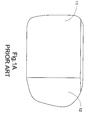
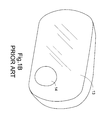
- a mirror consisting of two sections is developed to solve this problem, as shown in Fig. 1.
- the two sections may be two plane mirrors 11, 12 deflected from each other (Fig. 1A) by a fixed angle, or one plane mirror 13 and one curved bump 14 (Fig. 1B).
- This kind of rearview mirror although improves the view angle to some extent, still has the following disadvantages.
- the manufacturing and assembling processes of the two-sectional mirror are complicated.
- the outer section of the mirror is generally small, so it is uneasy for the driver to watch it clearly, especially for the mirror at the passenger's side.
- the view angles of the rearview mirrors can be automatically adjusted in order to avoid any blind spot.
- the driver clearly sees the right lane by rotating the exterior rearview mirror at the right side of the vehicle outwards.
- the rotating angle of the rearview mirror depend on the turning angle of the vehicle.
- an object of the present invention is to provide a control device and method, which can adjust the view angle of the rearview mirror automatically while the vehicle is turning.
- Another object of the present invention is to provide a control device and method, which can adjust the view angle of the rearview mirror dynamically according to the turning angle of the vehicle.
- a first aspect of the present invention relates to a control method for automatically adjusting a view angle of a monitoring device of a turning vehicle.
- the method includes steps of receiving an output of a navigation system; determining a turning operation of the vehicle according to the output of the navigation system; and triggering the monitoring device to move in response to the turning operation of the vehicle.
- the movement of the monitoring device is adjusted dynamically.
- the method further includes a step of determining a turning level of the turning operation, and the monitoring device is triggered to move to an extent corresponding to the turning level.
- the monitoring device for example, can be an exterior rearview mirror and/or a charge-coupled device (CCD) camera.
- CCD charge-coupled device
- the turning level of the vehicle can be determined by comparing the output of the electronic compass with a preset value. Therefore, it is preferred that the receiving, comparing and triggering steps are repeated to dynamically adjust a view angle of the rearview mirror of the vehicle.
- the control method further includes a step of counting a time period to determine the preset value.
- the time period is accumulatively counted when the turning level is kept to be zero, and the time period is counted over whenever the turning level is determined to be non-zero.
- the output of the electronic compass is indicative of one of sixteen direction zones
- the preset value is indicative of one of the sixteen direction zones
- the turning level is determined to be zero when the output of the electronic compass and the preset value indicate the same direction zone.
- the output of the electronic compass replaces for the preset value to serve as a new preset value, and the rearview mirror is triggered to be restored to its initial position when the counted time period exceeds a predetermined value, e.g. 2 seconds.
- the turning level correlates to an angle between the direction zones indicated by the output of the electronic compass and the preset value.
- the navigation system is a global positioning system (GPS).
- GPS global positioning system
- the turning level correlates to a predetermined turning angle under the guidance of the GPS.
- the control method further includes a step of triggering the rearview mirror to be restored to its initial position when the GPS indicates the completion of a turning operation by the predetermined turning angle.
- a second aspect of the present invention relates to a control device for automatically adjusting a view angle of a monitoring device of a turning vehicle.
- the control device includes a microprocessor which repetitively receives an output of the navigation system, determines a turning operation of the vehicle according to the output of the navigation system, and triggers the monitoring device to move in response to the turning operation of the vehicle.
- the movement of the monitoring device is adjusted dynamically.
- the microprocessor further determines a turning level of the turning operation, and the monitoring device is triggered to move to an extent corresponding to the turning level.
- a third aspect of the present invention relates to a control device for automatically adjusting a view angle of a rearview mirror of a turning vehicle in response to the output of a global positioning system (GPS).
- the control device includes a microprocessor electrically connected to the GPS and a controller area network (CAN) bus.
- the microprocessor monitors the output of the GPS.
- the microprocessor sends out a digital encoding signal to a rearview-mirror actuating device via the CAN bus to trigger the rearview-mirror actuating device to rotate the rearview mirror.
- the rotation of the rearview mirror is preferably dynamically adjusted.
- a fourth aspect of the present invention relates to a control device for automatically adjusting a view angle of a rearview mirror of a turning vehicle in response to the output of an electronic compass.
- the control device includes a microprocessor electrically connected to the electronic compass and a controller area network (CAN) bus.
- the microprocessor monitors the output of the electronic compass. When the output of the electronic compass indicates that the vehicle is heading a direction different from a preset direction, the microprocessor sends out a digital encoding signal to a rearview-mirror actuating device via the CAN bus to trigger the rearview-mirror actuating device to rotate the rearview mirror.
- the rotation of the rearview mirror is preferably dynamically adjusted.
- control device further includes a timer electrically connected to the microprocessor for counting a time period, wherein the direction that the vehicle is heading replaces for the preset direction to serve as a new preset direction when the counted time period exceeds a predetermined value.
- the automatic view-angle adjusting function can be designed as a basic response of the vehicle. Alternatively, the function can be enabled by pressing a key or a button. It is also understood the flowchart of Fig. 2 is for illustrating one of the rear mirrors, and a similar operation may be applied to the other rearview mirror.
- an initial position of the rearview mirror is preset by adjusting the rearview mirror before driving. While the driver is turning the vehicle right, the turning angle of the vehicle is detected, and the rearview mirror rotates outwards dynamically in response to the turning angle of the vehicle in order to enlarge the view angle of the right side.
- the outward movement of the rearview mirror is preferably confined within a proper boundary. In other words, when the mirror reaches the moving boundary, the mirror will not rotate further even if the vehicle still turns. On the other hand, no matter if the mirror reaches the moving boundary or not, the mirror moves toward the initial position upon the vehicle returns to the forward direction.
- the mirror is rotated outward again in response to the turning operation of the vehicle.
- the turning operation of the vehicle for example, can be inferred from the output of an electronic compass or a global positioning system (GPS).
- GPS global positioning system
- the turning operation of the vehicle is determined by detecting the output of a vehicular electronic compass.
- an electronic compass works in response to the magnetic field of the earth, thereby identifying the travel direction of the vehicle.
- the operational principle of the electronic compass is understood by those skilled in the art, and will not be described here.
- the 360-degree circle the electronic compass is scheduled as a predetermined number of direction zones, e.g. 16 zones 1 ⁇ 16, each of which lies between two of the points N, NNE, NE, ENE, E, ESE, SE, SSE, S, SSW, SW, WSW, W, WNW, NW and NNW, as shown in Fig. 3.
- the vehicle makes a turn. For example, when the vehicle is heading the direction zone 1 and remains the direction for more than a predetermined time period, e.g. 2 seconds, the direction zone 1 will be set as a reference origin. Afterwards, the vehicle turns right to the direction zone 2. Meanwhile, the rearview mirror at the right side is actuated to rotate outwards to an extent corresponding to the turning operation of one direction zone. If the vehicle further turns right to the direction zone 3, the rearview mirror at the right side will be further rotated outwards to an extent corresponding to the turning operation of two direction zones.
- a predetermined time period e.g. 2 seconds
- the rearview mirror at the right side will return to the initial position, and then the rearview mirror will rotate outwards to an extent corresponding to a turning operation across one direction zone.
- the view angle of the rearview mirror can be automatically and dynamically adjusted in response to the turning angle of the vehicle.
- the view angle of the rearview mirror at the left side can be designed to stay unchanged when the rearview mirror at the right side rotates.
- the rearview mirror at the left side is preferably designed to rotate inwards when the rearview mirror at the right side rotate outwards.
- the rearview mirrors at both sides synchronously rotate in the same direction. This is especially advantageous when the vehicle is passing continuous curves. The driver is likely to be unable to see the situation at the right side via the rearview mirror at the right side when the vehicle is turning right. Therefore, the inward movement of the rearview mirror at the left side and the presence of the interior rearview mirror will be helpful for realizing the situation.
- a control device is used to coordinate the rearview mirror and the electronic compass.
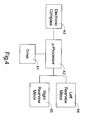
- Fig. 4 is a circuit functional block diagram schematically showing a preferred embodiment of the control device for use with an electronic compass according to the present invention.
- the control device includes a timer 41 and a microprocessor 42 or an application specific integrated circuit (ASIC).
- ASIC application specific integrated circuit
- the output of the electronic compass 43 representing a heading direction zone is transmitted to the microprocessor 42 to be compared with a preset value representing an initial direction zone, and the timer 41 starts to count at the same time.
- the microprocessor 42 When determining a change in direction zones by a first level within a predetermined period, e.g. 2 seconds, the microprocessor 42 outputs a control signal to rotate one or both of the left and right rearview mirrors 44 and 45 to a degree corresponding to the first level of direction change in a manner as mentioned above. It is understood that the timing operation can also be performed by the microprocessor 42 itself in a form of software so as to omit the timer 41. If the heading direction zone of the vehicle keeps unchanged during that predetermined period, the preset value will be replaced by another one representing the heading direction zone, and the counting operation of the timer 41 will start over. Meanwhile, the rearview mirrors are restored to their initial positions. The changing level of the direction zones is now based on the newly set direction zone.
- the turning operation of the vehicle is determined by detecting the output of a global positioning system (GPS).
- GPS global positioning system
- the GPS directs the moving path of a vehicle by communicating with different satellites orbiting the earth via radio waves.
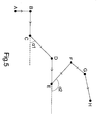
- the operational principle of the electronic compass is understood by those skilled in the art, and will not be describe herein. Please refer to Fig. 5 which is a schematic diagram exemplifying a route of the vehicle suggested by the GPS to travel from a start point A to a destination H.
- the route includes a substantially straight line from A to B, a right turn and then a straight line from B to C, a left turn and then a straight line from C to D, a right turn and a straight line from D to E, a left turn and then a straight line from E to F, a right turn and then a straight line from F to G, and another right turn and a straight line from G to H.
- the vehicle will make four right turns and two left turns to reach the destination H, and the GPS acquires the turning operations of the vehicle in advance. Whenever the vehicle gets to a position required to make a right turn by the GPS, i.e.
- the rearview mirror at the right side automatically rotates outwards to enlarge the view angle at the right side.
- the rearview mirror will return the initial position.
- the mirror may be restored to its initial position by counting a predetermined period, e.g. 2 seconds.
- the vehicle gets to a position required to make a left turn by the GPS, i.e. the position C, or E, the rearview mirror at the left side automatically rotates outwards to enlarge the view angle at the left side.
- the vehicle turns left at both of the positions C and E, the turning angles at the two positions are different. It is clear from Fig. 5 that the turning angle ⁇ 2 at the position E is larger than the turning angle ⁇ 1 at the position C. Therefore, the left-side rearview mirror at the position E will rotate outwards by an angle larger than the outward rotating angle of the rearview mirror at the position C.
- the rearview mirror at the right side can be designed or selected to keep unmoved or rotate along with the left-side rearview mirror when the rearview mirror at the left side rotates in response to a left-turn operation of the vehicle.
- a control device is used to coordinate the rearview mirror and the GPS.
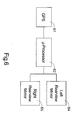
- Fig. 6 is a circuit functional block diagram schematically showing a preferred embodiment of the control device for use with a global positioning system (GPS) according to the present invention.
- the output of the GPS is transmitted to the microprocessor 62.
- the microprocessor 62 In response to the output of the GPS 61 indicative of a turning operation, the microprocessor 62 outputs a control signal to rotate one or both of the left and right rearview mirrors 64 and 65 to a degree corresponding to the first level of direction change in a manner as mentioned above. After the vehicle completes the turning operation, the rearview mirrors are restored to their initial position.
- the control device can be integrated into the computer system of the vehicle, and receives and transmits signals via a traditional communication network system or a controller area network bus (CAN-bus) system of a vehicle.
- CAN-bus controller area network bus
- it can be a control module added to an existent computer system of the vehicle especially via a CAN-bus system.
- a CAN-bus system is a communication standard for vehicles, which has been established since 1990 to communicate local computers with one another. Due to the arrangement of local computers or control modules, the numerous and complicated cables of various equipment of the vehicle are localized and simplified, and all the signals are transmitted among computers or control modules via the CAN-bus system. Consequently, the overall length and weight of the cables are significantly reduced.
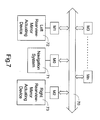
- Fig. 7 schematically shows the transmission of signals between a control device according to the present invention and rearview mirrors to be manipulated via a CAN-bus system.
- the present control module M0 is electrically connected between the CAN bus 70 and a navigation system 71.
- the control module M0 receives the output of a navigation system 71 such as an electronic compass or GPS, and transmits out a digital encoding signal to the CAN bus 70 to inform of a turning operation of the vehicle.
- a navigation system 71 such as an electronic compass or GPS
- all the local computers or control modules M1...Mn can acquire the information via the CAN bus.
- the digital encoding signal includes an ID code and a command code.
- the ID code directs to one or both of the control modules M1 and M2, so it is only the relevant control module(s) will respond to the digital encoding signal.
- the command code corresponds to a message for triggering the relevant rearview-mirror actuating device(s) 72 and/or 73, e.g. motor(s), to rotate the left and/or right rearview mirror(s).
- control device is used for adjusting the view angle of the rearview mirror in response to the output of the navigation system.
- the control device can also used to move the exterior CCD cameras that become basic equipment in luxury cars in response to the output of the navigation system.
Landscapes
- Engineering & Computer Science (AREA)
- Multimedia (AREA)
- Mechanical Engineering (AREA)
- Rear-View Mirror Devices That Are Mounted On The Exterior Of The Vehicle (AREA)
- Navigation (AREA)
Abstract
Description
Claims (16)
- A control method for automatically adjusting a view angle of a monitoring device of a turning vehicle, characterized in that the control method comprises steps of:receiving an output of a navigation system;determining a turning operation of the vehicle according to the output of the navigation system; andtriggering the monitoring device to move in response to the turning operation of the vehicle.
- The control method according to claim 1, characterized in that the control method further comprises a step of determining a turning level of the turning operation, the monitoring device being triggered to move to an extent corresponding to the turning level.
- The control method according to claim 2, characterized in that the navigation system is an electronic compass, the turning level of the vehicle is determined by comparing the output of the electronic compass with a preset value, and the receiving, comparing and triggering steps are repeated to dynamically adjust a view angle of the monitoring device of the vehicle.
- The control method according to claim 3, characterized in that the control method further comprises a step of counting a time period, wherein the time period is accumulatively counted when the turning level is kept to be zero, and the time period is counted over whenever the turning level is determined to be non-zero, and the output of the electronic compass replaces for the preset value to serve as a new preset value, and the monitoring device is triggered to be restored to its initial position when the counted time period exceeds a predetermined value.
- The control method according to claim 3, characterized in that the output of the electronic compass is indicative of one of sixteen direction zones, the preset value is indicative of one of the sixteen direction zones, and the turning level is determined to be zero when the output of the electronic compass and the preset value indicate the same direction zone, and the turning level correlates to an angle between the direction zones indicated by the output of the electronic compass and the preset value.
- The control method according to claim 2, characterized in that the navigation system is a global positioning system (GPS), and the turning level correlates to a predetermined turning angle under the guidance of the GPS.
- The control method according to claim 6, characterized in that the control method further comprises a step of triggering the monitoring device to be restored to its initial position when the GPS indicates the completion of a turning operation by the predetermined turning angle.
- The control method according to claim 1, characterized in that the monitoring device is an exterior rearview mirror or a charge-coupled device (CCD) camera.
- A control device for automatically adjusting a view angle of a monitoring device of a turning vehicle, comprising a microprocessor which repetitively receives an output of a navigation system, determines a turning operation of the vehicle according to the output of the navigation system, and triggers the monitoring device to move in response to the turning operation of the vehicle.
- The control device according to claim 9, characterized in that the microprocessor further determines a turning level of the turning operation, and the monitoring device is triggered to move to an extent corresponding to the turning level.
- The control device according to claim 9, characterized in that the navigation system is a global positioning system (GPS) or an electronic compass.
- The control device according to claim 11, characterized in that the microprocessor further performs a timing operation to accumulatively count a time period when the turning level is zero when the navigation system is an electronic compass, and the time period is counted over when the turning level is non-zero.
- The control device according to claim 11, characterized in that the control device further comprises a timer electrically connected to the microprocessor for counting a time period when the navigation system is an electronic compass, wherein the time period is accumulatively counted whenever the microprocessor determines the turning level is zero, and the time period is counted over whenever the microprocessor determines the turning level is non-zero.
- The control method according to claim 13, characterized in that the microprocessor has the output of the electronic compass replace for the preset value to serve as a new preset value, and triggers the monitoring device to be restored to its initial position when the counted time period exceeds a predetermined value.
- A control device for automatically adjusting a view angle of a monitoring device of a turning vehicle, characterized in that the control device comprises a microprocessor electrically connected to a global positioning system (GPS) and a controller area network (CAN) bus, the microprocessor receiving an output of the GPS, and sending out a digital encoding signal to a rearview-mirror actuating device via the CAN bus to trigger the rearview-mirror actuating device to rotate the monitoring device when the output of the GPS indicates that the vehicle arrives at a predetermined turning position.
- A control device for automatically adjusting a view angle of a monitoring device of a turning vehicle, characterized in that the control device comprises a microprocessor electrically connected to an electronic compass and a controller area network (CAN) bus, the microprocessor receiving an output of the electronic compass, and sending out a digital encoding signal to a rearview-mirror actuating device via the CAN bus to trigger the rearview-mirror actuating device to rotate the monitoring device when the output of the electronic compass indicates that the vehicle is heading a direction different from a preset direction.
Applications Claiming Priority (2)
| Application Number | Priority Date | Filing Date | Title |
|---|---|---|---|
| US10/047,762 US6756888B2 (en) | 2001-09-04 | 2002-01-15 | Control device and method for automatically adjusting view angle of rearview mirror in response to output of navigation system |
| US47762 | 2002-01-15 |
Publications (2)
| Publication Number | Publication Date |
|---|---|
| EP1327560A2 true EP1327560A2 (en) | 2003-07-16 |
| EP1327560A3 EP1327560A3 (en) | 2003-11-26 |
Family
ID=21950818
Family Applications (1)
| Application Number | Title | Priority Date | Filing Date |
|---|---|---|---|
| EP02018787A Withdrawn EP1327560A3 (en) | 2002-01-15 | 2002-08-22 | Control device and method for automatically adjusting view angle of rearview mirror in response to output of navigation system |
Country Status (3)
| Country | Link |
|---|---|
| EP (1) | EP1327560A3 (en) |
| JP (1) | JP2003212042A (en) |
| CN (2) | CN1416034A (en) |
Cited By (2)
| Publication number | Priority date | Publication date | Assignee | Title |
|---|---|---|---|---|
| DE102010051205A1 (en) | 2010-11-12 | 2012-05-16 | Valeo Schalter Und Sensoren Gmbh | A method of displaying images on a display, camera system and motor vehicle with a camera system |
| EP2676845A1 (en) * | 2012-06-22 | 2013-12-25 | Bayerische Motoren Werke Aktiengesellschaft | A method and system for dynamically adjusting a vehicle mirror |
Families Citing this family (5)
| Publication number | Priority date | Publication date | Assignee | Title |
|---|---|---|---|---|
| JP2005199910A (en) * | 2004-01-16 | 2005-07-28 | Nissan Motor Co Ltd | Mirror control device for vehicle and mirror control method for vehicle |
| CN103350661B (en) * | 2013-07-25 | 2017-06-16 | 上海虎印电子科技有限公司 | A kind of turn inside diameter condition checkout gear and its determination methods based on electronic sensor |
| KR102052525B1 (en) * | 2013-10-08 | 2019-12-05 | 현대모비스 주식회사 | Electronic Chromic Mirror Apparatus and Method Thereof |
| CN106274699B (en) * | 2015-05-28 | 2021-04-23 | 小米科技有限责任公司 | Method and device for adjusting vehicle rearview mirror and vehicle |
| CN106394412A (en) * | 2016-09-30 | 2017-02-15 | 北京汽车股份有限公司 | Automobile as well as exterior rearview mirror control system and control method thereof |
Family Cites Families (9)
| Publication number | Priority date | Publication date | Assignee | Title |
|---|---|---|---|---|
| US5719713A (en) * | 1994-02-28 | 1998-02-17 | Ultra-View Technology, Inc. | Automatic side view mirror tracking system |
| JPH08207665A (en) * | 1995-02-08 | 1996-08-13 | Nippondenso Co Ltd | Rearview mirror angle controller |
| JPH10138838A (en) * | 1996-11-08 | 1998-05-26 | Toyota Motor Corp | Mirror control device |
| JPH10287177A (en) * | 1997-04-15 | 1998-10-27 | Toyota Motor Corp | Front image capturing device for vehicle and guidance display device for vehicle |
| JP4294145B2 (en) * | 1999-03-10 | 2009-07-08 | 富士重工業株式会社 | Vehicle direction recognition device |
| DE10000215A1 (en) * | 2000-01-05 | 2001-07-12 | Bosch Gmbh Robert | Device for adjusting a rear-view mirror for a motor vehicle |
| DE10016222A1 (en) * | 2000-03-31 | 2001-10-31 | Volkswagen Ag | Electrical adjustment of outside mirror of motor vehicle when changing lanes based on angle at which change is made |
| JP2001294086A (en) * | 2000-04-17 | 2001-10-23 | Auto Network Gijutsu Kenkyusho:Kk | Vehicle periphery recognition device |
| JP3799988B2 (en) * | 2000-10-23 | 2006-07-19 | いすゞ自動車株式会社 | Rearview mirror device |
-
2002
- 2002-08-22 EP EP02018787A patent/EP1327560A3/en not_active Withdrawn
- 2002-09-02 CN CN 02141563 patent/CN1416034A/en active Pending
- 2002-09-02 CN CN 200410089612 patent/CN1607482A/en active Pending
- 2002-09-13 JP JP2002268159A patent/JP2003212042A/en active Pending
Cited By (3)
| Publication number | Priority date | Publication date | Assignee | Title |
|---|---|---|---|---|
| DE102010051205A1 (en) | 2010-11-12 | 2012-05-16 | Valeo Schalter Und Sensoren Gmbh | A method of displaying images on a display, camera system and motor vehicle with a camera system |
| WO2012062689A1 (en) | 2010-11-12 | 2012-05-18 | Valeo Schalter Und Sensoren Gmbh | Method for displaying images on a display device, a camera system and motor vehicle having a camera system |
| EP2676845A1 (en) * | 2012-06-22 | 2013-12-25 | Bayerische Motoren Werke Aktiengesellschaft | A method and system for dynamically adjusting a vehicle mirror |
Also Published As
| Publication number | Publication date |
|---|---|
| CN1416034A (en) | 2003-05-07 |
| JP2003212042A (en) | 2003-07-30 |
| EP1327560A3 (en) | 2003-11-26 |
| CN1607482A (en) | 2005-04-20 |
Similar Documents
| Publication | Publication Date | Title |
|---|---|---|
| US6756888B2 (en) | Control device and method for automatically adjusting view angle of rearview mirror in response to output of navigation system | |
| US20040212484A1 (en) | Control device and method for automatically adjusting view angle of rearview angle of outside camera in response to output of navigation system | |
| US11292415B2 (en) | Airbag device and vehicle | |
| JP6795036B2 (en) | Delivery support method and equipment | |
| JP4752486B2 (en) | Imaging device, video signal selection device, driving support device, automobile | |
| US6946978B2 (en) | Imaging system for vehicle | |
| US7012510B2 (en) | Device and method for adjusting view range of vehicular monitoring device | |
| US20140058653A1 (en) | Driver assistance system for a vehicle | |
| JP7593806B2 (en) | Vehicle operation system, vehicle control device, vehicle operation method, and vehicle operation program | |
| CZ20031238A3 (en) | Vehicle equipped with a device for visual signaling | |
| JP2018176793A (en) | Vehicle seat device | |
| US20200001815A1 (en) | Occupant restraint structure | |
| US20080143833A1 (en) | Image Pickup Device and Image Pickup Method | |
| US20200278743A1 (en) | Control device | |
| EP1327560A2 (en) | Control device and method for automatically adjusting view angle of rearview mirror in response to output of navigation system | |
| KR20160037045A (en) | Rear view mirror assembly | |
| WO2017154316A1 (en) | Vehicle display control device, vehicle display system, vehicle display control method, and program | |
| EP1338473A2 (en) | Device and method for adjusting view range of vehicular monitoring device | |
| EP1332927A2 (en) | Vehicular wireless transmission control assembly | |
| EP1555159B1 (en) | Vehicle situation monitoring apparatus and vehicle situation monitoring method | |
| JP4661339B2 (en) | Moving object detection device for vehicle | |
| JP6881562B2 (en) | Delivery support method and equipment | |
| US20180272942A1 (en) | Controlling side-view mirrors in autonomous vehicles | |
| EP1356989B1 (en) | Device and method for actuating and positioning vehicular monitoring device | |
| GB2397189A (en) | Forward looking road monitoring system for vehicles |
Legal Events
| Date | Code | Title | Description |
|---|---|---|---|
| PUAI | Public reference made under article 153(3) epc to a published international application that has entered the european phase |
Free format text: ORIGINAL CODE: 0009012 |
|
| AK | Designated contracting states |
Designated state(s): AT BE BG CH CY CZ DE DK EE ES FI FR GB GR IE IT LI LU MC NL PT SE SK TR |
|
| AX | Request for extension of the european patent |
Extension state: AL LT LV MK RO SI |
|
| PUAL | Search report despatched |
Free format text: ORIGINAL CODE: 0009013 |
|
| AK | Designated contracting states |
Kind code of ref document: A3 Designated state(s): AT BE BG CH CY CZ DE DK EE ES FI FR GB GR IE IT LI LU MC NL PT SE SK TR |
|
| AX | Request for extension of the european patent |
Extension state: AL LT LV MK RO SI |
|
| 17P | Request for examination filed |
Effective date: 20031211 |
|
| AKX | Designation fees paid |
Designated state(s): AT BE BG CH CY CZ DE DK EE ES FI FR GB GR IE IT LI LU MC NL PT SE SK TR |
|
| 17Q | First examination report despatched |
Effective date: 20050610 |
|
| STAA | Information on the status of an ep patent application or granted ep patent |
Free format text: STATUS: THE APPLICATION IS DEEMED TO BE WITHDRAWN |
|
| 18D | Application deemed to be withdrawn |
Effective date: 20051021 |