EP1326257B1 - Pipelined programming for a NAND type flash memory - Google Patents
Pipelined programming for a NAND type flash memory Download PDFInfo
- Publication number
- EP1326257B1 EP1326257B1 EP02252805A EP02252805A EP1326257B1 EP 1326257 B1 EP1326257 B1 EP 1326257B1 EP 02252805 A EP02252805 A EP 02252805A EP 02252805 A EP02252805 A EP 02252805A EP 1326257 B1 EP1326257 B1 EP 1326257B1
- Authority
- EP
- European Patent Office
- Prior art keywords
- page
- data
- memory array
- programming
- memory
- Prior art date
- Legal status (The legal status is an assumption and is not a legal conclusion. Google has not performed a legal analysis and makes no representation as to the accuracy of the status listed.)
- Expired - Lifetime
Links
Images




Classifications
-
- G—PHYSICS
- G11—INFORMATION STORAGE
- G11C—STATIC STORES
- G11C16/00—Erasable programmable read-only memories
- G11C16/02—Erasable programmable read-only memories electrically programmable
- G11C16/06—Auxiliary circuits, e.g. for writing into memory
- G11C16/34—Determination of programming status, e.g. threshold voltage, overprogramming or underprogramming, retention
- G11C16/3436—Arrangements for verifying correct programming or erasure
- G11C16/3468—Prevention of overerasure or overprogramming, e.g. by verifying whilst erasing or writing
- G11C16/3481—Circuits or methods to verify correct programming of nonvolatile memory cells whilst programming is in progress, e.g. by detecting onset or cessation of current flow in cells and using the detector output to terminate programming
-
- G—PHYSICS
- G11—INFORMATION STORAGE
- G11C—STATIC STORES
- G11C16/00—Erasable programmable read-only memories
- G11C16/02—Erasable programmable read-only memories electrically programmable
- G11C16/06—Auxiliary circuits, e.g. for writing into memory
- G11C16/10—Programming or data input circuits
-
- G—PHYSICS
- G11—INFORMATION STORAGE
- G11C—STATIC STORES
- G11C16/00—Erasable programmable read-only memories
- G11C16/02—Erasable programmable read-only memories electrically programmable
- G11C16/06—Auxiliary circuits, e.g. for writing into memory
- G11C16/24—Bit-line control circuits
-
- G—PHYSICS
- G11—INFORMATION STORAGE
- G11C—STATIC STORES
- G11C7/00—Arrangements for writing information into, or reading information out from, a digital store
- G11C7/10—Input/output [I/O] data interface arrangements, e.g. I/O data control circuits, I/O data buffers
- G11C7/1015—Read-write modes for single port memories, i.e. having either a random port or a serial port
- G11C7/1039—Read-write modes for single port memories, i.e. having either a random port or a serial port using pipelining techniques, i.e. using latches between functional memory parts, e.g. row/column decoders, I/O buffers, sense amplifiers
-
- G—PHYSICS
- G11—INFORMATION STORAGE
- G11C—STATIC STORES
- G11C2216/00—Indexing scheme relating to G11C16/00 and subgroups, for features not directly covered by these groups
- G11C2216/12—Reading and writing aspects of erasable programmable read-only memories
- G11C2216/14—Circuits or methods to write a page or sector of information simultaneously into a nonvolatile memory, typically a complete row or word line in flash memory
Definitions
- the invention relates generally to the field of electronic memory design, and in particular to techniques for improving performance in a NAND type flash memory.
- a flash memory can replace a bulk storage medium such as a hard disk, and is used in, for example, digital cameras, and voice mail systems.
- a NAND Flash memory cell array typically includes several single bit storage transistors, i.e., memory cells, in series. These memory cells are organized into pages. For example, a page may include 512 bytes (4096 bits). There are several pages per block, where erasing is done on a per block basis. Read access to the memory cell array is by page. Given a starting page address, sequential pages may be read out quickly, for example, with a 50 nsec cycle time per byte. Access to a byte within a page is done sequentially.
- Writing a page to the memory cell array is done in two steps: first, the address and data are written to an internal register, i.e., page buffers; and second, a special command initiates the writing, i.e., programming, of the data in the internal register to the non-volatile memory cell array.
- the writing of the data is done only on a per page basis. While the read access is fast, write time is slow, for example 200 ⁇ sec.
- FIG. 1 is a simplified architecture of a typical prior art NAND type flash memory device.
- the NAND Flash memory architecture 110 includes a State Machine 112, a Command Register 114, and an Address Register 116, a Status Register 118, a Memory Array 120, a Y Decoder 122, Page Buffers 124, a X-Decoder 126, and I/O Registers 132.
- the I/O Registers 132 receive input/output to the memory device through the I/O Ports 134.
- the I/O Ports 134 receive a page address, which is sent to the Address Register 116.
- the I/O Registers 132 next receive data for that address.
- This data is sent to the Y-Decoder 122 and written in Page Buffers 124, for example, page 130, using the address from the Address Register 116 via the X-Decoder 126.
- Each rising edge of a write enable bar (WEbar) signal 136 writes one byte of data from the I/O Registers 134 to eight one-bit page buffers in Page Buffers 124.
- a programming control signal from the Ready/Busy Line then writes the data in the Page Buffers 124 to the memory cells in Memory Array 120, e.g., page 130.
- To read a page e.g.
- the page address in Page Address Register 116 is sent to the X-Decoder 126 to access the page, and write it to the Page Buffers 124 for reading.
- the Read Enable bar (REbar) signal 138 is used to read out the data to the I/O Registers 132.
- FIG. 2 is a simplified and expanded block diagram of a typical Memory Array 120 of the prior art.
- FIG. 2 shows a plurality of blocks of data, for example blocks 212, 214, 218, 222 and 220.
- Page_i 242 includes 512 memory cells, e.g., 244, 246, and 248, where each memory cell stores one bit.
- Each memory cell within a page is programmed by 512 parallel bit lines (BL), e.g., BL0 230 for cell 244, BL1 232 for cell 246, and BL511 234 for cell 248.
- BL parallel bit lines
- All 512 memory cells in a page, e.g., Page_i 240, are programmed concurrently.
- Each block, e.g., block 212 has an associated seven other blocks, e.g., 214, 218, and five other blocks (not shown). This group of blocks is programmed (and read) in parallel, so that bytes of data, rather than bits of data, may be accessed per page, e.g., 512 bytes for Page_i 242.
- each block e.g., block 212 has a plurality of pages, e.g., Page_i 242, where each page, e.g., Page_i 242, has 512 bits concurrently programmed by bit lines BL0 230 to BL511 234.
- each block is eight bits deep, e.g., blocks 212 to 218, so that Page_i has 512 bytes programmed (and read) in parallel.
- FIG. 3 is an example of an expanded view of the Page Buffers 124 for 512 bits.
- Page Buffer 312 is an example page buffer for one bit.
- the Page Buffer 312 is one Page Buffer of the plurality of Page Buffers 124 in FIG. 1 .
- the Page Buffer 312 includes a data line, DATA 1 314 that receives one bit of data from I/O Registers 132 via the Y-Decoder 122 of FIG. 1 upon the rising edge of WEbar 136.
- DATA 1 314 is stored using a "keeper,” having back-to-back inverters, i.e., inverter 334 and inverter 336.
- a keeper having back-to-back inverters, i.e., inverter 334 and inverter 336.
- transistor 332 turns on, and when BL CONTROL 326 is high, the value stored in the keeper is then sent to bit line BL1 232 and used to program, for example, memory cell 246 in Page_i 242 of FIG. 2 .
- FIG. 4 is a simplified timing diagram showing the writing process of a typical NAND type flash memory of the prior art.
- An example NAND Flash memory device is the Advanced Micro Devices (AMD) C-MOS 3.0 volt-only NAND Flash Memory Am3LV0128D.
- the write enable bar (WEbar) 412 shows a plurality of write pulses, e.g., rising edges 414, 416, and 418.
- the data 420 is read from the I/O Registers 132 and written into the Page Buffers 124 at each rising edge of WEbar 412 e.g., 414, 416, 418.
- DATA0 422 one byte
- WEbar 412 is written into its eight page buffers on the rising edge of 414 of WEbar 412.
- the Ready/Busy Line (R/B) 430 transitions from high to low 432 to start the programming of the data in the Page Buffers 124 into a page, e.g. page 130, in Memory Array 120 ( FIG. 1 ).
- the programming time 434 is a pulse typically lasting approximately 200-250 microseconds. From FIG. 4 , for each data write of a page into the memory array, there is a series of write enable pulses to input data into the page buffers, followed by a programming pulse to program the page into the memory array. The problem is that this sequential process of input data - program page, input next data - program next page, etc., for writing a plurality of sequential pages is time consuming.
- US 5 519 847 discloses a method of increasing the data throughput of a memory device including a page buffer.
- Data throughput is increased by pipelining write operations such that one plane of the page buffer is being used to program the memory array of the device while the other plane of the page buffer is being loaded with data to be used in the next program operation.
- the first write operation is set up by loading a first block of data in to the first plane of the page buffer.
- the first operation begins by commanding the memory device to program the memory array with the first block of data stored in the first plane.
- the second write operation is setup immediately following the first command to program.
- the second write operation is setup by loading a second block of data into the second plane of the page buffer. Loading of the second plane occurs while the memory array is being programmed from the first plane.
- the second write operation begins by commanding the array controller to program the flash memory array with the second block of data stored in the second plane.
- EP 1 280 161 a patent application falling within the terms of Article 54(3) EPC, discloses a memory device having an array of memory cells to store data, and a Y-gating circuit to gate data stored in a group of the memory cells.
- a page buffer is coupled between the memory cell array and the Y-gating circuit.
- the page buffer includes a dual register corresponding to each memory cell of the group.
- the dual register includes a first register and an associated second register. The first and second registers are adapted to exchange data with each other, with cells of the memory cell array, and with the Y-gating circuit.
- the present invention provides techniques, including a system and method, for reducing the total time for writing a plurality of pages to a flash memory array, e.g. of the NAND type.
- An embodiment of the present invention provides a system for improving performance in a flash memory array including a first memory array and a second memory array.
- the system includes: a first buffer circuit for receiving a first data item; a first memory cell in the first memory array that is programmed using the first data item; a second buffer circuit for receiving a second data item while the first memory cell is programmed using the first data item; a switch for transferring the second data item to the first buffer circuit; and a third buffer circuit for receiving the reading of a second memory cell in the second memory array, while the first memory cell is programmed using the first data item.
- the system may comprise an input output register configured to supply the first data item to the second buffer circuit, wherein the switch is configured to transfer the first data item in the second buffer circuit to the first buffer circuit, and wherein the second buffer circuit is configured to receive the second data item from the input output register while the first memory cell is programmed using the first data item.
- the system may comprise a status register for verifying the programming of the first memory cell.
- the invention also provides a method for transferring a plurality of pages to and from a flash memory array including a first memory array and a second memory array, the method comprising: receiving a first data input, that comprises a first page, wherein said first data input is received by a first buffer circuit; programming said first page into a plurality of memory cells of said first memory array; receiving a second data input that comprises a second page in parallel with said programming said first page wherein said second data input is received by a second buffer circuit; transferring said second data input from said second buffer circuit to said first buffer circuit; and reading a third page from said second memory array in parallel with said programming of said first page.
- FIG. 1 is a simplified architecture of a typical prior art NAND type flash memory device
- FIG. 2 is a simplified and expanded block diagram of a typical memory array of the prior art
- FIG. 3 is an example of an expanded view of typical Pagebuffers of the prior art for 512 bits
- FIG. 4 is a simplified timing diagram showing the writing process of a typical NAND type flash memory of the prior art
- FIG. 5 is a simplified timing diagram illustrating pipelined programming of a flash memory
- FIG. 6 is a table showing a conventional write sequence for three consecutive pages of a conventional NAND type Flash memory
- FIG. 7 is a table illustrating an example of pipelining the writing of a plurality of pages to a flash memory array
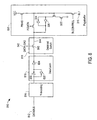
- FIG. 8 is a system diagram of a pagebuffer for one bit
- FIG. 9 illustrates a simplified block diagram of a pipelining system
- FIG. 10 is a simplified flowchart illustrating pipelined programming
- FIG. 11 illustrates an example of writing three pages to a flash memory array
- FIG. 12 shows an embodiment of the present invention that splits the memory array into a plurality of parts
- FIG. 13 illustrates an example of writing and reading three pages according to an embodiment of the present invention.
- FIG. 5 is a simplified timing diagram illustrating pipelined programming of a flash memory array.
- the WEbar signal 512 has two groups of pulses, a first group 514 inputting a page from the I/O Registers 132 into Pagebuffers 124, and a second group 516 inputting the next page from the I/O Registers 132 into Pagebuffers 124.
- the data is shown by Data signal 520 that has a corresponding first group of 512 butes, e.g. 522, 524, 526 for the first page, and a second group of 512 bytes, e.g., 530, 532, and 534, for the next page.
- the second group 516 of WEbar 512 pulses inputs the second group of data, e.g., 530, 532, and 534, for the next page into the Pagebuffers 124.
- This allows pipelined programming of Memory Array 120, because at the next programming time after programming time 544, the data in the Page Buffers is ready to be programmed. This is an advantage over the prior art, where the Memory Array needed to wait until the group of data for the next page was input into the Page Buffers 124 before programming could start (e.g., FIG. 4 ).
- FIG. 6 is a table showing a conventional write sequence for three consecutive pages of a conventional NAND Flash memory.
- Table 610 shows the time intervals 612, for example, ta1 614, ta2 616, ta3 618, ta4 620, ta5 622, and ta6 624.
- Page 1 630 has data input 640 at time interval ta1 614, followed by the programming of page 1 642 at time interval ta2 616.
- Page 2 632 must wait until page 1 630 is finished programming its page 642, before it may input data 644 at time interval ta3 618. Page 2 632 then programs its page 646 at time interval ta4 620. Similarly page 3 634 must wait until time interval ta5 622 before it may input data 650.
- the sequence for programming each page into the memory array includes a data input followed by programming the page, where the next page may not start inputting data into the page buffer until the previous page has finished programming the page into the memory array.
- the Status Register 118 may be used to monitor the progress of the programming cycle and should be checked after the end of the programming cycle to verify that programming was successful. Hence the Status Register 118 may be checked during and after programming of a page.
- reading the Status Register 118 to verify the programming of a page can occur for example, for page 1 630 at ta3 618, for page 2 632 at ta5 622, and so forth.
- verifying the programming of a page i.e., reading the Status Register, can occur at, for example, ta3 for page 1 630, ta4 620 for page 2, and ta5 622 for page 3 634.
- FIG. 7 is a table 710 illustrating an example of pipelining of the writing of pages to a flash memory.
- Page 1 630 has data input 640 at time interval ta1 614, followed by page programming 642 at time interval ta2 616.
- Page 2 632 is now pipelined such that the data input 644 may start at time interval ta2 616 rather than at time interval ta3 618 as in FIG. 6 .
- Page 2 programming 646 at time interval ta3 618 follows the data input 644.
- Page 3 likewise, is pipelined such that data input 650 may start at time interval ta3 rather than at time interval ta5 622 as in FIG. 6 .
- Page 3 programming 652 at time interval ta4 620 follows data input 650.
- the pipelining embodiment of FIG. 7 has reduced the programming time by several time intervals, e.g., ta5 622 and ta6 624, and hence improved the performance of writing to the NAND type Flash memory.
- FIG. 8 is a system diagram of an embodiment of a pagebuffer for one bit.
- FIG. 8 has a Data Bus 812, which is input to a Y-decoding circuit 814. One bit is shown outputting Y-decoding circuit 814 and being input into Data Latch 816. The output of the Data Latch 816 is coupled to a Data Load Switch 818, which outputs the one bit through signal line 844 to Pagebuffer 820.
- the example of Pagebuffer 820 is substantially similar to the Pagebuffer 312 in FIG. 3 .
- Pagebuffer 820 outputs a bit line, e.g., BL 1 316 into the Memory Array 120 to program a memory cell, e.g., memory cell 246 ( FIG.
- the Data Latch 816 includes a keeper, which has back-to-back inverters, 830 and 832. The output of the keeper then goes to inverter 834 to correct the inversion of the keeper.
- the Data Latch 816 functions to store the data of the next page, while the present page data, stored in the page buffer, is being programmed into the memory array.
- the Data Load Switch 818 includes a nMOS transistor 840 which acts as an on and off switch to connect or disconnect the Data Latch 816 to Pagebuffer 820 depending on the high or low value of the Dataload signal 842, respectively.
- the Data Latch 816 includes a register, memory cell, or any other storage device, volatile or non-volatile.
- the Data Load Switch 818 includes a pMOS transistor, a combination of one or more CMOS transistors, a logic gate, a tri-state circuit, a network switch, or any other on-off switching circuit.
- the Pagebuffer 820 includes a register, memory cell, or any other storage device, volatile or non-volatile. While FIG. 8 shows the implementation for one bit, one of ordinary skill in the art can extend it to the rest of the memory array, for example, FIG. 2 and FIG. 3 .
- FIG. 9 illustrates a simplified block diagram of another pipelining system.
- the I/O Registers 132 sends data through Data Bus 912 to Y-Decoder 914 to be stored in an intermediary storage, Intermediate Buffers 916.
- Intermediate Buffers 916 When a Switch 918 is turned on, the data in Intermediate Buffers 916 is passed to Page buffers 920. The data in Pagebuffers 920 is then programmed into the NAND type Flash Memory Array 922 on a page-by-page basis.
- the Switch 918 acts as a wall that allows the Page buffers 920 and the Intermediate Buffers 916 to operate concurrently. Thus page data of the next page maybe stored in Intermediate Buffers 916 concurrently or in parallel with data of the present page in Pagebuffers 920 being programmed into Memory Array 922.
- FIG. 10 is a simplified flowchart illustrating pipelined programming.
- the Page Buffer is initially loaded with data. For example, this includes a data bit coming from the Data Bus 812 through Y-Decoding 814 to Data Latch 816.
- the Dataload Signal 842 is high and transistor 840 passes the data bit directly into Page Buffer 820 where it is stored in back-to-back inverters 334 and 336.
- the Dataload signal is set low, turning off the Dataload Switch 818.
- a memory cell in the Memory Array 120 FIG. 1
- a memory cell in the Memory Array 120 FIG. 1
- step 1014 one page is loaded into the Pagebuffers 920 and at step 1018, the whole page is programmed into the memory array 922.
- a partial page programming may be done as in the case of the AMD/Fujitsu NAND Flash Memory Am3LV0128D/MBM30LV0128.
- step 1016 data from the next page is input into Intermediate Buffers 916 (step 1016).
- step 1020 the programming of the page into the Memory Array 922 is verified by examining the Status Register 118 ( FIG. 1 ).
- step 1022 if the programming has not been verified, the page is again programmed into the array again at step 1018. If verified, then at step 1024, the data of the next page is checked to see if the data has been loaded properly into the Intermediate Buffers 916. If no, the process ends at 1026. This means either there is an error or there needs to be a wait until the data can finish loading or reloading into the Intermediate Buffers 916. If the data has been loaded successfully into Data Latch 816, then the Switch 918 is turned on, and the next page data is then transferred from the Intermediate Buffers 916 into the Pagebuffers 920 (step 1030). And after the transfer the Switch 918 is turned off.
- next page in the Pagebuffers 920 is then programmed concurrently with another subsequent page (i.e., next-next page) being loaded into the Immediate Buffers 916.
- next-next page is then programmed concurrently with another subsequent page (i.e., next-next page) being loaded into the Immediate Buffers 916.
- the above process is repeated until all the pages in the series of pages to be written are programmed into the Memory Array 922.
- FIG.11 illustrates an example of writing three pages.
- FIG.11 shows a table 1110, showing three consecutive pages, e.g., page 1 1140, page 2 1142, and page 3 1144, being written into the memory array.
- the time intervals 1112 include tb1 1114, tb2 1116, tb3 1118, tb4 1120, tb5 1122, tb6 1124, and tb7 1126.
- the time intervals representing the data load e.g., tb2 1116, tb4 1120, and tb6 1166, are relatively short as the Data Load Switch, e.g., switch 818 in FIG.
- Page 1 1140 latches the input data 1150 into Data Latch 816 at time interval tb1 1114.
- Data Load Switch 818 is then turned on and the data is loaded 1152 into Pagebuffer 820 at time interval tb2 1116.
- the data stored in Pagebuffer 820 is then programmed into a memory cell via the associated bit line, at time interval tb3 1118.
- Next data from page 2 1142 is input 1156 into Data Latch 916 at time interval tb3 1118, which is during the same time interval that page 1 1140 is being programmed 1154.
- Page 3 1144 starts at time interval tb5 1122 and proceeds similarly to page 2 1142 except shifted in time, i.e., latch input data 1164, data load 1166, and program 1170.
- one of the major advantages of pipelining is the reduction in total write time for a plurality of pages to be written to the memory array. This results occurs, after the pipeline is filled, because the next page data input to the intermediate storage, e.g., data latch, happens in parallel with the programming of the current page data stored in the page buffers.
- the intermediate storage e.g., data latch
- FIG. 12 is an embodiment of the present invention that splits the memory array into a plurality of parts.
- the two memory arrays are shown for illustration purposes only as a first memory array 1230 and a second memory array 1232. In another embodiment both memory arrays 1230 and 1232 are part of the same memory array 120 ( FIG. 1 ).
- FIG. 12 includes a Y-Decoder 1212, Intermediate Buffers 1216, a Switch (or switches) 1220, Pagebuffers 1224, first memory array 1230, that has the even number bit lines (BL), and second memory array 1232 that has the odd number bit lines (BL).
- the memory circuit 1210 functions similarly to that of the memory circuit 910 in FIG. 9 , except on every other BL for each part of the memory array. Thus a page may be written to first memory array 1230 concurrently with another page being read from second memory array 1232.
- the plurality of parts of the memory array may have more than two parts and be divided into fixed or arbitrary sizes.
- FIG. 13 illustrates an example of writing and reading three pages of an embodiment of the present invention.
- FIG. 13 shows a table 1310, showing three consecutive pages, e.g., page 1 1340, page 2 1342, and page 3 1344, being written into and read from a memory array , e.g., the memory array 120 of FIG. 1 or the two memory arrays 1230 and 1232 in FIG. 12 .
- the time intervals 1312 include tc1 1314, tc2 1316, tc3 1318, tc4 1320, tc5 1322, tc6 1324, tc7 1326, and tc8 1328.
- Page 1 1340 stores the input data 1350 into Intermediate Buffers 1216 at time interval tc1 1314.
- Switch 1220 is then turned on and the data is loaded at 1352 into Pagebuffers 1224 at time interval tc2 1316.
- the data stored in Pagebuffers 1224 is then programmed 1354 into the first memory array 1230 at time interval tc3 1318.
- Next data from page 2 1342 is stored 1356 into Intermediate Buffers 1216 at time interval tc3 1318, which is during the same time interval that page 1 1340 is being programmed 1354.
- time interval tc4 1320 the data for page 2 1342 is loaded 1358 from the Intermediate Buffers 1216 into the Pagebuffer 1224, and then programmed 1362 at time interval tc5 1322 into second memory array 1232.
- time interval tc5 is an example when page 1 is being read from the first memory array 1230, page 2 is being programmed into the second memory array 1232, and page 3 is being stored in the intermediate buffers 1216, where all three operations are done in parallel.
- writing and reading is done alternatively from memory arrays 1230 and 1232, where each memory array 1230 and 1232 represent different parts of memory array 120 in FIG.1 , reading and writing pages can occur in parallel.
- the memory array 120 may have other combinations of bit lines, for example, 512 BL's for a first page followed by 512 BL's for a second page, or groups of BL's representing, part of one or more pages. There may be also a programmable switch between the Pagebuffers 1224 and the memory arrays 1230 and 1232 in order to route the bits to the appropriate bit lines.
Landscapes
- Read Only Memory (AREA)
Description
- The invention relates generally to the field of electronic memory design, and in particular to techniques for improving performance in a NAND type flash memory.
- Demand for flash memory is growing rapidly due to the wide range of portable and embedded products with increased storage requirements. A flash memory can replace a bulk storage medium such as a hard disk, and is used in, for example, digital cameras, and voice mail systems. A NAND Flash memory cell array typically includes several single bit storage transistors, i.e., memory cells, in series. These memory cells are organized into pages. For example, a page may include 512 bytes (4096 bits). There are several pages per block, where erasing is done on a per block basis. Read access to the memory cell array is by page. Given a starting page address, sequential pages may be read out quickly, for example, with a 50 nsec cycle time per byte. Access to a byte within a page is done sequentially. Writing a page to the memory cell array is done in two steps: first, the address and data are written to an internal register, i.e., page buffers; and second, a special command initiates the writing, i.e., programming, of the data in the internal register to the non-volatile memory cell array. The writing of the data is done only on a per page basis. While the read access is fast, write time is slow, for example 200 µsec.
-
FIG. 1 is a simplified architecture of a typical prior art NAND type flash memory device. The NAND Flashmemory architecture 110 includes aState Machine 112, aCommand Register 114, and anAddress Register 116, aStatus Register 118, aMemory Array 120, aY Decoder 122,Page Buffers 124, aX-Decoder 126, and I/O Registers 132. The I/O Registers 132 receive input/output to the memory device through the I/O Ports 134. The I/O Ports 134 receive a page address, which is sent to theAddress Register 116. The I/O Registers 132 next receive data for that address. This data is sent to the Y-Decoder 122 and written inPage Buffers 124, for example,page 130, using the address from theAddress Register 116 via the X-Decoder 126. Each rising edge of a write enable bar (WEbar) signal 136 writes one byte of data from the I/O Registers 134 to eight one-bit page buffers inPage Buffers 124. A programming control signal from the Ready/Busy Line (not shown) then writes the data in thePage Buffers 124 to the memory cells inMemory Array 120, e.g.,page 130. To read a page,e.g. page 130, the page address inPage Address Register 116 is sent to theX-Decoder 126 to access the page, and write it to thePage Buffers 124 for reading. The Read Enable bar (REbar)signal 138 is used to read out the data to the I/O Registers 132. -
FIG. 2 is a simplified and expanded block diagram of atypical Memory Array 120 of the prior art.FIG. 2 shows a plurality of blocks of data, for example blocks 212, 214, 218, 222 and 220. Inblock 212 there are one or more pages, for example,page_0 240 andpage_i 242.Page_i 242 includes 512 memory cells, e.g., 244, 246, and 248, where each memory cell stores one bit. Each memory cell within a page is programmed by 512 parallel bit lines (BL), e.g., BL0 230 forcell 244,BL1 232 forcell 246, andBL511 234 forcell 248. All 512 memory cells in a page, e.g., Page_i 240, are programmed concurrently. Each block, e.g.,block 212 has an associated seven other blocks, e.g., 214, 218, and five other blocks (not shown). This group of blocks is programmed (and read) in parallel, so that bytes of data, rather than bits of data, may be accessed per page, e.g., 512 bytes for Page_i 242. Thus, each block e.g.,block 212, has a plurality of pages, e.g., Page_i 242, where each page, e.g., Page_i 242, has 512 bits concurrently programmed by bit lines BL0 230 toBL511 234. And each block is eight bits deep, e.g.,blocks 212 to 218, so that Page_i has 512 bytes programmed (and read) in parallel. -
FIG. 3 is an example of an expanded view of thePage Buffers 124 for 512 bits. For example, forpage Page_i 242, there are 4096 (512 x 8) page buffers for a 512-byte page.Page Buffer 312 is an example page buffer for one bit. ThePage Buffer 312 is one Page Buffer of the plurality ofPage Buffers 124 inFIG. 1 . ThePage Buffer 312 includes a data line,DATA 1 314 that receives one bit of data from I/O Registers 132 via the Y-Decoder 122 ofFIG. 1 upon the rising edge of WEbar 136.DATA 1 314 is stored using a "keeper," having back-to-back inverters, i.e., inverter 334 and inverter 336. When the signal PGMON 322 is high,transistor 332 turns on, and when BL CONTROL 326 is high, the value stored in the keeper is then sent tobit line BL1 232 and used to program, for example,memory cell 246 inPage_i 242 ofFIG. 2 . -
FIG. 4 is a simplified timing diagram showing the writing process of a typical NAND type flash memory of the prior art. An example NAND Flash memory device is the Advanced Micro Devices (AMD) C-MOS 3.0 volt-only NAND Flash Memory Am3LV0128D. The write enable bar (WEbar) 412 shows a plurality of write pulses, e.g., risingedges data 420 is read from the I/O Registers 132 and written into thePage Buffers 124 at each rising edge of WEbar 412 e.g., 414, 416, 418. For example, DATA0 422 (one byte) is written into its eight page buffers on the rising edge of 414 of WEbar 412. This is done for the 512 bytes. Next the Ready/Busy Line (R/B) 430 transitions from high to low 432 to start the programming of the data in thePage Buffers 124 into a page,e.g. page 130, in Memory Array 120 (FIG. 1 ). Theprogramming time 434 is a pulse typically lasting approximately 200-250 microseconds. FromFIG. 4 , for each data write of a page into the memory array, there is a series of write enable pulses to input data into the page buffers, followed by a programming pulse to program the page into the memory array. The problem is that this sequential process of input data - program page, input next data - program next page, etc., for writing a plurality of sequential pages is time consuming. -
US 5 519 847 discloses a method of increasing the data throughput of a memory device including a page buffer. Data throughput is increased by pipelining write operations such that one plane of the page buffer is being used to program the memory array of the device while the other plane of the page buffer is being loaded with data to be used in the next program operation. The first write operation is set up by loading a first block of data in to the first plane of the page buffer. In the following clock cycle, the first operation begins by commanding the memory device to program the memory array with the first block of data stored in the first plane. The second write operation is setup immediately following the first command to program. The second write operation is setup by loading a second block of data into the second plane of the page buffer. Loading of the second plane occurs while the memory array is being programmed from the first plane. The second write operation begins by commanding the array controller to program the flash memory array with the second block of data stored in the second plane. -
EP 1 280 161 - Therefore with the problems of a slow writing time for NAND type flash memories, there is a need to decrease the time for sequential writes to the memory array, i.e., improve the performance of writing data to the memory array.
- The present invention provides techniques, including a system and method, for reducing the total time for writing a plurality of pages to a flash memory array, e.g. of the NAND type.
- An embodiment of the present invention provides a system for improving performance in a flash memory array including a first memory array and a second memory array. The system includes: a first buffer circuit for receiving a first data item; a first memory cell in the first memory array that is programmed using the first data item; a second buffer circuit for receiving a second data item while the first memory cell is programmed using the first data item; a switch for transferring the second data item to the first buffer circuit; and a third buffer circuit for receiving the reading of a second memory cell in the second memory array, while the first memory cell is programmed using the first data item.
The system may comprise an input output register configured to supply the first data item to the second buffer circuit, wherein the switch is configured to transfer the first data item in the second buffer circuit to the first buffer circuit, and wherein the second buffer circuit is configured to receive the second data item from the input output register while the first memory cell is programmed using the first data item.
The system may comprise a status register for verifying the programming of the first memory cell.
The invention also provides a method for transferring a plurality of pages to and from a flash memory array including a first memory array and a second memory array, the method comprising: receiving a first data input, that comprises a first page, wherein said first data input is received by a first buffer circuit; programming said first page into a plurality of memory cells of said first memory array; receiving a second data input that comprises a second page in parallel with said programming said first page wherein said second data input is received by a second buffer circuit; transferring said second data input from said second buffer circuit to said first buffer circuit; and reading a third page from said second memory array in parallel with said programming of said first page. - These and other embodiments, features, aspects and advantages of the invention will become better understood with regard to the following description, appended claims and accompanying drawings.
-
FIG. 1 is a simplified architecture of a typical prior art NAND type flash memory device; -
FIG. 2 is a simplified and expanded block diagram of a typical memory array of the prior art; -
FIG. 3 is an example of an expanded view of typical Pagebuffers of the prior art for 512 bits; -
FIG. 4 is a simplified timing diagram showing the writing process of a typical NAND type flash memory of the prior art; -
FIG. 5 is a simplified timing diagram illustrating pipelined programming of a flash memory; -
FIG. 6 is a table showing a conventional write sequence for three consecutive pages of a conventional NAND type Flash memory; -
FIG. 7 is a table illustrating an example of pipelining the writing of a plurality of pages to a flash memory array; -
FIG. 8 is a system diagram of a pagebuffer for one bit; -
FIG. 9 illustrates a simplified block diagram of a pipelining system; -
FIG. 10 is a simplified flowchart illustrating pipelined programming; -
FIG. 11 illustrates an example of writing three pages to a flash memory array; -
FIG. 12 shows an embodiment of the present invention that splits the memory array into a plurality of parts; and -
FIG. 13 illustrates an example of writing and reading three pages according to an embodiment of the present invention. - In the following description, numerous specific details are set forth to provide a more thorough description of the specific embodiments of the invention. It is apparent, however, to one skilled in the art, that the invention may be practiced without all the specific details given below. In other instances, well known features have not been described in detail so as not to obscure the invention.
-
FIG. 5 is a simplified timing diagram illustrating pipelined programming of a flash memory array. TheWEbar signal 512 has two groups of pulses, afirst group 514 inputting a page from the I/O Registers 132 intoPagebuffers 124, and asecond group 516 inputting the next page from the I/O Registers 132 intoPagebuffers 124. The data is shown by Data signal 520 that has a corresponding first group of 512 butes, e.g. 522, 524, 526 for the first page, and a second group of 512 bytes, e.g., 530, 532, and 534, for the next page. When the Ready/Busy (R/B) 540pulse 544 occurs, indicating that data in the Page buffers 124 is being programmed into theMemory Array 120, thesecond group 516 ofWEbar 512 pulses inputs the second group of data, e.g., 530, 532, and 534, for the next page into thePagebuffers 124. This allows pipelined programming ofMemory Array 120, because at the next programming time after programmingtime 544, the data in the Page Buffers is ready to be programmed. This is an advantage over the prior art, where the Memory Array needed to wait until the group of data for the next page was input into thePage Buffers 124 before programming could start (e.g.,FIG. 4 ). -
Figs. 6 and 7 illustrate the differences between a conventional NAND type Flash memory and a NAND Flash memory using the pipelined programming described above.FIG. 6 is a table showing a conventional write sequence for three consecutive pages of a conventional NAND Flash memory. Table 610 shows thetime intervals 612, for example,ta1 614,ta2 616,ta3 618,ta4 620,ta5 622, andta6 624. There are three rows showing the three consecutive pages, e.g.,page 1 630,page 2 632 andpage 3 634.Page 1 630 hasdata input 640 attime interval ta1 614, followed by the programming ofpage 1 642 attime interval ta2 616.Page 2 632 must wait untilpage 1 630 is finished programming itspage 642, before it may inputdata 644 attime interval ta3 618.Page 2 632 then programs itspage 646 attime interval ta4 620. Similarlypage 3 634 must wait untiltime interval ta5 622 before it may inputdata 650. Thus, the sequence for programming each page into the memory array includes a data input followed by programming the page, where the next page may not start inputting data into the page buffer until the previous page has finished programming the page into the memory array. - The
Status Register 118 may be used to monitor the progress of the programming cycle and should be checked after the end of the programming cycle to verify that programming was successful. Hence theStatus Register 118 may be checked during and after programming of a page. InFIG. 6 reading theStatus Register 118 to verify the programming of a page can occur for example, forpage 1 630 atta3 618, forpage 2 632 atta5 622, and so forth. ForFIG. 7 , verifying the programming of a page, i.e., reading the Status Register, can occur at, for example, ta3 forpage 1 630,ta4 620 forpage 2, andta5 622 forpage 3 634. -
FIG. 7 is a table 710 illustrating an example of pipelining of the writing of pages to a flash memory. InFIG. 7 thetime intervals 612 are the same as inFIG. 6 for comparison purposes.Page 1 630 hasdata input 640 attime interval ta1 614, followed bypage programming 642 attime interval ta2 616.Page 2 632 is now pipelined such that thedata input 644 may start attime interval ta2 616 rather than attime interval ta3 618 as inFIG. 6 .Page 2programming 646 attime interval ta3 618 follows thedata input 644.Page 3, likewise, is pipelined such thatdata input 650 may start at time interval ta3 rather than attime interval ta5 622 as inFIG. 6 .Page 3programming 652 attime interval ta4 620 followsdata input 650. Thus the pipelining embodiment ofFIG. 7 has reduced the programming time by several time intervals, e.g.,ta5 622 andta6 624, and hence improved the performance of writing to the NAND type Flash memory. -
FIG. 8 is a system diagram of an embodiment of a pagebuffer for one bit.FIG. 8 has aData Bus 812, which is input to a Y-decoding circuit 814. One bit is shown outputting Y-decoding circuit 814 and being input intoData Latch 816. The output of theData Latch 816 is coupled to aData Load Switch 818, which outputs the one bit throughsignal line 844 toPagebuffer 820. InFIG. 8 , the example ofPagebuffer 820 is substantially similar to thePagebuffer 312 inFIG. 3 .Pagebuffer 820 outputs a bit line, e.g.,BL 1 316 into theMemory Array 120 to program a memory cell, e.g., memory cell 246 (FIG. 2 ). TheData Latch 816 includes a keeper, which has back-to-back inverters, 830 and 832. The output of the keeper then goes toinverter 834 to correct the inversion of the keeper. TheData Latch 816 functions to store the data of the next page, while the present page data, stored in the page buffer, is being programmed into the memory array. TheData Load Switch 818 includes anMOS transistor 840 which acts as an on and off switch to connect or disconnect theData Latch 816 toPagebuffer 820 depending on the high or low value of theDataload signal 842, respectively. In other versions, theData Latch 816 includes a register, memory cell, or any other storage device, volatile or non-volatile. In another version, theData Load Switch 818 includes a pMOS transistor, a combination of one or more CMOS transistors, a logic gate, a tri-state circuit, a network switch, or any other on-off switching circuit. In alternative versions, thePagebuffer 820 includes a register, memory cell, or any other storage device, volatile or non-volatile. WhileFIG. 8 shows the implementation for one bit, one of ordinary skill in the art can extend it to the rest of the memory array, for example,FIG. 2 andFIG. 3 . -
FIG. 9 illustrates a simplified block diagram of another pipelining system. The I/O Registers 132 sends data throughData Bus 912 to Y-Decoder 914 to be stored in an intermediary storage,Intermediate Buffers 916. When aSwitch 918 is turned on, the data inIntermediate Buffers 916 is passed to Page buffers 920. The data inPagebuffers 920 is then programmed into the NAND typeFlash Memory Array 922 on a page-by-page basis. TheSwitch 918 acts as a wall that allows the Page buffers 920 and theIntermediate Buffers 916 to operate concurrently. Thus page data of the next page maybe stored inIntermediate Buffers 916 concurrently or in parallel with data of the present page inPagebuffers 920 being programmed intoMemory Array 922. -
FIG. 10 is a simplified flowchart illustrating pipelined programming. Atstep 1014 the Page Buffer is initially loaded with data. For example, this includes a data bit coming from theData Bus 812 through Y-Decoding 814 toData Latch 816. In this initial case theDataload Signal 842 is high andtransistor 840 passes the data bit directly intoPage Buffer 820 where it is stored in back-to-back inverters Data Latch 816 and thePagebuffer 820 store the same data bit. AfterPagebuffer 820 is initially loaded, the Dataload signal is set low, turning off theDataload Switch 818. Then atstep 1018, a memory cell in the Memory Array 120 (FIG. 1 ) is programmed with the data bit. While the above example illustrates the process for one bit, all bits in a page are processed the same way. Hence atstep 1014 one page is loaded into thePagebuffers 920 and atstep 1018, the whole page is programmed into thememory array 922. In an alternative version, a partial page programming may be done as in the case of the AMD/Fujitsu NAND Flash Memory Am3LV0128D/MBM30LV0128. In parallel with programming the page into the memory array, data from the next page is input into Intermediate Buffers 916 (step 1016). Atstep 1020 the programming of the page into theMemory Array 922 is verified by examining the Status Register 118 (FIG. 1 ). Atstep 1022, if the programming has not been verified, the page is again programmed into the array again atstep 1018. If verified, then atstep 1024, the data of the next page is checked to see if the data has been loaded properly into theIntermediate Buffers 916. If no, the process ends at 1026. This means either there is an error or there needs to be a wait until the data can finish loading or reloading into theIntermediate Buffers 916. If the data has been loaded successfully intoData Latch 816, then theSwitch 918 is turned on, and the next page data is then transferred from theIntermediate Buffers 916 into the Pagebuffers 920 (step 1030). And after the transfer theSwitch 918 is turned off. The next page in thePagebuffers 920 is then programmed concurrently with another subsequent page (i.e., next-next page) being loaded into theImmediate Buffers 916. The above process is repeated until all the pages in the series of pages to be written are programmed into theMemory Array 922. -
FIG.11 illustrates an example of writing three pages.FIG.11 shows a table 1110, showing three consecutive pages, e.g.,page 1 1140,page 2 1142, andpage 3 1144, being written into the memory array. Thetime intervals 1112 include tb1 1114, tb2 1116, tb3 1118, tb4 1120, tb5 1122, tb6 1124, andtb7 1126. The time intervals representing the data load, e.g., tb2 1116, tb4 1120, andtb6 1166, are relatively short as the Data Load Switch, e.g.,switch 818 inFIG. 8 , only includes the turning on or off of a transistor, e.g., 840, and the loading of the bits into the Pagebuffers, are done in parallel.Page 1 1140 latches theinput data 1150 intoData Latch 816 attime interval tb1 1114.Data Load Switch 818 is then turned on and the data is loaded 1152 intoPagebuffer 820 attime interval tb2 1116. The data stored inPagebuffer 820 is then programmed into a memory cell via the associated bit line, attime interval tb3 1118. Next data frompage 2 1142 isinput 1156 intoData Latch 916 attime interval tb3 1118, which is during the same time interval thatpage 1 1140 is being programmed 1154. Attime interval tb4 1120 the data forpage 2 1142 is loaded 1158 from theData Latch 816 into thePagebuffer 820, and then programmed 1162 attime interval tb5 1122.Page 3 1144 starts attime interval tb5 1122 and proceeds similarly topage 2 1142 except shifted in time, i.e., latchinput data 1164,data load 1166, andprogram 1170. - Thus one of the major advantages of pipelining is the reduction in total write time for a plurality of pages to be written to the memory array. This results occurs, after the pipeline is filled, because the next page data input to the intermediate storage, e.g., data latch, happens in parallel with the programming of the current page data stored in the page buffers.
-
FIG. 12 is an embodiment of the present invention that splits the memory array into a plurality of parts. The two memory arrays are shown for illustration purposes only as afirst memory array 1230 and asecond memory array 1232. In another embodiment bothmemory arrays FIG. 1 ).FIG. 12 includes a Y-Decoder 1212,Intermediate Buffers 1216, a Switch (or switches) 1220,Pagebuffers 1224,first memory array 1230, that has the even number bit lines (BL), andsecond memory array 1232 that has the odd number bit lines (BL). Thememory circuit 1210 functions similarly to that of thememory circuit 910 inFIG. 9 , except on every other BL for each part of the memory array. Thus a page may be written tofirst memory array 1230 concurrently with another page being read fromsecond memory array 1232. In other embodiments the plurality of parts of the memory array may have more than two parts and be divided into fixed or arbitrary sizes. -
FIG. 13 illustrates an example of writing and reading three pages of an embodiment of the present invention.FIG. 13 shows a table 1310, showing three consecutive pages, e.g.,page 1 1340,page 2 1342, andpage 3 1344, being written into and read from a memory array , e.g., thememory array 120 ofFIG. 1 or the twomemory arrays FIG. 12 . Thetime intervals 1312 include tc1 1314, tc2 1316, tc3 1318, tc4 1320, tc5 1322, tc6 1324, tc7 1326, andtc8 1328.Page 1 1340 stores theinput data 1350 intoIntermediate Buffers 1216 attime interval tc1 1314.Switch 1220 is then turned on and the data is loaded at 1352 intoPagebuffers 1224 attime interval tc2 1316. The data stored inPagebuffers 1224 is then programmed 1354 into thefirst memory array 1230 attime interval tc3 1318. Next data frompage 2 1342 is stored 1356 intoIntermediate Buffers 1216 attime interval tc3 1318, which is during the same time interval thatpage 1 1340 is being programmed 1354. Attime interval tc4 1320 the data forpage 2 1342 is loaded 1358 from theIntermediate Buffers 1216 into thePagebuffer 1224, and then programmed 1362 attime interval tc5 1322 intosecond memory array 1232. This is the same time interval tc5 thatpage 3 1344 stores inputdata 1364 intoImmediate Buffers 1216 and thatpage 1 1340 reads apage 1380 fromfirst Memory Array 1230 intoPagebuffers 1224. Thus time interval ta5 is an example whenpage 1 is being read from thefirst memory array 1230,page 2 is being programmed into thesecond memory array 1232, andpage 3 is being stored in theintermediate buffers 1216, where all three operations are done in parallel. As writing and reading is done alternatively frommemory arrays memory array memory array 120 inFIG.1 , reading and writing pages can occur in parallel. In other embodiments, thememory array 120 may have other combinations of bit lines, for example, 512 BL's for a first page followed by 512 BL's for a second page, or groups of BL's representing, part of one or more pages. There may be also a programmable switch between thePagebuffers 1224 and thememory arrays - The specification and drawings are, accordingly, to be regarded in an illustrative rather than a restrictive sense. It will, however, be evident that additions, subtractions, deletions, and other modifications and changes may be made thereunto without departing from the scope of the invention as set forth in the claims.
Claims (4)
- A system for improving performance in a flash memory array including a first memory array (1230) and a second memory array (1232), comprising:a first buffer circuit (1224) for receiving a first data item;a first memory cell in said first memory array that is programmed using said first data item;a second buffer circuit (1216) for receiving a second data item while said first memory cell is programmed using said first data item;a switch (1220) for transferring said second data item to said first buffer circuit;characterized by
a third buffer circuit (1224) for receiving the reading of a second memory cell in said second memory array, while said first memory cell is programmed using said first data item. - The system of claim 1 comprising an input output register (132) configured to supply the first data item to the second buffer circuit (1216), wherein the switch (1220) is configured to transfer the first data item in the second buffer circuit to the first buffer circuit (1224), and wherein the second buffer circuit is configured to receive the second data item from the input output register while the first memory cell is programmed using the first data item.
- The system of claim 1 or 2 comprising a status register (118) for verifying the programming of the first memory cell.
- A method for transferring a plurality of pages to and from a flash memory array including a first memory array (1230) and a second memory array (1232), the method comprising:receiving a first data input, that comprises a first page, wherein said first data input is received by a first buffer circuit (1224);programming said first page into a plurality of memory cells of said first memory array;receiving a second data input that comprises a second page in parallel with said programming said first page wherein said second data input is received by a second buffer circuit (1216);transferring said second data input from said second buffer circuit to said first buffer circuit; characterized in thatreading a third page from said second memory array in parallel with said programming of said first page.
Applications Claiming Priority (2)
| Application Number | Priority Date | Filing Date | Title |
|---|---|---|---|
| US10/029,666 US6687158B2 (en) | 2001-12-21 | 2001-12-21 | Gapless programming for a NAND type flash memory |
| US29666 | 2001-12-21 |
Publications (3)
| Publication Number | Publication Date |
|---|---|
| EP1326257A2 EP1326257A2 (en) | 2003-07-09 |
| EP1326257A3 EP1326257A3 (en) | 2006-08-30 |
| EP1326257B1 true EP1326257B1 (en) | 2010-04-14 |
Family
ID=21850227
Family Applications (1)
| Application Number | Title | Priority Date | Filing Date |
|---|---|---|---|
| EP02252805A Expired - Lifetime EP1326257B1 (en) | 2001-12-21 | 2002-04-22 | Pipelined programming for a NAND type flash memory |
Country Status (6)
| Country | Link |
|---|---|
| US (1) | US6687158B2 (en) |
| EP (1) | EP1326257B1 (en) |
| JP (1) | JP4104395B2 (en) |
| KR (1) | KR100848611B1 (en) |
| DE (1) | DE60235951D1 (en) |
| TW (1) | TW550573B (en) |
Families Citing this family (57)
| Publication number | Priority date | Publication date | Assignee | Title |
|---|---|---|---|---|
| JP4004811B2 (en) * | 2002-02-06 | 2007-11-07 | 株式会社東芝 | Nonvolatile semiconductor memory device |
| KR100471167B1 (en) * | 2002-05-13 | 2005-03-08 | 삼성전자주식회사 | Semiconductor memory device having page buffer for verifying programmed memory device |
| US7644239B2 (en) | 2004-05-03 | 2010-01-05 | Microsoft Corporation | Non-volatile memory cache performance improvement |
| US7490283B2 (en) * | 2004-05-13 | 2009-02-10 | Sandisk Corporation | Pipelined data relocation and improved chip architectures |
| KR100567912B1 (en) * | 2004-05-28 | 2006-04-05 | 주식회사 하이닉스반도체 | Page buffer of flash memory device and data program method using same |
| KR100632946B1 (en) * | 2004-07-13 | 2006-10-12 | 삼성전자주식회사 | Nonvolatile Memory Device And Its Program Method |
| US7379372B2 (en) * | 2004-09-15 | 2008-05-27 | Samsung Electronics Co., Ltd. | Non-volatile memory device with scanning circuit and method |
| FR2876491B1 (en) * | 2004-10-07 | 2006-12-15 | Atmel Corp | ACCESSIBLE COLUMN LOCK IN READING FOR NON-VOLATILE MEMORIES |
| US7490197B2 (en) | 2004-10-21 | 2009-02-10 | Microsoft Corporation | Using external memory devices to improve system performance |
| KR100590219B1 (en) * | 2004-12-01 | 2006-06-19 | 삼성전자주식회사 | Nonvolatile Memory Devices Reduce Program Time |
| US7420847B2 (en) * | 2004-12-14 | 2008-09-02 | Sandisk Corporation | Multi-state memory having data recovery after program fail |
| US7120051B2 (en) * | 2004-12-14 | 2006-10-10 | Sandisk Corporation | Pipelined programming of non-volatile memories using early data |
| US7158421B2 (en) * | 2005-04-01 | 2007-01-02 | Sandisk Corporation | Use of data latches in multi-phase programming of non-volatile memories |
| KR100597788B1 (en) | 2004-12-17 | 2006-07-06 | 삼성전자주식회사 | Page Buffer and Driving Method for Nonvolatile Semiconductor Memory Device to Improve Program Operation Speed |
| US7849381B2 (en) * | 2004-12-21 | 2010-12-07 | Sandisk Corporation | Method for copying data in reprogrammable non-volatile memory |
| KR100626391B1 (en) * | 2005-04-01 | 2006-09-20 | 삼성전자주식회사 | OneNand Flash Memory and Data Processing System Including It |
| US7206230B2 (en) * | 2005-04-01 | 2007-04-17 | Sandisk Corporation | Use of data latches in cache operations of non-volatile memories |
| US7463521B2 (en) * | 2005-04-01 | 2008-12-09 | Sandisk Corporation | Method for non-volatile memory with managed execution of cached data |
| US7447078B2 (en) | 2005-04-01 | 2008-11-04 | Sandisk Corporation | Method for non-volatile memory with background data latch caching during read operations |
| KR100713984B1 (en) | 2005-09-15 | 2007-05-04 | 주식회사 하이닉스반도체 | Program method of a nonvolatile memory device having a multi-plane structure |
| US8914557B2 (en) | 2005-12-16 | 2014-12-16 | Microsoft Corporation | Optimizing write and wear performance for a memory |
| KR100737919B1 (en) * | 2006-02-28 | 2007-07-10 | 삼성전자주식회사 | Program method of NAND flash memory and program method of memory system |
| EP1850347A1 (en) * | 2006-04-28 | 2007-10-31 | Deutsche Thomson-Brandt Gmbh | Method and device for writing to a flash memory |
| KR100778082B1 (en) | 2006-05-18 | 2007-11-21 | 삼성전자주식회사 | Multi-bit flash memory device having a single latch structure, program method thereof, and memory card comprising the same |
| US7876613B2 (en) | 2006-05-18 | 2011-01-25 | Samsung Electronics Co., Ltd. | Multi-bit flash memory devices having a single latch structure and related programming methods, systems and memory cards |
| WO2008020389A2 (en) * | 2006-08-15 | 2008-02-21 | Koninklijke Philips Electronics N.V. | Flash memory access circuit |
| US7567461B2 (en) * | 2006-08-18 | 2009-07-28 | Micron Technology, Inc. | Method and system for minimizing number of programming pulses used to program rows of non-volatile memory cells |
| KR100754226B1 (en) * | 2006-08-22 | 2007-09-03 | 삼성전자주식회사 | Programming method of nonvolatile data storage device and device therefor |
| KR100919156B1 (en) * | 2006-08-24 | 2009-09-28 | 삼성전자주식회사 | Multi-bit flash memory device and program method thereof |
| US7280398B1 (en) * | 2006-08-31 | 2007-10-09 | Micron Technology, Inc. | System and memory for sequential multi-plane page memory operations |
| US7499320B2 (en) | 2007-03-07 | 2009-03-03 | Sandisk Corporation | Non-volatile memory with cache page copy |
| JP4791580B2 (en) * | 2007-03-07 | 2011-10-12 | サンディスク コーポレイション | Nonvolatile memory and cache page copy method |
| US7502255B2 (en) | 2007-03-07 | 2009-03-10 | Sandisk Corporation | Method for cache page copy in a non-volatile memory |
| DE102007011638A1 (en) * | 2007-03-09 | 2008-09-11 | Giesecke & Devrient Gmbh | Method for writing data into a memory of a portable data carrier |
| KR101348173B1 (en) * | 2007-05-25 | 2014-01-08 | 삼성전자주식회사 | Flash memory device, erase and program methods, and memory system including the same |
| KR101431205B1 (en) | 2007-07-13 | 2014-08-18 | 삼성전자주식회사 | Cache memory device and data processing method of the device |
| KR101401558B1 (en) * | 2007-08-20 | 2014-06-09 | 삼성전자주식회사 | Flash memory device, program and erase methods thereof, and memory system and computer system including the same |
| KR101373186B1 (en) * | 2007-08-22 | 2014-03-13 | 삼성전자주식회사 | Flash memory device and program methods thereof, and memory system and computer system including the same |
| US8631203B2 (en) * | 2007-12-10 | 2014-01-14 | Microsoft Corporation | Management of external memory functioning as virtual cache |
| US7961512B2 (en) * | 2008-03-19 | 2011-06-14 | Sandisk Corporation | Adaptive algorithm in cache operation with dynamic data latch requirements |
| US8032707B2 (en) | 2008-09-15 | 2011-10-04 | Microsoft Corporation | Managing cache data and metadata |
| US9032151B2 (en) * | 2008-09-15 | 2015-05-12 | Microsoft Technology Licensing, Llc | Method and system for ensuring reliability of cache data and metadata subsequent to a reboot |
| US7953774B2 (en) | 2008-09-19 | 2011-05-31 | Microsoft Corporation | Aggregation of write traffic to a data store |
| US8560764B2 (en) * | 2009-12-21 | 2013-10-15 | Intel Corporation | Repurposing NAND ready/busy pin as completion interrupt |
| JP2011227976A (en) | 2010-04-22 | 2011-11-10 | Elpida Memory Inc | Nonvolatile semiconductor memory device and memory system having the same |
| US8472280B2 (en) | 2010-12-21 | 2013-06-25 | Sandisk Technologies Inc. | Alternate page by page programming scheme |
| JP5853973B2 (en) * | 2013-03-07 | 2016-02-09 | ソニー株式会社 | Storage control device, storage device, information processing system, and storage control method |
| FR3006097A1 (en) * | 2013-05-21 | 2014-11-28 | St Microelectronics Rousset | MECHANISM FOR WRITING A MEMORY EEPROM ON I2C BUS |
| FR3006094A1 (en) | 2013-05-21 | 2014-11-28 | St Microelectronics Rousset | WRITING A MEMORY EEPROM ON I2C BUS |
| US10720215B2 (en) | 2014-09-06 | 2020-07-21 | Fu-Chang Hsu | Methods and apparatus for writing nonvolatile 3D NAND flash memory using multiple-page programming |
| US9761310B2 (en) | 2014-09-06 | 2017-09-12 | NEO Semiconductor, Inc. | Method and apparatus for storing information using a memory able to perform both NVM and DRAM functions |
| US10242743B2 (en) | 2014-09-06 | 2019-03-26 | NEO Semiconductor, Inc. | Method and apparatus for writing nonvolatile memory using multiple-page programming |
| KR102282196B1 (en) * | 2015-04-28 | 2021-07-27 | 삼성전자 주식회사 | Non-volatile memory device, memory system and operating method thereof |
| KR102606468B1 (en) * | 2015-11-26 | 2023-11-29 | 삼성전자주식회사 | Nonvolatile memory device, storage device including nonvolatile memory device and programming method for programming data into nonvolatile memory device |
| US10346097B2 (en) | 2015-11-26 | 2019-07-09 | Samsung Electronics Co., Ltd. | Nonvolatile memory device and storage device including nonvolatile memory device |
| KR102470606B1 (en) * | 2015-11-26 | 2022-11-28 | 삼성전자주식회사 | Nonvolatile memory device and storage device including nonvolatile memory device |
| US12277346B2 (en) | 2023-09-14 | 2025-04-15 | Macronix International Co., Ltd. | Memory system having planes with multibit status |
Citations (1)
| Publication number | Priority date | Publication date | Assignee | Title |
|---|---|---|---|---|
| US5784705A (en) * | 1996-07-15 | 1998-07-21 | Mosys, Incorporated | Method and structure for performing pipeline burst accesses in a semiconductor memory |
Family Cites Families (8)
| Publication number | Priority date | Publication date | Assignee | Title |
|---|---|---|---|---|
| US5519847A (en) * | 1993-06-30 | 1996-05-21 | Intel Corporation | Method of pipelining sequential writes in a flash memory |
| KR0140179B1 (en) * | 1994-12-19 | 1998-07-15 | 김광호 | Nonvolatile Semiconductor Memory |
| US5652724A (en) * | 1994-12-23 | 1997-07-29 | Micron Technology, Inc. | Burst EDO memory device having pipelined output buffer |
| JPH1064293A (en) | 1996-08-23 | 1998-03-06 | Fujitsu Ltd | Shift register for both latch mode and counter mode and flash memory using the same |
| US6091666A (en) * | 1996-10-04 | 2000-07-18 | Sony Corporation | Nonvolatile flash memory with fast data programming operation |
| US5852576A (en) | 1997-02-28 | 1998-12-22 | Advanced Micro Devices, Inc. | High voltage NMOS pass gate for integrated circuit with high voltage generator and flash non-volatile memory device having the pass gate |
| US5978267A (en) | 1998-10-20 | 1999-11-02 | Advanced Micro Devices, Inc. | Bit line biasing method to eliminate program disturbance in a non-volatile memory device and memory device employing the same |
| US7120051B2 (en) * | 2004-12-14 | 2006-10-10 | Sandisk Corporation | Pipelined programming of non-volatile memories using early data |
-
2001
- 2001-12-21 US US10/029,666 patent/US6687158B2/en not_active Expired - Lifetime
-
2002
- 2002-03-21 TW TW091105436A patent/TW550573B/en not_active IP Right Cessation
- 2002-04-19 KR KR1020020021483A patent/KR100848611B1/en not_active Expired - Fee Related
- 2002-04-22 DE DE60235951T patent/DE60235951D1/en not_active Expired - Lifetime
- 2002-04-22 EP EP02252805A patent/EP1326257B1/en not_active Expired - Lifetime
- 2002-07-31 JP JP2002222607A patent/JP4104395B2/en not_active Expired - Fee Related
Patent Citations (1)
| Publication number | Priority date | Publication date | Assignee | Title |
|---|---|---|---|---|
| US5784705A (en) * | 1996-07-15 | 1998-07-21 | Mosys, Incorporated | Method and structure for performing pipeline burst accesses in a semiconductor memory |
Also Published As
| Publication number | Publication date |
|---|---|
| KR20030052943A (en) | 2003-06-27 |
| US6687158B2 (en) | 2004-02-03 |
| JP2003196989A (en) | 2003-07-11 |
| KR100848611B1 (en) | 2008-07-28 |
| EP1326257A2 (en) | 2003-07-09 |
| JP4104395B2 (en) | 2008-06-18 |
| EP1326257A3 (en) | 2006-08-30 |
| TW550573B (en) | 2003-09-01 |
| US20030117850A1 (en) | 2003-06-26 |
| DE60235951D1 (en) | 2010-05-27 |
Similar Documents
| Publication | Publication Date | Title |
|---|---|---|
| EP1326257B1 (en) | Pipelined programming for a NAND type flash memory | |
| US6882569B2 (en) | Non-volatile semiconductor memory device | |
| US7257027B2 (en) | Non-volatile memory device, and multi-page program, read and copyback program method thereof | |
| CN100383892C (en) | Memory device with page buffer including double registers and method of use thereof | |
| TWI514390B (en) | Non-volatile semiconductor memory device and data read-out method | |
| KR100476923B1 (en) | Memory devices with page buffer having dual registers and method of using the same | |
| EP1981030B1 (en) | Daisy chain cascading devices | |
| US6751129B1 (en) | Efficient read, write methods for multi-state memory | |
| EP2452341B1 (en) | Optimized page programming order for non-volatile memory | |
| CN1112708C (en) | Pipelined fast-access floating gate memory architecture and method of operation | |
| US7808825B2 (en) | Non-volatile memory device and method of programming the same | |
| US20180254086A1 (en) | Apparatus having memory arrays and having trim registers associated with memory array access operation commands | |
| US6552936B2 (en) | Semiconductor storage apparatus | |
| JP2011044232A (en) | Nonvolatile memory serial core architecture | |
| WO2007136704A2 (en) | Nand system with a data write frequency greater than a command-and-address-load frequency | |
| US7180783B2 (en) | Non-volatile memory devices that include a programming verification function | |
| JP4750034B2 (en) | Semiconductor device and writing method | |
| US20060146612A1 (en) | Flash memory devices configured to output data without waiting for bitline and wordline recovery and methods of operating same | |
| CN101048823A (en) | Approach for zero dummy byte flash memory read operation |
Legal Events
| Date | Code | Title | Description |
|---|---|---|---|
| PUAI | Public reference made under article 153(3) epc to a published international application that has entered the european phase |
Free format text: ORIGINAL CODE: 0009012 |
|
| AK | Designated contracting states |
Designated state(s): AT BE CH CY DE DK ES FI FR GB GR IE IT LI LU MC NL PT SE TR |
|
| AX | Request for extension of the european patent |
Extension state: AL LT LV MK RO SI |
|
| PUAL | Search report despatched |
Free format text: ORIGINAL CODE: 0009013 |
|
| AK | Designated contracting states |
Kind code of ref document: A3 Designated state(s): AT BE CH CY DE DK ES FI FR GB GR IE IT LI LU MC NL PT SE TR |
|
| AX | Request for extension of the european patent |
Extension state: AL LT LV MK RO SI |
|
| 17P | Request for examination filed |
Effective date: 20061204 |
|
| 17Q | First examination report despatched |
Effective date: 20070116 |
|
| AKX | Designation fees paid |
Designated state(s): DE FR GB |
|
| RAP1 | Party data changed (applicant data changed or rights of an application transferred) |
Owner name: FUJITSU MICROELECTRONICS LIMITED |
|
| GRAP | Despatch of communication of intention to grant a patent |
Free format text: ORIGINAL CODE: EPIDOSNIGR1 |
|
| GRAS | Grant fee paid |
Free format text: ORIGINAL CODE: EPIDOSNIGR3 |
|
| GRAA | (expected) grant |
Free format text: ORIGINAL CODE: 0009210 |
|
| AK | Designated contracting states |
Kind code of ref document: B1 Designated state(s): DE FR GB |
|
| REG | Reference to a national code |
Ref country code: GB Ref legal event code: FG4D |
|
| REF | Corresponds to: |
Ref document number: 60235951 Country of ref document: DE Date of ref document: 20100527 Kind code of ref document: P |
|
| REG | Reference to a national code |
Ref country code: FR Ref legal event code: CA Ref country code: FR Ref legal event code: CD |
|
| PLBE | No opposition filed within time limit |
Free format text: ORIGINAL CODE: 0009261 |
|
| STAA | Information on the status of an ep patent application or granted ep patent |
Free format text: STATUS: NO OPPOSITION FILED WITHIN TIME LIMIT |
|
| 26N | No opposition filed |
Effective date: 20110117 |
|
| REG | Reference to a national code |
Ref country code: FR Ref legal event code: ST Effective date: 20110916 |
|
| PG25 | Lapsed in a contracting state [announced via postgrant information from national office to epo] |
Ref country code: FR Free format text: LAPSE BECAUSE OF NON-PAYMENT OF DUE FEES Effective date: 20100614 |
|
| REG | Reference to a national code |
Ref country code: FR Ref legal event code: RN Effective date: 20111212 |
|
| REG | Reference to a national code |
Ref country code: FR Ref legal event code: FC Effective date: 20120109 |
|
| PGRI | Patent reinstated in contracting state [announced from national office to epo] |
Ref country code: FR Effective date: 20120117 |
|
| REG | Reference to a national code |
Ref country code: DE Ref legal event code: R082 Ref document number: 60235951 Country of ref document: DE Representative=s name: REICHERT & LINDNER PARTNERSCHAFT PATENTANWAELT, DE |
|
| REG | Reference to a national code |
Ref country code: GB Ref legal event code: 732E Free format text: REGISTERED BETWEEN 20150501 AND 20150506 |
|
| REG | Reference to a national code |
Ref country code: DE Ref legal event code: R081 Ref document number: 60235951 Country of ref document: DE Owner name: SOCIONEXT INC., YOKOHAMA-SHI, JP Free format text: FORMER OWNER: FUJITSU SEMICONDUCTOR LTD., YOKOHAMA, KANAGAWA, JP Effective date: 20150512 Ref country code: DE Ref legal event code: R082 Ref document number: 60235951 Country of ref document: DE Representative=s name: REICHERT & LINDNER PARTNERSCHAFT PATENTANWAELT, DE Effective date: 20150512 |
|
| REG | Reference to a national code |
Ref country code: FR Ref legal event code: TP Owner name: SOCIONEXT INC., JP Effective date: 20150710 |
|
| REG | Reference to a national code |
Ref country code: FR Ref legal event code: PLFP Year of fee payment: 15 |
|
| REG | Reference to a national code |
Ref country code: FR Ref legal event code: PLFP Year of fee payment: 16 |
|
| REG | Reference to a national code |
Ref country code: FR Ref legal event code: PLFP Year of fee payment: 17 |
|
| PGFP | Annual fee paid to national office [announced via postgrant information from national office to epo] |
Ref country code: GB Payment date: 20180329 Year of fee payment: 17 |
|
| PGFP | Annual fee paid to national office [announced via postgrant information from national office to epo] |
Ref country code: FR Payment date: 20180315 Year of fee payment: 17 |
|
| PGFP | Annual fee paid to national office [announced via postgrant information from national office to epo] |
Ref country code: DE Payment date: 20180410 Year of fee payment: 17 |
|
| REG | Reference to a national code |
Ref country code: DE Ref legal event code: R119 Ref document number: 60235951 Country of ref document: DE |
|
| GBPC | Gb: european patent ceased through non-payment of renewal fee |
Effective date: 20190422 |
|
| PG25 | Lapsed in a contracting state [announced via postgrant information from national office to epo] |
Ref country code: GB Free format text: LAPSE BECAUSE OF NON-PAYMENT OF DUE FEES Effective date: 20190422 Ref country code: DE Free format text: LAPSE BECAUSE OF NON-PAYMENT OF DUE FEES Effective date: 20191101 |
|
| PG25 | Lapsed in a contracting state [announced via postgrant information from national office to epo] |
Ref country code: FR Free format text: LAPSE BECAUSE OF NON-PAYMENT OF DUE FEES Effective date: 20190430 |