EP1323909A2 - Supercharger - Google Patents
Supercharger Download PDFInfo
- Publication number
- EP1323909A2 EP1323909A2 EP02028489A EP02028489A EP1323909A2 EP 1323909 A2 EP1323909 A2 EP 1323909A2 EP 02028489 A EP02028489 A EP 02028489A EP 02028489 A EP02028489 A EP 02028489A EP 1323909 A2 EP1323909 A2 EP 1323909A2
- Authority
- EP
- European Patent Office
- Prior art keywords
- supercharger
- roller
- traction
- speed increasing
- center roller
- Prior art date
- Legal status (The legal status is an assumption and is not a legal conclusion. Google has not performed a legal analysis and makes no representation as to the accuracy of the status listed.)
- Withdrawn
Links
Images




Classifications
-
- F—MECHANICAL ENGINEERING; LIGHTING; HEATING; WEAPONS; BLASTING
- F02—COMBUSTION ENGINES; HOT-GAS OR COMBUSTION-PRODUCT ENGINE PLANTS
- F02B—INTERNAL-COMBUSTION PISTON ENGINES; COMBUSTION ENGINES IN GENERAL
- F02B33/00—Engines characterised by provision of pumps for charging or scavenging
- F02B33/32—Engines with pumps other than of reciprocating-piston type
- F02B33/34—Engines with pumps other than of reciprocating-piston type with rotary pumps
-
- F—MECHANICAL ENGINEERING; LIGHTING; HEATING; WEAPONS; BLASTING
- F01—MACHINES OR ENGINES IN GENERAL; ENGINE PLANTS IN GENERAL; STEAM ENGINES
- F01D—NON-POSITIVE DISPLACEMENT MACHINES OR ENGINES, e.g. STEAM TURBINES
- F01D5/00—Blades; Blade-carrying members; Heating, heat-insulating, cooling or antivibration means on the blades or the members
- F01D5/02—Blade-carrying members, e.g. rotors
- F01D5/026—Shaft to shaft connections
-
- F—MECHANICAL ENGINEERING; LIGHTING; HEATING; WEAPONS; BLASTING
- F02—COMBUSTION ENGINES; HOT-GAS OR COMBUSTION-PRODUCT ENGINE PLANTS
- F02B—INTERNAL-COMBUSTION PISTON ENGINES; COMBUSTION ENGINES IN GENERAL
- F02B39/00—Component parts, details, or accessories relating to, driven charging or scavenging pumps, not provided for in groups F02B33/00 - F02B37/00
- F02B39/02—Drives of pumps; Varying pump drive gear ratio
- F02B39/04—Mechanical drives; Variable-gear-ratio drives
-
- F—MECHANICAL ENGINEERING; LIGHTING; HEATING; WEAPONS; BLASTING
- F02—COMBUSTION ENGINES; HOT-GAS OR COMBUSTION-PRODUCT ENGINE PLANTS
- F02C—GAS-TURBINE PLANTS; AIR INTAKES FOR JET-PROPULSION PLANTS; CONTROLLING FUEL SUPPLY IN AIR-BREATHING JET-PROPULSION PLANTS
- F02C6/00—Plural gas-turbine plants; Combinations of gas-turbine plants with other apparatus; Adaptations of gas-turbine plants for special use
- F02C6/04—Gas-turbine plants providing heated or pressurised working fluid for other apparatus, e.g. without mechanical power output
- F02C6/10—Gas-turbine plants providing heated or pressurised working fluid for other apparatus, e.g. without mechanical power output supplying working fluid to a user, e.g. a chemical process, which returns working fluid to a turbine of the plant
- F02C6/12—Turbochargers, i.e. plants for augmenting mechanical power output of internal-combustion piston engines by increase of charge pressure
-
- F—MECHANICAL ENGINEERING; LIGHTING; HEATING; WEAPONS; BLASTING
- F04—POSITIVE - DISPLACEMENT MACHINES FOR LIQUIDS; PUMPS FOR LIQUIDS OR ELASTIC FLUIDS
- F04D—NON-POSITIVE-DISPLACEMENT PUMPS
- F04D25/00—Pumping installations or systems
- F04D25/02—Units comprising pumps and their driving means
- F04D25/024—Units comprising pumps and their driving means the driving means being assisted by a power recovery turbine
-
- F—MECHANICAL ENGINEERING; LIGHTING; HEATING; WEAPONS; BLASTING
- F16—ENGINEERING ELEMENTS AND UNITS; GENERAL MEASURES FOR PRODUCING AND MAINTAINING EFFECTIVE FUNCTIONING OF MACHINES OR INSTALLATIONS; THERMAL INSULATION IN GENERAL
- F16H—GEARING
- F16H13/00—Gearing for conveying rotary motion with constant gear ratio by friction between rotary members
- F16H13/02—Gearing for conveying rotary motion with constant gear ratio by friction between rotary members without members having orbital motion
- F16H13/04—Gearing for conveying rotary motion with constant gear ratio by friction between rotary members without members having orbital motion with balls or with rollers acting in a similar manner
-
- F—MECHANICAL ENGINEERING; LIGHTING; HEATING; WEAPONS; BLASTING
- F05—INDEXING SCHEMES RELATING TO ENGINES OR PUMPS IN VARIOUS SUBCLASSES OF CLASSES F01-F04
- F05D—INDEXING SCHEME FOR ASPECTS RELATING TO NON-POSITIVE-DISPLACEMENT MACHINES OR ENGINES, GAS-TURBINES OR JET-PROPULSION PLANTS
- F05D2220/00—Application
- F05D2220/40—Application in turbochargers
-
- F—MECHANICAL ENGINEERING; LIGHTING; HEATING; WEAPONS; BLASTING
- F05—INDEXING SCHEMES RELATING TO ENGINES OR PUMPS IN VARIOUS SUBCLASSES OF CLASSES F01-F04
- F05D—INDEXING SCHEME FOR ASPECTS RELATING TO NON-POSITIVE-DISPLACEMENT MACHINES OR ENGINES, GAS-TURBINES OR JET-PROPULSION PLANTS
- F05D2260/00—Function
- F05D2260/40—Transmission of power
- F05D2260/403—Transmission of power through the shape of the drive components
- F05D2260/4031—Transmission of power through the shape of the drive components as in toothed gearing
- F05D2260/40311—Transmission of power through the shape of the drive components as in toothed gearing of the epicyclical, planetary or differential type
-
- F—MECHANICAL ENGINEERING; LIGHTING; HEATING; WEAPONS; BLASTING
- F16—ENGINEERING ELEMENTS AND UNITS; GENERAL MEASURES FOR PRODUCING AND MAINTAINING EFFECTIVE FUNCTIONING OF MACHINES OR INSTALLATIONS; THERMAL INSULATION IN GENERAL
- F16H—GEARING
- F16H13/00—Gearing for conveying rotary motion with constant gear ratio by friction between rotary members
- F16H13/10—Means for influencing the pressure between the members
- F16H13/14—Means for influencing the pressure between the members for automatically varying the pressure mechanically
Definitions
- the present invention relates to a supercharger.
- Japanese Patent Application Laid-Open No. 4-203421 proposes a structure using a planetary gear mechanism and Japanese Patent Publication No. 11-502596 proposes a structure using a planetary friction roller mechanism, as the speed increasing gear.
- An object of the present invention is to produce a supercharger which does not generate a slip at high speed rotation and a driving loss at low speed rotation, which has low noise and low vibration, which has a light weight and a compact size, and which can be produced at a high productivity.
- Another object of the present invention is to improve lubricating and cooling performances of a bearing portion in an output shaft, so as to make it possible to adjust a thrust load and improve durability.
- a supercharger in which a rotation speed of an input shaft is increased by a speed increasing gear of the traction roller type so as to be transmitted to an output shaft, and wherein an impeller is provided in the output shaft.
- the speed increasing gear of the traction roller type comprises a center roller connected to the output shaft; an outer ring arranged eccentric to the center roller; and a plurality of intermediate rollers arranged within an annular space in which a width of the center roller with respect to a diametrical direction is uneven with respect to a circumferential direction of the center roller.
- the annular space is provided between a driven side cylindrical surface corresponding to an outer circumferential surface of the center roller and a drive side cylindrical surface corresponding to an inner circumferential surface of the outer ring.
- Respective outer circumferential surfaces of the intermediate rollers are formed as power transmitting cylindrical surfaces.
- a pivot of at least one intermediate roller is movably arranged in a circumferential direction and a radial direction of the center roller.
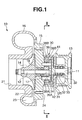
- An automotive supercharger 10 in FIG. 1 comprises an input shaft 11, a speed increasing gear of the traction roller type 30 that transmits increased rotation to an output shaft 12, a pulley 13 driven by an engine output and fixed to the input shaft 11, and an impeller 14 provided in the output shaft 12.
- the supercharger 10 is structured such that a compressor housing 16 is fixed to a center plate 15.
- the center plate 15 supports the output shaft 12 by a bearing 17.
- Reference numeral 18 denotes an oil seal.
- the compressor housing 16 receives the impeller 14, and is provided with a suction port 21, a supercharging passage 22 and a scroll 23.
- the speed increasing gear of the traction roller type 30 is a traction roller type speed increasing gear utilizing a wedge effect, and is provided with a speed increasing housing 31 in such a manner as to be fixed to the center plate 15, and the speed increasing housing 31 supports the input shaft 11 by a bearing 32.
- Reference numeral 33 denotes an oil seal.
- the speed increasing gear of the traction roller type 30 is provided with a center roller 34 integrally and concentrically arranged in an end portion of the output shaft 12, in an inner portion of the speed increasing housing 31.
- the speed increasing gear of the traction roller type 30 is provided with an outer ring 36 integrally and concentrically arranged in an end portion of the input shaft 11 via a disc portion 35, in the inner portion of the speed increasing housing 31.
- An outer ring 36 is arranged eccentric to the center roller 34.
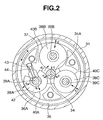
- three intermediate rollers 38A to 38C are arranged within an annular space 37 in which a width of the center roller 34 with respect to a radial direction is uneven with respect to a circumferential direction of the center roller 34 due to the eccentricity between the center roller 34 and the outer ring 36.
- the annular space 37 is provided between a driven side cylindrical surface 34A corresponding to an outer circumferential surface of the center roller 34 and a drive side cylindrical surface 36A corresponding to an inner circumferential surface of the outer ring 36, in the inner portion of the speed increasing housing 31.
- the end portions of three pivots 39A to 39C are respectively supported on the center plate 15 and a connection plate 41.
- connection plate 41 is fixed to the center plate 15 by connection bolts 41A (FIG. 4) and is received at a position in the inner portion of the speed increasing housing 31 and along the disc portion 35.
- the intermediate rollers 38A to 38C are rotatably supported by the pivots 39A to 39C, respectively.
- the respective pivots 39A to 39C are arranged parallel to the center roller 34 and a center axis of the outer ring 36.
- outer circumferential surfaces thereof are formed as power transmitting cylindrical surfaces 40A to 40C which roll in contact with the driven side cylindrical surface 34A of the center roller 34 and the drive side cylindrical surface 36A of the outer ring 36.
- pivots 39B and 39C are fixed by pressing or inserting both end portions thereof into supporting holes provided in the center plate 15 and the connection plate 41 with no play. Accordingly, the pivots 39B and 39C do not displace in a circumferential direction and a radial direction of the center roller 34 in the inner portion of the speed increasing housing 31.
- the pivot 39A is structured such that both end portions thereof can freely displace in the circumferential direction and the radial direction of the center roller 34 within the center plate 15 and a guide groove 42 provided in the connection plate 41, and the intermediate roller 38A is formed as a movable roller.
- the pivot 39A is pressed by a spring 44 corresponding to a pressing means which is backed up by a spring receiver 43 provided in the center plate 15 or the connection plate 41, and presses the movable roller 38A corresponding to the intermediate roller to the center roller 34 and the outer ring 36 in a direction in which a width of the annular space 37 becomes narrow.
- the movable roller 38A moves in a direction b in which the movable roller 38A is exposed to the wedge effect between the outer ring 36 and the center roller 34 according to a rotation of the outer ring 36 in a direction a , so that a pressing force c is generated among the driven side cylindrical surface 34A of the center roller 34, the drive side cylindrical surface 36A of the outer ring 36 and the power transmitting cylindrical surfaces 40A to 40C of the intermediate rollers 38A to 38C.
- a friction force is generated among the driven side cylindrical surface 34A of the center roller 34, the drive side cylindrical surface 36A of the outer ring 36 and the power transmitting cylindrical surfaces 40A to 40C of the intermediate rollers 38A to 38C.
- the driving force transmitted to the outer ring 36 is transmitted to the center roller 34, and the center roller 34 rotates in a direction d .
- the rotation of the center roller 34 generates a rotation of the integrally formed output shaft 12.
- the impeller 14 fixed to the output shaft rotates, and air is sucked from the suction port 21. This air is supercharged so as to be supplied to the engine from a chamber pipe communicated with the scroll 23.
- the movable roller 38A displaces in an opposite direction to the direction b , a connection between the drive side cylindrical surface 36A of the outer ring 36 and the power transmitting cylindrical surface 40A of the movable roller 38A is shut off, and a power transmission between the outer ring 36 and the movable roller 38A is shut off.
- the intermediate roller 38C is formed as the movable roller in the same manner as the intermediate roller 38A, and the movable rollers 38A and 38C are structured such as to be opposed to each other with respect to the narrow portion of the annular space 37 so as to be pressed displaceably within the guide grooves 42 by attached springs 44 and 44, as shown in FIG. 3.
- a stopper (not shown) for preventing the movable roller 38C (or 38A) on the opposite side to the movable roller 38A (or 38C) generating the wedge effect from escaping in a direction coming off from the wedge may be attached to the pivots 39A and 39C of the movable roller 38A and 38C.
- a distance at which the movable roller 38A can displace in the direction b is regulated by a length of the guide groove 42. Accordingly, when the outer ring 36 rotates in the direction a , it is possible to limit the pressing force c which is generated by the wedge effect applied to the movable roller 38A between the movable roller 38A and the center roller 34. In the case shown in FIG. 3 that the power transmission is performed without relation to the direction of the driving force input to the outer ring 36, it is possible to achieve limiting in the same manner. It is thus possible to limit a supercharging pressure and an air volume which the supercharger 10 can supply.
- Traction oil is sealed in the annular space 37 of the speed increasing gear of the traction roller type 30, and the traction oil lubricates and cools portions such as the driven side cylindrical surface 34A of the center roller 34, the drive side cylindrical surface 36A of the outer ring 36, the power transmitting cylindrical surfaces 40A to 40C of the intermediate rollers 38A to 38C, the bearing 17 of the output shaft 12 and the like.
- the traction oil may be forcibly circulated to these portions by an oil pump provided in an inner portion or an outer portion of the speed increasing gear of the traction roller type 30.
- an oil passage 46 communicating an outer circumferential portion of a space within the speed increasing gear of the traction roller type 30 with a space 45 held between the bearing 17 and the oil seal 18 can be pierced in the center plate 15, and the traction oil around the drive side cylindrical surface 36A of the outer ring 36 near an inner wall of the speed increasing housing 31 thrown up based on the rotation of the speed increasing gear of the traction roller type 30 can be received by an oil receiving portion 36B.
- the traction oil can be introduced to the bearing 17 from the oil passage 46 through the oil receiving portion 36B, and the traction oil can then flow out to the driven side cylindrical surface 34A of the center roller 34.
- the traction oil can be further guided to the power transmitting cylindrical surfaces 40A to 40C of the intermediate rollers 38A to 38C, and the traction oil can be circulated to portions to be lubricated such as the driven side cylindrical surface 34A of the center roller 34, the drive side cylindrical surface 36A of the outer ring 36, the power transmitting cylindrical surfaces 40A to 40C of the intermediate rollers 38A to 38C, the bearing 17 of the output shaft 12 and the like.
- a supercharger 10 according to a second embodiment is different from the supercharger 10 according to the first embodiment in that the speed increasing gear of the traction roller type 30 is provided with a built-in oil pump 50; such as a trochoidal pump or a vane pump, and so on, for circulating the traction oil in the inner portion of the speed increasing gear of the traction roller type 30.
- a built-in oil pump 50 such as a trochoidal pump or a vane pump, and so on
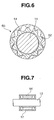
- the oil pump 50 comprises an outer rotor 51 assembled in the speed increasing housing 31, and an inner rotor 52 connected by such as spline-connection, and so on, to the input shaft 11.
- the oil pump 50 circulates the traction oil sealed in the speed increasing housing 31 to an external portion so as to cool, and again introduces the traction oil into the inner portion of the speed increasing housing 31, whereby it is possible to lubricate and cool the driven side cylindrical surface 34A of the center roller 34, the drive side cylindrical surface 36A of the outer ring 36, and the power transmitting cylindrical surfaces 40A to 40C of the intermediate rollers 38A to 38C.
- the oil pump 50 can supply the circulating traction oil to the bearing 17 of the output shaft 12 from an oil passage 53 provided in the center plate 15 via an oil feeding pipe (not shown) through an oil hole 54, and can flow out the oil to the driven side cylindrical surface 34A of the center roller 34, and the power transmitting cylindrical surfaces 40A to 40C of the intermediate rollers 38A to 38C.
- the oil pump 50 for lubricating and cooling the bearing 17 of the output shaft 12 and the contact surfaces among the outer ring 36, the intermediate rollers 38A to 38C and the center roller 34 is provided in the inner portion of the supercharger 10. Therefore, there is no need that the oil pump 50 is arranged in the outer portion of the supercharger 10 as in the conventional case, and it is possible to achieve a compact structure.
- a supercharger 10 according to a third embodiment is different from the superchargers 10 according to the first embodiment and the second embodiment in that an electromagnetic clutch 60 is provided between the input shaft 11 and the pulley 13, and the electromagnetic clutch 60 can be controlled to be turned on and off in correspondence with whether or not supercharging by the supercharger 10 is required.
- the electromagnetic clutch 60 can employ a disc type clutch, a powder clutch and the like.
- the electromagnetic clutch 60 can employ a structure having a small capacity. Accordingly, even in the case that the electromagnetic clutch 60 is mounted, the supercharger can be easily mounted to the engine in comparison with conventional mechanical superchargers.
- a supercharger 10 according to a fourth embodiment is different from the superchargers 10 according to the first embodiment, second embodiment and third embodiment in that a balance plate 70 is provided in the output shaft 12.
- a supercharging pressure is introduced into a space 71 in one side of the balance plate 70 from the scroll 23 via a passage 72.
- a suction pressure (or an atmospheric pressure from an atmospheric space) is introduced into a space 73 in another side of the balance plate 70 from a suction port 71 via a passage 74. Pressures in both of the spaces 71 and 73 applied to the balance plate 70 balance a thrust load applied to the impeller 14, and reduce a thrust load applied to the bearing 17 of the output shaft 12.
- the balance plate 70 since the balance plate 70 is provided in the output shaft 12, the supercharging pressure is applied to one side of the balance plate 70, and the suction pressure or the atmospheric pressure is applied to another side of the balance plate 70, it is possible to adjust the thrust load applied to the output shaft 12 of the supercharger 10, and it is possible to reduce the thrust load applied to the bearing 17 of the output shaft 12, and to improve durability.
Landscapes
- Engineering & Computer Science (AREA)
- General Engineering & Computer Science (AREA)
- Mechanical Engineering (AREA)
- Chemical & Material Sciences (AREA)
- Combustion & Propulsion (AREA)
- Chemical Kinetics & Catalysis (AREA)
- General Chemical & Material Sciences (AREA)
- Supercharger (AREA)
- Friction Gearing (AREA)
Abstract
Description
- The present invention relates to a supercharger.
- Conventionally, there is a supercharger in which a rotation speed of an input shaft is increased by a speed increasing gear so as to be transmitted to an output shaft, and an impeller is provided in the output shaft.
- In order to obtain a high speed increasing ratio, Japanese Patent Application Laid-Open No. 4-203421 proposes a structure using a planetary gear mechanism and Japanese Patent Publication No. 11-502596 proposes a structure using a planetary friction roller mechanism, as the speed increasing gear.
- In the structure using the planetary gear mechanism described in Japanese Patent Application Laid-Open No. 4-203421, there are problems of gear noise generated by high speed rotation and a reduction in service life of a bearing due to vibration. In order to reduce the problems relating to the noise and the vibration, it is necessary to improve the working accuracy and the assembling accuracy of the gears, resulting in decreased productivity.
- In the structure using the planetary friction roller mechanism described in Japanese Patent Publication of No. 11-502596, there are the following problems a to c in view of the structure thereof for fastening a friction roller such as a planetary wheel and a sun shaft by a flexible outer ring.
- a. When the rotation becomes high (i.e., at an impeller rotation speed equal to or greater than 75000rpm), a slip of the friction roller is generated, and it is impossible to transmit a driving force for supercharging to the impeller.
- b. In order to prevent slippage at high speed rotation, it is necessary to increase a force by which the outer ring fastens the friction roller. Accordingly, an undesired fastening force is always applied to the friction roller at low speed rotation, and a driving loss at the low speed rotation is great.
- c. In order to prevent slippage at high speed rotation and secure a suitable fastening force at low speed rotation, it is necessary to employ an exclusive assembling step of applying a high working accuracy, a selectable fitting, a suitable shrinkage fitting of the outer ring or the like to the outer ring and the friction roller. As a result, the productivity is deteriorated.
-
- An object of the present invention is to produce a supercharger which does not generate a slip at high speed rotation and a driving loss at low speed rotation, which has low noise and low vibration, which has a light weight and a compact size, and which can be produced at a high productivity.
- Another object of the present invention is to improve lubricating and cooling performances of a bearing portion in an output shaft, so as to make it possible to adjust a thrust load and improve durability.
- According to the present invention, there is provided a supercharger in which a rotation speed of an input shaft is increased by a speed increasing gear of the traction roller type so as to be transmitted to an output shaft, and wherein an impeller is provided in the output shaft.
- The speed increasing gear of the traction roller type comprises a center roller connected to the output shaft; an outer ring arranged eccentric to the center roller; and a plurality of intermediate rollers arranged within an annular space in which a width of the center roller with respect to a diametrical direction is uneven with respect to a circumferential direction of the center roller. The annular space is provided between a driven side cylindrical surface corresponding to an outer circumferential surface of the center roller and a drive side cylindrical surface corresponding to an inner circumferential surface of the outer ring. Respective outer circumferential surfaces of the intermediate rollers are formed as power transmitting cylindrical surfaces.
- A pivot of at least one intermediate roller is movably arranged in a circumferential direction and a radial direction of the center roller.
- FIG. 1 is a cross sectional view which shows a supercharger according to a first embodiment;
- FIG. 2 is an end elevational view along a line II-II in FIG. 1;
- FIG. 3 is an end elevational view which shows a modified embodiment of a speed increasing gear of the traction roller type;
- FIG. 4 is a cross sectional view which shows an oil circulating path;
- FIG. 5 is a cross sectional view which shows a supercharger according to a second embodiment;
- FIG. 6 is a cross sectional view along a line VI-VI in FIG. 5;
- FIG. 7 is a cross sectional view which shows a bearing portion;
- FIG. 8 is a cross sectional view which shows a supercharger according to a third embodiment; and
- FIG. 9 is an enlarged cross sectional view of a main portion which shows a supercharger according to a fourth embodiment.
-
- An
automotive supercharger 10 in FIG. 1 comprises aninput shaft 11, a speed increasing gear of thetraction roller type 30 that transmits increased rotation to anoutput shaft 12, apulley 13 driven by an engine output and fixed to theinput shaft 11, and animpeller 14 provided in theoutput shaft 12. - The
supercharger 10 is structured such that acompressor housing 16 is fixed to acenter plate 15. Thecenter plate 15 supports theoutput shaft 12 by abearing 17.Reference numeral 18 denotes an oil seal. Thecompressor housing 16 receives theimpeller 14, and is provided with asuction port 21, asupercharging passage 22 and ascroll 23. - The speed increasing gear of the
traction roller type 30 is a traction roller type speed increasing gear utilizing a wedge effect, and is provided with aspeed increasing housing 31 in such a manner as to be fixed to thecenter plate 15, and thespeed increasing housing 31 supports theinput shaft 11 by abearing 32.Reference numeral 33 denotes an oil seal. - The speed increasing gear of the
traction roller type 30 is provided with acenter roller 34 integrally and concentrically arranged in an end portion of theoutput shaft 12, in an inner portion of thespeed increasing housing 31. - The speed increasing gear of the
traction roller type 30 is provided with anouter ring 36 integrally and concentrically arranged in an end portion of theinput shaft 11 via adisc portion 35, in the inner portion of thespeed increasing housing 31. Anouter ring 36 is arranged eccentric to thecenter roller 34. - In the speed increasing gear of the
traction roller type 30, threeintermediate rollers 38A to 38C are arranged within anannular space 37 in which a width of thecenter roller 34 with respect to a radial direction is uneven with respect to a circumferential direction of thecenter roller 34 due to the eccentricity between thecenter roller 34 and theouter ring 36. Theannular space 37 is provided between a driven sidecylindrical surface 34A corresponding to an outer circumferential surface of thecenter roller 34 and a drive sidecylindrical surface 36A corresponding to an inner circumferential surface of theouter ring 36, in the inner portion of thespeed increasing housing 31. The end portions of threepivots 39A to 39C are respectively supported on thecenter plate 15 and aconnection plate 41. Theconnection plate 41 is fixed to thecenter plate 15 byconnection bolts 41A (FIG. 4) and is received at a position in the inner portion of thespeed increasing housing 31 and along thedisc portion 35. Theintermediate rollers 38A to 38C are rotatably supported by thepivots 39A to 39C, respectively. Therespective pivots 39A to 39C are arranged parallel to thecenter roller 34 and a center axis of theouter ring 36. In the respectiveintermediate rollers 38A to 38C, outer circumferential surfaces thereof are formed as power transmittingcylindrical surfaces 40A to 40C which roll in contact with the driven sidecylindrical surface 34A of thecenter roller 34 and the drive sidecylindrical surface 36A of theouter ring 36. - Two of the
pivots center plate 15 and theconnection plate 41 with no play. Accordingly, thepivots center roller 34 in the inner portion of thespeed increasing housing 31. - On the other hand, the
pivot 39A is structured such that both end portions thereof can freely displace in the circumferential direction and the radial direction of thecenter roller 34 within thecenter plate 15 and aguide groove 42 provided in theconnection plate 41, and theintermediate roller 38A is formed as a movable roller. Thepivot 39A is pressed by aspring 44 corresponding to a pressing means which is backed up by aspring receiver 43 provided in thecenter plate 15 or theconnection plate 41, and presses themovable roller 38A corresponding to the intermediate roller to thecenter roller 34 and theouter ring 36 in a direction in which a width of theannular space 37 becomes narrow. - Accordingly, in the speed increasing gear of the
traction roller type 30, when thesupercharger 10 is mounted to the engine by using amounting boss 24 provided in thecenter plate 15, and a driving force is input to aninput pulley 13 from the engine, the driving force is transmitted to theouter ring 36 from theinput shaft 11. At this time, since theouter ring 36 and thecenter roller 34 are eccentric as mentioned above and theannular space 37 mentioned above is uneven with respect to the circumferential direction of thecenter roller 34, themovable roller 38A moves in a direction b in which themovable roller 38A is exposed to the wedge effect between theouter ring 36 and thecenter roller 34 according to a rotation of theouter ring 36 in a direction a, so that a pressing force c is generated among the driven sidecylindrical surface 34A of thecenter roller 34, the drive sidecylindrical surface 36A of theouter ring 36 and the power transmittingcylindrical surfaces 40A to 40C of theintermediate rollers 38A to 38C. On the basis of the pressing force c, a friction force is generated among the driven sidecylindrical surface 34A of thecenter roller 34, the drive sidecylindrical surface 36A of theouter ring 36 and the power transmittingcylindrical surfaces 40A to 40C of theintermediate rollers 38A to 38C. The driving force transmitted to theouter ring 36 is transmitted to thecenter roller 34, and thecenter roller 34 rotates in a direction d. The rotation of thecenter roller 34 generates a rotation of the integrally formedoutput shaft 12. Theimpeller 14 fixed to the output shaft rotates, and air is sucked from thesuction port 21. This air is supercharged so as to be supplied to the engine from a chamber pipe communicated with thescroll 23. - In this case, since three
intermediate rollers 38A to 38C are substantially uniformly arranged peripheral to thecenter roller 34, substantially the same pressing force as the pressing force generated in themovable roller 38A corresponding to one of the intermediate rollers is also generated in theguide rollers intermediate rollers 38A to 38C. - When the driving force transmitted to the
outer ring 36 from theinput shaft 11 is changed to a reverse direction to the rotational direction a due to a speed reduction of the engine, themovable roller 38A displaces in an opposite direction to the direction b, a connection between the drive sidecylindrical surface 36A of theouter ring 36 and the power transmittingcylindrical surface 40A of themovable roller 38A is shut off, and a power transmission between theouter ring 36 and themovable roller 38A is shut off. - In order to perform power transmission without relation to the direction of the driving force input to the
outer ring 36 from theinput shaft 11, theintermediate roller 38C is formed as the movable roller in the same manner as theintermediate roller 38A, and themovable rollers annular space 37 so as to be pressed displaceably within theguide grooves 42 by attachedsprings movable roller 38C (or 38A) on the opposite side to themovable roller 38A (or 38C) generating the wedge effect from escaping in a direction coming off from the wedge may be attached to thepivots movable roller - In the case that it is desired to limit a maximum transmission torque from the
input shaft 11 to theoutput shaft 12, a distance at which themovable roller 38A can displace in the direction b is regulated by a length of theguide groove 42. Accordingly, when theouter ring 36 rotates in the direction a, it is possible to limit the pressing force c which is generated by the wedge effect applied to themovable roller 38A between themovable roller 38A and thecenter roller 34. In the case shown in FIG. 3 that the power transmission is performed without relation to the direction of the driving force input to theouter ring 36, it is possible to achieve limiting in the same manner. It is thus possible to limit a supercharging pressure and an air volume which thesupercharger 10 can supply. - A description will be given below of a lubricating and cooling structure of the speed increasing gear of the
traction roller type 30. - Traction oil is sealed in the
annular space 37 of the speed increasing gear of thetraction roller type 30, and the traction oil lubricates and cools portions such as the driven sidecylindrical surface 34A of thecenter roller 34, the drive sidecylindrical surface 36A of theouter ring 36, the power transmittingcylindrical surfaces 40A to 40C of theintermediate rollers 38A to 38C, the bearing 17 of theoutput shaft 12 and the like. In this case, the traction oil may be forcibly circulated to these portions by an oil pump provided in an inner portion or an outer portion of the speed increasing gear of thetraction roller type 30. - In the speed increasing gear of the
traction roller type 30, as shown in FIG. 4, anoil passage 46 communicating an outer circumferential portion of a space within the speed increasing gear of thetraction roller type 30 with aspace 45 held between the bearing 17 and theoil seal 18 can be pierced in thecenter plate 15, and the traction oil around the drive sidecylindrical surface 36A of theouter ring 36 near an inner wall of thespeed increasing housing 31 thrown up based on the rotation of the speed increasing gear of thetraction roller type 30 can be received by anoil receiving portion 36B. The traction oil can be introduced to the bearing 17 from theoil passage 46 through theoil receiving portion 36B, and the traction oil can then flow out to the driven sidecylindrical surface 34A of thecenter roller 34. The traction oil can be further guided to the power transmittingcylindrical surfaces 40A to 40C of theintermediate rollers 38A to 38C, and the traction oil can be circulated to portions to be lubricated such as the driven sidecylindrical surface 34A of thecenter roller 34, the drive sidecylindrical surface 36A of theouter ring 36, the power transmittingcylindrical surfaces 40A to 40C of theintermediate rollers 38A to 38C, the bearing 17 of theoutput shaft 12 and the like. - In this case, when the traction oil sufficiently exists within the speed increasing gear of the
traction roller type 30, it can be expected that the traction oil is circulated based on a pressure difference caused by a centrifugal force of the rotation. - According to the present embodiment, the following effects can be obtained.
- (1) Since the friction roller type speed increasing gear of the
traction roller type 30 utilizing the wedge effect is employed as the speed increasing gear of thetraction roller type 30 which increases the rotation speed of theinput shaft 11 so as to transmit increased rotation to theoutput shaft 12 provided with theimpeller 14, a pressing force in proportion to a transmission torque can be obtained between contact surfaces of theouter ring 36, theintermediate rollers 38A to 38C and thecenter roller 34, thereby preventing slippage at high speed rotation and driving loss at low speed rotation. Therefore, a high transmission efficiency can be obtained both at a low load and low rotation speed and at a high load and high rotation speed. Accordingly, it is possible to restrict the supercharger driving loss of the engine (which has been a problem in the conventional automotive supercharger). - (2) In comparison with the conventional friction roller mechanism product, a high working accuracy, a selective fitting and an exclusive assembling step such as shrinkage fitting or the like are not required, and productivity is increased.
- (3) Since the present invention provides a friction roller mechanism employing no gears, it is possible to reduce noise and vibration.
- (4) Since it is possible to transmit the driving force with a high
transmission efficiency, it is possible to reduce the axial lengths of the
intermediate rollers 38A to 38C and thecenter roller 34. Accordingly, in comparison with the structure employing a conventional existing friction roller mechanism or planetary gear mechanism, it is possible to reduce a total length of thesupercharger 10 and it is possible to achieve a light weight and a compact size. - (5) Since the circulating path such as the
oil passage 46 of the traction oil and the oil storage portion and the like for lubricating and cooling thebearing 17 of theoutput shaft 12 and the contact surfaces among theouter ring 36, theintermediate rollers 38A to 38C and thecenter roller 34 is provided in the inner portion of thesupercharger 10, it is possible to utilize the throw-up of oil due to rotation of the speed increasing gear of thetraction roller type 30, as well as a pressure difference due to centrifugal force and gravity. Thus, it is possible to improve the lubricating performance of the traction oil, and it is possible to maintain thebearing 17 and the contact surfaces in a well lubricated state. -
- A
supercharger 10 according to a second embodiment is different from thesupercharger 10 according to the first embodiment in that the speed increasing gear of thetraction roller type 30 is provided with a built-inoil pump 50; such as a trochoidal pump or a vane pump, and so on, for circulating the traction oil in the inner portion of the speed increasing gear of thetraction roller type 30. - As shown in FIG. 5 and FIG. 6, the
oil pump 50 comprises anouter rotor 51 assembled in thespeed increasing housing 31, and aninner rotor 52 connected by such as spline-connection, and so on, to theinput shaft 11. Theoil pump 50 circulates the traction oil sealed in thespeed increasing housing 31 to an external portion so as to cool, and again introduces the traction oil into the inner portion of thespeed increasing housing 31, whereby it is possible to lubricate and cool the driven sidecylindrical surface 34A of thecenter roller 34, the drive sidecylindrical surface 36A of theouter ring 36, and the power transmittingcylindrical surfaces 40A to 40C of theintermediate rollers 38A to 38C. - Further, the
oil pump 50 can supply the circulating traction oil to the bearing 17 of theoutput shaft 12 from anoil passage 53 provided in thecenter plate 15 via an oil feeding pipe (not shown) through anoil hole 54, and can flow out the oil to the driven sidecylindrical surface 34A of thecenter roller 34, and the power transmittingcylindrical surfaces 40A to 40C of theintermediate rollers 38A to 38C. - According to the present embodiment, the
oil pump 50 for lubricating and cooling thebearing 17 of theoutput shaft 12 and the contact surfaces among theouter ring 36, theintermediate rollers 38A to 38C and thecenter roller 34 is provided in the inner portion of thesupercharger 10. Therefore, there is no need that theoil pump 50 is arranged in the outer portion of thesupercharger 10 as in the conventional case, and it is possible to achieve a compact structure. - A
supercharger 10 according to a third embodiment is different from thesuperchargers 10 according to the first embodiment and the second embodiment in that anelectromagnetic clutch 60 is provided between theinput shaft 11 and thepulley 13, and the electromagnetic clutch 60 can be controlled to be turned on and off in correspondence with whether or not supercharging by thesupercharger 10 is required. The electromagnetic clutch 60 can employ a disc type clutch, a powder clutch and the like. - According to the present embodiment, since an inertia force of a rotation body in the inner portion of the speed increasing gear of the
traction roller type 30 and the driving loss are small, the electromagnetic clutch 60 can employ a structure having a small capacity. Accordingly, even in the case that theelectromagnetic clutch 60 is mounted, the supercharger can be easily mounted to the engine in comparison with conventional mechanical superchargers. - A
supercharger 10 according to a fourth embodiment is different from thesuperchargers 10 according to the first embodiment, second embodiment and third embodiment in that a balance plate 70 is provided in theoutput shaft 12. A supercharging pressure is introduced into aspace 71 in one side of the balance plate 70 from thescroll 23 via apassage 72. A suction pressure (or an atmospheric pressure from an atmospheric space) is introduced into aspace 73 in another side of the balance plate 70 from asuction port 71 via apassage 74. Pressures in both of thespaces impeller 14, and reduce a thrust load applied to the bearing 17 of theoutput shaft 12. - According to the present embodiment, since the balance plate 70 is provided in the
output shaft 12, the supercharging pressure is applied to one side of the balance plate 70, and the suction pressure or the atmospheric pressure is applied to another side of the balance plate 70, it is possible to adjust the thrust load applied to theoutput shaft 12 of thesupercharger 10, and it is possible to reduce the thrust load applied to the bearing 17 of theoutput shaft 12, and to improve durability. - As heretofore explained, embodiments of the present invention have been described in detail with reference to the drawings. However, the specific configurations of the present invention are not limited to the embodiments and modifications of the design within the range of the present invention are also included in the present invention.
- As mentioned above, according to the present invention, it is possible to produce a light and compact supercharger which does not generate slippage at high speed rotation and driving loss at low speed rotation, which has low noise and low vibration, and which can be produced at a high productivity.
- Further, according to the present invention, it is possible to improve the lubricating and cooling performance of bearing portions in the output shaft, and to adjust the thrust load, and improve durability.
- Although the invention has been illustrated and described with respect to several exemplary embodiments thereof, it should be understood by those skilled in the art that the foregoing and various other changes, omissions and additions may be made to the present invention without departing from the spirit and scope thereof. Therefore, the present invention should not be understood as being limited to the specific embodiments described above, and should be understood to include all possible embodiments which can be embodied within the scope of the appended claims and equivalents thereof.
Claims (9)
- A supercharger in which a rotation speed of an input shaft is increased by a speed increasing gear of the traction roller type so as to be transmitted to an output shaft, and an impeller is provided in the output shaft, wherein the speed increasing gear of the traction roller type comprises:wherein said annular space is provided between a driven side cylindrical surface corresponding to an outer circumferential surface of the center roller and a drive side cylindrical surface corresponding to an inner circumferential surface of the outer ring,a center roller connected to the output shaft;an outer ring arranged eccentric to the center roller; anda plurality of intermediate rollers arranged within an annular space in which a width of the center roller with respect to a diametrical direction is uneven with respect to a circumferential direction of the center roller,
wherein respective outer circumferential surfaces of said intermediate rollers are formed as power transmitting cylindrical surfaces, and
wherein a pivot of at least one of said intermediate rollers is movably arranged in a circumferential direction and a radial direction of the center roller. - A supercharger as claimed in claim 1, further comprising a circulation path for circulating traction oil in an inner portion of the speed increasing gear of the traction roller type to portions to be lubricated, based on rotation of the speed increasing gear of the traction roller type.
- A supercharger as claimed in claim 1 or 2, wherein the speed increasing gear of the traction roller type comprises a built-in oil pump for circulating traction oil in an inner portion of the speed increasing gear of the traction roller type.
- A supercharger as claimed in any one of claims 1 to 3, wherein a balance plate is provided in the output shaft, a supercharging pressure is applied to a first side of the balance plate, and at least one of a suction pressure and an atmospheric pressure is applied to a second side of the balance plate.
- A supercharger as claimed in any one of claims 1 to 4, wherein an input pulley is connectable to the input shaft, and an electromagnetic clutch is provided between the input pulley and the input shaft.
- A supercharger as claimed in claim 1, wherein the plurality of intermediate rollers are arranged peripheral to the center roller.
- A supercharger as claimed in claim 1, wherein said pivot of said at least one of said intermediate rollers is freely displaceable within a guide groove, and a displaceable distance of said intermediate roller is regulated by the guide groove.
- A supercharger as claimed in claim 3, wherein the oil pump supplies the traction oil to a bearing of the output shaft.
- A supercharger as claimed in claim 3, wherein the oil pump is a trochoidal pump.
Applications Claiming Priority (2)
| Application Number | Priority Date | Filing Date | Title |
|---|---|---|---|
| JP2001398353A JP3928035B2 (en) | 2001-12-27 | 2001-12-27 | Turbocharger |
| JP2001398353 | 2001-12-27 |
Publications (2)
| Publication Number | Publication Date |
|---|---|
| EP1323909A2 true EP1323909A2 (en) | 2003-07-02 |
| EP1323909A3 EP1323909A3 (en) | 2009-05-27 |
Family
ID=19189338
Family Applications (1)
| Application Number | Title | Priority Date | Filing Date |
|---|---|---|---|
| EP02028489A Withdrawn EP1323909A3 (en) | 2001-12-27 | 2002-12-19 | Supercharger |
Country Status (6)
| Country | Link |
|---|---|
| US (1) | US6796126B2 (en) |
| EP (1) | EP1323909A3 (en) |
| JP (1) | JP3928035B2 (en) |
| CN (1) | CN1432721A (en) |
| CA (1) | CA2414744A1 (en) |
| TW (1) | TWI226415B (en) |
Cited By (1)
| Publication number | Priority date | Publication date | Assignee | Title |
|---|---|---|---|---|
| WO2009052812A1 (en) | 2007-10-23 | 2009-04-30 | Keiper Gmbh & Co. Kg | Gear stage |
Families Citing this family (26)
| Publication number | Priority date | Publication date | Assignee | Title |
|---|---|---|---|---|
| US6994531B2 (en) * | 2002-04-23 | 2006-02-07 | Nsk Ltd. | High-speed fluidic device |
| US7128061B2 (en) * | 2003-10-31 | 2006-10-31 | Vortech Engineering, Inc. | Supercharger |
| US7055507B2 (en) * | 2004-03-29 | 2006-06-06 | Borgwarner Inc. | Continuously variable drive for superchargers |
| JP2006002633A (en) | 2004-06-16 | 2006-01-05 | Yamaha Marine Co Ltd | Water jet propulsion boat |
| JP2006037730A (en) | 2004-07-22 | 2006-02-09 | Yamaha Marine Co Ltd | Intake device for supercharged engine |
| JP2006077699A (en) * | 2004-09-10 | 2006-03-23 | Yamaha Marine Co Ltd | Lubricating structure for supercharging device |
| JP2006083713A (en) * | 2004-09-14 | 2006-03-30 | Yamaha Marine Co Ltd | Lubricating structure of supercharger |
| US20060180130A1 (en) * | 2005-02-14 | 2006-08-17 | St James David | Motor assisted mechanical supercharging system |
| JP2007062432A (en) | 2005-08-29 | 2007-03-15 | Yamaha Marine Co Ltd | Small planing boat |
| JP4614853B2 (en) | 2005-09-26 | 2011-01-19 | ヤマハ発動機株式会社 | Turbocharger mounting structure |
| JP4668143B2 (en) * | 2006-07-31 | 2011-04-13 | 株式会社エッチ・ケー・エス | Gearbox and reducer |
| US9086012B2 (en) * | 2010-08-13 | 2015-07-21 | Eaton Corporation | Supercharger coupling |
| JP5665602B2 (en) * | 2011-02-25 | 2015-02-04 | 三菱重工業株式会社 | Multistage turbocharger structure |
| US8558746B2 (en) | 2011-11-16 | 2013-10-15 | Andrew Llc | Flat panel array antenna |
| US8866687B2 (en) | 2011-11-16 | 2014-10-21 | Andrew Llc | Modular feed network |
| US9160049B2 (en) | 2011-11-16 | 2015-10-13 | Commscope Technologies Llc | Antenna adapter |
| WO2014010652A1 (en) | 2012-07-11 | 2014-01-16 | 川崎重工業株式会社 | Supercharger mounting structure for engine |
| CN102817710B (en) * | 2012-09-04 | 2016-03-02 | 杭州闪鹿科技有限公司 | centrifugal mechanical supercharger |
| JP6225762B2 (en) * | 2014-03-12 | 2017-11-08 | 株式会社豊田自動織機 | Turbo compressor |
| US10808701B2 (en) * | 2016-02-04 | 2020-10-20 | Eaton Corporation | Cartridge style front cover and coupling cavity sleeve for automotive supercharger |
| US10760584B2 (en) * | 2016-03-28 | 2020-09-01 | Kabushiki Kaisha Toyota Jidoshokki | Speed increaser and centrifugal compressor |
| JP6740950B2 (en) * | 2017-03-31 | 2020-08-19 | 株式会社豊田自動織機 | Centrifugal compressor |
| CA3089155A1 (en) | 2018-06-06 | 2019-12-12 | Vectis Drive Inc. | Fixed ratio traction or friction drive |
| CN110630711A (en) * | 2019-09-03 | 2019-12-31 | 广东广顺新能源动力科技有限公司 | A multifunctional high speed air compressor |
| JP2021110386A (en) * | 2020-01-09 | 2021-08-02 | 三菱重工コンプレッサ株式会社 | Speed changer and compressor system |
| CN111594461B (en) * | 2020-05-26 | 2024-11-15 | 烟台东德实业有限公司 | A heat exchange speed increasing air pump |
Citations (2)
| Publication number | Priority date | Publication date | Assignee | Title |
|---|---|---|---|---|
| JPH04203421A (en) | 1990-11-30 | 1992-07-24 | Tochigi Fuji Ind Co Ltd | Centrifugal supercharger |
| JPH11505596A (en) | 1996-03-11 | 1999-05-21 | オートモーティブ・プロダクツ・(ユーエスエー)・インコーポレイテッド | Spring clip for quick connection fitting |
Family Cites Families (17)
| Publication number | Priority date | Publication date | Assignee | Title |
|---|---|---|---|---|
| US2344078A (en) | 1939-05-23 | 1944-03-14 | Brissonnet Pierre | Transmission |
| US3945270A (en) * | 1975-02-18 | 1976-03-23 | Wedgtrac Corporation | Friction drive transmission |
| US4249750A (en) * | 1979-02-22 | 1981-02-10 | Kantner Harold H | Fluid-power converter with paired rotators providing seals and displacement paths and pump-motor utilizing same |
| US4408503A (en) * | 1981-03-06 | 1983-10-11 | Excelermatic Inc. | Traction roller transmission |
| FR2563063B1 (en) * | 1984-04-12 | 1986-06-20 | Bech Jean | EPICYCLOIDAL INDUCTION COUPLER FOR REDUCED ROTATION SPEED MACHINES |
| US5133325A (en) * | 1987-09-05 | 1992-07-28 | Zahnradfabrik Friedrichshafen, Ag. | Mechanical drive mechanism for a supercharger of an internal combustion engine |
| JP3060489B2 (en) * | 1990-06-15 | 2000-07-10 | アイシン精機株式会社 | Machine driven centrifugal turbocharger |
| JP3281100B2 (en) * | 1993-03-29 | 2002-05-13 | 栃木富士産業株式会社 | Supercharger |
| DK171047B1 (en) | 1995-03-29 | 1996-04-29 | Anders Peter Kolstrup | Planetary gears for high rpm |
| JPH10316081A (en) | 1997-01-29 | 1998-12-02 | Nippon Seiko Kk | Bicycle driving force assist device |
| JPH11294548A (en) | 1998-04-08 | 1999-10-29 | Ntn Corp | Supercharger and multi-stage roller accelerator used therefor |
| US6231302B1 (en) * | 1999-06-08 | 2001-05-15 | G. Fonda Bonardi | Thermal control system for gas-bearing turbocompressors |
| IT1308779B1 (en) | 1999-07-02 | 2002-01-10 | Elasis Sistema Ricerca Fiat | DEVICE FOR ADJUSTING THE DELIVERY PRESSURE OF A PUMP, SUITABLE FOR FUEL SUPPLY TO A COMBUSTION ENGINE |
| JP2001059469A (en) | 1999-08-18 | 2001-03-06 | Honda Motor Co Ltd | Starter device for starting the engine |
| JP4513158B2 (en) | 2000-03-28 | 2010-07-28 | 日本精工株式会社 | Friction roller type transmission |
| JP2002221263A (en) | 2000-11-27 | 2002-08-09 | Nsk Ltd | Wind power generator |
| BR0207695B1 (en) | 2001-02-14 | 2011-10-04 | planetary gear. |
-
2001
- 2001-12-27 JP JP2001398353A patent/JP3928035B2/en not_active Expired - Lifetime
-
2002
- 2002-12-16 US US10/320,131 patent/US6796126B2/en not_active Expired - Lifetime
- 2002-12-19 EP EP02028489A patent/EP1323909A3/en not_active Withdrawn
- 2002-12-19 CA CA002414744A patent/CA2414744A1/en not_active Abandoned
- 2002-12-20 TW TW091136883A patent/TWI226415B/en active
- 2002-12-25 CN CN02159619A patent/CN1432721A/en active Pending
Patent Citations (2)
| Publication number | Priority date | Publication date | Assignee | Title |
|---|---|---|---|---|
| JPH04203421A (en) | 1990-11-30 | 1992-07-24 | Tochigi Fuji Ind Co Ltd | Centrifugal supercharger |
| JPH11505596A (en) | 1996-03-11 | 1999-05-21 | オートモーティブ・プロダクツ・(ユーエスエー)・インコーポレイテッド | Spring clip for quick connection fitting |
Cited By (6)
| Publication number | Priority date | Publication date | Assignee | Title |
|---|---|---|---|---|
| WO2009052812A1 (en) | 2007-10-23 | 2009-04-30 | Keiper Gmbh & Co. Kg | Gear stage |
| WO2009052771A1 (en) | 2007-10-23 | 2009-04-30 | Keiper Gmbh & Co. Kg | Gear stage |
| WO2009052813A1 (en) * | 2007-10-23 | 2009-04-30 | Keiper Gmbh & Co. Kg | Clutch |
| RU2476740C2 (en) * | 2007-10-23 | 2013-02-27 | КЕИПЕР ГмбХ & Ко. КГ | Transmission stage |
| US8435150B2 (en) | 2007-10-23 | 2013-05-07 | Keiper Gmbh & Co. Kg | Gear stage |
| CN101835657B (en) * | 2007-10-23 | 2015-06-03 | 凯波有限责任两合公司 | Gear stage |
Also Published As
| Publication number | Publication date |
|---|---|
| US6796126B2 (en) | 2004-09-28 |
| JP3928035B2 (en) | 2007-06-13 |
| TWI226415B (en) | 2005-01-11 |
| CA2414744A1 (en) | 2003-06-27 |
| US20030121507A1 (en) | 2003-07-03 |
| CN1432721A (en) | 2003-07-30 |
| JP2003201850A (en) | 2003-07-18 |
| EP1323909A3 (en) | 2009-05-27 |
| TW200301337A (en) | 2003-07-01 |
Similar Documents
| Publication | Publication Date | Title |
|---|---|---|
| US6796126B2 (en) | Supercharger | |
| US6994531B2 (en) | High-speed fluidic device | |
| US4950213A (en) | Planetary gear transmission having an arrangement for efficient lubrication of planetary gears | |
| US4955852A (en) | Planetary gear mechanism having means for accurate alignment of sun gear | |
| JP2001355640A (en) | Bearing structure | |
| US7070402B2 (en) | Integrated speed reducer and pump assembly | |
| US11473575B2 (en) | Dual drive vane pump | |
| KR100909311B1 (en) | Clutch assembly with gear pump | |
| US20060222552A1 (en) | Torque limited lube pump for power transfer devices | |
| JP2004092414A (en) | High-speed fluid device | |
| US11624363B2 (en) | Dual drive gerotor pump | |
| JP2004308757A (en) | Friction roller type transmission and high speed fluid device | |
| JP2003314446A (en) | High-speed fluid device | |
| US7530915B2 (en) | Parallel path accessory drive | |
| JP2004116415A (en) | High-speed fluid device | |
| JP2004156531A (en) | Friction roller type transmission integrated compressor | |
| JP2004132460A (en) | Drive device and high-speed fluid device | |
| JP2004169551A (en) | Hybrid type compressor | |
| JP2004211593A (en) | Hybrid type compressor with planetary gear mechanism | |
| JP2004308756A (en) | Friction roller type transmission | |
| JP2004156743A (en) | Drive device and high-speed fluid device | |
| JPH03980A (en) | Refrigerant compressor with fluid coupling | |
| JP2002039305A (en) | Friction roller type transmission | |
| JP2004239407A (en) | Friction roller type transmission and high speed fluid device | |
| JP2003343435A (en) | High-speed fluid device |
Legal Events
| Date | Code | Title | Description |
|---|---|---|---|
| PUAI | Public reference made under article 153(3) epc to a published international application that has entered the european phase |
Free format text: ORIGINAL CODE: 0009012 |
|
| AK | Designated contracting states |
Designated state(s): AT BE BG CH CY CZ DE DK EE ES FI FR GB GR IE IT LI LU MC NL PT SE SI SK TR |
|
| AX | Request for extension of the european patent |
Extension state: AL LT LV MK RO |
|
| RAP1 | Party data changed (applicant data changed or rights of an application transferred) |
Owner name: HKS CO., LTD. |
|
| PUAL | Search report despatched |
Free format text: ORIGINAL CODE: 0009013 |
|
| AK | Designated contracting states |
Kind code of ref document: A3 Designated state(s): AT BE BG CH CY CZ DE DK EE ES FI FR GB GR IE IT LI LU MC NL PT SE SI SK TR |
|
| AX | Request for extension of the european patent |
Extension state: AL LT LV MK RO |
|
| 17P | Request for examination filed |
Effective date: 20090701 |
|
| 17Q | First examination report despatched |
Effective date: 20090806 |
|
| AKX | Designation fees paid |
Designated state(s): DE FR GB |
|
| STAA | Information on the status of an ep patent application or granted ep patent |
Free format text: STATUS: THE APPLICATION IS DEEMED TO BE WITHDRAWN |
|
| 18D | Application deemed to be withdrawn |
Effective date: 20091217 |