EP1323794A1 - Ink composition for offset printing - Google Patents
Ink composition for offset printing Download PDFInfo
- Publication number
- EP1323794A1 EP1323794A1 EP01963494A EP01963494A EP1323794A1 EP 1323794 A1 EP1323794 A1 EP 1323794A1 EP 01963494 A EP01963494 A EP 01963494A EP 01963494 A EP01963494 A EP 01963494A EP 1323794 A1 EP1323794 A1 EP 1323794A1
- Authority
- EP
- European Patent Office
- Prior art keywords
- offset printing
- ink composition
- printing ink
- varnish
- rosin
- Prior art date
- Legal status (The legal status is an assumption and is not a legal conclusion. Google has not performed a legal analysis and makes no representation as to the accuracy of the status listed.)
- Withdrawn
Links
Classifications
-
- C—CHEMISTRY; METALLURGY
- C09—DYES; PAINTS; POLISHES; NATURAL RESINS; ADHESIVES; COMPOSITIONS NOT OTHERWISE PROVIDED FOR; APPLICATIONS OF MATERIALS NOT OTHERWISE PROVIDED FOR
- C09D—COATING COMPOSITIONS, e.g. PAINTS, VARNISHES OR LACQUERS; FILLING PASTES; CHEMICAL PAINT OR INK REMOVERS; INKS; CORRECTING FLUIDS; WOODSTAINS; PASTES OR SOLIDS FOR COLOURING OR PRINTING; USE OF MATERIALS THEREFOR
- C09D11/00—Inks
- C09D11/02—Printing inks
- C09D11/03—Printing inks characterised by features other than the chemical nature of the binder
- C09D11/033—Printing inks characterised by features other than the chemical nature of the binder characterised by the solvent
-
- C—CHEMISTRY; METALLURGY
- C09—DYES; PAINTS; POLISHES; NATURAL RESINS; ADHESIVES; COMPOSITIONS NOT OTHERWISE PROVIDED FOR; APPLICATIONS OF MATERIALS NOT OTHERWISE PROVIDED FOR
- C09D—COATING COMPOSITIONS, e.g. PAINTS, VARNISHES OR LACQUERS; FILLING PASTES; CHEMICAL PAINT OR INK REMOVERS; INKS; CORRECTING FLUIDS; WOODSTAINS; PASTES OR SOLIDS FOR COLOURING OR PRINTING; USE OF MATERIALS THEREFOR
- C09D11/00—Inks
- C09D11/02—Printing inks
- C09D11/03—Printing inks characterised by features other than the chemical nature of the binder
-
- C—CHEMISTRY; METALLURGY
- C09—DYES; PAINTS; POLISHES; NATURAL RESINS; ADHESIVES; COMPOSITIONS NOT OTHERWISE PROVIDED FOR; APPLICATIONS OF MATERIALS NOT OTHERWISE PROVIDED FOR
- C09D—COATING COMPOSITIONS, e.g. PAINTS, VARNISHES OR LACQUERS; FILLING PASTES; CHEMICAL PAINT OR INK REMOVERS; INKS; CORRECTING FLUIDS; WOODSTAINS; PASTES OR SOLIDS FOR COLOURING OR PRINTING; USE OF MATERIALS THEREFOR
- C09D11/00—Inks
- C09D11/02—Printing inks
- C09D11/10—Printing inks based on artificial resins
- C09D11/106—Printing inks based on artificial resins containing macromolecular compounds obtained by reactions only involving carbon-to-carbon unsaturated bonds
Definitions
- the present invention relates to an offset printing ink composition. More particularly, the invention relates to an offset printing ink composition which contains the smallest amount of harmful components possible for compatibility with the environment, and which has excellent drying characteristics (including setting property and drying property) to provide excellent anti-blocking properties wherein printed paper sheets does not cause blocking when the printed paper sheets are stored in a pile immediately after printing, and in a process of cutting the printed paper sheets.
- Offset printing ink commonly consists of a coloring agent, a binder resin, a solvent and others.
- a solvent hitherto inexpensive petroleum solvents such as mineral oil have been used.
- non-VOC volatile organic compound
- low-VOC type of offset printing ink compositions wherein all or part of mineral oil in ink is replaced by vegetable oil, for example soybean oil, have been developed as one of the environmental measures, and drawing attention (JP 5-112745 A and JP 6-93220 A).
- mineral oils are different from vegetable oil components in fundamental properties, such as drying property and dissolving power for resin, which have a great influence on performances of ink compositions in addition to the economy mentioned above, and thus a mineral oil in an ink composition could not be easily replaced with a vegetable oil component.
- the use of a greater amount of a vegetable oil component in an offset printing ink often causes problems including blocking of printed paper sheets when the printed paper sheets immediately after printing are stored in a pile which originates from poor setting property of the ink (hereinafter, referred to as "primary blocking"), and blocking of printed paper sheets in a process of cutting the printed paper sheets which originates from poor drying property of the ink (hereinafter, referred to as "secondary blocking").
- the offset printing ink From a viewpoint of high-speed printing and post-processability in the offset printing, it is essential for the offset printing ink to have excellent drying characteristics, for example the setting property and the drying property, but it is the present situation that it is very difficult to maintain these drying characteristics with offset printing ink compositions which are made compatible with the environment by using vegetable oils.
- an object of the present invention to provide an offset printing ink composition which is capable of satisfying performances required for the offset printing, such as the anti-blocking properties including primary blocking resistance and secondary blocking resistance, by improving drying characteristics of the ink composition while aiming at compatibility with the environment (including an improvement in printing work environment and providing of harmless printed matters by removal of harmful components or change to a non-VOC or low-VOC type ink).
- an offset printing ink composition containing mainly a vegetable oil component as a solvent and further containing as a drying characteristic improver at least one member selected from the group consisting of (A) a polymer which is obtained by polymerizing at least one of olefin monomers and diene monomers, has a solubility parameter of less than 19 (MPa) 1/2 and is compatible with the solvent; and (B) a liquid paraffin.
- the present invention provides the following offset printing ink compositions:
- the present invention provides an offset printing ink composition
- a coloring agent a binder resin, a vegetable oil component as a solvent, and further a drying characteristic improver.
- coloring agent colorless or colored, inorganic or organic pigments commonly used for the offset printing ink may be used.
- Typical examples of the coloring agents include inorganic pigments such as titanium dioxide, barium sulfate, calcium carbonate and magnetic iron oxide, organic pigments such as azo pigments, lake pigments, phthalocyanine pigments, isoindoline pigments, anthraquinone pigments and quinacridone pigments, and carbon black.
- the content of the coloring agent in the offset printing ink composition is preferably about 3 to about 40 % by weight.
- binder resin rosin-modified phenol resins and rosin-modified maleic acid resins are preferably used. A combination of these resins may also be used.
- the rosin-modified phenol resins usable in the present invention include, for example, reaction products obtained from a rosin or a derivative thereof; and an addition-condensation product of a phenol and an aldehyde (so-called resol); and a polyhydric alcohol if necessary.
- rosins or derivatives thereof' is intended to refer to rosins or derivatives thereof containing carboxyl group.
- the rosins include gum rosins, wood rosins, tall oil rosins, disproportionated rosins, hydrogenated rosins and polymerized products of the foregoing rosins, and examples of the derivatives thereof containing carboxyl group include rosin derivatives wherein an unsaturated carboxylic acid such as maleic acid, itaconic acid or crotonic acid is added to a rosin.
- phenols to be used for preparation of the phenol aldehyde addition-condensation products include phenol; alkylsubstituted phenols wherein the alkyl group is a linear, branched or cyclic alkyl group having 1 to 20 carbon atoms, such as p-cresol, m-cresol, p-propylphenol, p-tert-butylphenol, p-aminophenol, p-cyclohexylphenol, p-tert-octylphenol, p-nonylphenol, p-decylphenol, and p-dodecylphenol; aryl-substituted phenols such as phenylphenol and cumylphenol; and polyhydric phenols such as catechol, resorcin, hydroquinone, bisphenol A, bisphenol S, and bisphenol F.
- alkylsubstituted phenols wherein the alkyl group is a linear,
- aldehydes examples include formaldehyde, paraformaldehyde, acetaldehyde, propionaldehyde, n-butyraldehyde, isobutyraldehyde, glyoxal, and furfural.
- Methods for preparing phenol aldehyde addition-condensation products from these phenols and aldehydes include a method for preparing a resol-type phenol resin wherein a phenol and an aldehyde are heated in an aqueous or organic solvent in the presence of an alkali catalyst such as sodium hydroxide, potassium hydroxide or calcium hydroxide; and another method wherein a phenol and an aldehyde are heated in an aqueous or organic solvent in the presence of an acid catalyst such as acetic acid, hydrochloric acid, phosphoric acid, hypophosphorous acid, sulfuric acid, p-toluenesulfonic acid, trifluoromethyl sulfate or trifluoromethyl acetate to give a novolak-type phenol resin, and subsequently the resulting resin is heated in the presence of an aldehyde and an alkali catalyst to give a resol-type phenol resin.
- an alkali catalyst such as sodium hydrox
- polyhydric alcohols used when necessary include aliphatic polyhydric alcohols such as glycerin, trimethylolethane, trimethylolpropane, ethoxylated trimethylolpropane, propoxylated trimethylolpropane, neopentyl glycol, pentaerythritol, dipentaerythritol, sorbitol, 1,6-hexanediol, ethylene glycol, diethylene glycol, polyethylene glycol, propylene glycol, dipropylene glycol, and polypropylene glycol.
- aliphatic polyhydric alcohols such as glycerin, trimethylolethane, trimethylolpropane, ethoxylated trimethylolpropane, propoxylated trimethylolpropane, neopentyl glycol, pentaerythritol, dipentaerythritol, sorbitol, 1,6-hexane
- the production of the rosin-modified phenol resins using the aforesaid materials can be conducted, for example by heating a rosin, a phenol aldehyde condensation product, and if necessary a polyhydric alcohol in any order at a high temperature, preferably in a range of 150° to 300°C.
- a reaction catalyst including an acid catalyst such as p-toluenesulfonic acid, dodecylbenzenesulfonic acid, methanesulfonic acid or ethanesulfonic acid, and a magnesium salt such as magnesium hydroxide, magnesium carbonate, magnesium bicarbonate, magnesium acetate, magnesium formate or magnesium oxalate for the purpose of accelerating the reaction; a reducing agent for the purpose of preventing coloration such as hypophosphorous acid, triphenyl phosphite or triphenyl phosphate; and a neutralizing agent for the purpose of preventing corrosion of metals such as hydroxides, oxides or carboxylates of metal including lithium, cesium, magnesium, calcium, strontium, barium, aluminum, zinc, titanium, zirconium, antimony and selenium, may be used.
- the reaction may be carried out under reduced pressure to accelerate the condensation reaction.
- the rosin-modified phenol resin has preferably a weight-average molecular weight in a range of 10,000 to 250,000.
- a resin having a weight-average molecular weight of more than 250,000 has a problem of causing trouble in the preparation.
- the rosin-modified maleic acid resin usable in the present invention has preferably a weight-average molecular weight in a range of 5,000 to 350,000, more preferably a weight-average molecular weight in a range of 5,000 to 250,000.
- a resin having a weight-average molecular weight beyond the range has a problem of causing trouble in the preparation.
- the rosin-modified phenol resin or rosin-modified maleic acid resin When the rosin-modified phenol resin or rosin-modified maleic acid resin is subject to a reaction with a cross-linking agent or a gelling agent, both of which will be described below, the rosin-modified phenol resin or rosin-modified maleic acid resin has preferably carboxyl groups and/or hydroxyl groups in the molecule, and further an acid value of about 10 to aboout 200 mgKOH/g and a hydroxyl value of about 10 to about 100 mgKOH/g.
- resins such as alkyd resins, polyester resins, petroleum resins, gilsonite resins and modified resins thereof may be used as the binder resin if necessary, in addition to the rosin-modified phenol resin and/or rosin-modified maleic acid resin.
- the content of the binder resin is not particularly limited, but usually in a range of about 15 to about 60 % by weight, more preferably in a range of about 20 to about 60 % by weight in the offset printing ink composition.
- a solvent containing a vegetable oil component is used as the solvent for the offset printing ink composition according to the present invention.
- a solvent comprising a vegetable oil component alone is more preferable.
- the vegetable oil components include vegetable oils and aliphatic acid esters derived from the vegetable oils.
- the vegetable oil components may be used alone or in a combination thereof.
- Examples of the vegetable oils include dry or semi-dry oils such as soybean oil, cotton oil, linseed oil, safflower oil, tung oil, tall oil, dehydrated castor oil, and canola oil, and examples of the fatty acid ester compounds derived from vegetable oil include monoalkyl ester compounds of fatty acids derived from the foregoing dry or semi-dry oils.
- Fatty acids constituting the fatty acid monoesters are preferably saturated or unsaturated fatty acids having 16 to 20 carbon atoms, and examples thereof include stearic acid, isostearic acid, hydroxystearic acid, oleic acid, lenoleic acid, lenolenic acid, and eleostearic acid.
- Alkyl groups derived from alcohols constituting the fatty acid monoesters have preferably 1 to 10 carbon atoms, and examples of such alkyl groups include methyl, ethyl, propyl, isopropyl, butyl, isobutyl, tert-butyl and 2-ethylhexyl.
- the aforesaid various vegetable oil components may be used alone or in a combination of two or more species thereof.
- an ester compound of fatty acid derived from vegetable oil is preferably used as the vegetable oil component from a viewpoint of the setting and anti-blocking properties.
- the fatty acid ester compounds may be used alone or in a combination thereof.
- the fatty acid ester compound may be used in combination with a vegetable oil.
- the content of the fatty acid ester compound in the offset printing ink composition is preferably 3 % by weight or more.
- a mineral oil (excluding liquid paraffin) incompatible with water and having a boiling temperature of not less than 160°C, preferably not less than 200°C, may be used in combination with the vegetable oil component.
- the mineral oils include naphthene solvents, aromatic solvents, petroleum solvents such as ⁇ -olefin oils, light oil, spindle oil, machine oil, cylinder oil, terpene oil, and mineral spirit.
- the use of the mineral oils is preferably avoided.
- the drying characteristic improver according to the present invention will be described below.
- an offset printing ink composition according to the present invention contains as a drying characteristic improver at least one member selected from the group consisting of (A) a polymer which is obtained by polymerizing at least one of olefin monomers and diene monomers, and has a solubility parameter of less than 19 (MPa) 1/2 and is compatible with the solvent mentioned above; and (B) a liquid paraffin.
- polymer (A) which is obtained by polymerizing at least one of olefin monomers and diene monomers, and has a solubility parameter of less than 19 (MPa) 1/2 and is compatible with the solvent component
- examples of polymer (A) include homopolymers and copolymers of olefin monomers, and homopolymers and copolymers of diene monomers, and copolymers of olefin and diene monomers.
- Specific examples thereof include polyisobutylene, polybutadiene, polyisoprene, and isoprene-isobutylene copolymer.
- polymer (A) has a solubility parameter in a range of 15 to 18 (MPa) 1/2 and more preferably is liquid at room temperature.
- the solubility parameter can be determined according to "dissolution method” or "swelling method".
- the solubility parameters of main polymers can be referred to "Polymer Handbook” (J. Brandrup and E. H. Immergut, Polymer Handbook 3rd. ed., John Wiley & Sons, Inc., New York, 1989, Section VII).
- Polymer (A) which is incompatible with the solvent component is not sufficiently miscible with other components. Further, polymer (A) having a solubility parameter of more than the foregoing range is excessively compatible with other components, and is thus unable to improve the setting and anti-blocking properties of the ink composition.
- Liquid paraffin (B) used as the drying characteristic improver is a mineral oil comprising mainly a mixture of three components of normal paraffin, isoparaffin and monocyclic cycloparaffin, which is obtained by highly refining a lubricating oil fraction through a sulfuric acid washing or the like.
- These three purity tests and standards for liquid paraffin are described in the fourteenth revised Japanese Pharmacopoeia, the seventh edition of Official Standards for Food Additives, and the Standards of Cosmetic Ingredients based on Notification No. 181 of the Ministry of Public Welfare, respectively, as the newest ones.
- liquid paraffins include Moresco White P-40, P-55, P-60, P-70, P-80, P-85, P-100, P-120, P-150, P-200, P-230, P-260, P-300, P-350P and P-500 available from Matsumura Oil Research Corp.; and S-type liquid paraffins available from Chuo Kasei Co., Ltd. such as 40-S, 55-S, 60-S, 70-S, 80-S, 90-S, 100-S, 120-S, 150-S, 260-S and 350-S. These liquid paraffins may be used alone or in a combination thereof, considering viscosity of the resulting ink composition and the like.
- drying characteristic improvers allow a marked improvement in the drying characteristics of the offset printing ink composition. This is presumed to be because polymer (A) having a solubility parameter remote from that of the binder resin or liquid paraffin (B) is dissolved into the solvent component of the ink composition, making easier separation of the solvent as a whole from the resin component.
- the amount of the drying characteristic improver is in a range of 0.1 to 10 % by weight in the offset printing ink varnish.
- the amount of the drying characteristic improver is less than this range, it does not allow sufficient improvement in the primary blocking resistance and the secondary blocking resistance, and when the amount is more than the range, it does not allow sufficient improvement in performances such as gloss and storage stability of the ink.
- the amount of the liquid paraffin is preferably in a range of 0.5 to 10 % by weight, more preferably in a range of 1 to 10 % by weight in the offset printing ink varnish.
- the optimal amount of the drying characteristic improver varies depending on the kind of the drying characteristic improver itself and the kind of the binder resins used, the optimal amount is preferably selected within the aforesaid range.
- the offset printing ink composition of the invention may further contain additives such as a pigment dispersant, a dryer, an antioxidant, a water-holding agent for non-image area, an abrasion resistance improver, an anti-offset agent, and a nonionic surface active agent.
- additives such as a pigment dispersant, a dryer, an antioxidant, a water-holding agent for non-image area, an abrasion resistance improver, an anti-offset agent, and a nonionic surface active agent.
- any conventional methods may be utilized.
- one method is as follows: First, a binder resin is dissolved into a solvent under heating to give a varnish for ink. Then a coloring agent and, if necessary, a solvent, a pigment dispersant and the like are added to the varnish, and the resulting mixture is ground in a beads mill, a three-roll mill or other mills to give a base composition for an offset printing ink. Finally, remaining materials are added to the base composition, yielding an offset printing ink composition.
- a drying characteristic improver may be added in any of the steps.
- the drying characteristic improver is polymer (A)
- polymer (A) is preferably contained in a varnish for ink.
- a varnish for ink which is obtained by reacting a binder resin, especially a rosin-modified phenol resin and/or a rosin-modified maleic acid resin, with a cross-linking agent or a gelling agent in the presence of polymer (A) and a solvent.
- Examples of practical methods for obtaining a vanish for ink by reacting a binder resin with a cross-linking agent or a gelling agent in the presence of polymer (A) or liquid paraffin (B) as a drying characteristic improver include the following methods (1) and (2):
- a mixture comprising 20 to 60 % by weight of a binder resin, 0.5 to 15 % by weight of at least one drying characteristic improver selected from polymer (A) and liquid paraffin (B), a solvent comprising mainly a vegetable oil component, and a cross-linking agent or a gelling agent is heated at 150° to 300°C for about 30 minutes to about 2 hours to give a varnish for ink.
- a mixture comprising 20 to 60 % by weight of a binder resin, 0.5 to 15 % by weight of at least one drying characteristic improver selected from polymer (A) and liquid paraffin (B), and a solvent comprising mainly a vegetable oil component is heated at 150° to 300°C for about 30 minutes to about 2 hours to dissolve the resin being a solid matter. Then, a cross-linking agent or a gelling agent is added to the binder resin and the resultant mixture is heated at 150° to 240°C for about 30 minutes to about 2 hours to give a varnish for ink.
- the varnish for ink thus obtained is preferably contained at a content of 20 to 80 % by weight in the offset printing ink composition, and the content of the drying characteristic improver is adjusted to be 0.1 to 10 % by weight.
- isocyanate compounds such as tolylene diisocyanate, isophorone diisocyanate, hexamethylene diisocyanate, tetramethylxylylene diisocyanate, and polymethylenepolyphenyl polyisocyanate.
- the gelling agents include aziridine compounds such as trimethylolpropane-tris- ⁇ -N-aziridinylpropionate and pentaerythritolpropane-tris- ⁇ -N-aziridinylpropionate; epoxy compounds such as glycerol polyglycidyl ether, and trimethylolpropane polyglycidyl ether; aluminum chelate compounds such as (ethyl acetoacetato)aluminum diisopropoxide, and aluminum tris-(ethyl acetoacetate); and aluminum alcoholates such as aluminum triisopropoxide, mono-sec-butoxyaluminum diisopropoxide, and aluminum tri-(sec-butoxide).
- aziridine compounds such as trimethylolpropane-tris- ⁇ -N-aziridinylpropionate and pentaerythritolpropane-tris- ⁇ -N-aziridinylpropionate
- the offset printing ink composition thus obtained according to the present invention contains the smallest amount of harmful components possible for compatibility with the environment, and has excellent drying characteristics (including setting property and drying property) to provide excellent anti-blocking properties wherein none of the primary blocking and the secondary blocking occur. Furthermore, an offset printing ink composition enhanced in the aforesaid effects can be obtained by utilizing a varnish for ink prepared by reacting a binder resin with a cross-linking agent or a gelling agent in the presence of a drying characteristic improver specified in the present invention.
- rosin-modified phenol resin A having a weight average molecular weight of 90,000 and an acid value of 15 mgKOH/g (made by Hitachi Kasei Polymer Co., Ltd.), soybean oil and mineral oil (AF Solvent No. 6, made by Nippon Petrochemicals Co., Ltd., hereinafter the same) were added according to the formula shown in Table 1-1 (the amount of each component is expressed in parts, hereinafter the same).
- the mixture was heated to 200°C and kept at the temperature for 1 hour to dissolve the components.
- fatty acid ester A methyl ester of soybean oil fatty acid, made by Lawter Inc.
- rosin-modified phenol resin A soybean oil and the mineral oil were added according to the formula shown in Table 1-1.
- the mixture was heated to 200°C. and kept at the temperature for 1 hour to dissolve the components.
- the gelling agent according to the formula shown in Table 1-1 the mixture was heated at 170°C for 60 minutes to give varnish 1C.
- varnishes 1A to 1F, and carbon black (MA-7, made by Mitsubishi Chemical Corp., hereinafter the same) were mixed according to the formula shown in Table 1-2 (the amount of each component is expressed in parts, hereinafter the same). Each mixture was then ground by a bead mill and a three-roll mill in sequence to provide each ink base.
- polybutadiene which is liquid at room temperature and has a solubility parameter of 17.2 (MPa) 1/2 and a number average molecular weight of 3,000 (hereinafter referred to as "polybutadiene A”)
- polyisoprene which is liquid at room temperature and has a solubility parameter of 16.6 (MPa) 1/2
- polyisobutylene which is liquid at room temperature and has a solubility parameter of 15.2 (MPa) 1/2
- a wax compound polyethylene wax compound, made by Shamrock Chemicals Corp., hereinafter the same
- a dryer metallic soap, hereinafter the same
- the mineral oil, fatty acid ester A and fatty acid ester B were added to each of the ink bases according to the formula shown in Table 1-2.
- the resulting mixture was stirred to give each offset printing ink composition according to Examples 1-1 to 1-13.
- Varnish 1A or varnish 1E, and carbon black were mixed according to the formula shown in Table 1-2 and ground by means of a bead mill and a three-roll mill in sequence to provide each ink base.
- polybutadiene A, polymethyl acrylate having a solubility parameter of 20.7, the wax compound, the dryer, the mineral oil, and fatty acid ester A were added to each of the ink bases according to the formula shown in Table 1-2, and the resulting mixture was stirred to give each offset printing ink composition according to Comparative Examples 1-1 to 1-4.
- the ink compositions of Comparative Examples 1-1 to 1-3 contain mineral oil, while the ink composition of Comparative Example 1-4 does not contain mineral oil.
- Each of the offset printing ink compositions was printed onto a coated paper sheet by means of a RI tester (manufactured by Kabusiki Kaisha Akira Seisakusho). After the printed paper sheet was allowed to stand at a room temperature for one day, 60°-60° Reflectance thereof was measured by means of a gloss meter (digital gloss meter manufactured by Murakami Shikisai Gijyutu Kenkyusho).
- Each of the offset printing ink compositions was printed onto a coated paper sheet by means of the RI tester (manufactured by Kabushiki Kaisha Akira Seisakusho).
- the degree to which the printed ink on the printed coated paper sheet adhered to a high-quality paper was observed by means of an automatic ink setting tester (manufactured by Kabushiki Kaisha Toyo Seiki Seisakusho) and the period of time (minute) required until the printed ink no longer adhere to the high-quality paper was measured. Shorter the period of time, better the setting property of the ink composition.
- Each of the offset printing ink compositions was printed onto sheets of a coated paper (NK-High Coat 73K, made by Nippon Kakoshi Kabushiki Kaisha) by means of a sheet-fed offset printing machine, and 10,000 sheets of the printed papers were stored in a pile at room temperature for 24 hours.
- the degree of blocking of the piled sheets was evaluated by visual examination according to the following criteria.
- An offset printing ink composition which is excellent in this evaluation is excellent in primary blocking resistance. 3.
- Low frequency of blocking 2.
- Each of the offset printing ink compositions was printed onto a coated paper (NK-High Coat 73K, made by Nippon Kakoshi Kabushiki Kaisha) by means of a sheet fed offset printing machine, and the printed papers were stored at room temperature for 24 hours. Subsequently, 200 sheets of the printed papers in pile were processed by means of a cutting machine. The degree of blocking was evaluated by visual examination according to the following criteria. An offset printing ink composition which is excellent in this evaluation is excellent in secondary blocking resistance and drying property. 3. Low frequency of blocking 2. Medium frequency of blocking 1. High frequency of blocking
- rosin-modified phenol resin C having a weight average molecular weight of 63,000 and an acid value of 18 mgKOH/g (made by Hitachi Kasei Polymer Co., Ltd.)
- the soybean oil, the mineral oil and polybutadiene A which is liquid at room temperature and has a solubility parameter of 17.2 (MPa) 1/2 and a number average molecular weight of 3,000 were added according to the formula shown in Table 2-1 (the amount of each of components is expressed by parts, hereinafter the same).
- the resulting mixture was heated to 200°C and kept at the same temperature for 1 hour to dissolve the components.
- fatty acid ester A (soybean fatty acid methyl ester made by Lawter Inc.), rosin-modified phenol resin C, the soybean oil, the mineral oil and polybutadiene A were added according to the formula shown in Table 2-1.
- the mixture was heated to 200°C and kept at the same temperature for 1 hour to dissolve the components.
- the gelling agent according to the formula shown in Table 2-1 the mixture was heated at 170°C for 60 minutes to give varnish 2F.
- polybutadiene which is liquid at room temperature and has a solubility parameter of 16.9 (MPa) 1/2 and a number average molecular weight of 1,000 (hereinafter referred to as "polybutadiene B")
- rosin-modified phenol resin A the soybean oil and the mineral oil were added according to the formula shown in Table 2-1.
- the mixture was heated to 200°C and kept at the same temperature for 60 minutes to dissolve the components.
- the gelling agent according to the formula shown in Table 2-1 the mixture was heated at 170°C for 60 minutes to give varnish 2G.
- each of varnishes 2A to 2L and carbon black were mixed according to the formula shown in Table 2-2 (the amount of each component is expressed in parts, hereinafter the same), and the resulting mixture was ground in a bead mill and a three-roll mill in sequence to give each ink base. Subsequently, the wax compound, the dryer, the mineral oil, and fatty acid ester A were added to the ink base according to the formula shown in Table 2-2. The mixture was stirred to give each offset printing ink composition according to Examples 2-1 to 2-12. Herein, all the ink compositions of Examples 2-1 to 2-12 contain mineral oil.
- Varnish 2M or Varnish 2N, and carbon black were mixed according to the formula shown in Table 2-2.
- the mixture was ground in a bead mill and a three-roll mill in sequence to give each ink base.
- the wax compound, the dryer, and the mineral oil were added to the ink base according to the formula shown in Table 2-2, and the resulting mixture was stirred to give each offset printing ink composition according to Comparative Examples 2-1 and 2-2.
- the ink compositions of Comparative Examples 2-1 and 2-1 also contain mineral oil.
- Each of the offset printing ink compositions was placed in two airtight containers. One container was stored at room temperature, and the other container was stored at 60°C, for twenty-four hours. Viscosity of each of the ink compositions was measured by Raleigh viscometer and a spreadmeter, and storage stability of each ink was evaluated according to the following criteria. 3. Small change in viscosity (practically with no problem) 2. Medium change in viscosity (practically with little problem) 1. Large change in viscosity (practically with some problem).
- rosin-modified phenol resin E having a weight average molecular weight of 100,000 and an acid value of 15 mgKOH/g (made by Hitachi Kasei Polymer Co., Ltd.), the soybean oil, and fatty acid ester B (soybean oil fatty acid isobutyl ester, made by Lawter Inc.) were added according to the formula shown in Table 3-1 (the amount of each component is expressed in parts, hereinafter the same).
- the mixture was heated to 200°C and kept at the same temperature for 1 hour to dissolve the components.
- Varnish 3A or 3B, and carbon black were mixed according to the formula shown in Table 3-2 (the amount of each component is expressed in parts, hereinafter the same), and the resulting mixture was ground in a bead mill and a three-roll mill in sequence to give each ink base. Subsequently, liquid paraffin A, fatty acid ester B, the wax compound and the dryer were added to the ink base, and the resulting mixture was stirred to give offset printing ink compositions according to Examples 3-1 and 3-2.
- Varnish 3C and carbon black were mixed according to the formula shown in Table 3-2, and the resulting mixture was ground in a bead mill and a three-roll mill in sequence to give an ink base. Subsequently, liquid paraffin A, fatty acid ester A, the wax compound and the dryer were added to the ink base, and the resulting mixture was stirred to give an offset printing ink composition according to Example 3-3.
- Varnish 3D and carbon black were mixed according to the formula shown in Table 3-2, and the resulting mixture was ground in a bead mill and a three-roll mill in sequence to give an ink base. Subsequently, fatty acid ester B, the wax compound and the dryer were added to the ink base, and the resulting mixture was stirred to give an offset printing ink composition according to Example 3-4.
- Varnish 3A and carbon black were mixed according to the formula shown in Table 3-2, and the resulting mixture was ground in a bead mill and a three-roll mill in sequence to give an ink base. Subsequently, liquid paraffin A, fatty acid ester B, the wax compound and the dryer were added to the ink base, and the mixture was stirred to give an offset printing ink composition according to Example 3-5.
- Varnish 3A and carbon black were mixed according to the formula shown in Table 3-2, and the resulting mixture was ground in a bead mill and a three-roll mill in sequence to give an ink base. Subsequently, liquid paraffin B (Moresco White P-55, made by Matsumura Oil Resarch Corp.), fatty acid ester B, the wax compound and the dryer were added to the ink base, and the mixture was stirred to give an offset printing ink composition according to Example 3-6.
- liquid paraffin B Mooresco White P-55, made by Matsumura Oil Resarch Corp.
- Varnish 3E and carbon black were mixed according to the formula shown in Table 3-2, and the resulting mixture was ground in a bead mill and a three-roll mill in sequence to give an ink base. Subsequently, liquid paraffin A, fatty acid ester B, the wax compound and the dryer were added to the ink base, and the mixture was stirred to give an offset printing ink composition according to Example 3-7.
- Varnish 3F and carbon black were mixed according to the formula shown in Table 3-2, and the resulting mixture was ground in a bead mill and a three-roll mill in sequence to give an ink base. Subsequently, the soybean oil, liquid paraffin A, the wax compound and the dryer were added to the ink base, and the mixture was stirred to give an offset printing ink composition according to Example 3-8.
- Varnish 3G and carbon black were mixed according to the formula shown in Table 3-2, and the resulting mixture was ground in a bead mill and a three-roll mill in sequence to give an ink base. Subsequently, liquid paraffin A, fatty acid ester B, the wax compound and the dryer were added to the ink base, and the mixture was stirred to give an offset printing ink composition according to Example 3-9.
- Varnish 3A, 3F or 3G, and carbon black were mixed according to the formula shown in Table 3-2, and each resulting mixture was ground in a bead mill and a three-roll mill in sequence to give an ink base. Subsequently, fatty acid ester B, the wax compound and the dryer were added to the ink base according to the formula shown in Table 3-3, and the mixture was stirred to give each offset printing ink composition according to Comparative Examples 3-1 to 3-3.
- the present invention provides an offset printing ink composition capable of providing printed matters which is excellent in setting property, and primary blocking resistance and secondary blocking resistance, and which is not reduced in the gloss and drying characteristics of printed surface.
Landscapes
- Chemical & Material Sciences (AREA)
- Chemical Kinetics & Catalysis (AREA)
- Life Sciences & Earth Sciences (AREA)
- Engineering & Computer Science (AREA)
- Materials Engineering (AREA)
- Wood Science & Technology (AREA)
- Organic Chemistry (AREA)
- General Chemical & Material Sciences (AREA)
- Inks, Pencil-Leads, Or Crayons (AREA)
Abstract
An offset printing ink composition is provided which has
further improved drying characteristics to satisfy performances required
for offset printing, such as anti-blocking properties including primary
blocking resistance and secondary blocking resistance, while aiming at
compatibility with the environment. The ink composition comprises
mainly a coloring agent, a binder resin and a solvent containing a
vegetable oil component and is characterized by further containing as a
drying characteristic improver at least one member selected from the
group consisting of (A) a polymer which is obtained by polymerizing at
least one of olefin monomers and diene monomers, and has a solubility
parameter of less than 19 (MPa)1/2 and is compatible with the solvent;
and (B) a liquid paraffin, wherein the total amount of the improver is 0.1
to 10 % by weight in the ink composition.
Description
The present invention relates to an offset printing ink
composition. More particularly, the invention relates to an offset
printing ink composition which contains the smallest amount of harmful
components possible for compatibility with the environment, and which
has excellent drying characteristics (including setting property and
drying property) to provide excellent anti-blocking properties wherein
printed paper sheets does not cause blocking when the printed paper
sheets are stored in a pile immediately after printing, and in a process of
cutting the printed paper sheets.
Offset printing ink commonly consists of a coloring agent, a
binder resin, a solvent and others. As the solvent, hitherto inexpensive
petroleum solvents such as mineral oil have been used.
Recently, growing awareness of environmental problems has
also prompted the printing ink industry to take a measure for
compatibility with the environment, and thus in the field of offset
printing, non-VOC (VOC = volatile organic compound) or low-VOC type
of offset printing ink compositions wherein all or part of mineral oil in
ink is replaced by vegetable oil, for example soybean oil, have been
developed as one of the environmental measures, and drawing attention
(JP 5-112745 A and JP 6-93220 A).
However, mineral oils are different from vegetable oil
components in fundamental properties, such as drying property and
dissolving power for resin, which have a great influence on performances
of ink compositions in addition to the economy mentioned above, and
thus a mineral oil in an ink composition could not be easily replaced
with a vegetable oil component. For example, the use of a greater
amount of a vegetable oil component in an offset printing ink often
causes problems including blocking of printed paper sheets when the
printed paper sheets immediately after printing are stored in a pile
which originates from poor setting property of the ink (hereinafter,
referred to as "primary blocking"), and blocking of printed paper sheets
in a process of cutting the printed paper sheets which originates from
poor drying property of the ink (hereinafter, referred to as "secondary
blocking").
These problems arise from the fact that vegetable oils are
more viscous and have a greater capacity to dissolve resins than mineral
oils, thus suppressing migration of the solvent from the printed ink into
paper and leaving a greater amount of the vegetable oil component
confined in a film of the printed ink.
From a viewpoint of high-speed printing and post-processability
in the offset printing, it is essential for the offset printing
ink to have excellent drying characteristics, for example the setting
property and the drying property, but it is the present situation that it is
very difficult to maintain these drying characteristics with offset printing
ink compositions which are made compatible with the environment by
using vegetable oils.
In view of the aforesaid problems of the prior art, it is an
object of the present invention to provide an offset printing ink
composition which is capable of satisfying performances required for the
offset printing, such as the anti-blocking properties including primary
blocking resistance and secondary blocking resistance, by improving
drying characteristics of the ink composition while aiming at
compatibility with the environment (including an improvement in
printing work environment and providing of harmless printed matters by
removal of harmful components or change to a non-VOC or low-VOC
type ink).
As a result of intensive studies, the present inventors have
discovered that the object described above can be achieved by an offset
printing ink composition containing mainly a vegetable oil component as
a solvent and further containing as a drying characteristic improver at
least one member selected from the group consisting of (A) a polymer
which is obtained by polymerizing at least one of olefin monomers and
diene monomers, has a solubility parameter of less than 19 (MPa)1/2 and
is compatible with the solvent; and (B) a liquid paraffin.
The present invention provides the following offset printing
ink compositions:
The present invention provides an offset printing ink
composition comprising a coloring agent, a binder resin, a vegetable oil
component as a solvent, and further a drying characteristic improver.
Each of the constitutes thereof will be described in detail below.
As the coloring agent, colorless or colored, inorganic or
organic pigments commonly used for the offset printing ink may be used.
Typical examples of the coloring agents include inorganic pigments such
as titanium dioxide, barium sulfate, calcium carbonate and magnetic
iron oxide, organic pigments such as azo pigments, lake pigments,
phthalocyanine pigments, isoindoline pigments, anthraquinone
pigments and quinacridone pigments, and carbon black. The content
of the coloring agent in the offset printing ink composition is preferably
about 3 to about 40 % by weight.
As the binder resin, rosin-modified phenol resins and rosin-modified
maleic acid resins are preferably used. A combination of these
resins may also be used.
The rosin-modified phenol resins usable in the present
invention, include, for example, reaction products obtained from a rosin
or a derivative thereof; and an addition-condensation product of a
phenol and an aldehyde (so-called resol); and a polyhydric alcohol if
necessary.
Herein, the term "rosins or derivatives thereof' is intended to
refer to rosins or derivatives thereof containing carboxyl group.
Examples of the rosins include gum rosins, wood rosins, tall oil rosins,
disproportionated rosins, hydrogenated rosins and polymerized
products of the foregoing rosins, and examples of the derivatives thereof
containing carboxyl group include rosin derivatives wherein an
unsaturated carboxylic acid such as maleic acid, itaconic acid or
crotonic acid is added to a rosin.
Examples of phenols to be used for preparation of the phenol
aldehyde addition-condensation products include phenol; alkylsubstituted
phenols wherein the alkyl group is a linear, branched or
cyclic alkyl group having 1 to 20 carbon atoms, such as p-cresol, m-cresol,
p-propylphenol, p-tert-butylphenol, p-aminophenol, p-cyclohexylphenol,
p-tert-octylphenol, p-nonylphenol, p-decylphenol,
and p-dodecylphenol; aryl-substituted phenols such as phenylphenol
and cumylphenol; and polyhydric phenols such as catechol, resorcin,
hydroquinone, bisphenol A, bisphenol S, and bisphenol F.
Examples of aldehydes include formaldehyde,
paraformaldehyde, acetaldehyde, propionaldehyde, n-butyraldehyde,
isobutyraldehyde, glyoxal, and furfural.
Methods for preparing phenol aldehyde addition-condensation
products from these phenols and aldehydes include a
method for preparing a resol-type phenol resin wherein a phenol and an
aldehyde are heated in an aqueous or organic solvent in the presence of
an alkali catalyst such as sodium hydroxide, potassium hydroxide or
calcium hydroxide; and another method wherein a phenol and an
aldehyde are heated in an aqueous or organic solvent in the presence of
an acid catalyst such as acetic acid, hydrochloric acid, phosphoric acid,
hypophosphorous acid, sulfuric acid, p-toluenesulfonic acid,
trifluoromethyl sulfate or trifluoromethyl acetate to give a novolak-type
phenol resin, and subsequently the resulting resin is heated in the
presence of an aldehyde and an alkali catalyst to give a resol-type phenol
resin.
Examples of polyhydric alcohols used when necessary
include aliphatic polyhydric alcohols such as glycerin, trimethylolethane,
trimethylolpropane, ethoxylated trimethylolpropane, propoxylated
trimethylolpropane, neopentyl glycol, pentaerythritol, dipentaerythritol,
sorbitol, 1,6-hexanediol, ethylene glycol, diethylene glycol, polyethylene
glycol, propylene glycol, dipropylene glycol, and polypropylene glycol.
The production of the rosin-modified phenol resins using the
aforesaid materials can be conducted, for example by heating a rosin, a
phenol aldehyde condensation product, and if necessary a polyhydric
alcohol in any order at a high temperature, preferably in a range of 150°
to 300°C.
In the above-mentioned reaction, if necessary, a reaction
catalyst including an acid catalyst such as p-toluenesulfonic acid,
dodecylbenzenesulfonic acid, methanesulfonic acid or ethanesulfonic
acid, and a magnesium salt such as magnesium hydroxide, magnesium
carbonate, magnesium bicarbonate, magnesium acetate, magnesium
formate or magnesium oxalate for the purpose of accelerating the
reaction; a reducing agent for the purpose of preventing coloration such
as hypophosphorous acid, triphenyl phosphite or triphenyl phosphate;
and a neutralizing agent for the purpose of preventing corrosion of
metals such as hydroxides, oxides or carboxylates of metal including
lithium, cesium, magnesium, calcium, strontium, barium, aluminum,
zinc, titanium, zirconium, antimony and selenium, may be used. The
reaction may be carried out under reduced pressure to accelerate the
condensation reaction.
The rosin-modified phenol resin has preferably a weight-average
molecular weight in a range of 10,000 to 250,000. A resin
having a weight-average molecular weight of more than 250,000 has a
problem of causing trouble in the preparation.
The rosin-modified maleic acid resin usable in the present
invention has preferably a weight-average molecular weight in a range of
5,000 to 350,000, more preferably a weight-average molecular weight in
a range of 5,000 to 250,000. A resin having a weight-average molecular
weight beyond the range has a problem of causing trouble in the
preparation.
When the rosin-modified phenol resin or rosin-modified
maleic acid resin is subject to a reaction with a cross-linking agent or a
gelling agent, both of which will be described below, the rosin-modified
phenol resin or rosin-modified maleic acid resin has preferably carboxyl
groups and/or hydroxyl groups in the molecule, and further an acid
value of about 10 to aboout 200 mgKOH/g and a hydroxyl value of about
10 to about 100 mgKOH/g.
Other resins such as alkyd resins, polyester resins,
petroleum resins, gilsonite resins and modified resins thereof may be
used as the binder resin if necessary, in addition to the rosin-modified
phenol resin and/or rosin-modified maleic acid resin.
The content of the binder resin is not particularly limited, but
usually in a range of about 15 to about 60 % by weight, more preferably
in a range of about 20 to about 60 % by weight in the offset printing ink
composition.
As the solvent for the offset printing ink composition
according to the present invention, a solvent containing a vegetable oil
component is used. A solvent comprising a vegetable oil component
alone is more preferable. Examples of the vegetable oil components
include vegetable oils and aliphatic acid esters derived from the
vegetable oils. The vegetable oil components may be used alone or in a
combination thereof.
Examples of the vegetable oils include dry or semi-dry oils
such as soybean oil, cotton oil, linseed oil, safflower oil, tung oil, tall oil,
dehydrated castor oil, and canola oil, and examples of the fatty acid ester
compounds derived from vegetable oil include monoalkyl ester
compounds of fatty acids derived from the foregoing dry or semi-dry oils.
Fatty acids constituting the fatty acid monoesters are
preferably saturated or unsaturated fatty acids having 16 to 20 carbon
atoms, and examples thereof include stearic acid, isostearic acid,
hydroxystearic acid, oleic acid, lenoleic acid, lenolenic acid, and
eleostearic acid. Alkyl groups derived from alcohols constituting the
fatty acid monoesters have preferably 1 to 10 carbon atoms, and
examples of such alkyl groups include methyl, ethyl, propyl, isopropyl,
butyl, isobutyl, tert-butyl and 2-ethylhexyl.
The aforesaid various vegetable oil components may be used
alone or in a combination of two or more species thereof.
In the offset printing ink compositions according to the
present invention, an ester compound of fatty acid derived from
vegetable oil is preferably used as the vegetable oil component from a
viewpoint of the setting and anti-blocking properties. The fatty acid
ester compounds may be used alone or in a combination thereof. The
fatty acid ester compound may be used in combination with a vegetable
oil. The content of the fatty acid ester compound in the offset printing
ink composition is preferably 3 % by weight or more.
As the solvent for the offset printing ink composition
according to the present invention, a mineral oil (excluding liquid
paraffin) incompatible with water and having a boiling temperature of
not less than 160°C, preferably not less than 200°C, may be used in
combination with the vegetable oil component. Examples of the
mineral oils include naphthene solvents, aromatic solvents, petroleum
solvents such as α-olefin oils, light oil, spindle oil, machine oil, cylinder
oil, terpene oil, and mineral spirit. However, according to the object of
the present invention, the use of the mineral oils is preferably avoided.
The drying characteristic improver according to the present
invention will be described below.
In order to improve the drying characteristics including
setting property and drying property, an offset printing ink composition
according to the present invention contains as a drying characteristic
improver at least one member selected from the group consisting of (A) a
polymer which is obtained by polymerizing at least one of olefin
monomers and diene monomers, and has a solubility parameter of less
than 19 (MPa)1/2 and is compatible with the solvent mentioned above;
and (B) a liquid paraffin.
Examples of polymer (A) which is obtained by polymerizing at
least one of olefin monomers and diene monomers, and has a solubility
parameter of less than 19 (MPa)1/2 and is compatible with the solvent
component include homopolymers and copolymers of olefin monomers,
and homopolymers and copolymers of diene monomers, and copolymers
of olefin and diene monomers. Specific examples thereof include
polyisobutylene, polybutadiene, polyisoprene, and isoprene-isobutylene
copolymer. Preferably, polymer (A) has a solubility parameter in a
range of 15 to 18 (MPa)1/2 and more preferably is liquid at room
temperature.
The solubility parameter can be determined according to
"dissolution method" or "swelling method". The solubility parameters of
main polymers can be referred to "Polymer Handbook" (J. Brandrup and
E. H. Immergut, Polymer Handbook 3rd. ed., John Wiley & Sons, Inc.,
New York, 1989, Section VII).
Polymer (A) which is incompatible with the solvent
component is not sufficiently miscible with other components. Further,
polymer (A) having a solubility parameter of more than the foregoing
range is excessively compatible with other components, and is thus
unable to improve the setting and anti-blocking properties of the ink
composition.
Liquid paraffin (B) used as the drying characteristic improver
is a mineral oil comprising mainly a mixture of three components of
normal paraffin, isoparaffin and monocyclic cycloparaffin, which is
obtained by highly refining a lubricating oil fraction through a sulfuric
acid washing or the like.
From a viewpoint of environment, workability, and hygiene, a
liquid paraffin which is refined to a level that no impurities that absorb
ultraviolet ray are substantially contained, and which passes at least
one of the purity test of liquid paraffin prescribed in the Japanese
Pharmacopoeia, the purity test of liquid paraffin prescribed in the
Japanese Standard for Food Additives and the purity test of liquid
paraffin prescribed in the Japanese Standards of Cosmetic Ingredients,
depending on the applications, is more preferable. These three purity
tests and standards for liquid paraffin are described in the fourteenth
revised Japanese Pharmacopoeia, the seventh edition of Official
Standards for Food Additives, and the Standards of Cosmetic
Ingredients based on Notification No. 181 of the Ministry of Public
Welfare, respectively, as the newest ones.
Specific examples of the liquid paraffins include Moresco
White P-40, P-55, P-60, P-70, P-80, P-85, P-100, P-120, P-150, P-200,
P-230, P-260, P-300, P-350P and P-500 available from Matsumura Oil
Research Corp.; and S-type liquid paraffins available from Chuo Kasei
Co., Ltd. such as 40-S, 55-S, 60-S, 70-S, 80-S, 90-S, 100-S, 120-S,
150-S, 260-S and 350-S. These liquid paraffins may be used alone or
in a combination thereof, considering viscosity of the resulting ink
composition and the like.
The use of at least one selected from the aforesaid drying
characteristic improvers allows a marked improvement in the drying
characteristics of the offset printing ink composition. This is presumed
to be because polymer (A) having a solubility parameter remote from that
of the binder resin or liquid paraffin (B) is dissolved into the solvent
component of the ink composition, making easier separation of the
solvent as a whole from the resin component.
In the present invention, the amount of the drying
characteristic improver is in a range of 0.1 to 10 % by weight in the offset
printing ink varnish. When the amount of the drying characteristic
improver is less than this range, it does not allow sufficient improvement
in the primary blocking resistance and the secondary blocking
resistance, and when the amount is more than the range, it does not
allow sufficient improvement in performances such as gloss and storage
stability of the ink. In the case when liquid paraffin is used as the
drying characteristic improver, the amount of the liquid paraffin is
preferably in a range of 0.5 to 10 % by weight, more preferably in a range
of 1 to 10 % by weight in the offset printing ink varnish.
However, as the optimal amount of the drying characteristic
improver varies depending on the kind of the drying characteristic
improver itself and the kind of the binder resins used, the optimal
amount is preferably selected within the aforesaid range.
The offset printing ink composition of the invention may
further contain additives such as a pigment dispersant, a dryer, an
antioxidant, a water-holding agent for non-image area, an abrasion
resistance improver, an anti-offset agent, and a nonionic surface active
agent.
To prepare the offset printing ink composition of the present
invention from the aforesaid materials, any conventional methods may
be utilized.
For example, one method is as follows: First, a binder resin is
dissolved into a solvent under heating to give a varnish for ink. Then a
coloring agent and, if necessary, a solvent, a pigment dispersant and the
like are added to the varnish, and the resulting mixture is ground in a
beads mill, a three-roll mill or other mills to give a base composition for
an offset printing ink. Finally, remaining materials are added to the
base composition, yielding an offset printing ink composition.
In this production method, a drying characteristic improver
may be added in any of the steps. However, in the case that the drying
characteristic improver is polymer (A), polymer (A) is preferably
contained in a varnish for ink. Specifically it is preferable to prepare an
ink by using a varnish for ink which is obtained by reacting a binder
resin, especially a rosin-modified phenol resin and/or a rosin-modified
maleic acid resin, with a cross-linking agent or a gelling agent in the
presence of polymer (A) and a solvent.
Examples of practical methods for obtaining a vanish for ink
by reacting a binder resin with a cross-linking agent or a gelling agent in
the presence of polymer (A) or liquid paraffin (B) as a drying
characteristic improver include the following methods (1) and (2):
A mixture comprising 20 to 60 % by weight of a binder resin,
0.5 to 15 % by weight of at least one drying characteristic improver
selected from polymer (A) and liquid paraffin (B), a solvent comprising
mainly a vegetable oil component, and a cross-linking agent or a gelling
agent is heated at 150° to 300°C for about 30 minutes to about 2 hours
to give a varnish for ink.
A mixture comprising 20 to 60 % by weight of a binder resin,
0.5 to 15 % by weight of at least one drying characteristic improver
selected from polymer (A) and liquid paraffin (B), and a solvent
comprising mainly a vegetable oil component is heated at 150° to 300°C
for about 30 minutes to about 2 hours to dissolve the resin being a solid
matter. Then, a cross-linking agent or a gelling agent is added to the
binder resin and the resultant mixture is heated at 150° to 240°C for
about 30 minutes to about 2 hours to give a varnish for ink.
The varnish for ink thus obtained is preferably contained at a
content of 20 to 80 % by weight in the offset printing ink composition,
and the content of the drying characteristic improver is adjusted to be
0.1 to 10 % by weight.
Examples of the cross-linking agents for use in the aforesaid
method include isocyanate compounds such as tolylene diisocyanate,
isophorone diisocyanate, hexamethylene diisocyanate,
tetramethylxylylene diisocyanate, and polymethylenepolyphenyl
polyisocyanate. Examples of the gelling agents include aziridine
compounds such as trimethylolpropane-tris-β-N-aziridinylpropionate
and pentaerythritolpropane-tris-β-N-aziridinylpropionate; epoxy
compounds such as glycerol polyglycidyl ether, and trimethylolpropane
polyglycidyl ether; aluminum chelate compounds such as (ethyl
acetoacetato)aluminum diisopropoxide, and aluminum tris-(ethyl
acetoacetate); and aluminum alcoholates such as aluminum
triisopropoxide, mono-sec-butoxyaluminum diisopropoxide, and
aluminum tri-(sec-butoxide).
The offset printing ink composition thus obtained according
to the present invention contains the smallest amount of harmful
components possible for compatibility with the environment, and has
excellent drying characteristics (including setting property and drying
property) to provide excellent anti-blocking properties wherein none of
the primary blocking and the secondary blocking occur. Furthermore,
an offset printing ink composition enhanced in the aforesaid effects can
be obtained by utilizing a varnish for ink prepared by reacting a binder
resin with a cross-linking agent or a gelling agent in the presence of a
drying characteristic improver specified in the present invention.
Offset printing ink compositions and production methods
thereof according to the present invention will be described in detail by
way of the following Examples. It is understood that the present
invention is not limited to specific Examples without departing from the
spirit and scope thereof. In the following description, "parts" means
"parts by weight".
Into a four necked flask equipped with a condenser, a
thermometer and an agitator, rosin-modified phenol resin A having a
weight average molecular weight of 90,000 and an acid value of 15
mgKOH/g (made by Hitachi Kasei Polymer Co., Ltd.), soybean oil and
mineral oil (AF Solvent No. 6, made by Nippon Petrochemicals Co., Ltd.,
hereinafter the same) were added according to the formula shown in
Table 1-1 (the amount of each component is expressed in parts,
hereinafter the same). The mixture was heated to 200°C and kept at
the temperature for 1 hour to dissolve the components. (Ethyl
acetoacetato)aluminum diisopropoxide (ALCH, made by Kawaken Fine
Chemicals Co., Ltd.) as a gelling agent was added to the mixture
according to the formula shown in Table 1-1, and the resulting mixture
was heated at 170°C for 60 minutes to give varnish 1A.
The same procedures as in the method of obtaining Vanish
1A except that rosin-modified phenol resin A was replaced by rosin-modified
phenol resin B having a weight average molecular weight of
140,000 and an acid value of 15 mgKOH/g (made by Hitachi Kasei
Polymer Co., Ltd.) were repeated to give varnish 1B.
Into a four necked flask equipped with a condenser, a
thermometer and an agitator, fatty acid ester A (methyl ester of soybean
oil fatty acid, made by Lawter Inc.), rosin-modified phenol resin A,
soybean oil and the mineral oil were added according to the formula
shown in Table 1-1. The mixture was heated to 200°C. and kept at the
temperature for 1 hour to dissolve the components. After addition of
the gelling agent according to the formula shown in Table 1-1, the
mixture was heated at 170°C for 60 minutes to give varnish 1C.
The same procedures as in the method of obtaining Vanish
1C except that fatty acid ester A was replaced by fatty acid ester B
(isobutyl ester of soybean oil fatty acid, made by Lawter Inc.) were
repeated to give varnish 1D.
Into a four necked flask equipped with a condenser, a
thermometer and an agitator, rosin-modified phenol resin A, soybean oil,
and fatty acid ester A were added according to the formula shown in
Table 1-1. The mixture was heated to 200°C and kept at the
temperature for 1 hour to dissolve the components. After addition of
the gelling agent according to the formula shown in Table 1-1, the
mixture was heated at 170°C for 60 minutes to give varnish 1E.
The same procedures as in the method of obtaining Vanish
1E except that fatty acid ester A was replaced by fatty acid ester B were
repeated to give varnish 1F.
Each of varnishes 1A to 1F, and carbon black (MA-7, made by
Mitsubishi Chemical Corp., hereinafter the same) were mixed according
to the formula shown in Table 1-2 (the amount of each component is
expressed in parts, hereinafter the same). Each mixture was then
ground by a bead mill and a three-roll mill in sequence to provide each
ink base. Subsequently, polybutadiene which is liquid at room
temperature and has a solubility parameter of 17.2 (MPa)1/2 and a
number average molecular weight of 3,000 (hereinafter referred to as
"polybutadiene A"), polyisoprene which is liquid at room temperature
and has a solubility parameter of 16.6 (MPa)1/2 (hereinafter referred to
simply as "polyisoprene"), polyisobutylene which is liquid at room
temperature and has a solubility parameter of 15.2 (MPa)1/2 (hereinafter
referred to simply as polyisobutylene), a wax compound (polyethylene
wax compound, made by Shamrock Chemicals Corp., hereinafter the
same), a dryer (metallic soap, hereinafter the same), the mineral oil, fatty
acid ester A and fatty acid ester B were added to each of the ink bases
according to the formula shown in Table 1-2. The resulting mixture
was stirred to give each offset printing ink composition according to
Examples 1-1 to 1-13. Herein, the ink compositions of Examples 1-1 to
1-9 contain mineral oil, while the ink compositions of Examples 1-10 to
1-13 do not contain mineral oil.
Varnish 1A or varnish 1E, and carbon black were mixed
according to the formula shown in Table 1-2 and ground by means of a
bead mill and a three-roll mill in sequence to provide each ink base.
Subsequently, polybutadiene A, polymethyl acrylate having a solubility
parameter of 20.7, the wax compound, the dryer, the mineral oil, and
fatty acid ester A were added to each of the ink bases according to the
formula shown in Table 1-2, and the resulting mixture was stirred to
give each offset printing ink composition according to Comparative
Examples 1-1 to 1-4. Herein, the ink compositions of Comparative
Examples 1-1 to 1-3 contain mineral oil, while the ink composition of
Comparative Example 1-4 does not contain mineral oil.
Each of the offset printing ink compositions of Examples 1-1
to 1-13 and Comparative Examples 1-1 to 1-4 was subjected to the
following evaluation tests for printing performance.
Each of the offset printing ink compositions was printed onto
a coated paper sheet by means of a RI tester (manufactured by Kabusiki
Kaisha Akira Seisakusho). After the printed paper sheet was allowed to
stand at a room temperature for one day, 60°-60° Reflectance thereof
was measured by means of a gloss meter (digital gloss meter
manufactured by Murakami Shikisai Gijyutu Kenkyusho).
Each of the offset printing ink compositions was printed onto
a coated paper sheet by means of the RI tester (manufactured by
Kabushiki Kaisha Akira Seisakusho). The degree to which the printed
ink on the printed coated paper sheet adhered to a high-quality paper
was observed by means of an automatic ink setting tester (manufactured
by Kabushiki Kaisha Toyo Seiki Seisakusho) and the period of time
(minute) required until the printed ink no longer adhere to the high-quality
paper was measured. Shorter the period of time, better the
setting property of the ink composition.
Each of the offset printing ink compositions was printed onto
sheets of a coated paper (NK-High Coat 73K, made by Nippon Kakoshi
Kabushiki Kaisha) by means of a sheet-fed offset printing machine, and
10,000 sheets of the printed papers were stored in a pile at room
temperature for 24 hours. The degree of blocking of the piled sheets
was evaluated by visual examination according to the following criteria.
An offset printing ink composition which is excellent in this evaluation is
excellent in primary blocking resistance.
3. Low frequency of blocking
2. Medium frequency of blocking
1. High frequency of blocking
3. Low frequency of blocking
2. Medium frequency of blocking
1. High frequency of blocking
Each of the offset printing ink compositions was printed onto
a coated paper (NK-High Coat 73K, made by Nippon Kakoshi Kabushiki
Kaisha) by means of a sheet fed offset printing machine, and the printed
papers were stored at room temperature for 24 hours. Subsequently,
200 sheets of the printed papers in pile were processed by means of a
cutting machine. The degree of blocking was evaluated by visual
examination according to the following criteria. An offset printing ink
composition which is excellent in this evaluation is excellent in
secondary blocking resistance and drying property.
3. Low frequency of blocking
2. Medium frequency of blocking
1. High frequency of blocking
3. Low frequency of blocking
2. Medium frequency of blocking
1. High frequency of blocking
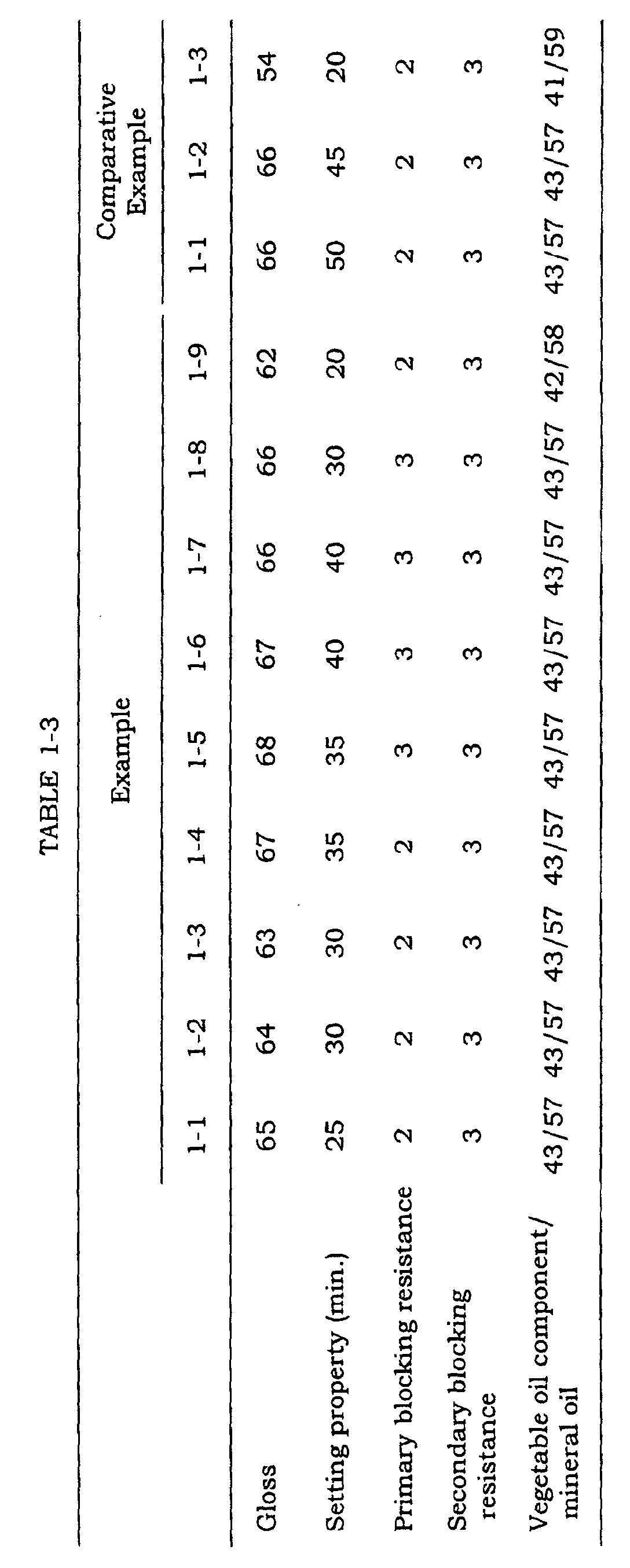
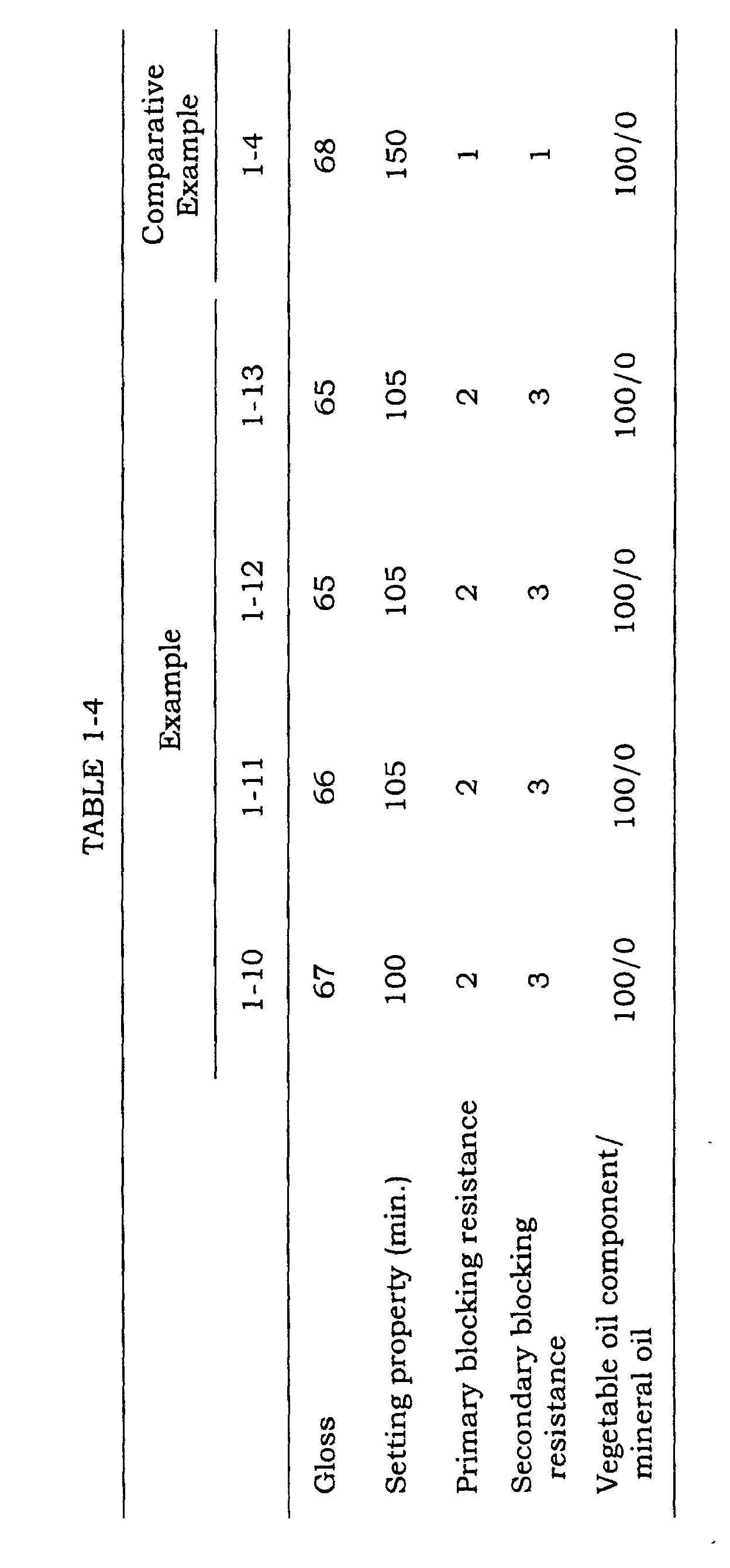
The results of the performance evaluation tests for the offset
printing ink compositions containing mineral oils of Examples 1-1 to 1-9
and Comparative Examples 1-1 to 1-3 are shown in Table 1-3. The
results of the same tests for each of the offset printing ink compositions
not containing mineral oils of Examples 1-10 to 1-13 and Comparative
Example 1-4 are shown in Table 1-4.


Into a four-necked flask equipped with a condenser, a
thermometer and an agitator, rosin-modified phenol resin C having a
weight average molecular weight of 63,000 and an acid value of 18
mgKOH/g (made by Hitachi Kasei Polymer Co., Ltd.), the soybean oil, the
mineral oil and polybutadiene A which is liquid at room temperature and
has a solubility parameter of 17.2 (MPa)1/2 and a number average
molecular weight of 3,000 were added according to the formula shown in
Table 2-1 (the amount of each of components is expressed by parts,
hereinafter the same). The resulting mixture was heated to 200°C and
kept at the same temperature for 1 hour to dissolve the components.
After addition of (ethyl acetoacetato) aluminum diisopropoxide (ALCH
made by Kawaken Fine Chemicals Co., Ltd, hereinafter the same) as a
gelling agent according to the formula shown in Table 2-1, the resulting
mixture was heated at 170°C for 60 minutes to give varnish 2A.
Into a four-necked flask equipped with a condenser, a
thermometer and an agitator, rosin-modified phenol resin C, the
soybean oil, the mineral oil, polybutadiene A and the gelling agent were
added according to the formulation shown in Table 2-1. The mixture
was heated to 200°C and kept at the same temperature for 1 hour to give
varnish 2B.
The same procedures as in the method of obtaining Vanish
2A except that rosin-modified phenol resin C was replaced by rosin-modified
phenol resin D having a weight average molecular weight of
130,000 and an acid value of 15 mgKOH/g (made by Hitachi Kasei
Polymer Co., Ltd.) were repeated to give varnish 2C.
Into a four-necked flask equipped with a condenser, a
thermometer and an agitator, an alkyd resin having a weight average
molecular weight of 7,000 and an acid value of 11 mgKOH/g (made by
Dainippon Ink & Chemicals, Inc., hereinafter the same), rosin-modified
phenol resin C, the soybean oil, the mineral oil, and polybutadiene A
were added according to the formula shown in Table 2-1. The mixture
was heated to 200°C and kept at the same temperature for 1 hour to
dissolve the components. After addition of the gelling agent according
to the formula shown in Table 2-1, the mixture was heated at 170°C for
60 minutes to give varnish 2D.
The same procedures as in the method of obtaining Vanish
2A except that the soybean oil was replaced by linseed oil were repeated
to give varnish 2E.
Into a four-necked flask equipped with a condenser, a
thermometer and an agitator, fatty acid ester A (soybean fatty acid
methyl ester made by Lawter Inc.), rosin-modified phenol resin C, the
soybean oil, the mineral oil and polybutadiene A were added according
to the formula shown in Table 2-1. The mixture was heated to 200°C
and kept at the same temperature for 1 hour to dissolve the components.
After addition of the gelling agent according to the formula shown in
Table 2-1, the mixture was heated at 170°C for 60 minutes to give
varnish 2F.
Into a four-necked flask equipped with a condenser, a
thermometer and an agitator, polybutadiene which is liquid at room
temperature and has a solubility parameter of 16.9 (MPa)1/2 and a
number average molecular weight of 1,000 (hereinafter referred to as
"polybutadiene B"), rosin-modified phenol resin A, the soybean oil and
the mineral oil were added according to the formula shown in Table 2-1.
The mixture was heated to 200°C and kept at the same temperature for
60 minutes to dissolve the components. After addition of the gelling
agent according to the formula shown in Table 2-1, the mixture was
heated at 170°C for 60 minutes to give varnish 2G.
Into a four-necked flask equipped with a condenser, a
thermometer and an agitator, rosin-modified phenol resin C, the
soybean oil, the mineral oil, and polybutadiene A were added according
to the formula shown in Table 2-1. The mixture was heated to 200°C
and kept at the same temperature for 1 hour to dissolve the components.
After addition of the gelling agent according to the formula shown in
Table 2-1, the mixture was heated at 170°C for 60 minutes to give
varnish 2H or 2I.
Into a four-necked flask equipped with a condenser, a
thermometer and an agitator, rosin-modified phenol resin C, the
soybean oil, the mineral oil, and polybutadiene A were added according
to the formula shown in Table 2-1. The mixture was heated to 200°C
and kept at the same temperature for 1 hour to dissolve the components.
After addition of the gelling agent according to the formula shown in
Table 2-1, the mixture was heated at 170°C for 60 minutes to give
varnish 2J.
Into a four-necked flask equipped with a condenser, a
thermometer and an agitator, rosin-modified phenol resin C, the
soybean oil, the mineral oil, polyisoprene which is liquid at room
temperature and having a solubility parameter of 16.6 (MPa)1/2, and
polyisobutylene which is liquid at room temperature and has a solubility
parameter of 15.2 (MPa)1/2 were added according to the formula shown
in Table 2-1. The mixture was heated to 200°C and kept at the same
temperature for 1 hour to dissolve the components. After addition of
the gelling agent according to the formula shown in Table 2-1, the
mixture was heated at 170°C for 60 minutes to give varnish 2K or 2L.
Into a four-necked flask equipped with a condenser, a
thermometer and an agitator, rosin-modified phenol resin C, the
soybean oil, and the mineral oil were added according to the formula
shown in Table 2-1. The mixture was heated to 200°C and kept at the
same temperature for 1 hour to dissolve the components. After
addition of the gelling agent according to the formula shown in Table 2-1,
the mixture was heated at 170°C for 60 minutes to give varnish 2M.
Into a four-necked flask equipped with a condenser, a
thermometer and an agitator, rosin-modified phenol resin C, the
soybean oil, the mineral oil, and polybutadiene A were added according
to the formula shown in Table 2-1. The mixture was heated to 200°C
and kept at the temperature for 1 hour to dissolve the components.
After addition of the gelling agent according to the formula shown in
Table 2-1, the mixture was heated at 170°C for 60 minutes to give
varnish 2N.
Each of varnishes 2A to 2L and carbon black were mixed
according to the formula shown in Table 2-2 (the amount of each
component is expressed in parts, hereinafter the same), and the
resulting mixture was ground in a bead mill and a three-roll mill in
sequence to give each ink base. Subsequently, the wax compound, the
dryer, the mineral oil, and fatty acid ester A were added to the ink base
according to the formula shown in Table 2-2. The mixture was stirred
to give each offset printing ink composition according to Examples 2-1 to
2-12. Herein, all the ink compositions of Examples 2-1 to 2-12 contain
mineral oil.
Varnish 2M or Varnish 2N, and carbon black were mixed
according to the formula shown in Table 2-2. The mixture was ground
in a bead mill and a three-roll mill in sequence to give each ink base.
The wax compound, the dryer, and the mineral oil were added to the ink
base according to the formula shown in Table 2-2, and the resulting
mixture was stirred to give each offset printing ink composition
according to Comparative Examples 2-1 and 2-2. The ink compositions
of Comparative Examples 2-1 and 2-1 also contain mineral oil.
The performance evaluation tests for the offset printing ink
compositions of Examples 2-1 to 2-12 and Comparative Examples 2-1
and 2-2 in regard to gloss, setting property, primary blocking resistance
and secondary blocking resistance were carried in the same manner as
in Examples 1-1 to 1-13. Additionally, storage stability of the offset
printing ink compositions was evaluated.
Each of the offset printing ink compositions was placed in
two airtight containers. One container was stored at room temperature,
and the other container was stored at 60°C, for twenty-four hours.
Viscosity of each of the ink compositions was measured by Raleigh
viscometer and a spreadmeter, and storage stability of each ink was
evaluated according to the following criteria.
3. Small change in viscosity (practically with no problem)
2. Medium change in viscosity (practically with little problem)
1. Large change in viscosity (practically with some problem).
3. Small change in viscosity (practically with no problem)
2. Medium change in viscosity (practically with little problem)
1. Large change in viscosity (practically with some problem).
The results of the performance evaluation tests for the offset
printing ink compositions of Examples 2-1 to 2-12 and Comparative
Examples 2-1 and 2-2 are shown in Table 2-3.
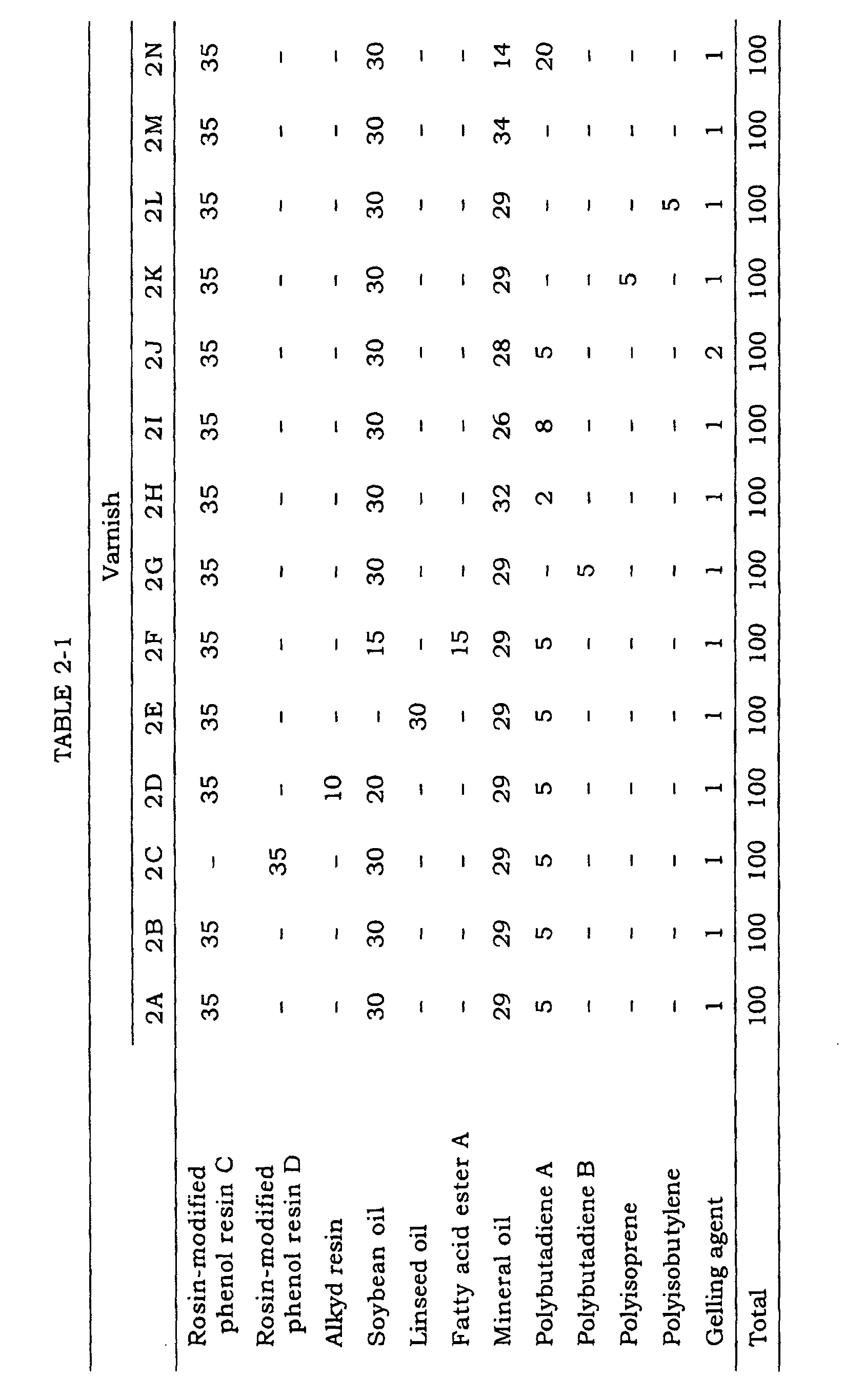


Into a four-necked flask equipped with a condenser, a
thermometer and an agitator, rosin-modified phenol resin E having a
weight average molecular weight of 100,000 and an acid value of 15
mgKOH/g (made by Hitachi Kasei Polymer Co., Ltd.), the soybean oil,
and fatty acid ester B (soybean oil fatty acid isobutyl ester, made by
Lawter Inc.) were added according to the formula shown in Table 3-1 (the
amount of each component is expressed in parts, hereinafter the same).
The mixture was heated to 200°C and kept at the same temperature for 1
hour to dissolve the components. After addition of (ethyl
acetoacetato)aluminum diisopropoxide (ALCH, made by Kawaken Fine
Chemicals, Co. Ltd.) as a gelling agent according to the formula shown in
Table 3-1, the mixture was heated with stirring at 170°C for 1 hour to
give varnish 3A.
The same procedures as in the method of obtaining varnish
3A except that rosin-modified phenol resin E was replaced by rosin-modified
phenol resin F having a weight average molecular weight of
150,000 and an acid value of 15 mgKOH/g (made by Hitachi Kasei
Polymer Co., Ltd.) were repeated to varnish 3B.
Into a four-necked flask equipped with a condenser, a
thermometer and an agitator, rosin-modified phenol resin E, the
soybean oil, and fatty acid ester A (soybean oil fatty acid methyl ester
made by Lawter Inc.) were added according to the formula shown in
Table 3-1. The mixture was heated to 200°C and kept at the same
temperature for 1 hour to dissolve the components. After addition of
(ethyl acetoacetato)aluminum diisopropoxide (ALCH) as a gelling agent
according to the formula shown in Table 3-1, the mixture was heated
with stirring at 170°C for 1 hour to give varnish 3C.
Into a four-necked flask equipped with a condenser, a
thermometer and an agitator, rosin-modified phenol resin E, the
soybean oil, fatty acid ester B and liquid paraffin A (Moresco White P-350P,
made by Matsumura Oil Research Corp.) were added according to
the formula shown in Table 3-1. The mixture was heated to 200°C and
kept at the same temperature for 1 hour to dissolve the components.
After addition of (ethyl acetoacetato)aluminum diisopropoxide (ALCH) as
a gelling agent according to the formula shown in Table 3-1, the mixture
was heated with stirring at a temperature of 170°C for 1 hour to give
varnish 3D.
Into a four-necked flask equipped with a condenser, a
thermometer and an agitator, rosin-modified phenol resin E, the
soybean oil, and fatty acid ester B were added according to the formula
shown in Table 3-1. The mixture was heated to 200°C and kept at the
same temperature for 1 hour to dissolve the components. After
addition of diphenylmethane diisocyanate (MDI) as a cross-linking agent
according to the formula shown in Table 3-1, the mixture was heated
with stirring at 100°C for 3 hours to give varnish 3E.
Into a four-necked flask equipped with a condenser, a
thermometer and an agitator, rosin-modified phenol resin E, and the
soybean oil were added according to the formula shown in Table 3-1.
The mixture was heated to 200°C and kept at the same temperature for 1
hour to dissolve the components. After addition of (ethyl
acetoacetato)aluminum diisopropoxide (ALCH made by Kawaken Fine
Chemicals Co, Ltd.) as a gelling agent according to the composition
shown in Table 3-1, the mixture was heated with stirring at 170°C for 1
hour to give varnish 3F.
Into a four-necked flask equipped with a condenser, a
thermometer and an agitator, rosin-modified phenol resin E, the
soybean oil, and fatty acid ester B were added according to the formula
shown in Table 3-1. The mixture was heated to 200°C and kept at the
same temperature for 1 hour to dissolve the components, giving varnish
3G.
Varnish 3A or 3B, and carbon black were mixed according to
the formula shown in Table 3-2 (the amount of each component is
expressed in parts, hereinafter the same), and the resulting mixture was
ground in a bead mill and a three-roll mill in sequence to give each ink
base. Subsequently, liquid paraffin A, fatty acid ester B, the wax
compound and the dryer were added to the ink base, and the resulting
mixture was stirred to give offset printing ink compositions according to
Examples 3-1 and 3-2.
Varnish 3C and carbon black were mixed according to the
formula shown in Table 3-2, and the resulting mixture was ground in a
bead mill and a three-roll mill in sequence to give an ink base.
Subsequently, liquid paraffin A, fatty acid ester A, the wax compound
and the dryer were added to the ink base, and the resulting mixture was
stirred to give an offset printing ink composition according to Example
3-3.
Varnish 3D and carbon black were mixed according to the
formula shown in Table 3-2, and the resulting mixture was ground in a
bead mill and a three-roll mill in sequence to give an ink base.
Subsequently, fatty acid ester B, the wax compound and the dryer were
added to the ink base, and the resulting mixture was stirred to give an
offset printing ink composition according to Example 3-4.
Varnish 3A and carbon black were mixed according to the
formula shown in Table 3-2, and the resulting mixture was ground in a
bead mill and a three-roll mill in sequence to give an ink base.
Subsequently, liquid paraffin A, fatty acid ester B, the wax compound
and the dryer were added to the ink base, and the mixture was stirred to
give an offset printing ink composition according to Example 3-5.
Varnish 3A and carbon black were mixed according to the
formula shown in Table 3-2, and the resulting mixture was ground in a
bead mill and a three-roll mill in sequence to give an ink base.
Subsequently, liquid paraffin B (Moresco White P-55, made by
Matsumura Oil Resarch Corp.), fatty acid ester B, the wax compound
and the dryer were added to the ink base, and the mixture was stirred to
give an offset printing ink composition according to Example 3-6.
Varnish 3E and carbon black were mixed according to the
formula shown in Table 3-2, and the resulting mixture was ground in a
bead mill and a three-roll mill in sequence to give an ink base.
Subsequently, liquid paraffin A, fatty acid ester B, the wax compound
and the dryer were added to the ink base, and the mixture was stirred to
give an offset printing ink composition according to Example 3-7.
Varnish 3F and carbon black were mixed according to the
formula shown in Table 3-2, and the resulting mixture was ground in a
bead mill and a three-roll mill in sequence to give an ink base.
Subsequently, the soybean oil, liquid paraffin A, the wax compound and
the dryer were added to the ink base, and the mixture was stirred to give
an offset printing ink composition according to Example 3-8.
Varnish 3G and carbon black were mixed according to the
formula shown in Table 3-2, and the resulting mixture was ground in a
bead mill and a three-roll mill in sequence to give an ink base.
Subsequently, liquid paraffin A, fatty acid ester B, the wax compound
and the dryer were added to the ink base, and the mixture was stirred to
give an offset printing ink composition according to Example 3-9.
Varnish 3A, 3F or 3G, and carbon black were mixed
according to the formula shown in Table 3-2, and each resulting mixture
was ground in a bead mill and a three-roll mill in sequence to give an ink
base. Subsequently, fatty acid ester B, the wax compound and the
dryer were added to the ink base according to the formula shown in
Table 3-3, and the mixture was stirred to give each offset printing ink
composition according to Comparative Examples 3-1 to 3-3.
Herein, none of the offset printing ink compositions of
Examples 3-1 to 3-9, and Comparative Examples 3-1 to 3-3 contain
mineral oil.
The performance evaluation tests for the offset printing ink
compositions of Examples 3-1 to 3-9 and Comparative Examples 3-1 to
3-3 in regard to gloss, setting property, primary blocking resistance and
secondary blocking resistance were carried in the same manner as in
Examples 1-1 to 1-13.
The results of the performance evaluation tests for Examples
3-1 to 3-9 and Comparative Example 3-1 to 3-3 are shown in Table 3-3.


The present invention provides an offset printing ink composition
capable of providing printed matters which is excellent in setting
property, and primary blocking resistance and secondary blocking
resistance, and which is not reduced in the gloss and drying
characteristics of printed surface.
Claims (5)
- An offset printing ink composition comprising mainly a coloring agent, a binder resin and a solvent containing a vegetable oil component, the ink composition further comprising as a drying characteristic improver at least one member selected from the group consisting of (A) a polymer which is obtained by polymerizing at least one of olefin monomers and diene monomers, and has a solubility parameter of less than 19 (MPa)1/2 and is compatible with the solvent; and (B) a liquid paraffin, wherein the total amount of the improver is 0.1 to 10 % by weight in the ink composition.
- The offset printing ink composition of Claim 1, wherein the binder resin comprises a rosin-modified phenol resin and/or a rosin-modified maleic acid resin.
- The offset printing ink composition of Claim 2, which contains a varnish for ink which is prepared by reacting the rosin-modified phenol resin and/or the rosin-modified maleic acid resin as the binder resin with a cross-linking agent or a gelling agent in the presence of the drying characteristic improver and the solvent.
- The offset printing ink composition of any one of Claims 1 to 3, wherein the polymer (A) is liquid at room temperature.
- The offset printing ink composition of any one of Claims 1 to 4, wherein all or part of the vegetable oil component is a fatty acid ester compound derived from a vegetable oil.
Applications Claiming Priority (7)
| Application Number | Priority Date | Filing Date | Title |
|---|---|---|---|
| JP2000273727 | 2000-09-08 | ||
| JP2000273726 | 2000-09-08 | ||
| JP2000273726 | 2000-09-08 | ||
| JP2000273727A JP3392113B2 (en) | 2000-04-19 | 2000-09-08 | Offset printing ink composition |
| JP2001022750 | 2001-01-31 | ||
| JP2001022750A JP4330282B2 (en) | 2001-01-31 | 2001-01-31 | Ink composition for offset printing |
| PCT/JP2001/007760 WO2002020679A1 (en) | 2000-09-08 | 2001-09-07 | Ink composition for offset printing |
Publications (2)
| Publication Number | Publication Date |
|---|---|
| EP1323794A1 true EP1323794A1 (en) | 2003-07-02 |
| EP1323794A4 EP1323794A4 (en) | 2004-11-17 |
Family
ID=27344577
Family Applications (1)
| Application Number | Title | Priority Date | Filing Date |
|---|---|---|---|
| EP01963494A Withdrawn EP1323794A4 (en) | 2000-09-08 | 2001-09-07 | OFFSET INK |
Country Status (3)
| Country | Link |
|---|---|
| US (1) | US20040082684A1 (en) |
| EP (1) | EP1323794A4 (en) |
| WO (1) | WO2002020679A1 (en) |
Cited By (3)
| Publication number | Priority date | Publication date | Assignee | Title |
|---|---|---|---|---|
| EP1873216A4 (en) * | 2005-03-22 | 2010-04-14 | Sakata Inx Corp | METHOD FOR PRODUCING INK COMPOSITION FOR OFFSET PRINTING AND INK COMPOSITION FOR OFFSET PRINTING PRODUCED BY SAID METHOD |
| EP1995286A4 (en) * | 2006-03-15 | 2010-11-24 | Dainippon Ink & Chemicals | PRINTING INK COMPOSITION |
| CN110885586A (en) * | 2019-10-17 | 2020-03-17 | 苏州丰倍生物科技有限公司 | Vegetable oil-based ink viscosity regulator and preparation method thereof |
Families Citing this family (10)
| Publication number | Priority date | Publication date | Assignee | Title |
|---|---|---|---|---|
| JP4874955B2 (en) * | 2005-03-25 | 2012-02-15 | サカタインクス株式会社 | Method for producing ink composition for offset printing and ink composition for offset printing obtained from the production method |
| US7666925B2 (en) * | 2006-04-11 | 2010-02-23 | Matsui Chemical Co., Ltd. | Ink composition for waterless lithographic printing of seamless can for retort food |
| US7645332B2 (en) * | 2006-04-28 | 2010-01-12 | Toshiba Tec Kabushiki Kaisha | Non-aqueous ink composition for inkjet |
| US8741039B2 (en) * | 2007-02-21 | 2014-06-03 | Sanford, L.P. | Permanent ink compositions and writing instruments containing same |
| US7842102B2 (en) * | 2007-11-05 | 2010-11-30 | Sunbelt Corporation | Liquid dye formulations in non-petroleum based solvent systems |
| EP2554610B1 (en) * | 2010-03-31 | 2017-11-15 | Konica Minolta Holdings, Inc. | Inkjet ink and method for forming inkjet image |
| CN102153907B (en) * | 2011-03-11 | 2013-07-17 | 中钞油墨有限公司 | Adhesion promoter for intaglio ink and preparation method thereof |
| JP2013249370A (en) * | 2012-05-31 | 2013-12-12 | Sakata Corp | Printing ink composition and method of manufacturing printing ink composition |
| JP7309347B2 (en) * | 2018-11-30 | 2023-07-18 | サカタインクス株式会社 | Ink composition for offset printing, method for producing the same, and method for producing printed matter using the same |
| US20230416544A1 (en) * | 2020-11-18 | 2023-12-28 | The Texas A & M University System | Polymer/phase change material composite ink for three-dimensional printing by direct ink writing |
Family Cites Families (16)
| Publication number | Priority date | Publication date | Assignee | Title |
|---|---|---|---|---|
| JPS4627493B1 (en) * | 1967-09-11 | 1971-08-10 | ||
| US4403550A (en) * | 1979-08-23 | 1983-09-13 | Ppg Industries, Inc. | Process for planographic printing |
| US4253397A (en) * | 1979-10-24 | 1981-03-03 | Rohm And Haas Company | Method of printing with lithographic ink of reduced volatile solvent content for reducing atmospheric pollution |
| JPH089702B2 (en) * | 1989-01-20 | 1996-01-31 | サカタインクス株式会社 | Method for producing varnish for lithographic printing ink |
| JPH04180969A (en) * | 1990-11-14 | 1992-06-29 | Toyo Ink Mfg Co Ltd | Monoazo lake pigment and its use |
| JP3317512B2 (en) * | 1991-10-22 | 2002-08-26 | 日清製油株式会社 | Solvent for ink |
| JP3061694B2 (en) * | 1992-04-02 | 2000-07-10 | 谷口インキ製造株式会社 | Oxidation polymerization type printing ink |
| ZA933185B (en) * | 1992-05-08 | 1994-05-23 | Dick Co Ab | Encapsulated magnetic particles pigments and carbon black compositions and methods related thereto |
| EP0677556A3 (en) * | 1994-04-15 | 1997-02-26 | Toyo Ink Mfg Co | Coated pigment and dye composition. |
| JPH08283643A (en) * | 1995-04-07 | 1996-10-29 | Toyo Ink Mfg Co Ltd | Ink composition for printing |
| US5882394A (en) * | 1995-06-28 | 1999-03-16 | Toyo Ink Manufacturing Co., Ltd. | Aqueous pigment paste for offset ink, process for producing the paste, and use thereof |
| JP3396585B2 (en) * | 1995-12-25 | 2003-04-14 | サカタインクス株式会社 | Pigment dispersion and ink composition for offset printing using the same |
| JP3880020B2 (en) * | 1997-09-16 | 2007-02-14 | サカタインクス株式会社 | Waterless lithographic printing ink composition |
| JP2001002967A (en) * | 1999-06-18 | 2001-01-09 | Ricoh Co Ltd | Ink for planographic printing press and planographic printing machine |
| JP2001261768A (en) * | 2000-03-14 | 2001-09-26 | Taniguchi Ink Seizo Kk | Method for producing varnish containing resin modified with rosin and ink for printing |
| US6692881B2 (en) * | 2001-05-30 | 2004-02-17 | Ricoh Company Limited | Recording liquid and image forming method using the recording liquid |
-
2001
- 2001-09-07 WO PCT/JP2001/007760 patent/WO2002020679A1/en not_active Ceased
- 2001-09-07 US US10/380,093 patent/US20040082684A1/en not_active Abandoned
- 2001-09-07 EP EP01963494A patent/EP1323794A4/en not_active Withdrawn
Cited By (3)
| Publication number | Priority date | Publication date | Assignee | Title |
|---|---|---|---|---|
| EP1873216A4 (en) * | 2005-03-22 | 2010-04-14 | Sakata Inx Corp | METHOD FOR PRODUCING INK COMPOSITION FOR OFFSET PRINTING AND INK COMPOSITION FOR OFFSET PRINTING PRODUCED BY SAID METHOD |
| EP1995286A4 (en) * | 2006-03-15 | 2010-11-24 | Dainippon Ink & Chemicals | PRINTING INK COMPOSITION |
| CN110885586A (en) * | 2019-10-17 | 2020-03-17 | 苏州丰倍生物科技有限公司 | Vegetable oil-based ink viscosity regulator and preparation method thereof |
Also Published As
| Publication number | Publication date |
|---|---|
| EP1323794A4 (en) | 2004-11-17 |
| US20040082684A1 (en) | 2004-04-29 |
| WO2002020679A1 (en) | 2002-03-14 |
Similar Documents
| Publication | Publication Date | Title |
|---|---|---|
| US20040082684A1 (en) | Ink composition for offset printing | |
| JP6282837B2 (en) | Printing ink varnish, printing ink, and printed matter | |
| JP6128159B2 (en) | Lithographic printing ink composition and printed matter | |
| JP5108430B2 (en) | Ink composition | |
| CN112996866B (en) | Ink composition for offset printing, method for producing same, and method for producing printed matter using same | |
| JP4550045B2 (en) | Rosin phenolic resin and related uses | |
| JP6040686B2 (en) | Rosin polyhydric alcohol ester resin, ink emulsification suitability improver, varnish for offset printing ink and ink composition for offset printing | |
| KR101318708B1 (en) | Composition of rotogravure hotmelt ink containing polypropylene carbonate | |
| JP2000281954A (en) | Gel varnish for offset printing ink and offset printing ink composition using the same | |
| JP3392113B2 (en) | Offset printing ink composition | |
| JP4330282B2 (en) | Ink composition for offset printing | |
| JP2015110750A (en) | Rosin-modified phenolic resin, binder for offset printing ink, varnish for offset printing ink, and offset printing ink | |
| JP2013057038A (en) | Lithographic ink and printed material thereof | |
| JP6352737B2 (en) | Offset printing ink and printed matter | |
| JP2005213401A (en) | Resin production method and ink | |
| JP3593341B2 (en) | Gel varnish for offset printing ink, and offset printing ink composition using the same | |
| JP2003020431A (en) | Printing ink and printed matter using the same | |
| JP5714238B2 (en) | Lithographic printing ink composition | |
| JP2002155227A (en) | Offset printing ink composition | |
| JP2012188608A (en) | Lithographic ink and its printed matter | |
| JP2007056186A (en) | Curable composition, active energy ray-curable printing ink using the same, and printed matter thereof | |
| JP3626164B2 (en) | Offset printing ink composition | |
| JP2007112966A (en) | Method for producing pigment composition, pigment composition obtained therefrom, printing ink using the same, and printed matter thereof | |
| KR101846296B1 (en) | Compostion for Dry lithographic printing | |
| JP2012207190A (en) | Lithographic ink and printed material made using the same |
Legal Events
| Date | Code | Title | Description |
|---|---|---|---|
| PUAI | Public reference made under article 153(3) epc to a published international application that has entered the european phase |
Free format text: ORIGINAL CODE: 0009012 |
|
| 17P | Request for examination filed |
Effective date: 20030326 |
|
| AK | Designated contracting states |
Designated state(s): DE FR GB |
|
| A4 | Supplementary search report drawn up and despatched |
Effective date: 20041001 |
|
| RIC1 | Information provided on ipc code assigned before grant |
Ipc: 7C 09D 11/00 B Ipc: 7C 09D 11/02 A |
|
| 17Q | First examination report despatched |
Effective date: 20050228 |
|
| STAA | Information on the status of an ep patent application or granted ep patent |
Free format text: STATUS: THE APPLICATION IS DEEMED TO BE WITHDRAWN |
|
| 18D | Application deemed to be withdrawn |
Effective date: 20050712 |