EP1323586A2 - Drive controller and control method - Google Patents
Drive controller and control method Download PDFInfo
- Publication number
- EP1323586A2 EP1323586A2 EP02258841A EP02258841A EP1323586A2 EP 1323586 A2 EP1323586 A2 EP 1323586A2 EP 02258841 A EP02258841 A EP 02258841A EP 02258841 A EP02258841 A EP 02258841A EP 1323586 A2 EP1323586 A2 EP 1323586A2
- Authority
- EP
- European Patent Office
- Prior art keywords
- occupant
- display
- display unit
- front passenger
- display surface
- Prior art date
- Legal status (The legal status is an assumption and is not a legal conclusion. Google has not performed a legal analysis and makes no representation as to the accuracy of the status listed.)
- Withdrawn
Links
- 238000000034 method Methods 0.000 title claims description 6
- NJPPVKZQTLUDBO-UHFFFAOYSA-N novaluron Chemical compound C1=C(Cl)C(OC(F)(F)C(OC(F)(F)F)F)=CC=C1NC(=O)NC(=O)C1=C(F)C=CC=C1F NJPPVKZQTLUDBO-UHFFFAOYSA-N 0.000 description 8
- 238000001514 detection method Methods 0.000 description 5
- 238000010586 diagram Methods 0.000 description 3
- 230000005540 biological transmission Effects 0.000 description 2
- 230000000694 effects Effects 0.000 description 1
- 230000002349 favourable effect Effects 0.000 description 1
Images


Classifications
-
- B—PERFORMING OPERATIONS; TRANSPORTING
- B60—VEHICLES IN GENERAL
- B60R—VEHICLES, VEHICLE FITTINGS, OR VEHICLE PARTS, NOT OTHERWISE PROVIDED FOR
- B60R11/00—Arrangements for holding or mounting articles, not otherwise provided for
- B60R11/02—Arrangements for holding or mounting articles, not otherwise provided for for radio sets, television sets, telephones, or the like; Arrangement of controls thereof
- B60R11/0229—Arrangements for holding or mounting articles, not otherwise provided for for radio sets, television sets, telephones, or the like; Arrangement of controls thereof for displays, e.g. cathodic tubes
- B60R11/0235—Arrangements for holding or mounting articles, not otherwise provided for for radio sets, television sets, telephones, or the like; Arrangement of controls thereof for displays, e.g. cathodic tubes of flat type, e.g. LCD
-
- B—PERFORMING OPERATIONS; TRANSPORTING
- B60—VEHICLES IN GENERAL
- B60K—ARRANGEMENT OR MOUNTING OF PROPULSION UNITS OR OF TRANSMISSIONS IN VEHICLES; ARRANGEMENT OR MOUNTING OF PLURAL DIVERSE PRIME-MOVERS IN VEHICLES; AUXILIARY DRIVES FOR VEHICLES; INSTRUMENTATION OR DASHBOARDS FOR VEHICLES; ARRANGEMENTS IN CONNECTION WITH COOLING, AIR INTAKE, GAS EXHAUST OR FUEL SUPPLY OF PROPULSION UNITS IN VEHICLES
- B60K35/00—Instruments specially adapted for vehicles; Arrangement of instruments in or on vehicles
- B60K35/65—Instruments specially adapted for specific vehicle types or users, e.g. for left- or right-hand drive
- B60K35/654—Instruments specially adapted for specific vehicle types or users, e.g. for left- or right-hand drive the user being the driver
-
- B—PERFORMING OPERATIONS; TRANSPORTING
- B60—VEHICLES IN GENERAL
- B60K—ARRANGEMENT OR MOUNTING OF PROPULSION UNITS OR OF TRANSMISSIONS IN VEHICLES; ARRANGEMENT OR MOUNTING OF PLURAL DIVERSE PRIME-MOVERS IN VEHICLES; AUXILIARY DRIVES FOR VEHICLES; INSTRUMENTATION OR DASHBOARDS FOR VEHICLES; ARRANGEMENTS IN CONNECTION WITH COOLING, AIR INTAKE, GAS EXHAUST OR FUEL SUPPLY OF PROPULSION UNITS IN VEHICLES
- B60K35/00—Instruments specially adapted for vehicles; Arrangement of instruments in or on vehicles
- B60K35/65—Instruments specially adapted for specific vehicle types or users, e.g. for left- or right-hand drive
- B60K35/656—Instruments specially adapted for specific vehicle types or users, e.g. for left- or right-hand drive the user being a passenger
-
- B—PERFORMING OPERATIONS; TRANSPORTING
- B60—VEHICLES IN GENERAL
- B60R—VEHICLES, VEHICLE FITTINGS, OR VEHICLE PARTS, NOT OTHERWISE PROVIDED FOR
- B60R21/00—Arrangements or fittings on vehicles for protecting or preventing injuries to occupants or pedestrians in case of accidents or other traffic risks
- B60R2021/003—Arrangements or fittings on vehicles for protecting or preventing injuries to occupants or pedestrians in case of accidents or other traffic risks characterised by occupant or pedestian
Definitions
- the present invention relates to a drive controller and a control method for controlling to change the orientation of a display surface of display means rotatably mounted on a vehicle.
- a related art drive controller is known, as described in the Japanese Patent Laid-Open No. 2001-30839, where an occupant of a vehicle operates a switch provided on a display unit to orient the display surface of the display unit in the direction desired by the occupant.
- an occupant seated in the driver seat must operate the switch to watch map information on a car navigation system while driving a vehicle.
- the line of sight of the occupant is turned from the traveling direction of the vehicle in this operation, which could disturb the driving operation.
- the invention has been proposed in view of the aforementioned situation and aims at providing a drive controller and a control method that can automatically change the orientation of a display surface of display means in accordance with the seated position(s) of one or a plurality of occupants of a vehicle.
- the invention provides a drive controller, which includes: a display, mounted on a vehicle, having a display surface; a drive device for driving the display to change the orientation of the displaysurface; a seating position detector for detecting seating position of one or more occupants aboard the vehicle; and a controller for controlling the drive device so as to orient the display surface in accordance with the seating position of the one or more occupants.
- the seating position detector is capable of detecting seating of the occupant in a driver seat and a front passenger seat respectively.
- the drive device is capable of driving the display to a first position, a second position and a third position. In the first position, the display surface is oriented toward the occupant seated in the driver seat. In the second position, the display surface is oriented toward both of the occupants seated in the driver seat and the front passenger seat. In the third position, the display surface is oriented toward the occupant seated in the front passenger seat.
- the controller controls the drive device to drive the display to the first position when the seating position detector detects seating of the occupant in the driver seat and does not detect seating of the occupant in the front passenger seat.
- the controller controls the drive device to drive the display to the second position when the seatingposition detector detects seating of the occupants both in the driver seat and in the front passenger seat.
- the controller controls the drive device to drive the display to the third position when seating position detector detects seating of the occupant in the front passenger seat and does not detect seating of the occupant in the driver seat.
- the invention further provides a control method for controlling an orientation of a display surface of a display, which includes: detecting the seating position of one or more occupants aboard the vehicle; and controlling the orientation of a display surface of a display so as to orient the display surface towards the one or more occupants in accordance with the seating position of the one or more occupants.
- Fig. 1 is a schematic diagram showing the general configuration of a drive controller according to this embodiment.
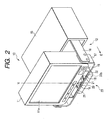
- Fig. 2 is a perspective view of a drive controller according to the embodiment.
- Fig. 3 is a block diagram showing the controller in the embodiment.
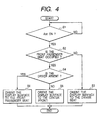
- Fig. 4 is a flowchart showing the operation of the drive controller in the embodiment.
- Fig. 1 is a schematic diagram showing the internal configuration of a vehicle mounting a drive controller according to this embodiment.
- a numeral 1 represents a vehicle.
- the vehicle 1 includes a driver seat 2 and a front passenger seat 3.
- a dashboard 4 Before the driver seat 2 and the front passenger seat 3 is provided a dashboard 4.
- a steering wheel 5 On the dashboard 4 is provided a steering wheel 5 for steering the vehicle 1 before the driver seat 2.
- a speaker 9 In the near proximity of the driver seat 2 and the front passenger seat 3 respectively is mounted a speaker 9, which amplifies and outputs the audio information supplied by a navigation unit 27 and a DVD (Digital Versatile Disc) unit 26.
- a numeral 7 represents an occupant is an occupant seated in the driver seat 2 and 8 an occupant seated in the front passenger seat 3.
- a display unit mounting section 12 In the approximate center of the dashboard 4 (before the center position of the driver seat 2 and front passenger seat 3) is arranged a display unit mounting section 12, to which a display unit 11 is rotatablymounted in the direction indicated by X in the figure.
- a controller 14 controls the operation of a drive unit 23 which drives a navigation unit 27, a DVD unit 26, TV receiver 25, and the display unit 11.
- a selector switch 28 On the controller 14 is provided a selector switch 28 which is changed over in accordance with the operation of a source selection button (not shown) provided on the display unit 11.
- the navigation unit 27 includes a playback unit for playing back map information recorded onto a recording medium such as a CD-ROM, and a GPS receiver.
- the navigation unit 27 sends map information played back by the playback unit to the display unit 11.
- the DVD unit 26 is a playback unit for playing back image information and audio information recorded onto a DVD such as DVD-VIDEO.
- the DVD unit sends image information played back by the playback unit to the display unit 11 and sends audio information to the speaker 9.
- the TV receiver 25 received a TV wave, converts the TV wave to an image signal, and sends the image signal to the display unit 11. While the controller 14, navigation unit 27, TV receiver 25 and a DVD unit 26 are shown behind the driver seat 2 and the front passenger seat 3 in Fig. 1 for clarity, these are arranged in predetermined positions of the dashboard 4 in practice.
- seats where occupants 7, 8 are seated comprise a sensor 29 for detecting an occupied driver seat as seating position detecting means and a sensor 30 for detecting an occupied front passenger seat as seating position detecting means.
- These seat occupation detecting sensors 29, 30 are composed of for example pressure sensors, and detects the seat occupation by detecting the level of a pressure applied when the occupants 7, 8 are seated.
- Each seat occupation detecting sensors 29, 30 sends signals indicating the occupants 7, 8 are seated to the controller 14.
- a drive unit 23 for deriving the display unit 11 will be described referring to Fig. 2.
- the display unit mounting section 12 for mounting the display unit 11 will be described.
- the display unit mounting section 12 includes a main body case 15 embedded into the dashboard 4, a pair of arms 16 extending in the direction of arrow E from the sides of the main body case 15, and pedestals 17 mounted on the tip of the pair of arms 16.
- the pedestal 17 is in the shape of an elongated plate, the ends of which in the longitudinal direction are erected upward.
- the erected sections are fixed to the pair of arms with nuts, and mounted to bridge across the arms 16.
- On the pedestal 17 are provided two guide pins 18, 18 which protrudes upward, and the guide pins 18, 18 are slidably engaged with two guide holes 21 formed in a rotary plate 19 mentioned later.
- the drive unit 23 for driving the display unit 11 will be described.
- the drive unit 23 includes a rotary plate 19 rotatably mounted on the pedestal 17 and a rotary box 22 accommodating a motor for rotation 22a for driving the rotary plate 19.
- the rotary plate 19 is slightly shorter than the longitudinal length of the pedestal 17 and has approximately the same shape as the pedestal 17.
- the tip of the erected section erected from the ends thereof in the longitudinal direction is bent along the bottom of the display unit 11. To the bend section is fixed the bottom of the display unit 11.
- a mounting plate 20 In the approximate center (on the center axis Y of the display unit 11) of the rotary plate 19 is located a mounting plate 20.
- a rotary plate 19 is rotatably mounted on the pedestal 17 so as to rotate about the mounting plate 20 as a pivot.
- On both sides of the mounting plate 20 are provided a pair of guide holes 21, 21 formed in the shape of arc and guide pins 18, 18 of the pedestal 17 are engaged slidably.
- the rotary box 22 accommodates a motor for rotation 22a and a transmission member for transmitting the drive force of the motor for rotation 22a to a vertical drive axis (not shown) , which extends from the mounting plate 20 into the rotary box 22.
- the transmission member is composed of a plurality of gear trains and transmits the drive force of the gear trains to the vertical drive axis depending on the rotation direction of the motor for rotation 22a.
- the motor for rotation 22a is driven by a power supplied using a flexible cable.
- the space area Z depends on the size of the display unit 11.
- the space area Z is an area rotatable from the position where the display surface 11a is oriented toward the occupant 7 seated in the driver seat 2 and the position where the display surface 11a is oriented toward the occupant 3 seated in the front passenger seat 3.
- the display surface 11a is displayed map information from the navigation unit 27, image information from the DVD unit 26, or image information from the TV receiver 25, depending on switching of the selector switch 28.
- the rotary plate 19 is rotated as driven by the motor for rotation 22a, which changes the orientation of the display surface 11a of the display means 11.
- the orientation of the display surface 11a is changed, to a position where mainly the occupant 7 in the driver seat 2 can recognize the display surface 11a, that is, a first position A where the direction X perpendicular to the center axis Y of the display surface 11a is directed to the driver seat 2, to a position where mainly the occupant 7 in the driver seat 2 and the occupant 8 in the front passenger seat 3 can recognize the display surface 11a, that is, a second position B where the direction X perpendicular to the center axis Y of the display surface 11a is directed to the middle position between the driver seat 2 and the front passenger seat 3, or to a position where mainly the occupant 8 in the front passenger seat 3 can recognize the display surface 11a, that is, a third position C where the direction X perpendicular to the center axis Y of the display surface 11
- Operation of the drive unit 23 is controlled by the controller 14. That is, in a memory 32 (shown in Fig. 3) of the controller 14 are preset drive conditions for driving the display unit 11 to the first position A, second position B or third position C. Depending on the seating position of the occupants 7, 8, the drive conditions are issued to control the drive unit 23.
- Table 1 An example of the drive conditions preset in the memory 23 of the controller 14 will be described using Table 1.
- Table 1 the number of rotations of the motor for rotation 22a and its rotating direction are specified in accordance with the current position of the display unit 11 and the position to which the display unit 11 will be oriented as determined by the seating position of the occupants 7, 8.
- the controller issues the drive conditions in the uppermost row of Table 1 and controls the drive unit 23 to set the rotating direction of the motor for rotation 22a to "positive" direction and the number of rotations to "aaa".
- Other drive conditions in Table 1 are also issued the same as the uppermost row.
- the drive unit 23 is controlled to drive the display unit 11.
- the current position of the display unit 11 in Table 1 is detected, for example, by providing a switch on the driver's sear which is turned on when the display unit 11 is in the first position A and a switch on the front passenger seat that is turned on when the display unit 11 is in the third position C on the pedestal 17 and by checking on/off of these switches.
- Table 2 shows the relationship between the current position of the display unit 11 and on/off of these switches. Switch on the driver seat Switch on the front passenger seat Motor for rotation Current position of the display unit On Off Halted First position A Off Off Craigd Second position B Off On Gard Third position C Off Off In rotation In rotation In rotation
- the switch on the driver seat is on, the switch on the front passenger seat is off, and the detected operation state of the motor for rotation 22a is halted, it is detected that the current position of the display unit 11 is the first position A (uppermost row of Table 2).
- the switch on the driver seat is off, the switch on the front passenger seat is on, and the motor for rotation 22a is halted, it is detected that the current position of the display unit 11 is the third position C (third row from top of Table 2).
- the state the display unit 11 is in the second position B is determined by detecting that both the switch on the driver seat and the switch on the front passenger seat are turned off and the motor for rotation 22a is halted.
- the state the display unit 11 is in rotation is determined by detecting the operating state of the motor for rotation 22a.
- the controller 14 comprises a Central Processing Unit (CPU) 31 as a computer, a memory 32, a steering wheel position determination means 33, and right/left angle control means 34 for controlling the motor for rotation 22a.
- CPU Central Processing Unit
- the CPU 31 recognizes the seating position of the occupants 7, 8 of the vehicle 1 based on signals from the sensor 29 for detecting an occupied driver seat and a sensor 30 for detecting an occupied front passenger seat.
- the CPU 31 recognizes the current position of the display unit 11 based on the on/off state of the switch on the driver seat and the switch on the front passenger seat as well as the operating state of the motor for rotation 22a. Then, the CPU 31 controls the right/left angle control means 34 to drive the display unit 11 based on the current position of the display unit 11 and detection signals from the seat occupation detecting sensors 29, 30.
- the memory 32 is a RAM (Random Access Memory) and stores data indicating the drive conditions and data indicating the current position of the display unit 11.
- the data indicating the current position of the display unit 11 is sequentially updated by the CPU 31 to the latest data depending on the on/off state of the switch on the driver seat and the switch on the front passenger seat as well as the operating state of the motor for rotation 22a.
- the right/left angle control means 34 performs drive control of the motor for rotation 22a of the drive unit 23 by way of a control signal from CPU 31 that is based on the drive conditions stored in the memory 32.
- the controller 14 in this configuration issues drive conditions for the memory 32 based on the detection by the sensor 29 for detecting an occupied driver seat and the sensor 30 for detecting an occupied front passenger seat and controls the drive unit 23 to direct the display unit 11 to the first position A where mainly the occupant 7 in the driver seat 2 can recognize the display surface 11a of the display unit 11, to the second position B where mainly the occupant 7 in the driver seat 2 and the occupant 8 in the front passenger seat 3 can recognize the display surface 11a of the display unit 11, or to the third position C where mainly the occupant 8 in the front passenger seat 3 can recognize the display surface 11a of the display unit 11.
- An accessory switch provided in the vehicle 1 is turned on to supply power from an accessory power source provided in the vehicle 1.
- the power starts the units such as the display unit 11 and drive unit 23.
- the controller 14 is capable of control by way of the power supplied from a backup power source.
- the controller 14 constantly supervises that the accessory switch is turned on (step S1).
- step s1 the controller 14 recognizes that the display unit 11 and the drive unit 23 have started up.
- An occupant that turns on the accessory switch of the vehicle 1 is generally an occupant 7 seated in the driver seat 2.
- the sensor 29 for detecting an occupied driver seat detects that the occupant 7 is seated.
- the controller 14 recognizes that the occupant 7 is seated in the driver seat 2.
- the controller 14 determines whether the occupant 8 is seated in the front passenger seat 3 based on the detection by the sensor 30 for detecting an occupied front passenger seat. For example, by detecting that the level of the pressure applied to the clamp sensor, seating of the occupant 8 is determined (step S2).
- the controller 14 references the data indicating the current position of the display unit 11 stored in the memory 32 as well as issues drive conditions to control the drive unit 23. For example, in case the controller 14 has recognized that the current position of the display unit 11 is the third position C in Fig. 1, the controller 14 issues the drive conditions in the lowermost row of table 1 to control the drive unit 23 (motor for rotation 22a).
- the display unit 11 is placed in the first position A in Fig. 1 and its display surface 11a is oriented to the position where mainly the occupant 7 seated in the driver seat 2 can recognize the display surface 11a (step S3).
- step S2 it is determined whether the occupant 7 is still seated in the driver seat 2. This assumes that the occupant 7 seated in the driver seat 2 when the accessory switch is turned on has gotten off the vehicle. That is, even when the vehicle 1 is halted, the occupant 7 seated in the driver seat 2 when the accessory switch is turned on could get off the vehicle, and it is determined once whether the occupant 7 is seated in the driver seat 2 (step S4).
- the controller 14 references the data indicating the current position of the display unit 11 stored in the memory 32 as well as issues drive conditions to control the drive unit 23. For example, in case the controller 14 has recognized that the current position of the display unit 11 is the third position C in Fig. 1, the controller 14 issues the drive conditions in the fifth row from top of Table 1 to control the drive unit 23 (motor for rotation 22a).
- the display unit 11 is placed in the second position B in Fig. 1 and its display surface 11a is oriented to the position where mainly the occupant 7 seated in the driver seat 2 and the occupant 8 seated in the front passenger seat 3 can recognize the display surface 11a (step S5).
- the controller 14 references the data indicating the current position of the display unit 11 stored in the memory 32 as well as issues drive conditions to control the drive unit 23. For example, in case the controller 14 has recognized that the current position of the display unit 11 is the second position B in Fig. 1, the controller 14 issues the drive conditions in the fourth row from top of Table 1 to control the drive unit 23 (motor for rotation 22a) .
- the display unit 11 is placed in the third position C in Fig. 1 and its display surface 11a is oriented to the position where mainly the occupant 8 seated in the front passenger seat 3 can recognize the display surface 11a (step S6).
- the aforementioned embodiment has the following operation and effect.
- the CPU 31 of the controller 14 performs drive control of the motor for rotation 22a of the drive unit 23 so as to orient the display surface 11a of the display unit 11 toward the occupants 7, 8 in accordance with the seating of the occupants 7, 8 in the driver seat 2 and front passenger seat 3 of the vehicle 1 detected by the sensor 29 and the sensor 30. That is, on recognizing the detection by the sensor 29 with regard to the seating of the occupant 7 in the driver seat 2 and the detection by the sensor 30 with regard to the seating of the occupant 8 in the front passenger seat 3, the CPU 31 controls the motor for rotation 22a to move the display surface 11a of the display unit 11 to the second position B in Fig. 1 where the display surface 11a is oriented toward the middle position between the driver seat 2 and the front passenger seat 3.
- the CPU 31 controls the motor for rotation 22a to move the display surface 11a of the display unit 11 to the first position A in Fig. 1 where the display surface 11a is oriented toward the driver seat 2.
- the CPU 31 controls the motor for rotation 22a to move the display surface 11a of the display unit 11 to the third position C in Fig. 1 where the display surface 11a is oriented toward the front passenger seat 3. This skips the operation of changing the orientation of the display surface 11a of the display unit 11 for use of the display unit 11.
- the sensor 29 for detecting an occupied driver seat arranged on the driver seat 2 for detecting that the occupant 7 is seated in the driver seat 2 and the sensor 30 for detecting an occupied front passenger seat arranged on the front passenger seat 3 for detecting that the occupant 8 is seated in the front passenger seat 3, it is possible to detect the seating position(s) of the occupant 7 in the driver seat 2 and the occupant 8 in the front passenger seat 3.
- a simple configuration such as a pressure-sensitive sensor as a pair of pressure sensors, it is it is possible to detect the seating position(s) of the occupant 7 in the driver seat 2 and the occupant 8 in the front passenger seat 3.
- the CPU 31 of the controller 14 recognizes the current position of the display unit 11 and performs drive control of the motor for rotation 22a from its current position detected by the sensor 29,30 for detecting occupied seats by reading the drive conditions to control the motor for rotation 22a stored in advance in the memory 32 shown in Table 1, the drive conditions corresponding to the first position A in Fig. 1 where the display surface 11a of the display unit 11 is oriented toward the driver seat 2, the third position C in Fig. 1 where the display surface 11a is oriented toward the front passenger seat 3, or the second position B in Fig. 1 where the display surface 11a is oriented toward the middle position between the driver seat 2 and the front passenger seat 3, thereby moving the display unit 11 to a predetermined position.
- This makes it easy to automatically orient the display surface 11a of the display unit 11 in accordance with the seating position(s) of the occupants 7, 8 with a simple configuration.
- the invention is not limited to the aforementioned embodiment but another configuration or procedure is allowed as long as the object of the invention is attained.
- drive means is controlled to orient the display surface of a display unit toward the occupant(s) in accordance with the seating position(s) of one or a plurality of occupants detected by seating position detecting means. This skips the operation of changing the orientation of the display surface of the display unit for use of the display unit, thereby promising easy handling and up graded convenience.
Landscapes
- Engineering & Computer Science (AREA)
- Mechanical Engineering (AREA)
- Chemical & Material Sciences (AREA)
- Combustion & Propulsion (AREA)
- Transportation (AREA)
- Fittings On The Vehicle Exterior For Carrying Loads, And Devices For Holding Or Mounting Articles (AREA)
- Instrument Panels (AREA)
Abstract
Description
- The present disclosure relates to the subject matter contained in Japanese Patent Application No. 2001-401690 filed December 28, 2001, which is incorporated herein by reference in its entirety.
- The present invention relates to a drive controller and a control method for controlling to change the orientation of a display surface of display means rotatably mounted on a vehicle.
- A related art drive controller is known, as described in the Japanese Patent Laid-Open No. 2001-30839, where an occupant of a vehicle operates a switch provided on a display unit to orient the display surface of the display unit in the direction desired by the occupant.
- To orient a display face of a display unit toward an occupant seated in a driver seat, the display surface oriented toward an occupant seated in a front passenger seat, either occupant operates the switch to attain the purpose.
- According to the related art drive controller, with the display surface of the display unit oriented toward an occupant seated in the front passenger seat, an occupant seated in the driver seat must operate the switch to watch map information on a car navigation system while driving a vehicle. The line of sight of the occupant is turned from the traveling direction of the vehicle in this operation, which could disturb the driving operation.
- The invention has been proposed in view of the aforementioned situation and aims at providing a drive controller and a control method that can automatically change the orientation of a display surface of display means in accordance with the seated position(s) of one or a plurality of occupants of a vehicle.
- The inventionprovides a drive controller, which includes: a display, mounted on a vehicle, having a display surface; a drive device for driving the display to change the orientation of the displaysurface; a seating position detector for detecting seating position of one or more occupants aboard the vehicle; and a controller for controlling the drive device so as to orient the display surface in accordance with the seating position of the one or more occupants.
- According to the invention, the seating position detector is capable of detecting seating of the occupant in a driver seat and a front passenger seat respectively. The drive device is capable of driving the display to a first position, a second position and a third position. In the first position, the display surface is oriented toward the occupant seated in the driver seat. In the second position, the display surface is oriented toward both of the occupants seated in the driver seat and the front passenger seat. In the third position, the display surface is oriented toward the occupant seated in the front passenger seat. The controller controls the drive device to drive the display to the first position when the seating position detector detects seating of the occupant in the driver seat and does not detect seating of the occupant in the front passenger seat. The controller controls the drive device to drive the display to the second position when the seatingposition detector detects seating of the occupants both in the driver seat and in the front passenger seat. The controller controls the drive device to drive the display to the third position when seating position detector detects seating of the occupant in the front passenger seat and does not detect seating of the occupant in the driver seat.
- The invention further provides a control method for controlling an orientation of a display surface of a display, which includes: detecting the seating position of one or more occupants aboard the vehicle; and controlling the orientation of a display surface of a display so as to orient the display surface towards the one or more occupants in accordance with the seating position of the one or more occupants.
- Fig. 1 is a schematic diagram showing the general configuration of a drive controller according to this embodiment.
- Fig. 2 is a perspective view of a drive controller according to the embodiment.
- Fig. 3 is a block diagram showing the controller in the embodiment.
- Fig. 4 is a flowchart showing the operation of the drive controller in the embodiment.
- An embodiment of the invention will be described referring to the drawings.
- Fig. 1 is a schematic diagram showing the internal configuration of a vehicle mounting a drive controller according to this embodiment. In Fig. 1, a numeral 1 represents a vehicle. The vehicle 1 includes a
driver seat 2 and afront passenger seat 3. Before thedriver seat 2 and thefront passenger seat 3 is provided adashboard 4. On thedashboard 4 is provided asteering wheel 5 for steering the vehicle 1 before thedriver seat 2. In the near proximity of thedriver seat 2 and thefront passenger seat 3 respectively is mounted aspeaker 9, which amplifies and outputs the audio information supplied by anavigation unit 27 and a DVD (Digital Versatile Disc)unit 26. A numeral 7 represents an occupant is an occupant seated in thedriver seat front passenger seat 3. - In the approximate center of the dashboard 4 (before the center position of the
driver seat 2 and front passenger seat 3) is arranged a displayunit mounting section 12, to which adisplay unit 11 is rotatablymounted in the direction indicated by X in the figure. Acontroller 14 controls the operation of adrive unit 23 which drives anavigation unit 27, aDVD unit 26,TV receiver 25, and thedisplay unit 11. On thecontroller 14 is provided aselector switch 28 which is changed over in accordance with the operation of a source selection button (not shown) provided on thedisplay unit 11. - The
navigation unit 27 includes a playback unit for playing back map information recorded onto a recording medium such as a CD-ROM, and a GPS receiver. Thenavigation unit 27 sends map information played back by the playback unit to thedisplay unit 11. TheDVD unit 26 is a playback unit for playing back image information and audio information recorded onto a DVD such as DVD-VIDEO. The DVD unit sends image information played back by the playback unit to thedisplay unit 11 and sends audio information to thespeaker 9. TheTV receiver 25 received a TV wave, converts the TV wave to an image signal, and sends the image signal to thedisplay unit 11. While thecontroller 14,navigation unit 27,TV receiver 25 and aDVD unit 26 are shown behind thedriver seat 2 and thefront passenger seat 3 in Fig. 1 for clarity, these are arranged in predetermined positions of thedashboard 4 in practice. - For each of the
driver seat 2 and thefront passenger seat 3, seats whereoccupants 7, 8 are seated comprise asensor 29 for detecting an occupied driver seat as seating position detecting means and asensor 30 for detecting an occupied front passenger seat as seating position detecting means. These seatoccupation detecting sensors occupants 7, 8 are seated. Each seatoccupation detecting sensors occupants 7, 8 are seated to thecontroller 14. - Next, a
drive unit 23 for deriving thedisplay unit 11 will be described referring to Fig. 2. First, the displayunit mounting section 12 for mounting thedisplay unit 11 will be described. - The display
unit mounting section 12 includes amain body case 15 embedded into thedashboard 4, a pair ofarms 16 extending in the direction of arrow E from the sides of themain body case 15, andpedestals 17 mounted on the tip of the pair ofarms 16. Thepedestal 17 is in the shape of an elongated plate, the ends of which in the longitudinal direction are erected upward. The erected sections are fixed to the pair of arms with nuts, and mounted to bridge across thearms 16. On thepedestal 17 are provided twoguide pins guide pins guide holes 21 formed in arotary plate 19 mentioned later. - The
drive unit 23 for driving thedisplay unit 11 will be described. As shown in Fig. 2, thedrive unit 23 includes arotary plate 19 rotatably mounted on thepedestal 17 and a rotary box 22 accommodating a motor forrotation 22a for driving therotary plate 19. Therotary plate 19 is slightly shorter than the longitudinal length of thepedestal 17 and has approximately the same shape as thepedestal 17. The tip of the erected section erected from the ends thereof in the longitudinal direction is bent along the bottom of thedisplay unit 11. To the bend section is fixed the bottom of thedisplay unit 11. - In the approximate center (on the center axis Y of the display unit 11) of the
rotary plate 19 is located amounting plate 20. Arotary plate 19 is rotatably mounted on thepedestal 17 so as to rotate about themounting plate 20 as a pivot. On both sides of themounting plate 20 are provided a pair ofguide holes guide pins pedestal 17 are engaged slidably. - The rotary box 22 accommodates a motor for
rotation 22a and a transmission member for transmitting the drive force of the motor forrotation 22a to a vertical drive axis (not shown) , which extends from themounting plate 20 into the rotary box 22. The transmission member is composed of a plurality of gear trains and transmits the drive force of the gear trains to the vertical drive axis depending on the rotation direction of the motor forrotation 22a. The motor forrotation 22a is driven by a power supplied using a flexible cable. - Between the rear surface of the
display unit 11 mounted on the rotary plate 19 (surface opposite to the face where thedisplay surface 11a is located) and the displayunit mounting section 12 is formed a space area Z required for thedisplay unit 11 to rotate. The space area Z depends on the size of thedisplay unit 11. The space area Z is an area rotatable from the position where thedisplay surface 11a is oriented toward the occupant 7 seated in thedriver seat 2 and the position where thedisplay surface 11a is oriented toward theoccupant 3 seated in thefront passenger seat 3. In thedisplay surface 11a is displayed map information from thenavigation unit 27, image information from theDVD unit 26, or image information from theTV receiver 25, depending on switching of theselector switch 28. - The
rotary plate 19 is rotated as driven by the motor forrotation 22a, which changes the orientation of thedisplay surface 11a of the display means 11. For example, as shown in Fig. 1, the orientation of thedisplay surface 11a is changed, to a position where mainly the occupant 7 in thedriver seat 2 can recognize thedisplay surface 11a, that is, a first position A where the direction X perpendicular to the center axis Y of thedisplay surface 11a is directed to thedriver seat 2, to a position where mainly the occupant 7 in thedriver seat 2 and theoccupant 8 in thefront passenger seat 3 can recognize thedisplay surface 11a, that is, a second position B where the direction X perpendicular to the center axis Y of thedisplay surface 11a is directed to the middle position between thedriver seat 2 and thefront passenger seat 3, or to a position where mainly theoccupant 8 in thefront passenger seat 3 can recognize thedisplay surface 11a, that is, a third position C where the direction X perpendicular to the center axis Y of thedisplay surface 11a is directed to thefront passenger seat 3. - Operation of the
drive unit 23 is controlled by thecontroller 14. That is, in a memory 32 (shown in Fig. 3) of thecontroller 14 are preset drive conditions for driving thedisplay unit 11 to the first position A, second position B or third position C. Depending on the seating position of theoccupants 7, 8, the drive conditions are issued to control thedrive unit 23. - An example of the drive conditions preset in the
memory 23 of thecontroller 14 will be described using Table 1. As shown in Table 1, the number of rotations of the motor forrotation 22a and its rotating direction are specified in accordance with the current position of thedisplay unit 11 and the position to which thedisplay unit 11 will be oriented as determined by the seating position of theoccupants 7, 8.Current position of the
display unitPosition the display unit
will be oriented toNumber of rotations of
the motor for rotationRotating direction of the
motor for rotationFirst position A Second position B aaa Positive Third position C bbb Positive Second position B First position A aaa Negative Third position C ccc Positive Third position C Third position C ccc Negative First position A bbb Negative - For example, in case the current position of the
display unit 11 is in the first position A (position where mainly the occupant 7 in thedriver seat 2 can recognize thedisplay surface 11a) and theseat occupation sensor occupants 7 and 8 are seated in both thedriver seat 2 and thefront passenger seat 3, the controller issues the drive conditions in the uppermost row of Table 1 and controls thedrive unit 23 to set the rotating direction of the motor forrotation 22a to "positive" direction and the number of rotations to "aaa". Other drive conditions in Table 1 are also issued the same as the uppermost row. Depending on the current position of thedisplay unit 11 and the position thedisplay unit 11 will be oriented to as determined by the seating position of theoccupants 7, 8 of the vehicle 1, thedrive unit 23 is controlled to drive thedisplay unit 11. - The current position of the
display unit 11 in Table 1 is detected, for example, by providing a switch on the driver's sear which is turned on when thedisplay unit 11 is in the first position A and a switch on the front passenger seat that is turned on when thedisplay unit 11 is in the third position C on thepedestal 17 and by checking on/off of these switches. Table 2 shows the relationship between the current position of thedisplay unit 11 and on/off of these switches.Switch on the driver seat Switch on the front
passenger seatMotor for rotation Current position of the
display unitOn Off Halted First position A Off Off Halted Second position B Off On Halted Third position C Off Off In rotation In rotation - For example, in case the switch on the driver seat is on, the switch on the front passenger seat is off, and the detected operation state of the motor for
rotation 22a is halted, it is detected that the current position of thedisplay unit 11 is the first position A (uppermost row of Table 2). - In case the switch on the driver seat is off, the switch on the front passenger seat is on, and the motor for
rotation 22a is halted, it is detected that the current position of thedisplay unit 11 is the third position C (third row from top of Table 2). The state thedisplay unit 11 is in the second position B is determined by detecting that both the switch on the driver seat and the switch on the front passenger seat are turned off and the motor forrotation 22a is halted. The state thedisplay unit 11 is in rotation is determined by detecting the operating state of the motor forrotation 22a. - Configuration of the
display unit 14 in this embodiment will be described referring to Fig. 3. As shown in Fig. 3, thecontroller 14 comprises a Central Processing Unit (CPU) 31 as a computer, amemory 32, a steering wheel position determination means 33, and right/left angle control means 34 for controlling the motor forrotation 22a. - The
CPU 31 recognizes the seating position of theoccupants 7, 8 of the vehicle 1 based on signals from thesensor 29 for detecting an occupied driver seat and asensor 30 for detecting an occupied front passenger seat. TheCPU 31 recognizes the current position of thedisplay unit 11 based on the on/off state of the switch on the driver seat and the switch on the front passenger seat as well as the operating state of the motor forrotation 22a. Then, theCPU 31 controls the right/left angle control means 34 to drive thedisplay unit 11 based on the current position of thedisplay unit 11 and detection signals from the seatoccupation detecting sensors - The
memory 32 is a RAM (Random Access Memory) and stores data indicating the drive conditions and data indicating the current position of thedisplay unit 11. The data indicating the current position of thedisplay unit 11 is sequentially updated by theCPU 31 to the latest data depending on the on/off state of the switch on the driver seat and the switch on the front passenger seat as well as the operating state of the motor forrotation 22a. - The right/left angle control means 34 performs drive control of the motor for
rotation 22a of thedrive unit 23 by way of a control signal fromCPU 31 that is based on the drive conditions stored in thememory 32. - The
controller 14 in this configuration issues drive conditions for thememory 32 based on the detection by thesensor 29 for detecting an occupied driver seat and thesensor 30 for detecting an occupied front passenger seat and controls thedrive unit 23 to direct thedisplay unit 11 to the first position A where mainly the occupant 7 in thedriver seat 2 can recognize thedisplay surface 11a of thedisplay unit 11, to the second position B where mainly the occupant 7 in thedriver seat 2 and theoccupant 8 in thefront passenger seat 3 can recognize thedisplay surface 11a of thedisplay unit 11, or to the third position C where mainly theoccupant 8 in thefront passenger seat 3 can recognize thedisplay surface 11a of thedisplay unit 11. - Next, control processing in the
controller 14 will be described using the flowchart in Fig. 4. - An accessory switch provided in the vehicle 1 is turned on to supply power from an accessory power source provided in the vehicle 1. The power starts the units such as the
display unit 11 and driveunit 23. Thecontroller 14 is capable of control by way of the power supplied from a backup power source. Thecontroller 14 constantly supervises that the accessory switch is turned on (step S1). - Recognizing that the accessory switch is turned on in step s1, the
controller 14 recognizes that thedisplay unit 11 and thedrive unit 23 have started up. - An occupant that turns on the accessory switch of the vehicle 1 is generally an occupant 7 seated in the
driver seat 2. Thus, almost at the same time the power is supplied from the accessory power source and thedisplay unit 11 and thedrive unit 23 start up, thesensor 29 for detecting an occupied driver seat detects that the occupant 7 is seated. Thecontroller 14 recognizes that the occupant 7 is seated in thedriver seat 2. - Then, the
controller 14 determines whether theoccupant 8 is seated in thefront passenger seat 3 based on the detection by thesensor 30 for detecting an occupied front passenger seat. For example, by detecting that the level of the pressure applied to the clamp sensor, seating of theoccupant 8 is determined (step S2). - In case it is determined that the
occupant 8 is not seated in thefront passenger seat 3, thecontroller 14 references the data indicating the current position of thedisplay unit 11 stored in thememory 32 as well as issues drive conditions to control thedrive unit 23. For example, in case thecontroller 14 has recognized that the current position of thedisplay unit 11 is the third position C in Fig. 1, thecontroller 14 issues the drive conditions in the lowermost row of table 1 to control the drive unit 23 (motor forrotation 22a). Thedisplay unit 11 is placed in the first position A in Fig. 1 and itsdisplay surface 11a is oriented to the position where mainly the occupant 7 seated in thedriver seat 2 can recognize thedisplay surface 11a (step S3). - In case it is determined that the
occupant 8 is seated in thefront passenger seat 3 in step S2, it is determined whether the occupant 7 is still seated in thedriver seat 2. This assumes that the occupant 7 seated in thedriver seat 2 when the accessory switch is turned on has gotten off the vehicle. That is, even when the vehicle 1 is halted, the occupant 7 seated in thedriver seat 2 when the accessory switch is turned on could get off the vehicle, and it is determined once whether the occupant 7 is seated in the driver seat 2 (step S4). - In case it is determined that the occupant 7 is still seated in the
driver seat 2 instep 34, thecontroller 14 references the data indicating the current position of thedisplay unit 11 stored in thememory 32 as well as issues drive conditions to control thedrive unit 23. For example, in case thecontroller 14 has recognized that the current position of thedisplay unit 11 is the third position C in Fig. 1, thecontroller 14 issues the drive conditions in the fifth row from top of Table 1 to control the drive unit 23 (motor forrotation 22a). Thedisplay unit 11 is placed in the second position B in Fig. 1 and itsdisplay surface 11a is oriented to the position where mainly the occupant 7 seated in thedriver seat 2 and theoccupant 8 seated in thefront passenger seat 3 can recognize thedisplay surface 11a (step S5). - In case it is determined that the occupant 7 is not seated in the
driver seat 2 as detected by thesensor 29 for detecting an occupied driver seat in step S4, for example in case the level of the pressure applied to the pressure sensor has restored below a predetermined level, thecontroller 14 references the data indicating the current position of thedisplay unit 11 stored in thememory 32 as well as issues drive conditions to control thedrive unit 23. For example, in case thecontroller 14 has recognized that the current position of thedisplay unit 11 is the second position B in Fig. 1, thecontroller 14 issues the drive conditions in the fourth row from top of Table 1 to control the drive unit 23 (motor forrotation 22a) . Thedisplay unit 11 is placed in the third position C in Fig. 1 and itsdisplay surface 11a is oriented to the position where mainly theoccupant 8 seated in thefront passenger seat 3 can recognize thedisplay surface 11a (step S6). - In this way, it is possible to detect the seating position(s) of one or a plurality of
occupants 7, 8 of the vehicle 1 and perform drive control of thedisplay unit 11 so as to orient thedisplay surface 11a of thedisplay unit 11 toward to position favorable to theoccupants 7, 8. - The aforementioned embodiment has the following operation and effect.
- The
CPU 31 of thecontroller 14 performs drive control of the motor forrotation 22a of thedrive unit 23 so as to orient thedisplay surface 11a of thedisplay unit 11 toward theoccupants 7, 8 in accordance with the seating of theoccupants 7, 8 in thedriver seat 2 andfront passenger seat 3 of the vehicle 1 detected by thesensor 29 and thesensor 30. That is, on recognizing the detection by thesensor 29 with regard to the seating of the occupant 7 in thedriver seat 2 and the detection by thesensor 30 with regard to the seating of theoccupant 8 in thefront passenger seat 3, theCPU 31 controls the motor forrotation 22a to move thedisplay surface 11a of thedisplay unit 11 to the second position B in Fig. 1 where thedisplay surface 11a is oriented toward the middle position between thedriver seat 2 and thefront passenger seat 3. On recognizing that the occupant 7 is seated solely in thedriver seat 2, theCPU 31 controls the motor forrotation 22a to move thedisplay surface 11a of thedisplay unit 11 to the first position A in Fig. 1 where thedisplay surface 11a is oriented toward thedriver seat 2. On recognizing that theoccupant 8 is seated solely in thefront passenger seat 3, theCPU 31 controls the motor forrotation 22a to move thedisplay surface 11a of thedisplay unit 11 to the third position C in Fig. 1 where thedisplay surface 11a is oriented toward thefront passenger seat 3. This skips the operation of changing the orientation of thedisplay surface 11a of thedisplay unit 11 for use of thedisplay unit 11. It is possible to automatically change the orientation of thedisplay surface 11a of thedisplay unit 11 in accordance with whether the occupant 7 is seated in thedriver seat 2, theoccupant 8 is seated in thefront passenger seat 3 or both are seated in thedriver seat 2 andfront passenger seat 3, respectively thereby promising easy handling and upgraded convenience. - By using the
sensor 29 for detecting an occupied driver seat arranged on thedriver seat 2 for detecting that the occupant 7 is seated in thedriver seat 2, and thesensor 30 for detecting an occupied front passenger seat arranged on thefront passenger seat 3 for detecting that theoccupant 8 is seated in thefront passenger seat 3, it is possible to detect the seating position(s) of the occupant 7 in thedriver seat 2 and theoccupant 8 in thefront passenger seat 3. For example, by using a simple configuration such as a pressure-sensitive sensor as a pair of pressure sensors, it is it is possible to detect the seating position(s) of the occupant 7 in thedriver seat 2 and theoccupant 8 in thefront passenger seat 3. - Further, the
CPU 31 of thecontroller 14 recognizes the current position of thedisplay unit 11 and performs drive control of the motor forrotation 22a from its current position detected by thesensor rotation 22a stored in advance in thememory 32 shown in Table 1, the drive conditions corresponding to the first position A in Fig. 1 where thedisplay surface 11a of thedisplay unit 11 is oriented toward thedriver seat 2, the third position C in Fig. 1 where thedisplay surface 11a is oriented toward thefront passenger seat 3, or the second position B in Fig. 1 where thedisplay surface 11a is oriented toward the middle position between thedriver seat 2 and thefront passenger seat 3, thereby moving thedisplay unit 11 to a predetermined position. This makes it easy to automatically orient thedisplay surface 11a of thedisplay unit 11 in accordance with the seating position(s) of theoccupants 7, 8 with a simple configuration. - The invention is not limited to the aforementioned embodiment but another configuration or procedure is allowed as long as the object of the invention is attained.
- According to the invention, drive means is controlled to orient the display surface of a display unit toward the occupant(s) in accordance with the seating position(s) of one or a plurality of occupants detected by seating position detecting means. This skips the operation of changing the orientation of the display surface of the display unit for use of the display unit, thereby promising easy handling and up graded convenience.
Claims (3)
- A drive controller, comprising:a display, mounted on a vehicle, having a display surface;a drive device for driving the display to change the orientation of the display surface;a seating position detector for detecting seating position of one or more occupants aboard the vehicle; anda controller for controlling the drive device so as to orient the display surface in accordance with the seating position of the one or more occupants.
- The drive controller according to claim 1,
wherein
the seating position detector is capable of detecting seating of the occupant in a driver seat and a front passenger seat respectively;
the drive device is capable of driving the display to a first position, a second position and a third position, the first position where the display surface is oriented toward the occupant seated in the driver seat, the second position where the display surface is oriented toward both of the occupants seated in the driver seat and the front passenger seat, the third position where the display surface is oriented toward the occupant seated in the front passenger seat;
the controller controls the drive device to drive the display to the first position when the seating position detector detects seating of the occupant in the driver seat and does not detect seating of the occupant in the front passenger seat;
the controller controls the drive device to drive the display to the second position when the seating position detector detects seating of the occupants both in the driver seat and in the front passenger seat; and
the controller controls the drive device to drive the display to the third position when seating position detector detects seating of the occupant in the front passenger seat and does not detect seating of the occupant in the driver seat. - A control method for controlling an orientation of a display surface of a display, comprising:detecting the seating position of one or more occupants aboard the vehicle; andcontrolling the orientation of a display surface of a display so as to orient the display surface towards the one or more occupants in accordance with the seating position of the one or more occupants.
Applications Claiming Priority (4)
| Application Number | Priority Date | Filing Date | Title |
|---|---|---|---|
| JP2001401690 | 2001-12-28 | ||
| JP2001401690 | 2001-12-28 | ||
| JP2002338686A JP2003252127A (en) | 2001-12-28 | 2002-11-22 | Drive control device and drive control method |
| JP2002338686 | 2002-11-22 |
Publications (2)
| Publication Number | Publication Date |
|---|---|
| EP1323586A2 true EP1323586A2 (en) | 2003-07-02 |
| EP1323586A3 EP1323586A3 (en) | 2004-03-17 |
Family
ID=26625415
Family Applications (1)
| Application Number | Title | Priority Date | Filing Date |
|---|---|---|---|
| EP02258841A Withdrawn EP1323586A3 (en) | 2001-12-28 | 2002-12-20 | Drive controller and control method |
Country Status (3)
| Country | Link |
|---|---|
| US (1) | US7002548B2 (en) |
| EP (1) | EP1323586A3 (en) |
| JP (1) | JP2003252127A (en) |
Cited By (3)
| Publication number | Priority date | Publication date | Assignee | Title |
|---|---|---|---|---|
| FR3021607A1 (en) * | 2014-06-02 | 2015-12-04 | Moussa Oussama Ben | INTELLIGENT MULTIFUNCTION SCREEN FOR AUTOMOBILE |
| EP3726342A4 (en) * | 2017-12-15 | 2021-09-08 | NIO (Anhui) Holding Co., Ltd. | MAN-VEHICLE INTERACTION PROCESS, DEVICE, AND CONTROL UNIT AND INTELLIGENT ON-BOARD SYSTEM |
| CN117087555A (en) * | 2022-07-11 | 2023-11-21 | 北京罗克维尔斯科技有限公司 | Steering control method and device for vehicle-mounted rear screen, vehicle-mounted system and vehicle |
Families Citing this family (25)
| Publication number | Priority date | Publication date | Assignee | Title |
|---|---|---|---|---|
| US10683494B2 (en) * | 2001-11-01 | 2020-06-16 | Pthera LLC | Enhanced stem cell therapy and stem cell production through the administration of low level light energy |
| US7303578B2 (en) | 2001-11-01 | 2007-12-04 | Photothera, Inc. | Device and method for providing phototherapy to the brain |
| JP2003200788A (en) * | 2001-12-28 | 2003-07-15 | Pioneer Electronic Corp | Display control device and display control method, drive control device and drive control method |
| DE10214200C1 (en) * | 2002-03-28 | 2003-11-20 | Siemens Ag | Instrument cluster and arrangement with an instrument cluster |
| EP1789277A1 (en) * | 2004-09-16 | 2007-05-30 | DaimlerChrysler AG | Display device and display method for a vehicle |
| JP2006146164A (en) * | 2004-10-20 | 2006-06-08 | Fujitsu Ten Ltd | Display device |
| JP2007034247A (en) * | 2004-12-03 | 2007-02-08 | Fujitsu Ten Ltd | Display device |
| KR100605064B1 (en) * | 2004-11-25 | 2006-07-28 | 주식회사 남성 | Car audio / video device |
| JP4951881B2 (en) * | 2005-06-20 | 2012-06-13 | 株式会社日立製作所 | Image display device and image display device stand |
| KR20070016611A (en) * | 2005-08-04 | 2007-02-08 | 현대자동차주식회사 | Monitor tilt control system in conjunction with the seat |
| JP2007145238A (en) * | 2005-11-29 | 2007-06-14 | Fujitsu Ten Ltd | Information display device |
| JP2006163413A (en) * | 2005-12-07 | 2006-06-22 | Fujitsu Ten Ltd | Multi-view display apparatus |
| JP4753703B2 (en) * | 2005-12-12 | 2011-08-24 | 富士通テン株式会社 | Display device |
| US7957864B2 (en) * | 2006-06-30 | 2011-06-07 | GM Global Technology Operations LLC | Method and apparatus for detecting and differentiating users of a device |
| EP2420410A1 (en) * | 2010-08-19 | 2012-02-22 | Harman Becker Automotive Systems GmbH | Method for Presenting an Image in a Vehicle |
| WO2014093100A1 (en) * | 2012-12-14 | 2014-06-19 | Johnson Controls Technology Company | System and method for automatically adjusting an angle of a three-dimensional display within a vehicle |
| US9950897B2 (en) * | 2016-01-28 | 2018-04-24 | Wipro Limited | Apparatus for holding a card |
| KR101851144B1 (en) * | 2016-02-24 | 2018-04-24 | 현대자동차주식회사 | Sound receiving apparatus, vehicle having the same and method for controlling the same |
| US10112505B2 (en) * | 2016-09-21 | 2018-10-30 | Intel Corporation | Occupant profiling system |
| WO2020003914A1 (en) * | 2018-06-26 | 2020-01-02 | 京セラ株式会社 | Electronic device, mobile body, program, and control method |
| JP7210965B2 (en) * | 2018-09-26 | 2023-01-24 | 株式会社アイシン | indoor monitoring device |
| US10894476B2 (en) * | 2018-11-06 | 2021-01-19 | Honda Motor Co., Ltd. | Display system in a vehicle and a method for control thereof |
| CN110850975B (en) * | 2018-11-08 | 2024-03-19 | 英属开曼群岛商麦迪创科技股份有限公司 | Electronic systems, vehicles with palm recognition and methods of operating the same |
| KR102708300B1 (en) * | 2019-02-28 | 2024-09-23 | 현대자동차주식회사 | Vehicle and controlling method of the vehicle |
| KR102941978B1 (en) * | 2020-12-07 | 2026-03-20 | 현대모비스 주식회사 | Avn monitor drive unit for vehicles |
Citations (1)
| Publication number | Priority date | Publication date | Assignee | Title |
|---|---|---|---|---|
| JP2001030839A (en) | 1999-07-01 | 2001-02-06 | Bos Gmbh & Co Kg | Load region partition |
Family Cites Families (7)
| Publication number | Priority date | Publication date | Assignee | Title |
|---|---|---|---|---|
| JPS60179357A (en) * | 1984-02-28 | 1985-09-13 | Nippon Denso Co Ltd | Car actuator controller |
| JPH0651451B2 (en) * | 1987-03-17 | 1994-07-06 | 矢崎総業株式会社 | Vehicle display |
| JP2986475B2 (en) * | 1988-04-18 | 1999-12-06 | 株式会社ザナヴィ・インフォマティクス | Automotive information display device |
| DE4214431C3 (en) * | 1992-04-30 | 1996-08-14 | Reinhausen Maschf Scheubeck | Step switch with motor drive |
| DE19639673A1 (en) * | 1996-09-27 | 1998-04-09 | Daimler Benz Ag | Display arranged in a motor vehicle in the region of the windscreen |
| FR2788244B1 (en) * | 1999-01-12 | 2001-04-06 | Peugeot Citroen Automobiles Sa | SYSTEM FOR FIXING A MULTIFUNCTIONAL DISPLAY, PARTICULARLY AID FOR NAVIGATION, IN A MOTOR VEHICLE |
| US6181996B1 (en) * | 1999-11-18 | 2001-01-30 | International Business Machines Corporation | System for controlling vehicle information user interfaces |
-
2002
- 2002-11-22 JP JP2002338686A patent/JP2003252127A/en not_active Abandoned
- 2002-12-20 EP EP02258841A patent/EP1323586A3/en not_active Withdrawn
- 2002-12-26 US US10/328,033 patent/US7002548B2/en not_active Expired - Fee Related
Patent Citations (1)
| Publication number | Priority date | Publication date | Assignee | Title |
|---|---|---|---|---|
| JP2001030839A (en) | 1999-07-01 | 2001-02-06 | Bos Gmbh & Co Kg | Load region partition |
Cited By (3)
| Publication number | Priority date | Publication date | Assignee | Title |
|---|---|---|---|---|
| FR3021607A1 (en) * | 2014-06-02 | 2015-12-04 | Moussa Oussama Ben | INTELLIGENT MULTIFUNCTION SCREEN FOR AUTOMOBILE |
| EP3726342A4 (en) * | 2017-12-15 | 2021-09-08 | NIO (Anhui) Holding Co., Ltd. | MAN-VEHICLE INTERACTION PROCESS, DEVICE, AND CONTROL UNIT AND INTELLIGENT ON-BOARD SYSTEM |
| CN117087555A (en) * | 2022-07-11 | 2023-11-21 | 北京罗克维尔斯科技有限公司 | Steering control method and device for vehicle-mounted rear screen, vehicle-mounted system and vehicle |
Also Published As
| Publication number | Publication date |
|---|---|
| JP2003252127A (en) | 2003-09-10 |
| US20030122782A1 (en) | 2003-07-03 |
| US7002548B2 (en) | 2006-02-21 |
| EP1323586A3 (en) | 2004-03-17 |
Similar Documents
| Publication | Publication Date | Title |
|---|---|---|
| US7002548B2 (en) | Drive controller and control method | |
| US6995755B2 (en) | Display controller, display control method, drive controller and drive control method | |
| EP0734007B1 (en) | Navigation apparatus for vehicles | |
| EP3040230B1 (en) | Display apparatus for vehicle and vehicle having the display apparatus | |
| US9688146B2 (en) | Vehicle including display apparatus | |
| GB2379319A (en) | Removable vehicle entertainment system | |
| JP6769500B2 (en) | Vehicle video control device, vehicle video system, video control method, and program | |
| US6746304B1 (en) | Remote-control toy car set | |
| JP2002096700A (en) | Car driving position adjustment device | |
| WO2004103775A1 (en) | Vehicle-mounted display controller, vehicle-mounted display unit, display control method, control program, and recording medium | |
| JP2004149024A (en) | In-vehicle image display device | |
| JP2007076383A (en) | Vehicle information display device | |
| JP4034496B2 (en) | In-vehicle movable panel drive control device | |
| JP3841543B2 (en) | Automotive electronics | |
| JP2006331317A (en) | Device and method for recording vehicle accident | |
| JP4303701B2 (en) | Inner mirror for vehicles | |
| JP2007145238A (en) | Information display device | |
| JP4783770B2 (en) | In-vehicle machine | |
| JP2001322491A (en) | In-vehicle display method and in-vehicle display device | |
| JP2010143328A (en) | Rear seat image display device | |
| JP2004216925A (en) | In-vehicle device and control device | |
| JP2006306398A (en) | On-vehicle electronic equipment | |
| JP2006130957A (en) | Vehicle rear monitoring system and rear view image display method | |
| JP4766515B2 (en) | In-vehicle display system | |
| JPH04349047A (en) | On-vehicle tv device |
Legal Events
| Date | Code | Title | Description |
|---|---|---|---|
| PUAI | Public reference made under article 153(3) epc to a published international application that has entered the european phase |
Free format text: ORIGINAL CODE: 0009012 |
|
| AK | Designated contracting states |
Designated state(s): AT BE BG CH CY CZ DE DK EE ES FI FR GB GR IE IT LI LU MC NL PT SE SI SK TR |
|
| AX | Request for extension of the european patent |
Extension state: AL LT LV MK RO |
|
| PUAL | Search report despatched |
Free format text: ORIGINAL CODE: 0009013 |
|
| AK | Designated contracting states |
Kind code of ref document: A3 Designated state(s): AT BE BG CH CY CZ DE DK EE ES FI FR GB GR IE IT LI LU MC NL PT SE SI SK TR |
|
| AX | Request for extension of the european patent |
Extension state: AL LT LV MK RO |
|
| 17P | Request for examination filed |
Effective date: 20040910 |
|
| AKX | Designation fees paid |
Designated state(s): DE FR GB |
|
| STAA | Information on the status of an ep patent application or granted ep patent |
Free format text: STATUS: THE APPLICATION IS DEEMED TO BE WITHDRAWN |
|
| 18D | Application deemed to be withdrawn |
Effective date: 20080701 |