EP1323559A2 - Sun blind assembly - Google Patents
Sun blind assembly Download PDFInfo
- Publication number
- EP1323559A2 EP1323559A2 EP02256915A EP02256915A EP1323559A2 EP 1323559 A2 EP1323559 A2 EP 1323559A2 EP 02256915 A EP02256915 A EP 02256915A EP 02256915 A EP02256915 A EP 02256915A EP 1323559 A2 EP1323559 A2 EP 1323559A2
- Authority
- EP
- European Patent Office
- Prior art keywords
- sun blind
- blind assembly
- light
- assembly according
- lens
- Prior art date
- Legal status (The legal status is an assumption and is not a legal conclusion. Google has not performed a legal analysis and makes no representation as to the accuracy of the status listed.)
- Withdrawn
Links
- 239000011248 coating agent Substances 0.000 claims description 7
- 238000000576 coating method Methods 0.000 claims description 7
- 230000001419 dependent effect Effects 0.000 claims 4
- 239000004033 plastic Substances 0.000 description 13
- 229920003023 plastic Polymers 0.000 description 13
- 230000005540 biological transmission Effects 0.000 description 7
- 239000000463 material Substances 0.000 description 7
- 239000011521 glass Substances 0.000 description 5
- 230000001965 increasing effect Effects 0.000 description 3
- 238000000034 method Methods 0.000 description 3
- 238000000465 moulding Methods 0.000 description 3
- 238000010137 moulding (plastic) Methods 0.000 description 3
- 230000000712 assembly Effects 0.000 description 2
- 238000000429 assembly Methods 0.000 description 2
- 230000003247 decreasing effect Effects 0.000 description 2
- 239000000853 adhesive Substances 0.000 description 1
- 230000001070 adhesive effect Effects 0.000 description 1
- 238000004378 air conditioning Methods 0.000 description 1
- 230000002301 combined effect Effects 0.000 description 1
- 230000000694 effects Effects 0.000 description 1
- 239000000446 fuel Substances 0.000 description 1
- 238000001746 injection moulding Methods 0.000 description 1
- 238000010295 mobile communication Methods 0.000 description 1
- 230000003287 optical effect Effects 0.000 description 1
- 239000004417 polycarbonate Substances 0.000 description 1
- 229920000515 polycarbonate Polymers 0.000 description 1
- 230000000750 progressive effect Effects 0.000 description 1
- 238000007650 screen-printing Methods 0.000 description 1
- 239000000126 substance Substances 0.000 description 1
- 230000001960 triggered effect Effects 0.000 description 1
Images


Classifications
-
- B—PERFORMING OPERATIONS; TRANSPORTING
- B60—VEHICLES IN GENERAL
- B60J—WINDOWS, WINDSCREENS, NON-FIXED ROOFS, DOORS, OR SIMILAR DEVICES FOR VEHICLES; REMOVABLE EXTERNAL PROTECTIVE COVERINGS SPECIALLY ADAPTED FOR VEHICLES
- B60J7/00—Non-fixed roofs; Roofs with movable panels, e.g. rotary sunroofs
- B60J7/0007—Non-fixed roofs; Roofs with movable panels, e.g. rotary sunroofs moveable head-liners, screens, curtains or blinds for ceilings
- B60J7/003—Non-fixed roofs; Roofs with movable panels, e.g. rotary sunroofs moveable head-liners, screens, curtains or blinds for ceilings one or more sliding rigid plate or lammellae
Definitions
- the present invention relates to sun blind assemblies, in particular to sun blind assemblies for use in vehicles with glass sunroofs.
- Glass sunroofs by their very nature, allow light, and therefore heat, that is incident on the glass, to be transmitted through the glass and into the vehicle. This results in a temperature increase inside the vehicle, which can be uncomfortable to the vehicle occupants.
- the sun blind located below the sunroof, the sun blind may include apertures which allow a certain percentage of light to be transmitted, and therefore reducing the total amount of transmitted light and hence heat, potentially reducing air-conditioning requirements with potential fuel economy gains.
- the apertures give the sun blind a striated appearance, i.e. the light from inside the vehicle does not appear of uniform intensity, which some vehicle purchasers find aesthetically undesirable.
- An object of the present invention is to provide a sun blind assembly which filters out a percentage of the light and thus heat, but is aesthetically pleasing.
- a sun blind assembly including an incident surface and a lens element, the incident surface having a reflective region which reflects incident light and a non-reflective region which transmits incident light, the lens element and incident surface being arranged such that the transmitted light incident on the lens element is substantially refracted so as to appear of substantially uniform intensity.
- the sun blind assembly is located below a glass sunroof (not shown) of a vehicle (not shown). Typically the assembly will be supported by and move on rails which are fixed to the vehicle roof (not shown).
- the sun blind assembly may be supported by the sunroof itself.
- the sun blind assembly 10 includes an incident surface 11, which is castellated, and a plurality of identical elongate lens elements 14 (only one of which is shown).
- the longitudinal axis of the elongate lens is into and out of the plane of the drawing.
- the incident surface 11 includes a plurality of identical reflective regions, in the form of a metallic coating 12, and a plurality of identical non-reflective regions 18 (only one of which is shown).
- the incident surface includes an elongate indent 15, the indent having two sides 19 and a base 21.
- the width of the base 21 represents approximately 20% of the width of the lens element.
- the sum total of the indent base widths of the assembly is approximately 20% of the combined width of all the lens elements.
- the lens element is convex, and has a focal point (not shown) on a centre line C.
- the metallic coating 12 is in the form of a thin adhesive backed metallic film.
- the film is applied onto the incident surface and then passed through hot rubber rollers.
- a suitable tool such as a wire brush is used to remove the metallic film from the region of the indent.
- the base 21 of the indent has a midpoint 23.
- the indent is positioned relative to the lens element such that the centre line C of the lens element passes through the midpoint 23 of the base 21.
- the lens element is made from a plastic moulding using a suitable moulding process, such as injection moulding.
- the position of the indent, and more particularly, the non-reflective region and the lens element is critical, as will be seen later, to the behaviour of light incident on the sun blind assembly.
- the plastics material is also chosen so as to transmit light, a suitable plastic material being polycarbonate.
- Other plastic materials could also be used if appropriate, for example, if lower transmission of light is required then less translucent plastic materials could be used.
- the plastic could be tinted so as to reduce light transmission.
- the metallic coating can be applied to a non castellated incident surface using a screen printing process, with the screen being configured such that, after application of the metallic coating, the non-reflective regions are positioned correctly relative to the lens element.
- Light L from an external source i.e. the sun or external artificial lighting from say a street lamp, is incident on the incident surface 11 of the assembly.
- the light L is incident on either the reflective or the non-reflective region.
- Light incident on the non-reflective region 18, is refracted, as indicated by arrow L 2 .
- the light L is refracted towards the normal N 2 since the light is passing from air (high refractive index) to plastic (low refractive index). The light is thus transmitted through the lens element.
- the transmitted light passes through the lens element and is incident on a lower part 26 of the lens at the lens element/air boundary.
- the light L 2 is refracted away from the normal N 3 since the light is passing from plastic to air, and follows the path indicated by arrow L 3 .
- the arrangement of the indent relative to the lens element ensures that light incident on the lower part of the lens element is at an angle ⁇ , this angle being lower than the critical angle of the plastic material, and therefore all light incident on the lower part of the lens element is refracted.
- the curvature of the lower part of the lens 26, and the arrangement of the centre line C with the midpoint 23, ensures that the refracted light L 3 emerges at an angle parallel with the centre line C.
- adjacent lens elements may have progressively varying indent geometry's, i.e. the width and/or depth may be altered, such that instead of a uniform light intensity across the entire assembly, there will be a progressive varying degree of light transmission.
- the front of the screen could appear darker with the screen becoming lighter towards the back.
- the vehicle occupant will thus have the benefit of a sun blind assembly which appears to be of uniform intensity, but since the base 21 represents approximately 20% of the width of the incident surface, the fact that 80% of incident light is reflected will result in a lower transmission of light, and therefore heat, into the vehicle.
- the width of the base 21 can be either increased or decreased, in effect, decreasing or increasing the width of the reflective region, so as to vary the amount of light reflected from the incident surface as required.
- the amount of refracted light is maximised, and hence the depth of the side portions is minimised. Increasing the depth of the side portions will result in a greater degree of total internal reflection, and hence less light transmission.
- the amount of light reflected due to total internal reflection can be exploited, as will be described later.
- sun blind assembly 110 there is shown an alternative sun blind assembly 110.
- Features which perform the same function as those in figure 1 are numbered 100 greater.
- the assembly 110 includes a screen plate 140 which can move relative to a lens plate 160 as further described below.
- the screen plate 140 includes a feature 142 (only one end of which is shown) which supports the lens plate.
- the feature 142 includes guide rails (not shown) which allow the lens plate to move relative to the screen plate in the longitudinal direction indicated X.
- the feature could be included in a separate component, such as a carrier plate which is not integral with the screen plate, and is fixed to, for example, the vehicle roof.
- the screen plate 140 includes an incident surface 111, with the incident surface having a plurality of reflective 116 and non-reflective regions 118. As in the embodiment of figure 1, the non-reflective region is defined by elongate indents 115.
- the lens plate includes a plurality of corresponding elongate convex lens elements 114.
- Both the screen plate and the lens plate are plastic mouldings.
- Figure 2 shows the assembly whereby the non-reflective regions are arranged relative to the lens elements, as described in the embodiment of figure 1. This position is called a first optically open position, in which light behaves as described below.
- the position of the non-reflective regions is determined by elongate indents 115.
- the embodiment of figures 2 and 3 permits such movement.
- Figure 3 shows the assembly whereby the lens plate has been moved longitudinally, such that the non-reflective regions no longer correspond to the lens elements, and hence the focal point is no longer in line with the midpoint of base 121. This position is called a second optically closed position, in which light behaves as described below.
- the lens plate moves as a result of manual actuation of a lever 144.
- the refracted light L 5 is transmitted through the lens plate, and since the light is normal to the lower part 126 of the lens plate, emerges, undeviated, below the lens plate following the path indicated by arrow L 6 . Hence the appearance from inside the vehicle, with the assembly in the first optically open position, will be of uniform light.
- the light behaves as described above in the first optically open position, except that light L 3 incident on the upper part 127 of the lens element at the air/plastic boundary is refracted towards normal N 3 , but since the position of the lens plate relative to the screen plate has changed, light refracted towards normal N 3 no longer emerges parallel to the centre line of the lens plate, but follows the path indicated by arrow L 5.
- the refracted light L 5 is transmitted through the lens plate, but since the light is no longer normal to the lower part 126 of the lens plate, the light will not emerge parallel. In fact the refracted light L 5 is at angle greater than the critical angle of the plastic material, and therefore the light will be reflected as indicated by arrow L 7 .
- the appearance from inside the vehicle, with the assembly in the second optically closed position will not be of uniform light, but will be striated.
- Moving the lens plate between the first and second optical positions thus provides a means for varying the appearance of the emerging light between uniform intensity and striated.
- the movement can be fully variable, or a fixed number of set positions.
- the lens elements 114 are, as in the embodiment of figure 1, convex, but in the embodiment of figures 2 and 3, the lens elements are inverted. This is because in figure 1 the transmitted light is travelling from plastic to air, whereas in figures 2 and 3 the transmitted light is travelling from air to plastic. Thus, in another embodiment, where there is no air gap between the lens plate and the screen plate, the lens elements would be arranged as described in figure 1.
- the lens plate can move by operation of a motor drive system.
- the motor drive system can be activated by a switch (not shown) or triggered automatically upon the vehicle reaching a predetermined temperature.
- a temperature sensor (not shown) is required, and suitable electronics programmed to control the drive system.
- the temperature sensor can be incorporated into the assembly, for example, integral with the incident surface.
- Power for the motor could come from an external source, such as the vehicles electrical system, or could be provided by a solar cell (not shown) which can be incorporated into the incident surface of the screen plate.
- the position of the lens plate relative to the screen plate is determined by micro switches which are positioned at suitable locations in the assembly, for example on the guide rails.
- FIG. 6 With reference to figures 6 and 7, there is shown an alternative sun blind assembly 210, which is identical to the embodiment of figures 2 and 3, except that an internal light source 280 is incorporated into the sun blind assembly.
- the lens plate can be moved relative to the screen plate so as to vary the intensity of the emerging parallel light as a result of the internal light source.
- the lens elements and indents are elongate.
- the lens elements can be non-elongate, for example annular, with corresponding annular indents.
- the lens elements, lens plate and screen plate being plastic mouldings, can be modified during the moulding process so as to produce two colour mouldings.
- the lens elements, lens plate and screen plate can also be coated so as to provide resistance to scratches, UV, and chemicals.
- the metallic coating of the sun blind assembly could also serve other functions.
- the metallic coating could be used as an antenna for radio, mobile communication, remote keyless entry, and passive entry systems, thus eliminating the need for a separate antenna for such systems.
Landscapes
- Engineering & Computer Science (AREA)
- Mechanical Engineering (AREA)
- Optical Elements Other Than Lenses (AREA)
- Blinds (AREA)
Abstract
Description
- The present invention relates to sun blind assemblies, in particular to sun blind assemblies for use in vehicles with glass sunroofs.
- Glass sunroofs, by their very nature, allow light, and therefore heat, that is incident on the glass, to be transmitted through the glass and into the vehicle. This results in a temperature increase inside the vehicle, which can be uncomfortable to the vehicle occupants.
- To overcome this problem, it is known to include a sun blind located below the sunroof, the sun blind may include apertures which allow a certain percentage of light to be transmitted, and therefore reducing the total amount of transmitted light and hence heat, potentially reducing air-conditioning requirements with potential fuel economy gains.
- However, the apertures give the sun blind a striated appearance, i.e. the light from inside the vehicle does not appear of uniform intensity, which some vehicle purchasers find aesthetically undesirable.
- An object of the present invention is to provide a sun blind assembly which filters out a percentage of the light and thus heat, but is aesthetically pleasing.
- Thus, according to the present invention there is provided a sun blind assembly including an incident surface and a lens element, the incident surface having a reflective region which reflects incident light and a non-reflective region which transmits incident light, the lens element and incident surface being arranged such that the transmitted light incident on the lens element is substantially refracted so as to appear of substantially uniform intensity.
- Advantageously this gives the sun blind assembly an appearance of uniform light from inside the vehicle, but with reduced transmission of heat.
- The invention will now be described, by way of example only, with reference to the accompanying drawings in which:
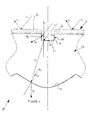
- Figure 1 is a cross-sectional view of part of a sun blind assembly according to the present invention,
- Figure 2 is a cross-sectional view of part of an alternative sun blind assembly according to the present invention, in a first optically open position,
- Figure 3 is a cross-sectional view of the sun blind assembly of figure 1 in a second optically closed position,
- Figures 4 and are 5 are enlarged views of the sun blind assembly of figures 2 and 3 showing the behaviour of incident light,
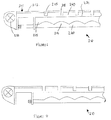
- Figure 6 is a cross-sectional view of an alternative sun blind assembly according to the present invention, in a first optically open position, and
- Figure 7 is a cross-sectional view of part of the sun blind assembly of figure 6, in a second optically closed position
-
- With reference to figure 1, there is shown part of a sun
blind assembly 10. - The sun blind assembly is located below a glass sunroof (not shown) of a vehicle (not shown). Typically the assembly will be supported by and move on rails which are fixed to the vehicle roof (not shown).
- In other embodiments the sun blind assembly may be supported by the sunroof itself.
- The sun
blind assembly 10 includes an incident surface 11, which is castellated, and a plurality of identical elongate lens elements 14 (only one of which is shown). The longitudinal axis of the elongate lens is into and out of the plane of the drawing. - The incident surface 11 includes a plurality of identical reflective regions, in the form of a
metallic coating 12, and a plurality of identical non-reflective regions 18 (only one of which is shown). - The incident surface includes an
elongate indent 15, the indent having twosides 19 and abase 21. In this embodiment, the width of thebase 21 represents approximately 20% of the width of the lens element. Thus the sum total of the indent base widths of the assembly is approximately 20% of the combined width of all the lens elements. - The lens element is convex, and has a focal point (not shown) on a centre line C.
- The
metallic coating 12 is in the form of a thin adhesive backed metallic film. The film is applied onto the incident surface and then passed through hot rubber rollers. A suitable tool such as a wire brush is used to remove the metallic film from the region of the indent. - It can be seen from figure 1 that by removing the excess metallic film, the indent thus defines the non-metallic, and therefore the non-reflective region of the incident surface.
- The
base 21 of the indent has amidpoint 23. The indent is positioned relative to the lens element such that the centre line C of the lens element passes through themidpoint 23 of thebase 21. - The lens element is made from a plastic moulding using a suitable moulding process, such as injection moulding.
- The position of the indent, and more particularly, the non-reflective region and the lens element is critical, as will be seen later, to the behaviour of light incident on the sun blind assembly.
- The plastics material is also chosen so as to transmit light, a suitable plastic material being polycarbonate. Other plastic materials could also be used if appropriate, for example, if lower transmission of light is required then less translucent plastic materials could be used. Similarly the plastic could be tinted so as to reduce light transmission.
- In another embodiment, the metallic coating can be applied to a non castellated incident surface using a screen printing process, with the screen being configured such that, after application of the metallic coating, the non-reflective regions are positioned correctly relative to the lens element.
- The behaviour of light incident on the sun blind assembly is as follows:
- Light L from an external source, i.e. the sun or external artificial lighting from say a street lamp, is incident on the incident surface 11 of the assembly.
- The light L is incident on either the reflective or the non-reflective region.
- Light incident on the reflective region 16 is reflected, as indicated by arrow L1 ,and is not transmitted through the lens element.
- Light incident on the
non-reflective region 18, is refracted, as indicated by arrow L2. The light L is refracted towards the normal N2 since the light is passing from air (high refractive index) to plastic (low refractive index). The light is thus transmitted through the lens element. - The transmitted light, indicated by arrow L2 , passes through the lens element and is incident on a
lower part 26 of the lens at the lens element/air boundary. The light L2 is refracted away from the normal N3 since the light is passing from plastic to air, and follows the path indicated by arrow L3. - The arrangement of the indent relative to the lens element ensures that light incident on the lower part of the lens element is at an angle , this angle being lower than the critical angle of the plastic material, and therefore all light incident on the lower part of the lens element is refracted. The curvature of the lower part of the
lens 26, and the arrangement of the centre line C with themidpoint 23, ensures that the refracted light L3 emerges at an angle parallel with the centre line C. - It can be seen that light emerging from the
lens element 14 is uniform across the width of the lens element (i.e. it is uniform local to the lens element), and this is in spite of the fact that the region above the lens element comprises two reflective regions where no light enters the lens element and a relatively narrownon-reflective region 18. - The combined effect of incident light on
base 21 of the indent and the resulting emerging parallel light from the lower part of thelens 26, gives an appearance of uniform intensity of light from each lens element, and since the lens elements are arranged adjacent to each other, it gives the appearance of uniform intensity from the entire lower part of all lens elements, and therefore from inside the vehicle. - In other embodiments, adjacent lens elements may have progressively varying indent geometry's, i.e. the width and/or depth may be altered, such that instead of a uniform light intensity across the entire assembly, there will be a progressive varying degree of light transmission. For example, the front of the screen could appear darker with the screen becoming lighter towards the back.
- The vehicle occupant will thus have the benefit of a sun blind assembly which appears to be of uniform intensity, but since the
base 21 represents approximately 20% of the width of the incident surface, the fact that 80% of incident light is reflected will result in a lower transmission of light, and therefore heat, into the vehicle. - In other embodiments, the width of the
base 21 can be either increased or decreased, in effect, decreasing or increasing the width of the reflective region, so as to vary the amount of light reflected from the incident surface as required. - It will be appreciated that light incident on the
sides 19 will also be refracted, and this light is also transmitted through the lens element. However, normal N4 is perpendicular to normal N2, and therefore the incident light L will be refracted towards N4 and follow the path indicated by arrow L4. The resultant path of the refracted light L4 is such that when it is incident on thelower part 26 of the lens element it will be at an angle (not shown) which is greater than the critical angle of the plastic material, and thus the refracted light L4 will be reflected (total internal reflection) from the lower part of the lens, and not refracted. - In this embodiment, the amount of refracted light is maximised, and hence the depth of the side portions is minimised. Increasing the depth of the side portions will result in a greater degree of total internal reflection, and hence less light transmission.
- In other embodiments, the amount of light reflected due to total internal reflection can be exploited, as will be described later.
- With reference to figures 2 and 3, there is shown an alternative sun blind assembly 110. Features which perform the same function as those in figure 1 are numbered 100 greater.
- The assembly 110 includes a
screen plate 140 which can move relative to alens plate 160 as further described below. - The
screen plate 140 includes a feature 142 (only one end of which is shown) which supports the lens plate. Thefeature 142 includes guide rails (not shown) which allow the lens plate to move relative to the screen plate in the longitudinal direction indicated X. - In other embodiments the feature could be included in a separate component, such as a carrier plate which is not integral with the screen plate, and is fixed to, for example, the vehicle roof.
- The
screen plate 140 includes an incident surface 111, with the incident surface having a plurality of reflective 116 andnon-reflective regions 118. As in the embodiment of figure 1, the non-reflective region is defined byelongate indents 115. - The lens plate includes a plurality of corresponding elongate
convex lens elements 114. - Both the screen plate and the lens plate are plastic mouldings.
- With reference to figures 2 and 3, it can be seen that there is a region of
air 125 located between the lens plate and the screen plate. - Figure 2 shows the assembly whereby the non-reflective regions are arranged relative to the lens elements, as described in the embodiment of figure 1. This position is called a first optically open position, in which light behaves as described below.
- As in the embodiment of figure 1, the position of the non-reflective regions is determined by
elongate indents 115. However, unlike the embodiment of figure 1, where the lens elements cannot move relative to the non reflective regions, the embodiment of figures 2 and 3, permits such movement. - Figure 3 shows the assembly whereby the lens plate has been moved longitudinally, such that the non-reflective regions no longer correspond to the lens elements, and hence the focal point is no longer in line with the midpoint of
base 121. This position is called a second optically closed position, in which light behaves as described below. - The lens plate moves as a result of manual actuation of a
lever 144. - With reference to figures 4 and 5, the behaviour of light incident on the screen plate is as follows:
- With the assembly in the first optically open position as shown in figure 4, light L incident on the
base 121 is refracted towards normal N2, and transmitted through the screen plate, following the path indicated by arrow L2. The refracted light L2 is incident on alower part 131 of the screen plate. The refracted light L2 is again refracted at thelower part 131, and is transmitted through theair region 125 following the path indicated by arrow L3. The refracted light L3 is incident on anupper part 127 of the lens element at the air/lens element boundary. The refracted light L3 is refracted again towards normal N3, and emerges parallel to the centre line of the lens following the path indicated by arrow L5. The refracted light L5 is transmitted through the lens plate, and since the light is normal to thelower part 126 of the lens plate, emerges, undeviated, below the lens plate following the path indicated by arrow L6. Hence the appearance from inside the vehicle, with the assembly in the first optically open position, will be of uniform light. - With the assembly in the second optically closed position, as shown in figure 5, the light behaves as described above in the first optically open position, except that light L3 incident on the
upper part 127 of the lens element at the air/plastic boundary is refracted towards normal N3, but since the position of the lens plate relative to the screen plate has changed, light refracted towards normal N3 no longer emerges parallel to the centre line of the lens plate, but follows the path indicated by arrow L5. The refracted light L5 is transmitted through the lens plate, but since the light is no longer normal to thelower part 126 of the lens plate, the light will not emerge parallel. In fact the refracted light L5 is at angle greater than the critical angle of the plastic material, and therefore the light will be reflected as indicated by arrow L7. Hence the appearance from inside the vehicle, with the assembly in the second optically closed position, will not be of uniform light, but will be striated. - It will be appreciated that, as a result of internal reflection, there will be less light transmission with the assembly in the second optically closed position compared to the first optically open position.
- Moving the lens plate between the first and second optical positions, thus provides a means for varying the appearance of the emerging light between uniform intensity and striated. The movement can be fully variable, or a fixed number of set positions.
- As in the embodiment of figure 1, light incident on the
sides 119 will also be refracted, and follow the path as indicated by arrow L4. - It will be appreciated that the
lens elements 114 are, as in the embodiment of figure 1, convex, but in the embodiment of figures 2 and 3, the lens elements are inverted. This is because in figure 1 the transmitted light is travelling from plastic to air, whereas in figures 2 and 3 the transmitted light is travelling from air to plastic. Thus, in another embodiment, where there is no air gap between the lens plate and the screen plate, the lens elements would be arranged as described in figure 1. - In other embodiments, the lens plate can move by operation of a motor drive system.
- The motor drive system can be activated by a switch (not shown) or triggered automatically upon the vehicle reaching a predetermined temperature.
- In the case of automatic movement, a temperature sensor (not shown) is required, and suitable electronics programmed to control the drive system. The temperature sensor can be incorporated into the assembly, for example, integral with the incident surface.
- Power for the motor could come from an external source, such as the vehicles electrical system, or could be provided by a solar cell (not shown) which can be incorporated into the incident surface of the screen plate.
- It will be appreciated, that locations for features such as solar cells and temperature sensors can be integrated with the screen plate by designing the moulds accordingly.
- For powered operation, the position of the lens plate relative to the screen plate is determined by micro switches which are positioned at suitable locations in the assembly, for example on the guide rails.
- With reference to figures 6 and 7, there is shown an alternative sun
blind assembly 210, which is identical to the embodiment of figures 2 and 3, except that an internal light source 280 is incorporated into the sun blind assembly. - Light emerging from the internal source will scatter throughout the screen plate before being refracted at the
lower part 231 of the screen plate. The refracted light will then be incident on thelens plate 260 which will behave as described in the embodiment of figures 2 and 3, with parallel light emerging from below the lens plate. Thus the appearance from inside the vehicle will be of a uniform light source. - As in the embodiment of figures 2 and 3, the lens plate can be moved relative to the screen plate so as to vary the intensity of the emerging parallel light as a result of the internal light source.
- It should be noted that it is also possible to include a similar internal light source in the embodiment of figure 1, so as to provide a uniform light inside the vehicle. However, unlike the embodiment of figures 6 and 7, the intensity of the light will not be variable since the lens element is fixed.
- As has been described in the embodiments of figures 1 to 7, the lens elements and indents are elongate. In other embodiments the lens elements can be non-elongate, for example annular, with corresponding annular indents.
- The lens elements, lens plate and screen plate, being plastic mouldings, can be modified during the moulding process so as to produce two colour mouldings.
- The lens elements, lens plate and screen plate can also be coated so as to provide resistance to scratches, UV, and chemicals.
- The metallic coating of the sun blind assembly could also serve other functions. For example, the metallic coating could be used as an antenna for radio, mobile communication, remote keyless entry, and passive entry systems, thus eliminating the need for a separate antenna for such systems.
Claims (16)
- A sun blind assembly (10, 110, 210) including an incident surface (11, 111, 211) and a lens element (14, 114, 214), the incident surface having a reflective region (12, 112, 212) which reflects incident light and a non-reflective region (18, 118, 218) which transmits incident light, the lens element and incident surface being arranged such that the transmitted light incident on the lens element is substantially refracted so as to appear of substantially uniform intensity.
- A sun blind assembly according to claim 1 in which the incident surface has a plurality of reflective and non-reflective regions.
- A sun blind assembly according to claim 2 including a plurality of lens elements, in which each lens element is associated with a corresponding non-reflective region.
- A sun blind assembly according to any preceding claim in which the incident surface includes an indent (15, 115, 215), the indent defining the non-reflective region.
- A sun blind assembly according to claims 3 or 4 when dependent on claim 2 in which adjacent non-reflective regions vary in size and/or shape so as to vary the percentage of transmitted light across the assembly.
- A sun blind assembly according to claim any preceding in which the incident surface is located on a screen plate (140, 240) and the lens element is located on a lens plate (160, 260), the lens plate being moveable relative to the screen plate between a first optically open position and a second optically closed position in which less light is transmitted in the closed position than in the open position.
- A sun blind assembly according to claim 6 in which the lens plate defines a plane substantially parallel to the screen plate, in which the relative movement between the optically open and closed positions occurs substantially parallel to the plane.
- A sun blind assembly according to any one of claims 6 or 7 in which a region of air (125, 225) is located between the screen plate and the lens plate
- A sun blind assembly according to any preceding claim in which an artificial light source (280) is located between the incident surface and the lens element such that the light transmitted from the light source is incident on the lens element and is substantially refracted so as to provide a light source.
- A sun blind assembly according to any preceding claim in which the assembly includes at least one solar cell.
- A sun blind assembly according to any preceding claim in which the assembly includes a temperature sensor.
- A sun blind assembly according to claim 6 and any one of claims 7 to 11 when dependent on claim 6 in which the relative movement between the lens plate and the screen plate is powered.
- A sun blind assembly according to claim 12 when dependent on claim 10 in which the power is provided by the at least one solar cell.
- A sun blind assembly according to any one of claims 12 or 13 when dependent on claim 11 in which the relative movement is activated automatically as the temperature sensor reaches a predetermined temperature.
- A sun blind assembly according to any preceding claim in which the reflective region is a metallic coating.
- A vehicle including a sun blind assembly according to any preceding claim.
Applications Claiming Priority (2)
| Application Number | Priority Date | Filing Date | Title |
|---|---|---|---|
| GB0131088 | 2001-12-29 | ||
| GBGB0131088.7A GB0131088D0 (en) | 2001-12-29 | 2001-12-29 | Sun blind assembly |
Publications (2)
| Publication Number | Publication Date |
|---|---|
| EP1323559A2 true EP1323559A2 (en) | 2003-07-02 |
| EP1323559A3 EP1323559A3 (en) | 2004-03-10 |
Family
ID=9928486
Family Applications (1)
| Application Number | Title | Priority Date | Filing Date |
|---|---|---|---|
| EP02256915A Withdrawn EP1323559A3 (en) | 2001-12-29 | 2002-10-04 | Sun blind assembly |
Country Status (3)
| Country | Link |
|---|---|
| US (1) | US6688681B2 (en) |
| EP (1) | EP1323559A3 (en) |
| GB (1) | GB0131088D0 (en) |
Families Citing this family (8)
| Publication number | Priority date | Publication date | Assignee | Title |
|---|---|---|---|---|
| DE10235901A1 (en) * | 2002-08-06 | 2004-02-19 | Dr.Ing.H.C. F. Porsche Ag | Method for moving a multi-part sunroof for a motor vehicle |
| JP2005067472A (en) * | 2003-08-26 | 2005-03-17 | Aisin Seiki Co Ltd | Sunroof device |
| KR100711566B1 (en) * | 2006-09-08 | 2007-04-27 | 해성쏠라(주) | Manufacturing method of solar cell module for automobile sunroof |
| US20110068601A1 (en) * | 2009-09-23 | 2011-03-24 | Gm Global Technology Operations, Inc. | Vehicle Solar Load Reduction System |
| US8934173B2 (en) * | 2012-08-21 | 2015-01-13 | Svv Technology Innovations, Inc. | Optical article for illuminating building interiors with sunlight |
| US10183463B2 (en) * | 2015-05-04 | 2019-01-22 | Sensitile Systems | Decorative panel |
| KR20180038551A (en) | 2015-08-18 | 2018-04-16 | 엘지 퓨얼 셀 시스템즈 인코포레이티드 | Solid Oxide Fuel Cell System Including Advanced Hydrocarbon Reduction Device |
| WO2020012361A1 (en) * | 2018-07-12 | 2020-01-16 | Gentex Corporation | Vehicle with electro-optic window system |
Family Cites Families (17)
| Publication number | Priority date | Publication date | Assignee | Title |
|---|---|---|---|---|
| US755196A (en) * | 1898-10-28 | 1904-03-22 | Pressed Prism Plate Glass Co | Illuminating structure. |
| CA1127896A (en) | 1976-07-19 | 1982-07-20 | Michael D. Boyd | Radiant energy reflector device |
| US4089594A (en) | 1977-06-13 | 1978-05-16 | Bell Telephone Laboratories, Incorporated | Sun screen structure |
| US4283451A (en) | 1978-06-09 | 1981-08-11 | Ziklag Reinforced Plastics, Ltd. | Light-transmitting roofing and cladding panel |
| US4498455A (en) | 1980-11-17 | 1985-02-12 | Gramm Ronald J | Glazing material |
| US4621898A (en) * | 1983-03-17 | 1986-11-11 | Allied Corporation | Directional optical filter |
| US4615579A (en) | 1983-08-29 | 1986-10-07 | Canadian Patents & Development Ltd. | Prism light guide luminaire |
| US4756603A (en) * | 1986-01-31 | 1988-07-12 | Nippon Seiki Co., Ltd. | Glare-proof transparent cover plate |
| DE4232660C1 (en) * | 1992-09-29 | 1993-10-07 | Webasto Schade Gmbh | Light-permeable cover for vehicle roof - has at least one outer located plate and device for varying light permeability of cover |
| DE4311049C1 (en) * | 1993-04-03 | 1994-06-01 | Rockwell Golde Gmbh | Vehicle roof with glass cover and sun visor - uses silk screen printing to lay down lattice sun visor adjustable by closure plate movement |
| DE4320947A1 (en) * | 1993-06-24 | 1995-01-05 | Bayerische Motoren Werke Ag | Vehicle roof with at least one roof window consisting of transparent material |
| DE4426787A1 (en) * | 1993-08-19 | 1995-02-23 | Volkswagen Ag | Sun roof, in particular for motor vehicles |
| JPH07304332A (en) | 1994-05-11 | 1995-11-21 | Toyota Autom Loom Works Ltd | Sunshade for automobile |
| FR2723612B1 (en) * | 1994-08-10 | 1996-10-31 | Peugeot | GLASS ASSEMBLY WITH ADJUSTABLE OPACITY. |
| JP3721820B2 (en) * | 1999-01-18 | 2005-11-30 | マツダ株式会社 | Automotive air conditioner |
| NL1014296C2 (en) * | 2000-02-04 | 2001-08-07 | Inalfa Ind Bv | Open roof construction for a vehicle. |
| US6437898B1 (en) * | 2000-11-20 | 2002-08-20 | Webasto Vehicle Systems International Gmbh | Device for changing the passage of light through a window, especially through the transparent cover of a motor vehicle roof |
-
2001
- 2001-12-29 GB GBGB0131088.7A patent/GB0131088D0/en not_active Ceased
-
2002
- 2002-10-04 EP EP02256915A patent/EP1323559A3/en not_active Withdrawn
- 2002-12-04 US US10/309,928 patent/US6688681B2/en not_active Expired - Fee Related
Non-Patent Citations (1)
| Title |
|---|
| None |
Also Published As
| Publication number | Publication date |
|---|---|
| GB0131088D0 (en) | 2002-02-13 |
| US6688681B2 (en) | 2004-02-10 |
| EP1323559A3 (en) | 2004-03-10 |
| US20030122393A1 (en) | 2003-07-03 |
Similar Documents
| Publication | Publication Date | Title |
|---|---|---|
| EP2983909B2 (en) | A glazing | |
| US20150210040A1 (en) | Cover for a motor vehicle roof | |
| US20070098969A1 (en) | Light-guiding assembly and automotive vehicle roof | |
| US20200103093A1 (en) | Covering devices for use with vehicle parts | |
| US20080155902A1 (en) | Integrated polycarbonate window assembly | |
| CN113632319B (en) | Backlit radar protection device | |
| DE19621148A1 (en) | Lighting element, especially e.g. for use in motor vehicles | |
| US6688681B2 (en) | Sun blind assembly | |
| WO2001005626A1 (en) | Light-sensitive sensor unit, especially for automatic switching of lighting devices | |
| RU2734640C1 (en) | Mounting element for vehicle with integrated camera module | |
| DE102011016433A1 (en) | Sunroof for motor vehicle e.g. motor car, has transparent light conductor plate arranged on roof frame and arranged in portion of roof opening, where light-scattering nano-particles are arranged in volume part of light conductor plate | |
| CN120112419A (en) | Vehicle window panel with light source and light conductor layer | |
| CN113799693A (en) | Functional lighting in a shade strip for vehicle glazing | |
| DE10320614B4 (en) | Cover for an opening in a vehicle roof and manufacturing method therefor | |
| GB2547413A (en) | Lighting device | |
| JP2017095101A (en) | Motor vehicle roof having integrated roller blind | |
| CN107620932B (en) | Vehicle lighting assembly with invisible recessed area and method of making same | |
| EP1559600A2 (en) | Vehicle roof arrangements | |
| EP3992008B1 (en) | Vehicle interior member and vehicle interior member manufacturing method | |
| CN101151560A (en) | Translucent wall element and motor vehicle comprising such element | |
| DE10034555A1 (en) | Light sensitive sensor unit, especially for automatically switching lights, has light conducting elements associated with sensors connected in one piece to light conducting body | |
| KR101807074B1 (en) | Light Guide Device for Sun Visor of Vehicle | |
| KR0173658B1 (en) | Auto-sunshield device | |
| CN214775319U (en) | Sunroof device | |
| KR100445215B1 (en) | Optical diffuser plates |
Legal Events
| Date | Code | Title | Description |
|---|---|---|---|
| PUAI | Public reference made under article 153(3) epc to a published international application that has entered the european phase |
Free format text: ORIGINAL CODE: 0009012 |
|
| AK | Designated contracting states |
Designated state(s): AT BE BG CH CY CZ DE DK EE ES FI FR GB GR IE IT LI LU MC NL PT SE SK TR |
|
| AX | Request for extension of the european patent |
Extension state: AL LT LV MK RO SI |
|
| PUAL | Search report despatched |
Free format text: ORIGINAL CODE: 0009013 |
|
| AK | Designated contracting states |
Kind code of ref document: A3 Designated state(s): AT BE BG CH CY CZ DE DK EE ES FI FR GB GR IE IT LI LU MC NL PT SE SK TR |
|
| AX | Request for extension of the european patent |
Extension state: AL LT LV MK RO SI |
|
| RIC1 | Information provided on ipc code assigned before grant |
Ipc: 7B 60J 7/00 B Ipc: 7B 60J 3/02 A |
|
| AKX | Designation fees paid | ||
| REG | Reference to a national code |
Ref country code: DE Ref legal event code: 8566 |
|
| STAA | Information on the status of an ep patent application or granted ep patent |
Free format text: STATUS: THE APPLICATION IS DEEMED TO BE WITHDRAWN |
|
| 18D | Application deemed to be withdrawn |
Effective date: 20040911 |