EP1321186A1 - Nox absorbing agent and absorption reduction type catalyst for removing nox - Google Patents
Nox absorbing agent and absorption reduction type catalyst for removing nox Download PDFInfo
- Publication number
- EP1321186A1 EP1321186A1 EP01961322A EP01961322A EP1321186A1 EP 1321186 A1 EP1321186 A1 EP 1321186A1 EP 01961322 A EP01961322 A EP 01961322A EP 01961322 A EP01961322 A EP 01961322A EP 1321186 A1 EP1321186 A1 EP 1321186A1
- Authority
- EP
- European Patent Office
- Prior art keywords
- absorbent
- catalyst
- composite oxide
- supported
- earth metal
- Prior art date
- Legal status (The legal status is an assumption and is not a legal conclusion. Google has not performed a legal analysis and makes no representation as to the accuracy of the status listed.)
- Granted
Links
Images



Classifications
-
- B—PERFORMING OPERATIONS; TRANSPORTING
- B01—PHYSICAL OR CHEMICAL PROCESSES OR APPARATUS IN GENERAL
- B01J—CHEMICAL OR PHYSICAL PROCESSES, e.g. CATALYSIS OR COLLOID CHEMISTRY; THEIR RELEVANT APPARATUS
- B01J23/00—Catalysts comprising metals or metal oxides or hydroxides, not provided for in group B01J21/00
- B01J23/38—Catalysts comprising metals or metal oxides or hydroxides, not provided for in group B01J21/00 of noble metals
- B01J23/54—Catalysts comprising metals or metal oxides or hydroxides, not provided for in group B01J21/00 of noble metals combined with metals, oxides or hydroxides provided for in groups B01J23/02 - B01J23/36
- B01J23/56—Platinum group metals
- B01J23/63—Platinum group metals with rare earths or actinides
-
- B—PERFORMING OPERATIONS; TRANSPORTING
- B01—PHYSICAL OR CHEMICAL PROCESSES OR APPARATUS IN GENERAL
- B01J—CHEMICAL OR PHYSICAL PROCESSES, e.g. CATALYSIS OR COLLOID CHEMISTRY; THEIR RELEVANT APPARATUS
- B01J20/00—Solid sorbent compositions or filter aid compositions; Sorbents for chromatography; Processes for preparing, regenerating or reactivating thereof
- B01J20/02—Solid sorbent compositions or filter aid compositions; Sorbents for chromatography; Processes for preparing, regenerating or reactivating thereof comprising inorganic material
-
- B—PERFORMING OPERATIONS; TRANSPORTING
- B01—PHYSICAL OR CHEMICAL PROCESSES OR APPARATUS IN GENERAL
- B01D—SEPARATION
- B01D53/00—Separation of gases or vapours; Recovering vapours of volatile solvents from gases; Chemical or biological purification of waste gases, e.g. engine exhaust gases, smoke, fumes, flue gases, aerosols
- B01D53/34—Chemical or biological purification of waste gases
- B01D53/74—General processes for purification of waste gases; Apparatus or devices specially adapted therefor
- B01D53/86—Catalytic processes
- B01D53/8621—Removing nitrogen compounds
- B01D53/8625—Nitrogen oxides
- B01D53/8628—Processes characterised by a specific catalyst
-
- B—PERFORMING OPERATIONS; TRANSPORTING
- B01—PHYSICAL OR CHEMICAL PROCESSES OR APPARATUS IN GENERAL
- B01J—CHEMICAL OR PHYSICAL PROCESSES, e.g. CATALYSIS OR COLLOID CHEMISTRY; THEIR RELEVANT APPARATUS
- B01J23/00—Catalysts comprising metals or metal oxides or hydroxides, not provided for in group B01J21/00
- B01J23/38—Catalysts comprising metals or metal oxides or hydroxides, not provided for in group B01J21/00 of noble metals
- B01J23/54—Catalysts comprising metals or metal oxides or hydroxides, not provided for in group B01J21/00 of noble metals combined with metals, oxides or hydroxides provided for in groups B01J23/02 - B01J23/36
- B01J23/56—Platinum group metals
- B01J23/58—Platinum group metals with alkali- or alkaline earth metals
-
- B—PERFORMING OPERATIONS; TRANSPORTING
- B01—PHYSICAL OR CHEMICAL PROCESSES OR APPARATUS IN GENERAL
- B01J—CHEMICAL OR PHYSICAL PROCESSES, e.g. CATALYSIS OR COLLOID CHEMISTRY; THEIR RELEVANT APPARATUS
- B01J21/00—Catalysts comprising the elements, oxides, or hydroxides of magnesium, boron, aluminium, carbon, silicon, titanium, zirconium, or hafnium
- B01J21/06—Silicon, titanium, zirconium or hafnium; Oxides or hydroxides thereof
- B01J21/066—Zirconium or hafnium; Oxides or hydroxides thereof
Definitions
- the present invention relates to a novel NO x absorbent which is used in a catalyst for purifying an exhaust gas discharged from an automobile engine and the like and can remarkably improve the NO x purifying capability at high temperatures, and also relates to an absorption reduction-type NO x purifying catalyst.
- the fuel is usually burned in a lean (oxygen-excess) condition and temporarily burned in a stoichiometric (at a theoretical air-fuel ratio) or rich (fuel-excess) condition.
- HC hydrocarbon
- CO hydrocarbon
- NO x is captured by an absorbent in the lean condition and this is temporarily released in the stoichiometric or rich condition and reduced and purified by the action of catalyst using the reducing atmosphere.
- a noble metal such as Pt, Au, Pd and Rh is used as the catalyst component and an alkali metal such as K and Na or an alkaline earth metal such as Ca and Ba is used as the NO x absorbent.
- This lean-burn system established by combining the control of an air-fuel ratio and the NO x absorbent is successful to a certain extent in solving the problem to improve the fuel consumption and reduce the total generation amount of CO, HC and NO x as compared with the conventional system using a three-way catalyst and combustion in the vicinity of theoretical air-fuel ratio.
- Japanese Unexamined Patent Publication (Kokai) No. 9-24274 describes an exhaust gas purifying catalyst comprising a composite oxide containing alumina and zirconia and having an acid point and a base point, and Kokai No. 11-226404 describes a stabilized zirconia support for improving the steam reforming reactivity of catalyst component Rh.
- the absorption reduction-type NO x purifying catalyst using the above-described alkali metal or alkaline earth metal as the NO x absorbent has a problem that the NO x purifying capability decreases when the exhaust gas temperature is high and exceeds about 500°C.
- the alkali metal or alkaline earth metal exerts the function as NO x absorbent by absorbing NO x while forming a nitrate in the lean side and by releasing NO x while forming a carbonate in the rich side, the nitrate or the like of the alkali metal or alkaline earth metal decomposes at a high temperature exceeding about 500°C and, therefore, the intended function cannot be brought out.
- an object of the present invention is to provide an exhaust gas purifying catalyst capable of exerting high NO x purifying capability even at a high temperature exceeding about 500°C by using, as the NO x absorbent, a specific modified ZrO 2 composite oxide, different from those in conventional techniques, in place of an alkali metal or an alkaline earth metal.
- the object of the present invention can be attained by an NO x absorbent comprising a crystalline ZrO 2 composite oxide having supported thereon at least one alkali metal or alkaline earth metal, the composite oxide being added with at least one element selected from trivalent rare earth metals and divalent alkaline earth metals, and also by an absorption reduction-type NO x purifying catalyst comprising this NO x absorbent.
- the present invention is characterized by using a specific modified crystalline ZrO 2 composite oxide as the NO x absorbent.
- the crystalline ZrO 2 composite oxide is considered to have the following NO x absorption mechanism.
- Zr constituting the crystalline ZrO 2 composite oxide is tetravalent and therefore, when a trivalent rare earth metal or a divalent alkaline earth metal is added, an oxygen vacancy is generated in the crystalline ZrO 2 composite oxide.
- an alkali metal or an alkaline earth metal is subsequently supported thereon, an electron released from the alkali metal or alkaline earth metal enters into the oxygen vacancy part.
- This electron is bound by a constituent element in the structure of crystalline ZrO 2 composite oxide but the binding degree is low because the electron is present in the oxygen vacancy part, therefore, the electron can be readily bonded to an electrophilic component such as NO x , particularly NO 2 .
- the crystalline ZrO 2 composite oxide can be rich in "strong base sites" which readily donate electrons to electrophilic components.
- the supported alkali metal or alkaline earth metal stays in the vicinity of surface of the crystalline ZrO 2 composite oxide and, therefore, the strong base site is present in the vicinity of surface of the crystalline ZrO 2 composite oxide and can effectively act on NO x , particularly NO 2 , in the exhaust gas.
- NO x particularly NO 2
- the crystalline ZrO 2 composite oxide having a strong base site in the vicinity of surface donates an electron less bound by a constituent element to NO 2 in the exhaust gas and thereby NO 2 can have a negative electric charge.
- the crystalline ZrO 2 composite oxide becomes to have a positive electric charge as a result of the electron donation.
- the crystalline ZrO 2 composite oxide is presumed to absorb NO 2 as the negative ion.
- the crystalline ZrO 2 composite oxide has a large NO 2 ion absorbing energy due to the attractive force between electric charges and thereby can exert the function of an NO x absorbent using the above-described absorption mechanism even at a temperature in excess of 500°C.
- the NO x absorbent of the present invention comprises a crystalline ZrO 2 composite oxide having supported thereon at least one alkali metal or alkaline earth metal, the composite oxide being added with at least one trivalent rare earth metal or divalent alkaline earth metal.
- Examples of the trivalent rare earth metal include Sc, Y, La, Nd, Pm, Sm, Eu, Gd, Dy, Ho, Er, Tm, Yb and Lu.
- Examples of the divalent alkaline earth metal include Mg, Ca, Sr, Ba and Ra.
- a crystalline ZrO 2 composite oxide having an oxygen vacancy formed by adding at least one element of these trivalent rare earth metals and divalent alkaline earth metals to ZrO 2 is used.
- an aqueous solution of a nitrate, an acetate, a carbonate or the like of the above-described trivalent rare earth metal or divalent alkaline earth metal is impregnated into ZrO 2 powder and this powder is dried and calcined in an air atmosphere at 700 to 1,200°C to solid-dissolve the trivalent rare earth metal or the like in ZrO 2 , whereby the crystalline ZrO 2 composite oxide having an oxygen vacancy can be obtained.
- M m Zr 1-m O n preferably 0.01 ⁇ m ⁇ 0.5, more preferably 0.1 ⁇ m ⁇ 0.2, and 1.5 ⁇ n ⁇ 2.0, more preferably 1.8 ⁇ n ⁇ 1.95.
- At least one alkali metal or alkaline earth metal is supported.
- the alkali metal include Li, Na, K, Rb, Cs and Fr
- examples of the alkaline earth metal include Mg, Ca, Sr, Ba and Ra.
- the ZrO 2 composite oxide is impregnated with an aqueous solution of a nitrate, an acetate, a carbonate or the like of this alkali metal or alkaline earth metal, then dried and calcined in an air atmosphere at 400 to 800°C, whereby the alkali metal or alkaline earth metal can be supported on the crystalline ZrO 2 composite oxide having an oxygen vacancy.
- the amount of the alkali metal or alkaline earth metal supported is preferably from 0.01 to 0.3 mol, more preferably from 0.03 to 0.1 mol, per mol of Zr.
- the capability of the NO x absorbent can be more enhanced by further loading Al on the crystalline ZrO 2 .
- the reason therefor is considered to be because the previously loaded alkali metal or alkaline earth metal is stabilized and high dispersibility of alkali metal or the like is attained.
- the crystalline ZrO 2 composite oxide is impregnated with a solution of aluminum nitrate, Al(OCH(CH 3 ) 2 ) 3 or the like, then dried and calcined in an air atmosphere at 400 to 800°C.
- the amount of Al supported is preferably 1 mol or less, more preferably from 0.5 to 0.001 mol, still more preferably from 0.2 to 0.001 mol, per mol of Zr.
- the absorption reduction-type NO x purifying catalyst of the present invention comprises a catalyst component of accelerating the oxidation/reduction of NO x .
- This catalyst component is preferably a noble metal such as Pt, Au, Ru, Rh, Pd and Ir.
- the catalyst component may be supported on an oxide support such as alumina, zirconia, titania and silica-alumina and be present together with the NO x absorbent, or may be directly supported on the NO x absorbent.
- oxide support such as alumina, zirconia, titania and silica-alumina
- the method for loading the catalyst component can be selected from a wide range of methods, for example, evaporation to dryness, precipitation, adsorption, ion exchange and reduction-deposition.
- Scandium nitrate was added to ZrO 2 powder and this powder was calcined in an air at about 1,000°C and then pulverized to obtain a solid solution powder with an oxygen vacancy having a composition of Sc 0.11 Zr 0.89 O 1.945 .
- the resulting powder was calcined in an air at 850°C for 2 hours to stabilize Na and, at the same time, dissipate unstable Na not taken in into the solid solution, thereby obtaining an NO x absorbent having a strong base point.
- the obtained NO x absorbent had a composition of Sc 0.11 Zr 0.89 O 1.945 /Na 0.2 .
- ⁇ -Al 2 O 3 powder 120 g was impregnated with an aqueous dinitrodiammine platinum solution in an amount corresponding to 2 g of Pt and rhodium nitrate in an amount corresponding to 0.1 g of Rh, then dried in air at 120°C for one hour and calcined in air at 500°C for one hour to obtain ⁇ -Al 2 O 3 having supported thereon Pt and Rh as catalyst components (hereinafter referred to as "Pt supported ⁇ -Al 2 O 3 ").
- the NO x absorbent was mixed with the Pt supported ⁇ -Al 2 O 3 in an equivalent mass and the mixture was pelletized to obtain a catalyst of the present invention.
- An NO x absorbent having a composition of Sc 0.11 Zr 0.89 O 1.945 /K 0.2 was prepared in the same manner as in Example 1 except for using an aqueous potassium nitrate solution in place of the aqueous sodium nitrate solution of Example 1.
- the obtained NO x absorbent was mixed with the Pt supported ⁇ -Al 2 O 3 in an equivalent mass similarly to Example 1 and the mixture was pelletized to obtain a catalyst of the present invention.
- An NO x absorbent having a composition of Sc 0.11 Zr 0.89 O 1.945 /Cs 0.2 was prepared in the same manner as in Example 1 except for using an aqueous cesium nitrate solution in place of the aqueous sodium nitrate solution of Example 1.
- the obtained NO x absorbent was mixed with the Pt supported ⁇ -Al 2 O 3 in an equivalent mass similarly to Example 1 and the mixture was pelletized to obtain a catalyst of the present invention.
- An NO x absorbent having a composition of Sc 0.11 Zr 0.89 O 1.945 /Ba 0.2 was prepared in the same manner as in Example 1 except for using an aqueous barium acetate solution in place of the aqueous sodium nitrate solution of Example 1.
- the obtained NO x absorbent was mixed with the Pt supported ⁇ -Al 2 O 3 in an equivalent mass similarly to Example 1 and the mixture was pelletized to obtain a catalyst of the present invention.
- An NO x absorbent having a composition of Y 0.07 Zr 0.93 O 1.965 /Na 0.2 was prepared in the same manner as in Example 1 except for using yttrium nitrate in place of the scandium nitrate of Example 1.
- the obtained NO x absorbent was mixed with the Pt supported ⁇ -Al 2 O 3 in an equivalent mass similarly to Example 1 and the mixture was pelletized to obtain a catalyst of the present invention.
- An NO x absorbent having a composition of Y 0.07 Zr 0.93 O 1.965 /K 0.2 was prepared in the same manner as in Example 2 except for using yttrium nitrate in place of the scandium nitrate of Example 2.
- the obtained NO x absorbent was mixed with the Pt supported ⁇ -Al 2 O 3 prepared in an equivalent mass similarly to Example 2 and the mixture was pelletized to obtain a catalyst of the present invention.
- An NO x absorbent having a composition of Y 0.07 Zr 0.93 O 1.965 /Cs 0.2 was prepared in the same manner as in Example 3 except for using yttrium nitrate in place of the scandium nitrate of Example 3.
- the obtained NO x absorbent was mixed with the Pt supported ⁇ -Al 2 O 3 in an equivalent mass similarly to Example 3 and the mixture was pelletized to obtain a catalyst of the present invention.
- An NO x absorbent having a composition of Y 0.07 Zr 0.93 O 1.965 /Ba 0.2 was prepared in the same manner as in Example 4 except for using yttrium nitrate in place of the scandium nitrate of Example 4.
- the obtained NO x absorbent was mixed with the Pt supported ⁇ -Al 2 O 3 in an equivalent mass similarly to Example 4 and the mixture was pelletized to obtain a catalyst of the present invention.
- An NO x absorbent having a composition of La 0.2 Zr 0.8 O 1.9 /Na 0.2 was prepared in the same manner as in Example 1 except for using lanthanum nitrate in place of the scandium nitrate of Example 1.
- the obtained NO x absorbent was mixed with the Pt supported ⁇ -Al 2 O 3 in an equivalent mass similarly to Example 1 and the mixture was pelletized to obtain a catalyst of the present invention.
- An NO x absorbent having a composition of La 0.2 Zr 0.8 O 1.9 /K 0.2 was prepared in the same manner as in Example 2 except for using lanthanum nitrate in place of the scandium nitrate of Example 2.
- the obtained NO x absorbent was mixed with the Pt supported ⁇ -Al 2 O 3 in an equivalent mass similarly to Example 2 and the mixture was pelletized to obtain a catalyst of the present invention.
- An NO x absorbent having a composition of La 0.2 Zr 0.8 O 1.9 /Cs 0.2 was prepared in the same manner as in Example 3 except for using lanthanum nitrate in place of the scandium nitrate of Example 3.
- the obtained NO x absorbent was mixed with the Pt supported ⁇ -Al 2 O 3 in an equivalent mass similarly to Example 3 and the mixture was pelletized to obtain a catalyst of the present invention.
- An NO x absorbent having a composition of La 0.2 Zr 0.8 O 1.9 /Ba 0.2 was prepared in the same manner as in Example 4 except for using lanthanum nitrate in place of the scandium nitrate of Example 4.
- the obtained NO x absorbent was mixed with the Pt supported ⁇ -Al 2 O 3 in an equivalent mass similarly to Example 4 and the mixture was pelletized to obtain a catalyst of the present invention.
- An NO x absorbent having a composition of Mg 0.12 Zr 0.88 O 1.94 /Na 0.2 was prepared in the same manner as in Example 1 except for using magnesium nitrate in place of the scandium nitrate of Example 1.
- the obtained NO x absorbent was mixed with the Pt supported ⁇ -Al 2 O 3 in an equivalent mass similarly to Example 1 and the mixture was pelletized to obtain a catalyst of the present invention.
- An NO x absorbent having a composition of Mg 0.12 Zr 0.88 O 1.94 /K 0.2 was prepared in the same manner as in Example 2 except for using magnesium nitrate in place of the scandium nitrate of Example 2.
- the obtained NO x absorbent was mixed with the Pt supported ⁇ -Al 2 O 3 in an equivalent mass similarly to Example 2 and the mixture was pelletized to obtain a catalyst of the present invention.
- An NO x absorbent having a composition of Mg 0.12 Zr 0.88 O 1.94 /Cs 0.2 was prepared in the same manner as in Example 3 except for using magnesium nitrate in place of the scandium nitrate of Example 3.
- the obtained NO x absorbent was mixed with the Pt supported ⁇ -Al 2 O 3 in an equivalent mass similarly to Example 3 and the mixture was pelletized to obtain a catalyst of the present invention.
- An NO x absorbent having a composition of Mg 0.12 Zr 0.88 O 1.94 /Ba 0.2 was prepared in the same manner as in Example 4 except for using magnesium nitrate in place of the scandium nitrate of Example 4.
- the obtained NO x absorbent was mixed with the Pt supported ⁇ -Al 2 O 3 in an equivalent mass similarly to Example 4 and the mixture was pelletized to obtain a catalyst of the present invention.
- An NO x absorbent having a composition of Ca 0.14 Zr 0.86 O 1.93 /Na 0.2 was prepared in the same manner as in Example 1 except for using calcium nitrate in place of the scandium nitrate of Example 1.
- the obtained NO x absorbent was mixed with the Pt supported ⁇ -Al 2 O 3 in an equivalent mass similarly to Example 1 and the mixture was pelletized to obtain a catalyst of the present invention.
- An NO x absorbent having a composition of Ca 0.14 Zr 0.86 O 1.93 /K 0.2 was prepared in the same manner as in Example 2 except for using calcium nitrate in place of the scandium nitrate of Example 2.
- the obtained NO x absorbent was mixed with the Pt supported ⁇ -Al 2 O 3 in an equivalent mass similarly to Example 2 and the mixture was pelletized to obtain a catalyst of the present invention.
- An NO x absorbent having a composition of Ca 0.14 Zr 0.86 O 1.93 /Cs 0.2 was prepared in the same manner as in Example 3 except for using calcium nitrate in place of the scandium nitrate of Example 3.
- the obtained NO x absorbent was mixed with the Pt supported ⁇ -Al 2 O 3 in an equivalent mass similarly to Example 3 and the mixture was pelletized to obtain a catalyst of the present invention.
- An NO x absorbent having a composition of Ca 0.14 Zr 0.86 O 1.93 /Ba 0.2 was prepared in the same manner as in Example 4 except for using calcium nitrate in place of the scandium nitrate of Example 4.
- the obtained NO x absorbent was mixed with the Pt supported ⁇ -Al 2 O 3 in an equivalent mass similarly to Example 4 and the mixture was pelletized to obtain a catalyst of the present invention.
- This Example shows a case where aluminum is further supported on the composite oxide.
- the solid solution powder with an oxygen vacancy having a composition of La 0.2 Zr 0.8 O 1.9 used in Example 9 was impregnated with an aqueous aluminum nitrate solution, then dried in an air at 120°C for one hour and calcined in an air at 650°C for one hour to obtain a composite oxide having supported thereon 0.005 mol of Al 2 O 3 per mol of the composite oxide La 0.2 Zr 0.8 O 1.9 .
- Example 3 On this composite oxide, Cs was supported in the same manner as in Example 3 to prepare an NO x absorbent having a composition of La 0.2 Zr 0.8 O 1.9 /(Al 2 O 3 ) 0.05 /Cs 0.2 .
- the obtained NO x absorbent was mixed with the Pt supported ⁇ -Al 2 O 3 in an equivalent mass similarly to Example 1 and the mixture was pelletized to obtain a catalyst of the present invention.
- This Example shows a case where aluminum is further supported on the composite oxide and Pt and Cs are supported thereon.
- the solid solution powder with an oxygen vacancy having a composition of La 0.2 Zr 0.8 O 1.9 used in Example 9 was impregnated with an aqueous aluminum nitrate solution, then dried in an air at 120°C for one hour and calcined in an air at 650°C for one hour to obtain a composite oxide having supported thereon 0.005 mol of Al 2 O 3 per mol of the composite oxide La 0.2 Zr 0.8 O 1.9 .
- 120 g of ⁇ -Al 2 O 3 powder was impregnated with an aqueous dinitrodiammine platinum solution in an amount corresponding to 2 g of Pt and rhodium nitrate in an amount corresponding to 0.1 g of Rh, then dried in an air at 120°C for one hour and calcined in an air at 500°C for one hour, thereby loading Pt and Rh as the catalyst components.
- the resulting powder was impregnated with an aqueous Na nitrate solution, then dried in an air at 120°C for one hour and calcined in an air at 500°C for one hour to load 0.2 mol of Na per 120 g of ⁇ -Al 2 O 3 powder. Thereafter, ⁇ -Al 2 O 3 in an equivalent mass was mixed and the mixture was pelletized to obtain a comparative catalyst.
- a comparative catalyst where Pt, Rh and K were supported on ⁇ -Al 2 O 3 powder was obtained in the same manner as in Comparative Example 1 except for using an aqueous potassium nitrate solution in place of the aqueous sodium nitrate solution.
- a comparative catalyst where Pt, Rh and Cs were supported on ⁇ -Al 2 O 3 powder was obtained in the same manner as in Comparative Example 1 except for using an aqueous cesium nitrate solution in place of the aqueous sodium nitrate solution.
- a comparative catalyst where Pt, Rh and Ba were supported on ⁇ -Al 2 O 3 powder was obtained in the same manner as in Comparative Example 1 except for using an aqueous barium nitrate solution in place of the aqueous sodium nitrate solution.
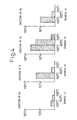
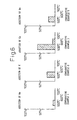
- the catalysts of Examples 1 to 20 and Comparative Examples 1 to 4 each was evaluated on the NO x purification percentage at 500°C, 600°C and 700°C under the following conditions.
- Example 11 obtained by loading Cs
- the catalyst of Example 21 obtained by loading Al and Cs
- the catalyst of Example 22 obtained by further loading Pt
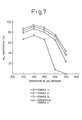
- the catalyst of Comparative Example 3 obtained by loading Cs on ⁇ -alumina each was evaluated on the NO x purification percentage at 300°C, 400°C, 500°C, 600°C and 700°C under the conditions described above.
- Fig. 7 shows the results.
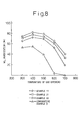
- the catalysts of Examples 11, 21 and 22 and Comparative Example 3 each was subjected to an endurance heat treatment of 850°C ⁇ 2 hours in a gas atmosphere having the following composition.
- Fig. 8 shows the results.
- the exhaust gas purifying catalyst of the present invention is excellent in the NO x purifying capability at high temperatures and also in the resistance against sulfur poisoning. This is considered to result because the alkali metal or alkaline earth metal necessary for producing a strong base site is present as ion and therefore, even if bonded to SO 4 2- , can be easily reduced.
- an exhaust gas purifying catalyst exhibiting excellent NO x purifying capability under high exhaust gas temperature conditions, and also having high durability, can be provided.
Landscapes
- Chemical & Material Sciences (AREA)
- Engineering & Computer Science (AREA)
- Chemical Kinetics & Catalysis (AREA)
- Organic Chemistry (AREA)
- Environmental & Geological Engineering (AREA)
- Analytical Chemistry (AREA)
- Materials Engineering (AREA)
- General Chemical & Material Sciences (AREA)
- Oil, Petroleum & Natural Gas (AREA)
- Biomedical Technology (AREA)
- Health & Medical Sciences (AREA)
- Inorganic Chemistry (AREA)
- Catalysts (AREA)
- Exhaust Gas Treatment By Means Of Catalyst (AREA)
- Exhaust Gas After Treatment (AREA)
- Treating Waste Gases (AREA)
Abstract
Description
| Gas composition | 1,000 ppm of CO + 667 ppm of C3H6 + 250 ppm of NO + 7.3% of O2 + 6.7% of CO2 + 5% of H2O (balance: N2) |
| Gas space velocity: | 50,000 h-1 |
| Gas composition | 1,000 ppm of CO + 250 ppm of NO + 7.3% of O2 + 6.7% of CO2 + 5% of H2O (balance: N2) |
| Gas space velocity: | 50,000 h-1 |
| gas composition | 1,000 ppm of CO + 667 ppm of C3H6 + 250 ppm of NO + 7.3% of O2 + 6.7% of CO2 + 5% of H2O (balance: N2) |
| Gas space velocity: | 50,000 h-1 |
Claims (4)
- An NOx absorbent comprising a crystalline ZrO2 composite oxide having supported thereon at least one element selected from alkali metals and alkaline earth metals, said composite oxide being added with at least one element selected from trivalent rare earth metals and divalent alkaline earth metals.
- The NOx absorbent as claimed in claim 1, wherein aluminum is supported on said ZrO2 composite oxide.
- An absorption reduction-type NOx purifying catalyst comprising the NOx absorbent claimed in claim 1 or claim 2.
- An absorption reduction-type NOx purifying catalyst comprising the NOx absorbent claimed in claim 1 or claim 2 and a noble metal.
Applications Claiming Priority (3)
| Application Number | Priority Date | Filing Date | Title |
|---|---|---|---|
| JP2000278687 | 2000-09-08 | ||
| JP2000278687A JP3758487B2 (en) | 2000-09-08 | 2000-09-08 | Absorption reduction type NOx purification catalyst |
| PCT/JP2001/007614 WO2002020153A1 (en) | 2000-09-08 | 2001-09-03 | Nox absorbing agent and absorption reduction type catalyst for removing nox |
Publications (3)
| Publication Number | Publication Date |
|---|---|
| EP1321186A1 true EP1321186A1 (en) | 2003-06-25 |
| EP1321186A4 EP1321186A4 (en) | 2004-08-11 |
| EP1321186B1 EP1321186B1 (en) | 2006-07-19 |
Family
ID=18763814
Family Applications (1)
| Application Number | Title | Priority Date | Filing Date |
|---|---|---|---|
| EP01961322A Expired - Lifetime EP1321186B1 (en) | 2000-09-08 | 2001-09-03 | Nox absorbing agent and absorption reduction type catalyst for removing nox |
Country Status (6)
| Country | Link |
|---|---|
| EP (1) | EP1321186B1 (en) |
| JP (1) | JP3758487B2 (en) |
| KR (1) | KR100611036B1 (en) |
| DE (1) | DE60121608T2 (en) |
| ES (1) | ES2267806T3 (en) |
| WO (1) | WO2002020153A1 (en) |
Cited By (2)
| Publication number | Priority date | Publication date | Assignee | Title |
|---|---|---|---|---|
| EP1681096A4 (en) * | 2003-10-24 | 2010-09-15 | Toyota Motor Co Ltd | CATALYST FOR PURIFYING EXHAUST GASES |
| WO2019219817A1 (en) | 2018-05-18 | 2019-11-21 | Umicore Ag & Co. Kg | Exhaust emission reduction system having an hc-trap and nox-trap combination designed for operating under strategic lean conditions |
Families Citing this family (7)
| Publication number | Priority date | Publication date | Assignee | Title |
|---|---|---|---|---|
| JP4863329B2 (en) * | 2004-01-26 | 2012-01-25 | 双葉電子工業株式会社 | Fluorescent display tube |
| JP4622753B2 (en) * | 2005-09-05 | 2011-02-02 | マツダ株式会社 | Diesel particulate filter with catalyst |
| FR2939695B1 (en) * | 2008-12-17 | 2011-12-30 | Saint Gobain Ct Recherches | PURIFICATION STRUCTURE INCORPORATING A CATALYSIS SYSTEM SUPPORTED BY A REDUCED ZIRCONY. |
| EP2772302A1 (en) | 2013-02-27 | 2014-09-03 | Umicore AG & Co. KG | Hexagonal oxidation catalyst |
| DE102013207709A1 (en) | 2013-04-26 | 2014-10-30 | Umicore Ag & Co. Kg | Desulphurisation of NOX storage catalysts |
| DE102013218234B4 (en) | 2013-09-11 | 2015-05-28 | Umicore Ag & Co. Kg | Using different strategies in the regeneration of nitrogen oxide storage catalysts to reduce N2O formation |
| WO2018054929A1 (en) | 2016-09-20 | 2018-03-29 | Umicore Ag & Co. Kg | Diesel particle filter |
Family Cites Families (18)
| Publication number | Priority date | Publication date | Assignee | Title |
|---|---|---|---|---|
| JPH064133B2 (en) * | 1986-01-20 | 1994-01-19 | 株式会社豊田中央研究所 | Zirconia carrier |
| US5202300A (en) * | 1988-02-18 | 1993-04-13 | Engelhard Corporation | Catalyst for purification of exhaust gas |
| JPH0644999B2 (en) * | 1988-04-30 | 1994-06-15 | 株式会社豊田中央研究所 | Exhaust gas purification catalyst |
| JP2698284B2 (en) * | 1991-04-22 | 1998-01-19 | 株式会社日本触媒 | Exhaust gas purification catalyst |
| JP3224054B2 (en) * | 1993-05-27 | 2001-10-29 | トヨタ自動車株式会社 | Exhaust gas purification method |
| JP3707641B2 (en) * | 1997-06-06 | 2005-10-19 | 株式会社豊田中央研究所 | Complex oxide promoter |
| JP3551348B2 (en) * | 1997-06-19 | 2004-08-04 | 日産自動車株式会社 | Exhaust gas purification device |
| JP3688871B2 (en) * | 1997-11-20 | 2005-08-31 | ダイハツ工業株式会社 | Exhaust gas purification catalyst |
| JP3741303B2 (en) * | 1997-12-08 | 2006-02-01 | トヨタ自動車株式会社 | Exhaust gas purification catalyst |
| JP4090547B2 (en) * | 1997-12-17 | 2008-05-28 | ジョンソン・マッセイ・ジャパン・インコーポレイテッド | Exhaust gas purification catalyst |
| DE69923843T2 (en) * | 1998-06-30 | 2006-04-06 | Toyota Jidosha K.K., Toyota | METHOD AND CATALYST FOR CLEANING EXHAUST GAS AND METHOD FOR PRODUCING THE CATALYST |
| DE19838282A1 (en) * | 1998-08-24 | 2000-03-02 | Degussa | Nitrogen oxide storage material and the nitrogen oxide storage catalyst produced therefrom |
| JP2000167402A (en) * | 1998-12-09 | 2000-06-20 | Daihatsu Motor Co Ltd | Catalyst for purification of exhaust gas |
| JP3643948B2 (en) * | 1999-03-15 | 2005-04-27 | 株式会社豊田中央研究所 | Titania-zirconia powder and method for producing the same |
| JP3766568B2 (en) * | 1999-07-30 | 2006-04-12 | 株式会社豊田中央研究所 | Exhaust gas purification catalyst and exhaust gas purification method |
| JP2001046835A (en) * | 1999-08-06 | 2001-02-20 | Nissan Motor Co Ltd | NOx absorption purification material and exhaust gas purification catalyst using the same |
| JP3756706B2 (en) * | 1999-09-03 | 2006-03-15 | ダイハツ工業株式会社 | Exhaust gas purification catalyst |
| JP3724708B2 (en) * | 1999-11-26 | 2005-12-07 | 日産自動車株式会社 | Exhaust gas purification catalyst |
-
2000
- 2000-09-08 JP JP2000278687A patent/JP3758487B2/en not_active Expired - Fee Related
-
2001
- 2001-09-03 DE DE60121608T patent/DE60121608T2/en not_active Expired - Lifetime
- 2001-09-03 KR KR1020037003312A patent/KR100611036B1/en not_active Expired - Fee Related
- 2001-09-03 ES ES01961322T patent/ES2267806T3/en not_active Expired - Lifetime
- 2001-09-03 EP EP01961322A patent/EP1321186B1/en not_active Expired - Lifetime
- 2001-09-03 WO PCT/JP2001/007614 patent/WO2002020153A1/en not_active Ceased
Cited By (2)
| Publication number | Priority date | Publication date | Assignee | Title |
|---|---|---|---|---|
| EP1681096A4 (en) * | 2003-10-24 | 2010-09-15 | Toyota Motor Co Ltd | CATALYST FOR PURIFYING EXHAUST GASES |
| WO2019219817A1 (en) | 2018-05-18 | 2019-11-21 | Umicore Ag & Co. Kg | Exhaust emission reduction system having an hc-trap and nox-trap combination designed for operating under strategic lean conditions |
Also Published As
| Publication number | Publication date |
|---|---|
| KR100611036B1 (en) | 2006-08-10 |
| EP1321186B1 (en) | 2006-07-19 |
| KR20030029929A (en) | 2003-04-16 |
| WO2002020153A1 (en) | 2002-03-14 |
| DE60121608D1 (en) | 2006-08-31 |
| JP3758487B2 (en) | 2006-03-22 |
| JP2002079095A (en) | 2002-03-19 |
| ES2267806T3 (en) | 2007-03-16 |
| EP1321186A4 (en) | 2004-08-11 |
| DE60121608T2 (en) | 2007-06-28 |
Similar Documents
| Publication | Publication Date | Title |
|---|---|---|
| JP3741303B2 (en) | Exhaust gas purification catalyst | |
| EP0657204B1 (en) | Catalyst for purifying exhaust gases | |
| US6858193B2 (en) | Catalyst for lowering the amount of nitrogen oxides in the exhaust gas from lean burn engines | |
| ES2383503T3 (en) | Nitrogen oxide accumulator catalyst for use in motor vehicles in a position close to the engine | |
| US6806225B1 (en) | Catalyst for exhaust gas purification, process for producing the same, and method of purifying exhaust gas | |
| EP1339490B1 (en) | Manganese containing oxygen storage component comprising three-way catalyst composition | |
| US7081431B2 (en) | NOx absorbent and absorption reduction-type NOx purifying catalyst | |
| US6468484B1 (en) | NO2 abatement composition with enhanced sulfur resistance | |
| JP2004513763A (en) | NOx trap composition | |
| EP1321186A1 (en) | Nox absorbing agent and absorption reduction type catalyst for removing nox | |
| US6623716B2 (en) | Exhaust gas purifying catalyst | |
| JP2002143683A (en) | Exhaust gas purification catalyst and method for producing the same | |
| US6906002B2 (en) | Absorption reduction-type NOx purifying catalyst | |
| JPH10218620A (en) | Oxygen absorbing cerium-based composite oxide | |
| JP3664201B2 (en) | Exhaust gas purification catalyst | |
| JPH08281116A (en) | Exhaust gas purification catalyst | |
| JP3622893B2 (en) | NOx absorbent and exhaust gas purification catalyst using the same | |
| JP4556084B2 (en) | Exhaust gas purification catalyst | |
| JP4822049B2 (en) | Exhaust gas purification catalyst and exhaust gas purification method using the same | |
| JP2000140638A (en) | Exhaust gas purification catalyst | |
| JP2000262897A (en) | Exhaust gas purification catalyst and exhaust gas purification method | |
| JP2003200061A (en) | Exhaust gas purification catalyst and exhaust gas purification device | |
| JP2001046835A (en) | NOx absorption purification material and exhaust gas purification catalyst using the same | |
| JP4186345B2 (en) | Exhaust gas purification catalyst | |
| JPH11267505A (en) | Method for producing exhaust gas purifying catalyst |
Legal Events
| Date | Code | Title | Description |
|---|---|---|---|
| PUAI | Public reference made under article 153(3) epc to a published international application that has entered the european phase |
Free format text: ORIGINAL CODE: 0009012 |
|
| 17P | Request for examination filed |
Effective date: 20030306 |
|
| AK | Designated contracting states |
Designated state(s): AT BE CH CY DE DK ES FI FR GB GR IE IT LI LU MC NL PT SE TR |
|
| RBV | Designated contracting states (corrected) |
Designated state(s): AT BE CH CY DE DK ES FR GB IT LI SE |
|
| A4 | Supplementary search report drawn up and despatched |
Effective date: 20040624 |
|
| RIC1 | Information provided on ipc code assigned before grant |
Ipc: 7B 01J 20/06 A Ipc: 7B 01D 53/94 B Ipc: 7B 01J 20/08 B Ipc: 7B 01J 23/58 B |
|
| 17Q | First examination report despatched |
Effective date: 20050310 |
|
| GRAP | Despatch of communication of intention to grant a patent |
Free format text: ORIGINAL CODE: EPIDOSNIGR1 |
|
| RBV | Designated contracting states (corrected) |
Designated state(s): DE ES FR GB IT SE |
|
| GRAS | Grant fee paid |
Free format text: ORIGINAL CODE: EPIDOSNIGR3 |
|
| GRAA | (expected) grant |
Free format text: ORIGINAL CODE: 0009210 |
|
| AK | Designated contracting states |
Kind code of ref document: B1 Designated state(s): DE ES FR GB IT SE |
|
| REG | Reference to a national code |
Ref country code: GB Ref legal event code: FG4D |
|
| REF | Corresponds to: |
Ref document number: 60121608 Country of ref document: DE Date of ref document: 20060831 Kind code of ref document: P |
|
| REG | Reference to a national code |
Ref country code: SE Ref legal event code: TRGR |
|
| ET | Fr: translation filed | ||
| REG | Reference to a national code |
Ref country code: ES Ref legal event code: FG2A Ref document number: 2267806 Country of ref document: ES Kind code of ref document: T3 |
|
| PLBE | No opposition filed within time limit |
Free format text: ORIGINAL CODE: 0009261 |
|
| STAA | Information on the status of an ep patent application or granted ep patent |
Free format text: STATUS: NO OPPOSITION FILED WITHIN TIME LIMIT |
|
| 26N | No opposition filed |
Effective date: 20070420 |
|
| REG | Reference to a national code |
Ref country code: GB Ref legal event code: 746 Effective date: 20091103 |
|
| PGFP | Annual fee paid to national office [announced via postgrant information from national office to epo] |
Ref country code: GB Payment date: 20120829 Year of fee payment: 12 Ref country code: SE Payment date: 20120911 Year of fee payment: 12 |
|
| PGFP | Annual fee paid to national office [announced via postgrant information from national office to epo] |
Ref country code: IT Payment date: 20120915 Year of fee payment: 12 Ref country code: DE Payment date: 20120829 Year of fee payment: 12 Ref country code: ES Payment date: 20120919 Year of fee payment: 12 Ref country code: FR Payment date: 20120926 Year of fee payment: 12 |
|
| REG | Reference to a national code |
Ref country code: SE Ref legal event code: EUG |
|
| PG25 | Lapsed in a contracting state [announced via postgrant information from national office to epo] |
Ref country code: SE Free format text: LAPSE BECAUSE OF NON-PAYMENT OF DUE FEES Effective date: 20130904 |
|
| GBPC | Gb: european patent ceased through non-payment of renewal fee |
Effective date: 20130903 |
|
| REG | Reference to a national code |
Ref country code: FR Ref legal event code: ST Effective date: 20140530 |
|
| REG | Reference to a national code |
Ref country code: DE Ref legal event code: R119 Ref document number: 60121608 Country of ref document: DE Effective date: 20140401 |
|
| PG25 | Lapsed in a contracting state [announced via postgrant information from national office to epo] |
Ref country code: GB Free format text: LAPSE BECAUSE OF NON-PAYMENT OF DUE FEES Effective date: 20130903 |
|
| PG25 | Lapsed in a contracting state [announced via postgrant information from national office to epo] |
Ref country code: DE Free format text: LAPSE BECAUSE OF NON-PAYMENT OF DUE FEES Effective date: 20140401 Ref country code: FR Free format text: LAPSE BECAUSE OF NON-PAYMENT OF DUE FEES Effective date: 20130930 Ref country code: IT Free format text: LAPSE BECAUSE OF NON-PAYMENT OF DUE FEES Effective date: 20130903 |
|
| REG | Reference to a national code |
Ref country code: ES Ref legal event code: FD2A Effective date: 20141007 |
|
| PG25 | Lapsed in a contracting state [announced via postgrant information from national office to epo] |
Ref country code: ES Free format text: LAPSE BECAUSE OF NON-PAYMENT OF DUE FEES Effective date: 20130904 |