EP1319666B1 - Antibacterial compounds - Google Patents
Antibacterial compounds Download PDFInfo
- Publication number
- EP1319666B1 EP1319666B1 EP03004404A EP03004404A EP1319666B1 EP 1319666 B1 EP1319666 B1 EP 1319666B1 EP 03004404 A EP03004404 A EP 03004404A EP 03004404 A EP03004404 A EP 03004404A EP 1319666 B1 EP1319666 B1 EP 1319666B1
- Authority
- EP
- European Patent Office
- Prior art keywords
- compound
- salt
- column
- product
- cultivation
- Prior art date
- Legal status (The legal status is an assumption and is not a legal conclusion. Google has not performed a legal analysis and makes no representation as to the accuracy of the status listed.)
- Expired - Lifetime
Links
- 0 CN(C(*(C(C1O)OC(C(C(*)=O)OC(C2O)OC(C(O)=O)=CC2O)C1OC)C=C1)=O)C1=O Chemical compound CN(C(*(C(C1O)OC(C(C(*)=O)OC(C2O)OC(C(O)=O)=CC2O)C1OC)C=C1)=O)C1=O 0.000 description 1
- UEMBCXUUNULNRG-UHFFFAOYSA-N COC(C(C(C(N)=O)OC(C1O)OC(C(NC(CC=C)C(O)=O)=O)=CC1O)OC1N(C=CC(N2)=O)C2=O)C1O Chemical compound COC(C(C(C(N)=O)OC(C1O)OC(C(NC(CC=C)C(O)=O)=O)=CC1O)OC1N(C=CC(N2)=O)C2=O)C1O UEMBCXUUNULNRG-UHFFFAOYSA-N 0.000 description 1
- NUVDGNUBNJBGRQ-UHFFFAOYSA-N NC(C(C(C(C1O)O)OC1N(CCC(N1)=O)C1=O)OC(C(C(C1O)O)O)OC1C(O)=O)=O Chemical compound NC(C(C(C(C1O)O)OC1N(CCC(N1)=O)C1=O)OC(C(C(C1O)O)O)OC1C(O)=O)=O NUVDGNUBNJBGRQ-UHFFFAOYSA-N 0.000 description 1
Classifications
-
- C—CHEMISTRY; METALLURGY
- C07—ORGANIC CHEMISTRY
- C07H—SUGARS; DERIVATIVES THEREOF; NUCLEOSIDES; NUCLEOTIDES; NUCLEIC ACIDS
- C07H19/00—Compounds containing a hetero ring sharing one ring hetero atom with a saccharide radical; Nucleosides; Mononucleotides; Anhydro-derivatives thereof
- C07H19/02—Compounds containing a hetero ring sharing one ring hetero atom with a saccharide radical; Nucleosides; Mononucleotides; Anhydro-derivatives thereof sharing nitrogen
- C07H19/04—Heterocyclic radicals containing only nitrogen atoms as ring hetero atom
- C07H19/06—Pyrimidine radicals
-
- A—HUMAN NECESSITIES
- A61—MEDICAL OR VETERINARY SCIENCE; HYGIENE
- A61P—SPECIFIC THERAPEUTIC ACTIVITY OF CHEMICAL COMPOUNDS OR MEDICINAL PREPARATIONS
- A61P31/00—Antiinfectives, i.e. antibiotics, antiseptics, chemotherapeutics
- A61P31/04—Antibacterial agents
-
- C—CHEMISTRY; METALLURGY
- C12—BIOCHEMISTRY; BEER; SPIRITS; WINE; VINEGAR; MICROBIOLOGY; ENZYMOLOGY; MUTATION OR GENETIC ENGINEERING
- C12P—FERMENTATION OR ENZYME-USING PROCESSES TO SYNTHESISE A DESIRED CHEMICAL COMPOUND OR COMPOSITION OR TO SEPARATE OPTICAL ISOMERS FROM A RACEMIC MIXTURE
- C12P17/00—Preparation of heterocyclic carbon compounds with only O, N, S, Se or Te as ring hetero atoms
- C12P17/16—Preparation of heterocyclic carbon compounds with only O, N, S, Se or Te as ring hetero atoms containing two or more hetero rings
-
- C—CHEMISTRY; METALLURGY
- C12—BIOCHEMISTRY; BEER; SPIRITS; WINE; VINEGAR; MICROBIOLOGY; ENZYMOLOGY; MUTATION OR GENETIC ENGINEERING
- C12P—FERMENTATION OR ENZYME-USING PROCESSES TO SYNTHESISE A DESIRED CHEMICAL COMPOUND OR COMPOSITION OR TO SEPARATE OPTICAL ISOMERS FROM A RACEMIC MIXTURE
- C12P17/00—Preparation of heterocyclic carbon compounds with only O, N, S, Se or Te as ring hetero atoms
- C12P17/16—Preparation of heterocyclic carbon compounds with only O, N, S, Se or Te as ring hetero atoms containing two or more hetero rings
- C12P17/162—Heterorings having oxygen atoms as the only ring heteroatoms, e.g. Lasalocid
-
- C—CHEMISTRY; METALLURGY
- C12—BIOCHEMISTRY; BEER; SPIRITS; WINE; VINEGAR; MICROBIOLOGY; ENZYMOLOGY; MUTATION OR GENETIC ENGINEERING
- C12P—FERMENTATION OR ENZYME-USING PROCESSES TO SYNTHESISE A DESIRED CHEMICAL COMPOUND OR COMPOSITION OR TO SEPARATE OPTICAL ISOMERS FROM A RACEMIC MIXTURE
- C12P17/00—Preparation of heterocyclic carbon compounds with only O, N, S, Se or Te as ring hetero atoms
- C12P17/16—Preparation of heterocyclic carbon compounds with only O, N, S, Se or Te as ring hetero atoms containing two or more hetero rings
- C12P17/167—Heterorings having sulfur atoms as ring heteroatoms, e.g. vitamin B1, thiamine nucleus and open chain analogs
-
- C—CHEMISTRY; METALLURGY
- C12—BIOCHEMISTRY; BEER; SPIRITS; WINE; VINEGAR; MICROBIOLOGY; ENZYMOLOGY; MUTATION OR GENETIC ENGINEERING
- C12P—FERMENTATION OR ENZYME-USING PROCESSES TO SYNTHESISE A DESIRED CHEMICAL COMPOUND OR COMPOSITION OR TO SEPARATE OPTICAL ISOMERS FROM A RACEMIC MIXTURE
- C12P19/00—Preparation of compounds containing saccharide radicals
- C12P19/26—Preparation of nitrogen-containing carbohydrates
- C12P19/28—N-glycosides
- C12P19/38—Nucleosides
-
- C—CHEMISTRY; METALLURGY
- C12—BIOCHEMISTRY; BEER; SPIRITS; WINE; VINEGAR; MICROBIOLOGY; ENZYMOLOGY; MUTATION OR GENETIC ENGINEERING
- C12P—FERMENTATION OR ENZYME-USING PROCESSES TO SYNTHESISE A DESIRED CHEMICAL COMPOUND OR COMPOSITION OR TO SEPARATE OPTICAL ISOMERS FROM A RACEMIC MIXTURE
- C12P19/00—Preparation of compounds containing saccharide radicals
- C12P19/26—Preparation of nitrogen-containing carbohydrates
- C12P19/28—N-glycosides
- C12P19/38—Nucleosides
- C12P19/40—Nucleosides having a condensed ring system containing a six-membered ring having two nitrogen atoms in the same ring, e.g. purine nucleosides
-
- Y—GENERAL TAGGING OF NEW TECHNOLOGICAL DEVELOPMENTS; GENERAL TAGGING OF CROSS-SECTIONAL TECHNOLOGIES SPANNING OVER SEVERAL SECTIONS OF THE IPC; TECHNICAL SUBJECTS COVERED BY FORMER USPC CROSS-REFERENCE ART COLLECTIONS [XRACs] AND DIGESTS
- Y02—TECHNOLOGIES OR APPLICATIONS FOR MITIGATION OR ADAPTATION AGAINST CLIMATE CHANGE
- Y02P—CLIMATE CHANGE MITIGATION TECHNOLOGIES IN THE PRODUCTION OR PROCESSING OF GOODS
- Y02P20/00—Technologies relating to chemical industry
- Y02P20/50—Improvements relating to the production of bulk chemicals
- Y02P20/55—Design of synthesis routes, e.g. reducing the use of auxiliary or protecting groups
Definitions
- the present invention relates to compounds of formulae (XI), (XII), (XIII), (XIV), (XV) and (XVI) which have excellent antibiotic activity or a pharmaceutically acceptable salt thereof.
- the present invention is also a pharmaceutical composition
- a pharmaceutical composition comprising a compound described above as an active ingredient effective to treat or prevent infectious diseases.
- the present invention includes a use of a compound described above in order to prepare a medicament effective to treat or prevent infectious diseases.
- the present invention also includes a process for preparing a compound of formula (XI), (XII), (XIV) or (XV).
- a ⁇ -lactam antibiotic, an amino-glycoside, isoniazid or rifampicin has been conventionally used in treatment or prophylaxis of microbial infections including tubercule bacillus. Recently there have been a lot of bacteria resistant to these antibiotics. It is desirable to develop new compounds which are different type antimicrobial agents from conventional ones.
- capuramycin having a formula shown below exhibits anti-tubercule bacillus activity (J. Antibiotics, 29, (8), 1047-1053 (1986)).
- the compounds of the present invention can provide a method effective to treat and prevent infection diseases including ones arising from bacteria resistant to the conventional antibiotics.
- Compounds of formulae (XI), (XII), (XIII), (XIV), (XV) and (XVI) are also useful starting materials for preparation of the compounds of the present invention having excellent antibiotic activity.
- the present invention provides a compound selected from the group consisting of:
- Compound A-500359E of the formula (XI), Compound A-500359F of the formula (XII), Amide derivative of Compound A-500359F of the formula (XIII), Compound A-500359H of the formula (XIV), Compound A-500359J of the formula (XV) and Compound A-500359M-3 of the formula (XVI) of the present invention each contain asymmetric carbons, and each may therefore exist as various optical isomers.
- isomers of each of Compound A-500359E, Compound A-500359F, Amide derivative of Compound A-500359F, Compound A-500359H, Compound A-500359J and Compound A-500359M-3 are represented by the same formula, but the present invention embraces all the isomers including racemic compounds and also mixtures thereof.
- each isomer of Compound A-500359E, Compound A-5000359F, Amide derivative of Compound A-500359F, Compound A-500359H, Compound A-500359J and Compound A-500359M-3 may be prepared directly or, if it is prepared in the form of a mixture, each isomer may be obtained in a manner known to those skilled in the art.
- Compound A-500359F, Compound A-500359H, Compound A-500359J and Compound A-500359M-3 of the present invention can each be converted into the corresponding salt by a method known to those skilled in the art.
- the present invention embraces such salts of Compound A-500359F, Compound A-500359H, Compound A-500359J and Compound A-500359M-3.
- a salt such as alkali metal salts such as a sodium salt, a potassium salt, or a lithium salt, alkaline earth metal salts such as a calcium salt or a magnesium salt, metal salts such as an aluminium salt, an iron salt, a zinc salt, a copper salt, a nickel salt or a cobalt salt, inorganic salts such as an ammonium salt, organic amine salts such as a t-octylamine salt, a dibenzylamine salt, a morpholine salt, a glucosamine salt, a phenylglycine alkyl ester salt, an ethylenediamine salt, an N-methylglucamine salt, a guanidine salt, a diethyl
- alkali metal salts such as a sodium salt, a potassium salt, or a lithium salt
- alkaline earth metal salts such as a calcium salt or a magnesium salt
- metal salts such as an aluminium salt, an iron salt, a zinc
- Compound A-500359E, Compound A-500359F, Amide derivative of Compound A-500359F, Compound A-500359H, Compound A-500359J and Compound A-500359M-3 of the present invention and salts thereof may each exist as a solvate.
- a solvate for example, when they are allowed to stand in the air or recrystallized, water is adsorbed thereto by absorption or a hydrate may be formed. Such a solvate is also embraced in the present invention.
- Compound A-500359E, Compound A-500359F, Compound A-500359H, Compound A-500359J and Compound A-500359M-3 of the present invention which are represented by the formulae (XI), (XII), (XIV), (XV) and (XVI) respectively are available by culturing, in a suitable medium, a microorganism belonging to the Streptomyces spp. and recover from the cultured broth.
- Streptomyces griseus Strain SANK 60196 (which will hereinafter be called "Strain SANK60196"), preferred as the microorganism capable of producing Compound A-500359E, Compound A-500359F, Compound A-500359H, Compound A-500359J and Compound A-500359M-3 are, as described above, collected and isolated from the soil of Ttsukubasan/Ibaraki Prefecture in a conventional manner. Strain SANK60196 has the following biological characteristics.
- Mycological properties of Strain SANK60196 are as follows:
- Strain SANK60196 showed morphological appearance as described below after cultivation at 28°C for 14 days on a medium specified by International Streptomyces Project (which will hereinafter be abbreviated as "ISP") [refer to Shirling, E.B. and Gottlieb, D., "Int. J. Syst. Bacteriol. 16, 313-340 (1996)”.] Observation through an optical microscope indicates that substrate mycelia of SANK60196 are favourably grown and branched and show yellowish grey, yellowish brown or pale olive colour, but unlike the strain belonging to Nocardia spp., does not show cleavage or zigzag extension. Aerial mycelia exhibit simple branching.
- ISP International Streptomyces Project
- the form of the spore chain is straight or curved and its chain is formed of 10 to 50 or greater spores. Observation through a scanning electron microscope shows that the spore has an oval shape and it has a smooth surface structure. The spore is 0.6-0.8 x 0.7-1.2 mm in dimension. The spore is formed only on the aerial mycelia. Formation of sporangia, axial division of aerial mycelia, cleavage of aerial mycelia and sclerotia are not recognized.
- Medium 1 is a yeast extract - malt extract agar medium (ISP 2). Hydrolysis of starch positive Liquefaction of gelatin positive Reduction of nitrates positive Coagulation of milk negative Peptonization of milk positive Formation of melamine-like pigment positive Substrate decomposition: casein positive tyrosine positive xanthine negative Growth temperature range (Medium 1) 6 to 35°C Optimum growth temperature (Medium 1) 18 to 30°C Growth in the presence of salt (Medium 1) 10%
- the cell wall of the present strain was investigated in accordance with the method of Hasegawa, et al. [refer to Hasegawa, T., et al., "The Journal of General and Applied Microbiology, 29, 319-322(1983)], resulting in the detection of LL-diaminopimelic acid.
- the main sugar component in the whole cells of the present strain was investigated in accordance with the method of M.P. Lechevalier [refer to Lechevalier, M.P., "Journal of Laboratory and Clinical Medicine, 71, 934-944(1968)]. As a result, no characteristic component was detected.
- the present strain belongs to Streptomyces spp. among the actinomycetes. It has been made clear that the present strain is markedly related to Streptomyces griseus , as a result of comparison with the microorganism described in the ISP strains by Shirling and Gottlieb [refer to Shirling, E.B. and Gottlieb, D., "International Journal of Systematic Bacteriology, 18, 68 ⁇ 189 and 279 ⁇ 392 (1968); 19, 391 ⁇ 512 (1969); 22, 265-394 (1972)"], the microorganism described in "The actinomycetes Vol.
- Streptomyces griseus It has however been recognized to be different from Streptomyces griseus , because it produces a yellowish grey soluble pigment on a glycerin - asparagine agar medium and a pale yellowish brown soluble pigment on a peptone - yeast extract - iron agar medium but produces a soluble pigment neither on a potato extract - carrot extract agar medium nor on a water agar medium; the maximum growth temperature is 40°C; and it is grown in the presence of 7% of salt.
- the present strain having such mycological characteristics is considered to be a novel strain different from Streptomyces griseus, but it is impossible to distinguish them based on only the above-described differences.
- the present inventors therefore identified the present strain as Streptomyces griseus SANK60196.
- the various characteristics of the actinomycetes belonging to Streptomyces spp. such as Strain SANK60196 are not stable, but as is well known, they easily change naturally or artificially.
- the strains usable in the present invention include all such variants.
- the present invention embraces all the strains belonging to the Streptomyces spp. and capable of producing Compound A-500359E, Compound A-500359F, Compound A-500359H, Compound A-500359J or Compound A-500359M-3.
- Any synthetic or natural medium is usable as a medium for culturing the microorganism capable of producing Compound A-500359E, Compound A-500359F, Compound A-500359H, Compound A-500359J or Compound A-500359M-3, insofar as it contains a source selected from carbon sources, nitrogen sources, inorganic ions and organic nutrition sources as necessary.
- Examples of the nutrition source usable here include known carbon sources, nitrogen sources and inorganic salts which are conventionally used for the cultivation of a mycotic or actinomycete strain and are utilisable by microorganisms.
- the carbon source examples include glucose, fructose, maltose, sucrose, mannitol, glycerol, dextrin, oats, rye, corn starch, potato, corn meal, soybean meal, cotton seed oil, glutinous malt syrup, syrup, soybean oil, citric acid and tartaric acid. They may be used either singly or in combination.
- the amount of the carbon source to be added usually varies, but is not limited to, within a range of from 1 to 10 wt.% of the amount of the medium.
- a substance containing a protein or a hydrolysate thereof is generally employed as the nitrogen source.
- Preferred examples of the nitrogen source include soybean meal, wheat bran, peanut meal, cotton seed meal, skimmed milk, casein hydrolysate, Pharmamine (product of Sheffield Chemical), fish meal, corn steep liquor, peptone, meat extract, pressed yeast, dry yeast, yeast extract, malt extract, potato, ammonium sulfate, ammonium nitrate and sodium nitrate. It is preferred to use the above-exemplified nitrogen sources either singly or in combination in an amount ranging from 0.2 to 6 wt.% of the amount of the medium.
- any ordinarily employed salt containing an ion such as sodium, ammonium, calcium, phosphate, sulfate, chloride or carbonate can be used as the nutrient inorganic salt.
- trace of metals such as potassium, calcium, cobalt, manganese, iron and magnesium are usable.
- cobalt, skimmed milk or yeast extract is particularly effective in the production of Compound A-500359E, Compound A-500359F, Compound A-500359H or Compound A-500359J.
- an inhibitor of antibiotic biosynthesis can be added to produce Compound A-500359E, Compound A-500359F and Compound A-500359H.
- Compound A-500359E, Compound A-500359F and Compound A-500359H can each be produced, for example, by using S-(2-aminoethyl)-L-cysteine or salt thereof which is an aspartate kinase inhibitor singly or in combination with cobalt, skimmed milk and yeast extract, as a medium additive.
- S-(2-aminoethyl)-L-cysteine or salt thereof which is an aspartate kinase inhibitor singly or in combination with cobalt, skimmed milk and yeast extract as a medium additive.
- use of the above-described additive in combination with skimmed milk improves productivity of Compound A-500359E, Compound A-500359F and Compound A-500359H.
- the additive can be added to give its final concentration ranging from 1 to 100 mM.
- an antifoamer such as silicone oil, vegetable oil, surfactant or the like can be used.
- the medium for cultivation of Strain SANK60196 to produce Compound A-500359E, Compound A-500359F, Compound A-500359H, or Compound A-500359J preferably has a pH ranging from 5.0 to 8.0.
- the temperature which allows growth of Strain SANK60196 ranges from 12 to 36°C
- the strain is preferably cultured at 18 to 28°C, more preferably 19 to 23°C, in order to produce Compound A-500359E, Compound A-500359F, Compound A-500359H and Compound A-500359J.
- an aerobic culture of Strain SANK60196 can be used.
- Examples of such a cultivation method include ordinarily employed aerobic culture such as solid culture, shaking culture, and aeration agitation culture.
- shake culture for several days at 19 to 23°C is preferred. Cultivation is started by growing a step of seed culture in a first or second stage process in a baffled Erlenmeyer flask (equipped with a water flow adjusting wall) or an ordinarily-employed Erlenmeyer flask. A carbon source and a nitrogen source can be used in combination as a medium in the seed culture.
- the seed culture flask may be shaken at 19 to 23°C for 5 days in a thermostat incubator or shaken until the seed culture grows sufficiently. The seed culture thus grown is used for inoculation on the second seed culture medium or a production medium.
- the seed cultures When the seed cultures are used under an intermediate growing step, they are allowed to grow in a similar manner, followed by partial inoculation into a production medium.
- the flask into which the seeds have been inoculated is subjected to culturing with shaking at a constant temperature for several days, and after completion of the cultivation, the cultured medium in the flask is centrifuged or filtered.
- a jar fermenter or tank equipped with an agitator and an aeration apparatus Prior to cultivation in such a container, a nutrient medium is heated to 121 to 130°C for sterilization. After cooling, the seed cultures which have been allowed to grow in advance by the above-described method are inoculated on the sterilized medium. Then, cultivation is carried out with aeration and agitation at 19 to 23°C. This method is suitable for preparing a large amount of compounds.
- Compound A-500359E, A-500359F or A-500359H can also be produced by adding, as an aspartate kinase inhibitor, an aqueous solution of S-(2-aminoethyl)-L-cysteine or salt thereof which has been previously filter-sterilized in advance to a sterilized medium at the start of, or during, cultivation.
- Compound A-500359M-3 can be produced by separately or simultaneously adding aqueous solutions of S-(2-aminoethyl)-L-cysteine or salt thereof, and L-allyl glycine or salt thereof which have been filter sterilized in advance to the sterilized medium at the start of, or during, cultivation.
- the product of Compound A-500359E, A-500359F, A-500359H, A-500359J and A-500359M-3 by cultivation can be measured by subjecting a portion of the cultured broth to HPLC analysis.
- the titre of Compound A-500359E, A-500359F, A-500359H, A-500359J and A-500359M-3 usually reaches a peak in 3 to 15 days.
- the cell component After completion of the cultivation, the cell component is separated from the cultured broth by filtration with the aid of diatomaceous earth or centrifugation and Compound A-500359E, A-500359F, A-500359H, A-500359J and A-500359M-3 present in the filtrate or supernatant is purified by utilizing their physico-chemical properties with HPLC analytical data as an index.
- diatomaceous earth "Celite 545" (product of Celite Corporation) is preferred.
- Compound A-500359E, A-500359F, A-500359H, A-500359J and A-50359M-3 present in the filtrate can be purified by using adsorbents singly or in combination, for example, activated charcoal or an adsorbing resin such as "Amberlite XAD-2 or XAD-4" (product of Rohm & Haas), and "Diaion HP-10, HP-20, CHP-20P, HP-50 or SP207" (each, product of Mitsubishi Chemical).
- adsorbents singly or in combination, for example, activated charcoal or an adsorbing resin such as "Amberlite XAD-2 or XAD-4" (product of Rohm & Haas), and "Diaion HP-10, HP-20, CHP-20P, HP-50 or SP207" (each, product of Mitsubishi Chemical).
- Compound A-500359E, A-500359F, A-500359H, A-500359J and A-500359M-3 can be separated from impurities by passing a solution containing Compound A-500359E, A-500359F, A-500359H, A-500359J and A-500359M-3 through the layer of such an adsorbent as described above, and removing the impurities adsorbed thereto from the solution; or by eluting the adsorbed Compound A-500359E, A-500359F, A-500359H, A-500359J and A-500359M-3 with aqueous methanol, aqueous acetone, aqueous n-butanol, aqueous ammonia, ammonia-containing aqueous methanol or ammonia-containing aqueous acetone.
- an ammonia-containing solution is employed as an eluent, the amide derivative of compound A-500359F happens to be produced upon elution from
- Compound A-500359E, Compound A-500359F, the amide derivative of Compound A-500359F, Compound A-500359H, Compound A-500359J and Compound A-500359M-3 thus obtained can be purified by adsorption column chromatography using silica gel, "Florisil”, “Cosmosil” (product ofNacalai Tesque), or “Diaion CHP-20P or SP207" (product of Mitsubishi Chemical); gel filtration chromatography with “Sephadex G-10 (product of Pharmacia Biotech) or “Toyopearl HW40F” (product of TOSOH Corporation); anion exchange chromatography with "Dowex 1 or SBR-P” (product of Dow Chemical) or "Diaion PA316" (product of Mitsubishi Chemical); normal phase and reversed phase HPLC; or the like.
- Compound A-500359E, Compound A-500359F, the amide derivative of Compound A-500359F, Compound A-500359H, Compound A-500359J and Compound A-500359M-3 of the present invention can be separated and purified by using the above-exemplified separation and purification means singly or in combination as needed, or in some cases, by using one of them in repetition.
- Compound A-500359F can be obtained by hydrolysis of Compound A-500359E.
- hydrolysis is preferably conducted under basic conditions, preferably in aqueous basic solution.
- Examples of the basic compound usable for hydrolysis include alkali metal hydroxides and weak acid salts thereof such as sodium hydroxide, potassium hydroxide, lithium hydroxide, sodium acetate, sodium carbonate, potassium carbonate and sodium bicarbonate; alkaline earth metal hydroxides and weak acid salts thereof such as calcium hydroxide, magnesium hydroxide and magnesium acetate; inorganic basic compounds and basic salts thereof such as ammonia; organic amines and basic salts thereof such as t-octylamine, dibenzylamine, morpholine, glucosamine, phenylglycine alkyl ester, ethylenediamine, N-methylglucamine, guanidine, diethylamine, triethylamine, dicyclohexylamine, N,N'-dibenzylethylenediamine, chloroprocaine, procaine, diethanolamine, N-benzylphenethylamine, piperazine, tetramethylammonia and tris(
- a basic buffer containing an alkali metal ion, an alkaline earth metal ion, an inorganic ion such as ammonia, or an organic amine ion of the above-exemplified basic compounds may also be employed.
- alkali metal hydroxides are preferred, of which sodium hydroxide is particularly preferred.
- hydrolysis of Compound A-500359E by using sodium hydroxide can easily produce Compound A-500359F.
- the concentration of the basic compound used in the above-described reaction preferably ranges from 0.001 to 1N, more preferably 0.3 to 0.1N.
- the reaction temperature is preferably -20 to 40°C, more preferably 0 to 30°C.
- the reaction time is preferably 30 seconds to 15 hours, more preferably 30 minutes to 2 hours.
- aqueous ammonia as a base produces the amide derivative of Compound A-500359F together with Compound A-500359F, but these compounds can be separated and purified by the above-described method.
- the amide derivative of Compound A-500359F may be produced by reaction of Compound A-500359E with ammonia in a solvent.
- the solvent examples include water and alcohols such as ethanol and methanol, of which water and methanol are preferred.
- Gaseous ammonia may be introduced into the solution of the compound, but a solution of ammonia in water or in an alcohol such as methanol or ethanol is usually used. Preferably, an aqueous or methanolic solution is employed.
- aqueous ammonia When aqueous ammonia is employed, its concentration preferably ranges from 0.1 to 1N, more preferably 0.3 to 0.7N.
- the reaction temperature is preferably -20 to 40°C, more preferably 0 to 30°C.
- the reaction time is preferably 30 minutes to 15 hours, more preferably 1 to 4 hours.
- the amide derivative of Compound A-500359F can also be produced by reacting Compound A-500359F with a methylating reagent in a solvent, thereby converting it to the methyl ester derivative, that is, Compound A-500359E, and then reacting the resulting compound with ammonia as described above.
- methylating reagent examples include diazomethane and dimethylsulfuric acid, of which diazomethane is preferred.
- the methylating reagent for the conversion of Compound A-500359F to Compound A-500359E is preferably added in an amount of 1 to 5 equivalents, preferably 1.5 to 2 equivalents.
- Examples of the solvent usable for the above reaction include water and alcohols such as methanol and ethanol, of which water and methanol are preferred.
- the reaction temperature is preferably -20 to 40°C, more preferably 0 to 30°C.
- the reaction time is preferably 30 minutes to 15 hours, more preferably 1 to 2 hours.
- Compound A-500359F, Compound A-500359E, and the amide derivative of Compound A-500359F can be isolated from the reaction mixture by the means selected as needed from those described above in the separation and purification means for Compound A-500359E, Compound A-500359F, the amide derivative of Compound A-500359F, Compound A-500359H, Compound A-500359J and Compound A-50359M-3.
- Compound A-500359E, Compound A-500359F, the amide derivative of Compound A-500359F, Compound A-500359H, Compound A-500359J and Compound A-500359M-3 of the present invention thus available are novel compounds which have not been described in the literature.
- Their growth inhibitory activity against general gram positive bacteria or gram negative bacteria can be determined by the disk assay method using normal agar medium (product of Eiken Chemical) or heart infusion agar medium (product of Difco Laboratories). Growth inhibitory activity against Mycobacteria, gram positive bacteria belonging to the Actinomycetales, can be determined similarly on the above-described medium added further with glycerin.
- the compounds of the present invention or pharmacologically acceptable salts thereof may be administered through various routes. Examples include oral administration using tablets, capsules, granules, powders, syrups or the like; and parenteral administration using injections (intravenous, intramuscular or subcutaneous), drops, suppositories or the like.
- These formulations can be prepared in a conventional manner by adding to a medicament ordinarily employed carriers known in the field of pharmaceutical formulation technique such as an excipient, binder, disintegrator, lubricant, corrigent, adjuvant for solubilization, suspending agent, coating agent and/or the like.
- various carriers known conventionally in this field can be employed.
- excipients such as lactose, sucrose, sodium chloride, glucose, urea, starch, calcium carbonate, kaolin, crystalline cellulose and silicic acid
- binders such as water, ethanol, propanol, simple syrup, glucose solution, starch solution, gelatin solution, carboxymethyl cellulose, shellac, methyl cellulose, potassium phosphate and polyvinyl pyrrolidone
- disintegrants such as dry starch, sodium alginate, agar powder, laminaran powder, sodium bicarbonate, calcium carbonate, polyoxyethylene sorbitan fatty acid ester, sodium lauryl sulfate, stearic monoglyceride, starch and lactose
- disintegration suppressants such as sucrose, stearin, cacao butter and hydrogenated oil
- absorption facilitators such as quaternary ammonium salts and sodium lauryl sulfate
- humectants such
- various carriers Conventionly known in this field can be used. Examples include excipients such as glucose, lactose, cacao butter, starch, hardened vegetable oil, kaolin and talc; binders such as gum arabic powder, tragacanth powder, gelatin and ethanol; and disintegrators such as laminaran agar.
- excipients such as glucose, lactose, cacao butter, starch, hardened vegetable oil, kaolin and talc
- binders such as gum arabic powder, tragacanth powder, gelatin and ethanol
- disintegrators such as laminaran agar.
- suppositories various carriers conventionally known in this field can be employed.
- carriers include polyethylene glycol, cacao butter, higher alcohols and esters thereof, gelatin and semi-synthetic glyceride.
- solutions or suspensions are sterilized and they are made isotonic with the blood.
- Solutions, emulsions or suspensions can be formed using any diluent conventionally used in this field. Examples include water, ethanol, propylene glycol, ethoxylated isostearyl alcohol, polyoxylated isostearyl alcohol and polyoxyethylene sorbitan esters of fatty acid. It is also possible to incorporate, in a pharmaceutical preparation, salt, glucose or glycerin in an amount sufficient for preparing an isotonic solution, or to add an ordinarily employed adjuvant for solubilization, buffer, soothing agent and/or the like.
- a colourant, preservative, flavor, sweetener or other medicaments may be incorporated.
- the content of the compound incorporated as an effective ingredient in the above-described pharmaceutical preparation can be chosen suitably from a wide range. In general, it is desired to be contained in an amount of 1 to 70 wt.%, preferably 1 to 30 wt.% in the whole composition.
- administering method of the above-described pharmaceutical preparation there is no particular limitation on the administering method of the above-described pharmaceutical preparation and it is determined depending on the dosage form or age, sex or other conditions of a patient to be administered or seriousness of the disease of the patient.
- tablets, pills, solutions, suspensions, emulsions, granules or capsules are administered orally.
- Injections are administered intravenously either singly or as a mixture with an ordinarily employed fluid replacement such as glucose or amino acid. If necessary, they are singly administered intramuscularly, subcutaneously, intracutaneously or intraperitoneally.
- a suppository is administered rectally.
- daily dose usually ranges from 2000 mg (preferably 100 mg) as the upper limit to 0.1 mg (preferably 1 mg, more preferably 10 mg) as the lower limit per adult. It can be administered once or in several portions a day according to the conditions.
- seed flasks Into each of four 2 L Erlenmeyer flasks (seed flasks), each containing 500 ml of the seed culture medium described below, were inoculated aseptically four loopfuls of Strain SANK60196 followed by shaking in a rotary shaker at 23°C and 210 rpm, and the seed culture was thus conducted for 3 days.
- Medium for seed culture containing the following components in 1000 ml of tap water: Maltose 30 g Meat extract 5 g Polypeptone 5 g Sodium chloride 5 g Calcium carbonate 3 g Antifoamer "CB442" 50 mg (product of NOF Corporation)
- v/v volume/volume: which will hereinafter be abbreviated as "v/v"
- v/v volume/volume: which will hereinafter be abbreviated as "v/v”
- filter-sterilized S-(2-aminoethyl)-L-cysteine hydrochloride was added to give a final concentration of 10 mM, followed by cultivation with aeration and agitation for 6 days.
- Example 43 The cultured broth (30 L) obtained in Example 43 was filtered with the aid of "Celite 545" (product of Celite Corporation).
- the resulting crude powdery product was dissolved in 200 mL of deionised water and charged on a column (2 L) packed with "Diaion CHP-20P" (product of Mitsubishi Chemical). The column was then washed with 4 L of deionised water and 4 L of 10% aqueous methanol, while the adsorbed substance was eluted with 4 L of 15% aqueous methanol and 4 L of 20% aqueous methanol. A 2 to 4 L portion of the 15% aqueous methanol eluate and the 20% aqueous methanol eluate were combined, followed by concentration. After removal of methanol by distillation, the residue was lyophilized to give 8.9 g of a powder.
- the resulting powder was dissolved in 200 ml of deionised water and the resulting solution was charged on a column (1 L) packed with "Toyopearl HW40F" (product of TOSOH Corporation), followed by development of the column with deionised water.
- the active substance having a retention time of 21.2 minutes upon the above-described HPLC was eluted in Fraction Nos. 5 to 10.
- the resulting fractions were concentrated and lyophilized to give 2.7 g of a powder.
- the compound A-500359E has the following physico-chemical properties:
- Example 44 After 42 L of non-adsorbed ⁇ washing fraction obtained in Example 44 was adjusted to pH 9 with 6N sodium hydroxide, this fraction was charged on a column (8.5 L) packed with "Diaion PA316 (Cl - )" (product of Mitsubishi Chemical). The column was washed with 27 L of deionised water and the adsorbed substance was then eluted with 27 L of 0.1N hydrochloric acid.
- the eluate was adjusted to pH 7 with 6N sodium hydroxide and then charged on an activated charcoal column (2 L).
- the column was washed with 8 L of deionised water and the active substance was then eluted with 8 L of 0.5N aqueous ammonia containing 10% acetone. Concentration and lyophilization of the resulting eluate yielded 28 g of a powder.
- the resulting powder was dissolved in 400 ml of distilled water. After adjustment to pH 3.0, the resulting solution was charged on a column (2 L) which had been adjusted with water and packed with "Diaion CHP-20P" (product of Mitsubishi Chemical). The non-adsorbed liquid and washing fractions were collected, concentrated and lyophilized, whereby 12 g of a viscous substance was obtained.
- Fraction H 600 ml of Fraction H was diluted with distilled water to 1 L and its pH adjusted to 2.8 with trifluoroacetic acid, and the resulting solution was then charged again on a column (1 L) packed with "Diaion CHP-20P" (product of Mitsubishi Chemical) equilibrated with 0.04% aqueous trifluoroacetic acid. The column was eluted with 2.2 L of 0.04% aqueous trifluoroacetic acid. Fractions 8 to 11 obtained by fractionation of the eluate in portions of 200 ml each were concentrated and lyophilized, whereby 233 mg of a powder was obtained.
- the compound A-500359F has the following physico-chemical properties:
- Compound A-500359H has the following physico-chemical properties:
- each of three 2 L Erlenmeyer flasks each containing 500 ml of the seed culture medium having the composition described below were aseptically inoculated four loopfuls of Strain SANK60196. These flasks were shaken on a rotary shaker at 23°C and 210 rpm and thus, the initial seed culture was conducted for 3 days.
- the seed culture medium contains the following components in 1000 ml of tap water. Glucose 20 g Soluble starch 10 g Pressed yeast 9 g Meat extract 5 g Polypeptone 5 g Sodium chloride 5 g Calcium carbonate 3 g Antifoamer "CB442" 50 mg (product of NOF Corporation)
- the first seed culture thus obtained was inoculated at 3% into a 60 L tank containing 30 L of the same preculture medium, and the second seed culture was carried out with aeration and agitation at 23°C for 24 hours.
- Cultivation was conducted as described below. Described specifically, the second seed culture broth was inoculated at 3% (v/v) into two 600 L tanks, each containing 400 L of the below-described cultivation medium and cultivation was then carried out with aeration and agitation at 23°C for 6 days.
- the medium for cultivation containing the following components in 1000 ml of tap water. Glucose 20 g Soluble starch 10 g Pressed yeast 9 g Meat extract 5 g Polypeptone 5 g Sodium chloride 5 g Calcium carbonate 3 g Antifoamer "CB442" 50 mg (product of NOF Corporation)
- Example 46 The cultured broth (810 L) obtained in Example 46 was filtered with the aid of "Celite 545" (product of Celite Corporation).
- the resulting filtrate (800 L) was charged on a column (160 L) packed with "Diaion HP-20P" (product of Mitsubishi Chemical). The column was washed with 640 L of deionised water and the non-adsorbed fraction and washing fraction were then combined (non-adsorbed washing fraction). The adsorbed substance was eluted with 348 L of 10% aqueous acetone.
- the resulting powder was dissolved in 1.2 L of deionised water.
- a 200 ml portion of the resulting solution was charged on an HPLC column ("YMC-Pak ODS-1050-20-SR"; 100 ⁇ x 500 mm; product of YMC) equilibrated with 0.04% aqueous trifluoroacetic acid containing 4% acetonitrile.
- the column was developed at a flow rate of 200 ml/min with 0.04% aqueous trifluoroacetic acid containing 4% acetonitrile.
- the active substance had a retention time of 105 to 124 minutes. That operation was repeated 6 times.
- the fractions thus obtained were combined, concentrated to 5 L by "Evapor” and then lyophilized, whereby 24.2 g of Compound A-500359E was obtained as a pure product.
- the non-adsorbed-washing fraction (1370 L) obtained in Example 47 was charged on an activated charcoal column (65 L). After the column was washed with 260 L of deionised water, the active substance was eluted with 270 L of 0.5N aqueous ammonia containing 10% acetone. After concentration of the eluate to 40 L and adjustment of the concentrate to pH 2.4 with trifluoroacetic acid, it was charged on a column (45 L) packed with "Diaion CHP-20P" (product of Mitsubishi Chemical) equilibrated with 0.04% aqueous trifluoroacetic acid.
- Fraction H Fraction H was concentrated to 1.5 L, while Fraction F was obtained as 287 g of a powder after concentration and lyophilization.
- Fraction H The concentrate of Fraction H was diluted with deionised water to 3.2 L. A 160 ml portion of it was charged on an HPLC column ("YMC-Pack ODS-1050-20-SR": 100 ⁇ x 500 mm; product of YMC) equilibrated with 0.04% aqueous trifluoroacetic acid, followed by development at a flow rate of 200 ml/min. Ultraviolet absorption of the active fraction at 210 nm was detected and a peak eluted at a retention time of 67 to 72 minutes was collected by fractionation. This operation was repeated 20 times. The fractions thus obtained were concentrated by "Evapor” (product of Okawara Seisakujo) and lyophilized to yield 5.9 g of Compound A-500359H as a pure product.
- Example 49 Preparation process of each of Compound A-500359F and the amide derivative of compound A-500359F (chemical conversion of Compound A-500359E by aqueous ammonia)
- Example 44 Compound A-500359E (75 mg) obtained in Example 44 was dissolved in 2 ml of 0.5N aqueous ammonia. The resulting solution was allowed to stand at room temperature for 2 hours. After completion of the reaction, the reaction mixture was lyophilized to yield 78 mg of a powder.
- the resulting powder was dissolved in 1 ml of 0.04% aqueous TFA.
- a 100 ⁇ l portion of the resulting solution was charged on an HPLC column ("Capcellpak UG 120 ⁇ ", 20 ⁇ x 250 mm; product of Shiseido) equilibrated with 0.04% aqueous trifluoroacetic acid, followed by elution with 0.04% aqueous trifluoroacetic acid at a flow rate of 10 ml/min.
- the ultraviolet absorption of the active fraction at 210 nm was detected and peaks eluted at a retention time of 21 to 22 minutes and at a retention time of 31 to 33 minutes were collected by fractionation, the process being carried out 10 times.
- the amide derivative of compound A-500359F has the following physico-chemical properties:
- Example 44 Compound A-500359E (4.4 mg) obtained in Example 44 was dissolved in 0.5 ml of distilled water. After the dropwise addition of 0.5 ml of 0.02N aqueous sodium hydroxide, 1 ml of 0.1 N aqueous sodium hydroxide was added dropwise. The resulting mixture was allowed to stand at room temperature for 50 minutes. The reaction mixture was neutralized with 1N hydrochloric acid and then charged on 2 ml of an activated charcoal column. The column was washed with 8 ml of distilled water and the reaction substance was then eluted with 8 ml of 0.5N aqueous ammonia containing 10% acetone.
- the concentrate was charged on an HPLC column ("Senshu Pak ODS-H-4251"; 10 ⁇ x 250 mm; product of Senshu Scientific) equilibrated with 0.04% aqueous trifluoroacetic acid, followed by elution at a flow rate of 4 ml/min.
- the ultraviolet absorption of the active substance at 210 nm was detected and a peak eluted at a retention time of 25 to 30 minutes was collected by fractionation. This operation was repeated three times.
- the fractions thus obtained were concentrated in a rotary evaporator and lyophilized, whereby 2.6 mg of Compound A-500359F was obtained in pure form.
- Example 51 Cultivation of Streptomyces griseus Strain SANK60196 (FERM BP-5420)
- strain SANK60196 was sterilised before being inoculated into a 500 ml Erlenmeyer flask (seed flask) containing 100 ml of a medium having the composition described below. Seed culture was conducted for 3 days by shaking the flask in a rotary shaker at 23°C and 210 rpm.
- Seed culture medium containing the following components in 1000 ml of tap water. Maltose 30 g Meat extract 5 g Polypeptone 5 g Sodium chloride 5 g Calcium carbonate 3 g "Antifoamer CB442" 50 mg
- Cultivation was conducted as described below. Described specifically, the seed culture was inoculated at 3% (V/V) into each of ten 500 ml Erlenmeyer flasks, each containing 100 ml of a sterilized medium having the composition described below. Cultivation was conducted for 11 days by shaking the flasks in a rotary shaker at 23°C and 210 rpm.
- Cultivation medium containing the following components in 1000 ml of tap water. Glucose 50 g Meat extract 4 g Polypeptone 3 g Skimmed milk 10 g Corn steep liquor 10 g Sodium chloride 5 g "Antifoamer CB442" 50 mg
- Example 51 The cultured broth obtained in Example 51 was filtered with the aid of "Celite 545" added at 5% (W/V). The filtrate (1 L) thus obtained was charged on a column (200 ml) of "Diaion HP-20". The column was then washed with distilled water (500 ml). After adjustment of the pH of 1.5 L of non-adsorbed washing fraction to 9 with 6N sodium hydroxide, the fraction was charged on a column (100 ml) of "Dowex SBR-P (OH - )". The column was washed with distilled water (300 ml) and the adsorbed substance was eluted with 300 ml of 1N aqueous hydrochloric acid.
- the compound A-500359J has the following physico-chemical properties:
- strain SANK60196 was sterilised prior to inoculation in a 500 ml Erlenmeyer flask (seed flask) containing 100 ml of a medium having the composition described below. Preculture was conducted for 3 days by shaking the flask in a rotary shaker at 23°C and 210 rpm.
- Cultivation was conducted as described below. Described specifically, the preculture broth was inoculated at 3% (V/V) into each of ten 500 ml Erlenmeyer flasks, each containing 100 ml of a sterilized medium having the composition described below. Cultivation was conducted by shaking the flasks in a rotary shaker at 23°C and 210 rpm. Six hours after initiation of the cultivation, filter-sterilized S-(2-aminoethyl)-L-cysteine hydrochloride and L-allylglycine were added to give a final concentration of 10 mM. Cultivation was then continued for 7 days.
- Cultivation medium containing the following components in 1000 ml of tap water. Maltose 30 g Yeast extract 5 g (product of Difco Laboratories) Meat extract 5 g Polypeptone 5 g Sodium chloride 5 g Calcium carbonate 3 g "Antifoamer CB442" 50 mg
- Example 53 The cultured broth (1 L) obtained in Example 53 was centrifuged at 3000 rpm for 20 minutes and the resulting supernatant was purified.
- the column was developed with the same solvent at a flow rate of 10.0 ml/min and the ultraviolet absorption at 210 nm was monitored, resulting in elution of the active substance at a retention time of 28.0 minutes. This operation was repeated four times and the eluates were combined, concentrated and lyophilized, whereby 11.1 mg of Substance A-500359M-3 was obtained in pure form.
- the compound A-500359M-3 has the following physico-chemical properties:
- Disk assay (Experimental Agricultural Chemistry", ed. by Agricultural Chemistry Class/Agriculture Dept./Tokyo Univ., 3rd edition, Volume II, published by Asakura Shoten in 1978) was conducted using 40 ⁇ g of a test substance per paper disk of 8 mm.
- Compound A-500359E exhibited an inhibitory circle of 12 mm in diameter against Mycobacterium smegmatis SANK 75075
- the amide derivative of compound A-500359F exhibited an inhibitory circle of 12 mm in diameter
- Compound A-500359M-3 also exhibited an inhibitory circle of 12 mm in diameter.
- Capsules were each obtained by mixing 100 mg of Compound A-500359E, Compound A-500359F, the amide derivative of compound A-500359F, Compound A-500359H, Compound A-500359J or Compound A-500359M-3, 100 mg of lactose respectively, 148.8 mg of corn starch and 1.2 mg of magnesium stearate (totally, 350 mg) in the powdery form, sieving the resulting mixture through a 60-mesh sieve and charging the powder in a gelatin capsule.
- the compounds of the invention represented by the formulae (XI), (XIII), (XIV), (XV) or (XVI) are also useful as a starting material for the synthesis of a derivative for the preparation of a prevention or treatment of various infectious diseases by organic chemical or microbiological conversion.
Landscapes
- Chemical & Material Sciences (AREA)
- Organic Chemistry (AREA)
- Life Sciences & Earth Sciences (AREA)
- Engineering & Computer Science (AREA)
- Wood Science & Technology (AREA)
- Zoology (AREA)
- Health & Medical Sciences (AREA)
- General Health & Medical Sciences (AREA)
- Biochemistry (AREA)
- Genetics & Genomics (AREA)
- Biotechnology (AREA)
- General Chemical & Material Sciences (AREA)
- Chemical Kinetics & Catalysis (AREA)
- General Engineering & Computer Science (AREA)
- Bioinformatics & Cheminformatics (AREA)
- Microbiology (AREA)
- Molecular Biology (AREA)
- Nuclear Medicine, Radiotherapy & Molecular Imaging (AREA)
- Communicable Diseases (AREA)
- Public Health (AREA)
- Animal Behavior & Ethology (AREA)
- Pharmacology & Pharmacy (AREA)
- Medicinal Chemistry (AREA)
- Oncology (AREA)
- Veterinary Medicine (AREA)
- Pharmaceuticals Containing Other Organic And Inorganic Compounds (AREA)
- Agricultural Chemicals And Associated Chemicals (AREA)
- Organic Low-Molecular-Weight Compounds And Preparation Thereof (AREA)
- Preparation Of Compounds By Using Micro-Organisms (AREA)
- Saccharide Compounds (AREA)
- Peptides Or Proteins (AREA)
Abstract
Description
- The present invention relates to compounds of formulae (XI), (XII), (XIII), (XIV), (XV) and (XVI) which have excellent antibiotic activity or a pharmaceutically acceptable salt thereof.
- The present invention is also a pharmaceutical composition comprising a compound described above as an active ingredient effective to treat or prevent infectious diseases.
- The present invention includes a use of a compound described above in order to prepare a medicament effective to treat or prevent infectious diseases.
- The present invention also includes a process for preparing a compound of formula (XI), (XII), (XIV) or (XV).
- A β-lactam antibiotic, an amino-glycoside, isoniazid or rifampicin has been conventionally used in treatment or prophylaxis of microbial infections including tubercule bacillus. Recently there have been a lot of bacteria resistant to these antibiotics. It is desirable to develop new compounds which are different type antimicrobial agents from conventional ones.
- On the other hand it has been known that capuramycin having a formula shown below exhibits anti-tubercule bacillus activity (J. Antibiotics, 29, (8), 1047-1053 (1986)).

- We found new compounds of formulae (XI), (XII), (XIII), (XIV), (XV) and (XVI), which do not show any cross resistance to conventional medicaments, in the cultivation products of a microorganism. We prepared the derivatives of compounds described above and capuramycin. We studied the physiological activity of these derivatives for several years and found that these derivatives exhibit excellent antibiotic activity.
- The compounds of the present invention can provide a method effective to treat and prevent infection diseases including ones arising from bacteria resistant to the conventional antibiotics. Compounds of formulae (XI), (XII), (XIII), (XIV), (XV) and (XVI) are also useful starting materials for preparation of the compounds of the present invention having excellent antibiotic activity.
- The present invention provides a compound selected from the group consisting of:
- (i) Compound A-500359E represented by the following formula (XI):
or a salt thereof;

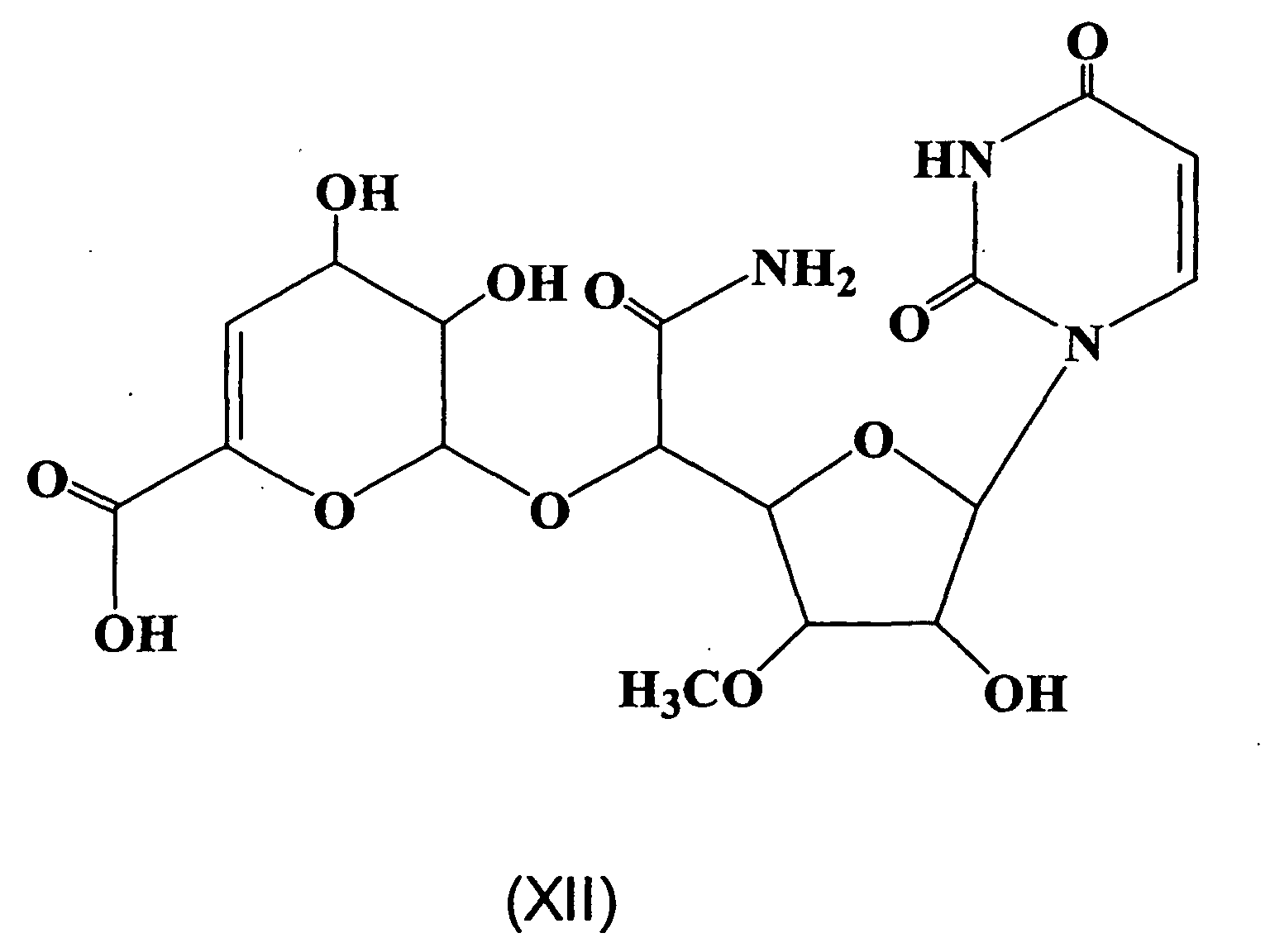
- (ii) Compound A-500359F represented by the following formula (XII):
or a salt thereof;
- (iii) an amide derivative of Compound A-500359F represented by the following
formula (XIII):
or a salt thereof;

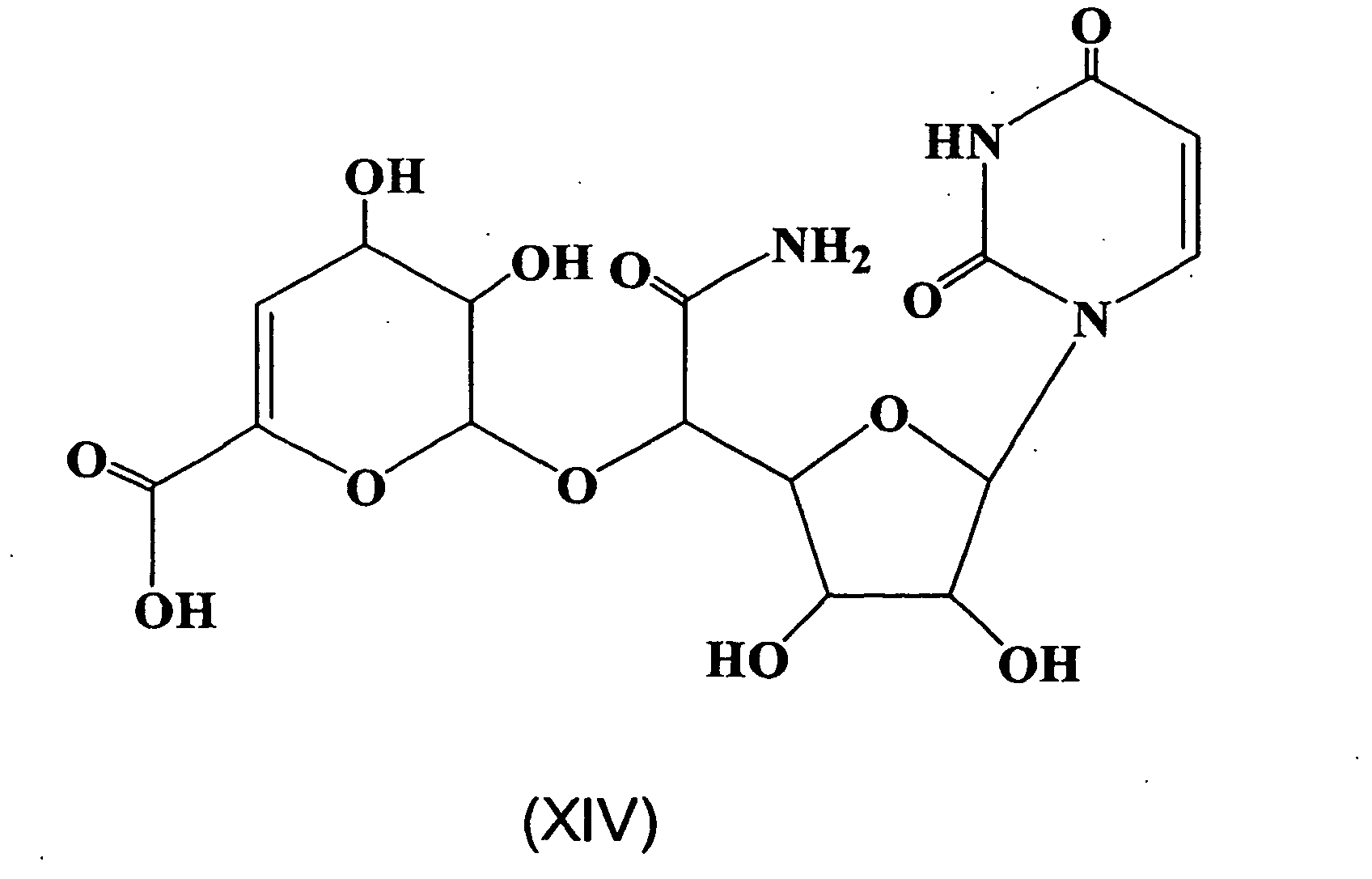
- (iv) Compound A-500359H represented by the following formula (XIV):
or a salt thereof;
- (v) Compound A-500359J represented by the following formula (XV):
or a salt thereof; and

- (vi) Compound A-500359M-3 represented by the following formula (XVI):
or a salt thereof;

- (2) a process for preparing the compound as described in (i), (ii), (iv) or (v) by cultivating a microorganism capable of producing said compound and belonging to the Streptomyces spp. and recovering the compound from the cultured broth;
- (3) a process as described in (2), wherein the microorganism belonging to the Streptomyces spp. and capable of producing the compound is Streptomyces griseus SANK60196 (FERM BP-5420) and is capable of producing the compounds as described in (i), (ii) (iii), or (iv);
- (4) a composition for the treatment or prevention of infectious diseases which contains the compound as described in (i), (ii), (iii), (iv), (v) or (vi) or a pharmacologically acceptable salt thereof as an effective ingredient;
- (5) use of the compound as described in (i), (ii), (iii), (iv), (v) or (vi) or a pharmacologically acceptable salt thereof for the preparation of a medicament for treating or preventing infectious diseases; and
- (6) a compound as described in (i), (ii), (iii), (iv), (v) or (vi) or a pharmacologically acceptable salt thereof for use as a medicament, particularly for use in the treatment or prevention of a bacterial infection.
-
- Compounds of the present invention represented by any one of the formulae (XI), (XII), (XIII), (XIV), (XV) and (XVI) are produced in the culture broth of Streptomyces griseus Strain SANK60196 which belongs to the Streptomyces spp. and has been separated from the soil collected from Mt. Tsukuba/Igaraki-ken; or produced by microbial conversion in the cultivation process or chemical conversion in the isolation and purification process.
- Compound A-500359E of the formula (XI), Compound A-500359F of the formula (XII), Amide derivative of Compound A-500359F of the formula (XIII), Compound A-500359H of the formula (XIV), Compound A-500359J of the formula (XV) and Compound A-500359M-3 of the formula (XVI) of the present invention each contain asymmetric carbons, and each may therefore exist as various optical isomers. In the present invention, isomers of each of Compound A-500359E, Compound A-500359F, Amide derivative of Compound A-500359F, Compound A-500359H, Compound A-500359J and Compound A-500359M-3 are represented by the same formula, but the present invention embraces all the isomers including racemic compounds and also mixtures thereof. When a stereospecific synthesis process is adopted or an optically active compound is employed as a starting compound, the isomer of each of Compound A-500359E, Compound A-5000359F, Amide derivative of Compound A-500359F, Compound A-500359H, Compound A-500359J and Compound A-500359M-3 may be prepared directly or, if it is prepared in the form of a mixture, each isomer may be obtained in a manner known to those skilled in the art.
- Compound A-500359F, Compound A-500359H, Compound A-500359J and Compound A-500359M-3 of the present invention can each be converted into the corresponding salt by a method known to those skilled in the art. The present invention embraces such salts of Compound A-500359F, Compound A-500359H, Compound A-500359J and Compound A-500359M-3. There is no particular restriction on the nature of the salt of any of Compound A-500359F, Compound A-500359H, Compound A-500359J and Compound A-500359M-3, provided that it is medically employed and is pharmacologically acceptable. When the salt of Compound A-500359F, Compound A-500359H, Compound A-500359J or Compound A-500359M-3 is employed for the purpose other than a medicament, for example, employed as an intermediate, no limitation is imposed. Preferred examples of such a salt include alkali metal salts such as a sodium salt, a potassium salt, or a lithium salt, alkaline earth metal salts such as a calcium salt or a magnesium salt, metal salts such as an aluminium salt, an iron salt, a zinc salt, a copper salt, a nickel salt or a cobalt salt, inorganic salts such as an ammonium salt, organic amine salts such as a t-octylamine salt, a dibenzylamine salt, a morpholine salt, a glucosamine salt, a phenylglycine alkyl ester salt, an ethylenediamine salt, an N-methylglucamine salt, a guanidine salt, a diethylamine salt, a triethylamine salt, a dicyclohexylamine salt, an N,N'-dibenzylethylenediamine salt, a chloroprocaine salt, a procaine salt, a diethanolamine salt, a N-benzylphenethylamine salt, a piperazine salt and a tetraamethylammonium salt, or a tris(hydroxymethyl)aminomethane salt, and amino acid salts such as a glycine salt, a lysine salt, an arginine salt, an ornithine salt, or an asparagine salt. More preferred are salts preferably usable as a pharmacologically acceptable salt such as a sodium salt, a potassium salt and an ammonium salt.
- Compound A-500359E, Compound A-500359F, Amide derivative of Compound A-500359F, Compound A-500359H, Compound A-500359J and Compound A-500359M-3 of the present invention and salts thereof may each exist as a solvate. For example, when they are allowed to stand in the air or recrystallized, water is adsorbed thereto by absorption or a hydrate may be formed. Such a solvate is also embraced in the present invention.
- Compound A-500359E, Compound A-500359F, Compound A-500359H, Compound A-500359J and Compound A-500359M-3 of the present invention which are represented by the formulae (XI), (XII), (XIV), (XV) and (XVI) respectively are available by culturing, in a suitable medium, a microorganism belonging to the Streptomyces spp. and recover from the cultured broth. Streptomyces griseus Strain SANK 60196 (which will hereinafter be called "Strain SANK60196"), preferred as the microorganism capable of producing Compound A-500359E, Compound A-500359F, Compound A-500359H, Compound A-500359J and Compound A-500359M-3 are, as described above, collected and isolated from the soil of Ttsukubasan/Ibaraki Prefecture in a conventional manner. Strain SANK60196 has the following biological characteristics.
- Mycological properties of Strain SANK60196 are as follows:
- Strain SANK60196 showed morphological appearance as described below after cultivation at 28°C for 14 days on a medium specified by International Streptomyces Project (which will hereinafter be abbreviated as "ISP") [refer to Shirling, E.B. and Gottlieb, D., "Int. J. Syst. Bacteriol. 16, 313-340 (1996)".] Observation through an optical microscope indicates that substrate mycelia of SANK60196 are favourably grown and branched and show yellowish grey, yellowish brown or pale olive colour, but unlike the strain belonging to Nocardia spp., does not show cleavage or zigzag extension. Aerial mycelia exhibit simple branching. The form of the spore chain is straight or curved and its chain is formed of 10 to 50 or greater spores. Observation through a scanning electron microscope shows that the spore has an oval shape and it has a smooth surface structure. The spore is 0.6-0.8 x 0.7-1.2 mm in dimension. The spore is formed only on the aerial mycelia. Formation of sporangia, axial division of aerial mycelia, cleavage of aerial mycelia and sclerotia are not recognized.
- Growth characteristics of Strain SANK60196 on an agar medium after cultivation at 28°C for 14 days is as described below in Table 3. In the Table, the composition of the medium attached with ISP No. is the same as specified by ISP. In the item, abbreviations G, AM, R and SP stand for growth, aerial mycelia, reverse colour and soluble pigment, respectively. The colour tone is described in accordance with "Colour Standards, ed. by Japan Colour Laboratory". The indication of the colour tone in parentheses is a colour number in accordance with Munsell colour system. The pale yellow soluble pigment produced in a water-agar medium changes into colourless by 0.05N hydrochloric acid, but shows no change by 0.05N sodium hydroxide.
Nature of Medium; Item: characteristics Yeast extract - malt extract agar (ISP 2); G: Excellent, flat, yellowish brown (10YR 5/6) AM: Abundantly formed, velvety, pale brown (2.5Y 8/2) R: Yellowish brown (10YR 5/8) SP: Yellowish brown (10YR 6/8) Oat meal - agar (ISP 3); G: Excellent, flat, yellowish brown (2.5Y 6/6) AM: Abundantly formed, velvety, pale yellowish orange (5Y 9/2) R: Dark yellow (2.5Y 8/8) SP: Not produced Starch - inorganic salt agar (ISP 4); G: Good, flat, yellowish brown (2.5Y 6/4) AM: Abundantly formed, velvety, yellowish grey (7.5Y 9/2) R: Yellowish brown (2.5Y 6/4) Glycerin - asparagine agar (ISP 5) G: Excellent, flat, pale yellowish brown (2.5Y 7/6) AM: Abundantly formed, velvety, yellowish grey (5Y 8/2) R: Pale yellowish brown (2.5Y 8/6) SP: Not produced Peptone - yeast extract - iron agar (ISP 6); G: Excellent, flat, pale olive color (5Y 8/3) AM: Slightly produced, velvety, yellowish grey (5Y 9/1) R: Pale yellow (5Y 8/6) SP: Not produced Tyrosine agar (ISP 7) G: Good, flat, grayish yellow brown (2.5Y 5/4) AM: Abundantly formed, velvety, light olive grey (7.5Y 8/2) R: Yellowish brown (10YR 5/4) SP: Grayish yellow brown (2.5Y 4/3) Sucrose - nitrate agar; G: Not so good, flat, pale yellow (5Y 8/6) AM: Abundantly formed, velvety, light olive grey (7.5Y 8/2) R: Dark yellow (5Y 8/8) SP: Pale yellow (5Y 9/6) Glucose - asparagine agar; G: Good, flat, pale yellow (5Y 9/3) AM: Not so good, velvety, yellowish grey (5Y 9/1) R: Yellowish grey (7.5Y 9/3) SP: Not produced Nutrient agar (product of Difco Laboratories) G: Good, flat, pale yellowish brown (2.5Y 8/3) AM: Good, velvety, yellowish grey (5Y 9/1) R: Yellowish grey (5Y 9/4) SP: Not produced Potato extract - carrot extract agar; G: Not so good, flat, yellowish grey (7.5Y 9/2) AM: Not so good, velvety, yellowish grey (5Y 9/2) R: Yellowish grey (7.5Y 9/3) SP: Yellowish grey (7.5Y 9/3) Water agar; G: Not good, flat, yellowish grey (5Y 9/1) AM: Not good, velvety, yellowish grey (5ZY 9/1) R: Yellowish grey (7.5Y 9/4) SP: Pale yellow (5Y 9/6) - The physiological characteristics of the present strain observed for 2 to 21 days after cultivation at 28°C are as shown in Table 4. In the table, Medium 1 is a yeast extract - malt extract agar medium (ISP 2).
Hydrolysis of starch positive Liquefaction of gelatin positive Reduction of nitrates positive Coagulation of milk negative Peptonization of milk positive Formation of melamine-like pigment positive Substrate decomposition: casein positive tyrosine positive xanthine negative Growth temperature range (Medium 1) 6 to 35°C Optimum growth temperature (Medium 1) 18 to 30°C Growth in the presence of salt (Medium 1) 10% - Utilisation of a carbon source by Strain SANK60196 observed after cultivation at 28°C for 14 days on a Pridham-Gottlieb agar medium (ISP 9) is as described in Table 5. In the table, "+" means utilisable, while "-" means non-utilisable.
D-glucose + L-arabinose - D-xylose + Inositol - D-mannitol + D-fructose + L-rhamnose - Sucrose - Raffinose - Control - - The cell wall of the present strain was investigated in accordance with the method of Hasegawa, et al. [refer to Hasegawa, T., et al., "The Journal of General and Applied Microbiology, 29, 319-322(1983)], resulting in the detection of LL-diaminopimelic acid. The main sugar component in the whole cells of the present strain was investigated in accordance with the method of M.P. Lechevalier [refer to Lechevalier, M.P., "Journal of Laboratory and Clinical Medicine, 71, 934-944(1968)]. As a result, no characteristic component was detected.
- The above-described mycological properties have revealed that the present strain belongs to Streptomyces spp. among the actinomycetes. It has been made clear that the present strain is markedly related to Streptomyces griseus, as a result of comparison with the microorganism described in the ISP strains by Shirling and Gottlieb [refer to Shirling, E.B. and Gottlieb, D., "International Journal of Systematic Bacteriology, 18, 68―189 and 279―392 (1968); 19, 391―512 (1969); 22, 265-394 (1972)"], the microorganism described in "The actinomycetes Vol. 2" written by Waksman [refer to Waksman, S.A., "The actinomycetes 2 (1961)"], with the microorganism described in Bergey's Manual edited by Buchanan and Gibbons [refer to R.E. Buchanan and N.E. Gibbons, "Bergey's Manual of Determinative Bacteriology", 8th edition (1974)], with the microorganism described in "Bergey's Manual of Systematic Bacteriology", edited by Williams [refer to Williams, S.T., et al., "Bergey's Manual of Systematic Bacteriology 4 (1989)"] and with the microorganism described in the recent literature about actinomycetes belonging to Streptomyces spp. It has however been recognized to be different from Streptomyces griseus, because it produces a yellowish grey soluble pigment on a glycerin - asparagine agar medium and a pale yellowish brown soluble pigment on a peptone - yeast extract - iron agar medium but produces a soluble pigment neither on a potato extract - carrot extract agar medium nor on a water agar medium; the maximum growth temperature is 40°C; and it is grown in the presence of 7% of salt.
- The present strain having such mycological characteristics is considered to be a novel strain different from Streptomyces griseus, but it is impossible to distinguish them based on only the above-described differences. The present inventors therefore identified the present strain as Streptomyces griseus SANK60196.
- This strain was internationally deposited with Agency of Industrial Science and Technology, Ministry of International Trade and Industry (1-3, Higashi 1-chome, Tsukuba-shi, Ibaraki-ken, 305, JAPAN) as of February 22, 1996, with the accession number of FERM BP-5420.
- The various characteristics of the actinomycetes belonging to Streptomyces spp. such as Strain SANK60196 are not stable, but as is well known, they easily change naturally or artificially. The strains usable in the present invention include all such variants. The present invention embraces all the strains belonging to the Streptomyces spp. and capable of producing Compound A-500359E, Compound A-500359F, Compound A-500359H, Compound A-500359J or Compound A-500359M-3.
- Any synthetic or natural medium is usable as a medium for culturing the microorganism capable of producing Compound A-500359E, Compound A-500359F, Compound A-500359H, Compound A-500359J or Compound A-500359M-3, insofar as it contains a source selected from carbon sources, nitrogen sources, inorganic ions and organic nutrition sources as necessary.
- Examples of the nutrition source usable here include known carbon sources, nitrogen sources and inorganic salts which are conventionally used for the cultivation of a mycotic or actinomycete strain and are utilisable by microorganisms.
- Specific examples of the carbon source include glucose, fructose, maltose, sucrose, mannitol, glycerol, dextrin, oats, rye, corn starch, potato, corn meal, soybean meal, cotton seed oil, glutinous malt syrup, syrup, soybean oil, citric acid and tartaric acid. They may be used either singly or in combination. The amount of the carbon source to be added usually varies, but is not limited to, within a range of from 1 to 10 wt.% of the amount of the medium.
- A substance containing a protein or a hydrolysate thereof is generally employed as the nitrogen source. Preferred examples of the nitrogen source include soybean meal, wheat bran, peanut meal, cotton seed meal, skimmed milk, casein hydrolysate, Pharmamine (product of Sheffield Chemical), fish meal, corn steep liquor, peptone, meat extract, pressed yeast, dry yeast, yeast extract, malt extract, potato, ammonium sulfate, ammonium nitrate and sodium nitrate. It is preferred to use the above-exemplified nitrogen sources either singly or in combination in an amount ranging from 0.2 to 6 wt.% of the amount of the medium.
- Any ordinarily employed salt containing an ion such as sodium, ammonium, calcium, phosphate, sulfate, chloride or carbonate can be used as the nutrient inorganic salt. In addition, trace of metals such as potassium, calcium, cobalt, manganese, iron and magnesium are usable.
- The addition of cobalt, skimmed milk or yeast extract is particularly effective in the production of Compound A-500359E, Compound A-500359F, Compound A-500359H or Compound A-500359J.
- Upon culturing the microorganism, an inhibitor of antibiotic biosynthesis can be added to produce Compound A-500359E, Compound A-500359F and Compound A-500359H. Compound A-500359E, Compound A-500359F and Compound A-500359H can each be produced, for example, by using S-(2-aminoethyl)-L-cysteine or salt thereof which is an aspartate kinase inhibitor singly or in combination with cobalt, skimmed milk and yeast extract, as a medium additive. For example, use of the above-described additive in combination with skimmed milk improves productivity of Compound A-500359E, Compound A-500359F and Compound A-500359H. The additive can be added to give its final concentration ranging from 1 to 100 mM. For the production of Compound A-500359E, Compound A-500359F and Compound A-500359H, the final concentration of 10 mM is preferred.
- Use of the above-described additive in combination with an amino acid or salt thereof makes it possible to produce useful compounds related to Compound A-500359F and Compound A-500359H. In particular, by the use in combination with L-allylglycine or a salt thereof, Compound A-500359M-3 (XVI) is available. The L-allylglycine can be added at a final concentration ranging from 1 to 100 mM. At the final concentration of 10 mM, Substance A-500359M-3 can be produced preferably.
- Upon liquid culture, an antifoamer such as silicone oil, vegetable oil, surfactant or the like can be used.
- The medium for cultivation of Strain SANK60196 to produce Compound A-500359E, Compound A-500359F, Compound A-500359H, or Compound A-500359J preferably has a pH ranging from 5.0 to 8.0.
- Although the temperature which allows growth of Strain SANK60196 ranges from 12 to 36°C, the strain is preferably cultured at 18 to 28°C, more preferably 19 to 23°C, in order to produce Compound A-500359E, Compound A-500359F, Compound A-500359H and Compound A-500359J.
- In order to obtain Compound A-500359E, Compound A-500359F, Compound A-500359H, Compound A-500359J and Compound A-500359M-3, an aerobic culture of Strain SANK60196 can be used. Examples of such a cultivation method include ordinarily employed aerobic culture such as solid culture, shaking culture, and aeration agitation culture.
- For small-scale cultivation, shake culture for several days at 19 to 23°C is preferred. Cultivation is started by growing a step of seed culture in a first or second stage process in a baffled Erlenmeyer flask (equipped with a water flow adjusting wall) or an ordinarily-employed Erlenmeyer flask. A carbon source and a nitrogen source can be used in combination as a medium in the seed culture. The seed culture flask may be shaken at 19 to 23°C for 5 days in a thermostat incubator or shaken until the seed culture grows sufficiently. The seed culture thus grown is used for inoculation on the second seed culture medium or a production medium. When the seed cultures are used under an intermediate growing step, they are allowed to grow in a similar manner, followed by partial inoculation into a production medium. The flask into which the seeds have been inoculated is subjected to culturing with shaking at a constant temperature for several days, and after completion of the cultivation, the cultured medium in the flask is centrifuged or filtered.
- For large-scale cultivation, on the other hand, use of a jar fermenter or tank equipped with an agitator and an aeration apparatus is preferred. Prior to cultivation in such a container, a nutrient medium is heated to 121 to 130°C for sterilization. After cooling, the seed cultures which have been allowed to grow in advance by the above-described method are inoculated on the sterilized medium. Then, cultivation is carried out with aeration and agitation at 19 to 23°C. This method is suitable for preparing a large amount of compounds.
- Compound A-500359E, A-500359F or A-500359H can also be produced by adding, as an aspartate kinase inhibitor, an aqueous solution of S-(2-aminoethyl)-L-cysteine or salt thereof which has been previously filter-sterilized in advance to a sterilized medium at the start of, or during, cultivation.
- Compound A-500359M-3 can be produced by separately or simultaneously adding aqueous solutions of S-(2-aminoethyl)-L-cysteine or salt thereof, and L-allyl glycine or salt thereof which have been filter sterilized in advance to the sterilized medium at the start of, or during, cultivation.
- The product of Compound A-500359E, A-500359F, A-500359H, A-500359J and A-500359M-3 by cultivation can be measured by subjecting a portion of the cultured broth to HPLC analysis. The titre of Compound A-500359E, A-500359F, A-500359H, A-500359J and A-500359M-3 usually reaches a peak in 3 to 15 days.
- After completion of the cultivation, the cell component is separated from the cultured broth by filtration with the aid of diatomaceous earth or centrifugation and Compound A-500359E, A-500359F, A-500359H, A-500359J and A-500359M-3 present in the filtrate or supernatant is purified by utilizing their physico-chemical properties with HPLC analytical data as an index. As diatomaceous earth, "Celite 545" (product of Celite Corporation) is preferred. Compound A-500359E, A-500359F, A-500359H, A-500359J and A-50359M-3 present in the filtrate can be purified by using adsorbents singly or in combination, for example, activated charcoal or an adsorbing resin such as "Amberlite XAD-2 or XAD-4" (product of Rohm & Haas), and "Diaion HP-10, HP-20, CHP-20P, HP-50 or SP207" (each, product of Mitsubishi Chemical). Compound A-500359E, A-500359F, A-500359H, A-500359J and A-500359M-3 can be separated from impurities by passing a solution containing Compound A-500359E, A-500359F, A-500359H, A-500359J and A-500359M-3 through the layer of such an adsorbent as described above, and removing the impurities adsorbed thereto from the solution; or by eluting the adsorbed Compound A-500359E, A-500359F, A-500359H, A-500359J and A-500359M-3 with aqueous methanol, aqueous acetone, aqueous n-butanol, aqueous ammonia, ammonia-containing aqueous methanol or ammonia-containing aqueous acetone. When an ammonia-containing solution is employed as an eluent, the amide derivative of compound A-500359F happens to be produced upon elution from the column or concentration.
- Compound A-500359E, Compound A-500359F, the amide derivative of Compound A-500359F, Compound A-500359H, Compound A-500359J and Compound A-500359M-3 thus obtained can be purified by adsorption column chromatography using silica gel, "Florisil", "Cosmosil" (product ofNacalai Tesque), or "Diaion CHP-20P or SP207" (product of Mitsubishi Chemical); gel filtration chromatography with "Sephadex G-10 (product of Pharmacia Biotech) or "Toyopearl HW40F" (product of TOSOH Corporation); anion exchange chromatography with "Dowex 1 or SBR-P" (product of Dow Chemical) or "Diaion PA316" (product of Mitsubishi Chemical); normal phase and reversed phase HPLC; or the like.
- Compound A-500359E, Compound A-500359F, the amide derivative of Compound A-500359F, Compound A-500359H, Compound A-500359J and Compound A-500359M-3 of the present invention can be separated and purified by using the above-exemplified separation and purification means singly or in combination as needed, or in some cases, by using one of them in repetition.
- Compound A-500359F can be obtained by hydrolysis of Compound A-500359E. For example, hydrolysis is preferably conducted under basic conditions, preferably in aqueous basic solution.
- Examples of the basic compound usable for hydrolysis include alkali metal hydroxides and weak acid salts thereof such as sodium hydroxide, potassium hydroxide, lithium hydroxide, sodium acetate, sodium carbonate, potassium carbonate and sodium bicarbonate; alkaline earth metal hydroxides and weak acid salts thereof such as calcium hydroxide, magnesium hydroxide and magnesium acetate; inorganic basic compounds and basic salts thereof such as ammonia; organic amines and basic salts thereof such as t-octylamine, dibenzylamine, morpholine, glucosamine, phenylglycine alkyl ester, ethylenediamine, N-methylglucamine, guanidine, diethylamine, triethylamine, dicyclohexylamine, N,N'-dibenzylethylenediamine, chloroprocaine, procaine, diethanolamine, N-benzylphenethylamine, piperazine, tetramethylammonia and tris(hydroxymethyl)aminomethane. A basic buffer containing an alkali metal ion, an alkaline earth metal ion, an inorganic ion such as ammonia, or an organic amine ion of the above-exemplified basic compounds may also be employed. Among them, alkali metal hydroxides are preferred, of which sodium hydroxide is particularly preferred. In particular, hydrolysis of Compound A-500359E by using sodium hydroxide can easily produce Compound A-500359F.
- The concentration of the basic compound used in the above-described reaction preferably ranges from 0.001 to 1N, more preferably 0.3 to 0.1N. The reaction temperature is preferably -20 to 40°C, more preferably 0 to 30°C. The reaction time is preferably 30 seconds to 15 hours, more preferably 30 minutes to 2 hours.
- Use of aqueous ammonia as a base produces the amide derivative of Compound A-500359F together with Compound A-500359F, but these compounds can be separated and purified by the above-described method.
- The amide derivative of Compound A-500359F may be produced by reaction of Compound A-500359E with ammonia in a solvent.
- Examples of the solvent include water and alcohols such as ethanol and methanol, of which water and methanol are preferred.
- Gaseous ammonia may be introduced into the solution of the compound, but a solution of ammonia in water or in an alcohol such as methanol or ethanol is usually used. Preferably, an aqueous or methanolic solution is employed.
- When aqueous ammonia is employed, its concentration preferably ranges from 0.1 to 1N, more preferably 0.3 to 0.7N. The reaction temperature is preferably -20 to 40°C, more preferably 0 to 30°C. The reaction time is preferably 30 minutes to 15 hours, more preferably 1 to 4 hours.
- When aqueous ammonia is used, in addition to the desired amide derivative of Compound A-500359F, Compound A-500359F is produced by the hydrolysis of the ester. These compounds however can be separated and purified by the above-described methods.
- The amide derivative of Compound A-500359F can also be produced by reacting Compound A-500359F with a methylating reagent in a solvent, thereby converting it to the methyl ester derivative, that is, Compound A-500359E, and then reacting the resulting compound with ammonia as described above.
- Examples of the methylating reagent include diazomethane and dimethylsulfuric acid, of which diazomethane is preferred. The methylating reagent for the conversion of Compound A-500359F to Compound A-500359E is preferably added in an amount of 1 to 5 equivalents, preferably 1.5 to 2 equivalents.
- Examples of the solvent usable for the above reaction include water and alcohols such as methanol and ethanol, of which water and methanol are preferred.
- The reaction temperature is preferably -20 to 40°C, more preferably 0 to 30°C. The reaction time is preferably 30 minutes to 15 hours, more preferably 1 to 2 hours.
- After completion of the reaction, Compound A-500359F, Compound A-500359E, and the amide derivative of Compound A-500359F can be isolated from the reaction mixture by the means selected as needed from those described above in the separation and purification means for Compound A-500359E, Compound A-500359F, the amide derivative of Compound A-500359F, Compound A-500359H, Compound A-500359J and Compound A-50359M-3.
- Typical preparation processes for Compound A-500359E, Compound A-500359F, the amide derivative of Compound A-500359F, Compound A-500359H, Compound A-500359J and Compound A-50359M-3 are described hereinabove, but preparation processes are not limited thereto and other processes already known to those skilled in the art may also be employed.
- Compound A-500359E, Compound A-500359F, the amide derivative of Compound A-500359F, Compound A-500359H, Compound A-500359J and Compound A-500359M-3 of the present invention thus available are novel compounds which have not been described in the literature. Their growth inhibitory activity against general gram positive bacteria or gram negative bacteria can be determined by the disk assay method using normal agar medium (product of Eiken Chemical) or heart infusion agar medium (product of Difco Laboratories). Growth inhibitory activity against Mycobacteria, gram positive bacteria belonging to the Actinomycetales, can be determined similarly on the above-described medium added further with glycerin.
- Typical evaluation methods of biological activity of Compound A-500359E, Compound A-500359F, the amide derivative of Compound A-500359F, Compound A-500359H, Compound A-500359J and Compound A-500359M-3 were described so far, but the evaluation method is not limited thereto, but other evaluation methods already known to those skilled in the art can also be employed.
- The compounds of the present invention or pharmacologically acceptable salts thereof may be administered through various routes. Examples include oral administration using tablets, capsules, granules, powders, syrups or the like; and parenteral administration using injections (intravenous, intramuscular or subcutaneous), drops, suppositories or the like. These formulations can be prepared in a conventional manner by adding to a medicament ordinarily employed carriers known in the field of pharmaceutical formulation technique such as an excipient, binder, disintegrator, lubricant, corrigent, adjuvant for solubilization, suspending agent, coating agent and/or the like.
- For the formation of tablets, various carriers known conventionally in this field can be employed. Examples include excipients such as lactose, sucrose, sodium chloride, glucose, urea, starch, calcium carbonate, kaolin, crystalline cellulose and silicic acid; binders such as water, ethanol, propanol, simple syrup, glucose solution, starch solution, gelatin solution, carboxymethyl cellulose, shellac, methyl cellulose, potassium phosphate and polyvinyl pyrrolidone; disintegrants such as dry starch, sodium alginate, agar powder, laminaran powder, sodium bicarbonate, calcium carbonate, polyoxyethylene sorbitan fatty acid ester, sodium lauryl sulfate, stearic monoglyceride, starch and lactose; disintegration suppressants such as sucrose, stearin, cacao butter and hydrogenated oil; absorption facilitators such as quaternary ammonium salts and sodium lauryl sulfate; humectants such as glycerin and starch; adsorbents such as starch, lactose, kaolin, bentonite and colloidal silicic acid; and lubricants such as purified talc, stearates, boric acid powder and polyethylene glycol. Tablets can be formed as those having ordinary coating as needed such as sugar coated tablets, gelatin encapsulated tablets, enteric coated tablets, film coated tablets, or double or multiple layer tablets.
- For the formation of pills, various carriers conventionally known in this field can be used. Examples include excipients such as glucose, lactose, cacao butter, starch, hardened vegetable oil, kaolin and talc; binders such as gum arabic powder, tragacanth powder, gelatin and ethanol; and disintegrators such as laminaran agar.
- For the formation of suppositories, various carriers conventionally known in this field can be employed. Examples include polyethylene glycol, cacao butter, higher alcohols and esters thereof, gelatin and semi-synthetic glyceride.
- For formulation as injections, it is preferred that solutions or suspensions are sterilized and they are made isotonic with the blood. Solutions, emulsions or suspensions can be formed using any diluent conventionally used in this field. Examples include water, ethanol, propylene glycol, ethoxylated isostearyl alcohol, polyoxylated isostearyl alcohol and polyoxyethylene sorbitan esters of fatty acid. It is also possible to incorporate, in a pharmaceutical preparation, salt, glucose or glycerin in an amount sufficient for preparing an isotonic solution, or to add an ordinarily employed adjuvant for solubilization, buffer, soothing agent and/or the like.
- If necessary, a colourant, preservative, flavor, sweetener or other medicaments may be incorporated.
- There is no particular limitation on the content of the compound incorporated as an effective ingredient in the above-described pharmaceutical preparation. It can be chosen suitably from a wide range. In general, it is desired to be contained in an amount of 1 to 70 wt.%, preferably 1 to 30 wt.% in the whole composition.
- There is no particular limitation on the administering method of the above-described pharmaceutical preparation and it is determined depending on the dosage form or age, sex or other conditions of a patient to be administered or seriousness of the disease of the patient. For example, tablets, pills, solutions, suspensions, emulsions, granules or capsules are administered orally. Injections are administered intravenously either singly or as a mixture with an ordinarily employed fluid replacement such as glucose or amino acid. If necessary, they are singly administered intramuscularly, subcutaneously, intracutaneously or intraperitoneally. A suppository is administered rectally.
- Although the dose of the pharmaceutical composition differs with the conditions, age and weight of the patient, administration route or dosage form, daily dose usually ranges from 2000 mg (preferably 100 mg) as the upper limit to 0.1 mg (preferably 1 mg, more preferably 10 mg) as the lower limit per adult. It can be administered once or in several portions a day according to the conditions.
- The present invention will hereinafter be described more specifically by Examples, Tests and Formulation Examples. It should however be borne in mind that the present invention is not limited to or by them.
- Into each of four 2 L Erlenmeyer flasks (seed flasks), each containing 500 ml of the seed culture medium described below, were inoculated aseptically four loopfuls of Strain SANK60196 followed by shaking in a rotary shaker at 23°C and 210 rpm, and the seed culture was thus conducted for 3 days.
- Medium for seed culture: containing the following components in 1000 ml of tap water:
Maltose 30 g Meat extract 5 g Polypeptone 5 g Sodium chloride 5 g Calcium carbonate 3 g Antifoamer "CB442" 50 mg (product of NOF Corporation) - After adjustment of pH to 7.4, sterilization was conducted at 121 °C for 30 minutes.
- Cultivation was conducted as described below. Described specifically, the seed culture was inoculated at 3% (volume/volume: which will hereinafter be abbreviated as "v/v") into two 30 L jar fermenters, each containing 15 L of a cultivation medium. Six hours later after the initiation of cultivation at 23°C, filter-sterilized S-(2-aminoethyl)-L-cysteine hydrochloride was added to give a final concentration of 10 mM, followed by cultivation with aeration and agitation for 6 days.
- Medium for cultivation: containing the following components in 1000 ml of tap water:
Maltose 30 g Yeast extract 5 g (product of Difco Laboratories) Meat extract 5 g Polypeptone 5 g Sodium chloride 5 g Calcium carbonate 3 g Antifoamer "CB442" 50 mg (product of NOF Corporation) - After adjustment of pH to 7.4, sterilization was conducted at 125°C for 30 minutes.
- The cultured broth (30 L) obtained in Example 43 was filtered with the aid of "Celite 545" (product of Celite Corporation).
- Upon purification as described later, the active fraction was monitored by HPLC using the column and analytical conditions described below.
- Column : "Senshu Pak ODS-H-215 1" 6 x 150 mm (product of Senshu Scientific Co., Ltd.)
Solvent: 0.04% aqueous trifluoroacetic acid containing 4% acetonitrile
Flow rate: 1.0 ml/min
Detection: UV 210 nm
Retention time: 21.2 minutes - 30 L of the resulting filtrate was charged on a column (6 L) packed with "Diaion HP-20" (product of Mitsubishi Chemical). After washing the column with 12 L of deionised water, the non-adsorbed fraction and washing fraction were combined (the combined fraction will hereinafter be called "non-adsorbed·washing fraction"). The adsorbed substance was eluted with 12 L of 10% aqueous acetone. The eluate was concentrated to remove acetone and lyophilized, whereby 39 g of a crude powdery product was obtained.
- The resulting crude powdery product was dissolved in 200 mL of deionised water and charged on a column (2 L) packed with "Diaion CHP-20P" (product of Mitsubishi Chemical). The column was then washed with 4 L of deionised water and 4 L of 10% aqueous methanol, while the adsorbed substance was eluted with 4 L of 15% aqueous methanol and 4 L of 20% aqueous methanol. A 2 to 4 L portion of the 15% aqueous methanol eluate and the 20% aqueous methanol eluate were combined, followed by concentration. After removal of methanol by distillation, the residue was lyophilized to give 8.9 g of a powder.
- The resulting powder was dissolved in 200 ml of deionised water and the resulting solution was charged on a column (1 L) packed with "Toyopearl HW40F" (product of TOSOH Corporation), followed by development of the column with deionised water. As a result of fractionation of the eluate into portions of 100 ml each, the active substance having a retention time of 21.2 minutes upon the above-described HPLC was eluted in Fraction Nos. 5 to 10. The resulting fractions were concentrated and lyophilized to give 2.7 g of a powder.
- The resulting powder was dissolved in 200 ml of deionised water and charged on an HPLC column ("YMC-Pack ODS-1050-20-SR": 100 x 500 mm; product of YMC) equilibrated with 0.04% aqueous trifluoroacetic acid containing 4% acetonitrile. The column was developed at a flow rate of 208 ml/min with 0.04% aqueous trifluoroacetic acid containing 4% acetonitrile. As a result of fractionation of the eluate into portions of 1 L each, the active substance was eluted in Fraction Nos. 6 and 7.
- These fractions were combined, followed by concentration to 200 ml by "Evapor" (product of Okawara Seisakujo) and lyophilization, whereby 99 mg of a powder was obtained. The resulting powder was suspended in 5 ml of distilled water and insoluble matter was then filtered off. The filtrate was concentrated to 2 ml by a rotary evaporator, followed by lyophilization, whereby 87 mg of Compound A-500359E was obtained as a pure product.
- The compound A-500359E has the following physico-chemical properties:
- 1) Appearance of the substance: white powder
- 2) Solubility: soluble in water, slightly soluble in methanol, insoluble in normal hexane and chloroform
- 3) Molecular formula: C18H23N3O12
- 4) Molecular weight: 473 (as measured by FAB mass spectrometry)
- 5) Accurate mass, [M+H]+, as measured by high-resolution FAB mass spectrometry is as
follows:
- Found: 474.1349
- Calculated: 474.1359
- 6) Ultraviolet absorption spectrum: ultraviolet absorption spectrum measured in water
exhibits the following maximum absorption:
- 251 nm (ε 10,000)
- 7) Optical rotation: optical rotation measured in water exhibits the following value:
- [α]D 20: +115° (c 0.28)
- 8) Infrared absorption spectrum: Infrared absorption spectrum as measured by the
potassium bromide (KBr) disk method exhibits the following absorption maxima:
- 3410, 2955, 1683, 1464, 1441, 1396, 1309, 1267, 1206, 1138, 1115, 1088, 1062, 1023 cm-1.
- 9) 1H nuclear magnetic resonance spectrum was measured in deuterated dimethyl
sulfoxide with tetramethylsilane as an internal standard substance. 1H nuclear magnetic
resonance spectrum is as follows:
- 3.24 (3H, s), 3.52 (1H, dd, J=4.5, 6.1Hz), 3.72 (3H, s), 3.98 (1H, m), 4.10 (1H, m), 4.25 (1H, m), 4.29 (1H, d, J=2.0Hz), 4.33 (1H, dd, J=2.0, 6.1 Hz), 5.05 (1H, d, J=3.9 Hz), 5.16 (1H, d, J=6.8Hz), 5.45 (1H, d, J=4.2Hz), 5.54 (1H, d, J=5.9Hz), 5.61 (1H, d, J=3.3Hz), 5.61 (1H, d, J=8.1Hz), 5.93 (1H, dd, J=1.3, 2.9 Hz), 7.56 (1H, br. s), 7.69 (1H, br. s), 7.74 (1H, d, J=8.1 Hz) ppm.
- 10) 13C nuclear magnetic resonance spectrum was measured in deuterated dimethyl
sulfoxide with tetramethylsilane as an internal standard substance. 13C-nuclear magnetic
resonance spectrum is as follows:
- 52.0 (q), 57.3 (q), 61.5 (d), 64.9 (d), 72.1 (d), 75.4 (d), 78.2 (d), 81.3 (d), 89.0 (d), 99.2 (d), 101.2 (d), 114.2 (d), 139.2 (s), 139.8 (d), 150.3 (s), 161.8 (s), 163.1 (s), 170.1 (s) ppm.
- 11) High performance liquid chromatography (which will hereinafter be abbreviated as
"HPLC") analysis:
- Column: "Senshu Pack ODS-H-2151"
- 6 x 150 mm (product of Senshu Scientific Co., Ltd.)
- Solvent: 0.04% aqueous trifluoroacetic acid containing 4% acetonitrile
- Flow rate: 1.0 ml/min
- Detection: UV 210 nm
- Retention time: 21 minutes
-
- In the purification described below, the active fraction was monitored by HPLC using the following column and analytical conditions.
Column : "Senshu Pak ODS-H-2151" 6 x 150 mm (product of Senshu Scientific Co., Ltd.)
Solvent: 0.04% aqueous trifluoroacetic acid
Flow rate: 1.5 ml/min
Detection: UV 210 nm
Retention time: 8 minutes (Compound A-500359H)
18 minutes (Compound A-500359F) - After 42 L of non-adsorbed·washing fraction obtained in Example 44 was adjusted to pH 9 with 6N sodium hydroxide, this fraction was charged on a column (8.5 L) packed with "Diaion PA316 (Cl-)" (product of Mitsubishi Chemical). The column was washed with 27 L of deionised water and the adsorbed substance was then eluted with 27 L of 0.1N hydrochloric acid.
- The eluate was adjusted to pH 7 with 6N sodium hydroxide and then charged on an activated charcoal column (2 L). The column was washed with 8 L of deionised water and the active substance was then eluted with 8 L of 0.5N aqueous ammonia containing 10% acetone. Concentration and lyophilization of the resulting eluate yielded 28 g of a powder.
- The resulting powder was dissolved in 400 ml of distilled water. After adjustment to pH 3.0, the resulting solution was charged on a column (2 L) which had been adjusted with water and packed with "Diaion CHP-20P" (product of Mitsubishi Chemical). The non-adsorbed liquid and washing fractions were collected, concentrated and lyophilized, whereby 12 g of a viscous substance was obtained.
- This viscous substance was dissolved in 200 ml of distilled water. After adjustment to pH 3.3 with trifluoroacetic acid, the resulting solution was then charged on a column (1 L) equilibrated with 0.04% aqueous trifluoroacetic acid and packed with "Diaion CHP-20P" (product of Mitsubishi Chemical). After development of the column with 2 L of 0.04% aqueous trifluoroacetic acid and pooling of the fraction (Fraction H) eluted between 0.8 and 1.4 L, the eluting solution was changed to 2 L of distilled water. Concentration and lyophilization of 2 L of the fraction (Fraction F) eluted with distilled water yielded 605 mg of a powder.
- 600 ml of Fraction H was diluted with distilled water to 1 L and its pH adjusted to 2.8 with trifluoroacetic acid, and the resulting solution was then charged again on a column (1 L) packed with "Diaion CHP-20P" (product of Mitsubishi Chemical) equilibrated with 0.04% aqueous trifluoroacetic acid. The column was eluted with 2.2 L of 0.04% aqueous trifluoroacetic acid. Fractions 8 to 11 obtained by fractionation of the eluate in portions of 200 ml each were concentrated and lyophilized, whereby 233 mg of a powder was obtained.
- A 100 mg portion of the resulting powder was dissolved in 5 ml of water and 1 ml portions of the resulting solution were charged on an HPLC column ("Senshu Pak ODS-H-5251": 20 x 250 mm; product of Senshu Scientific) equilibrated with 0.04% aqueous trifluoroacetic acid. The column was developed at a flow rate of 10 ml/min. The ultraviolet absorption of the active fraction at 210 nm was detected and a peak eluted during a retention time of 14 to 16 minutes was collected, the process being carried out 5 times. The fractions thus obtained were concentrated by a rotary evaporator, followed by lyophilization, whereby 23 mg of Compound A-500359H was obtained as a pure product.
- In 15 ml of water were dissolved 605 mg of lyophilized powder of Fraction F and 1 ml portions of the resulting solution were charged on an HPLC column ("Senshu Pak ODS-H-5251": 20 x 250 mm; product of Senshu Scientific) equilibrated with 0.04% aqueous trifluoroacetic acid. The column was developed at a flow rate of 10 ml/min. The absorption of the active fraction at the ultraviolet portion of 210 nm was detected and a peak eluted during a retention time of 29 to 31 minutes was collected 15 times by fractionation. The fractions thus obtained were concentrated by a rotary evaporator, followed by lyophilization, whereby 134 mg of Compound A-500359F was obtained as a pure product.
- The compound A-500359F has the following physico-chemical properties:
- 1) Appearance of the substance: white powder
- 2) Solubility: soluble in water, slightly soluble in methanol, insoluble in normal hexane and chloroform
- 3) Molecular formula: C17H21N3O12
- 4) Molecular weight: 459 (as measured by FAB mass spectrometry)
- 5) Accurate mass, [M+H]+, as measured by high-resolution FAB mass spectrometry is as
follows:
- Found: 460.1201
- Calculated: 460.1203
- 6) Ultraviolet absorption spectrum: ultraviolet absorption spectrum measured in water
exhibits the following maximum absorption:
- 262 nm (ε 7,000)
- 7) Optical rotation: optical rotation measured in water exhibits the following value:
- [α]D 20: +111° (c 0.41)
- 8) Infrared absorption spectrum: Infrared absorption spectrum as measured by the
potassium bromide (KBr) disk method exhibits the following absorption maxima:
- 3391, 2941, 1684, 1466, 1400, 1333, 1269, 1205, 1137, 1115, 1062, 1020 cm-1.
- 9) 1H nuclear magnetic resonance spectrum was measured in deuterium oxide with the
signal of water as 4.75 ppm. 1H nuclear magnetic resonance spectrum is as follows:
- 3.37 (3H, s), 3.79 (1H, dd, J=5.1, 6.4Hz), 4.17 (1H, ddd, J=1.6, 3.4,4.6 Hz), 4.38 (1H, dd, J=3.5, 5.1 Hz), 4.48 (1H, dd, J=2.4, 6.4 Hz), 4.49 (1H, ddd, J=0.6, 2.7, 4.6 Hz), 4.69 (1H, d, J=2.4 Hz), 5.32 (1H, dd, J=0.6, 3.4 Hz), 5.77 (1H, d, J=3.5 Hz), 5.90 (1H, d, J=8.1 Hz), 6.11 (1H, dd, J=1.6, 2.7 Hz), 7.75 (1H, d, J=8.1 Hz) ppm.
- 10) 13C nuclear magnetic resonance spectrum was measured in deuterium oxide with 1,4-dioxane
(67.4 ppm) as an internal standard substance. 13C nuclear magnetic resonance
spectrum is as follows:
- 58.6 (q), 62.7 (d), 65.5 (d), 72.7 (d), 76.3 (d), 78.8 (d), 91.2 (d), 100.0 (d), 102.7 (d), 114.8 (d), 140.7 (s), 141.9 (d), 152.1 (s), 165.4 (s), 167.0 (s), 173.9 (s) ppm.
- 11) HPLC analysis:
- Column: "Senshu Pak ODS-H-2151"
- 6 x 150 mm (product of Senshu Scientific Co., Ltd.)
- Solvent: 0.04% aqueous trifluoroacetic acid
- Flow rate: 1.5 ml/min
- Detection: UV 210 nm
- Retention time: 18 minutes
-
- Compound A-500359H has the following physico-chemical properties:
- 1) Appearance of the substance: white powder
- 2) Solubility: soluble in water, slightly soluble in methanol, insoluble in normal hexane and chloroform
- 3) Molecular formula: C16H19N3O12
- 4) Molecular weight: 445
- 5) Accurate mass, [M+H]+, as measured by high-resolution FAB spectrometry is as
follows:
- Found: 446.1025
- Calculated: 446.1047
- 6) Ultraviolet absorption spectrum: ultraviolet absorption spectrum measured in water
exhibits the following maximum absorption:
- 262 nm (ε 7,400)
- 7) Optical rotation: optical rotation measured in water exhibits the following value:
- [α]D 20: +115° (c 0.33)
- 8) Infrared absorption spectrum: Infrared absorption spectrum as measured by the potassium bromide (KBr) disk method exhibits the following absorption maxima: 3361, 2934, 1683, 1467, 1403, 1336, 1270, 1206, 1114, 1090, 1058, 1021 cm-1.
- 9) 1H nuclear magnetic resonance spectrum was measured in deuterium oxide with the
signal of water as 4.75 ppm. 1H nuclear magnetic resonance spectrum is as follows:
- 4.13 (br. t, J=5.4 Hz), 4.15-4.19 (2H), 4.43 (1H, dd, J=2.5, 5.8Hz), 4.48 (1H, dd, J=2.9, 4.7 Hz), 4.72 (1H, d, J=2.5 Hz), 5.31 (1H, d, J=4.0 Hz), 5.80 (1H, d, J=4.0 Hz), 5.89 (1H, d, J=8.3 Hz), 6.12 (1H, dd, J=1.4,2.9 Hz), 7.75 (1H, d, J=8.3 Hz) ppm.
- 10) 13C nuclear magnetic resonance spectrum was measured in deuterium oxide with 1,4-dioxane
(67.4ppm) as an internal standard substance. 13C nuclear magnetic resonance
spectrum is as follows:
- 62.8 (d), 65.8 (d), 70.3 (d), 74.6 (d), 77.0 (d), 84.2 (d), 90.3 (d), 100.3 (d), 102.9 (d), 113.9 (d), 141.2 (s), 141.9 (d), 152.2 (s), 165.9 (s), 167.0 (s), 174.2 (s) ppm.
- 11) HPLC analysis:
- Column: "Senshu Pak ODS-H-2151"
- 6 x 150 mm (product of Senshu Scientific Co., Ltd.)
- Solvent: 0.04% aqueous trifluoroacetic acid
- Flow rate: 1.5 ml/min
- Detection: UV 210 nm
- Retention time: 8 minutes
-
- Into each of three 2 L Erlenmeyer flasks, each containing 500 ml of the seed culture medium having the composition described below were aseptically inoculated four loopfuls of Strain SANK60196. These flasks were shaken on a rotary shaker at 23°C and 210 rpm and thus, the initial seed culture was conducted for 3 days.
- The seed culture medium contains the following components in 1000 ml of tap water.
Glucose 20 g Soluble starch 10 g Pressed yeast 9 g Meat extract 5 g Polypeptone 5 g Sodium chloride 5 g Calcium carbonate 3 g Antifoamer "CB442" 50 mg (product of NOF Corporation) - After adjustment of pH to 7.4, sterilization was conducted at 121 °C for 20 minutes.
- The first seed culture thus obtained was inoculated at 3% into a 60 L tank containing 30 L of the same preculture medium, and the second seed culture was carried out with aeration and agitation at 23°C for 24 hours.
- Cultivation was conducted as described below. Described specifically, the second seed culture broth was inoculated at 3% (v/v) into two 600 L tanks, each containing 400 L of the below-described cultivation medium and cultivation was then carried out with aeration and agitation at 23°C for 6 days.
- The medium for cultivation: containing the following components in 1000 ml of tap water.
Glucose 20 g Soluble starch 10 g Pressed yeast 9 g Meat extract 5 g Polypeptone 5 g Sodium chloride 5 g Calcium carbonate 3 g Antifoamer "CB442" 50 mg (product of NOF Corporation) - After adjustment to pH 7.4, 3 g of calcium carbonate was added and the mixture was sterilized at 125°C for 20 minutes.
- The cultured broth (810 L) obtained in Example 46 was filtered with the aid of "Celite 545" (product of Celite Corporation).
- Upon subsequent purification, the active fraction was monitored by HPLC using the following column and analytical conditions.
Column: "YMC-Pak ODS-A A-312" 6 x 150 mm (product of YMC)
Solvent: 0.04% aqueous trifluoroacetic acid containing 4% acetonitrile
Flow rate: 1.0 ml/min
Detection: UV 210 nm
Retention time: 19.8 minutes - The resulting filtrate (800 L) was charged on a column (160 L) packed with "Diaion HP-20P" (product of Mitsubishi Chemical). The column was washed with 640 L of deionised water and the non-adsorbed fraction and washing fraction were then combined (non-adsorbed washing fraction). The adsorbed substance was eluted with 348 L of 10% aqueous acetone.
- After concentration of the eluted fraction to 10 L, the residue was charged on a column (45 L) packed with "Diaion CHP-20P" (product of Mitsubishi Chemical). The column was then washed with 90 L of deionised water, 100 L of 10% aqueous methanol and 100 L of 15% aqueous methanol. The adsorbed substance was eluted with 100 L of 20% aqueous methanol.
- After concentration of the 20% aqueous methanol fraction to 5 L, the concentrate was charged on a column (22 L) packed with "Toyopearl HW40F" (product of TOSOH Corporation). The column was developed with deionised water and the eluate was collected by fractionation in portions of 5 L each. The active substance having a retention time of 19.8 minutes upon the above-described HPLC was eluted in Fractions Nos. 3 to 6. These fractions were concentrated to 5.8 L and lyophilized to yield 55.8 g of a powder.
- The resulting powder was dissolved in 1.2 L of deionised water. A 200 ml portion of the resulting solution was charged on an HPLC column ("YMC-Pak ODS-1050-20-SR"; 100 x 500 mm; product of YMC) equilibrated with 0.04% aqueous trifluoroacetic acid containing 4% acetonitrile. The column was developed at a flow rate of 200 ml/min with 0.04% aqueous trifluoroacetic acid containing 4% acetonitrile. The active substance had a retention time of 105 to 124 minutes. That operation was repeated 6 times. The fractions thus obtained were combined, concentrated to 5 L by "Evapor" and then lyophilized, whereby 24.2 g of Compound A-500359E was obtained as a pure product.
- Upon subsequent purification, the active fraction was monitored by HPLC using the following column and analytical conditions.
Column: "YMC-Pak ODS-A A-312" 6 x 150 mm (product of YMC)
Solvent: 0.04% aqueous trifluoroacetic acid
Flow rate: 1.5 ml/min
Detection: UV 210 nm
Retention time: 7.7 minutes (Compound A-500359H)
16.6 minutes (Compound A-500359F) - The non-adsorbed-washing fraction (1370 L) obtained in Example 47 was charged on an activated charcoal column (65 L). After the column was washed with 260 L of deionised water, the active substance was eluted with 270 L of 0.5N aqueous ammonia containing 10% acetone. After concentration of the eluate to 40 L and adjustment of the concentrate to pH 2.4 with trifluoroacetic acid, it was charged on a column (45 L) packed with "Diaion CHP-20P" (product of Mitsubishi Chemical) equilibrated with 0.04% aqueous trifluoroacetic acid. The column was developed with 0.04% aqueous trifluoroacetic acid to yield a fraction (Fraction H) eluted in 0 to 47 L and another fraction (Fraction F) eluted in 47 to 91 L. Fraction H was concentrated to 1.5 L, while Fraction F was obtained as 287 g of a powder after concentration and lyophilization.
- The concentrate of Fraction H was diluted with deionised water to 3.2 L. A 160 ml portion of it was charged on an HPLC column ("YMC-Pack ODS-1050-20-SR": 100 x 500 mm; product of YMC) equilibrated with 0.04% aqueous trifluoroacetic acid, followed by development at a flow rate of 200 ml/min. Ultraviolet absorption of the active fraction at 210 nm was detected and a peak eluted at a retention time of 67 to 72 minutes was collected by fractionation. This operation was repeated 20 times. The fractions thus obtained were concentrated by "Evapor" (product of Okawara Seisakujo) and lyophilized to yield 5.9 g of Compound A-500359H as a pure product.
- A 277 g portion of Fraction F in powder form was dissolved in 50 L of deionised water and the resulting solution was adjusted to pH 2.2 with trifluoroacetic acid. The solution was charged again on a column (45 L) packed with "Diaion CHP-20P" (product of Mitsubishi Chemical) equilibrated with 0.04% aqueous trifluoroacetic acid. After washing the column with 97 L of 0.04% aqueous trifluoroacetic acid, the active substance was eluted with 120 L of deionised water. The deionised water eluted fraction was concentrated and lyophilized, whereby 75.6 g of Fraction F was obtained as a lyophilized powder.
- The resulting lyophilized powder of Fraction F was dissolved in 4 L of water. A 150 ml portion of the solution was charged on an HPLC column ("YMC-Pak ODS-1050-20-SR", 100 x 500 mm; product of YMC) equilibrated with a mixture of 0.5% acetonitrile and 0.04% aqueous trifluoroacetic acid, followed by development with the same solvent system at a flow rate of 200 ml/min. The absorption of the active fraction at the ultraviolet portion of 210 nm was detected and a peak eluted at a retention time of 88 to 97 minutes was collected by fractionation. This operation was repeated 27 times. The fractions thus obtained were concentrated and lyophilized, whereby 19.2 g of Compound A-500359F was obtained as a pure product.
- Compound A-500359E (75 mg) obtained in Example 44 was dissolved in 2 ml of 0.5N aqueous ammonia. The resulting solution was allowed to stand at room temperature for 2 hours. After completion of the reaction, the reaction mixture was lyophilized to yield 78 mg of a powder.
- The resulting powder was dissolved in 1 ml of 0.04% aqueous TFA. A 100 µl portion of the resulting solution was charged on an HPLC column ("Capcellpak UG 120Å", 20ø x 250 mm; product of Shiseido) equilibrated with 0.04% aqueous trifluoroacetic acid, followed by elution with 0.04% aqueous trifluoroacetic acid at a flow rate of 10 ml/min. The ultraviolet absorption of the active fraction at 210 nm was detected and peaks eluted at a retention time of 21 to 22 minutes and at a retention time of 31 to 33 minutes were collected by fractionation, the process being carried out 10 times.
- The fractions eluted at a retention time of 21 to 22 minutes were concentrated by a rotary evaporator and lyophilized, whereby 14 mg of the amide derivative of compound A-500359F was obtained in pure form.
- The fractions eluted at a retention time of 31 to 33 minutes were concentrated by a rotary evaporator and lyophilized, whereby 50 mg of Compound A-500359F was obtained in pure form.
- The amide derivative of compound A-500359F has the following physico-chemical properties:
- 1) Appearance of the substance: white powder
- 2) Solubility: soluble in water, slightly soluble in methanol, insoluble in normal hexane and chloroform
- 3) Molecular formula: C17H22N4O11
- 4) Molecular weight: 458 (as measured by FAB mass spectrometry)
- 5) Accurate mass, [M+H]+, as measured by high-resolution FAB mass spectrometry is as
follows:
- Found: 459.1328
- Calculated: 459.1364
- 6) Ultraviolet absorption spectrum: ultraviolet absorption spectrum measured in water
exhibits the following maximum absorption:
- 258 nm (ε 7,500)
- 7) Optical rotation: optical rotation measured in water exhibits the following value:
- [α]D 25: +119° (c 0.87)
- 8) Infrared absorption spectrum: Infrared absorption spectrum as measured by the potassium bromide (KBr) disk method exhibits the following absorption maxima: 3339,2943, 1686, 1598, 1495, 1402, 1337, 1272, 1205, 1136, 1115, 1060, 1019 cm-1.
- 9) 1H nuclear magnetic resonance spectrum was measured in deuterium oxide with the
signal of water as 4.75 ppm. 1H nuclear magnetic resonance spectrum is as follows:
- 3.30 (3H, s) 3.67 (1H, dd, J=5.0, 6.8 Hz), 4.17 (1H, ddd, J=1.8, 2.9, 4.4 Hz), 4.35 (1H, dd, J=3.2, 5.0 Hz), 4.43 (1H, dd, J=2.3, 6.8 Hz), 4.45 (1H, dd, J=2.4, 4.4 Hz), 4.66 (1H, d, J=2.3 Hz), 5.35 (1H, d, J=2.9 Hz), 5.71 (1H, d, J=3.2 Hz), 5.85 (1H, d, J=8.1 Hz), 5.97 (1H, dd, J=1.8, 2.4 Hz), 7.71 (1H, d, J=8.1 Hz) ppm.
- 10) 13C nuclear magnetic resonance spectrum was measured in deuterium oxide with 1,4-dioxane
(67.4 ppm) as an internal standard substance. 13C nuclear magnetic resonance
spectrum is as follows:
- 58.6 (q), 62.7 (d), 65.3 (d), 72.6 (d), 75.7 (d), 78.7 (d), 82.3 (d), 91.3 (d), 99.8 (d), 102.7 (d), 110.8 (d), 141.9 (d), 142.3 (s), 152.1 (s), 166.0 (s), 167.0 (s) ppm.
- 11) HPLC analysis:
- Column: "Senshu Pack ODS-H-215 1 ", 6 x 150 mm (product of Senshu Scientific Co., Ltd.)
- Solvent: 0.04% aqueous trifluoroacetic acid
- Flow rate: 1.5 ml/min
- Detection: UV 210 nm
- Retention time: 11 minutes
-
- Compound A-500359E (4.4 mg) obtained in Example 44 was dissolved in 0.5 ml of distilled water. After the dropwise addition of 0.5 ml of 0.02N aqueous sodium hydroxide, 1 ml of 0.1 N aqueous sodium hydroxide was added dropwise. The resulting mixture was allowed to stand at room temperature for 50 minutes. The reaction mixture was neutralized with 1N hydrochloric acid and then charged on 2 ml of an activated charcoal column. The column was washed with 8 ml of distilled water and the reaction substance was then eluted with 8 ml of 0.5N aqueous ammonia containing 10% acetone.
- After concentration of the eluate to 700 µl, the concentrate was charged on an HPLC column ("Senshu Pak ODS-H-4251"; 10 x 250 mm; product of Senshu Scientific) equilibrated with 0.04% aqueous trifluoroacetic acid, followed by elution at a flow rate of 4 ml/min. The ultraviolet absorption of the active substance at 210 nm was detected and a peak eluted at a retention time of 25 to 30 minutes was collected by fractionation. This operation was repeated three times. The fractions thus obtained were concentrated in a rotary evaporator and lyophilized, whereby 2.6 mg of Compound A-500359F was obtained in pure form.
- One loopful of strain SANK60196 was sterilised before being inoculated into a 500 ml Erlenmeyer flask (seed flask) containing 100 ml of a medium having the composition described below. Seed culture was conducted for 3 days by shaking the flask in a rotary shaker at 23°C and 210 rpm.
- Seed culture medium containing the following components in 1000 ml of tap water.
Maltose 30 g Meat extract 5 g Polypeptone 5 g Sodium chloride 5 g Calcium carbonate 3 g "Antifoamer CB442" 50 mg - After adjustment to pH 7.4, sterilization was conducted at 121°C for 30 minutes.
- Cultivation was conducted as described below. Described specifically, the seed culture was inoculated at 3% (V/V) into each of ten 500 ml Erlenmeyer flasks, each containing 100 ml of a sterilized medium having the composition described below. Cultivation was conducted for 11 days by shaking the flasks in a rotary shaker at 23°C and 210 rpm.
- Cultivation medium: containing the following components in 1000 ml of tap water.
Glucose 50 g Meat extract 4 g Polypeptone 3 g Skimmed milk 10 g Corn steep liquor 10 g Sodium chloride 5 g "Antifoamer CB442" 50 mg - After adjustment to pH 7.4, sterilization was conducted at 125°C for 30 minutes.
- Upon subsequent purification, the active fraction was monitored by HPLC using the following column and analytical conditions.
Column: "Pegasil ODS", 6 x 150 mm (product of Senshu Scientific Co., Ltd.)
Solvent: 0.04% aqueous trifluoroacetic acid
Flow rate: 1.0 ml/min
Detection: UV 260 nm
Retention time: 5.57 minutes - The cultured broth obtained in Example 51 was filtered with the aid of "Celite 545" added at 5% (W/V). The filtrate (1 L) thus obtained was charged on a column (200 ml) of "Diaion HP-20". The column was then washed with distilled water (500 ml). After adjustment of the pH of 1.5 L of non-adsorbed washing fraction to 9 with 6N sodium hydroxide, the fraction was charged on a column (100 ml) of "Dowex SBR-P (OH-)". The column was washed with distilled water (300 ml) and the adsorbed substance was eluted with 300 ml of 1N aqueous hydrochloric acid.
After adjustment of pH after elution to 7 with sodium hydroxide, the eluate was charged on an active charcoal column (50 ml). The column was washed with distilled water (100 ml) and the active substance was diluted with 60% aqueous acetone (200 ml). Concentration and lyophilization of the eluate yielded 558 mg of a powder.
The powder was dissolved in 5 ml of distilled water and 500 µl portions of the resulting solution were charged on an HPLC column ("Senshu Pack Pegasil ODS"; 20 x 250 mm; product of Senshu Scientific) equilibrated with 0.05% aqueous trifluoroacetic acid. They were developed at a flow rate of 10.0 ml/min. The ultraviolet absorption of the active substance at 260 nm was detected and a peak eluted at a retention time of 11.1 minutes was collected by fractionation, the process being carried out 10 times. The resulting fractions were concentrated by a rotary evaporator and then lyophilized, whereby 16.2 mg of Substance A-500359J was obtained in pure form. - The compound A-500359J has the following physico-chemical properties:
- 1) Appearance of the substance: white powder
- 2) Solubility: soluble in water, slightly soluble in methanol, insoluble in normal hexane and chloroform
- 3) Molecular formula: C16H21N3O13
- 4) Molecular weight: 463 (as measured by FAB mass spectrometry)
- 5) Accurate mass, [M+H]+, as measured by high-resolution FAB mass spectrometry is as
follows:
- Found: 462.0996
- Calculated: 462.1006
- 6) Ultraviolet absorption spectrum: ultraviolet absorption spectrum measured in water
exhibits the following maximum absorption:
- 194 (ε 8800), 262 (ε 10000) nm
- 7) Optical rotation: optical rotation measured in water exhibits the following value:
- [α]D 28: +83° (c 0.1, H2O)
- 8) Infrared absorption spectrum: Infrared absorption spectrum as measured by the potassium bromide (KBr) disk method exhibits the following absorption maxima: 3372, 2931, 1684, 1467, 1407, 1273, 1204, 1107, 1058 cm-1.
- 9) 1H nuclear magnetic resonance spectrum was measured in deuterium oxide with 1,4-dioxane
(3.53 ppm) as an internal standard substance. 1H nuclear magnetic resonance
spectrum is as follows:
- 3.75 (1H, t, J=3.4 Hz), 3.83 (1H, ddd, J=1.4, 1.9, 3.4 Hz), 4.02 (1H, ddd, J=1.4, 1.7, 3 .4 Hz), 4.05 (1H, dd, J=5.3, 5.6 Hz), 4.11 (1H, t, J=5.6 Hz), 4.13 (1H, dd, J=3.1, 5.6 Hz), 4.30 (1H, d, J=5.3 Hz), 4.33 (1H, d, J=1.7 Hz), 4.90 (1H, d, J=1.9 Hz), 5.50 (1H, d, J=3.1 Hz), 5.7 (1H,d, J=8.2 Hz), 7.6 (1H, d, J=8.2 Hz) ppm.
- 10) 13C nuclear magnetic resonance spectrum was measured in deuterium oxide with 1,4-dioxane
(67.4 ppm) as an internal standard substance. 13C nuclear magnetic resonance
spectrum is as follows:
- 64.4 (d), 68.8 (d), 68.9 (d), 69.7 (d), 71.4 (d), 73.0 (d), 75.4 (d), 82.8 (d), 90.7 (d), 99.2 (d), 101.7 (d), 141.6 (d), 151.0 (s), 165.9 (s), 171.9 (s), 172.6 (s) ppm.
- 11) HPLC analysis:
- Column: "Senshu Pak ODS-H-2151", 6 x 150 mm (product of Senshu Scientific Co., Ltd.)
- Solvent: 0.05% aqueous trifluoroacetic acid
- Flow rate: 1.0 ml/min
- Detection: UV 260 nm
- Retention time: 5.57 minutes
-
- One loopful of strain SANK60196 was sterilised prior to inoculation in a 500 ml Erlenmeyer flask (seed flask) containing 100 ml of a medium having the composition described below. Preculture was conducted for 3 days by shaking the flask in a rotary shaker at 23°C and 210 rpm.
- Medium for preculture: containing the following components in 1000 ml of tap water.
Maltose 30 g Meat extract 5 g Polypeptone 5 g Sodium chloride 5 g Calcium carbonate 3 g "Antifoamer CB442" 50 mg - After adjustment to pH 7.4, sterilization was conducted at 121°C for 30 minutes.
- Cultivation was conducted as described below. Described specifically, the preculture broth was inoculated at 3% (V/V) into each of ten 500 ml Erlenmeyer flasks, each containing 100 ml of a sterilized medium having the composition described below. Cultivation was conducted by shaking the flasks in a rotary shaker at 23°C and 210 rpm. Six hours after initiation of the cultivation, filter-sterilized S-(2-aminoethyl)-L-cysteine hydrochloride and L-allylglycine were added to give a final concentration of 10 mM. Cultivation was then continued for 7 days.
- Cultivation medium: containing the following components in 1000 ml of tap water.
Maltose 30 g Yeast extract 5 g (product of Difco Laboratories) Meat extract 5 g Polypeptone 5 g Sodium chloride 5 g Calcium carbonate 3 g "Antifoamer CB442" 50 mg - After adjustment to pH 7.4, sterilization was conducted at 125°C for 30 minutes.
- The cultured broth (1 L) obtained in Example 53 was centrifuged at 3000 rpm for 20 minutes and the resulting supernatant was purified.
- Upon subsequent purification, the active fraction was monitored by HPLC using the following column and analytical conditions.
Column: "Pegasil ODS" 6 x 150 mm (product of Senshu Scientific)
Solvent: 7.2% acetonitrile - 0.05% aqueous trifluoroacetic acid
Flow rate: 1.0 ml/min
Detection: UV 260 nm
Retention time: 10.1 minutes - After adjustment of the supernatant to pH 3 with trifluoroacetic acid, the resulting solution (1 L) was charged on a "Diaion HP-20" column (200 ml) equilibrated with 0.05% aqueous trifluorocetic acid. The column was washed with 0.05% aqueous trifluoroacetic acid (500 ml), followed by elution with distilled water (500 ml). The distilled water eluate (500 ml) thus obtained was concentrated and lyophilized to yield 230 mg of a crude powdery product.
- The crude powdery product was dissolved in 2 ml of distilled water and a 500 µl portion of the resulting solution was charged on an HPLC column ("Pegasil ODS", trade name; 20 x 250 mm; product of Senshu Scientific) equilibrated with 0.05% aqueous trifluoroacetic acid containing 7% acetonitrile.
- The column was developed with the same solvent at a flow rate of 10.0 ml/min and the ultraviolet absorption at 210 nm was monitored, resulting in elution of the active substance at a retention time of 28.0 minutes. This operation was repeated four times and the eluates were combined, concentrated and lyophilized, whereby 11.1 mg of Substance A-500359M-3 was obtained in pure form.
- The compound A-500359M-3 has the following physico-chemical properties:
- 1) Appearance of the substance: white powder
- 2) Solubility: soluble in water and methanol, insoluble in normal hexane and chloroform
- 3) Molecular formula: C22H28N4O13
- 4) Molecular weight: 556 (as measured by FAB mass spectrometry)
- 5) Accurate mass, [M+H]+, as measured by high-resolution FAB mass spectrometry is as
follows:
- Found: 557.1754
- Calculated: 557.1731
- 6) Ultraviolet absorption spectrum: ultraviolet absorption spectrum measured in water
exhibits the following maximum absorption:
- 236 nm (ε 10,000)
- 7) Optical rotation: optical rotation measured in water exhibits the following value:
- [α]D 26: +92° (c 0.1, H2O)
- 8) Infrared absorption spectrum: Infrared absorption spectrum as measured by the
potassium bromide (KBr) disk method exhibits the following absorption maxima:
- 3407, 2938, 1684, 1524, 1465, 1399, 1385, 1335, 1268, 1205, 1139, 1118, 1095, 1063, 1021 cm-1.
- 9) 1H nuclear magnetic resonance spectrum was measured in deuterium oxide with 1,4-dioxane
(3.53 ppm) as an internal standard substance. 1H nuclear magnetic resonance
spectrum is as follows:
- 2.44 (1H, ddd, J=4.3, 7.3, 13.3 Hz), 2.52 (1H, ddd, J=4.3, 7.5, 13.3 Hz), 3.27 (3H, s), 3.66 (1H, t, J=5.5 Hz), 4.17 (1H, ddd, J=1.1, 2.5, 3.1 Hz), 4.32 (1H, dd, J=3.7, 5.5 Hz), 4.33 (1H, t, J=4.3 Hz), 4.45 (1H, m), 4.46 (1H, m), 4.73 (1H overlapped with HDO), 5.07 (1H, d, J=10.2 Hz), 5.36 (1H, d, J=3.1 Hz), 5.51 (1H, d, J=17.1 Hz), 5.58 (1H, d, J=8.1 Hz), 5.73 (1H, m), 5.74 (1H, d, J=3.7 Hz), 5.95 (1H, dd, J=1.1, 1.9 Hz), 7.72 (1H, d, J=8.1 Hz) ppm.
- 10) 13C nuclear magnetic resonance spectrum was measured in deuterium oxide with
1,4-dioxane (67.4 ppm) as an internal standard substance. 13C nuclear magnetic
resonance spectrum is as follows:
- 37.1 (t), 55.4 (d), 58.6 (q), 62.6 (d), 65.3 (d), 72.6 (d), 75.7 (d), 78.9 (d), 82.4(d), 90.6 (d), 99.8(d), 102.6 (d), 109.9 (d), 119.0 (t), 134.0 (d), 141.7 (d), 142.2 (s), 152.0 (s), 162.3 (s), 166.8 (s), 173.6 (s), 177.6 (s) ppm.
- 11) HPLC analysis:
- Column: "Pegasil ODS" 6 x 150 mm (product of Senshu Scientific Co., Ltd.)
- Solvent: 7.2% acetonitrile - 0.05% aqueous trifluoroacetic acid
- Flow rate: 1.0 ml/min
- Detection: UV 260 nm
- Retention time: 10.1 minutes
-
- So-called Disk assay ("Experimental Agricultural Chemistry", ed. by Agricultural Chemistry Class/Agriculture Dept./Tokyo Univ., 3rd edition, Volume II, published by Asakura Shoten in 1978) was conducted using 40 µg of a test substance per paper disk of 8 mm. Compound A-500359E exhibited an inhibitory circle of 12 mm in diameter against Mycobacterium smegmatis SANK 75075, the amide derivative of compound A-500359F exhibited an inhibitory circle of 12 mm in diameter and Compound A-500359M-3 also exhibited an inhibitory circle of 12 mm in diameter.
- Capsules were each obtained by mixing 100 mg of Compound A-500359E, Compound A-500359F, the amide derivative of compound A-500359F, Compound A-500359H, Compound A-500359J or Compound A-500359M-3, 100 mg of lactose respectively, 148.8 mg of corn starch and 1.2 mg of magnesium stearate (totally, 350 mg) in the powdery form, sieving the resulting mixture through a 60-mesh sieve and charging the powder in a gelatin capsule.
- The results described above show that the compounds of the invention represented by the formulae (XI), (XII), (XIII), (XIV), (XV) and (XVI) respectively, and pharmacologically acceptable salts thereof exhibit excellent antibacterial activities against various bacteria including Mycobacteria so that they are useful in the prevention or treatment of infectious diseases caused by such bacteria. Streptomyces griseus SANK60196 (FERM BP-5420) is useful as a bacterium producing the compound represented by the formula (XI), (XII), (XIV), (XV) or (XVI). The compounds of the invention represented by the formulae (XI), (XIII), (XIV), (XV) or (XVI) are also useful as a starting material for the synthesis of a derivative for the preparation of a prevention or treatment of various infectious diseases by organic chemical or microbiological conversion.
Claims (7)
- A compound being selected from the group consisting of:(i) Compound A-500359E represented by the following formula (XI):or a salt or a solvate thereof;
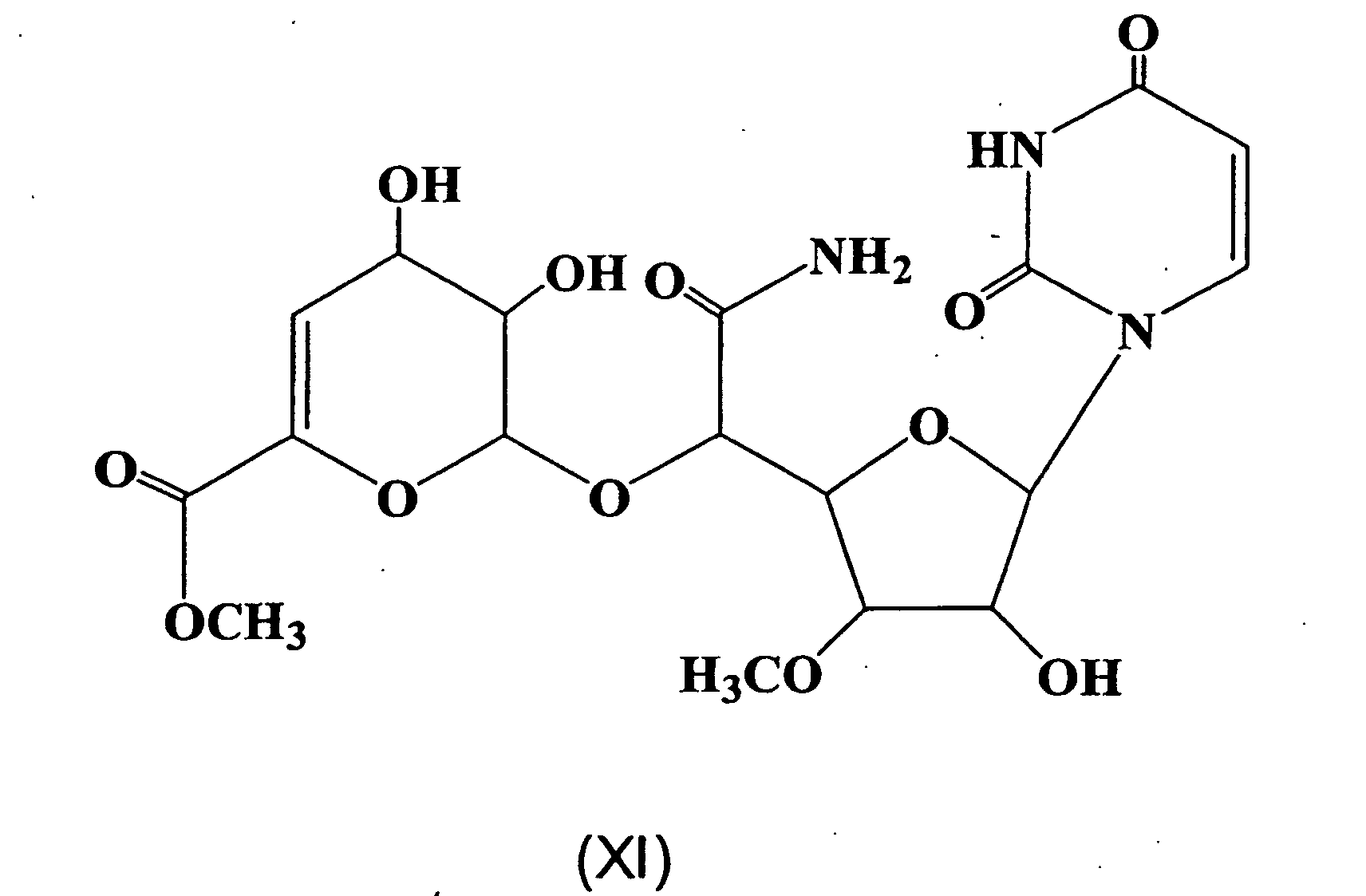 (ii) Compound A-500359F represented by the following formula formula (XII):or a salt or a solvate thereof ;
 (iii) an amide derivative of compound A-500359F represented by the following formula (XIII):or a salt or a solvate thereof;
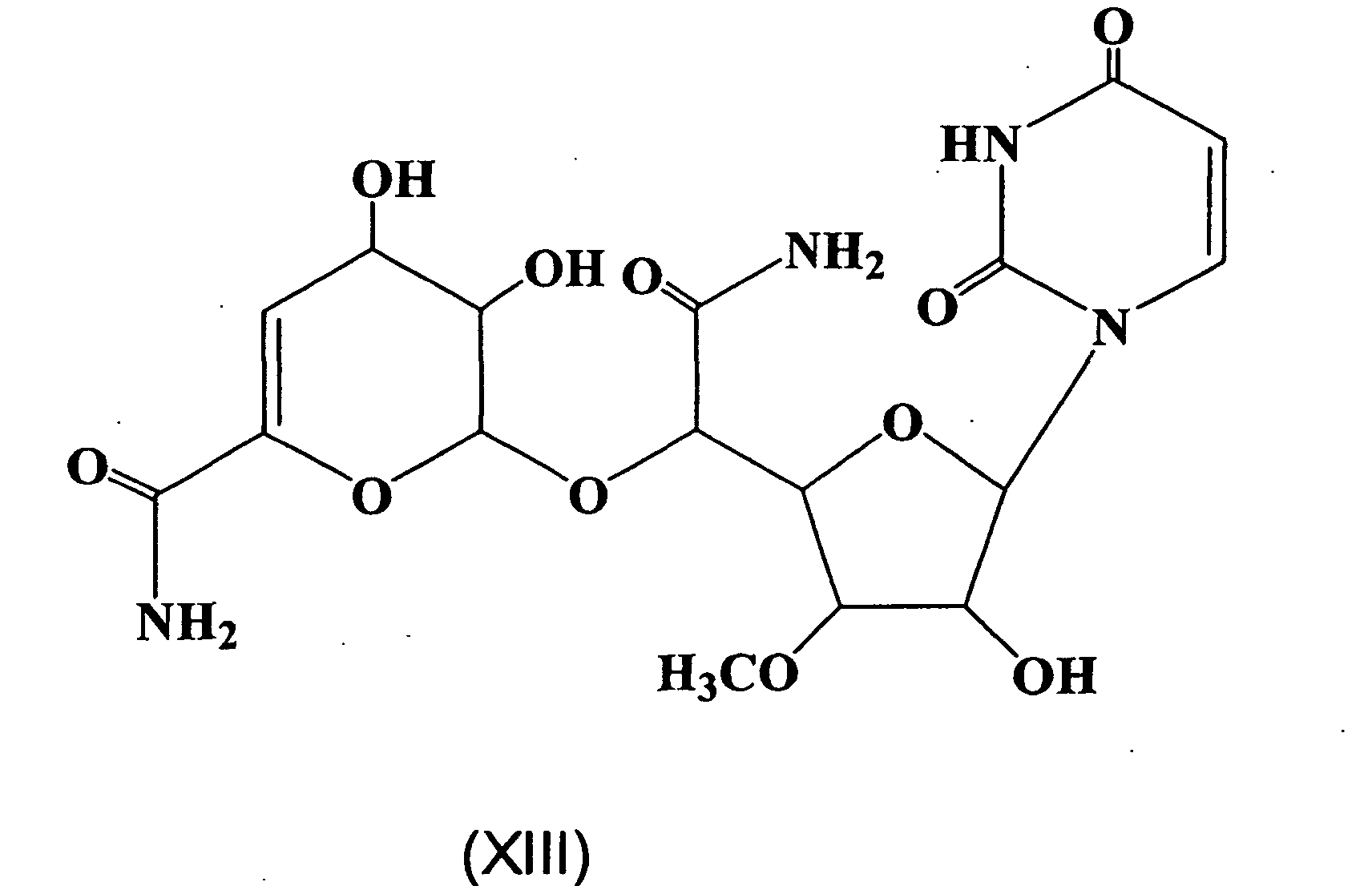 (iv) a compound A-500359H represented by the following formula (XIV):or a salt or a solvate thereof.;
 (v) a compound A-500359J represented by the following formula (XV):or a salt or a solvate thereof; and
 (vi) a compound A-500359M-3 represented by the following formula (XVI):or a salt or a solvate thereof.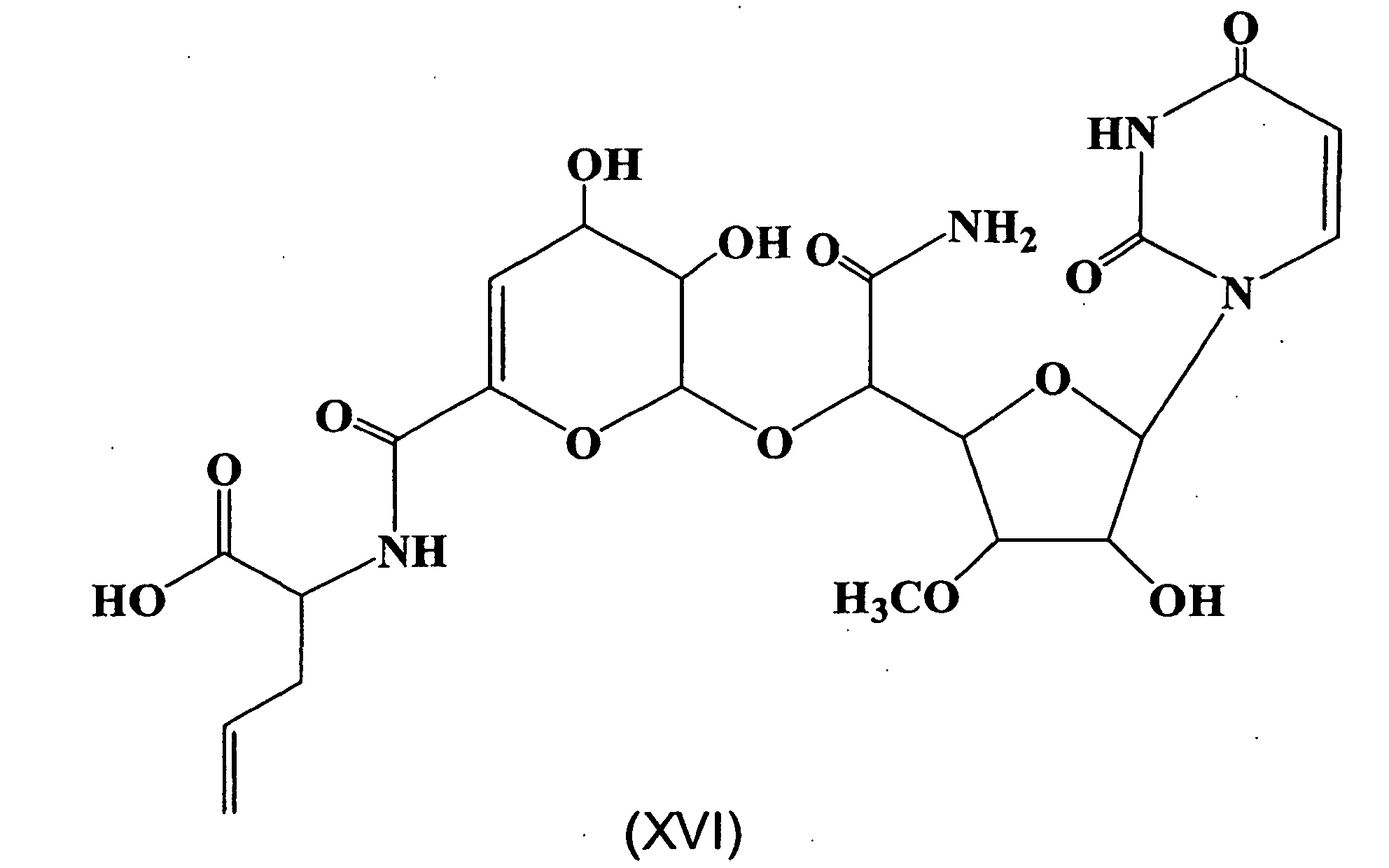
- A process for preparing a compound according to any one of claims 1(i), (ii), (iv) or (v) by a cultivation procedure which comprises
cultivating a strain of micro-organism of the genus Streptomyces, and
isolating the compound from the cultivation products. - A process according to claim 2 wherein the strain of micro-organism is Streptomyces griseus (SANK 60196; FERM BP-5420).
- A pharmaceutical composition comprising an effective amount of a pharmacologically active compound together with a carrier or diluent therefor, wherein said pharmacologically active compound is a compound according to claim 1 or a pharmaceutically acceptable salt thereof.
- The use of a compound according to any claim 1 or a pharmaceutically acceptable salt thereof in the manufacture of a medicament for the treatment or prevention of a bacterial infection.
- A compound according to claim 1 or a pharmaceutically acceptable salt thereof for use as a medicament.
- A compound according to claim 1 or a pharmaceutically acceptable salt thereof for use in the treatment or prevention of a bacterial infection.
Applications Claiming Priority (5)
| Application Number | Priority Date | Filing Date | Title |
|---|---|---|---|
| JP19428598 | 1998-07-09 | ||
| JP19428598 | 1998-07-09 | ||
| JP26944598 | 1998-09-24 | ||
| JP26944598 | 1998-09-24 | ||
| EP99929772A EP1095947B1 (en) | 1998-07-09 | 1999-07-09 | Novel antibacterial compounds |
Related Parent Applications (1)
| Application Number | Title | Priority Date | Filing Date |
|---|---|---|---|
| EP99929772A Division EP1095947B1 (en) | 1998-07-09 | 1999-07-09 | Novel antibacterial compounds |
Publications (2)
| Publication Number | Publication Date |
|---|---|
| EP1319666A1 EP1319666A1 (en) | 2003-06-18 |
| EP1319666B1 true EP1319666B1 (en) | 2005-09-14 |
Family
ID=26508414
Family Applications (3)
| Application Number | Title | Priority Date | Filing Date |
|---|---|---|---|
| EP03004404A Expired - Lifetime EP1319666B1 (en) | 1998-07-09 | 1999-07-09 | Antibacterial compounds |
| EP03004405A Withdrawn EP1319406A1 (en) | 1998-07-09 | 1999-07-09 | Novel antibacterial compounds |
| EP99929772A Expired - Lifetime EP1095947B1 (en) | 1998-07-09 | 1999-07-09 | Novel antibacterial compounds |
Family Applications After (2)
| Application Number | Title | Priority Date | Filing Date |
|---|---|---|---|
| EP03004405A Withdrawn EP1319406A1 (en) | 1998-07-09 | 1999-07-09 | Novel antibacterial compounds |
| EP99929772A Expired - Lifetime EP1095947B1 (en) | 1998-07-09 | 1999-07-09 | Novel antibacterial compounds |
Country Status (23)
| Country | Link |
|---|---|
| US (2) | US6472384B1 (en) |
| EP (3) | EP1319666B1 (en) |
| KR (2) | KR100622889B1 (en) |
| CN (1) | CN1181087C (en) |
| AT (2) | ATE304548T1 (en) |
| AU (1) | AU751470B2 (en) |
| BR (1) | BR9911965A (en) |
| CA (1) | CA2337225C (en) |
| DE (2) | DE69927306T2 (en) |
| DK (2) | DK1095947T3 (en) |
| ES (2) | ES2248654T3 (en) |
| HK (2) | HK1053063A1 (en) |
| HU (1) | HUP0103711A3 (en) |
| ID (1) | ID27955A (en) |
| IL (3) | IL140731A0 (en) |
| NO (1) | NO322083B1 (en) |
| NZ (1) | NZ509233A (en) |
| PL (1) | PL200426B1 (en) |
| PT (1) | PT1095947E (en) |
| RU (1) | RU2209210C2 (en) |
| TR (1) | TR200100059T2 (en) |
| WO (1) | WO2000002892A1 (en) |
| ZA (1) | ZA200100200B (en) |
Families Citing this family (9)
| Publication number | Priority date | Publication date | Assignee | Title |
|---|---|---|---|---|
| TWI245047B (en) * | 1999-08-20 | 2005-12-11 | Sankyo Co | Novel A-500359 derivatives |
| EP1322504A1 (en) | 2000-09-25 | 2003-07-02 | Volkswagen AG | Airbag device and method for operating the same |
| US7652039B2 (en) * | 2002-05-17 | 2010-01-26 | Sequella, Inc. | Methods of use and compositions for the diagnosis and treatment of infectious disease |
| US7456222B2 (en) * | 2002-05-17 | 2008-11-25 | Sequella, Inc. | Anti tubercular drug: compositions and methods |
| US20040033986A1 (en) * | 2002-05-17 | 2004-02-19 | Protopopova Marina Nikolaevna | Anti tubercular drug: compositions and methods |
| EP1670314A4 (en) * | 2003-09-05 | 2009-02-25 | Sequella Inc | Methods and compositions comprising diamines as new anti-tubercular therapeutics |
| CA2579756C (en) * | 2004-06-19 | 2013-04-30 | Human Biomolecular Research Institute | Modulators of central nervous system neurotransmitters |
| US20090068325A1 (en) * | 2007-09-10 | 2009-03-12 | Gil Depicciotto | Method of treatment of fresh produce |
| US20090281054A1 (en) * | 2008-05-06 | 2009-11-12 | Venkata Reddy | Compositions and methods comprising capuramycin analogues |
Family Cites Families (5)
| Publication number | Priority date | Publication date | Assignee | Title |
|---|---|---|---|---|
| JPS60259190A (en) * | 1984-06-06 | 1985-12-21 | Kanto Ishi Pharma Co Ltd | New antibiotic 446-s3-1 and production thereof |
| US5034381A (en) * | 1988-01-07 | 1991-07-23 | Ciba-Geigy Corporation | 2-(substituted amino) adenosines as antihypertensives |
| JPH05148293A (en) * | 1991-11-28 | 1993-06-15 | Mect Corp | Novel capramicin derivative and method for producing the same |
| GB9307043D0 (en) | 1993-04-05 | 1993-05-26 | Norsk Hydro As | Chemical compounds |
| TWI245047B (en) * | 1999-08-20 | 2005-12-11 | Sankyo Co | Novel A-500359 derivatives |
-
1999
- 1999-07-09 WO PCT/JP1999/003718 patent/WO2000002892A1/en not_active Ceased
- 1999-07-09 ID IDW20010052A patent/ID27955A/en unknown
- 1999-07-09 CA CA002337225A patent/CA2337225C/en not_active Expired - Fee Related
- 1999-07-09 NZ NZ509233A patent/NZ509233A/en not_active IP Right Cessation
- 1999-07-09 CN CNB998107417A patent/CN1181087C/en not_active Expired - Fee Related
- 1999-07-09 AT AT03004404T patent/ATE304548T1/en not_active IP Right Cessation
- 1999-07-09 BR BR9911965-0A patent/BR9911965A/en active Search and Examination
- 1999-07-09 HU HU0103711A patent/HUP0103711A3/en unknown
- 1999-07-09 AT AT99929772T patent/ATE356825T1/en not_active IP Right Cessation
- 1999-07-09 PL PL345403A patent/PL200426B1/en not_active IP Right Cessation
- 1999-07-09 TR TR2001/00059T patent/TR200100059T2/en unknown
- 1999-07-09 KR KR1020017000380A patent/KR100622889B1/en not_active Expired - Fee Related
- 1999-07-09 DE DE69927306T patent/DE69927306T2/en not_active Expired - Lifetime
- 1999-07-09 DE DE69935513T patent/DE69935513T2/en not_active Expired - Lifetime
- 1999-07-09 RU RU2001101459/04A patent/RU2209210C2/en not_active IP Right Cessation
- 1999-07-09 AU AU46505/99A patent/AU751470B2/en not_active Ceased
- 1999-07-09 EP EP03004404A patent/EP1319666B1/en not_active Expired - Lifetime
- 1999-07-09 ES ES03004404T patent/ES2248654T3/en not_active Expired - Lifetime
- 1999-07-09 EP EP03004405A patent/EP1319406A1/en not_active Withdrawn
- 1999-07-09 IL IL14073199A patent/IL140731A0/en active IP Right Grant
- 1999-07-09 PT PT99929772T patent/PT1095947E/en unknown
- 1999-07-09 DK DK99929772T patent/DK1095947T3/en active
- 1999-07-09 ES ES99929772T patent/ES2284260T3/en not_active Expired - Lifetime
- 1999-07-09 DK DK03004404T patent/DK1319666T3/en active
- 1999-07-09 EP EP99929772A patent/EP1095947B1/en not_active Expired - Lifetime
- 1999-07-09 KR KR1020067000525A patent/KR100729196B1/en not_active Expired - Fee Related
-
2001
- 2001-01-04 IL IL140731A patent/IL140731A/en not_active IP Right Cessation
- 2001-01-08 ZA ZA2001/00200A patent/ZA200100200B/en unknown
- 2001-01-08 NO NO20010105A patent/NO322083B1/en not_active IP Right Cessation
- 2001-01-09 US US09/757,393 patent/US6472384B1/en not_active Expired - Lifetime
- 2001-07-04 HK HK03105384.0A patent/HK1053063A1/en unknown
- 2001-07-04 HK HK03105386.8A patent/HK1053127B/en not_active IP Right Cessation
-
2002
- 2002-03-12 US US10/096,006 patent/US6844173B2/en not_active Expired - Fee Related
-
2007
- 2007-11-22 IL IL187551A patent/IL187551A/en not_active IP Right Cessation
Also Published As
Similar Documents
| Publication | Publication Date | Title |
|---|---|---|
| EP0388153B1 (en) | Immunosuppressant agent | |
| Muramatsu et al. | Studies on novel bacterial translocase I inhibitors, A-500359s I. Taxonomy, fermentation, isolation, physico-chemical properties and structure elucidation of A-500359 A, C, D and G | |
| US6780616B1 (en) | Antibiotic caprazamycins and process for producing the same | |
| HK1053127A1 (en) | Antibacterial compounds | |
| EP0298640A1 (en) | A new antimicrobial agent, fr 109615 and production thereof | |
| US5260447A (en) | Polyhydroxycyclopentane derivatives, their preparation and their therapeutic use | |
| US4792522A (en) | Rigolettone antitumor complex | |
| CA1236785A (en) | ANTIBIOTIC LL-D42067.beta. | |
| JP4531167B2 (en) | New antibacterial compounds | |
| JP3830964B2 (en) | A novel thiodepsipeptide isolated from marine actinomycetes | |
| CA1339467C (en) | New antibiotics called "mureidomycins a, b, c and d", a process for their preparation and their therapeutic use | |
| EP0175284B1 (en) | Novel antibiotics, process for their preparation and pharmaceutical compositions containing them | |
| EP0855402B1 (en) | Novel terpenoid compound 0406TP-1 | |
| EP0289354A2 (en) | Antibiotic TAN-950A, its production and use | |
| WO2004046368A1 (en) | Novel antibiotic muraminomicin | |
| US8318684B2 (en) | Antibiotics, bispolides A1, A2, and A3 as well as bispolides B1, B2a, B2b and B3 and processes for producing said antibiotics | |
| GB2159150A (en) | Antibiotics do-248-a and b and their preparation | |
| JP2002241394A (en) | New capuramycinanalogue | |
| JP2004196780A (en) | New antibiotic substance muraminomicin | |
| JP2008074710A (en) | New substance a-97065s | |
| JP2006111594A (en) | New antibiotic substance a-94964a | |
| HK1034262A1 (en) | Novel antibacterial compounds | |
| HK1034262B (en) | Novel antibacterial compounds | |
| JPH06279481A (en) | WS64826 substance | |
| GB2297324A (en) | Nitrosostromelin |
Legal Events
| Date | Code | Title | Description |
|---|---|---|---|
| PUAI | Public reference made under article 153(3) epc to a published international application that has entered the european phase |
Free format text: ORIGINAL CODE: 0009012 |
|
| 17P | Request for examination filed |
Effective date: 20030314 |
|
| AC | Divisional application: reference to earlier application |
Ref document number: 1095947 Country of ref document: EP Kind code of ref document: P |
|
| AK | Designated contracting states |
Designated state(s): AT BE CH CY DE DK ES FI FR GB GR IE IT LI LU MC NL PT SE |
|
| AKX | Designation fees paid |
Designated state(s): AT BE CH CY DE DK ES FI FR GB GR IE IT LI LU MC NL PT SE |
|
| 17Q | First examination report despatched |
Effective date: 20040723 |
|
| GRAP | Despatch of communication of intention to grant a patent |
Free format text: ORIGINAL CODE: EPIDOSNIGR1 |
|
| GRAS | Grant fee paid |
Free format text: ORIGINAL CODE: EPIDOSNIGR3 |
|
| GRAA | (expected) grant |
Free format text: ORIGINAL CODE: 0009210 |
|
| AC | Divisional application: reference to earlier application |
Ref document number: 1095947 Country of ref document: EP Kind code of ref document: P |
|
| AK | Designated contracting states |
Kind code of ref document: B1 Designated state(s): AT BE CH CY DE DK ES FI FR GB GR IE IT LI LU MC NL PT SE |
|
| REG | Reference to a national code |
Ref country code: GB Ref legal event code: FG4D |
|
| RTI1 | Title (correction) |
Free format text: ANTIBACTERIAL COMPOUNDS |
|
| REG | Reference to a national code |
Ref country code: CH Ref legal event code: EP |
|
| REG | Reference to a national code |
Ref country code: CH Ref legal event code: NV Representative=s name: A. BRAUN, BRAUN, HERITIER, ESCHMANN AG PATENTANWAE |
|
| REG | Reference to a national code |
Ref country code: IE Ref legal event code: FG4D |
|
| REF | Corresponds to: |
Ref document number: 69927306 Country of ref document: DE Date of ref document: 20051020 Kind code of ref document: P |
|
| REG | Reference to a national code |
Ref country code: GR Ref legal event code: EP Ref document number: 20050402889 Country of ref document: GR |
|
| REG | Reference to a national code |
Ref country code: DK Ref legal event code: T3 |
|
| REG | Reference to a national code |
Ref country code: SE Ref legal event code: TRGR |
|
| REG | Reference to a national code |
Ref country code: HK Ref legal event code: GR Ref document number: 1053127 Country of ref document: HK |
|
| REG | Reference to a national code |
Ref country code: ES Ref legal event code: FG2A Ref document number: 2248654 Country of ref document: ES Kind code of ref document: T3 |
|
| ET | Fr: translation filed | ||
| PLBE | No opposition filed within time limit |
Free format text: ORIGINAL CODE: 0009261 |
|
| STAA | Information on the status of an ep patent application or granted ep patent |
Free format text: STATUS: NO OPPOSITION FILED WITHIN TIME LIMIT |
|
| 26N | No opposition filed |
Effective date: 20060615 |
|
| BECA | Be: change of holder's address |
Owner name: SEQUELLA INC.9610 MEDICAL CENTER DRIVE, SUITE 200, Effective date: 20050914 |
|
| BECH | Be: change of holder |
Owner name: SEQUELLA INC. Effective date: 20050914 |
|
| BECA | Be: change of holder's address |
Owner name: SEQUELLA INC.9610 MEDICAL CENTER DRIVE, SUITE 200, Effective date: 20080215 |
|
| BECH | Be: change of holder |
Owner name: SEQUELLA INC. Effective date: 20080215 |
|
| REG | Reference to a national code |
Ref country code: GB Ref legal event code: 732E |
|
| REG | Reference to a national code |
Ref country code: CH Ref legal event code: PUE Owner name: DAIICHI SANKYO COMPANY LIMITED Free format text: SANKYO COMPANY, LIMITED#5-1, NIHONBASHI HONCHO 3-CHOME, CHUO-KU#TOKYO 103-8426 (JP) -TRANSFER TO- DAIICHI SANKYO COMPANY LIMITED#3-5-1 NIHONBASHI HONCHO#CHUO-KU, TOKYO (JP) Ref country code: CH Ref legal event code: PUE Owner name: SEQUELLA, INC. Free format text: DAIICHI SANKYO COMPANY LIMITED#3-5-1 NIHONBASHI HONCHO#CHUO-KU, TOKYO (JP) -TRANSFER TO- SEQUELLA, INC.#9610 MEDICAL CENTER DRIVE, SUITE 200#ROCKVILLE, MD 20850 (US) Ref country code: CH Ref legal event code: NV Representative=s name: RITSCHER & PARTNER AG |
|
| REG | Reference to a national code |
Ref country code: ES Ref legal event code: PC2A |
|
| REG | Reference to a national code |
Ref country code: FR Ref legal event code: TP |
|
| PGFP | Annual fee paid to national office [announced via postgrant information from national office to epo] |
Ref country code: MC Payment date: 20080627 Year of fee payment: 10 Ref country code: PT Payment date: 20080627 Year of fee payment: 10 |
|
| PGFP | Annual fee paid to national office [announced via postgrant information from national office to epo] |
Ref country code: FI Payment date: 20080714 Year of fee payment: 10 Ref country code: NL Payment date: 20080703 Year of fee payment: 10 |
|
| PGFP | Annual fee paid to national office [announced via postgrant information from national office to epo] |
Ref country code: CY Payment date: 20080630 Year of fee payment: 10 |
|
| PGFP | Annual fee paid to national office [announced via postgrant information from national office to epo] |
Ref country code: GR Payment date: 20080619 Year of fee payment: 10 |
|
| PGFP | Annual fee paid to national office [announced via postgrant information from national office to epo] |
Ref country code: DK Payment date: 20090714 Year of fee payment: 11 |
|
| PGFP | Annual fee paid to national office [announced via postgrant information from national office to epo] |
Ref country code: LU Payment date: 20090804 Year of fee payment: 11 Ref country code: SE Payment date: 20090729 Year of fee payment: 11 |
|
| REG | Reference to a national code |
Ref country code: PT Ref legal event code: MM4A Free format text: LAPSE DUE TO NON-PAYMENT OF FEES Effective date: 20100111 |
|
| PG25 | Lapsed in a contracting state [announced via postgrant information from national office to epo] |
Ref country code: MC Free format text: LAPSE BECAUSE OF NON-PAYMENT OF DUE FEES Effective date: 20090731 |
|
| NLV4 | Nl: lapsed or anulled due to non-payment of the annual fee |
Effective date: 20100201 |
|
| PG25 | Lapsed in a contracting state [announced via postgrant information from national office to epo] |
Ref country code: PT Free format text: LAPSE BECAUSE OF NON-PAYMENT OF DUE FEES Effective date: 20100111 |
|
| PG25 | Lapsed in a contracting state [announced via postgrant information from national office to epo] |
Ref country code: CY Free format text: LAPSE BECAUSE OF NON-PAYMENT OF DUE FEES Effective date: 20090709 |
|
| PG25 | Lapsed in a contracting state [announced via postgrant information from national office to epo] |
Ref country code: GR Free format text: LAPSE BECAUSE OF NON-PAYMENT OF DUE FEES Effective date: 20100204 |
|
| PGFP | Annual fee paid to national office [announced via postgrant information from national office to epo] |
Ref country code: IE Payment date: 20100712 Year of fee payment: 12 Ref country code: CH Payment date: 20100714 Year of fee payment: 12 |
|
| PGFP | Annual fee paid to national office [announced via postgrant information from national office to epo] |
Ref country code: AT Payment date: 20100712 Year of fee payment: 12 |
|
| PG25 | Lapsed in a contracting state [announced via postgrant information from national office to epo] |
Ref country code: FI Free format text: LAPSE BECAUSE OF NON-PAYMENT OF DUE FEES Effective date: 20050914 |
|
| PGFP | Annual fee paid to national office [announced via postgrant information from national office to epo] |
Ref country code: BE Payment date: 20100714 Year of fee payment: 12 |
|
| REG | Reference to a national code |
Ref country code: DK Ref legal event code: EBP |
|
| PGFP | Annual fee paid to national office [announced via postgrant information from national office to epo] |
Ref country code: FR Payment date: 20110729 Year of fee payment: 13 |
|
| PGFP | Annual fee paid to national office [announced via postgrant information from national office to epo] |
Ref country code: DE Payment date: 20110722 Year of fee payment: 13 Ref country code: GB Payment date: 20110704 Year of fee payment: 13 Ref country code: ES Payment date: 20110726 Year of fee payment: 13 |
|
| PGFP | Annual fee paid to national office [announced via postgrant information from national office to epo] |
Ref country code: IT Payment date: 20110726 Year of fee payment: 13 |
|
| BERE | Be: lapsed |
Owner name: SEQUELLA INC. Effective date: 20110731 |
|
| REG | Reference to a national code |
Ref country code: CH Ref legal event code: PL |
|
| REG | Reference to a national code |
Ref country code: AT Ref legal event code: MM01 Ref document number: 304548 Country of ref document: AT Kind code of ref document: T Effective date: 20110709 |
|
| REG | Reference to a national code |
Ref country code: IE Ref legal event code: MM4A |
|
| PG25 | Lapsed in a contracting state [announced via postgrant information from national office to epo] |
Ref country code: BE Free format text: LAPSE BECAUSE OF NON-PAYMENT OF DUE FEES Effective date: 20110731 Ref country code: CH Free format text: LAPSE BECAUSE OF NON-PAYMENT OF DUE FEES Effective date: 20110731 Ref country code: LI Free format text: LAPSE BECAUSE OF NON-PAYMENT OF DUE FEES Effective date: 20110731 |
|
| PG25 | Lapsed in a contracting state [announced via postgrant information from national office to epo] |
Ref country code: DK Free format text: LAPSE BECAUSE OF NON-PAYMENT OF DUE FEES Effective date: 20100802 Ref country code: IE Free format text: LAPSE BECAUSE OF NON-PAYMENT OF DUE FEES Effective date: 20110709 |
|
| PG25 | Lapsed in a contracting state [announced via postgrant information from national office to epo] |
Ref country code: SE Free format text: LAPSE BECAUSE OF NON-PAYMENT OF DUE FEES Effective date: 20100710 Ref country code: LU Free format text: LAPSE BECAUSE OF NON-PAYMENT OF DUE FEES Effective date: 20100709 Ref country code: FI Free format text: LAPSE BECAUSE OF NON-PAYMENT OF DUE FEES Effective date: 20090709 Ref country code: NL Free format text: LAPSE BECAUSE OF NON-PAYMENT OF DUE FEES Effective date: 20100201 |
|
| PG25 | Lapsed in a contracting state [announced via postgrant information from national office to epo] |
Ref country code: AT Free format text: LAPSE BECAUSE OF NON-PAYMENT OF DUE FEES Effective date: 20110709 |
|
| GBPC | Gb: european patent ceased through non-payment of renewal fee |
Effective date: 20120709 |
|
| REG | Reference to a national code |
Ref country code: FR Ref legal event code: ST Effective date: 20130329 |
|
| PG25 | Lapsed in a contracting state [announced via postgrant information from national office to epo] |
Ref country code: DE Free format text: LAPSE BECAUSE OF NON-PAYMENT OF DUE FEES Effective date: 20130201 Ref country code: GB Free format text: LAPSE BECAUSE OF NON-PAYMENT OF DUE FEES Effective date: 20120709 Ref country code: FR Free format text: LAPSE BECAUSE OF NON-PAYMENT OF DUE FEES Effective date: 20120731 |
|
| PG25 | Lapsed in a contracting state [announced via postgrant information from national office to epo] |
Ref country code: IT Free format text: LAPSE BECAUSE OF NON-PAYMENT OF DUE FEES Effective date: 20120709 |
|
| REG | Reference to a national code |
Ref country code: DE Ref legal event code: R119 Ref document number: 69927306 Country of ref document: DE Effective date: 20130201 |
|
| REG | Reference to a national code |
Ref country code: ES Ref legal event code: FD2A Effective date: 20131018 |
|
| PG25 | Lapsed in a contracting state [announced via postgrant information from national office to epo] |
Ref country code: ES Free format text: LAPSE BECAUSE OF NON-PAYMENT OF DUE FEES Effective date: 20120710 |