Die vorliegende Erfindung betrifft Haarfärbemittel enthaltend mindestens eine Verbindung
aus der Gruppe der AGEs (Advanced Glycosylation Endproducts), deren synthetischen
Vorstufen und/oder der Lipofuscine.
Der ganze menschliche Körper ist, mit Ausnahme der Lippen, der Handinnenflächen und
der Fußsohlen, behaart, zum Großteil allerdings mit kaum sichtbaren Wollhärchen.
Wegen der vielen Nervenenden an der Haarwurzel reagieren Haare empfindlich auf
äußere Einflüsse wie Wind oder Berührung und sind daher ein nicht zu unterschätzender
Bestandteil des Tastsinns. Die wichtigste Funktion des menschlichen Kopfhaares dürfte
allerdings heute darin bestehen, das Aussehen des Menschen in charakteristischer
Weise mitzugestalten. Ähnlich wie die Haut erfüllt es eine soziale Funktion, da es das
Erscheinungsbild des Menschen wesentlich prägt.
Das Haar besteht aus dem frei aus der Haut herausragenden Haarschaft - dem keratinisierten
(toten) Teil, der das eigentlich sichtbare Haar darstellt - und der in der Haut
steckenden Haarwurzel - dem lebenden Teil, in dem das sichtbare Haar in den
Wachstumsphasen (Anagen) neu gebildet wird. Der Haarschaft seinerseits ist aus drei
Schichten aufgebaut: einem zentralen Teil - dem sogenannten Haarmark (Medulla),
welches allerdings beim Menschen zurückgebildet ist und oft gänzlich fehlt - ferner dem
Mark (Cortex) und der äußeren, bis zu zehn Lagen starken Schuppenschicht (Cuticula),
die das ganze Haar umhüllt.
Das menschliche Haar kann unterschiedliche Farben aufweisen. Verantwortlich für die
persönliche Haarfarbe ist Melanin das als Farbstoff in den Haaren eingelagert ist. Gebildet
wird Melanin in den Melanozyten. Dies sind Zellen, die in der Haarzwiebel assoziiert mit
den Keratinozyten des Haarmarks vorkommen. Melanozyten enthalten als
charakteristische Zellorganellen Melanosomen, in denen das Melanin gebildet wird.
Dieses wird über die langen Dendriten der Melanozyten in die Keratinozyten der
präkortikalen Matrix transferiert und ruft die mehr oder weniger ausgeprägte blonde bis
braun-schwarze Haarfarbe hervor.
Melanin wird als Endstufe eines oxidativen Prozesses gebildet, in welchem Tyrosin unter
Mitwirkung der Enzyms Tyrosinase über mehrere Zwischenstufen zu den braun bis braunschwarzen
Eumelaninen (DHICA- und DHI-Melanin) bzw. unter Beteiligung von
schwefelhaltigen Verbindungen zum rötlichen Phäomelanin umgewandelt wird. DHICAund
DHI-Melanin entstehen über die gemeinsamen Zwischenstufen Dopachinon und
Dopachrom. Letzteres wird entweder zu Indol-5,6-Chinon-Carbonsäure oder zu lndol-5,6-Chinon
umgesetzt, aus denen die beiden genannten Eumelanine entstehen.
Die Entstehung von Phäomelanin läuft über die Zwischenprodukte Dopachinon und
Cysteinyldopa.
Das Eumelanin ist ein Schwarz-Braun-Pigment. Es entscheidend hauptsächlich über die
Farbtiefe des Haares. In braunem und schwarzem Haar kommt es in deutlich
erkennbaren Körnchen vor.
Das Phaeomelanin ist ein Rot-Pigment. Es ist verantwortlich für hellblonde, blonde und
rote Haare. Phaeomelanin ist von seiner Struktur her sehr viel feiner und kleiner als
Eumelanin.
Aus den verschiedenen Anteilen der Melanintypen entstehen die verschiedenen
Haarfarben:
- Blondes Haar enthält wenig Eumelanin und viel Phaeomelanin.
- Dunkles Haar enthält viel Eumelanin und wenig Phaeomelanin.
- Rotes Haar hat ebenfalls wenig Eumelanin und sehr viel Phaeomelanin.
Alle dazwischenliegenden Haarschattierungen entstehen aus unterschiedlichen
Mischungsverhältnissen der beiden Melanintypen.
Die Produktion der für die Haarpigmentbildung benötigten Tyrosine nimmt mit
zunehmenden Lebensalter ab. Das fehlende Melanin wird durch die Einlagerung von
Luftbläschen ersetzt. Die Haare erscheinen grau.
Dieser Prozeß ist in der Regel schleichend. Er beginnt an den Schläfen und weitet sich
dann auf die gesamte Kopfbehaarung aus. Danach erwischt es den Bart und die
Augenbrauen. Zuletzt sind schließlich alle Haare des Körpers grau.
Medizinisch werden graue Haare als Canities bezeichnet. Es gibt verschiedene
Möglichkeiten des Ergrauens. Vorzeitiges Ergrauen, ab dem 20 Lebensjahr, nennt sich
auch Canities praecox.
Die Canities symptomatica, oder symptomatisches Ergrauen der Haare, kann
verschiedene Ursachen haben. Dazu gehören:
- Perniziöse Anämie (Vitamin-B-Mangelanämie),
- schwere endokrinologische Störungen, z. B. bei Schilddrüsenerkrankungen.
- akute, fieberhafte Erkrankungen,
- Arzneimittelnebenwirkungen,
- Kosmetika,
- Metalle.
Graue Haare werden von vielen Menschen als unattraktiv empfunden und mit Alter und
körperlichen Verfall gleichgesetzt. Um das als Makel empfundene Ergrauen der Haare zu
kaschieren, pflegen sich viele Menschen ihre Haare zu färben.
Schon in der Antike griffen die Menschen zu Haarfärbemitteln. Doch erst mit der
Entwicklung synthetischer Farbstoffe gegen Ende des 19. Jahrhunderts erlebte die
Anwendung von Haarfärbemitteln ihren Durchbruch. Man schätzt, dass heutzutage in den
Industrieländern etwa 40 % aller Frauen sich die Haare färbt und auch bei Männern
erfreuen sich Haarfärbemittel wachsender Beliebtheit.
Den Verbrauchern stehen eine Vielzahl von Anwendungsformen für die dauerhafte oder
vorübergehende Verfärbung des Haares zur Verfügung. Neben Blondierungsmitteln, die
das Haar entfärben gibt es auch eine Vielzahl von farbgebenden Mitteln.
Haarfärbemittel können in der Regel in drei Klassen eingeteilt werden:
- direktziehende temporäre
- semipermanente
- permanente Färbemittel
Mit einem Marktanteil von etwa 80 % sind die permanenten Haarfärbemittel am weitesten
verbreitet. Bei diesem Färbesystem werden die Farbstoffe durch chemische Reaktionen
direkt auf und im Haar gebildet. Es laufen dabei Oxidationsreaktionen,
Kupplungsvorgänge bzw. Kondensationsreaktionen ab, die durch Wasserstoffperoxid, in
Gegenwart von Ammoniak oder Monoethanolamin hervorgerufen werden. Die
Verwendung von Wasserstoffperoxid als Oxidationsmittel ist deshalb erforderlich, weil es
nicht nur die Farbstoffbildung initiiert, sondern gleichzeitig auch die Melanin-Pigmente,
die dem Haar seine Färbung geben, zerstört und auf diese Weise eine Blondierung
hervorruft, weshalb man bei diesem Färbevorgang auch von einer aufhellenden Färbung
spricht (W. Umbach (Hrsg.): Kosmetik; Entwicklung, Herstellung und Anwendung
kosmetischer Mittel, 2. Aufl. Georg Thieme-Verlag, Stuttgart, 1995).
Der Einsatz von Wasserstoffperoxid, Ammoniak und anderen Chemikalien, belastet das
Haar und zerstört seine Oberfläche. Das natürlich gesunde Aussehen und der seidige
Glanz des Haares gehen beim Färben regelmäßig verloren. Durch die Zerstörung des
Melanins im Haar durch Wasserstoffperoxid wird darüber hinaus der natürliche Schutz
von Haar und Kopfhaut vor der schädlichen UV-Strahlung des Sonnenlichtes geschädigt.
Es war daher die Aufgabe der vorliegenden Erfindung die Mängel des Standes der
Technik zu beseitigen Haarfärbemittel zu entwickeln mit denen sich das Haar auf
schonende Weise färben läßt.
Überraschend gelöst wird die Aufgabe durch Haarfärbemittel enthaltend mindestens eine
Verbindung aus der Gruppe der AGEs (Advanced Glycosylation Endproducts), deren
synthetischen Vorstufen und/oder der Lipofuscine. Mit Hilfe dieser Zubereitungen kann
die Melaninproduktion angeregt, und vermehrt der natürliche Farbstoff Melanin in das
Haar eingelagert werden. Mit dieser überaus schonenden Art der Färbung wird die
Haarfarbe intensiviert und das Haar dunkel eingefärbt. Da die Haaroberfläche nicht von
aggressiven Chemikalien angegriffen wird, behält das Haar seine natürliche Schönheit
und seinen seidigen Glanz.
Es ist dabei erfindungsgemäß von Vorteil, wenn die Verbindungen aus der Gruppe der
AGEs, deren synthetischen Vorstufen und/oder der Lipofuscine in den
erfindungsgemäßen Zubereitungen in einer Konzentration von 0,001 bis 15 Gewichts-%,
insbesondere in einer Konzentration von 0,01 bis 5 Gewichts-% und ganz besonders
bevorzugt in einer Konzentration von 0,1 bis 2 Gewichts-% bezogen auf das
Gesamtgewicht der Zubereitung enthalten sind.
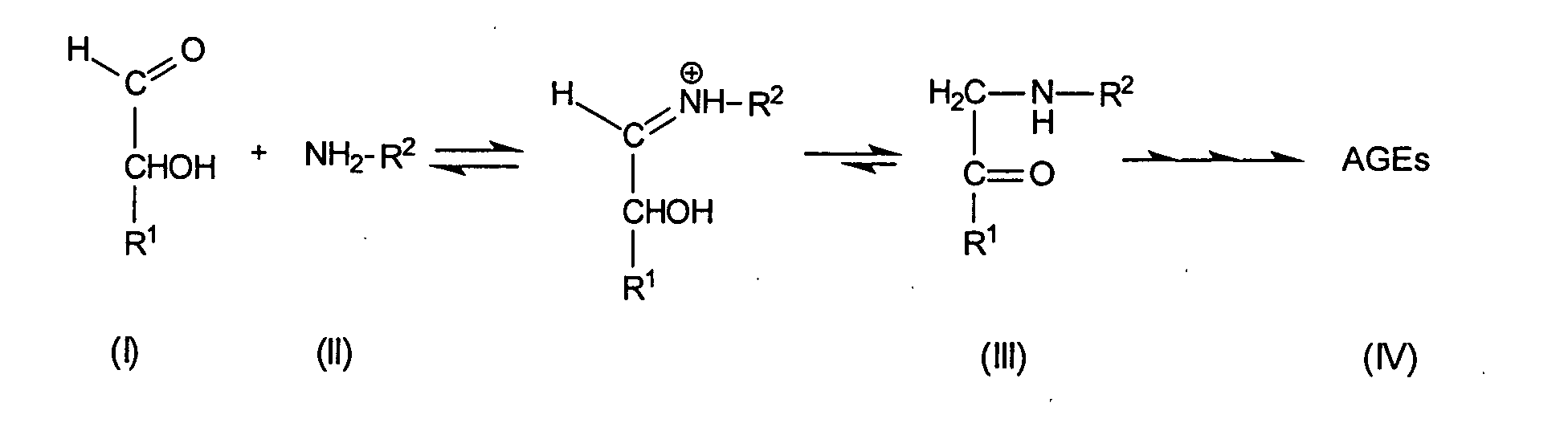
Die Bezeichnung AGE kommt vom englischen Begriff "Advanced Glycosylation Endproducts".
AGEs im Sinne der vorliegenden Erfindung sind beispielsweise erhältlich gemäß
der folgenden (beispielhaften) Reaktionsgleichung:
Vorteilhaft im Sinne der vorliegenden Erfindung sind neben den eigentlichen AGEs auch
deren Vorläufer, wie z. B. Amadori- oder Maillard-Produkte (entsprechend (III) in obiger
Reaktionsgleichung) bzw. sogenannte EGEs (Early Glycosylation Endproducts), welche
beispielsweise als Zwischenprodukte bei der Umlagerung von den Amadoriprodukten (III)
zu den AGEs (IV) erhältlich sind.
Vorteilhafte Ausgangsstoffe (I) tragen eine Aldehydgruppe (CHO) und werden beispielsweise
aus der Gruppe der Zucker (Aldosen, z. B. Triosen, Tetrosen, Pentosen, Hexosen
und dergleichen wie Glucose, Galactose, Mannose usw.) gewählt.
Vorteilhafte Ausgangsstoffe (II) weisen eine freie Aminogruppe auf und werden beispielsweise
aus der Gruppe der Aminosäuren und der Gruppe der Peptide mit endständigen
Aminogruppen gewählt, insbesondere Lysin, Hydroxylysin, Arginin, Tryptophan und
Histidin sind vorteilhaft. Ferner vorteilhaft kann die freie Aminogruppe auch aus N-terminalen
Enden von Proteinen und Peptiden stammen, ferner auch vorteilhaft
Sphingosin sowie Dihydrosphingosin und deren Homologen mit verschieden langen
(ungesättigten) Acylresten.
Bevorzugt enthalten erfindungsgemäße AGEs mindestens einen stickstoffhaltigen Fünfund/oder
Sechsring.
Vorteilhaft im Sinne der vorliegenden Erfindung ist beispielsweise das sogenannte FFI,
welches sich durch die folgende Strukturformel auszeichnet:
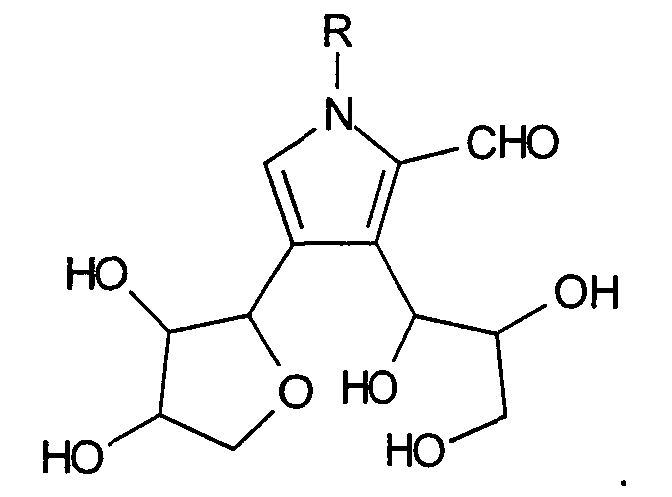
Ferner vorteilhaft im Sinne der vorliegenden Erfindung ist das sogenannte AFGP, welches
sich durch die folgende Strukturformel auszeichnet:
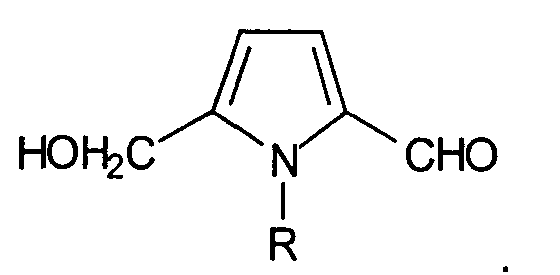
Ferner vorteilhaft im Sinne der vorliegenden Erfindung sind Pyrraline, welche sich durch
die folgende Strukturformel auszeichnen:
Erfindungsgemäß vorteilhaft stammt der Rest R beispielsweise aus Proteinen und Peptiden;
dementsprechend handelt es sich hierbei vorzugsweise um Peptid-, Aminosäureoder
Proteinreste, welche terminal oder seitlich an das Stickstoffatom angebunden sein
können.
R wird ferner vorteilhaft beispielsweise aus der Gruppe der gesättigten oder ungesättigten,
verzweigten oder unverzweigten Alkylgruppen mit 1 bis 35 Kohlenstoffatomen
gewählt.
Ferner vorteilhaft im Sinne der vorliegenden Erfindung ist Pentosidin, welches sich durch
die folgende Strukturformel auszeichnet:
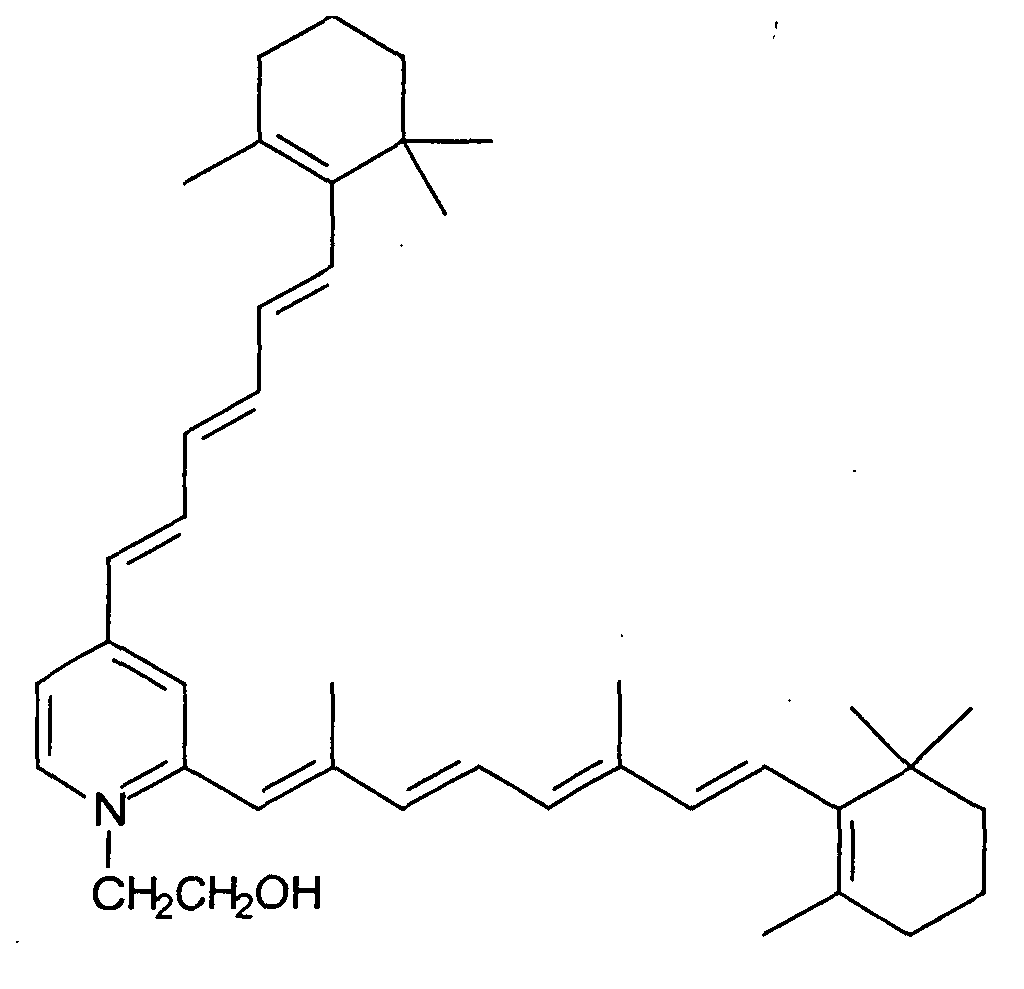
Besonders vorteilhaft im Sinne der vorliegenden Erfindung ist ferner das sogenannte
A2E, welches sich durch die folgende Strukturformel auszeichnet:
Die dargestellten Strukturformeln sollen die Erfindung selbstverständlich nicht auf
bestimmte Isomeren der erfindungsgemäßen Substanzen beschränken. Vielmehr sind
auch nicht dargestellte Isomere bzw. Isomerengemische vorteilhaft im Sinne der vorliegenden
Erfindung.
Lipofuscine im Sinne der vorliegenden Erfindung entstehen im Rahmen natürlicher Prozesse
innerhalb der menschlichen Zellen. Lipofuscin ist ein heterogenes, kohlenhydrat-,
protein- und cholesterin- bzw. lipidhaltiges, gelbliches bis braunes Pigment, das in Form
von Granula im Plasma verschiedener Körperzellen vorkommt. Lipofuscine treten v. a. im
Alter als sogenanntes Abnutzungspigment z. B. in Nerven- und Herzmuskelzellen auf.
Lipofuscin-Granula werden wahrscheinlich aus Lysosomen gebildet, in denen sich nicht
weiter verwertbare Zellbestandteile angesammelt haben. Im Alter reichern sie sich im
Cytoplasma somit auch in der Haut an.
Erfindungsgemäße Lipofuscine sind im Rahmen von lipidperoxidativen Prozessen
erhältlich; die mehrstufigen Reaktionen laufen unter anderem über Malonaldehyde, die
mit primären Aminen über Schiff sche Base-Reaktionen zur Bildung von Lipofuscinen
führen.
Vorteilhafte Ausgangsstoffe für derartige Reaktionen sind Aldehyde, welche aus lipidperoxidativen
Prozessen stammen, wie beispielsweise Malonaldehyde und Malodialdehyde.
Diese reagieren bevorzugt mit Substanzen, welche Aminogruppen enthalten, wobei
letztere vorteilhaft ebenfalls aus Lipidkomponenten stammen. Ferner vorteilhaft kann die
freie Aminogruppe auch aus N-terminalen Enden von (Lipo-) Proteinen und Peptiden
stammen. Besonders vorteilhafter Ausgangsstoff sind Phosphatidylethanolamin,
Sphingosin sowie Dihydrosphingosin und deren Homologen mit verschieden langen
(ungesättigten) Acylresten.
Bevorzugt enthalten erfindungsgemäße Lipofuscine mindestens eine stickstoffhaltige
Ringstruktur.
Erfindungsgemäße Lipofuscine sind ferner z. B. erhältlich durch artifizielle chemische
(z. B. mit Wasserstoffperoxid) oder physikalische (durch Einwirkung von UV-A-Strahlung)
Oxidation von Liposomen - insbesondere von Liposomen, welche Phosphatidylethanolamin
enthalten - und/oder durch Oxidation von isolierten, zellulären Organellen
(Mitochondrien) und/oder Membranen.
Ferner vorteilhaft im Sinne der vorliegenden Erfindung sind Lipofuscine, welche sich
durch die folgende Strukturformel auszeichnen:
worin R
1 und R
2 - je nach Wahl der Ausgangsstoffe - unabhängig voneinander unterschiedlichste
Reste darstellen können, vorteilhaft aber Peptid-, Aminosäure- oder Proteinreste.
Es kann sich gleichermaßen um Phospholipide (Phosphatidylethanolamin) oder
Sphingosine oder Dihydrosphingosine bzw. Bestandteile daraus handeln.
Weiterhin vorteilhaft im Sinne der vorliegenden Erfindung sind Lipofuscine, welche sich
als lineare Kondensationsprodukte durch Schiff'sche Base-Reaktionen aus primären
Aminen und Malondialdehyd (R1-N=CH-CH=CH-N-R2) oder Hydroxyketosen ableiten,
worin R1 und R2 - je nach Wahl der Ausgangsstoffe - unabhängig voneinander unter-schiedlichste
Reste darstellen können, vorteilhaft aber Peptid-, Aminosäure- oder Proteinreste.
Es kann sich gleichermaßen um Phospholipide (Phosphatidylethanolamin)
oder Sphingosine oder Dihydrosphingosine bzw. Bestandteile daraus handeln.
Erfindungsgemäß besonders bevorzugte Lipofuscine werden aus der Gruppe 1-Amino-3-Iminopropen
und dessen N,N'-substituierten Derivaten sowie 1,4-Dihydropyridin-3,5-Dicarbaldehyd
und dessen N,N'-substituierten Derivaten gewählt.
Die erfindungsgemäßen Zubereitungen können kosmetische Hilfsstoffe enthalten, wie sie
üblicherweise in solchen Zubereitungen verwendet werden, z. B. Konservierungsmittel,
Bakterizide, Parfüme, Substanzen zum Verhindern des Schäumens, Verdicker,
Antischuppenwirkstoffe, Komplexbildner, Vitamine, Pflanzenextrakte,, Haarglättungsmittel
(Entkräuselungsmittel), Farbstoffe, Pigmente, die eine färbende Wirkung haben, Verdickungsmittel,
anfeuchtende und/oder feuchthaltende Substanzen, Emulgatoren, Fette,
Öle, Wachse oder andere übliche Bestandteile einer kosmetischen oder
dermatologischen Formulierung wie Alkohole, Polyole, Polymere, Schaumstabilisatoren,
Elektrolyte, quartäre Ammoniumverbindungen, organische Lösungsmittel und/oder Silikonderivate
sowie Moisturizer. Auch können die erfindungsgemäßen Zubereitungen mit
den aus der Haarpflege bekannten Filmbildnern, Seifen und Tensiden in
erfindungsgemäß vorteilhafter Weise kombiniert werden.
Als Filmbildner können in erfindungsgemäß vorteilhafter Weise Mischpolymerisate aus
Vinylpyrrolidon und Vinylacetat oder neutralisierter Crotonsäure eingesetzt werden. Auch
Terpolymere, anionische, kationische, amphotere und nichtionische Polymere können
erfindungsgemäß vorteilhaft eingesetzt werden. Erfindungsgemäß vorteilhafte Filmbildner
sind beispielsweise Terpolymere aus Vinylpyrrolidon, Dimethylaminopropylmethacrylamid
und quarternisiertem Dimethylaminopropylmethacrylamid.
Erfindungsgemäß vorteilhafte anionische Polymere können aus der Gruppe
Vinylacetat/Crotonsäure-Copolymer, Vinylacetat/Acrylat-Copolymer, Vinylacetat/Vinylneodecanoat/Crotonsäure-Copolymer,
Natriumacrylat/Vinylalkohol-Copolymer, Natriumpolystyrolsulfat,
Ethylacrylat/N-tert.-Butylacrylamid/Acrylsäure-Copolymer, VinylpyrrolidonNinylacetat/ltaconsäure-Copolymer,
Acrylsäure/Acrylamid-Copolymer und deren
Natriumsalze, sowie Homo-und/oder Copolymere von Acrylsäure und/oder
Methacrylsäure und/oder deren Salze, Acrylat/Hydroxyacrylat-Copolymer,
Octylacrylamid/Acrylat-Copolymer, Octylacrylamid/Methacrylsäureester-Copolymer,
Butylacrylat/N-Vinylpyrrolidon-Copolymer, Methylvinylether/Maleinsäure-Copolymer und
deren Ethyl-, Isopropyl- und Butylester, Silikon/Acrylsäure oder Methacrylsäure
Copolymer, Diglcol/Cyclohexandimethanol/lsophthalat/Sulfoisophthalat Copolymer,
Polyurethane auf Basis von Diisocyanaten mit endständigen Säuregruppen gewählt
werden.
Es ist ferner erfindungsgemäß vorteilhaft, das amphotere Polymer aus der Gruppe N-Octylacrylamid/Acrylsäure/tert.-Butylaminoethylmethacrylat-Copolymer,
Gruppe N-Octylacrylamid/Methacrylsäure/tert.-Butylaminoethylmethacrylat-Copolymer
sowie
Copolymere aus Methacryloylbetain / Alkylmethacrylaten, Copolymere aus Monomeren
mit Carboxy- und/oder Sulfongruppen, insbesondere Acrylsäure, Methacrylsäure,
Itaconsäure und Monomeren mit Aminogruppen, insbesondere
Monoalkylaminoalkylacrylate, Dialkylaminoalkylacrylate, Monoalkylaminoalkylmethacrylate,
Dialkylaminoalkylmethacrylate, Monoalkylaminoalkylacrylamide,
Dialkylaminoalkylacrylamide, Monoalkylaminoalkylmethacrylamide, Dialkylaminoalkylmethacrylamide,
und Copolymeren aus N-Octylacrylamid, Methylmethacrylat,
Hydroxypropylmethacrylat, N-tert.-Butylaminoethylmethacrylat und Acrylsäure zu wählen.
Erfindungsgemäß vorteilhafte kationische Polymere sind beispielsweise
Polyquarterrnium-4 (Hydroxyethylcellulosedimethyldiallylammoniumchlorid-Copolymer),
Polyquarternium-11 (quarternisiertes Vinylpyrrolidonalkylaminomethacrylat) oder
Polyquarternium-16, (Methylvinylimidazoliumvinylpyrolidon),
Cetyltrimethylammoniumchlorid und Cetyldimethylammoniumphosphat.
Erfindungsgemäß vorteilhafte, nichtionische Polymere können beispielsweise aus der
Gruppe der folgenden Verbindungen gewählt werden:
- Homopolymere des N-Vinylpyrrolidons
- Homopolymere des N-Vinylcaprolactams
- Homopolymere des N-Vinylformamids
- Copolymere aus N-Vinylpyrrolidon und Vinylacetat und/oder Vinylpropionat
- Terpolymere aus N-Vinylpyrrolidon, Vinylacetat und Vinylpropionat
- Terpolymere aus N-Vinylpyrrolidon, Acrylamid und Vinylalkohol.
Als Tenside können anionische, kationische, amphotere und nichtionische Tenside, wie
sie beispielsweise in Haarshampoos Verwendung finden, erfindungsgemäß vorteilhaft
eingesetzt werden.
Anionische Tenside weisen als funktionelle Gruppen in der Regel Carboxylat-, Sulfatoder
Sulfonatgruppen auf. In wässriger Lösung bilden sie im sauren oder neutralen Milieu
negativ geladene organische lonen. Kationische Tenside sind beinahe ausschließlich
durch das Vorhandensein einer quarternären Ammoniumgruppe gekennzeichnet. In
wässriger Lösung bilden sie im sauren oder neutralen Milieu positiv geladene organische
lonen. Amphotere Tenside enthalten sowohl anionische als auch kationische Gruppen
und verhalten sich demnach in wässriger Lösung je nach pH-Wert wie anionische oder
kationische Tenside. Im stark sauren Milieu besitzen sie eine positive und im alkalischen
Milieu eine negative Ladung. Im neutralen pH-Bereich hingegen sind sie zwitterionisch,
wie das folgende Beispiel verdeutlichen soll:
| RNH2 +CH2CH2COOH X- | (bei pH=2) | X- = beliebiges Anion, z.B. Cl- |
| RNH2 +CH2CH2COO- | (bei pH=7) |
| RNHCH2CH2COO- B+ | (bei pH=12) | B+ = beliebiges Kation, z.B. Na+ |
Typisch für nicht-ionische Tenside sind Polyether-Ketten. Nicht-ionische Tenside bilden in
wässrigem Medium keine lonen.
Besonders vorteilhafte waschaktive anionische Tenside im Sinne der vorliegenden
Erfindung sind
Acylaminosäuren und deren Salze, wie
- Acylglutamate, insbesondere Natriumacylglutamat
- Sarcosinate, beispielsweise Myristoyl Sarcosin, TEA-lauroyl Sarcosinat, Natriumlauroylsarcosinat
und Natriumcocoylsarkosinat,
Sulfonsäuren und deren Salze, wie
- Acyl-isethionate, z.B. Natrium-/ Ammoniumcocoyl-isethionat,
- Sulfosuccinate, beispielsweise Dioctylnatriumsulfosuccinat, Dinatriumlaurethsulfosuccinat,
Dinatriumlaurylsulfosuccinat und Dinatriumundecylenamido MEA-Sulfosuccinat
sowie Schwefelsäureester, wie - Alkylethersulfat, beispielsweise Natrium-, Ammonium-, Magnesium-, MIPA-, TIPA-Laurethsulfat,
Natriummyrethsulfat und Natrium C12-13 Parethsulfat,
- Alkylsulfate, beispielsweise Natrium-, Ammonium- und TEA- Laurylsulfat.
Besonders vorteilhafte waschaktive kationische Tenside im Sinne der vorliegenden
Erfindung sind quarternäre Tenside. Quaternäre Tenside enthalten mindestens ein N-Atom,
das mit 4 Alkyl- oder Arylgruppen kovalent verbunden ist. Vorteilhaft sind Benzalkoniumchlorid,
Alkylbetain, Alkylamidopropylbetain und Alkyl-amidopropylhydroxysultain.
Besonders vorteilhafte waschaktive amphotere Tenside im Sinne der vorliegenden
Erfindung sind
- Acyl-/dialkylethylendiamine, beispielsweise Natriumacylamphoacetat, Dinatriumacylamphodipropionat,
Dinatriumalkylamphodiacetat, Natriumacylamphohydroxypropylsulfonat,
Dinatriumacylamphodiacetat und Natriumacylamphopropionat,
Besonders vorteilhafte waschaktive nicht-ionische Tenside im Sinne der vorliegenden
Erfindung sind
- Alkanolamide, wie Cocamide MEA/ DEA/ MIPA,
- Ester, die durch Veresterung von Carbonsäuren mit Ethylenoxid, Glycerin, Sorbitan
oder anderen Alkoholen entstehen,
- Ether, beispielsweise ethoxylierte Alkohole, ethoxyliertes Lanolin, ethoxylierte Polysiloxane,
propoxylierte POE Ether und Alkylpolyglycoside wie Laurylglucosid,
Decylglycosid und Cocoglycosid.
Weitere vorteilhafte anionische Tenside sind
- Taurate, beispielsweise Natriumlauroyltaurat und Natriummethylcocoyltaurat,
- Ether-Carbonsäuren, beispielsweise Natriumlaureth-13 Carboxylat und Natrium
PEG-6 Cocamide Carboxylat,
- Phosphorsäureester und Salze, wie beispielsweise DEA-Oleth-10 Phosphat und
Dilaureth-4 Phosphat,
- Alkylsulfonate, beispielsweise Natriumcocosmonoglyceridsulfat, Natrium C12-14
Olefin-sulfonat, Natriumlaurylsulfoacetat und Magnesium PEG-3 Cocamidsulfat.
Weitere vorteilhafte amphotere Tenside sind
- N-Alkylaminosäuren, beispielsweise Aminopropylalkylglutamid, Alkylaminopropionsäure,
Natriumalkylimidodipropionat und Lauroamphocarboxyglycinat.
Weitere vorteilhafte nicht-ionische Tenside sind Alkohole.
Weitere geeignete anionische Tenside im Sinne der vorliegenden Erfindung sind ferner
- Acylglutamate wie Di-TEA-palmitoylaspartat und Natrium Caprylic/ Capric Glutamat,
- Acylpeptide, beispielsweise Palmitoyl hydrolysiertes Milchprotein, Natrium Cocoyl
hydrolysiertes Soja Protein und Natrium-/ Kalium Cocoyl hydrolysiertes Kollagen
sowie Carbonsäuren und Derivate, wie
- beispielsweise Laurinsäure, Aluminiumstearat, Magnesiumalkanolat und Zinkundecylenat,
- Ester-Carbonsäuren, beispielsweise Calciumstearoyllactylat, Laureth-6 Citrat und
Natrium PEG-4 Lauramidcarboxylat,
- Alkylarylsulfonate.
Weitere geeignete kationische Tenside im Sinne der vorliegenden Erfindung sind ferner
- Alkylamine,
- Alkylimidazole und
- ethoxylierte Amine.
Weitere geeignete nicht-ionische Tenside im Sinne der vorliegenden Erfindung sind
ferner Aminoxide, wie Cocoamidopropylaminoxid.
Vorteilhaft liegen Zubereitungen gemäß der Erfindung in Form von Gelen vor und
enthalten einen oder mehrere Gelbildner bzw. Hydrokolloide.
"Hydrokolloid" ist die technologische Kurzbezeichnung für die an sich richtigere Bezeichnung
"hydrophiles Kolloid". Hydrokolloide sind Makromoleküle, die eine weitgehend lineare
Gestalt haben und über intermolekulare Wechselwirkungskräfte verfügen, die Neben-
und Hauptvalenzbindungen zwischen den einzelnen Molekülen und damit die
Ausbildung eines netzartigen Gebildes ermöglichen. Sie sind teilweise wasserlösliche
natürliche oder synthetische Polymere, die in wässrigen Systemen Gele oder viskose
Lösungen bilden. Sie erhöhen die Viskosität des Wassers, indem sie entweder Wassermoleküle
binden (Hydratation) oder aber das Wasser in ihre unter sich verflochtenen
Makromoleküle aufnehmen und einhüllen, wobei sie gleichzeitig die Beweglichkeit des
Wassers einschränken. Solche wasserlöslichen Polymere stellen eine große Gruppe
chemisch sehr unterschiedlicher natürlicher und synthetischer Polymere dar, deren
gemeinsames Merkmal ihre Löslichkeit in Wasser bzw. wäßrigen Medien ist.
Voraussetzung dafür ist, daß diese Polymere über eine für die Wasserlöslichkeit ausreichende
Anzahl an hydrophilen Gruppen besitzen und nicht zu stark vernetzt sind. Die
hydrophilen Gruppen können nichtionischer, anionischer oder kationischer Natur sein,
beispielsweise wie folgt:

Die Gruppe der kosmetisch und dermatologisch relevanten Hydrokolloide läßt sich wie
folgt einteilen in:
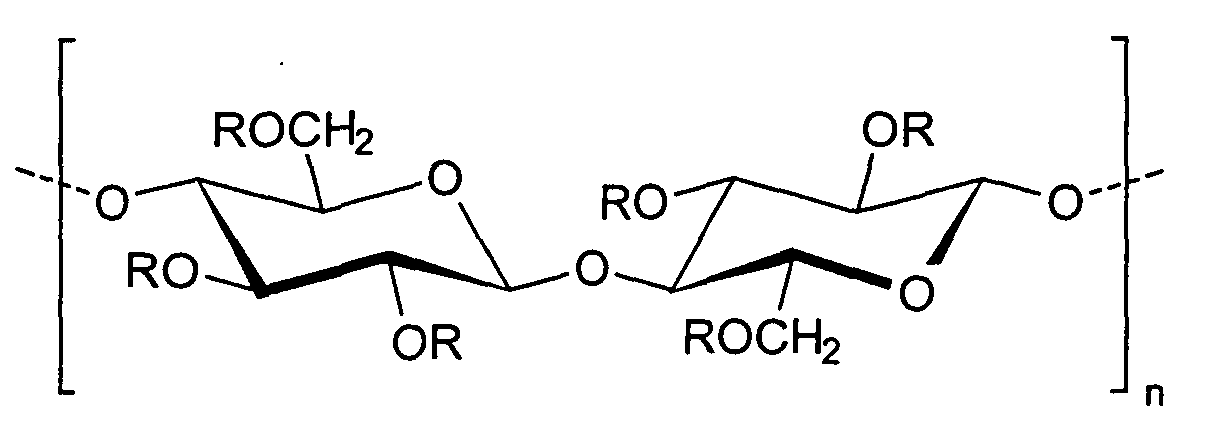
Erfindungsgemäß bevorzugte Hydrokolloide sind beispielsweise Methylcellulosen, als
welche die Methylether der Cellulose bezeichnet werden. Sie zeichnen sich durch die
folgende Strukturformel aus
in der R ein Wasserstoff oder eine Methylgruppe darstellen kann.
Insbesondere vorteilhaft im Sinne der vorliegenden Erfindung sind die im allgemeinen
ebenfalls als Methylcellulosen bezeichneten Cellulosemischether, die neben einem dominierenden
Gehalt an Methyl- zusätzlich 2-Hydroxyethyl-, 2-Hydroxypropyl- oder 2-Hydroxybutyl-Gruppen
enthalten. Besonders bevorzugt sind (Hydroxypropyl)methylcellulosen,
beispielsweise die unter der Handelsbezeichnung Methocel E4M bei der Dow Chemical
Comp. erhältlichen.
Erfindungsgemäß ferner vorteilhaft ist Natriumcarboxymethylcellulose, das Natrium-Salz
des Glykolsäureethers der Cellulose, für welches R in Strukturformel I ein Wasserstoff
und/oder CH2-COONa darstellen kann. Bevorzugt ist die unter der Handelsbezeichnung
Natrosol Plus 330 CS bei Aqualon erhältliche, auch als Cellulose Gum bezeichnete Natriumcarboxymethylcellulose.
Bevorzugt im Sinne der vorliegenden Erfindung ist ferner Xanthan (CAS-Nr. 11138-66-2),
auch Xanthan Gummi genannt, welches ein anionisches Heteropolysaccharid ist, das in
der Regel durch Fermentation aus Maiszucker gebildet und als Kaliumsalz isoliert wird.
Es wird von Xanthomonas campestris und einigen anderen Species unter aeroben
Bedingungen mit einem Molekulargewicht von 2×10⁶ bis 24×106 produziert. Xanthan wird
aus einer Kette mit β-1,4-gebundener Glucose (Cellulose) mit Seitenketten gebildet. Die
Struktur der Untergruppen besteht aus Glucose, Mannose, Glucuronsäure, Acetat und
Pyruvat. Xanthan ist die Bezeichnung für das erste mikrobielle anionische Heteropolysaccharid.
Es wird von Xanthomonas campestris und einigen anderen Species unter
aeroben Bedingungen mit einem Molekulargewicht von 2-15 106 produziert. Xanthan
wird aus einer Kette mit β-1,4-gebundener Glucose (Cellulose) mit Seitenketten gebildet.
Die Struktur der Untergruppen besteht aus Glucose, Mannose, Glucuronsäure, Acetat
und Pyruvat. Die Anzahl der Pyruvat-Einheiten bestimmt die Viskosität des Xanthans.
Xanthan wird in zweitägigen Batch-Kulturen mit einer Ausbeute von 70-90 %, bezogen
auf eingesetztes Kohlenhydrat, produziert. Dabei werden Ausbeuten von 25-30 g/l
erreicht. Die Aufarbeitung erfolgt nach Abtöten der Kultur durch Fällung mit z. B. 2-Propanol.
Xanthan wird anschließend getrocknet und gemahlen.
Vorteilhafter Gelbildner im Sinne der vorliegenden Erfindung ist ferner Carrageen, ein
gelbildender und ähnlich wie Agar aufgebauter Extrakt aus nordatlant., zu den Florideen
zählenden Rotalgen (Chondrus crispus u. Gigartina stellata).
Häufig wird die Bezeichnung Carrageen für das getrocknete Algenprodukt und
Carrageenan für den Extrakt aus diesem verwendet. Das aus dem Heißwasserextrakt der
Algen ausgefällte Carrageen ist ein farbloses bis sandfarbenes Pulver mit einem
Molekulargewichtsbereich von 100 000-800 000 und einem Sulfat-Gehalt von ca. 25 %.
Carrageen, das in warmem Wasser sehr leicht lösl. ist; beim Abkühlen bildet sich ein
thixotropes Gel, selbst wenn der Wassergehalt 95-98 % beträgt. Die Festigkeit des Gels
wird durch die Doppelhelix-Struktur des Carrageens bewirkt . Beim Carrageenan
unterscheidet man drei Hauptbestandteile: Die gelbildende κ-Fraktion besteht aus D-Galactose-4-sulfat
und 3,6-Anhydro-α-D-galactose, die abwechselnd in 1,3- und 1,4-Stellung
glykosidisch verbunden sind (Agar enthält demgegenüber 3,6-Anhydro-α-Lgalactose).
Die nicht gelierende λ-Fraktion ist aus 1,3-glykosidisch verknüpften D-Galactose-2-sulfat
und 1,4-verbundenen D-Galactose-2,6-disulfat-Resten zusammengesetzt
u. in kaltem Wasser leicht löslich. Das aus D-Galactose-4-sulfat in 1,3-Bindung und
3,6-Anhydro-α-D-galactose-2-sulfat in 1,4-Bindung aufgebaute τ-Carrageenan ist sowohl
wasserlöslich als auch gelbildend. Weitere Carrageen-Typen werden ebenfalls mit griechischen
Buchstaben bezeichnet. Auch die Art vorhandener Kationen (K+, NH4 +, Na+,
Mg2+, Ca2+) beeinflußt die Löslichkeit der Carrageene.
Polyacrylate sind ebenfalls vorteilhaft im Sinne der vorliegenden Erfindung zu
verwendende Gelatoren. Erfindungsgemäß vorteilhafte Polyacrylate sind Acrylat-Alkylacrylat-Copolymere,
insbesondere solche, die aus der Gruppe der sogenannten
Carbomere oder Carbopole (Carbopol® ist eigentlich eine eingetragene Marke der
NOVEON Inc.) gewählt werden. Insbesondere zeichnen sich das oder die
erfindungsgemäß vorteilhaften Acrylat-Alkylacrylat-Copolymere durch die folgende
Struktur aus:
Darin stellen R' einen langkettigen Alkylrest und x und y Zahlen dar, welche den jeweiligen
stöchiometrischen Anteil der jeweiligen Comonomere symbolisieren.
Erfindungsgemäß bevorzugt sind Acrylat-Copolymere und/oder Acrylat-Alkylacrylat-Copolymere,
welche unter den Handelbezeichnungen Carbopol® 1382, Carbopol® 981 und
Carbopol® 5984, Aqua SF-1 von der NOVEON Inc. bzw. als Aculyn® 33 von
International Specialty Products Corp. erhältlich sind.
Ferner vorteilhaft sind Copolymere aus C10-30 -Alkylacrylaten und einem oder mehreren
Monomeren der Acrylsäure, der Methacrylsäure oder deren Ester, die kreuzvernetzt sind
mit einem Allylether der Saccharose oder einem Allylether des Pentaerythrit.
Vorteilhaft sind Verbindungen, die die INCI-Bezeichnung "Acrylates/C 10-30 Alkyl Acrylate
Crosspolymer" tragen. Insbesondere vorteilhaft sind die unter den Handelsbezeichnungen
Pemulen TR1 und Pemulen TR2 bei der NOVEON Inc. erhältlichen.
Vorteilhaft sind ferner Verbindungen, die die INCI-Bezeichnung "acrylates/C12-24 pareth-25
acrylate copolymer" (unter der Handelsbezeichnungen Synthalen® W2000 bei der 3V
Inc. erhältlich), die die INCI-Bezeichnung "acrylates/steareth-20 methacrylate copolymer"
(unter der Handelsbezeichnungen Aculyn® 22 bei der International Specialty Products
Corp. erhältlich), die die INCI-Bezeichnung "acrylates/steareth-20 itaconate copolymer"
(unter der Handelsbezeichnungen Structure 2001® bei der National Starch erhältlich), die
die INCI-Bezeichnung "acrylates/aminoacrylates/C10-30 alkyl PEG-20 itaconate copolymer"
(unter der Handelsbezeichnungen Structure Plus® bei der National Starch erhältlich) und
ähnliche Polymere.
Die jeweils einzusetzenden Mengen an kosmetischen oder dermatologischen Hilfs- und
Trägerstoffen und Parfüm können in Abhängigkeit von der Art des jeweiligen Produktes
vom Fachmann durch einfaches Ausprobieren leicht ermittelt werden.
Ein zusätzlicher Gehalt an Antioxidantien ist im allgemeinen bevorzugt. Erfindungsgemäß
können als günstige Antioxidantien alle für kosmetische und/oder dermatologische Anwendungen
geeigneten oder gebräuchlichen Antioxidantien verwendet werden.
Vorteilhaft werden die Antioxidantien gewählt aus der Gruppe bestehend aus Aminosäuren
(z. B. Glycin, Histidin, Tyrosin, Tryptophan) und deren Derivate, Imidazole (z. B. Urocaninsäure)
und deren Derivate, Peptide wie D,L-Carnosin, D-Carnosin, L-Carnosin und
deren Derivate (z. B. Anserin), Carotinoide, Carotine (z. B. α-Carotin, β-Carotin, Lycopin)
und deren Derivate, Chlorogensäure und deren Derivate, Liponsäure und deren Derivate
(z. B. Dihydroliponsäure), Aurothioglucose, Propylthiouracil und andere Thiole (z. B. Thioredoxin,
Glutathion, Cystein, Cystin, Cystamin und deren Glycosyl-, N-Acetyl-, Methyl-,
Ethyl-, Propyl-, Amyl-, Butyl- und Lauryl-, Palmitoyl-, Oleyl-, γ-Linoleyl-, Cholesteryl- und
Glycerylester) sowie deren Salze, Dilaurylthiodipropionat, Distearylthiodipropionat, Thiodipropionsäure
und deren Derivate (Ester, Ether, Peptide, Lipide, Nukleotide, Nukleoside
und Salze) sowie Sulfoximinverbindungen (z. B. Buthioninsulfoximine, Homocysteinsulfoximin,
Buthioninsulfone, Penta-, Hexa-, Heptathioninsulfoximin) in sehr geringen verträglichen
Dosierungen (z. B. pmol bis µmol/kg), ferner (Metall)-Chelatoren (z. B. α-Hydroxyfettsäuren,
Palmitinsäure, Phytinsäure, Lactoferrin), α-Hydroxysäuren (z. B. Citronensäure,
Milchsäure, Apfelsäure), Huminsäure, Gallensäure, Gallenextrakte, Bilirubin,
Biliverdin, EDTA, EGTA und deren Derivate, ungesättigte Fettsäuren und deren Derivate
(z. B. γ-Linolensäure, Linolsäure, Ölsäure), Folsäure und deren Derivate, Ubichinon und
Ubichinol und deren Derivate, Vitamin C und Derivate (z. B. Ascorbylpalmitat, Mg-Ascorbylphosphat,
Ascorbylacetat), Tocopherole und Derivate (z. B. Vitamin-E-acetat), Vitamin
A und Derivate (Vitamin-A-palmitat) sowie Koniferylbenzoat des Benzoeharzes, Rutinsäure
und deren Derivate, α-Glycosylrutin, Ferulasäure, Furfurylidenglucitol, Carnosin,
Butylhydroxytoluol, Butylhydroxyanisol, Nordihydroguajakharzsäure, Nordihydroguajaretsäure,
Trihydroxybutyrophenon, Harnsäure und deren Derivate, Mannose und deren Derivate,
Zink und dessen Derivate (z. B. ZnO, ZnSO4) Selen und dessen Derivate (z. B.
Selenmethionin), Stilbene und deren Derivate (z. B. Stilbenoxid, Trans-Stilbenoxid) und
die erfindungsgemäß geeigneten Derivate (Salze, Ester, Ether, Zucker, Nukleotide, Nukleoside,
Peptide und Lipide) dieser genannten Wirkstoffe.
Ferner ist es vorteilhaft, wenn die Zubereitungen im Sinne der vorliegenden Erfindung
Enzyme bzw. Enzym-Mimics enthalten, die als enzymatische Antioxidantien wirken, wie
z. B. Superoxiddismutasen, Katalasen, Peroxidasen, Selenoproteine.
Die Menge der vorgenannten Antioxidantien (eine oder mehrere Verbindungen) in den
Emulsionen beträgt vorzugsweise 0,001 bis 30 Gew.-%, besonders bevorzugt 0,05 bis
20 Gew.-%, insbesondere 0,1 bis 10 Gew.-%, bezogen auf das Gesamtgewicht der Zubereitung.
Sofern Vitamin E und/oder dessen Derivate das oder die Antioxidantien darstellen, ist
vorteilhaft, deren jeweilige Konzentrationen aus dem Bereich von 0,001 bis 10 Gew.-%,
bezogen auf das Gesamtgewicht der Formulierung, zu wählen.
Sofern Vitamin A, bzw. Vitamin-A-Derivate, bzw. Carotine bzw. deren Derivate das oder
die Antioxidantien darstellen, ist vorteilhaft, deren jeweilige Konzentrationen aus dem
Bereich von 0,001 bis 10 Gew.-%, bezogen auf das Gesamtgewicht der Formulierung, zu
wählen.
Es ist auch von Vorteil, den erfindungsgemäßen Zubereitungen Komplexbildner zuzusetzen.
Vorteilhaft werden die Komplexbildner gewählt aus der Gruppe bestehend aus
Ethylendiamintetraessigsäure (EDTA) und deren Anionen, Nitrilotriessigsäure (NTA) und
deren Anionen, Hydroxyethylendiaminotriessigsäure (HOEDTA) und deren Anionen,
Diethylenaminopentaessigsäure (DPTA) und deren Anionen, trans-1,2-Diaminocyclohexantetraessigsäure
(CDTA) und deren Anionen, Tetrasodium Iminodisuccinate,
Trisodium Etylenediamine Disuccinate.
Die Lipidphase kann vorteilhaft gewählt werden aus folgender Substanzgruppe:
- Mineralöle, Mineralwachse
- Öle, wie Triglyceride der Caprin- oder der Caprylsäure, ferner natürliche Öle wie
z. B. Rizinusöl;
- Fette, Wachse und andere natürliche und synthetische Fettkörper, vorzugsweise
Ester von Fettsäuren mit Alkoholen niedriger C-Zahl, z. B. mit Isopropanol, Propylenglykol
oder Glycerin, oder Ester von Fettalkoholen mit Alkansäuren niedriger C-Zahl
oder mit Fettsäuren;
- Alkylbenzoate;
- Silikonöle wie Dimethylpolysiloxane, Diethylpolysiloxane, Diphenylpolysiloxane
sowie Mischformen daraus.
Die Ölphase der Emulsionen, Oleogele bzw. Hydrodispersionen oder Lipodispersionen
im Sinne der vorliegenden Erfindung wird vorteilhaft gewählt aus der Gruppe der Ester
aus gesättigten und/oder ungesättigten, verzweigten und/oder unverzweigten Alkancarbonsäuren
einer Kettenlänge von 3 bis 30 C-Atomen und gesättigten und/oder ungesättigten,
verzweigten und/oder unverzweigten Alkoholen einer Kettenlänge von 3 bis 30 C-Atomen,
aus der Gruppe der Ester aus aromatischen Carbonsäuren und gesättigten
und/oder ungesättigten, verzweigten und/oder unverzweigten Alkoholen einer Kettenlänge
von 3 bis 30 C-Atomen. Solche Esteröle können dann vorteilhaft gewählt werden
aus der Gruppe Isopropylmyristat, Isopropylpalmitat, Isopropylstearat, Isopropyloleat, n-Butylstearat,
n-Hexyllaurat, n-Decyloleat, Isooctylstearat, Isononylstearat, Isononylisononanoat,
2-Ethylhexylpalmitat, 2-Ethylhexyllaurat, 2-Hexyldecylstearat, 2-Octyldodecylpalmitat,
Oleyloleat, Oleylerucat, Erucyloleat, Erucylerucat sowie synthetische, halbsynthetische
und natürliche Gemische solcher Ester, z. B. Jojobaöl.
Ferner kann die Ölphase vorteilhaft gewählt werden aus der Gruppe der verzweigten und
unverzweigten Kohlenwasserstoffe und -wachse, der Silikonöle, der Dialkylether, der
Gruppe der gesättigten oder ungesättigten, verzweigten oder unverzweigten Alkohole,
sowie der Fettsäuretriglyceride, namentlich der Triglycerinester gesättigter und/oder ungesättigter,
verzweigter und/oder unverzweigter Alkancarbonsäuren einer Kettenlänge
von 8 bis 24, insbesondere 12 bis 18 C-Atomen. Die Fettsäuretriglyceride können beispielsweise
vorteilhaft gewählt werden aus der Gruppe der synthetischen, halbsynthetischen
und natürlichen Öle, z. B. Olivenöl, Sonnenblumenöl, Sojaöl, Erdnußöl, Rapsöl,
Mandelöl, Palmöl, Kokosöl, Palmkernöl und dergleichen mehr.
Auch beliebige Abmischungen solcher Öl- und Wachskomponenten sind vorteilhaft im
Sinne der vorliegenden Erfindung einzusetzen. Es kann auch gegebenenfalls vorteilhaft
sein, Wachse, beispielsweise Cetylpalmitat, als alleinige Lipidkomponente der Ölphase
einzusetzen.
Vorteilhaft wird die Ölphase gewählt aus der Gruppe 2-Ethylhexylisostearat, Octyldodecanol,
Isotridecylisononanoat, Isoeicosan, 2-Ethylhexylcocoat, C12-15-Alkylbenzoat, Capryl-Caprinsäure-triglycerid,
Dicaprylylether.
Besonders vorteilhaft sind Mischungen aus C12-15-Alkylbenzoat und 2-Ethylhexylisostearat,
Mischungen aus C12-15-Alkylbenzoat und Isotridecylisononanoat sowie Mischungen
aus C12-15-Alkylbenzoat, 2-Ethylhexylisostearat und Isotridecylisononanoat.
Von den Kohlenwasserstoffen sind Paraffinöl, Squalan und Squalen vorteilhaft im Sinne
der vorliegenden Erfindung zu verwenden.
Vorteilhaft kann die Ölphase ferner einen Gehalt an cyclischen oder linearen Silikonölen
aufweisen oder vollständig aus solchen Ölen bestehen, wobei allerdings bevorzugt wird,
außer dem Silikonöl oder den Silikonölen einen zusätzlichen Gehalt an anderen Ölphasenkomponenten
zu verwenden.
Vorteilhaft wird Cyclomethicon (Octamethylcyclotetrasiloxan) als erfindungsgemäß zu
verwendendes Silikonöl eingesetzt. Aber auch andere Silikonöle sind vorteilhaft im Sinne
der vorliegenden Erfindung zu verwenden, beispielsweise Hexamethylcyclotrisiloxan, Polydimethylsiloxan,
Poly(methylphenylsiloxan).
Besonders vorteilhaft sind ferner Mischungen aus Cyclomethicon und Isotridecylisononanoat,
aus Cyclomethicon und 2-Ethylhexylisostearat.
Die wäßrige Phase der erfindungsgemäßen Formulierungen enthält gegebenenfalls vorteilhaft
- Alkohole, Diole oder Polyole niedriger C-Zahl, sowie deren Ether, vorzugsweise
Ethanol, Isopropanol, Propylenglykol, Glycerin, Ethylenglykol, Ethylenglykolmonoethyl-
oder -monobutylether, Propylenglykolmonomethyl, -monoethyl- oder -monobutylether,
Diethylenglykolmonomethyl- oder -monoethylether und analoge
Produkte, ferner Alkohole niedriger C-Zahl, z. B. Ethanol, Isopropanol, 1,2-Propandiol,
Glycerin sowie insbesondere ein oder mehrere Verdickungsmittel, welches
oder welche vorteilhaft gewählt werden können aus der Gruppe Siliciumdioxid,
Aluminiumsilikate, Polysaccharide bzw. deren Derivate, z. B. Hyaluronsäure,
Xanthangummi und/oder Hydroxypropylmethylcellulose, besonders vorteilhaft aus
der Gruppe der Polyacrylate, bevorzugt ein Polyacrylat aus der Gruppe der
sogenannten Carbopole, beispielsweise Carbopole der Typen 980, 981, 1382,
2984, 5984, jeweils einzeln oder in Kombination.
Vorzugsweise enthalten die erfindungsgemäßen Zubereitungen neben den erfindungsgemäßen
Wirkstoffen zusätzlich mindestens eine UV-A-Filtersubstanz und/oder
mindestens eine UV-B-Filtersubstanz. Solche Formulierungen können, obgleich nicht
notwendig, gegebenenfalls auch ein oder mehrere anorganische Pigmente als UV-Filtersubstanzen
enthalten. Als UV-Filtersubstanzen können alle bekannten und für die
Kosmetik zugelassenen UV-Filtersubstanzen eingesetzt werden.
Die erfindungsgemäßen kosmetischen und/oder dermatologischen Zubereitungen für das
Haar können vorteilhaft als Emulsion, Lotion, Gel, wässrige Lösung oder Öl in Form eines
Shampoos, einer Creme, eines Haarwassers, eines Sprays, einer Pomade, einer
Spülung, eines Pulvers oder einer Kurpackung vorliegen.
In den Zubereitungen können im Sinne der vorliegenden Erfindung neben einer oder
mehrerer Ölphasen zusätzlich eine oder mehrere Wasserphasen enthalten und
beispielsweise in Form von W/O-, O/W-, W/O/W- oder O/W/O-Emulsionen vorliegen.
Solche Emulsionen können vorzugsweise auch eine Mikroemulsion, eine Pickering-Emulsion
oder eine sprühbare Emulsion sein. Darüber hinaus können die
erfindungsgemäßen Formulierungen aber auch vorteilhaft in Form von ölfreien
Zubereitungen oder als wasserfreie Zubereitungen vorliegen.
Zur Anwendung werden die erfindungsgemäßen kosmetischen und dermatologischen
Zubereitungen in der für Kosmetika üblichen Weise auf die die Haare in ausreichender
Menge aufgebracht.
Erfindungsgemäß ist auch das Verfahren zur Färbung der Haare, welches dadurch
gekennzeichnet ist, dass die Haare und/oder die Kopfhaut mit einem Haarfärbemittel
enthaltend mindestens eine Verbindung aus der Gruppe der AGEs, deren synthetischen
Vorstufen und/oder der Lipofuscine behandelt wird.
Erfindungsgemäß ist auch die Verwendung der erfindungsgemäßen Zubereitungen zur
Steigerung der Melaninsynthese in der Haarwurzel und der Einlagerung von Melanin im
Haar.
Die nachfolgenden Beispiele sollen die vorliegende Erfindung verdeutlichen, ohne sie
einzuschränken. Alle Mengenangaben, Anteile und Prozentanteile sind, soweit nicht anders
angegeben, auf das Gewicht und die Gesamtmenge bzw. auf das Gesamtgewicht
der Zubereitungen bezogen.
Herstellungsbeispiel für Lipofuscin
Leber-Gewebe wird in 0,3M Sucrose auf Eis homogenisiert und anschließend für 10
Minuten bei 270 g (1g steht hier und im nachfolgenden für die einfache Erdbeschleunigung)
zentrifugiert. Der Überstand hieraus wird ein weiteres mal bei 1100 g über
20 Minuten zentrifugiert, das entstehende Sediment verworfen und der Überstand
abermals zentrifugiert (diesesmal 10 Minuten bei 3000 g). Das aus der letzten Zentrifugation
verbleibende Sediment, das überwiegend aus Mitochondrien besteht, wird ins PBS
(Phosphate Bufferd Saline, ein einfacher Phosphat-Puffer bei pH 7,4) aufgenommen und
wie zuvor zentrifugiert (Waschschritt). Das verbleibende, von Sucrose weitgehend
gereinigte Pellet wird in 2ml PBS aufgenommen und unter der sterilen Werkbank 20
Stunden mit UV-Licht bestrahlt. Während dieser Zeit findet die Lipidperoxidation (u.a.
Entstehung von Malondialdehyd) statt, was über Schiff'sche Basen-Reaktionen mit freien
Aminogruppen (aus Proteinen und Phosphatidylethanolamin der Mitochondrien-Membranen)
zur Bildung von Lipofuscin führt.
Herstellung von A2E
Die Herstellung von A2E kann nach der Methode von Parish (Parish et al., 1998, Proc.
Natl. Acad. Sci. USA, 95:14609-13) erfolgen.
Das so gewonnene Lipofuscin bzw. A2E wurde in den nachfolgenden Rezepturbeispielen
eingesetzt.
Beispiele
|
Sprayformulierung
|
1
|
| Ethanol |
28,00 |
| Lipofuscin |
0,3 |
| Ubiquinon Q10 |
0,10 |
| Konservierungsmittel, Farbstoffe, Parfüm |
q.s. |
| Propan/Butan 25/75 |
ad 100 |
|
Duschbad
|
2
|
| Natriumlaurethsulfat |
33,00 |
| Kaliumcocoyl hydrolysiertes Collagen (30%) |
11,00 |
| Cocoamphodiacetat (30%) |
5,00 |
| PEG-7-Glyceryl Cocoate |
2,00 |
| Cocamide MEA |
1,00 |
| Natriumchlorid |
0,50 |
| A2E |
0,05 |
| Zitronensäure |
0,02 |
| Konservierungsmittel, Farbstoffe, Parfüm |
q.s. |
| Wasser |
ad 100 |
|
Conditioner-Shampoo mit Perlglanz
|
3
|
| Polyquaternium-10 |
0,50 |
| Natriumlaurethsulfat |
9,00 |
| Cocoamidopropylbetain |
2,50 |
| Perlglanzmittel |
2,00 |
| A2E |
0,1 |
| Dinatrium EDTA |
0,10 |
| Konservierungsmittel, Parfüm, Verdicker, pH-Einstellung und Lösungsvermittler |
q.s. |
| Wasser, VES (voll Entsalzt) |
ad 100 |
| Der pH-Wert wird auf 6 eingestellt. |
|
klares Conditioner-Shampoo
|
4
|
| Polyquaternium-10 |
0,50 |
| Natriumlaurethsulfat |
9,00 |
| Cocoamidopropylbetain |
2,50 |
| A2E |
0,1 |
| Iminodibernsteinsäure, Na-Salz |
0,20 |
| Konservierungsmittel, Parfüm, Verdicker, pH-Einstellung und Lösungsvermittler |
q.s. |
| Wasser, VES (voll Entsalzt) |
ad 100 |
| Der pH-Wert wird auf 6 eingestellt. |
|
klares Light-Shampoo mit Volumeneffekt
|
5
|
| Natriumlaurethsulfat |
9,00 |
| Cocoamidopropylbetain |
2,50 |
| A2E |
0,05 |
| Dinatrium EDTA |
0,20 |
| Konservierungsmittel, Parfüm, Verdicker, pH-Einstellung und Lösungsvermittler |
q.s. |
| Wasser |
ad 100 |
| Der pH-Wert wird auf 5,5 eingestellt. |
|
Haarkur
|
6
|
| Hydroxypropylmethylcellulose |
0,50 |
| Cetrimoniumbromid |
1,00 |
| Glycerin |
3,00 |
| Cetearylalkohol |
2,50 |
| Glycerylstearat |
2,00 |
| A2E |
0,1 |
| Konservierungsmittel, Parfüm, pH-Einstellung |
q.s. |
| Wasser |
ad 100 |
| Der pH-Wert wird auf 3,5 eingestellt. |
|
Haarspülung
|
7
|
| Behentrimoniumchlorid |
1,00 |
| Glycerin |
3,00 |
| Hydroxyethylcellulose |
0,20 |
| Cetearylalkohol |
3,00 |
| A2E |
0,2 |
| Folsäure |
0,80 |
| Konservierungsmittel, Parfüm, pH-Einstellung |
q.s. |
| Wasser |
ad 100 |
| Der pH-Wert wird auf 3,0 eingestellt. |