EP1317543B1 - Parietaria judaica ns-ltp antigen variants, uses thereof and compositions comprising them - Google Patents
Parietaria judaica ns-ltp antigen variants, uses thereof and compositions comprising them Download PDFInfo
- Publication number
- EP1317543B1 EP1317543B1 EP01972467A EP01972467A EP1317543B1 EP 1317543 B1 EP1317543 B1 EP 1317543B1 EP 01972467 A EP01972467 A EP 01972467A EP 01972467 A EP01972467 A EP 01972467A EP 1317543 B1 EP1317543 B1 EP 1317543B1
- Authority
- EP
- European Patent Office
- Prior art keywords
- allergen
- variant
- ltp
- seq
- variant according
- Prior art date
- Legal status (The legal status is an assumption and is not a legal conclusion. Google has not performed a legal analysis and makes no representation as to the accuracy of the status listed.)
- Expired - Lifetime
Links
- 241001465379 Parietaria judaica Species 0.000 title claims description 22
- 239000000203 mixture Substances 0.000 title claims description 18
- 239000000427 antigen Substances 0.000 title description 4
- 102000036639 antigens Human genes 0.000 title description 4
- 108091007433 antigens Proteins 0.000 title description 4
- 239000013566 allergen Substances 0.000 claims abstract description 102
- 230000000172 allergic effect Effects 0.000 claims abstract description 46
- 208000010668 atopic eczema Diseases 0.000 claims abstract description 46
- 230000002265 prevention Effects 0.000 claims abstract description 7
- 239000003814 drug Substances 0.000 claims abstract description 4
- 239000008194 pharmaceutical composition Substances 0.000 claims abstract description 4
- 238000002360 preparation method Methods 0.000 claims abstract description 3
- 230000027455 binding Effects 0.000 claims description 44
- 108090000623 proteins and genes Proteins 0.000 claims description 33
- 235000018102 proteins Nutrition 0.000 claims description 32
- 102000004169 proteins and genes Human genes 0.000 claims description 32
- 230000002829 reductive effect Effects 0.000 claims description 17
- 125000000151 cysteine group Chemical class N[C@@H](CS)C(=O)* 0.000 claims description 15
- 235000018417 cysteine Nutrition 0.000 claims description 10
- 230000000694 effects Effects 0.000 claims description 9
- 239000013598 vector Substances 0.000 claims description 9
- 108091033319 polynucleotide Proteins 0.000 claims description 7
- 239000002157 polynucleotide Substances 0.000 claims description 7
- 102000040430 polynucleotide Human genes 0.000 claims description 7
- 239000003937 drug carrier Substances 0.000 claims description 6
- 208000024780 Urticaria Diseases 0.000 claims description 5
- 238000009795 derivation Methods 0.000 claims description 5
- 238000003745 diagnosis Methods 0.000 claims description 5
- 238000009169 immunotherapy Methods 0.000 claims description 5
- 230000001939 inductive effect Effects 0.000 claims description 5
- 108060003951 Immunoglobulin Proteins 0.000 claims description 4
- 125000003275 alpha amino acid group Chemical group 0.000 claims description 4
- 125000000539 amino acid group Chemical group 0.000 claims description 4
- 239000000032 diagnostic agent Substances 0.000 claims description 4
- 229940039227 diagnostic agent Drugs 0.000 claims description 4
- 102000018358 immunoglobulin Human genes 0.000 claims description 4
- 229940072221 immunoglobulins Drugs 0.000 claims description 4
- 230000004044 response Effects 0.000 claims description 4
- QNAYBMKLOCPYGJ-REOHCLBHSA-N L-alanine Chemical compound C[C@H](N)C(O)=O QNAYBMKLOCPYGJ-REOHCLBHSA-N 0.000 claims description 2
- MTCFGRXMJLQNBG-UHFFFAOYSA-N Serine Natural products OCC(N)C(O)=O MTCFGRXMJLQNBG-UHFFFAOYSA-N 0.000 claims description 2
- 235000004279 alanine Nutrition 0.000 claims description 2
- 208000003455 anaphylaxis Diseases 0.000 claims description 2
- 230000001747 exhibiting effect Effects 0.000 claims description 2
- 230000003449 preventive effect Effects 0.000 claims description 2
- FWMNVWWHGCHHJJ-SKKKGAJSSA-N 4-amino-1-[(2r)-6-amino-2-[[(2r)-2-[[(2r)-2-[[(2r)-2-amino-3-phenylpropanoyl]amino]-3-phenylpropanoyl]amino]-4-methylpentanoyl]amino]hexanoyl]piperidine-4-carboxylic acid Chemical compound C([C@H](C(=O)N[C@H](CC(C)C)C(=O)N[C@H](CCCCN)C(=O)N1CCC(N)(CC1)C(O)=O)NC(=O)[C@H](N)CC=1C=CC=CC=1)C1=CC=CC=C1 FWMNVWWHGCHHJJ-SKKKGAJSSA-N 0.000 claims 1
- 206010002198 Anaphylactic reaction Diseases 0.000 claims 1
- 206010006482 Bronchospasm Diseases 0.000 claims 1
- 206010010741 Conjunctivitis Diseases 0.000 claims 1
- 206010015150 Erythema Diseases 0.000 claims 1
- 208000010201 Exanthema Diseases 0.000 claims 1
- 206010030113 Oedema Diseases 0.000 claims 1
- 208000003251 Pruritus Diseases 0.000 claims 1
- 206010048908 Seasonal allergy Diseases 0.000 claims 1
- 230000036783 anaphylactic response Effects 0.000 claims 1
- 208000006673 asthma Diseases 0.000 claims 1
- 230000015572 biosynthetic process Effects 0.000 claims 1
- 230000007885 bronchoconstriction Effects 0.000 claims 1
- 231100000321 erythema Toxicity 0.000 claims 1
- 201000005884 exanthem Diseases 0.000 claims 1
- 206010037844 rash Diseases 0.000 claims 1
- 125000003607 serino group Chemical group [H]N([H])[C@]([H])(C(=O)[*])C(O[H])([H])[H] 0.000 claims 1
- 230000000774 hypoallergenic effect Effects 0.000 abstract description 4
- FAPWRFPIFSIZLT-UHFFFAOYSA-M Sodium chloride Chemical compound [Na+].[Cl-] FAPWRFPIFSIZLT-UHFFFAOYSA-M 0.000 description 15
- 238000002965 ELISA Methods 0.000 description 13
- 238000010181 skin prick test Methods 0.000 description 12
- 238000006243 chemical reaction Methods 0.000 description 11
- 238000002474 experimental method Methods 0.000 description 11
- 239000000243 solution Substances 0.000 description 10
- 241000283973 Oryctolagus cuniculus Species 0.000 description 9
- 102000007056 Recombinant Fusion Proteins Human genes 0.000 description 9
- 108010008281 Recombinant Fusion Proteins Proteins 0.000 description 9
- RAXXELZNTBOGNW-UHFFFAOYSA-N imidazole Natural products C1=CNC=N1 RAXXELZNTBOGNW-UHFFFAOYSA-N 0.000 description 9
- 230000005764 inhibitory process Effects 0.000 description 9
- 210000002966 serum Anatomy 0.000 description 9
- 239000011780 sodium chloride Substances 0.000 description 8
- 238000006467 substitution reaction Methods 0.000 description 8
- 238000001262 western blot Methods 0.000 description 8
- 108091034117 Oligonucleotide Proteins 0.000 description 7
- 230000002009 allergenic effect Effects 0.000 description 7
- 239000000872 buffer Substances 0.000 description 7
- 239000000284 extract Substances 0.000 description 7
- 238000000034 method Methods 0.000 description 7
- 108020004414 DNA Proteins 0.000 description 6
- NTYJJOPFIAHURM-UHFFFAOYSA-N Histamine Chemical compound NCCC1=CN=CN1 NTYJJOPFIAHURM-UHFFFAOYSA-N 0.000 description 6
- 235000001014 amino acid Nutrition 0.000 description 6
- 150000001413 amino acids Chemical class 0.000 description 6
- 239000012634 fragment Substances 0.000 description 6
- 238000002703 mutagenesis Methods 0.000 description 6
- 231100000350 mutagenesis Toxicity 0.000 description 6
- 230000035772 mutation Effects 0.000 description 6
- 230000003287 optical effect Effects 0.000 description 6
- 238000003752 polymerase chain reaction Methods 0.000 description 6
- 208000026935 allergic disease Diseases 0.000 description 5
- 238000001514 detection method Methods 0.000 description 5
- 238000010790 dilution Methods 0.000 description 5
- 239000012895 dilution Substances 0.000 description 5
- 239000002773 nucleotide Substances 0.000 description 5
- 125000003729 nucleotide group Chemical group 0.000 description 5
- 108091026890 Coding region Proteins 0.000 description 4
- 229920001213 Polysorbate 20 Polymers 0.000 description 4
- 238000004458 analytical method Methods 0.000 description 4
- 238000013459 approach Methods 0.000 description 4
- 230000008901 benefit Effects 0.000 description 4
- 239000000287 crude extract Substances 0.000 description 4
- 238000010586 diagram Methods 0.000 description 4
- 238000004519 manufacturing process Methods 0.000 description 4
- 239000013642 negative control Substances 0.000 description 4
- 239000000256 polyoxyethylene sorbitan monolaurate Substances 0.000 description 4
- 235000010486 polyoxyethylene sorbitan monolaurate Nutrition 0.000 description 4
- 230000009467 reduction Effects 0.000 description 4
- 238000002560 therapeutic procedure Methods 0.000 description 4
- 206010020751 Hypersensitivity Diseases 0.000 description 3
- JLCPHMBAVCMARE-UHFFFAOYSA-N [3-[[3-[[3-[[3-[[3-[[3-[[3-[[3-[[3-[[3-[[3-[[5-(2-amino-6-oxo-1H-purin-9-yl)-3-[[3-[[3-[[3-[[3-[[3-[[5-(2-amino-6-oxo-1H-purin-9-yl)-3-[[5-(2-amino-6-oxo-1H-purin-9-yl)-3-hydroxyoxolan-2-yl]methoxy-hydroxyphosphoryl]oxyoxolan-2-yl]methoxy-hydroxyphosphoryl]oxy-5-(5-methyl-2,4-dioxopyrimidin-1-yl)oxolan-2-yl]methoxy-hydroxyphosphoryl]oxy-5-(6-aminopurin-9-yl)oxolan-2-yl]methoxy-hydroxyphosphoryl]oxy-5-(6-aminopurin-9-yl)oxolan-2-yl]methoxy-hydroxyphosphoryl]oxy-5-(6-aminopurin-9-yl)oxolan-2-yl]methoxy-hydroxyphosphoryl]oxy-5-(6-aminopurin-9-yl)oxolan-2-yl]methoxy-hydroxyphosphoryl]oxyoxolan-2-yl]methoxy-hydroxyphosphoryl]oxy-5-(5-methyl-2,4-dioxopyrimidin-1-yl)oxolan-2-yl]methoxy-hydroxyphosphoryl]oxy-5-(4-amino-2-oxopyrimidin-1-yl)oxolan-2-yl]methoxy-hydroxyphosphoryl]oxy-5-(5-methyl-2,4-dioxopyrimidin-1-yl)oxolan-2-yl]methoxy-hydroxyphosphoryl]oxy-5-(5-methyl-2,4-dioxopyrimidin-1-yl)oxolan-2-yl]methoxy-hydroxyphosphoryl]oxy-5-(6-aminopurin-9-yl)oxolan-2-yl]methoxy-hydroxyphosphoryl]oxy-5-(6-aminopurin-9-yl)oxolan-2-yl]methoxy-hydroxyphosphoryl]oxy-5-(4-amino-2-oxopyrimidin-1-yl)oxolan-2-yl]methoxy-hydroxyphosphoryl]oxy-5-(4-amino-2-oxopyrimidin-1-yl)oxolan-2-yl]methoxy-hydroxyphosphoryl]oxy-5-(4-amino-2-oxopyrimidin-1-yl)oxolan-2-yl]methoxy-hydroxyphosphoryl]oxy-5-(6-aminopurin-9-yl)oxolan-2-yl]methoxy-hydroxyphosphoryl]oxy-5-(4-amino-2-oxopyrimidin-1-yl)oxolan-2-yl]methyl [5-(6-aminopurin-9-yl)-2-(hydroxymethyl)oxolan-3-yl] hydrogen phosphate Polymers Cc1cn(C2CC(OP(O)(=O)OCC3OC(CC3OP(O)(=O)OCC3OC(CC3O)n3cnc4c3nc(N)[nH]c4=O)n3cnc4c3nc(N)[nH]c4=O)C(COP(O)(=O)OC3CC(OC3COP(O)(=O)OC3CC(OC3COP(O)(=O)OC3CC(OC3COP(O)(=O)OC3CC(OC3COP(O)(=O)OC3CC(OC3COP(O)(=O)OC3CC(OC3COP(O)(=O)OC3CC(OC3COP(O)(=O)OC3CC(OC3COP(O)(=O)OC3CC(OC3COP(O)(=O)OC3CC(OC3COP(O)(=O)OC3CC(OC3COP(O)(=O)OC3CC(OC3COP(O)(=O)OC3CC(OC3COP(O)(=O)OC3CC(OC3COP(O)(=O)OC3CC(OC3COP(O)(=O)OC3CC(OC3COP(O)(=O)OC3CC(OC3CO)n3cnc4c(N)ncnc34)n3ccc(N)nc3=O)n3cnc4c(N)ncnc34)n3ccc(N)nc3=O)n3ccc(N)nc3=O)n3ccc(N)nc3=O)n3cnc4c(N)ncnc34)n3cnc4c(N)ncnc34)n3cc(C)c(=O)[nH]c3=O)n3cc(C)c(=O)[nH]c3=O)n3ccc(N)nc3=O)n3cc(C)c(=O)[nH]c3=O)n3cnc4c3nc(N)[nH]c4=O)n3cnc4c(N)ncnc34)n3cnc4c(N)ncnc34)n3cnc4c(N)ncnc34)n3cnc4c(N)ncnc34)O2)c(=O)[nH]c1=O JLCPHMBAVCMARE-UHFFFAOYSA-N 0.000 description 3
- 230000007815 allergy Effects 0.000 description 3
- NKLPQNGYXWVELD-UHFFFAOYSA-M coomassie brilliant blue Chemical compound [Na+].C1=CC(OCC)=CC=C1NC1=CC=C(C(=C2C=CC(C=C2)=[N+](CC)CC=2C=C(C=CC=2)S([O-])(=O)=O)C=2C=CC(=CC=2)N(CC)CC=2C=C(C=CC=2)S([O-])(=O)=O)C=C1 NKLPQNGYXWVELD-UHFFFAOYSA-M 0.000 description 3
- 238000011161 development Methods 0.000 description 3
- 238000010353 genetic engineering Methods 0.000 description 3
- 229960001340 histamine Drugs 0.000 description 3
- 238000000338 in vitro Methods 0.000 description 3
- 238000001727 in vivo Methods 0.000 description 3
- 239000012528 membrane Substances 0.000 description 3
- 239000008363 phosphate buffer Substances 0.000 description 3
- 238000000746 purification Methods 0.000 description 3
- 108091008146 restriction endonucleases Proteins 0.000 description 3
- 230000002441 reversible effect Effects 0.000 description 3
- 238000002741 site-directed mutagenesis Methods 0.000 description 3
- 238000012360 testing method Methods 0.000 description 3
- 230000001225 therapeutic effect Effects 0.000 description 3
- 102000004190 Enzymes Human genes 0.000 description 2
- 108090000790 Enzymes Proteins 0.000 description 2
- 208000001718 Immediate Hypersensitivity Diseases 0.000 description 2
- 102000001708 Protein Isoforms Human genes 0.000 description 2
- 108010029485 Protein Isoforms Proteins 0.000 description 2
- CDBYLPFSWZWCQE-UHFFFAOYSA-L Sodium Carbonate Chemical compound [Na+].[Na+].[O-]C([O-])=O CDBYLPFSWZWCQE-UHFFFAOYSA-L 0.000 description 2
- 206010045240 Type I hypersensitivity Diseases 0.000 description 2
- 238000003556 assay Methods 0.000 description 2
- 208000010216 atopic IgE responsiveness Diseases 0.000 description 2
- 238000012512 characterization method Methods 0.000 description 2
- 238000010367 cloning Methods 0.000 description 2
- 239000011248 coating agent Substances 0.000 description 2
- 238000000576 coating method Methods 0.000 description 2
- 230000009260 cross reactivity Effects 0.000 description 2
- 238000012217 deletion Methods 0.000 description 2
- 230000037430 deletion Effects 0.000 description 2
- 229940088598 enzyme Drugs 0.000 description 2
- 230000001506 immunosuppresive effect Effects 0.000 description 2
- 238000003780 insertion Methods 0.000 description 2
- 230000037431 insertion Effects 0.000 description 2
- BPHPUYQFMNQIOC-NXRLNHOXSA-N isopropyl beta-D-thiogalactopyranoside Chemical compound CC(C)S[C@@H]1O[C@H](CO)[C@H](O)[C@H](O)[C@H]1O BPHPUYQFMNQIOC-NXRLNHOXSA-N 0.000 description 2
- 239000007788 liquid Substances 0.000 description 2
- 238000013507 mapping Methods 0.000 description 2
- 238000012986 modification Methods 0.000 description 2
- 230000004048 modification Effects 0.000 description 2
- 125000002924 primary amino group Chemical group [H]N([H])* 0.000 description 2
- 238000002415 sodium dodecyl sulfate polyacrylamide gel electrophoresis Methods 0.000 description 2
- 238000010186 staining Methods 0.000 description 2
- 239000000126 substance Substances 0.000 description 2
- 238000005406 washing Methods 0.000 description 2
- MTCFGRXMJLQNBG-REOHCLBHSA-N (2S)-2-Amino-3-hydroxypropansäure Chemical compound OC[C@H](N)C(O)=O MTCFGRXMJLQNBG-REOHCLBHSA-N 0.000 description 1
- GEYOCULIXLDCMW-UHFFFAOYSA-N 1,2-phenylenediamine Chemical compound NC1=CC=CC=C1N GEYOCULIXLDCMW-UHFFFAOYSA-N 0.000 description 1
- 244000144730 Amygdalus persica Species 0.000 description 1
- 206010002199 Anaphylactic shock Diseases 0.000 description 1
- 241000283707 Capra Species 0.000 description 1
- 108091035707 Consensus sequence Proteins 0.000 description 1
- 102000004127 Cytokines Human genes 0.000 description 1
- 108090000695 Cytokines Proteins 0.000 description 1
- 102000012410 DNA Ligases Human genes 0.000 description 1
- 108010061982 DNA Ligases Proteins 0.000 description 1
- BWGNESOTFCXPMA-UHFFFAOYSA-N Dihydrogen disulfide Chemical compound SS BWGNESOTFCXPMA-UHFFFAOYSA-N 0.000 description 1
- 241000196324 Embryophyta Species 0.000 description 1
- 241000283074 Equus asinus Species 0.000 description 1
- 102000000802 Galectin 3 Human genes 0.000 description 1
- 108010001517 Galectin 3 Proteins 0.000 description 1
- 206010062016 Immunosuppression Diseases 0.000 description 1
- 239000000020 Nitrocellulose Substances 0.000 description 1
- 108700026244 Open Reading Frames Proteins 0.000 description 1
- 238000012408 PCR amplification Methods 0.000 description 1
- 241000721467 Parietaria Species 0.000 description 1
- 239000008557 Parietaria judaica pollen Substances 0.000 description 1
- 102000003992 Peroxidases Human genes 0.000 description 1
- 239000004793 Polystyrene Substances 0.000 description 1
- 102000011195 Profilin Human genes 0.000 description 1
- 108050001408 Profilin Proteins 0.000 description 1
- 244000018633 Prunus armeniaca Species 0.000 description 1
- 235000009827 Prunus armeniaca Nutrition 0.000 description 1
- 235000006040 Prunus persica var persica Nutrition 0.000 description 1
- 244000088415 Raphanus sativus Species 0.000 description 1
- 235000006140 Raphanus sativus var sativus Nutrition 0.000 description 1
- 108020004511 Recombinant DNA Proteins 0.000 description 1
- 235000004789 Rosa xanthina Nutrition 0.000 description 1
- 241000220222 Rosaceae Species 0.000 description 1
- 102100021588 Sterol carrier protein 2 Human genes 0.000 description 1
- 230000006052 T cell proliferation Effects 0.000 description 1
- 230000005867 T cell response Effects 0.000 description 1
- 210000001744 T-lymphocyte Anatomy 0.000 description 1
- XSQUKJJJFZCRTK-UHFFFAOYSA-N Urea Chemical compound NC(N)=O XSQUKJJJFZCRTK-UHFFFAOYSA-N 0.000 description 1
- 241000218215 Urticaceae Species 0.000 description 1
- FJWGYAHXMCUOOM-QHOUIDNNSA-N [(2s,3r,4s,5r,6r)-2-[(2r,3r,4s,5r,6s)-4,5-dinitrooxy-2-(nitrooxymethyl)-6-[(2r,3r,4s,5r,6s)-4,5,6-trinitrooxy-2-(nitrooxymethyl)oxan-3-yl]oxyoxan-3-yl]oxy-3,5-dinitrooxy-6-(nitrooxymethyl)oxan-4-yl] nitrate Chemical compound O([C@@H]1O[C@@H]([C@H]([C@H](O[N+]([O-])=O)[C@H]1O[N+]([O-])=O)O[C@H]1[C@@H]([C@@H](O[N+]([O-])=O)[C@H](O[N+]([O-])=O)[C@@H](CO[N+]([O-])=O)O1)O[N+]([O-])=O)CO[N+](=O)[O-])[C@@H]1[C@@H](CO[N+]([O-])=O)O[C@@H](O[N+]([O-])=O)[C@H](O[N+]([O-])=O)[C@H]1O[N+]([O-])=O FJWGYAHXMCUOOM-QHOUIDNNSA-N 0.000 description 1
- 230000002378 acidificating effect Effects 0.000 description 1
- 238000001042 affinity chromatography Methods 0.000 description 1
- 239000011543 agarose gel Substances 0.000 description 1
- 229960000723 ampicillin Drugs 0.000 description 1
- AVKUERGKIZMTKX-NJBDSQKTSA-N ampicillin Chemical compound C1([C@@H](N)C(=O)N[C@H]2[C@H]3SC([C@@H](N3C2=O)C(O)=O)(C)C)=CC=CC=C1 AVKUERGKIZMTKX-NJBDSQKTSA-N 0.000 description 1
- 230000003321 amplification Effects 0.000 description 1
- 230000002052 anaphylactic effect Effects 0.000 description 1
- 230000001580 bacterial effect Effects 0.000 description 1
- 230000000903 blocking effect Effects 0.000 description 1
- 210000004369 blood Anatomy 0.000 description 1
- 239000008280 blood Substances 0.000 description 1
- 239000004202 carbamide Substances 0.000 description 1
- 210000004027 cell Anatomy 0.000 description 1
- 238000005119 centrifugation Methods 0.000 description 1
- 239000003153 chemical reaction reagent Substances 0.000 description 1
- 239000003795 chemical substances by application Substances 0.000 description 1
- 239000007979 citrate buffer Substances 0.000 description 1
- 238000012790 confirmation Methods 0.000 description 1
- 238000004925 denaturation Methods 0.000 description 1
- 230000036425 denaturation Effects 0.000 description 1
- 238000010217 densitometric analysis Methods 0.000 description 1
- 230000001419 dependent effect Effects 0.000 description 1
- 238000013461 design Methods 0.000 description 1
- 238000009826 distribution Methods 0.000 description 1
- -1 e.g. Substances 0.000 description 1
- 238000005516 engineering process Methods 0.000 description 1
- 230000007613 environmental effect Effects 0.000 description 1
- 238000011156 evaluation Methods 0.000 description 1
- 210000000245 forearm Anatomy 0.000 description 1
- 230000006870 function Effects 0.000 description 1
- 239000000499 gel Substances 0.000 description 1
- 230000002068 genetic effect Effects 0.000 description 1
- 239000003862 glucocorticoid Substances 0.000 description 1
- HNDVDQJCIGZPNO-UHFFFAOYSA-N histidine Natural products OC(=O)C(N)CC1=CN=CN1 HNDVDQJCIGZPNO-UHFFFAOYSA-N 0.000 description 1
- 125000000487 histidyl group Chemical group [H]N([H])C(C(=O)O*)C([H])([H])C1=C([H])N([H])C([H])=N1 0.000 description 1
- 230000001900 immune effect Effects 0.000 description 1
- 230000028993 immune response Effects 0.000 description 1
- 210000004201 immune sera Anatomy 0.000 description 1
- 229940042743 immune sera Drugs 0.000 description 1
- 230000002163 immunogen Effects 0.000 description 1
- 230000002401 inhibitory effect Effects 0.000 description 1
- 238000011081 inoculation Methods 0.000 description 1
- 230000003993 interaction Effects 0.000 description 1
- 229930027917 kanamycin Natural products 0.000 description 1
- 229960000318 kanamycin Drugs 0.000 description 1
- SBUJHOSQTJFQJX-NOAMYHISSA-N kanamycin Chemical compound O[C@@H]1[C@@H](O)[C@H](O)[C@@H](CN)O[C@@H]1O[C@H]1[C@H](O)[C@@H](O[C@@H]2[C@@H]([C@@H](N)[C@H](O)[C@@H](CO)O2)O)[C@H](N)C[C@@H]1N SBUJHOSQTJFQJX-NOAMYHISSA-N 0.000 description 1
- 229930182823 kanamycin A Natural products 0.000 description 1
- 150000002632 lipids Chemical class 0.000 description 1
- 230000004807 localization Effects 0.000 description 1
- 238000012423 maintenance Methods 0.000 description 1
- 230000007246 mechanism Effects 0.000 description 1
- 230000001404 mediated effect Effects 0.000 description 1
- 230000009456 molecular mechanism Effects 0.000 description 1
- 229920001220 nitrocellulos Polymers 0.000 description 1
- 229940079938 nitrocellulose Drugs 0.000 description 1
- 238000003199 nucleic acid amplification method Methods 0.000 description 1
- 238000011017 operating method Methods 0.000 description 1
- 108040007629 peroxidase activity proteins Proteins 0.000 description 1
- 230000000144 pharmacologic effect Effects 0.000 description 1
- 239000013600 plasmid vector Substances 0.000 description 1
- 229920000136 polysorbate Polymers 0.000 description 1
- 229920002223 polystyrene Polymers 0.000 description 1
- 239000013641 positive control Substances 0.000 description 1
- 238000009117 preventive therapy Methods 0.000 description 1
- 230000008569 process Effects 0.000 description 1
- 102000004196 processed proteins & peptides Human genes 0.000 description 1
- 108090000765 processed proteins & peptides Proteins 0.000 description 1
- 108020001580 protein domains Proteins 0.000 description 1
- 239000011541 reaction mixture Substances 0.000 description 1
- 230000009257 reactivity Effects 0.000 description 1
- 229920006395 saturated elastomer Polymers 0.000 description 1
- 230000028327 secretion Effects 0.000 description 1
- 229910000029 sodium carbonate Inorganic materials 0.000 description 1
- 239000007787 solid Substances 0.000 description 1
- 241000894007 species Species 0.000 description 1
- 108010058363 sterol carrier proteins Proteins 0.000 description 1
- 238000007920 subcutaneous administration Methods 0.000 description 1
- 239000000758 substrate Substances 0.000 description 1
- 208000024891 symptom Diseases 0.000 description 1
- 239000012085 test solution Substances 0.000 description 1
- 230000032258 transport Effects 0.000 description 1
- 230000001960 triggered effect Effects 0.000 description 1
- 239000012137 tryptone Substances 0.000 description 1
- 230000009959 type I hypersensitivity Effects 0.000 description 1
- 238000012795 verification Methods 0.000 description 1
- XLYOFNOQVPJJNP-UHFFFAOYSA-N water Substances O XLYOFNOQVPJJNP-UHFFFAOYSA-N 0.000 description 1
Images


Classifications
-
- C—CHEMISTRY; METALLURGY
- C07—ORGANIC CHEMISTRY
- C07K—PEPTIDES
- C07K14/00—Peptides having more than 20 amino acids; Gastrins; Somatostatins; Melanotropins; Derivatives thereof
- C07K14/415—Peptides having more than 20 amino acids; Gastrins; Somatostatins; Melanotropins; Derivatives thereof from plants
-
- A—HUMAN NECESSITIES
- A61—MEDICAL OR VETERINARY SCIENCE; HYGIENE
- A61K—PREPARATIONS FOR MEDICAL, DENTAL OR TOILETRY PURPOSES
- A61K38/00—Medicinal preparations containing peptides
Definitions
- the present invention relates to the fields of the prevention and the treatment of allergic symptoms associated with allergens belonging to the non-specific Lipid Transfer Protein (ns-LTPs) family.
- ns-LTPs non-specific Lipid Transfer Protein
- Ns-LTPs proteins are small proteic molecules of approximately 10 KDa that demonstrate high stability, and are naturally present in all vegetal organisms studied to date. In several species they have also been identified as allergens, as in the case of the Rosaceae Prunoideae (peach, apricot, plum) and Pomoideae (apple), and Graminaceae, as in the Urticaceae like Parietaria Judaica (18-23).
- ns-LTPs have a highly conserved secondary structure, comprising four alpha-helices (separated by loops) and one folded beta layer arranged in the 5'-3' direction according to a ⁇ - ⁇ - ⁇ - ⁇ - ⁇ pattern.
- This structure is provided by the presence of four disulfide bridges formed by eight cysteine residues present in the 4 alpha-helices in the fourth loop, in the folded beta-layer and in the amino-terminal region (cfr. ref. 29).
- cysteine residues are highly conserved in all ns-LTPs, and with reference thereto a consensus sequence can be derived (17).
- cysteines apt to form disulfide bridges are the residues 4, 14, 29, 30, 50, 52, 75 and 91, and the related bridges are arranged in the order Cys4- Cys52 (first bridge), Cys14-Cys29 (second bridge), Cys30- Cys75 (third bridge), Cys50- Cys91 (fourth bridge) (12).
- Par J1 besides being an ns-LTP, represents, together with Par J2, one of the major allergens of the Parietaria Judaica (PJ), a plant whose pollen constitutes one of the most widespread environmental antigens, especially in the Mediterranean area (1).
- PJ Parietaria Judaica
- Parietaria Judaica pollen contains at least nine allergens with molecular masses ranging from 10 to 80 KDa and different capabilities of binding IgE [1-9].
- Parj1 in the two isoform par11.1.2 and Parj1.0201 isolated from independent genes (10) and Parj2 acquire a remarkable relevance as major allergens.
- these two ns-LTPs are capable of inhibiting the majority of specific IgE against Parietaria allergens, and, upon administration, both have an immunological behaviour in all alike that of the commercial extracts commonly used (11).
- ParJ1 and ParJ2 do not constitute the sole ns-LTPs having allergenic properties. Recently, some scientific papers describing the characterisation of new allergenic molecules homologous to the ns-LTPs have been published (18-23).
- ns-LTP constitute a widespread family of allergens (pan-allergen) as already described for profilin (19).
- the derivation of molecules with reduced or even absent IgE binding capability, yet concomitantly capable of inducing IgG response, and in particular of IgG4, might be a landmark both from a therapeutic and a preventive point of view.
- Such a molecule would allow immunosuppression of the T cell response with reduced or even absent side effects.
- a preventive therapy represented by the specific immunotherapy actually consists in the subcutaneous administration of diluted quantities of allergen to the patient so as to suppress the specific reaction towards the allergen.
- the SIT strategy can entail the administration of allergenic components towards which the patient is not sensitive, inducing the secretion of IgEs specific towards other components of the extract. Moreover, the administration of the total allergen entails the possibility of side effects which, though with extremely low occurrence, could even cause anaphylactic shock.
- An object of the present invention is a variant of an allergen belonging to the ns-LTP protein family, specifically a hypoallergenic variant of a complete allergen or fragment thereof of the ns-LTD protein family.
- object of the invention is a variant of an allergen belonging to the ns-LTP family which lacks at least one of the four disulfide bridges constituting the structure of said allergen.
- a first advantage of the variant of the present invention is that with respect to the native allergen it has a reduced or even absent capability of binding IgE, having concomitantly an intact capability of binding IgG of the said subjects.
- This differential binding capability is particularly enhanced in the variants wherein such a missing bridge be localized in the amino-terminal region of the allergen at the domain alpha-helix 1- loop 1- alpha-helix 2, as they have a particularly reduced IgE binding activity, especially in the variants lacking at least two disulfide bridges.
- Variants of the invention which mainly maintain most of amino acid sequence of the wild type allergen, and has accordingly substiantially the same length of the said allergen, constitute in this connection a preferred embodiment of the invention.
- variants consisting of a mutein in which at least one of the cysteines constituting said disulfide bridges is deleted, or substituted with an amino acid residue not capable of forming disulfide bridges, are preferred.
- the embodiment related to variants of the major allergens of Parietaria Judaica is particularly preferred.
- the Parj1 variants specifically the Parj1 muteins in which the deleted or substituted residues are the cysteines 4, 14, 29, 30, 50, 52, 75 and 91, and in particular the variants having a sequence selected in the group comprising the sequences reported in the sequence listing as SEQ ID NO: 4, SEQ ID NO: 6, SEQ ID NO: 8 and SEQ ID NO: 10, are especially relevant.
- Object of the present invention is also a polynucleotide coding for the variants of the present invention, in particular for the above indicated muteins, and specifically the polynucleotides comprising a sequence selected in the group comprising the sequences reported in the sequence listing as SEQ ID NO: 3, SEQ ID NO: 5, SEQ ID NO: 7 and SEQ ID NO: 9, as well as the vectors comprising them.
- object of the present invention are also any of the above mentioned variants for use as medicament or as a diagnostic agent, and in particular for use in the treatment and/or the prevention and/or the diagnosis of the allergic form associated with an allergen belonging to the family of ns-LTP proteins, (this in light of the pan-allergen characteristic verified for the ns-LTP allergens), in particular to the allergen corresponding to said variant.
- a specific diagnosis for the individual allergen may be attained using the variants of the invention, e.g., as follows: initially the recombinant version of each native molecule (parJ1 and Parj2) is used for a specific diagnosis of the allergy by skin prick test. Patients sensitive to one of two allergens can then be analyzed for positiveness to the individual allergen variants to which they tested positive in order to highlight negatively testing variants. Then, such variants can be administered in substitution of commercial protein extracts developing an allergen-specific immunotherapy. Further modes of employ for diagnostic as well as therapeutic ends are anyhow derivable by those skilled in the art in light of the knowledge of the state of the art.
- Object of the present invention is also a pharmaceutical composition
- a pharmaceutical composition comprising a therapeutically effective quantity of at least one of the variants, or a polynucleotide or a vector among the above mentioned ones, and a pharmaceutically acceptable carrier, as well as all the matter compositions comprising at least one of the above mentioned molecules and one carrier chemically compatible therewith.
- This pharmaceutically and/or chemically acceptable carrier can be any one carrier known to the art as suitable in pharmaceutical or matter compositions containing the molecules like the above mentioned ones, therefore in particular peptides and conjugates and/or oligonucleotides in any form, in particular in solid and in liquid form; an example of composition in liquid form is provided by compositions whose carrier is water, saline solutions, like, e.g., solutions containing NaCl and/or fosfate, or other solutions containing buffer molecules.
- a still further object of the present invention is a kit for the derivation of a subject-customised allergogram, for an allergic form associated with an ns-LTP allergen comprising
- kits comprises, besides said first composition, a number of compositions each comprising a single variant of said ns-LTP allergen, equal to the number of variants of said ns-LTPs allergen and that in which said allergen is a Parietaria Judaica allergen, specifically ParJ1 (in any one form thereof) or ParJ2 (in any one form thereof).
- compositions can be contacted with immunoglobulins by 'skin prick test' in vivo, or on patient's tissues like, e.g., blood, in vitro.
- kit of the present invention to diagnostic ends are derivable by those skilled in the art in light of the knowledge of the state of the art. The invention will be better described with the aid of the attached figures.
- Panel B shows a Coomassie Brilliant Blue staining of the recombinant proteins used.
- Fig. 5 shows in panel A the outcome of a Western Blot analysis on a pool of sera from PJ allergic patients, aimed at demonstrating the IgE binding capability (activity) of some mutants of the present invention extensively disclosed in example 3.
- Fig. 6 reports an histogram showing the results of the ELISA detection experiment carried out using the pool of sera used in example 3, extensively described on the example 4. Black histogram indicate results obtained with allergic sera; dotted square indicated results obtained with non allergic serum. On the y axis the optical density measured and in the x axis the proteins tested (the rParj1 and its disulfide bond variants PjA, PjB, PjC, and PjD)) are reported.
- Figure 7 shows ten diagram reporting the results of the ELISA detection carried out using monosensitive sera from ten Pj allergic patients extensively described on example 4, each diagram corresponding to a respective patient.
- Fig. 8 reports an histogram showing the results of the ELISA detection of the Ig binding activity of a rabbit polyclonal immune and pre-immune antisera against rParj1, extensively described on the example 6.
- the experimental approach that led to the present invention consisted of a mutagenesis strategy aimed at the targeted disruption of all the disulfide bridges present in all the ns-LTPs. This in order to generate molecules with reduced or absent affinity to IgE, yet with intact affinity to the other classes of antibodies apt to compete with the specific IgEs against the native allergen.
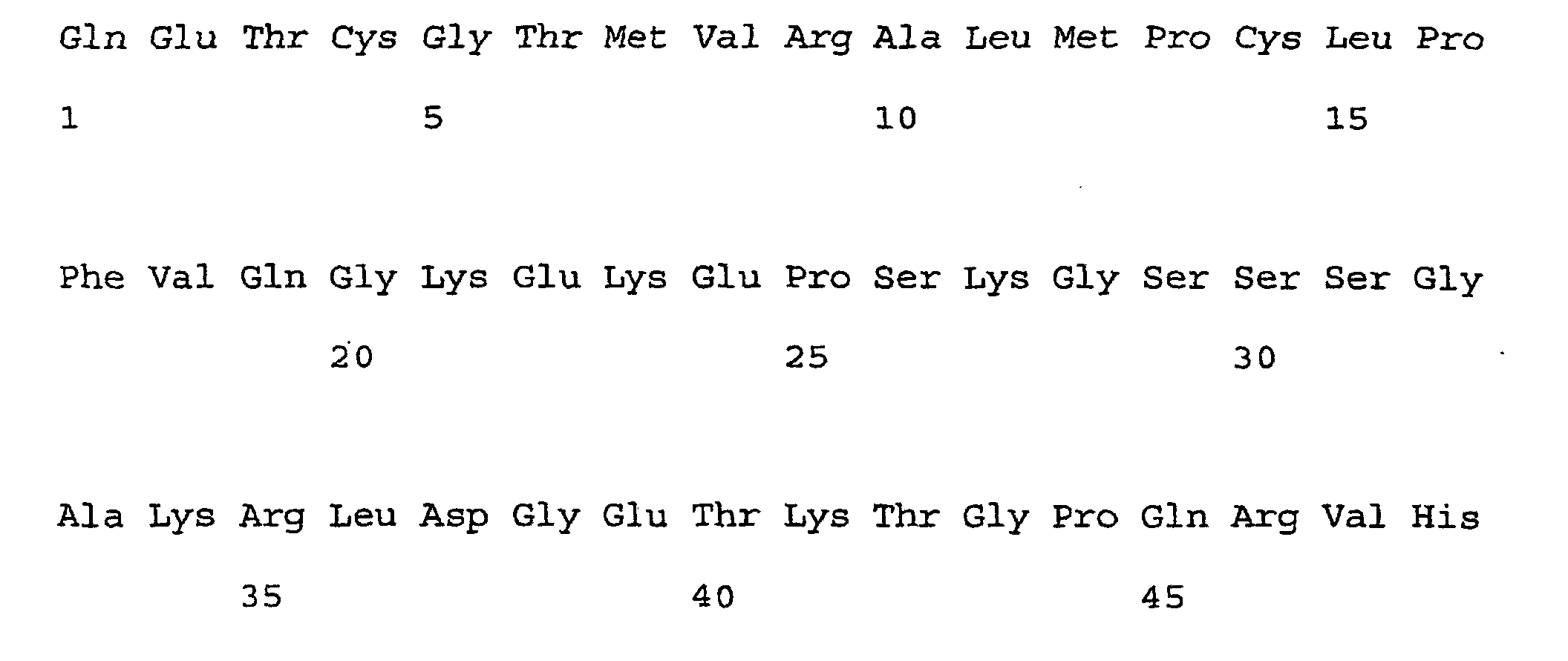
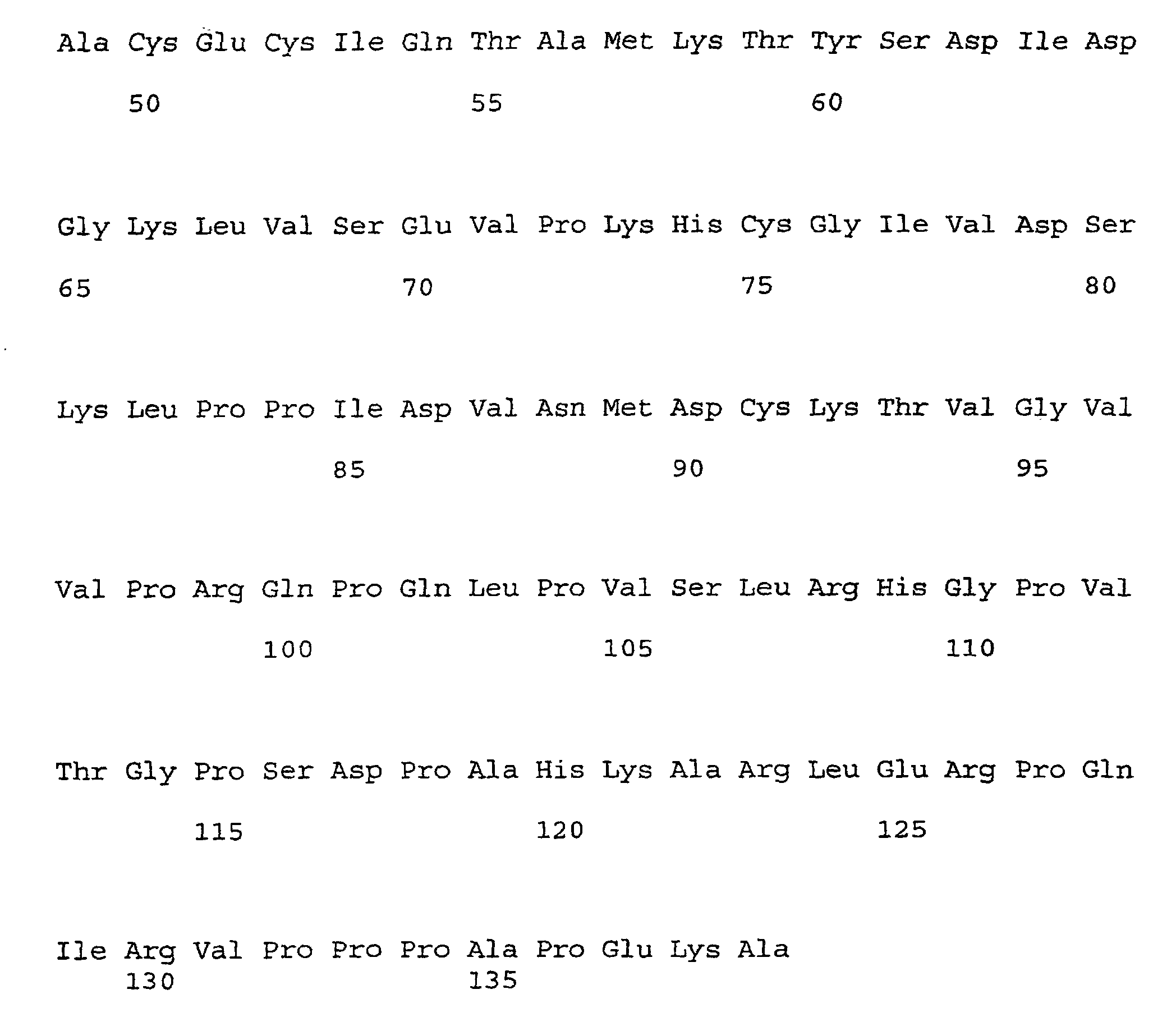
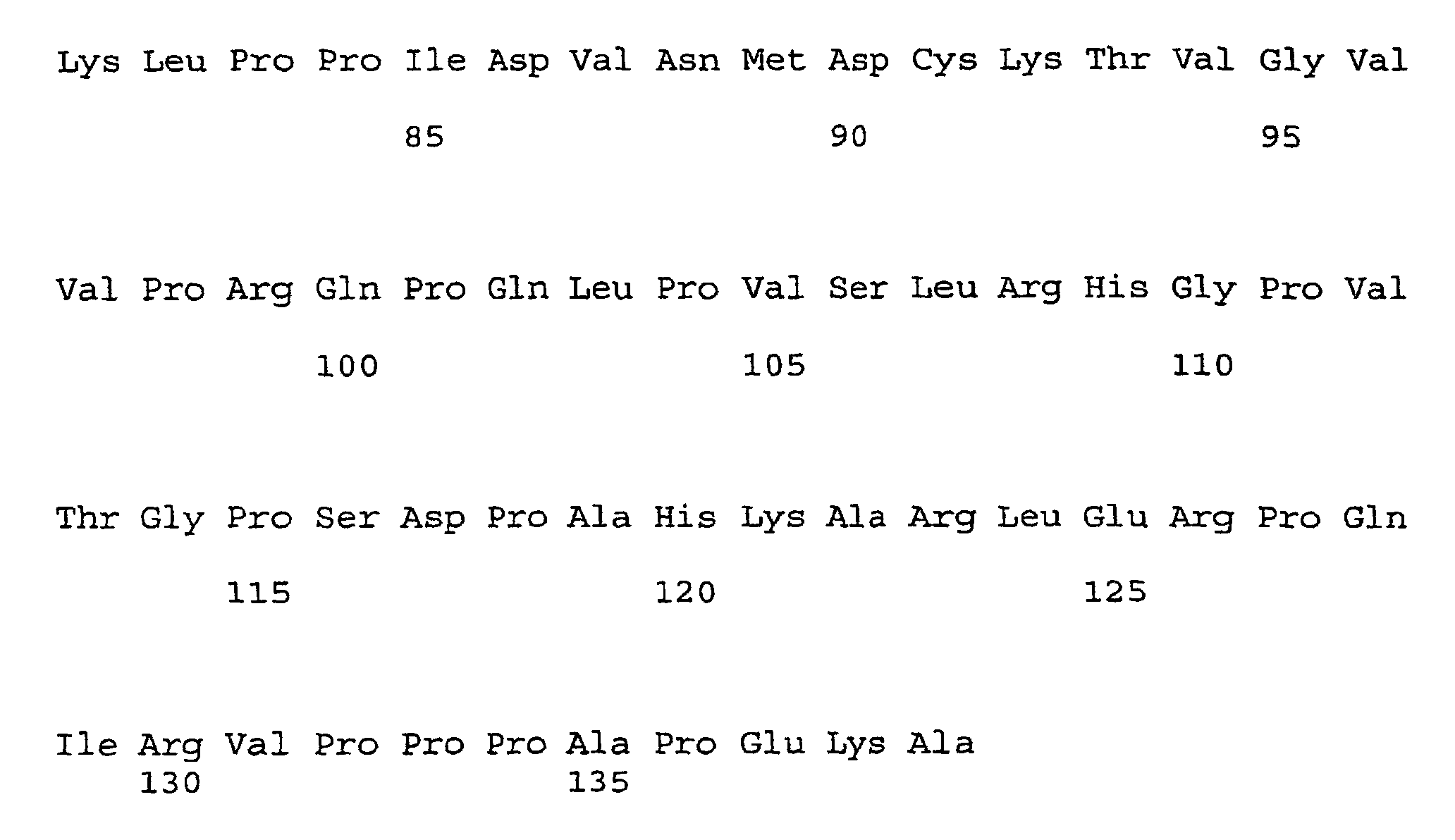
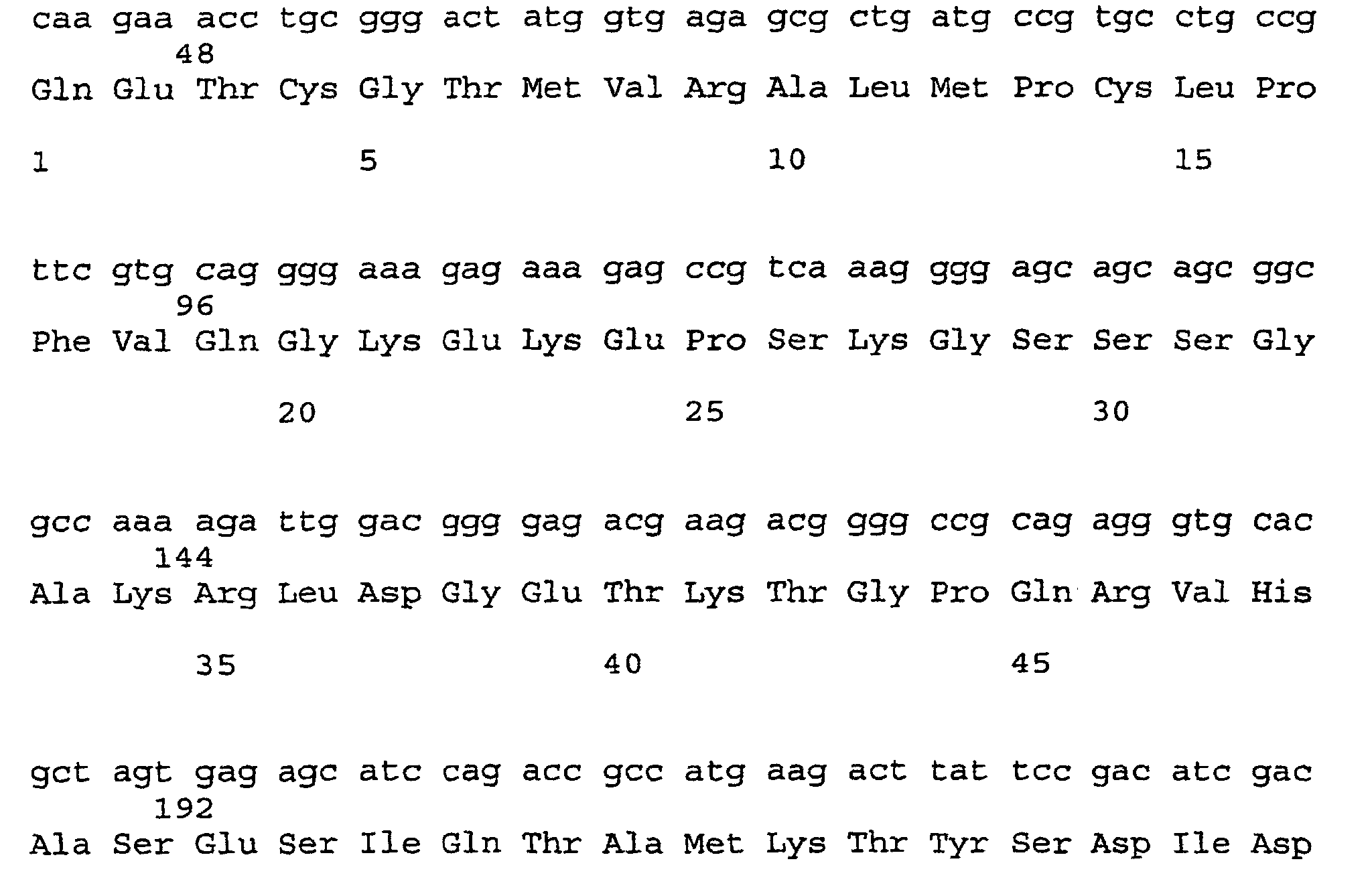
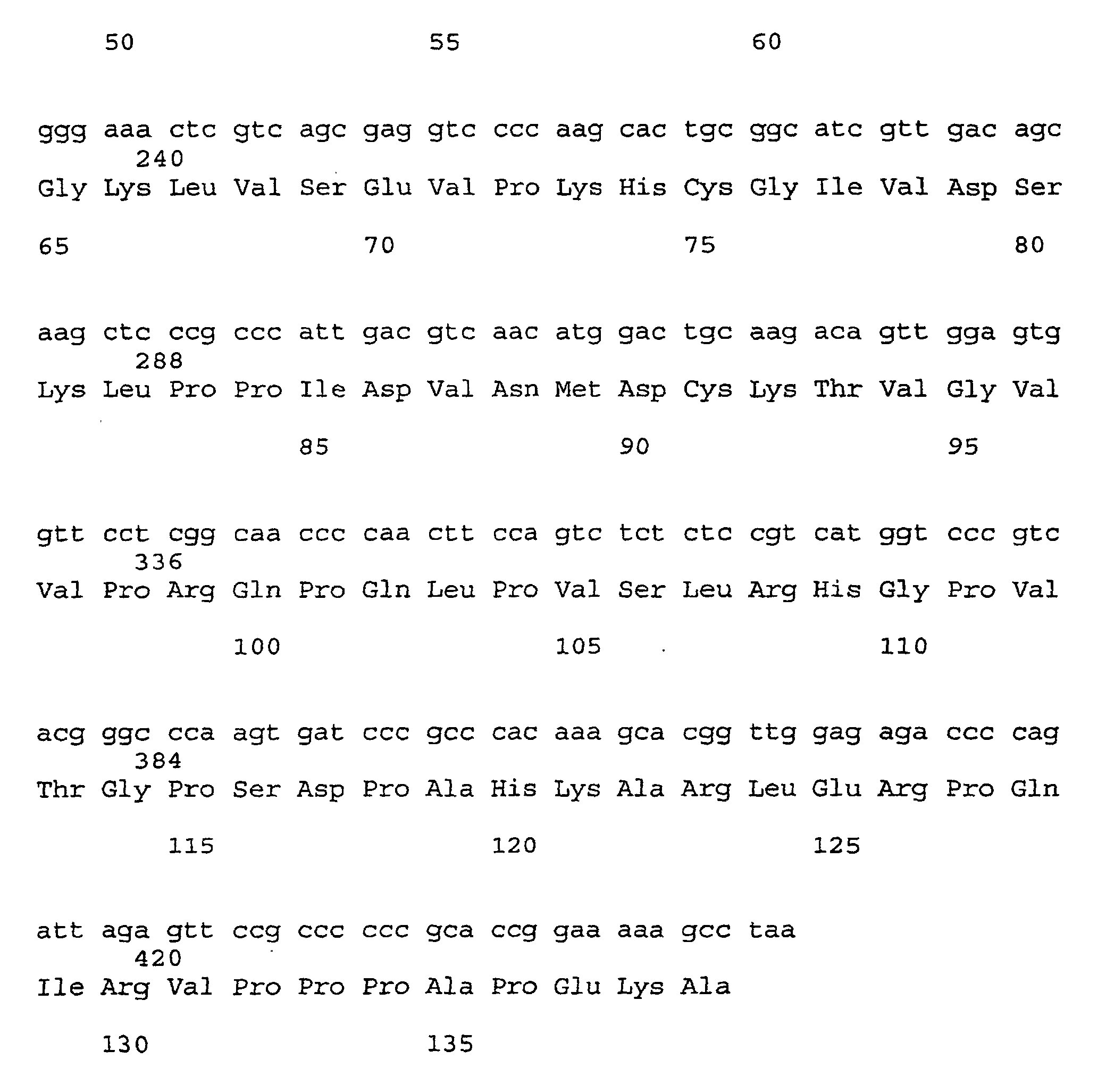
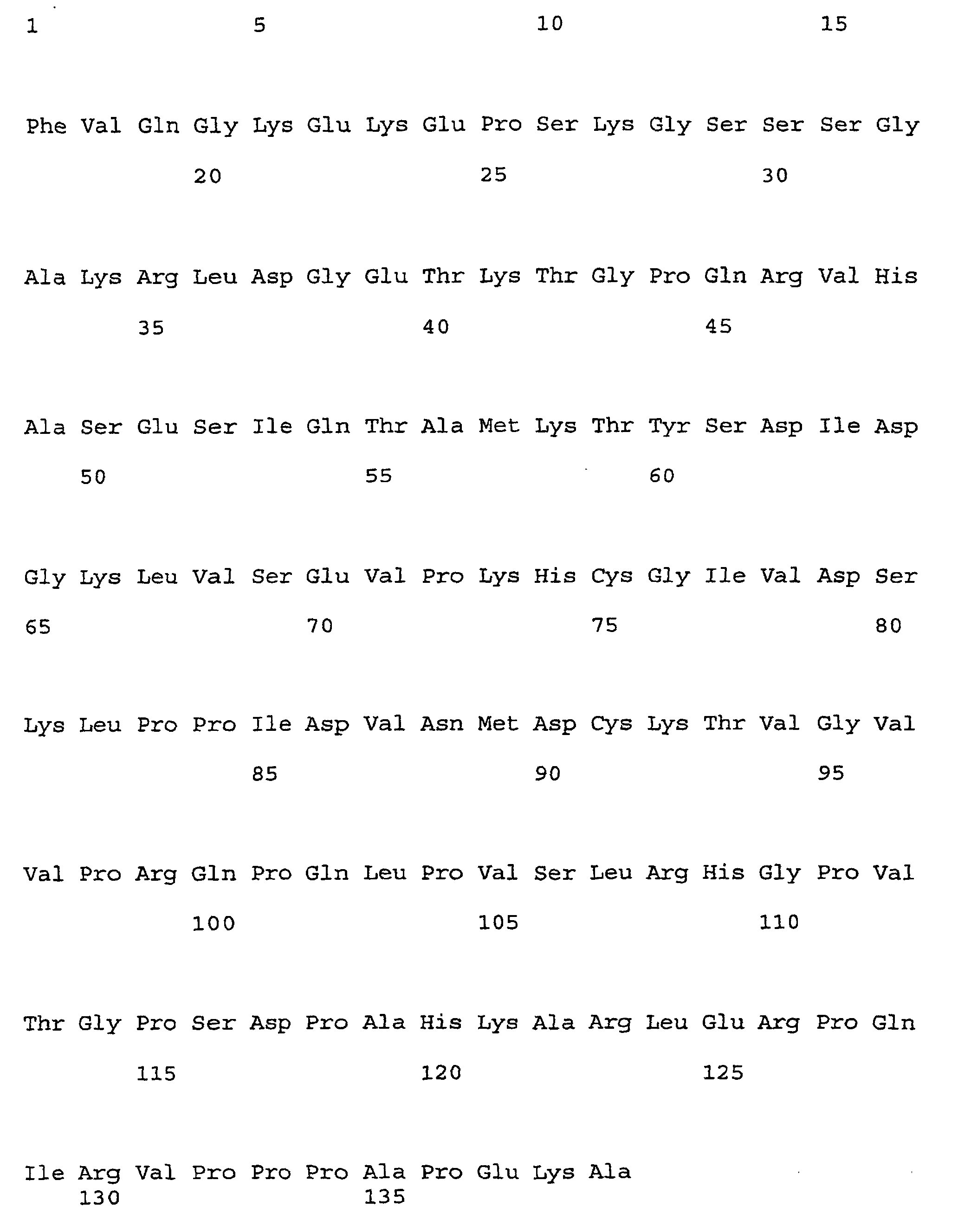
- the ns-LTPs allergen ParJ1 whose sequence and structure is reported in comparison with Par J2 in figure 1, and in particular the isoform Par j 1.0102 (the primary sequence thereof being reported in the annexed sequence listing as SEQ ID NOs:1 and 2), was taken as a molecular model, to be used for carrying out mutagenesis and the subsequent verification of the properties of the obtained mutant.
- recombinant DNA technology was resorted to in a strategy of site-directed mutagenesis against cysteines 4, 29, 30, 50 and 52, i.e., the cysteines constituting the disulfide bridges according to the structural model known to the art.
- ns-LTP Parj1 variants lacking of at least one disulfide bridge have a reduced allergenicity, which is even absent in the variants wherein the lacking bridge is localized in the aminoterminal region of the allergen at the domain alpha-helix1-loop1-alphahelix2, in particular when the lacking bridges are at least two.
- hypoallergenic variants generated by genetic engineering presented a similar behavior compared to the wild type, with a low reduction of their binding activity towards the anti-rParj1 rabbit antibodies.
- a variant that lacks of at least one disulfide bridges still contains several protein domains similar to the native molecule and, although at different extent, is apt to induce the production of IgG antibodies (see example 3 and 6).
- IgE production and/or IgE-mediated presentation of the allergen would be prevented by such "blocking" antibodies and reducing T cell proliferation and release of cytokines (25).
- variants lacking of three or four bridges as in the specific case PjC and PjD mutants, are considered as preferred embodiments.
- the above was demonstrated using a pool of sera as well as a cohort of individual patients, indicating that the obtained result is representative of the immune response of the allergic population.
- any variant obtainable by deletion, substitution and/or the insertion of one or more amino acidic residue which results in variants lacking of at least one disulfide bridge is included in the object of the invention.
- the strategy of point mutation has however the remarkable advantage of allowing the insertion of minimal variations at the level of the primary sequence of the native protein and therefore of generating mutants that are more likely not to interfere with the variant recognition operated by the T cells, and above all the possibility to generate proteins having a high reproducibility.
- the genetic mutagenesis imply however the remarkable advantage of allowing the generation of proteins having a high reproducibility, while the, chemical mutants do not ensure a denaturation pattern constant at every preparation.
- the adopted mutagenesis strategy is actually independent from the primary sequence of the allergen (and therefore from the sequence of the specific IgE epitopes).
- variant of the invention is not only any other mutein of the ParJ1 allergen or of other ns-LTP allergens which, independently from the mutation carried out (substitution and/or deletion of one or more amino acid residues) and of the way in which such a mutation is carried out (e.g., by the above mentioned techniques), retain a structure equivalent to that of the corresponding native allergen lacking at least one disulfide bridge.
- the pQE30 prokaryotic vector (Qiagen) was used.
- the latter characteristically expresses recombinant proteins fused to a short histidine tail and inducible with isopropyl- ⁇ -D-thiogalactoside (IPTG).
- IPTG isopropyl- ⁇ -D-thiogalactoside
- the histidine residues allow the purification of the recombinant protein by affinity chromatography.
- the fragment thus generated was fractionated on 1% agarose gel in I X TBE, extracted, purified and digested with Bam H1 and Hind III restriction enzymes and cloned in the Pqe30 VECTOR (Quiagen) previously digested with the same enzyme.
- the linearized vector and the digested fragments were incubated for 4 hours at 16° C in presence of the enzyme DNA ligase according to different stoichiometric ratios.
- the reaction mixture was then transformed in the bacterial strain M15.
- the recombinant clones were sequenced with the method of Sanger and the nucleotide sequence thus determined demonstrated that the DNA fragment inserted into the pQE30 vector was identical to that known in the art (10).
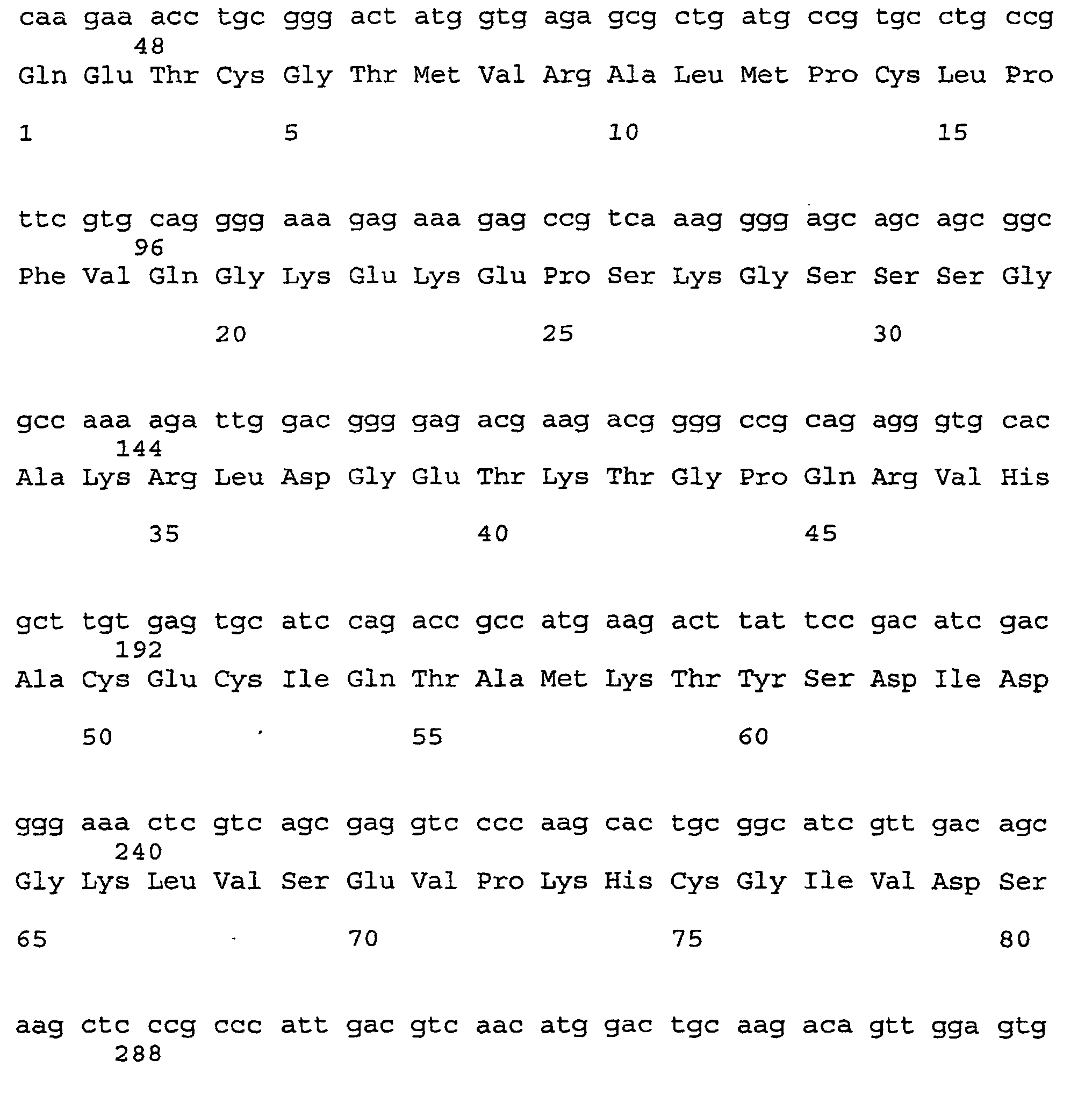
- PjA mutant (Cys29 ⁇ Ser and Cys30 ⁇ Ser) was generated using the Transformer Site-Directed Mutagenesis kit (Clontech) following the manufacturer's instruction and using the oligonucleotide P5 (29,30) reported in the sequence listing as SEQ ID NO: 13 (mapping from nucleotide 88 to nucleotide 105) and the Parj1 sequence as a template.
- PjB mutant (Cys50 ⁇ Ser and Cys52 ⁇ Ser) was generated by PCR using as primers the oligonucleotide P5(50-52)reported in the sequence listing as SEQ ID NO: 14 (mapping from nucleotide 91 to nucleotide 165) and P5 reverse oligonucleotide and 1 ng of the Parj1 clone as a template.
- the PCR fragment was digested with Pst I and Hind III restriction enzymes and ligated with the Pst I-Hind III linearized plasmid vector containing the Parj1 sequence (expressing the first 31 amino acids of the wild type Par j 1.0102 allergen).
- Pj C mutant (Cys4 ⁇ Ser, Cys29 ⁇ Ser and Cys30 ⁇ Ser) was generated by PCR amplification using the PjA variant as a template.
- the cysteine residue at position 4 was mutated by PCR using the oligonucleotides P5(triple), the sequence thereof being reported as SEQ ID NO: 15, and P5 reverse.
- PCR fragment was digested with Bam HI and Hind III enzymes and cloned in the pQE30 vector previously digested with the same restriction enzymes.
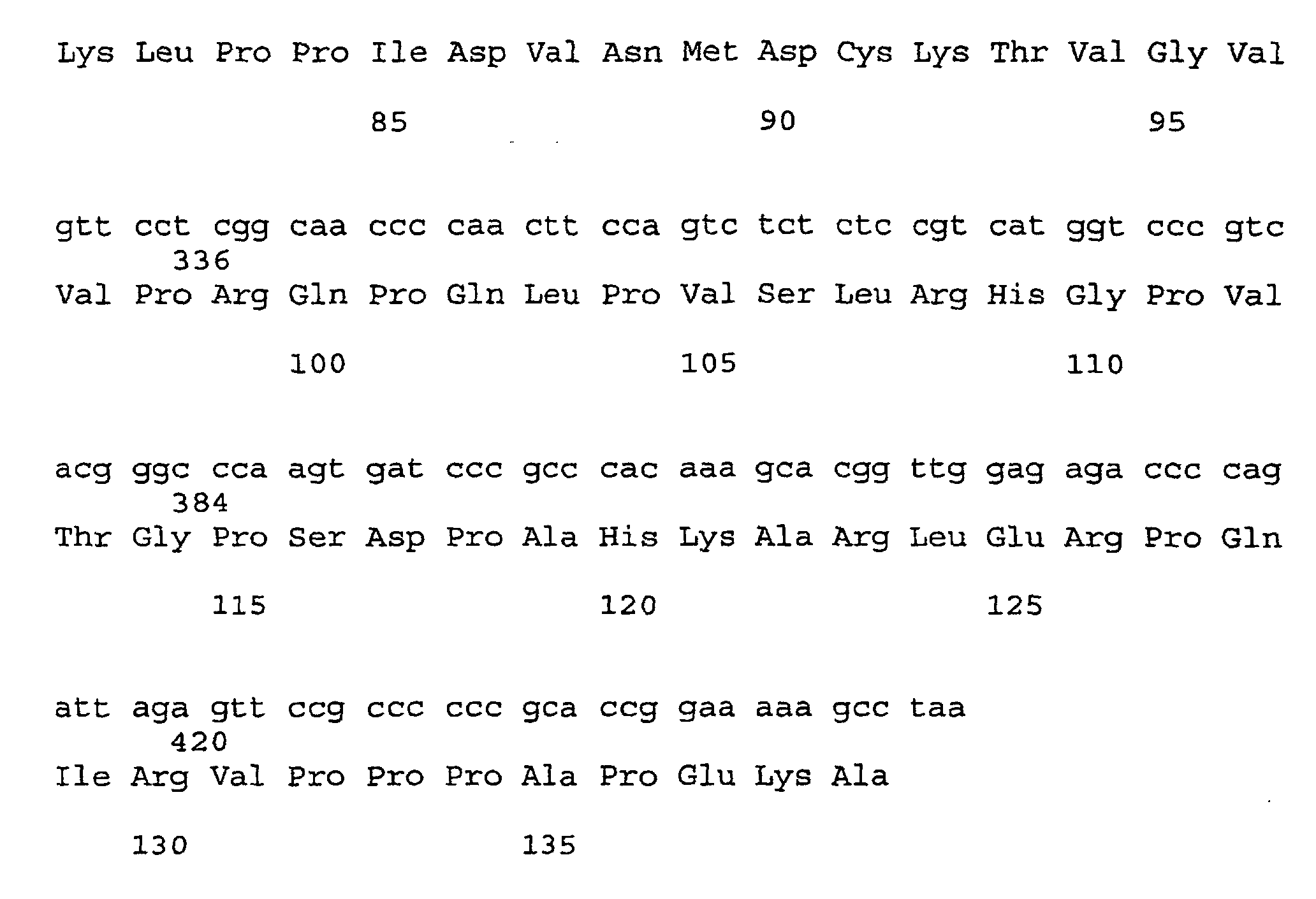
- PjD mutant (Cys29 ⁇ Ser, Cys30 ⁇ Ser, Cys50 ⁇ Ser and Cys52 ⁇ Ser) was generated using the Transformer Site-Directed Mutagenesis kit (Clontech) following the manufacturer's instruction and using the synthetic oligonucleotide P5 (29,30) reported in the sequence listing as SEQ ID NO: 13 and the PjB variant as a template. All clones were sequenced with the method of Sanger (24) and the mutations and the open reading frames confirmed (See Fig.3 for details).
- PjA SEQ ID NO: 3 and SEQ ID NO: 4
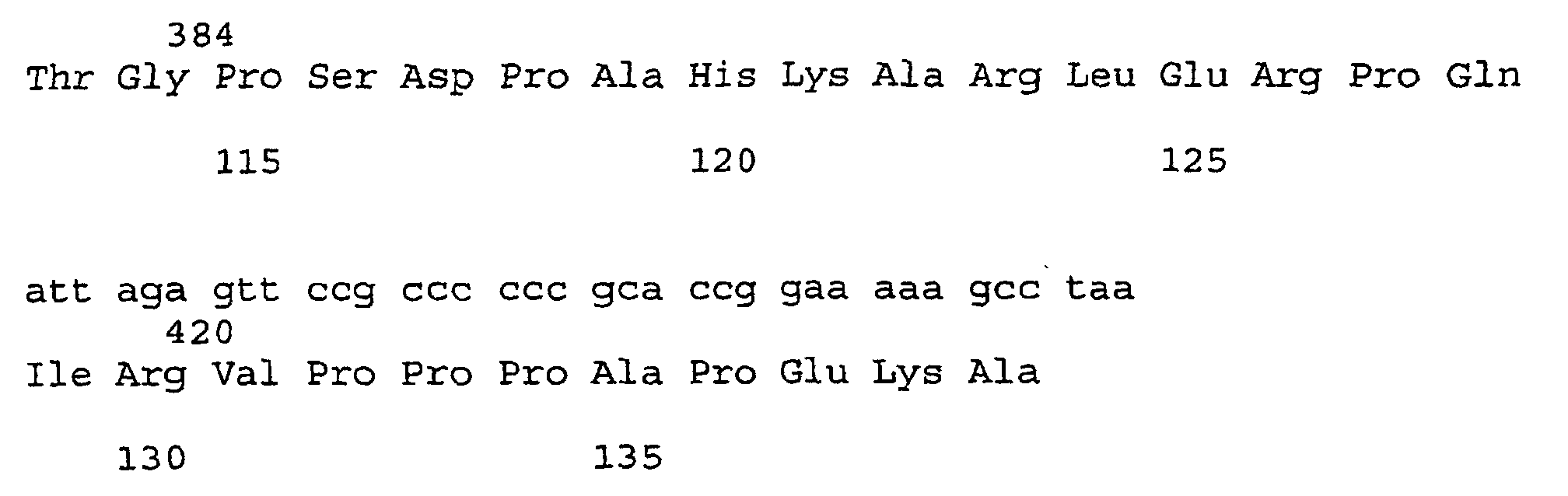
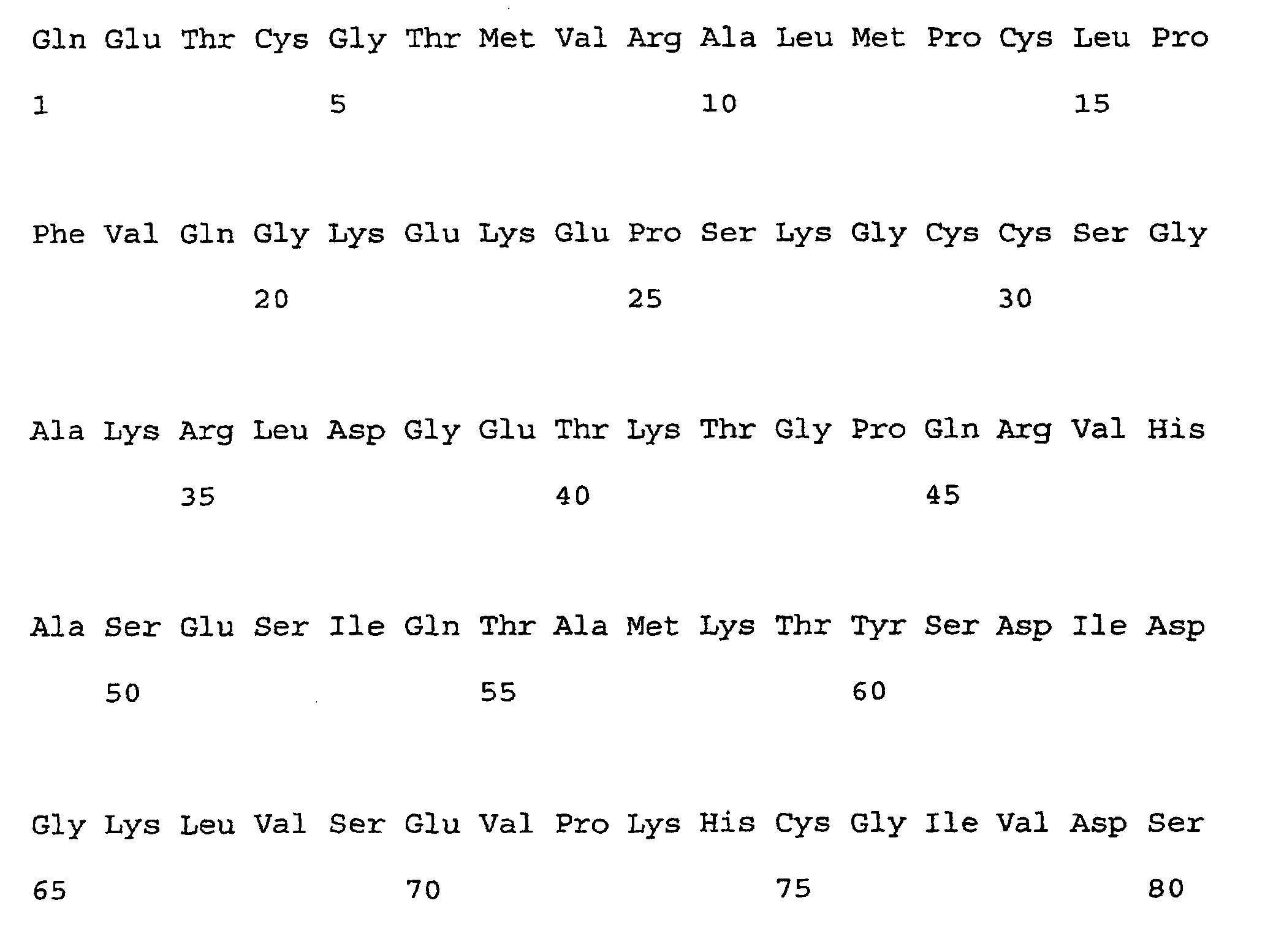
- PjB SEQ ID NO: 5 and SEQ ID NO: 6
- PjC SEQ ID NO: 7 and SEQ ID NO: 8
- PjD SEQ ID NO: 9 and SEQ ID NO: 10
- Example 3 Purification of recombinant proteins evaluation of the relevant capability of binding IgE of allergic patients
- a 1:40 dilution was grown for 1 hour at 37°C and, after that, induced with 1 mM isopropylthio- ⁇ -galactoside for 4 hours at 37° C.
- Cells were harvested by centrifugation and the recombinant proteins purified by using the His Trap kit (Pharmacia) following the manufacturer's instructions.
- Recombinant proteins, binding the HiTrap chelating column were eluted using a buffer containing: 20mM phosphate buffer pH7.4. 0,5 M NaCl, 8 M UREA and 500 mM imidazole; fractions were analysed by 16% SDS-PAGE and Coomassie Brilliant Blue staining.
- Fractions containing the purified protein were then diluted 1:100 in a buffer containing 20mM phosphate buffer pH7.4. 0,5 M NaCl and 20 mM imidazole to allow refolding of the protein, reloaded on the His Trap column and eluted with a buffer with no denaturing agents (20mM phosphate buffer pH7.4. 0,5 M NaCl and 500 mM imidazole).
- membranes were stripped and reprobed with a His-tag specific reagent (INDIATM Hisprobe-HRP, Pierce,USA) to check that the IgE-allergen complex was specific for the recombinant fused proteins.
- concentration of the recombinant proteins was determined by densitometric analysis of SDS-PAGE gels stained with Coomassie Brilliant Blue (see figure 4 panel B).
- the proteins purified were fractionated on 16% PAGE-SDS and transferred on nitro-cellulose thanks to a Dry-blot system (Millipore).
- the membrane was incubated for 12-14 hours with a pool of sera from Pj allergic patients (1:5 dilution) in PBS-tween.
- the protein-human IgE and IgG4 binding complexes are highlighted using respectively a secondary anti-IgE and anti-IgG4 antibodies conjugated to radish peroxidase.
- the complexes are highlighted using a chemioluminescence system (Super-signal, Pierce). The relevant results are reported in figure 4.
- the IgE binding activity of the four Parj1 disulfide bond variants was also tested by ELISA using sera from ten monosensitive Pj allergic patients. Analysis of single sera showed a remarkable homogeneity of the reaction.
- the Cys4-Cys52 and Cys50-Cys91 bridges did not influence the allergenicity of the protein since this mutant (PjB) showed an IgE binding activity comparable to the wild-type allergen.
- the Cys14-Cys29 and Cys30-Cys75 bridges seem to be crucial for the IgE recognition. All the variants lacking those two bonds (PjA, PjC and PjD) presented low or even absent IgE binding activity. (Fig.7)
- ELISA detection has been performed by adding 200 ⁇ l of a solution containing 5 ⁇ g/ml of antigen in coating buffer (sodium carbonate buffer pH 9,5) to each well of polystyrene plates overnight at room temperature. After several washing steps (1XPBS, 0.1% Tween 20) plates were saturated with a solution containing 5% BSA, 0,5% Tween 20 in coating buffer. After washing, 200 ⁇ l of serum (1:5 dilution) from Pj allergic patients or from a non allergic subject were incubated for 4 hours at room temperature.
- coating buffer sodium carbonate buffer pH 9,5
- Bound IgE antibodies were detected with a goat antihuman IgE-HRP conjugate (Biosource International) diluted at a concentration of 0,5 ng/ml in 1XPBS, 0,25% BSA, 0,1% Tween 20 for 1 hour at room temperature. After several washes, colorimetric reaction was developed by adding 0,2 ml/well of substrate solution (0,4 mg/ml o-phenylendiamine in 0,1 M citrate buffer). Optical density was read at 495 nm in a BIO-RAD microplate reader.
- Parj1 disulfide variants The ability of the Parj1 disulfide variants to interact with IgE antibodies was determined by an ELISA inhibition experiment.
- Rabbits were immunized by PRIMM sr1 (Milan, Italy) using the rParj1 allergen.
- rabbit polyclonal antibodies were analysed on a Western blot using a Parietaria judaica crude extract detecting a band of about 14000 Da corresponding to Parj1 native molecular weight.
- ELISA plates were coated at the same conditions as above described, with the wild-type Parj1 and with equal amount of each recombinant disulfide bond variant, were probed with an anti-rParj1 specific polyclonal serum to analyse their binding activity.
- Rabbit preimmune and immune sera were diluted at a concentration of 6 ng/ml and 200 ⁇ l of these solutions were incubated at room temperature for 1 hour. Wells were washed three times in 1XPBS, 0,1% Tween 20 and bound antibodies were detected using a donkey antirabbit Ig HRP linked (Amersham) at a 1:1000 dilution. Colorimetric reaction and optical density were performed as above described.
Landscapes
- Chemical & Material Sciences (AREA)
- Organic Chemistry (AREA)
- Health & Medical Sciences (AREA)
- Life Sciences & Earth Sciences (AREA)
- Proteomics, Peptides & Aminoacids (AREA)
- Biochemistry (AREA)
- Biophysics (AREA)
- Botany (AREA)
- Medicinal Chemistry (AREA)
- General Health & Medical Sciences (AREA)
- Molecular Biology (AREA)
- Genetics & Genomics (AREA)
- Gastroenterology & Hepatology (AREA)
- Peptides Or Proteins (AREA)
- Medicines Containing Antibodies Or Antigens For Use As Internal Diagnostic Agents (AREA)
- Medicinal Preparation (AREA)
Abstract
Description
- a first disulfide bridge connects the amino-terminal region and the third alpha-helix,
- a second disulfide bridge connects the first alpha-helix and the third alpha-helix,
- a third disulfide bridge connects the second alpha-helix and the fourth loop, and
- a fourth disulfide bridge connects the third alpha-helix and the folded beta-layer.
- a first composition comprising said ns-LTP allergen in native form together with a chemically and/or pharmaceutically acceptable carrier;
- at least one composition comprising a single variant of said ns-LTP allergen as abovedescribed and a chemically and/or pharmaceutically acceptable carrier;
| Inhibition of IgE binding | |
| Protein tested | %inhibition |
| rParj1 | 95% |
| PjA | 16% |
| PjB | 85% |
| PjC | 14% |
| PjD | 15% |
| Skin prick test of the rPar J and its disulfide bond variants | ||||||
| Patient No. | RParj1 | PjA | | PjC | PjD | |
| 1 | ++++ | - | - | - | - | |
| 2 | +++ | ++ | +++ | - | - | |
| 3 | ++++ | - | +++ | - | - | |
| 4 | ++++ | - | ++++ | - | - | |
| 5 | ++++ | ++ | +++ | - | - | |
| 6 | ++++ | - | +++ | - | - | |
| 7 | ++++ | - | ++++ | - | - | |
| 8 | ++++ | ++ | +++ | - | - | |
| 9 | +++ | - | ++ | - | - | |
| 10 | +++ | - | ++ | - | - | |
| P.C. | - | - | - | - | - | |
| D.G. | - | - | - | - | - |
<211> 420
<212> DNA
<213> Artificial sequence
<223> Mature Parj1.0102 wild type
<221> CDS
<222> (1)..(420)
<223>
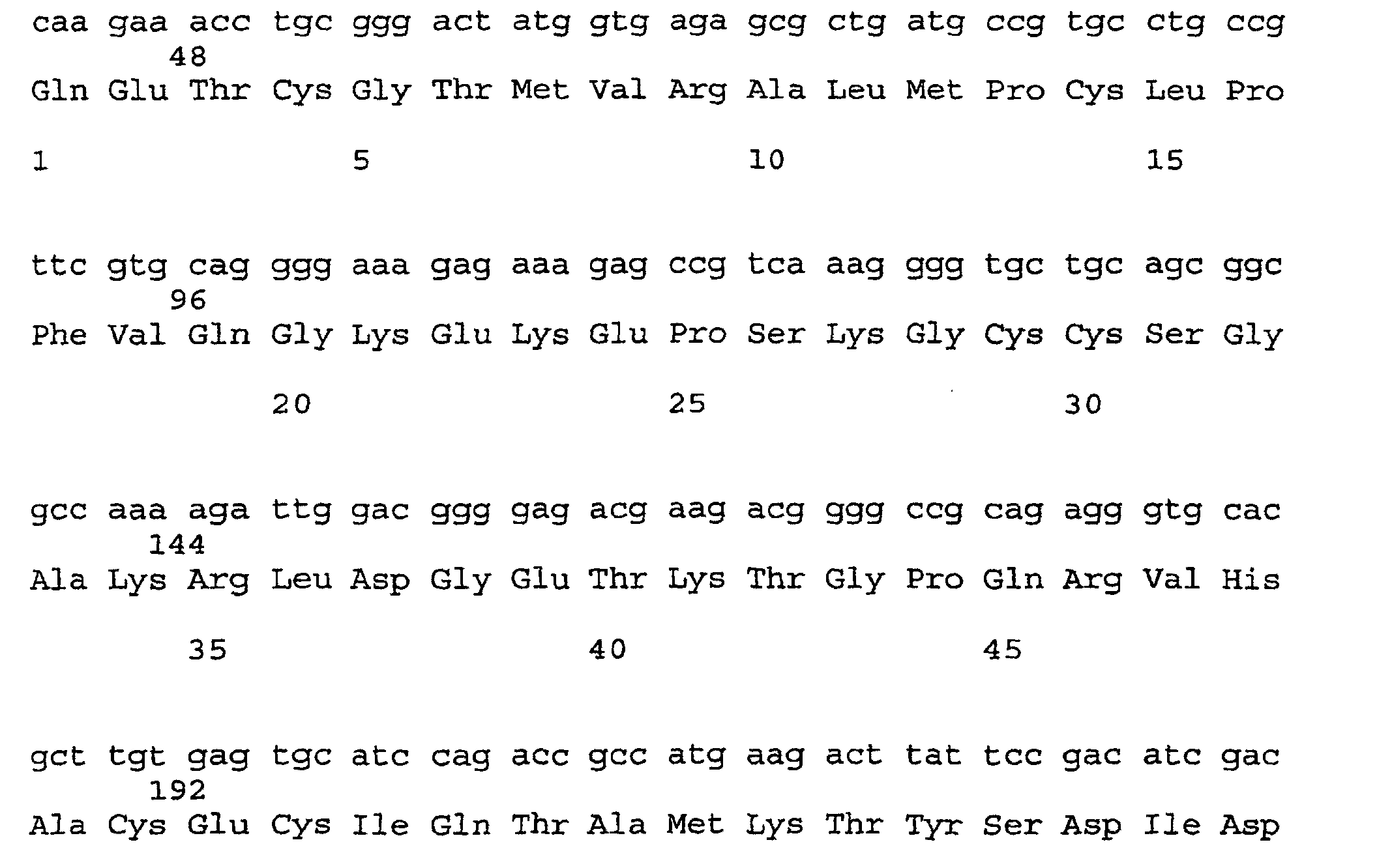

<211> 139
<212> PRT
<213> Artificial sequence
<223> Mature Parj1.0102 wild type

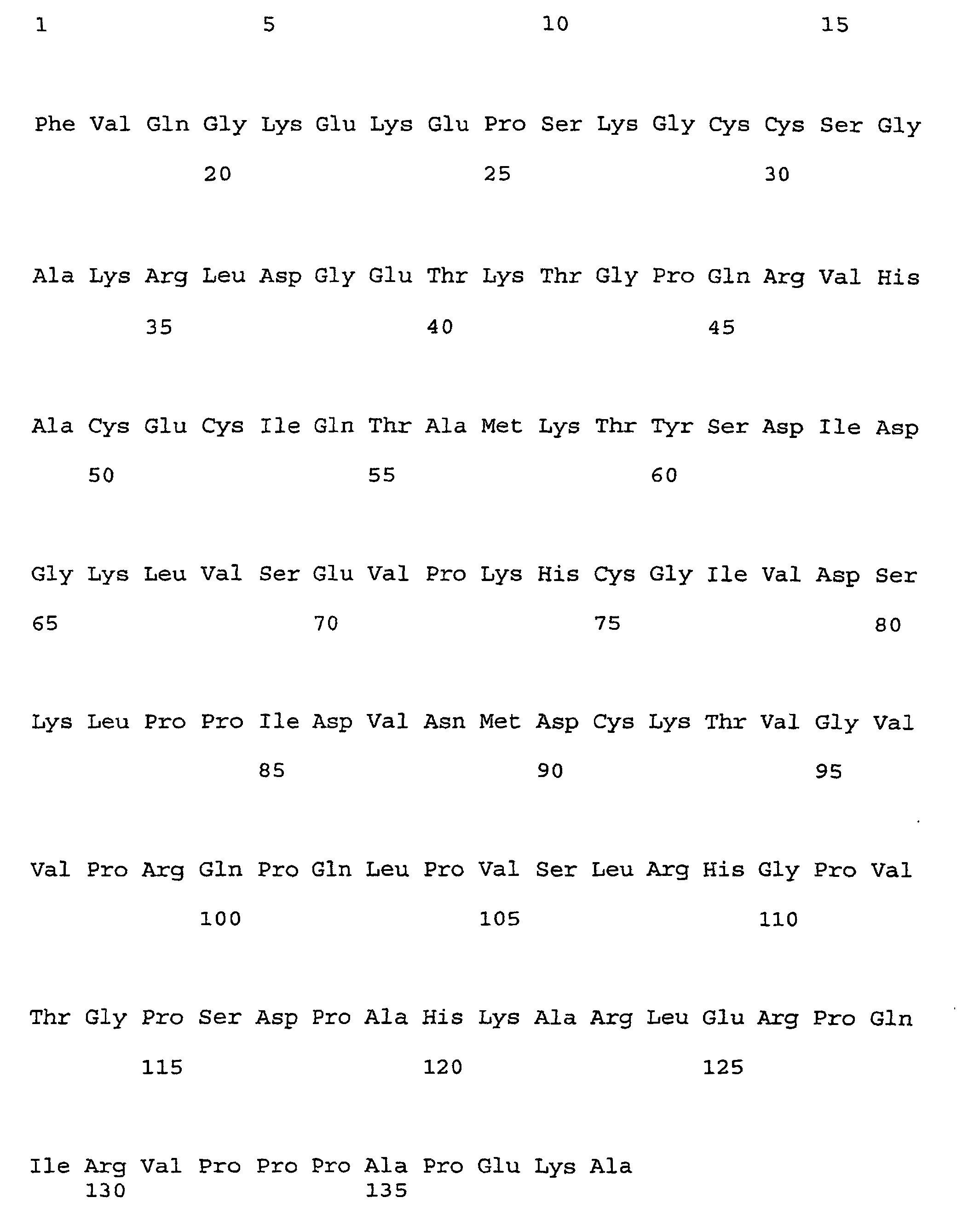
<211> 420
<212> DNA
<213> Artificial Sequence
<223>
<221> CDS
<222> (1)..(420)
<223> Coding sequence for the mutant of ParJ1 protein by subst itution o
f Cys 29 and 30 with Ser
<211> 139
<212> PRT
<213> Artificial Sequence
<223>
<211> 420
<212> DNA
<213> Artificial Sequence
<223>
<221> CDS
<222> (1)..(420)
<223> Coding sequence for the mutant of
of Cys 50 and 52 with Ser

<211> 139
<212> PRT
<213> Artificial Sequence
<223>
<211> 420
<212> DNA
<213> Artificial Sequence
<223> Parj1 variant PjC
<221> CDS
<222> (1) .. (420)
<223> Coding sequence for
9 and 30 with Ser


<211> 139
<212> PRT
<213> Artificial Sequence
<223> Parj1 variant PjC


<211> 420
<212> DNA
<213> Artificial Sequence
<223>
<221> CDS
<222> (1)..(420)
<223> Coding sequence for
Cys 29,
30, 50 and 52 with Ser
<211> 139
<212> PRT
<213> Artificial Sequence
<223>

<211> 30
Claims (28)
- A variant of an allergen belonging to the family of the ns-LTP proteins, said variant maintaining most of the amino acid sequence of the wild type allergen, said variant lacking at least one of the four disulfide bridges constituting the structure of said allergen and exhibiting reduced IgE binding capability while maintaining the capability of inducing IgG response.
- The variant according to claim 1, said variant lacking at least one disulfide bridge in the amino-terminal region of said allergen.
- The variant according to claim 1 or 2, said variant lacking two of said disulfide bridges constituting the structure of said allergen.
- The variant according to claim 1, said variant lacking three, or four of said disulfide bridges constituting the structure of said allergen.
- The variant according to any one of the claims 1 to 4, said variant being a mutein wherein at least one of the cysteines constituting said disulfide bridges is deleted.
- The variant according to any one of the claims 1 to 5, said variant being a mutein wherein at least one of the cysteines constituting said disulfide bridges is substituted with an amino acid residue not capable of forming disulfide bridges.
- The variant according to claim 6, wherein said amino acid residue is serine or alanine.
- The variant according to any of claims 1 to 7, wherein said allergen is one of the major allergens of Parietaria Judaica.
- The variant according to claim 8, wherein said allergen is Parj1, and said cysteines constituting the disulfide bridges are the cysteines 4, 14, 29, 30, 50, 52, 75 and 91.
- The variant according to claim 9, wherein the sequence of said variant comprises a sequence selected from the group consisting of the sequences reported in the sequence listing as SEQ ID NO: 1, SEQ ID NO: 3, SEQ ID NO: 5 and SEQ ID NO: 7.
- The variant according to any one of the claims 1 to 10 for use as a medicament or as a diagnostic agent.
- The variant according to claim 11 for use in a patient customised treatment and/or prevention of allergic form associated with an allergen belonging to the family of the ns-LTP proteins.
- The variant according to claim 12 which is a variant of a major allergen of Parietaria Judaica and wherein the allergic form is associated with an allergen of Parietaria Judaica.
- The variant according to claims 12 or 13 for use in the treatment of itch, erythema, edema, wheal, rash (urticaria) formation, rhino-conjunctivitis (seasonal allergies), bronchoconstriction, asthma and anaphylaxis.
- The variant according to claims 11 to 14 for use in preventive specific immunotherapy.
- The variant according to claim 11 for use as diagnostic agent for patient customised diagnosis of allergic forms.
- A polynucleotide coding for the variant according to any one of the claims 1 to 11.
- The polynucleotide according to claim 17, wherein said sequence of said variant comprises a sequence selected in the group comprising the sequences reported in the sequence listing as SEQ ID NO: 2, SEQ ID NO: 4, SEQ ID NO: 6 and SEQ ID NO: 8.
- A vector comprising at least one polynucleotide according to claim 17 or 18.
- An use of a variant according to any one of the claims 1 to 11, for the preparation of a medicament for the treatment and/or the prevention of allergic form associated with an allergen belonging to the family of the ns-LTP proteins.
- The use according to claim 20, wherein said allergen belonging to the family of ns-LTP proteins is the allergen corresponding to said variant.
- The use according to claim 20 or 21, wherein said allergen is a major allergen of Parietaria Judaica and said allergic form associated with said allergen is an allergic form from Parietaria Judaica.
- A pharmaceutical composition comprising at least one variant according to any one of the claims 1 to 11, and a pharmaceutically acceptable carrier.
- A pharmaceutical composition comprising at least one polynucleotide according to claim 17 or 18, and/or one vector according to claim 19, and a pharmaceutically acceptable carrier.
- A diagnostic agent comprising at least one variant according to any one of the claims 1 to 11, and a pharmaceutically acceptable carrier.
- A kit for the derivation of a subject-customised allergogram for an allergic form associated with an ns-LTP allergen, comprisingsaid allergogram being derivable contacting said compositions with immunoglobulins of said subject and observing the effects thus obtained.a first composition comprising said ns-LTP allergen in native form together with an acceptable carrier;at least one composition comprising a single variant of said ns-LTP allergen according to any one of the claims 1 to 11 and an acceptable carrier;
- The kit according to claim 26, comprising said first composition and a number of compositions each comprising a single variant of said ns-LTP allergen, equal to the number of the variants of said ns-LTP allergen.
- The kit according to claim 26 or 27, wherein said ns-LTP allergen is ParJ1.
Applications Claiming Priority (3)
| Application Number | Priority Date | Filing Date | Title |
|---|---|---|---|
| IT2000RM000494A IT1317905B1 (en) | 2000-09-11 | 2000-09-11 | VARIANTS OF NS-LTPS ALLERGENS, THEIR USES AND COMPOSITIONS THAT THEY INCLUDE. |
| ITRM000494 | 2000-09-11 | ||
| PCT/IT2001/000471 WO2002020790A1 (en) | 2000-09-11 | 2001-09-11 | Parietaria judaica ns-ltp antigen variants, uses thereof and compositions comprising them |
Publications (2)
| Publication Number | Publication Date |
|---|---|
| EP1317543A1 EP1317543A1 (en) | 2003-06-11 |
| EP1317543B1 true EP1317543B1 (en) | 2005-03-02 |
Family
ID=11454910
Family Applications (1)
| Application Number | Title | Priority Date | Filing Date |
|---|---|---|---|
| EP01972467A Expired - Lifetime EP1317543B1 (en) | 2000-09-11 | 2001-09-11 | Parietaria judaica ns-ltp antigen variants, uses thereof and compositions comprising them |
Country Status (9)
| Country | Link |
|---|---|
| US (1) | US20050031631A1 (en) |
| EP (1) | EP1317543B1 (en) |
| AT (1) | ATE290081T1 (en) |
| AU (1) | AU2001292230A1 (en) |
| CA (1) | CA2421840A1 (en) |
| DE (1) | DE60109180D1 (en) |
| ES (1) | ES2239162T3 (en) |
| IT (1) | IT1317905B1 (en) |
| WO (1) | WO2002020790A1 (en) |
Families Citing this family (8)
| Publication number | Priority date | Publication date | Assignee | Title |
|---|---|---|---|---|
| ITRM20030247A1 (en) * | 2003-05-20 | 2004-11-21 | Bonura Angela | HYPOALLERGENIC VARIANTS OF MAJOR ALLERGENS |
| ITRM20040103A1 (en) * | 2004-02-27 | 2004-05-27 | Consiglio Nazionale Ricerche | MELTING PROTEINS INCLUDING ALLERGENS OF THE NS-LTPS FAMILY, THEIR USES AND PHARMACEUTICAL COMPOSITIONS THAT INCLUDE THEM. |
| ES2307381B1 (en) | 2006-04-12 | 2009-10-23 | Bial Industrial Farmaceutica S.A. | HYPOALLERGENIC CHEMICAL PROTEINS BELONGING TO THE FAMILY OF TRANSPORTERS OF JUDAICA PARIETARY LIPIDS USED FOR THE TREATMENT OF ALLERGIES. |
| US20100226933A1 (en) * | 2007-02-14 | 2010-09-09 | Universitaet Salzburg | Hypoallergenic proteins |
| ITPA20080007A1 (en) | 2008-03-19 | 2009-09-20 | Angela Bonura | ANTI-LPS FACTOR BY PARIETARIA JUDAICA AND ITS METHODS OF USE. |
| EP2607376A1 (en) * | 2011-12-22 | 2013-06-26 | Biomay Ag | Hypoallergenic allergen derivatives of Pru p 3 for immunotherapy of IgE-mediated peach allergy |
| EP2813243B1 (en) * | 2013-06-11 | 2017-08-09 | Paris-Lodron-Universität Salzburg | PRU p 3 mimicks |
| EP4057009A1 (en) * | 2021-03-08 | 2022-09-14 | Euroimmun Medizinische Labordiagnostika AG | Methods and reagents for detecting an antibody to a sesame nsltp |
Family Cites Families (1)
| Publication number | Priority date | Publication date | Assignee | Title |
|---|---|---|---|---|
| US6555116B1 (en) * | 1991-10-12 | 2003-04-29 | Regents Of The University Of California | Alleviation of the allergenic potential of airborne and contact allergens by thioredoxin |
-
2000
- 2000-09-11 IT IT2000RM000494A patent/IT1317905B1/en active
-
2001
- 2001-09-11 EP EP01972467A patent/EP1317543B1/en not_active Expired - Lifetime
- 2001-09-11 AU AU2001292230A patent/AU2001292230A1/en not_active Abandoned
- 2001-09-11 US US10/380,002 patent/US20050031631A1/en not_active Abandoned
- 2001-09-11 CA CA002421840A patent/CA2421840A1/en not_active Abandoned
- 2001-09-11 ES ES01972467T patent/ES2239162T3/en not_active Expired - Lifetime
- 2001-09-11 DE DE60109180T patent/DE60109180D1/en not_active Expired - Lifetime
- 2001-09-11 AT AT01972467T patent/ATE290081T1/en active
- 2001-09-11 WO PCT/IT2001/000471 patent/WO2002020790A1/en not_active Ceased
Also Published As
| Publication number | Publication date |
|---|---|
| ATE290081T1 (en) | 2005-03-15 |
| EP1317543A1 (en) | 2003-06-11 |
| IT1317905B1 (en) | 2003-07-15 |
| ITRM20000494A0 (en) | 2000-09-11 |
| WO2002020790A9 (en) | 2003-05-30 |
| US20050031631A1 (en) | 2005-02-10 |
| ES2239162T3 (en) | 2005-09-16 |
| WO2002020790A1 (en) | 2002-03-14 |
| AU2001292230A1 (en) | 2002-03-22 |
| CA2421840A1 (en) | 2002-03-14 |
| ITRM20000494A1 (en) | 2002-03-11 |
| DE60109180D1 (en) | 2005-04-07 |
Similar Documents
| Publication | Publication Date | Title |
|---|---|---|
| Vrtala et al. | Immunologic characterization of purified recombinant timothy grass pollen (Phleum pratense) allergens (Phl p 1, Phl p 2, Phl p 5) | |
| Tamborini et al. | Biochemical and immunological characterization of recombinant allergen Lol p 1 | |
| US20150079120A1 (en) | Dna sequence and preparation of grass pollen allergen phl p4 by recombinant methods | |
| US20050031631A1 (en) | Parietaria judaica ns-ltp antigen variants, uses thereof and compositions comprising them | |
| JPH05502589A (en) | Birch pollen allergen P14 for diagnosis and treatment of allergic diseases | |
| US20090098167A1 (en) | PHL P 1 Allergen Derivative | |
| CN103874509B (en) | Hypoallergenic variant of the major allergen Mal d 1 from apples | |
| US20130004527A1 (en) | Contiguous overlapping peptides for treatment of ragweed pollen allergy | |
| EP1317484B1 (en) | Variants of the phleum pratense phl p 1 allergenic protein | |
| EP1720900B1 (en) | Fusion proteins comprising modified allergens of the ns-ltps family, use thereof and pharmaceutical compositions comprising the same | |
| AU2005231004B2 (en) | Novel mite allergen | |
| US20030180225A1 (en) | Walnut and ryegrass allergens | |
| WO1992016554A1 (en) | Protein allergens of the species cynodon dactylon | |
| EP2794644B1 (en) | Hypoallergenic variants of phl p 5, the major allergen from phleum pratense | |
| PT1434793E (en) | Recombinant allergen with reduced ige binding but undiminished t-cell antigenicity | |
| EP2281836B9 (en) | Hybrid proteins from Parietaria judaica major allergens and uses thereof | |
| US20050215766A1 (en) | Allergen from mugwort pollen |
Legal Events
| Date | Code | Title | Description |
|---|---|---|---|
| PUAI | Public reference made under article 153(3) epc to a published international application that has entered the european phase |
Free format text: ORIGINAL CODE: 0009012 |
|
| 17P | Request for examination filed |
Effective date: 20030409 |
|
| AK | Designated contracting states |
Designated state(s): AT BE CH CY DE DK ES FI FR GB GR IE IT LI LU MC NL PT SE TR |
|
| AX | Request for extension of the european patent |
Extension state: AL LT LV MK RO SI |
|
| GRAP | Despatch of communication of intention to grant a patent |
Free format text: ORIGINAL CODE: EPIDOSNIGR1 |
|
| GRAS | Grant fee paid |
Free format text: ORIGINAL CODE: EPIDOSNIGR3 |
|
| GRAA | (expected) grant |
Free format text: ORIGINAL CODE: 0009210 |
|
| AK | Designated contracting states |
Kind code of ref document: B1 Designated state(s): AT BE CH CY DE DK ES FI FR GB GR IE IT LI LU MC NL PT SE TR |
|
| PG25 | Lapsed in a contracting state [announced via postgrant information from national office to epo] |
Ref country code: LI Free format text: LAPSE BECAUSE OF FAILURE TO SUBMIT A TRANSLATION OF THE DESCRIPTION OR TO PAY THE FEE WITHIN THE PRESCRIBED TIME-LIMIT Effective date: 20050302 Ref country code: FI Free format text: LAPSE BECAUSE OF FAILURE TO SUBMIT A TRANSLATION OF THE DESCRIPTION OR TO PAY THE FEE WITHIN THE PRESCRIBED TIME-LIMIT Effective date: 20050302 Ref country code: CH Free format text: LAPSE BECAUSE OF FAILURE TO SUBMIT A TRANSLATION OF THE DESCRIPTION OR TO PAY THE FEE WITHIN THE PRESCRIBED TIME-LIMIT Effective date: 20050302 Ref country code: NL Free format text: LAPSE BECAUSE OF FAILURE TO SUBMIT A TRANSLATION OF THE DESCRIPTION OR TO PAY THE FEE WITHIN THE PRESCRIBED TIME-LIMIT Effective date: 20050302 Ref country code: BE Free format text: LAPSE BECAUSE OF FAILURE TO SUBMIT A TRANSLATION OF THE DESCRIPTION OR TO PAY THE FEE WITHIN THE PRESCRIBED TIME-LIMIT Effective date: 20050302 |
|
| REG | Reference to a national code |
Ref country code: GB Ref legal event code: FG4D |
|
| REG | Reference to a national code |
Ref country code: CH Ref legal event code: EP |
|
| REG | Reference to a national code |
Ref country code: IE Ref legal event code: FG4D |
|
| REF | Corresponds to: |
Ref document number: 60109180 Country of ref document: DE Date of ref document: 20050407 Kind code of ref document: P |
|
| PG25 | Lapsed in a contracting state [announced via postgrant information from national office to epo] |
Ref country code: DK Free format text: LAPSE BECAUSE OF FAILURE TO SUBMIT A TRANSLATION OF THE DESCRIPTION OR TO PAY THE FEE WITHIN THE PRESCRIBED TIME-LIMIT Effective date: 20050602 |
|
| PG25 | Lapsed in a contracting state [announced via postgrant information from national office to epo] |
Ref country code: DE Free format text: LAPSE BECAUSE OF FAILURE TO SUBMIT A TRANSLATION OF THE DESCRIPTION OR TO PAY THE FEE WITHIN THE PRESCRIBED TIME-LIMIT Effective date: 20050603 |
|
| REG | Reference to a national code |
Ref country code: GR Ref legal event code: EP Ref document number: 20050401727 Country of ref document: GR |
|
| GRAC | Information related to communication of intention to grant a patent modified |
Free format text: ORIGINAL CODE: EPIDOSCIGR1 |
|
| GRAL | Information related to payment of fee for publishing/printing deleted |
Free format text: ORIGINAL CODE: EPIDOSDIGR3 |
|
| NLV1 | Nl: lapsed or annulled due to failure to fulfill the requirements of art. 29p and 29m of the patents act | ||
| PG25 | Lapsed in a contracting state [announced via postgrant information from national office to epo] |
Ref country code: PT Free format text: LAPSE BECAUSE OF FAILURE TO SUBMIT A TRANSLATION OF THE DESCRIPTION OR TO PAY THE FEE WITHIN THE PRESCRIBED TIME-LIMIT Effective date: 20050907 |
|
| PG25 | Lapsed in a contracting state [announced via postgrant information from national office to epo] |
Ref country code: GB Free format text: LAPSE BECAUSE OF NON-PAYMENT OF DUE FEES Effective date: 20050911 Ref country code: CY Free format text: LAPSE BECAUSE OF FAILURE TO SUBMIT A TRANSLATION OF THE DESCRIPTION OR TO PAY THE FEE WITHIN THE PRESCRIBED TIME-LIMIT Effective date: 20050911 |
|
| PG25 | Lapsed in a contracting state [announced via postgrant information from national office to epo] |
Ref country code: IE Free format text: LAPSE BECAUSE OF NON-PAYMENT OF DUE FEES Effective date: 20050912 |
|
| REG | Reference to a national code |
Ref country code: CH Ref legal event code: PL |
|
| REG | Reference to a national code |
Ref country code: ES Ref legal event code: FG2A Ref document number: 2239162 Country of ref document: ES Kind code of ref document: T3 |
|
| PG25 | Lapsed in a contracting state [announced via postgrant information from national office to epo] |
Ref country code: LU Free format text: LAPSE BECAUSE OF NON-PAYMENT OF DUE FEES Effective date: 20050930 Ref country code: MC Free format text: LAPSE BECAUSE OF NON-PAYMENT OF DUE FEES Effective date: 20050930 |
|
| PLBE | No opposition filed within time limit |
Free format text: ORIGINAL CODE: 0009261 |
|
| STAA | Information on the status of an ep patent application or granted ep patent |
Free format text: STATUS: NO OPPOSITION FILED WITHIN TIME LIMIT |
|
| 26N | No opposition filed |
Effective date: 20051205 |
|
| ET | Fr: translation filed | ||
| GBPC | Gb: european patent ceased through non-payment of renewal fee |
Effective date: 20050911 |
|
| GRAJ | Information related to disapproval of communication of intention to grant by the applicant or resumption of examination proceedings by the epo deleted |
Free format text: ORIGINAL CODE: EPIDOSDIGR1 |
|
| GRAP | Despatch of communication of intention to grant a patent |
Free format text: ORIGINAL CODE: EPIDOSNIGR1 |
|
| GRAS | Grant fee paid |
Free format text: ORIGINAL CODE: EPIDOSNIGR3 |
|
| REG | Reference to a national code |
Ref country code: IE Ref legal event code: MM4A |
|
| PG25 | Lapsed in a contracting state [announced via postgrant information from national office to epo] |
Ref country code: SE Free format text: LAPSE BECAUSE OF FAILURE TO SUBMIT A TRANSLATION OF THE DESCRIPTION OR TO PAY THE FEE WITHIN THE PRESCRIBED TIME-LIMIT Effective date: 20050602 |
|
| PGFP | Annual fee paid to national office [announced via postgrant information from national office to epo] |
Ref country code: TR Payment date: 20130822 Year of fee payment: 13 |
|
| PGFP | Annual fee paid to national office [announced via postgrant information from national office to epo] |
Ref country code: GR Payment date: 20140919 Year of fee payment: 14 |
|
| PGFP | Annual fee paid to national office [announced via postgrant information from national office to epo] |
Ref country code: FR Payment date: 20140919 Year of fee payment: 14 Ref country code: AT Payment date: 20140911 Year of fee payment: 14 Ref country code: ES Payment date: 20140926 Year of fee payment: 14 |
|
| PGFP | Annual fee paid to national office [announced via postgrant information from national office to epo] |
Ref country code: IT Payment date: 20140902 Year of fee payment: 14 |
|
| PG25 | Lapsed in a contracting state [announced via postgrant information from national office to epo] |
Ref country code: IT Free format text: LAPSE BECAUSE OF NON-PAYMENT OF DUE FEES Effective date: 20150911 |
|
| REG | Reference to a national code |
Ref country code: AT Ref legal event code: MM01 Ref document number: 290081 Country of ref document: AT Kind code of ref document: T Effective date: 20150911 |
|
| REG | Reference to a national code |
Ref country code: GR Ref legal event code: ML Ref document number: 20050401727 Country of ref document: GR Effective date: 20160405 |
|
| REG | Reference to a national code |
Ref country code: FR Ref legal event code: ST Effective date: 20160531 |
|
| PG25 | Lapsed in a contracting state [announced via postgrant information from national office to epo] |
Ref country code: GR Free format text: LAPSE BECAUSE OF NON-PAYMENT OF DUE FEES Effective date: 20160405 |
|
| PG25 | Lapsed in a contracting state [announced via postgrant information from national office to epo] |
Ref country code: FR Free format text: LAPSE BECAUSE OF NON-PAYMENT OF DUE FEES Effective date: 20150930 Ref country code: AT Free format text: LAPSE BECAUSE OF NON-PAYMENT OF DUE FEES Effective date: 20150911 |
|
| REG | Reference to a national code |
Ref country code: ES Ref legal event code: FD2A Effective date: 20161026 |
|
| PG25 | Lapsed in a contracting state [announced via postgrant information from national office to epo] |
Ref country code: ES Free format text: LAPSE BECAUSE OF NON-PAYMENT OF DUE FEES Effective date: 20150912 |
|
| PG25 | Lapsed in a contracting state [announced via postgrant information from national office to epo] |
Ref country code: TR Free format text: LAPSE BECAUSE OF NON-PAYMENT OF DUE FEES Effective date: 20150911 |