EP1316867A2 - Verfahren und Vorrichtung zum Ermitteln und Überwachen von Resourcen in einem Herstellungsprozess - Google Patents
Verfahren und Vorrichtung zum Ermitteln und Überwachen von Resourcen in einem Herstellungsprozess Download PDFInfo
- Publication number
- EP1316867A2 EP1316867A2 EP02025121A EP02025121A EP1316867A2 EP 1316867 A2 EP1316867 A2 EP 1316867A2 EP 02025121 A EP02025121 A EP 02025121A EP 02025121 A EP02025121 A EP 02025121A EP 1316867 A2 EP1316867 A2 EP 1316867A2
- Authority
- EP
- European Patent Office
- Prior art keywords
- capacity
- parts
- supplier
- requirement
- system provider
- Prior art date
- Legal status (The legal status is an assumption and is not a legal conclusion. Google has not performed a legal analysis and makes no representation as to the accuracy of the status listed.)
- Withdrawn
Links
Images



Classifications
-
- G—PHYSICS
- G05—CONTROLLING; REGULATING
- G05B—CONTROL OR REGULATING SYSTEMS IN GENERAL; FUNCTIONAL ELEMENTS OF SUCH SYSTEMS; MONITORING OR TESTING ARRANGEMENTS FOR SUCH SYSTEMS OR ELEMENTS
- G05B19/00—Program-control systems
- G05B19/02—Program-control systems electric
- G05B19/418—Total factory control, i.e. centrally controlling a plurality of machines, e.g. direct or distributed numerical control [DNC], flexible manufacturing systems [FMS], integrated manufacturing systems [IMS] or computer integrated manufacturing [CIM]
- G05B19/41865—Total factory control, i.e. centrally controlling a plurality of machines, e.g. direct or distributed numerical control [DNC], flexible manufacturing systems [FMS], integrated manufacturing systems [IMS] or computer integrated manufacturing [CIM] characterised by job scheduling, process planning, material flow
-
- Y—GENERAL TAGGING OF NEW TECHNOLOGICAL DEVELOPMENTS; GENERAL TAGGING OF CROSS-SECTIONAL TECHNOLOGIES SPANNING OVER SEVERAL SECTIONS OF THE IPC; TECHNICAL SUBJECTS COVERED BY FORMER USPC CROSS-REFERENCE ART COLLECTIONS [XRACs] AND DIGESTS
- Y02—TECHNOLOGIES OR APPLICATIONS FOR MITIGATION OR ADAPTATION AGAINST CLIMATE CHANGE
- Y02P—CLIMATE CHANGE MITIGATION TECHNOLOGIES IN THE PRODUCTION OR PROCESSING OF GOODS
- Y02P90/00—Enabling technologies with a potential contribution to greenhouse gas [GHG] emissions mitigation
- Y02P90/02—Total factory control, e.g. smart factories, flexible manufacturing systems [FMS] or integrated manufacturing systems [IMS]
Definitions
- the present invention relates to a method and an apparatus for determining and / or monitoring resources in a manufacturing process.
- the manufacturing process delivers at least one supplier parts to at least one system provider.
- the system provider manufactures a system that includes these parts.
- the system can be described in particular via so-called properties.
- At least one System provider device and at least one supplier device are via communication links connected to a central facility.
- the invention further relates to a computer system, a computer program and a computer program product for performing or executing the above method.
- Such processes or systems are also used as capacity management processes or systems called. They are used particularly when very complex Systems such as Motor vehicles are manufactured. Motor vehicles are exposed a large number of individual parts put together by the vehicle manufacturer become. The motor vehicle manufacturer purchases individual parts or modules from a Variety of suppliers. Globalization in the automotive industry has become very complex Supply networks managed, which must be controlled organizationally. This affects the areas of sales, product development and production as well as Procurement. There is increasing global competition in the automotive business. As a result, an ever wider range of products with more and more is emerging New vehicle deployments and shortened product cycles.
- the motor vehicle manufacturer operates often a large number of motor vehicle manufacturing facilities distributed worldwide.
- the delivery structure has changed due to the globalization of vehicle manufacturers and suppliers changed. This has created a complex network between the Vehicle manufacturer or the individual manufacturing plants of the vehicle manufacturer and led the supplier, their control and mastery a central challenge for logistics.
- the current situation is characterized by the fact that every work of the Vehicle manufacturer for itself a delivery schedule for the required parts at the part level Provides suppliers. Exceeding the capacity limits of the Suppliers are not recognized a priori. In the event of supply shortages Suppliers usually report at short notice, so that to solve the supply problem there is only a very limited scope for action for both partners is.
- the vehicle manufacturer has capacity information that can be used in the program not through the supply network of the assembly plants for the motor vehicles in sufficient form and timeliness. Furthermore, the demand horizon the delivery schedule, typically six months, for key investment decisions especially on the part of the suppliers, as well as the pursuit of the Demand development not sufficient for the supplier.
- DE 199 30 446 C1 describes a diagnostic method for monitoring the available Resources described in a manufacturing process with supply links.
- the delivery links deliver components to a system provider who combines these components into one System.
- the delivery links are networked relative to each other Supply chain located so that individual delivery links from other delivery links be supplied.
- Each delivery link has stocks for incoming products (Incoming buffer) and stocks for outgoing products (outgoing buffer). Further each delivery link has a process level.
- a key figure for each delivery element based on the design of the inventory and the process level.
- the system provider Information on the forecasted needs of the System provider provided in their chronological order. From every delivery link information on the current inventory of its warehouse is continuously updated delivered.
- the key figures of the delivery members continuously determines whether their current stock levels meet the forecast requirements of the system provider are sufficient, and the results of this evaluation are continuous over time made available to the delivery members.
- a disadvantage of this diagnostic method is that it can only be used for the period is in which the system provider has knowledge of the need for parts by a Delivery link to be delivered. This period is usually around six months. There this diagnostic procedure only takes into account this short period of time, can on the Stocks of the delivery links are turned off. Because of the high cost of warehousing the stocks of suppliers are usually very small. Therefore one is on Diagnostic procedures that do not match the resources for one monitor longer period.
- the method according to the invention is characterized in that a property requirement of the system is determined as the primary requirement and the system provider device electronically transmits the property requirement to the central facility that the Supplier facility the capacity for at least one capacity family to the central facility transmitted electronically, a family of capacities being the quantity of parts is that can be manufactured on a capacity unit of the supplier that the properties Parts groups are automatically assigned, whereby a parts group is the quantity of parts required to generate the property is based on a capacity family are producible that from the property requirement a component group requirement as a secondary requirement is determined and that it is automatically checked for the parts groups whether the Parts group requirement is greater than the capacity of the capacity family, that of the respective Parts group is assigned and the result of this check of the system provider device and / or made available to the supplier facility.
- a system can be described in different ways. On the one hand can the system can be described from the customer's perspective. This description is made at the primary level. This description shows how many are required Systems are to be manufactured and what properties these systems have. It can e.g. For example, it can be stated that 1 million vehicles are sold per year in 2 years. The properties in this case are e.g. B. Features of the vehicle. This relatively undetailed description is suitable for medium and long-term planning, because the system is characterized only very roughly. On the other hand, the system can View of the system provider, such as B. a vehicle manufacturer. The Description of the system at the system provider is made using various Of detail. The most accurate description of the system is at the part level, in which the system is exactly characterized by the part numbers.
- the present invention is based on the knowledge that medium-term Demand planning only provides information about the property requirement and not it is possible when determining the requirements from the property requirements Generate part level. According to the invention are therefore for the description of Systems introduced so-called parts groups.
- a parts group in the sense of The present invention is the set of parts used to create a property or more properties are required and that on a capacity family are producible.
- the quantity is defined as a family of capacities in the sense of the invention understood by parts that can be manufactured on the supplier's capacity unit.
- the property requirement as a component group requirement Determine secondary requirements because the description of parts groups is more unspecific than the description is at part level.
- Parts groups take into account the capacity families of the suppliers, so that on simple Way a demand-capacity comparison can be carried out.
- the present invention is based on the finding that Information about the needs at various levels of detail are available at different times. At a very early stage how many systems with which properties, e.g. vehicles with certain features, will be needed in the next few years. The Property requirements can therefore be determined at a very early stage. in the Conversely, however, a need may still exist at the part level at this early stage not be specified, because firstly it is not known how certain characteristics of the System at part level during this period, and secondly, whether new, Parts that have not yet been developed are included in the system or existing parts are no longer used. The properties of the system will be However, there is a very high probability that they will not change over longer periods of time, so that a primary requirement determination is possible with the system provider.
- the invention is based on the knowledge that certain parts can be manufactured on one unit of capacity, it being for the Capacity of this capacity unit is irrelevant which of these parts is manufactured.
- the quantity of these parts is combined into a capacity family. This is it the supplier can indicate for a very long period how large the Capacity of this capacity family is. If the supplier has e.g. a sheet metal bending machine, he knows for a very long period how many housing parts he has with this machine can manufacture. Information about which housing parts are manufactured in detail should only be required very shortly before production, since this only affects the settings of the Machine concerns.
- Capacity information is systematically collected from the Suppliers recorded. This capacity information is used in particular as a threshold for a collaborative process between system provider and supplier in order to Detect supply bottlenecks in advance and take appropriate countermeasures Measures in appointment between supplier as well as logistics and procurement of the System provider to agree and implement.
- the advantages of the method according to the invention lie on the side of both Suppliers as well as on the side of the system provider, such as of the vehicle manufacturer. Since the demand information on the previously available time horizon of approx. beyond six months at property level, both the Both the supplier and the system provider have a medium and long-term view of the need development. At the same time, the existing capacities are compared with the current ones Requirements, for example over the Internet and / or an intranet. The Supplier is thus able to control its own capacities in a more targeted manner, the system provider can use the capacity information thus obtained in his planning process take into account a priori. This results both in the area of avoided Unrest costs due to short-term measures in the supply network, such as Flight costs, as well as in the area of process costs due to a higher reaction speed with lower personnel costs, but at the same time increased security of supply, Cost savings.
- the method according to the invention ensures security of supply for the system to be manufactured, it avoids bottleneck controls and shortage management and there are special costs in the area of banking, air freight, other travel costs, external Train purchases, retrofitting / conversion costs, scrapping costs etc. avoided. Can also Demand and capacity scenarios analyzed and countermeasures be coordinated.
- the Mapping the properties to the parts groups accessed a database in the the parts of the system are assigned to the capacity families of the suppliers.
- This Database is a so-called master data system. By accessing this database it is very easy to add properties to parts groups transform and thereby from the property requirement to a subgroup requirement produce.
- the capacity transmitted by the supplier facility the following data: an available one Capacity, a maximum available capacity and / or a minimum capacity.
- this further training it is automatically checked whether the parts group needs the available capacity and / or the maximum capacity and / or the falls below minimum capacity. The result of this check is sent to the system provider facility and / or made available to the supplier facility.
- Further training will become capacity indicators at the suppliers recorded in order to build a meaningful comparison of the needs with the capacities to enable. Under the available capacity is that of the system provider understood the capacity of the supplier actually available. Under the maximum capacity is understood to mean the capacity that the supplier utilizes can provide all measures to the system provider.
- the supplier delivers For example, to several system providers, he can use the capacities he needs makes available to the respective system providers, thus changing the capacity for one increase certain system providers. Furthermore, the working speed of Manufacturing units are often increased.
- the change from the available capacity to a maximum capacity is usually associated with a lead time.
- the minimum capacity is the capacity that the supplier minimally provides to the system provider can provide. For example, the demand falls below the minimum capacity for certain time interval of z. B. 4 weeks, the available capacity may Suppliers are changed. A renewed increase in the available capacity is under However, there may be a lead time.
- the supplier types the three capacity types on a weekly basis Transfer quantities as a movement quantity to the central facility. They form the Basis for the need and capacity comparison carried out below and the processes based on it.
- the basic principle of these processes is that of the supplier via the central facility and the requirements and capacity leveling carried out Recognizes supply problems in the future. The supplier can then make necessary Take measures to avoid the problem in advance. This problem can now solved on the one hand via the system provider facility or the supplier facility are, these devices coupled to each other via the central device are.
- the system provider device for a property requirement from a first point in time and the parts required for this system from a second, later date to Central Installation.
- the supplier facility transfers the capacity for the parts the second point in time to the central facility and then it is automatically checked whether the part requirement is greater than the part capacity and the result of this check of the System provider facility and / or the supplier facility made available.
- This configuration combines a capacity management process at part level with the capacity management process at part group or property level.
- the property requirement and from it the parts group requirement is determined and transferred afterwards.
- the parts requirement i.e. the parts lists with the individual part numbers, not yet known exactly from the system provider.
- the part requirement i.e. based on precisely specified Bills of materials, transmitted to the central facility.
- the supplier facility also transmits the capacity for these parts, so at the second, later date A requirement / capacity comparison can also be carried out at part level.
- the property requirement relates to one first period (medium-term area) and the parts requirement a second period (short-term area), wherein the first period comprises time segments that occur before the second Period.
- a capacity family can have several manufacturing units of one Include suppliers to manufacture one or more parts. For example involved in the production of a part several machines, production lines and the like his. There is no need to add capacity for these individual manufacturing units rather, it is sufficient to consider the production units under one capacity family subsume and specify a capacity for this.
- the capacity data remain in the method according to the invention Inventories of suppliers not taken into account.
- Such stocks represent throughput items which do not have to be taken into account in the medium-term area.
- the Capacity family or the capacity families checked whether and by how much the parts group requirement the capacity falls below and the result of this test is the System provider facility and / or the supplier facility made available.
- the suppliers in particular can advantageously the future ones Check capacity utilization.
- the suppliers through this Further training of the procedure supports future investment decisions to meet.
- At least one supplier supplies parts in a manufacturing process at least one system provider who produces a system comprising these parts, which is described via properties.
- the device comprises a central device, via communication links with at least one system provider device and at least one supplier device can be coupled.
- the central facility includes a first interface for electronic reception of the Property requirements from the system provider facility, a second interface to electronic reception of capacity for at least one capacity family from the or the supplier facility (s), where a capacity family is the quantity of parts, that can be manufactured on a capacity unit of the supplier, an assignment unit, by means of which parts groups can be automatically assigned to the properties, where a part group is the amount required to create the property Is parts that can be manufactured on a family of capacities, and through which from the A subgroup requirement can be determined, and a test unit that checks whether the subgroup requirement is greater than the capacity, whereby the Result of this check of the system provider facility and / or the supplier facility can be made available.
- the central device of the device according to the invention is preferably equipped with a Memory connected in which a database is stored in which the parts of the system are assigned to the capacity families of the suppliers. There is therefore a in this database so-called master data system saved.
- master data system By accessing this master data system the device according to the invention can advantageously very quickly Establish assignment between properties and parts groups, because a direct Relationship between the parts groups and the capacity families exists. Furthermore is data maintenance is very easy thanks to the master data system.
- the following data on the capacity can also be obtained from the Supplier facility to be electronically receivable: the available capacity, the maximum available capacity and / or the minimum capacity.
- check the test unit whether the demand is the available capacity and / or the maximum capacity exceeds and / or falls below the minimum capacity.
- the result of this Testing is preferably carried out by the testing unit of the system provider device and / or made available to the supplier facility.
- the central facility can, for example, be one with the Internet and / or an intranet connected data processing device of the system provider. Via the internet and / or an intranet can also be provided by the supplier facilities with the central facility be coupled. In this way the property needs as well as the Capacity can be transmitted electronically via the Internet and / or an intranet.
- the second Interface can e.g. B. a keyboard for manual input or a connection to another data processing system.
- the Test unit also for the capacity family (s), whether and how much the parts group needs Capacity falls below and the result of this check can be made to the system provider facility and / or made available to the supplier facility.
- a computer system the program technically to carry out the method described above is set up.
- a computer program with program code means is also provided, to perform all of the steps of the method described above if the program is run on a computer system.
- the present invention provides a computer program product with program code means, which are stored on a computer-readable data carrier to the above perform the described procedure if the program product is on a Computer is running.
- logistics functions are based on the structure of the system provider and supplier company installed. This allows in the individual logistics organizations implemented various processes and procedures to manage and secure the supply network.
- the demand capacity management provided by the invention can be found in the programming process will be integrated, and as a tool to control the Network.
- guidelines and guidelines for the products (systems) to consolidate all production programs.
- the production program is therefore a shared commitment between sales, Production and logistics. The buildability of the common guaranteed production programs.
- the invention thus provides a means to control the complex supply network together with the involved in and external partners. It will be a cross-system control of the Call-off situation for material and services in a joint process the dispositions of the assembly and component plants.
- the method and the device according to the invention make it accessible to all Advantageously, a web-based software tool that users can use at the same time updated information regarding requirements and Capacities enabled and thus generated transparency about the supply situation.
- the cooperation of the respective part-related contact persons becomes Suppliers as well as logistics and purchasing at the system provider improved. This can be done for the scope of the parts shown from the outset the respective contact person Supplier side and system provider side (logistics and procurement) as family tree be maintained to ensure the efficiency of the procedural implementation of the to increase the information presented and thus the basis for a higher To create responsiveness in supply shortages.
- the supplier is usually provided with parallel data remote data transmission incoming delivery schedules, the requirements for selected parts via Internet provided.
- the existing requirements bar based on the forecast delivery schedule includes in weekly intervals, e.g. a horizon of several months; it will be for everyone considered part number shown.
- the need information shown in this way relates to the difference for the delivery schedule-based requirements on the so-called property level. That is, the Required quantities are not determined on the basis of BOM explosion Level of the parts but at the description level of a system, e.g. one Vehicle, specified by individual properties or (equipment) features.
- the advantage here is that this information is already available internally at the system provider considerably longer time horizon is available. This is also advantageous where the documented parts list information increasingly decrease in quality.
- the connected suppliers receive this information via the Internet over a horizon from e.g. 24 months.
- dispatchers or an automated one Disposition facility On the part of the system provider, dispatchers or an automated one Disposition facility a delivery preview for e.g. five months at part level. This is entered into the system provider facility and then to the central facility transmitted electronically.
- program planning e.g. for a period of time of up to 24 months, carried out at property level and the corresponding Demand data transmitted to the central facility via the system provider facility.
- This capacity data is obtained through the supplier facility transferred to the central facility.
- a capacity-demand comparison can then be carried out in the central facility for the respective periods.
- the recorded capacity information directly follows the consideration of the requirements.
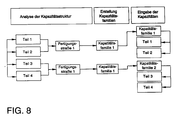
- the supplier summarizes according to his existing one Manufacturing structure of the parts (described by the part numbers) to so-called capacity families together. He can do this in several stages in the capacity model. By assigning individual parts to capacity families, the modeling of Capacity structures that produce several variants simultaneously.
- the invention is based on an embodiment from the automotive industry explained. However, the invention is applicable to all areas in which a system provider creates a complex system that is composed of several parts, which the system provider obtains at least in part from suppliers.
- Parts can be widely understood in the sense of the invention, since it is not just physical Parts that make up the system, but everything for Contributes to the manufacturing process and thus also services such as the Transport of parts, or containers for transporting parts.
- the suppliers offer this Goods or services to the system provider, being for certain periods Capacities for the production or provision of the goods or for the provision of the Services are available.
- the system provider is a vehicle manufacturer.
- the system which is manufactured by the vehicle manufacturer is a motor vehicle.
- the car is composed of a large number of individual parts, which the vehicle manufacturer partly manufactured by itself, but partly from a large number of suppliers refers.
- the suppliers form supply chains, in which one supplier has parts delivers to the next supplier until finally the vehicle manufacturer parts or a Module received from the last supplier in the supply chain.
- the suppliers deliver Air conditioners, headlights, rims, seats, navigation systems, etc. to the Vehicle manufacturers.
- the vehicle manufacturer and the suppliers have a system provider device 2 and supplier facilities 3. These are data processing facilities connected to the Internet of the vehicle manufacturer and the suppliers. On the part of the Vehicle manufacturer's requirement data is stored in the system provider device. in the Embodiment is considered only a system provider device 2, but can a system provider also have several system provider devices 2. For example Each assembly plant of a vehicle manufacturer can have a system provider facility exhibit. The demand data can also be carried out using a separate procedure are automatically determined by the system provider device 2 and then stored.
- the Supplier facilities are generally designated with reference number 3, special supplier facilities of the supplier network, e.g. in Fig. 1 is shown, e.g. designated 3-1-b.
- a central device 1 is provided, which is connected to the system provider device 2 and the supplier facilities 3 via communication links 4 are coupled.
- the central device 1 is e.g. a server that hosts a website to which the system provider device 2 and the supplier device 3 via the Can access the Internet and thereby exchange data with the central device 1 is possible.
- the central device 1 has a first interface 20 electronic reception of data from the system provider device 2 and a second interface 30 for the electronic reception of data from the supplier devices 3 on.
- the vehicle manufacturer produces vehicles that over have certain properties characterized.
- a vehicle can have the characteristics of a 1.8 I engine, to have an air conditioner, a gas discharge lamp and aluminum rims.
- the advantage of describing the vehicle based on properties is that it is suitable for a relatively long period of time, such as B. 24 months, estimate or automatically can determine how large the need for vehicles with these properties is. This Specifying the requirement at the property level is called the primary requirement.
- a characteristic of a family of capacities is that the capacity for the production of parts based on the units of a capacity family are producible for a long period of time is known in advance. Includes the Capacity families, for example, a machine for the production of panels, can Aperture supplier for a very long period of time state in advance how many apertures per unit of time he can manufacture.
- a capacity family is also characterized by this out that a short-term change in the needs of the parts by the capacity family are included, at the part level or part number level, the capacity of the Capacity family does not change.
- the Properties are automatically assigned to parts groups, whereby a parts group the amount of parts required to create a property is based on of a capacity family can be manufactured. It is possible that different parts groups can be manufactured on units of capacity which are in the same Capacity family fall. For example, the sub-groups "covers for air conditioners" and “Panels for ventilation units” assigned to the same capacity family because the panel supplier can produce both panels on the same machine.
- This master data system consists of a database stored in memory in which the parts that make up the Vehicle, which are assigned to the capacity families of the suppliers. On In this way, a subgroup requirement can be derived from the property requirement become. It is not necessary to know how the properties ultimately work a level of part numbers can be designed, since the parts groups only the Map the capacity structure of the suppliers and no resolution up to the level of Require part numbers.
- the capacity families are derived from the production structure of the supplier and summarize those parts or groups of parts, which together are subject to certain quantity restrictions, e.g. B. manufacturing different parts on one machine with a maximum output.
- the care the capacity families and the assignment of parts and parts groups Changes that e.g. B. by replacing an old machine with a new one can arise, takes place via the supplier facility 3.
- the The capacity family created is assigned to a hierarchical demand capacity tree to map further restrictions.
- the capacity family are now the affected parts and / or parts groups assigned.
- the vehicle manufacturer determines the Property requirements for the vehicles he produces per year, e.g. 24 Months in advance. This property requirement is entered into the system provider device 2 entered and saved there. According to another embodiment, the system provider device 2 also coupled to another data processing device be, which automatically estimates or determines the property requirement. In step S1 the need B for the multitude of properties E is sent electronically to the central device 1, which receives the data via the interface 20.
- step S2 the capacity K for the capacity families of the respective Suppliers identified for the same period in advance and in the supplier facility 3 entered.
- this capacity data could also be automatic by coupling the supplier device 3 with a data processing system of the respective supplier, in which information about all manufacturing units of the Suppliers are identified.
- step S2 the capacitance K for the Capacity family (s) from the respective supplier facility 3 to the central facility 1 electronically transmitted, which receives this data via the interface 30. It will notes that steps S1 and S2 are also in reverse order or simultaneously can be done.
- step S3 the properties for which a property requirement B is transmitted has been automatically assigned to parts groups.
- This step takes place in one Assignment unit 40, which is provided in the central device 1.
- the allocation unit 40 accesses a database in which the parts of the vehicle are assigned to the capacity families of the suppliers.
- assigning it is however, it is not necessary to know which parts at the part number level the properties are realized, rather it is enough to know which groups of parts, which in turn comprise a large number of parts, are required, to realize the property, the parts groups taking into account the Capacity families of the suppliers were formed.
- step S4 the property requirement B becomes a component group requirement as a secondary requirement determined.
- Known from the assignment of properties to the parts groups is which and how many parts groups are required to achieve the properties there is a direct relationship between the property requirement and the component group requirement.
- the determination of the parts group requirement is also in the assignment unit 40 performed.
- the assignment unit 40 transmits the parts group requirement a test unit 50.
- step S5 the test unit 50 finally automatically for the part groups checked whether the parts group requirement is greater than the capacity of the capacity family, the is assigned to the respective parts group.
- the result of this check is sent to the system provider facility 2 and / or the supplier device 3 made available.
- the result of the check over the Internet from the system provider facility 2 and the supplier facility 3 can be accessed or via remote data transmission are transmitted to these devices 2, 3.
- system provider device 2 and / or the supplier devices 3 a message is sent from the central device 1 when the need B capacity K exceeds for a capacity family. This is on the supplier side Notification preferably sent only to the supplier facilities 3, the parts thereof Manufacture capacity family.
- the supplier does not have to determine how the capacity K for each individual part is at part level, but it only needs the more unspecific capacity Specify K for the capacity family.
- Capacity for the capacity family does not change, is the description about capacity families sufficient. For example, concerns the transition from the property level at the part level, the selection of a specific material and the supplier can do so Ordering material at short notice, it is not necessary to choose the specific material at the time of transmission of the property requirement B and the capacity K for the Capacity family to specify.
- that provided by the supplier device 3 transmitted capacity contain the following detailed data, through the possible future Problems can be recognized very early: an available capacity that the respective Supplier actually provides the vehicle manufacturer with the maximum Capacity that the respective supplier takes advantage of all measures for the Vehicle manufacturers can provide and a minimum capacity which the can provide the respective supplier minimally for the vehicle manufacturer. Falls below z. B. the need of this minimum capacity for a period of 4 weeks, the Supplier may reduce its available capacity.
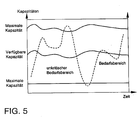
- FIG. 5 shows an exemplary course of demand relative to the three explained above Capacity data described.
- the need is in the uncritical range between the minimum capacity and the available capacity.
- the demand is growing after that and exceeds the available capacity.
- the supplier and the vehicle manufacturer therefore recognize early on that the supplier approves the vehicle manufacturer must provide a higher capacity at this time. Since this is usually the supplier can take appropriate measures in good time take.
- the demand increases beyond the maximum capacity of the supplier.
- the vehicle manufacturer can thus recognize early on that he possibly another supplier for the respective capacity family in the short term must be accepted if this bottleneck cannot be solved otherwise.
- the supplier can therefore decide at an early stage whether he will do it for the vehicle manufacturer available capacity reduced.
- the following procedural steps can occur Connect automatically:
- the transferred capacity data will open automatically Errors and incorrect entries checked. If necessary, the data can be automatically from the central device 1 are corrected.
- the central device 1 can automatically Request data from manufacturing data processing systems and check for possible ones Check manufacturing problems. It can then be checked automatically whether it is possible to fix the problems up to the critical time.
- the central device 1 can automatically display the capacity data of the Check upstream suppliers and possible bottlenecks there. Then the Central device 1 automatically switches to alternative upstream suppliers suggest. Finally, the development of the demand data can be checked, especially whether the demand is higher than expected.
- the system provider device 2 i.e. the data processing system of the vehicle manufacturer, in addition to the property requirement the parts requirements (at part number level) to the Transmit central device 1.
- the property requirement 104 Weeks in advance and the parts requirement 16 weeks in advance.
- the supplier facilities 3 transmit the capacity for the capacity family to the central facility 1. From this point on it can then be checked whether the parts requirement is greater than the capacity, and the result of this check by the system provider facility 2 and / or the supplier facilities 3 made available become. For example, can notifications to the supplier facilities 3 and the system provider facility be sent if the parts capacity by a certain value is smaller than the parts requirement.
- the transmitted property requirement and the transmitted parts requirement can relate to different periods. This is shown in Fig. 6.
- t L denotes the time of delivery.
- the property requirement is communicated at a time t 1 for the period ⁇ t 1 of, for example, 104 weeks. This period ⁇ t 1 ends at the delivery date t L.
- the parts requirement is communicated at a second later time t 2 for the period ⁇ t 2 . This period is considerably shorter than the period ⁇ t 1 . It also ends at the time of delivery t L.
- the first time period ⁇ t 1 comprises time segments that are earlier than the second time period ⁇ t 2 .
- the parts groups for the period ⁇ t 1 ie for example from the 17th to the 104th week, are assigned to the same capacity families as the concrete parts T for the period ⁇ t 2 , for example from the fifth to the 16th week , the capacities of the capacity family are transferred correctly from week 17 to week 16 and the correct parts and their requirements are automatically assigned.
- the system provider device can also determine the result of this check 2 and / or the supplier device 3 are made available.
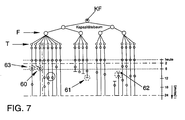
- the capacitance family KF includes that shown in FIG. 7 Example four manufacturing units F, which manufacture the parts T.
- FIG. 7 Example four manufacturing units F, which manufacture the parts T.
Landscapes
- Engineering & Computer Science (AREA)
- General Engineering & Computer Science (AREA)
- Manufacturing & Machinery (AREA)
- Quality & Reliability (AREA)
- Physics & Mathematics (AREA)
- General Physics & Mathematics (AREA)
- Automation & Control Theory (AREA)
- Management, Administration, Business Operations System, And Electronic Commerce (AREA)
- General Factory Administration (AREA)
Abstract
Description
Claims (16)
- Verfahren zum Ermitteln und/oder Überwachen von Ressourcen in einem Herstellungsprozess, bei dem zumindest ein Lieferant Teile (T) an zumindest einen Systemanbieter (SA) liefert, welcher ein diese Teile (T) umfassendes System herstellt, wobei zumindest eine Systemanbietereinrichtung (2) und zumindest eine Lieferanteneinrichtung (3) über Kommunikationsverbindungen (4) mit einer Zentraleinrichtung (1) verbunden sind,
dadurch gekennzeichnet,dass ein Eigenschaftsbedarf des Systems als Primärbedarf ermittelt wird und die Systemanbietereinrichtung den Eigenschaftsbedarf an die Zentraleinrichtung (1) elektronisch übermittelt,dass die Lieferanteneinrichtung (3) die Kapazität für zumindest eine Kapazitätsfamilie (KF) an die Zentraleinrichtung (1) elektronisch übermittelt, wobei eine Kapazitätsfamilie eine Menge von Teilen umfasst, die auf einer Kapazitätseinheit des Lieferanten fertigbar ist,dass den Eigenschaften automatisch Teilegruppen zugeordnet werden, wobei eine Teilegruppe die Menge von zur Erzeugung einer Eigenschaft erforderlichen Teilen ist, die auf einer Kapazitätsfamilie fertigbar sind,dass aus dem Eigenschaftsbedarf ein Teilegruppenbedarf als Sekundärbedarf ermittelt wird,dass für die Teilegruppen automatisch geprüft wird, ob der Teilegruppenbedarf größer als die Kapazität der Kapazitätsfamilie ist, die der jeweiligen Teilegruppe zugeordnet ist, und das Ergebnis dieser Prüfung der Systemanbietereinrichtung und/oder der Lieferanteneinrichtung verfügbar gemacht wird. - Verfahren nach Anspruch 1, dadurch gekennzeichnet, dass beim Zuordnen der Eigenschaften zu den Teilegruppen auf eine Datenbank zugegriffen wird, in der die Teile (T) des Systems den Kapazitätsfamilien der Lieferanten zugeordnet sind.
- Verfahren nach Anspruch 1 oder 2, dadurch gekennzeichnet,dass die von der Lieferanteneinrichtung (3) übermittelte Kapazität folgende Daten umfasst: eine verfügbare Kapazität, eine maximal bereitstellbare Kapazität und/oder eine minimale Kapazität unddass automatisch geprüft wird, ob der Teilegruppenbedarf die verfügbare Kapazität und/oder die maximale Kapazität überschreitet und/oder die minimale Kapazität unterschreitet und das Ergebnis dieser Prüfung der Systemanbietereinrichtung (2) und/oder der Lieferanteneinrichtung (3) verfügbar gemacht wird.
- Verfahren nach einem der vorstehenden Ansprüche, dadurch gekennzeichnet,dass die Systemanbietereinrichtung (2) für ein System den Eigenschaftsbedarf ab einem ersten Zeitpunkt (t1) an die Zentraleinrichtung (1) übermittelt unddass die Systemanbietereinrichtung (2) den Teilebedarf für dieses System ab einem zweiten, späteren Zeitpunkt (t2) an die Zentraleinrichtung (1) übermittelt,dass die Lieferanteneinrichtung (3) die Kapazität für die Teile (T) ab dem zweiten Zeitpunkt (t2) an die Zentraleinrichtung übermittelt unddass automatisch geprüft wird, ob der Teilebedarf größer als die Teilekapazität ist, und das Ergebnis dieser Prüfung der Systemanbietereinrichtung (2) und/oder der Lieferanteneinrichtung (3) verfügbar gemacht wird.
- Verfahren nach Anspruch 4, dadurch gekennzeichnet, dass der Eigenschaftsbedarf einen ersten Zeitraum (Δt1) und der Teilebedarf einen zweiten Zeitraum (Δt2) betrifft, wobei der erste Zeitraum (Δt1) Zeitabschnitte umfasst, die zeitlich vor dem zweiten Zeitraum (Δt2) liegen.
- Verfahren nach einem der vorstehenden Ansprüche, dadurch gekennzeichnet, dass eine Kapazitätsfamilie (KF) mehrere Fertigungseinheiten eines Lieferanten zur Herstellung eines oder mehrerer Teile (T) umfasst.
- Verfahren nach einem der vorstehenden Ansprüche, dass bei den Kapazitätsdaten Bestände der Lieferanten unberücksichtigt bleiben.
- Verfahren nach einem der vorstehenden Ansprüche, dass für die Kapazitätsfamilie(n) (KF) geprüft wird, ob und um wie viel der Teilegruppenbedarf die Kapazität unterschreitet und das Ergebnis dieser Prüfung der Systemanbietereinrichtung (2) und/oder der Lieferanteneinrichtung (3) verfügbar gemacht wird.
- Vorrichtung zum Ermitteln und/oder Überwachen von Ressourcen in einem Herstellungsprozess, bei dem zumindest ein Lieferant Teile (T) an zumindest einen Systemanbieter (SA) liefert, welcher ein diese Teile (T) umfassendes System herstellt, mit einer Zentraleinrichtung (1), die über Kommunikationsverbindungen (4) mit zumindest einer Systemanbietereinrichtung (2) und zumindest einer Lieferanteneinrichtung (3) koppelbar ist,
dadurch gekennzeichnet, dass die Zentraleinrichtung (1) umfasst:eine erste Schnittstelle (20) zum elektronischen Empfang des Eigenschaftsbedarfs von der Systemanbietereinrichtung (2),eine zweite Schnittstelle (30) zum elektronischen Empfang der Kapazität für zumindest eine Kapazitätsfamilie (KF) von der oder den Lieferanteneinrichtung(en) (3), wobei eine Kapazitätsfamilie (KF) die Menge von Teilen (T) umfasst, die auf einer Kapazitätseinheit des Lieferanten fertigbar ist,eine Zuordnungseinheit (40), mittels derer automatisch den Eigenschaften Teilegruppen zugeordnet werden können, wobei eine Teilegruppe die Menge von zur Erzeugung der Eigenschaft erforderlichen Teilen ist, die auf einer Kapazitätsfamilie fertigbar sind, und durch die aus dem Eigenschaftsbedarf ein Teilegruppenbedarf ermittelbar ist, undeine Prüfeinheit (50), die prüft, ob für die Teilegruppen der Teilegruppenbedarf größer als die Kapazität der Kapazitätsfamilie ist, die der jeweiligen Teilegruppe zugeordnet ist, wobei das Ergebnis dieser Prüfung der Systemanbietereinrichtung (2) und/oder der Lieferanteneinrichtung (3) verfügbar gemacht werden kann. - Vorrichtung gemäß Anspruch 9, dadurch gekennzeichnet, dass die Zentraleinrichtung mit einem Speicher verbunden ist, in dem eine Datenbank gespeichert ist, in der die Teile des Systems den Kapazitätsfamilien der Lieferanten zugeordnet sind.
- Vorrichtung gemäß Anspruch 9 oder 10, dadurch gekennzeichnet,dass über die zweite Schnittstelle (30) zu der von der Lieferanteneinrichtung (3) übermittelten Kapazität folgende Daten elektronisch empfangbar sind: eine verfügbare Kapazität, eine maximal bereitstellbare Kapazität und/oder eine minimale Kapazität, unddass die Prüfeinheit (50) prüft, ob der Teilegruppenbedarf die verfügbare Kapazität und/oder die maximale Kapazität überschreitet und/oder die minimale Kapazität unterschreitet und das Ergebnis dieser Prüfung der Systemanbietereinrichtung (2) und/oder der Lieferanteneinrichtung (3) verfügbar gemacht werden kann.
- Vorrichtung nach einem der Ansprüche 9 bis 11, dadurch gekennzeichnet, dass die Systemanbietereinrichtung(en) (2) und die Lieferanteneinrichtung(en) (3) über das Internet und/oder ein Intranet miteinander gekoppelt sind und der Eigenschaftsbedarf sowie die Kapazität über das Internet und/oder ein Intranet elektronisch übermittelbar sind.
- Vorrichtung nach einem der Ansprüche 9 bis 12, dass die Prüfeinheit (50) ferner für die Teilegruppen prüft, ob und um wie viel der Teilegruppenbedarf die Kapazität unterschreitet und das Ergebnis dieser Prüfung der Systemanbietereinrichtung (2) und/oder der Lieferanteneinrichtung (3) verfügbar gemacht werden kann.
- Computersystem, programmtechnisch eingerichtet zur Durchführung des Verfahrens nach einem der Ansprüche 1 bis 8.
- Computerprogramm mit Programmcode-Mitteln, um alle Schritte von jedem beliebigen der Ansprüche 1 bis 8 durchzuführen, wenn das Programm auf einem Computersystem ausgeführt wird.
- Computerprogrammprodukt mit Programmcode-Mitteln, die auf einem computerlesbaren Datenträger gespeichert sind, um das Verfahren nach jedem beliebigen der Ansprüche 1 bis 8 durchzuführen, wenn das Programmprodukt auf einem Computer ausgeführt wird.
Applications Claiming Priority (2)
| Application Number | Priority Date | Filing Date | Title |
|---|---|---|---|
| DE10156071 | 2001-11-16 | ||
| DE10156071 | 2001-11-16 |
Publications (2)
| Publication Number | Publication Date |
|---|---|
| EP1316867A2 true EP1316867A2 (de) | 2003-06-04 |
| EP1316867A3 EP1316867A3 (de) | 2005-03-16 |
Family
ID=7705811
Family Applications (1)
| Application Number | Title | Priority Date | Filing Date |
|---|---|---|---|
| EP02025121A Withdrawn EP1316867A3 (de) | 2001-11-16 | 2002-11-08 | Verfahren und Vorrichtung zum Ermitteln und Überwachen von Resourcen in einem Herstellungsprozess |
Country Status (2)
| Country | Link |
|---|---|
| EP (1) | EP1316867A3 (de) |
| DE (1) | DE10252112A1 (de) |
Families Citing this family (2)
| Publication number | Priority date | Publication date | Assignee | Title |
|---|---|---|---|---|
| JP4970711B2 (ja) | 2003-07-07 | 2012-07-11 | ハイデルベルガー ドルツクマシーネン アクチエンゲゼルシヤフト | 製造工程を見出す方法 |
| DE10343014A1 (de) * | 2003-09-17 | 2005-04-14 | Volkswagen Ag | Verfahren und Datenverarbeitungseinrichtung zum Durchführen eines Bedarfs-Kapazitäts-Abgleichs |
Family Cites Families (7)
| Publication number | Priority date | Publication date | Assignee | Title |
|---|---|---|---|---|
| JPH0425357A (ja) * | 1990-05-18 | 1992-01-29 | Mitsubishi Electric Corp | 投入指示装置 |
| JP3447286B2 (ja) * | 1990-11-28 | 2003-09-16 | 株式会社日立製作所 | 生産計画作成システムおよび生産計画作成方法 |
| US5193065A (en) * | 1990-12-03 | 1993-03-09 | Caterpillar Inc. | System for requistioning and distributing material in a manufacturing environment |
| US5787000A (en) * | 1994-05-27 | 1998-07-28 | Lilly Software Associates, Inc. | Method and apparatus for scheduling work orders in a manufacturing process |
| US5974395A (en) * | 1996-08-21 | 1999-10-26 | I2 Technologies, Inc. | System and method for extended enterprise planning across a supply chain |
| DE19848094A1 (de) * | 1998-10-19 | 2000-04-20 | Asea Brown Boveri | Verfahren zur Ermittlung des Grades der Aufgabenerfüllung technischer Systeme |
| DE19964498A1 (de) * | 1999-07-02 | 2007-01-11 | Daimlerchrysler Ag | Verfahren und System zur Überwachung der verfügbaren Ressourcen in einem Herstellungsprozeß |
-
2002
- 2002-11-08 EP EP02025121A patent/EP1316867A3/de not_active Withdrawn
- 2002-11-08 DE DE10252112A patent/DE10252112A1/de not_active Withdrawn
Also Published As
| Publication number | Publication date |
|---|---|
| EP1316867A3 (de) | 2005-03-16 |
| DE10252112A1 (de) | 2003-06-05 |
Similar Documents
| Publication | Publication Date | Title |
|---|---|---|
| DE602004010902T2 (de) | Asset-lebenszyklusverwaltungsverfahren und vorrichtung | |
| DE10393080T5 (de) | Serviceportal | |
| WO2004001633A2 (de) | Verfahren und simulationssystem zur simulation von auftragsabwicklungsprozessen sowie entsprechendes computerprogramm-erzeugnis und entsprechendes computerlesbares speichermedium | |
| DE102016103771A1 (de) | Verfahren zum Herstellen eines Produkts mit integrierter Planung und direkter ganzheitlicher Steuerung | |
| EP3635651B1 (de) | Verfahren zum betreiben einer vielzahl von technischen einheiten als verbund an einem elektrischen verteilungsnetz sowie steuervorrichtung und elektrische vorrichtung | |
| EP3765962B1 (de) | Verfahren zur behebung von prozessanomalien | |
| EP2697753A1 (de) | Einstellung einer industriellen anlage | |
| DE19930446C1 (de) | Diagnoseverfahren und Diagnosesystem zur Überwachung der verfügbaren Resourcen in einem Herstellungsprozeß | |
| DE102018118471A1 (de) | Vorrichtung und Verfahren zur Bereitstellung von Ersatzteilen eines Luftfahrzeuges | |
| DE10258655A1 (de) | Verfahren und System zur dynamischen, modellbasierten Planung und Optimierung von Produktionsprozessen, sowie zur Ablaufplanerstellung | |
| DE10252112A1 (de) | Verfahren und Vorrichtung zum Ermitteln und Überwachen von Ressourcen in einem Herstellungsprozess | |
| DE10029455A1 (de) | Verfahren und eine Vorrichtung zum Übertragen von Betriebsdaten einer Betriebseinheit und ein Verfahren zum Bereitstellen von Betriebsdaten einer oder mehrerer Betriebseinheiten | |
| LU500417B1 (de) | Eine Datenerfassungsplattform der intelligenten Fabrik und ihr Implementierungsverfahren | |
| DE102018121514A1 (de) | Verfahren zur "Just-In-Sequence" Individualisierung von Fahrzeugen | |
| DE102012202217A1 (de) | Abfüllanlage und computerimplementiertes Verfahren zur automatischen Erstellung einer aktuellen und individuellen Arbeitsliste | |
| DE10243281A1 (de) | Verfahren und System zur Komplexitätsreduzierung | |
| EP3147837A1 (de) | Optimieren eines logistischen netzes | |
| DE102007004232A1 (de) | Anordnung und Verfahren zur zeit- und mengen-bzw. durchsatz-optimierten Herstellung wenigstens eines Produktes mittels verfahrenstechnischer Anlagen | |
| EP3909011A1 (de) | Effizientes erstellen einer gebäudekonfiguration | |
| EP2901384A1 (de) | Verfahren zur lagerhaltung und/oder obsoleszenzrisikoeinschätzung | |
| WO2014005938A2 (de) | Bestimmung der eignung einer ressource | |
| DE10250313A1 (de) | Verfahren zur Bestimmung einer Vorlaufzeit | |
| DE202018004070U1 (de) | Maschinenanalyse | |
| DE10319883A1 (de) | Verfahren und Anordnung zur Auftragsverfolgung bei der Herstellung von komplexen Produkten sowie entsprechendes Computerprogrammerzeugnis und entsprechendes computerlesbares Speichermedium | |
| EP3285214A1 (de) | Lagersystem zur ersatzteilversorgung |
Legal Events
| Date | Code | Title | Description |
|---|---|---|---|
| PUAI | Public reference made under article 153(3) epc to a published international application that has entered the european phase |
Free format text: ORIGINAL CODE: 0009012 |
|
| AK | Designated contracting states |
Designated state(s): AT BE BG CH CY CZ DE DK EE ES FI FR GB GR IE IT LI LU MC NL PT SE SK TR |
|
| AX | Request for extension of the european patent |
Extension state: AL LT LV MK RO SI |
|
| PUAL | Search report despatched |
Free format text: ORIGINAL CODE: 0009013 |
|
| AK | Designated contracting states |
Kind code of ref document: A3 Designated state(s): AT BE BG CH CY CZ DE DK EE ES FI FR GB GR IE IT LI LU MC NL PT SE SK TR |
|
| AX | Request for extension of the european patent |
Extension state: AL LT LV MK RO SI |
|
| RIC1 | Information provided on ipc code assigned before grant |
Ipc: 7G 06F 17/60 B Ipc: 7G 05B 19/418 A |
|
| 17P | Request for examination filed |
Effective date: 20050916 |
|
| AKX | Designation fees paid |
Designated state(s): CZ DE ES FR GB IT |
|
| STAA | Information on the status of an ep patent application or granted ep patent |
Free format text: STATUS: THE APPLICATION IS DEEMED TO BE WITHDRAWN |
|
| 18D | Application deemed to be withdrawn |
Effective date: 20100601 |