EP1316633A1 - Air-bag-use non-coat base cloth and air-bag-use fiber - Google Patents
Air-bag-use non-coat base cloth and air-bag-use fiber Download PDFInfo
- Publication number
- EP1316633A1 EP1316633A1 EP01956923A EP01956923A EP1316633A1 EP 1316633 A1 EP1316633 A1 EP 1316633A1 EP 01956923 A EP01956923 A EP 01956923A EP 01956923 A EP01956923 A EP 01956923A EP 1316633 A1 EP1316633 A1 EP 1316633A1
- Authority
- EP
- European Patent Office
- Prior art keywords
- base fabric
- air bags
- fibers
- air
- section
- Prior art date
- Legal status (The legal status is an assumption and is not a legal conclusion. Google has not performed a legal analysis and makes no representation as to the accuracy of the status listed.)
- Granted
Links
Images


Classifications
-
- D—TEXTILES; PAPER
- D03—WEAVING
- D03D—WOVEN FABRICS; METHODS OF WEAVING; LOOMS
- D03D1/00—Woven fabrics designed to make specified articles
- D03D1/02—Inflatable articles
-
- D—TEXTILES; PAPER
- D03—WEAVING
- D03D—WOVEN FABRICS; METHODS OF WEAVING; LOOMS
- D03D15/00—Woven fabrics characterised by the material, structure or properties of the fibres, filaments, yarns, threads or other warp or weft elements used
- D03D15/40—Woven fabrics characterised by the material, structure or properties of the fibres, filaments, yarns, threads or other warp or weft elements used characterised by the structure of the yarns or threads
- D03D15/44—Woven fabrics characterised by the material, structure or properties of the fibres, filaments, yarns, threads or other warp or weft elements used characterised by the structure of the yarns or threads with specific cross-section or surface shape
-
- D—TEXTILES; PAPER
- D01—NATURAL OR MAN-MADE THREADS OR FIBRES; SPINNING
- D01D—MECHANICAL METHODS OR APPARATUS IN THE MANUFACTURE OF ARTIFICIAL FILAMENTS, THREADS, FIBRES, BRISTLES OR RIBBONS
- D01D5/00—Formation of filaments, threads, or the like
- D01D5/253—Formation of filaments, threads, or the like with a non-circular cross section; Spinnerette packs therefor
-
- D—TEXTILES; PAPER
- D03—WEAVING
- D03D—WOVEN FABRICS; METHODS OF WEAVING; LOOMS
- D03D15/00—Woven fabrics characterised by the material, structure or properties of the fibres, filaments, yarns, threads or other warp or weft elements used
- D03D15/20—Woven fabrics characterised by the material, structure or properties of the fibres, filaments, yarns, threads or other warp or weft elements used characterised by the material of the fibres or filaments constituting the yarns or threads
- D03D15/283—Woven fabrics characterised by the material, structure or properties of the fibres, filaments, yarns, threads or other warp or weft elements used characterised by the material of the fibres or filaments constituting the yarns or threads synthetic polymer-based, e.g. polyamide or polyester fibres
-
- D—TEXTILES; PAPER
- D03—WEAVING
- D03D—WOVEN FABRICS; METHODS OF WEAVING; LOOMS
- D03D15/00—Woven fabrics characterised by the material, structure or properties of the fibres, filaments, yarns, threads or other warp or weft elements used
- D03D15/40—Woven fabrics characterised by the material, structure or properties of the fibres, filaments, yarns, threads or other warp or weft elements used characterised by the structure of the yarns or threads
- D03D15/44—Woven fabrics characterised by the material, structure or properties of the fibres, filaments, yarns, threads or other warp or weft elements used characterised by the structure of the yarns or threads with specific cross-section or surface shape
- D03D15/46—Flat yarns, e.g. tapes or films
-
- D—TEXTILES; PAPER
- D10—INDEXING SCHEME ASSOCIATED WITH SUBLASSES OF SECTION D, RELATING TO TEXTILES
- D10B—INDEXING SCHEME ASSOCIATED WITH SUBLASSES OF SECTION D, RELATING TO TEXTILES
- D10B2331/00—Fibres made from polymers obtained otherwise than by reactions only involving carbon-to-carbon unsaturated bonds, e.g. polycondensation products
- D10B2331/02—Fibres made from polymers obtained otherwise than by reactions only involving carbon-to-carbon unsaturated bonds, e.g. polycondensation products polyamides
-
- D—TEXTILES; PAPER
- D10—INDEXING SCHEME ASSOCIATED WITH SUBLASSES OF SECTION D, RELATING TO TEXTILES
- D10B—INDEXING SCHEME ASSOCIATED WITH SUBLASSES OF SECTION D, RELATING TO TEXTILES
- D10B2401/00—Physical properties
-
- D—TEXTILES; PAPER
- D10—INDEXING SCHEME ASSOCIATED WITH SUBLASSES OF SECTION D, RELATING TO TEXTILES
- D10B—INDEXING SCHEME ASSOCIATED WITH SUBLASSES OF SECTION D, RELATING TO TEXTILES
- D10B2505/00—Industrial
- D10B2505/12—Vehicles
- D10B2505/124—Air bags
-
- Y—GENERAL TAGGING OF NEW TECHNOLOGICAL DEVELOPMENTS; GENERAL TAGGING OF CROSS-SECTIONAL TECHNOLOGIES SPANNING OVER SEVERAL SECTIONS OF THE IPC; TECHNICAL SUBJECTS COVERED BY FORMER USPC CROSS-REFERENCE ART COLLECTIONS [XRACs] AND DIGESTS
- Y10—TECHNICAL SUBJECTS COVERED BY FORMER USPC
- Y10T—TECHNICAL SUBJECTS COVERED BY FORMER US CLASSIFICATION
- Y10T428/00—Stock material or miscellaneous articles
- Y10T428/29—Coated or structually defined flake, particle, cell, strand, strand portion, rod, filament, macroscopic fiber or mass thereof
- Y10T428/2913—Rod, strand, filament or fiber
-
- Y—GENERAL TAGGING OF NEW TECHNOLOGICAL DEVELOPMENTS; GENERAL TAGGING OF CROSS-SECTIONAL TECHNOLOGIES SPANNING OVER SEVERAL SECTIONS OF THE IPC; TECHNICAL SUBJECTS COVERED BY FORMER USPC CROSS-REFERENCE ART COLLECTIONS [XRACs] AND DIGESTS
- Y10—TECHNICAL SUBJECTS COVERED BY FORMER USPC
- Y10T—TECHNICAL SUBJECTS COVERED BY FORMER US CLASSIFICATION
- Y10T428/00—Stock material or miscellaneous articles
- Y10T428/29—Coated or structually defined flake, particle, cell, strand, strand portion, rod, filament, macroscopic fiber or mass thereof
- Y10T428/2913—Rod, strand, filament or fiber
- Y10T428/2973—Particular cross section
-
- Y—GENERAL TAGGING OF NEW TECHNOLOGICAL DEVELOPMENTS; GENERAL TAGGING OF CROSS-SECTIONAL TECHNOLOGIES SPANNING OVER SEVERAL SECTIONS OF THE IPC; TECHNICAL SUBJECTS COVERED BY FORMER USPC CROSS-REFERENCE ART COLLECTIONS [XRACs] AND DIGESTS
- Y10—TECHNICAL SUBJECTS COVERED BY FORMER USPC
- Y10T—TECHNICAL SUBJECTS COVERED BY FORMER US CLASSIFICATION
- Y10T428/00—Stock material or miscellaneous articles
- Y10T428/29—Coated or structually defined flake, particle, cell, strand, strand portion, rod, filament, macroscopic fiber or mass thereof
- Y10T428/2913—Rod, strand, filament or fiber
- Y10T428/2973—Particular cross section
- Y10T428/2978—Surface characteristic
-
- Y—GENERAL TAGGING OF NEW TECHNOLOGICAL DEVELOPMENTS; GENERAL TAGGING OF CROSS-SECTIONAL TECHNOLOGIES SPANNING OVER SEVERAL SECTIONS OF THE IPC; TECHNICAL SUBJECTS COVERED BY FORMER USPC CROSS-REFERENCE ART COLLECTIONS [XRACs] AND DIGESTS
- Y10—TECHNICAL SUBJECTS COVERED BY FORMER USPC
- Y10T—TECHNICAL SUBJECTS COVERED BY FORMER US CLASSIFICATION
- Y10T428/00—Stock material or miscellaneous articles
- Y10T428/29—Coated or structually defined flake, particle, cell, strand, strand portion, rod, filament, macroscopic fiber or mass thereof
- Y10T428/2913—Rod, strand, filament or fiber
- Y10T428/298—Physical dimension
-
- Y—GENERAL TAGGING OF NEW TECHNOLOGICAL DEVELOPMENTS; GENERAL TAGGING OF CROSS-SECTIONAL TECHNOLOGIES SPANNING OVER SEVERAL SECTIONS OF THE IPC; TECHNICAL SUBJECTS COVERED BY FORMER USPC CROSS-REFERENCE ART COLLECTIONS [XRACs] AND DIGESTS
- Y10—TECHNICAL SUBJECTS COVERED BY FORMER USPC
- Y10T—TECHNICAL SUBJECTS COVERED BY FORMER US CLASSIFICATION
- Y10T442/00—Fabric [woven, knitted, or nonwoven textile or cloth, etc.]
- Y10T442/30—Woven fabric [i.e., woven strand or strip material]
- Y10T442/3065—Including strand which is of specific structural definition
-
- Y—GENERAL TAGGING OF NEW TECHNOLOGICAL DEVELOPMENTS; GENERAL TAGGING OF CROSS-SECTIONAL TECHNOLOGIES SPANNING OVER SEVERAL SECTIONS OF THE IPC; TECHNICAL SUBJECTS COVERED BY FORMER USPC CROSS-REFERENCE ART COLLECTIONS [XRACs] AND DIGESTS
- Y10—TECHNICAL SUBJECTS COVERED BY FORMER USPC
- Y10T—TECHNICAL SUBJECTS COVERED BY FORMER US CLASSIFICATION
- Y10T442/00—Fabric [woven, knitted, or nonwoven textile or cloth, etc.]
- Y10T442/30—Woven fabric [i.e., woven strand or strip material]
- Y10T442/3065—Including strand which is of specific structural definition
- Y10T442/3089—Cross-sectional configuration of strand material is specified
- Y10T442/3114—Cross-sectional configuration of the strand material is other than circular
Definitions
- the present invention relates to a base fabric for non-coated air bags, and to fibers for air bags. More precisely, the invention relates to a base fabric for high-pressure inflatable, non-coated air bags, which has high tenacity and low air permeability necessary to air bags and which can be compactly folded and housed, and relates to fibers to give the base fabric for such air bags.
- air bags which are, for example, low air permeability for ensuring smooth inflation in collision, high tenacity for preventing the bags themselves from being damaged and broken, and flexibility for protecting drivers and passengers from being scratched on their faces by inflated air bags.
- the other important matters for air bags are that the base fabric for them is compactly foldable so as to be housed in a limited small space, and is inexpensive.
- Base fabrics for air bags are grouped into two types, coated base fabrics and non-coated base fabrics.
- woven fabrics are coated with resin; and for the latter, woven fabrics are directly used as they are.
- coated base fabrics are said to be advantageous for ensuring the above-mentioned low air permeability for air bags.
- Japanese Patent Laid-Open No. 41438/1989 says that a base fabric for air bags, which is composed of fiber filaments having a tenacity of at least 8.5 g/d and a monofilament fineness of at most 3 deniers, attains the above-mentioned object. Though silent on the type of the base fabric, coated or non-coated one, it substantially relates to a base fabric coated with an elastomer such as chloroprene rubber. In case where the technique disclosed is applied to non-coated base fabrics, they could have high tenacity and could be compactly foldable to save the necessary housing space, but their air permeability could not be lowered satisfactorily.
- Japanese Patent Laid-Open No. 201650/1992 discloses a technique for producing a base fabric for air bags having high tenacity and capable of being compactly folded to save the housing space for it, for which are used polyamide multifilaments composed of a plurality of modified cross-section monofilaments each having a fineness of from 1.0 to 12 deniers and having a degree of cross-section modification of from 1.5 to 7.0.
- the technique disclosed is to satisfy only the requirements for coated base fabrics for air bags, but is still problematic in point of the air permeation through non-coated base fabrics, especially the air permeation therethrough at the seams.
- a technique relating to non-coated base fabrics is described in Japanese Patent Laid-Open No. 252740/1995, which says that a base fabric for non-coated air bags having low air permeability and capable of being compactly folded and housed in a limited small space is formed of flattened cross-section yarns having a degree of cross-section flatness of at least 1.5.
- the air permeation through the base fabric produced according to the technique disclosed is not lower than 0.3 cc/cm 2 /sec under low pressure (124 Pa), and does not satisfy lower air permeation recently required in the art.
- Japanese Patent 2,950,954 discloses a non-coated base fabric made of yarns having a total fineness of from 300 to 400 dtex, but this could not still solve the problem of seam distortion in the base fabric.
- Japanese Patent Laid-Open No. 2359/1996 discloses a base fabric for air bags, of which the warp/weft cover factor falls between 900 and 1400. In this, the residual oil content of the base fabric and the slip resistance thereof are specifically defined. However, this could not still solve the problem of seam distortion in the base fabric.
- the present invention has been achieved as a result of investigations to solve the problems in the prior art mentioned above.
- the object of the invention is to provide a base fabric for non-coated air bags which satisfies all the requirements of high tenacity, low air permeability and compact foldability indispensable to air bags and which further satisfies the advanced requirements of low air permeability under high pressure especially at the seams, not causing seam distortion, so as to be suitable to air bags for high-pressure inflation, and also to provide fibers for air bags.
- the base fabric for non-coated air bags of the invention has the following essential constitution.
- both the warp and the weft or either of them comprise synthetic fiber multifilaments of flattened cross-section monofilaments having a degree of flatness of from 1.5 to 8.0 and having a monofilament fineness of at moat 10 dtex and a total fineness of from 200 to 1000 dtex, and the base fabric satisfies all the following (1) to (3):
- the total fineness of the synthetic fiber multifilaments that constitute the base fabric for non-coated air bags of the invention indispensably falls between 200 and 1000 dtex, preferably between 200 and 700 dtex.
- the base fabric that comprises synthetic fibermultifilaments having a total fineness of smaller than 200 dtex could be compactly folded to save the housing space for it, but it is unfavorable since its tenacity is low and the air bags made of it will burst while they inflate or when the inflated air bags collide against drivers or passengers.
- synthetic fiber multifilaments having a total fineness of larger than 1000 dtex satisfy the tenacity and the safety necessary for air bags, but could not satisfy another requirement of compact foldability necessary to the invention.
- Air bags are designed in different ways, depending on the type of the automobiles and the site thereof in which they are installed, and the total fineness of the synthetic fiber multifilaments that constitute the base fabric for such air bags shall be suitably determined.
- the synthetic fiber multifilaments for air bags to be installed at the driver seat and the passenger seat have a total fineness of from 300 to 500 dtex.
- the total fineness of the multifilaments falling within the range satisfies both the necessary tenacity of air bags that must withstand the high inflator gas pressure to rapidly restrain drivers and passengers from being damaged in collision and the compact foldability thereof that must be housed in a relatively small space in the steering wheel at a driver seat or in the dashboard at a passenger seat.
- Inflatable curtains are also required to be folded and housed in a limited small space.
- the total fineness of the multifilaments preferably falls between 200 and 500 dtex.
- the monofilament fineness of the synthetic fiber multifilaments that constitute the base fabric for non-coated air bags of the invention is indispensably at most 10 dtex, preferably at most 7 dtex, more preferably at most 5 dtex.
- base fabrics of fibers having a smaller monofilament fineness are more flexible, and they can be more compactly folded and housed in a smaller space.
- the cover factor of the base fabric increases, and, as a result, the air permeation through the base fabric is lowered.
- Multifilaments having a monofilament fineness of larger than 10 dtex are unfavorable, since the base fabric comprising them could not be compactly folded and housed in a small space and its air permeability is high, and, after all, the base fabric is unsuitable to air bags.
- the degree of flatness of the monofilament which is indicated by the ratio of the length, a, of the largest major axis to the length, b, of the largest minor axis, a/b, of the cross section of the monofilament, indispensably falls between 1.5 and 8.0, preferably between 2.0 and 6.0.
- the synthetic fiber multifilaments having the flattened cross-section profile as in the defined range are woven into a base fabric, they are so aligned that the major axis of the cross section of each monofilament runs in the horizontal direction of the resulting base fabric owing to the general tension applied to all the fibers while they are woven.
- the void space per the unit area of the base fabric is reduced, and the air permeability of the base fabric is thereby reduced as compared with that of a base fabric of round cross-section fibers having a fineness of the same level.
- the air permeation of the same level as that through a base fabric of round cross-section fibers is taken into consideration for the base fabric of the flattened cross-section fibers, the necessary amount of the flattened cross-section fibers for the base fabric is lowered.
- the flattened cross-section fibers as in the defined range can form a base fabric for air bags that satisfies both low air permeability and compact foldability to save the housing space for it.
- the degree of flatness of the flattened cross-section fibers is smaller than 1.5, the difference between the fibers and ordinary round cross-section fibers is small, and the flattened cross-section fibers could not satisfactorily exhibit their effect.
- the degree of flatness of the flattened cross-section fibers is larger than 8.0, the effect of the fibers is saturated and is no more augmented. If so, in addition, high-tenacity fibers of high quality necessary for air bags, concretely those having a tenacity of at least 6.5 cN/dtex are difficult to obtain, and, moreover, the flat fibers having such a large degree of flatness could not be smoothly woven into fabrics, or that is, their workability into woven fabrics is extremely poor. For these reasons, such too much flattened fibers are unfavorable.
- the synthetic fiber multifilaments that constitute the base fabric for non-coated air bags of the invention are characterized in that the monofilaments all have a flattened cross-section profile and are so aligned that the major axis of the cross section of each monofilament runs in the horizontal direction of the base fabric.
- HI horizontal index
- the horizontal index, HI is indicated by the mean value of the cosine (hi) of the angle ( ⁇ ) at which the major axis of the flattened cross section of each monofilament of the base fabric crosses the horizontal direction of the base fabric.
- the horizontal index HI of the base fabric that comprises the flattened cross-section fibers of the invention is at least 0.75, more preferably at least 0.85, even more preferably at least 0.90.
- the base fabric ensures the intended good foldability to save the housing space for it and the intended low air permeability as in the above, and therefore attains the object of the invention.
- the cover factor of the base fabric for non-coated air bags of the invention indispensably falls between 1700 and 2200, preferably between 1800 and 2100.
- the cover factor is represented by: (D1 ⁇ 0.9) 1/2 ⁇ N1 + (D2 ⁇ 0.9) 1/2 ⁇ N2, in which D1 (dtex) indicates the total fineness of the warp; N1 (/2.54 cm) indicates the texture density of the warp; D2 (dtex) indicates the total fineness of the weft; and N2 (/2.54 cm) indicates the texture density of the weft.
- the cover factor of the base fabric is smaller than 1700, the mechanical properties of the base fabric are poor, and, in particular, the air permeation (P H ) thereof under high pressure is high. If so, in addition, the multifilaments constituting the base fabric are often distorted at the seams. As a result, the base fabric is unfavorable for non-coated air bags, since the air bags made of it could not well serve as safety guards. On the contrary, if the cover factor of the base fabric is larger than 2200, or that is, if the texture density thereof is too high, it is unfavorable since the base fabric could not be compactly folded to save the housing space for it. If so, in addition, the necessary amount of the fibers for the base fabric increases, and the base fabric is after all expensive.
- the cover factor of the base fabric is significantly related to the compact foldability thereof, and it is important that the cover factor of the base fabric for non-coated air bags of the invention falls within the suitable range as so defined in the above.
- the air permeation through it under low pressure, P L is at most 0.1 cc/cm 2 /sec, preferably at most 0.08 cc/cm 2 /sec. It is also necessary that the air permeation through the base fabric under high pressure, P H , is at most 20 cc/cm 2 /sec, preferably at most 15 cc/cm 2 /sec.
- P L indicates a degree of air permeation measured according to the method defined in JISL1096 (6.27.1MethodA).
- P H indicates a degree of air permeation measured as follows: Air having a controlled pressure of 19.6 KPa is made to run through a circular test piece having a diameter of 10 cm, and the amount of the air having passed through the test piece is measured by the use of a laminar flow air permeation meter.
- P L and P H indicate the necessary characteristics of the base fabric for air bags, or that is, they directly indicate the inflatablity of air bags. Having P L and P H each falling within the defined range, air bags well serve as safety guards and attain the object of the invention. If P L and P H are higher than 0.1 cc/cm 2 /sec and 20 cc/cm 2 /sec, respectively, the air bags could not smoothly inflate in collision and are therefore unfavorable since they are useless for safety guards.
- the degree of air permeation through the base fabric under high pressure, P s is preferably at most 50 cc/cm 2 /sec. With P s falling within the range, the air bags made of the base fabric ensure safe protection of drivers and passengers since the inflated air bags well keep their inner pressure when drivers or passengers have pushed in them.
- P s is measured as follows: A sample of the base fabric having a length of 20 cm and a width of 15 cm is stretched under tension of 1764 N at a pulling rate of 200 mm/min in the longitudinal direction. Air having a controlled pressure of 19.6 KPa is made to run through a circular part having a diameter of 10 cm in the center of the sample, and the amount of the air having passed through the circular part is measured by the use of a laminar flow air permeation meter.
- the number of residual entanglements in the warp of the base fabric is at most 10/m. With residual entanglements falling within the range, the base fabric can be prevented from being distorted at the seams.
- the number of residual entanglements in the warp is significantly related to the above-mentioned horizontal index HI. Concretely, when the number of residual entanglements in the warp is not larger than 10/m, HI of the base fabric tends to increase and the air permeation through the base fabric is kept low.
- the residual oil content of the warp and the weft of the base fabric is at most 0.1 % by weight. With the residual oil content falling within the range, the frictional force of the monofilaments that constitute the base fabric increases and the air permeation through the base fabric especially at the seams is lowered.
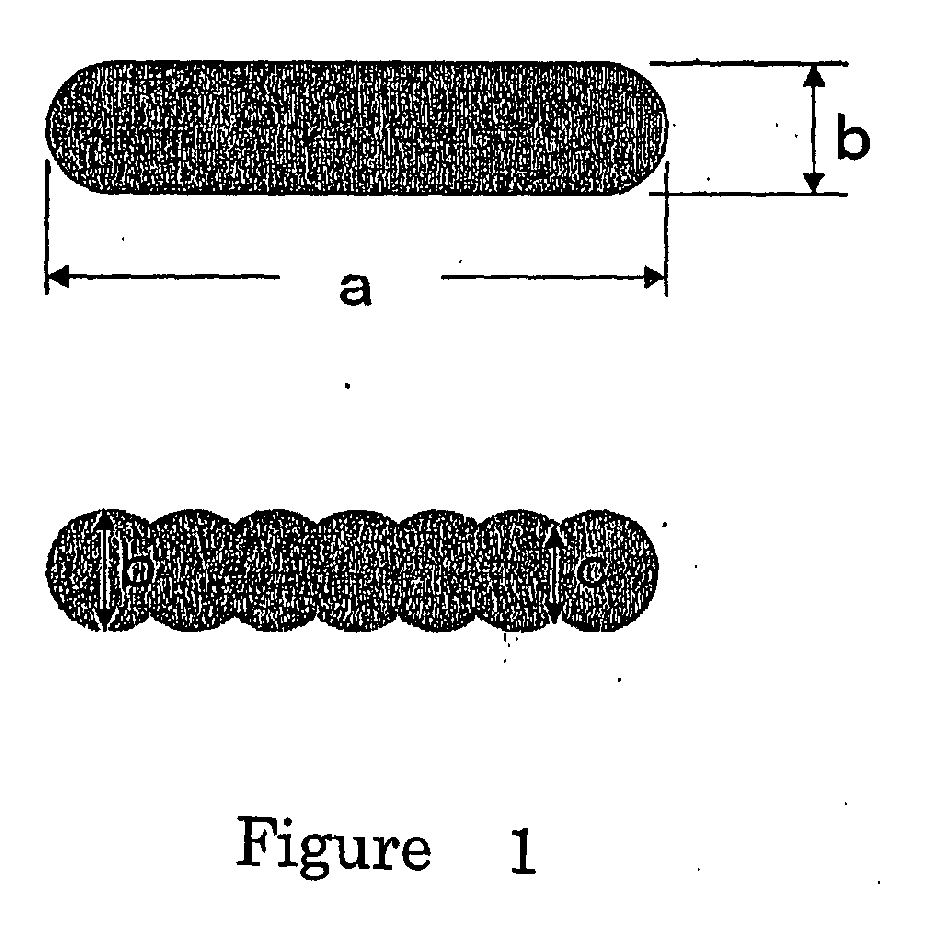
- the monofilament cross-section profile of the fibers for air bags of the invention is flattened as in Fig. 1, differing from an ordinary oval or diamond shape.
- the degree of flatness of the monofilament cross section falls between 1.5 and 8.0, indicated by the ratio of a/b in which a is the length of the largest major axis and b is the length of the largest minor axis of the cross section.
- the cross-section profile is formed by aligning plural circles in a line, for which the diameter of each circle corresponds to the minor axis of the cross section.
- the degree of surface smoothness of each monofilament in the direction of the major axis of the cross section which is indicated by the ratio of the length, c, of the smallest minor axis to the length, b, of the largest minor axis, c/b, is indispensably at least 0.8, preferably at least 0.85.
- the degree of surface smoothness falling within the range, the frictional force of the monofilaments increases and the air permeation through the base fabric for air bags made of the fibers is well lowered.
- fibers having a degree of surface smoothness of smaller than 0.8 are formed into a base fabric for air bags, the air permeation through the base fabric, especially at the seams could not be lowered, and therefore the fibers are not suitable for air bags intended in the invention.
- the length, b, of the largest minor axis is at most 15 ⁇ m, and the monofilament fineness is at most 10 dtex. With the length, b, of the largest minor axis and the monofilament fineness falling within the range, the fibers are favorable to the base fabric for non-coated air bags intended in the invention.
- the constitutive components of the fibers for air bags of the invention are not specifically defined.
- polyamide having a viscosity relative to sulfuric acid of at least 3.0 is preferred for the fibers.
- the polyamide may be either a homopolymer or a copolymer, and it may contain inorganic substances such as titanium oxide, silicon oxide and calcium carbonate, and also other chemicals such as weather-proofing agent and antioxidant, for improving the color, the weather resistance and the oxidation resistance of the polymer fibers.
- the fibers for air bags of the invention can be produced in any ordinary melt-spinning method.
- Fig. 2 shows one example of the method for producing polyamide fibers for air bags.
- the yarn (Y) having been spun out through the spinning pack (0) in a melt-spinning machine is led to pass through the heating zone (1) disposed just below the spinneret.
- the length of the heating zone (1) falls between 100 and 200 mm. Having passed through the heating zone of which the length is defined to fall within the range, the fibers can readily have the desired tenacity and the desired degree of flatness favorable to air bags intended in the invention.
- the yarn (Y) is cooled and solidified by the chill air that is blowing at a speed of 20 to 50 m/min in the chilling zone (2). Then, after having passed through the spinning duct (3), the yarn receives oil from the oil supply unit (4), and then taken up by the spun yarn-taking up rollers (5) and (6).
- the yarn (Y) is led to run along the hot rollers (7), (8) and (9) each running at a high speed, in that order and is thus drawn by these rollers.
- the fibers are preferably drawn in two or more stages.
- the yarn is wound around the rollers (10) and relaxed therearound, and then led to the control guides (12, 12') and the entangling unit (11) in which it is entangled. With that, the yarn is wound up in the winder (13).
- the relaxation is important for determining the shrink property of the fibers obtained.
- the fibers are relaxed to a degree of from 3 to 15 % in order that they have a desired degree of shrinkage favorable to air bags.
- the fibers are entangled to have at most 15 entanglements/m, for which pressure air of from 0.05 to 0.4 MPa is preferably applied to the fibers in the entangling unit.
- Fig. 3(A) shows the cross-section profile of the orifice of the spinneret usable for obtaining the flattened cross - section fibers of the invention.
- the round parts (d) at both ends and in the inside between them are connected in a line via the slit parts (e).
- the number of the round parts (d) is at least 2, the diameter of each round part falls between 0.15 and 0.25 mm, the width of the slit (e) falls between 0.10 and 0.20 mm, and the length of the slit falls between 0.10 and 0.20 mm.
- the orifice profile of Fig. 3(B) is undesirable, since the surface smoothness in the direction of the major axis of the cross section of the fibers produced through it could not satisfy the requirement defined herein and the air permeation through the base fabric for air bags made of the fibers could not be low.
- the base fabric for non-coated air bags of the invention or that is, for weaving the base fabric from the fibers of the invention, usable are a water-jet loom, a rapier loom, an air-jet loom, etc.
- the residual oil content of the base fabric for non-coated air bags of the invention is preferably at most 0.1 % by weight.
- a water-jet loom as facilitating the oil removal from the fibers.
- the tension of the warp falls between 0.2 and 0.6 cN/dtex in the process of weaving the fabric.
- the flattened cross-section fibers are well woven into the intended base fabric and are favorably aligned in the woven fabric, or that is, the horizontal index HI of the fibers constituting the woven fabric well meets the requirement defined herein and the air permeability of the woven fabric can be lowered.
- the base fabric is preferably scoured and/or thermally set at 160 to 190°C.
- the base fabric made of the flattened cross-section fibers of the invention is characterized in that it is favorable to air bags, especially to non-coated air bags.
- the base fabric favorable to such air bags of the invention is characterized in that its air permeability is low, especially at the seams, and it is compactly foldable to save the housing space for it.
- the monofilaments of the fibers are so aligned that the major axis of the cross section of each monofilament runs in the horizontal direction of the woven fabric. Therefore, the cover factor of the base fabric is high and the air permeability thereof is low. In addition, the base fabric is compactly foldable to save the housing space for it, and it is thin and flexible.
- the cross section of each monofilament of the flattened cross-section fibers of the invention is a rectangular cross section. Specifically, it is a flattened cross section that is formed by aligning plural circles in a line, for which the diameter of each circle corresponds to the minor axis of the cross section.
- the length of the minor axis is at most 15 ⁇ m.
- the fineness of the monofilament corresponds to 1 denier (1.1 dtex) and falls in the category of microfibers.
- the flattened cross-section fibers that are considered to fall in the category of microfibers are aligned in the horizontal direction of the base fabric, and, as a result, the base fabric of the invention can be compactly folded to save the housing space for it, and it is thin and flexible. Accordingly, the base fabric of the invention is comparable to ordinary base fabrics of microfibers in point of the texture.
- microfibers Base fabrics of microfibers are known for air bags, but it is difficult to stably spin microfibers in a direct spinning process. On the other hand, microfibers produced in a process of sea/island polymer alignment are expensive and could not be put into practical use.
- the base fabric of the invention is superior to any other conventional base fabrics made of ordinary fibers of thinned monofilaments, since its air permeability is low, it is compactly foldable to save the housing space for it, and it is thin and flexible.
- the base fabric of the invention can be readily produced in any ordinary melt-spinning process or direct spinning and drawing process, and its practicability is significant.
- the angle ⁇ at which the major axis of the cross section of each flattened cross-section fiber crosses the horizontal direction of the base fabric is measured.
- the horizontal index, HI is obtained according to the following equation.
- the number of the monofilaments measured, f 100.
- each one of the warp is nipped and drawn out of the base fabric, at an angle of from 20 to 45° relative to the direction of the warp and at a pulling rate of from 40 to 60 sec/m or so.
- the number of the entanglements/meter in the thus-drawn warp is measured in a method of dipping the sample in a water bath. 10 samples are measured, and the data are averaged to obtain the number of the entanglement/m of the warp.
- the water bath has a length of 70 cm, a width of 15 cm and a depth of 5 cm. This is partitioned at 10 cm from each end in the longitudinal direction, and filled with pure water to a depth of about 3 cm. To remove the influence of impurities such as oil on the measurement, the pure water in the bath is exchanged for fresh one in every measurement.
- the fiber sample having a length of 1.0 m is stretched by applying a load of 2 cN/dtex thereto for 5 seconds, and after the load has been removed, the sample is measured in a water bath according to the same method as above.
- the warp and the weft are individually drawn out of a base fabric in the same manner as that for the measurement of the residual entanglements as above, and the samples are measured according to JIS L-1096 (6.36.1 Method A) (alcohol/benzene extraction method).
- the details are as follows: About 5 g of a sample piece is prepared, and its weight is accuratelymeasured. This is lightly pushed into a Soxhlet extractor, not using a cylindrical paper filter therein, and 120 ml of a mixture of alcohol/benzene (1/2 by volume) is put into the accessory flask attached to the extractor. With that, the flask is heated for 3 hours in a water bath, and the solution formed in the sample section in the extractor is returned to the flask. The contents of the flask are concentrated to about 3 ml, and moved to a balance bottle. The bottle is put in a water bath, and the solvent is evaporated away. The absolute dry weight of the residue is measured. The same test is repeated two times.
- the residue obtained according to the method of JIS L-1096 (3.36.1Method A) is collected, and the monomer/oligomer content (% by weight) of the polyamide in the residue is measured through gas chromatography and high-performance liquid chromatography.
- the quantification standards used are adipic acid and hexamethylenadipamide (special-grade chemicals from Tokyo Chemical) and nylon 66 cyclic trimer (produced by Toray).
- Oil Content (data in alcohol/benzene extraction) - (data in monomer/oligomer analysis).
- a base fabric to be tested is cut to prepare its sample having a length of 20 cm and a width of 15 cm.
- Air having a controlled pressure of 124 Pa is made to run through a circular part having a diameter of 10 cm of the sample, and the amount of the air (cc/cm 2 /sec) having passed through the circular part is measured by the use of a laminar flow air permeation meter.
- a base fabric to be tested is cut to prepare its sample having a length of 20 cm and a width of 15 cm.
- Air having a controlled pressure of 19.6 KPa is made to run through a circular part having a diameter of 10 cm of the sample, and the amount of the air (cc/cm 2 /sec) having passed through the circular part is measured by the use of a laminar flow air permeation meter.
- a base fabric to be tested is cut to prepare its sample having a length of 20 cm and a width of 15 cm.
- the sample is stretched under tension of 1764 N at a pulling rate of 200 mm/min in the longitudinal direction.
- Air having a controlled pressure of 19.6 KPa is made to run through a circular part having a diameter of 10 cm of the sample, and the amount of the air (cc/cm 2 /sec) having passed through the circular part is measured by the use of a laminar flow air permeation meter.
- Air having a controlled pressure of 19.6 KPa is made to run through a circular part having a diameter of 10 cm in the center of the sample with the seams, and the amount of the air (cc/cm 2 /sec) having passed through the circular part is measured by the use of a laminar flow air permeation meter.
- Two sheets of a base fabric to be tested are prepared, each having a length of 7 cm and a width of 7 cm. With one on top of the other so that the warp and the weft are individually in the same direction in the two, these are sewed in a mode of multi-thread chain stitch.
- the margin left to sew up them is 2.5 cm; the needle thread and the bobbin thread used are both of nylon 6.6 1400 dtex/one; the sewing machine used is Juki Corporation's MH-380 Model; and the needle used is TV ⁇ 7 #19.
- the thus-sewed sample is set in a tensile tester, in which it is held by a chuck of 5 cm wide with a margin of 1 cm left at both ends. In that condition, an elastic stress of 1274 N is applied to the sample, and the length of the gap having appeared between the base fabric and the sewing thread is read with a measure. Large five gaps are thus measured, and the data are averaged.
- a base fabric to be tested is sewed up to form an air bag having a volume of 60 liters. This is bellows-wise folded four times both in the opposite horizontal directions and then four times both in the opposite vertical directions. Having thus folded, this has an area of 150 ⁇ 150 cm. A load of 4000 g is applied to this, and the thickness of the thus-folded bag is measured.
- nylon 66 chips having a viscosity, relative to 98 % sulfuric acid at 25°C, of 3.7 were melt-spun at 295°C.
- the nylon melt was spun out of a spinning pack with a spinneret having an orifice profile as in Table 1; then led to pass through a hot zone disposed just below the spinneret (the hot zone was heated at 230°C and had a length of 150 mm); then cooled and solidified in a chilling zone with chill air blowing at a speed of 30 m/min; then lubricated with an oiling roller; then wound around a take-up roll, a feed roll, a first stretch roll, a second stretch roll and a tension control roll in that order to thereby draw the fibers in two stages to a total draw ratio of 4.1 times; then relaxed by 7 %; and finally wound up in a winder at a speed of 3800 m/min. After relaxed, the fibers were entangled with pressure air of 0.3 MPa applied thereto in an entangling unit.
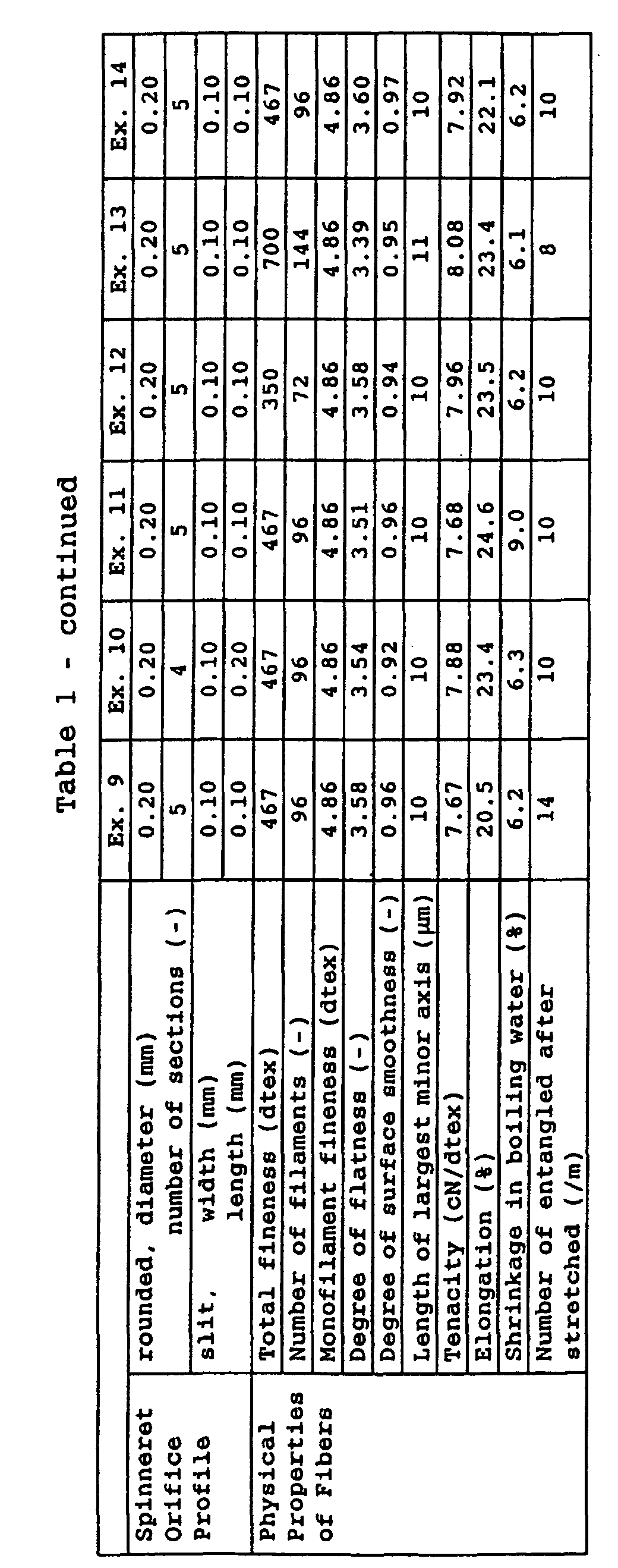
- Table 1 The physical properties of the synthetic fiber multifilaments for air bags, thus produced according to the process as above, are shown in Table 1.
- the resulting synthetic fiber multifilaments were warped under tension of 0.3 cN/dtex at a speed of 200 m/min, and then woven into a fabric by the use of a water-jet loom (Tsudakoma's ZW303) driving at a revolution speed of 800 rpm.
- the thus-woven fabric was scoured by dipping it in a hot water bath at 80°C that contained 0.5 g/liter of sodium alkylbenzenesulfonate and 0.5 g/liter of soda ash, for 3 minutes, followed by drying it in an atmosphere at 130°C for 3 minutes. Finally, this was thermally set at 180°C for one minute to obtain a base fabric for air bags.
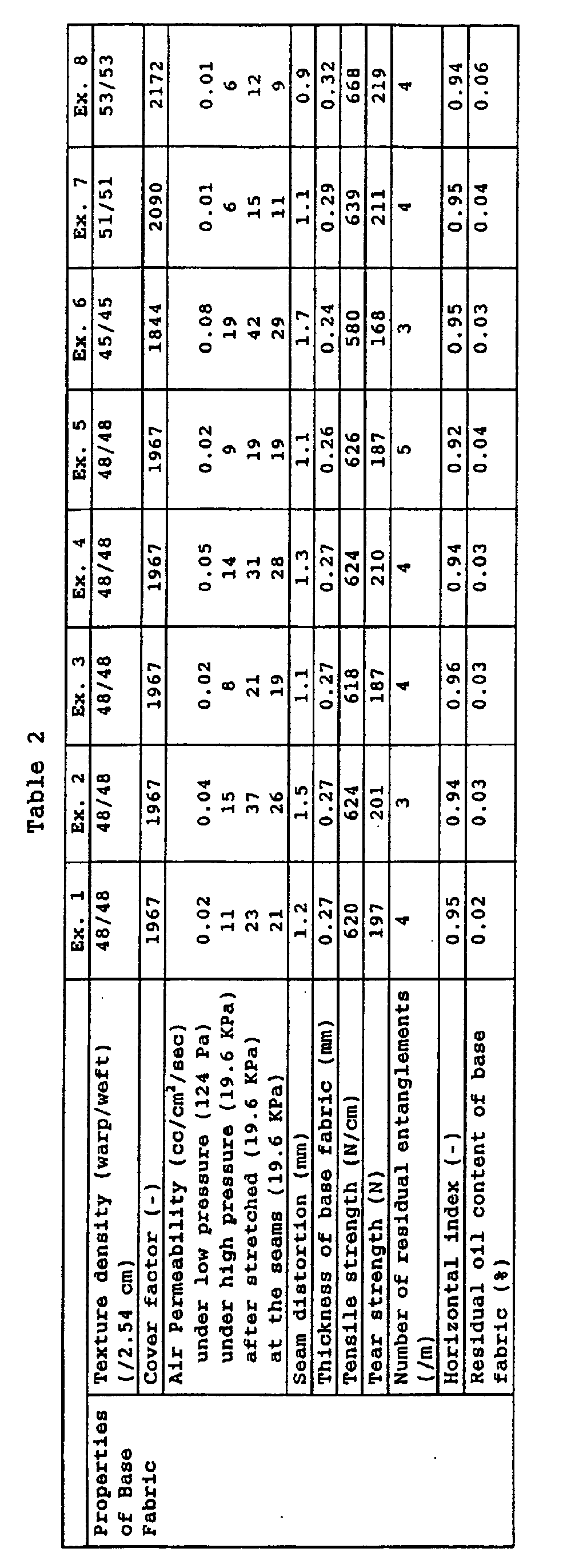
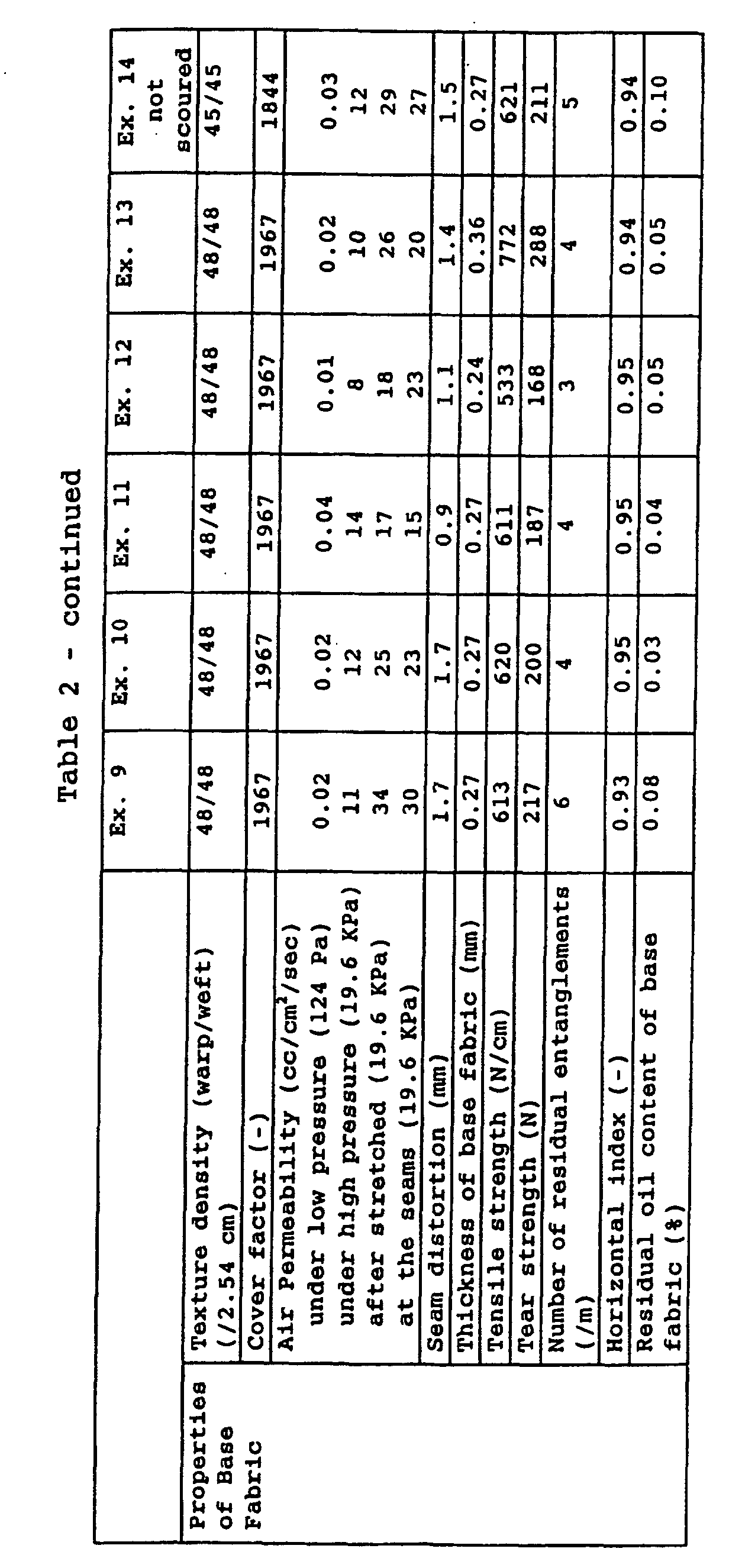
- the base fabric for non-coated air bags obtained according to the process as above was analyzed and tested for the texture density (count of warp/weft) and for the properties thereof.
- the data are in Table 2.
- Fibers for air bags were produced in the same manner as in Example 1, for which, however, the orifice profile of the spinneret used is as in Table 3.
- the physical properties of the synthetic fibers for air bags obtained are in Table 3.
- the base fabrics for non-coated air bags of the invention are all superior to the conventional base fabrics in point of the high tenacity thereof, the low air permeability thereof under low pressure, under high pressure, after stretched and at the seams, the small thickness thereof, and the compact foldability thereof to save the necessary housing space.
- the base fabrics for non-coated air bags of the invention satisfy all the requirements for air bags.
- the base fabric for non-coated air bags of the invention has the necessary properties of high tenacity, low air permeability and compact foldability to save the housing space for it, and is favorable to air bags for high-pressure inflation.
- the synthetic fiber multifilaments to constitute the base fabric for air bags of the invention can be readily produced in any ordinary melt-spinning process or direct spinning and drawing process, and any ordinary weaving machine can be used in weaving them into base fabrics. To that effect, the practicability of the invention is significant.
Landscapes
- Engineering & Computer Science (AREA)
- Textile Engineering (AREA)
- Mechanical Engineering (AREA)
- Woven Fabrics (AREA)
- Air Bags (AREA)
Abstract
Description
is the angle at which the major axis of the flattened cross section of each monofilament crosses the horizontal direction of the base fabric, and
f is the number of monofilaments measured.
N1 (/2.54 cm) indicates the texture density of the warp;
D2 (dtex) indicates the total fineness of the weft; and
N2 (/2.54 cm) indicates the texture density of the weft.
is the angle at which the major axis of the flattened cross section of each monofilament crosses the horizontal direction of the base fabric, and
f is the number of the monofilaments measured.
N1 (/2.54 cm) indicates the texture density of the warp;
D2 (dtex) indicates the total fineness of the weft; and
N2 (/2.54 cm) indicates the texture density of the weft.



Claims (10)
- A base fabric for non-coated air bags in which both the warp and the weft or either of them comprise synthetic fiber multifilaments of flattened cross-section monofilaments having a degree of flatness of from 1.5 to 8.0 and having a monofilament fineness of at most 10 dtex and a total fineness of from 200 to 1000 dtex, and which satisfies all the following (1) to (3):(1) its cover factor falls between 1700 and 2200;(2) its air permeability under low pressure, PL, is at most 0.1 cc/cm2/sec; and(3) its air permeability under high pressure, PH, is at most 20 cc/cm2/sec.
- The base fabric for non-coated air bags as claimed in claim 1, of which the air permeability under high pressure after stretched, Ps, is at most 50 20 cc/cm2/sec.
- The base fabric for non-coated air bags as claimed in claim 1 or 2, wherein the horizontal index, HI, of the synthetic fiber multifilaments is at least 0.75 in terms of the cosine of the angle at which the horizontal direction of the base fabric crosses the direction of the major axis of the cross section of each monofilament.
- The base fabric for non-coated air bags as claimed in any one of claims 1 to 3, which is such that the number of residual entanglements in the warp drawn out of the base fabric is at most 10/m.
- The base fabric for non-coated air bags as claimed in any one of claims 1 to 4, of which the residual oil content is at most 0.1 % by weight.
- The base fabric for non-coated air bags as claimed in any one of claims 1 to 5, wherein the synthetic fiber multifilaments are of a polyamide having a viscosity relative to sulfuric acid of at least 3.0.
- Fibers for air bags, which comprise synthetic fiber multifilaments and satisfy all the following (4) to (7):(4) the degree of flatness of each monofilament, which is indicated by the ratio of the length, a, of the largest major axis to the length, b, of the largest minor axis, a/b, of the cross section of the monofilament, falls between 1.5 and 8.0;(5) the degree of surface smoothness of each monofilament in the direction of the major axis of the cross section, which is indicated by the ratio of the length, c, of the smallest minor axis to the length, b, of the largest minor axis, c/b, is at least 0.8;(6) the monofilament fineness is at most 10 dtex; and(7) the length, b, of the largest minor axis is at most 15 µm.
- The fibers for air bags as claimed in claim 7, in which the number of residual entanglements after stretched under tension is at most 15/m.
- The fibers for air bags as claimed in claim 7 or 8, of which the synthetic fiber multifilaments are of a polyamide having a viscosity relative to sulfuric acid of at least 3.0.
- The base fabric for non-coated air bags as claimed in any one of claims 1 to 6, which comprises the fibers of any of claims 7 to 9.
Applications Claiming Priority (7)
| Application Number | Priority Date | Filing Date | Title |
|---|---|---|---|
| JP2000248028 | 2000-08-17 | ||
| JP2000248028 | 2000-08-17 | ||
| JP2001028886A JP4538967B2 (en) | 2000-08-17 | 2001-02-05 | Airbag fabric |
| JP2001028886 | 2001-02-05 | ||
| JP2001102354 | 2001-03-30 | ||
| JP2001102354A JP2002293209A (en) | 2001-03-30 | 2001-03-30 | Fiber for airbag, method for producing the same, and base fabric for non-coated airbag |
| PCT/JP2001/007064 WO2002014590A1 (en) | 2000-08-17 | 2001-08-16 | Air-bag-use non-coat base cloth and air-bag-use fiber |
Publications (3)
| Publication Number | Publication Date |
|---|---|
| EP1316633A1 true EP1316633A1 (en) | 2003-06-04 |
| EP1316633A4 EP1316633A4 (en) | 2006-07-26 |
| EP1316633B1 EP1316633B1 (en) | 2009-05-20 |
Family
ID=27344374
Family Applications (1)
| Application Number | Title | Priority Date | Filing Date |
|---|---|---|---|
| EP01956923A Expired - Lifetime EP1316633B1 (en) | 2000-08-17 | 2001-08-16 | Base fabric for non-coated air-bags |
Country Status (8)
| Country | Link |
|---|---|
| US (1) | US20030008582A1 (en) |
| EP (1) | EP1316633B1 (en) |
| KR (1) | KR100792177B1 (en) |
| CN (1) | CN1318668C (en) |
| CA (1) | CA2384790A1 (en) |
| DE (1) | DE60138761D1 (en) |
| TW (1) | TWI230213B (en) |
| WO (1) | WO2002014590A1 (en) |
Cited By (1)
| Publication number | Priority date | Publication date | Assignee | Title |
|---|---|---|---|---|
| EP2684746B1 (en) * | 2011-03-10 | 2020-06-03 | Toyobo Co., Ltd. | Air bag |
Families Citing this family (28)
| Publication number | Priority date | Publication date | Assignee | Title |
|---|---|---|---|---|
| US7413214B2 (en) * | 2002-01-08 | 2008-08-19 | Milliken & Company | Airbag made from low tenacity yarns |
| JP3855775B2 (en) * | 2002-01-16 | 2006-12-13 | 東レ株式会社 | Coat airbag base fabric |
| ATE449203T1 (en) * | 2002-04-24 | 2009-12-15 | Polyamide High Performance Gmb | HIGH STRENGTH YARN WITH PROFILED FILAMENTS |
| JP2004052167A (en) * | 2002-07-22 | 2004-02-19 | Teijin Fibers Ltd | Bulky knit having sweat-absorbing property and drape |
| EP1524343B1 (en) | 2002-07-24 | 2013-05-15 | Teijin Fibers Limited | Flat multifilament-yarn textile |
| JP3895227B2 (en) * | 2002-07-24 | 2007-03-22 | 帝人ファイバー株式会社 | Apparel-related products |
| US8278227B2 (en) * | 2004-03-31 | 2012-10-02 | Kb Seiren, Ltd. | Polyester woven fabric |
| US20080188151A1 (en) * | 2004-10-19 | 2008-08-07 | Daisuke Yokoi | Fabric for Restraint Devices and Method for Producing the Same |
| CN101633349B (en) * | 2005-10-20 | 2012-03-21 | 财团法人工业技术研究院 | Tetragonal cross-section fiber, fabric and method of manufacture |
| DE102006017274A1 (en) * | 2006-04-12 | 2007-10-18 | Bst Safety Textiles Gmbh | tissue |
| KR101372186B1 (en) * | 2006-06-23 | 2014-03-07 | 도레이 카부시키가이샤 | Woven fabric for air bags, air bags and process for production of the woven fabric for air bags |
| CN101168881B (en) * | 2006-10-24 | 2011-06-15 | 东丽纤维研究所(中国)有限公司 | Non-coat fabric for safety gasbag and producing method thereof |
| CN101363154B (en) * | 2007-08-09 | 2011-05-18 | 东丽纤维研究所(中国)有限公司 | Fabric for air bag |
| CN101440529B (en) * | 2007-11-23 | 2011-05-11 | 新光合成纤维股份有限公司 | Manufacturing method and application of square section polyamide fiber |
| BRPI0910390B1 (en) * | 2008-03-10 | 2021-11-16 | Toray Industries, Inc. | AIR BAG TISSUE |
| CN102220685B (en) * | 2010-04-14 | 2014-07-23 | 东丽纤维研究所(中国)有限公司 | Uncoated fabric for airbag and production method thereof |
| CN104271822B (en) * | 2012-05-11 | 2016-07-27 | 东洋纺株式会社 | A fabric for an uncoated airbag |
| EP3243708A1 (en) * | 2012-07-25 | 2017-11-15 | Autoliv Development AB | A fabric for an air-bag |
| TWI613338B (en) * | 2012-08-02 | 2018-02-01 | 東麗股份有限公司 | Fabrics using a flat multi-lobar cross-section fiber and sewn product using the same |
| TR201905967T4 (en) * | 2013-08-13 | 2019-05-21 | Asahi Chemical Ind | Woven fabric. |
| WO2016170050A1 (en) * | 2015-04-22 | 2016-10-27 | Teijin Aramid B.V. | Cord comprising multifilament para-aramid yarn comprising non-round filaments |
| CN106149138A (en) * | 2016-08-26 | 2016-11-23 | 山东合信科技股份有限公司 | A kind of heat-resist RING SPINNING elastic force weft yarn and production technology thereof |
| CN106119999A (en) * | 2016-08-26 | 2016-11-16 | 山东合信科技股份有限公司 | A kind of PA66 undrawn yarn and production technology thereof propping up elastic force weft yarn yarn core for height |
| CN106149137A (en) * | 2016-08-26 | 2016-11-23 | 山东合信科技股份有限公司 | A kind of RING SPINNING high drawing elastic force weft yarn and production technology thereof |
| CN106120061A (en) * | 2016-08-26 | 2016-11-16 | 山东合信科技股份有限公司 | A kind of RING SPINNING high-tenacity elastic force weft yarn and production technology thereof |
| JP6947816B2 (en) * | 2016-10-21 | 2021-10-13 | 嘉興徳永紡織品有限公司 | Looms, woven fabric manufacturing methods, and ultra-high density woven fabrics |
| JP7200115B2 (en) | 2017-09-28 | 2023-01-06 | セーレン株式会社 | Fabrics and airbags for uncoated airbags |
| CN108977952A (en) * | 2018-08-01 | 2018-12-11 | 浙江竟成特种单丝有限公司 | A kind of six disjunctor flat filaments |
Family Cites Families (13)
| Publication number | Priority date | Publication date | Assignee | Title |
|---|---|---|---|---|
| CA2044378A1 (en) * | 1990-10-02 | 1992-04-03 | Mitsuo Matsumoto | Shock-absorbing air bag |
| JPH04262938A (en) * | 1991-02-19 | 1992-09-18 | Teijin Ltd | Air bag |
| JP2949842B2 (en) * | 1990-11-29 | 1999-09-20 | 東レ株式会社 | Airbag fabric |
| JP2944220B2 (en) * | 1993-10-13 | 1999-08-30 | 帝人株式会社 | Fabric for high-performance airbag and method for producing the same |
| JP3284735B2 (en) * | 1994-03-10 | 2002-05-20 | 東レ株式会社 | Base fabric for airbag |
| JP3457739B2 (en) * | 1994-06-29 | 2003-10-20 | 帝人株式会社 | Non-coated side airbag fabric |
| JPH0860425A (en) * | 1994-08-23 | 1996-03-05 | Unitika Ltd | Fiber for air bag |
| JPH08199449A (en) * | 1995-01-12 | 1996-08-06 | Toray Ind Inc | Base cloth for non-coated airbags and airbags |
| US5626961A (en) * | 1995-06-30 | 1997-05-06 | E. I. Du Pont De Nemours And Company | Polyester filaments and tows |
| US6037047A (en) * | 1997-02-26 | 2000-03-14 | E. I. Du Pont De Nemours And Company | Industrial fibers with diamond cross sections and products made therefrom |
| US6147017A (en) * | 1997-02-26 | 2000-11-14 | E. I. Du Pont De Nemours And Company | Industrial fibers with sinusoidal cross sections and products made therefrom |
| US6010789A (en) * | 1997-05-05 | 2000-01-04 | E. I. Du Pont De Nemours And Company | Polyester staple fiber |
| US6022817A (en) | 1997-06-06 | 2000-02-08 | E. I. Du Pont De Nemours And Company | Fabric for airbag |
-
2001
- 2001-08-08 TW TW90119353A patent/TWI230213B/en not_active IP Right Cessation
- 2001-08-16 EP EP01956923A patent/EP1316633B1/en not_active Expired - Lifetime
- 2001-08-16 KR KR1020027004205A patent/KR100792177B1/en not_active Expired - Fee Related
- 2001-08-16 CN CNB018024483A patent/CN1318668C/en not_active Expired - Lifetime
- 2001-08-16 US US10/070,260 patent/US20030008582A1/en not_active Abandoned
- 2001-08-16 DE DE60138761T patent/DE60138761D1/en not_active Expired - Lifetime
- 2001-08-16 CA CA 2384790 patent/CA2384790A1/en not_active Abandoned
- 2001-08-16 WO PCT/JP2001/007064 patent/WO2002014590A1/en not_active Ceased
Cited By (1)
| Publication number | Priority date | Publication date | Assignee | Title |
|---|---|---|---|---|
| EP2684746B1 (en) * | 2011-03-10 | 2020-06-03 | Toyobo Co., Ltd. | Air bag |
Also Published As
| Publication number | Publication date |
|---|---|
| US20030008582A1 (en) | 2003-01-09 |
| CA2384790A1 (en) | 2002-02-21 |
| TWI230213B (en) | 2005-04-01 |
| CN1388842A (en) | 2003-01-01 |
| EP1316633A4 (en) | 2006-07-26 |
| CN1318668C (en) | 2007-05-30 |
| KR20020041450A (en) | 2002-06-01 |
| EP1316633B1 (en) | 2009-05-20 |
| KR100792177B1 (en) | 2008-01-07 |
| WO2002014590A1 (en) | 2002-02-21 |
| DE60138761D1 (en) | 2009-07-02 |
Similar Documents
| Publication | Publication Date | Title |
|---|---|---|
| EP1316633B1 (en) | Base fabric for non-coated air-bags | |
| US8261779B2 (en) | Base cloth for air bag, raw yarn for air bag, and method for producing the raw yarn | |
| CA2655825C (en) | Woven fabric for air bags, air bags and process for production of the woven fabric for air bags | |
| CN100443659C (en) | Coated base fabric for airbag and manufacturing method thereof | |
| JP2012502194A (en) | Airbag fabric and method for producing the same | |
| EP2554722B1 (en) | Polyester yarn and method for manufacturing same | |
| CN100567619C (en) | Cloth for restraint device and method for producing the same | |
| JP4872174B2 (en) | Non-coated airbag fabric and airbag fabric | |
| EP3279378B1 (en) | Airbag-use woven fabric and airbag | |
| JP2010174390A (en) | Woven fabric for airbag, and method for producing the same | |
| JP2004156166A (en) | Fabric and method for producing the same | |
| JP4538967B2 (en) | Airbag fabric | |
| JP2004176221A (en) | Base fabric for coat airbag and method of manufacturing the same | |
| JP5564780B2 (en) | Non-coated airbag fabric | |
| JP2002293209A (en) | Fiber for airbag, method for producing the same, and base fabric for non-coated airbag | |
| JP2002266161A (en) | Yarn for airbag and fabric for airbag | |
| KR100575380B1 (en) | Polyamide Fabric for Unsealed Airbags | |
| JP2003213540A (en) | Fabrics and airbags | |
| JP2000264162A (en) | Synthetic fiber for seat belt and seat belt webbing |
Legal Events
| Date | Code | Title | Description |
|---|---|---|---|
| PUAI | Public reference made under article 153(3) epc to a published international application that has entered the european phase |
Free format text: ORIGINAL CODE: 0009012 |
|
| 17P | Request for examination filed |
Effective date: 20030218 |
|
| AK | Designated contracting states |
Designated state(s): AT BE CH CY DE DK ES FI FR GB GR IE IT LI LU MC NL PT SE TR |
|
| RBV | Designated contracting states (corrected) |
Designated state(s): DE FR GB NL |
|
| A4 | Supplementary search report drawn up and despatched |
Effective date: 20060626 |
|
| 17Q | First examination report despatched |
Effective date: 20070403 |
|
| 17Q | First examination report despatched |
Effective date: 20070403 |
|
| GRAP | Despatch of communication of intention to grant a patent |
Free format text: ORIGINAL CODE: EPIDOSNIGR1 |
|
| RTI1 | Title (correction) |
Free format text: BASE FABRIC FOR NON-COATED AIR-BAGS |
|
| GRAS | Grant fee paid |
Free format text: ORIGINAL CODE: EPIDOSNIGR3 |
|
| GRAA | (expected) grant |
Free format text: ORIGINAL CODE: 0009210 |
|
| AK | Designated contracting states |
Kind code of ref document: B1 Designated state(s): DE FR GB NL |
|
| REG | Reference to a national code |
Ref country code: GB Ref legal event code: FG4D |
|
| REF | Corresponds to: |
Ref document number: 60138761 Country of ref document: DE Date of ref document: 20090702 Kind code of ref document: P |
|
| PLBE | No opposition filed within time limit |
Free format text: ORIGINAL CODE: 0009261 |
|
| STAA | Information on the status of an ep patent application or granted ep patent |
Free format text: STATUS: NO OPPOSITION FILED WITHIN TIME LIMIT |
|
| 26N | No opposition filed |
Effective date: 20100223 |
|
| REG | Reference to a national code |
Ref country code: FR Ref legal event code: PLFP Year of fee payment: 16 |
|
| REG | Reference to a national code |
Ref country code: FR Ref legal event code: PLFP Year of fee payment: 17 |
|
| REG | Reference to a national code |
Ref country code: FR Ref legal event code: PLFP Year of fee payment: 18 |
|
| PGFP | Annual fee paid to national office [announced via postgrant information from national office to epo] |
Ref country code: NL Payment date: 20190712 Year of fee payment: 19 |
|
| PGFP | Annual fee paid to national office [announced via postgrant information from national office to epo] |
Ref country code: FR Payment date: 20190711 Year of fee payment: 19 |
|
| PGFP | Annual fee paid to national office [announced via postgrant information from national office to epo] |
Ref country code: GB Payment date: 20190816 Year of fee payment: 19 |
|
| PGFP | Annual fee paid to national office [announced via postgrant information from national office to epo] |
Ref country code: DE Payment date: 20200804 Year of fee payment: 20 |
|
| REG | Reference to a national code |
Ref country code: NL Ref legal event code: MM Effective date: 20200901 |
|
| GBPC | Gb: european patent ceased through non-payment of renewal fee |
Effective date: 20200816 |
|
| PG25 | Lapsed in a contracting state [announced via postgrant information from national office to epo] |
Ref country code: FR Free format text: LAPSE BECAUSE OF NON-PAYMENT OF DUE FEES Effective date: 20200831 |
|
| REG | Reference to a national code |
Ref country code: DE Ref legal event code: R071 Ref document number: 60138761 Country of ref document: DE |
|
| PG25 | Lapsed in a contracting state [announced via postgrant information from national office to epo] |
Ref country code: GB Free format text: LAPSE BECAUSE OF NON-PAYMENT OF DUE FEES Effective date: 20200816 |
|
| PG25 | Lapsed in a contracting state [announced via postgrant information from national office to epo] |
Ref country code: NL Free format text: LAPSE BECAUSE OF NON-PAYMENT OF DUE FEES Effective date: 20200901 |