EP1316599A1 - Magnetic particles and process for producing the same - Google Patents
Magnetic particles and process for producing the same Download PDFInfo
- Publication number
- EP1316599A1 EP1316599A1 EP01956972A EP01956972A EP1316599A1 EP 1316599 A1 EP1316599 A1 EP 1316599A1 EP 01956972 A EP01956972 A EP 01956972A EP 01956972 A EP01956972 A EP 01956972A EP 1316599 A1 EP1316599 A1 EP 1316599A1
- Authority
- EP
- European Patent Office
- Prior art keywords
- fine particles
- magnetic fine
- biotin
- particles according
- bound
- Prior art date
- Legal status (The legal status is an assumption and is not a legal conclusion. Google has not performed a legal analysis and makes no representation as to the accuracy of the status listed.)
- Granted
Links
Classifications
-
- H—ELECTRICITY
- H01—ELECTRIC ELEMENTS
- H01F—MAGNETS; INDUCTANCES; TRANSFORMERS; SELECTION OF MATERIALS FOR THEIR MAGNETIC PROPERTIES
- H01F1/00—Magnets or magnetic bodies characterised by the magnetic materials therefor; Selection of materials for their magnetic properties
- H01F1/01—Magnets or magnetic bodies characterised by the magnetic materials therefor; Selection of materials for their magnetic properties of inorganic materials
- H01F1/03—Magnets or magnetic bodies characterised by the magnetic materials therefor; Selection of materials for their magnetic properties of inorganic materials characterised by their coercivity
- H01F1/12—Magnets or magnetic bodies characterised by the magnetic materials therefor; Selection of materials for their magnetic properties of inorganic materials characterised by their coercivity of soft-magnetic materials
- H01F1/34—Magnets or magnetic bodies characterised by the magnetic materials therefor; Selection of materials for their magnetic properties of inorganic materials characterised by their coercivity of soft-magnetic materials non-metallic substances, e.g. ferrites
- H01F1/36—Magnets or magnetic bodies characterised by the magnetic materials therefor; Selection of materials for their magnetic properties of inorganic materials characterised by their coercivity of soft-magnetic materials non-metallic substances, e.g. ferrites in the form of particles
- H01F1/37—Magnets or magnetic bodies characterised by the magnetic materials therefor; Selection of materials for their magnetic properties of inorganic materials characterised by their coercivity of soft-magnetic materials non-metallic substances, e.g. ferrites in the form of particles in a bonding agent
-
- B—PERFORMING OPERATIONS; TRANSPORTING
- B03—SEPARATION OF SOLID MATERIALS USING LIQUIDS OR USING PNEUMATIC TABLES OR JIGS; MAGNETIC OR ELECTROSTATIC SEPARATION OF SOLID MATERIALS FROM SOLID MATERIALS OR FLUIDS; SEPARATION BY HIGH-VOLTAGE ELECTRIC FIELDS
- B03C—MAGNETIC OR ELECTROSTATIC SEPARATION OF SOLID MATERIALS FROM SOLID MATERIALS OR FLUIDS; SEPARATION BY HIGH-VOLTAGE ELECTRIC FIELDS
- B03C1/00—Magnetic separation
- B03C1/005—Pretreatment specially adapted for magnetic separation
- B03C1/01—Pretreatment specially adapted for magnetic separation by addition of magnetic adjuvants
-
- B—PERFORMING OPERATIONS; TRANSPORTING
- B82—NANOTECHNOLOGY
- B82Y—SPECIFIC USES OR APPLICATIONS OF NANOSTRUCTURES; MEASUREMENT OR ANALYSIS OF NANOSTRUCTURES; MANUFACTURE OR TREATMENT OF NANOSTRUCTURES
- B82Y30/00—Nanotechnology for materials or surface science, e.g. nanocomposites
-
- C—CHEMISTRY; METALLURGY
- C09—DYES; PAINTS; POLISHES; NATURAL RESINS; ADHESIVES; COMPOSITIONS NOT OTHERWISE PROVIDED FOR; APPLICATIONS OF MATERIALS NOT OTHERWISE PROVIDED FOR
- C09C—TREATMENT OF INORGANIC MATERIALS, OTHER THAN FIBROUS FILLERS, TO ENHANCE THEIR PIGMENTING OR FILLING PROPERTIES ; PREPARATION OF CARBON BLACK ; PREPARATION OF INORGANIC MATERIALS WHICH ARE NO SINGLE CHEMICAL COMPOUNDS AND WHICH ARE MAINLY USED AS PIGMENTS OR FILLERS
- C09C1/00—Treatment of specific inorganic materials other than fibrous fillers; Preparation of carbon black
- C09C1/22—Compounds of iron
- C09C1/24—Oxides of iron
-
- C—CHEMISTRY; METALLURGY
- C12—BIOCHEMISTRY; BEER; SPIRITS; WINE; VINEGAR; MICROBIOLOGY; ENZYMOLOGY; MUTATION OR GENETIC ENGINEERING
- C12N—MICROORGANISMS OR ENZYMES; COMPOSITIONS THEREOF; PROPAGATING, PRESERVING, OR MAINTAINING MICROORGANISMS; MUTATION OR GENETIC ENGINEERING; CULTURE MEDIA
- C12N11/00—Carrier-bound or immobilised enzymes; Carrier-bound or immobilised microbial cells; Preparation thereof
- C12N11/14—Enzymes or microbial cells immobilised on or in an inorganic carrier
-
- C—CHEMISTRY; METALLURGY
- C12—BIOCHEMISTRY; BEER; SPIRITS; WINE; VINEGAR; MICROBIOLOGY; ENZYMOLOGY; MUTATION OR GENETIC ENGINEERING
- C12N—MICROORGANISMS OR ENZYMES; COMPOSITIONS THEREOF; PROPAGATING, PRESERVING, OR MAINTAINING MICROORGANISMS; MUTATION OR GENETIC ENGINEERING; CULTURE MEDIA
- C12N15/00—Mutation or genetic engineering; DNA or RNA concerning genetic engineering, vectors, e.g. plasmids, or their isolation, preparation or purification; Use of hosts therefor
- C12N15/09—Recombinant DNA-technology
- C12N15/10—Processes for the isolation, preparation or purification of DNA or RNA
- C12N15/1003—Extracting or separating nucleic acids from biological samples, e.g. pure separation or isolation methods; Conditions, buffers or apparatuses therefor
- C12N15/1006—Extracting or separating nucleic acids from biological samples, e.g. pure separation or isolation methods; Conditions, buffers or apparatuses therefor by means of a solid support carrier, e.g. particles, polymers
- C12N15/1013—Extracting or separating nucleic acids from biological samples, e.g. pure separation or isolation methods; Conditions, buffers or apparatuses therefor by means of a solid support carrier, e.g. particles, polymers by using magnetic beads
-
- G—PHYSICS
- G01—MEASURING; TESTING
- G01N—INVESTIGATING OR ANALYSING MATERIALS BY DETERMINING THEIR CHEMICAL OR PHYSICAL PROPERTIES
- G01N33/00—Investigating or analysing materials by specific methods not covered by groups G01N1/00 - G01N31/00
- G01N33/48—Biological material, e.g. blood, urine; Haemocytometers
- G01N33/50—Chemical analysis of biological material, e.g. blood, urine; Testing involving biospecific ligand binding methods; Immunological testing
- G01N33/53—Immunoassay; Biospecific binding assay; Materials therefor
- G01N33/543—Immunoassay; Biospecific binding assay; Materials therefor with an insoluble carrier for immobilising immunochemicals
- G01N33/54313—Immunoassay; Biospecific binding assay; Materials therefor with an insoluble carrier for immobilising immunochemicals the carrier being characterised by its particulate form
- G01N33/54326—Magnetic particles
- G01N33/5434—Magnetic particles using magnetic particle immunoreagent carriers which constitute new materials per se
-
- C—CHEMISTRY; METALLURGY
- C01—INORGANIC CHEMISTRY
- C01P—INDEXING SCHEME RELATING TO STRUCTURAL AND PHYSICAL ASPECTS OF SOLID INORGANIC COMPOUNDS
- C01P2004/00—Particle morphology
- C01P2004/60—Particles characterised by their size
- C01P2004/62—Submicrometer sized, i.e. from 0.1-1 micrometer
-
- C—CHEMISTRY; METALLURGY
- C01—INORGANIC CHEMISTRY
- C01P—INDEXING SCHEME RELATING TO STRUCTURAL AND PHYSICAL ASPECTS OF SOLID INORGANIC COMPOUNDS
- C01P2004/00—Particle morphology
- C01P2004/60—Particles characterised by their size
- C01P2004/64—Nanometer sized, i.e. from 1-100 nanometer
-
- C—CHEMISTRY; METALLURGY
- C01—INORGANIC CHEMISTRY
- C01P—INDEXING SCHEME RELATING TO STRUCTURAL AND PHYSICAL ASPECTS OF SOLID INORGANIC COMPOUNDS
- C01P2006/00—Physical properties of inorganic compounds
- C01P2006/80—Compositional purity
-
- Y—GENERAL TAGGING OF NEW TECHNOLOGICAL DEVELOPMENTS; GENERAL TAGGING OF CROSS-SECTIONAL TECHNOLOGIES SPANNING OVER SEVERAL SECTIONS OF THE IPC; TECHNICAL SUBJECTS COVERED BY FORMER USPC CROSS-REFERENCE ART COLLECTIONS [XRACs] AND DIGESTS
- Y10—TECHNICAL SUBJECTS COVERED BY FORMER USPC
- Y10S—TECHNICAL SUBJECTS COVERED BY FORMER USPC CROSS-REFERENCE ART COLLECTIONS [XRACs] AND DIGESTS
- Y10S530/00—Chemistry: natural resins or derivatives; peptides or proteins; lignins or reaction products thereof
- Y10S530/81—Carrier - bound or immobilized peptides or proteins and the preparation thereof, e.g. biological cell or cell fragment as carrier
- Y10S530/812—Peptides or proteins is immobilized on, or in, an organic carrier
- Y10S530/815—Carrier is a synthetic polymer
Definitions
- the present invention relates to magnetic fine particles and a process for producing the same, a method of separating or concentrating a microorganism, a method of purifying, detecting, or concentrating a nucleic acid, a separating agent, a method of separating a biological substance, and a method of converting a substance.
- LCST polyisopropylacrylamide having a lower critical solution temperature
- the stimuli-responsible magnetic fine particles have a small particle size of about 100 to 200 nm, the particles can be well dispersed in water.
- an aqueous solution of the stimuli-responsible magnetic fine particles is heated to raise the temperature to the LCST or higher, the stimuli-responsible magnetic fine particles precipitate and aggregate. Since the aggregate can be easily recovered by magnetism, there are attempts to separate a variety of biological molecules and microorganisms using the stimuli-responsible magnetic fine particles to which an antibody or antigen is immobilized.
- the biological substance or the like as the objective substance may be damaged or inactivated in some cases.
- the present inventors have extensively studied for solving the above problems of the conventional technology. As a result, they have found that, when magnetic fine particles to which a polymer having an upper critical solution temperature is immobilized are used for separating a biological molecule or the like, it is possible to separate or recover the objective biological molecule or the like without damaging or inactivating it. Based on the findings, they have accomplished the invention.
- the invention includes the following constitutions.
- the polymer (hereinafter referred to as "UCST polymer”) having a upper critical solution temperature (hereinafter referred to as “UCST ”) which is essential for the invention is a polymer having a nature that the polymer dissolves in a solvent containing the polymer when the temperature of the solvent exceeds a particular temperature and the polymer precipitates and aggregates in the solvent when the temperature is not higher than the particular temperature.
- UCST means the particular temperature.
- a phenomenon that a polymer dissolves or precipitates wherein UCST acts as a border is called a UCST characteristic.
- the above-mentioned solvent is not particularly limited and specifically includes water and a liquid containing 50% by weight or more of water.
- the liquid containing 50% by weight or more of water specifically includes biological saline, a buffer solution, and the like.
- the solvent may be a mixed liquid of an organic solvent such as acetone and water as far as the liquid exhibits the UCST characteristic in a polymer-containing state.
- the UCST polymer for use in the invention may be any polymer as far as it has a UCST.
- the UCST polymer includes a homopolymer of acryloylglycineamide, a copolymer of acryloylglycineamide and a polymerizable biotin monomer, a copolymer of acryloylglycineamide and N-formylacrylamide, a copolymer of acrylamide and N-formylacrylamide, a copolymer of acrylamide and N-acetylacrylamide, and the like.
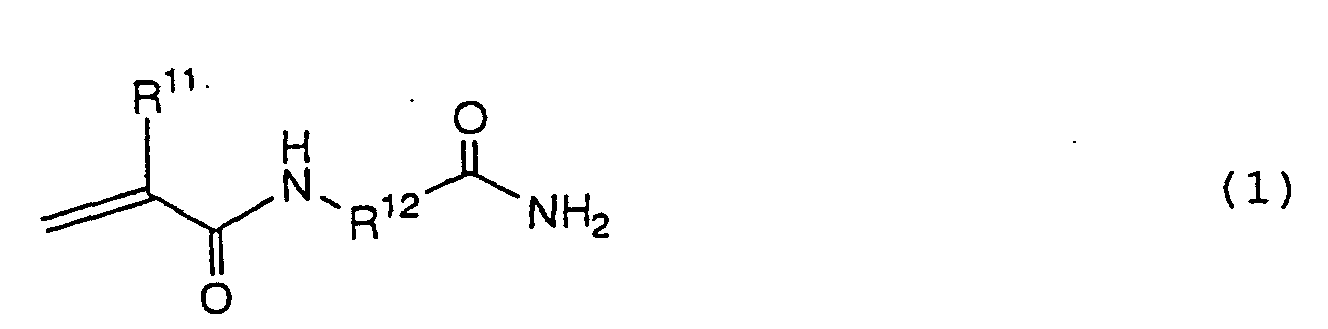
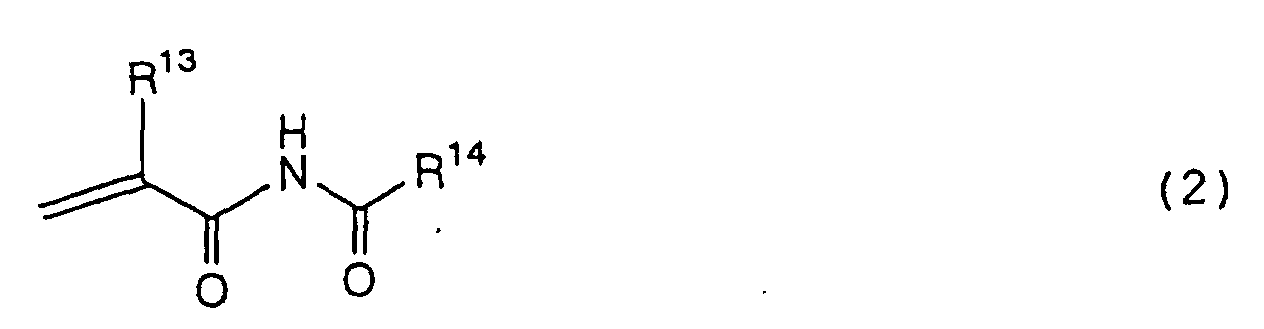
- a polymer obtained by polymerizing a monomer represented by the following general formula (1) (hereinafter referred to as “monomer (1)”) and a polymer obtained by polymerizing the monomer (1) and a monomer represented the following general formula (2) (hereinafter referred to as “monomer (2)”) are particularly preferably used in the invention.
- R 11 represents a hydrogen atom or a methyl group and R 11 is preferably a hydrogen atom in the invention.
- R 12 represents a single bond or a linear or branched alkylene group having 1 to 5 carbon atoms and R 12 is preferably a methylene group in the invention.
- R 13 represents a hydrogen atom or a methyl group and R 13 is preferably a hydrogen atom in the invention.
- R 14 represents a hydrogen atom, a linear, branched, or cyclic alkyl group having 1 to 10 carbon atoms, an alkoxyl group, an alkylamino group, an aryl group, or a heterocyclic group.
- the alkyl group is preferably a linear alkyl group having 1 to 5 carbon atoms
- the alkyl moiety of the alkoxyl group or alkylamino group is preferably a linear alkyl group having 1 to 5 carbon atoms.
- the aryl group includes phenyl group, naphthyl group, and the like, and compound forming the heterocyclic group includes pyrimidine and the like.
- the UCST when at least one monomer selected from hydrophilic monomers and hydrophobic polymers in addition to the monomers (1) and (2), the UCST can be controlled by changing the kind and ratio thereof.
- the monomer to be used is classified into a hydrophilic one or a hydrophobic one on the basis of the hydrophilicity of the monomer (1) to be used in the polymerization. That is, the one more hydrophilic than the monomer (1) to be used in the polymerization is a hydrophilic monomer and the one more hydrophobic is a hydrophobic monomer. Moreover, when two or more monomers as the monomer (1) are used in the polymerization, the classification may be carried out on the basis of the most hydrophilic monomer of them.
- the hydrophilic monomer for use in the invention may vary depending on the kind of the monomer (1) to be used in the polymerization and hence is difficult to specify sweepingly, but specific examples thereof include (meth)acrylamide, (meth)acrylic acid, allyl alcohol, allylamine, and the like, and the examples of the hydrophobic monomer include alkyl (meth)acrylates, unsaturated hydrocarbons such as styrene, ethylene, propylene, and acetylene, alkyl vinyl ethers, alkyl(meth)acrylamides, and the like.
- the UCST tends to lower. Contrary, in the case that a hydrophobic monomer is used, the UCST tends to rise.
- the composition ratio of the individual monomers is not particularly limited, but the molar ratio of the monomer (1)/the monomer (2)/the other monomer is usually a ratio of 95 to 20/1 to 60/0 to 40, preferably a ratio of 95 to 50/1 to 50/0 to 20.
- the raw material for the magnetic fine particles for use in the invention may be an organic or inorganic substance as far as it exhibits magnetism.
- it is not limited to the following, but specifically, it includes nickel oxide particles, ferrite particles, magnetite particles, cobalt iron oxide, barium ferrite, carbon steel, tungsten steel, KS steel, rare-earth cobalt magnet fine particles, hematite particles, and the like.
- the particle size of the magnetic fine particles may be such a size that the magnetic fine particles are not adsorbed by a magnetic force when the magnetic force is applied to the solvent in which the magnetic fine particles are dispersed.
- the size is not particularly limited but is preferably in the range of 1 nm to 1 ⁇ m, more preferably in the range of 1 nm to 100 nm.
- Magnetic magnetite fine particles having a particle size of several dozen nm can be obtained by converting magnetite into double micelles using sodium oleate and sodium dodecylbenzenesulfonate and dispersing the micelles into an aqueous solution. This process is described in Biocatalysis, 1991, Vol. 5, pp. 61-69.
- the magnetic fine particles of the invention are particles to which a UCST polymer is immobilized. Also, since they are fine particles, the magnetic fine particles themselves have a UCST.
- the UCST of the magnetic fine particles and UCST polymer is specifically a temperature at the time when the transmittance of visible light of magnetic fine particles- or UCST polymer-containing water, wherein the magnetic fine particles or UCST polymer is added to water in the rate of 1% by weight, reaches a half value of the value in a clear state, in the case that the magnetic fine particles- or UCST polymer-containing water is heated to be in a clear state and then the temperature of the magnetic fine particles- or UCST polymer-containing water is lowered in the rate of 1°C per 1 minute.
- the transmittance of visible light of the magnetic fine particles- or UCST polymer-containing water reaches a half value of the value in the clear state and the half value is still maintained in a certain temperature range even when the temperature is raised or lowered.
- the upper limit of the temperature range is called a UCST at temperature elevation and the lower limit is called a UCST at temperature lowering.
- the difference of the both temperatures (temperature range) is called a switching range.
- the narrower, the better and the range is preferably 10°C or less, more preferably 0°C in the invention.
- the UCST of the magnetic fine particles of the invention is not particularly limited but is preferably in the range of 0 to 50°C, particularly preferably in the range of 0 to 40°C in the case that the magnetic fine particles of the invention is used as a separating agent.
- a UCST polymer may be immobilized to the surface of magnetic fine particles by any action. That is, the action may be physical absorption or a chemical bond such as a hydrogen bond or a covalent bond.
- methods for the immobilization include a method of polymerizing the UCST polymer in the presence of magnetic fine particles, a method of bringing the UCST polymer into contact with magnetic fine particles in a solvent, a method of binding a coupling agent having a functional group such as SH group to magnetic fine particles and subjecting the UCST polymer to graft polymerization using the functional group as a starting point.
- magnetic fine particles of the invention obtainable by the method of polymerizing the UCST polymer in the presence of magnetic fine particles are preferable because the immobilized UCST polymer is hardly eliminated from the magnetic fine particles even when dissolution and precipitation/aggregation are repeatedly carried out in a liquid containing the same.
- a method of polymerizing only the monomer (1) or the monomer (1) and the monomer (2) in the presence of magnetic fine particles may be preferably used in the invention, and a method of polymerizing one or more monomers selected from hydrophilic monomers and hydrophobic monomers, the monomer (1) and the monomer (2) in the presence of magnetic fine particles may be particularly preferably used in the invention.
- magnetic fine particles to which a polymer is physically adsorbed can be prepared by adding the individual monomers to a solution in which magnetic fine particles are suspended, adding a polymerization initiator (e.g., ammonium persulfate or potassium persulfate) or a polymerization accelerator (e.g., N,N,N' ,N'-tetramethylethylenediamine) under stirring under a nitrogen atmosphere, and then stirring the mixture for several hours.
- a polymerization initiator e.g., ammonium persulfate or potassium persulfate
- a polymerization accelerator e.g., N,N,N' ,N'-tetramethylethylenediamine
- the UCST of the magnetic fine particles of the invention is preferably the same temperature as the UCST inherent in the UCST polymer.
- the magnetic fine particles of the invention are preferably the particles in which the immobilized UCST polymer is tightly supported even when dissolution and precipitation/aggregation are repeatedly carried out in a solution thereof.
- the magnetic fine particles of the invention which have a USCT and aggregate in a liquid can be easily recovered by a magnetism, and hence can be extremely effectively used for separation, recovery, and concentration of an objective substance in a solution.
- the one pair of substances having a mutual specific action is substances which mutually adsorb specifically through an interaction such as an interaction between ions, a hydrogen bond, a hydrophobic interaction, and coordination to a metal atom.
- biotin and avidin an antigen and an antibody
- a polynucleotide and a polynucleotide having a complementary base sequence, a cDNA and an mRNA an enzyme (active site) and a substrate, an enzyme (active site) and a product, an enzyme (active site) and a competitive inhibitor, an enzyme (coenzyme binding site) and a coenzyme, an enzyme (coenzyme binding site) and a triazine dye, a protease and a protease inhibitor, an Fc site and protein A, an Fc site and protein G, lectin and a sugar, a hormone receptor and a hormone, a DNA and a DNA binding protein, heparin and fibronectin, and he
- biotin and avidin can be most preferably used.
- biotin is immobilized to the UCST polymer, it is possible to separate or recover selectively only an objective substance to which avidin is immobilized.
- avidin is immobilized to the UCST polymer, it is possible to separate or recover selectively only an objective substance to which biotin is immobilized.
- biotin may be iminobiotin, and avidin may be streptoavidin.
- biotin may be iminobiotin, and avidin may be streptoavidin.
- the objective substance at that time is not particularly limited but examples thereof include enzymes, antibodies, nucleic acids, molecular chaperons, and heat shock proteins.
- avidin is preferably immobilized to the UCST polymer in the form of avidin-bound biotin.
- the magnetic fine particles of the invention wherein one of the one pair of substances having a mutual specific action is immobilized to the UCST polymer are used, another substance or a substance to which the substance is immobilized can be easily separated or recovered.
- the enzyme to be used is not particularly limited but it includes oxidoreductases, transferases, hydrolases, lyases, isomerases, ligases, and the like.
- the substance produced by converting a substrate can be easily separated from the enzyme by raising the temperature of the solution containing the magnetic fine particles of the invention and the produced substance to precipitate only the magnetic fine particles and removing only the thus precipitated magnetic fine particles using magnetism.
- the antibody to be used at that time may be a monoclonal antibody or a polyclonal antibody.
- the method of separating or concentrating a microorganism in a solution is not particularly limited but there may be specifically mentioned a method of adding the magnetic fine particles to a solution containing a microorganism, bringing the microorganism thoroughly into contact with the magnetic fine particles, then lowering the temperature of the solution to precipitate only the magnetic fine particles which have adsorbed the microorganism, and removing only the thus precipitated magnetic fine particles using magnetic force.
- a method of adding the magnetic fine particles to a solution containing a microorganism bringing the microorganism thoroughly into contact with the magnetic fine particles, then lowering the temperature of the solution to precipitate only the magnetic fine particles which have adsorbed the microorganism, and removing only the thus precipitated magnetic fine particles using magnetic force.
- the antibody to be used is a salmonella antibody
- the antibody to be used is a salmonella antibody
- the magnetic fine particles wherein a molecular chaperon or heat shock protein is immobilized to the UCST polymer enhance stability of an enzyme or antibody in a solution, repeated use thereof becomes possible, and hence production of proteins or substances at an industrial level can be assisted.
- a protein such as a molecular chaperon is expensive, it is difficult to use it at an industrial level.
- the method of separating or concentrating a nucleic acid is applicable to purification, concentration, detection, or the like of a specific gene.
- purification, detection, or concentration of any nucleic acid can be easily carried out by effecting thoroughly hybridization in a mixed liquid containing two or more kinds of nucleic acids and the magnetic fine particles, then lowering the temperature of the mixed liquid to aggregate and recover the particles together with the nucleic acids, and again raising the temperature.
- target DNA or mRNA can be concentrated or purified by using a biotinylated DNA or biotinylated polythymine.
- a nucleic acid can be detected in a good sensitivity by amplifying the resulting nucleic acid according to any of various gene-amplifying methods.
- the method of amplifying a nucleic acid is not particularly limited but PCR method or RT-PCR method may be preferably used in the invention.
- the method for immobilizing one of the one pair of substances having a mutual specific action to a UCST polymer immobilized to the magnetic fine particles of the invention is not particularly limited and includes a method of immobilizing one of the one pair of substances to a UCST polymer already synthesized (hereinafter referred to as "immobilization method") or a method of introducing one of the one pair of substances by polymerizing a monomer having one of the one pair of substances as part of the structure and a monomer forming a UCST polymer through polymerization (hereinafter referred to as "polymerization method").
- the above-mentioned immobilization method preferably uses a covalent bond, but binding utilizing an ion-complex or a charge-transfer complex, binding utilizing a biochemical affinity, or the like may be used.
- the UCST polymer may be bound to the protein utilizing the reactivity of a functional group such as an amino group or carboxyl group which the protein has.
- an amide bond can be formed according to the reaction scheme as shown below by introducing a carboxyl group in the UCST polymer.
- R' a UCST polymer
- the UCST polymer may be bound to a protein utilizing a method of using an aldehyde group or utilizing an epoxy group as shown below.
- an amide bond can be formed according to the reaction scheme as shown below by introducing an amino group in the UCST polymer.
- a protein such as an enzyme or antibody can be also immobilized to the UCST polymer according to a known protein immobilizing method using a carbodiimide or the like by designing the UCST polymer-so as to have an appropriate functional group such as carboxyl group or the like, for example, through copolymerization of the carboxyl group or the like of methacrylic acid with the above monomer or the other monomer.
- the binding is preferably effected in a phosphate or Tris buffer solution whose pH is around neutral.
- the salt concentration may be suitably determined depending on the purposes.
- the polymerization method is preferably employed in the invention because it is relatively easy to control polymerization ratio in a polymer.
- the method for immobilizing one of the one pair of substances having a mutual specific action to the UCST polymer immobilized to magnetic fine particles of the invention is described in detail by way of illustration of the polymerization method using a monomer having biotin as part of the structure.
- the monomer forming the UCST polymer through polymerization includes N-acryloylglycineamide, N-formylacrylamide, N-acetylacrylamide, acrylamide, polymerizable biotin derivatives, and the like, while the monomer having biotin as part of the structure includes (meth)acrylamide, (meth)acrylate derivatives, and the like formed by utilizing a terminal carboxyl group of biotin, but they are not limited thereto in the invention.
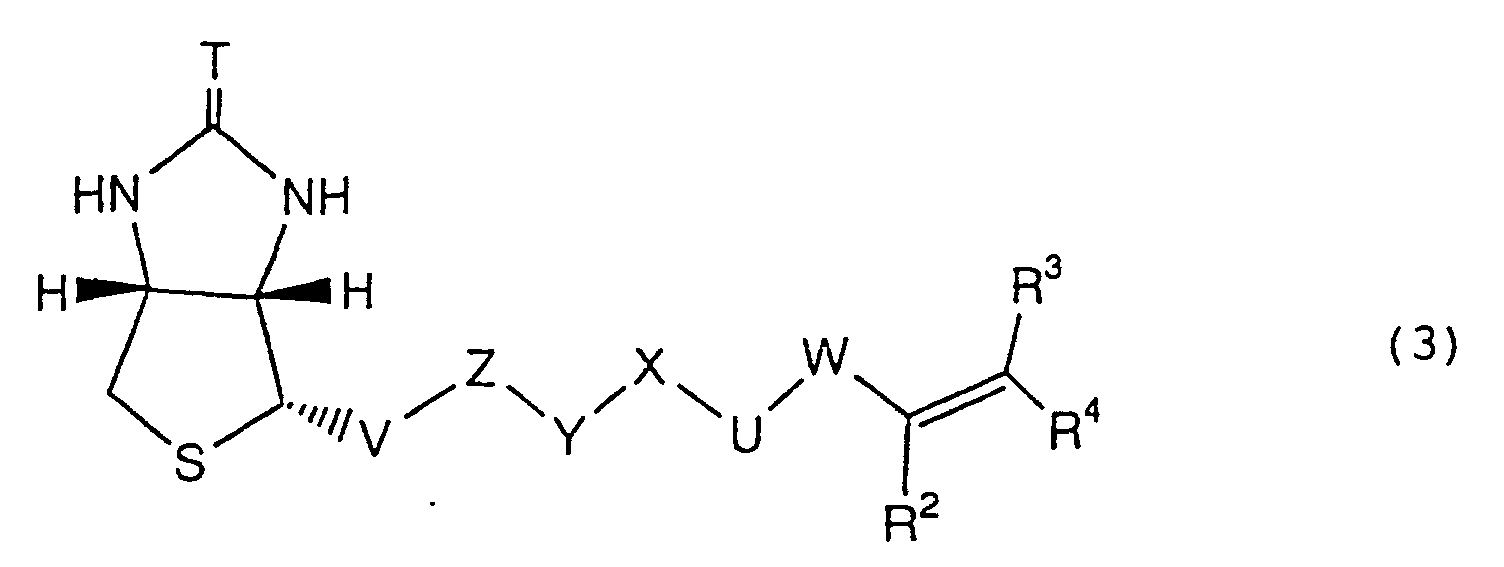
- the monomer forming the UCST polymer to be preferably used in the polymerization method includes the above-mentioned monomer (1), and the monomer having biotin as part of the structure includes a polymerizable biotin derivative represented by the following general formula (3).
- R 2 represents a hydrogen atom or an alkyl group.
- R 3 and R 4 each independently represents a hydrogen atom, an alkyl group or an aryl group.
- W represents a single bond or a carbonyl group, a thiocarbonyl group, or an alkylene group having 1 to 5 carbon atoms.
- U represents a single bond or -NH- group.
- X represents a single bond or a hydrocarbon bond having 1 to 8 carbon atoms, an oxygen atom, or -NH- group.
- Y represents a single bond or a carbonyl group, a thiocarbonyl group, -NH- group, a 1,2-dioxyethylene group, or a 1,2-diaminoethylene group.
- Z represents a single bond or a carbonyl group, a thiocarbonyl group, an alkylene group having 1 to 5 carbon atoms, an oxygen atom, or -NH- group.
- V represents a single bond or an alkylene group having 1 to 5 carbon atoms.
- acryloylglycineamide represented by the following general formula (4) may be specifically mentioned.
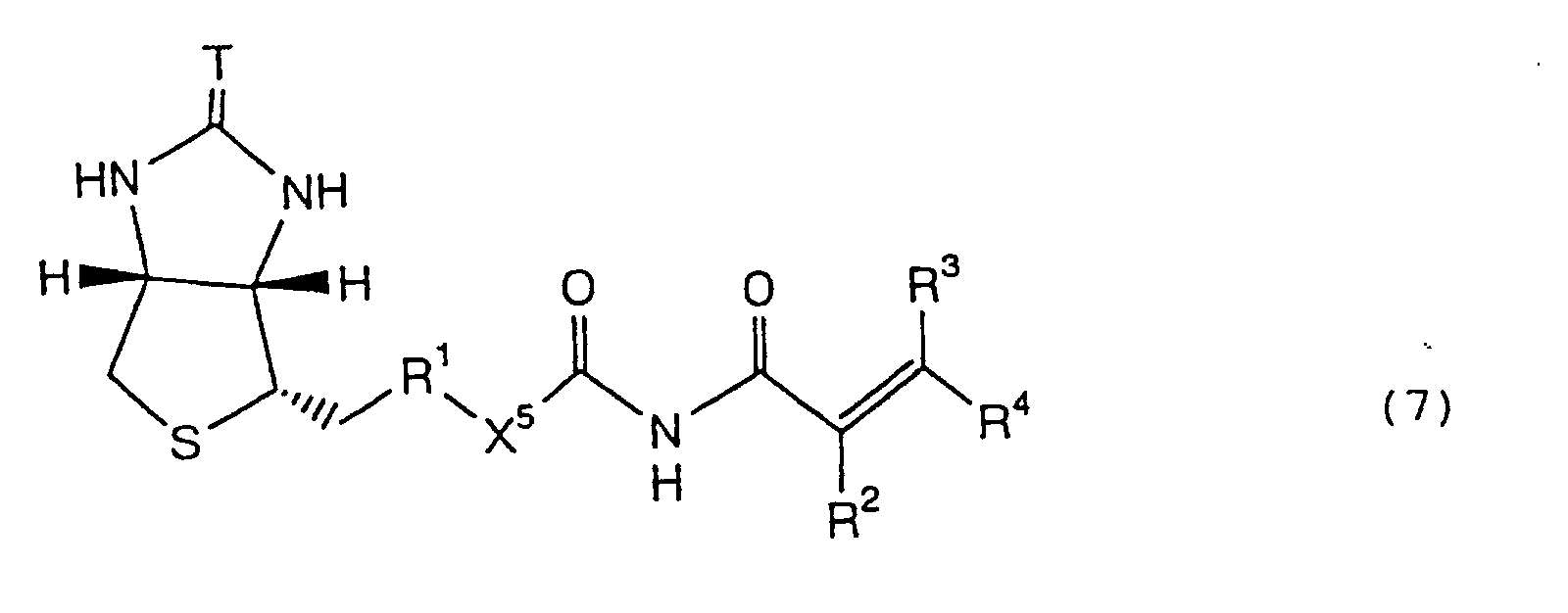
- polymerizable biotin derivatives represented by the following general formulae (5) to (7) may be preferably used in the polymerization method.
- R 1 represents a single bond or an alkylene group having 1 to 4 carbon atoms and R 5 represents an alkylene group having 2 or 3 carbon atoms.
- X 1 represents an oxygen atom or a sulfur atom
- X 2 to X 5 each independently represents an oxygen atom or -NH- group.
- T, R 2 , R 3 , and R 4 each has the same definition as in the above general formula (3).
- the polymerizable biotin derivative represented by the above general formula (5) can be generally obtained by converting the side chain carboxyl hydroxyl group of biotin or that of a biotin derivative represented by the following general formula (8) into an appropriate leaving group and then condensing the product with an acrylic derivative represented by the following general formula (9).
- the polymerizable biotin derivative represented by the above general formula (6) can be obtained by reacting a biotin derivative represented by the following general formula (10) with an appropriate acrylating agent (including a methacrylating agent or the like; for example, an acrylating agent such as acrylic acid, acryloyl chloride, acrylic anhydride, or acryloxysuccinimide, a methacrylating agent such as methacrylic acid, methacryloyl chloride, methacrylic anhydride, or methacryloxysuccinimide, or the like).
- an appropriate acrylating agent including a methacrylating agent or the like; for example, an acrylating agent such as acrylic acid, acryloyl chloride, acrylic anhydride, or acryloxysuccinimide, a methacrylating agent such as methacrylic acid, methacryloyl chloride, methacrylic anhydride, or methacryloxysuccinimide, or the like.
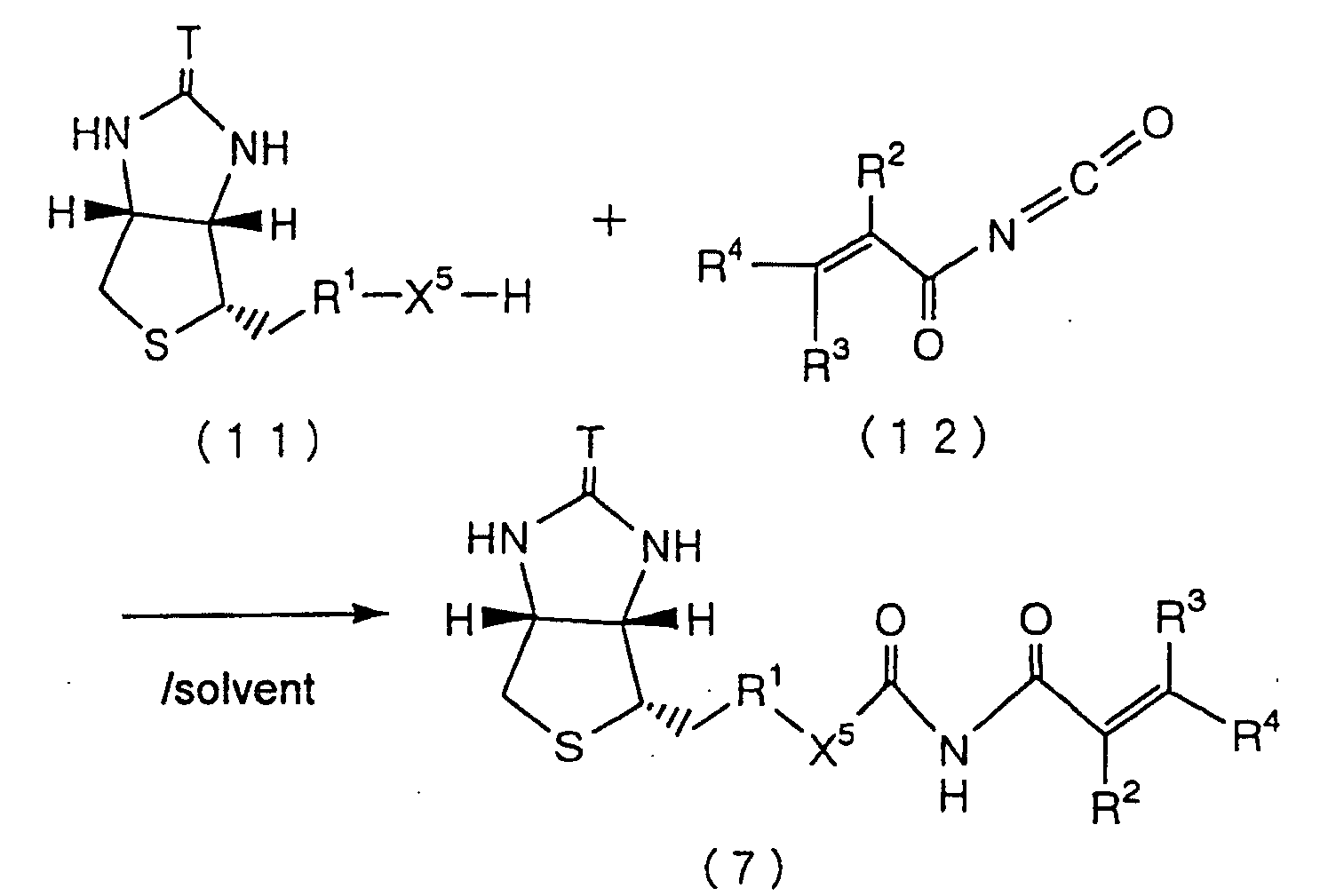
- the polymerizable biotin derivative represented by the above general formula (7) can be obtained by reacting a biotin derivative represented by the following general formula (11) with an isocyanate substance represented by the general formula (12) in an aprotic solvent such as tetrahydrofuran (THF), dimethyl sulfoxide (DMSO), ether, dimethylformamide (DMF), dichloromethane, chloroform, ethyl acetate, acetone, an aliphatic hydrocarbon, benzene, or toluene.
- an aprotic solvent such as tetrahydrofuran (THF), dimethyl sulfoxide (DMSO), ether, dimethylformamide (DMF), dichloromethane, chloroform, ethyl acetate, acetone, an aliphatic hydrocarbon, benzene, or toluene.
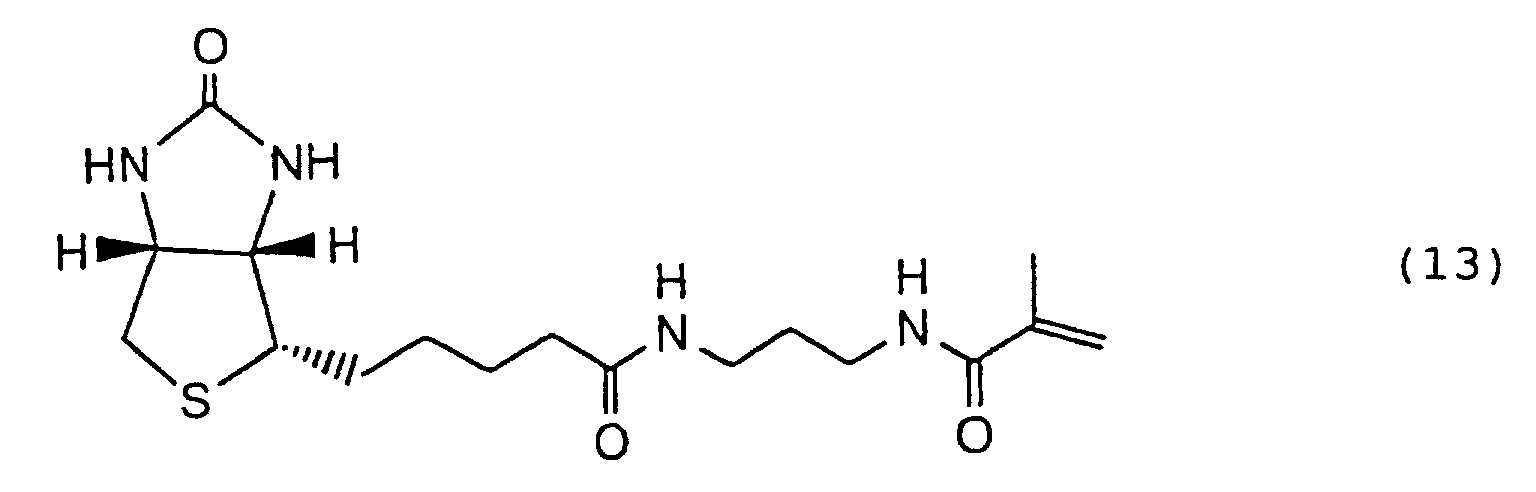
- a polymerizable biotin derivative represented by the following general formula (13) is particularly preferably used in the polymerization method.
- the monomer capable of being preferably used in the polymerization method includes a biotin methacrylamide derivative represented by the general formula (14) and a biotin derivative represented by the general formula (15).
- the magnetic fine particles of the invention are produced by the method of carrying out the polymerization for obtaining a UCST polymer in the presence of magnetic fine particles, contaminants such as unreacted monomers and salts coexist in the reaction solution.
- the contaminants may be removed by dialysis or by lowering the temperature of the solution to the UCST or lower to cause aggregation, recovering aggregated matter with a magnet, and subsequently removing the resulting supernatant.
- one of the one pair of substances having a mutual specific action may be directly immobilized to the UCST polymer but, since the operations for the immobilization are simple and convenient, it is preferable to immobilize it to the UCST polymer through a binding of biotin to avidin.
- an enzyme to which avidin is immobilized may be immobilized to the UCST polymer to which biotin is immobilized utilizing a specific adsorption action between avidin and biotin.
- an enzyme to which biotin is immobilized is immobilized to the UCST polymer to which avidin-bound biotin is immobilized.
- the avidin-bound biotin is capable of immobilizing a maximum of three biotinylated enzymes, it is possible to convert, separate, or recover a substrate in a high efficiency.
- it is not limited to an enzyme and any one pair of substances having a mutual specific action may result in the same effects.
- the separating agent of the invention is not particularly limited as far as it contains the UCST magnetic fine particles of the invention, but the content of the magnetic fine particles in the separating agent is preferably in the range of 1 to 100% by weight, particularly preferably in the range of 2 to 30% by weight.
- the other components include ferrite particles, magnetite particles, hematite particles, and the like.
- the use of the separating agent of the invention enables a facile separation of a microorganism, a nucleic acid, a protein, an antigen, an endocrine-disrupting chemical, or the like.
- Magnetic fine particles are prepared according to the following method.
- the magnetic fine particles of the invention to which a UCST polymer was immobilized were prepared according to the following method.
- Example 2 Preparation of magnetic fine particles to which UCST polymer is immobilized (hereinafter referred to as "UCST magnetic fine particles”)
- Example 2 Into a 300 ml flask were added 4 ml of the magnetic fine particles prepared in Example 1, 2.13 g of N-acryloylglycineamide, 12.7 mg of N-biotinyl-N'-methacryloyltrimethyleneamide, and 94 ml of distilled water, followed by thorough stirring at 50°C. Thereto was added 0.1 g of potassium persulfate, followed by 6 hours of stirring at room temperature. The resulting black clear solution was dialyzed for one day and night to obtain UCST magnetic fine particles. The UCST of the resulting black clear solution was measured to be 18°C. The UCST hardly changed in a physiological saline and in 100 mM phosphate buffer (pH 7.0).
- the temperature of the solution was changed by means of a constant temperature bath, and operations of dissolution, aggregation, and recovery with a magnet were carried out.
- the activity of the peroxidase in each supernatant was measured according to the method of measuring the activity of peroxidase shown in the following. In this connection, after the recovery of the UCST magnetic fine particles with a magnet, 1900 ⁇ l of the supernatant was removed and 1900 1 of 0.1 M phosphate buffer (pH 7.0) was newly added each time.
- the following shows the results of measuring enzymatic activity of the supernatant in the case that aggregation and dissolution of the UCST fine particles of the invention were repeatedly carried out according to the above method.
- the enzymatic activity was represented by specific activity wherein the activity at the first dissolution was regarded as 100.
- Number of repetition (time) Peroxidase activity at dissolution of UCST magnetic fine particles (%)
- Peroxidase activity of supernatant after aggregation and recovery of UCST magnetic fine particles (%) 1 100 13 2 102 9 3 101 5 5 5 97 4 10 98 2 20 86 0
- One hundred ⁇ l of the solution of the magnetic fine particles 1000 ⁇ l of a commercially available biotinylated peroxidase solution (1 mg/ml), 100 ⁇ l of 1.0 M sodium phosphate buffer (pH 7.0), and 700 ⁇ l of distilled water were added and thoroughly mixed. The resulting solution was cooled and the aggregate was recovered with a magnet. After 1900 ⁇ l of the supernatant was removed, 1900 ⁇ l of 0.1 M phosphate buffer (pH 7.0) was newly added to prepare avidinylated magnetic fine particles to which biotinylated peroxidase was immobilized.
- the following shows the results of measuring enzymatic activity of the supernatant in the case that dissolution, aggregation, and recovery were repeatedly carried out in a similar manner to Example 5 using the UCST magnetic fine particles.
- the enzymatic activity was also represented by specific activity wherein the activity at the first dissolution was regarded as 100.
- Peroxidase activity of supernatant after aggregation and recovery of UCST magnetic fine particles (%) 1 100 2 2 99 1 3 102 1 5 98 0 10 96 0 20 90 0
- a commercially available biotinylated heat shock protein HSP70 was thoroughly mixed with 100 mM sodium phosphate buffer (pH 7.0) and the 5 ⁇ l of the mixture was taken out. After denaturation treatment, the band of HSP70 was confirmed by SDS-PAGE. Subsequently, 50 ⁇ l of the avidinylated UCST magnetic fine particles wherein the biotin-binding sites other than the binding site to the polymer were free prepared in Example 6 was added to 50 ⁇ l of the above sodium phosphate buffer solution of the biotinylated HSP70 and the whole was thoroughly mixed. Thereafter, as in Example 3, the solution was cooled to aggregate the magnetic fine particles, which was recovered with a magnet. HSP70 in the supernatant was similarly investigated by SDS-PAGE to confirm that HSP70 was absent in the supernatant and was bound to avidin immobilized to the magnetic fine particles.
- Example 8 (Method of separating and concentrating microorganism)
- a commercially available biotinylated salmonella antibody was immobilized to the avidinylated UCST magnetic fine particles, prepared in Example 6, wherein the biotin-binding sites other than the binding site to the polymer were free. The immobilization was confirmed using SDS-PAGE. Subsequently, 1 ml of the solution of the biotinylated salmonella antibody-immobilized UCST magnetic fine particles was added to 20 ml of a bacteria suspension which was adjusted so as to contain the salmonella in a rate of one bacteria/ml and the whole was thoroughly mixed. Thereafter, as in Example 3, the solution was cooled to aggregate the magnetic fine particles, which was recovered with a magnet. The supernatant was removed and a 1 ml solution was prepared.
- the solution was sterilized beforehand and added to 20 ml of a brain-heart infusion agar medium and the whole was rapidly mixed. Then, the mixture was spread in a petri dish and allowed to stand to cool until the agar became hard, followed by 48 hours of incubation at 37°C. The following shows the results of measuring the number of colonies after 48 hours. These all the operations were carried out in a clean workstation. Additionally, the number of bacteria in 1 ml of the bacteria suspension originally prepared was similarly measured as a control without adding the magnetic fine particles. Control Use of UCST magnetic fine particles Number of colonies 1 19
- UCST magnetic fine particles were prepared in accordance with Example 2 with the exception that 252 mg of methacrylamide was used instead of N-biotinyl-N'-methacryloyltrimethyleneamide.
- the UCST of the resulting magnetic fine particles was found to be 2°C.
- UCST magnetic fine particles were prepared in accordance with Example 2 with the exception that 251 mg of N-acetylacrylamide was used instead of N-biotinyl-N'-methacryloyltrimethyleneamide.
- the UCST of the resulting magnetic fine particles was found to be 6°C.
- UCST magnetic fine particles were prepared in accordance with Example 2 with the exception that 132 mg of N-formylacrylamide was used instead of N-biotinyl-N'-methacryloyltrimethyleneamide.
- the UCST of the resulting magnetic fine particles was found to be 16°C.
- UCST magnetic fine particles were prepared in accordance with Example 2 with the exception that 221 mg of N-formylacrylamide was used instead of N-biotinyl-N'-methacryloyltrimethyleneamide.
- the UCST of the resulting magnetic fine particles was found to be 30°C.
- UCST magnetic fine particles were prepared in accordance with Example 2 with the exception that 237 mg of acrylamide was used instead of N-biotinyl-N'-methacryloyltrimethyleneamide.
- the UCST of the resulting magnetic fine particles was found to be 10°C.
- UCST magnetic fine particles were prepared in accordance with Example 2 with the exception that 188 mg of N-acetylacrylamide was used instead of N-biotinyl-N'-methacryloyltrimethyleneamide.
- the UCST of the resulting magnetic fine particles was found to be 12°C.
- UCST magnetic fine particles were prepared in accordance with Example 2 with the exception that 1.18 g of acrylamide and 275 mg of N-formylacrylamide were used instead of N-acryloylglycineamide and N-biotinyl-N'-methacryloyltrimethyleneamide.
- the UCST of the resulting magnetic fine particles was found to be 14°C.
- the magnetic fine particles of the invention to which a polymer having an upper critical solution temperature is immobilized are used for separating a biological molecule or the like, it is possible to separate or recover the objective biological molecule or the like without damaging or inactivating it.
Landscapes
- Chemical & Material Sciences (AREA)
- Engineering & Computer Science (AREA)
- Health & Medical Sciences (AREA)
- Life Sciences & Earth Sciences (AREA)
- Biomedical Technology (AREA)
- Genetics & Genomics (AREA)
- Immunology (AREA)
- Organic Chemistry (AREA)
- Biotechnology (AREA)
- Zoology (AREA)
- Wood Science & Technology (AREA)
- Bioinformatics & Cheminformatics (AREA)
- Molecular Biology (AREA)
- Physics & Mathematics (AREA)
- Biochemistry (AREA)
- General Health & Medical Sciences (AREA)
- General Engineering & Computer Science (AREA)
- Microbiology (AREA)
- Urology & Nephrology (AREA)
- Analytical Chemistry (AREA)
- General Physics & Mathematics (AREA)
- Nanotechnology (AREA)
- Crystallography & Structural Chemistry (AREA)
- Hematology (AREA)
- Pathology (AREA)
- Materials Engineering (AREA)
- Food Science & Technology (AREA)
- Biophysics (AREA)
- Cell Biology (AREA)
- Composite Materials (AREA)
- Condensed Matter Physics & Semiconductors (AREA)
- Plant Pathology (AREA)
- Medicinal Chemistry (AREA)
- Inorganic Chemistry (AREA)
- Dispersion Chemistry (AREA)
- Power Engineering (AREA)
- Measuring Or Testing Involving Enzymes Or Micro-Organisms (AREA)
- Immobilizing And Processing Of Enzymes And Microorganisms (AREA)
Abstract
Description








| Number of repetition (time) | Peroxidase activity at dissolution of UCST magnetic fine particles (%) | Peroxidase activity of supernatant after aggregation and recovery of UCST magnetic fine particles (%) |
| 1 | 100 | 13 |
| 2 | 102 | 9 |
| 3 | 101 | 5 |
| 5 | 97 | 4 |
| 10 | 98 | 2 |
| 20 | 86 | 0 |
| Number of repetition (time) | Peroxidase activity at dissolution of UCST magnetic fine particles (%) | Peroxidase activity of supernatant after aggregation and recovery of UCST magnetic fine particles (%) |
| 1 | 100 | 2 |
| 2 | 99 | 1 |
| 3 | 102 | 1 |
| 5 | 98 | 0 |
| 10 | 96 | 0 |
| 20 | 90 | 0 |
| Control | Use of UCST magnetic fine particles | |
| Number of colonies | 1 | 19 |
Claims (34)
- Magnetic fine particles having immobilized thereto a polymer having an upper critical solution temperature.
- The magnetic fine particles according to claim 1, wherein said polymer having an upper critical solution temperature is a polymer obtained by polymerizing a monomer represented the following general formula (1):wherein R11 represents a hydrogen atom or a methyl group and R12 represents a single bond or a linear or branched alkylene group having 1 to 5 carbon atoms.
- The magnetic fine particles according to claim 1, wherein said polymer having an upper critical solution temperature is a polymer obtained by polymerizing the monomer represented by the above general formula (1) and a monomer represented the following general formula (2):wherein R13 represents a hydrogen atom or a methyl group and R14 represents a hydrogen atom, a linear, branched, or cyclic alkyl group having 1 to 10 carbon atoms, an alkoxyl group, an alkylamino group, an aryl group, or a heterocyclic group.
- The magnetic fine particles according to claim 1, wherein said polymer having an upper critical solution temperature is a polymer obtained by polymerizing the monomer represented by the above general formula (1) and a monomer having biotin as part of its structure.
- The magnetic fine particles according to any one of claims 2 to 4, wherein said polymer having an upper critical solution temperature is a polymer obtained by polymerization additionally using at least one monomer selected from hydrophilic monomers and hydrophobic monomers.
- The magnetic fine particles according to claim 1, wherein one of one pair of substances having a mutual specific action is immobilized to said polymer having an upper critical solution temperature.
- The magnetic fine particles according to claim 6, wherein said one pair of substances having a mutual specific action is at least one combination selected from combinations of biotin and avidin, an antigen and an antibody, a polynucleotide and a polynucleotide having a complementary base sequence, a cDNA and an mRNA, an enzyme (active site) and a substrate, an enzyme (active site) and a product, an enzyme (active site) and a competitive inhibitor, an enzyme (coenzyme binding site) and a coenzyme, an enzyme (coenzyme binding site) and a triazine dye, a protease and a protease inhibitor, an Fc site and protein A, an Fc site and protein G, lectin and a sugar, a hormone receptor and a hormone, a DNA and a DNA binding protein, heparin and fibronectin, and heparin and laminin.
- The magnetic fine particles according to claim 6, wherein said one pair of substances having a mutual specific action are biotin and avidin.
- The magnetic fine particles according to claim 6, wherein one of said one pair of substances having a mutual specific action, immobilized to said polymer having an upper critical solution temperature is biotin.
- The magnetic fine particles according to claim 9, wherein said biotin is a biotin bound to avidin (hereinafter referred to as "avidin-bound biotin").
- The magnetic fine particles according to claim 9, wherein an avidinylated enzyme is bound to said biotin.
- The magnetic fine particles according to claim 10, wherein a biotinylated enzyme is bound to said avidin-bound biotin.
- A conversion method comprising converting a substance using said magnetic fine particles according to claim 11 or 12.
- The magnetic fine particles according to claim 9, wherein an avidinylated antibody is bound to said biotin.
- The magnetic fine particles according to claim 10, wherein a biotinylated antibody is bound to said avidin-bound biotin.
- A separation or concentration method comprising separating or concentrating a microorganism using said magnetic fine particles according to claim 14 or 15.
- The magnetic fine particles according to claim 9, wherein an avidinylated molecular chaperon is bound to said biotin.
- The magnetic fine particles according to claim 10, wherein a biotinylated molecular chaperon is bound to said avidin-bound biotin.
- A modification method comprising modifying a denatured protein using said magnetic fine particles according to claim 17 or 18.
- The magnetic fine particles according to claim 9, wherein an avidinylated heat shock protein is bound to said biotin.
- The magnetic fine particles according to claim 10, wherein a biotinylated heat shock protein is bound to said avidin-bound biotin.
- A modification method comprising modifying a denatured protein using said magnetic fine particles according to claim 20 or 21.
- The magnetic fine particles according to claim 9, wherein an avidinylated nucleic acid is bound to said biotin.
- The magnetic fine particles according to claim 10, wherein a biotinylated nucleic acid is bound to said avidin-bound biotin.
- A purification, detection or concentration method comprising purifying, detecting or concentrating a nucleic acid using said magnetic fine particles according to claim 23 or 24.
- A method of detecting a nucleic acid comprising amplifying said nucleic acid obtained by said method of purifying or concentrating the nucleic acid according to claim 25.
- The method of detecting a nucleic acid according to claim 26, wherein said amplification is carried out by PCR method or RT-PCR method.
- A separating agent containing said magnetic fine particles according to any one of claims 1 to 10.
- A separation method comprising separating a biological substance using said separating agent according to claim 28.
- A process for producing magnetic fine particles having an upper critical solution temperature, comprising carrying out polymerization in the presence of magnetic fine particles to obtain a polymer having an upper critical solution temperature.
- The process for producing magnetic fine particles having an upper critical solution temperature according to claim 30, wherein a monomer represented the following general formula (1) is polymerized in the presence of magnetic fine particles:wherein R11 represents a hydrogen atom or a methyl group and R12 represents a single bond or a linear or branched alkylene group having 1 to 5 carbon atoms.

- The process for producing magnetic fine particles having an upper critical solution temperature according to claim 30, wherein the monomer represented by the above general formula (1) and a monomer represented the following general formula (2) are polymerized in the presence of magnetic fine particles:wherein R13 represents a hydrogen atom or a methyl group and R14 represents a hydrogen atom, a linear, branched, or cyclic alkyl group having 1 to 10 carbon atoms, an alkoxyl group, an alkylamino group, an aryl group, or a heterocyclic group.

- The process for producing magnetic fine particles having an upper critical solution temperature according to claim 30, wherein the monomer represented by the above general formula (1) and a monomer having biotin as part of its structure are polymerized in the presence of magnetic fine particles.
- The process for producing magnetic fine particles according to any one of claims 30 to 33, wherein at least one monomer selected from hydrophilic monomers and hydrophobic monomers is used as an additional monomer.
Applications Claiming Priority (3)
| Application Number | Priority Date | Filing Date | Title |
|---|---|---|---|
| JP2000249817 | 2000-08-21 | ||
| JP2000249817 | 2000-08-21 | ||
| PCT/JP2001/007120 WO2002016528A1 (en) | 2000-08-21 | 2001-08-20 | Magnetic particles and process for producing the same |
Publications (3)
| Publication Number | Publication Date |
|---|---|
| EP1316599A1 true EP1316599A1 (en) | 2003-06-04 |
| EP1316599A4 EP1316599A4 (en) | 2009-08-05 |
| EP1316599B1 EP1316599B1 (en) | 2014-03-26 |
Family
ID=18739496
Family Applications (1)
| Application Number | Title | Priority Date | Filing Date |
|---|---|---|---|
| EP01956972.2A Expired - Lifetime EP1316599B1 (en) | 2000-08-21 | 2001-08-20 | Magnetic particles and process for producing the same |
Country Status (4)
| Country | Link |
|---|---|
| US (1) | US7393698B2 (en) |
| EP (1) | EP1316599B1 (en) |
| JP (1) | JP4887530B2 (en) |
| WO (1) | WO2002016528A1 (en) |
Cited By (9)
| Publication number | Priority date | Publication date | Assignee | Title |
|---|---|---|---|---|
| EP2009044A1 (en) * | 2007-06-29 | 2008-12-31 | Chisso Corporation | Aqueous solution of polymer having upper critical solution temperature, aqueous dispersion of particle modified with the polymer and method of storing the same |
| WO2010007157A1 (en) | 2008-07-18 | 2010-01-21 | Basf Se | Inorganic particles comprising an organic coating that can be hydrophilically/hydrophobically temperature controlled |
| CN101165183B (en) * | 2006-10-19 | 2010-05-12 | 陕西西大北美基因股份有限公司 | A Method for Separating mRNA Using Gold Magnetic Particles |
| CN101165182B (en) * | 2006-10-19 | 2010-05-12 | 陕西西大北美基因股份有限公司 | Method for purifying DNA by using gold magnetism particles |
| US8426214B2 (en) | 2009-06-12 | 2013-04-23 | University Of Washington | System and method for magnetically concentrating and detecting biomarkers |
| US8507283B2 (en) | 2007-03-08 | 2013-08-13 | University Of Washington | Stimuli-responsive magnetic nanoparticles and related methods |
| US9080933B2 (en) | 2009-11-09 | 2015-07-14 | University Of Washington Through Its Center For Commercialization | Stimuli-responsive polymer diagnostic assay comprising magnetic nanoparticles and capture conjugates |
| CN104841483A (en) * | 2015-04-21 | 2015-08-19 | 南开大学 | Preparation method and application research of temperature-sensitive material supported Pd catalyst |
| WO2020231703A1 (en) * | 2019-05-15 | 2020-11-19 | The Boeing Company | Polymer with upper critical solution temperature in aqueous solution |
Families Citing this family (27)
| Publication number | Priority date | Publication date | Assignee | Title |
|---|---|---|---|---|
| EP1312627B1 (en) * | 2000-08-21 | 2009-10-07 | National Institute of Advanced Industrial Science and Technology | Polymers |
| JP4078247B2 (en) * | 2003-05-02 | 2008-04-23 | キヤノン株式会社 | Magnetic substance-biological substance complex type structure, peptide fragment having amino acid sequence capable of binding to magnetic substance and gene thereof, and method for producing magnetic substance-biological substance complex type structure |
| JP4518767B2 (en) * | 2003-09-09 | 2010-08-04 | チッソ株式会社 | Stimulus-responsive polymer-immobilized magnetic fine particles and adsorbent using the same |
| JP4554375B2 (en) * | 2005-01-11 | 2010-09-29 | 国立大学法人神戸大学 | Protozoan oocyst measurement method and detection reagent |
| US8084275B2 (en) | 2005-02-08 | 2011-12-27 | Fujifilm Corporation | Magnetic composite body, production method thereof, method for removing substance with mannose on its surface, and method for concentrating substance with mannose on its surface |
| JP2006280277A (en) * | 2005-03-31 | 2006-10-19 | Tokyo Univ Of Agriculture & Technology | Method for extracting nucleic acid |
| JP4945959B2 (en) * | 2005-08-23 | 2012-06-06 | Jnc株式会社 | Thermally responsive magnetic fine particles, production method thereof, and adsorbent using the fine particles |
| JP4837410B2 (en) | 2006-03-22 | 2011-12-14 | 富士フイルム株式会社 | Target compound detection method |
| FR2902799B1 (en) | 2006-06-27 | 2012-10-26 | Millipore Corp | METHOD AND UNIT FOR PREPARING A SAMPLE FOR THE MICROBIOLOGICAL ANALYSIS OF A LIQUID |
| US20100129889A1 (en) * | 2006-09-05 | 2010-05-27 | Innovative Purification Technologies Pty Ltd | Affinity separation methods and systems |
| US8569464B2 (en) | 2006-12-21 | 2013-10-29 | Emd Millipore Corporation | Purification of proteins |
| WO2008079280A1 (en) | 2006-12-21 | 2008-07-03 | Millipore Corporation | Purification of proteins |
| US8362217B2 (en) | 2006-12-21 | 2013-01-29 | Emd Millipore Corporation | Purification of proteins |
| WO2009151514A1 (en) | 2008-06-11 | 2009-12-17 | Millipore Corporation | Stirred tank bioreactor |
| US20100190963A1 (en) | 2008-12-16 | 2010-07-29 | Millipore Corporation | Stirred Tank Reactor And Method |
| US8536322B2 (en) * | 2009-10-19 | 2013-09-17 | Zhiqiang Han | Method for nucleic acid isolation by solid phase reversible binding of nucleic acids |
| US20110117668A1 (en) * | 2009-11-09 | 2011-05-19 | University Of Washington Through Its Center For Commercialization | Self-powered smart diagnostic devices |
| EP2571903B1 (en) | 2010-05-17 | 2019-09-04 | EMD Millipore Corporation | Stimulus responsive polymers for the purification of biomolecules |
| JP5435099B2 (en) * | 2012-09-27 | 2014-03-05 | Jnc株式会社 | Polymer aqueous solution having upper critical solution temperature, aqueous dispersion of particles modified with the polymer |
| CN103601847B (en) * | 2013-10-24 | 2016-04-06 | 江苏大学 | A kind of preparation method of Core-shell type magnetic surface trace nano composite material |
| CN105754021B (en) * | 2016-05-18 | 2018-04-03 | 苏州知益微球科技有限公司 | A kind of grain magnetic polymer microsphere preparation method |
| JP6880571B2 (en) * | 2016-05-20 | 2021-06-02 | Jnc株式会社 | Recovery method and recovery device for microorganisms in aqueous solution using magnetic particles |
| JP6880614B2 (en) * | 2016-09-21 | 2021-06-02 | Jnc株式会社 | How to recover water-insoluble substances |
| CN109321634A (en) * | 2017-07-26 | 2019-02-12 | 上海之江生物科技股份有限公司 | Nucleic acid uniforms method and its kit and application |
| JP7296610B2 (en) * | 2018-05-07 | 2023-06-23 | 国立大学法人東京工業大学 | Artificial chaperone molecule and protein quality control method using the same |
| CN111537745B (en) * | 2020-05-27 | 2021-07-30 | 南京大学 | Application of heat shock protein 90kDa αB1 in detecting the degree of protein denaturation caused by inhalable particulate matter |
| CN119546389A (en) * | 2022-08-02 | 2025-02-28 | 泰尔茂株式会社 | Filter and method for manufacturing the same |
Family Cites Families (19)
| Publication number | Priority date | Publication date | Assignee | Title |
|---|---|---|---|---|
| US4206094A (en) * | 1976-06-09 | 1980-06-03 | California Institute Of Technology | Method for producing a biological reagent |
| US4438239A (en) * | 1981-03-30 | 1984-03-20 | California Institute Of Technology | Microsphere coated substrate containing reactive aldehyde groups |
| US4554088A (en) * | 1983-05-12 | 1985-11-19 | Advanced Magnetics Inc. | Magnetic particles for use in separations |
| US4912032A (en) * | 1986-04-17 | 1990-03-27 | Genetec Systems Corporation | Methods for selectively reacting ligands immobilized within a temperature-sensitive polymer gel |
| GB8827160D0 (en) * | 1988-11-21 | 1988-12-29 | Apothekernes Lab | Detection & quantitative determination of rna & dna |
| US5445971A (en) * | 1992-03-20 | 1995-08-29 | Abbott Laboratories | Magnetically assisted binding assays using magnetically labeled binding members |
| US5496934A (en) * | 1993-04-14 | 1996-03-05 | Yissum Research Development Company Of The Hebrew University Of Jerusalem | Nucleic acids encoding a cellulose binding domain |
| US5855790A (en) * | 1994-02-07 | 1999-01-05 | Selective Environmental Technologies, Inc. | Magnetic particles, a method for the preparation thereof and their use in the purification of solutions |
| JP3800615B2 (en) * | 1994-09-28 | 2006-07-26 | Jsr株式会社 | Method for preparing nucleic acid diagnostic particle and method for detecting target nucleic acid in test sample using the nucleic acid diagnostic particle |
| DE19528029B4 (en) * | 1995-07-31 | 2008-01-10 | Chemagen Biopolymer-Technologie Aktiengesellschaft | Magnetic polymer particles based on polyvinyl alcohol, process for their preparation and use |
| JPH11137297A (en) | 1997-11-07 | 1999-05-25 | Kdk Corp | Assay of gene |
| EP0922715B8 (en) | 1997-12-09 | 2008-05-21 | National Institute of Advanced Industrial Science and Technology | Stimuli-responsive polymer utilizing keto-enol tautomerization |
| JP4217804B2 (en) * | 1998-09-14 | 2009-02-04 | 独立行政法人産業技術総合研究所 | Thermally responsive separation material and drug release capsule using thermoresponsive polymer derivative having upper limit solution critical temperature |
| WO1999062079A1 (en) * | 1998-05-26 | 1999-12-02 | Bar-Ilan University | Nucleation and growth of magnetic metal oxide nanoparticles and its use |
| DE60041255D1 (en) * | 1999-04-28 | 2009-02-12 | Eidgenoess Tech Hochschule | POLYIONIC COATINGS FOR ANALYTICAL AND SENSOR DEVICES |
| JP4435950B2 (en) * | 2000-08-21 | 2010-03-24 | 独立行政法人産業技術総合研究所 | Thermoresponsive polymer with coacervate-forming ability and liquid-liquid phase partition method, immobilized enzyme and drug release agent using the same |
| US7695905B2 (en) * | 2000-08-21 | 2010-04-13 | National Institute Of Advanced Industrial Science And Technology | Magnetic fine particles having lower critical solution temperature |
| EP1312627B1 (en) * | 2000-08-21 | 2009-10-07 | National Institute of Advanced Industrial Science and Technology | Polymers |
| JP4797143B2 (en) * | 2001-01-31 | 2011-10-19 | 独立行政法人産業技術総合研究所 | Catalytic reaction control method |
-
2001
- 2001-08-20 EP EP01956972.2A patent/EP1316599B1/en not_active Expired - Lifetime
- 2001-08-20 JP JP2002521609A patent/JP4887530B2/en not_active Expired - Lifetime
- 2001-08-20 US US10/362,166 patent/US7393698B2/en not_active Expired - Fee Related
- 2001-08-20 WO PCT/JP2001/007120 patent/WO2002016528A1/en not_active Ceased
Cited By (16)
| Publication number | Priority date | Publication date | Assignee | Title |
|---|---|---|---|---|
| CN101165183B (en) * | 2006-10-19 | 2010-05-12 | 陕西西大北美基因股份有限公司 | A Method for Separating mRNA Using Gold Magnetic Particles |
| CN101165182B (en) * | 2006-10-19 | 2010-05-12 | 陕西西大北美基因股份有限公司 | Method for purifying DNA by using gold magnetism particles |
| US8507283B2 (en) | 2007-03-08 | 2013-08-13 | University Of Washington | Stimuli-responsive magnetic nanoparticles and related methods |
| EP2009044A1 (en) * | 2007-06-29 | 2008-12-31 | Chisso Corporation | Aqueous solution of polymer having upper critical solution temperature, aqueous dispersion of particle modified with the polymer and method of storing the same |
| WO2010007157A1 (en) | 2008-07-18 | 2010-01-21 | Basf Se | Inorganic particles comprising an organic coating that can be hydrophilically/hydrophobically temperature controlled |
| US8434623B2 (en) | 2008-07-18 | 2013-05-07 | Basf Se | Inorganic particles comprising an organic coating that can be hydrophilically/hydrophobically temperature controlled |
| US8426214B2 (en) | 2009-06-12 | 2013-04-23 | University Of Washington | System and method for magnetically concentrating and detecting biomarkers |
| US9429570B2 (en) | 2009-11-09 | 2016-08-30 | University Of Washington Through Its Center For Commercialization | Stimuli-responsive polymer diagnostic assay comprising magnetic nanoparticles and capture conjugates |
| US9080933B2 (en) | 2009-11-09 | 2015-07-14 | University Of Washington Through Its Center For Commercialization | Stimuli-responsive polymer diagnostic assay comprising magnetic nanoparticles and capture conjugates |
| CN104841483A (en) * | 2015-04-21 | 2015-08-19 | 南开大学 | Preparation method and application research of temperature-sensitive material supported Pd catalyst |
| CN104841483B (en) * | 2015-04-21 | 2019-03-01 | 南开大学 | A kind of preparation method and applications research of the Pd catalyst of temperature sensing material load |
| WO2020231703A1 (en) * | 2019-05-15 | 2020-11-19 | The Boeing Company | Polymer with upper critical solution temperature in aqueous solution |
| US20200361859A1 (en) * | 2019-05-15 | 2020-11-19 | The Boeing Company | Polymer with upper critical solution temperature |
| CN113825776A (en) * | 2019-05-15 | 2021-12-21 | 波音公司 | Polymers with an upper critical solution temperature in aqueous solution |
| US11673858B2 (en) * | 2019-05-15 | 2023-06-13 | The Boeing Company | Polymer with upper critical solution temperature |
| CN113825776B (en) * | 2019-05-15 | 2024-01-30 | 波音公司 | Polymers having an upper critical dissolution temperature in aqueous solution |
Also Published As
| Publication number | Publication date |
|---|---|
| US20030175826A1 (en) | 2003-09-18 |
| EP1316599B1 (en) | 2014-03-26 |
| WO2002016528A1 (en) | 2002-02-28 |
| EP1316599A4 (en) | 2009-08-05 |
| US7393698B2 (en) | 2008-07-01 |
| JP4887530B2 (en) | 2012-02-29 |
Similar Documents
| Publication | Publication Date | Title |
|---|---|---|
| EP1316599B1 (en) | Magnetic particles and process for producing the same | |
| US8313902B2 (en) | Magnetic fine particles having lower critical solution temperature | |
| JPWO2002016528A1 (en) | Magnetic microparticles and their manufacturing method | |
| JP4969760B2 (en) | polymer | |
| JPWO2002016571A1 (en) | Magnetic particles with a lower critical solution temperature | |
| KR102891229B1 (en) | Biomagnetic microspheres and their manufacturing and use methods | |
| US10816546B2 (en) | Binding a target substance | |
| EP1201667B1 (en) | Polymerizable biotin derivatives, biotin polymer, and polymer responsive to avidin stimulation | |
| EP2479268B1 (en) | Dissociation method and dissociation agent for avidin and biotinderivatives | |
| EP0757106A2 (en) | Nucleic acid-bondable magnetic carrier and method for isolating nucleic acid using the same | |
| JP5540467B2 (en) | Charged material recovery method and kit using magnetic fine particles surface-modified with temperature-responsive polymer having upper critical solution temperature | |
| Kumar et al. | Metal chelate affinity precipitation: purification of (His) 6-tagged lactate dehydrogenase using poly (vinylimidazole-co-N-isopropylacrylamide) copolymers | |
| JP6880614B2 (en) | How to recover water-insoluble substances | |
| CN114878647A (en) | DNA biosensor for rapidly detecting clostridium perfringens in meat product and detection method thereof | |
| CN1116353C (en) | Method for preparing magnetic high molecular micro ball of amino polyacrylamide | |
| Khandare | Studies on affinity precipitation of biomolecules using stimuli sensitive polymers | |
| JPWO2001009141A1 (en) | Polymerizable biotin derivatives, biotin polymer compounds, and avidin stimulus-responsive polymer compounds | |
| WO2016148090A1 (en) | Gene examination method using stimulation-responsive magnetic nanoparticles |
Legal Events
| Date | Code | Title | Description |
|---|---|---|---|
| PUAI | Public reference made under article 153(3) epc to a published international application that has entered the european phase |
Free format text: ORIGINAL CODE: 0009012 |
|
| AK | Designated contracting states |
Designated state(s): AT BE CH CY DE DK ES FI FR GB GR IE IT LI LU MC NL PT SE TR |
|
| 17P | Request for examination filed |
Effective date: 20030219 |
|
| RBV | Designated contracting states (corrected) |
Designated state(s): AT BE CH DE FR GB LI |
|
| A4 | Supplementary search report drawn up and despatched |
Effective date: 20090703 |
|
| 17Q | First examination report despatched |
Effective date: 20090929 |
|
| RAP1 | Party data changed (applicant data changed or rights of an application transferred) |
Owner name: JNC CORPORATION Owner name: NATIONAL INSTITUTE OF ADVANCED INDUSTRIAL SCIENCE |
|
| GRAP | Despatch of communication of intention to grant a patent |
Free format text: ORIGINAL CODE: EPIDOSNIGR1 |
|
| INTG | Intention to grant announced |
Effective date: 20131024 |
|
| RBV | Designated contracting states (corrected) |
Designated state(s): DE FR GB |
|
| RIN1 | Information on inventor provided before grant (corrected) |
Inventor name: FURUKAWA, HIROTAKA Inventor name: OHNISHI, NORIYUKI Inventor name: KATAOKA, KAZUNORI Inventor name: UENO, KATSUHIKO |
|
| GRAS | Grant fee paid |
Free format text: ORIGINAL CODE: EPIDOSNIGR3 |
|
| GRAA | (expected) grant |
Free format text: ORIGINAL CODE: 0009210 |
|
| AK | Designated contracting states |
Kind code of ref document: B1 Designated state(s): DE FR GB |
|
| REG | Reference to a national code |
Ref country code: GB Ref legal event code: FG4D |
|
| REG | Reference to a national code |
Ref country code: DE Ref legal event code: R096 Ref document number: 60148677 Country of ref document: DE Effective date: 20140508 |
|
| REG | Reference to a national code |
Ref country code: DE Ref legal event code: R097 Ref document number: 60148677 Country of ref document: DE |
|
| PLBE | No opposition filed within time limit |
Free format text: ORIGINAL CODE: 0009261 |
|
| STAA | Information on the status of an ep patent application or granted ep patent |
Free format text: STATUS: NO OPPOSITION FILED WITHIN TIME LIMIT |
|
| 26N | No opposition filed |
Effective date: 20150106 |
|
| REG | Reference to a national code |
Ref country code: DE Ref legal event code: R097 Ref document number: 60148677 Country of ref document: DE Effective date: 20150106 |
|
| REG | Reference to a national code |
Ref country code: FR Ref legal event code: PLFP Year of fee payment: 15 |
|
| REG | Reference to a national code |
Ref country code: FR Ref legal event code: PLFP Year of fee payment: 16 |
|
| REG | Reference to a national code |
Ref country code: FR Ref legal event code: PLFP Year of fee payment: 17 |
|
| REG | Reference to a national code |
Ref country code: FR Ref legal event code: PLFP Year of fee payment: 18 |
|
| PGFP | Annual fee paid to national office [announced via postgrant information from national office to epo] |
Ref country code: FR Payment date: 20180712 Year of fee payment: 18 Ref country code: DE Payment date: 20180807 Year of fee payment: 18 |
|
| PGFP | Annual fee paid to national office [announced via postgrant information from national office to epo] |
Ref country code: GB Payment date: 20180815 Year of fee payment: 18 |
|
| REG | Reference to a national code |
Ref country code: DE Ref legal event code: R119 Ref document number: 60148677 Country of ref document: DE |
|
| GBPC | Gb: european patent ceased through non-payment of renewal fee |
Effective date: 20190820 |
|
| PG25 | Lapsed in a contracting state [announced via postgrant information from national office to epo] |
Ref country code: DE Free format text: LAPSE BECAUSE OF NON-PAYMENT OF DUE FEES Effective date: 20200303 Ref country code: FR Free format text: LAPSE BECAUSE OF NON-PAYMENT OF DUE FEES Effective date: 20190831 |
|
| PG25 | Lapsed in a contracting state [announced via postgrant information from national office to epo] |
Ref country code: GB Free format text: LAPSE BECAUSE OF NON-PAYMENT OF DUE FEES Effective date: 20190820 |