EP1316581A1 - Flame retardant polymer composition - Google Patents
Flame retardant polymer composition Download PDFInfo
- Publication number
- EP1316581A1 EP1316581A1 EP01128261A EP01128261A EP1316581A1 EP 1316581 A1 EP1316581 A1 EP 1316581A1 EP 01128261 A EP01128261 A EP 01128261A EP 01128261 A EP01128261 A EP 01128261A EP 1316581 A1 EP1316581 A1 EP 1316581A1
- Authority
- EP
- European Patent Office
- Prior art keywords
- flame retardant
- composition according
- component
- retardant composition
- preferred
- Prior art date
- Legal status (The legal status is an assumption and is not a legal conclusion. Google has not performed a legal analysis and makes no representation as to the accuracy of the status listed.)
- Withdrawn
Links
- 239000000203 mixture Substances 0.000 title claims abstract description 79
- RNFJDJUURJAICM-UHFFFAOYSA-N 2,2,4,4,6,6-hexaphenoxy-1,3,5-triaza-2$l^{5},4$l^{5},6$l^{5}-triphosphacyclohexa-1,3,5-triene Chemical compound N=1P(OC=2C=CC=CC=2)(OC=2C=CC=CC=2)=NP(OC=2C=CC=CC=2)(OC=2C=CC=CC=2)=NP=1(OC=1C=CC=CC=1)OC1=CC=CC=C1 RNFJDJUURJAICM-UHFFFAOYSA-N 0.000 title claims abstract description 47
- 239000003063 flame retardant Substances 0.000 title claims abstract description 47
- 229920000642 polymer Polymers 0.000 title claims abstract description 36
- 150000001875 compounds Chemical class 0.000 claims abstract description 22
- 239000000463 material Substances 0.000 claims abstract description 14
- 239000011256 inorganic filler Substances 0.000 claims abstract description 12
- 229910003475 inorganic filler Inorganic materials 0.000 claims abstract description 12
- 229920000620 organic polymer Polymers 0.000 claims abstract description 9
- 229910044991 metal oxide Inorganic materials 0.000 claims abstract description 7
- 150000004706 metal oxides Chemical class 0.000 claims abstract description 7
- XLYOFNOQVPJJNP-UHFFFAOYSA-M hydroxide Chemical compound [OH-] XLYOFNOQVPJJNP-UHFFFAOYSA-M 0.000 claims abstract description 5
- 125000002524 organometallic group Chemical group 0.000 claims abstract description 5
- 239000011159 matrix material Substances 0.000 claims abstract description 4
- 150000002366 halogen compounds Chemical class 0.000 claims abstract description 3
- 238000004519 manufacturing process Methods 0.000 claims abstract description 3
- 229920001577 copolymer Polymers 0.000 claims description 19
- GWEVSGVZZGPLCZ-UHFFFAOYSA-N Titan oxide Chemical compound O=[Ti]=O GWEVSGVZZGPLCZ-UHFFFAOYSA-N 0.000 claims description 16
- VTYYLEPIZMXCLO-UHFFFAOYSA-L Calcium carbonate Chemical compound [Ca+2].[O-]C([O-])=O VTYYLEPIZMXCLO-UHFFFAOYSA-L 0.000 claims description 14
- VGGSQFUCUMXWEO-UHFFFAOYSA-N Ethene Chemical compound C=C VGGSQFUCUMXWEO-UHFFFAOYSA-N 0.000 claims description 12
- 239000005977 Ethylene Substances 0.000 claims description 12
- 229920006112 polar polymer Polymers 0.000 claims description 10
- -1 polydimethylsiloxane Polymers 0.000 claims description 8
- 229910000019 calcium carbonate Inorganic materials 0.000 claims description 7
- 229910052751 metal Inorganic materials 0.000 claims description 7
- 239000002184 metal Substances 0.000 claims description 7
- PNEYBMLMFCGWSK-UHFFFAOYSA-N aluminium oxide Inorganic materials [O-2].[O-2].[O-2].[Al+3].[Al+3] PNEYBMLMFCGWSK-UHFFFAOYSA-N 0.000 claims description 6
- 229910052593 corundum Inorganic materials 0.000 claims description 6
- JEIPFZHSYJVQDO-UHFFFAOYSA-N iron(III) oxide Inorganic materials O=[Fe]O[Fe]=O JEIPFZHSYJVQDO-UHFFFAOYSA-N 0.000 claims description 6
- 229920001296 polysiloxane Polymers 0.000 claims description 6
- 125000000391 vinyl group Chemical group [H]C([*])=C([H])[H] 0.000 claims description 6
- 229920002554 vinyl polymer Polymers 0.000 claims description 6
- 229910001845 yogo sapphire Inorganic materials 0.000 claims description 6
- 150000001336 alkenes Chemical class 0.000 claims description 5
- 239000012530 fluid Substances 0.000 claims description 5
- 239000000178 monomer Substances 0.000 claims description 5
- JRZJOMJEPLMPRA-UHFFFAOYSA-N olefin Natural products CCCCCCCC=C JRZJOMJEPLMPRA-UHFFFAOYSA-N 0.000 claims description 5
- BVKZGUZCCUSVTD-UHFFFAOYSA-L Carbonate Chemical compound [O-]C([O-])=O BVKZGUZCCUSVTD-UHFFFAOYSA-L 0.000 claims description 4
- 239000004205 dimethyl polysiloxane Substances 0.000 claims description 4
- 229920000435 poly(dimethylsiloxane) Polymers 0.000 claims description 4
- NIXOWILDQLNWCW-UHFFFAOYSA-M Acrylate Chemical compound [O-]C(=O)C=C NIXOWILDQLNWCW-UHFFFAOYSA-M 0.000 claims description 3
- 230000000737 periodic effect Effects 0.000 claims description 3
- XTXRWKRVRITETP-UHFFFAOYSA-N Vinyl acetate Chemical compound CC(=O)OC=C XTXRWKRVRITETP-UHFFFAOYSA-N 0.000 claims description 2
- HCHKCACWOHOZIP-UHFFFAOYSA-N Zinc Chemical compound [Zn] HCHKCACWOHOZIP-UHFFFAOYSA-N 0.000 claims description 2
- 239000004411 aluminium Substances 0.000 claims description 2
- 229910052782 aluminium Inorganic materials 0.000 claims description 2
- XAGFODPZIPBFFR-UHFFFAOYSA-N aluminium Chemical compound [Al] XAGFODPZIPBFFR-UHFFFAOYSA-N 0.000 claims description 2
- 150000002735 metacrylic acids Chemical class 0.000 claims description 2
- 150000002739 metals Chemical class 0.000 claims description 2
- 239000011701 zinc Substances 0.000 claims description 2
- 229910052725 zinc Inorganic materials 0.000 claims description 2
- SMZOUWXMTYCWNB-UHFFFAOYSA-N 2-(2-methoxy-5-methylphenyl)ethanamine Chemical compound COC1=CC=C(C)C=C1CCN SMZOUWXMTYCWNB-UHFFFAOYSA-N 0.000 claims 1
- NIXOWILDQLNWCW-UHFFFAOYSA-N 2-Propenoic acid Natural products OC(=O)C=C NIXOWILDQLNWCW-UHFFFAOYSA-N 0.000 claims 1
- 150000001252 acrylic acid derivatives Chemical class 0.000 claims 1
- 229920000554 ionomer Polymers 0.000 claims 1
- 229940117958 vinyl acetate Drugs 0.000 claims 1
- 239000000945 filler Substances 0.000 description 9
- 229920006245 ethylene-butyl acrylate Polymers 0.000 description 8
- QVGXLLKOCUKJST-UHFFFAOYSA-N atomic oxygen Chemical compound [O] QVGXLLKOCUKJST-UHFFFAOYSA-N 0.000 description 6
- 229920001971 elastomer Polymers 0.000 description 6
- 239000001301 oxygen Substances 0.000 description 6
- 229910052760 oxygen Inorganic materials 0.000 description 6
- 125000004432 carbon atom Chemical group C* 0.000 description 4
- 238000009472 formulation Methods 0.000 description 4
- 238000002156 mixing Methods 0.000 description 4
- 239000005060 rubber Substances 0.000 description 4
- XUIMIQQOPSSXEZ-UHFFFAOYSA-N Silicon Chemical compound [Si] XUIMIQQOPSSXEZ-UHFFFAOYSA-N 0.000 description 3
- 239000003963 antioxidant agent Substances 0.000 description 3
- 238000013459 approach Methods 0.000 description 3
- 229910052710 silicon Inorganic materials 0.000 description 3
- 239000010703 silicon Substances 0.000 description 3
- 229920002379 silicone rubber Polymers 0.000 description 3
- 238000012360 testing method Methods 0.000 description 3
- IJGRMHOSHXDMSA-UHFFFAOYSA-N Atomic nitrogen Chemical compound N#N IJGRMHOSHXDMSA-UHFFFAOYSA-N 0.000 description 2
- KAKZBPTYRLMSJV-UHFFFAOYSA-N Butadiene Chemical compound C=CC=C KAKZBPTYRLMSJV-UHFFFAOYSA-N 0.000 description 2
- RRHGJUQNOFWUDK-UHFFFAOYSA-N Isoprene Chemical compound CC(=C)C=C RRHGJUQNOFWUDK-UHFFFAOYSA-N 0.000 description 2
- 229920000459 Nitrile rubber Polymers 0.000 description 2
- 229910004674 SiO0.5 Inorganic materials 0.000 description 2
- VYPSYNLAJGMNEJ-UHFFFAOYSA-N Silicium dioxide Chemical group O=[Si]=O VYPSYNLAJGMNEJ-UHFFFAOYSA-N 0.000 description 2
- 230000003078 antioxidant effect Effects 0.000 description 2
- 125000003118 aryl group Chemical group 0.000 description 2
- QYMGIIIPAFAFRX-UHFFFAOYSA-N butyl prop-2-enoate;ethene Chemical compound C=C.CCCCOC(=O)C=C QYMGIIIPAFAFRX-UHFFFAOYSA-N 0.000 description 2
- 238000002485 combustion reaction Methods 0.000 description 2
- 230000000052 comparative effect Effects 0.000 description 2
- 238000009833 condensation Methods 0.000 description 2
- 230000005494 condensation Effects 0.000 description 2
- 231100001010 corrosive Toxicity 0.000 description 2
- 239000000806 elastomer Substances 0.000 description 2
- 239000007789 gas Substances 0.000 description 2
- 231100001261 hazardous Toxicity 0.000 description 2
- 125000004051 hexyl group Chemical group [H]C([H])([H])C([H])([H])C([H])([H])C([H])([H])C([H])([H])C([H])([H])* 0.000 description 2
- 229920001519 homopolymer Polymers 0.000 description 2
- 239000001257 hydrogen Substances 0.000 description 2
- 229910052739 hydrogen Inorganic materials 0.000 description 2
- 229920001684 low density polyethylene Polymers 0.000 description 2
- 239000004702 low-density polyethylene Substances 0.000 description 2
- 238000005259 measurement Methods 0.000 description 2
- 229920002725 thermoplastic elastomer Polymers 0.000 description 2
- XLYOFNOQVPJJNP-UHFFFAOYSA-N water Substances O XLYOFNOQVPJJNP-UHFFFAOYSA-N 0.000 description 2
- VXNZUUAINFGPBY-UHFFFAOYSA-N 1-Butene Chemical compound CCC=C VXNZUUAINFGPBY-UHFFFAOYSA-N 0.000 description 1
- QTBSBXVTEAMEQO-UHFFFAOYSA-M Acetate Chemical compound CC([O-])=O QTBSBXVTEAMEQO-UHFFFAOYSA-M 0.000 description 1
- 239000004215 Carbon black (E152) Substances 0.000 description 1
- 229910020381 SiO1.5 Inorganic materials 0.000 description 1
- 229920003182 Surlyn® Polymers 0.000 description 1
- 239000012963 UV stabilizer Substances 0.000 description 1
- 239000004708 Very-low-density polyethylene Substances 0.000 description 1
- 150000001253 acrylic acids Chemical class 0.000 description 1
- 125000003545 alkoxy group Chemical group 0.000 description 1
- 125000002877 alkyl aryl group Chemical group 0.000 description 1
- 125000000217 alkyl group Chemical group 0.000 description 1
- WNROFYMDJYEPJX-UHFFFAOYSA-K aluminium hydroxide Chemical compound [OH-].[OH-].[OH-].[Al+3] WNROFYMDJYEPJX-UHFFFAOYSA-K 0.000 description 1
- 229910021502 aluminium hydroxide Inorganic materials 0.000 description 1
- 125000003710 aryl alkyl group Chemical group 0.000 description 1
- 230000008033 biological extinction Effects 0.000 description 1
- IAQRGUVFOMOMEM-UHFFFAOYSA-N butene Natural products CC=CC IAQRGUVFOMOMEM-UHFFFAOYSA-N 0.000 description 1
- CQEYYJKEWSMYFG-UHFFFAOYSA-N butyl acrylate Chemical compound CCCCOC(=O)C=C CQEYYJKEWSMYFG-UHFFFAOYSA-N 0.000 description 1
- 239000011575 calcium Substances 0.000 description 1
- CXUJOBCFZQGUGO-UHFFFAOYSA-F calcium trimagnesium tetracarbonate Chemical compound [Mg++].[Mg++].[Mg++].[Ca++].[O-]C([O-])=O.[O-]C([O-])=O.[O-]C([O-])=O.[O-]C([O-])=O CXUJOBCFZQGUGO-UHFFFAOYSA-F 0.000 description 1
- 150000004649 carbonic acid derivatives Chemical class 0.000 description 1
- 150000001732 carboxylic acid derivatives Chemical class 0.000 description 1
- 239000003054 catalyst Substances 0.000 description 1
- 239000003518 caustics Substances 0.000 description 1
- 238000000576 coating method Methods 0.000 description 1
- 238000013329 compounding Methods 0.000 description 1
- 238000001816 cooling Methods 0.000 description 1
- 238000007334 copolymerization reaction Methods 0.000 description 1
- 238000004132 cross linking Methods 0.000 description 1
- 238000000354 decomposition reaction Methods 0.000 description 1
- 230000003247 decreasing effect Effects 0.000 description 1
- 230000006866 deterioration Effects 0.000 description 1
- 239000006185 dispersion Substances 0.000 description 1
- 239000000428 dust Substances 0.000 description 1
- HQQADJVZYDDRJT-UHFFFAOYSA-N ethene;prop-1-ene Chemical group C=C.CC=C HQQADJVZYDDRJT-UHFFFAOYSA-N 0.000 description 1
- 239000000835 fiber Substances 0.000 description 1
- 229910021485 fumed silica Inorganic materials 0.000 description 1
- 229910001679 gibbsite Inorganic materials 0.000 description 1
- 150000004820 halides Chemical class 0.000 description 1
- 229920001903 high density polyethylene Polymers 0.000 description 1
- 239000004700 high-density polyethylene Substances 0.000 description 1
- 229910000515 huntite Inorganic materials 0.000 description 1
- 229930195733 hydrocarbon Natural products 0.000 description 1
- 150000002431 hydrogen Chemical class 0.000 description 1
- 230000007062 hydrolysis Effects 0.000 description 1
- 238000006460 hydrolysis reaction Methods 0.000 description 1
- 150000004679 hydroxides Chemical class 0.000 description 1
- 150000002440 hydroxy compounds Chemical class 0.000 description 1
- 125000002887 hydroxy group Chemical group [H]O* 0.000 description 1
- 239000011261 inert gas Substances 0.000 description 1
- 239000004615 ingredient Substances 0.000 description 1
- VTHJTEIRLNZDEV-UHFFFAOYSA-L magnesium dihydroxide Chemical compound [OH-].[OH-].[Mg+2] VTHJTEIRLNZDEV-UHFFFAOYSA-L 0.000 description 1
- 229910001862 magnesium hydroxide Inorganic materials 0.000 description 1
- 239000000347 magnesium hydroxide Substances 0.000 description 1
- 229920001179 medium density polyethylene Polymers 0.000 description 1
- 239000004701 medium-density polyethylene Substances 0.000 description 1
- 238000000034 method Methods 0.000 description 1
- 238000000465 moulding Methods 0.000 description 1
- 229910052757 nitrogen Inorganic materials 0.000 description 1
- QIQXTHQIDYTFRH-UHFFFAOYSA-N octadecanoic acid Chemical compound CCCCCCCCCCCCCCCCCC(O)=O QIQXTHQIDYTFRH-UHFFFAOYSA-N 0.000 description 1
- 239000012766 organic filler Substances 0.000 description 1
- 239000002245 particle Substances 0.000 description 1
- 229920000728 polyester Polymers 0.000 description 1
- 229920000570 polyether Polymers 0.000 description 1
- 229920000098 polyolefin Polymers 0.000 description 1
- 229920002635 polyurethane Polymers 0.000 description 1
- 239000004814 polyurethane Substances 0.000 description 1
- 238000012545 processing Methods 0.000 description 1
- 150000003839 salts Chemical class 0.000 description 1
- 229920006395 saturated elastomer Polymers 0.000 description 1
- 150000004756 silanes Chemical class 0.000 description 1
- SCPYDCQAZCOKTP-UHFFFAOYSA-N silanol Chemical compound [SiH3]O SCPYDCQAZCOKTP-UHFFFAOYSA-N 0.000 description 1
- 125000005372 silanol group Chemical group 0.000 description 1
- 229920000260 silastic Polymers 0.000 description 1
- 125000004469 siloxy group Chemical group [SiH3]O* 0.000 description 1
- 239000000126 substance Substances 0.000 description 1
- 229920001866 very low density polyethylene Polymers 0.000 description 1
Classifications
-
- C—CHEMISTRY; METALLURGY
- C08—ORGANIC MACROMOLECULAR COMPOUNDS; THEIR PREPARATION OR CHEMICAL WORKING-UP; COMPOSITIONS BASED THEREON
- C08K—Use of inorganic or non-macromolecular organic substances as compounding ingredients
- C08K5/00—Use of organic ingredients
- C08K5/54—Silicon-containing compounds
-
- C—CHEMISTRY; METALLURGY
- C08—ORGANIC MACROMOLECULAR COMPOUNDS; THEIR PREPARATION OR CHEMICAL WORKING-UP; COMPOSITIONS BASED THEREON
- C08K—Use of inorganic or non-macromolecular organic substances as compounding ingredients
- C08K3/00—Use of inorganic substances as compounding ingredients
- C08K3/18—Oxygen-containing compounds, e.g. metal carbonyls
- C08K3/20—Oxides; Hydroxides
- C08K3/22—Oxides; Hydroxides of metals
-
- C—CHEMISTRY; METALLURGY
- C08—ORGANIC MACROMOLECULAR COMPOUNDS; THEIR PREPARATION OR CHEMICAL WORKING-UP; COMPOSITIONS BASED THEREON
- C08K—Use of inorganic or non-macromolecular organic substances as compounding ingredients
- C08K3/00—Use of inorganic substances as compounding ingredients
- C08K3/18—Oxygen-containing compounds, e.g. metal carbonyls
- C08K3/24—Acids; Salts thereof
- C08K3/26—Carbonates; Bicarbonates
Definitions
- the present invention relates to a flame retardant polymer composition and to a wire or cable comprising such a flame retardant polymer composition.
- flame retardant compositions include relatively large amounts, typically 50 to 60 wt.% of inorganic fillers as e.g. hydrated and hydroxy compounds, which during burning decompose endothermically and deliberate inert gases at temperatures in the range of 200 to 600°C.
- inorganic fillers e.g. hydrated and hydroxy compounds
- Such organic fillers e.g. include Al(OH) 3 and Mg(OH) 2 .
- these flame retardant materials suffer from the high costs of the inorganic fillers and the deterioration of the processability and mechanical properties due to the high amount of filler.
- a third approach as disclosed in EP 0 393 959 uses a silicon fluid or gum in a composition together with an organic polymer comprising an acrylate or acetate and an inorganic filler. However, the flame retardancy of these compositions can still be improved.
- the present invention is based on the finding that the flame retardancy of a polymer composition comprising an organic polymer matrix, a silicone group containing compound and an inorganic filler material can further be improved by the addition of a metal oxide.
- the present invention therefore provides a flame retardant polymer composition which is substantially free of halogen compounds and organo-metallic salts, comprising
- EBA Ca-CO 3 % Al 2 O 3 % Fe 2 O 3 % TiO 2 % Si-elastomer % Antioxidant % 1.
- EBA an ethylene butylacrylate copolymer having a nominal melt index of (190°C, 2.16 kg) 0.4 g/10 min and a butyl acrylate content of 7.5%.
- CaCO 3 Stearate (1%) coated calcium carbonate having an average particle size of 1.5 microns.
- Si-elastomer polydimethylsiloxane polymer having a plasticity of 150 (1/10 mm) and sold under the trade designation Silastic Q4-2735 by Dow Corning.
- LOI was determined using a Stanton Redcroft FTA Flammability Unit by the US standard ASTM D 2863-77 and the ISO 4589.
- the OI results are based on approximately 10 test specimens of dimension "150 x 6 mm". These are stamped out from a 3 mm thick plate pressed in a Collins press. (low pressure (20 bar) at 150° C during one minute followed by high pressure (200 bar) during five minutes at the same temperature). Cooling rate was 10° C/minute under high pressure. The compound was immediately taken from the Brabender kneader to the press.
- LOI is a measure of the minimum oxygen concentration of an O 2 /N 2 mixture required to sustain combustion for a minimum of 3 minutes or not propagate more than 5 cm from the top of the test specimen. LOI is a measure of ease of extinction.
Landscapes
- Chemical & Material Sciences (AREA)
- Health & Medical Sciences (AREA)
- Chemical Kinetics & Catalysis (AREA)
- Medicinal Chemistry (AREA)
- Polymers & Plastics (AREA)
- Organic Chemistry (AREA)
- Compositions Of Macromolecular Compounds (AREA)
Abstract
The present invention relates to a flame retardant polymer composition
which is substantially free of halogen compounds and organo-metallic salts,
comprising
Furthermore, the invention relates to a wire or a cable comprising said
flame retardant composition and to the use of said flame retardant polymer
composition for the production of a flame retardant layer, in particular of a
wire or cable.
Description
- The present invention relates to a flame retardant polymer composition and to a wire or cable comprising such a flame retardant polymer composition.
- For improving the flame retardancy of polymers, several approaches are known in the art. First, it is known to include compounds containing halides into the polymer. However, these materials have the disadvantage that by burning hazardous and corrosives gases like hydrogen halides are deliberated. This is also a disadvantage of flame retardant polymer composition based on PVC.
- In a further approach, flame retardant compositions include relatively large amounts, typically 50 to 60 wt.% of inorganic fillers as e.g. hydrated and hydroxy compounds, which during burning decompose endothermically and deliberate inert gases at temperatures in the range of 200 to 600°C. Such organic fillers e.g. include Al(OH)3 and Mg(OH)2. However, these flame retardant materials suffer from the high costs of the inorganic fillers and the deterioration of the processability and mechanical properties due to the high amount of filler.
- A third approach as disclosed in EP 0 393 959 uses a silicon fluid or gum in a composition together with an organic polymer comprising an acrylate or acetate and an inorganic filler. However, the flame retardancy of these compositions can still be improved.
- It is an object of the present invention to avoid the disadvantages of the prior art materials and to provide a flame retardant polymer composition with improved flame retardancy and good processability and mechanical properties.
- The present invention is based on the finding that the flame retardancy of a polymer composition comprising an organic polymer matrix, a silicone group containing compound and an inorganic filler material can further be improved by the addition of a metal oxide.
- The present invention therefore provides a flame retardant polymer composition which is substantially free of halogen compounds and organo-metallic salts, comprising
- (A) an organic polymer matrix,
- (B) a silicone group containing compound
- (C) an inorganic filler material which is neither a hydroxide nor a substantially hydrated compound, and
- (D) a metal oxide.
In the inventive compositions, component (C) and (D) are of different
chemical nature.The inventive compositions show an improved flame retardancy compared
to the prior art materials and on decomposition do not deliberate any hazardous
or corrosive gases.As a measurement for the flame retardancy, the limiting oxygen index
(LOI) is used. The LOI according to ISO 4589-A-IV is a measurement of a
product's flame resistance. To determine the LOI value a test specimen of
the compound to be evaluated is ignited in an atmosphere of a mixture of
nitrogen and oxygen. A content of oxygen in the N2-O2 mixture is gradually
decreased until the specimen stops burning. The percentage of O2 in that
N2-O2 mixture constitutes the compounds LOI value.A high LOI value means that a high percentage of oxygen is needed to sustain
combustion, i.e. the compound has a good flame resistance. The LOI
value for a flame retardant composition should be at least 22 and higher
values are desirable.The flame retardant polymer composition according to the present invention
is particularly suitable for use in electric wire and cable.In a preferred embodiment, component (D) of the inventive flame retardant
polymer composition is selected from the oxides of the metals of groups 2
to 15, more preferably of groups 2 to 13 of the periodic system of the elements
(PSE).The group numbering used herein is in accordance with a new IUPAC system
in which the groups of the PSE are numbered from 1 to 18.It is also within the scope of the present invention that component (D) is a
mixture of any of the specified metal oxides.In a further preferred embodiment component (D) of the flame retardant
composition is selected from the group of Al2O3, Fe2O3 and/or TiO2, more
preferably is TiO2.Preferably, component (D) is present in the inventive flame retardant
polymer composition in an amount of 10% or less, more preferred of 5% or
less and still more preferred of 3% or less with respect to the total weight
of the polymer composition.Component (C), i.e. the inorganic filler material suitable for use in the inventive
flame retardant polymer composition, comprises all filler materials
as known in the art which are neither hydroxides or substantially hydrated
compounds.However, although the inorganic filler is not a hydroxide it can contain
small amounts of a hydroxide typically less than 5 wt.% of the filler, preferable
less than 3 wt.%. In addition, although the inorganic filler is not a
substantially hydrated compound, it can contain small amounts of water,
usually less than 3 wt.% of the filler, preferably less than 1.0 wt.%.As inorganic filler material also a mixture of the filler materials known in
the art may be used.Preferably, component (C) of the inventive flame retardant polymer composition
is a metal carbonate or a mixture of metal carbonates.Further preferred, component (C) is a carbonate of a metal of group 2 of the
PSE, aluminium and/or zinc or mixtures of any of such compounds. By
mixtures, also polynery compounds such as e.g. huntite (Mg3Ca(CO3)4) are
meant.In a particularly preferred embodiment component (C) of the inventive
flame retardant polymer composition comprises at least 50 wt.% of calcium
carbonate and further preferred it is substantially all calcium carbonate.Preferably, component (C) and (D) together are present in the inventive
flame retardant polymer composition in an amount of 5 % to 70 %, more
preferred of 10 % to 45 % and still more preferred of 25 % to 40 % of the
total weight of the polymer composition.In a particularly preferred embodiment components (C) and (D) are present
in an amount of about 30 % of the total weight of the polymer composition. Further preferred, component (B) of the inventive flame retardant polymer
composition is a silicon fluid or a gum, or a copolymer of ethylene and at
least one other comonomer including a vinyl unsaturated polybishydrocarbylsiloxane
or a mixture of these compounds.Silicon fluids and gums suitable for use in the present inventions are known
and include for example organopolysiloxane polymers comprising chemically
combined siloxy units selected from the group consisting of R3SiO0.5,
R2SiO, R1SiO1.5, R1R2SiO0.5, RR1SiO,.R1 2SiO,.RSiO1.5 and SiO2 units and
mixtures thereof in which each R represents independently a saturated or
unsaturated monovalent hydrocarbon radical and each R1 represents a radical
such as R or a radical selected from the group consisting of hydrogen,
hydroxyl, alkoxy, aryl, vinyl or allyl radicals.The organopolysiloxane preferably has a viscosity of approximately 600 to
300 x 105 centipoise at 25° C.The silicone fluid or gum can contain fumed silica fillers of the type commonly
used to stiffen silicone rubbers, e.g. up to 50% by weight.As mentioned above, component (B) may also be a copolymer of ethylene
and at least one other comonomer including a vinyl unsaturated polybis-hydrocarbylsiloxane
according to formula (I):
wherein n = 1 to 1000 and
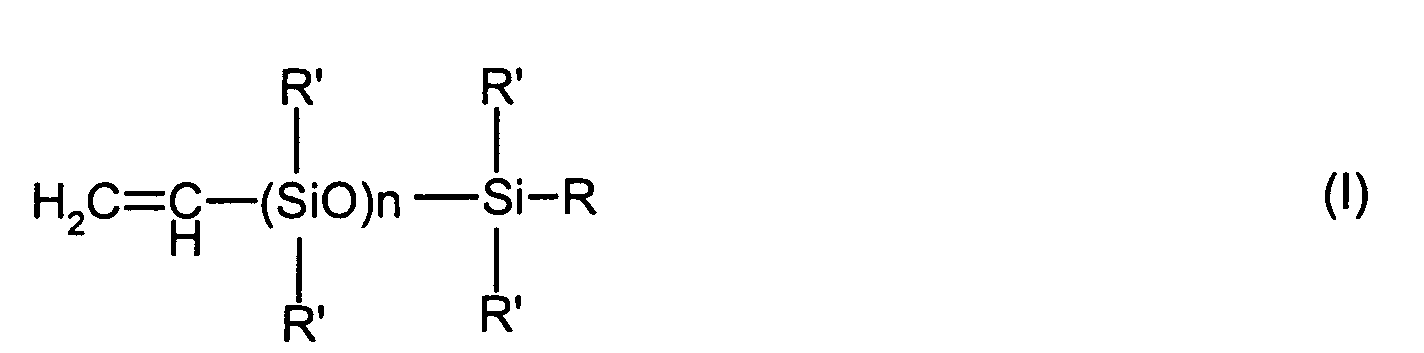
R and R' independently are vinyl, alkyl branched or unbranched, with 1 to 10 carbon atoms; aryl with 6 or 10 carbon atoms; alkyl aryl with 7 to 10 carbon atoms; or aryl alkyl with 7 to 10 carbon atoms.Such compounds e.g. are disclosed in WO 98/12253 the contents of which is herein enclosed by reference.It is preferred that component (B) is present in an amount of 0.1 to 30%, more preferred 1 to 10% and still more preferred 1 to 5% by weight of the total composition.Preferably, component (B) is polydimethylsiloxane and/or a copolymer of ethylene and vinyl polydimethylsiloxane. These components (B) are preferred due to commercial availability.The term "copolymer" as used herein is meant to include copolymers produced by copolymerization or by grafting of monomers onto a polymer backbone.Suitable polymers for forming component (A) include polyolefins, polyesters, polyethers and polyurethanes. Elastomeric polymers may also be used such as, for example, ethylene/propylene rubber (EPR), ethylene/propylene-diene monomer rubbers (EPDN), thermoplastic elastomer rubber (TPE) and acrylonitrile butadiene rubber (NBR). Silane-crosslinkable polymers may also be used, i.e. polymers prepared using unsaturated silane monomers having hydrolisable groups capable of crosslinking by hydrolysis and condensation to form silanol groups in the presence of water and, optionally, a silanol condensation catalyst.In a preferred embodiment component (A) is essentially formed by olefin homo- or copolymers. These are, for example, homopolymers or copolymers of ethylene, propylene and butene and polymers of butadiene or isoprene. Suitable homopolymers and copolymers of ethylene include low density polyethylene, linear, low, medium or high density polyethylene and very low density polyethylene.In a further preferred embodiment component (A) comprises a polar polymer.Further preferred, this polar polymer is an olefin/acrylate and/or olefin/acetate copolymer.It is further preferred that the polar polymer comprises a copolymer of ethylene with one or more comonomers selected from C1- to C6-alkyl acrylates, C1- to C6-alkyl metacrylates, acrylic acids, metacrylic acids and vinyl acetate. The copolymer may also contain ionomeric structures (like in e.g. DuPont's Surlyn types).Particularly preferred, the polar polymer comprises a copolymer of ethylene with C2- C4-alkyl acrylates.In addition to ethylene and the defined comonomers, the copolymers can also contain additional monomers.It is preferred that the polar polymer makes up 30% or more, more preferred 50% or more and still more preferred 60% or more of the total weight of component (A).Although the compositions according to the present invention are substantially free of organo-metallic salts, the inorganic filler may comprise a filler which has been surface-treated with a carboxylic acid or salt to aid processing and provide better dispersion of the filler in the organic polymer. Such coatings conventionally comprise not more than 2 wt.% of the filler. Preferably, the compositions according to the present invention contain less than 0.5 wt.% and are of organo-metallic salt.In addition to components (A) to (D) the inventive compositions may also contain additional conventional polymer ingredients such as, for example, antioxidants or UV stabilizers in small amounts.In a preferred embodiment in the inventive flame retardant composition the amount of component (B) is from 0.5 to 100 parts by weight, preferably 2 to 45 parts by weight, per 100 parts by weight of component (A) and the amount of component (C) and component (D) together is from 10 to 250 parts by weight, preferably 25 to 100 parts by weight per 100 parts by weight of the organic polymer.The flame retardant polymer composition according to the invention may be prepared by mixing together the components (A) to (D) using any suitable means such as conventional compounding or blending apparatus, e.g. a Bunbury Mixer, a 2-roll rubber mill or a twin screw extruder, Buss co-kneader, etc..Generally, the composition will be prepared by blending the components together at a temperature which is sufficiently high to soften and plasticise the organic polymer, typically at a temperature in the range of 120 to 200 °C.The flame retardant compositions according to the present invention can be used in many and diverse applications and products. The compositions can for example be moulded, extruded or otherwise formed into mouldings, sheets and fibers.As already mentioned, a particularly preferred use of the flame retardant compositions is for the manufacture of wire and cables. The compositions can be extruded about a wire or a cable to form an insulating or jacketing layer or can be used as bedding compounds.In the following the present invention is further illustrated by means of examples. -
- 1. Mixing procedure for obtaining Ethylene-butylacrylate copolymer (EBA) / silicone elastomer / CaCO3 / metal oxide formulations:
- Equipment: Brabender kneader (287 cm3)
- Temp. 140°C
-
- "Screw" speed: 60 rpm. When material was added the speed was lowered to 5 rpm to prevent material loss and dust. When mixed for approximately one minute the speed was increased up to 60 rpm again.
- Feeding order/feeding time:
- 0 min:
- half the amount of EBA together with an antioxidant (Anox 20)
- 2 min:
- feeding the rest of the EBA
- 6 min:
- CaCO3 is added
- 10 min:
- metal oxide is added
- 18 min:
- the silicone elastomer is added
- 22 min:
- the compound is ready
- 2. Compounds
- The following compounds were produced as described above:
Formulation EBA Ca-CO3% Al2O3 % Fe2O3 % TiO2 % Si-elastomer % Antioxidant % 1. CaSiEBA (comparative) 64.8 30 5 0.2 2. CaSiEBA + Al2O3 64.8 28 2 5 0.2 3. CaSiEBA + Fe2O3 64.8 28 2 5 0.2 4. CaSiEBA + TiO2 64.8 28 2 5 0.2 EBA: EBA = an ethylene butylacrylate copolymer having a nominal melt index of (190°C, 2.16 kg) 0.4 g/10 min and a butyl acrylate content of 7.5%. CaCO3: Stearate (1%) coated calcium carbonate having an average particle size of 1.5 microns. Si-elastomer: polydimethylsiloxane polymer having a plasticity of 150 (1/10 mm) and sold under the trade designation Silastic Q4-2735 by Dow Corning. Al2O3 (110 µm), Fe2O3 (7 µm) and TiO2 (3 µm) were all supplied by Sigma-Aldrich. - 3. Determination of LOI (limited oxygen index)
- LOI was determined using a Stanton Redcroft FTA Flammability Unit by the US standard ASTM D 2863-77 and the ISO 4589. The OI results are based on approximately 10 test specimens of dimension "150 x 6 mm". These are stamped out from a 3 mm thick plate pressed in a Collins press. (low pressure (20 bar) at 150° C during one minute followed by high pressure (200 bar) during five minutes at the same temperature). Cooling rate was 10° C/minute under high pressure. The compound was immediately taken from the Brabender kneader to the press.
- LOI is a measure of the minimum oxygen concentration of an O2/N2 mixture required to sustain combustion for a minimum of 3 minutes or not propagate more than 5 cm from the top of the test specimen. LOI is a measure of ease of extinction.
- 4. Results
- The results of the LOI determinations of the formulations given in Table 1 according to item 3 are shown in Table 2.
Formulation LOI 1. CaSiEBA (comparative) 35 2. CaSiEBA+Al2O3 36 3. CaSiEBA+Fe2O3 39 4. CaSiEBA+TiO2 39.5 - The results show that the LOI of the inventive compositions is increased, thus indicating an improved flame retardancy of the compositions.
Claims (20)
- A flame retardant polymer composition which is substantially free of halogen compounds and organo-metallic salts, comprising(A) an organic polymer matrix,(B) a silicone-group containing compound,(C) an inorganic filler material which is neither a hydroxide nor a substantially hydrated compound and(D) a metal oxide.
- A flame retardant composition according to claim 1 wherein component (D) is selected from the oxides of the metals of groups 2 to 15, more preferably of groups 2 to 13, of the periodic system of the elements.
- A flame retardant composition according to claim 2, wherein component (D) is Al2O3, Fe2O3 and/or TiO2, more preferably TiO2.
- A flame retardant composition according to any of the preceding claims wherein component (D) is present in an amount of 10 % or less, more preferred of 5 % or less and still more preferred of 3 % or less of the total weight of the polymer composition.
- A flame retardant composition according to any of the preceding claims wherein component (C) is a metal carbonate.
- A flame retardant composition according to claim 5 wherein component (C) is a carbonate of a metal of group 2 of the periodic system of the elements, aluminium and/or zinc.
- A flame retardant composition according to claim 6 wherein component (C) is calcium carbonate.
- A flame retardant composition according to any of the preceding claims wherein components (C) and (D) together are present in an amount of 5 to 70 %, more preferred of 10 to 45 % and still more preferred of 25 to 40 % of the total weight of the polymer composition.
- A flame retardant composition according to any of the preceding claims wherein component (B) is a silicone fluid or gum, and or a copolymer of ethylene and at least one other co-monomer including a vinyl unsaturated poly-bis-hydrocarbyl-siloxane.
- A flame retardant composition according to any of the preceding claims wherein component (B) comprises is polydimethylsiloxane and or a copolymer of ethylene and vinyl-polymethylsiloxane.
- A flame retardant composition according to any of the preceding claims wherein component (B) is present in an amount of 0.1 to 30 wt%, more preferred of 1 to 10 wt% and still more preferred of 1 to 5 wt% of the composition.
- A flame retardant composition according to any of the preceding claims wherein component (A) is essentially formed by olefin homo-or copolymers.
- A flame retardant composition according to any of the preceding claims wherein component (A) comprises a polar polymer.
- A flame retardant composition according to claim 13 wherein the polar polymer comprises an olefin/acrylate and/or acetate copolymer.
- A flame retardant composition according to claim 14 wherein the polar polymer comprises a copolymer of ethylene with one or more comonomers selected from C1- to C6- alkylacrylates, C1- to C6- alkylmethacrylates, acrylic acid, metacrylic acid and vinylacetate including ionomers thereof.
- A flame retardant composition according to claim 15, wherein the polar polymer comprises a copolymer of ethylene with C2- C4 acrylates.
- A flame retardant composition according to any of claims 13 to 16 wherein the polar polymer is present in an amount of 30 % or more, more preferred of 50 % or more and still more preferred of 60 % or more of the total weight of component (A).
- A flame retardant composition according to any of the preceding claims in which the amount of component (B) is from 0.5 to 100 parts by weight, preferably 2 to 45 pbw, per 100 parts by weight of component (A) and the amount of component (C) and component (D) together is from 10 to 250 parts by weight, preferably 25 to 100 pbw per 100 parts by weight of the organic polymer.
- A wire or a cable comprising a flame retardant composition according to any of the preceding claims.
- Use of a flame retardant polymer composition according to any of claims 1 to 21 for the production of a flame retardant layer, in particular of a wire or cable.
Priority Applications (3)
| Application Number | Priority Date | Filing Date | Title |
|---|---|---|---|
| EP01128261A EP1316581A1 (en) | 2001-11-28 | 2001-11-28 | Flame retardant polymer composition |
| AU2002349347A AU2002349347A1 (en) | 2001-11-28 | 2002-10-11 | Flame retardant polymer composition |
| PCT/EP2002/011413 WO2003046064A1 (en) | 2001-11-28 | 2002-10-11 | Flame retardant polymer composition |
Applications Claiming Priority (1)
| Application Number | Priority Date | Filing Date | Title |
|---|---|---|---|
| EP01128261A EP1316581A1 (en) | 2001-11-28 | 2001-11-28 | Flame retardant polymer composition |
Publications (1)
| Publication Number | Publication Date |
|---|---|
| EP1316581A1 true EP1316581A1 (en) | 2003-06-04 |
Family
ID=8179379
Family Applications (1)
| Application Number | Title | Priority Date | Filing Date |
|---|---|---|---|
| EP01128261A Withdrawn EP1316581A1 (en) | 2001-11-28 | 2001-11-28 | Flame retardant polymer composition |
Country Status (3)
| Country | Link |
|---|---|
| EP (1) | EP1316581A1 (en) |
| AU (1) | AU2002349347A1 (en) |
| WO (1) | WO2003046064A1 (en) |
Cited By (5)
| Publication number | Priority date | Publication date | Assignee | Title |
|---|---|---|---|---|
| WO2005021642A1 (en) * | 2003-08-27 | 2005-03-10 | Borealis Technology Oy | Flame retardant polymer composition comprising fine particles |
| EP1544245A1 (en) * | 2003-12-17 | 2005-06-22 | Borealis Technology Oy | An environmentally beneficial, flame retardant, halogen free polymer composition and cable |
| WO2006044873A1 (en) * | 2004-10-20 | 2006-04-27 | E.I. Dupont De Nemours And Company | Composition comprising polymer and silicone rubber |
| EP1882721A4 (en) * | 2005-05-20 | 2008-07-09 | Sun Allomer Ltd | FLAME RETARDANT THERMOPLASTIC RESIN COMPOSITION, MOLDED ARTICLE THEREOF, AND ELECTRIC WIRE |
| US8058336B2 (en) * | 2006-05-31 | 2011-11-15 | Borealis Technology Oy | Flame retardant polymer composition comprising polyolefin with high molecular weight distribution |
Families Citing this family (1)
| Publication number | Priority date | Publication date | Assignee | Title |
|---|---|---|---|---|
| US20050124745A1 (en) * | 2002-04-19 | 2005-06-09 | Saint-Gobain Ceramics & Plastics, Inc. | Flame retardant composites |
Citations (2)
| Publication number | Priority date | Publication date | Assignee | Title |
|---|---|---|---|---|
| EP0333514A1 (en) * | 1988-03-18 | 1989-09-20 | Mortile Industries Ltd | Low toxicity, fire retardant thermoplastic material |
| EP0393959A2 (en) * | 1989-04-21 | 1990-10-24 | Borealis Holding A/S | Flame retardant polymer composition |
-
2001
- 2001-11-28 EP EP01128261A patent/EP1316581A1/en not_active Withdrawn
-
2002
- 2002-10-11 WO PCT/EP2002/011413 patent/WO2003046064A1/en not_active Ceased
- 2002-10-11 AU AU2002349347A patent/AU2002349347A1/en not_active Abandoned
Patent Citations (2)
| Publication number | Priority date | Publication date | Assignee | Title |
|---|---|---|---|---|
| EP0333514A1 (en) * | 1988-03-18 | 1989-09-20 | Mortile Industries Ltd | Low toxicity, fire retardant thermoplastic material |
| EP0393959A2 (en) * | 1989-04-21 | 1990-10-24 | Borealis Holding A/S | Flame retardant polymer composition |
Cited By (7)
| Publication number | Priority date | Publication date | Assignee | Title |
|---|---|---|---|---|
| WO2005021642A1 (en) * | 2003-08-27 | 2005-03-10 | Borealis Technology Oy | Flame retardant polymer composition comprising fine particles |
| EA008923B1 (en) * | 2003-08-27 | 2007-08-31 | Бореалис Текнолоджи Ой | FIRE-RELEASE POLYMER COMPOSITION CONTAINING THIN-DIFFERENT INCLUSIONS |
| EP1544245A1 (en) * | 2003-12-17 | 2005-06-22 | Borealis Technology Oy | An environmentally beneficial, flame retardant, halogen free polymer composition and cable |
| WO2006044873A1 (en) * | 2004-10-20 | 2006-04-27 | E.I. Dupont De Nemours And Company | Composition comprising polymer and silicone rubber |
| EP1882721A4 (en) * | 2005-05-20 | 2008-07-09 | Sun Allomer Ltd | FLAME RETARDANT THERMOPLASTIC RESIN COMPOSITION, MOLDED ARTICLE THEREOF, AND ELECTRIC WIRE |
| US7799857B2 (en) | 2005-05-20 | 2010-09-21 | Sun Allomer Ltd. | Flame-retardant thermoplastic resin composition, molded product thereof and electric wire |
| US8058336B2 (en) * | 2006-05-31 | 2011-11-15 | Borealis Technology Oy | Flame retardant polymer composition comprising polyolefin with high molecular weight distribution |
Also Published As
| Publication number | Publication date |
|---|---|
| AU2002349347A1 (en) | 2003-06-10 |
| WO2003046064A1 (en) | 2003-06-05 |
Similar Documents
| Publication | Publication Date | Title |
|---|---|---|
| EP0393959B1 (en) | Flame retardant polymer composition | |
| EP0077055B1 (en) | Flame retardant additives based on alumina trihydrate and ethylene polymer compositions, containing same, having improved flame retardant properties | |
| EP0352699B1 (en) | Flame retardant composition | |
| EP3289006B1 (en) | Hydroxyl-terminated pdms as cure control additive for the silane crosslinking of polyolefins | |
| US6166120A (en) | Flame retardant composition | |
| EP2130864B1 (en) | Flame retardant polyolefin composition comprising a high amount of inorganic filler | |
| EP1457523B1 (en) | Flame-retardant resin composition free from halogen | |
| US20080194749A1 (en) | Flame Retardant Polymer Composition Comprising Nanofillers | |
| EP1512719B1 (en) | Flame retardant polymer composition comprising fine particles | |
| US7893132B2 (en) | Power or communications cable with flame retardant polymer layer | |
| WO2003046064A1 (en) | Flame retardant polymer composition | |
| EP1396865A1 (en) | Flame retardant polymer composition | |
| JP3415859B2 (en) | Polyolefin resin composition and molded article thereof | |
| EP2072573A1 (en) | Flame retardant polymer composition comprising coated aluminium hydroxide as filler | |
| JP2000327861A (en) | Flame-retardant composition | |
| JP2000327863A (en) | Heat-resistant flame-retardant composition | |
| JPH05186644A (en) | Olefinic resin composition and its molding and usage | |
| JP4730755B2 (en) | Non-halogen flame retardant composition and flame retardant power cord using the same | |
| JP2005170987A (en) | Halogen-free flame-retardant resin composition |
Legal Events
| Date | Code | Title | Description |
|---|---|---|---|
| PUAI | Public reference made under article 153(3) epc to a published international application that has entered the european phase |
Free format text: ORIGINAL CODE: 0009012 |
|
| 17P | Request for examination filed |
Effective date: 20011128 |
|
| AK | Designated contracting states |
Designated state(s): AT BE CH CY DE DK ES FI FR GB GR IE IT LI LU MC NL PT SE TR |
|
| AX | Request for extension of the european patent |
Extension state: AL LT LV MK RO SI |
|
| AKX | Designation fees paid |
Designated state(s): AT BE CH CY DE DK ES FI FR GB GR IE IT LI LU MC NL PT SE TR |
|
| 17Q | First examination report despatched |
Effective date: 20081121 |
|
| STAA | Information on the status of an ep patent application or granted ep patent |
Free format text: STATUS: THE APPLICATION IS DEEMED TO BE WITHDRAWN |
|
| 18D | Application deemed to be withdrawn |
Effective date: 20090909 |