EP1316542A1 - 3-amino-1-indanole, method of synthesizing the same and method of optical resolution - Google Patents
3-amino-1-indanole, method of synthesizing the same and method of optical resolution Download PDFInfo
- Publication number
- EP1316542A1 EP1316542A1 EP01963473A EP01963473A EP1316542A1 EP 1316542 A1 EP1316542 A1 EP 1316542A1 EP 01963473 A EP01963473 A EP 01963473A EP 01963473 A EP01963473 A EP 01963473A EP 1316542 A1 EP1316542 A1 EP 1316542A1
- Authority
- EP
- European Patent Office
- Prior art keywords
- amino
- indanol
- compound
- enantiomerically
- group
- Prior art date
- Legal status (The legal status is an assumption and is not a legal conclusion. Google has not performed a legal analysis and makes no representation as to the accuracy of the status listed.)
- Withdrawn
Links
- UJOYFRCOTPUKAK-UHFFFAOYSA-N NC(CC(O)=O)c1ccccc1 Chemical compound NC(CC(O)=O)c1ccccc1 UJOYFRCOTPUKAK-UHFFFAOYSA-N 0.000 description 1
Images

Classifications
-
- C—CHEMISTRY; METALLURGY
- C07—ORGANIC CHEMISTRY
- C07C—ACYCLIC OR CARBOCYCLIC COMPOUNDS
- C07C215/00—Compounds containing amino and hydroxy groups bound to the same carbon skeleton
- C07C215/42—Compounds containing amino and hydroxy groups bound to the same carbon skeleton having amino groups or hydroxy groups bound to carbon atoms of rings other than six-membered aromatic rings of the same carbon skeleton
- C07C215/44—Compounds containing amino and hydroxy groups bound to the same carbon skeleton having amino groups or hydroxy groups bound to carbon atoms of rings other than six-membered aromatic rings of the same carbon skeleton bound to carbon atoms of the same ring or condensed ring system
-
- C—CHEMISTRY; METALLURGY
- C07—ORGANIC CHEMISTRY
- C07B—GENERAL METHODS OF ORGANIC CHEMISTRY; APPARATUS THEREFOR
- C07B2200/00—Indexing scheme relating to specific properties of organic compounds
- C07B2200/07—Optical isomers
-
- C—CHEMISTRY; METALLURGY
- C07—ORGANIC CHEMISTRY
- C07C—ACYCLIC OR CARBOCYCLIC COMPOUNDS
- C07C2602/00—Systems containing two condensed rings
- C07C2602/02—Systems containing two condensed rings the rings having only two atoms in common
- C07C2602/04—One of the condensed rings being a six-membered aromatic ring
- C07C2602/08—One of the condensed rings being a six-membered aromatic ring the other ring being five-membered, e.g. indane
Definitions
- the present invention relates to 3-amino-1-indanol which is a novel compound and a process for synthesizing it, further to an enantiomerically active compound of 3-amino-1-indanol and a process for enantiomerically resolving it, and to a separating agent for enantiomeric isomers comprising the enantiomerically active compound as an effective ingredient.
- Aminoindanols are important intermediates for various fine chemical derivatives including physiologically active substances such as medicines and pesticides. For example, it is disclosed in J. Med. Chem., 35, 2525 (1992), J. Med. Chem., 35, 1702 (1992), J. Med. Chem., 35, 1685 (1992) etc. that cis-1-amino-2-indanol is an effective intermediate for production of anti-HMV drugs.
- enantiomerically active aminoindanols are effective as separating agents for enantiomerically active carboxylic acids (chiral acids), and JP-A 11-511742 discloses a process for separating chiral acids with 1-aminoindan-2-ol.
- 3-Amino-1-indanol is a compound also expected to be a synthetic intermediate for medicines and pesticides or a separating agent for chromatography or an enantiomeric resolving agent for racemic bodies, but no body has succeeded in the synthesis thereof and thus it is highly desired to establish the synthetic process.
- 3-amino-1-indanol which is a novel compound and a convenient process for synthesizing 3-amino-1-indanol using an easily available starting material, further a process for an effective enantiomeric resolution of 3-amino-1-indanol obtained, and a separating agent for enantiomeric isomers comprising an enantiomerically active compound of 3-amino-1-indanol as an effective ingredient.
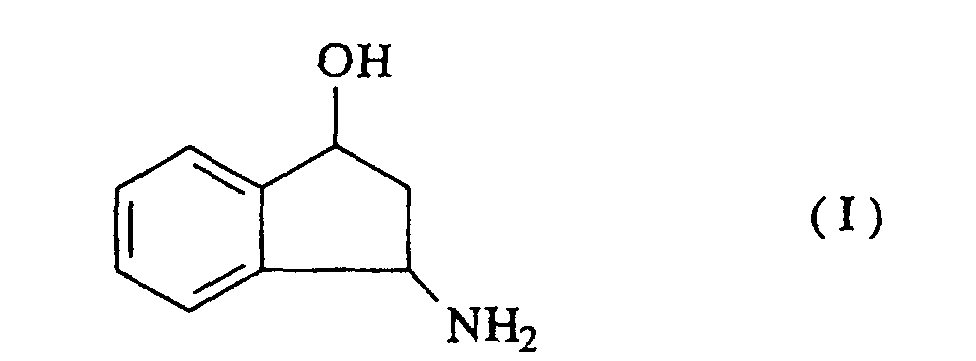
- the present invention provides 3-amino-1-indanol represented by the formula (I): wherein the configuration between OH group and NH 2 group are cis-configuration or trans-configuration and the compound may be a racemic body or an enantiomerically active compound.
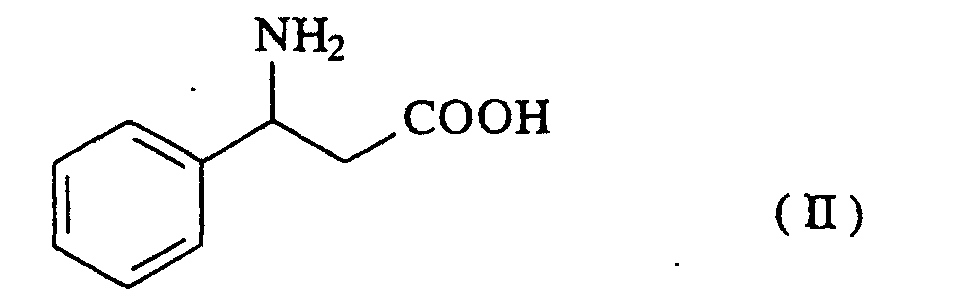
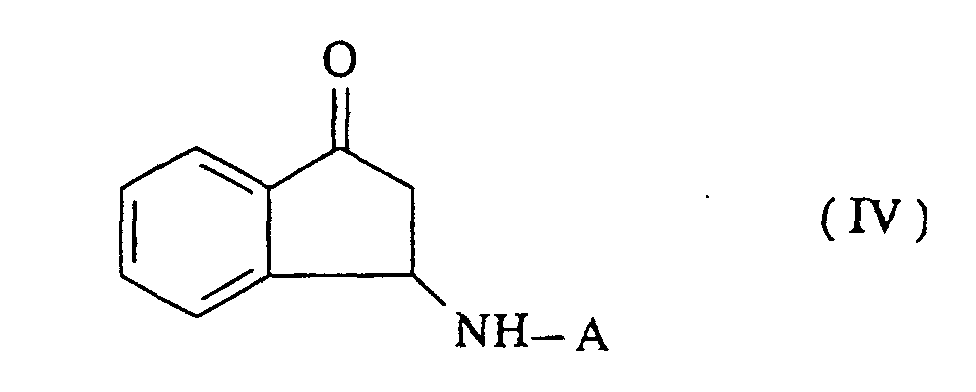
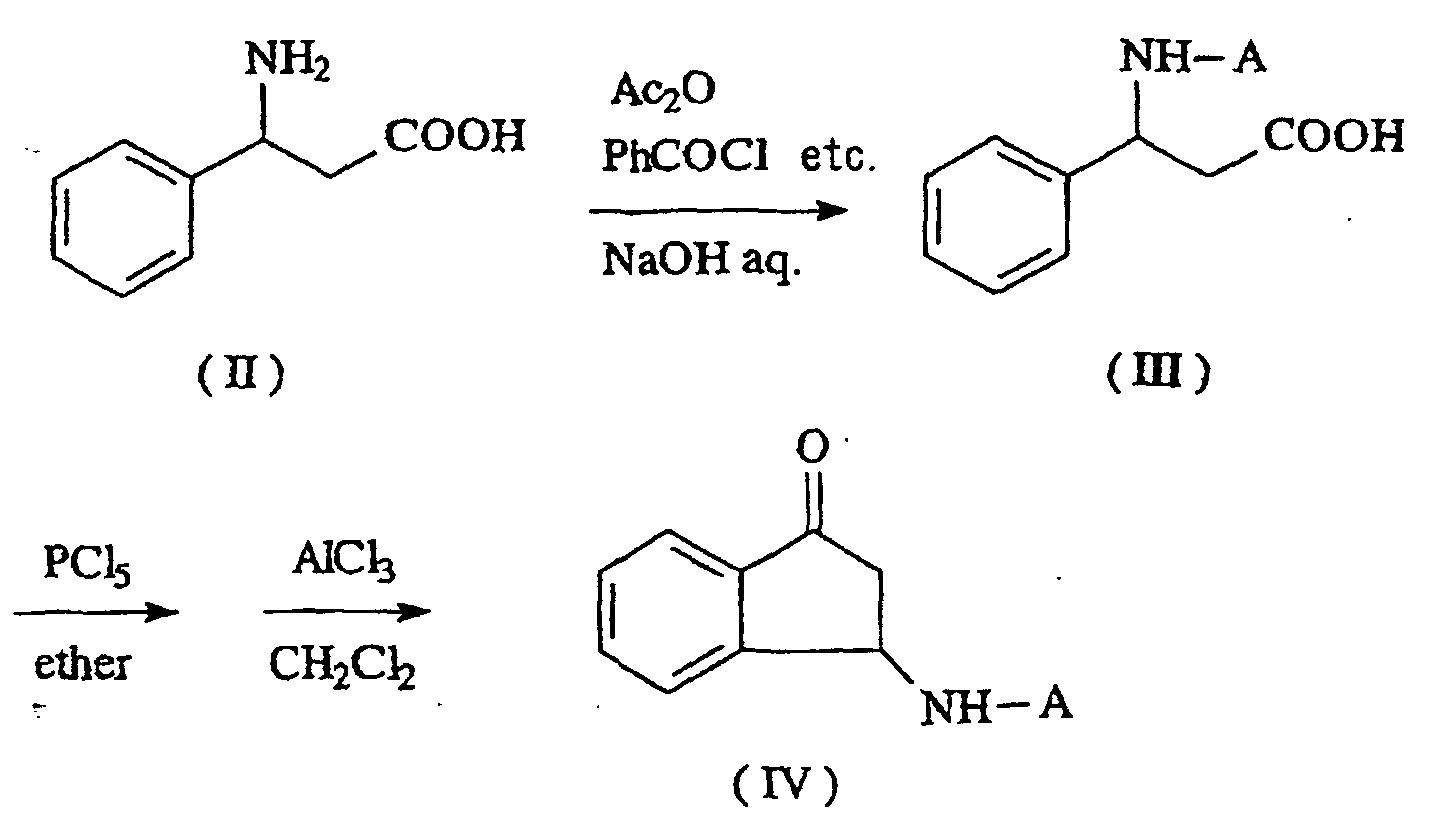
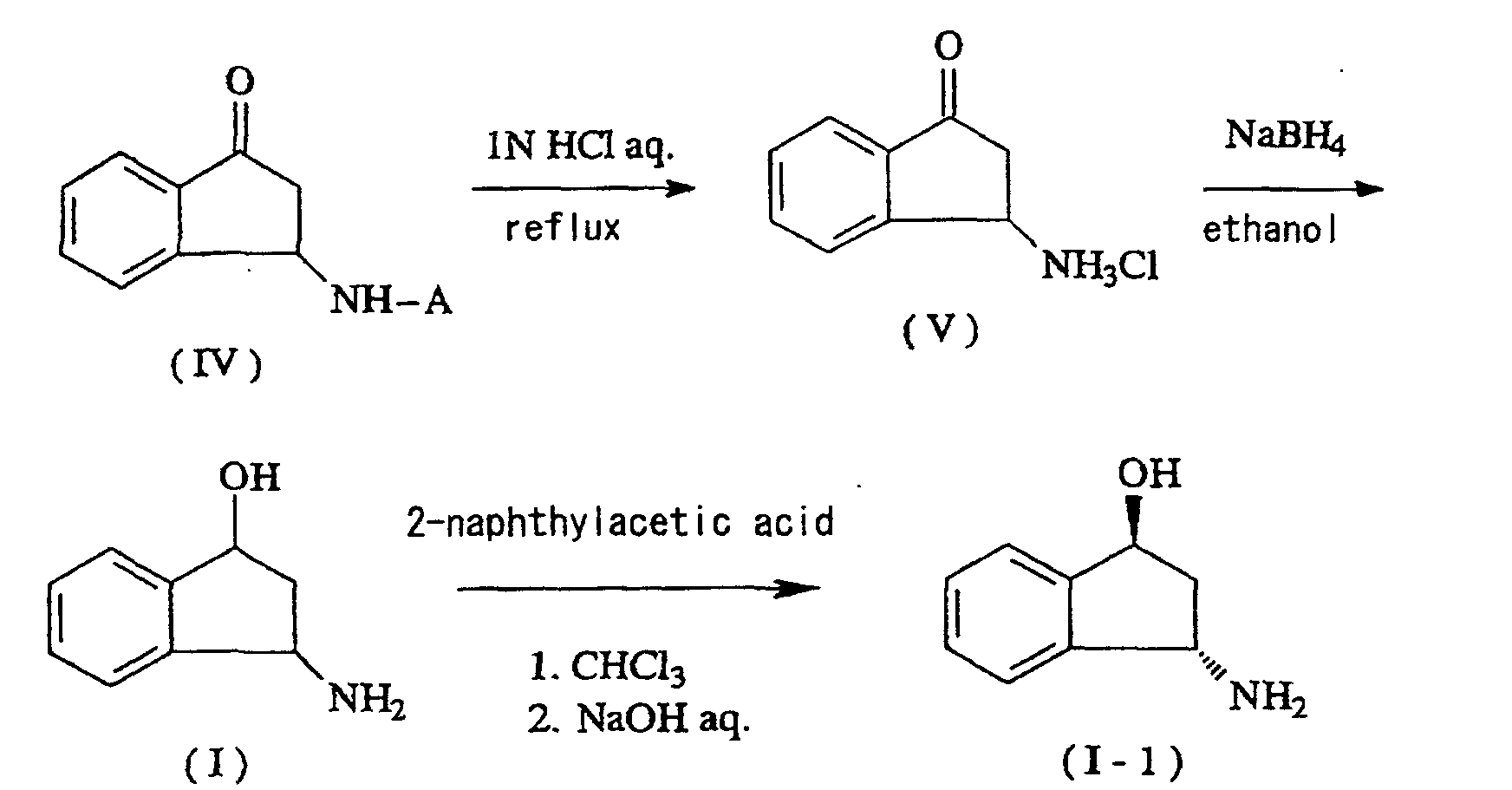
- the present invention provides a process for synthesizing the 3-amino-1-indanol represetned by the above formula (I), which comprises the steps of protecting the amino group of ⁇ -phenyl- ⁇ -alanine represented by the formula (II): with a protective group to give a compound represented by the formula (III): (wherein A represents RCO- or ROCO- group (wherein R is an alkyl group having 1 to 30 carbon atoms or an aryl group)); subjecting the compound to Friedel-Crafts acylation to give a compound represented by the formula (IV): (wherein A has the same meaning as above); and then removing the protective group of the compound, followed by reduction.
- an enantiomerically active compound of 3-amino-1-indanol and a process for enantiomerically resolving 3-amino-1-indanol, which comprises the steps of treating a mixture of enantiomerically active compounds of 3-amino-1-indanol represented by the above formula (I) with an enantiomerically active carboxylic acid; and then separating formed diastereomer salts from each other, and a separating agent for enantiomeric isomers comprising 3-amino-1-indanol represented by the above formula (I) as the effective ingredient.
- the present invention provides use of the enantiomerically active compound of the 3-amino-1-indanol represented by the above formula (I) as a separating agent for enantiomeric isomers.
- the present invention provides a process for enantiomerically separating a racemic body of the target compound to be separated with 3-amino-1-indanol represented by the above formula (I).
- 3-Amino-1-indanol of the present invention represented by the formula (I) may be cis-isomer or trans-isomer, or a racemic body or an enantiomerically active compound.
- ⁇ -Phenyl- ⁇ -alanine (II) used as a starting material can be synthesized from benzaldehyde, malonic acid, and ammonium acetate according to a known method.
- the amino group of the resulting ⁇ -Phenyl- ⁇ -alanine (II) is protected with a protective group using a compound having a group usable as an amino-protecting group, such as acetic anhydride, benzoyl chloride, 9-fluorenylmethyl chloroformate, benzyloxycarbonyl chloride, or di-t-butyl dicarbonate, to give the compound (III).
- a group usable as an amino-protecting group such as acetic anhydride, benzoyl chloride, 9-fluorenylmethyl chloroformate, benzyloxycarbonyl chloride, or di-t-butyl dicarbonate.
- an amino-protecting group preferred is acetyl group or benzoyl group, and more preferred is acetyl group.
- Friedel-Crafts acylation is effected by first adding PCl 5 to the compound (III), reacting them in a solvent such as ethyl ether or THF, and further reacting the product in a solvent such as methylene chloride at a temperature of 0 to 5°C with adding AlCl 3 .
- a summary of the above reactions is illustrated in the following reaction scheme. wherein A has the same meaning as above; Ac represents acetyl group and Ph represents phenyl group.
- the reduction of the carbonyl group to hydroxyl group is conducted by means of a metal hydride reagent such as sodium borohydride.
- ( ⁇ )-trans-3-amino-1-indanol (racemic body) (I-1) can be obtained.
- the purifying method used is preferably made of a method of forming a salt of the mixture (I) with a 2-arylcarboxylic acid such as 2-naphthylacetic acid, heating the salt under reflux, and then allowing to stand at room temperature. By this method, only the salt of the trans-isomer can be selectively crystallized.
- the above trans-isomer (1-1) can be obtained by treating the salt with an aqueous solution of an alkali selected from sodium hydrogencarbonate, potassium hydrogencarbonate, sodium carbonate, potassium carbonate, sodium hydroxide potassium hydroxide etc, and then extracting with a suitable organic solvent.
- an alkali selected from sodium hydrogencarbonate, potassium hydrogencarbonate, sodium carbonate, potassium carbonate, sodium hydroxide potassium hydroxide etc.
- reaction solvent is preferably tetrahydrofuran (THF).
- reaction temperature is preferably from -100 to -50°C.
- ( ⁇ )-cis-3-Amino-1-indanol (racemic body) (1-2) can be obtained by heating the resulting (-+)-cis-N-acyl-3-aminoindan-1-ol (VII) in a suitable basic organic solvent under reflux and then extracting with a suitable solvent.
- the basic organic solvent is preferably a sodium hydroxide-ethanol mixed solvent and the extracting solvent is preferably methylene chloride.
- the enantiomeric resolution of the racemic body of 3-amino-1-indanol can be conducted according to a diastereomer salt method using an enantiomerically active carboxylic acid.
- the usable enantiomerically active carboxylic acid is not particularly limited but it is preferable to use dibenzoyltartaric acid because an enantiomerically active compound can be efficiently obtained.
- the solvent used at the enantiomeric resolution is not particularly limited but preferred is a water-ethanol mixed solvent.
- the crystallizing temperature may be in the range of 0 to 60°C, preferably the range of 10 to 40°C. If necessary, the crystallized diastereomer salt may be recrystallized to give a crystalline diastereomer salt having a higher enantiomeric purity.
- the enantiomerically active compound of 3-amino-1-indanol obtained as above is useful as a separating agent for enantiomeric isomers, particularly an enantiomeric resolving agent for the racemic body of an enantiomerically active carboxylic acid.
- an enantiomerically active carboxylic acid can be obtained by the method of mixing an enantiomerically active compound of 3-amino-1-indanol and the racemic body of an enantiomerically active carboxylic acid in a suitable solvent and then precipitating a diastereomer salt.
- a carboxylic acid having an aryl group at the 2-position can be preferably enantiomerically resolved.
- Novel 3-amino-1-indanol of the present invention is an extremely important compound as an synthetic intermediate for medicines and pesticides, especially for medicines. Furthermore, enantiomerically active 3-amino-1-indanol can be widely utilized also as a separating agent for enantiomerically active carboxylic acids.
- Figure 1 is a CD spectrum of an enantiomerically active precedent component-(1-2) obtained in (3) of Example 2.
- aqueous layer was evaporated and the residue was dried in vacuo, followed by adding 200 mL of ethanol to the residue. After cooling to 0°C, 1.22 g (0.072 mol) of NaBH 4 was added thereto, followed by stirring overnight. Subsequently, most of the solvent was evaporated, 100 mL of water was added to the residue, and then the mixture was dried over sodium chloride.
- the liquid was basified with 50 mL of IN NaOH aqueous solution and extracted with methylene chloride (4 x 200 mL). The organic layer was dried over sodium sulfate, the drying agent was removed by filtration, then the solvent was evaporated, and the residue was dried in vacuo.
- each fraction of the precedent component-(I-2) and subsequent component-(I-2) fractionated on HPLC was, after concentration, basified by the addition of 10% sodium hydroxide aqueous solution and then extracted with chloroform, to give aimed enantiomerically active precedent component-(I-2) (yield 28%, enantiomeric purity 97.3% e.e.) and enantiomerically active subsequent component-(I-2) (yield 18%, enantiomeric purity 95% e.e.).
- the enantiomeric purity was determined under the same conditions as in Example 1.
- equimolar amounts of the separating agent and the racemic body of the target compound to be separated were dissolved into acetonitrile and the solution was cooled to 4°c to precipitate crystals.
- equimolar amounts of the separating agent and the racemic body of the target compound were dissolved under heating in a water-ethanol mixed solvent (1:1) and the solution was allowed to stand at 26°C to precipitate crystals. The results are shown in Table 1.
- the separating agent of the present invention can efficiently separate the racemic bodies of the target compounds to be separated as compared with the comparative separating agents.
Landscapes
- Chemical & Material Sciences (AREA)
- Organic Chemistry (AREA)
- Organic Low-Molecular-Weight Compounds And Preparation Thereof (AREA)
Abstract
Description


wherein A has the same meaning as above.

Melting point: 155-158°C
1H-NMR (CDCl3) : δ = 2.055 (s, 3H), 2. 468 (dd, 1H, J = 3.3, 19.2), 3.216 (dd, 1H, J = 7.8, 19.2), 5.681 (dt, 1H, J = 3.3, 7.8), 5.956 (s, 1H), 7.453-7.757 (m, 4H) .
Melting point: 257°C
1H-NMR (D2O) : δ = 2.826-2.900 (m, 1H), 3.353 (dd, 1H), 5.158-5.184 (m, 1H), 7.686-7.941 (m, 4H)
IR (KBr): 3450, 3000, 2900, 1730, 1600, 1490, 1370, 1290, 1260, 780 cm-1
Melting point: 108-110°C
1H-NMR (D2O) : δ = 1 . 583 (br s, 3H) , 2. 056 (dt, 1H. J = 6.3, 13.7), 2.461 (ddd, 1H. J = 3.0, 6.3, 13.7), 4.641 (t, 1H, J = 6.3), 5.336 (dd, 1H, J = 3.0, 6.3), 7.306-7.426 (m, 4H)
IR (KBr): 3350, 3300, 3125 (br), 2925, 2700, 1650, 1320, 1300, 1040, 990, 780 cm-1.
Melting point: 112-113.5°C
[α] 39.3 (c = 1.00, ethanol)
Melting point: 113.5-114°C
[α] = 38.1 1 (c = 1.00, ethanol)
Column: CROWNPAK CR (manufactured by Daicel Chemical Industries, Ltd.)
Flow rate: 0.5 mL/minute
Detecting wavelength: 200 nm
Developing solvent: pH 2 HClO4 aqueous solution
Peaks: precedent one (1S,3S)-(I-1), subsequent one (1R,3R)-(I-1)
Melting point: 170-172°C
1H-NMR (CDCl3) : δ = 1. 80 (dt, 1H, J = 5.7, 8. 1), 2.01 (s, 3H), 2.57 (d, 1H, J = 6.3), 2.92 (ddd, 1H, J = 6.6, 7.5, 13.8), 5. 15 (dd, 1H, J 6.3, 13.1), 5.30 (dd, 1H. J = 7.5, 13.5), 7.32-7.46 (m, 4H)
Melting point: 67-75°C
1H-NMR (CDCl3): δ = 1.64 (dt, 1H, J = 6.6, 1.2), 2.13 (br s, 3H), 2.81 (dt, 1H, J = 6.6, 13.2), 4.24 (t, 1H, J = 6.3), 5.05 (t, 1H, J = 6.0), 7.302-7.443 (m, 4H)
IR (KBr): 3350, 1580, 1460, 1340, 1050, 770, 740 cm-1

Claims (7)
- 3-Amino-1-indanol represented by the formula (I):wherein, the configuration between OH group and NH2 group are cis-configuration or trans-configuration; and the compound may be a racemic body or an enantiomerically active compound.

- A process for synthesizing the 3-amino-1-indanol as claimed in Claim 1, which comprises the steps of protecting the amino group of β-phenyl-β-alanine represented by the formula (II):with a protective group to give a compound represented by the formula (III):
 (wherein A represents RCO- or ROCO- group (wherein R is an alkyl group having 1 to 30 carbon atoms or an aryl group)); subjecting the compound to Friedel-Crafts acylation to give a compound represented by the formula (IV):
 (wherein A has the same meaning as above); and then removing the protective group of the compound, followed by reduction.
- The 3-amino-1-indanol as claimed in Claim 1, which is an enantiomerically active compound.
- A process for enantiomerically resolving 3-amino-1-indanol, which comprises the steps of treating a mixture of enantiomerically active compounds of the 3-amino-1-indanol as claimed in Claim 1 with an enantiomerically active carboxylic acid; and then separating the resulting diastereomer salts from each other.
- A separating agent for enantiomeric isomers comprising the enantiomerically active compound of 3-amino-1-indanol as claimed in Claim 1 as an active ingredient.
- Use of the enantiomerically active compound of 3-amino-1-indanol as claimed in Claim 3 as a separating agent for enantiomeric isomers.
- A process for enantiomerically separating a racemic body of the target compound to be separated with the enantiomerically active compound of 3-aniino-1-indanol as claimed in Claim 3.
Applications Claiming Priority (3)
| Application Number | Priority Date | Filing Date | Title |
|---|---|---|---|
| JP2000270036 | 2000-09-06 | ||
| JP2000270036 | 2000-09-06 | ||
| PCT/JP2001/007736 WO2002020461A1 (en) | 2000-09-06 | 2001-09-06 | 3-amino-1-indanole, method of synthesizing the same and method of optical resolution |
Publications (2)
| Publication Number | Publication Date |
|---|---|
| EP1316542A1 true EP1316542A1 (en) | 2003-06-04 |
| EP1316542A4 EP1316542A4 (en) | 2005-10-26 |
Family
ID=18756549
Family Applications (1)
| Application Number | Title | Priority Date | Filing Date |
|---|---|---|---|
| EP01963473A Withdrawn EP1316542A4 (en) | 2000-09-06 | 2001-09-06 | 3-AMINO-1-INDANOLE, TECHNIQUE FOR SYNTHESIS OF THIS COMPOUND AND OPTICAL RESOLUTION METHOD |
Country Status (5)
| Country | Link |
|---|---|
| US (1) | US6479702B1 (en) |
| EP (1) | EP1316542A4 (en) |
| CN (1) | CN1388802A (en) |
| MX (1) | MXPA02004538A (en) |
| WO (1) | WO2002020461A1 (en) |
Cited By (1)
| Publication number | Priority date | Publication date | Assignee | Title |
|---|---|---|---|---|
| WO2011154738A1 (en) | 2010-06-10 | 2011-12-15 | Chiesi Farmaceutici S.P.A. | Urea derivatives and their therapeutic use in the treatment of, inter alia, diseases of the respiratory tract |
Families Citing this family (4)
| Publication number | Priority date | Publication date | Assignee | Title |
|---|---|---|---|---|
| ES2237312B1 (en) * | 2003-10-29 | 2006-11-01 | Universidad De Oviedo | CHEMIOENZYMA SYNTHESIS OF ENANTIOPURE DERIVATIVES OF 3-AMINOINDAN-1-OL AND INDANO-1,3-DIAMINE |
| US20060252818A1 (en) * | 2005-05-06 | 2006-11-09 | Neurocrine Biosciences, Inc. | Monoamine re-uptake inhibitors and methods relating thereto |
| WO2006133339A2 (en) * | 2005-06-07 | 2006-12-14 | Neurocrine Biosciences, Inc. | Monoamine re-uptake inhibitors and methods relating thereto |
| CN110824092A (en) * | 2018-08-08 | 2020-02-21 | 天津药物研究院有限公司 | Chiral detection method of S-3-amino-3-phenylpropanol isomer |
Family Cites Families (3)
| Publication number | Priority date | Publication date | Assignee | Title |
|---|---|---|---|---|
| US4129561A (en) | 1977-07-20 | 1978-12-12 | American Home Products Corporation | Anti-ulcer methano-dibenzazocines derivatives |
| US5677469A (en) * | 1995-05-18 | 1997-10-14 | Sepracor, Inc. | Process for resolving chiral acids with 1-aminoindan-2-ols |
| JPH08332095A (en) | 1995-06-06 | 1996-12-17 | Chisso Corp | Indenol manufacturing method |
-
2001
- 2001-09-06 US US10/110,881 patent/US6479702B1/en not_active Expired - Fee Related
- 2001-09-06 CN CN01802626A patent/CN1388802A/en active Pending
- 2001-09-06 EP EP01963473A patent/EP1316542A4/en not_active Withdrawn
- 2001-09-06 MX MXPA02004538A patent/MXPA02004538A/en unknown
- 2001-09-06 WO PCT/JP2001/007736 patent/WO2002020461A1/en not_active Ceased
Cited By (1)
| Publication number | Priority date | Publication date | Assignee | Title |
|---|---|---|---|---|
| WO2011154738A1 (en) | 2010-06-10 | 2011-12-15 | Chiesi Farmaceutici S.P.A. | Urea derivatives and their therapeutic use in the treatment of, inter alia, diseases of the respiratory tract |
Also Published As
| Publication number | Publication date |
|---|---|
| US20020177736A1 (en) | 2002-11-28 |
| EP1316542A4 (en) | 2005-10-26 |
| MXPA02004538A (en) | 2004-09-10 |
| US6479702B1 (en) | 2002-11-12 |
| CN1388802A (en) | 2003-01-01 |
| WO2002020461A1 (en) | 2002-03-14 |
Similar Documents
| Publication | Publication Date | Title |
|---|---|---|
| WO2008062460A2 (en) | Crystalline forms of pregabalin | |
| AU2001269063B2 (en) | Shortened synthesis of 3,3-diarylpropylamine derivatives | |
| EP0828702B1 (en) | Process for resolving chiral acids with 1-aminoindan-2-ols | |
| JPH0623150B2 (en) | Process for producing optically active 3-hydroxybutanoic acids | |
| EP0413667B1 (en) | Halogenoalkyl-phenyl-alcohols, -ketones and their hydrates | |
| US6479702B1 (en) | 3-amino-1-indanole, method of synthesizing the same and method of optical resolution | |
| CA2623355C (en) | Resolution of .alpha.-(phenoxy) phenylacetic acid derivatives with naphthyl-alkylamines | |
| EP1008590B1 (en) | Process for preparing optically active oxazolidinone derivatives | |
| EP0182279A1 (en) | Process for the optical resolution of racemic mixtures of alpha-naphtyl-propionic acids | |
| JP3209041B2 (en) | Optical resolving agent and process for producing optically active tetrahydrofurancarboxylic acids using the same | |
| JP4874122B2 (en) | How to get tolterodine | |
| JPH08109173A (en) | Method of preparing 4-substituted optically active (s)-2-oxazolidinone,new (s)-2-oxazolidinone and new optically active (s)-aminoalcohol | |
| WO2008096373A2 (en) | Process for synthesizing highly pure nateglinide polymorphs | |
| WO2003051852A1 (en) | Intermediate and process for producing optically active compound from the intermediate | |
| US20030162840A1 (en) | Novel process for preparing salmeterol | |
| JP4380325B2 (en) | Process for producing optically active carboxylic acid | |
| JP2002155035A (en) | 3-amino-1-indanol, method for synthesizing the same and optical isomer separating agent comprising the same | |
| CN100341850C (en) | Salts of demethyl phencynonate isomer and N-para-methyl-phenyl-sulfuryl glutamic acid optical isomer and their preparing method and use | |
| HU205594B (en) | Process for producing optical isomeres of cyclopropane-carboxylic acids5 | |
| JP2002332277A (en) | Method for manufacturing optically active 2- methylpiperazine | |
| JP4218310B2 (en) | Process for producing optically active 2-amino-2-phenylethanol and its intermediate | |
| JP2000239237A (en) | Crystal of optically active compound and its production | |
| EP0780358B1 (en) | A process for the resolution of 6-methoxy-alpha-methyl-2-naphthaleneacetic racemic acid into its enantiomers | |
| JP4335390B2 (en) | Method for producing optically active oxazolidinone derivative | |
| WO2006046252A2 (en) | Novel diasteriomeric salts of atenolol and their use in the production of optically active atenolol |
Legal Events
| Date | Code | Title | Description |
|---|---|---|---|
| PUAI | Public reference made under article 153(3) epc to a published international application that has entered the european phase |
Free format text: ORIGINAL CODE: 0009012 |
|
| 17P | Request for examination filed |
Effective date: 20020422 |
|
| AK | Designated contracting states |
Designated state(s): AT BE CH CY DE DK ES FI FR GB GR IE IT LI LU MC NL PT SE TR |
|
| RBV | Designated contracting states (corrected) |
Designated state(s): AT BE CH CY DE DK ES FR GB IE LI |
|
| A4 | Supplementary search report drawn up and despatched |
Effective date: 20050914 |
|
| RIC1 | Information provided on ipc code assigned before grant |
Ipc: 7C 07M 7/00 B Ipc: 7C 07C 213/10 B Ipc: 7C 07C 215/44 A Ipc: 7C 07C 213/02 B Ipc: 7C 07B 57/00 B |
|
| 17Q | First examination report despatched |
Effective date: 20061120 |
|
| GRAP | Despatch of communication of intention to grant a patent |
Free format text: ORIGINAL CODE: EPIDOSNIGR1 |
|
| RIC1 | Information provided on ipc code assigned before grant |
Ipc: C07C 215/44 20060101AFI20070315BHEP Ipc: C07C 213/10 20060101ALI20070315BHEP Ipc: C07B 57/00 20060101ALI20070315BHEP Ipc: C07C 213/02 20060101ALI20070315BHEP |
|
| STAA | Information on the status of an ep patent application or granted ep patent |
Free format text: STATUS: THE APPLICATION IS DEEMED TO BE WITHDRAWN |
|
| 18D | Application deemed to be withdrawn |
Effective date: 20070730 |
|
| R18D | Application deemed to be withdrawn (corrected) |
Effective date: 20070731 |