EP1316316A1 - Preparations for oral administration - Google Patents
Preparations for oral administration Download PDFInfo
- Publication number
- EP1316316A1 EP1316316A1 EP01963455A EP01963455A EP1316316A1 EP 1316316 A1 EP1316316 A1 EP 1316316A1 EP 01963455 A EP01963455 A EP 01963455A EP 01963455 A EP01963455 A EP 01963455A EP 1316316 A1 EP1316316 A1 EP 1316316A1
- Authority
- EP
- European Patent Office
- Prior art keywords
- group
- chloro
- methoxybenzylamino
- pyrimidine
- carbamoyl
- Prior art date
- Legal status (The legal status is an assumption and is not a legal conclusion. Google has not performed a legal analysis and makes no representation as to the accuracy of the status listed.)
- Granted
Links
- 0 C*C1=C(*)**C(N)=N1 Chemical compound C*C1=C(*)**C(N)=N1 0.000 description 2
Images

Classifications
-
- A—HUMAN NECESSITIES
- A61—MEDICAL OR VETERINARY SCIENCE; HYGIENE
- A61K—PREPARATIONS FOR MEDICAL, DENTAL OR TOILETRY PURPOSES
- A61K9/00—Medicinal preparations characterised by special physical form
- A61K9/20—Pills, tablets, discs, rods
- A61K9/2004—Excipients; Inactive ingredients
- A61K9/2009—Inorganic compounds
-
- A—HUMAN NECESSITIES
- A61—MEDICAL OR VETERINARY SCIENCE; HYGIENE
- A61K—PREPARATIONS FOR MEDICAL, DENTAL OR TOILETRY PURPOSES
- A61K31/00—Medicinal preparations containing organic active ingredients
- A61K31/33—Heterocyclic compounds
- A61K31/395—Heterocyclic compounds having nitrogen as a ring hetero atom, e.g. guanethidine or rifamycins
- A61K31/495—Heterocyclic compounds having nitrogen as a ring hetero atom, e.g. guanethidine or rifamycins having six-membered rings with two or more nitrogen atoms as the only ring heteroatoms, e.g. piperazine or tetrazines
- A61K31/505—Pyrimidines; Hydrogenated pyrimidines, e.g. trimethoprim
- A61K31/506—Pyrimidines; Hydrogenated pyrimidines, e.g. trimethoprim not condensed and containing further heterocyclic rings
-
- A—HUMAN NECESSITIES
- A61—MEDICAL OR VETERINARY SCIENCE; HYGIENE
- A61K—PREPARATIONS FOR MEDICAL, DENTAL OR TOILETRY PURPOSES
- A61K31/00—Medicinal preparations containing organic active ingredients
- A61K31/33—Heterocyclic compounds
- A61K31/395—Heterocyclic compounds having nitrogen as a ring hetero atom, e.g. guanethidine or rifamycins
- A61K31/535—Heterocyclic compounds having nitrogen as a ring hetero atom, e.g. guanethidine or rifamycins having six-membered rings with at least one nitrogen and one oxygen as the ring hetero atoms, e.g. 1,2-oxazines
- A61K31/5375—1,4-Oxazines, e.g. morpholine
- A61K31/5377—1,4-Oxazines, e.g. morpholine not condensed and containing further heterocyclic rings, e.g. timolol
-
- A—HUMAN NECESSITIES
- A61—MEDICAL OR VETERINARY SCIENCE; HYGIENE
- A61K—PREPARATIONS FOR MEDICAL, DENTAL OR TOILETRY PURPOSES
- A61K47/00—Medicinal preparations characterised by the non-active ingredients used, e.g. carriers or inert additives; Targeting or modifying agents chemically bound to the active ingredient
- A61K47/06—Organic compounds, e.g. natural or synthetic hydrocarbons, polyolefins, mineral oil, petrolatum or ozokerite
- A61K47/08—Organic compounds, e.g. natural or synthetic hydrocarbons, polyolefins, mineral oil, petrolatum or ozokerite containing oxygen, e.g. ethers, acetals, ketones, quinones, aldehydes, peroxides
- A61K47/12—Carboxylic acids; Salts or anhydrides thereof
-
- A—HUMAN NECESSITIES
- A61—MEDICAL OR VETERINARY SCIENCE; HYGIENE
- A61K—PREPARATIONS FOR MEDICAL, DENTAL OR TOILETRY PURPOSES
- A61K9/00—Medicinal preparations characterised by special physical form
- A61K9/20—Pills, tablets, discs, rods
- A61K9/2004—Excipients; Inactive ingredients
- A61K9/2013—Organic compounds, e.g. phospholipids, fats
-
- A—HUMAN NECESSITIES
- A61—MEDICAL OR VETERINARY SCIENCE; HYGIENE
- A61K—PREPARATIONS FOR MEDICAL, DENTAL OR TOILETRY PURPOSES
- A61K9/00—Medicinal preparations characterised by special physical form
- A61K9/20—Pills, tablets, discs, rods
- A61K9/2004—Excipients; Inactive ingredients
- A61K9/2022—Organic macromolecular compounds
- A61K9/205—Polysaccharides, e.g. alginate, gums; Cyclodextrin
- A61K9/2054—Cellulose; Cellulose derivatives, e.g. hydroxypropyl methylcellulose
-
- A—HUMAN NECESSITIES
- A61—MEDICAL OR VETERINARY SCIENCE; HYGIENE
- A61P—SPECIFIC THERAPEUTIC ACTIVITY OF CHEMICAL COMPOUNDS OR MEDICINAL PREPARATIONS
- A61P15/00—Drugs for genital or sexual disorders; Contraceptives
- A61P15/10—Drugs for genital or sexual disorders; Contraceptives for impotence
-
- A—HUMAN NECESSITIES
- A61—MEDICAL OR VETERINARY SCIENCE; HYGIENE
- A61P—SPECIFIC THERAPEUTIC ACTIVITY OF CHEMICAL COMPOUNDS OR MEDICINAL PREPARATIONS
- A61P43/00—Drugs for specific purposes, not provided for in groups A61P1/00-A61P41/00
-
- C—CHEMISTRY; METALLURGY
- C07—ORGANIC CHEMISTRY
- C07D—HETEROCYCLIC COMPOUNDS
- C07D487/00—Heterocyclic compounds containing nitrogen atoms as the only ring hetero atoms in the condensed system, not provided for by groups C07D451/00 - C07D477/00
- C07D487/02—Heterocyclic compounds containing nitrogen atoms as the only ring hetero atoms in the condensed system, not provided for by groups C07D451/00 - C07D477/00 in which the condensed system contains two hetero rings
- C07D487/04—Ortho-condensed systems
-
- A—HUMAN NECESSITIES
- A61—MEDICAL OR VETERINARY SCIENCE; HYGIENE
- A61K—PREPARATIONS FOR MEDICAL, DENTAL OR TOILETRY PURPOSES
- A61K9/00—Medicinal preparations characterised by special physical form
- A61K9/20—Pills, tablets, discs, rods
- A61K9/2072—Pills, tablets, discs, rods characterised by shape, structure or size; Tablets with holes, special break lines or identification marks; Partially coated tablets; Disintegrating flat shaped forms
- A61K9/2077—Tablets comprising drug-containing microparticles in a substantial amount of supporting matrix; Multiparticulate tablets
Definitions
- the present invention relates to a preparation for oral administration, which contains a cGMP-specific phosphodiesterase inhibitor and has an improved capacity of expressing the drug efficacy. More specifically, the present invention related to an oral preparation containing a medicinal substance having cGMP-specific phosphodiesterase inhibitory activity and showing decrease of solubility in the neutral and alkaline regions, which preparation is compounded with an acidic substance and thereby being capable of expressing the drug efficacy rapidly after oral administration.
- a cyclic GMP (cGMP)-specific phosphodiesterase (PDE) inhibitor is used as a therapeutic agent.
- a therapeutic agent for erectile dysfunction preferably exerts the drug efficacy immediately after taking the agent so that the sexual response can be regulated on demand.
- PDE-V inhibitors are known to show marked decrease in solubility in the neutral and alkaline regions compared to the acidic region.
- solubility of sildenafil citrate is 2.52 mg/ml at pH 1.2, while it is only 0.11 mg/ml at pH 6.8 (WO00/20033, page 4).
- PDE-V inhibitor when administered to a subject who just finished eating or is suffering from anacidity, would not dissolve well in the digestive tract, resulting in the delay of expression of efficacy and/or reduction of bioavailability (BA).
- BA bioavailability
- Examples of known PDE-V inhibitor-containing preparations for oral administration include intraoral quickly disintegrating tablets (JP-A 10-298062) prepared by a process comprising subjecting a mixture containing sildenafil citrate and a bondable disintegrant to wet granulation followed by compression molding, and granules coated with flavor mask (WO98/30209) wherein a core containing sildenafil citrate is coated with an inner coating layer of hydroxypropylcellulose and an outer coating layer of Eudragit-E 100 (gastric-soluble polymer).
- these preparations are directed to the improvement of disintegration of tablets or masking of bitterness and is irrelevant to the improvement of the solubility of PDE-V inhibitor itself.
- the present inventors have intensively studied for the purpose of developing a novel preparation which contains as an active ingredient a cGMP PDE inhibitor showing decrease of solubility in the neutral and alkaline ranges, and which can achieve rapid expression of efficacy of the active ingredient even when the preparation is administered to a subject who is suffering from anacidity or who intends to take the same just after eating, and established the present invention.
- the present invention provides a novel preparation for oral administration containing as an active ingredient a cGMP PDE inhibitor showing decrease of solubility in the neutral and alkaline regions, which preparation is compounded with an acidic substance and, if necessary, a carbonate and thereby can exert drug efficacy rapidly after administration.
- Examples of the medicinal substance usable as an active ingredient of the preparation for oral administration of the present invention include any substances which have a cGMP-specific phosphodiesterase inhibitory activity (hereinafter, referred to as "PDE-V inhibitor"), and which show decrease in solubility in the neutral and alkaline regions.
- PDE-V inhibitor cGMP-specific phosphodiesterase inhibitory activity
- neutral and alkaline regions refers to a region of pH 4 or above, generally, to the range of pH 5 - pH 10
- the phrase "decrease in solubility in the neutral and alkaline regions” means that, for example, the solubility of a substance at pH 6.8 is 1/10 or less, preferably 1/15 or less, more preferably 1/20 or less compared to the solubility at pH 1.2.
- PDE-V inhibitors include those described in Japanese Patent Translation Publication Hei-9-512835 and Hei-9-503996, JP-A-2000-128883, JP-A-2000-128884, Japanese Patent Translation Publications Hei-11-505236, Hei-11-505539, 2000-507256 and 2000-503996, JP-A-2000-95759, JP-A-10-298164, JP-A-2000-72675, JP-A-2000-72751, JP-A-9-124648, JP-A-8-231545, JP-A-8-231546, JP-A-8-253457, Japanese Patent Translation Publication Hei-11-503445, WO97/45427, Japanese Patent Translation Publications Hei-11-509221, Hei-11-509517 and Hei-11-509535, WO00/20033, WO00/39099, WO01/19802, and the like.
- Examples of the nitrogen-containing heterocyclic group of the "optionally substituted nitrogen-containing heterocyclic group" for Ring A include a 5- to 10-membered monocyclic or bicyclic nitrogen-containing heterocyclic group, more particularly, a 5- or 6-membered nitrogen-containing heteromonocyclic group and a 8- to 10-membered nitrogen-containing heterobicyclic group, and most particularly, a 5- or 6-membered non-aromatic nitrogen-containing heteromonocyclic group such as pyrrolidinyl group, piperazinyl group, piperidyl group, a nitrogen-containing heterobicyclic group wherein any one of above-mentioned 5- or 6-membered non-aromatic nitrogen-containing heteromonocyclic group is condensed with a 5- or 6-membered aromatic nitrogen-containing heteromonocyclic group such as 1H-2,3-dihydropyrroro[3, 4-b]pyridin-2-yl group, 5,6,7,8-tetrahydroimidazo[1,2-
- Examples of the substituent of the "optionally substituted nitrogen-containing heterocyclic group" for Ring A and R 3 include a lower alkyl group, a hydroxy-substituted lower alkyl group, a formyl group, an oxo group, and the like.
- aryl group of the "optionally substituted aryl group" for R 2 examples include a 5- to 10-membered monocyclic or bicyclic aromatic hydrocarbon group such as phenyl group, naphthyl group and the like.
- Examples of the substituent of the "optionally substituted aryl group" for R 2 include a lower alkoxy group, a halogen atom, a cyano group, and the like.
- Examples of the substituent of the "optionally substituted lower alkyl group” for R 1 and the substituent of the "optionally substituted cycloalkyl group” for R 4 include a lower alkoxy group, a hydroxy group, a morpholinyl group, and the like.
- lower alkyl group means a straight chain or branched chain alkyl group having 1 to 6 carbon atoms, such as methyl, ethyl, propyl, isopropyl, butyl, isobutyl, tert-butyl, etc.
- lower alkoxy group means a straight chain or branched chain alkoxy group having 1 to 6 carbon atoms, such as methoxy, ethoxy, propoxy, isopropyloxy, butyloxy, isobutyloxy, tert-butyloxy, etc.
- cycloalkyl group means a cycloalkyl group having 3 to 8 carbon atoms, such as cyclopropyl, cyclobutyl, cyclopentyl, cyclohexyl, cycloheptyl, etc.
- lower alkylene group means a straight chain or branched chain alkylene group having 1 to 6 carbon atoms, such as methylene, ethylene, trimethylene, etc.
- the present oral preparation is also applicable to a compound in the free form. Accordingly, a compound which shows disadvantages regarding stability, operationality, etc. in the form of acid addition salt can be conveniently used in the present preparation.
- PDE-V inhibitor usable in the present invention include the following compounds.
- a medicinal substance is compounded in a pharmaceutically effective amount which varies depending on the kind of medicinal substance; however, it is generally in the range of 0.1-99 weight %, preferably 1-50 weight % on the basis of the total weight of the preparation.
- Examples of the acidic substance that can be used in the present oral preparation include any substance on condition that it shows pH 4.0 or below when dissolved in water and does not interfere with the efficacy of a medicinal substance as an active ingredient, and preferred examples include an organic acid such as fumaric acid, tartaric acid, succinic acid, malic acid, ascorbic acid, aspartic acid, and the like. These organic acids can be used alone or in combination of two or more acids. Especially preferable acidic substance is fumaric acid.
- a carbonate may also be compounded in the present oral preparation, which possibly leads to the further improvement of dissolution of a medicinal substance in the digestive tract, the enhancement of the moldability when tableting and the increase of the productivity.
- Examples of the carbonate available include alkali metal carbonate such as sodium carbonate, etc., alkali metal hydrogen carbonate such as sodium hydrogen carbonate, etc., alkali earth metal carbonate such as calcium carbonate, magnesium carbonate, etc., and they can be used alone or in combination of two or more. Among these carbonates, calcium carbonate is especially preferred.
- the present oral preparation may contain additives generally used in the pharmaceutical solid preparations.
- the additives include excipients such as lactose, sucrose, mannitol, xylitol, erythritol, sorbitol, maltitol, calcium citrate, calcium phosphate, crystalline cellulose and calcium aluminometasilicate, etc.; disintegrants such as corn starch, potato starch, sodium carboxymethyl starch, partially pregelatinized starch, calcium carboxymethylcellulose, carboxymethylcellulose, low-substituted hydroxypropylcellulose, cross-linked sodium carboxymethylcellulose, cross-linked polyvinylpyrrolidone, etc.; binders such as hydroxypropylcellulose, hydroxypropylmethylcellulose, polyvinylpyrrolidone, polyethyleneglycol, dextrin, pregelatinized starch, etc.; lubricants such as magnesium stearate, calcium stearate, talc, light anhydrous
- the present preparation for oral administration can be in the form of ordinary solid pharmaceutical preparations such as powders, granules, tablets, capsules, etc.
- the tablets are preferred considering the productivity, convenience of administration, masking effect on bitter taste, and the like, and especially tablets comprising a medicinal substance and an acidic substance separately in respective granules are preferred.
- These solid preparations may be coated with sugar coating or film coating with the aim of, for example, preventing abrasion wear, masking bitterness, improving stability; however, they are preferably uncoated to avoid adverse influence on the dissolution of an active ingredient, if there are no particular inconveniences.
- the solid pharmaceutical preparation of the present invention contains a medicinal substance having cGMP phosphodiesterase-inhibitory activity and is applicable to prevention and treatment of penile erectile dysfunction, pulmonary hypertension, gastroparesis diabeticorum, hypertension, angina pectoris, myocardial infarction, chronic and acute heart failure, female sexual dysfunction, prostatic hyperplasia, asthma, diarrhea, constipation, achalasia, etc., and is particularly useful in prevention and treatment of penile erectile dysfunction.
- oral preparation of the present invention include those comprising the following constituents.
- the oral preparation of the present invention can be prepared in accordance with a conventional method for preparing pharmaceutical solid formulations.
- Powders can be prepared by compounding a medicinal substance with an acidic substance and optionally calcium carbonate, and, if necessary, further a pharmaceutically acceptable additive(s), and mixing in a conventional manner.
- Granules can be prepared by any one of known methods for preparing granules such as wet granulation, dry granulation, layering granulation, melt-granulation, impregnated-granulation, etc. The outline of respective granulation methods is described below.
- a drug mixture is prepared by mixing a medicinal substance, an acidic substance, and, if necessary, a carbonate and a pharmaceutical additive(s).
- the drug mixture is combined with an aqueous solution of a binder and subjected to stirring and granulation with a mixer granulator or a high-shear mixer granulator, etc.
- the drug mixture is combined with an aqueous solution of a binder, kneaded, and subjected to granulation and sizing with an extrusion granulator.
- an aqueous solution of a binder is sprayed the drug mixture under fluid condition with a fluidized bed granulator, a tumbling mixer fluidized bed granulator, etc.
- a drug mixture is prepared, as mentioned above, by mixing a medicinal substance, an acidic substance, and, if necessary, a carbonate and a pharmaceutical additive(s), and subjected to granulation with a roller compactor, a roll granulator, etc.
- a drug mixture similar to the above is added to an rolling inactive carriers while spraying an aqueous binder solution with a centrifugal fluidized bed granulator or the like to make the drug mixture adhere to the carries.
- the inactive carrier that used in this method include crystals of sugars or inorganic salts such as crystalline lactose, crystalline cellulose, crystalline sodium chloride, etc., and spherical granules such as spherical granules of crystalline cellulose (brand name: Avicel SP, Asahi Kasei Corporation), spherical granules of crystalline cellulose and lactose (brand name: Nonpareil-NP-5 and NP-7, Freund Co., Ltd.), spherical granules of purified white sugar (brand name: Nonpareil-103, Freund Co., Ltd.), spherical granules of lactose and a ⁇ starch, etc.
- a drug mixture containing a melting material which melts under heating, is prepared by mixing a medicinal substance, an acidic substance and, if necessary, a carbonate and a pharmaceutical additive(s) to a melting material such as polyethylene glycol, fat, wax, etc.
- the resulting drug mixture is subjected to stirring and granulation with a mixer granulator or a high-shear mixer granulator, etc. at temperature under which the melting material melts.
- a drug mixture containing a melting material as mentioned above is added to rolling inactive carriers at temperature under which the melting material melts with a centrifugal fluidized bed granulator, whereby making the drug mixture adhere to the carries,
- the same inactive carriers as mentioned above can be used.
- a drug solution containing a medicinal substance, an acidic substance and the like at an appropriate concentration is mixed with porous carriers thereby a sufficient amount of drug solution is made to retain in the cavities of the carrier, which is followed by drying to remove the solvent.
- porous carriers examples include magnesium aluminometasilicate (bland name: Neusiline, Fuji Chemical Industry Co., Ltd.), calcium silicate (Florite, Eisai Co., Ltd.), etc.
- the solvent in which a medicinal substance, an acidic substance, etc. are dissolved include water, ethanol, methanol, or the like.
- Tablets can be manufactured by either subjecting a drug mixture prepared in the same manner as above to the compression molding as it is, or subjecting said drug mixture to the granulation as mentioned above, and then to the compression molding after adding a disintegrant(s), lubricant(s), etc., if needed. If a carbonate is compounded, it is preferably added at the same time when a disintegrant, a lubricant, etc. are added. If desired, an additional acidic substance(s) can be compounded.
- a drug mixture containing a medicinal substance and a pharmaceutical additive(s) without an acidic substance can be granulated.
- the resulting granules are then mixed with an acidic substance and, if necessary, a carbonate, a disintegrant and a lubricant, and then subjected to compression molding.
- granules of an acidic substance prepared by the granulation method above can be used, whereby tablets comprising different granules each containing a medicinal substance and an acidic substance separately are prepared.
- the compression molding can be conducted using a conventional tableting machine such as rotary tableting machine, single punch tableting machine, dual tableting machine, and the like, with a compressing pressure of generally about 50 to 4,000 kg/cm 2 .
- the capsules can be manufactured by filling in hard capsules either a drug mixture obtained by mixing a medicinal substance, an acidic substance and, if necessary, a carbonate and a pharmaceutical additive(s) as it is, or in the form of powders, granules or tablets prepared in a manner as described above.
- compositions that can be obtained according to the manufacturing methods above can be coated with sugar coating or film coating for the purpose of preventing abrasion wear, masking bitterness, improving stability, and the like.
- the coating can be carried out in a conventional manner; however, it is preferable to confine the coating amount to such an extent that does not disturb the dissolution of a medicinal substance.
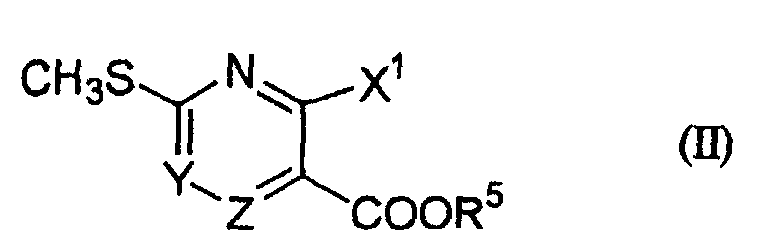
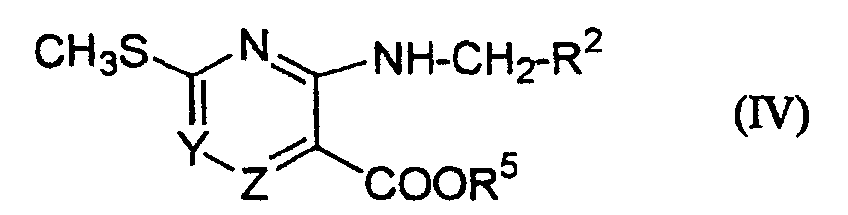
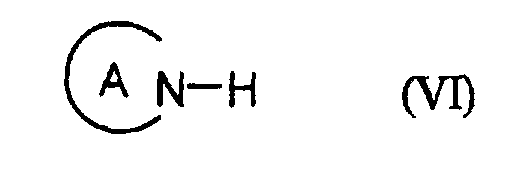
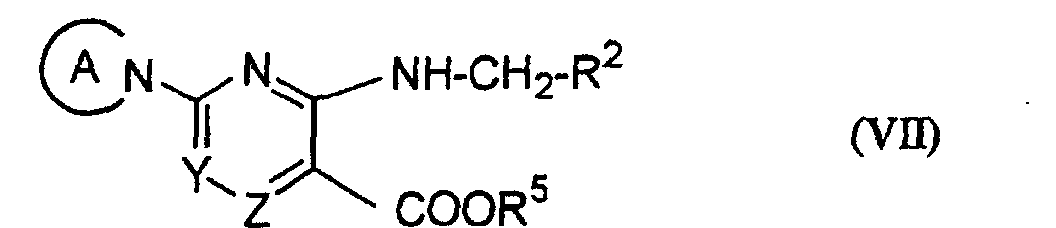
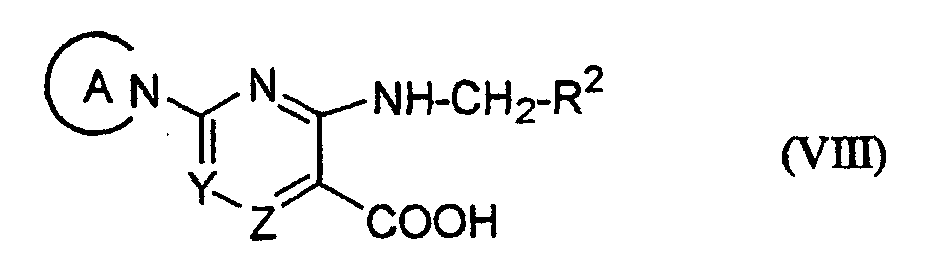
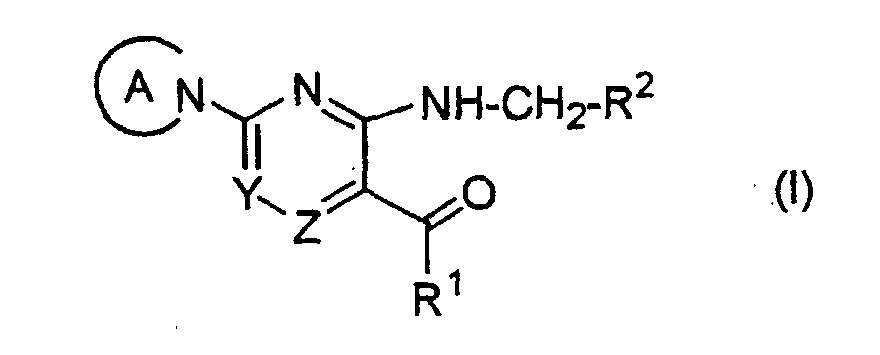
- a compound (I), which is a preferred PDE-V inhibitor for the present invention, can be prepared by reacting a compound of the formula (II): wherein X 1 is a halogen atom, R 5 is a protecting group for the carboxyl group and the other symbols are the same as defined above with a compound of the formula (III): R 2 -CH 2 -NH 2 wherein the symbol is the same as defined above; oxidizing the resulting compound of the formula (IV): wherein the symbols are the same as defined above to give a methylsulfonyl (or methylsulfinyl) compound of the formula (V): wherein n is 1 or 2 and the other symbols are the same as defined above; reacting the compound (V) with a compound of the formula (VI): wherein the symbol is the same as defined above, or a salt thereof to give a compound of the formula (VII): wherein the symbols are the same as defined above; removing the protecting group R 5 for the carboxyl group to give
- the compound (I) can also be prepared by halogenating a compound (VIII) to give a compound of the formula (X): wherein X 2 is a halogen atom and the other symbols are the same as defined above, and reacting the compound (X) with a compound of the formula (IX-a).
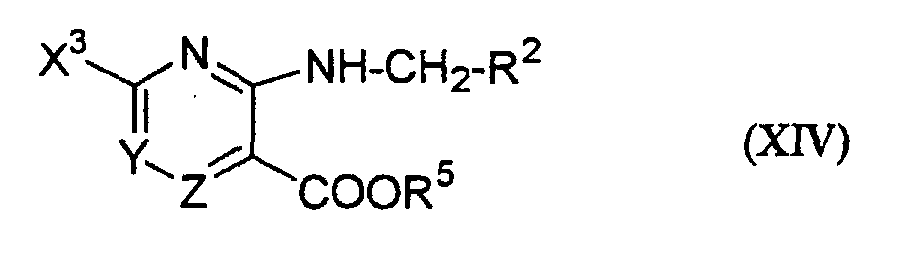
- the compound (VII) above can also be prepared by treating a dihalogeno compound of the formula (XI): wherein X 3 is a halogen atom, X 4 is a halogen atom and the other symbols are the same as defined above with a carbon dioxide to give a compound of the formula (XII): wherein the symbols are the same as defined above; protecting the carboxyl group of the compound (XII) to give a compound of the formula (XIII): wherein the symbols are the same as defined above; reacting the compound (XIII) with a compound of the formula (III) to give a compound of the formula (XIV): wherein the symbols are the same as defined above; and reacting the compound (XIV) with a compound (VI).
- the compound (XIV) above can also be prepared by hydrolyzing a compound (V) to give a compound of the formula (XV): wherein the symbols are the same as defined above; and halogenating the compound (XV).
- the reaction of the compound (II) with the compound (III) is carried out in the presence or absence of an acid scavenger in a solvent.
- the acid scavenger includes, for example, an organic base such as N,N-diisopropylethylamine, N-methylmorpholine, triethylamine, pyridine, etc., and an inorganic base such as sodium hydride, sodium carbonate, potassium carbonate, sodium hydrogen carbonate, etc.
- the solvent may be any solvent which does not disturb the reaction, for example, dimethylformamide, tetrahydrofuran, toluene, ethyl acetate, chloroform, dimethoxyethane, xylene, dimethylsulfoxide, etc.
- the reaction is carried out at a temperature of -10°C to room temperature, preferably 0°C to room temperature.
- the reaction for oxidizing the compound (IV) to give the methylsulfonyl (or methylsulfinyl) compound (V) is carried out in the presence of an oxidizing agent in a solvent.
- the oxidizing agent includes, for example, peracids such as m-chloroperbenzoic acid, peracetic acid, etc., and inorganic oxidizing agents such as manganese dioxide, sodium periodate, hydrogen peroxide, acyl nitrate, dinitrogen tetroxide, halogen, N-halide, hydroperoxide, iodobenzene acetate, t-butyl hypochlorite, sulfuryl chloride, potassium peroxymonosulfate (oxone), etc.
- the solvent may be any solvent which does not disturb the reaction, for example, chloroform, methylene chloride, dichloroethane, acetic acid, etc.
- the reaction is carried out at a temperature of -78°C to 50°C, preferably -10°C to 10°C.
- the reaction of the compound (V) with the compound (VI) or a salt thereof can be carried out in the presence or absence of an acid scavenger in a solvent.
- the acid scavenger includes, for example, an organic base such as N,N-diisopropylethylamine, N-methylmorpholine, triethylamine, pyridine, etc., and an inorganic base such as sodium hydride, sodium carbonate, potassium carbonate, sodium hydrogen carbonate, etc.
- the salt of the compound (VI) is preferably an alkali metal salt such as sodium salt, potassium salt, etc.
- the solvent may be any solvent which does not disturb the reaction, for example, dimethylformamide, tetrahydrofuran, dimethoxyethane, dimethylsulfoxide, etc.
- the reaction is carried out at a temperature of 0°C to 150°C, preferably room temperature to 60°C.
- the reaction of removing the protecting group R 5 for the carboxyl group of the compound (VII) to give the compound (VIII) can be carried out by a conventional method such as hydrolysis, catalytic reduction, etc. depending on the type of the carboxyl protecting group.
- a protecting group for carboxyl group is removed by hydrolysis
- the hydrolysis can be carried out, for example, in the presence of a base in a solvent.
- the base is preferably, for example, an alkali metal hydroxide such as sodium hydroxide, potassium hydroxide, lithium hydroxide, etc., or an alkali metal carbonate such as sodium carbonate, potassium carbonate, etc.
- the solvent may be water or a mixture of water and methanol, ethanol, tetrahydrofuran, dioxane, dimethylformamide, dimethylsulfoxide, etc.
- the reaction is carried out at a temperature of 0 to 80°C, preferably 5°C to 60°C.
- the protecting group for carboxyl group represented by R 5 may be any groups conventionally used for protecting a carboxyl group, such as a lower alkyl group, benzyl group, etc.
- the reaction of the compound (VIII) with the compound (IX-a) can be carried out in the presence or absence of a condensing agent, a base or an activator in a suitable solvent.
- the condensing agent includes, for example, dicyclohexylcarbodiimide, 1-ethyl-3-(3-dimethylaminopropyl)carbodiimide, diphenylphosphoryl azide, diethylcyanophosphonate, etc., which is commonly used in the peptide synthesis.
- the base includes, for example, an organic base such as triethylamine, N-methymorpholine, etc.
- the activator includes, for example, 1-hydroxybenzotriazole, etc.
- the solvent may be any solvent which does not disturb the reaction, for example, methylene chloride, tetrahydrofuran, dimethylformamide, acetonitrile, dimethylacetamide, ethyl acetate, etc.
- the present reaction proceeds preferably in the presence of an activator or a base.
- the activator includes hydroxybenzotriazole, etc. and the base include triethylamine, N-methymorpholine, etc.
- the reaction is carried out at a temperature of -30°C to 50°C, preferably - 10°C to 10°C.
- the solvent may be any solvent which does not disturb the reaction, for example, methylene chloride, chloroform, tetrahydrofuran, benzene, toluene, dioxane, etc.
- the reaction is carried out at a temperature of -30°C to 100°C, preferably -5°C to 10°C.
- the subsequent reaction with the compound (IX-a) can be carried out in the presence of an acid scavenger in a solvent.
- the acid scavenger includes, for example, an organic base such as N,N-diisopropylethylamine, N-methylmorpholine, triethylamine, pyridine, dimethylaminopyridine, etc., and an inorganic base such as sodium hydride, sodium carbonate, potassium carbonate, sodium hydrogen carbonate, etc.
- the solvent may be any solvent which does not disturb the reaction, for example, tetrahydrofuran, methylene chloride, chloroform, toluene, benzene, dioxane, ethyl acetate, etc.
- the reaction is carried out at a temperature of -30°C to 100°C, preferably -5°C to 10°C.
- the reaction of treating the dihalogeno compound (XI) with carbon dioxide to give the compound (XII) can be carried out in the presence of a base in a solvent.
- the base includes, for example, an alkali metal salt of an organic base such as lithium diisopropylamide, lithium 2,2,6,6-tetramethylpiperidide, etc.
- the solvent may be any solvent which does not disturb the reaction, for example, tetrahydrofuran, 1,2-dimethoxyethane, diethyl ether, etc.
- the reaction is carried out at a temperature of -100°C to - 30°C, preferably -100°C to -70°C.
- reaction of the compound (XIII) with the compound (III) to give the compound (XIV) can be carried out in the same manner as in the reaction of the compound (II) with the compound (III).
- reaction of the compound (XIV) with the compound (VI) to give the compound (VII) can be carried out in the same manner as in the reaction of the compound (V) with the compound (VI).
- the hydrolysis reaction of the compound (V) to give the compound (XV) can be carried out in the presence of a base in a solvent.
- the base includes, for example, an alkali metal hydroxide such as sodium hydroxide, potassium hydroxide, lithium hydroxide, etc., and an alkali metal carbonate such as sodium carbonate, potassium carbonate, etc.
- the solvent is preferably water, or a mixture of water and methanol, ethanol, tetrahydrofuran, dioxane, dimethylformamide, dimethylsulfoxide, etc.
- the reaction is carried out at a temperature of -20°C to 80°C, preferably - 5°C to 60°C.
- reaction of halogenating the compound (XV) to give the compound (XIV) can be carried out in the same manner as in the reaction wherein the compound (X) is obtained by halogenating the compound (XIII) by a halogenating agent.
- a 25 weight % aqueous hydroxypropylcellulose (HPC-SL, Nippon Soda Co., Ltd.) solution (70 g) is added to (S)-2-(2-hydroxymethyl-1-pyrrolidinyl)-4-(3-chloro-4-methoxybenzylamino)-5- [N-(2-pyrimidinylmethyl)-carbamoyl]pyrimidine (i.e., a PDE-V inhibitor) (250 g ), mannitol (325 g) and fumaric acid (100 g), and mixed for granulation with a planetary mixer (5DMV-01-r, Dalton, Co., Ltd.).
- HPC-SL Nippon Soda Co., Ltd.
- the granules are dried, sized with a sizer (P-02S, Dalton Co., Ltd.) and sieved through a No. 22 Sieve.
- a sizer P-02S, Dalton Co., Ltd.
- To an aliquot (650 g) of the resultant granules are added low-substituted hydroxypropylcellulose (L-HPC, Shin-Etsu Chemical Co., Ltd.) (41.9 g) and magnesium stearate (7.0 g), and mixed with a double cone mixer (Yashima Chemical Engineering Co., Ltd.) at 55 rpm for 3 minutes to yield granules for tableting.
- L-HPC low-substituted hydroxypropylcellulose
- 7.0 g magnesium stearate
- the granules are compressed with a rotary tableting machine (CPC818 HUK-DC-AWC, Kikusui Seisakusyo Ltd., punch: 7.5 ⁇ , 11R, compressing pressure: 6kN/punch) to yield tablets containing PDE-V inhibitor (150 mg/tablet).
- a rotary tableting machine CPC818 HUK-DC-AWC, Kikusui Seisakusyo Ltd., punch: 7.5 ⁇ , 11R, compressing pressure: 6kN/punch
- Tablets containing PDE-V inhibitor are prepared in the same manner as described in Example 1 except that tartaric acid is used instead of fumaric acid.
- Tablets containing PDE-V inhibitor are prepared in the same manner as described in Example 1 except that succinic acid is used instead of fumaric acid.
- Tablets containing PDE-V inhibitor are prepared in the same manner as described in Example 1 except that malic acid is used instead of fumaric acid.
- Tablets containing PDE-V inhibitor are prepared in the same manner as described in Example 1 except that ascorbic acid is used instead of fumaric acid.
- Tablets containing PDE-V inhibitor are prepared in the same manner as described in Example 1 except that aspartic acid is used instead of fumaric acid.
- Granules are prepared in the same manner as described in Example 7 (1). To an aliquot (650 g) of the resultant granules are added low-substituted hydroxypropylcellulose (L-HPC, Shin-Etsu Chemical Co., Ltd.) (41.9 g), magnesium stearate (7.0 g) and precipitated calcium carbonate (7.0 g), and mixed with a double cone mixer (Yashima Chemical Engineering Co., Ltd.) at 55 rpm for 3 minutes to yield granules for tableting.
- L-HPC low-substituted hydroxypropylcellulose
- 7.0 g magnesium stearate
- precipitated calcium carbonate 7.0 g
- the granules are compressed with a rotary tableting machine (CPC818 HUK-DC-AWC, Kikusui Seisakusyo Ltd., punch: 7.5 ⁇ , 11R, compressing pressure: 6kN/punch) to yield tablets containing PDE-V inhibitor (151.5 mg/tablet).
- a rotary tableting machine CPC818 HUK-DC-AWC, Kikusui Seisakusyo Ltd., punch: 7.5 ⁇ , 11R, compressing pressure: 6kN/punch
- Granules obtained in the same manner as described in Example 7(1) except that (S)-2-(2-hydroxymethyl-1-pyrrolidinyl)-4-(3-chloro-4-methoxybenzylamino)-5-[N-(5-pyrimidinylmethyl)carbamoyl]pyrimidine is used as a PDE-V inhibitor are treated in the same manner as described in Example 8 to yield tablets containing PDE-V inhibitor.
- Example 2 To a mixture similar to that described in Example 1, i.e., PDE-V inhibitor (250 g) and mannitol (425 g), a 25 weight % aqueous hydroxypropylcellulose (HPC-SL, Nippon Soda Co., Ltd.) solution (70 g) is added, and the mixture is mixed for granulation with a planetary mixer (5DMV-01-r, Dalton, Co., Ltd.). The granules are dried, sized with a sizer (P-02S, Dalton CO., Ltd.) and sieved through a No. 22 Sieve.
- HPC-SL a 25 weight % aqueous hydroxypropylcellulose
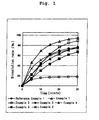
- the tablets of Examples 1-6, to which an acidic substance has been added show greatly improved dissolution rate of a medicinal substance compared to the preparation of Reference Example 1 which does not contain an acidic substance.
- the dissolution rate of a medicinal substance was further improved by adding precipitated calcium carbonate in addition to an organic acid.
- the present preparation for oral administration containing a PDEV inhibitor together with an acidic substance can achieve rapid dissolution of a medicinal substance in the digestive tract without being influenced by the conditions of the subject such as being suffering from anacidity or the time of administration such as just after eating, and can express the drug efficacy rapidly/immediately after administration, and hence is very useful in treatment of erectile dysfunction.
- a medicinal substance which becomes instable and/or hygroscopic when converted into an acid addition salt in order to improve the solubility, can be conveniently formulated in the free form.
- the dissolution profile of a medicinal substance can be further improved, and the moldability in the preparation of tablets is also enhanced, which shows another advantage of the present invention.
Landscapes
- Health & Medical Sciences (AREA)
- Chemical & Material Sciences (AREA)
- Life Sciences & Earth Sciences (AREA)
- Medicinal Chemistry (AREA)
- Pharmacology & Pharmacy (AREA)
- Animal Behavior & Ethology (AREA)
- General Health & Medical Sciences (AREA)
- Public Health (AREA)
- Veterinary Medicine (AREA)
- Epidemiology (AREA)
- Organic Chemistry (AREA)
- Chemical Kinetics & Catalysis (AREA)
- General Chemical & Material Sciences (AREA)
- Engineering & Computer Science (AREA)
- Oil, Petroleum & Natural Gas (AREA)
- Nuclear Medicine, Radiotherapy & Molecular Imaging (AREA)
- Molecular Biology (AREA)
- Biophysics (AREA)
- Inorganic Chemistry (AREA)
- Bioinformatics & Cheminformatics (AREA)
- Gynecology & Obstetrics (AREA)
- Endocrinology (AREA)
- Reproductive Health (AREA)
- Pharmaceuticals Containing Other Organic And Inorganic Compounds (AREA)
- Nitrogen Condensed Heterocyclic Rings (AREA)
- Medicinal Preparation (AREA)
- Medicines That Contain Protein Lipid Enzymes And Other Medicines (AREA)
- Plural Heterocyclic Compounds (AREA)
Abstract
Description

oxidizing the resulting compound of the formula (IV):

reacting the compound (V) with a compound of the formula (VI):
removing the protecting group R5 for the carboxyl group to give a compound of the formula (VIII):
reacting the compound (VIII) with a compound of the formula (IX-a):




Claims (17)
- A preparation for oral administration containing as an active ingredient a medicinal substance having cGMP-specific phosphodiesterase inhibitory activity and showing decrease of solubility in the neutral and alkaline regions, which comprises an acidic substance.
- The preparation for oral administration according to claim 1 wherein the medicinal substance is a compound of the formula (I):wherein ring A is an optionally substituted nitrogen-containing heterocyclic group; R1 is an optionally substituted lower alkyl group, a group of the formula: -NH-Q-R3 (wherein R3 is an optionally substituted nitrogen-containing heterocyclic group, and Q is a lower alkylene group or a single bond), or a group of the formula: -NH-R4 (wherein R4 is an optionally substituted cycloalkyl group); R2 is an optionally substituted aryl group; one of Y and Z is a group of the formula: =CH-, and the other is a group of the formula: =N-, or a pharmaceutically acceptable salt thereof.
- The preparation according to claim 1 or 2, wherein the medicinal substance is in the free form.
- The preparation according to claim 3, wherein the medicinal substance is selected from the group consisting of (S)-2-(2-hydroxymethyl-1-pyrrolidinyl)-4-(3-chloro-4-methoxybenzylamino)-5-[N-(2-pyrimidinylmethyl) carbamoyl]-pyrimidine, 2-(5,6,7,8-tetrahydroimidazo[1,2-a]pyrazin-7 yl)-4-(3-chloro-4-methoxybenzylamino)-5-[N-(2-pyrimidinylmethyl) carbamoyl]pyrimidine, 2-(5,6,7,8-tetrahydro-1,7-naphthyridin-7-yl)-4-(3-chloro-4-methoxybenzylamino)-5-[N-(2-morpholinoethyl)-carbamoyl]pyrimidine, (S)-2-(2-hydroxymethyl-1-pyrrolidinyl)-4-(3-chloro-4-methoxybenzylamino)-5-[N-(5-pyrimidinylmethyl)carbamoyl]pyrimidine and (S)-2-(2-hydroxymethyl-1-pyrrolidinyl)-4-(3-chloro-4-methoxybenzylamino)-5-[N-(1,3,5-trimethyl-4-pyrazolyl)carbamoyl]pyrimidine.
- The preparation according to any one of claims 1 to 4, wherein the acidic substance is an organic acid.
- The preparation according to claim 5, wherein the acidic substance is one or more acids selected from the group consisting of fumaric acid, tartaric acid, succinic acid, malic acid, ascorbic acid and aspartic acid.
- The preparation according to claim 5, wherein the acidic substance is fumaric acid.
- The preparation according to any one of claims 1 to 7, wherein the compounding ratio of a medicinal substance and an acidic substance is in the range of 1:0.05 to 1:30.
- The preparation according to any one of claims 1 to 8, which further contains a carbonate.
- The preparation according to claim 9, wherein the carbonate is one or more substances selected from the group consisting of alkali metal carbonates, alkali metal hydrogen carbonates and alkali earth metal carbonates.
- The preparation according to claim 9, wherein the carbonate is calcium carbonate.
- The preparation according to any one of claims 9 to 11, wherein the content of a carbonate is 10 weight % or less of the total amount of the preparation.
- The preparation according to any one of claims 1 to 12, which is in the form of tablet.
- A tablet which comprises a medicinal substance selected from the group consisting of (S)-2-(2-hydroxymethyl-1-pyrrolidinyl)-4-(3-chloro-4-methoxybenzylamino)-5-[N-(2-pyrimidinylmethyl)carbamoyl]-pyrimidine, 2-(5,6,7,8-tetrahydroimidazo[1,2-a]pyrazin-7-yl)-4-(3-chloro-4-methoxybenzylamino)-5-[N-(2-pyrimidinylmethyl)carbamoyl]pyrimidine, 2-(5,6,7,8-tetrahydro-1,7-naphthyridin-7-yl)-4-(3-chloro-4-methoxybenzylamino)-5-[N-(2-morpholinoethyl)carbamoyl]pyrimidine, (S)-2-(2-hydroxymethyl-1-pyrrolidinyl)-4-(3-chloro-4-methoxybenzylamino)-5-[N-(5-pyrimidinylmethyl)-carbamoyl]pyrimidine, and (S)-2-(2-hydroxymethyl-1-pyrrolidinyl)-4-(3-chloro-4-methoxybenzylamino)-5-[N-(1,3,5-trimethyl-4-pyrazolyl)carbamoyl]pyrimidine; fumaric acid; and calcium carbonate.
- A tablet which comprises (S)-2-(2-hydroxymethyl-1-pyrrolidinyl)-4-(3-chloro-4-methoxybenzylamino)-5-[N-(2-pyrimidinylmethyl)carbamoyl]pyrimidine, fumaric acid and calcium carbonate.
- A tablet which comprises 2-(5,6,7,8-tetrahydro-1,7-naphthyridin-7-yl)-4-(3-chloro-4-methoxybenzylamino)-5-[N-(2-morpholinoethyl)carbamoyl]pyrimidine, fumaric acid and calcium carbonate.
- A tablet which comprises (S)-2-(2-hydroxymethyl-1-pyrrolidinyl)-4-(3-chloro-4-methoxybenzylamino)-5-[N-(1,3,5-trimethyl-4-pyrazolyl)carbamoyl]pyrimidine, fumaric acid and calcium carbonate.
Applications Claiming Priority (5)
| Application Number | Priority Date | Filing Date | Title |
|---|---|---|---|
| JP2000270061 | 2000-09-06 | ||
| JP2000270061 | 2000-09-06 | ||
| JP2001231682 | 2001-07-31 | ||
| JP2001231682 | 2001-07-31 | ||
| PCT/JP2001/007718 WO2002020058A1 (en) | 2000-09-06 | 2001-09-06 | Preparations for oral administration |
Publications (3)
| Publication Number | Publication Date |
|---|---|
| EP1316316A1 true EP1316316A1 (en) | 2003-06-04 |
| EP1316316A4 EP1316316A4 (en) | 2009-09-09 |
| EP1316316B1 EP1316316B1 (en) | 2012-04-04 |
Family
ID=26599342
Family Applications (1)
| Application Number | Title | Priority Date | Filing Date |
|---|---|---|---|
| EP01963455A Expired - Lifetime EP1316316B1 (en) | 2000-09-06 | 2001-09-06 | Preparations for oral administration |
Country Status (13)
| Country | Link |
|---|---|
| US (1) | US7501409B2 (en) |
| EP (1) | EP1316316B1 (en) |
| JP (1) | JP4588973B2 (en) |
| KR (1) | KR100610131B1 (en) |
| CN (1) | CN1264574C (en) |
| AT (1) | ATE552013T1 (en) |
| AU (2) | AU2001284444B2 (en) |
| CA (1) | CA2420461C (en) |
| ES (1) | ES2381862T3 (en) |
| HK (1) | HK1052879A1 (en) |
| MX (1) | MXPA03001958A (en) |
| NZ (1) | NZ524572A (en) |
| WO (1) | WO2002020058A1 (en) |
Cited By (1)
| Publication number | Priority date | Publication date | Assignee | Title |
|---|---|---|---|---|
| EP2213306A4 (en) * | 2007-09-19 | 2012-08-29 | Asahi Group Holdings Ltd | METHOD FOR PRODUCING GRANULES WITH MATERIAL OF NATURAL ORIGIN SUCH AS AN EXTRACT OF CHINESE ORTHODOX MEDICINE, RAW DRUG EXTRACT, NATURAL MATERIAL EXTRACT, OR MIXTURE THEREOF AND METHOD FOR PRODUCING TABLETS FROM GRANULES |
Families Citing this family (20)
| Publication number | Priority date | Publication date | Assignee | Title |
|---|---|---|---|---|
| GB0219516D0 (en) * | 2002-08-21 | 2002-10-02 | Phoqus Ltd | Fast dissolving and taste masked oral dosage form comprising sildenafil |
| WO2005075068A1 (en) * | 2004-02-05 | 2005-08-18 | Taiyo Kagaku Co., Ltd. | Adsorptivity imparting agent containing porous silica |
| US20080019367A1 (en) * | 2004-06-30 | 2008-01-24 | Satoshi Ito | Communication Device, Communication Setting Method, Communication Setting Program And Recording Medium On Which Is Recorded A Communication Setting Program |
| US8645578B2 (en) * | 2004-12-22 | 2014-02-04 | Intel Corporaton | Routing of messages |
| WO2011039527A1 (en) * | 2009-09-30 | 2011-04-07 | Merck Sharp & Dohme Ltd | Formulations for c-met kinase inhibitors |
| KR101940840B1 (en) * | 2011-08-10 | 2019-01-21 | 다이이찌 산쿄 가부시키가이샤 | Pharmaceutical composition containing diamine derivative |
| ES2895918T3 (en) * | 2012-02-21 | 2022-02-23 | Towa Pharmaceutical Europe S L | Dabigatran etexilate oral pharmaceutical compositions |
| US9359371B2 (en) | 2012-08-14 | 2016-06-07 | Xuanzhu Pharma Co., Ltd. | Bicyclic substituted pyrimidine compounds |
| CN105899510A (en) * | 2013-08-08 | 2016-08-24 | 拜耳制药股份公司 | Substituted imidazo[1,2-a]pyrazinecarboxamides and use thereof |
| EP3082428A4 (en) | 2013-12-09 | 2017-08-02 | Respira Therapeutics, Inc. | Pde5 inhibitor powder formulations and methods relating thereto |
| EP3034070A1 (en) * | 2014-12-18 | 2016-06-22 | Omya International AG | Method for the production of a pharmaceutical delivery system |
| EP3069713A1 (en) | 2015-03-20 | 2016-09-21 | Omya International AG | Dispersible dosage form |
| CA3007213C (en) | 2015-12-23 | 2024-01-02 | Colgate-Palmolive Company | Storage-stable solid peroxymonosulfate composition |
| CN109689165B (en) | 2016-08-11 | 2022-08-26 | 高露洁-棕榄公司 | Permonosulfate dentifrice compositions for hard stains |
| EP4620525A3 (en) | 2016-12-14 | 2025-12-03 | Respira Therapeutics, Inc. | Methods and compositions for treatment of pulmonary hypertension and other lung disorders |
| SE542968C2 (en) | 2018-10-26 | 2020-09-22 | Lindahl Anders | Treatment of osteoarthritis |
| CN109438421A (en) * | 2018-11-13 | 2019-03-08 | 扬州市三药制药有限公司 | A kind of polishing purification method of avanaphil intermediate |
| EP4200025A1 (en) | 2021-01-25 | 2023-06-28 | Colgate-Palmolive Company | Solid oral care compositions comprising pvp and hec as binder system |
| US12214063B2 (en) | 2021-02-19 | 2025-02-04 | Colgate-Palmolive Company | Peroxymonosulfate whitening strips |
| WO2022226369A1 (en) | 2021-04-23 | 2022-10-27 | Colgate-Palmolive Company | Solid oral care compositions |
Family Cites Families (35)
| Publication number | Priority date | Publication date | Assignee | Title |
|---|---|---|---|---|
| GB9301192D0 (en) | 1993-06-09 | 1993-06-09 | Trott Francis W | Flower shaped mechanised table |
| GB9514465D0 (en) | 1995-07-14 | 1995-09-13 | Glaxo Lab Sa | Chemical compounds |
| GB9423911D0 (en) | 1994-11-26 | 1995-01-11 | Pfizer Ltd | Therapeutic agents |
| DE19501481A1 (en) | 1995-01-19 | 1996-07-25 | Bayer Ag | 2,8-disubstituted quinazolinones |
| DE19501480A1 (en) | 1995-01-19 | 1996-07-25 | Bayer Ag | 9-substituted 2- (2-n-alkoxyphenyl) -purin-6-one |
| DE19501482A1 (en) | 1995-01-19 | 1996-07-25 | Bayer Ag | 2,9-disubstituted purine-6-ones |
| KR100430059B1 (en) | 1995-04-10 | 2004-09-24 | 후지사와 야꾸힝 고교 가부시키가이샤 | Indole derivatives as cGMP-PDE inhibitors |
| DE59610031D1 (en) | 1995-05-18 | 2003-02-06 | Altana Pharma Ag | CYCLOHEXYLDIHYDROBENZOFURANE |
| AU698028B2 (en) | 1995-05-18 | 1998-10-22 | Altana Pharma Ag | Phenyldihydrobenzofurans |
| GB9514464D0 (en) | 1995-07-14 | 1995-09-13 | Glaxo Lab Sa | Medicaments |
| DE19541264A1 (en) | 1995-11-06 | 1997-05-07 | Bayer Ag | Purin-6-one derivatives |
| BR9707233A (en) | 1996-01-31 | 1999-07-20 | Byk Gulden Lomberg Chem Fab | Phenanthridines |
| US6127378A (en) | 1996-03-26 | 2000-10-03 | Byk Gulden Lomberg Chemische Fabrik Gmbh | Phenanthridines substituted in the 6 position |
| EP0985671B1 (en) | 1996-05-31 | 2003-04-02 | Mochida Pharmaceutical Co., Ltd. | PYRIDOCARBAZOLE DERIVATIVES HAVING cGMP-PDE INHIBITORY EFFECT |
| HUP0002744A3 (en) | 1997-01-06 | 2001-01-29 | Pfizer | Rapidly releasing and taste-masking pharmaceutical dosage form |
| JPH10240446A (en) | 1997-02-27 | 1998-09-11 | Nec Ic Microcomput Syst Ltd | Editing graphic selection system |
| WO1998038168A1 (en) | 1997-02-27 | 1998-09-03 | Tanabe Seiyaku Co., Ltd. | Isoquinolinone derivatives, process for preparing the same, and their use as phosphodiesterase inhibitors |
| JPH10298062A (en) | 1997-04-24 | 1998-11-10 | Pfizer Pharmaceut Co Ltd | Oral fast dissolving tablets |
| US6548490B1 (en) * | 1997-10-28 | 2003-04-15 | Vivus, Inc. | Transmucosal administration of phosphodiesterase inhibitors for the treatment of erectile dysfunction |
| US6403597B1 (en) * | 1997-10-28 | 2002-06-11 | Vivus, Inc. | Administration of phosphodiesterase inhibitors for the treatment of premature ejaculation |
| GT199900061A (en) | 1998-05-15 | 2000-10-14 | Pfizer | PHARMACEUTICAL FORMULATIONS. |
| JP2000095759A (en) | 1998-07-21 | 2000-04-04 | Takeda Chem Ind Ltd | Tricyclic compound, its production, and phosphodiesterase inhibitor |
| JP2000072675A (en) | 1998-08-26 | 2000-03-07 | Tanabe Seiyaku Co Ltd | Pharmaceutical composition |
| JP2000072751A (en) | 1998-08-26 | 2000-03-07 | Tanabe Seiyaku Co Ltd | Isoquinolinone derivative |
| WO2000020033A1 (en) * | 1998-10-05 | 2000-04-13 | Eisai Co., Ltd. | Tablets immediately disintegrating in the oral cavity |
| JP2000178204A (en) * | 1998-10-05 | 2000-06-27 | Eisai Co Ltd | Oral rapid disintegration tablet containing phosphodiesterase inhibitor |
| JP2000119198A (en) * | 1998-10-16 | 2000-04-25 | Eisai Co Ltd | Phosphodiesterase inhibitor-containing peroral preparation hiding bitterness or the like |
| JP2000191518A (en) * | 1998-10-19 | 2000-07-11 | Eisai Co Ltd | Intraoral quickly collapsible tablet having improved solubility |
| GB9823101D0 (en) | 1998-10-23 | 1998-12-16 | Pfizer Ltd | Pharmaceutically active compounds |
| UA67802C2 (en) * | 1998-10-23 | 2004-07-15 | Пфайзер Рісьоч Енд Дівелепмент Компані, Н.В./С.А. | CONTROLLED-RELEASE FORMULATIONS FOR ORAL ADMINISTRATION CONTAINING cGMP PDE-5 INHIBITOR (VARIANTS), METHOD FOR ITS PREPARATION AND METHOD FOR TREATING ERECTILE DYSFUNCTION |
| GB9823103D0 (en) | 1998-10-23 | 1998-12-16 | Pfizer Ltd | Pharmaceutically active compounds |
| WO2000032195A1 (en) * | 1998-12-02 | 2000-06-08 | Mochida Pharmaceutical Co., Ltd. | Preparations for intraurethral administration |
| US6869950B1 (en) | 1998-12-24 | 2005-03-22 | Fujisawa Pharmaceutical Co., Ltd. | Benzimidazole derivatives |
| ES2283315T3 (en) | 1999-09-16 | 2007-11-01 | Tanabe Seiyaku Co., Ltd. | CYCLE COMPOUNDS OF 6 MEMBERS CONTAINING AROMATIC NITROGEN. |
| ATE314362T1 (en) * | 1999-10-12 | 2006-01-15 | Takeda Pharmaceutical | PYRIMIDINE-5-CARBOXIMIDE COMPOUNDS, METHOD FOR PRODUCING SAME AND USE THEREOF |
-
2001
- 2001-09-06 AT AT01963455T patent/ATE552013T1/en active
- 2001-09-06 EP EP01963455A patent/EP1316316B1/en not_active Expired - Lifetime
- 2001-09-06 WO PCT/JP2001/007718 patent/WO2002020058A1/en not_active Ceased
- 2001-09-06 ES ES01963455T patent/ES2381862T3/en not_active Expired - Lifetime
- 2001-09-06 US US10/363,322 patent/US7501409B2/en not_active Expired - Lifetime
- 2001-09-06 CA CA002420461A patent/CA2420461C/en not_active Expired - Lifetime
- 2001-09-06 CN CNB018160611A patent/CN1264574C/en not_active Ceased
- 2001-09-06 AU AU2001284444A patent/AU2001284444B2/en active Active
- 2001-09-06 KR KR1020037003283A patent/KR100610131B1/en not_active Expired - Lifetime
- 2001-09-06 JP JP2002524541A patent/JP4588973B2/en not_active Expired - Lifetime
- 2001-09-06 HK HK03105164.6A patent/HK1052879A1/en unknown
- 2001-09-06 NZ NZ524572A patent/NZ524572A/en not_active IP Right Cessation
- 2001-09-06 AU AU8444401A patent/AU8444401A/en active Pending
- 2001-09-06 MX MXPA03001958A patent/MXPA03001958A/en active IP Right Grant
Cited By (1)
| Publication number | Priority date | Publication date | Assignee | Title |
|---|---|---|---|---|
| EP2213306A4 (en) * | 2007-09-19 | 2012-08-29 | Asahi Group Holdings Ltd | METHOD FOR PRODUCING GRANULES WITH MATERIAL OF NATURAL ORIGIN SUCH AS AN EXTRACT OF CHINESE ORTHODOX MEDICINE, RAW DRUG EXTRACT, NATURAL MATERIAL EXTRACT, OR MIXTURE THEREOF AND METHOD FOR PRODUCING TABLETS FROM GRANULES |
Also Published As
| Publication number | Publication date |
|---|---|
| CN1462193A (en) | 2003-12-17 |
| AU2001284444B2 (en) | 2006-05-25 |
| WO2002020058A1 (en) | 2002-03-14 |
| CN1264574C (en) | 2006-07-19 |
| JP4588973B2 (en) | 2010-12-01 |
| KR20030029921A (en) | 2003-04-16 |
| AU8444401A (en) | 2002-03-22 |
| EP1316316A4 (en) | 2009-09-09 |
| CA2420461A1 (en) | 2003-02-26 |
| MXPA03001958A (en) | 2003-06-24 |
| CA2420461C (en) | 2008-08-12 |
| HK1052879A1 (en) | 2003-10-03 |
| US7501409B2 (en) | 2009-03-10 |
| ES2381862T3 (en) | 2012-06-01 |
| EP1316316B1 (en) | 2012-04-04 |
| ATE552013T1 (en) | 2012-04-15 |
| KR100610131B1 (en) | 2006-08-09 |
| US20030195220A1 (en) | 2003-10-16 |
| NZ524572A (en) | 2004-08-27 |
Similar Documents
| Publication | Publication Date | Title |
|---|---|---|
| AU2001284444B2 (en) | Preparations for oral administration | |
| AU2002230217B2 (en) | Tablets quickly disintegrated in oral cavity | |
| US6140329A (en) | Use of cGMP-phosphodiesterase inhibitors in methods and compositions to treat impotence | |
| JPWO2002020058A1 (en) | Oral administration formulation | |
| EP1949902B1 (en) | USE OF COMBINATION OF ANTI-ANGIOGENIC SUBSTANCE AND c-kit KINASE INHIBITOR | |
| JP4955012B2 (en) | Novel condensed pyrrole derivatives | |
| JP2008546786A (en) | Rapidly absorbable oral formulation of PDE5 inhibitor | |
| SK3898A3 (en) | Cyclic gmp-specific phosphodiesterase inhibitors | |
| CN118765272A (en) | Process for preparing (5S)-{[2-(4-carboxyphenyl)ethyl][2-(2-{[3-chloro-4'-(trifluoromethyl)biphenyl-4-yl]methoxy}phenyl)ethyl]amino}-5,6,7,8-tetrahydroquinoline-2-carboxylic acid and its crystalline form for use as a pharmaceutically active compound | |
| JPH05238958A (en) | (quinolin-2-ylmethoxy)indole/cyclodextrin complex | |
| EP1641440B1 (en) | Tablet comprising fluvastatin and carmellose calcium | |
| JP2000191518A (en) | Intraoral quickly collapsible tablet having improved solubility | |
| KR100192534B1 (en) | Agent for increasing somatostatin or for inhibiting decrease of somatostatin | |
| JP2009520806A (en) | Pharmaceutical combination of PDE-5 inhibitor and 5-α reductase inhibitor | |
| HK1057712A (en) | Tablets quickly disintegrated in oral cavity | |
| WO2005051384A1 (en) | Stabilised pharmaceutical compositions | |
| EA052842B1 (en) | SOLID PHARMACEUTICAL COMPOSITIONS OF ADAGRASIB | |
| KR20090033246A (en) | Oral pharmaceutical compositions of active substances with poor water solubility | |
| WO2001032689A1 (en) | Salts of enalapril | |
| TWI462925B (en) | Pharmaceutical composition for the treatment of type 2 diabetes | |
| JPH06509587A (en) | Drugs to increase somatostatin or suppress somatostatin decrease | |
| JP2005263788A (en) | Stabilized pharmaceutical composition containing indoline compound | |
| JP2007051085A (en) | Stabilized pharmaceutical composition containing indoline compound |
Legal Events
| Date | Code | Title | Description |
|---|---|---|---|
| PUAI | Public reference made under article 153(3) epc to a published international application that has entered the european phase |
Free format text: ORIGINAL CODE: 0009012 |
|
| 17P | Request for examination filed |
Effective date: 20030305 |
|
| AK | Designated contracting states |
Designated state(s): AT BE CH CY DE DK ES FI FR GB GR IE IT LI LU MC NL PT SE TR |
|
| AX | Request for extension of the european patent |
Extension state: AL LT LV MK RO SI |
|
| RAP1 | Party data changed (applicant data changed or rights of an application transferred) |
Owner name: MITSUBISHI TANABE PHARMA CORPORATION |
|
| A4 | Supplementary search report drawn up and despatched |
Effective date: 20090812 |
|
| 17Q | First examination report despatched |
Effective date: 20091201 |
|
| GRAP | Despatch of communication of intention to grant a patent |
Free format text: ORIGINAL CODE: EPIDOSNIGR1 |
|
| GRAS | Grant fee paid |
Free format text: ORIGINAL CODE: EPIDOSNIGR3 |
|
| RAP1 | Party data changed (applicant data changed or rights of an application transferred) |
Owner name: MITSUBISHI TANABE PHARMA CORPORATION |
|
| GRAA | (expected) grant |
Free format text: ORIGINAL CODE: 0009210 |
|
| AK | Designated contracting states |
Kind code of ref document: B1 Designated state(s): AT BE CH CY DE DK ES FI FR GB GR IE IT LI LU MC NL PT SE TR |
|
| REG | Reference to a national code |
Ref country code: GB Ref legal event code: FG4D |
|
| REG | Reference to a national code |
Ref country code: CH Ref legal event code: EP |
|
| REG | Reference to a national code |
Ref country code: AT Ref legal event code: REF Ref document number: 552013 Country of ref document: AT Kind code of ref document: T Effective date: 20120415 |
|
| REG | Reference to a national code |
Ref country code: IE Ref legal event code: FG4D |
|
| REG | Reference to a national code |
Ref country code: DE Ref legal event code: R096 Ref document number: 60146353 Country of ref document: DE Effective date: 20120531 |
|
| REG | Reference to a national code |
Ref country code: ES Ref legal event code: FG2A Ref document number: 2381862 Country of ref document: ES Kind code of ref document: T3 Effective date: 20120601 |
|
| REG | Reference to a national code |
Ref country code: NL Ref legal event code: VDEP Effective date: 20120404 |
|
| REG | Reference to a national code |
Ref country code: AT Ref legal event code: MK05 Ref document number: 552013 Country of ref document: AT Kind code of ref document: T Effective date: 20120404 |
|
| PG25 | Lapsed in a contracting state [announced via postgrant information from national office to epo] |
Ref country code: SE Free format text: LAPSE BECAUSE OF FAILURE TO SUBMIT A TRANSLATION OF THE DESCRIPTION OR TO PAY THE FEE WITHIN THE PRESCRIBED TIME-LIMIT Effective date: 20120404 Ref country code: CY Free format text: LAPSE BECAUSE OF FAILURE TO SUBMIT A TRANSLATION OF THE DESCRIPTION OR TO PAY THE FEE WITHIN THE PRESCRIBED TIME-LIMIT Effective date: 20120404 Ref country code: FI Free format text: LAPSE BECAUSE OF FAILURE TO SUBMIT A TRANSLATION OF THE DESCRIPTION OR TO PAY THE FEE WITHIN THE PRESCRIBED TIME-LIMIT Effective date: 20120404 |
|
| PG25 | Lapsed in a contracting state [announced via postgrant information from national office to epo] |
Ref country code: PT Free format text: LAPSE BECAUSE OF FAILURE TO SUBMIT A TRANSLATION OF THE DESCRIPTION OR TO PAY THE FEE WITHIN THE PRESCRIBED TIME-LIMIT Effective date: 20120806 Ref country code: GR Free format text: LAPSE BECAUSE OF FAILURE TO SUBMIT A TRANSLATION OF THE DESCRIPTION OR TO PAY THE FEE WITHIN THE PRESCRIBED TIME-LIMIT Effective date: 20120705 |
|
| PG25 | Lapsed in a contracting state [announced via postgrant information from national office to epo] |
Ref country code: BE Free format text: LAPSE BECAUSE OF FAILURE TO SUBMIT A TRANSLATION OF THE DESCRIPTION OR TO PAY THE FEE WITHIN THE PRESCRIBED TIME-LIMIT Effective date: 20120404 |
|
| PG25 | Lapsed in a contracting state [announced via postgrant information from national office to epo] |
Ref country code: DK Free format text: LAPSE BECAUSE OF FAILURE TO SUBMIT A TRANSLATION OF THE DESCRIPTION OR TO PAY THE FEE WITHIN THE PRESCRIBED TIME-LIMIT Effective date: 20120404 Ref country code: AT Free format text: LAPSE BECAUSE OF FAILURE TO SUBMIT A TRANSLATION OF THE DESCRIPTION OR TO PAY THE FEE WITHIN THE PRESCRIBED TIME-LIMIT Effective date: 20120404 Ref country code: NL Free format text: LAPSE BECAUSE OF FAILURE TO SUBMIT A TRANSLATION OF THE DESCRIPTION OR TO PAY THE FEE WITHIN THE PRESCRIBED TIME-LIMIT Effective date: 20120404 |
|
| PLBE | No opposition filed within time limit |
Free format text: ORIGINAL CODE: 0009261 |
|
| STAA | Information on the status of an ep patent application or granted ep patent |
Free format text: STATUS: NO OPPOSITION FILED WITHIN TIME LIMIT |
|
| 26N | No opposition filed |
Effective date: 20130107 |
|
| REG | Reference to a national code |
Ref country code: HK Ref legal event code: WD Ref document number: 1052879 Country of ref document: HK |
|
| PG25 | Lapsed in a contracting state [announced via postgrant information from national office to epo] |
Ref country code: MC Free format text: LAPSE BECAUSE OF NON-PAYMENT OF DUE FEES Effective date: 20120930 |
|
| REG | Reference to a national code |
Ref country code: CH Ref legal event code: PL |
|
| REG | Reference to a national code |
Ref country code: DE Ref legal event code: R097 Ref document number: 60146353 Country of ref document: DE Effective date: 20130107 |
|
| REG | Reference to a national code |
Ref country code: IE Ref legal event code: MM4A |
|
| PG25 | Lapsed in a contracting state [announced via postgrant information from national office to epo] |
Ref country code: CH Free format text: LAPSE BECAUSE OF NON-PAYMENT OF DUE FEES Effective date: 20120930 Ref country code: IE Free format text: LAPSE BECAUSE OF NON-PAYMENT OF DUE FEES Effective date: 20120906 Ref country code: LI Free format text: LAPSE BECAUSE OF NON-PAYMENT OF DUE FEES Effective date: 20120930 |
|
| PG25 | Lapsed in a contracting state [announced via postgrant information from national office to epo] |
Ref country code: TR Free format text: LAPSE BECAUSE OF FAILURE TO SUBMIT A TRANSLATION OF THE DESCRIPTION OR TO PAY THE FEE WITHIN THE PRESCRIBED TIME-LIMIT Effective date: 20120404 |
|
| PG25 | Lapsed in a contracting state [announced via postgrant information from national office to epo] |
Ref country code: LU Free format text: LAPSE BECAUSE OF NON-PAYMENT OF DUE FEES Effective date: 20120906 |
|
| REG | Reference to a national code |
Ref country code: FR Ref legal event code: PLFP Year of fee payment: 16 |
|
| REG | Reference to a national code |
Ref country code: FR Ref legal event code: PLFP Year of fee payment: 17 |
|
| REG | Reference to a national code |
Ref country code: FR Ref legal event code: PLFP Year of fee payment: 18 |
|
| PGFP | Annual fee paid to national office [announced via postgrant information from national office to epo] |
Ref country code: DE Payment date: 20200826 Year of fee payment: 20 Ref country code: FR Payment date: 20200812 Year of fee payment: 20 Ref country code: GB Payment date: 20200826 Year of fee payment: 20 |
|
| PGFP | Annual fee paid to national office [announced via postgrant information from national office to epo] |
Ref country code: IT Payment date: 20200812 Year of fee payment: 20 |
|
| PGFP | Annual fee paid to national office [announced via postgrant information from national office to epo] |
Ref country code: ES Payment date: 20201005 Year of fee payment: 20 |
|
| REG | Reference to a national code |
Ref country code: DE Ref legal event code: R071 Ref document number: 60146353 Country of ref document: DE |
|
| REG | Reference to a national code |
Ref country code: GB Ref legal event code: PE20 Expiry date: 20210905 |
|
| PG25 | Lapsed in a contracting state [announced via postgrant information from national office to epo] |
Ref country code: GB Free format text: LAPSE BECAUSE OF EXPIRATION OF PROTECTION Effective date: 20210905 |
|
| REG | Reference to a national code |
Ref country code: ES Ref legal event code: FD2A Effective date: 20211227 |
|
| PG25 | Lapsed in a contracting state [announced via postgrant information from national office to epo] |
Ref country code: ES Free format text: LAPSE BECAUSE OF EXPIRATION OF PROTECTION Effective date: 20210907 |