EP1312265B1 - Method for preparing solid milk product - Google Patents
Method for preparing solid milk product Download PDFInfo
- Publication number
- EP1312265B1 EP1312265B1 EP02257856A EP02257856A EP1312265B1 EP 1312265 B1 EP1312265 B1 EP 1312265B1 EP 02257856 A EP02257856 A EP 02257856A EP 02257856 A EP02257856 A EP 02257856A EP 1312265 B1 EP1312265 B1 EP 1312265B1
- Authority
- EP
- European Patent Office
- Prior art keywords
- blend
- solid
- percent
- milk
- fat
- Prior art date
- Legal status (The legal status is an assumption and is not a legal conclusion. Google has not performed a legal analysis and makes no representation as to the accuracy of the status listed.)
- Expired - Lifetime
Links
Images

Classifications
-
- A—HUMAN NECESSITIES
- A23—FOODS OR FOODSTUFFS; TREATMENT THEREOF, NOT COVERED BY OTHER CLASSES
- A23C—DAIRY PRODUCTS, e.g. MILK, BUTTER OR CHEESE; MILK OR CHEESE SUBSTITUTES; PREPARATION THEREOF
- A23C20/00—Cheese substitutes
-
- A—HUMAN NECESSITIES
- A23—FOODS OR FOODSTUFFS; TREATMENT THEREOF, NOT COVERED BY OTHER CLASSES
- A23C—DAIRY PRODUCTS, e.g. MILK, BUTTER OR CHEESE; MILK OR CHEESE SUBSTITUTES; PREPARATION THEREOF
- A23C9/00—Milk preparations; Milk powder or milk powder preparations
- A23C9/15—Reconstituted or recombined milk products containing neither non-milk fat nor non-milk proteins
- A23C9/1504—Spreads, semi-solid products
-
- A—HUMAN NECESSITIES
- A23—FOODS OR FOODSTUFFS; TREATMENT THEREOF, NOT COVERED BY OTHER CLASSES
- A23C—DAIRY PRODUCTS, e.g. MILK, BUTTER OR CHEESE; MILK OR CHEESE SUBSTITUTES; PREPARATION THEREOF
- A23C9/00—Milk preparations; Milk powder or milk powder preparations
- A23C9/15—Reconstituted or recombined milk products containing neither non-milk fat nor non-milk proteins
- A23C9/1512—Reconstituted or recombined milk products containing neither non-milk fat nor non-milk proteins containing isolated milk or whey proteins, caseinates or cheese; Enrichment of milk products with milk proteins in isolated or concentrated form, e.g. ultrafiltration retentate
-
- A—HUMAN NECESSITIES
- A23—FOODS OR FOODSTUFFS; TREATMENT THEREOF, NOT COVERED BY OTHER CLASSES
- A23L—FOODS, FOODSTUFFS OR NON-ALCOHOLIC BEVERAGES, NOT OTHERWISE PROVIDED FOR; PREPARATION OR TREATMENT THEREOF
- A23L7/00—Cereal-derived products; Malt products; Preparation or treatment thereof
- A23L7/10—Cereal-derived products
- A23L7/117—Flakes or other shapes of ready-to-eat type; Semi-finished or partly-finished products therefor
- A23L7/126—Snacks or the like obtained by binding, shaping or compacting together cereal grains or cereal pieces, e.g. cereal bars
-
- A—HUMAN NECESSITIES
- A23—FOODS OR FOODSTUFFS; TREATMENT THEREOF, NOT COVERED BY OTHER CLASSES
- A23C—DAIRY PRODUCTS, e.g. MILK, BUTTER OR CHEESE; MILK OR CHEESE SUBSTITUTES; PREPARATION THEREOF
- A23C2210/00—Physical treatment of dairy products
- A23C2210/30—Whipping, foaming, frothing or aerating dairy products
Definitions
- the present invention generally relates to a method for preparing a solid milk product. More specifically, the present invention relates to a process for preparing a solid milk product having a moisture level of less than 40 percent and a fat/protein ratio of less than 2.5.
- Solid milk products produced according to such methods are solid at ambient temperatures, have a moisture level of less than 40 percent, and have a fat/protein ratio of less than 2.5.
- Dairy products such as liquid milk which are high in protein can form an important part of a nutritious diet.
- many people do not generally consume liquid milk in sufficient quantities for a number of reasons.
- Barta, United States Patent 4,497,834 (February 5, 1985 ) provided a simplified process for preparing a nutritious dairy-based product. This process involved condensing fatted or defatted milk to essentially the solids and moisture content desired in the final product, reducing the lactose content to below about 15 percent, and then cooking the mixture to produce, upon cooling, a gel-like material. If desired, fat could be added to a level of about 5 to 40 percent. The moisture content of the gel-like material was generally less than about 50 percent. However, to achieve low moisture levels, Barta was required to add significant levels of fat.
- a 48 percent moisture level product would have a fat/protein ratio of about 1.1; a 30 percent moisture level product would have a fat/protein ratio of about 6.2; and a 15 percent moisture level product would have a fat/protein ratio of about 19.6.
- Barta was only able to obtain relatively low moisture levels by significantly increasing the fat/protein ratios.
- such high fat/protein ratios result in a less desirable high-fat product, thereby significantly reducing the nutritional characteristics of the product.
- EP 1226759 which published on 31 July 2002 and falls under Article 59(3) EPC discloses a method of preparing a solid milk product having a moisture level of less than about 40 percent and a fat/protein ratio of less than about 2.5, and preferably a moisture level of about 10 to about 30 percent and a fat/protein ratio of less than about 2. More preferably, the solid milk product disclosed in EP 1226759 has a fat/protein ratio of about 0.5 to about 1.5 and, even more preferably, about 1 to about 1.2.
- That product is a high solids, low moisture, high-protein, shelf-stable milk product which is solid at ambient temperatures, which comprises about 15 to about 60 percent condensed fat-free milk, about 8 to about 40 percent non-fat dry milk powder; 0 to about 3 percent sodium citrate, disodium phosphate, or mixtures thereof; 0 to about 1 percent TiO 2 ; and 0 to 1 percent emulsifier, wherein the solid milk product is a solid at ambient temperatures, has a moisture level of less than 40 percent, and has a fat/protein ratio of less than about 2.5.
- DE 2530464 discloses milk protein based cookies having low moisture and a low fat/protein ratio.
- the present invention provides methods for producing such solid milk products.
- the present invention provides a method which is useful in the preparation of a solid milk product having a moisture level of less than 40 percent and a fat/protein ratio of less than 2.5, and preferably a moisture level of 10 to 30 percent and a fat/protein ratio of less than 2.0. More preferably, the solid milk product has a fat/protein ratio of 0.5 to 1.5 and, even more preferably, 1 to 1.2. Generally, the solid milk product of the present invention has less than 50 percent added sweetener (e.g., sugar), preferably 12 to 35 percent added sweetener, and more preferably 25 to 35 percent added sweetener. Generally, the total sweetener (i.e., added sweetener plus sugars added with other ingredients) is less than 57 percent, preferably 25 to 52 percent, and more preferably 25 to 40 percent.
- the total sweetener i.e., added sweetener plus sugars added with other ingredients
- the solid milk product made according to the present invention is a high solids, low moisture, high-protein, shelf-stable milk product which is solid at ambient temperatures.
- the present product can be conveniently transported and consumed by hand.
- the present product can be produced in various forms - for example, solid bars, candy-type bars, cookies, cookies or bars with other ingredients (e.g., granola, grains, peanuts, other nuts, or chocolate bits or chips), bite-sized forms or pieces, enrobed solid forms (e.g., coated with yogurt, yogurt-coated raisins, or chocolate), or shapes (e.g., animal, stars, letters), - and can be produced with varying levels of sweetness.
- the present product can also be produced in an aerated form.
- the present invention provides a method for preparing a solid ingredient-containing solid milk product, said method comprising:
- the present invention provides a method of preparing a solid milk product having a moisture level of less than 40 percent and a fat/protein ratio of less than 2.5, and preferably a moisture level of 10 to 30 percent and a fat/protein ratio of less than 2. More preferably, the solid milk product has a fat/protein ratio 0.5 to 1.5 and, even more preferably, 1 to 1.2.
- the present solid milk product is a high solids, low moisture, high-protein, shelf-stable milk product which is solid at ambient temperatures. Thus, the present product can be conveniently transported and consumed by hand.
- the present product can be produced in various forms - for example, solid bars, candy-type bars, cookies, cookies or bars with other ingredients (e.g., granola, grains, peanuts, other nuts, or chocolate bits or chips), bite-sized forms or pieces, enrobed solid forms, or shapes (e.g., animal, stars, letters) - and can be produced with varying levels of sweetness.
- the present product can also be produced in an aerated form.
- a solid milk product produced according to the method of the present invention contains an aqueous liquid; an edible fat; a concentrated milk protein source; 2.5 percent of an emulsifying salt; 0 to 1 percent TiO 2 ; 0 to 1 percent of an emulsifier; and 35 percent non-lactose sweetener, wherein the solid milk product is a solid at ambient temperatures, has a moisture level of less than 40 percent and has a fat/protein ratio of less than 2.5.
- the solid milk product has a moisture level of 10 to 30 percent and a fat/protein ratio of less than 2. More preferably, the solid milk product has a fat/protein ratio of 0.5 to 1.5 and, even more preferably, 1 to 1.2.
- Suitable emulsifying salts include, for example, sodium citrate, potassium citrate, monosodium phosphate, disodium phosphate, trisodium phosphate, sodium aluminum phosphate, sodium tripolyphosphate, sodium hexametaphosphate, dipotassium phosphate, and sodium acid pyrophosphate, as well as mixtures thereof.
- Sodium citrate, disodium phosphate, or mixtures thereof are the preferred emulsifying salts.
- Suitable emulsifiers include, for example, monoglycerides, diglycerides, polysorbates, sodium stearoyl lactylate, lecithin, and mixtures thereof.
- Monoglycerides, diglycerides, sodium stearoyl lactylate, and mixtures thereof are the preferred emulsifiers.
- emulsifiers are used in aerated solid milk products to improve the aeration process.
- Figure 1 illustrates the relationship of the moisture level and the fat/protein level in the present solid milk product. Also included in Figure 1 are several prior art products which generally have significantly higher moisture levels and/or fat/protein ratios; these prior art products are described in the Background of the Invention above. Cross-hatching in Figure 1 generally indicates ranges of moisture and fat/protein ratio values for the specific products. As shown in Figure 1, the prior art has not been able to produce solid milk products having low moisture levels coupled with low fat/protein ratios as provided by the present invention.
- a preferred solid milk product produced according to the method of the present invention contains 20 to 50 percent of an aqueous liquid (preferably condensed fat-free milk or sweetened condensed fat-free milk); 10 to 35 percent of an edible fat (preferably anhydrous milkfat); 8 to 30 percent of a concentrated milk protein source (preferably concentrated dry milk powder); 2.5 percent of an emulsifying salt (preferably sodium citrate, disodium phosphate, or mixtures thereof); 0 to 1 percent TiO 2 ; 0 to 1 percent emulsifier; and 35 percent non-lactose sweeteners.
- an aqueous liquid preferably condensed fat-free milk or sweetened condensed fat-free milk
- 10 to 35 percent of an edible fat preferably anhydrous milkfat
- 8 to 30 percent of a concentrated milk protein source preferably concentrated dry milk powder
- 2.5 percent of an emulsifying salt preferably sodium citrate, disodium phosphate, or mixtures thereof
- 0 to 1 percent TiO 2 0 to 1 percent emulsifier
- Typical formulations for the preferred solid milk product are provided in the following table: Component General Preferred More Preferred Range (%) Range (%) Range (%) Condensed Milk 15 - 60 20 - 50 25 - 40 Anhydrous Milkfat 8 - 40 10 - 35 14 - 20 Concentrated Dry Milk Powder 1 - 45 8 - 30 12 - 25 Emulsifying Salts 1 - 2.5 1 - 2.5 1.5 - 2.5 TiO 2 0 - 1 0.4 - 0.9 0.7 - 0.9 Emulsifiers 0 - 1 0.05 - 0.7 0.15 - 0.4 Added Sweetener 12 - 35 12 - 35 25 - 35 (non-lactose)
- Suitable emulsifying salts include, for example, sodium citrate, potassium citrate, monosodium phosphate, disodium phosphate, trisodium phosphate, sodium aluminum phosphate, sodium tripolyphosphate, sodium hexametaphosphate, dipotassium phosphate, and sodium acid pyro
- emulsifiers include, for example, monoglycerides, diglycerides, polysorbates, sodium stearoyl lactylate, lecithin, and mixtures thereof. Monoglycerides, diglycerides, sodium stearoyl lactylate, and mixtures thereof are the preferred emulsifiers. Preferably such emulsifiers are used in aerated solid milk products.
- Suitable non-lactose sweeteners include, for example, sucrose, dextrose, fructose, glucose, maltose, honey, corn syrup, and non-nutritive sweeteners, and the like. Sucrose is generally preferred.
- the solid milk products produced according to the present invention are solid at ambient temperatures (i.e., 22 to 25°C), have moisture levels of less than 40 percent, and have fat/protein ratio of less than 2.5.
- the solid milk products Preferably, have moisture levels of 10 to 30 percent and a fat/protein ratio of less than 2. More preferably, the solid milk product has a fat/protein ratio of 0.5 to 1.5 and, even more preferably, 1 to 1.2.
- the firmness or penetration of the unaerated solid milk product of this invention is greater than 150 grams force, preferably 150 to 15,000 grams force, and more preferably 1000 to 10,000 grams force.
- the overrun of the aerated solid milk product of this invention is 5 to 100 percent and more preferably 15 to 60 percent.
- Aerated solid milk products preferably contain 0.05 to 0.7 percent emulsifier, and more preferably 0.15 to 0.4 percent emulsifier.
- the solid milk products of the present invention are shelf stable. Generally, the solid milk products have shelf-lives of at least 3 months under ambient, non-refrigeration conditions and of at least about 7 months under refrigeration conditions.
- Suitable aqueous liquids include, for example, water, flavored water, fruit juice, liquid fruit concentrate, condensed milk, sweetened condensed milk, condensed fat-free milk, sweetened condensed fat-free milk, ultrafiltered milk, ultrafiltered skim milk, ultrafiltered/diafiltered milk, ultrafiltered/diafiltered skim milk, and mixtures thereof.
- the aqueous liquid is condensed milk, sweetened condensed milk, condensed fat-free milk, sweetened condensed fat-free milk, ultrafiltered milk, or ultrafiltered skim milk.
- the aqueous liquid is condensed milk or condensed fat-free milk having 30 to 35 percent solids or sweetened condensed milk or fat-free sweetened condensed milk having 70 to 75 percent solids.
- the sweetened condensed milk contains 10 to 50 percent sweetener selected from the group consisting of sucrose, dextrose, fructose, glucose, maltose, and non-nutritive sweeteners.
- the preferred sweetener is sucrose.
- the added sugars or sweeteners can be added separately or via the sweetened condensed milk.
- the sweeteners are added via the sweetened condensed milks. If added as a separate component, they are preferably added at the same time as the initial components.
- Suitable edible fats include, for example, butter, cream, anhydrous milkfat, vegetable fats, coco butter, and mixtures thereof.
- the edible fat should generally have a melting point less than 50°C; more preferably, the edible fat has a melting point of 35 to 45°C.
- the edible fat is anhydrous milkfat.
- the edible fat is melted prior to incorporation in the composition.
- Suitable concentrated milk protein sources include, for example, non-fat dry milk powder, milk protein concentrate, ultrafiltered milk protein concentrate, ultrafiltered/diafiltered milk protein concentrate, ultrafiltered milk protein paste, ultrafiltered/diafiltered milk protein paste, whey protein concentrate, caseinates, and mixtures thereof.
- the concentrated milk protein source is a dry powder having 40 to 92 percent milk protein and, more preferably, 65 to 85 milk protein
- Preferred concentrated milk protein sources are concentrated dry milk powders such as, for example, non-fat dry milk powders and dry milk protein concentrate powders.
- the most preferred concentrated milk protein source is dry milk protein concentrate powder because of its generally low lactose level. It is generally preferred that the lactose in the moisture phase of the solid milk product (as measured by lactose (%)/moisture (%) x 100) of the present invention is below 19 percent and more preferably below 16 percent.
- the desired relatively low lactose levels can be obtained by using components having low levels of lactose (e.g., ultrafiltered or, ultrafiltered/diafiltered milk components) or by treatment of one or more of the components or the sold milk product itself with, for example, an enzyme (e.g., lactase) to reduce the lactose levels.
- an enzyme e.g., lactase
- essentially all components are hydrated requires that at least 90 percent, and more preferably at least 95 percent, of the components, including lactose that may be present in the composition, are hydrated.
- the time required to obtain essentially complete hydration will vary depending on the relative amounts of the components, the amount of water present, and mixing conditions (e.g., applied shear and temperature).
- the low moisture solid milk product will tend to be "gritty."
- the blending or mixing time and/or the blending or mixing temperature can be increased.
- Optional functional ingredients can be, and preferably are, incorporated into the solid milk products of this invention. These functional ingredients include
- TiO 2 and, especially for aerated solid milk products, one or more emulsifiers such as monoglycerides, diglycerides, polysorbates, sodium stearoyl lactylate, and lecithin.
- emulsifiers such as monoglycerides, diglycerides, polysorbates, sodium stearoyl lactylate, and lecithin.
- at least one of these optional ingredients is incorporated into the compositions produced according to the method of this invention; more preferably, at least two of these optional ingredients are incorporated; even more preferably, especially if aerated solid milk products are desired, all of these just-listed optional ingredients are incorporated.
- optional functional ingredients are added to the first blend (i.e., aqueous liquid, an edible fat, and concentrated milk protein source) either before or after essentially all components in the first blend are hydrated.
- the particular timing of the addition of these optional functional ingredients depends, at least in part, on the particular solid milk product being prepared.
- the emulsifier can be added either before or after essentially all components in the first blend are hydrated.
- the appropriate timing of the addition of the emulsifying salts and/or TiO 2 can vary depending on the total moisture level of the final solid milk product (see also Figure 2).
- the emulsifying salts and/or the TiO 2 can be added to the first blend either before or after essentially all components in the first blend are hydrated. If, however, the moisture level of the solid milk product is to be less than 25 percent, the emulsifying salts and/or the TiO 2 should be added to the first blend after essentially all components in the first blend are hydrated. Generally, however and largely for process consideration, all of these optional functional ingredients are added after essentially all components in the first blend are hydrated.
- TiO 2 acts as a whitener and also decreases the stretchability (i.e., less taffy like) of the solid milk product.
- Emulsifying salts generally improve textural properties. For example, sodium citrate generally provides better mouth-melting properties and disodium phosphate generally provides a firmer solid milk product.
- Suitable emulsifying salts include, for example, sodium citrate, potassium citrate, monosodium phosphate, disodium phosphate, trisodium phosphate, sodium aluminum phosphate, sodium tripolyphosphate, sodium hexametaphosphate, dipotassium phosphate, and sodium acid pyrophosphate, as well as mixtures thereof.
- Sodium citrate, disodium phosphate, or mixtures thereof are the preferred emulsifying salts.
- the emulsifiers generally provide a smoother product; they also assist in preparing aerated solid milk products.
- Suitable emulsifiers include, for example, monoglycerides, diglycerides, polysorbates, sodium stearoyl lactylate, and lecithin, as well as mixtures thereof.
- Monoglycerides, diglycerides, sodium stearoyl lactylate, and mixtures thereof are the preferred emulsifiers.
- the amounts of these ingredients are as follows: 2.5 percent emulsifying salts; 0 to 1 percent TiO 2 ; and 0 to 1 percent emulsifiers.
- the amount of added emulsifying salts is 1 to 2.5 percent
- the amount of added TiO 2 is 0.4 to 0.9 percent
- the amount of added emulsifiers is 0.05 to 0.7 percent.
- the amount of added emulsifying salts is 1.5 to 2.5 percent
- the amount of added TiO 2 is 0.7 to 0.9 percent
- the amount of added emulsifiers is 0.15 to 0.4 percent.
- added emulsifiers can be used in unaerated solid milk products, their use in aerated solid milk products is especially preferred.
- the solid milk product can be formed into solid bars, candy-type bars, cookies, cookies or bars with other ingredients (e.g., granola, grains, peanuts, other nuts, or chocolate bits or chips), bite-sized forms or pieces, enrobed solid forms, or shapes (e.g., animal, stars, letters), - and can be produced with varying levels of sweetness. Shapes that appeal to children are especially preferred.
- the present product can also be produced in an aerated form.
- additives can be incorporated into solid milk products produced according to the present invention so long as these additives do not interfere or adversely effect the desired properties (i.e., firmness, water level, fat/protein ratio, and the like).
- additives include, for example, flavorants, fruits, nuts, colorants, stabilizers, emulsifiers, preservatives, additional nutrients, vitamins, and mineral supplements (e.g., calcium fortification). If included, these additives generally constitute less than 10 percent of the solid milk product.
- Such additives can be added either during the initial blending or after essentially all components have been hydrated.
- solid additives are added during the high shear treatment and liquid additives are added during the initial blending.
- the addition should be under low shear conditions only.
- the simplified process of this invention is especially adapted for preparing solid ingredient-containing solid milk bars.
- This simplified production method eliminates some of the heating steps and the use of high shear mixing.
- the present invention provides a method for preparing a solid ingredient-containing solid milk product, said method comprising:
- condensed milk, anhydrous milkfat (preferably premelted), and milk protein concentrate are blended under low to moderate shear (i.e., a bulk peak shear of less than 950 sec -1 and preferably less than 800 sec -1 ) until a white, non-gritty mixture (i.e., the first blend) is obtained.
- low to moderate shear i.e., a bulk peak shear of less than 950 sec -1 and preferably less than 800 sec -1
- such a white, non-gritty mixture is obtained after 1 to 10 minutes of low to moderate shear mixing.
- the color before shear mixing is yellow-gray to off-white.
- the viscosity of the white, non-gritty mixture is less than 43,000 Pa-sec at a shear rate of 0.1 sec -1 and preferably is 200 to 2000 Pa-sec at a shear rate of 0.1 sec -1 .
- TiO 2 is not used in the simplified method of Figure 2 since a bright white color is developed without used such a whitener. If desired, however, TiO 2 can be incorporated into the product to provide increased whiteness.
- Emulsifying salts and emulsifiers can be added either before or after essentially all the components in the first blend are hydrated; generally, complete hydration will have occurred by the time the white, non-gritty mixture has been formed.
- the desired solid components can be added and blended into the first blend under low shear conditions (generally a bulk peak shear of less than 800 sec -1 and preferably less than 600 sec -1 ) until the solid components are uniformly coated with the first blend and uniformly distributed through the first blend; usually this blending step requires about a minute or less. This step should generally be carried out using gentle blending so as to avoid undesirable breakup or diminution of the solid components.
- the mixture is then pressed onto a baking sheet at the desired thickness.
- the mixture is then baked to an internal temperature of 185°F [85.0°C] or higher; generally the baking time is 15 to 40 minutes, depending on the desired degree of browning and crispiness/chewiness desired, for a product having a thickness of 0.5 to 1 inch [12.70 to 25.40mm].
- Baking can be carried out in any suitable oven, including, for example, conventional ovens, microwave ovens, impingement ovens, forced air ovens, steam injection devices, or indirect heating devices.
- the solid component-containing first blend can be molded into the desired shape prior to baking or pressed down to obtain the desired density.
- a density of 1 to 1.2 g/ml before baking provides good results.
- the product is cooled, cut, and packaged as appropriate to obtain the final solid component-containing solid milk product.
- Emulsifying salts and emulsifiers are added once essentially all the components in the first blend are hydrated. If desired, however, all components can be added at once and the mixture blended until essentially all components are hydrated.
- Sweeteners are added to obtain the desired sweetness. Such sweeteners are preferably added after hydration of the other components to avoid hydration competition from the sweeteners.
- sweeteners added before hydration can be used to modify the viscosity of the mixture during the initial blending step.
- all components, including the sweeteners can be added before the initial blending step. Generally, the amount of sweeteners added will be in the range of 20 to 50 percent.
- the solid component-containing solid milk product contains 30 to 80 percent of the solid component.
- suitable solid ingredients for use in the present invention include cereals, grains, cookies, trail mix, dried fruits, and nuts, as well as mixtures thereof.
- the size of the individual solid components can vary widely but will generally be in the range of 0.1 to 0.5 inches [2.54 to 12.70mm in diameter] in diameter.
- the mixing used to blend the solid component into the solid milk mixture should be sufficiently gentle so as to avoid destroying the integrity of the solid component or to reducing the particle size to an undesired level.
- Especially fragile solid components e.g., puffed rice or similar components
- the mixture of solid component coated with the first blend can be baked or cooked using conventional techniques so long as the desired internal temperature (i.e., 185°F [85.0°C] or higher) is obtained.
- the desired internal temperature i.e., 185°F [85.0°C] or higher
- baking at 300 to 350°F [148.9 to 176.7°C] will allow the appropriate internal temperature to be obtained in a reasonable time period; of course, the time required to obtain the desired temperature will depend, in part, on the total thickness of the mixture.
- a conventional radiant or convection oven allows for a browned appearance whereas a microwave oven will give a lighter appearance; if desired both a conventional radiant or convection oven and a microwave oven can be used in combination in order to achieve the desired degree of browning.
- the baking step provides a pathogen kill step and reduces the water activity to below 0.75; preferably the water activity is reduced to below 0.65 and even more preferably to 0.5 to 0.55.
- the solid component-containing solid milk products have shelf-lives of at least 3 months under ambient, non-refrigeration conditions and at least 7 months under refrigeration conditions.
- the solid milk products of the present invention prepared using any of the methods of this invention can be aerated if desired using conventional aeration techniques.
- the product can be aerated using a gas such as, for example, air, nitrogen, or carbon dioxide.
- a gas such as, for example, air, nitrogen, or carbon dioxide.
- the aerated milk product of this invention has a density of less than 1.14 g/ml as compared to 1.2 to 1.3 g/ml for the unaerated product.
- Aeration can be used to prepare solid milk products which resemble ice cream, yogurt, and the like.
- solid component-containing solid milk products containing relatively high proportions of the solid milk component relative to the solid component i.e., 70 to 80 percent solid milk component
- when baked when baked, generate a "puffed" appearance and have air cells that are generally small and well distributed without any added gas or other aeration techniques.
- Example 1 This example illustrates the preparation of granola-containing solid milk products prepared using the simplified process of this invention.
- a solid milk blend was prepared using the following formulation: Component Amount (%) salt 0.2 sugar 34.5 sodium citrate 0.5 whey protein concentrate 6.0 corn syrup solids (10DE) 8.3 5X ultrafiltered whole milk 50.0 sodium stearoyl lactylate 0.5
- the solid milk components were blended without heat in a Kitchenaid mixer under moderate shear (i.e., setting of 2 out a maximum of 10) for 5 to 10 minutes to produce a smooth (i.e., not gritty), sticky, and bright white mixture.
- Granola was added and mixed, again without heating, under low speed for 15 to 20 seconds to fully coat the solid component without adversely affecting the integrity of the solid component.
- the final mixture contained 40 percent solid milk mixture and 60 percent granola.
- the final mixture was pressed onto a baking sheet at a thickness of 3/4 inches [19.05mm] and then baked under various conditions as illustrated in the following table: Oven Baking Conditions Results Conventional 325°F [162.8°C] / 40 minutes Good product, extremely browned Conventional 325°F [162.8°C] / 33 minutes Good product; very browned Conventional 325°F [162.8°C] / 30 minutes, out 2 minutes, bake 2 minutes Good product; slightly brown Microwave high / 3 minutes Good product; very white Microwave high / 3.5 minutes Good product; very white In all cases, the internal temperature achieved during baking was 190 to 209°F [87.8 to 98.3°C].
- Example 2 This example illustrates the preparation of granola and fruit- and/or nut-containing solid milk products prepared using the simplified process of this invention.
- a solid milk blend was prepared using the following formulation: Component Amount (%) salt 0.18 sugar 30.6 sodium citrate 0.45 nonfat dry milk 11.3 whey protein concentrate 5.3 corn syrup solids (10DE) 7.3 5X ultrafiltered reduced fat milk 44.3 sodium stearoyl lactylate 0.45 Combined the nonfat dry milk and ultrafiltered milk; the other solid milk components were then added and the mixture blended without heat in a Kitchenaid mixer under moderate shear (i.e., setting of 2 out a maximum of 10) for 5 to 10 minutes to produce a smooth (i.e., not gritty), sticky, and bright white mixture.
- moderate shear i.e., setting of 2 out a maximum of 10
- Granola was added and mixed, again without heating, under low speed for 15 to 20 seconds to fully coat the solid component without adversely affecting the integrity of the solid component.
- this mixture contained 50 percent solid milk mixture and 50 percent granola and had a moisture content of 16.5 percent.
- the granola/solid milk mixture was then combined with the desired fruit and/or nut components using low shear mixing for 10 to 20 seconds.
- the resulting mixture was formed into clusters (1 inch [25.4mm] in diameter) on parchment paper and placed on a baking sheet.
- the following combinations were prepared and baked as indicated in a conventional oven: Granola/ Solid Milk (%) Trail Mix; Amount(%) Baking Conditions Results 82 Planters Apple-Cranberry Crunch;18 325°F [162.8°C]/ 15 min Good taste; dark and crunchy 82 Planters Caribbean Crunch;18 325°F [162.8°C]/ 16 min Good taste; moderate browning 82 Planters Nuts, Seeds & Rasin;18 325°F [162.8°C]/ 17 min Good taste; moderate browning 82 Planters Fruit & Nut;18 325°F [162.8°C]/ 17 min Good taste; moderate browning 82 Planters Fruit & Nut;18 325°F [162.8°C]/ 17 min Good taste; moderate
- Example 3 This example illustrates the preparation of cookie-containing solid milk products prepared using the simplified process of this invention.
- a solid milk blend was prepared using the following formulation: Component Amount (%) salt 0.2 sugar 27.5 sodium citrate 0.5 nonfat dry milk 13.0 corn syrup solids (10DE) 8.3 5X ultrafiltered whole milk 50.0 sodium stearoyl lactylate 0.5
- the solid milk components were mixed essentially as described in Example 2. Cookies were then added to the mixture; the cookies with coated with the solid milk mixture by gentle stirring using a spoon to avoid cookie breakage. Cookies used included Mini-Oreos TM , Chips Ahoy! TM with pecans, and Teddy Grahams TM . Generally, this mixture contained 45 percent solid milk mixture and 55 percent cookies and had a moisture content of 14 percent.
- the resulting mixture was spread on a baking sheet (3/4 inches [19.05mm] thick) and baked at 300°F [148.9°C] for 25 minutes using a conventional oven. After baking and cooling for 30 minutes, about half of the product was cut into bars and packaged immediately whereas the other half was allowed to stand under ambient conditions before cutting and packaging.
- Example 4 This example illustrates an alternative method of manufacture where the mixture is first mixed together under moderate shear and then heated.
- a solid milk blend was prepared using the following formulation: Component Amount (%) Non Fat Dry Milk 9.6 Milk Protein Concentrate 8.8 Cream 32.4 High Fructose Corn Syrup (42DE) 43.8 Water 4.0 Sodium Citrate 0.5 Titanium Dioxide 0.3 Vanilla Flavor 0.7
- the solid milk components were mixed essentially as described in Example 2 (i.e., moderate shear without the addition of heat).
- the grainy mixture had a solids level of 69 percent, fat level of 14.4 percent, and a total milk protein level of 10.0 percent.
- the product was placed into an indirect heating vessel and heated to 185°F [85.0°C] under low shear conditions. The product became very smooth and creamy as it was heated, and no graininess remained.
- the finished product had a very smooth texture and pleasing milk and vanilla flavor.
Landscapes
- Life Sciences & Earth Sciences (AREA)
- Chemical & Material Sciences (AREA)
- Engineering & Computer Science (AREA)
- Food Science & Technology (AREA)
- Polymers & Plastics (AREA)
- Health & Medical Sciences (AREA)
- Nutrition Science (AREA)
- Dairy Products (AREA)
- Confectionery (AREA)
- Photoreceptors In Electrophotography (AREA)
Abstract
Description
- The present invention generally relates to a method for preparing a solid milk product. More specifically, the present invention relates to a process for preparing a solid milk product having a moisture level of less than 40 percent and a fat/protein ratio of less than 2.5. Solid milk products produced according to such methods are solid at ambient temperatures, have a moisture level of less than 40 percent, and have a fat/protein ratio of less than 2.5.
- Dairy products such as liquid milk which are high in protein can form an important part of a nutritious diet. Unfortunately, many people do not generally consume liquid milk in sufficient quantities for a number of reasons. Thus, there has been considerable effort to prepare milk-based products in solid form which are more convenient to consume.
- Barta,
United States Patent 4,497,834 (February 5, 1985 ) provided a simplified process for preparing a nutritious dairy-based product. This process involved condensing fatted or defatted milk to essentially the solids and moisture content desired in the final product, reducing the lactose content to below about 15 percent, and then cooking the mixture to produce, upon cooling, a gel-like material. If desired, fat could be added to a level of about 5 to 40 percent. The moisture content of the gel-like material was generally less than about 50 percent. However, to achieve low moisture levels, Barta was required to add significant levels of fat. Based on the reported examples in Barta, for example, a 48 percent moisture level product would have a fat/protein ratio of about 1.1; a 30 percent moisture level product would have a fat/protein ratio of about 6.2; and a 15 percent moisture level product would have a fat/protein ratio of about 19.6. Thus, Barta was only able to obtain relatively low moisture levels by significantly increasing the fat/protein ratios. Of course, such high fat/protein ratios result in a less desirable high-fat product, thereby significantly reducing the nutritional characteristics of the product. - Cillario,
U.S. Patent 4,298,625 (November 3, 1981 ) provided a low moisture foam consisting of an oil-in-water emulsion prepared from edible fat, milk proteins, water, and optionally added sugars. Cillario was able to produce both "creamy" (i.e., viscosity of about 400,000 cps [about 400 Pa-sec]) and "paste-like (i.e., viscosity of about 3,500,00 cps [about 3500 Pa-sec]) products with moisture levels of about 17 to about 35 percent. Fat/protein ratios for both the creamy and paste-like products generally ranged from about 3.9 to about 12, with the "optimum" ratios reported at about 7 to about 7.5. Of course, such high fat/protein ratios result in a less desirable high-fat product, thereby significantly reducing the nutritional characteristics of the product. -
EP 1226759 which published on 31 July 2002 and falls under Article 59(3) EPC discloses a method of preparing a solid milk product having a moisture level of less than about 40 percent and a fat/protein ratio of less than about 2.5, and preferably a moisture level of about 10 to about 30 percent and a fat/protein ratio of less than about 2. More preferably, the solid milk product disclosed inEP 1226759 has a fat/protein ratio of about 0.5 to about 1.5 and, even more preferably, about 1 to about 1.2. That product is a high solids, low moisture, high-protein, shelf-stable milk product which is solid at ambient temperatures, which comprises about 15 to about 60 percent condensed fat-free milk, about 8 to about 40 percent non-fat dry milk powder; 0 to about 3 percent sodium citrate, disodium phosphate, or mixtures thereof; 0 to about 1 percent TiO2; and 0 to 1 percent emulsifier, wherein the solid milk product is a solid at ambient temperatures, has a moisture level of less than 40 percent, and has a fat/protein ratio of less than about 2.5. -
DE 2530464 discloses milk protein based cookies having low moisture and a low fat/protein ratio. - It would be desirable, therefore, to produce solid milk products having low moisture levels as well as low fat/protein ratios. The present invention provides methods for producing such solid milk products.
- The present invention provides a method which is useful in the preparation of a solid milk product having a moisture level of less than 40 percent and a fat/protein ratio of less than 2.5, and preferably a moisture level of 10 to 30 percent and a fat/protein ratio of less than 2.0. More preferably, the solid milk product has a fat/protein ratio of 0.5 to 1.5 and, even more preferably, 1 to 1.2. Generally, the solid milk product of the present invention has less than 50 percent added sweetener (e.g., sugar), preferably 12 to 35 percent added sweetener, and more preferably 25 to 35 percent added sweetener. Generally, the total sweetener (i.e., added sweetener plus sugars added with other ingredients) is less than 57 percent, preferably 25 to 52 percent, and more preferably 25 to 40 percent.
- The solid milk product made according to the present invention is a high solids, low moisture, high-protein, shelf-stable milk product which is solid at ambient temperatures. Thus, the present product can be conveniently transported and consumed by hand. Moreover, the present product can be produced in various forms - for example, solid bars, candy-type bars, cookies, cookies or bars with other ingredients (e.g., granola, grains, peanuts, other nuts, or chocolate bits or chips), bite-sized forms or pieces, enrobed solid forms (e.g., coated with yogurt, yogurt-coated raisins, or chocolate), or shapes (e.g., animal, stars, letters), - and can be produced with varying levels of sweetness. The present product can also be produced in an aerated form.
- The present invention provides a method for preparing a solid ingredient-containing solid milk product, said method comprising:
- (1) blending an aqueous liquid and concentrated milk protein source at a bulk peak shear of less than 950 sec-1 to form a first blend, wherein the blending continues until essentially all components in the first blend are hydrated and the first blend forms a sticky white mass;
- (2) adding an emulsifying salt to the first blend either before or after essentially all components in the first blend are hydrated,
- (3) adding sugar to the first blend either before or after essentially all components in the first blend are hydrated;
- (4) adding a solid ingredient to the sticky white mass to form a solid ingredient and first blend mixture;
- (5) blending the solid ingredient and first blend mixture under low shear conditions until the solid ingredient is coated with the first blend to form a second blend;
- (6) placing the second blend into a container;
- (7) baking the second blend in the container; and
- (8) cooling the baked second blend to form the solid ingredient-containing solid milk product,
-
- Figure 1 provides a plot of moisture content versus fat/protein ratio comparing the solid milk product of the present invention with prior art products (i.e., Barta,
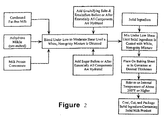
U.S. Patent 4,497,834 (February 5, 1985 ) and Cillario,U.S. Patent 4,298,625 (November 3, 1981 )). - Figure 2 is a flowchart illustrating the simplified process of this invention which is especially adapted for preparing solid ingredient-containing solid milk bars.
- The present invention provides a method of preparing a solid milk product having a moisture level of less than 40 percent and a fat/protein ratio of less than 2.5, and preferably a moisture level of 10 to 30 percent and a fat/protein ratio of less than 2. More preferably, the solid milk product has a fat/protein ratio 0.5 to 1.5 and, even more preferably, 1 to 1.2. The present solid milk product is a high solids, low moisture, high-protein, shelf-stable milk product which is solid at ambient temperatures. Thus, the present product can be conveniently transported and consumed by hand. Moreover, the present product can be produced in various forms - for example, solid bars, candy-type bars, cookies, cookies or bars with other ingredients (e.g., granola, grains, peanuts, other nuts, or chocolate bits or chips), bite-sized forms or pieces, enrobed solid forms, or shapes (e.g., animal, stars, letters) - and can be produced with varying levels of sweetness. The present product can also be produced in an aerated form.
- A solid milk product produced according to the method of the present invention contains an aqueous liquid; an edible fat; a concentrated milk protein source; 2.5 percent of an emulsifying salt; 0 to 1 percent TiO2; 0 to 1 percent of an emulsifier; and 35 percent non-lactose sweetener, wherein the solid milk product is a solid at ambient temperatures, has a moisture level of less than 40 percent and has a fat/protein ratio of less than 2.5. Preferably, the solid milk product has a moisture level of 10 to 30 percent and a fat/protein ratio of less than 2. More preferably, the solid milk product has a fat/protein ratio of 0.5 to 1.5 and, even more preferably, 1 to 1.2. Suitable emulsifying salts include, for example, sodium citrate, potassium citrate, monosodium phosphate, disodium phosphate, trisodium phosphate, sodium aluminum phosphate, sodium tripolyphosphate, sodium hexametaphosphate, dipotassium phosphate, and sodium acid pyrophosphate, as well as mixtures thereof. Sodium citrate, disodium phosphate, or mixtures thereof are the preferred emulsifying salts. Suitable emulsifiers include, for example, monoglycerides, diglycerides, polysorbates, sodium stearoyl lactylate, lecithin, and mixtures thereof. Monoglycerides, diglycerides, sodium stearoyl lactylate, and mixtures thereof are the preferred emulsifiers. Preferably such emulsifiers are used in aerated solid milk products to improve the aeration process.
- Figure 1 illustrates the relationship of the moisture level and the fat/protein level in the present solid milk product. Also included in Figure 1 are several prior art products which generally have significantly higher moisture levels and/or fat/protein ratios; these prior art products are described in the Background of the Invention above. Cross-hatching in Figure 1 generally indicates ranges of moisture and fat/protein ratio values for the specific products. As shown in Figure 1, the prior art has not been able to produce solid milk products having low moisture levels coupled with low fat/protein ratios as provided by the present invention.
- A preferred solid milk product produced according to the method of the present invention contains 20 to 50 percent of an aqueous liquid (preferably condensed fat-free milk or sweetened condensed fat-free milk); 10 to 35 percent of an edible fat (preferably anhydrous milkfat); 8 to 30 percent of a concentrated milk protein source (preferably concentrated dry milk powder); 2.5 percent of an emulsifying salt (preferably sodium citrate, disodium phosphate, or mixtures thereof); 0 to 1 percent TiO2; 0 to 1 percent emulsifier; and 35 percent non-lactose sweeteners. Typical formulations for the preferred solid milk product are provided in the following table:
Component General Preferred More Preferred Range (%) Range (%) Range (%) Condensed Milk 15 - 60 20 - 50 25 - 40 Anhydrous Milkfat 8 - 40 10 - 35 14 - 20 Concentrated Dry Milk Powder 1 - 45 8 - 30 12 - 25 Emulsifying Salts 1 - 2.5 1 - 2.5 1.5 - 2.5 TiO2 0 - 1 0.4 - 0.9 0.7 - 0.9 Emulsifiers 0 - 1 0.05 - 0.7 0.15 - 0.4 Added Sweetener 12 - 35 12 - 35 25 - 35 (non-lactose)
Preferably such emulsifiers are used in aerated solid milk products. Suitable non-lactose sweeteners include, for example, sucrose, dextrose, fructose, glucose, maltose, honey, corn syrup, and non-nutritive sweeteners, and the like. Sucrose is generally preferred. - The solid milk products produced according to the present invention are solid at ambient temperatures (i.e., 22 to 25°C), have moisture levels of less than 40 percent, and have fat/protein ratio of less than 2.5.
Preferably, the solid milk products have moisture levels of 10 to 30 percent and a fat/protein ratio of less than 2. More preferably, the solid milk product has a fat/protein ratio of 0.5 to 1.5 and, even more preferably, 1 to 1.2. Generally, the firmness or penetration of the unaerated solid milk product of this invention is greater than 150 grams force, preferably 150 to 15,000 grams force, and more preferably 1000 to 10,000 grams force. Firmness can be measured using a universal testing machine in the penetration mode (e.g., Texture Technologies TA-XT2 using a 45° conical probe) or similar testing equipment. Generally, the overrun of the aerated solid milk product of this invention is 5 to 100 percent and more preferably 15 to 60 percent. Aerated solid milk products preferably contain 0.05 to 0.7 percent emulsifier, and more preferably 0.15 to 0.4 percent emulsifier. The solid milk products of the present invention are shelf stable. Generally, the solid milk products have shelf-lives of at least 3 months under ambient, non-refrigeration conditions and of at least about 7 months under refrigeration conditions. - Suitable aqueous liquids include, for example, water, flavored water, fruit juice, liquid fruit concentrate, condensed milk, sweetened condensed milk, condensed fat-free milk, sweetened condensed fat-free milk, ultrafiltered milk, ultrafiltered skim milk, ultrafiltered/diafiltered milk, ultrafiltered/diafiltered skim milk, and mixtures thereof. Preferably, the aqueous liquid is condensed milk, sweetened condensed milk, condensed fat-free milk, sweetened condensed fat-free milk, ultrafiltered milk, or ultrafiltered skim milk. More preferably, the aqueous liquid is condensed milk or condensed fat-free milk having 30 to 35 percent solids or sweetened condensed milk or fat-free sweetened condensed milk having 70 to 75 percent solids. More preferably, the sweetened condensed milk contains 10 to 50 percent sweetener selected from the group consisting of sucrose, dextrose, fructose, glucose, maltose, and non-nutritive sweeteners. The preferred sweetener is sucrose. The added sugars or sweeteners can be added separately or via the sweetened condensed milk. Preferably the sweeteners are added via the sweetened condensed milks. If added as a separate component, they are preferably added at the same time as the initial components.
- Suitable edible fats include, for example, butter, cream, anhydrous milkfat, vegetable fats, coco butter, and mixtures thereof. The edible fat should generally have a melting point less than 50°C; more preferably, the edible fat has a melting point of 35 to 45°C. Preferably the edible fat is anhydrous milkfat. Preferably, the edible fat is melted prior to incorporation in the composition. Suitable concentrated milk protein sources include, for example, non-fat dry milk powder, milk protein concentrate, ultrafiltered milk protein concentrate, ultrafiltered/diafiltered milk protein concentrate, ultrafiltered milk protein paste, ultrafiltered/diafiltered milk protein paste, whey protein concentrate, caseinates, and mixtures thereof. Generally, the concentrated milk protein source is a dry powder having 40 to 92 percent milk protein and, more preferably, 65 to 85 milk protein, Preferred concentrated milk protein sources are concentrated dry milk powders such as, for example, non-fat dry milk powders and dry milk protein concentrate powders. The most preferred concentrated milk protein source is dry milk protein concentrate powder because of its generally low lactose level. It is generally preferred that the lactose in the moisture phase of the solid milk product (as measured by lactose (%)/moisture (%) x 100) of the present invention is below 19 percent and more preferably below 16 percent. If desired, the desired relatively low lactose levels can be obtained by using components having low levels of lactose (e.g., ultrafiltered or, ultrafiltered/diafiltered milk components) or by treatment of one or more of the components or the sold milk product itself with, for example, an enzyme (e.g., lactase) to reduce the lactose levels.
- For purposes of this invention, "essentially all components are hydrated" requires that at least 90 percent, and more preferably at least 95 percent, of the components, including lactose that may be present in the composition, are hydrated. As those skilled in the art will realize, the time required to obtain essentially complete hydration will vary depending on the relative amounts of the components, the amount of water present, and mixing conditions (e.g., applied shear and temperature).
- In cases where sufficient hydration has not occurred, the low moisture solid milk product will tend to be "gritty." Of course, if such a gritty product is obtained, the blending or mixing time and/or the blending or mixing temperature can be increased.
- Optional functional ingredients can be, and preferably are, incorporated into the solid milk products of this invention. These functional ingredients include
- TiO2, and, especially for aerated solid milk products, one or more emulsifiers such as monoglycerides, diglycerides, polysorbates, sodium stearoyl lactylate, and lecithin. Preferably at least one of these optional ingredients is incorporated into the compositions produced according to the method of this invention; more preferably, at least two of these optional ingredients are incorporated; even more preferably, especially if aerated solid milk products are desired, all of these just-listed optional ingredients are incorporated.
- These optional functional ingredients are added to the first blend (i.e., aqueous liquid, an edible fat, and concentrated milk protein source) either before or after essentially all components in the first blend are hydrated. The particular timing of the addition of these optional functional ingredients depends, at least in part, on the particular solid milk product being prepared. Generally, the emulsifier can be added either before or after essentially all components in the first blend are hydrated. The appropriate timing of the addition of the emulsifying salts and/or TiO2, however, can vary depending on the total moisture level of the final solid milk product (see also Figure 2). If the moisture level of the solid milk product is to be greater than 25 percent, the emulsifying salts and/or the TiO2 can be added to the first blend either before or after essentially all components in the first blend are hydrated. If, however, the moisture level of the solid milk product is to be less than 25 percent, the emulsifying salts and/or the TiO2 should be added to the first blend after essentially all components in the first blend are hydrated.. Generally, however and largely for process consideration, all of these optional functional ingredients are added after essentially all components in the first blend are hydrated.
- TiO2 acts as a whitener and also decreases the stretchability (i.e., less taffy like) of the solid milk product. Emulsifying salts generally improve textural properties. For example, sodium citrate generally provides better mouth-melting properties and disodium phosphate generally provides a firmer solid milk product. Suitable emulsifying salts include, for example, sodium citrate, potassium citrate, monosodium phosphate, disodium phosphate, trisodium phosphate, sodium aluminum phosphate, sodium tripolyphosphate, sodium hexametaphosphate, dipotassium phosphate, and sodium acid pyrophosphate, as well as mixtures thereof. Sodium citrate, disodium phosphate, or mixtures thereof are the preferred emulsifying salts. The emulsifiers generally provide a smoother product; they also assist in preparing aerated solid milk products. Suitable emulsifiers include, for example, monoglycerides, diglycerides, polysorbates, sodium stearoyl lactylate, and lecithin, as well as mixtures thereof. Monoglycerides, diglycerides, sodium stearoyl lactylate, and mixtures thereof are the preferred emulsifiers.
- Generally, the amounts of these ingredients are as follows: 2.5 percent emulsifying salts; 0 to 1 percent TiO2; and 0 to 1 percent emulsifiers. Preferably, the amount of added emulsifying salts is 1 to 2.5 percent, the amount of added TiO2 is 0.4 to 0.9 percent, and the amount of added emulsifiers is 0.05 to 0.7 percent. More preferably, the amount of added emulsifying salts is 1.5 to 2.5 percent, the amount of added TiO2 is 0.7 to 0.9 percent, and the amount of added emulsifiers is 0.15 to 0.4 percent. Although added emulsifiers can be used in unaerated solid milk products, their use in aerated solid milk products is especially preferred.
- The solid milk product can be formed into solid bars, candy-type bars, cookies, cookies or bars with other ingredients (e.g., granola, grains, peanuts, other nuts, or chocolate bits or chips), bite-sized forms or pieces, enrobed solid forms, or shapes (e.g., animal, stars, letters), - and can be produced with varying levels of sweetness. Shapes that appeal to children are especially preferred. The present product can also be produced in an aerated form.
- If desired, other additives can be incorporated into solid milk products produced according to the present invention so long as these additives do not interfere or adversely effect the desired properties (i.e., firmness, water level, fat/protein ratio, and the like). Such additives include, for example, flavorants, fruits, nuts, colorants, stabilizers, emulsifiers, preservatives, additional nutrients, vitamins, and mineral supplements (e.g., calcium fortification). If included, these additives generally constitute less than 10 percent of the solid milk product. Such additives can be added either during the initial blending or after essentially all components have been hydrated. Preferably, solid additives are added during the high shear treatment and liquid additives are added during the initial blending. Of course, in cases where it is desired to maintain the physical integrity of the additives (e.g., fruit, nut, or grain pieces), the addition should be under low shear conditions only.
- The simplified process of this invention is especially adapted for preparing solid ingredient-containing solid milk bars. This simplified production method eliminates some of the heating steps and the use of high shear mixing. The present invention provides a method for preparing a solid ingredient-containing solid milk product, said method comprising:
- (1) blending an aqueous liquid and concentrated milk protein source under low to moderate shear conditions to form a first blend, wherein the blending continues until essentially all components in the first blend are hydrated and the first blend forms a sticky white mass;
- (2) adding an emulsifying salt to the first blend either before or after essentially all components in the first blend are hydrated,
- (3) adding sugar to the first blend either before or after essentially all components in the first blend are hydrated;
- (4) adding a solid ingredient to the sticky white mass to form a solid ingredient and first blend mixture;
- (5) blending the solid ingredient and first blend mixture under low shear conditions until the solid ingredient is coated with the first blend to form a second blend;
- (6) placing the second blend into a container;
- (7) baking the second blend in the container; and
- (8) cooling the baked second blend to form the solid ingredient-containing solid milk product,
- (1) blending an aqueous liquid, an edible fat, and concentrated milk protein source under low to moderate shear conditions to form a first blend, wherein the blending continues until essentially all components in the first blend are hydrated and the first blend forms a sticky white mass and wherein the edible fat has a melting point less than 50°C;
- (2) adding an emulsifying salt to the first blend either before or after essentially all components in the first blend are hydrated,
- (3) adding sugar to the first blend either before or after essentially all components in the first blend are hydrated;
- (4) adding a solid ingredient to the sticky white mass to form a solid ingredient and first blend mixture;
- (5) blending the solid ingredient and first blend mixture under low shear conditions until the solid ingredient is coated with the first blend to form a second blend;
- (6) placing the second blend into a container;
- (7) baking the second blend in the container; and
- (8) cooling the baked second blend to form the solid ingredient-containing solid milk product,
- Using the simplified method of Figure 2, condensed milk, anhydrous milkfat (preferably premelted), and milk protein concentrate are blended under low to moderate shear (i.e., a bulk peak shear of less than 950 sec-1 and preferably less than 800 sec-1) until a white, non-gritty mixture (i.e., the first blend) is obtained.
- Generally, such a white, non-gritty mixture is obtained after 1 to 10 minutes of low to moderate shear mixing. Generally, the color before shear mixing is yellow-gray to off-white. Generally, the viscosity of the white, non-gritty mixture is less than 43,000 Pa-sec at a shear rate of 0.1 sec-1 and preferably is 200 to 2000 Pa-sec at a shear rate of 0.1 sec-1. As opposed to the general methods illustrated in Figures 2-4, it is generally preferred that TiO2 is not used in the simplified method of Figure 2 since a bright white color is developed without used such a whitener. If desired, however, TiO2 can be incorporated into the product to provide increased whiteness. Emulsifying salts and emulsifiers can be added either before or after essentially all the components in the first blend are hydrated; generally, complete hydration will have occurred by the time the white, non-gritty mixture has been formed. Once the white, non-gritty mixture is formed, the desired solid components can be added and blended into the first blend under low shear conditions (generally a bulk peak shear of less than 800 sec-1 and preferably less than 600 sec-1) until the solid components are uniformly coated with the first blend and uniformly distributed through the first blend; usually this blending step requires about a minute or less. This step should generally be carried out using gentle blending so as to avoid undesirable breakup or diminution of the solid components. Once the solid components are uniformly coated with the first blend, the mixture is then pressed onto a baking sheet at the desired thickness. The mixture is then baked to an internal temperature of 185°F [85.0°C] or higher; generally the baking time is 15 to 40 minutes, depending on the desired degree of browning and crispiness/chewiness desired, for a product having a thickness of 0.5 to 1 inch [12.70 to 25.40mm]. Baking can be carried out in any suitable oven, including, for example, conventional ovens, microwave ovens, impingement ovens, forced air ovens, steam injection devices, or indirect heating devices. If desired, the solid component-containing first blend can be molded into the desired shape prior to baking or pressed down to obtain the desired density. Generally a density of 1 to 1.2 g/ml before baking provides good results. After baking, the product is cooled, cut, and packaged as appropriate to obtain the final solid component-containing solid milk product.
Emulsifying salts and emulsifiers are added once essentially all the components in the first blend are hydrated. If desired, however, all components can be added at once and the mixture blended until essentially all components are hydrated. Sweeteners are added to obtain the desired sweetness. Such sweeteners are preferably added after hydration of the other components to avoid hydration competition from the sweeteners. If desired, however, a portion of the sweeteners can be added prior to hydration with the remainder added after hydration; sweeteners added before hydration can be used to modify the viscosity of the mixture during the initial blending step. Moreover, and if desired, all components, including the sweeteners, can be added before the initial blending step. Generally, the amount of sweeteners added will be in the range of 20 to 50 percent. - Generally, the solid component-containing solid milk product contains 30 to 80 percent of the solid component. Suitable solid ingredients for use in the present invention include cereals, grains, cookies, trail mix, dried fruits, and nuts, as well as mixtures thereof. The size of the individual solid components can vary widely but will generally be in the range of 0.1 to 0.5 inches [2.54 to 12.70mm in diameter] in diameter. The mixing used to blend the solid component into the solid milk mixture should be sufficiently gentle so as to avoid destroying the integrity of the solid component or to reducing the particle size to an undesired level. Especially fragile solid components (e.g., puffed rice or similar components) should be added to the solid milk mixture just prior to the baking step and incorporated into the solid milk mixture using very gentle mixing to maintain integrity of the solid component.
- Prior to the baking step, all blending steps are carried out at or close to ambient temperatures (i.e., 55 to 85°F [12.8 to 29.4°C]). Once placed in the appropriate container, the mixture of solid component coated with the first blend can be baked or cooked using conventional techniques so long as the desired internal temperature (i.e., 185°F [85.0°C] or higher) is obtained. Generally, baking at 300 to 350°F [148.9 to 176.7°C] will allow the appropriate internal temperature to be obtained in a reasonable time period; of course, the time required to obtain the desired temperature will depend, in part, on the total thickness of the mixture. A conventional radiant or convection oven allows for a browned appearance whereas a microwave oven will give a lighter appearance; if desired both a conventional radiant or convection oven and a microwave oven can be used in combination in order to achieve the desired degree of browning. Generally, the baking step provides a pathogen kill step and reduces the water activity to below 0.75; preferably the water activity is reduced to below 0.65 and even more preferably to 0.5 to 0.55. Generally, the solid component-containing solid milk products have shelf-lives of at least 3 months under ambient, non-refrigeration conditions and at least 7 months under refrigeration conditions.
- The solid milk products of the present invention prepared using any of the methods of this invention can be aerated if desired using conventional aeration techniques. For example, after pasteurization the product can be aerated using a gas such as, for example, air, nitrogen, or carbon dioxide. Generally, the aerated milk product of this invention has a density of less than 1.14 g/ml as compared to 1.2 to 1.3 g/ml for the unaerated product. Aeration can be used to prepare solid milk products which resemble ice cream, yogurt, and the like. Moreover, it has also been found that the solid component-containing solid milk products containing relatively high proportions of the solid milk component relative to the solid component (i.e., 70 to 80 percent solid milk component), when baked, generate a "puffed" appearance and have air cells that are generally small and well distributed without any added gas or other aeration techniques.
- The following examples are included to illustrate the invention and not to limit it. Unless otherwise indicated, all percentages are by weight.
- Any of the following examples which do not fall within the scope of the appended claims are included for exemplary purposes only.
- Example 1. This example illustrates the preparation of granola-containing solid milk products prepared using the simplified process of this invention. A solid milk blend was prepared using the following formulation:
Component Amount (%) salt 0.2 sugar 34.5 sodium citrate 0.5 whey protein concentrate 6.0 corn syrup solids (10DE) 8.3 5X ultrafiltered whole milk 50.0 sodium stearoyl lactylate 0.5 - The final mixture was pressed onto a baking sheet at a thickness of 3/4 inches [19.05mm] and then baked under various conditions as illustrated in the following table:
Oven Baking Conditions Results Conventional 325°F [162.8°C] / 40 minutes Good product, extremely browned Conventional 325°F [162.8°C] / 33 minutes Good product; very browned Conventional 325°F [162.8°C] / 30 minutes, out 2 minutes, bake 2 minutesGood product; slightly brown Microwave high / 3 minutes Good product; very white Microwave high / 3.5 minutes Good product; very white - Example 2. This example illustrates the preparation of granola and fruit- and/or nut-containing solid milk products prepared using the simplified process of this invention. A solid milk blend was prepared using the following formulation:
Component Amount (%) salt 0.18 sugar 30.6 sodium citrate 0.45 nonfat dry milk 11.3 whey protein concentrate 5.3 corn syrup solids (10DE) 7.3 5X ultrafiltered reduced fat milk 44.3 sodium stearoyl lactylate 0.45 - The granola/solid milk mixture was then combined with the desired fruit and/or nut components using low shear mixing for 10 to 20 seconds. The resulting mixture was formed into clusters (1 inch [25.4mm] in diameter) on parchment paper and placed on a baking sheet. The following combinations were prepared and baked as indicated in a conventional oven:
Granola/ Solid Milk (%) Trail Mix; Amount(%) Baking Conditions Results 82 Planters Apple-Cranberry Crunch;18 325°F [162.8°C]/ 15 min Good taste; dark and crunchy 82 Planters Caribbean Crunch;18 325°F [162.8°C]/ 16 min Good taste; moderate browning 82 Planters Nuts, Seeds & Rasin;18 325°F [162.8°C]/ 17 min Good taste; moderate browning 82 Planters Fruit & Nut;18 325°F [162.8°C]/ 17 min Good taste; moderate browning - Example 3. This example illustrates the preparation of cookie-containing solid milk products prepared using the simplified process of this invention. A solid milk blend was prepared using the following formulation:
Component Amount (%) salt 0.2 sugar 27.5 sodium citrate 0.5 nonfat dry milk 13.0 corn syrup solids (10DE) 8.3 5X ultrafiltered whole milk 50.0 sodium stearoyl lactylate 0.5 - All products had good and strong milky taste. Generally, the product packaged immediately after cooling were better. In some cases, the product tended to break upon handling; this appears to be due to size of the cookies (i.e., not broken) and resulting voids within the product matrix; this problem should be eliminated and/or significantly reduced by reducing the size of the cookies and/or using cookie pieces and/or increasing the proportion of the milk component. Generally, bars located near the edges of the baking sheet tended to be crunchier and with increased browning as compared to those formed from the middle of the baking sheet. Increased crunchiness and browning for the "edge" product appears to be due to decreased thickness close to the edges; thus, a thinner layer should allow for a crunchier product.
- Example 4. This example illustrates an alternative method of manufacture where the mixture is first mixed together under moderate shear and then heated. A solid milk blend was prepared using the following formulation:
Component Amount (%) Non Fat Dry Milk 9.6 Milk Protein Concentrate 8.8 Cream 32.4 High Fructose Corn Syrup (42DE) 43.8 Water 4.0 Sodium Citrate 0.5 Titanium Dioxide 0.3 Vanilla Flavor 0.7
wherein the solid ingredient-containing solid milk product is a solid at ambient temperatures.
Claims (6)
- A method for preparing a solid ingredient-containing solid milk product, said method comprising:(1) blending an aqueous liquid and concentrated milk protein source at a bulk peak shear of less than 950 sec-1 to form a first blend, wherein the blending continues until essentially all components in the first blend are hydrated and the first blend forms a sticky white mass;(2) adding an emulsifying salt to the first blend either before or after essentially all components in the first blend are hydrated,(3) adding sugar to the first blend either before or after essentially all components in the first blend are hydrated;(4) adding a solid ingredient to the sticky white mass to form a solid ingredient and first blend mixture;5) blending the solid ingredient and first blend mixture under low shear conditions until the solid ingredient is coated with the first blend to form a second blend;(6) placing the second blend into a container;(7) baking the second blend in the container; and8) cooling the baked second blend to form the solid ingredient containing solid milk product,wherein the relative amounts of the aqueous liquid, the emulsifying salt, and the concentrated milk protein source in the first blend are adjusted such that the solid ingredient-containing solid milk product has a moisture level of less than 40 percent and a fat/protein ratio of less than 2.5 and wherein the solid ingredient-containing solid milk product is a solid at ambient temperatures.
- A method according to claim 1, wherein the first blend further comprises an edible fat having a melting point less than 50°C and wherein the relative amounts of the aqueous liquid, the edible fat, the emulsifying salt, and the concentrated milk protein source in the first blend are adjusted such that the solid ingredient-containing solid milk product has a moisture level of less than 40 percent and a fat/protein ratio of less than 2.5.
- The method as defined in claim 2, wherein the solid ingredient is selected from the group consisting of cereals, grains, cookies, trail mix, dried fruits, nuts, and mixtures thereof.
- The method as defined in claim 2, wherein the solid ingredient-containing solid milk product contains 30 to 80 percent of the solid ingredient.
- The method as defined in claim 3, wherein the solid ingredient-containing solid milk product contains 45 to 70 percent of the solid ingredient.
- The method as defined in 4, wherein the solid ingredient-containing solid milk product has a moisture level of 10 to 30 percent and a fat/protein ratio of 0.5 to 1.5.
Applications Claiming Priority (2)
| Application Number | Priority Date | Filing Date | Title |
|---|---|---|---|
| US09/992,912 US6667068B2 (en) | 2001-01-29 | 2001-11-14 | Method for preparing solid milk product |
| US992912 | 2001-11-14 |
Publications (3)
| Publication Number | Publication Date |
|---|---|
| EP1312265A2 EP1312265A2 (en) | 2003-05-21 |
| EP1312265A3 EP1312265A3 (en) | 2004-02-04 |
| EP1312265B1 true EP1312265B1 (en) | 2007-06-20 |
Family
ID=25538879
Family Applications (1)
| Application Number | Title | Priority Date | Filing Date |
|---|---|---|---|
| EP02257856A Expired - Lifetime EP1312265B1 (en) | 2001-11-14 | 2002-11-14 | Method for preparing solid milk product |
Country Status (9)
| Country | Link |
|---|---|
| US (1) | US6667068B2 (en) |
| EP (1) | EP1312265B1 (en) |
| AT (1) | ATE364998T1 (en) |
| DE (1) | DE60220761T2 (en) |
| ES (1) | ES2289058T3 (en) |
| HU (1) | HUP0203938A2 (en) |
| PL (1) | PL357124A1 (en) |
| RU (1) | RU2303359C2 (en) |
| UA (1) | UA78191C2 (en) |
Families Citing this family (37)
| Publication number | Priority date | Publication date | Assignee | Title |
|---|---|---|---|---|
| EG23432A (en) * | 2001-12-17 | 2005-07-25 | New Zealand Dairy Board | |
| IL147942A0 (en) * | 2002-01-31 | 2002-08-14 | Enzymotec Ltd | Method of fractionation of phytosterol esters in oil and products obtained thereby |
| US20040076729A1 (en) * | 2002-10-22 | 2004-04-22 | Land O'lakes, Inc. | Cheese product and method of making |
| IL155136A0 (en) * | 2003-02-10 | 2003-10-31 | Enzymotec Ltd | A composition for reducing blood cholesterol and triglycerides |
| US20060233863A1 (en) * | 2003-02-10 | 2006-10-19 | Enzymotec Ltd. | Oils enriched with diacylglycerols and phytosterol esters and unit dosage forms thereof for use in therapy |
| US20050084593A1 (en) * | 2003-02-21 | 2005-04-21 | Calvert Frederic R.Jr. | Reduced fat and carbohydrate cultured dairy product and process for manufacturing such cultured dairy product |
| US20040208974A1 (en) * | 2003-02-21 | 2004-10-21 | Calvert Frederic R. | Reduced carbohydrate cultured dairy product and process for manufacturing such cultured dairy product |
| US20040208972A1 (en) * | 2003-02-21 | 2004-10-21 | Calvert Frederic R. | Reduced carbohydrate milk product and process for manufacturing such milk product |
| US7611742B2 (en) * | 2003-02-21 | 2009-11-03 | HP Hood, LLC | Reduced fat and carbohydrate milk product and process for manufacturing such milk product |
| US20070122529A1 (en) * | 2003-08-21 | 2007-05-31 | Advanced Nutri-Tech Systems Inc. | Fruit sponge |
| US20050186311A1 (en) * | 2004-02-23 | 2005-08-25 | Loh Jimbay P. | Method for acidifying and preserving food compositions using electrodialyzed compositions |
| US7700145B1 (en) | 2004-02-17 | 2010-04-20 | Hp Hood Llc | Methods of making a low-carbohydrate dairy beverage and dairy beverages made from such methods |
| US7887867B2 (en) * | 2004-02-23 | 2011-02-15 | Kraft Foods Global Brands Llc | Stabilized non-sour dairy base materials and methods for preparation |
| US20050220969A1 (en) * | 2004-02-23 | 2005-10-06 | Kraft Foods Holdings, Inc. | Shelf-stable cold-processed food compositions and methods for their preparation |
| US20050186312A1 (en) * | 2004-02-23 | 2005-08-25 | Kraft Foods Holdings, Inc. | Shelf-stable foodstuffs and methods for their preparation |
| US20050202134A1 (en) * | 2004-03-12 | 2005-09-15 | Land O'lakes, Inc. | Process for the manufacture of cheese base and the products made therefrom |
| US20090232916A1 (en) * | 2004-08-09 | 2009-09-17 | Avidor Shulman | Food products for diabetics |
| EP1796726A2 (en) * | 2004-08-10 | 2007-06-20 | Enzymotec Ltd. | Mixture of phytosterol ester(s) and 1,3-diglyceride(s) for use in the treatment of medical conditions |
| AU2006269056B2 (en) * | 2005-07-08 | 2011-02-17 | Nestec S.A. | Spreadable dairy product |
| US20080075816A1 (en) * | 2006-09-21 | 2008-03-27 | Jensen Mark W | Dairy-based product and method and process for producing same |
| US8501258B1 (en) | 2006-10-13 | 2013-08-06 | Jose Antonio Feregrino-Quezada | Method for preparing milk-based beverages |
| EP1935249A1 (en) * | 2006-12-21 | 2008-06-25 | Nestec S.A. | Spreadable dairy product |
| EP2362737B1 (en) | 2008-10-24 | 2012-12-05 | Unilever PLC, a company registered in England and Wales under company no. 41424 | Frozen confection |
| US8293299B2 (en) | 2009-09-11 | 2012-10-23 | Kraft Foods Global Brands Llc | Containers and methods for dispensing multiple doses of a concentrated liquid, and shelf stable Concentrated liquids |
| AR081324A1 (en) * | 2010-03-31 | 2012-08-08 | Fonterra Co Operative Group | PRODUCTION OF HIGH DENSITY UNIFIED COMPOSITIONS |
| US9326538B2 (en) | 2010-04-07 | 2016-05-03 | Kraft Foods Group Brands Llc | Intermediate moisture bar using a dairy-based binder |
| WO2011146805A1 (en) * | 2010-05-20 | 2011-11-24 | General Mills, Inc. | Bite sized refrigerated yogurt products |
| BR112013000777A2 (en) * | 2010-07-13 | 2016-05-24 | Perfetti Van Melle Spa | lollipop formed in chocolate-filled cosine and its manufacturing process |
| US9232807B2 (en) | 2011-09-30 | 2016-01-12 | Kraft Foods Group Brands Llc | Dairy-based foods having high levels of lactose |
| US11013248B2 (en) | 2012-05-25 | 2021-05-25 | Kraft Foods Group Brands Llc | Shelf stable, concentrated, liquid flavorings and methods of preparing beverages with the concentrated liquid flavorings |
| WO2014163485A1 (en) * | 2013-04-03 | 2014-10-09 | N.V. Nutricia | Process and system for preparing dry milk formulae |
| WO2014163486A1 (en) * | 2013-04-03 | 2014-10-09 | N.V. Nutricia | Process and system for preparing dry milk formulae |
| EP2820956A1 (en) * | 2013-07-03 | 2015-01-07 | Arla Foods Amba | Sliceable dairy product with extended shelf life |
| FI128499B (en) * | 2013-10-17 | 2020-06-30 | Valio Oy | Process for making a foamed dairy product |
| US9040107B2 (en) | 2013-10-29 | 2015-05-26 | Twin Cups, LLC | Method for making a high-protein dairy product |
| US9907323B2 (en) | 2015-09-25 | 2018-03-06 | Mead Johnson Nutrition Co. | Infant formula tablets |
| CN112970853B (en) * | 2019-12-13 | 2024-03-15 | 内蒙古蒙牛乳业(集团)股份有限公司 | Solid dairy product and preparation method thereof |
Family Cites Families (24)
| Publication number | Priority date | Publication date | Assignee | Title |
|---|---|---|---|---|
| US3903308A (en) | 1973-09-04 | 1975-09-02 | Vernon H Ode | Food bar and method of making |
| AT334538B (en) * | 1974-10-31 | 1976-01-25 | Klosterfrau Berlin Chem | PROCESS FOR MAKING DIAT COOKIES |
| US4444800A (en) * | 1977-02-28 | 1984-04-24 | L.D. Schreiber Cheese Co., Inc. | Non-cultured simulated cheese containing rennet casein |
| IT1119935B (en) | 1979-09-11 | 1986-03-19 | Ferrero & C Spa P | SWEET PROTEIN FOOD PRODUCT IN FOAMED PLASTIC MASS FORM |
| AU1024883A (en) * | 1982-05-07 | 1984-07-12 | Pa Consulting Services Ltd. | Producing milk foam |
| ATE15753T1 (en) * | 1982-03-29 | 1985-10-15 | Battelle Memorial Institute | FOOD COMPOSITION FOR THE MANUFACTURE OF SALT RODS WITH GOOD SHELF LIFE. |
| US4497834A (en) | 1982-08-30 | 1985-02-05 | Barta Frank E | Method of making a dairy-based food product |
| US4673578A (en) | 1983-05-11 | 1987-06-16 | Warner-Lambert Company | Snack food product with high dietary fiber content and process for producing the same |
| US4565702A (en) | 1984-06-04 | 1986-01-21 | Warner-Lambert Company | Dietary fiber food products and method of manufacture |
| US4619831A (en) | 1984-06-04 | 1986-10-28 | Warner-Lambert Company | Dietary fiber composition and process of manufacture |
| IT1193259B (en) | 1985-06-19 | 1988-06-15 | Polenghi Lombardo Esportazione | PROCEDURE FOR THE PRODUCTION OF SIMPLE AND COMPLEX MILK AND SUGAR-BASED TABLETS AND TABLETS OBTAINED BY SUCH PROCEDURE |
| NL8801149A (en) * | 1988-05-02 | 1989-12-01 | Friesland Condensfab | PROCESS FOR PREPARING AN EDIBLE AND LUBRICABLE OIL-IN-WATER EMULSION |
| US5320859A (en) | 1988-09-02 | 1994-06-14 | Bahram Namdari | High protein dough mix |
| ATE164491T1 (en) | 1993-01-09 | 1998-04-15 | Nestle Sa | METHOD FOR PRODUCING FOOD PRODUCTS, FOAM PRODUCTS PRODUCED THEREFROM AND COMPOSITE FINAL PRODUCTS |
| JP3385548B2 (en) | 1994-10-17 | 2003-03-10 | ライオン菓子株式会社 | Confectionery production method |
| RU2122804C1 (en) * | 1997-08-11 | 1998-12-10 | Воронежская государственная технологическая академия | Method of producing milk dessert "aroniya" |
| NZ502923A (en) | 1997-08-28 | 2001-09-28 | Nestle Sa | Cream-based food composition and process for the manufacture thereof |
| EP0938848A1 (en) * | 1998-01-21 | 1999-09-01 | Societe Des Produits Nestle S.A. | Milk-based spreadable product |
| US6117478A (en) | 1998-03-12 | 2000-09-12 | Nestec S.A. | Method of making a reduced fat agglomerated chocolate |
| US6103283A (en) * | 1998-12-14 | 2000-08-15 | Healthy Grain Foods Llc. | Process for producing milk infused cereal grain ready-to-eat products |
| PT1168933E (en) | 1999-03-24 | 2005-03-31 | Nestle Sa | METHOD OF MANUFACTURING A SNACK PRODUCT EXPANDED WITH A HIGH CONTENT OF SOLID DAIRY PRODUCTS |
| ES2219328T3 (en) | 1999-03-24 | 2004-12-01 | Societe Des Produits Nestle S.A. | CEREAL BAR WITH HIGH CONTENT OF MILK SOLIDS. |
| PT1151676E (en) * | 2000-05-01 | 2008-12-12 | Nestle Sa | Process for manufacturing a cereal bar |
| CA2367811C (en) * | 2001-01-29 | 2011-03-22 | Kraft Foods Holdings, Inc. | Method for preparing solid milk product |
-
2001
- 2001-11-14 US US09/992,912 patent/US6667068B2/en not_active Expired - Lifetime
-
2002
- 2002-11-13 HU HU0203938A patent/HUP0203938A2/en unknown
- 2002-11-13 RU RU2002130493/13A patent/RU2303359C2/en not_active IP Right Cessation
- 2002-11-14 EP EP02257856A patent/EP1312265B1/en not_active Expired - Lifetime
- 2002-11-14 ES ES02257856T patent/ES2289058T3/en not_active Expired - Lifetime
- 2002-11-14 UA UA2002119076A patent/UA78191C2/en unknown
- 2002-11-14 AT AT02257856T patent/ATE364998T1/en not_active IP Right Cessation
- 2002-11-14 DE DE60220761T patent/DE60220761T2/en not_active Expired - Lifetime
- 2002-11-14 PL PL02357124A patent/PL357124A1/en not_active Application Discontinuation
Non-Patent Citations (1)
| Title |
|---|
| None * |
Also Published As
| Publication number | Publication date |
|---|---|
| UA78191C2 (en) | 2007-03-15 |
| PL357124A1 (en) | 2003-05-19 |
| HU0203938D0 (en) | 2003-01-28 |
| US6667068B2 (en) | 2003-12-23 |
| ES2289058T3 (en) | 2008-02-01 |
| US20020146500A1 (en) | 2002-10-10 |
| EP1312265A2 (en) | 2003-05-21 |
| DE60220761T2 (en) | 2008-03-06 |
| EP1312265A3 (en) | 2004-02-04 |
| ATE364998T1 (en) | 2007-07-15 |
| HUP0203938A2 (en) | 2003-08-28 |
| RU2303359C2 (en) | 2007-07-27 |
| DE60220761D1 (en) | 2007-08-02 |
Similar Documents
| Publication | Publication Date | Title |
|---|---|---|
| US6667068B2 (en) | Method for preparing solid milk product | |
| RU2333670C2 (en) | Grain loaves and associated production method | |
| US6713100B1 (en) | Confectionery product comprising vegetables solids | |
| US9320292B2 (en) | Intermediate moisture bar using a dairy-based binder | |
| CN116569984A (en) | Nutritional formulations containing pea protein isolate | |
| AU1806888A (en) | Improved low fat yogurt product and method | |
| RU2002130493A (en) | METHOD FOR PRODUCING SOLID MILK PRODUCT (OPTIONS) | |
| AU2012227316B2 (en) | Dairy-Based Foods Having High Levels of Lactose | |
| US20050095336A1 (en) | Low carbohydrate ice cream | |
| EP1470756A1 (en) | Shelf-stable shredded cheese | |
| JP2005512582A (en) | mousse | |
| US20240032561A1 (en) | Protein-Enriched Marshmallows | |
| EP1226759B1 (en) | Method for preparing solid milk product | |
| JP2004041016A (en) | Soft candy and method for producing the same | |
| JP7664694B2 (en) | Confectionery and method for producing same | |
| Fox | Milk and dairy products as food materials | |
| Fox | Milk and dairy products as food materials By P. F. Fox, Department of Food Chemistry Uniwersity College Cork, Ireland | |
| PL247897B1 (en) | Method of producing cottage cheese bars with chocolate, fruit or toffee coating | |
| BURRINGTON | 11 BEVERAGE APPLICATIONS FOR WHEY AND LACTOSE PRODUCTS | |
| NZ602652B (en) | Dairy-based foods having high levels of lactose |
Legal Events
| Date | Code | Title | Description |
|---|---|---|---|
| PUAI | Public reference made under article 153(3) epc to a published international application that has entered the european phase |
Free format text: ORIGINAL CODE: 0009012 |
|
| AK | Designated contracting states |
Designated state(s): AT BE BG CH CY CZ DE DK EE ES FI FR GB GR IE IT LI LU MC NL PT SE SK TR |
|
| AX | Request for extension of the european patent |
Extension state: AL LT LV MK RO SI |
|
| PUAL | Search report despatched |
Free format text: ORIGINAL CODE: 0009013 |
|
| AK | Designated contracting states |
Kind code of ref document: A3 Designated state(s): AT BE BG CH CY CZ DE DK EE ES FI FR GB GR IE IT LI LU MC NL PT SE SK TR |
|
| AX | Request for extension of the european patent |
Extension state: AL LT LV MK RO SI |
|
| RIC1 | Information provided on ipc code assigned before grant |
Ipc: 7A 23C 9/15 A Ipc: 7A 23L 1/164 B Ipc: 7A 23C 20/00 B |
|
| 17P | Request for examination filed |
Effective date: 20040722 |
|
| AKX | Designation fees paid |
Designated state(s): AT BE BG CH CY CZ DE DK EE ES FI FR GB GR IE IT LI LU MC NL PT SE SK TR |
|
| AXX | Extension fees paid |
Extension state: AL Payment date: 20040722 Extension state: RO Payment date: 20040722 Extension state: SI Payment date: 20040722 Extension state: MK Payment date: 20040722 Extension state: LT Payment date: 20040722 Extension state: LV Payment date: 20040722 |
|
| GRAP | Despatch of communication of intention to grant a patent |
Free format text: ORIGINAL CODE: EPIDOSNIGR1 |
|
| GRAS | Grant fee paid |
Free format text: ORIGINAL CODE: EPIDOSNIGR3 |
|
| GRAA | (expected) grant |
Free format text: ORIGINAL CODE: 0009210 |
|
| AK | Designated contracting states |
Kind code of ref document: B1 Designated state(s): AT BE BG CH CY CZ DE DK EE ES FI FR GB GR IE IT LI LU MC NL PT SE SK TR |
|
| AX | Request for extension of the european patent |
Extension state: AL LT LV MK RO SI |
|
| PG25 | Lapsed in a contracting state [announced via postgrant information from national office to epo] |
Ref country code: LI Free format text: LAPSE BECAUSE OF FAILURE TO SUBMIT A TRANSLATION OF THE DESCRIPTION OR TO PAY THE FEE WITHIN THE PRESCRIBED TIME-LIMIT Effective date: 20070620 Ref country code: CH Free format text: LAPSE BECAUSE OF FAILURE TO SUBMIT A TRANSLATION OF THE DESCRIPTION OR TO PAY THE FEE WITHIN THE PRESCRIBED TIME-LIMIT Effective date: 20070620 |
|
| REG | Reference to a national code |
Ref country code: GB Ref legal event code: FG4D |
|
| REG | Reference to a national code |
Ref country code: CH Ref legal event code: EP |
|
| REG | Reference to a national code |
Ref country code: IE Ref legal event code: FG4D |
|
| REF | Corresponds to: |
Ref document number: 60220761 Country of ref document: DE Date of ref document: 20070802 Kind code of ref document: P |
|
| PG25 | Lapsed in a contracting state [announced via postgrant information from national office to epo] |
Ref country code: SE Free format text: LAPSE BECAUSE OF FAILURE TO SUBMIT A TRANSLATION OF THE DESCRIPTION OR TO PAY THE FEE WITHIN THE PRESCRIBED TIME-LIMIT Effective date: 20070920 |
|
| LTIE | Lt: invalidation of european patent or patent extension |
Effective date: 20070620 |
|
| REG | Reference to a national code |
Ref country code: CH Ref legal event code: PL |
|
| PG25 | Lapsed in a contracting state [announced via postgrant information from national office to epo] |
Ref country code: PT Free format text: LAPSE BECAUSE OF FAILURE TO SUBMIT A TRANSLATION OF THE DESCRIPTION OR TO PAY THE FEE WITHIN THE PRESCRIBED TIME-LIMIT Effective date: 20071120 Ref country code: CZ Free format text: LAPSE BECAUSE OF FAILURE TO SUBMIT A TRANSLATION OF THE DESCRIPTION OR TO PAY THE FEE WITHIN THE PRESCRIBED TIME-LIMIT Effective date: 20070620 Ref country code: BG Free format text: LAPSE BECAUSE OF FAILURE TO SUBMIT A TRANSLATION OF THE DESCRIPTION OR TO PAY THE FEE WITHIN THE PRESCRIBED TIME-LIMIT Effective date: 20070920 |
|
| REG | Reference to a national code |
Ref country code: ES Ref legal event code: FG2A Ref document number: 2289058 Country of ref document: ES Kind code of ref document: T3 |
|
| EN | Fr: translation not filed | ||
| PG25 | Lapsed in a contracting state [announced via postgrant information from national office to epo] |
Ref country code: SK Free format text: LAPSE BECAUSE OF FAILURE TO SUBMIT A TRANSLATION OF THE DESCRIPTION OR TO PAY THE FEE WITHIN THE PRESCRIBED TIME-LIMIT Effective date: 20070620 |
|
| PLBE | No opposition filed within time limit |
Free format text: ORIGINAL CODE: 0009261 |
|
| STAA | Information on the status of an ep patent application or granted ep patent |
Free format text: STATUS: NO OPPOSITION FILED WITHIN TIME LIMIT |
|
| PG25 | Lapsed in a contracting state [announced via postgrant information from national office to epo] |
Ref country code: IT Free format text: LAPSE BECAUSE OF NON-PAYMENT OF DUE FEES Effective date: 20071114 Ref country code: GR Free format text: LAPSE BECAUSE OF FAILURE TO SUBMIT A TRANSLATION OF THE DESCRIPTION OR TO PAY THE FEE WITHIN THE PRESCRIBED TIME-LIMIT Effective date: 20070921 Ref country code: DK Free format text: LAPSE BECAUSE OF FAILURE TO SUBMIT A TRANSLATION OF THE DESCRIPTION OR TO PAY THE FEE WITHIN THE PRESCRIBED TIME-LIMIT Effective date: 20070620 |
|
| 26N | No opposition filed |
Effective date: 20080325 |
|
| PG25 | Lapsed in a contracting state [announced via postgrant information from national office to epo] |
Ref country code: MC Free format text: LAPSE BECAUSE OF NON-PAYMENT OF DUE FEES Effective date: 20071130 |
|
| PG25 | Lapsed in a contracting state [announced via postgrant information from national office to epo] |
Ref country code: FR Free format text: LAPSE BECAUSE OF FAILURE TO SUBMIT A TRANSLATION OF THE DESCRIPTION OR TO PAY THE FEE WITHIN THE PRESCRIBED TIME-LIMIT Effective date: 20080222 |
|
| PG25 | Lapsed in a contracting state [announced via postgrant information from national office to epo] |
Ref country code: EE Free format text: LAPSE BECAUSE OF FAILURE TO SUBMIT A TRANSLATION OF THE DESCRIPTION OR TO PAY THE FEE WITHIN THE PRESCRIBED TIME-LIMIT Effective date: 20070620 |
|
| PG25 | Lapsed in a contracting state [announced via postgrant information from national office to epo] |
Ref country code: FI Free format text: LAPSE BECAUSE OF FAILURE TO SUBMIT A TRANSLATION OF THE DESCRIPTION OR TO PAY THE FEE WITHIN THE PRESCRIBED TIME-LIMIT Effective date: 20070620 |
|
| PGRI | Patent reinstated in contracting state [announced from national office to epo] |
Ref country code: IT Effective date: 20090101 |
|
| PG25 | Lapsed in a contracting state [announced via postgrant information from national office to epo] |
Ref country code: CY Free format text: LAPSE BECAUSE OF FAILURE TO SUBMIT A TRANSLATION OF THE DESCRIPTION OR TO PAY THE FEE WITHIN THE PRESCRIBED TIME-LIMIT Effective date: 20070620 |
|
| PG25 | Lapsed in a contracting state [announced via postgrant information from national office to epo] |
Ref country code: LU Free format text: LAPSE BECAUSE OF NON-PAYMENT OF DUE FEES Effective date: 20071114 |
|
| PG25 | Lapsed in a contracting state [announced via postgrant information from national office to epo] |
Ref country code: TR Free format text: LAPSE BECAUSE OF FAILURE TO SUBMIT A TRANSLATION OF THE DESCRIPTION OR TO PAY THE FEE WITHIN THE PRESCRIBED TIME-LIMIT Effective date: 20070620 |
|
| NLS | Nl: assignments of ep-patents |
Owner name: KRAFT FOODS GLOBAL BRANDS LLC Effective date: 20090827 |
|
| PGFP | Annual fee paid to national office [announced via postgrant information from national office to epo] |
Ref country code: AT Payment date: 20091021 Year of fee payment: 8 |
|
| REG | Reference to a national code |
Ref country code: GB Ref legal event code: 732E Free format text: REGISTERED BETWEEN 20100422 AND 20100428 |
|
| PG25 | Lapsed in a contracting state [announced via postgrant information from national office to epo] |
Ref country code: AT Free format text: LAPSE BECAUSE OF NON-PAYMENT OF DUE FEES Effective date: 20101114 |
|
| REG | Reference to a national code |
Ref legal event code: R082 Ref country code: DE Ref document number: 60220761 Country of ref document: DE Representative=s name: W.P.THOMPSON & CO., GB |
|
| REG | Reference to a national code |
Ref country code: NL Ref legal event code: SD Effective date: 20130131 |
|
| REG | Reference to a national code |
Ref country code: DE Ref legal event code: R082 Ref document number: 60220761 Country of ref document: DE Representative=s name: W.P.THOMPSON & CO., GB |
|
| REG | Reference to a national code |
Ref country code: ES Ref legal event code: PC2A Owner name: KRAFT FOODS GROUP BRANDS LLC Effective date: 20130422 |
|
| REG | Reference to a national code |
Ref country code: DE Ref legal event code: R082 Ref document number: 60220761 Country of ref document: DE Representative=s name: W.P.THOMPSON & CO., GB Effective date: 20120307 Ref country code: DE Ref legal event code: R081 Ref document number: 60220761 Country of ref document: DE Owner name: KRAFT FOODS GROUP BRANDS LLC, US Free format text: FORMER OWNER: KRAFT FOODS GLOBAL BRANDS LLC, 60093 NORTHFIELD, US Effective date: 20130402 Ref country code: DE Ref legal event code: R082 Ref document number: 60220761 Country of ref document: DE Representative=s name: W.P.THOMPSON & CO., GB Effective date: 20130402 Ref country code: DE Ref legal event code: R081 Ref document number: 60220761 Country of ref document: DE Owner name: KRAFT FOODS GROUP BRANDS LLC, NORTHFIELD, US Free format text: FORMER OWNER: KRAFT FOODS GLOBAL BRANDS LLC, 60093 NORTHFIELD, ILL., US Effective date: 20130402 |
|
| REG | Reference to a national code |
Ref country code: GB Ref legal event code: 732E Free format text: REGISTERED BETWEEN 20130516 AND 20130522 |
|
| REG | Reference to a national code |
Ref country code: DE Ref legal event code: R082 Ref document number: 60220761 Country of ref document: DE Representative=s name: HOEGER, STELLRECHT & PARTNER PATENTANWAELTE MB, DE |
|
| PGFP | Annual fee paid to national office [announced via postgrant information from national office to epo] |
Ref country code: ES Payment date: 20211201 Year of fee payment: 20 Ref country code: NL Payment date: 20211126 Year of fee payment: 20 Ref country code: IE Payment date: 20211129 Year of fee payment: 20 Ref country code: GB Payment date: 20211129 Year of fee payment: 20 Ref country code: DE Payment date: 20211126 Year of fee payment: 20 |
|
| PGFP | Annual fee paid to national office [announced via postgrant information from national office to epo] |
Ref country code: IT Payment date: 20211122 Year of fee payment: 20 Ref country code: BE Payment date: 20211129 Year of fee payment: 20 |
|
| REG | Reference to a national code |
Ref country code: DE Ref legal event code: R071 Ref document number: 60220761 Country of ref document: DE |
|
| REG | Reference to a national code |
Ref country code: NL Ref legal event code: MK Effective date: 20221113 |
|
| REG | Reference to a national code |
Ref country code: ES Ref legal event code: FD2A Effective date: 20221128 |
|
| REG | Reference to a national code |
Ref country code: BE Ref legal event code: MK Effective date: 20221114 Ref country code: GB Ref legal event code: PE20 Expiry date: 20221113 |
|
| REG | Reference to a national code |
Ref country code: IE Ref legal event code: MK9A |
|
| PG25 | Lapsed in a contracting state [announced via postgrant information from national office to epo] |
Ref country code: IE Free format text: LAPSE BECAUSE OF EXPIRATION OF PROTECTION Effective date: 20221114 Ref country code: GB Free format text: LAPSE BECAUSE OF EXPIRATION OF PROTECTION Effective date: 20221113 Ref country code: ES Free format text: LAPSE BECAUSE OF EXPIRATION OF PROTECTION Effective date: 20221115 |