EP1310519A1 - Expandable vinyl chloride resin composition - Google Patents
Expandable vinyl chloride resin composition Download PDFInfo
- Publication number
- EP1310519A1 EP1310519A1 EP01956787A EP01956787A EP1310519A1 EP 1310519 A1 EP1310519 A1 EP 1310519A1 EP 01956787 A EP01956787 A EP 01956787A EP 01956787 A EP01956787 A EP 01956787A EP 1310519 A1 EP1310519 A1 EP 1310519A1
- Authority
- EP
- European Patent Office
- Prior art keywords
- weight
- parts
- vinyl chloride
- blowing agent
- chloride resin
- Prior art date
- Legal status (The legal status is an assumption and is not a legal conclusion. Google has not performed a legal analysis and makes no representation as to the accuracy of the status listed.)
- Granted
Links
Classifications
-
- C—CHEMISTRY; METALLURGY
- C08—ORGANIC MACROMOLECULAR COMPOUNDS; THEIR PREPARATION OR CHEMICAL WORKING-UP; COMPOSITIONS BASED THEREON
- C08J—WORKING-UP; GENERAL PROCESSES OF COMPOUNDING; AFTER-TREATMENT NOT COVERED BY SUBCLASSES C08B, C08C, C08F, C08G or C08H
- C08J9/00—Working-up of macromolecular substances to porous or cellular articles or materials; After-treatment thereof
- C08J9/0061—Working-up of macromolecular substances to porous or cellular articles or materials; After-treatment thereof characterized by the use of several polymeric components
-
- C—CHEMISTRY; METALLURGY
- C08—ORGANIC MACROMOLECULAR COMPOUNDS; THEIR PREPARATION OR CHEMICAL WORKING-UP; COMPOSITIONS BASED THEREON
- C08F—MACROMOLECULAR COMPOUNDS OBTAINED BY REACTIONS ONLY INVOLVING CARBON-TO-CARBON UNSATURATED BONDS
- C08F265/00—Macromolecular compounds obtained by polymerising monomers on to polymers of unsaturated monocarboxylic acids or derivatives thereof as defined in group C08F20/00
- C08F265/04—Macromolecular compounds obtained by polymerising monomers on to polymers of unsaturated monocarboxylic acids or derivatives thereof as defined in group C08F20/00 on to polymers of esters
-
- C—CHEMISTRY; METALLURGY
- C08—ORGANIC MACROMOLECULAR COMPOUNDS; THEIR PREPARATION OR CHEMICAL WORKING-UP; COMPOSITIONS BASED THEREON
- C08F—MACROMOLECULAR COMPOUNDS OBTAINED BY REACTIONS ONLY INVOLVING CARBON-TO-CARBON UNSATURATED BONDS
- C08F265/00—Macromolecular compounds obtained by polymerising monomers on to polymers of unsaturated monocarboxylic acids or derivatives thereof as defined in group C08F20/00
- C08F265/04—Macromolecular compounds obtained by polymerising monomers on to polymers of unsaturated monocarboxylic acids or derivatives thereof as defined in group C08F20/00 on to polymers of esters
- C08F265/06—Polymerisation of acrylate or methacrylate esters on to polymers thereof
-
- C—CHEMISTRY; METALLURGY
- C08—ORGANIC MACROMOLECULAR COMPOUNDS; THEIR PREPARATION OR CHEMICAL WORKING-UP; COMPOSITIONS BASED THEREON
- C08J—WORKING-UP; GENERAL PROCESSES OF COMPOUNDING; AFTER-TREATMENT NOT COVERED BY SUBCLASSES C08B, C08C, C08F, C08G or C08H
- C08J9/00—Working-up of macromolecular substances to porous or cellular articles or materials; After-treatment thereof
- C08J9/04—Working-up of macromolecular substances to porous or cellular articles or materials; After-treatment thereof using blowing gases generated by a previously added blowing agent
- C08J9/06—Working-up of macromolecular substances to porous or cellular articles or materials; After-treatment thereof using blowing gases generated by a previously added blowing agent by a chemical blowing agent
-
- C—CHEMISTRY; METALLURGY
- C08—ORGANIC MACROMOLECULAR COMPOUNDS; THEIR PREPARATION OR CHEMICAL WORKING-UP; COMPOSITIONS BASED THEREON
- C08J—WORKING-UP; GENERAL PROCESSES OF COMPOUNDING; AFTER-TREATMENT NOT COVERED BY SUBCLASSES C08B, C08C, C08F, C08G or C08H
- C08J9/00—Working-up of macromolecular substances to porous or cellular articles or materials; After-treatment thereof
- C08J9/04—Working-up of macromolecular substances to porous or cellular articles or materials; After-treatment thereof using blowing gases generated by a previously added blowing agent
- C08J9/06—Working-up of macromolecular substances to porous or cellular articles or materials; After-treatment thereof using blowing gases generated by a previously added blowing agent by a chemical blowing agent
- C08J9/08—Working-up of macromolecular substances to porous or cellular articles or materials; After-treatment thereof using blowing gases generated by a previously added blowing agent by a chemical blowing agent developing carbon dioxide
-
- C—CHEMISTRY; METALLURGY
- C08—ORGANIC MACROMOLECULAR COMPOUNDS; THEIR PREPARATION OR CHEMICAL WORKING-UP; COMPOSITIONS BASED THEREON
- C08J—WORKING-UP; GENERAL PROCESSES OF COMPOUNDING; AFTER-TREATMENT NOT COVERED BY SUBCLASSES C08B, C08C, C08F, C08G or C08H
- C08J9/00—Working-up of macromolecular substances to porous or cellular articles or materials; After-treatment thereof
- C08J9/04—Working-up of macromolecular substances to porous or cellular articles or materials; After-treatment thereof using blowing gases generated by a previously added blowing agent
- C08J9/06—Working-up of macromolecular substances to porous or cellular articles or materials; After-treatment thereof using blowing gases generated by a previously added blowing agent by a chemical blowing agent
- C08J9/10—Working-up of macromolecular substances to porous or cellular articles or materials; After-treatment thereof using blowing gases generated by a previously added blowing agent by a chemical blowing agent developing nitrogen, the blowing agent being a compound containing a nitrogen-to-nitrogen bond
- C08J9/102—Azo-compounds
- C08J9/103—Azodicarbonamide
-
- C—CHEMISTRY; METALLURGY
- C08—ORGANIC MACROMOLECULAR COMPOUNDS; THEIR PREPARATION OR CHEMICAL WORKING-UP; COMPOSITIONS BASED THEREON
- C08K—Use of inorganic or non-macromolecular organic substances as compounding ingredients
- C08K3/00—Use of inorganic substances as compounding ingredients
- C08K3/01—Use of inorganic substances as compounding ingredients characterized by their specific function
- C08K3/013—Fillers, pigments or reinforcing additives
-
- C—CHEMISTRY; METALLURGY
- C08—ORGANIC MACROMOLECULAR COMPOUNDS; THEIR PREPARATION OR CHEMICAL WORKING-UP; COMPOSITIONS BASED THEREON
- C08L—COMPOSITIONS OF MACROMOLECULAR COMPOUNDS
- C08L27/00—Compositions of homopolymers or copolymers of compounds having one or more unsaturated aliphatic radicals, each having only one carbon-to-carbon double bond, and at least one being terminated by a halogen; Compositions of derivatives of such polymers
- C08L27/02—Compositions of homopolymers or copolymers of compounds having one or more unsaturated aliphatic radicals, each having only one carbon-to-carbon double bond, and at least one being terminated by a halogen; Compositions of derivatives of such polymers not modified by chemical after-treatment
- C08L27/04—Compositions of homopolymers or copolymers of compounds having one or more unsaturated aliphatic radicals, each having only one carbon-to-carbon double bond, and at least one being terminated by a halogen; Compositions of derivatives of such polymers not modified by chemical after-treatment containing chlorine atoms
- C08L27/06—Homopolymers or copolymers of vinyl chloride
-
- C—CHEMISTRY; METALLURGY
- C08—ORGANIC MACROMOLECULAR COMPOUNDS; THEIR PREPARATION OR CHEMICAL WORKING-UP; COMPOSITIONS BASED THEREON
- C08L—COMPOSITIONS OF MACROMOLECULAR COMPOUNDS
- C08L51/00—Compositions of graft polymers in which the grafted component is obtained by reactions only involving carbon-to-carbon unsaturated bonds; Compositions of derivatives of such polymers
- C08L51/003—Compositions of graft polymers in which the grafted component is obtained by reactions only involving carbon-to-carbon unsaturated bonds; Compositions of derivatives of such polymers grafted on to macromolecular compounds obtained by reactions only involving unsaturated carbon-to-carbon bonds
-
- C—CHEMISTRY; METALLURGY
- C08—ORGANIC MACROMOLECULAR COMPOUNDS; THEIR PREPARATION OR CHEMICAL WORKING-UP; COMPOSITIONS BASED THEREON
- C08J—WORKING-UP; GENERAL PROCESSES OF COMPOUNDING; AFTER-TREATMENT NOT COVERED BY SUBCLASSES C08B, C08C, C08F, C08G or C08H
- C08J2327/00—Characterised by the use of homopolymers or copolymers of compounds having one or more unsaturated aliphatic radicals, each having only one carbon-to-carbon double bond, and at least one being terminated by a halogen; Derivatives of such polymers
- C08J2327/02—Characterised by the use of homopolymers or copolymers of compounds having one or more unsaturated aliphatic radicals, each having only one carbon-to-carbon double bond, and at least one being terminated by a halogen; Derivatives of such polymers not modified by chemical after-treatment
- C08J2327/04—Characterised by the use of homopolymers or copolymers of compounds having one or more unsaturated aliphatic radicals, each having only one carbon-to-carbon double bond, and at least one being terminated by a halogen; Derivatives of such polymers not modified by chemical after-treatment containing chlorine atoms
- C08J2327/06—Homopolymers or copolymers of vinyl chloride
-
- C—CHEMISTRY; METALLURGY
- C08—ORGANIC MACROMOLECULAR COMPOUNDS; THEIR PREPARATION OR CHEMICAL WORKING-UP; COMPOSITIONS BASED THEREON
- C08J—WORKING-UP; GENERAL PROCESSES OF COMPOUNDING; AFTER-TREATMENT NOT COVERED BY SUBCLASSES C08B, C08C, C08F, C08G or C08H
- C08J2433/00—Characterised by the use of homopolymers or copolymers of compounds having one or more unsaturated aliphatic radicals, each having only one carbon-to-carbon double bond, and only one being terminated by only one carboxyl radical, or of salts, anhydrides, esters, amides, imides, or nitriles thereof; Derivatives of such polymers
-
- C—CHEMISTRY; METALLURGY
- C08—ORGANIC MACROMOLECULAR COMPOUNDS; THEIR PREPARATION OR CHEMICAL WORKING-UP; COMPOSITIONS BASED THEREON
- C08L—COMPOSITIONS OF MACROMOLECULAR COMPOUNDS
- C08L2666/00—Composition of polymers characterized by a further compound in the blend, being organic macromolecular compounds, natural resins, waxes or and bituminous materials, non-macromolecular organic substances, inorganic substances or characterized by their function in the composition
- C08L2666/02—Organic macromolecular compounds, natural resins, waxes or and bituminous materials
- C08L2666/04—Macromolecular compounds according to groups C08L7/00 - C08L49/00, or C08L55/00 - C08L57/00; Derivatives thereof
-
- C—CHEMISTRY; METALLURGY
- C08—ORGANIC MACROMOLECULAR COMPOUNDS; THEIR PREPARATION OR CHEMICAL WORKING-UP; COMPOSITIONS BASED THEREON
- C08L—COMPOSITIONS OF MACROMOLECULAR COMPOUNDS
- C08L33/00—Compositions of homopolymers or copolymers of compounds having one or more unsaturated aliphatic radicals, each having only one carbon-to-carbon double bond, and only one being terminated by only one carboxyl radical, or of salts, anhydrides, esters, amides, imides or nitriles thereof; Compositions of derivatives of such polymers
- C08L33/04—Homopolymers or copolymers of esters
- C08L33/06—Homopolymers or copolymers of esters of esters containing only carbon, hydrogen and oxygen, which oxygen atoms are present only as part of the carboxyl radical
- C08L33/10—Homopolymers or copolymers of methacrylic acid esters
- C08L33/12—Homopolymers or copolymers of methyl methacrylate
-
- C—CHEMISTRY; METALLURGY
- C08—ORGANIC MACROMOLECULAR COMPOUNDS; THEIR PREPARATION OR CHEMICAL WORKING-UP; COMPOSITIONS BASED THEREON
- C08L—COMPOSITIONS OF MACROMOLECULAR COMPOUNDS
- C08L51/00—Compositions of graft polymers in which the grafted component is obtained by reactions only involving carbon-to-carbon unsaturated bonds; Compositions of derivatives of such polymers
Definitions
- the present invention relates to an expandable vinyl chloride resin composition, and more particularly to an expandable vinyl chloride resin composition which is excellent in processability and provides cellular molded articles having a high expansion ratio and having excellent strength and surface property.
- Polyvinyl chloride resins provide molded articles excellent in physical properties such as impact resistance and heat resistance and in chemical properties such as solvent resistance, acid resistance and alkali resistance and, therefore, have been widely used in the field of building materials and other various fields.
- foaming method attracts attention as a means for lightening of vinyl chloride resins and cost reduction of molded articles.
- Cellular molded articles of vinyl chloride resins having a high expansion ratio have been demanded strongly from the market.
- foaming of vinyl chloride resins generally known is a method using a blowing agent in combination with a processing aid comprising methyl methacrylate as a main component.
- Japanese Patent Publications Kokoku No. 60-10540 and Kokoku No. 58-40986 disclose that foamed articles having an expansion ratio of several tens of times are obtained by impregnating a vinyl chloride resin with an organic solvent having a boiling point of not more than 90°C such as butane or dichlorofluoromethane as a blowing agent or by directly introducing the organic solvent to an extruder during extrusion processing.
- Japanese Patent Publication Kokoku No. 63-9540 discloses an expandable vinyl chloride resin composition obtained by adding a methacrylate resin (polymethyl methacrylate having a degree of polymerization of 2,000 to 30,000, that is, a weight average molecular weight of 200,000 to 3,000,000) with a thermally decomposable organic blowing agent such as azodicarbonamide and a thermally decomposable inorganic blowing agent such as sodium bicarbonate and further with a filler such as calcium carbonate to a vinyl chloride resin having an average degree of polymerization of 500 to 800. It is disclosed that this expandable vinyl chloride resin composition is molded to give foamed articles having uniform and fine cells and having excellent surface property and surface hardness, but the expansion ratio is at most about 3-4 times.
- a methacrylate resin polymethyl methacrylate having a degree of polymerization of 2,000 to 30,000, that is, a weight average molecular weight of 200,000 to 3,000,000
- Japanese Patent Publication Kokai No. 6-9813 discloses an expandable vinyl chloride resin composition obtained by adding a methacrylate resin and a bicarbonate having a particle size of not more than 10 ⁇ m as a thermally decomposable blowing agent to a vinyl chloride resin. It is disclosed that this expandable vinyl chloride resin composition is molded to give foamed articles having uniform and fine cells and having good heat stability and weatherability, but no detail of the average molecular weight of methacrylate resin and the expansion ratio is disclosed therein.
- Japanese Patent Publication Kokai No. 9-151269 discloses an expandable vinyl chloride resin composition obtained by adding a polymethyl methacrylate resin having a weight average molecular weight of 4,500,000 to 7,000,000 and a thermally decomposable blowing agent to a vinyl chloride resin. It is disclosed that this expandable vinyl chloride resin composition is molded to give injection-molded foams having uniform cells without occurrence of decomposition of the resins.
- the polymethyl methacrylate resin is used only a resin "P-531" made by Mitsubishi Rayon Co., Ltd. having a weight average molecular weight of 4,700,000, and no evaluation is made with respect to monomer composition and expandability. Also, the obtained expansion ratios are at most about 2-3 times.
- Japanese Patent Publication Kokai No. 9-208732 discloses an expandable vinyl chloride resin composition obtained by incorporating a methacrylic ester resin, a chlorinated polyethylene resin, talc and a blowing agent into a vinyl chloride resin. It is disclosed that this expandable vinyl chloride resin composition is molded with good molding processability to give foamed articles having a small linear expansion coefficient and uniform cells. However, the obtained expansion ratios are at most about 2-3 times.
- an object of the present invention to provide an expandable vinyl chloride resin composition, according to which the expansion ratio can be markedly increased by the use of a thermally decomposable blowing agent without using any organic solvent-based blowing agent in the foaming, and deterioration of strength and surface property of foamed articles caused by the increase in expansion ratio can be suppressed.
- compositions capable of greatly increasing the expansion ratio as compared with conventional compositions containing a thermally decomposable blowing agent and capable of improving the strength and surface property of foamed articles is obtained by adding a specific (meth)acrylic acid ester copolymer, a thermally decomposable inorganic blowing agent, a thermally decomposable organic blowing agent and optionally a filler to a vinyl chloride resin.
- an expandable vinyl chloride resin composition comprising (1) 100 parts by weight of a vinyl chloride resin, (2) 0.5 to 30 parts by weight of, as a processing aid, a two stage (meth)acrylic acid ester polymer having a specific viscosity of not less than 0.5 measured at 30°C with respect to a solution of 0.1 g of the polymer dissolved in 100 ml of chloroform, the two stage polymer being obtained by emulsion-polymerizing (a) 50 to 99 parts by weight of a monomer mixture comprising 50 to 100 % by weight of methyl methacrylate, 0 to 50 % by weight of at least one monomer selected from the group consisting of an acrylic acid ester and a methacrylic acid ester excepting methyl methacrylate and 0 to 20 % by weight of other vinyl monomer copolymerizable therewith to give a polymer having a specific viscosity of not less than 0.7 measured at 30°C with respect
- Sodium bicarbonate is particularly preferred as the thermally decomposable inorganic blowing agent.
- the expandable vinyl chloride resin composition of the present invention may further contain 1 to 20 parts by weight of a filler.
- a filler are preferably used calcium carbonate, talc, mica, clay, wollastonite, asbestos, glass fiber and montmorillonite.
- the feature of the present invention resides in that a copolymer which is obtained by emulsion polymerization of a monomer mixture containing a predominant amount of specific methacrylic acid ester and/or acrylic acid ester is used as a processing aid for vinyl chloride resins.
- a processing aid for vinyl chloride resins.
- the vinyl chloride resins used in the present invention are not particularly limited, and any of conventionally used vinyl chloride resins can be used in the present invention. Homopolymer and copolymers composed of 80 to 100 % by weight of units of vinyl chloride and 0 to 20 % by weight of units of other monomers copolymerizable with vinyl chloride are preferable.
- Examples of the other monomer copolymerizable with vinyl chloride are, for instance, vinyl acetate, propylene, styrene, an acrylic acid ester (e.g., alkyl acrylates having a C 1 to C 8 alkyl group such as methyl acrylate, ethyl acrylate, butyl acrylate and octyl acrylate), and other vinyl monomers. These vinyl monomers may be used alone or in admixture thereof.
- the average degree of polymerization of the vinyl chloride resin is not particularly limited, but vinyl chloride resins having an average degree of polymerization of about 400 to about 1,000 are usually employed.
- Such vinyl chloride resins include, for instance, polyvinyl chloride, copolymers of not less than 80 % by weight of units of vinyl chloride and not more than 20 % by weight of units of other copolymerizable monomer such as vinyl acetate, propylene, styrene or an acrylic acid ester, a chlorinated polyvinyl chloride, and the like. These may be used alone or in admixture thereof.
- the processing aid used in the present invention comprises a polymer mixture obtained by polymerizing a monomer mixture (b) in a latex of a first stage polymer obtained by emulsion polymerization of a monomer mixture (a). Usually, a composite polymer having a two layer structure is formed by such a polymerization method.
- the processing aid is used for the purpose of improving the expandability of the vinyl chloride resin.
- the monomer mixture (a) is required to contain 50 to 100 % by weight, preferably 60 to 90 % by weight, more preferably 70 to 85 % by weight, of methyl methacrylate.
- the monomer mixture (a) may contain 0 to 50 % by weight of at least one monomer selected from an acrylic acid ester and a methacrylic acid ester excepting methyl methacrylate, and preferably the mixture contains such a monomer in an amount of 10 to 40 % by weight, especially 15 to 30 % by weight. If the proportion of methyl methacryalte in the monomer mixture (a) is less than 50 % by weight, the transparency and expandability are lowered.
- the monomer mixture (a) may further contain 0 to 20 % by weight, preferably at most 10 % by weight, more preferably at most 5 % by weight, of other vinyl monomers copolymerizable with the (meth)acrylic acid esters.
- Examples of the methacrylic acid ester excepting methyl methacrylate in the monomer mixture (a) are, for instance, alkyl methacrylates having a C 2 to C 8 alkyl group such as ethyl methacrylate, propyl methacrylate, butyl methacrylate and 2-ethylhexyl methacrylate.
- Examples of the acrylic acid ester are, for instance, alkyl acrylates having a C 1 to C 8 alkyl group such as methyl acrylate, ethyl acrylate, propyl acrylate, butyl acrylate and 2-ethylhexyl acrylate. These acrylates and methacrylates excepting methyl methacrylate may be used alone or in admixture thereof.
- Examples of the other vinyl monomers in the monomer mixture (a) are, for instance, an aromatic vinyl compound such as styrene or ⁇ -methylstyrene, an unsaturated nitrile compound such as acrylonitrile, and the like. These may be used alone or in admixture thereof.
- the homopolymer and copolymers (first stage polymer) obtained by emulsion polymerization of the monomer mixture (a) is preferred to have a high molecular weight, and the specific viscosity thereof measured at 30°C with respect to a solution of 0.1 g of the polymer dissolved in 100 ml of chloroform is at least 0.7, preferably from 0.7 to 1.9, more preferably from 0.8 to 1.8, further preferably from 0.8 to 1.7, still further preferably from 0.9 to 1.6. If the specific viscosity is less than 0.7, the expansion ratio cannot be increased. Also, if the specific viscosity exceeds 1.9, the expandability and processability tend to lower.
- a monomer mixture (b) is polymerized in the presence of a first stage polymer latex to provide an outer layer of a homopolymer or copolymer made of the monomer mixture (b) on the first stage polymer.
- the monomer mixture (b) is required to contain 50 to 100 % by weight, preferably 51 to 80 % by weight, more preferably 55 to 70 % by weight, of at least one monomer selected from an acrylic acid ester and a methacrylic acid ester excepting methyl methacrylate.
- the monomer mixture (b) may contain 0 to 50 % by weight of methyl methacrylate, and preferably the monomer mixture (b) contains 20 to 49 % by weight, especially 30 to 45 % by weight, of methyl methacrylate.
- the proportion of the monomer selected from an acrylic acid ester and a methacrylic acid ester excepting methyl methacrylate is less than 50 % by weight, a good gelling property is lost and non-gelled material is easy to be produced. In addition, the expandability is also lowered.
- the monomer mixture (b) may contain 0 to 20 % by weight, preferably at most 10 % by weight, more preferably at most 5 % by weight, of other vinyl monomers copolymerizable with the above-mentioned (meth)acrylic acid esters. If the content of the copolymerizable other vinyl monomers exceeds 20 % by weight, the transparency and expandability are lowered.
- Examples of the methacrylic acid ester excepting methyl methacrylate in the monomer mixture (b) are, for instance, alkyl methacrylates having a C 2 to C 8 alkyl group such as ethyl methacrylate, propyl methacrylate, butyl methacrylate and 2-ethylhexyl methacrylate.
- Examples of the acrylic acid ester are, for instance, alkyl acrylates having a C 1 to C 8 alkyl group such as methyl acrylate, ethyl acrylate, propyl acrylate, butyl acrylate and 2-ethylhexyl acrylate. These acrylates and methacrylates excepting methyl methacrylate may be used alone or in admixture thereof. Of these, butyl acrylate is preferable from the viewpoint that polymers having a low glass transition temperature are obtained.
- Examples of the copolymerizable other vinyl monomers in the monomer mixture (b) are, for instance, an aromatic vinyl compound such as styrene or ⁇ -methylstyrene, an unsaturated nitrile compound such as acrylonitrile, and the like. These may be used alone or in admixture thereof.
- the monomer mixture (a) per 100 parts by weight of the total of the monomer mixtures (a) and (b), the monomer mixture (a) is used in an amount of 50 to 99 parts by weight, preferably 60 to 95 parts by weight, more preferably 65 to 90 parts by weight, and the monomer mixture (b) is used in an amount of 1 to 50 parts by weight, preferably 5 to 40 parts by weight, more preferably 10 to 35 parts by weight.
- the amount of the monomer mixture (a), namely the first stage polymer, is less than 50 parts by weight, the gelation of vinyl chloride resins is not sufficiently improved, so sufficient expandability is not obtained. Also, if the amount of the monomer mixture (b), namely the second stage polymer, is more than 50 parts by weight, gelation property, transparency and expandability of vinyl chloride resin compositions are impaired. By the presence of a polymer formed from the monomer mixture (b) as an outer layer on the first stage polymer, the gelation property, processability and expandability are peculiarly improved and, as a result, the effect of addition of the processing aid of the present invention becomes highly efficient.
- the processing aid of the present invention is prepared by the following method.
- the monomer mixture (a) is emulsion-polymerized in a suitable medium in the presence of an emulsifier, a polymerization initiator and optionally a chain transfer agent according to a known method, thereby giving a first stage polymer latex.
- the polymerization is conducted by emulsion polymerization method, since it is possible to make the specific viscosity high.
- the monomer mixture (b) is added to the first stage polymer latex and is polymerized.
- a two stage polymer comprising an inner layer of a polymer formed from the monomer mixture (a) and an outer layer of a polymer formed from the monomer mixture (b).
- the dispersion medium used in the emulsion polymerization is usually water.
- emulsifiers are used.
- the emulsifier are, for instance, an anionic surfactant such as a fatty acid salt, an alkyl sulfate, an alkylbenzene sulfonate, an alkyl phosphate or a sulfosuccinic acid diester, and a non-ionic surfactant such as a polyoxyethylene alkyl ether or a polyoxyethylene fatty acid ester.
- polymerization initiator water-soluble and oil-soluble polymerization initiators.
- inorganic polymerization initiators such as a persulfate, organic peroxides or azo compounds may be used alone, or may be used as a redox system in combination with a sulfite, a thiosulfate, a primary metal salt, formaldehyde sodium sulfoxylate or the like.
- Preferable persulfates include, for instance, sodium persulfate, potassium persulfate, ammonium persulfate, and the like.
- Preferable peroxides include, for instance, t-butyl hydroperoxide, cumene hydroperoxide, benzoyl peroxide, lauroyl peroxide, and the like.
- the chain transfer agent is not particularly limited. For instance, t-dodecylmercaptan, n-dodecylmercaptan, t-decylmercaptan, n-decylmercaptan and the like can be used.
- the temperature and time of the polymerization reaction are not particularly limited and are suitably adjusted so as to obtain the desired specific viscosity and particle size in accordance with the purpose of use.
- the monomer mixture (b) can be added after confirming that the first stage polymerization is completed, whereby the second stage polymerization can be carried out without mixing of the second stage monomer mixture (b) with the first stage monomer mixture (a).
- the polymerization of the second stage monomer mixture (b) is carried out by an emulsion polymerization method from the viewpoint that it is possible to raise the specific viscosity.
- the emulsifier, polymerization initiator and chain transfer agent to be used in the second stage polymerization are not particularly limited.
- the polymerization reaction conditions such as time and temperature can be suitably adjusted according to the purpose of use.
- the thus obtained two stage polymer latex has an average particle size of 100 to 3,000 ⁇ (0.01 to 0.3 ⁇ m), preferably 100 to 2,000 ⁇ (0.01 to 0.2 ⁇ m).
- the particles are taken out of the latex by salting out or coagulation by means of addition of a usual electrolyte, or spray drying in hot air. Also, as occasion demands, washing, dehydration, drying and the like are carried out in a usual manner.
- the thus obtained two stage polymer useful as a processing aid has a specific viscosity of at least 0.5 measured at 30°C with respect to a solution of 0.1 g of the polymer dissolved in 100 ml of chloroform, preferably 0.5 to 1.7, more preferably 0.6 to 1.6, the most preferably 0.7 to 1.5. If the specific viscosity is less than 0.5, the expansion ratio cannot be increased. If the specific viscosity is more than 1.7, the expandability and processability tend to lower.
- the processing aid is preferably a white powder having an average particle size of 30 to 300 ⁇ m from the viewpoint of incorporating it as a processing aid into a vinyl chloride resin.
- the processing aid is used in an amount of 0.5 to 30 parts by weight, preferably 5 to 25 parts by weight, more preferably 8 to 25 parts by weight, per 100 parts by weight of a vinyl chloride resin. If the amount of the processing aid is less than 0.5 part by weight, the effect to be produced by the addition of the processing aid is not sufficiently obtained. If the amount is more than 30 parts by weight, excellent mechanical properties of the vinyl chloride resin are impaired.
- thermally decomposable inorganic blowing agent means an inorganic compound capable of generating, by the thermal decomposition thereof, a gas such as nitrogen gas, carbon dioxide gas, carbon monoxide gas, ammonia gas, oxygen gas, hydrogen gas or mixtures thereof in an amount effective for expansion of vinyl chloride resins.
- the thermally decomposable organic blowing agent is non-organic-solvent type blowing agents and means an organic compound capable of generating, by the thermal decomposition thereof, an effective amount of a gas, typically a gas composed mainly of nitrogen gas, for the expansion of vinyl chloride resins.
- thermally decomposable inorganic blowing agent used in the present invention are, for instance, sodium bicarbonate, potassium bicarbonate, ammonium bicarbonate, sodium carbonate, ammonium carbonate, and the like. These may be used alone or in admixture thereof. Of these, sodium bicarbonate is preferred from the viewpoints of expansion efficiency and cost.
- the amount of the thermally decomposable inorganic blowing agent is selected in accordance with the purpose without particular restriction. Usually, the amount is from 0.3 to 25 parts by weight, especially 1 to 18 parts by weight, per 100 parts by weight of a vinyl chloride resin. If the amount of the thermally decomposable inorganic blowing agent is less than 0.3 part by weight, foamed articles having a sufficient expansion ratio are hard to be obtained. If the amount is more than 25 parts by weight, foamed articles having uniform cells are hard to be obtained.
- the amount of the thermally decomposable inorganic blowing agent may be changed in conformity with the amount of the processing aid.
- the thermally decomposable inorganic blowing agent in an amount of, per 100 parts by weight of a vinyl chloride resin, 0.5 to 5 parts by weight when the processing aid is used in an amount of 5 parts by weight, 1.0 to 8 parts by weight when the processing aid is used in an amount of 10 parts by weight, and 1.5 to 18 parts by weight when the processing aid is used in an amount of 20 parts by weight.
- thermally decomposable organic blowing agent used in the present invention are, for instance, a nitroso compound such as N,N'-dinitrosopentamethylenetetramine or N,N'-dimethylN,N'-dinitrosoterephthalamide, an azo compound such as azodicarbonamide or azobisisobutyronitrile, a sulfonyl hydrazide compound such as benzenesulfonyl hydrazide or toluenesulfonyl hydrazide, and the like. These may be used alone or in admixture thereof. Of these, azodicarbonamide is preferred from the viewpoints of expansion efficiency and cost.
- the amount of the thermally decomposable organic blowing agent is from 0.01 to 15 parts by weight, preferably 0.1 to 5 parts by weight, per 100 parts by weight of a vinyl chloride resin. If the amount of the thermally decomposable organic blowing agent is less than 0.01 part by weight, the effect of improving the surface property and strength of foamed articles is not obtained. If the amount is more than 15 parts by weight, the expansion ratio tends to rather lower.
- the amount of the thermally decomposable organic blowing agent may be changed in conformity with the amount of the thermally decomposable inorganic blowing agent.
- the thermally decomposable organic blowing agent in an amount of, per 100 parts by weight of a vinyl chloride resin, 0.1 to 0.6 part by weight when the inorganic blowing agent is used in an amount of 2 parts by weight, 0.5 to 1.5 parts by weight when the inorganic blowing agent is used in an amount of 5 parts by weight, and 1.0 to 3 parts by weight when the inorganic blowing agent is used in an amount of 10 parts by weight.
- the inorganic blowing agent/organic blowing agent ratio is from 1 : 0.05 to 1 : 0.3 by weight, especially 1 : 0.1 to 1 : 0.3 by weight.
- Examples of the filler used in the present invention are, for instance, calcium carbonate, talc, mica, clay, wollastonite, asbestos, glass fiber, montmorillonite, and the like. These may be used alone or in admixture thereof. Calcium carbonate, talc, mica, wollastonite, glass fiber and montmorillonite are preferred from the viewpoint of improvement in strength.
- the amount of the filler is from 1 to 20 parts by weight, preferably 3 to 18 parts by weight, more preferably 5 to 15 parts by weight, per 100 parts by weight of a vinyl chloride resin. If the amount of the filler is less than 1 part by weight, the effect of making the cells of foamed articles uniform is small. If the amount is more than 20 parts by weight, the melt viscosity tends to rise and also the expandability tends to lower.
- the expandable vinyl chloride resin composition of the present invention may contain one or more of other additives such as stabilizer, lubricant, impact modifier, plasticizer, colorant and the like, as occasion demands.
- the process for preparing the expandable vinyl chloride resin composition of the present invention is not particularly limited.
- the composition can be prepared in such a manner as mixing a vinyl chloride resin, the processing aid, a thermally decomposable inorganic blowing agent, a thermally decomposable organic blowing agent, and optionally a filler and other additives, and melt-kneading the mixture at an appropriate temperature by a melt kneader such as a single screw extruder or a twin screw extruder.
- the method of the molding processing of the expandable vinyl chloride resin composition of the present invention is not particularly limited, and generally used molding methods such as extrusion are applicable.
- the molding conditions are shown below.
- Polymerization conversion (%) (amount of produced polymer/amount of monomers charged) x 100
- the average particle size was measured using light scattering in a wavelength of 546 nm by a Spectrophotometer U-2000 made by Hitachi, Ltd.
- the appearance was visually observed and evaluated according to the following criteria.
- Compressive strength at 20 % compression was measured at 23°C according to JIS K 7220.
- Heat distortion temperature (HDT) was measured under a condition of bending stress 18.5 kgf/cm 2 according to JIS K 7207.
- the polymerization conversion was 99.6 %.
- the latex was coagulated by salting out with an aqueous solution of calcium chloride, heat-treated by elevating the temperature to 90°C and dehydrated by a centrifugal dehydrator.
- the obtained cake of a resin was washed with an approximately same amount of water as the weight of the resin and was dried at 50°C for 15 hours by a parallel flow dryer to give a white powder of polymer sample (1).
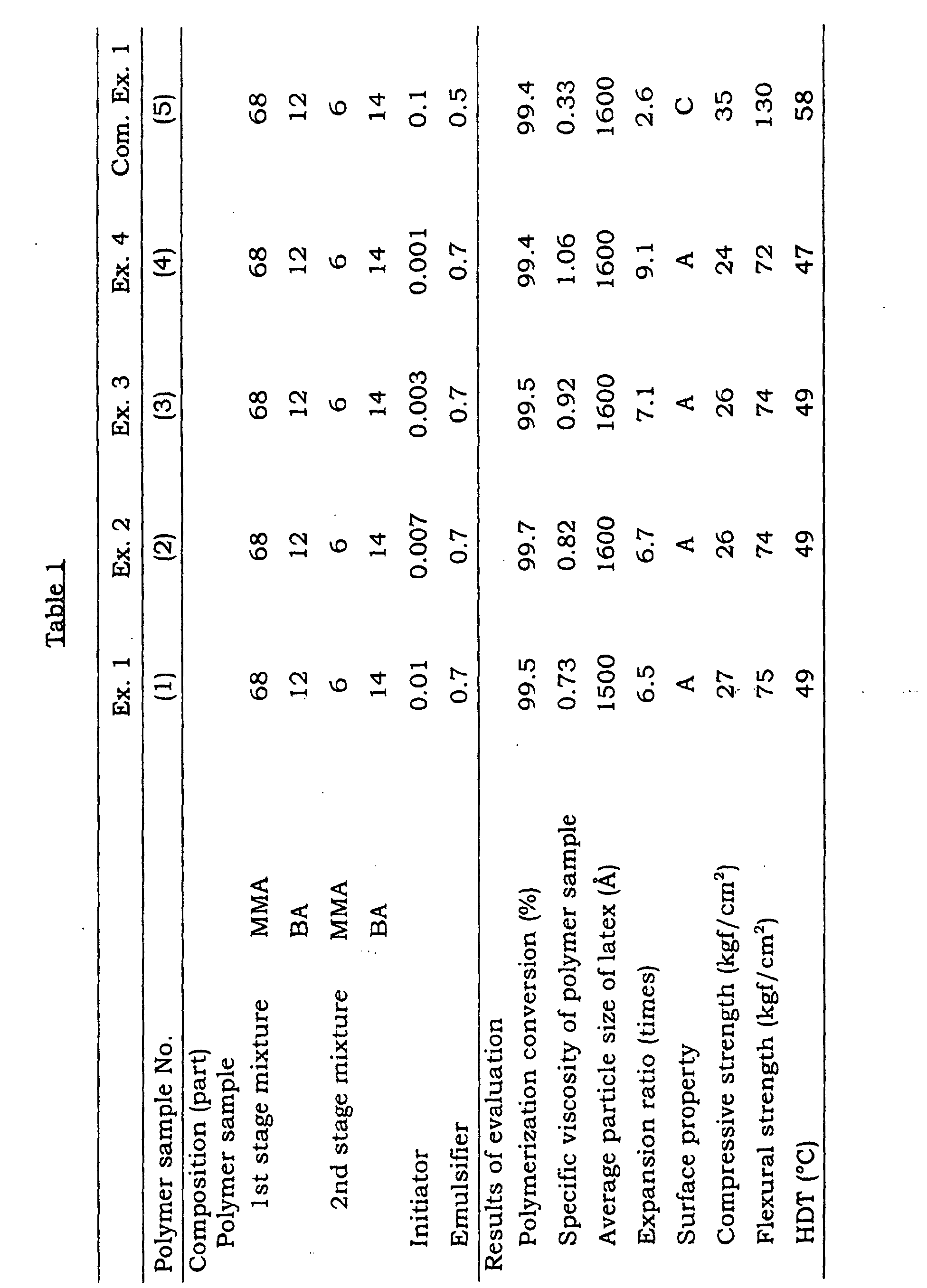
- the specific viscosity of the obtained polymer sample (1) was measured. The result is shown in Table 1.
- a polyvinyl chloride (KANEVINYL S-1007 made by Kaneka Corporation, average degree of polymerization 680) was mixed with 20.0 parts of the above polymer sample (1), 6.0 parts of calcium carbonate, 2.0 parts of titanium oxide, 2.0 parts of an octyl tin mercapto-type stabilizer (TVS #8831 made by Nitto Kasei Kabushiki Kaisha), 0.6 part of calcium stearate, 0.1 part of hydroxystearic acid (LOXIOL G-21 made by Henkel GmbH), 0.9 part of a dibasic fatty acid alcohol ester (LOXIOL G-60 made by Henkel GmbH) and 0.6 part of a polyethylene wax (ACPE-629A made by Allied Chemical Corporation), and the inner temperature was elevated to 110°C.
- LOXIOL G-21 0.1 part of hydroxystearic acid
- LOXIOL G-60 dibasic fatty acid alcohol ester
- ACPE-629A polyethylene wax
- Polymer samples (2) to (5) were prepared according to the recipe shown in Table 1 in the same manner as in Example 1, and the characteristics thereof were measured. Also, foamed articles were obtained by incorporating each of the obtained polymer samples (2) to (5) into polyvinyl chloride in the same manner as in Example 1, and were evaluated. The results are shown in Table 1.
- compositions having a good expandability are obtained when polymer samples (1) to (4) having a specific viscosity of not less than 0.5, but no sufficient expandability is obtained when polymer sample (5) having a specific viscosity of less than 0.5, and accordingly the specific viscosity of the polymer is required to be not less than 0.5 for obtaining the effects of the present invention.
- Foamed articles were prepared in the same manner as in Example 3 except that the amount of polymer sample (3) was changed as shown in Table 2 instead of 20.0 parts per 100 parts of polyvinyl chloride in order to evaluate a change in expandability when the amount of polymer sample (3) incorporated into polyvinyl chloride was changed.
- the expandability, surface property, compressive strength, flexural strength and HDT of the foamed articles were evaluated. The results are shown in Table 2, provided that in Comparative Example 3 a foamed article suitable to evaluate the expandability could not be obtained due to non-uniformity of a composition obtained.
- Foamed articles were prepared in the same manner as in Example 3 except that the kind and amount of the thermally decomposable blowing agent were changed as shown in Tables 3 and 4.
- the expandability, surface property, compressive strength, flexural strength and HDT of the foamed articles were evaluated. The results are shown in Tables 3 and 4.
- SBC denotes sodium bicarbonate
- ADCA denotes azodicarbonamide
- Foamed articles were prepared in the same manner as in Example 3 except that the kind and amount of the filler were changed as shown in Tables 5 and 6.
- the expandability, surface property, compressive strength, flexural strength and HDT of the foamed articles were evaluated. The results are shown in Tables 5 and 6.
- Talc LMS-200 made by Fuji Talc Kabushiki Kaisha Mica: A-21 made by Yamaguchi Ummo Kabushiki Kaisha Montmorillonite: CLOISITE-25A made by Southern Clay Corp.
- the expandable vinyl chloride resin composition of the present invention provides foamed articles having an expansion ratio as high as about 5-10 in spite of the use of thermally decomposable blowing agents, while suppressing deterioration of surface property and strength which would result from increase in expansion ratio. Therefore, cost reduction is possible since an existing extruder can be used, and also the range of uses is expanded.
Landscapes
- Chemical & Material Sciences (AREA)
- Health & Medical Sciences (AREA)
- Chemical Kinetics & Catalysis (AREA)
- Medicinal Chemistry (AREA)
- Polymers & Plastics (AREA)
- Organic Chemistry (AREA)
- Engineering & Computer Science (AREA)
- Materials Engineering (AREA)
- General Chemical & Material Sciences (AREA)
- Manufacture Of Porous Articles, And Recovery And Treatment Of Waste Products (AREA)
- Compositions Of Macromolecular Compounds (AREA)
Abstract
Description
| A: | Unevenness of the surface is scarcely observed and the appearance is excellent. |
| B: | Unevenness of the surface is observed but is not so noticeable. |
| C: | The surface is uneven and the appearance is somewhat bad. |
| D: | Unevenness of the surface is marked and the appearance is bad. |
| Ex. 5 | Ex. 6 | Ex. 7 | Com. Ex. 2 | Com.Ex. 3 | |
| Polymer sample No. | (3) | (3) | (3) | (3) | (3) |
| Amount (part) | 10 | 15 | 25 | 0.3 | 40 |
| Results of evaluation | |||||
| Expansion ratio (times) | 6.1 | 6.6 | 9.2 | 1.3 | - |
| Surface property | A | A | A | D | D |
| Compressive strength (kgf/cm2) | 27 | 27 | 24 | - | - |
| Flexural strength (kgf/cm2) | 74 | 74 | 72 | - | - |
| HDT (°C) | 50 | 50 | 48 | - | - |

Mica: A-21 made by Yamaguchi Ummo Kabushiki Kaisha
Montmorillonite: CLOISITE-25A made by Southern Clay Corp.

Claims (4)
- An expandable vinyl chloride resin composition comprising (1) 100 parts by weight of a vinyl chloride resin, (2) 0.5 to 30 parts by weight of, as a processing aid, a two stage (meth)acrylic acid ester polymer having a specific viscosity of not less than 0.5 measured at 30°C with respect to a solution of 0.1 g of the polymer dissolved in 100 ml of chloroform, the two stage polymer being obtained by emulsion-polymerizing (a) 50 to 99 parts by weight of a monomer mixture comprising 50 to 100 % by weight of methyl methacrylate, 0 to 50 % by weight of at least one monomer selected from the group consisting of an acrylic acid ester and a methacrylic acid ester excepting methyl methacrylate and 0 to 20 % by weight of other vinyl monomer copolymerizable therewith to give a polymer having a specific viscosity of not less than 0.7 measured at 30°C with respect to a solution of 0.1 g of the polymer dissolved in 100 ml of chloroform and polymerizing, in the presence of a latex of the obtained polymer, (b) 1 to 50 parts by weight of a monomer mixture comprising 0 to 50 % by weight of methyl methacrylate, 50 to 100 % by weight of at least one monomer selected from the group consisting of an acrylic acid ester and a methacrylic acid ester excepting methyl methacrylate and 0 to 20 % by weight of other vinyl monomer copolymerizable therewith wherein the total of the monomer mixtures (a) and (b) is 100 parts by weight, (3) 0.3 to 25 parts by weight of a thermally decomposable inorganic blowing agent and (4) 0.01 to 15 parts by weight of a thermally decomposable organic blowing agent.
- The composition of Claim 1, wherein said thermally decomposable inorganic blowing agent is sodium bicarbonate.
- The composition of Claim 1 which further contains 1 to 20 parts by weight of a filler per 100 parts by weight of said vinyl chloride resin.
- The composition of Claim 3, wherein said filler is at least one member selected from the group consisting of calcium carbonate, talc, mica, clay, wollastonite, asbestos, glass fiber and montmorillonite.
Applications Claiming Priority (3)
| Application Number | Priority Date | Filing Date | Title |
|---|---|---|---|
| JP2000239631 | 2000-08-08 | ||
| JP2000239631 | 2000-08-08 | ||
| PCT/JP2001/006650 WO2002012378A1 (en) | 2000-08-08 | 2001-08-02 | Expandable vinyl chloride resin composition |
Publications (3)
| Publication Number | Publication Date |
|---|---|
| EP1310519A1 true EP1310519A1 (en) | 2003-05-14 |
| EP1310519A4 EP1310519A4 (en) | 2003-07-30 |
| EP1310519B1 EP1310519B1 (en) | 2008-07-02 |
Family
ID=18731137
Family Applications (1)
| Application Number | Title | Priority Date | Filing Date |
|---|---|---|---|
| EP01956787A Expired - Lifetime EP1310519B1 (en) | 2000-08-08 | 2001-08-02 | Expandable vinyl chloride resin composition |
Country Status (12)
| Country | Link |
|---|---|
| US (1) | US6635687B2 (en) |
| EP (1) | EP1310519B1 (en) |
| KR (1) | KR100639084B1 (en) |
| CN (1) | CN1331925C (en) |
| AU (1) | AU7868701A (en) |
| BR (1) | BR0107038A (en) |
| CA (1) | CA2384389A1 (en) |
| DE (1) | DE60134647D1 (en) |
| ES (1) | ES2306721T3 (en) |
| MY (1) | MY134161A (en) |
| TW (1) | TWI294891B (en) |
| WO (1) | WO2002012378A1 (en) |
Families Citing this family (17)
| Publication number | Priority date | Publication date | Assignee | Title |
|---|---|---|---|---|
| EP1846492B1 (en) * | 2005-01-18 | 2014-10-01 | ExxonMobil Chemical Patents Inc. | Improvements in or relating to plasticiser compositions |
| US20070078191A1 (en) * | 2005-09-30 | 2007-04-05 | Guhde Brian J | Foamed reinforced composite siding product |
| JP5346192B2 (en) * | 2007-10-05 | 2013-11-20 | ローム アンド ハース カンパニー | Improved polymer composition |
| US9309397B2 (en) | 2007-10-05 | 2016-04-12 | Rohm And Haas Company | Processing aids and polymer formulations containing the same and method for producing the same |
| EP2220023B1 (en) | 2007-12-19 | 2017-04-05 | Evonik Röhm GmbH | Process for preparing (meth)acrylates |
| CN101544719B (en) * | 2009-05-11 | 2011-05-04 | 芜湖融汇化工有限公司 | Method for producing chlorinated polyvinyl chloride processing modified adjuvant |
| CN104011082B (en) | 2011-12-28 | 2016-07-13 | 罗姆及哈斯公司 | Processing aids and polymer formulations comprising same and methods of making them |
| CN102634131B (en) * | 2012-04-11 | 2014-06-18 | 深圳市新纶科技股份有限公司 | Low-density PVC (Poly Vinyl Chloride) injection-molded shoe material and preparation method thereof |
| CN102816400A (en) * | 2012-08-21 | 2012-12-12 | 上海氯碱化工股份有限公司 | Preparation method for chlorinated polyvinyl chloride foaming board |
| CN103435938A (en) * | 2013-08-29 | 2013-12-11 | 浙江宏博新型建材有限公司 | High-wear-resistance modified PVC (Polyvinyl Chloride) micro-foamed material |
| WO2016047952A1 (en) * | 2014-09-23 | 2016-03-31 | 주식회사 엘지화학 | Method for producing vinyl chloride-based polymer and vinyl chloride-based polymer produced thereby |
| KR101617592B1 (en) | 2014-09-23 | 2016-05-02 | 주식회사 엘지화학 | Vinylchloride polymer and preparation method thereof |
| US10106678B2 (en) | 2016-06-14 | 2018-10-23 | Lg Chem, Ltd. | Acrylic processing aid and vinyl chloride resin composition comprising the same |
| WO2018174460A1 (en) * | 2017-03-22 | 2018-09-27 | 주식회사 엘지하우시스 | Resin composition obtained by mixing polyvinyl chloride resin and acrylic resin, and indoor interior material board produced using same |
| MY189966A (en) | 2017-07-17 | 2022-03-22 | Qingdao sanyi plastic machinery co ltd | Composition for producing foamed layer of sheet, sheet containing the same, and production method thereof |
| WO2020090828A1 (en) * | 2018-10-31 | 2020-05-07 | 株式会社クレハ | Gel electrolyte and nonaqueous electrolyte secondary battery |
| CN118459645B (en) * | 2024-05-11 | 2024-11-19 | 云南正邦科技有限公司 | Special PVC (polyvinyl chloride) with high polymerization degree for foaming injection molding and preparation method thereof |
Family Cites Families (31)
| Publication number | Priority date | Publication date | Assignee | Title |
|---|---|---|---|---|
| US3879313A (en) | 1971-06-02 | 1975-04-22 | Elwood E Huntzinger | Stabilization of vinyl resin foam systems |
| BE792581A (en) | 1971-12-09 | 1973-06-12 | Ici Ltd | EXPANDABLE COMPOSITIONS BASED ON VINYL CHLORIDE POLYMERS AND PROCESS FOR PREPARING THEM |
| AR205727A1 (en) | 1974-03-22 | 1976-05-31 | Rohm & Haas | MODIFYING COMPOSITION TO EXTRUDE ALVEOLAR POLYVINYL CHLORIDE |
| JPS6010540B2 (en) | 1979-04-18 | 1985-03-18 | 信越化学工業株式会社 | Expandable vinyl chloride resin composition |
| JPS5840986B2 (en) | 1979-05-11 | 1983-09-09 | 信越化学工業株式会社 | Method for producing polyvinyl chloride resin foam moldings |
| DK183380A (en) | 1979-05-11 | 1980-11-12 | Shinetsu Chemical Co | PROCEDURE FOR THE PREPARATION OF FOAMED CELL BODY OF VINYL CHLORIDE BASE RESIN |
| US4415514A (en) | 1980-04-26 | 1983-11-15 | Stamicarbon B.V. | Method for the preparation of rigid polyvinyl chloride foams |
| JPS608330A (en) * | 1983-06-28 | 1985-01-17 | Nippon Zeon Co Ltd | Expandable vinyl chloride resin composition |
| JPH0611831B2 (en) * | 1984-12-03 | 1994-02-16 | 三菱レイヨン株式会社 | Vinyl chloride resin composition |
| JPH0670153B2 (en) | 1985-09-09 | 1994-09-07 | 鐘淵化学工業株式会社 | Expandable vinyl chloride resin particles for bead foam molding |
| JPS63105045A (en) | 1986-10-21 | 1988-05-10 | Lonseal Corp | Open-cell cellular material made of rigid vinyl chloride resin |
| US4797426A (en) | 1987-02-21 | 1989-01-10 | Lonseal Corporation | Hard polyvinyl chloride resin composition and open-cell foam made of said composition |
| JPH01274702A (en) * | 1988-04-27 | 1989-11-02 | Asahi Corp | Injection mold composition for foaming sole |
| KR940004537B1 (en) * | 1988-12-28 | 1994-05-25 | 가네가후치 가가쿠 고오교 가부시키가이샤 | Foamable composition, process for its production, rigid foam, and process for its production |
| JPH04239046A (en) * | 1991-01-11 | 1992-08-26 | Sekisui Chem Co Ltd | Foamable vinyl chloride composition |
| TW200505B (en) | 1991-05-23 | 1993-02-21 | Sumitomo Chemical Co | |
| JPH069813A (en) * | 1992-06-26 | 1994-01-18 | Tokuyama Sekisui Ind Corp | Vinyl chloride resin composition for foaming |
| CN1038758C (en) * | 1992-09-18 | 1998-06-17 | 安顺企业股份有限公司 | Rigid polyvinyl chloride foam material and manufacturing method thereof |
| JP3213788B2 (en) | 1994-09-06 | 2001-10-02 | 信越化学工業株式会社 | Low foam molding resin composition |
| JPH09151269A (en) * | 1995-11-29 | 1997-06-10 | Sekisui Chem Co Ltd | Foamed vinyl chloride resin composition for injection molding |
| JP3555636B2 (en) * | 1996-01-31 | 2004-08-18 | 日本ゼオン株式会社 | Vinyl chloride resin composition for foam molding |
| JP3642097B2 (en) * | 1996-02-09 | 2005-04-27 | 日本ゼオン株式会社 | Vinyl chloride resin composition for foam molding |
| JP3724603B2 (en) * | 1996-03-12 | 2005-12-07 | ゼオン化成株式会社 | Vinyl chloride resin composition |
| JP3778651B2 (en) * | 1996-04-02 | 2006-05-24 | 日本ゼオン株式会社 | Vinyl chloride resin composition |
| JP3646758B2 (en) * | 1996-09-30 | 2005-05-11 | 日本ゼオン株式会社 | Vinyl chloride resin composition for foam molding |
| JPH10182911A (en) | 1996-12-26 | 1998-07-07 | Nippon Zeon Co Ltd | Vinyl chloride resin composition |
| JPH1192608A (en) * | 1997-09-22 | 1999-04-06 | Zeon Kasei Co Ltd | Vinyl chloride-based resin composition |
| JP2000017095A (en) * | 1998-07-02 | 2000-01-18 | Mitsui Chemicals Inc | Vinyl chloride-based resin composition and molded product using the same |
| MY129262A (en) * | 1998-08-28 | 2007-03-30 | Kaneka Corp | Processing aid for vinyl chloride resin and vinyl chloride resin composition |
| JP2001089592A (en) * | 1999-09-22 | 2001-04-03 | Kanegafuchi Chem Ind Co Ltd | Foamable vinyl chloride resin composition |
| JP2001089591A (en) * | 1999-09-22 | 2001-04-03 | Kanegafuchi Chem Ind Co Ltd | Foamable vinyl chloride resin composition |
-
2001
- 2001-08-02 CN CNB018023045A patent/CN1331925C/en not_active Expired - Fee Related
- 2001-08-02 US US10/069,956 patent/US6635687B2/en not_active Expired - Lifetime
- 2001-08-02 DE DE60134647T patent/DE60134647D1/en not_active Expired - Lifetime
- 2001-08-02 WO PCT/JP2001/006650 patent/WO2002012378A1/en not_active Ceased
- 2001-08-02 ES ES01956787T patent/ES2306721T3/en not_active Expired - Lifetime
- 2001-08-02 EP EP01956787A patent/EP1310519B1/en not_active Expired - Lifetime
- 2001-08-02 AU AU78687/01A patent/AU7868701A/en not_active Abandoned
- 2001-08-02 KR KR1020027004397A patent/KR100639084B1/en not_active Expired - Fee Related
- 2001-08-02 BR BR0107038-0A patent/BR0107038A/en not_active Application Discontinuation
- 2001-08-02 CA CA002384389A patent/CA2384389A1/en not_active Abandoned
- 2001-08-03 TW TW090118986A patent/TWI294891B/zh not_active IP Right Cessation
- 2001-08-03 MY MYPI20013671 patent/MY134161A/en unknown
Also Published As
| Publication number | Publication date |
|---|---|
| KR20020037769A (en) | 2002-05-22 |
| WO2002012378A1 (en) | 2002-02-14 |
| BR0107038A (en) | 2002-06-04 |
| AU7868701A (en) | 2002-02-18 |
| TWI294891B (en) | 2008-03-21 |
| CN1386125A (en) | 2002-12-18 |
| US6635687B2 (en) | 2003-10-21 |
| EP1310519B1 (en) | 2008-07-02 |
| MY134161A (en) | 2007-11-30 |
| US20030027881A1 (en) | 2003-02-06 |
| EP1310519A4 (en) | 2003-07-30 |
| KR100639084B1 (en) | 2006-10-27 |
| DE60134647D1 (en) | 2008-08-14 |
| CN1331925C (en) | 2007-08-15 |
| ES2306721T3 (en) | 2008-11-16 |
| CA2384389A1 (en) | 2002-02-14 |
Similar Documents
| Publication | Publication Date | Title |
|---|---|---|
| US6635687B2 (en) | Expandable vinyl chloride resin composition | |
| CN1275146B (en) | Processing aid for vinyl chloride resin and vinyl chloride resin composition containing the same | |
| US6765033B1 (en) | Expandable vinyl chloride resin composition | |
| US6140417A (en) | Vinyl chloride resin composition | |
| US6723762B1 (en) | Foamable vinyl chloride-base resin compositions | |
| AU2002318657B2 (en) | Foamable Polyester Resin Composition | |
| US6610757B2 (en) | Foamable vinyl chloride resin composition | |
| JPWO2000042101A1 (en) | Foamable vinyl chloride resin composition | |
| JP2001089591A (en) | Foamable vinyl chloride resin composition | |
| JP2001089592A (en) | Foamable vinyl chloride resin composition | |
| JPH09208732A (en) | Vinyl chloride resin composition for foam molding | |
| JPWO2002012378A1 (en) | Foamable vinyl chloride resin composition | |
| JP2003096226A (en) | Expandable polycarbonate resin composition | |
| JP2003096227A (en) | Foamable polyester resin composition | |
| JP2003026845A (en) | Foamable polyester resin composition | |
| MXPA00009055A (en) | Expandable vinyl chloride resin composition | |
| JPH06285943A (en) | Coextrusion |
Legal Events
| Date | Code | Title | Description |
|---|---|---|---|
| PUAI | Public reference made under article 153(3) epc to a published international application that has entered the european phase |
Free format text: ORIGINAL CODE: 0009012 |
|
| 17P | Request for examination filed |
Effective date: 20030305 |
|
| AK | Designated contracting states |
Designated state(s): BE DE ES FR GB IT NL |
|
| AX | Request for extension of the european patent |
Extension state: AL LT LV MK RO SI |
|
| A4 | Supplementary search report drawn up and despatched |
Effective date: 20030616 |
|
| RIC1 | Information provided on ipc code assigned before grant |
Ipc: 7C 08K 3/26 B Ipc: 7C 08J 9/08 B Ipc: 7C 08J 9/00 B Ipc: 7C 08L 27/06 B Ipc: 7C 08J 9/06 A |
|
| GRAP | Despatch of communication of intention to grant a patent |
Free format text: ORIGINAL CODE: EPIDOSNIGR1 |
|
| GRAS | Grant fee paid |
Free format text: ORIGINAL CODE: EPIDOSNIGR3 |
|
| GRAA | (expected) grant |
Free format text: ORIGINAL CODE: 0009210 |
|
| AK | Designated contracting states |
Kind code of ref document: B1 Designated state(s): BE DE ES FR GB IT NL |
|
| REG | Reference to a national code |
Ref country code: GB Ref legal event code: FG4D |
|
| REF | Corresponds to: |
Ref document number: 60134647 Country of ref document: DE Date of ref document: 20080814 Kind code of ref document: P |
|
| REG | Reference to a national code |
Ref country code: ES Ref legal event code: FG2A Ref document number: 2306721 Country of ref document: ES Kind code of ref document: T3 |
|
| PLBE | No opposition filed within time limit |
Free format text: ORIGINAL CODE: 0009261 |
|
| STAA | Information on the status of an ep patent application or granted ep patent |
Free format text: STATUS: NO OPPOSITION FILED WITHIN TIME LIMIT |
|
| 26N | No opposition filed |
Effective date: 20090403 |
|
| PG25 | Lapsed in a contracting state [announced via postgrant information from national office to epo] |
Ref country code: IT Free format text: LAPSE BECAUSE OF FAILURE TO SUBMIT A TRANSLATION OF THE DESCRIPTION OR TO PAY THE FEE WITHIN THE PRESCRIBED TIME-LIMIT Effective date: 20080702 |
|
| PGFP | Annual fee paid to national office [announced via postgrant information from national office to epo] |
Ref country code: ES Payment date: 20090827 Year of fee payment: 9 Ref country code: FR Payment date: 20090814 Year of fee payment: 9 |
|
| PGFP | Annual fee paid to national office [announced via postgrant information from national office to epo] |
Ref country code: NL Payment date: 20090816 Year of fee payment: 9 |
|
| PGFP | Annual fee paid to national office [announced via postgrant information from national office to epo] |
Ref country code: BE Payment date: 20090805 Year of fee payment: 9 |
|
| BERE | Be: lapsed |
Owner name: KANEKA CORP. Effective date: 20100831 |
|
| REG | Reference to a national code |
Ref country code: NL Ref legal event code: V1 Effective date: 20110301 |
|
| REG | Reference to a national code |
Ref country code: FR Ref legal event code: ST Effective date: 20110502 |
|
| PG25 | Lapsed in a contracting state [announced via postgrant information from national office to epo] |
Ref country code: NL Free format text: LAPSE BECAUSE OF NON-PAYMENT OF DUE FEES Effective date: 20110301 |
|
| PG25 | Lapsed in a contracting state [announced via postgrant information from national office to epo] |
Ref country code: BE Free format text: LAPSE BECAUSE OF NON-PAYMENT OF DUE FEES Effective date: 20100831 Ref country code: FR Free format text: LAPSE BECAUSE OF NON-PAYMENT OF DUE FEES Effective date: 20100831 |
|
| REG | Reference to a national code |
Ref country code: ES Ref legal event code: FD2A Effective date: 20111019 |
|
| PG25 | Lapsed in a contracting state [announced via postgrant information from national office to epo] |
Ref country code: ES Free format text: LAPSE BECAUSE OF NON-PAYMENT OF DUE FEES Effective date: 20100803 |
|
| PGFP | Annual fee paid to national office [announced via postgrant information from national office to epo] |
Ref country code: DE Payment date: 20190723 Year of fee payment: 19 |
|
| PGFP | Annual fee paid to national office [announced via postgrant information from national office to epo] |
Ref country code: GB Payment date: 20190731 Year of fee payment: 19 |
|
| REG | Reference to a national code |
Ref country code: DE Ref legal event code: R119 Ref document number: 60134647 Country of ref document: DE |
|
| GBPC | Gb: european patent ceased through non-payment of renewal fee |
Effective date: 20200802 |
|
| PG25 | Lapsed in a contracting state [announced via postgrant information from national office to epo] |
Ref country code: DE Free format text: LAPSE BECAUSE OF NON-PAYMENT OF DUE FEES Effective date: 20210302 |
|
| PG25 | Lapsed in a contracting state [announced via postgrant information from national office to epo] |
Ref country code: GB Free format text: LAPSE BECAUSE OF NON-PAYMENT OF DUE FEES Effective date: 20200802 |