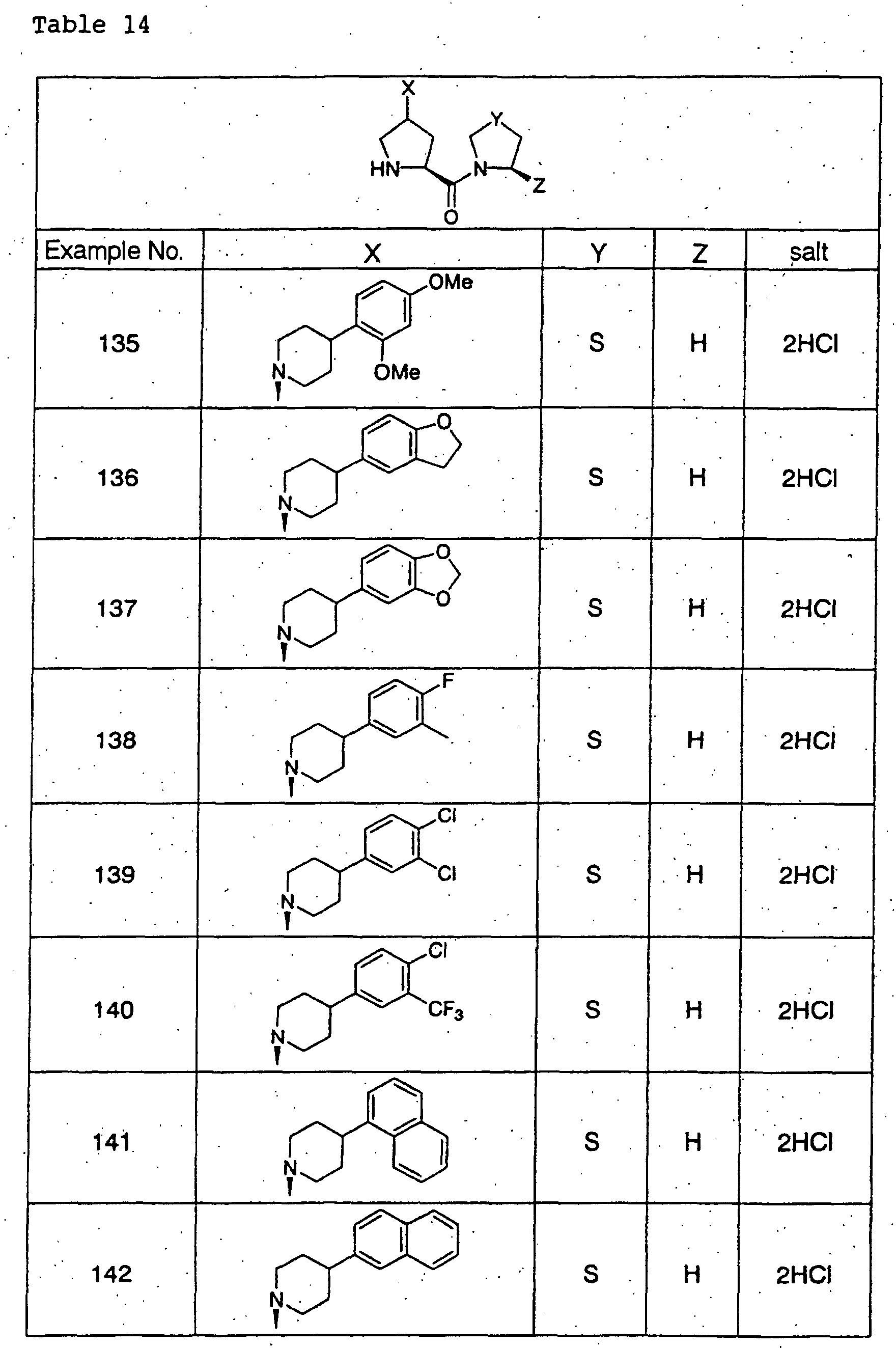
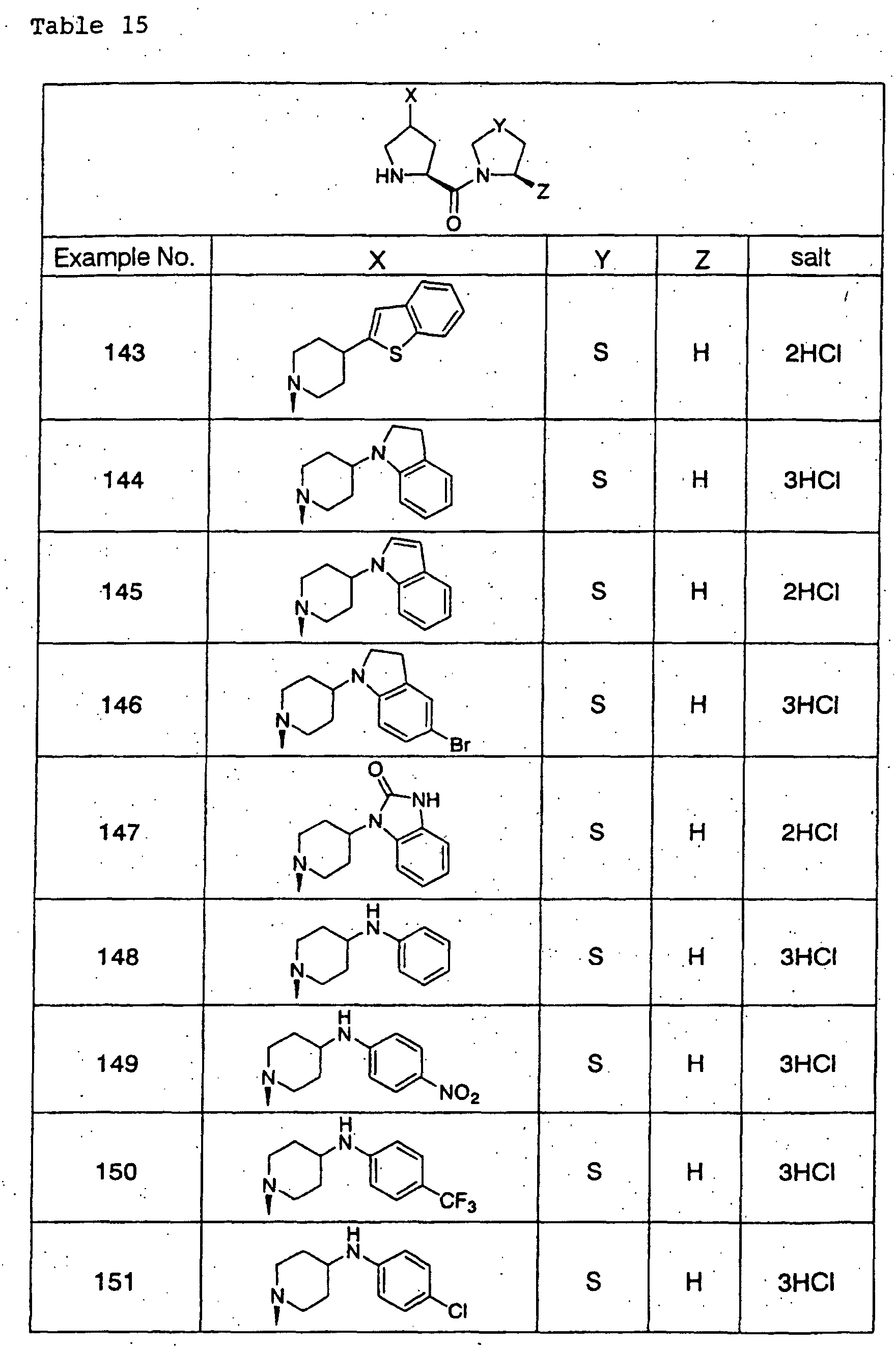
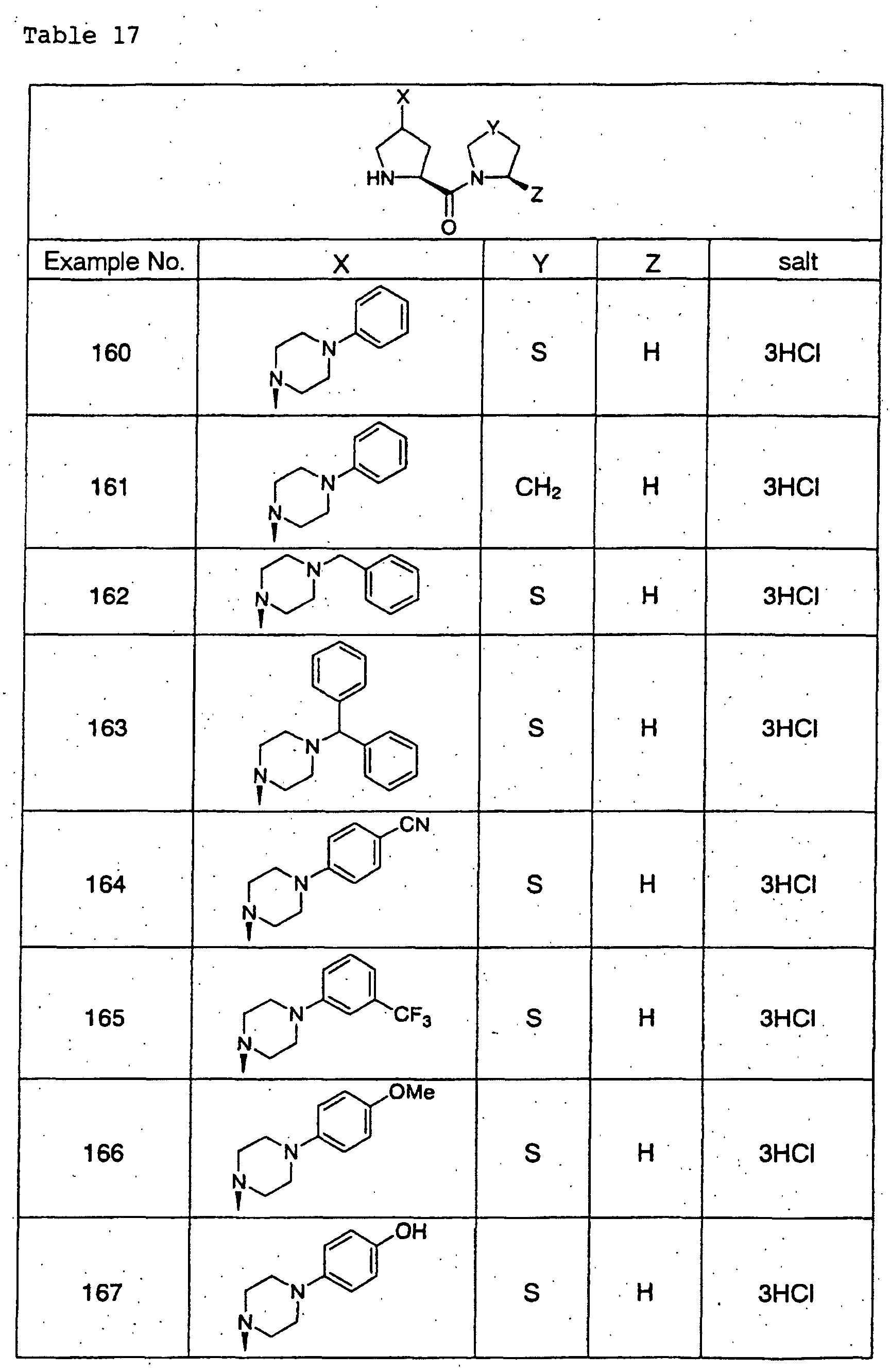
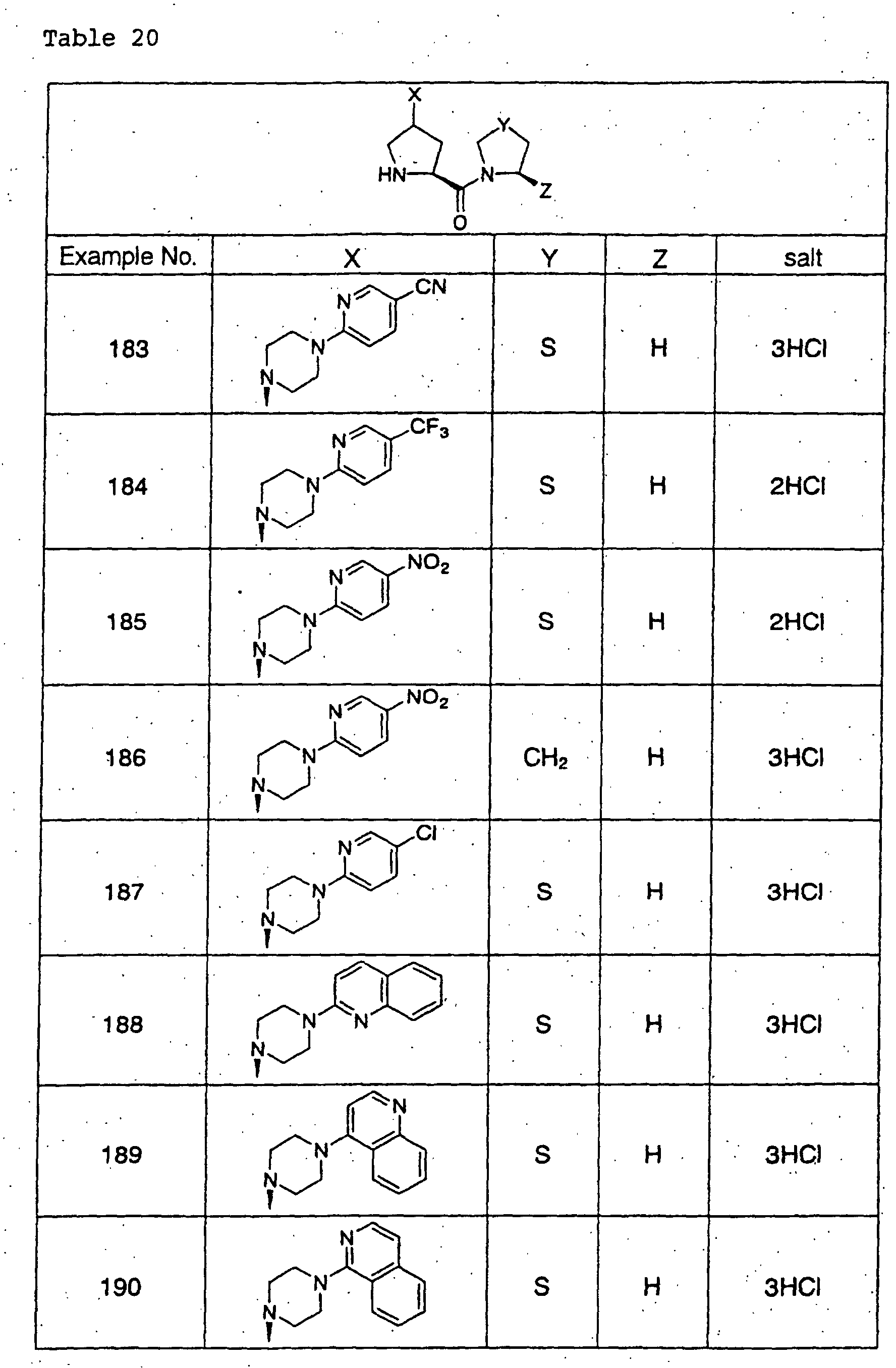
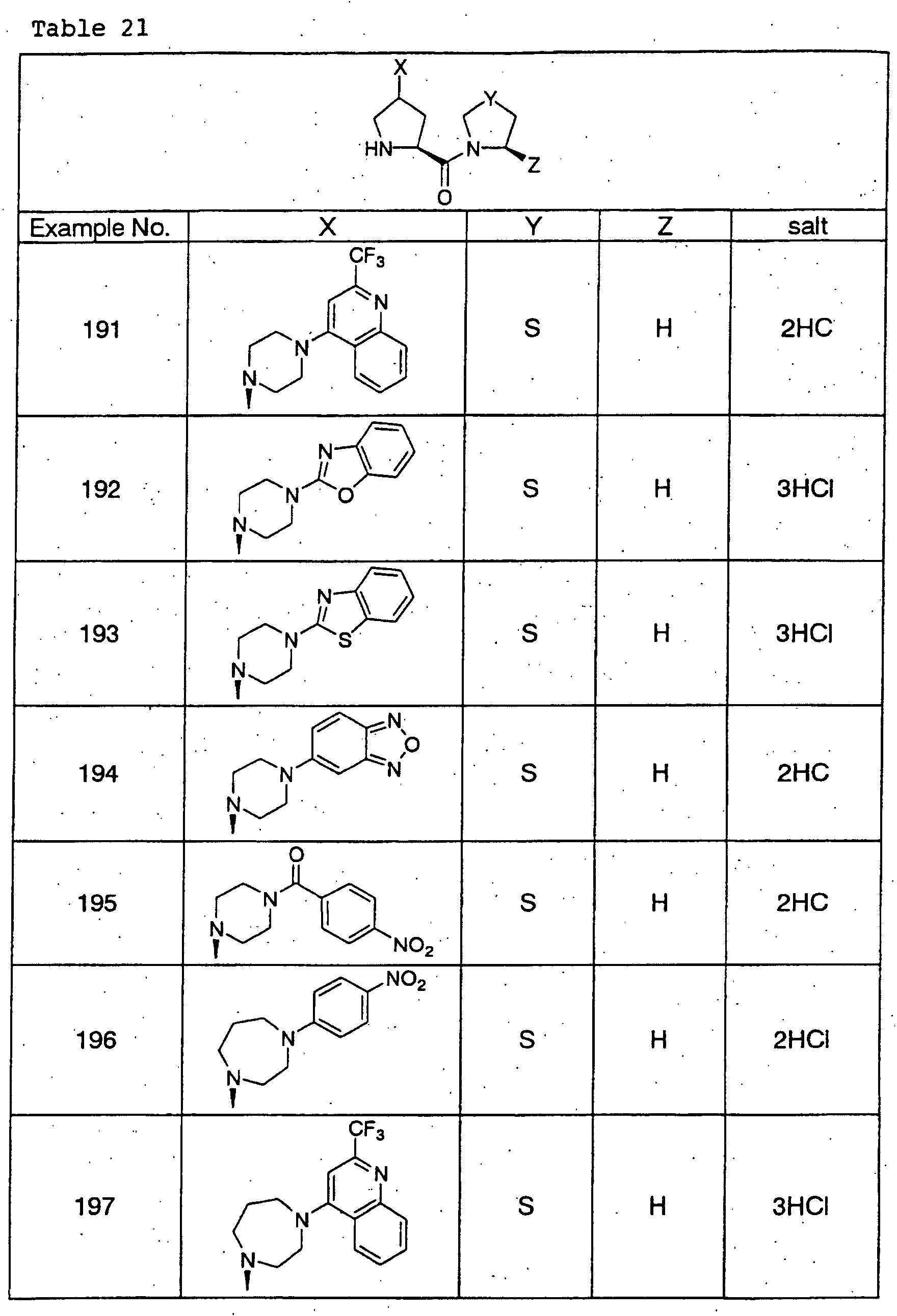
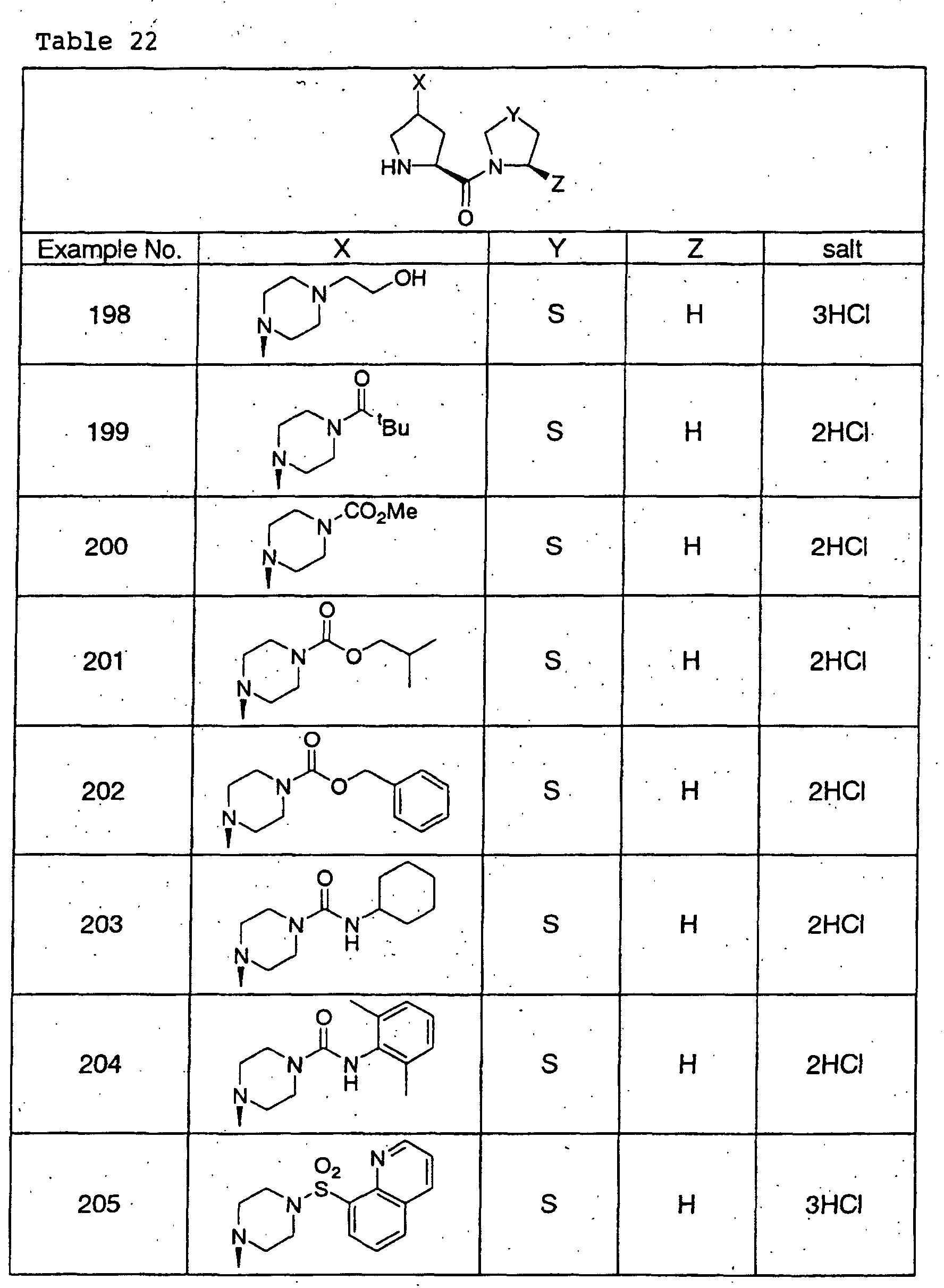
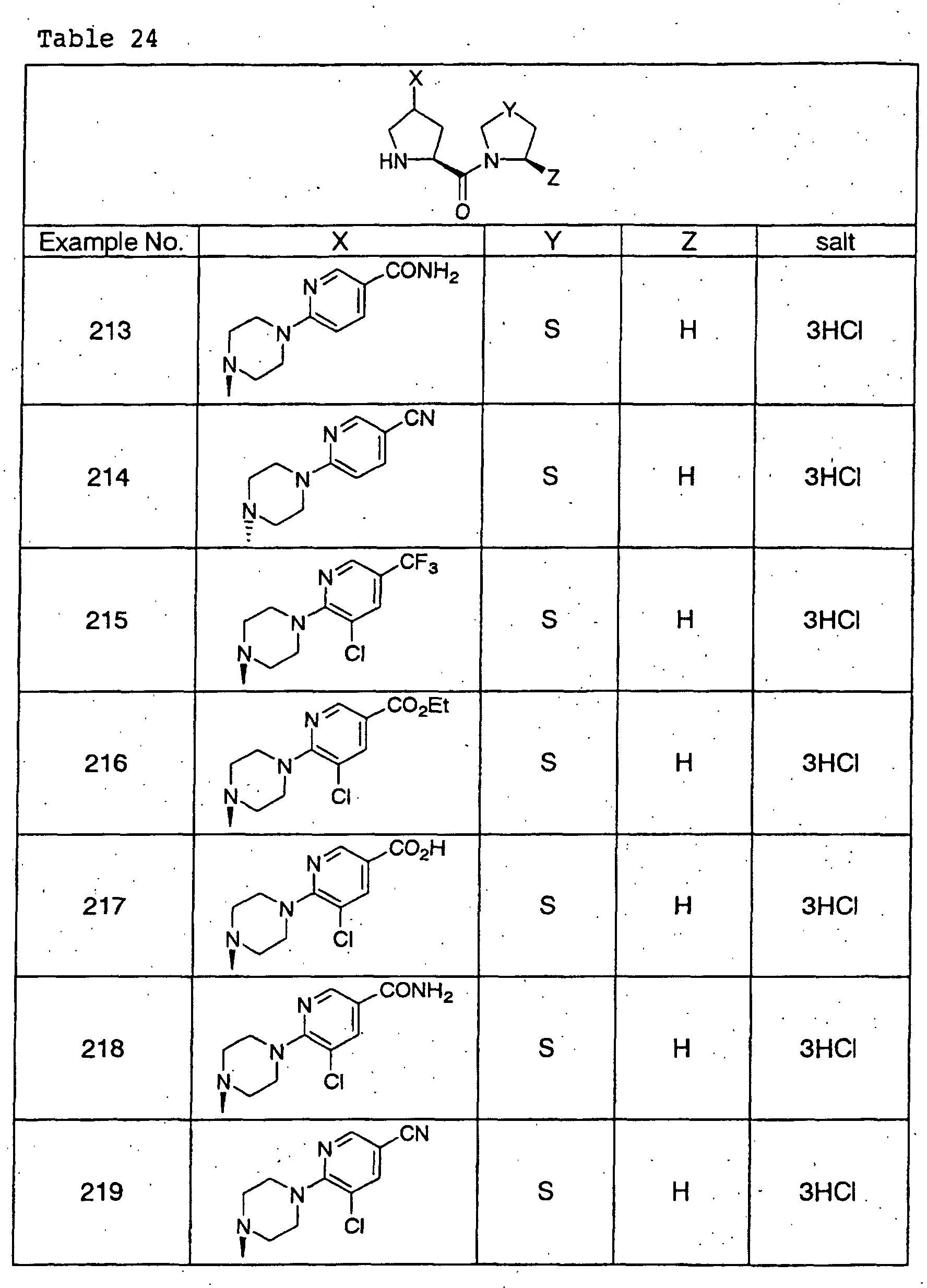
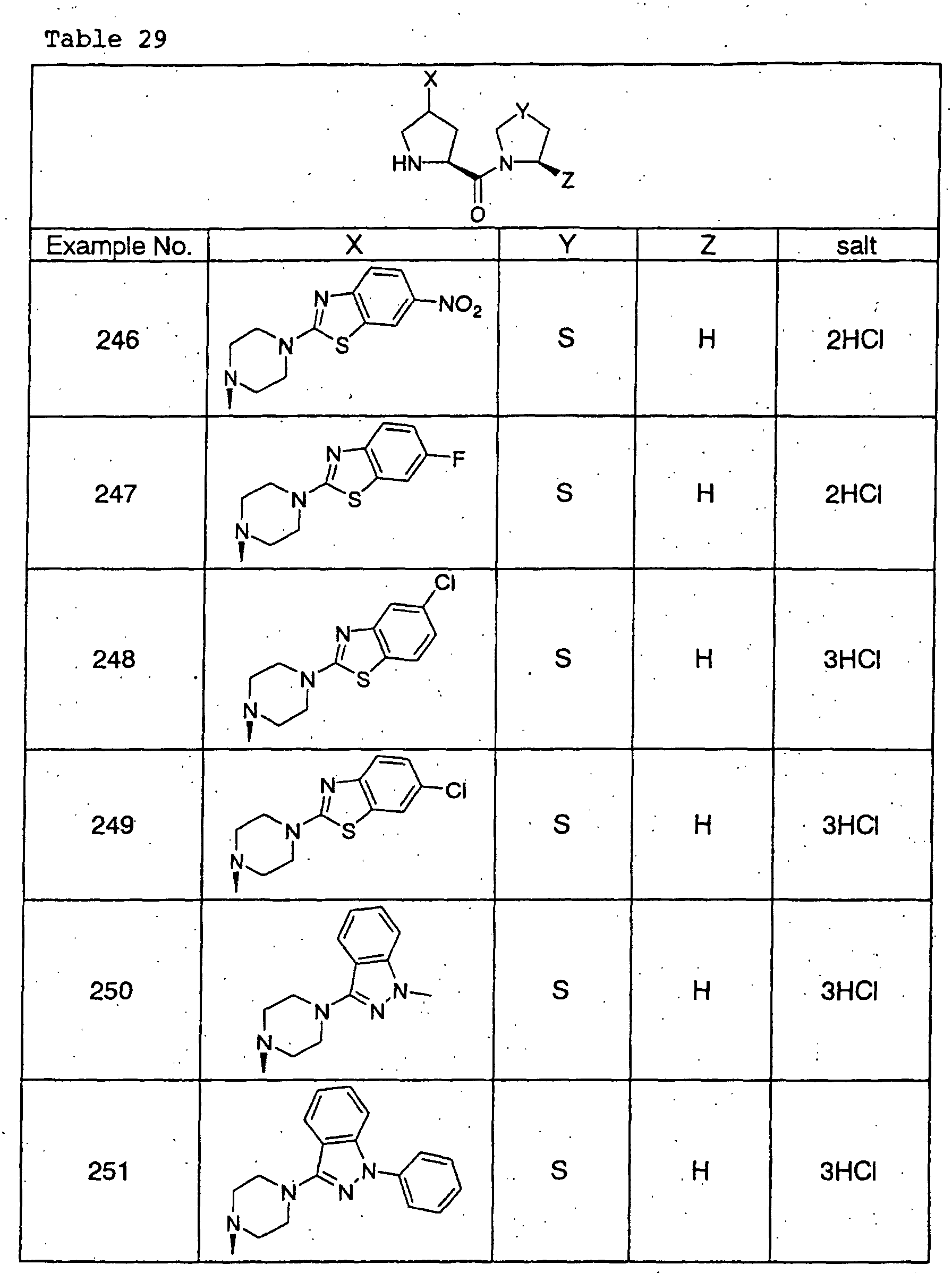
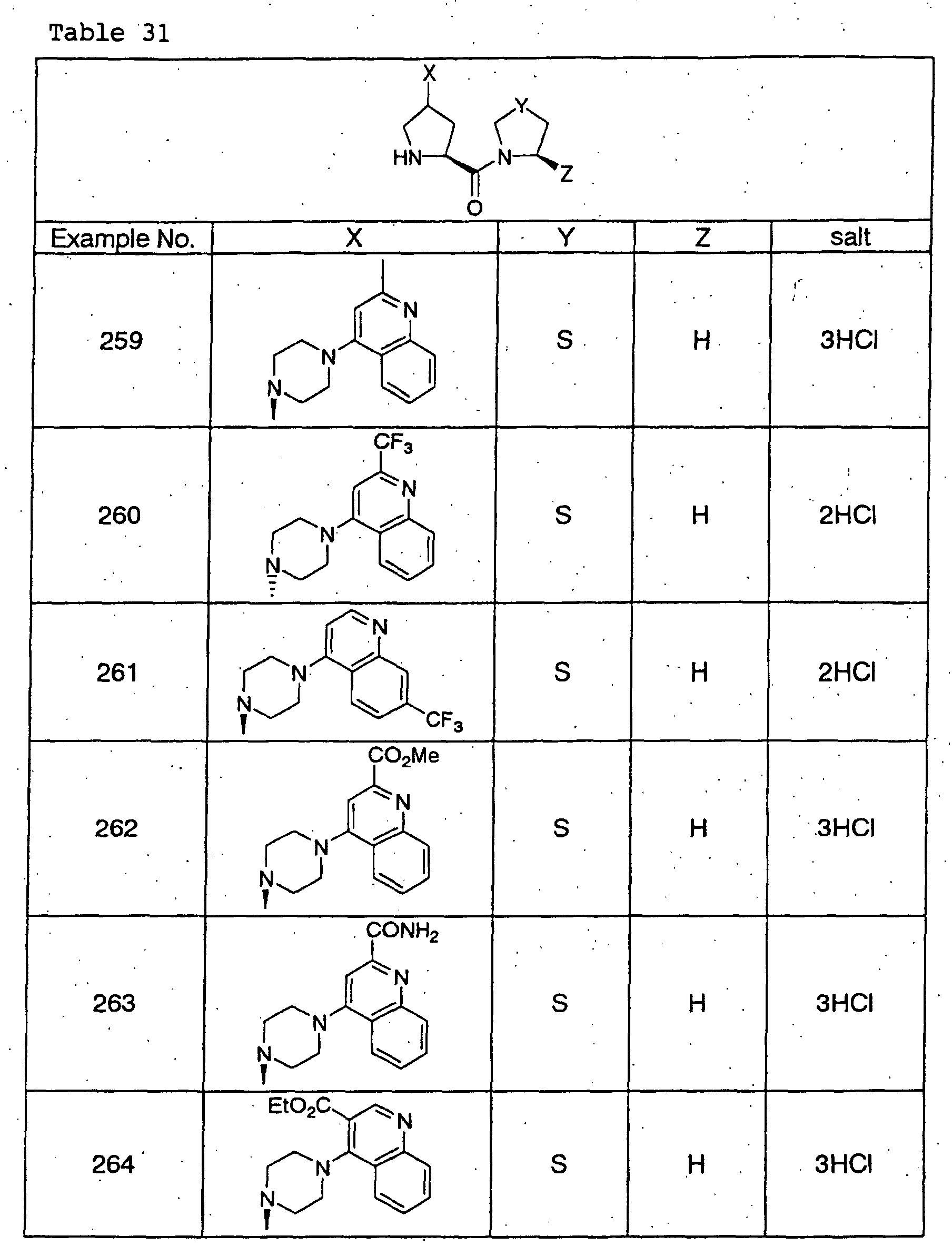
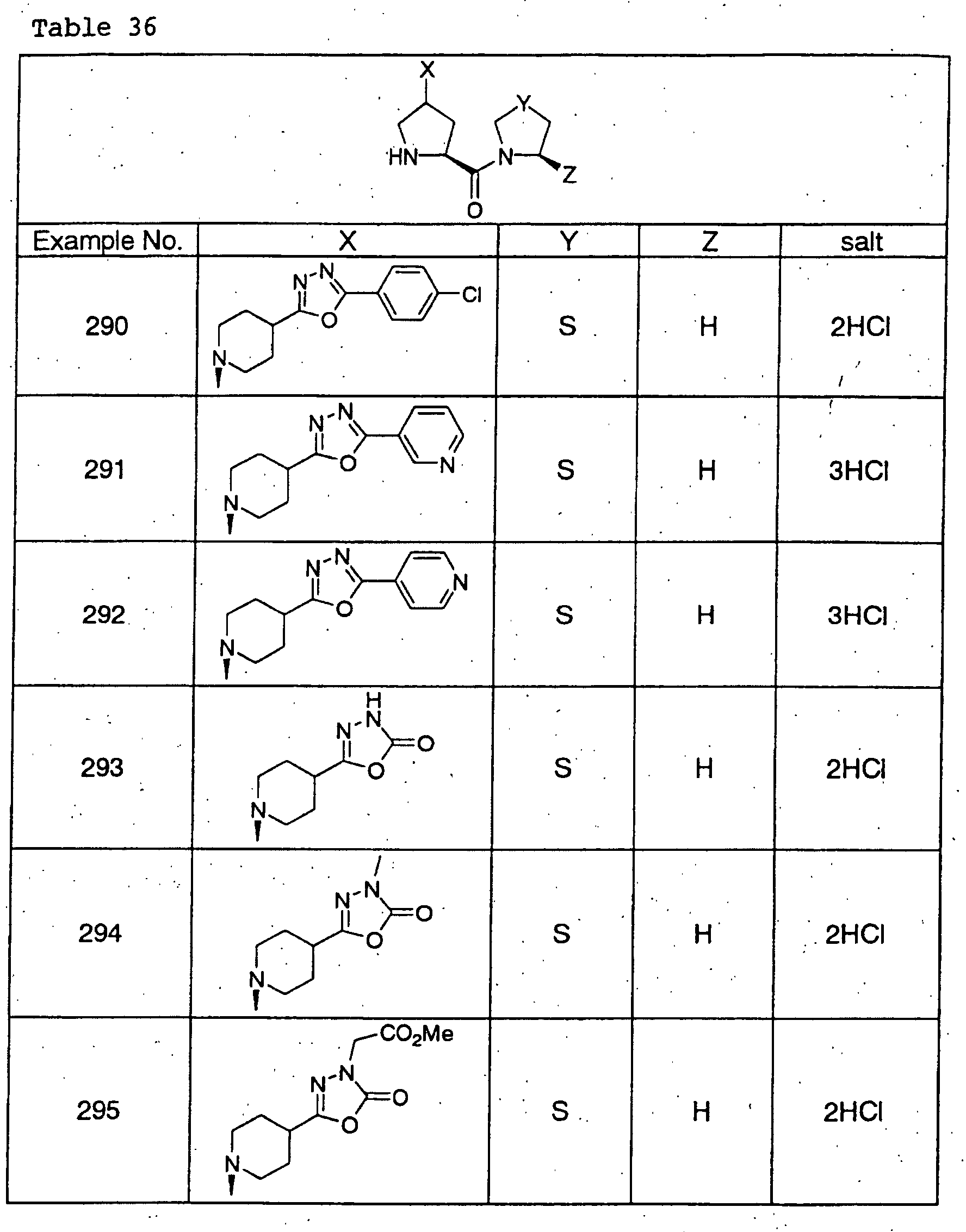
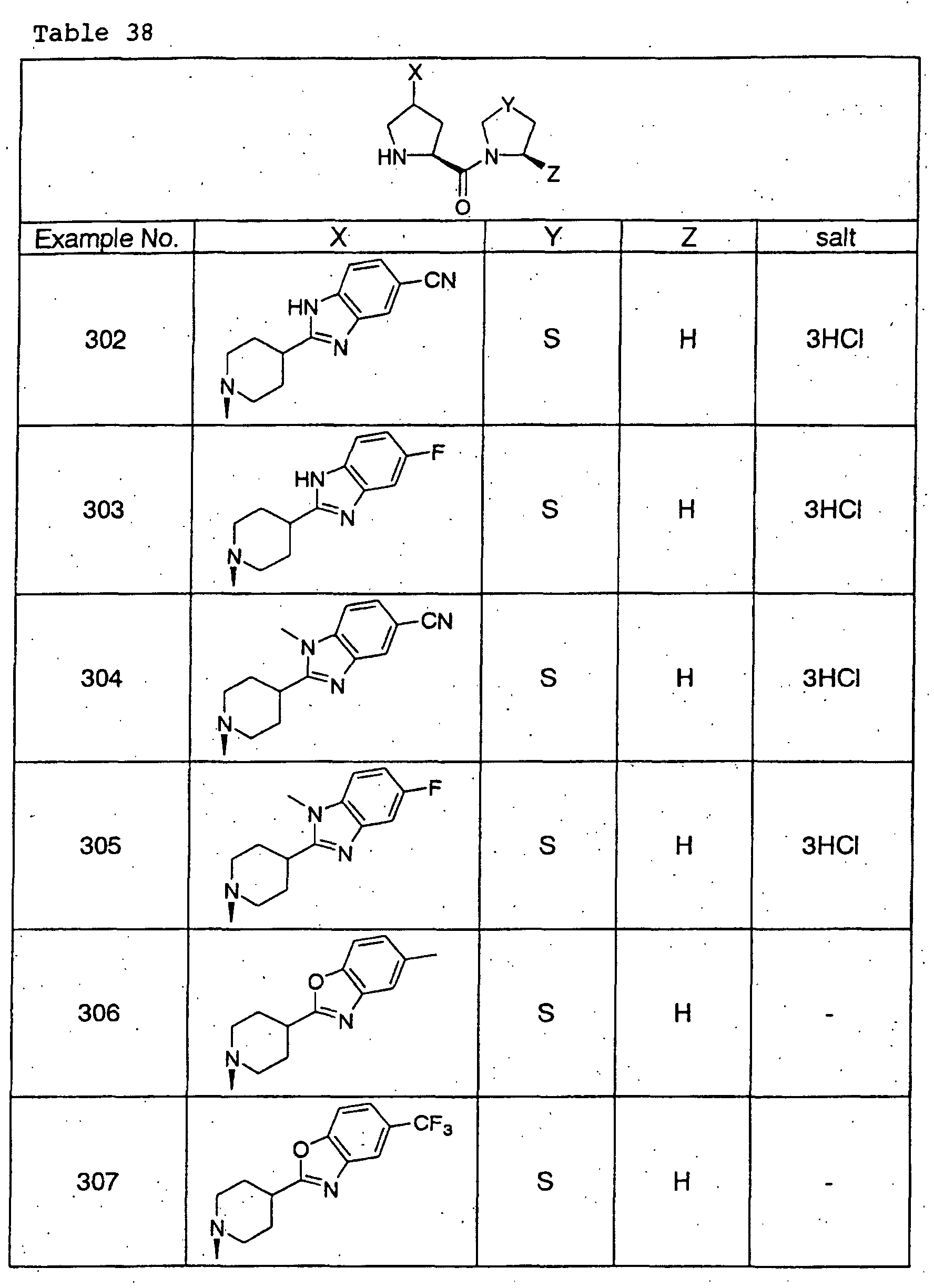
Technical Field
The present invention relates to a proline derivative
showing a dipeptidyl peptidase IV (DPP-IV) inhibitory activity,
which is useful for the treatment or prophylaxis of diabetes,
obesity, HIV infection, cancer metastasis, dermopathy,
prostatic hyperplasia, periodontitis, autoimmune disease and
the like, and a salt thereof.
Background Art
DPP-IV is a serine protease, which recognizes an amino
acid sequence having proline (or alanine or hydroxyproline) the
penultimate position from the N-terminal and produces dipeptide
Xaa-Pro (xaa shows an optional amino acid and Pro shows L-proline).
DPP-IV is widely distributed in mammalian tissues
and is known to be present particularly in blood, kidney,
intestinal epithelium and placenta.
While the physiological role of DPP-IV in mammal has not
been completely elucidated, its involvement in a broad range of
functions of living organisms such as degradation of
neuropeptide [Heymann et al., FEBS Letters vol. 91, 360-364
(1978)], activation of T cell [Schon et al., Biomedica
Biochimica Acta vol. 44, K9-K15 (1985)], adhesion of metastatic
tumor cell to endothelium [Johnson et al., Journal of Cell
Biology, vol. 121, 1423-1432 (1993)], invasion of HIV virus
into lymphocytes [Callebaut et al., Science vol. 262, 2045-2050
(1993)] and the like is being clarified. Of these, the role of
DPP-IV as an enzyme that inactivates glucagon-like peptide
(GLP-1), which is a biogenic substance having a strong insulin
secretion ability and controls postprandial blood glucose level,
has been drawing attention [Deacon et al., Journal of Clinical
Endocrinology and Metabolism, vol. 80, 952-957 (1995)].
GLP-1 is known to be metabolized in several minutes in a
living organism. In the metabolism, that by DPP-IV is
particularly important, because it quickly cleaves GLP-1 and
produces inert GLP-1 [Deacon et al., American Journal of
Physiology, vol. 271, E458-E464 (1996)]. In addition, it is
considered that physiological action of GLP-1 becomes
attenuated further because this inert GLP-1 shows an
antagonistic action on GLP-1 receptor [Knudsen et al., European
Journal of Pharmacology, vol. 318, 429-435 (1996)]. Therefore,
a method for suppressing cleavage of GLP-1 by inhibition of
DPP-IV is considered to be the most superior approach for
reinforcing GLP-1 action. That is, a DPP-IV inhibitor is
expected to be a superior treatment method of curing
postprandial hyperglycemia without side effects, such as
prolonged hypoglycemia and the like, for non insulin-dependent
diabetic (type II diabetes) patients.
Patent applications relating to DPP-IV inhibitors include
the following.
Japanese Patent Application under PCT laid-open under
kohyo No. 9-509921 discloses (S)-2-cyano-1-L-prolinepyrrolidine
derivative. The L-α-amino acid corresponding to the L-proline
moiety of the compound disclosed therein characteristically has
a lipophilic side chain.
In addition, WO99/61431 describes DPP-IV inhibitory
activities of a compound consisting of natural amino acid and
thiazolidine or pyrrolidine.
Disclosure of the Invention
While there have been reported many DPP-IV inhibitors
till date [Augustyns et al., Current Medicinal Chemistry, vol.
6, 311-327 (1999)], none of the compounds shows sufficient
inhibitory activity or sufficient stability and safety in
living organisms, and they are unsatisfactory as a
pharmaceutical product. Therefore, the development of a
compound which exhibits a therapeutic effect through the
inhibition of DPP-IV action and satisfactory as a
pharmaceutical product has been demanded.
In view of the above-mentioned points, the present
inventors have conducted intensive studies with the aim of
developing a novel DPP-IV inhibitor. As a result, the present
inventors have found that a derivative having a substituent
introduced into the γ-position of proline has a potent DPP-IV
inhibitory activity, and made the stability higher, which
resulted in the completion of the present invention.
Accordingly, the present invention relates to the
following compounds.
(1) An L-proline derivative of the formula (I)

wherein
- X
- shows -NR1R2 wherein R1 and R2 may be the same or
different and each is independently a hydrogen atom,
alkyl, cycloalkyl, cycloalkylalkyl, aryl, arylalkyl,
heteroaryl or heteroarylalkyl, or may be bonded to
each other to form a heterocycle optionally
containing 1 or 2 nitrogen atoms or oxygen atoms, the
heterocycle optionally being condensed with an
aromatic ring optionally having substituents, and the
heterocycle optionally being a spiro ring,
-NR3COR4 wherein R3 and R4 are the same or different and
each is independently a hydrogen atom, alkyl,
cycloalkyl, cycloalkylalkyl, aryl, arylalkyl,
arylalkenyl, heteroaryl or heteroarylalkyl,
-NR5CONR6R7 or -NR5CH2CH2NR6R7 wherein R5, R6 and R7 are
the same or different and each is independently
hydrogen atom, alkyl, acyl, cycloalkyl,
cycloalkylalkyl, aryl, arylalkyl, heteroaryl or
heteroarylalkyl, or R6 and R7 may be bonded to each
other to form a heterocycle optionally containing 1
or 2 nitrogen atoms or oxygen atoms, the heterocycle
optionally being condensed with an aromatic ring
optionally having substituents,
-NR8SO2R9 wherein R8 and R9 are the same or different
and each is independently a hydrogen atom, alkyl,
cycloalkyl, cycloalkylalkyl, aryl, arylalkyl,
heteroaryl or heteroarylalkyl, or
-OR10 or -OCOR11 wherein R10 and R11 are each a hydrogen
atom, alkyl, cycloalkyl, cycloalkylalkyl, aryl,
arylalkyl, heteroaryl or heteroarylalkyl,
- Y
- is CH2, CH-OH, S, S=O or SO2,
- Z
- is a hydrogen atom or a cyano, and
of the above-mentioned groups, alkyl, aryl, arylalkyl,
arylalkenyl, heteroaryl, heteroarylalkyl, cycloalkyl,
cycloalkylalkyl and heterocycle each optionally have
substituents,
or a pharmaceutically acceptable salt thereof. (2) The L-proline derivative described in the aforementioned
(1), wherein X of the formula (I) is a substituent selected
from the formulas
wherein
- - - - - - -
- is a single bond or a double bond,
- R12
- is alkyl, cycloalkyl, cycloalkylalkyl, aryl, arylalkyl,
heteroaryl, heteroarylalkyl, -NR14R15, -OR16, -COR17,
-CO2R18, -CONR19R20 or -SO2R21CH2 wherein R14, R15, R16,
R17, R18, R19, R20 and R21 are the same or different and
each is independently a hydrogen atom, alkyl, cycloalkyl,
cycloalkylalkyl, aryl, arylalkyl, heteroaryl,
heteroarylalkyl or haloalkyl, or R14 and R15, and R19
and R20 may be bonded to each other to form heterocycles
each optionally containing 1 or 2 nitrogen atoms or
oxygen atoms, said heterocycle optionally being
condensed with an aromatic ring optionally having
substituents,
- R13
- is a hydrogen atom, alkyl, cycloalkyl, cycloalkylalkyl,
aryl, arylalkyl, heteroaryl or heteroarylalkyl,
- m
- is 1 or 2, and
- A
- is a carbon atom or a nitrogen atom,
provided that i) when A is a carbon atom, A may be substituted
by a hydroxyl group, carboxyl or alkoxycarbonyl, and ii) when A
is a nitrogen atom,
- - - - - - -
- is a single bond,
of the above-mentioned groups, alkyl, cycloalkyl,
cycloalkylalkyl, aryl, arylalkyl, heteroaryl, heteroarylalkyl
and heterocycle each optionally have substituents,
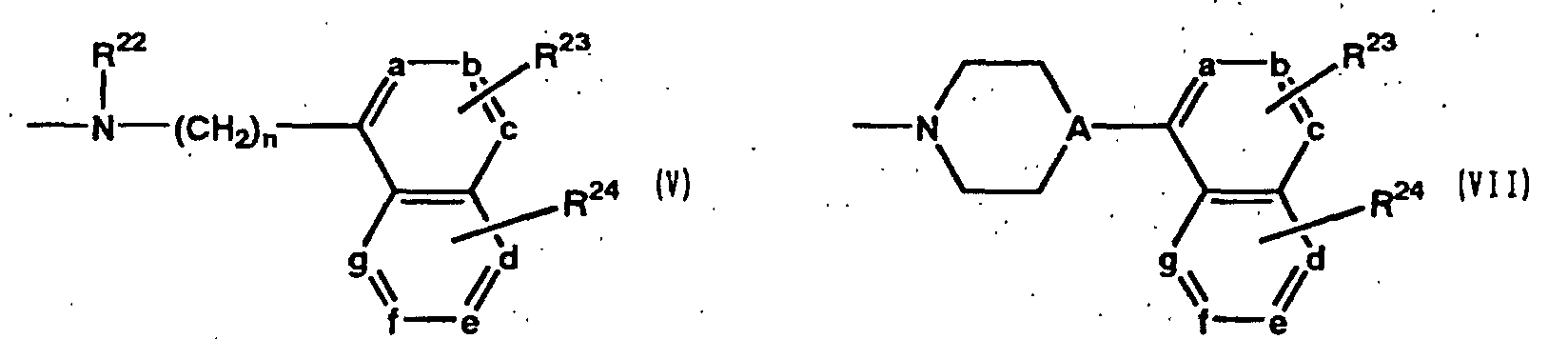
or a pharmaceutically acceptable salt thereof. (3) The L-proline derivative described in the aforementioned
(1) or (2), wherein X of the formula (I) is a substituent
selected from the formulas


wherein
- R22
- is a hydrogen atom, alkyl, cycloalkyl, cycloalkylalkyl,
aryl, arylalkyl, heteroaryl or heteroarylalkyl,
- R23 and R24
- are the same or different and each is
independently a hydrogen atom, alkyl, aryl, arylalkyl,
heteroaryl, heteroarylalkyl, halogen, haloalkyl, cyano,
nitro, -NR25R26, -NHSO2R27, -OR28, -COOR29, -CONHSO2R30,
-SO2OR31, -SO2R32 or -CONR33R34 wherein R25, R26, R27,
R28, R29, R30, R31, R32, R33 and R34 are the same or
different and each is independently a hydrogen atom,
alkyl, cycloalkyl, cycloalkylalkyl, aryl, arylalkyl,
heteroaryl, heteroarylalkyl or haloalkyl, or R25 and R26,
and R33 and R34 may be bonded to each other to form
heterocycles each optionally containing 1 or 2 nitrogen
atoms or oxygen atoms, said heterocycle optionally being
condensed with an aromatic ring optionally having
substituents,
- a, b, c, d, e, f and g
- are all carbon atoms, or any one or two
thereof is(are) nitrogen atom(s) and the rest is a
carbon atom,
- n
- is 0, 1, 2 or 3, and
- A
- is a carbon atom or a nitrogen atom,
provided that when A is a carbon atom, A may be substituted by
a hydroxyl group, carboxyl or alkoxycarbonyl, and
of the above-mentioned groups, alkyl, aryl, arylalkyl,
heteroaryl, heteroarylalkyl, cycloalkyl, cycloalkylalkyl and
heterocycle each optionally have substituents,
or a pharmaceutically acceptable salt thereof. (4) The L-proline derivative of any of the aforementioned (1)
to (3), wherein, in the formula (I), the asymmetric carbon, to
which X is bonded, is expressed by an S configuration, X is a
group of the formula (VI) or (VII), R23 and R24 are the same
or different and each is nitro, cyano, C1-6alkyl, C1-6alkyloxy,
halogen or haloalkyl, Y is a sulfur atom and Z is a hydrogen
atom,
or a pharmaceutically acceptable salt thereof. (5) The L-proline derivative of the aforementioned (1), wherein,
in the formula (I), X is a hydroxyl group, phenylamino
optionally having substituents, 2-pyridylamino optionally
having substituents, 3-pyridazinylamino optionally having
substituents or 2-pyrimidinylamino optionally having
substituents, and the asymmetric carbon, to which X is bonded,
is expressed by an S configuration,
or a pharmaceutically acceptable salt thereof. (6) A compound of the formula (I-a)
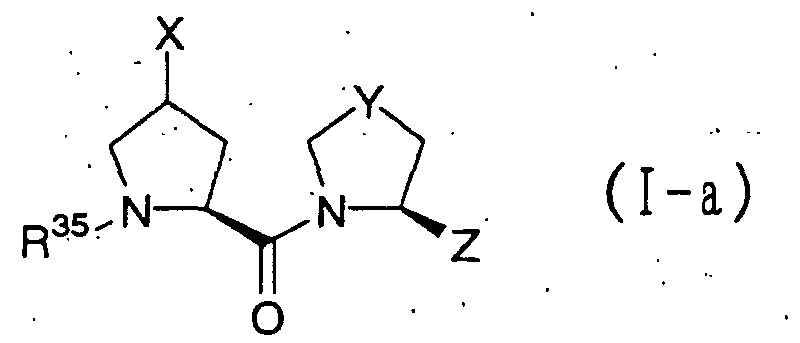
wherein
- X
- shows -NR1R2 wherein R1 and R2 may be the same or
different and each is independently a hydrogen atom,
alkyl, cycloalkyl, cycloalkylalkyl, aryl, arylalkyl,
heteroaryl or heteroarylalkyl, or may be bonded to
each other to form a heterocycle optionally
containing 1 or 2 nitrogen atoms or oxygen atoms, the
heterocycle optionally being condensed with an
aromatic ring optionally having substituents, and the
heterocycle optionally being a spiro ring,
-NR3COR4 wherein R3 and R4 are the same or different and
each is independently a hydrogen atom, alkyl,
cycloalkyl, cycloalkylalkyl, aryl, arylalkyl,
arylalkenyl, heteroaryl or heteroarylalkyl,
-NR5CONR6R7 or -NR5CH2CH2NR6R7 wherein R5, R6 and R7 are
the same or different and each is independently a
hydrogen atom, alkyl, acyl, cycloalkyl,
cycloalkylalkyl, aryl, arylalkyl, heteroaryl or
heteroarylalkyl, or R6 and R7 may be bonded to each
other to form a heterocycle optionally containing 1
or 2 nitrogen atoms or oxygen atoms, said heterocycle
optionally being condensed with an aromatic ring
optionally having substituents, or
-NR8SO2R9 wherein R8 and R9 are the same or different
and each is independently a hydrogen atom, alkyl,
cycloalkyl, cycloalkylalkyl, aryl, arylalkyl,
heteroaryl or heteroarylalkyl,
- Y
- is CH2, CH-OH, S, S=O or SO2,
- Z
- is a hydrogen atom or a cyano,
- R35
- is -COR41 wherein R41 is a hydrogen atom, alkyl,
cycloalkyl, cycloalkylalkyl, aryl, arylalkyl, heteroaryl
or heteroarylalkyl, or -COOR42 wherein R42 is alkyl,
cycloalkyl, cycloalkylalkyl, aryl, arylalkyl, heteroaryl
or heteroarylalkyl, and
of the above-mentioned groups, alkyl, cycloalkyl,
cycloalkylalkyl, aryl, arylalkyl, arylalkenyl, heteroaryl,
heteroarylalkyl and heterocycle each optionally have
substituents. (7) A compound of the formula (I-b)
wherein
- Z
- is a hydrogen atom or a cyano, and
- R35
- is -COR41 wherein R41 is a hydrogen atom, alkyl,
cycloalkyl, cycloalkylalkyl, aryl, arylalkyl, heteroaryl
or heteroarylalkyl, or -COOR42 wherein R42 is alkyl,
cycloalkyl, cycloalkylalkyl, aryl, arylalkyl, heteroaryl
or heteroarylalkyl, and
of the above-mentioned groups, alkyl, cycloalkyl,
cycloalkylalkyl, aryl, arylalkyl, heteroaryl and
heteroarylalkyl each optionally have substituents.
The present invention further relates to the following
compositions for pharmaceutical agents. (8) A pharmaceutical composition containing an L-proline
derivative of any of the aforementioned (1)-(5) or a
pharmaceutically acceptable salt thereof, and a
pharmacologically acceptable carrier. (9) A DPP-IV inhibitor containing an L-proline derivative of
any of the aforementioned (1)-(5) or a pharmaceutically
acceptable salt thereof as an active ingredient. (10) A therapeutic agent for the disease where DPP-IV is
involved, which contains an L-proline derivative of any of the
aforementioned (1)-(5) or a pharmaceutically acceptable salt
thereof as an active ingredient. (11) The therapeutic agent of the aforementioned (10), wherein
the aforementioned disease is diabetes, obesity, HIV infection,
cancer metastasis, dermopathy, prostatic hyperplasia,
periodontitis or autoimmune disease.
The symbols used in the present specification are
explained in the following.
Alkyl is preferably linear or branched alkyl having 1 to
8 carbon atoms, such as methyl, ethyl, propyl, isopropyl, butyl,
isobutyl, tert-butyl, pentyl, hexyl, octyl and the like.
Acyl. is preferably linear or branched and has 1 to 8
carbon atoms, such as formyl, acetyl, propionyl, butyryl,
isobutyryl, valeryl, isovaleryl, hexanoyl and the like.
Cycloalkyl preferably has 3 to 7 carbon atoms, and is
exemplified by cyclopropyl, cyclopentyl, cyclohexyl,
cycloheptyl and the like.
Cycloalkylalkyl has a cycloalkyl moiety, which is
equivalent to that mentioned above, and an alkyl moiety which
is preferably linear or branched and has 1 to 3 carbon atoms.
Examples thereof include cyclopropylmethyl, 2-cyclobutylethyl,
3-cyclopentylpropyl, cyclohexylmethyl, 2-cyclohexylethyl,
cycloheptylmethyl and the like.
Aryl is preferably phenyl, naphthyl or ortho fused
bicyclic group having 8 to 10 ring atoms wherein at least one
ring is an aromatic ring (e.g., indenyl) and the like.
Arylalkyl has an aryl moiety, which is equivalent to
that mentioned above, and an alkyl moiety which is preferably
linear or branched and has 1 to 3 carbon atoms. Examples
thereof include benzyl, benzhydryl, phenethyl, 3-phenylpropyl,
1-naphthylmethyl, 2-(1-naphthyl)ethyl, 2-(2-naphthyl)ethyl, 3-(2-naphthyl)propyl
and the like.
Arylalkenyl has an aryl moiety, which is equivalent to
that mentioned above, and an alkenyl moiety which has 2 or 3
carbon atoms and is linear or branched. Examples thereof
include styryl and the like.
Heteroaryl is preferably a 5 or 6-membered ring group
having carbon and 1-4 hetero atoms (oxygen, sulfur or nitrogen),
an ortho fused bicyclic heteroaryl having 8 to 10 ring atoms,
which is derived therefrom, particularly a benz derivative,
those derived from fusing a propenylene, trimethylene or
tetramethylene group therewith, stable N-oxide thereof and the
like. Examples thereof include pyrrolyl, furyl, thienyl,
oxazolyl, isoxazolyl, imidazolyl, thiazolyl, isothiazolyl,
pyrazolyl, triazolyl, tetrazolyl, 1,3,5-oxadiazolyl, 1,2,4-oxadiazolyl,
1,3,4-oxadiazolyl, 1,2,4-thiadiazolyl, pyridyl,
pyrazinyl, pyrimidinyl, pyridazinyl, 1,2,4-triazinyl, 1,2,3-triazinyl,
1,3,5-triazinyl, benzoxazolyl, benzisoxazolyl,
benzothiazolyl, benzisothiazolyl, benzimidazolyl,
oxazolopyridyl, imidazopyridazinyl, thianaphthenyl,
isothianaphthenyl, benzofuranyl, isobenzofuranyl, benzothienyl,
chromenyl, isoindolyl, indolyl, indolinyl, indazolyl,
isoquinolyl, quinolyl, phthalazinyl, quinoxalinyl, quinazolinyl,
cinnolinyl, 2,1,3-benzoxadiazolyl, benzoxazinyl and the like.
Heteroarylalkyl has a heteroaryl moiety, which is
equivalent to that mentioned above, and an alkyl moiety which_
is preferably has 1 to 3 carbon atoms and linear or branched.
Examples thereof include 2-pyrrolylmethyl, 2-pyridylmethyl, 3-pyridylmethyl,
4-pyridylmethyl, 2-thienylmethyl, 2-(2-pyridyl)ethyl,
2-(3-pyridyl)ethyl, 2-(4-pyridyl)ethyl, 3-(2-pyrrolyl)propyl,
4-imidazolylmethyl and the like.
Heterocycle is a saturated or unsaturated monocyclic 4
to 7-membered ring group or 10 or 11-membered ring group, which
is a spiro ring, having carbon and at least one nitrogen, and
optionally other hetero atom (oxygen or sulfur). Examples
thereof include azetidinyl, pyrrolidinyl, piperidino,
piperazinyl, morpholino, 1,4-diazepanyl, 1,2,5,6-tetrahydropyridyl,
thiomorpholino, oxothiomorpholino,
dioxothiomorpholino, 3-azaspiro[5,5]undecyl, 1,3,8-triazaspiro[4,5]decyl
and the like.
Moreover, the above-mentioned heterocycle may be
condensed with an aromatic ring (e.g., benzene ring, pyridine
ring and the like) optionally having substituents. Examples
thereof include indolinyl, isoindolinyl, 1,2,3,4-tetrahydroquinolyl,
1,2,3,4-tetrahydroisoquinolyl, phthalimido,
indolyl and the like.
Halogen is exemplified by chlorine, bromine, fluorine
and iodine.
Haloalkyl is exemplified by trifluoromethyl, 2,2,2-trifluoroethyl,
pentafluoroethyl and the like.
Of the above-mentioned substituents, alkyl, cycloalkyl,
cycloalkylalkyl, aryl, arylalkyl, arylalkenyl, heteroaryl,
heteroarylalkyl and heterocycle are optionally substituted by
the following 1 or more substituents.
The substituents may be, for example, halogen, hydroxyl
group, nitro, cyano, trifluoromethyl, alkyl, alkoxy, alkylthio,
formyl, acyloxy, oxo, phenyl, 2-pyridyl, 3-pyridyl, 4-pyridyl,
4-piperidinyl, 2-morpholinoethyl, 3-picolyl, arylalkyl, -COORa,
-CH2COORa, -OCH2COORa, -CONRbRc, -CH2CQNRbRc (Q is =O or =S),
-OCH2CONRbRc, -COO(CH2)2NReRf, -SO2T1, -CONRdSO2T1, -NReRf,
-NRgCHO, -NRgCOT2, -NRgCOOT2, -NRgCONRiRj, -NRkSO2T3,-SO2NR1Rm, -SO2NRnCOT4, methylenedioxy, ethyleneoxy and the
like.
These substituents may have substituents, and phenyl, 2-pyridyl
and 4-piperidinyl having substituents are exemplified
by 4-cyanophenyl, 4-chlorophenyl, 4-methoxyphenyl, 5-cyano-2-pyridyl,
1-ethoxycarbonyl-4-piperidinyl and the like.
In the above-mentioned substituents of the substituents,
halogen, alkyl and arylalkyl are exemplified by those mentioned
above.
Alkoxy is linear or branched and preferably has 1 to 8
carbon atoms. Examples thereof include methoxy, ethoxy,
propoxy, butoxy, pentyloxy, hexyloxy, octyloxy and the like.
Alkylthio is linear or branched and preferably has 1 to 8
carbon atoms. Examples thereof include methylthio, ethylthio,
propylthio, butylthio, pentylthio, hexylthio, octylthio and the
like. Acyloxy is linear or branched and preferably has 1 to 8
carbon atoms. Examples thereof include formyloxy, acetyloxy,
propionyloxy, butyryloxy, valeryloxy, pivaloyloxy, hexanoyloxy,
benzoyloxy and the like.
Ra-Rn show hydrogen, alkyl (as defined above) or
arylalkyl (as defined above). Rb and Rc, Re and Rf, Ri and Rj,
and Rl and Rm of -NRbRc, -NReRf, -NRiRj and -NRlRm may be
respectively bonded to each other to form heterocycles each
optionally having 1 or 2 nitrogen atoms or oxygen atoms, and
the heterocycle may be condensed with an aromatic ring
optionally having substituents (as defined above, and
optionally substituted by the aforementioned substituents).
Moreover, -NReRf may show a heteroaryl having =O (e.g., 2-pyrrolidinon-1-yl,
succinimido, oxazolidin-2-on-3-yl, 2-benzoxazolinon-3-yl,
phthalimido, cis-hexahydrophthalimido and
the like). T1-T4 show hydrogen atom, alkyl, cycloalkyl,
cycloalkylalkyl, aryl, arylalkyl, heteroaryl, heteroarylalkyl
or haloalkyl, which may be substituted by the aforementioned
substituents.
Due to the asymmetric carbon, to which X is bonded, in
compound (I), compound (I) can be present as an optically
active compound or a diastereomer mixture, and the diastereomer
mixture can be separated into each optically active compound by
a known method.
The compound (I) can show polymorphism, and can be
present as two or more tautomers.
Therefore, the present invention encompasses any of the
above-mentioned stereoisomers, optical isomers, polymorphs,
tautomers, optional mixtures thereof and the like.
The pharmaceutically acceptable salt of compound (I)
includes, for example, inorganic acid addition salts (e.g.,
salts with hydrochloric acid, hydrobromic acid, hydriodic acid,
sulfuric acid, nitric acid, phosphoric acid and the like),
organic acid addition salts (e.g., salts with methanesulfonic
acid, benzenesulfonic acid, p-toluenesulfonic acid, formic acid,
acetic acid, trifluoroacetic acid, oxalic acid, citric acid,
malonic acid, fumaric acid, glutaric acid, adipic acid, maleic
acid, tartaric acid, succinic acid, mandelic acid, malic acid,
pantothenic acid, methylsulfuric acid and the like), salts with
amino acids (e.g., salts with glutamic acid, aspartic acid and
the like), and the like.
The L-proline derivative of the present invention can be
produced by the following method.
Scheme 1 shows a production method of a compound of the
formula (I) wherein X is -OR
10 or -OCOR
11.
wherein R
35 is an amino acid-protecting group (e.g., tert-butoxycarbonyl
(Boc) and benzyloxycarbonyl (Cbz)), R
36 is a
hydroxyl-protecting group (e.g., tert-butyldimethylmethylsilyl,
triisopropylsilyl and tert-butyldiphenylsilyl), A' is R
10 or
COR
11 and other symbols are as defined above.
When Z of a compound of the formula (VIII) is cyano,
this compound can be prepared by a method described in a
reference [Ashworth et al., Bioorganic & Medicainal Chemistry
Letters, vol. 6, 1163-1166 (1996)] or a conventional method
based on such reference. A compound of the formula (IX')
[hereinafter to be referred to as compound (IX')] can be
prepared by silylation of hydroxyl group of hydroxyproline
derivative by a conventional method.
Step a: Compound (VIII) is reacted with compound (IX) to give
amide compound (XI), or compound (VIII) is reacted with
compound (IX') to give amide compound (X).
As a condensation agent for activating carboxylic acid
of compound (IX) or (IX'), there are recited, for example,
dicyclohexylcarbodiimide (DCC), N-(3-dimethylaminopropyl)-N'-ethylcarbodiimide
(EDC), hydrochloride thereof, 2-ethoxy-1-ethoxycarbonyl-1,2-dihydroxyquinoline
(EEDQ), carbodiimidazole
(CDI), diethylphosphoryl cyanide, benzotriazol-1-yloxytrispyrrolidinophosphonium
hexafluorophosphate (PyBOP),
diphenylphosphoryl azide (DPPA), isobutyl chloroformate,
diethylacetyl chloride, trimethylacetyl chloride and the like.
These condensation agent may be used alone, or an additive such
as N-hydroxysuccinimide (HONSu), hydroxybenzotriazole (HOBT) or
3-hydroxy-4-oxo-3,4-dihydro-1,2,3-benzotriazine (HOOBT), 4-dimethylaminopyridine
(DMAP) and the like is used in
combination.
This reaction is generally carried out in an inert
solvent and the inert solvent to be used may be any as long as
it is aprotic. Preferable examples include acetonitrile,
tetrahydrofuran, dichloromethane, chloroform, N,N-dimethylformamide
(DMF) and the like. This condensation is
carried out generally at a temperature of from -30°C to 80°C,
preferably from -10°C to 25°C.
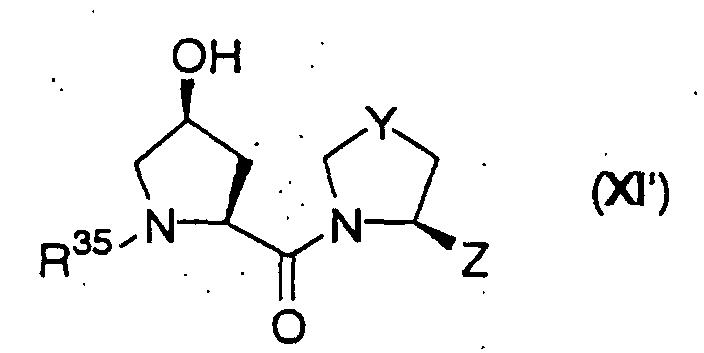
Step b: Compound (X) is deprotected to give compound (XI').
This reaction can be carried out in an inert solvent
such as tetrahydrofuran and the like, using tetrabutylammonium
fluoride and the like. The reaction mixture is preferably
buffered with an acid such as acetic acid and the like
generally at a temperature of from -30°C to 70°C for 10 min to
24 hr.
Step c: Compound (XI) is reacted to give compound (XII), or
compound (XI') is reacted to give compound (XII').
By acylation of hydroxyl group of compound (XI) or (XI')
by a general method, a compound of the formula (XII) or (XII'),
wherein A' is COR11, can be obtained. The synthetic method of
compound (XII) or (XII'), wherein R11 is alkyl, cycloalkyl,
cycloalkylalkyl, aryl, arylalkyl, heteroaryl or heteroarylalkyl,
is exemplified by a method including use of an active
carboxylic acid derivative such as acid halide, a method
including use of a carboxylic acid and a coupling agent, and
the like.
A compound of the formula (XII) or (XII') wherein A' is
R10 can be obtained by converting hydroxyl group of compound
(XI) or (XI') to alcoholate, which is followed by nucleophilic
substitution of alkyl halide and the like. The reaction is
carried out in the presence of a base such as sodium hydride
and the like, using alkyl halide and the like in an inert
solvent such as tetrahydrofuran and the like, generally at a
temperature of from -80°C to 60°C, preferably from -50°C to 25°C.
Step d: Compound (XI) is reacted to give compound (XII'), or
compound (XI') is reacted to give compound (XII).
The reaction is carried out in the presence of
phosphines such as triphenylphosphine, tributylphosphine and
the like and diazodicarboxylic acid diester, using R11COOH or
aryl or heteroaryl having a hydroxyl group, and the like in an
inert solvent such as toluene, tetrahydrofuran and the like,
generally at a temperature of from -30°C to 110°C, preferably
from 0°C to 25°C.
A compound of the formula (XII') or (XII), wherein A' is
COR11, can be obtained by sulfonylation of hydroxyl group of
compound (XI) or (XI'), and reacting the compound with
carboxylic acid salt. The sulfonylation is carried out in the
presence of a base such as pyridine, triethylamine and the like
using p-toluenesulfonyl chloride, methanesulfonyl chloride,
trifluoromethanesulfonyl chloride and the like, in an inert
solvent such as dichloromethane, 1,2-dichloroethane and the
like generally from -30°C to 60°C for 10 min to 24 hr. The
subsequent reaction with carboxylic acid salt is carried out in
the presence of an inorganic base such as potassium carbonate,
sodium carbonate and the like using R11COOH in an inert
solvent such as acetone, hexamethylphosphoramide and the like
generally from 0°C to 120°C for 10 min to 24 hr.
Step e: Compound (XII) is deprotected to give compound (XIII),
or compound (XII') is deprotected to give compound (XIII').
When, in this reaction, the protecting group is Boc
group, for example, the compound is reacted in a solvent such
as acetonitrile, tetrahydrofuran, 1,4-dioxane, ethyl acetate,
methanol, ethanol, chloroform and the like, using an acid such
as hydrogen chloride, trifluoroacetic acid and the like
generally from -30°C to 60°C for 10 min to 24 hr for
deprotection.
Scheme 2 shows a production method of a compound of the
formula (I) wherein X is -NR
1R
2.
wherein OSO
2R
37 is a leaving group (e.g., tosylate (OTs),
mesylate (OMs) or triflate (OTf)), Hal is halogen, R
38 and R
39
are the same or different and each is independently hydrogen
atom, alkyl, cycloalkyl, cycloalkylalkyl, aryl, arylalkyl,
heteroaryl or heteroarylalkyl, or may be bonded to each other
to form a heterocycle optionally containing 1 or 2 nitrogen
atoms or oxygen atoms, or the heterocycle may be condensed with
an aromatic ring optionally having substituents, and other
symbols are as defined above.
Step f: Hydroxyl group of compound (XI) is sulfonylated to give
compound (XIV).
This reaction is carried out in the presence of a base
such as pyridine, triethylamine and the like, using p-toluenesulfonyl
chloride, methanesulfonyl chloride,
trifluoromethanesulfonyl chloride and the like in an inert
solvent such as dichloromethane, 1,2-dichloroethane and the
like generally at a temperature of from -30°C to 60°C for 10
min to 24 hr.
Step g: Compound (XIV) is subjected to azidation to give
compound (XV).
The reaction is carried out using a metal azide, such as
sodium azide, in a solvent such as N,N-dimethylformamide and
the like generally at a temperature of from 0°C to 120°C for 30
min to 24 hr.
Step h: Compound (XV) is directly obtained from compound (XI).
The reaction is carried out in the presence of
phosphines such as triphenylphosphine, tributylphosphine and
the like, and diazodicarboxylic acid diester using hydrogen
azide, DPPA, zinc azide bispyridine complex salt and the like
in an inert solvent such as toluene, tetrahydrofuran and the
like generally at a reaction temperature of from -30°C to 100°C.
Step i: Compound (XV) is reduced to give compound (XVI).
For this reaction, catalytic reduction using palladium,
platinum, nickel and the like, reduction by metalhydride,
reduction by triphenylphosphine, thiol, sulfide, diborane, or
transition metal and the like are mentioned.
Step j: Compound (XVI) is reacted with compound (XVII) or
(XVII') to give compound (XIX).
The reaction is carried out in the presence of a base
such as triethylamine, diisopropylethylamine and the like in an
inert solvent such as N-methyl-2-pyrrolidone, N,N-dimethylformamide,
tetrahydrofuran and the like at a
temperature of from 0°C to near boiling point of solvent,
preferably from 0°C to 80°C.
Step k: Compound (XVI) is reacted with compound (XVIII), which
is followed by reduction to give compound (XIX).
This reaction is carried out in the presence of sodium
borohydride, sodium cyanoborohydride, sodium
triacetoxyborohydride and the like in an inert solvent such as
methanol, ethanol, dichloromethane, 1,2-dichloroethane,
tetrahydrofuran, acetonitrile, 1,4-dioxane and the like, and
using, where necessary, an acid catalyst such as acetic acid,
p-toluenesulfonic acid, boron trifluoride diethylether complex
and the like, generally at a temperature of from 0°C to 100°C
for 10 min to 20 hr.
By repeating Step j or k as necessary, compound (XIX)
wherein R1 and R2 may be the same or different can be obtained.
Step l: Compound (XIX) is directly obtained from compound (XI).
The reaction is carried out in the presence of
phosphines such as triphenylphosphine, tributylphosphine and
the like and diazodicarboxylic acid diester using
iminodicarbonates, sulfonamides, a nitrogen-containing compound
having N-H hydrogen and having high acidity, and the like in an
inert solvent such as toluene, tetrahydrofuran and the like.
Step m: Compound (XI) is oxidized to give (XX).
This reaction is carried out by, for example, a method
using pyridine sulfur trioxide complex and dimethyl sulfoxide
at room temperature. Examples of useful other methods include
a method using alkaline potassium permanganate solution; a
method using oxalyl chloride, dimethyl sulfoxide and tertiary
amine; a method using acetic anhydride and dimethyl sulfoxide;
a method using EDC and dimethyl sulfoxide with dichloroacetic
acid as a catalyst; a method using chromium oxide (XI) pyridine
complex in dichloromethane; a method using aqueous sodium
hypochlorite solution with TEMPO free radical as a catalyst in
the presence of sodium bromide in ethyl acetate and toluene,
and the like.
Step n: Compound (XX) is reacted with compound (XXI), which is
followed by reduction to give compound (XIX).
This reaction is carried out in the presence of sodium
borohydride, sodium cyanoborohydride, sodium
triacetoxyborohydride and the like, in an inert solvent such as
methanol, ethanol, dichloromethane, 1,2-dichloroethane,
tetrahydrofuran, acetonitrile, 1,4-dioxane and the like, and
using as necessary an acidic catalyst, such as acetic acid, p-toluenesulfonic
acid, boron trifluoride diethyl ether complex
and the like generally at a temperature of from 0°C to 100°C
for 10 min to 20 hr.
The compound (XXI) can be synthesized by a known method.
Step o is the same as Step e of Scheme 1.
The production method of a compound of the formula (I)
wherein X is -NR
3COR
4 is shown in Scheme 3.
wherein each symbol in the formula is as defined above.
The compound (XXIII) is the same as compound (XVI)
obtained in Scheme 2 or a compound (XIX) wherein one of R1 and
R2 is hydrogen atom.
Step p: Compound (XXIII) is reacted to give amide compound
(XXIV).
The reaction is carried out using R4COCl or R4CO2H after
conversion to an acid halide with thionyl chloride, thionyl
bromide and the like or conversion to a mixed acid anhydride
with pivaloyl chloride, isobutyl chloroformate and the like, in
the presence of a tertiary base such as triethylamine, pyridine,
N,N-dimethylaniline and the like, in an inert solvent such as
toluene, hexane, tetrahydrofuran, 1,4-dioxane, ethyl acetate,
chloroform, N,N-dimethylformamide, dimethyl sulfoxide,
hexamethylphosphoramide and the like, generally from 0°C to
120°C for 10 min to 10 hr.
For the reaction with R4CO2H, a condensation agent shown
in Step a can be also used and the reaction is carried out in
an inert solvent such as acetonitrile, tetrahydrofuran,
dichloromethane, chloroform, N,N-dimethylformamide and the like
generally at a temperature of from -30°C to 80°C, preferably
from -10°C to 25°C.
Step q is the same as Step e of Scheme 1.
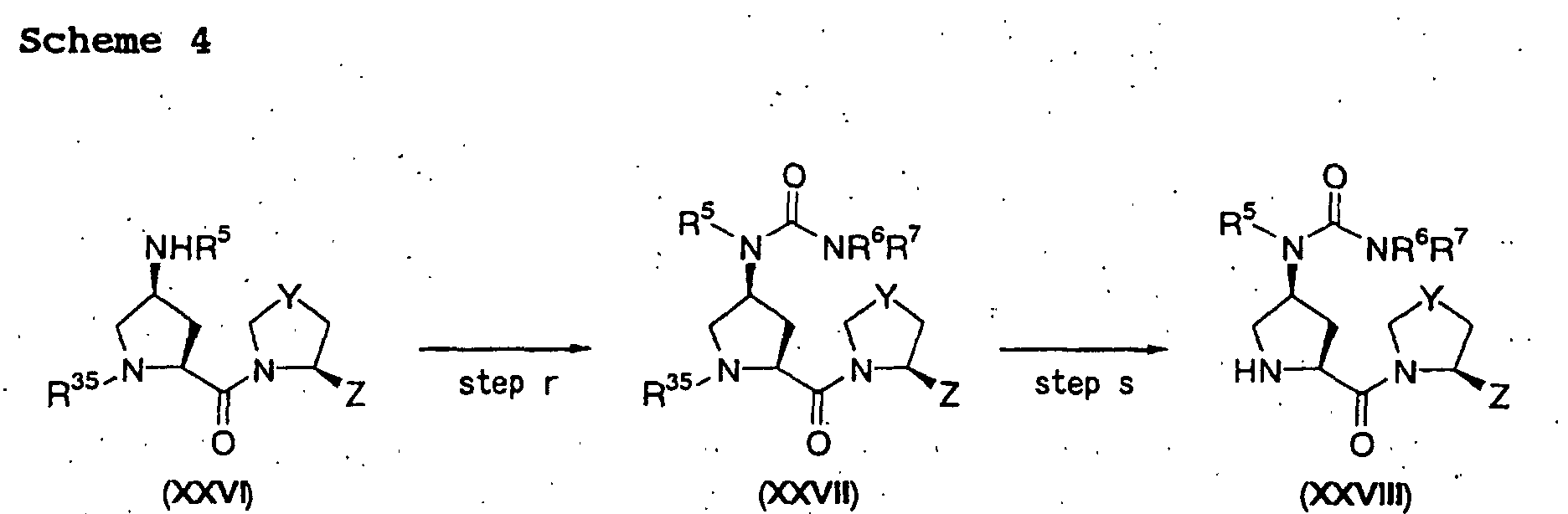
The production method of a compound of the formula (I)
wherein X is -NR
5CONR
6R
7 is shown in Scheme 4.
wherein each symbol in the formula is as defined above.
The compound (XXVI) is the same as compound (XVI)
obtained in Scheme 2 or a compound (XIX) wherein one of R1 and
R2 is hydrogen atom.
Step r: Compound (XXVI) is reacted to give urea compound
(XXVII).
The reaction is carried out using isocyanate such as R6-NCO
and the like in an inert solvent such as toluene,
chloroform, dichloromethane, tetrahydrofuran and the like
generally at a temperature of from -20°C to 80°C, preferably
from 0°C to 25°C.
Alternatively, there is a method using, for example,
carbodiimidazole, phosgene, diphosgene (trichloromethyl
chloroformate), triphosgene [bis(trichloromethyl)carbonate] and
the like, together with an amine represented by R6R7 NH and a
tertiary base such as triethylamine and the like.
Step s is the same as Step e of Scheme 1.
The production method of a compound of the formula (I)
wherein X is -NR
8SO
2R
9 is shown in Scheme 5.
wherein each symbol in the formula is as defined above.
The compound (XXIX) is the same as compound (XVI)
obtained in Scheme 2 or a compound (XIX) wherein one of R1 and
R2 is hydrogen atom.
Step t: Compound (XXIX) is reacted to give sulfonamide compound
(XXX).
The reaction is carried out using sulfonyl chloride such
as R9-SO2Cl and the like in the presence of an organic base
such as triethylamine, pyridine and the like or an inorganic
base such as sodium carbonate, potassium carbonate, sodium
hydroxide and the like, in a solvent such as water, toluene,
chloroform, dichloromethane, tetrahydrofuran and the like
generally at a temperature of from -20°C to 80°C.
Alternatively, there is a method wherein compound (XXIX)
and sulfuryl chloride are reacted in the presence of a tertiary
base such as triethylamine and the like in an inert solvent
such as chloroform, dichloromethane, tetrahydrofuran and the
like to give sulfamyl chloride, which is reacted with aryl
compound in the presence of a Lewis acid such as aluminum
chloride and the like.
Step u is the same as Step e of Scheme 1.
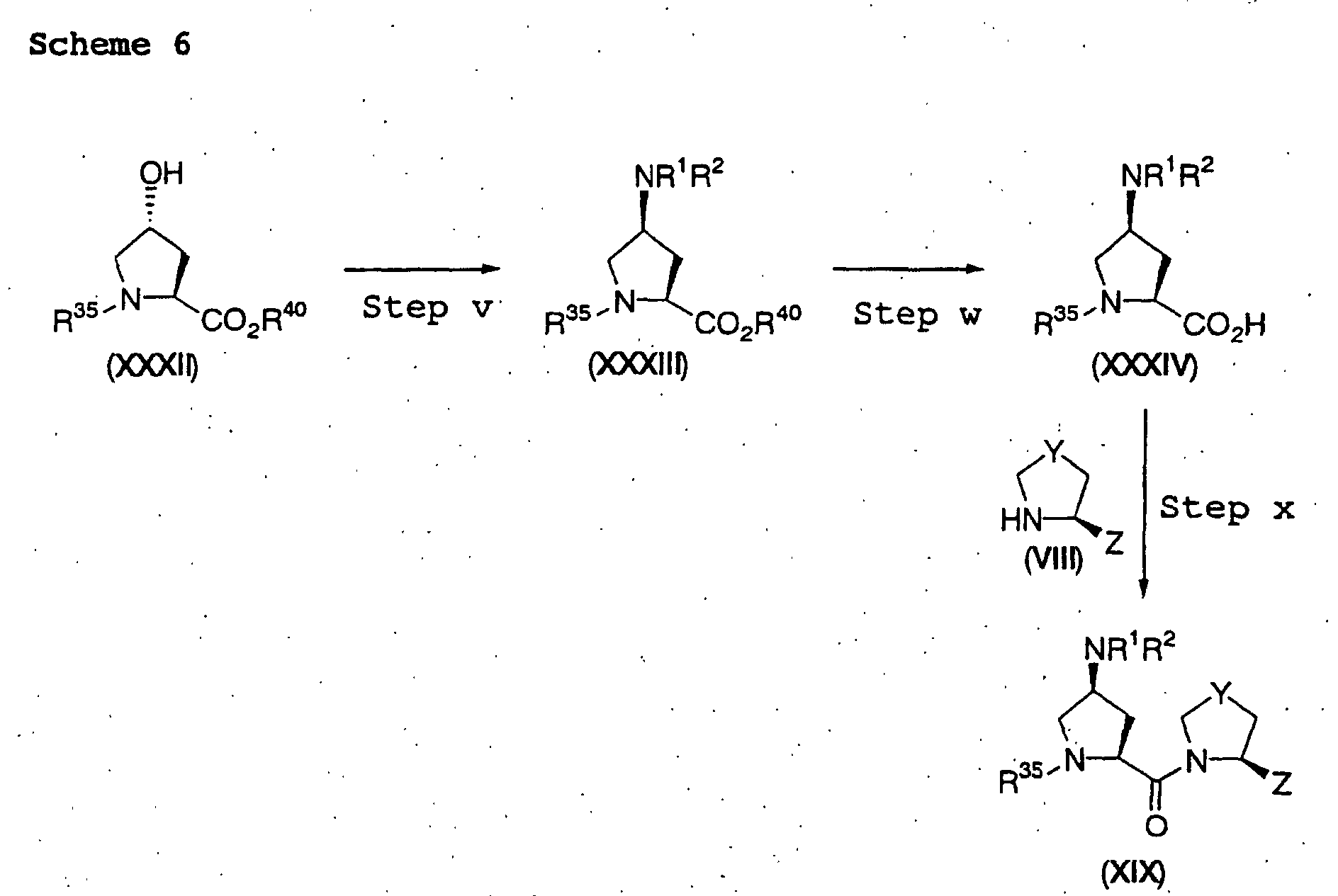
A different production method of compound (XXII) is
shown in Scheme 6. This production method is useful when both
R
1 and R
2 are not hydrogen atoms.
wherein R
40 is alkyl such as methyl, ethyl and the like,
benzyl and the like, and other symbols are as defined above.
Step v is the same as the method for conversion of
compound (XI) to compound (XIX) shown in Scheme 2.
Step w: Ester-protected carboxyl group of compound (XXXIII) is
deprotected to give compound (XXXIV).
For reaction, general deprotection can be used. For
example, sodium hydroxide, potassium hydroxide, sodium
carbonate, potassium carbonate and the like are hydrolyzed
under alkali conditions, or when R40 is benzyl, catalytic
hydrogenation and the like are conducted in the presence of
platinum, palladium and the like, in an inert solvent such as
methanol, ethanol and the like for deprotection.
Step x: Compound (VIII) and compound (XXXIV) are reacted to
give amide compound (XIX).
The reaction is carried out using a condensation agent
shown in Step a, in an inert solvent such as acetonitrile,
tetrahydrofuran, dichloromethane, chloroform, N,N-dimethylformamide
and the like generally at a temperature of
from -30°C to 80°C, preferably from -10°C to 25°C.
The compound of the formula (XXIV) shown in Scheme 3,
the compound of the formula (XXVII) shown in Scheme 4 and the
compound of the formula (XXX) shown in Scheme 5 can be produced
by the routes shown in Scheme 6.
The production method of compound (XXII), wherein the
asymmetric carbon, to which NR1R2 is bonded, is shown by S
configuration, is shown in Scheme 2 using the compound of the
formula (XI) as a starting material, and in Scheme 6, using the
compound of the formula (XXXII) as a starting material.
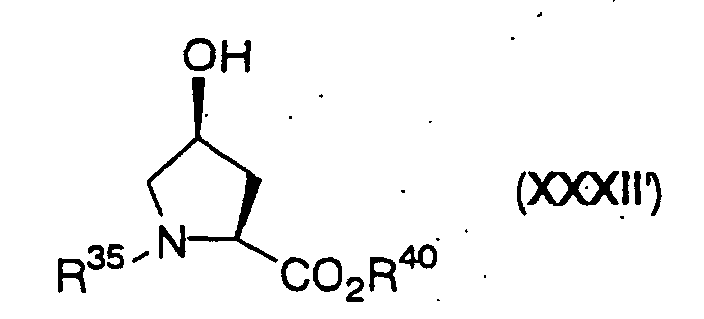
Besides the above-mentioned, a compound (XXII'), wherein
the asymmetric carbon, to which NR
1R
2 is bonded, is shown by R
configuration,
wherein each symbol in the formula is as defined above, can be
also produced by a method similar to the one mentioned above
using compound (XI')
wherein each symbol in the formula is as defined above, or a
compound (XXXII')
wherein each symbol in the formula is as defined above, as a
starting material.
When Z in each formula shows cyano, each compound up to
an intermediate is produced with Z of the formula as a
carbamoyl group and dehydrated by a known method for conversion
thereof to cyano group.
This reaction is carried out using diphosphorus
pentaoxide, phosphorus oxychloride-imidazole, trifluoroacetic
acid anhydride, p-toluenesulfonyl chloride-pyridine and the
like as a dehydrating agent in an inert solvent such as
dichloromethane, pyridine and the like.
The L-proline derivative of the formula (I) of the
present invention produced in this manner can be obtained at an
optional purity by applying a known separation and purification
means as necessary, such as concentration, extraction,
chromatography, reprecipitation, recrystallization and the like.
The L-proline derivative of the formula (I) can be
prepared into an acid addition salt as necessary with an
inorganic acid such as hydrochloric acid, hydrobromic acid,
hydriodic acid, sulfuric acid, nitric acid, phosphoric acid and
the like or an organic acid such as methanesulfonic acid,
benzenesulfonic acid, p-toluenesulfonic acid, formic acid,
acetic acid, trifluoroacetic acid, oxalic acid, citric acid,
malonic acid, fumaric acid, glutaric acid, adipic acid, maleic
acid, tartaric acid, succinic acid, mandelic acid, malic acid,
pantothenic acid, methylsulfuric acid and the like. In
addition, it is also present as a solvate such as hydrate and
the like.
The compound of the formula (I) or a pharmacologically
acceptable salt of the present invention has a superior DPP-IV
inhibitory activity in mammals (e.g., human, dog, cat, rat and
the like).
Therefore, the compound of the present invention (I) or
a pharmacologically acceptable salt thereof is useful as a DPP-IV
inhibitor and useful for the prophylaxis or treatment of
various diseases considered to be caused by DPP-IV, for example,
for the prophylaxis or treatment of diseases where GLP-1 is
considered to be involved (e.g., diabetes, obesity and the
like), and the like.
The compound (I) of the present invention can be
administered to a same subject with other therapeutic drug for
diabetes, therapeutic drug for diabetic complications, anti-hyperlipidemic
agent, antihypertensive agent and the like at
the same time or timelag. As used herein, examples of the
therapeutic drug for diabetes include insulin sensitivity
increasing agent, α-glucosidase inhibitor, biguanide agent and
the like. Examples of the therapeutic drug for diabetic
complications include aldose reductase inhibitor. As the antihyperlipidemic
agent, statin compound, which is a cholesterol
synthetase inhibitor, squalene synthetase inhibitor, fibrates
having triglyceride lowering effect, and the like can be
mentioned. As the antihypertensive agent, calcium antagonist,
angiotensin converting enzyme inhibitor, angiotensin II
antagonist and the like can be mentioned. When the compound of
the present invention is used on combination with multiple
agents, the mixing ratio thereof can be appropriately
determined depending on the subject of administration, age and
body weight of the administration subject, symptom,
administration time, dosage form, administration method,
combination and the like.
When the compound (I) of the present invention or an
acid addition salt thereof is used as the aforementioned
pharmaceutical agent, it is used on its own or admixed with an
appropriate pharmacologically acceptable carrier, an excipient,
a diluent and the like in the form of powder, granule, tablet,
capsule, injection and the like, and administered orally or
parenterally. The above-mentioned preparation contains an
effective amount of compound (I) or a pharmacologically
acceptable salt thereof.
While the dose of the compound (I) or a
pharmacologically acceptable salt thereof varies depending on
the administration route, target disease, symptom, body weight
and age of patients, and the compound to be used, it can be
determined as appropriately according to the administration
object. Generally, when orally administered to an adult, 0.01-1000
mg/kg body weight/day, preferably 0.05-500 mg/kg body
weight/day, is preferably administered once a day or in several
doses a day.
Examples
The present invention is explained in detail by
referring to Reference Examples and Examples, which are not
to be construed as limitative.
1H-NMR was measured at 300 MHz unless particularly
indicated. The chemical shift of 1H-NMR relative delta (δ)
value was expressed in parts per million (ppm) using
tetramethylsilane (TMS) as the internal standard. For the
coupling constant, obvious multiplicity is shown in hertz (Hz)
using s (singlet), d (doublet), t (triplet), q (quartet), quint
(quintet), m (multiplet), dd (doublet of doublets), td (triplet
of doublets), brs (broad singlet) and the like. Thin-layer
chromatography used was manufactured by Merck, and column
chromatography was performed using silica gel manufactured by
Fuji silysia chemical.
For drying organic solutions in extraction, anhydrous
sodium sulfate or anhydrous magnesium sulfate was used, unless
particularly indicated.
Reference Example 1
Synthesis of (S)-1-((2S,4S)-1-tert-butoxycarbonyl-4-hydroxy-2-pyrrolidinylcarbonyl)-2-cyanopyrrolidine
(1) N-tert-Butoxycarbonyl-L-cis-4-hydroxyproline (23.1 g) and
imidazole (30.0 g) were dissolved in DMF (300 mL). tertButyldimethylsilyl
chloride (33.3 g) was added thereto. After
stirring at room temperature for 16 hr, water (300 mL) was
gradually added under ice-cooling. The reaction solution was
acidified with 10% aqueous citric acid solution and extracted
with ethyl acetate. The extract was washed 3 times with water
and with brine, and dried. The solvent was distilled away
under reduced pressure. The residue was purified by silica gel
chromatography to give N-tert-butoxycarbonyl-L-cis-4-tert-butyldimethylsilyloxyproline
(27.4 g) as a white solid. (2) The above-mentioned compound (27.4 g) and (S)-2-cyanopyrrolidine
hydrochloride (10.4 g) were dissolved in DMF
(250 mL), and triethylamine (10.9 mL), HOBT (14.3 g) and EDC
hydrochloride (18.0 g) were added successively. The mixture
was stirred at room temperature for 15 hr. The reaction
mixture was added to saturated aqueous sodium hydrogencarbonate
solution, and extracted with ethyl acetate. The extract was
washed with water and brine, and dried. The solvent was
evaporated under reduced pressure. The residue was purified by
silica gel chromatography to give (S)-1-[(2S,4S)-1-tert-butoxycarbonyl-4-tert-butyldimethylsilyloxy-2-pyrrolidinylcarbonyl]-2-cyanopyrrolidine
(25.3 g) as a slightly
yellow oil. (3) The above-mentioned compound (25.3 g) was dissolved in
tetrahydrofuran (300 mL), and a 1.0 mol/L solution (60 mL) of
tetrabutylammonium fluoride in tetrahydrofuran was added
dropwise under ice-cooling. The mixture was stirred at room
temperature for 3 hr, and the solvent was evaporated under
reduced pressure. The residue was added to brine, and
extracted with ethyl acetate. The extract was dried, and the
solvent was evaporated under reduced pressure. The residue was
purified by silica gel chromatography to give the title
compound (20.6 g) as a white solid.
1 H-NMR(DMSO-d6)δ1.25-1.45(9H,m), 1,50-1.64(1H,m), 1.95-2.30(4H,m),
2.98-3.13(1H,m), 3.30-3.67(4H,m), 4.13-4.26(1H,m),
4.30-4.42(1H,m), 4.77-4.88(1H,m), 5.16(1H,d,J=6.5Hz).
Reference Example 2
Synthesis of (S)-1-((2S,4R)-1-tert-butoxycarbonyl-4-hydroxy-2-pyrrolidinylcarbonyl)-2-cyanopyrrolidine
N-tert-Butoxycarbonyl-L-trans-4-hydroxyproline (68.4 g)
and (S)-2-cyanopyrrolidine hydrochloride (39.2 g) were
dissolved in DMF (350 mL), and triethylamine (41.4 mL), HOBT
(49.9 g), and EDC hydrochloride (62.5 g) were successively
added. The mixture was stirred at room temperature for 15 hr.
The reaction mixture was concentrated and brine and saturated
aqueous sodium hydrogencarbonate solution were added to the
residue. The precipitated crystals were collected by
filtration. The filtrate was extracted with ethyl acetate and
the extract was dried. The solvent was evaporated under
reduced pressure. The residue and the crystals were combined
and washed with ethyl acetate to give the title compound (60.7
g) as a white solid.
1H-NMR(CDCl3)δ1.30-1.45(9H,m), 1.54-2.38(5H,m), 3.30-3.93(5H,m),
4.49-4.89(3H,m).
Reference Example 3
Synthesis of (S)-1-((2S,4S)-4-amino-1-tert-butoxycarbonyl-2-pyrrolidinylcarbonyl)-2-cyanopyrrolidine
(1) (S)-1-((2S,4R)-1-tert-Butoxycarbonyl-4-hydroxy-2-pyrrolidinylcarbonyl)-2-cyanopyrrolidine
(title compound of
Reference Example 2, 60.7 g) and triethylamine (30.1 mL) were
dissolved in DMF (300 mL). Methanesulfonyl chloride (16 mL)
was added thereto under ice-cooling. After stirring at room
temperature for 3 hr, the reaction mixture was washed with
water and dried. The solvent was evaporated under reduced
pressure. Ethanol was added to the residue to give (S)-1-((2S,4R)-1-tert-butoxycarbonyl-4-methanesulfonyloxy-2-pyrrolidinylcarbonyl)-2-cyanopyrrolidine
(64.1 g) as a white
solid. (2) The above-mentioned compound (64.1 g) and sodium azide
(11.8 g) were dissolved in DMF (250 mL), and the mixture was
stirred at 85°C for 5 hr. The reaction mixture was added to
water and the precipitated crystals were collected by
filtration to give (S)-1-((2S,4S)-4-azido-1-tert-butoxycarbonyl-2-pyrrolidinylcarbonyl)-2-cyanopyrrolidine
(50.1
g) as a white solid. (3) The above-mentioned compound (50.1 g) was dissolved in
ethanol (500 mL). The mixture was stirred under a hydrogen
atomosphere (1 atm) in the presence of 5% palladium/barium
sulfate (5.9 g). The reaction mixture was filtrated and the
filtrate was concentrated under reduced pressure. Diethyl
ether was added thereto and the precipitated solid was
collected by filtration to give the title compound (45.5 g) as
a white solid.
1H-NMR(CDCl3)δ1.23-1.52(10H,m), 1.60-2.47(8H,m), 2.86-3.00(1H,m),
3.43-3.65(3H,m), 4.25-4.40(1H,m), 4.75-5.02(1H,m).
Reference Example 4
Synthesis of (2S,4R)-1-tert-butoxycarbonyl-4-(5-cyano-2-pyridyl)aminopyrrolidine-2-carboxylic
acid
(1) N-tert-Butoxycarbonyl-L-cis-4-hydroxyproline (24.5 g) and
triethylamine (15.4 mL) were dissolved in dichloromethane (500
mL). Methanesulfonyl chloride (8.1 mL) was added thereto under
ice-cooling. After stirring at room temperature for 3 hr, the
reaction mixture was washed with water and dried. The solvent
was evaporated under reduced pressure. The residue was
dissolved in DMF (250 mL) and sodium azide (7.15 g) was added.
The mixture was stirred at 80°C for 3 hr, added to water and
extracted with ethyl acetate. The extract was dried, and the
solvent was evaporated under reduced pressure. The residue was
purified by silica gel chromatography to give methyl (2S,4R)-4-azido-1-tert-butoxycarbonylpyrrolidine-2-carboxylate
(18.4 g)
as an oil. (2) The above-mentioned compound (18.3 g) was dissolved in
methanol (200 mL), and the mixture was stirred under a hydrogen
atomosphere (1 atm) in the presence of 5% palladium/carbon (5.9
g). The reaction mixture was filtrated and the filtrate was
concentrated under reduced pressure to give methyl (2S,4R)-4-amino-1-tert-butoxycarbonylpyrrolidine-2-carboxylate
(16.6 g)
as an oil. (3) The above-mentioned compound (3.32 g) and triethylamine
(1.4 mL) were dissolved in tetrahydrofuran (20 mL), and 2-chloro-5-cyanopyridine
(1.0 g) was added thereto. The mixture
was stirred at 80°C for 4 hr. The reaction mixture was added
to water and extracted with ethyl acetate. The extract was
washed with saturated aqueous sodium hydrogencarbonate solution
and brine, and dried. The solvent was evaporated under reduced
pressure, and the residue was purified by silica gel
chromatography to give methyl (2S,4R)-1-tert-butoxycarbonyl-4-(5-cyano-2-pyridylamino)pyrrolidine-2-carboxylate
(1.2 g) as a
white solid. (4) The above-mentioned compound (0.94 g) was dissolved in
methanol (30 mL), and 1 mol/L aqueous sodium hydroxide solution
(3.0 mL) was added thereto. The mixture was stirred at room
temperature for 15 hr. The reaction mixture was concentrated
and 5% aqueous citric acid solution was added to the residue.
The mixture was extracted with ethyl acetate, and the extract
was washed with brine and dried. The solvent was evaporated
under reduced pressure to give the title compound (0.75 g) as
amorphous.
1H-NMR(CDCl3)δ1.33-1.57(9H,m), 2.14-2.68(2H,m), 3.27-3.55(1H,m),
3.82-4.00(1H,m), 4.33-4.57(2H,m), 6.23(1H,brs),
6.50(1H,d,J=8.7Hz), 7.64(1H,dd,J=8.7,2.1Hz)8.33(1H,d,J=2.1Hz).
Reference Example 5
Synthesis of (2S,4S)-4-(2-benzoxazolyl)amino-1-tert-butoxycarbonylpyrrolidine-2-carboxylic
acid
(1) N-tert-Butoxycarbonyl-L-trans-4-hydroxyproline (20.7 g) and
triethylamine (15.4 mL) were dissolved in dichloromethane (400
mL). p-Toluenesulfonic acid chloride (16.8 g) was added
thereto under ice-cooling. After stirring at room temperature
for 15 hr, the reaction mixture was washed with water and dried.
The solvent was evaporated under reduced pressure and the
residue was purified by silica gel chromatography to give
methyl (2S,4R)-1-tert-butoxycarbonyl-4-(p-toluenesulfonyloxy)pyrrolidine-2-carboxylate
(11.7 g). (2) The above-mentioned compound (11.7 g) was dissolved in DMF
(100 mL), and sodium azide (1.95 g) was added thereto. The
mixture was stirred at 80°C for 3 hr. The reaction mixture was
added to water, and extracted with ethyl acetate. The extract
was dried, and the solvent was evaporated under reduced
pressure. The residue was purified by silica gel
chromatography to give methyl (2S,4S)-4-azide-1-tert-butoxycarbonylpyrrolidine-2-carboxylate
(7.99 g) as an oil. (3) The above-mentioned compound (7.99 g) was dissolved in
methanol (150 mL). The mixture was stirred under a hydrogen
atomosphere (1 atm) in the presence of 10% palladium/carbon (2
g). The reaction mixture was filtrated and the filtrate was
concentrated under reduced pressure to give methyl (2S,4S)-4-amino-1-tert-butoxycarbonylpyrrolidine-2-carboxylate
(7.23 g)
as an oil. (4) The above-mentioned compound (2.4 g) and triethylamine (1.4
mL) were dissolved in tetrahydrofuran (20 mL), and 2-chlorobenzoxazole
(0.82 mL) was added thereto. The mixture was
stirred at 60°C for 3 hr. The reaction mixture was added to
water, and extracted with ethyl acetate. The extract was
washed with saturated aqueous sodium hydrogencarbonate solution
and dried. The solvent was evaporated under reduced pressure
and the residue was purified by silica gel chromatography. to
give methyl (2S,4S)-4-(2-benzoxazolyl)amino-1-tert-butoxycarbonylpyrrolidine-2-carboxylate
(1.49 g) as amorphous. (5) The above-mentioned compound (1.49 g) was dissolved in
methanol (50 mL), and 1 mol/L aqueous sodium hydroxide solution
(5.0 mL) was added thereto. The mixture was stirred for 15 hr
and concentrated. The residue was extracted with water and the
extract was washed with ethyl acetate. 5% Aqueous citric acid
solution was added thereto to give the title compound (1.39 g)
as a white solid.
1H-NMR(DMSO-d6)δ1.28-1.50(9H,m), 1.93-2.08(1H,m), 2.53-2.75(1H,m),
3.18-3.30(1H,m), 3.77-4.33(2H,m), 6.97-7.40(4H,m),
8.06-8.16(1H,m), 12.63(1H,brs).
Reference Example 6
Synthesis of (2S,4R)-4-(2-benzoxazolyl)amino-1-tert-butoxycarbonylpyrrolidine-2-carboxylic
acid
(1) Methyl (2S,4R)-4-amino-1-tert-butoxycarbonylpyrrolidine-2-carboxylate
[product of Reference Example 4(2), 3.32 g] and
triethylamine (1.4 mL) were dissolved in tetrahydrofuran (20
mL). 2-Chlorobenzoxazole (0.86 mL) was added thereto and the
mixture was stirred at room temperature for 48 hr. The
reaction mixture was added to water and extracted with ethyl
acetate. The extract was washed with saturated aqueous sodium
hydrogencarbonate solution and brine, and dried. The solvent
was evaporated under reduced pressure and the residue was
purified by silica gel chromatography to give methyl (2S,4R)-4-(2-benzoxazolyl)amino-1-tert-butoxycarbonylpyrrolidine-2-carboxylate
(1.48 g) as a white solid. (2) The above-mentioned compound (1.31 g) was dissolved in
methanol (30 mL) and 1 mol/L aqueous sodium hydroxide solution
(4.4 mL) was added thereto. The mixture was stirred at room
temperature for 15 hr and the reaction mixture was concentrated.
To the residue was added 5% aqueous citric acid solution and
the mixture was extracted with ethyl acetate. The extract was
washed with brine and dried. The solvent was evaporated under
reduced pressure to give the title compound (1.11 g) as a white
solid.
1H-NMR(CDCl3)δ1.32-1.68(9H,m), 2.20-2.80(2H,m), 3.37-3.62(1H,m),
3.88-4.10(1H,m), 4.37-4.68(2H,m), 7.01-7.43(4H,m).
Reference Example 7
Synthesis of (2S,4S)-4-benzoylamino-1-tert-butoxycarbonylpyrrolidine-2-carboxylic
acid
(1) Methyl (2S,4S)-4-amino-1-tert-butoxycarbonylpyrrolidine-2-carboxylate
[product of Reference Example 5(3), 2.4 g] and
triethylamine (2.0 mL) were dissolved in tetrahydrofuran (20
mL), and benzoyl chloride (1.1 mL) was added thereto. The
mixture was stirred for 1 hr. The reaction mixture was added
to water and extracted with ethyl acetate. The extract was
washed with saturated aqueous sodium hydrogencarbonate solution
and dried. The solvent was evaporated under reduced pressure
and the residue was purified by silica gel chromatography to
give methyl (2S,4S)-4-benzoylamino-1-tert-butoxycarbonylpyrrolidine-2-carboxylate
(1.63 g) as a white
solid. (2) The above-mentioned compound (1.5 g) was dissolved in
methanol (50 mL) and 1 mol/L aqueous sodium hydroxide solution
(4.7 mL) was added thereto. The mixture was stirred for 15 hr.
The reaction mixture was concentrated and 5% aqueous citric
acid solution was added to the residue. The mixture was
extracted with ethyl acetate, and the extract was washed with
brine and dried. The solvent was evaporated under reduced
pressure to give the title compound (1.1 g) as amorphous.
Reference Example 8
Synthesis of (2S,4R)-4-benzoylamino-1-tert-butoxycarbonylpyrrolidine-2-carboxylic
acid
(1) The product (3.32 g) of Reference Example 4(2) and
triethylamine (1.4 mL) were dissolved in tetrahydrofuran (20
mL), and benzoyl chloride (0.87 mL) was added thereto. The
mixture was stirred for 1 hr. The reaction mixture was added
to water and extracted with ethyl acetate. The extract was
washed with saturated aqueous sodium hydrogencarbonate solution
and dried. The solvent was evaporated under reduced pressure
and the residue was purified by silica gel chromatography to
give methyl (2S,4R)-4-benzoylamino-1-tert-butoxycarbonylpyrrolidine-2-carboxylate
(2.4 g) as amorphous. (2) The above-mentioned compound (2.4 g) was dissolved in
methanol (80 mL), and 1 mol/L aqueous sodium hydroxide solution
(8.2 mL) was added thereto. The mixture was stirred for 15 hr.
The reaction mixture was concentrated and 5% aqueous citric
acid solution was added to the residue. The mixture was
extracted with ethyl acetate, and the extract was washed with
brine and dried. The solvent was evaporated under reduced
pressure to give the title compound (1.9 g) as a white solid.
1H-NMR(CDCl3)δ1.33-1.55(9H,m), 2.12-2.75(2H,m), 3.31-3.60(1H,m),
3.84-4.00(1H,m), 4.30-4.81(2H,m), 6.16-6.55(4H,m), 7.38-7.80(5H,m).
Reference Example 9
Synthesis of 3-[(2S,4R)-1-tert-butoxycarbonyl-4-hydroxy-2-pyrrolidinylcarbonyl]-1,3-thiazolidine
N-tert-Butoxycarbonyl-L-trans-4-hydroxyproline (69.4 g)
and thiazolidine (29.4 g) were dissolved in DMF (300 mL), and
HOBT (50.5 g) and EDC hydrochloride (63.3 g) were successively
added thereto. The mixture was stirred at room temperature for
18 hr and the reaction mixture was concentrated. To the
concentrate were added brine and saturated aqueous sodium
hydrogencarbonate solution, and the mixture was extracted with
ethyl acetate. The extract was dried, and the solvent was
evaporated under reduced pressure to give the title compound
(56.3 g) as a colorless transparent oil.
1H-NMR(CDCl3)δ1.41-1.45(9H,m), 1.95-2.34(2H,m)2.62-3.25(2H,m),
3.40-3.98(4H,m),4.40-4.90(4H,m).
Reference Example 10
Synthesis of 3-((2S,4S)-4-amino-1-tert-butoxycarbonyl-2-pyrrolidinylcarbonyl)-1,3-thiazolidine
(1) 3-((2S,4R)-1-tert-Butoxycarbonyl-4-hydroxy-2-pyrrolidinylcarbonyl)-1,3-thiazolidine
(title compound of
Reference Example 9, 56.3 g) and triethylamine (28.5 mL) were
dissolved in dichloromethane (1.0 l), and methanesulfonyl
chloride (15.1 mL) was added thereto under ice-cooling. After
stirring under ice-cooling for 1 hr, the reaction mixture was
washed with water and dried. The solvent was evaporated under
reduced pressure to give 3-((2S,4R)-1-tert-butoxycarbonyl-4-methanesulfonyloxy-2-pyrrolidinylcarbonyl)-1,3-thiazolidine
(70.5 g) as an oil. (2) The above-mentioned compound (70.5 g) and sodium azide
(13.3 g) were dissolved in DMF (500 mL), and the mixture was
stirred at 80°C for 5 hr. The reaction mixture was
concentrated under reduced pressure and water was added thereto.
The mixture was extracted with ethyl acetate, and the organic
layer was dried and concentrated. The residue was purified by
silica gel chromatography to give 3-((2S,4S)-4-azido-1-tert-butoxycarbonyl-2-pyrrolidinylcarbonyl)-1,3-thiazolidine
(39.5
g) as a white solid. (3) The above-mentioned compound (26.7 g) was dissolved in
ethanol (270 mL) and the mixture was stirred under a hydrogen
atomosphere (1 atm) for 18 hr in the presence of 10% palladium
carbon catalyst (13.4 g). The reaction mixture was filtrated
and the filtrate was concentrated under reduced pressure to
give the title compound (24.5 g) as a black solid.
1H-NMR(CDCl3)δ1.40-1.45(9H,m), 1.70-1.83(1H,m), 2.07(2H,brs),
2.32-2.56(1H,m), 2.90-3.19(2H,m), 3.25-3.58(2H,m), 3.60-4.14(3H,m),
4.31-4.80(3H,m).
Reference Example 11
Synthesis of 3-((2S,4S)-1-tert-butoxycarbonyl-4-hydroxy-2-pyrrolidinylcarbonyl)-1,3-thiazolidine
(1) N-tert-Butoxycarbonyl-L-cis-4-tert-butyldimethylsilyloxyproline
[product of Reference Example 1
(1), 5.55 g] and thiazolidine (1.4 mL) were dissolved in DMF
(55 mL), and triethylamine (2.24 mL), HOBT (2.96 g) and EDC
hydrochloride (3.70 g) were successively added thereto. The
mixture was stirred at room temperature for 13 hr. The
reaction mixture was added to saturated aqueous sodium
hydrogencarbonate solution, and extracted with ethyl acetate.
The extract was washed with water and brine and dried. The
solvent was evaporated under reduced pressure and the residue
was purified by silica gel chromatography to give 3-[(2S,4S)-1-tert-butoxycarbonyl-4-tert-butyldimethylsilyloxy-2-pyrrolidinylcarbonyl]-1,3-thiazolidine
(3.41 g) as a white
solid. (2) The above-mentioned compound (3.36 g) was dissolved in
tetrahydrofuran (50 mL), and a 1.0 mol/L solution (9 mL)
tetrabutylammonium fluoride in tetrahydrofuran was added
dropwise under ice-cooling. The mixture was stirred at room
temperature for 18 hr, and the solvent was evaporated under
reduced pressure. The residue was added to brine and extracted
with ethyl acetate. The extract was dried and the solvent was
evaporated under reduced pressure. The residue was purified by
silica gel chromatography to give the title compound (2.44 g)
as a white solid.
1H-NMR(DMSO-d6)δ1.25-1.45(9H,m), 1.52-1.70(1H,m), 2.35-2.50(1H,m),
2.95-3.20(3H,m), 3.50-3.80(3H,m), 4.10-4,25(1H,m),
4.37-4.78(3H,m), 5.18(1H,brs).
Reference Example 12
Synthesis of 3-((S)-1-tert-butoxycarbonyl-4-oxo-2-pyrrolidinylcarbonyl)-1,3-thiazolidine
The title compound (55.4 g) of Reference Example 9 and
triethylamine (46 mL) were dissolved in dichloromethane (350
mL). A solution of sulfur trioxide pyridine complex (52.4 g)
in dimethyl sulfoxide (150 mL) was added thereto under ice-cooling,
and the mixture was stirred for 2 hr. Saturated
aqueous sodium hydrogencarbonate solution was added to the
reaction mixture, arid the mixture was extracted with ethyl
acetate. The extract was washed with brine and dried. The
solvent was evaporated under reduced pressure and the residue
was purified by silica gel chromatography to give the title
compound (30.3 g) as a white solid.
1H-NMR(CDCl3)δ1.47(9H,s), 2.45-2.57(1H,m), 2.70-2.93(1H,m),
2.97-3.22(2H,m), 3.66-3.78(0.6H,m), 3.80-4.10(3H,m), 4.28-4.38(0.4H,m),
4.45-5.08(3H,m).
Reference Example 13
Synthesis of (2S,4S)-1-tert-butoxycarbonyl-4-(1-indolyl)pyrrolidine-2-carboxylic
acid
(1) N-tert-Butoxycarbonyl-L-trans-4-hydroxyproline benzyl ester
(20.3 g) and triethylamine (17.6 mL) were dissolved in
dichloromethane (120 mL), and a solution of sulfur trioxide
pyridine complex (25.1 g) in dimethyl sulfoxide (60 mL) was
added thereto under ice-cooling, and the mixture was stirred
for 5 hr. Saturated aqueous sodium hydrogencarbonate solution
was added to the reaction mixture, and the mixture was
extracted with ethyl acetate. The extract was washed with
brine and dried. The solvent was evaporated under reduced
pressure and the residue was purified by silica gel
chromatography to give benzyl (S)-1-tert-butoxycarbonyl-4-oxopyrrolidine-2-carboxylate
(9.76 g) as an oil. (2) The above-mentioned compound (2.50 g), indoline (1.05 mL)
and acetic acid (0.45 mL) were dissolved in 1,2-dichloroethane
(40 mL), and sodium triacetoxyborohydride (3.32 g) was added
thereto. The mixture was stirred at room temperature for 6 hr
and saturated aqueous sodium hydrogencarbonate solution was
added to the reaction mixture. The mixture was extracted with
ethyl acetate, and the extract was washed with brine and dried.
The solvent was evaporated under reduced pressure and the
residue was purified by silica gel chromatography to give
benzyl (2S,4S)-1-tert-butoxycarbonyl-4-(1-indolinyl)pyrrolidine-2-carboxylate
(2.59 g) as an oil. (3) The above-mentioned compound (2.53 g) was dissolved in
acetone (50 mL) and manganese dioxide (7.51 g) was added
thereto. The mixture was stirred at room temperature for 12 hr
and the reaction mixture was filtrated. The filtrate was
concentrated under reduced pressure and the residue was
purified by silica gel chromatography to give benzyl (2S,4S)-1-tert-butoxycarbonyl-4-(1-indolyl)pyrrolidine-2-carboxylate
(2.43 g) as an oil. (4) The above-mentioned compound (2.42 g) was dissolved in
methanol (50 mL) and the mixture was stirred under a hydrogen
atomosphere (1 atm) for 20 hr in the presence of 10%
palladium/carbon (0.25 g). The reaction mixture was filtrated
and the filtrate was concentrated under reduced pressure to
give the title compound (1.91 g) as a pale-green solid.
1H-NMR(CDCl3)δ1.49(9H,s), 2.37-3.00(2H,m), 3.60-3.85(1H,m),
4.05-4.25(1H,m), 4.40-4.60(1H,m), 4.95-5.10(1H,m), 6.54(1H,s),
7.13(1H,t,J=7.7Hz), 7.18-7.28(2H,m), 7.38(1H,d,J=8.2Hz),
7.62(1H,d,J=7.7Hz).
Reference Example 14
Synthesis of 1-((S)-1-tert-butoxycarbonyl-4-oxo-2-pyrrolidinylcarbonyl)pyrrolidine
(1) N-tert-Butoxycarbonyl-L-trans-4-hydroxyproline (46.25 g)
and pyrrolidine (18 mL) were dissolved in DMF (200 mL), and
HOBT (45.5 g) and EDC hydrochloride (46.0 g) were successively
added thereto. The mixture was stirred at room temperature for
13 hr, and the solvent was evaporated under reduced pressure.
Saturated aqueous sodium hydrogencarbonate solution was added
to the residue, and the mixture was extracted with ethyl
acetate. The extract was dried and the solvent was evaporated
under reduced pressure to give 1-((2S,4R)-1-tert-butoxycarbonyl-4-hydroxy-2-pyrrolidinylcarbonyl)pyrrolidine
(59.3 g) as an oil. (2) The above-mentioned compound (59.3 g) and triethylamine (41
mL) were dissolved in dichloromethane (350 mL), and a solution
of sulfur trioxide pyridine complex (46.5 g) in dimethyl
sulfoxide (100 mL) was added thereto under ice-cooling. The
mixture was stirred for 2 hr and saturated aqueous sodium
hydrogencarbonate solution was added to the reaction mixture.
The mixture was extracted with ethyl acetate, and the extract
was washed with brine and dried. The solvent was evaporated
under reduced pressure. The residue was purified by silica gel
chromatography to give the title compound (11.9 g) as a white
solid.
1H-NMR(CDCl3)δ1.47(9H,s), 1.80-2.08(4H,m), 2.42-2.53(1H,m),
2.68-2.88(1H,m), 3.35-3.58(3H,m), 3.62-4.13(3H,m),
4.85(0.4H,d,J=9.0Hz), 4.99(0.6H,d,J=8.7Hz).
Reference Example 15
Synthesis of 3-((2S,4R)-4-amino-1-tert-butoxycarbonyl-2-pyrrolidinylcarbonyl)-1,3-thiazolidine
(1) The title compound (13.6 g) of Reference Example 11 was
dissolved in dichloromethane (250 mL), and triethylamine (7 mL)
was added thereto. Methanesulfonyl chloride (3.64 mL) was
added to the reaction mixture under ice-cooling, and the
mixture was stirred for 1 hr. Water was added to the reaction
mixture and the organic layer was separated. The solvent was
evaporated under reduced pressure and the residue was dissolved
in DMF (200 mL). Sodium azide (3.25 g) was added thereto and
the mixture was stirred at 85°C for 3 hr with heating. The
reaction mixture was concentrated under reduced pressure and
water was added to the residue. The mixture was extracted with
ethyl acetate and the extract was concentrated under reduced
pressure. The residue was purified by silica gel
chromatography to give 3-((2S,4R)-4-azido-1-tert-butoxycarbonyl-2-pyrrolidinylcarbonyl)-1,3-thiazolidine
(9.9 g). (2) The above-mentioned compound (9.9 g) was dissolved in
ethanol (150 mL) and the mixture was stirred at room
temperature for 18 hr under a hydrogen atomosphere (1 atm) in
the presence of 10% palladium/carbon (10 g). The reaction
mixture was filtrated and the filtrate was concentrated under
reduced pressure to give the title compound (10.1 g) as a black
solid.
1H-NMR(500MHz,DMSO-d6)δ1.30(4.5H,s), 1.38(4.5H,s), 1.42-1.52(1H,m),
2.05(2H,brs), 2.33-2.45(1H,m), 2.92-3.88(7H,m),
4.37-4.72(3H,m).
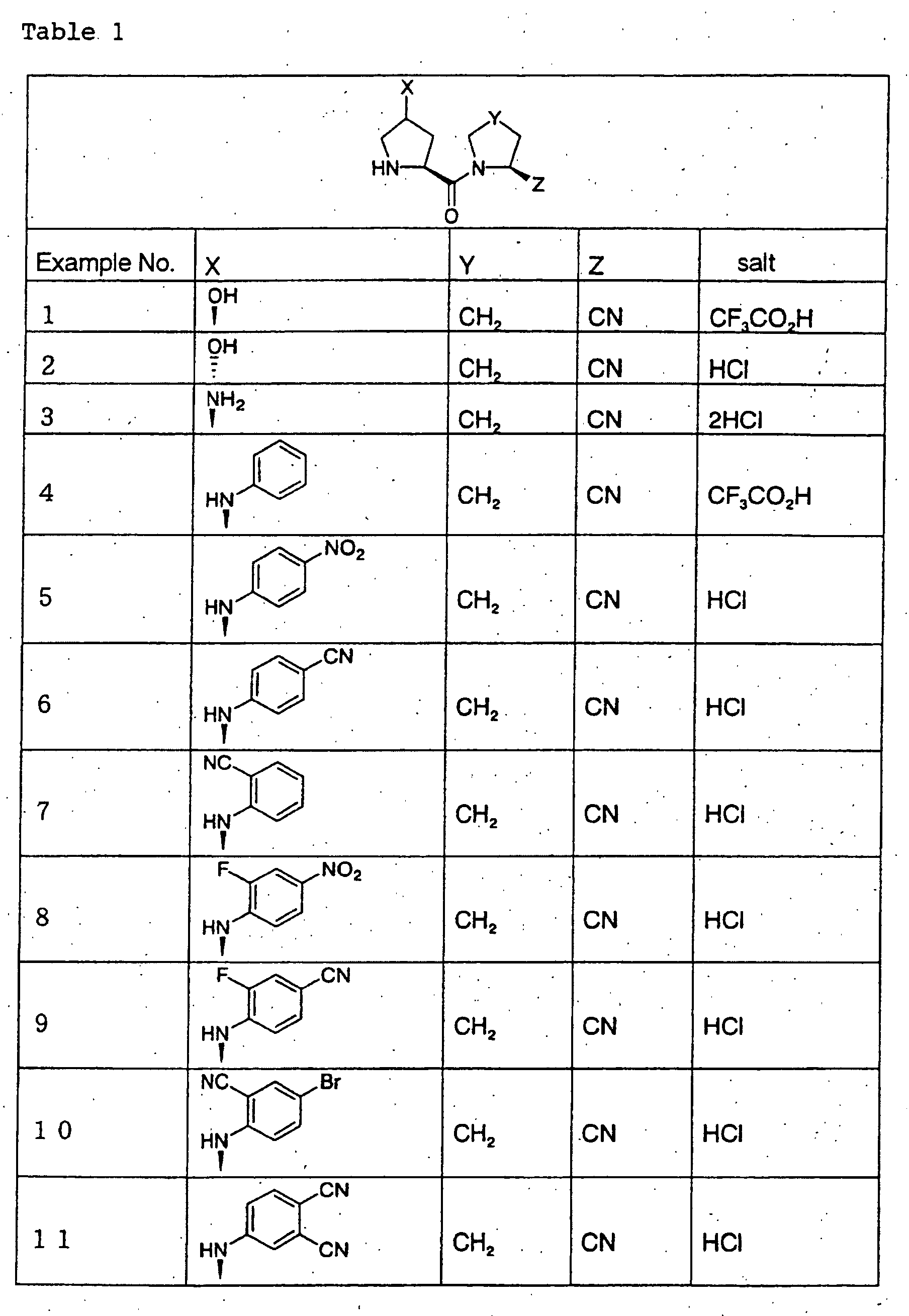
Example 1
Synthesis of (S)-2-cyano-1-((2S,4S)-4-hydroxy-2-pyrrolidinylcarbonyl)pyrrolidine
trifluoroacetate
(S)-1-((2S,4S)-1-tert-Butoxycarbonyl-4-hydroxy-2-pyrrolidinylcarbonyl)-2-cyanopyrrolidine
(title compound of
Reference Example 1, 544 mg) was dissolved in dichloromethane
(18 mL), and trifluoroacetic acid (1.8 mL) was added thereto.
The mixture was stirred at room temperature for 18 hr, and the
solvent was evaporated under reduced pressure. Ethanol and
diethyl ether were added to the residue and the precipitated
powder was collected by filtration to give the title compound
(350 mg) as powdery white crystals.
1H-NMR(DMSO-d6)δ1.68-2.85(6H,m), 3.10-3.30(2H,m), 3.44-3.70(2H,m),
4.30-4.60(2H,m), 4.78-5.09(1H,m), 5.35-5.50(1H,m),
9.18(2H,brs).
Example 2
Synthesis of (S)-2-cyano-1-((2S,4R)-4-hydroxy-2-pyrrolidinylcarbonyl)pyrrolidine
hydrochloride
The title compound (309 mg) of Reference Example 2 was
dissolved in 4 mol/L hydrochloric acid-1,4-dioxane (2 mL), and
the mixture was stirred at room temperature for 18 hr. The
solvent was evaporated under reduced pressure and the residue
was purified by HPLC to give the title compound (36 mg) as
powdery white crystals.
1H-NMR(DMSO-d6)δ1.85-2.44(6H,m), 3.05-3.72(4H,m), 4.41-4.60(2H,m),
4.78-5.16(1H,m), 5.55-5.70(1H,m).
Example 3
Synthesis of (S)-1-((2S,4S)-4-amino-2-pyrrolidinylcarbonyl)-2-cyanopyrrolidine
dihydrochloride
(S)-1-((2S,4S)-4-Amino-1-tert-butoxycarbonyl-2-pyrrolidinylcarbonyl)-2-cyanopyrrolidine
(title compound of
Reference Example 3, 308 mg) was dissolved in 4 mol/L
hydrochloric acid-1,4-dioxane (1.25 mL), and the mixture was
stirred at room temperature for 27 hr. The solvent was
evaporated under reduced pressure and tetrahydrofuran was added
thereto. The precipitated solid was collected by filtration to
give the title compound (214 mg).
1H-NMR(DMSO-d6)δ1.85-2.35(5H,m), 2.80-2.93(1H,m), 3.27-3.68(4H,m),
3.83-3.98(1H,m), 4.52-4.64(lH,m),
4.84(1H,d,J=4.5,7.8Hz), 8.81(3H,brs).
Example 4
Synthesis of (S)-1-((2S,4S)-4-anilino-2-pyrrolidinylcarbonyl)-2-cyanopyrrolidine
trifluoroacetate
(1) The title compound (6.18 g) of Reference Example 2 and
triethylamine (8.4 mL) were dissolved in dimethyl sulfoxide (15
mL). Sulfur trioxide pyridine complex (9.54 g) was added
thereto. After stirring at room temperature for 1 hr, water
was added to the reaction mixture, and the mixture was
extracted with ethyl acetate. The extract was washed with
water and dried. The solvent was evaporated under reduced
pressure and the residue was purified by silica gel
chromatography to give (S)-1-((2S)-1-tert-butoxycarbonyl-4-oxo-2-pyrrolidinylcarbonyl)-2-cyanopyrrolidine
(6.0 g) as an oil. (2) The above-mentioned compound (1.5 g) and aniline (0.43 mL)
were dissolved in methanol (25 mL), and the mixture was stirred
at room temperature for 6 hr in the presence of molecular sieve
3A (1.5 g). Sodium cyanoborohydride (0.315 g) and acetic acid
(0.4 mL) were added to the reaction mixture, and the mixture
was stirred for 1 hr. The reaction mixture was filtrated and
the filtrate was evaporated under reduced pressure. Saturated
aqueous sodium hydrogencarbonate solution was added to the
residue, and the mixture was extracted with ethyl acetate. The
extract was dried, and the solvent was evaporated under reduced
pressure. The residue was purified by silica gel
chromatography to give (S)-1-((2S,4S)-4-anilino-1-tert-butoxycarbonyl-2-pyrrolidinylcarbonyl)-2-cyanopyrrolidine
(0.74
g) as amorphous. (3) The above-mentioned compound (0.82 g) was dissolved in
dichloromethane (21 mL) and trifluoroacetic acid (2.1 mL) was
added thereto. The mixture was stood at room temperature for
15 hr, and the solvent was evaporated under reduced pressure.
The residue was purified by HPLC and freeze-dried to give the
title compound (0.246 g) as amorphous.
1H-NMR(DMSO-d6)δ1.52-2.33(5H,m), 2.87-3.22(2H,m), 3.75-5.13(8H,m),
6.50-6.67(3H,m), 7.03-7.20(2H,m), 8.91(1H,brs),
9.88(1H,brs).
Example 5
Synthesis of (S)-2-cyano-1-[(2S,4S)-4-(4-nitrophenyl)amino-2-pyrrolidinylcarbonyl]pyrrolidine
hydrochloride
(1) The title compound (0.924 g) of Reference Example 3,
diisopropylethylamine (1.7 mL) and 4-fluoronitrobenzene (0.53
mL) were dissolved in N-methyl-2-pyrrolidone (10 mL), and the
mixture was stirred at 80°C for 15 hr. Water was added to the
reaction mixture and the mixture was extracted with ethyl
acetate. The extract was dried, and the solvent was evaporated
under reduced pressure. The residue was purified by silica gel
chromatography to give (S)-1-[(2S,4S)-1-tert-butoxycarbonyl-4-(4-nitrophenyl)amino-2-pyrrolidinylcarbonyl]-2-cyanopyrrolidine
(1.14 g) as amorphous. (2) The above-mentioned compound (1.13 g) was dissolved in
ethyl acetate (3.5 mL), and 4 mol/L hydrochloric acid-ethyl
acetate (3.4 mL) was added thereto. The mixture was stood at
room temperature for 15 hr. The precipitated solid was
collected by filtration to give the title compound (0.67 g).
1H-NMR(DMSO-d6)δ1.74-2.37(6H,m), 2.90-3.10(1H,m), 3.27-3.97(3H,m),
4.37-4.70(2H,m), 4.80-5.20(1H,m), 6.90-7.34(2H,m),
7.88-8.03(2H,m), 9.09(1H,brs), 10.98(1H,brs).
Example 6
Synthesis of (S)-2-cyano-1-[(2S,4S)-4-(4-cyanophenyl)amino-2-pyrrolidinylcarbonyl]pyrrolidine
hydrochloride
(1) The title compound (924 mg) of Reference Example 3,
diisopropylethylamine (1.7 mL) and 4-fluorobenzonitrile (606
mg) were dissolved in N-methyl-2-pyrrolidone (10 mL), and the
mixture was stirred at 100°C for 15 hr. Water was added to the
reaction mixture, and the mixture was extracted with ethyl
acetate. The extract was dried and the solvent was evaporated
under reduced pressure. The residue was purified by silica gel
chromatography to give (S)-2-cyano-1-[(2S,4S)-1-tert-butoxycarbonyl-4-(4-cyanophenyl)amino-2-pyrrolidinylcarbonyl]pyrrolidine
(340 mg) as amorphous. (2) The above-mentioned compound (420 mg) was dissolved in
ethyl acetate (1.2 mL), and 4 mol/L hydrochloric acid-ethyl
acetate (1.2 mL) was added thereto. The mixture was stood at
room temperature for 15 hr and the precipitated solid was
collected by filtration to give the title compound (289 mg).
1H-NMR(DMSO-d6)δ1.62-1.80(1H,m), 1.97-2.33(4H,m), 2.90-3.24(2H,m),
3.64-3.96(3H,m), 4.20-4.63(2H,m), 4.80-5.13(1H,m),
6.70(2H,d,J=8.7Hz), 7.53(2H,d,J=8.7Hz), 9.00(1H,brs),
10.50(1H,brs).
Example 7
Synthesis of (S)-2-cyano-1-[(2S,4S)-4-(2-cyanophenyl)amino-2-pyrrolidinylcarbonyl]pyrrolidine
hydrochloride
(1) The title compound (924 mg) of Reference Example 3,
diisopropylethylamine (1.7 mL) and 2-fluorobenzonitrile (0.54
mL) were dissolved in N-methyl-2-pyrrolidone (10 mL), and the
mixture was stirred at 100°C for 15 hr. Water was added to the
reaction mixture, and the mixture was extracted with ethyl
acetate. The extract was dried and the solvent was evaporated
under reduced pressure. The residue was purified by silica gel
chromatography to give (S)-1-[(2S,4S)-1-tert-butoxycarbonyl-4-(2-cyanophenyl)amino-2-pyrrolidinylcarbonyl]-2-cyanopyrrolidine
(177 mg) as amorphous. (2) The above-mentioned compound (115 mg) was dissolved in
ethyl acetate (0.5 mL), and 4 mol/L hydrochloric acid-ethyl
acetate (0.35 mL) was added thereto. The mixture was stood at
room temperature for 15 hr. The precipitated solid was
collected by filtration to give the title compound (46 mg).
1H-NMR(DMSO-d6)δ1.70-2.36(6H,m), 2.93-3.74(3H,m), 4.28-4.66(2H,m),
4.81-5.15(1H,m), 6.33(1H,d,J=8.1Hz),
6.77(1H,dd,J=8.4,8.1Hz), 6.90(1H,d,J=8.4Hz), 7.39-7.60(2H,m).
Example 8
Synthesis of (S)-2-cyano-1-[(2S,4S)-4-(2-fluoro-4-nitrophenyl)amino-2-pyrrolidinylcarbonyl]pyrrolidine
hydrochloride
(1) The title compound (0.924 g) of Reference Example 3,
diisopropylethylamine (1.7 mL) and 3,4-difluoronitrobenzene
(0.55 mL) were dissolved in N-methyl-2-pyrrolidone (10 mL), and
the mixture was stirred at 80°C for 15 hr. Water was added to
the reaction mixture and the mixture was extracted with ethyl
acetate. The extract was dried and the solvent was evaporated
under reduced pressure. The residue was purified by silica gel
chromatography to give (S)-1-[(2S,4S)-1-tert-butoxycarbonyl-4-(2-fluoro-4-nitrophenyl)amino-2-pyrrolidinylcarbonyl]-2-cyanopyrrolidine
(0.95 g) as amorphous. (2) The above-mentioned compound (0.95 g) was dissolved in
ethyl acetate (3 mL), and 4 mol/L hydrochloric acid-ethyl
acetate (2.65 mL) was added thereto. The mixture was stood at
room temperature for 15 hr and the precipitated solid was
collected by filtration to give the title compound (0.63 g).
1H-NMR(DMSO-d6)δ1.74-2.37(6H,m), 2.90-3.10(1H,m), 3.27-3.97(3H,m),
4.37-4.70(2H,m), 4.80-5.20(1H,m), 6.90-7.34(2H,m),
7.88-8.03(2H,m), 9.09(1H,brs), 10.98(1H,brs).
Example 9
Synthesis of (S)-2-cyano-1-[(2S,4S)-4-(4-cyano-2-fluorophenyl)amino-2-pyrrolidinylcarbonyl]pyrrolidine
hydrochloride
(1) The title compound (924 mg) of Reference Example 3,
diisopropylethylamine (1.7 mL) and 3,4-difluorobenzonitrile
(700 mg) were dissolved in N-methyl-2-pyrrolidone (10 mL), and
the mixture was stirred at 80°C for 15 hr. Water was added to
the reaction mixture and the mixture was extracted with ethyl
acetate. The extract was dried and the solvent was evaporated
under reduced pressure. The residue was purified by silica gel
chromatography to give (S)-1-[(2S,4S)-1-tert-butoxycarbonyl-4-(4-cyano-2-fluorophenyl)amino-2-pyrrolidinylcarbonyl]-2-cyanopyrrolidine
(920 mg) as amorphous. (2) The above-mentioned compound (920 mg) was dissolved in
ethyl acetate (2.5 mL), and 4 mol/L hydrochloric acid-ethyl
acetate (2.2 mL) was added thereto. The mixture was stood at
room temperature for 15 hr and the precipitated solid was
collected by filtration to give the title compound (756 mg).
1H-NMR(DMSO-d6)δ1.67-2-35(6H,m), 2.88-3.06(1H,m), 3.22-3.73(3H,m),
4.27-4.64(2H,m), 4.86-5.13(1H,m),
6.73(1H,d,J=6.3Hz), 7.82-7.92(1H,m), 7.51(1H,dd,J=8.4,1.5Hz),
7.61(1H,dd,J=12.0,1.5Hz), 8.98(1H,brs), 10.75(1H,brs).
Example 10
Synthesis of (S)-1-[(2S,4S)-4-(4-bromo-2-cyanophenyl)amino-2-pyrrolidinylcarbonyl]-2-cyanopyrrolidine
hydrochloride
(1) The title compound (924 mg) of Reference Example 3,
diisopropylethylamine (1.7 mL) and 3-bromo-6-fluorobenzonitrile
(1000 mg) were dissolved in N-methyl-2-pyrrolidone (10 mL) and
the mixture was stirred at 80°C for 5 hr. Water was added to
the reaction mixture and the mixture was extracted with ethyl
acetate. The extract was dried and the solvent was evaporated
under reduced pressure. The residue was purified by silica gel
chromatography to give (S)-1-[(2S,4S)-1-tert-butoxycarbonyl-4-(4-bromo-2-cyanophenyl)amino-2-pyrrolidinylcarbonyl]-2-cyanopyrrolidine
(904 mg) as amorphous. (2) The above-mentioned compound (900 mg) was dissolved in
ethyl acetate (2 mL) and 4 mol/L hydrochloric acid-ethyl
acetate (1.8 mL) was added thereto. The mixture was stood at
room temperature for 15 hr and the precipitated solid was
collected by filtration to give the title compound (501 mg).
1H-NMR(DMSO-d6 )δ1.70-2.34(4H,m), 2.93-3.07(1H,m), 3.42-3.65(3H,m),
4.33-4.61(2H,m), 4.82-5.10(1H,m),
6.56(1H,d,J=8.7Hz), 6.94(1H,dd,J=8.1,1.8Hz), 7.12(1H,d,J=1.8Hz),
7.49(1H,d,J=8.1Hz), 8.96(1H,brs), 10.02(1H,brs).
Example 11
Synthesis of (S)-2-cyano-1-[(2S,4S)-4-(3,4-dicyanophenyl)amino-2-pyrrolidinylcarbonyl]pyrrolidine
hydrochloride
(1) The title compound (0.924 g) of Reference Example 3,
diisopropylethylamine (1.7 mL) and 3-fluorophthalonitrile (0.73
g) were dissolved in N-methyl-2-pyrrolidone (10 mL), and the
mixture was stirred at 80°C for 4 hr. Water was added to the
reaction mixture and the mixture was extracted with ethyl
acetate. The extract was dried and the solvent was evaporated
under reduced pressure. The residue was purified by silica gel
chromatography to give (S)-1-[(2S,4S)-1-tert-butoxycarbonyl-4-(3,4-dicyanophenyl)amino-2-pyrrolidinylcarbonyl]-2-cyanopyrrolidine
(1.05 g) as amorphous. (2) The above-mentioned compound (1.04 g) was dissolved in
ethyl acetate (5 mL) and 4 mol/L hydrochloric acid-ethyl
acetate (3.0 mL) was added thereto. The mixture was stood at
room temperature for 15 hr and the precipitated solid was
collected by filtration to give the title compound (0.794 g).
1H-NMR(DMSO-d6)δ1.62-1.79(1H,m), 1.95-2.35(3H,m), 2.90-3.28(2H,m),
3.53-3.71(2H,m), 4.23-4.64(2H,m), 4.80-5.13(1H,m),
7.01(1H,dd,J=9.0,2.4Hz), 7.24(1H,d,J=2.4Hz), 7.65(1H,d,J=6.3Hz),
7.78(1H,d,J=9.0Hz), 9.06(1H,brs), 10.62(1H,brs).
Example 12
Synthesis of (S)-1-[(2S,4S)-4-(3-chloro-4-cyanophenyl)amino-2-pyrrolidinylcarbonyl]-2-cyanopyrrolidine
hydrochloride
(1) The title compound (0.924 g) of Reference Example 3,
diisopropylethylamine (1.7 mL) and 2-chloro-4-fluorobenzonitrile
(0.78 g) were dissolved in N-methyl-2-pyrrolidone
(10 mL), and the mixture was stirred at 80°C for 4
hr. Water was added to the reaction mixture and the mixture
was extracted with ethyl acetate. The extract was dried and
the solvent was evaporated under reduced pressure. The residue
was purified by silica gel chromatography to give (S)-1-[(2S,4S)-1-tert-butoxycarbonyl-4-(3-chloro-4-cyanophenyl)amino-2-pyrrolidinylcarbonyl]
-2-cyanopyrrolidine (0.94 g) as
amorphous. (2) The above-mentioned compound (0.93 g) was dissolved in
ethyl acetate (3 mL) and 4 mol/L hydrochloric acid-ethyl
acetate (2.6 mL) was added thereto. The mixture was stood at
room temperature for 15 hr and the precipitated solid was
collected by filtration to give the title compound (0.73 g).
1H-NMR(DMSO-d6)δ1.58-1.80(1H,m), 1.96-2.37(3H,m), 2.92-3.22(2H,m),
3.53-3.67(2H,m), 4.22-4.60(2H,m), 4.80-5.10(1H,m),
6.67(1H,dd,J=8.7,2.4Hz), 6.84(1H,d,J=2.4Hz 7.24(1H,d,J=6.9Hz),
7.61(1H,d,J=8.7Hz), 9.02(1H,brs), 9.97(1H,brs).
Example 13
Synthesis of (S)-2-cyano-1-[(2S,4S)-4-(4-cyano-2,6-difluorophenyl)amino-2-pyrrolidinylcarbonyl]pyrrolidine
hydrochloride
(1) The title compound (0.924 g) of Reference Example 3,
diisopropylethylamine (1.7 mL) and 3,4,5-trifluorobenzonitrile
(0.79 g) were dissolved in N-methyl-2-pyrrolidone (10 mL), and
the mixture was stirred at 80°C for 3 hr. Water was added to
the reaction mixture and the mixture was extracted with ethyl
acetate. The extract was dried and the solvent was evaporated
under reduced pressure. The residue was purified by silica gel
chromatography to give (S)-1-[(2S,4S)-1-tert-butoxycarbonyl-4-(4-cyano-2,6-difluorophenyl)amino-2-pyrrolidinylcarbonyl]-2-cyanopyrrolidine
(1.08 g) as amorphous. (2) The above-mentioned compound (1.08 g) was dissolved in
ethyl acetate (3 mL) and 4 mol/L hydrochloric acid-ethyl
acetate (2.4 mL) was added thereto. The mixture was stood at
room temperature for 15 hr and the precipitated solid was
collected by filtration to give the title compound (0.706 g).
1H-NMR(DMSO-d6)δ1.72-2.33(6H,m), 2.77-2.92(1H,m), 3.20-3.70(3H,m),
4.42-5.09(3H,m), 6.38(1H,d,J=8.4Hz), 7.51-7.70(2H,m),
8.97(1H,brs), 10.73(1H,brs).
Example 14
Synthesis of (S)-2-cyano-1-[(2S,4S)-4-(3-trifluoromethyl-2-pyridyl)amino-2-pyrrolidinylcarbonyl]pyrrolidine
trifluoroacetate
(1) The title compound (1.86 g) of Reference Example 3,
diisopropylethylamine (3.14 mL) and 2-chloro-3-trifluoromethylpyridine
(1.09 g) were dissolved in N-methyl-2-pyrrolidone
(36 mL), and the mixture was stirred at 120°C for 8
hr. The reaction mixture was added to saturated aqueous sodium
hydrogencarbonate solution, and the mixture was extracted with
ethyl acetate. The extract was dried and the solvent was
evaporated under reduced pressure.. The residue was purified by
silica gel chromatography to give (S)-1-[(2S,4S)-1-tert-butoxycarbonyl-4-(3-trifluoromethyl-2-pyridyl)amino-2-pyrrolidinylcarbonyl]-2-cyanopyrrolidine
(0.099 g). (2) The above-mentioned compound (99 mg) was dissolved in
dichloromethane (2.2 mL) and trifluoroacetic acid (0.2 mL) was
added thereto. The mixture was stood at room temperature for
18 hr. The reaction mixture was concentrated under reduced
pressure and purified by HPLC to give the title compound (3.2
mg) as amorphous.
1H-NMR(DMSO-d6)δ1.80-2.40(5H,m), 2.80-2.98(1H,m), 3.30-3.65(4H,m),
4.40-4.78(1H,m), 4.80-4.89(1H,m), 4.90-5.10(1H,m),
6.58(1H,d,J=7.8Hz), 6.73-6.89(1H,m), 7.86(1H,d,J=6.6Hz),
8.33(1H,d,J=3.9Hz), 8.84(1H,brs), 9.56(1H,brs).
Example 15
Synthesis of (S)-2-cyano-1-[(2S,4S)-4-(3-nitro-2-pyridyl)amino-2-pyrrolidinylcarbonyl]pyrrolidine
trifluoroacetate
(1) The title compound (928 mg) of Reference Example 3,
diisopropylethylamine (1.57 mL) and 2-chloro-3-nitropyridine
(476 mg) were dissolved in N-methyl-2-pyrrolidone (18 mL), and
the mixture was stirred at 80°C for 3 hr. The reaction mixture
was added to saturated aqueous sodium hydrogencarbonate
solution, and the mixture was extracted with ethyl acetate.
The extract was dried and the solvent was evaporated under
reduced pressure. The residue was purified by silica gel
chromatography to give (S)-1-[(2S,4S)-1-tert-butoxycarbonyl-4-(3-nitro-2-pyridyl)amino-2-pyrrolidinylcarbonyl]-2-cyanopyrrolidine
(851 mg) as a yellow oil. (2) The above-mentioned compound (851 mg) was dissolved in
dichloromethane (20 mL) and trifluoroacetic acid (2.0 mL) was
added thereto. The mixture was stood at room temperature for
18 hr. The reaction mixture was concentrated under reduced
pressure and diethyl ether was added to the residue. The
precipitated product was collected by filtration to give a
yellow powder (677 mg). This powder (257 mg) was purified by
HPLC to give the title compound (152 mg) as a yellow powder.
1H-NMR(DMSO-d6)δ1.89-2.37(5H,m), 2.86-3.04(1H,m), 3.38-3.65(4H,m),
4.49-4.70(1H,m), 4.79-4.90(1H,m), 5.00-5.22(1H,m),
6.88(1H,dd,J=8.4,4.8Hz), 8.38-8.60(3H,m), 9.03(1H,brs),
9.73(1H,brs).
Example 16
Synthesis of (S)-2-cyano-1-[(2S,4S)-4-(3-cyano-2-pyridyl)amino-2-pyrrolidinylcarbonyl]pyrrolidine
hydrochloride
(1) The title compound (1.86 g) of Reference Example 3,
diisopropylethylamine (3.14 mL) and 2-chloro-3-cyanopyridine
(0.831 g) were dissolved in N-methyl-2-pyrrolidone (36 mL), and
the mixture was stirred at 100°C for 9 hr. The reaction
mixture was added to saturated aqueous sodium hydrogencarbonate
solution, and the mixture was extracted with ethyl acetate.
The extract was dried and the solvent was evaporated under
reduced pressure. The residue was purified by silica gel
chromatography to give (S)-1-[(2S,4S)-1-tert-butoxycarbonyl-4-(3-cyano-2-pyridyl)amino-2-pyrrolidinylcarbonyl]-2-cyanopyrrolidine
(0.487 g). (2) The above-mentioned compound (0.464 g) was dissolved in
ethyl acetate (1.13 mL) and 4 mol/L hydrochloric acid-ethyl
acetate (1.41 mL) was added thereto. The mixture was stood at
room temperature for 3 hr. The precipitated solid was
collected by filtration to give the title compound (0.370 g) as
a pale-brown powder.
1H-NMR(DMSO-d6)δ1.72-2.31(5H,m), 2.81-2.98(1H,m), 3.20-3.36(1H,m),
3.40-3.69(3H,m), 4.45-4.67(1H,m) 4.75-5.11(1H,m),
6.78(1H,dd,J=7.5,4.8Hz), 7.35(1H,d,J=7.5Hz),
7.99(1H,dd,J=7.5,1.8Hz), 8.33(1H,dd,J=5.1,1.8Hz), 8.88(1H,brs),
10.50(1H,brs).
Example 17
Synthesis of (S)-2-cyano-1-[(2S,4S)-4-(4-cyano-2-pyridyl)amino-2-pyrrolidinylcarbonyl]pyrrolidine
trifluoroacetate
(1) The title compound (928 mg) of Reference Example 3,
diisopropylethylamine (1.57 mL) and 2-chloro-4-cyanopyridine
(416 mg) were dissolved in N-methyl-2-pyrrolidone (18 mL), and
the mixture was stirred at 120°C for 18 hr. The reaction
mixture was added to saturated aqueous sodium hydrogencarbonate
solution, and extracted with ethyl acetate. The extract was
dried and the solvent was evaporated under reduced pressure.
The residue was purified by silica gel chromatography to give
(S)-1-[(2S,4S)-1-tert-butoxycarbonyl-4-(4-cyano-2-pyridyl)amino-2-pyrrolidinylcarbonyl]-2-cyanopyrrolidine
(134
mg). (2) The above-mentioned compound (134 mg) was dissolved in
dichloromethane (3.3 mL) and trifluoroacetic acid (0.3 mL) was
added thereto. The mixture was stirred at room temperature for
18 hr. The reaction mixture was concentrated under reduced
pressure and diethyl ether was added to the residue. The
precipitated product was collected by filtration to give a
pale-brown powder (64 mg). This powder (64 mg) was purified by
HPLC to give the title compound (8 mg) as a white solid.
1H-NMR(DMSO-d6)δ1.64-1.86(1H,m), 1.86-2.37(4H,m), 2.80-3.00(1H,m),
3.06-3.28(1H,m) 3.42-3.69(3H,m), 4.42-4.70(2H,m),
4.75-5.10(1H,m), 6.89(1H,s), 6.93(1H,d,J=5.2Hz),
7.44(1H,d,J=6.2Hz), 8.23(1H,d,J=4.7Hz), 8.96(1H,brs),
9.81(1H,brs).
Example 18
Synthesis of (S)-2-cyano-1-[(2S,4S)-4-(5-cyano-2-pyridyl)amino-2-pyrrolidinylcarbonyl]pyrrolidine
dihydrochloride
(1) The title compound (462 mg) of Reference Example 3,
triethylamine (0.42 mL) and 2-chloro-5-cyanopyridine (210 mg)
were dissolved in DMF (10 mL), and the mixture was stirred at
90°C for 24 hr. Water was added to the reaction mixture and
the mixture was extracted with ethyl acetate. The extract was
dried and the solvent was evaporated under reduced pressure.
The residue was purified by silica gel chromatography to give
(S)-1-[(2S,4S)-1-tert-butoxycarbonyl-4-(5-cyano-2-pyridyl)amino-2-pyrrolidinylcarbonyl]-2-cyanopyrrolidine
(310
mg) as amorphous. (2) The above-mentioned compound (310 mg) was dissolved in
tetrahydrofuran (3 mL) and 4 mol/L hydrochloric acid-ethyl
acetate (2 mL) was added thereto. The mixture was stood at
room temperature for 15 hr and the solvent was evaporated under
reduced pressure. The residue was purified by HPLC and freeze-dried
to give the title compound (150 mg) as amorphous.
1H-NMR(DMSO-d6)δ1.77-2.33(2.81-3.23(2H,m), 4.00-5.15(6H,m),
6.61(1H,d,J=8.7Hz), 7.77(1H,d,J=8.7Hz), 7.91(1H,d,J=6.0Hz),
8.46(1H,s), 8.98(1H,brs), 9.91(1H,brs).
Example 19
Synthesis of (S)-1-[(2S,4R)-4-(5-cyano-2-pyridyl)amino-2-pyrrolidinylcarbonyl]-2-cyanopyrrolidine
dihydrochloride
(1) (2S,4R)-1-tert-Butoxycarbonyl-4-(5-cyano-2-pyridyl)aminopyrrolidine-2-carboxylic
acid (title compound of
Reference Example 4, 0.73 g) and (S)-2-cyanopyrrolidine
hydrochloride (0.29 g) were dissolved in DMF (10 mL), and
triethylamine (0.62 mL), HOBT (0.34 g) and EDC hydrochloride
(0.42 g) were successively added thereto. The mixture was
stirred at room temperature for 15 hr. Water was added to the
reaction mixture and the mixture was extracted with ethyl
acetate. The extract was dried and evaporated under reduced
pressure. The residue was purified by silica gel
chromatography to give (S)-1-[(2S,4S)-1-tert-butoxycarbonyl-4-(5-cyano-2-pyridyl)amino-2-pyrrolidinylcarbonyl]-2-cyanopyrrolidine
(0.58 g) as amorphous. (2) The above-mentioned compound (0.57 g) was dissolved in 4
mol/L hydrochloric acid-1,4-dioxane (4 mL), and the mixture was
stood at room temperature for 15 hr. The solvent was
evaporated under reduced pressure, and the residue was purified
by HPLC and freeze-dried to give the title compound (0.181 g)
as amorphous.
1H-NMR(DMSO-d6)δ1.93-2.68(6H,m), 3.13-3.70(4H,m), 4.58-5.10(3H,m),
6.61(1H,d,J=8.7Hz), 7.79(1H,dd,J=8.7,1.8Hz),
7.98(1H,brs), 8.48(1H,d,J=1.8Hz), 8.87(1H,brs), 9.78(1H,brs).
Example 20
Synthesis of (S)-2-cyano-1-[(2S,4S)-4-(5-trifluoromethyl-2-pyridyl)amino-2-pyrrolidinylcarbonyl]pyrrolidine
2
trifluoroacetate
(1) The title compound (0.924 g) of Reference Example 3,
diisopropylethylamine (1.7 mL) and 2-chloro-5-trifluoromethylpyridine
(0.54 g) were dissolved in N-methyl-2-pyrrolidone
(10 mL), and the mixture was stirred at 120°C for 8
hr. Water was added to the reaction mixture and the mixture
was extracted with ethyl acetate. The extract was dried and
the solvent was evaporated under reduced pressure. The residue
was purified by silica gel chromatography to give (S)-1-[(2S,4S)-1-tert-butoxycarbonyl-4-(5-trifluoromethyl-2-pyridyl)amino-2-pyrrolidinylcarbonyl]-2-cyanopyrrolidine
(0.40
g) as amorphous. (2) The above-mentioned compound (0.40 g) was dissolved in
dichloromethane (9 mL) and trifluoroacetic acid (0.9 mL) was
added thereto. The mixture was stood at room temperature for
15 hr, and the solvent was evaporated under reduced pressure.
The residue was purified by HPLC and freeze-dried to give the
title compound (0.163 g) as amorphous.
1H-NMR(DMSO-d6)δ1.68-2.32(5H,m), 2.85-3.26(2H,m), 4.38-5.12(8H,m),
6.65(1H,d,J=9.0Hz), 7.66(1H,d,J=6.3Hz),
7.72(1H,dd,J=9.0,2.4Hz), 8.35(1H,s), 8.96(1H,brs), 9.80(1H,brs).
Example 21
Synthesis of (S)-2-cyano-1-[(2S,4S)-4-(5-nitro-2-pyridyl)amino-2-pyrrolidinylcarbonyl]pyrrolidine
dihydrochloride
(1) The title compound (0.462 g) of Reference Example 3,
triethylamine (0.42 mL) and 2-chloro-5-nitropyridine (0.24 g)
were dissolved in DMF (6 mL), and the mixture was stirred at
100°C for 8 hr. Water was added to the reaction mixture and
the mixture was extracted with ethyl acetate. The extract was
dried and the solvent was evaporated under reduced pressure.
The residue was purified by silica gel chromatography to give
(S)-1-[(2S,4S)-1-tert-butoxycarbonyl-4-(5-nitro-2-pyridyl)amino-2-pyrrolidinylcarbonyl]-2-cyanopyrrolidine
(0.50
g) as amorphous. (2) The above-mentioned compound (0.50 g) was dissolved in
tetrahydrofuran (3 mL) and 4 mol/L hydrochloric acid-1,4-dioxane
(3 mL) was added thereto. The mixture was stood at
room temperature for 15 hr and the precipitated solid was
collected by filtration to give the title compound (0.445 g).
1H-NMR(DMSO-d6)δ1.69-2.37(5H,m), 2.80-3.26(2H,m), 3.47-3.76(3H,m),
4.50-5.15(3H/m), 6.67(1H,d,J=9.3Hz),
8.18(1H,dd,J=9.3,3.0Hz), 8.58(1H,s), 8.90-9.12(2H,m),
10.65(1H,brs).
Example 22
Synthesis of (S)-2-cyano-1-[(2S,4S)-4-(3,5-dinitro-2-pyridyl)amino-2-pyrrolidinylcarbonyl]pyrrolidine
trifluoroacetate
(1) The title compound (0.928 g) of Reference Example 3,
diisopropylethylamine (1.57 mL) and 2-chloro-3,5-dinitropyridine
(0.611 g) were dissolved in N-methyl-2-pyrrolidone
(18 mL), and the mixture was stirred at room
temperature for 2 hr. The reaction mixture was added to
saturated aqueous sodium hydrogencarbonate solution, and the
mixture was extracted with ethyl acetate. The extract was
dried and the solvent was evaporated under reduced pressure.
The residue was purified by silica gel chromatography to give
(S)-1-[(2S,4S)-1-tert-butoxycarbonyl-4-(3,5-dinitro-2-pyridyl)amino-2-pyrrolidinylcarbonyl]-2-cyanopyrrolidine
(1.21
g) as a yellow oil. (2) The above-mentioned compound (1.18 g) was dissolved in
dichloromethane (25 mL) and trifluoroacetic acid (2.5 mL) was
added thereto. The mixture was stirred at room temperature for
18 hr. The reaction mixture was concentrated under reduced
pressure and diethyl ether was added to the residue. The
precipitated yellow powder was collected by filtration to give
the title compound (1.12 g).
1 H-NMR(DMSO-d6)δ1.68-2.33(5H,m), 2.84-3.08(1H,m), 3.32-3.68(4H,m),
4.49-4.70(1H,m), 4.76-4.90(1H,m), 5.11-5,37(1H,m),
9.01(1H,s), 9.04(1H,brs), 9.25(1H,brs), 9.28(1H,s),
9.84(1H,brs).
Example 23
Synthesis of (S)-1-[(2S,4S)-4-(6-chloro-3-pyridazinyl)amino-2-pyrrolidinylcarbonyl]-2-cyanopyrrolidine
hydrochloride
(1) The title compound (928 mg) of Reference Example 3,
diisopropylethylamine (1.57 mL) and 2,6-dichloropyridazine (447
mg) were dissolved in N-methyl-2-pyrrolidone (18 mL), and the
mixture was stirred at 120°C for 5 hr. The reaction mixture
was added to saturated aqueous sodium hydrogencarbonate
solution, and the mixture was extracted with ethyl acetate.
The extract was dried and the solvent was evaporated under
reduced pressure. The residue was purified by silica gel
chromatography to give (S)-1-[(2S,4S)-1-tert-butoxycarbonyl-4-(6-chloro-3-pyridazinyl)amino-2-pyrrolidinylcarbonyl]-2-cyanopyrrolidine
(58 mg). (2) The above-mentioned compound (57 mg) was dissolved in ethyl
acetate (1.0 mL) and 4 mol/L hydrochloric acid-ethyl acetate
(0.2 mL) was added thereto. The mixture was stood at room
temperature for 4 hr and the precipitated solid was collected
by filtration to give the title compound (31 mg).
1H-NMR(DMSO-d6)δ11.69-2.35(5H,m), 2.88-3.01(1H,m), 3.09-3.29(1H,m),
3.50-3.70(3H,m), 4.50-4.72(2H,m), 4.76-5.15(1H,m),
7.00(1H,d,J=9.3Hz) 7.48(1H,d,J=9.3Hz), 7.71(1H,brs),
9.00(1H,brs), 10.31(1H,brs).
Example 24
Synthesis of (S)-2-cyano-1-[(2S,4S)-4-(2-pyrimidinyl)amino-2-pyrrolidinylcarbonyl]pyrrolidine
hydrochloride
(1) The title compound (1.85 g) of Reference Example 3,
diisopropylethylamine (3.14 mL) and 2-chloropyrimidine (0.687
g) were dissolved in N-methyl-2-pyrrolidone (30 mL), and the
mixture was stirred at 100°C for 24 hr. The reaction mixture
was added to saturated aqueous sodium hydrogencarbonate
solution, and extracted with ethyl acetate. The extract was
dried and the solvent was evaporated under reduced pressure.
The residue was purified by silica gel chromatography to give
(S)-1-[(2S,4S)-1-tert-butoxycarbonyl-4-(2-pyrimidinyl)amino-2-pyrrolidinylcarbonyl]-2-cyanopyrrolidine
(0.950 g) as a pale-brown
powder. (2) The above-mentioned compound (0.833 g) was dissolved in
ethyl acetate (2.16 mL) and 4 mol/L hydrochloric acid-ethyl
acetate (2.69 mL) was added thereto. The mixture was stood at
room temperature for 18 hr. The precipitated solid was
collected by filtration to give the title compound (0.626 g).
1H-NMR(DMSO-d6)δ1.70-2.35(5H,m), 2.80-2.95(1H,m), 3.10-3.30(1H,m),
3.42-3.90(3H,m), 4.49-4.73(2H,m), 4.80-5.14(1H,m),
6.74(1H,t,J=5.1Hz), 7.67(1H,brs), 8.38(2H,d,J=5.1Hz),
8.89(1H,brs), 10.37(1H,brs).
Example 25
Synthesis of (S)-2-cyano-1-[(2S,4S)-4-(4-trifluoromethyl-2-pyrimidinyl)amino-2-pyrrolidinylcarbonyl]pyrrolidine
hydrochloride
(1) The title compound (1.85 g) of Reference Example 3,
diisopropylethylamine (3.14 mL) and 2-chloro-4-trifluoromethylpyrimidine
(1.10 g) were dissolved in N-methyl-2-pyrrolidone
(30 mL), and the mixture was stirred at room
temperature for 18 hr. The reaction mixture was added to
saturated aqueous sodium hydrogencarbonate solution, and the
mixture was extracted with ethyl acetate. The extract was
dried and the solvent was evaporated under reduced pressure.
The residue was purified by silica gel chromatography to give
(S)-1-[(2S,4S)-1-tert-butoxycarbonyl-4-(4-trifluoromethyl-2-pyrimidinyl)amino-2-pyrrolidinylcarbonyl]-2-cyanopyrrolidine
(2.44 g). (2) The above-mentioned compound (2.27 g) was dissolved in
ethyl acetate (4.99 mL) and 4 mol/L hydrochloric acid-ethyl
acetate (6.24 mL) was added thereto. The mixture was stood at
room temperature for 4 hr. The precipitated solid was
collected by filtration to give the title compound (1.94 g).
1H-NMR(DMSO-d6 )δ1.72-2.35(5H,m), 2.78-2.99(1H,m), 3.10-3.30(1H,m),
3.36-3.88(3H,m), 4.47-4.72(2H,m), 4.79-5.13(1H,m),
7.11(1H,d,J=5.1Hz), 8.20(1H,brs), 8.69(1H,d,J=4.2Hz),
8.94(1H,brs), 10.73(1H,brs).
Example 26
Synthesis of (S)-1-[(2S,4S)-4-(2-benzoxazolyl)amino-2-pyrrolidinylcarbonyl]-2-cyanopyrrolidine
hydrochloride
(1) (2S,4S)-4-(2-Benzoxazolyl)amino-1-tert-butoxycarbonylpyrrolidine-2-carboxylic
acid (title compound of
Reference Example 5, 1.04 g) and (S)-2-cyanopyrrolidine
hydrochloride (0.40 g) were dissolved in DMF (5 mL), and
triethylamine (0.84 mL), HOBT (0.51 g) and EDC hydrochloride
(0.63 g) were successively added thereto. The mixture was
stirred at room temperature for 15 hr. Water was added to the
reaction mixture, and the mixture was extracted with ethyl
acetate. The extract was dried and evaporated under reduced
pressure. The residue was purified by silica gel
chromatography to give (S)-1-[(2S,4S)-4-(2-benzoxazolyl)amino-1-tert-butoxycarbonyl-2-pyrrolidinylcarbonyl]-2-cyanopyrrolidine
(0.86 g) as amorphous. (2) The above-mentioned compound (0.86 g) was dissolved in 4
mol/L hydrochloric acid-1,4-dioxane (6 mL), and the mixture was
stood at room temperature for 15 hr. The precipitated white
solid was collected by filtration to give the title compound
(0.828 g).
1H-NMR(DMSO-d6)δ1.70-2.36(5H,m), 2.87-3.50(2H,m), 4.20-5.15(3H,m),
7.00-7.49(4H,m), 8.24-8.38(1H,m), 8.97(1H,brs),
10.26(1H,brs).
Example 27
Synthesis of (S)-1-[(2S,4R)-4-(2-benzoxazolyl)amino-2-pyrrolidinylcarbonyl]-2-cyanopyrrolidine
hydrochloride
(1) (2S,4R)-4-(2-Benzoxazolyl)amino-1-tert-butoxycarbonylpyrrolidine-2-carboxylic
acid (title compound of
Reference Example 6, 1.0 g) and (S)-2-cyanopyrrolidine
hydrochloride (0.38 g) were dissolved in DMF (10 mL), and
triethylamine (0.81 mL), HOBT (0.49 g) and EDC hydrochloride
(0.61 g) were successively added thereto. The mixture was
stirred at room temperature for 15 hr. Water was added to the
reaction mixture, and mixture was extracted with ethyl acetate.
The extract was dried and the residue was evaporated under
reduced pressure. The residue was purified by silica gel
chromatography to give (S)-1-[(2S,4R)-4-(2-benzoxazolyl)amino-1-tert-butoxycarbonyl-2-pyrrolidinylcarbonyl]-2-cyanopyrrolidine
(0.91 g) as amorphous. (2) The above-mentioned compound (0.91 g) was dissolved in 4
mol/L hydrochloric acid-1,4-dioxane (6 mL), and the mixture was
stood at room temperature for 15 hr. The precipitated white
solid was collected by filtration to give the title compound
(0.841 g).
1H-NMR(DMSO-d6)δ1.93-2.73(6H,m), 3.30-3.94(4H,m), 4.36-5.18(3H,m),
6.96-7.50(4H,m), 8.42-9.05(2H,m), 10.17(1H,brs).
Example 28
Synthesis of (S)-1-[(2S,4S)-4-(4-chlorophenylmethyl)amino-2-pyrrolidinylcarbonyl]-2-cyanopyrrolidine
dihydrochloride
(1) The title compound (1.54 g) of Reference Example 3 and 4-chlorobenzaldehyde
(0.703 g) were dissolved in methanol (15 mL),
and the mixture was stirred at room temperature for 1 hr.
Sodium cyanoborohydride (0.315 g) and acetic acid (0.4 mL) were
added to the reaction mixture, and the mixture was stirred for
1 hr. The reaction mixture was filtrated and the filtrate was
evaporated under reduced pressure. Saturated aqueous sodium
hydrogencarbonate solution was added to the residue, and the
mixture was extracted with ethyl acetate. The extract was
dried and the solvent was evaporated under reduced pressure.
The residue was purified by silica gel chromatography to give
(S)-1-[(2S,4S)-1-tert-butoxycarbonyl-4-(4-chlorophenylmethyl)amino-2-pyrrolidinylcarbonyl]-2-cyanopyrrolidine
(1.67 g) as amorphous. (2) The above-mentioned compound (0.643 g) was dissolved in
ethyl acetate (1.9 mL) and 4 mol/L hydrochloric acid-ethyl
acetate (1.9 mL) was added thereto. The mixture was stood at
room temperature for 15 hr. The precipitated solid was
collected by filtration to give the title compound (0.62 g).
1H-NMR(DMSO-d6)δ2.00-2.37(5H,m), 2.90-3.05(1H,m), 3.52-3.73(4H,m),
3.86-4.04(1H,m), 4.24(2H,s), 4.48-4.54(1H,m), 4.80-5.17(1H,m),
7.53(2H,d,J=8.4Hz), 7.66(2H,d,J=8.4Hz),
9.07(1H,brs), 10.20(2H,brs), 10.72(1H,brs).
Example 29
Synthesis of (S)-2-cyano-1-[(2S,4S)-4-(4-nitrophenylmethyl)amino-2-pyrrolidinylcarbonyl]pyrrolidine
dihydrochloride
(1) The title compound (1.54 g) of Reference Example 3 and 4-nitrobenzaldehyde
(6.801 g) were dissolved in methanol (15 mL),
and the mixture was stirred at room temperature for 1 hr.
Sodium cyanoborohydride (0.315 g) and acetic acid (0.4 mL) were
added to the reaction mixture, and the mixture was stirred for
1 hr. The reaction mixture was filtrated and the filtrate was
evaporated under reduced pressure. Saturated aqueous sodium
hydrogencarbonate solution was added to the residue and the
mixture was extracted with chloroform. The extract was dried
and the solvent was evaporated under reduced pressure. The
residue was purified by silica gel chromatography to give (S)-1-[(2S,4S)-1-tert-butoxycarbonyl-4-(4-nitrophenylmethyl)amino-2-pyrrolidinylcarbonyl]-2-cyanopyrrolidine
(1.15 g) as
amorphous. (2) The above-mentioned compound (1.15 g) was dissolved in
ethyl acetate (3 mL) and 4 mol/L hydrochloric acid-ethyl
acetate (3.3 mL) was added thereto. The mixture was stood at
room temperature for 15 hr. The precipitated solid was
collected by filtration to give the title compound (0.975 g).
1H-NMR(DMSO-d6 )δ1.96-2.37(5H,m), 2.93-3.07(1H,m), 3.66-3.75(3H,m),
3.93-4.10(1H,m), 4.40(2H,s), 4.50-4.67(1H,m), 4.80-5.17(1H,m),
7.92(2H,d,J=8.7Hz), 8.31(2H,d,J=8.7Hz),
9.10(1H,brs), 10.10-11.30(2H,m).
Example 30
Synthesis of (S)-2-cyano-1-[(2S,4S)-4-(4-phenoxyphenylmethyl)amino-2-pyrrolidinylcarbonyl]pyrrolidine
dihydrochloride
(1) The title compound (0.924 g) of Reference Example 3 and 4-phenoxybenzaldehyde
(0.594 g) were dissolved in methanol (15
mL), and the mixture was stirred at room temperature for 1 hr.
Sodium cyanoborohydride (0.189 g) and acetic acid (0.2 mL) were
added to the reaction mixture, and the mixture was stirred for
1 hr. The reaction mixture was evaporated under reduced
pressure. Saturated aqueous sodium hydrogencarbonate solution
was added to the residue and the mixture was extracted with
ethyl acetate. The extract was dried and the solvent was
evaporated under reduced pressure. The residue was purified by
silica gel chromatography to give (S)-1-[(2S,4S)-1-tert-butoxycarbonyl-4-(4-phenoxyphenylmethyl)amino-2-pyrrolidinylcarbonyl]-2-cyanopyrrolidine
(0.99 g) as amorphous. (2) The above-mentioned compound (0.99 g) was dissolved in
ethyl acetate (2 mL) and 4 mol/L hydrochloric acid-ethyl
acetate (2.5 mL) was added thereto. The mixture was stood at
room temperature for 15 hr. The precipitated solid was
collected by filtration to give the title compound (0.95 g).
1H-NMR(DMSO-d6)δ1.95-2.38(5H,m), 2.90-3.16(1H,m), 3.40-3.70(4H,m),
3.89-4.03(1H,m), 4.21(2H,s), 4.50-4.67(1H,m), 4.80-5.17(1H,m),
6.94-7.22(5H,m), 7.34-7.48(2H,m),
7.64(2H,d,J=8.4Hz), 9.10(1H,brs), 10.17(2H,brs), 10.90(1H,brs).
Example 31
Synthesis of (S)-2-cyano-1-[(2S,4S)-4-(4-cyanophenylmethyl)amino-2-pyrrolidinylcarbonyl]pyrrolidine
dihydrochloride
(1) The title compound (924 mg) of Reference Example 3 and 4-cyanobenzaidehyde
(589 mg) were dissolved in methanol (15 mL),
and the mixture was stirred at room temperature for 1 hr.
Sodium cyanoborohydride (283 mg) and acetic acid (0.4 mL) were
added to the reaction mixture, and the mixture was stirred for
1 hr. The reaction mixture was filtrated and the filtrate was
evaporated under reduced pressure. Saturated aqueous sodium
hydrogencarbonate solution was added to the residue and the
mixture was extracted with ethyl acetate. The extract was
dried and the solvent was evaporated under reduced pressure.
The residue was purified by silica gel chromatography to give
(S)-1-[(2S,4S)-1-tert-butoxycarbonyl-4-(4-cyanophenylmethyl)amino-2-pyrrolidinylcarbonyl]-2-cyanopyrrolidine
(940 mg) as amorphous. (2) The above-mentioned compound (940 mg) was dissolved in
ethyl acetate (3.0 mL) and 4 mol/L hydrochloric acid-ethyl
acetate (2.8 mL) was added thereto. The mixture was stood at
room temperature for 15 hr. The precipitated solid was
collected by filtration to give the title compound (655 mg).
1H-NMR(DMSO-d6)δ1.94-2.37(6H,m), 2.89-3.09(1H,m), 3.27-3.80(3H,m),
3.90-4.10(1H,m), 4.23-4.44(2H,s), 4.53-4.69(1H,m),
4.80-5.20(1H,m), 7.87(2H,d,J=8.4Hz), 7.94(2H,d,J=8.4Hz),
9.18(1H,brs), 10.60(2H,brs).
Example 32
Synthesis of (s)-1-{(2S,4S)-4-[N-(4-cyanophenylmethyl)-N-methylamino]-2-pyrrolidinylcarbonyl}-2-cyanopyrrolidine
dihydrochloride
(1) (S)-1-[(2S,4S)-1-tert-Butoxycarbonyl-4-(4-cyanophenylmethyl)amino-2-pyrrolidinylcarbonyl]-2-cyanopyrrolidine
[product of Example 31 (1), 1.04 g] and 37%
formaldehyde solution (0.7 mL) were dissolved in acetonitrile
(15 mL), and the mixture was stirred at room temperature for 1
hr. Sodium cyanoborohydride (0.240 g) and acetic acid (0.4 mL)
were added to the reaction mixture, and the mixture was stirred
for 1 hr. The reaction mixture was evaporated under reduced
pressure. Saturated aqueous sodium hydrogencarbonate solution
was added to the residue and the mixture was extracted with
chloroform. The extract was dried and the solvent was
evaporated under reduced pressure. The residue was purified by
silica gel chromatography to give (S)-1-{(2S,4S)-1-tert-butoxycarbonyl-4-[N-(4-cyanophenylmethyl)-N-methylamino]-2-pyrrolidinylcarbonyl}-2-cyanopyrrolidine
(0.71 g) as amorphous. (2) The above-mentioned compound (0.70 g) was dissolved in
ethyl acetate (2.0 mL) and 4 mol/L hydrochloric acid-ethyl
acetate (2.0 mL) was added thereto. The mixture was stood at
room temperature for 15 hr. The precipitated solid was
collected by filtration to give the title compound (0.548 g).
1H-NMR(DMSO-d6)δ2.00-2.42(5H,m), 2.59(3H,s), 2.88-3.18(1H,m),
3.50-5.20(9H,m), 7.89(2H,d,J=8.1Hz), 7.97(2H,d,J=8.1Hz),
9.26(1H,brs), 10.96(1H,brs), 12.42(1H,brs).
Example 33
Synthesis of (S)-2-cyano-1-{(2S,4S)-4-[N,N-bis(4-cyanophenylmethyl)amino]-2-pyrrolidinylcarbonyl}pyrrolidine
dihydrochloride
(1) The title compound (0.924 g) of Reference Example 3, 4-cyanobenzyl
bromide (1.27 g) and diisopropylethylamine (1.6 mL)
were dissolved in N-methyl-2-pyrrolidone (10 mL), and the
mixture was stirred at room temperature for 15 hr. Water was
added to the reaction mixture and the mixture was extracted
with ethyl acetate. The extract was dried and the solvent was
evaporated under reduced pressure. The residue was purified by
silica gel chromatography to give (S)-1-{(2S,4S)-1-tert-butoxycarbonyl-4-[N,N-bis(4-cyanophenylmethyl)amino]-2-pyrrolidinylcarbonyl}-2-cyanopyrrolidine
(1.11 g) as a white
solid. (2) The above-mentioned compound (0.95 g) was dissolved in
ethyl acetate (2.2 mL) and 4 mol/L hydrochloric-acid-ethyl
acetate (2.2 mL) was added thereto. The mixture was stood at
room temperature for 15 hr. The precipitated solid was
collected by filtration to give the title compound (0.85 g).
1 H-NMR(DMSO-d6)δ1.72-2.37(5H,m), 2.62-2.79(1H,m), 3.06-3.43(2H,m),
3.53-4.50(8H,m), 4.80-5.14(1H,m),
7.55(4H,d,J=8.1Hz), 7.79(4H,d,J=8.1Hz), 8.90(1H,brs),
10.10(1H,brs).
Example 34
Synthesis of (S)-2-cyano-1-[(2S,4S)-4-(3-pyridylmethyl)amino-2-pyrrolidinylcarbonyl]pyrrolidine
3 trifluoroacetate
(1) The title compound (928 mg) of Reference Example 3 and
nicotinaldehyde (321 mg) were dissolved in methanol (16 mL),
and the mixture was stirred at room temperature for 30 min.
Sodium cyanoborohydride (189 mg) and several drops of acetic
acid were added to the reaction mixture, and the mixture was
stirred at room temperature for 18 hr. The reaction mixture
was filtrated and the filtrate was evaporated under reduced
pressure. Saturated aqueous sodium hydrogencarbonate solution
was added to the residue and the mixture was extracted with
ethyl acetate. The extract was dried and the solvent was
evaporated under reduced pressure. The residue was purified by
silica gel chromatography to give (S)-1-[(2S,4S)-1-tert-butoxycarbonyl-4-(3-pyridylmethyl)amino-2-pyrrolidinylcarbonyl]-2-cyanopyrrolidine
(591 mg). (2) The above-mentioned compound (557 mg) was dissolved in
dichloromethane (14 mL) and trifluoroacetic acid (1.4 mL) was
added thereto. The mixture was stood at room temperature for
18 hr. The reaction solvent was concentrated under reduced
pressure, and diethyl ether was added to the residue. The
precipitated solid was collected by filtration to give the
title compound (704 mg).
1H-NMR(DMSO-d6)δ1.70-2.40(5H,m), 2.91-3.14(1H,m), 3.29-3.73(5H,m),
4.31(2H,s), 4.52-4.70(1H,m), 4.78-5.15(1H,m),
7.58(1H,dd,J=7.8,5.0Hz), 8.02(1H,d,J=7.9Hz),
8.68(1H,dd,J=4.9,1.4Hz), 8.75(1H,d,J=1.7Hz).
Example 35
Synthesis of (S)-2-cyano-1-((2S,4S)-4-phenethylamino-2-pyrrolidinylcarbonyl)pyrrolidine
2 trifluoroacetate
(1) The title compound (462 mg) of Reference Example 3 and
phenylacetaldehyde (0.18 mL) were dissolved in methanol (15 mL),
and the mixture was stirred at room temperature for 1 hr.
Sodium cyanoborohydride (94 mg) and acetic acid (0.1 mL) were
added to the reaction mixture, and the mixture was stirred for
15 hr. The reaction mixture was filtrated and the filtrate was
evaporated under reduced pressure. Saturated aqueous sodium
hydrogencarbonate solution was added to the residue and the
mixture was extracted with ethyl acetate. The extract was
dried and the solvent was evaporated under reduced pressure.
The residue was purified by silica gel chromatography to give
(S)-1-((2S,4S)-1-tert-butoxycarbonyl-4-phenethylamino-2-pyrrolidinylcarbonyl)-2-cyanopyrrolidine
(300 mg) as amorphous. (2) The above-mentioned compound (300 mg) was dissolved in
dichloromethane (7.3 mL) and trifluoroacetic acid (0.73 mL) was
added thereto. The mixture was stood at room temperature for
15 hr. The solvent was evaporated under reduced pressure, and
the residue was purified by HPLC and freeze-dried to give the
title compound (150 mg) as amorphous.
1 H-NMR(DMSO-d6)δ1.85-2.38(5H,m), 2.83-3.08(3H,m), 3.15-3.74(4H,m),
3.75-5.18(5H,m), 7.17-7.40(5H,m).
Example 36
Synthesis of (S)-2-cyano-1-((2S,4S)-4-cyclohexylamino-2-pyrrolidinylcarbonyl)pyrrolidine
dihydrochloride
(1) The title compound (924 mg) of Reference Example 3 and
cyclohexanone (0.34 mL) were dissolved in methanol (15 mL), and
the mixture was stirred at room temperature for 1 hr. Sodium
cyanoborohydride (200 mg) and acetic acid (0.4 mL) were added
to the reaction mixture, and the mixture was stirred for 15 hr.
The reaction mixture was evaporated under reduced pressure.
Saturated aqueous sodium hydrogencarbonate solution was added
to the residue and the mixture was extracted with ethyl acetate.
The extract was dried and the solvent was evaporated under
reduced pressure. The residue was purified by silica gel
chromatography to give (S)-1-(2S,4S)-1-tert-butoxycarbonyl-4-cyclohexylamino-2-pyrrolidinylcarbonyl)-2-cyanopyrrolidine
(440
mg) as amorphous. (2) The above-mentioned compound (430 mg) was dissolved in
ethyl acetate (1.5 mL) and 4 mol/L hydrochloric acid-ethyl
acetate (1.4 mL) was added thereto. The mixture was stood at
room temperature for 15 hr. The precipitated solid was
collected by filtration to give the title compound (338 mg).
1 H-NMR(DMSO-d6)δ1.01-1.47(5H,m), 1.54-2.38(10H,m), 2.88-3.07(2H,m),
3.38-3.70(4H,m), 3.95-4.13(1H,m), 4.40-4.61(1H,m
4.80-5.14(1H,m), 9.68(1H,brs), 9.89(1H,brs).
Example 37
Synthesis of (S)-2-cyano-1-((2S,4S)-4-diethylamino-2-pyrrolidinylcarbonyl)pyrrolidine
dihydrochloride
(1) The title compound (924 mg) of Reference Example 3 and 90%
aqueous acetaldehyde solution (1.7 mL) were dissolved in
methanol (15 mL), and the mixture was stirred at room
temperature for 3 hr. Sodium cyanoborohydride (440 mg) and
acetic acid (0.4 mL) were added to the reaction mixture, and
the mixture was stirred for 1 hr. The reaction mixture was
evaporated under reduced pressure. Saturated aqueous sodium
hydrogencarbonate solution was added to the residue and the
mixture was extracted with ethyl acetate. The extract was
dried and the solvent was evaporated under reduced pressure.
The residue was purified by silica gel chromatography to give
(S)-1-((2S,4S)-1-tert-butoxycarbonyl-4-diethylamino-2-pyrrolidinylcarbonyl)-2-cyanopyrrolidine
(720 mg) as amorphous. (2) The above-mentioned compound (720 mg) was dissolved in
ethyl acetate (2 mL) and 4 mol/L hydrochloric acid-ethyl
acetate (2.5 mL) was added thereto. The mixture was stood at
room temperature for 15 hr. The precipitated solid was
collected by filtration to give the title compound (713 mg).
1H-NMR(DMSO-d6)δ1.20-1-30(6H,m), 1.94-2.36(1H,m), 2.87-3.38(6H,m),
3.52-4.18(8H,m), 4.45-4.64(1H,m), 4.82-4.90(1H,m),
9.38(1H,brs), 11.30(1H,brs), 11.82(1H,brs).
Example 38
Synthesis of (S)-2-cyano-1-[(2S,4S)-4-(1-piperidino)-2-pyrrolidinylcarbonyl]pyrrolidine
dihydrochloride
(1) The title compound (924 mg) of Reference Example 3 and 50%
aqueous glutaraldehyde solution (0.8 mL) were dissolved in
methanol (15 mL), and the mixture was stirred at room
temperature for 3 hr. Sodium cyanoborohydride (630 mg) and
acetic acid (0.4 mL) were added the reaction mixture and the
mixture was stirred for 1 hr. The reaction mixture was
evaporated under reduced pressure. Saturated aqueous sodium
hydrogencarbonate solution was added to the residue and the
mixture was extracted with ethyl acetate. The extract was
dried and the solvent was evaporated under reduced pressure.
The residue was purified by silica gel chromatography to give
(S)-1-[(2S,4S)-1-tert-butoxycarbonyl-4-(1-piperidino)-2-pyrrolidinylcarbonyl]-2-cyanopyrrolidine
(480 mg) as amorphous. (2) The above-mentioned compound (470 mg) was dissolved in
ethyl acetate (2 mL) and 4 mol/L hydrochloric acid-ethyl
acetate (1.6 mL) was added thereto. The mixture was stood at
room temperature for 15 hr. The precipitated solid was
collected by filtration to give the title compound (485 mg).
1 H-NMR(DMSO-d6)δ1.30-1.50(1H,m), 1.61-1.90(5H,m), 1.99-2.32(3H,m),
2.83-3.09(2H,m), 3.31-3.80(8H,m), 3.90-4.07(1H,m),
4.40-4.62(1H,m), 4,80-5.20(1H,m), 9.27(1H,brs), 11.10(1H,brs),
11.64(1H,brs).
Example 39
Synthesis of (S)-2-cyano-1-{(2S,4S)-4-[N,N-bis(ethoxycarbonylmethyl)amino]-2-pyrrolidinylcarbonyl}pyrrolidine
dihydrochloride
(1) The title compound (0.924 g) of Reference Example 3, ethyl
bromoacetate (0.73 mL) and diisopropylethylamine (1.6 mL) were
dissolved in N-methyl-2-pyrrolidone (10 mL), and the mixture
was stirred at room temperature for 15 hr. Water was added to
the reaction mixture and the mixture was extracted with ethyl
acetate. The extract was dried and the solvent was evaporated
under reduced pressure. The residue was purified by silica gel
chromatography to give (S)-1-{(2S,4S)-1-tert-butoxycarbonyl-4-[N,N-bis(ethoxycarbonylmethyl)amino]-2-pyrrolidinylcarbonyl}-2-cyanopyrrolidine
(0.95 g) as a white solid. (2) The above-mentioned compound (0.80 g) was dissolved in
ethyl acetate (2 mL) and 4 mol/L hydrochloric acid-ethyl
acetate (2 mL) was added thereto. The mixture was stood at
room temperature for 15 hr. The precipitated solid was
collected by filtration to give the title compound (0.65 g).
1H-NMR(DMSO-d6)δ1.19(6H,t,J=7.2Hz), 1.57-1.74(1H,m), 1.93-2.34(4H,m),
2.96-3.42(2H,m), 3.75-4.50(12H,m), 4.78-5.12(1H,m),
8.80(1H,brs), 10.19(1H,brs).
Example 40
Synthesis of (S)-1-((2S,4S)-4-benzoylamino-2-pyrrolidinylcarbonyl)-2-cyanopyrrolidine
hydrochloride
(1) (2S,4S)-4-Benzoylamino-1-tert-butoxycarbonylpyrrolidine-2-carboxylic
acid (title compound of Reference Example 7, 1.1 g)
and (S)-2-cyanopyrrolidine hydrochloride (0.44 g) were
dissolved in DMF (10 mL), and triethylamine (0.98 mL), HOBT
(0.54 g) and EDC hydrochloride (0.67 g) were successively added.
The mixture was stirred at room temperature for 15 hr. Water
was added to the reaction mixture and the mixture was extracted
with ethyl acetate. The extract was dried and evaporated under
reduced pressure. The residue was purified by silica gel
chromatography to give (S)-1-((2S,4R)-4-benzoylamino-1-tert-butoxycarbonyl-2-pyrrolidinylcarbonyl)-2-cyanopyrrolidine
(1.0
g) as a white solid. (2) The above-mentioned compound (0.91 g) was dissolved in
tetrahydrofuran (3 mL) and 4 mol/L hydrochloric acid-1,4-dioxane
(6 mL) was added thereto. The mixture was stood at
room temperature for 15 hr. The precipitated white solid was
collected by filtration to give the title compound (541 mg).
1H-NMR(DMSO-d6)δ1.63-2.36(5H,m), 2.75-2.93((1H,m), 3.21-3.80(4H,m),
4.51-5.13(3H,m), 7.40-7.90(2H,m), 8.52-9.00(2H,m),
10.06(1H,brs).
Example 41
Synthesis of (S)-1-((2S,4R)-4-benzoylamino-2-pyrrolidinylcarbonyl)-2-cyanopyrrolidine
hydrochloride
(1) (2S,4R)-4-Benzoylamino-1-tert-butoxycarbonylpyrrolidine-2-carboxylic
acid (title compound of Reference Example 8, 1.6 g)
and (S)-2-cyanopyrrolidine hydrochloride (0.63 g) were
dissolved in DMF (10 mL), and triethylamine (1.32 mL), HOBT
(0.79 g) and EDC hydrochloride (0.99 g) were successively added.
The mixture was stirred at room temperature for 15 hr. Water
was added to the reaction mixture and the mixture was extracted
with ethyl acetate. The extract was dried and evaporated under
reduced pressure. The residue was purified by silica gel
chromatography to give (S)-1-((2S,4R)-4-benzoylamino-1-tert-butoxycarbonyl-2-pyrrolidinylcarbonyl)-2-cyanopyrrolidine
(1.2
g) as a white solid. (2) The above-mentioned compound (0.97 g) was dissolved in 4
mol/L hydrochloric acid-1,4-dioxane (6 mL). The mixture was
stood at room temperature for 15 hr. The precipitated white
solid was collected by filtration to give the title compound
(0.814 g).
1 H-NMR(DMSO-d6)δ1.96-2.65(6H,m), 3.23-3.71(4H,m), 4.42-5.15(3H,m),
7.51-7.97(5H,m), 8.67-9.03(2H,m), 9.92(1H,brs).
Example 42
Synthesis of (S)-1-[(2S,4S)-4-(4-chlorobenzoyl)amino-2-pyrrolidinylcarbonyl]-2-cyanopyrrolidine
hydrochloride
(1) The title compound (462 mg) of Reference Example 3 and
triethylamine (0.42 mL) were dissolved in dichloromethane (30
mL), and 4-chlorobenzoyl chloride (0.19 mL) was added under
ice-cooling. The mixture was stirred at room temperature for
24 hr. Water was added to the reaction mixture and the mixture
was extracted with dichloromethane. The extract was dried and
evaporated under reduced pressure. The residue was purified by
silica gel chromatography to give (S)-1-[(2S,4S)-1-tert-butoxycarbonyl-4-(4-chlorobenzoyl)amino-2-pyrrolidinylcarbonyl]-2-cyanopyrrolidine
(617 mg) as amorphous. (2) The above-mentioned compound (610 mg) was dissolved in
tetrahydrofuran (4 mL) and 4 mol/L hydrochloric acid-1,4-dioxane
(3.4 mL) was added thereto. The mixture was stirred at
room temperature for 24 hr. The solvent was evaporated under
reduced pressure, and the concentrate was purified by HPLC and
freeze-dried to give the title compound (340 mg) as amorphous.
1H-NMR(DMSO-d6)δ1.87-2.34(5H,m), 2.78-2.93(1H,m), 3.20-3.75(4H,m),
4.54-4.72(2H,m), 4.85(1H,dd,J=7.8,4.7Hz),
7.58(2H,d,J=8.5Hz), 7.86(2H,d,J=8.5Hz), 8.70(1H,d,J=6.8Hz),
8.88(1H,brs), 9.74(1H,brs).
Example 43
Synthesis of (S)-2-cyano-1-[(2S,4S)-4-(4-trifluoromethylbenzoyl)amino-2-pyrrolidinylcarbonyl]pyrrolidine
hydrochloride
(1) The title compound (462 mg) of Reference Example 3,4-trifluoromethylbenzoic
acid (285 mg) and triethylamine (0.42
mL) were dissolved in DMF (30 mL), and HOBT (241 mg) and EDC
hydrochloride (302 mg) were successively added under ice-cooling.
The mixture was stirred at room temperature for 22 hr.
The solvent was evaporated under reduced pressure, and
saturated aqueous sodium hydrogencarbonate solution was added
to the concentrate. The mixture was extracted with ethyl
acetate. The extract was washed with brine, dried and
evaporated under reduced pressure. The residue was purified by
silica gel chromatography to give (S)-1-[(2S,4S)-1-tert-butoxycarbonyl-4-(4-trifluoromethylbenzoyl)amino-2-pyrrolidinylcarbonyl]-2-cyanopyrrolidine
(640 mg) as a
colorless oil. (2) The above-mentioned compound (640 mg) was dissolved in
tetrahydrofuran (15 mL) and 4 mol/L hydrochloric acid-1,4-dioxane
(3.3 mL) was added thereto. The mixture was stirred at
room temperature for 24 hr. The solvent was evaporated under
reduced pressure and the concentrate was purified by HPLC and
freeze-dried to give the title compound (163 mg) as amorphous.
1H-NMR(DMSO-d6)61.92-2.37(5H,m), 2.82-2.96(1H,m), 3.24-3.65(4H,m),
4.67-4.76(2H,m),
4.89(1H,dd,J=7.8,4.7),7.90(2H,d,J=8.2Hz), 8.06(2H,d,J=8.2Hz),
8.90(1H,d,J=6.7Hz), 9.0-10.0(2H,m).
Example 44
Synthesis of (S)-2-cyano-1-[(2S,4S)-4-(4-cyanobenzoyl)amino-2-pyrrolidinylcarbonyl]pyrrolidine
hydrochloride
(1) The title compound (462 mg) of Reference Example 3, 4-cyanobenzoic
acid (221 mg) and triethylamine (0.42 mL) were
dissolved in DMF (30 mL), HOBT (241 mg) and EDC hydrochloride
(302 mg) were successively added under ice-cooling. The
mixture was stirred at room temperature for 21 hr. The solvent
was evaporated under reduced pressure, and saturated aqueous
sodium hydrogencarbonate solution was added to the concentrate.
The mixture was extracted with ethyl acetate. The extract was
washed with brine, dried and evaporated under reduced pressure.
The residue was purified by silica gel chromatography to give
(S)-1-[(2S,4S)-1-tert-butoxycarbonyl-4-(4-cyanobenzoyl)amino-2-pyrrolidinylcarbonyl]-2-cyanopyrrolidine
(548 mg) as amorphous. (2) The above-mentioned compound (548 mg) was dissolved in
tetrahydrofuran (15 mL) and 4 mol/L hydrochloric acid-1,4-dioxane
(3.1 mL) was added thereto. The mixture was stirred at
room temperature for 5 days. The solvent was evaporated under
reduced pressure, and the concentrate was purified by HPLC and
freeze-dried to give the title compound (177 mg) as amorphous.
1H-NMR(DMSO-d6)δ1.93-2.36(5H,m), 2.80-2.96(1H,m), 3.26-3.68(4H,m),
4.58-4.76(2H,m), 4.88(1H,dd,J=7.7,4.8Hz),
8.00(4H,s), 8.93(1H,d,J=6.6Hz), 9.0-10.0(2H,m).
Example 45
Synthesis of (S)-2-cyano-1-((2S,4S)-4-nicotinoylamino-2-pyrrolidinylcarbonyl)pyrrolidine
2 trifluoroacetate
(1) The title compound (462 mg) of Reference Example 3 and
triethylamine (0.63 mL) were dissolved in tetrahydrofuran (10
mL), and nicotinoyl chloride hydrochloride (285 mg) was added
thereto. The mixture was stirred at room temperature for 15 hr.
Water was added to the reaction mixture and the mixture was
extracted with ethyl acetate. The extract was dried and the
solvent was evaporated under reduced pressure. The residue was
purified by silica gel chromatography to give (S)-1-((2S,4S)-1-tert-butoxycarbonyl-4-nicotinoylamino-2-pyrrolidinylcarbonyl)-2-cyanopyrrolidine
(190 mg) as amorphous. (2) The above-mentioned compound (180 mg) was dissolved in
dichloromethane (5 mL), and trifluoroacetic acid (0.5 mL) was
added thereto. The mixture was stood at room temperature for
15 hr. The solvent was evaporated under reduced pressure, and
the residue was purified by HPLC and freeze-dried to give the
title compound (96 mg) as amorphous.
1H-NMR(DMSO-d6)δ1.86-2.36(5H,m), 2.80-2.97(1H,m), 3.24-3.68(4H,m),
4.49-5.13(3H,m), 7.58(1H,dd,J=7.8,4.8Hz),
8.24(1H,d,J=7.8Hz), 8.76(1H,d,J=4.8Hz), 8.87(1H,d,J=6.6Hz),
9.03(1H,s), 9.93(1H,brs).
Example 46
Synthesis of (S)-2-cyano-1-((2S,4S)-4-isonicotinoylamino-2-pyrrolidinylcarbonyl)pyrrolidine
2 trifluoroacetate
(1) The title compound (462 mg) of Reference Example 3 and
triethylamine (0.63 mL) were dissolved in tetrahydrofuran (10
mL), and isonicotinoyl chloride hydrochloride (285 mg) was
added thereto. The mixture was stirred at room temperature for
15 hr. Water was added to the reaction mixture and the mixture
was extracted with ethyl acetate. The extract was dried and
the solvent was evaporated under reduced pressure. The residue
was purified by silica gel chromatography to give (S)-1-((2S,4S)-1-tert-butoxycarbonyl-4-isonicotinoylamino-2-pyrrolidinylcarbonyl)-2-cyanopyrrolidine
(670 mg) as amorphous. (2) The above-mentioned compound (650 mg) was dissolved in
dichloromethane (16 mL) and trifluoroacetic acid (1.6 mL) was
added thereto. The mixture was stood at room temperature for
15 hr. The solvent was evaporated under reduced pressure, and
the residue was purified by HPLC and freeze-dried to give the
title compound (412 mg) as amorphous.
1 H-NMR(DMSO-d6)δ1.87-2.36(5H,m), 2.79-2.96(1H,m), 3.20-3.68(4H,m),
4.48-5.15(3H,m), 7.80(2H,d,J=6.0Hz), 8.70-9.13(4H,m),
9.93(1H,brs).
Example 47
Synthesis of (S)-2-cyano-1-((2S,4S)-4-glycylamino-2-pyrrolidinylcarbonyl)pyrrolidine
dihydrochloride
(1) The title compound (464 mg) of Reference Example 3 and N-methylmorpholine
(0.16 mL) were dissolved in tetrahydrofuran
(10 mL), and isobutyl chloroformate (0.19 mL) was added thereto
at -20°C. The mixture was stirred for 30 min, and a solution
of N-tert-butoxycarbonylglycine (463 mg) and triethylamine
(0.21 mL) in DMF (3 mL) was added thereto at -20°C. The
mixture was stirred at room temperature for 20 hr. Saturated
aqueous sodium hydrogencarbonate solution was added to the
reaction mixture and the mixture was extracted with ethyl
acetate. The extract was washed with brine, dried and
evaporated under reduced pressure. The residue was purified by
silica gel chromatography to give (S)-1-[(2S,4S)-1-tert-butoxycarbonyl-4-(N-tert-butoxycarbonylglycyl)amino-2-pyrrolidinylcarbonyl]-2-cyanopyrrolidine
(680 mg) as amorphous. (2) The above-mentioned compound (360 mg) was dissolved in 1,4-dioxane
(1 mL) and 4 mol/L hydrochloric acid-1,4-dioxane (4 mL)
was added thereto. The mixture was stirred at room temperature
for 4 hr. The precipitated solid was collected by filtration
to give the title compound (262 mg) as a white solid.
1H-NMR(DMSO-d6)δ1.7-2.3(5H,m), 2.78(1H,m), 3.5(2H,m), 4.26-4.60(2H,m),
4.84(1H,dd,J=7.9,4.6Hz), 8.24(3H,brs), 8.7-9.1(2H,m),
10.71(1H,brs).
Example 48
Synthesis of (S)-2-cyano-1-[(2S,4S)-4-(ethoxyoxalyl)amino-2-pyrrolidinylcarbonyl]pyrrolidine
trifluoroacetate
(1) The title compound (464 mg) of Reference Example 3 and
triethylamine (0.63 mL) were dissolved in tetrahydrofuran (10
mL), and ethyl chloroglyoxylate (0.18 mL) was added thereto
under ice-cooling. The mixture was stirred for 2 hr and the
solvent was evaporated under reduced pressure. Saturated
aqueous sodium hydrogencarbonate solution was added to the
concentrate and the mixture was extracted with ethyl acetate.
The extract was washed with brine and dried. The solvent was
evaporated under reduced pressure and the residue was purified
by silica gel chromatography to give (S)-1-[(2S,4S)-1-tert-butoxycarbonyl-4-(ethoxyoxalyl)amino-2-pyrrolidinylcarbonyl]-2-cyanopyrrolidine
(615 mg) as amorphous. (2) The above-mentioned compound (492 mg) was dissolved in
acetonitrile (10 mL), and trifluoroacetic acid (2 mL) was added
thereto under ice-cooling. The mixture was stood at room
temperature for 28 hr. The solvent was evaporated under
reduced pressure, and the residue was purified by HPLC and
freeze-dried to give the title compound (168 mg) as amorphous.
1H-NMR(DMSO-d6)δ1.27(3H,t,J=7.1Hz), 1.82-2.35(5H,m), 2.82(1H,m),
3.26(1H,dd,J=11.5,7.1Hz), 3.45(1H,dd,J=11.5,7.1Hz), 3.5(2H,m),
4.24(2H,q,J=7.1Hz), 4.43-4.62(2H,m), 4.85(1H,dd,J=7.8,4.8Hz),
8.89(1H,brs), 9.18(1H,d,J=7.8Hz), 9.78(1H,brs).
Example 49
Synthesis of (S)-2-cyano-1-[(2S,4S)-4-(4-pyridyl)oxy-2-pyrrolidinylcarbonyl]pyrrolidine
dihydrochloride
(1) The title compound (464 mg) of Reference Example 2, 4-hydroxypyridine
(144 mg) and triphenylphosphine (393 mg) were
dissolved in tetrahydrofuran (20 mL), and 40% toluene solution
(0.71 mL) of diethyl diazodicarboxylate was added thereto. The
mixture was stirred for 9 days. The solvent was evaporated
under reduced pressure, and the concentrate was purified by
HPLC and freeze-dried to give (S)-1-[(2S,4S)-1-tert-butoxycarbonyl-4-(4-pyridyl)oxy-2-pyrrolidinylcarbonyl]-2-cyanopyrrolidine
(178 mg) as amorphous. (2) The above-mentioned compound (173 mg) was dissolved in
ethyl acetate (1.0 mL) and 4 mol/L hydrochloric acid-ethyl
acetate (0.6 mL) was added thereto. The mixture was stood at
room temperature for 5 hr. The precipitated white solid was
collected by filtration to give the title compound (159 mg).
1H-NMR(DMSO-d6)δ1.73-2.42(5H,m), 2.87-3.03(1H,m), 3.2-3.8(4H,m),
4.66-4.87(2H,m), 5.53-5.67(m,1H),7.52(1H,d,J=7.2Hz),
8.78(1H,d,J=7.2Hz), 8.81(1H,d,J=7.2Hz), 8.96(1H,brs),
10.86(1H,brs).
Example 50
Synthesis of (S)-1-[(2S,4S)-4-(4-aminobenzoyl)oxy-2-pyrrolidinylcarbonyl]-2-cyanopyrrolidine
dihydrochloride
(1) The title compound (619 mg) of Reference Example 1 and
triethylamine (0.84 mL) were dissolved in dichloromethane (10
mL), and 4-nitrobenzoyl chloride (557 mg) and 4-dimethylaminopyridine
(24 mg) were added thereto. The mixture
was stirred at room temperature for 14 hr. Saturated aqueous
sodium hydrogencarbonate solution was added to the reaction
mixture and the mixture was extracted with chloroform. The
extract was washed with brine and dried. The solvent was
evaporated under reduced pressure, and the residue was purified
by silica gel chromatography and recrystallized from ethyl
acetate-hexane to give (S)-1-[(2S,4S)-1-tert-butoxycarbonyl-4-(4-nitrobenzoyl)oxy-2-pyrrolidinylcarbonyl]-2-cyanopyrrolidine
(800 mg) as pale-brown crystals. (2) The above-mentioned compound (600 mg) was dissolved in
ethyl acetate (15 mL), and the mixture was stirred under a
hydrogen atomosphere (1 atm) in the presence of 10%
palladium/carbon (123 mg) for 3 hr. The reaction mixture was
filtrated and the filtrate was concentrated under reduced
pressure. The residue was crystallized from ethyl acetate-hexane
to give (S)-1-[(2S,4S)-4-(4-aminobenzoyl)oxy-1-tert-butoxycarbonyl-2-pyrrolidinylcarbonyl]-2-cyanopyrrolidine
(96
mg) as white crystals. (3) The above-mentioned compound (518 mg) was dissolved in
ethyl acetate (1.2 mL) and 4 mol/L hydrochloric acid-ethyl
acetate (1.5 mL) was added thereto. The mixture was stood at
room temperature for 15 hr. The precipitated pale-brown solid
was collected by filtration to give the title compound (378 mg).
1H-NMR(DMSO-d6)δ1.97-2.38(5H,m), 2.76-2.88(1H,m), 3.40-3.70(4H,m),
4.63-4.76(1H,m), 4.88(1H,dd,J=7.9,5.3Hz), 5.42-5.50(m,1H),6.71(1H,d,J=8.7Hz),
7.72(1H,d,J=8.7Hz); 8.88(1H,brs),
10.84(1H,brs).
Example 51
Synthesis of (S)-2-cyano-1-((2S,4S)-4-nicotinoyloxy-2-pyrrolidinylcarbonyl)pyrrolidine
dihydrochloride
(1) The title compound (619 mg) of Reference Example 1 and
triethylamine (0.84 mL) were dissolved in dichloromethane (10
mL), and nicotinoyl-chloride hydrochloride (534 mg) and 4-dimethylaminopyridine
(23 mg) were added thereto. The mixture
was stirred at room temperature for 15 hr. Saturated aqueous
sodium hydrogencarbonate solution was added to the reaction
mixture and the mixture was extracted with chloroform. The
extract was washed with brine and dried. The solvent was
evaporated under reduced pressure and the residue was purified
by silica gel chromatography and recrystallized from ethyl
acetate-hexane to give (S)-1-((2S,4S)-1-tert-butoxycarbonyl-4-nicotinoyloxy-2-pyrrolidinylcarbonyl)-2-cyanopyrrolidine
(731
mg) as pale-yellow crystals. (2) The above-mentioned compound (414 mg) was dissolved in
ethyl acetate (2 mL) and 4 mol/L hydrochloric acid-ethyl
acetate (1.25 mL) was added thereto. The mixture was stood at
room temperature for 18 hr. The precipitated white solid was
collected by filtration to give the title compound (524 mg).
1 H-NMR(DMSO-d6)δ1.97-2.45(5H,m), 2.81-2.96(1H,m), 3.45-3.85(4H,m),
4.67-4.78(1H,m), 4.86(1H,dd,J=7.9,5.0Hz), 5.60-5.67(m,1H),7.65(1H,dd,J=8.0,5.1Hz),
8.40-8.47(1H,m),
8.88(1H,dd,J=5.0,1.6Hz), 9.02(1H,brs), 9.17(1H,d,J=1.8Hz),
10.94(1H,brs).
Example 52
Synthesis of (S)-2-cyano-1-((2S,4S)-4-isonicotinoyloxy-2-pyrrolidinylcarbonyl)pyrrolidine
dihydrochloride
(1) The title compound (752 mg) of Reference Example 1 and
triethylamine (0.84 mL) were dissolved in dichloromethane (10
mL), and isonicotinoyl chloride hydrochloride (712 mg) and 4-dimethylaminopyridine
(40 mg) were added thereto. The mixture
was stirred at room temperature for 22 hr. Saturated aqueous
sodium hydrogencarbonate solution was added to the reaction
mixture, and the mixture was extracted with chloroform. The
extract was washed with brine and dried. The solvent was
evaporated under reduced pressure. The residue was purified by
silica gel chromatography and crystallized from diethyl ether
to give (S)-1-((2S,4S)-1-tert-butoxycarbonyl-4-isonicotinoyloxy-2-pyrrolidinylcarbonyl)-2-cyanopyrrolidine
(576 mg) as white crystals. (2) The above-mentioned compound (414 mg) was dissolved in
ethyl acetate (1.0 mL) and 4 mol/L hydrochloric acid-ethyl
acetate (1.25 mL) was added thereto. The mixture was stood at
room temperature for 18 hr. The precipitated white solid was
collected by filtration to give the title compound (458 mg).
1H-NMR(DMSO-d6)δ1.97-2.47(5H,m), 2.79-2.92(1H,m), 3.5-3.8(4H,m),
4.68-4.81(1H,m), 4.87(1H,dd,J=7.9,5.3Hz), 5.60-5.67(m,1H),7.97(2H,d,J=6.0Hz),
8.83(2H,d,J=6.0Hz), 8.97(1H,brs),
10.98(1H,brs).
Example 53
Synthesis of 3-((2S,4S)-4-amino-2-pyrrolidinylcarbonyl)-1,3-thiazolidine
dihydrochloride
3-((2S,4S)-4-Amino-1-tert-butoxycarbonyl-2-pyrrolidinylcarbonyl)-1,3-thiazolidine
(title compound of
Reference Example 10, 400 mg) was dissolved in ethyl acetate
(3.0 mL), and 4 mol/L hydrochloric acid-ethyl acetate (3.75 mL)
was added thereto. The mixture was stood at room temperature
for 3 hr. The reaction mixture was concentrated under reduced
pressure, and the residue was dissolved in ethanol (100 mL).
Activated carbon (0.4 g) was added thereto and the activated
carbon was filtered off. The filtrate was concentrated and
diethyl ether was added thereto. The precipitated solid was
collected by filtration to give the title compound (28.8 mg) as
a white powder.
1H-NMR(DMSO-d6)δ1.85-2.06(1H,m), 2.71-2.93(1H,m) 2.99-3.20(2H,m),
3.40-3.98(5H,m), 4.37-4.78(3H,m), 8.86(5H,brs).
Example 54
Synthesis of 3-[(2S,4S)-4-(4-cyanophenyl)amino-2-pyrrolidinylcarbonyl]-1,3-thiazolidine
hydrochloride
(1) The title compound (1810 mg) of Reference Example 10,
diisopropylethylamine (3.14 mL) and 4-fluorobenzonitrile (727
mg) were dissolved in N-methyl-2-pyrrolidone (18 mL), and the
mixture was stirred at 100°C for 24 hr. The reaction mixture
was poured into saturated aqueous sodium hydrogencarbonate
solution, and the mixture was extracted with ethyl acetate.
The extract was dried and the solvent was evaporated under
reduced pressure. The residue was purified by silica gel
chromatography to give 3-[(2S,4S)-1-tert-butoxycarbonyl-4-(4-cyanophenyl)amino-2-pyrrolidinylcarbonyl]-1,3-thiazolidine
(170
mg) as a pale-brown oil. (2) The above-mentioned compound (170 mg) was dissolved in
ethyl acetate (0.42 mL) and 4 mol/L hydrochloric acid-ethyl
acetate (0.53 mL) was added thereto. The mixture was stirred
at room temperature for 18 hr. The precipitated solid was
collected by filtration to give the title compound (69.3 mg) as
a pale-brown powder.
1H-NMR(DMSO-d6)δ1.64-1.80(1H,m), 2.84-3.20(4H,m), 3.45-3.96(3H,m),
4.15-4.34(1H,m 4.39-4.78(3H,m),
6.70(2H,d,J=8.8Hz), 6.85-7.01(1H,m), 7.52(1H,d,J=8.7Hz),
9.45(2H,brs).
Example 55
Synthesis of 3-[(2S,4S)-4-(4-nitrophenyl)amino-2-pyrrolidinylcarbonyl]-1,3-thiazolidine
hydrochloride
(1) The title compound (904 mg) of Reference Example 10,
diisopropylethylamine (1.57 mL) and 4-fluoronitrobenzene (423
mg) were dissolved in N-methyl-2-pyrrolidone (9 mL), and the
mixture was stirred at 80°C for 24 hr. The reaction mixture
was poured into saturated aqueous sodium hydrogencarbonate
solution, and the mixture was extracted with ethyl acetate.
The extract was dried and the solvent was evaporated under
reduced pressure. The residue was purified by silica gel
chromatography to give 3-[(2S,4S)-1-tert-butoxycarbonyl-4-(4-nitrophenyl)amino-2-pyrrolidinylcarbonyl]-1,3-thiazolidine
(919
mg) as yellow amorphous. (2) The above-mentioned compound (795 mg) was dissolved in
ethyl acetate (3.8 mL) and 4 mol/L hydrochloric acid-ethyl
acetate (2.4 mL) was added thereto. The mixture was stirred at
room temperature for 18 hr. The precipitated solid was
collected by filtration to give the title compound (647 mg) as
a yellow powder.
1H-NMR(DMSO-d6)δ1.68-1.87(1H,m), 2.88-3.30(4H,m), 3.48-3.98(3H,m),
4.24-4.80(4H,m), 6.72(2H,d,J=9.3Hz), 7.40-7.56(1H,m),
8.04(2H,d,J=7.5Hz), 9.51(2H,brs).
Example 56
Synthesis of 3-[(2S,4S)-4-(4-methanesulfonylphenyl)amino-2-pyrrolidinylcarbonyl]-1,3-thiazolidine
hydrochloride
(1) The title compound (904 mg) of Reference Example 10,
diisopropylethylamine (1.57 mL) and 4-fluorophenyl methyl
sulfone (523 mg) were dissolved in N-methyl-2-pyrrolidone (9
mL), and the mixture was stirred at 100°C for 18 hr. The
reaction mixture was poured into saturated aqueous sodium
hydrogencarbonate solution, and the mixture was extracted with
ethyl acetate. The extract was dried and the solvent was
evaporated under reduced pressure. The residue was purified by
silica gel chromatography to give 3-[(2S,4S)-1-tert-butoxycarbonyl-4-(4-methanesulfonylphenyl)amino-2-pyrrolidinylcarbonyl]-1,3-thiazolidine
(27 mg). (2) The above-mentioned compound (27 mg) was dissolved in ethyl
acetate (0.2 mL) and 4 mol/L hydrochloric acid-ethyl acetate
(0.1 mL) was added thereto. The mixture was stirred at room
temperature for 18 hr. The precipitated solid was collected by
filtration to give the title compound (19.4 mg).
1H-NMR(DMSO-d6)δ1.65-1.82(1H,m), 2.89-3.23(7H,m), 3.49-3.98(3H,m),
4.18-4.78(4H,m), 6.74(2H,d,J=9.0Hz), 6.80-6.92(1H,m),
6.63(2H,d,J=9.0Hz), 9.30(2H,brs).
Example 57
Synthesis of 3-[(2S,4S)-4-(2-cyanophenyl)amino-2-pyrrolidinylcarbonyl]-1,3-thiazolidine
hydrochloride
(1) The title compound (1810 mg) of Reference Example 10,
diisopropylethylamine (3.14 mL) and 2-fluorobenzonitrile (727
mg) were dissolved in N-methyl-2-pyrrolidone (18 mL), and the
mixture was stirred at 80°C for 32 hr. The reaction mixture
was poured into saturated aqueous sodium'hydrogencarbonate
solution, and the mixture was extracted with ethyl acetate.
The extract was dried and the solvent was evaporated under
reduced pressure. The residue was purified by silica gel
chromatography to give 3-[(2S,4S)-1-tert-butoxycarbonyl-4-(2-cyanophenyl)amino-2-pyrrolidinylcarbonyl]-1,3-thiazolidine
(88
mg). (2) The above-mentioned compound (88 mg) was dissolved in ethyl
acetate (0.4 mL) and 4 mol/L hydrochloric acid-ethyl acetate
(0.3 mL) was added thereto. The mixture was stirred at room
temperature for 18 hr. The precipitated solid was collected by
filtration to give the title compound (25 mg).
1H-NMR(DMSO-d6)δ1.74-1.95(1H,m), 2.85-3.16(3H,m), 3.30-3.92(4H,m),
4.27-4.79(4H,m), 6.15-6.27(1H,m),
6.77(1H,t,J=7.5Hz), 6.87(1H,d,J=8.4Hz), 7.38-7.59(2H,m),
8.90(1H,brs), 10.80(1H,brs).
Example 58
Synthesis of 3-[(2S,4S)-4-(5-cyano-2-pyridyl)amino-2-pyrrolidinylcarbonyl]-1,3-thiazolidine
dihydrochloride
(1) The title compound (904 mg) of Reference Example 10,
diisopropylethylamine (1.57 mL) and 2-chloro-5-cyanopyridine
(416 mg) were dissolved in N-methyl-2-pyrrolidone (9 mL), and
the mixture was stirred at 80°C for 18 hr. The reaction
mixture was added to saturated aqueous sodium hydrogencarbonate
solution, and the mixture was extracted with ethyl acetate.
The extract was'dried and the solvent was evaporated under
reduced pressure. The residue was purified by silica gel
chromatography to give 3-[(2S,4S)-1-tert-butoxycarbonyl-4-(5-cyano-2-pyridyl)amino-2-pyrrolidinylcarbonyl]-1,3-thiazolidine
(807 mg) as white amorphous. (2) The above-mentioned compound (711 mg) was dissolved in
ethyl acetate (1.76 mL) and 4 mol/L hydrochloric acid-ethyl
acetate (2.20 mL) was added thereto. The mixture was stood at
room temperature for 18 hr. The precipitated solid was
collected by filtration to give the title compound (709 mg) as
a white powder.
1H-NMR(DMSO-d6)δ1.74-1.94(1H,m), 2.78-2.94(1H,m), 2.97-3.26(3H,m),
3.40-3.77(3H,m), 4.40-4.80(4H,m),
6.64(1H,d,J=9.0Hz), 7.77(1H,dd,J=8.7,2.4Hz), 8.08(1H,brs),
8.46(1H,d,J=1.8Hz), 8.86(1H,brs), 10.37(1H,brs).
Example 59
Synthesis of 3-[(2S,4S)-4-(3,4-dicyanophenyl)amino-2-pyrrolidinylcarbonyl]-1,3-thiazolidine
hydrochloride
(1) The title compound (0.904 g) of Reference Example 10,
diisopropylethylamine (1.57 mL) and 4-fluorophthalonitrile
(0.438 g) were dissolved in N-methyl-2-pyrrolidone (9 mL), and
the mixture was stirred at 80°C for 4 hr. The reaction mixture
was poured into saturated aqueous sodium hydrogencarbonate
solution, and the mixture was extracted with ethyl acetate.
The extract was dried and the solvent was evaporated under
reduced pressure. The residue was purified by silica gel
chromatography to give 3-[(2S,4S)-1-tert-butoxycarbonyl-4-(3,4-dicyanophenyl)amino-2-pyrrolidinylcarbonyl]-1,3-thiazolidine
(1.08 g) as white amorphous. (2) The above-mentioned compound (0.924 g) was dissolved in
ethyl acetate (2.16 mL) and'4 mol/L hydrochloric acid-ethyl
acetate (2.70 mL) was added thereto. 'The mixture was stirred
at room temperature for 18 hr. The precipitated solid was
collected by filtration to give the title compound (0.782 g) as
a yellow powder.
1H-NMR(DMSO-d6)δ1.66-1.84(1H,m), 2.90-3.27(4H,m), 3.49-3.95(3H,m),
4.20-4.40(1H,m), 4.40-5.79(3H,m),
7.00(1H,dd,J=8.7,2.4Hz), 7.22(1H,s), 7.52-7.67(1H,m),
7.76(1H,d,J=9.0Hz).
Example 60
Synthesis of 3-[(2S,4S)-4-(3-chloro-4-cyanophenyl)amino-2-pyrrolidinylcarbonyl]-1,3-thiazolidine
hydrochloride
(1) The title compound (0.904 g) of Reference Example 10,
diisopropylethylamine (1.57 mL) and 2-chloro-4-fluorobenzonitrile
(0.467 g) were dissolved in N-methyl-2-pyrrolidone
9 mL), and the mixture was stirred at 80°C for 8 hr.
The reaction mixture was poured into saturated aqueous sodium
hydrogencarbonate solution, and the mixture was extracted with
ethyl acetate. The extract was dried and the solvent was
evaporated under reduced pressure. The residue was purified by
silica gel chromatography to give 3-[(2S,4S)-1-tert-butoxycarbonyl-4-(3-chloro-4-cyanophenyl)amino-2-pyrrolidinylcarbonyl]-1,3-thiazolidine
(0.630 g) as a colorless
transparent oil. (2) The above-mentioned compound (0.630 g) was dissolved in
ethyl acetate (2.88 mL) and 4 mol/L hydrochloric acid-ethyl
acetate (1.80 mL) was added thereto. The mixture was stirred'
at room temperature for 18 hr, and the precipitated solid was
collected by filtration to give the title compound (0.465 g) as
a white powder.
1 H-NMR(DMSO-d6 )δ1.65-1.81(1H,m), 2.84-2.99(1H,m), 2.99-3.22(3H,m),
3.48-3.95(3H,m), 4.16-4.37(1H,m), 4.39-4.78(3H,m),
6.68(1H,dd,J=8.7,2.1Hz), 6.85(1H,d,J=1.8Hz), 7.30-7.45(1H,m),
7.60(1H,d,J=8.7Hz), 9.60(2H,brs).
Example 61
Synthesis of 3-[(2S,4S)-4-(2-benzoxazolyl)amino-2-pyrrolidinylcarbonyl]-1,3-thiazolidine
hydrochloride
(1) The title compound (904 mg) of Reference Example 10,
diisopropylethylamine (1.57 mL) and 2-chlorobenzoxazole (461
mg) were dissolved in N-methyl-2-pyrrolidone (9 mL), and the
mixture was stirred at room temperature for 1 hr. The reaction
mixture was poured into saturated aqueous sodium
hydrogencarbonate solution, and the mixture was extracted with .
ethyl acetate. The extract was dried and the solvent was
evaporated under reduced pressure. The residue was purified by
silica gel chromatography to give 3-[(2S,4S)-4-(2-benzoxazolyl)amino-1-tert-butoxycarbonyl-2-pyrrolidinylcarbonyl]-1,3-thiazolidine
(975 mg) as white
amorphous. (2) The above-mentioned compound (862 mg) was dissolved in
ethyl acetate (4.1 mL) and 4 mol/L hydrochloric acid-ethyl
acetate (2.6 mL) was added thereto. The mixture was stirred at
room temperature for 8 hr. The precipitated solid was
collected by filtration to give the title compound (656 mg) as
a white powder.
1H-NMR(DMSO-d6)δ1.94-2.13(1H,m), 2.85-2.99(1H,m), 3.00-3.20(2H,m),
3.31-4.00(4H,m), 4.40-4.82(4H,m),
7.07(1H,td,J=7.8,1.2Hz), 7.18(1H,td,J=7.8,1.2Hz),
7.33(1H,d,J=7.2Hz), 7.42(1H,d,J=7.5Hz), 8.61(1H,brs),
8.89(1Hbrs), 10.59(1H,brs).
Example 62
Synthesis of 3-((2S,4S)-4-benzylamino-2-pyrrolidinylcarbonyl)-1,3-thiazolidine
dihydrochloride
(1) The title compound (904 mg) of Reference Example 10 and
benzaldehyde (318 mg) were dissolved in methanol (16 mL), and
the mixture was stirred at room temperature for 30 min. Sodium
cyanoborohydride (189 mg) and several drops of acetic acid were
added to the reaction mixture, and the mixture was stirred for
6 hr. The reaction mixture was evaporated under reduced
pressure. Saturated aqueous sodium hydrogencarbonate solution
was added to the residue and the mixture was extracted with
ethyl acetate. The extract was dried and the solvent was
evaporated under reduced pressure. The residue was purified by
silica gel chromatography to give 3-[(2S,4S)-4-benzylamino-1-tert-butoxycarbonyl-2-pyrrolidinylcarbonyl]-1,3-thiazolidine
(742 mg) as a colorless transparent oil. (2) The above-mentioned compound (742 mg) was dissolved in
ethyl acetate (3.8 mL) and 4 mol/L hydrochloric acid-ethyl
acetate (2.4 mL) was added thereto. The mixture was stirred at
room temperature for 18 hr and the precipitated solid was
collected by filtration to give the title compound (540 mg) as
a white powder.
1H-NMR(DMSO-d6)δ2.10-2.32(1H,m), 2.86-3.20(3H,m), 3.49-4.03(5H,m),
4.21(2H,s), 4.39-4.80(3H,m), 7.31-7.52(3H,m), 7.52-7.72(2H,m),
10.17(4H,brs).
Example 63
Synthesis of 3-[(2S,4S)-4-(4-cyanophenylmethyl)amino-2-pyrrolidinylcarbonyl]-1,3-thiazolidine
dihydrochloride
(1) The title compound (904 mg) of Reference Example 10 and 4-cyanobenzaldehyde
(393 mg) were dissolved in methanol (16 mL),
and the mixture was stirred at room temperature for 30 min.
Sodium cyanoborohydride (189 mg) and several drops of acetic
acid were added to the reaction mixture, and the mixture was
stirred for 18 hr. The reaction mixture was evaporated under
reduced pressure. Saturated aqueous sodium hydrogencarbonate
solution was added to the residue and the mixture was extracted
with ethyl acetate. The extract was dried and the solvent was
evaporated under reduced pressure. The residue was purified by
silica gel chromatography to give 3-[(2S,4S)-1-tert-butoxycarbonyl-4-(4-cyanophenylmethyl)amino-2-pyrrolidinylcarbonyl]-1,3-thiazolidine
(389 mg) as a colorless
transparent oil. (2) The above-mentioned compound (389 mg) was dissolved in
ethyl acetate (0.9 mL) and 4 mol/L hydrochloric acid-ethyl
acetate (1.2 mL) was added thereto. The mixture was stood at
room temperature for 18 hr. The precipitated solid was
collected by filtration to give the title compound (286 mg) as
a white powder.
1H-NMR(DMSO-d6)δ2.06-2.34(1H,m), 2.85-3.01(1H,m), 3.01-3.20(2H,m),
3.50-4.06(5H,m), 4.30(2H,s), 4.41-4.79(3H,m),
7.80(2H,d,J=8.1Hz), 7.95(2H,d,J=8.4Hz), 9.05(1H,brs),
10.30(3H,brs).
Example 64
Synthesis of 3-{(2S,4S)-4-[N-(4-cyanophenylmethyl)-N-methylamino]-2-pyrrolidinylcarbonyl}-1,3-thiazolidine
dihydrochloride
(1) 3-[(2S,4S)-1-tert-Butoxycarbonyl-4-(4-cyanophenylmethyl)amino-2-pyrrolidinylcarbonyl]-1,3-thiazolidine
[product of Example 63 (1), 1.35 g] and 37%
formaldehyde solution (0.788 mL) were dissolved in acetonitrile
(20 mL), and the mixture was stirred at room temperature for 30
min. Sodium cyanoborohydride (0.305 g) and several drops of
acetic acid were added to the reaction mixture, and the
reaction mixture was stirred for 1 hr. The reaction mixture
was evaporated under reduced pressure. Saturated aqueous
sodium hydrogencarbonate solution was added to the residue and
the mixture was extracted with ethyl acetate. The extract was
dried and the solvent was evaporated under reduced pressure.
The residue was purified by silica gel chromatography to give
3-{(2S,4S)-1-tert-butoxycarbonyl-4-[N-(4-cyanophenylmethyl)-N-methylamino]-2-pyrrolidinylcarbonyl}-1,3-thiazolidine
(0.953 g)
as white amorphous. (2) The above-mentioned compound (0.818 g) was dissolved in
ethyl acetate (3.8 mL) and 4 mol/L hydrochloric acid-ethyl
acetate (2.4 mL) was added thereto. The mixture was stirred at
room temperature for 5 hr. The precipitated solid was
collected by filtration to give the title compound (0.683 g) as
a white powder.
1H-NMR(DMSO-d6)δ2.20-2.48(1H,m), 2.57(3H,s), 2.80-3.20(3H,m),
3.57-4.17(5H,m), 4.20-4.85(5H,m), 7.88(2H,d,J=7.8Hz),
7.96(2H,d,J=8.4Hz), 9.12(1H,brs), 10.95(1H,br 12.50(1H,brs).
Example 65
Synthesis of 3-[(2S,4R)-4-(7-methoxy-2-phenyl-4-quinolyl)oxy-2-pyrrolidinylcarbonyl]-1,3-thiazolidine
trihydrochloride
(1) N-tert-Butoxycarbonyl-L-trans-hydroxyproline (5.67 g) was
dissolved in dimethyl sulfoxide (70 mL), and potassium tert-butoxide
(6.88 g) was gradually added thereto at room
temperature. The mixture was stirred for 1.5 hr. 4-Chloro-7-methoxy-2-phenylquinoline
(7.28 g) was gradually added to this
solution, and the mixture was stirred for 17 hr. Water was
added to the reaction mixture and the mixture was washed with
ethyl acetate/hexane (1/1). The aqueous layer was adjusted to
pH 4 with 1 mol/L hydrochloric acid, and the precipitate was
collected by filtration to give (2S,4R)-1-tert-butoxycarbonyl-4-(7-methoxy-2-phenyl-4-quinolyl)oxy-2-pyrrolidine-2-carboxylic
acid (8.00 g) as a white solid. (2) Using the above-mentioned compound (546 mg) and in the same
manner as in Reference Example 9, 3-[(2S,4R)-1-tert-butoxycarbonyl-4-(7-methoxy-2-phenyl-4-quinolyl)oxy-2-pyrrolidinylcarbonyl]-1,3-thiazolidine
(568 mg) was obtained as
a white solid. (3) Using the above-mentioned compound (554 mg) and in the same
manner as in Example 5 (2), the title compound (521 mg) was
obtained as a white powder.
1H-NMR(500MHz,DMSO-d6)δ2.40-2.50(1H,m), 2.96-3.12(3H,m), 3.68-3.97(4H,m),
3.99(3H,s), 4.48-4.94(3H,m), 4.98(1H,brs),
7.43(1H,d,J=8.1Hz), 7.69-7.70(4H,m), 7.91(1H,brs),
8.26(2H,d,J=7.4Hz), 8.57(1H,brs), 9.10(1H,brs), 11.00(1H,brs).
Example 66
Synthesis of 3-((2S,4S)-4-benzoyloxy-2-pyrrolidinylcarbonyl)-1,3-thiazolidine
(1) Using the title compound (643 mg) of Reference Example 11
and benzoyl chloride (0.44 mL), and in the same manner as in
Example 50 (1), 3-((2S,4S)-4-benzoyloxy-1-tert-butoxycarbonyl-2-pyrrolidinylcarbonyl)-1,3-thiazolidine
(515 mg) was obtained
as an oil. (2) The above-mentioned compound (413 mg) was dissolved in
ethyl acetate (4 mL) and 4 mol/L hydrochloric acid-ethyl
acetate (1.3 mL) was added thereto. The mixture was stirred at
room temperature for 14 hr and the solvent was evaporated under
reduced pressure. The residue was added to aqueous sodium
hydrogencarbonate solution and extracted with ethyl acetate.
The extract was washed with brine and dried. The solvent was
evaporated under reduced pressure and the residue was purified
by silica gel chromatography to give the title compound (315
mg) as an oil.
1H-NMR(DMSO-d6)δ1.83-1.93(1H,m), 2.45-2.57(1H,m),
2.87(1H,dd,J=12.8,4.2Hz), 2.99(1H,t,J=6.3Hz),
3.08(1H,t,J=6.3Hz), 3.19(1H,d,J=12.8Hz), 3.57-3.77(1.5H,m),
3.83-3.98(1.5H,m), 4.42(0.5H,d,J=9.5Hz), 4.48-4.58(1H,m),
4.72(0.5H,d,J=9.5Hz), 5.28-5.36(1H,m), 7.52(2H,t,J=7.4Hz),
7.65(1H,t,J=7.4Hz), 7.93(2H,d,J=7.4Hz).
Example 67
Synthesis of 3-[(2S,4S)-4-(4-cyanobenzoyl)oxy-2-pyrrolidinylcarbonyl]-1,3-thiazolidine
(1) Using the title compound (445 mg) of Reference Example 11
and 4-cyanobenzoyl chloride (371 mg), and in the same manner as
in Example 50 (1), 3-[(2S,4S)-1-tert-butoxycarbonyl-4-(4-cyanobenzoyl)oxy-2-pyrrolidinylcarbonyl]-1,3-thiazolidine
(519
mg) was obtained as a pale-brown solid. (2) Using the above-mentioned compound (386 mg), and in the
same manner as in Example 66 (2), the title compound (280 mg)
was obtained as a pale-yellow solid.
1H-NMR(DMSO-d6)δ1.88-1.97(1H,m), 2.46-2.58(1H,m),
2.88(1H,dd,J=12.9,4.0Hz), 2.99(1H,t,J=6.3Hz),
3.09(1H,t,J=6.3Hz), 3.23(1H,d,J=12,9Hz), 3.57-3.76(1.5H,m),
3.84-3.99(1.5H,m), 4.42(0.5H,d,J=9.5Hz), 4.48-4.57(1H,m),
4.72(0.5H,d,J=9.5Hz), 5.33-5.38(1H,m), 8.01(2H,d,J=8.3Hz),
8.07(2H,d,J=8.3Hz).
Example 68
Synthesis of 3-((2S,4S)-4-anilino-2-pyrrolidinylcarbonyl)-1,3-thiazolidine
dihydrochloride
(1) The title compound (501 mg) of Reference Example 12,
aniline (0.20 mL) and acetic acid (0.10 mL) were dissolved in
methanol (10 mL), and the mixture was stirred at room
temperature for 1.5 hr. Sodium cyanoborohydride (145 mg) was
added to the reaction mixture and the mixture was stirred for 2
hr. The reaction mixture was evaporated under reduced pressure.
Saturated aqueous sodium hydrogencarbonate solution was added
to the residue and the mixture was extracted with ethyl acetate.
The extract was washed with brine and dried. The solvent was
evaporated under reduced pressure, and the residue was purified
by silica gel chromatography and crystallized from diethyl
ether to give 3-((2S,4S)-4-anilino-1-tert-butoxycarbonyl-2-pyrrolidinylcarbonyl)-1,3-thiazolidine
(156 mg) as white
crystals. (2) The above-mentioned compound (142 mg) was dissolved in
ethyl acetate (2 mL) and 4 mol/L hydrochloric acid-ethyl
acetate (0.5 mL) was added thereto. The mixture was stirred at
room temperature for 12 hr. The precipitated solid was
collected by filtration to give the title compound (89 mg) as a
white powder.
1H-NMR(DMSO-d6)δ1.64-1.78(1H,m), 2.84-2.97(1H,m), 3.00-3.19(3H,m),
3.43-3.55(1H,m), 3.60-4.20(5H,m), 4.41-4.76(3H,m),
6.56-6.67(3H,m), 7.13(2H,t,J=7.2Hz), 8.79(1H,brs),
10.29(1H,brs).
Example 69
Synthesis of 3-[(2S,4S)-4-(4-aminophenyl)amino-2-pyrrolidinylcarbonyl]-1,3-thiazolidine
hydrochloride
The title compound (200 mg) of Example 55 was dissolved
in ethanol (10 mL), and 4 mol/L hydrochloric acid-1,4-dioxane
(0.28 mL) and 10% palladium/carbon (100 mg) were added. The
mixture was stirred under a hydrogen atomosphere (1 atm) at
room temperature for 18 hr. The reaction mixture was filtrated
and the filtrate was concentrated under reduced pressure, and
the obtained solid was washed with ethanol to give the title
compound (13 mg) as a white powder.
1H-NMR(DMSO-d6)δ1.58-1.80(1H,m), 2.83-3.00(1H,m), 3.00-3.20(3H,m),
3.60-3.90(3H,m), 4.08-4.25(1H,m), 4.39-4.79(3H,m),
6.67(2H,d,J=8.7Hz), 7.15(2H,d,J=8.7Hz), 8.81(1H,brs),
10.00(3H,brs), 10.25(1H,brs).
Example 70
Synthesis of 3-[(2S,4S)-4-(p-anisidino)-2-pyrrolidinylcarbonyl]-1,3-thiazolidine
dihydrochloride
(1) The title compound (450 mg) of Reference Example 12, p-anisidine
(222 mg) and acetic acid (0.09 mL) were dissolved in
1,2-dichloroethane (8 mL), and sodium triacetoxyborohydride
(636 mg) was added thereto. The mixture was stirred at room
temperature for 3 hr. Saturated aqueous sodium
hydrogencarbonate solution was added to the reaction mixture,
'and the mixture was extracted with ethyl acetate. The extract
was washed with brine and dried. The solvent was evaporated
under reduced pressure, and the residue was purified by silica
gel chromatography to give 3-[(2S,4S)-4-(p-anisidino)-1-tert-butoxycarbonyl-2-pyrrolidinylcarbonyl]-1,3-thiazolidine
(515
mg) as a white solid. (2) The above-mentioned compound (448 mg) was dissolved in
ethyl acetate (10 mL) and 4 mol/L hydrochloric acid-ethyl
acetate (1.4 mL) was added thereto. The mixture was stirred at
room temperature for 13 hr. The precipitated solid was
collected by filtration to give the title compound (223 mg) as
a white powder.
1H-NMR(DMSO-d6)δ1.77=1.90(1H,m), 2.77-2.89(1H,m), 3.00-3.14(3H,m),
3.20-4. 20(1H,m), 3.60-4.20(6H,m), 4.40-4.72(3H,m),
6.87(4H,s), 8.84(1H,brs), 10.33(1H,brs).
Example 71
Synthesis of 3-[(2S,4S)-4-(4-chlorophenyl)amino-2--pyrrolidinylcarbonyl]-1,3-thiazolidine
dihydrochloride
(1) Using the title compound (450 mg) of Reference Example 12
and p-chloroaniline (230 mg), and in the same manner as in
Example 70 (1), 3-[(2S,4S)-1-tert-butoxycarbonyl-4-(4-chlorophenyl)amino-2-pyrrolidinylcarbonyl]-1,3-thiazolidine
(415 mg) was obtained as an oil. (2) Using the above-mentioned compound (412 mg), and in the
same manner as in Example 70 (2) the title compound (297 mg)
was obtained as a white powder.
1H-NMR(DMSO-d6)δ1.63-1.78(1H,m), 2.84-2.97(1H,m), 3.00-3.17(3H,m),
3.5-3.92(3H,m), 4.07-4.18(1H,m), 4.40-4.73(3H,m),
6.62(2H,d,J=8.8Hz), 7.15(2H,d,J=8.8Hz), 8.86(1H,brs),
10.23(1H,brs).
Example 72
Synthesis of 3-[(2S,4S)-4-(2-chloro-4-cyanophenyl)amino-2-pyrrolidinylcarbonyl]-1,3-thiazolidine
hydrochloride
(1) The title compound (904 mg) of Reference Example 10,
diisopropylethylamine (1.57 mL) and 3-chloro-4-fluorobenzonitrile
(467 mg) were dissolved in N-methyl-2-pyrrolidone
(9 mL), and the mixture was stirred at 80°C for 8
hr. The reaction solution was added to saturated aqueous
sodium hydrogencarbonate solution, extracted with ethyl acetate.
The extract was dried and the solvent was evaporated under
reduced pressure. The residue was purified by silica gel
chromatography to give 3-[(2S,4S)-1-tert-butoxycarbonyl-4-(2-chloro-4-cyanophenyl)amino-2-pyrrolidinylcarbonyl]-1,3-thiazolidine
(460 mg) as a white solid. (2) The above-mentioned compound (395 mg) was dissolved in
ethyl acetate (1.8 mL) and 4 mol/L hydrochloric acid-ethyl
acetate (1.13 mL) was added thereto. The mixture was stirred
at room temperature for 4 hr, and the precipitated solid was
collected by filtration to give the title compound (177 mg) as
a white powder.
1H-NMR(DMSO-d6)δ1.80-1.99(1H,m), 2.82-3.17(3H,m), 3.25-3.94(4H,m),
4.36-4.54(2H,m), 4.54-4.80(2H,m),
6.42(1H,d,J=7.8Hz), 6.93(1H,d,J=8.7Hz), 7.64(1H,dd,J=8.4,1.8Hz),
7.82(d,J=1.8Hz).
Example 73
Synthesis of 3-[(2S,4S)-4-(3-chloro-4-methoxyphenyl)amino-2-pyrrolidinylcarbonyl]-1,3-thiazolidine
dihydrochloride
(1) Using the title compound (450 mg) of Reference Example 12
and 3-chloro-4-methoxyaniline (284 mg), and in the same manner
as in Example 70 (1), 3-[(2S,4S)-1-tert-butoxycarbonyl-4-(3-chloro-4-methoxyphenyl)amino-2-pyrrolidinylcarbonyl]-1,3-thiazolidine
(569 mg) was obtained as an oil. (2) Using the above-mentioned compound (561 mg), and in the
same manner as in Example 70 (2), the title compound (429 mg)
was obtained as a pale-brown powder.
1H-NMR(DMSO-d6)δ1.62-1.76(1H,m), 2.82-2.95(1H,m), 3.00-3.18(3H,m),
3.5-3.92(6H,m), 4.07-4.18(1H,m), 4.40-4.73(3H,m),
6.61(1H,dd,J=8.8,2.7Hz), 6.75(1H,d,J=2.7Hz), 6.98(1H,d,J=8.8Hz),
8.80(1H,brs), 10.15(1H,brs).
Example 74
Synthesis of 3-[(2S,4S)-4-(3,4-methylenedioxyphenyl)amino-2-pyrrolidinylcarbonyl]-1,3-thiazolidine
dihydrochloride
(1) Using the title compound (450 mg) of Reference Example 12
and 3,4-methylenedioxyaniline (249 mg), and in the same manner
as in Example 70 (1), 3-[(2S,4S)-1-tert-butoxycarbonyl-4-(3,4-methylenedioxyphenyl)amino-2-pyrrolidinylcarbonyl]-1,3-thiazolidine
(553 mg) was obtained as a pale-brown-reddish
solid. (2) Using the above-mentioned compound (549 mg), and in the
same manner as in Example 70 (2), the title compound (457 mg)
was obtained as a pale-brown-reddish powder.
1H-NMR(DMSO-d6)δ1.72-1.85(1H,m), 2.820-2.93(1H,m), 3.00-3.28(3H,m),
3.45-3.57(1H,m), 3.60-3.95(2H,m), 4.08-4.20(1H,m),
4.42-4.75(3H,m), 5.92(2H,s), 6.25-6.32(1H,m), 6.53(1H,s), 6.76-6.83(1H,m),
8.89(1H,brs) 10.36(1H,brs).
Example 75
Synthesis of 3-[(2S,4S)-4-(5-trifluoromethyl-2-pyridyl)amino-2-pyrrolidinylcarbonyl]-1,3-thiazolidine
dihydrochloride
(1) The title compound (904 mg) of Reference Example 10,
diisopropylethylamine (1.57 mL) and 2-chloro-5-trifluoromethylpyridine
(545 mg) were dissolved in N-methyl-2-pyrrolidone
(9 mL), and the mixture was stirred at 80°C for 18
hr. The reaction solution was added to saturated aqueous
sodium hydrogencarbonate solution, and extracted with ethyl
acetate. The extract was dried and the solvent was evaporated
under reduced pressure. The residue was purified by silica gel
chromatography to give 3-[(2S,4S)-1-tert-butoxycarbonyl-4-(5-trifluoromethyl-2-pyridyl)amino-2-pyrrolidinylcarbonyl]-1,3-thiazolidine
(143 mg). (2) The above-mentioned compound (143 mg) was dissolved in
ethyl acetate (0.64 mL) and 4 mol/L hydrochloric acid-ethyl
acetate (0.32 mL) was added thereto. The mixture was stirred
at room temperature for 18 hr. The precipitated solid was
collected by filtration to give the title compound (65 mg) as a
brown powder.
1H-NMR(DMSO-d6)δ1.71-1.93(1H,m), 2.80-2.98(1H,m), 3.00-3.28(3H,m),
3.34-3.99(3H,m), 4.40-4.80(4H,m),
6.68(1H,d,J=9.0Hz), 7.74(1H,dd,J=8.7,2.4Hz), 7.83(1H,brs),
8.35(1H,d,J=1.2Hz), 8.91(1H,brs), 10.22(1H,brs).
Example 76
Synthesis of 3-[(2S,4S)-4-(6-cyano-5-trifluoromethyl-2-pyridyl)amino-2-pyrrolidinylcarbonyl]-1,3-thiazolidine
hydrochloride
(1)2-Chloro-5-trifluoromethylpyridine (5 g) was dissolved in
chloroform (150 mL) and m-chloroperbenzoic acid (14.3 g) was
added thereto. The mixture was stirred at 60°C for 30 hr.
Aqueous sodium thiosulfate solution and saturated aqueous
sodium hydrogencarbonate solution were added to the reaction
mixture, and after stirring, the mixture was extracted with
chloroform. The extract was washed successively with saturated
aqueous sodium hydrogencarbonate solution and brine, and dried.
The solvent was evaporated under reduced pressure and the
residue was purified by silica gel chromatography to give 2-chloro-5-trifluoromethylpyridine
1-oxide (0.64 g). (2) The above-mentioned compound (610 mg) was dissolved in
acetonitrile (5 mL), and triethylamine (0.861 mL) and
trimethylsilyl cyanide (1.16 mL) were added thereto. The
mixture was refluxed for 4 hr. Saturated aqueous sodium
hydrogencarbonate solution was added to the reaction mixture,
and the mixture was extracted with ethyl acetate. The extract
was washed with brine and the solvent was evaporated under
reduced pressure. The residue was purified by silica gel
chromatography to give 6-chloro-3-trifluoromethylpyridine-2-carbonitrile
(401 mg) as a red oil. (3) The above-mentioned compound (381 mg), the title compound
(556 mg) of Reference Example 10 and diisopropylethylamine
(0.96 mL) were dissolved in N-methyl-2-pyrrolidone. (6 mL), and
the mixture was stirred at room temperature for 18 hr. The
reaction solution was added to saturated aqueous sodium
hydrogencarbonate solution and extracted with ethyl acetate.
The extract-was dried and the solvent was evaporated under
reduced pressure. The residue was purified by silica gel
chromatography to give 3-[(2S,4S)-1-tert-butoxycarbonyl-4-(6-cyano-5-trifluoromethyl-2-pyridyl)amino-2-pyrrolidinylcarbonyl]-1,3-thiazolidine
(509 mg) as a colorless
transparent oil. (4) The above-mentioned compound (481 mg) was dissolved in
ethyl acetate (2.04 mL) and 4 mol/L hydrochloric acid-ethyl
acetate (1.02 mL) was added thereto. The mixture was stirred
at room temperature for 8 hr. The reaction solvent was
evaporated under reduced pressure, and the obtained solid was
washed with ethyl acetate to give the title compound (272 mg)
as a white powder.
1H-NMR(DMSO-d6)δ1.71-1.95(1H,m), 2.77-2.98(1H,m), 2.99-3.27(3H,m),
3.48-3.99(3H,m), 4.40-4.80(4H,m),
6.96(1H,d,J=9.0Hz) 7.93(1H,d,J=9.0Hz), 8.40(1H,t,J=6.0Hz),
9.55(1H,brs).
Example 77
Synthesis of 3-[(2S,4S)-4-(5,6-dicyano-2-pyridyl)amino-2-pyrrolidinylcarbonyl]-1,3-thiazolidine
hydrochloride
(1) 2-Chloropyridine-5-carbonitrile (7.01 g) was dissolved in
acetonitrile (70 mL), and urea hydrogen peroxide addition
compound (10 g) was added. Trifluoroacetic anhydride was added
dropwise to the reaction mixture under ice-cooling and the
mixture was stirred at room temperature for 18 hr. The
reaction mixture was added to aqueous sodium thiosulfate
solution and the mixture was extracted with chloroform. The
extract was washed successively with saturated aqueous sodium
hydrogencarbonate solution and brine and dried. The solvent
was evaporated under reduced pressure and the residue was
'purified by silica gel chromatography to give 2-chloro-5-cyanopyridine
1-oxide (0.779 g) as a white solid. (2) Using the above-mentioned compound (779 mg), and in the
same manner as in Example 76 (2), 6-chloro-2,3-dicyanopyridine
(198 mg) was obtained as a brown solid. (3) Using the above-mentioned compound (196 mg) and the title
compound (361 mg) of Reference Example 10, and in the same
manner as in Example 76 (3), 3-[(2S,4S)-1-tert-butoxycarbonyl-4-(5,6-dicyano-2-pyridyl)amino-2-pyrrolidinylcarbonyl]-1,3-thiazolidine
(338 mg) was obtained as a white solid. (4) The above-mentioned compound (338 mg) was dissolved in
ethyl acetate (1.58 mL) and 4 mol/L hydrochloric acid-ethyl
acetate (0.79 mL) was added thereto. The mixture was stirred
at room temperature for 6 hr. The precipitated solid was
collected by filtration to give the title compound (178 mg) as
a pale-yellow powder.
1H-NMR(DMSO-d6)δ1.71-1.98(1H,m), 2.80-3.00(1H,m), 3.00-3.24(3H,m),
3.49-4.00(3H,m), 4.39-4.90(3H,m),
6.94(1H,d,J=9.0Hz), 7.97(1H,d,J=8.7Hz), 8.70(1H,brs),
9.55(2H,brs).
Example 78
Synthesis of 3-[(2S,4S)-4-(3-cyanophenylmethyl)amino-2-pyrrolidinylcarbonyl]-1,3-thiazolidine
dihydrochloride
(1) Using the title compound (3.62 g) of Reference Example 10
and 3-cyanobenzaldehyde (1.57 g), and in the same manner as in
Example 63 (1), 3-[(2S,4S)-1-tert-butoxycarbonyl-4-(3-cyanophenylmethyl)amino-2-pyrrolidinylcarbonyl]-1,3-thiazolidine
(2.01 g) was obtained. (2) The above-mentioned compound (313 mg) was dissolved in
ethyl acetate (1.50 mL) and 4 mol/L hydrochloric acid-ethyl
acetate (0.94 mL) was added thereto. The mixture was stirred
at room temperature for 18 hr. The precipitated solid was
collected by filtration to give the title compound (217 mg) as
a white powder.
1 H-NMR(DMSO-d6 )δ2.09-2.30(1H,m), 2.87-3.01(1H,m),
3.07(1H,t,J=6.3Hz), 3.15(1H,t,J=6.0Hz), 3.50-4.05(5H,m),
4.27(2H,s), 4.40-4.78(3H,m), 7.67(1H,t,J=7.8Hz), 7.84-8.00(2H,m),
8.10(1H,s), 10.28(3H,brs).
Example 79
Synthesis of 3-[(2S,4S)-4-(4-trifluoromethylphenylmethyl)amino-2-pyrrolidinylcarbonyl]-1,3-thiazolidine
dihydrochloride
(1) Using the title compound (1.81 g) of Reference Example 10
and 4-(trifluoromethyl)benzaldehyde (1.05 g), and in the same
manner as in Example 63 (1), 3-[(2S,4S)-1-tert-butoxycarbonyl-4-(4-trifluoromethylphenylmethyl)amino-2-pyrrolidinylcarbonyl]-1,3-thiazolidine
(1.69 g) was obtained. (2) The above-mentioned compound (488 mg) was dissolved in
ethyl acetate (2.12 mL) and 4 mol/L hydrochloric acid-ethyl
acetate (1.33 mL) was added thereto. The mixture was stirred
at room temperature for 18 hr and the precipitated solid was
collected by filtration to give the title compound (375 mg) as
a white powder.
1H-NMR(DMSO-d6)δ2.10-2.32(1H,m), 2.86-3.00(1H,m),
2.50(1H,t,J=1.8Hz), 2.51(1H,t,J=1.8Hz), 3.50-4.02(5H,m),
4.32(2H,s), 4.41-4.80(3H,m), 7.78-7.92(4H,m), 10.35(3H,brs).
Example 80
Synthesis of 3-{(2S,4S)-4-[bis(4-cyanophenylmethyl)]amino-2-pyrrolidinylcarbonyl}-1,3-thiazolidine
dihydrochloride
(1) The title compound (0.904 g) of Reference Example 10, 4-cyanobenzyl
bromide (1.29 g) and diisopropylethylamine (1.57
mL) were dissolved in N-methyl-2-pyrrolidone (9 mL), and the
mixture was stirred at room temperature for 18 hr. The
reaction mixture was added to saturated aqueous sodium
hydrogencarbonate solution, and the mixture was extracted with
ethyl acetate. The extract was dried and the solvent was
evaporated under reduced pressure. The residue was purified by
silica gel chromatography to give 3-{(2S,4S)-1-tert-butoxycarbonyl-4-[bis(4-cyanophenylmethyl)]amino-2-pyrrolidinylcarbonyl}-1,3-thiazolidine
(1.27 g). (2) The above-mentioned compound (1.13 g) was dissolved in
ethyl acetate (4.24 mL) and 4 mol/L hydrochloric acid-ethyl
acetate (2.65 mL) was added thereto. The mixture was stirred
at room temperature for 18 hr and the precipitated solid was
collected by filtration to give the title compound (444 mg) as
a white powder.
1H-NMR(DMSO-d6)δ1.81-1.94(1H,m), 2.57-2.79(1H,m), 3.00-3.95(11H,m),
4.39-4.75(3H,m), 7.55(4H,d,J=8.1Hz),
7.79(4H,d,J=8.1Hz), 8.78(1H,brs), 10.19(1H,brs).
Example 81
Synthesis of 3-[(2S,4S)-4-(4-imidazolylmethyl)amino-2-pyrrolidinylcarbonyl]-1,3-thiazolidine
trihydrochloride
(1) Using the title compound (904 mg) of Reference Example 10
and 4-imidazolecarboxyaldehyde (288 mg), and in the same manner
as in Example 63 (1), 3-[(2S,4S)-1-tert-butoxycarbonyl-4-(4-imidazolylmethyl)amino-2-pyrrolidinylcarbonyl]-1,3-thiazolidine
(221 mg) was obtained. (2) The above-mentioned compound (221 mg) was dissolved in
ethyl acetate (1.16 mL) and 4 mol/L hydrochloric acid-ethyl
acetate (0.72 mL) was added thereto. The mixture was stirred
at room temperature for 18 hr. The precipitated solid was
collected by filtration, and washed with ethanol to give the
title compound (7.7 mg) as a white powder.
1H-NMR(DMSO-d6)δ2.04-2.26(1H,m), 2.88-4.10(8H,m), 4.25-4.80(5H,m),
7.82(1H,s), 9.07(1H,s).
Example 82
Synthesis of 3-{(2S,4S)-4-[N-benzyl-N-(5-cyano-2-pyridyl)amino]-2-pyrrolidinylcarbonyl}-1,3-thiazolidine
hydrochloride
(1) 3-[(2S,4S)-1-tert-Butoxycarbonyl-4-(5-cyano-2-pyridyl)amino-2-pyrrolidinylcarbonyl]-1,3-thiazolidine
[product
of Example 58(1)] (305 mg) was dissolved in DMF (10 mL), and
potassium tert-butoxide (93 mg) was added under ice cooling.
After stirring the mixture for 10 min, benzyl bromide (94 µl)
was added, and the mixture was stirred at room temperature for
3 days. 10% citric acid solution was added to the reaction
mixture, and the mixture was extracted with ethyl acetate. The
extract was washed successively with saturated aqueous sodium
hydrogencarbonate solution and brine, and dried. The solvent
was evaporated under reduced pressure and the residue was
purified by silica gel chromatography to give 3-{(2S,4S)-4-[N-benzyl-N-(5-cyano-2-pyridyl)amino]-1-tert-butoxycarbonyl-2-pyrrolidinylcarbonyl}-1,3-thiazolidine
(202 mg) as a pale-yellow
solid. (2) The above-mentioned compound (196 mg) was dissolved in
ethyl acetate (2 mL) and 4 mol/L hydrochloric acid-ethyl
acetate (0.5 mL) was added thereto. The mixture was stirred at
room temperature for 17 hr. The precipitated solid was
collected by filtration to give the title compound (112 mg) as
a pale-yellow powder.
1H-NMR(DMSO-d6)δ1.91-1.99(1H,m), 2.69-2.76(1H,m), 3.00-3.11(2H,m),
3.28-3.34(1H,m), 3.41-3.48(1H,m), 3.58-3.90(2H,m),
4.41-4.47(1H,m), 4.58-4.81(4H,m), 5.43-5.48(1H,m),
6.65(1H,d,J=9.0Hz), 7.17-7.38(5H,m), 7.88(1H,dd,J=9.0,2.1Hz),
8.54(1H,d,J=2.1Hz), 8.84(1H,brs), 10.21(1H,brs).
Example 83
Synthesis of 3-[(2S,4S)-4-(1-indolyl)-2-pyrrolidinylcarbonyl]-1,3-thiazolidine
hydrochloride
(1) The title compound (950 mg) of Reference Example 13 and
thiazolidine (0.27 mL) were dissolved in DMF (20 mL), and HOBT
(666 mg) and EDC hydrochloride (666 mg) were added successively.
The mixture was stirred at room temperature for 4 hr. The
reaction mixture was added to saturated aqueous sodium
hydrogencarbonate solution, and extracted with ethyl acetate.
The extract was washed with brine and dried. The solvent was
evaporated under reduced pressure and the residue was purified
by silica gel chromatography to give 3-[(2S,4S)-1-tert-butoxycarbonyl-4-(1-indolyl)-2-pyrrolidinylcarbonyl]-1,3-thiazolidine
(978 mg) as a white solid. (2) Using the above-mentioned compound (665 mg), and in the
same manner as in Example 68 (2), the title compound (486 mg)
was obtained as a red powder.
1H-NMR(DMSO-d6)δ2.14-2.28(1H,m), 2.98-3.18(4H,m), 3.4-3.97(3H,m),
4.43-4.87(3H,m), 5.38-5.55(1H,m),
6.55(1H,d,J=3.3Hz), 7.07(1H,t,J=7.1Hz), 7.20(1H,d,J=7.1Hz),
7.48-7.63(3H,m), 9.25(1H,brs), 10.45(1H,brs).
Example 84
Synthesis of 3-[(2S,4S)-4-(1-indolinyl)-2-pyrrolidinylcarbonyl]-1,3-thiazolidine
dihydrochloride
(1) Using the title compound (601 mg) of Reference Example 12
and indoline (0.27 mL), and in the same manner as in Example 70
(1), 3-[(2S,4S)-1-tert-butoxycarbonyl-4-(1-indolinyl)-2-pyrrolidinylcarbonyl]-1,3-thiazolidine
(460 mg) was obtained as
a white solid. (2) Using the above-mentioned compound (436 mg), and in the
same manner as in Example 70 (2), the title compound (373 mg)
was obtained as a white powder.
1 H-NMR(DMSO-d6)δ1.83-1.97(1H,m), 2.62-2.77(1H,m),
2.88(2H,t,J=8.2Hz), 3.04(1H,t,J=7.0Hz), 3.12(1H,t,J=6.2Hz),
3.20-3.95(6H,m), 4.40-4.78(4H,m), 6.55-6.68(2H,m), 6.98-7.09(2H,m),
8.84(1H,brs), 10.31(1H,brs).
Example 85
Synthesis of 1-[(2S,4S)-4-(1-indolinyl)-2-pyrrolidinylcarbonyl]pyrrolidine
dihydrochloride
(1) Using the title compound (565 mg) of Reference Example 14
and indoline (0.27 mL), and in the same manner as in Example 70
(1), 1-[(2S,4S)-1-tert-butoxycarbonyl-4-(1-indolinyl)-2-pyrrolidinylcarbonyl]pyrrolidine
(653 mg) was obtained as a
white solid. (2) Using the above-mentioned compound (648 mg), and in the
same manner as in Example 70 (2), the title compound (491 mg)
was obtained as a white powder.
1H-NMR(DMSO-d6)δ1.75-1.97(5H,m), 2.60-2.72(1H,m),
2.88(2H,t,J=8.2Hz), 3.218-3.60(8H,m), 4.40-4.55(2H,m), 6.56-6.67(2H,m),
6.98-7.09(2H,m), 8.75(1H,brs), 10.41(1H,brs).
Example 86
Synthesis of 3-[(2S,4S)-4-(5-nitro-1-indolinyl)-2-pyrrolidinylcarbonyl]-1,3-thiazolidine
hydrochloride
(1) Using the title compound (450 mg) of Reference Example 12
and 5-nitroindoline (295 mg), and in the same manner as in
Example 70 (1), 3-[(2S,4S)-1-tert-butoxycarbonyl-4-(5-nitro-1-indolinyl)-2-pyrrolidinylcarbonyl]-1,3-thiazolidine
(153 mg)
was obtained as an oil. (2) Using the above-mentioned compound (153 mg), and in the
same manner as in Example 70 (2), the title compound (116 mg)
was obtained as a yellow powder.
1H-NMR(DMSO-d6)δ1.92-2.06(1H,m), 2.67-2.80(1H,m), 3.00-3.17(4H,m),
3.27-3. 94(6H,m), 4.42-4.78(4H,m),
6.62(1H,d,J=8.9Hz), 7.87(1H,d,J=2,3Hz), 8.04(1H,dd,J=8.9,2.3Hz),
9.1(1H,brs), 10.2(1H,brs).
Example 87
Synthesis of 3-[(2S,4S)-4-(6-nitro-1-indolinyl)-2-pyrrolidinylcarbonyl]-1,3-thiazolidine
dihydrochloride
(1) Using the title compound (450 mg) of Reference Example 12
'and 6-nitroindoline (296 mg), and in the same manner as in
Example 70 (1), 3-[(2S,4S)-1-tert-butoxycarbonyl-4-(6-nitro-1-indolinyl)-2-pyrrolidinylcarbonyl]-1,3-thiazolidine
(188 mg)
was obtained as an oil. (2) Using the above-mentioned compound (188 mg), and in the
same manner as in Example 70 (2), the title compound (80 mg)
was obtained as a brown-reddish powder.
1H-NMR(DMSO-d6)δ1.84-2.00(1H,m), 2.64-2.77(1H,m), 3.00-3.17(4H,m),
3.22-3. 92(6H,m), 4.41-4.77(4H,m), 7.22-7.32(2H,m),
7.51(1H,dd,J=7.9,1.9Hz), 8.94(1H,brs), 10.12(1H,brs).
Example 88
Synthesis of 3-[(2S,4S)-4-(5-methoxy-1-indolinyl)-2-pyrrolidinylcarbonyl]-1,3-thiazolidine
dihydrochloride
(1) Using the title compound (751 mg) of Reference Example 12
and 5-methoxyindoline (410 mg), and in the same manner as in
Example 70 (1), 3-[(2S,4S)-1-tert-butoxycarbonyl-4-(5-methoxy-1-indolinyl)-2-pyrrolidinylcarbonyl]-1,3-thiazolidine
(1010 mg)
was obtained as a white solid. (2) Using the above-mentioned compound (326 mg), and in the
same manner as in Example 70 (2), the title compound (262 mg)
was obtained as a white powder.
1H-NMR(DMSO-d6)δ1.80-1.95(1H,m), 2.62-2.75(1H,m),
2.86(2H,t,J=7.9Hz), 3.04(1H,t,J=7.0Hz), 3.12(1H,t,J=6.2Hz),
3.17-3.52(4H,m), 3.65(3H,s), 3.66-4.08(6H,m), 4.28-4.77(4H,m),
6.54(1H,d,J=8.5Hz), 6.63(1H,dd,J=8.5,2.4Hz), 6.75(1H,d,J=2.4Hz),
8.83(1H,brs), 10.40(1H,brs).
Example 89
Synthesis of 3-[(2S,4S)-4-(5-hydroxy-1-indolinyl)-2-pyrrolidinylcarbonyl]-1,3-thiazolidine
dihydrochloride
(1) Using the title compound (872 mg) of Reference Example 12
and 5-hydroxyindoline (390 mg), and in the same manner as in
Example 70 (1), 3-[(2S,4S)-1-tert-butoxycarbonyl-4-(5-hydroxy-1-indolinyl)-2-pyrrolidinylcarbonyl]-1,3-thiazolidine
(538 mg)
was obtained as a pale-brown solid . (2) Using the above-mentioned compound (163 mg), and in the
same manner as in Example 70 (2), the title compound (101 mg)
was obtained as a white powder.
1H-NMR(DMSO-d6)δ1.85-2.00(1H,m), 2.63-2.78(1H,m),
2.88(2H,t,J=7.7Hz), 3.04(1H,t,J=6.6Hz), 3.12(1H,t,J=6.2Hz),
3.24-3.95(6H,m), 4.27-4.76(4H,m), 6.51-6.68(3H,m), 8.96(1H,brs),
10.43(1H,brs).
Example 90
Synthesis of 3-[(2S,4S)-4-(5-acetoxy-1-indolinyl)-2-pyrrolidinylcarbonyl]-1,3-thiazolidine
dihydrochloride
(1) Using 3-[(2S,4S)-1-tert-butoxycarbonyl-4-(5-hydroxy-1-indolinyl)-2-pyrrolidinylcarbonyl]-1,3-thiazolidine
[product of
Example 89 (1), 174 mg] and acetyl chloride (50 µL), and in the
same manner as in Example 50 (1), 3-[(2S,4S)-4-(5-acetoxy-1-indolinyl)-1-tert-butoxycarbonyl-2-pyrrolidinylcarbonyl]-1,3-thiazolidine
(136 mg) was obtained as an oil. (2) Using the above-mentioned compound (136 mg), and in the
same manner as in Example 70 (2), the title compound (77 mg)
was obtained as a pale-brown powder.
1H-NMR(DMSO-d6)δ1.83-1.96(1H,m), 2.20(3H,s), 2.63-2.77(1H,m),
2.89(2H,t,J=8.1Hz), 3.05(1H,t,J=6.8Hz), 3.12(1H,t,J=6.2Hz),
3.18-3.53(4H,m), 3.61-3.93(2H,m), 4.36-4.77(4H,m),
6.56(1H,d,J=8.4Hz), 6.76(1H,dd,J=8.4,2.3Hz), 6.83(1H,d,J=2.3Hz),
8.91(1H,brs), 10.19(1H,brs).
Example 91
Synthesis of 3-[(2S,4S)-4-(5-benzoyloxy-1-indolinyl)-2-pyrrolidinylcarbonyl]-1,3-thiazolidine
dihydrochloride
(1) Using the product (199 mg) of Example 89 (1) and benzoyl
chloride (83 µL), and in the same manner as in Example 50 (1),
3-[(2S,4S)-4-(5-benzoyloxy-1-indolinyl)-1-tert-butoxycarbonyl-2-pyrrolidinylcarbonyl]-1,3-thiazolidine
(173 mg) was obtained
as a pale-brown solid. (2) Using the above-mentioned compound (173 mg), and in the
same manner as in Example 70 (2), the title compound (116 mg)
was obtained as a pale-brown powder.
1H-NMR(DMSO-d6)δ1.84-1.98(1H,m), 2.66-2.78(1H,m),
2.93(2H,t,J=8.3Hz), 3.05(1H,t,J=6.7Hz), 3.13(1H,t,J=6.2Hz),
3.23-3.56(4H,m), 3.6-3.95(2H,m), 4.42-4.78(4H,m),
6.62(1H,d,J=8.4Hz), 6.93(1H,dd,J=8.4,2.2Hz), 6.99(1H,d,J=2.2Hz),
7.60(2H,t,J=7.5Hz), 7.74(1H,t,J=7.5Hz), 8.10(2H,d,J=7.5Hz),
8.93(1H,brs), 10.37(1H,brs).
Example 92
Synthesis of 3-[(2S,4S)-4-(5-fluoro-1-indolinyl)-2-pyrrolidinylcarbonyl]-1,3-thiazolidine
dihydrochloride
(1) Using the title compound (496 mg) of Reference Example 12
and 5-fluoroindoline (200 mg), and in the same manner as in
Example 70 (1), 3-[(2S,4S)-1-tert-butoxycarbonyl-4-(5-fluoro-1-indolinyl)-2-pyrrolidinylcarbonyl]-1,3-thiazolidine
(492 mg)
was obtained as a pale-brown solid. (2) Using the above-mentioned compound (487 mg), and in the
same manner as in Example 70 (2), the title compound (357 mg)
was obtained as a white powder.
1H-NMR(DMSO-d6)δ1.80-1.95(1H,m), 2.62-2.75(1H,m),
2.88(2H,t,J=8.2Hz), 3.04(1H,t,J=7.0Hz), 3.11(1H,t,J=6.2Hz),
3.18-3.52(4H,m), 3.60-3.94(2H,m), 4.35-4.78(4H,m),
6.55(1H,dd,J=8.8,4.3Hz), 6.85(1H,td,J=8.8,2.6Hz),
6.94(1H,dd,J=8.5,2.6Hz), 8.90(1H,brs), 10.44(1H,brs).
Example 93
Synthesis of 3-[(2S,4S)-4-(5-chloro-1-indolinyl)-2-pyrrolidinylcarbonyl]-1,3-thiazolidine
hydrochloride
(1) Using the title compound (665 mg) of Reference Example 12
and 5-chloroindoline (340 mg), and in the same manner as in
Example 70 (1), 3-[(2S,4S)-1-tert-butoxycarbonyl-4-(5-chloro-1-indolinyl)-2-pyrrolidinylcarbonyl]-1,3-thiazolidine
(393 mg)
was obtained as a white solid. (2) Using the above-mentioned compound (389 mg), and in the
same manner as in Example 70 (2), the title compound (242 mg)
was obtained as a white powder.
1H-NMR(DMSO-d6)δ1.81-1.95(1H,m), 2.62-2.74(1H,m),
2.90(2H,t,J=8.3Hz), 3.04(1H,t,J=7.1Hz), 3.12(1H,t,J=6.2Hz),
3.18-3.52(4H,m), 3.60-3.94(2H,m), 4.38-4.77(4H,m),
6.57(1H,d,J=8.3Hz), 7.03-7.11(2H,m), 8.86(1H,brs),
10.38(1H,brs).
Example 94
Synthesis of 3-[(2S,4S)-4-(5-bromo-1-indolinyl)-2-pyrrolidinylcarbonyl]-1,3-thiazolidine
hydrochloride
(1) Using the title compound (0.901 g) of Reference Example 12
and 5-bromoindoline (0.713 g), and in the same manner as in
Example 70 (1), 3-[(2S,4S)-4-(5-bromo-1-indolinyl)-1-tert-butoxycarbonyl-2-pyrrolidinylcarbonyl]-1,3-thiazolidine
(1.31
g) was obtained as a white solid. (2) Using the above-mentioned compound (340 mg), and in the
same manner as in Example 70 (2), the title compound (251 mg)
was obtained as a pale-red powder.
1H-NMR(DMSO-d6)δ1.82-1.96(1H,m), 2.62-2.74(1H,m),
2.91(2H,t,J=8.3Hz), 3.04(1H,t,J=7.0Hz), 3.12(1H,t,J=6.2Hz),
3.18-3.54(4H,m), 3.62-3.93(2H,m), 4.37-4.77(4H,m),
6.53(1H,d,J=8.1Hz), 7.15-7.24(2H,m), 8.91(1H,brs),
10.27(1H,brs).
Example 95
Synthesis of 3-[(2S,4S)-4-(1,2,3,4-tetrahydro-1-quinolyl)-2-pyrrolidinylcarbonyl]-1,3-thiazolidine
hydrochloride
(1) Using the title compound (450 mg) of Reference Example 12
and 1,2,3,4-tetrahydroquinoline (0.23 mL), and in the same
manner as in Example 70 (1), 3-[(2S,4S)-1-tert-butoxycarbonyl-4-(1,2,3,4-tetrahydro-1-quinolyl)-2-pyrrolidinylcarbonyl]-1,3-thiazolidine
(100 mg) was obtained as an oil. (2) Using the above-mentioned compound (100 mg), and in the
same manner as in Example 70 (2), the title compound (60 mg)
was obtained as a pale-brown-reddish powder.
1H-NMR(DMSO-d6)δ1.76-1.97(3H,m), 2.59-2.73(3H,m), 3.02-3.5(6H,m),
3.62-3.94(2H,m), 4.42-4.86(4H,m), 6.57(1H,d,J=7.2Hz),
6.80(1H,d,J=8.3Hz), 6.92(1H,d,J=7.2Hz), 6.97-7.07(1H,m),
8.84(1H,brs), 10.04(1H,brs).
Example 96
Synthesis of 3-[(2S,4S)-4-(2-isoindolinyl)-2-pyrrolidinylcarbonyl]-1,3-thiazolidine
2 trifluoroacetate
(1) The title compound (1.49 g) of Reference Example 10 was
dissolved in DMF (50 mL), and potassium carbonate (2.04 g) and
α,α'-dibromo-o-xylene (1.37 g) were added thereto. The mixture
was stirred at room temperature for 18 hr. Water was added to
the reaction mixture and the mixture was extracted with
chloroform. The extract was washed with brine and dried. The
solvent was evaporated under reduced pressure. The residue was
purified by silica gel chromatography to give 3-[(2S,4S)-1-tert-butoxycarbonyl-4-(2-isoindolinyl)-2-pyrrolidinylcarbonyl]-1,3-thiazolidine
(1.26 g) as a pale-brown solid. (2) Using the above-mentioned compound (910 mg), and in the
same manner as in Example 1, the title compound (730 mg) was
obtained as a brown powder.
1H-NMR(DMSO-d6)δ2.05-2.14(1H,m), 2.88-2.96(1H,m), 3.05-3.17(2H,m),
3.42-4.02(5H,m), 4.44-4.75(7H,m), 7.31-7.37(4H,m).
Example 97
Synthesis of 3-[(2S,4S)-4-(N-methylanilino)-2-pyrrolidinylcarbonyl)-1,3-thiazolidine
dihydrochloride
(1) Using the title compound (450 mg) of Reference Example 12
and N-methylaniline (0.22 mL), and in the same manner as in
Example 70 (1), 3-[(2S,4S)-1-tert-butoxycarbonyl-4-(N-methylanilino)-2-pyrrolidinylcarbonyl]-1,3-thiazolidine
(274
mg) was obtained as a white solid. (2) Using the above-mentioned compound (216 mg), and in the
same manner as in Example 70 (2), the title compound (149 mg)
was obtained as a white powder.
1H-NMR(DMSO-d6)δ1.83-1.98(1H,m), 2.56-2.69(1H,m), 2.82(3H,s),
3.05(1H,t,J=6.9Hz), 3.11(1H,t,J=6.2Hz), 3.20-3.32(1H,m), 3.36-3.50(1,m),
3.62-4.0(4H,m), 4.43-4.82(4H,m), 6.85(1H,t,J=7.5Hz),
7.02(1H,d,J=7.5Hz), 7.27(1H,t,J=7.5Hz), 8.89(1H,brs),
10.44(1H,brs).
Example 98
Synthesis of 3-{(2S,4S)-4-[N-(5-cyano-2-pyridyl)-N-methylamino]-2-pyrrolidinylcarbonyl}-1,3-thiazolidine
hydrochloride
(1) Using the product (313 mg) of Example 58 (1) and methyl
iodide 53 µL, and in the same manner as in Example 82 (1), 3-{(2S,4S)-1-tert-butoxycarbonyl-4-[N-(5-cyano-2-pyridyl)-N-methylamino]-2-pyrrolidinylcarbonyl}-1,3-thiazolidine
(200 mg)
was obtained as a white powder. (2) Using the above-mentioned compound (198 mg), and in the
same manner as in Example 5 (2), the title compound (165 mg)
was obtained as a white powder.
1H-NMR(DMSO-d6)δ1.91-1.99(1H,m), 2.62-2.70(1H,m), 2.98(3H,s),
3.00-3.13(2H,m), 3.30-3.34(2H,m), 3.65-3.93(2H,m), 4.45-4.77(3H,m),
5.51-5.57(1H,m), 6.84(1H,d,J=9.0Hz),
7.94(1H,dd,J=9.0,2.4Hz), 8.52(1H,d,J=2.4Hz), 8.93(1H,brs),
10.22(1H,brs).
Example 99
Synthesis of 3-{(2S,4S)-4-[N-(3-cyanophenylmethyl)-N-methylamino]-2-pyrrolidinylcarbonyl}-1,3-thiazolidine
dihydrochloride
(1) Using 3-[(2S,4S)-1-tert-butoxycarbonyl-4-(3-cyanophenylmethyl)amino-2-pyrrolidinylcarbonyl]-1,3-thiazolidine
[product of Example 78 (1), 313 mg], and in the
same manner as in Example 64 (1), 3-{(2S,4S)-1-tert-butoxycarbonyl-4-[N-(3-cyanophenylmethyl)-N-methylamino]-2-pyrrolidinylcarbonyl}-1,3-thiazolidine
(598 mg) was obtained as
an oil. (2) The above-mentioned compound (571 mg) was dissolved in
ethyl acetate (2.65 mL) and 4 mol/L hydrochloric acid-ethyl
acetate (1.66 mL) was added thereto. The mixture was stirred
at room temperature for 18 hr. The precipitated solid was
collected by filtration to give the title compound (377 mg) as
a white powder.
1 H-NMR(DMSO-d6)δ2.20-2.42(1H,m), 2.57(3H,brs), 2.80-3.20(3H,m),
3.55-4.10(5H,m), 4.20-4.85(5H,m), 7,68(1H,t,J=7.8Hz), 7.88-8.05(2H,m),
8.14(1H,brs), 9.12(1H,brs), 10.70(1H,brs).
Example 100
Synthesis of 3-{(2S,4S)-4-[N-(4-cyanophenylmethyl)-N-(2-propyl)amino]-2-pyrrolidinylcarbonyl}-1,3-thiazolidine
dihydrochloride
(1) Using the product (833 mg) of Example 63 (1) and acetone,
and in the same manner as in Example 70 (1), 3-{(2S,4S)-1-tert-butoxycarbonyl-4-[N-(4-cyanophenylmethyl)-N-(2-propyl)amino]-2-pyrrolidinylcarbonyl}-1,3-thiazolidine
(818 m) was obtained. (2) The above-mentioned compound (792 mg) was dissolved in
ethyl acetate (3.47 mL) and 4 mol/L hydrochloric acid-ethyl
acetate (2.16 mL) was added thereto. The mixture was stirred
at room temperature for 18 hr and the precipitated solid was
collected by filtration to give the title compound (637 mg) as
a white powder.
1H-NMR(DMSO-d6)δ0.90-1.60(6H,m), 1.95-2.45(1H,m), 2.65-3.20(3H,m),
3.40-4.90(11H,m), 7.50-8.30(4H,m).
Example 101
Synthesis of 3-{(2S,4S)-4-[N-butyl-N-(4-cyanophenylmethyl)amino]-2-pyrrolidinylcarbonyl}-1,3-thiazolidine
dihydrochloride
(1) Using the product (833 mg) of Example 63 (1) and n-butyraldehyde
(216 mg), and in the same manner as in Example 70
(1), 3-{(2S,4S)-1-tert-butoxycarbonyl-4-[N-butyl-N-(4-cyanophenylmethyl)amino]-2-pyrrolidinylcarbonyl}-1,3-thiazolidine
(837 mg) was obtained. (2) The above-mentioned compound (830 mg) was dissolved in
ethyl acetate (3.51 mL) and 4 mol/L hydrochloric acid-ethyl
acetate (2.20 mL) was added thereto. The mixture was stirred
at room temperature for 18 hr and the precipitated solid was
collected by filtration to give the title compound (607 mg) as
a pale-yellow powder.
1H-NMR(DMSO-d6)δ0.80(3H,t,J=7.2Hz), 1.18(2H,quint,J=6.9Hz),
1.30-1.90(2H,m), 2.10-2.50(1H,m), 2.60-3.24(5H,m), 3.54-4.87(9H,m),
7.60-8.20(4H,m).
Example 102
Synthesis of 3-{(2S,4S)-4-[N-(4-cyanophenylmethyl)-N-(2-hydroxyethyl)amino]-2-pyrrolidinylcarbonyl}-1,3-thiazolidine
dihydrochloride
(1) The product (1.67 g) of Example 63 (1) was dissolved in N-methyl-2-pyrrolidone
(12 mL), and 2-bromoethanol (1.42 mL) and
diisopropylethylamine (2.09 mL) were added thereto. The
mixture was stirred at 80°C for 2 days. The reaction mixture
was added to saturated aqueous sodium hydrogencarbonate
solution and the mixture was extracted with ethyl acetate. The
extract was dried and the solvent was evaporated under reduced
pressure. The residue was purified by silica gel
chromatography to give 3-{(2S,4S)-1-tert-butoxycarbonyl-4-[N-(4-cyanophenylmethyl)-N-(2-hydroxyethyl)amino]-2-pyrrolidinylcarbonyl}-1,3-thiazolidine
(0.480 g). (2) The above-mentioned compound (480 mg) was dissolved in
ethyl acetate (2.08 mL) and 4 mol/L hydrochloric acid-ethyl
acetate (1.04 mL) was added thereto. The mixture was stirred
at room temperature for 18 hr and the precipitated solid was
collected by filtration to give the title compound (351 mg) as
a brown powder.
1H-NMR(DMSO-d6)δ1.85-1.97(1H,m), 2.02-2.33(2H,m), 2.70-4.80(14H,m),
7.60-8.00(4H,m), 9.00(1H,brs), 10.50(1H,brs).
Example 103
Synthesis of 3-{(2S,4S)-4-[N-(carboxymethyl)-N-(5-cyano-2-pyridyl)amino]-2-pyrrolidinylcarbonyl]-1,3-thiazolidine
trifluoroacetate
(1) Using the product (461 mg) of Example 58 (1) and tert-butyl
bromoacetate (202 µL), and in the same manner as in Example 82
(1), 3-{(2S,4S)-1-tert-butoxycarbonyl-4-[N-(tert-butoxycarbonylmethyl)-N-(5-cyano-2-pyridyl)amino]-2-pyrrolidinylcarbonyl}-1,3-thiazolidine
(344 mg) was obtained as
a pale-yellow powder. (2) Using the above-mentioned compound (340 mg), and by the
synthesis in the same manner as in Example 1 and purification
by HPLC, the title compound (118 mg) was obtained as a white
solid.
1H-NMR(500MHz,DMSO-d6)δ1.93-1.98(1H,m), 2.66-2.69(1H,m), 3.04-3.12(2H,m),
3.27-3.31(1H,m), 3.40-3.45(1H,m), 3.62-3.87(2H,m),
4.32(2H,s), 4.44-4.71(3H,m), 5.23(1H,m), 6.81(1H,d,J=7.3Hz),
7.95(1H,dd,J=7.3,2.3Hz), 8.51(1H,d,J=2.3Hz).
Example 104
Synthesis of 3-{(2S,4S)-4-[N-(4-cyanophenylmethyl)-N-(ethoxycarbonylmethyl)amino]-2-pyrrolidinylcarbonyl}-1,3-thiazolidine
dihydrochloride
(1) The product (0.833 g) of Example 63 (1) was dissolved in N-methyl-2-pyrrolidone
(6 mL), and ethyl bromoacetate (0.333 mL)
and diisopropylethylamine (1.05 mL) were added thereto. The
mixture was stirred at room temperature for 18 hr. The
reaction mixture was added to saturated aqueous sodium
hydrogencarbonate solution, and the mixture was extracted with
ethyl acetate. The extract was dried, and the solvent was
evaporated under reduced pressure. The residue was purified by
silica gel chromatography to give 3-{(2S,4S)-1-tert-butoxycarbonyl-4-[N-(4-cyanophenylmethyl)-N-(ethoxycarbonylmethyl)amino]-2-pyrrolidinylcarbonyl}-1,3-thiazolidine
(1.01 g) as an oil. (2) The above-mentioned compound (976 mg) was dissolved in
ethyl acetate (3.88 mL) and 4 mol/L hydrochloric acid-ethyl
acetate (2.43 mL) was added thereto. The mixture was stirred
at room temperature for 18 hr and the precipitated solid was
collected by filtration to give the title compound (630 mg) as
a white powder.
1H-NMR(DMSO-d6)δ1.18-(3H,t,J=7.1Hz),1.67-1.90(1H,m),2.56-2.75(1H,m),
2.94-3.22(3H,m), 3.25-4.00(8H,m),
4.07(2H,q,J=7.1Hz), 4.34-4.78(3H,m), 7.54(2H,d,J=8.2Hz),
7.81(2H,d,J=8.2Hz), 8.86(1H,brs), 10.40(1H,brs).
Example 105
Synthesis of 3-{(2S,4S)-4-[N-(4-cyanophenylmethyl)-N-(isopropoxycarbonylmethyl)amino]-2-pyrrolidinylcarbonyl}-1,3-thiazolidine
dihydrochloride
(1) Using the product (0.833 g) of Example 63 (1) and isopropyl
bromoacetate (0.259 mL), and in the same manner as in Example
104 (1), 3-{(2S,4S)-1-tert-butoxycarbonyl-4-[N-(4-cyanophenylmethyl)-N-(isopropoxycarbonylmethyl)amino]-2-pyrrolidinylcarbonyl}-1,3-thiazolidine
(0.967 g) was obtained
as an oil. (2) The above-mentioned compound (966 mg) was dissolved in
ethyl acetate (3.74 mL) and 4 mol/L hydrochloric acid-ethyl
acetate (1.87 mL) was added thereto. The mixture was stirred
at room temperature for 8 hr. The precipitated solid was
collected by filtration to give the title compound (641 mg) as
a white powder.
1H-NMR(DMSO-d6)δ1.18(6H,d,J=6.0Hz), 1.65-1.84(1H,m), 2.55-2.74(1H,m),
2.95-3.16(3H,m), 3.22-3.47(3H,m), 3.50-3.98(5H,m),
4.39-4.80(3H,m), 4.91(1H,quint,J=6.3Hz), 7.53(2H,d,J=8.1Hz),
7.81(2H,d,J=8.4Hz), 8.70(1H,brs), 10.25(1H,brs).
Example 106
Synthesis of 3-{(2S,4S)-4-[N-(benzyloxycarbonylmethyl)-N-(4-cyanophenylmethyl)amino}-2-pyrrolidinylcarbonyl]-1,3-thiazolidine
dihydrochloride
(1) Using the product (0.833 g) of Example 63 (1) and benzyl
bromoacetate (0.317 mL), and in the same manner as in Example
104 (1), 3-{(2S,4S)-4-[N-(benzyloxycarbonylmethyl)-N-(4-cyanophenylmethyl)amino]-1-tert-butoxycarbonyl-2-pyrrolidinylcarbonyl}-1,3-thiazolidine
(0.992 g) was obtained
as an oil. (2) The above-mentioned compound (992 mg) was dissolved in
ethyl acetate (3.51 mL) and 4 mol/L hydrochloric acid-ethyl
acetate (1.76 mL) was added thereto. The mixture was stirred
at room temperature for 8 hr and the precipitated solid was
collected by filtration to give the title compound (680 mg) as
a white powder.
1 H-NMR(DMSO-d6 )δ1.67-1.85(1H,m), 2.53-2.71(1H,m), 2.94-3.20(3H,m),
3.20-4.00(8H,m), 4.37-4.80(3H,m), 5.11(2H,s), 7.29-7.45(5H,m),
7.50(2H,d,J=8.1Hz), 7.78(2H,d,J=8.4Hz),
8.75(1H,brs), 10.15(1H,brs).
Example 107
Synthesis of 3-{(2S,4S)-4-[N-(carboxymethyl)-N-(4-cyanophenylmethyl)amino]-2-pyrrolidinylcarbonyl}-1,3-thiazolidine
2 trifluoroacetate
(1) Using the product (0.833 g) of Example 63 (1) and tert-butyl
bromoacetate (0.443 mL), and in the same manner as in
Example 104 (1), 3-{(2S,4S)-1-tert-butoxycarbonyl-4-[N-(tert-butoxycarbonylmethyl)-N-(4-cyanophenylmethyl)amino]-2-pyrrolidinylcarbonyl}-1,3-thiazolidine
(0.990 g) was obtained. (2) The above-mentioned compound (881 mg) was dissolved in
ethyl acetate (3.06 mL) and 4 mol/L hydrochloric acid-ethyl
acetate (6.91 mL) was added thereto. The mixture was stirred
at room temperature for 3 days. The precipitated solid was
purified by HPLC to give the title compound (141 mg) as a white
powder.
1H-HMR(DMSO-d6)δ1.65-1.84(1H,m), 2.57-2.74(1H,m), 2.96-3.19(3H,m),
3.22-4.00(8H,m), 4.37-4.72(3H,m),
7.53(2H,d,J=8.4Hz), 7.81(2H,d,J=8.1Hz), 8.77(1H,brs),
9.63(1H,brs).
Example 108
Synthesis of 3-{(2S,4S)-4-[N-(4-carbamoylphenylmethyl)-N-(carboxymethyl)amino]-2-pyrrolidinylcarbonyl}-1,3-thiazolidine
2 trifluoroacetate
The title compound (41 mg) was obtained as a pale-yellow
powder by purification of Example 107 (2) by HPLC.
1H-NMR(DMSO-d6)δ1.67-1.90(1H,m), 2.56-2.79(1H,m), 2.90-4.20(11H,m),
4.36-4.74(3H,m), 7.34(1H,brs), 7.56(2H,d,J=8.1Hz),
7.84(2H,d, J=8.4Hz), 7.96(1H,brs), 8.80(1H,brs), 9.60(1H,brs).
Example 109
Synthesis of 3-{(2S,4S)-4-[N-(carbamoylmethyl)-N-(4-cyanophenylmethyl)
amino]-2-pyrrolidinylcarbonyl}-1,3-thiazolidine
dihydrochloride
(1) Using the product (0.833 g) of Example 63 (1) and 2-bromoacetamide
(0.276 mL), and in the same manner as in Example
104 (1), 3-{(2S,4S)-1-tert-butoxycarbonyl-4-[N-(carbamoylmethyl)-N-(4-cyanophenylmethyl)amino]-2-pyrrolidinylcarbonyl}-1,3-thiazolidine
(0.599 g) was obtained. (2) The above-mentioned compound (599 mg) was dissolved in
ethyl acetate (2.53 mL) and 4 mol/L hydrochloric acid-ethyl
acetate (1.27 mL) was added thereto. The mixture was stirred
at room temperature for 6 hr and the precipitated solid was
collected by filtration to give the title compound (416 mg) as
a white powder.
1H-NMR(DMSO-d6)δ1.76-1.99(1H,m), 2.62-2.83(1H,m), 2.90-4.10(11H,m),
4.25-4.80(3H,m), 7.22(1H,brs), 7.44(1H,brs),
7.64(2H,d,J=8.1Hz), 7.84(2H,d,J=8.4Hz), 8.82(1H,brs),
10.35(1H,brs).
Example 110
Synthesis of 3-((2S,4S)-4-benzoylamino-2-pyrrolidinylcarbonyl)-1,3-thiazolidine
(1) Using the title compound (499 mg) of Reference Example 10
and benzoyl chloride (202 µL), and in the same manner as in
Reference Example 7, 3-((2S,4S)-4-benzoylamino-1-tert-butoxycarbonyl-2-pyrrolidinylcarbonyl)-1,3-thiazolidine
(652
mg) was obtained as a white powder. (2) Using the above-mentioned compound (648 mg), and in the
same manner as in Example 5 (2), the title compound (250 mg)
was obtained as a white powder.
1H-NMR(500MHz, DMSO-d6)δ1.76-1.81(1H,m), 2.33-2.39(1H,m), 2.91-3.09(5H,m),
3.63-3.95(3H,m), 4.34-4.70(3H,m), 7.44-7.53(3H,m),
7.80-7.82(2H,m), 8.38(1H,brs).
Example 111
Synthesis of 3-[(2S,4S)-4-(4-cyanobenzoyl)amino-2-pyrrolidinylcarbonyl]-1,3-thiazolidine
hydrochloride
(1) Using the title compound (543 mg) of Reference Example 10
and 4-cyanobenzoyl chloride (313 mg), and in the same manner as
in Reference Example 7, 3-[(2S,4S)-1-tert-butoxycarbonyl-4-(4-cyanobenzoyl)amino-2-pyrrolidinylcarbonyl]-1,3-thiazolidine
(804 mg) was obtained as a white powder. (2) Using the above-mentioned compound (798 mg), and in the
same manner as in Example 5 (2), the title compound (513 mg)
was obtained as a white powder.
1H-NMR(500MHz,DMSO-d6)δ2.01-2.06(1H,m), 2.81-2.86(1H,m), 3.03-3.14(2H,m),
3.36-3.50(2H,m), 3.65-3.94(2H,m), 4.45-4.75(4H,m),
7.98-8.06(4H,m), 8.86(1H,brs), 9.07-9.12(1H,m), 10.49(1H,brs).
Example 112
Synthesis of 3-[(2S,4S)-4-(5-chloro-2-nitrobenzoyl)amino-2-pyrrolidinylcarbonyl]-1,3-thiazolidine
hydrochloride
(1) Using the title compound (495 mg) of Reference Example 10
and 5-chloro-2-nitrobenzoic acid (300 mg), and in the same
manner as in Reference Example 9, 3-[(2S,4S)-1-tert-butoxycarbonyl-4-(5-chloro-2-nitrobenzoyl)amino-2-pyrrolidinylcarbonyl]-1,3-thiazolidine
(340 mg) was obtained as
a white powder. (2) Using the above-mentioned compound (338 mg), and in the
same manner as in Example 5 (2), the title compound (272 mg)
was obtained as a white powder.
1H-NMR(DMSO-d6)δ1.88-1.99(1H,m), 2.79-2.88(1H,m), 3.04-3.15(2H,m),
3.26-3.36(1H,m), 3.47-3.94(3H,m), 4.44-4.75(4H,m),
7.80-7.84(2H,m), 8.11-8.14(1H,m), 9.09-9.12(1H,m), 9.50(2H,brs).
Example 113
Synthesis of 3-[(2S,4S)-4-(2,4-dichlorobenzoyl)amino-2-pyrrolidinylcarbonyl]-1,3-thiazolidine
hydrochloride
(1) Using the title compound (440 mg) of Reference Example 10
and 2,4-dichlorobenzoic acid (254 mg), 'and in the same manner
as in Reference Example 9, 3-[(2S,4S)-1-tert-butoxycarbonyl-4-(2,4-dichlorobenzoyl)amino-2-pyrrolidinylcarbonyl]-1,3-thiazolidine
(356 mg) was obtained as a white powder. (2) Using the above-mentioned compound (356 mg), and in the
same manner as in Example 5 (2), the title compound (211 mg)
was obtained as a white powder.
1H-NMR(DMSO-d6)δ1.86-1.99(1H,m), 2.79-2.88(1H,m), 3.04-3.14(2H,m),
3.26-3.31(1H,m), 3.47-3.95(3H,m), 4.43-4.75(4H,m),
7.50-7.56(2H,m), 7.71(1H,s), 8.84-8.88(1H,m), 9.70(2H,brs).
Example 114
Synthesis of 3-{(2S,4S)-4-[(3-nitrophenyl)acetyl]amino-2-pyrrolidinylcarbonyl}-1,3-thiazolidine
hydrochloride
(1) Using the title compound (370 mg) of Reference Example 10
and 3-nitrophenylacetic acid (201 mg), and in the same manner
as in Reference Example 9, 3-{(2S,4S)-1-tert-butoxycarbonyl-4-[(3-nitrophenyl)acetyl]amino-2-pyrrolidinylcarbonyl}-1,3-thiazolidine
(516 mg) was obtained as a white powder. (2) Using the above-mentioned compound (515 mg), and in the
same manner as in Example 5 (2), the title compound (427 mg)
was obtained as a white powder.
1H-NMR(500MHz,DMSO-d6)δ1.86-1.93(1H,m), 2.74-2.78(1H,m), 3.04-3.14(3H,m),
3.40-3.44(1H,m), 3.63(2H,s), 3.63-3.89(2H,m), 4.36-4.70(4H,m),
7.60-7.63(1H,m), 7.72(1H,d,J=7.7Hz),
8.12(1H,d,J=8.2Hz), 8.15(1H,s), 8.65-8.68(1H,m),
Example 115
Synthesis of 3-[(2S,4S)-4-(trans-3-trifluoromethylcinnamoyl)amino-2-pyrrolidinylcarbonyl]-1,3-thiazolidine
hydrochloride
(1) Using the compound (338 mg) of Reference Example 10 and 3-trifluoromethylcinnamoyl
chloride (201 µL), and in the same
manner as in Reference Example 7, 3-[(2S,4S)-1-tert-butoxycarbonyl-4-(trans-3-trifluoromethylcinnamoyl)amino-2-pyrrolidinylcarbonyl]-1,3-thiazolidine
(274 mg) was obtained as
a white powder. (2) Using the above-mentioned compound (270 mg), and in the
same manner as in Example 5 (2), the title compound (230 mg)
was obtained as a white powder.
1H-NMR(DMSO-d6)δ1.78-1.88(1H,m), 2.79-2.87(1H,m), 3.04-3.22(3H,m),
3.46-3.52(1H,m), 3.64-3.94(2H,m), 4.46-4.75(4H,m),
6.76(1H,d,J=15.9Hz), 7.57(1H,d,J=15.9Hz), 7.64-7.76(2H,m),
7.89-8.03(2H,m), 8.70-8.75(1H,m), 9.60(2H,brs).
Example 116
Synthesis of 3-{(2S,4S)-4-[N-(4-cyanobenzoyl)-N-(4-cyanophenylmethyl)amino]-2-pyrrolidinylcarbonyl}-1,3-thiazolidine
hydrochloride
(1) The product (0.833 g) of Example 63 (1) was dissolved in
dichloromethane (10 mL), and triethylamine (0.418 mL) and 4-cyanobenzoyl
chloride (0.331 g) were added thereto. The
mixture was stirred at room temperature for 18 hr. The
reaction mixture was added to saturated aqueous sodium
hydrogencarbonate solution, and the mixture was extracted with
ethyl acetate. The extract was dried and the solvent was
evaporated under reduced pressure. The residue was purified by
silica gel chromatography to give 3-{(2S,4S)-1-tert-butoxycarbonyl-4-[N-(4-cyanobenzoyl)-N-(4-cyanophenylmethyl)amino]-2-pyrrolidinylcarbonyl}-1,3-thiazolidine
(0.956 g). (2) The above-mentioned compound (514 mg) was dissolved in
ethyl acetate (1.88 mL) and 4 mol/L hydrochloric acid-ethyl
acetate (1.18 mL) was added thereto. The mixture was stirred
at room temperature for 18 hr and the precipitated solid was
collected by filtration to give the title compound (320 g) as a
white powder.
1H-NMR(DMSO-d6)δ1.62-2.39(1H,m), 2.45-2.82(1H,m), 2.90-3.25(2H,m),
3.30-3.95(4H,m), 4.25-5.00(6H,m), 7.30-8.20(8H,m).
Example 117
Synthesis of 3-{(2S,4S)-4-[N-acetyl-N-(5-cyano-2-pyridyl)amino]-2-pyrrolidinylcarbonyl}-1,3-thiazolidine
hydrochloride
(1) Using the product (340 mg) of Example 58 (1) and acetyl
chloride (72 µL), and in the same manner as in Example 82 (1),
3-{(2S,4S)-4-[N-acetyl-N-(5-cyano-2-pyridyl)amino]-1-tert-butoxycarbonyl-2-pyrrolidinylcarbonyl}-1,3-thiazolidine
(188
mg) was obtained. (2) Using the above-mentioned compound (186 mg), and in the
same manner as in Example 82 (2), the title compound (121 mg)
was obtained as a white powder.
1H-NMR(500MHz,DMSO-d6)δ1.90-1.95(1H,m), 1.91(3H,s), 2.75-2.80(1H,m),
3.03-3.11(2H,m), 3.40-3.44(1H,m), 3.50-3.54(1H,m),
3.59-3.63(1H,m), 3.71-3.85(1H,m), 4.39-4.44(1H,m) 4.56-4.69(2H,m),
5.04-5.08(1H,m), 7.75(1H,d,J=8.3Hz),
8.50(1H,dd,J=8.3,2.1Hz), 9.01(1H,d,J=2.1Hz).
Example 118
Synthesis of 3-((2S,4S)-4-phthalimido-2-pyrrolidinylcarbonyl)-1,3-thiazolidine
trifluoroacetate
(1) The title compound (1.23 g) of Reference Example 10 was
suspended in toluene (20 mL), and phthalic anhydride (632 mg)
and triethylamine (60 µL) were added thereto. The mixture was
refluxed for 5 hr. To the reaction mixture was added 10%
citric acid solution and the mixture was extracted with ethyl
acetate. The extract was washed successively with saturated
aqueous sodium hydrogencarbonate solution and brine, and dried.
The solvent was evaporated under reduced pressure. The residue
was purified by silica gel chromatography to give 3-((2S,4S)-1-tert-butoxycarbonyl-4-phthalimido-2-pyrrolidinylcarbonyl)-1,3-thiazolidine
(1.21 g) as a white solid. (2) The above-mentioned compound (362 mg) was dissolved in
dichloromethane (4 mL) and trifluoroacetic acid (2 mL) was
added thereto. The mixture was stirred at room temperature for
20 hr. The solvent was evaporated under reduced pressure to
give the title compound (374 mg) as a pale-yellow solid.
1H-NMR(500MHz,DMSO-d6)δ2.38-2.44(1H,m), 2.80-2.84(1H,m), 3.07-3.13(2H,m),
3.50-3.54(1H,m), 3.60-3.89(3H,m), 4.46-4.50(1H,m),
4.62-4.78(2H,m), 4.97-5.00(1H,m), 7.86-7.90(4H,m), 8.74(1H,brs),
9.90(1H,brs).
Example 119
Synthesis of 3-[(2S,4S)-4-(4-nitrophthalimido)-2-pyrrolidinylcarbonyl]-1,3-thiazolidine
trifluoroacetate
(1) Using the title compound (2.31 g) of Reference Example 10
and 4-nitrophthalic anhydride (1.16 g), and in the same manner
as in Example 118 (1), 3-[(2S,4S)-1-tert-butoxycarbonyl-4-(4-nitrophthalimido)-2-pyrrolidinylcarbonyl]-1,3-thiazolidine
(1.42 g) was obtained as a white solid. (2) Using the above-mentioned compound (355 mg), and in the
same manner as in Example 118 (2), the title compound (298 mg)
was obtained as a white powder.
1H-NMR(500MHz,DMSO-d6)δ2.40-2.45(1H,m), 2.82-2.88,(1H,m), 3.06-3,14(2H,m),
3.52-3.56(1H,m), 3.62-3.89(3H,m), 4.47-4.50(1H,m),
4.62-4.78(2H,m), 5.01-5.07(1H,m), 8.15(1H,d,J=8.2Hz),
8.51(1H,d,J=1.9Hz), 8.65(1H,dd,J=8.2,1.9Hz), 9.24(2H,brs).
Example 120
Synthesis of 3-[(2S,4S)-4-(3-phenylureido)-2-pyrrolidinylcarbonyl]-1,3-thiazolidine
trifluoroacetate
(1) The title compound (401 mg) of Reference Example 10 was
dissolved in tetrahydrofuran (10 mL), and phenyl isocyanate
(167 mg) was added thereto at room temperature. The mixture
was stirred for 18 hr. To the reaction mixture was added 10%
citric acid solution and the mixture was extracted with ethyl
acetate. The extract was washed successively with saturated
aqueous sodium hydrogencarbonate solution and brine, and dried.
The solvent was evaporated under reduced pressure to give 3-[(2S,4S)-1-tert-butoxycarbonyl-4-(3-phenylureido)-2-pyrrolidinylcarbonyl)⊐-1,3-thiazolidine
(560 mg) as a white
solid. (2) The above-mentioned compound (532 mg) was dissolved in
trifluoroacetic'acid (2 mL) and the mixture was stirred at room
temperature for 3 hr. The solvent was evaporated under reduced
pressure to give the title compound (363 mg) as a brown powder.
1H-NMR(500MHz,DMSO,-d6)δ1.75-1.80(1H,m), 2.75-2.80(1H,m), 3.04-3.20(3H,m),
3.43-3.47(1H,m), 3.68-3.89(2H,m), 4.40-4.71(4H,m),
6.72-6.75(1H,m), 6.91(1H,t,J=7.4Hz), 7.21-7.24(2H,m),
7.39(2H,d,J=7.8Hz), 8.85(1H,brs), 8.89-8.90(1H,m), 9.60(1H,brs).
Example 121
Synthesis of 3-{[2S,4S)-4-[3-(4-cyanophenyl)ureido]-2-pyrrolidinylcarbonyl}-1,3-thiazolidine
(1) Using the title compound (640 mg) of Reference Example 10
and 4-cyanophenyl isocyanate (321 mg), and in the same manner
as in Example 120 (1), 3-{(2S,4S)-1-tert-butoxycarbonyl-4-[3-(4-cyanophenyl)ureido]-2-pyrrolidinylcarbonyl}-1,3-thiazolidine
(992 mg) was obtained as a white powder. (2) The above-mentioned compound (978 mg) was dissolved in
chloroform (5 mL), and then dissolved in trifluoroacetic acid
(3 mL), and the mixture was stirred at room temperature for 8
hr. The solvent was evaporated under reduced pressure and
saturated aqueous sodium hydrogencarbonate solution was added
to the residue. The mixture was extracted with chloroform.
The extract was concentrated under reduced pressure to give the
title compound (140 mg) as a white powder.
1H-NMR(DMSO-d6)δ1.60-1.68(1H,m), 2.22-2.32(1H,m), 2.67-2.72(1H,m),
2.91-3.11(4H,m), 3.65-3.93(3H,m), 4.13-4.16(1H,m),
4.43-4.72(2H,m), 6.47(1H,d,J=7.2Hz), 7.56(2H,d,J=8.7Hz),
7.65(2H,d,J=8.7Hz), 9.11(1H,s).
Example 122
Synthesis of 3-((2S,4S)-4-phenylsulfonylamino-2-pyrrolidinylcarbonyl)-1,3-thiazolidine
hydrochloride
(1) The title compound (543 mg) of Reference Example 10 was
dissolved in dichloromethane (10 mL), and 4-methylmorpholine
(240 µL) and benzenesulfonyl chloride (240 µL) were added
thereto at room temperature. The mixture was stirred for 17 hr.
To the reaction mixture was added 10% citric acid solution, and
the mixture was extracted with ethyl acetate. The extract was
washed successively with saturated aqueous sodium
hydrogencarbonate solution and brine, and dried. The solvent
was evaporated under reduced pressure to give 3-((2S,4S)-1-tert-butoxycarbonyl-4-phenylsulfonylamino-2-pyrrolidinylcarbonyl)-1,3-thiazolidine
(644 mg) as a white
powder. (2) The above-mentioned compound (634 mg) was dissolved in
ethyl acetate (4 mL) and 4 mol/L hydrochloric acid-ethyl
acetate (1.8 mL) was added thereto. The mixture was stirred at
room temperature for 67 hr. The precipitate was collected by
filtration to give the title compound (437 mg) as a pale-yellow
powder.
1H-NMR(500MHz,DMSO-d6)δ1.68-1.74(1H,m), 2.50-2.58(1H,m), 3.00-3.08(3H,m),
3.17-3.20(1H,m), 3.53-3.87(3H,m), 4.38-4.63(3H,m),
7.62-7.71(3H,m), 7.84-7.85(2H,m), 8.24-8.27(1H,m) 9.50(2H,brs).
Example 123
Synthesis of 3-[(2S,4S)-4-(4-cyanophenylsulfonyl)amino-2-pyrrolidinylcarbonyl]-1,3-thiazolidine
hydrochloride
(1) Using the title compound (1.09 g) of Reference Example 10
and 4-cyanobenzenesulfonyl chloride (0.780 g), and in the same
manner as in Example 122 (1), 3-[(2S,4S)-1-tert-butoxycarbonyl-4-(4-cyanophenylsulfonyl)amino-2-pyrrolidinylcarbonyl]-1,3-thiazolidine
(1.67 g) was obtained as a white powder. (2) Using the above-mentioned compound (798 mg), and in the
same manner as in Example 122 (2), the title compound (544 mg)
was obtained as a pale-yellow powder.
1H-NMR(500MHz,DMSO-d6)δ1.68-1.75(1H,m), 2.53-2.59(1H,m), 3.02-3.09(3H,m),
3.23-3.28(1H,m), 3.54-3.90(3H,m), 4.40-4.64(3H,m),
8.01(2H,d,J=8.4Hz), 8.13(2H,d,J=8.4Hz), 8.62-8.65(1H,m),
9.93(2H,brs).
Example 124
Synthesis of 3-{(2S,4S)-4-[N-(4-cyanophenylmethyl)-N-(4-cyanophenylsulfonyl)amino]-2-pyrrolidinylcarbonyl}-1,3-thiazolidine
hydrochloride
(1) 3-[(2S,4S)-1-tert-Butoxycarbonyl-4-(4-cyanophenylsulfonyl)amino-2-pyrrolidinylcarbonyl]-1,3-thiazolidine
[product of Example 123 (1), 856 mg] was dissolved
in DMF (20 mL), and potassium carbonate (380 mg) and 4-cyanobenzyl
bromide (400 mg) were added thereto at room
temperature. The mixture was stirred for 4 hr. To the
reaction mixture was added 10% citric acid solution, and the
precipitate was collected by filtration to give 3-{(2S,4S)-1-tert-butoxycarbonyl-4-[N-(4-cyanophenylmethyl)-N-(4-cyanophenylsulfonyl)amino]-2-pyrrolidinylcarbonyl}-1,3-thiazolidine
(900 mg) as a pale-yellow solid. (2) Using the above-mentioned compound (900 mg), and in the
same manner as in Example 122 (2), the title compound (800 mg)
was obtained as a pale-yellow powder.
1H-NMR(500MHz,DMSO-d6)δ1.54-1.60(1H,m), 2.45-2.50(1H,m),
2.79(1H,dd,J=8.7,1.6Hz), 3.00-3.20(3H,m), 3.55-3.58(1H,m),
3.68-3.82(1H,m), 4.34-4.63(3H,m), 4.65(2H,s), 4.87-4.93(1H,m),
7.51(2H,d,J=8.2Hz), 7.86(2H,d,J=8.2Hz), 8.11(2H,d,J=8.4Hz),
8.16(2H,d,J=8.4Hz), 8.85(1H,brs), 9.91(1H,brs).
Example 125
Synthesis of 3-[(2S,4S)-4-(1-pyrrolidinyl)-2-pyrrolidinylcarbonyl]-1,3-thiazolidine
dihydrochloride
(1) Using' the title compound (1.00 g) of Reference Example 12
and pyrrolidine (0.274 g), and in the same manner as in Example
70 (1), 3-[(2S,4S)-1-tert-butoxycarbonyl-4-(1-pyrrolidinyl)-2-pyrrolidinylcarbonyl]-1,3-thiazolidine
(0.793 g) was obtained
as a white solid. (2) Using the above-mentioned compound (791 mg), and in the
same manner as in Example 70 (2), the title compound (626 mg)
was obtained as a white powder.
1H-NMR(DMSO-d6)δ1.80-2.15(6H,m), 2.16-2.28(2H,m), 2.95-3.25(3H,m),
3.50-3.95(3H,m), 4.02-4.15(2H,m), 4.45-4.75(4H,m).
Example 126
Synthesis of 3-((2S,4S)-4-morpholino-2-pyrrolidinylcarbonyl)-1,3-thiazolidine
dihydrochloride
(1) Using the title compound (1.00 g) of Reference Example 12
and morpholine (0.319 g), and in the same manner as in Example
70 (1), 3-((2S,4S)-1-tert-butoxycarbonyl-4-morpholino-2-pyrrolidinylcarbonyl)-1,3-thiazolidine
(0.987 g) was obtained
as a white solid. (2) Using the above-mentioned compound (985 mg), and in the
same manner as in Example 70 (2), the title compound (746 mg)
was obtained as a white powder.
1H-NMR(DMSO-d6)δ2.22-2.35(2H,m), 2.90-3.50(7H,m), 3.70-4.20(5H,m),
4.46-4.83(6H,m), 9.30(1H,brs).
Example 127
Synthesis of 3-((2S,4S)-4-piperidino-2-pyrrolidinylcarbonyl)-1,3-thiazolidine
dihydrochloride
(1) Using the title compound (1.00 g) of Reference Example 12
and piperidine (0.318 g), and in the same manner as in Example
70 (1), 3-((2S,4S)-1-tert-butoxycarbonyl-4-piperidino-2-pyrrolidinylcarbonyl)-1,3-thiazolidine
(0.908 g) was obtained
as a white solid. (2) Using the above-mentioned compound (906 mg), and in the
same manner as in Example 70 (2), the title compound (705 mg)
was obtained as a white powder.
1HNMR(DMSO-d6)δ1.65-1.90(6H,m), 2.18-2.34(2H,m), 2.85-3.20(4H,m),
3.30-3.50(2H,m), 3.55-4.05(2H,m), 4.50-4.82(6H,m).
Example 128
Synthesis of 3-[(2S,4S)-4-(4-hydroxypiperidino)-2-pyrrolidinylcarbonyl]-1,3-thiazolidine
trihydrochloride
(1) Using the title compound (988 mg) of Reference Example 12
and 4-hydroxypiperidine (867 mg), and in the same manner as in
Example 70 (1), 3-[(2S,4S)-1-tert-butoxycarbonyl-4-(4-hydroxypiperidino)-2-pyrrolidinylcarbonyl]-1,3-thiazolidine
(408 mg) was obtained as a white solid. (2) Using the above-mentioned compound (408 mg), and in the
same manner as in Example 70 (2), the title compound (250 mg)
was obtained as a white powder.
1H-NMR(DMSO-d6)δ1.60-1.82(2H,m),δ1.84-2.05(2H,m), 2.12-2.33(2H,m),
2.85-3.55(6H,m), 3.59-4.10(6H,m), 4.45-4.78(3H,m).
Example 129
Synthesis of 3-[(2S,4S)-4-(3-azaspiro[5.5]undec-3-yl)-2-pyrrolidinylcarbonyl]-1,3-thiazolidine
2 trifluoroacetate
(1) The title compound (340 mg) of Reference Example 12, 3-azaspiro[5.5]undecene
(210 mg) and acetic acid (0.066 mL) were
dissolved in 1,2-dichloroethane (10 mL), and sodium
triacetoxyborohydride (485 mg) was added thereto. The mixture
was stirred at room temperature for 17 hr. The reaction
mixture was 'added to and the mixture was extracted with
chloroform. The extract was washed with brine and dried. The
solvent was evaporated under reduced pressure. Ethyl acetate
was added to the residue, and the precipitate was collected by
filtration to give 3-[(2S,4S)-4-(3-azaspiro[5.5]undec-3-yl)-1-tert-butoxycarbonyl-2-pyrrolidinylcarbonyl]-1,3-thiazolidine
(141 mg) as a white solid. (2) The above-mentioned compound (140 mg) was dissolved in
methanol (3 mL) and chloroform (3 mL) and 4 mol/L hydrochloric
acid-1,4-dioxane (1 mL) were added thereto. The mixture was
stirred at room temperature for 18 hr. The solvent was
evaporated under reduced pressure and the residue was purified
by HPLC to give the title compound (52 mg) as a white solid.
1H-NMR(500MHz,DMSO-d6)δ1.39-1.75(14H,m), 2.08-2.14(1H,m), 2.96-3.30(8H,m),
3.64-3.89(3H,m), 4.05-4.10(1H,m), 4.44-4.69(3H,m),
9.84(2H,brs).
Example 130
Synthesis of 3-[(2S,4S)-4-(4-oxo-1-phenyl-1,3,8-triazaspiro[4.5]dec-8-yl)-2-pyrrolidinylcarbonyl]-1,3-thiazolidine
dihydrochloride
(1) Using the title compound (1.00 g) of Reference Example 12
and 4-oxo-1-phenyl-1,3,8-triazaspiro[4.5]decane (0.81 g), and
in the same manner as in Example 70 (1), 3-[(2S,4S)-1-tert-butoxycarbonyl-4-(4-oxo-1-phenyl-1,3,8-triazaspiro[4.5]dec-8-yl)-2-pyrrolidinylcarbonyl]-1,3-thiazolidine
(1.64 g) was
obtained as a white solid powder. (2) Using the above-mentioned compound (1.64 g), and in the
same manner as in Example 70 (2), the title compound (0.900 g)
was obtained as a white powder.
1H-NMR(DMSO-d6)δ1.50-2.16(6H,m), 2.80-3.30(5H,m), 3.40-3.95(6H,m),
4.45-4.80(5H,m), 6.75-6.85(1H,m), 6.90-7.05(2H,m),
7.21-7.30(2H,m).
Example 131
Synthesis of 3-[(2S,4S)-4-(4-phenyl)-2-pyrrolidinylcarbonyl]-1,3-thiazolidine
dihydrochloride
(1) Using the title compound (461 mg) of Reference Example 12
and 4-phenylpiperidine (300 mg), and in the same manner as in
Example 129 (1), 3-[(2S,4S)-1-tert-butoxycarbonyl-4-(4-phenylpiperidi)-2-pyrrolidinylcarbonyl]-1,3-thiazolidine
(118
mg) was obtained as a white solid. (2) Using the above-mentioned compound (116 mg), and in the
same manner as in Example 129 (2), the title compound (78 mg)
was obtained as a white powder.
1H-NMR(DMSO-d6)δ1.98-2.06(4H,m), 2.22-2.33(1H,m), 2.84-2.90(1H,m),
3.00-3.20(5H,m), 3.53-4.04(7H,m), 4.47-4.74(3H,m),
7.23-7.38(5H,m).
Example 132
Synthesis of 3-[(2S,4S)-4-(1,2,3,6-tetrahydro-4-phenyl-1-pyridyl)-2-pyrrolidinylcarbonyl]-1,3-thiazolidine
dihydrochloride
(1) Using the title compound (236 mg) of Reference Example 12
and 1,2,3,6-tetrahydro-4-phenyl-1-pyridine (150 mg), and in the
same manner as in Example 70 (1), 3-[(2S,4S)-1-tert-butoxycarbonyl-4-(1,2,3,6-tetrahydro-4-phenyl-1-pyridyl)-2-pyrrolidinylcarbonyl]-1,3-thiazolidine
(227 mg) was obtained as
a white solid. (2) The above-mentioned compound (225 mg) was dissolved in
dichloromethane (4 mL), and trifluoroacetic acid (1 mL) was
added thereto at room temperature. The mixture was stirred for
16 hr. The solvent was evaporated under reduced pressure, and
saturated aqueous sodium hydrogencarbonate solution was added
to the residue. The mixture was extracted with chloroform.
The extract was washed with brine and dried. The solvent was
evaporated under reduced pressure. The residue was dissolved
in ethyl acetate and 4 mol/L hydrochloric acid-ethyl acetate
was added and the precipitate was collected by filtration to
give the title compound (158 mg) as a white powder.
1H-NMR(500MHz,DMSO-d6)δ2.27-2.32(1H,m), 2.83(2H,brs), 3.03-3.16(4H,m),
3.68-4.15(8H,m), 4.48-4.75(3H,m), 6.19(1H,s), 7.32-7.41(3H,m),
7.49-7.51(2H,m).
Example 133
Synthesis of 3-{(2S,4S)-4-[4-(p-tolyl)piperidino]-2-pyrrolidinylcarbonyl}-1,3-thiazolidine
dihydrochloride
(1) The title compound (504 mg) of Reference Example 12, 4-(p-tolyl)piperidine
(353 mg) and acetic acid (0.096 mL) were
dissolved in 1,2-dichloroethane (10 mL), and sodium
triacetoxyborohydride (710 mg) was added thereto. The mixture
was stirred at room temperature for 18 hr. The reaction
mixture was added to water and the mixture was extracted with
chloroform. The extract was washed with brine and dried. The
solvent was evaporated under reduced pressure to give 3-{(2S,4S)-1-tert-butoxycarbonyl-4-[4-(p-tolyl)piperidino]-2-pyrrolidinylcarbonyl}-1,3-thiazolidine
(115 mg) as a white
solid. (2) The above-mentioned compound (114 mg) was dissolved in
methanol (3 mL), and chloroform (3 mL) and 4 mol/L hydrochloric
acid-1,4-dioxane (1 mL) were added thereto. The mixture was
stirred at room temperature for 18 hr. The solvent was
evaporated under reduced pressure to give the title compound
(84 mg) as a white powder.
1H-NMR(DMSO-d6)δ1.97-2.06(4H,m), 2.25-2.35(1H,m), 2.27(3H,s),
2.78-2.85(1H,m), 3.00-3.17(5H,m), 3.50-4.05(7H,m), 4.47-4.74(3H,m),
7.10-7.17(4H,m).
Example 134
Synthesis of 3-{(2S,4S)-4-[4-(3,4-xylyl)piperidino]-2-pyrrolidinylcarbonyl}-1,3-thiazolidine
dihydrochloride
(1) Using the title compound (450 mg) of Reference Example 12
and 4-(3,4-xylyl)piperidine (312 mg), and in the same manner as
in Example 70 (1), 3-{(2S,4S)-1-tert-butoxycarbonyl-4-[4-(3,4-xylyl)piperidino]-2-pyrrolidinylcarbonyl}-1,3-thiazolidine
618
mg) was obtained as a white solid. (2) Using the above-mentioned compound (613 mg), and in the
same manner as in Example 70 (2), the title compound (374 mg)
was obtained as a white powder.
1H-NMR(DMSO-d6)δ1.86-2.15(4H,m), 2.18(3H,s), 2.20(3H,s), 2.22-2.37(1H,m),
2.68-2.74(1H,m), 2.93-3.25(5H,m), 3.42-4.07(7H,m),
4.44-4.77(3H,m), 6.88-7.04(2H,m), 7.09(1H,d,J=7.8Hz),
10.1(1H,brs), 11.91(1H,brs).
Example 135
Synthesis of 3-{(2S,4S)-4-[4-(2,4-dimethoxyphenyl)piperidino]-2-pyrrolidinylcarbonyl}-1,3-thiazolidine
dihydrochloride
(1) Using the title compound (487 mg) of Reference Example 12
and 4-(2,4-dimethoxyphenyl)piperidine (430 mg), and in the same
manner as in Example 133 (1), 3-{(2S,4S)-1-tert-butoxycarbonyl-4-[4-(2,4-dimethoxyphenyl)piperidino]-2-pyrrolidinylcarbonyl}-1,3-thiazolidine
(82 mg) was obtained as a pale-brown solid . (2) Using the above-mentioned compound (82 mg), and in the same
manner as in Example 133 (2), the title compound (61 mg) was
obtained as a brown powder.
1H-NMR(DMSO-d6)δ1.99-2.08(4H,m), 2.25-2.35(1H,m), 2.78-3.17(6H,m),
3.53-4.06(7H,m), 3.72(3H,s), 3.75(3H,s), 4.47-4.75(3H,m),
6.74(1H,d,J=8.1Hz), 6.83(1H,s), 6.91(1H,d,J=8.1Hz).
Example 136
Synthesis of 3-{(2S,4S)-4-[4-(2,3-dihydrobenzo[b]furan-5-yl)piperidino]-2-pyrrolidinylcarbonyl}-1,3-thiazolidine
dihydrochloride
(1) Using the title compound (450 mg) of Reference Example 12
and 4-(2,3-dihydrobenzo[b]furan-5-yl)piperidine (335 mg), and
in the same manner as in Example 70 (1), 3-{(2S,4S)-1-tert-butoxycarbonyl-4-[4-(2,3-dihydrobenzo[b]furan-5-yl)piperidino]-2-pyrrolidinylcarbonyl}-1,3-thiazolidine
(494 mg) was obtained
as a white solid. (2) Using the above-mentioned compound (489 mg), and in the
same manner as in Example 70(2), the title compound (330 mg)
was obtained as a white powder.
1H-NMR(DMSO-d6)δ1.84-2.14(4H,m), 2.21-2.37(1H,m), 2.72-2.86(1H,m),
2.96-3.26(7H,m), 3.47-4.07(7H,m), 4.44-4.77(5H,m),
6.71(1H,d,J=8.1Hz), 6.94(1H,d,J=8.1Hz) 7.09(1H,s), 9.9(1H,brs),
11.89(1H,brs).
Example 137
Synthesis of 3-{(2S,4S)-4-[4-(3,4-methylenedioxyphenyl)piperidino]-2-pyrrolidinylcarbonyl}-1,3-thiazolidine
dihydrochloride
(1) Using the title compound (505 mg) of Reference Example 12
and 4-(3,4-methylenedioxyphenyl)piperidine (414 mg), and in the
same manner as in Example 133 (1), 3-{(2S,4S)-1-tert-butoxycarbonyl-4-[4-(3,4-methylenedioxyphenyl)piperidino]-2-pyrrolidinylcarbonyl}-1,3-thiazolidine
(105 mg) was obtained as
a white solid. (2) Using the above-mentioned compound (105 mg), and in the
same manner as in Example 133 (2), the title compound (61 mg)
was obtained as a white powder.
1H-NMR(DMSO-d6)δ1.97-2.04(4H,m), 2.25-2.35(1H,m), 2.78-2.82(1H,m),
3.00-3.17(5H,m), 3.50-4.03(7H,m), 4.47-4.76(3H,m),
5.98(2H,s), 6.70(1H,d,J=8.1Hz), 6.82(1H,s), 6..87(1H,d,J=8.1Hz).
Example 138
Synthesis of 3-{(2S,4S)-4-[4-(4-fluoro-3-methylphenyl)piperidino]-2-pyrrolidinylcarbonyl}-1,3-thiazolidine
dihydrochloride
(1) Using the title compound (450 mg) of Reference Example 12
and 4-(4-fluoro-3-methylphenyl)piperidine (326 mg), and in the
same manner as in Example 70 (1), 3-{(2S,4S)-1-tert-butoxycarbonyl-4-[4-(4-fluoro-3-methylphenyl)piperidino]-2-pyrrolidinylcarbonyl}-1,3-thiazolidine
(603 mg) was obtained as
a white solid. (2) Using the above-mentioned compound (597 mg), and in the
same manner as in Example 70 (2), the title compound (441 mg)
was obtained as a white powder.
1H-NMR(DMSO-d6)δ1.90-2.16(4H,m), 2.23(3H,s), 2.25-2.38(1H,m),
2.77-2.92(1H,m), 2.96-3.26(5H,m), 3.48-4.07(7H,m), 4.46-4.78(3H,m),
7.04-7.19(3H,m), 10.5(1H,brs), 11.94(1H,brs).
Example 139
Synthesis of 3-{(2S,4S)-4-[4-(3,4-dichlorophenyl)piperidino]-2-pyrrolidinylcarbonyl}-1,3-thiazolidine
dihydrochloride
(1) Using the title compound (480 mg) of Reference Example 12
and 4-(3,4-dichlorophenyl)piperidine (442 mg), and in the same
manner as in Example 133 (1), 3-{(2S,4S)-1-tert-butoxycarbonyl-4-[4-(3,4-dichlorophenyl)piperidino]-2-pyrrolidinylcarbonyl}-1,3-thiazolidine
(820 mg) was obtained as a white powder. (2) Using the above-mentioned compound (820 mg), and in the
same manner as in Example 133 (2), the title compound (654 mg)
was obtained as a white powder.
1H-NMR(DMSO-d6)δ1.99-2.10(4H,m), 2.25-2.35(1H,m), 2.89-3.20(6H,m),
3.53-4.06(7H,m), 4.47-4.77(3H,m),
7.26(1H,d,J=8.1Hz), 7.50(1H,d,J=3.3Hz), 7.61(1H,dd,J=8.1,3.3Hz).
Example 140
Synthesis of 3-{(2S,4S)-4-[4-(4-chloro-3-trifluoromethylphenyl)piperidino]-2-pyrrolidinylcarbonyl}-1,3-thiazolidine
dihydrochloride
(1) Using the title compound (503 mg) of Reference Example 12
and 4-(4-chloro-3-trifluoromethylphenyl)piperidine (530 mg),
and in the same manner as in Example 133 (1), 3-{(2S,4S)-1-tert-butoxycarbonyl-4-[4-(4-chloro-3-trifluoromethylphenyl)piperidino]-2-pyrrolidinylcarbonyl}-1,3-thiazolidine
(189 mg) was obtained as a white solid. (2) Using the above-mentioned compound (189 mg), and in the
same manner as in Example 133 (2), the title compound (116 mg)
was obtained as a white powder.
1H-NMR(DMSO-d6)δ2.07-2.12(4H,m), 2.25-2.35(1H,m), 3.00-3.17(6H,m),
3.59-4.10(7H,m), 4.47-4.76(3H,m), 7.57-7.74(3H,m).
Example 141
Synthesis of 3-{(2S,4S)-4-[4-(1-naphthyl)piperidino]-2-pyrrolidinylcarbonyl}-1,3-thiazolidine
dihydrochloride
(1) Using the title compound (601 mg) of Reference Example 12
and 4-(1-naphthyl)piperidine (630 mg), and in the same manner
as in Example 133 (1), 3-{(2S,4S)-1-tert-butoxycarbonyl-4-[4-(1-naphthyl)piperidino]-2-pyrrolidinylcarbonyl}-1,3-thiazolidine
(130 mg) as a pale-brown solid (2) Using the above-mentioned compound (129 mg), and in the
same manner as in Example 133 (2), the title compound (72 mg)
was obtained as a brown powder.
1H-NMR(500MHz,DMSO-d6)δ1.99-2.35(5H,m), 3.05-3.41(5H,m), 3.63-4.06(8H,m),
4.49-4.75(3H,m), 7.38-7.39(1H,m), 7.45-7.61(3H,m),
7.83-7.84(1H,m), 7.95-7.97(1H,m), 8.21-8.23(1H,m).
Example 142
Synthesis of 3-{(2S,4S)-4-[4-(2-naphthyl)piperidino]-2-pyrrolidinylcarbonyl}-1,3-thiazolidine
dihydrochloride
(1) Using the title compound (450 mg) of Reference Example 12
and 4-(2-naphthyl)piperidine (349 mg), and in the same manner
as in Example 70 (1), 3-{(2S,4S)-1-tert-butoxycarbonyl-4-[4-(2-naphthyl)piperidino]-2-pyrrolidinylcarbonyl}-1,3-thiazolidine
(721 mg) was obtained as a white solid. (2) Using the above-mentioned compound (616 mg), and in the
same manner as in Example 70 (2), the title compound (206 mg)
was obtained as a white powder.
1H-NMR(DMSO-d6)δ2.03-2.40(5H,m), 2.97-3.35(6H,m), 3.54-4.15(7H,m),
4.47-4.80(3H,m), 7.40-7.57(3H,m), 7.73(1H,s), 7.86-7.97(3H,m),
10.1(1H,brs), 11.95(1H,brs).
Example 143
Synthesis of 3-{(2S,4S)-4-[4-(2-benzo[b]thienyl)piperidino]-2-pyrrolidinylcarbonyl}-1,3-thiazolidine
dihydrochloride
(1) Using the title compound (450 mg) of Reference Example 12
and 4-(2-benzo[b]thienyl)piperidine (330 mg), and in the same
manner as in Example 70 (1), 3-{(2S,4S)-1-tert-butoxycarbonyl-4-[4-(2-benzo[b]thienyl)piperidino]-2-pyrrolidinylcarbonyl}-1,3-thiazolidine
(531 mg) was obtained as a white solid. (2) Using the above-mentioned compound (447 mg), and in the
same manner as in Example 70 (2), the title compound (258 mg)
was obtained as a white powder.
1H-NMR(DMSO-d6)δ2.03-2.40(5H,m), 2.96-4.10(13H,m), 4.46-4.77(3H,m),
7.23-7.42(3H,m), 7.78(1H,d,J=7.2Hz),
7.92(1H,d,J=7.5Hz), 10.3(1H,brs), 11.95(1H,brs).
Example 144
Synthesis of 3-{(2S,4S)-4-[4-(1-indolinyl)piperidino]-2-pyrrolidinylcarbonyl}-1,3-thiazolidine
trihydrochloride
(1) 1-tert-Butoxycarbonylpiperidin-4-one (2.50 g), indoline
(1.50 g) and acetic acid (0.73 mL) were dissolved in 1,2-dichloroethane
(75 mL), and sodium triacetoxyborohydride (5.32
g) was added thereto. The mixture was stirred at room
temperature for 12 hr. The reaction mixture was added to iced
water and the mixture was extracted with chloroform. The
extract was dried and the solvent was evaporated under reduced
pressure. The residue was purified by silica gel
chromatography to give 1-tert-butoxycarbonyl-4-(1-indolinyl)piperidine
(2.82.g). (2) The above-mentioned compound (2.82 g) was dissolved in
methanol (20 mL) and 4 mol/L hydrochloric acid-1,4-dioxane (20
mL) was added thereto. The mixture was stirred at room
temperature for 12 hr. The reaction mixture was added to
aqueous sodium hydrogencarbonate solution, and the mixture was
extracted with chloroform. The extract was dried and the
solvent was evaporated under reduced pressure to give 4-(1-indolinyl)piperidine
(0.60 g). (3) Using the above-mentioned compound (470 mg) and the title
compound (700 mg) of Reference Example 12, and in the same
manner as in Example 70 (1), 3-{(2S,4S)-1-tert-butoxycarbonyl-4-[4-(1-indolinyl)piperidino]-2-pyrrolidinylcarbonyl}-1,3-thiazolidine
(449 mg) was obtained as a white solid. (4) Using the above-mentioned compound (448 mg), and in the
same manner as in Example 70 (2), the title compound (350 mg)
was obtained as a white powder.
1H-NMR(DMSO-d6)δ1.85-2.30(5H,m), 2.85-3.25(9H,m), 3.50-4.02(8H,m),
4.52-4.81(3H,m), 6.51-6.60(2H,m), 6.98-7.05(2H,m).
Example 145
Synthesis of 3-{(2S,4S)-4-[4-(1-indolyl)piperidino]-2-pyrrolidinylcarbonyl}-1,3-thiazolidine
dihydrochloride
(1) Using the title compound (604 mg) of Reference Example 12
and 4-(1-indolyl)piperidine (403 mg), and in the same manner as
in Example 70 (1), 3-{(2S,4S)-1-tert-butoxycarbonyl-4-[4-(1-indolyl)piperidino]-2-pyrrolidinylcarbonyl}-1,3-thiazolidine
(868 mg) was obtained as a white solid. (2) Using the above-mentioned compound (868 mg), and in the
same manner as in Example 70 (2), the title compound (642 mg)
was obtained as a white powder.
1H-NMR(DMSO-d6)δ2.05-2.60(6H,m), 2.99-3.18(4H,m), 3.55-4.20(6H,m),
4.30-4.90(5H,m), 6.50(1H,d,J=3.0Hz), 7.05(1H,
dd,J=8.2,3.0Hz), 7.16(1H,dd,J=8.1,3.0Hz), 7.35(1H,d,J=3.0Hz),
7.57(1H,d,J=8.1Hz), 7.61(1H,d,J=8.1Hz), 9.30(1H,brs),
10.00(1H,brs).
Example 146
Synthesis of 3-{(2S,4S)-4-[4-(5-bromo-1-indolinyl)piperidino]-2-pyrrolidinylcarbonyl}-1,3-thiazolidine
trihydrochloride
(1) Using 1-tert-butoxycarbonylpiperidin-4-one (2.81 g) and 5-bromo-1-indoline
(3.00 g), and in the same manner as in Example
144 (1), 1-tert-butoxycarbonyl-4-(5-bromo-1-indolinyl)piperidine
(3.34 g) was obtained. (2) Using the above-mentioned compound (3.34 g), and in the
same manner as in Example 144 (2), 4-(5-bromo-1-indolinyl)piperidine
(1.79 g) was obtained. (3) Using the above-mentioned compound (1.12 g) and the title
compound (1.20 g) of Reference Example 12, and in the same
manner as in Example 70 (1), 3-{(2S,4S)-4-[4-(5-bromo-1-indolinyl)piperidino]-1-tert-butoxycarbonyl-2-pyrrolidinylcarbonyl}-1,3-thiazolidine
(1.27 g) was obtained as
a white powder. (4) Using the above-mentioned compound (1.27 g), and in the
same manner as in Example 70 (2), the title compound (0.850 g)
was obtained as a white powder.
1H-NMR(DMSO-d6)δ1.76-1.98(2H,m), 2.01-2.20(2H,m), 2.21-2.35(2H,m),
2.85-3.30(9H,m), 3.11-3.45(2H,m), 3.55-4.10(5H,m),
4.55-4.85(3H,m), 6.49(1H,d,J=8.4Hz), 7.13(1H,d,J=1.8Hz),
7.15(1H,dd,J=8.4,1.8Hz), 9.25(1H,brs).
Example 147
Synthesis of 3-{(2S,4S)-4-[4-(2-oxo-1-benzimidazolinyl)piperidino]-2-pyrrolidinylcarbonyl}-1,3-thiazolidine
dihydrochloride
(1) Using the title compound (450 mg) of Reference Example 12
and 4-(2-oxo-1-benzimidazolinyl)piperidine (358 mg), and in the
same manner as in Example 70 (1), 3-{(2S,4S)-1-tert-butoxycarbonyl-4-[4-(2-oxo-1-benzimidazolinyl)piperidino]-2-pyrrolidinylcarbonyl}-1,3-thiazolidine
(752 mg) was obtained as
a white solid. (2) The above-mentioned compound (635 mg) was dissolved in 1.5
mol/L hydrochloric acid-methanol (5 mL), and the mixture was
stirred at room temperature for 36 hr. The reaction mixture
was concentrated under reduced pressure and ethanol (10 mL) was
added to the residue. The precipitate was collected by
filtration to give the title compound (352 mg) as a pale-brown
powder.
1 H-NMR(DMSO-d6)δ1.83-1.98(2H,m), 2.20-2.37(1H,m), 2.72-2.93(2H,m),
2.96-3.45(5H,m), 3.52-4.10(7H,m), 4.46-4.77(4H,m),
7.00(3H,brs), 7.58(1H,brs), 10.97(1H,brs), 12.23(1H,brs).
Example 148
Synthesis of 3-[(2S,4S)-4-(4-anilinopiperidino)-2-pyrrolidinylcarbonyl]-1,3-thiazolidine
trihydrochloride
(1) Using 1-tert-butoxycarbonylpiperidin-4-one (2.50 g) and
aniline (1.24 g), and in the same manner as in Example 144 (1),
4-anilino-1-tert-butoxycarbonylpiperidine (2.35 g) was obtained. (2) Using the above-mentioned compound (2.34 g), and in the
same manner as in Example 144 (2), 4-anilinopiperidine (0.88 g)
was obtained. (3) Using the above-mentioned compound (320 mg) and the title
compound (500 mg) of Reference Example 12, and in the same
manner as in Example 70 (1), 3-[(2S,4S)-4-(4-anilinopiperidino]-1-tert-butoxycarbonyl-2-pyrrolidinylcarbonyl]-1,3-thiazolidine
(679 mg) was obtained as
a white solid. (4) Using the above-mentioned compound (678 mg), and in the
same manner as in Example 70 (2), the title compound (469 mg)
was obtained as a white powder.
1H-NMR(DMSO-d6)δ1.98-2.45(6H,m), 2.90-3.25(6H,m), 3.30-4.25(5H,m),
4.50-4.85(4H,m), 6.95-7,50(5H,m), 9.22(1H,brs).
Example 149
Synthesis of 3-{(2S,4S)-4-[4-(4-nitrophenyl)aminopiperidino]-2-pyrrolidinylcarbonyl}-1,3-thiazolidine
trihydrochloride
(1) 4-Amino-1-tert-butoxycarbonylpiperazine (3.00 g), 4-fluoronitrobenzene
(2.54 g) and N,N-diisopropylethylamine (8.82
g) were dissolved in N-methyl-2-pyrrolidone (30 mL), and the
mixture was stirred at 80°C for 18 hr. The reaction mixture
was added to water and the mixture was extracted with ethyl
acetate. The extract was washed with brine and dried. The
solvent was evaporated under reduced pressure. The residue was
purified by silica gel column chromatography to give 1-tert-.butoxycarbonyl-4-(4-nitrophenyl)aminopiperidine
(2.55 g) as a
white solid. (2) Using the above-mentioned compound (1.00 g), and in the
same manner as in Example 144 (2), 4-(4-nitrophenyl)aminopiperidine
(0.563 g) was obtained. (3) Using the above-mentioned compound (562 mg) and the title
compound (761 mg) of Reference Example 12, and in the same
manner as in Example 70 (1), 3-{(2S,4S)-1-tert-butoxycarbonyl-4-[4-(4-nitrophenyl)aminopiperidino]-2-pyrrolidinylcarbonyl}-1,3-thiazolidine
(780 mg) was obtained as a yellow solid. (4) Using the above-mentioned compound (778 mg), and in the
same manner as in Example 70 (2), the title compound (575 mg)
was obtained as a yellow powder.
1H-NMR(DMSO-d6)δ1.85-2.01(2H,m), 2.05-2.24(2H,m), 2.25-2.45(2H,m),
3.00-3.21(5H,m), 3.50-4.20(7H,m), 4.48-4.85(3H,m),
6.72(2H,d,J=9.3Hz), 8.00(2H,d,J=9.3Hz), 9.21(1H,brs).
Example 150
Synthesis of 3-{(2S,4S)-4-[4-(4-trifluoromethylphenyl)aminopiperidino]-2-pyrrolidinylcarbonyl}-1,3-thiazolidine
trihydrochloride
(1) Using 1-tert-butoxycarbonylpiperidin-4-one (2.50 g) and 4-trifluoromethylaniline
(2.12 g), and in the same manner as in
Example 144 (1), 1-tert-butoxycarbonyl-4-(4-trifluoromethylphenyl)aminopiperidine
(2.23 g) was obtained. (2) Using the above-mentioned compound (2.23 g), and in the
same manner as in Example 144 (2), 4-(4-trifluoromethylphenyl)aminopiperidine
(1.36 g) was obtained. (3) Using the above-mentioned compound (447 mg) and the title
compound (500 mg) of Reference Example 12, and in the same
manner as in Example 70 (1), 3-{(2S,4S)-1-tert-butoxycarbonyl-4-[4-(4-trifluoromethylphenyl)aminopiperidino]-2-pyrrolidinylcarbonyl}-1,3-thiazolidine
(775 mg) was obtained as
a white solid. (4) Using the above-mentioned compound (774 mg), and in the
same manner as in Example 70 (2), the title compound (514 mg)
was obtained as a white powder.
1H-NMR(DMSO-d6)δ1.75-1.95(2H,m), 2.05-2.30(2H,m), 2.25-2.55(2H,m),
2.95-3.30(6H,m), 3.40-4.15(5H,m), 4.50-4.80(4H,m),
6.72(2H,d,J=8.7Hz), 7.38(2H,d,J=8.7Hz), 9.21(1H,brs).
Example 151
Synthesis of 3-{(2S,4S)-4-[4-(4-chlorophenyl)aminopiperidino]-2-pyrrolidinylcarbonyl}-1,3-thiazolidine
trihydrochloride
(1) Using 1-tert-butoxycarbonylpiperidin-4-one (3.00 g) and 4-chloroaniline(1.92
g), and in the same manner as in Example
144 (1), 1-tert-butoxycarbonyl-4-(4-chlorophenyl)aminopiperidine
(2.77 g) was obtained. (2) Using the above-mentioned compound (2.76 g), and in the
same manner as in Example 144 (2), 4-(4-chlorophenyl)aminopiperidine
(1.07 g) was obtained. (3) Using the above-mentioned compound (725 mg) and the title
compound (500 mg) of Reference Example 12, and in the same
manner as in Example 70 (1), 3-{(2S,4S)-1-tert-butoxycarbonyl-4-[4-(4-chlorophenyl)aminopiperidino]-2-pyrrolidinylcarbonyl}-1,3-thiazolidine
(553 mg) was obtained as an oil. (4) Using the above-mentioned compound (550 mg), and in the
same manner as in Example 70 (2), the title compound (416 mg)
was obtained as a white powder.
1H-NMR(DMSO-d6)δ1.65-1.99(2H,m), 2.05-2.35(3H,m), 2.95-3.25(5H,m),
3.26-4.15(8H,m), 4.48-4.82(3H,m), 6.58-6.85(2H,m),
7.08-7.20(2H,m), 9.22(1H,brs).
Example 152
Synthesis of 3-{(2S,4S)-4-[4-(5-cyano-2-pyridyl)aminopiperidino]-2-pyrrolidinylcarbonyl}-1,3-thiazolidine
trihydrochloride
(1) Using the title compound (254 mg) of Reference Example 12
and 4-(5-cyano-2-pyridyl)aminopiperidine (155 mg), and in the
same manner as in Example 70 (1), 3-{(2S,4S)-1-tert-butoxycarbonyl-4-[4-(5-cyano-2-pyridyl)aminopiperidino]-2-pyrrolidinylcarbonyl}-1,3-thiazolidine
(225 mg) was obtained as
a white solid. (2) Using the above-mentioned compound (224 mg), and in the
same manner as in Example 70 (2), the title compound (219 mg)
was obtained as a white powder.
1H-NMR(DMSO-d6)δ1.80-1.99(2H,m), 2.02-2.20(2H,m), 2.21-2.45(2H,m),
2.98-3.23(5H,m), 3.75-4.20(7H,m), 4.55-4.86(3H,m),
6.55-6.62(1H,m), 7.72(1H,d,J=9.0Hz), 8.42(1H,s), 9.22(1H,brs).
Example 153
Synthesis of 3-{(2S,4S)-4-[4-(N-methylanilino)piperidino]-2-pyrrolidinylcarbonyl}-1,3-thiazolidine
trihydrochloride
(1) 3-[(2S,4S)-4-(4-Anilinopiperidino)-1-tert-butoxycarbonyl-2-pyrrolidinylcarbonyl]-1,3-thiazolidine
[product of Example 148
(3), 1.18 g] was dissolved in 1,2-dichloroethane (75 mL), and
sodium triacetoxyborohydride (5.32 g), acetic acid (0.73 mL)
and 37% formaldehyde solution (5.0 mL) were added thereto. The
mixture was stirred at room temperature for 12 hr. The
reaction mixture was added to water, and the mixture was
extracted with chloroform. The extract was dried and the
solvent was evaporated under reduced pressure. The residue was
purified by silica gel column chromatography to give 3-{(2S,4S)-1-tert-butoxycarbonyl-4-[4-(N-methylanilino)piperidino]-2-pyrrolidinylcarbonyl}-1,3-thiazolinine
(967 mg). (2) Using the above-mentioned compound (965 mg), and in the
same manner as in Example 70 (2), the title compound (618 mg)
was obtained as a white powder.
1H-NMR(DMSO-d6)δ1.75-2.35(6H,m), 2.78-3.28(9H,m), 3.40-4.15(6H,m),
4.48-4.85(3H,m), 7.20-7.75(5H,m), 9.22(1H,brs),
9.22(1H,brs).
Example 154
Synthesis of 3-{(2S,4S)-4-[4-(4-chlorophenyl)-4-hydroxypiperidino]-2-pyrrolidinylcarbonyl}-1,3-thiazolidine
2
trifluoroacetate
(1) The title compound (593 mg) of Reference Example 12 was
dissolved in methanol (10 mL), and 4-(4-chlorophenyl)-4-hydroxypiperidine
(500 mg), acetic acid (113 µL) and sodium
cyanoborohydride (124 mg) were added thereto at room
temperature. The mixture was stirred for 21 hr. Water was
added to the reaction mixture, and the mixture was extracted
with chloroform. The extract was washed with brine and dried.
The solvent was evaporated under reduced pressure to give 3-{(2S,4S)-1-tert-butoxycarbonyl-4-[4-(4-chlorophenyl)-4-hydroxypiperidino]-2-pyrrolidinylcarbonyl}-1,3-thiazolidine
(428 mg) as a white solid. (2) Formic acid (10 mL) was added to the above-mentioned
compound (427 mg). The mixture was stirred at room temperature
for 21 hr. The solvent was evaporated under reduced pressure
and the residue was purified by HPLC to give the title compound
(78 mg) as a white powder.
1H-NMR(DMSO-d6)δ1.81-1.85(2H,m), 2.05-2.19(3H,m), 3.00-4.06(12H,m),
4.45-4.71(3H,m), 5.60(1H,brs), 7.42-7.50(4H,m).
Example 155
Synthesis of 3-{(2S,4S)-4-[4-ethoxycarbonyl-4-(4-fluorophenyl)piperidino]-2-pyrrolidinylcarbonyl}-1,3-thiazolidine
dihydrochloride
(1) Using the title compound (450 mg) of Reference Example 12
and 4-ethoxycarbonyl-4-(4-fluorophenyl)piperidine (414 mg), and
in the same manner as in Example 70 (1), 3-{(2S,4S)-1-tert-butoxycarbonyl-4-[4-ethoxycarbonyl-4-(4-fluorophenyl)piperidino]-2-pyrrolidinylcarbonyl}-1,3-thiazolidine
(742 mg) was obtained as a white solid. (2) The above-mentioned compound (321 mg) was dissolved in
ethanol (4 mL), and 4.6 mol/L hydrochloric acid-ethanol (1 mL)
was added thereto. The mixture was stirred at room temperature
for 18 hr. The precipitate was collected by filtration to give
the title compound (218 mg) as a white powder.
1H-NMR(DMSO-d6)δ1.14(3H,t,J=6.8Hz), 2.05-2.28(2H,m), 2.58-2.67(2H,m),
2.83-3.16(5H,m), 3.5-4.15(10H,m), 4.42-4.73(3H,m),
7.24(2H,t,J=8.8Hz), 7.34(2H,brs), 9.1(1H,brs), 10.35(1H,brs),
11.95(1H,brs).
Example 156
Synthesis of 3-{(2S,4S)-4-[1-(4-nitrophenyl)-4-piperidinyl]amino-2-pyrrolidinylcarbonyl}-1,3-thiazolidine
trihydrochloride
(1) 1,4-Dioxa-8-azaspiro[4,5]decane (7.88 g) was dissolved in
N-methyl-2-pyrrolidine (50 mL), and diisopropylethylamine (9.58
mL) and 4-fluoronitrobenzene (7.06 g) were successively added.
The mixture was stirred at room temperature for 2 hr. The
reaction mixture was added to iced water, and the precipitated
solid was collected by filtration to give N-(4-nitrophenyl)-4-piperidone
ethylene ketal (10.6 g) as a yellow powder. (2) The above-mentioned compound (9.25 g) was suspended in
acetone (100 mL), and p-toluenesulfonic 'acid monohydrate (7.32
g) and hydrochloric acid (20 mL) were successively added. The
mixture was stirred at room temperature for 18 hr. Aqueous
sodium hydroxide solution was added to the reaction mixture and
the precipitate was collected by filtration to give [1-(4-nitrophenyl)-4-piperidinyl]amine
(6.48 g) as a yellow powder. (3) Using the above-mentioned compound (6.17 g) and the title
compound (4.22 g) of Reference Example 10, and in the same
manner as in Example 70 (1), 3-{(2S,4S)-1-tert-butoxycarbonyl-4-[1-(4-nitrophenyl)-4-piperidinyl]amino-2-pyrrolidinylcarbonyl}-1,3-thiazolidine
(7.26 g) was obtained. (4) The above-mentioned compound (524 mg) was dissolved in
ethyl acetate (2.07 mL), and 4 mol/L hydrochloric acid-ethyl
acetate (1.04 mL) was added thereto. The mixture was stirred
at room temperature for 18 hr. The precipitate was collected
by filtration to give the title compound (406 mg) as a yellow
powder.
1H-NMR(DMSO-d6)δ1.53-1.79(2H,m), 2.02-2.25(3H,m), 2.88-3.01(5H,m),
3.35-3.96(5H,m), 3.96-4.28(3H,m), 4.39-4.78(3H,m),
7.08(2H,d,J=9.6Hz), 8.07(2H,d,J=9.3Hz).
Example 157
Synthesis of 3-{(2S,4S)-4-{N-methyl-N-[1-(4-nitrophenyl)-4-piperidinyl]amino}-2-pyrrolidinylcarbonyl}-1,3-thiazolidine
dihydrochloride
(1) Using 3-{(2S,4S)-1-tert-butoxycarbonyl-4-[1-(4-nitrophenyl)-4-piperidinyl]amino-2-pyrrolidinylcarbonyl}-1,3-thiazolidine
[product of Example 156 (3), 1.01 g], and in the
same manner as in Example 64 (1), 3-{(2S,4S)-1-tert-butoxycarbonyl-4-{N-methyl-N-[1-(4-nitrophenyl)-4-piperidinyl]amino}-2-pyrrolidinylcarbonyl}-1,3-thiazolidine
(1.04 g) was obtained. (2) The above-mentioned compound (1.04 g) was dissolved in
methanol (4 mL), and 4 mol/L hydrochloric acid-1,4-dioxane (2
mL) was added thereto. The mixture was stirred at room
temperature for 18 hr. The reaction mixture was concentrated
under reduced pressure and the obtained solid was washed with
ethanol to give the title compound (0.555 g) as a yellow powder.
1H-NMR(DMSO-d6)δ1.50-1.90(2H,m), 1.95-2.40(3H,m), 2.68(3H,s),
2.80-3.25(5H,m), 3.25-3.98(5H,m), 4.02-4.37(3H,m), 4.40-4.75(3H,m),
7.09(2H,d,J=9.6Hz), 8.07(2H,d,J=9.3Hz).
Example 158
Synthesis of 3-{(2S,4S)-4-{N-(4-cyanophenylmethyl)-N-[1-(4-nitrophenyl)-4-piperidinyl]amino}-2-pyrrolidinylcarbonyl}-1,3-thiazolidine
dihydrochloride
(1) The product (1.01 g) of Example 156 (3) was dissolved in N-methyl-2-pyrrolidone
(6 mL), and 4-cyanobenzyl bromide (0.392
g) and disopropylethylamine (1.05 mL) were added thereto. The
mixture was stirred at 80°C for 8 hr with heating. The
reaction mixture was added to saturated aqueous sodium
hydrogencarbonate solution and the mixture was extracted with
ethyl acetate. The extract was dried and the solvent was
evaporated under reduced pressure. The residue was purified by
silica gel chromatography to give 3-{(2S,4S)-1-tert-butoxycarbonyl-4-{N-(4-cyanophenylmethyl)-N-[1-(4-nitrophenyl)-4-piperidinyl]amino}-2-pyrrolidinylcarbonyl}-1,3-thiazolidine
(0.685 g) as a yellow oil. (2) The above-mentioned compound (1.04 g) was dissolved in
ethyl acetate (4.41 mL), and 4 mol/L hydrochloric acid-ethyl
acetate (2.20 mL) was added thereto. The mixture was stirred
at room temperature for 18 hr. The reaction mixture was added
to saturated aqueous sodium hydrogencarbonate solution and the.
mixture was extracted with chloroform. The extract was dried
and concentrated under reduced pressure. The residue was
purified by silica gel chromatography and was dissolved in
chloroform. 4 mol/L Hydrochloric acid-ethyl acetate (0.309 mL)
was added and the precipitate was collected by filtration to
give the title compound (0.249 g) as a yellow powder.
1H-NMR(DMSO-d6)δ1.34-2.35(5H,m), 2.45-3.20(7H,m), 3.20-4.25(8H,m),
4.35-4.80(3H,m), 7.01(2H,d,J=9.6Hz), 7.50-7.90(4H,m),
8.03(2H,d,J=9.3Hz), 8.87(1H,brs), 10.24(1H,brs).
Example 159
Synthesis of 3-[(2S,4S)-4-(4-methyl-1-piperazinyl)-2-pyrrolidinylcarbonyl]-1,3-thiazolidine
trihydrochloride
The title compound (450 mg) of Reference Example 12, 1-methylpiperazine
(0.20 mL) and acetic acid (0.09 mL) were
dissolved in 1,2-dichloroethane (8 mL), and sodium
triacetoxyborohydride (636 mg) was added thereto. The mixture
was stirred at room temperature for 30 hr. Saturated aqueous
sodium hydrogencarbonate solution was added to the reaction.
mixture and the mixture was extracted with ethyl acetate. The
extract was washed with brine and dried. The solvent was
evaporated under reduced pressure and the residue was purified
by silica gel chromatography to give 3-[(2S,4S)-1-tert-butoxycarbonyl-4-(4-methyl-1-piperazinyl)-2-pyrrolidinylcarbonyl]-1,3-thiazolidine
(526 mg) as a white
solid.
(2) The above-mentioned compound (522 mg) was dissolved in
methanol (25 mL), and 1.5 mol/L hydrochloric acid-methanol (25
mL) was added thereto. The mixture was stirred at room
temperature for 38 hr. The reaction mixture was concentrated
under reduced pressure and ethyl acetate was added to the
residue. The precipitate was collected by filtration to give
the title compound (355 mg) as a white powder.
1H-NMR(DMSO-d6)δ1.88-2.03(1H,m), 2.79(3H,s), 2.80-2.94(1H,m),
2.98-3.93(15H,m), 4.43-4.77(3H,m), 9.10(1H,brs), 10.78(1H,brs),
11.5(1H,brs).
Example 160
Synthesis of 3-[(2S,4S)-4-(4-phenyl-1-piperazinyl)-2-pyrrolidinylcarbonyl]-1,3-thiazolidine
trihydrochloride
(1) Using the title compound (450 mg) and 1-phenylpiperazine
(0.27 mL), and in the same manner as in Example 70 (1), 3-[(2S,4S)-1-tert-butoxycarbonyl-4-(4-phenyl-1-piperazinyl)-2-pyrrolidinylcarbonyl]-1,3-thiazolidine
(566 mg) was obtained as
a white solid. (2) The above-mentioned compound (442 mg) was dissolved in 1.5
mol/L hydrochloric acid-methanol (10 mL), and the mixture was
stirred at room temperature for 20 hr. the reaction mixture
was concentrated under reduced pressure and ethyl acetate was
added to the residue. 'The precipitate was collected by
filtration to give the title compound (418 mg) as a white
powder.
1H-NMR(DMSO-d6)δ2.35(1H,q,J=11.2Hz), 2.94-3.95(15H,m), 4.03-4.18(1H,m),
4.44-4.77(3H,m), 6.89(1H,t,J=7.3Hz),
7.03(2H,d,J=8.0Hz), 7.28(2H,dd,J=8.0,7.3Hz), 9.23(1H,brs),
10.94(1H,brs).
Example 161
Synthesis of 1-[(2S,4S)-4-(4-phenyl-1-piperazinyl)-2-pyrrolidinylcarbonyl]pyrrolidine
trihydrochloride
(1) Using the title compound (565 mg) of Reference Example 14
and 1-phenylpiperazine (0.37 mL), and in the same manner as in
Example 70 (1), 1-[(2S,4S)-1-tert-butoxycarbonyl-4-(4-phenyl-1-piperazinyl)-2-pyrrolidinylcarbonyl]pyrrolidine
(832 mg) was
obtained as a white solid. (2) The above-mentioned compound (700 mg) was dissolved in
methanol (50 mL) and chloroform (50 mL), and 1.5 mol/L
hydrochloric acid-methanol (50 mL) was added thereto. The
mixture was stirred at room temperature for 5 days. The
reaction mixture was concentrated under reduced pressure and
methanol was added to the residue. The precipitated solid was
collected by filtration to give the title compound (632 mg) as
a white powder.
1H-NMR(DMS0-d6)δ1.73-1.98(4H,m), 2.29(1H,q,J=11.6Hz), 2.93-4.18(16H,m),
4.45-4.57(1H,m), 6.89(1H,t,J=8.0Hz),
7.03(2H,d,J=8.0Hz), 7.28(2H,t,J=8.0Hz), 9.13(1H,brs),
10.89(1H,brs).
Example 162
Synthesis of 3-[(2S,4S)-4-(4-benzyl-1-piperazinyl)-2-pyrrolidinylcarbonyl]-1,3-thiazolidine
trihydrochloride
(1) The title compound (437 mg) of Reference Example 12, 1-benzylpiperazine
(303 mg) and acetic acid (0.085 mL) were
dissolved in 1,2-dichloroethane (6 mL), and sodium
triacetoxyborohydride (650 mg) was added thereto. The mixture
was stirred at room temperature for 5 hr. Saturated aqueous
sodium hydrogencarbonate solution was added to the reaction
mixture and the mixture was extracted with ethyl acetate. The
extract was washed with brine and dried. The solvent was
evaporated under reduced pressure and the residue was purified
by silica gel chromatography to give 3-[(2S,4S)-4-(4-benzyl-1-piperazinyl)-1-tert-butoxycarbonyl-2-pyrrolidinylcarbonyl]-1,3-thiazolidine
(556 mg) as a white solid. (2) The above-mentioned compound (546 mg) was dissolved in
methanol (16 mL), and 4 mol/L hydrochloric acid-1,4-dioxane (8
mL) was added thereto. The mixture was stirred at room
temperature for 15 hr. The precipitate was collected by
filtration to give the title compound (412 mg) as a white
powder.
1H-NMR(DMSO-d6)δ1.79-1.89(1H,m), 2.76-2.84(1H,m), 2.90-3.90(15H,m),
4.35(2H,s), 4.45-4.73(3H,m), 7.45-7.47(3H,m),
7.62-7.65(2H,m), 8.99(1H,brs), 10.45(1H,brs).
Example 163
Synthesis of 3-{(2S,4S)-4-[4-(diphenylmethyl)-1-piperazinyl)-2-pyrrolidinylcarbonyl]-1,3-thiazolidine
trihydrochloride
(1) Using the title compound (402 mg) of Reference Example 12
and 1-diphenylmethylpiperazine (405 mg), and in the same manner
as in Example 162 (1), 3-{(2S,4S)-1-tert-butoxycarbonyl-4-[4-(diphenylmethyl)-1-piperazinyl]-2-pyrrolidinylcarbonyl}-1,3-thiazolidine
(470 mg) was obtained as a white powder. (2) Using the above-mentioned compound (470 mg), and in the
same manner as in Example 162 (2), the title compound (449 mg)
was obtained as a white powder.
1H-NMR(DMSO-d6)δ1.94-2.01(1H,m), 2.79-2.85(1H,m), 3.03-3.92(15H,m),
4.43-4.73(3H,m), 4.48(1H,brs), 7.30-7.44(6H,m),
7.88(4H,brs), 9.09(1H,brs), 10.50(1H,brs).
Example 164
Synthesis of 3-{(2S,4S)-4-[4-(4-cyanophenyl)-1-piperazinyl]-2-pyrrolidinylcarbonyl}-1,3-thiazolidine
trihydrochloride
(1) Using the title compound (485 mg) of Reference Example 12
and 1-(4-cyanophenyl)piperazine (335 mg), and in the same
manner as in Example 70 (1), 3-{(2S,4S)-1-tert-butoxycarbonyl-4-[4-(4-cyanophenyl)-1-piperazinyl]-2-pyrrolidinylcarbonyl}-1,3-thiazolidine
(492 mg) was obtained as a white powder. (2) Formic acid (8 mL) was added to the above-mentioned
compound (492 mg). The mixture was stirred at room temperature
for 2 days. The solvent was evaporated under reduced pressure,
and saturated aqueous sodium hydrogencarbonate solution was
added to the residue. The mixture was extracted with
chloroform. The extract was washed with brine and dried. The
solvent was evaporated under reduced pressure, and the residue
was purified by silica gel chromatography. 4 mol/L
Hydrochloric acid-ethyl acetate was added and the precipitate
was collected by filtration to give the title compound (78 mg)
as a white powder.
1 H-NMR(500MHz,DMSO-d6)δ2.20-2.27(1H,m), 2.95-3.16(3H,m), 3.10-4.05(13H,m),
4.47-4.74(3H,m), 7.13(1H,d,J=8.8Hz),
7.65(1H,d,J=8.8Hz), 9.13(1H,brs), 10.61(1H,brs).
Example 165
Synthesis of 3-{(2S,4S)-4-[4-(3-trifluoromethylphenyl)-1-piperazinyl]-2-pyrrolidinylcarbonyl}-1,3-thiazolidine
trihydrochloride
(1) Using the title compound (411 mg) of Reference Example 12
and 1-(3-trifluoromethylphenyl)piperazine (378 mg), and in the
same manner as in Example 162 (1), 3-{(2S,4S)-1-tert-butoxycarbonyl-4-[4-(3-trifluoromethylphenyl)-1-piperazinyl]-2-pyrrolidinylcarbonyl}-1,3-thiazolidine
(700 mg) was obtained as
a white powder. (2) Using the above-mentioned compound (700 mg), and in the
same manner as in Example 162 (2), the title compound (553 mg)
was obtained as a white powder.
1H-NMR(DMSO-d6)δ2.25-2.36(1H,m), 3.00-4.10(16H,m), 4.47-4.77(3H,m),
7.17(1H,d,J=7.8Hz), 7.26-7.33(2H,m),
7.48(1H,t,J=7.8Hz), 9.25(1H,brs), 10.82(1H,brs).
Example 166
Synthesis of 3-{(2S,4S)-4-[4-(4-methoxyphenyl)-1-piperazinyl]-2-pyrrolidinylcarbonyl}-1,3-thiazolidine
trihydrochloride
(1) Using the title compound (513 mg) of Reference Example 12
and 1-(4-methoxyphenyl)piperazine (394 mg), and in the same
manner as in Example 162 (1), 3-{(2S,4S)-1-tert-butoxycarbonyl-4-[4-(4-methoxyphenyl)-1-piperazinyl]-2-pyrrolidinylcarbonyl}-1,3-thiazolidine
(536 mg) was obtained as a white powder. (2) Using the above-mentioned compound (530 mg), and in the
same manner as in Example 162 (2), the title compound (567 mg)
was obtained as a white powder.
1H-NMR(DMSO-d6)δ2.28-2.39(1H,m), 3.00-3.17(3H,m), 3.68-4.12(13H,m),
3.71(3H,s), 4.47-4.77(3H,m), 6.89(2H,d,J=9.0Hz),
7.05(2H,d,J=9.0Hz), 9.22(1H,brs), 11.00(1H,brs).
Example 167
Synthesis of 3-{(2S,4S)-4-[4-(4-hydroxyphenyl)-1-piperazinyl]-2-pyrrolidinylcarbonyl}-1,3-thiazolidine
trihydrochloride
(1) Using the title compound (515 mg) of Reference Example 12
and 1-(4-hydroxyphenyl)piperazine (366 mg) and in the same
manner as in Example 70 (1), 3-{(2S,4S)-1-tert-butoxycarbonyl-4-[4-(4-hydroxyphenyl)-1-piperazinyl]-2-pyrrolidinylcarbonyl}-1,3-thiazolidine
(260 mg) was obtained as a pale-brown solid . (2) The above-mentioned compound (259 mg) was dissolved in
dichloromethane (10 mL), and trifluoroacetic acid (3 mL) was
added thereto. The mixture was stirred at room temperature for
16 hr. The reaction mixture was added to saturated aqueous
sodium hydrogencarbonate solution, and the mixture was
extracted with chloroform. The extract was washed with brine
and dried. The solvent was evaporated under reduced pressure,
and the residue was purified by silica gel column
chromatography. Thereto was added 4 mol/L hydrochloric acid-ethyl
acetate and the precipitate was collected by filtration
to give the title compound (15 mg) as a brown powder.
1 H-NMR(DMSO-d6 )δ2.18-2.2B(1H,m), 2.97-4,00(16H,m), 4.46-4.75(3H,m),
6.73(2H,d,J=8.7Hz), 6.96-6.99(2H,m), 9.18(1H,brs),
10.51(1H,brs).
Example 168
Synthesis of 3-{(25,4S,)-4-[4-(2-nitrophenyl)-1-piperazinyl]-2-pyrrolidinylcarbonyl}-1,3-thiazolidine
dihydrochloride
(1) Piperazine (12.9 g) was dissolved in DMF (100 mL), and a
solution of 2-fluoronitrobenzene (7.06 g) in DMF (30 mL) was
added dropwise. The mixture was stirred at room temperature
for 3 hr. The reaction mixture was added to water and the
mixture was extracted with ethyl acetate. The extract was
washed with water and dried. The solvent was evaporated to
give 1-(2-nitrophenyl)piperazine (7.7 g) as a red oil. (2) Using the above-mentioned compound (414 mg) and the title
compound (601 mg) of Reference Example 12, and in the same
manner as in Example 70 (1), 3-{(2S,4S)-1-tert-butoxycarbonyl-4-[4-(2-nitrophenyl)-1-piperazinyl]-2-pyrrolidinylcarbonyl}-1,3-thiazolidine
(690 mg) was obtained as a red oil. (3) Using the above-mentioned compound (690 mg) and in the same
manner as in Example 161 (2), the title compound (433 mg) was
obtained as a yellow powder.
1H-NMR(DMSO-d6)δ2.19-2.40(1H,m), 2.90-4.24(16H,m), 4.44-4.80(3H,m),
7.27(1H,t,J=7.5Hz), 7.41(1H,d,J=7.8Hz),
7.68(1H,t,J=7.2Hz), 7.92(1H,d,J=8.1Hz).
Example 169
Synthesis of 3-{(2S,4S)-4-[4-(4-nitrophenyl)-1-piperazinyl]-2-pyrrolidinylcarbonyl}-1,3-thiazolidine
trihydrochloride
(1) Using the title compound (465 mg) of Reference Example 12
and 1-(4-nitrophenyl)piperazine (385 mg), and in the same
manner as in Example 162 (1), 3-{(2S,4S)-1-tert-butoxycarbonyl-4-[4-(4-nitrophenyl)-1-piperazinyl]-2-pyrrolidinylcarbonyl}-1,3-thiazolidine
(688 mg) was obtained as a yellow powder: 1H-NMR(CDCl3)δ1.41(4.5H,s),
1.46(4.5H,s), 1.79-1.99(1H,m), 2.38-2.52(1H,m),
2.52-2.74(4H,m), 2.75-3.22(3H,m), 3.25-3.50(5H,m),
3.60-4.20(3H,m), 4.36-4.82(3H,m), 6.82(2H,d,J=9.4Hz),
8.12(2H,d,J=9.4Hz). (2) Using the above-mentioned compound (560 mg), and in the
same manner as in Example 162 (2), the title compound (511 mg)
was obtained as a yellow powder.
1H-NMR(DMSO-d6)δ2.23-2.32(1H,m), 2.95-3.17(3H,m), 3.57-4.04(13H,m),
4.47-4.76(3H,m), 7.15(2H,d,J=9.3Hz),
8.12(2H,d,J=9.3Hz), 9.19(1H,brs), 10.68(1H,brs);[.]D 24-35(cl.0,H2O).
Example 170
Synthesis of 3- {(2S,4S)-4-[4-(4-fluorophenyl)-1-piperazinyl]-2-pyrrolidinylcarbonyl}-1,3-thiazolidine
trihydrochloride
(1) Using the title compound (409 mg) of Reference Example 12
and 1-(4-fluorophenyl)piperazine (300 mg), and in the same
manner as in Example 162 (1), 3-{(2S,4S)-1-tert-butoxycarbonyl-4-[4-(4-fluorophenyl)-1-piperazinyl]-2-pyrrolidinylcarbonyl}-1,3-thiazolidine
(404 mg) was obtained as a white solid. (2) Using the above-mentioned compound (402 mg), and in the
same manner as in Example 162 (2), the title compound (371 mg)
was obtained as a white powder.
1H-NMR(DMSO-d6)δ2.28-2.39(1H,m), 3.00-4.10(16H,m), 4.47-4.76,(3H,m),
7.02-7.14(4H,m), 9.20(1H,brs), 10.79(1H,brs).
Example 171
Synthesis of 3-{(2S,45)-4-[4-(2-chlorophenyl)-1-piperazinyl]-2
pyrrolidinylcarbonyl}-1,3-thiazolidine dihydrochloride
(1) Using the title compound (430 mg) of Reference Example 12
and 1-(2-chlorophenyl)piperazine (338 mg), and in the same
manner as in Example 162 (1), 3-{(2S,4S)-1-tert-butoxycarbonyl-4-[4-(2-chlorophenyl)-1-piperazinyl]-2-pyrrolidinylcarbonyl}-1,3-thiazolidine
(687 mg) was obtained as a white powder. (2) Using the above-mentioned compound (687 mg), and in the
same manner as in Example 162 (2), the title compound (531 mg)
was obtained as a white powder.
1H-NMR(DMSO-d5)δ2.28-2.38(1H,m), 2.97-4.15(16H,m), 4.47-4.77(3H,m),
7.12(1H,td,J=4.8,1.5Hz), 7.21(1H,dd,J=4.8,1.5Hz),
7.35(1H,td,J=8.1,1.5Hz), 7.46(1H,dd,J=8.1,1.5Hz), 9.30(1H,brs),
10.15(1H,brs).
Example 172
Synthesis of 3-{(2S,4S)-4-[4-(3-chlorophenyl)-1-piperazinyl]-2-pyrrolidinylcarbonyl}-1,3-thiazolidine
trihydrochloride
(1) Using the title compound (476 mg) of Reference Example 12
and 1-(3-chlorophenyl)piperazine (374 mg), and in the same
manner as in Example 162 (1), 3-{(2S,4S)-1-tert-butoxycarbonyl-4-[4-(3-chlorophenyl)-1-piperazinyl]-2-pyrrolidinylcarbonyl}-1,3-thiazolidine
(495 mg) was obtained as a white solid. (2) Using the above-mentioned compound (494 mg), and in the
same manner as in Example 162 (2), the title compound (426 mg)
was obtained as a white powder.
1H-NMR(DMSO-d6)δ2.22-2.32(1H,m), 2.97-4.06(16H,m), 4.47-4.76(3H,m),
6.88(1H,dd,J=8.1,1.8Hz), 6.98(1H,dd,J=8.1,1.8Hz),
7.07(1H,d,J=1.8Hz), 7.27(1H,t,J=8.1Hz), 9.24(2H,brs).
Example 173
Synthesis of 3-{(2S,4S)-4-[4-(4-chlorophenyl)-1-piperazinyl]-2-pyrrolidinylcarbonyl}-1,3-thiazolidine
trihydrochloride
(1) Using the title compound (473 mg) of Reference Example 12
and 1-(4-chlorophenyl)piperazine (372 mg), and in the same
manner as in Example 162 (1), 3-{(2S,4S)-1-tert-butoxycarbonyl-4-[4-(4-chlorophenyl)-1-piperazinyl]-2-pyrrolidinylcarbonyl}-1,3-thiazolidine
(564 mg) was obtained as a white solid. (2) Using the above-mentioned compound (554 mg), and in the
same manner as in Example 162 (2), the title compound (533 mg)
was obtained as a white powder.
1H-NMR(DMSO-d6)δ2.25-2.35(1H,m), 2.98-3.94(15H,m), 4.04-4.10(1H,m),
4.45-4.75(3H,m), 7.05(2H,d,J=9.0Hz),
7.30(2H,d,J=9.0Hz), 9.19(1H,brs), 10,63(1H,brs).
Example 174
Synthesis of 3-{(2S,4S)-4-[4-(4-bromophenyl)-1-piperazinyl]-2-pyrrolidinylcarbonyl}-1,3-thiazolidine
trihydrochloride
(1) Using the title compound (332 mg) of Reference Example 12
and 1-(4-bromophenyl)piperazine (300 mg), and in the same
manner as in Example 162 (1), 3-{(2S,4S)-1-tert-butoxycarbonyl-4-[4-(4-bromophenyl)-1-piperazinyl]-2-pyrrolidinylcarbonyl}-1,3-thiazolidine
(390 mg) was obtained as a white solid. (2) Using the above-mentioned compound (388 mg), and in the
same manner as in Example 162 (2), the title compound (341 mg)
was obtained as a white powder.
1H-NMR(500MHz,DMSO-d6)δ2.18-2.27(1H,m), 2.95-4.06(16H,m), 4.47-4.74(3H,m),
6.98(2H,d,J=8.8Hz), 7.40(2H,d,J=8.8Hz),
9.15(1H,brs), 10.50(1H,brs).
Example 175
Synthesis of 3-{(2S,4S)-4-[4-(3,4-dicyanophenyl)-1-piperazinyl]-2-pyrrolidinylcarbonyl}-1,3-thiazolidine
trihydrochloride
(1) Using the title compound (561 mg) of Reference Example 12
and 1-(3,4-dicyanophenyl)piperazine (475 mg), and in the same
manner as in Example 70 (1), 3-{(2S,4S)-1-tert-butoxycarbonyl-4-[4-(3,4-dicyanophenyl)-1-piperazinyl]-2-pyrrolidinylcarbonyl}-1,3-thiazolidine
(945 mg) was obtained as
a pale-yellow powder. (2) Using the above-mentioned compound'(935 mg), and in the
same manner as in Example 167 (2), the title compound (508 mg)
was obtained as a pale-yellow powder.
1 H-NMR(DMSO-d6)δ2.18-2.28(1H,m), 2.93-3.90(16H,m), 4.46-4.75(3H,m),
7.41(1H,dd,J=9.0,2.7Hz), 7.72(1H,d,J=2.7Hz),
7.90(1H,d,J=9.0Hz), 9.19(1H,brs), 10.63(1H,brs).
Example 176
Synthesis of 3-{(2S,4S)-4-[4-(3,4-dichlorophenyl)-1-piperazinyl]-2-pyrrolidinylcarbonyl}-1,3-thiazolidine
trihydrochloride
(1) Using the title compound (540 mg) of Reference Example 12
and 1-(3,4-dichlorophenyl)piperazine (500 mg), and in the same
manner as in Example 162 (1), 3-3-{(2S,4S)-1-tert-butoxycarbonyl-4-[4-(3,4-dichlorophenyl)-1-piperazinyl]-2-pyrrolidinylcarbonyl}-1,3-thiazolidine
(540 mg) was obtained as
a white solid. (2) Using the above-mentioned compound (540 mg), and in the
same manner as in Example 162 (2), the title compound (503 mg)
was obtained as a white solid.
1H-NMR(DMSO-d6)δ2.22-2.32(1H,m), 2.97-4.06(16H,m), 4.47-4.76(3H,m),
7.03(1H,dd,J=9.0,2.7Hz), 7.27(1H,d,J=2.7Hz),
7.46(1H,d,J=9.0Hz), 9.20(1H,brs), 10.70(1H,brs).
Example 177
Synthesis of 3-{(2S,4S)-4-[4-(3,5-dichlorophenyl)-1-piperazinyl]-2-pyrrolidinylcarbonyl}-1,3-thiazolidine
trihydrochloride
(1) Using the title compound (481 mg) of Reference Example 12
and 1-(3,5-dichlorophenyl)piperazine (444 mg), and in the same
manner as in Example 162 (1), 3-{(2S,4S)-1-tert-butoxycarbonyl-4-[4-(3,5-dichlorophenyl)-1-piperazinyl]-2-pyrrolidinylcarbonyl}-1,3-thiazolidine
(523 mg) was obtained as
a white solid. (2) Using the above-mentioned compound (520 mg), and in the
same manner as in Example 162 (2), the title compound (442 mg)
was obtained as a white powder.
1H-NMR(DMSO-d6)δ2.20-2.30(1H,m), 2.97-4.06(16H,m), 4.47-4.75(3H,m),
6.97(1H,s), 7.07(2H,s), 9.20(1H,brs), 10.60(1H,brs).
Example 178
Synthesis of 3-{(2S,4S)-4-[4-(4-nitro-1-naphthyl)-1-piperazinyl]-2-pyrrolidinylcarbonyl}-1,3-thiazolidine
dihydrochloride
(1) Using the title compound (400 mg) of Reference Example 12
and 1-(4-nitro-1-naphthyl)piperazine (414 mg), and in the same
manner as in Example 162 (1), 3-{(2S,4S)-1-tert-butoxycarbonyl-4-[4-(4-nitro-1-naphthyl)-1-piperazinyl]-2-pyrrolidinylcarbonyl}-1,3-thiazolidine
(600 mg) was obtained as
a yellow powder. (2) Using the above-mentioned compound (596 mg), and in the
same manner as in Example 162 (2), the title compound (449 mg)
was obtained as a pale-yellow powder.
1H-NMR(DMSO-d6)δ2.29-2.39(1H,m), 3.00-3.18(3H,m), 3.57-4.17(13H,m),
4.48-4.78(3H,m), 7.29(1H,d,J=8.7Hz),
7.73(1H,t,J=7.8Hz), 7.83(1H,t,J=7.8Hz), 8.27(1H,d,J=8.4Hz),
8.36(1H,d,J=8.4Hz), 8.52(1H,d,J=8.7Hz), 9.20(1H,brs),
10.60(1H,brs).
Example 179
Synthesis of 3-{(2S,4S)-4-[4-(2-pyridyl)-1-piperazinyl]-2-pyrrolidinylcarbonyl}-1,3-thiazolidine
trihydrochloride
(1) Using the title compound (426 mg) of Reference Example 12
and 1-(2-pyridyl)piperazine (0.26 mL), and in the same manner
as in Example 162 (1), 3-{(2S,4S)-1-tert-butoxycarbonyl-4-[4-(2-pyridyl)-1-piperazinyl]-2-pyrrolidinylcarbonyl}-1,3-thiazolidine
(375 mg) was obtained as a white solid. (2) Using the above-mentioned compound (374 mg), and in the
same manner as in Example 162 (2), the title compound (466 mg)
was obtained as a white powder.
1 H-NMR(DMSO-d6)δ2.26-2.37(1H,m), 3.00-3.16(3H,m), 3.43-4.06(13H,m),
4.47-4.78(3H,m), 6.98(1H,t,J=6.0Hz),
7.35(1H,d,J=9.0Hz), 7.96(1H,td,J=9.0,1.5Hz),
8.13(1H,dd,J=6.0,1.5Hz), 9.23(1H,brs), 10.98(1H,brs).
Example 180
Synthesis of 3-{(2S,4S)-4-[4-(4-pyridyl)-1-piperazinyl]-2-pyrrolidinylcarbonyl}-1,3-thiazolidine
trihydrochloride
(1) Using the title compound (601 mg) of Reference Example 12
and 1-(4-pyridyl)piperazine (326 mg), and in the same manner as
in Example 70 (1), 3-{(2S,4S)-1-tert-butoxycarbonyl-4-[4-(4-pyridyl)-1-piperazinyl]-2-pyrrolidinylcarbonyl}-1,3-thiazolidine(366
mg) was obtained. (2) Using the above-mentioned compound (366 mg), and in the
same manner as in Example 161 (2), the title compound (133 mg)
was obtained as a white powder.
1H-NMR(DMSO-d6 )δ2.03-2.30(1H,m), 2.79-4.30(16H,m), 4.40-4.80(3H,m),
7.32(2H,d,J=7.5Hz), 8.34(2H,d,J=7.2Hz),
9.15(1H,brs), 10.80(1H,brs), 14.00(1H,brs).
Example 181
Synthesis of 3-{(2S,4S)-4-[4-(4-cyano-2-pyridyl)-1-piperazinyl]-2-pyrrolidinylcarbonyl}-1,3-thiazolidine
trihydrochloride
(1) Using the title compound (494 mg) of Reference Example 12
and 1-(4-cyano-2-pyridyl)piperazine (371 mg), and in the same
manner as in Example 154 (1), 3-{(2S,4S)-1-tert-butoxycarbonyl-4-[4-(4-cyano-2-pyridyl)-1-piperazinyl]-2-pyrrolidinylcarbonyl}-1,3-thiazolidine
(431 mg) was obtained as
a white solid. (2) Using the above-mentioned compound (424 mg), and in the
same manner as in Example 167 (2), the title compound (194 mg)
was obtained as a pale-yellow powder.
1H-NMR(500MHz,DMSO-d6)δ2.32-2.39(1H,m), 3.00-3.16(3H,m), 3.25-4.07(13H,m),
4.48-4.75(3H,m), 7.10(1H,dd,J=5.1,0.8Hz),
7.50(1H,d,J=0.8Hz), 8.36(1H,d,J=5.1Hz), 9.22(1H,brs),
10.91(1H,brs).
Example 182
Synthesis of 1-{(2S,4S)-4-[4-(4-cyano-2-pyridyl)-1-piperazinyl]-2-pyrrolidinylcarbonyl}pyrrolidine
trihydrochloride
(1) Using the title compound (527 mg) of Reference Example 14
and 1-(4-cyano-2-pyridyl)piperazine (422 mg), and in the same
manner as in Example 70 (1), 1-{(2S,4S)-1-tert-butoxycarbonyl-4-[4-(4-cyano-2-pyridyl)-1-piperazinyl]-2-pyrrolidinylcarbonyl}pyrrolidine
(502 mg) was obtained as a
pale-yellow solid. (2) Using the above-mentioned compound (491 mg), and in the
same manner as in Example 167 (2), the title compound (134 mg)
was obtained as a pale-yellow powder.
1H-NMR(500MHz,DMSO-d6)δ1.83-1.96(4H,m), 2.25-2.30(1H,m), 2.98-3.02(1H,m),
3.20-3.56(10H,m), 3.70-3.72(2H,m), 4.04-4.08(1H,m),
4.30-4.54(2H,m), 4.50-4.54(1H,m), 7.10(1H,dd,J=5.1,0.8Hz),
7.50(1H,d,J=0.8Hz), 8.36(1H,d,J=5.1Hz), 9.12(1H,brs),
10.73(1H,brs).
Example 183
Synthesis of 3-{(2S,4S)-4-[4-(5-cyano-2-pyridyl)-1-piperazinyl]-2-pyrrolidinylcarbonyl}-1,3-thiazolidine
trihydrochloride
(1) Using the title compound (740 mg) of Reference Example 12
and 1-(5-cyano-2-pyridyl)piperazine (516 mg), and in the same
manner as in Example 154 (1), 3-{(2S,4S)-1-tert-butoxycarbonyl-4-[4-(5-cyano-2-pyridyl)-1-piperazinyl]-2-pyrrolidinylcarbonyl}-1,3-thiazolidine
(772 mg) was obtained as
a white powder.
1H-NMR(CDCl3)δ1.41(4.5H,s), 1.46(4.5H,s), 1.86-1.98(1H,m),
2.45-2.60(5H,m), 2.83-3.25(3H,m), 3.31-3.39(1H,m), 3.60-3.79(5H,m),
3.81-3.99(2H,m), 4.40-4.85(3H,m),
6.58(1H,d,J=9.0Hz), 7.61(1H,dd,J=9.0,2.1Hz), 8.40(1H,d,J=2.1Hz). (2) Using the above-mentioned compound (744 mg), and in the
same manner as in Example 167 (2), the title compound (202 mg)
was obtained as a pale-yellow powder.
1H-NMR(DMSO-d6)δ2.28-2.39(1H,m), 2.97-3.16(3H,m), 3.35-4.10(13H,m),
4.47-4.76(3H,m), 7.11(1H,d,J=9.3Hz),
7.98(1H,dd,J=9.3,2.1Hz), 8.57(1H,d,J=2.1Hz), 9.25(1H,brs),
10.91(1H,brs);[.]D 23-32(c1.0,H2O).
Example 184
Synthesis of 3-{(2S,4S)-4-[4-(5-trifluoromethyl-2-pyridyl)-1-piperazinyl]-2-pyrrolidinylcarbonyl}-1,3-thiazolidine
dihydrochloride
(1) Piperazine (12.9 g) was suspended in N-methyl-2-pyrrolidone
(130 mL), and a solution of 2-chloro-5-trifluoromethylpyridine
(9.08 g) in N-methyl-2-pyrrolidone (30 mL) was added dropwise.
The mixture was stirred at room temperature for 18 hr. The
reaction mixture was added to water and the mixture was
extracted with ethyl acetate. The extract was washed with
water and dried. The solvent was evaporated under reduced
pressure to give 1-(5-trifluoromethyl-2-pyridyl)piperazine
(11.5 g) as a white solid. (2) Using the above-mentioned compound (462 mg) and the title
compound (601 mg) of Reference Example 12, and in the same
manner as in Example 70 (1), 3-{(2S,4S)-1-tert-butoxycarbonyl-4-[4-(5-trifluoromethyl-2-pyridyl)-1-piperazinyl]-2-pyrrolidinylcarbonyl}-1,3-thiazolidine
(379 mg) as an oil. (3) Using the above-mentioned compound (368 mg), and in the
same manner as in Example 161 (2), the title compound (276 mg)
was obtained as a white powder.
1H-NMR(DMSO-d6)δ2.20-2.48(1H,m), 2.87-5.00(19H,m),
7.14(1H,d,J=9.0Hz), 7.92(1H,dd,J=9.3,2.4Hz), 8.49(1H,d,J=0.6Hz).
Example185
Synthesis of 3-{(2S,4S)-4-[4-(5-nitro-2-pyridyl)-1-piperazinyl]-2-pyrrolidinylcarbonyl}-1,3-thiazolidine
dihydrochloride
(1) Using 2-chloro-5-nitropyridine (7.93 g), and in the same
manner as in Example 184 (1), 1-(5-nitro-2-pyridyl)piperazine
(9.3 g) was obtained as a yellow powder. (2) Using the above-mentioned compound (416 mg) and the title
compound (601 mg) of Reference Example 12, and in the same
manner as in Example 70 (1), 3-{(2S,4S)-1-tert-butoxycarbonyl-4-[4-(5-nitro-2-pyridyl)-1-piperazinyl]-2-pyrrolidinylcarbonyl}-1,3-thiazolidine
(754 mg) was obtained as
a yellow powder. (3) Using the above-mentioned compound (693 mg), and in the
same manner as in Example 161 (2), the title compound (475 mg)
was obtained as a yellow powder.
1H-NMR(DMSO-d6)δ2.00-2.34(1H,m), 2.75-4.10(16H,m), 4.40-4.80(3H,m),
7.09(1H,d,J=9.6Hz), 8.32(1H,dd,J=9.6,3.0Hz),
9.01(1H,d,J=3.0Hz), 9.18(1H,brs), 10.50(1H,brs).
Example 186
Synthesis of 1-{(2S,4S)-4-[4-(5-nitro-2-pyridyl)-1-piperazinyl]-2-pyrrolidinylcarbonyl}pyrrolidine
trihydrochloride
(1) Using 1-(5-nitro-2-pyridyl)piperazine [product of Example
185 (1), 625 mg] and the title compound (565 mg) of Reference
Example 14, and in the same manner as in Example 70 (1), 1-{(2S,4S)-1-tert-butoxycarbonyl-4[4-(5-nitro-2-pyridyl)-1-piperazinyl]-2-pyrrolidinylcarbonyl}pyrrolidine
(632 mg) was
obtained as a yellow powder. (2) The above-mentioned compound (522 mg) was dissolved in
methanol (10 mL) and chloroform (2.5 mL), and 4 mol/L
hydrochloric acid-ethyl acetate (5 mL) was added thereto. The
mixture was stirred at room temperature for 18 hr. The
reaction mixture was concentrated under reduced pressure, and
the residue was washed with ethanol to give the title compound
(395 mg) as a yellow powder.
1H-NMR(DMSO-d6)δ1.70-2.04(4H,m), 2.09-2.36(1H,m), 2.86-3.07(1H,m),
3.20-5.00(14H,m), 7.11(1H,d,J=9.6Hz),
8.33(1H,dd,J=9.6,3.0Hz), 9.02(1H,d,J=2.7Hz), 9.11(1H,brs),
10.80(1H,brs).
Example 187
Synthesis of 3-{(2S,4S)-4-[4-(5-chloro-2-pyridyl)-1-piperazinyl]-2-pyrrolidinylcarbonyl}-1,3-thiazolidine
trihydrochloride
(1) Using the title compound (340 mg) of Reference Example 12
and 1-(5-chloro-2-pyridyl)piperazine (268 mg), and in the same
manner as in Example 162 (1), 3-{(2S,4S)-1-tert-butoxycarbonyl-4-[4-(5-chloro-2-pyridyl)-1-piperazinyl]-2-pyrrolidinylcarbonyl}-1,3-thiazolidine
(421 mg) was obtained as
a white solid. (2) Using the above-mentioned compound (418 mg), and in the
same manner as in Example 162 (2), the title compound (262 mg)
was obtained as a white powder.
1H-NMR(500MHz,DMSO-d6)δ2.26-2.31(1H,m), 2.97-4.40(16H,m), 4.47-4.73(3H,m),
7.03(1H,d,J=9.1Hz), 7.71(1H,dd,J=9.1,2.5Hz),
8.18(1H,d,J=2.5Hz), 9.18(1H,brs), 10.57(1H,brs).
Example 188
Synthesis of 3-{(2S,4S)-4-[4-(2-quinolyl)-1-piperazinyl]-2-pyrrolidinylcarbonyl}-1,3-thiazolidine
trihydrochloride
(1) Using the title compound (488 mg) of Reference Example 12
and 1-(2-quinolyl)piperazine (416 mg), and in the same manner
as in Example 162 (1), 3-{(2S,4S)-1-tert-butoxycarbonyl-4-[4-(2-quinolyl)-1-piperazinyl]-2-pyrrolidinylcarbonyl}-1,3-thiazolidine
(724 mg) was obtained as a white solid. (2) Using the above-mentioned compound (720 mg), and in the
same manner as in Example 162 (2), the title compound (560 mg)
was obtained as a white powder.
1H-NMR(DMSO-d6)δ2.20-2.30(1H,m), 2.96-3.17(3H,m), 3.64-4.40(13H,m),
4.47-4.76(3H,m), 7.50(1H,t,J=7.5Hz),
7.60(1H,d,J=9.6Hz), 7.77(1H,t,J=7.8Hz), 7.93(1H,d,J=7.5Hz),
8.15-8.20(1H,m), 8.44(1H,d,J=9.6Hz), 9.21(1H,brs),
10.68(1H,brs).
Example 189
Synthesis of 3-{(2S,4S)-4-[4-(4-quinolyl)-1-piperazinyl]-2-pyrrolidinylcarbonyl}-1,3-thiazolidine
trihydrochloride
(1) Piperazine (13.2 g) was melted by heating at 140°C, and 4-chloroquinoline
(2.5 g) was added thereto. The mixture was
stirred at 140°C for 30 min. The reaction mixture was added to
iced water, and the mixture was extracted with chloroform to
give 1-(4-quinolyl)piperazine (3.45 g) as a pale-yellow oil. (2) Using the above-mentioned compound (469 mg) and the title
compound (601 mg) of Reference Example 12, and in the same
manner as in Example 70 (1), 3-{(2S,4S)-1-tert-butoxycarbonyl-4-[4-(4-quinolyl)-1-piperazinyl]-2-pyrrolidinylcarbonyl}-1,3-thiazolidine
(995 mg) was obtained. (3) Using the above-mentioned compound (995 mg), and in the
same manner as in Example 186 (2), the title compound (392 mg)
was obtained as a white powder.
1H-NMR(DMSO-d6)δ2.16-2.40(1H,m), 2.70-4.30(16H,m), 4.40-4.80(3H,m),
7.37(1H,d,J=6.9Hz), 7.77(1H,t,J=8.1Hz),
8.04(1H,t,J=8.4Hz), 8.21(1H,d,J=8.7Hz) 8.85(1H,d,J=6.9Hz).
Example 190
Synthesis of 3-{(2S,4S)-4-[4-(1-isoquinolyl)-1-piperazinyl]-2-pyrrolidinylcarbonyl}-1,3-thiazolidine
trihydrochloride
(1) Using the title compound (606 mg) of Reference Example 12
and 1-(1-isoquinolyl)piperazine (692 mg), and in the same
manner as in Example 162 (1), 3-{(2S,4S)-1-tert-butoxycarbonyl-4-[4-(1-isoquinolyl)-1-piperazinyl]-2-pyrrolidinylcarbonyl}-1,3-thiazolidine
(216 mg) was obtained as a white solid. (2) Using the above-mentioned compound (215 mg), and in the
same manner as in Example 162 (2), the title compound (99 mg)
was obtained as a pale-yellow powder.
1 H-NMR(500MHz,DMSO-d6)δ2.25-2.30(1H,m), 3.00-3.17(3H,m), 3.59-3.95(12H,m),
4.13-4.18(1H,m), 4.49-4.77(3H,m),
7.59(1H,d,J=6.1Hz), 7.71-7.74(1H,m), 7.86-7.89(1H,m),
8.02(1H,d,J=8.2Hz), 8.08(1H,d,J=6.1Hz), 8,21(1H,d,J=8.5Hz),
9.25(1H,brs), 10.89(1H,brs).
Example 191
Synthesis of 3-{(2S,4S)-4-[4-(2-trifluoromethyl-4-quinolyl)-1-piperazinyl]-2-pyrrolidinylcarbonyl}-1,3-thiazolidine
dihydrochloride
(1) Using the title compound (0.655 g) of Reference Example 12
and 1-(2-trifluoromethyl-4-quinolyl)piperazine (0.735 g), and
in the same manner as in Example 162 (1), 3-{(2S,4S)-1-tert-butoxycarbonyl-4-[4-(2-trifluoromethyl-4-quinolyl)-1-piperazinyl]-2-pyrrolidinylcarbonyl}-1,3-thiazolidine
(1.23 g)
was obtained as a pale-yellow powder: 1H-NMR(DMSO-d6)δ1.33(4.5H,s),
1.41(4.5H,s), 1.55-1.64(1H,m), 2.60-2.78(5H,m),
2.90-3.15(4H,m), 3.33-3.38(4H,m), 3.67-3.85(3H,m),
4.04-4.69(3H,m), 7.25(1H,s), 7.70(1H,t,J=8.1Hz), 7.81-7.87(1H,m),
8.07(2H,d,J=8.4Hz). (2) Using the above-mentioned compound (1.23 g), and in the
same manner as in Example 162 (2), the title compound (1.06 g)
was obtained as a pale-yellow powder.
1H-NMR(DMSO-d6)δ2.28-2.38(1H,m), 3.00-3.18(3H,m), 3.48-4.15(13H,m),
4.48-4.78(3H,m), 7.39(1H,s), 7.75(1H,t,J=7.5Hz),
7.89(1H,t,J=7.5Hz), 8.11-8.16(2H,m), 9.23(1H,brs),
10.68(1H,brs);[.]D 24-32(c1.0,H2O).
Example 192
Synthesis of 3-{(2S,4S)-4-[4-(2-benzoxazolyl)-1-piperazinyl]-2-pyrrolidinylcarbonyl}-1,3-thiazolidine
trihydrochloride
(1) Using 2-chlorobenzoxazole (7.68 g) and piperazine (12.9 g),
and in the same manner as in Example 168 (1), 1-(2-benzoxazolyl)piperazine
(2.4 g) was obtained as a white solid. (2) Using the above-mentioned compound (610 mg) and the title
compound (601 mg) of Reference Example 12, and in the same
manner as in Example 70 (1), 3-{(2S,4S)-4-[4-(2-benzoxazolyl)-1-tert-butoxycarbonyl-1-piperazinyl]-2-pyrrolidinylcarbonyl}-1,3-thiazolidine
(526 mg) was obtained as a white powder. (3) Using the above-mentioned compound (416 mg), and in the
same manner as in Example 186 (2), the title compound (286 mg)
was obtained as a white powder.
1H-NMR(DMSO-d6)δ2.20-2.42(1H,m), 2.89-3.20(3H,m), 3.25-4.35(13H,m),
4.40-4.80(3H,m), 7.10(1H,td,J=7.5,1.2Hz),
7.22(1H,td,J=7.8,1.2Hz), 7.37(1H,dd,J=7.8,0.6Hz),
7.47(1H,d,J=7.8Hz), 9.25(1H,brs), 11.00(1H,brs).
Example 193
Synthesis of 3-{(2S,4S)-4-[4-(2-benzothiazolyl)-1-piperazinyl]-2-pyrrolidinylcarbonyl}-1,3-thiazolidine
trihydrochloride
(1) Using 2-chlorobenzothiazole (8.48 g) and piperazine (43.1
g), and in the same manner as in Example 189 (1), 1-(2-benzothiazolyl)piperazine
(10.9 g) was obtained. (2) Using the above-mentioned compound (482 mg) and the title
compound (601 mg) of Reference Example 12, and in the same
manner as in Example 70 (1), 3-{(2S,4S)-4-[4-(2-benzothiazolyl)-1-piperazinyl]-1-tert-butoxycarbonyl-2-pyrrolidinylcarbonyl}-1,3-thiazolidine
(798 mg) was obtained as
a white powder. (3) Using the above-mentioned compound (606 mg), and in the
same manner as in Example 186 (2), the title compound (591 mg)
was obtained as a white powder.
1 H-NMR(DMSO-d6 )δ2.20-2.44(1H,m), 2.90-3.20(3H,m), 3.35-4.30(13H,m),
4.42-4.82(3H,m), 7.16(1H,t,J=7.2Hz),
7.35(1H,t,J=7.2Hz), 7.55(1H,d,J=7.8Hz), 7.86(1H,d,J=7.5Hz),
9.25(1H,brs), 10.90(1H,brs).
Example 194
Synthesis of 3-{(2S,4S)-4-[4-(benz-2-oxa-1,3-diazol-5-yl)-1-piperazinyl]-2-pyrrolidinylcarbonyl}-1,3-thiazolidine
dihydrochloride
(1) Using 5-chlorobenzofurazan (0.500 g) and piperazine (2.79
g), and in the same manner as in Example 189 (1), 1-(benz-2-oxa-1,3-diazol-5-yl)piperazine
(0.433 g) was obtained. (2) Using the above-mentioned compound (433 mg) and the title
compound (601 mg) of Reference Example 12, and in the same
manner as in Example 70 (1), 3-{(2S,4S)-4-[4-(benz-2-oxa-1,3-diazol-5-yl)-1-tert-butoxycarbonyl-1-piperazinyl]-2-pyrrolidinylcarbonyl}-1,3-thiazolidine
(500 mg) was obtained as
a yellow powder. (3) Using the above-mentioned compound (438 mg), and in the
same manner as in Example 186 (2), the title compound (409 mg)
was. obtained as a yellow powder.
1H-NMR(DMSO-d6)δ2.10-2.40(1H,m), 2.80-4.30(16H,m), 4.40-4.80(3H,m),
7.02(1H,s), 7.72(1H,dd,J=9.9,1.5Hz),
7.94(1H,d,J=9.9Hz).
Example 195
Synthesis of 3-{(2S,4S)-4-[4-(4-nitrobenzoyl)-1-piperazinyl]-2-pyrrolidinylcarbonyl}-1,3-thiazolidine
dihydrochloride
(1) Using the title compound (454 mg) of Reference Example 12
and 1-(4-nitrobenzoyl)piperazine (426 mg), and in the same
manner as in Example 162 (1), 3-{(2S,4S)-1-tert-butoxycarbonyl-4-[4-(4-nitrobenzoyl)-1-piperazinyl]-2-pyrrolidinylcarbonyl}-1,3-thiazolidine
(500 mg) was obtained as a white solid. (2) Using the above-mentioned compound (496 mg), and in the
same manner as in Example 162 (2), the title compound (242 mg)
was obtained as a white powder.
1H-NMR(DMSO-d6)δ2.15-2.22(1H,m), 2.90-2.94(1H,m), 3.07-3.93(15H,m),
4.46-4.73(3H,m), 7.75(2H,d,J=8.6Hz),
8.32(2H,d,J=8.6Hz), 9.15(1H,brs), 10.63(1H,brs).
Example 196
Synthesis of 3-{(2S,4S)-4-[4-(4-nitrophenyl)-1,4-diazepam-1-yl]-2-pyrrolidinylcarbonyl}-1,3-thiazolidine
dihydrochloride
(1) Homopiperazine (15.0 g) was dissolved in N-methyl-2-pyrrolidine
(50 mL), and 4-fluoronitrobenzene (7.06 g) was
added thereto. The mixture was stirred at room temperature for
30 min. The reaction mixture was added to iced water, and the
precipitate was collected by filtration to give N-(4-nitrophenyl)-1,4-diazepam
(10.9 g) as a yellow powder. (2) Using the above-mentioned compound (443 mg) and the title
compound (601 mg) of Reference-Example 12, and in the same
manner as in Example 70 (1), 3-{(2S,4S)-1-tert.butoxycarbonyl-4-[4-(4-nitrophenyl)-1,4-diazepam-1-yl]-2-pyrrolidinylcarbonyl}-1,3-thiazolidine
(429 mg) was obtained as
a yellow powder. (3) Using the above-mentioned compound (398 mg), and in the
same manner as in Example 161 (2), the title compound (118 mg)
was obtained as a yellow powder.
1H-NMR(DMSO-d6 )δ1.80-2.60(3H,m), 2.70-4.20(12H,m), 4.38-4.78(3H,m),
6.89(2H,d,J=9.3Hz), 8.09(2H,d,J=9-3Hz).
Example 197
Synthesis of 3-{(2S,4S)-4-[4-(2-trifluoromethyl-4-quinolyl)-1,4-diazepam-1-yl]-2-pyrrolidinylcarbonyl}-1,3-thiazolidine
trihydrochloride
(1) Using 4-chloro-2-trifluoromethylquinoline (5.00 g) and
homopiperazine (20.7 g), and by reaction in the same manner as
in Example 196 (1) at 60°C, N-(2-trifluoromethyl-4-quinolyl)-1,4-diazepam
(6.11 g) was obtained as a.yellow solid. (2) Using the above-mentioned compound (0.83 g) and the title
compound (0.703 g) of Reference Example 12, and in the same
manner as in Example 70 (1),3-{(2S,4S)-1-tert-butoxycarbonyl-4-[4-(2-trifluoromethyl-4-quinolyl)-1,4-diazepam-1-yl]-2-pyrrolidinylcarbonyl}-1,3-thiazolidine
(1.35 g) was obtained as
a white powder. (3) Using the above-mentioned compound (1.35 g), and in the
same manner as in Example 133 (2), the title compound (1.21 g)
was obtained as a pale-yellow powder.
1H-NMR(500MHz,DMSO-d6)δ2.19-2.49(3H,m), 2.96-3.19(3H,m), 3.30-4.28(13H,m),
4.48-4.76(3H,m), 7.17(1H,s), 7.67(1H,t,J=7.6Hz),
7.83(1H,t,J=7.6Hz), 8.05-8.10(2H,m), 9.14(1H,brs),
10.91(1H,brs), 12.51(1H,brs)
Example 198
Synthesis of 3-{(2S,4S)-4-[4-(2-hydroxyethyl)-1-piperazinyl]-2-pyrrolidinylcarbonyl}-1,3-thiazolidine
trihydrochloride
(1) Using 1-piperazineethanol (147 mg) and the title compound
(307 mg) of Reference Example 12, and in the same manner as in
Example 70 (1), 3-{(2S,4S)-1-tert-butoxycarbonyl-4-[4-(2-hydroxyethyl)-1-piperazinyl]-2-pyrrolidinylcarbonyl}-1,3-thiazolidine
(354 mg) was obtained as an oil. (2) Using the above-mentioned compound (350 mg), and in the
same manner as in Example 132 (2), deprotection was conducted.
The solvent was evaporated under reduced pressure, and the
residue was dissolved in ethyl acetate (5 mL). 4 mol/L
Hydrochloric acid-ethyl acetate (1.0 mL) was added thereto, and
the precipitated solid was collected by filtration to give the
title compound (158 mg) as a white powder.
1H-NMR(500MHz,DMSO-d6)δ1.91(1H,m), 2.78-3.93(20H,m), 4.46-4.74(3H,m),
8.97(1H,brs), 10.80(1H,brs) 11.97(1H,brs).
Example 199
Synthesis of 3-[(2S,4S)-4-(4-pivaloyl-1-piperazinyl)-2-<
pyrrolidinylcarbonyl]-1,3-thiazolidine dihydrochloride
(1) Using N-benzyloxycarbonyl-L-trans-4-hydroxyproline (25.0 g),
and in the same manner as in Reference Examples 9 and 12, 3-((2S)-1-benzyloxycarbonyl-4-oxo-2-pyrrolidinylcarbonyl)-1,3-thiazolidine
(10.9 g) was obtained as white crystals. (2) Using the above-mentioned compound (4.05 g) and 1-tert-butoxycarbonylpiperazine
(2.48 g), and in the same manner as in
Example 70 (1), 3-[(2S,4S)-1-benzyloxycarbonyl-4-(4-tert-butoxycarbonyl-1-piperazinyl)-2-pyrrolidinylcarbonyl)]-1,3-thiazolidine
(4.64 g) was obtained as a white powder. (3) The above-mentioned compound (4.04 g) was deprotected in
the same manner as in Example 132 (2). The solvent was
evaporated under reduced pressure, and saturated aqueous sodium
hydrogencarbonate solution was added to the residue. The
mixture was extracted with chloroform, and the extract was
dried and concentrated under reduced pressure to give 3-[(2S,4S)-1-benzyloxycarbonyl-4-(1-piperazinyl)-2-pyrrolidinylcarbonyl]-1,3-thiazolidine
(3.10 g) as a white
powder. (4) The above-mentioned compound (405 mg) and triethylamine
(170 µL) were dissolved in chloroform (4 mL), and pivaloyl
chloride (126 µL) was added thereto at room temperature. The
mixture was stirred for 3 hr. Water was added to the reaction
mixture and the mixture was extracted with chloroform. The
extract was dried and the mixture was concentrated under
reduced pressure to give 3-[(2S,4S)-1-benzyloxycarbonyl-4-(4-pivaloyl-1-piperazinyl)-2-pyrrolidinylcarbonyl]-1,3-thiazolidine
(430 mg) as a white solid. (5) The above-mentioned compound (423 mg) was dissolved in
trifluoroacetic acid, and thioanisole (0.6 mL) was added
thereto. The mixture was stirred at room temperature for 21 hr.
Diethyl ether was added to the reaction mixture, and the
precipitated solid was collected by filtration and purified by
HPLC. This was converted to hydrochloride with 4 mol/L
hydrochloric acid-ethyl acetate to give the title compound (95
mg) as a white powder.
1H-NMR(500MHz,DMSO-d6)δ1.20(9H,s), 2.12-2.33(1H,m), 2.85-4.05(16H,m),
4.48-4.73(3H,m), 9.08(1H,brs), 10.73(1H,brs).
Example 200
Synthesis of 3-[(2S,4S)-4-(4-methoxycarbonyl-1-piperazinyl)-2-pyrrolidinylcarbonyl]-1,3-thiazolidine
dihydrochloride
(1) Using 3-[(2S,4S)-1-benzyloxycarbonyl-4-(1-piperazinyl)-2-pyrrolidinylcarbonyl]-1,3-thiazolidine
[product of Example 199
(3), 405 mg] and methyl chlorocarbonate (79 µL), and in the
same manner as in Example 199 (4), 3-[(2S,4S)-1-benzyloxycarbonyl-4-(4-methoxycarbonyl-1-piperazinyl)-2-pyrrolidinylcarbonyl]-1,3-thiazolidine
(413 mg) was obtained as
a white solid. (2) Using the above-mentioned compound (407 mg), and in the
same manner as in Example 199 (5), the title compound (43 mg)
was obtained as a brown powder.
1H-NMR(500MHz, DMSO-d6)δ2.13-2.43(1H,m), 2.85-4.05(16H,m),
3.63(3H,s), 4.47-4.74(3H,m), 9.08(1H,brs), 10.73(1H,brs).
Example 201
Synthesis of 3-[(2S,4S)-4-(4-isobutyloxycarbonyl-1-piperazinyl)-2-pyrrolidinylcarbonyl]-1,3-thiazolidine
dihydrochloride
(1) Using the product (405 mg) of Example 199 (3) and isobutyl
chlorocarbonate (133 µL), and in the same manner as in Example
199 (4), 3-[(2S,4S)-1-benzyloxycarbonyl-4-(4-isobutyloxycarbonyl-1-piperazinyl)-2-pyrrolidinylcarbonyl]-1,3-thiazolidine
(421 mg) was obtained as a white solid. (2) Using the above-mentioned compound (416 mg), and in the
same manner as in Example 199 (5), the title compound (59 mg)
was obtained as a white powder.
1H-NMR(500MHz,DMSO-d6)δ0.90(6H,d,J=6.8Hz), 1.81-1.97(1H,m),
2.19-2.39(1H,m), 2.90-4.20(16H,m), 3.83(2H,d,J=6.5Hz), 4.47-4.74(3H,m),
9.12(1H,brs), 11.07(1H,brs).
Example 202
Synthesis of 3-[(2S,4S)-4-(4-benzyloxycarbonyl-1-piperazinyl)-2-pyrrolidinylcarbonyl]-1,3-thiazolidine
dihydrochloride
(1) Using 1-benzyloxcarbonylpiperazine (217 mg) and the title
compound (307 mg) of Reference Example 12, and in the same
manner as in Example 70 (1), 3-[(2S,4S)-4-(4-benzyloxycarbonyl-1-piperazinyl)-1-tert-butoxycarbonyl-2-pyrrolidinylcarbonyl]-1,3-thiazolidine
(500 mg) was obtained as a white powder. (2) Using the above-mentioned compound (490 mg), and in the
same manner as in Example 133 (2), the title compound (399 mg)
was obtained as a white powder.
1H-NMR(500MHz,DMSO-d6)δ2.10-2.30(1H,m), 1.70-4.20(16H,m), 4.46-4.73(3H,m),
5.11(2H,s), 7.31-7.42(5H,m), 9.06(1H,brs),
10.67(1H,brs), 12.50(1H,brs).
Example 203
Synthesis of 3-[(2S,4S)-4-(4-cyclohexylaminocarbonyl-1-piperazinyl)-2-pyrrolidinylcarbonyl]-1,3-thiazolidine
dihydrochloride
(1) Using the product (405 mg) of Example 199 (3) and
cyclohexyl isocyanate (127 µL), and in the same manner as in
Example 199 (4),3-[(2S,4S)-1-benzyloxycarbonyl-4-(4-cyclohexylaminocarbonyl-1-piperazinyl)-2-pyrrolidinylcarbonyl]-1,3-thiazolidine
(296 mg) was obtained as a white solid. (2) Using the above-mentioned compound (296 mg), and in the
same manner as in Example 199 (5), the title compound (85 mg)
was obtained as a white powder.
1H-NMR(500MHz,DMSO-d6)δ1.00-1.29(5H,m), 1.53-1.80(5H,m), 2.12-2.32(1H,m),
2.80-4.20(17H,m), 4.47-4.73(3H,m), 6.48(1H,brs),
9.09(1H,brs), 10.65(1H,brs), 12.18(1H,brs).
Example 204
Synthesis of 3-{(2S,4S)-4-[4-(2,6-dimethylphenyl)aminocarbonyl-1-piperazinyl]-2-pyrrolidinylcarbonyl}-1,3-thiazolidine
dihydrochloride
(1) Using the product (405 mg) of Example 199 (3) and 2,6-dimethylphenyl
isocyanate (142 µL), and in the same manner as
in Example 199 (4), 3-{(2S,4S)-1-benzyloxycarbonyl-4-[4-(2,6-dimethylphenyl)aminocarbonyl-1-piperazinyl]-2-pyrrolidinylcarbonyl}-1,3-thiazolidine
(517 mg) was obtained as
a white powder. (2) Using the above-mentioned compound (503 mg), and in the
same manner as in Example 199 (5), the title compound (166 mg)
was obtained as a white powder.
1H-NMR(500MHz,DMSO-d6),δ2.15(6H,s), 2.09-2.29(1H,m), 2.85-4.20(16H,m),
4.48-4.73(3H,m), 7.04(3H,m), 8.16(1H,s),
9.07(1H,brs), 10.61(1H,brs).
Example 205
Synthesis of 3-{(2S,4S)-4-[4-(8-quinolinesulfonyl)-1-piperazinyl]-2-pyrrolidinylcarbonyl}-1,3-thiazolidine
trihydrochloride
(1) 1-tert-Butoxycarbonylpiperazine (2.22 g) and triethylamine
(2.0 mL) were dissolved in dichloromethane (100 mL), and 8-quinolinesulfonyl
chloride (2.71 g) was added thereto. The
mixture was stirred at room temperature for 14 hr. 10% citric
acid solution was added to the reaction mixture and the mixture
was extracted with chloroform. The extract was washed with
brine, dried and concentrated under reduced pressure. The
residue was dissolved in dichloromethane (20 mL), and
trifluoroacetic acid (5 mL) was added thereto. The mixture was
stirred at room temperature for 1.5 hr. The reaction mixture
was concentrated under reduced pressure, and saturated aqueous
sodium hydrogencarbonate solution was added to the residue.
The mixture was extracted with chloroform, and the extract was
dried and concentrated under reduced pressure to give 1-(8-quinolinesulfonyl)piperazine
(0.73 g) as a white solid. (2) Using the above-mentioned compound (0.725 g) and the title
compound (0.714 g) of Reference Example 12, and in the same
manner as in Example 70 (1), 3-{(2S,4S)-1-tert-butoxycarbonyl-4-[4-(8-quinolinesulfonyl)-1-piperazinyl]-2-pyrrolidinylcarbonyl}-1,3-thiazolidine
(1.34 g) was obtained as
a white powder. (3) Using the above-mentioned compound (1.34 g), and in the
same manner as in Example 133 (2), the title compound (0.56 g)
was obtained as a pale-yellow powder.
1H-NMR(500MHz,DMSO-d6)δ2.01-2.21(1H,m), 2.80-3.95(16H,m), 4.43-4.72(3H,m),
7.74(1H,dd,J=8.3,4.2Hz), 7.79(1H,t,J=7.9Hz), 8.35-8.40(2H,m),
8.58(1H,dd,J=8.3,1.7Hz), 9.00(1H,brs),
9.06(1H,dd,J=4.2,1.7Hz), 10.60(1H,brs).
Example 206
Synthesis of 3-{(2S,4S)-4-[4-(1-ethoxycarbonyl-4-piperidinyl)-1-piperazinyl]-2-pyrrolidinylcarbonyl}-1,3-thiazolidine
tetrahydrochloride
(1) Using 1-(9-fluorenylmethoxycarbonyl)piperazine (1.47 g) and
the title compound (1.30 g) of Reference Example 12, and in the
same manner as in Example 70 (1), 3-{(2S,4S)-1-tert-butoxycarbonyl-4-[4-(9-fluorenylmethoxycarbonyl)-1-piperazinyl]-2-pyrrolidinylcarbonyl}-1,3-thiazolidine
(1.68 g)
was obtained as a white powder. (2) The above-mentioned compound (1.68 g) was dissolved in
dichloromethane (30 mL), and piperidine (1.5 mL) was added
thereto at room temperature. The mixture was stirred for 4 hr.
The solvent was evaporated under reduced pressure, and the
residue was purified by silica gel chromatography to give 3-[(2S,4S)-1-tert-butoxycarbonyl-4-(1-piperazinyl)-2-pyrrolidinylcarbonyl]-1,3-thiazolidine
(206 mg) as a white
solid. (3) Using the above-mentioned compound (202 mg) and 1-ethoxycarbonyl-4-piperidone
(90 µL), and in the same manner as
in Example 70 (1), 3-{(2S,4S)-1-tert-butoxycarbonyl-4-[4-(1-ethoxycarbonyl-4-piperidinyl)-1-piperazinyl]-2-pyrrolidinylcarbonyl}-1,3-thiazolidine
(168 mg) was obtained as
a white powder. (4) Using the above-mentioned compound (168 mg), and in the
same manner as in Example 133 (2), the title compound (113 mg)
was obtained as a white powder.
1H-NMR(500MHz,DMSO-d6)δ1.18(3H,t,J=7.1Hz), 1.53-1.65(2H,m),
1.81-1.95(1H,m), 2.01-2.21(2H,m), 2.70-4.20(21H,m),
4.04(2H,q,J=7.1Hz), 4.47-4.73(3H,m), 8.89(1H,brs),
10.39(1H,brs), 11.46(1H,brs).
Example 207
Synthesis of 3-{(2S,4R)-4-[4-(4-nitrophenyl)-1-piperazinyl]-2-pyrrolidinylcarbonyl}-1,3-thiazolidine
dihydrochloride
(1) 3-((2S,4R)-4-Amino-1-tert-butoxycarbonyl-2-pyrrolidinylcarbonyl)-1,3-thiazolidine
(title compound of
Reference Example 15, 1 g) was dissolved in N-methyl-2-pyrrolidone
(20 mL), and N,N-bis{2-[(methylsulfonyl)oxy]ethyl}-4-nitroaniline
(1.27 g) and N,N-diisopropylethylamine (1.73 mL)
were added thereto. The mixture was stirred at 80°C for 24 hr
with heating. The reaction mixture was added to saturated
aqueous sodium hydrogencarbonate solution, and the mixture was
extracted with ethyl acetate. The extract was washed with
brine and the solvent was evaporated under reduced pressure.
The residue was purified by silica gel chromatography to give
3-{(2S,4R)-1-tert-butoxycarbonyl-4-[4-(4-nitrophenyl)-1-piperazinyl]-2-pyrrolidinylcarbonyl}-1,3-thiazolidine. (2) This was dissolved in methanol (20 mL) and chloroform (10
mL), and 4 mol/L hydrochloric acid-ethyl acetate (10 mL) was
added thereto. The mixture was stirred for 2 hr. The reaction
mixture was concentrated under reduced pressure, and saturated
aqueous sodium hydrogencarbonate solution was added to the
residue. The mixture was extracted with chloroform and the
extract was concentrated under reduced pressure. The residue
was purified by silica gel chromatography to give a free base
(161 mg) of the title compound. This was dissolved in ethanol
(5 mL), and 4 mol/L hydrochloric acid-ethyl acetate (0.21 mL)
was added thereto. The solvent was evaporated under reduced
pressure to give the title compound (128 mg) as a yellow powder.
1H-NMR(DMSO-d6)δ2.22-2.46(1H,m), 2.75-2.99(1H,m), 3.00-3.20(2H,m),
3.20-4.30(13H,m), 4.40-5.07(3H,m),
7.16(2H,d,J=9.3Hz), 8.12(2H,d,J=9.3Hz).
Example 208
Synthesis of 3-{(2S,4S)-4-[4-(4-trifluoromethylphenyl)-1-piperazinyl]-2-pyrrolidinylcarbonyl}-1,3-thiazolidine
trihydrochloride
(1) Using the title compound (450 mg) of Reference Example 12
and 1-(4-trifluoromethylphenyl)piperazine (414 mg), and in the
same manner as in Example 70 (1), 3-{(2S,4S)-1-tert-butoxycarbonyl-4-[4-(4-trifluoromethylphenyl)-1-piperazinyl]-2-pyrrolidinylcarbonyl}-1,3-thiazolidine
(772 mg) was obtained as
a white solid. (2) The above-mentioned compound (766 mg) was dissolved in
methanol (5 mL), and 1.1 mol/L hydrochloric acid-methanol (14
mL) was added thereto. The mixture was stirred at room
temperature for 4 days. The reaction mixture was concentrated
under reduced pressure, and ethyl acetate was added to the
residue. The precipitated solid was collected by filtration to
give the title compound (680 mg) as a pale-brown powder.
1H-NMR(DMSO-d6)δ2.27-2.40(1H,m), 2.96-4.16(16H,m), 4.46-4.77(3H,m),
7.18(2H,d,J=8.8), 7.58(2H,d,J=8.8), 9.22(1H,brs),
10.73(1H,brs).
Example 209
Synthesis of 3-{(2S,4S)-4-[4-(3-cyano-2-pyridyl)-1-piperazinyl]-2-pyrrolidinylcarbonyl}-1,3-thiazolidine
trihydrochloride
(1) Piperazine (125 g) was melted by heating at 150°C and 2-chloro-3-cyanopyridine
(20.0 g) was added thereto. The mixture
was stirred at 110°C for 2 hr. Water was added to the reaction
mixture and the mixture was extracted with chloroform. The
extract was washed with brine, dried and concentrated under
reduced pressure to give 1-(3-cyano-2-pyridyl)piperazine (24.2
g) as a brown solid. (2) Using the above-mentioned compound (0.621 g) and the title
compound (0.901 g) of Reference Example 12, and in the same
manner as in Example 70 (1), 3-{(2S,4S)-1-tert-butoxycarbonyl-4-[4-(3-cyano-2-pyridyl)-1-piperazinyl]-2-pyrrolidinylcarbonyl}-1,3-thiazolidine
(1.42 g) was obtained as
a white solid.
1H-NMR(CDCl3)δ1.41(4.5H,s), 1.46(4.5H,s), 1.83-1.97(1H,m),
2.40-2.51(1H,m), 2.53-2.72(4H,m), 2.82-3.22(3H,m),
3.33(1H,t,J=9.9Hz), 3.35-4.14(7H,m), 4.38-4.79(3H,m),
6.76(1H,dd,J=7.6,4.7Hz), 7.77(1H,dd,J=7.6,1.7Hz),
8.34(1H,dd,J=4.7,1.7Hz). (3) The above-mentioned compound (1.42 g) was dissolved in
ethyl acetate (7.5 mL), and 4 mol/L hydrochloric acid-ethyl
acetate (7.5 mL) was added thereto. The mixture was stirred at
room temperature for 12 hr. The precipitated solid was
collected by filtration to give the title compound (1.00 g) as
a white powder.
1H-NMR{DMSO-d6)δ2.26-2.40(1H,m), 2.93-3.18(3H,m), 3.2-4.8(16H,m),
7.09(1H,dd,J=7.7,4.8), 8.19(1H,dd,J=7.7,1.9),
8.49(1H,dd,J=4.8,1.9), 9.16(1H,brs), 11.02(1H,brs),
12.7(1H,brs).
Example 210
Synthesis of 3-{(2S,4S)-4-[4-(3-chloro-2-pyridyl)-1-piperazinyl]-2-pyrrolidinylcarbonyl}-1,3-thiazolidine
trihydrochloride
(1) Piperazine (20.0 g) was melted by heating at 140°C and 2,3-dichloropyridine
(3.42 g) was added thereto. The mixture was
stirred at 120°C for 2 hr. Water was added to the reaction
mixture and the mixture was extracted with chloroform. The
extract was washed with brine, dried and concentrated under
reduced pressure to give 1-(3-chloro-2-pyridyl)piperazine (4.68
g) as a dark-brown oil. (2) Using the above-mentioned compound (0.712 g) and the title
compound (0.901 g) of Reference Example 12, and in the same
manner as in Example 70 (1), 3-{(2S,4S)-1-tert-butoxycarbonyl-4-[4-(3-chloro-2-pyridyl)-1-piperazinyl]-2-pyrrolidinylcarbonyl}-1,3-thiazolidine
(1.41 g) was obtained as
a white solid.
1H-NMR(CDCl3)δ1.41(4.5H,s), 1.46(4.5H,s), 1.84-1.99(1H,m),
2.40-2.51(1H,m), 2.53-2.73(4H,m), 2.79-3.18(3H,m), 3.28-3.45(5H,m),
3.58-4.12(3H,m), 4.38-4.78(3H,m),
6.84(1H,dd,J=7.7,4.7Hz), 7.58(1H,dd,J=7.7,1.5Hz),
8.18(1H,dd,J=4.7,1.5Hz). (3) The above-mentioned compound (1.40 g) was dissolved in
ethanol (4 mL), and 4.1 mol/L hydrochloric acid-ethanol (4 mL)
was added thereto. The mixture was stirred at room temperature
for 14 hr. The precipitated solid was collected by filtration
to give the title compound (1.14 g) as a white powder.
1H-NMR(DMSO-d6)δ2.30-2.43(1H,m), 2.95-3.18(3H,m), 3.2-4.2(13H,m),
4.45-4.80(3H,m), 7.12(1H,dd,J=7.8,4.7Hz),
7.89(1H,dd,J=7.8,1.5Hz), 8.28(1H,dd,J=4.7,1.5Hz), 9.16(1H,brs),
10.96(1H,brs) 12.55(1H,brs).
Example 211
Synthesis of 3-{(2S,4S)-4-[4-(5-ethoxycarbonyl-2-pyridyl)-1-piperazinyl]-2-pyrrolidinylcarbonyl}-1,3-thiazolidine
trihydrochloride
(1) Ethyl 6-chloronicotinate (1.12 g) was dissolved in DMF (30
mL), and 1-tert-butoxycarbonylpiperazine (1.24 g) and potassium
carbonate (1.00 g) were added thereto. The mixture was stirred
at 80°C for 18 hr. Water (100 mL) was added to the reaction
mixture and the mixture was extracted with ethyl acetate. The
extract was washed successively with saturated aqueous sodium
hydrogencarbonate solution and brine and dried. The solvent
was evaporated under reduced pressure. The residue was
dissolved in dichloromethane (10 mL), and trifluoroacetic acid
(5 mL) was added thereto at room temperature. The mixture was
stirred for 2 hr and the reaction mixture was concentrated
under reduced pressure. Water (50 mL) was added to the residue,
and the mixture was washed with diethyl ether. The aqueous
layer was basified with aqueous sodium hydrogen carbonate
solution. The mixture was extracted with chloroform. The
extract was dried and the mixture was concentrated under
reduced pressure to give 1-(5-ethoxycarbonyl-2-pyridyl)piperazine
(1.17 g) as an oil. (2) Using the above-mentioned compound (1.17 g) and the title
compound (1.47 g) of Reference Example 12, and in the same
manner as in Example 70 (1), 3-{(2S,4S)-1-tert-butoxycarbonyl-4-[4-(5-ethoxycarbonyl-2-pyridyl)-1-piperazinyl]-2-pyrrolidinylcarbonyl}-1,3-thiazolidine
(2.07 g) as a white
solid. (3) Using the above-mentioned compound (1.06 g), and in the
same manner as in Example 133 (2), the title compound (1.06 g)
was obtained as a white powder.
1H-NMR(500MHz,DMSO-d6)δ1.30(3H,t,J=7.1Hz), 2.23-2.43(1H,m),
2.92-4.90(19H,m), 4.28(2H,q,J=7.1Hz), 7.05(1H,d,J=9.1Hz),
8.04(1H,dd,J=9.1,2.3Hz), 8.69(1H,d,J=2.3Hz), 9.13(1H,brs),
10.91(1H,brs), 12.58(1H,brs).
Example 212
Synthesis of 3-{(2S,4S)-4-[4-(5-carboxy-2-pyridyl)-1-piperazinyl]-2-pyrrolidinylcarbonyl}-1,3-thiazolidine
trihydrochloride
6 mol/L Hydrochloric acid was added to 3-{(2S,4S)-1-tert-butoxycarbonyl-4-[4-(5-ethoxycarbonyl-2-pyridyl)-1-piperazinyl]-2-pyrrolidinylcarbonyl}-1,3-thiazolidine
trihydrochloride [product of Example 211 (2), 1.00 g] and the
mixture was refluxed for 2 hr. The solvent was evaporated
under reduced pressure, and the residue was purified by HPLC.
This was converted to hydrochloride with 4 mol/L hydrochloric
acid-1,4-dioxane to give the title compound (158 mg) as a white
powder.
1H-NMR(500MHz,DMSO-d6)δ2.21-2.41(1H,m), 2.90-4.90(19H,m),
7.04(1H,d,J=9.0Hz), 8.03(1H,dd,J=9.0,2.2Hz), 8.67(1H,d,J=2,2Hz),
9.12(1H,brs), 10.80(1H,brs), 12.50(1H,brs).
Example 213
Synthesis of 3-{(2S,4S)-4-[4-(5-carbamoyl-2-pyridyl)-1-piperazinyl]-2-pyrrolidinylcarbonyl}-1,3-thiazolidine
trihydrochloride
(1) Using 6-chloronicotinamide (5.00 g) and piperazine (27.6 g),
and by reaction in the same manner as in Example 196 (1) at
100°C, 1-(5-carbamoyl-2-pyridyl)piperazine (0.41 g) was
obtained as a yellow powder. (2) Using the above-mentioned compound (370 mg) and the title
compound (450 mg) of Reference Example 12, and in the same
manner as in Example 70 (1), 3-{(2S,4S)-1-tert-butoxycarbonyl-4-[4-(5-carbamoyl-2-pyridyl)-1-piperazinyl]-2-pyrrolidinylcarbonyl}-1,3-thiazolidine
(350 mg) was obtained as
a white solid. (3) Using the above-mentioned compound (347 mg), and in the
same manner as in Example 133 (2), the title compound (332 mg)
was obtained as a white powder.
1H-NMR(500MHz,DMSO-d6)δ1.81-2.01(1H,m), 2.93-4 .10(14H,m), 4.28-4.75(5H,m),
7.08(1H,d,J=9.0Hz), 7.26(1H,brs), 7.91(1H,brs),
8.10(1H,dd,J=9.0,2.3Hz), 8.66(1H,d,J=2.3Hz), 9.12(1H,brs),
10.87(1H,brs), 12,51(1H,brs).
Example 214
Synthesis of 3-{(2S,4R)-4-[4-(5-cyano-2-pyridyl)-1
piperazinyl]-2-pyrrolidinylcarbonyl}-1,3-thiazolidine
trihydrochloride
(1) The title compound (1.74 g) of Reference Example 11 and
triethylamine (1.0 mL) were dissolved in dichloromethane (35
mL), and methanesulfonyl chloride (0.49 mL) was added dropwise
under ice-cooling. The mixture was stirred for 3 hr. Iced
water was added to the reaction mixture and the mixture was
extracted with dichloromethane. The extract was washed with
brine, dried and concentrated under reduced pressure to give 3-{(25,4S)-1-tert-butoxycarbonyl-4-methanesulfonyloxy-2-pyrrolidinylcarbonyl}-1,3-thiazolidine
(2.03 g) as a pale-brown
solid. (2) The above-mentioned compound (1.10 g) and 1-(5-cyano-2-pyridyl)piperazine
(1.12 g) were dissolved in 1-methyl-2-pyrrolidone
(20 mL), and the mixture was stirred at 90°C for 12
hr. The reaction mixture was added to water and the mixture
was extracted with ethyl acetate. The extract was concentrated
under reduced pressure and the residue was purified by column
chromatography to give 3-{(2S,4R)-1-tert-butoxycarbonyl-4-[4-(5-cyano-2-pyridyl)-1-piperazinyl]-2-pyrrolidinylcarbonyl}-1,3-thiazolidine
(170 mg).
1H-NMR(CDCl3)δ1.41(4.5H,s), 1.46(4.5H,s), 2.07-2.20(2H,m),
2.45-2.65(4H,m), 3.00-3.40(4H,m), 3.57-3.79(5H,m), 3.81-4.00(2H,m),
4.45-4.83(3H,m), 6.59(1H,d,J=9.3Hz),
7.61(1H,dd,J=9.3,1.9Hz), 8.40(1H,d,J=1.9Hz). (3) The above-mentioned compound (150 mg) was suspended in
tetrahydrofuran (40 mL), and 4 mol/L hydrochloric acid-ethyl
acetate (40 mL) was added thereto. The mixture was stirred at
55°C for 5 hr. After allowing to cool, the precipitated solid
was collected by filtration to give the title compound (130 mg)
as a white powder.
1H-NMR(DMSO-d6)δ2.26-2.45(1H,m), 2.80-3.00(1H,m), 3.01-3.27(3H,m),
3.28-3.94(8H,m), 3.95-4.15(3H,m), 4.38-4.77(3H,m),
4.84-5.01(1H,m), 7.12(1H,d,J=9.3Hz), 8.00(1H,dd,J=9.3,2.1Hz),
8.58(1H,d,J=2.1Hz), 9.22(1H,brs).
Example 215
Synthesis of 3-{(2S,4S)-4-[4-(3-chloro-5-trifluoromethyl-2-pyridyl)-1-piperazinyl]-2-pyrrolidinylcarbonyl}-1,3-thiazolidine
trihydrochloride
(1) Piperazine (40 g) was melted by heating at 140°C and 2,3-dichloro-5-trifluoromethylpyridine
(10 g) was added thereto.
The mixture was stirred at 120°C for 2 hr. Water was added to
the reaction mixture and the mixture was extracted with
chloroform. The extract was washed with brine, dried and
concentrated under reduced pressure to give 1-(3-chloro-5-trifluoromethyl-2-pyridyl)piperazine
(12.8 g) as a brown solid. (2) Using the above-mentioned compound (0.956 g) and the title
compound (0.901 g) of Reference Example 12, and in the same
manner as in Example 70 (1), 3-{(2S,4S)-1-tert-butoxycarbonyl-4-[4-(3-chloro-5-trifluoromethyl-2-pyridyl)-1-piperazinyl]-2-pyrrolidinylcarbonyl}-1,3-thiazolidine
(1.64 g) was obtained as
a white solid.
1H-NMR(CDCl3)δ1.41(4.5H,s), 1.46(4.5H,s), 1.83-1.98(1H,m),
2.38-2.50(1H,m), 2.52-2.70(4H,m), 2.78-3.19(3H,m),
3.33(1H,t,J=10.1H 3.47-4.13(7H,m), 4.37-4.81(3H,m),
7.75(1H,s), 8.38(1H,s). (3) The above-mentioned compound (1.64 g) was dissolved in
ethanol (4 mL), and 4.1 mol/L hydrochloric acid-ethanol (4 mL)
was added thereto. The mixture was stirred at room temperature
for 5 days. The precipitated solid was collected by filtration
to give the title compound (1.20 g) as a white powder.
1H-NMR(DMSO-d6)δ2.30-2.47(1H,m), 2.92-4.2(16H,m), 4.45-4.78(3H,m),
8.31(1H,d,J=1.9Hz), 8.63(1H,d,J=1.9Hz),
9.15(1H,brs), 10.77(1H,brs), 12.6(1H,brs).
Example 216
Synthesis of 3-{(2S,4S)-4-[4-(3-chloro-5-ethoxycarbonyl-2-pyridyl)-1-piperazinyl]-2-pyrrolidinylcarbonyl}-1,3-thiazolidine
trihydrochloride
(1) 5,6-Dichloronicotinic acid (4.90 g) was dissolved in
ethanol (40 mL), and thionyl chloride (2.0 mL) was added
thereto under ice-cooling. The mixture was refluxed for 1.5 hr.
The reaction mixture was concentrated under reduced pressure,
and saturated aqueous sodium hydrogencarbonate solution was
added to the residue. The mixture was extracted with ethyl
acetate. The extract was dried and the solvent was evaporated
under reduced pressure. The residue was purified by silica gel
chromatography to give ethyl 5,6-dichloronicotinate (4.85 g) as
a white solid. (2) Piperazine (19.0 g) was melted by heating at 140°C and the
'above-mentioned compound (4.80 g) was added thereto. The
mixture was stirred at 120°C for 2 hr. Water was added to the
reaction mixture and the mixture was extracted with chloroform.
The extract was washed with brine, dried and concentrated under
reduced pressure to give 1-(3-chloro-5-ethoxycarbonyl-2-pyridyl)piperazine
(5.64 g) as a dark brown solid. (3) Using the above-mentioned compound (5.12 g) and the title
compound (4.75 g) of Reference Example 12, and in the same
manner as in Example 70 (1), 3-{(2S,4S)-1-tert-butoxycarbonyl-4-[4-(3-chloro-5-ethoxycarbonyl-2-pyridyl)-1-piperazinyl]-2-pyrrolidinylcarbonyl}-1,3-thiazolidine
(7.53 g) was obtained as
a white solid.
1H-NMR(CDCl3)δ1.38(3H,t,J=7.1Hz), 1.41(4.5H,s), 1.46(4.5H,s),
1.83-1.98(1H,m), 2.38-2.50(1H,m), 2.53-2.73(4H,m), 2.78-3.20(3H,m),
3.33(1H,t,J=10.3Hz), 3.45-4.13(7H,m),
4.36(2H,q,J=7.1Hz), 4.32-4.78(3H,m), 8.11(1H,d,J=1.8Hz),
8.74(1H,d,J=1.8Hz). (4) The above-mentioned compound (1.00 g) was dissolved in
dichloroethane (10 mL) and trifluoroacetic acid (5 mL) was
added thereto. The mixture was stirred at room temperature for
3 hr. The reaction mixture was concentrated under reduced
pressure, and the residue was dissolved in ethyl acetate (10
mL). 4 mol/L Hydrochloric acid-ethyl acetate (2.25 mL) was
added thereto, and the mixture was stirred at room temperature
for 1 hr. The precipitated solid was collected by filtration
to give the title compound (0.82 g) as a white powder.
1H-NMR(DMSO-d6)δ1.32(3H,t,J=7.1Hz), 2.26-2.40(1H,m), 2.93-3.18(3H,m),
3.25-4.15(13H,m), 4.32(2H,q,J=7.1Hz), 4.4-4.78(3H,m),
8.19(1H,d,J=2.0Hz), 8.73(1H,d,J=2.0Hz),
9.16(1H,brs), 10.78(1H,brs), 12.5(1H,brs).
Example 217
Synthesis of 3-{(2S,4S)-4-[4-(5-carboxy-3-chloro-2-pyridyl)-1-piperazinyl]-2-pyrrolidinylcarbonyl}-1,3-thiazolidine
trihydrochloride
(1) 3-{(2S,4S)-1-tert-Butoxycarbonyl-4-[4-(3-chloro-5-ethoxycarbonyl-2-pyridyl)-1-piperazinyl]-2-pyrrolidinylcarbonyl}-1,3-thiazolidine
[product of Example 216
(3), 6.49 g] was dissolved in ethanol (30 mL), and aqueous
solution (30 mL) of lithium hydroxide (0.59 g) was added
thereto. The mixture was stirred at room temperature for 19 hr
and ethanol was evaporated under reduced pressure. The
concentrate was washed with ethyl acetate, and 1 mol/L
hydrochloric acid was added thereto. The precipitated solid
was collected by filtration to give 3-{(2S,4S)-1-tert-butoxycarbonyl-4-[4-(5-carboxy-3-chloro-2-pyridyl)-1-piperazinyl]-2-pyrrolidinylcarbonyl}-1,3-thiazolidine
(2.64 g)
as a white solid.
1H-NMR(DMSO-d6)δ1.33(4.5H,s), 1.41(4.5H,s), 1.97-2.15(1H,m),
2.77-2.87(1H,m 2.95-4.25(15H,m), 4.40-4.76(3H,m),
8.16(1H,d,J=2.0Hz), 8.71(1H,d,J=2.0Hz), 11.40(1H,brs). (2) Using the above-mentioned compound (500 mg), and in the
same manner as in Example 216 (4), the title compound (437 mg)
was obtained as a white powder.
1H-NMR(DMSO-d6)δ2.27-2.42(1H,m), 2.94-3.18(3H,m), 3.2-4.8(16H,m),
8.17(1H,d,J=2.0Hz), 8.71(1H,d,J=2.0Hz),
9.16(1H,brs), 10.95(1H,brs), 12.60(1H,brs)
Example 218
Synthesis of 3-{(2S,4S)-4-[4-(5-carbamoyl-3-chloro-2-pyridyl)-1-piperazinyl]-2-pyrrolidinylcarbonyl}-1,3-thiazolidine
trihydrochloride
(1) 3-{(2S,4S)-1-tert-Butoxycarbonyl-4-[4-(5-carboxy-3-chloro-2-pyridyl)-1-piperazinyl]-2-pyrrolidinylcarbonyl}-1,3-thiazolidine
[product of Example 217 (1), 2.63 g] and ammonium
chloride (0.54 g) were dissolved in DMF (30 mL), and N-methylmorpholine
(1.1 mL), HOBT (1.53 g) and EDC hydrochloride
(1.15 g) were successively added thereto. The mixture was
stirred at room temperature for 4 hr. The reaction mixture was
concentrated under reduced pressure, and saturated aqueous
sodium hydrogencarbonate solution was added to the residue.
The mixture was extracted with ethyl acetate. The extract
washed with brine and dried. The solvent was evaporated under
reduced pressure to give 3-{(2S,4S)-1-tert-butoxycarbonyl-4-[4-(5-carbamoyl-3-chloro-2-pyridyl)-1-piperazinyl]-2-pyrrolidinylcarbonyl}-1,3-thiazolidine
(2.50 g) as a white
solid.
1H-NMR(CDCl3)δ1.41(4.5H,s), 1.45(4.5H,s), 1.84-1.98(1H,m),
2.39-2.52(1H,m), 2.53-2.73(4H,m), 2.78-3.18(3H,m),
3.34(1H,t,J=10.0Hz), 3.45-4.13(7H,m), 4.38-4.78(3H,m),
5.87(1H,brs), 6.17(1H,brs), 8.07(1H,d,J=2.0Hz),
8.56(1H,d,J=2.0Hz). (2) The above-mentioned compound (683 mg) was dissolved in
ethanol (2 mL), and 4.1 mol/L hydrochloric acid-ethanol (2 mL)
was added thereto. The mixture was stirred at room temperature
for 22 hr. The precipitated solid was collected by filtration
to give the title compound (616 mg) as a white powder.
1H-NMR(DMSO-d6)δ2.26-2.42(1H,m), 2.92-4.3(16H,m), 4.46-4.78(3H,m),
7.56(1H,brs), 8.12(1H,brs), 8.26(1H, 8.73(1H,s),
9.15(1H,brs), 10.83(1H,brs), 12.52(1H,brs).
Example 219
Synthesis of 3-{(2S,4S)-4-[4-(3-chloro-5-cyano-2-pyridyl)-1-piperazinyl]-2-pyrrolidinylcarbonyl}-1,3-thiazolidine
trihydrochloride
(1) 3-{(2S,4S)-1-tert-Butoxycarbonyl-4-[4-(5-carbamoyl-3-chloro-2-pyridyl)-1-piperazinyl]-2-pyrrolidinylcarbonyl}-1,3-thiazolidine
[product of Example 218 (1), 1000 mg] and
imidazole (195 mg) were dissolved in pyridine (10 mL), and
phosphorus oxychloride (0.35 mL) was added thereto under ice-cooling.
The mixture was stirred at room temperature for 13 hr
and saturated aqueous sodium hydrogencarbonate solution was
added to the reaction mixture. The mixture was extracted with
chloroform. The extract was washed with brine, dried and
concentrated under reduced pressure. The residue was purified
by silica gel chromatography to give 3-{(2S,4S)-1-tert-butoxycarbonyl-4-[4-(3-chloro-5-cyano-2-2-pyridyl)-1-piperazinyl]-2-pyrrolidinylcarbonyl}-1,3-thiazolidine
(628 mg)
as a white solid.
1H-NMR(CDCl3)δ1.41(4.5H,s), 1.45(4.5H,s), 1.83-1.98(1H,m),
2.38-2.70(5H,m), 2.80-3.20(3H,m), 3.33(1H,t,J=10.0Hz), 3.53-4.13(7H,m),
4.37-4.82(3H,m), 7.73(1H,d,J=1.9Hz),
8.37(1H,d,J=1.9Hz). (2) The above-mentioned compound (622 mg) was dissolved in
ethyl acetate (1.5 mL), and 4 mol/L hydrochloric acid-ethyl
acetate (1.5 mL) was added thereto. The mixture was stirred at
room temperature for 14 hr. The reaction mixture was
concentrated under reduced pressure, and saturated aqueous
sodium hydrogencarbonate solution was added to the residue.
The mixture was extracted with chloroform. The extract was
dried and concentrated under reduced pressure. The residue was
purified by silica gel chromatography to give a white solid.
This was dissolved in ethyl acetate (6 mL) and 4 mol/L
hydrochloric acid-ethyl acetate (0.9 mL) was added thereto.
The mixture was stirred at room temperature for 1 hr. The
precipitated solid was collected by filtration to give the
title compound (388 mg) as a white powder.
1 H-NMR(DMSO-d6)δ2.10-2.26(1H,m), 2.90-4.2(16H,m), 4.47-4.78(3H,m),
8.41(1H,d,J=1.9Hz), 8.69(1H,d,J=1.9Hz),
9.13(1H,brs), 10.81(1H,brs), 12.57(1H,brs).
Example 220
Synthesis of 3-{(2S,4S)-4-[4-(3,5-dichloro-2-pyridyl)-1-piperazinyl]-2-pyrrolidinylcarbonyl}-1,3-thiazolidine
trihydrochloride
(1) Piperazine (24.0 g) was melted by heating at 140°C and
2,3,5-trichloropyridine (5.00 g) was added thereto. The
mixture was stirred at 120°C for 2 hr. Water was added to the
reaction mixture and the mixture was extracted with chloroform.
The extract was washed with brine, dried and concentrated under
reduced pressure to give 1-(3,5-dichloro-2-pyridyl)piperazine
(6.43 g) as a brown solid. (2) Using the above-mentioned compound (0.832 g) and the title
compound (0.901 g) of Reference Example 12, and in the same
manner as in Example 70(1), 3-{(2S,4S)-1-tert-butoxycarbonyl-4-[4-(3,5-dichloro-2-pyridyl)-1-piperazinyl]-2-pyrrolidinylcarbonyl}-1,3-thiazolidine
(1.35 g) was obtained as
a white solid.
1H-NMR(CDCl3)δ1.41(4.5H,s), 1.46(4.5H,s), 1.82-1.98(1H,m),
2.38-2.50(1H,m), 2.53-2.73(4H,m), 2.78-3.22(3H,m), 3.28-3.44(5H,m),
3.62-4.14(3H,m), 4.38-4.80(3H,m),
7.59(1H,d,J=2.2Hz), 8.12(1H,d,J=2.2Hz). (3) The above-mentioned compound (1.34 g) was dissolved in
ethanol (3.5 mL), and 4.1 mol/L hydrochloric acid-ethanol (3.5
mL) was added thereto. The mixture was stirred at room
temperature for 15 hr. The precipitated solid was collected by
filtration to give the title compound (1.10 g) as a white
powder.
1H-NMR(DMSO-d6)δ2.20-2.38(1H,m), 2.90-4.15(16H,m), 4.46-4.78(3H,m),
8.15(1H,d,J=2.3Hz), 8.73(1H,d,J=2.3Hz),
9.13(1H,brs), 10.84(1H,brs), 12.55(1H,brs).
Example 221
Synthesis of 3-{(2S,4S)-4-[4-(3,5-dichloro-4-pyridyl)-1-piperazinyl]-2-pyrrolidinylcarbonyl}-1,3-thiazolidine
trihydrochloride
(1) Using 1-(3,5-dichloro-4-pyridyl)piperazine (0.766 g) and
the title compound (0.901 g) of Reference Example 12, and in
the same manner as in Example 70 (1), 3-{(2S,4S)-1-tert-butoxycarbonyl-4-[4-(3,5-dichloro-4-pyridyl)-1-piperazinyl]-2-pyrrolidinylcarbonyl}-1,3-thiazolidine
(1.53 g) was obtained as
a white solid.
1H-NMR(CDCl3)δ1.41(4.5H,s), 1.46(4.5H,s), 1.82-1.98(1H,m),
2.40-2.52(1H,m), 2.55-2.72(4H,m), 2.83-3.21(3H,m), 3.28-3.45(5H,m),
3.62-4.1,4(3H,m), 4.38-4.81(3H,m), 8.33(2H,s). (2) The above-mentioned compound (1.53 g) was dissolved in
ethyl acetate (7.5 mL), and 4 mol/L hydrochloric acid-ethyl
acetate (7.5 mL) was added thereto. The mixture was stirred at
room temperature for 13 hr. The precipitated solid was
collected by filtration to give the title compound (1.64 g) as
a white powder.
1H-NMR(DMSO-d6)δ2.27-2.43(1H,m), 2.95-4.2(16H,m), 4.45-4.78(3H,m),
8.52(2H,s), 9.14(1H,brs), 10.97(1H,brs),
12.6(1H,brs).
Example 222
Synthesis of 3-{(2S,4S)-4-[4-(3-methyl-1-phenyl-5-pyrazolyl)-1-piperazinyl]-2-pyrrolidinylcarbonyl}-1,3-thiazolidine
trihydrochloride
(1) 1-tert-Butoxycarbonylpiperazine (5.02 g) was dissolved in
DMF (90 mL), and diketene (2.50 mL) was added thereto at room
temperature. The mixture was stirred for 1.5 hr and the
solvent was evaporated under reduced pressure. Water was added
to the residue, and the mixture was extracted with ethyl
acetate. The extract was washed with brine and dried. The
solvent was evaporated under reduced pressure to give 1-acetoacetyl-4-tert-butoxycarbonylpiperazine
(6.26 g) as a pale-brown
powder. (2) The above-mentioned compound (6.24 g) was dissolved in
ethanol (500 mL), and phenylhydrazine (2.27 mL) and
methanesulfonic acid (350 µL) were added at room temperature.
The mixture was stirred for 14 hr and pyridine (6 mL) was added
to the reaction mixture. The solvent was evaporated under
reduced pressure and the residue was dissolved in pyridine (250
mL). Phosphorus oxychloride (5.0 mL) was added thereto at room
temperature and the mixture was stirred for 20 hr. The solvent
was evaporated under reduced pressure, the residue was
acidified with dilute hydrochloric acid to pH 3. The mixture
was extracted with ethyl acetate. The extract was washed
successively with saturated aqueous sodium hydrogencarbonate
solution and brine and dried. The solvent was evaporated under
reduced pressure and the residue was purified by silica gel
chromatography to give 1-tert-butoxycarbonyl-4-(3-methyl-1-phenyl-5-pyrazolyl)piperazine
(935 mg) as an oil. (3) The above-mentioned compound (935 mg) was dissolved in
dichloromethane (10 mL), and trifluoroacetic acid (5 mL) was
added thereto at room temperature. The mixture was stirred for
1.5 hr. The solvent was evaporated under reduced pressure, and
water (50 mL) was added to the residue. The mixture was washed
with diethyl ether. The aqueous layer was basified with
aqueous sodium hydrogen carbonate solution, and the mixture was
extracted with chloroform. The extract was dried, and
evaporated under reduced pressure to give 1-(3-methyl-1-phenyl-5-pyrazolyl)piperazine
(584 mg) as a brown powder. (4) Using the above-mentioned compound (584 mg) and the title
compound (604 mg) of Reference Example 12, and in the same
manner as in Example 70 (1), 3-{(2S,4S)-1-tert-butoxycarbonyl-4-[4-(3-methyl-1-phenyl-5-pyrazolyl)-1-piperazinyl]-2-pyrrolidinylcarbonyl}-1,3-thiazolidine
(846 mg) was obtained as
a pale-yellow powder. (5) Using the above-mentioned compound (844 mg), and in the
same manner as in Example 133 (2), the title compound (751 mg)
was obtained as a white solid.
1H-NMR(500MHz,DMSO-d6)δ2.17(3H,s), 2.18-2.38(1H,m), 2.90-4.10(16H,m),
4.46-4.74(3H,m), 5.93(1H,s) 7.31(1H,m),
7.47(2H,m), 7.79(2H,m), 9.09(1H,brs), 10.91(1H,brs),
12.40(1H,brs).
Example 223
Synthesis of 3-{(2S,4S)-4-[4-(1-tert-butyl-3-methyl-5-pyrazolyl)-1-piperazinyl]-2-pyrrolidinylcarbonyl}-1,3-thiazolidine
trihydrochloride
(1) 1-Acetoacetyl-4-tert-butoxycarbonylpiperazine [product of
Example 222 (1), 3.92 g] was dissolved in ethanol (300 mL), and
tert-butylhydrazine hydrochloride (1.81 g) and molecular sieves
3A (10 g) were added thereto at room temperature. The mixture
was stirred for 15 hr. The reaction mixture was filtrated and
the filtrate was concentrated under reduced pressure. The
residue was dissolved in pyridine (200 mL), and phosphorus
oxychloride (3.0 mL) was added thereto at room temperature.
The mixture was stirred for 24 hr. The reaction mixture was
concentrated under reduced pressure, the residue was acidified
with dilute hydrochloric acid to pH 3. The mixture was
extracted with ethyl acetate. The extract was washed
successively with saturated aqueous sodium hydrogencarbonate
solution and brine and dried. The solvent was evaporated under
reduced pressure and the residue was purified by silica gel
chromatography to give 1-tert-butoxycarbonyl-4-(1-tert-butyl-3-methyl-5-pyrazolyl)piperazine
(886 mg) as an oil. (2) Using the above-mentioned compound (880 mg), and in the
same manner as in Example 222 (3), 1-(3-methyl-1-tert-butyl-5-pyrazolyl)piperazine
(607 mg) was obtained as a pale-yellow
powder. (3) Using the above-mentioned compound (0.607 g) and the title
compound (0.781 g) of Reference Example 12, and in the same
manner as in Example 70 (1), 3-{(2S,4S)-1-tert-butoxycarbonyl-4-[4-(3-methyl-1-tert-butyl-5-pyrazolyl)-1-piperazinyl]-2-pyrrolidinylcarbonyl}-1,3-thiazolidine
(1.17 g) was obtained as
a white powder. (4) Using the above-mentioned compound (1.17 g), and in the
same manner as in Example 133 (2), the title compound (0.902 g)
was obtained as a white solid.
1H-NMR(500MHz,DMSO-d6)δ1.56(9H,s), 2.09(3H,s), 2.27-2.47(1H,m),
2.90-4.20(16H,m), 4.48-4.78(3H,m), 6.00(1H,s), 9.12(1H,brs),
11.12(1H,brs), 12.49(1H,brs).
Example 224
Synthesis of 3-{(2S,4S)-4-[4-(1-phenyl-2-imidazolyl)-1-piperazinyl]-2-pyrrolidinylcarbonyl}-1,3-thiazolidine
trihydrochloride
(1) 1-Benzyloxycarbonylpiperazine (5.00 g) was dissolved in
acetone (50 mL), and phenyl isothiocyanate (2.9 mL) was added
thereto under ice-cooling. The mixture was stirred at room
temperature for 1 hr. The precipitated solid was collected by
filtration to give 1-(anilinocarbothioyl)-4-(benzyloxycarbonyl)piperazine
(5.08 g) as a white powder. (2) The above-mentioned compound (5.07 g) was dissolved in
methanol (100 mL) and dichloromethane (20 mL), methyl iodide
(1.4 mL) were added thereto. The mixture was stirred at room
temperature for 17 hr. The reaction mixture was concentrated
under reduced pressure, and saturated aqueous sodium
hydrogencarbonate solution was added to the residue. The
mixture was extracted with dichloromethane, and the extract was
washed with brine, dried and concentrated under reduced
pressure to give 1-benzyloxycarbonyl-4-[(methylthio)phenyliminomethyl]piperazine
(5.71 g) as a
slightly yellow oil. (3) The above-mentioned compound (3.00 g) and aminoacetaldehyde
dimethyl acetal (1.8 mL) were dissolved in pyridine (15 mL),
and the mixture was stirred at 100°C for 2 days with heating.
The reaction mixture was concentrated under reduced pressure,
and saturated aqueous sodium hydrogencarbonate solution was
added to the residue. The mixture was extracted with
chloroform and the extract was washed with brine, dried and
concentrated under reduced pressure. The residue was dissolved
in 2 mol/L hydrochloric acid (30 mL), and heated at 100°C for 2
hr. Saturated aqueous sodium hydrogencarbonate solution was
added to the reaction mixture, and the mixture was extracted
with chloroform. The extract was washed with brine, dried and
concentrated under reduced pressure. The residue was purified
by silica gel chromatography to give 1-benzyloxycarbonyl-4-(1-phenyl-2-imidazolyl)piperazine
(1.16 g) as a brown oil. (4) The above-mentioned compound (1.16 g) was dissolved in
methanol (30 mL). The solution was stirred in the presence of
10% palladium/carbon (232 mg) under a hydrogen atomosphere (1
atm) at room temperature for 20 hr. The reaction mixture was
filtrated and the filtrate was concentrated under reduced
pressure to give 1-(1-phenyl-2-imidazolyl)piperazine (0.742 g)
as a white solid. (5) Using the above-mentioned compound (0.740 g) and the title
compound (0.901 g) of Reference Example 12, and in the same
manner as in Example 70 (1), 3-{(2S,4S)-1-tert-butoxycarbonyl-4-[4-(1-phenyl-2-imidazolyl)-1-piperazinyl]-2-pyrrolidinylcarbonyl}-1,3-thiazolidine
(1.30 g) was obtained as
a white solid.
1H-NMR(CDCl3)δ1.39(4.5H,s), 1.44(4.5H,s), 1.75-1.92(1H,m),
2.36-2.57(5H,m), 2.74-2.89(1H,m), 2.93-3.17(6H,m),
3.25(1H,t,J=10.0Hz), 3.60-4.08(3H,m), 4.34-4.77(3H,m), 6.83-6.88(2H,m),
7.34(1H,t,J=7.1Hz), 7.43-7.54(4H,m). (6) The above-mentioned compound (1.30 g) was dissolved in
ethanol (3 mL), and 4.1 mol/L hydrochloric acid-ethanol (3 mL)
was added thereto. The mixture was stirred at room temperature
for 18 hr. The precipitated solid was collected by filtration
to give the title compound (1.15 g) as a white powder.
1H-NMR(DMSO-d6)δ2.10-2.26(1H,m), 2.83-4.05(16H,m), 4.43-4.77(3H,m),
7.48(1H,d,J=2.3Hz), 7.53(1H,d,J=2.3Hz), 7.54-7.72(5H,m),
9.07(1H,brs), 10.98(1H,brs).
Example 225
Synthesis of 3-{(2S,4S)-4-[4-(5-methyl-1-phenyl-2-imidazolyl)-1-piperazinyl]-2-pyrrolidinylcarbonyl}-1,3-thiazolidine
trihydrochloride
(1) 1-Benzyloxycarbonyl-4-[(methylthio)phenyliminomethyl]piperazine
[product of Example
224 (2), 2.70 g] and propargylamine (2.3 mL) were dissolved in
1-butanol (25 mL), and p-toluenesulfonic acid monohydrate (156
mg) was added thereto. The mixture was refluxed for 20 hr.
The reaction mixture was concentrated under reduced pressure,
and saturated aqueous sodium hydrogencarbonate solution was
added to the residue. The mixture was extracted with
chloroform, and the extract was washed with brine, dried and
concentrated under reduced pressure. The residue was purified
by silica gel chromatography to give 1-benzyloxycarbonyl-4-(5-methyl-1-phenyl-2-imidazolyl)piperazine
(1.82 g) as a brown oil. (2) Using the above-mentioned compound (1.16 g), and in the
same manner as in Example 224 (4), 1-(5-methyl-1-phenyl-2-imidazolyl)piperazine
(1.23 g) was obtained as a brown solid. (3) Using the above-mentioned compound (0.800 g) and the title
compound (0.901 g) of Reference Example 12, and in the same
manner as in Example 70 (1), 3-{(2S,4S)-1-tert-butoxycarbonyl-4-[4-(5-methyl-1-phenyl-2-imidazolyl)-1-piperazinyl]-2-pyrrolidinylcarbonyl}-1,3-thiazolidine
(1.20 g) was obtained as
a white solid.
1 H-NMR(CDCl3)δ1.38(4.5H,s), 1.43(4.5H,s), 1.75-1.88(1H,m),
1.99(3H,s), 2.28-2.46(5H,m), 2.68-2.83(1H,m), 2.90-3.16(6H,m),
3.22(1H,t,J=10.1Hz), 3.57-4.07(3H,m), 4.32-4.75(3H,m),
6.57(1H,s), 7.27-7.53(5H,m). (4) The above-mentioned compound (1.19 g) was dissolved in
ethanol (3 mL), and 4.1 mol/L hydrochloric acid-ethanol (3 mL)
was added thereto. The mixture was stirred at room temperature
for 13 hr. The precipitated solid was collected by filtration
to give the title compound (0.913 g) as a white powder.
1H-NMR(DMSO-d6)δ2.00-2.18(1H,m), 2.79-3.93(16H,m), 4.42-4.76(3H,m),
7.23(1H,s), 7.58-7.72(5H,m), 9.02(1H,brs),
10.86(1H,brs), 14.01(1H,brs).
Example 226
Synthesis of 3-{(2S,4S)-4-[4-(4-phenyl-2-thiazolyl)-1-piperazinyl]-2-pyrrolidinylcarbonyl}-1,3-thiazolidine-trihydrochloride
(1) Phenacyl bromide (4 g) was dissolved in acetonitrile (30
mL), and sodium thiocyanate (1.8 g) was added at room
temperature with stirring. The reaction mixture was
concentrated under reduced pressure, and brine was added to the
residue. The mixture was extracted with ethyl acetate. The
extract was dried, and the solvent was evaporated under reduced
pressure to give 2-isocyanatoacetophenone (3.53 g) as white
crystals. (2) Piperazine (3.8 g) was dissolved in ethanol (40 mL), and a
solution of the above-mentioned compound (3.53 g) in ethyl
acetate (10 mL) was added thereto. The mixture was heated at
70°C for 1 hr. The reaction mixture was concentrated under
reduced pressure, and brine was added to the residue.' The
mixture was extracted with ethyl acetate, and the extract was
dried and concentrated under reduced pressure. The residue was
purified by silica gel chromatography to give 4-phenyl-2-(1-piperazinyl)thiazole
(2.38 g) as a yellow oil. (3) Using the above-mentioned compound (0.810 g) and the title
compound (0.901 g) of Reference Example 12, and in the same
manner as in Example 70 (1), 3-{(2S,4S)-1-tert-butoxycarbonyl-4-[4-(4-phenyl-2-thiazolyl)-1-piperazinyl]-2-pyrrolidinylcarbonyl}-1,3-thiazolidine
(1.59 g) was obtained as
a pale-yellow solid.
1H-NMR(CDCl3)δ1.41(4.5H,s), 1.46(4.5H,s), 1.84-1.98(1H,m),
2.40-2.72(5H,m), 2.80-3.18(3H,m), 3.34(1H,t,J=9.9Hz), 3.49-4.15(7H,m),
4.38-4.80(3H,m), 6.78(1H,s), 7.26-7.46(13H,m),
7.83(2H,d,J=7.1Hz). (4) The above-mentioned compound (1.59 g) was dissolved in
ethanol (6 mL), and 4.1 mol/L hydrochloric acid-ethanol (6 mL)
was added thereto. The mixture was stirred at room temperature
for 12 hr. The precipitated solid was collected by filtration
to give the title compound (1.41 g) as a pale-brown powder.
1H-NMR(DMSO-d6)δ2.27-2.42(1H,m), 2.95-3.18(3H,m), 3.37-4.18(16H,m),
4.47-4.78(3H,m), 7.30(1H,t,J=7.3Hz), 7.37-7.45(3H,s),
7.87(2H,d,J=7.1Hz), 9.17(1H,brs), 10.93(1H,brs).
Example 227
Synthesis of 3-((2S,4S)-4-{4-[4-(4-cyanophenyl)-2-thiazolyl]-1-piperazinyl}-2-pyrrolidinylcarbonyl)-1,3-thiazolidine
trihydrochloride
(1) 4-Acetylbenzonitrile (4.35 g) was dissolved in chloroform
(40 mL), and a solution of bromine (1.7 mL) in chloroform (10
mL) was added dropwise. The mixture was stirred at room
temperature. The reaction mixture was washed with saturated
aqueous sodium hydrogencarbonate solution, dried and
concentrated under reduced pressure. The residue was dissolved
in acetonitrile (40 mL), and sodium thiocyanate (2.4 g) was
added thereto. The mixture was stirred at room temperature and
concentrated under reduced pressure. Brine was added to the
residue, and the mixture was extracted with ethyl acetate. The
extract was dried and the solvent was evaporated under reduced
pressure. The residue was purified by silica gel
chromatography to give 4-(2-isocyanatoacetyl)benzonitrile (4.39
g) as yellow crystals. (2) The above-mentioned compound (4.39 g) and piperazine (4.15
g) were dissolved in ethanol (70 mL), and the mixture was
stirred at 80°C for 1 hr with heating. The reaction mixture
was concentrated under reduced pressure, and brine was added to
the residue. The mixture was extracted with ethyl acetate.
The extract was dried and concentrated under reduced pressure.
The residue was purified by silica gel chromatography to give
1-[4-(4-cyanophenyl)-2-thiazolyl]piperazine (1.83 g) as a
yellow solid. (3) Using the above-mentioned compound (0.892 g) and the title
compound (0.901 g) of Reference Example 12, and in the same
manner as in Example 70 (1),3-((2S,4S)-1-tert-butoxycarbonyl-4-{4-[4-(4-cyanophenyl)-2-thiazolyl]-1-piperazinyl}-2-pyrrolidinylcarbonyl)-1,3-thiazolidine
(1.40 g) was obtained as
a brown solid.
1H-NMR(CDCl3)δ1.41(4.5H,s), 1.46(4.5H,s), 1.83-1.98(1H,m),
2.38-2.75(5H,m), 2.82-3.22(3H,m), 3.34(1H,t,J=9.9Hz), 3.48-4.15(7H,m),
4.38-4.81(3H,m), 6.93(1H,S), 7.65(2H,d,J=8,3Hz),
8.34(2H,d,J=8.3Hz). (4) The above-mentioned compound (1.39 g) was dissolved in
ethyl acetate (3 mL), and 4 mol/L hydrochloric acid-ethyl
acetate (6 mL) was added thereto. The mixture was stirred at
room temperature for 4 days. The precipitated solid was
collected by filtration to give the title compound (1.23 g) as
a pale-yellow powder.
1H-NMR(DMSO-d6)δ2.24-2.38(1H,m), 2.94-3.18(3H,m), 3.35-4.14(16H,m),
4.46-4.78(3H,m), 7.73(1H,s), 7.87(2H,d,J=8.5Hz),
8.07(2H,d,J=8.5Hz), 9.16(1H,brs), 10.83(1H,brs).
Example 228
Synthesis of 3-{(2S,4S)-4-[4-(1-phenyl-1H-tetrazol-5-yl)-1-piperazinyl]-2-pyrrolidinylcarbonyl}-1,3-thiazolidine
trihydrochloride
(1) Using 5-chloro-1-phenyl-1H-tetrazol (2.10 g) and piperazine
(10.0 g), and reaction at 100°C in the same manner as in
Example 196 (1), 1-(1-phenyl-1H-tetrazol-5-yl)piperazine (2.67
g) was obtained as a pale-yellow powder. (2) Using the above-mentioned compound (0.59 g) and the title
compound (0.696 g) of Reference Example 12, and in the same
manner as in Example 70 (1), 3-{(2S,4S)-1-tert-butoxycarbonyl-4-[4-(1-phenyl-1H-tetrazol-5-yl)-1-piperazinyl]-2-pyrrolidinylcarbonyl}-1,3-thiazolidine
(1.19 g) was obtained as
a white powder. (3) Using the above-mentioned compound (1.19 g), and in the
same manner as in Example 133 (2), the title compound (0.863 g)
was obtained as a white powder.
1H-NMR(SOOMHz,DMSO-d6)δ2.02-2.22(1H,m), 2.80-3.95(16H,m), 4.45-4.73(3H,m),
7.57-7.73(5H,m), 9.04(1H,brs), 10.61(1H,brs).
Example 229
Synthesis of 3-{(2S,4S)-4-[4-(1-cyclohexyl-1H-tetrazol-5-yl)-1-piperazinyl]-2-pyrrolidinylcarbonyl}-1,3-thiazolidine
trihydrochloride
(1) 1-Benzyloxycarbonylpiperazine (2.07 g) was dissolved in
dichloromethane (50 mL), and cyclohexyl isocyanate (1.20 mL)
was added thereto at room temperature. The mixture was stirred
for 1 hr. The solvent was evaporated under reduced pressure,
and the residue was dissolved in tetrahydrofuran (100 mL).
Phosphorus oxychloride (8.8 mL) was added thereto, and the
mixture was refluxed for 18 hr. The reaction mixture was
concentrated under reduced pressure, and a 0.5 mol/L solution
of triazole in acetonitrile (100 mL) was added to the residue.
The mixture was stirred at room temperature for 3 hr. The
solvent was evaporated under reduced pressure, and saturated
aqueous sodium hydrogencarbonate solution was added to the
residue. The mixture was extracted with ethyl acetate, and the
extract was washed with brine and dried. The solvent was
distilled away under reduced pressure, and the residue was
dissolved in methanol (100 mL). An aqueous solution (20 mL) of
sodium azide (6.50 g) was added thereto. The mixture was
stirred at 70°C for 3 hr and the reaction mixture was
concentrated under reduced pressure. Water was added to the
residue, and the mixture was extracted with ethyl acetate. The
extract was washed with brine and dried. The solvent was
evaporated under reduced pressure and the residue was purified
by silica gel chromatography to give 1-benzyloxycarbonyl-4-(1-cyclohexyl-1H-tetrazol-5-yl)piperazine
(390 mg) as a white
powder. (2) The above-mentioned compound (388 mg) was dissolved in
ethanol (10 mL) and ethyl acetate (10 mL). The mixture was
stirred in the presence of 10% palladium/carbon (140 mg) under
a hydrogen atomosphere (1 atm) for 2 hr. The reaction mixture
was filtrated and the filtrate was concentrated under reduced
pressure to give 1-(1-cyclohexyl-1H-tetrazol-5-yl)piperazine
(248 mg) as a white powder. (3) Using the above-mentioned compound (248 mg) and the title
compound (290 mg) of Reference Example 12, and in the same
manner as in Example 70 (1), 3-{(2S,4S)-1-tert-butoxycarbonyl-4-[4-(1-cyclohexyl-1H-tetrazol-5-yl)-1-piperazinyl]-2-pyrrolidinylcarbonyl}-1,3-thiazolidine
(502 mg) was obtained as
a white powder. (4) Using the above-mentioned compound (502 mg), and in the
same manner as in Example 133 (2), the title compound (302 mg)
was obtained as a white powder.
1H-NMR(500MHz,DMSO-d6)δ1.20-1.34(1H,m), 1.40-1.50(2H,m), 1.64-1.88(5H,m),
1.97-2.03(2H,m), 2.12-2.32(1H,m), 2.90-4.05(16H,m),
4.25(1H,m), 4.48-4.75(3H,m), 9.10(1H,brs), 10.67(1H,brs).
Example 230
Synthesis of 3-{(2S,4S)-4-[4-(2-benzimidazolyl)-1-piperazinyl]-2-pyrrolidinylcarbonyl}-1,3-thiazolidine
dihydrochloride
(1) Using 2-chlorobenzimidazole (0.500 g) and piperazine (8.47
g), and in the same manner as in Example 189 (1), 1-(2-benzimidazolyl)piperazine
(0.086 g) was obtained as a white
powder. (2) Using the above-mentioned compound (86 mg) of Reference
Example 12 and the title compound (128 mg), and in the same
manner as in Example 70 (1), 3-{(2S,4S)-4-[4-(2-benzimidazolyl)-1-piperazinyl]-1-tert-butoxycarbonyl-2-pyrrolidinylcarbonyl}-1,3-thiazolidine
(203 mg) was obtained as
a white solid. (3) Using the above-mentioned compound (203 mg), and in the
same manner as in Example 186 (2), the title compound (94 mg)
was obtained as a white powder.
1H-NMR(DMSO-d6)δ1.72-2-16(1H,m), 2.65-4.30(16H,m), 4.40-4.80(3H,m),
7.18-7.33(2H,m), 7.36-7.51(2H,m), 8.95(1H,brs),
9.70(1H,brs), 10.50(1H,brs), 13.71(2H,brs).
Example 231
Synthesis of 3-{(2S,4S)-4-[4-(5-cyano-2-benzimidazolyl)-1-piperazinyl]-2-pyrrolidinylcarbonyl}-1,3-thiazolidine
trihydrochloride
(1) 4-Amino-3-nitrobenzonitrile (25 g) was dissolved in
methanol (200 mL) and tetrahydrofuran (200 mL). The mixture
was stirred in the presence of 10% palladium/carbon (3.0 g)
under a hydrogen atomosphere (1 atm) for 20 hr. The reaction
mixture was filtrated and the filtrate was concentrated under
reduced pressure to give 3,4-diaminobenzonitrile (20 g) as a
charcoal brown solid. (2) The above-mentioned compound (2.60 g) was dissolved in DMF
(20 mL) and pyridine (2 mL), and a solution of triphosgene
(2.12 g) in tetrahydrofuran (20 mL) was added dropwise under
ice-cooling. The mixture was stirred at room temperature for
18 hr. Dilute hydrochloric acid was added to the reaction
mixture, and the mixture was extracted with ethyl acetate. The
extract was washed with brine and dried. The solvent was
evaporated under reduced pressure and ethyl acetate was added
to the residue. The precipitated solid was collected by
filtration to give 2-hydroxybenzimidazole-5-carbonitrile (896
mg) as a purple solid. (3) The above-mentioned compound (894 mg) was dissolved in
phosphorus oxychloride (12 mL), and the solution was refluxed
for 3 hr. The reaction mixture was added to ice, and extracted
with ethyl acetate. The extract was washed with brine, dried
and concentrated under reduced pressure. The residue was
purified by silica gel chromatography to give 2-chlorobenzimidazole-5-carbonitrile
(322 mg) as a white powder. (4) The product (345 mg) of Example 199 (3) was dissolved in N-methyl-2-pyrrolidone
(6 mL), and the above-mentioned compound
(182 mg) and N,N-diisopropylethylamine (180 µL) were added
thereto. The mixture was stirred at 100°C for 17 hr. The
reaction mixture was added to water, and the mixture was
extracted with ethyl acetate. The extract was washed with
brine, dried and concentrated under reduced pressure. The
residue was purified by HPLC to give 3-{(2S,4S)-1-benzyloxycarbonyl-4-[4-(5-cyano-2-benzimidazolyl)-1-piperazinyl]-2-pyrrolidinylcarbonyl}-1,3-thiazolidine
(250 mg)
as a white solid. (5) Using the above-mentioned compound (200 mg), and in the
same manner as in Example 199 (5), the title compound (50 mg)
was obtained as a white powder.
1H-NMR(500MHz,DMSO-d6)δ1.89-2.09(1H,m), 2.78-4.20(16H,m), 4.47-4.82(3H,m),
7.51(1H,d,J=8.2Hz), 7.61(1H,d,J=8.2Hz), 7.81(1H,s),
8.97(1H,brs), 10.28(1H,brs).
Example 232
Synthesis of 3-{(2S,4S)-4-[4-(5-trifluoromethyl-2-benzimidazolyl)-1-piperazinyl]-2-pyrrolidinylcarbonyl}-1,3-thiazolidine
trihydrobromide
(1) Using 4-trifluoromethyl-2-nitroaniline (25.0 g), and in the
same manner as in Example 231 (1), 4-trifluoromethyl-1,2-phenylenediamine
(21.3 g) was obtained as a white solid. (2) Using the above-mentioned compound (10.2 g) and in the same
manner as in Example 231 (2), the reaction mixture was added to
water. The precipitated solid was collected by filtration to
give 5-trifluoromethyl-2-hydroxybenzimidazole (3.28 g) as a
white solid. (3) Using the above-mentioned compound (3.27 g), and in the
same manner as in Example 231 (3), 2-chloro-5-trifluoromethylbenzimidazole
(2.48 g) was obtained as a white
powder. (4) Using the above-mentioned compound (226 mg) and the product
(345 mg) of Example 199 (3), and in the same manner as in
Example 231 (4), 3-{(2S,4S)-1-benzyloxycarbonyl-4-[4-(5-trifluoromethyl-2-benzimidazolyl)-1-piperazinyl]-2-pyrrolidinylcarbonyl}-1,3-thiazolidine
(192 mg) was obtained as
a white solid. (5) 30% Hydrogen bromide-acetic acid solution (10 mL) was added
to the above-mentioned compound (190 mg), and the mixture was
stirred at room temperature for 6 hr. Diethyl ether was added
to the reaction mixture, and the precipitated solid was
collected by filtration and washed with ethanol. The title
compound (101 mg) was obtained as a white powder.
1H-NMR(500MHz,DMSO-d6)δ1.761.96(1H,m), 2.75-4.80(16H,m), 4.46-4.74(3H,m),
7.60(2H,s), 7.67(1H,s), 8.96(1H,brs), 9.59(1H,brs),
13.02(1H,brs).
Example 233
Synthesis of 3-{(2S,4S)-4-[4-(5-fluoro-2-benzimidazolyl)-1-piperazinyl]-2-pyrrolidinylcarbonyl}-1,3-thiazolidine
trihydrobromide
(1) Using 4-fluoro-2-nitroaniline (25.0 g), and in the same
manner as in Example 231 (1), 4-fluoro-1,2-phenylenediamine
(20.1 g) was obtained as a charcoal brown solid. (2) Using the above-mentioned compound (10.0 g), and in the
same manner as in Example 231 (2), the reaction mixture was
added to water. The precipitated solid was collected by
filtration to give 5-fluoro-2-hydroxybenzimidazole (2.14 g) as
a brown solid. (3) Using the above-mentioned compound (2.13 g), and in the
same manner as in Example 231 (3), 2-chloro-5-fluorobenzimidazole
(1.44 g) was obtained as a brown solid. (4) Using the above-mentioned compound (174 mg) and the product
(345 mg) of Example 199 (3), and in the same manner as in
Example 231 (4), 3-{(2S,4S)-1-benzyloxycarbonyl-4-[4-(5-fluoro-2-benzimidazolyl)-1-piperazinyl]-2-pyrrolidinylcarbonyl}-1,3-thiazolidine
(66 mg) was obtained as a white solid. (5) Using the above-mentioned compound (66 mg), and in the same
manner as in Example 232 (5), the title compound (20 mg) was
obtained as a white powder.
1 H-NMR(500MHz,DMSO-d6)δ1.77-1.97(1H,m), 2.88-4.20(16H,m), 4.46-4.76(3H,m),
7.12-7.16(1H,m), 7.32(1H,dd,J=8.5,2.2Hz),
7.44(1H,dd,J=8.7,4.5Hz), 8.97(1H,brs 9.61(1H,brs),
13.16(1H,brs).
Example 234
Synthesis of 3-{(2S,4S)-4-[4-(5-chloro-2-benzimidazolyl)-1-piperazinyl]-2-pyrrolidinylcarbonyl}-1,3-thiazolidine
trihydrobromide
(1) 2-Chlorobenzimidazole (1.05 g) was dissolved in DMF (10 mL),
and N-chlorosuccinimide (1.01 g) was added thereto. The
mixture was stirred at 60°C for 30 min and the reaction mixture
was added to water. The precipitated solid was collected by
filtration to give 2,5-dichlorobenzimidazole (0.480 g) as a
white solid. (2) Using the above-mentioned compound (191 mg) and the product
(345 mg) of Example 199 (3), and in the same manner as in
Example 231 (4), 3-{(2S,4S)-1-benzyloxycarbonyl-4-[4-(5-chloro-2-benzimidazolyl)-1-piperazinyl]-2-pyrrolidinylcarbonyl}-1,3-thiazolidine
(122 mg) was obtained as a pale-yellow solid. (3) Using the above-mentioned compound (110 mg), and in the
same manner as in Example 232 (5), the title compound (56 mg)
was obtained as a white powder.
1 H-NMR(500MHz,DMSO-d6)δ1.76-1.96(1H,m), 2.70-4.87(16H,m), 4.46-4.74(3H,m),
7.32(1H,dd,J=8.5,1.7Hz), 7.44(1H,d,J=8.5Hz),
7.48(1H,d,J=1.7Hz), 8.96(1H,brs), 9.59(1H,brs 13.15(1H,brs).
Example 235
Synthesis of 3-{(2S,4S)-4-[4-(5-nitro-2-benzimidazolyl)-1-piperazinyl]-2-pyrrolidinylcarbonyl}-1,3-thiazolidine
trihydrochloride
(1) Using 4-nitro-1,2-phenylenediamine (9.12 g), and in the
same manner as in Example 231 (2), the reaction mixture was
added to water. The precipitated solid was collected by
filtration to give 5-nitro-2-hydroxyxisobenzimidazole (5.69 g)
as an yellow solid. (2) Using the above-mentioned compound (5.69 g), and in the
same manner as in Example 231 (3), 2-chloro-5-nitrobenzimidazole
(2.41 g) was obtained as a yellow solid. (3) Using the above-mentioned compound (1.00 g) and piperazine
(4.70 g), and by a reaction at 100°C in the same manner as in
Example 196 (1), 1-(5-nitro-2-benzimidazolyl)piperazine (0.16
g) was obtained as an orange solid. (4) Using the above-mentioned compound (160 mg) and the title
compound (162 mg) of Reference Example 12, and in the same
manner as in Example 70 (1), 3-{(2S,4S)-1-tert-butoxycarbonyl-4-[4-(5-nitro-2-benzimidazolyl)-1-piperazinyl]-2-pyrrolidinylcarbonyl}-1,3-thiazolidine
(172 mg) was obtained as
a yellow solid. (5) Using the above-mentioned compound (172 mg), and in the
same manner as in Example 133 (2), the title compound (138 mg)
was obtained as a yellow powder.
1H-NMR(500MHz,DMSO-d6)δ2.08-2.24(1H,m), 2.78-4.03(16H,m), 4.48-4.75(3H,m),
7-52(2H,d,J=8.6Hz), 8.11(2H,dd,J=8.6,2.0Hz),
8.12(1H,d,J=2.0Hz), 9.06(1H,brs), 10.59(1H,brs).
Example 236
Synthesis of 3-{(2S,4S)-4-[4-(1-methyl-2-benzimidazolyl)-1-piperazinyl]-2-pyrrolidinylcarbonyl}-1,3-thiazolidine
trihydrochloride
(1) Sodium hydride (contained by 60%, 0.288 g) was suspended in
DMF (10 mL), and 2-chlorobenzimidazole (1 g) was added thereto.
The mixture was stirred at room temperature for 30 min and
methyl iodide (0.61 mL) was added thereto. After stirring at
room temperature for 1 hr, water was added to the reaction
mixture. The mixture was extracted with ethyl acetate, and the
extract was washed with brine and concentrated under reduced
pressure to give 2-chloro-1-methylbenzimidazole (0.928 g) as a
white powder. (2) Using the above-mentioned compound (0.928 g) and piperazine
(9.60 g), and in the same manner as in Example 189 (1), 1-(1-methyl-2-benzimidazolyl)piperazine
(1.18 g) was obtained as a
pale-yellow solid. (3) Using the above-mentioned compound (476 mg) and the title
compound (601 mg) of Reference Example 12, and in the same
manner as in Example 70 (1), 3-{(2S,4S)-1-tert-butoxycarbonyl-4-[4-(1-methyl-2-benzimidazolyl)-1-piperazinyl]-2-pyrrolidinylcarbonyl}-1,3-thiazolidine
(947 mg) was obtained as
a white solid. (4) Using the above-mentioned compound (857 mg), and in the
same manner' as in Example 186 (2), the title compound (532 mg)
was obtained as a white powder.
1 H-NMR(DMSO-d6)δ2.19-2.38(1H,m), 2.89-3.20(3H,m), 3.30-4.30(13H,m),
3.79(3H,s), 4.42-4.85(3H,m), 7.34-7.47(2H,m),
7.53-7.63(1H,m), 7.64-7.76(1H,m), 9.15(1H,brs), 11.08(1H,brs).
Example 237
Synthesis of 3-{(2S,4S)-4-[4-(5-trifluoromethyl-1-methyl-2-benzimidazolyl)-1-piperazinyl]-2-pyrrolidinylcarbonyl}-1,3-thiazolidine
trihydrochloride
(1) 4-Fluoro-3-nitrobenzotrifluoride (25 g) was dissolved in
ethanol (50 mL), and 30% methylamine-ethanol solution (97.9 g)
was gradually added dropwise under ice-cooling, and the mixture
was stirred at room temperature for 40 min. The reaction
mixture was added to water, and the precipitated solid was
collected by filtration to give 4-methylamino-3-nitrobenzotrifluoride
(25.5 g) as yellow crystals. (2) Using the above-mentioned compound (25.3 g), and in the
same manner as in Example 231 (1), 4-trifluoromethyl-Nl-methyl-1,2-phenylenediamine
(21.9 g) was obtained as a pale-yellow
solid. (3) The above-mentioned compound (21.9 g) was subjected to the
reaction in the same manner as in Example 231 (2), and water
was added to the reaction mixture. The precipitated solid was
collected by filtration to give 5-trifluoromethyl-2-hydroxy-1-methylbenzimidazole
(23.8 g) as a white solid. (4) Using the above-mentioned compound (10.1 g), and in the
same manner as in Example 231 (3), 2-chloro-5-trifluoromethyl-1-methylbenzimidazole
(10.5 g) was obtained as a white solid. (5) Using the above-mentioned compound (5.07 g) and piperazine
(18.6 g), and by a reaction at 100°C in the same manner as in
Example 196 (1), 1-(5-trifluoromethyl-1-methyl-2-benzimidazolyl)piperazine
(4.87 g) was obtained as a white
solid. (6) Using the above-mentioned compound (485 mg) and the title
compound (518 mg) of Reference Example 12, and in the same
manner as in Example 70 (1), 3-{(2S,4S)-1-tert-butoxycarbonyl-4-[4-(5-trifluoromethyl-1-methyl-2-benzimidazolyl)-1-piperazinyl]-2-pyrrolidinylcarbonyl}-1,3-thiazolidine
(978 mg)
was obtained as a white powder. (7) Using the above-mentioned compound (978 mg), and in the
same manner as in Example 133 (2), the title compound (483 mg)
was obtained as a white powder.
1H-NMR(500MHz,DMSO-d6)δ2.23-2.43(1H,m), 2.97-4.15(16H,m),
3.76(3H,s), 4.49-4.77(3H,m), 7.61(1H,d,J=8.4Hz),
7.74(1H,d,J=8.4Hz), 7.80(1H,s), 9.14(1H,brs), 10.94(1H,brs).
Example 238
Synthesis of 3-{(2S,4S)-4-[4-(5-fluoro-1-methyl-2-benzimidazolyl)-1-piperazinyl]-2-pyrrolidinylcarbonyl}-1,3-thiazolidine
trihydrochloride
(1) Using 2,5-difluoronitrobenzene (25.4 g), and in the same
manner as in Example 237 (1), 5-fluoro-2-(methylamino)nitrobenzene
(27.2 g) was obtained as an orange
solid. (2) Using the above-mentioned compound (27.2 g), and in the
same manner as in Example 231 (1), 4-fluoro-N1-methyl-1,2-phenylenediamine
(20.9 g) was obtained as an orange solid. (3) Using the above-mentioned compound (18.1 g), and in the
same manner as in Example 231 (2), 5-fluoro-2-hydroxy-1-methylbenzimidazole
(0.682 g) was obtained as a pale-yellow
solid. (4) Using the above-mentioned compound (675 mg), and in the
same manner as in Example 231 (3), 2-chloro-5-fluoro-1-methylbenzimidazole
(647 mg) was obtained as a white solid. (5) Using the above-mentioned compound (0.633 g) and piperazine
(3.2 g), and by a reaction at 100°C in the same manner as in
Example 196 (1), 1-(5-fluoro-1-methyl-2-benzimidazolyl)piperazine
(0.77 g) was obtained/as a pale-yellow
solid. (6) Using the above-mentioned compound (0.76 g) and the title
compound (0.80 g) of Reference Example 12, and in the same
manner as in Example 70 (1), 3-{(2S,4S)-1-tert-butoxycarbonyl-4-[4-(5-fluoro-1-methyl-2-benzimidazolyl)-1-piperazinyl]-2-pyrrolidinylcarbonyl}-1,3-thiazolidine
(1.40 g) was obtained as
a white powder. (7) Using the above-mentioned compound (1.40 g), and in the
same manner as in Example 133 (2), the title compound (0.676 g)
was obtained as a white powder.
1 H-NMR(500MHz,DMSO-d6 )δ2.20-2.40(1H,m), 2.85-4.14(16H,m),
3.76(3H,s), 4.49-4.76(3H,m), 7.23(1H,m),
7.38(1H,dd,J=8.6,2.1Hz), 7.65(1H,dd,J=8.7,4.3Hz), 9.13(1H,brs),
11.03(1H,brs).
Example 239
Synthesis of 3-{(2S,4S)-4-[4-(5-cyano-2-benzoxazolyl)-1-piperazinyl]-2-pyrrolidinylcarbonyl}-1,3-thiazolidine
dihydrochloride
(1) 3-Amino-4-cyanophenol (6.71 g) was dissolved in pyridine
(100 mL), and potassium ethylxanthate (8.82 g) was added
thereto. The mixture was refluxed for 2 hr. After allowing to
cool, iced water (200 mL) was added to the reaction mixture,
and conc. hydrochloric acid (40 mL) was added thereto. The
precipitated solid was collected by filtration to give 5-cyano-2-mescaptobenzoxazole
(5.62 g) as a gray powder. (2) The above-mentioned compound (5 g) and two drops of DMF
were added to thionyl chloride (20 mL), and the mixture was
refluxed for 1 hr. The reaction mixture was concentrated under
reduced pressure to give 2-chloro-5-cyanobenzoxazole (5.06 g). (3) Piperazine (4.29 g) was dissolved in DMF (40 mL), and the
above-mentioned compound (2.96 g) was added thereto. The
mixture was stirred at room temperature for 3 hr. The reaction
mixture was added to water, and the mixture was extracted with
chloroform. 1 mol/L Hydrochloric acid was added to the extract,
and the aqueous layer was separated. Aqueous sodium hydroxide
solution was added thereto, and the mixture was extracted with
chloroform. The extract was concentrated under reduced
pressure to give 1-(5-cyano-2-benzoxazolyl)piperazine (0.933 g)
as a pale-yellow powder. (4) Using the above-mentioned compound (502 mg) and the title
compound (601 mg) of Reference Example 12, and in the same
manner as in Example 70 (1), 3-{(2S,4S)-1-tert-butoxycarbonyl-4-[4-(5-cyano-2-benzoxazolyl)-1-piperazinyl]-2-pyrrolidinylcarbonyl}-1,3-thiazolidine
(428 mg) was obtained as
a white powder. (5) The above-mentioned compound (424 mg) was dissolved in
chloroform (10 mL), and 5 mol/L hydrochloric acid-ethyl acetate
(5 mL) was added thereto. The mixture was stirred at room
temperature for 18 hr and the reaction mixture was concentrated
under reduced pressure. The residue was washed with ethanol to
give the title compound (302 mg) as a white powder.
1H-NMR(DMSO-d6)δ1.94-2.26(1H,m), 2.80-3.00(1H,m), 3.00-4.30(15H,m),
4.45-4.78(3H,m), 7.56(1H,dd,J=8.4,1.8Hz),
7.66(1H,d,J=8.4Hz), 7.83(1H,d,J=1.5Hz), 9.05(1H,brs),
10.43(1H,brs).
Example 240
Synthesis of 3-{(2S,4S)-4-[4-(5-cyano-2-benzothiazolyl)-1-piperazinyl]-2-pyrrolidinylcarbonyl}-1,3-thiazolidine
dihydrochloride
(1) 2-Bromo-5-nitroaniline (10 g) was dissolved in N-methyl-2-pyrrolidone
(50 mL), and potassium ethylxanthate (14.8 g) was
added thereto. The mixture was stirred at 140°C with heating.
The reaction mixture was concentrated under reduced pressure,
and water (300 mL) and conc. hydrochloric acid (10 mL) were
added to the residue. The precipitated solid was collected by
filtration, which was then dissolved in 1 mol/L aqueous sodium
hydroxide solution (80 mL). After washing with chloroform, 1
mol/L hydrochloric acid was added thereto, and the precipitated
solid was collected by filtration to give 2-mercapto-5-nitrobenzothiazole
(8.43 g) as an orange powder. (2) Sodium hydride (contained by 60%, 1.05 g) was suspended in
DMF (50 mL) and the above-mentioned compound (8.43 g) was added
thereto under ice-cooling. After the mixture was stirred for
30 min, methyl iodide (2.72 mL) was added thereto under ice-cooling.
The mixture was stirred at room temperature for 2 hr.
The reaction mixture was added to water, and the mixture was
extracted with ethyl acetate (insoluble material was removed by
filtration). The extract was washed successively with water
and brine and concentrated under reduced pressure to give 2-methylthio-5-nitrobenzothiazole
(4.82 g) as a pale-brown powder. (3) The above-mentioned compound (3.33 g) was dissolved in
ethanol (70 mL), and chloride dihydrate (II) (14.0 g) was added
thereto. The mixture was refluxed for 1 hr. The reaction
mixture was concentrated under reduced pressure, and saturated
aqueous sodium hydrogencarbonate solution was added to the
residue. The mixture was extracted with chloroform (insoluble
material was filtered off). The extract was washed with brine
and concentrated under reduced pressure to give 5-amino-2-methylthiobenzothiazole
(2.54 g) as a red-orange solid. (4) The above-mentioned compound (2.54 g) was suspended in
water (40 mL) and conc. hydrochloric acid (3.75 mL) was added
thereto under ice-cooling. Thereto was added dropwise a
solution of sodium nitrite (1.00 g) in water.(10 mL) under ice-cooling.
After stirring the reaction mixture for 20 min, 5%
aqueous potassium carbonate solution (20 mL) was added dropwise
under ice-cooling. This reaction mixture was added dropwise
under ice-cooling to a solution of copper cyanide (2.35 g) and
potassium cyanide (3.44 g) in water (40 mL) prepared separately.
After stirring under ice-cooling for 1 hr, the mixture was
stirred at 50°C for 10 min with heating. The reaction mixture
was added to water (50 mL), and the mixture was extracted with
ethyl acetate (insoluble material was filtered off). The
extract was washed with brine, and concentrated under reduced
pressure to give 5-cyano-2-methylthiobenzothiazole (1.96 g). (5) Using the above-mentioned compound (0.645 g) and piperazine
(8.08 g), and in the same manner as in Example 189 (1), 1-(5-cyano-2-benzothiazolyl)piperazine
(0.601 g) was obtained as a
brown solid. (6) Using the above-mentioned compound (601 mg) and the title
compound (601 mg) of Reference Example 12, and in the same
manner as in Example 70 (1), 3-{(2S,4S)-1-tert-butoxycarbonyl-4-[4-(5-cyano-2-benzothiazolyl)-1-piperazinyl]-2-pyrrolidinylcarbonyl}-1,3-thiazolidine
(649 mg) was obtained as
a pale-orange powder. (7) Using the above-mentioned compound (649 mg), and in the
same manner as in Example 239 (5), the title compound (500 mg)
was obtained as a white powder.
1H-NMR(DMSO-d6)δ2.04-2.28(1H,m), 2.82-3.00(1H,m), 3.00-4.30(15H,m),
4.43-4.80(3H,m), 7.53(1H,dd,J=8.2,1.5Hz),
7.93(1H,d,J=1.5Hz), 8.07(1H,d,J=8.2Hz), 9.08(1H,brs),
10.51(1H,brs).
Example 241
Synthesis of 3-{(2S,4S)-4-[4-(6-cyano-2-benzothiazolyl)-1-piperazinyl]-2-pyrrolidinylcarbonyl}-1,3-thiazolidine
dihydrochloride
(1) Sodium hydride (containing by 60%, 6.15 g) was suspended in
DMF (120 mL) and 2-mercapto-6-nitrobenzothiazole (20 g) was
added thereto under ice-cooling. After completion of bubbling,
methyl iodide (26.4 mL) was added thereto. The mixture was
stirred at room temperature for 18 hr. Water (800 mL) was
added to the reaction mixture, and the precipitated solid was
collected by filtration to give 2-methylthio-6-nitrobenzothiazole
(21.2 g) as a pale-yellow powder. (2) Using the above-mentioned compound (10 g) and tin(II)
chloride (41.9 g), and in the same manner as in Example 240 (3),
6-amino-2-methylthiobenzothiazole (7.75 g) was obtained as a
white solid. (3) Using the above-mentioned compound (2.59 g), sodium nitrite
(1.00 g), copper cyanide (2.35 g) and potassium cyanide (3.44
g), and in the same manner as in Example 240 (4), 6-cyano-2-mercaptobenzothiazole
(2.22 g) was obtained as a brown solid. (4) Using the above-mentioned compound (2.04 g) and piperazine
(8.82 g), and in the same manner as in Example 189 (1), 1-(6-cyano-2-berizothiazolyl)piperazine
(2.02 mg) was obtained as a
brown-reddish solid. (5) Using the above-mentioned compound (538 mg) and the title
compound (601 mg) of Reference Example 12, and in the same
manner as in Example 70 (1), 3-{(2S,4S)-1-tert-butoxycarbonyl-4-[4-(6-cyano-2-benzothiazolyl)-1-piperazinyl]-2-pyrrolidinylcarbonyl}-1,3-thiazolidine
(526 mg) was obtained as
an orange powder. (6) Using the above-mentioned compound (526 mg), and in the
same manner as in Example 239 (5), the title compound (394 mg)
was obtained as a white powder.
1H-NMR(DMSO-d6)δ2.00-2.30(1H,m), 2.80-3.00(1H,m), 3.00-4.30(15H,m),
4.42-4.80(3H,m), 7.59(1H,d,J=8.4Hz),
7.72(1H,dd,J=8.1,1.5Hz), 8.39(1H,d,J=1.5Hz), 9.06(1H,brs),
10.58(1H,brs).
Example 242
Synthesis of 3-{(2S,4S)-4-[4-(6-trofluoromethyl-2-benzothiazolyl)-1-piperazinyl]-2-pyrrolidinylcarbonyl}-1,3-thiazolidine
dihydrochloride
(1) 4-Amino-3-bromobenzotrifluoride (2.40 g) was dissolved in
N-methyl-2-pyrrolidone (10 mL), and potassium ethylxanthate
(3.52 g) was added thereto. The mixture was stirred at 160°C
for 3 hr with heating. Water (300 mL) was added to the
reaction mixture, and the mixture was extracted with ethyl
acetate. The extract was washed successively with water and
brine, and concentrated under reduced pressure to give 6-trifluoromethyl-2-mercaptobenzothiazole
(607 mg) as an orange
powder. (2) Using the above-mentioned compound (607 mg), sodium hydride
(containing by 60%, 155 mg) and methyl iodide (241 mL), and in
the same manner as in Example 236 (1), 6-trifluoromethyl-2-methylthiobenzothiazole
(665 mg) was obtained as a brown solid. (3) Using the above-mentioned compound (0.665 g) and piperazine
(11.5 g), and in the same manner as in Example 189 (1), 1-(6-trifluoromethylbenzothiazolyl)piperazine
(0.56 g) was obtained
as a white powder. (4) Using the above-mentioned compound (560 mg) and the title
compound (532 mg) of Reference Example 12, and in the same
manner as in Example 70 (1), 3-{(2S,4S)-1-tert-butoxycarbonyl-4-[4-(6-trifluoromethyl-2-benzothiazolyl)-1-piperazinyl]-2-pyrrolidinylcarbonyl}-1,3-thiazolidine
(477 mg) was obtained as
a white powder. (5) Using the above-mentioned compound (477 mg), and in the
same manner as in Example 186 (2), the title compound (403 mg)
was obtained as a white powder.
1H-NMR(DMSO-d6)δ2.05-2.33(1H,m), 2.79-3.00(1H,m), 3.00-3.29(2H,m),
3.29-4.30(13H,m), 4.45-4.80(3H,m), 7.58-7.70(2H,m),
8.34(1H,s), 9.10(1H,brs), 10.72(1H,brs).
Example 243
Synthesis of 3-{(2S,4S)-4-[4-(6-methoxy-2-benzothiazolyl)-1-piperazinyl]-2-pyrrolidinylcarbonyl)}-1,3-thiazolidine
trihydrochloride
(1) Using 2-chloro-6-methoxybenzothiazole (1 g) and piperazine
(8.63 g), and in the same manner as in Example 189 (1), 1-(6-methoxybenzothiazolyl)piperazine
(1.22 g) was obtained as a
pale-brown powder. (5) Using the above-mentioned compound (549 mg) and the title
compound (601 mg) of Reference Example 12, and in the same
manner as in Example 70 (1), 3-{(2S,4S)-1-tert-butoxycarbonyl-4-[4-(6-methoxy-2-benzothiazolyl)-1-piperazinyl]-2-pyrrolidinylcarbonyl}-1,3-thiazolidine
(420 mg) was obtained as
a white powder. (6) Using the above-mentioned compound (420 mg), and in the
same manner as in Example 186 (2), the title compound (393 mg)
was obtained as a white powder.
1H-NMR(DMSO-d6)δ2.22-2.41(1H,m), 2.90-3.20(3H,m), 3.25-4.20(13H,m),
3.77(3H,s), 4.42-4.81(3H,m),
6.96(1H,dd,J=8.9,2.6Hz), 7.47(1H,d,J=8.8Hz), 7.50(1H,d,J=2.6Hz).
Example 244
Synthesis of 3-{(2S,4S)-4-[4-(6-isopropoxy-2-benzothiazolyl)-1-piperazinyl]-2-pyrrolidinylcarbonyl}-1,3-thiazolidine
trihydrochloride
(1) 4-Isopropoxyaniline (24.2 g) was dissolved in acetic acid
(300 mL), and a mixture of bromine (8.25 mL) and acetic acid
(80 mL) was added dropwise. After stirring at room temperature
for 2 hr, the reaction mixture was concentrated under reduced
pressure. Water was added to residue, and the mixture was
extracted with diethylether. The extract was washed
successively with aqueous sodium thiosulfate solution and brine,
and concentrated under reduced pressure. The residue was
purified by silica gel chromatography to give 2-bromo-4-isopropoxyaniline
(10.2 g) as a black brown oil. (2) The above-mentioned compound (10.2 g) was dissolved in N-methyl-2-pyrrolidone
(50 mL), and potassium ethylxanthate (14.2
g) was added thereto. The mixture was stirred at 140°C for 6
hr with heating. The reaction mixture was concentrated under
reduced pressure, and 1 mol/L aqueous sodium hydroxide solution
(50 mL) was added to the residue. The mixture was washed with
chloroform, and conc. hydrochloric acid (30 mL) was added
thereto. The mixture was extracted with chloroform. The
extract was concentrated under reduced pressure to give 6-isopropoxy-2-mercaptobenzothiazole
(12.6 g) as a black brown
oil. (3) The above-mentioned compound (11.6 g) and 2 drops of DMF
were added to thionyl chloride (30 mL), and the mixture was
stirred at room temperature for 18 hr. The reaction mixture
was concentrated under reduced pressure, and saturated aqueous
sodium hydrogencarbonate solution was added to the residue.
The mixture was extracted with chloroform. The extract was
concentrated under reduced pressure and the residue was
purified by silica gel chromatography to give 2-chloro-6-isopropoxybenzothiazole
(9.37 g) as a black oil. (4) Using the above-mentioned compound (9.37 g) and piperazine
(35.4 g), and in the same manner as in Example 189 (1), 1-(6-isopropoxy-2-benzothiazolyl)piperazine
(2.8 g) was obtained as
a black powder. (5) Using the above-mentioned compound (1.25 g) and the title
compound (0.901 g) of Reference Example 12, and in the same
manner as in Example 70 (1), 3-{(2S,4S)-1-tert-butoxycarbonyl-4-[4-(6-isopropoxy-2-benzothiazolyl)-1-piperazinyl]-2-pyrrolidinylcarbonyl}-1,3-thiazolidine
(0.993 g) was obtained
as a pale-brown powder. (6) Using the above-mentioned compound (933 mg), and in the
same manner as in Example 186 (2), the title compound (749 mg)
was obtained as a white powder.
1H-NMR(DMSO-d6)δ1.26(6H,d,J=6.0Hz), 2.20-2.40(1H,m), 2.90-3.20(3H,m),
3.28-4.12(14H,m), 4.39-4.80(3H,m),
6.92(1H,dd,J=8.8,2.6Hz), 7.44(1H,d,J=8.8Hz), 7.48(1H,d,J=2.6Hz),
9.18(1H,brs), 10.90(1H,brs).
Example 245
Synthesis of 3-{(2S,4S)-4-[4-(5-nitro-2-benzothiazolyl)-1-piperazinyl]-2-pyrrolidinylcarbonyl}-1,3-thiazolidine
dihydrochloride
(1) Using 2-methylthio-5-nitrobenzothiazole [product of Example
240 (2), 1.5 g] and piperazine (11.4 g), and in the same manner
as in Example 189 (1), 1-(5-nitro-2-benzothiazolyl)piperazine
(1.55 g) was Obtained as a yellow powder. (2) Using the above-mentioned compound (581 mg) and the title
compound (601 mg) of Reference Example 12, and in the same
manner as in Example 70 (1), 3-{(2S,4S)-1-tert-butoxycarbonyl-4-[4-(5-nitro-2-benzothiazolyl)-1-piperazinyl]-2-pyrrolidinylcarbonyl}-1,3-thiazolidine
(507 mg) was obtained as
a yellow powder. (3) Using the above-mentioned compound (507 mg), and in the
same manner as in Example 186 (2), the title compound (243 mg)
was obtained as a yellow powder.
1H-NMR(DMSO-d6)δ2.00-2.22(1H,m), 2.79-3.00(1H,m), 3.00-4.30(15H,m),
4.42-4.80(3H,m), 7.98(1H,dd,J=8.7,2.2Hz),
8.13(1H,d,J=8.7Hz), 8.21(1H,d,J=2.2Hz), 9.05(1H,brs),
10.40(1H,brs).
Example 246
Synthesis of 3-{(2S,4S)-4-[4-(6-nitro-2-benzothiazolyl)-1-piperazinyl]-2-pyrrolidinylcarbonyl}-1,3-thiazolidine
dihydrochloride
(1) Conc. sulfuric acid (50 mL) was added to 2-chlorobenzothiazole
(10 g) under ice-cooling, and conc. nitric
acid (5 mL) was added dropwise under ice-cooling. The mixture
was stirred under ice-cooling for 1 hr, and iced water (600 mL)
was added to the reaction mixture. The precipitated solid was
collected by filtration, which was then recrystallized from
acetone to give 2-chloro-6-nitrobenzothiazole (6.36 g) as a
pale-yellow powder. (2) Using the above-mentioned compound (6.36 g) and piperazine
(25.8 g), and in the same manner as in Example 189 (1), 1-(6-nitro-2-benzothiazolyl)piperazine
(1.84 g) was obtained as a
yellow powder. (3) Using the above-mentioned compound (581 mg) and the title
compound (601 mg) of Reference Example 12, and in the same
manner as in Example 70 (1), 3-{(2S,4S)-1-tert-butoxycarbonyl-4-[4-(6-nitro-2-benzothiazolyl)-1-piperazinyl]-2-pyrrolidinylcarbonyl}-1,3-thiazolidine
(664 mg) was obtained as
a yellow powder. (4) Using the above-mentioned compound (588 mg), and in the
same manner as in Example 186 (2), the title compound (495 mg)
was obtained as a yellow powder.
1H-NMR(DMSO-d6)δ2.00-2.26(1H,m), 2.83-3.00(1H,m), 3.01-4.30(15H,m),
4.43-4.80(3H,m), 7-60(1H,d,J=9.0Hz),
8.19(1H,dd,J=9.0,2.4Hz), 8.89(1H,d,J=2.4Hz) 9.16(1H,brs),
10.45(1H,brs).
Example 247
Synthesis of 3-{(2S,4S)-4-[4-(6-fluoro-2-benzothiazolyl)-1-piperazinyl]-2-pyrrolidinylcarbonyl}-1,3-thiazolidine
dihydrochloride
(1) Using 2-bromo-4-fluoroaniline (25 g) and potassium
ethylxanthate (42.2 g), and in the same manner as in Example
244 (2), 6-fluoro-2-mercaptobenzothiazole (1.01 g) was obtained
as a white powder. (2) Using the above-mentioned compound (1.01 g), sodium hydride
(containing by 60%, 0.24 g), and methyl iodide (373 mL), and in
the same manner as in Example 236 (1), 6-fluoro-2-methylthiobenzothiazole
(0.928 g) was obtained as a pale-yellow
solid. (3) Using the above-mentioned compound (0.928 g) and piperazine
(8.02 g), and in the same manner as in Example 189 (1), 1-(6-fluoro-2-benzothiazolyl)piperazine
(0.627 g) was obtained as a
pale-yellow oil. (4) Using the above-mentioned compound (627 mg) and the title
compound (601 mg) of Reference Example 12, and in the same
manner as in Example 70 (1), 3-{(2S,4S)-1-tert-butoxycarbonyl-4-[4-(6-fluoro-2-benzothiazolyl)-1-piperazinyl]-2-pyrrolidinylcarbonyl}-1,3-thiazolidine
(535 mg) was obtained as
a white powder. (5) Using the above-mentioned compound (535 mg), and in the
same manner as in Example 186 (2), the title compound (441 mg)
was obtained as a white powder.
1H-MMR(DMSO-d6)δ2.05-2.38(1H,m), 2.82-4.30(16H,m), 4.42-4.80(3H,m),
7.17(1H,td,J=9.0,2.7Hz), 7.52(1H,dd,J=9.0,4.8Hz),
7.79(1H,dd,J=8.7,2.7Hz), 9.09(1H,brs), 10.72(1H,brs).
Example 248
Synthesis of 3-{(2S,4S)-4-[4-(5-chloro-2-benzothiazolyl)-1-piperazinyl]-2-pyrrolidinylcarbonyl}-1,3-thiazolidine
trihydrochloride
(1) Using 5-chloro-2-mercaptobenzothiazole (25 g), sodium
hydride (containing by 60%, 5.45 g) and methyl iodide (8.49 mL),
and in the same manner as in Example 241 (1), 5-chloro-2-methylthiobenzothiazole
(26.7 g) was obtained as a white powder. (2) Using the above-mentioned compound (10.8 g) and piperazine
(43.1 g), and in the same manner as in Example 189 (1), 1-(6-chloro-2-benzothiazolyl)piperazine
(10.9 g) was obtained as a
white powder. (3) Using the above-mentioned compound (558 mg) and the title
compound (601 mg) of Reference Example 12, and in the same
manner as in Example 70 (1), 3-{(2S,4S)-1-tert-butoxycarbonyl-4-[4-(5-chloro-2-benzothiazolyl)-1-piperazinyl]-2-pyrrolidinylcarbonyl}-1,3-thiazolidine
(834 mg) was obtained as
a white powder. (4) Using the above-mentioned compound (834 mg), and in the
same manner as in Example 186 (2), the title compound (735 mg)
was obtained as a white powder.
1H-NMR(DMSO-d6)δ2.20-2.40(1H,m), 2.89-3.20(3H,m), 3.23-3.60(4H,m),
3.60-4.85(12H,m), 7.18(1H,dd,J=8.4,2.1Hz),
7.56(1H,d,J=2.1Hz), 7.88(1H,d,J=8.4Hz), 9.15(1H,brs),
10.86(1H,brs).
Example 249
Synthesis of 3-{(2S,4S)-4-[4-(6-chloro-2-benzothiazolyl)-1-piperazinyl]-2-pyrrolidinylcarbonyl}-1,3-thiazolidine
trihydrochloride
(1) Using 2,6-dichlorobenzothiazole (1 g) and piperazine (8.44
g), and in the same manner as in Example 189 (1), 1-(6-chloro-2-benzothiazolyl)piperazine
(1.24 g) was obtained as a pale-brown
solid . (2) Using the above-mentioned compound (558 mg) and the title
compound (601 mg) of Reference Example 12, and in the same
manner as in Example 70 (1), 3-{(2S,4S)-1-tert-butoxycarbonyl-4-[4-(6-chloro-2-benzothiazolyl)-1-piperazinyl]-2-pyrrolidinylcarbonyl}-1,3-thiazolidine
(740 mg) was obtained as
a white powder. (3) Using the above-mentioned compound (647 mg), and in the
same manner as in Example 186 (2), the title compound (603 mg)
was obtained as a white powder.
1H-NMR(DMSO-d6)δ2.22-2.42(1H,m), 2.90-3.21(3H,m), 3.30-4.20(13H,m),
4.43-4.81(3H,m), 7.36(1H,dd,J=8.5,2.2Hz),
7.52(1H,d,J=8.5Hz), 8.01(1H,d,J=2.2Hz), 9.25(1H,brs),
11.10(1H,brs).
Example 250
Synthesis of 3-{(2S,4S)-4-[4-(1-methyl-1H-indazol-3-yl)-1-piperazinyl]-2-pyrrolidinylcarbonyl}-1,3-thiazolidine
trihydrochloride
(1) Using 1-(1-methyl-1H-indazol-3-yl)piperazine (0.714 g) and
the title compound (0.901 g) of Reference Example 12, and in
the same manner as in Example 70 (1), 3-{(2S,4S)-1-tert-butoxycarbonyl-4-[4-(1-methyl-1H-indazol-3-yl)-1-piperazinyl]-2-pyrrolidinylcarbonyl}-1,3-thiazolidine
(1.37 g) was obtained
as a pale-yellow solid.
1H-NMR(CDCl3)δ1.41(4.5H,s), 1.46(4.5H,s), 1.85-2.00(1H,m),
2.42-2.55(1H,m), 2.62-2.80(4H,m), 2.83-3.22(3H,m),
3.35(1H,t,J=10.1Hz), 3.40-3.52(4H,m), 3.63-4.14(6H,m), 4.39-4.81(3H,m),
7.01(1H,t,J=7.6Hz), 7.23-7.38(2H,m),
7.67(1H,d,J=8.2Hz). (2) The above-mentioned compound (1.36 g) was dissolved in
ethanol (3.5 mL), and 4.1 mol/L hydrochloric acid-ethanol (3.5
mL) was added thereto. The mixture was stirred at room
temperature for 15 hr. The reaction mixture was concentrated
under reduced pressure, and the obtained crystal was
recrystallized from ethanol to give the title compound (0.985
g) as a white powder.
1H-NMR(DMSO-d6)δ2.30-2.42(1H,m), 2.95-3.17(3H,m), 3.2-4.2(16H,m),
4.46-4.78(3H,m), 7.02-7.08(1H,m), 7.35-7.42(1H,m),
7.51(1H,d,J=8.6Hz), 7.81(1H,d,J=8.2Hz), 9.17(1H,brs),
10.86(1H,brs), 12.40(1H,brs).
Example 251
Synthesis of 3-{(2S,4S)-4-[4-(1-phenyl-1H-indazol-3-yl)-1-piperazinyl]-2-pyrrolidinylcarbonyl}-1,3-thiazolidine
trihydrochloride
(1) Using 1-(1-phenyl-1H-indazol-3-yl)piperazine (0.918 g) and
the title compound (0.901 g) of Reference Example 12, and in
the same manner as in Example 70 (1), 3-{(2S,4S)-1-tert-butoxycarbonyl-4-[4-(1-phenyl-1H-indazol-3-yl)-1-piperazinyl]-2-pyrrolidinylcarbonyl}-1,3-thiazolidine
(1.23 g) was obtained
as a white solid.
1H-NMR(CDCl3)δ1.41(4.5H,s), 1.47(4.5H,s), 1.88-2.04(1H,m),
2.45-2.57(1H,m), 2.66-3.18(7H,m), 3.38(1H,t,J=9.9Hz), 3.50-4.15(7H,m),
4.39-4.80(3H,m), 7.11(1H,t,J=7.5Hz), 7.24-7.32(1H,m),
7.40(1H,t,J=7.6Hz), 7.49(2H,t,J=7.5Hz), 7.66-7.78(4H,m). (2) The above-mentioned compound (1.22 g) was dissolved in
ethanol (3 mL), and 4.1 mol/L hydrochloric acid-ethanol (6 mL)
was added thereto. The mixture was stirred at room temperature
for 14 hr. The precipitated solid was collected by filtration
to give the title compound (0.823 g) as a white powder.
1H-NMR(DMSO-d6)δ2.30-2.46(1H,m), 2.96-3.18(3H,m), 3.3-4.2(13H,m),
4.46-4.79(3H,m), 7.17-7.25(1H,m),
7.33(1H,t,J=7.4Hz), 7.46-7.58(3H,m), 7.74(2H,d,J=7.6Hz),
7.81(1H,d,J=8.6Hz), 7.98(1H,d,J=8.2Hz), 9.18(1H,brs),
10.94(1H,brs), 12.50(1H,brs).
Example 252
Synthesis of 3-{(2S,4S)-4-[4-(3-benz[d]isoxazolyl)-1-piperazinyl]-2-pyrrolidinylcarbonyl}-1,3-thiazolidine
trihydrochloride
(1) Hydroxylammonium hydrochloride (15 g) was dissolved in 10%
aqueous sodium hydroxide solution (220 mL), and a solution of
ethyl salicylate (24 g) in 1,4-dioxane (70 mL) was gradually
added, and the mixture was stirred at room temperature for 5 hr.
The reaction mixture was concentrated until the amount thereof
became almost the half, and acidified with conc. hydrochloric
acid. The precipitated solid was collected by filtration,
which was then recrystallized from methanol to give
salicylhydroxamic acid (12 g) as white crystals. (2) The above-mentioned compound (12 g) was suspended in
tetrahydrofuran (30 mL) and thionyl chloride (13 mL) was added
thereto. The mixture was stirred at room temperature for 1 hr.
The reaction mixture was concentrated under reduced pressure,
and the residue was dissolved in 1,4-dioxane (30 mL). To this
solution was gradually added triethylamine (33 mL), and the
mixture was stirred at room temperature for 2 hr. The reaction
mixture was acidified with conc. hydrochloric acid, extracted
with toluene. The extract was washed successively with water
and brine, dried and concentrated under reduced pressure. The
residue was washed with diisopropyl ether to give 3-hydroxybenz[d]isoxazole
(3.7 g) as a pale-brown powder. (3) Pyridine (1.2 mL) and phosphorus oxychloride (2.1 mL) were
added to the above-mentioned compound (2.0 g), and the mixture
was stirred at 125°C for 5 hr. Ice was added to the reaction
mixture, and the mixture was extracted with chloroform. The
extract was washed with water, dried and concentrated under
reduced pressure to give 3-chlorobenz[d]isoxazole (1.7 g) as a
brown solid. (4) Using the above-mentioned compound (1.7 g) and piperazine
(7.6 g), and in the same manner as in Example 189 (1), 4-(3-benz[d]isoxazolyl)piperazine
(0.944 g) was obtained as a gray
powder. (5) Using the title compound (0.900 g) of Reference Example 12
and the above-mentioned compound (0.734 g), and in the same
manner as in Example 70 (1), 3-{(2S,4S)-4-[4-(3-benz[d]isoxazolyl)-1-piperazinyl]-1-tert-butoxycarbonyl-2-pyrrolidinylcarbonyl}-1,3-thiazolidine
(1.5 g) was obtained as
a white solid. (6) Using the above-mentioned compound (1.0 g), and in the same
manner as in Example 70 (2), the title compound (0.978 g) was
obtained as a white powder.
1H-NMR(DMSO-d6)δ2.19-2.35(1H,m), 2.90-3.16(3H,m), 3.25-3.55(4H,m),
3.60-4.15(10H,m), 4.47-4.75(4H,m), 7.06-7.12(1H,m),
7.18-7.23(1H,m), 7.36(1H,d,J=7.5Hz), 7.46(1H,d,J=7,8Hz),
9.13(1H,brs), 10.86(1H,brs)
Example 253
Synthesis of 3-{(2S,4S)-4-[4-(5-cyano-3-benz[d]isoxazolyl)-1-piperazinyl]-2-pyrrolidinylcarbonyl}-1,3-thiazolidine
trihydrochloride
(1) Methyl salicylate (149 g) was dissolved in acetic acid (900
mL), and bromine (50 mL) was added thereto. The mixture was
stirred at room temperature for 21 hr. Water (10 L) was added
to the reaction mixture, and the precipitated solid was
collected by filtration, which was then recrystallized from
methanol to give methyl 5-bromosalicylate (175 g) as white
crystals. (2) Using the above-mentioned compound (30 g), and in the same
manner as in Example 252 (1), 5-bromosalicylhydroxamic acid (24
g) was obtained as white crystals. (3) Using the above-mentioned compound (10 g), and in the same
manner as in Example 252 (2), 5-bromo-3-hydroxybenz[d]isoxazole
(8.6 g) was obtained as a white powder. (4) Using the above-mentioned compound (8.6 g), and in the same
manner as in Example 252 (3), 5-bromo-3-chlorobenz[d]isoxazole
(7.4 g) was obtained as a white powder. (5) Using the above-mentioned compound (7.4 g) and piperazine
(21 g), and in the same manner as in Example 189 (1), 4-(5-bromo-3-benz[d]isoxazolyl)piperazine
(6.5 g) was obtained as a
gray powder. (6) The above-mentioned compound (6.5 g) was dissolved in a
solution of tetrahydrofuran (100 mL) and sodium hydroxide (1.0
g) in water (125 mL) and benzyl chloroformate (3.9 mL) was
gradually added under ice-cooling. The mixture was stirred at
room temperature for 2 hr. The precipitated solid was
collected by filtration, and washed with diisopropyl ether to
give 1-benzyloxycarbonyl-4-(5-bromo-3-benz[d]isoxazolyl)piperazine
(8.3 g) as a pale-brown powder. (7) The above-mentioned compound (3.0 g) and zinc cyanide (1.1
g) was dissolved in DMF (15 mL), and
tetrakistriphenylphosphinepalladium (0.633 g) was added thereto.
The mixture was stirred at 85°C for 18 hr under a nitrogen
atmosphere. The reaction mixture was added to 2 mol/L aqueous
ammonia and extracted'with ethyl acetate. The extract was
washed successively with water and brine, dried and
concentrated under reduced pressure. The residue was purified
by silica gel chromatography to give 1-benzyloxycarbonyl-4-(5-cyano-3-benz[d]isoxazolyl)piperazine
(2.1 g) as a white solid. (8) The above-mentioned compound (1.5 g) was suspended in
methanol (60 mL), and ammonium formate (1.8 g) and 5% palladium
carbon (0.230 g) were added thereto. The mixture was refluxed
for 0.5 hr. The reaction mixture was filtrated and the
filtrate was concentrated under reduced pressure. Saturated
aqueous sodium hydrogencarbonate solution was added to the
residue, and the mixture was extracted with chloroform. The
extract was dried and concentrated under reduced pressure to
give a mixture (1.1 g) containing 4-(5-cyano-3-benz[d]isoxazolyl)piperazine
as a white solid. (9) Using the title compound (904 mg) and the above-mentioned
compound (681 mg), and in the same manner as in Example 70 (1),
3-{(2S,4S)-1-tert-butoxycarbonyl-4-[4-(5-cyano-3-benz[d]isoxazolyl)-1-piperazinyl]-2-pyrrolidinylcarbonyl}-1,3-thiazolidine
(778 mg) was obtained as a white solid. (10) Using the above-mentioned compound (778 mg), and in the
same manner as in Example 70 (2), the title compound (349 mg)
was obtained as a white powder.
1H-NMR(DMSO-d6)δ2.15-2.40(1H,m), 2.90-3.20(3H,m), 3.25-4.20(14H,m),
4.47-4.77(4H,m), 7.86(1H,d,J=8.7Hz),
8.06(1H,dd,J=8.7,1.2Hz), 8.81(1H,brs), 9.11(1H,brs),
10.65(1H,brs).
Example 254
Synthesis of 3-{(2S,4S)-4-[4-(5-methoxy-3-benz[d]isoxazolyl)-1-piperazinyl]-2-pyrrolidinylcarbonyl}-1,3,-thiazolidine
trihydrochloride
(1) 5-Methoxysalicylic acid (41 g) was dissolved in
acetonitrile (500 mL), and ethyl iodide (20 mL) and DBU (38 mL)
were added thereto. The mixture was refluxed for 6 hr. The
reaction mixture was concentrated under reduced pressure, and 1
mol/L hydrochloric acid was added to the residue. 'The mixture
was extracted with ethyl acetate. The extract was washed
successively with saturated aqueous sodium hydrogencarbonate
solution and brine, dried and concentrated under reduced
pressure to give a mixture (44 g) containing ethyl 5-methoxysalicylate
as a brown oil. (2) Using the above-mentioned compound (44 g), and in the same
manner as in Example 252 (1), 5-methoxysalicylhydroxamic acid
(33 g) was obtained as white crystals. (3) Using the above-mentioned compound (33 g), and in the same
manner as in Example 252 (2), 3-hydroxy-5-methoxybenz[d]isoxazole
(5.9 g) was obtained as a pale-brown
powder. (4) Using the above-mentioned compound (5.9 g), and in the same
manner as in Example 252 (3), a mixture (4.2 g) containing 3-chloro-5-hydroxybenz[d]isoxazole
was obtained as a black oil. (5) Piperazine (19 g) was melted by heating at 140°C, and the
above-mentioned title compound (4.2 g) was added thereto.
After stirring at 140°C for 1 hr, the mixture was poured into
iced water and extracted with chloroform. After drying, the
solvent was evaporated under reduced pressure, and the residue
was diluted with ethyl acetate and extracted with 1 mol/L
hydrochloric acid. The aqueous layer was basified with 2 mol/L
aqueous sodium hydroxide solution and extracted with chloroform.
After drying, the solvent was evaporated under reduced pressure
to give 4-(5-methoxy-3-benz[d]isoxazolyl)piperazine (804 mg) as
a black solid. (6) Using the title compound (0.900 g) of Reference Example 12
and the above-mentioned compound (0.804 g), and in the same
manner as in Example 70 (1), 3-{(2S,4S)-1-tert-butoxycarbonyl-4-[4-(5-methoxy-3-benz[d]isoxazolyl)-1-piperazinyl]-2-pyrrolidinylcarbonyl}-1,3-thiazolidine
(1.0 g) was obtained as
white amorphous. (7) Using the above-mentioned compound (1.0 g), and in the same
manner as in Example 70 (2), the title compound (0.693 g) was
obtained as a white powder.
1H-NMR(DMSO-d6)δ2.20-2.40(1H,m), 2.90-3.19(3H,m), 3.30-3.60(4H,m),
3.65-4.15(13H,m), 4.30-4.76(4H,m),
6.65(1H,dd,J=8.7,2.4Hz), 6.97(1H,d,J=2.4Hz), 7.35(1H,d,J=8.7Hz),
10.15(1H,brs), 10.95(1H,brs).
Example 255
Synthesis of 3-{(2S,4S)-4-[4-(3-benz[d]isothiazolyl)-1-piperazinyl]-2-pyrrolidinylcarbonyl}-1,3-thiazolidine
1.5
oxalate
(1) Using 1-(3-benz[d]isothiazolyl)piperazine (385 mg) and the
title compound (500 mg) of Reference Example 12, and in the
same manner as in Example 70 (1), 3-{(2S,4S)-4-[4-(3-benz[d]isothiazolyl)-1-piperazinyl]-1-tert-butoxycarbonyl-2-pyrrolidinylcarbonyl}-1,3-thiazolidine
(716 mg) was obtained as
a white powder. (2) The above-mentioned compound (709 mg) was dissolved in
methanol (10 mL), and 4 mol/L hydrochloric acid-ethyl acetate
(10 mL) was added thereto. The mixture was stirred at room
temperature for 19 hr. The precipitated solid was collected by
filtration, and saturated aqueous sodium hydrogencarbonate
solution was added thereto. The mixture was extracted with
chloroform. The extract was concentrated under reduced
pressure, and the residue was dissolved in ethanol (10 mL), and
oxalic acid (130 mg) was added thereto. The precipitated solid
was collected by filtration to give the title compound (150 mg)
as a white powder.
1H-NMR(DMSO-d6)δ1.60-1.81(1H,m), 2.78-2.85(4H,m), 2.89-3.24(4H,m),
3.52-3.99(7H,m), 4.43-4.74(4H,m), 7.39-7.48(1H,m),
7.53-7.60(1H,m), 8.01-8.09(2H,m).
Example 256
Synthesis of 3-{(2S,4S)-4-[4-(2-oxazolo[4,5-b]pyridyl)-1-piperazinyl]-2-pyrrolidinylcarbonyl}-1,3-thiazolidine
trihydrochloride
(1) 2-Amino-3-hydroxypyridine (5.51 g) was dissolved in
pyridine (100 mL), and potassium ethylxanthate (8.82 g) was
added thereto. The mixture was refluxed for 2 hr. Iced water
(400 mL) was added to the reaction mixture, and concentrated
hydrochloric acid (40 mL) was added thereto. The mixture was
extracted with chloroform and the extract was washed with brine
and concentrated under reduced pressure to give 1,3-oxazolo[4,5-b]pyridine-2-thiol
(5.13 g) as a pale-brown powder. (2) The above-mentioned compound (5 g) and 2 drops of DMF were
added to thionyl chloride (20 mL). The mixture was refluxed
for 1 hr. The reaction mixture was concentrated under reduced
pressure to give 2-chloro-1,3-oxazolo[4,5-b]pyridine (5.08 g)
as a pale-brown powder. (3) Using the above-mentioned compound (3.09 g) and piperazine
(5.17 g), and in the same manner as in Example 239 (3), 1-(2-oxazolo[4,5-b]pyridyl)piperazine
(1.15 g) was obtained as a
yellowish brown powder. (4) Using the above-mentioned compound (1.15 g) and the title
compound (0.601 g) of Reference Example 12, and in the same
manner as in Example 70 (1), 3-{(2S,4S)-1-tert-butoxycarbonyl-4-[4-(2-oxazolo[4,5-b]pyridyl)-1-piperazinyl]-2-pyrrolidinylcarbonyl}-1,3-thiazolidine
(0.635 g) was obtained
as a white solid. (5) Using the above-mentioned compound (635 mg), and in the
same manner as in Example 186 (2), the title compound (293 mg)
was obtained as a white powder.
1H-NMR(DMSO-d6)δ2.02-2.30(1H,m), 2.83-3.00(1H,m), 3.00-3.20(2H,m),
3.20-3.48(4H,m), 3.48-4.30(9H,m), 4.40-4.80(3H,m),
7.16(1H,dd,J=7.8,5.4Hz), 7.95(1H,d,J=7.8Hz), 8.22(1H,d,J=5.4Hz),
9.09(1H,brs), 10.59(1H,brs)
Example 257
Synthesis of 3-((2S,4S)-4-{4-[2-(1-ethoxycarbonyl-1-methylethyl)-6-imidazo[1,2-b]pyridazinyl]-1-piperazinyl}-2-pyrrolidinylcarbonyl)-1,3-thiazolidine
trihydrochloride
(1) Using ethyl 2-(6-chloroimidazo[1,2-b]pyridazin-2-yl)-2-methylpropionate
(2.00 g) and piperazine (19.7 g), and by a
reaction at 100°C in the same manner as in Example 196 (1), 1-[2-(1-ethoxycarbonyl-1-methylethyl)-6-imidazo[1,2-b]pyridazinyl]piperazine
(2.37 g) was obtained as an oil. (2) Using the above-mentioned compound (2.37 g) and the title
compound (1.87 g) of Reference Example 12, and in the same
manner as in Example 70 (1), 3-((2S,4S)-1-tert-butoxycarbonyl-4-{4-[2-(1-ethoxycarbonyl-1-methylethyl)-6-imidazo[1,2-b]pyridazinyl]-1-piperazinyl}-2-pyrrolidinylcarbonyl)-1,3-thiazolidine
(3.29 g) was obtained as a pale-yellow solid. (3) The above-mentioned compound (1.10 g) was dissolved in
dichloromethane (10 mL), and trifluoroacetic acid (5 mL) was
added thereto. The mixture was stirred at room temperature for
1.5 hr. The solvent was evaporated under reduced pressure, and
the residue was dissolved in ethyl acetate. 4 mol/L
Hydrochloric acid-ethyl acetate solution (1 mL) was added
thereto, and the precipitated solid was collected by filtration
to give the title compound (1.05 g) as a white powder.
1H-NMR(500MHz,DMSO-d6 )δ1.15(3H,t,J=7.1Hz), 1.61(6H,s), 2.16-2.36(1H,m),
2.90-4.80(19H,m), 4.10(2H,q,J=7.1Hz),
7.64(1H,d,J=10Hz), 8.10(1H,d,J=10Hz), 8.22(1H,s), 9.11(1H,brs),
10.85(1H,brs).
Example 258
Synthesis of 3-((2S,4S)-4-{4-[2-(1-carboxy-1-methylethyl)-6-imidazo[1,2-b]pyridazinyl]-1-piperazinyl}-2-pyrrolidinylcarbonyl)-1,3-thiazolidine
trihydrochloride
(1) 3-((2S,4S)-1-tert-Butoxycarbonyl-4-{4-[2-(1-ethoxycarbonyl-1-methylethyl)-6-imidazo-[1,2-b]pyridazinyl]-1-piperazinyl}-2-pyrrolidinylcarbonyl)-1,3-thiazolidine
[product of Example 257
(2), 608 mg] was dissolved in ethanol (2 mL). A solution of
lithium hydroxide monohydrate (85 mg) in water (1 mL) was added,
and the mixture was stirred at 60°C for 2 hr. Dilute
hydrochloric acid was added to the reaction mixture to make the
pH 6. The mixture was extracted with chloroform. The extract
was dried and concentrated under reduced pressure to give 3-((2S,4S)-1-tert-butoxycarbonyl-4-{4-[2-(1-carboxy-1-methylethyl)-6-imidazo[1,2-b]pyridazinyl]-1-piperazinyl}-2-pyrrolidinylcarbonyl)-1,3-thiazolidine
(580 mg) as a pale-yellow
powder. (2) Using the above-mentioned compound (579 mg), and in the
same manner as in Example 257 (3), the title compound (477 mg)
was obtained as a white powder.
1H-NMR(500MHz,DMSO-d6)δ1.59(6H,s), 2.11-2.31(1H,m), 2.82-4.20(16H,m),
4.47-4.74(3H,m), 7.64(1H,d,J=10Hz),
8.09(1H,d,J=10Hz), 8.22(1H,s), 9.07(1H,brs), 10,68(1H,brs),
12.85(1H,brs).
Example 259
Synthesis of 3-{(2S,4S)-4-[4-(2-methyl-4-quinolyl)-1-piperazinyl]-2-pyrrolidinylcarbonyl}-1,3-thiazolidine
trihydrochloride
(1) Phosphorus oxychloride (30 mL) was added to 4-hydroxy-2-methylquinoline
(10 g), and the mixture was stirred at room
temperature for 30 min. The reaction mixture was concentrated
under reduced pressure, and saturated aqueous sodium carbonate
solution was added to the residue under ice-cooling. The
mixture was extracted with ethyl acetate. The extract was
washed with brine, and concentrated under reduced pressure to
give 4-chloro-2-methylquinoline (11.2 g) as a black oil. (2) Using the above-mentioned compound (5.33 g) and piperazine
(25.8 g), and in the same manner as in Example 189 (1), 1-(2-methyl-4-quinolyl)piperazine
(4.19 g). (3) Using the above-mentioned compound (500 mg) and the title
compound (601 mg) of Reference Example 12, and in the same
manner as in Example 70 (1), 3-{(2S,4S)-1-tert-butoxycarbonyl-4-[4-(2-methyl-4-quinolyl)-1-piperazinyl]-2-pyrrolidinylcarbonyl}-1,3-thiazolidine
(1.15 g) was obtained as
a pale-yellow oil. (4) Using the above-mentioned compound (1.15 g), and in the
same manner as in Example 186 (2), the title compound (0.863 g)
was obtained as a pale-brown powder.
1H-NMR(DMSO-d6)δ2.20-2.42(1H,m), 2.81(3H,s), 2.91-3.20(3H,m),
3.30-4.26(13H,m), 4.44-4.87(3H,m), 7.35(1H,s),
7.73(1H,t,J=7.6Hz), 8.00(1H,t,J=7.6Hz), 8.16(1H,d,J=8.4Hz),
8.24(1H,d,J=8.4Hz)
Example 260
Synthesis of 3-{(2S,4R)-4-[4-(2-trifluoromethyl-4-quinolyl)-1-piperazinyl]-2-pyrrolidinylcarbonyl}-1,3-thiazolidine
dihydrochloride
(1) Diethanolamine (20 mL) was added to 4-chloro-2-trifluoromethylquinoline
(5.04 g), and the mixture was stirred
at 80°C for 19 hr. Brine was added to the reaction mixture,
and the mixture was extracted with ethyl acetate. The extract
was dried and concentrated under reduced pressure. The residue
was purified by silica gel chromatography to give 4-[N,N-bis(2-hydroxyethyl)amino]-2-trifluoromethylquinoline
(3.40 g) as a
white powder. (2) The above-mentioned compound (1.77 g) and triethylamine
(2.63 mL) were dissolved in ethyl acetate (100 mL), and
methanesulfonyl chloride (1.28 mL) was added under ice-cooling.
The mixture was stirred at room temperature for 30 min. The
precipitated solid was collected by filtration, and the
filtrate was concentrated under reduced pressure to give
dimesylate as an oil. This was dissolved in N-methyl-2-pyrrolidone
(100 mL), and the title compound (2.02 g) of
Reference Example 15 and N,N-diisopropylethylamine (3.10 mL)
were added thereto. The mixture was stirred at 100°C for 15 hr.
10% Aqueous citric acid solution was added to the reaction
mixture, and the mixture was extracted with ethyl acetate. The
extract was washed successively with saturated aqueous sodium
hydrogencarbonate solution and brine, dried and concentrated
under reduced pressure. The residue was purified by silica gel
chromatography to give 3-{(2S,4R)-1-tert-butoxycarbonyl-4-[4-(2-trifluoromethyl-4-quinolyl)-1-piperazinyl]-2-pyrrolidinylcarbonyl}-1,3-thiazolidine
(0.248 g) as a pale-brown
powder. (3) Using the above-mentioned compound (246 mg), and in the
same manner as in Example 133 (2), the title compound (101 mg)
was obtained as a white powder.
1H-NMR(500MHz,DMSO-d6)δ2.40-2.50(1H,m), 3.00-3.18(3H,m), 3.59-3.95(12H,m),
4.12-4.22(1H,m), 4.47-5.03(3H,m), 7.39(1H,s),
7.75(1H,t,J=7.9Hz), 7.88-7.91(1H,m), 8.12-8.14(2H,m),
9.30(1H,brs), 10.75(1H,brs).
Example 261
Synthesis of 3-{(2S,4S)-4-[4-(7-trifluoromethyl-4-quinolyl)-1-piperazinyl]-2-pyrrolidinylcarbonyl}-1,3-thiazolidine
trihydrochloride
(1) Using 4-chloro-7-(trifluoromethyl)quinoline (2.5 g) and
piperazine (9.30 g), and in the same manner as in Example 189
(1), 1-(7-trifluoromethyl-4-quinolyl)piperazine (3.04 g) was
obtained as a pale-brown solid. (2) Using the above-mentioned compound (619 mg) and the title
compound (601 mg) of Reference Example 12, and in the same
manner as in Example 70 (1), 3-{(2S,4S)-1-tert-butoxycarbonyl-4-[4-(7-trifluoromethyl-4-quinolyl)-1-piperazinyl]-2-pyrrolidinylcarbonyl}-1,3-thiazolidine
(458 mg) was obtained as
a pale-yellow oil. (3) Using the above-mentioned compound (458 mg), and in the
same manner as in Example 186 (2), the title compound (282 mg)
was obtained as a brown powder.
1H-NMR(DMSO-d6)δ2.20-2.47(1H,m), 2.90-3.20(3H,m), 3.30-4.30(13H,m),
4.45-4.85(3H,m), 7.46(1H,d,J=6.7Hz),
7.98(1H,dd,J=9.0,1.5Hz), 8.43(1H,d,J=8.9Hz), 8.62(1H,s),
8.96(1H,d,J=6.7Hz).
Example 262
Synthesis of 3-{(2S,4S)-4-[4-(2-methoxycarbonyl-4-quinolyl)-1-piperazinyl]-2-pyrrolidinylcarbonyl}-1,3-thiazolidine
trihydrochloride
(1) Phosphorus oxychloride (100 mL) was added to kynurenic acid
(25 g). The mixture was refluxed for 6 hr. The reaction
mixture was concentrated under reduced pressure, and the
residue was dissolved in 1,4-dioxane (100 mL). Aqueous ammonia
(400 mL) was dropwise added thereto under ice-cooling. Water
(500 mL) was added thereto, and the mixture was extracted with
chloroform. The extract was washed with brine and concentrated
under reduced pressure to give 4-chloroquinoline-2-carboxamide
(27.3 g) as a black purple solid. (2) Piperazine (12.9 g) was suspended in N-methyl-2-pyrrolidone
(170 mL) and the above-mentioned compound (10.3 g) was added
thereto. The mixture was stirred at 80°C with heating. The
reaction mixture was concentrated under reduced pressure, and
the residue was added to 1 mol/L hydrochloric acid (150 mL),
and the mixture was washed with chloroform. The mixture was
basified with aqueous sodium hydroxide solution, and the
mixture was extracted with chloroform. The extract was
concentrated under reduced pressure to give 1-(2-carbamoyl-4-quinolyl)piperazine
(35.18 g) as a pale-yellow powder. (3) Using the above-mentioned compound (2.54 g) and the title
compound (1.26 g) of Reference Example 12, and in the same
manner as in Example 70 (1), 3-{(2S,4S)-1-tert-butoxycarbonyl-4-[4-(2-carbamoyl-4-quinolyl)-1-piperazinyl]-2-pyrrolidinylcarbonyl}-1,3-thiazolidine
(2.19 g). (4) The above-mentioned compound (2.19 g) and imidazole (0.551
g) were dissolved in pyridine (20 mL), and phosphorus
oxychloride (1.51 mL) was dropwise added to the reaction
mixture under ice-cooling. The mixture was stirred under ice-cooling
for 1 hr. Saturated aqueous sodium hydrogencarbonate
solution was added to the reaction mixture, and the mixture was
extracted with chloroform. The extract was concentrated under
reduced pressure and the residue was purified by silica gel
chromatography to give 3-{(2S,4S)-1-tert-butoxycarbonyl-4-[4-(2-cyano-4-quinolyl)-1-piperazinyl]-2-pyrrolidinylcarbonyl}-1,3-thiazolidine
(0.658 g) as a red orange solid. (5) 5.6 mol/L Hydrochloric acid-methanol (30 mL) was added to
the above-mentioned compound (992 mg), and the mixture was
stirred at room temperature for 24 hr. The reaction mixture
was concentrated under reduced pressure, and saturated aqueous
sodium hydrogencarbonate solution was added to the residue.
The mixture was extracted with chloroform and the extract was
concentrated under reduced pressure. The residue was purified
by silica gel chromatography to give a free base (670 mg) of
the title compound as a pale-yellow oil. This was dissolved in
methanol (10 mL), and 5.6 mol/L hydrochloric acid-methanol
(0.79 mL) was added thereto. The mixture was concentrated
under reduced pressure to give the title compound (615 mg) as a
pale-yellow powder.
1H-NMR(DMSO-d6)δ2.20,-2.56(1H,m), 2.82-3.20(3H,m), 3.40-4.30(13H,m),
4.00(3H,s), 4.41-4.82(3H,m), 7.63(1H,s),
7.75(1H,t,J=7.8Hz), 7.93(1H,t,J=7.8Hz), 8.17(1H,d,J=7.8Hz),
8.24(1H,d,J=7.8Hz), 9.20(1H,brs), 11.05(1H,brs).
Example 263
Synthesis of 3-{(2S,4S)-4-[4-(2-carbamoyl-4-quinolyl)-1-piperazinyl]-2-pyrrolidinylcarbonyl}-1,3-thiazolidine
trihydrochloride
Using 3-{(2S,4S)-1-tert-butoxycarbonyl-4-[4-(2-carbamoyl-4-quinolyl)-1-piperazinyl]-2-pyrrolidinylcarbonyl}-1,3-thiazolidine
[product of Example 262 (3), 1.05 g], and in the
same manner as in Example 186 (2), the title compound (696 mg)
was obtained as a brown powder.
1H-NMR(DMSO-d6)δ2.20-2.42(1H,m), 2.89-3.20(3H,m), 3.30-4.30(13H,m),
4.44-4.83(3H,m), 7.73(1H,t,J=8.0Hz), 7.87(1H,s),
7.95(1H,t,J=8.0Hz), 8.17(1H,d,J=8.0Hz), 8.24(1H,brs),
8.28(1H,d,J=8.0Hz), 8.86(1H,brs), 9.18(1H,brs), 10.89(1H,brs).
Example 264
Synthesis of 3-{(2S,4S)-4-[4-(3-exycarbonyl-4-quinolyl)-1-piperazinyl]-2-pyrrolidinylcarbonyl}-1,3-thiazolidine
trihydrochloride
(1) Diethyl ethoxymethylenemalonate (115 g) was dropwise added
to aniline (50 g), and the mixture was refluxed for 1 hr. The
resulting ethanol was evaporated under atmospheric pressure,
and the residue was heated at 200°C and poured into diphenyl
ether (750 mL). The mixture was stirred at 220 - 250°C for 2
hr with heating. The resulting ethanol was again evaporated
under atmospheric pressure, and the reaction mixture was
allowed to cool to room temperature. The precipitated solid
was collected by filtration and washed with hexane to give
ethyl 4-hydroxyquinoline-3-carboxylate (51.0 g) as a white
powder. (2) The above-mentioned compound (51.0 g) was added to
phosphorus oxychloride (121 mL), and the mixture was stirred at
60 -70°C for 2 hr with heating. The reaction mixture was
concentrated under reduced pressure, and the residue was added
to iced water (1 L). The mixture was basified with 1 mol/L
aqueous sodium hydroxide solution (500 mL) and sodium
hydrogencarbonate. The mixture was extracted with ethyl
acetate, washed with brine and concentrated under reduced
pressure to give ethyl 4-chloroquinoline-3-carboxylate (54.2 g)
as a pale-brown solid. (3) Piperazine (12.9 g) was dissolved in DMF (100 mL), and a
solution of the above-mentioned compound (11.8 g) in DMF (100
mL) was added thereto. The mixture was stirred at room
temperature for 1 hr. The reaction mixture was added to iced
water (500 mL), and the mixture was extracted with ethyl
acetate. The extract was washed successively with water and
brine, and concentrated under reduced pressure to give 1-(2-ethoxycarbonyl-4-quinolyl)piperazine
(7.92 g) as a pale-yellow
solid. (4) Using the above-mentioned compound (3.42 g) and the title
compound (2.70 g) of Reference Example 12, and in the same
manner as in Example 70 (1), 3-{(2S,4S)-1-tert-butoxycarbonyl-4-[4-(3-ethoxycarbonyl-4-quinolyl)-1-piperazinyl]-2-pyrrolidinylcarbonyl}-1,3-thiazolidine
(4.57 g) was obtained as
a pale-yellow powder. (5) The above-mentioned compound (600 mg) was dissolved in
ethanol (20 mL), and 4.1 mol/L hydrochloric acid-ethanol (10
mL) was added thereto. The mixture was stirred at room
temperature for 24 hr. The reaction mixture was concentrated
under reduced pressure, and saturated aqueous sodium
hydrogencarbonate solution was added to the residue. The
mixture was extracted with chloroform and the extract was
concentrated under reduced pressure. The residue was purified
by silica gel chromatography to give a free base (269 mg) of
the title compound. This was dissolved in ethanol (5 mL) and
4.1 mol/L hydrochloric acid-ethanol(0.42 mL) was added thereto.
The mixture was concentrated under reduced pressure to give the
title compound (253 mg) as a pale-yellow powder.
1H-NMR(DMSO-d6)δ1.41(3H,t,J=6.9Hz), 2.22-2.46(1H,m), 2.90-3.20(3H,m),
3.30-4.30(13H,m), 4.33-4.82(5H,m),
7.80(1H,t,J=7.8Hz), 8.02(1H,t,J=7.8Hz), 8.19(1H,d,J=7.8Hz),
8.27(1H,d,J=7.8Hz), 9.02(1H,s), 9.15(1H,brs), 10.88(1H,brs).
Example 265
Synthesis of 3-{(2S,4S)-4-[4-(2-cyano-4-quinolyl)-1-piperazinyl]-2-pyrrolidinylcarbonyl}-1,3-thiazolidine
trihydrochloride
3-{(2S,4S)-1-tert-Butoxycarbonyl-4-[4-(2-cyano-4-quinolyl)-1-piperazinyl]-2-pyrrolidinylcarbonyl}-1,3-thiazolidine
[product of Example 262(4), 658 mg] was dissolved
in chloroform (10 mL), and 4 mol/L hydrochloric acid-ethyl
acetate (5 mL) was added thereto. The mixture was stirred at
room temperature for 24 hr. The solvent was evaporated under
reduced pressure, and saturated aqueous sodium
hydrogencarbonate solution was added to the residue. The
mixture was extracted with chloroform and the extract was
concentrated under reduced pressure. The residue was purified
by silica gel chromatography to give a free base (435 mg) of
the title compound. This was dissolved in ethanol (20 mL), and
4.1 mol/L hydrochloric acid-ethanol (0.75 mL) was added thereto.
The mixture was concentrated under reduced pressure to give the
title compound (353 mg) as a pale-yellow powder.
1H-NMR(DMSO-d6)δ2.20-2.45(1H,m), 2.90-3.20(3H,m), 3.30-4.22(13H,m),
4.43-4.80(3H,m), 7.63(1H,s), 7.75(1H,t,J=7.8Hz),
7.89(1H,t,J=7.8z), 8.01-8.19(2H,m), 9.17(1H,brs), 10.71(1H,brs).
Example 266
Synthesis of 3-{(2S,4S)-4-[4-(2-phenyl-4-quinolyl)-1-piperazinyl]-2-pyrrolidinylcarbonyl}-1,3-thiazolidine
trihydrochloride
(1) Using 4-chloro-2-pheriylquinoline (2.50 g) and piperazine
(8.98 g), and in the same manner as in Example 268 (1), 1-(2-phenyl-4-quinolyl)piperazine
(2.72 g) was obtained. (2) Using the above-mentioned compound (1.01 g) and the title
compound (1.00 g) of Reference Example 12, and in the same
manner as in Example 70 (1), 3-{(2S,4S)-1-tert-butoxycarbonyl-4-[4-(2-phenyl-4-quinolyl)-1-piperazinyl]-2-pyrrolidinylcarbonyl}-1,3-thiazolidine
(1.77 g) was obtained as
a white powder. (3) The above-mentioned compound (1.75 g) was dissolved in
methanol (10 mL), and 4 mol/L hydrochloric acid-ethyl acetate
(10 mL) was added thereto. The mixture was stirred at room
temperature for 14 hr. The precipitated solid was collected by
filtration to give the title compound (0.970 g) as a white
powder.
1H-NMR(DMSO-d6)δ2.20-2.45(1H,m), 2.90-3.17(3H,m), 3.28-4.00(13H,m),
4.42-4.80(3H,m), 7.57(1H,s), 7.61-7.82(4H,m),
7.95-8.08(1H,m), 8.16-8.31(3H,m), 8.50(1H,d,J=8.7Hz),
9.15(1H,brs), 11.06(1H,brs).
Example 267
Synthesis of 3-{(2S,4S)-4-[4-(2-amino-4-quinolyl)-1-piperazinyl]-2-pyrrolidinylcarbonyl}-1,3-thiazolidine
trihydrochloride
(1) Bromine (2.32 mL) was dissolved in 5% aqueous potassium
hydroxide solution (190 mL), and a solution of 4-chloroquinoline-2-carboxamide
[product of Example 262 (1), 9.80
g] in tetrahydrofuran (190 mL) was dropwise added thereto. The
mixture was stirred at room temperature for 30 min, and the
mixture was stirred at 80°C for 1 hr with heating. The
reaction mixture was filtrated and the filtrate was added to
water. The mixture was extracted with chloroform, and the
extract was washed with brine and concentrated under reduced
pressure. The residue was purified by silica gel
chromatography to give 2-amino-4-chloroquinoline (1.98 g) as a
pale-yellow solid. (2) Using the above-mentioned compound (1.98 g) and piperazine
(19.1 g), and in the same manner as in Example 189 (1), 1-(2-amino-4-quinolyl)piperazine
(1.85 g) was obtained as a pale-brown
powder. (3) Using the above-mentioned compound (913 mg) and the title
compound (901 mg) of Reference Example 12, and in the same
manner as in Example 70 (1), 3-{(2S,4S)-1-tert-butoxycarbonyl-4-[4-(2-amino-4-quinolyl)-1-piperazinyl]-2-pyrrolidinylcarbonyl}-1,3-thiazolidine
(465 mg) was obtained as
a white solid. (4) Using the above-mentioned compound (465 mg), and in the
same manner as in Example 186 (2), the title compound (439 mg)
was obtained as a white powder.
1H-NMR(DMSO-d6)δ2.20-2.42(1H,m), 2.86-3.20(3H,m), 3.30-4.30(13H,m),
4.41-4.84(3H,s), 6.52(1H,s), 7.46(1H,t,J=8.1Hz),
7.59-7.82(2H,m), 7.91(1H,d,J=8.1Hz), 8.33(2H,brs), 9.14(1H,brs),
10.85(1H,brs), 13.79(1H,brs)
Example 268
Synthesis of 3-{(2S,4S)-4-[4-(7-chloro-4-quinolyl)-1-piperazinyl]-2-pyrrolidinylcarbonyl}-1,3-thiazolidine
trihydrochloride
(1) Piperazine (65.2 g) was melted by heating at 120°C, and
4,7-dichloroquinoline (15.0 g) was added thereto. The mixture
was stirred at 120°C for 2.5 hr and the reaction mixture was
added to water. The mixture was extracted with chloroform and
concentrated under reduced pressure to give 1-(7-chloro-4-quinolyl)piperazine
(7.72 g). (2) Using the above-mentioned compound (0.87 g) and the title
compound (1.00 g) of Reference Example 12, and in the same
manner as in Example 70 (1), 3-{(2S,4S)-1-tert-butoxycarbonyl-4-[4-(7-chloro-4-quinolyl)-1-piperazinyl]-2-pyrrolidinylcarbonyl}-1,3-thiazolidine
(1.65 g) was obtained as
a white powder. (3) The above-mentioned compound (1.64 g) was suspended in
methanol (10 mL), and 4 mol/L hydrochloric acid-ethyl acetate
(8.0 mL) was added thereto. The mixture was stirred at room
temperature for 13 hr. The precipitated solid was collected by
filtration to give the title compound (1.04 g) as a white
powder.
1H-NMR(DMSO-d6)δ2.10-2.37(1H,m), 2.84-4.00(16H,m), 4.41-4.82(3H,m),
7.36(1H,d,J=6.9Hz), 7.77(1H,dd,J=9.0,1.8Hz),
8.22(1H,d,J=9.0Hz), 8.27(1H,d,J=1.8Hz), 8.85(1H,d,J=6.9Hz),
9.18(1H,brs), 10.82(1H,brs).
Example 269
Synthesis of 3-{(2S,4S)-4-[4-(2-trifluoromethyl-8-methyl-4-quinolyl)-1-piperazinyl]-2-pyrrolidinylcarbonyl}-1,3-thiazolidine
dihydrpchloride
(1) 2-Methylaniline (5.00 g) was dissolved in 75% phosphoric
acid (20 mL), and ethyl trifluoroacetoacetate (8.60 g) was
dropwise added thereto at 105°C. The mixture was stirred at
105°C for 5.5 hr. After allowing to cool, the reaction mixture
was added to water. The precipitated solid was collected by
filtration to give 2-trifluoromethyl-4-hydroxy-8-methylquinoline
(1.84 g). (2) The above-mentioned compound (1.82 g) was dissolved in
phosphorus oxychloride (8.00 mL), and the mixture was stirred
at 70°C for 2.5 hr. The reaction mixture was concentrated
under reduced pressure, and saturated aqueous sodium
hydrogencarbonate solution was added to the residue. The
mixture was extracted with chloroform and the extract was
concentrated under reduced pressure to give 4-chloro-2-trifluoromethyl-8-methylquinoline
(1.66 g). (3) Using the above-mentioned compound (1.65 g) and piperazine
(4.00 g), and in the same manner as in Example 268 (1), 1-(2-trifluoromethyl-8-methyl-4-quinolyl)piperazine
(1.57 g) was
obtained. (4) Using the above-mentioned compound (1.03 g) and the title
compound (1.00 g) of Reference Example 12, and in the same
manner as in Example 70 (1), 3-{(2S,4S)-1-tert-butoxycarbonyl-4-[4-(2-trifluoromethyl-8-methyl-4-quinolyl)-1-piperazinyl]-2-pyrrolidinylcarbonyl}-1,3-thiazolidine
(1.81 g) was obtained as
a white powder. (5) Using the above-mentioned compound (1.80 g), and in the
same manner as in Example 268 (3), the title compound (1.30 g)
was obtained as a white powder.
1H-NMR(DMSO-d6)δ2.20-2.45(1H,m), 2.72(3H,s), 2.90-3.2.0(3H,m),
3.25-4.25(13H,m), 4.44-4.82(3H,m), 7.40(1H,s),
7.63(1H,dd,J=8.3,6.9Hz), 7.75(1H,d,J=6.9Hz), 7.93(1H,d,J=8.3Hz),
9.12(1H,brs), 10.85(1H,brs), 12.65(1H,brs).
Example 270
Synthesis of 3-((2S,4S)-4-{4-[2,6-bis(trifluoromethyl)-4-quinolyl]-1-piperazinyl}-2-pyrrolidinylcarbonyl)-1,3-thiazolidine
dihydrochloride
(1) 4-Hydroxy-2,6-bis(trifluoromethyl)quinoline (1.28 g) was
dissolved in phosphorus oxychloride (5.0 mL), and the mixture
was stirred at room temperature for 17 hr. The reaction
mixture was concentrated under reduced pressure, and saturated
aqueous sodium hydrogencarbonate solution was added to the
residue. The mixture was extracted with chloroform and
concentrated under reduced pressure to give 4-chloro-2,6-bis(trifluoromethyl)quinoline
(1.17 g). (2) Using the above-mentioned compound (1.14 g) and piperazine
(3.29 g), and in the same manner as in Example 189 (1), 1-[2,6-bis(trifluoromethyl)-4-quinolyl]piperazine
(870 mg) was
obtained. (3) Using the above-mentioned compound (0.860 g) and the title
compound (0.86 g) of Reference Example 12, and in the same
manner as in Example 70 (1), 3-((2S,4S)-1-tert-butoxycarbonyl-4-{4-[2,6-bis(trifluoromethyl)-4-quinolyl]-1-piperazinyl}-2-pyrrolidinylcarbonyl)-1,3-thiazolidine
(1.55 g) was obtained as
a white powder. (3) Using the above-mentioned compound (1.54 g), and in the
same manner as in Example 268 (3), the title compound (860 mg)
was obtained as a white powder.
1H-NMR(DMSO-d6)δ2.11-2.46(1H,m), 2.72-4.20(16H,m), 4.35-4.89(3H,m),
7.54(1H,s), 8.14(1H,dd,J=9.0,1.2Hz),
8.33(1H,d,J=9.0Hz), 8.38(1H,d,J=1.2Hz), 9.24(1H,brs),
10.88(1H,brs).
Example 271
Synthesis of 3-((2S,4S)-4-{4-[2,8-bis(trifluoromethyl)-4-quinolyl]-1-piperazinyl}-2-pyrrolidinylcarbonyl)-1,3-thiazolidine
dihydrochloride
(1) Using 4-chloro-2,8-bis(trifluoromethyl)quinoline (0.500 g)
and piperazine (7.19 g), and in the same manner as in Example
189 (1), 1-[2,8-bis(trifluoromethyl)-4-quinolyl]piperazine
(0.519 g) was obtained as a pale-brown solid. (2) Using the above-mentioned compound (519 mg) and the title
compound (406 mg) of Reference Example 12, and in the same
manner as in Example 70 (1), 3-{(2S,4S)-1-tert-butoxycarbonyl-4-{4-[2,8-bis(trifluoromethyl)-4-quinolyl]-1-piperazinyl}-2-pyrrolidinylcarbonyl}-1,3-thiazolidine
(631 mg) was obtained as
a white powder. (3) Using the above-mentioned compound (547 mg), and in the
same manner as in Example 186 (2), the title compound (362 mg)
was obtained as a white powder.
1H-NMR(DMSO-d6)δ2.11-2.45(1H,m), 2.86-3.20(3H,m), 3.30-4.30(13H,m),
4.45-4.86(3H,m), 7.52(1H,s), 7.85(1H,t,J=8.4Hz),
8.31(1H,d,J=8.4Hz), 8.42(1H,d,J=8.4Hz).
Example 272
Synthesis of 3-{(2S,4S)-4-[4-(2-trifluoromethyl-6-methoxy-4-quinolyl)-1-piperazinyl]-2-pyrrolidinylcarbonyl}-1,3-thiazolidine
trihydrochloride
(1) 4-Methoxyaniline (5.00 g) was dissolved in 75% phosphoric
acid (20 mL) and ethyl trifluoroacetoacetate (7.48 g) was
dropwise added thereto at 110°C. The mixture was stirred at
110°C for 4 hr with heating. After allowing to cool, the
reaction mixture was added to saturated aqueous natrim
hydrogencarbonate solution, and the mixture was extracted with
ethyl acetate. The extract was dried and the solvent was
evaporated under reduced pressure. The residue was purified by
silica gel chromatography to give 2-trifluoromethyl-4-hydroxy-6-methoxyquinoline
(0.450 g). (2) Using the above-mentioned compound (450 mg), and in the
same manner as in Example 270 (1), 4-chloro-2-trifluoromethyl-6-methoxyquinoline
(410 mg) was obtained as a white powder. (3) Using the above-mentioned compound (0.410 g) and piperazine
(1.32 g), and in the same manner as in Example 189 (1), 1-(2-trifluoromethyl-6-methoxy-4-quinolyl)piperazine
(0.450 g) was
obtained. (4) Using the above-mentioned compound (450 mg) and the title
compound (430 mg) of Reference Example 12, and in the same
manner as in Example 70 (1), 3-{(2S,4S)-1-tert-butoxycarbonyl-4-[4-(2-trifluoromethyl-6-methoxy-4-quinolyl)-1-piperazinyl]-2-pyrrolidinylcarbonyl}-1,3-thiazolidine
(660 mg) was obtained as
a white powder. (5) Using the above-mentioned compound (660 mg), and in the
same manner as in Example 268 (3), the title compound (290 mg)
was obtained as a white powder.
1 H-NMR(DMSO-d6)δ2.34-2.54(1H,m), 2.93-3.21(3H,m), 3.31-4.30(13H,m),
3.97(3H,s), 4.45-4.85(3H,m), 7.31(1H,d,J=2.7Hz),
7.38(1H,s), 7.55(1H,dd,J=9.3,2.7Hz), 8.06(1H,d,J=9.3Hz),
9.18(1H,brs), 11.84(1H,brs), 12.78(1H,brs).
Example 273
Synthesis of 3-{(2S,4S)-4-[4-(2-trifluoromethyl-7-methoxy-4-quinolyl)-1-piperazinyl]-2-pyrrolidinylcarbonyl}-1,3-thiazolidine
dihydrochloride
(1) Using 3-methoxyaniline (20.0 g) and ethyl
trifluoroacetoacetate (29.9 g), and in the same manner as in
Example 269 (1), 2-trifluoromethyl-4-hydroxy-7-methoxyquinoline
(860 mg) was obtained. (2) Using the above-mentioned compound (850 mg), and in the
same manner as in Example 269 (2), 4-chloro-2-trifluoromethyl-7-methoxyquincline
(820 mg) was obtained as a white powder. (3) Using the above-mentioned compound (0.820 g) and piperazine
(4.00 g), and in the same manner as in Example 189 (1), 1-(2-trifluoromethyl-7-methoxy-4-quinolyl)piperazine
(0.840 g) was
obtained. (4) Using the above-mentioned compound (0.830 g) and the title
compound (0.800 g) of Reference Example 12, and in the same
manner as in Example 70 (1), 3-{(2S,4S)-1-tert-butoxycarbonyl-4-[4-(2-trifluoromethyl-7-methoxy-4-quinolyl)-1-piperazinyl]-2-pyrrolidinylcarbonyl}-1,3-thiazolidine
(1.25 g) was obtained as
a white powder. (5) Using the above-mentioned compound (1.24 g), and in the
same manner as in Example 268 (3), the title compound (0.900 g)
was obtained as a white powder.
1H-NMR(DMSO-d6)δ2.28-2.48(1H,m), 2.95-3.20(3H,m), 3.21-3.97(12H,m),
3.95(3H,s), 4.03-4.24(1H,m), 4.44-4.83(3H,m),
7.25(1H,s), 7.36(1H,dd,J=9.9,2.6Hz), 7.51(1H,d,J=2.6Hz),
8.04(1H,d,J=9.9Hz), 9.16(1H,brs), 11.69(1H,brs).
Example 274
Synthesis of 3-{(2S,4S)-4-[4-(2-trifluoromethyl-8-methoxy-4-quinolyl)-1-piperazinyl]-2-pyrrolidinylcarbonyl}-1,3-thiazolidine
dihydrochloride
(1) Using 2-methoxyaniline (10.0 g) and ethyl
trifluoroacetoacetate (14.5 g), and in the same manner as in
Example 269 (1), 2-trifluoromethyl-4-hydroxy-8-methoxyquinoline
(2.03 g) was obtained. (2) Using the above-mentioned compound (2.00 g), and in the
same manner as in Example 269 (2), 4-chloro-2-trifluoromethyl-8-methoxyquinoline
(1.95 g) was obtained as a white powder.
Using the above-mentioned compound (1.95 g) and piperazine
(8.00 g), and in the same manner as in Example 189 (1), 1-(2-trifluoromethyl-8-methoxy-4-quinolyl)piperazine
(2.14 g) was
obtained. (4) Using the above-mentioned compound (1.60 g) and the title
compound (1.01 g) of Reference Example 12, and in the same
manner as in Example 70 (1), 3-{(2S,4S)-1-tert-butoxycarbonyl-4-[4-(2-trifluoromethyl-8-methoxy-4-quinolyl)-1-piperazinyl]-2-pyrrolidinylcarbonyl}-1,3-thiazolidine
(1.01 g) was obtained as
a white powder. (5) Using the above-mentioned compound (1.01 g), and in the
same manner as in Example 268 (3), the title compound (0.640 g)
was obtained as a white powder.
1H-NMR(DMSO-d6)δ2.15-2.39(1H,m), 2.80-3.19(3H,m), 3.20-4.18(13H,m),
3.99(3H,s), 4.40-4.78(3H,m), 7.29-7.33(1H,m),
7.35(1H,s), 7.60-7.69(2H,m), 9.14(1H,brs), 10.71(1H,brs),
12.61(1H,brs).
Example 275
Synthesis of 3-{(2S,4S)-4-[4-(8-fluoro-2-trifluoromethyl-4-quinolyl)-1-piperazinyl]-2-pyrrolidinylcarbonyl}-1,3-thiazolidine
dihydrochloride
(1) 2-Fluoroaniline (10.0 g), ethyl trifluoroacetoacetate (16.6
g) and concentrated hydrochloric acid (0.1 mL) were dissolved
in benzene (40 mL), and the mixture was refluxed in a reaction
vessel equipped with Dean-Stark trap for 7 hr. The reaction
mixture was concentrated under reduced pressure and 75%
phosphoric acid (40 mL) was added thereto. The mixture was
stirred at 110°C for 5 hr. The reaction mixture was added to
water, neutralized with sodium hydrogencarbonate, and extracted
with ethyl acetate. The extract was concentrated under reduced
pressure to give 8-fluoro-4-hydroxy-2-trifluoromethylquinoline
(1.77 g). (2) Using the above-mentioned compound (1.77 g), and in the
same manner as in Example 269 (2), 4-chloro-8-fluoro-2-trifluoromethylquinoline
(1.70 g) was obtained as a white
powder. (3) The above-mentioned compound (1.45 g), piperazine (0.5 g)
and N,N-diisopropylethylamine (0.751 g) were dissolved in DMF
(25 mL), and the mixture was stirred at 70°C for 6.5 hr. The
reaction mixture was added to water, and the mixture was
extracted with chloroform. The extract was concentrated under
reduced pressure and the residue was purified by silica gel
chromatography to give 1-(8-fluoro-2-trifluoromethyl-4-quinolyl)piperazine
(0.187 g). (4) Using the above-mentioned compound (186 mg) and the title
compound (187 mg) of Reference Example 12, and in the same
manner as in Example 70 (1), 3-{(2S,4S)-1-tert-butoxycarbonyl-4-[4-(8-fluoro-2-trifluoromethyl-4-quinolyl)-1-piperazinyl]-2-pyrrolidinylcarbonyl}-1,3-thiazolidine
(302 mg) was obtained as
a white powder. (5) Using the above-mentioned compound (302 mg), and in the
same manner as in Example 186 (2), the title compound (150 mg)
was obtained as a white powder.
1H-NMR(DMSO-d6)δ2.23-2.48(1H,m), 2.91-3.20(3H,m), 3.21-3.89(11H,m),
3.90-3.99(1H,m), 4.00-4.22(1H,m), 4.45-4.85(3H,m),
7.46(1H,s), 7.65-7.78(2H,m), 7.89-8.01(1H,m), 9.16(1H,brs),
11.02(1H,brs).
Example 276
Synthesis of 3-{(2S,4S)-4-[4-(6-chloro-2-trifluoromethyl-4-quinolyl)-1-piperazinyl]-2-pyrrolidinylcarbonyl}-1,3-thiazolidine
dihydrochloride
(1) 4-Chloroaniline (5.00 g) was dissolved in 75% phosphoric
acid (20 mL), and ethyl trifluoroacetoacetate (8.60 g) was
dropwise added thereto at 110°C. The mixture was stirred at
110°C for 4 hr, and then at 130°C for 7 hr. After allowing to
cool, water was added thereto. The precipitated solid was
collected by filtration to give 2-trifluoromethyl-4-hydroxy-6-methoxyquinoline
(0.800 g). (2) Using the above-mentioned compound (800 mg) and in the same
manner as in Example 270 (1), 4,6-dichloro-2-trifluoromethylquinoline
(540 mg) was obtained as a white
powder. (3) Using the above-mentioned compound (0.54 g) and piperazine
(1.50 g), and in the same manner as in Example 189 (1), 1-(6-chloro-2-trifluoromethyl-4-quinolyl)piperazine
(0.490 g) was
obtained. (4) Using the above-mentioned compound (480 mg) and the title
compound (460 mg) of Reference Example 12, and in the same
manner as in Example 70 (1), 3-{(2S,4S)-1-tert-butoxycarbonyl-4-[4-(6-chloro-2-trifluoromethyl-4-quinolyl)-1-piperazinyl]-2-pyrrolidinylcarbonyl}-1,3-thiazolidine
(740 mg) was obtained as
a white powder. (5) Using the above-mentioned compound (730 mg), and in the
same manner as in Example 268 (3), the title compound (550 mg)
was obtained as a white powder.
1H-NMR(DMSO-d6)δ2.45-2.70(1H,m), 2.80-4.06(14H,m), 4.39-4.78(5H,m),
7.42(1H,s), 7.90(1H,d,J=9.0Hz), 8.08(1H,d,J=2.7Hz),
8.14(1H,dd,J=9.0Hz,2.7Hz), 9.10(1H,brs), 10.08(1H,brs).
Example 277
Synthesis of 3-{(2S,4S)-4-[4-(8-chloro-2-trifluoromethyl-4-quinolyl)-1-piperazinyl]-2-pyrrolidinylcarbonyl}-1,3-thiazolidine
dihydrochloride
(1) Using 2-chloroaniline (20.0 g), and in the same manner as
in Example 275 (1), 8-chloro-4-hydroxy-2-trifluoromethylquinoline
(3.20 g) was obtained. (2) Using the above-mentioned compound (3.17 g), and in the
same manner as in Example 269 (2), 4,8-dichloro-2-trifluoromethylquinoline
(2.30 g) was obtained as a white
powder. (3) Using the above-mentioned compound (2.30 g), and in the
same manner as in Example 275 (3), 1-(8-chloro-2-trifluoromethyl-4-quinolyl)piperazine
(0.950 g) was obtained. (4) Using the above-mentioned compound (0.950 g) and the title
compound (0.900 g) of Reference Example 12, and in the same
manner as in Example 70 (1), 3-{(2S,4S)-1-tert-butoxycarbonyl-4-[4-(8-chloro-2-trifluoromethyl-4-quinolyl)-1-piperazinyl]-2-pyrrolidinylcarbonyl}-1,3-thiazolidine
(1.20 g) was obtained as
a white powder. (5) Using the above-mentioned compound (1.18 g), and in the
same manner as in Example 268 (3), the title compound (0.790 g)
was obtained as a white powder.
1H-NMR(DMSO-d6)δ2.22-2.53(1H,m), 2.90-3.23,(3H,m), 3.24-3.89(11H,m),
3.90-4.01(1H,m), 4.07-4.22(1H,m) 4.44-4.85(3H,m),
7.49(1H,s), 7.62-7.75(1H,m), 7.99-8.18(2H,m), 9.18(1H,brs),
11.09(1H,brs).
Example 278
Synthesis of 3-{(2S,4S)-4-[4-(4-cyano-1-isoquinolyl)-1-piperazinyl]-2-pyrrolidinylcarbonyl}-1,3-thiazolidine
trihydrochloride
(1) 4-Bromo-1-hydroxyisoquinoline (1.56 g) was dissolved in N-methyl-2-pyrrolidine
(25 mL), and copper cyanide (1.56 g) was
added thereto. The mixture was stirred at 180°C for 4 hr with
heating. The reaction mixture was added to cool to 100°C and
added to an aqueous solution (125 mL) of sodium cyanide (31.25
g). The mixture was extracted with dichloromethane and the
extract was dried and concentrated under reduced pressure. The
residue was purified by silica gel chromatography to give 4-cyano-1-hydroxyisoquinoline
(0.62 g) as a pale-yellow solid. (2) The above-mentioned compound (916 mg) was dissolved in
phosphorus oxychloride (10 mL), and the mixture was stirred at
70°C for 5 hr with heating. Phosphorus oxychloride was
evaporated under reduced pressure, and saturated aqueous sodium
hydrogencarbonate solution was added to the residue. The
mixture was extracted with ethyl acetate, and the extract was
washed with brine, dried and concentrated under reduced
pressure. The residue was purified by silica gel
chromatography to give 1-chloro-4-cyanoisoquinoline (704 mg) as
a white solid. (3) Piperazine (4.6 g) was melted by heating at 140°C and the
above-mentioned compound (0.500 g) was added thereto. The
mixture was stirred at 140°C for 2 hr and water was added to
the reaction mixture. The mixture was extracted with
chloroform, and the extract was washed with brine, dried and
concentrated under reduced pressure to give 1-(4-cyano-1-isoquinolyl)piperazine
(0.491 g) as a dark brown solid. (4) Using the above-mentioned compound (252 mg) and the title
compound (300 mg) of Reference Example 12, and in the same
manner as in Example 70 (1), 3-{(2S,4S)-1-tert-butoxycarbonyl-4-[4-(4-cyano-1-isoquinolyl)-1-piperazinyl]-2-pyrrolidinylcarbonyl}-1,3-thiazolidine
(494 mg) was obtained as
a pale-yellow solid.
1H-NMR(CDCl3)δ1.41(4.5H,s), 1.46(4.5H,s), 1.87-2.02(1H,m),
2.41-2.55(1H,m), 2.61-2.80(4H,m), 2.84-3.32(3H,m),
3.35(1H,dt,J=2.7,10.0Hz), 3.62-4.16(7H,m), 4.40-4.82(3H,m),
7.59(1H,t,J=8.1Hz), 7.77(1H,t,J=8.1Hz), 8.01(1H,d,J=8.1Hz),
8.07(1H,d,J=8.1Hz), 8.46(1H,s). (5) The above-mentioned compound (490 mg) was dissolved in
tetrahydrofuran (5 mL), and 4 mol/L hydrochloric acid-ethyl
acetate (2.5 mL) was added thereto. The mixture was stirred at
room temperature for 14 hr. The precipitated solid was
collected by filtration and recrystallized from ethanol to give
the title compound (202 mg) as a pale-brown powder.
1H-NMR(DMSQ-d6)δ2.26-2.43(1H,m), 2.93-4.20(16H,m), 4.44-4.78(3H,m),
7.74-7.82(1H,m)1 7.75-8.05(2H,m),
8.22(1H,d,J=8.4Hz), 8.69(1H,s), 9.16(1H,brs), 10.85(1H,brs),
12.65(1H,brs).
Example 279
Synthesis of 3-{(2S,4S)-4-[4-(4-chloro-1-isoquinolyl)-1-piperazinyl]-2-pyrrolidinylcarbonyl}-1,3-thiazolidine
trihydrochloride
(1) Using 1-chloro-1-hydroxyisoquinoline (3.63 g), and in the
same manner as in Example 278 (2), 1,4-dichloroisoquinoline
(3.95 g) was obtained as a gray solid. (2) Piperazine (12.6 g) was melted by heating at 140°C, and the
above-mentioned compound (2.78 g) was added thereto. The
mixture was stirred' at 110°C for 1 hr. The reaction mixture
was added to water and the mixture was extracted with
chloroform. The extract was washed with brine, dried and
concentrated under reduced pressure to give 1-(4-chloro-1-isoquinolyl)piperazine
(3.86 g) as a dark brown solid. (3) Using the above-mentioned compound (446 mg) and the title
compound (450 mg) of Reference Example 12, and in the same
manner as in Example 70 (1), 3-{(2S,4S)-1-tert-butoxycarbonyl-4-[4-(4-chloro-1-isoquinolyl)-1-piperazinyl]-2-pyrrolidinylcarbonyl}-1,3-thiazolidine
(596 mg) was obtained as
a white solid. (4) The above-mentioned compound (592 mg) was dissolved in 1.1
mol/L hydrochloric acid-methanol (10 mL), and the mixture was
stirred at room temperature for 5 days. The reaction mixture
was concentrated under reduced pressure, and ethanol (5 mL) was
added thereto. The precipitated solid was collected by
filtration to give the title compound (318 mg) as a pale-yellow
powder.
1H-NMR(DMSO-d6)δ2.32-2.46(1H,m), 2.95-4.20(16H,m), 4.43-4.78(3H,m),
7.74-7.82(1H,m), 7.90-7.97(1H,m),
8.14(1H,d,J=8.0Hz), 8.23(1H,d,J=8.3Hz), 8.30(1H,s),
9.17(1H,brs), 10.83(1H,brs), 12.53(1H,brs).
Example 280
Synthesis of 3-{(2S,4S)-4-[4-(4-bromo-1-isoquinolyl)-1-piperazinyl]-2-pyrrolidinylcarbonyl}-1,3-thiazolidine
trihydrochloride
(1) Using 1-bromo-1-hydroxyisoquinoline (3.11 g), and in the
same manner as in Example 278 (2), 4-bromo-1-chloroisoquinoline
(3.00 g) was obtained as a pale-brown solid (2) Piperazine (6.94 g) was melted by heating at 140°C, and the
above-mentioned compound (2.92 g) was added thereto. The
mixture was stirred at 110°C for 1 hr. Water was added to the
reaction mixture and the mixture was extracted with chloroform.
The extract was dried and concentrated under reduced pressure
to give 1-(4-bromo-1-isoquinolyl)piperazine (2.52 g) as a dark
brown solid. (3) Using the above-mentioned compound (488 mg) and the title
compound (450 mg) of Reference Example 12, and in the same
manner as in Example 70 (1), 3-{(2S,4S)-4-[4-(4-bromo-1-isoquinolyl)-1-tert-butoxycarbonyl-1-piperazinyl]-2-pyrrolidinylcarbonyl}-1,3-thiazolidine
(753 mg) was obtained as
a pale-yellow solid. (4) The above-mentioned compound (749 mg) was dissolved in 1.1
mol/L hydrochloric acid-methanol (6 mL), and the mixture was
stirred at room temperature for 4 days. The precipitated solid
was collected by filtration to give the title compound (135 mg)
as a white powder.
1H-NMR(DMSO-d6)δ2.32-2.46(1H,m), 2.97-3.19(3H,m), 3.40-3.97(12H,m),
4.06-4.20(1H,m) 4.45-4.78(3H,m), 7.73-7.80(1H,m),
7.89-7.97(1H,m), 8.08(1H,d,J=8.0Hz), 8.22(1H,d,J=8.3Hz),
8.40(1H,s), 9.17(1H,brs), 10.94(1H,brs), 12.60(1H,brs).
Example 281
Synthesis of 3-{(2S,4S)-4-[4-(4-quinazolinyl)-1-piperazinyl]-2-pyrrolidinylcarbonyl}-1,3-thiazolidine
trihydrochloride
(1) 4-Hydroxyquinazoline (3.76 g) and 2 drops of DMF were added
to thionyl chloride (12 mL), and the mixture was refluxed for 2
hr. The reaction mixture was concentrated under reduced
pressure, and the residue was added by small portions to
piperazine (10 g) melted by heating at 140°C. Water and
chloroform were added to the reaction mixture and an insoluble
material was filtered off. The organic layer of the filtrate
was separated and extracted with 1 mol/L hydrochloric acid.
The aqueous layer was basified with aqueous sodium hydroxide
solution, and the mixture was extracted with chloroform and
concentrated under reduced pressure to give 1-(4-quinazolinyl)piperazine
(1.86 g) as a yellow oil. (2) Using the above-mentioned compound (471 mg) and the title
compound (601 mg) of Reference Example 12, and in the same
manner as in Example 70 (1), 3-{(2S,4S)-1-tert-butoxycarbonyl-4-[4-(4-quinazolinyl)-1-piperazinyl]-2-pyrrolidinylcarbonyl}-1,3-thiazolidine
(543 mg) was obtained as a yellow powder. (3) Using the above-mentioned compound (543 mg), and in the
same manner as in Example 186 (2), the title compound (40 mg)
was obtained as a white powder.
1H-NMR(DMSO-d6)δ2.00-2.30(1H,m), 2.80-3.00(1H,m), 3.00-4.85(18H,m),
7.66-7.81(1H,m), 7.93-8.12(2H,m),
8.24(1H,d,J=8.4Hz) 8.95(1H,brs), 9.09(1H,brs), 10.84(1H,brs).
Example 282
Synthesis of 3-{(2S,4S)-4-[4-(2-trifluoromethyl-4-quinazolinyl)-1-piperazinyl]-2-pyrrolidinylcarbonyl}-1,3-thiazolidine
(1) 2-Amino benzamide (13.6 g) was dissolved in 1,4-dioxane (50
mL) and trifluoroacetic acid anhydride (16.8 mL) was dropwise
added thereto under ice-cooling. After stirring at room
temperature for 1 hr, the reaction mixture was concentrated
under reduced pressure. Acetic acid (50 mL) was added to the
residue and the mixture was refluxed for 2 hr. After allowing
to cool, the precipitated solid was collected by filtration and
washed with diethyl ether to give 4-hydroxy-2-trifluoromethylquinazoline
(11.9 g) as a white powder. (2) The above-mentioned compound (5 g) and 2 drops of DMF were
added to thionyl chloride (30 mL), and the mixture was refluxed
for 1 hr. The reaction mixture was concentrated under reduced
pressure, and the residue was added to a solution of piperazine
(6.03 g) in DMF (60 mL). The mixture was stirred at room
temperature for 1 hr and then at 60°C for 30 min. The reaction
mixture was concentrated under reduced pressure, and water and
chloroform were added thereto. An insoluble material was
filtered off. The organic layer of the filtrate was separated
and extracted with 1 mol/L hydrochloric acid. The aqueous
layer was basified with aqueous sodium hydroxide solution, and
the mixture was extracted with chloroform. The extract was
concentrated under reduced pressure to give 1-(2-trifluoromethyl-4-quinazolinyl)piperazine
(3.75 g) as a pale-yellow
solid. (3) Using the above-mentioned compound (1.13 g) and the title
compound (0.901 g) of Reference Example 12, and in the same
manner as in Example 70 (1), 3-{(2S,4S)-1-tert-butoxycarbonyl-4-[4-(2-trifluoromethyl-4-quinazolinyl)-1-piperazinyl]-2-pyrrolidinylcarbonyl}-1,3-thiazolidine
(1.51 g) was obtained as
a yellow powder. (4) Using the above-mentioned compound (1.51 g), and in the
same manner as in Example 186 (2), hydrochloride of the title
compound was obtained. Aqueous sodium hydroxide solution was
added thereto, and the mixture was extracted with chloroform.
The extract was concentrated under reduced pressure and the
residue was purified by HPLC to give the title compound (450
mg) as a yellow powder.
1H-NMR(CDCl3)δ1.68-1.76(1H,m), 2.34-2.49(1H,m), 2.57-2.80(4H,m),
2.91-3.23(5H,m), 3.60-4.07(7H,m), 4.42-4.74(2H,m),
7.54(1H,t,J=7.8Hz), 7.80(1H,t,J=7.8Hz), 7.91(1H,dd,J=7.8,0.8Hz),
8.01(1H,dd,J=7.8,0.8Hz).
Example 283
Synthesis of 3-{(2S,4S)-4-[4-(2-phenyl-4-quinazolinyl)-1-piperazinyl]-2-pyrrolidinylcarbonyl}-1,3-thiazolidine
trihydrochloride
(1) Piperazine (3.22 g) was dissolved in DMF (830 mL), and 4-chloro-2-phenylquinazoline
(3 g) was added thereto. The
mixture was stirred at room temperature for 6 hr. The reaction
mixture was concentrated under reduced pressure, water and
chloroform were added to the residue and an insoluble material
was filtered off. The organic layer of the filtrate was
separated and extracted with 1 mol/L hydrochloric acid. The
aqueous layer was basified with aqueous sodium hydroxide
solution, and the mixture was extracted with chloroform. The
extract was concentrated under reduced pressure to give 1-(2-phenyl-4-quinazolinyl)piperazine
(2.27 g) as a white solid. (2) Using the above-mentioned compound (1.16 g) and the title
compound (0.901 g) of Reference Example 12, and in the same
manner as in Example 70 (1), 3-{(2S,4S)-1-tert-butoxycarbonyl-4-[4-(2-phenyl-4-quinazolinyl)-1-piperazinyl]-2-pyrrolidinylcarbonyl}-1,3-thiazolidine
(1.66 g) was obtained as
a white powder. (3) Using the above-mentioned compound (1.66 g), and in the
same manner as in Example 186 (2), the title compound (1.21 g)
was obtained as a white powder.
1H-NMR(DMSO-d6)δ2.17-2.38(1H,m), 2.85-3.18(3H,m), 3.30-4.90(16H,m),
7.56-7.80(4H,m), 8.04(1H,t,J=8.2Hz),
8.22(1H,d,J=8.2Hz), 8.33(1H,d,J=8.2Hz), 8.53(2H,d,J=8.4Hz),
9.16(1H,brs).
Example 284
Synthesis of 3-{(2S,4S)-4-[4-(5-cyano-2-pyridyl)-2-oxo-1-piperazinyl]-2-pyrrolidinylcarbonyl}-1,3-thiazolidine
dihydrochloride
(1) Using the title compound (2.10 g) of Reference Example 12
and 2-aminoacetaldehyde diethyl acetal 0.984, and in the same
manner as in Example 70 (1), 3-{(2S,4S)-1-tert-butoxycarbonyl-4-[4-(2,2-diethoxyethyl)amino]-2-pyrrolidinylcarbonyl}-1,3-thiazolidine
(3.57 g) was obtained as a pale-yellow oil. (2) The above-mentioned compound (3.56 g) and N-benzyloxycarbonylglycine
(1.54 g) were dissolved in DMF (30 mL),
and HOBT (1.39 g) and EDC hydrochloride (1.61 g) were
successively added thereto. The mixture was stirred at room
temperature for 2 days. The reaction mixture was concentrated
under reduced pressure, and 0.5 mol/L hydrochloric acid was
added to the residue. The mixture was extracted with
chloroform. The extract was washed with saturated aqueous
sodium hydrogencarbonate solution and brine, dried and
concentrated under reduced pressure. The residue was purified
by silica gel chromatography to give 3-((2S,4S)-4-{N-[2-(1-benzyloxycarbonylamino)acetyl]-N-(2,2-diethoxyethyl)amino}-2-pyrrolidinylcarbonyl)-1-tert-butoxycarbonyl-1,3-thiazolidine
(2.77 g) as a pale-brown oil. (3) The above-mentioned compound (2.77 g) and p-toluenesulfonic
acid monohydrate (0.164 g) were dissolved in toluene (100 mL),
and the solution was heated at 70°C for 7 hr. The reaction
mixture was added to saturated aqueous sodium hydrogencarbonate
solution, and the mixture was extracted with ethyl acetate.
The extract was dried and concentrated under reduced pressure.
The residue was dissolved in methanol (50 mL), and ammonium
formate (1.44 g) and 10% palladium/carbon (1.93 g) were added
thereto. The mixture was heated at 100°C for 2 days.
Furthermore, ammonium formate (1.44 g) and 10% palladium/carbon
(1.93 g) were added thereto, and the mixture was stirred at
100°C for 1 day with heating. The reaction mixture was
filtrated and the filtrate was concentrated under reduced
pressure. Saturated aqueous sodium hydrogencarbonate solution
was added to the residue, and the mixture was extracted with
chloroform. The extract was washed with brine, dried and
concentrated under reduced pressure. The residue was purified
by silica gel chromatography to give 3-[(2S,4S)-1-tert-butoxycarbonyl-4-(2-oxo-1-piperazinyl)-2-pyrrolidinylcarbonyl]-1,3-thiazolidine
(0.237 g) as a white solid. (4) The above-mentioned compound (237 mg) and N,N-diisopropylethylamine
(0.32 mL) were dissolved in N-methyl-2-pyrrolidone
(5 mL), and 2-chloro-5-cyanopyridine (145 mg) was
added thereto. The mixture was heated at 80°C for 4 hr. The
reaction mixture was added to saturated aqueous sodium
hydrogencarbonate solution, and the mixture was extracted with
ethyl acetate. The extract was washed with brine, dried and
concentrated under reduced pressure. The residue was purified
by silica gel chromatography' to give 3-{(2S,4S)-1-tert-butoxycarbonyl-4-[4-(5-cyano-2-pyridyl)-2-oxo-1-piperazinyl]-2-pyrrolidinylcarbonyl}-1,3-thiazolidine
(425 mg) as a pale-brown
oil.
1H-NMR(CDCl3)δ1.42(4.5H,s), 1.44(4.5H,s), 1.93-2.10(1H,m),
2.43-2.58(1H,m), 2.94-3.22(2H,m), 3.43-4.06(8H,m), 4.24(2H,s),
4.40-4.92(3H,m), 5.20-5.38(1H,m), 6.52(1H,d,J=8.9Hz),
7.70(1H,dd,J=8.9,2.1Hz), 8.45(1H,d,J=2.1Hz). (5) The above-mentioned compound (422 mg) was dissolved in
ethyl acetate (1 mL), and 4 mol/L hydrochloric acid-ethyl
acetate (1.2 mL) was added thereto. The mixture was stirred at
room temperature for 18 hr. The precipitated solid was
collected by filtration to give the title compound (217 mg) as
a white powder.
1H-NMR(DMSO-d6)δ1.86-1.96(1H,m), 2.14-2.23(1H,m), 2.60-2.75(1H,m),
3.12(1H,t,J=6.2Hz), 3.25-4.32(10H,m),
4.47(1H,t,J=10.0Hz), 4.55-4.77(2H,m), 4.95-5.10(1H,m),
7.93(1H,d,J=9.0Hz), 7.93(1H,dd,J=9.0,2.2Hz), 8.54(1H,d,J=2.2Hz),
8.79(1H,brs), 10.29(1H,brs).
Example 285
Synthesis of 3-{(2S,4S)-4-[4-(5-cyano-2-pyridyl)-3-oxo-1-piperazinyl]-2-pyrrolidinylcarbonyl}-1,3-thiazolidine
dihydrochloride
(1) N-(5-Cyano-2-pyridyl)ethylenediamine (10.0 g) and
triethylamine (9.5 mL) were dissolved in tetrahydrofuran (300
mL), and ethyl 2-bromoacetate (6.9 mL) was added thereto under
ice-cooling. The mixture was stirred at room temperature for
21 hr. Di-tert-butyl dicarbonate (14.2 mL) was added to the
reaction mixture, and the mixture was further stirred at room
temperature for 21 hr. The reaction mixture was filtrated and
the filtrate was concentrated under reduced pressure. The
residue was purified by silica gel chromatography to give N-tert-butoxycarbonyl-N'-(5-cyano-2-pyridyl)-N-(ethoxycarbonylmethyl)ethylenediamine
(17.3 g) as a white solid. (2) The above-mentioned compound (17.3 g) was dissolved in 1,4-dioxane
(220 mL), and 1 mol/L aqueous sodium hydroxide solution
(75 mL) was added thereto.' The mixture was stirred at room
temperature for 13 hr. The reaction mixture was concentrated
under reduced pressure, and 10% aqueous citric acid solution
was added to the residue. The mixture was extracted with ethyl
acetate. The extract was washed with brine, dried,
concentrated under reduced pressure and crystallized from
diethyl ether-hexane to give N-tert-butoxycarbonyl-N-(carboxymethyl)-N'-(5-cyano-2-pyridyl)ethylenediamine
(11.7 g)
as a white solid. (3) The above-mentioned compound (3.20 g) and triethylamine
(2.8 mL) were dissolved in tetrahydrofuran (60 mL), and HOBT
(1.84 g) and EDC hydrochloride (2.30 g) were successively added.
The mixture was stirred at room temperature for 6 hr. The
reaction mixture was concentrated under reduced pressure, and
saturated aqueous sodium hydrogencarbonate solution was added
to the residue. The mixture was extracted with ethyl acetate.
The extract was washed with brine, dried and concentrated under
reduced pressure to give 4-tert-butoxycarbonyl-1-(5-cyano-2-pyridyl)-2-oxopiperazine
(2.34 g) as a white solid. (4) The above-mentioned compound (2.34 g) was dissolved in
dichloromethane (50 mL), and trifluoroacetic acid (25 mL) was
added thereto under ice-cooling. The mixture was stirred for 1
hr. The reaction mixture was concentrated under reduced
pressure, and saturated aqueous sodium hydrogencarbonate
solution was added to the residue. The mixture was extracted
with chloroform. The extract was washed with brine, dried and
concentrated under reduced pressure to give 1-(5-cyano-2-pyridyl)-2-oxopiperazine
(1.02 g) as a white solid. (5) Using the above-mentioned compound (667 mg) and the title
compound (901 mg) of Reference Example 12, and in the same
manner as in Example 70 (1), 3-{(2S,4S)-1-tert-butoxycarbonyl-4-[4-(5-cyano-2-pyridyl)-3-oxo-1-piperazinyl]-2-pyrrolidinylcarbonyl}-1,3-thiazolidine
(976 mg) was obtained as
a white solid.
1H-NMR(CDCl3)δ1.41(4.5H,s), 1.46(4.5H,s), 1.86-2.02(1H,m),
2.42-2.55(1H,m), 2.78-4.83(16H,m), 7.91(1H,dd,J=8.8,2.1Hz),
8.37(1H,d,J=8.8Hz), 8.68(1H,d,J=2.1Hz). (6) The above-mentioned compound (972 mg) was dissolved in
ethyl acetate (5 mL), and 4 mol/L hydrochloric acid-ethyl
acetate (5 mL) was added thereto. The mixture was stirred at
room temperature for 17 hr. The precipitated solid was
collected by filtration to give the title compound (789 mg) as
a white powder.
1H-NMR(DMSO-d6)δ1.95-2.10(1H,m), 2.80-2.94(1H,m) 3.02-3.45(5H,m),
3.50-4.15(8H,m), 4.4-4.8(3H,m), 8.21(1H,d,J=8.9Hz),
8.32(1H,dd,J=8.9,2.3Hz), 8.87-9.06(2H,m), 10.61(1H,brs).
Example 286
Synthesis of 3-[(2S,4S)-4-(4-methoxycarbonylpiperidino)-2-pyrrolidinylcarbonyl]-1,3-thiazolidine
dihydrochloride
(1) Using methyl isonipecotinate (0.466 g) and the title
compound (0.89 g) of Reference Example 12, and in the same
manner as in Example 70 (1), 3-[(2S,4S)-1-tert-butoxycarbonyl-4-(4-methoxycarbonylpiperidino)-2-pyrrolidinylcarbonyl]-1,3-thiazolidine
(1.19 g) was obtained as a white powder. (2) Using the above-mentioned compound (166 mg), and in the
same manner as in Example 133 (2), the title compound (132 mg)
was obtained as a white powder.
1H-NMR(500MHz,DMSO-d6)δ1.88-2.13(4H,m), 2.15-2.35(1H,m), 2.56-2.76(1H,m),
2.85-3.20(5H,m), 3.43-4.00(7H,m), 3.64(3H,s), 4.47-4.73(3H,m),
9.20(1H,brs), 10.70(1H,brs), 11.98(1H,brs).
Example 287
Synthesis of 3-{(2S,4S)-4-[4-(4-nitrophenyl)piperidino]-2-pyrrolidinylcarbonyl}-1,3-thiazolidine
dihydrochloride
(1) Using 4-(4-nitrophenyl)piperidine (625 mg) and the title
compound (606 mg) of Reference Example 12, and in the same
manner as in Example 70 (1), 3-{(2S,4S)-1-tert-butoxycarbonyl-4-[4-(4-nitrophenyl)piperidino]-2-pyrrolidinylcarbonyl}-1,3-thiazolidine
387 mg) was obtained as a pale-yellow solid. (2) Using the above-mentioned compound (387 mg), and in the
same manner as in Example 133 (2), the title compound (240 mg)
was obtained as a white powder.
1H-NMR(500MHz,DMSO-d6)δ1.95-2.38(5H,m), 2.90-3.28(6H,m), 3.51-4.08(7H,m),
4.48-4.75(3H,m), 7.54(2H,d,J=8.1Hz),
8.22(2H,d,J=8.1Hz), 9.20(1H,brs), 10.60(1H,brs), 12.07(1H,brs).
Example 288
Synthesis of 3-{(2S,4S)-4-[4-(2-pyrimidinyl)piperidino]-2-pyrrolidinylcarbonyl}-1,3-thiazolidine
dihydrochloride
(1) 4-Cyanopyridine (50.0 g) was suspended in methanol (50 mL),
and 28% sodium methoxide-methanol solution (4.14 mL) was added
thereto. After stirring at room temperature for 15 min,
ammonium chloride (25.7 g) was added to the mixture. The
mixture was stirred at room temperature for 24 hr. Acetone
(200 mL) was added to the reaction mixture, and the
precipitated solid was collected by filtration to give 4-amidinopyridine
hydrochloride (62.8 g) as a white solid. (2) The above-mentioned compound (5.00 g) and 3-dimethylamino-2-propenal
(3.18 g) were suspended in methanol (30 mL), and 28%
sodium methoxide-methanol solution (13.8 mL) was added thereto.
The mixture was refluxed for 12 hr. The reaction mixture was
filtrated and the filtrate was concentrated under reduced
pressure. Water was added to the residue, and the mixture was
extracted with chloroform. The extract was washed with brine
and dried, and the solvent was evaporated under reduced
pressure. The residue was purified by silica gel
chromatography to give 4-(2-pyrimidiny)pyridine (3.45 g) as a
slightly yellow solid. (3) The above-mentioned compound (3.14 g) was dissolved in
acetonitrile (50 mL), and benzyl chloride (4.60 mL) was added
thereto. The mixture was refluxed for 16 hr. The reaction
mixture was concentrated to about 10 mL, and diethyl ether (10
mL) was added thereto. The precipitated solid was collected by
filtration to give 1-benzyl-4-(2-pyrimidinyl)pyridine
hydrochloride (5.61 g) as a white solid. (4) The above-mentioned compound (5.50 g) was suspended in
ethanol (20 mL), and sodium borohydride (1.47 g) was added
thereto under ice-cooling. The mixture was stirred at room
temperature for 1.5 hr and water was added to the reaction
mixture. The mixture was extracted with ethyl acetate, and the
extract was washed successively with water and brine, and dried.
The solvent was evaporated under reduced pressure. The residue
was purified by silica gel chromatography to give 1-benzyl-4-(2-pyrimidinyl)-1,2,3,6-tetrahydropyridine
(4.10 g) as a
slightly yellow solid. (5) The above-mentioned compound (4.10 g) was dissolved in
ethanol (100 mL), and the mixture was stirred at room
temperature in the presence of 10% palladium carbon (1.10 g)
under a hydrogen atomosphere (1 atm). The reaction mixture was
filtrated and the filtrate was concentrated under reduced
pressure. The residue was purified by silica gel
chromatography to give 1-benzyl-4-(2-pyrimidinyl)piperidine
(3.33 g) as a colorless transparent oil. (6) The above-mentioned compound (3.33 g) was dissolved in
dichloromethane (25 mL), and a solution of 1-chloroethyl
chlorocarbonate (1.70 mL) in dichloromethane (5 mL) was added
under ice-cooling. The mixture was refluxed for 30 min. The
reaction mixture was concentrated under reduced pressure, and
the residue was dissolved in methanol (25 mL). The solution
was refluxed for 1 hr and 28% sodium methoxide-methanol
solution (3.40 mL) was added to the reaction mixture. After
filtration, the filtrate was concentrated under reduced
pressure and the residue was purified by silica gel
chromatography to give 4-(2-pyrimidinyl)piperidine (1.43 g) as
a brown oil. (7) Using the above-mentioned compound (1.43 g) and the title
compound (2.39 g) of Reference Example 12, and in the same
manner as in Example 70 (1), 3-{(2S,4S)-1-tert-butoxycarbonyl-4-[4-(2-pyrimidinyl)piperidino]-2-pyrrolidinylcarbonyl}-1,3-thiazolidine
(2.30 g) was obtained as a white solid. (8) Using the above-mentioned compound (895 mg), and in the
same manner as in Example 167 (2), the title compound (227 mg)
was obtained as a slightly yellow powder.
1H-NMR(DMSO-d6)δ2.05-2.46(5H,m), 2.86-3.50(4H,m), 3.52-4.07(7H,m),
4.42-4.79(3H,m), 7.42(1H,t,J=5.1Hz),
8.82(2H,d,J=5.1Hz), 9.11(1H,brs), 11.01(1H,brs), 12.03(1H,brs).
Example 289
Synthesis of 3-{(2S,4S)-4-(4-(5-ethyl-1,3,4-oxadiazol-2-yl)piperidino]-2-pyrrblidinylcarbonyl}-1,3-thiazolidine
dihydrochloride
(1) Ethyl isdnipecotinate (51.5 g) was dissolved in
tetrahydrofuran (400 mL) and pyridine (40 mL), and a solution
of benzyl chlorocarbonate (58.7 g) in tetrahydrofuran (50 mL)
was dropwise added under ice-cooling. After stirring the
mixture under ice-cooling for 1.5 hr, the solvent was
evaporated under reduced pressure. Water was added to the
residue, and the mixture was extracted with ethyl acetate. The
extract was washed successively with dilute hydrochloric acid,
saturated aqueous sodium hydrogencarbonate solution and brine,
and dried. The solvent was evaporated under reduced pressure
to give ethyl 1-benzyloxycarbonylisonipecotinate (80.4 g) as an
oil. (2) The above-mentioned compound (42.8 g) was dissolved in
isopropanol (300 mL), and hydrazine monohydrate (43 mL) was
added thereto. The mixture was refluxed for 10 hr. The
solvent was evaporated under reduced pressure, and the residue
was washed with diisopropyl ether and water to give 1-benzyloxycarbonylisonipecotic
acid hydrazide (23.8 g) as a
white solid. (3) The above-mentioned compound (3.52 g) was dissolved in
tetrahydrofuran (50 mL) and pyridine (5 mL), and propionyl
chloride (1.21 mL) was added thereto under ice-cooling. The
mixture was stirred for 4 hr. Water was added to the reaction
mixture, and the precipitated solid was collected by filtration.
This was suspended in 1,2-dimethoxyethane (70 mL), and
phosphorus oxychloride (1.40 mL) was added thereto. The
mixture was refluxed for 4 hr. The reaction mixture was
concentrated under reduced pressure, and saturated aqueous
sodium hydrogencarbonate solution was added to the residue.
The mixture was extracted with chloroform, and the extract was
dried and concentrated under reduced pressure. The residue was
purified by silica gel chromatography to give 1-benzyloxycarbonyl-4-(5-ethyl-1,3,4-oxadiazol-2-yl)piperidine
(2.29 g) as an oil. (4) Using the above-mentioned compound (2.29 g), and in the
same manner as in Example 232 (5), 4-(5-ethyl-1,3,4-oxadiazol-2-yl)piperidine
hydrobromide (1.90 g) was obtained as a white
solid. (5) Using a free base (400 mg) of the above-mentioned compound
and the title compound (553 mg) of Reference Example 12, and in
the same manner as in Example 70 (1), 3-{(2S,4S)-1-tert-butoxycarbonyl-4-[4-(5-ethyl-1,3,4-oxadiazol-2-yl)piperidino]-2-pyrrolidinylcarbonyl}-1,3-thiazolidine
(856 mg) was obtained
as a white powder. (6) Using the above-mentioned compound (856 mg), and in the
same manner as in Example 257 (3), the title compound (307 mg)
was obtained as a white powder.
1H-NMR(DMSO-d6)δ1.25(3H,t,J=7.5Hz), 1.90-2.44(5H,m),
2.84(2H,q,J=7.5Hz), 2.89-4.20(13H,m), 4.46-4.75(3H,m),
10.10(2H,brs), 12.15(1H,brs).
Example 290
Synthesis of 3-((2S,4S)-4-{4-[5-(4-chlorophenyl)-1,3,4-oxadiazol-2-yl]piperidino}-2-pyrrolidinylcarbonyl)-1,3-thiazolidine
dihydrochloride
(1) Using 4-chlorobenzoyl chloride (1.40 µL) and 1-benzyloxycarbonylisonipecotic
acid hydrazide [product of
Example 289 (2), 3.00 g], and in the same manner as in Example
289 (3), 1-benzyloxycarbonyl-4-[5-(4-chlorophenyl)-1,3,4-oxadiazol-2-yl]piperidine
(1.26 g) was obtained as a white
solid. (2) Using the above-mentioned compound (1.26 g), and in the
same manner as in Example 232 (5), 4-[5-(4-chlorophenyl)-1,3,4-oxadiazol-2-yl]piperidine
hydrobromide (1.09 g) was obtained as
a white solid. (3) Using a free base (556 mg) of the above-mentioned compound
and the title compound (530 mg) of Reference Example 12, and in
the same manner as in Example 70 (1), 3-{(2S,4S)-1-tert-butoxycarbonyl-4-[4-(5-{4-chlorophenyl}-1,3,4-oxadiazol-2-yl)piperidino]-2-pyrrolidinylcarbonyl}-1,3-thiazolidine
(922
mg) was obtained as a white powder. (4) Using the above-mentioned compound (896 mg), and in the
same manner as in Example 257(3), the title compound (739 mg)
was obtained as a white powder.
1H-NMR (500MHz,DMSO-d6)δ2.06-2.48(5H,m), 2.90-4.15(13H,m), 4.48-4.98(3H,m),
7.69(2H,d,J=7.4Hz), 8.01(2H,d,J=7.4Hz),
9.14(1H,brs), 10.92(1H,brs), 12.25(1H,brs).
Example 291
Synthesis of 3-((2S,4S)-4-{4-[5-(3-pyridyl)-1,3,4-oxadiazol-2-yl]piperidino}-2-pyrrolidinylcarbonyl)-1,3-thiazolidine
trihydrochloride
(1) Using nicotinoyl chloride (1.40 g) and the product (2.08 g)
of Example 289 (2), and in the same manner as in Example 289
(3), 1-benzyloxycarbonyl-4-[5-(3-pyridyl)-1,3,4-oxadiazol-2-yl]piperidine
(0.48 g) was obtained as a white solid. (2) Using the above-mentioned compound (477 mg), and in the
same manner as in Example 232 (5), 4-[5-(3-pyridyl)-1,3,4-oxadiazol-2-yl]piperidine
hydrobromide (435 mg) was obtained as
a white solid. (3) Using a free base (256 mg) of the above-mentioned compound
and the title compound (320 mg) of Reference Example 12, and in
the same manner as in Example 70 (1), 3-{(2S,4S)-1-tert-butoxycarbonyl-4-[4-(5-{3-pyridyl}-1,3,4-oxadiazol-2-yl)piperidino]-2-pyrrolidinylcarbonyl}-1,3-thiazolidine
(425
mg) was obtained as a white powder. (4) Using the above-mentioned compound (425 mg), and in the
same manner as in Example 257 (3), the title compound (430 mg)
was obtained as a white powder.
1H-NMR(500MHz,DMSO-d6)δ2.18-2.45(5H,m), 2.95-4.15(13H,m), 4.48-4.77(3H,m),
7.69(1H,dd,J=8.2,5.1Hz), 8.40-8.47(1H,m), 8.82-8.85(1H,m),
9.12(1H,brs), 9.18,(1H,s), 10.88(1H,brs),
12.20(1H,brs).
Example 292
Synthesis of 3-((2S,4S)-4-{4-[5-(4-pyridyl)-1,3,4-oxadiazol-2-yl]piperidino}-2-pyrrolidinylcarbonyl)-1,3-thiazolidine
trihydrochloride
(1) Using isonicotinic acid chloride (1.36 g) and the product
(2.02 g) of Example 289 (2), and in the same manner as in
Example 289 (3), 1-benzyloxycarbonyl-4-[5-(4-pyridyl)-1,3,4-oxadiazol-2-yl]piperidine
(0.287 g) was obtained as a white
solid. (2) Using the above-mentioned compound (287 mg), and in the
same manner as in Example 232 (5), 4-[5-(4-pyridyl)-1,3,4-oxadiazol-2-yl]piperidine
hydrobromide (211 mg) was obtained as
a white solid. (3) Using a free base (124 mg) of the above-mentioned compound
and the title compound (157 mg) of Reference Example 12, and in
the same manner as in Example 70 (1), 3-{(2S,4S)-1-tert-butoxycarbonyl-4-[4-(5-{4-pyridyl}-1,3,4-oxadiazol-2-yl)piperidino]-2-pyrrolidinylcarbonyl}-1,3-thiazolidine
(269
mg) was obtained as a white powder. (4) Using the above-mentioned compound (268 mg), and in the
same manner as in Example 257 (3), the title compound (242 mg)
was obtained as a white powder.
1H-NMR(500MHz,DMSO-d6)δ2.10-2.46(5H,m), 2.92-4.08(13H,m), 4.48-4.72(3H,m),
7.97(2H,brs), 8.85-8.87(2H,m), 9.13(1H,brs),
10.55(1H,brs), 11.97(1H,brs).
Example 293
Synthesis of 3-{(2S,4S)-4-[4-(5-oxo-4,5-dihydro-1,3,4-oxadiazol-2-yl)piperidino]-2-pyrrolidinylcarbonyl}-1,3-thiazolidine
dihydrochloride
(1) 3-[(2S,4S)-1-tert-Butoxycarbonyl-4-(4-methoxycarbonylpiperidino)-2-pyrrolidinylcarbonyl]-1,3-thiazolidine
[product of Example 286 (1), 1.01 g] was dissolved
in methanol (10 mL) and water (10 mL), and 1 mol/L sodium
hydroxide (3.54 mL) was added thereto under ice-cooling. The
mixture was stirred at room temperature for 3 hr. Methanol was
evaporated under reduced pressure and dilute hydrochloric acid
was added to the residue to adjust its pH to 7. The
precipitated solid was collected by filtration to give 3-[(2S,4S)-1-tert-butoxycarbonyl-4-(4-carboxylpiperidino)-2-pyrrolidinylcarbonyl]-1,3-thiazolidine
(650 mg) as a white
powder. (2) The above-mentioned compound (650 mg), HOBT (290 mg) and
EDC hydrochloride (362 mg) were suspended in DMF (15 mL), and
hydrazine monohydrate (114 µL) was added thereto. The mixture
was stirred at room temperature for 18 hr. After DMF was
evaporated under reduced pressure, saturated aqueous sodium
hydrogencarbonate solution was added to the residue and the
mixture was extracted with chloroform. The extract was dried
and concentrated under reduced pressure. The residue was
dissolved in tetrahydrofuran (50 mL) and pyridine (5 mL), and
triphosgene (190 mg) was added thereto under ice-cooling. The
mixture was stirred at room temperature for 2 days. Water was
added to the reaction mixture, and the mixture was extracted
with chloroform and dried. The solvent was evaporated under
reduced pressure and the residue was purified by silica gel
chromatography to give 3-{(2S,4S)-1-tert-butoxycarbonyl-4-[4-(5-oxo-4,5-dihydro-1,3,4-oxadiazol-2-yl)piperidino]-2-pyrrolidinylcarbonyl}-1,3-thiazolidine
(104 mg) as a white
solid. (3) Using the above-mentioned compound (104 mg), and in the
same manner as in Example 257 (3), the title compound (80 mg)
was obtained as a white powder.
1H-NMR(500MHz,DMSO-d6)δ1.82-2.32(5H,m), 2.80-4.10(13H,m), 4.47-4.72(3H,m),
9.10(1H,brs), 10.41(1H,brs), 11.86(1H,brs),
12.21(1H,brs).
Example 294
Synthesis of 3-{(2S,4S)-4-[4-(4-methyl-5-oxo-4,5-dihydro-1,3,4-oxadiazol-2-yl)piperidino]-2-pyrrolidinylcarbonyl}-1,3-thiazolidine
dihydrochloride
(1) The product (7.46 g) of Example 289 (2) was suspended in
tetrahydrofuran (200 mL) and pyridine (20 mL), and
tetrahydrofuran solution (20 mL) of triphosgene (3.0 g) was
added thereto under ice-cooling. The mixture was stirred at
room temperature for 18 hr. The solvent was evaporated under
reduced pressure, and water was added to the residue. The
mixture was extracted with ethyl acetate. The extract was
dried and concentrated under reduced pressure. The residue was
purified by silica gel chromatography to give 1-benzyloxycarbonyl-4-(5-oxo-4,5-dihydro-1,3,4-oxadiazol-2-yl)piperidine
(5.92 g) as an oil. (2) The above-mentioned compound (1.02 g) was dissolved in DMF
(15 mL), and potassium carbonate (0.700 g) and methyl iodide
(320 µL) were added thereto. The mixture was stirred at room
temperature for 15 hr. The reaction mixture was concentrated
under reduced pressure, and water was added to the residue.
The mixture was extracted with ethyl acetate. The extract was
washed with brine, dried and concentrated under reduced
pressure to give 1-benzyloxycarbonyl-4-(4-methyl-5-oxo-4,5-dihydro-1,3,4-oxadiazol-2-yl)piperidine
(0.900 g) as an oil. (3) Using the above-mentioned compound (894 mg), and in the
same manner as in Example 232 (5), 1 mol/L aqueous sodium
hydroxide solution was added to the resulting hydrobromide.
The mixture was extracted with chloroform, and concentrated
under reduced pressure to give 4-(4-methyl-5-oxo-4,5-dihydro-1,3,4-oxadiazol-2-yl)piperidine
(352 mg) as a pale-yellow solid. (4) Using the above-mentioned compound (352 mg) and the title
compound (550 mg) of Reference Example 12, and in the same
manner as in Example 70 (1), 3-{(2S,4S)-1-tert-butoxycarbonyl-4-[4-(4-methyl-5-oxo-4,5-dihydro-1,3,4-oxadiazol-2-yl)piperidino]-2-pyrrolidinylcarbonyl}-1,3-thiazolidine
(402
mg) was obtained as a white solid. (5) Using the above-mentioned compound (402 mg), and in the
same manner as in Example 257 (3), the title compound (375 mg)
was obtained as a white powder.
1H-NMR(500MHz,DMSO-d6)δ1.90-2.32(5H,m), 2.85-4.05(13H,m),
3.29(3H,s), 4.47-4.72(3H,m), 9.10(1H,brs), 10.45(1H,brs),
11.92(1H,brs).
Example 295
Synthesis of 3-{(2S,4S)-4-[4-(4-methoxycarbonylmethyl-5-oxo-4,5-dihydro-1,3,4-oxadiazol-2-yl)piperidino]-2-pyrrolidinylcarbonyl}-1,3-thiazolidine
dihydrochloride
(1) Using 1-benzyloxycarbonyl-4-(5-oxo-4,5-dihydro-1,3,4-oxadiazol-2-yl)piperidine
[product of Example 294 (1), 1.84 g]
and methyl bromoacetate (670 µL), and in the same manner as in
Example 294 (2), 1-benzyloxycarbonyl-4-(4-methoxycarbonylmethyl-5-oxo-4,5-dihydro-1,3,4-oxadiazol-2-yl)piperidine
(2.28 g) was obtained as an oil. (2) Using the above-mentioned compound (2.26 g), and in the
same manner as in Example 232 (5), 1 mol/L aqueous sodium
hydroxide solution was added to the resulting hydrobromide.
The mixture was extracted with chloroform, and concentrated
under reduced pressure to give 4-(4-methoxycarbonylmethyl-5-oxo-4,5-dihydro-1,3,4-oxadiazol-2-yl)piperidine
(1.20 g) as an
oil. (3) Using the above-mentioned compound (1.20 g) and the title
compound (1.24 g) of Reference Example 12, and in the same
manner as in Example 70 (1), 3-{(2S,4S)-1-tert-butoxycarbonyl-4-[4-(4-methoxycarbonylmethyl-5-oxo-4,5-dihydro-1,3,4-oxadiazol-2-yl)piperidino]-2-pyrrolidinylcarbonyl}-1,3-thiazolidine
(1.41 g) was obtained as a pale-yellow solid. (4) Using the above-mentioned compound (904 mg), and in the
same manner as in Example 133 (2), the title compound (877 mg)
was obtained as a white powder.
1 H-NMR(500MHz,DMSO-d6 )δ1.90-2.32(5H,m), 2.90-4.10(13H,m),
3.57(3H,s), 4.47-4.74(3H,m), 4.64(2H,s), 9.10(1H,brs),
10.73(1H,brs), 12.20(1H,brs).
Example 296
Synthesis of 3-((2S,4S)-4-{4-[4-(2-morpholinoethyl)-5-oxo-4,5-dihydro-1,3,4-oxadiazol-2-yl]piperidino}-2-pyrrolidinylcarbonyl)-1,3-thiazolidine
trihydrochloride
(1) Using the product (930 mg) of Example 294 (1) and 4-(2-chloroethyl)morpholine
hydrochloride (685 mg), and in the same
manner as in Example 294 (2), 1-benzyloxycarbonyl-4-[4-(2-morpholinoethyl)-5-oxo-4,5-dihydro-1,3,4-oxadiazol-2-yl]piperidine
(720 mg) was obtained as an oil. (2) Using the above-mentioned compound (696 mg), and in the
same manner as in Example 232 (5), 1 mol/L aqueous sodium
hydroxide solution was added to the resulting hydrobromide.
The mixture was extracted with chloroform, and concentrated
under reduced pressure to give 4-[4-(2-morpholinoethyl)-5-oxo-4,5-dihydro-1,3,4-oxadiazol-2-yl]piperidine
(328 mg) as an oil. (3) Using the above-mentioned compound (318 mg) and the title
compound (322 mg) of Reference Example 12, and in the same
manner as in Example 70 (1), 3-((2S,4S)-1-tert-butoxycarbonyl-4-{4-[4-(2-morpholinoethyl)-5-oxo-4,5-dihydro-1,3,4-oxadiazol-2-yl]piperidino}-2-pyrrolidinylcarbonyl)-1,3-thiazolidine
(606
mg) was obtained as an oil. (4) Using the above-mentioned compound (606 mg), and in the
same manner as in Example 258 (2), the title compound (522 mg)
was obtained as a white powder.
1H-NMR(500MHz,DMSO-d6 )δ1.95-2.36(5H,m), 2.90-4.15(25H,m), 4.47-4.74(3H,m),
9.10(1H,brs), 10.64(1H,brs), 11.54(1H,brs),
11.83(1H,brs), 12.02(1H,brs).
Example 297
Synthesis of 3-((2S,4S)-4-{4-[5-oxo-4-(3-picolyl)-4,5-dihydro-1,3,4-oxadiazol-2-yl]piperidino}-2-pyrrolidinylcarbonyl)-1,3-thiazolidine
trihydrochloride
(1) Using the product (0.932 g) of Example 294 (1) and 3-picolyl
chloride hydrochloride (0.605 g), and in the same
manner as in Example 294 (2), 1-benzyloxycarbonyl-4-[5-oxo-4-(3-picolyl)-4,5-dihydro-1,3,4-oxadiazol-2-yl]piperidine
(1.06
g) was obtained as an oil. (2) Using the above-mentioned compound (1.01 g), and in the
same manner as in Example 232 (5), 1 mol/L aqueous sodium
hydroxide solution was added to the resulting hydrobromide.
The mixture was extracted with chloroform, and concentrated
under reduced pressure to give 4-[5-oxo-4-(3-picolyl)-4,5-dihydro-1,3,4-oxadiazol-2-yl]piperidine
(0.17 g) as a pale-yellow
solid. (3) Using the above-mentioned compound (170 mg) and the title
compound (187 mg) of Reference Example 12, and in the same
manner as in Example 70 (1), 3-((2S,4S)-1-tert-butoxycarbonyl-4-{4-[5-oxo-4-(3-picolyl)-4,5-dihydro-1,3,4-oxadiazol-2-yl]piperidino}-2-pyrrolidinylcarbonyl)-1,3-thiazolidine
(236
mg) was obtained as a white powder. (4) Using the above-mentioned compound (236 mg), and in the
same manner as in Example 257 (3), the title compound (204 mg)
was obtained as a white powder.
1 H-NMR(500MHz, DMSO-d6)δ1.98-2.36(5H,m), 2.93-4.05(13H,m), 4.47-4.74(3H,m),
5.08(2H,s), 7.86-7.89(1H,m), 8.30-8.32(1H,m),
8.79(1H,d,J=5.1Hz), 8.85(1H,s), 9.10(1H,brs), 10.90(1H,brs),
12.22(1H,brs).
Example 298
Synthesis of 3-{(2S,4S)-4-[4-(2-tert-butyl-2H-tetrazol-5-yl)piperidino]-2-pyrrolidinylcarbonyl}-1,3-thiazolidine
dihydrochloride
(1) Isonipecotamide (19.4 g) and triethylamine (42 mL) were
dissolved in dichloromethane (500 mL), and benzyloxy
chlorocarbonate (24 mL) was added thereto under ice-cooling.
The mixture was stirred at room temperature for 18 hr. The
reaction mixture was added to saturated aqueous sodium
hydrogencarbonate solution, and the mixture was extracted with
chloroform. The extract was dried and concentrated under
reduced pressure to give 1-benzyloxycarbonyl-4-carbamoylpiperidine
(33.3 g) as a white solid. (2) The above-mentioned compound (33.3 g) and imidazole (17.3
g) were dissolved in pyridine (350 mL), and phosphorus
oxychloride (47 mL) was added thereto under ice-cooling. The
mixture was stirred at room temperature for 3 hr. The
saturated aqueous sodium hydrogencarbonate solution was added
to the reaction mixture under ice-cooling, and the mixture was
extracted with chloroform. The extract was washed with brine,
dried, and the solvent was evaporated under reduced pressure.
The residue was purified by silica gel chromatography to give
1-benzyloxycarbonyl-4-cyanopiperidine (20.6 g) as a slightly
yellow oil. (3) The above-mentioned compound (1.42 g) was dissolved in N-methyl-2-pyrrolidone
(60 mL), and sodium azide (1.13 g) and
triethylamine hydrochloride (1.24 g) were added thereto. The
mixture was stirred at 150°C for 6 hr. 1 mol/L Hydrochloric
acid was added to the reaction mixture to adjust its pH to 1,
and the mixture was extracted with ethyl acetate. 10% Aqueous
sodium hydroxide solution was added to the extract, and the
mixture was washed with diethyl ether. The aqueous layer was
adjusted to pH 1 with concentrated hydrochloric acid, and the
mixture was extracted with ethyl acetate. The extract was
dried and concentrated under reduced pressure. Trifluoroacetic
acid (6 mL), tert-butanol (0.900 g) and concentrated sulfuric
acid (0.16 mL) were added to the residue, and the mixture was
stirred at room temperature for 3 days. Water was added to the
reaction mixture, and the mixture was extracted with ethyl
acetate. The extract was washed successively with 2.5 mol/L
aqueous sodium hydroxide solution and brine, dried, and
concentrated under reduced pressure. The residue was purified
by HPLC to give 1-benzyloxycarbonyl-4-(2-tert-butyl-2H-tetrazol-5-yl)piperidine
(140 mg) as a white solid. (4) The above-mentioned compound (140 mg) was dissolved in
ethanol (10 mL), and the mixture was stirred in the presence of
10% palladium/carbon (100 mg) at room temperature under a
hydrogen atomosphere (1 atm) for 4 hr. The reaction mixture
was filtrated and the filtrate was concentrated under reduced
pressure to give 4-(2-tert-butyl-2H-tetrazol-5-yl)piperidine
(85 mg) as a white solid. (5) Using the above-mentioned compound (85 mg) and the title
compound (117 mg) of Reference Example 12, and in the same
manner as in Example 70 (1), 3-{(2S,4S)-1-tert-butoxycarbonyl-4-[4-(2-tert-butyl-2H-tetrazol-5-yl)piperidino]-2-pyrrolidinylcarbonyl}-1,3-thiazolidine
(192 mg) was obtained as
a white powder. (6) Using the above-mentioned compound (192 mg), and in the
same manner as in Example 257 (3), the title compound (113 mg)
was obtained as a white powder.
1H-NMR(500MHz,DMSO-d6)δ1.67(9H,s), 1.95-2.30(5H,m), 2.92-4.10(13H,m),
4.40-4.73(3H,m).
Example 299
Synthesis of 3-((2S,4S)-4-{4-[1-(4-methoxyphenyl)-1H-tetrazol-5-yl]piperidino}-2-pyrrolidinylcarbonyl)-1,3-thiazolidine
dihydrochloride
(1) Isonipecotic acid (19.0 g) was dissolved in water (150 mL)
and 1,4-dioxane (300 mL), 1 mol/L aqueous sodium hydroxide
solution (150 mL) and di-tert-butyl dicarbonate (35.3 g) were
added thereto under ice-cooling. The mixture was stirred at
room temperature for 3 days. 1,4-Dioxane was evaporated under
reduced pressure, and 5% potassium hydrogen sulfate was added
to the residue. The precipitated solid was collected by
filtration to give 1-tert-butoxycarbonylisonipecotic acid (33.0
g) as a white solid. (2) The above-mentioned compound (2.63 g), HOBT (2.11 g) and
EDC hydrochloride (2.64 g) were dissolved in DMF (50 mL), and
p-anisidine (1.41 g) was added thereto. The mixture was
stirred at room temperature for 3 hr. Water was added to the
reaction mixture, and the precipitated solid was collected by
filtration to give 1-tert-butoxycarbonylisonipecotic acid 4-methoxyphenylamide
(2.84 g) as a white solid. (3) The above-mentioned compound (1.06 g) was dissolved in
tetrahydrofuran (30 mL), and trimethylsilylazide (845 µL),
triphenylphosphine (1.66 g) and 40% diisopropyl
azodicarboxylate/toluene solution (3.20 g) was added thereto.
The mixture was stirred at room temperature for 23 hr. Water
was added to the reaction mixture, and the mixture was
extracted with ethyl acetate. The extract was washed with
brine, dried, and concentrated under reduced pressure. The
residue was purified by HPLC to give 1-tert-butoxycarbonyl-4-[1-(4-methoxyphenyl)-1H-tetrazol-5-yl]piperidine
(0.514 g) as a
white solid. (4) The above-mentioned compound (514 mg) was dissolved in
dichloromethane (10 mL), and trifluoroacetic acid (3 mL) was
added thereto at room temperature. The mixture was stirred for
5 hr. The solvent was evaporated under reduced pressure, and
saturated aqueous sodium hydrogencarbonate solution was added
to the residue. The mixture was extracted with chloroform.
The extract was dried and concentrated under reduced pressure
to give 4-[1-(4-methoxyphenyl)-1H-tetrazol-5-yl]piperidine (260
mg) as an oil. (5) Using the above-mentioned compound (260 mg) and the title
compound (295 mg) of Reference Example 12, and in the same
manner as in Example 70 (1), 3-((2S,4S)-1-tert-butoxycarbonyl-4-{4-[1-(4-methoxyphenyl)-1H-tetrazol-5-yl]piperidino}-2-pyrrolidinylcarbonyl)-1,3-thiazolidine
(427 mg) was obtained as
a white powder. (6) Using the above-mentioned compound (424 mg), and in the
same manner as in Example 133 (2), the title compound (301 mg)
was obtained as a white powder.
1H-NMR(500MHz,DMSO-d6)δ1.95-2.35(5H,m), 2.87-3.95(13H,m),
3.87(3H,s), 4.46-4.73(3H,m), 7.19(2H,d,J=8.8Hz),
7.61(2H,d,J=8.8Hz), 9.10(1H,brs), 10.70(1H,brs), 12.02(1H,brs).
Example 300
Synthesis of 3-{(2S,4S)-4-[4-(5-chloro-3-benzofuranyl)piperidino]-2-pyrrolidinylcarbonyl}-1,3-thiazolidine
dihydrochloride
(1) Using 4-(5-chloro-3-benzofuranyl)piperidine (380 mg) and
the title compound (404 mg) of Reference Example 12, and in the
same manner as in Example 70 (1), 3-{(2S,4S)-1-tert-butoxycarbonyl-4-[4-(5-chloro-3-benzofuranyl)piperidino]-2-pyrrolidinylcarbonyl}-1,3-thiazolidine
(697 mg) was obtained as
a pale-yellow powder. (2) Using the above-mentioned compound (697 mg), and in the
same manner as in Example 133 (2), the title compound (182 mg)
was obtained as a brown powder.
1H-NMR(500MHz,DMSO-d6)δ2.00-2.40(5H,m), 2.90-4.14(13H,m), 4.49-4.74(3H,m),
7.35(1H,dd,J=8.7,1.8Hz), 7.61(1H,d,J=8.7Hz),
7.94(1H,s), 7.99(1H,s), 9.22(1H,brs), 10.71(1H,brs),
12.11(1H,brs).
Example 301
Synthesis of 3-{(2S,4S)-4-[4-(2-benzimidazolyl)piperidino]-2-pyrrolidinylcarbonyl}-1,3-thiazolidine
trihydrochloride
(1) Acetyl chloride (180 mL) was dropwise added to a mixture of
ethanol (160 mL) and chloroform (180 mL) under ice-cooling.
After the mixture was stirred for 30 min, a solution of 1-benzyloxycarbonyl-4-cyanopiperidine
[product of Example 298 (2),
20.6 g] in chloroform (180 mL) was added thereto under ice-cooling.
The mixture was stirred at room temperature for 18 hr.
The reaction mixture was concentrated under reduced pressure to
give 1-benzyloxycarbonyl-4-(ethoxycarbonimidoyl)piperidine
hydrochloride (28.7 g) as a white solid. (2) The above-mentioned compound (2.88 g) and 1,2-phenylenediamine
(1.19 g) were dissolved in ethanol (50 mL),
and the mixture was refluxed for 4 hr. The reaction mixture
was concentrated under reduced pressure, and 0.5 mol/L aqueous
sodium hydroxide solution was added to the residue. The
mixture was extracted with chloroform. The extract was washed
successively with 0.2 mol/L hydrochloric acid, saturated
aqueous sodium hydrogencarbonate solution and brine, and dried.
The solvent was evaporated under reduced pressure and the
residue was purified by silica gel chromatography to give 1-benzyloxycarbonyl-4-(2-benzimidazolyl)piperidine
(2.61 g) as a
pale-brown solid. (3) The above-mentioned compound (2.50 g) was dissolved in
methanol (50 mL), and the mixture was stirred in the presence
of 10% palladium/carbon (500 mg) at room temperature under a
hydrogen atomosphere (1 atm). The reaction mixture was
filtrated and the filtrate was concentrated under reduced
pressure to give 4-(2-benzimidazolyl)piperidine (1.50 g) as a
pale-brown solid. (4) Using the above-mentioned compound (332 mg) and the title
compound (450 mg) of Reference Example 12, and in the same
manner as in Example 70 (1), 3-{(2S,4S)-4-[4-(2-benzimidazolyl)piperidino]-1-tert-butoxycarbonyl-2-pyrrolidinylcarbonyl}-1,3-thiazolidine
(434 mg) was obtained as
a yellow solid.
1H-NMR(CDCl3)δ1.36(4.5H,s), 1.40(4.5H,s), 1.75-2.32(7H,m),
2.43-2.56(1H,m), 2.75-4.15(10H,m), 4.38-4.82(3H,m), 7.17-7.25(2H,m),
7.41(1H,brs), 7.68(1H,brs), 10.74(1H,brs). (5) The above-mentioned compound (430 mg) was dissolved in
ethanol (4 mL), and 4.1 mol/L hydrochloric acid-ethanol (2.2
mL) was added thereto. The mixture was stirred at room
temperature for 13 hr. The precipitated solid was collected by
filtration to give the title compound (318 mg) as a white
powder.
1 H-NMR(DMSO-d6)δ2.20-2.57(5H,m), 2.95-4.07(13H,m), 4.47-4.79(3H,m),
7.48-7.57(2H,m), 7.74-7.83(2H,m), 9.14(1H,brs),
10.91(1H,brs), 12.18(1H,brs).
Example 302
Synthesis of 3-{(2S,4S)-4-[4-(5-cyano-2-benzimidazolyl)piperidino]-2-pyrrolidinylcarbonyl}-1,3-thiazolidine
trihydrochloride
(1) Using 1-benzyloxycarbonyl-4-(ethoxycarbonimidoyl)piperidine
hydrochloride [product of Example 301 (1), 2.87 g] and 3,4-diaminobenzonitrile
[product of' Example 231 (1), 1.46 g], and
in the same manner as in Example 301 (2), 1-benzyloxycarbonyl-4-(5-cyano-2-benzimidazolyl)piperidine
(2.11 g) was obtained as
a pale-brown solid. (2) Using the above-mentioned compound (2.11 g), and in the
same manner as in Example 301 (3), 4-(5-cyano-2-benzimidazolyl)piperidine
(1.44 g) was obtained as a yellow
powder. (3) Using the above-mentioned compound (498 mg) and the title
compound (601 mg) of Reference Example 12, and in the same
manner as in Example 70 (1), 3-{(2S,4S)-1-tert-butoxycarbonyl-4-[4-(5-cyano-2-benzimidazolyl)piperidino]-2-pyrrolidinylcarbonyl}-1,3-thiazolidine
(463 mg) was obtained as
a white solid. (4) 4 mol/L Hydrochloric acid-1,4-dioxane (2.5 mL) was added to
the above-mentioned compound (459 mg), and the mixture was
stirred at room temperature for 10 days. The precipitated
solid was collected by filtration to give the title compound
(412 mg) as a white powder.
1H-NMR(DMSO-d6)δ2.17-2.60(5H,m), 2.95-4.10(13H,m), 4.45-4.79(3H,m),
5.7(1H,brs), 7.73(1H,d,J=8.4Hz), 7.82(1H,d,J=8.4Hz),
8.21(1H,s), 9.13(1H,brs), 10.97(1H,brs), 12.14(1H,brs).
Example 303
Synthesis of 3-{(2S,4S)-4-[4-(5-fluoro-2-benzimidazolyl)piperidino]-2-pyrrolidinylcarbonyl}-1,3-thiazolidine
trihydrochloride
(2) Using the product (2.87 g) of Example 301 (1) and 4-fluoro-1,2-phenylenediamine
[product of Example 233 (1), 1.38 g], and
in the same manner as in Example 301 (2), 1-benzyloxycarbonyl-4-(5-fluoro-2-benzimidazolyl)piperidine
(2.72 g) was obtained
as a yellow solid. (2) Using the above-mentioned compound (2.71 g), and in the
same manner as in Example 301 (3), 4-(5-fluoro-2-benzimidazolyl)piperidine
(1.84 g) was obtained as a brown-dark
solid. (3) Using the above-mentioned compound (488 mg) and the title
compound (601 mg) of Reference Example 12, and in the same
manner as in Example 70 (1), 3-{(2S,4S)-1-tert-butoxycarbonyl-4-[4-(5-fluoro-2-benzimidazolyl)piperidino]-2-pyrrolidinylcarbonyl}-1,3-thiazolidine
(505 mg) was obtained as
a pale-brown solid. (4) The above-mentioned compound (501 mg) was dissolved in
ethanol (5.5 mL), and 4.1 mol/L hydrochloric acid-ethanol (3.7
mL) was added thereto. The mixture was stirred at room
temperature for 3 days. The precipitated solid was collected
by filtration to give the title compound (391 mg) as a white
powder.
1 H-NMR(DMSO-d6)δ2.17-2.55(5H,m), 2.93-4.10(13H,m), 4.45-4.78(3H,m),
7.30-7.41(1H,m), 7.60(1H,dd,J=8.6,2.1Hz),
7.79(1H,dd,J=8.9,4.5Hz), 9.14(1H,brs), 10.96(1H,brs),
12.16(1H,brs).
Example 304
Synthesis of 3-{(2S,4S)-4-[4-(5-cyano-1-methyl-2-benzimidazolyl)piperidino]-2-pyrrolidinylcarbonyl}-1,3-thiazolidine
3 hydrochloride
(1) Using the product (1.29 g) of Example 301 (1) and 3-amino-4-methylaminobenzonitrile
(0.61 g), and in the same manner as
in Example 301 (2), 1-benzyloxycarbonyl-4-(5-cyano-1-methyl-2-benzimidazolyl)piperidine
(1.03 g) was obtained as a pale-brown
solid. (2) Using the above-mentioned compound (1.03 g), and in the
same manner as in Example 301 (3), 4-(5-cyano-1-methyl-2-benzimidazolyl)piperidine
(0.549 g) was obtained as a yellow
solid. (3) Using the above-mentioned compound (396 mg) and the title
compound (450 mg) of Reference Example 12, and in the same
manner as in Example 70 (1), 3-{(2S,4S)-1-tert-butoxycarbonyl-4-[4-(5-cyano-1-methyl-2-benzimidazolyl)piperidino]-2-pyrrolidinylcarbonyl}-1,3-thiazolidine
(316 mg) was obtained as
a white solid. (4) The above-mentioned compound (313 mg) was dissolved in
ethyl acetate (1 mL), and 4 mol/L hydrochloric acid-ethyl
acetate (3 mL) was added thereto. The mixture was stirred at
room temperature for 18 hr. The precipitated solid was
collected by filtration to give the title compound (298 mg) as
a white powder.
1H-NMR(DMSO-d6)62.13-2.43(5H,m), 2.97-3.35(5H,m), 3.42-4.07(13H,m),
4.47-4.90(3H,m), 7.71(1H,d,J=8.4Hz),
7.84(1H,d,J=8.4Hz), 8.19(1H,s), 9.14(1H,brs), 10.91(1H,brs),
12.14(1H,brs).
Example 305
Synthesis of 3-{(2S,4S)-4-[4-(5-fluoro-1-methyl-2-benzimidazolyl)piperidino]-2-pyrrolidinylcarbonyl}-1,3-thiazolidine
trihydrochloride
(1) Using the product (2.87 g) of Example 301 (1) and 4-fluoro-N1-methyl-1,2-phenylenediamine
[product of Example 238 (1),
1.30 g], and in the same manner as in Example 301 (2), 1-benzyloxycarbonyl-4-(5-fluoro-1-methyl-2-benzimidazolyl)piperidine
(2.83 g) was obtained as a brown-dark
oil. (2) Using the above-mentioned compound (2.83 g), and in the
same manner as in Example 301 (3), 4-(5-fluoro-1-methyl-2-benzimidazolyl)piperidine
(1.65 g) was obtained as a brown
solid. (3) Using the above-mentioned compound (513 mg) and the title
compound (601 mg) of Reference Example 12, and in the same
manner as in Example 70 (1), 3-{(2S,4S)-1-tert-butoxycarbonyl-4-[4-(5-fluoro-1-methyl-2-benzimidazolyl)piperidino]-2-pyrrolidinylcarbonyl}-1,3-thiazolidine
(377 mg) was obtained as
a pale-brown solid. (4) The above-mentioned compound (373 mg) was dissolved in
ethyl acetate (1 mL), and 4 mol/L hydrochloric acid-ethyl
acetate (3.8 mL) was added thereto. The mixture was stirred at
room temperature for 12 hr. The precipitated solid was
collected by filtration to give the title compound (226 mg) as
a white powder.
1H-NMR(DMSO-d6)δ2.18-2.43(5H,m), 2.97-3.37(5H,m), 3.60-4.09(13H,m),
4.47-4.80(4H,m), 7.39(1H,t,J=8.7Hz),
7.57(1H,dd,J=8.7,2.0Hz), 7.83-7.92(1H,m), 9.14(1H,brs),
10.95(1H,brs), 12.14(1H,brs).
Example 306
Synthesis of 3-{(2S,4S)-4-[4-(5-methyl-2-benzoxazolyl)piperidino]-2-pyrrolidinylcarbonyl}-1,3-thiazolidine
(1) Using the product (2.50 g) of Example 301 (1) and 2-amino-4-methylphenol
(1.60 g), and in the same manner as in Example
301 (2), 1-benzyloxycarbonyl-4-(5-methyl-2-benzoxazolyl)piperidine
(2.01 g) was obtained as a dark brown
oil. (2) Using the above-mentioned compound (2.00 g), and in the
same manner as in Example 301 (3), 4-(5-methyl-2-benzoxazolyl)piperidine
(1.21 g) was obtained as a green solid. (3) Using the above-mentioned compound (0.714 g) and the title
compound (0.901 g) of Reference Example 12, and in the same
manner as in Example 70 (1), 3-{(2S,4S)-1-tert-butoxycarbonyl-4-[4-(5-methyl-2-benzoxazolyl)piperidino]-2-pyrrolidinylcarbonyl}-1,3-thiazolidine
(1.47 g) was obtained as
a pale-green solid. (4) The above-mentioned compound (1.47 g) was dissolved in 4.1
mol/L hydrochloric acid-ethanol (7 mL), and the mixture was
stirred at room temperature for 6 hr. The reaction mixture was
concentrated under reduced pressure, and saturated aqueous
sodium hydrogencarbonate solution was added to the residue.
The mixture was extracted with chloroform. The extract was
dried and concentrated under reduced pressure. The residue was
purified by silica gel chromatography and recrystallized from
diethyl ether to give the title compound (0.601 g) as a white
powder.
1H-NMR(DMSO-d6)δ1.52-1.65(1H,m), 1.72-1.88(2H,m), 1.98-2.18(4H,m),
2.22-2.33(1H,m), 2.40(3H,s), 2.64-3.03(7H,m),
3.07(1H,t,J=6.2Hz), 3.58-3.93(3H,m), 4.38-4.68(2H,m),
7.15(1H,dd,J=8.3,1.3Hz), 7.48(1H,d,J=1.3Hz), 7.53(1H,d,J=8.3Hz).
Example 307
Synthesis of 3-{(2S,4S)-4-[4-(5-trifluoromethyl-2-benzoxazolyl)piperidino]-2-pyrrolidinylcarbonyl}-1,3-thiazolidine
(1) Using the product (2.96 g) of Example 301 (1) and 2-amino-4-trifluoromethylphenol
(2.30 g), and in the same manner as in
Example 301 (2), 1-benzyloxycarbonyl-4-(5-trifluoromethyl-2-benzoxazolyl)piperidine
(2.68 g) was obtained as a brown oil. (2) Using the above-mentioned compound (2.68 g), and in the
same manner as in Example 301 (3), 4-(5-trifluoromethyl-2-benzoxazolyl)piperidine
(1.74 g) was obtained as a pale-green
oil. (3) Using the above-mentioned compound (0.892 g) and the title
compound (0.901 g) of Reference Example 12, and in the same
manner as in Example 70 (1), 3-{(2S,4S)-1-tert-butoxycarbonyl-4-[4-(5-trifluoromethyl-2-benzoxazolyl)piperidino]-2-pyrrolidinylcarbonyl}-1,3-thiazolidine
(1.56 g) was obtained as
a white solid. (4) The above-mentionedcompound (1.47 g) was dissolved in 4.1
mol/L hydrochloric acid-ethanol (7 mL), and the mixture was
stirred at room temperature for 16 hr. The reaction mixture
was concentrated under reduced pressure, and saturated aqueous
sodium hydrogencarbonate solution was added to the residue.
The mixture was extracted with chloroform. The extract was
dried and concentrated under reduced pressure. The residue was
purified by silica gel chromatography and crystallized from
diethyl ether to give the title compound (0.034 g) as a white
powder.
1H-NMR(DMSO-d6)δ1.54-1.65(1H,m), 1.74-1.89(2H,m), 2.03-2.24(4H,m),
2.27-2.38(1H,m), 2.71-3.14(8H,m), 3.58-4.03(3H,m),
4.41-4.72(2H,m), 7.74(1H,d,J=8.5Hz), 7.92(1H,d,J=8.5Hz),
8.14(1H,s)
Example 308
Synthesis of 3-{(2S,4S)-4-[4-(5-methoxycarbonyl-2-benzoxazolyl)piperidino]-2-pyrrolidinylcarbonyl}-1,3-thiazolidine
(1) Using the product (5.92 g) of Example 301 (1) and methyl 3-amino-4-hydroxybenzoate
(4.34 g), and in the same manner as in
Example 301 (2), 1-benzyloxycarbonyl-4-(5-methoxycarbonyl-2-benzoxazolyl)piperidine
(5.44 g) was obtained as a slightly red
solid. (2) Using the above-mentioned compound (2.02 g), and in the
same manner as in Example 301 (3), 4-(5-methoxycarbonyl-2-benzoxazolyl)piperidine
(1.40 g) was obtained as a pale-yellow
solid. (3) Using the above-mentioned compound (0.858 g) and the title
compound (0.901 g) of Reference Example 12, and in the same
manner as in Example 70 (1), 3-{(2S,4S)-1-tert-butoxycarbonyl-4-[4-(5-methoxycarbonyl-2-benzoxazolyl)piperidino]-2-pyrrolidinylcarbonyl}-1,3-thiazolidine
(1.48 g) was obtained as
a white solid. (4) The above-mentioned compound (1.47 g) was dissolved in
methanol (2 mL), and 5.6 mol/L hydrochloric acid-methanol (2.5
mL) was added thereto. The mixture was stirred at room
temperature for 14 hr. The reaction mixture was concentrated
under reduced pressure, and saturated aqueous sodium
hydrogencarbonate solution was added to the residue. The
mixture was extracted with chloroform. The extract was dried
and concentrated under reduced pressure. The residue was
purified by HPLC and crystallized from diethyl ether to give
the title compound (0.080 g) as a white powder.
1H-NMR(DMSO-d6)δ1.56-1.67(1H,m) 1.74-1.89(2H,m), 2.03-2.24(4H,m),
2.32-2.43(1H,m), 2.72-3.12(8H,m), 3.48-3.73(1H,m),
3.48-3.73(1H,m), 3.80-3.90(1H,m), 3.88(3H,s), 3.96-4.08(1H,m),
4.42-4.72(2H,m), 5.3(1H,brs), 7.82(1H,d,J=8.5Hz),
8.00(1H,dd,J=8.5,1.7Hz), 8,24(1H,d,J=1.7Hz).
Example 309
Synthesis of 3-{(2S,4S)-4-[4-(5-ethoxycarbonyl-2-benzoxazolyl)piperidino]-2-pyrrolidinylcarbonyl}-1,3-thiazolidine
(1) Using the product (25.0 g) of Example 301 (1) and ethyl 3-amino-4-hydroxybenzoate
(18.8 g), and in the same manner as in
Example 301 (2), 1-benzyloxycarbonyl-4-(5-ethoxycarbonyl-2-benzoxazolyl)piperidine
(20.0 g) was obtained as a white solid. (2) Using the above-mentioned compound (10.2 g), and in the
same manner as in Example 301 (3), 4-(5-ethoxycarbonyl-2-benzoxazolyl)piperidine
(7.05 g) was obtained as a white solid. (3) Using the above-mentioned compound (4.04 g) and the title
compound (4.03 g) of Reference Example 12, and in the same
manner as in Example 70 (1), 3-{(2S,4S)-1-tert-butoxycarbonyl-4-[4-(5-ethoxycarbonyl-2-benzoxazolyl)piperidino]-2-pyrrolidinylcarbonyl}-1,3-thiazolidine
(7.56 g) was obtained as
a white powder. (4) The above-mentioned compound (2.24 g) was dissolved in
dichloromethane (4 mL) and trifluoroacetic acid (2 mL), and the
mixture was stirred at room temperature for 15 hr. Saturated
aqueous sodium hydrogencarbonate solution was added to the
reaction mixture, and the mixture was extracted with chloroform.
The extract was dried and the solvent was evaporated under
reduced pressure. The residue was purified by silica gel
chromatography and recrystallized from diethyl ether to give
the title compound (1.18 g) as a white powder.
1H-NMR(CDCl3)δ1.41(3H,t,J=7.2Hz), 1.65-2.45(8H,m), 2.94-3.16(9H,m),
3.63-3.98(3H,m), 4.40(2H,q,J=7.2Hz), 4.44-4.68(2H,m),
7.51(1H,d,J=8.7Hz), 8.07(1H,dd,J=8.7,1.8Hz),
8.39(1H,d,J=1.8Hz).
Example 310
Synthesis of 3-{(2S,4S)-4-[4-(5-carboxy-2-benzoxazolyl)piperidino]-2-pyrrolidinylcarbonyl}-1,3-thiazolidine
dihydrochloride
(1) 3-{(2S,4S)-1-tert-Butoxycarbonyl-4-[4-(5-ethoxycarbonyl-2-benzoxazolyl)piperidino]-2-pyrrolidinylcarbonyl}-1,3-thiazolidine
[product of Example 309 (3), 4.51 g] was dissolved
in ethanol (16 mL) and water (8 mL), and lithium hydroxide
monohydrate (678 mg) was added. The mixture was stirred at
room temperature for 3.5 hr. The reaction mixture was diluted
with water, and 1 mol/L hydrochloric acid was added to adjust
its pH to 7. The mixture was extracted with chloroform. The
extract was dried and concentrated under reduced pressure to
give 3-{(2S,4S)-1-tert-butoxycarbonyl-4-[4-(5-carboxy-2-benzoxazolyl)piperidino]-2-pyrrolidinylcarbonyl}-1,3-thiazolidine
(3.45 g) as a white powder. (2) Using the above-mentioned compound (786 mg), and in the
same manner as in Example 167 (2), the title compound (689 mg)
was obtained as a white powder.
1H-NMR(DMSO-d6)δ2.10-2.45(5H,m), 2.88-4.12(13H,m), 4.45-4.81(3H,m),
7.82(1H,d,J=8.7Hz), 8.02(1H,dd,J=8.7,1.5Hz),
8.24(1H,d,J=1.5Hz), 9.20(1H,brs), 10.45(1H,brs), 11.90(1H,brs),
13.15(1H,brs).
Example 311
Synthesis of 3-{(2S,4S)-4-[4-(5-carbamoyl-2-benzoxazolyl)piperidino]-2-pyrrolidinylcarbonyl}-1,3-thiazolidine
(1) 3-{(2S,4S)-1-tert-Butoxycarbonyl-4-[4-(5-carboxy-2-benzoxazolyl)piperidino]-2-pyrrolidinylcarbonyl}-1,3-thiazolidine
[product of Example 310 (1), 1.06 g] was dissolved
in tetrahydrofuran (5 mL), and triethylamine (0.279 mL) and
isobutyl chlorocarbonate (0.263 mL) were added thereto under
ice-cooling. The mixture was stirred at room temperature for
30 min. A solution of 7 mol/L ammonia-methanol (1 mL) was
added to the reaction mixture, and the mixture was stirred at
room temperature for 15 hr. Water was added to the reaction
mixture, and the mixture was extracted with chloroform. The
extract was dried and concentrated under reduced pressure. The
residue was purified by silica gel chromatography to give 3-{(2S,4S)-1-tert-butoxycarbonyl-4-[4-(5-carbamoyl-2-benzoxazolyl)piperidino]-2-pyrrolidinylcarbonyl}-1,3-thiazolidine
(345 mg) as a white powder. (2) The above-mentioned compound (335 mg) was dissolved in
dichloromethane (0.5 mL) and trifluoroacetic acid (0.5 mL), and
the mixture was stirred at room temperature for 7.5 hr.
Saturated aqueous sodium hydrogencarbonate solution was added
to the reaction mixture, and the mixture was extracted with
chloroform. The extract was dried, and concentrated under
reduced pressure to give the title compound (75 mg) as a white
powder.
1H-NMR(CDCl3)δ1.65-1.78(1H,m), 1.95-2.47(8H,m), 2.85-3.19(8H,m),
3.62-3.75(1H,m), 3.77-3.98(2H,m), 4.47-4.67(2H,m), 5.88(1H,brs),
6.18(1H,brs), 7.54(1H,d,J=9.6Hz), 7.87(1H,dd,J=9.6,1.5Hz),
8.11(1H,d,J=1.5Hz).
Example 312
Synthesis of 3-((2S,4S)-4-{4-[5-(N-methylcarbamoyl)-2-benzoxazolyl]piperidino}-2-pyrrolidinylcarbonyl)-1,3-thiazolidine
(1) Using the product (1.06 g) of Example 310 (1) and 30%
methylamine-ethanol solution (1 mL), and in the same manner as
in Example 311 (1), 3-((2S,4S)-1-tert-butoxycarbonyl-4-{4-[5-(N-methylcarbamoyl)-2-benzoxazolyl]piperidino}-2-pyrrolidinylcarbonyl)-1,3-thiazolidine
(0.725 g) was obtained
as a white powder. (2) Using the above-mentioned compound (669 mg), and in the
same manner as in Example 311 (2), the title compound (386 mg)
was obtained as a white powder.
1H-NMR(CDCl3)δ1.62-1.78(1H,m), 1.92-2.38(8H,m), 2.87-3.20(11H,m),
3.63-3.74(1H,m), 3.75-3.97(2H,m), 4.47-4.67(2H,m),
6.35(1H,brs), 7.51(1H,d,J=8.5Hz), 7.81(1H,dd,J=8.5,1.7Hz),
8.04(1H,d,J=1.7Hz).
Example 313
Synthesis of 3-((2S,4S)-4-{4-[5-(N,N-dimethylcarbamoyl)-2-benzoxazolyl]piperidino}-2-pyrrolidinylcarbonyl)-1,3-thiazolidine
dihydrochloride
(1) The product (1.36 g) of Example 310 (1) and dimethylamine
hydrochloride (0.244 g) were dissolved in DMF, and
triethylamine (0.42 mL), HOBT (0.457 g) and EDC hydrochloride
(0.572 g) were added thereto. The mixture was stirred at room
temperature for 1.5 hr. The saturated aqueous sodium
hydrogencarbonate solution was added to the reaction mixture,
and the mixture was extracted with ethyl acetate. The extract
was dried and concentrated under reduced pressure. The residue
was purified by silica gel chromatography to give 3-((2S,4S)-1-tert-butoxycarbonyl-4-{4-[5-(N,N-dimethylcarbamoyl)-2-benzoxazolyl]piperidino}-2-pyrrolidinylcarbonyl)-1,3-thiazolidine
(0.786 g) as a white powder. (2) Using the above-mentioned compound (760 mg), and in the
same manner as in Example 167 (2), the title compound (634 mg)
was obtained as a white powder.
1H-NMR(DMSO-d6)δ2.13-2.46(5H,m), 2.84-4.10(19H,m), 4.41-4.79(3H,m),
7.43(1H,dd,J=1.5,8.4Hz), 7.75-7.78(2H,m),
9.18(1H,brs), 10.63(1H,brs), 12.05(1H,brs).
Example 314
Synthesis of 3-{(2S,4S)-4-[4-(5-cyano-2-benzoxazolyl)piperidino]-2-pyrrolidinylcarbonyl}-1,3-thiazolidine
(1) Using the product (2.88 g) of Example 301 (1) and 3-amino-4-cyanophenol
(1.47 g), and in the same manner as in Example
301 (2), 1-benzyloxycarbonyl-4-(5-cyano-2-benzoxazolyl)piperidine
(2.43 g) was obtained as a pale-brown
powder. (2) Using the above-mentioned compound (2.43 g), and in the
same manner as in Example 301 (3), 4-(5-cyano-2-benzoxazolyl)piperidine
(1.33 g) was obtained as a brown-dark
solid. (3) Using the above-mentioned compound (409 mg) and the title
compound (450 mg) of Reference Example 12, and in the same
manner as in Example 70 (1), 3-{(2S,4S)-1-tert-butoxycarbonyl-4-[4-(5-cyano-2-benzoxazolyl)piperidino]-2-pyrrolidinylcarbonyl}-1,3-thiazolidine
(230 mg) was obtained as
a white solid. (4) The above-mentioned compound (226 mg) was dissolved in
ethyl acetate (1 mL), and 4 mol/L hydrochloric acid-ethyl
acetate (1.1 mL) was added thereto. The mixture was stirred at
room temperature for 18 hr. The reaction mixture was
concentrated under reduced pressure, and saturated aqueous
sodium hydrogencarbonate solution was added to the residue.
The mixture was extracted with chloroform. The extract was
dried, and concentrated under reduced pressure. The residue
was purified by silica gel chromatography and crystallized from
ethyl acetate to give the title compound (869 mg) as a white
powder.
1H-NMR(DMSO-d6)δ1.53-1.65(1H,m), 1.73-1.90(2H,m), 2.04-2.24(4H,m),
2.27-2.37(1H,m), 2.68-3.12(8H,m), 3.60-3.98(3H,m),
4.40-4.69(2H,m), 7.84(1H,dd,J=8.4,1.4Hz), 7.92(1H,d,J=8.4Hz),
8.32(1H,d,J=1.4Hz).
Example 315
Synthesis of 3-{(2S,4S)-4-[4-(5-methoxy-2-benzoxazolyl)piperidino]-2-pyrrolidinylcarbonyl}-1,3-thiazolidine
dihydrochloride
(1) Using the product (5.11 g) of Example 301 (1) and 3-amino-4-methoxyphenol
2.72 g, and in the same manner as in Example
301 (2), 1-benzyloxycarbonyl-4-(5-methoxy-2-benzoxazolyl)piperidine
(4.35 g) was obtained as an orange oil. (2) Using the above-mentioned compound (4.25 g), and in the
same manner as in Example 301 (3), 4-(5-methoxy-2-benzoxazolyl)piperidine
(2.47 g) was obtained as a red-brown
solid. (3) Using the above-mentioned compound (0.767 g) and the title
compound (0.901 g) of Reference Example 12, and in the same
manner as in Example 70 (1), 3-{(2S,4S)-1-tert-butoxycarbonyl-4-[4-(5-methoxy-2-benzoxazolyl)piperidino]-2-pyrrolidinylcarbonyl}-1,3-thiazolidine
(1.38 g) was obtained as
a white solid. (4) The above-mentioned compound (1.37 g) was dissolved in
ethanol (4 mL), and 4.1 mol/L hydrochloric acid-ethanol (6.5
mL) was added thereto. The mixture was stirred at room
temperature for 16 hr. The reaction mixture was concentrated
under reduced pressure and the residue was crystallized from
ethanol (10 mL) to give the title compound (0.953 g) as a white
powder.
1H-NMR(DMSO-d6)δ2.12-2.43(5H,m), 2.90-4.07(16H,m), 4.45-4.77(3H,m),
6.97(1H,dd,J=8.9,2.5Hz), 7.28(1H,d,J=2.5Hz),
7.60(1H,d,J=8.9Hz), 9.14(1H,brs), 10.67(1H,brs), 12.03(1H,brs).
Example 316
Synthesis of 3-{(2S,4S)-4-[4-(2-benzothiazolyl)piperidino]-2-pyrrolidinylcarbonyl}-1,3-thiazolidine
dihydrochloride
(1) Using the product (5.74 g) of Example 301 (1) and 2-aminothiophenol
(2.3 mL), and in the same manner as in Example
301 (2), 4-(2-benzothiazolyl)-1-benzyloxycarbonylpiperidine
(3.76 g) was obtained as a yellow solid. (2) The above-mentioned compound (986 mg) and thioanisole (1.0
mL) were dissolved in trifluoroacetic acid (10 mL), and the
mixture was stirred at room temperature for 11 hr. The
reaction mixture was concentrated under reduced pressure, and
saturated aqueous sodium hydrogencarbonate solution was added
to the residue. The mixture was extracted with chloroform.
The extract was dried and concentrated under reduced pressure
to give 4-(2-benzothiazolyl)piperidine (0.299 g) as a white
solid. (3) Using the above-mentioned compound (297 mg) and the title
compound (409 mg) of Reference Example 12, and in the same
manner as in Example 70 (1), 3-{(2S,4S)-4-[4-(2-benzothiazolyl)piperidino]-1-tert-butoxycarbonyl-2-pyrrolidinylcarbonyl}-1,3-thiazolidine
(625 mg) was obtained as
a white solid.
1 H-NMR(CDCl3)δ1.41(4.5H,s), 1.46(4.5H,s), 1.82-2.06(3H,m),
2.14-2.32(4H,m), 2.39-2.52(1H,m), 2.78-3.21(6H,m),
3.32(1H,t,J=10.0Hz), 3.63-4.12(3H,m), 4.37-4.79(3H,m),
7.35(1H,t,J=7.8Hz), 7.46(1H,t,J=7.8Hz), 7.86(1H,d,J=7.8Hz),
7.97(1H,d,J=7.8Hz). (4) The above-mentioned compound (621 mg) was dissolved in 1.1
mol/L hydrochloric acid-methanol (6 mL), and the mixture was
stirred at room temperature for 2 days. The reaction mixture
was concentrated under reduced pressure and the residue was
crystallized from ethanol (6 mL) to give the title compound
(423 mg) as a white powder.
1H-NMR(DMSO-d6)δ2.16-2.46(5H,m), 2.94-3.36(5H,m), 3.40-4.08(8H,m),
4.47-4.78(3H,m), 7.44(1H,t,J=7.8Hz),
7.52(1H,t,J=7.8Hz), 7.99(1H,d,J=7.8Hz), 8.11(1H,d,J=7.8Hz),
9.13(1H,brs), 10.82(1H,brs), 12.14(1H,brs).
Example 317
Synthesis of 3-{(2S,4S)-4-(4-(5-trifluoromethyl-2-benzothiazolyl)piperidino]-2-pyrrolidinylcarbonyl}-1,3-thiazolidine
(1) The product (2.96 g) of Example 301 (1), 2-amino-4-trifluoromethylthiophenol
hydrochloride (2.99 g) and
triethylamine (1.8 mL) were dissolved in ethanol (60 mL), and
the mixture was refluxed for 4 hr. The reaction mixture was
concentrated under reduced pressure, and 0.5 mol/L aqueous
sodium hydroxide solution was added to the residue. The
mixture was extracted with chloroform. The extract was washed
successively with 0.5 mol/L hydrochloric acid, saturated
aqueous sodium hydrogencarbonate solution and brine, and dried.
The solvent was evaporated under reduced pressure and the
residue was purified by silica gel chromatography to give 1-benzyloxycarbonyl-4-(5-trifluoromethyl-2-benzothiazolyl)piperidine
(1.75 g) as a pale-yellow oil. (2) The above-mentioned compound (1.74 g) was dissolved in 30%
hydrogen bromide-acetic acid solution (8 mL), and the mixture
was stirred at room temperature for 1 hr. Diethyl ether (10
mL) was added to the reaction mixture, and the precipitated
solid was collected by filtration. The saturated aqueous
sodium hydrogencarbonate solution was added to the precipitated
solid, and the mixture was extracted with chloroform. The
extract was dried and concentrated under reduced pressure to
give 4-(5-trifluoromethyl-2-benzothiazolyl)piperidine (0.943 g)
as a pale-yellow solid. (3) Using the above-mentioned compound (0.923 g) and the title
compound (0.901 g) of Reference Example 12, and in the same
manner as in Example 70 (1), 3-{(2S,4S)-1-tert-butoxycarbonyl-4-[4-(5-trifluoromethyl-2-benzothiazolyl)piperidino]-2-pyrrolidinylcarbonyl}-1,3-thiazolidine
(1.60 g) was obtained as
a white solid. (4) The above-mentioned compound (1.60 g) was dissolved in 4.1
mol/L hydrochloric acid-ethanol (7 mL), and the mixture was
stirred at room temperature for 2 days. The reaction mixture
was concentrated under reduced pressure, and saturated aqueous
sodium hydrogencarbonate solution was added to the residue.
The mixture was extracted with chloroform. The extract was
dried and concentrated under reduced pressure. The residue was
purified by silica gel chromatography and crystallized from
diethyl ether to give the title compound (0.848 g) as a white
powder.
1H-NMR(DMSO-d6)δ1.52-1.65(1H,m), 1.72-1.88(2H,m), 2.04-2.20(4H,m),
2.22-2.33(1H,m), 2.67-3.23(8H,m), 3.58-3.92(3H,m),
4.40-4.70(2H,m), 7.74(1H,dd,J=8.4,1.5Hz), 8.31(1H,d,J=1.5Hz),
8.34(1H,d,J=8.4Hz).
Example 318
Synthesis of 3-{(2S,4S)-4-[4-(6-fluoro-3-benz[d]isoxazolyl)piperidino]-2-pyrrolidinylcarbonyl}-1,3-thiazolidine
dihydrochloride
(1) Using 4-(6-fluoro-3-benz[d]isoxazolyl)piperidine (0.54 g)
and the title compound (0.614 g) of Reference Example 12, and
in the same manner as in Example 70 (1), 3-{(2S,4S)-1-tert-butoxycarbonyl-4-[4-(6-fluoro-3-benz[d]isoxazolyl)piperidino]-2-pyrrolidinylcarbonyl}-1,3-thiazolidine
(1.01 g) was obtained
as a white powder. (2) Using the above-mentioned compound (1.00 g), and in the
same manner as in Example 133 (2), the title compound (0.38 g)
was obtained as a white powder.
1H-NMR(500MHz,DMSO-d6)δ2.05-2.46( 5H,m), 2.92-4.20(13H,m), 4.49-4.73(3H,m),
7.32-7.36(1H,m), 7.72-7.74(1H,m), 8.20(1H,brs),
9.10(1H,brs), 10.60(1H,brs), 12.22(1H,brs).
Example 319
Synthesis of 3-{(2S,4S)-4-{2-[(5-cyano-2-pyridyl)amino]ethyl}amino-2-pyrrolidinylcarbonyl}-1,3-thiazolidine
trihydrochloride
(1) Using N-(5-cyano-2-pyridyl)ethylenediamine (0.656 g) and
the title compound (1.20 g) of Reference Example 12, and in the
same manner as in Example 70 (1), 3-{(2S,4S)-1-tert-butoxycarbonyl-4-{2-[(5-cyano-2-pyridyl)amino]ethyl}amino-2-pyrrolidinylcarbonyl}-1,3-thiazolidine
(1.46 g) was obtained as
a white solid. (2) The above-mentioned compound (656 mg) was dissolved in
ethyl acetate (4 mL), and 4 mol/L hydrochloric acid-ethyl
acetate (4 mL) was added thereto. The mixture was stirred at
room temperature for 12 hr. The precipitated solid was
collected by filtration to give the title compound (666 mg) as
a white powder.
1H-NMR(DMSO-d6)δ2.03-2.19(1H,m), 2.87-2.98(1H,m),
3.06(1H,t,J=6.5Hz), 3.10-3.25(3H,m), 3.45-4.10(7H,m), 4.47-4.74(3H,m),
6.67(1H,d,J=8.9Hz), 7.76(1H,dd,J=8.9,2.2Hz),
8.03(1H,brs), 8.46(1H,d,J=2.2Hz), 8.96(1H,brs), 9.96(2H,brs),
10.64(1H,brs).
Example 320
Synthesis of 3-[(2S,4S)-4-(N-acetyl-N-{2-[(5-cyano-2-pyridyl)amino]ethyl}amino)-2-pyrrolidinylcarbonyl]-1,3-thiazolidine
dihydrochloride
(1) 3-{(2S,4S)-1-tert-Butoxycarbonyl-4-{2-[(5-cyano-2-pyridyl)amino]ethyl}amino-2-pyrrolidinylcarbonyl}-1,3-thiazolidine
[product of Example 319 (1), 800 mg] and
triethylamine (0.42 mL) were dissolved in dichloromethane (20
mL), and acetyl chloride (0.18 mL) was added thereto under ice-cooling.
The mixture was stirred at room temperature for 5 hr.
The reaction mixture was added to saturated aqueous sodium
hydrogencarbonate solution and the mixture was extracted with
chloroform. The extract was washed with brine, dried, and
concentrated under reduced pressure. The residue was purified
by silica gel chromatography to give 3-[(2S,4S)-4-(N-acetyl-N-{2-[(5-cyano-2-pyridyl)amino]ethyl}amino)-1-tert-butoxycarbonyl-2-pyrrolidinylcarbonyl]-1,3-thiazolidine
(786
mg) as a white solid. (2) The above-mentioned compound (380 mg) was dissolved in
ethyl acetate (3 mL), and 4 mol/L hydrochloric acid-ethyl
acetate (1 mL) was added thereto. The mixture was stirred at
room temperature for 3 hr. The precipitated solid was
collected by filtration to give the title compound (314 mg) as
a white powder.
1H-NMR(DMSO-d6)δ1.95-2.10(4H,m), 2.62-2.80(1H,m), 3.00-3.90(11H,m),
4.28-4.77(4H,m), 6.64(1H,d,J=8.8Hz),
7.73(1H,dd,J=8.8,2.2Hz), 7.95(1H,brs), 8.35(1H,brs),
8.42(1H,d,J=2.2Hz), 9.96(1H,brs).
The structures of the compound obtained in the above-mentioned
Examples are all shown in Tables 1 - 40.
The compound of the present invention showed a potent
DPP-IV inhibitory activity in Experimental Example 1 shown
below.
Experimental Example 1 (plasma DPP-IV inhibitory activity)
The plasma DPP-IV inhibitory activity of human and rat
was measured by the fluorescence assay method. Using Gly-Pro-MCA
(Peptide Institute Inc.) as a DPP-IV specific fluorescent
substrate, reaction solutions having the following compositions
and containing test substances having various concentrations
were incubated at room temperature for 60 mm and the measured
(SPECTRA FLUOR, TECAN) fluorescent intensity (Exitation 360
nm/Emission 465 nm) was taken as the DPP-IV activity.
| Rat or human plasma (10-fold diluted solution) | 20 µL/well |
| fluorescent substrate (100 µmol/L) | 20 µL/well |
| test substance | 20 µL/well |
| buffer (0.003% Brij-35 containing PBS) | 140 µL/well |
| total amount | 200 µL/well |
The inhibitory rate relative to the solvent addition
group was calculated and IC50 values were determined by
logistic analysis.
The IC
50 values of the plasma DPP-IV inhibitory activity
of the present invention as determined by the method above are
shown in the following table.
Example compound
No. | Human plasma DPP-IV
Inhibitory activity
IC50 (nM) | Rat plasma DPP-IV
Inhibitory activity
IC50 (nM) |
| 5 | 0.18 | 0.17 |
| 12 | 0.13 | 0.15 |
| 20 | 0.54 | 0.41 |
| 24 | 0.51 | 0.64 |
| 29 | 0.30 | 0.22 |
| 39 | 1.1 | 0.55 |
| 88 | 4.8 | 6.1 |
| 99 | 6.8 | 9.4 |
| 143 | 1.5 | 2.1 |
| 186 | 3.7 | 4.2 |
| 189 | 0.95 | 1.0 |
| 212 | 0.45 | 0.75 |
| 242 | 0.33 | 0.34 |
| 279 | 0.73 | 0.79 |
| 296 | 1.1 | 1.9 |
| 303 | 0.61 | 1.1 |
As shown in the following, the plasma DPP-IV inhibitory
activity of the compound of Japanese Patent Application under
PCT laid-open under kohyo No. 9-509921 and the compound of
WO99/61431 is not sufficient.
| Known compound | Human plasma DPP-IV Inhibitory activity IC50 (nM) |
| (S)-2-cyano-1-L-prolylpyrrolidine hydrochloride | 2.9 |
| 3-L-prolyl-1,3-thiazolidine | 538 |
Industrial Applicability
From the foregoing Experimental Example and various
pharmacological experiments, the compounds of the present
invention exhibit a potent DPP-IV inhibitory activity and are
useful for the prophylaxis or treatment of diabetes or the
prophylaxis or treatment of obesity or the prophylaxis or
treatment of HIV infection, cancer metastasis, dermopathy,
prostatic hyperplasia, periodontitis or autoimmune disease, and
the like.
This application is based on patent application Nos.
243217/2000 and 400296/2000 filed in Japan, the contents of
which are hereby incorporated by reference.