EP1308396A2 - Environmentally friendly sealing member for a metal cap - Google Patents
Environmentally friendly sealing member for a metal cap Download PDFInfo
- Publication number
- EP1308396A2 EP1308396A2 EP02257599A EP02257599A EP1308396A2 EP 1308396 A2 EP1308396 A2 EP 1308396A2 EP 02257599 A EP02257599 A EP 02257599A EP 02257599 A EP02257599 A EP 02257599A EP 1308396 A2 EP1308396 A2 EP 1308396A2
- Authority
- EP
- European Patent Office
- Prior art keywords
- cap
- sealing member
- polyester
- polyurethane elastomer
- coating material
- Prior art date
- Legal status (The legal status is an assumption and is not a legal conclusion. Google has not performed a legal analysis and makes no representation as to the accuracy of the status listed.)
- Granted
Links
Classifications
-
- C—CHEMISTRY; METALLURGY
- C08—ORGANIC MACROMOLECULAR COMPOUNDS; THEIR PREPARATION OR CHEMICAL WORKING-UP; COMPOSITIONS BASED THEREON
- C08J—WORKING-UP; GENERAL PROCESSES OF COMPOUNDING; AFTER-TREATMENT NOT COVERED BY SUBCLASSES C08B, C08C, C08F, C08G or C08H
- C08J5/00—Manufacture of articles or shaped materials containing macromolecular substances
- C08J5/12—Bonding of a preformed macromolecular material to the same or other solid material such as metal, glass, leather, e.g. using adhesives
-
- B—PERFORMING OPERATIONS; TRANSPORTING
- B65—CONVEYING; PACKING; STORING; HANDLING THIN OR FILAMENTARY MATERIAL
- B65D—CONTAINERS FOR STORAGE OR TRANSPORT OF ARTICLES OR MATERIALS, e.g. BAGS, BARRELS, BOTTLES, BOXES, CANS, CARTONS, CRATES, DRUMS, JARS, TANKS, HOPPERS, FORWARDING CONTAINERS; ACCESSORIES, CLOSURES, OR FITTINGS THEREFOR; PACKAGING ELEMENTS; PACKAGES
- B65D53/00—Sealing or packing elements; Sealings formed by liquid or plastics material
-
- C—CHEMISTRY; METALLURGY
- C08—ORGANIC MACROMOLECULAR COMPOUNDS; THEIR PREPARATION OR CHEMICAL WORKING-UP; COMPOSITIONS BASED THEREON
- C08G—MACROMOLECULAR COMPOUNDS OBTAINED OTHERWISE THAN BY REACTIONS ONLY INVOLVING UNSATURATED CARBON-TO-CARBON BONDS
- C08G18/00—Polymeric products of isocyanates or isothiocyanates
- C08G18/06—Polymeric products of isocyanates or isothiocyanates with compounds having active hydrogen
- C08G18/28—Polymeric products of isocyanates or isothiocyanates with compounds having active hydrogen characterised by the compounds used containing active hydrogen
- C08G18/40—High-molecular-weight compounds
- C08G18/4009—Two or more macromolecular compounds not provided for in one single group of groups C08G18/42 - C08G18/64
- C08G18/4018—Mixtures of compounds of group C08G18/42 with compounds of group C08G18/48
-
- C—CHEMISTRY; METALLURGY
- C08—ORGANIC MACROMOLECULAR COMPOUNDS; THEIR PREPARATION OR CHEMICAL WORKING-UP; COMPOSITIONS BASED THEREON
- C08G—MACROMOLECULAR COMPOUNDS OBTAINED OTHERWISE THAN BY REACTIONS ONLY INVOLVING UNSATURATED CARBON-TO-CARBON BONDS
- C08G18/00—Polymeric products of isocyanates or isothiocyanates
- C08G18/06—Polymeric products of isocyanates or isothiocyanates with compounds having active hydrogen
- C08G18/28—Polymeric products of isocyanates or isothiocyanates with compounds having active hydrogen characterised by the compounds used containing active hydrogen
- C08G18/65—Low-molecular-weight compounds having active hydrogen with high-molecular-weight compounds having active hydrogen
- C08G18/66—Compounds of groups C08G18/42, C08G18/48, or C08G18/52
- C08G18/6666—Compounds of group C08G18/48 or C08G18/52
- C08G18/667—Compounds of group C08G18/48 or C08G18/52 with compounds of group C08G18/32 or polyamines of C08G18/38
- C08G18/6674—Compounds of group C08G18/48 or C08G18/52 with compounds of group C08G18/32 or polyamines of C08G18/38 with compounds of group C08G18/3203
-
- C—CHEMISTRY; METALLURGY
- C08—ORGANIC MACROMOLECULAR COMPOUNDS; THEIR PREPARATION OR CHEMICAL WORKING-UP; COMPOSITIONS BASED THEREON
- C08G—MACROMOLECULAR COMPOUNDS OBTAINED OTHERWISE THAN BY REACTIONS ONLY INVOLVING UNSATURATED CARBON-TO-CARBON BONDS
- C08G18/00—Polymeric products of isocyanates or isothiocyanates
- C08G18/06—Polymeric products of isocyanates or isothiocyanates with compounds having active hydrogen
- C08G18/70—Polymeric products of isocyanates or isothiocyanates with compounds having active hydrogen characterised by the isocyanates or isothiocyanates used
- C08G18/72—Polyisocyanates or polyisothiocyanates
- C08G18/80—Masked polyisocyanates
- C08G18/8003—Masked polyisocyanates masked with compounds having at least two groups containing active hydrogen
- C08G18/8006—Masked polyisocyanates masked with compounds having at least two groups containing active hydrogen with compounds of C08G18/32
- C08G18/8009—Masked polyisocyanates masked with compounds having at least two groups containing active hydrogen with compounds of C08G18/32 with compounds of C08G18/3203
- C08G18/8012—Masked polyisocyanates masked with compounds having at least two groups containing active hydrogen with compounds of C08G18/32 with compounds of C08G18/3203 with diols
- C08G18/8016—Masked aliphatic or cycloaliphatic polyisocyanates
-
- C—CHEMISTRY; METALLURGY
- C08—ORGANIC MACROMOLECULAR COMPOUNDS; THEIR PREPARATION OR CHEMICAL WORKING-UP; COMPOSITIONS BASED THEREON
- C08G—MACROMOLECULAR COMPOUNDS OBTAINED OTHERWISE THAN BY REACTIONS ONLY INVOLVING UNSATURATED CARBON-TO-CARBON BONDS
- C08G18/00—Polymeric products of isocyanates or isothiocyanates
- C08G18/06—Polymeric products of isocyanates or isothiocyanates with compounds having active hydrogen
- C08G18/70—Polymeric products of isocyanates or isothiocyanates with compounds having active hydrogen characterised by the isocyanates or isothiocyanates used
- C08G18/72—Polyisocyanates or polyisothiocyanates
- C08G18/80—Masked polyisocyanates
- C08G18/8061—Masked polyisocyanates masked with compounds having only one group containing active hydrogen
- C08G18/807—Masked polyisocyanates masked with compounds having only one group containing active hydrogen with nitrogen containing compounds
- C08G18/8077—Oximes
-
- C—CHEMISTRY; METALLURGY
- C08—ORGANIC MACROMOLECULAR COMPOUNDS; THEIR PREPARATION OR CHEMICAL WORKING-UP; COMPOSITIONS BASED THEREON
- C08G—MACROMOLECULAR COMPOUNDS OBTAINED OTHERWISE THAN BY REACTIONS ONLY INVOLVING UNSATURATED CARBON-TO-CARBON BONDS
- C08G2190/00—Compositions for sealing or packing joints
-
- Y—GENERAL TAGGING OF NEW TECHNOLOGICAL DEVELOPMENTS; GENERAL TAGGING OF CROSS-SECTIONAL TECHNOLOGIES SPANNING OVER SEVERAL SECTIONS OF THE IPC; TECHNICAL SUBJECTS COVERED BY FORMER USPC CROSS-REFERENCE ART COLLECTIONS [XRACs] AND DIGESTS
- Y10—TECHNICAL SUBJECTS COVERED BY FORMER USPC
- Y10T—TECHNICAL SUBJECTS COVERED BY FORMER US CLASSIFICATION
- Y10T428/00—Stock material or miscellaneous articles
- Y10T428/13—Hollow or container type article [e.g., tube, vase, etc.]
- Y10T428/1352—Polymer or resin containing [i.e., natural or synthetic]
- Y10T428/1355—Elemental metal containing [e.g., substrate, foil, film, coating, etc.]
-
- Y—GENERAL TAGGING OF NEW TECHNOLOGICAL DEVELOPMENTS; GENERAL TAGGING OF CROSS-SECTIONAL TECHNOLOGIES SPANNING OVER SEVERAL SECTIONS OF THE IPC; TECHNICAL SUBJECTS COVERED BY FORMER USPC CROSS-REFERENCE ART COLLECTIONS [XRACs] AND DIGESTS
- Y10—TECHNICAL SUBJECTS COVERED BY FORMER USPC
- Y10T—TECHNICAL SUBJECTS COVERED BY FORMER US CLASSIFICATION
- Y10T428/00—Stock material or miscellaneous articles
- Y10T428/13—Hollow or container type article [e.g., tube, vase, etc.]
- Y10T428/1352—Polymer or resin containing [i.e., natural or synthetic]
- Y10T428/1376—Foam or porous material containing
-
- Y—GENERAL TAGGING OF NEW TECHNOLOGICAL DEVELOPMENTS; GENERAL TAGGING OF CROSS-SECTIONAL TECHNOLOGIES SPANNING OVER SEVERAL SECTIONS OF THE IPC; TECHNICAL SUBJECTS COVERED BY FORMER USPC CROSS-REFERENCE ART COLLECTIONS [XRACs] AND DIGESTS
- Y10—TECHNICAL SUBJECTS COVERED BY FORMER USPC
- Y10T—TECHNICAL SUBJECTS COVERED BY FORMER US CLASSIFICATION
- Y10T428/00—Stock material or miscellaneous articles
- Y10T428/13—Hollow or container type article [e.g., tube, vase, etc.]
- Y10T428/1352—Polymer or resin containing [i.e., natural or synthetic]
- Y10T428/139—Open-ended, self-supporting conduit, cylinder, or tube-type article
-
- Y—GENERAL TAGGING OF NEW TECHNOLOGICAL DEVELOPMENTS; GENERAL TAGGING OF CROSS-SECTIONAL TECHNOLOGIES SPANNING OVER SEVERAL SECTIONS OF THE IPC; TECHNICAL SUBJECTS COVERED BY FORMER USPC CROSS-REFERENCE ART COLLECTIONS [XRACs] AND DIGESTS
- Y10—TECHNICAL SUBJECTS COVERED BY FORMER USPC
- Y10T—TECHNICAL SUBJECTS COVERED BY FORMER US CLASSIFICATION
- Y10T428/00—Stock material or miscellaneous articles
- Y10T428/249921—Web or sheet containing structurally defined element or component
- Y10T428/249953—Composite having voids in a component [e.g., porous, cellular, etc.]
-
- Y—GENERAL TAGGING OF NEW TECHNOLOGICAL DEVELOPMENTS; GENERAL TAGGING OF CROSS-SECTIONAL TECHNOLOGIES SPANNING OVER SEVERAL SECTIONS OF THE IPC; TECHNICAL SUBJECTS COVERED BY FORMER USPC CROSS-REFERENCE ART COLLECTIONS [XRACs] AND DIGESTS
- Y10—TECHNICAL SUBJECTS COVERED BY FORMER USPC
- Y10T—TECHNICAL SUBJECTS COVERED BY FORMER US CLASSIFICATION
- Y10T428/00—Stock material or miscellaneous articles
- Y10T428/31504—Composite [nonstructural laminate]
- Y10T428/31551—Of polyamidoester [polyurethane, polyisocyanate, polycarbamate, etc.]
-
- Y—GENERAL TAGGING OF NEW TECHNOLOGICAL DEVELOPMENTS; GENERAL TAGGING OF CROSS-SECTIONAL TECHNOLOGIES SPANNING OVER SEVERAL SECTIONS OF THE IPC; TECHNICAL SUBJECTS COVERED BY FORMER USPC CROSS-REFERENCE ART COLLECTIONS [XRACs] AND DIGESTS
- Y10—TECHNICAL SUBJECTS COVERED BY FORMER USPC
- Y10T—TECHNICAL SUBJECTS COVERED BY FORMER US CLASSIFICATION
- Y10T428/00—Stock material or miscellaneous articles
- Y10T428/31504—Composite [nonstructural laminate]
- Y10T428/31551—Of polyamidoester [polyurethane, polyisocyanate, polycarbamate, etc.]
- Y10T428/31565—Next to polyester [polyethylene terephthalate, etc.]
-
- Y—GENERAL TAGGING OF NEW TECHNOLOGICAL DEVELOPMENTS; GENERAL TAGGING OF CROSS-SECTIONAL TECHNOLOGIES SPANNING OVER SEVERAL SECTIONS OF THE IPC; TECHNICAL SUBJECTS COVERED BY FORMER USPC CROSS-REFERENCE ART COLLECTIONS [XRACs] AND DIGESTS
- Y10—TECHNICAL SUBJECTS COVERED BY FORMER USPC
- Y10T—TECHNICAL SUBJECTS COVERED BY FORMER US CLASSIFICATION
- Y10T428/00—Stock material or miscellaneous articles
- Y10T428/31504—Composite [nonstructural laminate]
- Y10T428/31551—Of polyamidoester [polyurethane, polyisocyanate, polycarbamate, etc.]
- Y10T428/31605—Next to free metal
Definitions
- the present invention relates to a sealing member for a cap featuring excellent cap performance as well as excellent safety and environmental friendliness, and to a metallic cap.
- a cap has a sealing member such as a gasket formed in a portion to where at least the mouth of a container comes in contact to maintain sealing performance.
- a sealing member made of a plastisol of vinyl chloride since it has a suitable degree of elasticity and workability.
- the inner surface of the cap comes into direct contact with the content and must, hence, protect the metal body and must prevent the metallic component from eluting out.
- a resin film has been formed on the surface of the metal body.
- an epoxy film or a vinyl chloride resin film owing to their adhesiveness and workability.
- the vinyl chloride is a substance that could cause the formation of dioxin and is further often treated by using a large amount of a plasticizer such as dioctyl phthalate which is harmful to the human body.
- the epoxy resin used for the film uses a bisphenol A (BPA) which is becoming a problem as an environmental hormone, a bisphenol glycidyl ether (BADGE) which is harmful to the human body and a novolak glycidyl ether (NOGE) accompanied by such a probability that these substances may elute out. It is desired to avoid their use particularly as the sealing member or the inner film of the caps that are used in the field of foods.
- the sealing member for the caps must have a hardness of from 10 to 70 (JIS A hardness), a tensile strength of from 1 to 40 MPa and a compressive permanent distortion in a range of from 0.1 to 60%.
- a sealing member for a cap comprising a foamed polyurethane elastomer having a hardness (JIS A hardness) of from 15 to 65 and a foaming magnification of from 1.1 to 10 times.
- a metallic cap having a sealing member formed on the inner surface of a metallic cap shell via a film, the film being a polyester film, and the sealing member being a foamed polyurethane elastomer having a hardness (JIS A hardness) of from 15 to 65 and a foaming magnification of from 1.1 to 10 times.
- the sealing member for a cap In order to maintain sealing performance, the sealing member for a cap must, generally, have a flexibility which, if expressed in terms of the JIS A hardness, lies in a range of from 10 to 70. As described above, however, if the hardness of the polyurethane elastomer is adjusted so as to lie within the above range, the compressive permanent distortion increases, the sealing member undergoes a creep deformation due to a reduction in the pressure and an accumulation of the pressure in the container, causing the durability to decrease.
- the present invention uses, as a sealing member, a foamed polyurethane elastomer having a hardness (JIA A hardness) of from 15 to 65 and a foaming magnification of from 1.1 to 10 times.
- the foaming magnification is defined as a value obtained by dividing the specific gravity of before foaming by the specific gravity of after foaming, i.e., defined as (specific gravity of before foaming)/(specific gravity of after foaming).
- the polyurethane elastomer is a high molecular material having excellent adaptability to living body, i.e., to human body, without containing the above-mentioned materials that involve problems, but offering excellent safety and environmental friendliness.
- the elasticity required for the sealing member is not obtained by adjusting the hardness of the polyurethane elastomer itself that is done with the conventional sealing members. But, instead, the polyurethane elastomer to be used is foamed, and the required elasticity (flexibility) is maintained relying upon the degree of foaming. It is therefore allowed to prevent an increase in the compressive permanent distortion that stems from a decrease in the hardness of the polyurethane elastomer, to obtain excellent sealing performance and to sustain sealing performance, i.e., to obtain excellent durability.
- the foamed urethane elastomer used as the sealing member for a cap of the invention has a foaming magnification after the polyurethane elastomer is foamed of from 1.1 to 10 times and, particularly, from 1.2 to 5 times.
- the foaming magnification is smaller than the above range, the sealing member exhibits insufficient flexibility and, hence, lacks sealing performance.
- the foaming magnification is greater than the above range, on the other hand, the sealing member exhibits flexibility to a sufficient degree. However, too much foaming portion spoils the elasticity of the elastomer. Therefore, the sealing member lacks sealing performance, either.
- the foamed polyurethane elastomer used in the present invention has a specific gravity of from 1.1 to 2 before being foamed and has a specific gravity which is decreased to be from 0.2 to 1.1 after being foamed.
- the foamed polyurethane elastomer for forming the sealing member by containing thermally expanding hollow particles as a foaming agent in the polyurethane elastomer.
- the thermally expanding hollow particles are those hollow particles of a resin such as methyl methacrylate entrapping a gas that expands upon the heating.
- a foaming agent By using such a foaming agent, the polyurethane elastomer can be foamed after it is applied to the inner surfaces of the caps, and the sealing agent can be easily formed on the inner surfaces of the caps.
- Foaming by using the thermally expanding hollow particles is different from foaming the polyurethane elastomer by using a gas generated by the chemical reaction, and is irrelevant to the reaction of preparing the polyurethane elastomer, and does not impair the reaction. Further, foaming by using the thermally expanding hollow particles does not permit the gas in the particles to easily leak from the interior of the particles. Therefore, the foamed body exhibits the elasticity for extended periods of time and, hence, the sealing member of the present invention exhibits excellent durability. Moreover, outer wrapping portions which are the hollow particles are made of a substance which is harmless to the human body, are not subject to be eluted out, and are excellent from the standpoint of safety and sanitation.
- the sealing member in a metallic cap shell which has a polyester film formed in the inner surface thereof. This makes it possible to provide a metallic cap featuring excellent safety and environmental friendliness yet maintaining a function as the metallic cap.
- the polyester film formed on the inner surface thereof comprises chiefly a polyester of a carboxylic acid component and an alcohol component, and is formed by applying a polyester coating material containing the polyester as a chief component or by applying a polyester resin.
- the polyester does not contain the above-mentioned materials such as bisphenol A and the like that involve problems and, hence, offers excellent safety as well as excellent adhesiveness to the metallic materials, resistance against the content, flavor-retaining property and workability.
- the polyester having such excellent features is formed as a protection film on the inner surfaces of the caps to protect the metal body.
- polyurethane elastomer used as a sealing member for a cap of the present invention there can be preferably used a two-can type polyurethane elastomer obtained by reacting a polyisocyanate component with a polyol component.
- a polyisocyanate component there can be exemplified an aliphatic isocyanate.
- an aliphatic isocyanate As the alicyclic isocyanate, there can be exemplified a hydrogenated aromatic isocyanate, a hexamethylene diisocyanate (HDI), an isophorone diisocyanate (IPDI) and a lysine diisocyanate.
- HDI hexamethylene diisocyanate
- IPDI isophorone diisocyanate
- HDI and/or IPDI can be preferably used.
- the polyisocyanate component that can be used most desirably is (A) the polyisocyanate component containing 5 to 38% by mass of isocyanate groups obtained by modifying an aliphatic isocyanate and/or an alicyclic isocyanate, and having functional groups in an average number of 2 to 3.
- the polyisocyanate (A) is obtained by modifying the aliphatic isocyanate and/or the alicyclic isocyanate by the dimerizing reaction, trimerizing reaction, polymerizing reaction, or by the urethane-forming reaction, urea-forming reaction, amide-forming reaction, allophanate-forming reaction or biuret-forming reaction of the above isocyanates with a polyfunctional active hydrogen group-containing compound.
- the polyisocyanate component (A) contains the isocyanate groups in an amount of from 5 to 38% by mass and, preferably, from 8 to 25% by mass.
- the content of the isocyanate groups is smaller than 5% by mass, the polyisocyanate component (A) has a too great viscosity and cannot be easily handled.
- the content of the isocyanate groups exceeds 38% by mass, on the other hand, it becomes virtually difficult to suppress the concentration of the free starting isocyanate to be not larger than 1% by mass.
- the content of the isocyanate groups referred to here stands for the content that undergoes the reaction with the polyol component (B), and is a concept including an isocyanate group blocked with a hydroxyl group or an uretodione group with which two isocyanate groups are cyclically polymerized, and including an isocyanate group stemming from an uretonimine bond in which an isocyanate group is added to a carbodiimide group, which does not exhibit the activity as the isocyanate groups at normal temperature but reproduces the isocyanate group at high temperatures.
- the so-called blocked isocyanate b'locked with the hydroxyl group is accompanied by a problem of scattering the blocking agent, and is not desirable in the present invention.
- the polyisocyanate component (A) has the functional groups in an average number of 2 to 3 from the standpoint of the amount of elution of the polyurethane elastomer and the compressive permanent distortion.
- the polyol component that can be used in the present invention is, concretely, a high molecular polyol, a low molecular polyol or a mixture thereof. From the standpoint of easily selecting the properties, it is desired to use a mixture of the high molecular polyol and the low molecular polyol.
- the high molecular polyol and the low molecular polyol may be those of a single kind or a mixture of two or more kinds, respectively.
- the high molecular polyol has a number average molecular weight of not smaller than 500 and, preferably, from 500 to 10,000.
- Concrete examples include polypropylene glycol, polyetherpolyol (PPG), polytetramethylene ether glycol (PTMG), adipate polyesterpolyol, polycaprolactone polyesterpolyol and polycarbonate polyol, as represented by Preminol and Excenol of Asahi Glass Co. and Acreim of Liondel Co.
- the high molecular polyol are PTMG and adipate polyesterpolyol from the standpoint of elution of the polyurethane elastomer.
- PTMG and PPG are further preferred from the standpoint of resistance against the hydrolysis. It is desired that the number average molecular weight of the PTMG is from 500 to 2000. When the number average molecular weight exceeds 2000, the PTMG exhibits an increased crystallinity and becomes less easy to handle.
- the low molecular polyol there can be exemplified ethylene glycol, 1,2-propanediol, 1,3-propanediol, 1,2-butanediol, 1,3-butanediol, 1,4-butanediol, 1,5-pentanediol, 1,6-hexanediol, 3-methyl-1,5-pentanediol, neopentyl glycol, 1,8-octanediol, 1,9-nonanediol, diethylene glycol, cyclohexane-1,4-diol, cyclohexane-1,4-dimethanol, cyclohexane-1,4-dimethanol, dimethylolheptane, dimeric acid diol, trimethylolpropane, glycerine, hexanetriol, quadrol, bisphenol A, hydrogenated bisphenol A, and compounds having a
- the amount of using the low molecular polyols there is no particular limitation on the amount of using the low molecular polyols, and the amount can be suitably selected depending upon the hardness to be imparted to the object polyurethane elastomer.
- the low molecular polyol is used in an amount of not larger than 5 mols and, particularly, in a range of from 0.1 to 3 mols per mole of the high molecular polyol.
- the polyol component (B) which is most desirably used in the present invention has a hydroxyl value of from 20 to 350 (mgKOH/g) and, preferably, from 100 to 350 (mgKOH/g).
- a hydroxyl value of from 20 to 350 (mgKOH/g) and, preferably, from 100 to 350 (mgKOH/g).
- the hydroxyl value is smaller than 20 (mgKOH/g)
- the obtained polyurethane elastomer becomes too soft and the compressive permanent distortion becomes too great.
- the hydroxyl value becomes greater than 350 (mgKOH/g)
- the obtained polyurethane elastomer becomes too hard and is not suited for use as a sealing member.
- the polyol component (B) has functional groups in an average number of 2 to 3 to meet the average number of the functional groups of the polyisocyanate component (A).
- the polyisocyanate component (A) is used at such a ratio that the mole number of the isocyanate groups per mole of the active hydrogen atoms is from 0.9 to 1.5 mols and, more preferably, from about 1.00 to about 1.10 mols with respect to the whole amount of the active hydrogen atoms possessed by the polyol component (B) and by other components.
- any known urethane-forming reaction technology can be employed irrespective of whether it is a prepolymer method or a one-shot method.
- the polyurethane elastomer used as the sealing member of the present invention consumes not more than 30 ppm of potassium permanganate in the extraction solution when the retort processing is effected by using 10 ml of water per gram of the polyurethane elastomer at a temperature of 120°C for 30 minutes.
- the outer wrapping portions constituting the particles comprise methyl methacrylate, acrylonitrile or methacrylonitride, and an isopentane solution or a chemical foaming agent is contained in the particles.
- the thermally expanding hollow particles generally have a particle size of from 10 to 40 ⁇ m, and are expanded to possess a particle size of from 20 to 90 ⁇ m through the heating at a temperature of from 100 to 300°C and a specific gravity that is decreased down to be from 0.001 to 0.5 times.
- thermally expanding hollow particles there can be preferably used Expancel of Expancel Co., Matsumoto Microsphere of Matsumoto Yushi Seiyaku Co., or Cell Powder of Eiwa Kasei Kogyosha Co.
- the polyurethane elastomer is blended with the thermally expanding hollow particles in an amount of from 0.1 to 9% by weight and, particularly, from 0.2 to 5% by weight.
- the sealing member of the present invention is a compound in which at least either (A) the liquid polyisocyanate component or (B) the liquid polyol component is blended with the thermally expanding hollow particles, and the grooves of the cap are lined with the above compound which is, then, reacted at 150 to 300°C for 20 to 200 seconds to thereby integrally form a polyurethane elastomer.
- the heating temperature is lower than 150°C, the polyurethane elastomer is not formed to a sufficient degree.
- the heating temperature exceeds 300°C on the other hand, the urethane bond may be decomposed, when the heating time is shorter than 20 seconds, the elastomer is not formed to a sufficient degree.
- the productivity decreases and, besides, the production line that is now used for the vinyl chloride plastic sol cannot be used.
- the polyurethane elastomer When the polyurethane elastomer that has been synthesized in advance is to be used, the polyurethane elastomer is melted and is, then, blended with the thermally expanding hollow particles, and is extruded into the cap shell or is injection-molded therewith as a unitary structure. Or, the polyurethane elastomer powder is blended with the thermally expanding hollow particles and is molded, followed by melting so as to be formed as a unitary structure. The melting temperature is desirably from 150 to 300°C.
- the sealing member of the present invention can be blended, as required, with a catalyst, a filler, a coloring agent and an antioxidant that are usually used for the polyurethane resins, as well as a lubricant, flame-retarding agent, an ultrasonic-ray absorber, a photo stabilizer, an electric insulation-improving agent, an anti-molding agent, a silicone surfactant, a metal salt of an organic acid, waxes derived from organic acids, a metal oxide, a metal hydroxide, an internal parting agent, a reinforcing agent and the like agents.
- the sealing member of the present invention has a JIS A hardness in a range of from 15 to 65 and, particularly, from 20 to 60, a tensile strength of from 0.1 to 30 MPa, and a compressive permanent stress of from 1 to 60% so as to exhibit excellent sealing performance, easy-to-open performance and excellent durability.
- the sealing member bites into the mouth of the container excessively, and cannot be easily opened.
- the sealing member does not bite into the mouth of the container to a sufficient degree, whereby the sealing area decreases and the sealing becomes defective.
- the sealing member when the tensile strength is smaller than 0.1 MPa, the sealing member lacks mechanical strength and is torn off to lose the sealing performance due to the opening and closing of the closure and due to the accumulation of pressure in the container.
- the tensile strength is larger than 30 MPa, the sealing member does not bite into the mouth of the container to a sufficient degree, whereby the sealing area decreases and the sealing becomes defective.
- the sealing member When the compressive permanent distortion is smaller than 1%, the sealing member does not bite into the mouth of the container to a sufficient degree, whereby the sealing area decreases and the sealing becomes defective.
- the compressive permanent distortion islarger than 60%, the sealing member undergoes a creep deformation due to a reduction in the pressure in the container and the accumulation of pressure in the container. Therefore, the sealing member is finally torn off along the mouth of the container to lose durability.
- the polyester film applied onto the inner surface of the cap shell is formed of the polyester resin film or is formed by applying the polyester coating material as described earlier.
- polyester resin film there can be used any film formed of a known thermoplastic polyester resin.
- a film of a polyester derived from a carboxylic acid component comprising chiefly an aromatic dicarboxylic acid and an alcohol component comprising chiefly an aliphatic diol and, particularly, a film of a polyester resin in which not less than 50% by mol of the carboxylic acid component comprises a terephthalic acid component and not less than 50% by mol of the alcohol component comprises an ethylene glycol component.
- the polyester may be a homopolyester, a copolymerized polyester, or a blend of two or more kinds thereof.
- carboxylic acid component other than the terephthalic acid component there can be exemplified isophthalic acid, naphthalenedicarboxylic acid, p- ⁇ -oxyethoxybenzoic acid, biphenyl-4,4'-dicarboxylic acid, diphenoxyethane-4,4'-dicarboxylic acid, 5-sodiumsulfoisophthalic acid, hexahydroterephthalic acid, adipic acid, sebacic acid, trimellitic acid and pyromellitic acid.
- alcohol component other than the ethylene glycol there can be exemplified such alcohol components as 1,4-butanediol, propylene glycol, neopentyl alcohol, 1,6-hexylene glycol, diethylene glycol, triethylene glycol, cyclohexanedimethanol, ethylene oxide adduct of bisphenol A, glycerol, trimethylolpropane, pentaerythritol, dipentaerythritol and sorbitan.
- 1,4-butanediol propylene glycol
- neopentyl alcohol 1,6-hexylene glycol
- diethylene glycol triethylene glycol
- cyclohexanedimethanol ethylene oxide adduct of bisphenol A, glycerol, trimethylolpropane
- pentaerythritol dipentaerythritol and sorbitan.
- polyester constituting the polyester resin film examples include polyethylene terephthalate, polybutylene terephthalate, polyethylene-2,6-naphthalate, polyethylene terephthalate/isophthalate, polybutylene terephthalate/isophthalate, polyethylene-2,6-naphthalate/terephthalate, polyethylene terephthalate, polybutylene terephthalate/adipate, polyethylene-2,6-naphthalate/isophthalate, polybutylene terephthalate/adipate, or a blend of two or more kinds thereof.
- the polyethylene terephthalate film can be preferably used.
- the polyester resin should have a molecular weight capable of forming a film, and an inherent viscosity of from 0.6 to 1.5, and a glass transition point of from 30 to 100°C.
- the poyester resin film used in the present invention may be either an undrawn film or a biaxially drawn film.
- the metal body can be coated with the resin film by any means such as an extrusion-coating method, a method of thermally adhering cast film, or a method of thermally adhering a biaxially drawn film.
- the resin film has a thickness generally in a range of from 3 to 30 ⁇ m.
- polyester coating material there can be preferably used a solvent-type coating material comprising the polyester resin as a chief component and blended with a thermosetting resin such as amino resin, phenol resin, isocyanate resin or thermosetting acrylic resin, and an aqueous polyester coating material obtained by modifying the polyester resin with an acrylic resin.
- a thermosetting resin such as amino resin, phenol resin, isocyanate resin or thermosetting acrylic resin
- the film of polyester serves as a base, and the film is further constituted by curing chiefly the thermosetting resin. That is, the polyester resin and the thermosetting resin do not substantially react with each other, and the resin in the coating material is cured as the thermosetting resin undergoes the reaction thereby to form an inter-penetrating network (IPN) structure in the film.
- IPN inter-penetrating network
- the polyester resin which is the chief component is preferably the one exemplified in connection with the polyester resin film, and, generally, has a number average molecular weight of from 4,000 to 25,000, a glass transition point of from 40 to 100°C, and a reduced viscosity of from 0.25 to 0.70 dl/g.
- thermosetting resin Described below are examples of the thermosetting resin.
- the phenolic resin which can be used for the polyester coating material of the invention in combination with the polyester resin is a resol-type phenolic resin derived from phenols comprising carbolic acid and/or metacresol and from a formaldehyde or a functional derivative thereof.
- the polyester coating material is obtained by blending the polyester resin and the thermosetting resin at a ratio of from 95:5 to 60:40.
- the coating material contains the solvent in an amount of from 150 to 500 parts by weight per 100 parts by weight of the resin component.
- Any known solvent can be used provided it is capable of dissolving the above-mentioned resin component, such as isopropyl alcohol, isobutyl acetate, n-butanol and Sorbesso 110.
- polyester coating material there can be used, as the polyester coating material, a polyester/thermosetting acrylic coating material (Japanese Unexamined Patent Publication (Kokai) No. 290585/2000), polyester/amino coating materials (Japanese Unexamined Patent Publications (Kokai) Nos. 19876/2001 and 19877/2001, and Japanese Patent Application No. 374890/2000), and a polyester/phenolic coating material (Japanese Patent Application No. 147058/2001) by the present inventors.
- a polyester/thermosetting acrylic coating material Japanese Unexamined Patent Publication (Kokai) No. 290585/2000
- polyester/amino coating materials Japanese Unexamined Patent Publications (Kokai) Nos. 19876/2001 and 19877/2001, and Japanese Patent Application No. 374890/2000
- polyester/phenolic coating material Japanese Patent Application No. 147058/2001
- a concrete example of the aqueous polyester coating material is an aqueous coating material (Japanese Patent Application No. 148339/2001) comprising an isocyanate curing agent and an acrylic-modified aromatic polyester resin to which water dispersing property is imparted by the modification with an acrylic resin and by the neutralization with bases.
- the polyester coating material used in the present invention can be applied by any known method such as application by immersion, roller coating, spray coating or electrodeposition.
- the conditions for firing the coating material may vary depending upon the kind of the coating material that is used, but is generally in a range of from 150 to 300°C for 0.2 to 30 minutes.
- the film obtained by heating and curing the polyester coating material used in the present invention has a glass transition point of not lower than 40°C, an MEK extraction factor of not larger than 40%, and exhibits excellent film properties such as excellent workability, corrosion resistance and adhesiveness.
- the metallic cap of the present invention may assume any shape that has been known per se.
- shapes of caps of the press screw type such as screw cap and twist-off cap
- cap of roll-on type such as pilfer-proof cap
- cap of the crimp type such as crown and maxi-cap.
- the metal blank used for the present invention may be any blank that has heretofore been used for the conventional metal caps, such as tin plate, tin-free steel plate, laminated steel plate, stainless steel plate and aluminum plate.
- the resin-coated metal plate on which the polyester film has been formed in advance may be formed in the shape of a desired cap shell or the metal blank may be formed in the shape of a desired cap shell and, then, may be coated with the polyester coating material so as to form a film thereon.
- the grooves in the closure are lined with the mixture of the polyisocyanate component (A) and the polyol component (B), which is, then, reacted at 150 to 240°C for 20 to 200 seconds in order to integrally form the polyurethane elastomer in the cap.
- the polyurethane elastomer that has been synthesized in advance is to be used for the production of the metallic caps for food containers, the polyurethane elastomer is melted and is extruded into the metallic cap shells on which the polyester film has been formed already or is injection-molded so as to be formed integrally therewith. Or, the polyurethane elastomer powder is formed and is melted so as to be formed integrally together.
- the melting temperature is desirably from 150 to 240°C.
- the content of the isocyanate groups was measured in compliance with the method of JIS-K7301.
- the hydroxyl value of the polyol was measured in compliance with the method of JIS-K1601.
- titanium oxide was dispersed in the above coating material to prepare a polyester/blocked isocyanate/white coating material having 33% of a solid component, 19.8% of a resin component, containing 13.2% of titanium oxide and having a #4 Ford cup viscosity (25°C) of 70 seconds.
- a capped bottle is inverted, the load is exerted on the closure portion from the side direction, and the load at a moment when the content starts leaking is measured, and is regarded as the transverse load.
- the load is measured by using the Tensilon, and the test is conducted by exerting the load at a rate of 1 mm/min.
- the capped bottle is allowed to fall in an inverted state on an inclined surface inclined at 30° from a height of 30 cm.
- the leaking ratio is evaluated, and a reduction in the pressure of 30 mmHg or less is counted as leaking,
- the capped bottle is preserved at room temperature for 2 weeks and the torque for opening the cap is measured to evaluate the cap-opening performance.
- a tin plate (tin-plating amount, 2.8 g/m 2 ) having a thickness of 0.155 mm was prepared, and the polyester/blocked isocyanate/white coating material of Preparation Example 5 was applied onto the inner surface thereof in an amount of 80 mg/dm 2 and was fired under a condition of 190°C for 8 minutes. Then, onto the outer surface were applied the size coating material, white coating material and luster varnish in this order and, finally, the polyester/blocked isocyanate coating material of Preparation Example 5 was applied as the inner surface top coating in an amount of 30 mg/dm 2 followed by firing under a condition of 180°C for 8 minutes to thereby prepare the coated plate.
- the MEK extraction factor on the inner surface of the coated plate was 30%.
- a twist-off cap (white cap) shell having a diameter of 53 mm was formed by press from the above coated plate.
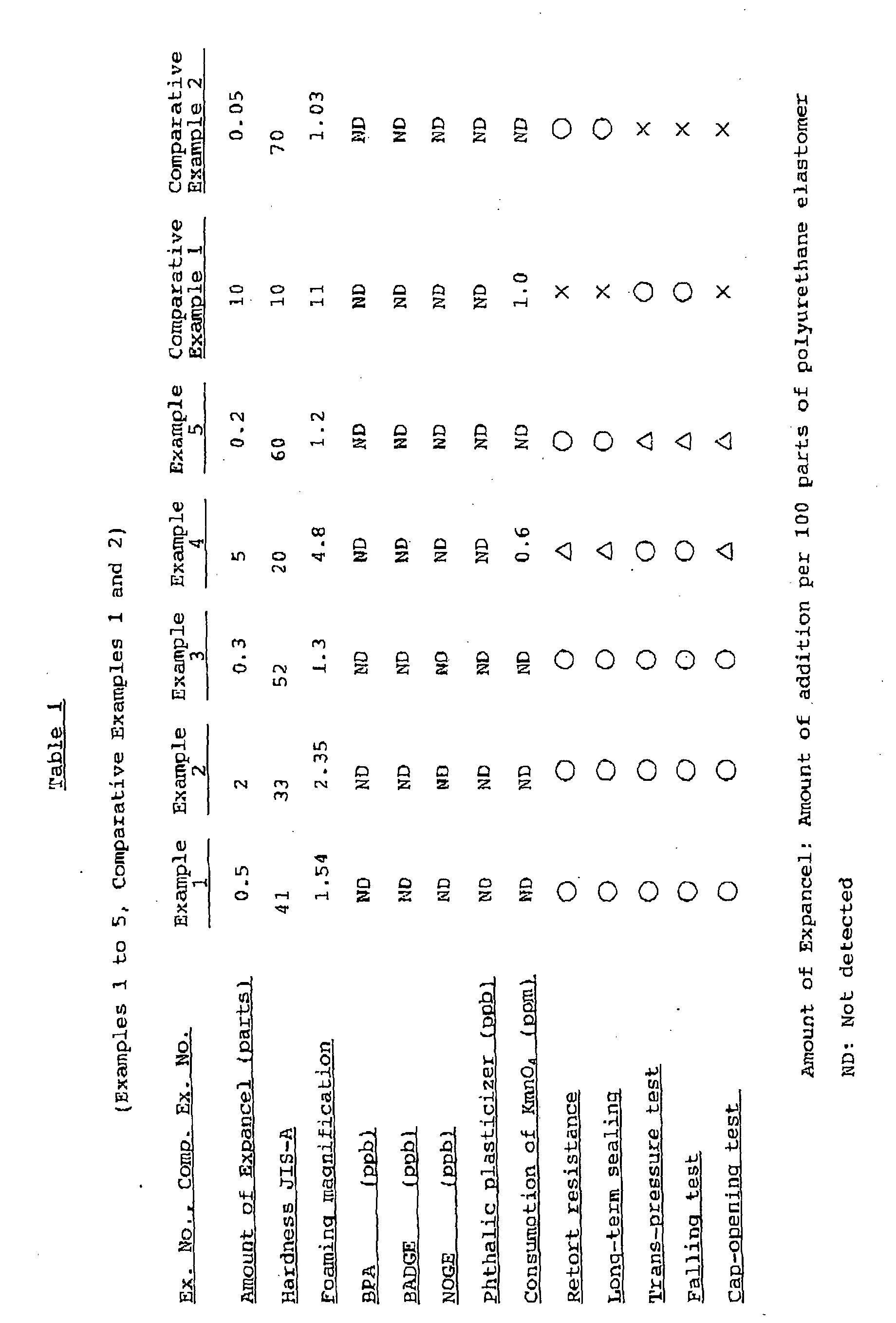
- the sealing member for the cap was applied in an amount of 0.75 g, the foaming magnification was 1.54, the specific gravity after foaming was 0.78, and the JIS A hardness was 41.
- a glass bottle having a volume of 155 cm 3 was filled with 140 g of hot water heated at 90°C, closed with the above twist-off cap under a condition of a pull-up value of 8 mm, and was retort-treated under a condition of 125°C for 30 minutes.
- the retort extraction water was analyzed for bisphenol A (BPA), bisphenol glycidyl ether (BADGE), novolak glycidyl ether (NOGE) and phthalic acid plasticizer by the GC-MS (gas-mass) method at a detection limit of 1 ppb. However, none of these substances were detected. Further, the amount of organic matter eluted in the retort extraction water was measured as the amount of consumption of potassium permanganate at a detection limit of 0.5 ppm to find that the amount was not larger than the detection limit.
- BPA bisphenol A
- BADGE bisphenol glycidyl ether
- NOGE novolak glycidyl ether
- phthalic acid plasticizer by the GC-MS (gas-mass) method at a detection limit of 1 ppb.
- the amount of organic matter eluted in the retort extraction water was measured as the amount of consumption of potassium permanganate at a detection limit of
- the pressure reduction value remained normal even after the passage of one month at 37°C exhibiting good retort resistance and long-term sealing performance, when the cap was opened, the sealing member (liner) exhibited good appearance, and a good adhering state was maintained between the sealing member and the closure.
- the glass bottle having the volume of 155 cm 3 was filled with 140 g of hot water heated at 90°C, closed with the above twist-off cap under a condition of a pull-up value of 8 mm, left to cool, preserved at room temperature for one week, and was put to the transverse-pressure test and to the falling test. There was exhibited excellent sealing performance such as a transverse load of 70 kgf and a fall-leakage ratio of 0%.
- cap-opening performance was evaluated to be favorable requiring a cap-opening torque of 26 kgf ⁇ cm.
- the glass bottle was filled with a blueberry jam at 85°C, closed with the twist-off cap, and was sterilized with hot water heated at 90°C for 40 minutes.
- the glass bottle was preserved at 50°C for one month and the cap was opened to observe the inner surface of the cap. There was observed no abnormal condition, and the inner surface of the cap exhibited favorable resistance against the content withstanding the blueberry jam.
- sealing members for caps having different specific gravities after foaming and different hardnesses as well as various twist-off caps were prepared in the same manner as in Example 1 but changing the amount of addition of the thermally expanding hollow particulate Expancel.
- the sealing members for the caps were adjusted to possess thicknesses in a range of from 1.3 to 1.5 mm by adjusting the amount of application.
- the sealing members for caps of Examples 2 to 5 and Comparative Examples 1 and 2 were evaluated in the same manner as in Example 1.
- a tin plate (tin-plating amount, 2.8 g/m 2 ) having a thickness of 0.155 mm was prepared, and the polyester phenol coating material of Preparation Example 6 was applied onto the inner surface thereof in an amount of 40 mg/dm 2 and was fired under a condition of 190°C for 8 minutes. Then, onto the outer surface were applied the size coating material, white coating material and luster varnish in this order and, finally, the polyester/blocked isocyanate white coating material of Preparation Example 5 was applied as the inner surface top coating in an amount of 80 mg/dm 2 followed by firing under a condition of 190°C for 8 minutes to thereby prepare the coated plate.
- the MEK extraction factor on the inner surface of the coated plate was 25%.
- a twist-off cap (white cap) shell having a diameter of 53 mm was formed by press from the above coated plate.
- the sealing member for the cap was applied in an amount of 0.75 g, the foaming magnification was 1.5, the specific gravity after foaming was 0.80, and the JIS A hardness was 45.
- a glass bottle having a volume of 155 cm 3 was filled with 140 g of hot water heated at 90°C, closed with the above twist-off cap under a condition of a pull-up value of 8 mm, and was retort-treated under a condition of 125°C for 30 minutes.
- the retort extraction water was analyzed for BPA, BADGE, NOGE and phthalic acid plasticizer by the GC-MS (gas-mass) method at a detection limit of 1 ppb. However, none of these substances were detected. Further, the amount of organic matter eluted in the retort extraction water was measured as the amount of consumption of potassium permanganate at a detection limit of 0.5 ppm to find that the amount was not larger than the detection limit. The pressure reduction value remained normal even after the passage of one month at 37°C exhibiting good retort resistance and long-term sealing performance. When the cap was opened, the sealing member (liner) exhibited good appearance, and a good adhering state was maintained between the sealing member and the closure.
- the glass bottle having the volume of 155 cm 3 was filled with 140 g of hot water heated at 90°C, closed with the above twist-off cap under a condition of a pull-up value of 8 mm, left to cool, preserved at room temperature for one week, and was put to the transverse-pressure test and to the falling test. There was exhibited excellent sealing performance such as a transverse load of 65 kgf and a fall-leakage ratio of 0%.
- cap-opening performance was evaluated to be favorable requiring a cap-opening torque of 31 kgf ⁇ cm.
- the glass bottle was filled with pickled scallions at 50°C, closed with the twist-off cap, and was sterilized with hot water heated at 90°C for 10 minutes.
- the glass bottle was preserved at 37°c for two months and the cap was opened to observe the inner surface of the cap. There was observed no abnormal condition, and the inner surface of the cap exhibited favorable resistance against the content withstanding the pickled scallions.
- the film on the outer surface of the coated plate was peeled by a decomposition method using concentrated sulfuric acid. After dried, the coated plate was cut out and was used as a sample. After the weight is measured (W 1 ), the extraction is conducted by using MEK (methyl ethyl ketone) in an amount of 1 ml per 2 cm 2 of the film at a boiling point thereof for one hour. After the extraction, the coated plate was dried under a condition of 130°C for one hour, and the weight (W2) of the coated plate after the extraction was measured. The film is further peeled by the decomposition method using concentrated sulfuric acid, and the weight (W 3 ) of the plate was measured.
Landscapes
- Chemical & Material Sciences (AREA)
- Health & Medical Sciences (AREA)
- Chemical Kinetics & Catalysis (AREA)
- Medicinal Chemistry (AREA)
- Polymers & Plastics (AREA)
- Organic Chemistry (AREA)
- Engineering & Computer Science (AREA)
- Mechanical Engineering (AREA)
- Manufacturing & Machinery (AREA)
- Materials Engineering (AREA)
- Polyurethanes Or Polyureas (AREA)
- Closures For Containers (AREA)
Abstract
Description
Preferably, however, the low molecular polyol is used in an amount of not larger than 5 mols and, particularly, in a range of from 0.1 to 3 mols per mole of the high molecular polyol.
- ○:
- 40 kgf or larger
- Δ:
- 20 to 40 kgf
- ×:
- smaller than 20 kgf
- ○:
- 0%
- Δ:
- 30% or less
- ×:
- not smaller than 30%
- ○:
- 35 kgf·cm or less
- Δ:
- 35 to 50 kgf·cm
- ×:
- not smaller than 50 kgf·cm
Claims (10)
- A sealing member for a cap, comprising a foamed polyurethane elastomer having a hardness (JIS A hardness) of from 15 to 65 and a foaming magnification of from 1.1 to 10 times.
- A sealing member according to claim 1, wherein said foamed polyurethane elastomer is formable by thermally-expanding hollow particles in a polyurethane elastomer.
- A sealing member according to claim 1 or 2, wherein said polyurethane elastomer comprises a two-part type polyurethane elastomer formable from components comprising a polyisocyanate and a polyol.
- A sealing member according to claim 3, wherein said two-part type polyurethane elastomer comprises:(A) a polyiscocyanate containing 5 to 38% by mass of isocyanate groups obtainable by modifying an aliphatic isocyanate and/or an alicyclic isocyanate, and having functional groups in an average number of 2 to 3; and(B) a polyol having a hydroxyl value of from 20 to 350 (mgKOH/g) and functional groups in an average number of 2 to 3.
- A method of producing a sealing member according to any prceding claim, in which thermally-expandable hollow particles are blended with a polyisocyanate and/or with a polyol component from which the polyurethane elastomer is produced.
- A cap having a sealing member according to any of claims 1 to 4 or produced by a method according to claim 5.
- A cap according to claim 6, comprising a metal.
- A cap according to claim 6 or 7 in which the sealing member is at an inner surface of a shell of the cap and polyester film is provided between the shell and the sealing member.
- A cap according to claim 8, wherein said polyester film comprises a polyethylene terephthalate film or a polyester coating material.
- A cap according to claim 9, wherein said polyester coating material comprises one or more of a polyester/amino coating material, a polyester/phenol coating material, a polyester/isocyanate coating material or an aqueous polyester coating material.
Applications Claiming Priority (4)
| Application Number | Priority Date | Filing Date | Title |
|---|---|---|---|
| JP2001337983A JP4068831B2 (en) | 2001-11-02 | 2001-11-02 | Metal cap |
| JP2001337983 | 2001-11-02 | ||
| JP2002183215 | 2002-06-24 | ||
| JP2002183215A JP3860509B2 (en) | 2001-11-06 | 2002-06-24 | Seal for cap |
Publications (3)
| Publication Number | Publication Date |
|---|---|
| EP1308396A2 true EP1308396A2 (en) | 2003-05-07 |
| EP1308396A3 EP1308396A3 (en) | 2005-08-17 |
| EP1308396B1 EP1308396B1 (en) | 2008-12-24 |
Family
ID=26624319
Family Applications (1)
| Application Number | Title | Priority Date | Filing Date |
|---|---|---|---|
| EP20020257599 Expired - Lifetime EP1308396B1 (en) | 2001-11-02 | 2002-11-01 | Environmentally friendly sealing member for a metal cap |
Country Status (7)
| Country | Link |
|---|---|
| US (2) | US6878449B2 (en) |
| EP (1) | EP1308396B1 (en) |
| KR (1) | KR100828527B1 (en) |
| CN (1) | CN100348663C (en) |
| AU (1) | AU2003200020B8 (en) |
| DE (1) | DE60230476D1 (en) |
| ES (1) | ES2317980T3 (en) |
Cited By (4)
| Publication number | Priority date | Publication date | Assignee | Title |
|---|---|---|---|---|
| WO2006027671A1 (en) | 2004-09-08 | 2006-03-16 | Elachem S.R.L. | Low density polyurethane integral skin foam system prepared using expandable microspheres and water as coblowing agent |
| US7423521B2 (en) | 2004-12-07 | 2008-09-09 | Kabushiki Kaisha Honda Lock | Vehicular visual assistance system |
| WO2015067749A1 (en) * | 2013-11-08 | 2015-05-14 | Basf Se | Polyurethane sealant |
| EP2987642A4 (en) * | 2013-03-22 | 2016-08-31 | Dainippon Printing Co Ltd | PROTECTIVE LAYER TRANSFER SHEET AND INTERMEDIATE TRANSFER AGENT |
Families Citing this family (7)
| Publication number | Priority date | Publication date | Assignee | Title |
|---|---|---|---|---|
| DE60230476D1 (en) * | 2001-11-02 | 2009-02-05 | Crown Cork Japan | Environmentally friendly sealing element for a metal cap |
| CN101432082B (en) * | 2006-04-25 | 2011-10-05 | 关西涂料株式会社 | Method for forming multilayer coating film |
| US20120074091A1 (en) * | 2010-09-24 | 2012-03-29 | Himelstein Walter D | Safety-coated glass bottle |
| JP5546050B2 (en) | 2012-03-27 | 2014-07-09 | 日本クロージャー株式会社 | Metal cap having foam coating and method for producing the same |
| US11027523B2 (en) * | 2015-11-30 | 2021-06-08 | Toray Plastics (America), Inc. | Polyester film incorporating silicone for release of canned meat products |
| CN109593180A (en) * | 2018-11-29 | 2019-04-09 | 荣德铵家新型材料(福州)有限公司 | A kind of preparation method of shell sound-insulating polyurethane plate |
| CN112283451A (en) * | 2020-11-05 | 2021-01-29 | 金螳螂精装科技(苏州)有限公司 | Indoor assembled quick pipeline location structure for water and electricity installation |
Family Cites Families (12)
| Publication number | Priority date | Publication date | Assignee | Title |
|---|---|---|---|---|
| US1796728A (en) * | 1929-11-14 | 1931-03-17 | Aluminum Co Of America | Replaceable container seal |
| DE1941500B2 (en) * | 1968-08-18 | 1975-08-28 | Hashimoto Kogyo Co., Ltd., Tokio | Process for the production of elastomeric polyurethanes |
| US4818577A (en) * | 1987-08-20 | 1989-04-04 | Minnesota Mining And Manufacturing Company | Synthetic liner capable of resisting chemical attack and high temperature |
| JPH086029B2 (en) * | 1989-10-11 | 1996-01-24 | 日本ポリウレタン工業株式会社 | Interior skin material |
| US5321050A (en) * | 1992-08-06 | 1994-06-14 | Nisshinbo Industries, Inc. | Method for producing modified polyisocyanurate foams |
| WO1996000754A1 (en) * | 1994-06-30 | 1996-01-11 | Minnesota Mining And Manufacturing Company | Polyurethane/urea elastomeric sealants |
| JP3090862B2 (en) * | 1995-07-17 | 2000-09-25 | 日鐵ドラム株式会社 | Canopy for container with openable lid and method for producing the same |
| US5654390A (en) * | 1995-11-17 | 1997-08-05 | Uniroyal Chemical Company, Inc. | Trimodal molecular weight polyether polyol prepolymers |
| CA2239950C (en) * | 1997-08-11 | 2007-09-18 | Bayer Corporation | Syntactic rigid pur/pir foam boardstock |
| JP2000344902A (en) * | 1999-06-04 | 2000-12-12 | Fuji Spinning Co Ltd | Method for producing urethane molding for polishing pad and urethane molding for polishing pad |
| JP3920610B2 (en) * | 2000-10-18 | 2007-05-30 | 東洋製罐株式会社 | Sealing material for lid and method for producing lid using the same |
| DE60230476D1 (en) * | 2001-11-02 | 2009-02-05 | Crown Cork Japan | Environmentally friendly sealing element for a metal cap |
-
2002
- 2002-11-01 DE DE60230476T patent/DE60230476D1/en not_active Expired - Lifetime
- 2002-11-01 CN CNB021563403A patent/CN100348663C/en not_active Expired - Fee Related
- 2002-11-01 EP EP20020257599 patent/EP1308396B1/en not_active Expired - Lifetime
- 2002-11-01 ES ES02257599T patent/ES2317980T3/en not_active Expired - Lifetime
- 2002-11-02 KR KR1020020067643A patent/KR100828527B1/en not_active Expired - Fee Related
- 2002-11-04 US US10/286,769 patent/US6878449B2/en not_active Expired - Fee Related
-
2003
- 2003-01-06 AU AU2003200020A patent/AU2003200020B8/en not_active Ceased
-
2004
- 2004-05-12 US US10/843,351 patent/US20040209970A1/en not_active Abandoned
Cited By (6)
| Publication number | Priority date | Publication date | Assignee | Title |
|---|---|---|---|---|
| WO2006027671A1 (en) | 2004-09-08 | 2006-03-16 | Elachem S.R.L. | Low density polyurethane integral skin foam system prepared using expandable microspheres and water as coblowing agent |
| WO2006027805A1 (en) * | 2004-09-08 | 2006-03-16 | Elachem S.R.L. | Composition and process for the realization of low density expanded products |
| US7423521B2 (en) | 2004-12-07 | 2008-09-09 | Kabushiki Kaisha Honda Lock | Vehicular visual assistance system |
| EP2987642A4 (en) * | 2013-03-22 | 2016-08-31 | Dainippon Printing Co Ltd | PROTECTIVE LAYER TRANSFER SHEET AND INTERMEDIATE TRANSFER AGENT |
| WO2015067749A1 (en) * | 2013-11-08 | 2015-05-14 | Basf Se | Polyurethane sealant |
| US10280248B2 (en) | 2013-11-08 | 2019-05-07 | Basf Se | Polyurethane sealant |
Also Published As
| Publication number | Publication date |
|---|---|
| EP1308396A3 (en) | 2005-08-17 |
| US20030087980A1 (en) | 2003-05-08 |
| KR20030036107A (en) | 2003-05-09 |
| EP1308396B1 (en) | 2008-12-24 |
| US20040209970A1 (en) | 2004-10-21 |
| CN100348663C (en) | 2007-11-14 |
| AU2003200020B8 (en) | 2008-11-13 |
| US6878449B2 (en) | 2005-04-12 |
| CN1420296A (en) | 2003-05-28 |
| AU2003200020B2 (en) | 2008-10-02 |
| ES2317980T3 (en) | 2009-05-01 |
| DE60230476D1 (en) | 2009-02-05 |
| KR100828527B1 (en) | 2008-05-13 |
Similar Documents
| Publication | Publication Date | Title |
|---|---|---|
| US6878449B2 (en) | Sealing member for a cap featuring excellent safety and environmental friendliness, and metal cap | |
| US5527616A (en) | Laminate for flexible packaging and a process for preparing the same | |
| TW384258B (en) | Barrier composite film and preparation thereof | |
| EP1234842A1 (en) | Solvent-free two-component curable adhesive composition | |
| CA2279737A1 (en) | Decorative film for use in platics molding, process for preparing the same and injection-molded part by use of the same | |
| EP1303561A1 (en) | Foamed thermoplastic polyurethanes | |
| EP1081170A3 (en) | Gas barrier polyurethane resin | |
| EP0581863A1 (en) | Pressurizable thermoplastic container having an exterior polyurethane layer and its method of making | |
| CN104828382B (en) | Packaging material is used in molding | |
| EP2535384A2 (en) | Organic-inorganic hybrid composition for anti-corrosive coating agent and manufacturing method for same | |
| EP2638087B1 (en) | Hot-sealable coating systems and method for joining surfaces | |
| JP4068831B2 (en) | Metal cap | |
| EP2489510A1 (en) | Polylactic acid-based decorative body | |
| JP3860509B2 (en) | Seal for cap | |
| JP4533598B2 (en) | Paint for metal packaging body and metal packaging body using the same | |
| AU2006225580A1 (en) | Adhesive sheet | |
| US6306967B1 (en) | Solid, oxazoline-terminated, urethane-functional polyaddition compounds, a process for preparing them and their use | |
| EP2935383B1 (en) | Polyurethane dispersions for coating containers | |
| WO1995013307A1 (en) | Polymer viscosity depressant/super cooling thermoplastic urethane | |
| JP2005162271A (en) | Gas barrier hollow container | |
| EP2505627B1 (en) | Adhering method using electrostatic powder adhesive, and powder adhesive to be used in adhering method | |
| JP2004238403A (en) | Adhesive composition and anchor coating agent using the same | |
| AU2022341122B2 (en) | Adhesive composition with lightweight filler | |
| JP2001213927A (en) | Two-part curable resin composition and adhesive for lamination | |
| WO1992019656A1 (en) | Coating composition and method |
Legal Events
| Date | Code | Title | Description |
|---|---|---|---|
| PUAI | Public reference made under article 153(3) epc to a published international application that has entered the european phase |
Free format text: ORIGINAL CODE: 0009012 |
|
| AK | Designated contracting states |
Designated state(s): AT BE BG CH CY CZ DE DK EE ES FI FR GB GR IE IT LI LU MC NL PT SE SK TR |
|
| AX | Request for extension of the european patent |
Extension state: AL LT LV MK RO SI |
|
| PUAL | Search report despatched |
Free format text: ORIGINAL CODE: 0009013 |
|
| AK | Designated contracting states |
Kind code of ref document: A3 Designated state(s): AT BE BG CH CY CZ DE DK EE ES FI FR GB GR IE IT LI LU MC NL PT SE SK TR |
|
| AX | Request for extension of the european patent |
Extension state: AL LT LV MK RO SI |
|
| 17P | Request for examination filed |
Effective date: 20051031 |
|
| AKX | Designation fees paid |
Designated state(s): DE ES FR GB IT |
|
| GRAP | Despatch of communication of intention to grant a patent |
Free format text: ORIGINAL CODE: EPIDOSNIGR1 |
|
| RAP1 | Party data changed (applicant data changed or rights of an application transferred) |
Owner name: JAPAN CROWN CORK CO., LTD Owner name: TOYO SEIKAN KAISHA, LTD. Owner name: FUKUOKA PACKING CO., LTD |
|
| GRAS | Grant fee paid |
Free format text: ORIGINAL CODE: EPIDOSNIGR3 |
|
| GRAA | (expected) grant |
Free format text: ORIGINAL CODE: 0009210 |
|
| AK | Designated contracting states |
Kind code of ref document: B1 Designated state(s): DE ES FR GB IT |
|
| REG | Reference to a national code |
Ref country code: GB Ref legal event code: FG4D |
|
| REF | Corresponds to: |
Ref document number: 60230476 Country of ref document: DE Date of ref document: 20090205 Kind code of ref document: P |
|
| REG | Reference to a national code |
Ref country code: ES Ref legal event code: FG2A Ref document number: 2317980 Country of ref document: ES Kind code of ref document: T3 |
|
| PLBE | No opposition filed within time limit |
Free format text: ORIGINAL CODE: 0009261 |
|
| STAA | Information on the status of an ep patent application or granted ep patent |
Free format text: STATUS: NO OPPOSITION FILED WITHIN TIME LIMIT |
|
| 26N | No opposition filed |
Effective date: 20090925 |
|
| PGFP | Annual fee paid to national office [announced via postgrant information from national office to epo] |
Ref country code: DE Payment date: 20101027 Year of fee payment: 9 |
|
| PGFP | Annual fee paid to national office [announced via postgrant information from national office to epo] |
Ref country code: GB Payment date: 20101027 Year of fee payment: 9 Ref country code: IT Payment date: 20101111 Year of fee payment: 9 |
|
| PGFP | Annual fee paid to national office [announced via postgrant information from national office to epo] |
Ref country code: ES Payment date: 20111216 Year of fee payment: 10 Ref country code: FR Payment date: 20111118 Year of fee payment: 10 |
|
| GBPC | Gb: european patent ceased through non-payment of renewal fee |
Effective date: 20121101 |
|
| REG | Reference to a national code |
Ref country code: FR Ref legal event code: ST Effective date: 20130731 |
|
| PG25 | Lapsed in a contracting state [announced via postgrant information from national office to epo] |
Ref country code: IT Free format text: LAPSE BECAUSE OF NON-PAYMENT OF DUE FEES Effective date: 20121101 |
|
| REG | Reference to a national code |
Ref country code: DE Ref legal event code: R119 Ref document number: 60230476 Country of ref document: DE Effective date: 20130601 |
|
| PG25 | Lapsed in a contracting state [announced via postgrant information from national office to epo] |
Ref country code: DE Free format text: LAPSE BECAUSE OF NON-PAYMENT OF DUE FEES Effective date: 20130601 |
|
| PG25 | Lapsed in a contracting state [announced via postgrant information from national office to epo] |
Ref country code: FR Free format text: LAPSE BECAUSE OF NON-PAYMENT OF DUE FEES Effective date: 20121130 Ref country code: GB Free format text: LAPSE BECAUSE OF NON-PAYMENT OF DUE FEES Effective date: 20121101 |
|
| REG | Reference to a national code |
Ref country code: ES Ref legal event code: FD2A Effective date: 20140305 |
|
| PG25 | Lapsed in a contracting state [announced via postgrant information from national office to epo] |
Ref country code: ES Free format text: LAPSE BECAUSE OF NON-PAYMENT OF DUE FEES Effective date: 20121102 |