EP1308339A2 - Adaptive cruise control system - Google Patents
Adaptive cruise control system Download PDFInfo
- Publication number
- EP1308339A2 EP1308339A2 EP02023488A EP02023488A EP1308339A2 EP 1308339 A2 EP1308339 A2 EP 1308339A2 EP 02023488 A EP02023488 A EP 02023488A EP 02023488 A EP02023488 A EP 02023488A EP 1308339 A2 EP1308339 A2 EP 1308339A2
- Authority
- EP
- European Patent Office
- Prior art keywords
- headway
- speed
- maximum
- vehicle
- source vehicle
- Prior art date
- Legal status (The legal status is an assumption and is not a legal conclusion. Google has not performed a legal analysis and makes no representation as to the accuracy of the status listed.)
- Granted
Links
Images

Classifications
-
- B—PERFORMING OPERATIONS; TRANSPORTING
- B60—VEHICLES IN GENERAL
- B60K—ARRANGEMENT OR MOUNTING OF PROPULSION UNITS OR OF TRANSMISSIONS IN VEHICLES; ARRANGEMENT OR MOUNTING OF PLURAL DIVERSE PRIME-MOVERS IN VEHICLES; AUXILIARY DRIVES FOR VEHICLES; INSTRUMENTATION OR DASHBOARDS FOR VEHICLES; ARRANGEMENTS IN CONNECTION WITH COOLING, AIR INTAKE, GAS EXHAUST OR FUEL SUPPLY OF PROPULSION UNITS IN VEHICLES
- B60K31/00—Vehicle fittings, acting on a single sub-unit only, for automatically controlling vehicle speed, i.e. preventing speed from exceeding an arbitrarily established velocity or maintaining speed at a particular velocity, as selected by the vehicle operator
- B60K31/0008—Vehicle fittings, acting on a single sub-unit only, for automatically controlling vehicle speed, i.e. preventing speed from exceeding an arbitrarily established velocity or maintaining speed at a particular velocity, as selected by the vehicle operator including means for detecting potential obstacles in vehicle path
-
- B—PERFORMING OPERATIONS; TRANSPORTING
- B60—VEHICLES IN GENERAL
- B60W—CONJOINT CONTROL OF VEHICLE SUB-UNITS OF DIFFERENT TYPE OR DIFFERENT FUNCTION; CONTROL SYSTEMS SPECIALLY ADAPTED FOR HYBRID VEHICLES; ROAD VEHICLE DRIVE CONTROL SYSTEMS FOR PURPOSES NOT RELATED TO THE CONTROL OF A PARTICULAR SUB-UNIT
- B60W50/00—Details of control systems for road vehicle drive control not related to the control of a particular sub-unit, e.g. process diagnostic or vehicle driver interfaces
- B60W2050/0001—Details of the control system
- B60W2050/0002—Automatic control, details of type of controller or control system architecture
- B60W2050/0012—Feedforward or open loop systems
-
- B—PERFORMING OPERATIONS; TRANSPORTING
- B60—VEHICLES IN GENERAL
- B60W—CONJOINT CONTROL OF VEHICLE SUB-UNITS OF DIFFERENT TYPE OR DIFFERENT FUNCTION; CONTROL SYSTEMS SPECIALLY ADAPTED FOR HYBRID VEHICLES; ROAD VEHICLE DRIVE CONTROL SYSTEMS FOR PURPOSES NOT RELATED TO THE CONTROL OF A PARTICULAR SUB-UNIT
- B60W2754/00—Output or target parameters relating to objects
- B60W2754/10—Spatial relation or speed relative to objects
- B60W2754/30—Longitudinal distance
-
- G—PHYSICS
- G01—MEASURING; TESTING
- G01S—RADIO DIRECTION-FINDING; RADIO NAVIGATION; DETERMINING DISTANCE OR VELOCITY BY USE OF RADIO WAVES; LOCATING OR PRESENCE-DETECTING BY USE OF THE REFLECTION OR RERADIATION OF RADIO WAVES; ANALOGOUS ARRANGEMENTS USING OTHER WAVES
- G01S13/00—Systems using the reflection or reradiation of radio waves, e.g. radar systems; Analogous systems using reflection or reradiation of waves whose nature or wavelength is irrelevant or unspecified
- G01S13/88—Radar or analogous systems specially adapted for specific applications
- G01S13/93—Radar or analogous systems specially adapted for specific applications for anti-collision purposes
- G01S13/931—Radar or analogous systems specially adapted for specific applications for anti-collision purposes of land vehicles
- G01S2013/9321—Velocity regulation, e.g. cruise control
Definitions
- the present invention relates to vehicle speed control, and more particularly to headway limiting in adaptive cruise control for automotive vehicles.
- Automatic vehicle cruise control systems have been developed for maintaining the speed of a vehicle at a driver-selected speed.
- an adaptive cruise control system has been developed for detecting the presence of, and the distance to, a preceding vehicle and for adjusting the vehicle speed to maintain a following distance from the preceding vehicle when it is moving slower than the driver-selected speed.
- the source vehicle speed is controlled to the speed of the preceding vehicle with a speed dependent separation being maintained from the preceding vehicle, wherein the source vehicle speed is limited at a driver-selected speed.
- Adaptive cruise control systems typically have conventional cruise control that may be overridden in certain circumstances by an adaptive vehicle speed control routine.
- the conventional cruise control when activated, may include a control function designed to minimize a difference between the actual vehicle speed and a cruise-set speed, which is selected by the driver.
- the adaptive cruise control system adapts any active conventional control to the environment external to the controlled source vehicle by attempting to account for vehicles preceding the source vehicle within a speed dependent separation interval of the source vehicle and in the path of the source vehicle.
- One form of adaptive control lies in the reduction of the cruise-set speed below the driver-selected speed by an amount determined and periodically updated to provide controlled following of sensed preceding vehicles traveling slower than the driver-selected speed.
- a speed command is generated, based in part, on the speed relationship between the source vehicle and the preceding vehicle.
- the cruise set speed is limited accordingly, to adapt the source vehicle speed to that of the preceding vehicle and provide a controlled following relationship.
- Adaptive cruise control systems such as the system described in U.S. Patent No. 5,014,200, incorporated herein by reference and assigned to the assignee of the present invention, provides a speed dependent following distance that is adjustable by the driver. This adjustment affects a speed multiplier term used in the determination of the speed dependent following distance. For a fixed speed multiplier, the desired following distance should increase with increasing vehicle speed.
- the present invention resides in an adaptive cruise control system that provides smooth adaptive cruise control following operation of a source vehicle by limiting the headway to keep it lower than a predetermined maximum.
- following distance limiting headway limiting
- the system informs the driver of the source vehicle that the following distance and thus the amount of time or distance of headway is less than what the driver expected.
- the present invention accomplishes this objective through systematically limiting the headway.
- a time related speed dependent term used in calculating the desired headway is assigned prescribed limits, to maintain a headway that is less than a predetermined maximum headway that maintains the preceding source vehicle spacing within a preferred operational range for the adaptive cruise control system.
- Limiting the headway accounts for the practical maximum range limitations of forward looking sensors and allows smooth adaptive cruise control following operation of the source vehicle, especially during high speed operation of the source and preceding vehicles without requiring the driver to adjust the speed dependent following distance. This operation is desirable due to the practical maximum range limitations of forward looking sensors used in adaptive cruise control systems, wherein the performance of the adaptive cruise control system can be less than optimal when the desired headway is near or beyond a maximum range for the system's sensor.
- the adaptive cruise control system When no vehicle is detected to be in the path of the source vehicle, the adaptive cruise control system maintains or accelerates the source vehicle to the driver-selected speed.
- Conventional adaptive cruise control systems provide a speed dependent headway when a preceding vehicle moving slower than the driver-selected speed is encountered in the path of the source vehicle. Therefore, it is possible that the source vehicle will accelerate and decelerate, as the distance to the preceding vehicle moves into and out of the maximum sensor range resulting in a rough, jerky adaptive cruise condition. This occurs when the preceding vehicle is traveling slower than the driver-selected speed of the source vehicle but faster than a relatively high speed resulting in headway corresponding to or exceeding the maximum sensor range.
- the source vehicle speed would be 120 mph. If the source vehicle approaches a preceding vehicle traveling at 110 mph, the source vehicle would be decelerated by the system when it approached within 100 meters of the preceding vehicle. This occurs to bring the source vehicle down to a speed of 110 mph.
- the actual distance between vehicles can be lower than the desired headway based on the driver's setting, by the time the source vehicle decelerates to 110 mph. The source vehicle then decelerates slightly to meet the desired headway.
- the present invention limits the maximum headway when a source vehicle is operating in an adaptive cruise control system mode.
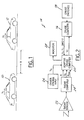
- FIGURE 1 is an illustration of the relationship between a source vehicle following a preceding vehicle
- FIGURE 2 is a block diagram of the headway limiting adaptive cruise control system of the present invention.
- FIGURE 3 is a flowchart of the headway limiting adaptive cruise control system of the present invention.
- Figure 1 is a general diagram illustrating the relationship between a source vehicle 10, having the headway limiting adaptive cruise control system of the present invention, following a preceding vehicle 12 on a roadway surface.
- the source vehicle 10 has a speed V S and the preceding vehicle has a speed V T .
- a distance R separates the source and preceding vehicles from each other.
- FIG. 2 is a block diagram of the speed dependent headway limiting adaptive cruise control system 14 of the present invention.
- Headway is a term used to describe the separation between the source and preceding vehicles.
- a cruise computer 16 is engaged by manual operation of conventional cruise switches 18 (for example, cruise switches typically include on/off, resume, and set switches).
- a signal that is sent from the cruise computer 16 to an adaptive cruise computer 20 indicates when the cruise control is engaged.
- the cruise computer 16 maintains the speed of the source vehicle at a command speed V C .
- the command speed V C is provided to the cruise computer 16 by the adaptive cruise computer 20.
- the adaptive cruise computer 20 sets the command speed V C equal to a driver-selected speed, V D .
- a radar sensor 22 provides a measure of the distance, R, to the preceding vehicle and a relative velocity V R to a radar computer 24.
- the radar sensor 22 may take the form of a conventional radar that provides a measure of the distance to a preceding vehicle and the relative velocity between the radar sensor 22 and the preceding vehicle. While distance and relative velocity measurements are described as being provided by a radar sensor, other sensors, such as infrared sensors, that provide range and relative velocity may also be used.
- the adaptive cruise computer 20 computes the command speed V C to be less than the driver-selected speed. Then, the adaptive cruise computer 20 sends V C to the cruise computer 16, for controlling the speed of the source vehicle while cruise control is engaged.
- the radar computer 24 extracts the distance R and the relative speed V R between the source and preceding vehicles, then sends this information, along with an effective maximum sensor range, R max to the adaptive cruise computer.
- the adaptive cruise computer 20 also receives the actual speed of the source vehicle, V S , and the driver-selected speed, V D from the cruise computer 16.
- the adaptive cruise computer 20 uses the inputs discussed above to determine the command speed, V C , necessary for the source vehicle to attain and then maintain a desired headway, D FOLLOW , behind the preceding vehicle.
- D DESIRED (V s 2 /K1)-(V T 2 /K1)+T HWC *V s
- K1 is a constant of two times the deceleration rate of the vehicle.
- the value of T HWC would be set to a driver-selected value, T R , established by the vehicle operator from a driver spacing input 26 such as a potentiometer.
- the speed dependent headway adaptive cruise control system limits the headway to keep it lower than the maximum range by substituting the limiting value of the time related speed multiplier T HWC in place of the driver-selected value of T R .
- the automated speed control routine 100 of the present invention is shown in flow chart form in Figure 3.
- the adaptive cruise computer extracts 102 the distance, R, relative speed, V R , and the effective maximum sensor range, R max from the radar computer.
- the adaptive cruise computer also extracts 102 the source vehicle speed V S and the driver-selected speed V D , from the cruise computer.
- the effective maximum sensor range, R max may be a calibratable constant in the adaptive cruise control computer, or it may be a variable that depends on the radar system's ability to predict the path of the source vehicle.
- routine 100 determines 104 if the cruise switches to the cruise computer have been set to engage the cruise control.
- speed control is not engaged, the command speed, V C , is set to zero and the cruise computer is instructed to release the throttle 106.
- a headway limited flag is then cleared 108.
- the routine When speed control is engaged, the routine next determines 105 if there is a preceding vehicle whose speed, V T , is less than the driver-selected speed V D . If there is no preceding vehicle or the preceding vehicle is traveling at a speed V T equal to or greater than the driver-selected speed V D , the routine proceeds to step 150 where the command speed V C is set equal to the driver-selected speed V D and sent to the cruise computer. The headway limited flag is then cleared 152.
- T R is taken from the driver-selected spacing input and read 110 into the adaptive cruise computer.
- the maximum headway, D max is determined 112 to be a value less than the effective maximum sensor range, R max .
- D max must be less than R max to allow the system to compensate for variations in the preceding and source vehicle speeds, thereby avoiding control oscillations during following.
- D max can be less than R max by a fixed distance or by a speed dependent distance.
- the time related speed multiplier, T HWC is set equal to the driver-selected value, T R , 118.
- the headway limited flag is cleared 120.
- the relative speed V R is set to zero
- the source vehicle speed V S is set equal to the preceding vehicle speed V T .
- the desired distance equation is set equal to D max and then solved 122 for T HWC .
- the distance, R, to the preceding vehicle is compared 124 to the maximum headway, D max . If R is close to D max , the headway limited flag is set 126 when the headway is limited and substantially stabilized, otherwise the headway limited flag is cleared 120.
- the command speed, V C is calculated 128 using the value of T HWC determined at either step 118 or 122, and sent to the cruise computer.
- the method of the present invention is run at a periodic rate, e.g. every 100 msec, in order to update the control outputs such as command speed Vc, as the inputs change.
- the headway limited flag can be used by the adaptive cruise computer to control an indicator 28 that is used to alert the driver that the source vehicle is following the preceding vehicle at a distance closer than expected based on the setting of the driver-selected value T R .
- the indicator 28 could be a visual and/or audible device, such as a warning light, buzzer, tone, or the like.
- the determination of the time related speed multiplier, T HWC based on the relationship between the desired headway and the predetermined maximum headway, limits the headway and keeps it lower than the predetermined maximum.
- a source vehicle having a driver-selected speed of 120 mph, a driver-selected value T R of 2.0 seconds, and an effective maximum sensor range of 100 meters.
- the source vehicle speed is 120 mph.
- the maximum headway is limited, but the vehicle speed is not limited.
- the source vehicle then follows the preceding vehicle at 110 mph, at the predetermined maximum headway D max , effectively reducing the actual speed dependent headway below the speed dependent headway set by the driver.
- the source vehicle follows the preceding vehicle at a distance of, for example, 90 meters, which is less than the effective maximum sensor range, R max , effectively reducing the speed dependent headway from 2.0 seconds to 1.83 seconds.
- the indicator device 28 will inform the driver that the headway has been limited to a value less than the driver-selected value by the adaptive cruise control system.
- One such variation involves combining the functions of the adaptive cruise computer 20 and the cruise computer 16 such that the combined computer reads the cruise switches and determines the driver-selected speed.
- the combined computer would also provide a control command to an engine management system that controls the engine to achieve the commanded value.
- the control command is updated periodically by the combined computer to attain either the driver-selected speed or the headway depending on whether there is a preceding vehicle moving slower than the driver-selected speed.
- the control command can be a command speed V C as described previously, or some other control command such as acceleration. Accordingly, it is intended that the invention be limited only in terms of the appended claims.
Landscapes
- Engineering & Computer Science (AREA)
- Chemical & Material Sciences (AREA)
- Combustion & Propulsion (AREA)
- Transportation (AREA)
- Mechanical Engineering (AREA)
- Controls For Constant Speed Travelling (AREA)
- Control Of Vehicle Engines Or Engines For Specific Uses (AREA)
Abstract
Description
More specifically,
Claims (23)
- An adaptive cruise control system for controlling a distance, R, between a source vehicle and a preceding vehicle, said system comprising:a sensor for sensing said distance, R;a signal representing a predetermined time, TR;means for determining a maximum headway, Dmax;means for determining a desired headway, DFOLLOW based on said predetermined time, TR;means for comparing DFOLLOW to Dmax; andmeans for controlling said distance, R, to the smaller of said desired headway, DFOLLOW or said maximum headway, Dmax, thereby defining a controlled distance.
- The system as claimed in claim 1 wherein said maximum headway is a function of an effective maximum sensor range.
- The system as claimed in claim 1 wherein said maximum headway is a fixed distance.
- The system as claimed in claim 1 wherein said desired headway is a function of a speed of the preceding vehicle.
- The system as claimed in claim 1 wherein said controlled distance is a function of a speed of the preceding vehicle and said means for controlling the distance R further comprises means for calculating a time related speed multiplier THWC.
- The system as claimed in claim 5 wherein said means for calculating said time related speed multiplier, THWC further comprises setting said time related speed multiplier, THWC, equal to said predetermined time, TR, when said desired headway is less than or equal to said maximum headway.
- The system as claimed in claim 5 wherein said time related speed multiplier, THWC, is a function of said maximum headway, Dmax, when said desired headway, DFOLLOW, is greater than said maximum headway, Dmax.
- A method for limiting a following distance in an adaptive cruise control system, said method comprising the steps of:relaying an actual source vehicle speed, a relative distance, a relative velocity, a desired source vehicle speed, a time related speed multiplier, and a maximum system range to an adaptive cruise computer;determining a maximum headway;calculating a desired headway by solving a desired distance equation;limiting said time related speed multiplier;setting a headway limited flag when said relative distance approaches said predetermined maximum headway;determining a source vehicle command speed based on said limited time related speed multiplier;limiting the following distance to be less than said predetermined maximum headway; andcontrolling said source vehicle speed to said source vehicle command speed.
- The method as claimed in claim 8 wherein said step of limiting the following distance further comprises setting said time related speed multiplier to a pre-set driver input when said desired headway is less than or equal to said maximum headway.
- The method as claimed in claim 8 wherein said step of limiting said headway further comprises calculating said time related speed multiplier by setting said relative speed equal to zero, setting said source vehicle speed equal to said preceding vehicle speed and solving said desired distance equation.
- The method as claimed in claim 8 wherein said step of serting a headway limited flag further comprises the step of activating an indicator.
- The method as claimed in claim 8 wherein said step of calculating a desired headway further comprises the steps of:setting said relative speed equal to zero;setting said source vehicle speed equal to said preceding vehicle speed; andsetting said time related speed multiplier equal to a value pre-set by an operator of said source vehicle.
- A method of controlling the headway between a preceding vehicle and a source vehicle operating at a controlled speed comprising the steps of:determining a maximum headway between the preceding vehicle and the source vehicle;calculating a desired headway between the preceding vehicle and the source vehicle;comparing the desired headway to the maximum headway; andwhen the desired headway is greater than the maximum headway, setting the controlled speed to result in a limited headway at which the source vehicle follows the preceding vehicle wherein the limited headway is less than the desired headway.
- The method as claimed in claim 13 wherein the step of determining the maximum headway involves determining the maximum headway based on an effective maximum range of a sensor on the source vehicle that senses distance from the preceding vehicle to the source vehicle wherein the maximum headway is less than the effective maximum range.
- The method as claimed in claim 13 wherein the step of calculating the desired headway is effected as a function of a driver spacing input setting manually selected in the source vehicle.
- The method as claimed in claim 13 wherein when the maximum headway is greater than the desired headway, the headway at which the source vehicle follows the preceding vehicle is controlled to the desired headway.
- The method as claimed in claim 13 wherein the desired headway is determined based on the speed of the source vehicle and wherein when the speed of the source vehicle increases, the desired headway increases.
- A method of controlling the headway between a preceding vehicle and a source vehicle operating at a controlled speed comprising the steps of:reading input of a sensor to determine an actual headway spacing between the source vehicle and the preceding vehicle;determining a maximum headway spacing between the source vehicle and the preceding vehicle as a function of a maximum effective range of the sensor;reading driver spacing input from a manually adjustable unit;determining a following headway spacing between the preceding vehicle and the source vehicle as a function of the driver spacing input; comparing the following headway spacing to the maximum headway spacing; andwhen the following headway spacing is greater than the maximum headway spacing, setting the controlled speed of the source vehicle to effect a limited headway spacing between the preceding vehicle and the source vehicle that is less than the following headway spacing.
- The method as claimed in claim 18 wherein the limited headway spacing is effected by calculating a variable THWC as a function of speed of the source vehicle and substituting the variable THWC for the driver spacing input and calculating the controlled speed of the source vehicle as a function of THWC.
- The method as claimed in claim 18 wherein the maximum headway spacing is a constant.
- The method as claimed in claim 18 wherein when the following headway spacing is less than the maximum headway spacing the controlled speed of the source vehicle is calculated as a function of the driver spacing input.
- The method as claimed in claim 18 wherein when the limited headway spacing is effected, a headway limited indicator in the source vehicle is turned on.
- The method as claimed in claim 18 wherein the steps are repeated at predetermined time intervals.
Applications Claiming Priority (2)
| Application Number | Priority Date | Filing Date | Title |
|---|---|---|---|
| US11563 | 2001-11-05 | ||
| US10/011,563 US6622810B2 (en) | 2001-11-05 | 2001-11-05 | Adaptive cruise control system |
Publications (3)
| Publication Number | Publication Date |
|---|---|
| EP1308339A2 true EP1308339A2 (en) | 2003-05-07 |
| EP1308339A3 EP1308339A3 (en) | 2005-11-23 |
| EP1308339B1 EP1308339B1 (en) | 2008-01-09 |
Family
ID=21750941
Family Applications (1)
| Application Number | Title | Priority Date | Filing Date |
|---|---|---|---|
| EP02023488A Expired - Lifetime EP1308339B1 (en) | 2001-11-05 | 2002-10-21 | Adaptive cruise control system |
Country Status (3)
| Country | Link |
|---|---|
| US (1) | US6622810B2 (en) |
| EP (1) | EP1308339B1 (en) |
| DE (1) | DE60224487T2 (en) |
Families Citing this family (20)
| Publication number | Priority date | Publication date | Assignee | Title |
|---|---|---|---|---|
| GB0300974D0 (en) * | 2003-01-16 | 2003-02-19 | Ford Global Tech Inc | Adaptive cruise control apparatus |
| GB0300975D0 (en) * | 2003-01-16 | 2003-02-19 | Ford Global Tech Inc | Adaptive cruise control systems |
| DE10310720A1 (en) * | 2003-03-10 | 2004-09-23 | Robert Bosch Gmbh | Method and device for regulating the speed of a motor vehicle |
| US7457699B2 (en) * | 2004-01-21 | 2008-11-25 | Delphi Technologies, Inc. | Technique for detecting truck trailer for stop and go adaptive cruise control |
| AU2006300775B2 (en) * | 2005-10-07 | 2012-01-19 | Bendix Commercial Vehicle Systems Llc | Adaptive cruise control for heavy-duty vehicles |
| US20070083318A1 (en) * | 2005-10-07 | 2007-04-12 | Parikh Jayendra S | Adaptive cruise control using vehicle-to-vehicle wireless communication |
| KR101320223B1 (en) * | 2005-12-23 | 2013-10-21 | 콘티넨탈 테베스 아게 운트 코. 오하게 | Method and system for assisting a driver when parking or manoeuvring a motor vehicle |
| US8131442B2 (en) | 2007-11-28 | 2012-03-06 | GM Global Technology Operations LLC | Method for operating a cruise control system for a vehicle |
| US7966118B2 (en) * | 2007-12-18 | 2011-06-21 | GM Global Technology Operations LLC | Automatic time headway setting for adaptive cruise control system |
| GB2508668A (en) * | 2012-12-10 | 2014-06-11 | Jaguar Land Rover Ltd | Adaptive cruise control (ACC) means for a host vehicle having regenerative and non-regenerative braking means |
| US9725095B2 (en) | 2013-05-29 | 2017-08-08 | International Truck Intellectual Property Company, Llc | Adaptive automatic transmission control system |
| JP6138840B2 (en) * | 2015-02-27 | 2017-05-31 | 株式会社Subaru | Vehicle control apparatus and vehicle control method |
| EP3081447B1 (en) | 2015-04-14 | 2020-07-01 | Honda Research Institute Europe GmbH | Intelligent gap setting for adaptive cruise control |
| DE102015225241A1 (en) * | 2015-12-15 | 2017-06-22 | Volkswagen Aktiengesellschaft | Method and system for automatically controlling a following vehicle with a fore vehicle |
| JP6753674B2 (en) * | 2016-02-26 | 2020-09-09 | 株式会社Soken | In-vehicle radar device |
| US10183684B2 (en) * | 2016-03-31 | 2019-01-22 | General Electric Company | Multiple vehicle control system |
| JP6669267B2 (en) * | 2016-09-21 | 2020-03-18 | 日産自動車株式会社 | Vehicle traveling control method and traveling control device |
| US10525943B2 (en) * | 2017-02-20 | 2020-01-07 | Aptiv Technologies Limited | Automated vehicle control system with multiple brake-pedal selected disengagement modes |
| KR20200108169A (en) * | 2019-03-07 | 2020-09-17 | 현대자동차주식회사 | Variable compression ratio control system and variable compression ratio control method |
| US12043242B2 (en) * | 2022-05-23 | 2024-07-23 | Waymo Llc | Repositioning rooftop sensors for autonomous vehicles |
Family Cites Families (17)
| Publication number | Priority date | Publication date | Assignee | Title |
|---|---|---|---|---|
| FR2071418A5 (en) * | 1969-12-29 | 1971-09-17 | Dessailly Rene | |
| JPS616033A (en) * | 1984-06-15 | 1986-01-11 | Nippon Soken Inc | Speed control device for car |
| JPS6130428A (en) * | 1984-07-20 | 1986-02-12 | Nissan Motor Co Ltd | Controller for vehicle travelling |
| US5014200A (en) | 1990-02-20 | 1991-05-07 | General Motors Corporation | Adaptive cruise system |
| US5173859A (en) | 1990-11-05 | 1992-12-22 | General Motors Corporation | Automatic vehicle deceleration |
| DE4209060C2 (en) | 1992-03-20 | 1994-12-15 | Daimler Benz Ag | Method for regulating the distance between moving motor vehicles |
| US5396426A (en) * | 1992-08-26 | 1995-03-07 | Nippondenso Co., Ltd. | Constant speed traveling apparatus for vehicle with inter-vehicle distance adjustment function |
| GB9303434D0 (en) * | 1993-02-20 | 1993-04-07 | Lucas Ind Plc | Method of and apparatus for cruise control |
| US5454442A (en) | 1993-11-01 | 1995-10-03 | General Motors Corporation | Adaptive cruise control |
| GB9425057D0 (en) * | 1994-12-13 | 1995-02-08 | Lucas Ind Plc | Apparatus and method for cruise control |
| US5934399A (en) | 1995-10-31 | 1999-08-10 | Honda Giken Kogyo Kabushiki Kaisha | Automatically driven motor vehicle |
| GB9606381D0 (en) | 1996-03-26 | 1996-06-05 | Jaguar Cars | Cruise control systems for motor vehicles |
| US5680118A (en) | 1996-06-10 | 1997-10-21 | General Motors Corporation | Vehicle signal apparatus |
| JP3477015B2 (en) | 1996-12-25 | 2003-12-10 | トヨタ自動車株式会社 | Inter-vehicle distance control device |
| US6009368A (en) | 1997-03-21 | 1999-12-28 | General Motors Corporation | Active vehicle deceleration in an adaptive cruise control system |
| JP3395623B2 (en) * | 1998-01-19 | 2003-04-14 | 株式会社日立製作所 | Vehicle travel control device |
| GB9817579D0 (en) * | 1998-08-12 | 1998-10-07 | Lucas Ind Plc | Method of and apparatus for controlling headway |
-
2001
- 2001-11-05 US US10/011,563 patent/US6622810B2/en not_active Expired - Lifetime
-
2002
- 2002-10-21 DE DE60224487T patent/DE60224487T2/en not_active Expired - Lifetime
- 2002-10-21 EP EP02023488A patent/EP1308339B1/en not_active Expired - Lifetime
Also Published As
| Publication number | Publication date |
|---|---|
| US6622810B2 (en) | 2003-09-23 |
| EP1308339B1 (en) | 2008-01-09 |
| DE60224487D1 (en) | 2008-02-21 |
| US20030085066A1 (en) | 2003-05-08 |
| DE60224487T2 (en) | 2009-01-08 |
| EP1308339A3 (en) | 2005-11-23 |
Similar Documents
| Publication | Publication Date | Title |
|---|---|---|
| US6622810B2 (en) | Adaptive cruise control system | |
| EP0897824B1 (en) | Adaptive cruise control system with mode change display | |
| EP0443644B2 (en) | Adaptive cruise control system | |
| US5396426A (en) | Constant speed traveling apparatus for vehicle with inter-vehicle distance adjustment function | |
| US6597981B2 (en) | Apparatus and method for controlling vehicular velocity of host vehicle to follow preceding vehicle running ahead of host vehicle | |
| US5529139A (en) | Vehicle speed control system | |
| EP0484995B1 (en) | Method of controlling the speed of a vehicle | |
| US5678650A (en) | Drive control system for automotive vehicle | |
| US5761629A (en) | Method and apparatus for cruise control | |
| EP1110793B1 (en) | Method and system for controlling vehicle speed based on vehicle yaw rate and yaw acceleration | |
| US6081762A (en) | Cruise control system | |
| EP1674322B1 (en) | Vehicle speed control apparatus | |
| US6094616A (en) | Method for automatically controlling motor vehicle spacing | |
| EP1065087B1 (en) | Automobile running control system for optimum inter-vehicle spacing | |
| US4519469A (en) | Method and apparatus for automatic control of driving speed | |
| EP1338460B1 (en) | Driving assist system for vehicle | |
| EP0721594A4 (en) | Autonomous cruise control | |
| EP1110831B1 (en) | Method and system for controlling vehicle deceleration in an adaptive speed control system based on vehicle speed | |
| JPH05221252A (en) | Vehicle drive controller | |
| JPH05104993A (en) | Run control device for vehicle | |
| GB2402502A (en) | Adaptive cruise control system for a vehicle | |
| WO2000009357A1 (en) | Method of and apparatus for controlling headway | |
| JPH08216728A (en) | Vehicle running control device | |
| JPH0717293A (en) | Vehicle running control device | |
| JP3071323B2 (en) | Travel control device for vehicles |
Legal Events
| Date | Code | Title | Description |
|---|---|---|---|
| PUAI | Public reference made under article 153(3) epc to a published international application that has entered the european phase |
Free format text: ORIGINAL CODE: 0009012 |
|
| AK | Designated contracting states |
Designated state(s): AT BE BG CH CY CZ DE DK EE ES FI FR GB GR IE IT LI LU MC NL PT SE SK TR |
|
| AX | Request for extension of the european patent |
Extension state: AL LT LV MK RO SI |
|
| PUAL | Search report despatched |
Free format text: ORIGINAL CODE: 0009013 |
|
| AK | Designated contracting states |
Kind code of ref document: A3 Designated state(s): AT BE BG CH CY CZ DE DK EE ES FI FR GB GR IE IT LI LU MC NL PT SE SK TR |
|
| AX | Request for extension of the european patent |
Extension state: AL LT LV MK RO SI |
|
| 17P | Request for examination filed |
Effective date: 20060410 |
|
| AKX | Designation fees paid |
Designated state(s): DE |
|
| 17Q | First examination report despatched |
Effective date: 20060719 |
|
| GRAP | Despatch of communication of intention to grant a patent |
Free format text: ORIGINAL CODE: EPIDOSNIGR1 |
|
| GRAS | Grant fee paid |
Free format text: ORIGINAL CODE: EPIDOSNIGR3 |
|
| GRAA | (expected) grant |
Free format text: ORIGINAL CODE: 0009210 |
|
| AK | Designated contracting states |
Kind code of ref document: B1 Designated state(s): DE |
|
| REF | Corresponds to: |
Ref document number: 60224487 Country of ref document: DE Date of ref document: 20080221 Kind code of ref document: P |
|
| PLBE | No opposition filed within time limit |
Free format text: ORIGINAL CODE: 0009261 |
|
| STAA | Information on the status of an ep patent application or granted ep patent |
Free format text: STATUS: NO OPPOSITION FILED WITHIN TIME LIMIT |
|
| 26N | No opposition filed |
Effective date: 20081010 |
|
| PGFP | Annual fee paid to national office [announced via postgrant information from national office to epo] |
Ref country code: DE Payment date: 20091015 Year of fee payment: 8 |
|
| REG | Reference to a national code |
Ref country code: DE Ref legal event code: R119 Ref document number: 60224487 Country of ref document: DE Effective date: 20110502 |
|
| PG25 | Lapsed in a contracting state [announced via postgrant information from national office to epo] |
Ref country code: DE Free format text: LAPSE BECAUSE OF NON-PAYMENT OF DUE FEES Effective date: 20110502 |