EP1306468A1 - Titanium material less susceptible to discoloration and method for production thereof - Google Patents
Titanium material less susceptible to discoloration and method for production thereof Download PDFInfo
- Publication number
- EP1306468A1 EP1306468A1 EP01953306A EP01953306A EP1306468A1 EP 1306468 A1 EP1306468 A1 EP 1306468A1 EP 01953306 A EP01953306 A EP 01953306A EP 01953306 A EP01953306 A EP 01953306A EP 1306468 A1 EP1306468 A1 EP 1306468A1
- Authority
- EP
- European Patent Office
- Prior art keywords
- oxide film
- discoloration
- fluorine
- titanium
- less susceptible
- Prior art date
- Legal status (The legal status is an assumption and is not a legal conclusion. Google has not performed a legal analysis and makes no representation as to the accuracy of the status listed.)
- Granted
Links
Images


Classifications
-
- C—CHEMISTRY; METALLURGY
- C23—COATING METALLIC MATERIAL; COATING MATERIAL WITH METALLIC MATERIAL; CHEMICAL SURFACE TREATMENT; DIFFUSION TREATMENT OF METALLIC MATERIAL; COATING BY VACUUM EVAPORATION, BY SPUTTERING, BY ION IMPLANTATION OR BY CHEMICAL VAPOUR DEPOSITION, IN GENERAL; INHIBITING CORROSION OF METALLIC MATERIAL OR INCRUSTATION IN GENERAL
- C23C—COATING METALLIC MATERIAL; COATING MATERIAL WITH METALLIC MATERIAL; SURFACE TREATMENT OF METALLIC MATERIAL BY DIFFUSION INTO THE SURFACE, BY CHEMICAL CONVERSION OR SUBSTITUTION; COATING BY VACUUM EVAPORATION, BY SPUTTERING, BY ION IMPLANTATION OR BY CHEMICAL VAPOUR DEPOSITION, IN GENERAL
- C23C8/00—Solid state diffusion of only non-metal elements into metallic material surfaces; Chemical surface treatment of metallic material by reaction of the surface with a reactive gas, leaving reaction products of surface material in the coating, e.g. conversion coatings, passivation of metals
- C23C8/02—Pretreatment of the material to be coated
-
- C—CHEMISTRY; METALLURGY
- C22—METALLURGY; FERROUS OR NON-FERROUS ALLOYS; TREATMENT OF ALLOYS OR NON-FERROUS METALS
- C22F—CHANGING THE PHYSICAL STRUCTURE OF NON-FERROUS METALS AND NON-FERROUS ALLOYS
- C22F1/00—Changing the physical structure of non-ferrous metals or alloys by heat treatment or by hot or cold working
- C22F1/02—Changing the physical structure of non-ferrous metals or alloys by heat treatment or by hot or cold working in inert or controlled atmosphere or vacuum
-
- C—CHEMISTRY; METALLURGY
- C22—METALLURGY; FERROUS OR NON-FERROUS ALLOYS; TREATMENT OF ALLOYS OR NON-FERROUS METALS
- C22F—CHANGING THE PHYSICAL STRUCTURE OF NON-FERROUS METALS AND NON-FERROUS ALLOYS
- C22F1/00—Changing the physical structure of non-ferrous metals or alloys by heat treatment or by hot or cold working
- C22F1/16—Changing the physical structure of non-ferrous metals or alloys by heat treatment or by hot or cold working of other metals or alloys based thereon
- C22F1/18—High-melting or refractory metals or alloys based thereon
- C22F1/183—High-melting or refractory metals or alloys based thereon of titanium or alloys based thereon
-
- C—CHEMISTRY; METALLURGY
- C23—COATING METALLIC MATERIAL; COATING MATERIAL WITH METALLIC MATERIAL; CHEMICAL SURFACE TREATMENT; DIFFUSION TREATMENT OF METALLIC MATERIAL; COATING BY VACUUM EVAPORATION, BY SPUTTERING, BY ION IMPLANTATION OR BY CHEMICAL VAPOUR DEPOSITION, IN GENERAL; INHIBITING CORROSION OF METALLIC MATERIAL OR INCRUSTATION IN GENERAL
- C23C—COATING METALLIC MATERIAL; COATING MATERIAL WITH METALLIC MATERIAL; SURFACE TREATMENT OF METALLIC MATERIAL BY DIFFUSION INTO THE SURFACE, BY CHEMICAL CONVERSION OR SUBSTITUTION; COATING BY VACUUM EVAPORATION, BY SPUTTERING, BY ION IMPLANTATION OR BY CHEMICAL VAPOUR DEPOSITION, IN GENERAL
- C23C8/00—Solid state diffusion of only non-metal elements into metallic material surfaces; Chemical surface treatment of metallic material by reaction of the surface with a reactive gas, leaving reaction products of surface material in the coating, e.g. conversion coatings, passivation of metals
- C23C8/06—Solid state diffusion of only non-metal elements into metallic material surfaces; Chemical surface treatment of metallic material by reaction of the surface with a reactive gas, leaving reaction products of surface material in the coating, e.g. conversion coatings, passivation of metals using gases
- C23C8/08—Solid state diffusion of only non-metal elements into metallic material surfaces; Chemical surface treatment of metallic material by reaction of the surface with a reactive gas, leaving reaction products of surface material in the coating, e.g. conversion coatings, passivation of metals using gases only one element being applied
- C23C8/10—Oxidising
-
- C—CHEMISTRY; METALLURGY
- C23—COATING METALLIC MATERIAL; COATING MATERIAL WITH METALLIC MATERIAL; CHEMICAL SURFACE TREATMENT; DIFFUSION TREATMENT OF METALLIC MATERIAL; COATING BY VACUUM EVAPORATION, BY SPUTTERING, BY ION IMPLANTATION OR BY CHEMICAL VAPOUR DEPOSITION, IN GENERAL; INHIBITING CORROSION OF METALLIC MATERIAL OR INCRUSTATION IN GENERAL
- C23G—CLEANING OR DE-GREASING OF METALLIC MATERIAL BY CHEMICAL METHODS OTHER THAN ELECTROLYSIS
- C23G1/00—Cleaning or pickling metallic material with solutions or molten salts
- C23G1/02—Cleaning or pickling metallic material with solutions or molten salts with acid solutions
- C23G1/10—Other heavy metals
- C23G1/106—Other heavy metals refractory metals
Definitions
- This invention relates to titanium materials less susceptible to discoloration with time used for roofs, exterior walls and other exterior materials, monuments, railings, fences and other items that should not be unpleasant or offensive to view and methods for manufacturing such titanium materials.
- titanium materials Because of superior resistance to atmospheric corrosion, titanium materials have been used for building roofs and exterior walls exposed to severe corrosive environments in, for example, coastal areas. While approximately ten years have passed since the use of titanium materials as building materials, no case of corrosion has been reported so far. Yet, discoloration unpleasant or offensive to view can happen during long use in some environments. Although discoloration can be controlled by chemically or mechanically reducing the subsurface, low efficiency and high costliness are the problems with roofs and other applications of large areas.
- Japanese Provisional Patent Publication No. 8234 of 1998 discloses a method to reduce discoloration by using titanium materials having surface roughness of not greater than Ra 3 ⁇ m and oxide film thickness of not smaller than 20 angstrom.
- the same publication describes nothing about the carbon at the surface and other compositional features.
- Japanese Provisional Patent Publication No. 1729 of 2000 discloses use of titanium materials having oxide film thickness of not greater than 100 angstroms and containing not more than 30 at% carbon at the surface.
- the description says that titanium materials of this type can be obtained by reducing a certain amount of the surface by pickling.
- Titanium materials are generally pickled with an aqueous solution (of fluonitric acid) containing approximately 10 to 50 g of hydrofluoric acid and approximately 100 to 200 g of nitric acid (approximately 5 to 10 times greater than the concentration of hydrofluoric acid) per liter.
- aqueous solution of fluonitric acid
- An object of this invention is to provide titanium materials less susceptible to discoloration that will remain undisfigured for a long time through the control of discoloration that is likely to occur on titanium materials used for roofs, walls and other building materials and methods for manufacturing such titanium materials.
- This invention provides the following titanium materials and methods for manufacturing them based on the above finding.
- the content of fluorine and carbon and the thickness of oxide film are derived from the distribution of composition in the direction of depth from the surface of titanium materials determined by Auger electron spectroscopy.
- the titanium materials as used here mean strips, sheets, pipes, bars, wires, and other formed products of pure titanium, typically for industrial use, and titanium alloys.
- Atmospheric environment varies among different areas such as coastal, industrial, rural and mountain areas. Even in the same area, some titanium materials are more susceptible to discoloration and some are less susceptible.
- the inventors conducted exposure tests and surface analyses on various titanium materials in several areas of Japan in different environments. Also, the inventors analyzed the surface of actually discolored titanium roofs.
- the inventors discovered that acid rain is a major environmental discoloration accelerating factor.
- the inventors devised an accelerated discoloration test to simulate the acid rain environment that evaluates the degree of discoloration by dipping the test specimen in an aqueous sulfuric acid solution of pH3 at 60°C for several days and checks the color difference between before and after dipping.
- the inventors also confirmed that the orders of color discoloration (color difference) of the titanium materials subjected to the discoloration acceleration and exposure tests agree to each other.
- fluorine, carbon or compounds thereof lowers the action of the oxide film to control the elution of the base metal titanium, thereby facilitating the elution of titanium.
- the presence of fluorine or carbon in the oxide film as easy-to-dissolve compounds with titanium facilitates the growth and discoloration of the titanium oxide film.
- fluorine and carbon in the oxide film may possibly exist by itself or as compounds with titanium, hydrogen, oxygen, etc.
- Fig. 1 shows the relationship between the fluorine content in the oxide film on JIS Type 1 pure titanium for industrial use before the 7-day long accelerated discoloration test and the color difference ⁇ E*ab after the test.
- the symbol with a slash indicates a case in which carbon content in the oxide film exceeds 20 at%.
- the color difference is 10 points or under when fluorine content is 7 at% or under. Therefore, this invention specifies fluorine content in the surface oxide film to be 7 at% or under, or preferably 5 at% or less that makes color difference 7 points or under, as described in claim 1.
- color tone difference is inconspicuous when color difference is less than 10 points. Color tone difference becomes more inconspicuous when color difference is less than 7 points. By contrast, color tone difference is conspicuous even at a distance when color difference is greater than 15 points.
- Fig. 2 shows the relationship between the range of fluorine and carbon contents in the oxide film on JIS Type 1 pure titanium for industrial use before accelerated discoloration test and the color difference ⁇ E*ab after the 7-day long accelerated discoloration test.
- Color difference is shown in four levels: 7 points or below (circle) , over 7 points and not more than 10 points (crossed square), over 10 points and under 15 points (black triangle) and 15 points or above (black square).
- the slash on the symbol shows that the oxide film is over 120 angstroms.
- the dotted area in the figure shows the range in which fluorine content is specified according to this invention, whereas the black area shows the range in which fluorine and carbon contents are specified according to this invention.
- the accelerated discoloration test was carried out by dipping the specimen in an aqueous sulfuric acid solution at pH3 and 60°C.
- the color difference ⁇ E*ab indicating the degree of discoloration is expressed by color tones L*, a* and b* according to JIS Z8729.
- ⁇ E*ab ⁇ ( ⁇ L*) 2 + ( ⁇ a*) 2 + ( ⁇ b*) 2 ⁇ 1/2 . Greater color difference indicates greater discoloration between before and after the test.
- the fluorine and carbon contents and oxide film thickness were derived from the composition distribution in the direction of depth determined by Auger electron spectroscopy.
- Fig. 3 shows an example of surface analysis results of titanium materials by Auger electron spectroscopy and methods of determining the oxide film thickness, fluorine and carbon contents according to this invention.
- the thickness of oxide film means a depth where the concentration of oxygen is intermediate between the maximum and base concentrations, and the maximum fluorine concentration in the oxide film is used as the fluorine concentration in the oxide film.
- Carbon concentration decreases substantially linearly in the direction of depth because of the influence of contamination at the outermost surface.
- the area where oxygen concentration at the outermost surface drops is considered to show the influence of contamination.
- the maximum carbon concentration found below the depth where oxygen concentration becomes maximum is used as the carbon content in the oxide film.
- Auger electron spectroscopy was carried out by using JEOL's Auger electron spectroscope JAMP-7100. In an analysis area of 50 ⁇ m, qualitative analysis of the outermost surface was performed using a broad spectrum. Composition distribution in the direction of depth was determined from the elements detected. Analysis in the direction of depth was performed by confirming the absence of other elements through quantitative analysis at intermediate depths.
- the analysis conditions for Auger electron spectroscopy described above are given just as an example and, therefore, the conditions are by no means limited thereto.
- Fig. 4 shows the relationship between the oxide film thickness and the color difference ⁇ E*ab after the 7-day long accelerated discoloration test when the fluorine and carbon contents in the oxide film before the accelerated discoloration test are fixed within a certain range. Fig. 4 shows only the range where fluorine content is between 5 and 7 at% and carbon content is between 6 and 12 at% and discoloration is less likely to occur. Besides, acid concentration in the aqueous fluonitric acid solution is limited to between 50 and 80 g/l and the amount of surface reduction on one side to 10 ⁇ m.
- oxide film thickness is not greater than approximately 120 angstroms and color difference is not greater than 10 points as shown in Fig. 4. Obviously, color difference decreases as oxide film thickness decreases, to as low as under 8 points when oxide film thickness is 110 angstroms or below.
- this invention specifies oxide film thickness to be 120 angstrom or under, or preferably 110 angstroms, as described in (3) and (4).
- Nitric acid concentration in the aqueous fluonitric acid solution affects the control of the thickness of the oxide film produced by dissolution in the aqueous fluonitric acid solution and the fluorine content in the oxide film.
- the inventors found as shown in Fig. 5, that oxide films not greater than 120 angstrom in thickness and containing not more than 7 at% fluorine can be obtained by keeping the nitric acid concentration at not higher than 80 9/l (and the amount of titanium surface reduction on one side at not lower than 9 ⁇ m). Then, discoloration is difficult to occur.
- this invention specifies that the surface of titanium materials should be dissolved by an aqueous fluonitric acid solution with a nitric acid concentration of 80 g/l or under, as described in (5). More preferably, this invention specifies nitric acid concentration to be in a range between 10 and 60 g/l as this range reduces the fluorine content in the oxide film to approximately 5 at% or under and the thickness of the oxide film to 100 angstroms or under.
- Fig. 5 shows a case in which one side of titanium is dissolved by 9 ⁇ m or over in an aqueous fluonitric acid solution.
- carbon content before dissolving is high and the amount of dissolving is extremely small, the carbon content in the oxide film after dissolving is sometimes relatively high.
- the amount dissolved on one side exceeds 9 ⁇ m, the carbon content in the oxide film is immune to the effects of the composition and concentration of the aqueous fluonitric acid solution.
- the inventors also found that when titanium is dissolved in an aqueous fluonitric acid solution, fluorine in the oxide film is practically annihilated and the thickness of the oxide film reduced by heating the dissolved titanium in a vacuum or an atmosphere of inert gas, such as argon and helium, to a temperature of 300 to 900 °C, as shown in Fig. 5.
- inert gas such as argon and helium
- heating temperature When the heating temperature is lower than 300 °C, temperature is so low that diffusion and evaporation of fluorine, carbon and oxygen is delayed and the effect of heating is insufficient. When the heating temperature exceeds 900°C, temperature is so high that grain growth occurs in such a short time that material quality is sometimes impaired. When heat treatment is performed in the air or a nitriding atmosphere, titanium assumes a gold or blue color instead of a metallic color.
- this invention specifies that titanium materials whose surface is dissolved in an aqueous fluonitric acid solution should be heated to between 300 and 900 °C in a vacuum or in an inert-gas atmosphere such as argon and helium, as described earlier in (6).
- the heating temperature should be between 400 and 700 °C.
- condition of titanium materials before pickling described in (5) and (6) is not limited to any specific condition but may be either salt-immersed, heat-treated in a vacuum or an argon atmosphere or skinpass-rolled so long as dissolving in an acid solution is possible.
- this invention permits performing skinpassing, abrasive blasting or other surface properties adjusting or redressing process either before or after dissolving in an aqueous fluonitric acid solution or either before or after heat treatment in a vacuum or an atmosphere of such inert gas as argon and helium, as described in (7).
- Table 1 shows manufacturing processes and conditions, oxide film thickness before accelerated discoloration test, fluorine and carbon contents in oxide film, and color difference ⁇ E*ab after a 7-day long accelerated discoloration test of JIS Type 1 pure titanium for industrial use.
- the oxide film thickness before the accelerated discoloration test, fluorine and carbon contents in the oxide film were determined, together with the composition distribution in the direction of depth determined by Auger electron spectroscopy, by the method described before.
- Examples for comparison Nos. 11, 14, 15, 23 to 25, 28, 31, 32 and 35 in Table 1 contained more than 8 at% fluorine in the oxide film, had thick oxide films with thickness exceeding 120 angstroms, had as high a carbon content as 22 at%, showed as high a color difference as approximately 14 points or above after the accelerated discoloration test, and were obviously discolored.
- Example No. 35 was heat treated in an argon atmosphere after the surface had been dissolved in an aqueous solution of fluonitric acid. Although the oxide film became as thin as 100 angstroms, fluorine content in the oxide film did not decrease sufficiently because the heat treatment was performed at as low a temperature as 200 °C. As a consequence, color difference was as great as 14.4 points.
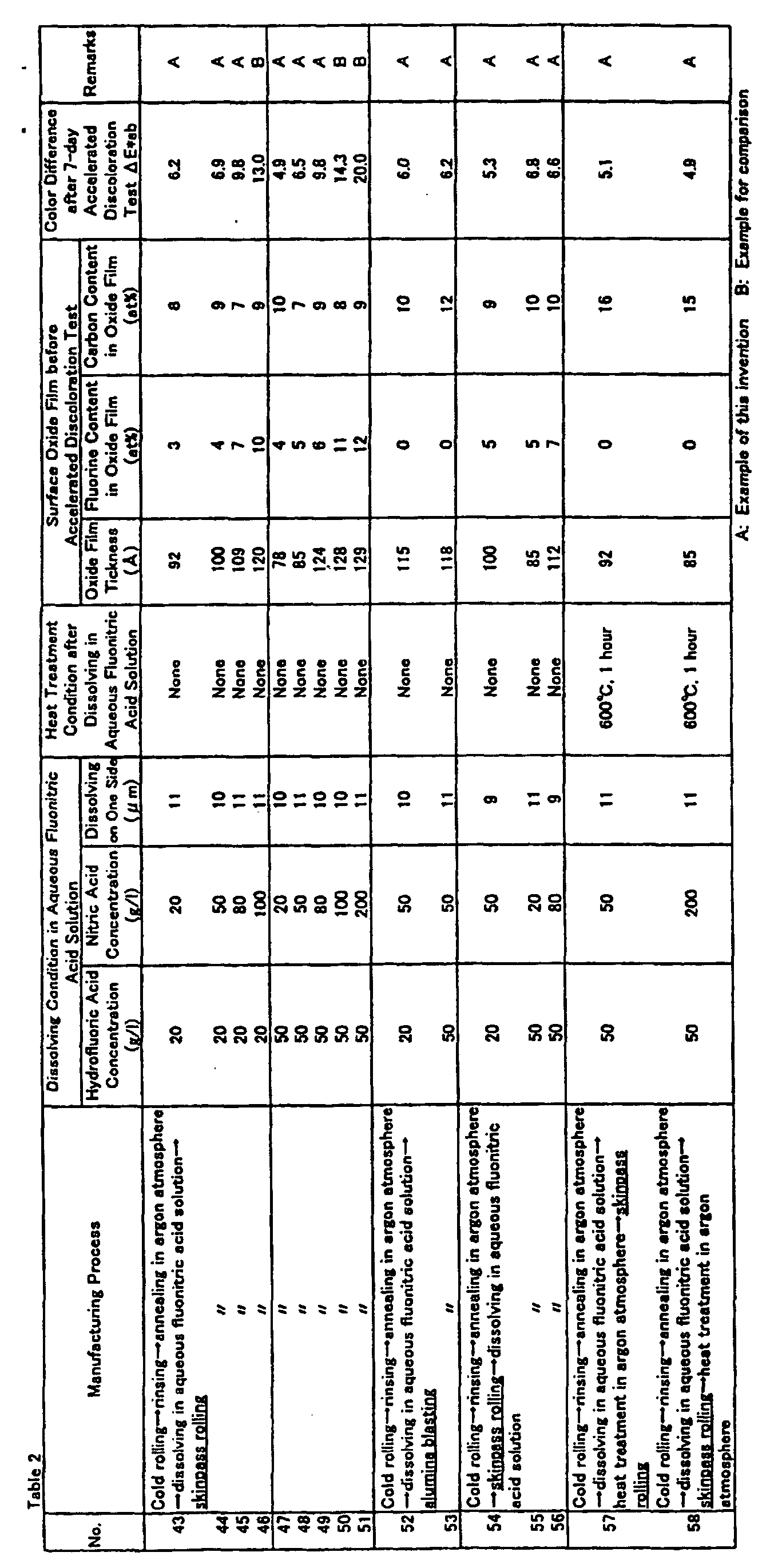
- Table 2 shows manufacturing processes and conditions, oxide film thickness before accelerated discoloration test, fluorine and carbon contents in oxide film, and color difference ⁇ E*ab after a 7-day long accelerated discoloration test of JIS Type 1 pure titanium for industrial use subjected to skinpass rolling and alumina blasting.
- the oxide film thickness before the accelerated discoloration test, fluorine and carbon contents in the oxide film were determined, together with the composition distribution in the direction of depth determined by Auger electron spectroscopy, by the method described before, as with the data given in Table 1.
- Examples for comparison Nos. 46, 50 and 51 in Table 2 were dissolved in an aqueous fluonitric acid solution with a nitric acid of 100 g/l or over and then skinpass rolled. Fluorine and carbon contents in the oxide film remained substantially unchanged from before the application of skinpass rolling, as in the case of Examples Nos. 11, 23 and 24 in Table 1. Fluorine content in the oxide film was as high as 10 at% or above, as a result of which color difference was as great as 13 points or above.
- Examples Nos. 43 to 45, 47 to 49, and 54 to 56 according to this invention were dissolved in an aqueous fluonitric acid solution with a nitric acid concentration of 80 g/l or under. Even if skinpass rolling was applied before or after dissolving, fluorine and carbon contents in the surface oxide film remained substantially unchanged. Fluorine content was as low as 7 at% or below and color difference was as small as under 10 points, as with the examples dissolved in an aqueous fluonitric acid solution shown in Table 1.
- the degree of insusceptibility to discoloration remained substantially the same when dissolving was performed in an aqueous fluonitric acid with a nitric acid concentration of 80 g/l or under, whether skinpass rolling was applied before or after dissolving.
- Examples Nos. 52 and 53 were subjected to alumina blasting after being dissolved in an aqueous fluonitric acid solution. With the surface thus slightly reduced, fluorine content was lowered to an undetectable level, as a result of which color difference was also reduced to as low as 6.2 points or under. Thus, the degree of insusceptibility to discoloration remained substantially the same when dissolving was performed in an aqueous fluonitric acid with a nitric acid concentration of 80 g/l or under, whether alumina blasting, like skinpass rolling, was applied before or after melting.
- Examples Nos. 57 and 58 according to this invention were subjected to skinpass rolling before and after heat treatment in an argon atmosphere. No fluorine was detected in the oxide film of both examples and color difference was as small as approximately 5.0 points. Obviously, the degree of insusceptibility to discoloration remained unchanged whether skinpass rolling was applied before or after the heat treatment in an argon atmosphere. Like the skinpass rolling described here, alumina blasting or redressing also produces similar results.
- titanium materials less susceptible to discoloration are obtainable by controlling fluorine and carbon contents in the oxide film on the surface of titanium and the thickness thereof.
- the titanium materials thus obtained are useful particularly for building roofs, walls and other exterior materials that should not be unpleasant or offensive to view.
Landscapes
- Chemical & Material Sciences (AREA)
- Engineering & Computer Science (AREA)
- Materials Engineering (AREA)
- Mechanical Engineering (AREA)
- Metallurgy (AREA)
- Organic Chemistry (AREA)
- Chemical Kinetics & Catalysis (AREA)
- Thermal Sciences (AREA)
- Physics & Mathematics (AREA)
- Crystallography & Structural Chemistry (AREA)
- General Chemical & Material Sciences (AREA)
- Chemical Treatment Of Metals (AREA)
- Cleaning And De-Greasing Of Metallic Materials By Chemical Methods (AREA)
- Other Surface Treatments For Metallic Materials (AREA)
- Inorganic Compounds Of Heavy Metals (AREA)
- Physical Vapour Deposition (AREA)
Abstract
Description

Claims (7)
- A titanium material less susceptible to discoloration containing not more than 7 at% fluorine in the oxide film on the surface thereof.
- A titanium material less susceptible to discoloration containing not more than 7 at% fluorine and not more than 20 at% carbon in the oxide film on the surface thereof.
- A titanium material less susceptible to discoloration having an oxide film not more than 120 angstroms in thickness on the surface thereof and containing not more than 7 at% fluorine in said oxide film.
- A titanium material less susceptible to discoloration having an oxide film not more than 120 angstroms in thickness on the surface thereof and containing not more than 7 at% fluorine and not more than 20 at% carbon in said oxide film.
- A method of manufacturing titanium material less susceptible to discoloration comprising dissolving the surface thereof in an aqueous solution of hydrofluoric and nitric acids with a nitric acid concentration of not higher than 80 g/l.
- A method of manufacturing titanium material less susceptible to discoloration comprising heating the titanium material at between 300 and 900 °C in a vacuum or an inert gas atmosphere after dissolving the surface of the titanium material in an aqueous solution of hydrofluoric and nitric acids.
- A method of manufacturing titanium material less susceptible to discoloration according to claim 5 or 6 comprising applying skinpass rolling, shot blasting or other surface properties adjusting or redressing either before or after, or both, dissolving in an aqueous fluonitric acid solution or either before or after, or both, heat treating in a vacuum or an inert gas atmosphere of argon or helium.
Applications Claiming Priority (3)
| Application Number | Priority Date | Filing Date | Title |
|---|---|---|---|
| JP2000229803A JP3406898B2 (en) | 2000-07-28 | 2000-07-28 | Titanium material that does not easily cause discoloration and method for producing the same |
| JP2000229803 | 2000-07-28 | ||
| PCT/JP2001/006302 WO2002010481A1 (en) | 2000-07-28 | 2001-07-19 | Titanium material less susceptible to discoloration and method for production thereof |
Publications (3)
| Publication Number | Publication Date |
|---|---|
| EP1306468A1 true EP1306468A1 (en) | 2003-05-02 |
| EP1306468A4 EP1306468A4 (en) | 2009-04-08 |
| EP1306468B1 EP1306468B1 (en) | 2015-07-08 |
Family
ID=18722859
Family Applications (1)
| Application Number | Title | Priority Date | Filing Date |
|---|---|---|---|
| EP01953306.6A Expired - Lifetime EP1306468B1 (en) | 2000-07-28 | 2001-07-19 | Method for production of titanium material less susceptible to discoloration |
Country Status (4)
| Country | Link |
|---|---|
| US (1) | US7594973B2 (en) |
| EP (1) | EP1306468B1 (en) |
| JP (1) | JP3406898B2 (en) |
| WO (1) | WO2002010481A1 (en) |
Cited By (3)
| Publication number | Priority date | Publication date | Assignee | Title |
|---|---|---|---|---|
| EP1464715A1 (en) * | 2003-03-20 | 2004-10-06 | Kabushiki Kaisha Kobe Seiko Sho | Pure titanium building material and method of manufacturing the same |
| US7611588B2 (en) | 2004-11-30 | 2009-11-03 | Ecolab Inc. | Methods and compositions for removing metal oxides |
| EP1887094A4 (en) * | 2005-05-31 | 2009-11-11 | Nippon Steel Corp | PURE TITANIUM OR COLORED TITANIUM ALLOY HAVING A LOW TREND TO DECOLORIZATION IN AN ATMOSPHERIC ENVIRONMENT |
Families Citing this family (11)
| Publication number | Priority date | Publication date | Assignee | Title |
|---|---|---|---|---|
| JP4541726B2 (en) * | 2003-03-20 | 2010-09-08 | 株式会社神戸製鋼所 | Manufacturing method of pure titanium material for building materials |
| JP4548105B2 (en) * | 2004-12-08 | 2010-09-22 | 東洋製罐株式会社 | Method of removing resin coating from resin-coated metal molded body and titanium molded body obtained by the method |
| JP4634257B2 (en) * | 2005-08-30 | 2011-02-16 | パイオニア株式会社 | Voice coil bobbin, method for manufacturing the same, and speaker device |
| US8323415B2 (en) * | 2006-08-10 | 2012-12-04 | GM Global Technology Operations LLC | Fast recycling process for ruthenium, gold and titanium coatings from hydrophilic PEM fuel cell bipolar plates |
| WO2011016465A1 (en) * | 2009-08-03 | 2011-02-10 | 新日本製鐵株式会社 | Titanium material for solid polymer fuel cell separator, and process for production thereof |
| JP6917587B1 (en) * | 2020-06-30 | 2021-08-11 | パナソニックIpマネジメント株式会社 | Laminated film structure and manufacturing method of laminated film structure |
| EP4311381A3 (en) | 2020-06-30 | 2024-07-03 | Panasonic Intellectual Property Management Co., Ltd. | Laminated film structure and method for manufacturing laminated film structure |
| US20230357893A1 (en) * | 2020-09-16 | 2023-11-09 | Nippon Steel Corporation | Titanium material and method for manufacturing titanium material |
| JP7518378B2 (en) | 2020-10-07 | 2024-07-18 | 日本製鉄株式会社 | Titanium material and its manufacturing method |
| WO2023170979A1 (en) | 2022-03-11 | 2023-09-14 | 日本製鉄株式会社 | Titanium material |
| CN115027079B (en) * | 2022-06-27 | 2023-09-05 | 江苏君华特种工程塑料制品有限公司 | Method for reducing thickness of oxide layer by destressing special engineering plastic profile |
Family Cites Families (16)
| Publication number | Priority date | Publication date | Assignee | Title |
|---|---|---|---|---|
| JPS5461038A (en) | 1977-10-24 | 1979-05-17 | Sumitomo Metal Ind Ltd | Metallic luster giving method to titanium and titanium alloy surfaces |
| JPS59179791A (en) | 1983-03-30 | 1984-10-12 | Nuclear Fuel Ind Ltd | Surface treatment of coated pipe for nuclear fuel rod |
| JPS60238465A (en) | 1984-05-11 | 1985-11-27 | Nippon Stainless Steel Co Ltd | Manufacture of bright-annealed titanium and titanium alloy material with superior formability |
| JPH07103458B2 (en) | 1986-05-13 | 1995-11-08 | 株式会社神戸製鋼所 | Method of modifying titanium plate |
| JPS62284056A (en) * | 1986-06-03 | 1987-12-09 | Nippon Steel Corp | Pretreatment of titanium and titanium alloy before heating |
| JPH01234551A (en) * | 1988-03-15 | 1989-09-19 | Nippon Mining Co Ltd | Manufacture of titanium stock excellent in workability |
| BR9509934A (en) * | 1994-11-30 | 1998-01-27 | Implant Innovations Inc | Preparation of implant surface |
| JP3397927B2 (en) | 1995-03-01 | 2003-04-21 | 新日本製鐵株式会社 | Method for producing titanium material with excellent anti-glare properties |
| JP3204598B2 (en) | 1995-04-19 | 2001-09-04 | 株式会社神戸製鋼所 | Pickling method for titanium plate |
| JPH08296072A (en) | 1995-04-26 | 1996-11-12 | Nippon Steel Corp | Pickling method for titanium material |
| JP3221303B2 (en) | 1995-12-06 | 2001-10-22 | 株式会社神戸製鋼所 | Titanium or titanium alloy member with beautiful surface and method of manufacturing the same |
| JP3219690B2 (en) | 1996-06-18 | 2001-10-15 | 株式会社神戸製鋼所 | Outdoor titanium or titanium alloy material with excellent discoloration resistance |
| JPH1096093A (en) | 1996-09-19 | 1998-04-14 | Nippon Steel Corp | Method for producing pure titanium sheet with excellent anti-glare properties |
| JP3255610B2 (en) * | 1998-06-18 | 2002-02-12 | 株式会社神戸製鋼所 | Titanium material or titanium alloy material excellent in discoloration resistance, method for producing the same, and exterior material for building |
| JP3566930B2 (en) * | 2000-02-23 | 2004-09-15 | 新日本製鐵株式会社 | Titanium hardly causing discoloration in atmospheric environment and method for producing the same |
| JP2001348634A (en) * | 2000-06-06 | 2001-12-18 | Sumitomo Metal Ind Ltd | Titanium plate with little discoloration |
-
2000
- 2000-07-28 JP JP2000229803A patent/JP3406898B2/en not_active Expired - Fee Related
-
2001
- 2001-07-19 EP EP01953306.6A patent/EP1306468B1/en not_active Expired - Lifetime
- 2001-07-19 WO PCT/JP2001/006302 patent/WO2002010481A1/en not_active Ceased
- 2001-07-19 US US10/343,168 patent/US7594973B2/en not_active Expired - Lifetime
Cited By (4)
| Publication number | Priority date | Publication date | Assignee | Title |
|---|---|---|---|---|
| EP1464715A1 (en) * | 2003-03-20 | 2004-10-06 | Kabushiki Kaisha Kobe Seiko Sho | Pure titanium building material and method of manufacturing the same |
| US7611588B2 (en) | 2004-11-30 | 2009-11-03 | Ecolab Inc. | Methods and compositions for removing metal oxides |
| EP1887094A4 (en) * | 2005-05-31 | 2009-11-11 | Nippon Steel Corp | PURE TITANIUM OR COLORED TITANIUM ALLOY HAVING A LOW TREND TO DECOLORIZATION IN AN ATMOSPHERIC ENVIRONMENT |
| US9885102B2 (en) | 2005-05-31 | 2018-02-06 | Nippon Steel & Sumitomo Metal Corporation | Colored pure titanium or titanium alloy having low susceptibility to discoloration in atmospheric environment |
Also Published As
| Publication number | Publication date |
|---|---|
| US7594973B2 (en) | 2009-09-29 |
| JP2002047589A (en) | 2002-02-15 |
| US20030178112A1 (en) | 2003-09-25 |
| EP1306468B1 (en) | 2015-07-08 |
| EP1306468A4 (en) | 2009-04-08 |
| JP3406898B2 (en) | 2003-05-19 |
| WO2002010481A1 (en) | 2002-02-07 |
Similar Documents
| Publication | Publication Date | Title |
|---|---|---|
| EP1306468A1 (en) | Titanium material less susceptible to discoloration and method for production thereof | |
| EP1264913B1 (en) | Titanium less susceptible to discoloration in the atmosphere and method for producing same | |
| US5580398A (en) | Method of forming passive oxide film based on chromium oxide, and stainless steel | |
| EP2829628A1 (en) | Cast product having alumina barrier layer, and method for manufacturing same | |
| RU2266345C1 (en) | Construction material from pure titanium and method for manufacturing the same | |
| EP1540029B1 (en) | Method of case hardening titanium and zirconium alloys | |
| Culpan et al. | The chemical polishing of aluminium | |
| JP3255610B2 (en) | Titanium material or titanium alloy material excellent in discoloration resistance, method for producing the same, and exterior material for building | |
| Göbel et al. | Study of the high‐temperature oxidation behaviour of Ti and Ti4Nb with SNMS using tracers | |
| KR102861309B1 (en) | Titanium materials and methods for manufacturing titanium materials | |
| JPH07180029A (en) | Corrosion resistant material and its production | |
| JP4541726B2 (en) | Manufacturing method of pure titanium material for building materials | |
| JP2952840B2 (en) | Stainless steel with excellent rust resistance containing nitrogen-containing compound | |
| JP2887528B2 (en) | How to improve the corrosion resistance of iron alloys | |
| JP2702371B2 (en) | Manufacturing method of exterior stainless steel sheet having anti-glare property and corrosion resistance | |
| EP0928836B1 (en) | Steel products having superior weathering, method of producing the steel products, and method of forming weathering protective rust on steel product surfaces | |
| Lenarduzzi et al. | Titanium oxidation during thermal treatment: inhibiting role of nitrogen and epitaxial orientation relations evidenced by EBSD | |
| JP2849251B2 (en) | Manufacturing method of exterior stainless steel sheet having both anti-glare property and corrosion resistance | |
| JP2005272870A (en) | Titanium or titanium alloy that does not easily discolor in the atmosphere | |
| JP3119165B2 (en) | Manufacturing method of stainless steel for high purity gas | |
| JP4418386B2 (en) | Titanium or titanium alloy that does not easily discolor in the atmosphere | |
| JP3036325B2 (en) | Cold rolled steel sheet with excellent chemical conversion properties | |
| WO2025150394A1 (en) | Titanium material and method for manufacturing titanium material | |
| JP4213889B2 (en) | Color titanium for outdoor environment having excellent discoloration resistance and method for producing the same | |
| JP2632569B2 (en) | Method for producing titanium material with excellent corrosion resistance |
Legal Events
| Date | Code | Title | Description |
|---|---|---|---|
| PUAI | Public reference made under article 153(3) epc to a published international application that has entered the european phase |
Free format text: ORIGINAL CODE: 0009012 |
|
| 17P | Request for examination filed |
Effective date: 20030224 |
|
| AK | Designated contracting states |
Designated state(s): DE FR GB |
|
| A4 | Supplementary search report drawn up and despatched |
Effective date: 20090309 |
|
| 17Q | First examination report despatched |
Effective date: 20090813 |
|
| RAP1 | Party data changed (applicant data changed or rights of an application transferred) |
Owner name: NIPPON STEEL & SUMITOMO METAL CORPORATION |
|
| REG | Reference to a national code |
Ref country code: DE Ref legal event code: R079 Ref document number: 60149441 Country of ref document: DE Free format text: PREVIOUS MAIN CLASS: C23G0001020000 Ipc: C22F0001020000 |
|
| RIC1 | Information provided on ipc code assigned before grant |
Ipc: C22F 1/02 20060101AFI20141118BHEP Ipc: C23G 1/10 20060101ALI20141118BHEP Ipc: C23C 8/10 20060101ALI20141118BHEP Ipc: C22F 1/18 20060101ALI20141118BHEP Ipc: C23C 8/02 20060101ALI20141118BHEP |
|
| GRAP | Despatch of communication of intention to grant a patent |
Free format text: ORIGINAL CODE: EPIDOSNIGR1 |
|
| INTG | Intention to grant announced |
Effective date: 20150109 |
|
| GRAS | Grant fee paid |
Free format text: ORIGINAL CODE: EPIDOSNIGR3 |
|
| GRAA | (expected) grant |
Free format text: ORIGINAL CODE: 0009210 |
|
| RIN1 | Information on inventor provided before grant (corrected) |
Inventor name: TAKAHASHI, K., C/O NIPPON STEEL CORP. HIKARI WORKS Inventor name: TOKUNO, K., C/O NIPPON STEEL CORP. HIKARI WORKS Inventor name: TAMENARI, J., C/O NIPPON STEEL CORP. HIKARI WORKS Inventor name: KIMURA, KINICHI, C/O NIPPON STEEL & SUMITOMO METAL Inventor name: HAYASHI,T., C/O NIPPON STEEL CORP. HIKARI WORKS Inventor name: KANEKO, MICHIO, C/O NIPPON STEEL CORPORATION |
|
| AK | Designated contracting states |
Kind code of ref document: B1 Designated state(s): DE FR GB |
|
| REG | Reference to a national code |
Ref country code: GB Ref legal event code: FG4D |
|
| RIN1 | Information on inventor provided before grant (corrected) |
Inventor name: KANEKO, MICHIO, C/O NIPPON STEEL CORPORATION Inventor name: TAKAHASHI, KAZUHIRO, C/O NIPPON STEEL CORP. HIKARI Inventor name: KIMURA, KINICHI, C/O NIPPON STEEL & SUMITOMO METAL Inventor name: TAMENARI, JUNICHI, C/O NIPPON STEEL CORP. HIKARI W Inventor name: TOKUNO, KIYONORI, C/O NIPPON STEEL CORP. HIKARI WO Inventor name: HAYASHI, TERUHIKO, C/O NIPPON STEEL CORP. HIKARI W |
|
| REG | Reference to a national code |
Ref country code: DE Ref legal event code: R096 Ref document number: 60149441 Country of ref document: DE |
|
| REG | Reference to a national code |
Ref country code: DE Ref legal event code: R097 Ref document number: 60149441 Country of ref document: DE |
|
| PLBE | No opposition filed within time limit |
Free format text: ORIGINAL CODE: 0009261 |
|
| STAA | Information on the status of an ep patent application or granted ep patent |
Free format text: STATUS: NO OPPOSITION FILED WITHIN TIME LIMIT |
|
| REG | Reference to a national code |
Ref country code: FR Ref legal event code: PLFP Year of fee payment: 16 |
|
| 26N | No opposition filed |
Effective date: 20160411 |
|
| REG | Reference to a national code |
Ref country code: FR Ref legal event code: PLFP Year of fee payment: 17 |
|
| REG | Reference to a national code |
Ref country code: FR Ref legal event code: PLFP Year of fee payment: 18 |
|
| REG | Reference to a national code |
Ref country code: DE Ref legal event code: R082 Ref document number: 60149441 Country of ref document: DE Representative=s name: VOSSIUS & PARTNER PATENTANWAELTE RECHTSANWAELT, DE Ref country code: DE Ref legal event code: R081 Ref document number: 60149441 Country of ref document: DE Owner name: NIPPON STEEL CORPORATION, JP Free format text: FORMER OWNER: NIPPON STEEL & SUMITOMO METAL CORP., TOKYO, JP |
|
| PGFP | Annual fee paid to national office [announced via postgrant information from national office to epo] |
Ref country code: FR Payment date: 20200611 Year of fee payment: 20 |
|
| PGFP | Annual fee paid to national office [announced via postgrant information from national office to epo] |
Ref country code: DE Payment date: 20200707 Year of fee payment: 20 Ref country code: GB Payment date: 20200708 Year of fee payment: 20 |
|
| REG | Reference to a national code |
Ref country code: DE Ref legal event code: R071 Ref document number: 60149441 Country of ref document: DE |
|
| REG | Reference to a national code |
Ref country code: GB Ref legal event code: PE20 Expiry date: 20210718 |
|
| PG25 | Lapsed in a contracting state [announced via postgrant information from national office to epo] |
Ref country code: GB Free format text: LAPSE BECAUSE OF EXPIRATION OF PROTECTION Effective date: 20210718 |