EP1306363A1 - Adamantyl ester monomer composition - Google Patents
Adamantyl ester monomer composition Download PDFInfo
- Publication number
- EP1306363A1 EP1306363A1 EP01984487A EP01984487A EP1306363A1 EP 1306363 A1 EP1306363 A1 EP 1306363A1 EP 01984487 A EP01984487 A EP 01984487A EP 01984487 A EP01984487 A EP 01984487A EP 1306363 A1 EP1306363 A1 EP 1306363A1
- Authority
- EP
- European Patent Office
- Prior art keywords
- ester monomer
- adamantyl ester
- distillation
- general formula
- adamantyl
- Prior art date
- Legal status (The legal status is an assumption and is not a legal conclusion. Google has not performed a legal analysis and makes no representation as to the accuracy of the status listed.)
- Withdrawn
Links
Classifications
-
- C—CHEMISTRY; METALLURGY
- C07—ORGANIC CHEMISTRY
- C07C—ACYCLIC OR CARBOCYCLIC COMPOUNDS
- C07C67/00—Preparation of carboxylic acid esters
- C07C67/48—Separation; Purification; Stabilisation; Use of additives
- C07C67/52—Separation; Purification; Stabilisation; Use of additives by change in the physical state, e.g. crystallisation
- C07C67/54—Separation; Purification; Stabilisation; Use of additives by change in the physical state, e.g. crystallisation by distillation
-
- C—CHEMISTRY; METALLURGY
- C07—ORGANIC CHEMISTRY
- C07C—ACYCLIC OR CARBOCYCLIC COMPOUNDS
- C07C67/00—Preparation of carboxylic acid esters
- C07C67/48—Separation; Purification; Stabilisation; Use of additives
- C07C67/62—Use of additives, e.g. for stabilisation
-
- C—CHEMISTRY; METALLURGY
- C07—ORGANIC CHEMISTRY
- C07C—ACYCLIC OR CARBOCYCLIC COMPOUNDS
- C07C2603/00—Systems containing at least three condensed rings
- C07C2603/56—Ring systems containing bridged rings
- C07C2603/58—Ring systems containing bridged rings containing three rings
- C07C2603/70—Ring systems containing bridged rings containing three rings containing only six-membered rings
- C07C2603/74—Adamantanes
Definitions
- the present invention relates to an adamantyl ester monomer composition having high storage stability, as well as to a process for producing an adamantyl ester monomer of high purity from the composition.
- the adamantyl ester monomer is generally produced by reacting an adamantane derivative (the examples thereof are shown below or the like) with a carboxylic acid compound or a derivative thereof, such as acrylic acid or methacrylic acid [hereinafter, both are referred to as (meth)acrylic acid], (meth)acrylic acid derivative or the like, to give rise to esterification.
- an adamantane derivative the examples thereof are shown below or the like
- a carboxylic acid compound or a derivative thereof such as acrylic acid or methacrylic acid [hereinafter, both are referred to as (meth)acrylic acid], (meth)acrylic acid derivative or the like
- Resist materials used in semiconductor production are required to have a high purity so as to be suitably used in fine processing.
- the monomer need be purified in order to remove the impurities contained therein, such as metal component and the like.
- the purification is conducted by distillation, the adamantyl ester monomer causes gelling during the distillation, which tends to incur pipe plugging and solidification in still. Therefore, it is difficult to purify the adamantyl ester monomer stably by distillation.
- a polymerization inhibitor is generally added to the monomer in order to prevent the polymerization of the monomer taking place during the distillation.
- the polymerization inhibitor used for such a purpose there are known phenol type polymerization inhibitors such as hydroquinone, 4-methoxyphenol and the like; quinone type polymerization inhibitors such as parabenzoquinone, 2,5-di-tert-butylbenzoquinone and the like; and aromatic amine type polymerization inhibitors such as phenothiazine and the like.
- the present inventors first tried to distill an adamantyl ester monomer by adding thereto a generally used polymerization inhibitor such as mentioned above.
- a generally used polymerization inhibitor such as mentioned above.
- the boiling point of adamantyl ester monomer is generally high, a high distillation temperature is needed.
- the following problems, for example, have appeared probably owing to the high-temperature distillation. That is, the polymerization inhibitor is distilled and the amount of the polymerization inhibitor in still is decreased, which invites gelling in the still in the latter period of distillation; and the adamantyl ester monomer or the polymerization inhibitor used in distillate is decomposed, which invites coloring of the distillate.
- a polymerization inhibitor having a large molecular weight specifically an aromatic amine type polymerization inhibitor, i.e. N,N'-diphenyl-p-phenylenediamine or N,N'-dinaphthyl-p-phenylenediamine was added to an adamantyl ester monomer and distillation was tried.
- an aromatic amine type polymerization inhibitor i.e. N,N'-diphenyl-p-phenylenediamine or N,N'-dinaphthyl-p-phenylenediamine
- the stabilization effect of such a polymerization inhibitor toward adamantyl ester monomer was low and the gelling of monomer in still and the coloring of distillate could not be prevented sufficiently.
- the present inventors further made studies on the stabilization effect of large molecular weight polymerization inhibitor other than those mentioned above, toward adamantyl ester monomer.
- the present invention lies in an adamantyl ester monomer composition characterized by containing at least an adamantyl ester monomer wherein a carbon atom of the adamantane skeleton is bonded with an organic residue having at least one polymerizable unsaturated bond via -OCO- bond, and a compound represented by the following general formula (1): (in the formula, R 1 is an alkyl group of 1 to 5 carbon atoms, R 2 is an alkyl group of 1 to 5 carbon atoms, R 3 is a hydrogen atom or an alkyl group of 1 to 5 carbon atoms, and R 4 is a hydrogen atom or a methyl group).
- the compound represented by the general formula (1) has a large molecular weight and therefore low volatility at high temperatures and is very high in inhibitory effect for polymerization of adamantyl ester monomer.
- the adamantyl ester monomer composition of the present invention containing the compound has high stability. That is, decomposition or polymerization of adamantyl ester monomer in the composition is prevented even during the long-term storage or high-temperature standing of the composition, and there is no distillation of the polymerization inhibitor when the composition has been subjected to distillation.
- an adamantyl ester monomer of high purity can be obtained from such a composition by a simple distillation operation.
- the stabilization effect of the composition can be further enhanced by adding thereto, besides the compound of the general formula (1), a sulfur-based antioxidant and/or a phenol type antioxidant.
- the sulfur-based antioxidant acts as a decomposer for hydroperoxide and decomposes a peroxide contained in adamantyl ester monomer composition and the phenol type antioxidant acts as a capturing agent for peroxy radical, whereby such preferred effects are exhibited.
- the present invention lies also in a process for producing a high-purity adamantyl ester monomer, characterized in that the above-mentioned adamantyl ester monomer composition of the present invention is subjected to distillation to obtain a high-purity adamantyl ester monomer.
- an adamantyl ester monomer of high purity can be obtained stably by a simple operation of subjecting the present composition to distillation.
- the gelling of the monomer per se can be prevented sufficiently and a monomer of high purity can be obtained by adding, to the crude adamantyl ester monomer, a compound represented by the general formula (1) and, as necessary, the above-mentioned sulfur-based antioxidant and phenol type antioxidant and subjecting the resulting adamantyl ester monomer composition of the present invention to distillation.
- the present invention it becomes possible to easily distill and purify an adamantyl ester monomer whose stable distillation and purification has been difficult.
- By employing the production process of the present invention it is also possible to easily obtain an adamantyl ester monomer of high purity which is expected to be used as a resist material for semiconductor. It is also possible to store an adamantyl ester monomer stably for a long period.
- composition of the present invention contains at least an adamantyl ester monomer having at least one polymerizable unsaturated bond in the molecule and a compound represented by the general formula (1).
- the adamantyl ester monomer contained in the composition of the present invention is a compound wherein a monovalent organic residue is bonded to a carbon atom of adamantane skeleton via -O-CO- bond.
- the organic residue has at least one polymerizable unsaturated bond.
- the adamantyl ester monomer there is no particular restriction, and a known compound can be used.
- R 6 is an alkyl group of 1 to 6 carbon atoms
- m is an integer of 1 to 3
- n is an integer of 0 to 4
- R 5 and R 6 two R 5 s or two R 6 s may be bonded to a carbon atom of adamantane skeleton.
- 2-adamantyl (meth)acrylates represented by the following general formula (3): (in the formula, R 7 is a hydrogen atom or a methyl group and R 8 is a hydrogen atom or an alkyl group of 1 to 6 carbon atoms), or 1-adamantyl (meth)acrylates represented by the following general formula (4): (in the formula, R 9 is a hydrogen atom or a methyl group), because they are useful as a raw material for resist for semiconductor and a very high purity is required .
- adamantyl ester compound represented by the general formula (3) there are mentioned 2-methyl-2-adamantyl acrylate, 2-ethyl-2-adamantyl acrylate, 2-methyl-2-adamantyl methacrylate, 2-ethyl-2-adamantyl methacrylate, 2-propyl-2-adamantyl acrylate and 2-butyl-2-adamantyl acrylate.
- the composition of the present invention contains an adamantyl ester monomer, a compound represented by the general formula (1) and, as necessary, an antioxidant. Owing to the presence of such an antioxidant, the storage stability of the adamantyl ester monomer becomes higher than when no antioxidant is present. Further, when the composition is heated to the boiling point, the compound of the general formula (1) and the antioxidant are not distilled and remain in the composition and a high stabilization effect toward monomer is maintained. Therefore, when the composition is subjected to distillation, decomposition, etc. of adamantyl ester monomer and subsequent gelling and coloring are prevented effectively.
- composition of the present invention contains a compound represented by the general formula (1) as an essential component.
- 2,2'-methylenebis(6-tert-butyl-4-methylphenol) monoacrylate which is a compound of the general formula (1) wherein R 1 is a methyl group, R 2 is a methyl group, R 3 is a hydrogen atom and R 4 is a hydrogen atom, or 2,2'-ethylidenebis(4,6-di-tert-amylphenol) monoacrylate which is a compound of the general formula (1) wherein R 1 is an ethyl group, R 2 is a tert-amyl group, R 3 is a methyl group and R 4 is a hydrogen atom, because they have a high inhibitory effect for polymerization and are easily available.
- the use amount of the compound represented by the general formula (1) differs depending upon its kind, the kind of adamantyl ester monomer, and the kinds and amount of the impurities contained. Therefore, a use amount necessary for obtaining a sufficient inhibitory effect for polymerization is determined appropriately, for example, by specifically conducting a preliminary heat stability test for each individual composition.
- the use amount of the compound represented by the general formula (1) is preferably 0.01 to 30 parts by mass, particularly preferably 0.1 to 5 parts by mass relative to 100 parts by mass of adamantyl ester monomer.
- composition of the present invention may contain only an adamantyl ester monomer and a compound of the general formula (1).
- the composition preferably contains further a sulfur-based antioxidant and/or a phenol type antioxidant for a higher inhibitory effect for gelling during heating.
- a composition containing both a sulfur-based antioxidant and a phenol type antioxidant is most preferred.
- the sulfur-based antioxidant there is no particular restriction as long as it is a sulfur-containing compound having antioxidancy but having no phenol skeleton. Any known sulfur-containing compound can be used. However, a compound generally used as a sulfur-based secondary antioxidant is preferred from the standpoint of stabilizing effect.
- dialkyl sulfides such as didodecyl sulfide, distearyl sulfide and the like
- thiopropionic acid type sulfur compounds such as dilauryl 3,3'-thiodipropionate, dimyristyl 3,3'-thiodipropionate, distearyl 3,3'-thiodipropionate, pentaerythrityl tetrakis(3-laurylthiopropionate), thiobis[2-(1,1-dimethylethyl)-5-methyl-4,1-phenylene]bis[3-(tetradecylthio)propionate], thiobis[2-(1,1-dimethylethyl)-5-methyl-4,1-phenylene]bis[3-(dodecylthio)propionate and the like; and thiol group-containing imidazoles such as 2-
- thiopropionic acid type sulfur compounds such as pentaerythrityl tetrakis(3-laurylthiopropionate) and the like because they are hardly distilled and show a very high inhibitory effect for gelling.
- the amount of the sulfur-based antioxidant used is preferably 10 to 500 parts by mass, particularly preferably 20 to 100 parts by mass relative to 100 parts by mass of the compound represented by the general formula (1) in view of the stabilization (polymerization inhibition) effect of monomer.
- the phenol type antioxidant there is no particular restriction as long as it is a phenolic compound having antioxidancy, and a known compound can be used.
- a compound generally used as a phenolic primary antioxidant is preferably used in view of the stabilization effect.
- the compounds preferably used as the phenol type antioxidant there are mentioned monophenol type compounds such as 2,6-di-tert-butyl-4-methylphenol, 2,6'-di-tert-butyl-4-ethylphenol, butylhydroxyanisole, stearyl ⁇ -(3,5-di-tert-butyl-4-hydroxyphenyl)propionate and the like; bisphenol type compounds such as 2,2'-methylenebis(6-tert-butyl-4-methylphenol), 2,2'-methylenebis(6-tert-butyl-4-ethylphenol), 4,4'-butylidenebis(6-tert-butyl-3-methylphenol), 4,4'-thiobis(6-tert-butyl-3-methylphenol), 3,9-bis[2- ⁇ 3-(3-tert-butyl-4-hydroxy-5-methylphenyl)propionyloxy ⁇ -1,1'-dimethylethyl]-2,4,8,10-te
- bisphenol type compounds such as 4,4'-thiobis(6-tert-butyl-3-methylphenol) and the like and phenolic compounds having three or more phenol groups, such as tetrakis-[methylene-3-(3',5'-di-tert-butyl-4-hydroxyphenyl propionate)methane and the like because they are hardly distilled and are highly soluble in adamantyl ester monomers.
- the amount of the phenol type antioxidant used is preferably 10 to 500 parts by mass, particularly preferably 20 to 100 parts by mass relative to 100 parts by mass of the compound represented by the general formula (1) so that a stabilization effect is exhibited reliably.
- the adamantyl ester monomer composition of the present invention may further contain, in addition to the adamantyl ester monomer, the compound represented by the general formula (1) and the antioxidant, a known polymerization inhibitor other than the compound represented by the general formula (1) as long as the advantages of the present invention are not impaired.
- the adamantyl ester monomer composition of the present invention may further contain a third component in addition to the adamantyl ester monomer, the compound represented by the general formula (1) and the antioxidant.
- a third component there is no particular restriction as to the third component, but there are generally mentioned a solvent (e.g. tetrahydrofuran or hexane) used in synthesis of adamantyl ester monomer, unreacted raw materials, reaction by-products, metal components incoming from the environment, etc.
- a solvent e.g. tetrahydrofuran or hexane
- the impurities contained in a crude product obtained by an ordinary process for production of adamantyl ester monomer that is, a crude product obtained by as necessary removing a solvent, etc. from the reaction mixture of a synthesis reaction of adamantyl ester monomer, gives no adverse effect in carrying out the present invention.
- the content of the third component there is no particular restriction as to the content of the third component, but the total amount of the third component is ordinarily 50 parts by mass or less relative to 100 parts by mass of the adamantyl ester monomer.
- the alkali metal atom represented by M is a potassium atom, a sodium atom or the like.
- the halogen atom represented by X is a chlorine atom, a bromine atom, an iodine atom or the like.
- the bivalent aliphatic hydrocarbon group represented by R is a methylidene group, an ethylidene group, a propylidene group, an isopropylidene group or the like.
- an adamantyl ester monomer represented by the general formula (3) wherein R 8 is an alkyl group of 1 to 6 carbon atoms can be obtained by the following processes (a) to (c).
- a Grignard reagent e.g. an alkyl magnesium halide
- organometallic reagent e.g. an alkyl lithium
- the adamantyl ester monomer represented by the general formula (4) can be obtained, for example, by the following process (d).
- the adamantyl ester monomer composition of the present invention can be obtained, for example, by mixing, into a crude product obtained by a synthesis reaction [one of the above reactions (a) to (d)] for adamantyl ester monomer or a high-purity adamantyl ester monomer obtained by purification of the crude product, the compound of the general formula (1) and, as necessary, the above-mentioned antioxidant.
- the crude product includes a reaction mixture after synthesis reaction, a composition obtained by removing a solvent from the reaction mixture by distillation, a composition obtained by treating the reaction mixture with an aqueous basic solution, as necessary washing the resulting mixture, conducting solvent extraction, and further conducting a treatment such as solvent removal by distillation, or the like (hereinafter, each of such compositions may be referred to simply as crude product).
- the adamantyl ester monomer composition of the present invention obtained by mixing, into a high-purity adamantyl ester monomer, the compound of the general formula (1) and, as necessary, the above-mentioned antioxidant, is characterized by having high storage stability over a long period.
- the adamantyl ester monomer composition obtained by mixing, into the above-mentioned crude product, the compound of the general formula (1) and, as necessary, the above-mentioned antioxidant, has high storage stability.
- a high-purity adamantyl ester monomer can be obtained easily by obtaining a crude product by a synthesis reaction for adamantyl ester monomer, such as one of the above-mentioned (a) to (d), mixing thereinto the compound of the general formula (1) and, as necessary, the above-mentioned antioxidant to prepare an adamantyl ester monomer composition of the present invention, and distilling the composition.
- the compound of the general formula (1) and the above-mentioned antioxidant added as necessary may be added beforehand to a crude product which is to be distilled, or may be fed, after the start of distillation, into a still, a distillation tower, a distillation tube, a reflux line or the like.
- distillation there is no particular restriction as to the method of distillation and there can be employed simple distillation or fractional distillation.
- a fractionating column used in fractional distillation there are preferred thin-film type fractionating columns such as vigoureux type, concentric type, rotary band type, packed column type and the like, and plate-shaped fractionating columns such as bubble cap type, perforated plate type and the like.
- vigoureux type concentric type
- rotary band type packed column type and the like
- plate-shaped fractionating columns such as bubble cap type, perforated plate type and the like.
- a thin-film type fractionating column of low pressure loss is preferred.
- a known distillation method such as Kugel rohr, thin-film distillation or the like can be employed with no restriction.
- the distillation conditions used such as distillation temperature, distillation pressure, reflux ratio and the like.
- the distillation conditions are determined appropriately depending upon the boiling point of adamantyl ester monomer, the kinds and amount of the impurities contained, the kinds and use amounts of the compound of the general formula (1) and the antioxidant added as necessary, the purity of adamantyl ester monomer obtained finally, etc. It is generally preferred to conduct distillation at a pressure of 0.01 to 10 mmHg and a still temperature (a composition temperature inside still) of 50 to 150°C.
- the reaction mixture was concentrated. Thereto were added 200 ml of hexane and 100 ml of a 1 N aqueous ammonium chloride solution, followed by shaking. The organic phase was separated and then washed with a 5 mass % aqueous sodium hydroxide solution and further with water. The washed organic phase was concentrated to obtain crude 2-methyl-2-adamantyl methacrylate (a crude product) having a purity of 90 mass %.
- the gelling time is a time required for the contents of test tube to become non-fluid when the test tube is made upside down.
- a longer gelling time means superior storage stability, particularly superior stability at high temperatures.
- the average of the gelling times of the two samples, i.e. the average gelling time was 2.0 hours.
- the two test tubes each containing the above composition of the present Example were kept at 120°C in a constant-temperature oil bath and determined for average gelling time in the same manner as in Comparative Example 1.
- the average gelling time was 12.0 hours and was six times that of Comparative Example 1.
- the composition of the present Example is improved in high-temperature storage stability.
- An average gelling time was measured in the same manner as in Example 1 except that A-2 was used as the compound represented by the general formula (1).
- the average gelling time was 11.5 hours.
- Example 6 Average gelling times were measured in the same manner as in Example 1 except that there were added a compound of general formula (1) and a sulfur-based antioxidant both shown in Table 4. The results are shown in Table 4.
- Compound added Amount added (g) Average gelling time (hr)
- Example 6 A-1 0.01 17.5 S-1 0.01
- Example 7 A-2 0.01 19.5 S-2 0.02
- Example 8 A-1 0.01 18.5 S-1 0.04
- Example 9 A-2 0.001 17.5 S-2 0.02
- Example 10 A-1 0.01 19.0 S-3 0.02
- Example 11 A-2 0.01 18.5 S-4 0.04
- Example 12 Average gelling times were measured in the same manner as in Example 1 except that, as shown in Table 5, there was added a mixture of a compound represented by the general formula (1), a sulfur-based antioxidant and a phenol type antioxidant. The results are shown in Table 5.
- Compound added Amount added (g) Average gelling time (hr)
- Example 12 A-1 0.01 26.5 S-2 0.02 P-3 0.01
- Example 13 A-1 0.01 24.5 S-2 0.02 P-4 0.01
- Example 14 A-1 0.01 21.5 S-2 0.02 P-1 0.01
- Example 15 A-2 0.01 23.0 S-2 0.02 P-1 0.01
- Example 16 A-2 0.01 26.0 S-1 0.02 P-4 0.01
- the reduced pressure distillation was conducted at a vacuum of 0.3 mmHg using a 5-cm vigoureux type fractionating column and a total condensation type reflux fractionator while air was introduced into the composition through a glass capillary.
- the distillation was conducted while the distillate was subjected to compositional analysis using a gas chromatograph.
- the initial distillate was cut and the collection of the main distillate was begun when the purity of 2-methyl-2-adamantyl methacrylate in distillate exceeded 80%.
- 2-methyl-2-adamantyl methacrylate could be obtained at a purity of 95.2 mass % (distillation yield: 81%).
- Reduced pressure distillation was conducted in the same manner as in Example 17 except that the amount of the crude product was changed to 100 g and 0.3 g of A-1 and 0.6 g of S-1 were added thereto.
- 2-methyl-2-adamantyl methacrylate could be obtained at a purity of 95.6 mass % (distillation yield: 77%).
- 15 Hours were taken for the distillation.
- no gel was formed in the still, the pipe, etc.
- the main distillate was almost colorless and the A-1 content in the main distillate was the detection limit or less (50 ppm or less).
- Reduced pressure distillation was conducted in the same manner as in Example 17 except that there were added, to 200 g of the crude product, 0.6 g of A-1, 1.2 g of S-2 and 0.6 g of P-3.
- 2-methyl-2-adamantyl methacrylate could be obtained at a purity of 95.3 mass % (distillation yield: 80%).
- 24 Hours were taken for the distillation.
- no gel was formed in the still, the pipe, etc.
- the main distillate was almost colorless and the A-1 content in the main distillate was the detection limit or less (50 ppm or less).
- the initial distillate was cut and collection of the main distillate was begun when the purity of 2-methyl-2-adamantyl methacrylate exceeded 80%. However, gel was gradually formed in the still and, after 4 hours from the start of distillation, there was no distillation of the main distillate. The distillation yield of the main distillate was only 13%.
- Distillation was conducted in the same manner as in Example 17 except that 0.18 g of O-3 alone was added in addition to A-2, a compound of the general formula (1).
- the initial distillate was cut and collection of the main distillate was begun when the purity of 2-methyl-2-adamantyl methacrylate exceeded 80%.
- gel was gradually formed in the still and, after 10 hours from the start of distillation, there was no distillation of the main distillate.
- the distillation yield of the main distillate was 63%.
- the main distillate had a light green color and contained 660 ppm of phenothiazine.
Landscapes
- Chemical & Material Sciences (AREA)
- Organic Chemistry (AREA)
- Crystallography & Structural Chemistry (AREA)
- Organic Low-Molecular-Weight Compounds And Preparation Thereof (AREA)
- Addition Polymer Or Copolymer, Post-Treatments, Or Chemical Modifications (AREA)
Abstract
The present invention discloses an adamantyl ester
monomer composition characterized by containing at least an
adamantyl ester monomer having at least one polymerizable
unsaturated bond in the molecule, and a compound represented
by the following general formula (1):
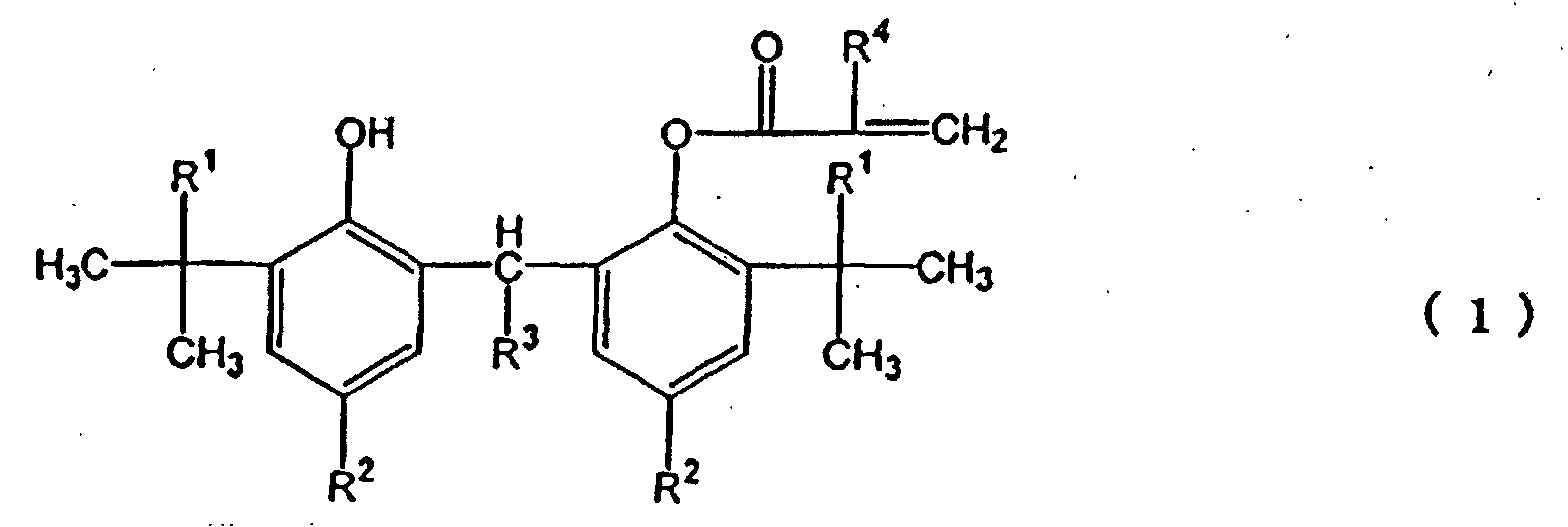 (in the formula, R1 is an alkyl group of 1 to 5 carbon atoms,
R2 is an alkyl group of 1 to 5 carbon atoms, R3 is a hydrogen
atom or an alkyl group of 1 to 5 carbon atoms, and R4 is a
hydrogen atom or a methyl group). The composition has high
storage stability and, by subjecting it to distillation, an
adamantyl ester monomer of high purity can be obtained easily.
(in the formula, R1 is an alkyl group of 1 to 5 carbon atoms,
R2 is an alkyl group of 1 to 5 carbon atoms, R3 is a hydrogen
atom or an alkyl group of 1 to 5 carbon atoms, and R4 is a
hydrogen atom or a methyl group). The composition has high
storage stability and, by subjecting it to distillation, an
adamantyl ester monomer of high purity can be obtained easily.
Description
The present invention relates to an adamantyl ester
monomer composition having high storage stability, as well as
to a process for producing an adamantyl ester monomer of high
purity from the composition.
In recent years, it was reported in, for example, JP-A-5-265212
that polymers obtained from an adamantyl ester
monomer have high resistance to dry etching in the process
for semiconductor production. Therefore, attention is being
paid to the future prospect of adamantyl ester monomer as a
raw material for the resist used in semiconductor production.
The adamantyl ester monomer is generally produced by
reacting an adamantane derivative (the examples thereof are
shown below or the like) with a carboxylic acid compound or a
derivative thereof, such as acrylic acid or methacrylic acid
[hereinafter, both are referred to as (meth)acrylic acid],
(meth)acrylic acid derivative or the like, to give rise to
esterification.
Resist materials used in semiconductor production are
required to have a high purity so as to be suitably used in
fine processing.
Therefore, when an adamantyl ester monomer obtained by
the above production process is used in a resist material for
semiconductor production, the monomer need be purified in
order to remove the impurities contained therein, such as
metal component and the like. However, when the purification
is conducted by distillation, the adamantyl ester monomer
causes gelling during the distillation, which tends to incur
pipe plugging and solidification in still. Therefore, it is
difficult to purify the adamantyl ester monomer stably by
distillation.
Thus, no method is known which can provide, from a
crude adamantyl ester monomer containing impurities, an
adamantyl ester monomer of high purity stably by a simple
method of distillation; and development of such a method is
desired.
In distilling a polymerizable monomer, a polymerization
inhibitor is generally added to the monomer in order to
prevent the polymerization of the monomer taking place during
the distillation. As the polymerization inhibitor used for
such a purpose, there are known phenol type polymerization
inhibitors such as hydroquinone, 4-methoxyphenol and the
like; quinone type polymerization inhibitors such as
parabenzoquinone, 2,5-di-tert-butylbenzoquinone and the like;
and aromatic amine type polymerization inhibitors such as
phenothiazine and the like.
The present inventors first tried to distill an
adamantyl ester monomer by adding thereto a generally used
polymerization inhibitor such as mentioned above. However,
since the boiling point of adamantyl ester monomer is
generally high, a high distillation temperature is needed.
In this case, the following problems, for example, have
appeared probably owing to the high-temperature distillation.
That is, the polymerization inhibitor is distilled and the
amount of the polymerization inhibitor in still is decreased,
which invites gelling in the still in the latter period of
distillation; and the adamantyl ester monomer or the
polymerization inhibitor used in distillate is decomposed,
which invites coloring of the distillate.
Next, the present inventors thought that it might be
possible to prevent the occurrence of the above problems by
using a polymerization inhibitor having a large molecular
weight. Hence, a polymerization inhibitor of large molecular
weight, specifically an aromatic amine type polymerization
inhibitor, i.e. N,N'-diphenyl-p-phenylenediamine or N,N'-dinaphthyl-p-phenylenediamine
was added to an adamantyl ester
monomer and distillation was tried. However, the
stabilization effect of such a polymerization inhibitor
toward adamantyl ester monomer was low and the gelling of
monomer in still and the coloring of distillate could not be
prevented sufficiently.
Hence, the present inventors further made studies on
the stabilization effect of large molecular weight
polymerization inhibitor other than those mentioned above,
toward adamantyl ester monomer.
As a result, it was found out that by using a
particular polymerization inhibitor, an adamantyl ester
monomer could be purified stably by distillation without
causing the above-mentioned problems. The finding has led to
the completion of the present invention.
That is, the present invention lies in an adamantyl
ester monomer composition characterized by containing at
least
an adamantyl ester monomer wherein a carbon atom of the adamantane skeleton is bonded with an organic residue having at least one polymerizable unsaturated bond via -OCO- bond, and
a compound represented by the following general formula (1): (in the formula, R1 is an alkyl group of 1 to 5 carbon atoms,
R2 is an alkyl group of 1 to 5 carbon atoms, R3 is a hydrogen
atom or an alkyl group of 1 to 5 carbon atoms, and R4 is a
hydrogen atom or a methyl group).
(in the formula, R1 is an alkyl group of 1 to 5 carbon atoms,
R2 is an alkyl group of 1 to 5 carbon atoms, R3 is a hydrogen
atom or an alkyl group of 1 to 5 carbon atoms, and R4 is a
hydrogen atom or a methyl group).
an adamantyl ester monomer wherein a carbon atom of the adamantane skeleton is bonded with an organic residue having at least one polymerizable unsaturated bond via -OCO- bond, and
a compound represented by the following general formula (1):
The compound represented by the general formula (1) has
a large molecular weight and therefore low volatility at high
temperatures and is very high in inhibitory effect for
polymerization of adamantyl ester monomer. As a result, the
adamantyl ester monomer composition of the present invention
containing the compound has high stability. That is,
decomposition or polymerization of adamantyl ester monomer in
the composition is prevented even during the long-term
storage or high-temperature standing of the composition, and
there is no distillation of the polymerization inhibitor when
the composition has been subjected to distillation.
Therefore, when the composition contains various impurities such as metal components, unreacted raw materials remaining in production of adamantyl ester monomer, reaction by-products and the like, an adamantyl ester monomer of high purity can be obtained from such a composition by a simple distillation operation.
Therefore, when the composition contains various impurities such as metal components, unreacted raw materials remaining in production of adamantyl ester monomer, reaction by-products and the like, an adamantyl ester monomer of high purity can be obtained from such a composition by a simple distillation operation.
Also, in the reaction by-products are contained such
impurities as to promote the gelling of adamantyl ester
monomer. Even in a composition containing such impurities,
the stabilization effect of the composition can be further
enhanced by adding thereto, besides the compound of the
general formula (1), a sulfur-based antioxidant and/or a
phenol type antioxidant.
Although not clear theoretically, it is presumed that
in addition to the excellent stabilization effect of the
compound represented by the general formula (1), the sulfur-based
antioxidant acts as a decomposer for hydroperoxide and
decomposes a peroxide contained in adamantyl ester monomer
composition and the phenol type antioxidant acts as a
capturing agent for peroxy radical, whereby such preferred
effects are exhibited.
The present invention lies also in a process for
producing a high-purity adamantyl ester monomer,
characterized in that the above-mentioned adamantyl ester
monomer composition of the present invention is subjected to
distillation to obtain a high-purity adamantyl ester monomer.
According to this production process of the present
invention, an adamantyl ester monomer of high purity can be
obtained stably by a simple operation of subjecting the
present composition to distillation.
An investigation by the present inventors revealed that
a crude adamantyl ester monomer obtained by esterification of
an adamantane derivative having -OH group, -OM group or =R
group [M is an alkali metal atom or MgX (X is a halogen atom)
and R is a bivalent aliphatic hydrocarbon group] with an
unsaturated carboxylic acid compound or a derivative thereof,
particularly a (meth)acrylic acid or a derivative thereof,
often contains impurities which promotes the gelling of the
monomer per se when the crude monomer is subjected to
distillation.
Even in such a case, the gelling of the monomer per se
can be prevented sufficiently and a monomer of high purity
can be obtained by adding, to the crude adamantyl ester
monomer, a compound represented by the general formula (1)
and, as necessary, the above-mentioned sulfur-based
antioxidant and phenol type antioxidant and subjecting the
resulting adamantyl ester monomer composition of the present
invention to distillation.
According to the present invention, it becomes possible
to easily distill and purify an adamantyl ester monomer whose
stable distillation and purification has been difficult. By
employing the production process of the present invention, it
is also possible to easily obtain an adamantyl ester monomer
of high purity which is expected to be used as a resist
material for semiconductor. It is also possible to store an
adamantyl ester monomer stably for a long period.
The composition of the present invention contains at
least an adamantyl ester monomer having at least one
polymerizable unsaturated bond in the molecule and a compound
represented by the general formula (1).
The adamantyl ester monomer contained in the
composition of the present invention is a compound wherein a
monovalent organic residue is bonded to a carbon atom of
adamantane skeleton via -O-CO- bond. The organic residue has
at least one polymerizable unsaturated bond. As the
adamantyl ester monomer, there is no particular restriction,
and a known compound can be used.
For easiness of the synthesis, there are preferred
compounds represented by the following general formula (2):
 [in the formula, R5 is a -O-CO-CH=CH2 group or a -O-CO-C(CH3)=CH2
group; R6 is an alkyl group of 1 to 6 carbon atoms;
m is an integer of 1 to 3; n is an integer of 0 to 4; R5 and
R6, two R5s or two R6s may be bonded to a carbon atom of
adamantane skeleton].
[in the formula, R5 is a -O-CO-CH=CH2 group or a -O-CO-C(CH3)=CH2
group; R6 is an alkyl group of 1 to 6 carbon atoms;
m is an integer of 1 to 3; n is an integer of 0 to 4; R5 and
R6, two R5s or two R6s may be bonded to a carbon atom of
adamantane skeleton].
Of these compounds, particularly preferred are 2-adamantyl
(meth)acrylates represented by the following
general formula (3):
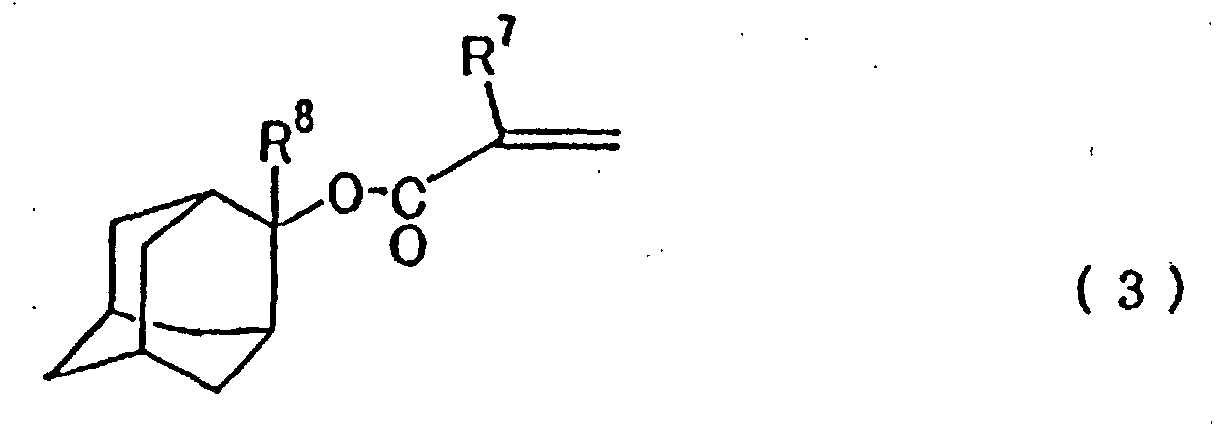 (in the formula, R7 is a hydrogen atom or a methyl group and
R8 is a hydrogen atom or an alkyl group of 1 to 6 carbon
atoms), or 1-adamantyl (meth)acrylates represented by the
following general formula (4):
(in the formula, R7 is a hydrogen atom or a methyl group and
R8 is a hydrogen atom or an alkyl group of 1 to 6 carbon
atoms), or 1-adamantyl (meth)acrylates represented by the
following general formula (4):
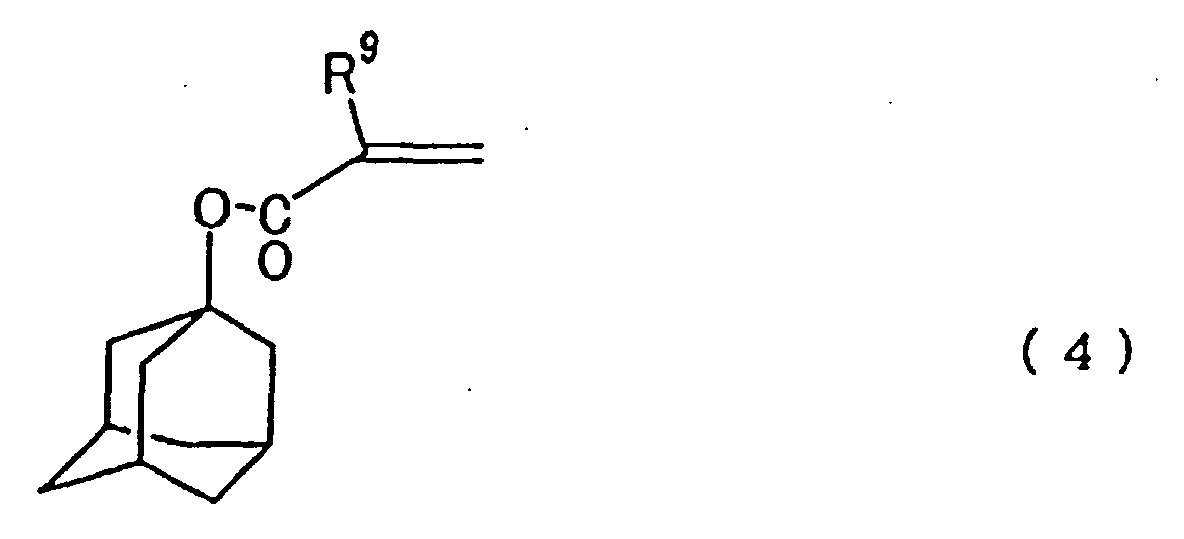 (in the formula, R9 is a hydrogen atom or a methyl group),
because they are useful as a raw material for resist for
semiconductor and a very high purity is required .
(in the formula, R9 is a hydrogen atom or a methyl group),
because they are useful as a raw material for resist for
semiconductor and a very high purity is required .
As specific examples of the adamantyl ester compound
represented by the general formula (3), there are mentioned
2-methyl-2-adamantyl acrylate, 2-ethyl-2-adamantyl acrylate,
2-methyl-2-adamantyl methacrylate, 2-ethyl-2-adamantyl
methacrylate, 2-propyl-2-adamantyl acrylate and 2-butyl-2-adamantyl
acrylate.
The composition of the present invention contains an
adamantyl ester monomer, a compound represented by the
general formula (1) and, as necessary, an antioxidant. Owing
to the presence of such an antioxidant, the storage stability
of the adamantyl ester monomer becomes higher than when no
antioxidant is present. Further, when the composition is
heated to the boiling point, the compound of the general
formula (1) and the antioxidant are not distilled and remain
in the composition and a high stabilization effect toward
monomer is maintained. Therefore, when the composition is
subjected to distillation, decomposition, etc. of adamantyl
ester monomer and subsequent gelling and coloring are
prevented effectively.
The composition of the present invention contains a
compound represented by the general formula (1) as an
essential component.
As specific examples of the compound represented by the
general formula (1), there are mentioned 2,2'-methylenebis(6-tert-butyl-4-methylphenol)
monoacrylate, 2,2'-ethylidenebis(4,6-di-tert-amylphenol)
monoacrylate, 2,2'-methylenebis(6-tert-butyl-4-methylphenol)
monomethacrylate
and 2,2'-methylenebis(6-tert-butyl-4-propylphenol)
monoacrylate. These compounds may be used singly or in
combination of different kinds.
Of these compounds, particularly preferred is 2,2'-methylenebis(6-tert-butyl-4-methylphenol)
monoacrylate which
is a compound of the general formula (1) wherein R1 is a
methyl group, R2 is a methyl group, R3 is a hydrogen atom and
R4 is a hydrogen atom, or 2,2'-ethylidenebis(4,6-di-tert-amylphenol)
monoacrylate which is a compound of the general
formula (1) wherein R1 is an ethyl group, R2 is a tert-amyl
group, R3 is a methyl group and R4 is a hydrogen atom,
because they have a high inhibitory effect for polymerization
and are easily available.
The use amount of the compound represented by the
general formula (1) differs depending upon its kind, the kind
of adamantyl ester monomer, and the kinds and amount of the
impurities contained. Therefore, a use amount necessary for
obtaining a sufficient inhibitory effect for polymerization
is determined appropriately, for example, by specifically
conducting a preliminary heat stability test for each
individual composition. Generally, the use amount of the
compound represented by the general formula (1) is preferably
0.01 to 30 parts by mass, particularly preferably 0.1 to 5
parts by mass relative to 100 parts by mass of adamantyl
ester monomer.
The composition of the present invention may contain
only an adamantyl ester monomer and a compound of the general
formula (1). However, the composition preferably contains
further a sulfur-based antioxidant and/or a phenol type
antioxidant for a higher inhibitory effect for gelling during
heating. A composition containing both a sulfur-based
antioxidant and a phenol type antioxidant is most preferred.
As to the sulfur-based antioxidant, there is no
particular restriction as long as it is a sulfur-containing
compound having antioxidancy but having no phenol skeleton.
Any known sulfur-containing compound can be used. However, a
compound generally used as a sulfur-based secondary
antioxidant is preferred from the standpoint of stabilizing
effect.
As specific examples of compounds preferably usable as
the sulfur-based antioxidant, there are mentioned dialkyl
sulfides such as didodecyl sulfide, distearyl sulfide and the
like; thiopropionic acid type sulfur compounds such as
dilauryl 3,3'-thiodipropionate, dimyristyl 3,3'-thiodipropionate,
distearyl 3,3'-thiodipropionate,
pentaerythrityl tetrakis(3-laurylthiopropionate), thiobis[2-(1,1-dimethylethyl)-5-methyl-4,1-phenylene]bis[3-(tetradecylthio)propionate],
thiobis[2-(1,1-dimethylethyl)-5-methyl-4,1-phenylene]bis[3-(dodecylthio)propionate
and the
like; and thiol group-containing imidazoles such as 2-mercaptobenzimidazole
and the like.
Of these, more preferred are thiopropionic acid type
sulfur compounds such as pentaerythrityl tetrakis(3-laurylthiopropionate)
and the like because they are hardly
distilled and show a very high inhibitory effect for gelling.
There is no particular restriction as to the amount of
the sulfur-based antioxidant used, but the amount is
preferably 10 to 500 parts by mass, particularly preferably
20 to 100 parts by mass relative to 100 parts by mass of the
compound represented by the general formula (1) in view of
the stabilization (polymerization inhibition) effect of
monomer.
As to the phenol type antioxidant, there is no
particular restriction as long as it is a phenolic compound
having antioxidancy, and a known compound can be used. A
compound generally used as a phenolic primary antioxidant is
preferably used in view of the stabilization effect.
As specific examples of the compounds preferably used
as the phenol type antioxidant, there are mentioned
monophenol type compounds such as 2,6-di-tert-butyl-4-methylphenol,
2,6'-di-tert-butyl-4-ethylphenol,
butylhydroxyanisole, stearyl β-(3,5-di-tert-butyl-4-hydroxyphenyl)propionate
and the like; bisphenol type
compounds such as 2,2'-methylenebis(6-tert-butyl-4-methylphenol),
2,2'-methylenebis(6-tert-butyl-4-ethylphenol),
4,4'-butylidenebis(6-tert-butyl-3-methylphenol), 4,4'-thiobis(6-tert-butyl-3-methylphenol),
3,9-bis[2-{3-(3-tert-butyl-4-hydroxy-5-methylphenyl)propionyloxy}-1,1'-dimethylethyl]-2,4,8,10-tetraoxaspiro[5,5]undecane
and the
like; and phenolic compounds having three or more phenol
groups, such as 1,1,3-tris(2-methyl-4-hydroxy-5-tert-butylphenyl)butane,
1,3,5-trimethyl-2,4,6-tris(3,5-di-tert-butyl-4'-hydroxybenzyl)benzene,
tetrakis-[methylene-3-(3',5'-di-tert-butyl-4-hydroxyphenyl)
propionate]methane, bis[3,3'-bis-(4'-hydroxy-3'-tert-butylphenyl)butyric
acid] glycol
ester, 1,3,5-tris(3,5-di-tert-butyl-4'-hydroxybenzyl)-S-triazine-2,4,6-(lH,3H,5H)trione
and the like.
Of these, particularly preferred are bisphenol type
compounds such as 4,4'-thiobis(6-tert-butyl-3-methylphenol)
and the like and phenolic compounds having three or more
phenol groups, such as tetrakis-[methylene-3-(3',5'-di-tert-butyl-4-hydroxyphenyl
propionate)methane and the like because
they are hardly distilled and are highly soluble in adamantyl
ester monomers.
There is no particular restriction as to the amount of
the phenol type antioxidant used, but the amount is
preferably 10 to 500 parts by mass, particularly preferably
20 to 100 parts by mass relative to 100 parts by mass of the
compound represented by the general formula (1) so that a
stabilization effect is exhibited reliably.
The adamantyl ester monomer composition of the present
invention may further contain, in addition to the adamantyl
ester monomer, the compound represented by the general
formula (1) and the antioxidant, a known polymerization
inhibitor other than the compound represented by the general
formula (1) as long as the advantages of the present
invention are not impaired.
The adamantyl ester monomer composition of the present
invention may further contain a third component in addition
to the adamantyl ester monomer, the compound represented by
the general formula (1) and the antioxidant. There is no
particular restriction as to the third component, but there
are generally mentioned a solvent (e.g. tetrahydrofuran or
hexane) used in synthesis of adamantyl ester monomer,
unreacted raw materials, reaction by-products, metal
components incoming from the environment, etc. These third
components differ depending upon the differences in
production method, etc. and therefore cannot be specified
unconditionally.
However, the impurities contained in a crude product
obtained by an ordinary process for production of adamantyl
ester monomer, that is, a crude product obtained by as
necessary removing a solvent, etc. from the reaction mixture
of a synthesis reaction of adamantyl ester monomer, gives no
adverse effect in carrying out the present invention.
Further, there is no particular restriction as to the content
of the third component, but the total amount of the third
component is ordinarily 50 parts by mass or less relative to
100 parts by mass of the adamantyl ester monomer.
Incidentally, as a general process for production of
adamantyl ester monomer, there is mentioned a process which
comprises converting, into an ester, an adamantane derivative
having -OH group, -OM group or =R group [M is an alkali metal
atom or MgX (X is a halogen atom), and R is a bivalent
aliphatic hydrocarbon group], using an unsaturated carboxylic
acid compound or a derivative thereof, particularly
(meth)acrylic acid or a derivative thereof. Here, the alkali
metal atom represented by M is a potassium atom, a sodium
atom or the like. The halogen atom represented by X is a
chlorine atom, a bromine atom, an iodine atom or the like.
The bivalent aliphatic hydrocarbon group represented by R is
a methylidene group, an ethylidene group, a propylidene group,
an isopropylidene group or the like.
For example, an adamantyl ester monomer represented by
the general formula (3) wherein R8 is an alkyl group of 1 to
6 carbon atoms, can be obtained by the following processes
(a) to (c).
(a) A process which comprises alkylating 2-adamantanone
with a Grignard reagent (e.g. an alkyl magnesium halide) or
an organometallic reagent (e.g. an alkyl lithium) to obtain a
-OM group-containing adamantane derivative represented by the
following general formula (5):
 [in the formula, R10 is an alkyl group of 1 to 6 carbon atoms,
and M is an alkali metal atom or MgX (X is a halogen atom)]
and converting the derivative into a (meth) acrylate using a
(meth)acrylic acid halide.
[in the formula, R10 is an alkyl group of 1 to 6 carbon atoms,
and M is an alkali metal atom or MgX (X is a halogen atom)]
and converting the derivative into a (meth) acrylate using a
(meth)acrylic acid halide.
(b) A process which comprises alkylating 2-adamantanone
with an organometallic reagent to obtain a 2-alkyl-2-adamantanol
(a -OH group-containing adamantane derivative)
and converting the compound into a (meth)acrylate using
(meth)acrylic acid, (meth)acrylic acid anhydride, a (meth)
acrylic acid ester or the like.
(c) A process which comprises alkylating 2-adamantanone
with an organometallic reagent, decomposing the resulting
metal alkoxide to obtain an alcohol compound, dehydrating the
alcohol compound to obtain a 2-alkylideneadamantane (an
adamantane derivative having =R group), and subjecting the
compound to an addition reaction using (meth)acrylic acid to
obtain a (meth)acrylate.
The adamantyl ester monomer represented by the general
formula (4) can be obtained, for example, by the following
process (d).
(d) A process which comprises converting 1-adamantanol
into a (meth)acrylate using (meth)acrylic acid, (meth)acrylic
acid anhydride, a (meth)acrylic acid ester or the like.
As to the method for producing the adamantyl ester
monomer composition of the present invention, there is no
particular restriction and, for example, the following method
can be mentioned.
The adamantyl ester monomer composition of the present
invention can be obtained, for example, by mixing, into a
crude product obtained by a synthesis reaction [one of the
above reactions (a) to (d)] for adamantyl ester monomer or a
high-purity adamantyl ester monomer obtained by purification
of the crude product, the compound of the general formula (1)
and, as necessary, the above-mentioned antioxidant.
Here, the crude product includes a reaction mixture
after synthesis reaction, a composition obtained by removing
a solvent from the reaction mixture by distillation, a
composition obtained by treating the reaction mixture with an
aqueous basic solution, as necessary washing the resulting
mixture, conducting solvent extraction, and further
conducting a treatment such as solvent removal by
distillation, or the like (hereinafter, each of such
compositions may be referred to simply as crude product).
The adamantyl ester monomer composition of the present
invention obtained by mixing, into a high-purity adamantyl
ester monomer, the compound of the general formula (1) and,
as necessary, the above-mentioned antioxidant, is
characterized by having high storage stability over a long
period.
The adamantyl ester monomer composition obtained by
mixing, into the above-mentioned crude product, the compound
of the general formula (1) and, as necessary, the above-mentioned
antioxidant, has high storage stability.
When the composition is subjected to distillation in
order to obtain a high-purity adamantyl ester monomer, there
is no coloring of the resulting distillate and gelling of
adamantyl ester monomer is prevented. Therefore,
distillation of adamantyl ester monomer composition can be
conducted stably with no difficulty.
Thus, a high-purity adamantyl ester monomer can be
obtained easily by obtaining a crude product by a synthesis
reaction for adamantyl ester monomer, such as one of the
above-mentioned (a) to (d), mixing thereinto the compound of
the general formula (1) and, as necessary, the above-mentioned
antioxidant to prepare an adamantyl ester monomer
composition of the present invention, and distilling the
composition.
The compound of the general formula (1) and the above-mentioned
antioxidant added as necessary may be added
beforehand to a crude product which is to be distilled, or
may be fed, after the start of distillation, into a still, a
distillation tower, a distillation tube, a reflux line or the
like.
In order to conduct distillation more stably, it is
preferred to add, in addition to the compound of the general
formula (1), at least either of a sulfur-based antioxidant
and a phenol type antioxidant and it is more preferred to add
both of them.
There is no particular restriction as to the method of
distillation and there can be employed simple distillation or
fractional distillation. As a fractionating column used in
fractional distillation, there are preferred thin-film type
fractionating columns such as vigoureux type, concentric type,
rotary band type, packed column type and the like, and plate-shaped
fractionating columns such as bubble cap type,
perforated plate type and the like. When, in particular,
reduced pressure distillation is conducted, a thin-film type
fractionating column of low pressure loss is preferred. Also,
a known distillation method such as Kugel rohr, thin-film
distillation or the like can be employed with no restriction.
Further, there is no particular restriction as to the
distillation conditions used, such as distillation
temperature, distillation pressure, reflux ratio and the like.
The distillation conditions are determined appropriately
depending upon the boiling point of adamantyl ester monomer,
the kinds and amount of the impurities contained, the kinds
and use amounts of the compound of the general formula (1)
and the antioxidant added as necessary, the purity of
adamantyl ester monomer obtained finally, etc. It is
generally preferred to conduct distillation at a pressure of
0.01 to 10 mmHg and a still temperature (a composition
temperature inside still) of 50 to 150°C.
The present invention is described more specifically
below by way of Examples and Comparative Examples. However,
the present invention is in no way restricted by these
Examples.
Incidentally, the symbols used for compounds of the
general formula (1) and antioxidants in each Example ad each
Comparative Example are shown below in a style of [symbol:
compound name].
- A-1:
- 2,2'-Methylenebis(6-tert-butyl-4-methylphenol) monoacrylate
- A-2:
- 2,2'-Ethylidenebis(4,6-di-tert-amylphenol) monoacrylate
- S-1:
- Distearyl 3,3'-thiodipropionate
- S-2:
- Pentaerythrityl tetrakis(3-laurylthiopropionate)
- S-3:
- Thiobis[2-(1,1-dimethylethyl)-5-methyl-4,1-phenylene] bis[3-(dodecylthio)propionate]
- S-4:
- Distearyl sulfide
- P-1:
- 2,2'-Methylenebis(6-tert-butyl-4-methylphenol)
- P-2:
- 2,6-Di-tert-butyl-4-methylphenol
- P-3:
- 4,4'-Thiobis(6-tert-butyl-3-methylphenol)
- P-4:
- Tetrakis-[methylene-3-(3',5'-di-tert-butyl-4-hydroxyphenyl)propionate]methane
- O-1:
- Methoxyphenol
- O-2:
- Hydroquinone
- O-3:
- Phenothiazine
30 g of 2-adamantanone was dissolved in 100 ml of
anhydrous tetrahydrofuran. To the solution was added, at
room temperature, 200 ml of a tetrahydrofuran solution
containing 1 mole/liter of methyl magnesium bromide, and a
reaction was allowed to take place for 3 hours. Then, 5 g of
pyridine was added to the reaction mixture and successively
26 g of methacrylic acid chloride was added, followed by
stirring at 50°C for 3 hours.
The reaction mixture was concentrated. Thereto were
added 200 ml of hexane and 100 ml of a 1 N aqueous ammonium
chloride solution, followed by shaking. The organic phase
was separated and then washed with a 5 mass % aqueous sodium
hydroxide solution and further with water. The washed
organic phase was concentrated to obtain crude 2-methyl-2-adamantyl
methacrylate (a crude product) having a purity of
90 mass %.
200 ml of toluene and 1 g of p-toluenesulfonic acid
were added to 70 g of 1-adamantanol and 50 g of methacrylic
acid. They were subjected to a reaction with heating and
stirring, while water was distilled off using a Dean-Stark
trap. The resulting organic phase was washed with water, a
10 mass % aqueous sodium hydrogencarbonate solution and water
in this order and distilled to obtain crude 1-adamantyl
methacrylate (a crude product) having a purity of 91 mass %.
5 g of the crude product obtained in Synthesis Example
1 was placed in each of two screw-necked test tubes. The
test tubes were kept at 120°C in a constant-temperature oil
bath and measured for a time up to gelling of contents (the
time is hereinafter may be referred to as gelling time).
Incidentally, the gelling time is a time required for the
contents of test tube to become non-fluid when the test tube
is made upside down. A longer gelling time means superior
storage stability, particularly superior stability at high
temperatures. The average of the gelling times of the two
samples, i.e. the average gelling time was 2.0 hours.
5 g of the crude product obtained in Synthesis Example
1 was placed in each of two screw-necked test tubes. Further,
0.01 g of A-1 was placed in each test tube. Then, each test
tube was tightly sealed and the contents of each test tube
was mixed uniformly to prepare a composition of the present
Example.
Next, the two test tubes each containing the above
composition of the present Example were kept at 120°C in a
constant-temperature oil bath and determined for average
gelling time in the same manner as in Comparative Example 1.
The average gelling time was 12.0 hours and was six times
that of Comparative Example 1. Thus, the composition of the
present Example is improved in high-temperature storage
stability.
An average gelling time was measured in the same manner
as in Example 1 except that A-2 was used as the compound
represented by the general formula (1). The average gelling
time was 11.5 hours.
Average gelling times were measured in the same manner
as in Examples 1 and 2 except that the compounds represented
by the general formula (1) used in Examples 1 and 2 were
changed by various compounds shown in Table 1. The results
are shown together in Table 1.
| Compound added | Amount added (g) | Average gelling time (hr) | |
| Example 1 | A-1 | 0.01 | 12.0 |
| Example 2 | A-2 | 0.01 | 11.5 |
| Comparative Example 1 | - | - | 2.0 |
| Comparative Example 2 | O-1 | 0.01 | 6.0 |
| Comparative Example 3 | O-2 | 0.01 | 7.0 |
| Comparative Example 4 | O-3 | 0.01 | 7.5 |
| Comparative Example 5 | S-1 | 0.01 | 2.5 |
| Comparative Example 6 | S-2 | 0.01 | 2.5 |
| Comparative Example 7 | P-1 | 0.01 | 3.5 |
| Comparative Example 8 | P-2 | 0.01 | 3.0 |
As shown in Table 1, even when there are used
polymerization inhibitors other than compounds represented by
the general formula (1), the average gelling times are longer
than when there is used no polymerization inhibitor
(Comparative Example 1). However, even the longest gelling
time is about 65% or less of Examples 1 and 2 and the
stabilization effect of that case is lower than that of each
Example.
An average gelling time was measured in the same manner
as in Comparative Example 1 except that the crude product
obtained in Synthesis Example 2 was used. The result is
shown in Table 2.
| Compound added | Amount added (g) | Average gelling time (hr) | |
| Example 3 | A-1 | 0.01 | 12.5 |
| Example 4 | A-2 | 0.01 | 11.0 |
| Comparative Example 9 | - | - | 1.5 |
| Comparative Example 10 | O-1 | 0.01 | 6.5 |
| Comparative Example 11 | O-2 | 0.01 | 6.5 |
| Comparative Example 12 | O-3 | 0.01 | 8.0 |
| Comparative Example 13 | S-1 | 0.01 | 2.5 |
| Comparative Example 14 | S-2 | 0.01 | 3.0 |
| Comparative Example 15 | P-1 | 0.01 | 3.0 |
| Comparative Example 16 | P-2 | 0.01 | 3.5 |
Average gelling times were measured in the same manner
as in Example 1 except that 0.01 g of a compound sown in
Table 2 was added to 5 g of the crude product obtained in
Synthesis Example 2. The results are shown in Table 2.
As shown in Table 2, the average gelling times are 7.3
times or more that of Comparative Example 9. As a result, it
is seen that the compositions of the present invention are
improved in high-temperature storage stability.
Average gelling times were measured in the same manner
as in Examples 3 and 4 except that the compounds represented
by the general formula (1) used in Examples 3 and 4 were
changed by various compounds shown in Table 2. The results
are shown together in Table 2.
As shown in Table 2, even when there are used
polymerization inhibitors other than compounds represented by
the general formula (1), the average gelling times are longer
than when there is used no polymerization inhibitor
(Comparative Example 2). However, the stabilization effects of such cases are lower than those of Examples 3 and 4.
(Comparative Example 2). However, the stabilization effects of such cases are lower than those of Examples 3 and 4.
An average gelling time was measured in the same manner
as in Example 1 except that 0.01 g of phenothiazine (O-3) was
added in addition to A-1 [a compound represented by the
general formula (1)]. The results is shown in Table 3.
| Compound added | Amount added (g) | Average gelling time (hr) | |
| Example 5 | A-1 | 0.01 | 14.5 |
| O-3 | 0.01 |
Average gelling times were measured in the same manner
as in Example 1 except that there were added a compound of
general formula (1) and a sulfur-based antioxidant both shown
in Table 4. The results are shown in Table 4.
| Compound added | Amount added (g) | Average gelling time (hr) | |
| Example 6 | A-1 | 0.01 | 17.5 |
| S-1 | 0.01 | ||
| Example 7 | A-2 | 0.01 | 19.5 |
| S-2 | 0.02 | ||
| Example 8 | A-1 | 0.01 | 18.5 |
| S-1 | 0.04 | ||
| Example 9 | A-2 | 0.001 | 17.5 |
| S-2 | 0.02 | ||
| Example 10 | A-1 | 0.01 | 19.0 |
| S-3 | 0.02 | ||
| Example 11 | A-2 | 0.01 | 18.5 |
| S-4 | 0.04 |
It is seen from Table 4 that the stabilization effect
of adamantyl ester monomer composition is improved by a
combination use of a compound represented by the general
formula (1) and a sulfur-based antioxidant.
Also, as is clear from the comparison of Table 3 and
Table 4, a combination use of a compound represented by the
general formula (1) and a sulfur-based antioxidant gives a
higher stabilization effect than a combination use of the
compound and an amine type polymerization inhibitor.
Average gelling times were measured in the same manner
as in Example 1 except that, as shown in Table 5, there was
added a mixture of a compound represented by the general
formula (1), a sulfur-based antioxidant and a phenol type
antioxidant. The results are shown in Table 5.
| Compound added | Amount added (g) | Average gelling time (hr) | |
| Example 12 | A-1 | 0.01 | 26.5 |
| S-2 | 0.02 | ||
| P-3 | 0.01 | ||
| Example 13 | A-1 | 0.01 | 24.5 |
| S-2 | 0.02 | ||
| P-4 | 0.01 | ||
| Example 14 | A-1 | 0.01 | 21.5 |
| S-2 | 0.02 | ||
| P-1 | 0.01 | ||
| Example 15 | A-2 | 0.01 | 23.0 |
| S-2 | 0.02 | ||
| P-1 | 0.01 | ||
| Example 16 | A-2 | 0.01 | 26.0 |
| S-1 | 0.02 | ||
| P-4 | 0.01 |
It is seen from Table 5 that a combination use of a
compound represented by the general formula (1), a sulfur-based
antioxidant and a phenol type antioxidant gives a
further improved stabilization effect than a combination use
of the former two substances.
0.18 g of A-2, a compound of general formula (1) was
added to 60 g of the crude product obtained in Synthesis
Example 1. The resulting composition was subjected to
reduced pressure distillation.
The reduced pressure distillation was conducted at a
vacuum of 0.3 mmHg using a 5-cm vigoureux type fractionating
column and a total condensation type reflux fractionator
while air was introduced into the composition through a glass
capillary. The distillation was conducted while the
distillate was subjected to compositional analysis using a
gas chromatograph. The initial distillate was cut and the
collection of the main distillate was begun when the purity
of 2-methyl-2-adamantyl methacrylate in distillate exceeded
80%. By collecting the main distillate (a fraction of 80 to
115°C), 2-methyl-2-adamantyl methacrylate could be obtained
at a purity of 95.2 mass % (distillation yield: 81%).
11 Hours were taken for the distillation. However, no
gel was formed in the still, the pipe, etc. The main
distillate was almost colorless and the A-2 content in the
main distillate was the detection limit or less (50 ppm or
less).
Reduced pressure distillation was conducted in the same
manner as in Example 17 except that the amount of the crude
product was changed to 100 g and 0.3 g of A-1 and 0.6 g of S-1
were added thereto. By collecting the main distillate, 2-methyl-2-adamantyl
methacrylate could be obtained at a purity
of 95.6 mass % (distillation yield: 77%). 15 Hours were
taken for the distillation. However, no gel was formed in
the still, the pipe, etc. The main distillate was almost
colorless and the A-1 content in the main distillate was the
detection limit or less (50 ppm or less).
Reduced pressure distillation was conducted in the same
manner as in Example 17 except that there were added, to 200
g of the crude product, 0.6 g of A-1, 1.2 g of S-2 and 0.6 g
of P-3. By collecting a main distillate, 2-methyl-2-adamantyl
methacrylate could be obtained at a purity of 95.3
mass % (distillation yield: 80%). 24 Hours were taken for
the distillation. However, no gel was formed in the still,
the pipe, etc. The main distillate was almost colorless and
the A-1 content in the main distillate was the detection
limit or less (50 ppm or less).
The crude product obtained in Synthesis Example 1 was
subjected to distillation in the same manner as in Example 17,
with no addition of a compound of general formula (1), an
antioxidant, or the like.
The initial distillate was cut and collection of the
main distillate was begun when the purity of 2-methyl-2-adamantyl
methacrylate exceeded 80%. However, gel was
gradually formed in the still and, after 4 hours from the
start of distillation, there was no distillation of the main
distillate. The distillation yield of the main distillate
was only 13%.
Distillation was conducted in the same manner as in
Example 17 except that 0.18 g of O-3 alone was added in
addition to A-2, a compound of the general formula (1). The
initial distillate was cut and collection of the main
distillate was begun when the purity of 2-methyl-2-adamantyl
methacrylate exceeded 80%. However, gel was gradually formed
in the still and, after 10 hours from the start of
distillation, there was no distillation of the main
distillate. The distillation yield of the main distillate
was 63%. The main distillate had a light green color and
contained 660 ppm of phenothiazine.
Claims (4)
- An adamantyl ester monomer composition characterized by containing at least
an adamantyl ester monomer having at least one polymerizable unsaturated bond in the molecule, and
a compound represented by the following general formula (1):(in the formula, R1 is an alkyl group of 1 to 5 carbon atoms, R2 is an alkyl group of 1 to 5 carbon atoms, R3 is a hydrogen atom or an alkyl group of 1 to 5 carbon atoms, and R4 is a hydrogen atom or a methyl group).
- An adamantyl ester monomer composition according to Claim 1, further containing a sulfur-based antioxidant.
- An adamantyl ester monomer composition according to Claim 2, further containing a phenol type antioxidant.
- A process for producing an adamantyl ester monomer, characterized in that an adamantyl ester monomer composition according to any of Claims 1 to 3 is subjected to distillation to obtain an adamantyl ester monomer.
Applications Claiming Priority (3)
| Application Number | Priority Date | Filing Date | Title |
|---|---|---|---|
| JP2000235403 | 2000-08-03 | ||
| JP2000235403 | 2000-08-03 | ||
| PCT/JP2001/006207 WO2002012163A1 (en) | 2000-08-03 | 2001-07-18 | Adamantyl ester monomer composition |
Publications (2)
| Publication Number | Publication Date |
|---|---|
| EP1306363A1 true EP1306363A1 (en) | 2003-05-02 |
| EP1306363A4 EP1306363A4 (en) | 2005-10-05 |
Family
ID=18727617
Family Applications (1)
| Application Number | Title | Priority Date | Filing Date |
|---|---|---|---|
| EP01984487A Withdrawn EP1306363A4 (en) | 2000-08-03 | 2001-07-18 | MONOMER COMPOSITION OF ADAMANTYL ESTER |
Country Status (7)
| Country | Link |
|---|---|
| US (1) | US6861552B2 (en) |
| EP (1) | EP1306363A4 (en) |
| JP (1) | JP3978132B2 (en) |
| KR (1) | KR100712590B1 (en) |
| CN (1) | CN1189444C (en) |
| TW (1) | TWI302530B (en) |
| WO (1) | WO2002012163A1 (en) |
Cited By (2)
| Publication number | Priority date | Publication date | Assignee | Title |
|---|---|---|---|---|
| EP2017299A1 (en) * | 2007-07-20 | 2009-01-21 | Sumitomo Chemical Company, Limited | Stabilizer and method of manufacturing the same, thermoplastic polymer composition using the same, and method of stabilizing thermoplastic polymer |
| US7977418B2 (en) | 2007-07-25 | 2011-07-12 | Sumitomo Chemical Company, Limited | Bisphenol monoester-based stabilizer composition, thermoplastic polymer composition and method of manufacturing the same, thermoplastic polymer molded product, and method of stabilizing thermoplastic polymer |
Families Citing this family (2)
| Publication number | Priority date | Publication date | Assignee | Title |
|---|---|---|---|---|
| JP5220253B2 (en) * | 1999-10-27 | 2013-06-26 | 株式会社ダイセル | Method for producing adamantyl (meth) acrylates |
| US20240336868A1 (en) * | 2023-04-07 | 2024-10-10 | The Procter & Gamble Company | Compositions comprising adamantyl ester-containing compounds |
Family Cites Families (5)
| Publication number | Priority date | Publication date | Assignee | Title |
|---|---|---|---|---|
| US3518241A (en) * | 1967-03-24 | 1970-06-30 | Sun Oil Co | Acrylate and methacrylate esters and polymers thereof |
| US3984372A (en) * | 1974-05-06 | 1976-10-05 | The Goodyear Tire & Rubber Company | Polymer compositions containing esters of polyphenolic compounds as built-in antioxidants |
| JP2755444B2 (en) * | 1989-09-28 | 1998-05-20 | 株式会社トクヤマ | Chromen composition |
| JPH0733508B2 (en) * | 1989-10-04 | 1995-04-12 | 株式会社トクヤマ | Photochromic composition |
| JPH0733509B2 (en) * | 1989-10-11 | 1995-04-12 | 株式会社トクヤマ | Photochromic composition |
-
2001
- 2001-07-18 JP JP2002517466A patent/JP3978132B2/en not_active Expired - Fee Related
- 2001-07-18 CN CNB018136826A patent/CN1189444C/en not_active Expired - Fee Related
- 2001-07-18 KR KR1020037001430A patent/KR100712590B1/en not_active Expired - Fee Related
- 2001-07-18 US US10/343,606 patent/US6861552B2/en not_active Expired - Fee Related
- 2001-07-18 WO PCT/JP2001/006207 patent/WO2002012163A1/en not_active Ceased
- 2001-07-18 EP EP01984487A patent/EP1306363A4/en not_active Withdrawn
- 2001-07-24 TW TW090118077A patent/TWI302530B/zh not_active IP Right Cessation
Cited By (3)
| Publication number | Priority date | Publication date | Assignee | Title |
|---|---|---|---|---|
| EP2017299A1 (en) * | 2007-07-20 | 2009-01-21 | Sumitomo Chemical Company, Limited | Stabilizer and method of manufacturing the same, thermoplastic polymer composition using the same, and method of stabilizing thermoplastic polymer |
| US8536258B2 (en) * | 2007-07-20 | 2013-09-17 | Sumitomo Chemical Company, Limited | Stabilizer and method of manufacturing the same, thermoplastic polymer composition using the same, and method of stabilizing thermoplastic polymer |
| US7977418B2 (en) | 2007-07-25 | 2011-07-12 | Sumitomo Chemical Company, Limited | Bisphenol monoester-based stabilizer composition, thermoplastic polymer composition and method of manufacturing the same, thermoplastic polymer molded product, and method of stabilizing thermoplastic polymer |
Also Published As
| Publication number | Publication date |
|---|---|
| CN1446190A (en) | 2003-10-01 |
| JPWO2002012163A1 (en) | 2004-01-15 |
| JP3978132B2 (en) | 2007-09-19 |
| US20040015008A1 (en) | 2004-01-22 |
| US6861552B2 (en) | 2005-03-01 |
| TWI302530B (en) | 2008-11-01 |
| WO2002012163A1 (en) | 2002-02-14 |
| KR20030019640A (en) | 2003-03-06 |
| KR100712590B1 (en) | 2007-05-02 |
| EP1306363A4 (en) | 2005-10-05 |
| CN1189444C (en) | 2005-02-16 |
Similar Documents
| Publication | Publication Date | Title |
|---|---|---|
| US5384379A (en) | Sulfur-containing poly(meth)acrylate | |
| US4563538A (en) | Process for stabilizing silicon-containing methacrylate | |
| US6861552B2 (en) | Adamantyl ester monomer composition | |
| BR112017015571B1 (en) | ACRYLIC ESTER (META) PRODUCTION PROCESS AND ACRYLIC (META) ESTER RECOVERY PROCESS AND ACRYLIC ESTER (META) PRODUCTS | |
| US6008404A (en) | Acrylate monomer preparation using alkali metal alkoxides as ester interchange catalysts and bromide salt polymerization inhibitors | |
| KR20110127218A (en) | Compositions stabilized for purification, and methods for purifying and preparing hydroxyalkyl (meth) acrylates | |
| KR20020016835A (en) | Processes for conducting equilibrium-limited reactions | |
| AU2128002A (en) | Transesterification process | |
| JP2010126453A (en) | Method for producing epoxy group-containing acrylic esters | |
| KR100615931B1 (en) | Process for producing high purity alkyl adamantyl ester | |
| JPS5918378B2 (en) | Method for inhibiting polymerization of acrylic acid or methacrylic acid or their esters | |
| BRPI0408043B1 (en) | Process for conducting equilibrium-limited reactions of at least one reactant to produce at least one product | |
| JPH0717577B2 (en) | Process for producing methacrylic acid ester of ether group-containing alcohol | |
| JP4165365B2 (en) | Method for distilling 2-alkyl-2-adamantyl (meth) acrylate | |
| KR20250059267A (en) | Method for producing vinyl ether group containing (meth)acrylic acid ester | |
| JPWO2005056512A1 (en) | Method for producing polymerizable unsaturated carboxylic acid adamantyl esters | |
| JP2011225499A (en) | Method for producing fluorine-containing aromatic (meth)acrylic ester compound, and fluorine-containing aromatic (meth)acrylic ester compound | |
| TW202506684A (en) | Method for producing (meth)acrylate compound | |
| TW202423890A (en) | Composition containing ester compound and method for producing the same, polymerizable composition, (meth)acrylic polymer and method for producing the same | |
| JP2006257138A5 (en) | ||
| WO2026082468A1 (en) | Process for production of a (meth)acrylate | |
| CN118546060A (en) | A method for synthesizing UV dual-curing monomer VEEM | |
| KR20250059266A (en) | Method for producing vinyl ether group containing (meth)acrylic acid ester | |
| TW202523714A (en) | Bifunctional (meth)acrylate-containing composition, and curable composition and cured product using the same | |
| JP2001199936A (en) | Method for producing bis (meth) acrylate compound |
Legal Events
| Date | Code | Title | Description |
|---|---|---|---|
| PUAI | Public reference made under article 153(3) epc to a published international application that has entered the european phase |
Free format text: ORIGINAL CODE: 0009012 |
|
| 17P | Request for examination filed |
Effective date: 20030130 |
|
| AK | Designated contracting states |
Designated state(s): AT BE CH CY DE DK ES FI FR GB GR IE IT LI LU MC NL PT SE TR |
|
| RBV | Designated contracting states (corrected) |
Designated state(s): AT BE DE GB |
|
| A4 | Supplementary search report drawn up and despatched |
Effective date: 20050819 |
|
| STAA | Information on the status of an ep patent application or granted ep patent |
Free format text: STATUS: THE APPLICATION IS DEEMED TO BE WITHDRAWN |
|
| 18D | Application deemed to be withdrawn |
Effective date: 20051109 |