EP1305969B1 - Authentication in a mobile communications network - Google Patents
Authentication in a mobile communications network Download PDFInfo
- Publication number
- EP1305969B1 EP1305969B1 EP01954127.5A EP01954127A EP1305969B1 EP 1305969 B1 EP1305969 B1 EP 1305969B1 EP 01954127 A EP01954127 A EP 01954127A EP 1305969 B1 EP1305969 B1 EP 1305969B1
- Authority
- EP
- European Patent Office
- Prior art keywords
- authentication
- challenge
- algorithm
- challenges
- identifying means
- Prior art date
- Legal status (The legal status is an assumption and is not a legal conclusion. Google has not performed a legal analysis and makes no representation as to the accuracy of the status listed.)
- Expired - Lifetime
Links
- 238000010295 mobile communication Methods 0.000 title claims description 18
- 238000000034 method Methods 0.000 claims description 62
- 230000004044 response Effects 0.000 claims description 59
- 238000004364 calculation method Methods 0.000 claims description 2
- 238000004891 communication Methods 0.000 claims description 2
- 125000004122 cyclic group Chemical group 0.000 claims description 2
- 238000010586 diagram Methods 0.000 description 4
- 230000006870 function Effects 0.000 description 4
- 238000013475 authorization Methods 0.000 description 3
- 238000012544 monitoring process Methods 0.000 description 2
- 230000008569 process Effects 0.000 description 2
- 238000012545 processing Methods 0.000 description 2
- 238000012795 verification Methods 0.000 description 2
- 101100028130 Danio rerio ora1 gene Proteins 0.000 description 1
- 238000010367 cloning Methods 0.000 description 1
- 238000001514 detection method Methods 0.000 description 1
- 238000005516 engineering process Methods 0.000 description 1
- 238000004519 manufacturing process Methods 0.000 description 1
- 230000007246 mechanism Effects 0.000 description 1
- 238000012986 modification Methods 0.000 description 1
- 230000004048 modification Effects 0.000 description 1
- 238000010187 selection method Methods 0.000 description 1
- 238000012546 transfer Methods 0.000 description 1
Images




Classifications
-
- H—ELECTRICITY
- H04—ELECTRIC COMMUNICATION TECHNIQUE
- H04W—WIRELESS COMMUNICATION NETWORKS
- H04W12/00—Security arrangements; Authentication; Protecting privacy or anonymity
- H04W12/06—Authentication
-
- H—ELECTRICITY
- H04—ELECTRIC COMMUNICATION TECHNIQUE
- H04L—TRANSMISSION OF DIGITAL INFORMATION, e.g. TELEGRAPHIC COMMUNICATION
- H04L63/00—Network architectures or network communication protocols for network security
- H04L63/08—Network architectures or network communication protocols for network security for authentication of entities
- H04L63/0823—Network architectures or network communication protocols for network security for authentication of entities using certificates
-
- H—ELECTRICITY
- H04—ELECTRIC COMMUNICATION TECHNIQUE
- H04L—TRANSMISSION OF DIGITAL INFORMATION, e.g. TELEGRAPHIC COMMUNICATION
- H04L9/00—Cryptographic mechanisms or cryptographic arrangements for secret or secure communications; Network security protocols
- H04L9/32—Cryptographic mechanisms or cryptographic arrangements for secret or secure communications; Network security protocols including means for verifying the identity or authority of a user of the system or for message authentication, e.g. authorization, entity authentication, data integrity or data verification, non-repudiation, key authentication or verification of credentials
- H04L9/3263—Cryptographic mechanisms or cryptographic arrangements for secret or secure communications; Network security protocols including means for verifying the identity or authority of a user of the system or for message authentication, e.g. authorization, entity authentication, data integrity or data verification, non-repudiation, key authentication or verification of credentials involving certificates, e.g. public key certificate [PKC] or attribute certificate [AC]; Public key infrastructure [PKI] arrangements
-
- H—ELECTRICITY
- H04—ELECTRIC COMMUNICATION TECHNIQUE
- H04L—TRANSMISSION OF DIGITAL INFORMATION, e.g. TELEGRAPHIC COMMUNICATION
- H04L9/00—Cryptographic mechanisms or cryptographic arrangements for secret or secure communications; Network security protocols
- H04L9/32—Cryptographic mechanisms or cryptographic arrangements for secret or secure communications; Network security protocols including means for verifying the identity or authority of a user of the system or for message authentication, e.g. authorization, entity authentication, data integrity or data verification, non-repudiation, key authentication or verification of credentials
- H04L9/3271—Cryptographic mechanisms or cryptographic arrangements for secret or secure communications; Network security protocols including means for verifying the identity or authority of a user of the system or for message authentication, e.g. authorization, entity authentication, data integrity or data verification, non-repudiation, key authentication or verification of credentials using challenge-response
- H04L9/3273—Cryptographic mechanisms or cryptographic arrangements for secret or secure communications; Network security protocols including means for verifying the identity or authority of a user of the system or for message authentication, e.g. authorization, entity authentication, data integrity or data verification, non-repudiation, key authentication or verification of credentials using challenge-response for mutual authentication
-
- H—ELECTRICITY
- H04—ELECTRIC COMMUNICATION TECHNIQUE
- H04W—WIRELESS COMMUNICATION NETWORKS
- H04W12/00—Security arrangements; Authentication; Protecting privacy or anonymity
- H04W12/12—Detection or prevention of fraud
- H04W12/121—Wireless intrusion detection systems [WIDS]; Wireless intrusion prevention systems [WIPS]
- H04W12/122—Counter-measures against attacks; Protection against rogue devices
-
- H—ELECTRICITY
- H04—ELECTRIC COMMUNICATION TECHNIQUE
- H04W—WIRELESS COMMUNICATION NETWORKS
- H04W12/00—Security arrangements; Authentication; Protecting privacy or anonymity
- H04W12/12—Detection or prevention of fraud
- H04W12/126—Anti-theft arrangements, e.g. protection against subscriber identity module [SIM] cloning
-
- H—ELECTRICITY
- H04—ELECTRIC COMMUNICATION TECHNIQUE
- H04L—TRANSMISSION OF DIGITAL INFORMATION, e.g. TELEGRAPHIC COMMUNICATION
- H04L2209/00—Additional information or applications relating to cryptographic mechanisms or cryptographic arrangements for secret or secure communication H04L9/00
- H04L2209/80—Wireless
-
- H—ELECTRICITY
- H04—ELECTRIC COMMUNICATION TECHNIQUE
- H04L—TRANSMISSION OF DIGITAL INFORMATION, e.g. TELEGRAPHIC COMMUNICATION
- H04L51/00—User-to-user messaging in packet-switching networks, transmitted according to store-and-forward or real-time protocols, e.g. e-mail
- H04L51/42—Mailbox-related aspects, e.g. synchronisation of mailboxes
-
- H—ELECTRICITY
- H04—ELECTRIC COMMUNICATION TECHNIQUE
- H04L—TRANSMISSION OF DIGITAL INFORMATION, e.g. TELEGRAPHIC COMMUNICATION
- H04L51/00—User-to-user messaging in packet-switching networks, transmitted according to store-and-forward or real-time protocols, e.g. e-mail
- H04L51/58—Message adaptation for wireless communication
-
- H—ELECTRICITY
- H04—ELECTRIC COMMUNICATION TECHNIQUE
- H04W—WIRELESS COMMUNICATION NETWORKS
- H04W12/00—Security arrangements; Authentication; Protecting privacy or anonymity
- H04W12/40—Security arrangements using identity modules
Definitions
- This invention relates to a method of authentication, in particular, but not exclusively, in a mobile communications network.
- each mobile station such as a mobile telephone handset, is provided with a SIM, which is inserted into the mobile station in order to allow the mobile station to receive service in a GSM network.
- GSM Global System for Mobile Communications
- a typical SIM includes a microprocessor, memory elements including a permanent memory (e.g. ROM), a non-volatile rewritable memory (e.g. EEPROM) and a volatile rewritable memory (e.g. RAM), and contacts for forming the data transfer interface between the SIM and the mobile station.
- a permanent memory e.g. ROM
- a non-volatile rewritable memory e.g. EEPROM
- RAM volatile rewritable memory
- FIG. 1 The basic structure of a GSM system is shown in Fig. 1 .
- the GSM standard also specifies the process of authenticating the user to the network. This process is illustrated in Fig. 2 .
- a home location register storing information of all the subscribers to a network.
- the subscriber data contain information of the services to which the subscriber may have access and the current location of the subscriber.
- Connected to the HLR are a number of visitor location registers VLR1, VLR2, etc.
- Each VLR is attached to or integrated in a mobile switching centre MSC.
- the MSC is connected to a base station controller (BSC).
- BSC base station controller
- the BSC serves a number of cells, each having a transceiver station (BTS).
- BTS transceiver station
- the BTS communicates with a mobile station (MS) via radio connections.
- An authentication centre AuC is connected to the HLR.
- the AuC handles the authentication of the subscriber to the network as will be explained in the following.
- the visited Mobile Service Switching Centre (MSC)/Visitors Location Register (VLR) sends parameters including the International Mobile Subscriber Identity (IMSI) to the Authentication Centre (AuC) and demands authentication parameters (step 106).
- the authentication centre is linked to a Home Location Register (HLR) of the subscriber.
- HLR Home Location Register
- K i an authentication key
- the AuC comprises a database 32 which stores the authentication key K i for each mobile subscriber in the GSM network as is illustrated in Fig. 5A .
- the key K i is unique to the subscriber.
- the key K i is stored on the SIM in a very protected way: it is not possible to retrieve the key K i from the SIM.
- the K i of the mobile subscriber can be retrieved from database 32 using the IMSI of the subscriber as an index.
- the AuC is further provided with means for calculating authentication responses 36 including an authentication algorithm A 3 .
- the GSM system further specifies the size of the random input parameter RAND (128 bits) and of the output parameter SRES (32 bits). K i may have any format and length.
- the authentication algorithm A 3 is provided by the network operator and kept secret.
- a random generator 34 provides random numbers RAND having length of 128 bits (step 102).
- Authentication algorithm A 3 is a so-called one-way hash function. This ensures that the computation of the authentication response SRES (signed response) from the key K i and the random number RAND is easy, whereas the computation of the key K i knowing RAND and the authentication response SRES is as complex as possible. Even with the knowledge of several pairs of authentication challenges and responses (RAND, SRES) pertaining to the same subscriber, the computation remain highly complex. At the same time a ciphering key K c is calculated using authentication key K i and random number RAND as input parameters in a ciphering algorithm A 8 .
- the triplet comprising the random number RAND, the signed response SRES and the ciphering key K c are sent from the AuC to the visited MSC/VLR in step 112. Such a triplet is used only once, i.e. for one communication and is then destroyed.
- Several triplets are calculated in advance for each subscriber at authentication centre AuC and are delivered to the MSC/VLR on request.
- Such a request contains the IMSI of subscriber and a demand for authentication parameters (step 106).
- the IMSI is used to retrieve parameters pertaining to the subscriber (step 110), and a number of triplets are transmitted from the authentication centre AuC to the visited MSC/VLR (step 112).
- a reserve of a few of the triplets are stored in the MSC/VLR (step 114).
- a triplet is retrieved from storage in the MSCNLR using the IMSI.
- the value of SRES is stored in the MSC/VLR in step 122.
- the random number RAND is further transmitted from the MSC/VLR to the Mobile Station MS as a request for authentication (10) of the subscriber to the network in step 120 and 124.
- the SIM stores a copy of the key K i of the subscriber and the authentication algorithm A 3 for calculating the signed response SRES for verification.
- the response SRES is accordingly calculated using K i and RAND as an input for authentication algorithm A 3 (step 126) and the response is transmitted in step 128 to the MSC/VLR as an authentication result (12).
- the MSC/VLR compares the signed response SRES transmitted from the AuC and already stored in the MSC/VLR with the signed response SRES transmitted from the mobile station as an authentication result 12 in steps 130 and 132. If the two values for SRES are identical, access of the subscriber to the network is granted by the MSC/VLR in step 134. If the two values are not identical, access is denied in step 136.
- the system described above is open to various attacks to gain access to the secret key K i .
- This is called a multiple attack.
- the use of a one-way hash function for A 3 ensures a considerable level of complexity of the computation, the secret key K i may be discovered with a finite number of attacks. With the knowledge of both the secret K i and the authentication algorithm A 3 one or more clone SIM cards may be generated.
- European patent application EP 1 005 244 describes a method of authenticating a connection between a user terminal and a network, in which an authorised authentication station issues an authentication challenge to the user terminal including verification information in the authentication challenge to indicate to the user terminal that the challenge originates from the authorised station.
- a method of authentication in a mobile communications network comprising: authentication of a subscriber identifying means to a network entity; and authentication of the network entity to the subscriber identifying means, wherein the subscriber identifying means receives an authentication challenge from the network entity; wherein the subscriber identifying means distinguishes authorised authentication challenges from unauthorised authentication challenges; characterised in that a response to both said authorised and said unauthorised authentication challenges is given by the subscriber identifying means.
- mutual authentication is achieved by authorising the authentication challenge from the network entity with a certificate, thus authenticating the network entity to the subscriber identifying means.
- a true authentication response to said authentication challenge is only given to a request carrying a valid certificate.
- said certificate includes a digital signature, a message authentication code (MAC) or a redundancy check code.
- the procedure of responding to said authentication challenge is the same for an authorised and an unauthorised authentication challenge and a first input parameter or algorithm is used for said procedure of responding to an authorised challenge and at least one further input parameter or algorithm, different from said first input parameter or algorithm, is used for said procedure of responding to an unauthorised challenge.
- data are stored on said subscriber identifying means indicating that said subscriber identifying means has been subject to a request for authentication with an invalid certificate.
- the network may have access to the information that an attempt has been made to challenge the subscriber identifying means in an unauthorised way and precautionary steps may be undertaken to prevent any further attempts.
- the method comprises the steps of: receiving a message comprising said authentication challenge and determining a characteristic of said message, calculating said authentication response based on said authentication challenge, an authentication input parameter and an authentication algorithm; retrieving one authentication input parameter from a number of input parameters stored on said subscriber identifying means or one authentication algorithm from a number of algorithms stored on said subscriber identifying means in response to said characteristic; and responding to said authentication challenge by using said retrieved authentication input parameter or algorithm.
- This provides ways to prevent disclosure of a secret authentication key and thus to prevent cloning of the subscriber identifying means.
- a sequence of messages comprising said authentication challenge and said certificate or authentication code has the appearance of randomness.
- said authentication challenge preferably comprises a message of (128-n) bits and said certificate or authentication code comprises a message of n bits, such that a message comprising said authentication challenge and said certificate or authentication code is 128 bits long.
- the subscriber identifying means is a subscriber identity module.
- apparatus comprising a subscriber identifying means adapted to:
- said authentication requests comprising authentication challenges carry certificates for authorising said authentication challenges and the validity of said certificates can be checked by calculation of said certificates from a certifying key and certifying algorithm stored on said information storage means using said authentication challenges as input parameters and comparison of calculated and received certificates.
- said information storage means adapted for storing a first authentication input parameter or algorithm for use in a procedure of responding to authorised requests for authentication and further adapted for storing at least another authentication input parameter or algorithm for use in a procedure of responding to unauthorised requests.
- the information storage means comprises: means for calculating authentication responses to received authentication challenges using said challenges, an authentication input parameter and an authentication algorithm stored on said information storage means; means for: i) determining characteristics of said authentication challenges; or ii) determining characteristics of received authentication codes; means for storing: i) an authentication algorithm and at least two secret authentication input parameters; or ii) a secret authentication input parameters and at least two authentication algorithms means for determining predetermined assignments of said characteristics to said at least two authentication input parameters or algorithms; and means for retrieving the assigned authentication input parameters or algorithms for a particular characteristic or authentication code and using said assigned authentication input parameter or algorithm for calculating said authentication responses.
- a received message comprising said authentication challenge and said certificate or authentication code has the same appearance as an authentication challenge according to the GSM standard.
- a subscriber identifying means for authentication in a mobile communications network adapted for distinguishing an authorised authentication challenge as transmitted by said network from an unauthorised authentication challenge, characterised in that said subscriber identifying means is further adapted for storing data indicating that said subscriber identifying means has been subject to unauthorised authentication challenges.
- a subscriber identifying means for authentication in a mobile communications network adapted for distinguishing a genuine authentication challenge as transmitted by said network from a false authentication challenge and for storing data indicating that said subscriber identifying means has been subject to false authentication challenges.
- a method of authentication in a mobile communications network comprising transmitting an authentication request to a mobile station and receiving an authentication response from the mobile station, wherein the authentication request transmitted to the mobile station comprises:
- a network entity transmits an authentication challenge to a subscriber identifying means and generates an authentication response to said challenge
- said subscriber identifying means generates an authentication response to said received challenge and transmitting said response to said network entity
- said network entity compares the authentication response generated by said network entity to the authentication response provided by said subscriber identifying means
- said method comprises the steps of generating said authentication responses using a variable external input parameter available to said network entity and said subscriber identifying means and calculating said authentication response in response thereto.
- FIGS 3A , B and C show the procedure of mutual authentication according to one embodiment of the present invention.
- the steps of sending a demand of authentication parameters and the IMSI from the MSC/VLR to the authentication centre AuC (step 206) and step 202 and 204 of generating RAND and calculating authentication response are similar as steps 102, 104, 106 shown in Figure 2A and described above.
- the random number RAND used in this embodiment of the present invention is shorter than 128 bits.
- a second secret number called a certifying key K i cert is allocated to the subscriber, together with the IMSI and the authentication key K i .
- the certificate key K i cert is stored in database 32 and can be retrieved together with K i with IMSI as an index.
- Authentication algorithm A 3 is used to calculate SRES from RAND and K i in step 204.
- a certifying algorithm is used to calculate a certificate CERT from RAND and K i cert in step 205.
- RAND, CERT and SRES are transmitted from authentication centre AuC to MSC/VLR on demand in step 212 and 214.
- SRES is stored in step 222 in the visited MSC/VLR and RAND is transmitted together with certificate CERT in one message from the MSC/VLR to the mobile station in step 220 and 224.
- the random number RAND In contrast to the prior art and common GSM authentication procedure, where a 128 bit random number RAND is used, the random number RAND according to the described embodiment of the present invention is n bits shorter than 128 bits. n bits are reserved for the certificate CERT. The certifying algorithm, the certificate key K i cert and the random number RAND are chosen to match these requirements. As a result the authentication request comprising the authentication challenge RAND the certificate CERT is 128 bits long. In this way the sequence of messages comprising RAND and CERT as transmitted from MSC/VLR to the mobile station MS would have the appearance of randomness and could not be distinguished from prior art 128 bit random number RAND by an unauthorised attacker.
- a set of random number RAND and certificate CERT is illustrated in Fig. 4 as an example.
- the certificate CERT may be located anywhere within the sequence of messages comprising RAND and CERT and is not restricted to a location at the end of the sequence.
- the certificate may for example be included in the sequence while being split into two or more portions, may be distributed in various manners, or may be coded in the random number RAND according to a predetermined procedure.
- the SIM connected to mobile station MS is provided with the same certifying algorithm and certificate key K i cert and is thus able to check the message containing the random number RAND and certificate CERT for authentication.
- the SIM stores the transmitted CERT in step 225.
- the SIM calculates CERT using the transmitted random number RAND and the key K i cert and certifying algorithm stored in the SIM memory.
- the stored and the calculate values of CERT are compared (step 229).
- the SIM now continues to respond to the authentication challenge by calculating SRES from K i and RAND in step 237 and 226 as explained before.
- the two values of CERT are not identical, an invalid authentication challenge 21 is detected.
- the SIM uses a second, fake authentication key K i ' to calculate a fake authentication response SRES 233 (step 233 and 226).
- This second key Ki' is also stored in the memory of the SIM.
- the resulting SRES is transmitted to the MSC/VLR as the authentication result 22 in steps 228 and 230.
- the procedure of comparing the stored authentication result SRES as received from authentication centre AuC with SRES received from the mobile station and granting or denying access in steps 232, 234 and 236 are the same as in steps 132, 134 and 136 of Fig. 2 .
- a flag is set on the SIM indicating that an unauthorised authentication challenge has been detected (step 235).
- the SIM card returns an authentication response for every challenge, a valid and thus authorised authentication challenge 20 and also an invalid i.e., unauthorised, authentication challenge 21.
- the method of authorising the authentication challenge is described as a certifying algorithm with a secret key K i cert as an input parameter, i.e. an authorisation according to the message authentication code (MAC) method
- MAC message authentication code
- other possibilities to authorise the authentication challenge like, for example, digital signature or redundancy check codes can be used.
- MAC message authentication code
- the length of the keys K i , K i cert , of the random number RAND and the certificate CERT it is even possible to use one of the existing GSM algorithms stored on the SIM, for example A 3 , as a certifying algorithm.
- the length and appearance of a message containing the authentication challenge RAND and the certificate is the same as for an authentication challenge according to the prior art.
- the random number RAND generated by the authentication centre AuC is provided with a predetermined code.
- the message comprising RAND and the code is encrypted with a secret key.
- a sequence of these encrypted messages would again have the appearance of randomness and could be adjusted to have 128 bit length of prior art authentication challenges, in order not to give a hint to a potential attacker that the authentication challenges carry authorisation certificates.
- the encrypted message is then transmitted via the visited MSC/VLR to the mobile station and its SIM.
- the SIM would be provided with the same secret key to decrypt the message.
- the predetermined code can be checked by the SIM for authorisation of the random number authentication challenge RAND.
- the authentication challenge is to provide the authentication challenge RAND with a digital signature.
- the message comprising the random number RAND and the digital signature may be encrypted using the authentication key K i .
- the ciphering algorithm for encryption of the message and the length of the random number RAND and the digital signature have to be adjusted such that the entire message to be transmitted from the visiting MSC/VLR has the length of the usual authentication challenge and the appearance of randomness.
- the SIM would be provided with means for decryption of the message and to verify the digital signature.
- more than one valid key K i and/or more than one fake key K i ' can be stored on the SIM card and can be used to calculate the response for invalid authentication challenges.
- the different valid keys K i or fake keys K i ', K i ', etc may, for example, be used alternately if a valid or invalid authentication challenge is detected.
- one valid or fake key may be selected according to a predetermined selection procedure which may, for example, be based on the random number RAND, the certificate CERT or an external variable parameter.
- the SIM card Whilst in the above-described embodiment the SIM card responds to authentication challenges by performing the same procedure but using an invalid "fake" authentication key or algorithm, it is appreciated that the SIM card may not respond to unauthorised and thus false authentication challenges. In this case the SIM card stores data indicating that an false challenge is detected and consequently the SIM card will not respond to any further authentication challenges by transmitting an authentication response SRES. In this way the possibility of misuse of the SIM card is further reduced.
- the authentication centre AuC stores a number of authentication codes Ca.
- a number of authentication keys K i are allocated to the mobile subscriber.
- the database 32 of the authentication centre AuC is further provided with means for randomly choosing or selecting in another way one of the authentication codes. After choosing one of the authentication codes, the AuC retrieves the authentication keys K i assigned to the chosen authentication code and the authentication centre generates a random number RAND as an authentication challenge. The authentication response SRES is then calculated from the random number RAND and the assigned authentication key K i fed into an authentication algorithm A 3 as described before. The AuC then sends a message comprising the random number RAND, the authentication code Ca and the authentication response SRES. The random number RAND and the authentication code Ca is sent to the visited MSCNLR and further transmitted to the mobile station as an authentication request. Again a sequence of messages containing RAND and Ca should have the appearance of randomness in order not to alert a potential attacker.
- the authentication code might for example consist of a 1 bit message with is stored in a predetermined place within a 127 bit random number RAND, such that the message comprising RAND and Ca is the common 128 bit format for authentication challenges according to the GSM standard.
- Ca is 0 or 1
- the SIM card is also provided with the authentication codes, keys and their predetermined assignments as illustrated in Figure 7 .
- the SIM card is provided with information identifying which region of the received authentication request the authentication code Ca is stored.
- the SIM card On reception of an authentication challenge from the visited MSC/VLR the SIM card reads the Ca and retrieves the authentication key K i assigned to the received authentication code Ca from its memory and calculates an authentication response SRES from this assigned authentication key K i and the received random number RAND.
- SRES is sent as an authentication result to the visited MSC/VLR and there compared to the SRES as received from the AuC. Access is granted if the two authentication results are identical, access is denied if they are not identical. In this way the SIM card is protected against multiple attacks, because it would not be possible to derive the authentication key K i from challenging the SIM with random number RAND according to the GSM standard and monitoring the authentication responses SRES.
- authentication codes are described in response to which one authentication key is chosen, it is appreciated that alternatively a characteristic of the authentication challenge itself may be used. For example a checksum or a cyclic redundancy code may be derived from the random number RAND or portions thereof to determine which authentication key is used. Another possibility is that a portion of predetermined length and position of the authentication challenge itself, for example, the last two bits, determine which authentication key is used. It is further appreciated that one of a number of different authentication algorithms may be used rather than, or in addition, selecting one of a number of different authentication keys.
- an authentication key or algorithm assigned to a received authentication code or a characteristic derived from the authentication challenge is used to generate an authentication response
- an external variable input parameter may be used to select an authentication key or algorithm.
- An example for such an external variable parameter is for example the date or a parameter derivable from the TMSI (Temporary Mobile Subscriber Identity) according to a predetermined algorithm.
- an authentication code or characteristic derivable from the authentication challenge is used to select in a predetermined way an authentication key or algorithm
- the network i.e. the AuC
- the SIM card may select one of a number of authentication keys or algorithms and respond by generating SRES using this selected key or algorithm.
- both the AuC and the SIM card are provided with more than one keys or algorithms.
- the AuC or the SIM selects one of these keys or algorithms
- the according other party i.e. the SIM card or the AuC
- the authentication procedure is successful and thus access for the mobile station carrying the SIM is granted if the SRES generating the selected key or algorithms is amongst the number of authentication responses SRES provided by the other party.
- the authentication processing functions on the network side are carried out in the MSC/VLR, one or more of the processing functions may be carried out elsewhere, for example in a base station.
- the method and system of authentication is for authenticating a network entity in the form of a network operator as described in the framework of the GSM standard, it is appreciated that the method and system may also be adapted in other mobile communication systems like for example PCS and for other authentication procedures like the WS and the S scheme.
- the method and system may also be used for authenticating network entities such as virtual network operators, service providers, etc.
- the method and system may also be adapted in authentication systems other than mobile communication systems.
Landscapes
- Engineering & Computer Science (AREA)
- Computer Security & Cryptography (AREA)
- Computer Networks & Wireless Communication (AREA)
- Signal Processing (AREA)
- Computer Hardware Design (AREA)
- Computing Systems (AREA)
- General Engineering & Computer Science (AREA)
- Mobile Radio Communication Systems (AREA)
Description
- This invention relates to a method of authentication, in particular, but not exclusively, in a mobile communications network.
- In a known conventional GSM (Global System for Mobile Communications) system, each mobile station, such as a mobile telephone handset, is provided with a SIM, which is inserted into the mobile station in order to allow the mobile station to receive service in a GSM network.
- A typical SIM includes a microprocessor, memory elements including a permanent memory (e.g. ROM), a non-volatile rewritable memory (e.g. EEPROM) and a volatile rewritable memory (e.g. RAM), and contacts for forming the data transfer interface between the SIM and the mobile station.
- In the following it is referred to
Fig. 1 ,2A and2B . The basic structure of a GSM system is shown inFig. 1 . The GSM standard also specifies the process of authenticating the user to the network. This process is illustrated inFig. 2 . - Referring now to
Fig. 1 , there is a home location register (HLR) storing information of all the subscribers to a network. The subscriber data contain information of the services to which the subscriber may have access and the current location of the subscriber. Connected to the HLR are a number of visitor location registers VLR1, VLR2, etc. Each VLR is attached to or integrated in a mobile switching centre MSC. The MSC is connected to a base station controller (BSC). The BSC serves a number of cells, each having a transceiver station (BTS). The BTS communicates with a mobile station (MS) via radio connections. An authentication centre AuC is connected to the HLR. The AuC handles the authentication of the subscriber to the network as will be explained in the following. - Referring now to
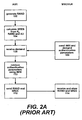
Fig. 2A andFig. 1 , the visited Mobile Service Switching Centre (MSC)/Visitors Location Register (VLR) sends parameters including the International Mobile Subscriber Identity (IMSI) to the Authentication Centre (AuC) and demands authentication parameters (step 106). The authentication centre is linked to a Home Location Register (HLR) of the subscriber. When a subscription is started, a secret number called an authentication key (Ki) is allocated to the mobile subscriber together with the IMSI. The AuC comprises adatabase 32 which stores the authentication key Ki for each mobile subscriber in the GSM network as is illustrated inFig. 5A . The key Ki is unique to the subscriber. It is shared only by the subscriber's SIM card and the authentication centre which serves the subscriber's home network. The key Ki is stored on the SIM in a very protected way: it is not possible to retrieve the key Ki from the SIM. The Ki of the mobile subscriber can be retrieved fromdatabase 32 using the IMSI of the subscriber as an index. The AuC is further provided with means for calculating authentication responses 36 including an authentication algorithm A3. The GSM system further specifies the size of the random input parameter RAND (128 bits) and of the output parameter SRES (32 bits). Ki may have any format and length. The authentication algorithm A3 is provided by the network operator and kept secret. Arandom generator 34 provides random numbers RAND having length of 128 bits (step 102). The key Ki retrieved fromdatabase 32 and the random number RAND are used as input parameters in the authentication algorithm A3 to calculate the signed response SRES (step 104). Authentication algorithm A3 is a so-called one-way hash function. This ensures that the computation of the authentication response SRES (signed response) from the key Ki and the random number RAND is easy, whereas the computation of the key Ki knowing RAND and the authentication response SRES is as complex as possible. Even with the knowledge of several pairs of authentication challenges and responses (RAND, SRES) pertaining to the same subscriber, the computation remain highly complex. At the same time a ciphering key Kc is calculated using authentication key Ki and random number RAND as input parameters in a ciphering algorithm A8. The triplet comprising the random number RAND, the signed response SRES and the ciphering key Kc are sent from the AuC to the visited MSC/VLR instep 112. Such a triplet is used only once, i.e. for one communication and is then destroyed. Several triplets are calculated in advance for each subscriber at authentication centre AuC and are delivered to the MSC/VLR on request. Such a request contains the IMSI of subscriber and a demand for authentication parameters (step 106). The IMSI is used to retrieve parameters pertaining to the subscriber (step 110), and a number of triplets are transmitted from the authentication centre AuC to the visited MSC/VLR (step 112). A reserve of a few of the triplets are stored in the MSC/VLR (step 114). Referring now toFig. 2B , upon access request of a mobile station (MS) in step 116 and 118 a triplet is retrieved from storage in the MSCNLR using the IMSI. The value of SRES is stored in the MSC/VLR instep 122. The random number RAND is further transmitted from the MSC/VLR to the Mobile Station MS as a request for authentication (10) of the subscriber to the network instep - The response SRES is accordingly calculated using Ki and RAND as an input for authentication algorithm A3 (step 126) and the response is transmitted in
step 128 to the MSC/VLR as an authentication result (12). The MSC/VLR then compares the signed response SRES transmitted from the AuC and already stored in the MSC/VLR with the signed response SRES transmitted from the mobile station as anauthentication result 12 insteps step 134. If the two values are not identical, access is denied instep 136. - However, the system described above is open to various attacks to gain access to the secret key Ki. By repeatingly sending random numbers RAND as authentication challenges to the SIM and by monitoring the signed responses SRES the SIM will provide, it might be possible to derive the value of the secret key Ki and possibly also the authentication algorithm A3. This is called a multiple attack. Although the use of a one-way hash function for A3 ensures a considerable level of complexity of the computation, the secret key Ki may be discovered with a finite number of attacks. With the knowledge of both the secret Ki and the authentication algorithm A3 one or more clone SIM cards may be generated.
- European
patent application EP 1 005 244 describes a method of authenticating a connection between a user terminal and a network, in which an authorised authentication station issues an authentication challenge to the user terminal including verification information in the authentication challenge to indicate to the user terminal that the challenge originates from the authorised station. - It is an object of the present invention to provide a better, more secure, mechanism for authenticating the subscriber to the network. It is a further object of the present invention to nullify potential multiple attacks and the attempts to derive the value of the secret authentication key Ki and thus to prevent or further reduce the production of clone SIM cards.
- According to one aspect of the present invention, there is provided a method of authentication in a mobile communications network comprising: authentication of a subscriber identifying means to a network entity; and authentication of the network entity to the subscriber identifying means, wherein the subscriber identifying means receives an authentication challenge from the network entity; wherein the subscriber identifying means distinguishes authorised authentication challenges from unauthorised authentication challenges; characterised in that a response to both said authorised and said unauthorised authentication challenges is given by the subscriber identifying means.
- Preferably, mutual authentication is achieved by authorising the authentication challenge from the network entity with a certificate, thus authenticating the network entity to the subscriber identifying means.
- Preferably, a true authentication response to said authentication challenge is only given to a request carrying a valid certificate. Thus a disclosure of a secret authentication key following multiple attacks may be prevented. Preferably, said certificate includes a digital signature, a message authentication code (MAC) or a redundancy check code.
- Preferably, the procedure of responding to said authentication challenge is the same for an authorised and an unauthorised authentication challenge and a first input parameter or algorithm is used for said procedure of responding to an authorised challenge and at least one further input parameter or algorithm, different from said first input parameter or algorithm, is used for said procedure of responding to an unauthorised challenge.
- Thus the same procedure is applied to respond to valid and invalid authentication challenges. Even if the multiple attacks of the subscriber identifying means are performed with help of a card reader no differences in the procedure to response to valid and invalid request could be detected. In this way a potential attacker would not be alerted that the attack is being nullified. This reduces further the chance for a potential attacker to discover a secret authentication key.
- Preferably, data are stored on said subscriber identifying means indicating that said subscriber identifying means has been subject to a request for authentication with an invalid certificate.
- In this way the network may have access to the information that an attempt has been made to challenge the subscriber identifying means in an unauthorised way and precautionary steps may be undertaken to prevent any further attempts.
- According to an embodiment of the present invention, the method comprises the steps of: receiving a message comprising said authentication challenge and determining a characteristic of said message, calculating said authentication response based on said authentication challenge, an authentication input parameter and an authentication algorithm; retrieving one authentication input parameter from a number of input parameters stored on said subscriber identifying means or one authentication algorithm from a number of algorithms stored on said subscriber identifying means in response to said characteristic; and responding to said authentication challenge by using said retrieved authentication input parameter or algorithm.
- This provides ways to prevent disclosure of a secret authentication key and thus to prevent cloning of the subscriber identifying means.
- Preferably, a sequence of messages comprising said authentication challenge and said certificate or authentication code has the appearance of randomness.
- For authentication in a mobile communications network in accordance with the GSM standard, said authentication challenge preferably comprises a message of (128-n) bits and said certificate or authentication code comprises a message of n bits, such that a message comprising said authentication challenge and said certificate or authentication code is 128 bits long.
- In this way a potential attacker may not recognise that the authentication challenges carries a certificate or authentication code. This helps further to nullify the attack because the message containing the authentication challenge RAND together with the certificate or authentication code has the same format and length than an authentication challenge according to the conventional GSM standard.
- According to an embodiment of the present invention, the subscriber identifying means is a subscriber identity module.
- According to another aspect of the present invention, there is provided apparatus comprising a subscriber identifying means adapted to:
- receive an authentication challenge from a network entity in a mobile communications network; and
- distinguish authorised authentication challenges from unauthorised authentication challenges,
- characterised in that:
- the apparatus is adapted to give a response to both said authorised and said unauthorised authentication challenges.
- By responding differently to authorised and unauthorised authentication challenges the chance for discovering a secret authentication input parameter in a multiple attack is substantially reduced.
- Preferably said authentication requests comprising authentication challenges carry certificates for authorising said authentication challenges and the validity of said certificates can be checked by calculation of said certificates from a certifying key and certifying algorithm stored on said information storage means using said authentication challenges as input parameters and comparison of calculated and received certificates.
- In this way the same procedures and methods are used for authorising said authentication challenge itself. Only minor modifications have to be applied to the subscriber identifying means and known technology may be used.
- Preferably said information storage means adapted for storing a first authentication input parameter or algorithm for use in a procedure of responding to authorised requests for authentication and further adapted for storing at least another authentication input parameter or algorithm for use in a procedure of responding to unauthorised requests.
- In this way the same procedure is used for calculating the response to a valid and an invalid authentication challenge and therefore no possibility for a potential attacker is provided to distinguish an authentication challenge with valid certificate from one with an invalid certificate.
- According to an embodiment of the present invention, the information storage means comprises: means for calculating authentication responses to received authentication challenges using said challenges, an authentication input parameter and an authentication algorithm stored on said information storage means; means for: i) determining characteristics of said authentication challenges; or ii) determining characteristics of received authentication codes; means for storing: i) an authentication algorithm and at least two secret authentication input parameters; or ii) a secret authentication input parameters and at least two authentication algorithms means for determining predetermined assignments of said characteristics to said at least two authentication input parameters or algorithms; and means for retrieving the assigned authentication input parameters or algorithms for a particular characteristic or authentication code and using said assigned authentication input parameter or algorithm for calculating said authentication responses.
- In this way the possibility of the detection of a secret authentication key or keys is reduced.
- Preferably in a mobile communications network according to the GSM standard, a received message comprising said authentication challenge and said certificate or authentication code has the same appearance as an authentication challenge according to the GSM standard.
- In this way a potential attacker may not distinguish an authorised authentication challenge according to these embodiments of the present invention from an authentication challenge according to the conventional GSM standard and the potential attacker would not be alerted that the attack is nullified.
- According to an embodiment of the present invention, there is provided a subscriber identifying means for authentication in a mobile communications network, adapted for distinguishing an authorised authentication challenge as transmitted by said network from an unauthorised authentication challenge, characterised in that said subscriber identifying means is further adapted for storing data indicating that said subscriber identifying means has been subject to unauthorised authentication challenges.
- In this way an unauthorised authentication challenge by a potential attacker is detected and the network may be notified of the false attack and actions to prevent further attacks or misuse may be started.
- According to another aspect of the present invention, there is provided a subscriber identifying means for authentication in a mobile communications network, adapted for distinguishing a genuine authentication challenge as transmitted by said network from a false authentication challenge and for storing data indicating that said subscriber identifying means has been subject to false authentication challenges.
- In this way a false authentication challenge by a potential attacker is detected and the network may be notified of the false attack and actions to prevent further attacks or misuse may be started.
- According to yet another aspect of the present invention, there is provided a method of authentication in a mobile communications network, comprising transmitting an authentication request to a mobile station and receiving an authentication response from the mobile station, wherein the authentication request transmitted to the mobile station comprises:
- an authentication challenge; and
- a certificate, said certificate providing authentication of a network entity to or an authentication code for determining a procedure for responding to said authentication challenge.
- According to a further aspect of the invention there is provided a method of authentication in a mobile communications network,
wherein a network entity transmits an authentication challenge to a subscriber identifying means and generates an authentication response to said challenge,
wherein said subscriber identifying means generates an authentication response to said received challenge and transmitting said response to said network entity,
wherein said network entity compares the authentication response generated by said network entity to the authentication response provided by said subscriber identifying means, and
wherein said method comprises the steps of generating said authentication responses using a variable external input parameter available to said network entity and said subscriber identifying means and calculating said authentication response in response thereto. - Further aspects and advantages of the invention will be apparent from the following, in which one embodiment of the invention will now be described, by way of example only, with reference to the accompanying drawings in which:
-
Figure 1 is a general outline of the structure of a mobile communications network; -
Figure 2A is a flowchart diagram showing the steps between the authentication centre AuC and the visited MSC/VLR in the authentication procedure according to the GSM standard (prior art); -
Figure 2B is a flowchart diagram showing the steps between the visited MSC/VLR and the mobile station including the SIM card in the authentication procedure according to the GSM standard (prior art); -
Figure 3A is a flowchart diagram showing the steps between the authentication centre AuC and the visited MSC/VLR in the mutual authentication procedure according to one embodiment of the present invention; -
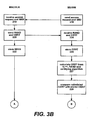
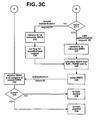
Figures 3B and3C are flowchart diagrams showing the steps between the authentication centre AuC and, the mobile station including the SIM card in the mutual authentication procedure according to one embodiment of the present invention; -
Figure 4 is an outline of the random number RAND and the certificate according to one embodiment of the present invention; -
Figure 5A shows the database content for retrieving the authentication key in the authentication centre AuC (prior art); -
Figure 5B shows the database content for retrieving the authentication key and the certifying key in the authentication centre AuC according to one embodiment of the present invention; -
Figure 6 shows the storing of the certifying key and of different authentication keys in the SIM for use to response to authorised and unauthorised authentication challenges according to one embodiment of the present invention; -
Figure 7 shows the storing of authentication codes and of authentication keys and their assignment in the SIM for use to respond to authentication requests comprising an authentication challenge and an authentication code according to a second embodiment of the present invention. -
Figures 3A , B and C show the procedure of mutual authentication according to one embodiment of the present invention. Referring now toFig. 3A , the steps of sending a demand of authentication parameters and the IMSI from the MSC/VLR to the authentication centre AuC (step 206) and step 202 and 204 of generating RAND and calculating authentication response are similar assteps Figure 2A and described above. However, the random number RAND used in this embodiment of the present invention is shorter than 128 bits. At subscription time, a second secret number called a certifying key Ki cert is allocated to the subscriber, together with the IMSI and the authentication key Ki. The certificate key Ki cert is stored indatabase 32 and can be retrieved together with Ki with IMSI as an index. Authentication algorithm A3 is used to calculate SRES from RAND and Ki instep 204. A certifying algorithm is used to calculate a certificate CERT from RAND and Ki cert instep 205. RAND, CERT and SRES are transmitted from authentication centre AuC to MSC/VLR on demand instep Fig. 3B , upon access request from mobile station MS (step 116), SRES is stored instep 222 in the visited MSC/VLR and RAND is transmitted together with certificate CERT in one message from the MSC/VLR to the mobile station instep - In contrast to the prior art and common GSM authentication procedure, where a 128 bit random number RAND is used, the random number RAND according to the described embodiment of the present invention is n bits shorter than 128 bits. n bits are reserved for the certificate CERT. The certifying algorithm, the certificate key Ki cert and the random number RAND are chosen to match these requirements. As a result the authentication request comprising the authentication challenge RAND the certificate CERT is 128 bits long. In this way the sequence of messages comprising RAND and CERT as transmitted from MSC/VLR to the mobile station MS would have the appearance of randomness and could not be distinguished from
prior art 128 bit random number RAND by an unauthorised attacker. A set of random number RAND and certificate CERT is illustrated inFig. 4 as an example. However, it is appreciated that the certificate CERT may be located anywhere within the sequence of messages comprising RAND and CERT and is not restricted to a location at the end of the sequence. The certificate may for example be included in the sequence while being split into two or more portions, may be distributed in various manners, or may be coded in the random number RAND according to a predetermined procedure. The SIM connected to mobile station MS is provided with the same certifying algorithm and certificate key Ki cert and is thus able to check the message containing the random number RAND and certificate CERT for authentication. The SIM stores the transmitted CERT instep 225. Instep 227 the SIM calculates CERT using the transmitted random number RAND and the key Ki cert and certifying algorithm stored in the SIM memory. Subsequently, the stored and the calculate values of CERT are compared (step 229). Referring now toFig. 3C , if the two values are identical, it is ensured that the authentication challenge is valid and assumed that it was provided by the MSC/VLR. In this case the SIM now continues to respond to the authentication challenge by calculating SRES from Ki and RAND in step 237 and 226 as explained before. If the two values of CERT are not identical, aninvalid authentication challenge 21 is detected. In order to provide protection against multiple challenge attacks, it is not sufficient to provide an error message or no response from the SIM card if the two values of CERT are not identical, i.e. an invalid authentication challenge is detected. This would provide potential attackers with a hint that the challenges RAND are not truly random. - In case of an invalid authentication challenge, the SIM uses a second, fake authentication key Ki' to calculate a fake authentication response SRES 233 (step 233 and 226). This second key Ki' is also stored in the memory of the SIM. In both cases, i.e. a valid and invalid authentication challenge, the resulting SRES is transmitted to the MSC/VLR as the
authentication result 22 insteps steps steps Fig. 2 . - In case an
invalid authentication challenge 21 is detected, a flag is set on the SIM indicating that an unauthorised authentication challenge has been detected (step 235). - As explained above, the SIM card returns an authentication response for every challenge, a valid and thus authorised authentication challenge 20 and also an invalid i.e., unauthorised,
authentication challenge 21. To further enhance the security provided, it is important that the system performs the same procedure as a response for valid and invalid authentication challenges. In this way a potential attacker would not be able to detect any differences if the SIM card is measured in a card reader or the like. Thus, no hint is given to the potential attacker whether the authentication challenge is valid or not. Otherwise the potential attacker may discover the certifying key Ki cert in a first series of multiple attacks and may continue challenging the SIM using the correct certificate in a second series of attacks in order to discover the authentication key Ki. According to the above-described embodiment of the present invention, however, no hint is given that the attempts are being nullified and that the responses to invalid authentication challenges are meaningless. This method enhances further the security of the authentication system. A potential attacker may well derive the second authentication key Ki', but this is of no use in generating a clone SIM card. - Whilst in the above-described embodiment the method of authorising the authentication challenge is described as a certifying algorithm with a secret key Ki cert as an input parameter, i.e. an authorisation according to the message authentication code (MAC) method, it is appreciated that other possibilities to authorise the authentication challenge like, for example, digital signature or redundancy check codes can be used. By adjusting the length of the keys Ki, Ki cert, of the random number RAND and the certificate CERT it is even possible to use one of the existing GSM algorithms stored on the SIM, for example A3, as a certifying algorithm. However, it is preferred that the length and appearance of a message containing the authentication challenge RAND and the certificate is the same as for an authentication challenge according to the prior art.
- It is appreciated that even other possibilities for authorising the authentication challenge can be used: For example the random number RAND generated by the authentication centre AuC is provided with a predetermined code. Subsequently the message comprising RAND and the code is encrypted with a secret key. A sequence of these encrypted messages would again have the appearance of randomness and could be adjusted to have 128 bit length of prior art authentication challenges, in order not to give a hint to a potential attacker that the authentication challenges carry authorisation certificates. The encrypted message is then transmitted via the visited MSC/VLR to the mobile station and its SIM. The SIM would be provided with the same secret key to decrypt the message. In this way the predetermined code can be checked by the SIM for authorisation of the random number authentication challenge RAND.
- Yet another possibility to authorise the authentication challenge is to provide the authentication challenge RAND with a digital signature. The message comprising the random number RAND and the digital signature may be encrypted using the authentication key Ki. Again the ciphering algorithm for encryption of the message and the length of the random number RAND and the digital signature have to be adjusted such that the entire message to be transmitted from the visiting MSC/VLR has the length of the usual authentication challenge and the appearance of randomness. The SIM would be provided with means for decryption of the message and to verify the digital signature.
- Moreover, it is appreciated that more than one valid key Ki and/or more than one fake key Ki' (i.e. Ki", Ki"'...) can be stored on the SIM card and can be used to calculate the response for invalid authentication challenges. The different valid keys Ki or fake keys Ki', Ki', etc may, for example, be used alternately if a valid or invalid authentication challenge is detected. Alternatively, one valid or fake key may be selected according to a predetermined selection procedure which may, for example, be based on the random number RAND, the certificate CERT or an external variable parameter.
- It if further appreciated that only one authentication key Ki is used, but more than one authentication algorithms A3, A3', A3", ... rather than more than one authentication key Ki are used in the authentication method described.
- Whilst in the above-described embodiment the SIM card responds to authentication challenges by performing the same procedure but using an invalid "fake" authentication key or algorithm, it is appreciated that the SIM card may not respond to unauthorised and thus false authentication challenges. In this case the SIM card stores data indicating that an false challenge is detected and consequently the SIM card will not respond to any further authentication challenges by transmitting an authentication response SRES. In this way the possibility of misuse of the SIM card is further reduced.
- In a second embodiment of the present invention the authentication centre AuC stores a number of authentication codes Ca. In this embodiment when a subscription is started a number of authentication keys Ki are allocated to the mobile subscriber. There is one authentication key Ki assigned to each possible authentication code for each subscriber in the GSM network.
- The
database 32 of the authentication centre AuC is further provided with means for randomly choosing or selecting in another way one of the authentication codes. After choosing one of the authentication codes, the AuC retrieves the authentication keys Ki assigned to the chosen authentication code and the authentication centre generates a random number RAND as an authentication challenge. The authentication response SRES is then calculated from the random number RAND and the assigned authentication key Ki fed into an authentication algorithm A3 as described before. The AuC then sends a message comprising the random number RAND, the authentication code Ca and the authentication response SRES. The random number RAND and the authentication code Ca is sent to the visited MSCNLR and further transmitted to the mobile station as an authentication request. Again a sequence of messages containing RAND and Ca should have the appearance of randomness in order not to alert a potential attacker. In the simplest case the authentication code might for example consist of a 1 bit message with is stored in a predetermined place within a 127 bit random number RAND, such that the message comprising RAND and Ca is the common 128 bit format for authentication challenges according to the GSM standard. In case that Ca is 0 or 1, there is assigned a first authentication key Ki or a second key Ki', respectively, for use in calculating the authentication response SRES. - The SIM card is also provided with the authentication codes, keys and their predetermined assignments as illustrated in
Figure 7 . The SIM card is provided with information identifying which region of the received authentication request the authentication code Ca is stored. On reception of an authentication challenge from the visited MSC/VLR the SIM card reads the Ca and retrieves the authentication key Ki assigned to the received authentication code Ca from its memory and calculates an authentication response SRES from this assigned authentication key Ki and the received random number RAND. Again SRES is sent as an authentication result to the visited MSC/VLR and there compared to the SRES as received from the AuC. Access is granted if the two authentication results are identical, access is denied if they are not identical. In this way the SIM card is protected against multiple attacks, because it would not be possible to derive the authentication key Ki from challenging the SIM with random number RAND according to the GSM standard and monitoring the authentication responses SRES. - Whilst in the above described embodiment the use of authentication codes are described in response to which one authentication key is chosen, it is appreciated that alternatively a characteristic of the authentication challenge itself may be used. For example a checksum or a cyclic redundancy code may be derived from the random number RAND or portions thereof to determine which authentication key is used. Another possibility is that a portion of predetermined length and position of the authentication challenge itself, for example, the last two bits, determine which authentication key is used. It is further appreciated that one of a number of different authentication algorithms may be used rather than, or in addition, selecting one of a number of different authentication keys.
- Whilst in the above-described embodiment an authentication key or algorithm assigned to a received authentication code or a characteristic derived from the authentication challenge is used to generate an authentication response, it is appreciated that alternatively an external variable input parameter may be used to select an authentication key or algorithm. An example for such an external variable parameter is for example the date or a parameter derivable from the TMSI (Temporary Mobile Subscriber Identity) according to a predetermined algorithm.
- Whilst in the above-described embodiments an authentication code or characteristic derivable from the authentication challenge is used to select in a predetermined way an authentication key or algorithm, it is appreciated that either the network (i.e. the AuC) or the SIM card may select one of a number of authentication keys or algorithms and respond by generating SRES using this selected key or algorithm. In this case both the AuC and the SIM card are provided with more than one keys or algorithms. Whereas the AuC or the SIM selects one of these keys or algorithms, the according other party (i.e. the SIM card or the AuC) provides more than one authentication responses SRES. The authentication procedure is successful and thus access for the mobile station carrying the SIM is granted if the SRES generating the selected key or algorithms is amongst the number of authentication responses SRES provided by the other party.
- It is appreciated that instead of using one authentication algorithm and more than one authentication key alternatively more than one authentication algorithm and one authentication key or more than one authentication algorithm and more than one authentication key may be used.
- Whilst in the above-described embodiments an authentication algorithms A3 according to the GSM standard is used to calculate the signed response SRES, it is appreciated that other authentication algorithms may be used.
- Whilst in the above-described embodiments a number of the authentication processing functions on the network side are carried out in the MSC/VLR, one or more of the processing functions may be carried out elsewhere, for example in a base station.
- Whilst in the above-described embodiments the method and system of authentication is for authenticating a network entity in the form of a network operator as described in the framework of the GSM standard, it is appreciated that the method and system may also be adapted in other mobile communication systems like for example PCS and for other authentication procedures like the WS and the S scheme. The method and system may also be used for authenticating network entities such as virtual network operators, service providers, etc. The method and system may also be adapted in authentication systems other than mobile communication systems.
Claims (25)
- A method of authentication in a mobile communications network comprising:authentication of a subscriber identifying means to a network entity;
andauthentication of the network entity to the subscriber identifying means,wherein the subscriber identifying means receives (224) an authentication challenge from the network entity, andwherein the subscriber identifying means distinguishes (231) authorised authentication challenges from unauthorised authentication challenges,characterised in that a different response (228) to both said authorised (20) and said unauthorised (21) authentication challenges is given by the subscriber identifying means. - A method of authentication according to claim 1, wherein said authentication challenges are authorised by adding a certificate (220) to an authentication challenge.
- A method of authentication according to claim 1 or 2, wherein said authentication of the subscriber identifying means to the network entity includes said subscriber identifying means receiving (224) an authentication challenge, calculating (226) an authentication response from said authentication challenge, an authentication input parameter stored on said subscriber identifying means and an authentication algorithm, and transmitting said authentication response to the network.
- A method of authentication according to claim 2 or 3, wherein said certificate includes at least one of the following:i) a digital signature;ii) a message authentication code (MAC); andiii) a redundancy check code.
- A method of authentication according to any of claims 1 to 4, wherein the procedure of responding to said authentication challenge is the same for an authorised and unauthorised authentication challenge and a first input parameter or algorithm is used for said procedure of responding to an authorised authentication challenge, and at least one further input parameter or algorithm, different from said first input parameter or algorithm, is used for said procedure of responding to an unauthorised authentication challenge.
- A method of authentication according to claim 5, wherein said first and any further input parameter and algorithms are stored on said subscriber identifying means.
- A method of authentication according to any of claims 1 to 6, further comprising storing data (235) on said subscriber identifying means indicating that said subscriber identifying means has been subject to an unauthorised authentication challenge.
- A method of authentication according to claim 1, said method comprising the steps of:receiving a message comprising said authentication challenge and determining a characteristic of said message;calculating said authentication response based on said authentication challenge, an authentication input parameter and an authentication algorithm;retrieving one authentication input parameter from a number of input parameters stored on said subscriber identifying means or one authentication algorithm from a number of algorithms stored on said subscriber identifying means in response to said characteristic; andresponding to said authentication challenge by using said retrieved authentication input parameter or algorithm.
- A method of authentication according to claim 8, wherein said characteristic of said message is derivable from said authentication challenge.
- A method of authentication according to claim 9, wherein said characteristic is determined using checksums, cyclic redundancy codes or by portions of predetermined length or predetermined position.
- A method of authentication according to claim 8, wherein said message includes said authentication challenge and an authentication code and said characteristic of said message is included in said authentication code.
- A method of authentication according to claim 11, comprising the step of selecting one authentication code from a number of different authentication codes, whereby each authentication code is assigned to a particular input parameter or algorithm.
- A method of authentication according to claim 12, wherein said authentication codes, input parameters or algorithms and assignments of said codes to said input parameter or algorithms are stored on said subscriber identifying means.
- A method of authentication according to any of claims 1 to 13, wherein a sequence of messages comprising said authentication challenges and said certificates or authentication codes have the appearance of randomness.
- A method of authentication according to any of claims 1 to 14 for authentication in a mobile communications network, said communications network being in accordance with the GSM standard, wherein said authentication challenge comprises a message of (128-n) bits and said certificate or authentication code comprises a message of n bits, such that a message comprising said authentication challenge and said certificate or authentication codes is 128 bits long.
- A method of authentication according to any of claims 1 to 15, wherein said subscriber identifying means is a subscriber identity module.
- Apparatus comprising a subscriber identifying means adapted to:receive (224) an authentication challenge from a network entity in a mobile communications network; anddistinguish (231) authorised authentication challenges from unauthorised authentication challenges,characterised in that:the apparatus is adapted to give a different response (228) to both said authorised (20) and said unauthorised (21) authentication challenges.
- Apparatus according to claim 17, wherein said authentication requests include authentication challenges and responding to said authentication challenges includes calculating (226) an authentication response from said authentication challenge, an authentication input parameter and an authentication algorithm.
- Apparatus according to claim 18, wherein said authentication challenges carry certificates (220) for authorising said authentication challenges.
- Apparatus according to claim 19, wherein the validity of said certificate can be checked by calculation (227) of said certificate from a certifying key and a certifying algorithm stored on said information storage means using said authentication challenge as an input parameter and by comparing (229) the calculated and received certificate.
- Apparatus according to any of claims 17 to 20, said apparatus being adapted to store a first authentication input parameter or algorithm (237) for use in a procedure of responding to authorised requests (20) for authentication and further adapted to store at least another authentication input parameter or algorithm (233) for use in a procedure of responding to unauthorised requests (21).
- Apparatus according to any of claims 17 to 21, further adapted to store data (235) indicating that said apparatus has been subject to an unauthorised request for authentication.
- Apparatus for authentication according to claim 17, comprising:means for calculating authentication responses to received authentication challenges using said challenges, an authentication input parameter and an authentication algorithm stored on said information storage means;means for:i) determining characteristics of said authentication challenges;
orii) determining characteristics of received authentication codes;means for storing:i) an authentication algorithm and at least two secret authentication input parameters; orii) a secret authentication input parameter and at least two authentication algorithms;means for determining predetermined assignments of said characteristics to said at least two authentication input parameters or algorithms; andmeans for retrieving the assigned authentication input parameters or algorithms for a particular characteristic or authentication code and using said assigned authentication input parameter or algorithm for calculating said authentication responses. - Apparatus according to claim 23, for authentication in a mobile communications network according to a GSM standard, wherein a received message comprising said authentication challenge and said certificate or authentication code have the same appearance as an authentication challenge according to the GSM standard.
- Apparatus according to any of claims 17 to 24, the apparatus being adapted to distinguish an authorised authentication challenge as transmitted by said network from an unauthorised authentication challenge, wherein said subscriber identifying means is further adapted to store data indicating that said subscriber identifying means has been subject to unauthorised authentication challenges.
Priority Applications (1)
| Application Number | Priority Date | Filing Date | Title |
|---|---|---|---|
| EP10181441.6A EP2385661B1 (en) | 2000-08-03 | 2001-07-31 | Authentication in a mobile communications network |
Applications Claiming Priority (3)
| Application Number | Priority Date | Filing Date | Title |
|---|---|---|---|
| GB0019110A GB2366938B (en) | 2000-08-03 | 2000-08-03 | Authentication in a mobile communications network |
| GB0019110 | 2000-08-03 | ||
| PCT/GB2001/003423 WO2002013568A1 (en) | 2000-08-03 | 2001-07-31 | Authentication in a mobile communications network |
Related Child Applications (2)
| Application Number | Title | Priority Date | Filing Date |
|---|---|---|---|
| EP10181441.6A Division EP2385661B1 (en) | 2000-08-03 | 2001-07-31 | Authentication in a mobile communications network |
| EP10181441.6A Division-Into EP2385661B1 (en) | 2000-08-03 | 2001-07-31 | Authentication in a mobile communications network |
Publications (2)
| Publication Number | Publication Date |
|---|---|
| EP1305969A1 EP1305969A1 (en) | 2003-05-02 |
| EP1305969B1 true EP1305969B1 (en) | 2015-09-09 |
Family
ID=9896942
Family Applications (2)
| Application Number | Title | Priority Date | Filing Date |
|---|---|---|---|
| EP10181441.6A Expired - Lifetime EP2385661B1 (en) | 2000-08-03 | 2001-07-31 | Authentication in a mobile communications network |
| EP01954127.5A Expired - Lifetime EP1305969B1 (en) | 2000-08-03 | 2001-07-31 | Authentication in a mobile communications network |
Family Applications Before (1)
| Application Number | Title | Priority Date | Filing Date |
|---|---|---|---|
| EP10181441.6A Expired - Lifetime EP2385661B1 (en) | 2000-08-03 | 2001-07-31 | Authentication in a mobile communications network |
Country Status (6)
| Country | Link |
|---|---|
| US (1) | US20040015692A1 (en) |
| EP (2) | EP2385661B1 (en) |
| CN (1) | CN1244249C (en) |
| AU (1) | AU2001276476A1 (en) |
| GB (1) | GB2366938B (en) |
| WO (1) | WO2002013568A1 (en) |
Families Citing this family (85)
| Publication number | Priority date | Publication date | Assignee | Title |
|---|---|---|---|---|
| US7295509B2 (en) * | 2000-09-13 | 2007-11-13 | Qualcomm, Incorporated | Signaling method in an OFDM multiple access system |
| US9130810B2 (en) * | 2000-09-13 | 2015-09-08 | Qualcomm Incorporated | OFDM communications methods and apparatus |
| US7389412B2 (en) * | 2001-08-10 | 2008-06-17 | Interactive Technology Limited Of Hk | System and method for secure network roaming |
| GB0221674D0 (en) | 2002-09-18 | 2002-10-30 | Nokia Corp | Linked authentication protocols |
| US20060190984A1 (en) * | 2002-09-23 | 2006-08-24 | Credant Technologies, Inc. | Gatekeeper architecture/features to support security policy maintenance and distribution |
| US7437752B2 (en) * | 2002-09-23 | 2008-10-14 | Credant Technologies, Inc. | Client architecture for portable device with security policies |
| US7665118B2 (en) * | 2002-09-23 | 2010-02-16 | Credant Technologies, Inc. | Server, computer memory, and method to support security policy maintenance and distribution |
| US7665125B2 (en) * | 2002-09-23 | 2010-02-16 | Heard Robert W | System and method for distribution of security policies for mobile devices |
| WO2004100592A1 (en) * | 2003-05-12 | 2004-11-18 | Setec Oy | Authentication of a subscriber station |
| IL156606A (en) * | 2003-06-23 | 2011-07-31 | Aviad Kipnis | Digital certificates |
| CN1315268C (en) * | 2003-11-07 | 2007-05-09 | 华为技术有限公司 | Method for authenticating users |
| US20050149740A1 (en) * | 2003-12-31 | 2005-07-07 | Kotzin Michael D. | Method and apparatus for device authentication |
| US7406334B2 (en) | 2004-01-26 | 2008-07-29 | Sbc Knowledge Ventures, L.P. | Systems and methods for securing personal or private content stored in the internal memory of a mobile terminal |
| US8156548B2 (en) | 2004-05-20 | 2012-04-10 | Future Internet Security Ip Pty Ltd. | Identification and authentication system and method |
| WO2005115045A1 (en) * | 2004-05-20 | 2005-12-01 | Future Internet Security Ip Pty Ltd | Identification system and method |
| EP1605716A1 (en) * | 2004-06-11 | 2005-12-14 | Axalto SA | Method and device to authenticate customers in a mobile phone network |
| US9137822B2 (en) | 2004-07-21 | 2015-09-15 | Qualcomm Incorporated | Efficient signaling over access channel |
| US9148256B2 (en) * | 2004-07-21 | 2015-09-29 | Qualcomm Incorporated | Performance based rank prediction for MIMO design |
| GB2416956B (en) * | 2004-07-29 | 2007-09-19 | Nec Technologies | Method of testing integrity of a mobile radio communications device and related apparatus |
| CN100459787C (en) * | 2004-08-29 | 2009-02-04 | 华为技术有限公司 | Safety guarantee method for user card |
| JP2006071695A (en) * | 2004-08-31 | 2006-03-16 | Yamatake Corp | Encryption, decryption program and encryption system. |
| CN101116284B (en) * | 2004-12-17 | 2012-11-14 | 艾利森电话股份有限公司 | Anti-cloning mutual authentication method, identity module, server and system in radio communication network |
| GB0428084D0 (en) * | 2004-12-22 | 2005-01-26 | Nokia Corp | Method for producing authentication information |
| MY142227A (en) * | 2005-02-04 | 2010-11-15 | Qualcomm Inc | Secure bootstrapping for wireless communications |
| US20060203794A1 (en) * | 2005-03-10 | 2006-09-14 | Qualcomm Incorporated | Systems and methods for beamforming in multi-input multi-output communication systems |
| US9246560B2 (en) | 2005-03-10 | 2016-01-26 | Qualcomm Incorporated | Systems and methods for beamforming and rate control in a multi-input multi-output communication systems |
| US9154211B2 (en) * | 2005-03-11 | 2015-10-06 | Qualcomm Incorporated | Systems and methods for beamforming feedback in multi antenna communication systems |
| US8446892B2 (en) * | 2005-03-16 | 2013-05-21 | Qualcomm Incorporated | Channel structures for a quasi-orthogonal multiple-access communication system |
| US9520972B2 (en) | 2005-03-17 | 2016-12-13 | Qualcomm Incorporated | Pilot signal transmission for an orthogonal frequency division wireless communication system |
| US9143305B2 (en) | 2005-03-17 | 2015-09-22 | Qualcomm Incorporated | Pilot signal transmission for an orthogonal frequency division wireless communication system |
| US9461859B2 (en) | 2005-03-17 | 2016-10-04 | Qualcomm Incorporated | Pilot signal transmission for an orthogonal frequency division wireless communication system |
| US20090213950A1 (en) * | 2005-03-17 | 2009-08-27 | Qualcomm Incorporated | Pilot signal transmission for an orthogonal frequency division wireless communication system |
| US9184870B2 (en) | 2005-04-01 | 2015-11-10 | Qualcomm Incorporated | Systems and methods for control channel signaling |
| US9408220B2 (en) | 2005-04-19 | 2016-08-02 | Qualcomm Incorporated | Channel quality reporting for adaptive sectorization |
| US9036538B2 (en) | 2005-04-19 | 2015-05-19 | Qualcomm Incorporated | Frequency hopping design for single carrier FDMA systems |
| US8611284B2 (en) * | 2005-05-31 | 2013-12-17 | Qualcomm Incorporated | Use of supplemental assignments to decrement resources |
| US8879511B2 (en) * | 2005-10-27 | 2014-11-04 | Qualcomm Incorporated | Assignment acknowledgement for a wireless communication system |
| US8565194B2 (en) | 2005-10-27 | 2013-10-22 | Qualcomm Incorporated | Puncturing signaling channel for a wireless communication system |
| US8462859B2 (en) * | 2005-06-01 | 2013-06-11 | Qualcomm Incorporated | Sphere decoding apparatus |
| KR100652125B1 (en) * | 2005-06-03 | 2006-12-01 | 삼성전자주식회사 | Mutual authentication method for overall authentication and management between service provider, terminal, and user identification module, system and terminal device using same |
| US9179319B2 (en) * | 2005-06-16 | 2015-11-03 | Qualcomm Incorporated | Adaptive sectorization in cellular systems |
| US8599945B2 (en) | 2005-06-16 | 2013-12-03 | Qualcomm Incorporated | Robust rank prediction for a MIMO system |
| US8885628B2 (en) | 2005-08-08 | 2014-11-11 | Qualcomm Incorporated | Code division multiplexing in a single-carrier frequency division multiple access system |
| US20070041457A1 (en) | 2005-08-22 | 2007-02-22 | Tamer Kadous | Method and apparatus for providing antenna diversity in a wireless communication system |
| US9209956B2 (en) * | 2005-08-22 | 2015-12-08 | Qualcomm Incorporated | Segment sensitive scheduling |
| US8644292B2 (en) | 2005-08-24 | 2014-02-04 | Qualcomm Incorporated | Varied transmission time intervals for wireless communication system |
| US20070047495A1 (en) * | 2005-08-29 | 2007-03-01 | Qualcomm Incorporated | Reverse link soft handoff in a wireless multiple-access communication system |
| US9136974B2 (en) * | 2005-08-30 | 2015-09-15 | Qualcomm Incorporated | Precoding and SDMA support |
| US9172453B2 (en) * | 2005-10-27 | 2015-10-27 | Qualcomm Incorporated | Method and apparatus for pre-coding frequency division duplexing system |
| US8582509B2 (en) | 2005-10-27 | 2013-11-12 | Qualcomm Incorporated | Scalable frequency band operation in wireless communication systems |
| US9225416B2 (en) * | 2005-10-27 | 2015-12-29 | Qualcomm Incorporated | Varied signaling channels for a reverse link in a wireless communication system |
| US8693405B2 (en) * | 2005-10-27 | 2014-04-08 | Qualcomm Incorporated | SDMA resource management |
| US9210651B2 (en) | 2005-10-27 | 2015-12-08 | Qualcomm Incorporated | Method and apparatus for bootstraping information in a communication system |
| US8045512B2 (en) | 2005-10-27 | 2011-10-25 | Qualcomm Incorporated | Scalable frequency band operation in wireless communication systems |
| US8477684B2 (en) | 2005-10-27 | 2013-07-02 | Qualcomm Incorporated | Acknowledgement of control messages in a wireless communication system |
| US9144060B2 (en) * | 2005-10-27 | 2015-09-22 | Qualcomm Incorporated | Resource allocation for shared signaling channels |
| US9088384B2 (en) * | 2005-10-27 | 2015-07-21 | Qualcomm Incorporated | Pilot symbol transmission in wireless communication systems |
| US9225488B2 (en) | 2005-10-27 | 2015-12-29 | Qualcomm Incorporated | Shared signaling channel |
| US8582548B2 (en) | 2005-11-18 | 2013-11-12 | Qualcomm Incorporated | Frequency division multiple access schemes for wireless communication |
| US8831607B2 (en) * | 2006-01-05 | 2014-09-09 | Qualcomm Incorporated | Reverse link other sector communication |
| WO2007084973A2 (en) * | 2006-01-20 | 2007-07-26 | Verimatrix, Inc. | Network security system and method |
| FR2904174B1 (en) * | 2006-07-24 | 2008-08-29 | Sagem Comm | METHOD FOR CONTROLLING THE ACCESS OF A MOBILE STATION TO A BASE STATION WHICH COVERAGE DEFINES ONE OF THE CELLS OF A MOBILE CELLULAR TELEPHONY SYSTEM |
| DE102006061338A1 (en) * | 2006-12-22 | 2008-06-26 | Giesecke & Devrient Gmbh | Authentication of portable data carriers |
| US7885640B2 (en) * | 2007-01-11 | 2011-02-08 | Nokia Corporation | Authentication in communication networks |
| US9767319B2 (en) | 2007-04-17 | 2017-09-19 | Avago Technologies General Ip (Singapore) Pte. Ltd. | Method and apparatus of secure authentication for system on chip (SoC) |
| US8792450B2 (en) * | 2007-05-10 | 2014-07-29 | Starhome Gmbh | System and method for providing local IP connectivity for a roaming mobile subscriber |
| US8887307B2 (en) | 2007-10-12 | 2014-11-11 | Broadcom Corporation | Method and system for using location information acquired from GPS for secure authentication |
| US20100014662A1 (en) * | 2008-06-19 | 2010-01-21 | Sami Antti Jutila | Method, apparatus and computer program product for providing trusted storage of temporary subscriber data |
| US8380531B2 (en) * | 2008-07-25 | 2013-02-19 | Invivodata, Inc. | Clinical trial endpoint development process |
| GB2464260B (en) * | 2008-10-02 | 2013-10-02 | Motorola Solutions Inc | Method, mobile station, system and network processor for use in mobile communications |
| US20100232384A1 (en) * | 2009-03-13 | 2010-09-16 | Qualcomm Incorporated | Channel estimation based upon user specific and common reference signals |
| DE102009036179A1 (en) * | 2009-08-05 | 2011-02-10 | Siemens Aktiengesellschaft | Method for issuing a digital certificate by a certification authority, arrangement for carrying out the method and computer system of a certification authority |
| CA2769933C (en) | 2011-03-01 | 2018-11-27 | Tracfone Wireless, Inc. | System, method and apparatus for pairing sim or uicc cards with authorized wireless devices |
| CA2830283C (en) | 2011-03-25 | 2016-11-01 | Certicom Corp. | Interrogating an authentication device |
| US8887258B2 (en) * | 2011-08-09 | 2014-11-11 | Qualcomm Incorporated | Apparatus and method of binding a removable module to an access terminal |
| CN103311584B (en) * | 2012-03-12 | 2016-03-30 | 联想(北京)有限公司 | Battery unit, terminal equipment and battery verification method |
| US9369290B2 (en) * | 2012-11-30 | 2016-06-14 | Certicom Corp. | Challenge-response authentication using a masked response value |
| US9727720B2 (en) * | 2012-11-30 | 2017-08-08 | Certicom Corp. | Challenge-response authentication using a masked response value |
| US9264899B2 (en) | 2013-12-19 | 2016-02-16 | Nxp, B.V. | Binding mobile device secure software components to the SIM |
| KR102304927B1 (en) * | 2014-06-13 | 2021-09-24 | 삼성전자 주식회사 | Memory device, memory system and operating method of memory system |
| JP6734570B2 (en) * | 2015-11-10 | 2020-08-05 | 日本電気株式会社 | Communications system |
| CN106330452B (en) * | 2016-08-13 | 2020-02-18 | 广东中云智安科技有限公司 | A secure network attachment and method for blockchain |
| WO2019226696A1 (en) | 2018-05-22 | 2019-11-28 | Futurewei Technologies, Inc. | Access technology agnostic serving network authentication |
| US11483709B2 (en) | 2019-03-14 | 2022-10-25 | At&T Intellectual Property I, L.P. | Authentication technique to counter subscriber identity module swapping fraud attack |
| US11991520B2 (en) * | 2022-04-29 | 2024-05-21 | Microsoft Technology Licensing, Llc | Encrypted flow of SIM data between regions and edge networks |
Family Cites Families (21)
| Publication number | Priority date | Publication date | Assignee | Title |
|---|---|---|---|---|
| US5390245A (en) * | 1990-03-09 | 1995-02-14 | Telefonaktiebolaget L M Ericsson | Method of carrying out an authentication check between a base station and a mobile station in a mobile radio system |
| CA2098136C (en) * | 1992-06-25 | 1996-11-12 | Peter John Yankura | Remote charging cradle for cordless telephone handset |
| JP2942913B2 (en) * | 1993-06-10 | 1999-08-30 | ケイディディ株式会社 | Remote party authentication / encryption key distribution method |
| US5668876A (en) * | 1994-06-24 | 1997-09-16 | Telefonaktiebolaget Lm Ericsson | User authentication method and apparatus |
| US5537474A (en) * | 1994-07-29 | 1996-07-16 | Motorola, Inc. | Method and apparatus for authentication in a communication system |
| GB2301751B (en) * | 1995-06-02 | 2000-02-09 | Dsc Communications | Control message transmission in telecommunications systems |
| WO1998000956A2 (en) * | 1996-06-28 | 1998-01-08 | Mci Communications Corporation | System and method for preventing cellular fraud |
| US6532543B1 (en) * | 1996-08-13 | 2003-03-11 | Angel Secure Networks, Inc. | System and method for installing an auditable secure network |
| US5875394A (en) * | 1996-12-27 | 1999-02-23 | At & T Wireless Services Inc. | Method of mutual authentication for secure wireless service provision |
| US6182215B1 (en) * | 1997-02-28 | 2001-01-30 | Matsushita Electric Industrial Co., Ltd. | Information devices which select and use one out of plurality of encryption utilization protocols for protecting copyrights of digital productions |
| JP3595109B2 (en) * | 1997-05-28 | 2004-12-02 | 日本ユニシス株式会社 | Authentication device, terminal device, authentication method in those devices, and storage medium |
| US6014085A (en) * | 1997-10-27 | 2000-01-11 | Lucent Technologies Inc. | Strengthening the authentication protocol |
| DE19756587C2 (en) * | 1997-12-18 | 2003-10-30 | Siemens Ag | Method and communication system for encrypting information for radio transmission and for authenticating subscribers |
| GB9802152D0 (en) * | 1998-01-30 | 1998-04-01 | Certicom Corp | Secure one way authentication communication system |
| FI980427A7 (en) * | 1998-02-25 | 1999-08-26 | Ericsson Telefon Ab L M | Method, arrangement and device for authentication |
| DE19820422A1 (en) * | 1998-05-07 | 1999-11-11 | Giesecke & Devrient Gmbh | Method for authenticating a chip card within a message transmission network |
| SE9803569L (en) * | 1998-10-19 | 2000-04-20 | Ericsson Telefon Ab L M | Authentication procedure and system |
| FR2785119B1 (en) * | 1998-10-27 | 2000-12-08 | Gemplus Card Int | METHOD AND SYSTEM FOR MANAGING RISK IN A MOBILE TELEPHONY NETWORK |
| DE69931873T2 (en) * | 1998-10-30 | 2007-06-06 | Matsushita Electric Industrial Co., Ltd., Kadoma | Method and device for authentication and key exchange between different components |
| EP1005244A1 (en) * | 1998-11-25 | 2000-05-31 | ICO Services Ltd. | Connection authentication in a mobile network |
| CA2371329C (en) * | 1999-05-21 | 2005-12-06 | International Business Machines Corporation | Method and apparatus for initializing secure communications among, and for exclusively pairing wireless devices |
-
2000
- 2000-08-03 GB GB0019110A patent/GB2366938B/en not_active Expired - Lifetime
-
2001
- 2001-07-31 EP EP10181441.6A patent/EP2385661B1/en not_active Expired - Lifetime
- 2001-07-31 AU AU2001276476A patent/AU2001276476A1/en not_active Abandoned
- 2001-07-31 EP EP01954127.5A patent/EP1305969B1/en not_active Expired - Lifetime
- 2001-07-31 US US10/343,778 patent/US20040015692A1/en not_active Abandoned
- 2001-07-31 WO PCT/GB2001/003423 patent/WO2002013568A1/en not_active Ceased
- 2001-07-31 CN CNB018135161A patent/CN1244249C/en not_active Expired - Lifetime
Also Published As
| Publication number | Publication date |
|---|---|
| AU2001276476A1 (en) | 2002-02-18 |
| EP2385661B1 (en) | 2019-10-23 |
| EP2385661A2 (en) | 2011-11-09 |
| GB0019110D0 (en) | 2000-09-27 |
| GB2366938A (en) | 2002-03-20 |
| CN1244249C (en) | 2006-03-01 |
| EP1305969A1 (en) | 2003-05-02 |
| WO2002013568A1 (en) | 2002-02-14 |
| US20040015692A1 (en) | 2004-01-22 |
| EP2385661A3 (en) | 2014-01-15 |
| CN1444835A (en) | 2003-09-24 |
| GB2366938B (en) | 2004-09-01 |
Similar Documents
| Publication | Publication Date | Title |
|---|---|---|
| EP2385661B1 (en) | Authentication in a mobile communications network | |
| EP1430640B1 (en) | A method for authenticating a user in a terminal, an authentication system, a terminal, and an authorization device | |
| EP0976278B1 (en) | Preventing misuse of a copied subscriber identity in a mobile communication system | |
| US7957533B2 (en) | Method of establishing authentication keys and secure wireless communication | |
| US8122250B2 (en) | Authentication in data communication | |
| US20090103728A1 (en) | Secure wireless communication | |
| US20060141987A1 (en) | Identification of a terminal with a server | |
| EP1157582B1 (en) | Authentication method for cellular communications systems | |
| HK1080246A1 (en) | Method and system for challenge-response user authentication | |
| JP2002084276A (en) | Improved method for authentication of user subscription identity module | |
| US7246242B1 (en) | Integrity protection method for radio network signaling | |
| EP4061037B1 (en) | Privacy information transmission methods, computer device and computer-readable medium | |
| JP4636423B2 (en) | Authentication within the mobile network | |
| EP1680940B1 (en) | Method of user authentication | |
| US20050272406A1 (en) | Self-synchronizing authentication and key agreement protocol | |
| CN111246464B (en) | Identity authentication method, device and system, and computer readable storage medium | |
| EP1001641A2 (en) | Secure method for generating cryptographic function outputs | |
| EP1746798A1 (en) | A personal token for reliable GBA-U authentication | |
| WO2004100592A1 (en) | Authentication of a subscriber station |
Legal Events
| Date | Code | Title | Description |
|---|---|---|---|
| PUAI | Public reference made under article 153(3) epc to a published international application that has entered the european phase |
Free format text: ORIGINAL CODE: 0009012 |
|
| 17P | Request for examination filed |
Effective date: 20030206 |
|
| AK | Designated contracting states |
Designated state(s): AT BE CH CY DE DK ES FI FR GB GR IE IT LI LU MC NL PT SE TR |
|
| AX | Request for extension of the european patent |
Extension state: AL LT LV MK RO SI |
|
| 17Q | First examination report despatched |
Effective date: 20070418 |
|
| RAP1 | Party data changed (applicant data changed or rights of an application transferred) |
Owner name: FRANCE TELECOM SA |
|
| RAP1 | Party data changed (applicant data changed or rights of an application transferred) |
Owner name: FRANCE TELECOM |
|
| RIC1 | Information provided on ipc code assigned before grant |
Ipc: H04W 12/06 20090101AFI20111031BHEP |
|
| RIC1 | Information provided on ipc code assigned before grant |
Ipc: H04L 9/32 20060101ALI20130718BHEP Ipc: H04L 12/58 20060101AFI20130718BHEP Ipc: H04L 29/06 20060101ALI20130718BHEP |
|
| RIC1 | Information provided on ipc code assigned before grant |
Ipc: H04W 12/06 20090101AFI20130719BHEP |
|
| RAP1 | Party data changed (applicant data changed or rights of an application transferred) |
Owner name: ORANGE |
|
| REG | Reference to a national code |
Ref country code: DE Ref legal event code: R079 Ref document number: 60149576 Country of ref document: DE Free format text: PREVIOUS MAIN CLASS: H04Q0007380000 Ipc: H04L0009320000 |
|
| GRAP | Despatch of communication of intention to grant a patent |
Free format text: ORIGINAL CODE: EPIDOSNIGR1 |
|
| RIC1 | Information provided on ipc code assigned before grant |
Ipc: H04L 12/58 20060101ALI20150313BHEP Ipc: H04L 9/32 20060101AFI20150313BHEP Ipc: H04W 12/06 20090101ALI20150313BHEP Ipc: H04L 29/06 20060101ALI20150313BHEP |
|
| INTG | Intention to grant announced |
Effective date: 20150413 |
|
| GRAS | Grant fee paid |
Free format text: ORIGINAL CODE: EPIDOSNIGR3 |
|
| GRAA | (expected) grant |
Free format text: ORIGINAL CODE: 0009210 |
|
| AK | Designated contracting states |
Kind code of ref document: B1 Designated state(s): AT BE CH CY DE DK ES FI FR GB GR IE IT LI LU MC NL PT SE TR |
|
| REG | Reference to a national code |
Ref country code: GB Ref legal event code: FG4D |
|
| REG | Reference to a national code |
Ref country code: AT Ref legal event code: REF Ref document number: 748889 Country of ref document: AT Kind code of ref document: T Effective date: 20150915 Ref country code: CH Ref legal event code: EP |
|
| REG | Reference to a national code |
Ref country code: IE Ref legal event code: FG4D |
|
| REG | Reference to a national code |
Ref country code: DE Ref legal event code: R096 Ref document number: 60149576 Country of ref document: DE |
|
| REG | Reference to a national code |
Ref country code: NL Ref legal event code: MP Effective date: 20150909 |
|
| PG25 | Lapsed in a contracting state [announced via postgrant information from national office to epo] |
Ref country code: FI Free format text: LAPSE BECAUSE OF FAILURE TO SUBMIT A TRANSLATION OF THE DESCRIPTION OR TO PAY THE FEE WITHIN THE PRESCRIBED TIME-LIMIT Effective date: 20150909 Ref country code: GR Free format text: LAPSE BECAUSE OF FAILURE TO SUBMIT A TRANSLATION OF THE DESCRIPTION OR TO PAY THE FEE WITHIN THE PRESCRIBED TIME-LIMIT Effective date: 20151210 |
|
| REG | Reference to a national code |
Ref country code: AT Ref legal event code: MK05 Ref document number: 748889 Country of ref document: AT Kind code of ref document: T Effective date: 20150909 |
|
| PG25 | Lapsed in a contracting state [announced via postgrant information from national office to epo] |
Ref country code: ES Free format text: LAPSE BECAUSE OF FAILURE TO SUBMIT A TRANSLATION OF THE DESCRIPTION OR TO PAY THE FEE WITHIN THE PRESCRIBED TIME-LIMIT Effective date: 20150909 Ref country code: SE Free format text: LAPSE BECAUSE OF FAILURE TO SUBMIT A TRANSLATION OF THE DESCRIPTION OR TO PAY THE FEE WITHIN THE PRESCRIBED TIME-LIMIT Effective date: 20150909 |
|
| PG25 | Lapsed in a contracting state [announced via postgrant information from national office to epo] |
Ref country code: NL Free format text: LAPSE BECAUSE OF FAILURE TO SUBMIT A TRANSLATION OF THE DESCRIPTION OR TO PAY THE FEE WITHIN THE PRESCRIBED TIME-LIMIT Effective date: 20150909 |
|
| PG25 | Lapsed in a contracting state [announced via postgrant information from national office to epo] |
Ref country code: IT Free format text: LAPSE BECAUSE OF FAILURE TO SUBMIT A TRANSLATION OF THE DESCRIPTION OR TO PAY THE FEE WITHIN THE PRESCRIBED TIME-LIMIT Effective date: 20150909 |
|
| PG25 | Lapsed in a contracting state [announced via postgrant information from national office to epo] |
Ref country code: AT Free format text: LAPSE BECAUSE OF FAILURE TO SUBMIT A TRANSLATION OF THE DESCRIPTION OR TO PAY THE FEE WITHIN THE PRESCRIBED TIME-LIMIT Effective date: 20150909 Ref country code: PT Free format text: LAPSE BECAUSE OF FAILURE TO SUBMIT A TRANSLATION OF THE DESCRIPTION OR TO PAY THE FEE WITHIN THE PRESCRIBED TIME-LIMIT Effective date: 20160111 |
|
| REG | Reference to a national code |
Ref country code: DE Ref legal event code: R097 Ref document number: 60149576 Country of ref document: DE |
|
| REG | Reference to a national code |
Ref country code: FR Ref legal event code: PLFP Year of fee payment: 16 |
|
| PLBE | No opposition filed within time limit |
Free format text: ORIGINAL CODE: 0009261 |
|
| STAA | Information on the status of an ep patent application or granted ep patent |
Free format text: STATUS: NO OPPOSITION FILED WITHIN TIME LIMIT |
|
| 26N | No opposition filed |
Effective date: 20160610 |
|
| PG25 | Lapsed in a contracting state [announced via postgrant information from national office to epo] |
Ref country code: DK Free format text: LAPSE BECAUSE OF FAILURE TO SUBMIT A TRANSLATION OF THE DESCRIPTION OR TO PAY THE FEE WITHIN THE PRESCRIBED TIME-LIMIT Effective date: 20150909 |
|
| PG25 | Lapsed in a contracting state [announced via postgrant information from national office to epo] |
Ref country code: BE Free format text: LAPSE BECAUSE OF FAILURE TO SUBMIT A TRANSLATION OF THE DESCRIPTION OR TO PAY THE FEE WITHIN THE PRESCRIBED TIME-LIMIT Effective date: 20150909 |
|
| REG | Reference to a national code |
Ref country code: CH Ref legal event code: PL |
|
| PG25 | Lapsed in a contracting state [announced via postgrant information from national office to epo] |
Ref country code: MC Free format text: LAPSE BECAUSE OF FAILURE TO SUBMIT A TRANSLATION OF THE DESCRIPTION OR TO PAY THE FEE WITHIN THE PRESCRIBED TIME-LIMIT Effective date: 20150909 |
|
| PG25 | Lapsed in a contracting state [announced via postgrant information from national office to epo] |
Ref country code: LI Free format text: LAPSE BECAUSE OF NON-PAYMENT OF DUE FEES Effective date: 20160731 Ref country code: CH Free format text: LAPSE BECAUSE OF NON-PAYMENT OF DUE FEES Effective date: 20160731 |
|
| REG | Reference to a national code |
Ref country code: IE Ref legal event code: MM4A |
|
| REG | Reference to a national code |
Ref country code: FR Ref legal event code: PLFP Year of fee payment: 17 |
|
| PG25 | Lapsed in a contracting state [announced via postgrant information from national office to epo] |
Ref country code: IE Free format text: LAPSE BECAUSE OF NON-PAYMENT OF DUE FEES Effective date: 20160731 |
|
| PG25 | Lapsed in a contracting state [announced via postgrant information from national office to epo] |
Ref country code: LU Free format text: LAPSE BECAUSE OF NON-PAYMENT OF DUE FEES Effective date: 20160731 |
|
| PG25 | Lapsed in a contracting state [announced via postgrant information from national office to epo] |
Ref country code: CY Free format text: LAPSE BECAUSE OF FAILURE TO SUBMIT A TRANSLATION OF THE DESCRIPTION OR TO PAY THE FEE WITHIN THE PRESCRIBED TIME-LIMIT Effective date: 20150909 |
|
| REG | Reference to a national code |
Ref country code: FR Ref legal event code: PLFP Year of fee payment: 18 |
|
| PG25 | Lapsed in a contracting state [announced via postgrant information from national office to epo] |
Ref country code: TR Free format text: LAPSE BECAUSE OF FAILURE TO SUBMIT A TRANSLATION OF THE DESCRIPTION OR TO PAY THE FEE WITHIN THE PRESCRIBED TIME-LIMIT Effective date: 20150909 |
|
| PGFP | Annual fee paid to national office [announced via postgrant information from national office to epo] |
Ref country code: FR Payment date: 20200623 Year of fee payment: 20 |
|
| PGFP | Annual fee paid to national office [announced via postgrant information from national office to epo] |
Ref country code: GB Payment date: 20200624 Year of fee payment: 20 |
|
| PGFP | Annual fee paid to national office [announced via postgrant information from national office to epo] |
Ref country code: DE Payment date: 20200622 Year of fee payment: 20 |
|
| REG | Reference to a national code |
Ref country code: DE Ref legal event code: R071 Ref document number: 60149576 Country of ref document: DE |
|
| REG | Reference to a national code |
Ref country code: GB Ref legal event code: PE20 Expiry date: 20210730 |
|
| PG25 | Lapsed in a contracting state [announced via postgrant information from national office to epo] |
Ref country code: GB Free format text: LAPSE BECAUSE OF EXPIRATION OF PROTECTION Effective date: 20210730 |