EP1304548A2 - Navigation system equipped with portable sub-navigation unit - Google Patents
Navigation system equipped with portable sub-navigation unit Download PDFInfo
- Publication number
- EP1304548A2 EP1304548A2 EP02257192A EP02257192A EP1304548A2 EP 1304548 A2 EP1304548 A2 EP 1304548A2 EP 02257192 A EP02257192 A EP 02257192A EP 02257192 A EP02257192 A EP 02257192A EP 1304548 A2 EP1304548 A2 EP 1304548A2
- Authority
- EP
- European Patent Office
- Prior art keywords
- route
- navigation
- map information
- route search
- destination
- Prior art date
- Legal status (The legal status is an assumption and is not a legal conclusion. Google has not performed a legal analysis and makes no representation as to the accuracy of the status listed.)
- Withdrawn
Links
Images




Classifications
-
- G—PHYSICS
- G01—MEASURING; TESTING
- G01C—MEASURING DISTANCES, LEVELS OR BEARINGS; SURVEYING; NAVIGATION; GYROSCOPIC INSTRUMENTS; PHOTOGRAMMETRY OR VIDEOGRAMMETRY
- G01C21/00—Navigation; Navigational instruments not provided for in groups G01C1/00 - G01C19/00
- G01C21/26—Navigation; Navigational instruments not provided for in groups G01C1/00 - G01C19/00 specially adapted for navigation in a road network
- G01C21/34—Route searching; Route guidance
- G01C21/36—Input/output arrangements for on-board computers
- G01C21/3688—Systems comprising multiple parts or multiple output devices (not client-server), e.g. detachable faceplates, key fobs or multiple output screens
-
- G—PHYSICS
- G01—MEASURING; TESTING
- G01C—MEASURING DISTANCES, LEVELS OR BEARINGS; SURVEYING; NAVIGATION; GYROSCOPIC INSTRUMENTS; PHOTOGRAMMETRY OR VIDEOGRAMMETRY
- G01C21/00—Navigation; Navigational instruments not provided for in groups G01C1/00 - G01C19/00
- G01C21/26—Navigation; Navigational instruments not provided for in groups G01C1/00 - G01C19/00 specially adapted for navigation in a road network
- G01C21/34—Route searching; Route guidance
- G01C21/3407—Route searching; Route guidance specially adapted for specific applications
- G01C21/3423—Multimodal routing
Definitions
- the present invention relates to a navigation system, and in particular, to a navigation system equipped with portable sub-navigation unit capable of still providing a route guide to a person who carries the sub-navigation unit.
- a navigation system for guiding a vehicle has widely used, where a display unit such as a liquid crystal display panel is mounted on the vehicle to display maps.
- a communicating navigation system is a communicating navigation system.
- the information server has a database in which pieces of information about maps are stored. Pieces of map information are delivered to each on-vehicle navigation terminal by making use of mobile communication lines.
- Each on-vehicle terminal detects vehicle data (mobile data), such as vehicle's own position data, and provides crew members with pieces of information in relation to the navigation.
- portable terminals including a cellular phones and a PDA (personal digital assistance) have been in wide use.
- PDA personal digital assistance
- the terminal In cases where the foregoing on-vehicle navigation terminal is used to simply guide the vehicle to a destination, the terminal is able to achieve the goal without any problems.
- such terminal encounters a problem, if facilities to be targeted are located far from a parking lot. The problem tends to be more frequent in inner-city districts or pleasure facilities.
- the vehicle should be parked at the parking lot, and persons are obliged to go to the facilities (a final destination) on foot. Walking from the parking lot to the facilities may make persons worry about a further route guide to the facilities. There is even a fear that persons may be lost, if the route is complicated or in ordered good conditions.
- the present invention has been made in view of the above circumstances, and an object of the present invention is, therefore, to provide a navigation system capable of, in addition to a route guide to a vehicle's stop position apart from a final destination, guiding a route from the vehicle's stop position to the final destination to a person in a steady manner, even when the vehicle's stop position is fairly distinct from the final destination.
- the present invention provides a navigation system having a first route search processing unit and a second route search processing unit.
- the first route search processing unit is configured to perform a first route search to produce map information to guide a first movable member carrying a navigation apparatus from a current position to a destination and to produce first-movable-member map information formed by laying route information on the map information.
- the second route search processing unit is configured to perform a second route search to produce further map information to guide a second movable member carrying a portable sub-navigation unit from a further current position to the destination and to produce second-movable-member map information formed by laying further route information on the further map information.
- the further current position is an instantaneous position at which the second route search is performed.
- a route guide on the first-movable-member map information is provided from an initial current position toward a destination.
- the first movable member for example, a vehicle
- a certain position for example, a parking lot
- a guide for the remaining route is continued by the use of the second-movable-member map information.
- the certain position is distant from the destination
- a person is obliged to walk from the certain position to the destination.
- the portable sub-navigation unit is able to steadily guide, to the person, the route between the certain position and the destination, with the possibility of losing person's way almost completely eliminated.
- the portable sub-navigation unit carried by the second movable member is a portable information device wire-less communicable with the navigation apparatus and the navigation system further comprises a transfer unit configured to transfer the second-movable-member map information to the portable information device.
- the transfer unit configured to transfer the second-movable-member map information to the portable information device.
- the first movable member is a vehicle having an engine and the second route search processing unit is configured to automatically start the second route search in response to a turn-off operation of the engine of the vehicle.
- the second route search processing unit is configured to automatically start the second route search in response to a turn-off operation of the engine of the vehicle.
- the second route search processing unit is configured to produce the second-movable-member map information consisting of a plurality of maps formed depending on distances from the destination. In consequence, an easy-to-understand map information is given the person who walks toward the destination after getting off the vehicle.
- At least one of the plurality of maps solely includes both of the further current position and the destination in cases where each of the maps is displayed on a screen of the portable information device.
- the destination is displayed on the portable information device together with the further current position (i.e., a parking lot), thus providing overviewed map information to the person who carries the device.
- the plurality of maps are formed based on the same scale. It is therefore possible to give easy-to-observe maps to the person who carries the portable information device.
- the plurality of maps are formed into enlarged maps showing a predetermined region in which a route including a right-and-left-turn crossing is placed with the crossing located at a center of the region, the route being selected from routes searched by the second route search processing unit.
- the second route search processing unit is configured to produce each of the plurality of maps so as to show a travel direction of the second movable member upward on a display screen of the portable information device. Maps are thus easier for the person to view.
- the second route search processing unit is configured to produce each of the plurality of maps so as to display on each map information about a transit time to be expected, in cases where the second movable member travels along a route guided by the second route search processing unit.
- easy-to-observe maps are provided to the person who carries the portable information device.
- the second route search processing unit is configured to additionally perform search a route from the destination to the further current position. Therefore, even when the person who carries the portable information device returns from the destination to, for example, a parking lot at which a person's vehicle is parked (i.e., the further current position), a route guide is surely provided to the person who carries the device.
- a navigation method a program for navigation, and an information recording medium for navigation are provided.
- the same or identical operations and advantages as or to the above primary ones can be provided.
- the present invention is reduced into practice a navigation system including an on-vehicle navigation apparatus and a terminal.
- the on-vehicle navigation apparatus which is mounted on a vehicle, is in charge of performing various types of processing, such as route search processing, storage and delivery of map information, and storage and delivery of positional information, all pieces of information are required for navigation of a vehicle.
- the terminal made into a portable type, has the capability of communicating with the on-vehicle navigation apparatus by a short-range wireless communication technique as well as receiving results of the route search processing and information about maps, in order to perform a guide toward the owner thereof (hereinafter, referred as a pedestrian).
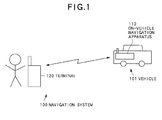
- the navigation system 100 is equipped with an on-vehicle navigation apparatus 110 and an terminal 120 serving as a portable information device, such as a PDA, and both of the apparatus 110 and the terminal 120 are communicable with each other based on a short-range wireless communication technique.
- the on-vehicle navigation apparatus 110 is mounted on a vehicle 101 (serving as a first movable member) and is responsible for various kinds of processing such as route search processing necessary for navigation carried out the terminal.
- the on-vehicle navigation apparatus 110 calculates vehicle travel data from information indicative of a destination given by a crew on the vehicle 101, positional information indicative of the vehicle 101 acquired with the aid of GPS (Global Positioning System) data that has been received, and signals from various types of sensors such as a vehicle speed pulse outputting unit, accelerator sensor, vibration sensor, and gyro sensor. Based on the vehicle travel data, the vehicle navigation apparatus 110 carries out "navigation processing" for the vehicle 101, i.e., processing to guide a route or others to the crews on the vehicle 101.
- GPS Global Positioning System
- the terminal 120 is used to guide the person (corresponding to a second movable member) who has the terminal 120 through transmission and reception of searched results to and from the vehicle navigation apparatus 110. More practically, the terminal 120 receives data that has been processed by the on-vehicle navigation apparatus 110 (hereafter referred to as "navigation data") and carries out the navigation processing toward the person.
- the navigation data is for example information indicating results of searched routes and route guides.
- Both of the on-vehicle navigation apparatus 110 and the terminal 120 are mutually communicable in a wireless manner based on short-range wireless communication, which is, for example, the "Bluetooth (a trademark owned by Wegiebolaget L M Ericsson)." This standard is at present under formulation IEEE (Institute of Electrical and Electronic Engineers) 802.15.
- Fig. 2 details in a block form the on-vehicle navigation apparatus 110
- Fig.3 details in a block form the terminal 120.
- the on-vehicle navigation apparatus 110 includes a GPS receiver 111, sensor unit 112, communication unit 113, display 114, voice guide unit 115, storage 116, system controller 117, and operation device 118.
- the receiver GPS 111 is connected to an antenna AT and receives GPS data.
- the sensor unit 112 includes a speed/acceleration sensor to detect a running speed and an acceleration of a vehicle and azimuthal angle sensor to detect an azimuthal angle of the vehicle.
- the communication unit 113 also connected to the antenna AT, serves as transferring means and is responsible for radio communication to and from the terminal 120 based on the foregoing standard of Bluetooth (trademark). Not only map information but also navigation data are displayed on the display 114.
- the received navigation data is used by the voice guide unit 115 to guide routes of a vehicle with voice messages.
- the storage 116 is used to temporarily memorize data, such as the received navigation data.
- the system controller 117 Based on the received navigation data and stored navigation data in the storage 116, the system controller 117 carries out control of both the display 114 and the voice guide unit 115, thus serving as first and second route processing means.
- the operation device 118 is used to give commands to each constituent described above.
- an address on the Bluetooth (hereafter referred to as "BT address") is previously assigned to the communication unit 113.
- the communication unit 113 is specified as being a master apparatus on the standard of Bluetooth (trademark).
- the terminal 120 includes a receiver 121, reception data analyzer 122, speaker 123, storage 124, display 125, microphone 126, audio recognizer 127, transmission data generator 128, transmitter 129, system controller 130, operation device 131, and communication unit 132.
- the receiver 121 coupled with an antenna AT is able to receive communication data including audio data associated with telephone calls.
- the reception data analyzer 122 analyzes types of data to output analyzed data to each unit necessary in the terminal 120.
- the speaker 123 outputs audio messages in response to the reception and the storage 124 memorizes the audio data.
- the display 125 visualizes the data received by the receiver 121.
- the microphone 126 is used to allow a pedestrian to input voice messages.
- the voice messages that have been given to the microphone 126 are analyzed by the audio analyzer 127.
- the voice data obtained by the microphone 126 is also sent to the transmission data generator 128 to produce transmission data.
- the transmitter 129 is in charge of transmitting transmission data and others to the information server 110.
- the data that has been received and stored by the storage 124 is used by the system controller 130 to control each constituent as well as control connection processing to and from the terminal 120.
- the operation device 131 is used to operate each constituent.
- the communication unit 132 is in charge of radio communication to and from the on-vehicle navigation apparatus 110 on the basis of the foregoing standard of "Bluetooth (trademark)."
- a BT address on the standard of Bluetooth (trademark) is previously assigned to the communication unit 132.
- a link called a Piconet
- the single Piconet mutually connects a single communication apparatus and a plurality of slave communication apparatuses.
- the Piconet is configured according to a series of predetermined connection procedures including an inquiry step and a paging step.
- the inquiry step is to inquire whether or not there are some apparatuses with which the master communication apparatus communicates on the standards on Bluetooth (trademark) within a communicable range of the master communication apparatus.
- the paging step is placed to permit the master communication apparatus to acquire a BT address from a slave communication apparatus in order to establish a communicable state therebetween.
- the foregoing on-vehicle navigation apparatus is assigned to the master communication apparatus in advance.
- the inquiry step omitted only the paging step is used to constitute the Piconet by linking the terminal 120 to the on-vehicle navigation apparatus 110.
- This Piconet is in charge of communication of various types of pieces of information, such as search information, as will be described later.
- the navigation system 100 is linked by the Piconet.
- the navigation processing is executed for a former route guide, and then, if necessary, executed for a last route guide.
- the former route guide is realized by the on-vehicle navigation apparatus 110 through navigation processing to guide routes to the crews until the vehicle 101 arrives at a specified position (referred to as a "destination-nearer position") nearer to a finally desired destination (i.e., a final destination).
- the on-vehicle navigation apparatus 110 receives a command for transferring map information from the "destination-nearer position" to the final destination, the last route guide is executed.
- pieces of information about maps are communicated between the on-vehicle navigation apparatus 110 and the terminal 120, so that routes from the destination-nearer position to the final destination are shown to the pedestrian who has the terminal 120.
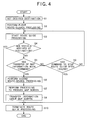
- the on-vehicle navigation apparatus 110 first carries out the processing for specifying a desired destination (final destination), and then carries out first route search processing (steps S1 and S2).
- the first route search processing at step S2 is that map information required to guide routes to crews on the vehicle 101 from the current position to the specified destination is first produced, and then owner's map information formed by superposing route information on the produced map information is produced.
- This former route search processing is continued until the final destination. In the case that the final destination ties up with a parking lot, the former route search processing is kept to continue until the parking lot.
- step S3 route guide processing is executed (step S3). Based on GPS data obtained from the GPS receiver 111 of the on-vehicle navigation apparatus 110, it is then determined whether or not the vehicle 101 has arrived at the final destination (step S4). When the vehicle 101 has arrived at the final destination (i.e., YES at step S4), the processing of the apparatus 110 is made to go to step S10 to terminate the route guide processing.
- step S5 it is further determined if a command for transfer of map information to the terminal 120 has been issued or not. Specifically, the command indicates that information in relation to maps ranging from the "destination-nearer position" to the final destination is transferred from the on-vehicle navigation apparatus 110 to the terminal 120 on the standards on Bluetooth (trademark). In cases where the above transfer command has been issued (YES at step S5), the on-vehicle navigation apparatus 110 makes its processing proceed to step S6, where a second route search processing is performed.
- the second route search processing is performed while the route guide performed based on the first route search processing is in operation.
- map information to guide to the pedestrian the routes from the current position to the final destination, and pedestrian's map information is produced in which route information is superposed on the already produced map information.
- this route search processing provides on-foot routes to the pedestrian who has the terminal 120, where the searched routes are shown in consideration of various factors, such as sidewalks, pedestrian bridges, and footways.
- the second route search processing at step S6 is launched in response to a stop of the engine of the vehicle 101, so that the foregoing transfer command is issued.
- This way of transfer makes it possible to automatically transfer the map information to the terminal 120.
- the on-vehicle navigation apparatus 110 then performs the processing for producing a map image (step S7).
- This map-image production processing is responsible for the production of a plurality of map images showing maps from the current position (i.e., destination-nearer position) to the final destination. How to produce the map images will be described later.
- the information in relation to map images produced at step S7 is transferred from the on-vehicle navigation apparatus 110 to the terminal 120 (step S8), before terminating the route guide processing by means of on-vehicle navigation apparatus 110 (step S10).
- step S9 there is no transfer command of the map information at step S5 and a command to stop the route guide has been issued (YES at step S9), the processing is made to go to step S10 to terminate the route guide processing. In contrast, the route-guide stop command has not been issued (NO at step S9), the processing at the apparatus 110 is returned to step S3.
- the navigation system 100 of the present embodiment provides the first route search processing at step S2, where map information to guide the vehicle 101 from the current position to the final destination is produced, and map information for the vehicle 101, in which vehicle's routes are superposed on the maps, is produced.
- the second route search processing is carried out at step S6 as follows. In other words, map information to guide the pedestrian from the current position to final destination is produced, and map information for the pedestrian, in which pedestrian routes are laid on maps, is produced.
- a route guide i.e., the former route guide
- a further route guide i.e., the last route guide
- the terminal 120 is able to provide a reliable route information to the pedestrian, reducing the fear that the pedestrian may lose one's way.
- the on-vehicle navigation apparatus 110 is provided with the communication unit 113 capable of transferring, to the terminal 120, map information dedicated to the pedestrian and the map information is displayed on the display 125 of the terminal 120.
- the route guide on the display 125 allows the pedestrian to walk from the destination-nearer position to the final destination in a steadier manner, without losing the pedestrian's way.
- the information about maps is radio-transferred from the on-vehicle navigation apparatus 110 to the terminal 120 based on the standards on Bluetooth (trademark), with the result that various kinds of information such as searched information can be transmitted in an easier manner.
- the on-vehicle navigation apparatus 110 is combined with the portable terminal 120 for a continuous use. This makes it possible that the route guide to the final destination is continuously and steadily performed during both periods of travel by the vehicle 101 and on foot.
- the second route search processing is automatically carried out at step S6 in Fig. 4.
- the guide to the crews on the vehicle 101 can therefore be followed by the guide to the pedestrian who uses the terminal 120 automatically and without a rest.
- maps and route information can be displayed on the display 125 of the terminal 120, without particular cumbersome operations for the guide on the terminal 120.
- Fig. 5 shows a first technique of producing a map
- Fig. 6 shows a second technique of producing a map
- the first map producing technique shown in Fig. 5 adopts three scale maps to be handled as map information to be transmitted. These three scale maps is composed of, for instance, a first map M1, a second map M2, and a third map M3.
- a first map M1 the current position (i.e., a parking lot) and a final destination are depicted.
- the second map M2 depicts from a position, at which the pedestrian who has the terminal 120 is present after a walk of a predetermined distance, to the final destination.
- the third map M3 shows the vicinity of the final destination.
- a crew For transferring information about maps from the on-vehicle navigation apparatus 110 to the terminal 120, a crew is to push a map transmission button on the operation device 118 of the apparatus 110 when the vehicle 101 stops at a destination-nearer position.
- the system controller 117 of the on-vehicle navigation apparatus 110 will respond to the push operation. Specifically, the system controller 117 calculates a distance from the current position to the final destination. Based on the calculated distance, the system controller 117 prepares the foregoing first, second, and third maps M1 to M3 (i.e., the three scale maps), and performs route search processing. This route search is executed in consideration of routes through which a pedestrian who has the terminal 120 is able to walk. Then the system controller 117 depicts a route guide line RL on the map in order to show the spots, places and routes through which the pedestrian can walk.
- the above first to third maps M1 to M3 are produced depending on different distances from the final destination. Examples are such that the first, second and third maps M1, M2 and M3 are produced as maps apart from the final destination by 500 m, 300m and 100m, respectively.
- any one map is selected from the first to third maps M1 to M3 with consideration of a waling speed of a pedestrian who has the terminal 120. And the selected map is displayed, in an automatically switched manner, on the terminal 120 at that selection timing.
- the pedestrian's manual operations can be adopted. That is, the navigation system can be configured such that the pedestrian operates the operation device 131 of the terminal 120 when desired, in order to selectively display any one of the first to third maps M1 to M3 on the display 125.
- the maps that have been produced are divided into three stages depending on different scales determined by distances from the final destination, thus providing a desired map to the pedestrian in accordance with the pedestrian's current position.
- an easy-to-understand guide map is always given the pedestrian who walks toward the final destination.
- the first map M1 which is provided at the timing when the second route search processing is performed at step S6 in Fig. 4, provides both of the current position and a final destination of the vehicle 101 on the same display screen of the terminal 120. Accordingly, observing the first map M1 enables the pedestrian to easily understand the final destination in comparison with the current position of the vehicle 101.
- the first to third maps M1 to M3 are produced according to distances between the current positions, which are obtained at the timings when the second route search processing is performed at step S6 in Fig. 4, and a final destination. It is therefore possible to provide pieces of information about maps that allow the pedestrian to understand the routes from the current position to a final destination in an easier fashion.
- the second map producing technique shown in Fig. 6 uses detailed information about three crossings, which corresponds to transmission map information.
- These plural crossing maps are composed of, for example, a first map M11, a second map M12 and a third map M13.
- the first map M11 is a detailed map depicting a first right and left turn crossing
- the second map M12 is a detailed map showing a second right and left turn crossing
- the third map M13 is a detailed map showing a third right an left turn crossing.
- All of the first to third maps M11 to M13 are produced on the same scale and depict enlarged areas in each of which a right and left turn crossing is centered.
- the right and left turn crossing is selected from various crossings searched by the second route search processing at step S6.
- a crew For transferring map information from the on-vehicle navigation apparatus 110 to the terminal 120, a crew is to push a map transmission button on the operation device 118 of the apparatus 110 when the vehicle 101 stops at a destination-nearer position.
- the system controller 117 of the on-vehicle navigation apparatus 110 will respond to the push operation. Specifically, the system controller 117 calculates a route from the current position to the final destination. Based on the calculated route, the system controller 117 prepares maps of right and left turn crossings that should be on the first to third maps M11 to M13.
- the maps thus produced shows in detail a plurality of crossings at which the pedestrian will turn to the right or left during the pedestrian's walk to the final destination.
- the easy-to-understand maps can be provided to the pedestrian.
- the first to third maps M11 to M13 are all produced on the same scale, thus providing the easy-to-understand maps to the pedestrian.
- the first to third maps M11 to M13 depict enlarged areas in each of which a right and left turn crossing is centered.
- the right and left turn crossing is selected from various crossings searched by the second route search processing at step S6. It is therefore possible to provide the pedestrian with easier-to-understand maps.
- the second map producing technique shown in Fig. 6 is directed to the production of maps at every point only. Hence it is desirable that the pedestrian be informed of a switchover timing, for example, from the first map M11 to the second map M12.
- this information of a switchover timing is carried out such that a period of time from the present time to the next switchover display of maps is calculated in consideration of a walking speed of the pedestrian and displayed on the display 125 of the terminal 120.
- each of the first to third maps M11 to M13 display, in a superposition manner, pieces of information indicating which time the pedestrian passes the locations shown by the maps. This way of display provides the map information which can be understood more easily.
- first map producing technique shown in Fig. 5 and the second map producing technique shown in Fig. 6 may be combined in such a manner that both techniques are automatically switched over with each other in consideration of a walking speed of a pedestrian. This communication will give pedestrians steadier route guide information.
- a pedestrian may operate the operation device 131 of the terminal 120 at desired timings so that the first to third maps on the display 125 are switched over one from another, like the switchover technique of the maps described before.
- the terminal 120 it is desirable to configure the terminal 120 such that a direction along which a pedestrian walks be depicted upward on the screen of the display 125.
- the waking direction always becomes upward on the display screen. This way of displaying the maps is also very easy-to-understand for pedestrians.
- both the on-vehicle navigation apparatus and the terminal 120 in such a manner that, for route guide when returning, maps from the final destination to the parking lot are previously produced at the second route search processing at step S6.
- a preferable display technique is that a walking direction of a pedestrian is displayed downward, or opposite to the foregoing upward direction, on the display 125. Accordingly, when the second route search processing is carried out in approaching to the final destination, the route search from the final destination to the position in returning to the parking lot is carried out as well. This route guide in the return to the parking lot is helpful to the pedestrian, with the possibly of losing the pedestrian's way reduced, thus giving a sense of safe to the pedestrian.
- a further modification can be practiced in a mobile navigation apparatus that makes use of communication means, instead of the foregoing on-vehicle navigation apparatus 110 fixedly mounted on the vehicle.
- the program shown by the flowchart shown in Fig. 4 is stored in such information recording mediums as a flexible disk or a hard disk, or delivered to a computer system though such networks as the Internet.
- the program is then read out by a computer (such as a universal microcomputer) equipped with the on-vehicle navigation apparatus 110 or the terminal 120, instead of the system controller 117 or 130, and then executed.
- a computer such as a universal microcomputer equipped with the on-vehicle navigation apparatus 110 or the terminal 120, instead of the system controller 117 or 130, and then executed.
- a computer is able to function as the system controller 117 or 130.
- the portable sub-navigation unit has been implemented as a terminal which is a portable information device such as a PDA.
- the portable sub-navigation unit can be implemented by other portable devices such as portable phones.
Landscapes
- Engineering & Computer Science (AREA)
- Radar, Positioning & Navigation (AREA)
- Remote Sensing (AREA)
- Automation & Control Theory (AREA)
- Physics & Mathematics (AREA)
- General Physics & Mathematics (AREA)
- Navigation (AREA)
- Mobile Radio Communication Systems (AREA)
- Instructional Devices (AREA)
- Traffic Control Systems (AREA)
Abstract
Description
Claims (18)
- A navigation system (100) comprising:characterized in that the system comprisesa first route search processing unit (111-116, 117(S1-S3), 118) configured to perform a first route search to produce map information to guide a first movable member (101) carrying a navigation apparatus (110) from a current position to a destination and to produce first-movable-member map information formed by laying route information on the map information,
a second route search processing unit (111-113, 117(S6-S7), 118) configured to perform a second route search to produce further map information to guide a second movable member carrying a portable sub-navigation unit (120) from a further current position to the destination and to produce second-movable-member map information formed by laying further route information on the further map information, the further current position being an instantaneous position at which the second route search is performed. - The navigation system of claim 1, characterized in that
the portable sub-navigation unit carried by the second movable member is a portable information device wire-less communicable with the navigation apparatus, and
the system further comprises a transfer unit (113, 117(S5, S8) configured to transfer the second-movable-member map information to the portable information device. - The navigation system of claim 1 or 2, characterized in that the first movable member is a vehicle (101) having an engine and the second route search processing unit is configured to automatically start the second route search in response to a turn-off operation of the engine of the vehicle.
- The navigation system of any one of claims 1 to 3, characterized in that the second route search processing unit is configured to produce the second-movable-member map information consisting of a plurality of maps (M1 - M3; M11- M13) formed depending on distances from the destination.
- The navigation system of claim 4, characterized in that at least one of the plurality of maps solely includes both of the further current position and the destination in cases where each of the maps is displayed on a screen of the portable information device.
- The navigation system of either one of claim 4 or 5, characterized in that the plurality of maps (M11 - M13) are formed based on the same scale.
- The navigation system of any one of claims 4 to 6, characterized in that the plurality of maps are formed into enlarged maps showing a predetermined region in which a route including a right-and-left-turn crossing is placed with the crossing located at a center of the region, the route being selected from routes searched by the second route search processing unit.
- The navigation system of any one of claims 4 to 7, characterized in that the second route search processing unit is configured to produce each of the plurality of maps so as to show a travel direction of the second movable member upward on a display screen of the portable information device.
- The navigation system of any one of claims 4 to 8, characterized in that the second route search processing unit is configured to produce each of the plurality of maps so as to display on each map information about a transit time to be expected, in cases where the second movable member travels along a route guided by the second route search processing unit.
- The navigation system of claim 1, characterized in that the second route search processing unit is configured to additionally perform search a route from the destination to the further current position.
- A navigation method, characterized in that the method comprising the steps of:performing a first route search to produce map information to guide a first movable member carrying a navigation apparatus from a current position to a destination and to produce first-movable-member map information formed by laying route information on the map information; andperforming a second route search to produce further map information to guide a second movable member carrying a portable sub-navigation unit from a further current position to the destination and to produce second-movable-member map information formed by laying further route information on the further map information, the further current position being an instantaneous position at which the second route search is performed.
- The navigation method of claim 11, characterized in that
the portable sub-navigation unit carried by the second movable member is a portable information device wire-less communicable with the navigation apparatus and
the method further comprises a step of transferring the second-movable-member map information to the portable information device. - A program readable by a computer incorporated in a navigation system provides the functions of:performing a first route search to produce map information to guide a first movable member carrying a navigation apparatus from a current position to a destination and to produce first-movable-member map information formed by laying route information on the map information; andperforming a second route search to produce further map information to guide a second movable member carrying a portable sub-navigation unit from a further current position to the destination and to produce second-movable-member map information formed by laying further route information on the further map information, the further current position being an instantaneous position at which the second route search is performed.
- The program of claim 13, further providing a function of transferring the second-movable-member map information to the portable sub-navigation unit.
- An information recording medium in which the program of claim 13 or 14 is recorded.
- A navigation system (100), comprising a navigation apparatus (110) for providing a first movable member (101) with a route guide by showing a route from a current position to a destination,
characterized in that the system further comprises
a portable sub-navigation unit (120) for providing a second movable member with a further route guide by showing a further route from a further current position to the destination, after the route guide performed by the navigation apparatus - The navigation system of claim 16, characterized in that the navigation apparatus comprises
a first route search processing unit (111-113, 116, 117(S1-S2)) for searching the route from the current position to the destination;
a route guiding unit (114-116, 117(S3))for guiding the searched route to the first movable member;
a second route search processing unit (111-113, 116, 117(S6-S7)) for searching the further route from the further current position to the destination in response to a predetermined command; and
a transfer unit (113, 117(S5, S8)) for transferring information indicative of the further route to the portable sub-navigation unit. - The navigation system of claim 17, characterized in that the first movable member is a vehicle (101) on which the navigation apparatus is mounted and the portable sub-navigation unit is a portable information device (120) carried by the second movable member and wireless-communicable with the navigation unit based on a predetermined communication protocol.
Applications Claiming Priority (2)
| Application Number | Priority Date | Filing Date | Title |
|---|---|---|---|
| JP2001319446A JP2003121183A (en) | 2001-10-17 | 2001-10-17 | Navigation apparatus and navigation method, program for navigation, and information recording medium |
| JP2001319446 | 2001-10-17 |
Publications (2)
| Publication Number | Publication Date |
|---|---|
| EP1304548A2 true EP1304548A2 (en) | 2003-04-23 |
| EP1304548A3 EP1304548A3 (en) | 2004-08-04 |
Family
ID=19136999
Family Applications (1)
| Application Number | Title | Priority Date | Filing Date |
|---|---|---|---|
| EP02257192A Withdrawn EP1304548A3 (en) | 2001-10-17 | 2002-10-16 | Navigation system equipped with portable sub-navigation unit |
Country Status (4)
| Country | Link |
|---|---|
| US (1) | US6748321B2 (en) |
| EP (1) | EP1304548A3 (en) |
| JP (1) | JP2003121183A (en) |
| CN (1) | CN1412526A (en) |
Cited By (7)
| Publication number | Priority date | Publication date | Assignee | Title |
|---|---|---|---|---|
| EP1593938A1 (en) * | 2004-05-04 | 2005-11-09 | Harman Becker Automotive Systems GmbH | Method for indicating a route to a destination and navigation system therefor |
| WO2009053202A1 (en) * | 2007-10-19 | 2009-04-30 | Siemens Aktiengesellschaft | Portable telecommunication device, vehicle-assisted navigation unit and method |
| CN101545780B (en) * | 2008-03-25 | 2012-11-14 | 阿尔派株式会社 | Vehicle-used navigation device |
| WO2015061633A3 (en) * | 2013-10-25 | 2015-08-13 | Qualcomm Incorporated | Automatic handover of positioning parameters from a navigation device to a mobile device |
| DE102008036687B4 (en) | 2008-08-06 | 2018-10-25 | Continental Automotive Gmbh | Method for transmitting a partial route and navigation device for carrying out the method |
| EP4184118A1 (en) * | 2021-11-23 | 2023-05-24 | Bayerische Motoren Werke Aktiengesellschaft | Method of determining and communicating a travel route of a user of a road vehicle |
| GB2614110A (en) * | 2021-12-21 | 2023-06-28 | Rivian Ip Holdings Llc | Multi-modal navigation system |
Families Citing this family (36)
| Publication number | Priority date | Publication date | Assignee | Title |
|---|---|---|---|---|
| JP3895633B2 (en) * | 2002-04-19 | 2007-03-22 | 株式会社ザナヴィ・インフォマティクス | Display device, information processing device, information processing system |
| JP2004101366A (en) * | 2002-09-10 | 2004-04-02 | Hitachi Ltd | Portable communication terminal and navigation system using the same |
| JP2005062139A (en) * | 2003-08-20 | 2005-03-10 | Sanyo Electric Co Ltd | Navigation device |
| WO2005040725A1 (en) * | 2003-10-23 | 2005-05-06 | Matsushita Electric Industrial Co., Ltd. | Navigation device |
| JP2005227144A (en) * | 2004-02-13 | 2005-08-25 | Shimadzu Corp | Controller for analytical instruments |
| US7502686B1 (en) * | 2004-06-23 | 2009-03-10 | Garmin Ltd. | System and method utilizing non-GPS satellite content in real-time navigation |
| JP2006010441A (en) * | 2004-06-24 | 2006-01-12 | Kyocera Corp | Mobile communication terminal and map display system |
| CN101002070A (en) * | 2004-08-11 | 2007-07-18 | 日本先锋公司 | Move guidance device, portable move guidance device, move guidance system, move guidance method, move guidance program, and recording medium on which the program is recorded |
| KR100687195B1 (en) * | 2004-12-02 | 2007-02-27 | 엘지전자 주식회사 | Apparatus and method for using map information of mobile communication terminal with traffic card |
| US7254516B2 (en) * | 2004-12-17 | 2007-08-07 | Nike, Inc. | Multi-sensor monitoring of athletic performance |
| JP4534838B2 (en) * | 2005-03-30 | 2010-09-01 | 株式会社デンソー | Navigation device and program for navigation device |
| US11390165B2 (en) | 2005-11-17 | 2022-07-19 | Invently Automotive Inc. | Electric vehicle power management system |
| US11325468B2 (en) | 2005-11-17 | 2022-05-10 | Invently Automotive Inc. | Vehicle power management system |
| DE602006010866D1 (en) * | 2006-07-27 | 2010-01-14 | Aisin Aw Co | Navigation device and method |
| JP5008620B2 (en) * | 2008-07-31 | 2012-08-22 | 富士通テン株式会社 | In-vehicle device, navigation system, and control method thereof |
| JP5049233B2 (en) * | 2008-09-05 | 2012-10-17 | パイオニア株式会社 | In-vehicle device, route guidance system, in-vehicle device communication control method and program |
| JP2010071918A (en) * | 2008-09-22 | 2010-04-02 | Fujitsu Ten Ltd | Car navigation device |
| JP5353291B2 (en) * | 2009-02-19 | 2013-11-27 | ソニー株式会社 | Guide route delivery apparatus, guide route delivery method, and guide route delivery program |
| JP5511222B2 (en) * | 2009-06-01 | 2014-06-04 | アルパイン株式会社 | Navigation device, guidance route guidance method, and guidance route guidance program |
| US8532574B2 (en) * | 2009-08-05 | 2013-09-10 | Honda Motor Co., Ltd. | Destination information sharing for the automobile environment |
| US9880014B2 (en) | 2010-11-24 | 2018-01-30 | Telenav, Inc. | Navigation system with session transfer mechanism and method of operation thereof |
| US9261603B2 (en) | 2011-04-11 | 2016-02-16 | Telenav, Inc. | Navigation system with conditional based application sharing mechanism and method of operation thereof |
| JP2012251960A (en) * | 2011-06-07 | 2012-12-20 | Casio Comput Co Ltd | Arm-mounted terminal, navigation system, and program |
| JP6102282B2 (en) * | 2012-05-07 | 2017-03-29 | 株式会社デンソー | Facility search system, facility search program, and vehicle device |
| JP2014062842A (en) * | 2012-09-21 | 2014-04-10 | Aisin Aw Co Ltd | Route guiding device, route guiding method and route guiding program |
| CN103900592B (en) * | 2012-12-26 | 2016-12-07 | 观致汽车有限公司 | The based reminding method of a kind of trip of driving and system |
| CN103900595A (en) * | 2012-12-28 | 2014-07-02 | 环达电脑(上海)有限公司 | Aided navigation system and navigation method |
| US8914229B2 (en) * | 2013-03-15 | 2014-12-16 | Google Inc. | Systems and methods for transferring navigation data |
| JP5992620B2 (en) * | 2013-06-28 | 2016-09-14 | 株式会社東芝 | Electronic equipment and programs |
| DE102014210757A1 (en) * | 2014-06-05 | 2015-12-17 | Bayerische Motoren Werke Aktiengesellschaft | Route planning for a vehicle |
| JP6590485B2 (en) * | 2015-02-13 | 2019-10-16 | 株式会社デンソーテン | Information processing system and information processing method |
| JP6436844B2 (en) * | 2015-04-13 | 2018-12-12 | アルパイン株式会社 | Navigation system and in-vehicle device |
| US20160356622A1 (en) * | 2015-06-07 | 2016-12-08 | Apple Inc. | Walking Guidance During Transit Navigation |
| JP6771273B2 (en) * | 2015-07-07 | 2020-10-21 | 三菱電機株式会社 | Evacuation support method using navigation device and navigation device |
| CN106767865B (en) * | 2016-12-05 | 2021-01-05 | 车音智能科技有限公司 | Navigation method and device |
| JP6962793B2 (en) * | 2017-11-20 | 2021-11-05 | トヨタ自動車株式会社 | Information processing device |
Family Cites Families (6)
| Publication number | Priority date | Publication date | Assignee | Title |
|---|---|---|---|---|
| DE19521929A1 (en) * | 1994-10-07 | 1996-04-11 | Mannesmann Ag | Facility for guiding people |
| JP3198883B2 (en) * | 1995-08-24 | 2001-08-13 | トヨタ自動車株式会社 | Travel schedule processing device |
| US6208934B1 (en) * | 1999-01-19 | 2001-03-27 | Navigation Technologies Corp. | Method and system for providing walking instructions with route guidance in a navigation program |
| JP3896728B2 (en) * | 1999-06-23 | 2007-03-22 | トヨタ自動車株式会社 | Portable terminal device and in-vehicle information processing device |
| US6526335B1 (en) * | 2000-01-24 | 2003-02-25 | G. Victor Treyz | Automobile personal computer systems |
| US6633809B1 (en) * | 2000-08-15 | 2003-10-14 | Hitachi, Ltd. | Wireless method and system for providing navigation information |
-
2001
- 2001-10-17 JP JP2001319446A patent/JP2003121183A/en active Pending
-
2002
- 2002-10-16 EP EP02257192A patent/EP1304548A3/en not_active Withdrawn
- 2002-10-16 US US10/270,544 patent/US6748321B2/en not_active Expired - Lifetime
- 2002-10-17 CN CN02152935A patent/CN1412526A/en active Pending
Cited By (11)
| Publication number | Priority date | Publication date | Assignee | Title |
|---|---|---|---|---|
| EP1593938A1 (en) * | 2004-05-04 | 2005-11-09 | Harman Becker Automotive Systems GmbH | Method for indicating a route to a destination and navigation system therefor |
| US7925435B2 (en) | 2004-05-04 | 2011-04-12 | Harman Becker Automotive Systems Gmbh | Navigation system for determining a route to a destination |
| US8515668B2 (en) | 2004-05-04 | 2013-08-20 | Harman Becker Automotive Systems Gmbh | Navigation system for determining a route to a destination |
| US8532923B2 (en) | 2004-05-04 | 2013-09-10 | Harman Becker Automotive Systems Gmbh | Navigation system for determining a route to a destination |
| WO2009053202A1 (en) * | 2007-10-19 | 2009-04-30 | Siemens Aktiengesellschaft | Portable telecommunication device, vehicle-assisted navigation unit and method |
| CN101545780B (en) * | 2008-03-25 | 2012-11-14 | 阿尔派株式会社 | Vehicle-used navigation device |
| DE102008036687B4 (en) | 2008-08-06 | 2018-10-25 | Continental Automotive Gmbh | Method for transmitting a partial route and navigation device for carrying out the method |
| WO2015061633A3 (en) * | 2013-10-25 | 2015-08-13 | Qualcomm Incorporated | Automatic handover of positioning parameters from a navigation device to a mobile device |
| US9279696B2 (en) | 2013-10-25 | 2016-03-08 | Qualcomm Incorporated | Automatic handover of positioning parameters from a navigation device to a mobile device |
| EP4184118A1 (en) * | 2021-11-23 | 2023-05-24 | Bayerische Motoren Werke Aktiengesellschaft | Method of determining and communicating a travel route of a user of a road vehicle |
| GB2614110A (en) * | 2021-12-21 | 2023-06-28 | Rivian Ip Holdings Llc | Multi-modal navigation system |
Also Published As
| Publication number | Publication date |
|---|---|
| US6748321B2 (en) | 2004-06-08 |
| EP1304548A3 (en) | 2004-08-04 |
| JP2003121183A (en) | 2003-04-23 |
| CN1412526A (en) | 2003-04-23 |
| US20030074135A1 (en) | 2003-04-17 |
Similar Documents
| Publication | Publication Date | Title |
|---|---|---|
| US6748321B2 (en) | Navigation system equipped with portable sub-navigation unit | |
| US6785607B2 (en) | Navigation system, and information server apparatus and communication terminal apparatus for the same, and method and program for changing a movable body in the same | |
| US6856892B2 (en) | Navigation apparatus and information server | |
| CN101578501B (en) | Navigation device and method | |
| JP2003106854A (en) | Navigation system, method for retrieving route in navigation system, first communication terminal device in navigation system, second communication terminal device in navigation system, vehicle navigation apparatus in navigation system, program for second communication terminal device and program for vehicle navigation apparatus | |
| JP2013148419A (en) | Guidance system, mobile terminal apparatus and vehicle-mounted apparatus | |
| JP2002022478A (en) | Portable type gps receiver, navigator and navigation system | |
| CN101458088A (en) | Portable electronic device and traffic information enquiry method thereof | |
| US9074908B2 (en) | Cooperation system between in-vehicle device and mobile terminal, non-transitory tangible computer readable medium for the same, and in-vehicle device for the same | |
| JP2008076412A (en) | Navigation apparatus, navigation method, and navigation program | |
| JP2001116564A (en) | Mobile communication system | |
| CN102037315A (en) | Navigation apparatus, location determination system and method of location determination | |
| JPH11237251A (en) | Navigation system | |
| JP4133114B2 (en) | Inter-vehicle communication device | |
| JP3852754B2 (en) | Mobile navigation system and mobile phone having navigation system | |
| JP4375800B2 (en) | Portable navigation device, display control method thereof, and learning method | |
| JP2006250874A (en) | Navigation device and guidance method for own vehicle relative position | |
| JP2007071665A (en) | Navigation system | |
| JP4250836B2 (en) | Navigation information providing apparatus and navigation apparatus | |
| JP3767671B2 (en) | Navigation device and navigation method | |
| JP4576685B2 (en) | Information communication equipment | |
| JPH109888A (en) | Route guidance system, mobile communication terminal used for the route guidance system, and route information calculation device | |
| JP2000293789A (en) | Navigation device | |
| JP3235607B2 (en) | Communication navigation device, navigation information providing device and system thereof | |
| JP5388690B2 (en) | Route guidance device and program |
Legal Events
| Date | Code | Title | Description |
|---|---|---|---|
| PUAI | Public reference made under article 153(3) epc to a published international application that has entered the european phase |
Free format text: ORIGINAL CODE: 0009012 |
|
| AK | Designated contracting states |
Designated state(s): AT BE BG CH CY CZ DE DK EE ES FI FR GB GR IE IT LI LU MC NL PT SE SK TR |
|
| AX | Request for extension of the european patent |
Extension state: AL LT LV MK RO SI |
|
| PUAL | Search report despatched |
Free format text: ORIGINAL CODE: 0009013 |
|
| AK | Designated contracting states |
Kind code of ref document: A3 Designated state(s): AT BE BG CH CY CZ DE DK EE ES FI FR GB GR IE IT LI LU MC NL PT SE SK TR |
|
| AX | Request for extension of the european patent |
Extension state: AL LT LV MK RO SI |
|
| 17P | Request for examination filed |
Effective date: 20041027 |
|
| AKX | Designation fees paid |
Designated state(s): DE FR GB |
|
| RBV | Designated contracting states (corrected) |
Designated state(s): DE FR GB |
|
| STAA | Information on the status of an ep patent application or granted ep patent |
Free format text: STATUS: THE APPLICATION IS DEEMED TO BE WITHDRAWN |
|
| 18D | Application deemed to be withdrawn |
Effective date: 20060928 |