EP1304359A1 - Cyan dye mixture, water-based cyan ink composition, and method of ink-jet recording - Google Patents
Cyan dye mixture, water-based cyan ink composition, and method of ink-jet recording Download PDFInfo
- Publication number
- EP1304359A1 EP1304359A1 EP01954338A EP01954338A EP1304359A1 EP 1304359 A1 EP1304359 A1 EP 1304359A1 EP 01954338 A EP01954338 A EP 01954338A EP 01954338 A EP01954338 A EP 01954338A EP 1304359 A1 EP1304359 A1 EP 1304359A1
- Authority
- EP
- European Patent Office
- Prior art keywords
- ink
- dye mixture
- cyan
- region
- water
- Prior art date
- Legal status (The legal status is an assumption and is not a legal conclusion. Google has not performed a legal analysis and makes no representation as to the accuracy of the status listed.)
- Withdrawn
Links
- 0 *(C(*12)c(cccc3)c3C1=*C(*13)c(cccc4)c4C1=*1)C4=*5[Cn]23*2C1=C(C=CC=C1)C1=C2*C5c1c4cccc1 Chemical compound *(C(*12)c(cccc3)c3C1=*C(*13)c(cccc4)c4C1=*1)C4=*5[Cn]23*2C1=C(C=CC=C1)C1=C2*C5c1c4cccc1 0.000 description 2
Images



Classifications
-
- C—CHEMISTRY; METALLURGY
- C09—DYES; PAINTS; POLISHES; NATURAL RESINS; ADHESIVES; COMPOSITIONS NOT OTHERWISE PROVIDED FOR; APPLICATIONS OF MATERIALS NOT OTHERWISE PROVIDED FOR
- C09D—COATING COMPOSITIONS, e.g. PAINTS, VARNISHES OR LACQUERS; FILLING PASTES; CHEMICAL PAINT OR INK REMOVERS; INKS; CORRECTING FLUIDS; WOODSTAINS; PASTES OR SOLIDS FOR COLOURING OR PRINTING; USE OF MATERIALS THEREFOR
- C09D11/00—Inks
- C09D11/30—Inkjet printing inks
- C09D11/32—Inkjet printing inks characterised by colouring agents
- C09D11/328—Inkjet printing inks characterised by colouring agents characterised by dyes
-
- C—CHEMISTRY; METALLURGY
- C09—DYES; PAINTS; POLISHES; NATURAL RESINS; ADHESIVES; COMPOSITIONS NOT OTHERWISE PROVIDED FOR; APPLICATIONS OF MATERIALS NOT OTHERWISE PROVIDED FOR
- C09B—ORGANIC DYES OR CLOSELY-RELATED COMPOUNDS FOR PRODUCING DYES, e.g. PIGMENTS; MORDANTS; LAKES
- C09B47/00—Porphines; Azaporphines
- C09B47/04—Phthalocyanines abbreviation: Pc
- C09B47/08—Preparation from other phthalocyanine compounds, e.g. cobaltphthalocyanineamine complex
- C09B47/24—Obtaining compounds having —COOH or —SO3H radicals, or derivatives thereof, directly bound to the phthalocyanine radical
- C09B47/26—Amide radicals
-
- C—CHEMISTRY; METALLURGY
- C09—DYES; PAINTS; POLISHES; NATURAL RESINS; ADHESIVES; COMPOSITIONS NOT OTHERWISE PROVIDED FOR; APPLICATIONS OF MATERIALS NOT OTHERWISE PROVIDED FOR
- C09B—ORGANIC DYES OR CLOSELY-RELATED COMPOUNDS FOR PRODUCING DYES, e.g. PIGMENTS; MORDANTS; LAKES
- C09B67/00—Influencing the physical, e.g. the dyeing or printing properties of dyestuffs without chemical reactions, e.g. by treating with solvents grinding or grinding assistants, coating of pigments or dyes; Process features in the making of dyestuff preparations; Dyestuff preparations of a special physical nature, e.g. tablets, films
- C09B67/0033—Blends of pigments; Mixtured crystals; Solid solutions
- C09B67/0034—Mixtures of two or more pigments or dyes of the same type
- C09B67/0035—Mixtures of phthalocyanines
Definitions
- the present invention relates to a cyan dye mixture, water-based cyan ink composition and method of ink-jet recording.
- any process comprises generating ink droplets to deposit them onto various recording materials (such as paper, film, cloth) for recording.
- the recording method by means of ink-jet printer is characterized by generating no sound, thus being silent and being able to print character on rough surface, soft material, fragile products and the like in any place due to the system in which a recording head does not contact with the recording material and the method has rapidly been spread in recent years and will be propagated in future because the method advantageously allows the printer to become downsized, to work in a high-speed and to give color printing, easily.
- the information is generally printed according to subtractive color mixing of inks of four colors, namely black (K) plus trichromatic color of yellow(Y), magenta(M) and cyan(C).
- K black
- M magenta
- C cyan
- the dyestuffs used especially ones for a YMC ink, are desired to have color hues close to the respective standards of YMC and vividness.
- the resulting ink composition is stable for long-term storage and that the resulting printed image is of a high optical density and has excellent fastness including water fastness and light fastness.
- the ink composition is applied to displays such as advertisements to spread the usable fields, the printed articles increases opportunities to be exposed to light (electric light, fluorescent light, sun light and the like).
- phthalocyanine dyes such as C. I. Direct Blue 86 or C. I. Direct Blue 199, which has higher light fastness than those of magenta and yellow dyes.
- C. I. Direct Blue 86 or C. I. Direct Blue 199 is used for printing a coated paper generally called glossy paper and then the resultant print is allowed to stand in a well ventilated shade for a long time (hereinafter referred to as "exposure to weather"), the print is soon discolored or faded.
- the application of the ink-jet printers has been extended from compact printers for office automation to large printers for industrial use. Accordingly, the prints produced by these printers are more likely to be exposed to outside weather so that higher water fastness and light fastness than ever are required.
- the water fastness may be notably improved by coating inorganic fine particles capable of adsorbing dye particles in ink, such as of silica, a cationic polymer, alumina or a ceramic with a PVA resin on a paper surface.
- a phthalocyanine dye for cyan is superior to other magenta and yellow dyes in light fastness and hence, is not studied so much as magenta and yellow dyes to improve the light fastness.
- the cyan dye used in the art is discolored or faded if it is used to print the coated paper which is called the glossy paper and then the resultant print is allowed to stand under exposure to weather or ozone gas.
- the glossy paper which is called the glossy paper
- the resultant print is allowed to stand under exposure to weather or ozone gas.
- this problem after printed the prints are laminated for suppressing the discoloration.
- this method has large problems in terms of time efficiency, convenience and cost.
- a typical skeleton of the cyan dye for use in the water-based ink composition for ink-jet recording is a triphenylmethane series or a phthalocyanine series.
- Triphenylmethane dyes exhibit favorable hues but are seriously inferior in water fastness and light fastness.
- the dyes, after printed on the glossy paper are discolored or faded under exposure to weather or ozone gas.
- the phthalocyanine dyes used in the art are superior in hue, water fastness and light fastness but have a problem that the dyes, after printed on the glossy paper, are discolored or faded under exposure to weather or ozone gas.
- the invention relates to:
- the abscissa represents the wavelength (nanometer) whereas the ordinate represents the absorbance.
- the x axis represents wavelength (nanometer)
- the y axis represents mAU (absorbance/1000)
- the z axis represents the time (minute).
- a cyan dye mixture according to the invention is characterized by comprising a mixture of compounds represented by the aforesaid formula (1) or salts thereof which are obtained by reacting a chlorosulfonation product of copper phthalocyanine with an aminating agent in an amount of at least 2.5 mol per mol of the copper phthalocyanine or copper phthalocyanine sulfone as a starting material when the chlorosulhonation product is converted to a sulfonamids thereof.
- the cyan dye mixture of the invention is soluble in water and hence, is usable as a cyan color component for a water-based ink.
- the water-based cyan ink composition employing the cyan dye mixture of the invention is suitable for an ink composition for ink-jet printing.
- the cyan dye mixture of the invention is soluble in water so that the dye mixture can be used as the cyan color component of the water-based ink.
- the use of the cyan dye mixture of the invention provides the cyan ink composition less prone to discolor or fade when allowed to stand under exposure to weather or ozone gas.
- the water-based cyan ink composition employing the cyan dye mixture of the invention is suitable for the ink composition for ink-jet printing.
- the cyan dye mixture of the invention may be used as a mixture with any of the known cyan compounds (C. I. Direct Blue 86, C. I. Direct Blue 87, C. I. Acid Blue 9 or the like), it is more preferred to use the cyan dye mixture of the invention alone.
- the cyan dye mixture of the invention is obtained by, for example, chlorosulfonating copper phthalocyanine (pigment) or copper phthalocyanine sulfone compound with chlorosulfonic acidor the like, and then reacting the chlorosulfonation product with an aminating agent in an amount of at least 2.5 mol per mol of the copper phthalocyanine (pigment) or copper phthalocyanine sulfone compound as a starting material.
- the cyan dye mixture of the invention may also be obtained by sulfonating copper phthalocyanine (pigment), chlorosulfonating the sulfonation product, and then reacting the resultant chlorosulfonation product with a predetermined amount of aminating agent.
- the procedures will specifically be described as below.
- chlorosulfonation of copper phthalocyanine (pigment) with chlorosulfonic acid normally is carried out in chlorosulfonic acid.
- chlorosulfonic acid may preferably be used in amount of 3-15 times relative to copper phthalocyanine (pigment) and more preferably 5-10 times by weight ratios. If chlorosulfonic acid is used in amount of 15 times or more by weight ratio, it is industrially disadvantageous although it does not cause any problems in chlorosulfonation. If chlorosulfonic acid is used in amount of less than 3 times, copper phthalocyanine does not dissolve completely in the acid so that insufficient stirring or abnormal reaction may result.
- the reaction temperature may normally range between 80 and 140°C, or preferably between 120 and 140°C. Although varied depending upon the reaction temperature, the reaction time may normally range between 30 minutes and 10 hours, or preferably between 1 and 6 hours.
- the reaction solution is poured into ice water and filtered to give a wet cake of chlorosulfonated copper phthalocyanine.
- the chlorosulfonated copper phthalocyanine thus obtained contains chlorosulfonic groups of 1 to 4 as substituents.
- the compounds obtained by the chlorosulfonation is a mixture of various compounds because it is possible for the group to substitute at plural positions.
- C. I. Direct Blue 86 or C. I. Direct Blue 87 may be reacted in chlorosulfonic acid in amount of 3 to 15 times, preferably of 5 to 10 times relative to the copper phthalocyanine sulfonate by weight ratio at usually 30 to 140°C, preferably 50 to 120°C of the reaction temperature to obtain the chlorosulfonation product.
- the reaction time normally ranges between 30 minutes and 10 hours or preferably between 1 and 6 hours, although it may vary depending upon the reaction temperature.
- the chlorosulfonated copper phthalocyanine is reacted with an aminating agent to obtain the compound represented by the formula (1).
- the amount of aminating agent used is 2.5 times or more per mol of the starting material by a molar ratio.
- a usable aminating agent include, but not limited to, ammonium salts such as ammonium chloride, ammonium sulfate, preferably ammonium salts of inorganic acids, urea, ammonia water, ammonia gas and the like.
- the resultant compounds may be separated by filtering after precipitating with acid or salting out.
- the salting out may be performed in the range of neutral to alkaline, preferably at pH 7 to 11, thereby to remove byproducts accelerating the discoloration or fade.
- the temperature for the salting out is not particularly limited. However, the salting out may preferably be performed by heating the solution to normally 40 to 80°C, preferably to 50 to 70°C, followed by adding salt or the like.
- the separated compounds may be purified by desalting or the like so as to decrease inorganic salt contents. If the compounds are desalted with lower alcohol having 1 to 4 carbon atoms, preferably with alcohol having 1 to 3 carbon atoms or more preferably with methanol, ethanol or 2-propanol, the byproducts accelerating the discoloration or fade are also removed along with the salt and hence, an even more favorable cyan dye mixture can be obtained. Desalting with alcohol may preferably be performed by heating the solution nearly to a boiling point of a used alcohol, followed by cooling.
- the SO 3 M-containing compound may be obtained in the form of a free acid or a salt thereof.
- the free acid of the compound may be formed by precipitating with acid, for example.
- the salt of the compound may be formed by salting out. If a desired salt cannot be obtained by salting out, a normal salt exchange process may be performed wherein a desired organic or inorganic base is added to a free acid of the compound.
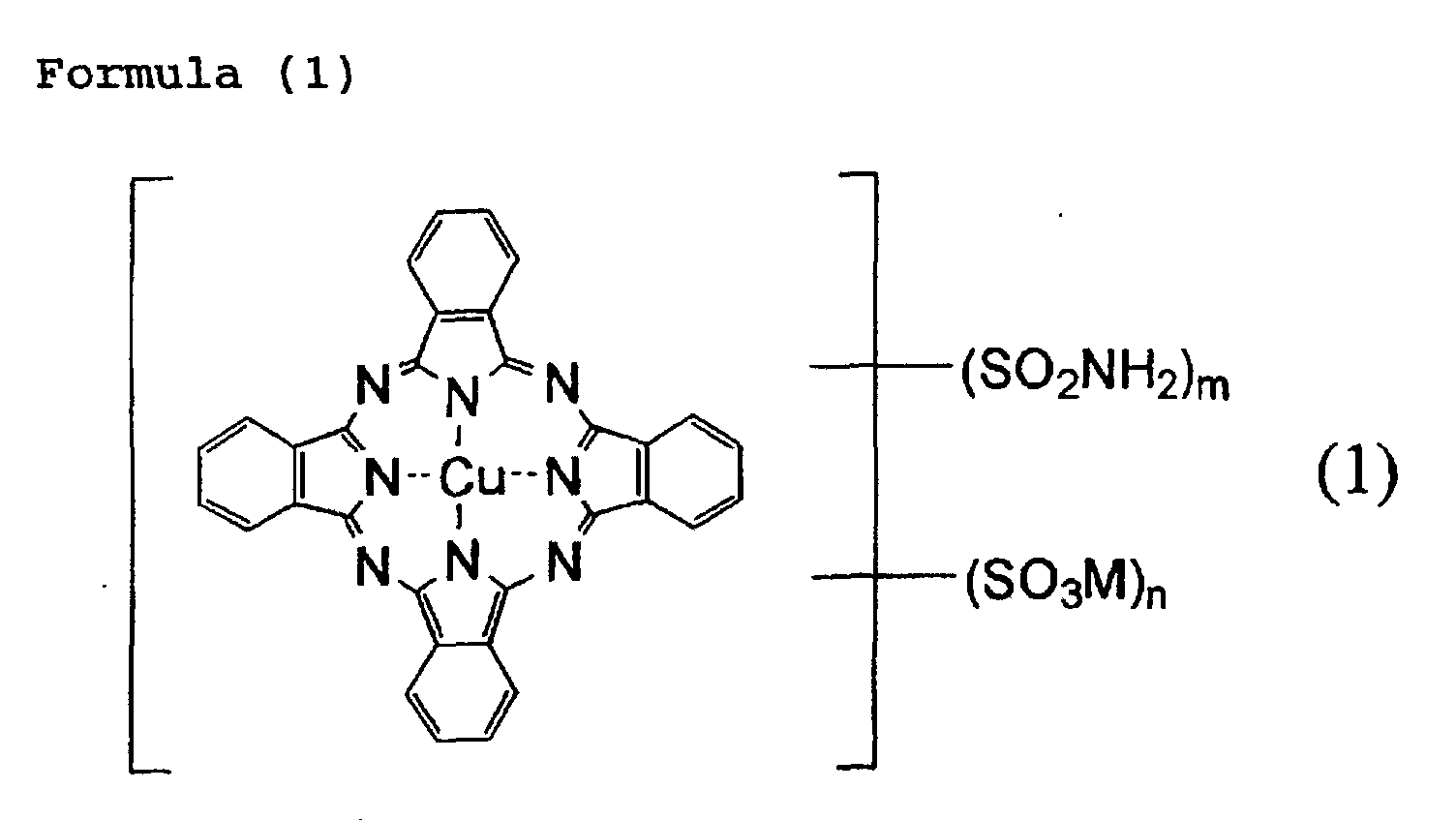
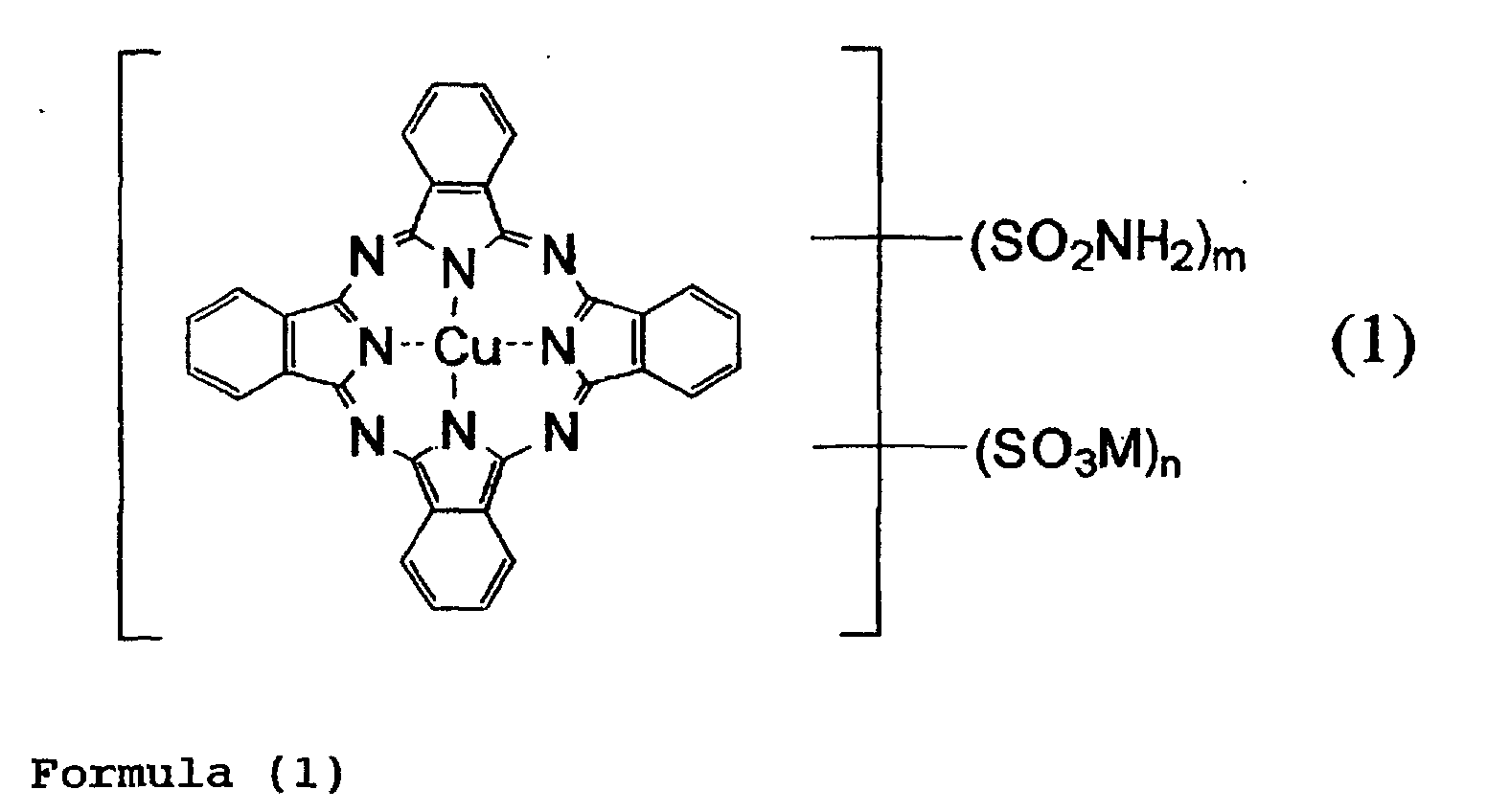
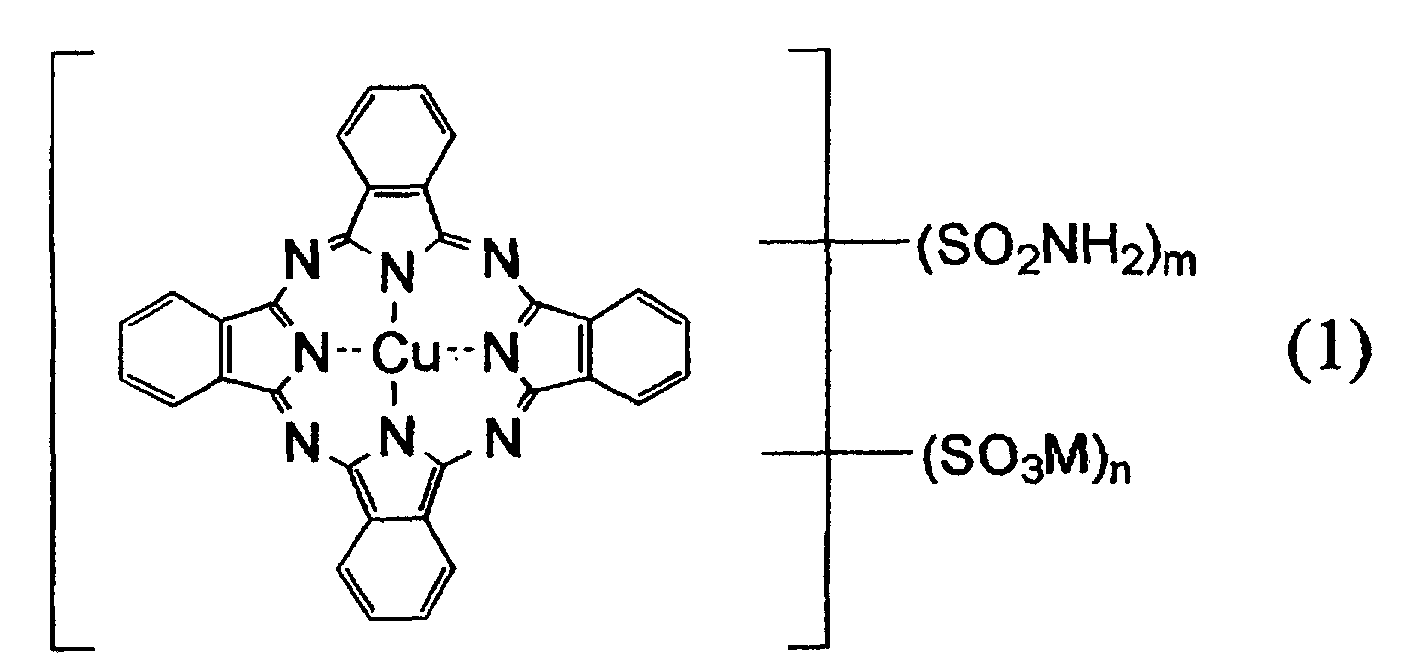
- M represents a proton, alkali metal ion, alkaline earth metal ion, onium ion of an organic amine, or ammonium ion; m is an integer of 1 to 4; m+n is an integer of 1 to 4; n is an integer of 0 to 3; and n is preferably other than 0.
- Examples of an alkali metal giving the alkali metal ion represented by M include sodium, potassium, and lithium.
- Examples of an alkaline earth metal giving the alkaline earth metal ion include calcium, magnesium and the like.
- Examples of an organic amine include alkylamines like lower alkylamines having 1 to 4 carbon atoms such as methylamine and ethylamine; and alkanolamines like mono-, di- or tri-amines (lower alkanols having 1 to 4 carbon atoms) such as monoethanolamine, diethanolamine, triethanolamine, monoisopropanolamine, diisopropanolamine, and triisopropanolamine.
- Examples of a preferred M include proton; ammonium ion; alkali metal ions such as sodium ion, potassium ion, and lithium ion; alkanolamines such as monoethanolamine, diethanolamine, triethanolamine, monoisopropanolamine, diisopropanolamine, and triisopropanolamine; and preferably onium ions of mono-, di- and tri- (1 to 4 carbon atoms-lower alkanol) amines.
- the form of ion is not limited to the above.
- the chlorosulfonated copper phthalocyanine may also be obtained by reacting the copper phthalocyanine in fuming sulfurio acid under heating for introducing sulfonic acid group therein, thereby forming copper phthalocyanine sulfone represented by the formula (2), and then reacting the sulfonic acid group with a chlorinating agent, such as thionyl chloride, phosphorous oxychloride, phosphorous pentachloride or chlorosulfonic acid to substitute the sulfonic acid group with chlorosulfone group.
- a chlorinating agent such as thionyl chloride, phosphorous oxychloride, phosphorous pentachloride or chlorosulfonic acid to substitute the sulfonic acid group with chlorosulfone group.
- a water-based ink composition of the invention is prepared using the cyan dye mixture of the invention (dye component) and water as a medium.
- the dye component contains inorganic substances, such as chlorides of metal cations and sulfate, in lower contents.
- the total contents of sodium chloride and sodium sulfate in the cyan dye mixture is not more than 5 wt%, preferably of not more than 3 wt%, or more preferably of not more than 1 wt% and the said total contents in the ink composition is not more than 1 wt%.
- the dye components of the invention containing less inorganic substances can be prepared by desalting treatment, for example by the conventional method using a reverse osmosis membrane or by the method of stirring the dye components of the invention in a dry form or wet cake in a mixed solvent of methanol and water, filtering the solution and drying the filtered compounds and like.
- the inorganic substances may be more advantageously removed by desalting the dye components in the dry form or wet cake using alcohol.
- the dye components are stirred in a mixed solvent of water and a lower alcohol having 1 to 4 carbon atoms or preferably alcohol having 1 to 3 carbon atoms, which is miscible in water, such as methanol, ethanol and 2-propanol, and then the dye components are filtered out and dried.
- a mixed solvent of water and a lower alcohol having 1 to 4 carbon atoms or preferably alcohol having 1 to 3 carbon atoms, which is miscible in water, such as methanol, ethanol and 2-propanol the dye components are filtered out and dried.
- the latter method has a purifying effect.
- the cyan dye mixture of the invention thus obtained is a dye mixture characterized by having ⁇ max in a 590-630 nm region and substantially no absorption peak in the 640-670 nm region of the absorption curve as spectrophotometrically measured in water with concentrations thereof adjusted to 0.01 g/l.
- the cyan dye mixture of the invention further contains a compound which has absorption peaks in 615-640 nm and 655-680 nm regions of an absorption curve as spectrophotometrically measured in N,N-dimethylformamide with absorbance adjusted from 1 to 2 Abs.
- the cyan dye mixture of the invention further contains a cyan dye compound having a "D-C" value (hereinafter expressed as " ⁇ ") of not more than 50 nm or preferably of not more than 48 nm, wherein C represents a wavelength of an absorption peak in a 615-640 nm region and D represents a wavelength of an absorption peak in a 655-680 nm region.
- a total area percentage of components having ⁇ max in a 640-670 nm region is not more than 50% or preferably of not more than 20% of the overall area of all the components detected and a " ⁇ B/ ⁇ A" value is not more than 1 wherein ⁇ A and ⁇ B each represent the sum of absorbances of all the detected components, provide that A represents an absorbance of an absorption peak in a 590-630 nm region and B represents an absorbance at a absorption peak in a 640-670 nm region.
- the above cyan dye mixture comprises a cyan dye compound consisting of components having B/A values of not more than 1.
- the water-based ink composition of the invention is prepared using water as a medium.
- the ink composition of the invention contains the mixture of compounds of the formula (1) in amount preferably of 0.1 to 20 wt%, more preferably of 0.1 to 10 wt% or even more preferably of 0.5 to 7 wt%.
- the water-based ink composition of the invention may further contain a water-soluble organic solvent or an ink preparing agent.
- the amount of the water-soluble organic solvent is in the range of 0 to 30 wt% or preferably of 10 to 30 wt%, whereas the amount of ink preparing agent is in the range of 0 to 5 wt% or preferably of 0 to 2 wt%.
- the remainder is water.
- the recent printers are provided with two kinds of cyan inks which include a higher concentration ink and a lower concentration ink.
- the higher concentration ink contains the compound mixture of the formula (1) in preferred concentrations of 2.5 to 7 wt% or more preferably of 2.5 to 5 wt%
- the lower concentration ink contains the compound mixture (1) in preferred concentrations of 0.5 to 2.5 wt% or more preferably of 0.5 to 1.5 wt%.
- the ink composition of the invention is prepared by admixing the compound mixture of the formula (1) and optionally the following water-soluble (or having solubility) organic solvent, ink preparing agent or the like into water removed of impurities, such as distilled water or ion-exchange water.
- the compound mixture of the formula (1) may be added and dissolved in a mixture including water and the following water-soluble organic solvent, ink preparing agent and the like. If necessary, the prepared ink composition may be filtered for removing unwanted foreign substances.
- Examples of a usable water-soluble organic solvent include C1-C4 alkanols such as methanol, ethanol, propanol, isopropanol, butanol, isobutanol, secondary butanol, and tertiary butanol; carboxylic amides such as N,N-dimethylformamide and N,N-dimethylacetamide or preferably aliphatic N,N-di(C1-C4)alkyl(C1-C3)carboxylic amide; lactams such as ⁇ -caprolactam and N-methylpyrrolidine-2-one or preferably 5-6 membered ring lactams; cyclic ureas such as urea, 1,3-dimethyl imidazoline-2-one, or 1,3-dimethyl hexahydropyrimide-2-one; ketones or ketone alcohols such as acetone, methyl ethyl ketone, and 2-methyl-2-hydroxypentan
- Examples of an advantageous organic solvent include N-methylpyrrolidine-2-one; urea; glycerin; mono-, di- or tri-alkylene glycol having C2-C6 alkylene unit or preferably mono-, di or tri-ethylene glycol and dipropylene glycol; and dimethyl sulfoxide.
- N-methylpyrrolidine-2-one, urea, glycerin, diethylene glycol and dimethyl sulfoxide are particularly preferred.
- Examples of an ink preparing agent include a preservative and fungicide, pH adjuster, chelating agent, rust preventive, water-soluble UV absorber, water-soluble polymer, dye dissolving agent, and surface-tension modifier.
- Examples of a usable preservative/fungicide include sodium dehydroacetate, sodium sorbate, sodium 2-pyridinethiol-1-oxide, sodium benzoate and sodium pentachlorophenol.
- the pH of the ink composition of the invention preferably ranges between 6 and 11. Any pH adjuster that can regulate the pH of the ink in the range of 6 to 11 without adversely affecting the prepared ink composition may be used.
- a usable pH adjuster include alkanolamines such as diethanolamine and triethanolamine; alkali metal hydorxides such as lithium hydroxide, sodium hydroxide, and potassium hydroxide; ammonium hydroxide; and alkali metal carbonates such as lithium carbonate, sodium carbonate, and potassium carbonate.
- Examples of a usable chelating agent include sodium ethylenediaminetetraacetate, sodium nitrilotriacetate, hydroxyethyl sodium ethylenediaminetriacetate, sodium diethylenetriaminepentaacetate, and uramil sodium diacetate.
- Examples of a usable rust preventive include acidic sulfite, sodium thiosulfate, ammonium thioglycolic acid, diisopropylammonium nitrite, pentaerythritol tetranitrate, and dicyclohexylammonium nitrite.
- Examples of a usable water-soluble polymer include polyvinyl alcohol, cellulose derivative, polyamine, and polyimine.
- Examples of a usable water-soluble UV absorber include sulfonated benzophenone and sulfonated benzotriazole.
- Examples of a usable dye dissolving agent include ⁇ -caprolactam, ethylene carbonate, and urea.
- Examples of a usable surface-tension modifier include anionic, cationic and nonionic surface-tension modifiers known in the art.
- examples of a usable receiving material include information transmission sheets such as paper and film; fabrics; and hide.
- Preferred information transmission sheets are those which are surface treated.
- a preferred information transmission sheet may comprise any one of the aforesaid substrates and an ink receiving layer formed thereon.
- the ink receiving layer may be formed by applying a coating solution to the substrate surface, the coating solution containing inorganic fine particles capable of adsorbing the dye particles in the ink, such as silica, alumina, and ceramics, and a hydrophilic polymer such as polyvinyl alcohol or polyvinylpyrrolidone.
- the information transmission sheets formed with such an ink receiving layer are generally called specialty paper (film) for ink-jet printer or glossy paper (film) and are marketed under tradenames such as PICTRICO (available from Asahi Glass Co., Ltd.); Color BJ Paper, Color BJ Photo-Film Sheet, Professional Photopaper, Photo-Glossy Film (all available from Canon Inc.); Color Image-Jet Paper (available from Sharp Corporation); Superfine Specialty Glossy Film, PM Photo-Paper (all available from Seiko Epson Corporation); and Pictafine (available from Hitachi Maxell Ltd.).
- PICTRICO available from Asahi Glass Co., Ltd.
- Color BJ Paper, Color BJ Photo-Film Sheet, Professional Photopaper, Photo-Glossy Film all available from Canon Inc.
- Color Image-Jet Paper available from Sharp Corporation
- Superfine Specialty Glossy Film PM Photo-Paper (all available from Seiko Epson Corporation); and Pictafine (available from Hitachi Maxell Ltd.).
- the water-based ink composition of the invention is highly soluble in water and free from precipitation during storage. When used in the ink-jet printer, the water-based ink composition of the invention does not clog in ink-jet nozzles. When used over a relatively long period of time (repeatedly used in given cycles, or intermittently used at intervals), the water-based ink composition of the invention does not suffer changes in physical properties.
- a container of the invention contains therein the above water-based cyan ink composition.
- An ink-jet printer of the invention features the container of the invention containing the water-based cyan ink composition set at an ink tank portion thereof.
- the water-based ink composition of the invention features an almost ideal cyan color which is clear and close to the standard cyan color specified by JNC (Japan Printing Machinery Manufacturers Association).
- the ink composition of the invention is capable of rendering color tones in a wide visible region of the spectrum when used in combination with other magenta and yellow inks.
- the invention provides the cyan ink composition which is less prone to discolor or fade when allowed to stand under exposure to weather or ozone gas after printed on the glossy paper.
- Example 2 the chlorosulfonation was performed at 140°C to obtain 43.7 parts of wet cake.
- the resultant wet cake was reacted with 1.77 parts of ammonium chloride (ratio: 0.033 mol per 0.01 mol of copper phthalocyanine) in the same way as Example 1 and then was purified in the same manner.
- Example 2 the chlorosulfonation was performed at 130°C to obtain 45.0 parts of wet cake.
- the resultant wet cake was reacted with 1.47 parts of ammonium chloride (ratio: 0.0275 mol per 0.01 mol of copper phthalocyanine) in the same way as Example 1 and then was purified in the same manner.
- Example 2 the chlorosulfonation was performed at 140°C to obtain 42.8 parts of wet cake.
- the resultant wet cake was reacted with 1.18 parts of ammonium chloride (0.0022 mol per 0.01 mol of copper phthalocyanine (pigment)) in the same way as Example 1 and then was purified in the same manner.
- Example 2 the chlorosulfonation was performed at 130°C to obtain 46.0 parts of wet cake.
- the resultant wet cake was reacted with 1.18 parts of ammonium chloride (0.022 mol per 0.01 mol of copper phthalocyanine) in the same way as Example 1 and then was purified in the same manner.
- Example 2 the chlorosulfonation was performed at 120°C to obtain 44.0 parts of wet cake.
- the resultant wet cake was reacted with 0.88 parts of ammonium chloride (0.0165 mol) in the same way as Example 1 and then was purified in the same manner.
- the dye mixtures of Examples 7-10 were synthesized using different methods for purifying the compounds.
- the filtrates were obtained by these methods for purification, that is, by salting out the cyan dye mixtures of the present invention at respective pH of 10, 7 and 2 and then filtering, or by salting out the cyan dye mixtures of the present invention with methanol and then filtering.
- the resultant filtrates were measured by a spectrophotometer to obtain respective absorption curves thereof (in water).
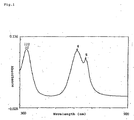
- Fig.1 shows an absorption curve of the filtrate having a pH of 10 used for salting out in Example 7
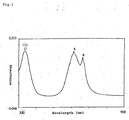
- Fig.2 shows an absorption curve of the filtrate having a pH of 7 used for salting out in Example 8
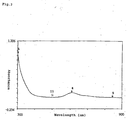
- Fig. 3 shows an absorption curve of the filtrate having a pH of 2 used for salting out in Example 9
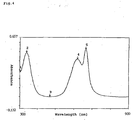
- Fig. 4 shows an absorption curve of the methanol filtrate in Example 10.
- Fig.5 shows absorption curves of the cyan dye mixture of Example 4 of the invention and Projet Cyan 1 (Comparative Example 1) as spectrophotometrically measured in water with the concentrations thereof adjusted to 0.01 g/l.
- the dye mixture of Example 4 has ⁇ max in the 590-630 nm region and no peak in the 640-670 nm region.
- Projet Cyan 1 (Comparative Example 1) has a peak in the 640-670 nm region. That is, the cyan dye mixture of the invention is a dye mixture having ⁇ max in the 590-630 nm region but no peak in the 640-670 nm region of the absorption curve as spectrophotometrically measured in water.
- Fig.6 shows absorption curves of the cyan dye mixtures of Examples 1, 4, 11 of the invention spectrophotometrically measured (in N,N-dimethylformamide with absorbance adjusted from 1 to 2 Abs).
- Fig.7 shows for comparison an absorption curve of Projet Cyan 1 (Comparative Example 1) as spectrophotometrically measured under the same conditions.
- cyan dye mixtures of Examples 1, 4 and 7 of the invention and Projet Cyan 1 were measured by a high performance liquid chromatography.
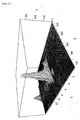
- the measurement data are shown in Fig.8 (Example 1), Fig. 9 (Example 4), Fig. 10 (Example 7) and Fig. 11 (Comparative Example 1, Projet Cyan 1).
- the above measurement with high performance liquid chromatography was performed under gradient method conditions at a detection wavelength of 200 to 900 nm, using Hewlett-Packard 1100 series having a photodiode array detector, and acetonitrilelammonium dihydrogenphosphate aqueous solution as a solvent.
- the dye mixtures of Examples 1, 4, 7 each contains the components having ⁇ max in the 640-670 nm region in a total area percentage of not more than 20 % of the overall area of all the components detected at a detection wavelength of 254 nm, and each has a " ⁇ B/ ⁇ A" value of not more than 1 wherein ⁇ A and ⁇ B each represent the sum of absorbances of all the detected components, provided that A represents an absorbance of an absorption peak in the 590-630 nm region; and B represents an absorbance of an absorption peak in the 640-670 nm region. Furthermore, the dye mixtures of Examples 1 and 4 each consist of the components having an B/A value of not more than 1. On the other hand, Projet Cyan 1 (Comparative Example 1) contains the components having ⁇ max in the 640-670 nm region in a total area percentage of not less than 50 % and has a " ⁇ B/ ⁇ A" value of not less than 1.
- Cyan inks of comparative examples were adjusted to an optical density equal to that of cyan ink compositions containing the cyan dye mixture of the above examples.
- Projet Cyan 1 (Comparative Example 1, manufactured by AVECIA. LTD.)
- C. I. Direct Blue 86 (Comparative Example 2, manufactured by Nippon Kayaku Co., Ltd.) were used.
- An ink-jet printer (Trade Name :PICTY80L, manufactured by NEC Corporation) or (Trade Name :BJ F850, manufactured by Canon Inc.) was operated to perform ink-jet recording on 4 types of receiving materials which included two types of commercial glossy papers surface treated with an inorganic substance and/or a polymer, Glossy Paper A (PM photo-paper KA420PSK, manufactured by Seiko Epson Corporation) and Glossy Paper B (Professional Photo-Paper PR-101 manufactured by Canon Inc.), and two types of commercial glossy films, Glossy Film A (Photo-Glossy Film HG-201, manufactured by Canon Inc.) and Glossy Film B (Specialty Glossy Film MJA4SP6, manufactured by Seiko Epson Corporation). Images recordedwith the water-based cyan ink compositions of the invention and the cyan ink compositions of the comparative examples were evaluated for hue, vividness, hue changes under exposure to weather ( ⁇ E), and hue changes under exposure to ozone gas ( ⁇ E).
- the use of the dye mixtures of the invention wherein the dye mixtures were obtained by using ammonium chloride as the aminating agent in an amount of not less than 2.5 mol per mol of copper phthalocyanine (pigment) as the starting material, thereby increasing the sulfonamidation rate, achieves good results that the inks on the two types of receiving materials exhibit small hue degradations ⁇ E of not more than 10,.
- the concentration of the dye in ink was adjusted to 0.8 % and PICTY80L was used for the printing operation.
- the ink composition of the comparative example was prepared using Projet Cyan 1 (Comparative Example 1) and in the same way as in the preparation of the ink compositions of the invention.
- the separated cyan dye mixture was subjected to the ozone-gas exposure test.
- the ⁇ E on Glossy Paper A was 11.7 and that on Glossy Film B was 13.5, which were much worse than the data of Example 7.
- the filtrate of aqueous methanol solution used in Example 10 was precipitated with acid at pH 2 to separate the remaining cyan dye mixture.
- the cyan dye mixture was subjected to the above ozone-gas exposure test.
- the results were ⁇ E of 14.6 for Glossy Paper A and ⁇ E of 14.4 for Glossy Film B, which were much worse than the data of Example 10.
- the data also demonstrate that the impurities intensifying the discoloration under exposure to weather or ozone gas are effectively removed by salting out at the pH range of 7 to 11 or desalting with methanol.
- ⁇ and ⁇ E are plotted on the abscissa and on the ordinate, respectively.
- ⁇ and ⁇ E are in a proportional relationship indicating that the smaller is the ⁇ value, the smaller is the discoloration under exposure to ozone gas.
- the compounds having smaller ⁇ value may be used to improve the discoloration under exposure to ozone gas. Since the compounds synthesized using 2.75 mol of ammonium chloride has the ⁇ value of 46.5, a measure of achieving the improvement is a ⁇ of 48 or less.
- the cyan dye mixtures of Examples 1 and 4 were used to prepare a high-concentration cyan ink having a dye concentration of 4.0 % and a low-concentration cyan ink having a dye concentration of 0.8 %.
- the resultant inks were used with Ink-Jet Printer BJ F805 for color printing.
- a yellow ink, magenta ink and black ink used for this color printing were genuine brand name products for Canon Ink-Jet Printer BJ F850.
- the prints thus produced were tested as allowed to stand for 10 days under exposure to weather or ozone gas.
- the results of the weather exposure test are listed in Table 6 and the results of the ozone-gas exposure test are listed in Table 7.
- Projet Cyan 1 Comparative Example 1
- Tables 6 and 7 show that the cyan inks of the invention are optimum inks for ink-jet printing, producing color prints suffering extremely less discoloration as allowed to stand under exposure to weather or ozone gas in contrast to color prints produced using the cyan inks commonly used in the art.
- the cyan inks of the invention are more suited for printing on the glossy paper and the glossy film than the cyan inks used in the art because the prints using the cyan inks of the invention suffer quite small discoloration when allowed to stand under exposure to weather or ozone gas.
- the cyan compounds used in the cyan ink compositions of the invention have good storage stability without crystal deposition and change in physical properties or color after storage over an extended period of time.
- the ink composition of the invention achieves excellent results with little discoloration, particularly when printed on the information transmission sheets having a surface treated with an inorganic substance and/or polymer, so-called glossy paper, and allowed to stand under exposure to weather or ozone gas.
- the ink composition of the invention exhibits a vivid, almost ideal cyan color on the print surface and hence, can render color tones in a wide visible region of the spectrum as used in combination with other magenta and yellow inks. Therefore, the ink composition of the invention is quite useful as the cyan ink for ink-jet recording.
Landscapes
- Chemical & Material Sciences (AREA)
- Organic Chemistry (AREA)
- Life Sciences & Earth Sciences (AREA)
- Engineering & Computer Science (AREA)
- Materials Engineering (AREA)
- Wood Science & Technology (AREA)
- Chemical Kinetics & Catalysis (AREA)
- Inks, Pencil-Leads, Or Crayons (AREA)
- Ink Jet Recording Methods And Recording Media Thereof (AREA)
Abstract
Description


The filtrates were obtained by these methods for purification, that is, by salting out the cyan dye mixtures of the present invention at respective pH of 10, 7 and 2 and then filtering, or by salting out the cyan dye mixtures of the present invention with methanol and then filtering. The resultant filtrates were measured by a spectrophotometer to obtain respective absorption curves thereof (in water). Fig.1 shows an absorption curve of the filtrate having a pH of 10 used for salting out in Example 7; Fig.2 shows an absorption curve of the filtrate having a pH of 7 used for salting out in Example 8; Fig. 3 shows an absorption curve of the filtrate having a pH of 2 used for salting out in Example 9; and Fig. 4 shows an absorption curve of the methanol filtrate in Example 10.
| Dye mixture obtained by the above each example (desalted) | 0.5-7.0 parts |
| Water+ammonium hydroxide | 74.0-80.5 parts |
| Glycerin | 5.0 parts |
| Urea | 5.0 parts |
| N-methyl-2-pyrrolidone | 4.0 parts |
| IPA | 3.0 parts |
| Butyl carbitol | 2.0 parts |
| Total | 100.0 parts |
| Results of 7-day Exposure to Weather Test (ΔE) (Glossy Film A) | |||
| Amount of Chlorosulfonation Reaction Temperature | |||
| NH4Cl | 140°C | 130°C | 120°C |
| 1.65 | 11.00 (CE 5) | ||
| 2.2 | 9.90(CE 3) | 9.89(CE 4) | |
| 2.75 | 9.04(E 1) | 8.62(E 3) | |
| 3.3 | 8.80(E 2) | ||
| Note: NH4Cl was used in equimolecular amount; CE means comparative example; and E means example. |
| Results of 7-day Exposure to Weather Test (ΔE) (Glossy Film B) | |||
| Amount of | Chlorosulfonation Reaction Temperature | ||
| NH4Cl | 140°C | 130°C | 120°C |
| 1.65 | 12.97 (CE 5) | ||
| 2.2 | 10.03(CE 3) | 10.31(CE 4) | |
| 2.75 | 9.63(E 1) | 9.13(E 3) | |
| 3.3 | 7.47(E 2) |
| Hue Vividness | Exposure weather | Exposure ozone | ||||
| L* | a* | b* | (C*) | ΔE | ΔE | |
| Example 1 | ||||||
| GP A | 67.3 | -42.8 | -41.8 | 59.8 | 10.4 | 8.0 |
| GF B | 67.3 | -41.9 | -45.7 | 62.0 | 14.5 | 9.8 |
| Example 4 | ||||||
| GP A | 66.4 | -39.7 | -45.7 | 60.5 | 6.7 | 4.9 |
| GF B | 66.9 | -39.6 | -47.1 | 61.5 | 9.5 | 7.7 |
| Example 5 | ||||||
| GP A | 67.7 | -39.3 | -44.2 | 59.1 | 8.6 | 7.1 |
| GF B | 68.4 | -39.2 | -45.2 | 59.8 | 10.4 | 7.4 |
| Example 6 | ||||||
| GP A | 68.5 | -39.9 | -41.4 | 57.5 | 8.6 | 7.5 |
| GF B | 68.7 | -39.5 | -44.7 | 59.7 | 13.2 | 8.3 |
| Example 7 | ||||||
| GP A | 68.0 | -39.5 | -42.1 | 57.7 | 8.6 | 7.1 |
| GF B | 68.1 | -39.7 | -45.0 | 60.0 | 12.5 | 8.0 |
| Example 8 | ||||||
| GP A | 69.3 | -39.4 | -40.9 | 56.8 | 9.1 | 7.5 |
| GF B | 68.9 | -39.6 | -44.3 | 59.4 | 14.8 | 8.8 |
| Example 9 | ||||||
| GP A | 68.6 | -40.4 | -41.1 | 60.4 | 9.3 | 8.0 |
| GF B | 68.2 | -40.3 | -44.9 | 60.3 | 15.4 | 9.1 |
| Example 10 | ||||||
| GP A | 69.3 | -39.8 | -40.7 | 56.9 | 8.6 | 7.0 |
| GF B | 69.2 | -39.8 | -44.0 | 59.3 | 13.6 | 8.0 |
| Example 11 | ||||||
| GP A | 68.0 | -39.3 | -44.2 | 59.1 | - | 3.1 |
| GF B | 67.5 | -39.1 | -45.6 | 60.1 | - | 5.7 |
| Comparative Example 1 | ||||||
| GP A | 68.4 | -44.3 | -37.6 | 58.1 | 16.8 | 15.3 |
| GF B | 68.5 | -42.0 | -44.1 | 60.9 | 22.5 | 20.0 |
| Note: GP means glossy paper; and GF means glossy film. |
| D-C(Δλ) Value | ||
| E.1: 46.5 | E.4: 44.4 | E.5: 43.8 |
| E.6: 44.9 | E.7: 44.2 | E.8: 45.2 |
| E.9: 45.1 | E.10: 44.9 | E.11: 42.2 |
| Test Inks Discoloration Test under 10-day Exposure to Weather | ||||
| ΔE after test GP A | Color print GP A | ΔE after test GP B | Color print GP B | |
| E.4 | 9.9 | Δ-○ | 9.1 | Δ-○ |
| E.1 | 13.7 | Δ | 16.2 | Δ |
| CE.1 | 22.2 | × | 28.4 | × |
| CE.2 | 28.1 | × | 36.8 | × |
| Test Inks Discoloration Test under 10-day Exposure to Weather | ||||
| ΔE after test GP A | Color print GP A | ΔE after test GP B | Color print GP B | |
| E.4 | 8.1 | Δ-○ | 7.2 | Δ-○ |
| E.1 | 11.5 | Δ | 10.8 | Δ |
| CE.1 | 17.6 | × | 16.3 | × |
| CE.2 | 19.5 | × | 18.4 | × |
| Note: E means Example; CE means Comparative Example; GP A means Glossy Paper A; and GP B means Glossy Paper B. |
Claims (23)
- A cyan dye mixture comprising a mixture of compounds which are obtained by chlorosulfonating copper phthalocyanine and then amidating the chlorosulfonation product with an aminating agent used in an amount of at least 2.5 mol per mol of the copper phthalocyanine as a starting material, and which are represented by the following formula (1):wherein M represents a proton, alkali metal ion, alkaline earth metal ion, onium ion of an organic amine, or ammonium ion; m is an integer of 1 to 4; and n is an integer of 0 to 3; provided that m+n is an integer of 1 to 4.

- A cyan dye mixture comprising a mixture of compounds which are represented by the formula (1) and obtained by reacting a compound represented by the following formula (2) with a chlorinating agent for chlorosulfonating its sulfonic acid group, and then amidating the chlorosulfonation product with an aminating agent in an amount of at least 2.5 mol per mol of the compound of the formula (2):wherein M represents a proton, alkali metal ion, alkaline earth metal ion, onium ion of an organic amine, or ammonium ion; and s is an integer of 2 to 4.

- A cyan dye mixture comprising compounds which are represented by the following formula (1):wherein M represents a proton, alkali metal ion, alkaline earth metal ion, onium ion of an organic amine, or ammonium ion; m is an integer of 1 to 4; n is an integer of 0 to 3; provided that m+n is an integer of 1 to 4, and which have λmax in a 590-630 nm region and no peak in a 640-670 nm region of an absorption curve as spectrophotometrically measured in water with concentrations thereof adjusted to 0.01 g/l.
- A cyan dye mixture as claimed in Claim 1 or 2, comprising a compound having absorption peaks in a 615-640 nm region and 655-680 nm region of an absorption curve as spectrophotometrically measured in N,N-dimethylformamide with absorbance adjusted from 1 to 2 Abs.
- A cyan dye mixture as claimed in Claim 1 or 2, comprising a compound having a "D-C" value of not more than 48 nm wherein C represents a wavelength of an absorption peak in a 615-640 nm region of an absorption curve as spectrophotometrically measured in N,N-dimethylformamide with absorbance adjusted from 1 to 2 Abs, and D represents a wavelength of an absorption peak in a 655-680 nm region of the absorption curve.
- A cyan dye mixture as claimed in Claim 1 or 2, comprising components having λmax in a 640-670 nm region, as measured by a high performance liquid chromatography having a photodiode array detector (developer: acetonitrile/aqueous solution of ammonium dihydrogenphosphate), in a total area percentage of not more than 50 % of the overall area of all the components detected at a wavelength of 254 nm.
- A cyan dye mixture as claimed in Claim 1 or 2, wherein a "ΣB/ΣA" value is not more than 1 wherein ΣA and ΣB each represent the sum of absorbances of all the detected components, provided that A represents an absorbance of an absorption peak in a 590-630 nm region as measured by a high performance liquid chromatography having a photodiode array detector (developer: acetonitrile/aqueous solution of ammonium dihydrogenphosphate); and B represents an absorbance of an absorption peak in a 640-670 nm region.
- A cyan dye mixture as claimed in Claim 1 or 2, wherein the compounds consist of components having a "B/A" value of not more than 1 wherein A represents an absorbance of an absorption peak in a 590-630 nm region as measured by a high performance liquid chromatography having a photodiode array detector (developer: acetonitrile/aqueous solution of ammonium dihydrogenphosphate); and B represents an absorbance of an absorption peak in a 640-670 nm region.
- A water-based cyan ink composition comprising the cyan dye mixture claimed in any one of Claims 1 to 8.
- A purification method for the cyan dye mixture claimed in Claim 1 or 2, wherein a solution containing the cyan dye mixture claimed in Claim 1 or 2 is precipitated with salt in a pH range of 7 to 11 thereby reducing absorbance in a 640-670 nm region as measured by a spectrophotometer.
- A purification method for the cyan dye mixture claimed in Claim 1 or 2, which reduces absorbance in a 640-670 nm region as measured by a spectrophotometer, the method wherein the cyan dye mixture claimed in Claim 1 or 2 is stirringly suspended in water-containing methanol, ethanol or 2-propanol, and then is filtered out.
- A water-based cyan ink composition containing the cyan dye mixture claimed in Claim 1 or 2, which is purified by the method claimed in Claim 10 or 11.
- A water-based cyan ink composition as claimed in Claim 9 or 12, which is used for ink-jet recording.
- A water-based cyan ink composition set comprising two inks of different concentrations wherein the inks are prepared by using the water-based cyan ink composition claimed in any one of Claims 9, 12 and 13 and the ink of the higher concentration is adjusted to the concentrations in 2.5 to 7 wt% of the dye mixture, the ink of the lower concentration containing the dye mixture in concentrations of 0.5 to 2.5 wt%.
- An ink-jet recording method for recording on a receiving material by jetting an ink droplet thereto in response to a recording signal, wherein the water-based cyan ink composition claimed in any one of Claims 9, 12 and 13 is used as ink.
- An ink-jet recording method as claimed in Claim 15, wherein the receiving material is an information transmission sheet.
- An ink-jet recording method as claimed in Claim 15, wherein the receiving material is an information transmission sheet having a surface treated with at least one selected from the group consisting of inorganic substances and polymers.
- An ink-jet recording method as claimed in Claim 15. wherein the receiving material is an information transmission sheet having a surface treated with at least one inorganic substance selected from the group consisting of silica, alumina and ceramics.
- An ink-jet recording method as claimed in Claim 15, wherein the receiving material is an information transmission sheet having a surface treated with at least one polymer selected from the group consisting of hydrophilic polymers, acrylic polymers and polyurethane polymers.
- An ink-jet recording method as claimed in Claim 15, wherein the receiving material is an information transmission sheet having a surface treated with at least one hydrophilic polymer selected from the group consisting of polyvinyl alcohol and polyvinylpyrrolidone.
- A container containing therein the water-based cyan ink composition claimed in any one of Claims 9, 12 and 13.
- An ink-jet printer comprising the container claimed in Claim 21.
- A cyan dye mixture comprising a mixture of compounds which are represented by the following formula (1):wherein M represents a proton, an alkali metal ion, an alkaline earth metal ion or an onium ion or ammonium ion of an organic amine; m is an integer of 1 to 4; and n is an integer of 0 to 3; provided that m+n is an integer of 1 to 4, and containing a compound which has absorption peaks in a 615-640 nm region and 655-680 nm region of an absorption curve as spectrophotometrically measured in N,N-dimethylformamide with absorbance adjusted from 1 to 2 Abs, and which has a "D-C" value of not more than 48 nm wherein C represents a wavelength of the absorption peak in the 615-640 nm region; and D represents a wavelength of the absorption peak in the 655-680 nm region.

Applications Claiming Priority (3)
| Application Number | Priority Date | Filing Date | Title |
|---|---|---|---|
| JP2000226146 | 2000-07-26 | ||
| JP2000226146 | 2000-07-26 | ||
| PCT/JP2001/006403 WO2002008340A1 (en) | 2000-07-26 | 2001-07-25 | Cyan dye mixture, water-based cyan ink composition, and method of ink-jet recording |
Publications (2)
| Publication Number | Publication Date |
|---|---|
| EP1304359A1 true EP1304359A1 (en) | 2003-04-23 |
| EP1304359A4 EP1304359A4 (en) | 2004-10-06 |
Family
ID=18719810
Family Applications (1)
| Application Number | Title | Priority Date | Filing Date |
|---|---|---|---|
| EP01954338A Withdrawn EP1304359A4 (en) | 2000-07-26 | 2001-07-25 | Cyan dye mixture, water-based cyan ink composition, and method of ink-jet recording |
Country Status (7)
| Country | Link |
|---|---|
| US (1) | US7034149B2 (en) |
| EP (1) | EP1304359A4 (en) |
| KR (1) | KR100577642B1 (en) |
| CN (1) | CN100355836C (en) |
| CA (1) | CA2417529A1 (en) |
| TW (1) | TWI290946B (en) |
| WO (1) | WO2002008340A1 (en) |
Cited By (7)
| Publication number | Priority date | Publication date | Assignee | Title |
|---|---|---|---|---|
| WO2003078529A1 (en) * | 2002-03-14 | 2003-09-25 | Avecia Limited | Processes for preparing phthalocyanine compounds |
| EP1405883A1 (en) | 2002-10-02 | 2004-04-07 | Canon Kabushiki Kaisha | Aqueous ink, ink jet recording method, ink tank, recording unit and ink jet recording apparatus |
| WO2005014732A1 (en) * | 2003-07-18 | 2005-02-17 | Avecia Inkjet Limited | Cyan inks and their use in ink-jet printers |
| EP1616916A1 (en) * | 2004-07-14 | 2006-01-18 | Hewlett-Packard Development Company, L.P. | Inkjet ink formulation |
| EP1820831A1 (en) * | 2006-02-16 | 2007-08-22 | Brother Kogyo Kabushiki Kaisha | Cyan ink for ink-jet recording |
| EP2311919A1 (en) * | 2009-10-15 | 2011-04-20 | Seiko Epson Corporation | Ink composition and method for producing the same |
| US8808439B2 (en) | 2009-07-31 | 2014-08-19 | Hewlett-Packard Development Company, L.P. | Phthalocyanines and naphthalocyanines with near-IR absorptions for inkjet inks |
Families Citing this family (35)
| Publication number | Priority date | Publication date | Assignee | Title |
|---|---|---|---|---|
| WO2002088256A1 (en) * | 2001-04-27 | 2002-11-07 | Daiwa Dyestuff Mfg. Co., Ltd. | Oxidation-resistant water-soluble dye of copper/phthalocyanine compound complex, dye composition containing the same, and recording fluid |
| KR100644113B1 (en) * | 2001-06-22 | 2006-11-10 | 후지 샤신 필름 가부시기가이샤 | Colored image forming compositions containing phthalocyanine compounds, inks, inkjet inks, inkjet recording methods and methods for improving ozone gas fading resistance |
| TWI271424B (en) * | 2001-12-21 | 2007-01-21 | Benq Corp | Multicolor dye set and inkjet ink composition with high chroma |
| TWI292426B (en) * | 2001-12-25 | 2008-01-11 | Benq Corp | |
| DE10260361A1 (en) | 2001-12-25 | 2003-07-17 | Benq Corp | High-chromaticity magenta inkjet printing ink comprises acid red 92 and at least one other red dye in an aqueous solvent |
| JP4190187B2 (en) * | 2002-01-22 | 2008-12-03 | 富士フイルム株式会社 | Ink containing water-soluble phthalocyanine compound, ink-jet ink, ink-jet recording method, and method for improving ozone gas fading of colored image material |
| EP1468051B1 (en) * | 2002-01-22 | 2009-05-13 | FUJIFILM Corporation | Phthalocyanine dye mixture and ink containing the same |
| JP3903938B2 (en) | 2002-04-23 | 2007-04-11 | セイコーエプソン株式会社 | Ink composition, ink jet recording method using the same, and recorded matter |
| JP4377254B2 (en) | 2003-03-27 | 2009-12-02 | 富士フイルム株式会社 | Ink set |
| KR101077066B1 (en) * | 2003-03-31 | 2011-10-26 | 니폰 가야꾸 가부시끼가이샤 | Phthalocyanine dye and use thereof for ink-jet printing |
| CN1894350A (en) * | 2003-12-19 | 2007-01-10 | 富士胶片株式会社 | Ink for inkjet, method for producing ink for inkjet, ink set for inkjet, and method for recording inkjet |
| US7276111B2 (en) * | 2004-02-09 | 2007-10-02 | Seiko Epson Corporation | Ink composition, inkjet recording method and recorded matter |
| JP2006028450A (en) * | 2004-07-21 | 2006-02-02 | Fuji Photo Film Co Ltd | Mixed dyestuff, ink containing the same, method of inkjet-recording and method for forming image |
| US7247195B2 (en) * | 2005-03-09 | 2007-07-24 | Hewlett-Packard Development Company, L.P. | Dye sets for ink-jet ink imaging |
| CN100419030C (en) * | 2005-10-25 | 2008-09-17 | 上海汇友精密化学品有限公司 | A modified phthalocyanine dye |
| JP4795221B2 (en) * | 2005-12-21 | 2011-10-19 | キヤノン株式会社 | Ink, inkjet recording method, recording unit, ink cartridge, and inkjet recording apparatus |
| US8163075B2 (en) | 2006-10-31 | 2012-04-24 | Sensient Colors Llc | Inks comprising modified pigments and methods for making and using the same |
| CA2680819C (en) * | 2007-03-14 | 2014-04-15 | Nippon Kayaku Kabushiki Kaisha | Novel porphyrazine coloring matter, ink, ink set and colored product |
| AU2008288785B2 (en) | 2007-08-23 | 2014-08-21 | Sensient Colors Inc. | Self-dispersed pigments and methods for making and using the same |
| JP5281019B2 (en) * | 2007-12-28 | 2013-09-04 | 日本化薬株式会社 | Porphyrazine dye and ink composition containing the same |
| CN101580646B (en) | 2008-05-13 | 2012-07-04 | 珠海纳思达企业管理有限公司 | Weather-proof dye and application thereof |
| TW201005045A (en) * | 2008-06-30 | 2010-02-01 | Nippon Kayaku Kk | Porphyrazine pigment, ink composition and colored article |
| CA2747687C (en) | 2008-12-25 | 2016-02-09 | Nippon Kayaku Kabushiki Kaisha | Porphyrazine coloring matter, ink composition containing the same and colored product |
| KR20110135989A (en) | 2009-04-07 | 2011-12-20 | 센션트 컬러스 엘엘씨 | Self-dispersing particles and methods of making and using the same |
| US8535432B2 (en) | 2009-04-15 | 2013-09-17 | Nippon Kayaku Kabushiki Kaisha | Porphyrazine coloring matter, ink composition containing the same and colored product |
| US8256885B2 (en) * | 2009-07-15 | 2012-09-04 | Lexmark International, Inc. | Cyan inkjet ink having improved print quality with porous photo media |
| US8282723B2 (en) * | 2009-07-15 | 2012-10-09 | Lexmark International, Inc. | Magenta inkjet ink having improved print quality with porous photo media |
| US8277550B2 (en) * | 2009-07-15 | 2012-10-02 | Lexmark International, Inc. | Yellow inkjet ink having improved print quality with porous photo media |
| US8328920B2 (en) * | 2009-07-15 | 2012-12-11 | Lexmark International, Inc. | Inkjet ink having improved high resolution nozzle plate compatibility |
| JP2013146925A (en) * | 2012-01-19 | 2013-08-01 | Seiko Epson Corp | Ink jet recording method, ink jet recording apparatus, and recording material |
| CN102626657B (en) * | 2012-03-20 | 2015-03-04 | 武汉科林精细化工有限公司 | Preparation method of catalyst for catalyzing rich gas catalytic oxidation desulfurization |
| CN102942801A (en) * | 2012-08-14 | 2013-02-27 | 上海色如丹染料化工有限公司 | Preparation method of red-light blue metal phthalocyanine dye |
| CN103554982B (en) * | 2013-09-29 | 2017-10-24 | 天津德凯化工股份有限公司 | A kind of emerald blue reactive dye and preparation method thereof |
| CN107266935B (en) * | 2017-06-28 | 2019-04-12 | 江苏安诺其化工有限公司 | A kind of dyestuff, dye composite and dye material composition |
| CN107266934B (en) * | 2017-06-28 | 2019-04-12 | 江苏安诺其化工有限公司 | A kind of preparation method of dyestuff |
Family Cites Families (5)
| Publication number | Priority date | Publication date | Assignee | Title |
|---|---|---|---|---|
| DE696591C (en) | 1937-05-26 | 1940-09-25 | I G Farbenindustrie Akt Ges | Process for the production of dyes |
| JPS62190273A (en) * | 1986-02-17 | 1987-08-20 | Canon Inc | recording liquid |
| JPH07138511A (en) * | 1993-11-18 | 1995-05-30 | Ricoh Co Ltd | Inkjet recording ink |
| JPH08169155A (en) * | 1994-10-21 | 1996-07-02 | Seiko Epson Corp | Inkjet printer, recording medium used therefor, recording medium supply source |
| GB9708533D0 (en) * | 1997-04-26 | 1997-06-18 | Zeneca Ltd | Pthalocyanine ink-jet dyes |
-
2001
- 2001-07-24 TW TW090117994A patent/TWI290946B/en not_active IP Right Cessation
- 2001-07-25 CN CNB018132529A patent/CN100355836C/en not_active Expired - Lifetime
- 2001-07-25 KR KR1020037000895A patent/KR100577642B1/en not_active Expired - Lifetime
- 2001-07-25 WO PCT/JP2001/006403 patent/WO2002008340A1/en not_active Ceased
- 2001-07-25 CA CA002417529A patent/CA2417529A1/en not_active Abandoned
- 2001-07-25 US US10/333,418 patent/US7034149B2/en not_active Expired - Lifetime
- 2001-07-25 EP EP01954338A patent/EP1304359A4/en not_active Withdrawn
Cited By (12)
| Publication number | Priority date | Publication date | Assignee | Title |
|---|---|---|---|---|
| WO2003078529A1 (en) * | 2002-03-14 | 2003-09-25 | Avecia Limited | Processes for preparing phthalocyanine compounds |
| US7314273B2 (en) | 2002-03-14 | 2008-01-01 | Fujifilm Imaging Colorants Limited | Process for preparing phthalocyanine compounds |
| EP1405883A1 (en) | 2002-10-02 | 2004-04-07 | Canon Kabushiki Kaisha | Aqueous ink, ink jet recording method, ink tank, recording unit and ink jet recording apparatus |
| US6976755B2 (en) | 2002-10-02 | 2005-12-20 | Canon Kabushiki Kaisha | Aqueous ink, ink jet recording method, ink tank recording unit and ink jet recording apparatus |
| WO2005014732A1 (en) * | 2003-07-18 | 2005-02-17 | Avecia Inkjet Limited | Cyan inks and their use in ink-jet printers |
| US7326287B2 (en) | 2003-07-18 | 2008-02-05 | Fujifilm Imaging Colorants Limited | Cyan inks and their use in ink-jet printers |
| EP1616916A1 (en) * | 2004-07-14 | 2006-01-18 | Hewlett-Packard Development Company, L.P. | Inkjet ink formulation |
| US7105045B2 (en) | 2004-07-14 | 2006-09-12 | Hewlett-Packard Development Company, L.P. | Inkjet ink formulation |
| EP1820831A1 (en) * | 2006-02-16 | 2007-08-22 | Brother Kogyo Kabushiki Kaisha | Cyan ink for ink-jet recording |
| US8808439B2 (en) | 2009-07-31 | 2014-08-19 | Hewlett-Packard Development Company, L.P. | Phthalocyanines and naphthalocyanines with near-IR absorptions for inkjet inks |
| EP2459653B1 (en) * | 2009-07-31 | 2016-09-07 | Hewlett-Packard Development Company, L.P. | Phthalocyanines with near-ir absorptions for inkjet inks |
| EP2311919A1 (en) * | 2009-10-15 | 2011-04-20 | Seiko Epson Corporation | Ink composition and method for producing the same |
Also Published As
| Publication number | Publication date |
|---|---|
| CN1444634A (en) | 2003-09-24 |
| EP1304359A4 (en) | 2004-10-06 |
| US20030164114A1 (en) | 2003-09-04 |
| US7034149B2 (en) | 2006-04-25 |
| CA2417529A1 (en) | 2003-01-27 |
| KR20030040368A (en) | 2003-05-22 |
| TWI290946B (en) | 2007-12-11 |
| CN100355836C (en) | 2007-12-19 |
| KR100577642B1 (en) | 2006-05-10 |
| WO2002008340A1 (en) | 2002-01-31 |
Similar Documents
| Publication | Publication Date | Title |
|---|---|---|
| US7034149B2 (en) | Cyan dye mixture, water-based cyan ink composition, and method of ink-jet recording | |
| KR100580937B1 (en) | Novel Anthrapyridone Compounds, Aqueous Magenta Ink Compositions, and Inkjet Recording Methods | |
| EP1626070B1 (en) | Novel anthrapyridone compound, aqueous magenta ink composition and inkjet recording method | |
| JP2000303009A (en) | Water-base ink composition and ink jet recording process | |
| KR100635705B1 (en) | Novel anthrapyridone compounds, and use thereof | |
| KR100632829B1 (en) | Water-based ink composition, water-soluble dye composition and inkjet recording method | |
| KR100674095B1 (en) | Anthrapyridone Compound, Aqueous Magenta Ink Composition and Inkjet Recording Method | |
| EP1386945B1 (en) | Anthrapyridone compound, water-based magenta ink composition, and method of ink-jet recording | |
| JP3767879B2 (en) | Novel anthrapyridone compound, aqueous magenta ink composition and ink jet recording method | |
| KR20010041701A (en) | Water-based magenta ink composition and method of ink-jet recording | |
| JP3799247B2 (en) | Cyan dye mixture, aqueous cyan ink composition, and ink jet recording method | |
| KR101132214B1 (en) | Azo Compound, Ink Composition, and Colored Object | |
| JP2002285022A (en) | Dye composition, ink composition and ink jet recording method | |
| JP4947677B2 (en) | Aqueous black ink composition and ink jet recording method | |
| JP3957423B2 (en) | Aqueous magenta ink composition and ink jet recording method | |
| JP4408492B2 (en) | Anthrapyridone compound, aqueous magenta ink composition, and ink jet recording method | |
| JP4471528B2 (en) | Dye composition, ink composition, and ink jet recording method | |
| JP4404859B2 (en) | Novel anthrapyridone compound, aqueous magenta ink composition and ink jet recording method | |
| JP4407849B2 (en) | Dye composition, ink composition, and ink jet recording method | |
| KR20050094805A (en) | Dye composition, ink composition, and method of ink-jet recording | |
| KR20010080272A (en) | Dye composition, ink composition, and ink-jet recording method |
Legal Events
| Date | Code | Title | Description |
|---|---|---|---|
| PUAI | Public reference made under article 153(3) epc to a published international application that has entered the european phase |
Free format text: ORIGINAL CODE: 0009012 |
|
| 17P | Request for examination filed |
Effective date: 20030120 |
|
| AK | Designated contracting states |
Designated state(s): AT BE CH CY DE DK ES FI FR GB GR IE IT LI LU MC NL PT SE TR |
|
| RIN1 | Information on inventor provided before grant (corrected) |
Inventor name: NAMBA, SHINICHI Inventor name: KITAYAMA, HIROKAZU Inventor name: OTANI, JUNJI Inventor name: SHIRASAKI, YASUO Inventor name: FUJII, TAKAFUMI Inventor name: YOSHIOKA, JUNKO |
|
| RBV | Designated contracting states (corrected) |
Designated state(s): CH DE FR GB IT LI |
|
| A4 | Supplementary search report drawn up and despatched |
Effective date: 20040825 |
|
| 17Q | First examination report despatched |
Effective date: 20070810 |
|
| STAA | Information on the status of an ep patent application or granted ep patent |
Free format text: STATUS: THE APPLICATION IS DEEMED TO BE WITHDRAWN |
|
| 18D | Application deemed to be withdrawn |
Effective date: 20080221 |