EP1304089A1 - Artificial tooth holder and preparation method of denture - Google Patents
Artificial tooth holder and preparation method of denture Download PDFInfo
- Publication number
- EP1304089A1 EP1304089A1 EP02022932A EP02022932A EP1304089A1 EP 1304089 A1 EP1304089 A1 EP 1304089A1 EP 02022932 A EP02022932 A EP 02022932A EP 02022932 A EP02022932 A EP 02022932A EP 1304089 A1 EP1304089 A1 EP 1304089A1
- Authority
- EP
- European Patent Office
- Prior art keywords
- paste
- base material
- denture base
- denture
- artificial
- Prior art date
- Legal status (The legal status is an assumption and is not a legal conclusion. Google has not performed a legal analysis and makes no representation as to the accuracy of the status listed.)
- Withdrawn
Links
- 238000002360 preparation method Methods 0.000 title claims abstract description 56
- 239000000463 material Substances 0.000 claims abstract description 164
- 239000010440 gypsum Substances 0.000 claims abstract description 41
- 229910052602 gypsum Inorganic materials 0.000 claims abstract description 41
- 238000006116 polymerization reaction Methods 0.000 claims abstract description 28
- 210000000214 mouth Anatomy 0.000 claims abstract description 19
- 230000000379 polymerizing effect Effects 0.000 claims abstract description 8
- 238000012216 screening Methods 0.000 claims description 15
- 241000282414 Homo sapiens Species 0.000 claims description 14
- 210000003679 cervix uteri Anatomy 0.000 claims description 11
- 238000004519 manufacturing process Methods 0.000 claims description 6
- 238000009966 trimming Methods 0.000 abstract description 10
- ATUOYWHBWRKTHZ-UHFFFAOYSA-N Propane Chemical compound CCC ATUOYWHBWRKTHZ-UHFFFAOYSA-N 0.000 description 18
- -1 barium glass Chemical compound 0.000 description 16
- 239000000203 mixture Substances 0.000 description 13
- WOBHKFSMXKNTIM-UHFFFAOYSA-N Hydroxyethyl methacrylate Chemical compound CC(=C)C(=O)OCCO WOBHKFSMXKNTIM-UHFFFAOYSA-N 0.000 description 12
- JOYRKODLDBILNP-UHFFFAOYSA-N Ethyl urethane Chemical compound CCOC(N)=O JOYRKODLDBILNP-UHFFFAOYSA-N 0.000 description 11
- 239000005057 Hexamethylene diisocyanate Substances 0.000 description 11
- STVZJERGLQHEKB-UHFFFAOYSA-N ethylene glycol dimethacrylate Substances CC(=C)C(=O)OCCOC(=O)C(C)=C STVZJERGLQHEKB-UHFFFAOYSA-N 0.000 description 11
- RRAMGCGOFNQTLD-UHFFFAOYSA-N hexamethylene diisocyanate Chemical compound O=C=NCCCCCCN=C=O RRAMGCGOFNQTLD-UHFFFAOYSA-N 0.000 description 11
- 238000000034 method Methods 0.000 description 11
- UEKHZPDUBLCUHN-UHFFFAOYSA-N 2-[[3,5,5-trimethyl-6-[2-(2-methylprop-2-enoyloxy)ethoxycarbonylamino]hexyl]carbamoyloxy]ethyl 2-methylprop-2-enoate Chemical compound CC(=C)C(=O)OCCOC(=O)NCCC(C)CC(C)(C)CNC(=O)OCCOC(=O)C(C)=C UEKHZPDUBLCUHN-UHFFFAOYSA-N 0.000 description 10
- OPLCSTZDXXUYDU-UHFFFAOYSA-N 2,4-dimethyl-6-tert-butylphenol Chemical compound CC1=CC(C)=C(O)C(C(C)(C)C)=C1 OPLCSTZDXXUYDU-UHFFFAOYSA-N 0.000 description 9
- VYPSYNLAJGMNEJ-UHFFFAOYSA-N Silicium dioxide Chemical compound O=[Si]=O VYPSYNLAJGMNEJ-UHFFFAOYSA-N 0.000 description 9
- 238000009472 formulation Methods 0.000 description 9
- 239000004033 plastic Substances 0.000 description 9
- 229920003023 plastic Polymers 0.000 description 9
- 229920001748 polybutylene Polymers 0.000 description 9
- 239000001294 propane Substances 0.000 description 9
- VNQXSTWCDUXYEZ-UHFFFAOYSA-N 1,7,7-trimethylbicyclo[2.2.1]heptane-2,3-dione Chemical compound C1CC2(C)C(=O)C(=O)C1C2(C)C VNQXSTWCDUXYEZ-UHFFFAOYSA-N 0.000 description 8
- 229930006711 bornane-2,3-dione Natural products 0.000 description 8
- FZUGPQWGEGAKET-UHFFFAOYSA-N parbenate Chemical compound CCOC(=O)C1=CC=C(N(C)C)C=C1 FZUGPQWGEGAKET-UHFFFAOYSA-N 0.000 description 8
- PAPBSGBWRJIAAV-UHFFFAOYSA-N ε-Caprolactone Chemical compound O=C1CCCCCO1 PAPBSGBWRJIAAV-UHFFFAOYSA-N 0.000 description 8
- 239000000945 filler Substances 0.000 description 7
- 239000012766 organic filler Substances 0.000 description 7
- 238000005498 polishing Methods 0.000 description 7
- LCXXNKZQVOXMEH-UHFFFAOYSA-N Tetrahydrofurfuryl methacrylate Chemical compound CC(=C)C(=O)OCC1CCCO1 LCXXNKZQVOXMEH-UHFFFAOYSA-N 0.000 description 6
- 239000011521 glass Substances 0.000 description 5
- 239000000178 monomer Substances 0.000 description 5
- 239000003505 polymerization initiator Substances 0.000 description 5
- XLYOFNOQVPJJNP-UHFFFAOYSA-N water Substances O XLYOFNOQVPJJNP-UHFFFAOYSA-N 0.000 description 5
- PUPZLCDOIYMWBV-UHFFFAOYSA-N (+/-)-1,3-Butanediol Chemical compound CC(O)CCO PUPZLCDOIYMWBV-UHFFFAOYSA-N 0.000 description 4
- 239000004342 Benzoyl peroxide Substances 0.000 description 4
- OMPJBNCRMGITSC-UHFFFAOYSA-N Benzoylperoxide Chemical compound C=1C=CC=CC=1C(=O)OOC(=O)C1=CC=CC=C1 OMPJBNCRMGITSC-UHFFFAOYSA-N 0.000 description 4
- 235000019400 benzoyl peroxide Nutrition 0.000 description 4
- 239000002131 composite material Substances 0.000 description 4
- CERQOIWHTDAKMF-UHFFFAOYSA-M Methacrylate Chemical compound CC(=C)C([O-])=O CERQOIWHTDAKMF-UHFFFAOYSA-M 0.000 description 3
- 239000003638 chemical reducing agent Substances 0.000 description 3
- 239000011256 inorganic filler Substances 0.000 description 3
- 229910003475 inorganic filler Inorganic materials 0.000 description 3
- 239000000377 silicon dioxide Substances 0.000 description 3
- 235000012239 silicon dioxide Nutrition 0.000 description 3
- BTLXPCBPYBNQNR-UHFFFAOYSA-N 1-hydroxyanthraquinone Chemical compound O=C1C2=CC=CC=C2C(=O)C2=C1C=CC=C2O BTLXPCBPYBNQNR-UHFFFAOYSA-N 0.000 description 2
- RBGUKBSLNOTVCD-UHFFFAOYSA-N 1-methylanthracene-9,10-dione Chemical compound O=C1C2=CC=CC=C2C(=O)C2=C1C=CC=C2C RBGUKBSLNOTVCD-UHFFFAOYSA-N 0.000 description 2
- OZAIFHULBGXAKX-UHFFFAOYSA-N 2-(2-cyanopropan-2-yldiazenyl)-2-methylpropanenitrile Chemical compound N#CC(C)(C)N=NC(C)(C)C#N OZAIFHULBGXAKX-UHFFFAOYSA-N 0.000 description 2
- XFCMNSHQOZQILR-UHFFFAOYSA-N 2-[2-(2-methylprop-2-enoyloxy)ethoxy]ethyl 2-methylprop-2-enoate Chemical compound CC(=C)C(=O)OCCOCCOC(=O)C(C)=C XFCMNSHQOZQILR-UHFFFAOYSA-N 0.000 description 2
- GNSFRPWPOGYVLO-UHFFFAOYSA-N 3-hydroxypropyl 2-methylprop-2-enoate Chemical compound CC(=C)C(=O)OCCCO GNSFRPWPOGYVLO-UHFFFAOYSA-N 0.000 description 2
- XOJWAAUYNWGQAU-UHFFFAOYSA-N 4-(2-methylprop-2-enoyloxy)butyl 2-methylprop-2-enoate Chemical compound CC(=C)C(=O)OCCCCOC(=O)C(C)=C XOJWAAUYNWGQAU-UHFFFAOYSA-N 0.000 description 2
- SOGAXMICEFXMKE-UHFFFAOYSA-N Butylmethacrylate Chemical compound CCCCOC(=O)C(C)=C SOGAXMICEFXMKE-UHFFFAOYSA-N 0.000 description 2
- VVQNEPGJFQJSBK-UHFFFAOYSA-N Methyl methacrylate Chemical compound COC(=O)C(C)=C VVQNEPGJFQJSBK-UHFFFAOYSA-N 0.000 description 2
- ULQMPOIOSDXIGC-UHFFFAOYSA-N [2,2-dimethyl-3-(2-methylprop-2-enoyloxy)propyl] 2-methylprop-2-enoate Chemical compound CC(=C)C(=O)OCC(C)(C)COC(=O)C(C)=C ULQMPOIOSDXIGC-UHFFFAOYSA-N 0.000 description 2
- 230000015572 biosynthetic process Effects 0.000 description 2
- 238000013329 compounding Methods 0.000 description 2
- 150000001875 compounds Chemical class 0.000 description 2
- 230000007547 defect Effects 0.000 description 2
- 150000001451 organic peroxides Chemical class 0.000 description 2
- 150000002902 organometallic compounds Chemical class 0.000 description 2
- 239000011505 plaster Substances 0.000 description 2
- 229920003229 poly(methyl methacrylate) Polymers 0.000 description 2
- 229920000642 polymer Polymers 0.000 description 2
- 239000004926 polymethyl methacrylate Substances 0.000 description 2
- 238000010298 pulverizing process Methods 0.000 description 2
- 239000010453 quartz Substances 0.000 description 2
- 239000000126 substance Substances 0.000 description 2
- 238000004381 surface treatment Methods 0.000 description 2
- 150000003512 tertiary amines Chemical class 0.000 description 2
- GQIUQDDJKHLHTB-UHFFFAOYSA-N trichloro(ethenyl)silane Chemical compound Cl[Si](Cl)(Cl)C=C GQIUQDDJKHLHTB-UHFFFAOYSA-N 0.000 description 2
- 239000005050 vinyl trichlorosilane Substances 0.000 description 2
- WRXCBRHBHGNNQA-UHFFFAOYSA-N (2,4-dichlorobenzoyl) 2,4-dichlorobenzenecarboperoxoate Chemical compound ClC1=CC(Cl)=CC=C1C(=O)OOC(=O)C1=CC=C(Cl)C=C1Cl WRXCBRHBHGNNQA-UHFFFAOYSA-N 0.000 description 1
- QEQBMZQFDDDTPN-UHFFFAOYSA-N (2-methylpropan-2-yl)oxy benzenecarboperoxoate Chemical compound CC(C)(C)OOOC(=O)C1=CC=CC=C1 QEQBMZQFDDDTPN-UHFFFAOYSA-N 0.000 description 1
- RIPYNJLMMFGZSX-UHFFFAOYSA-N (5-benzoylperoxy-2,5-dimethylhexan-2-yl) benzenecarboperoxoate Chemical compound C=1C=CC=CC=1C(=O)OOC(C)(C)CCC(C)(C)OOC(=O)C1=CC=CC=C1 RIPYNJLMMFGZSX-UHFFFAOYSA-N 0.000 description 1
- VDYWHVQKENANGY-UHFFFAOYSA-N 1,3-Butyleneglycol dimethacrylate Chemical compound CC(=C)C(=O)OC(C)CCOC(=O)C(C)=C VDYWHVQKENANGY-UHFFFAOYSA-N 0.000 description 1
- DKEGCUDAFWNSSO-UHFFFAOYSA-N 1,8-dibromooctane Chemical compound BrCCCCCCCCBr DKEGCUDAFWNSSO-UHFFFAOYSA-N 0.000 description 1
- CXTPIHZYOGDSLV-UHFFFAOYSA-N 1-bromoanthracene-9,10-dione Chemical compound O=C1C2=CC=CC=C2C(=O)C2=C1C=CC=C2Br CXTPIHZYOGDSLV-UHFFFAOYSA-N 0.000 description 1
- BOCJQSFSGAZAPQ-UHFFFAOYSA-N 1-chloroanthracene-9,10-dione Chemical compound O=C1C2=CC=CC=C2C(=O)C2=C1C=CC=C2Cl BOCJQSFSGAZAPQ-UHFFFAOYSA-N 0.000 description 1
- QZYOLNVEVYIPHV-UHFFFAOYSA-N 1-methyl-3-(3-methylphenyl)peroxybenzene Chemical compound CC1=CC=CC(OOC=2C=C(C)C=CC=2)=C1 QZYOLNVEVYIPHV-UHFFFAOYSA-N 0.000 description 1
- DRIRMYPZOAOUPR-UHFFFAOYSA-N 10,10-dioxothioxanthen-9-one Chemical compound C1=CC=C2C(=O)C3=CC=CC=C3S(=O)(=O)C2=C1 DRIRMYPZOAOUPR-UHFFFAOYSA-N 0.000 description 1
- YEZOVIIHKKPUOS-UHFFFAOYSA-N 10-oxothioxanthen-9-one Chemical compound C1=CC=C2C(=O)C3=CC=CC=C3S(=O)C2=C1 YEZOVIIHKKPUOS-UHFFFAOYSA-N 0.000 description 1
- BRKORVYTKKLNKX-UHFFFAOYSA-N 2,4-di(propan-2-yl)thioxanthen-9-one Chemical compound C1=CC=C2C(=O)C3=CC(C(C)C)=CC(C(C)C)=C3SC2=C1 BRKORVYTKKLNKX-UHFFFAOYSA-N 0.000 description 1
- BTJPUDCSZVCXFQ-UHFFFAOYSA-N 2,4-diethylthioxanthen-9-one Chemical compound C1=CC=C2C(=O)C3=CC(CC)=CC(CC)=C3SC2=C1 BTJPUDCSZVCXFQ-UHFFFAOYSA-N 0.000 description 1
- LCHAFMWSFCONOO-UHFFFAOYSA-N 2,4-dimethylthioxanthen-9-one Chemical compound C1=CC=C2C(=O)C3=CC(C)=CC(C)=C3SC2=C1 LCHAFMWSFCONOO-UHFFFAOYSA-N 0.000 description 1
- ASUQXIDYMVXFKU-UHFFFAOYSA-N 2,6-dibromo-9,9-dimethylfluorene Chemical compound C1=C(Br)C=C2C(C)(C)C3=CC=C(Br)C=C3C2=C1 ASUQXIDYMVXFKU-UHFFFAOYSA-N 0.000 description 1
- JKNCOURZONDCGV-UHFFFAOYSA-N 2-(dimethylamino)ethyl 2-methylprop-2-enoate Chemical compound CN(C)CCOC(=O)C(C)=C JKNCOURZONDCGV-UHFFFAOYSA-N 0.000 description 1
- XXGPFLQHCPMRDW-UHFFFAOYSA-N 2-[2-(2-hydroxyethoxy)ethoxy]ethanol 2-methylprop-2-enoic acid Chemical compound CC(=C)C(O)=O.CC(=C)C(O)=O.CC(=C)C(O)=O.OCCOCCOCCO XXGPFLQHCPMRDW-UHFFFAOYSA-N 0.000 description 1
- HWSSEYVMGDIFMH-UHFFFAOYSA-N 2-[2-[2-(2-methylprop-2-enoyloxy)ethoxy]ethoxy]ethyl 2-methylprop-2-enoate Chemical compound CC(=C)C(=O)OCCOCCOCCOC(=O)C(C)=C HWSSEYVMGDIFMH-UHFFFAOYSA-N 0.000 description 1
- DJKKWVGWYCKUFC-UHFFFAOYSA-N 2-butoxyethyl 2-methylprop-2-enoate Chemical compound CCCCOCCOC(=O)C(C)=C DJKKWVGWYCKUFC-UHFFFAOYSA-N 0.000 description 1
- SQOUGRMFFXWSRY-UHFFFAOYSA-N 2-chloro-7-(trifluoromethyl)thioxanthen-9-one Chemical compound C1=C(Cl)C=C2C(=O)C3=CC(C(F)(F)F)=CC=C3SC2=C1 SQOUGRMFFXWSRY-UHFFFAOYSA-N 0.000 description 1
- FPKCTSIVDAWGFA-UHFFFAOYSA-N 2-chloroanthracene-9,10-dione Chemical compound C1=CC=C2C(=O)C3=CC(Cl)=CC=C3C(=O)C2=C1 FPKCTSIVDAWGFA-UHFFFAOYSA-N 0.000 description 1
- KMNCBSZOIQAUFX-UHFFFAOYSA-N 2-ethoxy-1,2-diphenylethanone Chemical compound C=1C=CC=CC=1C(OCC)C(=O)C1=CC=CC=C1 KMNCBSZOIQAUFX-UHFFFAOYSA-N 0.000 description 1
- SJEBAWHUJDUKQK-UHFFFAOYSA-N 2-ethylanthraquinone Chemical compound C1=CC=C2C(=O)C3=CC(CC)=CC=C3C(=O)C2=C1 SJEBAWHUJDUKQK-UHFFFAOYSA-N 0.000 description 1
- WDQMWEYDKDCEHT-UHFFFAOYSA-N 2-ethylhexyl 2-methylprop-2-enoate Chemical compound CCCCC(CC)COC(=O)C(C)=C WDQMWEYDKDCEHT-UHFFFAOYSA-N 0.000 description 1
- BQZJOQXSCSZQPS-UHFFFAOYSA-N 2-methoxy-1,2-diphenylethanone Chemical compound C=1C=CC=CC=1C(OC)C(=O)C1=CC=CC=C1 BQZJOQXSCSZQPS-UHFFFAOYSA-N 0.000 description 1
- YXYJVFYWCLAXHO-UHFFFAOYSA-N 2-methoxyethyl 2-methylprop-2-enoate Chemical compound COCCOC(=O)C(C)=C YXYJVFYWCLAXHO-UHFFFAOYSA-N 0.000 description 1
- 125000004200 2-methoxyethyl group Chemical group [H]C([H])([H])OC([H])([H])C([H])([H])* 0.000 description 1
- RUMACXVDVNRZJZ-UHFFFAOYSA-N 2-methylpropyl 2-methylprop-2-enoate Chemical compound CC(C)COC(=O)C(C)=C RUMACXVDVNRZJZ-UHFFFAOYSA-N 0.000 description 1
- MYISVPVWAQRUTL-UHFFFAOYSA-N 2-methylthioxanthen-9-one Chemical compound C1=CC=C2C(=O)C3=CC(C)=CC=C3SC2=C1 MYISVPVWAQRUTL-UHFFFAOYSA-N 0.000 description 1
- DYRJLHNVMSBZLR-UHFFFAOYSA-N 2-nitrothioxanthen-9-one Chemical compound C1=CC=C2C(=O)C3=CC([N+](=O)[O-])=CC=C3SC2=C1 DYRJLHNVMSBZLR-UHFFFAOYSA-N 0.000 description 1
- KTALPKYXQZGAEG-UHFFFAOYSA-N 2-propan-2-ylthioxanthen-9-one Chemical compound C1=CC=C2C(=O)C3=CC(C(C)C)=CC=C3SC2=C1 KTALPKYXQZGAEG-UHFFFAOYSA-N 0.000 description 1
- YNJSNEKCXVFDKW-UHFFFAOYSA-N 3-(5-amino-1h-indol-3-yl)-2-azaniumylpropanoate Chemical compound C1=C(N)C=C2C(CC(N)C(O)=O)=CNC2=C1 YNJSNEKCXVFDKW-UHFFFAOYSA-N 0.000 description 1
- XDLMVUHYZWKMMD-UHFFFAOYSA-N 3-trimethoxysilylpropyl 2-methylprop-2-enoate Chemical compound CO[Si](OC)(OC)CCCOC(=O)C(C)=C XDLMVUHYZWKMMD-UHFFFAOYSA-N 0.000 description 1
- VVBLNCFGVYUYGU-UHFFFAOYSA-N 4,4'-Bis(dimethylamino)benzophenone Chemical compound C1=CC(N(C)C)=CC=C1C(=O)C1=CC=C(N(C)C)C=C1 VVBLNCFGVYUYGU-UHFFFAOYSA-N 0.000 description 1
- DBCAQXHNJOFNGC-UHFFFAOYSA-N 4-bromo-1,1,1-trifluorobutane Chemical compound FC(F)(F)CCCBr DBCAQXHNJOFNGC-UHFFFAOYSA-N 0.000 description 1
- YVPZFPKENDZQEJ-UHFFFAOYSA-N 4-propylcyclohexan-1-ol Chemical compound CCCC1CCC(O)CC1 YVPZFPKENDZQEJ-UHFFFAOYSA-N 0.000 description 1
- SAPGBCWOQLHKKZ-UHFFFAOYSA-N 6-(2-methylprop-2-enoyloxy)hexyl 2-methylprop-2-enoate Chemical compound CC(=C)C(=O)OCCCCCCOC(=O)C(C)=C SAPGBCWOQLHKKZ-UHFFFAOYSA-N 0.000 description 1
- OKTJSMMVPCPJKN-UHFFFAOYSA-N Carbon Chemical compound [C] OKTJSMMVPCPJKN-UHFFFAOYSA-N 0.000 description 1
- QSJXEFYPDANLFS-UHFFFAOYSA-N Diacetyl Chemical group CC(=O)C(C)=O QSJXEFYPDANLFS-UHFFFAOYSA-N 0.000 description 1
- ZAFNJMIOTHYJRJ-UHFFFAOYSA-N Diisopropyl ether Chemical compound CC(C)OC(C)C ZAFNJMIOTHYJRJ-UHFFFAOYSA-N 0.000 description 1
- 208000002354 Edentulous Jaw Diseases 0.000 description 1
- OFSAUHSCHWRZKM-UHFFFAOYSA-N Padimate A Chemical compound CC(C)CCOC(=O)C1=CC=C(N(C)C)C=C1 OFSAUHSCHWRZKM-UHFFFAOYSA-N 0.000 description 1
- AMFGWXWBFGVCKG-UHFFFAOYSA-N Panavia opaque Chemical compound C1=CC(OCC(O)COC(=O)C(=C)C)=CC=C1C(C)(C)C1=CC=C(OCC(O)COC(=O)C(C)=C)C=C1 AMFGWXWBFGVCKG-UHFFFAOYSA-N 0.000 description 1
- ZLMJMSJWJFRBEC-UHFFFAOYSA-N Potassium Chemical compound [K] ZLMJMSJWJFRBEC-UHFFFAOYSA-N 0.000 description 1
- GSEJCLTVZPLZKY-UHFFFAOYSA-N Triethanolamine Chemical compound OCCN(CCO)CCO GSEJCLTVZPLZKY-UHFFFAOYSA-N 0.000 description 1
- OKKRPWIIYQTPQF-UHFFFAOYSA-N Trimethylolpropane trimethacrylate Chemical compound CC(=C)C(=O)OCC(CC)(COC(=O)C(C)=C)COC(=O)C(C)=C OKKRPWIIYQTPQF-UHFFFAOYSA-N 0.000 description 1
- 239000007983 Tris buffer Substances 0.000 description 1
- 229910021536 Zeolite Inorganic materials 0.000 description 1
- JUDXBRVLWDGRBC-UHFFFAOYSA-N [2-(hydroxymethyl)-3-(2-methylprop-2-enoyloxy)-2-(2-methylprop-2-enoyloxymethyl)propyl] 2-methylprop-2-enoate Chemical compound CC(=C)C(=O)OCC(CO)(COC(=O)C(C)=C)COC(=O)C(C)=C JUDXBRVLWDGRBC-UHFFFAOYSA-N 0.000 description 1
- NMHJAFPCUXEYFN-UHFFFAOYSA-N [2-[2-[2-(2-methylprop-2-enoyloxy)phenyl]propan-2-yl]phenyl] 2-methylprop-2-enoate Chemical compound CC(=C)C(=O)OC1=CC=CC=C1C(C)(C)C1=CC=CC=C1OC(=O)C(C)=C NMHJAFPCUXEYFN-UHFFFAOYSA-N 0.000 description 1
- OQHMGFSAURFQAF-UHFFFAOYSA-N [2-hydroxy-3-(2-methylprop-2-enoyloxy)propyl] 2-methylprop-2-enoate Chemical compound CC(=C)C(=O)OCC(O)COC(=O)C(C)=C OQHMGFSAURFQAF-UHFFFAOYSA-N 0.000 description 1
- SWHLOXLFJPTYTL-UHFFFAOYSA-N [2-methyl-3-(2-methylprop-2-enoyloxy)-2-(2-methylprop-2-enoyloxymethyl)propyl] 2-methylprop-2-enoate Chemical compound CC(=C)C(=O)OCC(C)(COC(=O)C(C)=C)COC(=O)C(C)=C SWHLOXLFJPTYTL-UHFFFAOYSA-N 0.000 description 1
- FOVRCPBDDCLNIG-UHFFFAOYSA-N [3-(2-methylprop-2-enoyloxy)-2-(2-methylprop-2-enoyloxymethyl)propyl] 2-methylprop-2-enoate Chemical compound CC(=C)C(=O)OCC(COC(=O)C(C)=C)COC(=O)C(C)=C FOVRCPBDDCLNIG-UHFFFAOYSA-N 0.000 description 1
- SJSXBTSSSQCODU-UHFFFAOYSA-N [4-[2-[2,3-diethoxy-4-(2-methylprop-2-enoyloxy)phenyl]propan-2-yl]-2,3-diethoxyphenyl] 2-methylprop-2-enoate Chemical compound CCOC1=C(OC(=O)C(C)=C)C=CC(C(C)(C)C=2C(=C(OCC)C(OC(=O)C(C)=C)=CC=2)OCC)=C1OCC SJSXBTSSSQCODU-UHFFFAOYSA-N 0.000 description 1
- PXKSRSJQCLIEQC-UHFFFAOYSA-N [5-(2-benzoylbenzoyl)peroxy-2,5-dimethylhexan-2-yl] 2-benzoylbenzenecarboperoxoate Chemical compound C=1C=CC=C(C(=O)C=2C=CC=CC=2)C=1C(=O)OOC(C)(C)CCC(C)(C)OOC(=O)C1=CC=CC=C1C(=O)C1=CC=CC=C1 PXKSRSJQCLIEQC-UHFFFAOYSA-N 0.000 description 1
- YKTSYUJCYHOUJP-UHFFFAOYSA-N [O--].[Al+3].[Al+3].[O-][Si]([O-])([O-])[O-] Chemical compound [O--].[Al+3].[Al+3].[O-][Si]([O-])([O-])[O-] YKTSYUJCYHOUJP-UHFFFAOYSA-N 0.000 description 1
- NOZAQBYNLKNDRT-UHFFFAOYSA-N [diacetyloxy(ethenyl)silyl] acetate Chemical compound CC(=O)O[Si](OC(C)=O)(OC(C)=O)C=C NOZAQBYNLKNDRT-UHFFFAOYSA-N 0.000 description 1
- 239000000654 additive Substances 0.000 description 1
- PNEYBMLMFCGWSK-UHFFFAOYSA-N aluminium oxide Inorganic materials [O-2].[O-2].[O-2].[Al+3].[Al+3] PNEYBMLMFCGWSK-UHFFFAOYSA-N 0.000 description 1
- PYKYMHQGRFAEBM-UHFFFAOYSA-N anthraquinone Natural products CCC(=O)c1c(O)c2C(=O)C3C(C=CC=C3O)C(=O)c2cc1CC(=O)OC PYKYMHQGRFAEBM-UHFFFAOYSA-N 0.000 description 1
- 150000004056 anthraquinones Chemical class 0.000 description 1
- XKRFYHLGVUSROY-UHFFFAOYSA-N argon Substances [Ar] XKRFYHLGVUSROY-UHFFFAOYSA-N 0.000 description 1
- 229910052786 argon Inorganic materials 0.000 description 1
- 125000003118 aryl group Chemical group 0.000 description 1
- IVRMZWNICZWHMI-UHFFFAOYSA-N azide group Chemical group [N-]=[N+]=[N-] IVRMZWNICZWHMI-UHFFFAOYSA-N 0.000 description 1
- 229910052788 barium Inorganic materials 0.000 description 1
- DSAJWYNOEDNPEQ-UHFFFAOYSA-N barium atom Chemical compound [Ba] DSAJWYNOEDNPEQ-UHFFFAOYSA-N 0.000 description 1
- WURBFLDFSFBTLW-UHFFFAOYSA-N benzil Chemical compound C=1C=CC=CC=1C(=O)C(=O)C1=CC=CC=C1 WURBFLDFSFBTLW-UHFFFAOYSA-N 0.000 description 1
- LHMRXAIRPKSGDE-UHFFFAOYSA-N benzo[a]anthracene-7,12-dione Chemical compound C1=CC2=CC=CC=C2C2=C1C(=O)C1=CC=CC=C1C2=O LHMRXAIRPKSGDE-UHFFFAOYSA-N 0.000 description 1
- RWCCWEUUXYIKHB-UHFFFAOYSA-N benzophenone Chemical compound C=1C=CC=CC=1C(=O)C1=CC=CC=C1 RWCCWEUUXYIKHB-UHFFFAOYSA-N 0.000 description 1
- 239000012965 benzophenone Substances 0.000 description 1
- AOJOEFVRHOZDFN-UHFFFAOYSA-N benzyl 2-methylprop-2-enoate Chemical compound CC(=C)C(=O)OCC1=CC=CC=C1 AOJOEFVRHOZDFN-UHFFFAOYSA-N 0.000 description 1
- 125000001797 benzyl group Chemical group [H]C1=C([H])C([H])=C(C([H])=C1[H])C([H])([H])* 0.000 description 1
- VYHBFRJRBHMIQZ-UHFFFAOYSA-N bis[4-(diethylamino)phenyl]methanone Chemical compound C1=CC(N(CC)CC)=CC=C1C(=O)C1=CC=C(N(CC)CC)C=C1 VYHBFRJRBHMIQZ-UHFFFAOYSA-N 0.000 description 1
- 239000001506 calcium phosphate Substances 0.000 description 1
- 229910000389 calcium phosphate Inorganic materials 0.000 description 1
- 235000011010 calcium phosphates Nutrition 0.000 description 1
- 239000000378 calcium silicate Substances 0.000 description 1
- 229910052918 calcium silicate Inorganic materials 0.000 description 1
- OYACROKNLOSFPA-UHFFFAOYSA-N calcium;dioxido(oxo)silane Chemical compound [Ca+2].[O-][Si]([O-])=O OYACROKNLOSFPA-UHFFFAOYSA-N 0.000 description 1
- 229910052799 carbon Inorganic materials 0.000 description 1
- 239000003086 colorant Substances 0.000 description 1
- 238000001816 cooling Methods 0.000 description 1
- 239000012933 diacyl peroxide Substances 0.000 description 1
- HNPSIPDUKPIQMN-UHFFFAOYSA-N dioxosilane;oxo(oxoalumanyloxy)alumane Chemical compound O=[Si]=O.O=[Al]O[Al]=O HNPSIPDUKPIQMN-UHFFFAOYSA-N 0.000 description 1
- 238000007598 dipping method Methods 0.000 description 1
- 230000000694 effects Effects 0.000 description 1
- 150000002148 esters Chemical class 0.000 description 1
- FWDBOZPQNFPOLF-UHFFFAOYSA-N ethenyl(triethoxy)silane Chemical compound CCO[Si](OCC)(OCC)C=C FWDBOZPQNFPOLF-UHFFFAOYSA-N 0.000 description 1
- NKSJNEHGWDZZQF-UHFFFAOYSA-N ethenyl(trimethoxy)silane Chemical compound CO[Si](OC)(OC)C=C NKSJNEHGWDZZQF-UHFFFAOYSA-N 0.000 description 1
- WOXXJEVNDJOOLV-UHFFFAOYSA-N ethenyl-tris(2-methoxyethoxy)silane Chemical compound COCCO[Si](OCCOC)(OCCOC)C=C WOXXJEVNDJOOLV-UHFFFAOYSA-N 0.000 description 1
- SUPCQIBBMFXVTL-UHFFFAOYSA-N ethyl 2-methylprop-2-enoate Chemical compound CCOC(=O)C(C)=C SUPCQIBBMFXVTL-UHFFFAOYSA-N 0.000 description 1
- 239000010433 feldspar Substances 0.000 description 1
- 229910021485 fumed silica Inorganic materials 0.000 description 1
- VOZRXNHHFUQHIL-UHFFFAOYSA-N glycidyl methacrylate Chemical compound CC(=C)C(=O)OCC1CO1 VOZRXNHHFUQHIL-UHFFFAOYSA-N 0.000 description 1
- 239000003999 initiator Substances 0.000 description 1
- 238000011835 investigation Methods 0.000 description 1
- 208000037805 labour Diseases 0.000 description 1
- CDOSHBSSFJOMGT-UHFFFAOYSA-N linalool Chemical compound CC(C)=CCCC(C)(O)C=C CDOSHBSSFJOMGT-UHFFFAOYSA-N 0.000 description 1
- 239000007788 liquid Substances 0.000 description 1
- ZLNQQNXFFQJAID-UHFFFAOYSA-L magnesium carbonate Chemical compound [Mg+2].[O-]C([O-])=O ZLNQQNXFFQJAID-UHFFFAOYSA-L 0.000 description 1
- 239000001095 magnesium carbonate Substances 0.000 description 1
- 229910000021 magnesium carbonate Inorganic materials 0.000 description 1
- 210000002050 maxilla Anatomy 0.000 description 1
- QSHDDOUJBYECFT-UHFFFAOYSA-N mercury Chemical compound [Hg] QSHDDOUJBYECFT-UHFFFAOYSA-N 0.000 description 1
- 150000002734 metacrylic acid derivatives Chemical class 0.000 description 1
- 229910001507 metal halide Inorganic materials 0.000 description 1
- 150000005309 metal halides Chemical class 0.000 description 1
- 238000002156 mixing Methods 0.000 description 1
- GYVGXEWAOAAJEU-UHFFFAOYSA-N n,n,4-trimethylaniline Chemical compound CN(C)C1=CC=C(C)C=C1 GYVGXEWAOAAJEU-UHFFFAOYSA-N 0.000 description 1
- 229920001483 poly(ethyl methacrylate) polymer Polymers 0.000 description 1
- 239000011591 potassium Substances 0.000 description 1
- 229910052700 potassium Inorganic materials 0.000 description 1
- 239000000843 powder Substances 0.000 description 1
- BOQSSGDQNWEFSX-UHFFFAOYSA-N propan-2-yl 2-methylprop-2-enoate Chemical compound CC(C)OC(=O)C(C)=C BOQSSGDQNWEFSX-UHFFFAOYSA-N 0.000 description 1
- 230000008707 rearrangement Effects 0.000 description 1
- 239000011734 sodium Substances 0.000 description 1
- 229910052708 sodium Inorganic materials 0.000 description 1
- JIYXDFNAPHIAFH-UHFFFAOYSA-N tert-butyl 3-tert-butylperoxycarbonylbenzoate Chemical compound CC(C)(C)OOC(=O)C1=CC=CC(C(=O)OC(C)(C)C)=C1 JIYXDFNAPHIAFH-UHFFFAOYSA-N 0.000 description 1
- YRHRIQCWCFGUEQ-UHFFFAOYSA-N thioxanthen-9-one Chemical compound C1=CC=C2C(=O)C3=CC=CC=C3SC2=C1 YRHRIQCWCFGUEQ-UHFFFAOYSA-N 0.000 description 1
- CMHHITPYCHHOGT-UHFFFAOYSA-N tributylborane Chemical compound CCCCB(CCCC)CCCC CMHHITPYCHHOGT-UHFFFAOYSA-N 0.000 description 1
- QORWJWZARLRLPR-UHFFFAOYSA-H tricalcium bis(phosphate) Chemical compound [Ca+2].[Ca+2].[Ca+2].[O-]P([O-])([O-])=O.[O-]P([O-])([O-])=O QORWJWZARLRLPR-UHFFFAOYSA-H 0.000 description 1
- WFKWXMTUELFFGS-UHFFFAOYSA-N tungsten Chemical compound [W] WFKWXMTUELFFGS-UHFFFAOYSA-N 0.000 description 1
- 229910052721 tungsten Inorganic materials 0.000 description 1
- 239000010937 tungsten Substances 0.000 description 1
- 229940124543 ultraviolet light absorber Drugs 0.000 description 1
- 239000006097 ultraviolet radiation absorber Substances 0.000 description 1
- 229910052724 xenon Inorganic materials 0.000 description 1
- FHNFHKCVQCLJFQ-UHFFFAOYSA-N xenon atom Chemical compound [Xe] FHNFHKCVQCLJFQ-UHFFFAOYSA-N 0.000 description 1
- 239000010457 zeolite Substances 0.000 description 1
Images




Classifications
-
- A—HUMAN NECESSITIES
- A61—MEDICAL OR VETERINARY SCIENCE; HYGIENE
- A61C—DENTISTRY; APPARATUS OR METHODS FOR ORAL OR DENTAL HYGIENE
- A61C19/00—Dental auxiliary appliances
- A61C19/10—Supports for artificial teeth for transport or for comparison of the colour
-
- A—HUMAN NECESSITIES
- A61—MEDICAL OR VETERINARY SCIENCE; HYGIENE
- A61C—DENTISTRY; APPARATUS OR METHODS FOR ORAL OR DENTAL HYGIENE
- A61C13/00—Dental prostheses; Making same
- A61C13/0001—In-situ dentures; Trial or temporary dentures
-
- A—HUMAN NECESSITIES
- A61—MEDICAL OR VETERINARY SCIENCE; HYGIENE
- A61C—DENTISTRY; APPARATUS OR METHODS FOR ORAL OR DENTAL HYGIENE
- A61C13/00—Dental prostheses; Making same
- A61C13/10—Fastening of artificial teeth to denture palates or the like
- A61C13/1003—Fastening of artificial teeth to denture palates or the like by embedding in base material
- A61C13/1013—Arch forms
- A61C13/1016—Methods or apparatus for mounting, holding or positioning a set of teeth
Definitions
- the present invention relates to an artificial tooth holder where artificial teeth are arranged and held via a paste-like denture base material and to a preparation method of a denture for preparing a denture using artificial teeth taken out from the artificial tooth holder together with the paste-like denture base material.
- the preparation of a denture has been carried out in a process usually called as a lost wax process. That is, an impression within an oral cavity of a patient is taken to prepare a gypsum cast; a denture base section and an occlusion rim are formed on the gypsum cast using a dental wax or the like; the denture base section and the occlusion rim are set in an articulator; artificial teeth held with a tacky wax on an artificial tooth plastic holder are taken out one by one from the artificial tooth plastic holder; the tacky wax attached to the artificial teeth is cleanly washed out upon exposure to hot water or the like; and the entire of the denture base is subjected to shape arrangement such as arrangement of artificial teeth and formation of a gingival section, while adjusting the occlusion on the denture base section, thereby preparing a wax denture having a shape the same as a desired denture.
- the wax denture is taken out from the articulator and invested together with the gypsum cast in a flask using an investing plaster; the wax portion is washed out with hot water or the like, to form a cavity of the denture base section in an investment; a heat polymerization type denture base material comprising a powder comprised of polymethyl methacrylate as a major component and a liquid comprised of methyl methacrylate as a major component is weighed and mixed, and the mixture is allowed to stand for a certain period of time to form like a dough, which is then filled within the cavity formed in the investing plaster; the resulting mixture is polymerized and cured by dipping in hot water; and after cooling, the polymerized and cured material is excavated from the investment and then subjected to trimming and polishing.
- the following has been employed as a preparation method without using the lost wax process. That is, an impression within an oral cavity of a patient is taken to prepare a gypsum cast; and a denture base section and an occlusion rim are formed on the gypsum cast using a photopolymerization type paste-like denture base material comprising a methacrylate-based monomer, a filler and a polymerization initiator in place of the dental wax.
- a photopolymerization type paste-like denture base material comprising a methacrylate-based monomer, a filler and a polymerization initiator in place of the dental wax.
- actinic rays are irradiated to effect primary polymerization.
- the paste-like denture base material which will become a gingival section is built up; artificial teeth held with a tacky wax on an artificial tooth plastic holder are taken out one by one from the artificial tooth plastic holder; the tacky wax attached to the artificial teeth is cleanly washed out upon exposure to hot water or the like; the entire of the denture base is subjected to shape arrangement such as arrangement of artificial teeth and formation of a gingival section, while adjusting the occlusion on the denture base section; and actinic rays are irradiated to achieve ultimate polymerization and curing, followed by polishing.
- Such denture preparation method is disclosed in JP-A-62-117552.
- the present invention is aimed to provide an artificial tooth holder by which various complicated steps required for the preparation of a denture are reduced and the arrangement work of artificial teeth, which has hitherto required a skill, is made simple and to provide a preparation method of a denture using the artificial tooth holder.
- the denture preparation methods of the conventional art required operations such that artificial teeth held on an artificial tooth plastic holder with a tacky wax for ensuring good adhesion between the artificial teeth and a denture base are taken out one by one from the artificial tooth plastic holder and that the tacky wax attached to the artificial teeth is cleanly washed out upon exposure to hot water or the like, so as to not lower the adhesiveness to the denture base material.
- the present invention is concerned with an artificial tooth holder comprising artificial teeth held in the same arrangement order as natural teeth on an artificial tooth holder main body via a heat polymerization type or photopolymerization type paste-like denture base material and also with a process for preparing a denture using the artificial tooth holder.
- the artificial tooth holder As the artificial tooth holder according to the present invention are preferred an embodiment in which, in the case where the paste-like denture base material is of a photopolymerization type, the artificial tooth holder is covered by a light-screening material such that the paste-like denture base material is not polymerized prior to the preparation of a denture and an embodiment in which the artificial teeth are arranged on the paste-like denture base material in accordance with an average arrangement standard of a human being, namely the artificial teeth are arranged in an arch state closed to the arrangement of natural teeth within an actual oral cavity.
- the denture preparation method is a process for preparing a denture, which comprises taking out artificial teeth necessary for the preparation of a denture from an artificial tooth holder comprising artificial teeth held in the same arrangement order as natural teeth on an artificial tooth holder main body via a heat polymerization type or photopolymerization type paste-like denture base material, together with the paste-like denture base material and placing them on a residual ridge of a gypsum cast reproduced for an oral cavity of a patient; and after adjusting into a desired denture shape, polymerizing and curing the paste-like denture base material by heat polymerization or photopolymerization to prepare a denture.
- a method in which, before or after taking out artificial teeth necessary for the preparation of a denture from an artificial tooth holder comprising artificial teeth held in the same arrangement order as natural teeth on an artificial tooth holder main body via a heat polymerization type or photopolymerization type paste-like denture base material, together with the paste-like denture base material and placing them on a residual ridge of a gypsum cast reproduced for an oral cavity of a patient, a replenishing paste-like denture base material which is mutually polymerizable with the paste-like denture base material is added; and, after trimming into a desired denture shape, the paste-like denture base materials are polymerized and cured by heat polymerization or photopolymerization to prepare a denture.
- a paste-like denture base material for the preparation of a denture base section or an occlusion rim section, and/or a paste-like denture base material for the preparation of a cervix or adjustment of a gap between artificial teeth, as the replenishing paste-like denture base material, depending upon the utility.
- Fig. 1 is a plane view of one example of an artificial tooth holder in which anterior teeth are arranged and held on a plane.
- Fig. 2 is a left-side view of Fig. 1.
- Fig. 3 is a plane view of another example of an artificial tooth holder in which anterior teeth are arranged and held on a plane.
- Fig. 4 is a left-side view of Fig. 3.
- Fig. 5 is a plane view showing an embodiment in which the artificial tooth holder of Fig. 1, wherein a paste-like denture base material arranging and holding the artificial teeth is a photopolymerization type paste-like denture base material, is covered by a cover comprising a light-screening material.
- Fig. 6 is a left-side view of Fig. 5.
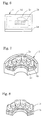
- Fig. 7 is a perspective view of one example of an artificial tooth holder in which anterior teeth are arranged and held in accordance with an average arrangement standard of a human being.
- Fig. 8 is a perspective view showing the state in which the artificial teeth are taken out from the artificial tooth holder of Fig. 7 together with a paste-like denture base material.
- Fig. 9 is a plane view of one example of an artificial tooth holder in which molars are arranged and held on a plane.
- Fig. 10 is a perspective view of a gypsum cast reproduced for an oral cavity.
- Fig. 11 is a perspective view showing the state in which an anterior tooth section taken out from an artificial tooth holder together with a paste-like denture base material is installed on a residual ridge of a gypsum cast.
- Fig. 12 is a perspective view showing the state in which a replenishing paste-like denture base material is added in the state of Fig. 11 and the shape is adjusted.
- Fig. 13 is a perspective view showing the state in which a molar section between E-F and between F-G in Fig. 9 is taken out from the artificial tooth holder and installed on the residual ridge of the gypsum cast of Fig. 12, and the shape is adjusted.
- Fig. 1 is a plane view of one example of an artificial tooth holder in which anterior teeth are arranged and held on a plane.
- Fig. 2 is a left-side view of Fig. 1.
- Fig. 3 is a plane view of another example of an artificial tooth holder in which anterior teeth are arranged and held on a plane.
- Fig. 4 is a left-side view of Fig. 3.
- Fig. 5 is a plane view showing an embodiment in which the artificial tooth holder of Fig. 1, wherein a paste-like denture base material arranging and holding the artificial teeth is a photopolymerization type paste-like denture base material, is covered by a cover comprising a light-screening material.
- Fig. 6 is a left-side view of Fig. 5.
- Fig. 5 is a left-side view of Fig. 5.
- FIG. 7 is a perspective view of one example of an artificial tooth holder in which anterior teeth are arranged and held in accordance with an average arrangement standard of a human being.
- Fig. 8 is a perspective view showing the state in which the artificial teeth are taken out from the artificial tooth holder of Fig. 7 together with a paste-like denture base material.
- Fig. 9 is a plane view of one example of an artificial tooth holder in which molars are arranged and held on a plane.
- Fig. 10 is a perspective view of a gypsum cast reproduced for an oral cavity.
- FIG. 11 is a perspective view showing the state in which an anterior tooth section taken out from an artificial tooth holder together with a paste-like denture base material is installed on a residual ridge of a gypsum cast.
- Fig. 12 is a perspective view showing the state in which a replenishing paste-like denture base material is added in the state of Fig. 11 and the shape is adjusted.
- Fig. 13 is a perspective view showing the state in which a molar section between E-F and between F-G in Fig. 10 is taken out from the artificial tooth holder and installed on the residual ridge of the gypsum cast of Fig. 12, and the shape is adjusted.
- a numeral 1 is an artificial tooth holder comprising artificial teeth 1c held in the same arrangement order as natural teeth on an artificial tooth holder main body 1a made of, e.g., a plastic, via a heat polymerization type or photopolymerization type paste-like denture base material 1b.
- the artificial teeth 1c are arranged on the paste-like denture base material 1b in accordance with an average arrangement standard of a human being, namely the artificial teeth are arranged in an arch state closed to the arrangement of natural teeth within an actual oral cavity, as shown in Fig. 7.
- the paste-like denture base material 1b is a photopolymerizable paste-like denture base material
- the entire of the artificial tooth holder 1 is covered by a cover comprising a light-screening material 1d, as shown in Figs. 5 and 6.
- the artificial tooth holder main body 1a is made thick or is made of a light-screening material 1d, thereby preventing the paste-like denture base material 1b from occurrence of polymerization and curing through exposure to light prior to the use.
- the artificial teeth 1c are held in the same arrangement order as natural teeth such that no rearrangement is required.
- the artificial teeth 1c may be held on the paste-like denture base material 1b in a manner such that the cheek side of the artificial teeth 1c can be seen, as shown in Fig. 1.
- the cervix is held on the paste-like denture base material 1b in a manner such that the artificial teeth 1c are easily arranged during the denture preparation, as shown in Figs. 3, 7 and 9.
- paste-like denture base material 1b among paste-like denture base materials which have been conventionally used in the dentistry, are employable heat polymerization type or photopolymerization type paste-like denture base materials exclusive of cold polymerization type paste-like denture base materials which are possibly polymerized prior to the actual use.
- These heat polymerization type or photopolymerization type paste-like denture base materials are comprised of a methacrylate-based monomer, a filler, a polymerization initiator, and other additives such as a ultraviolet light absorber and a coloring agent, whose viscosity is adjusted into one in a paste-like form or clay-like form such that they can be easily formed by means of a spatula or the like.
- methacrylate-based monomer examples include methyl methacrylate, ethyl methacrylate, isopropyl methacrylate, 2-hydroxyethyl methacrylate, 3-hydroxypropyl methacrylate, 2-hydroxy-1,3-dimethacryloxypropane, n-butyl methacrylate, isobutyl methacrylate, butoxyethyl methacrylate, hydroxypropyl methacrylate, tetrahydrofurfuryl methacrylate, glycidyl methacrylate, 2-methoxyethyl methacrylate, 2-ethylhexyl methacrylate, benzyl methacrylate, ethylene glycol dimethacrylate, diethylene glycol dimethacrylate, triethylene glycol dimethacrylate, triethylene glycol trimethacrylate, butylene glycol dimethacrylate, neopentyl glycol dimethacrylate, 1,3-butanedio
- methacrylates having a urethane bond in the molecule thereof include di-2-methacryloxyethyl- 2,2,4-trimethylhexamethylene dicarbamate, 1,3,5-tris[1,3-bis(methacryloyloxy)-2-propoxycarbonylaminohexane]-1,3,5-(1H,3H,5H)triazin-2,4,6-trione, a urethane oligomer consisting of 2,2'-di (4-hydroxycyclohexyl)propane, 2-oxepanone , hexamethylene diisocyanate and 2-hydroxyethyl methacrylate, and a urethane oligomer consisting of 1,3-butanediol, hexamethylene diisocyanate and 2-hydroxyethyl methacrylate.
- organic fillers which have hitherto been used in the dentistry, such as polymers (e.g., polymethyl methacrylate, polyethyl methacrylate), and pulverized polymers prepared by polymerizing the foregoing monomer and then finely pulverizing it; and inorganic fillers such as silicon dioxide, glasses (e.g., barium glass, alumina glass, potassium glass, fluoroaluminosilicate glass), synthetic zeolite, calcium phosphate, feldspar, fumed silica, aluminum silicate, calcium silicate, magnesium carbonate, and quartz.
- polymers e.g., polymethyl methacrylate, polyethyl methacrylate
- pulverized polymers prepared by polymerizing the foregoing monomer and then finely pulverizing it
- inorganic fillers such as silicon dioxide, glasses (e.g., barium glass, alumina glass, potassium glass, fluoroaluminosilicate glass), synthetic zeolite, calcium phosphate,
- inorganic fillers may be subjected to a surface treatment with, e.g., ⁇ -methacryloxypropyl trimethoxysilane, vinyl trichlorosilane, vinyl triethoxysilane, vinyl trimethoxysilane, vinyl triacetoxysilane, vinyl tri(methoxyethoxy)silane.
- organic-inorganic composite fillers prepared by mixing the foregoing inorganic filler with a polymerizable monomer or oligomers in advance, curing the mixture and then pulverizing the cured mixture.
- the heat polymerization type polymerization initiator As the heat polymerization type polymerization initiator, are mainly employed organic peroxides and azo compounds.
- organic peroxide are preferred diacyl peroxides having an aromatic ring and peroxyesters that are seemed to be an ester of perbenzoic acid.
- Effective examples include benzoyl peroxide, 2,4-dichlorobenzoyl peroxide, m-tolyl peroxide, t-butyl peroxybenzoate, di-t-butyl peroxyisophthalate, 2,5-dimethyl-2,5-di(benzoylperoxy)hexane, and 2,5-dimethyl-2,5-di ⁇ (o-benzoyl)benzoylperoxy ⁇ hexane.
- the azo compound not only azobisisobutyronitrile but also organometallic compounds such as tributylboron are useful.
- the photopolymerization initiator is generally used a combination of a sensitizer with a reducing agent.
- the sensitizer that can be used include camphor quinone, benzil, diacetyl, benzyl dimethyl ketal, benzyl diethyl ketal, benzyl di(2-methoxyethyl) ketal, 4,4'-dimethylbenzyl dimethyl ketal, anthraquinone, 1-chloroanthraquinone, 2-chloroanthraquinone, 1,2-benzanthraquinone, 1-hydroxyanthraquinone, 1-methylanthraquinone, 2-ethylanthraquinone, 1-bromoanthraquinone, thioxanthone, 2-isopropylthioxanthone, 2-nitrothioxanthone, 2-methylthioxanthone, 2,4-dimethylthioxanthone, 2,4-die
- tertiary amines As the reducing agent are generally used tertiary amines.
- Preferred examples of the tertiary amine that can be used include N,N-dimethyl-p-toluidine, N,N-dimethylaminoethyl methacrylate, triethanolamine, methyl 4-dimethylaminobenzoate, ethyl 4-dimethylaminobenzoate, and isoamyl 4-dimethylaminobenzoate.
- reducing agents are employable benzoyl peroxide, sodium sulfinate derivatives, and organometallic compounds.
- the polymerization reaction is achieved upon irradiation with actinic rays such as ultraviolet light and visible rays.
- actinic rays such as ultraviolet light and visible rays.
- the light source are employable various mercury vapor lamps of super high pressure, high pressure, medium pressure and low pressure, a chemical lamp, a carbon arc lamp, a metal halide lamp, a fluorescent lamp, LED, a tungsten lamp, a xenon lamp, and an argon ion laser.
- a numeral 2 is a gypsum cast having a residual ridge 2a and the like as prepared using an impression within an oral cavity of a patient taken according to the usual manner.
- the gypsum cast 2 includes the case of a gypsum cast of an edentulous jaw as shown in Fig. 10 and the case of a gypsum cast where remaining teeth are present when a removable partial denture is prepared. In the latter case, the shape within an oral cavity of a patient may be partially reproduced.
- a numeral 3 is a replenishing paste-like denture base material to be replenished and put into use in the case where the denture base material is insufficient only by the paste-like denture base material 1b of the artificial tooth holder 1.
- the replenishing paste-like denture base material 3 is basically constituted of the same configuration as the paste-like denture base material 1b.
- the replenishing paste-like denture base material 3 is integrated with the paste-like denture base material 1b and polymerized. Accordingly, it is required that the replenishing paste-like denture base material 3 is mutually polymerizable with the paste-like denture base material 1b.
- a paste-like denture base material for the preparation of a denture base section or an occlusion rim section, or a paste-like denture base material for the preparation of a cervix or adjustment of a gap between artificial teeth, as the replenishing paste-like denture base material 3, while adjusting the kind of compounding substances and compounding ratio thereof depending upon the utility.
- an impression within an oral cavity of a patient is first taken in a customary manner, and for example, the gypsum cast 2 as shown in Fig. 10 is then prepared utilizing the thus taken impression.
- the artificial teeth 1c are taken out from the artificial tooth holder main body 1a of the artificial tooth holder 1 together with the paste-like denture base material 1b and placed on the residual ridge 2a of the gypsum cast 2, or, in the case of a maxilla, placed on a residual ridge made of a paste-like denture base material for the preparation of a denture base section or an occlusion rim section.
- the artificial teeth 1c are arranged and held on a plane as in the embodiment shown in Fig. 3 or Fig. 5, the artificial teeth 1c are first arranged in an arch state closed to the arrangement of natural teeth within an actual oral cavity as shown in Fig. 8 and then placed on the residual ridge 2a of the gypsum cast 2 as shown in Fig. 11.
- the artificial teeth 1c are placed on the residual ridge 2a of the gypsum cast 2 as they are, as shown in Fig. 11.
- the paste-like denture base material 1b is processed to prepare a denture base.
- the paste-like denture base material 1b is in excess, the excessive paste-like denture base material 1b is removed.
- the replenishing paste-like denture base material 3 that is mutually polymerizable with the paste-like denture base material 1b is added. With respect to the replenishing paste-like denture base material 3, it is not always required to use one kind.
- a paste-like denture base material for the preparation of a denture base section or an occlusion rim section, or a paste-like denture base material for the preparation of a cervix or adjustment of a gap between artificial teeth as the replenishing paste-like denture base material 3, depending upon the utility, not only the work efficiency is improved, but also the designing property of the denture becomes good.
- the denture is set in an articulator, and after arrangement of the artificial teeth and occlusal adjustment and arrangement, the paste-like denture base materials 1b and 3 are finally cured and polymerized by means of heat polymerization or photopolymerization. The resultant is subjected to final trimming and polishing, whereby a denture is completed.
- the paste-like denture base materials 1b and 3 may be subjected to primary polymerization at each of the preparation stages such as the preparation of a denture base section or an occlusion rim section and the arrangement of artificial teeth to an extent such that the shape does not change, and after completely adjusting the shape as a denture, the entire of the denture may be polymerized and cured.
- a full denture when all artificial teeth are not arranged at once, but every group of several artificial teeth is subjected to arrangement and orthodonture, the works become easy.
- the anterior tooth section as shown in Figs. 1, 3, 5 and 7 and the molar section as shown in Fig. 9
- the anterior tooth section is first arranged as shown in Fig. 11.
- the molar section is arranged as shown in Fig. 13.
- the full denture can be simply prepared.
- the artificial teeth 1c considered necessary among the anterior tooth section and the molar section are taken out from the artificial tooth holder main body 1a together with the paste-like denture base material 1b, thereby preparing the denture.
- any dentures can be prepared through simple operations.
- Tetrahydrofurfuryl methacrylate 2 % by weight Polybutylene glycol dimethacrylate 2 % by weight Di-2-methacryloxyethyl-2,2,4-trimethylhexamethylene dicarbamate 38 % by weight
- Urethane oligomer consisting of 2,2'-di(4-hydroxycyclohexyl)propane, 2-oxepanone , hexamethylene diisocyanate and 2-hydroxyethyl methacrylate 16 % by weight
- Organic filler 40.9 % by weight Camphor quinone 0.5 % by weight
- Ethyl 4-dimethylaminobenzoate 0.5 % by weight 6-tert-butyl-2,4-xylenol 0.1 % by weight
- An artificial tooth holder covered by a light-screening material was prepared by building up this photopolymerization type paste-like denture base material on a plastic-made artificial tooth holder main body and arranging and holding artificial teeth for anterior teeth in accordance with an average arrangement standard of a human being as shown in Fig. 7. Also, an artificial tooth holder covered by a light-screening material was prepared by building up the same photopolymerization type paste-like denture base material on a plastic-made artificial tooth holder main body and arranging and holding artificial teeth for molars on a plane as shown in Fig. 9.
- the artificial teeth for anterior teeth were taken out from the artificial tooth holder from which the light-screening material had been removed, together with the paste-like denture base material and brought into press contact with the gypsum cast.
- the artificial teeth for molars were taken out from the artificial tooth holder together with the paste-like denture base material and brought into press contact with the same gypsum cast. The resultant was set in an articulator. During this time, since the artificial teeth were held by the paste-like denture base material in the same arrangement order as natural teeth, a desired arrangement could be easily achieved by simple repair.
- an artificial tooth holder covered by a light-screening material was prepared by building up the paste-like denture base material (a) on a plastic-made artificial tooth holder main body and arranging and holding artificial teeth for anterior teeth on a plane as shown in Fig. 3. Also, an artificial tooth holder covered by a light-screening material was prepared by building up the same paste-like denture base material (a) on a plastic-made artificial tooth holder main body and arranging and holding artificial teeth for molars on a plane as shown in Fig. 9.
- the paste-like denture base material (b) for the preparation of a denture base section or an occlusion rim section was formed in a sheet-like state and brought into press contact with the gypsum cast to form a denture base section, which was then set in an articulator.
- the artificial teeth for anterior teeth were taken out from the artificial tooth holder from which the light-screening material had been removed, together with the paste-like denture base material (a), and the paste-like denture base material (a) was curved in accordance with an average arrangement standard of a human being and then brought into press contact with the gypsum cast.
- the artificial teeth for molars were taken out together with the paste-like denture base material (a), and the paste-like denture base material (a) was curved in accordance with an average arrangement standard of a human being and then brought into press contact with the same gypsum cast. During this time, since the artificial teeth were held by the paste-like denture base material (a) in the same arrangement order as natural teeth, a desired arrangement could be easily achieved by simple repair. Next, fine gaps such as boundaries between the anterior teeth and the molars were filled with the paste-like denture base material (c) for the preparation of a cervix or adjustment of a gap site between artificial teeth.
- an artificial tooth holder covered by a light-screening material was prepared by building up the paste-like denture base material (a) on a plastic-made artificial tooth holder main body and arranging and holding artificial teeth for anterior teeth in accordance with an average arrangement standard of a human being as shown in Fig. 7. Also, an artificial tooth holder covered by a light-screening material was prepared by building up the same paste-like denture base material (a) on a plastic-made artificial tooth holder main body and arranging and holding artificial teeth for molars on a plane as shown in Fig. 9.
- the paste-like denture base material (b) for the preparation of a denture base section or an occlusion rim section was formed in a sheet-like state and brought into press contact with the gypsum cast to form a denture base section, which was then set in an articulator.
- the artificial teeth for anterior teeth were taken out from the artificial tooth holder from which the light-screening material had been removed, together with the paste-like denture base material (a), and the paste-like denture base material (a) was formed into a curve in accordance with an average arrangement standard of human beings and then brought into press contact with the gypsum cast.
- the artificial teeth for molars were taken out together with the paste-like denture base material (a), and the paste-like denture base material (a) was curved in accordance with an average arrangement standard of a human being and then brought into press contact with the same gypsum cast.
- an artificial tooth holder was prepared by building up the paste-like denture base material (a) on a plastic-made artificial tooth holder main body and arranging and holding artificial teeth for anterior teeth in accordance with an average arrangement standard of a human being as shown in Fig. 7. Also, an artificial tooth holder was prepared by building up the same paste-like denture base material (a) on a plastic-made artificial tooth holder main body and arranging and holding artificial teeth for molars on a plane as shown in Fig. 9.
- the paste-like denture base material (b) for the preparation of a denture base section or an occlusion rim section was formed in a sheet-like state and brought into press contact with the gypsum cast to form a denture base section. Also, using the paste-like denture base material (b) for the preparation of a denture base section or an occlusion rim section, an occlusion rim section was built up on the denture base surface, and the gypsum cast was set in an articulator.
- the artificial teeth for anterior teeth were taken out from the artificial tooth holder together with the paste-like denture base material (a) and placed in the space corresponding to the position of the anterior teeth.
- the artificial teeth for molars were taken out together with the paste-like denture base material (a), and the paste-like denture base material (a) was curved in accordance with an average arrangement standard of a human being and placed to achieve the arrangement of artificial teeth.
- the artificial teeth were held by the paste-like denture base material (a) in the same arrangement order as natural teeth, a desired arrangement could be easily achieved by simple trimming.
- the artificial tooth holder according to the present invention artificial teeth are not arranged and held by a wax as in the conventional artificial tooth holder but are arranged and held by a paste-like denture base material that can be used as a denture base as it stands. Accordingly, the artificial tooth holder according to the present invention is different from the conventional case wherein only an artificial tooth main body is taken out and placed on a denture base material one by one using a wax on a gypsum cast as separately prepared.
- the artificial tooth holder according to the present invention, only by taking out the artificial teeth held in the same arrangement order as natural teeth as they are, together with the paste-like denture base material, and placing them on a gypsum cast, and then trimming the shape, a high-degree arrangement work of artificial teeth can be achieved.
- the denture preparation method according to the present invention is concerned with a process for preparing a denture using the above-described artificial tooth holder according to the present invention.
- the denture can be directly prepared, without need to prepare a wax denture as in the conventional lost wax process.
- the preparation method according to the present invention is an easy method with a markedly reduced number of preparation steps, as compared with the conventional denture preparation methods requiring a number of preparation steps and a very long period of time, so that the required preparation period, which has hitherto been several days to several weeks, can be greatly reduced.
- the present invention is greatly valuable in contributing to the dental remedy.
Landscapes
- Health & Medical Sciences (AREA)
- Oral & Maxillofacial Surgery (AREA)
- Dentistry (AREA)
- Epidemiology (AREA)
- Life Sciences & Earth Sciences (AREA)
- Animal Behavior & Ethology (AREA)
- General Health & Medical Sciences (AREA)
- Public Health (AREA)
- Veterinary Medicine (AREA)
- Dental Preparations (AREA)
- Dental Tools And Instruments Or Auxiliary Dental Instruments (AREA)
Abstract
An artificial tooth holder is constituted of
artificial teeth held in the same arrangement order as natural
teeth on an artificial tooth holder main body via a heat
polymerization type or photopolymerization type paste-like
denture base material. The denture is prepared by taking out
artificial teeth necessary for the preparation of a denture
from an artificial tooth holder together with the paste-like
denture base material and placing them on a residual ridge of
a gypsum cast reproduced for an oral cavity of a patient; and,
after trimming into a desired denture shape by adding a
replenishing paste-like denture base material which is
mutually polymerizable with the paste-like denture base
material according to necessity before or after the paste-like
denture base material being placed, polymerizing and curing the
paste-like denture base material by heat polymerization or
photopolymerization.
Description
- The present invention relates to an artificial tooth holder where artificial teeth are arranged and held via a paste-like denture base material and to a preparation method of a denture for preparing a denture using artificial teeth taken out from the artificial tooth holder together with the paste-like denture base material.
- Hitherto, the preparation of a denture has been carried out in a process usually called as a lost wax process. That is, an impression within an oral cavity of a patient is taken to prepare a gypsum cast; a denture base section and an occlusion rim are formed on the gypsum cast using a dental wax or the like; the denture base section and the occlusion rim are set in an articulator; artificial teeth held with a tacky wax on an artificial tooth plastic holder are taken out one by one from the artificial tooth plastic holder; the tacky wax attached to the artificial teeth is cleanly washed out upon exposure to hot water or the like; and the entire of the denture base is subjected to shape arrangement such as arrangement of artificial teeth and formation of a gingival section, while adjusting the occlusion on the denture base section, thereby preparing a wax denture having a shape the same as a desired denture. Thereafter, the wax denture is taken out from the articulator and invested together with the gypsum cast in a flask using an investing plaster; the wax portion is washed out with hot water or the like, to form a cavity of the denture base section in an investment; a heat polymerization type denture base material comprising a powder comprised of polymethyl methacrylate as a major component and a liquid comprised of methyl methacrylate as a major component is weighed and mixed, and the mixture is allowed to stand for a certain period of time to form like a dough, which is then filled within the cavity formed in the investing plaster; the resulting mixture is polymerized and cured by dipping in hot water; and after cooling, the polymerized and cured material is excavated from the investment and then subjected to trimming and polishing. Thus, according to the conventional art, it took a long period of time and a lot of labors to prepare the denture.
- Further, the following has been employed as a preparation method without using the lost wax process. That is, an impression within an oral cavity of a patient is taken to prepare a gypsum cast; and a denture base section and an occlusion rim are formed on the gypsum cast using a photopolymerization type paste-like denture base material comprising a methacrylate-based monomer, a filler and a polymerization initiator in place of the dental wax. In the case of the denture base section, if desired, actinic rays are irradiated to effect primary polymerization. After setting in an articulator, the paste-like denture base material which will become a gingival section is built up; artificial teeth held with a tacky wax on an artificial tooth plastic holder are taken out one by one from the artificial tooth plastic holder; the tacky wax attached to the artificial teeth is cleanly washed out upon exposure to hot water or the like; the entire of the denture base is subjected to shape arrangement such as arrangement of artificial teeth and formation of a gingival section, while adjusting the occlusion on the denture base section; and actinic rays are irradiated to achieve ultimate polymerization and curing, followed by polishing. Such denture preparation method is disclosed in JP-A-62-117552.
- However, in the case where the arrangement work of artificial teeth is carried out for every tooth, there were involved defects that it is difficult to properly provide a gap between the artificial teeth to be arranged and that among the artificial teeth in the arrangement, even those which are not required to be moved are erroneously moved. Accordingly, this method required a skill in the arrangement of artificial teeth and took a very long period of time and delicacy. On the other hand, there was employed a method in which connected teeth in a form where several artificial teeth are connected in advance are used. However, this method involved a defect that since the size of the artificial teeth to be arranged and the kind of arrangement pattern are limited, the method cannot be applied to all dentures.
- Thus, the present invention is aimed to provide an artificial tooth holder by which various complicated steps required for the preparation of a denture are reduced and the arrangement work of artificial teeth, which has hitherto required a skill, is made simple and to provide a preparation method of a denture using the artificial tooth holder.
- In order to achieve the above-described aim, the present inventors made extensive and intensive investigations. As a result, they have found the following matters. That is, the denture preparation methods of the conventional art required operations such that artificial teeth held on an artificial tooth plastic holder with a tacky wax for ensuring good adhesion between the artificial teeth and a denture base are taken out one by one from the artificial tooth plastic holder and that the tacky wax attached to the artificial teeth is cleanly washed out upon exposure to hot water or the like, so as to not lower the adhesiveness to the denture base material. In order to make such operations unnecessary and omit the complicated steps for taking out the artificial teeth one by one from the artificial tooth plastic holder and arranging the artificial teeth, when the artificial teeth are held on an artificial tooth holder via a paste-like denture base material that can be used as a denture base material as it stands, by taking out the artificial teeth together with the paste-like denture base material and placing them on a gypsum cast, it is not necessary to take out the artificial teeth one by one from the artificial tooth plastic holder and arrange them, and hence, such a complicated step for arranging the artificial teeth at predetermined gaps can be reduced, thereby making the preparation of a denture easy. The present invention has thus been completed based on these findings.
- Specifically, the present invention is concerned with an artificial tooth holder comprising artificial teeth held in the same arrangement order as natural teeth on an artificial tooth holder main body via a heat polymerization type or photopolymerization type paste-like denture base material and also with a process for preparing a denture using the artificial tooth holder. As the artificial tooth holder according to the present invention are preferred an embodiment in which, in the case where the paste-like denture base material is of a photopolymerization type, the artificial tooth holder is covered by a light-screening material such that the paste-like denture base material is not polymerized prior to the preparation of a denture and an embodiment in which the artificial teeth are arranged on the paste-like denture base material in accordance with an average arrangement standard of a human being, namely the artificial teeth are arranged in an arch state closed to the arrangement of natural teeth within an actual oral cavity.
- The denture preparation method according to the present invention is a process for preparing a denture, which comprises taking out artificial teeth necessary for the preparation of a denture from an artificial tooth holder comprising artificial teeth held in the same arrangement order as natural teeth on an artificial tooth holder main body via a heat polymerization type or photopolymerization type paste-like denture base material, together with the paste-like denture base material and placing them on a residual ridge of a gypsum cast reproduced for an oral cavity of a patient; and after adjusting into a desired denture shape, polymerizing and curing the paste-like denture base material by heat polymerization or photopolymerization to prepare a denture. In this process, there may be employed a method in which, before or after taking out artificial teeth necessary for the preparation of a denture from an artificial tooth holder comprising artificial teeth held in the same arrangement order as natural teeth on an artificial tooth holder main body via a heat polymerization type or photopolymerization type paste-like denture base material, together with the paste-like denture base material and placing them on a residual ridge of a gypsum cast reproduced for an oral cavity of a patient, a replenishing paste-like denture base material which is mutually polymerizable with the paste-like denture base material is added; and, after trimming into a desired denture shape, the paste-like denture base materials are polymerized and cured by heat polymerization or photopolymerization to prepare a denture. In this case, it is more preferred to use a paste-like denture base material for the preparation of a denture base section or an occlusion rim section, and/or a paste-like denture base material for the preparation of a cervix or adjustment of a gap between artificial teeth, as the replenishing paste-like denture base material, depending upon the utility.
- Fig. 1 is a plane view of one example of an artificial tooth holder in which anterior teeth are arranged and held on a plane.
- Fig. 2 is a left-side view of Fig. 1.
- Fig. 3 is a plane view of another example of an artificial tooth holder in which anterior teeth are arranged and held on a plane.
- Fig. 4 is a left-side view of Fig. 3.
- Fig. 5 is a plane view showing an embodiment in which the artificial tooth holder of Fig. 1, wherein a paste-like denture base material arranging and holding the artificial teeth is a photopolymerization type paste-like denture base material, is covered by a cover comprising a light-screening material.
- Fig. 6 is a left-side view of Fig. 5.
- Fig. 7 is a perspective view of one example of an artificial tooth holder in which anterior teeth are arranged and held in accordance with an average arrangement standard of a human being.
- Fig. 8 is a perspective view showing the state in which the artificial teeth are taken out from the artificial tooth holder of Fig. 7 together with a paste-like denture base material.
- Fig. 9 is a plane view of one example of an artificial tooth holder in which molars are arranged and held on a plane.
- Fig. 10 is a perspective view of a gypsum cast reproduced for an oral cavity.
- Fig. 11 is a perspective view showing the state in which an anterior tooth section taken out from an artificial tooth holder together with a paste-like denture base material is installed on a residual ridge of a gypsum cast.
- Fig. 12 is a perspective view showing the state in which a replenishing paste-like denture base material is added in the state of Fig. 11 and the shape is adjusted.
- Fig. 13 is a perspective view showing the state in which a molar section between E-F and between F-G in Fig. 9 is taken out from the artificial tooth holder and installed on the residual ridge of the gypsum cast of Fig. 12, and the shape is adjusted.
- The artificial tooth holder and denture preparation method according to the present invention will be described below in detail with reference to the drawings.
- Fig. 1 is a plane view of one example of an artificial tooth holder in which anterior teeth are arranged and held on a plane. Fig. 2 is a left-side view of Fig. 1. Fig. 3 is a plane view of another example of an artificial tooth holder in which anterior teeth are arranged and held on a plane. Fig. 4 is a left-side view of Fig. 3. Fig. 5 is a plane view showing an embodiment in which the artificial tooth holder of Fig. 1, wherein a paste-like denture base material arranging and holding the artificial teeth is a photopolymerization type paste-like denture base material, is covered by a cover comprising a light-screening material. Fig. 6 is a left-side view of Fig. 5. Fig. 7 is a perspective view of one example of an artificial tooth holder in which anterior teeth are arranged and held in accordance with an average arrangement standard of a human being. Fig. 8 is a perspective view showing the state in which the artificial teeth are taken out from the artificial tooth holder of Fig. 7 together with a paste-like denture base material. Fig. 9 is a plane view of one example of an artificial tooth holder in which molars are arranged and held on a plane. Fig. 10 is a perspective view of a gypsum cast reproduced for an oral cavity. Fig. 11 is a perspective view showing the state in which an anterior tooth section taken out from an artificial tooth holder together with a paste-like denture base material is installed on a residual ridge of a gypsum cast. Fig. 12 is a perspective view showing the state in which a replenishing paste-like denture base material is added in the state of Fig. 11 and the shape is adjusted. Fig. 13 is a perspective view showing the state in which a molar section between E-F and between F-G in Fig. 10 is taken out from the artificial tooth holder and installed on the residual ridge of the gypsum cast of Fig. 12, and the shape is adjusted.
- In the drawings, a
numeral 1 is an artificial tooth holder comprisingartificial teeth 1c held in the same arrangement order as natural teeth on an artificial tooth holdermain body 1a made of, e.g., a plastic, via a heat polymerization type or photopolymerization type paste-likedenture base material 1b. Preferably, theartificial teeth 1c are arranged on the paste-likedenture base material 1b in accordance with an average arrangement standard of a human being, namely the artificial teeth are arranged in an arch state closed to the arrangement of natural teeth within an actual oral cavity, as shown in Fig. 7. - In the case where the paste-like
denture base material 1b is a photopolymerizable paste-like denture base material, in order to prevent the paste-likedenture base material 1b from occurrence of polymerization prior to the use, it is preferred that the entire of theartificial tooth holder 1 is covered by a cover comprising a light-screening material 1d, as shown in Figs. 5 and 6. Further, it is more preferred that the artificial tooth holdermain body 1a is made thick or is made of a light-screening material 1d, thereby preventing the paste-likedenture base material 1b from occurrence of polymerization and curing through exposure to light prior to the use. - It is necessary that the
artificial teeth 1c are held in the same arrangement order as natural teeth such that no rearrangement is required. In order to make it easy to achieve shade matching with natural teeth of a patient, theartificial teeth 1c may be held on the paste-likedenture base material 1b in a manner such that the cheek side of theartificial teeth 1c can be seen, as shown in Fig. 1. But, it is preferred that the cervix is held on the paste-likedenture base material 1b in a manner such that theartificial teeth 1c are easily arranged during the denture preparation, as shown in Figs. 3, 7 and 9. - As the paste-like
denture base material 1b, among paste-like denture base materials which have been conventionally used in the dentistry, are employable heat polymerization type or photopolymerization type paste-like denture base materials exclusive of cold polymerization type paste-like denture base materials which are possibly polymerized prior to the actual use. These heat polymerization type or photopolymerization type paste-like denture base materials are comprised of a methacrylate-based monomer, a filler, a polymerization initiator, and other additives such as a ultraviolet light absorber and a coloring agent, whose viscosity is adjusted into one in a paste-like form or clay-like form such that they can be easily formed by means of a spatula or the like. Specific examples of the methacrylate-based monomer include methyl methacrylate, ethyl methacrylate, isopropyl methacrylate, 2-hydroxyethyl methacrylate, 3-hydroxypropyl methacrylate, 2-hydroxy-1,3-dimethacryloxypropane, n-butyl methacrylate, isobutyl methacrylate, butoxyethyl methacrylate, hydroxypropyl methacrylate, tetrahydrofurfuryl methacrylate, glycidyl methacrylate, 2-methoxyethyl methacrylate, 2-ethylhexyl methacrylate, benzyl methacrylate, ethylene glycol dimethacrylate, diethylene glycol dimethacrylate, triethylene glycol dimethacrylate, triethylene glycol trimethacrylate, butylene glycol dimethacrylate, neopentyl glycol dimethacrylate, 1,3-butanediol dimethacrylate, 1,4-butanediol dimethacrylate, 1,6-hexanediol dimethacrylate, trimethylolpropane trimethacrylate, trimethylolethane trimethacrylate, trimethylolmethane trimethacrylate, pentaerythritol trimethacrylate, pentaerythritol tetramethacrylate, polyoxytetraethylene glycol dimethacrylate, 2,2-bis(methacryloxyphenyl)propane, 2,2-bis[4-(2-hydroxy-3-methacryloxypropoxy)phenyl]propane, 2,2-bis(4-methacryloxydiethoxyphenyl)propane, and 2,2-bis-(4-methacryloxypolyethoxyphenyl)propane. Examples of methacrylates having a urethane bond in the molecule thereof include di-2-methacryloxyethyl- 2,2,4-trimethylhexamethylene dicarbamate, 1,3,5-tris[1,3-bis(methacryloyloxy)-2-propoxycarbonylaminohexane]-1,3,5-(1H,3H,5H)triazin-2,4,6-trione, a urethane oligomer consisting of 2,2'-di (4-hydroxycyclohexyl)propane, 2-oxepanone , hexamethylene diisocyanate and 2-hydroxyethyl methacrylate, and a urethane oligomer consisting of 1,3-butanediol, hexamethylene diisocyanate and 2-hydroxyethyl methacrylate. - As the filler, are employable organic fillers which have hitherto been used in the dentistry, such as polymers (e.g., polymethyl methacrylate, polyethyl methacrylate), and pulverized polymers prepared by polymerizing the foregoing monomer and then finely pulverizing it; and inorganic fillers such as silicon dioxide, glasses (e.g., barium glass, alumina glass, potassium glass, fluoroaluminosilicate glass), synthetic zeolite, calcium phosphate, feldspar, fumed silica, aluminum silicate, calcium silicate, magnesium carbonate, and quartz. These inorganic fillers may be subjected to a surface treatment with, e.g., γ-methacryloxypropyl trimethoxysilane, vinyl trichlorosilane, vinyl triethoxysilane, vinyl trimethoxysilane, vinyl triacetoxysilane, vinyl tri(methoxyethoxy)silane. Further, are employable so-called organic-inorganic composite fillers prepared by mixing the foregoing inorganic filler with a polymerizable monomer or oligomers in advance, curing the mixture and then pulverizing the cured mixture.
- With respect to the polymerization initiator, as the heat polymerization type polymerization initiator, are mainly employed organic peroxides and azo compounds. As the organic peroxide, are preferred diacyl peroxides having an aromatic ring and peroxyesters that are seemed to be an ester of perbenzoic acid. Effective examples include benzoyl peroxide, 2,4-dichlorobenzoyl peroxide, m-tolyl peroxide, t-butyl peroxybenzoate, di-t-butyl peroxyisophthalate, 2,5-dimethyl-2,5-di(benzoylperoxy)hexane, and 2,5-dimethyl-2,5-di{(o-benzoyl)benzoylperoxy}hexane. As the azo compound, not only azobisisobutyronitrile but also organometallic compounds such as tributylboron are useful.
- As the photopolymerization initiator is generally used a combination of a sensitizer with a reducing agent. Examples of the sensitizer that can be used include camphor quinone, benzil, diacetyl, benzyl dimethyl ketal, benzyl diethyl ketal, benzyl di(2-methoxyethyl) ketal, 4,4'-dimethylbenzyl dimethyl ketal, anthraquinone, 1-chloroanthraquinone, 2-chloroanthraquinone, 1,2-benzanthraquinone, 1-hydroxyanthraquinone, 1-methylanthraquinone, 2-ethylanthraquinone, 1-bromoanthraquinone, thioxanthone, 2-isopropylthioxanthone, 2-nitrothioxanthone, 2-methylthioxanthone, 2,4-dimethylthioxanthone, 2,4-diethylthioxanthone, 2,4-diisopropylthioxanthone, 2-chloro-7-trifluoromethylthioxanthone, thioxanthone-10,10-dioxide, thioxanthone-10-oxide, benzoin methyl ether, benzoin ethyl ether, isopropyl ether, benzoin isobutyl ether, benzophenone, bis(4-dimethylaminophenyl) ketone, 4,4'-bisdiethylaminobenzophenone, acyl phosphine oxide derivatives, and azide group-containing compounds. These compounds may be used alone or in admixture.
- As the reducing agent are generally used tertiary amines. Preferred examples of the tertiary amine that can be used include N,N-dimethyl-p-toluidine, N,N-dimethylaminoethyl methacrylate, triethanolamine, methyl 4-dimethylaminobenzoate, ethyl 4-dimethylaminobenzoate, and isoamyl 4-dimethylaminobenzoate. As other reducing agents, are employable benzoyl peroxide, sodium sulfinate derivatives, and organometallic compounds. In the case of the photopolymerization type polymerization initiator, the polymerization reaction is achieved upon irradiation with actinic rays such as ultraviolet light and visible rays. As the light source, are employable various mercury vapor lamps of super high pressure, high pressure, medium pressure and low pressure, a chemical lamp, a carbon arc lamp, a metal halide lamp, a fluorescent lamp, LED, a tungsten lamp, a xenon lamp, and an argon ion laser.
- A
numeral 2 is a gypsum cast having aresidual ridge 2a and the like as prepared using an impression within an oral cavity of a patient taken according to the usual manner. The gypsum cast 2 includes the case of a gypsum cast of an edentulous jaw as shown in Fig. 10 and the case of a gypsum cast where remaining teeth are present when a removable partial denture is prepared. In the latter case, the shape within an oral cavity of a patient may be partially reproduced. - A
numeral 3 is a replenishing paste-like denture base material to be replenished and put into use in the case where the denture base material is insufficient only by the paste-likedenture base material 1b of theartificial tooth holder 1. The replenishing paste-likedenture base material 3 is basically constituted of the same configuration as the paste-likedenture base material 1b. The replenishing paste-likedenture base material 3 is integrated with the paste-likedenture base material 1b and polymerized. Accordingly, it is required that the replenishing paste-likedenture base material 3 is mutually polymerizable with the paste-likedenture base material 1b. It is more preferred to properly use a paste-like denture base material for the preparation of a denture base section or an occlusion rim section, or a paste-like denture base material for the preparation of a cervix or adjustment of a gap between artificial teeth, as the replenishing paste-likedenture base material 3, while adjusting the kind of compounding substances and compounding ratio thereof depending upon the utility. - In order to carry out the denture preparation method according to the present invention using the
artificial tooth holder 1 having the above-described configuration according to the present invention, an impression within an oral cavity of a patient is first taken in a customary manner, and for example, the gypsum cast 2 as shown in Fig. 10 is then prepared utilizing the thus taken impression. Next, theartificial teeth 1c are taken out from the artificial tooth holdermain body 1a of theartificial tooth holder 1 together with the paste-likedenture base material 1b and placed on theresidual ridge 2a of thegypsum cast 2, or, in the case of a maxilla, placed on a residual ridge made of a paste-like denture base material for the preparation of a denture base section or an occlusion rim section. During this time, for example, in the case where, in theartificial tooth holder 1, theartificial teeth 1c are arranged and held on a plane as in the embodiment shown in Fig. 3 or Fig. 5, theartificial teeth 1c are first arranged in an arch state closed to the arrangement of natural teeth within an actual oral cavity as shown in Fig. 8 and then placed on theresidual ridge 2a of the gypsum cast 2 as shown in Fig. 11. Alternatively, in the case where, in theartificial tooth holder 1, theartificial teeth 1c are arranged and held in accordance with an average arrangement standard of a human being as in the embodiment shown in Fig. 7, theartificial teeth 1c are placed on theresidual ridge 2a of the gypsum cast 2 as they are, as shown in Fig. 11. Next, the paste-likedenture base material 1b is processed to prepare a denture base. In the case where the paste-likedenture base material 1b is in excess, the excessive paste-likedenture base material 1b is removed. Alternatively, in the case where the paste-likedenture base material 1b is short, the replenishing paste-likedenture base material 3 that is mutually polymerizable with the paste-likedenture base material 1b is added. With respect to the replenishing paste-likedenture base material 3, it is not always required to use one kind. By properly using a paste-like denture base material for the preparation of a denture base section or an occlusion rim section, or a paste-like denture base material for the preparation of a cervix or adjustment of a gap between artificial teeth, as the replenishing paste-likedenture base material 3, depending upon the utility, not only the work efficiency is improved, but also the designing property of the denture becomes good. Thereafter, the denture is set in an articulator, and after arrangement of the artificial teeth and occlusal adjustment and arrangement, the paste-likedenture base materials - During the preparation of the denture, it is not always required to polymerize the paste-like
denture base materials denture base materials - In the case where a full denture is prepared, when all artificial teeth are not arranged at once, but every group of several artificial teeth is subjected to arrangement and orthodonture, the works become easy. For example, using the anterior tooth section as shown in Figs. 1, 3, 5 and 7 and the molar section as shown in Fig. 9, the anterior tooth section is first arranged as shown in Fig. 11. Next, the molar section is arranged as shown in Fig. 13. Thus, the full denture can be simply prepared. Further, in the case of a partial removable denture, the
artificial teeth 1c considered necessary among the anterior tooth section and the molar section are taken out from the artificial tooth holdermain body 1a together with the paste-likedenture base material 1b, thereby preparing the denture. Thus, any dentures can be prepared through simple operations. - The artificial tooth holder and the denture preparation method according to the present invention will be described with reference to the following Examples, but it should not be construed that the invention is limited thereto.
- Components of a photopolymerization type paste-like denture base material in which artificial teeth are to be arranged and held were prepared in accordance with the following formulation.
Tetrahydrofurfuryl methacrylate 2 % by weight Polybutylene glycol dimethacrylate 2 % by weight Di-2-methacryloxyethyl-2,2,4-trimethylhexamethylene dicarbamate 38 % by weight Urethane oligomer consisting of 2,2'-di(4-hydroxycyclohexyl)propane, 2-oxepanone , hexamethylene diisocyanate and 2- hydroxyethyl methacrylate 16 % by weight Organic filler 40.9 % by weight Camphor quinone 0.5 % by weight Ethyl 4-dimethylaminobenzoate 0.5 % by weight 6-tert-butyl-2,4-xylenol 0.1 % by weight - An artificial tooth holder covered by a light-screening material was prepared by building up this photopolymerization type paste-like denture base material on a plastic-made artificial tooth holder main body and arranging and holding artificial teeth for anterior teeth in accordance with an average arrangement standard of a human being as shown in Fig. 7. Also, an artificial tooth holder covered by a light-screening material was prepared by building up the same photopolymerization type paste-like denture base material on a plastic-made artificial tooth holder main body and arranging and holding artificial teeth for molars on a plane as shown in Fig. 9.
- Then, an impression within an oral cavity was taken, and a gypsum cast was prepared using the impression. Next, the artificial teeth for anterior teeth were taken out from the artificial tooth holder from which the light-screening material had been removed, together with the paste-like denture base material and brought into press contact with the gypsum cast. Also, the artificial teeth for molars were taken out from the artificial tooth holder together with the paste-like denture base material and brought into press contact with the same gypsum cast. The resultant was set in an articulator. During this time, since the artificial teeth were held by the paste-like denture base material in the same arrangement order as natural teeth, a desired arrangement could be easily achieved by simple repair. Thus, an overall balance was adjusted, and the denture was irradiated with light for 5 minutes by a visible light curing unit (a trade name: Labolight LV-II, made by GC Corporation), thereby polymerizing and curing the paste-like denture base material. After trimming and polishing, a full plate denture was completed.
-
- (a) Components of a photopolymerization type paste-like
denture base material in which artificial teeth are to be
arranged and held were prepared in accordance with the
following formulation.
Tetrahydrofurfuryl methacrylate 2 % by weight Polybutylene glycol dimethacrylate 2 % by weight Di-2-methacryloxyethyl-2,2,4-trimethylhexamethylene dicarbamate 38 % by weight Urethane oligomer consisting of 2,2'-di(4-hydroxycyclohexyl)propane, 2-oxepanone , hexamethylene diisocyanate and 2- hydroxyethyl methacrylate 16 % by weight Organic filler 40.9 % by weight Camphor quinone 0.5 % by weight Ethyl 4-dimethylaminobenzoate 0.5 % by weight 6-tert-butyl-2,4-xylenol 0.1 % by weight - (b) A photopolymerization type replenishing paste-like
denture base material, particularly a photopolymerization type
paste-like denture base material for the preparation of a
denture base section or an occlusion rim section, that is to
be used for the preparation of a denture base section or an
occlusion rim section, was prepared in accordance with the
following formulation.
Tetrahydrofurfuryl methacrylate 2 % by weight Polybutylene glycol dimethacrylate 2 % by weight Di-2-methacryloxyethyl-2,2,4-trimethylhexamethylene dicarbamate 31 % by weight Urethane oligomer consisting of 2,2'-di(4-hydroxycyclohexyl)propane, 2-oxepanone , hexamethylene diisocyanate and 2-hydroxyethyl methacrylate: 14 % by weight Organic filler 49.9 % by weight Camphor quinone 0.5 % by weight Ethyl 4-dimethylaminobenzoate 0.5 % by weight 6-tert-butyl-2,4-xylenol 0.1 % by weight - (c) A photopolymerization type replenishing paste-like
denture base material, particularly a photopolymerization type
paste-like denture base material for the preparation of a
cervix or adjustment of a gap between artificial teeth, that
is to be used for the preparation of a cervix or adjustment of
a gap between artificial teeth and slightly flows spontaneously
in a stationary state, was prepared in accordance with the
following formulation.
Tetrahydrofurfuryl methacrylate 3 % by weight Polybutylene glycol dimethacrylate 3 % by weight Di-2-methacryloxyethyl-2,2,4-trimethylhexamethylene dicarbamate 44 % by weight Urethane oligomer consisting of 2,2'-di(4-hydroxycyclohexyl)propane, 2-oxepanone , hexamethylene diisocyanate and 2-hydroxyethyl methacrylate 20 % by weight Organic filler 28.9 % by weight Camphor quinone 0.5 % by weight Ethyl 4-dimethylaminobenzoate 0.5 % by weight 6-tert-butyl-2,4-xylenol 0.1 % by weight -
- First, an artificial tooth holder covered by a light-screening material was prepared by building up the paste-like denture base material (a) on a plastic-made artificial tooth holder main body and arranging and holding artificial teeth for anterior teeth on a plane as shown in Fig. 3. Also, an artificial tooth holder covered by a light-screening material was prepared by building up the same paste-like denture base material (a) on a plastic-made artificial tooth holder main body and arranging and holding artificial teeth for molars on a plane as shown in Fig. 9.
- Then, an impression within an oral cavity was taken, and a gypsum cast was prepared using the impression. Next, the paste-like denture base material (b) for the preparation of a denture base section or an occlusion rim section was formed in a sheet-like state and brought into press contact with the gypsum cast to form a denture base section, which was then set in an articulator. Next, the artificial teeth for anterior teeth were taken out from the artificial tooth holder from which the light-screening material had been removed, together with the paste-like denture base material (a), and the paste-like denture base material (a) was curved in accordance with an average arrangement standard of a human being and then brought into press contact with the gypsum cast. Also, the artificial teeth for molars were taken out together with the paste-like denture base material (a), and the paste-like denture base material (a) was curved in accordance with an average arrangement standard of a human being and then brought into press contact with the same gypsum cast. During this time, since the artificial teeth were held by the paste-like denture base material (a) in the same arrangement order as natural teeth, a desired arrangement could be easily achieved by simple repair. Next, fine gaps such as boundaries between the anterior teeth and the molars were filled with the paste-like denture base material (c) for the preparation of a cervix or adjustment of a gap site between artificial teeth. Thereafter, an overall balance was adjusted, and the denture was irradiated with light for 5 minutes by a visible light curing unit (a trade name: Labolight LV-II, made by GC Corporation), thereby polymerizing and curing the paste-like denture base materials (a), (b) and (c). After trimming and polishing, a full denture was completed.
-
- (a) Components of a photopolymerization type paste-like
denture base material in which artificial teeth are to be
arranged and held were prepared in accordance with the
following formulation.
Polybutylene glycol dimethacrylate 3 % by weight Di-2-methacryloxyethyl-2,2,4-trimethylhexamethylene dicarbamate 32 % by weight Urethane oligomer consisting of 2,2'-di(4-hydroxycyclohexyl)propane, 2-oxypanone, hexamethylene diisocyanate and 2-hydroxyethyl methacrylate 19 % by weight Organic filler 28.9 % by weight Ultrafine silica 16 % by weight Camphor quinone 0.5 % by weight Ethyl 4-dimethylaminobenzoate 0.5 % by weight 6-tert-butyl-2,4-xylenol 0.1 % by weight - (b) A photopolymerization type replenishing paste-like
denture base material, particularly a photopolymerization type
paste-like denture base material for the preparation of a
denture base section or an occlusion rim section, that is to
be used for the preparation of a denture base section or an
occlusion rim section, was prepared in accordance with the
following formulation.
Polybutylene glycol dimethacrylate 2 % by weight Di-2-methacryloxyethyl-2,2,4-trimethylhexamethylene dicarbamate 34 % by weight Urethane oligomer consisting of 2,2'-di(4-hydroxycyclohexyl)propane, 2-oxepanone , hexamethylene diisocyanate and 2-hydroxyethyl methacrylate 12 % by weight Organic filler 36.9 % by weight Ultrafine silica 14 % by weight Camphor quinone 0.5 % by weight Ethyl 4-dimethylaminobenzoate 0.5 % by weight 6-tert-butyl-2,4-xylenol 0.1 % by weight - (c) A photopolymerization type replenishing paste-like
denture base material, particularly a photopolymerization type
paste-like denture base material for the preparation of a
cervix or adjustment of a gap between artificial teeth, that
is to be used for the preparation of a cervix or adjustment of
a gap between artificial teeth and slightly flows spontaneously
in a stationary state, was prepared in accordance with the
following formulation.
Tetrahydrofurfuryl methacrylate 3 % by weight Polybutylene glycol dimethacrylate 3 % by weight Di-2-methacryloxyethyl-2,2,4-trimethylhexamethylene dicarbamate 45 % by weight Urethane oligomer consisting of 2,2'-di(4-hydroxycyclohexyl)propane, 2-oxepanone , hexamethylene diisocyanate and 2-hydroxyethyl methacrylate 20 % by weight Organic-inorganic composite filler 27.9 % by weight Camphor quinone 0.5 % by weight Ethyl 4-dimethylaminobenzoate 0.5 % by weight 6-tert-butyl-2,4-xylenol 0.1 % by weight -
- First, an artificial tooth holder covered by a light-screening material was prepared by building up the paste-like denture base material (a) on a plastic-made artificial tooth holder main body and arranging and holding artificial teeth for anterior teeth in accordance with an average arrangement standard of a human being as shown in Fig. 7. Also, an artificial tooth holder covered by a light-screening material was prepared by building up the same paste-like denture base material (a) on a plastic-made artificial tooth holder main body and arranging and holding artificial teeth for molars on a plane as shown in Fig. 9.
- Then, an impression within an oral cavity was taken, and a gypsum cast was prepared using the impression. Next, the paste-like denture base material (b) for the preparation of a denture base section or an occlusion rim section was formed in a sheet-like state and brought into press contact with the gypsum cast to form a denture base section, which was then set in an articulator. Next, the paste-like denture base material (b) for the preparation of a denture base section or an occlusion rim section, which was formed in a rod-like state, was built up as a gingival section on the denture base surface. Next, the artificial teeth for anterior teeth were taken out from the artificial tooth holder from which the light-screening material had been removed, together with the paste-like denture base material (a), and the paste-like denture base material (a) was formed into a curve in accordance with an average arrangement standard of human beings and then brought into press contact with the gypsum cast. Also, the artificial teeth for molars were taken out together with the paste-like denture base material (a), and the paste-like denture base material (a) was curved in accordance with an average arrangement standard of a human being and then brought into press contact with the same gypsum cast. During this time, since the artificial teeth were held by the paste-like denture base material (a) in the same arrangement order as natural teeth, a desired arrangement could be easily achieved by simple repair. Next, fine gaps such as boundaries between the anterior teeth and the molars were filled with the paste-like denture base material (c) for the preparation of a cervix or adjustment of a gap site between artificial teeth. Thereafter, an overall balance was adjusted, and the denture was irradiated with light for 5 minutes by a visible light curing unit (a trade name: Labolight LV-II, made by GC Corporation), thereby polymerizing and curing the paste-like denture base materials (a), (b) and (c). After trimming and polishing, a full denture was completed.
-
- (a) Components of a heat polymerization type paste-like
denture base material in which artificial teeth are to be
arranged and held were prepared in accordance with the
following formulation.
Polybutylene glycol dimethacrylate 2.5 % by weight Di-2-methacryloxyethyl-2,2,4-trimethylhexamethylene dicarbamate 35 % by weight Urethane oligomer consisting of 2,2'-di(4-hydroxycyclohexyl)propane, 2-oxepanone , hexamethylene diisocyanate and 2-hydroxyethyl methacrylate 12.5 % by weight Organic-inorganic composite filler 29.75 % by weight Powdered quartz subjected to surface treatment with vinyl trichlorosilane 20 % by weight Benzoyl peroxide 0.15 % by weight 6-tert-butyl-2,4-xylenol 0.1 % by weight - (b) A heat polymerization type replenishing paste-like
denture base material, particularly a heat polymerization type
paste-like denture base material for the preparation of a
denture base section or an occlusion rim section, that is to
be used for the preparation of a denture base section or an
occlusion rim section, was prepared in accordance with the
following formulation.
Neopentyl glycol dimethacrylate 2 % by weight Polybutylene glycol dimethacrylate 5 % by weight Di-2-methacryloxyethyl-2,2,4-trimethylhexamethylene dicarbamate 25 % by weight Urethane oligomer consisting of 1,3-butanediol, hexamethylene diisocyanate and 2-hydroxyethyl methacrylate 20 % by weight Organic-inorganic composite filler 47.75 % by weight Benzoyl peroxide 0.15 % by weight 6-tert-butyl-2,4-xylenol 0.1 % by weight -
- First, an artificial tooth holder was prepared by building up the paste-like denture base material (a) on a plastic-made artificial tooth holder main body and arranging and holding artificial teeth for anterior teeth in accordance with an average arrangement standard of a human being as shown in Fig. 7. Also, an artificial tooth holder was prepared by building up the same paste-like denture base material (a) on a plastic-made artificial tooth holder main body and arranging and holding artificial teeth for molars on a plane as shown in Fig. 9.
- Then, an impression within an oral cavity was taken, and a gypsum cast was prepared using the impression. Next, the paste-like denture base material (b) for the preparation of a denture base section or an occlusion rim section was formed in a sheet-like state and brought into press contact with the gypsum cast to form a denture base section. Also, using the paste-like denture base material (b) for the preparation of a denture base section or an occlusion rim section, an occlusion rim section was built up on the denture base surface, and the gypsum cast was set in an articulator. Then, a space for arranging the artificial teeth on the occlusion surface of the occlusion rim section was ensured, and the artificial teeth for anterior teeth were taken out from the artificial tooth holder together with the paste-like denture base material (a) and placed in the space corresponding to the position of the anterior teeth. Also, the artificial teeth for molars were taken out together with the paste-like denture base material (a), and the paste-like denture base material (a) was curved in accordance with an average arrangement standard of a human being and placed to achieve the arrangement of artificial teeth. During this time, since the artificial teeth were held by the paste-like denture base material (a) in the same arrangement order as natural teeth, a desired arrangement could be easily achieved by simple trimming. Thereafter, an overall balance was adjusted, and the denture was heated at 95 °C for 90 minutes by a hot air circulation type low-temperature thermostat (a trade name: SOYOKAZE SSF-115S, manufactured by Isuzu Seisakusho Co., Ltd.), thereby polymerizing and curing the paste-like denture base materials (a) and (b) . After trimming and polishing, a full denture was completed.
- As described above in detail, in the artificial tooth holder according to the present invention, artificial teeth are not arranged and held by a wax as in the conventional artificial tooth holder but are arranged and held by a paste-like denture base material that can be used as a denture base as it stands. Accordingly, the artificial tooth holder according to the present invention is different from the conventional case wherein only an artificial tooth main body is taken out and placed on a denture base material one by one using a wax on a gypsum cast as separately prepared. Namely, in the artificial tooth holder according to the present invention, only by taking out the artificial teeth held in the same arrangement order as natural teeth as they are, together with the paste-like denture base material, and placing them on a gypsum cast, and then trimming the shape, a high-degree arrangement work of artificial teeth can be achieved.
- In addition, the denture preparation method according to the present invention is concerned with a process for preparing a denture using the above-described artificial tooth holder according to the present invention. In accordance with the preparation method of the present invention, the denture can be directly prepared, without need to prepare a wax denture as in the conventional lost wax process. Accordingly, the preparation method according to the present invention is an easy method with a markedly reduced number of preparation steps, as compared with the conventional denture preparation methods requiring a number of preparation steps and a very long period of time, so that the required preparation period, which has hitherto been several days to several weeks, can be greatly reduced. Thus, the present invention is greatly valuable in contributing to the dental remedy.
Claims (6)
- An artificial tooth holder comprising artificial teeth held in the same arrangement order as natural teeth on an artificial tooth holder main body via a heat polymerization type or photopolymerization type paste-like denture base material.
- The artificial tooth holder according to claim 1, wherein the paste-like denture base material is of a photopolymerization type, and the artificial tooth holder is covered by a light-screening material.
- The artificial tooth holder according to claim 1 or 2, wherein the artificial teeth are arranged on the paste-like denture base material in accordance with an average arrangement standard of a human being.
- A process for preparing a denture, which comprises taking out artificial teeth necessary for the preparation of a denture from an artificial;tooth holder comprising artificial teeth held in the same arrangement order as natural teeth on an artificial tooth holder main body via a heat polymerization type or photopolymerization type paste-like denture base material, together with the paste-like denture base material and placing them on a residual ridge of a gypsum cast reproduced for an oral cavity of a patient; and after adjusting into a desired denture shape, polymerizing and curing the paste-like denture base material by heat polymerization or photopolymerization to prepare a denture.
- The process for preparing a denture according to claim 4, wherein, before or after taking out artificial teeth necessary for the preparation of a denture from an artificial tooth holder comprising artificial teeth held in the same arrangement order as natural teeth on an artificial tooth holder main body via a heat polymerization type or photopolymerization type paste-like denture base material, together with the paste-like denture base material and placing them on a residual ridge of a gypsum cast reproduced for an oral cavity of a patient, a replenishing paste-like denture base material which is mutually polymerizable with the paste-like denture base material is added; and, after adjusting into a desired denture shape, the paste-like denture base materials are polymerized and cured by heat polymerization or photopolymerization to prepare a denture.
- The process for preparing a denture according to claim 5, wherein the replenishing paste-like denture base material is a paste-like denture base material for the preparation of a denture base section or an occlusion rim section, and/or a paste-like denture base material for the preparation of a cervix or adjustment of a gap between artificial teeth.
Applications Claiming Priority (2)
| Application Number | Priority Date | Filing Date | Title |
|---|---|---|---|
| JP2001322459 | 2001-10-19 | ||
| JP2001322459A JP2003126120A (en) | 2001-10-19 | 2001-10-19 | Artificial tooth holder and preparation method of denture |
Publications (1)
| Publication Number | Publication Date |
|---|---|
| EP1304089A1 true EP1304089A1 (en) | 2003-04-23 |
Family
ID=19139508
Family Applications (1)
| Application Number | Title | Priority Date | Filing Date |
|---|---|---|---|
| EP02022932A Withdrawn EP1304089A1 (en) | 2001-10-19 | 2002-10-10 | Artificial tooth holder and preparation method of denture |
Country Status (3)
| Country | Link |
|---|---|
| US (1) | US20030091959A1 (en) |
| EP (1) | EP1304089A1 (en) |
| JP (1) | JP2003126120A (en) |
Cited By (4)
| Publication number | Priority date | Publication date | Assignee | Title |
|---|---|---|---|---|
| WO2012155161A1 (en) * | 2011-05-16 | 2012-11-22 | Amann Girrbach Ag | Prosthetic tooth support |
| CN103315822A (en) * | 2013-05-23 | 2013-09-25 | 山东大学 | Method for making mirror image denture |
| CN106132350A (en) * | 2014-06-18 | 2016-11-16 | 株式会社Gc | Artificial tooth |
| ITUB20160031A1 (en) * | 2016-02-02 | 2017-08-02 | Biagio Servillo | PREFORMED ARTICLE TO OBTAIN A DENTAL PROSTHESIS WITH IMMEDIATE LOAD |
Families Citing this family (12)
| Publication number | Priority date | Publication date | Assignee | Title |
|---|---|---|---|---|
| EP1867665A3 (en) * | 2003-06-09 | 2008-04-02 | Mitsui Chemicals, Inc. | Crosslinkable methacrylic resin composition and transparent member |
| JP5275205B2 (en) * | 2008-12-17 | 2013-08-28 | 株式会社松風 | Artificial molar |
| US20100304331A1 (en) * | 2009-05-27 | 2010-12-02 | MAJOR PRODITTI DENTARI S.p.A.. | Device for Positioning Artificial Teeth |
| PH12013501182A1 (en) * | 2010-12-07 | 2013-07-15 | Colgate Palmolive Co | Apparatus for conducting oral care experiments and method of forming and using the same |
| US9901428B2 (en) * | 2013-03-15 | 2018-02-27 | Good Fit Technologies, Inc. | Dental devices and systems and methods for making the same |
| US9326834B2 (en) * | 2013-12-27 | 2016-05-03 | James R. Glidewell Dental Ceramics, Inc. | Apparatus and methods of making denture devices |
| US9707061B2 (en) * | 2013-12-27 | 2017-07-18 | James R. Glidewell Dental Ceramics, Inc. | Apparatus and methods of making denture devices |
| DE102015100080B3 (en) | 2015-01-07 | 2016-05-12 | Heraeus Kulzer Gmbh | Method for producing a dental prosthesis |
| KR101762516B1 (en) | 2015-12-07 | 2017-08-04 | (주) 디케이 문교 | Denture manufacture method using gum with false teeth |
| CN109640876B (en) * | 2016-08-26 | 2021-11-16 | 维他牙科产品有限公司 | Dental device and method for producing a denture base |
| JP6379345B1 (en) * | 2017-09-29 | 2018-08-29 | 医療法人社団誠秀会 | Preparation method of temporary complete denture and simple complete denture |
| CA185510S (en) * | 2018-07-05 | 2020-05-06 | Tokuyama Dental Corp | Denture arrangement device |
Citations (3)
| Publication number | Priority date | Publication date | Assignee | Title |
|---|---|---|---|---|
| JPS62117552A (en) | 1985-11-15 | 1987-05-29 | 株式会社ジーシー | Method for forming bed provided denture |
| EP0535683A1 (en) * | 1991-10-01 | 1993-04-07 | Ube Industries, Ltd. | Prosthetic denture precursor and method |
| US6079981A (en) * | 1991-09-30 | 2000-06-27 | Sekendur; Oral Fatih | One visit denture |
Family Cites Families (8)
| Publication number | Priority date | Publication date | Assignee | Title |
|---|---|---|---|---|
| US4470815A (en) * | 1983-03-17 | 1984-09-11 | Hazco Development, Inc. | Method of making custom dentures |
| US4551098A (en) * | 1983-07-01 | 1985-11-05 | Dentsply Research & Development Corp. | Method and apparatus to produce artificial dentures |
| JPH05178714A (en) * | 1991-11-13 | 1993-07-20 | G C Dentaru Prod:Kk | Curing of resin for dental use |
| US6001896A (en) * | 1995-04-05 | 1999-12-14 | Gc Corporation | Adhesive for dental resin composite materials |
| JPH08277207A (en) * | 1995-04-05 | 1996-10-22 | G C:Kk | Adhesive for dental resin composite |
| JP3933779B2 (en) * | 1997-12-11 | 2007-06-20 | 株式会社ジーシー | Metal surface treatment material |
| JP2000080013A (en) * | 1998-09-02 | 2000-03-21 | Gc Corp | Restorative dental material composition |
| JP2002104912A (en) * | 2000-09-26 | 2002-04-10 | Gc Corp | Resin composition for dental tooth plate |
-
2001
- 2001-10-19 JP JP2001322459A patent/JP2003126120A/en active Pending
-
2002
- 2002-10-10 EP EP02022932A patent/EP1304089A1/en not_active Withdrawn
- 2002-10-18 US US10/272,829 patent/US20030091959A1/en not_active Abandoned
Patent Citations (3)
| Publication number | Priority date | Publication date | Assignee | Title |
|---|---|---|---|---|
| JPS62117552A (en) | 1985-11-15 | 1987-05-29 | 株式会社ジーシー | Method for forming bed provided denture |
| US6079981A (en) * | 1991-09-30 | 2000-06-27 | Sekendur; Oral Fatih | One visit denture |
| EP0535683A1 (en) * | 1991-10-01 | 1993-04-07 | Ube Industries, Ltd. | Prosthetic denture precursor and method |
Cited By (7)
| Publication number | Priority date | Publication date | Assignee | Title |
|---|---|---|---|---|
| WO2012155161A1 (en) * | 2011-05-16 | 2012-11-22 | Amann Girrbach Ag | Prosthetic tooth support |
| EP2666438A3 (en) * | 2011-05-16 | 2015-04-01 | Amann Girrbach AG | Prosthetic tooth support |
| US9820833B2 (en) | 2011-05-16 | 2017-11-21 | Amann Girrbach Ag | Prosthetic tooth support |
| CN103315822A (en) * | 2013-05-23 | 2013-09-25 | 山东大学 | Method for making mirror image denture |
| CN103315822B (en) * | 2013-05-23 | 2015-03-04 | 山东大学 | Method for making mirror image denture |
| CN106132350A (en) * | 2014-06-18 | 2016-11-16 | 株式会社Gc | Artificial tooth |
| ITUB20160031A1 (en) * | 2016-02-02 | 2017-08-02 | Biagio Servillo | PREFORMED ARTICLE TO OBTAIN A DENTAL PROSTHESIS WITH IMMEDIATE LOAD |
Also Published As
| Publication number | Publication date |
|---|---|
| US20030091959A1 (en) | 2003-05-15 |
| JP2003126120A (en) | 2003-05-07 |
Similar Documents
| Publication | Publication Date | Title |
|---|---|---|
| US20030091959A1 (en) | Artificial tooth holder and preparation method of denture | |
| US20080085493A1 (en) | Methods for making provisional and long-term dental crowns and bridges | |
| EP1457190B1 (en) | Photopolymerization initiator | |
| Peampring | Restorative management using hybrid ceramic of a patient with severe tooth erosion from swimming: a clinical report | |
| Barrack | Recent advances in etched cast restorations | |
| JP4162738B2 (en) | Photopolymerization type orthodontic resin composition | |
| US9877811B2 (en) | Method for producing temporary prosthesis | |
| CA2586264A1 (en) | Dental restoration aids | |
| JP2002104912A (en) | Resin composition for dental tooth plate | |
| US20040161726A1 (en) | Crown prosthesis | |
| JP6489888B2 (en) | Dental filling and repair kit | |
| US4838789A (en) | Material packs for preparing plate dentures | |
| JP2000254152A (en) | Resin material for dental plate | |
| JP2009178348A (en) | Stent for dental implant | |
| EA038190B1 (en) | Standard dental plate, standard denture, denture fabrication kit and denture fabrication method | |
| US20160000524A1 (en) | Process for producing dental restoration | |
| US5304062A (en) | Prosthetic denture precursor and method | |
| JP2004065578A (en) | Prosthesis for dental surface | |
| JP2001149385A (en) | Dental prosthesis | |
| US6576711B2 (en) | Resin material for denture base | |
| JP2000175941A (en) | Repair material composition for denture base | |
| Mohammadzadeh et al. | Clinical evaluation of fiber-reinforced composite crowns in pulp-treated primary molars: 12-month results | |
| El-Mowafy | Management of extensive carious lesions in permanent molars of a child with nonmetallic bonded restorations-a case report | |
| Fehling et al. | A direct provisional restoration for decreased occlusal wear and improved marginal integrity: a hybrid technique | |
| JP2004067597A (en) | Dental composition |
Legal Events
| Date | Code | Title | Description |
|---|---|---|---|
| PUAI | Public reference made under article 153(3) epc to a published international application that has entered the european phase |
Free format text: ORIGINAL CODE: 0009012 |
|
| AK | Designated contracting states |
Designated state(s): AT BE BG CH CY CZ DE DK EE ES FI FR GB GR IE IT LI LU MC NL PT SE SK TR |
|
| AX | Request for extension of the european patent |
Extension state: AL LT LV MK RO SI |
|
| 17P | Request for examination filed |
Effective date: 20030528 |
|
| 17Q | First examination report despatched |
Effective date: 20031013 |
|
| AKX | Designation fees paid |
Designated state(s): AT BE BG CH CY CZ DE DK EE ES FI FR GB GR IE IT LI LU MC NL PT SE SK TR |
|
| STAA | Information on the status of an ep patent application or granted ep patent |
Free format text: STATUS: THE APPLICATION IS DEEMED TO BE WITHDRAWN |
|
| 18D | Application deemed to be withdrawn |
Effective date: 20040224 |