EP1302471A1 - Sulfur compound and use thereof - Google Patents
Sulfur compound and use thereof Download PDFInfo
- Publication number
- EP1302471A1 EP1302471A1 EP00950058A EP00950058A EP1302471A1 EP 1302471 A1 EP1302471 A1 EP 1302471A1 EP 00950058 A EP00950058 A EP 00950058A EP 00950058 A EP00950058 A EP 00950058A EP 1302471 A1 EP1302471 A1 EP 1302471A1
- Authority
- EP
- European Patent Office
- Prior art keywords
- meth
- sulfur
- formula
- reaction
- optical
- Prior art date
- Legal status (The legal status is an assumption and is not a legal conclusion. Google has not performed a legal analysis and makes no representation as to the accuracy of the status listed.)
- Granted
Links
- 150000003464 sulfur compounds Chemical class 0.000 title 1
- -1 acrylic ester compounds Chemical class 0.000 claims abstract description 66
- 229910052717 sulfur Inorganic materials 0.000 claims abstract description 65
- NINIDFKCEFEMDL-UHFFFAOYSA-N Sulfur Chemical compound [S] NINIDFKCEFEMDL-UHFFFAOYSA-N 0.000 claims abstract description 58
- 239000011593 sulfur Substances 0.000 claims abstract description 58
- 230000003287 optical effect Effects 0.000 claims abstract description 51
- 239000000203 mixture Substances 0.000 claims abstract description 49
- 125000004435 hydrogen atom Chemical group [H]* 0.000 claims abstract description 29
- 125000002496 methyl group Chemical group [H]C([H])([H])* 0.000 claims abstract description 9
- 230000000379 polymerizing effect Effects 0.000 claims abstract description 8
- 125000004434 sulfur atom Chemical group 0.000 claims abstract description 7
- 125000000217 alkyl group Chemical group 0.000 claims abstract description 6
- 125000004430 oxygen atom Chemical group O* 0.000 claims abstract description 5
- CERQOIWHTDAKMF-UHFFFAOYSA-N Methacrylic acid Chemical compound CC(=C)C(O)=O CERQOIWHTDAKMF-UHFFFAOYSA-N 0.000 claims description 14
- 239000000463 material Substances 0.000 abstract description 9
- 239000000178 monomer Substances 0.000 abstract description 9
- 239000005548 dental material Substances 0.000 abstract description 2
- 150000001253 acrylic acids Chemical class 0.000 abstract 1
- YXFVVABEGXRONW-UHFFFAOYSA-N Toluene Chemical compound CC1=CC=CC=C1 YXFVVABEGXRONW-UHFFFAOYSA-N 0.000 description 69
- 150000001875 compounds Chemical class 0.000 description 61
- 238000000034 method Methods 0.000 description 51
- 238000006243 chemical reaction Methods 0.000 description 44
- 238000003786 synthesis reaction Methods 0.000 description 33
- 230000015572 biosynthetic process Effects 0.000 description 32
- NIXOWILDQLNWCW-UHFFFAOYSA-M Acrylate Chemical compound [O-]C(=O)C=C NIXOWILDQLNWCW-UHFFFAOYSA-M 0.000 description 28
- 238000006116 polymerization reaction Methods 0.000 description 28
- 239000000047 product Substances 0.000 description 21
- 239000002904 solvent Substances 0.000 description 21
- XLYOFNOQVPJJNP-UHFFFAOYSA-N water Substances O XLYOFNOQVPJJNP-UHFFFAOYSA-N 0.000 description 18
- 229920005989 resin Polymers 0.000 description 16
- 239000011347 resin Substances 0.000 description 16
- 239000007788 liquid Substances 0.000 description 13
- 238000011282 treatment Methods 0.000 description 13
- HEDRZPFGACZZDS-UHFFFAOYSA-N Chloroform Chemical compound ClC(Cl)Cl HEDRZPFGACZZDS-UHFFFAOYSA-N 0.000 description 12
- 239000002253 acid Substances 0.000 description 12
- 239000007795 chemical reaction product Substances 0.000 description 11
- 239000000243 solution Substances 0.000 description 11
- LYCAIKOWRPUZTN-UHFFFAOYSA-N Ethylene glycol Chemical compound OCCO LYCAIKOWRPUZTN-UHFFFAOYSA-N 0.000 description 10
- VEXZGXHMUGYJMC-UHFFFAOYSA-N Hydrochloric acid Chemical compound Cl VEXZGXHMUGYJMC-UHFFFAOYSA-N 0.000 description 10
- HEDRZPFGACZZDS-MICDWDOJSA-N Trichloro(2H)methane Chemical compound [2H]C(Cl)(Cl)Cl HEDRZPFGACZZDS-MICDWDOJSA-N 0.000 description 10
- 238000000434 field desorption mass spectrometry Methods 0.000 description 10
- UHOVQNZJYSORNB-UHFFFAOYSA-N Benzene Chemical compound C1=CC=CC=C1 UHOVQNZJYSORNB-UHFFFAOYSA-N 0.000 description 9
- HEMHJVSKTPXQMS-UHFFFAOYSA-M Sodium hydroxide Chemical compound [OH-].[Na+] HEMHJVSKTPXQMS-UHFFFAOYSA-M 0.000 description 9
- 239000011521 glass Substances 0.000 description 9
- 238000004519 manufacturing process Methods 0.000 description 9
- 239000003054 catalyst Substances 0.000 description 8
- KZTYYGOKRVBIMI-UHFFFAOYSA-N diphenyl sulfone Chemical compound C=1C=CC=CC=1S(=O)(=O)C1=CC=CC=C1 KZTYYGOKRVBIMI-UHFFFAOYSA-N 0.000 description 8
- 239000003999 initiator Substances 0.000 description 8
- 239000000758 substrate Substances 0.000 description 8
- RTZKZFJDLAIYFH-UHFFFAOYSA-N Diethyl ether Chemical compound CCOCC RTZKZFJDLAIYFH-UHFFFAOYSA-N 0.000 description 7
- 150000001252 acrylic acid derivatives Chemical class 0.000 description 7
- 150000001299 aldehydes Chemical class 0.000 description 7
- 150000004820 halides Chemical class 0.000 description 7
- 229920003023 plastic Polymers 0.000 description 7
- 239000004033 plastic Substances 0.000 description 7
- 239000011541 reaction mixture Substances 0.000 description 7
- 238000005406 washing Methods 0.000 description 7
- QTBSBXVTEAMEQO-UHFFFAOYSA-N Acetic acid Chemical compound CC(O)=O QTBSBXVTEAMEQO-UHFFFAOYSA-N 0.000 description 6
- CSCPPACGZOOCGX-UHFFFAOYSA-N Acetone Chemical compound CC(C)=O CSCPPACGZOOCGX-UHFFFAOYSA-N 0.000 description 6
- YMWUJEATGCHHMB-UHFFFAOYSA-N Dichloromethane Chemical compound ClCCl YMWUJEATGCHHMB-UHFFFAOYSA-N 0.000 description 6
- UIIMBOGNXHQVGW-UHFFFAOYSA-M Sodium bicarbonate Chemical compound [Na+].OC([O-])=O UIIMBOGNXHQVGW-UHFFFAOYSA-M 0.000 description 6
- QAOWNCQODCNURD-UHFFFAOYSA-N Sulfuric acid Chemical compound OS(O)(=O)=O QAOWNCQODCNURD-UHFFFAOYSA-N 0.000 description 6
- ZMANZCXQSJIPKH-UHFFFAOYSA-N Triethylamine Chemical compound CCN(CC)CC ZMANZCXQSJIPKH-UHFFFAOYSA-N 0.000 description 6
- 150000004662 dithiols Chemical class 0.000 description 6
- 125000005843 halogen group Chemical group 0.000 description 6
- 239000010410 layer Substances 0.000 description 6
- 239000002994 raw material Substances 0.000 description 6
- UMGDCJDMYOKAJW-UHFFFAOYSA-N thiourea Chemical compound NC(N)=S UMGDCJDMYOKAJW-UHFFFAOYSA-N 0.000 description 6
- 238000005160 1H NMR spectroscopy Methods 0.000 description 5
- IISBACLAFKSPIT-UHFFFAOYSA-N bisphenol A Chemical compound C=1C=C(O)C=CC=1C(C)(C)C1=CC=C(O)C=C1 IISBACLAFKSPIT-UHFFFAOYSA-N 0.000 description 5
- 239000011248 coating agent Substances 0.000 description 5
- 238000000576 coating method Methods 0.000 description 5
- LTYMSROWYAPPGB-UHFFFAOYSA-N diphenyl sulfide Chemical compound C=1C=CC=CC=1SC1=CC=CC=C1 LTYMSROWYAPPGB-UHFFFAOYSA-N 0.000 description 5
- 239000003822 epoxy resin Substances 0.000 description 5
- LNEPOXFFQSENCJ-UHFFFAOYSA-N haloperidol Chemical compound C1CC(O)(C=2C=CC(Cl)=CC=2)CCN1CCCC(=O)C1=CC=C(F)C=C1 LNEPOXFFQSENCJ-UHFFFAOYSA-N 0.000 description 5
- 238000000465 moulding Methods 0.000 description 5
- 230000007935 neutral effect Effects 0.000 description 5
- 229920000647 polyepoxide Polymers 0.000 description 5
- WKBOTKDWSSQWDR-UHFFFAOYSA-N Bromine atom Chemical group [Br] WKBOTKDWSSQWDR-UHFFFAOYSA-N 0.000 description 4
- 239000004593 Epoxy Substances 0.000 description 4
- AFVFQIVMOAPDHO-UHFFFAOYSA-N Methanesulfonic acid Chemical compound CS(O)(=O)=O AFVFQIVMOAPDHO-UHFFFAOYSA-N 0.000 description 4
- JUJWROOIHBZHMG-UHFFFAOYSA-N Pyridine Chemical compound C1=CC=NC=C1 JUJWROOIHBZHMG-UHFFFAOYSA-N 0.000 description 4
- WYURNTSHIVDZCO-UHFFFAOYSA-N Tetrahydrofuran Chemical compound C1CCOC1 WYURNTSHIVDZCO-UHFFFAOYSA-N 0.000 description 4
- 239000007864 aqueous solution Substances 0.000 description 4
- PXKLMJQFEQBVLD-UHFFFAOYSA-N bisphenol F Chemical compound C1=CC(O)=CC=C1CC1=CC=C(O)C=C1 PXKLMJQFEQBVLD-UHFFFAOYSA-N 0.000 description 4
- 238000009835 boiling Methods 0.000 description 4
- 239000007809 chemical reaction catalyst Substances 0.000 description 4
- 238000011161 development Methods 0.000 description 4
- 230000018109 developmental process Effects 0.000 description 4
- GYZLOYUZLJXAJU-UHFFFAOYSA-N diglycidyl ether Chemical compound C1OC1COCC1CO1 GYZLOYUZLJXAJU-UHFFFAOYSA-N 0.000 description 4
- XBDQKXXYIPTUBI-UHFFFAOYSA-N dimethylselenoniopropionate Natural products CCC(O)=O XBDQKXXYIPTUBI-UHFFFAOYSA-N 0.000 description 4
- 238000004821 distillation Methods 0.000 description 4
- 150000002148 esters Chemical class 0.000 description 4
- 239000003112 inhibitor Substances 0.000 description 4
- 229920002285 poly(styrene-co-acrylonitrile) Polymers 0.000 description 4
- 229920002578 polythiourethane polymer Polymers 0.000 description 4
- 230000035484 reaction time Effects 0.000 description 4
- 238000003756 stirring Methods 0.000 description 4
- JOXIMZWYDAKGHI-UHFFFAOYSA-N toluene-4-sulfonic acid Chemical compound CC1=CC=C(S(O)(=O)=O)C=C1 JOXIMZWYDAKGHI-UHFFFAOYSA-N 0.000 description 4
- DHBXNPKRAUYBTH-UHFFFAOYSA-N 1,1-ethanedithiol Chemical compound CC(S)S DHBXNPKRAUYBTH-UHFFFAOYSA-N 0.000 description 3
- GQHTUMJGOHRCHB-UHFFFAOYSA-N 2,3,4,6,7,8,9,10-octahydropyrimido[1,2-a]azepine Chemical compound C1CCCCN2CCCN=C21 GQHTUMJGOHRCHB-UHFFFAOYSA-N 0.000 description 3
- LCRPXJVCMONPLL-UHFFFAOYSA-N 2-(1,3-dithiolan-2-yl)ethanethiol Chemical compound SCCC1SCCS1 LCRPXJVCMONPLL-UHFFFAOYSA-N 0.000 description 3
- FBDKRVBTKUEMTH-UHFFFAOYSA-N 2-(2-bromoethyl)-1,3-dithiolane Chemical compound BrCCC1SCCS1 FBDKRVBTKUEMTH-UHFFFAOYSA-N 0.000 description 3
- ZWEHNKRNPOVVGH-UHFFFAOYSA-N 2-Butanone Chemical compound CCC(C)=O ZWEHNKRNPOVVGH-UHFFFAOYSA-N 0.000 description 3
- XMLYCEVDHLAQEL-UHFFFAOYSA-N 2-hydroxy-2-methyl-1-phenylpropan-1-one Chemical compound CC(C)(O)C(=O)C1=CC=CC=C1 XMLYCEVDHLAQEL-UHFFFAOYSA-N 0.000 description 3
- WEVYAHXRMPXWCK-UHFFFAOYSA-N Acetonitrile Chemical compound CC#N WEVYAHXRMPXWCK-UHFFFAOYSA-N 0.000 description 3
- 239000004215 Carbon black (E152) Substances 0.000 description 3
- LFQSCWFLJHTTHZ-UHFFFAOYSA-N Ethanol Chemical compound CCO LFQSCWFLJHTTHZ-UHFFFAOYSA-N 0.000 description 3
- XEKOWRVHYACXOJ-UHFFFAOYSA-N Ethyl acetate Chemical compound CCOC(C)=O XEKOWRVHYACXOJ-UHFFFAOYSA-N 0.000 description 3
- 239000002841 Lewis acid Substances 0.000 description 3
- ZMXDDKWLCZADIW-UHFFFAOYSA-N N,N-Dimethylformamide Chemical compound CN(C)C=O ZMXDDKWLCZADIW-UHFFFAOYSA-N 0.000 description 3
- KWYUFKZDYYNOTN-UHFFFAOYSA-M Potassium hydroxide Chemical compound [OH-].[K+] KWYUFKZDYYNOTN-UHFFFAOYSA-M 0.000 description 3
- DNIAPMSPPWPWGF-UHFFFAOYSA-N Propylene glycol Chemical compound CC(O)CO DNIAPMSPPWPWGF-UHFFFAOYSA-N 0.000 description 3
- GOOHAUXETOMSMM-UHFFFAOYSA-N Propylene oxide Chemical compound CC1CO1 GOOHAUXETOMSMM-UHFFFAOYSA-N 0.000 description 3
- VYPSYNLAJGMNEJ-UHFFFAOYSA-N Silicium dioxide Chemical compound O=[Si]=O VYPSYNLAJGMNEJ-UHFFFAOYSA-N 0.000 description 3
- XSQUKJJJFZCRTK-UHFFFAOYSA-N Urea Natural products NC(N)=O XSQUKJJJFZCRTK-UHFFFAOYSA-N 0.000 description 3
- 238000010521 absorption reaction Methods 0.000 description 3
- DHKHKXVYLBGOIT-UHFFFAOYSA-N acetaldehyde Diethyl Acetal Natural products CCOC(C)OCC DHKHKXVYLBGOIT-UHFFFAOYSA-N 0.000 description 3
- 239000003377 acid catalyst Substances 0.000 description 3
- 230000004075 alteration Effects 0.000 description 3
- 238000000137 annealing Methods 0.000 description 3
- 239000012298 atmosphere Substances 0.000 description 3
- JKJWYKGYGWOAHT-UHFFFAOYSA-N bis(prop-2-enyl) carbonate Chemical compound C=CCOC(=O)OCC=C JKJWYKGYGWOAHT-UHFFFAOYSA-N 0.000 description 3
- 229920000402 bisphenol A polycarbonate polymer Polymers 0.000 description 3
- 239000007810 chemical reaction solvent Substances 0.000 description 3
- 239000003795 chemical substances by application Substances 0.000 description 3
- 239000012043 crude product Substances 0.000 description 3
- 210000002858 crystal cell Anatomy 0.000 description 3
- 230000000694 effects Effects 0.000 description 3
- 238000004817 gas chromatography Methods 0.000 description 3
- 238000010438 heat treatment Methods 0.000 description 3
- 229930195733 hydrocarbon Natural products 0.000 description 3
- 150000002430 hydrocarbons Chemical class 0.000 description 3
- 150000002440 hydroxy compounds Chemical class 0.000 description 3
- 150000007517 lewis acids Chemical class 0.000 description 3
- 239000004973 liquid crystal related substance Substances 0.000 description 3
- 239000013307 optical fiber Substances 0.000 description 3
- 239000012044 organic layer Substances 0.000 description 3
- 229920003229 poly(methyl methacrylate) Polymers 0.000 description 3
- 239000003505 polymerization initiator Substances 0.000 description 3
- 239000004926 polymethyl methacrylate Substances 0.000 description 3
- 238000010526 radical polymerization reaction Methods 0.000 description 3
- 150000003839 salts Chemical class 0.000 description 3
- 229910000030 sodium bicarbonate Inorganic materials 0.000 description 3
- 235000017557 sodium bicarbonate Nutrition 0.000 description 3
- 229920001187 thermosetting polymer Polymers 0.000 description 3
- WSLDOOZREJYCGB-UHFFFAOYSA-N 1,2-Dichloroethane Chemical compound ClCCCl WSLDOOZREJYCGB-UHFFFAOYSA-N 0.000 description 2
- MYRTYDVEIRVNKP-UHFFFAOYSA-N 1,2-Divinylbenzene Chemical compound C=CC1=CC=CC=C1C=C MYRTYDVEIRVNKP-UHFFFAOYSA-N 0.000 description 2
- YGKHJWTVMIMEPQ-UHFFFAOYSA-N 1,2-propanedithiol Chemical compound CC(S)CS YGKHJWTVMIMEPQ-UHFFFAOYSA-N 0.000 description 2
- RYHBNJHYFVUHQT-UHFFFAOYSA-N 1,4-Dioxane Chemical compound C1COCCO1 RYHBNJHYFVUHQT-UHFFFAOYSA-N 0.000 description 2
- FFJSSYBTRPSNQR-UHFFFAOYSA-N 2-(1,3-dithiolan-2-yl)ethanol Chemical compound OCCC1SCCS1 FFJSSYBTRPSNQR-UHFFFAOYSA-N 0.000 description 2
- GGZQLTVZPOGLCC-UHFFFAOYSA-N 2-(2-bromoethyl)-1,3-dioxolane Chemical compound BrCCC1OCCO1 GGZQLTVZPOGLCC-UHFFFAOYSA-N 0.000 description 2
- WXLYRANDTAURIG-UHFFFAOYSA-N 2-(2-bromoethyl)-4-methyl-1,3-dithiolane Chemical compound CC1CSC(CCBr)S1 WXLYRANDTAURIG-UHFFFAOYSA-N 0.000 description 2
- OZAIFHULBGXAKX-UHFFFAOYSA-N 2-(2-cyanopropan-2-yldiazenyl)-2-methylpropanenitrile Chemical compound N#CC(C)(C)N=NC(C)(C)C#N OZAIFHULBGXAKX-UHFFFAOYSA-N 0.000 description 2
- TXBCBTDQIULDIA-UHFFFAOYSA-N 2-[[3-hydroxy-2,2-bis(hydroxymethyl)propoxy]methyl]-2-(hydroxymethyl)propane-1,3-diol Chemical compound OCC(CO)(CO)COCC(CO)(CO)CO TXBCBTDQIULDIA-UHFFFAOYSA-N 0.000 description 2
- NJWGQARXZDRHCD-UHFFFAOYSA-N 2-methylanthraquinone Chemical compound C1=CC=C2C(=O)C3=CC(C)=CC=C3C(=O)C2=C1 NJWGQARXZDRHCD-UHFFFAOYSA-N 0.000 description 2
- VVBLNCFGVYUYGU-UHFFFAOYSA-N 4,4'-Bis(dimethylamino)benzophenone Chemical compound C1=CC(N(C)C)=CC=C1C(=O)C1=CC=C(N(C)C)C=C1 VVBLNCFGVYUYGU-UHFFFAOYSA-N 0.000 description 2
- KWOLFJPFCHCOCG-UHFFFAOYSA-N Acetophenone Chemical compound CC(=O)C1=CC=CC=C1 KWOLFJPFCHCOCG-UHFFFAOYSA-N 0.000 description 2
- VHUUQVKOLVNVRT-UHFFFAOYSA-N Ammonium hydroxide Chemical compound [NH4+].[OH-] VHUUQVKOLVNVRT-UHFFFAOYSA-N 0.000 description 2
- XKRFYHLGVUSROY-UHFFFAOYSA-N Argon Chemical compound [Ar] XKRFYHLGVUSROY-UHFFFAOYSA-N 0.000 description 2
- IJGRMHOSHXDMSA-UHFFFAOYSA-N Atomic nitrogen Chemical compound N#N IJGRMHOSHXDMSA-UHFFFAOYSA-N 0.000 description 2
- ZOXJGFHDIHLPTG-UHFFFAOYSA-N Boron Chemical compound [B] ZOXJGFHDIHLPTG-UHFFFAOYSA-N 0.000 description 2
- OKTJSMMVPCPJKN-UHFFFAOYSA-N Carbon Chemical compound [C] OKTJSMMVPCPJKN-UHFFFAOYSA-N 0.000 description 2
- QIGBRXMKCJKVMJ-UHFFFAOYSA-N Hydroquinone Chemical compound OC1=CC=C(O)C=C1 QIGBRXMKCJKVMJ-UHFFFAOYSA-N 0.000 description 2
- GRYLNZFGIOXLOG-UHFFFAOYSA-N Nitric acid Chemical compound O[N+]([O-])=O GRYLNZFGIOXLOG-UHFFFAOYSA-N 0.000 description 2
- CTQNGGLPUBDAKN-UHFFFAOYSA-N O-Xylene Chemical compound CC1=CC=CC=C1C CTQNGGLPUBDAKN-UHFFFAOYSA-N 0.000 description 2
- NBIIXXVUZAFLBC-UHFFFAOYSA-N Phosphoric acid Chemical compound OP(O)(O)=O NBIIXXVUZAFLBC-UHFFFAOYSA-N 0.000 description 2
- 239000004793 Polystyrene Substances 0.000 description 2
- CDBYLPFSWZWCQE-UHFFFAOYSA-L Sodium Carbonate Chemical compound [Na+].[Na+].[O-]C([O-])=O CDBYLPFSWZWCQE-UHFFFAOYSA-L 0.000 description 2
- 229910021626 Tin(II) chloride Inorganic materials 0.000 description 2
- 229910021627 Tin(IV) chloride Inorganic materials 0.000 description 2
- 150000001241 acetals Chemical class 0.000 description 2
- 150000007513 acids Chemical class 0.000 description 2
- UMLWXYJZDNNBTD-UHFFFAOYSA-N alpha-dimethylaminoacetophenone Natural products CN(C)CC(=O)C1=CC=CC=C1 UMLWXYJZDNNBTD-UHFFFAOYSA-N 0.000 description 2
- QGZKDVFQNNGYKY-UHFFFAOYSA-N ammonia Natural products N QGZKDVFQNNGYKY-UHFFFAOYSA-N 0.000 description 2
- TZCXTZWJZNENPQ-UHFFFAOYSA-L barium sulfate Chemical compound [Ba+2].[O-]S([O-])(=O)=O TZCXTZWJZNENPQ-UHFFFAOYSA-L 0.000 description 2
- ISAOCJYIOMOJEB-UHFFFAOYSA-N benzoin Chemical compound C=1C=CC=CC=1C(O)C(=O)C1=CC=CC=C1 ISAOCJYIOMOJEB-UHFFFAOYSA-N 0.000 description 2
- 229910052796 boron Inorganic materials 0.000 description 2
- WTEOIRVLGSZEPR-UHFFFAOYSA-N boron trifluoride Chemical compound FB(F)F WTEOIRVLGSZEPR-UHFFFAOYSA-N 0.000 description 2
- 125000000484 butyl group Chemical group [H]C([*])([H])C([H])([H])C([H])([H])C([H])([H])[H] 0.000 description 2
- 125000004432 carbon atom Chemical group C* 0.000 description 2
- MVPPADPHJFYWMZ-UHFFFAOYSA-N chlorobenzene Chemical compound ClC1=CC=CC=C1 MVPPADPHJFYWMZ-UHFFFAOYSA-N 0.000 description 2
- 238000004587 chromatography analysis Methods 0.000 description 2
- 125000000753 cycloalkyl group Chemical group 0.000 description 2
- 230000002950 deficient Effects 0.000 description 2
- 230000032050 esterification Effects 0.000 description 2
- 238000005886 esterification reaction Methods 0.000 description 2
- 125000001495 ethyl group Chemical group [H]C([H])([H])C([H])([H])* 0.000 description 2
- 239000005038 ethylene vinyl acetate Substances 0.000 description 2
- 238000000605 extraction Methods 0.000 description 2
- 238000001914 filtration Methods 0.000 description 2
- 125000002887 hydroxy group Chemical group [H]O* 0.000 description 2
- WGCNASOHLSPBMP-UHFFFAOYSA-N hydroxyacetaldehyde Natural products OCC=O WGCNASOHLSPBMP-UHFFFAOYSA-N 0.000 description 2
- 239000011261 inert gas Substances 0.000 description 2
- 229910052500 inorganic mineral Inorganic materials 0.000 description 2
- 238000004811 liquid chromatography Methods 0.000 description 2
- 239000000395 magnesium oxide Substances 0.000 description 2
- CPLXHLVBOLITMK-UHFFFAOYSA-N magnesium oxide Inorganic materials [Mg]=O CPLXHLVBOLITMK-UHFFFAOYSA-N 0.000 description 2
- AXZKOIWUVFPNLO-UHFFFAOYSA-N magnesium;oxygen(2-) Chemical compound [O-2].[Mg+2] AXZKOIWUVFPNLO-UHFFFAOYSA-N 0.000 description 2
- 229910001507 metal halide Inorganic materials 0.000 description 2
- 150000005309 metal halides Chemical class 0.000 description 2
- 229940098779 methanesulfonic acid Drugs 0.000 description 2
- 239000011707 mineral Substances 0.000 description 2
- 235000010755 mineral Nutrition 0.000 description 2
- 238000012544 monitoring process Methods 0.000 description 2
- VLKZOEOYAKHREP-UHFFFAOYSA-N n-Hexane Chemical compound CCCCCC VLKZOEOYAKHREP-UHFFFAOYSA-N 0.000 description 2
- 238000006386 neutralization reaction Methods 0.000 description 2
- 229910017604 nitric acid Inorganic materials 0.000 description 2
- 229920003986 novolac Polymers 0.000 description 2
- 150000007524 organic acids Chemical class 0.000 description 2
- NWVVVBRKAWDGAB-UHFFFAOYSA-N p-methoxyphenol Chemical compound COC1=CC=C(O)C=C1 NWVVVBRKAWDGAB-UHFFFAOYSA-N 0.000 description 2
- 230000000704 physical effect Effects 0.000 description 2
- 229920000728 polyester Polymers 0.000 description 2
- 229920000915 polyvinyl chloride Polymers 0.000 description 2
- 239000004800 polyvinyl chloride Substances 0.000 description 2
- BWHMMNNQKKPAPP-UHFFFAOYSA-L potassium carbonate Chemical compound [K+].[K+].[O-]C([O-])=O BWHMMNNQKKPAPP-UHFFFAOYSA-L 0.000 description 2
- 238000002360 preparation method Methods 0.000 description 2
- 235000019260 propionic acid Nutrition 0.000 description 2
- AOJFQRQNPXYVLM-UHFFFAOYSA-N pyridin-1-ium;chloride Chemical compound [Cl-].C1=CC=[NH+]C=C1 AOJFQRQNPXYVLM-UHFFFAOYSA-N 0.000 description 2
- UMJSCPRVCHMLSP-UHFFFAOYSA-N pyridine Natural products COC1=CC=CN=C1 UMJSCPRVCHMLSP-UHFFFAOYSA-N 0.000 description 2
- IUVKMZGDUIUOCP-BTNSXGMBSA-N quinbolone Chemical compound O([C@H]1CC[C@H]2[C@H]3[C@@H]([C@]4(C=CC(=O)C=C4CC3)C)CC[C@@]21C)C1=CCCC1 IUVKMZGDUIUOCP-BTNSXGMBSA-N 0.000 description 2
- 238000001953 recrystallisation Methods 0.000 description 2
- FJYHHQPINKAIQF-UHFFFAOYSA-N s-[2-(1,3-dithiolan-2-yl)ethyl] 3-chloropropanethioate Chemical compound ClCCC(=O)SCCC1SCCS1 FJYHHQPINKAIQF-UHFFFAOYSA-N 0.000 description 2
- 238000000926 separation method Methods 0.000 description 2
- 235000011150 stannous chloride Nutrition 0.000 description 2
- 239000000126 substance Substances 0.000 description 2
- VZGDMQKNWNREIO-UHFFFAOYSA-N tetrachloromethane Chemical compound ClC(Cl)(Cl)Cl VZGDMQKNWNREIO-UHFFFAOYSA-N 0.000 description 2
- YLQBMQCUIZJEEH-UHFFFAOYSA-N tetrahydrofuran Natural products C=1C=COC=1 YLQBMQCUIZJEEH-UHFFFAOYSA-N 0.000 description 2
- 238000004809 thin layer chromatography Methods 0.000 description 2
- 125000003396 thiol group Chemical group [H]S* 0.000 description 2
- ANRHNWWPFJCPAZ-UHFFFAOYSA-M thionine Chemical compound [Cl-].C1=CC(N)=CC2=[S+]C3=CC(N)=CC=C3N=C21 ANRHNWWPFJCPAZ-UHFFFAOYSA-M 0.000 description 2
- AXZWODMDQAVCJE-UHFFFAOYSA-L tin(II) chloride (anhydrous) Chemical compound [Cl-].[Cl-].[Sn+2] AXZWODMDQAVCJE-UHFFFAOYSA-L 0.000 description 2
- HPGGPRDJHPYFRM-UHFFFAOYSA-J tin(iv) chloride Chemical compound Cl[Sn](Cl)(Cl)Cl HPGGPRDJHPYFRM-UHFFFAOYSA-J 0.000 description 2
- XJDNKRIXUMDJCW-UHFFFAOYSA-J titanium tetrachloride Chemical compound Cl[Ti](Cl)(Cl)Cl XJDNKRIXUMDJCW-UHFFFAOYSA-J 0.000 description 2
- ITMCEJHCFYSIIV-UHFFFAOYSA-N triflic acid Chemical compound OS(=O)(=O)C(F)(F)F ITMCEJHCFYSIIV-UHFFFAOYSA-N 0.000 description 2
- 239000008096 xylene Substances 0.000 description 2
- DTGKSKDOIYIVQL-WEDXCCLWSA-N (+)-borneol Chemical group C1C[C@@]2(C)[C@@H](O)C[C@@H]1C2(C)C DTGKSKDOIYIVQL-WEDXCCLWSA-N 0.000 description 1
- HGXJDMCMYLEZMJ-UHFFFAOYSA-N (2-methylpropan-2-yl)oxy 2,2-dimethylpropaneperoxoate Chemical compound CC(C)(C)OOOC(=O)C(C)(C)C HGXJDMCMYLEZMJ-UHFFFAOYSA-N 0.000 description 1
- OXYKVVLTXXXVRT-UHFFFAOYSA-N (4-chlorobenzoyl) 4-chlorobenzenecarboperoxoate Chemical compound C1=CC(Cl)=CC=C1C(=O)OOC(=O)C1=CC=C(Cl)C=C1 OXYKVVLTXXXVRT-UHFFFAOYSA-N 0.000 description 1
- FTFJRVOODZULMY-UHFFFAOYSA-N (4-methyl-1,3-dithiolan-2-yl)methanethiol Chemical compound CC1CSC(CS)S1 FTFJRVOODZULMY-UHFFFAOYSA-N 0.000 description 1
- WXPWZZHELZEVPO-UHFFFAOYSA-N (4-methylphenyl)-phenylmethanone Chemical compound C1=CC(C)=CC=C1C(=O)C1=CC=CC=C1 WXPWZZHELZEVPO-UHFFFAOYSA-N 0.000 description 1
- MJYFYGVCLHNRKB-UHFFFAOYSA-N 1,1,2-trifluoroethyl 2-methylprop-2-enoate Chemical compound CC(=C)C(=O)OC(F)(F)CF MJYFYGVCLHNRKB-UHFFFAOYSA-N 0.000 description 1
- XKSUVRWJZCEYQQ-UHFFFAOYSA-N 1,1-dimethoxyethylbenzene Chemical compound COC(C)(OC)C1=CC=CC=C1 XKSUVRWJZCEYQQ-UHFFFAOYSA-N 0.000 description 1
- WVAFEFUPWRPQSY-UHFFFAOYSA-N 1,2,3-tris(ethenyl)benzene Chemical compound C=CC1=CC=CC(C=C)=C1C=C WVAFEFUPWRPQSY-UHFFFAOYSA-N 0.000 description 1
- BHGQSXUNEGPBCB-UHFFFAOYSA-N 1,2,3-tris(prop-1-en-2-yl)benzene Chemical compound CC(=C)C1=CC=CC(C(C)=C)=C1C(C)=C BHGQSXUNEGPBCB-UHFFFAOYSA-N 0.000 description 1
- LFTMJBWNOFFSRW-UHFFFAOYSA-N 1,2-Butanedithiol Chemical compound CCC(S)CS LFTMJBWNOFFSRW-UHFFFAOYSA-N 0.000 description 1
- HIACAHMKXQESOV-UHFFFAOYSA-N 1,2-bis(prop-1-en-2-yl)benzene Chemical compound CC(=C)C1=CC=CC=C1C(C)=C HIACAHMKXQESOV-UHFFFAOYSA-N 0.000 description 1
- MSAHTMIQULFMRG-UHFFFAOYSA-N 1,2-diphenyl-2-propan-2-yloxyethanone Chemical compound C=1C=CC=CC=1C(OC(C)C)C(=O)C1=CC=CC=C1 MSAHTMIQULFMRG-UHFFFAOYSA-N 0.000 description 1
- OUPZKGBUJRBPGC-UHFFFAOYSA-N 1,3,5-tris(oxiran-2-ylmethyl)-1,3,5-triazinane-2,4,6-trione Chemical compound O=C1N(CC2OC2)C(=O)N(CC2OC2)C(=O)N1CC1CO1 OUPZKGBUJRBPGC-UHFFFAOYSA-N 0.000 description 1
- KOMNUTZXSVSERR-UHFFFAOYSA-N 1,3,5-tris(prop-2-enyl)-1,3,5-triazinane-2,4,6-trione Chemical compound C=CCN1C(=O)N(CC=C)C(=O)N(CC=C)C1=O KOMNUTZXSVSERR-UHFFFAOYSA-N 0.000 description 1
- XMEPRJBZFCWFKN-UHFFFAOYSA-N 1,3-Butanedithiol Chemical compound CC(S)CCS XMEPRJBZFCWFKN-UHFFFAOYSA-N 0.000 description 1
- UFUYYOACZGNQGB-UHFFFAOYSA-N 1,3-dithiolan-2-ylmethanethiol Chemical compound SCC1SCCS1 UFUYYOACZGNQGB-UHFFFAOYSA-N 0.000 description 1
- OCJBOOLMMGQPQU-UHFFFAOYSA-N 1,4-dichlorobenzene Chemical compound ClC1=CC=C(Cl)C=C1 OCJBOOLMMGQPQU-UHFFFAOYSA-N 0.000 description 1
- UWFRVQVNYNPBEF-UHFFFAOYSA-N 1-(2,4-dimethylphenyl)propan-1-one Chemical compound CCC(=O)C1=CC=C(C)C=C1C UWFRVQVNYNPBEF-UHFFFAOYSA-N 0.000 description 1
- WQMJBYIEWDAFJE-UHFFFAOYSA-N 1-[4-[2-[4-(2-prop-2-enoyloxypropoxy)phenyl]propan-2-yl]phenoxy]propan-2-yl prop-2-enoate Chemical compound C1=CC(OCC(C)OC(=O)C=C)=CC=C1C(C)(C)C1=CC=C(OCC(C)OC(=O)C=C)C=C1 WQMJBYIEWDAFJE-UHFFFAOYSA-N 0.000 description 1
- YCDTZVAWNIHDOW-UHFFFAOYSA-N 1-[4-[[4-(2-prop-2-enoyloxypropoxy)phenyl]methyl]phenoxy]propan-2-yl prop-2-enoate Chemical compound C1=CC(OCC(C)OC(=O)C=C)=CC=C1CC1=CC=C(OCC(C)OC(=O)C=C)C=C1 YCDTZVAWNIHDOW-UHFFFAOYSA-N 0.000 description 1
- XXQYDHQZPAYRIN-UHFFFAOYSA-N 1-[4-[[4-[2-(2-methylprop-2-enoyloxy)propoxy]phenyl]methyl]phenoxy]propan-2-yl 2-methylprop-2-enoate Chemical compound C1=CC(OCC(C)OC(=O)C(C)=C)=CC=C1CC1=CC=C(OCC(C)OC(=O)C(C)=C)C=C1 XXQYDHQZPAYRIN-UHFFFAOYSA-N 0.000 description 1
- BOCJQSFSGAZAPQ-UHFFFAOYSA-N 1-chloroanthracene-9,10-dione Chemical compound O=C1C2=CC=CC=C2C(=O)C2=C1C=CC=C2Cl BOCJQSFSGAZAPQ-UHFFFAOYSA-N 0.000 description 1
- 239000012956 1-hydroxycyclohexylphenyl-ketone Substances 0.000 description 1
- XLPJNCYCZORXHG-UHFFFAOYSA-N 1-morpholin-4-ylprop-2-en-1-one Chemical compound C=CC(=O)N1CCOCC1 XLPJNCYCZORXHG-UHFFFAOYSA-N 0.000 description 1
- WJFKNYWRSNBZNX-UHFFFAOYSA-N 10H-phenothiazine Chemical compound C1=CC=C2NC3=CC=CC=C3SC2=C1 WJFKNYWRSNBZNX-UHFFFAOYSA-N 0.000 description 1
- CERJZAHSUZVMCH-UHFFFAOYSA-N 2,2-dichloro-1-phenylethanone Chemical compound ClC(Cl)C(=O)C1=CC=CC=C1 CERJZAHSUZVMCH-UHFFFAOYSA-N 0.000 description 1
- BRKORVYTKKLNKX-UHFFFAOYSA-N 2,4-di(propan-2-yl)thioxanthen-9-one Chemical compound C1=CC=C2C(=O)C3=CC(C(C)C)=CC(C(C)C)=C3SC2=C1 BRKORVYTKKLNKX-UHFFFAOYSA-N 0.000 description 1
- BTJPUDCSZVCXFQ-UHFFFAOYSA-N 2,4-diethylthioxanthen-9-one Chemical compound C1=CC=C2C(=O)C3=CC(CC)=CC(CC)=C3SC2=C1 BTJPUDCSZVCXFQ-UHFFFAOYSA-N 0.000 description 1
- LCHAFMWSFCONOO-UHFFFAOYSA-N 2,4-dimethylthioxanthen-9-one Chemical compound C1=CC=C2C(=O)C3=CC(C)=CC(C)=C3SC2=C1 LCHAFMWSFCONOO-UHFFFAOYSA-N 0.000 description 1
- HNEXOKKGLNGUAM-UHFFFAOYSA-N 2-(1,3-dithiolan-2-yl)ethyl 2-methylprop-2-enoate Chemical compound CC(=C)C(=O)OCCC1SCCS1 HNEXOKKGLNGUAM-UHFFFAOYSA-N 0.000 description 1
- KXMZOKKPQZRPRN-UHFFFAOYSA-N 2-(1-bromoethyl)-1,3-dioxane Chemical compound CC(Br)C1OCCCO1 KXMZOKKPQZRPRN-UHFFFAOYSA-N 0.000 description 1
- ZMASOHJVZRWBCX-UHFFFAOYSA-N 2-(1-bromoethyl)-1,3-dioxolane Chemical compound CC(Br)C1OCCO1 ZMASOHJVZRWBCX-UHFFFAOYSA-N 0.000 description 1
- JHQVCQDWGSXTFE-UHFFFAOYSA-N 2-(2-prop-2-enoxycarbonyloxyethoxy)ethyl prop-2-enyl carbonate Chemical compound C=CCOC(=O)OCCOCCOC(=O)OCC=C JHQVCQDWGSXTFE-UHFFFAOYSA-N 0.000 description 1
- ACMJRAACNPVZOP-UHFFFAOYSA-N 2-(4-methyl-1,3-dithiolan-2-yl)ethanethiol Chemical compound CC1CSC(CCS)S1 ACMJRAACNPVZOP-UHFFFAOYSA-N 0.000 description 1
- CKIIJIDEWWXQEA-UHFFFAOYSA-N 2-(bromomethyl)-1,3-dioxolane Chemical compound BrCC1OCCO1 CKIIJIDEWWXQEA-UHFFFAOYSA-N 0.000 description 1
- QPRNFGAKYXAHEK-UHFFFAOYSA-N 2-(bromomethyl)-1,3-dithiolane Chemical compound BrCC1SCCS1 QPRNFGAKYXAHEK-UHFFFAOYSA-N 0.000 description 1
- NCWBBBOLKJOTCN-UHFFFAOYSA-N 2-(bromomethyl)-4-methyl-1,3-dithiolane Chemical compound CC1CSC(CBr)S1 NCWBBBOLKJOTCN-UHFFFAOYSA-N 0.000 description 1
- HDPLHDGYGLENEI-UHFFFAOYSA-N 2-[1-(oxiran-2-ylmethoxy)propan-2-yloxymethyl]oxirane Chemical compound C1OC1COC(C)COCC1CO1 HDPLHDGYGLENEI-UHFFFAOYSA-N 0.000 description 1
- LCZVSXRMYJUNFX-UHFFFAOYSA-N 2-[2-(2-hydroxypropoxy)propoxy]propan-1-ol Chemical compound CC(O)COC(C)COC(C)CO LCZVSXRMYJUNFX-UHFFFAOYSA-N 0.000 description 1
- DXNINXCZCMZEOY-UHFFFAOYSA-N 2-[4-[2-[4-[1-(2-methylprop-2-enoyloxy)propan-2-yloxy]phenyl]propan-2-yl]phenoxy]propyl 2-methylprop-2-enoate Chemical compound C1=CC(OC(COC(=O)C(C)=C)C)=CC=C1C(C)(C)C1=CC=C(OC(C)COC(=O)C(C)=C)C=C1 DXNINXCZCMZEOY-UHFFFAOYSA-N 0.000 description 1
- VIYWVRIBDZTTMH-UHFFFAOYSA-N 2-[4-[2-[4-[2-(2-methylprop-2-enoyloxy)ethoxy]phenyl]propan-2-yl]phenoxy]ethyl 2-methylprop-2-enoate Chemical compound C1=CC(OCCOC(=O)C(=C)C)=CC=C1C(C)(C)C1=CC=C(OCCOC(=O)C(C)=C)C=C1 VIYWVRIBDZTTMH-UHFFFAOYSA-N 0.000 description 1
- VTHKQKIHOQTGQZ-UHFFFAOYSA-N 2-[4-[[4-(2-prop-2-enoyloxyethoxy)phenyl]methyl]phenoxy]ethyl prop-2-enoate Chemical compound C1=CC(OCCOC(=O)C=C)=CC=C1CC1=CC=C(OCCOC(=O)C=C)C=C1 VTHKQKIHOQTGQZ-UHFFFAOYSA-N 0.000 description 1
- IMOKCZBCZRYSGB-UHFFFAOYSA-N 2-[4-[[4-[2-(2-methylprop-2-enoyloxy)ethoxy]phenyl]methyl]phenoxy]ethyl 2-methylprop-2-enoate Chemical compound C1=CC(OCCOC(=O)C(=C)C)=CC=C1CC1=CC=C(OCCOC(=O)C(C)=C)C=C1 IMOKCZBCZRYSGB-UHFFFAOYSA-N 0.000 description 1
- AGXAFZNONAXBOS-UHFFFAOYSA-N 2-[[3-(oxiran-2-ylmethyl)phenyl]methyl]oxirane Chemical compound C=1C=CC(CC2OC2)=CC=1CC1CO1 AGXAFZNONAXBOS-UHFFFAOYSA-N 0.000 description 1
- FSYPIGPPWAJCJG-UHFFFAOYSA-N 2-[[4-(oxiran-2-ylmethoxy)phenoxy]methyl]oxirane Chemical compound C1OC1COC(C=C1)=CC=C1OCC1CO1 FSYPIGPPWAJCJG-UHFFFAOYSA-N 0.000 description 1
- PJPVYGUQGDYACQ-UHFFFAOYSA-N 2-[[4-[2,6-dimethyl-4-(oxiran-2-ylmethoxy)phenyl]-3,5-dimethylphenoxy]methyl]oxirane Chemical compound C=1C(C)=C(C=2C(=CC(OCC3OC3)=CC=2C)C)C(C)=CC=1OCC1CO1 PJPVYGUQGDYACQ-UHFFFAOYSA-N 0.000 description 1
- OZRVXYJWUUMVOW-UHFFFAOYSA-N 2-[[4-[4-(oxiran-2-ylmethoxy)phenyl]phenoxy]methyl]oxirane Chemical compound C1OC1COC(C=C1)=CC=C1C(C=C1)=CC=C1OCC1CO1 OZRVXYJWUUMVOW-UHFFFAOYSA-N 0.000 description 1
- AHIUAFXWZKCJLR-UHFFFAOYSA-N 2-bromo-1,1-diethoxypropane Chemical compound CCOC(C(C)Br)OCC AHIUAFXWZKCJLR-UHFFFAOYSA-N 0.000 description 1
- OVXJWSYBABKZMD-UHFFFAOYSA-N 2-chloro-1,1-diethoxyethane Chemical compound CCOC(CCl)OCC OVXJWSYBABKZMD-UHFFFAOYSA-N 0.000 description 1
- NDZXMOIVBGRFLC-UHFFFAOYSA-N 2-chloro-1,1-diethoxypropane Chemical compound CCOC(C(C)Cl)OCC NDZXMOIVBGRFLC-UHFFFAOYSA-N 0.000 description 1
- CRZJPEIBPQWDGJ-UHFFFAOYSA-N 2-chloro-1,1-dimethoxyethane Chemical compound COC(CCl)OC CRZJPEIBPQWDGJ-UHFFFAOYSA-N 0.000 description 1
- USYKAPHTJDDRLV-UHFFFAOYSA-N 2-chloro-1,1-dimethoxypropane Chemical compound COC(OC)C(C)Cl USYKAPHTJDDRLV-UHFFFAOYSA-N 0.000 description 1
- QSKPIOLLBIHNAC-UHFFFAOYSA-N 2-chloro-acetaldehyde Chemical compound ClCC=O QSKPIOLLBIHNAC-UHFFFAOYSA-N 0.000 description 1
- SJEBAWHUJDUKQK-UHFFFAOYSA-N 2-ethylanthraquinone Chemical compound C1=CC=C2C(=O)C3=CC(CC)=CC=C3C(=O)C2=C1 SJEBAWHUJDUKQK-UHFFFAOYSA-N 0.000 description 1
- BQZJOQXSCSZQPS-UHFFFAOYSA-N 2-methoxy-1,2-diphenylethanone Chemical compound C=1C=CC=CC=1C(OC)C(=O)C1=CC=CC=C1 BQZJOQXSCSZQPS-UHFFFAOYSA-N 0.000 description 1
- RIWRBSMFKVOJMN-UHFFFAOYSA-N 2-methyl-1-phenylpropan-2-ol Chemical compound CC(C)(O)CC1=CC=CC=C1 RIWRBSMFKVOJMN-UHFFFAOYSA-N 0.000 description 1
- BSKHPKMHTQYZBB-UHFFFAOYSA-N 2-methylpyridine Chemical compound CC1=CC=CC=N1 BSKHPKMHTQYZBB-UHFFFAOYSA-N 0.000 description 1
- UMWZLYTVXQBTTE-UHFFFAOYSA-N 2-pentylanthracene-9,10-dione Chemical compound C1=CC=C2C(=O)C3=CC(CCCCC)=CC=C3C(=O)C2=C1 UMWZLYTVXQBTTE-UHFFFAOYSA-N 0.000 description 1
- KTALPKYXQZGAEG-UHFFFAOYSA-N 2-propan-2-ylthioxanthen-9-one Chemical compound C1=CC=C2C(=O)C3=CC(C(C)C)=CC=C3SC2=C1 KTALPKYXQZGAEG-UHFFFAOYSA-N 0.000 description 1
- 125000003903 2-propenyl group Chemical group [H]C([*])([H])C([H])=C([H])[H] 0.000 description 1
- YTPSFXZMJKMUJE-UHFFFAOYSA-N 2-tert-butylanthracene-9,10-dione Chemical compound C1=CC=C2C(=O)C3=CC(C(C)(C)C)=CC=C3C(=O)C2=C1 YTPSFXZMJKMUJE-UHFFFAOYSA-N 0.000 description 1
- BMYNFMYTOJXKLE-UHFFFAOYSA-N 3-azaniumyl-2-hydroxypropanoate Chemical compound NCC(O)C(O)=O BMYNFMYTOJXKLE-UHFFFAOYSA-N 0.000 description 1
- BUPXDXGYFXDDAA-UHFFFAOYSA-N 3-bromo-2-methylpropanoic acid Chemical compound BrCC(C)C(O)=O BUPXDXGYFXDDAA-UHFFFAOYSA-N 0.000 description 1
- DHXNZYCXMFBMHE-UHFFFAOYSA-N 3-bromopropanoic acid Chemical compound OC(=O)CCBr DHXNZYCXMFBMHE-UHFFFAOYSA-N 0.000 description 1
- AWSSTZZQBPIWKZ-UHFFFAOYSA-N 3-chloro-2-methylpropanoic acid Chemical compound ClCC(C)C(O)=O AWSSTZZQBPIWKZ-UHFFFAOYSA-N 0.000 description 1
- FFDNRFMIOVQZMT-UHFFFAOYSA-N 3-chloropropanal Chemical compound ClCCC=O FFDNRFMIOVQZMT-UHFFFAOYSA-N 0.000 description 1
- QEYMMOKECZBKAC-UHFFFAOYSA-N 3-chloropropanoic acid Chemical compound OC(=O)CCCl QEYMMOKECZBKAC-UHFFFAOYSA-N 0.000 description 1
- INUNLMUAPJVRME-UHFFFAOYSA-N 3-chloropropanoyl chloride Chemical compound ClCCC(Cl)=O INUNLMUAPJVRME-UHFFFAOYSA-N 0.000 description 1
- VPWNQTHUCYMVMZ-UHFFFAOYSA-N 4,4'-sulfonyldiphenol Chemical compound C1=CC(O)=CC=C1S(=O)(=O)C1=CC=C(O)C=C1 VPWNQTHUCYMVMZ-UHFFFAOYSA-N 0.000 description 1
- WMZLQBFVJFSMPY-UHFFFAOYSA-N 4-[(4-hydroxyphenyl)methyl]phenol;oxirane Chemical compound C1CO1.C1=CC(O)=CC=C1CC1=CC=C(O)C=C1 WMZLQBFVJFSMPY-UHFFFAOYSA-N 0.000 description 1
- WPSWDCBWMRJJED-UHFFFAOYSA-N 4-[2-(4-hydroxyphenyl)propan-2-yl]phenol;oxirane Chemical compound C1CO1.C=1C=C(O)C=CC=1C(C)(C)C1=CC=C(O)C=C1 WPSWDCBWMRJJED-UHFFFAOYSA-N 0.000 description 1
- 229910015900 BF3 Inorganic materials 0.000 description 1
- 239000004342 Benzoyl peroxide Substances 0.000 description 1
- OMPJBNCRMGITSC-UHFFFAOYSA-N Benzoylperoxide Chemical compound C=1C=CC=CC=1C(=O)OOC(=O)C1=CC=CC=C1 OMPJBNCRMGITSC-UHFFFAOYSA-N 0.000 description 1
- 229930185605 Bisphenol Natural products 0.000 description 1
- LCFVJGUPQDGYKZ-UHFFFAOYSA-N Bisphenol A diglycidyl ether Chemical compound C=1C=C(OCC2OC2)C=CC=1C(C)(C)C(C=C1)=CC=C1OCC1CO1 LCFVJGUPQDGYKZ-UHFFFAOYSA-N 0.000 description 1
- XWUNIDGEMNBBAQ-UHFFFAOYSA-N Bisphenol A ethoxylate diacrylate Chemical compound C=1C=C(OCCOC(=O)C=C)C=CC=1C(C)(C)C1=CC=C(OCCOC(=O)C=C)C=C1 XWUNIDGEMNBBAQ-UHFFFAOYSA-N 0.000 description 1
- DKPFZGUDAPQIHT-UHFFFAOYSA-N Butyl acetate Natural products CCCCOC(C)=O DKPFZGUDAPQIHT-UHFFFAOYSA-N 0.000 description 1
- NTIZESTWPVYFNL-UHFFFAOYSA-N Methyl isobutyl ketone Chemical compound CC(C)CC(C)=O NTIZESTWPVYFNL-UHFFFAOYSA-N 0.000 description 1
- UIHCLUNTQKBZGK-UHFFFAOYSA-N Methyl isobutyl ketone Natural products CCC(C)C(C)=O UIHCLUNTQKBZGK-UHFFFAOYSA-N 0.000 description 1
- FXHOOIRPVKKKFG-UHFFFAOYSA-N N,N-Dimethylacetamide Chemical compound CN(C)C(C)=O FXHOOIRPVKKKFG-UHFFFAOYSA-N 0.000 description 1
- JLTDJTHDQAWBAV-UHFFFAOYSA-N N,N-dimethylaniline Chemical compound CN(C)C1=CC=CC=C1 JLTDJTHDQAWBAV-UHFFFAOYSA-N 0.000 description 1
- WHNWPMSKXPGLAX-UHFFFAOYSA-N N-Vinyl-2-pyrrolidone Chemical compound C=CN1CCCC1=O WHNWPMSKXPGLAX-UHFFFAOYSA-N 0.000 description 1
- CYTYCFOTNPOANT-UHFFFAOYSA-N Perchloroethylene Chemical compound ClC(Cl)=C(Cl)Cl CYTYCFOTNPOANT-UHFFFAOYSA-N 0.000 description 1
- FQYUMYWMJTYZTK-UHFFFAOYSA-N Phenyl glycidyl ether Chemical compound C1OC1COC1=CC=CC=C1 FQYUMYWMJTYZTK-UHFFFAOYSA-N 0.000 description 1
- 239000002202 Polyethylene glycol Substances 0.000 description 1
- 239000004721 Polyphenylene oxide Substances 0.000 description 1
- 239000004280 Sodium formate Substances 0.000 description 1
- 229910000831 Steel Inorganic materials 0.000 description 1
- 244000028419 Styrax benzoin Species 0.000 description 1
- 235000000126 Styrax benzoin Nutrition 0.000 description 1
- PPBRXRYQALVLMV-UHFFFAOYSA-N Styrene Chemical compound C=CC1=CC=CC=C1 PPBRXRYQALVLMV-UHFFFAOYSA-N 0.000 description 1
- UCKMPCXJQFINFW-UHFFFAOYSA-N Sulphide Chemical compound [S-2] UCKMPCXJQFINFW-UHFFFAOYSA-N 0.000 description 1
- 235000008411 Sumatra benzointree Nutrition 0.000 description 1
- ZJCCRDAZUWHFQH-UHFFFAOYSA-N Trimethylolpropane Chemical compound CCC(CO)(CO)CO ZJCCRDAZUWHFQH-UHFFFAOYSA-N 0.000 description 1
- HVVWZTWDBSEWIH-UHFFFAOYSA-N [2-(hydroxymethyl)-3-prop-2-enoyloxy-2-(prop-2-enoyloxymethyl)propyl] prop-2-enoate Chemical compound C=CC(=O)OCC(CO)(COC(=O)C=C)COC(=O)C=C HVVWZTWDBSEWIH-UHFFFAOYSA-N 0.000 description 1
- KNSXNCFKSZZHEA-UHFFFAOYSA-N [3-prop-2-enoyloxy-2,2-bis(prop-2-enoyloxymethyl)propyl] prop-2-enoate Chemical compound C=CC(=O)OCC(COC(=O)C=C)(COC(=O)C=C)COC(=O)C=C KNSXNCFKSZZHEA-UHFFFAOYSA-N 0.000 description 1
- JHUUEZOWSASVMM-UHFFFAOYSA-N [4-[(4-prop-2-enoyloxyphenyl)methyl]phenyl] prop-2-enoate Chemical compound C1=CC(OC(=O)C=C)=CC=C1CC1=CC=C(OC(=O)C=C)C=C1 JHUUEZOWSASVMM-UHFFFAOYSA-N 0.000 description 1
- FHLPGTXWCFQMIU-UHFFFAOYSA-N [4-[2-(4-prop-2-enoyloxyphenyl)propan-2-yl]phenyl] prop-2-enoate Chemical compound C=1C=C(OC(=O)C=C)C=CC=1C(C)(C)C1=CC=C(OC(=O)C=C)C=C1 FHLPGTXWCFQMIU-UHFFFAOYSA-N 0.000 description 1
- RSUCJIJELNXPQI-UHFFFAOYSA-N [4-[[4-(2-methylprop-2-enoyloxy)phenyl]methyl]phenyl] 2-methylprop-2-enoate Chemical compound C1=CC(OC(=O)C(=C)C)=CC=C1CC1=CC=C(OC(=O)C(C)=C)C=C1 RSUCJIJELNXPQI-UHFFFAOYSA-N 0.000 description 1
- 238000005299 abrasion Methods 0.000 description 1
- 239000002250 absorbent Substances 0.000 description 1
- 230000002745 absorbent Effects 0.000 description 1
- 230000001133 acceleration Effects 0.000 description 1
- 239000000654 additive Substances 0.000 description 1
- 239000002390 adhesive tape Substances 0.000 description 1
- 125000002723 alicyclic group Chemical group 0.000 description 1
- 238000005904 alkaline hydrolysis reaction Methods 0.000 description 1
- XYLMUPLGERFSHI-UHFFFAOYSA-N alpha-Methylstyrene Chemical compound CC(=C)C1=CC=CC=C1 XYLMUPLGERFSHI-UHFFFAOYSA-N 0.000 description 1
- PNEYBMLMFCGWSK-UHFFFAOYSA-N aluminium oxide Inorganic materials [O-2].[O-2].[O-2].[Al+3].[Al+3] PNEYBMLMFCGWSK-UHFFFAOYSA-N 0.000 description 1
- 229910000147 aluminium phosphate Inorganic materials 0.000 description 1
- VSCWAEJMTAWNJL-UHFFFAOYSA-K aluminium trichloride Chemical compound Cl[Al](Cl)Cl VSCWAEJMTAWNJL-UHFFFAOYSA-K 0.000 description 1
- 238000004458 analytical method Methods 0.000 description 1
- 239000003963 antioxidant agent Substances 0.000 description 1
- 229910052786 argon Inorganic materials 0.000 description 1
- 230000004888 barrier function Effects 0.000 description 1
- SRSXLGNVWSONIS-UHFFFAOYSA-N benzenesulfonic acid Chemical compound OS(=O)(=O)C1=CC=CC=C1 SRSXLGNVWSONIS-UHFFFAOYSA-N 0.000 description 1
- 229940092714 benzenesulfonic acid Drugs 0.000 description 1
- WURBFLDFSFBTLW-UHFFFAOYSA-N benzil Chemical compound C=1C=CC=CC=1C(=O)C(=O)C1=CC=CC=C1 WURBFLDFSFBTLW-UHFFFAOYSA-N 0.000 description 1
- 229960002130 benzoin Drugs 0.000 description 1
- RWCCWEUUXYIKHB-UHFFFAOYSA-N benzophenone Chemical compound C=1C=CC=CC=1C(=O)C1=CC=CC=C1 RWCCWEUUXYIKHB-UHFFFAOYSA-N 0.000 description 1
- 239000012965 benzophenone Substances 0.000 description 1
- 235000019400 benzoyl peroxide Nutrition 0.000 description 1
- MQDJYUACMFCOFT-UHFFFAOYSA-N bis[2-(1-hydroxycyclohexyl)phenyl]methanone Chemical compound C=1C=CC=C(C(=O)C=2C(=CC=CC=2)C2(O)CCCCC2)C=1C1(O)CCCCC1 MQDJYUACMFCOFT-UHFFFAOYSA-N 0.000 description 1
- VYHBFRJRBHMIQZ-UHFFFAOYSA-N bis[4-(diethylamino)phenyl]methanone Chemical compound C1=CC(N(CC)CC)=CC=C1C(=O)C1=CC=C(N(CC)CC)C=C1 VYHBFRJRBHMIQZ-UHFFFAOYSA-N 0.000 description 1
- QUZSUMLPWDHKCJ-UHFFFAOYSA-N bisphenol A dimethacrylate Chemical compound C1=CC(OC(=O)C(=C)C)=CC=C1C(C)(C)C1=CC=C(OC(=O)C(C)=C)C=C1 QUZSUMLPWDHKCJ-UHFFFAOYSA-N 0.000 description 1
- KGBXLFKZBHKPEV-UHFFFAOYSA-N boric acid Chemical compound OB(O)O KGBXLFKZBHKPEV-UHFFFAOYSA-N 0.000 description 1
- 239000004327 boric acid Substances 0.000 description 1
- GDTBXPJZTBHREO-UHFFFAOYSA-N bromine Substances BrBr GDTBXPJZTBHREO-UHFFFAOYSA-N 0.000 description 1
- 229910052794 bromium Inorganic materials 0.000 description 1
- SMTOKHQOVJRXLK-UHFFFAOYSA-N butane-1,4-dithiol Chemical compound SCCCCS SMTOKHQOVJRXLK-UHFFFAOYSA-N 0.000 description 1
- AXCZMVOFGPJBDE-UHFFFAOYSA-L calcium dihydroxide Chemical compound [OH-].[OH-].[Ca+2] AXCZMVOFGPJBDE-UHFFFAOYSA-L 0.000 description 1
- 239000000920 calcium hydroxide Substances 0.000 description 1
- 229910001861 calcium hydroxide Inorganic materials 0.000 description 1
- 238000005266 casting Methods 0.000 description 1
- 238000004440 column chromatography Methods 0.000 description 1
- 230000000052 comparative effect Effects 0.000 description 1
- 238000001816 cooling Methods 0.000 description 1
- 229920001577 copolymer Polymers 0.000 description 1
- YKRCKUBKOIVILO-UHFFFAOYSA-N cyclohexane-1,2-dithiol Chemical compound SC1CCCCC1S YKRCKUBKOIVILO-UHFFFAOYSA-N 0.000 description 1
- 125000000113 cyclohexyl group Chemical group [H]C1([H])C([H])([H])C([H])([H])C([H])(*)C([H])([H])C1([H])[H] 0.000 description 1
- YZVNURZNMBCWGG-UHFFFAOYSA-N cyclopentane-1,2-dithiol Chemical compound SC1CCCC1S YZVNURZNMBCWGG-UHFFFAOYSA-N 0.000 description 1
- VCUWJPJPQDKSHA-UHFFFAOYSA-N decane-1,2-dithiol Chemical compound CCCCCCCCC(S)CS VCUWJPJPQDKSHA-UHFFFAOYSA-N 0.000 description 1
- 239000012024 dehydrating agents Substances 0.000 description 1
- 230000018044 dehydration Effects 0.000 description 1
- 238000006297 dehydration reaction Methods 0.000 description 1
- 238000006704 dehydrohalogenation reaction Methods 0.000 description 1
- 230000001419 dependent effect Effects 0.000 description 1
- 229940117389 dichlorobenzene Drugs 0.000 description 1
- GGSUCNLOZRCGPQ-UHFFFAOYSA-N diethylaniline Chemical compound CCN(CC)C1=CC=CC=C1 GGSUCNLOZRCGPQ-UHFFFAOYSA-N 0.000 description 1
- XXJWXESWEXIICW-UHFFFAOYSA-N diethylene glycol monoethyl ether Chemical compound CCOCCOCCO XXJWXESWEXIICW-UHFFFAOYSA-N 0.000 description 1
- SBZXBUIDTXKZTM-UHFFFAOYSA-N diglyme Chemical compound COCCOCCOC SBZXBUIDTXKZTM-UHFFFAOYSA-N 0.000 description 1
- 125000003438 dodecyl group Chemical group [H]C([H])([H])C([H])([H])C([H])([H])C([H])([H])C([H])([H])C([H])([H])C([H])([H])C([H])([H])C([H])([H])C([H])([H])C([H])([H])C([H])([H])* 0.000 description 1
- 239000000975 dye Substances 0.000 description 1
- 238000004043 dyeing Methods 0.000 description 1
- 239000003759 ester based solvent Substances 0.000 description 1
- 125000004185 ester group Chemical group 0.000 description 1
- 239000004210 ether based solvent Substances 0.000 description 1
- 239000000706 filtrate Substances 0.000 description 1
- 239000007789 gas Substances 0.000 description 1
- 230000005484 gravity Effects 0.000 description 1
- 235000019382 gum benzoic Nutrition 0.000 description 1
- 229910052736 halogen Inorganic materials 0.000 description 1
- 150000002367 halogens Chemical class 0.000 description 1
- FHNYITPJJXPJHV-UHFFFAOYSA-N hexane-1,2-dithiol Chemical compound CCCCC(S)CS FHNYITPJJXPJHV-UHFFFAOYSA-N 0.000 description 1
- PXNHROWYGDJGGN-UHFFFAOYSA-N hexane-1,3-dithiol Chemical compound CCCC(S)CCS PXNHROWYGDJGGN-UHFFFAOYSA-N 0.000 description 1
- XXMIOPMDWAUFGU-UHFFFAOYSA-N hexane-1,6-diol Chemical compound OCCCCCCO XXMIOPMDWAUFGU-UHFFFAOYSA-N 0.000 description 1
- FUZZWVXGSFPDMH-UHFFFAOYSA-M hexanoate Chemical compound CCCCCC([O-])=O FUZZWVXGSFPDMH-UHFFFAOYSA-M 0.000 description 1
- 238000004128 high performance liquid chromatography Methods 0.000 description 1
- IXCSERBJSXMMFS-UHFFFAOYSA-N hydrogen chloride Substances Cl.Cl IXCSERBJSXMMFS-UHFFFAOYSA-N 0.000 description 1
- 229910000041 hydrogen chloride Inorganic materials 0.000 description 1
- 239000012433 hydrogen halide Substances 0.000 description 1
- 229910000039 hydrogen halide Inorganic materials 0.000 description 1
- 230000003301 hydrolyzing effect Effects 0.000 description 1
- 150000007529 inorganic bases Chemical class 0.000 description 1
- 239000011256 inorganic filler Substances 0.000 description 1
- 229910003475 inorganic filler Inorganic materials 0.000 description 1
- 238000011835 investigation Methods 0.000 description 1
- 239000005453 ketone based solvent Substances 0.000 description 1
- 239000004611 light stabiliser Substances 0.000 description 1
- XGZVUEUWXADBQD-UHFFFAOYSA-L lithium carbonate Chemical compound [Li+].[Li+].[O-]C([O-])=O XGZVUEUWXADBQD-UHFFFAOYSA-L 0.000 description 1
- 229910052808 lithium carbonate Inorganic materials 0.000 description 1
- 229910052751 metal Inorganic materials 0.000 description 1
- 239000002184 metal Substances 0.000 description 1
- VHRYZQNGTZXDNX-UHFFFAOYSA-N methacryloyl chloride Chemical compound CC(=C)C(Cl)=O VHRYZQNGTZXDNX-UHFFFAOYSA-N 0.000 description 1
- 239000003595 mist Substances 0.000 description 1
- 239000011259 mixed solution Substances 0.000 description 1
- 238000002156 mixing Methods 0.000 description 1
- 239000003607 modifier Substances 0.000 description 1
- 239000002808 molecular sieve Substances 0.000 description 1
- SLCVBVWXLSEKPL-UHFFFAOYSA-N neopentyl glycol Chemical compound OCC(C)(C)CO SLCVBVWXLSEKPL-UHFFFAOYSA-N 0.000 description 1
- 229910052757 nitrogen Inorganic materials 0.000 description 1
- FDMHYKRVLAUTND-UHFFFAOYSA-N nonane-1,2-dithiol Chemical compound CCCCCCCC(S)CS FDMHYKRVLAUTND-UHFFFAOYSA-N 0.000 description 1
- GBGFSXCJKDCHKQ-UHFFFAOYSA-N octane-1,2-dithiol Chemical compound CCCCCCC(S)CS GBGFSXCJKDCHKQ-UHFFFAOYSA-N 0.000 description 1
- 235000005985 organic acids Nutrition 0.000 description 1
- 150000007530 organic bases Chemical class 0.000 description 1
- MMCOUVMKNAHQOY-UHFFFAOYSA-L oxido carbonate Chemical compound [O-]OC([O-])=O MMCOUVMKNAHQOY-UHFFFAOYSA-L 0.000 description 1
- IKOMOWGDDDKXBG-UHFFFAOYSA-N pentane-1,2-dithiol Chemical compound CCCC(S)CS IKOMOWGDDDKXBG-UHFFFAOYSA-N 0.000 description 1
- UTQKOCMICXQWQW-UHFFFAOYSA-N pentane-1,3-dithiol Chemical compound CCC(S)CCS UTQKOCMICXQWQW-UHFFFAOYSA-N 0.000 description 1
- YBTBNHOVLJXIRW-UHFFFAOYSA-N pentane-1,4-dithiol Chemical compound CC(S)CCCS YBTBNHOVLJXIRW-UHFFFAOYSA-N 0.000 description 1
- 150000002978 peroxides Chemical class 0.000 description 1
- ISWSIDIOOBJBQZ-UHFFFAOYSA-N phenol group Chemical group C1(=CC=CC=C1)O ISWSIDIOOBJBQZ-UHFFFAOYSA-N 0.000 description 1
- 229950000688 phenothiazine Drugs 0.000 description 1
- 239000000049 pigment Substances 0.000 description 1
- 239000002798 polar solvent Substances 0.000 description 1
- 238000005498 polishing Methods 0.000 description 1
- 229920003050 poly-cycloolefin Polymers 0.000 description 1
- 229920000570 polyether Polymers 0.000 description 1
- 229920001223 polyethylene glycol Polymers 0.000 description 1
- 229920000306 polymethylpentene Polymers 0.000 description 1
- 229920001451 polypropylene glycol Polymers 0.000 description 1
- 229920002223 polystyrene Polymers 0.000 description 1
- 229920006295 polythiol Polymers 0.000 description 1
- 229920002635 polyurethane Polymers 0.000 description 1
- 239000004814 polyurethane Substances 0.000 description 1
- 229910000027 potassium carbonate Inorganic materials 0.000 description 1
- 230000002265 prevention Effects 0.000 description 1
- KCTAWXVAICEBSD-UHFFFAOYSA-N prop-2-enoyloxy prop-2-eneperoxoate Chemical compound C=CC(=O)OOOC(=O)C=C KCTAWXVAICEBSD-UHFFFAOYSA-N 0.000 description 1
- RGBXDEHYFWDBKD-UHFFFAOYSA-N propan-2-yl propan-2-yloxy carbonate Chemical compound CC(C)OOC(=O)OC(C)C RGBXDEHYFWDBKD-UHFFFAOYSA-N 0.000 description 1
- ZJLMKPKYJBQJNH-UHFFFAOYSA-N propane-1,3-dithiol Chemical compound SCCCS ZJLMKPKYJBQJNH-UHFFFAOYSA-N 0.000 description 1
- 238000000746 purification Methods 0.000 description 1
- 239000008213 purified water Substances 0.000 description 1
- IPDGWBODTQUFCX-UHFFFAOYSA-N s-(1,3-dithiolan-2-ylmethyl) prop-2-enethioate Chemical compound C=CC(=O)SCC1SCCS1 IPDGWBODTQUFCX-UHFFFAOYSA-N 0.000 description 1
- UUAZZECHSLKRKA-UHFFFAOYSA-N s-[2-(1,3-dithiolan-2-yl)ethyl] prop-2-enethioate Chemical compound C=CC(=O)SCCC1SCCS1 UUAZZECHSLKRKA-UHFFFAOYSA-N 0.000 description 1
- 239000000741 silica gel Substances 0.000 description 1
- 229910002027 silica gel Inorganic materials 0.000 description 1
- 239000000377 silicon dioxide Substances 0.000 description 1
- URGAHOPLAPQHLN-UHFFFAOYSA-N sodium aluminosilicate Chemical compound [Na+].[Al+3].[O-][Si]([O-])=O.[O-][Si]([O-])=O URGAHOPLAPQHLN-UHFFFAOYSA-N 0.000 description 1
- 229910000029 sodium carbonate Inorganic materials 0.000 description 1
- HLBBKKJFGFRGMU-UHFFFAOYSA-M sodium formate Chemical compound [Na+].[O-]C=O HLBBKKJFGFRGMU-UHFFFAOYSA-M 0.000 description 1
- 235000019254 sodium formate Nutrition 0.000 description 1
- 239000010959 steel Substances 0.000 description 1
- 125000001424 substituent group Chemical group 0.000 description 1
- 239000000454 talc Substances 0.000 description 1
- 229910052623 talc Inorganic materials 0.000 description 1
- DDFYFBUWEBINLX-UHFFFAOYSA-M tetramethylammonium bromide Chemical compound [Br-].C[N+](C)(C)C DDFYFBUWEBINLX-UHFFFAOYSA-M 0.000 description 1
- 229920005992 thermoplastic resin Polymers 0.000 description 1
- 150000003573 thiols Chemical class 0.000 description 1
- ZWYDDDAMNQQZHD-UHFFFAOYSA-L titanium(ii) chloride Chemical compound [Cl-].[Cl-].[Ti+2] ZWYDDDAMNQQZHD-UHFFFAOYSA-L 0.000 description 1
- YONPGGFAJWQGJC-UHFFFAOYSA-K titanium(iii) chloride Chemical compound Cl[Ti](Cl)Cl YONPGGFAJWQGJC-UHFFFAOYSA-K 0.000 description 1
- ZIBGPFATKBEMQZ-UHFFFAOYSA-N triethylene glycol Chemical compound OCCOCCOCCO ZIBGPFATKBEMQZ-UHFFFAOYSA-N 0.000 description 1
- IMNIMPAHZVJRPE-UHFFFAOYSA-N triethylenediamine Chemical compound C1CN2CCN1CC2 IMNIMPAHZVJRPE-UHFFFAOYSA-N 0.000 description 1
- YUYCVXFAYWRXLS-UHFFFAOYSA-N trimethoxysilane Chemical compound CO[SiH](OC)OC YUYCVXFAYWRXLS-UHFFFAOYSA-N 0.000 description 1
- GRPURDFRFHUDSP-UHFFFAOYSA-N tris(prop-2-enyl) benzene-1,2,4-tricarboxylate Chemical compound C=CCOC(=O)C1=CC=C(C(=O)OCC=C)C(C(=O)OCC=C)=C1 GRPURDFRFHUDSP-UHFFFAOYSA-N 0.000 description 1
- 125000000391 vinyl group Chemical group [H]C([*])=C([H])[H] 0.000 description 1
Classifications
-
- C—CHEMISTRY; METALLURGY
- C07—ORGANIC CHEMISTRY
- C07D—HETEROCYCLIC COMPOUNDS
- C07D339/00—Heterocyclic compounds containing rings having two sulfur atoms as the only ring hetero atoms
- C07D339/02—Five-membered rings
- C07D339/06—Five-membered rings having the hetero atoms in positions 1 and 3, e.g. cyclic dithiocarbonates
-
- C—CHEMISTRY; METALLURGY
- C07—ORGANIC CHEMISTRY
- C07D—HETEROCYCLIC COMPOUNDS
- C07D339/00—Heterocyclic compounds containing rings having two sulfur atoms as the only ring hetero atoms
-
- C—CHEMISTRY; METALLURGY
- C07—ORGANIC CHEMISTRY
- C07D—HETEROCYCLIC COMPOUNDS
- C07D339/00—Heterocyclic compounds containing rings having two sulfur atoms as the only ring hetero atoms
- C07D339/08—Six-membered rings
-
- C—CHEMISTRY; METALLURGY
- C08—ORGANIC MACROMOLECULAR COMPOUNDS; THEIR PREPARATION OR CHEMICAL WORKING-UP; COMPOSITIONS BASED THEREON
- C08F—MACROMOLECULAR COMPOUNDS OBTAINED BY REACTIONS ONLY INVOLVING CARBON-TO-CARBON UNSATURATED BONDS
- C08F20/00—Homopolymers and copolymers of compounds having one or more unsaturated aliphatic radicals, each having only one carbon-to-carbon double bond, and only one being terminated by only one carboxyl radical or a salt, anhydride, ester, amide, imide or nitrile thereof
- C08F20/02—Monocarboxylic acids having less than ten carbon atoms, Derivatives thereof
- C08F20/10—Esters
- C08F20/38—Esters containing sulfur
Definitions
- This invention relates to a sulfur-containing (meth)acrylic ester compound.
- the present invention is also concerned with a polymerizable composition comprising the sulfur-containing (meth)acrylic ester compound, and also with an optical part obtained by polymerizing the polymerizable composition.
- the sulfur-containing (meth)acrylic ester compound according to the present invention has a characteristic feature in molecular structure that contains a cyclic thioacetal structure in its molecule, and is useful as a monomer for a photocurable, polymerizable composition.
- the optical part obtained by curing the polymerizable composition is excellent in optical properties, thermal properties and mechanical properties, is good in productivity and has high refractive index, so that it is useful as various plastic lenses represented by correctional eyeglass lenses, substrates for optical information recording media, plastic substrates for liquid crystal cells, coating materials for optical fibers, and the like.
- Inorganic glass is excellent in various physical properties as typified by excellent transparency and small optical anisotropy, and therefore, is used as a transparent optical material in a wide variety of fields. Nonetheless, it involves problems such as heavy weight, fragility and poor productivity, and in recent years, developments of optical resins as replacements for inorganic glass are actively under way.
- optical resin As an optical resin, a fundamentally important property is transparency.
- Industrial optical resins known to date to have good transparency include polymethyl methacrylate (PMMA), bisphenol A polycarbonate (BPA-PC), polystyrene (PS), methyl methacrylate-styrene copolymer (MS), styrene-acrylonitrile copolymer (SAN), poly(4-methylpentene-1) (TPX), polycycloolefins (COPs), polydiethylene glycol bis(allyl carbonate) (EGAC), polythiourethanes (PTUs), and the like.
- PMMA polymethyl methacrylate
- BPA-PC bisphenol A polycarbonate
- PS polystyrene
- MS methyl methacrylate-styrene copolymer
- SAN styrene-acrylonitrile copolymer
- TPX poly(4-methylpentene-1)
- COPs polycycloolefins
- PMMA is excellent in transparency and weatherability and is also good in moldability. It, however, involves drawbacks in that it has a refractive index (nd) as low as 1.49 and high water absorption property.
- BPA-PC has a large chromatic aberration so that a limitation is imposed on its application fields, although it is excellent in transparency, heat resistance, impact resistance and high refraction properties.
- PS and MS are excellent in moldability, transparency, low water absorption property, and high refraction properties. They are, however, inferior in impact resistance, weatherability and heat resistance so that they have not found any substantial practical utility as optical resins.
- SAN is relatively high in refractive index and its mechanical properties are considered to be well-balanced. However, SAN is somewhat defective in heat resistance (heat distortion temperature: 80 to 90°C) and practically, is not used as an optical resin.
- TPX and COPS are excellent in transparency and heat resistance, and have low water absorption property. They are, however, accompanied by problems in that they are low in refractive index (nd: 1.47 to 1.53) and are poor in impact resistance, gas barrier property and dyeability.
- thermosetting resins each of which are obtained by a reaction between a diisocyanate compound and a polythiol compound, and are used most widely for eyeglass lenses of high refractive index. They are extremely good materials for their outstanding transparency, impact resistance, high refractive properties and their small chromic aberration. They are, however, deficient only in that they require long thermopolymerization molding time (1 to 3 days), and are still accompanied by an unsolved problem in productivity.
- An object of the present invention is, therefore, to solve the above-described drawbacks of the conventional optical resins, and to provide a monomer as a raw material for an optical material excellent in optical properties, mechanical properties and thermal properties and high in productivity and refractive index and also to provide an intermediate for the monomer.
- the present invention relates to a sulfur-containing (meth)acrylic ester compound represented by the following formula (1): wherein R 1 and R 2 each independently represent a hydrogen atom or an alkyl group or may be fused together to form a ring, R 3 represents a hydrogen atom or a methyl group, X 1 represents an oxygen atom or a sulfur atom, m stands for an integer of from 0 to 3, and n stands for an integer of from 1 to 4.
- the present invention also relates to a polymerizable composition
- a polymerizable composition comprising the sulfur-containing (meth)acrylic ester compound represented by formula (1), a cured product obtained by polymerizing the polymerizable composition, and further, an optical part comprising the cured product.
- the sulfur-containing (meth)acrylic ester compound according to the present invention which is represented by formula (1), is a novel compound, and is a (meth)acrylic ester characterized by the possession of a cyclic thioacetal structure in the moiety of the ester group.
- R 1 and R 2 each independently represent a hydrogen atom or an alkyl group. As an alternative, R 1 and R 2 may be fused together to form a ring.
- Each of the substituents R 1 and R 2 may preferably be a hydrogen atom or an alkyl group having 1 to 4 carbon atoms, with a hydrogen atom, a methyl group or an ethyl group being more preferred.
- the ring may be preferably a cycloalkane ring, more preferably a cycloalkane ring having 5 to 7 carbon atoms, still more preferably a cyclohexane ring.
- m is an integer of from 0 to 3, preferably an integer of from 0 to 2, more preferably an integer of 0 or 1.
- n is an integer of from 1 to 4, preferably an integer of from 1 to 3, more preferably an integer of 1 or 2.
- X 1 represents an oxygen atom or a sulfur atom. In view of a high refractive index required upon using as a lens resin, X 1 is preferably a sulfur atom.
- sulfur-containing (meth)acrylic ester compounds represented by formula (1) according to the present invention can each be produced by conducting, on a compound represented by the following formula (2-a) or the following formula (2-b), desired one of various known esterification processes (or thioesterification processes) typified specifically by:
- the latter process (2) is more preferred as a process for producing each sulfur-containing (meth)acrylic ester compound represented by formula (1) according to the present invention.
- the amount of the (meth)acrylic acid or the like [(meth)acrylic acid, an ester derivative thereof, or an acid halide thereof] which is caused to act on the sulfur-containing compound represented by formula (2-a) or formula (2-b) in the above-described reaction.
- the (meth)acrylic acid or the like may be used in a proportion of from 0.1 to 5 moles, with 0.25 to 2.5 moles being preferred and 0.4 to 1.5 moles being more preferred, all per mole of the sulfur-containing compound.
- the reaction can be conducted in a solventless manner, or can be conducted in a solvent which is inert to the reaction.
- a solvent can include hydrocarbon solvents such as n-hexane, benzene and toluene; ketone solvents such as acetone, methyl ethyl ketone and methyl isobutyl ketone; ester solvents such as ethyl acetate and butyl acetate; ether solvents such as diethyl ether, tetrahydrofuran and dioxane; halogenated solvents such as dichloromethane, chloroform, carbon tetrachloride, 1,2-dichloroethane and Perclene; and polar solvents such as acetonitrile, N,N-dimethylformamide, N,N-dimethylacetamide and N,N-dimethylimidazolidinone. Two or more of these solvents may be used without development of inconvenience.
- reaction temperature No particular limitation is imposed on the reaction temperature.
- the reaction should, however, be conducted at such a temperature that neither the (meth)acrylic acid or the like as a raw material nor the sulfur-containing (meth)acrylic ester compound as a reaction product is allowed to undergo polymerization.
- the reaction temperature may be in a range of from -78 to 150°C, with -20 to 120°C being preferred and 0 to 100°C being more preferred.
- the reaction time is also dependent upon the reaction temperature. In general, however, the reaction time may range from several minutes to 100 hours, with 30 minutes to 50 hours being preferred and 1 to 20 hours being more preferred.
- the reaction can be terminated at a desired rate of reaction while monitoring the rate of reaction by a known analyzing means (for example, liquid chromatography, thin layer chromatography, IR or the like).
- hydrogen halide for example, hydrogen chloride or the like
- an organic base such as triethylamine, pyridine, picoline, dimethylaniline, diethylaniline, 1,4-diazabicyclo[2.2.2]octane (DABCO) or 1,8-diazabicyclo[5.4.0]undeca-7-ene (DBU)
- an inorganic base such as sodium hydrogencarbonate, sodium carbonate, potassium carbonate, lithium carbonate, sodium hydroxide, potassium hydroxide, calcium hydroxide or magnesium oxide may, therefore, be used as a dehydrohalogenating agent.
- a dehydrohalogenating agent may be used in a proportion of from 0.05 to 10 moles, preferably from 0.1 to 5 moles, more preferably from 0.5 to 3 moles per mole of the sulfur-containing compound represented by formula (2).
- Illustrative of the catalysts are mineral acids (for example, hydrochloric acid, sulfuric acid, nitric acid, boric acid, phosphoric acid, and the like); organic acids (for example, methanesulfonic acid, benzenesulfonic acid, p-toluenesulfonic acid, trifluoromethanesulfonic acid, and the like); and Lewis acids (for example, boron trifluoride, aluminum trichloride, titanium tetrachloride, titanium dichloride, tin dichloride, tin tetrachloride, and the like).
- mineral acids for example, hydrochloric acid, sulfuric acid, nitric acid, boric acid, phosphoric acid, and the like
- organic acids for example, methanesulfonic acid, benzenesulfonic acid, p-toluenesulfonic acid, trifluoromethanesulfonic acid, and the like
- Lewis acids for example,
- azeotropic dehydration by use of one of the above-exemplified solvents, said one solvent being capable of forming an azeotropic mixture (for example, a hydrocarbon solvent such as benzene, toluene or xylene); use of a dehydrating agent such as molecular sieve; and combined use of these methods.
- azeotropic dehydration by use of one of the above-exemplified solvents, said one solvent being capable of forming an azeotropic mixture (for example, a hydrocarbon solvent such as benzene, toluene or xylene); use of a dehydrating agent such as molecular sieve; and combined use of these methods.
- the process - in which the sulfur-containing (meth)acrylic ester compound represented by formula (1) is produced by reacting the halopropionic ester compound represented by formula(2-a) or formula (2-b) with the halopropionic acid or its acid halide to form a halopropionic ester compound and then dehydrohalogenating the halopropionic ester compound - can be typified, for example, by the process disclosed in JP 10-67736 A or the like.
- a polymerization inhibitor for the prevention of polymerization of the reaction product during the reaction or after the reaction is preferred.
- a polymerization inhibitor a variety of known compounds such as 4-methoxyphenol, hydroquinone and phenothiazine can be mentioned. No particular limitation is imposed on the amount of the polymerization inhibitor to be used. In general, however, the polymerization inhibitor may be used in a proportion of from 0.01 to 5 wt.%, preferably from 0.05 to 3 wt.% based on the reaction feed mixture or the reaction product in the reaction system.
- the reaction product i.e., the sulfur-containing (meth)acrylic ester compound represented by formula (1) according to the present invention is post-treated and isolated by known procedure and treatment methods (typically, neutralization, extraction into solvent, washing with water, separation into layers, removal of solvent by distillation, etc.). If necessary, the thus-obtained sulfur-containing (meth)acrylic ester compound represented by formula (1) may be separated and purified by a known method (for example, distillation, recrystallization, chromatography or the like) to isolate as a high-purity compound.
- a known method for example, distillation, recrystallization, chromatography or the like
- the compound represented by formula (2-a) or (2-b), namely, the hydroxyl-containing compound (2-b) or the thiol-containing compound (2-a) can be appropriately produced by converting the halogen atom in a cyclic thioacetal compound, which is represented by the below-described formula (2-c), in accordance with a known synthetic chemical procedure, for example, by subjecting the halogen atom to alkaline hydrolysis to convert the same into a hydroxyl group or by causing thiourea to act on the halogen atom to form a thiouronium salt and then subjecting it to alkaline treatment to form a thiol group.
- R 1 , R 2 , m and n have the same meanings as defined above, and X represents a halogen atom.
- the conversion from the halogen derivative represented by formula (2-c) into the thiol group can be appropriately practiced by a known process, for example, by the process disclosed in Journal of Organic Chemistry, 27 , 93-95 (1962) or Organic Synthesis, IV , 401-403 (1963). Described specifically, according to such a representative process, the compound of formula (2-a) can be appropriately produced by reacting thiourea to X (i.e., halogen atom) in formula (2-c) and then hydrolyzing the thus-formed group with a base such as aqueous ammonia or sodium hydroxide.
- a base such as aqueous ammonia or sodium hydroxide.
- the sulfur-containing compound represented by formula (2-c), which is useful as a raw material in the present invention, can be appropriately produced typically by reacting a dithiol represented by the following formula (4) with an aldehyde represented by the following formula (3) or a derivative thereof in the presence of an acid catalyst.
- X 3 represents a halogen atom
- an n stands for an integer of from 1 to 4.
- R 1 , R 2 and m have the same meanings as defined above.
- aldehyde represented by formula (3) or its derivative are:
- the dithiol represented by formula (4) may be used in a proportion of from 0.5 to 5 moles per mole of the aldehyde represented by formula (3) or its derivative, with 0.8 to 2 moles being preferred and 0.9 to 1.2 moles being more preferred.
- the reaction may be conducted under solventless conditions or in the presence of a catalyst such as a protonic acid, for example, a mineral acid (e.g., hydrochloric acid or sulfuric acid) or an organic acid (e.g., acetic acid or propionic acid), or a Lewis acid.
- a catalyst such as a protonic acid, for example, a mineral acid (e.g., hydrochloric acid or sulfuric acid) or an organic acid (e.g., acetic acid or propionic acid), or a Lewis acid.
- a catalyst such as a protonic acid, for example, a mineral acid (e.g., hydrochloric acid or sulfuric acid) or an organic acid (e.g., acetic acid or propionic acid), or a Lewis acid.
- reaction catalysts are:
- reaction catalyst may be used in a proportion of from 0.001 mole to 20 moles per mole of the aldehyde represented by formula (3) or its derivative, with 0.01 mole to 10 moles being preferred and 0.1 mole to 5 moles being more preferred.
- reaction catalysts may be used either singly or in combination.
- the reaction can be conducted either in a solventless manner or in the presence of a solvent.
- a solvent no particular limitation is imposed on the solvent insofar as it is inert to the reaction.
- the solvent include hydrocarbon solvents such as benzene, toluene and xylene; halogenated solvents such as methylene chloride, chloroform, 1,2-dichloroethane, chlorobenzene and dichlorobenzene; and ether-type solvents such as diethyl ether, tetrahydrofuran, dioxane and diethylene glycol dimethyl ether. These solvents may be used either singly or in combination.
- reaction solvent may, therefore, be used generally in a weight proportion not greater than 300 times, preferably in a weight proportion not greater than 100 times the aldehyde represented by formula (3) or its acetal derivative.
- the reaction may be conducted either under the surrounding atmosphere or under an inert gas atmosphere.
- an inert gas atmosphere such as nitrogen or argon.
- reaction temperature No particular limitation is imposed on the reaction temperature. In general, however, it is preferred to conduct the reaction in a range of from 0°C to the boiling point of the solvent.
- the reaction time varies depending upon the reaction temperature. In general, the reaction may be conducted for a time ranging from several minutes to several tens hours. The end point of the reaction can be determined by monitoring the reaction with a known analysis means (for example, liquid chromatography, thin-layer chromatography, IR or the like).
- a known analysis means for example, liquid chromatography, thin-layer chromatography, IR or the like.
- the sulfur-containing compounds represented by formulas (2-a) to (2-c) can each be isolated by subjecting the reaction product to usual post-treatment operations (for example, neutralization, filtration, extraction in a solvent, washing with water, separation into layers, removal of the solvent by distillation).
- post-treatment operations for example, neutralization, filtration, extraction in a solvent, washing with water, separation into layers, removal of the solvent by distillation.
- purification methods for example, distillation, recrystallization, column chromatography, treatment with activated carbon, and the like
- the polymerizable composition according to the present invention contains, as essential components, the sulfur-containing (meth)acrylic ester compound represented by formula (1) according to the present invention and a photo- and/or thermopolymerization initiator.
- the above-described, sulfur-containing, unsaturated carboxylic ester compounds may be used singly, or a plurality of different sulfur-containing (meth)acrylic ester compounds may be used in combination without developing inconvenience.
- the polymerizable composition according to the present invention may also contain a known polymerizable compound (photo- or thermopolymerizable monomer, oligomer or the like) to extent not impairing the desired effects as needed without developing inconvenience.
- a known polymerizable compound photo- or thermopolymerizable monomer, oligomer or the like
- the amount of the sulfur-containing (meth)acrylic ester compound represented by formula (1) and contained in the above-described polymerizable composition may be contained in a proportion of 10 wt.% or more, preferably 20 wt.% or more, more preferably 30 wt.% or more, still more preferably 50 wt.% or more based on the whole polymerizable composition.
- thermopolymerization initiators or photopolymerization initiators can be used.
- Illustrative of photopolymerization initiators are benzoin, benzil, benzoin methyl ether, benzoin isopropyl ether, acetophenone, 1,1-dimethoxy-1-phenylacetophenone, 1,1-dichloroacetophenone, 1-hydroxycyclohexylphenyl ketone, 2-hydroxy-2-methyl-1-phenylpropan-1-one, 2-methyl-1-(4-methylthiophenyl)-2-morpholinolpropan-1-one, N,N-dimethylaminoacetophenone, 2-methylanthraquinone, 2-ethylanthraquinone, 2-tert-butylanthraquinone, 1-chloroanthraquinone, 2-amylanthraquinone,
- the photopolymerization initiator may be used in a proportion of from 0.001 to 50 parts by weight, preferably from 0.01 to 30 parts by weight, more preferably from 0.1 to 10 parts by weight, still more preferably from 0.2 to 5 parts by weight per 100 parts by weight of the sulfur-containing (meth)acrylic ester compound represented by formula (1).
- thermopolymerization initiators are peroxides such as benzoyl peroxide, p-chlorobenzoyl peroxide, diisopropyl peroxycarbonate, di-2-ethylhexyl peroxycarbonate and tert-butyl peroxypivalate; and azo compounds such as azobisisobutyronitrile.
- thermopolymerization initiator may be used in a proportion of from 0.001 to 50 parts by weight, preferably from 0.01 to 30 parts by weight, more preferably from 0.1 to 10 parts by weight, still more preferably from 0.2 to 5 parts by weight per 100 parts by weight of the sulfur-containing (meth)acrylic ester compound represented by formula (1).
- Examples of the known polymerizable compound as a polymerizable compound usable in the polymerizable composition according to the present invention, said known polymerizable compound being other than the sulfur-containing (meth)acrylic ester compound represented by formula (1), include:
- such a polymerizable compound may be used generally in a proportion of from 300 parts by weight or less, preferably in a proportion of from 200 parts by weight or less, more preferably in a proportion of from 100 parts by weight or less per 100 parts by weight of the sulfur-containing (meth)acrylic ester compound represented by formula(1).
- the polymerizable composition according to the present invention As a specific production process of the polymerizable composition according to the present invention, it can be obtained using the sulfur-containing (meth)acrylic ester compound represented by formula (1) according to the present invention optionally in combination with one or more of the above-described various known polymerizable compounds, adding the above-described polymerization initiator, and then mixing them into a solution.
- This polymerizable composition is provided for polymerization and curing after filtering off insoluble matter, foreign matter and the like and sufficiently defoaming the filtered composition under reduced pressure as needed.
- additives can be added as desired, including internal mold releasing agents, light stabilizers, ultraviolet absorbents, antioxidants, color pigments (for example, cyanine green, cyanine blue, etc.), dyes, flow modifiers, and inorganic fillers (for example, talc, silica, alumina, barium sulfate, magnesium oxide, etc.).
- the cured product and the optical part comprising the cured product according to the present invention are each obtained by polymerizing and curing the above-described polymerizable composition.
- various processes known to date can be selectively adopted and practiced.
- cast polymerization or the like can be mentioned.
- a polymerizable composition obtained as mentioned above is poured into a mold, and is then polymerized using a radical polymerization reaction which is initiated by heat or light.
- the mold is composed, for example, of two mirror-polished mold members made of polyethylene, ethylene-vinyl acetate copolymer, polyvinyl chloride or the like and assembled together with a gasket interposed therebetween.
- the mold members include the following combinations: glass mold member-glass mold member, glass mold member-plastic plate, and glass mold member-metal plate.
- a gasket the above-described soft thermoplastic resin (polyethylene, ethylene-vinyl acetate copolymer, polyvinyl chloride, or the like) can be used.
- the two mold members may be fixed together by a polyester adhesive tape or the like. Further, known treatment such as mold releasing treatment may be applied to the mold members.
- examples of the radical polymerization reaction include a polymerization reaction by heat (thermopolymerization), a polymerization reaction by light such as ultraviolet rays (photopolymerization), a polymerization reaction by gamma rays, and processes each making combined use of a plurality of these reactions.
- a cast product obtained after parting a mold or an optical part comprising the cured product may be subjected to annealing after completion of curing such that internal stress and strain is eliminated.
- photopolymerization by ultraviolet rays permits curing in several seconds to several minutes as opposed to thermopolymerization that requires several hours to several tens hours, and therefore, is a preferred process from the standpoint of increasing productivity upon production of optical parts according to the present invention.
- the polymerization temperature varies depending upon the kind of the polymerization initiator and the polymerization conditions, and no limitation is imposed thereon. In general, however, the polymerization temperature ranges from 25 to 200°C, with a range of from 50 to 170°C being preferred.
- the lens can be obtained, for example, by conducting cast polymerization under light and/or heat as mentioned above (for example, JP 60-135901 A, JP 10-67736 A, JP 10-130250 A, etc.).
- the molding of an optical lens can be adequately practiced by defoaming a polymerizable composition, which has been prepared by the above-mentioned process and contains a sulfur-containing (meth)acrylic ester compound represented by formula (1) according to the present invention, by a suitable method as needed, pouring it into a mold, and then polymerizing it generally under irradiated light.
- the molding of an optical lens can be appropriately practiced by polymerizing such a polymerizable composition while gradually heating it from a low temperature to a high temperature.
- the thus-obtained optical lens may be subjected to annealing as needed subsequent to its curing. If necessary, various known physical or chemical treatments can be applied further to prevent reflection, to impart high hardness, to improve abrasion resistance, to impart anti-mist property and/or to impart fashionability, including surface polishing, antistatic treatment, hard coating treatment, non-reflection coating treatment, dyeing treatment, and photochromic treatment (for example, treatment for the provision of a photochromic lens).
- the cured product according to the present invention which is obtained by photopolymerizing the polymerizable composition, and the optical part according to the present invention, which comprises the cured product, are characterized in that they require several minutes to several hours for polymerization and curing, can be polymerized and molded in shorter time than thermosetting optical resins represented by conventional polydiethylene glycol diallyl carbonate and polythiourethane, and have high productivity.
- the cured product and optical part according to the present invention have the characteristic features that they are excellent in optical properties, mechanical properties and thermal properties and have high refractive indexes.
- Specific examples of the optical part include various plastic lenses typified by correctional eyeglass lenses, substrates for optical information recording media, plastic substrates for liquid crystal cells, and coating materials for optical fibers.
- the (meth)acrylic ester compounds represented by formula (1) according to the present invention are novel compounds each having the cyclic thioacetal structure in the molecule, and are very useful compounds as raw material monomers of resins for optical members represented by correctional eyeglass lenses.
- the reaction mixture was allowed to stand and separate into phases, so that the reaction product was extracted in the toluene phase.
- the toluene phase was subjected to alkaline washing with a 3% aqueous solution of sodium hydrogencarbonate (150 g), followed by the washing with water until the water phase became neutral.
- the toluene phase was separated and taken out.
- Toluene was distilled off under reduced pressure at 40°C, and the resulting crude product was distilled under reduced pressure to afford 2-(2'-bromoethyl)-1,3-dithiolane (51.8 g) as a colorless liquid. Yield: 90%, purity>99% [analyzed by gas chromatography (percent by area method)].
- Example 1 Synthesis of Illustrative Compound No. 1-2; the compound of formula (1) in which R 1 : hydrogen atom, R 2 : hydrogen atom, R 3 : hydrogen atom, X 1 : sulfur atom, m: 0, n: 2]
- the thus-obtained cured product was colorless and transparent, and no optical strain was observed. Its refractive index was 1.645 (nd), and its Abbe number was 36 (vd).
- the thus-obtained cured product was colorless and transparent, and no optical strain was observed. Its refractive index was 1.615 (nd), and its Abbe number was 37 ( ⁇ d).
- the thus-obtained cured product was colorless and transparent, and no optical strain was observed. Its refractive index was 1.660 (nd), and its Abbe number was 35 ( ⁇ d).
- the sulfur-containing (meth)acrylic ester compounds according to the present invention were curable (photopolymerizable) by irradiation of light for short time. Further, the resultant cured products each had a high refractive index and a high Abbe number and was good in heat resistance and impact resistance.
- annealing was conducted at 80°C for 1 hour. After completion of polymerization, the polymerization product was allowed to cool down to room temperature to obtain a colorless transparent minus lens having a diameter of 30 mm and a center thickness of 1.5 mm.
- the lens was colorless and transparent, its refractive index and Abbe number were 1.645 (nd) and 35 ( ⁇ d), respectively, and its heat resistance and impact resistance were good.
- Cured products and optical parts which can be obtained by polymerizing polymerizable compositions containing sulfur-containing (meth)acrylic ester compounds according to the present invention, respectively, are excellent in optical properties, thermal properties and mechanical properties (impact resistance), have high productivity owing to short-time polymerization and curing moldability, and have high refractive indexes.
- the sulfur-containing (meth)acrylic ester compounds according to the present invention are very useful, as monomers for photocurable, polymerizable compositions, in applications such as optical materials and dental materials.
- Optical parts obtained by curing the polymerizable compositions are excellent in optical properties, thermal properties and mechanical properties, are good in productivity and have high refractive indexes, so that they are useful as various plastic lenses represented by correctional eyeglass lenses, substrates for optical information recording media, plastic substrates for liquid crystal cells, coating materials for optical fibers, and the like.
Landscapes
- Chemical & Material Sciences (AREA)
- Organic Chemistry (AREA)
- Health & Medical Sciences (AREA)
- Chemical Kinetics & Catalysis (AREA)
- Medicinal Chemistry (AREA)
- Polymers & Plastics (AREA)
- Organic Low-Molecular-Weight Compounds And Preparation Thereof (AREA)
- Addition Polymer Or Copolymer, Post-Treatments, Or Chemical Modifications (AREA)
- Dental Preparations (AREA)
Abstract

Description
- This invention relates to a sulfur-containing (meth)acrylic ester compound. The present invention is also concerned with a polymerizable composition comprising the sulfur-containing (meth)acrylic ester compound, and also with an optical part obtained by polymerizing the polymerizable composition.
- The sulfur-containing (meth)acrylic ester compound according to the present invention has a characteristic feature in molecular structure that contains a cyclic thioacetal structure in its molecule, and is useful as a monomer for a photocurable, polymerizable composition. The optical part obtained by curing the polymerizable composition is excellent in optical properties, thermal properties and mechanical properties, is good in productivity and has high refractive index, so that it is useful as various plastic lenses represented by correctional eyeglass lenses, substrates for optical information recording media, plastic substrates for liquid crystal cells, coating materials for optical fibers, and the like.
- Inorganic glass is excellent in various physical properties as typified by excellent transparency and small optical anisotropy, and therefore, is used as a transparent optical material in a wide variety of fields. Nonetheless, it involves problems such as heavy weight, fragility and poor productivity, and in recent years, developments of optical resins as replacements for inorganic glass are actively under way.
- As an optical resin, a fundamentally important property is transparency. Industrial optical resins known to date to have good transparency include polymethyl methacrylate (PMMA), bisphenol A polycarbonate (BPA-PC), polystyrene (PS), methyl methacrylate-styrene copolymer (MS), styrene-acrylonitrile copolymer (SAN), poly(4-methylpentene-1) (TPX), polycycloolefins (COPs), polydiethylene glycol bis(allyl carbonate) (EGAC), polythiourethanes (PTUs), and the like.
- PMMA is excellent in transparency and weatherability and is also good in moldability. It, however, involves drawbacks in that it has a refractive index (nd) as low as 1.49 and high water absorption property.
- BPA-PC has a large chromatic aberration so that a limitation is imposed on its application fields, although it is excellent in transparency, heat resistance, impact resistance and high refraction properties.
- PS and MS are excellent in moldability, transparency, low water absorption property, and high refraction properties. They are, however, inferior in impact resistance, weatherability and heat resistance so that they have not found any substantial practical utility as optical resins.
- SAN is relatively high in refractive index and its mechanical properties are considered to be well-balanced. However, SAN is somewhat defective in heat resistance (heat distortion temperature: 80 to 90°C) and practically, is not used as an optical resin.
- TPX and COPS are excellent in transparency and heat resistance, and have low water absorption property. They are, however, accompanied by problems in that they are low in refractive index (nd: 1.47 to 1.53) and are poor in impact resistance, gas barrier property and dyeability.
- EGAC is a thermosetting resin available from diethylene glycol bis(allyl carbonate) as a monomer, and is used most widely for general-purpose eyeglass lenses. Although it is excellent in transparency and heat resistance and is extremely small in chromic aberration, it has drawbacks in that it is low in refractive index (nd= 1.50) and is inferior in impact resistance.
- PTUs are thermosetting resins each of which are obtained by a reaction between a diisocyanate compound and a polythiol compound, and are used most widely for eyeglass lenses of high refractive index. They are extremely good materials for their outstanding transparency, impact resistance, high refractive properties and their small chromic aberration. They are, however, deficient only in that they require long thermopolymerization molding time (1 to 3 days), and are still accompanied by an unsolved problem in productivity.
- With a view to achieving polymerization and curing in a short time to increase their productivity, certain production processes have been proposed, including photopolymerization of a bromine- or sulfur-containing acrylic ester to obtain an optical lens (e.g., JP 4-161410 A, JP 3-217412 A) and use of a (meth)acrylic ester compound having a sulfur-containing alicyclic structure for the production of an optical lens (e.g., JP 3-215801 A).
- These processes make it possible to achieve polymerization in a short time, but the resulting resins are by no means satisfactory for optical parts. Described specifically, when these resins are used as eyeglass lenses, for example, those having high refractive indexes involve problems in that they are brittle and susceptible to breakage and are high in specific gravity. There is, accordingly, a strong desire for the development of a material free of these problems.
- As has been described above, it is the current circumstance that each of the conventional optical resins still has one or more drawbacks to be solved although it has certain excellent properties. Under the foregoing situation, it is the current circumstance that a keen desire exists for the development of an optical resin excellent in optical properties, mechanical properties and thermal properties and high in productivity and refractive index.
- An object of the present invention is, therefore, to solve the above-described drawbacks of the conventional optical resins, and to provide a monomer as a raw material for an optical material excellent in optical properties, mechanical properties and thermal properties and high in productivity and refractive index and also to provide an intermediate for the monomer.
- The present inventors have proceeded with an extensive investigation to achieve the above-described object and as a result, have reached the present invention. Specifically, the present invention relates to a sulfur-containing (meth)acrylic ester compound represented by the following formula (1):wherein R1 and R2 each independently represent a hydrogen atom or an alkyl group or may be fused together to form a ring, R3 represents a hydrogen atom or a methyl group, X1 represents an oxygen atom or a sulfur atom, m stands for an integer of from 0 to 3, and n stands for an integer of from 1 to 4.
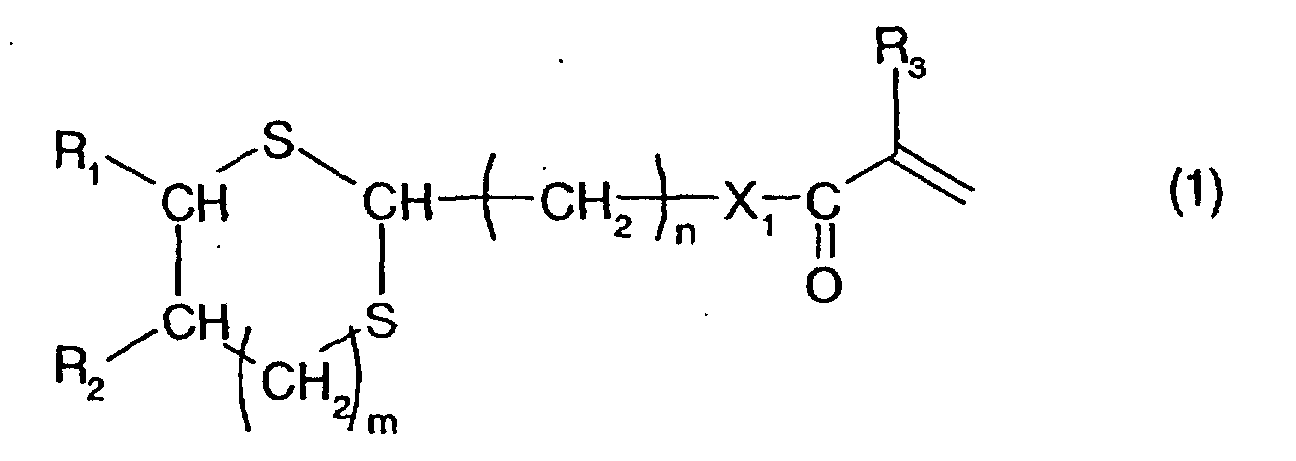
- The present invention also relates to a polymerizable composition comprising the sulfur-containing (meth)acrylic ester compound represented by formula (1), a cured product obtained by polymerizing the polymerizable composition, and further, an optical part comprising the cured product.
- The present invention will hereinafter be described in detail.
- The sulfur-containing (meth)acrylic ester compound according to the present invention, which is represented by formula (1), is a novel compound, and is a (meth)acrylic ester characterized by the possession of a cyclic thioacetal structure in the moiety of the ester group.
- In formula (1), R1 and R2 each independently represent a hydrogen atom or an alkyl group. As an alternative, R1 and R2 may be fused together to form a ring.
- Each of the substituents R1 and R2 may preferably be a hydrogen atom or an alkyl group having 1 to 4 carbon atoms, with a hydrogen atom, a methyl group or an ethyl group being more preferred. When R1 and R2 are fused together to form a ring, the ring may be preferably a cycloalkane ring, more preferably a cycloalkane ring having 5 to 7 carbon atoms, still more preferably a cyclohexane ring.
- In formula (1), m is an integer of from 0 to 3, preferably an integer of from 0 to 2, more preferably an integer of 0 or 1.
- In formula (1), n is an integer of from 1 to 4, preferably an integer of from 1 to 3, more preferably an integer of 1 or 2.
- In formula (1), X1 represents an oxygen atom or a sulfur atom. In view of a high refractive index required upon using as a lens resin, X1 is preferably a sulfur atom.
- As specific examples of the sulfur-containing (meth)acrylic ester compound represented by formula (1) according to the present invention; the compounds shown below in Table 1 can be exemplified.


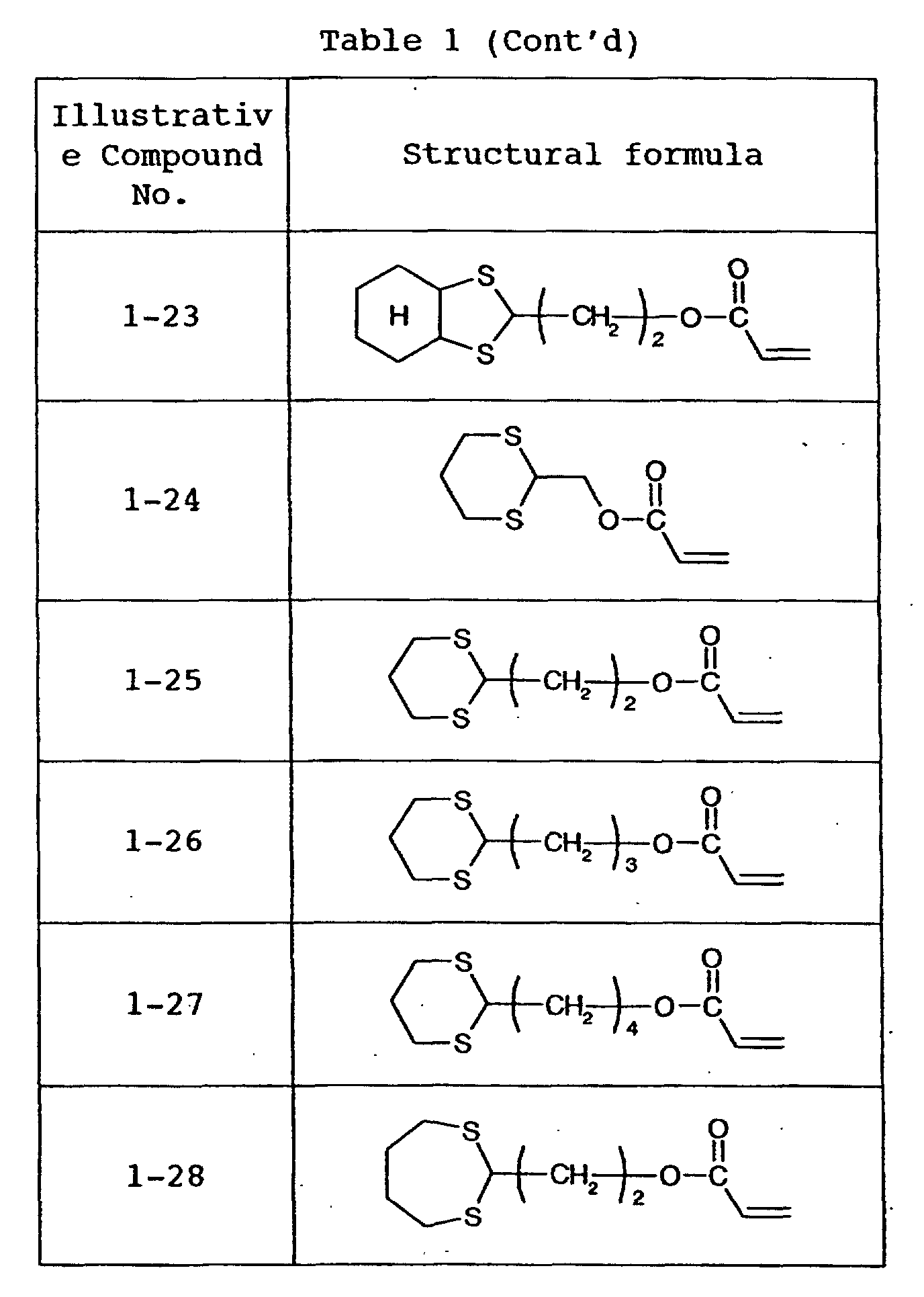


- These sulfur-containing (meth)acrylic ester compounds represented by formula (1) according to the present invention can each be produced by conducting, on a compound represented by the following formula (2-a) or the following formula (2-b), desired one of various known esterification processes (or thioesterification processes) typified specifically by:
- (1) a process in which a (meth)acrylic acid or the like is reacted; and
- (2) a process in which a halopropionic ester
compound (for example, 3-chloropropionic acid, 3-bromopropionic
acid, 3-chloro-2-methylpropionic acid, 3-bromo-2-methylpropionic
acid, or the like) or an acid
halide thereof is reacted to form a halopropionic ester
derivative, followed by the dehydrohalogenation of the
derivative into the (meth)acrylic ester.
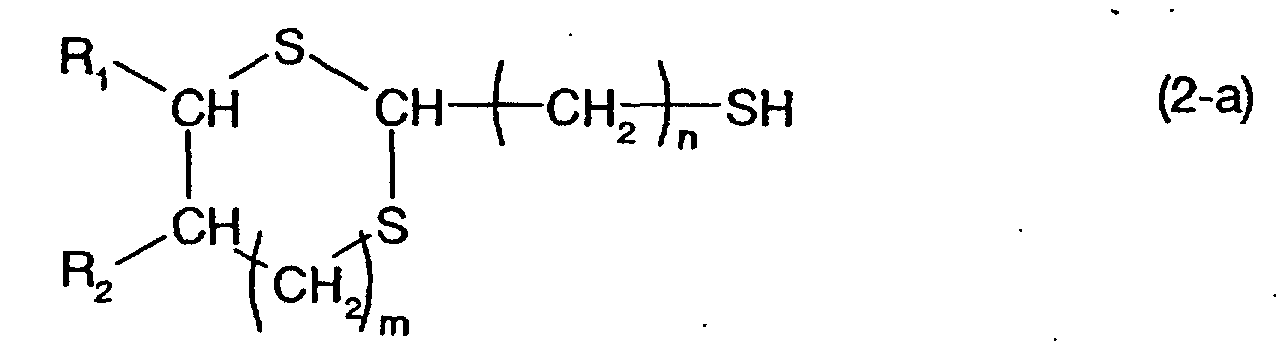
 wherein R1, R2, m and n have the same meanings as defined
above.
wherein R1, R2, m and n have the same meanings as defined
above. -
- Among the processes described above, the latter process (2) is more preferred as a process for producing each sulfur-containing (meth)acrylic ester compound represented by formula (1) according to the present invention.
- As a most representative example of the above-mentioned processes, a more detailed description will hereinafter be made firstly about a process in which a sulfur-containing compound represented by formula (2-a) or formula (2-b) and a (meth)acrylic acid or the like [(meth)acrylic acid, an ester derivative, or an acid halide thereof] are reacted.
- Specifically, a known process, for example, a process similar to that disclosed in J. Org. Chem., 45, 5364 (1980) or Eur. Polym. J., 19, 399 (1983) can be used as the above process.
- Illustrative is:
- (1) a process in which an acid halide of (meth)acrylic acid is caused to act on a sulfur-containing compound represented by formula (2-a) or formula (2-b) under stirring in the presence of a base by a procedure such as dropwise addition of the acid halide;
- (2) a process in which a sulfur-containing hydroxy compound represented by formula (2-b) and (meth)acrylic acid are subjected to a dehydrating reaction in the presence of a catalyst; or
- (3) a process in which a sulfur-containing hydroxy compound represented by formula (2-b) and a (meth)acrylic ester derivative [for example, an alkyl (meth)acrylate such as methyl (meth)acrylate, ethyl (meth)acrylate or butyl (meth)acrylate] are subjected to an ester interchange reaction in the presence of a catalyst (acid catalyst or base catalyst).
-
- No particular limitation is imposed on the amount of the (meth)acrylic acid or the like [(meth)acrylic acid, an ester derivative thereof, or an acid halide thereof] which is caused to act on the sulfur-containing compound represented by formula (2-a) or formula (2-b) in the above-described reaction. In general, however, the (meth)acrylic acid or the like may be used in a proportion of from 0.1 to 5 moles, with 0.25 to 2.5 moles being preferred and 0.4 to 1.5 moles being more preferred, all per mole of the sulfur-containing compound.
- The reaction can be conducted in a solventless manner, or can be conducted in a solvent which is inert to the reaction. Examples of such a solvent can include hydrocarbon solvents such as n-hexane, benzene and toluene; ketone solvents such as acetone, methyl ethyl ketone and methyl isobutyl ketone; ester solvents such as ethyl acetate and butyl acetate; ether solvents such as diethyl ether, tetrahydrofuran and dioxane; halogenated solvents such as dichloromethane, chloroform, carbon tetrachloride, 1,2-dichloroethane and Perclene; and polar solvents such as acetonitrile, N,N-dimethylformamide, N,N-dimethylacetamide and N,N-dimethylimidazolidinone. Two or more of these solvents may be used without development of inconvenience.
- No particular limitation is imposed on the reaction temperature. The reaction should, however, be conducted at such a temperature that neither the (meth)acrylic acid or the like as a raw material nor the sulfur-containing (meth)acrylic ester compound as a reaction product is allowed to undergo polymerization. In general, the reaction temperature may be in a range of from -78 to 150°C, with -20 to 120°C being preferred and 0 to 100°C being more preferred.
- The reaction time is also dependent upon the reaction temperature. In general, however, the reaction time may range from several minutes to 100 hours, with 30 minutes to 50 hours being preferred and 1 to 20 hours being more preferred. As an alternative, the reaction can be terminated at a desired rate of reaction while monitoring the rate of reaction by a known analyzing means (for example, liquid chromatography, thin layer chromatography, IR or the like).
- Upon producing the sulfur-containing (meth)acrylic ester compound according to the present invention by the reaction between sulfur-containing compound represented by formula (2-a) or formula (2-b) and the acid halide of (meth)acrylic acid, hydrogen halide (for example, hydrogen chloride or the like) is byproduced. For example, an organic base such as triethylamine, pyridine, picoline, dimethylaniline, diethylaniline, 1,4-diazabicyclo[2.2.2]octane (DABCO) or 1,8-diazabicyclo[5.4.0]undeca-7-ene (DBU) or an inorganic base such as sodium hydrogencarbonate, sodium carbonate, potassium carbonate, lithium carbonate, sodium hydroxide, potassium hydroxide, calcium hydroxide or magnesium oxide may, therefore, be used as a dehydrohalogenating agent.
- Although no particular limitation is imposed on the amount of such a dehydrohalogenating agent to be used, it may be used in a proportion of from 0.05 to 10 moles, preferably from 0.1 to 5 moles, more preferably from 0.5 to 3 moles per mole of the sulfur-containing compound represented by formula (2).
- Upon producing the sulfur-containing (meth)acrylic ester compound represented by formula (1) according to the present invention by the dehydrating reaction between the sulfur-containing hydroxy compound represented by formula (2-b) and (meth)acrylic acid, use of desired one of various known esterification catalysts is preferred. Illustrative of the catalysts are mineral acids (for example, hydrochloric acid, sulfuric acid, nitric acid, boric acid, phosphoric acid, and the like); organic acids (for example, methanesulfonic acid, benzenesulfonic acid, p-toluenesulfonic acid, trifluoromethanesulfonic acid, and the like); and Lewis acids (for example, boron trifluoride, aluminum trichloride, titanium tetrachloride, titanium dichloride, tin dichloride, tin tetrachloride, and the like).
- No particular limitation is imposed on the amount of such a catalyst to be used. In general, however, it may be used preferably in a proportion of from 0.001 to 50 wt.%, more preferably in a proportion of from 0.01 to 30 wt.% based on the reaction feed mixture.
- For the acceleration of the progress of the reaction, it is preferred to remove byproduced water from the system. Examples of a method for effecting this removal include azeotropic dehydration by use of one of the above-exemplified solvents, said one solvent being capable of forming an azeotropic mixture (for example, a hydrocarbon solvent such as benzene, toluene or xylene); use of a dehydrating agent such as molecular sieve; and combined use of these methods.
- Among the above-mentioned processes, the process - in which the sulfur-containing (meth)acrylic ester compound represented by formula (1) is produced by reacting the halopropionic ester compound represented by formula(2-a) or formula (2-b) with the halopropionic acid or its acid halide to form a halopropionic ester compound and then dehydrohalogenating the halopropionic ester compound - can be typified, for example, by the process disclosed in JP 10-67736 A or the like.
- Upon producing the sulfur-containing (meth)acrylic ester compound represented by formula (1) according to the present invention, use of a polymerization inhibitor for the prevention of polymerization of the reaction product during the reaction or after the reaction is preferred. As examples of such a polymerization inhibitor, a variety of known compounds such as 4-methoxyphenol, hydroquinone and phenothiazine can be mentioned. No particular limitation is imposed on the amount of the polymerization inhibitor to be used. In general, however, the polymerization inhibitor may be used in a proportion of from 0.01 to 5 wt.%, preferably from 0.05 to 3 wt.% based on the reaction feed mixture or the reaction product in the reaction system.
- After completion of the reaction, the reaction product, i.e., the sulfur-containing (meth)acrylic ester compound represented by formula (1) according to the present invention is post-treated and isolated by known procedure and treatment methods (typically, neutralization, extraction into solvent, washing with water, separation into layers, removal of solvent by distillation, etc.). If necessary, the thus-obtained sulfur-containing (meth)acrylic ester compound represented by formula (1) may be separated and purified by a known method (for example, distillation, recrystallization, chromatography or the like) to isolate as a high-purity compound.
- The compound represented by formula (2-a) or (2-b), namely, the hydroxyl-containing compound (2-b) or the thiol-containing compound (2-a) can be appropriately produced by converting the halogen atom in a cyclic thioacetal compound, which is represented by the below-described formula (2-c), in accordance with a known synthetic chemical procedure, for example, by subjecting the halogen atom to alkaline hydrolysis to convert the same into a hydroxyl group or by causing thiourea to act on the halogen atom to form a thiouronium salt and then subjecting it to alkaline treatment to form a thiol group.wherein R1, R2, m and n have the same meanings as defined above, and X represents a halogen atom.

- Further, the conversion from the halogen derivative represented by formula (2-c) into the thiol group can be appropriately practiced by a known process, for example, by the process disclosed in Journal of Organic Chemistry, 27, 93-95 (1962) or Organic Synthesis, IV, 401-403 (1963). Described specifically, according to such a representative process, the compound of formula (2-a) can be appropriately produced by reacting thiourea to X (i.e., halogen atom) in formula (2-c) and then hydrolyzing the thus-formed group with a base such as aqueous ammonia or sodium hydroxide.
- The sulfur-containing compound represented by formula (2-c), which is useful as a raw material in the present invention, can be appropriately produced typically by reacting a dithiol represented by the following formula (4) with an aldehyde represented by the following formula (3) or a derivative thereof in the presence of an acid catalyst.wherein X3 represents a halogen atom, an n stands for an integer of from 1 to 4.
 wherein R1, R2 and m have the same meanings as defined above.
- A more detailed description will hereinafter be made firstly about the process in which the compound represented by formula (2-c) is produced by reacting the dithiol represented by formula (4) to the aldehyde represented by formula (3) or the like in the presence of the acid catalyst.
- Illustrative of the aldehyde represented by formula (3) or its derivative are:
- haloalkyl aldehydes such as chloroacetaldehyde, 3-chloropropionaldehyde, 3-buromopropionaldehyde, 4-chlorobutylaldehyde, and 4-bromobutylaldehyde; and
- dialkyl acetal derivatives or cyclic alkylene acetal derivatives or the like of haloalkyl aldehydes, such as 2-chloroacetaldehyde dimethyl acetal, 2-chloroacetaldehyde diethyl acetal, 2-chloropropionaldehyde dimethyl acetal, 2-chloropropionaldehyde diethyl acetal, 2-bromopropionaldehyde diethyl acetal, 2-bromopropionaldehyde ethylene acetal [or 2-(2'-bromoethyl)-1,3-dioxolane], and 2-bromopropionaldehyde trimethylene acetal [or 2-(2'-bromoethyl)-1,3-dioxane].
-
- Illustrative of the dithiol derivative represented by formula (4) are:
- linear alkanedithiols such as ethanedithiol, 1,2-propanedithiol, 1,3-propanedithiol, 1,2-butanedithiol, 1,3-butanedithiol, 1,4-butanedithiol, 1,2-pentanedithiol, 1,3-pentanedithiol, 1,4-pentanedithiol, 1,2-hexanedithiol, 1,3-hexanedithiol, 1,4-hexanedithol, 1,2-heptanedithol, 1,2-octanedithiol, 1,2-nonanedithiol, and 1,2-decanedithiol; and
- cycloalkanedithiols such as cyclopentane-1,2-dithiol and cyclohexane-1,2-dithiol.
-
- No particular limitation is imposed on the amount of the dithiol represented by formula (4) which is to be used upon producing the compound of formula (2-c) by reacting the dithiol represented by formula (4) with the aldehyde represented by formula (3) or its derivative. In general, however, the dithiol represented by formula (4) may be used in a proportion of from 0.5 to 5 moles per mole of the aldehyde represented by formula (3) or its derivative, with 0.8 to 2 moles being preferred and 0.9 to 1.2 moles being more preferred.
- In such a reaction, the reaction may be conducted under solventless conditions or in the presence of a catalyst such as a protonic acid, for example, a mineral acid (e.g., hydrochloric acid or sulfuric acid) or an organic acid (e.g., acetic acid or propionic acid), or a Lewis acid. In view of the reaction temperature, reaction time and the like, it is preferred to conduct the reaction in the presence of the catalyst for the purpose of accelerating the reaction.
- Illustrative of such reaction catalysts are:
- protonic acids such as sulfuric acid, hydrochloric acid, hydrobromic acid, nitric acid, acetic acid, propionic acid, methanesulfonic acid, trifluoromethanesulfonic acid, and p-toluenesulfonic acid; and
- Lewis acids such as titanium trichloride, titanium tetrachloride, tin dichloride, tin tetrachloride, boron trifluoride-ether complexes.
-
- No particular limitation is imposed on the amount of such a reaction catalyst to be used. In general, however, the reaction catalyst may be used in a proportion of from 0.001 mole to 20 moles per mole of the aldehyde represented by formula (3) or its derivative, with 0.01 mole to 10 moles being preferred and 0.1 mole to 5 moles being more preferred. These reaction catalysts may be used either singly or in combination.
- The reaction can be conducted either in a solventless manner or in the presence of a solvent. When a solvent is used, no particular limitation is imposed on the solvent insofar as it is inert to the reaction. Examples of the solvent include hydrocarbon solvents such as benzene, toluene and xylene; halogenated solvents such as methylene chloride, chloroform, 1,2-dichloroethane, chlorobenzene and dichlorobenzene; and ether-type solvents such as diethyl ether, tetrahydrofuran, dioxane and diethylene glycol dimethyl ether. These solvents may be used either singly or in combination.
- No particular limitation is imposed on the amount of the reaction solvent to be used. From the standpoint of production efficiency and the like, however, it is not preferred to use the reaction solvent in an excessively large amount. The reaction solvent may, therefore, be used generally in a weight proportion not greater than 300 times, preferably in a weight proportion not greater than 100 times the aldehyde represented by formula (3) or its acetal derivative.
- The reaction may be conducted either under the surrounding atmosphere or under an inert gas atmosphere. To control coloration or the like of the reaction production, however, it is preferred to conduct the reaction under an inert gas atmosphere such as nitrogen or argon.
- No particular limitation is imposed on the reaction temperature. In general, however, it is preferred to conduct the reaction in a range of from 0°C to the boiling point of the solvent.
- The reaction time varies depending upon the reaction temperature. In general, the reaction may be conducted for a time ranging from several minutes to several tens hours. The end point of the reaction can be determined by monitoring the reaction with a known analysis means (for example, liquid chromatography, thin-layer chromatography, IR or the like).
- The sulfur-containing compounds represented by formulas (2-a) to (2-c) can each be isolated by subjecting the reaction product to usual post-treatment operations (for example, neutralization, filtration, extraction in a solvent, washing with water, separation into layers, removal of the solvent by distillation). By known operations and purification methods (for example, distillation, recrystallization, column chromatography, treatment with activated carbon, and the like), their purity can be increased further if necessary.
- As specific examples of the sulfur-containing compounds represented by formulas (2-a) to (2-c), the compounds shown below in Table 2 can be exemplified.
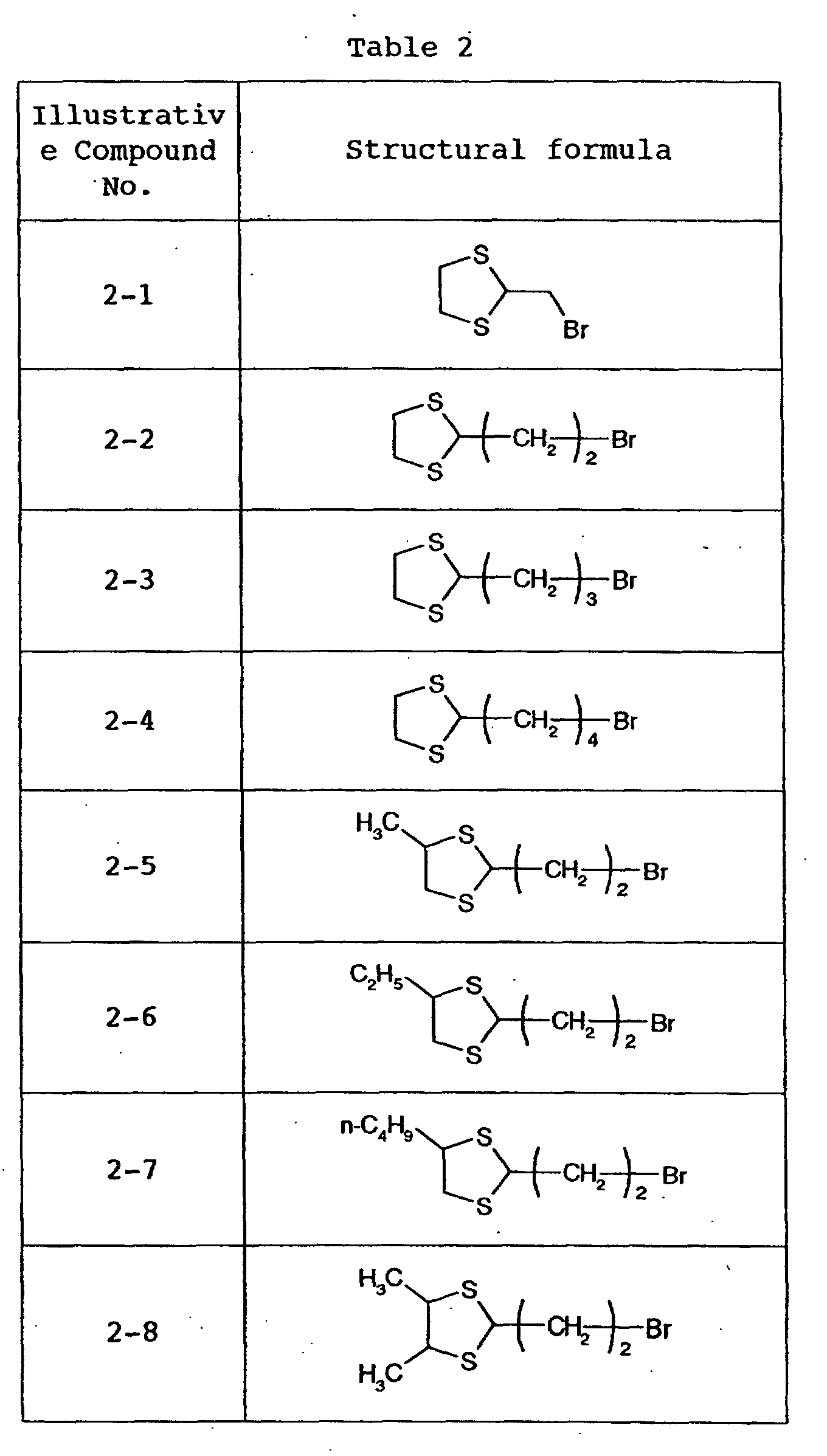
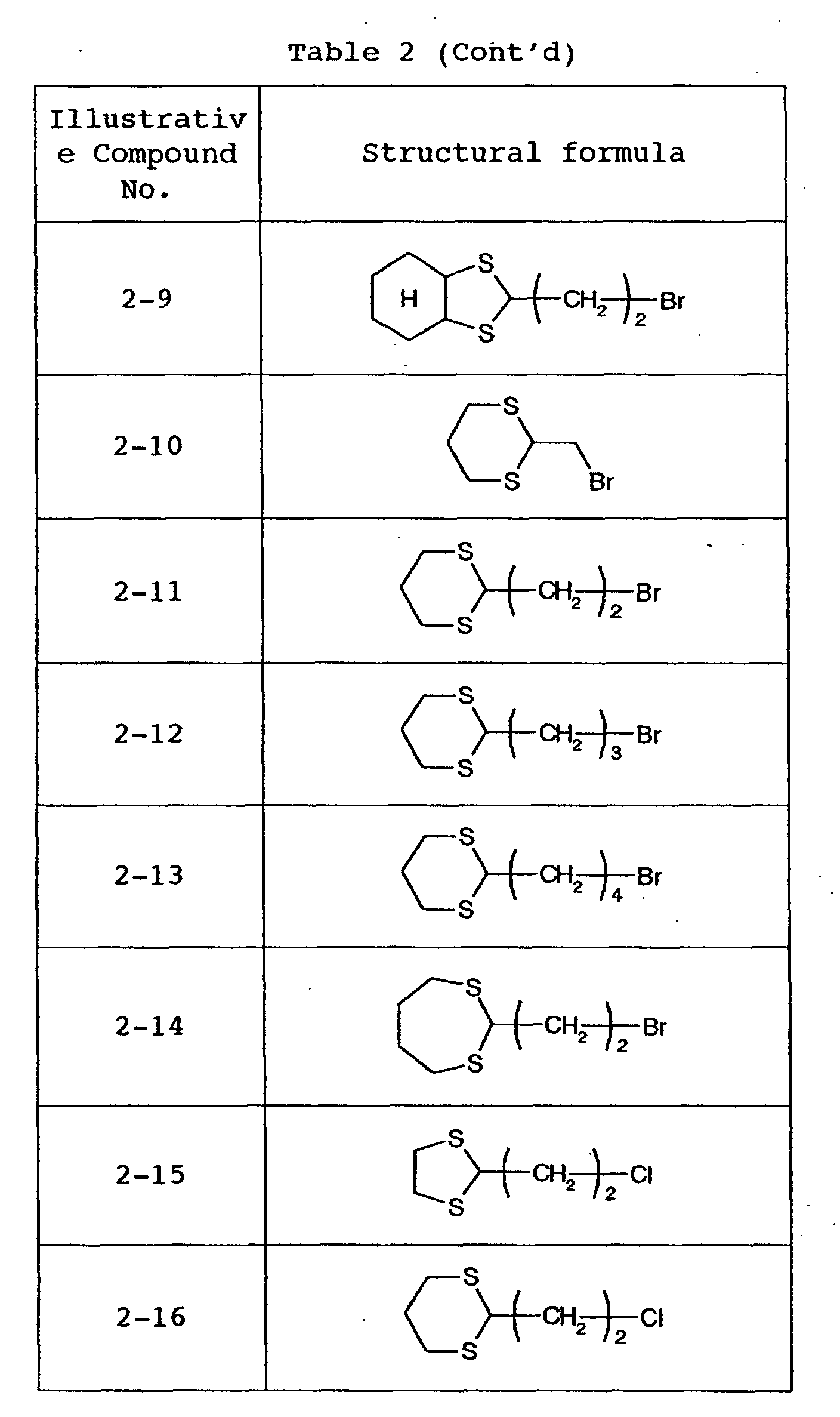


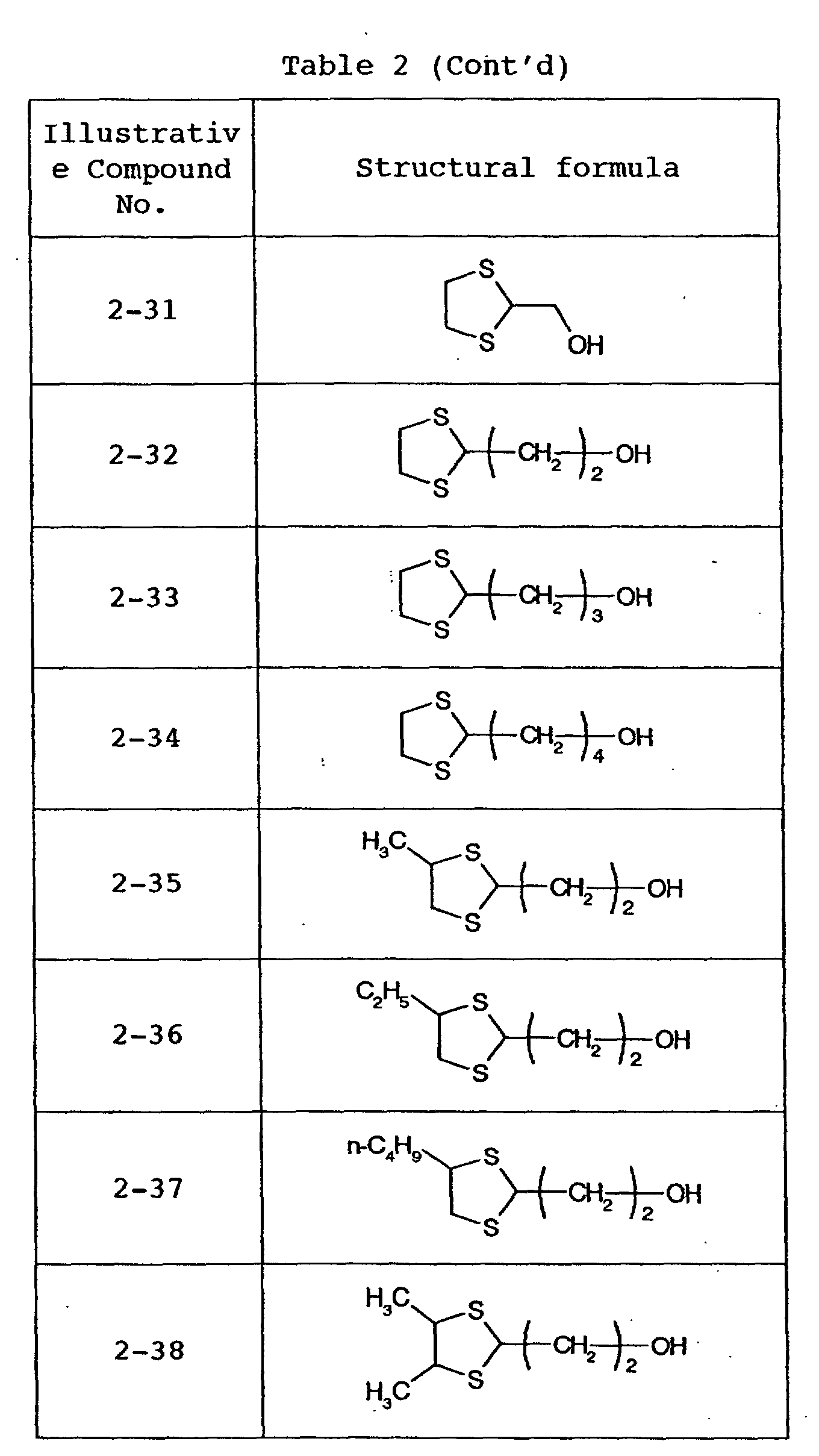

- A description will next be made in detail about the polymerizable composition which comprises the sulfur-containing (meth)acrylic ester compound represented by formula (1) according to the present invention.
- The polymerizable composition according to the present invention contains, as essential components, the sulfur-containing (meth)acrylic ester compound represented by formula (1) according to the present invention and a photo- and/or thermopolymerization initiator. Here, the above-described, sulfur-containing, unsaturated carboxylic ester compounds may be used singly, or a plurality of different sulfur-containing (meth)acrylic ester compounds may be used in combination without developing inconvenience.
- In addition to the sulfur-containing (meth)acrylic ester compound represented by formula (1), the polymerizable composition according to the present invention may also contain a known polymerizable compound (photo- or thermopolymerizable monomer, oligomer or the like) to extent not impairing the desired effects as needed without developing inconvenience.
- No particular limitation is imposed on the amount of the sulfur-containing (meth)acrylic ester compound represented by formula (1) and contained in the above-described polymerizable composition. In general, however, it may be contained in a proportion of 10 wt.% or more, preferably 20 wt.% or more, more preferably 30 wt.% or more, still more preferably 50 wt.% or more based on the whole polymerizable composition.
- No particular limitation is imposed on the polymerization initiator for use in the polymerizable composition according to the present invention. Various known thermopolymerization initiators or photopolymerization initiators can be used. Illustrative of photopolymerization initiators are benzoin, benzil, benzoin methyl ether, benzoin isopropyl ether, acetophenone, 1,1-dimethoxy-1-phenylacetophenone, 1,1-dichloroacetophenone, 1-hydroxycyclohexylphenyl ketone, 2-hydroxy-2-methyl-1-phenylpropan-1-one, 2-methyl-1-(4-methylthiophenyl)-2-morpholinolpropan-1-one, N,N-dimethylaminoacetophenone, 2-methylanthraquinone, 2-ethylanthraquinone, 2-tert-butylanthraquinone, 1-chloroanthraquinone, 2-amylanthraquinone, 2-isopropylthioxanthone, 2,4-dimethylthioxanthone, 2,4-diethylthioxanthone, 2,4-diisopropylthioxanthone, acetophenone dimethylketal, benzophenone, 4-methylbenzophenone, 4,4'-dicyclobenzophenone, 4,4'-bisdiethylaminobenzophenone, and Michler's ketone. They can be used either singly or in combination.
- The photopolymerization initiator may be used in a proportion of from 0.001 to 50 parts by weight, preferably from 0.01 to 30 parts by weight, more preferably from 0.1 to 10 parts by weight, still more preferably from 0.2 to 5 parts by weight per 100 parts by weight of the sulfur-containing (meth)acrylic ester compound represented by formula (1).
- Illustrative of the thermopolymerization initiators are peroxides such as benzoyl peroxide, p-chlorobenzoyl peroxide, diisopropyl peroxycarbonate, di-2-ethylhexyl peroxycarbonate and tert-butyl peroxypivalate; and azo compounds such as azobisisobutyronitrile.
- The thermopolymerization initiator may be used in a proportion of from 0.001 to 50 parts by weight, preferably from 0.01 to 30 parts by weight, more preferably from 0.1 to 10 parts by weight, still more preferably from 0.2 to 5 parts by weight per 100 parts by weight of the sulfur-containing (meth)acrylic ester compound represented by formula (1).
- Examples of the known polymerizable compound as a polymerizable compound usable in the polymerizable composition according to the present invention, said known polymerizable compound being other than the sulfur-containing (meth)acrylic ester compound represented by formula (1), include:
- monofunctional or polyfunctional (meth)acrylates such
as:
- methyl (meth)acrylate, butyl (meth)acrylate, 2-ethylhexyl (meth)acrylate, ethylcarbitol (meth)acrylate, lauryl (meth)acrylate, tetracyclododecyl (meth)acrylate, phenoxyethyl (meth)acrylate, nonylphenoxyethyl (meth)acrylate, dicyclopentenyl (meth)acrylate, isobornyl (meth)acrylate, N-n-butyl-O-(meth)acryloyloxy-ethyl carbamate, acryloylmorpholine, trifluoroethyl (meth)acrylate, tribromobenzyl (meth)acrylate, and perfluorooctylethyl (meth)acrylate,
- ethylene glycol di(meth)acrylate, propylene glycol di(meth)acrylate, neopentyl glycol di(meth)acrylate, and 1,6-hexanediol di(meth)acrylate,
- triethylene glycol di(meth)acrylate, tripropylene glycol di(meth)acrylate, polyethylene glycol di(meth)acrylate, and polypropylene glycol di(meth)acrylate,
- 2,2-bis(4-acryloyloxyphenyl)propane, 2,2-bis(4-methacryloyloxyphenyl)propane,
- bis(4-acryloyloxyphenyl)methane, bis(4-methacryloyloxyphenyl)methane, 4,4'-bis(acryloyloxy)-diphenyl sulfide, 4,4'-bis(methacryloyloxy)diphenyl sulfide, 2,2-bis[4-(acryloyloxyethoxy)phenyl]propane, 2,2-bis[4-(methacryloyloxyethoxy)phenyl]propane, 2,2-bis[4-(2-acryloyloxypropoxy)phenyl]propane, 2,2-bis[4-(2-methacryloyloxypropoxy)phenyl]propane, bis[4-(acryloyloxyethoxy)phenyl]methane, bis[4-(methacryloyloxyethoxy)phenyl]methane, bis[4-(2-acryloyloxypropoxy)phenyl]methane, and bis[4-(2-methacryloyloxypropoxy)phenyl]methane,
- 4,4'-bis(2-acryloyloxyethoxy)diphenyl sulfide, 4,4'-bis(2-methacryloyloxyethoxy)diphenyl sulfide, 4,4'-bis(2-acryloyloxypropoxy)diphenyl sulfide, and 4,4'-bis(2-methacryloyloxypropoxy)diphenyl sulfide,
- 4,4'-bis(2-acryloyloxyethoxy)diphenylsulfone, 4,4'-bis(2-methacryloyloxyethoxy)diphenylsulfone, 4,4'-bis(2-acryloyloxypropoxy)diphenylsulfone, and 4,4'-bis(2-methacryloyloxypropoxy)diphenylsulfone,
- 2,2-bis(4-hydroxyphenyl)propane-ethylene oxide or propylene oxide adduct di(meth)acrylate, bis(4-hydroxyphenyl)methane-ethylene oxide or propylene oxide adduct di(meth)acrylate, and 4,4'-dihydroxyphenyl sulfide-ethylene oxide or propylene oxide adduct di(meth)acrylate,
- trimethylolpropane tri(meth)acrylate, dipentaerythritol pentacrylate, pentaerythritol triacrylate, pentaerythritol tetracrylate, ditrimethylol tetracryalte, dipentaerythritol hexacrylate, 2-(meth)acryloyloxyethyl trisisocyanate, and (meth)acryloyloxypropyl tris(methoxy)silane;
- epoxy (meth)acrylates obtained by causing
(meth)acrylic acid compounds to act on various known
monovalent, divalent or higher valent epoxy compounds,
such as:
- phenol glycidyl ether, ethylene glycol diglycidyl ether, propylene glycol diglycidyl ether, resorcin diglycidyl ether, hydroquinone diglycidyl ether, bis(4-hydroxyphenyl)methane (common name: bisphenol F) diglycidyl ether, 2,2-bis(4-hydroxyphenyl)propane (common name: bisphenol A) diglycidyl ether, 4,4'-bishydroxyphenyl sulfide diglycidyl ether, 4,4'-bishydroxyphenylsulfone (common name: bisphenol S) diglycidyl ether, 4,4'-biphenol diglycidyl ether, 3,3',5,5'-tetramethyl-4,4'-biphenol diglycidyl ether, and tris(2,3-epoxypropyl) isocyanurate;
- epoxy (meth)acrylates obtained by causing
(meth)acrylic acid compounds to act on various known
epoxy resins, such as:
- epoxy resins of the phenolic novolak type, epoxy resins of the cresolic novolak type, epoxy resins of the phenol-aralkyl resin type, and epoxy resins of the bisphenol type;
- vinyl compounds such as:
- vinylbenzene, divinylbenzene, trivinylbenzene, isopropenylbenzene, diisopropenylbenzene, triisopropenylbenzene, N-vinylpyrrolidone, and N-vinylcaptolactam;
- a variety of known polymerizable monomers, for
example, allyl-containing compounds such as:
- ethylene glycol diallyl carbonate, triallyl trimellitate, and triallyl isocyanurate; and
- a variety of known.polymerizable oligomers such as:
- polyurethane (meth)acrylates, epoxy (meth)acrylates, polyester (meth)acrylates, and polyether (meth)acrylates.
-
- To better achieve the effects of the present invention, such a polymerizable compound may be used generally in a proportion of from 300 parts by weight or less, preferably in a proportion of from 200 parts by weight or less, more preferably in a proportion of from 100 parts by weight or less per 100 parts by weight of the sulfur-containing (meth)acrylic ester compound represented by formula(1).
- As a specific production process of the polymerizable composition according to the present invention, it can be obtained using the sulfur-containing (meth)acrylic ester compound represented by formula (1) according to the present invention optionally in combination with one or more of the above-described various known polymerizable compounds, adding the above-described polymerization initiator, and then mixing them into a solution. This polymerizable composition is provided for polymerization and curing after filtering off insoluble matter, foreign matter and the like and sufficiently defoaming the filtered composition under reduced pressure as needed.
- Upon producing the polymerizable composition, various known additives can be added as desired, including internal mold releasing agents, light stabilizers, ultraviolet absorbents, antioxidants, color pigments (for example, cyanine green, cyanine blue, etc.), dyes, flow modifiers, and inorganic fillers (for example, talc, silica, alumina, barium sulfate, magnesium oxide, etc.).
- The cured product and the optical part comprising the cured product according to the present invention are each obtained by polymerizing and curing the above-described polymerizable composition. As their production processes, various processes known to date can be selectively adopted and practiced. Typically, cast polymerization or the like can be mentioned. According to this process, a polymerizable composition obtained as mentioned above is poured into a mold, and is then polymerized using a radical polymerization reaction which is initiated by heat or light.
- The mold is composed, for example, of two mirror-polished mold members made of polyethylene, ethylene-vinyl acetate copolymer, polyvinyl chloride or the like and assembled together with a gasket interposed therebetween. Examples of the mold members include the following combinations: glass mold member-glass mold member, glass mold member-plastic plate, and glass mold member-metal plate. As a gasket, the above-described soft thermoplastic resin (polyethylene, ethylene-vinyl acetate copolymer, polyvinyl chloride, or the like) can be used. As an alternative, the two mold members may be fixed together by a polyester adhesive tape or the like. Further, known treatment such as mold releasing treatment may be applied to the mold members.
- As mentioned above, examples of the radical polymerization reaction include a polymerization reaction by heat (thermopolymerization), a polymerization reaction by light such as ultraviolet rays (photopolymerization), a polymerization reaction by gamma rays, and processes each making combined use of a plurality of these reactions.
- When polymerization is conducted by light, a cast product obtained after parting a mold or an optical part comprising the cured product may be subjected to annealing after completion of curing such that internal stress and strain is eliminated.
- Of these processes, photopolymerization by ultraviolet rays permits curing in several seconds to several minutes as opposed to thermopolymerization that requires several hours to several tens hours, and therefore, is a preferred process from the standpoint of increasing productivity upon production of optical parts according to the present invention.
- Upon conducting thermopolymerization, the polymerization temperature varies depending upon the kind of the polymerization initiator and the polymerization conditions, and no limitation is imposed thereon. In general, however, the polymerization temperature ranges from 25 to 200°C, with a range of from 50 to 170°C being preferred.
- As a molding process of an optical lens, the lens can be obtained, for example, by conducting cast polymerization under light and/or heat as mentioned above (for example, JP 60-135901 A, JP 10-67736 A, JP 10-130250 A, etc.).
- Described specifically, the molding of an optical lens can be adequately practiced by defoaming a polymerizable composition, which has been prepared by the above-mentioned process and contains a sulfur-containing (meth)acrylic ester compound represented by formula (1) according to the present invention, by a suitable method as needed, pouring it into a mold, and then polymerizing it generally under irradiated light. According to polymerization under heat, on the other hand, the molding of an optical lens can be appropriately practiced by polymerizing such a polymerizable composition while gradually heating it from a low temperature to a high temperature.
- The thus-obtained optical lens may be subjected to annealing as needed subsequent to its curing. If necessary, various known physical or chemical treatments can be applied further to prevent reflection, to impart high hardness, to improve abrasion resistance, to impart anti-mist property and/or to impart fashionability, including surface polishing, antistatic treatment, hard coating treatment, non-reflection coating treatment, dyeing treatment, and photochromic treatment (for example, treatment for the provision of a photochromic lens).
- As a molding process of a substrate for an optical disk or photomagnetic disk, conventionally known processes can be mentioned including, for example, the process in which a polymerizable composition obtained by the above-described process and containing a sulfur-containing (meth)acrylic ester compound represented by the formula (1) is poured into a cavity of a disk substrate mold, is polymerized by radical polymerization or the like, and if necessary, is subjected to post-heat treatment (JP 58-130450 A, JP 58-137150 A, JP 62-280008 A, etc.), the process in which such a polymerizable composition is subjected to photopolymerization in a mold the upper and lower walls of which are made of glass (JP 60-202557 A), and the process in which, after completion of vacuum casting or pouring of such a polymerizable composition, such a polymerizable composition is pressurized and thermally polymerized (JP 60-203414 A).
- The cured product according to the present invention, which is obtained by photopolymerizing the polymerizable composition, and the optical part according to the present invention, which comprises the cured product, are characterized in that they require several minutes to several hours for polymerization and curing, can be polymerized and molded in shorter time than thermosetting optical resins represented by conventional polydiethylene glycol diallyl carbonate and polythiourethane, and have high productivity.
- Further, the cured product and optical part according to the present invention have the characteristic features that they are excellent in optical properties, mechanical properties and thermal properties and have high refractive indexes. Specific examples of the optical part include various plastic lenses typified by correctional eyeglass lenses, substrates for optical information recording media, plastic substrates for liquid crystal cells, and coating materials for optical fibers.
- The (meth)acrylic ester compounds represented by formula (1) according to the present invention are novel compounds each having the cyclic thioacetal structure in the molecule, and are very useful compounds as raw material monomers of resins for optical members represented by correctional eyeglass lenses.
- The present invention will hereinafter be described more specifically based on Examples. It should however be borne in mind that the present invention is not limited to these Examples.
- Into a glass-made, 500-mL reactor equipped with a stirrer, ethanedithiol (25.4 g, 0.27 mole), a boron trifluoride-ether complex (25 mL) and toluene (100 g) were charged. To the mixture, 2-(2'-bromoethyl)-1,3-dioxolane (53.6 g, 0.275 mole) was added dropwise at 20°C over 1 hour. After the contents were allowed to react further at 20°C for 5 hours, iced water (150 g) and toluene (50 g) were added to the reaction mixture, followed by stirring for 15 minutes. The reaction mixture was allowed to stand and separate into phases, so that the reaction product was extracted in the toluene phase. The toluene phase was subjected to alkaline washing with a 3% aqueous solution of sodium hydrogencarbonate (150 g), followed by the washing with water until the water phase became neutral. The toluene phase was separated and taken out. Toluene was distilled off under reduced pressure at 40°C, and the resulting crude product was distilled under reduced pressure to afford 2-(2'-bromoethyl)-1,3-dithiolane (51.8 g) as a colorless liquid.
Yield: 90%, purity>99% [analyzed by gas chromatography (percent by area method)].
Boiling point: 93 to 96°C/0.22 mmHg
1H-NMR δ (CDCl3):
2.2-2.3(m,2H), 3.2(s,4H), 3.4-3.5(m,2H),
4.6-4.7(t,1H).
FD-MS: 212(M), 214(M+2). - Into a glass-made, 500-mL reactor equipped with a stirrer, thiourea (32.0 g, 0.42 mole) and ethanol (175 g) were charged. To the mixture, the 2-(2'-bromoethyl)-1,3-dithiolane (44.8 g) prepared in Synthesis Example 1 was added dropwise at 50°C over 35 minutes. The contents were allowed to react further at 80°C for 4 hours to yield a thiouronium salt. The reaction mixture was analyzed by high-performance liquid chromatography to confirm that the bromine-containing compound as the raw material had been consumed up. To the reaction mixture, 18% aqueous ammonia (200 g) was added dropwise at 50°C over 10 minutes, followed by the further reaction at 50°C for 2 hours to hydrolyze the thiouronium salt. Toluene (100 g) was added, and the resulting mixture was allowed to separate into phases, so that the reaction product was extracted in the toluene phase. The toluene phase was washed with water until the washing became neutral. The toluene phase was then taken out. Toluene was distilled off under reduced pressure at 40°C, and the resulting crude product was distilled under reduced pressure to afford 2-(2'-mercaptoethyl)-1,3-dithiolane (31.6 g) as a colorless liquid.
Yield: 95%, purity>99% [analyzed by gas chromatography (percent by area method)].
Boiling point: 98 to 100°C/0.25 mmHg
1H-NMR δ (CDCl3):
1.7-1.8 (br, 1H), 2.0-2.1 (m, 2H), 2.5-2.7 (m, 2H),
3.2-3.3 (m, 4H), 4.7-4.8 (t, 1H).
FD-MS: 166(M). - Into a glass-made, 100-mL reactor equipped with a stirrer, the 2-(2'-bromoethyl)-1,3-dithiolane (21.3 g, 0.10 mole) prepared in Synthesis Example 1, sodium formate (13.6 g, 0.20 mole) and tetramethylammonium bromide (1.61 g, 0.005 mole) were charged. The mixture was stirred for 1.5 hours under heating at 110°C. After completion of a reaction, a 50% aqueous solution of sodium hydroxide (8.8 g) was added under stirring to the reaction mixture over 15 minutes. The reaction product was extracted with toluene. Subsequent to washing of the extract with water, toluene was distilled off under reduced pressure at 40°C, and the resulting crude product was distilled under reduced pressure to afford 2-(2'-hydroxyethyl)-1,3-dithiolane (13.5 g) as a colorless liquid.
Yield: 90%, purity>99% [analyzed by gas chromatography (percent by area method)].
Boiling point: 100 to 105°C/0.25 mmHg
1H-NMR δ (CDCl3):
2.0-2.1 (m, 2H), 2.5-2.6 (br, 1H), 2.8-2.9 (m, 2H),
3.2-3.3 (m, 4H), 4.7-4.8 (t, 1H).
FD-MS: 150(M). - In a similar manner as in Synthesis Example 1 except for use of 1,2-propanedithiol in place of ethanedithiol, synthesis was conducted to afford 2-(2'-bromoethyl)-4-methyl-1,3-dithiolane as a colorless liquid.
FD-MS: 226(M), 228(M+2). - In a similar manner as in Synthesis Example 2 except for use of the 2-(2'-bromoethyl)-4-methyl-1,3-dithiolane produced in Synthesis Example 4, synthesis was conducted to afford 2-(2'-mercaptoethyl)-4-methyl-1,3-dithiolane as a colorless liquid.
FD-MS: 180(M). - In a similar manner as in Synthesis Example 1 except for use of 2-bromomethyl-1,3-dioxolane in place of 2-bromoethyl-1,3-dioxolane, synthesis was conducted to afford 2-bromomethyl-4-methyl-1,3-dithiolane as a colorless liquid.
FD-MS: 198(M), 200(M+2). - In a similar manner as in Synthesis Example 2 except for use of the 2-bromomethyl-1,3-dithiolane produced in Synthesis Example 6, synthesis was conducted to afford 2-mercaptomethyl-4-methyl-1,3-dithiolane as a colorless liquid.
FD-MS: 152(M). - Into a glass-made, 500-mL reaction vessel equipped with a stirrer, the 2-(2'-mercaptoethyl)-1,3-dithiolane produced in Synthesis Example 2 (100 g, 0.60 mole) was weighed, to which 3-chloropropionic acid chloride (80 g, 0.63 mole) was added dropwise at 40°C over 15 minutes. After the contents were reacted further under stirring at 40°C for 8 hours, toluene (200 g) was added to the reaction mixture to dissolve the same. The resulting solution was transferred into a separating funnel, in which the solution was washed three times with a 3 wt.% aqueous solution of sodium hydrogen carbonate (300 g). After the organic layer (toluene solution) was washed with purified water (300 g) until the water layer became neutral, the organic layer was taken out, and toluene was then distilled off under reduced pressure to afford 2-[2-(3-chloropropionylthio)ethyl]-1,3-dithiolane (127 g).
- To a solution of the 2-[2-(3-chloropropionylthio)-ethyl]-1,3-dithiolane (127 g, 0.49 mole) obtained as described above and dissolved in acetone (200 g) in a glass-made 1-L reaction vessel, triethylamine (74 g, 0.73 mole) was added dropwise at 25°C over 1 hour. After the contents were stirred and reacted at 25°C for 6 hours, toluene (400 g) and water (400 g) were added to the reaction mixture, and a toluene layer with the reaction product extracted therein was allowed to separate and was taken out. The toluene solution was washed with a 5 wt.% aqueous solution of hydrochloric acid, and the resulting mixture was washed with water until the water layer became neutral. Toluene was then distilled off under reduced pressure to afford the target compound, 2-(2'-acryloylthioethyl)-1,3-dithiolane, (106 g) as a colorless viscous clear liquid.
Yield: 80%, purity>99% [analyzed by liquid choromatography (percent by area method)].
1H-NMR δ (CDCl3):
2.0-2.1 (m, 2H), 2.5-2.7 (m, 2H), 3.2-3.3 (m, 4H),
4.7-4.8 (t, 1H), 5.0-7.0 (m, 3H).
FD-MS: 220(M). - To a mixed solution consisting of the 2-(2'-hydroxyethyl)-1,3-dithiolane (30.0 g, 0.20 mole) produced in Synthesis Example 3, pyridine (19.0 g, 0.24 mole) and chloroform (200 g), methacrylic acid chloride (19.9 g, 0.22 mole) was added under ice cooling (at 10°C). After completion of the dropwise addition, the contents were stirred and reacted further at 10°C for 3 hours. Byproduced pyridine hydrochloride was then filtered off. After the chloroform solution as the filtrate was washed with dilute hydrochloric acid (200 g), the chloroform solution was washed with water until the washing become neutral. The resulting mixture was allowed to separate into layers, and the organic layer was taken out. Chloroform was distilled off under reduced pressure at 60°C to obtain the crude reaction product as a pale yellow clear liquid. The crude reaction product was purified by chromatography on silica gel to afford the target product, 2-(2'-methacryloyloxyethyl)-1,3-dithiolane, (34.8 g) as a viscous colorless clear liquid. Yield: 80%, purity>99% [analyzed by liquid choromatography (percent by area method)].
1H-NMR δ (CDCl3):
1.9-2.0 (s, 2H), 2.1-2.4 (m, 2H), 2.5-2.8 (m, 2H),
3.2-3.3 (m, 4H), 4.7-4.8 (t, 1H), 5.0-7.0 (m, 2H). FD-MS: 218(M). - In a similar manner as in Example 1 except for use of the 2-mercaptomethyl-1,3-dithiolane, which had been produced in Synthesis Example 7, as a raw material in place of 2-(2'-mercaptoethyl)-1,3-dithiolane, 2-acryloylthiomethyl-1,3-dithiolane was produced.
FD-MS: 206(M). - Physical properties of cured products or optical parts (lenses) produced in the following Examples and comparative example were determined by the following methods.
- External appearance: Tint and transparency were examined visually.
- Refractive index, Abbe number: Measured at 20°C by using a Pulfrich reflectometer.
- Impact resistance: Determined by dropping a steel ball from a height of 127 cm onto a central part of each minus lens the center thickness of which was 1.5 mm.
- To the sulfur-containing acrylic ester compound (Illustrative Compound No. 1-2; 30 g) obtained above in Example 1, 2-hydroxy-2-methyl-1-phenylpropan-1-one ("Darocur-1173", product of Ciba-Geigy AG; 30 mg) was added as a photopolymerization initiator. They were thoroughly mixed into a solution. After defoamed under sufficiently reduced pressure, the solution was poured into a mold unit composed of glass mold members and a gasket. Using a metal halide lamp (80 W/cm), ultraviolet rays were irradiated for 60 seconds to effect polymerization. After completion of the polymerization, the polymerization product was allowed to gradually cool down, and the thus-molded, cured product was taken out of the mold unit.
- The thus-obtained cured product was colorless and transparent, and no optical strain was observed. Its refractive index was 1.645 (nd), and its Abbe number was 36 (vd).
- Preparation of a polymerizable composition and its polymerization under light (ultraviolet rays) were conducted in a similar manner as in Example 4 except for use of the sulfur-containing (meth)acrylic ester compound, which had been produced as Illustrative Compound No. 1-44 in Example 2, in place of the sulfur-containing (meth)acrylic ester compound as Illustrative Compound No. 1-2.
- The thus-obtained cured product was colorless and transparent, and no optical strain was observed. Its refractive index was 1.615 (nd), and its Abbe number was 37 (νd).
- Preparation of a polymerizable composition and its polymerization under light (ultraviolet rays) were conducted in a similar manner as in Example 4 except for use of the sulfur-containing (meth)acrylic ester compound, which had been produced as Illustrative Compound No. 1-1 in Example 3, in place of the sulfur-containing (meth)acrylic ester compound as Illustrative Compound No. 1-2.
- The thus-obtained cured product was colorless and transparent, and no optical strain was observed. Its refractive index was 1.660 (nd), and its Abbe number was 35 (νd).
- The sulfur-containing (meth)acrylic ester compounds according to the present invention were curable (photopolymerizable) by irradiation of light for short time. Further, the resultant cured products each had a high refractive index and a high Abbe number and was good in heat resistance and impact resistance.
- To a mixture consisting of the sulfur-containing (meth)acrylic ester compound (20 g) obtained as Illustrative Compound No. 1-1 in Example 3 and the epoxy acrylate of bisphenol A diglycidyl ether (5 g), 2-hydroxy-2-methyl-1-phenylpropan-1-one (50 mg; 0.2 wt.% based on the weight of the polymerizable compound) was added. The resulting mixture was thoroughly stirred into a solution. Subsequent to thorough defoaming, the resultant liquid was poured into a mold unit composed of glass mold members and a tape and formed to define the shape of a minus lens. After ultraviolet rays were irradiated for 60 seconds by a metal halide lamp, annealing was conducted at 80°C for 1 hour. After completion of polymerization, the polymerization product was allowed to cool down to room temperature to obtain a colorless transparent minus lens having a diameter of 30 mm and a center thickness of 1.5 mm.
- The lens was colorless and transparent, its refractive index and Abbe number were 1.645 (nd) and 35 (νd), respectively, and its heat resistance and impact resistance were good.
- Cured products and optical parts, which can be obtained by polymerizing polymerizable compositions containing sulfur-containing (meth)acrylic ester compounds according to the present invention, respectively, are excellent in optical properties, thermal properties and mechanical properties (impact resistance), have high productivity owing to short-time polymerization and curing moldability, and have high refractive indexes.
- The sulfur-containing (meth)acrylic ester compounds according to the present invention are very useful, as monomers for photocurable, polymerizable compositions, in applications such as optical materials and dental materials. Optical parts obtained by curing the polymerizable compositions are excellent in optical properties, thermal properties and mechanical properties, are good in productivity and have high refractive indexes, so that they are useful as various plastic lenses represented by correctional eyeglass lenses, substrates for optical information recording media, plastic substrates for liquid crystal cells, coating materials for optical fibers, and the like.
Claims (4)
- A sulfur-containing (meth)acrylic ester compound represented by the following formula (1);wherein R1 and R2 each independently represent a hydrogen atom or an alkyl group or may be fused together to form a ring, R3 represents a hydrogen atom or a methyl group, X1 represents an oxygen atom or a sulfur atom, m stands for an integer of from 0 to 3, and n stands for an integer of from 1 to 4.

- A polymerizable composition comprising a sulfur-containing (meth)acrylic acid as defined in claim 1.
- A cured product obtained by polymerizing a polymerizable composition as defined in claim 2.
- An optical part comprising a cured product as defined in claim 3.
Applications Claiming Priority (3)
| Application Number | Priority Date | Filing Date | Title |
|---|---|---|---|
| JP2000162899A JP4485651B2 (en) | 1999-06-01 | 2000-05-31 | Sulfur-containing compounds and uses thereof |
| JP2000162899 | 2000-05-31 | ||
| PCT/JP2000/005368 WO2001092252A1 (en) | 2000-05-31 | 2000-08-10 | Sulfur compound and use thereof |
Publications (3)
| Publication Number | Publication Date |
|---|---|
| EP1302471A1 true EP1302471A1 (en) | 2003-04-16 |
| EP1302471A4 EP1302471A4 (en) | 2004-04-07 |
| EP1302471B1 EP1302471B1 (en) | 2006-12-27 |
Family
ID=18666741
Family Applications (1)
| Application Number | Title | Priority Date | Filing Date |
|---|---|---|---|
| EP00950058A Expired - Lifetime EP1302471B1 (en) | 2000-05-31 | 2000-08-10 | Sulfur compound and use thereof |
Country Status (4)
| Country | Link |
|---|---|
| US (1) | US6570025B1 (en) |
| EP (1) | EP1302471B1 (en) |
| DE (1) | DE60032640T2 (en) |
| WO (1) | WO2001092252A1 (en) |
Families Citing this family (4)
| Publication number | Priority date | Publication date | Assignee | Title |
|---|---|---|---|---|
| US20040039080A1 (en) * | 2000-10-23 | 2004-02-26 | Narimichi Honda | Dental material and composition |
| KR100604688B1 (en) * | 2001-05-15 | 2006-07-25 | 미쓰이 가가쿠 가부시키가이샤 | Acrylic esters and use thereof |
| WO2003074510A1 (en) * | 2002-03-05 | 2003-09-12 | Universitaet Ulm | Dithiolane derivatives for immobilizing biomolecules on noble metals and semiconductors |
| CN115737643A (en) | 2012-09-26 | 2023-03-07 | 阿拉贡药品公司 | Antiandrogens for the treatment of non-metastatic castration resistant prostate cancer |
Family Cites Families (4)
| Publication number | Priority date | Publication date | Assignee | Title |
|---|---|---|---|---|
| JP3130957B2 (en) | 1991-04-23 | 2001-01-31 | 三井化学株式会社 | Novel polymer of thioacetal compound and method for producing the same |
| JP3212104B2 (en) | 1991-04-23 | 2001-09-25 | 三井化学株式会社 | Novel thioacetal compound and method for producing the same |
| JP3196361B2 (en) | 1991-12-25 | 2001-08-06 | 日立化成工業株式会社 | Resin composition for paint and antifouling paint for underwater structures |
| FR2759369B1 (en) | 1997-02-13 | 1999-04-02 | Essilor Int | NOVEL MONO (THIO) (METH) ACRYLATES, INTERMEDIATE COMPOUNDS FOR THE SYNTHESIS OF THE SAME, POLYMERIZABLE COMPOSITIONS AND POLYMERS OBTAINED THEREFROM AND OPTICAL AND OPHTHALMIC APPLICATIONS THEREOF |
-
2000
- 2000-08-10 US US10/048,002 patent/US6570025B1/en not_active Expired - Lifetime
- 2000-08-10 WO PCT/JP2000/005368 patent/WO2001092252A1/en not_active Ceased
- 2000-08-10 EP EP00950058A patent/EP1302471B1/en not_active Expired - Lifetime
- 2000-08-10 DE DE60032640T patent/DE60032640T2/en not_active Expired - Lifetime
Non-Patent Citations (2)
| Title |
|---|
| No further relevant documents disclosed * |
| See also references of WO0192252A1 * |
Also Published As
| Publication number | Publication date |
|---|---|
| WO2001092252A1 (en) | 2001-12-06 |
| DE60032640T2 (en) | 2007-10-04 |
| DE60032640D1 (en) | 2007-02-08 |
| EP1302471A4 (en) | 2004-04-07 |
| US6570025B1 (en) | 2003-05-27 |
| EP1302471B1 (en) | 2006-12-27 |
Similar Documents
| Publication | Publication Date | Title |
|---|---|---|
| EP1057808B1 (en) | Sulfur-containing unsaturated carboxylate compound and its use | |
| JP4480190B2 (en) | Novel (thio) (meth) acrylate monomers, intermediate compounds for the synthesis of these monomers, polymerizable compositions and polymers obtained therefrom, and their optical and ophthalmic uses | |
| JP4375643B2 (en) | Sulfur-containing (meth) acrylic acid thioester compounds and uses thereof | |
| KR100453344B1 (en) | Acrylic ester compound and usage thereof | |
| US6835844B2 (en) | Acrylic esters and use thereof | |
| EP1302471B1 (en) | Sulfur compound and use thereof | |
| JP2570776B2 (en) | Sulfur-containing aliphatic acrylic compound | |
| JP4485651B2 (en) | Sulfur-containing compounds and uses thereof | |
| AU764146B2 (en) | Polymerizable sulfur-containing (meth)acrylate, polymerizable composition and optical lens | |
| JP4704550B2 (en) | Sulfur-containing (meth) acrylic acid thioester compounds and uses thereof | |
| JP4372990B2 (en) | Sulfur-containing (meth) acrylic acid thioester compounds and uses thereof | |
| JP2001316355A (en) | Sulfur-containing unsaturated carboxylic ester compound and use thereof | |
| JP3820183B2 (en) | Acrylic ester compounds and uses thereof | |
| JP3584228B2 (en) | Acrylic ester compounds and uses thereof | |
| JP4766647B2 (en) | Sulfur-containing compounds | |
| JP3981602B2 (en) | Radical polymerizable sulfur-containing adamantane compound and cured product | |
| JP2003160556A (en) | Acrylic acid ester compound and its use |
Legal Events
| Date | Code | Title | Description |
|---|---|---|---|
| PUAI | Public reference made under article 153(3) epc to a published international application that has entered the european phase |
Free format text: ORIGINAL CODE: 0009012 |
|
| 17P | Request for examination filed |
Effective date: 20020308 |
|
| AK | Designated contracting states |
Designated state(s): AT BE CH CY DE DK ES FI FR GB GR IE IT LI LU MC NL PT SE |
|
| A4 | Supplementary search report drawn up and despatched |
Effective date: 20040225 |
|
| RIC1 | Information provided on ipc code assigned before grant |
Ipc: 7C 08F 20/38 B Ipc: 7C 07D 339/00 A Ipc: 7C 07D 339/08 B Ipc: 7C 07D 339/06 B |
|
| RBV | Designated contracting states (corrected) |
Designated state(s): DE FR GB |
|
| RAP1 | Party data changed (applicant data changed or rights of an application transferred) |
Owner name: MITSUI CHEMICALS, INC. |
|
| GRAP | Despatch of communication of intention to grant a patent |
Free format text: ORIGINAL CODE: EPIDOSNIGR1 |
|
| GRAS | Grant fee paid |
Free format text: ORIGINAL CODE: EPIDOSNIGR3 |
|
| GRAA | (expected) grant |
Free format text: ORIGINAL CODE: 0009210 |
|
| AK | Designated contracting states |
Kind code of ref document: B1 Designated state(s): DE FR GB |
|
| REG | Reference to a national code |
Ref country code: GB Ref legal event code: FG4D |
|
| REF | Corresponds to: |
Ref document number: 60032640 Country of ref document: DE Date of ref document: 20070208 Kind code of ref document: P |
|
| ET | Fr: translation filed | ||
| PLBE | No opposition filed within time limit |
Free format text: ORIGINAL CODE: 0009261 |
|
| STAA | Information on the status of an ep patent application or granted ep patent |
Free format text: STATUS: NO OPPOSITION FILED WITHIN TIME LIMIT |
|
| 26N | No opposition filed |
Effective date: 20070928 |
|
| PGFP | Annual fee paid to national office [announced via postgrant information from national office to epo] |
Ref country code: FR Payment date: 20080818 Year of fee payment: 9 |
|
| PGFP | Annual fee paid to national office [announced via postgrant information from national office to epo] |
Ref country code: GB Payment date: 20080820 Year of fee payment: 9 |
|
| GBPC | Gb: european patent ceased through non-payment of renewal fee |
Effective date: 20090810 |
|
| REG | Reference to a national code |
Ref country code: FR Ref legal event code: ST Effective date: 20100430 |
|
| PG25 | Lapsed in a contracting state [announced via postgrant information from national office to epo] |
Ref country code: FR Free format text: LAPSE BECAUSE OF NON-PAYMENT OF DUE FEES Effective date: 20090831 |
|
| PG25 | Lapsed in a contracting state [announced via postgrant information from national office to epo] |
Ref country code: GB Free format text: LAPSE BECAUSE OF NON-PAYMENT OF DUE FEES Effective date: 20090810 |
|
| REG | Reference to a national code |
Ref country code: DE Ref legal event code: R082 Ref document number: 60032640 Country of ref document: DE Representative=s name: MAI DOERR BESIER EUROPEAN PATENT ATTORNEYS - E, DE Ref country code: DE Ref legal event code: R082 Ref document number: 60032640 Country of ref document: DE Representative=s name: MAI DOERR BESIER PATENTANWAELTE, DE |
|
| PGFP | Annual fee paid to national office [announced via postgrant information from national office to epo] |
Ref country code: DE Payment date: 20170822 Year of fee payment: 18 |
|
| REG | Reference to a national code |
Ref country code: DE Ref legal event code: R119 Ref document number: 60032640 Country of ref document: DE |
|
| PG25 | Lapsed in a contracting state [announced via postgrant information from national office to epo] |
Ref country code: DE Free format text: LAPSE BECAUSE OF NON-PAYMENT OF DUE FEES Effective date: 20190301 |