EP1302469A1 - Process for producing hydroxylactone - Google Patents
Process for producing hydroxylactone Download PDFInfo
- Publication number
- EP1302469A1 EP1302469A1 EP01951895A EP01951895A EP1302469A1 EP 1302469 A1 EP1302469 A1 EP 1302469A1 EP 01951895 A EP01951895 A EP 01951895A EP 01951895 A EP01951895 A EP 01951895A EP 1302469 A1 EP1302469 A1 EP 1302469A1
- Authority
- EP
- European Patent Office
- Prior art keywords
- unsaturated carboxylic
- acid
- groups
- carboxylic acids
- reaction
- Prior art date
- Legal status (The legal status is an assumption and is not a legal conclusion. Google has not performed a legal analysis and makes no representation as to the accuracy of the status listed.)
- Granted
Links
- 0 *C(*)(C(*)(C1(*)S)O)OC1=O Chemical compound *C(*)(C(*)(C1(*)S)O)OC1=O 0.000 description 1
Classifications
-
- C—CHEMISTRY; METALLURGY
- C07—ORGANIC CHEMISTRY
- C07D—HETEROCYCLIC COMPOUNDS
- C07D307/00—Heterocyclic compounds containing five-membered rings having one oxygen atom as the only ring hetero atom
- C07D307/77—Heterocyclic compounds containing five-membered rings having one oxygen atom as the only ring hetero atom ortho- or peri-condensed with carbocyclic rings or ring systems
- C07D307/93—Heterocyclic compounds containing five-membered rings having one oxygen atom as the only ring hetero atom ortho- or peri-condensed with carbocyclic rings or ring systems condensed with a ring other than six-membered
- C07D307/935—Not further condensed cyclopenta [b] furans or hydrogenated cyclopenta [b] furans
-
- C—CHEMISTRY; METALLURGY
- C07—ORGANIC CHEMISTRY
- C07D—HETEROCYCLIC COMPOUNDS
- C07D307/00—Heterocyclic compounds containing five-membered rings having one oxygen atom as the only ring hetero atom
- C07D307/02—Heterocyclic compounds containing five-membered rings having one oxygen atom as the only ring hetero atom not condensed with other rings
- C07D307/26—Heterocyclic compounds containing five-membered rings having one oxygen atom as the only ring hetero atom not condensed with other rings having one double bond between ring members or between a ring member and a non-ring member
- C07D307/30—Heterocyclic compounds containing five-membered rings having one oxygen atom as the only ring hetero atom not condensed with other rings having one double bond between ring members or between a ring member and a non-ring member with hetero atoms or with carbon atoms having three bonds to hetero atoms with at the most one bond to halogen, e.g. ester or nitrile radicals, directly attached to ring carbon atoms
- C07D307/32—Oxygen atoms
-
- C—CHEMISTRY; METALLURGY
- C07—ORGANIC CHEMISTRY
- C07D—HETEROCYCLIC COMPOUNDS
- C07D309/00—Heterocyclic compounds containing six-membered rings having one oxygen atom as the only ring hetero atom, not condensed with other rings
- C07D309/16—Heterocyclic compounds containing six-membered rings having one oxygen atom as the only ring hetero atom, not condensed with other rings having one double bond between ring members or between a ring member and a non-ring member
- C07D309/28—Heterocyclic compounds containing six-membered rings having one oxygen atom as the only ring hetero atom, not condensed with other rings having one double bond between ring members or between a ring member and a non-ring member with hetero atoms or with carbon atoms having three bonds to hetero atoms with at the most one bond to halogen, e.g. ester or nitrile radicals, directly attached to ring carbon atoms
- C07D309/30—Oxygen atoms, e.g. delta-lactones
Definitions
- the present invention relates to a process for producing hydroxylactones. More specifically, it relates to a process for producing a corresponding hydroxylactone from an unsaturated carboxylic acid having a double bond not conjugated to a carboxyl group or an ester thereof.
- Lactones having a hydroxyl group are useful compounds as materials for photosensitive resins and other functional polymers and as materials for pharmaceutical drugs, agricultural chemicals, and other fine chemicals.
- an object of the present invention is to provide an industrially advantageous process that can produce hydroxylactones in high yields at low cost.
- the present inventors After intensive investigations to achieve the above object, the present inventors have found that a corresponding hydroxylactone can be efficiently produced at low cost by allowing an unsaturated carboxylic acid having a double bond not conjugated to a carboxyl group or an ester thereof to react with a specific compound.
- the present invention has been accomplished based on these findings.
- the present invention provides a process for producing hydroxylactones, including the step of subjecting an unsaturated carboxylic acid having a double bond not conjugated to a carboxyl group or an ester thereof to (i) a reaction with hydrogen peroxide in the presence of a metallic compound containing a metallic element selected from W, Mo, V and Mn or (ii) a reaction with a peroxide containing the metallic element to thereby yield a corresponding hydroxylactone having a hydroxyl group combined with one of two carbon atoms constituting the double bond and being cyclized at the other carbon atom positon.
- the metallic compound for example, at least one selected from oxides, oxoacids and salts thereof can be used.
- the unsaturated carboxylic acid includes, for example, ⁇ , ⁇ -unsaturated carboxylic acids, ⁇ , ⁇ -unsaturated carboxylic acids, and ⁇ , ⁇ -unsaturated carboxylic acids.
- hydroxylactone(s) as used herein means and includes not only compounds having a hydroxyl group directly combined with a lactone ring but also compounds having a hydroxyl-group-containing substituent combined with a lactone ring.
- peroxide is used in a broad sense and includes peroxoacids and salts thereof, peracids and salts thereof in addition to peroxides and hydroperoxides in the narrow sense.
- Unsaturated carboxylic acids and esters thereof for use as a reaction material (substrate) in the present invention are not specifically limited as long as they are carboxylic acids having a double bond not conjugated to a carboxylic group and esters thereof.
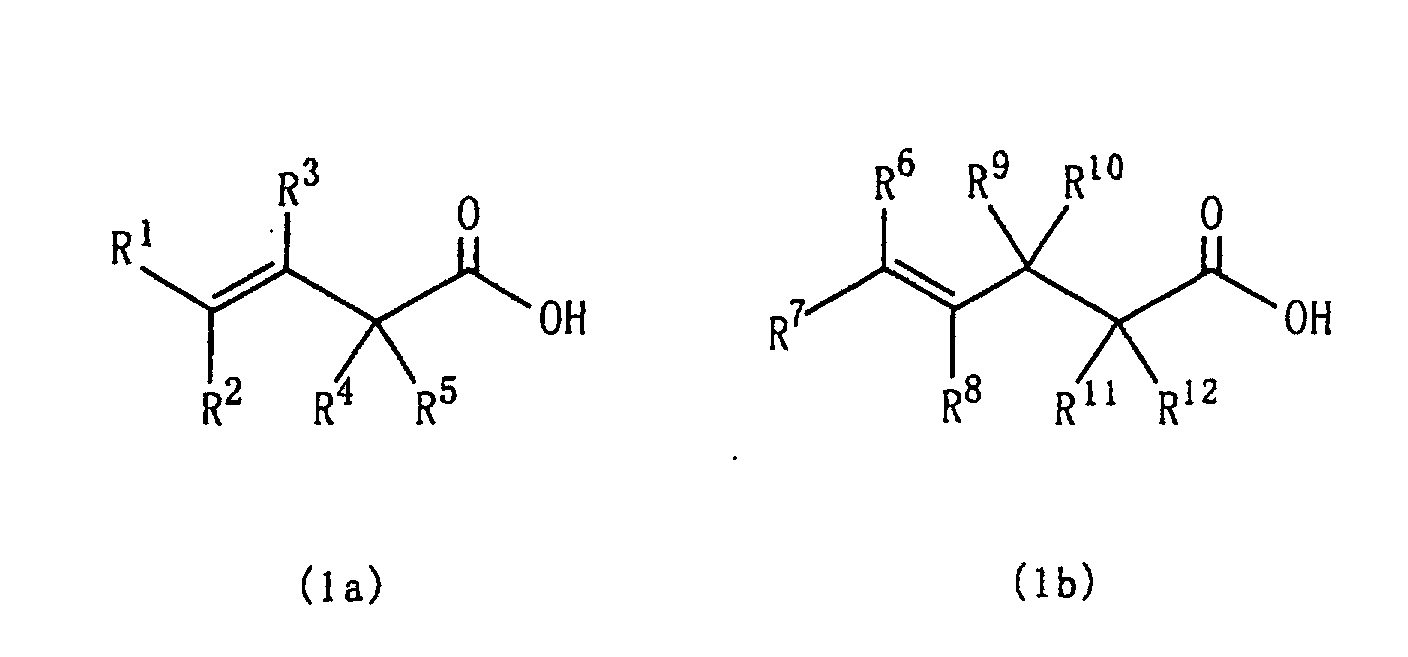
- Examples of such unsaturated carboxylic acids for use as the substrate include ⁇ , ⁇ -unsaturated carboxylic acids represented by following Formula (1a), ⁇ , ⁇ -unsaturated carboxylic acids represented by following Formula (1b), and ⁇ , ⁇ -unsaturated carboxylic acids represented by following Formula (1c): wherein R 1 , R 2 , R 3 , R 4 , R 5 , R 6 , R 7 , R 8 , R 9 , R 10 , R 11 , R 12 , R 13 , R 14 , R 15 , R 16 , R 17 , R 18 , R 19 , R 20 , and R 21 are the same or different and are each a hydrogen atom or an organic group, and at least two of R 1 to R 5 in Formula (1a), R 7 to R 12 in Formula (1b) or R 13 to R 21 in Formula (1c) may be combined to form a ring with an adjacent carbon atom or carbon chain.
- the organic group is not specifically limited as long as it is a group not adversely affecting the reaction.
- Such organic groups include, but are not limited to, halogen atoms, hydrocarbon groups, heterocyclic groups, substituted oxycarbonyl groups (e.g., alkoxycarbonyl groups, aryloxycarbonyl groups, aralkyloxycarbonyl groups, and cycloalkyloxycarbonyl groups), carboxyl group, substituted or unsubstituted carbamoyl groups, (N-substituted or unsubstituted amido groups), cyano group, nitro group, sulfur acid groups (sulfonic groups and sulfinic groups), sulfur acid ester groups (sulfonic ester groups and sulfinic ester groups), acyl groups, hydroxyl group, alkoxy groups, and N-substituted or unsubstituted amino groups.
- the carboxyl group, hydroxyl group, and amino groups may be protected by a conventional protective group
- the halogen atoms include fluorine, chlorine, bromine, and iodine atoms.
- the hydrocarbon groups include aliphatic hydrocarbon groups, alicyclic hydrocarbon groups, and aromatic hydrocarbon groups.
- the aliphatic hydrocarbon groups include, but are not limited to, methyl, ethyl, propyl, isopropyl, butyl, isobutyl, s-butyl, t-butyl, pentyl, hexyl, octyl, decyl, tetradecyl, hexadecyl, octadecyl, allyl, and other straight-or branched-chain aliphatic hydrocarbon groups (alkyl groups, alkenyl groups, and alkynyl groups) each containing from about 1 to about 20 carbon atoms, preferably from about 1 to about 10 carbon atoms, and more preferably from about 1 to about 6 carbon atoms.
- the alicyclic hydrocarbon groups include, but are not limited to, cyclopropyl, cyclobutyl, cyclopentyl, cyclohexyl, cyclohexenyl, cyclooctyl, cyclodecyl, cyclododecyl, and other alicyclic hydrocarbon groups (e.g., cycloalkyl groups and cycloalkenyl groups) each containing from about 3 to about 20 carbon atoms, and preferably form about 3 to about 15 carbon atoms.
- the aromatic hydrocarbon groups include, for example, phenyl, naphthyl, and other aromatic hydrocarbon groups each containing from about 6 to about 14 carbon atoms.
- hydrocarbon groups may have a substituent.
- substituents include, but are not limited to, halogen atoms (fluorine, chlorine, bromine, and iodine atoms), oxo group, hydroxyl group which may be protected by a protective group, hydroxymethyl group which may be protected by a protective group, amino groups which may be protected by a protective group, carboxyl group which may be protected by a protective group, substituted oxycarbonyl groups, substituted or unsubstituted carbamoyl groups, nitro group, acyl groups, cyano group, alkyl groups such as methyl, ethyl and other C 1 -C 4 alkyl groups, cycloalkyl groups, aryl groups such as phenyl and naphthyl groups, and heterocyclic groups.
- Conventional protective groups in the field of organic synthesis can be used as the protective groups.
- Heterocyclic rings constituting the heterocyclic groups include aromatic heterocyclic rings and non-aromatic heterocyclic rings.
- Such heterocyclic rings include, for example, 5-or 6-membered heterocyclic rings containing at least one atom selected from oxygen, sulfur, and nitrogen atoms as a hetero atom.
- the heterocyclic rings may be condensed rings and may have a substituent (a similar group to those which the hydrocarbon groups may have).
- the alkoxycarbonyl groups include, but are not limited to, methoxycarbonyl, ethoxycarbonyl, and other C 1 -C 6 alkoxy-carbonyl groups.
- the aryloxycarbonyl groups include, but are not limited to, phenyloxycarbonyl group.
- the aralkyloxycarbonyl groups include, for example, benzyloxycarbonyl group.
- the cycloalkyloxycarbonyl groups include, for example, cyclopentyloxycarbonyl and cyclohexyloxycarbonyl groups.
- the substituted carbamoyl groups include, for example, N-methylcarbamoyl and N,N-dimethylcarbamoyl groups.
- the sulfonic ester groups include, for example, methyl sulfonate, ethyl sulfonate, and other sulfonic acid C 1 -C 4 alkyl ester groups.
- the sulfinic ester groups include methyl sulfinate, ethyl sulfinate, and other sulfinic acid C 1 -C 4 alkyl ester groups.
- the acyl groups include, but are not limited to, acetyl, propionyl, and other aliphatic acyl groups (e.g., C 2 -C 7 aliphatic acyl groups), benzoyl and other aromatic acyl groups.
- the alkoxy groups include, but are not limited to, methoxy, ethoxy, propoxy, butoxy, and other alkoxy groups each containing from about 1 to about 6 carbon atoms.
- the N-substituted amino groups include, but are not limited to, N,N-dimethylamino, N,N-diethylamino, and piperidino groups.
- Preferred organic groups include, for example, hydrogen atom; methyl, ethyl, propyl, isopropyl, butyl, isobutyl, s-butyl, t-butyl, pentyl, hexyl, and other C 1 -C 10 alkyl groups (especially, C 1 -C 4 alkyl groups); cyclopentyl, cyclohexyl, and other C 3 -C 15 alicyclic hydrocarbon groups; and phenyl, and other aromatic hydrocarbon groups.
- At least two of R 1 to R 5 in Formula (1a), R 7 to R 12 in Formula (1b) or R 13 to R 21 in Formula (1c) may be combined to form a ring with an adjacent carbon atom or carbon chain.
- Such rings include, but are not limited to, cyclopropane ring, cyclobutane ring, cyclopentane ring, cyclopentene ring, cyclohexane ring, cyclohexene ring, cyclooctane ring, cyclododecane ring, and other cycloalkane rings and cycloalkene rings each containing from about 3 to about 20 members; norbornane ring, norbornene ring, adamantane ring, decalin ring, perhydrofluorene ring, tricyclo[5.2.1.0 2,6 ]decane ring, and other bridged rings.
- These groups may have a substituent such as a similar group to those which the hydrocarbon groups may have.
- Another ring (a non-aromatic ring or aromatic ring) may be condensed with each of these rings.
- Examples of the ⁇ , ⁇ -unsaturated carboxylic acids represented by Formula (1a) include, but are not limited to, 3-butenoic acid, 3-pentenoic acid, 3-hexenoic acid, 3-methyl-3-butenoic acid, 2-methyl-3-butenoic acid, and 2,2-dimethyl-3-butenoic acid.
- Examples of the ⁇ , ⁇ -unsaturated carboxylic acids include, but are not limited to, 4-pentenoic acid, 4-hexenoic acid, 4-heptenoic acid, 4-methyl-4-pentenoic acid, 3-methyl-4-pentenoic acid, 3,3-dimethyl-4-pentenoic acid, 2-methyl-4-pentenoic acid, 2,2-dimethyl-4-pentenoic acid, 2,3-dimethyl-4-pentenoic acid, cyclopentene-3-acetic acid, cyclohexene-3-acetic acid, and 5-norbornene-2-carboxylic acid.
- Examples of the ⁇ , ⁇ -unsaturated carboxylic acids include, but are not limited to, 5-hexenoic acid, 5-heptenoic acid, 5-octenoic acid, 5-methyl-5-hexenoic acid, 4-methyl-5-hexenoic acid, 4,4-dimethyl-5-hexenoic acid, 3-methyl-5-hexenoic acid, 3,3-dimethyl-5-hexenoic acid, 2-methyl-5-hexenoic acid, 2,2-dimethyl-5-hexenoic acid, 3,4-dimethyl-5-hexenoic acid, 2,4-dimethyl-5-hexenoic acid, 2, 3-dimethyl-5-hexenoic acid, and 2,3,4-trimethyl-5-hexenoic acid.
- Esters of the unsaturated carboxylic acids include, but are not limited to, methyl esters, ethyl esters, propyl esters, isopropylesters, butylesters, isobutyl esters, s-butylesters, t-butyl esters, and other alkyl esters (e.g., C 1 -C 4 alkyl esters); cyclohexyl esters, and other cycloalkyl esters; phenyl esters, and other aryl esters; benzyl esters, and other aralkyl esters.
- alkyl esters e.g., C 1 -C 4 alkyl esters
- cyclohexyl esters, and other cycloalkyl esters phenyl esters, and other aryl esters
- benzyl esters and other aralkyl esters.
- the unsaturated carboxylic acid or an ester thereof is subjected to (i) a reaction with hydrogen peroxide in the presence of a metallic compound containing a metallic element selected from W, Mo, V, and Mn or (ii) a reaction with a peroxide containing the metallic element.
- the metallic compounds in the reaction (i) are not specifically limited, as long as they are compounds containing a metallic element selected from W, Mo, V, and Mn, and include, for example, oxides, oxoacids and salts thereof, sulfides, halides, oxyhalides, borides, carbides, silicides, nitrides, phosphides, peroxides, complexes (inorganic complexes and organic complexes), and organometallic compounds each containing the metallic element. Each of these metallic compounds can be used alone or in combination.
- the oxides include, but are not limited to, tungsten oxides such as WO 2 and WO 3 , molybdenum oxides such as MoO 2 and MoO 3 , vanadium oxides such as VO, V 2 O 3 , VO 2 , and V 2 O 5 , manganese oxides such as MnO, Mn 2 O 3 , Mn 3 O 4 , MnO 2 , and Mn 2 O 7 , and complex oxides containing any of the metals.
- the oxoacids include, but are not limited to, tungstic acid, molybdic acid, vanadic acid, and manganic acid, as well as isopolytungstic acid, isopolymolybdic acid, isopolyvanadic acid, and other isopolyacids; phosphotungstic acid, silicotungstic acid, phosphomolybdic acid, silicomolybdic acid, phosphovanadomolybdic acid, and other heteropolyacids each comprising the metallic element and other metallic element (s) .
- Preferred examples of such other metallic elements in the heteropolyacids are phosphorus and silicon, of which phosphorus is typically preferred.
- the salts of oxoacids include, but are not limited to, sodium salts, potassium salts, and other alkali metal salts; magnesium salts, calciumsalts, bariumsalts, and other alkaline earth metal salts; ammonium salts; and transition metal salts, of the oxoacids.
- the salts of oxoacids such as salts of heteropolyacids may be salts except with another cation replacing part of hydrogen atoms corresponding to a cation.
- the peroxides include, but are not limited to, peroxides; hydroperoxides; peroxoacids such as peroxotungstic acid, peroxomolybdic acid, and peroxovanadic acid; salts of peroxoacids such as alkali metal salts, alkaline earth metal salts, ammonium salts, and transition metal salts of the peroxoacids; peracids such as permanganic acid; and salts of peracids such as alkali metal salts, alkaline earth metal salts, ammonium salts, and transition metal salts of the peracids.
- the amount of the metallic compound is, for example, from about 0.0001 to about 2 moles, preferably from about 0.0005 to about 0.5 mole, and more preferably from about 0.001 to about 0.2 mole per mole of the unsaturated carboxylic acid or an ester thereof used in the reaction.
- the active species in the reaction (i) is supposed to be the peroxide containing the metal or a peroxy radical.
- the peroxide in the reaction (ii) includes those as mentioned above. Each of these peroxides can be used alone or in combination.
- the amount of the peroxide is, for example, from about 0.8 to about 2 moles, preferably from about 0.9 to about 1.5 moles, and more preferably from about 0.95 to 1.2 moles per mole of the unsaturated carboxylic acid or an ester thereof used in the reaction.
- Hydrogen peroxide used herein may be pure hydrogen peroxide but is generally a diluted hydrogen peroxide in an appropriate solvent such as water (e.g., 30% by weight hydrogen peroxide aqueous solution) for handleability.
- an appropriate solvent such as water (e.g., 30% by weight hydrogen peroxide aqueous solution) for handleability.
- the amount of hydrogen peroxide is, for example, from about 0.9 to about 5 moles, preferably from about 0.9 to about 3 moles, and more preferably from about 0.95 to about 2 moles per mole of the unsaturated carboxylic acid or an ester thereof used in the reaction.
- the reaction is performed in the presence of, or in the absence of, a solvent.
- solvents include, but are not limited to, t-butyl alcohol, and other alcohols; chloroform, dichloromethane, 1,2-dichloroethane, and other halogenated hydrocarbons; benzene, and other aromatic hydrocarbons; hexane, heptane, octane, and other aliphatic hydrocarbons; cyclohexane, and other alicyclic hydrocarbons; N,N-dimethylformamide, N,N-dimethylacetamide, and other amides; acetonitrile, propionitrile, benzonitrile, and other nitriles; ethyl ether, tetrahydrofuran, and other chain or cyclic ethers; ethyl acetate, and other esters; acetic acid, and other organic acids; and water.
- solvents include, but are not limited to,
- a reaction temperature can be appropriately selected in consideration of the rate and selectivity of the reaction and is generally from about 0°C to about 100°C, and preferably from about 10°C to about 60°C.
- the reaction can be performed in any system such as batch system, semi-batch system, and continuous system.
- the reaction yields a corresponding hydroxylactone having a hydroxyl group combined with one of carbon atoms constituting the double bond of the material unsaturated carboxylic acid and being cyclized at the other carbon atom position.
- the double bond is initially epoxidized, an intramolecular cyclization reaction accompanied with ring-opening of the epoxy ring then proceeds and thereby yields the corresponding hydroxylactone.
- At which carbon atom position of two carbon atoms constituting the double bond the cyclization occurs is determined depending on the electrical properties and bulkiness of substituent(s) combined with the carbon atom, steric regulation, stability of the produced lactone, and other conditions.
- an unsaturated carboxylic acid having a ring containing at least two carbon atoms between the carbon atom at the alpha-position of the carboxyl group and a distal carbon atom constituting the double bond or its ester is used as the substrate, a polycyclic compound having the ring condensed with the lactone ring can be produced.
- the ⁇ , ⁇ -unsaturated carboxylic acids represented by Formula (1a) or esters thereof generally yield, for example, ⁇ -hydroxy- ⁇ -butyrolactone derivatives represented by following Formula (2a): wherein R 1 , R 2 , R 3 , and R 4 have the same meanings as defined above.
- ⁇ -hydroxy- ⁇ -butyrolactone (4-hydroxydihydrofuran-2-one) can be obtained in a high yield.
- the ⁇ , ⁇ -unsaturated carboxylic acids represented by Formula (1b) or esters thereof generally yield ⁇ -hydroxymethyl- ⁇ -butyrolactone derivatives represented by following Formula (2b-1), and some of them yield ⁇ -hydroxy- ⁇ -valerolactone derivatives represented by following Formula (2b-2): wherein R 6 , R 7 , R 8 , R 9 , R 10 , R 11 , and R 12 have the same meanings as defined above.
- 4-pentenoic acid or an ester thereof yields ⁇ -hydroxymethyl- ⁇ -butyrolactone (5-hydroxymethyldihydrofuran-2-one) in a high yield.
- Cyclopentene-3-acetic acid yields 2,3-dihydroxycyclopentaneacetic acid ⁇ -lactone
- 5-norbornene-2-carboxylic acid yields 5,6-dihydroxybicyclo[2.2.1]octane-2-carboxylic acid ⁇ -lactone
- 5-hydroxy-2,6-norbornanecarbolactone 5-hydroxy-3-oxatricyclo[4.2.1.0 4,8 ]nonan-2-one
- the ⁇ , ⁇ -unsaturated carboxylic acids represented by Formula (1c) or esters thereof yield ⁇ -hydroxymethyl- ⁇ -valerolactone derivatives represented by following Formula (2c): wherein R 13 , R 14 , R 15 , R 16 , R 17 , R 18 , R 19 , R 20 , and R 21 have the same meanings as defined above.
- Some of these substrates yield ⁇ -caprolactone derivatives.
- 5-hexenoic acid yields ⁇ -hydroxymethyl- ⁇ -valerolactone (6-hydroxymethyltetrahydropyran-2-one) in a high yield.
- reaction products can be easily separated and purified by conventional separation means such as filtration, concentration, distillation, extraction, crystallization, recrystallization, column chromatography, and combinations thereof.
- the hydroxylactones thus obtained can be used as materials for photosensitive resins and other functional materials and as materials for pharmaceutical drugs, agricultural chemicals, and other fine chemicals.
- the process of the present invention can produce such hydroxylactones in high yields at low cost and is therefore very advantageous for commercial production of hydroxylactones.
Landscapes
- Chemical & Material Sciences (AREA)
- Organic Chemistry (AREA)
- Organic Low-Molecular-Weight Compounds And Preparation Thereof (AREA)
Abstract
Description


Claims (3)
- A process for producing hydroxylactones, comprising the step of:subjecting an unsaturated carboxylic acid having a double bond not conjugated to a carboxyl group or an ester thereof to (i) a reaction with hydrogen peroxide in the presence of a metallic compound containing a metallic element selected from W, Mo, V and Mn or (ii) a reaction with a peroxide containing the metallic element to thereby yield a corresponding hydroxylactone having a hydroxyl group combined with one of two carbon atoms constituting the double bond and being cyclized at the other carbon atom position.
- The process for producing hydroxylactones according to claim 1, wherein the metallic compound is at least one selected from oxides, oxoacids and salts thereof.
- The process for producing hydroxylactones according to claim 1, wherein the unsaturated carboxylic acid is one of β,γ-unsaturated carboxylic acids, γ,δ-unsaturated carboxylic acids, and δ,ε-unsaturated carboxylic acids.
Applications Claiming Priority (3)
| Application Number | Priority Date | Filing Date | Title |
|---|---|---|---|
| JP2000219706 | 2000-07-19 | ||
| JP2000219706 | 2000-07-19 | ||
| PCT/JP2001/006200 WO2002006262A1 (en) | 2000-07-19 | 2001-07-18 | Process for producing hydroxylactone |
Publications (3)
| Publication Number | Publication Date |
|---|---|
| EP1302469A1 true EP1302469A1 (en) | 2003-04-16 |
| EP1302469A4 EP1302469A4 (en) | 2004-02-04 |
| EP1302469B1 EP1302469B1 (en) | 2005-03-30 |
Family
ID=18714445
Family Applications (1)
| Application Number | Title | Priority Date | Filing Date |
|---|---|---|---|
| EP01951895A Expired - Lifetime EP1302469B1 (en) | 2000-07-19 | 2001-07-18 | Process for producing hydroxylactone |
Country Status (6)
| Country | Link |
|---|---|
| US (1) | US7038064B2 (en) |
| EP (1) | EP1302469B1 (en) |
| KR (1) | KR100740033B1 (en) |
| DE (1) | DE60109786T2 (en) |
| TW (1) | TWI238162B (en) |
| WO (1) | WO2002006262A1 (en) |
Families Citing this family (7)
| Publication number | Priority date | Publication date | Assignee | Title |
|---|---|---|---|---|
| US7750101B2 (en) * | 2005-09-28 | 2010-07-06 | Daicel Chemical Industries, Ltd. | Polycyclic ester containing cyano group and lactone skeleton |
| EP1992651A4 (en) | 2006-02-17 | 2009-11-04 | Kuraray Co | TERTIARY ALCOHOL DERIVATIVE, POLYMERIC COMPOUND AND PHOTORESIST COMPOSITION |
| CN104334536B (en) | 2012-06-04 | 2017-02-22 | 捷恩智株式会社 | Beta-(meth)acryloyloxy-gamma-butyrolactone compound and manufacturing method thereof |
| AP2016009221A0 (en) | 2013-10-25 | 2016-05-31 | Asilomar Bio Inc | Strigolactone formulations and uses thereof |
| PL3286171T3 (en) | 2015-04-24 | 2022-01-10 | Sound Agriculture Company | Methods for hydraulic enhancement of crops |
| US10264084B2 (en) * | 2015-09-30 | 2019-04-16 | Apple Inc. | Updating playlists using push and pull |
| US20250122541A1 (en) * | 2023-10-11 | 2025-04-17 | The United States, As Represented By The Secretary Of Agriculture | Enzymatic and chemical catalysis for production from glucose of the pharmaceutical precursor, s-3-hydroxy- y -butyrolactone hbl |
Family Cites Families (3)
| Publication number | Priority date | Publication date | Assignee | Title |
|---|---|---|---|---|
| GB1133247A (en) * | 1966-09-15 | 1968-11-13 | Shell Int Research | Process for the preparation of lactones |
| EP0974581A4 (en) * | 1997-09-16 | 2002-01-02 | Daicel Chem | PROCESS FOR THE PREPARATION OF BALANCED PEROXYACID AND PROCESS FOR THE PRODUCTION OF LACTONE |
| JP2000159693A (en) * | 1998-12-01 | 2000-06-13 | Noguchi Inst | Method for oxidizing organic unsaturated compounds |
-
2001
- 2001-07-18 KR KR1020037000805A patent/KR100740033B1/en not_active Expired - Fee Related
- 2001-07-18 DE DE60109786T patent/DE60109786T2/en not_active Expired - Lifetime
- 2001-07-18 US US10/332,049 patent/US7038064B2/en not_active Expired - Fee Related
- 2001-07-18 EP EP01951895A patent/EP1302469B1/en not_active Expired - Lifetime
- 2001-07-18 WO PCT/JP2001/006200 patent/WO2002006262A1/en not_active Ceased
- 2001-07-19 TW TW090117627A patent/TWI238162B/en not_active IP Right Cessation
Also Published As
| Publication number | Publication date |
|---|---|
| EP1302469A4 (en) | 2004-02-04 |
| US7038064B2 (en) | 2006-05-02 |
| TWI238162B (en) | 2005-08-21 |
| WO2002006262A1 (en) | 2002-01-24 |
| KR20030029627A (en) | 2003-04-14 |
| US20040024228A1 (en) | 2004-02-05 |
| EP1302469B1 (en) | 2005-03-30 |
| DE60109786D1 (en) | 2005-05-04 |
| KR100740033B1 (en) | 2007-07-18 |
| DE60109786T2 (en) | 2005-08-18 |
Similar Documents
| Publication | Publication Date | Title |
|---|---|---|
| US7834114B2 (en) | Polycyclic ester containing cyano group and lactone skeleton | |
| US6020501A (en) | Process for preparing phthalides | |
| JP2007031355A (en) | 3-oxa-2-thiatricyclo [4.2.1.04,8] nonane derivative | |
| EP1302469B1 (en) | Process for producing hydroxylactone | |
| DE69301771T2 (en) | T-Butyl-R - (-) - 4-cyano-3-hydroxybutyrate and process for its preparation | |
| US4393060A (en) | Isocyanuric acid derivatives, method of preparation, therapeutic compositions with a cytostatic action and therapeutic method | |
| Sugita et al. | Regioselectivity of addition of thiols and amines to conjugated allenic ketones and esters | |
| EP0001089B1 (en) | Process for the preparation of halogenovinyl-substituted 2-tetrahydrofuranones, selected halogenovinyl-substituted 2-tetrahydrofuranones | |
| JPWO2002006262A1 (en) | Method for producing hydroxylactones | |
| KR20220130119A (en) | Chemical Process for Preparation of Herbicide Pyridazine Compounds | |
| JP4748848B2 (en) | Process for producing 5-hydroxy-2,6-norbornanecarbolactone and its (meth) acrylic acid ester | |
| Tyvorskii et al. | A convenient synthesis of 3-functionalized 5-alkoxymethyl-and 5-phenoxymethyl-2 (5H)-furanones and their transformations into related epoxy and methylene lactones | |
| JP4748860B2 (en) | 2-Oxatricyclo [4.2.1.04,8] nonan-3-one derivative and process for producing the same | |
| Tănase et al. | Secondary compounds in the catalytic hydrogenation of enone and allylic alcohol prostaglandin intermediates: isolation, characterization, and X-ray crystallography | |
| US11136302B2 (en) | Single step process for the synthesis of furan derivatives from carbohydrates | |
| Janecki et al. | Stereocontrolled synthesis of 5-(1′-hydroxyalkyl)-3-methylidenetetrahydro-2-furanones | |
| JP4740677B2 (en) | 3-oxa-7-oxa (or thia) tricyclo [4.2.1.04,8] nonan-2-one derivatives | |
| JP5468870B2 (en) | Method for producing lactone compound | |
| ARATA et al. | Studies on 1-Azabicyclo Compounds. X. Syntheses of Ten-membered Ring Amine Derivatives and 1-Azabicyclo [4.4. 1] undecane from 3, 4, 6, 7, 8, 9-Hexahydro-2H-quinolizine | |
| JP4718922B2 (en) | 3-Oxa-7-thiatricyclo [4.2.1.04,8] nonane derivative | |
| CN114426540B (en) | Pyrido[1,2-a]pyrazine-1,8-dione prodrug derivatives, preparation methods and applications thereof | |
| US4513150A (en) | Preparation of but-2-ene-1,4-diones substituted in the 1,4-positions | |
| US3642874A (en) | Beta-halogenoalkyl isocyanates | |
| JP2008081404A (en) | A method for producing 2- (meth) acryloyloxy-6-cyano-5-oxo-4-oxatricyclo [4.2.1.03,7] nonane. | |
| DE69120760T2 (en) | Process for the preparation of (S) -gamma-acyloxy-methyl-alpha-beta-butenolide |
Legal Events
| Date | Code | Title | Description |
|---|---|---|---|
| PUAI | Public reference made under article 153(3) epc to a published international application that has entered the european phase |
Free format text: ORIGINAL CODE: 0009012 |
|
| 17P | Request for examination filed |
Effective date: 20030103 |
|
| AK | Designated contracting states |
Designated state(s): DE FR GB |
|
| A4 | Supplementary search report drawn up and despatched |
Effective date: 20031219 |
|
| GRAP | Despatch of communication of intention to grant a patent |
Free format text: ORIGINAL CODE: EPIDOSNIGR1 |
|
| GRAS | Grant fee paid |
Free format text: ORIGINAL CODE: EPIDOSNIGR3 |
|
| GRAA | (expected) grant |
Free format text: ORIGINAL CODE: 0009210 |
|
| AK | Designated contracting states |
Kind code of ref document: B1 Designated state(s): DE FR GB |
|
| REG | Reference to a national code |
Ref country code: GB Ref legal event code: FG4D |
|
| REF | Corresponds to: |
Ref document number: 60109786 Country of ref document: DE Date of ref document: 20050504 Kind code of ref document: P |
|
| ET | Fr: translation filed | ||
| PLBE | No opposition filed within time limit |
Free format text: ORIGINAL CODE: 0009261 |
|
| STAA | Information on the status of an ep patent application or granted ep patent |
Free format text: STATUS: NO OPPOSITION FILED WITHIN TIME LIMIT |
|
| 26N | No opposition filed |
Effective date: 20060102 |
|
| PGFP | Annual fee paid to national office [announced via postgrant information from national office to epo] |
Ref country code: FR Payment date: 20110727 Year of fee payment: 11 |
|
| PGFP | Annual fee paid to national office [announced via postgrant information from national office to epo] |
Ref country code: GB Payment date: 20110713 Year of fee payment: 11 Ref country code: DE Payment date: 20110713 Year of fee payment: 11 |
|
| GBPC | Gb: european patent ceased through non-payment of renewal fee |
Effective date: 20120718 |
|
| REG | Reference to a national code |
Ref country code: FR Ref legal event code: ST Effective date: 20130329 |
|
| PG25 | Lapsed in a contracting state [announced via postgrant information from national office to epo] |
Ref country code: FR Free format text: LAPSE BECAUSE OF NON-PAYMENT OF DUE FEES Effective date: 20120731 Ref country code: DE Free format text: LAPSE BECAUSE OF NON-PAYMENT OF DUE FEES Effective date: 20130201 Ref country code: GB Free format text: LAPSE BECAUSE OF NON-PAYMENT OF DUE FEES Effective date: 20120718 |
|
| REG | Reference to a national code |
Ref country code: DE Ref legal event code: R119 Ref document number: 60109786 Country of ref document: DE Effective date: 20130201 |