EP1302459A1 - Processes for preparation of fused pyrroles - Google Patents
Processes for preparation of fused pyrroles Download PDFInfo
- Publication number
- EP1302459A1 EP1302459A1 EP01945742A EP01945742A EP1302459A1 EP 1302459 A1 EP1302459 A1 EP 1302459A1 EP 01945742 A EP01945742 A EP 01945742A EP 01945742 A EP01945742 A EP 01945742A EP 1302459 A1 EP1302459 A1 EP 1302459A1
- Authority
- EP
- European Patent Office
- Prior art keywords
- group
- process according
- acid
- substituent
- ammonium salt
- Prior art date
- Legal status (The legal status is an assumption and is not a legal conclusion. Google has not performed a legal analysis and makes no representation as to the accuracy of the status listed.)
- Granted
Links
- 0 CCC(C(*)(*)O)=NC1=CC=CC=*=C1 Chemical compound CCC(C(*)(*)O)=NC1=CC=CC=*=C1 0.000 description 1
Classifications
-
- C—CHEMISTRY; METALLURGY
- C07—ORGANIC CHEMISTRY
- C07D—HETEROCYCLIC COMPOUNDS
- C07D209/00—Heterocyclic compounds containing five-membered rings, condensed with other rings, with one nitrogen atom as the only ring hetero atom
- C07D209/56—Ring systems containing three or more rings
- C07D209/80—[b, c]- or [b, d]-condensed
-
- C—CHEMISTRY; METALLURGY
- C07—ORGANIC CHEMISTRY
- C07D—HETEROCYCLIC COMPOUNDS
- C07D209/00—Heterocyclic compounds containing five-membered rings, condensed with other rings, with one nitrogen atom as the only ring hetero atom
- C07D209/02—Heterocyclic compounds containing five-membered rings, condensed with other rings, with one nitrogen atom as the only ring hetero atom condensed with one carbocyclic ring
- C07D209/04—Indoles; Hydrogenated indoles
- C07D209/08—Indoles; Hydrogenated indoles with only hydrogen atoms or radicals containing only hydrogen and carbon atoms, directly attached to carbon atoms of the hetero ring
-
- C—CHEMISTRY; METALLURGY
- C07—ORGANIC CHEMISTRY
- C07D—HETEROCYCLIC COMPOUNDS
- C07D209/00—Heterocyclic compounds containing five-membered rings, condensed with other rings, with one nitrogen atom as the only ring hetero atom
- C07D209/56—Ring systems containing three or more rings
- C07D209/96—Spiro-condensed ring systems
Definitions
- This invention relates to a novel process for producing condensed pyrroles useful as starting materials, intermediates etc. for dyes, perfumes etc. or as starting materials for synthesizing physiologically active substances.
- the Fischer method is a method of synthesizing a hydrazone from an aryl hydrazine and a ketone and then treating it with an acid to form indole. Because various kinds of ketones are easily available, this method is generally usable, but there are problems such as necessity for synthesis of hydrazine from an aniline derivative and occurrence of various regioisomers at the time of forming an indole ring, etc. Various attempts have been made on regioselective synthesis, but have never provided complete solution (J. Org. Chem., 56 , 3001 (1991); J. Org. Chem., 58 , 7638 (1993), etc.).
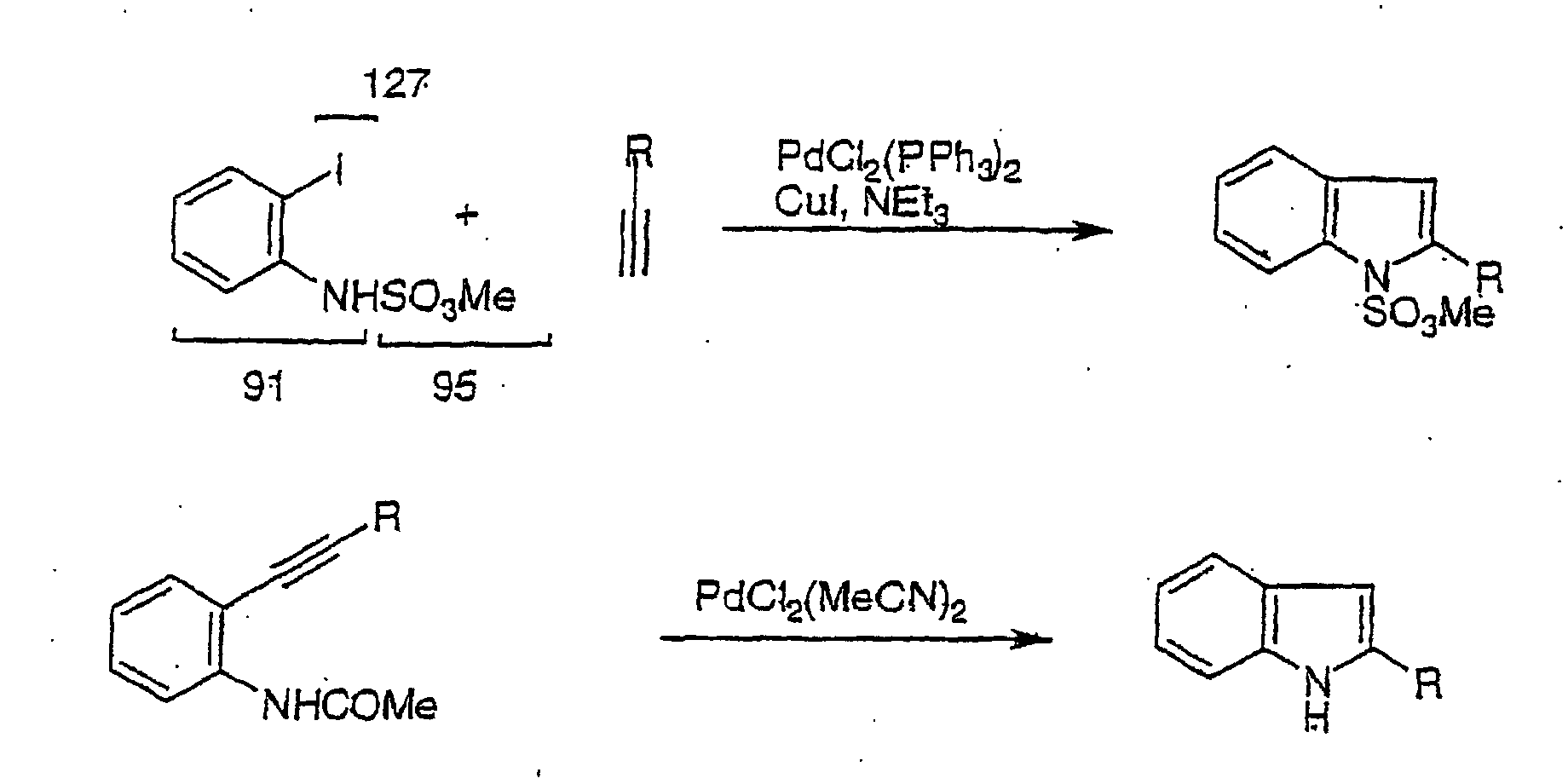
- o-iodoaniline is considerably more expensive than aniline; although the atomic weight of iodine is 127 which is higher than that (92) of the aniline nucleus, the iodine does not remain in the indole skeleton of the product and is discarded as a byproduct, that is, the atom efficiency is low; nitrogen in the aniline should previously been converted into e.g. amide (Chem. Pharm. Bull., 1305 (1988); Tetrahedron Lett., 3915 (1992), etc.).
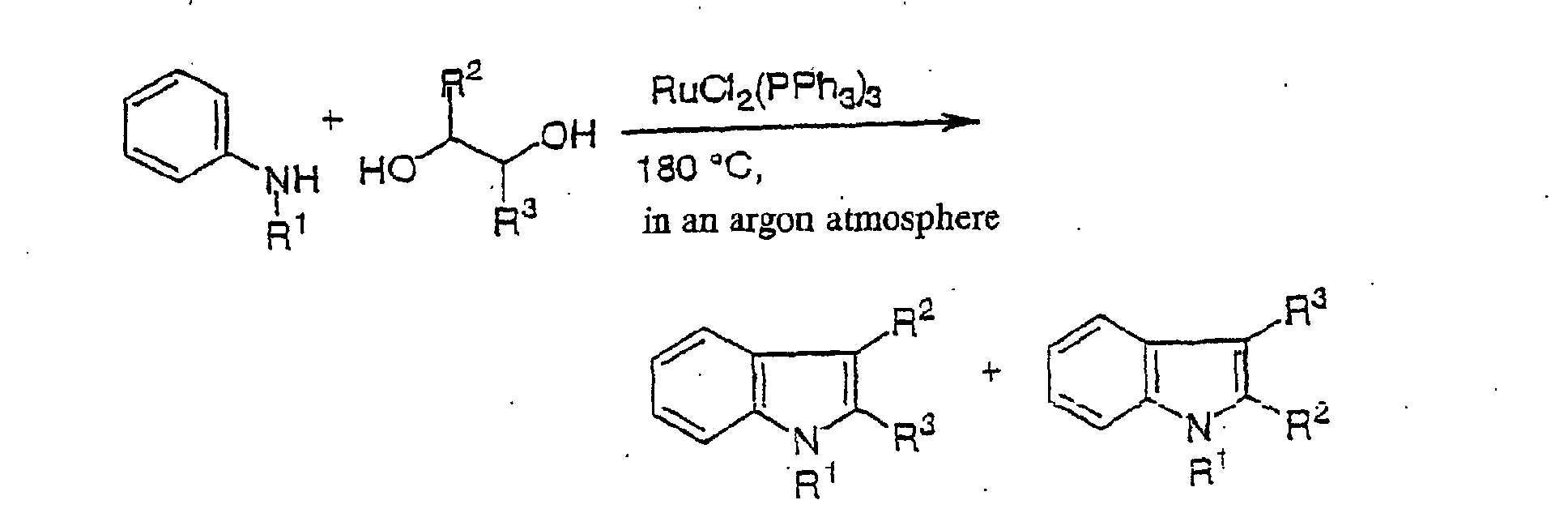
- a method of synthesizing indole from aniline and 1,2-diol is known. This method is superior in features such as atom efficiency and usability of aniline itself as a starting material, but there are problems such as formation of a mixture of isomers from asymmetric diol due to generally low regioselectivity, necessity for relatively high temperature (180 °C), necessity for an argon atmosphere, necessity for a solvent, etc. (J. Org. Chem., 52 , 1673 (1987), etc.).
- This invention was made in view of the present circumstances described above, and the object of this invention is to provide a process for producing condensed pyrroles having high regioselectivity, preferably indoles, which achieves high atom efficiency and can utilize inexpensive aromatic amines itself as the starting material.
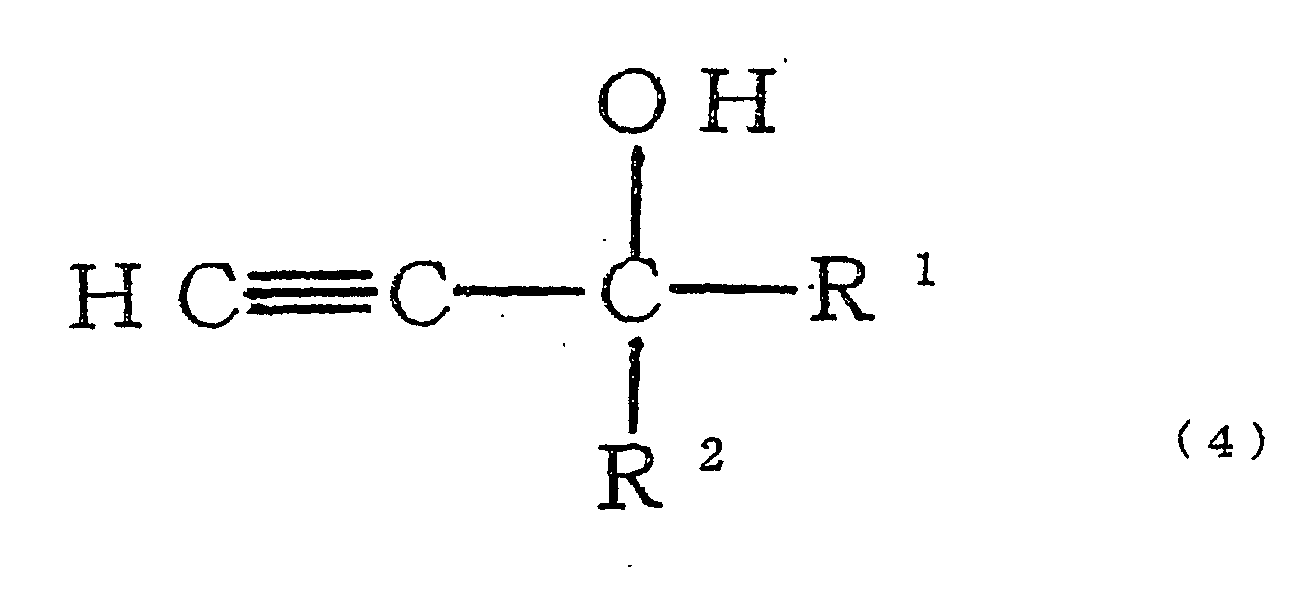
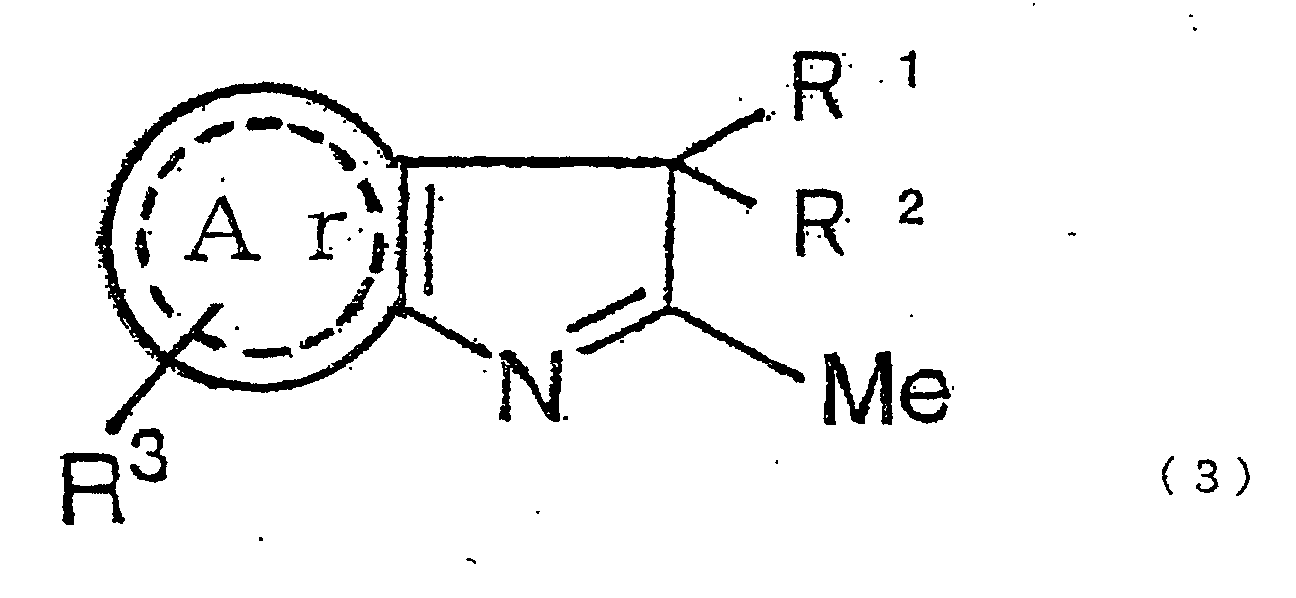
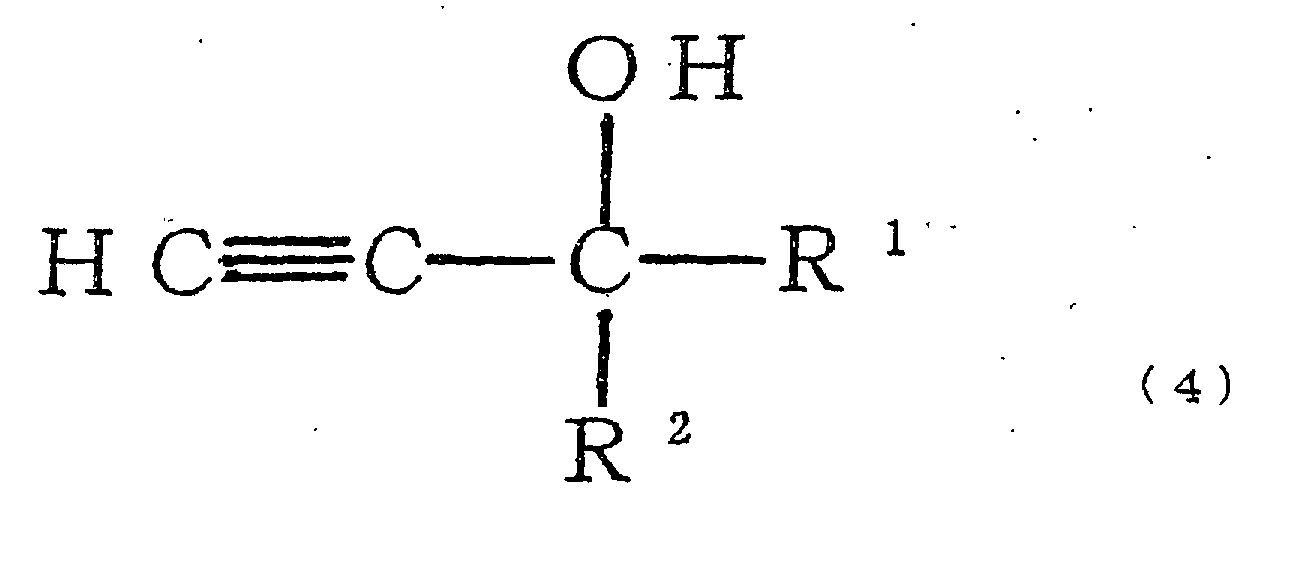
- This invention relates to a process for producing condensed pyrroles, which comprises allowing an alkyne alcohol represented by formula (4): wherein R 1 and R 2 independently represent a hydrogen atom, an alkyl group which may have a substituent group or an aryl group which may have a substituent group, and R 1 and R 2 are combined to form an alkylene chain, to react with an aromatic primary amine in the presence of a ruthenium complex.
- the compounds obtained by the process of this invention include:
- the alkyl group in the optionally substituted alkyl group represented by R 1 and R 2 includes e.g. a C 1-20 linear or branched alkyl group such as methyl group, ethyl group, propyl group, butyl group, pentyl group, hexyl group, heptyl group, octyl group, nonyl group, decyl group, dodecyl group, pentadecyl group, hexadecyl group, octadecyl group, nonadecyl group and eicosyl group.
- a C 1-20 linear or branched alkyl group such as methyl group, ethyl group, propyl group, butyl group, pentyl group, hexyl group, heptyl group, octyl group, nonyl group, decyl group, dodecyl group, pentadecyl group, hexa
- the aryl group in the optionally substituted aryl group includes e.g. a phenyl group, tolyl group, xylyl group, naphthyl group, methyl naphthyl group, biphenyl group etc.
- the substituent groups on these alkyl and aryl groups include e.g. an alkoxy group such as methoxy group and ethoxy group, an alkenyl group such as vinyl group and allyl group, a halogeno group such as chloro group, bromo group and fluoro group, and an amide group, an ester group etc.
- R 1 and R 2 are combined to form an alkylene chain, these groups together with their adjacent C atom form e.g. a cyclopropane ring, cyclopentane ring, cyclohexane ring etc.
- the aromatic primary amines used in the invention include e.g. aniline and nucleus-substituted derivatives thereof, 1- or 2-naphthyl amine and nucleus-substituted derivatives thereof, 1- or 2-aminoanthracene and nucleus-substituted derivatives thereof, and 2-aminobiphenyl and nucleus-substituted derivatives thereof.
- the double-circled Ar represents an aromatic ring
- the aromatic ring referred to herein may be a monocyclic, condensed polycyclic, non-condensed polycyclic carbon ring or heterocyclic ring, and includes e.g. a benzene ring, naphthalene ring, anthracene ring, phenanthrene ring, biphenyl, terphenyl, pyridine ring, pyrimidine ring etc.
- the heterocyclic ring is preferably a ring having 1 to 3 heteroatoms such as O, S and N.
- the alkyl group in the optionally substituted alkyl group represented by R 3 includes e.g. a C 1-6 linear or branched lower alkyl group such as methyl group, ethyl group, propyl group, butyl group, pentyl group and hexyl group, and the substituent group thereon includes a hydroxyl group, an alkoxy group such as methoxy group, ethoxy group, n-propoxy group and isopropoxy group, and a halogen atom such as chlorine, bromine and fluorine.
- a C 1-6 linear or branched lower alkyl group such as methyl group, ethyl group, propyl group, butyl group, pentyl group and hexyl group
- the substituent group thereon includes a hydroxyl group, an alkoxy group such as methoxy group, ethoxy group, n-propoxy group and isopropoxy group, and a halogen atom such as chlorine, bromine
- the aryl group represented by R 3 includes e.g. a phenyl group, tolyl group, xylyl group, naphthyl group, methyl naphthyl group, biphenyl group etc.
- the alkoxy group represented by R 3 includes e.g. a methoxy group, ethoxy group, n-propoxy group, isopropoxy group, n-butoxy group, t-butoxy group etc.
- the halogeno group represented by R 3 includes e.g. a chloro group, bromo group, fluoro group etc.
- substituent groups represented by R 3 on the aromatic ring include a hydroxy group, amide group, ketone ring, ester group etc.
- aromatic primary amines having these substituent groups those aromatic primary amines having electron-donating substituent groups such as hydroxy group and alkoxy group are particularly highly reactive, thus giving high yield.
- the ruthenium complex used in the process of this invention may be any complex capable of demonstrating a catalytic action in reaction of the alkyne alcohol with the aromatic primary amine, and for example, use can be made of ruthenium complexes used in conventional processes for producing an imine and enamine by adding e.g. an amine to a terminal alkyne.
- the ruthenium complexes usable in this invention include e.g. Ru 3 (CO) 12 , Ru(CO) 3 (C 8 H 12 ), Ru(CO) 3 (C 8 H 8 ), [RuCl 2 (CO 3 )] 2 , [Ru(C 5 H 5 )(CO) 2 ] 2 , (C 2 H 5 ) 4 N ⁇ [HRu 3 (CO) 12 ], HRu 4 (CO) 12 , [(C 2 H 5 ) 4 N] 2 ⁇ [Ru 6 C(CO) 16 ], [(Ph 3 P) 2 N] 2 ⁇ [Ru 6 (CO) 18 ], [(Ph 3 P) 2 N] 2 ⁇ [Ru 10 C(CO) 24 ], [RuCl 2 (C 6 H 6 )] 2 , RuCl 3 ⁇ 3H 2 O, [RuCl 2 (PPh 3 ) 3 ], [RuCl 2 (C 6 H 6 )(PPh 3 )], [RuCl 2 (C 6 H 6 )(
- the ruthenium complex is particularly preferably Ru 3 (CO) 12 .
- the amount of the ruthenium complex added to the reaction system is usually 0.1 to 10 mol-%.
- the process of this invention is conducted preferably in the coexistence of an acid or an ammonium salt thereof (referred to hereinafter as "additive").
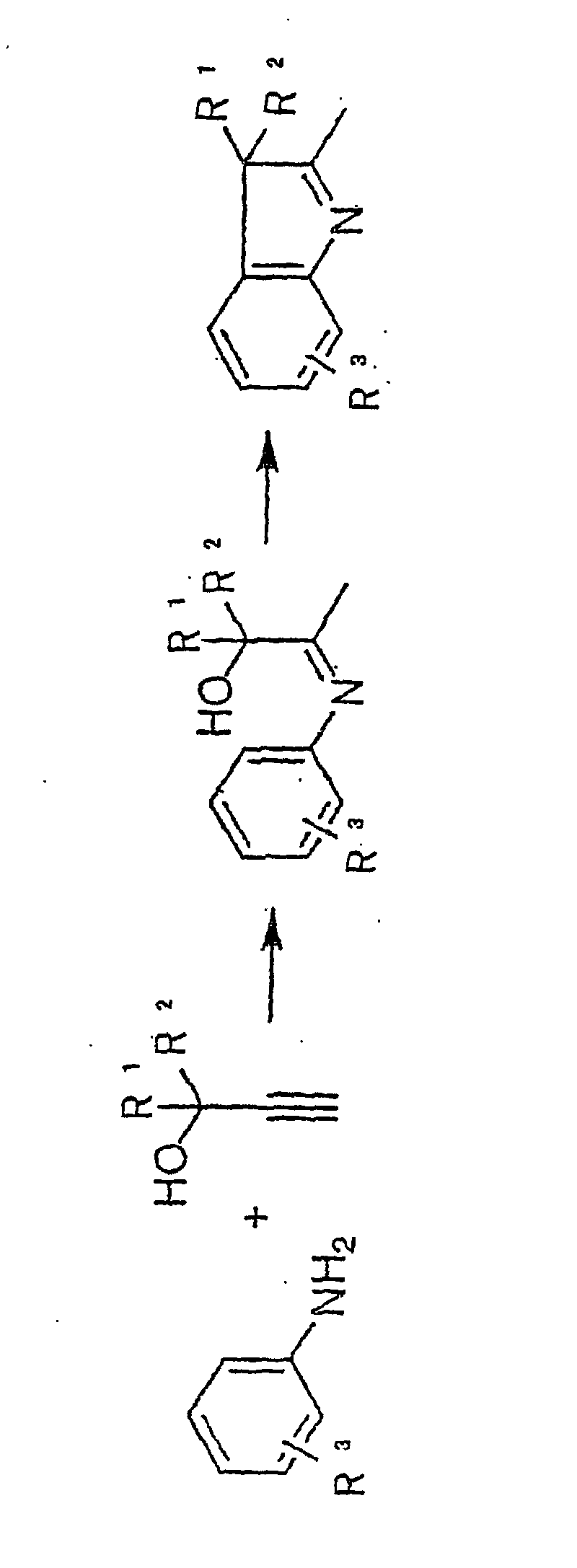
- the amount of the additive is not necessarily the same, but generally speaking, when e.g. Ru 3 (CO) 12 is used as the ruthenium complex, the additive is used in an amount of about 3 equivalents relative to Ru 3 (CO) 12 (that is, in an amount of about 1 equivalent relative to the ruthenium atom), whereby the compounds represented by the following general formula (5): (wherein the double-circled Ar, R 1 , R 2 and R 3 have the same meanings as defined above) are obtained, while the additive is used in excess, for example in an amount of 10 equivalents or more relative to Ru 3 (CO) 12 (that is, in an amount of 3 equivalents or more relative to the ruthenium atom), the desired condensed pyrroles can be obtained.
- the additive promotes both the first and second reactions.
- a small amount of the additive suffices for the first reaction, but a relatively large amount thereof is necessary for the second reaction.
- the additive is used in an amount of 3 to 30 equivalents relative to Ru 3 (CO) 12 (that is, in an amount of 1 to 10 equivalents relative to the ruthenium atom)
- the product is considered to occur as a mixture of the condensed pyrrole and an intermediate thereof, but formation of the product depends on the type of the aromatic primary amine used.
- the pyrrole ring is also formed depending on the type of the aromatic primary amine used (for example, m-hydroxy aniline can be easily cyclized to form indole in high yield even if the amount of the additive is 3 equivalents relative to Ru 3 (CO) 12 (1 equivalent relative to the ruthenium atom).
- the process of this invention can make use of a 2-stage reaction process wherein the compound represented by the general formula (5) above is first obtained from the alkyne alcohol and the aromatic primary amine, and then converted into the desired condensed pyrrole, or a process wherein the alkyne alcohol and the aromatic primary amine are converted directly into the condensed pyrrole.
- the compound represented by the general formula (5) may be isolated once, or without isolation, the reaction mixture may be used as such in the second reaction.
- the intermediate is isolated, further addition of the ruthenium complex and the additive is naturally necessary for conducting the next reaction, but when the reaction mixture is subjected as such without isolation to the second reaction, it is enough to add a deficient amount of the additive.
- the acids include e.g. HPF 6 , HBF 4 , BF 3 , CF 3 SO 3 H, CH 3 SO 3 H, C 6 H 6 SO 3 H, CH 3 C 6 H 6 SO 3 H, H 2 SO 4 , HI, HBr, HCl, HF, CF 3 COOH, ClCH 2 COOH, CH 3 COOH, C 6 H 5 COOH etc., and effective ammonium salts are those except for quaternary ones (N(CH 3 ) 4 + etc.).
- unsubstituted ammonium salts (NH 4 + salts), primary ammonium salts (for example C 6 H 5 NH 3 + salt etc.), secondary ammonium salts (for example NH 2 (C 2 H 5 ) 2 + salt etc.), tertiary ammonium salts (for example NH(C 2 H 5 ) 3 + salt etc.) have the same effect.
- primary ammonium salts for example C 6 H 5 NH 3 + salt etc.
- secondary ammonium salts for example NH 2 (C 2 H 5 ) 2 + salt etc.
- tertiary ammonium salts for example NH(C 2 H 5 ) 3 + salt etc.
- the additive preferably used is a salt consisting of the aromatic primary amine used in the reaction and one of the above acids.
- the reaction is conducted usually under heating at 80 to 200 °C. Replacement of the atmosphere in the reaction system by e.g. nitrogen or argon is not particularly necessary.
- This reaction does not particularly necessitate the presence of a solvent, but can also be conducted using a general organic solvent.
- a solvent includes those having a boiling point of 80 °C or more, such as ethylene glycol, grime, digrime, toluene, benzene, xylene, 2-propanol, 1,4-dioxane, dimethylformamide and dimethyl sulfoxide.
- the method of isolating the condensed pyrrole as the final product can be conducted using an extraction procedure. That is, an excess of the aromatic primary amine etc. can be removed by adding an extraction solvent such as diethyl ether, dichloromethane and toluene to the reaction solution and then washing the product several times with e.g. 1 M hydrochloric acid. In this procedure, the product can usually attain 90 to 99 % purity. The product can be further purified by re-crystallization, distillation etc.
- an extraction solvent such as diethyl ether, dichloromethane and toluene
- Compound (1) has a methyl group as a substituent group at the 3-position of the pyrrole ring and R 1 (or R 2 ) as a substituent group at the 2-position.
- Compound (2) wherein the substituent groups at the 2- and 3-positions have been replaced with each other is also simultaneously formed in a smaller amount, Compound (1) can be obtained as the major product.
- Compound (1) Compound (2) is usually at least 9 : 1.
Landscapes
- Chemical & Material Sciences (AREA)
- Organic Chemistry (AREA)
- Indole Compounds (AREA)
- Low-Molecular Organic Synthesis Reactions Using Catalysts (AREA)
Abstract
Description






| Examples | R1 | R3 | 1/Additive/2 (mmol) | Time (h) | Yield (%) | 3a/3b |
| 5c | H | Ph | 6.0/1.0a/9.0 | 7c | >95 | 1/16 |
| 6e | m-OH | CH3 | 6.0/1.0a/9.0 | 8e | 50 | - |
| 7c | p-CH3O | CH3 | 6.0/1.0a/9.0 | 8c | 89 | - |
| 8e | 3,4-di-(CH3O) | n-C3H7 | 5.0/1.0a/7.0 | 24e | 75 | |
| 9c | p-CH3 | C2H5 | 6.0/1.0a/9.0 | 9c | 97 | 1/8.4 |
| 10e | o-CH3 | CH3 | 7.0/0.75b/9.0 | 17e | 91 | - |
| 11e,f | p-Cl | CH3 | 5.0/0.75b/7.0 | 9e | 80 | - |
| 12e,g | o-CO2CH3 | CH3 | 7.0/0.7b/9.0 | 23e | 40 | - |
| a) The corresponding monohydrochloride was used. b) NH4PF6 was used. | ||||||
| c) No solvent was used. e) Ethylene glycol was used as solvent. | ||||||
| f) 0.5 mol-% catalyst was used. g) 1.0 mol-% catalyst was used. |
Claims (11)
- A process for producing condensed pyrroles, which comprises allowing an alkyne alcohol represented by formula (4):wherein R1 and R2 independently represent a hydrogen atom, an alkyl group which may have a substituent group or an aryl group which may have a substituent group, and R1 and R2 may be combined to form an alkylene chain, to react with an aromatic primary amine in the presence of a ruthenium complex.

- The process according to claim 1, wherein the condensed pyrroles are compounds represented by formula (1):wherein double-circled Ar represents an aromatic ring, R1 (or R2) represents a hydrogen atom, an alkyl group which may have a substituent group or an aryl group which may have a substituent group, and R3 represents an alkyl group which may have a substituent group, an aryl group, a hydroxy group, an alkoxy group, an amide group, a ketone group, an ester group or a halogeno group.

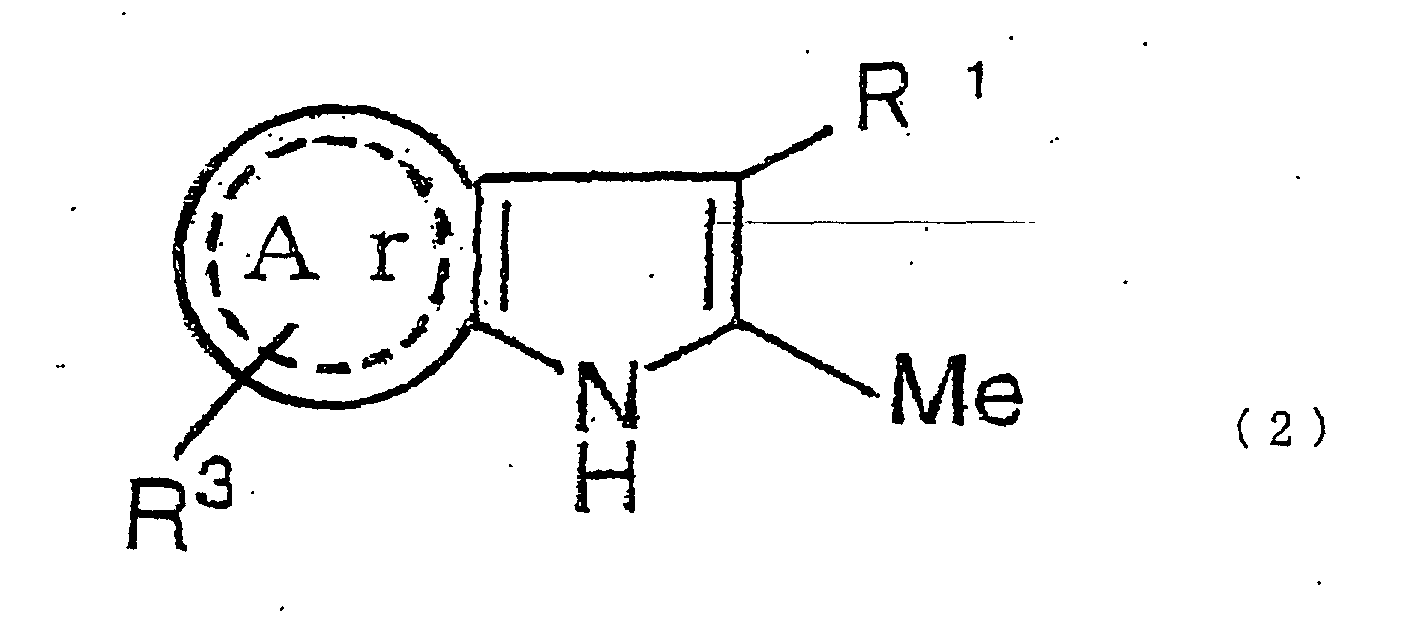
- The process according to claim 1, wherein the condensed pyrroles are compounds represented by formula (2):wherein double-circled Ar represents an aromatic ring, R1 (or R2) represents a hydrogen atom, an alkyl group which may have a substituent group or an aryl group which may have a substituent group, and R3 represents an alkyl group which may have a substituent group, an aryl group, a hydroxy group, an alkoxy group, an amide group, a ketone group, an ester group or a halogeno group.

- The process according to claim 1, wherein the condensed pyrroles are compounds represented by formula (3):wherein double-circled Ar represents an aromatic ring, R3 represents an alkyl group which may have a substituent group, an aryl group, a hydroxy group, an alkoxy group, an amide group, a ketone group, an ester group or a haiogeno group, and R1 and R2 have the same meanings as defined above.
- The process according to any one of claims 1 to 4, wherein the ruthenium complex is Ru3(CO)12.
- The process according to claim 5, wherein Ru3(CO)12 is used in an amount of 0.1 to 10 mol-%.
- The process according to any one of claims 1 to 6, wherein the reaction is conducted in the coexistence of an acid or an ammonium salt thereof.
- The process according to claim 7, wherein the acid or an ammonium salt thereof is used in an amount of 3 equivalents or more relative to Ru3(CO)12 (1 equivalent or more relative to the ruthenium atom).
- The process according to claim 7 or 8, wherein the acid or an ammonium salt thereof is a salt consisting of an acid and the aromatic primary amine used in the reaction.
- The process according to any one of claims 1 to 9, wherein the reaction is conducted under heating at 80 to 200 °C.
- The process according to claim 1, which comprises allowing an alkyne alcohol represented by formula (4):wherein R1 and R2 have the same meanings as defined above, to react with an aromatic primary amine in the presence of a ruthenium salt and in the coexistence of an acid or an ammonium salt thereof in an amount of 1 to 10 equivalents relative to the ruthenium atom, to form a compound represented by formula (5):
 wherein double-circled Ar, R1, R2 and R3 have the same meanings as defined above, then isolating the compound and adding an additional ruthenium complex and an acid or an ammonium salt thereof to react with the compound, or adding an acid or an ammonium salt thereof to react with the compound without isolation in the same system.
Applications Claiming Priority (3)
| Application Number | Priority Date | Filing Date | Title |
|---|---|---|---|
| JP2000216457 | 2000-07-17 | ||
| JP2000216457A JP2002030069A (en) | 2000-07-17 | 2000-07-17 | Method for producing condensed pyrroles |
| PCT/JP2001/005691 WO2002006226A1 (en) | 2000-07-17 | 2001-07-02 | Processes for preparation of fused pyrroles |
Publications (3)
| Publication Number | Publication Date |
|---|---|
| EP1302459A1 true EP1302459A1 (en) | 2003-04-16 |
| EP1302459A4 EP1302459A4 (en) | 2004-03-10 |
| EP1302459B1 EP1302459B1 (en) | 2004-10-27 |
Family
ID=18711722
Family Applications (1)
| Application Number | Title | Priority Date | Filing Date |
|---|---|---|---|
| EP01945742A Expired - Lifetime EP1302459B1 (en) | 2000-07-17 | 2001-07-02 | Processes for preparation of fused pyrroles |
Country Status (5)
| Country | Link |
|---|---|
| US (1) | US6872835B2 (en) |
| EP (1) | EP1302459B1 (en) |
| JP (1) | JP2002030069A (en) |
| DE (1) | DE60106766T2 (en) |
| WO (1) | WO2002006226A1 (en) |
Families Citing this family (5)
| Publication number | Priority date | Publication date | Assignee | Title |
|---|---|---|---|---|
| EA200700243A1 (en) | 2004-07-14 | 2007-08-31 | ПиТиСи ТЕРАПЬЮТИКС, ИНК. | METHODS OF TREATMENT OF HEPATITIS C |
| US7868037B2 (en) | 2004-07-14 | 2011-01-11 | Ptc Therapeutics, Inc. | Methods for treating hepatitis C |
| US7781478B2 (en) | 2004-07-14 | 2010-08-24 | Ptc Therapeutics, Inc. | Methods for treating hepatitis C |
| US7772271B2 (en) | 2004-07-14 | 2010-08-10 | Ptc Therapeutics, Inc. | Methods for treating hepatitis C |
| EP1781289A1 (en) | 2004-07-22 | 2007-05-09 | PTC Therapeutics, Inc. | Thienopyridines for treating hepatitis c |
Family Cites Families (6)
| Publication number | Priority date | Publication date | Assignee | Title |
|---|---|---|---|---|
| US2703333A (en) | 1954-04-21 | 1955-03-01 | Air Reduction | 3-methyl-3-hydroxy-2-butanil and method for preparing same |
| IT1015908B (en) * | 1974-04-05 | 1977-05-20 | Snam Progetti | PROCEDURE FOR THE SYNTHESIS OF INDOLENINE ALKYL SUBSTITUTED |
| JPS6293273A (en) | 1985-10-21 | 1987-04-28 | Yoshihisa Watabe | Production of indole |
| JP3023197B2 (en) | 1991-03-27 | 2000-03-21 | 川研ファインケミカル株式会社 | Method for producing indole |
| JPH07238069A (en) | 1994-02-28 | 1995-09-12 | Daicel Chem Ind Ltd | Production of cyclic amide compound |
| JP4241970B2 (en) * | 1998-10-30 | 2009-03-18 | 中外製薬株式会社 | Indole derivatives having amide bonds, and mono- or diazaindole derivatives |
-
2000
- 2000-07-17 JP JP2000216457A patent/JP2002030069A/en active Pending
-
2001
- 2001-07-02 EP EP01945742A patent/EP1302459B1/en not_active Expired - Lifetime
- 2001-07-02 US US10/088,276 patent/US6872835B2/en not_active Expired - Fee Related
- 2001-07-02 WO PCT/JP2001/005691 patent/WO2002006226A1/en not_active Ceased
- 2001-07-02 DE DE60106766T patent/DE60106766T2/en not_active Expired - Fee Related
Also Published As
| Publication number | Publication date |
|---|---|
| EP1302459B1 (en) | 2004-10-27 |
| DE60106766D1 (en) | 2004-12-02 |
| US6872835B2 (en) | 2005-03-29 |
| US20040049054A1 (en) | 2004-03-11 |
| WO2002006226A1 (en) | 2002-01-24 |
| JP2002030069A (en) | 2002-01-29 |
| DE60106766T2 (en) | 2005-12-15 |
| EP1302459A4 (en) | 2004-03-10 |
Similar Documents
| Publication | Publication Date | Title |
|---|---|---|
| Peat et al. | Novel syntheses of tetrahydropyrroloquinolines: Applications to alkaloid synthesis | |
| Tokunaga et al. | A practical one-pot synthesis of 2, 3-disubstituted indoles from unactivated anilines | |
| Suryavanshi et al. | Expedient, one-pot preparation of fused indoles via CAN-catalyzed three-component domino sequences and their transformation into polyheterocyclic compounds containing pyrrolo [1, 2-a] azepine fragments | |
| EP2943471A1 (en) | Syntheses of n-heterocyclic carbenes and intermediates therefor | |
| EP1302459B1 (en) | Processes for preparation of fused pyrroles | |
| JP2002507222A (en) | Method for producing substituted perhydroisoindole | |
| EA005491B1 (en) | Method for the preparation of citalopram | |
| FI68222C (en) | FOERFARANDE FOER 0-METYLERING AV HYDROXIAPORFINER | |
| CA2297279C (en) | New cyano-indole compounds that inhibit serotonin recapture, the process for their preparation and the pharmaceutical compounds that contain them | |
| FR2660657A1 (en) | NOVEL 3-AMINOCHROMAN DERIVATIVES, PROCESS FOR PREPARING THEM AND PHARMACEUTICAL COMPOSITIONS CONTAINING THEM | |
| Cabanal-Duvillard et al. | Preparation of N, N′-aryl-disubstituted-1, 2-diphenyl-1, 2-diaminoethanes using palladium-catalyzed aromatic amino coupling | |
| CN101868438A (en) | Process for the synthesis of polyhydroxystilbene compounds | |
| JP2000344720A (en) | Production of diarylamine | |
| CN105669516B (en) | A kind of preparation method of 3,3 '-bis-benzazolyl compounds | |
| TW202404947A (en) | Process for preparing cis-4-aminotetrahydrofuran-2-carboxylic esters | |
| JP4508528B2 (en) | Process for producing α-amino substituted carboxylic acid amide | |
| CN111732528A (en) | A kind of preparation method of N-aryl indoline derivative | |
| CZ283683B6 (en) | Process for preparing 3-/2-(dimethylamino)ethyl/-n-methyl -1h - indole-5-methane sulfonamide | |
| CN105801333B (en) | A kind of preparation method of coronene | |
| CN103724228B (en) | The novel method of synthesis 3-(2-bromo-4,5-dimethoxy phenyl) propionitrile and the application in the additive salt of synthesis of ivabradine and itself and pharmaceutically acceptable acid | |
| HU223138B1 (en) | A novel process for the preparation of racemic alkyl 4,6,7,8,9,9a-hexahydro-2H, 3H-pyrido- [1,2-a] pyrazine-1-one-7-carboxylic acid esters | |
| CN107954960A (en) | A kind of synthetic method of 1,3- dihydroisobenzofurans class compound | |
| US4122256A (en) | Heterocyclic azomethines | |
| EP0015786B1 (en) | Imidazo and pyrimido-pyrido indoles, their preparation and medicines containing them | |
| KR100909295B1 (en) | Method for preparing 6-aminomethyl-6,11-dihydro-5H-dibenz [e] ezepine |
Legal Events
| Date | Code | Title | Description |
|---|---|---|---|
| PUAI | Public reference made under article 153(3) epc to a published international application that has entered the european phase |
Free format text: ORIGINAL CODE: 0009012 |
|
| 17P | Request for examination filed |
Effective date: 20020418 |
|
| AK | Designated contracting states |
Designated state(s): AT BE CH CY DE DK ES FI FR GB GR IE IT LI LU MC NL PT SE TR |
|
| RIN1 | Information on inventor provided before grant (corrected) |
Inventor name: WAKATSUKI, YASUO,C/O RIKEN Inventor name: TOKUNAGA, MAKOTO |
|
| RIC1 | Information provided on ipc code assigned before grant |
Ipc: 7C 07D 209/08 A |
|
| A4 | Supplementary search report drawn up and despatched |
Effective date: 20040123 |
|
| GRAP | Despatch of communication of intention to grant a patent |
Free format text: ORIGINAL CODE: EPIDOSNIGR1 |
|
| RAP1 | Party data changed (applicant data changed or rights of an application transferred) |
Owner name: RIKEN Owner name: JAPAN SCIENCE AND TECHNOLOGY AGENCY |
|
| RBV | Designated contracting states (corrected) |
Designated state(s): CH DE FR GB LI |
|
| GRAS | Grant fee paid |
Free format text: ORIGINAL CODE: EPIDOSNIGR3 |
|
| GRAA | (expected) grant |
Free format text: ORIGINAL CODE: 0009210 |
|
| AK | Designated contracting states |
Kind code of ref document: B1 Designated state(s): CH DE FR GB LI |
|
| REG | Reference to a national code |
Ref country code: GB Ref legal event code: FG4D |
|
| REG | Reference to a national code |
Ref country code: CH Ref legal event code: EP |
|
| REG | Reference to a national code |
Ref country code: IE Ref legal event code: FG4D |
|
| REF | Corresponds to: |
Ref document number: 60106766 Country of ref document: DE Date of ref document: 20041202 Kind code of ref document: P |
|
| REG | Reference to a national code |
Ref country code: CH Ref legal event code: NV |
|
| REG | Reference to a national code |
Ref country code: GB Ref legal event code: 711B |
|
| PGFP | Annual fee paid to national office [announced via postgrant information from national office to epo] |
Ref country code: GB Payment date: 20050629 Year of fee payment: 5 |
|
| PGFP | Annual fee paid to national office [announced via postgrant information from national office to epo] |
Ref country code: DE Payment date: 20050630 Year of fee payment: 5 |
|
| PGFP | Annual fee paid to national office [announced via postgrant information from national office to epo] |
Ref country code: FR Payment date: 20050708 Year of fee payment: 5 |
|
| PGFP | Annual fee paid to national office [announced via postgrant information from national office to epo] |
Ref country code: CH Payment date: 20050713 Year of fee payment: 5 |
|
| PLBE | No opposition filed within time limit |
Free format text: ORIGINAL CODE: 0009261 |
|
| STAA | Information on the status of an ep patent application or granted ep patent |
Free format text: STATUS: NO OPPOSITION FILED WITHIN TIME LIMIT |
|
| ET | Fr: translation filed | ||
| 26N | No opposition filed |
Effective date: 20050728 |
|
| REG | Reference to a national code |
Ref country code: GB Ref legal event code: 711G |
|
| PG25 | Lapsed in a contracting state [announced via postgrant information from national office to epo] |
Ref country code: GB Free format text: LAPSE BECAUSE OF NON-PAYMENT OF DUE FEES Effective date: 20060702 |
|
| PG25 | Lapsed in a contracting state [announced via postgrant information from national office to epo] |
Ref country code: LI Free format text: LAPSE BECAUSE OF NON-PAYMENT OF DUE FEES Effective date: 20060731 Ref country code: CH Free format text: LAPSE BECAUSE OF NON-PAYMENT OF DUE FEES Effective date: 20060731 |
|
| PG25 | Lapsed in a contracting state [announced via postgrant information from national office to epo] |
Ref country code: DE Free format text: LAPSE BECAUSE OF NON-PAYMENT OF DUE FEES Effective date: 20070201 |
|
| REG | Reference to a national code |
Ref country code: CH Ref legal event code: PL |
|
| GBPC | Gb: european patent ceased through non-payment of renewal fee |
Effective date: 20060702 |
|
| REG | Reference to a national code |
Ref country code: FR Ref legal event code: ST Effective date: 20070330 |
|
| PG25 | Lapsed in a contracting state [announced via postgrant information from national office to epo] |
Ref country code: FR Free format text: LAPSE BECAUSE OF NON-PAYMENT OF DUE FEES Effective date: 20060731 |
|
| REG | Reference to a national code |
Ref country code: CH Ref legal event code: NV Representative=s name: PATENTANWAELTE SCHAAD, BALASS, MENZL & PARTNER AG |