EP1301853B1 - Apparatus and method for text segmentation based on coherent units - Google Patents
Apparatus and method for text segmentation based on coherent units Download PDFInfo
- Publication number
- EP1301853B1 EP1301853B1 EP01975645A EP01975645A EP1301853B1 EP 1301853 B1 EP1301853 B1 EP 1301853B1 EP 01975645 A EP01975645 A EP 01975645A EP 01975645 A EP01975645 A EP 01975645A EP 1301853 B1 EP1301853 B1 EP 1301853B1
- Authority
- EP
- European Patent Office
- Prior art keywords
- text
- size
- segmentation
- end position
- segments
- Prior art date
- Legal status (The legal status is an assumption and is not a legal conclusion. Google has not performed a legal analysis and makes no representation as to the accuracy of the status listed.)
- Expired - Lifetime
Links
Images


Classifications
-
- G—PHYSICS
- G06—COMPUTING OR CALCULATING; COUNTING
- G06F—ELECTRIC DIGITAL DATA PROCESSING
- G06F40/00—Handling natural language data
- G06F40/10—Text processing
- G06F40/12—Use of codes for handling textual entities
- G06F40/137—Hierarchical processing, e.g. outlines
-
- G—PHYSICS
- G06—COMPUTING OR CALCULATING; COUNTING
- G06F—ELECTRIC DIGITAL DATA PROCESSING
- G06F40/00—Handling natural language data
- G06F40/10—Text processing
- G06F40/12—Use of codes for handling textual entities
- G06F40/14—Tree-structured documents
- G06F40/143—Markup, e.g. Standard Generalized Markup Language [SGML] or Document Type Definition [DTD]
-
- Y—GENERAL TAGGING OF NEW TECHNOLOGICAL DEVELOPMENTS; GENERAL TAGGING OF CROSS-SECTIONAL TECHNOLOGIES SPANNING OVER SEVERAL SECTIONS OF THE IPC; TECHNICAL SUBJECTS COVERED BY FORMER USPC CROSS-REFERENCE ART COLLECTIONS [XRACs] AND DIGESTS
- Y10—TECHNICAL SUBJECTS COVERED BY FORMER USPC
- Y10S—TECHNICAL SUBJECTS COVERED BY FORMER USPC CROSS-REFERENCE ART COLLECTIONS [XRACs] AND DIGESTS
- Y10S707/00—Data processing: database and file management or data structures
- Y10S707/99941—Database schema or data structure
- Y10S707/99943—Generating database or data structure, e.g. via user interface
-
- Y—GENERAL TAGGING OF NEW TECHNOLOGICAL DEVELOPMENTS; GENERAL TAGGING OF CROSS-SECTIONAL TECHNOLOGIES SPANNING OVER SEVERAL SECTIONS OF THE IPC; TECHNICAL SUBJECTS COVERED BY FORMER USPC CROSS-REFERENCE ART COLLECTIONS [XRACs] AND DIGESTS
- Y10—TECHNICAL SUBJECTS COVERED BY FORMER USPC
- Y10S—TECHNICAL SUBJECTS COVERED BY FORMER USPC CROSS-REFERENCE ART COLLECTIONS [XRACs] AND DIGESTS
- Y10S707/00—Data processing: database and file management or data structures
- Y10S707/99941—Database schema or data structure
- Y10S707/99944—Object-oriented database structure
- Y10S707/99945—Object-oriented database structure processing
Definitions
- the invention relates to a text segmentation technique and, more specifically, to a text segmentation technique for segmenting texts based on coherent units.
- a user After a text has been retrieved through a text search process, a user must make a further search for retrieving the required text part from the displayed text if the searched text is still so bulky as to contain many topics. In such a case, if the user makes a search through the text segments that have been segmented beforehand based on topics, the user will be able to immediately display the desired text segment. And accordingly it may become unnecessary for the user to make a further search for the required part. Therefore, if the text is segmented based on topics, It will be easy to perform various text processing applications.
- Laid Open Japanese Patent Publication No. 11-242684 proposes a text segmentation apparatus wherein texts are handled in terms of not only association between adjacent sentences but also global sentence association.
- Japan Patent Application Publication No. 2000-235574 proposes a method for obtaining segmentation points based on a square matrix whose elements include relativeness between the paragraphs, the text being segmented in accordance with a paragraph format and the like.
- Laid Open Japanese Patent Application Publication No. 10-72724 proposes a method comprising the steps of determining the relativeness at each position based on a plurality of windows, determining the border of the topics for each layer and integrating those borders to identify the topic border.
- the text is segmented into a group of text segments, each having the approximately equal size to the specified one.
- the Inventive apparatus first determines the similarity between the text parts contained in a pair of windows to be set up on the left and right sides of each sentence end position in the text so as to obtain similarity curves. Then, the apparatus determines the likelihood of segmentation point for each sentence end point based on the obtained similarity curves. The apparatus segments the text at the point having the best likelihood of segmentation point and further segments it at the point of the second best likelihood of segmentation point, and so on, until the size of all of the text segments becomes approximately equal to the specified segment size.
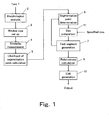
- Figure 1 illustrates the functional blocks showing the structure of the system in accordance with one embodiment of the invention.
- the system of this embodiment comprises a general purpose computer, workstation or personal computer in terms of hardware structure.
- the invention can be implemented through the execution of the computer program on the general purpose computer.
- Each of the blocks shown in Fig. 1 represents the respective function embodied by such computer program.
- a morphological analysis block 2 receives an electronic text 1 as an object to be segmented, extract words from the text and append the information upon the part of speech to each of extracted words.
- a window size setup block 3 sets up a window size to be used for measuring the similarity between the adjacent sentences contained in the concerned text.
- the window size is defined as a predetermined length in the left and right directions from a sentence end position.
- a similarity measurement block 4 measures, at each sentence end position, the similarity between the text portions contained in the left and right windows that have been set up by the window size setup block 3 and generate the corresponding similarity curve.
- a determination block 5 is for determining the likelihood of segmentation point at each sentence end position based on the similarity curve generated by the similarity measurement block 4.
- a segmentation point determination block 6 uses the likelihood of segmentation point determined in the determination block 5 to select as a segmentation point the position having the best likelihood of segmentation point within the largest text segment. At the starting point of the process when the text 1 is not segmented yet, the entire text 1 is to be regarded as the largest text segment.
- a size comparison block 11 compares the size of the candidate text segment selected by the segmentation point determination block 6 with a threshold size value to be determined based on the text segment size specified by the output equipment. If the size of the candidate text segment is larger than the threshold size, the position having the best likelihood of segmentation point in that candidate text segment may be selected as a segmentation point.
- a text segment generation block 7 collects the candidate text segments obtained through the previous blocks to generate a set of text segments. Until the size of all of the text segments within the set becomes smaller than the specified size, the process may return to the segmentation point determination block 6 and the size comparison block 11 to repeat their processes.
- a relativeness determination block 8 determines the similarity between adjacent segments generated by the text segment generation block 7 and performs an association process upon those text segments using that similarity.
- a link generation block 12 generates a link between the text segments having the high association in terms of contents based on the determination result by the relativeness determination block 8.
- Such generated text segments may be transmitted to the requesting terminal equipment, e.g., a PDA or a mobile telephone.
- a text segmentation apparatus in accordance with the invention may be used under the Internet environment.
- a user may use a PDA to access a web site via Internet, search for the data and display the acquired data on a PDA browser.
- the web site may utilize the inventive text segmentation apparatus to segment the text to be transmitted to the PDA into text segments so that the size of the text segments can match the display screen of the PDA.
- the text segments may be converted to the HTML format and accordingly appropriate hyperlinks for pointing to the associated text segments may be embedded before transmission to the PDA.
- the user can jump to the next text segment or to another text segment having a higher relativeness in terms of the content by clicking a button, so the user can comfortably view the text even on the small size display screen.
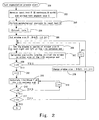
- Figure 2 and Figure 3 illustrate flowcharts of the text segmentation algorithm.
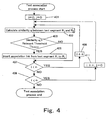
- Figure 4 illustrates a flowchart of the association algorithm among the text segments.
- the process receives an electronic text D containing N sentences and M words as well as the optimum text segment size S(step 202).
- the optimum text segment size means that it should be defined based on the number of the characters specified by the user or the number of displayable characters on the PDA or the mobile telephone. For example, the optimum text segment size may be 100 characters when the terminal device can display 100 characters.
- step 203 the process performs a morphological analysis on the input electronic text D to extract the words and give the information on the part of speech to each of the words.
- the process continues to set up the window size B in step 205.
- the window size B may be initially set to, for example, a fifth (1/5) of the number M of the words contained in the concerned text.
- step 207 the process determines the cosine measure sim(b l ,b r ) as the similarity at that position from the two vectors above obtained.
- the similarity gained in the equation (1) will be getting higher (up to 1 at maximum). If there is no common term, the similarity becomes zero.
- the larger value of the similarity means a higher probability of common topics being included in the left and right windows whereas the less value means a high probability of the topic boundary.
- the suffix i shown in Fig. 2 represents the number of the sentence contained in the text where the sequence of the numbers 1, 2, 3, ..., N are given to the sentences starting from the top sentence of the concerned text. Accordingly, the similarity determination for the end position of each sentence is performed by incrementing i until it reaches N, that is, it is determined NO in step 209. Thus, the similarity curve for the concerned text may be obtained.
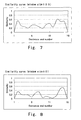
- Figure 5 through Figure 8 illustrate similarity curves for the following sample input text: TABLE 1
- the community of mostly volunteer programmers that has built Linux into a daunting operating system is getting some help from computer industry giants.
- the Open Source Development Lab will help fulfill a need that individual Linux and open source developers often have: access to high-end enterprise hardware," said Brian Behlendorf, creator of the open source Web server software Apache.
- Irving Wladawsky-Berger the head of IBM's Linux group, said the lab would help companies run hardware from different vendors together, as well as let run "clusters" of computers working as one.
- the four main sponsors said they will contribute several millions of dollars to the project.
- the lab is also backed by smaller companies that specialize in Linux products, like Red Hat Inc., Turbolinux Inc., Linuxcare Inc. and VA Linux Systems Inc., as well as Dell Computer Corp. and Silicon Graphics Inc.
- Linux is seen as an alternative to proprietary operating systems like Microsoft's Windows and Apple OS. Its backers say the publicly available source code, or software blueprint, makes it more flexible and reliable. Analyst Bill Claybrook at Aberdeen Group said the project sponsors are backing Linux because it gives them a chance to influence an operating system for their computers. "These companies see that they can play a much more important role in developing Linux than they can in, let's say Windows, because Microsoft pretty much decides what to put in Windows," he said.
- horizontal axes represent each sentence end position
- the vertical axes represent the corresponding similarity
- window sizes represent the number of the words contained respectively in the left and right windows.
- the process continues to obtain the likelihood of segmentation points f(c) for each end position of the sentences c based on those similarity curves.
- the likelihood of segmentation points f(c) may be determined from the following equations.
- s(c) represents the similarity at the end position c of each sentence
- s(c-) represents the similarity at the end position of the sentence immediately before the end position c
- s(c+) represents the similarity at the end position of the sentence immediately after the end position c
- alpha ( ⁇ ) and beta ( ⁇ ) are parameters to be appropriately determined through the experiment.
- the value of the likelihood of segmentation point of the equation (2) may become larger when the corresponding similarity is at minimal point or the magnitude of the transition between adjacent similarities is large, whereas it becomes smaller when the corresponding similarity is large or the magnitude of the transition between adjacent similarities is small.
- the process sets the window size B to a half (1/2) of the initial size and return to step 206 to repeat the subsequent steps. Then, after those steps complete, the process further sets the window size B to the half of the current one and repeats the subsequent steps. These processes are repeated until j reaches the total number L of the similarity curves, wherein it is determined NO in step 217.
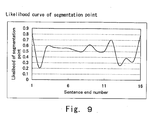
- the text segmentation process in this embodiment in the following will be performed based on the likelihood curve of segmentation point gained by equation (5).
- Figure 9 shows such a likelihood curve of segmentation point.
- the process starts at step 301 where the entire text before segmentation is represented as a text segment R 0 .
- the process selects the segment R i having the largest size from the text segment set R.
- the text segment set R initially includes only the text segment R 0 comprising the entire text.
- step 303 to compare the size of the selected text segment R i with the segment size threshold Th size , which is to be determined based on the specified size, that is, the optimum segment size S. For example, if the segment size threshold Th size is determined to be 1.1 times of the optimum segment size S, the text segment having the size within 110% of the optimum segment size may be accepted.
- the process may segment the text segment R i to generate new segments Rl', Rr'.
- the process may revisit the previous unsegmented text segment R i and select as a segmentation point the end position of the sentence that has the second best likelihood of segmentation point within the segment R i and segment it accordingly (step 309).
- the R i is removed from the text segment set R, and the segments Rl' and Rr' are added to the text segment set R (step 311).
- the process may repeat the steps following the step 305 for the text segments having the size exceeding the threshold Th size until the size of the largest text segment among all text segments becomes smaller than the threshold Th size , wherein it is determined NO in step 303.
- Table 2 shows a group of the text segments when the input document D shown in Table 1 has been segmented with the optimum segment size specified as 400 characters. It is understood that the size of each segment is almost equal to 400 characters as specified.
- Table 3 also shows an example of the text segments described in the markup language format.
- Text segment 1 The community of mostly volunteer programmers that has built Linux into a daunting operating system is getting some help from computer industry giants. International Business Machines Inc., Intel Corp., Hewlett-Packard Co. and NEC Corp. are announcing Wednesday that they will create a laboratory with an investment of several million dollars where programmers can test Linux software on the large computer systems that are common in the corporate world.
- Text segment 2 The lab is expected to open by the end of the year near Portland, Ore.
- Linux is an "open source" operating system that anyone can modify, as long as the modifications are made available for free on the Internet. It has a devoted following among programmers, who collaborate on software projects over the Web. These software engineers can usually only test software on their own desktop computers, part of the reason Linux is now rarely used on larger computers.
- Text segment 3 “The Open Source Development Lab will help fulfill a need that individual Linux and open source developers often have: access to high-end enterprise hardware," said Brian Be, creator of the open source Web server software Apache.
- Text segment 4 The four main sponsors said they will contribute several millions of dollars to the project.
- the lab is also backed by smaller companies that specialize in Linux products, like Red Hat Inc., Turbolinux Inc., Linuxcare Inc. and VA Linux Systems Inc., as well as Dell Computer Corp. and Silicon Graphics Inc.
- the founding companies said the lab will be run by a nonprofit organization that will select the software projects that gain access to the lab in an "open, neutral process.”
- Text segment 5 Linux is seen as an alternative to proprietary operating systems like Microsoft's Windows and Apple OS. Its backers say the publicly available source code, or software blueprint, makes it more flexible and reliable. Analyst Bill Claybrook at Aberdeen Group said the project sponsors are backing Linux because it gives them a chance to influence an operating system for their computers.
- the process uses equation (1) to determine the similarity q between any pair of the text segments that have been gained through the above-described processes or between the important words and any one of such text segments (step 402).
- the process may determine that similar topics are included between those text segments and embed an association link between those text segments (step 405).
- the relevant threshold Th relevant may be for example 0.5.
- the relevant threshold Th relevant may be specified by the user preparing for such situations where the user may wish to display only segments of which relativeness is high or all of the segments as long as there is association among them.
- Hyperlinks between the text segments having the similarity in terms of topics may be embedded into the corresponding text segments by means of the markup language.
- the target of the hyperlink is not limited to one text segment but may be linked to plural text segments.
- links to a plurality of text segments could be constructed, enabling such a mechanism for displaying a plurality of associated segments from one text segment to be implemented on the browser.
- a text is segmented into smaller segments having the almost same size with the specified one, so the text can be efficiently displayed to the user even on a smaller size screen such as a mobile terminal's screen.
- the user will be able to determine at a glance if the text being displayed is required or not because the text segments can be generated so as to meet the screen size.
- the association between the text segments having the same topics is established, so it is possible for users to access another associated text segment easily.
- terminal display devices do not need a larger size of the storage because it can display the text on a segment basis instead of displaying the whole text.
- the text can be transmitted segment by segment to the terminal display, limitations on the transmission packet size and/or the hardware could be taken into consideration at the transmission time.
- the user could immediately read required portion of the text by presenting the search result as text segments to the user.
- the user may extract important words or sentences for each segment in accordance with known methods as disclosed in some known literatures (for example, a literature by M. Kameda entitled “Retrieval of important sentences based on the paragraph shifting method using relativeness between the paragraph and the sentence", Natural Language Process Study Group Report, Information Process Society, 1997, 119-126. 121-17 ), or generate a text summary for each segment in accordance with known methods as disclosed in some known literatures (for example, a literature by Y.
Landscapes
- Engineering & Computer Science (AREA)
- Theoretical Computer Science (AREA)
- Audiology, Speech & Language Pathology (AREA)
- Health & Medical Sciences (AREA)
- Computational Linguistics (AREA)
- General Health & Medical Sciences (AREA)
- Physics & Mathematics (AREA)
- General Engineering & Computer Science (AREA)
- General Physics & Mathematics (AREA)
- Artificial Intelligence (AREA)
- Information Retrieval, Db Structures And Fs Structures Therefor (AREA)
- Machine Translation (AREA)
- Document Processing Apparatus (AREA)
- Facsimiles In General (AREA)
Applications Claiming Priority (3)
| Application Number | Priority Date | Filing Date | Title |
|---|---|---|---|
| JP2000302321A JP4299963B2 (ja) | 2000-10-02 | 2000-10-02 | 意味的まとまりに基づいて文書を分割する装置および方法 |
| JP2000003023 | 2000-10-02 | ||
| PCT/US2001/030734 WO2002029547A1 (en) | 2000-10-02 | 2001-10-02 | Apparatus and method for text segmentation based on coherent units |
Publications (3)
| Publication Number | Publication Date |
|---|---|
| EP1301853A1 EP1301853A1 (en) | 2003-04-16 |
| EP1301853A4 EP1301853A4 (en) | 2007-03-14 |
| EP1301853B1 true EP1301853B1 (en) | 2009-07-22 |
Family
ID=18783693
Family Applications (1)
| Application Number | Title | Priority Date | Filing Date |
|---|---|---|---|
| EP01975645A Expired - Lifetime EP1301853B1 (en) | 2000-10-02 | 2001-10-02 | Apparatus and method for text segmentation based on coherent units |
Country Status (5)
| Country | Link |
|---|---|
| US (1) | US7113897B2 (enExample) |
| EP (1) | EP1301853B1 (enExample) |
| JP (1) | JP4299963B2 (enExample) |
| DE (1) | DE60139323D1 (enExample) |
| WO (1) | WO2002029547A1 (enExample) |
Families Citing this family (22)
| Publication number | Priority date | Publication date | Assignee | Title |
|---|---|---|---|---|
| US20050120011A1 (en) * | 2003-11-26 | 2005-06-02 | Word Data Corp. | Code, method, and system for manipulating texts |
| JP2007241902A (ja) * | 2006-03-10 | 2007-09-20 | Univ Of Tsukuba | テキストデータの分割システム及びテキストデータの分割及び階層化方法 |
| JP5084297B2 (ja) * | 2007-02-21 | 2012-11-28 | 株式会社野村総合研究所 | 会話解析装置および会話解析プログラム |
| JP4646078B2 (ja) * | 2007-03-08 | 2011-03-09 | 日本電信電話株式会社 | 相互に関係する固有表現の組抽出装置及びその方法 |
| JP5256654B2 (ja) * | 2007-06-29 | 2013-08-07 | 富士通株式会社 | 文章分割プログラム、文章分割装置および文章分割方法 |
| KR101472844B1 (ko) | 2007-10-23 | 2014-12-16 | 삼성전자 주식회사 | 적응적 문서 디스플레이 장치 및 방법 |
| JP5464209B2 (ja) * | 2009-03-30 | 2014-04-09 | 日本電気株式会社 | 言語解析装置、方法、及びプログラム |
| US8434001B2 (en) | 2010-06-03 | 2013-04-30 | Rhonda Enterprises, Llc | Systems and methods for presenting a content summary of a media item to a user based on a position within the media item |
| US9326116B2 (en) | 2010-08-24 | 2016-04-26 | Rhonda Enterprises, Llc | Systems and methods for suggesting a pause position within electronic text |
| US9002701B2 (en) | 2010-09-29 | 2015-04-07 | Rhonda Enterprises, Llc | Method, system, and computer readable medium for graphically displaying related text in an electronic document |
| CN104468319B (zh) * | 2013-09-18 | 2018-11-16 | 阿里巴巴集团控股有限公司 | 一种会话内容合并方法和系统 |
| CN104090918B (zh) * | 2014-06-16 | 2017-02-22 | 北京理工大学 | 一种基于信息量的句子相似度计算方法 |
| US10402473B2 (en) * | 2016-10-16 | 2019-09-03 | Richard Salisbury | Comparing, and generating revision markings with respect to, an arbitrary number of text segments |
| JP6815184B2 (ja) * | 2016-12-13 | 2021-01-20 | 株式会社東芝 | 情報処理装置、情報処理方法、および情報処理プログラム |
| WO2018197639A1 (en) * | 2017-04-26 | 2018-11-01 | Piksel, Inc | Multimedia stream analysis and retrieval |
| JP6564811B2 (ja) * | 2017-05-18 | 2019-08-21 | 日本電信電話株式会社 | パッセージ提示制御装置、パッセージ提示方法、及びパッセージ提示プログラム |
| CN109492659B (zh) * | 2018-09-25 | 2021-10-01 | 维灵(杭州)信息技术有限公司 | 一种用于心电、脑电波形对比的计算曲线相似度的方法 |
| JP7148077B2 (ja) * | 2019-02-28 | 2022-10-05 | 日本電信電話株式会社 | 木構造解析装置、方法、及びプログラム |
| US11748571B1 (en) * | 2019-05-21 | 2023-09-05 | Educational Testing Service | Text segmentation with two-level transformer and auxiliary coherence modeling |
| CN111797634B (zh) * | 2020-06-04 | 2023-09-08 | 语联网(武汉)信息技术有限公司 | 文档分割方法及装置 |
| CN112597422A (zh) | 2020-12-30 | 2021-04-02 | 深圳市世强元件网络有限公司 | 一种pdf文件分割方法和网页中pdf文件加载方法 |
| CN118446213B (zh) * | 2024-04-29 | 2025-01-14 | 北京医二科技有限公司 | 文本切分方法及装置、计算机程序产品、电子设备 |
Family Cites Families (14)
| Publication number | Priority date | Publication date | Assignee | Title |
|---|---|---|---|---|
| ATE260486T1 (de) * | 1992-07-31 | 2004-03-15 | Ibm | Auffindung von zeichenketten in einer datenbank von zeichenketten |
| US5778397A (en) * | 1995-06-28 | 1998-07-07 | Xerox Corporation | Automatic method of generating feature probabilities for automatic extracting summarization |
| US5761191A (en) * | 1995-11-28 | 1998-06-02 | Telecommunications Techniques Corporation | Statistics collection for ATM networks |
| US6052657A (en) * | 1997-09-09 | 2000-04-18 | Dragon Systems, Inc. | Text segmentation and identification of topic using language models |
| JPH11235574A (ja) | 1998-02-24 | 1999-08-31 | Hitachi Kasei Techno Plant Kk | リサイクル装置及び廃パトローネのリサイクル装置 |
| JP3578618B2 (ja) | 1998-02-26 | 2004-10-20 | 株式会社リコー | 文書分割装置 |
| JP3597697B2 (ja) * | 1998-03-20 | 2004-12-08 | 富士通株式会社 | 文書要約装置およびその方法 |
| US6714909B1 (en) * | 1998-08-13 | 2004-03-30 | At&T Corp. | System and method for automated multimedia content indexing and retrieval |
| US6185524B1 (en) * | 1998-12-31 | 2001-02-06 | Lernout & Hauspie Speech Products N.V. | Method and apparatus for automatic identification of word boundaries in continuous text and computation of word boundary scores |
| US6317708B1 (en) * | 1999-01-07 | 2001-11-13 | Justsystem Corporation | Method for producing summaries of text document |
| JP2000235574A (ja) | 1999-02-16 | 2000-08-29 | Ricoh Co Ltd | 文書処理装置 |
| US6611825B1 (en) * | 1999-06-09 | 2003-08-26 | The Boeing Company | Method and system for text mining using multidimensional subspaces |
| US6411962B1 (en) * | 1999-11-29 | 2002-06-25 | Xerox Corporation | Systems and methods for organizing text |
| US6675174B1 (en) * | 2000-02-02 | 2004-01-06 | International Business Machines Corp. | System and method for measuring similarity between a set of known temporal media segments and a one or more temporal media streams |
-
2000
- 2000-10-02 JP JP2000302321A patent/JP4299963B2/ja not_active Expired - Fee Related
-
2001
- 2001-10-02 WO PCT/US2001/030734 patent/WO2002029547A1/en not_active Ceased
- 2001-10-02 EP EP01975645A patent/EP1301853B1/en not_active Expired - Lifetime
- 2001-10-02 US US10/182,779 patent/US7113897B2/en not_active Expired - Fee Related
- 2001-10-02 DE DE60139323T patent/DE60139323D1/de not_active Expired - Lifetime
Also Published As
| Publication number | Publication date |
|---|---|
| US7113897B2 (en) | 2006-09-26 |
| JP2002117019A (ja) | 2002-04-19 |
| US20030081811A1 (en) | 2003-05-01 |
| EP1301853A4 (en) | 2007-03-14 |
| JP4299963B2 (ja) | 2009-07-22 |
| WO2002029547A9 (en) | 2005-03-17 |
| DE60139323D1 (de) | 2009-09-03 |
| WO2002029547A1 (en) | 2002-04-11 |
| EP1301853A1 (en) | 2003-04-16 |
Similar Documents
| Publication | Publication Date | Title |
|---|---|---|
| US7113897B2 (en) | Apparatus and method for text segmentation based on coherent units | |
| US12039284B2 (en) | Real-time in-context smart summarizer | |
| Hill et al. | Quantifying the impact of dirty OCR on historical text analysis: Eighteenth Century Collections Online as a case study | |
| Sun et al. | Dom based content extraction via text density | |
| US6178420B1 (en) | Related term extraction apparatus, related term extraction method, and a computer-readable recording medium having a related term extraction program recorded thereon | |
| US11393237B1 (en) | Automatic human-emulative document analysis | |
| US20060155662A1 (en) | Sentence classification device and method | |
| JP7434867B2 (ja) | ウェブページから情報を抽出する方法、装置及び記憶媒体 | |
| CN112380337A (zh) | 基于富文本的高亮方法及装置 | |
| Pupovac | The frequency of plagiarism identified by text-matching software in scientific articles: a systematic review and meta-analysis | |
| US20050183033A1 (en) | Apparatus and methods for displaying dialog box text messages including languages having different reading orders | |
| Chen et al. | TopBlend: An efficient implementation of HtmlDiff in Java | |
| CN118797027B (zh) | 一种基于数据分析的英语文本数据处理方法 | |
| US11971918B2 (en) | Selectively tagging words based on positional relationship | |
| CN113420042A (zh) | 基于演示文稿的数据统计方法、装置、设备及存储介质 | |
| CN111950037A (zh) | 检测方法、装置、电子设备及存储介质 | |
| EP2096561B1 (en) | Method for extracting relevant content from a markup language file, in particular from a HTML file | |
| CN113962226A (zh) | 一种用于公司名称的提取方法和系统 | |
| Dumne et al. | Automatic text summarization using text rank algorithm | |
| US20070112546A1 (en) | Context modeling architecture and framework | |
| JP7703601B2 (ja) | 日本語文書の剽窃有無を判断するための装置及び方法 | |
| JP2022117019A (ja) | 情報解析プログラム、情報解析方法及び情報解析装置 | |
| CN121031526B (zh) | 建筑工程图纸跳转链接自动生成方法、装置、设备及介质 | |
| JP3416918B2 (ja) | キーワード自動抽出方法および装置 | |
| Magapu | Development and customization of in-house developed OCR and its evaluation |
Legal Events
| Date | Code | Title | Description |
|---|---|---|---|
| PUAI | Public reference made under article 153(3) epc to a published international application that has entered the european phase |
Free format text: ORIGINAL CODE: 0009012 |
|
| 17P | Request for examination filed |
Effective date: 20020920 |
|
| AK | Designated contracting states |
Designated state(s): AT BE CH CY DE DK ES FI FR GB GR IE IT LI LU MC NL PT SE TR |
|
| RIN1 | Information on inventor provided before grant (corrected) |
Inventor name: NAKAGAWA, SHINYA Inventor name: SHIMIZU, HIROYUKI |
|
| RBV | Designated contracting states (corrected) |
Designated state(s): DE FR GB |
|
| RIC1 | Information provided on ipc code assigned before grant |
Ipc: G06F 17/27 20060101ALN20070130BHEP Ipc: G06F 17/22 20060101ALI20070130BHEP Ipc: G06F 17/24 20060101ALI20070130BHEP Ipc: G06F 17/21 20060101ALI20070130BHEP Ipc: G06F 17/10 20060101ALI20070130BHEP Ipc: G06F 17/00 20060101ALI20070130BHEP Ipc: G06F 15/00 20060101ALI20070130BHEP Ipc: G06F 7/60 20060101AFI20020417BHEP |
|
| A4 | Supplementary search report drawn up and despatched |
Effective date: 20070209 |
|
| 17Q | First examination report despatched |
Effective date: 20070628 |
|
| RIN1 | Information on inventor provided before grant (corrected) |
Inventor name: NAKAGAWA, SHINYA Inventor name: SHIMIZU, HIROYUKI |
|
| RIC1 | Information provided on ipc code assigned before grant |
Ipc: G06F 17/27 20060101ALI20081211BHEP Ipc: G06F 17/22 20060101AFI20081211BHEP |
|
| GRAP | Despatch of communication of intention to grant a patent |
Free format text: ORIGINAL CODE: EPIDOSNIGR1 |
|
| RIN1 | Information on inventor provided before grant (corrected) |
Inventor name: NAKAGAWA, SHINYA Inventor name: SHIMIZU, HIROYUKI |
|
| GRAS | Grant fee paid |
Free format text: ORIGINAL CODE: EPIDOSNIGR3 |
|
| GRAA | (expected) grant |
Free format text: ORIGINAL CODE: 0009210 |
|
| AK | Designated contracting states |
Kind code of ref document: B1 Designated state(s): DE FR GB |
|
| REG | Reference to a national code |
Ref country code: GB Ref legal event code: FG4D |
|
| REF | Corresponds to: |
Ref document number: 60139323 Country of ref document: DE Date of ref document: 20090903 Kind code of ref document: P |
|
| PGFP | Annual fee paid to national office [announced via postgrant information from national office to epo] |
Ref country code: DE Payment date: 20091028 Year of fee payment: 9 |
|
| PGFP | Annual fee paid to national office [announced via postgrant information from national office to epo] |
Ref country code: GB Payment date: 20091026 Year of fee payment: 9 Ref country code: FR Payment date: 20091029 Year of fee payment: 9 |
|
| PLBE | No opposition filed within time limit |
Free format text: ORIGINAL CODE: 0009261 |
|
| STAA | Information on the status of an ep patent application or granted ep patent |
Free format text: STATUS: NO OPPOSITION FILED WITHIN TIME LIMIT |
|
| 26N | No opposition filed |
Effective date: 20100423 |
|
| GBPC | Gb: european patent ceased through non-payment of renewal fee |
Effective date: 20101002 |
|
| PG25 | Lapsed in a contracting state [announced via postgrant information from national office to epo] |
Ref country code: FR Free format text: LAPSE BECAUSE OF NON-PAYMENT OF DUE FEES Effective date: 20101102 |
|
| REG | Reference to a national code |
Ref country code: FR Ref legal event code: ST Effective date: 20110630 |
|
| PG25 | Lapsed in a contracting state [announced via postgrant information from national office to epo] |
Ref country code: GB Free format text: LAPSE BECAUSE OF NON-PAYMENT OF DUE FEES Effective date: 20101002 |
|
| REG | Reference to a national code |
Ref country code: DE Ref legal event code: R119 Ref document number: 60139323 Country of ref document: DE Effective date: 20110502 |
|
| PG25 | Lapsed in a contracting state [announced via postgrant information from national office to epo] |
Ref country code: DE Free format text: LAPSE BECAUSE OF NON-PAYMENT OF DUE FEES Effective date: 20110502 |