EP1298935A2 - Procédé et dispositif de compression d'un signal d'image - Google Patents
Procédé et dispositif de compression d'un signal d'image Download PDFInfo
- Publication number
- EP1298935A2 EP1298935A2 EP02292260A EP02292260A EP1298935A2 EP 1298935 A2 EP1298935 A2 EP 1298935A2 EP 02292260 A EP02292260 A EP 02292260A EP 02292260 A EP02292260 A EP 02292260A EP 1298935 A2 EP1298935 A2 EP 1298935A2
- Authority
- EP
- European Patent Office
- Prior art keywords
- quantification
- blocks
- block
- segment
- frequency
- Prior art date
- Legal status (The legal status is an assumption and is not a legal conclusion. Google has not performed a legal analysis and makes no representation as to the accuracy of the status listed.)
- Withdrawn
Links
Images


Classifications
-
- H—ELECTRICITY
- H04—ELECTRIC COMMUNICATION TECHNIQUE
- H04N—PICTORIAL COMMUNICATION, e.g. TELEVISION
- H04N19/00—Methods or arrangements for coding, decoding, compressing or decompressing digital video signals
- H04N19/42—Methods or arrangements for coding, decoding, compressing or decompressing digital video signals characterised by implementation details or hardware specially adapted for video compression or decompression, e.g. dedicated software implementation
- H04N19/436—Methods or arrangements for coding, decoding, compressing or decompressing digital video signals characterised by implementation details or hardware specially adapted for video compression or decompression, e.g. dedicated software implementation using parallelised computational arrangements
-
- H—ELECTRICITY
- H04—ELECTRIC COMMUNICATION TECHNIQUE
- H04N—PICTORIAL COMMUNICATION, e.g. TELEVISION
- H04N19/00—Methods or arrangements for coding, decoding, compressing or decompressing digital video signals
- H04N19/10—Methods or arrangements for coding, decoding, compressing or decompressing digital video signals using adaptive coding
- H04N19/102—Methods or arrangements for coding, decoding, compressing or decompressing digital video signals using adaptive coding characterised by the element, parameter or selection affected or controlled by the adaptive coding
- H04N19/124—Quantisation
- H04N19/126—Details of normalisation or weighting functions, e.g. normalisation matrices or variable uniform quantisers
-
- H—ELECTRICITY
- H04—ELECTRIC COMMUNICATION TECHNIQUE
- H04N—PICTORIAL COMMUNICATION, e.g. TELEVISION
- H04N19/00—Methods or arrangements for coding, decoding, compressing or decompressing digital video signals
- H04N19/10—Methods or arrangements for coding, decoding, compressing or decompressing digital video signals using adaptive coding
- H04N19/134—Methods or arrangements for coding, decoding, compressing or decompressing digital video signals using adaptive coding characterised by the element, parameter or criterion affecting or controlling the adaptive coding
- H04N19/146—Data rate or code amount at the encoder output
- H04N19/152—Data rate or code amount at the encoder output by measuring the fullness of the transmission buffer
-
- H—ELECTRICITY
- H04—ELECTRIC COMMUNICATION TECHNIQUE
- H04N—PICTORIAL COMMUNICATION, e.g. TELEVISION
- H04N19/00—Methods or arrangements for coding, decoding, compressing or decompressing digital video signals
- H04N19/10—Methods or arrangements for coding, decoding, compressing or decompressing digital video signals using adaptive coding
- H04N19/169—Methods or arrangements for coding, decoding, compressing or decompressing digital video signals using adaptive coding characterised by the coding unit, i.e. the structural portion or semantic portion of the video signal being the object or the subject of the adaptive coding
- H04N19/17—Methods or arrangements for coding, decoding, compressing or decompressing digital video signals using adaptive coding characterised by the coding unit, i.e. the structural portion or semantic portion of the video signal being the object or the subject of the adaptive coding the unit being an image region, e.g. an object
- H04N19/176—Methods or arrangements for coding, decoding, compressing or decompressing digital video signals using adaptive coding characterised by the coding unit, i.e. the structural portion or semantic portion of the video signal being the object or the subject of the adaptive coding the unit being an image region, e.g. an object the region being a block, e.g. a macroblock
-
- H—ELECTRICITY
- H04—ELECTRIC COMMUNICATION TECHNIQUE
- H04N—PICTORIAL COMMUNICATION, e.g. TELEVISION
- H04N19/00—Methods or arrangements for coding, decoding, compressing or decompressing digital video signals
- H04N19/10—Methods or arrangements for coding, decoding, compressing or decompressing digital video signals using adaptive coding
- H04N19/189—Methods or arrangements for coding, decoding, compressing or decompressing digital video signals using adaptive coding characterised by the adaptation method, adaptation tool or adaptation type used for the adaptive coding
- H04N19/192—Methods or arrangements for coding, decoding, compressing or decompressing digital video signals using adaptive coding characterised by the adaptation method, adaptation tool or adaptation type used for the adaptive coding the adaptation method, adaptation tool or adaptation type being iterative or recursive
- H04N19/194—Methods or arrangements for coding, decoding, compressing or decompressing digital video signals using adaptive coding characterised by the adaptation method, adaptation tool or adaptation type used for the adaptive coding the adaptation method, adaptation tool or adaptation type being iterative or recursive involving only two passes
-
- H—ELECTRICITY
- H04—ELECTRIC COMMUNICATION TECHNIQUE
- H04N—PICTORIAL COMMUNICATION, e.g. TELEVISION
- H04N19/00—Methods or arrangements for coding, decoding, compressing or decompressing digital video signals
- H04N19/10—Methods or arrangements for coding, decoding, compressing or decompressing digital video signals using adaptive coding
- H04N19/189—Methods or arrangements for coding, decoding, compressing or decompressing digital video signals using adaptive coding characterised by the adaptation method, adaptation tool or adaptation type used for the adaptive coding
- H04N19/196—Methods or arrangements for coding, decoding, compressing or decompressing digital video signals using adaptive coding characterised by the adaptation method, adaptation tool or adaptation type used for the adaptive coding being specially adapted for the computation of encoding parameters, e.g. by averaging previously computed encoding parameters
-
- H—ELECTRICITY
- H04—ELECTRIC COMMUNICATION TECHNIQUE
- H04N—PICTORIAL COMMUNICATION, e.g. TELEVISION
- H04N19/00—Methods or arrangements for coding, decoding, compressing or decompressing digital video signals
- H04N19/10—Methods or arrangements for coding, decoding, compressing or decompressing digital video signals using adaptive coding
- H04N19/189—Methods or arrangements for coding, decoding, compressing or decompressing digital video signals using adaptive coding characterised by the adaptation method, adaptation tool or adaptation type used for the adaptive coding
- H04N19/196—Methods or arrangements for coding, decoding, compressing or decompressing digital video signals using adaptive coding characterised by the adaptation method, adaptation tool or adaptation type used for the adaptive coding being specially adapted for the computation of encoding parameters, e.g. by averaging previously computed encoding parameters
- H04N19/197—Methods or arrangements for coding, decoding, compressing or decompressing digital video signals using adaptive coding characterised by the adaptation method, adaptation tool or adaptation type used for the adaptive coding being specially adapted for the computation of encoding parameters, e.g. by averaging previously computed encoding parameters including determination of the initial value of an encoding parameter
-
- H—ELECTRICITY
- H04—ELECTRIC COMMUNICATION TECHNIQUE
- H04N—PICTORIAL COMMUNICATION, e.g. TELEVISION
- H04N19/00—Methods or arrangements for coding, decoding, compressing or decompressing digital video signals
- H04N19/60—Methods or arrangements for coding, decoding, compressing or decompressing digital video signals using transform coding
Definitions
- the invention relates to a compression method a digital image signal, in particular a video signal, and to a device for implementing this method.
- the invention relates to the compression, by devices that convert analog video signals into digital signals and code by transformation in a frequency domain, into particular in order to store the corresponding information on magnetic media.
- devices that convert analog video signals into digital signals and code by transformation in a frequency domain, into particular in order to store the corresponding information on magnetic media.
- VTR for example devices called VTR according to the acronym of the expression Anglo-Saxon Video Tape Recorder.
- An image is usually saved to a support in the form of a collection of associated data at points in the image called pixels. To do this, the image is broken down into pixel matrices. For example, in the Red-Green-Blue color system, a matrix of pixels is associated with each of these three components of the color. These three components are frequently replaced by a luminance component associated with two components chrominance.
- a video signal consists of a succession of such pictures.
- a macro-block consists for example of four DCT blocks of luminance and two or four DCT chrominance blocks.
- a segment is for example made up of five macro-blocks.
- a segment must be coded by a number of bits corresponding to a target value, so that we can control the flow of outlet of the compression device.
- Quantification consists in dividing the coefficients of DCT blocks by a quantization step and at round off the value thus obtained to the nearest integer. This quantification step is chosen according to the desired quality for the image restored after compression and storage. The greater the step, the greater the loss of information entered on each coefficient is big.
- Each DCT block is usually quantified using a set of quantization steps. So for example, in the standard defined by "Specifications of Consumer-Use Digital VCRs ”(HD Digital VCR Conference, Dec. 1994), a quantization step set has four quantification, each being applied to a portion different from the same block.
- US-A-5,677,734 describes a method of compressing video signals in which the macro blocks of a segment are subject to a first quantification producing, after Huffman coding, less than one amount of data target value and then the fineness of quantification of some macro-blocks is increased ensuring that the quantity data for the segment does not exceed the target value.
- the more finely quantified macro-blocks are chosen by based on their location relative to the center of the image.
- An object of the invention is in particular to provide a image signal compression method allowing a more efficient compression of the constituent data of this signal.
- the first and second step sets quantification are chosen based on the one hand, a target value of the amount of data needed to represent the quantized coefficients of the segment and on the other hand, gain factors respectively calculated for frequency blocks in the segment, the gain factor relating to a block representing a reduction, during the switching from one set of quantization steps to another for said block, the amount of data needed to represent the quantized coefficients.
- the method according to the invention makes it possible to modify one or more step set quantization steps quantification of certain blocks, preferably those for which this modification does not entail perceptible degradation of the image restored after compression of the corresponding data, in order to keep for the other blocks a set of quantization steps with smallest quantification steps. So we get, thanks to the method according to the invention a more compression efficient, since with an equivalent amount of data, we observe a better quality of the image taken in its together, or with less data, we observes a quality of the image taken as a whole at less equivalent, even better.
- the invention provides a program loadable in a memory, associated with a processor, and including portions of code for setting implementing a method as defined above, during the execution of said program.
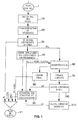
- Figure 1 There is shown schematically in Figure 1 a non-limiting example of compression device video signals according to the invention.
- an input stream 1 is injected in device input.
- This input stream 1 consists of a digitized data set corresponding to information on the pixels making up a video image.
- a video image is broken down into different entities.
- an image of 720 pixels on 576 lines is decomposed into three memory plans 2 each corresponding to one component (one luminance component and two chrominance components), each memory plane being itself even broken down into spatial blocks 3 made up of 8x8 pixels.
- These spatial blocks 3 are grouped into macro-blocks 4 of six spatial blocks 3 (four luminance blocks 5 and two blocks chrominance 6, 7). Five of these macroblocks 4 taken from pseudo-random positions in the image form a video segment.
- Input stream 1 consists of a succession of video segments whose size is to be compressed.
- each video segment into blocks 3 is performed by a module 10.
- Each block 3 then undergoes, at the level of a module 20 a transformation of the data of the spatial to frequency domain.
- This transformation corresponds for example to a discrete cosine transform (DCT, “Discrete Cosine Transform”).
- DCT blocks Frequency blocks resulting from this transformation are hereinafter called "DCT blocks”.
- a DCT block is also composed of 8x8 coefficients.
- One of these coefficients, at the top left of the block, is a coefficient corresponding to a component continuous decomposition in the frequency domain, the others being coefficients corresponding to frequency components.
- the coefficient corresponding to a DC component of a block DCT i is denoted DCi.
- the coefficients corresponding to frequency components for this same block DCT i are denoted ACi.
- a module 30 detects the continuous coefficient DCi, among the coefficients of each DCT block i.
- the coefficient DCi of each DCT block i is integrated into the output stream 11 of the compression device according to the invention.
- the CLASSi class of each DCT i block is determined by a module 90 for determining the strategy of quantization as a function of the sum of the absolute values coefficients ACi determined by module 40. It is also integrated with output stream 11.
- the quantification steps that can be used for quantify the different DCT blocks of a macro-block 4 font the subject of specifications for example, "Specifications of Consumer-Use Digital VCRs ”, HD Digital VCR Conference, Dec. 1994.
- a set of four steps quantization is used to quantify different areas of a DCT block.
- Two parameters QNO and CLASS are used to define the best set of quantization steps.
- the CLASS parameter corresponds to the class indicated above.
- Figure 3 gives a table grouping the values of these different parameters.
- the QNO parameter indicated in the output stream 11 of the device, is the same for all the blocks of a macro-block.
- To each block i can be attached a couple (QNOi, Classi).
- Such a couple can also be replaced by a unique and specific QIDi parameter of each DCT block i (see "A New Quantizer Selection Scheme for Digital VCR", Rhee et al., IEEE Trans on Consumer Electronics, Vol 43, N ° 3, August 1997, pp. 879-885 and figure 3).
- a module 60 quantifies each DCT block i as a function quantization steps corresponding to the QIDi parameter supplied by module 90.
- a module 70 performs a simplified coding of data from each DCT block i. This coding is simplified in since it only performs the coding steps necessary for calculating data lengths of steps following.
- a module 100 calculates the length of the data coding for DCT i blocks.
- the length LB of data encoding information relating to a DCT block i, corresponding to a given QIDi, is stored at the level of module 90, for later use.
- a module 110 calculates the length LS of the data coding for the five macro-blocks 4 of a video segment.
- the LS length of the corresponding compressed data to a segment video is provided to module 90 to determine the quantification strategy of the different blocks of a video segment and this for each video segment.
- the ACi coefficients are coded final by a module 80 according to QNOi and CLASSi.
- the target value VC corresponds to a data length compressed compatible with storage volumes and acceptable video signal processing speeds.
- the data corresponding to the ACi and compressed coefficients by this final coding, are integrated into the output stream 11.
- the QNOi parameters, identical for all the blocks of a macro-block 4 and CLASSi are also inserted in the flow of exit 11. Their knowledge is enough to deduce QIDi for each DCT block i.
- Information relating to ACi coefficients coded correspond to the quality criterion defined at level of the quantification strategy.
- Figure 4 schematically represents the algorithm of the quantification strategy.
- QID is initialized to 0. Smaller is QID, plus the quantization steps of the corresponding game are the better the quality of the compressed image (see figure 5).
- This calculation 130 is performed by the modules 60, 70, 100 and 110 as described above.
- a 140 test is performed to determine if this length LS is less than or equal to the target value VC.
- QID is incremented by one per operation 150.
- the quantification steps corresponding to the new value of QID allow to quantify the coarse segment video data, i.e. with less compressed data but also with loss of image quality reformed from compressed data.
- Operations 130, 140 and 150, corresponding to a first quantification are repeated as long as the length LS remains greater than the target value VC. They consist in determining a set of quantization steps identical for the thirty DCT i blocks of a segment video, in incrementing these steps gradually until the number of bits needed to code the data of the segment video is less than the value target VC.
- Figure 5 gives a example of a diagram representing the length of the data coding for a segment video based on QID. Line horizontal around 2700 bits corresponds to the target value VC.
- the LB lengths of data coding for the information of a block i are determined and stored for each QID value tested.
- a decoder reading the output stream 11, finds QIDi f (QNO, CLASSi).
- the following operations consist in bringing the LS value below the target value by adjusting the clearance no quantization of certain DCT blocks, these blocks DCT being those for which the increase in the steps of quantification least adversely affects image quality compressed.
- the DCT blocks i then undergo a permutation ⁇ 180.
- This permutation ⁇ 180 orders the DCT i blocks of the video segment in order of QF quality factor descending.
- QF is the reverse of gain factor. The higher the quality factor of a DCT block i, plus the length of the data necessary for code this DCT block i will be small, with no apparent loss of image quality.
- QF measures the gain on the reduction of number of bits needed to code the data quantified corresponding to the video segment. This factor of quality brings out the DCT blocks that can be coded with a small data length for the same quality related. Increase the step clearance values by quantification of certain DCT blocks for less good quality associated with low quality factor DCT blocks, allows more DCT blocks whose steps remain longer small, so more DCT blocks corresponding to better compressed image quality. Total image quality is then improved.
- the QF quality factor is easily and quickly calculated. Indeed, the LB lengths of data coding for the information of a block i, has already been determined and stored for the calculation 130 of the length LS of the data compressed coding for a video segment.
- the DCT blocks ordered by the permutation ⁇ 180 are re-indexed by an index j, the index j increasing when QF decreases.
- the transition from QID-1 to QID + 1 actually corresponds to keeping QNO constant and changing the CLASSi class.
- a test 220 is then carried out to determine whether the LS length of the video segment has become less than the target value VC.
- the index j is incremented by unit by operation 230.
- Operations 200, 210, 220, 230 and 240, corresponding to a second quantification, are reproduced until LS is less than or equal to the target value VC.
- test 220 gives a affirmative answer.
- the step determination process quantification is complete.
- the data is then coded, by the module 80, with the set of determined steps. They are compressed and formatted in output stream 11 as shown schematically in Figure 6.
- each macro block we have a header comprising bits coding for the QNO coefficient.
- the header of each DCT block i includes bits coding for DCi and two bits for the CLASSi class of this DCT i block.
- operations 60, 70 and 100 are carried out in parallel by three circuits 250 identical.
- This mounting to three circuits 250 in parallel has the advantage of allowing faster convergence from the LS length of the quantized data to the value target VC.
- three LS lengths of quantified data are determined, starting from three different QIDs, and compared to the value target VC.
- three new QIDs are chosen to perform a second treatment by the three circuits 250. From this second processing results in three new LS data lengths which are compared with the target value VC.
- the QID parameter giving the length LS closest to VC by value lower is retained for operations 160 and following.
Landscapes
- Engineering & Computer Science (AREA)
- Multimedia (AREA)
- Signal Processing (AREA)
- Computing Systems (AREA)
- Theoretical Computer Science (AREA)
- Compression Or Coding Systems Of Tv Signals (AREA)
- Compression, Expansion, Code Conversion, And Decoders (AREA)
Abstract
Description
- une division des matrices de pixels en blocs de N x M pixels (N et M étant des entiers non-nuls), c'est-à-dire N x M points d'un domaine spatial ; il en résulte pour chaque composante des blocs spatiaux de N par M coefficients ;
- un regroupement de plusieurs blocs spatiaux en un macro-bloc ; dans une réalisation courante, un macro-bloc intègre un certain nombre de blocs de luminance et un ou deux bloc(s) de chrominance, la résolution spatiale des pixels de luminance étant habituellement plus fine que celle des pixels de chrominance ;
- un assemblage de plusieurs macro-blocs en un segment ;
- une transformation, dans le domaine des fréquences, des N x M coefficients de chaque bloc spatial, pour obtenir un bloc fréquentiel, appelé bloc DCT ;
- une étape de quantification des coefficients ainsi obtenus à l'intérieur de chaque segment ; et
- une étape de compression conservative des coefficients quantifiés.
- première quantification des coefficients de chaque bloc fréquentiel, avec un premier jeu de pas de quantification, défini pour chaque bloc fréquentiel par un groupe d'index incluant un index identique pour tous les blocs fréquentiels d'un macro-bloc, et
- deuxième quantification des coefficients d'au moins une partie des blocs fréquentiels, avec un deuxième jeu de pas de quantification substitué au premier jeu de pas de quantification.
- l'index identique pour tous les blocs fréquentiels d'un macro-bloc est également identique pour tous les macro-blocs d'un segment ;
- le premier jeu de pas de quantification est choisi de façon que la quantité de données représentant les coefficients quantifiés de chaque segment, après la première quantification, soit supérieure à la valeur cible ;
- le deuxième jeu de pas de quantification donne lieu à une quantification plus grossière que le premier jeu de pas de quantification ;
- le deuxième jeu de pas de quantification est choisi de façon que la quantité de données représentant les coefficients quantifiés de chaque segment, après la deuxième quantification, soit inférieure ou égale à la valeur cible ;
- la deuxième quantification est effectuée en priorité pour le bloc fréquentiel du segment pour lequel le facteur de gain est le plus élevé, et répétée pour au moins un autre bloc fréquentiel du segment, par ordre de gain décroissant tant que la quantité de données nécessaires pour représenter les coefficients du segment est supérieure à ladite valeur cible ;
- le facteur de gain calculé pour un bloc fréquentiel est la différence entre les quantités de données nécessaires pour représenter les coefficients quantifiés dudit bloc fréquentiel avec le premier jeu et avec le deuxième jeu, respectivement, divisée par la quantité de données nécessaires pour représenter les coefficients quantifiés dudit bloc fréquentiel avec le premier jeu ;
- lesdites quantités de données sont calculées au cours de la première quantification et mémorisées pour calculer les gains ; et
- la première quantification comprend trois traitements en parallèle, chaque traitement comprenant des opérations de quantification, de codage et de calcul de la quantité de données nécessaires pour représenter les données quantifiées du segment.
- des moyens d'entrée de données représentées par des coefficients affectés à des pixels d'une image,
- des moyens de formation de blocs spatiaux de N x M coefficients affectés à des pixels de l'image, où N et M sont des entiers non-nuls,
- des moyens de transformation de chaque bloc spatial dans un domaine fréquentiel pour former un bloc fréquentiel de N x M coefficients, et
- des moyens de traitement de segments d'image composés chacun d'un nombre déterminé de macro-blocs eux-mêmes composés d'un nombre déterminé de blocs fréquentiels,
- des premiers moyens de quantification des coefficients de chaque bloc fréquentiel du segment, pour sélectionner un premier jeu de pas de quantification, attaché à chaque bloc fréquentiel et défini pour chaque bloc fréquentiel par un groupe d'index incluant un index identique pour tous les blocs fréquentiels d'un macro-bloc,
- des deuxièmes moyens de quantification pour quantifier au moins une partie des blocs fréquentiels, avec un deuxième jeu de pas de quantification substitué au premier pas de quantification, et
- des moyens de calcul d'un facteur de gain représentant une réduction, lors du passage d'un jeu de pas de quantification à l'autre, de la quantité de données nécessaires pour représenter les coefficients quantifiés, ce facteur de gain étant pris au niveau des deuxièmes moyens de quantification pour sélectionner les blocs fréquentiels pour lesquels le premier jeu de pas de quantification est substitué par le deuxième jeu de pas de quantification.
- il comporte des moyens de tri des blocs ayant subis la première quantification, par ordre décroissant du facteur de gain ;
- il comporte des moyens pour substituer le deuxième jeu de pas de quantification au premier jeu de pas de quantification, en traitant les blocs, par ordre de facteur de gain décroissant, jusqu'à ce que la quantité des données nécessaires pour représenter les données quantifiées correspondant au segment soit inférieure ou égale à une valeur cible ;
- les premiers moyens de quantification comprennent trois circuits de quantification en parallèle ;
- il comprend des moyens de mémoires des quantités de données nécessaires pour représenter les données quantifiées correspondant au segment, avec le premier jeu et avec le deuxième jeu de pas de quantification, et calculées en relation avec la première quantification ; et
- il comprend des moyens de calcul du facteur gain, dans lesquels le facteur de gain pour un bloc fréquentiel est la différence entre les quantités de données nécessaires pour représenter les coefficients quantifiés dudit bloc fréquentiel avec le premier jeu et avec le deuxième jeu, respectivement, divisée par la quantité de données nécessaires pour représenter les coefficients quantifiés dudit bloc fréquentiel avec le premier jeu.
- la figure 1 est un schéma synoptique d'un exemple de dispositif conforme à la présente invention ;
- la figure 2 représente schématiquement un exemple de structure de données pouvant être traitées par le dispositif schématisé sur la figure 1 ;
- la figure 3 est un tableau donnant les valeurs d'index définissant des jeux de pas de quantification pour la mise en oeuvre du dispositif représenté sur la figure 1 ;
- la figure 4 est un algorithme de la stratégie de quantification dans le dispositif de la figure 1 ;
- la figure 5 est un diagramme représentant la quantité des données quantifiées pour un segment, obtenue au cours de la mise en oeuvre de certaines opérations sur le dispositif de la figure 1 ;
- la figure 6 représente schématiquement le flux de données compressées en sortie du dispositif de la figure 1 ;
- la figure 7 représente schématiquement une variante d'une partie du dispositif de la figure 1 ; et
- la figure 8 représente schématiquement les étapes de détermination de l'identifiant du jeu de pas de première quantification par la partie du dispositif représentée sur la figure 7.
Claims (16)
- Procédé de compression d'un signal d'image numérique comprenant des coefficients affectés à des pixels d'une image, ce procédé comportant la formation de blocs spatiaux (3) de N x M coefficients affectés à des pixels de l'image, où N et M sont des entiers non-nuls, la transformation de chaque bloc spatial (3) dans un domaine fréquentiel pour former un bloc fréquentiel de N x M coefficients, l'association d'une pluralité de blocs fréquentiels en macro-blocs (4) et d'une pluralité de macro-blocs (4) en segments , ainsi que les étapes suivantes pour chaque segment :première quantification (60) des coefficients de chaque bloc fréquentiel, avec un premier jeu de pas de quantification, défini pour chaque bloc fréquentiel par un groupe d'index incluant un index identique pour tous les blocs fréquentiels d'un macro-bloc (4), etdeuxième quantification des coefficients d'au moins une partie des blocs fréquentiels, avec un deuxième jeu de pas de quantification substitué au premier pas de quantification,le premier et le deuxième jeux de pas de quantification étant choisis en fonction d'une part, d'une valeur cible de la quantité de données nécessaire pour représenter les coefficients quantifiés du segment et d'autre part, de facteurs de gain respectivement calculés pour les blocs fréquentiels du segment, le facteur de gain relatif à un bloc représentant une réduction, lors du passage d'un jeu de pas de quantification à l'autre pour ledit bloc, de la quantité de données nécessaires pour représenter les coefficients quantifiés.
- Procédé selon la revendication 1, dans lequel l'index identique pour tous les blocs fréquentiels d'un macro-bloc (4) est également identique pour tous les macro-blocs (4) d'un segment.
- Procédé selon l'une des revendications précédentes, dans lequel le premier jeu de pas de quantification est choisi de façon que la quantité de données représentant les coefficients quantifiés de chaque segment , après la première quantification, soit supérieure à la valeur cible.
- Procédé selon la revendication 3, dans lequel le deuxième jeu de pas de quantification donne lieu à une quantification plus grossière que le premier jeu de pas de quantification.
- Procédé selon la revendication 4, dans lequel le deuxième jeu de pas de quantification est choisi de façon que la quantité de données représentant les coefficients quantifiés de chaque segment, après la deuxième quantification, soit inférieure ou égale à la valeur cible.
- Procédé selon la revendication 5, dans lequel la deuxième quantification est effectuée en priorité pour le bloc fréquentiel du segment pour lequel le facteur de gain est le plus élevé, et répétée pour au moins un autre bloc fréquentiel du segment, par ordre de gain décroissant tant que la quantité de données nécessaires pour représenter les coefficients du segment est supérieure à ladite valeur cible.
- Procédé selon l'une des revendications précédentes, dans lequel le facteur de gain calculé pour un bloc fréquentiel est la différence entre les quantités de données nécessaires pour représenter les coefficients quantifiés dudit bloc fréquentiel avec le premier jeu et avec le deuxième jeu, respectivement, divisée par la quantité de données nécessaires pour représenter les coefficients quantifiés dudit bloc fréquentiel avec le premier jeu.
- Procédé selon la revendication 7, dans lequel lesdites quantités de données sont calculées au cours de la première quantification et mémorisées pour calculer les gains.
- Procédé selon l'une des revendications précédentes dans lequel la première quantification comprend trois traitements en parallèle, chaque traitement comprenant des opérations de quantification, de codage et de calcul de la quantité de données nécessaires pour représenter les données quantifiées du segment .
- Dispositif de compression d'un signal d'image numérique, comportant :dans lequel les moyens de traitement d'un segment comprennent :des moyens d'entrée de données représentées par des coefficients affectés à des pixels d'une image,des moyens de formation de blocs spatiaux (3) de N x M coefficients affectés à des pixels de l'image, où N et M sont des entiers non-nuls,des moyens de transformation de chaque bloc spatial (3) dans un domaine fréquentiel pour former un bloc fréquentiel de N x M coefficients, etdes moyens de traitement de segments d'image composés chacun d'un nombre déterminé de macro-blocs (4) eux-mêmes composés d'un nombre déterminé de blocs fréquentiels,des premiers moyens de quantification des coefficients de chaque bloc fréquentiel du segment , pour sélectionner un premier jeu de pas de quantification, attaché à chaque bloc fréquentiel et défini pour chaque bloc fréquentiel par un groupe d'index incluant un index identique pour tous les blocs fréquentiels d'un macro-bloc (4),des deuxièmes moyens de quantification pour quantifier au moins une partie des blocs fréquentiels, avec un deuxième jeu de pas de quantification substitué au premier pas de quantification, etdes moyens de calcul, pour chaque bloc, d'un facteur de gain représentant une réduction, lors du passage d'un jeu de pas de quantification à l'autre, de la quantité de données nécessaires pour représenter les coefficients quantifiés, ce facteur de gain étant pris au niveau des deuxièmes moyens de quantification pour sélectionner les blocs fréquentiels pour lesquels le premier jeu de pas de quantification est substitué par le deuxième jeu de pas de quantification.
- Dispositif selon la revendication 10, comportant des moyens de tri des blocs ayant subis la première quantification, par ordre décroissant du facteur de gain.
- Dispositif selon l'une des revendications 10 et 11, comportant des moyens pour substituer le deuxième jeu de pas de quantification au premier jeu de pas de quantification, en traitant les blocs, par ordre de facteur de gain décroissant, jusqu'à ce que la quantité des données nécessaires pour représenter les données quantifiées correspondant au segment soit inférieure ou égale à une valeur cible.
- Dispositif selon l'une des revendications 10 à 12, dans lequel les premiers moyens de quantification comprennent trois circuits de quantification en parallèle.
- Dispositif selon l'une des revendications 10 à 13, comprenant des moyens de mémoires des quantités de données nécessaires pour représenter les données quantifiées correspondant au segment, avec le premier jeu et avec le deuxième jeu, et calculées en relation avec la première quantification.
- Dispositif selon la revendication 14, comprenant des moyens de calcul du facteur gain, dans lesquels le facteur de gain pour un bloc fréquentiel est la différence entre les quantités de données nécessaires pour représenter les coefficients quantifiés dudit bloc fréquentiel avec le premier jeu et avec le deuxième jeu, respectivement, divisée par la quantité de données nécessaires pour représenter les coefficients quantifiés dudit bloc fréquentiel avec le premier jeu.
- Programme chargeable dans une mémoire, associée à un processeur, et comprenant des portions de codes pour la mise en oeuvre d'un procédé selon l'une des revendications 1 à 9, lors de l'exécution dudit programme.
Applications Claiming Priority (2)
| Application Number | Priority Date | Filing Date | Title |
|---|---|---|---|
| FR0112209A FR2830143B1 (fr) | 2001-09-21 | 2001-09-21 | Procede et dispositif de compression d'un signal d'image |
| FR0112209 | 2001-09-21 |
Publications (2)
| Publication Number | Publication Date |
|---|---|
| EP1298935A2 true EP1298935A2 (fr) | 2003-04-02 |
| EP1298935A3 EP1298935A3 (fr) | 2010-09-22 |
Family
ID=8867510
Family Applications (1)
| Application Number | Title | Priority Date | Filing Date |
|---|---|---|---|
| EP02292260A Withdrawn EP1298935A3 (fr) | 2001-09-21 | 2002-09-16 | Procédé et dispositif de compression d'un signal d'image |
Country Status (3)
| Country | Link |
|---|---|
| US (1) | US7286714B2 (fr) |
| EP (1) | EP1298935A3 (fr) |
| FR (1) | FR2830143B1 (fr) |
Cited By (1)
| Publication number | Priority date | Publication date | Assignee | Title |
|---|---|---|---|---|
| CN101945271A (zh) * | 2009-07-03 | 2011-01-12 | 北京中企开源信息技术有限公司 | 图像压缩系统及压缩方法 |
Families Citing this family (9)
| Publication number | Priority date | Publication date | Assignee | Title |
|---|---|---|---|---|
| CN101091393B (zh) * | 2004-12-28 | 2012-03-07 | 日本电气株式会社 | 运动图像编码方法以及利用其的装置 |
| JP4556124B2 (ja) * | 2005-02-04 | 2010-10-06 | ソニー株式会社 | 符号化装置および方法、復号装置および方法、画像処理システム、記録媒体、並びにプログラム |
| ATE470993T1 (de) * | 2005-12-22 | 2010-06-15 | Microsoft Corp | Optimierungen für netzwerkkodierung und netzwerkdekodierung |
| JP5064820B2 (ja) * | 2007-02-01 | 2012-10-31 | マーベル ワールド トレード リミテッド | 磁気ディスクコントローラおよび方法 |
| JP5221044B2 (ja) * | 2007-02-01 | 2013-06-26 | マーベル ワールド トレード リミテッド | 磁気ディスクコントローラおよび方法 |
| US20080317364A1 (en) * | 2007-06-25 | 2008-12-25 | Augusta Technology, Inc. | Methods for determining neighboring locations for partitions of a video stream |
| US8249150B2 (en) * | 2008-12-24 | 2012-08-21 | Sony Corporation | SIMD-processor-friendly MPEG-2 inter-quantizer |
| US8249151B2 (en) * | 2008-12-24 | 2012-08-21 | Sony Corporation | SIMD-processor-friendly MPEG-2 intra-quantizer |
| FR3045983B1 (fr) * | 2015-12-16 | 2020-12-04 | Commissariat Energie Atomique | Compression de donnees numeriques |
Family Cites Families (14)
| Publication number | Priority date | Publication date | Assignee | Title |
|---|---|---|---|---|
| US5144426A (en) * | 1989-10-13 | 1992-09-01 | Matsushita Electric Industrial Co., Ltd. | Motion compensated prediction interframe coding system |
| ES2101730T3 (es) * | 1990-12-28 | 1997-07-16 | Canon Kk | Aparato para codificacion de imagenes, con optimizacion del codigo generado. |
| US5144424A (en) * | 1991-10-15 | 1992-09-01 | Thomson Consumer Electronics, Inc. | Apparatus for video data quantization control |
| JP2797159B2 (ja) * | 1992-03-02 | 1998-09-17 | カシオ計算機株式会社 | 画像データ圧縮装置及び画像データ圧縮方法 |
| JP3245977B2 (ja) * | 1992-06-30 | 2002-01-15 | ソニー株式会社 | ディジタル画像信号の伝送装置 |
| JP3336754B2 (ja) * | 1994-08-19 | 2002-10-21 | ソニー株式会社 | デジタルビデオ信号の記録方法及び記録装置 |
| US5937098A (en) * | 1995-02-06 | 1999-08-10 | Asahi Kogaku Kogyo Kabushiki Kaisha | Adaptive quantization of orthogonal transform coefficients for setting a target amount of compression |
| US6037985A (en) * | 1996-10-31 | 2000-03-14 | Texas Instruments Incorporated | Video compression |
| WO1999007158A2 (fr) * | 1997-07-29 | 1999-02-11 | Koninklijke Philips Electronics N.V. | Procede de codage video a debit binaire variable et codeur video correspondant |
| JP2000125136A (ja) * | 1998-10-19 | 2000-04-28 | Internatl Business Mach Corp <Ibm> | 画像データ圧縮装置およびその方法 |
| JP3259702B2 (ja) * | 1998-12-24 | 2002-02-25 | 日本電気株式会社 | 動画像可変ビットレート符号化装置および方法 |
| CN1204751C (zh) * | 1999-04-13 | 2005-06-01 | 松下电器产业株式会社 | 编码数据变换方法、再编码方法、再编码系统以及数据记录媒体 |
| JP3561485B2 (ja) * | 2000-08-18 | 2004-09-02 | 株式会社メディアグルー | 符号化信号分離・合成装置、差分符号化信号生成装置、符号化信号分離・合成方法、差分符号化信号生成方法、符号化信号分離・合成プログラムを記録した媒体および差分符号化信号生成プログラムを記録した媒体 |
| WO2002080567A1 (fr) * | 2001-03-30 | 2002-10-10 | Sony Corporation | Dispositif de quantification de signal d'image et son procede |
-
2001
- 2001-09-21 FR FR0112209A patent/FR2830143B1/fr not_active Expired - Fee Related
-
2002
- 2002-09-16 EP EP02292260A patent/EP1298935A3/fr not_active Withdrawn
- 2002-09-19 US US10/251,658 patent/US7286714B2/en not_active Expired - Lifetime
Cited By (2)
| Publication number | Priority date | Publication date | Assignee | Title |
|---|---|---|---|---|
| CN101945271A (zh) * | 2009-07-03 | 2011-01-12 | 北京中企开源信息技术有限公司 | 图像压缩系统及压缩方法 |
| CN101945271B (zh) * | 2009-07-03 | 2012-11-28 | 大地辰星科技发展(北京)有限公司 | 图像压缩系统及压缩方法 |
Also Published As
| Publication number | Publication date |
|---|---|
| US20030113025A1 (en) | 2003-06-19 |
| FR2830143A1 (fr) | 2003-03-28 |
| EP1298935A3 (fr) | 2010-09-22 |
| US7286714B2 (en) | 2007-10-23 |
| FR2830143B1 (fr) | 2004-02-27 |
Similar Documents
| Publication | Publication Date | Title |
|---|---|---|
| US10638162B2 (en) | Coding method and decoding processing method | |
| US7054365B2 (en) | Method for providing variable bit rate in streaming service | |
| HUP0301368A2 (hu) | Eljárás és berendezés mozgóképadatok tömörítésére | |
| US7869659B2 (en) | Image-comparing apparatus, image-comparing method, image-retrieving apparatus and image-retrieving method | |
| US20120308128A1 (en) | Image data coding apparatus, method of controlling operation of same, and program therefor | |
| FR2842983A1 (fr) | Transcodage de donnees | |
| US7366238B2 (en) | Noise filter for video processing | |
| FR2755818A1 (fr) | Codage de signal numerique par decomposition en sous-bandes de frequence et quantification vectorielle a etats finis | |
| FR3143245A1 (fr) | Procédé et dispositif de codage et décodage d’images. | |
| FR2830143A1 (fr) | Procede et dispositif de compression d'un signal d'image | |
| KR101193267B1 (ko) | 화상 처리 장치 및 처리 방법 | |
| EP3632103B1 (fr) | Procédés et dispositifs de codage et de décodage d'un flux de données représentatif d'au moins une image | |
| US7525463B2 (en) | Compression rate control system and method with variable subband processing | |
| CN110896432A (zh) | 图像处理方法和系统 | |
| US8279098B2 (en) | Compression rate control system and method with variable subband processing | |
| Kaur et al. | A robust video compression algorithm for efficient data transfer of surveillance data | |
| WO2009130540A1 (fr) | Procédé de codage/décodage vidéo haute définition convenant au flux vidéo en temps réel | |
| WO2025202411A1 (fr) | Mise en œuvre d'optimisation de distorsion de débit et procédé | |
| WO2026003354A1 (fr) | Procédé et dispositif de codage et décodage d'un signal | |
| WO2026003293A1 (fr) | Procédé et dispositif de codage et décodage d'un signal | |
| FR2862168A1 (fr) | Procede et dispositif de regulation de debit d'une sequence d'images. | |
| FR3164086A1 (fr) | Procédé et dispositif de codage et décodage d’images | |
| van der Vleuten et al. | Lossless and fine-granularity scalable near-lossless color image compression | |
| WO2006056720A1 (fr) | Compression video par modification de quantification par zones d'images | |
| GB2425013A (en) | Encoding video data using operating parameters of the image capture device |
Legal Events
| Date | Code | Title | Description |
|---|---|---|---|
| PUAI | Public reference made under article 153(3) epc to a published international application that has entered the european phase |
Free format text: ORIGINAL CODE: 0009012 |
|
| AK | Designated contracting states |
Kind code of ref document: A2 Designated state(s): AT BE BG CH CY CZ DE DK EE ES FI FR GB GR IE IT LI LU MC NL PT SE SK TR Designated state(s): AT BE BG CH CY CZ DE DK EE ES FI FR GB GR IE IT LI LU MC NL PT SE SK TR |
|
| AX | Request for extension of the european patent |
Extension state: AL LT LV MK RO SI |
|
| PUAL | Search report despatched |
Free format text: ORIGINAL CODE: 0009013 |
|
| AK | Designated contracting states |
Kind code of ref document: A3 Designated state(s): AT BE BG CH CY CZ DE DK EE ES FI FR GB GR IE IT LI LU MC NL PT SE SK TR |
|
| AX | Request for extension of the european patent |
Extension state: AL LT LV MK RO SI |
|
| RIC1 | Information provided on ipc code assigned before grant |
Ipc: H04N 7/26 20060101ALI20100813BHEP Ipc: H04N 7/30 20060101AFI20030205BHEP |
|
| 17P | Request for examination filed |
Effective date: 20110308 |
|
| 17Q | First examination report despatched |
Effective date: 20110418 |
|
| AKX | Designation fees paid |
Designated state(s): DE FR GB IT |
|
| STAA | Information on the status of an ep patent application or granted ep patent |
Free format text: STATUS: THE APPLICATION IS DEEMED TO BE WITHDRAWN |
|
| 18D | Application deemed to be withdrawn |
Effective date: 20120403 |