EP1295784A2 - Vehicle with solar cell - Google Patents
Vehicle with solar cell Download PDFInfo
- Publication number
- EP1295784A2 EP1295784A2 EP02019916A EP02019916A EP1295784A2 EP 1295784 A2 EP1295784 A2 EP 1295784A2 EP 02019916 A EP02019916 A EP 02019916A EP 02019916 A EP02019916 A EP 02019916A EP 1295784 A2 EP1295784 A2 EP 1295784A2
- Authority
- EP
- European Patent Office
- Prior art keywords
- solar cell
- panel
- basket
- cell panel
- storage box
- Prior art date
- Legal status (The legal status is an assumption and is not a legal conclusion. Google has not performed a legal analysis and makes no representation as to the accuracy of the status listed.)
- Granted
Links
Images





Classifications
-
- B—PERFORMING OPERATIONS; TRANSPORTING
- B62—LAND VEHICLES FOR TRAVELLING OTHERWISE THAN ON RAILS
- B62M—RIDER PROPULSION OF WHEELED VEHICLES OR SLEDGES; POWERED PROPULSION OF SLEDGES OR SINGLE-TRACK CYCLES; TRANSMISSIONS SPECIALLY ADAPTED FOR SUCH VEHICLES
- B62M6/00—Rider propulsion of wheeled vehicles with additional source of power, e.g. combustion engine or electric motor
- B62M6/40—Rider propelled cycles with auxiliary electric motor
- B62M6/70—Rider propelled cycles with auxiliary electric motor power-driven at single endless flexible member, e.g. chain, between cycle crankshaft and wheel axle, the motor engaging the endless flexible member
-
- B—PERFORMING OPERATIONS; TRANSPORTING
- B60—VEHICLES IN GENERAL
- B60L—PROPULSION OF ELECTRICALLY-PROPELLED VEHICLES; SUPPLYING ELECTRIC POWER FOR AUXILIARY EQUIPMENT OF ELECTRICALLY-PROPELLED VEHICLES; ELECTRODYNAMIC BRAKE SYSTEMS FOR VEHICLES IN GENERAL; MAGNETIC SUSPENSION OR LEVITATION FOR VEHICLES; MONITORING OPERATING VARIABLES OF ELECTRICALLY-PROPELLED VEHICLES; ELECTRIC SAFETY DEVICES FOR ELECTRICALLY-PROPELLED VEHICLES
- B60L50/00—Electric propulsion with power supplied within the vehicle
- B60L50/50—Electric propulsion with power supplied within the vehicle using propulsion power supplied by batteries or fuel cells
- B60L50/53—Electric propulsion with power supplied within the vehicle using propulsion power supplied by batteries or fuel cells in combination with an external power supply, e.g. from overhead contact lines
-
- B—PERFORMING OPERATIONS; TRANSPORTING
- B60—VEHICLES IN GENERAL
- B60L—PROPULSION OF ELECTRICALLY-PROPELLED VEHICLES; SUPPLYING ELECTRIC POWER FOR AUXILIARY EQUIPMENT OF ELECTRICALLY-PROPELLED VEHICLES; ELECTRODYNAMIC BRAKE SYSTEMS FOR VEHICLES IN GENERAL; MAGNETIC SUSPENSION OR LEVITATION FOR VEHICLES; MONITORING OPERATING VARIABLES OF ELECTRICALLY-PROPELLED VEHICLES; ELECTRIC SAFETY DEVICES FOR ELECTRICALLY-PROPELLED VEHICLES
- B60L53/00—Methods of charging batteries, specially adapted for electric vehicles; Charging stations or on-board charging equipment therefor; Exchange of energy storage elements in electric vehicles
- B60L53/80—Exchanging energy storage elements, e.g. removable batteries
-
- B—PERFORMING OPERATIONS; TRANSPORTING
- B60—VEHICLES IN GENERAL
- B60L—PROPULSION OF ELECTRICALLY-PROPELLED VEHICLES; SUPPLYING ELECTRIC POWER FOR AUXILIARY EQUIPMENT OF ELECTRICALLY-PROPELLED VEHICLES; ELECTRODYNAMIC BRAKE SYSTEMS FOR VEHICLES IN GENERAL; MAGNETIC SUSPENSION OR LEVITATION FOR VEHICLES; MONITORING OPERATING VARIABLES OF ELECTRICALLY-PROPELLED VEHICLES; ELECTRIC SAFETY DEVICES FOR ELECTRICALLY-PROPELLED VEHICLES
- B60L8/00—Electric propulsion with power supply from forces of nature, e.g. sun or wind
-
- B—PERFORMING OPERATIONS; TRANSPORTING
- B60—VEHICLES IN GENERAL
- B60L—PROPULSION OF ELECTRICALLY-PROPELLED VEHICLES; SUPPLYING ELECTRIC POWER FOR AUXILIARY EQUIPMENT OF ELECTRICALLY-PROPELLED VEHICLES; ELECTRODYNAMIC BRAKE SYSTEMS FOR VEHICLES IN GENERAL; MAGNETIC SUSPENSION OR LEVITATION FOR VEHICLES; MONITORING OPERATING VARIABLES OF ELECTRICALLY-PROPELLED VEHICLES; ELECTRIC SAFETY DEVICES FOR ELECTRICALLY-PROPELLED VEHICLES
- B60L8/00—Electric propulsion with power supply from forces of nature, e.g. sun or wind
- B60L8/003—Converting light into electric energy, e.g. by using photo-voltaic systems
-
- B—PERFORMING OPERATIONS; TRANSPORTING
- B62—LAND VEHICLES FOR TRAVELLING OTHERWISE THAN ON RAILS
- B62J—CYCLE SADDLES OR SEATS; AUXILIARY DEVICES OR ACCESSORIES SPECIALLY ADAPTED TO CYCLES AND NOT OTHERWISE PROVIDED FOR, e.g. ARTICLE CARRIERS OR CYCLE PROTECTORS
- B62J9/00—Containers specially adapted for cycles, e.g. panniers or saddle bags
- B62J9/20—Containers specially adapted for cycles, e.g. panniers or saddle bags attached to the cycle as accessories
- B62J9/21—Containers specially adapted for cycles, e.g. panniers or saddle bags attached to the cycle as accessories above or alongside the front wheel, e.g. on the handlebars
-
- B—PERFORMING OPERATIONS; TRANSPORTING
- B62—LAND VEHICLES FOR TRAVELLING OTHERWISE THAN ON RAILS
- B62M—RIDER PROPULSION OF WHEELED VEHICLES OR SLEDGES; POWERED PROPULSION OF SLEDGES OR SINGLE-TRACK CYCLES; TRANSMISSIONS SPECIALLY ADAPTED FOR SUCH VEHICLES
- B62M6/00—Rider propulsion of wheeled vehicles with additional source of power, e.g. combustion engine or electric motor
- B62M6/80—Accessories, e.g. power sources; Arrangements thereof
- B62M6/85—Solar cells
-
- B—PERFORMING OPERATIONS; TRANSPORTING
- B62—LAND VEHICLES FOR TRAVELLING OTHERWISE THAN ON RAILS
- B62M—RIDER PROPULSION OF WHEELED VEHICLES OR SLEDGES; POWERED PROPULSION OF SLEDGES OR SINGLE-TRACK CYCLES; TRANSMISSIONS SPECIALLY ADAPTED FOR SUCH VEHICLES
- B62M6/00—Rider propulsion of wheeled vehicles with additional source of power, e.g. combustion engine or electric motor
- B62M6/80—Accessories, e.g. power sources; Arrangements thereof
- B62M6/90—Batteries
-
- B—PERFORMING OPERATIONS; TRANSPORTING
- B60—VEHICLES IN GENERAL
- B60L—PROPULSION OF ELECTRICALLY-PROPELLED VEHICLES; SUPPLYING ELECTRIC POWER FOR AUXILIARY EQUIPMENT OF ELECTRICALLY-PROPELLED VEHICLES; ELECTRODYNAMIC BRAKE SYSTEMS FOR VEHICLES IN GENERAL; MAGNETIC SUSPENSION OR LEVITATION FOR VEHICLES; MONITORING OPERATING VARIABLES OF ELECTRICALLY-PROPELLED VEHICLES; ELECTRIC SAFETY DEVICES FOR ELECTRICALLY-PROPELLED VEHICLES
- B60L2200/00—Type of vehicles
- B60L2200/12—Bikes
-
- B—PERFORMING OPERATIONS; TRANSPORTING
- B60—VEHICLES IN GENERAL
- B60L—PROPULSION OF ELECTRICALLY-PROPELLED VEHICLES; SUPPLYING ELECTRIC POWER FOR AUXILIARY EQUIPMENT OF ELECTRICALLY-PROPELLED VEHICLES; ELECTRODYNAMIC BRAKE SYSTEMS FOR VEHICLES IN GENERAL; MAGNETIC SUSPENSION OR LEVITATION FOR VEHICLES; MONITORING OPERATING VARIABLES OF ELECTRICALLY-PROPELLED VEHICLES; ELECTRIC SAFETY DEVICES FOR ELECTRICALLY-PROPELLED VEHICLES
- B60L2270/00—Problem solutions or means not otherwise provided for
- B60L2270/30—Preventing theft during charging
- B60L2270/34—Preventing theft during charging of parts
-
- B—PERFORMING OPERATIONS; TRANSPORTING
- B60—VEHICLES IN GENERAL
- B60L—PROPULSION OF ELECTRICALLY-PROPELLED VEHICLES; SUPPLYING ELECTRIC POWER FOR AUXILIARY EQUIPMENT OF ELECTRICALLY-PROPELLED VEHICLES; ELECTRODYNAMIC BRAKE SYSTEMS FOR VEHICLES IN GENERAL; MAGNETIC SUSPENSION OR LEVITATION FOR VEHICLES; MONITORING OPERATING VARIABLES OF ELECTRICALLY-PROPELLED VEHICLES; ELECTRIC SAFETY DEVICES FOR ELECTRICALLY-PROPELLED VEHICLES
- B60L2270/00—Problem solutions or means not otherwise provided for
- B60L2270/30—Preventing theft during charging
- B60L2270/36—Preventing theft during charging of vehicles
-
- B—PERFORMING OPERATIONS; TRANSPORTING
- B62—LAND VEHICLES FOR TRAVELLING OTHERWISE THAN ON RAILS
- B62J—CYCLE SADDLES OR SEATS; AUXILIARY DEVICES OR ACCESSORIES SPECIALLY ADAPTED TO CYCLES AND NOT OTHERWISE PROVIDED FOR, e.g. ARTICLE CARRIERS OR CYCLE PROTECTORS
- B62J9/00—Containers specially adapted for cycles, e.g. panniers or saddle bags
- B62J9/30—Containers specially adapted for cycles, e.g. panniers or saddle bags characterised by locking arrangements, e.g. top case locks integrated in a vehicle central locking system
-
- Y—GENERAL TAGGING OF NEW TECHNOLOGICAL DEVELOPMENTS; GENERAL TAGGING OF CROSS-SECTIONAL TECHNOLOGIES SPANNING OVER SEVERAL SECTIONS OF THE IPC; TECHNICAL SUBJECTS COVERED BY FORMER USPC CROSS-REFERENCE ART COLLECTIONS [XRACs] AND DIGESTS
- Y02—TECHNOLOGIES OR APPLICATIONS FOR MITIGATION OR ADAPTATION AGAINST CLIMATE CHANGE
- Y02T—CLIMATE CHANGE MITIGATION TECHNOLOGIES RELATED TO TRANSPORTATION
- Y02T10/00—Road transport of goods or passengers
- Y02T10/60—Other road transportation technologies with climate change mitigation effect
- Y02T10/70—Energy storage systems for electromobility, e.g. batteries
-
- Y—GENERAL TAGGING OF NEW TECHNOLOGICAL DEVELOPMENTS; GENERAL TAGGING OF CROSS-SECTIONAL TECHNOLOGIES SPANNING OVER SEVERAL SECTIONS OF THE IPC; TECHNICAL SUBJECTS COVERED BY FORMER USPC CROSS-REFERENCE ART COLLECTIONS [XRACs] AND DIGESTS
- Y02—TECHNOLOGIES OR APPLICATIONS FOR MITIGATION OR ADAPTATION AGAINST CLIMATE CHANGE
- Y02T—CLIMATE CHANGE MITIGATION TECHNOLOGIES RELATED TO TRANSPORTATION
- Y02T10/00—Road transport of goods or passengers
- Y02T10/60—Other road transportation technologies with climate change mitigation effect
- Y02T10/7072—Electromobility specific charging systems or methods for batteries, ultracapacitors, supercapacitors or double-layer capacitors
-
- Y—GENERAL TAGGING OF NEW TECHNOLOGICAL DEVELOPMENTS; GENERAL TAGGING OF CROSS-SECTIONAL TECHNOLOGIES SPANNING OVER SEVERAL SECTIONS OF THE IPC; TECHNICAL SUBJECTS COVERED BY FORMER USPC CROSS-REFERENCE ART COLLECTIONS [XRACs] AND DIGESTS
- Y02—TECHNOLOGIES OR APPLICATIONS FOR MITIGATION OR ADAPTATION AGAINST CLIMATE CHANGE
- Y02T—CLIMATE CHANGE MITIGATION TECHNOLOGIES RELATED TO TRANSPORTATION
- Y02T10/00—Road transport of goods or passengers
- Y02T10/80—Technologies aiming to reduce greenhouse gasses emissions common to all road transportation technologies
- Y02T10/90—Energy harvesting concepts as power supply for auxiliaries' energy consumption, e.g. photovoltaic sun-roof
Definitions
- the present invention relates to a vehicle with solar cell, particularly to a vehicle provided with solar cells disposed on a luggage carrier or the like and capable of efficiently receiving sunlight.
- Japanese Patent Laid-open No. 2000-247287 discloses a motor-assisted bicycle which comprises a solar cell panel on a luggage basket provided on the upper side of the front wheel of the bicycle.
- the solar cell panel is fixed by a hinge to a control box fixed on the front side of the basket, and is so set as to cover the basket in the manner of a lid.
- the arrangement of the solar cell panel mentioned above is suitable for receiving sunlight by directing a light-receiving portion to the upper side.
- the solar cell panel since the solar cell panel is so provided as to cover the basket, the solar cell panel must be retracted by rotating it to the front side of the basket through utilizing the hinge at the time of putting luggage into the basket or taking luggage out of the basket. On such an occasion, the solar cell panel may be damaged or stained by contact with adjacent members. Conventionally, sufficient consideration has not been given to the dealing with the solar cell panel in such situations.
- the present invention is firstly characterized in that, in a vehicle with solar cell, comprising a storage box opened on the upper side thereof provided at a front portion of a vehicle body, and a solar cell panel held on the storage box, the solar cell panel is stored along a rear wall in the storage box, and the present invention is secondly characterized in that the storage box is provided at a rear portion of the vehicle body, and the solar cell panel is stored along a front wall in the storage box.
- the solar cell panel is stored on the side of the center of the vehicle body, so that the solar cell panel would not easily collide against or make contact with external things, and would not easily be stained or scratched.
- the present invention is thirdly characterized in that there are provided a pivot shaft provided at one end of the solar cell panel so as to pivotally support the solar cell panel swivelably relative to the storage box at a position near a wall on the side where the solar cell panel is stored, and a guide mans provided in the storage box in order to guide the pivot shaft along the wall on the side where the solar cell panel is stored.
- the solar cell panel is swiveled around the pivot shaft, and then the pivot shaft is moved downwards along the above-mentioned wall by guide means, whereby the solar cell panel is stored in the storage box with the pivot shaft on the lower side.
- the present invention is fourthly characterized in that there are provided a lock device fitted to the solar cell panel, and an engaging member provided at an upper portion of the storage box and engaged with the lock device.
- the lock device in the condition where the solar cell panel is set on the storage box so as to cover the storage box, the lock device is engaged with the engaging member, whereby the solar cell panel is connected with the storage box and is locked.
- the present invention is fifthly characterized in that the solar cell panel is stored along an inside wall of the storage box. According to the fifth characteristic feature, the solar cell panel is protected by the wall surface of the storage box, so that this arrangement is more effective for coping with scratches and stains.
- the present invention is sixthly characterized in that there is provided a connecting portion by which a cable for taking out electric power generated by the solar cell panel is connected to the solar cell panel in the vicinity of the pivot shaft. According to the sixth characteristic feature, the displacement of the cable at the time of swiveling the solar cell panel around the pivot shaft can be reduced, so that the wiring length of the cable can be reduced.
- the present invention is seventhly characterized in that there is provided a holding member for accommodating the solar cell panel so that the solar cell panel is stored along the outside surface of a wall in the storage box.
- the solar cell panel can be protected from external things by the wall of the storage box, and the original purpose of the storage box to store things other than the solar cell panel can be easily achieved.
- the solar cell panel is stored at a position on the side of a central portion of the vehicle body, so that the solar cell panel would not collide with or make contact with external things, and can be made to be stained or scratched with difficulty.
- the solar cell panel is protected by a wall surface of the storage box, the arrangement is more effective against scratches and stains.
- the solar cell panel is not separated from the storage box, so that it can be stored in the storage box in the state of being connected.
- the solar cell panel can be locked in the sate of being mounted on the storage box so as to cover the storage box, so that the solar cell panel can have the function as a lid for the storage box, and can have an antitheft function for the panel itself.
- the displacement of the cable at the time of swiveling the solar cell panel around the pivot shaft can be reduced, so that the wiring length of the cable can be reduced.
- the solar cell panel can be protected from external things by the wall of the storage box, and, at the same time, the original purpose of the storage box to store other things than the solar cell panel can be sufficiently attained.
- Fig. 2 is a side view of a motor-assisted bicycle with solar cell according to one embodiment of the present invention.
- a vehicle body frame 2 of the motor-assisted bicycle 1 comprises a head pipe 21 at the front end thereof, a down pipe 22 extending rearwardly downwards from the head pipe 21, and a seat post 23 erected upwards from a support pipe (not shown) which is attached to the rear end of the down pipe 22 and extends in the left-right direction of the vehicle body.
- a front fork 3 is turnably supported on the head pipe 21.
- a front wheel WF is shaft-supported at the lower end of the front fork 3, and the front wheel WF can be steered by a handle 4 provided at the upper end of the front fork 3.
- a basket (front basket) 7 for storing luggage is mounted on an upper portion of an auxiliary frame 6 having its lower end connected to an axle 5 of the front wheel and extending upwards. While a box body (storage box) for storing luggage mounted on the vehicle body is described as a basket herein, the box body may be any of various box bodies known as luggage storage containers such as, for example, a basket knitted in mesh from a line material, a basket formed of metal net, and a box molded from resin or metal.
- a solar cell panel (hereinafter referred to as "panel") 8 having a structure described later is fitted to the basket 7.
- the panel 8 is not limited to a non-flexible plate form member, but may be one having flexibility to such an extent as to maintain its original shape in the condition of being mounted on the basket 7, such as an amorphous film.
- a rear wheel WR as a driving wheel disposed between the pair of rear forks 24 is shaft-supported.
- a left-right pair of stays 25 is provided between an upper portion of the seat post 23 and both the rear forks 24.
- a seat 9 is fitted to an upper portion of the seat post 23 so that its height can be adjusted.
- a battery storage box 11 for detachably storing a battery 10 is provided on the lower side of the seat 9 between the seat post 23 and the rear wheel WR.
- a power unit 13 comprising an electric motor 12 supplied with electric power from the battery 10 stored in the battery storage box 11 is provided on the rear side of the vehicle body with respect to the support pipe which is not shown.
- An input shaft of the power unit 13, namely, a crankshaft 14 is supported by the support pipe not shown.
- Pedals 16 are fitted to the crankshaft 14 through cranks 15.
- Power from the motor 12 is added to the power (tread force) inputted from the crankshaft 14, and a driving force as a composite force is taken out through an output shaft which is not shown.
- the driving force is transmitted to the rear wheel WR through a chain 17.
- the output of the power from the electric motor 12 is controlled by a controller, not shown, according to the magnitude of the tread force.
- a tread force detector (not shown) is provided for controlling the electric motor 12 according to the tread force.
- a harness 18 is provided along the down pipe 22, and electric power generated by the panel 8 is inputted to the battery 10 through a controller in the power unit 13, by way of a cable fitted to the harness 18.
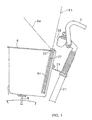
- Fig. 1 is a side view of a major part of the bicycle.
- a rear portion of the basket 7 is engaged with the head pipe 21 by a latch 29.
- the latch 29 has it one end connected to an upper portion of the head pipe 21, and its other end connected to a rear wall of the basket 7 by, for example, a bolt-nut combination.
- the panel 8 is supported by a pivot shaft 26 extending in the left-right direction on the rear side of the vehicle body with respect to the basket 7, and is provided turnably with the pivot shaft 26 as a center.
- the upper side of the basket 7 is opened by turning the panel 8 clockwise in the figure as indicated by 8a-8b from the condition of making contact with the brim of the basket 7. Further, the panel 8 is moved downwards, directly in the erected posture indicated by symbol 8b.
- the pivot shaft 26 of the panel 8 is guided by vertical guide holes 27 provided at left and right positions near the rear portion of the basket 7, and the panel 8 is stored in the basket 7 as indicated by symbol 8c.
- a main switch 28 of the motor-assisted bicycle 1 is provided in the vicinity of a central portion of the handle 4.
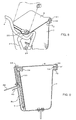
- Fig. 3 is a plan view showing a roughly right half of the panel and the basket
- Fig. 4 is a perspective view of a major part showing an engaging portion between the basket and the panel
- Fig. 5 is a perspective view of a major part of the basket showing the condition where the panel is stored
- Fig. 6 is a view from the upper side of the basket showing the condition where the panel is stored
- Fig. 7 is a perspective view of a major part in the vicinity of the brim of the basket.
- vertically elongate frame bodies 28 are attached to left and right side surfaces of the basket 7.
- the frame body 28 is assembled with a window 281 in the manner of overlapping with a slit 71 formed in each side portion of the basket 7, and the window 281 and the slit 71 constitute the guide hole 27.
- the slit 71 is opened at the brim of the basket 7 (See Fig. 7).
- the position of the frame body 28 is so set that the upper end of the window 281 is located to be extended to the upper side of the opened portion.
- the pivot shaft 26 is bosses 61 extended to the left and right outsides from the panel 8, and the bosses are projected to the outside through the guide holes 27, namely, the slits 71 and the windows 281.
- An end portion of the boss 261 is provided with a threaded hole, and a set screw 31 is screwed into the threaded hole.
- the condition where the panel 8 is erected from the position shown in Figs. 3 and 4 and the bosses 261 are moved along the guide holes 27 to the lowermost portions is shown in Figs. 5 and 6.
- the panel 8 is stored along the rear inside wall of the basket 7, so that the appearance is simple, and the vertical movements of the panel 8 in the basket 7 are smoothly performed along the guide holes 27.
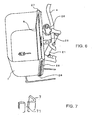
- Fig. 8 is a perspective sectional view showing a left half of a front portion of the bicycle according to the modified example
- Fig. 9 is a side sectional view of the same
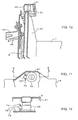
- Fig. 10 is a view from the lower side of a rear portion of the basket.
- Fig. 11 is a plan view of a front portion of the panel
- Fig. 12 is a sectional view taken along B-B of Fig. 11.
- the panel 8 is provided with a lock. While the panel 8 is used for charging the battery 10, it is so disposed as to cover an upper portion of the basket 7 and, therefore, functions as a lid for the basket 7. In this modified example, the panel 8 is integrally provided with the lock, whereby the function as the lid is more enriched, and antitheft function for the panel 8 itself is attained.
- a tubular lock device 32 projecting to the lower side of the panel 8 (in the roughly horizontal posture along the brim of the basket) is provided at a central portion of the front end of the panel 8.
- the panel 8 has a front wall 81 in the manner of covering the lock device 32.
- the basket 7 has a horizontal portion 72 opposed to the lower side of the lock device 32 when the panel is set in the roughly horizontal posture so as to cover the upper portion of the basket 7, and a vertical member 73 provided with a hole for engagement with a plunger 321 of the lock device 32 is erected on the horizontal member 72.
- a cable 40 for transmitting electric power generated which extends to the battery 10 is connected to the vicinity of the pivot shaft of the panel 8. As seen from Figs.
- a partition wall 33 disposed in parallel to the rear wall of the basket 7 is provided.
- the partition wall 33 may be provided with an engaging and stopping block 34 at an upper portion thereof.
- the engaging and stopping block 34 has a portion having the same function as the vertical member 73 of Fig. 11 which is engaged with the plunger 321 of the lock device 32 at a position where the panel 8 is stored in the basket 8. Therefore, also in the condition where the panel 8 is stored in the basket 7, the panel 8 is fixed to the basket 7 by the lock device 32.
- the partition wall 33 provides means for indicating the engaging and stopping block 34, and functions to partition the inside of the basket 7 into a luggage-storing space and a space for storing the panel 8, thereby enhancing a protective effect for the panel 8.
- a second modified example While a structure capable of storing the panel 8 in the basket 7 is adopted in the above example, the panel 8 is stored in a holding portion provided on the rear outside of the basket 7 in this second modified example.
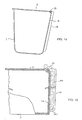
- Fig. 13 is a perspective view of the basket
- Fig. 14 is a side sectional view
- Fig. 15 is an enlarged sectional view.
- the panel 8 is hooked on hooks 35 provided at a rear upper portion of the basket, in the posture of being mounted roughly horizontally on the basket 7.
- the hooks 35 each have such a shape as to project upwards from the upper edge of the rear wall 74 of the basket 7 and be bent toward the rear portion of the vehicle body.
- the hooks 35 are provided at a plurality of positions (in this example, four positions) in the width direction of the basket 7, and the panel 8 is provided with engaging holes 82 engageable with the hooks 35, at the same intervals as the hooks 35.
- the hooks 35 are engaged with the engaging holes 82, with the panel 8 in a vertically erected posture.
- the panel 8 is tilted down to a horizontal posture to cover an upper portion of the basket 7.
- the engagement between the engaging holes 82 and the hooks 35 is released, and the panel 8 can be separated from the basket 7.
- a holding portion capable of accommodating the panel 8 separated from the basket 7 is provided on the outside of the basket 7.
- a pair of angle members 36 L-shaped in horizontal sectional shape are fitted in the state of being separated from each other in the width direction of the vehicle body, on the outside of the rear wall 74 of the basket 7, as a holding member for the panel 8.
- the angle member 36 has a receiving portion 361 at a lower portion thereof. Both left and right ends of the panel 8 separated from the basket 7 are guided by the angle members 36, and an end face of the panel 8 located on the rear side at the time of being fitted, namely, the end face on the side where the engaging holes 82 are provided is received by the receiving portions 361, and the panel 8 is held in the posture indicated by symbol 8d in Fig. 14.
- the basket 7 has a shape contracted to be smaller on the lower side. Therefore, when the panel 8 is formed in a storable shape conforming to the shape of the basket 7, the width of the panel 8 must be reduced on the side of the rear portion of the basket 7 as shown in Fig. 13. Therefore, when the panel 8 is set to cover the upper portion of the basket 7, gaps G are generated (See Fig. 13) .
- Fig. 16 is a perspective view of the basket 7 according to the third modified example, in which the same symbols as in Fig. 13 denote the same or equivalent portions.
- triangular auxiliary plates 37 capable of covering the gaps G are provided in the width direction of the panel 8.
- the auxiliary plates 37 are each connected to the panel 8 by a hinge 38.
- the auxiliary plates 37 can be folded, and laid on the panel 8, by utilizing pivot shafts of the hinges 38.
- the panel 8 can be enlarged by developing so as to eliminate the gaps at the time of covering the upper portion of the basket 7; on the other hand, at the time of being stored on the rear side of the basket 7, the panel 8 can be reduced in size by folding the auxiliary plates 3.
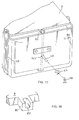
- Fig. 17 is a perspective view of a rear portion of the basket 7 according to a fourth modified example
- Fig. 18 is a perspective view of a cable connecting portion of the panel 8.
- a cable connecting portion 85 for connecting a cable 40 for transmitting the electric power generated by the panel 8 to the battery 10 is provided at a rear portion of the panel 8.
- the cable 40 is connected to an output terminal (not shown) of the panel 8 by the cable connecting portion 85.
- the cable 40 is led out to the rear side of the vehicle body through a through-hole 741 provided in the rear wall 74 of the basket 7, and is connected to the battery 10 through the above-mentioned harness 18.
- a diode 41 for inhibiting reverse flow of electric current is provided at an intermediate portion of the cable 40.
- the panel 8 is stored near the rear wall 74 of the basket 7, with the cable connecting portion 85 on the lower side (posture 8d in Fig. 17).
- the cable 40 is so treated as to extend upwards from the cable connecting portion 85 to reach the through-hole 741.
- the leading-out direction of the cable 40 is changed by 180° , between the situation where the panel 8 is mounted on the basket 7 in a roughly horizontal posture and the situation where the panel 8 is stored in a roughly vertical posture.
- the cable connecting portion 85 is provided with a groove 851 opened in two directions as shown in Fig. 18, so as thereby to cope with treatment of the cable 40.
- Fig. 19 is a side view of a bicycle comprising a basket (rear basket) mounted on a luggage carrier at a lower portion thereof, in which the same symbols as in Fig. 2 denote the same or equivalent portions.
- the rear basket 43 is fixed on the luggage carrier 42 located on the rear side of the seat 9, and the panel 8 is provided on the rear basket 43.
- the panel 8 is fitted turnably by a pivot shaft 26, in the same manner as in the case of fitting on the basket 7 located at a front portion of the vehicle body. It should be noted here, however, that the pivot shaft 26 is provided near the front wall of the rear basket 43.
- the pivot shaft 26 is guided vertically in guide holes 27 provided at side surfaces of the rear basket 43, whereby the panel 8 can be stored in the rear basket 43, which is a constitution applicable in common to the one shown in Fig. 1.
- the structure shown in Fig. 19 is not limitative; the structures for storing the panel 8 on the inside or outside of the rear basket 43 are the same as the structures for storing the panel 8 on the inside or outside of the front basket 7. Therefore, the constitutions described referring to Figs. 1 to 18 above can be applied to the rear basket 43 and the panel 8 mounted thereon in a roughly horizontal posture. In the application, it is natural that modifications can be appropriately made by known means according to the shape and size of the rear basket 43.
- the present invention is not limited to the above embodiments; the present invention can be widely applied generally to motor-assisted vehicles in which tread force is assisted by power of an electric motor, and can be applied to motor-driven vehicles such as a motor-driven wheel chair for running by power of an electric motor. Further, the present invention can be used for engine vehicles, for example, those which comprise a solar cell panel for charging a starting battery.
- the panel can not only be provided on the basket provided at a front portion or a rear portion of the vehicle body but can also be provided on each of the baskets provided at a front portion and a rear portion of the vehicle body.
- a solar cell panel 8 is supported on a front basket 7 in a horizontal posture, to receive light. In the cases of night or raining when sunlight is not received, the panel 8 is stored in the basket 7. Particularly, the panel 8 is supported by a pivot shaft 26 near a rear wall of the basket 7 so that it can be swiveled relative to the basket 7. Side surfaces of the basket 7 are provided with guide holes 7 for guiding the panel 8 through the pivot shaft 26 at the time of storing. The pivot shaft 26 is guided by the guide holes 27, and the panel 8 is stored in the basket 7 with the pivot shaft 26 on the lower side.
Landscapes
- Engineering & Computer Science (AREA)
- Mechanical Engineering (AREA)
- Chemical & Material Sciences (AREA)
- Combustion & Propulsion (AREA)
- Transportation (AREA)
- Power Engineering (AREA)
- Life Sciences & Earth Sciences (AREA)
- Sustainable Development (AREA)
- Sustainable Energy (AREA)
- Photovoltaic Devices (AREA)
- Packaging Of Machine Parts And Wound Products (AREA)
- Fittings On The Vehicle Exterior For Carrying Loads, And Devices For Holding Or Mounting Articles (AREA)
- Automatic Cycles, And Cycles In General (AREA)
Abstract
Description
- The present invention relates to a vehicle with solar cell, particularly to a vehicle provided with solar cells disposed on a luggage carrier or the like and capable of efficiently receiving sunlight.
- Of motor-assisted bicycles in which electrically generated power can be auxiliarily added to power generated by human force, one that obtains electric power from solar cells is known. Japanese Patent Laid-open No. 2000-247287 discloses a motor-assisted bicycle which comprises a solar cell panel on a luggage basket provided on the upper side of the front wheel of the bicycle. The solar cell panel is fixed by a hinge to a control box fixed on the front side of the basket, and is so set as to cover the basket in the manner of a lid.
- The arrangement of the solar cell panel mentioned above is suitable for receiving sunlight by directing a light-receiving portion to the upper side. However, since the solar cell panel is so provided as to cover the basket, the solar cell panel must be retracted by rotating it to the front side of the basket through utilizing the hinge at the time of putting luggage into the basket or taking luggage out of the basket. On such an occasion, the solar cell panel may be damaged or stained by contact with adjacent members. Conventionally, sufficient consideration has not been given to the dealing with the solar cell panel in such situations.
- It is an object of the present invention to solve the above-mentioned problems of the prior art and to provide a vehicle with solar cells so considered as to be capable of efficiently receiving sunlight and be scratched or stained with difficulty.
- In order to attain the above object, the present invention is firstly characterized in that, in a vehicle with solar cell, comprising a storage box opened on the upper side thereof provided at a front portion of a vehicle body, and a solar cell panel held on the storage box, the solar cell panel is stored along a rear wall in the storage box, and the present invention is secondly characterized in that the storage box is provided at a rear portion of the vehicle body, and the solar cell panel is stored along a front wall in the storage box.
- According to the first and second characteristic features, the solar cell panel is stored on the side of the center of the vehicle body, so that the solar cell panel would not easily collide against or make contact with external things, and would not easily be stained or scratched.
- The present invention is thirdly characterized in that there are provided a pivot shaft provided at one end of the solar cell panel so as to pivotally support the solar cell panel swivelably relative to the storage box at a position near a wall on the side where the solar cell panel is stored, and a guide mans provided in the storage box in order to guide the pivot shaft along the wall on the side where the solar cell panel is stored.
- According to the third characteristic feature, the solar cell panel is swiveled around the pivot shaft, and then the pivot shaft is moved downwards along the above-mentioned wall by guide means, whereby the solar cell panel is stored in the storage box with the pivot shaft on the lower side.
- The present invention is fourthly characterized in that there are provided a lock device fitted to the solar cell panel, and an engaging member provided at an upper portion of the storage box and engaged with the lock device. According to the fourth characteristic feature, in the condition where the solar cell panel is set on the storage box so as to cover the storage box, the lock device is engaged with the engaging member, whereby the solar cell panel is connected with the storage box and is locked.
- The present invention is fifthly characterized in that the solar cell panel is stored along an inside wall of the storage box. According to the fifth characteristic feature, the solar cell panel is protected by the wall surface of the storage box, so that this arrangement is more effective for coping with scratches and stains.
- The present invention is sixthly characterized in that there is provided a connecting portion by which a cable for taking out electric power generated by the solar cell panel is connected to the solar cell panel in the vicinity of the pivot shaft. According to the sixth characteristic feature, the displacement of the cable at the time of swiveling the solar cell panel around the pivot shaft can be reduced, so that the wiring length of the cable can be reduced.
- The present invention is seventhly characterized in that there is provided a holding member for accommodating the solar cell panel so that the solar cell panel is stored along the outside surface of a wall in the storage box. According to the seventh characteristic feature, the solar cell panel can be protected from external things by the wall of the storage box, and the original purpose of the storage box to store things other than the solar cell panel can be easily achieved.
- According to the inventions as set forth in
claims 1 to 7, the solar cell panel is stored at a position on the side of a central portion of the vehicle body, so that the solar cell panel would not collide with or make contact with external things, and can be made to be stained or scratched with difficulty. Particularly, since the solar cell panel is protected by a wall surface of the storage box, the arrangement is more effective against scratches and stains. - According to the invention as set forth in claim 3, the solar cell panel is not separated from the storage box, so that it can be stored in the storage box in the state of being connected. Besides, according to the invention as set forth in
claim 4, the solar cell panel can be locked in the sate of being mounted on the storage box so as to cover the storage box, so that the solar cell panel can have the function as a lid for the storage box, and can have an antitheft function for the panel itself. - In addition, according to the invention as set forth in
claim 6, the displacement of the cable at the time of swiveling the solar cell panel around the pivot shaft can be reduced, so that the wiring length of the cable can be reduced. Furthermore, according to the invention as set forth inclaim 7, the solar cell panel can be protected from external things by the wall of the storage box, and, at the same time, the original purpose of the storage box to store other things than the solar cell panel can be sufficiently attained. - Fig. 1 is a side view of a major part of a motor-assisted bicycle with solar cell according to one embodiment of the present invention.
- Fig. 2 is a side view of the motor-assisted bicycle with solar cell according to the embodiment of the present invention.
- Fig. 3 is a plan view showing a roughly right half of a solar cell panel and a basket.
- Fig. 4 is a perspective view of a major part showing an engaging portion between the solar cell panel and the basket.
- Fig. 5 is a perspective view of a major part of the basket in the condition where the solar cell panel is stored therein.
- Fig. 6 is a view from above of the basket in the condition where the solar cell panel is stored therein.
- Fig. 7 is a perspective view of a major part of the vicinity of the brim of the basket.
- Fig. 8 is a perspective sectional view showing the left half of a front portion of a bicycle according to a modified example.
- Fig. 9 is a side sectional view showing the left half of the front portion of the bicycle according to a modified example.
- Fig. 10 is a view from the lower side of a rear portion of the basket.
- Fig. 11 is a plan view of a front portion of the solar cell panel.
- Fig. 12 is a sectional view taken along B-B of Fig. 11.
- Fig. 13 is a perspective view of the basket.
- Fig. 14 is a side sectional view of the basket.
- Fig. 15 is an enlarged sectional view of the basket.
- Fig. 16 is a perspective view of a
basket 7 according to a third modified example. - Fig. 17 is a perspective view of a rear portion of
a
basket 7 according to a fourth modified example. - Fig. 18 is a perspective view of a cable connecting portion of the solar cell panel.
- Fig. 19 is a side view of a bicycle comprising a rear basket mounted on a luggage carrier at a rear portion thereof.
-
- The present invention will be described below referring to the drawings. Fig. 2 is a side view of a motor-assisted bicycle with solar cell according to one embodiment of the present invention. In Fig. 2, a
vehicle body frame 2 of the motor-assistedbicycle 1 comprises ahead pipe 21 at the front end thereof, adown pipe 22 extending rearwardly downwards from thehead pipe 21, and aseat post 23 erected upwards from a support pipe (not shown) which is attached to the rear end of thedown pipe 22 and extends in the left-right direction of the vehicle body. - A front fork 3 is turnably supported on the
head pipe 21. A front wheel WF is shaft-supported at the lower end of the front fork 3, and the front wheel WF can be steered by ahandle 4 provided at the upper end of the front fork 3. A basket (front basket) 7 for storing luggage is mounted on an upper portion of anauxiliary frame 6 having its lower end connected to anaxle 5 of the front wheel and extending upwards. While a box body (storage box) for storing luggage mounted on the vehicle body is described as a basket herein, the box body may be any of various box bodies known as luggage storage containers such as, for example, a basket knitted in mesh from a line material, a basket formed of metal net, and a box molded from resin or metal. - A solar cell panel (hereinafter referred to as "panel") 8 having a structure described later is fitted to the
basket 7. Thepanel 8 is not limited to a non-flexible plate form member, but may be one having flexibility to such an extent as to maintain its original shape in the condition of being mounted on thebasket 7, such as an amorphous film. - At the rear ends of a left-right pair of
rear forks 24 extended to the rear side from theseat post 23, a rear wheel WR as a driving wheel disposed between the pair ofrear forks 24 is shaft-supported. A left-right pair ofstays 25 is provided between an upper portion of theseat post 23 and both therear forks 24. - A
seat 9 is fitted to an upper portion of theseat post 23 so that its height can be adjusted. Abattery storage box 11 for detachably storing abattery 10 is provided on the lower side of theseat 9 between theseat post 23 and the rear wheel WR. - A
power unit 13 comprising anelectric motor 12 supplied with electric power from thebattery 10 stored in thebattery storage box 11 is provided on the rear side of the vehicle body with respect to the support pipe which is not shown. An input shaft of thepower unit 13, namely, acrankshaft 14 is supported by the support pipe not shown.Pedals 16 are fitted to thecrankshaft 14 throughcranks 15. - Power from the
motor 12 is added to the power (tread force) inputted from thecrankshaft 14, and a driving force as a composite force is taken out through an output shaft which is not shown. The driving force is transmitted to the rear wheel WR through achain 17. The output of the power from theelectric motor 12 is controlled by a controller, not shown, according to the magnitude of the tread force. A tread force detector (not shown) is provided for controlling theelectric motor 12 according to the tread force. - A
harness 18 is provided along thedown pipe 22, and electric power generated by thepanel 8 is inputted to thebattery 10 through a controller in thepower unit 13, by way of a cable fitted to theharness 18. - Fig. 1 is a side view of a major part of the bicycle. In the figure, a rear portion of the
basket 7 is engaged with thehead pipe 21 by alatch 29. Thelatch 29 has it one end connected to an upper portion of thehead pipe 21, and its other end connected to a rear wall of thebasket 7 by, for example, a bolt-nut combination. - The
panel 8 is supported by apivot shaft 26 extending in the left-right direction on the rear side of the vehicle body with respect to thebasket 7, and is provided turnably with thepivot shaft 26 as a center. The upper side of thebasket 7 is opened by turning thepanel 8 clockwise in the figure as indicated by 8a-8b from the condition of making contact with the brim of thebasket 7. Further, thepanel 8 is moved downwards, directly in the erected posture indicated by symbol 8b. By this, thepivot shaft 26 of thepanel 8 is guided by vertical guide holes 27 provided at left and right positions near the rear portion of thebasket 7, and thepanel 8 is stored in thebasket 7 as indicated bysymbol 8c. - In order to return the
panel 8 into a roughly horizontal posture along the brim of thebasket 7, it suffices to pull up thepanel 8 from the inside of thebasket 7, to move thepanel 8 so that thepivot shaft 26 is located at the upper ends of the guide holes 27, and then to turn thepanel 8 counterclockwise in the figure as indicated by 8b-8a. Amain switch 28 of the motor-assistedbicycle 1 is provided in the vicinity of a central portion of thehandle 4. - Fig. 3 is a plan view showing a roughly right half of the panel and the basket, Fig. 4 is a perspective view of a major part showing an engaging portion between the basket and the panel, Fig. 5 is a perspective view of a major part of the basket showing the condition where the panel is stored, Fig. 6 is a view from the upper side of the basket showing the condition where the panel is stored, and Fig. 7 is a perspective view of a major part in the vicinity of the brim of the basket.
- In these figures, vertically
elongate frame bodies 28 are attached to left and right side surfaces of thebasket 7. Theframe body 28 is assembled with awindow 281 in the manner of overlapping with aslit 71 formed in each side portion of thebasket 7, and thewindow 281 and theslit 71 constitute theguide hole 27. Theslit 71 is opened at the brim of the basket 7 (See Fig. 7). The position of theframe body 28 is so set that the upper end of thewindow 281 is located to be extended to the upper side of the opened portion. - More concretely, the
pivot shaft 26 is bosses 61 extended to the left and right outsides from thepanel 8, and the bosses are projected to the outside through the guide holes 27, namely, theslits 71 and thewindows 281. An end portion of theboss 261 is provided with a threaded hole, and aset screw 31 is screwed into the threaded hole. The condition where thepanel 8 is erected from the position shown in Figs. 3 and 4 and thebosses 261 are moved along the guide holes 27 to the lowermost portions is shown in Figs. 5 and 6. As seen from these figures, thepanel 8 is stored along the rear inside wall of thebasket 7, so that the appearance is simple, and the vertical movements of thepanel 8 in thebasket 7 are smoothly performed along the guide holes 27. - Next, a modified example of the structure for storing the
panel 8 will be described. Fig. 8 is a perspective sectional view showing a left half of a front portion of the bicycle according to the modified example, Fig. 9 is a side sectional view of the same, and Fig. 10 is a view from the lower side of a rear portion of the basket. Further, Fig. 11 is a plan view of a front portion of the panel, and Fig. 12 is a sectional view taken along B-B of Fig. 11. - In this modified example, the
panel 8 is provided with a lock. While thepanel 8 is used for charging thebattery 10, it is so disposed as to cover an upper portion of thebasket 7 and, therefore, functions as a lid for thebasket 7. In this modified example, thepanel 8 is integrally provided with the lock, whereby the function as the lid is more enriched, and antitheft function for thepanel 8 itself is attained. - In these figures, a
tubular lock device 32 projecting to the lower side of the panel 8 (in the roughly horizontal posture along the brim of the basket) is provided at a central portion of the front end of thepanel 8. Thepanel 8 has afront wall 81 in the manner of covering thelock device 32. On the other hand, thebasket 7 has ahorizontal portion 72 opposed to the lower side of thelock device 32 when the panel is set in the roughly horizontal posture so as to cover the upper portion of thebasket 7, and avertical member 73 provided with a hole for engagement with aplunger 321 of thelock device 32 is erected on thehorizontal member 72. Acable 40 for transmitting electric power generated which extends to thebattery 10 is connected to the vicinity of the pivot shaft of thepanel 8. As seen from Figs. 11 and 12, when thepanel 8 is set in a horizontal posture to function as the lid for thebasket 8 and thelock device 32 is turned to a lock position, theplunger 321 of thelock device 32 is engaged with a hole of thevertical member 73 of thebasket 8, resulting in locking. - On the other hand, when the
panel 8 is lifted up as indicated by a chain line in Fig. 8 and thepanel 8 is further put into a roughly vertical posture, thepanel 8 can be stored by moving it downwards, in the same manner as described referring to Fig. 3 or the like (posture 8c in Fig. 9). In this modified example, as shown in Figs. 9 and 10, apartition wall 33 disposed in parallel to the rear wall of thebasket 7 is provided. Thepartition wall 33 may be provided with an engaging and stoppingblock 34 at an upper portion thereof. The engaging and stoppingblock 34 has a portion having the same function as thevertical member 73 of Fig. 11 which is engaged with theplunger 321 of thelock device 32 at a position where thepanel 8 is stored in thebasket 8. Therefore, also in the condition where thepanel 8 is stored in thebasket 7, thepanel 8 is fixed to thebasket 7 by thelock device 32. - By thus locking with the
lock device 32, an antitheft effect is obtained, and, at the same time, it is possible to restrain thepanel 8 from chattering and from being scratched easily. Thepartition wall 33 provides means for indicating the engaging and stoppingblock 34, and functions to partition the inside of thebasket 7 into a luggage-storing space and a space for storing thepanel 8, thereby enhancing a protective effect for thepanel 8. - Next, a second modified example will be described. While a structure capable of storing the
panel 8 in thebasket 7 is adopted in the above example, thepanel 8 is stored in a holding portion provided on the rear outside of thebasket 7 in this second modified example. Fig. 13 is a perspective view of the basket, Fig. 14 is a side sectional view, and Fig. 15 is an enlarged sectional view. In these figures, thepanel 8 is hooked onhooks 35 provided at a rear upper portion of the basket, in the posture of being mounted roughly horizontally on thebasket 7. Thehooks 35 each have such a shape as to project upwards from the upper edge of therear wall 74 of thebasket 7 and be bent toward the rear portion of the vehicle body. Thehooks 35 are provided at a plurality of positions (in this example, four positions) in the width direction of thebasket 7, and thepanel 8 is provided with engagingholes 82 engageable with thehooks 35, at the same intervals as thehooks 35. - With this constitution, the
hooks 35 are engaged with the engagingholes 82, with thepanel 8 in a vertically erected posture. When thehooks 35 are fitted into the engagingholes 82, thepanel 8 is tilted down to a horizontal posture to cover an upper portion of thebasket 7. On the other hand, when thepanel 8 is moved to the rear side of the vehicle body in the condition where thepanel 8 is erected from the horizontal posture to the vertical posture, the engagement between the engagingholes 82 and thehooks 35 is released, and thepanel 8 can be separated from thebasket 7. - In this second modified example, a holding portion capable of accommodating the
panel 8 separated from thebasket 7 is provided on the outside of thebasket 7. A pair of angle members 36 L-shaped in horizontal sectional shape are fitted in the state of being separated from each other in the width direction of the vehicle body, on the outside of therear wall 74 of thebasket 7, as a holding member for thepanel 8. Theangle member 36 has a receivingportion 361 at a lower portion thereof. Both left and right ends of thepanel 8 separated from thebasket 7 are guided by theangle members 36, and an end face of thepanel 8 located on the rear side at the time of being fitted, namely, the end face on the side where the engagingholes 82 are provided is received by the receivingportions 361, and thepanel 8 is held in the posture indicated bysymbol 8d in Fig. 14. - The
basket 7 has a shape contracted to be smaller on the lower side. Therefore, when thepanel 8 is formed in a storable shape conforming to the shape of thebasket 7, the width of thepanel 8 must be reduced on the side of the rear portion of thebasket 7 as shown in Fig. 13. Therefore, when thepanel 8 is set to cover the upper portion of thebasket 7, gaps G are generated (See Fig. 13) . - In view of this, in a third modified example described below, a contrivance to cover the gaps G is made. Fig. 16 is a perspective view of the
basket 7 according to the third modified example, in which the same symbols as in Fig. 13 denote the same or equivalent portions. In Fig. 16, triangularauxiliary plates 37 capable of covering the gaps G are provided in the width direction of thepanel 8. Theauxiliary plates 37 are each connected to thepanel 8 by ahinge 38. Theauxiliary plates 37 can be folded, and laid on thepanel 8, by utilizing pivot shafts of the hinges 38. Thus, thepanel 8 can be enlarged by developing so as to eliminate the gaps at the time of covering the upper portion of thebasket 7; on the other hand, at the time of being stored on the rear side of thebasket 7, thepanel 8 can be reduced in size by folding the auxiliary plates 3. - Fig. 17 is a perspective view of a rear portion of the
basket 7 according to a fourth modified example, and Fig. 18 is a perspective view of a cable connecting portion of thepanel 8. In Fig. 17, acable connecting portion 85 for connecting acable 40 for transmitting the electric power generated by thepanel 8 to thebattery 10 is provided at a rear portion of thepanel 8. Thecable 40 is connected to an output terminal (not shown) of thepanel 8 by thecable connecting portion 85. Thecable 40 is led out to the rear side of the vehicle body through a through-hole 741 provided in therear wall 74 of thebasket 7, and is connected to thebattery 10 through the above-mentionedharness 18. Adiode 41 for inhibiting reverse flow of electric current is provided at an intermediate portion of thecable 40. - The
panel 8 is stored near therear wall 74 of thebasket 7, with thecable connecting portion 85 on the lower side (posture 8d in Fig. 17). At this time, thecable 40 is so treated as to extend upwards from thecable connecting portion 85 to reach the through-hole 741. Namely, the leading-out direction of thecable 40 is changed by 180° , between the situation where thepanel 8 is mounted on thebasket 7 in a roughly horizontal posture and the situation where thepanel 8 is stored in a roughly vertical posture. Accordingly, thecable connecting portion 85 is provided with agroove 851 opened in two directions as shown in Fig. 18, so as thereby to cope with treatment of thecable 40. - Fig. 19 is a side view of a bicycle comprising a basket (rear basket) mounted on a luggage carrier at a lower portion thereof, in which the same symbols as in Fig. 2 denote the same or equivalent portions. In the
bicycle 1 shown in Fig. 19, therear basket 43 is fixed on theluggage carrier 42 located on the rear side of theseat 9, and thepanel 8 is provided on therear basket 43. Thepanel 8 is fitted turnably by apivot shaft 26, in the same manner as in the case of fitting on thebasket 7 located at a front portion of the vehicle body. It should be noted here, however, that thepivot shaft 26 is provided near the front wall of therear basket 43. Thepivot shaft 26 is guided vertically in guide holes 27 provided at side surfaces of therear basket 43, whereby thepanel 8 can be stored in therear basket 43, which is a constitution applicable in common to the one shown in Fig. 1. - The structure shown in Fig. 19 is not limitative; the structures for storing the
panel 8 on the inside or outside of therear basket 43 are the same as the structures for storing thepanel 8 on the inside or outside of thefront basket 7. Therefore, the constitutions described referring to Figs. 1 to 18 above can be applied to therear basket 43 and thepanel 8 mounted thereon in a roughly horizontal posture. In the application, it is natural that modifications can be appropriately made by known means according to the shape and size of therear basket 43. - Besides, while examples of mounting the panel on the motor-assisted bicycle have been shown in the above embodiments, the present invention is not limited to the above embodiments; the present invention can be widely applied generally to motor-assisted vehicles in which tread force is assisted by power of an electric motor, and can be applied to motor-driven vehicles such as a motor-driven wheel chair for running by power of an electric motor. Further, the present invention can be used for engine vehicles, for example, those which comprise a solar cell panel for charging a starting battery.
- Furthermore, the panel can not only be provided on the basket provided at a front portion or a rear portion of the vehicle body but can also be provided on each of the baskets provided at a front portion and a rear portion of the vehicle body.
- The invention can be summarized as follows:
- To store a solar cell panel, which is mounted on a motor-assisted vehicle in a roughly horizontal posture, in a luggage basket so that the solar cell panel is not scratched or stained at non-use time.
- A
solar cell panel 8 is supported on afront basket 7 in a horizontal posture, to receive light. In the cases of night or raining when sunlight is not received, thepanel 8 is stored in thebasket 7. Particularly, thepanel 8 is supported by apivot shaft 26 near a rear wall of thebasket 7 so that it can be swiveled relative to thebasket 7. Side surfaces of thebasket 7 are provided withguide holes 7 for guiding thepanel 8 through thepivot shaft 26 at the time of storing. Thepivot shaft 26 is guided by the guide holes 27, and thepanel 8 is stored in thebasket 7 with thepivot shaft 26 on the lower side.
Claims (7)
- A vehicle with solar cell, comprising a storage box (7; 43) opened on the upper side thereof provided at a front portion of a vehicle body, and a solar sell panel (8) held on said storage box (7; 43), wherein said solar cell panel (8) is stored along a rear wall (74) in said storage box (8).
- A vehicle with solar cell, comprising a storage box (7; 43) opened on the upper side thereof provided at a rear portion of a vehicle body, and a solar cell panel (8) held on said storage box (7; 43), wherein said solar cell panel (8) is stored along a front wall in said storage box (8).
- A vehicle with solar cell as set forth in claim 1 or 2, comprising:a pivot shaft (26) provided at one end of said solar cell panel (8) so as to pivotally support said solar cell panel (8) swivelably relative to said storage box (7; 43) at a position near a wall (74) on the side where said solar cell panel (8) is stored, andguide means (27) provided in said storage box (7; 43) in order to guide said pivot shaft (26) in a moving direction of said solar cell panel (8) at the time of storing said solar cell panel (8).
- A vehicle with solar panel as set force in any of claims 1 to 3, comprising:a lock device (32) fitted to said solar cell panel, and an engaging member (73) provided at an upper portion of said storage box (8) and engaged with said lock device (32).
- A vehicle with solar cell as set forth in any of claims 1 to 4, wherein said solar cell panel (8) is stored along an inside wall of said storage box (7; 43).
- A vehicle with solar cell as set forth in claim 3, comprising a connecting portion (85) through with a cable (40) for taking out electric power generated by said solar cell panel (8) is connected to said solar cell panel (8) in the vicinity of said pivot shaft (26).
- A vehicle with solar cell as set forth in claim 1 or 2, comprising a holding member (36) for accommodating said solar cell panel (8) so that said solar cell panel (8) is stored along the outer surface of a wall (74) in said storage box (7).
Applications Claiming Priority (2)
| Application Number | Priority Date | Filing Date | Title |
|---|---|---|---|
| JP2001291299A JP2003095183A (en) | 2001-09-25 | 2001-09-25 | Vehicle with solar cell |
| JP2001291299 | 2001-09-25 |
Publications (3)
| Publication Number | Publication Date |
|---|---|
| EP1295784A2 true EP1295784A2 (en) | 2003-03-26 |
| EP1295784A3 EP1295784A3 (en) | 2003-10-01 |
| EP1295784B1 EP1295784B1 (en) | 2011-05-11 |
Family
ID=19113470
Family Applications (1)
| Application Number | Title | Priority Date | Filing Date |
|---|---|---|---|
| EP02019916A Expired - Lifetime EP1295784B1 (en) | 2001-09-25 | 2002-09-04 | Vehicle with solar cell |
Country Status (6)
| Country | Link |
|---|---|
| EP (1) | EP1295784B1 (en) |
| JP (1) | JP2003095183A (en) |
| CN (1) | CN1281432C (en) |
| AT (1) | ATE508932T1 (en) |
| ES (1) | ES2363328T3 (en) |
| TW (1) | TW590948B (en) |
Cited By (7)
| Publication number | Priority date | Publication date | Assignee | Title |
|---|---|---|---|---|
| ITBO20110144A1 (en) * | 2011-03-23 | 2012-09-24 | Simon Plast Ind S R L | VEHICLE OPERATED BY STEP |
| CN106828696A (en) * | 2017-01-09 | 2017-06-13 | 上海共佰克智能科技有限公司 | A kind of handlebar and bicycle |
| CN109866861A (en) * | 2019-02-14 | 2019-06-11 | 张艺涵 | Portable charged bicycle |
| CN110803044A (en) * | 2019-11-06 | 2020-02-18 | 徐州华创电子有限公司 | Charging device for electric vehicle |
| US20200172195A1 (en) * | 2017-08-07 | 2020-06-04 | Hangzhou Qingqi Science And Technology Co., Ltd. | Shared bicycle that can be charged conveniently |
| DE202020107472U1 (en) | 2020-12-22 | 2022-02-17 | MPR GmbH & Co. KG | System for attaching an accessory to a bicycle |
| DE102022207533A1 (en) | 2022-07-22 | 2023-07-06 | Zf Friedrichshafen Ag | System for supplying an electric two-wheeler with electrical energy |
Families Citing this family (5)
| Publication number | Priority date | Publication date | Assignee | Title |
|---|---|---|---|---|
| US20100264183A1 (en) | 2009-04-15 | 2010-10-21 | Kaczowski Michael J | Motorcycle saddlebag |
| CN102420441A (en) * | 2010-09-28 | 2012-04-18 | 吴镇煜 | Solar charging device for electric vehicle battery |
| JP5277376B1 (en) * | 2012-05-16 | 2013-08-28 | 絵里香 田村 | Bicycle storage box with wide lid |
| CN108551304A (en) * | 2018-04-24 | 2018-09-18 | 佛山市所能网络有限公司 | A kind of anti-solar panel blocked |
| CN111086578B (en) * | 2019-12-23 | 2021-11-19 | 绍兴悦通新能源科技有限公司 | Solar hanging basket on sharing bicycle |
Citations (1)
| Publication number | Priority date | Publication date | Assignee | Title |
|---|---|---|---|---|
| JP2000247287A (en) | 1999-02-28 | 2000-09-12 | Yoshitaka Hashimoto | External environment detection control auxiliary power system of bicycle |
Family Cites Families (2)
| Publication number | Priority date | Publication date | Assignee | Title |
|---|---|---|---|---|
| JP3008205B2 (en) * | 1990-04-17 | 2000-02-14 | 株式会社東京アールアンドデー | Electric scooter combined with solar cell |
| JPH08111905A (en) * | 1994-10-07 | 1996-04-30 | Sanyo Electric Co Ltd | Electric motor vehicle |
-
2001
- 2001-09-25 JP JP2001291299A patent/JP2003095183A/en active Pending
-
2002
- 2002-09-04 EP EP02019916A patent/EP1295784B1/en not_active Expired - Lifetime
- 2002-09-04 AT AT02019916T patent/ATE508932T1/en not_active IP Right Cessation
- 2002-09-04 ES ES02019916T patent/ES2363328T3/en not_active Expired - Lifetime
- 2002-09-09 TW TW091120425A patent/TW590948B/en not_active IP Right Cessation
- 2002-09-10 CN CNB021416699A patent/CN1281432C/en not_active Expired - Fee Related
Patent Citations (1)
| Publication number | Priority date | Publication date | Assignee | Title |
|---|---|---|---|---|
| JP2000247287A (en) | 1999-02-28 | 2000-09-12 | Yoshitaka Hashimoto | External environment detection control auxiliary power system of bicycle |
Cited By (10)
| Publication number | Priority date | Publication date | Assignee | Title |
|---|---|---|---|---|
| ITBO20110144A1 (en) * | 2011-03-23 | 2012-09-24 | Simon Plast Ind S R L | VEHICLE OPERATED BY STEP |
| CN106828696A (en) * | 2017-01-09 | 2017-06-13 | 上海共佰克智能科技有限公司 | A kind of handlebar and bicycle |
| US20200172195A1 (en) * | 2017-08-07 | 2020-06-04 | Hangzhou Qingqi Science And Technology Co., Ltd. | Shared bicycle that can be charged conveniently |
| EP3650328A4 (en) * | 2017-08-07 | 2020-06-10 | Hangzhou Qingqi Science And Technology Co., Ltd. | SHARED BICYCLE WITH PRACTICAL LOAD |
| US11820455B2 (en) * | 2017-08-07 | 2023-11-21 | Hangzhou Qingqi Science And Technology Co., Ltd. | Shared bicycle that can be charged conveniently |
| CN109866861A (en) * | 2019-02-14 | 2019-06-11 | 张艺涵 | Portable charged bicycle |
| CN109866861B (en) * | 2019-02-14 | 2023-12-26 | 张艺涵 | Portable charging bike |
| CN110803044A (en) * | 2019-11-06 | 2020-02-18 | 徐州华创电子有限公司 | Charging device for electric vehicle |
| DE202020107472U1 (en) | 2020-12-22 | 2022-02-17 | MPR GmbH & Co. KG | System for attaching an accessory to a bicycle |
| DE102022207533A1 (en) | 2022-07-22 | 2023-07-06 | Zf Friedrichshafen Ag | System for supplying an electric two-wheeler with electrical energy |
Also Published As
| Publication number | Publication date |
|---|---|
| ATE508932T1 (en) | 2011-05-15 |
| EP1295784B1 (en) | 2011-05-11 |
| JP2003095183A (en) | 2003-04-03 |
| EP1295784A3 (en) | 2003-10-01 |
| TW590948B (en) | 2004-06-11 |
| ES2363328T3 (en) | 2011-08-01 |
| CN1281432C (en) | 2006-10-25 |
| CN1410292A (en) | 2003-04-16 |
Similar Documents
| Publication | Publication Date | Title |
|---|---|---|
| EP2978659B1 (en) | Motor scooter | |
| EP1295784A2 (en) | Vehicle with solar cell | |
| EP0844169B1 (en) | Small vehicle | |
| US5633095A (en) | Battery holding structure | |
| US10870460B2 (en) | Compact folding electric bicycle | |
| US6010173A (en) | Sunshield for motorcycles | |
| US5789898A (en) | Battery holding device for vehicle | |
| EP0648633B1 (en) | Electric vehicle comprising a cover structure and battery storing case | |
| US9070925B2 (en) | Battery charger and battery charger attaching structure | |
| EP2738080B1 (en) | Electrical component layout structure for electric automobile | |
| US20130192908A1 (en) | Small Electrical Vehicle | |
| JPH09226653A (en) | Electric bicycle battery box mounting structure | |
| US8919483B2 (en) | Ridden vehicle with integrated fuel tank | |
| WO2011033967A1 (en) | Electrically driven two-wheeled vehicle | |
| EP0729878B1 (en) | Seat fastening device for a bicycle | |
| JP2011063074A (en) | Electric motorcycle | |
| CN109153422B (en) | Body for a two-wheeled vehicle | |
| JP3120243B2 (en) | Electric motorcycle | |
| EP2586689B1 (en) | Motor driven vehicle | |
| WO2008129589A2 (en) | Variable-geometry system for capturing solar and photovoltaic energy that can be applied on electrically driven vehicles | |
| JP3976382B2 (en) | Bicycle with cover | |
| JP3815869B2 (en) | Electric bicycle | |
| CN219904606U (en) | Battery storage device for vehicle | |
| CN103534165A (en) | Two-wheeled vehicle | |
| KR20090000724U (en) | Vehicular screens |
Legal Events
| Date | Code | Title | Description |
|---|---|---|---|
| PUAI | Public reference made under article 153(3) epc to a published international application that has entered the european phase |
Free format text: ORIGINAL CODE: 0009012 |
|
| AK | Designated contracting states |
Kind code of ref document: A2 Designated state(s): AT BE BG CH CY CZ DE DK EE ES FI FR GB GR IE IT LI LU MC NL PT SE SK TR |
|
| AX | Request for extension of the european patent |
Extension state: AL LT LV MK RO SI |
|
| PUAL | Search report despatched |
Free format text: ORIGINAL CODE: 0009013 |
|
| AK | Designated contracting states |
Kind code of ref document: A3 Designated state(s): AT BE BG CH CY CZ DE DK EE ES FI FR GB GR IE IT LI LU MC NL PT SE SK TR |
|
| AX | Request for extension of the european patent |
Extension state: AL LT LV MK RO SI |
|
| RIC1 | Information provided on ipc code assigned before grant |
Ipc: 7B 62J 9/00 A Ipc: 7B 62M 23/02 B Ipc: 7B 62K 19/46 B Ipc: 7B 60L 8/00 B |
|
| 17P | Request for examination filed |
Effective date: 20031125 |
|
| AKX | Designation fees paid |
Designated state(s): AT BE BG CH CY CZ DE DK EE ES FI FR GB GR IE IT LI LU MC NL PT SE SK TR |
|
| 17Q | First examination report despatched |
Effective date: 20070111 |
|
| GRAP | Despatch of communication of intention to grant a patent |
Free format text: ORIGINAL CODE: EPIDOSNIGR1 |
|
| GRAS | Grant fee paid |
Free format text: ORIGINAL CODE: EPIDOSNIGR3 |
|
| GRAA | (expected) grant |
Free format text: ORIGINAL CODE: 0009210 |
|
| RIN1 | Information on inventor provided before grant (corrected) |
Inventor name: CHO, TOSHIYUKIC/O KABUSHIKI KAISHA HONDA GIJUTSU K Inventor name: NAKAGOMI, YOSHIOC/O KABUSHIKI KAISHA HONDA GIJUTSU |
|
| AK | Designated contracting states |
Kind code of ref document: B1 Designated state(s): AT BE BG CH CY CZ DE DK EE ES FI FR GB GR IE IT LI LU MC NL PT SE SK TR |
|
| REG | Reference to a national code |
Ref country code: GB Ref legal event code: FG4D |
|
| REG | Reference to a national code |
Ref country code: CH Ref legal event code: EP Ref country code: CH Ref legal event code: NV Representative=s name: BOHEST AG |
|
| REG | Reference to a national code |
Ref country code: IE Ref legal event code: FG4D |
|
| REG | Reference to a national code |
Ref country code: DE Ref legal event code: R096 Ref document number: 60239982 Country of ref document: DE Effective date: 20110622 |
|
| REG | Reference to a national code |
Ref country code: NL Ref legal event code: T3 |
|
| REG | Reference to a national code |
Ref country code: ES Ref legal event code: FG2A Ref document number: 2363328 Country of ref document: ES Kind code of ref document: T3 Effective date: 20110801 |
|
| PG25 | Lapsed in a contracting state [announced via postgrant information from national office to epo] |
Ref country code: PT Free format text: LAPSE BECAUSE OF FAILURE TO SUBMIT A TRANSLATION OF THE DESCRIPTION OR TO PAY THE FEE WITHIN THE PRESCRIBED TIME-LIMIT Effective date: 20110912 Ref country code: SE Free format text: LAPSE BECAUSE OF FAILURE TO SUBMIT A TRANSLATION OF THE DESCRIPTION OR TO PAY THE FEE WITHIN THE PRESCRIBED TIME-LIMIT Effective date: 20110511 |
|
| PGFP | Annual fee paid to national office [announced via postgrant information from national office to epo] |
Ref country code: CH Payment date: 20110913 Year of fee payment: 10 |
|
| PG25 | Lapsed in a contracting state [announced via postgrant information from national office to epo] |
Ref country code: FI Free format text: LAPSE BECAUSE OF FAILURE TO SUBMIT A TRANSLATION OF THE DESCRIPTION OR TO PAY THE FEE WITHIN THE PRESCRIBED TIME-LIMIT Effective date: 20110511 Ref country code: BE Free format text: LAPSE BECAUSE OF FAILURE TO SUBMIT A TRANSLATION OF THE DESCRIPTION OR TO PAY THE FEE WITHIN THE PRESCRIBED TIME-LIMIT Effective date: 20110511 Ref country code: AT Free format text: LAPSE BECAUSE OF FAILURE TO SUBMIT A TRANSLATION OF THE DESCRIPTION OR TO PAY THE FEE WITHIN THE PRESCRIBED TIME-LIMIT Effective date: 20110511 Ref country code: CY Free format text: LAPSE BECAUSE OF FAILURE TO SUBMIT A TRANSLATION OF THE DESCRIPTION OR TO PAY THE FEE WITHIN THE PRESCRIBED TIME-LIMIT Effective date: 20110511 Ref country code: GR Free format text: LAPSE BECAUSE OF FAILURE TO SUBMIT A TRANSLATION OF THE DESCRIPTION OR TO PAY THE FEE WITHIN THE PRESCRIBED TIME-LIMIT Effective date: 20110812 |
|
| PG25 | Lapsed in a contracting state [announced via postgrant information from national office to epo] |
Ref country code: EE Free format text: LAPSE BECAUSE OF FAILURE TO SUBMIT A TRANSLATION OF THE DESCRIPTION OR TO PAY THE FEE WITHIN THE PRESCRIBED TIME-LIMIT Effective date: 20110511 Ref country code: CZ Free format text: LAPSE BECAUSE OF FAILURE TO SUBMIT A TRANSLATION OF THE DESCRIPTION OR TO PAY THE FEE WITHIN THE PRESCRIBED TIME-LIMIT Effective date: 20110511 |
|
| PG25 | Lapsed in a contracting state [announced via postgrant information from national office to epo] |
Ref country code: SK Free format text: LAPSE BECAUSE OF FAILURE TO SUBMIT A TRANSLATION OF THE DESCRIPTION OR TO PAY THE FEE WITHIN THE PRESCRIBED TIME-LIMIT Effective date: 20110511 Ref country code: DK Free format text: LAPSE BECAUSE OF FAILURE TO SUBMIT A TRANSLATION OF THE DESCRIPTION OR TO PAY THE FEE WITHIN THE PRESCRIBED TIME-LIMIT Effective date: 20110511 |
|
| PLBE | No opposition filed within time limit |
Free format text: ORIGINAL CODE: 0009261 |
|
| STAA | Information on the status of an ep patent application or granted ep patent |
Free format text: STATUS: NO OPPOSITION FILED WITHIN TIME LIMIT |
|
| 26N | No opposition filed |
Effective date: 20120214 |
|
| PG25 | Lapsed in a contracting state [announced via postgrant information from national office to epo] |
Ref country code: MC Free format text: LAPSE BECAUSE OF NON-PAYMENT OF DUE FEES Effective date: 20110930 |
|
| REG | Reference to a national code |
Ref country code: GB Ref legal event code: 746 Effective date: 20120521 |
|
| REG | Reference to a national code |
Ref country code: DE Ref legal event code: R097 Ref document number: 60239982 Country of ref document: DE Effective date: 20120214 |
|
| REG | Reference to a national code |
Ref country code: IE Ref legal event code: MM4A |
|
| PG25 | Lapsed in a contracting state [announced via postgrant information from national office to epo] |
Ref country code: IE Free format text: LAPSE BECAUSE OF NON-PAYMENT OF DUE FEES Effective date: 20110904 |
|
| REG | Reference to a national code |
Ref country code: DE Ref legal event code: R084 Ref document number: 60239982 Country of ref document: DE Effective date: 20120523 |
|
| PGFP | Annual fee paid to national office [announced via postgrant information from national office to epo] |
Ref country code: GB Payment date: 20120829 Year of fee payment: 11 |
|
| PGFP | Annual fee paid to national office [announced via postgrant information from national office to epo] |
Ref country code: DE Payment date: 20120829 Year of fee payment: 11 Ref country code: IT Payment date: 20120915 Year of fee payment: 11 Ref country code: FR Payment date: 20120926 Year of fee payment: 11 |
|
| PGFP | Annual fee paid to national office [announced via postgrant information from national office to epo] |
Ref country code: NL Payment date: 20120908 Year of fee payment: 11 |
|
| PGFP | Annual fee paid to national office [announced via postgrant information from national office to epo] |
Ref country code: ES Payment date: 20121004 Year of fee payment: 11 |
|
| PG25 | Lapsed in a contracting state [announced via postgrant information from national office to epo] |
Ref country code: LU Free format text: LAPSE BECAUSE OF NON-PAYMENT OF DUE FEES Effective date: 20110904 |
|
| PG25 | Lapsed in a contracting state [announced via postgrant information from national office to epo] |
Ref country code: BG Free format text: LAPSE BECAUSE OF FAILURE TO SUBMIT A TRANSLATION OF THE DESCRIPTION OR TO PAY THE FEE WITHIN THE PRESCRIBED TIME-LIMIT Effective date: 20110811 |
|
| PG25 | Lapsed in a contracting state [announced via postgrant information from national office to epo] |
Ref country code: TR Free format text: LAPSE BECAUSE OF FAILURE TO SUBMIT A TRANSLATION OF THE DESCRIPTION OR TO PAY THE FEE WITHIN THE PRESCRIBED TIME-LIMIT Effective date: 20110511 |
|
| REG | Reference to a national code |
Ref country code: NL Ref legal event code: V1 Effective date: 20140401 |
|
| REG | Reference to a national code |
Ref country code: CH Ref legal event code: PL |
|
| GBPC | Gb: european patent ceased through non-payment of renewal fee |
Effective date: 20130904 |
|
| REG | Reference to a national code |
Ref country code: FR Ref legal event code: ST Effective date: 20140530 |
|
| REG | Reference to a national code |
Ref country code: DE Ref legal event code: R119 Ref document number: 60239982 Country of ref document: DE Effective date: 20140401 |
|
| PG25 | Lapsed in a contracting state [announced via postgrant information from national office to epo] |
Ref country code: CH Free format text: LAPSE BECAUSE OF NON-PAYMENT OF DUE FEES Effective date: 20130930 Ref country code: GB Free format text: LAPSE BECAUSE OF NON-PAYMENT OF DUE FEES Effective date: 20130904 Ref country code: LI Free format text: LAPSE BECAUSE OF NON-PAYMENT OF DUE FEES Effective date: 20130930 |
|
| PG25 | Lapsed in a contracting state [announced via postgrant information from national office to epo] |
Ref country code: FR Free format text: LAPSE BECAUSE OF NON-PAYMENT OF DUE FEES Effective date: 20130930 Ref country code: DE Free format text: LAPSE BECAUSE OF NON-PAYMENT OF DUE FEES Effective date: 20140401 Ref country code: IT Free format text: LAPSE BECAUSE OF NON-PAYMENT OF DUE FEES Effective date: 20130904 Ref country code: NL Free format text: LAPSE BECAUSE OF NON-PAYMENT OF DUE FEES Effective date: 20140401 |
|
| REG | Reference to a national code |
Ref country code: ES Ref legal event code: FD2A Effective date: 20150506 |
|
| PG25 | Lapsed in a contracting state [announced via postgrant information from national office to epo] |
Ref country code: ES Free format text: LAPSE BECAUSE OF NON-PAYMENT OF DUE FEES Effective date: 20130905 |