EP1295716A2 - Method for evaluating image and method for controlling quality of lithographic printing plate - Google Patents
Method for evaluating image and method for controlling quality of lithographic printing plate Download PDFInfo
- Publication number
- EP1295716A2 EP1295716A2 EP02021328A EP02021328A EP1295716A2 EP 1295716 A2 EP1295716 A2 EP 1295716A2 EP 02021328 A EP02021328 A EP 02021328A EP 02021328 A EP02021328 A EP 02021328A EP 1295716 A2 EP1295716 A2 EP 1295716A2
- Authority
- EP
- European Patent Office
- Prior art keywords
- lithographic printing
- developing solution
- printing plates
- evaluation
- image
- Prior art date
- Legal status (The legal status is an assumption and is not a legal conclusion. Google has not performed a legal analysis and makes no representation as to the accuracy of the status listed.)
- Granted
Links
- 238000007639 printing Methods 0.000 title claims abstract description 174
- 238000000034 method Methods 0.000 title claims abstract description 55
- 238000011156 evaluation Methods 0.000 claims abstract description 68
- 239000000463 material Substances 0.000 claims abstract description 65
- 150000001875 compounds Chemical class 0.000 claims abstract description 40
- 229920005989 resin Polymers 0.000 claims abstract description 37
- 239000011347 resin Substances 0.000 claims abstract description 37
- 239000000203 mixture Substances 0.000 claims abstract description 13
- 238000009472 formulation Methods 0.000 claims abstract description 8
- 230000001603 reducing effect Effects 0.000 claims description 16
- 235000000346 sugar Nutrition 0.000 claims description 16
- 238000004321 preservation Methods 0.000 claims description 7
- 239000000243 solution Substances 0.000 description 98
- 239000010410 layer Substances 0.000 description 90
- 239000000049 pigment Substances 0.000 description 42
- 238000000576 coating method Methods 0.000 description 40
- 239000000975 dye Substances 0.000 description 39
- 239000011248 coating agent Substances 0.000 description 37
- -1 quinonediazide compound Chemical class 0.000 description 27
- 230000035945 sensitivity Effects 0.000 description 24
- 238000011161 development Methods 0.000 description 20
- 229910052782 aluminium Inorganic materials 0.000 description 18
- XAGFODPZIPBFFR-UHFFFAOYSA-N aluminium Chemical compound [Al] XAGFODPZIPBFFR-UHFFFAOYSA-N 0.000 description 18
- 238000012545 processing Methods 0.000 description 18
- 239000004094 surface-active agent Substances 0.000 description 17
- IWDCLRJOBJJRNH-UHFFFAOYSA-N p-cresol Chemical compound CC1=CC=C(O)C=C1 IWDCLRJOBJJRNH-UHFFFAOYSA-N 0.000 description 16
- 239000007787 solid Substances 0.000 description 16
- ZWEHNKRNPOVVGH-UHFFFAOYSA-N 2-Butanone Chemical compound CCC(C)=O ZWEHNKRNPOVVGH-UHFFFAOYSA-N 0.000 description 15
- 230000008859 change Effects 0.000 description 15
- 229920000642 polymer Polymers 0.000 description 15
- 230000000694 effects Effects 0.000 description 14
- 239000011230 binding agent Substances 0.000 description 13
- HEMHJVSKTPXQMS-UHFFFAOYSA-M Sodium hydroxide Chemical compound [OH-].[Na+] HEMHJVSKTPXQMS-UHFFFAOYSA-M 0.000 description 12
- IJKVHSBPTUYDLN-UHFFFAOYSA-N dihydroxy(oxo)silane Chemical compound O[Si](O)=O IJKVHSBPTUYDLN-UHFFFAOYSA-N 0.000 description 12
- ISWSIDIOOBJBQZ-UHFFFAOYSA-N phenol group Chemical group C1(=CC=CC=C1)O ISWSIDIOOBJBQZ-UHFFFAOYSA-N 0.000 description 12
- 239000002243 precursor Substances 0.000 description 12
- 239000002904 solvent Substances 0.000 description 12
- 239000000126 substance Substances 0.000 description 12
- 239000003513 alkali Substances 0.000 description 11
- 239000000976 ink Substances 0.000 description 11
- 238000011282 treatment Methods 0.000 description 11
- XLYOFNOQVPJJNP-UHFFFAOYSA-N water Substances O XLYOFNOQVPJJNP-UHFFFAOYSA-N 0.000 description 11
- ARXJGSRGQADJSQ-UHFFFAOYSA-N 1-methoxypropan-2-ol Chemical compound COCC(C)O ARXJGSRGQADJSQ-UHFFFAOYSA-N 0.000 description 10
- RLSSMJSEOOYNOY-UHFFFAOYSA-N m-cresol Chemical compound CC1=CC=CC(O)=C1 RLSSMJSEOOYNOY-UHFFFAOYSA-N 0.000 description 10
- KWYUFKZDYYNOTN-UHFFFAOYSA-M Potassium hydroxide Chemical compound [OH-].[K+] KWYUFKZDYYNOTN-UHFFFAOYSA-M 0.000 description 9
- 239000007864 aqueous solution Substances 0.000 description 9
- 239000002585 base Substances 0.000 description 9
- 238000002360 preparation method Methods 0.000 description 9
- JOXIMZWYDAKGHI-UHFFFAOYSA-N toluene-4-sulfonic acid Chemical compound CC1=CC=C(S(O)(=O)=O)C=C1 JOXIMZWYDAKGHI-UHFFFAOYSA-N 0.000 description 9
- YCKRFDGAMUMZLT-UHFFFAOYSA-N Fluorine atom Chemical compound [F] YCKRFDGAMUMZLT-UHFFFAOYSA-N 0.000 description 8
- 239000000654 additive Substances 0.000 description 8
- 239000011737 fluorine Substances 0.000 description 8
- 229910052731 fluorine Inorganic materials 0.000 description 8
- 150000003839 salts Chemical class 0.000 description 8
- 239000003795 chemical substances by application Substances 0.000 description 7
- 150000008163 sugars Chemical class 0.000 description 7
- 125000005420 sulfonamido group Chemical group S(=O)(=O)(N*)* 0.000 description 7
- YEJRWHAVMIAJKC-UHFFFAOYSA-N 4-Butyrolactone Chemical compound O=C1CCCO1 YEJRWHAVMIAJKC-UHFFFAOYSA-N 0.000 description 6
- WMFOQBRAJBCJND-UHFFFAOYSA-M Lithium hydroxide Chemical compound [Li+].[OH-] WMFOQBRAJBCJND-UHFFFAOYSA-M 0.000 description 6
- OKKJLVBELUTLKV-UHFFFAOYSA-N Methanol Chemical compound OC OKKJLVBELUTLKV-UHFFFAOYSA-N 0.000 description 6
- VYPSYNLAJGMNEJ-UHFFFAOYSA-N Silicium dioxide Chemical compound O=[Si]=O VYPSYNLAJGMNEJ-UHFFFAOYSA-N 0.000 description 6
- ZMANZCXQSJIPKH-UHFFFAOYSA-N Triethylamine Chemical compound CCN(CC)CC ZMANZCXQSJIPKH-UHFFFAOYSA-N 0.000 description 6
- 239000002253 acid Substances 0.000 description 6
- 229910052910 alkali metal silicate Inorganic materials 0.000 description 6
- UAOMVDZJSHZZME-UHFFFAOYSA-N diisopropylamine Chemical compound CC(C)NC(C)C UAOMVDZJSHZZME-UHFFFAOYSA-N 0.000 description 6
- 238000004090 dissolution Methods 0.000 description 6
- 238000001035 drying Methods 0.000 description 6
- 239000000178 monomer Substances 0.000 description 6
- 229920003986 novolac Polymers 0.000 description 6
- 230000003647 oxidation Effects 0.000 description 6
- 238000007254 oxidation reaction Methods 0.000 description 6
- ANRHNWWPFJCPAZ-UHFFFAOYSA-M thionine Chemical compound [Cl-].C1=CC(N)=CC2=[S+]C3=CC(N)=CC=C3N=C21 ANRHNWWPFJCPAZ-UHFFFAOYSA-M 0.000 description 6
- 238000005406 washing Methods 0.000 description 6
- JUJWROOIHBZHMG-UHFFFAOYSA-N Pyridine Chemical compound C1=CC=NC=C1 JUJWROOIHBZHMG-UHFFFAOYSA-N 0.000 description 5
- 230000007423 decrease Effects 0.000 description 5
- 238000007788 roughening Methods 0.000 description 5
- 239000000758 substrate Substances 0.000 description 5
- HDTRYLNUVZCQOY-UHFFFAOYSA-N α-D-glucopyranosyl-α-D-glucopyranoside Natural products OC1C(O)C(O)C(CO)OC1OC1C(O)C(O)C(O)C(CO)O1 HDTRYLNUVZCQOY-UHFFFAOYSA-N 0.000 description 4
- ZRUOTKQBVMWMDK-UHFFFAOYSA-N 2-hydroxy-6-methylbenzaldehyde Chemical compound CC1=CC=CC(O)=C1C=O ZRUOTKQBVMWMDK-UHFFFAOYSA-N 0.000 description 4
- QTWJRLJHJPIABL-UHFFFAOYSA-N 2-methylphenol;3-methylphenol;4-methylphenol Chemical compound CC1=CC=C(O)C=C1.CC1=CC=CC(O)=C1.CC1=CC=CC=C1O QTWJRLJHJPIABL-UHFFFAOYSA-N 0.000 description 4
- ATRRKUHOCOJYRX-UHFFFAOYSA-N Ammonium bicarbonate Chemical compound [NH4+].OC([O-])=O ATRRKUHOCOJYRX-UHFFFAOYSA-N 0.000 description 4
- ROSDSFDQCJNGOL-UHFFFAOYSA-N Dimethylamine Chemical compound CNC ROSDSFDQCJNGOL-UHFFFAOYSA-N 0.000 description 4
- QUSNBJAOOMFDIB-UHFFFAOYSA-N Ethylamine Chemical compound CCN QUSNBJAOOMFDIB-UHFFFAOYSA-N 0.000 description 4
- QIGBRXMKCJKVMJ-UHFFFAOYSA-N Hydroquinone Chemical compound OC1=CC=C(O)C=C1 QIGBRXMKCJKVMJ-UHFFFAOYSA-N 0.000 description 4
- BAVYZALUXZFZLV-UHFFFAOYSA-N Methylamine Chemical compound NC BAVYZALUXZFZLV-UHFFFAOYSA-N 0.000 description 4
- 239000004793 Polystyrene Substances 0.000 description 4
- CDBYLPFSWZWCQE-UHFFFAOYSA-L Sodium Carbonate Chemical compound [Na+].[Na+].[O-]C([O-])=O CDBYLPFSWZWCQE-UHFFFAOYSA-L 0.000 description 4
- UIIMBOGNXHQVGW-UHFFFAOYSA-M Sodium bicarbonate Chemical compound [Na+].OC([O-])=O UIIMBOGNXHQVGW-UHFFFAOYSA-M 0.000 description 4
- HDTRYLNUVZCQOY-WSWWMNSNSA-N Trehalose Natural products O[C@@H]1[C@@H](O)[C@@H](O)[C@@H](CO)O[C@@H]1O[C@@H]1[C@H](O)[C@@H](O)[C@@H](O)[C@@H](CO)O1 HDTRYLNUVZCQOY-WSWWMNSNSA-N 0.000 description 4
- 229910000272 alkali metal oxide Inorganic materials 0.000 description 4
- HDTRYLNUVZCQOY-LIZSDCNHSA-N alpha,alpha-trehalose Chemical compound O[C@@H]1[C@@H](O)[C@H](O)[C@@H](CO)O[C@@H]1O[C@@H]1[C@H](O)[C@@H](O)[C@H](O)[C@@H](CO)O1 HDTRYLNUVZCQOY-LIZSDCNHSA-N 0.000 description 4
- 239000001099 ammonium carbonate Substances 0.000 description 4
- 229930003836 cresol Natural products 0.000 description 4
- MNNHAPBLZZVQHP-UHFFFAOYSA-N diammonium hydrogen phosphate Chemical group [NH4+].[NH4+].OP([O-])([O-])=O MNNHAPBLZZVQHP-UHFFFAOYSA-N 0.000 description 4
- USEUJPGSYMRJHM-UHFFFAOYSA-N formaldehyde;4-methylphenol Chemical compound O=C.CC1=CC=C(O)C=C1 USEUJPGSYMRJHM-UHFFFAOYSA-N 0.000 description 4
- 229930182470 glycoside Natural products 0.000 description 4
- FBPFZTCFMRRESA-UHFFFAOYSA-N hexane-1,2,3,4,5,6-hexol Chemical compound OCC(O)C(O)C(O)C(O)CO FBPFZTCFMRRESA-UHFFFAOYSA-N 0.000 description 4
- 150000002500 ions Chemical class 0.000 description 4
- 229910052751 metal Inorganic materials 0.000 description 4
- 239000002184 metal Substances 0.000 description 4
- 229920001542 oligosaccharide Polymers 0.000 description 4
- 150000002482 oligosaccharides Chemical class 0.000 description 4
- BWHMMNNQKKPAPP-UHFFFAOYSA-L potassium carbonate Chemical compound [K+].[K+].[O-]C([O-])=O BWHMMNNQKKPAPP-UHFFFAOYSA-L 0.000 description 4
- GETQZCLCWQTVFV-UHFFFAOYSA-N trimethylamine Chemical compound CN(C)C GETQZCLCWQTVFV-UHFFFAOYSA-N 0.000 description 4
- LWIHDJKSTIGBAC-UHFFFAOYSA-K tripotassium phosphate Chemical group [K+].[K+].[K+].[O-]P([O-])([O-])=O LWIHDJKSTIGBAC-UHFFFAOYSA-K 0.000 description 4
- CURLTUGMZLYLDI-UHFFFAOYSA-N Carbon dioxide Chemical compound O=C=O CURLTUGMZLYLDI-UHFFFAOYSA-N 0.000 description 3
- LFQSCWFLJHTTHZ-UHFFFAOYSA-N Ethanol Chemical compound CCO LFQSCWFLJHTTHZ-UHFFFAOYSA-N 0.000 description 3
- ZMXDDKWLCZADIW-UHFFFAOYSA-N N,N-Dimethylformamide Chemical compound CN(C)C=O ZMXDDKWLCZADIW-UHFFFAOYSA-N 0.000 description 3
- 239000004115 Sodium Silicate Substances 0.000 description 3
- YXFVVABEGXRONW-UHFFFAOYSA-N Toluene Chemical compound CC1=CC=CC=C1 YXFVVABEGXRONW-UHFFFAOYSA-N 0.000 description 3
- 235000010724 Wisteria floribunda Nutrition 0.000 description 3
- 230000009471 action Effects 0.000 description 3
- 239000000987 azo dye Substances 0.000 description 3
- 230000003139 buffering effect Effects 0.000 description 3
- 239000003638 chemical reducing agent Substances 0.000 description 3
- 239000012954 diazonium Substances 0.000 description 3
- 150000001989 diazonium salts Chemical class 0.000 description 3
- 238000005530 etching Methods 0.000 description 3
- JVICFMRAVNKDOE-UHFFFAOYSA-M ethyl violet Chemical compound [Cl-].C1=CC(N(CC)CC)=CC=C1C(C=1C=CC(=CC=1)N(CC)CC)=C1C=CC(=[N+](CC)CC)C=C1 JVICFMRAVNKDOE-UHFFFAOYSA-M 0.000 description 3
- HEBKCHPVOIAQTA-UHFFFAOYSA-N meso ribitol Natural products OCC(O)C(O)C(O)CO HEBKCHPVOIAQTA-UHFFFAOYSA-N 0.000 description 3
- 238000002156 mixing Methods 0.000 description 3
- 150000007524 organic acids Chemical class 0.000 description 3
- 235000005985 organic acids Nutrition 0.000 description 3
- 239000002985 plastic film Substances 0.000 description 3
- 229920006255 plastic film Polymers 0.000 description 3
- 230000008569 process Effects 0.000 description 3
- WVIICGIFSIBFOG-UHFFFAOYSA-N pyrylium Chemical class C1=CC=[O+]C=C1 WVIICGIFSIBFOG-UHFFFAOYSA-N 0.000 description 3
- 238000003908 quality control method Methods 0.000 description 3
- GHMLBKRAJCXXBS-UHFFFAOYSA-N resorcinol Chemical compound OC1=CC=CC(O)=C1 GHMLBKRAJCXXBS-UHFFFAOYSA-N 0.000 description 3
- 239000002356 single layer Substances 0.000 description 3
- NTHWMYGWWRZVTN-UHFFFAOYSA-N sodium silicate Chemical compound [Na+].[Na+].[O-][Si]([O-])=O NTHWMYGWWRZVTN-UHFFFAOYSA-N 0.000 description 3
- 229910052911 sodium silicate Inorganic materials 0.000 description 3
- 239000007921 spray Substances 0.000 description 3
- 238000005507 spraying Methods 0.000 description 3
- 150000005846 sugar alcohols Chemical class 0.000 description 3
- 238000004381 surface treatment Methods 0.000 description 3
- KMOUUZVZFBCRAM-OLQVQODUSA-N (3as,7ar)-3a,4,7,7a-tetrahydro-2-benzofuran-1,3-dione Chemical compound C1C=CC[C@@H]2C(=O)OC(=O)[C@@H]21 KMOUUZVZFBCRAM-OLQVQODUSA-N 0.000 description 2
- HXKKHQJGJAFBHI-UHFFFAOYSA-N 1-aminopropan-2-ol Chemical compound CC(O)CN HXKKHQJGJAFBHI-UHFFFAOYSA-N 0.000 description 2
- IRLYGRLEBKCYPY-UHFFFAOYSA-M 2,5-dimethylbenzenesulfonate Chemical compound CC1=CC=C(C)C(S([O-])(=O)=O)=C1 IRLYGRLEBKCYPY-UHFFFAOYSA-M 0.000 description 2
- HZAXFHJVJLSVMW-UHFFFAOYSA-N 2-Aminoethan-1-ol Chemical compound NCCO HZAXFHJVJLSVMW-UHFFFAOYSA-N 0.000 description 2
- KXGFMDJXCMQABM-UHFFFAOYSA-N 2-methoxy-6-methylphenol Chemical compound [CH]OC1=CC=CC([CH])=C1O KXGFMDJXCMQABM-UHFFFAOYSA-N 0.000 description 2
- XLLIQLLCWZCATF-UHFFFAOYSA-N 2-methoxyethyl acetate Chemical compound COCCOC(C)=O XLLIQLLCWZCATF-UHFFFAOYSA-N 0.000 description 2
- NQRAOOGLFRBSHM-UHFFFAOYSA-N 2-methyl-n-(4-sulfamoylphenyl)prop-2-enamide Chemical compound CC(=C)C(=O)NC1=CC=C(S(N)(=O)=O)C=C1 NQRAOOGLFRBSHM-UHFFFAOYSA-N 0.000 description 2
- YQUVCSBJEUQKSH-UHFFFAOYSA-N 3,4-dihydroxybenzoic acid Chemical compound OC(=O)C1=CC=C(O)C(O)=C1 YQUVCSBJEUQKSH-UHFFFAOYSA-N 0.000 description 2
- SCOSSUFXFMVRJQ-UHFFFAOYSA-N 6-hydroxynaphthalene-1-sulfonic acid Chemical compound OS(=O)(=O)C1=CC=CC2=CC(O)=CC=C21 SCOSSUFXFMVRJQ-UHFFFAOYSA-N 0.000 description 2
- LRFVTYWOQMYALW-UHFFFAOYSA-N 9H-xanthine Chemical compound O=C1NC(=O)NC2=C1NC=N2 LRFVTYWOQMYALW-UHFFFAOYSA-N 0.000 description 2
- 239000004925 Acrylic resin Substances 0.000 description 2
- 229920000178 Acrylic resin Polymers 0.000 description 2
- NLHHRLWOUZZQLW-UHFFFAOYSA-N Acrylonitrile Chemical compound C=CC#N NLHHRLWOUZZQLW-UHFFFAOYSA-N 0.000 description 2
- 229910000838 Al alloy Inorganic materials 0.000 description 2
- 229910000013 Ammonium bicarbonate Inorganic materials 0.000 description 2
- NOWKCMXCCJGMRR-UHFFFAOYSA-N Aziridine Chemical compound C1CN1 NOWKCMXCCJGMRR-UHFFFAOYSA-N 0.000 description 2
- RYGMFSIKBFXOCR-UHFFFAOYSA-N Copper Chemical compound [Cu] RYGMFSIKBFXOCR-UHFFFAOYSA-N 0.000 description 2
- RDFLLVCQYHQOBU-GPGGJFNDSA-O Cyanin Natural products O([C@H]1[C@H](O)[C@H](O)[C@H](O)[C@H](CO)O1)c1c(-c2cc(O)c(O)cc2)[o+]c2c(c(O[C@H]3[C@H](O)[C@@H](O)[C@H](O)[C@H](CO)O3)cc(O)c2)c1 RDFLLVCQYHQOBU-GPGGJFNDSA-O 0.000 description 2
- IAZDPXIOMUYVGZ-UHFFFAOYSA-N Dimethylsulphoxide Chemical compound CS(C)=O IAZDPXIOMUYVGZ-UHFFFAOYSA-N 0.000 description 2
- PIICEJLVQHRZGT-UHFFFAOYSA-N Ethylenediamine Chemical compound NCCN PIICEJLVQHRZGT-UHFFFAOYSA-N 0.000 description 2
- VEXZGXHMUGYJMC-UHFFFAOYSA-N Hydrochloric acid Chemical compound Cl VEXZGXHMUGYJMC-UHFFFAOYSA-N 0.000 description 2
- XEEYBQQBJWHFJM-UHFFFAOYSA-N Iron Chemical compound [Fe] XEEYBQQBJWHFJM-UHFFFAOYSA-N 0.000 description 2
- VVQNEPGJFQJSBK-UHFFFAOYSA-N Methyl methacrylate Chemical compound COC(=O)C(C)=C VVQNEPGJFQJSBK-UHFFFAOYSA-N 0.000 description 2
- KKCBUQHMOMHUOY-UHFFFAOYSA-N Na2O Inorganic materials [O-2].[Na+].[Na+] KKCBUQHMOMHUOY-UHFFFAOYSA-N 0.000 description 2
- PXHVJJICTQNCMI-UHFFFAOYSA-N Nickel Chemical compound [Ni] PXHVJJICTQNCMI-UHFFFAOYSA-N 0.000 description 2
- GRYLNZFGIOXLOG-UHFFFAOYSA-N Nitric acid Chemical compound O[N+]([O-])=O GRYLNZFGIOXLOG-UHFFFAOYSA-N 0.000 description 2
- LGRFSURHDFAFJT-UHFFFAOYSA-N Phthalic anhydride Natural products C1=CC=C2C(=O)OC(=O)C2=C1 LGRFSURHDFAFJT-UHFFFAOYSA-N 0.000 description 2
- 239000004698 Polyethylene Substances 0.000 description 2
- 239000004743 Polypropylene Substances 0.000 description 2
- 229920002472 Starch Polymers 0.000 description 2
- 229930006000 Sucrose Natural products 0.000 description 2
- CZMRCDWAGMRECN-UGDNZRGBSA-N Sucrose Chemical compound O[C@H]1[C@H](O)[C@@H](CO)O[C@@]1(CO)O[C@@H]1[C@H](O)[C@@H](O)[C@H](O)[C@@H](CO)O1 CZMRCDWAGMRECN-UGDNZRGBSA-N 0.000 description 2
- QAOWNCQODCNURD-UHFFFAOYSA-N Sulfuric acid Chemical compound OS(O)(=O)=O QAOWNCQODCNURD-UHFFFAOYSA-N 0.000 description 2
- LSNNMFCWUKXFEE-UHFFFAOYSA-N Sulfurous acid Chemical compound OS(O)=O LSNNMFCWUKXFEE-UHFFFAOYSA-N 0.000 description 2
- GSEJCLTVZPLZKY-UHFFFAOYSA-N Triethanolamine Chemical compound OCCN(CCO)CCO GSEJCLTVZPLZKY-UHFFFAOYSA-N 0.000 description 2
- HCHKCACWOHOZIP-UHFFFAOYSA-N Zinc Chemical compound [Zn] HCHKCACWOHOZIP-UHFFFAOYSA-N 0.000 description 2
- 238000010521 absorption reaction Methods 0.000 description 2
- 150000007513 acids Chemical class 0.000 description 2
- OIRDTQYFTABQOQ-KQYNXXCUSA-N adenosine Chemical compound C1=NC=2C(N)=NC=NC=2N1[C@@H]1O[C@H](CO)[C@@H](O)[C@H]1O OIRDTQYFTABQOQ-KQYNXXCUSA-N 0.000 description 2
- 238000007754 air knife coating Methods 0.000 description 2
- 229910052783 alkali metal Inorganic materials 0.000 description 2
- 235000012538 ammonium bicarbonate Nutrition 0.000 description 2
- 235000012501 ammonium carbonate Nutrition 0.000 description 2
- HRBFQSUTUDRTSV-UHFFFAOYSA-N benzene-1,2,3-triol;propan-2-one Chemical compound CC(C)=O.OC1=CC=CC(O)=C1O HRBFQSUTUDRTSV-UHFFFAOYSA-N 0.000 description 2
- IISBACLAFKSPIT-UHFFFAOYSA-N bisphenol A Chemical compound C=1C=C(O)C=CC=1C(C)(C)C1=CC=C(O)C=C1 IISBACLAFKSPIT-UHFFFAOYSA-N 0.000 description 2
- 229910021538 borax Inorganic materials 0.000 description 2
- HQABUPZFAYXKJW-UHFFFAOYSA-N butan-1-amine Chemical compound CCCCN HQABUPZFAYXKJW-UHFFFAOYSA-N 0.000 description 2
- JHIWVOJDXOSYLW-UHFFFAOYSA-N butyl 2,2-difluorocyclopropane-1-carboxylate Chemical compound CCCCOC(=O)C1CC1(F)F JHIWVOJDXOSYLW-UHFFFAOYSA-N 0.000 description 2
- 239000006229 carbon black Substances 0.000 description 2
- 235000019241 carbon black Nutrition 0.000 description 2
- YCIMNLLNPGFGHC-UHFFFAOYSA-N catechol Chemical compound OC1=CC=CC=C1O YCIMNLLNPGFGHC-UHFFFAOYSA-N 0.000 description 2
- 229920001577 copolymer Polymers 0.000 description 2
- 238000007334 copolymerization reaction Methods 0.000 description 2
- 229910052802 copper Inorganic materials 0.000 description 2
- 239000010949 copper Substances 0.000 description 2
- 238000007766 curtain coating Methods 0.000 description 2
- RDFLLVCQYHQOBU-ZOTFFYTFSA-O cyanin Chemical compound O[C@@H]1[C@@H](O)[C@H](O)[C@@H](CO)O[C@H]1OC(C(=[O+]C1=CC(O)=C2)C=3C=C(O)C(O)=CC=3)=CC1=C2O[C@H]1[C@H](O)[C@@H](O)[C@H](O)[C@@H](CO)O1 RDFLLVCQYHQOBU-ZOTFFYTFSA-O 0.000 description 2
- JHIVVAPYMSGYDF-UHFFFAOYSA-N cyclohexanone Chemical compound O=C1CCCCC1 JHIVVAPYMSGYDF-UHFFFAOYSA-N 0.000 description 2
- OPTASPLRGRRNAP-UHFFFAOYSA-N cytosine Chemical compound NC=1C=CNC(=O)N=1 OPTASPLRGRRNAP-UHFFFAOYSA-N 0.000 description 2
- 230000006866 deterioration Effects 0.000 description 2
- 235000013681 dietary sucrose Nutrition 0.000 description 2
- ZBCBWPMODOFKDW-UHFFFAOYSA-N diethanolamine Chemical compound OCCNCCO ZBCBWPMODOFKDW-UHFFFAOYSA-N 0.000 description 2
- HPNMFZURTQLUMO-UHFFFAOYSA-N diethylamine Chemical compound CCNCC HPNMFZURTQLUMO-UHFFFAOYSA-N 0.000 description 2
- LVTYICIALWPMFW-UHFFFAOYSA-N diisopropanolamine Chemical compound CC(O)CNCC(C)O LVTYICIALWPMFW-UHFFFAOYSA-N 0.000 description 2
- 229940043276 diisopropanolamine Drugs 0.000 description 2
- 229940043279 diisopropylamine Drugs 0.000 description 2
- 238000007865 diluting Methods 0.000 description 2
- 238000003618 dip coating Methods 0.000 description 2
- ZPWVASYFFYYZEW-UHFFFAOYSA-L dipotassium hydrogen phosphate Chemical compound [K+].[K+].OP([O-])([O-])=O ZPWVASYFFYYZEW-UHFFFAOYSA-L 0.000 description 2
- 239000006185 dispersion Substances 0.000 description 2
- 238000005868 electrolysis reaction Methods 0.000 description 2
- 239000008151 electrolyte solution Substances 0.000 description 2
- LZCLXQDLBQLTDK-UHFFFAOYSA-N ethyl 2-hydroxypropanoate Chemical compound CCOC(=O)C(C)O LZCLXQDLBQLTDK-UHFFFAOYSA-N 0.000 description 2
- WSFSSNUMVMOOMR-UHFFFAOYSA-N formaldehyde Substances O=C WSFSSNUMVMOOMR-UHFFFAOYSA-N 0.000 description 2
- LNTHITQWFMADLM-UHFFFAOYSA-N gallic acid Chemical compound OC(=O)C1=CC(O)=C(O)C(O)=C1 LNTHITQWFMADLM-UHFFFAOYSA-N 0.000 description 2
- 150000002338 glycosides Chemical class 0.000 description 2
- UYTPUPDQBNUYGX-UHFFFAOYSA-N guanine Chemical compound O=C1NC(N)=NC2=C1N=CN2 UYTPUPDQBNUYGX-UHFFFAOYSA-N 0.000 description 2
- 239000001257 hydrogen Substances 0.000 description 2
- 229910052739 hydrogen Inorganic materials 0.000 description 2
- FDGQSTZJBFJUBT-UHFFFAOYSA-N hypoxanthine Chemical compound O=C1NC=NC2=C1NC=N2 FDGQSTZJBFJUBT-UHFFFAOYSA-N 0.000 description 2
- 239000003112 inhibitor Substances 0.000 description 2
- JJWLVOIRVHMVIS-UHFFFAOYSA-N isopropylamine Chemical compound CC(C)N JJWLVOIRVHMVIS-UHFFFAOYSA-N 0.000 description 2
- 238000010297 mechanical methods and process Methods 0.000 description 2
- 230000007246 mechanism Effects 0.000 description 2
- 125000001434 methanylylidene group Chemical group [H]C#[*] 0.000 description 2
- 229910017604 nitric acid Inorganic materials 0.000 description 2
- QWVGKYWNOKOFNN-UHFFFAOYSA-N o-methyl phenol Natural products CC1=CC=CC=C1O QWVGKYWNOKOFNN-UHFFFAOYSA-N 0.000 description 2
- 238000007645 offset printing Methods 0.000 description 2
- 239000003960 organic solvent Substances 0.000 description 2
- 239000002245 particle Substances 0.000 description 2
- 229920001568 phenolic resin Polymers 0.000 description 2
- 150000002989 phenols Chemical class 0.000 description 2
- 229920000573 polyethylene Polymers 0.000 description 2
- 229920001155 polypropylene Polymers 0.000 description 2
- 229920002223 polystyrene Polymers 0.000 description 2
- 239000011736 potassium bicarbonate Substances 0.000 description 2
- 229910000028 potassium bicarbonate Inorganic materials 0.000 description 2
- 235000015497 potassium bicarbonate Nutrition 0.000 description 2
- 229910000027 potassium carbonate Inorganic materials 0.000 description 2
- 235000011181 potassium carbonates Nutrition 0.000 description 2
- TYJJADVDDVDEDZ-UHFFFAOYSA-M potassium hydrogencarbonate Chemical compound [K+].OC([O-])=O TYJJADVDDVDEDZ-UHFFFAOYSA-M 0.000 description 2
- 229940086066 potassium hydrogencarbonate Drugs 0.000 description 2
- 229910000160 potassium phosphate Inorganic materials 0.000 description 2
- 235000011009 potassium phosphates Nutrition 0.000 description 2
- UMJSCPRVCHMLSP-UHFFFAOYSA-N pyridine Natural products COC1=CC=CN=C1 UMJSCPRVCHMLSP-UHFFFAOYSA-N 0.000 description 2
- WQGWDDDVZFFDIG-UHFFFAOYSA-N pyrogallol Chemical compound OC1=CC=CC(O)=C1O WQGWDDDVZFFDIG-UHFFFAOYSA-N 0.000 description 2
- 230000009467 reduction Effects 0.000 description 2
- 229960001755 resorcinol Drugs 0.000 description 2
- YGSDEFSMJLZEOE-UHFFFAOYSA-N salicylic acid Chemical compound OC(=O)C1=CC=CC=C1O YGSDEFSMJLZEOE-UHFFFAOYSA-N 0.000 description 2
- 239000004065 semiconductor Substances 0.000 description 2
- 229910000030 sodium bicarbonate Inorganic materials 0.000 description 2
- 235000017557 sodium bicarbonate Nutrition 0.000 description 2
- 229910000029 sodium carbonate Inorganic materials 0.000 description 2
- 235000017550 sodium carbonate Nutrition 0.000 description 2
- 239000001488 sodium phosphate Substances 0.000 description 2
- 229910000162 sodium phosphate Inorganic materials 0.000 description 2
- 235000010339 sodium tetraborate Nutrition 0.000 description 2
- 239000008107 starch Substances 0.000 description 2
- 235000019698 starch Nutrition 0.000 description 2
- 229960004793 sucrose Drugs 0.000 description 2
- 239000006188 syrup Substances 0.000 description 2
- 235000020357 syrup Nutrition 0.000 description 2
- WYXIGTJNYDDFFH-UHFFFAOYSA-Q triazanium;borate Chemical compound [NH4+].[NH4+].[NH4+].[O-]B([O-])[O-] WYXIGTJNYDDFFH-UHFFFAOYSA-Q 0.000 description 2
- RKBCYCFRFCNLTO-UHFFFAOYSA-N triisopropylamine Chemical compound CC(C)N(C(C)C)C(C)C RKBCYCFRFCNLTO-UHFFFAOYSA-N 0.000 description 2
- WUUHFRRPHJEEKV-UHFFFAOYSA-N tripotassium borate Chemical compound [K+].[K+].[K+].[O-]B([O-])[O-] WUUHFRRPHJEEKV-UHFFFAOYSA-N 0.000 description 2
- BSVBQGMMJUBVOD-UHFFFAOYSA-N trisodium borate Chemical compound [Na+].[Na+].[Na+].[O-]B([O-])[O-] BSVBQGMMJUBVOD-UHFFFAOYSA-N 0.000 description 2
- RYFMWSXOAZQYPI-UHFFFAOYSA-K trisodium phosphate Chemical compound [Na+].[Na+].[Na+].[O-]P([O-])([O-])=O RYFMWSXOAZQYPI-UHFFFAOYSA-K 0.000 description 2
- 239000011701 zinc Substances 0.000 description 2
- 229910052725 zinc Inorganic materials 0.000 description 2
- JHNRZXQVBKRYKN-VQHVLOKHSA-N (ne)-n-(1-phenylethylidene)hydroxylamine Chemical compound O\N=C(/C)C1=CC=CC=C1 JHNRZXQVBKRYKN-VQHVLOKHSA-N 0.000 description 1
- AVQQQNCBBIEMEU-UHFFFAOYSA-N 1,1,3,3-tetramethylurea Chemical compound CN(C)C(=O)N(C)C AVQQQNCBBIEMEU-UHFFFAOYSA-N 0.000 description 1
- WSLDOOZREJYCGB-UHFFFAOYSA-N 1,2-Dichloroethane Chemical compound ClCCCl WSLDOOZREJYCGB-UHFFFAOYSA-N 0.000 description 1
- BFXWFQSYMVKOCJ-UHFFFAOYSA-N 1-N',2-N'-dihydroxyethanediimidamide Chemical compound ON=C(N)C(N)=NO BFXWFQSYMVKOCJ-UHFFFAOYSA-N 0.000 description 1
- OWEGMIWEEQEYGQ-UHFFFAOYSA-N 100676-05-9 Natural products OC1C(O)C(O)C(CO)OC1OCC1C(O)C(O)C(O)C(OC2C(OC(O)C(O)C2O)CO)O1 OWEGMIWEEQEYGQ-UHFFFAOYSA-N 0.000 description 1
- HYZJCKYKOHLVJF-UHFFFAOYSA-N 1H-benzimidazole Chemical compound C1=CC=C2NC=NC2=C1 HYZJCKYKOHLVJF-UHFFFAOYSA-N 0.000 description 1
- KPWDGTGXUYRARH-UHFFFAOYSA-N 2,2,2-trichloroethanol Chemical compound OCC(Cl)(Cl)Cl KPWDGTGXUYRARH-UHFFFAOYSA-N 0.000 description 1
- NBUKAOOFKZFCGD-UHFFFAOYSA-N 2,2,3,3-tetrafluoropropan-1-ol Chemical compound OCC(F)(F)C(F)F NBUKAOOFKZFCGD-UHFFFAOYSA-N 0.000 description 1
- LXFQSRIDYRFTJW-UHFFFAOYSA-M 2,4,6-trimethylbenzenesulfonate Chemical compound CC1=CC(C)=C(S([O-])(=O)=O)C(C)=C1 LXFQSRIDYRFTJW-UHFFFAOYSA-M 0.000 description 1
- XNWFRZJHXBZDAG-UHFFFAOYSA-N 2-METHOXYETHANOL Chemical compound COCCO XNWFRZJHXBZDAG-UHFFFAOYSA-N 0.000 description 1
- WXHLLJAMBQLULT-UHFFFAOYSA-N 2-[[6-[4-(2-hydroxyethyl)piperazin-1-yl]-2-methylpyrimidin-4-yl]amino]-n-(2-methyl-6-sulfanylphenyl)-1,3-thiazole-5-carboxamide;hydrate Chemical compound O.C=1C(N2CCN(CCO)CC2)=NC(C)=NC=1NC(S1)=NC=C1C(=O)NC1=C(C)C=CC=C1S WXHLLJAMBQLULT-UHFFFAOYSA-N 0.000 description 1
- WBIQQQGBSDOWNP-UHFFFAOYSA-N 2-dodecylbenzenesulfonic acid Chemical compound CCCCCCCCCCCCC1=CC=CC=C1S(O)(=O)=O WBIQQQGBSDOWNP-UHFFFAOYSA-N 0.000 description 1
- CSDSSGBPEUDDEE-UHFFFAOYSA-N 2-formylpyridine Chemical compound O=CC1=CC=CC=N1 CSDSSGBPEUDDEE-UHFFFAOYSA-N 0.000 description 1
- XCSZUHHAYFILGO-UHFFFAOYSA-N 2-methyl-4-nitrobenzenesulfonic acid Chemical compound CC1=CC([N+]([O-])=O)=CC=C1S(O)(=O)=O XCSZUHHAYFILGO-UHFFFAOYSA-N 0.000 description 1
- JITOHJHWLTXNCU-UHFFFAOYSA-N 2-methyl-n-(4-methylphenyl)sulfonylprop-2-enamide Chemical compound CC(=C)C(=O)NS(=O)(=O)C1=CC=C(C)C=C1 JITOHJHWLTXNCU-UHFFFAOYSA-N 0.000 description 1
- 125000003903 2-propenyl group Chemical group [H]C([*])([H])C([H])=C([H])[H] 0.000 description 1
- ALKYHXVLJMQRLQ-UHFFFAOYSA-N 3-Hydroxy-2-naphthoate Chemical compound C1=CC=C2C=C(O)C(C(=O)O)=CC2=C1 ALKYHXVLJMQRLQ-UHFFFAOYSA-N 0.000 description 1
- QDWTXRWOKORYQH-UHFFFAOYSA-N 3-bromobenzenesulfonic acid Chemical compound OS(=O)(=O)C1=CC=CC(Br)=C1 QDWTXRWOKORYQH-UHFFFAOYSA-N 0.000 description 1
- IQOJIHIRSVQTJJ-UHFFFAOYSA-N 3-chlorobenzenesulfonic acid Chemical compound OS(=O)(=O)C1=CC=CC(Cl)=C1 IQOJIHIRSVQTJJ-UHFFFAOYSA-N 0.000 description 1
- VPWNQTHUCYMVMZ-UHFFFAOYSA-N 4,4'-sulfonyldiphenol Chemical compound C1=CC(O)=CC=C1S(=O)(=O)C1=CC=C(O)C=C1 VPWNQTHUCYMVMZ-UHFFFAOYSA-N 0.000 description 1
- BTJIUGUIPKRLHP-UHFFFAOYSA-N 4-nitrophenol Chemical compound OC1=CC=C([N+]([O-])=O)C=C1 BTJIUGUIPKRLHP-UHFFFAOYSA-N 0.000 description 1
- YCPXWRQRBFJBPZ-UHFFFAOYSA-N 5-sulfosalicylic acid Chemical compound OC(=O)C1=CC(S(O)(=O)=O)=CC=C1O YCPXWRQRBFJBPZ-UHFFFAOYSA-N 0.000 description 1
- HWTDMFJYBAURQR-UHFFFAOYSA-N 80-82-0 Chemical compound OS(=O)(=O)C1=CC=CC=C1[N+]([O-])=O HWTDMFJYBAURQR-UHFFFAOYSA-N 0.000 description 1
- LPEKGGXMPWTOCB-UHFFFAOYSA-N 8beta-(2,3-epoxy-2-methylbutyryloxy)-14-acetoxytithifolin Natural products COC(=O)C(C)O LPEKGGXMPWTOCB-UHFFFAOYSA-N 0.000 description 1
- 244000215068 Acacia senegal Species 0.000 description 1
- 241001270131 Agaricus moelleri Species 0.000 description 1
- FBPFZTCFMRRESA-FBXFSONDSA-N Allitol Chemical compound OC[C@H](O)[C@H](O)[C@H](O)[C@H](O)CO FBPFZTCFMRRESA-FBXFSONDSA-N 0.000 description 1
- VHUUQVKOLVNVRT-UHFFFAOYSA-N Ammonium hydroxide Chemical compound [NH4+].[OH-] VHUUQVKOLVNVRT-UHFFFAOYSA-N 0.000 description 1
- 241001584785 Anavitrinella pampinaria Species 0.000 description 1
- 239000002126 C01EB10 - Adenosine Substances 0.000 description 1
- 229920001747 Cellulose diacetate Polymers 0.000 description 1
- DQEFEBPAPFSJLV-UHFFFAOYSA-N Cellulose propionate Chemical compound CCC(=O)OCC1OC(OC(=O)CC)C(OC(=O)CC)C(OC(=O)CC)C1OC1C(OC(=O)CC)C(OC(=O)CC)C(OC(=O)CC)C(COC(=O)CC)O1 DQEFEBPAPFSJLV-UHFFFAOYSA-N 0.000 description 1
- 229920002284 Cellulose triacetate Polymers 0.000 description 1
- VYZAMTAEIAYCRO-UHFFFAOYSA-N Chromium Chemical compound [Cr] VYZAMTAEIAYCRO-UHFFFAOYSA-N 0.000 description 1
- FBPFZTCFMRRESA-FSIIMWSLSA-N D-Glucitol Natural products OC[C@H](O)[C@H](O)[C@@H](O)[C@H](O)CO FBPFZTCFMRRESA-FSIIMWSLSA-N 0.000 description 1
- FBPFZTCFMRRESA-JGWLITMVSA-N D-glucitol Chemical compound OC[C@H](O)[C@@H](O)[C@H](O)[C@H](O)CO FBPFZTCFMRRESA-JGWLITMVSA-N 0.000 description 1
- RWSOTUBLDIXVET-UHFFFAOYSA-N Dihydrogen sulfide Chemical class S RWSOTUBLDIXVET-UHFFFAOYSA-N 0.000 description 1
- XTHFKEDIFFGKHM-UHFFFAOYSA-N Dimethoxyethane Chemical compound COCCOC XTHFKEDIFFGKHM-UHFFFAOYSA-N 0.000 description 1
- 229920003261 Durez Polymers 0.000 description 1
- 239000004593 Epoxy Substances 0.000 description 1
- 229920000084 Gum arabic Polymers 0.000 description 1
- UGQMRVRMYYASKQ-UHFFFAOYSA-N Hypoxanthine nucleoside Natural products OC1C(O)C(CO)OC1N1C(NC=NC2=O)=C2N=C1 UGQMRVRMYYASKQ-UHFFFAOYSA-N 0.000 description 1
- UGQMRVRMYYASKQ-KQYNXXCUSA-N Inosine Chemical compound O[C@@H]1[C@H](O)[C@@H](CO)O[C@H]1N1C2=NC=NC(O)=C2N=C1 UGQMRVRMYYASKQ-KQYNXXCUSA-N 0.000 description 1
- 229930010555 Inosine Natural products 0.000 description 1
- HEBKCHPVOIAQTA-IMJSIDKUSA-N L-arabinitol Chemical compound OC[C@H](O)C(O)[C@@H](O)CO HEBKCHPVOIAQTA-IMJSIDKUSA-N 0.000 description 1
- FYYHWMGAXLPEAU-UHFFFAOYSA-N Magnesium Chemical compound [Mg] FYYHWMGAXLPEAU-UHFFFAOYSA-N 0.000 description 1
- GUBGYTABKSRVRQ-PICCSMPSSA-N Maltose Natural products O[C@@H]1[C@@H](O)[C@H](O)[C@@H](CO)O[C@@H]1O[C@@H]1[C@@H](CO)OC(O)[C@H](O)[C@H]1O GUBGYTABKSRVRQ-PICCSMPSSA-N 0.000 description 1
- 229920000881 Modified starch Polymers 0.000 description 1
- FXHOOIRPVKKKFG-UHFFFAOYSA-N N,N-Dimethylacetamide Chemical compound CN(C)C(C)=O FXHOOIRPVKKKFG-UHFFFAOYSA-N 0.000 description 1
- SECXISVLQFMRJM-UHFFFAOYSA-N N-Methylpyrrolidone Chemical compound CN1CCCC1=O SECXISVLQFMRJM-UHFFFAOYSA-N 0.000 description 1
- 229930192627 Naphthoquinone Natural products 0.000 description 1
- 239000000020 Nitrocellulose Substances 0.000 description 1
- 239000004677 Nylon Substances 0.000 description 1
- ZLMJMSJWJFRBEC-UHFFFAOYSA-N Potassium Chemical compound [K] ZLMJMSJWJFRBEC-UHFFFAOYSA-N 0.000 description 1
- 239000004111 Potassium silicate Substances 0.000 description 1
- NRCMAYZCPIVABH-UHFFFAOYSA-N Quinacridone Chemical compound N1C2=CC=CC=C2C(=O)C2=C1C=C1C(=O)C3=CC=CC=C3NC1=C2 NRCMAYZCPIVABH-UHFFFAOYSA-N 0.000 description 1
- JVWLUVNSQYXYBE-UHFFFAOYSA-N Ribitol Natural products OCC(C)C(O)C(O)CO JVWLUVNSQYXYBE-UHFFFAOYSA-N 0.000 description 1
- 239000006087 Silane Coupling Agent Substances 0.000 description 1
- XUIMIQQOPSSXEZ-UHFFFAOYSA-N Silicon Chemical compound [Si] XUIMIQQOPSSXEZ-UHFFFAOYSA-N 0.000 description 1
- 238000003723 Smelting Methods 0.000 description 1
- RTAQQCXQSZGOHL-UHFFFAOYSA-N Titanium Chemical compound [Ti] RTAQQCXQSZGOHL-UHFFFAOYSA-N 0.000 description 1
- XSTXAVWGXDQKEL-UHFFFAOYSA-N Trichloroethylene Chemical group ClC=C(Cl)Cl XSTXAVWGXDQKEL-UHFFFAOYSA-N 0.000 description 1
- RHQDFWAXVIIEBN-UHFFFAOYSA-N Trifluoroethanol Chemical compound OCC(F)(F)F RHQDFWAXVIIEBN-UHFFFAOYSA-N 0.000 description 1
- TVXBFESIOXBWNM-UHFFFAOYSA-N Xylitol Natural products OCCC(O)C(O)C(O)CCO TVXBFESIOXBWNM-UHFFFAOYSA-N 0.000 description 1
- NNLVGZFZQQXQNW-ADJNRHBOSA-N [(2r,3r,4s,5r,6s)-4,5-diacetyloxy-3-[(2s,3r,4s,5r,6r)-3,4,5-triacetyloxy-6-(acetyloxymethyl)oxan-2-yl]oxy-6-[(2r,3r,4s,5r,6s)-4,5,6-triacetyloxy-2-(acetyloxymethyl)oxan-3-yl]oxyoxan-2-yl]methyl acetate Chemical compound O([C@@H]1O[C@@H]([C@H]([C@H](OC(C)=O)[C@H]1OC(C)=O)O[C@H]1[C@@H]([C@@H](OC(C)=O)[C@H](OC(C)=O)[C@@H](COC(C)=O)O1)OC(C)=O)COC(=O)C)[C@@H]1[C@@H](COC(C)=O)O[C@@H](OC(C)=O)[C@H](OC(C)=O)[C@H]1OC(C)=O NNLVGZFZQQXQNW-ADJNRHBOSA-N 0.000 description 1
- FJWGYAHXMCUOOM-QHOUIDNNSA-N [(2s,3r,4s,5r,6r)-2-[(2r,3r,4s,5r,6s)-4,5-dinitrooxy-2-(nitrooxymethyl)-6-[(2r,3r,4s,5r,6s)-4,5,6-trinitrooxy-2-(nitrooxymethyl)oxan-3-yl]oxyoxan-3-yl]oxy-3,5-dinitrooxy-6-(nitrooxymethyl)oxan-4-yl] nitrate Chemical compound O([C@@H]1O[C@@H]([C@H]([C@H](O[N+]([O-])=O)[C@H]1O[N+]([O-])=O)O[C@H]1[C@@H]([C@@H](O[N+]([O-])=O)[C@H](O[N+]([O-])=O)[C@@H](CO[N+]([O-])=O)O1)O[N+]([O-])=O)CO[N+](=O)[O-])[C@@H]1[C@@H](CO[N+]([O-])=O)O[C@@H](O[N+]([O-])=O)[C@H](O[N+]([O-])=O)[C@H]1O[N+]([O-])=O FJWGYAHXMCUOOM-QHOUIDNNSA-N 0.000 description 1
- 238000005299 abrasion Methods 0.000 description 1
- 239000000205 acacia gum Substances 0.000 description 1
- 235000010489 acacia gum Nutrition 0.000 description 1
- DHKHKXVYLBGOIT-UHFFFAOYSA-N acetaldehyde Diethyl Acetal Natural products CCOC(C)OCC DHKHKXVYLBGOIT-UHFFFAOYSA-N 0.000 description 1
- 150000001241 acetals Chemical class 0.000 description 1
- PXAJQJMDEXJWFB-UHFFFAOYSA-N acetone oxime Chemical compound CC(C)=NO PXAJQJMDEXJWFB-UHFFFAOYSA-N 0.000 description 1
- 125000003647 acryloyl group Chemical group O=C([*])C([H])=C([H])[H] 0.000 description 1
- 239000008186 active pharmaceutical agent Substances 0.000 description 1
- 229960005305 adenosine Drugs 0.000 description 1
- 150000001298 alcohols Chemical class 0.000 description 1
- 150000001299 aldehydes Chemical class 0.000 description 1
- 150000001340 alkali metals Chemical class 0.000 description 1
- 229910045601 alloy Inorganic materials 0.000 description 1
- 239000000956 alloy Substances 0.000 description 1
- 239000000908 ammonium hydroxide Substances 0.000 description 1
- 150000003863 ammonium salts Chemical class 0.000 description 1
- 239000002280 amphoteric surfactant Substances 0.000 description 1
- 125000000129 anionic group Chemical group 0.000 description 1
- 239000003945 anionic surfactant Substances 0.000 description 1
- PYKYMHQGRFAEBM-UHFFFAOYSA-N anthraquinone Natural products CCC(=O)c1c(O)c2C(=O)C3C(C=CC=C3O)C(=O)c2cc1CC(=O)OC PYKYMHQGRFAEBM-UHFFFAOYSA-N 0.000 description 1
- 239000001000 anthraquinone dye Substances 0.000 description 1
- 150000004056 anthraquinones Chemical class 0.000 description 1
- 239000002518 antifoaming agent Substances 0.000 description 1
- VUEDNLCYHKSELL-UHFFFAOYSA-N arsonium Chemical class [AsH4+] VUEDNLCYHKSELL-UHFFFAOYSA-N 0.000 description 1
- 125000004429 atom Chemical group 0.000 description 1
- HNYOPLTXPVRDBG-UHFFFAOYSA-N barbituric acid Chemical compound O=C1CC(=O)NC(=O)N1 HNYOPLTXPVRDBG-UHFFFAOYSA-N 0.000 description 1
- 230000015572 biosynthetic process Effects 0.000 description 1
- 229910052797 bismuth Inorganic materials 0.000 description 1
- JCXGWMGPZLAOME-UHFFFAOYSA-N bismuth atom Chemical compound [Bi] JCXGWMGPZLAOME-UHFFFAOYSA-N 0.000 description 1
- 239000001055 blue pigment Substances 0.000 description 1
- 239000001058 brown pigment Substances 0.000 description 1
- 239000007853 buffer solution Substances 0.000 description 1
- 235000011089 carbon dioxide Nutrition 0.000 description 1
- 125000005626 carbonium group Chemical group 0.000 description 1
- 150000001735 carboxylic acids Chemical class 0.000 description 1
- 125000002091 cationic group Chemical group 0.000 description 1
- 239000003093 cationic surfactant Substances 0.000 description 1
- 229920006217 cellulose acetate butyrate Polymers 0.000 description 1
- 229920001727 cellulose butyrate Polymers 0.000 description 1
- 229920006218 cellulose propionate Polymers 0.000 description 1
- 239000013522 chelant Substances 0.000 description 1
- 229910052804 chromium Inorganic materials 0.000 description 1
- 239000011651 chromium Substances 0.000 description 1
- 239000000084 colloidal system Substances 0.000 description 1
- 239000012141 concentrate Substances 0.000 description 1
- 235000008504 concentrate Nutrition 0.000 description 1
- 238000009833 condensation Methods 0.000 description 1
- 230000005494 condensation Effects 0.000 description 1
- 150000004696 coordination complex Chemical class 0.000 description 1
- 229940104302 cytosine Drugs 0.000 description 1
- 238000005238 degreasing Methods 0.000 description 1
- 230000000881 depressing effect Effects 0.000 description 1
- 230000000994 depressogenic effect Effects 0.000 description 1
- NOLRDOPZWRKPSO-UHFFFAOYSA-N diethylaminomethylphosphonic acid Chemical compound CCN(CC)CP(O)(O)=O NOLRDOPZWRKPSO-UHFFFAOYSA-N 0.000 description 1
- JGUQDUKBUKFFRO-CIIODKQPSA-N dimethylglyoxime Chemical compound O/N=C(/C)\C(\C)=N\O JGUQDUKBUKFFRO-CIIODKQPSA-N 0.000 description 1
- PPSZHCXTGRHULJ-UHFFFAOYSA-N dioxazine Chemical compound O1ON=CC=C1 PPSZHCXTGRHULJ-UHFFFAOYSA-N 0.000 description 1
- 150000002016 disaccharides Chemical class 0.000 description 1
- 238000010494 dissociation reaction Methods 0.000 description 1
- 230000005593 dissociations Effects 0.000 description 1
- YRIUSKIDOIARQF-UHFFFAOYSA-N dodecyl benzenesulfonate Chemical compound CCCCCCCCCCCCOS(=O)(=O)C1=CC=CC=C1 YRIUSKIDOIARQF-UHFFFAOYSA-N 0.000 description 1
- JRTVEUGOGWTHTR-UHFFFAOYSA-N dodecyl octadecanoate Chemical compound CCCCCCCCCCCCCCCCCC(=O)OCCCCCCCCCCCC JRTVEUGOGWTHTR-UHFFFAOYSA-N 0.000 description 1
- 229940071161 dodecylbenzenesulfonate Drugs 0.000 description 1
- 229940060296 dodecylbenzenesulfonic acid Drugs 0.000 description 1
- ODQWQRRAPPTVAG-GZTJUZNOSA-N doxepin Chemical compound C1OC2=CC=CC=C2C(=C/CCN(C)C)/C2=CC=CC=C21 ODQWQRRAPPTVAG-GZTJUZNOSA-N 0.000 description 1
- 238000002848 electrochemical method Methods 0.000 description 1
- 238000005516 engineering process Methods 0.000 description 1
- 229940116333 ethyl lactate Drugs 0.000 description 1
- 238000002474 experimental method Methods 0.000 description 1
- 125000000524 functional group Chemical group 0.000 description 1
- FBPFZTCFMRRESA-GUCUJZIJSA-N galactitol Chemical compound OC[C@H](O)[C@@H](O)[C@@H](O)[C@H](O)CO FBPFZTCFMRRESA-GUCUJZIJSA-N 0.000 description 1
- 229940074391 gallic acid Drugs 0.000 description 1
- 235000004515 gallic acid Nutrition 0.000 description 1
- 239000007789 gas Substances 0.000 description 1
- 239000001056 green pigment Substances 0.000 description 1
- 125000004435 hydrogen atom Chemical group [H]* 0.000 description 1
- XMBWDFGMSWQBCA-UHFFFAOYSA-N hydrogen iodide Chemical class I XMBWDFGMSWQBCA-UHFFFAOYSA-N 0.000 description 1
- 230000001771 impaired effect Effects 0.000 description 1
- 230000002401 inhibitory effect Effects 0.000 description 1
- 229910001389 inorganic alkali salt Inorganic materials 0.000 description 1
- 239000001023 inorganic pigment Substances 0.000 description 1
- 229960003786 inosine Drugs 0.000 description 1
- 238000011835 investigation Methods 0.000 description 1
- 229910052742 iron Inorganic materials 0.000 description 1
- 230000001678 irradiating effect Effects 0.000 description 1
- PXZQEOJJUGGUIB-UHFFFAOYSA-N isoindolin-1-one Chemical compound C1=CC=C2C(=O)NCC2=C1 PXZQEOJJUGGUIB-UHFFFAOYSA-N 0.000 description 1
- 125000000468 ketone group Chemical group 0.000 description 1
- 239000011777 magnesium Substances 0.000 description 1
- 229910052749 magnesium Inorganic materials 0.000 description 1
- 239000000845 maltitol Substances 0.000 description 1
- 235000010449 maltitol Nutrition 0.000 description 1
- VQHSOMBJVWLPSR-WUJBLJFYSA-N maltitol Chemical compound OC[C@H](O)[C@@H](O)[C@@H]([C@H](O)CO)O[C@H]1O[C@H](CO)[C@@H](O)[C@H](O)[C@H]1O VQHSOMBJVWLPSR-WUJBLJFYSA-N 0.000 description 1
- 229940035436 maltitol Drugs 0.000 description 1
- WPBNNNQJVZRUHP-UHFFFAOYSA-L manganese(2+);methyl n-[[2-(methoxycarbonylcarbamothioylamino)phenyl]carbamothioyl]carbamate;n-[2-(sulfidocarbothioylamino)ethyl]carbamodithioate Chemical compound [Mn+2].[S-]C(=S)NCCNC([S-])=S.COC(=O)NC(=S)NC1=CC=CC=C1NC(=S)NC(=O)OC WPBNNNQJVZRUHP-UHFFFAOYSA-L 0.000 description 1
- 238000004519 manufacturing process Methods 0.000 description 1
- 150000002739 metals Chemical class 0.000 description 1
- 229940057867 methyl lactate Drugs 0.000 description 1
- 150000007522 mineralic acids Chemical class 0.000 description 1
- 235000019426 modified starch Nutrition 0.000 description 1
- 238000012544 monitoring process Methods 0.000 description 1
- 239000008164 mustard oil Substances 0.000 description 1
- MXDDRENDTSVWLG-UHFFFAOYSA-N n-(4-methylphenyl)sulfonylprop-2-enamide Chemical compound CC1=CC=C(S(=O)(=O)NC(=O)C=C)C=C1 MXDDRENDTSVWLG-UHFFFAOYSA-N 0.000 description 1
- KVBGVZZKJNLNJU-UHFFFAOYSA-N naphthalene-2-sulfonic acid Chemical compound C1=CC=CC2=CC(S(=O)(=O)O)=CC=C21 KVBGVZZKJNLNJU-UHFFFAOYSA-N 0.000 description 1
- 150000002791 naphthoquinones Chemical class 0.000 description 1
- 230000003472 neutralizing effect Effects 0.000 description 1
- 229910052759 nickel Inorganic materials 0.000 description 1
- 125000000449 nitro group Chemical group [O-][N+](*)=O 0.000 description 1
- 229920001220 nitrocellulos Polymers 0.000 description 1
- 229910052757 nitrogen Inorganic materials 0.000 description 1
- 125000004433 nitrogen atom Chemical group N* 0.000 description 1
- 125000000018 nitroso group Chemical group N(=O)* 0.000 description 1
- 239000002736 nonionic surfactant Substances 0.000 description 1
- 150000007523 nucleic acids Chemical class 0.000 description 1
- 102000039446 nucleic acids Human genes 0.000 description 1
- 108020004707 nucleic acids Proteins 0.000 description 1
- 229920001778 nylon Polymers 0.000 description 1
- 239000013307 optical fiber Substances 0.000 description 1
- 239000001053 orange pigment Substances 0.000 description 1
- 150000002923 oximes Chemical class 0.000 description 1
- FJKROLUGYXJWQN-UHFFFAOYSA-N papa-hydroxy-benzoic acid Natural products OC(=O)C1=CC=C(O)C=C1 FJKROLUGYXJWQN-UHFFFAOYSA-N 0.000 description 1
- DGBWPZSGHAXYGK-UHFFFAOYSA-N perinone Chemical compound C12=NC3=CC=CC=C3N2C(=O)C2=CC=C3C4=C2C1=CC=C4C(=O)N1C2=CC=CC=C2N=C13 DGBWPZSGHAXYGK-UHFFFAOYSA-N 0.000 description 1
- 125000002080 perylenyl group Chemical group C1(=CC=C2C=CC=C3C4=CC=CC5=CC=CC(C1=C23)=C45)* 0.000 description 1
- CSHWQDPOILHKBI-UHFFFAOYSA-N peryrene Natural products C1=CC(C2=CC=CC=3C2=C2C=CC=3)=C3C2=CC=CC3=C1 CSHWQDPOILHKBI-UHFFFAOYSA-N 0.000 description 1
- 150000004714 phosphonium salts Chemical class 0.000 description 1
- IEQIEDJGQAUEQZ-UHFFFAOYSA-N phthalocyanine Chemical compound N1C(N=C2C3=CC=CC=C3C(N=C3C4=CC=CC=C4C(=N4)N3)=N2)=C(C=CC=C2)C2=C1N=C1C2=CC=CC=C2C4=N1 IEQIEDJGQAUEQZ-UHFFFAOYSA-N 0.000 description 1
- 239000001007 phthalocyanine dye Substances 0.000 description 1
- 239000004033 plastic Substances 0.000 description 1
- 229920003023 plastic Polymers 0.000 description 1
- 229920000515 polycarbonate Polymers 0.000 description 1
- 239000004417 polycarbonate Substances 0.000 description 1
- 229920006267 polyester film Polymers 0.000 description 1
- 229920000139 polyethylene terephthalate Polymers 0.000 description 1
- 239000005020 polyethylene terephthalate Substances 0.000 description 1
- 229920001228 polyisocyanate Polymers 0.000 description 1
- 239000005056 polyisocyanate Substances 0.000 description 1
- 229910052700 potassium Inorganic materials 0.000 description 1
- 229960003975 potassium Drugs 0.000 description 1
- 239000011591 potassium Substances 0.000 description 1
- 159000000001 potassium salts Chemical class 0.000 description 1
- NNHHDJVEYQHLHG-UHFFFAOYSA-N potassium silicate Chemical compound [K+].[K+].[O-][Si]([O-])=O NNHHDJVEYQHLHG-UHFFFAOYSA-N 0.000 description 1
- 229910052913 potassium silicate Inorganic materials 0.000 description 1
- 235000019353 potassium silicate Nutrition 0.000 description 1
- 239000000843 powder Substances 0.000 description 1
- 230000002265 prevention Effects 0.000 description 1
- 238000004886 process control Methods 0.000 description 1
- BDERNNFJNOPAEC-UHFFFAOYSA-N propan-1-ol Chemical compound CCCO BDERNNFJNOPAEC-UHFFFAOYSA-N 0.000 description 1
- LLHKCFNBLRBOGN-UHFFFAOYSA-N propylene glycol methyl ether acetate Chemical compound COCC(C)OC(C)=O LLHKCFNBLRBOGN-UHFFFAOYSA-N 0.000 description 1
- 239000008262 pumice Substances 0.000 description 1
- 239000001057 purple pigment Substances 0.000 description 1
- JEXVQSWXXUJEMA-UHFFFAOYSA-N pyrazol-3-one Chemical compound O=C1C=CN=N1 JEXVQSWXXUJEMA-UHFFFAOYSA-N 0.000 description 1
- BGUWFUQJCDRPTL-UHFFFAOYSA-N pyridine-4-carbaldehyde Chemical compound O=CC1=CC=NC=C1 BGUWFUQJCDRPTL-UHFFFAOYSA-N 0.000 description 1
- 229940079877 pyrogallol Drugs 0.000 description 1
- IZMJMCDDWKSTTK-UHFFFAOYSA-N quinoline yellow Chemical compound C1=CC=CC2=NC(C3C(C4=CC=CC=C4C3=O)=O)=CC=C21 IZMJMCDDWKSTTK-UHFFFAOYSA-N 0.000 description 1
- 239000001008 quinone-imine dye Substances 0.000 description 1
- 239000001054 red pigment Substances 0.000 description 1
- HEBKCHPVOIAQTA-ZXFHETKHSA-N ribitol Chemical compound OC[C@H](O)[C@H](O)[C@H](O)CO HEBKCHPVOIAQTA-ZXFHETKHSA-N 0.000 description 1
- 239000008237 rinsing water Substances 0.000 description 1
- 239000010731 rolling oil Substances 0.000 description 1
- ORIHZIZPTZTNCU-YVMONPNESA-N salicylaldoxime Chemical compound O\N=C/C1=CC=CC=C1O ORIHZIZPTZTNCU-YVMONPNESA-N 0.000 description 1
- 229960004889 salicylic acid Drugs 0.000 description 1
- 239000004576 sand Substances 0.000 description 1
- SPVXKVOXSXTJOY-UHFFFAOYSA-O selenonium Chemical class [SeH3+] SPVXKVOXSXTJOY-UHFFFAOYSA-O 0.000 description 1
- 230000001235 sensitizing effect Effects 0.000 description 1
- 150000004760 silicates Chemical class 0.000 description 1
- 229910052710 silicon Inorganic materials 0.000 description 1
- 239000010703 silicon Substances 0.000 description 1
- 150000003377 silicon compounds Chemical class 0.000 description 1
- 229910052814 silicon oxide Inorganic materials 0.000 description 1
- 239000000344 soap Substances 0.000 description 1
- 159000000000 sodium salts Chemical class 0.000 description 1
- 229960002920 sorbitol Drugs 0.000 description 1
- 238000003756 stirring Methods 0.000 description 1
- 125000000446 sulfanediyl group Chemical group *S* 0.000 description 1
- HXJUTPCZVOIRIF-UHFFFAOYSA-N sulfolane Chemical compound O=S1(=O)CCCC1 HXJUTPCZVOIRIF-UHFFFAOYSA-N 0.000 description 1
- 150000003871 sulfonates Chemical class 0.000 description 1
- CXVGEDCSTKKODG-UHFFFAOYSA-N sulisobenzone Chemical compound C1=C(S(O)(=O)=O)C(OC)=CC(O)=C1C(=O)C1=CC=CC=C1 CXVGEDCSTKKODG-UHFFFAOYSA-N 0.000 description 1
- 239000000725 suspension Substances 0.000 description 1
- DDFYFBUWEBINLX-UHFFFAOYSA-M tetramethylammonium bromide Chemical compound [Br-].C[N+](C)(C)C DDFYFBUWEBINLX-UHFFFAOYSA-M 0.000 description 1
- 238000005979 thermal decomposition reaction Methods 0.000 description 1
- JOUDBUYBGJYFFP-FOCLMDBBSA-N thioindigo Chemical compound S\1C2=CC=CC=C2C(=O)C/1=C1/C(=O)C2=CC=CC=C2S1 JOUDBUYBGJYFFP-FOCLMDBBSA-N 0.000 description 1
- OKYDCMQQLGECPI-UHFFFAOYSA-N thiopyrylium Chemical class C1=CC=[S+]C=C1 OKYDCMQQLGECPI-UHFFFAOYSA-N 0.000 description 1
- 239000010936 titanium Substances 0.000 description 1
- 229910052719 titanium Inorganic materials 0.000 description 1
- UBOXGVDOUJQMTN-UHFFFAOYSA-N trichloroethylene Natural products ClCC(Cl)Cl UBOXGVDOUJQMTN-UHFFFAOYSA-N 0.000 description 1
- 229920002554 vinyl polymer Polymers 0.000 description 1
- 239000001993 wax Substances 0.000 description 1
- 229940075420 xanthine Drugs 0.000 description 1
- 239000000811 xylitol Substances 0.000 description 1
- 235000010447 xylitol Nutrition 0.000 description 1
- HEBKCHPVOIAQTA-SCDXWVJYSA-N xylitol Chemical compound OC[C@H](O)[C@@H](O)[C@H](O)CO HEBKCHPVOIAQTA-SCDXWVJYSA-N 0.000 description 1
- 229960002675 xylitol Drugs 0.000 description 1
- 239000001052 yellow pigment Substances 0.000 description 1
Classifications
-
- B—PERFORMING OPERATIONS; TRANSPORTING
- B41—PRINTING; LINING MACHINES; TYPEWRITERS; STAMPS
- B41C—PROCESSES FOR THE MANUFACTURE OR REPRODUCTION OF PRINTING SURFACES
- B41C1/00—Forme preparation
- B41C1/10—Forme preparation for lithographic printing; Master sheets for transferring a lithographic image to the forme
- B41C1/1008—Forme preparation for lithographic printing; Master sheets for transferring a lithographic image to the forme by removal or destruction of lithographic material on the lithographic support, e.g. by laser or spark ablation; by the use of materials rendered soluble or insoluble by heat exposure, e.g. by heat produced from a light to heat transforming system; by on-the-press exposure or on-the-press development, e.g. by the fountain of photolithographic materials
-
- B—PERFORMING OPERATIONS; TRANSPORTING
- B41—PRINTING; LINING MACHINES; TYPEWRITERS; STAMPS
- B41C—PROCESSES FOR THE MANUFACTURE OR REPRODUCTION OF PRINTING SURFACES
- B41C1/00—Forme preparation
- B41C1/10—Forme preparation for lithographic printing; Master sheets for transferring a lithographic image to the forme
- B41C1/1008—Forme preparation for lithographic printing; Master sheets for transferring a lithographic image to the forme by removal or destruction of lithographic material on the lithographic support, e.g. by laser or spark ablation; by the use of materials rendered soluble or insoluble by heat exposure, e.g. by heat produced from a light to heat transforming system; by on-the-press exposure or on-the-press development, e.g. by the fountain of photolithographic materials
- B41C1/1016—Forme preparation for lithographic printing; Master sheets for transferring a lithographic image to the forme by removal or destruction of lithographic material on the lithographic support, e.g. by laser or spark ablation; by the use of materials rendered soluble or insoluble by heat exposure, e.g. by heat produced from a light to heat transforming system; by on-the-press exposure or on-the-press development, e.g. by the fountain of photolithographic materials characterised by structural details, e.g. protective layers, backcoat layers or several imaging layers
-
- B—PERFORMING OPERATIONS; TRANSPORTING
- B41—PRINTING; LINING MACHINES; TYPEWRITERS; STAMPS
- B41C—PROCESSES FOR THE MANUFACTURE OR REPRODUCTION OF PRINTING SURFACES
- B41C2210/00—Preparation or type or constituents of the imaging layers, in relation to lithographic printing forme preparation
- B41C2210/02—Positive working, i.e. the exposed (imaged) areas are removed
-
- B—PERFORMING OPERATIONS; TRANSPORTING
- B41—PRINTING; LINING MACHINES; TYPEWRITERS; STAMPS
- B41C—PROCESSES FOR THE MANUFACTURE OR REPRODUCTION OF PRINTING SURFACES
- B41C2210/00—Preparation or type or constituents of the imaging layers, in relation to lithographic printing forme preparation
- B41C2210/06—Developable by an alkaline solution
-
- B—PERFORMING OPERATIONS; TRANSPORTING
- B41—PRINTING; LINING MACHINES; TYPEWRITERS; STAMPS
- B41C—PROCESSES FOR THE MANUFACTURE OR REPRODUCTION OF PRINTING SURFACES
- B41C2210/00—Preparation or type or constituents of the imaging layers, in relation to lithographic printing forme preparation
- B41C2210/14—Multiple imaging layers
-
- B—PERFORMING OPERATIONS; TRANSPORTING
- B41—PRINTING; LINING MACHINES; TYPEWRITERS; STAMPS
- B41C—PROCESSES FOR THE MANUFACTURE OR REPRODUCTION OF PRINTING SURFACES
- B41C2210/00—Preparation or type or constituents of the imaging layers, in relation to lithographic printing forme preparation
- B41C2210/22—Preparation or type or constituents of the imaging layers, in relation to lithographic printing forme preparation characterised by organic non-macromolecular additives, e.g. dyes, UV-absorbers, plasticisers
-
- B—PERFORMING OPERATIONS; TRANSPORTING
- B41—PRINTING; LINING MACHINES; TYPEWRITERS; STAMPS
- B41C—PROCESSES FOR THE MANUFACTURE OR REPRODUCTION OF PRINTING SURFACES
- B41C2210/00—Preparation or type or constituents of the imaging layers, in relation to lithographic printing forme preparation
- B41C2210/24—Preparation or type or constituents of the imaging layers, in relation to lithographic printing forme preparation characterised by a macromolecular compound or binder obtained by reactions involving carbon-to-carbon unsaturated bonds, e.g. acrylics, vinyl polymers
-
- B—PERFORMING OPERATIONS; TRANSPORTING
- B41—PRINTING; LINING MACHINES; TYPEWRITERS; STAMPS
- B41C—PROCESSES FOR THE MANUFACTURE OR REPRODUCTION OF PRINTING SURFACES
- B41C2210/00—Preparation or type or constituents of the imaging layers, in relation to lithographic printing forme preparation
- B41C2210/26—Preparation or type or constituents of the imaging layers, in relation to lithographic printing forme preparation characterised by a macromolecular compound or binder obtained by reactions not involving carbon-to-carbon unsaturated bonds
- B41C2210/262—Phenolic condensation polymers, e.g. novolacs, resols
Definitions
- the present invention relates to an image-evaluating method for positive-working image-forming materials adapted for infrared ray laser which can be used as an offset printing master and which permits direct plate making based on digital signals from a computer, called "direct plate making", and to a method for controlling quality of lithographic printing plates.
- the positive-working lithographic printing plate material adapted for infrared laser using as an exposure light source an infrared laser emitting a light of the infrared ray region is a lithographic printing plate material which contains as necessary components an alkaline aqueous solution-soluble binder resin and an IR dye or the like which absorbs a light to generate heat.
- the positive-working lithographic printing plate material adapted for infrared laser is exposed with the infrared laser, in the non-exposed areas (image areas) the function of the IR dye or the like as a dissolution inhibitor, which substantially decreases solubility of the binder resin due to mutual action with the binder resin, is maintained.
- the exposed areas (non-image areas) the mutual action between the IR dye or the like and the binder resin is weakened due to heat generated by absorption of IR rays by the dye.
- the exposed areas (non-image areas) are dissolved away with an alkaline developing solution to form a lithographic printing plate.
- positive-working lithographic printing plate materials adapted for infrared laser has a narrower latitude for activity of a developing solution than positive-working lithographic printing plate materials which are formed into printing plates by UV exposure, and hence there arise problems that, when the activity of a developing solution is enhanced, decrease in density of image areas and deterioration of printing durability easily occur and that, when the activity of a developing solution is deteriorated, development failure easily occurs.
- These problems result from the following essential differences between the positive-working lithographic printing plate materials adapted for infrared laser and the positive-working lithographic printing plate materials to be formed into printing plates by UV exposure.
- the positive-working lithographic printing plate materials to be formed into printing plates by UV exposure contain as necessary components an alkaline aqueous solution-soluble binder resin and an onium salt or a quinonediazide compound.
- an alkaline aqueous solution-soluble binder resin and an onium salt or a quinonediazide compound.
- the onium salt or the quinonediazide compound in exposed areas (non-image areas) is decomposed by UV rays to generate an acid which in turn functions as a dissolution accelerator of the binder resin. Therefore, in the positive-working lithographic printing plate materials to be formed into printing plates by UV exposure, difference in solubility characteristics for the alkaline developing solution between the exposed areas and the non-exposed areas
- the IR dye in exposed areas does not function as a dissolution accelerator for the binder though the mutual action between the IR dye or the like and the binder resin is weakened, thus difference in solubility between the non-exposed areas and the exposed areas being small. Therefore, positive-working lithographic printing plate materials adapted for infrared laser suffer a serious change in image-forming properties by change in the activity of a developing solution, and easily cause problems with respect to quality of lithographic printing plates.
- an automatic processor In developing positive-working light-sensitive lithographic printing plates adapted for infrared laser, an automatic processor is ordinarily used which has a replenishing mechanism for maintaining the activity of a developing solution at a level as constant as possible.
- the replenishing mechanism functions to add a highly active replenisher in order to prevent deterioration of developing activity of the developing solution due to reduction in pH of the developing solution caused by development processing of plates or absorption of CO 2 .
- a method of monitoring electroconductivity of the developing solution and adding a replenisher to the solution so as to keep the electroconductivity at a constant level and a method of adding a definite amount of a replenisher periodically, for example, every time when the number of development-processed plates reaches a definite number or every time when a definite processing time has passed.
- a method of adding a definite amount of a replenisher periodically for example, every time when the number of development-processed plates reaches a definite number or every time when a definite processing time has passed.
- Japanese Patent Laid-Open No. 13692/2001 describes a method of easily judging and evaluating the state of plate-making conditions for image-forming materials by preparing lithographic printing plates for evaluation by exposing under plural conditions with stepwise changing plate surface energy, developing on the one hand one exposed image-forming material with a standard developing solution having a standard formulation to prepare a standard developing solution-processed lithographic printing plate and developing on the other hand another exposed image-forming material with a developing solution to be evaluated to prepare a lithographic printing plate processed with the developing solution to be evaluated, and comparing the state of image areas or non-image areas of the standard processing solution-processed lithographic printing plate and that of the lithographic printing plate processed with the developing solution to be evaluated and, further, describes a method of controlling quality of lithographic printing plates by making feedback of the result to the exposing/developing step. That is, the method comprises comparing the standard developing solution-processed lithographic printing plate with the lithographic printing plate processed with a developing solution to
- plate-making conditions for the positive-working image-forming materials adapted for infrared laser, particularly the activity state of a developing solution can easily be judged and, further, by making feedback of the result to the exposing/developing step, quality of the lithographic printing plates can be maintained at a constant level, and uniform images can continuously be formed, thus being extremely effective.
- an object of the invention is to solve such problem and to provide a method which comprises exposing plural image-forming materials at once to prepare lithographic printing plates for evaluation and development processing them when evaluation is necessary to obtain similar definite evaluation results and which, as a result, permits to maintain quality of lithographic printing plates at a constant level.
- the inventors have found that sufficiently definite evaluation results for controlling quality can be obtained without change in developability of the lithographic printing plates for evaluation, by previously preparing a plurality of lithographic printing plates by conducting stepwise exposure for evaluation at once and preserving the lithographic printing plates at a temperature of from 15 to 23 °C in place of conducting exposure each time evaluation is conducted. That is, the invention is an image-evaluating method and a method for controlling quality of lithographic printing plates having the following constitutions.
- the difference in plate surface energy between adjacent exposed areas is preferably from 3 to 50%.
- comparison of the state of image areas or non-image areas formed under predetermined exposing conditions in the standard developing solution-processed lithographic printing plate and that in the lithographic printing plate processed with a developing solution to be evaluated is preferably conducted by exposing with stepwise changing plate surface energy upon exposure, developing the exposed plate material and comparing the plate surface energy of minimum exposure amount necessary for completely dissolving the exposed area away, i.e., clear sensitivity or comparing plate surface energy of the maximum exposure amount at which exposed areas and non-exposed areas are the same in density, i.e., solid sensitivity.
- the order of the preserving step (ii) and the step (iii) of preparing at least one standard developing solution-processed lithographic printing plate is not particularly limited. Specifically, in the case of preparing the lithographic printing plate having been treated with the standard developing solution, the exposed lithographic printing plate for evaluation can be processed with a standard developing solution without being subjected to the preserving step (ii).
- step (i) there are prepared a plurality of lithographic printing plates for evaluation having been subjected to stepwise exposure (hereinafter sometimes referred to as "precursor for evaluation") (step (i)). These plates exhibit the same function as gray scales which are used for UV exposure type PS plates.
- exposed areas with respective steps are formed by exposing image-forming materials comprising a support having provided thereon an alkaline aqueous solution-soluble resin and a compound capable of absorbing a light to generate heat with a laser light with changing output of the light.
- the difference in plate surface energy between adjacent exposed areas is preferably from 3 to 50% and, in the case of conducting more precise control, it is preferably from 3 to 20%, with a range of from 5 to 10% being most preferred. In consideration of that difference in plate surface energy between adjacent exposed areas is about 40% with respect to common gray scales, it is seen that, in the lithographic printing plates of the invention adapted for infrared laser exposure, more accurate control is preferred.
- the number of precursors for evaluation to be prepared is not particularly limited, and a necessary number is previously estimated before preparation of them. Also, it is effective and preferred to repeatedly expose different portions of the same plate under the same condition, to divide the exposed potions appropriately and to preserve each exposed portion for use.
- the thus prepared plural precursors for evaluation are preserved at a temperature of from 15 to 23 °C, preferably from 18 to 23 °C (step (ii)).
- a temperature of from 15 to 23 °C preferably from 18 to 23 °C
- the precursors for evaluation suffer change in developability, thus constant quality control becoming impossible.
- the precursors are preserved at a temperature lower than 15 °C, such temperature is so different from the temperature of a developing solution that it is not preferred.
- the smaller, the better, and a range of the change is preferably within 5 °C.
- thermostatic and humidistatic apparatus As a preserving method, it is preferred to preserve in a thermostatic and humidistatic apparatus. Specifically, there are illustrated Platinus F series (made by Tabai Espec Corp.) and build-in thermostatic and humidistatic chamber TBR-6W2S3L (made by Tabai Espec Corp.). Preservation time is preferably within 24 hours.
- Heat mode plates have a plate surface with a weak scratch resistance, and hence it is preferred to protect the plate surface in order to improve accuracy of evaluation. Specifically, it is preferred to put an interleaf or the like between the plates for the preservation. During the preservation, vibration is not preferred since it causes formation of scratches, thus quiet and vibration-less environment being preferred.
- a relative humidity of preserving environment is preferably 60% or less under which change in developability of the precursors for evaluation is further depressed.
- step (iii) At least one of the plural precursors for evaluation prepared in the above step (i) is developed with a standard developing solution having a standard formulation to prepare a standard developing solution-processed lithographic printing plate (step (iii)).
- This plate constitutes a standard sample of base developing conditions. Formulation of the developing solution, processing time and processing temperature used here are employed as a standard process.
- the standard developing solution-processed lithographic printing plate to be used as an evaluation standard may be prepared for each evaluation but, in the case of conducting evaluation and control in continuous steps of conducting the same plate-making processing, it suffices to prepare only one plate at the first stage or to appropriately prepare as needed.
- the plate may be prepared with omitting the preserving step (ii).
- a lithographic printing plate to be evaluated is prepared (step (iv)). This is conducted for confirming the state of fatigue of developing solution with time and, at the point where evaluation is required, at least one of the aforesaid plural precursors for evaluation having been subjected to stepwise exposure and not having been processed with the standard developing solution is processed. Development processing is conducted in the same manner as with the aforesaid standard developing solution-processed lithographic printing plate except for developing with a developing solution to be evaluated. The temperature and time for development processing are made the same as in the preparation of the standard developing solution-processed lithographic printing plate.
- step (v) the image areas or non-image areas having been exposed under the same conditions are compared in terms of the state of development to evaluate (step (v)). Since the evaluation is conducted by one-to-one comparison, it suffices to visually evaluate the state of plate surface or to conduct printing using the resultant lithographic printing plates and compare them in terms of print stain properties or printing durability. In view of simplicity and convenience, the comparison is preferably conducted visually or through density.
- a plate surface energy of the minimum exposure amount at which exposed areas of the precursor for evaluation having been exposed with stepwise changing plate surface energy in exposure and having been developed are completely dissolved away (hereinafter referred to as "clear sensitivity”) or a plate surface energy of the maximum exposure amount at which exposed areas and non-exposed areas are the same in density (hereinafter referred to as "solid sensitivity”) is determined and compare the standard plate and the plate for evaluation in terms of clear sensitivity and/or solid sensitivity. The comparison can be made using both the clear sensitivity and the solid sensitivity, or one of them.
- step (vi) change in exposing/developing conditions can easily be detected by comparing with the sample having been subjected to the standard development processing. Therefore, quality control of lithographic printing plates can rationally be conducted by the feed back of the evaluation results on the lithographic printing plates to the exposing step, developing step and plate-making step (step (vi)). That is, where the tested lithographic printing plate having been developed with a developing solution to be evaluated shows deteriorated developing properties, exposing condition is changed to strengthen exposure or developing condition is changed to activate while, where development is too excessive, exposing condition is changed to weaken exposure or developing condition is alleviated.
- Limitation in the case of making feedback of the evaluation results to the exposing/developing step may be determined by the desired uniformity of lithographic printing plates and, ordinarily, the point where the clear sensitivity or solid sensitivity deviates from that of the standard sample by 20%, i.e., where (data on the lithographic printing plate having been processed with a developing solution to be evaluated)/(data on the standard developing solution-processed lithographic printing plate) becomes outside the range of from 0.8 to 1.2, is a criterion of making feedback to the exposing/developing step.
- the image-forming material in accordance with the invention is not particularly limited, and any of those may be used which comprise a support having provided thereon a light-sensitive layer composed of a positive-working light-sensitive composition adapted for infrared laser.
- the light-sensitive layer contains (a) an alkaline aqueous solution-soluble resin and (b) a compound capable of absorbing a light to generate heat, and may further contain additives commonly used in positive-working light-sensitive composition adapted for infrared laser.
- the light-sensitive layer may be composed of a single layer or may have a multi-layer structure comprising two or more layers .
- the multi-layer structure is also referred to as a laminated structure.
- the light-sensitive layer of multi-layer structure comprises at least an upper heat-sensitive layer positioned nearer the surface (exposure surface) and a lower layer containing an alkali-soluble resin positioned nearer the support.
- the alkali-soluble resin (a) used in the invention is not particularly restricted and conventionally known alkali-soluble resins are employed.
- Polymer compounds containing, in the molecules thereof, a functional group selected from (1) a phenolic hydroxy group, (2) a sulfonamido group and (3) an active imido group are preferably used.
- Examples of the polymer compound include the following compounds, but the alkali-soluble resin should not be construed as being limited to these compounds.
- the alkali-soluble polymer compounds containing phenolic hydroxy groups are preferred because they are excellent in image-forming properties when exposed by an infrared laser.
- Preferred examples of the polymer compound include a novolak resin, for example, phenol-formaldehyde resin, m-cresol-formaldehyde resin, p-cresol-formaldehyde resin, mixed m-/p-cresol-formaldehyde resin or mixed phenol/cresol (m-cresol, p-cresol or mixed m-/p-cresol)-formaldehyde resin, and a pyrogallol acetone resin.
- the alkali-soluble polymer compounds containing phenolic hydroxy groups are preferably used in the upper layer because they exhibit the strong hydrogen bond-forming property in the unexposed area, while a part of the hydrogen bonds are easily destroyed in the exposed area.
- the novolak resin is more preferably employed.
- an acrylic resin is preferred.
- An acrylic resin containing sulfonamido groups is particularly preferred.
- the alkali-soluble resins may be used individually or as a combination of two or more thereof.
- the compound (b) capable of absorbing a light to generate heat various known pigments or dyes may be used but, since sufficient exposure is conducted to the deep portion of the light-sensitive layer, dyes are preferred.
- pigments there may be illustrated commercially available pigments and those pigments which are described in Colour Index (C.I.), "The latest Pigment Handbook” compiled by Nihon Ganryo Gijutsu Kyokai (1977), “The latest Pigment Applied Technique” published by CMC Publishing Co. (1986) and “Printing Ink Technique” published by CMC Publishing Co. (1984).
- Colour Index C.I.
- the latest Pigment Handbook compiled by Nihon Ganryo Gijutsu Kyokai (1977
- the latest Pigment Applied Technique published by CMC Publishing Co. (1986)
- Print Ink Technique published by CMC Publishing Co. (1984).
- the pigments include black pigments, yellow pigments, orange pigments, brown pigments, red pigments, purple pigments, blue pigments, green pigments, fluorescent pigments, metal powder pigments and polymer-bound pigments.
- insoluble azo pigments azo lake pigments, condensation azo pigments, chelate azo pigments, phthalocyanine pigments, anthraquinone pigments, perylene and perinone pigments, thioindigo pigments, quinacridone pigments, dioxazine pigments, isoindolinone pigments, quinophthalone pigments, Reichardt's dyes, azine pigments, nitroso pigments, nitro pigments, natural pigments, fluorescent pigments, inorganic pigments and carbon black.
- the pigments may be used without surface treatment or may be surface-treated for the purpose of improving dispersibility in the light-sensitive layer.
- a method of surface-coating with resins or waxes, a method of adhering surfactants, and a method of attaching reactive substances (e.g., silane coupling agents, epoxy compounds and polyisocyanates) on the surface of pigments can be illustrated.
- the surface treatment methods are described in "Natures and Application of Metal Soaps" published by Saiwai Shobo Co., "Printing Ink Technique” published by CMC Publishing Co . (1984) and The Latest Pigment Applied Technique” published by CMC Publishing Co. (1986).
- the particle size of pigments is preferably from 0.01 to 10 ⁇ m, more preferably from 0.05 to 1 ⁇ m, particularly preferably from 0.1 to 1 ⁇ m.
- Particle size of pigments of less than 0.01 ⁇ m is sometimes not preferred from the viewpoint of the stability of the dispersion in a coating solution for light-sensitive layer while, in case where it exceeds 10 ⁇ m, it is not preferred in view of the uniformity of the light-sensitive layer.
- dispersing methods of pigments known methods in the manufacture of inks and toners may be used.
- examples of dispersing apparatus using for the dispersion include a sand mill, an attritor, a pearl mill, a super-mill, a ball mill, an impeller, a disperser, a KD mill, a colloid mill, a dynatron, a three-roll mill, a pressure kneader, etc., and details are described in "The Latest Pigment Applied Technique" published in 1986 by CMC Publishing Co.
- dyes to be used in the invention commercially available dyes and known dyes described, for example, in "Dye Handbook" compiled by Yuki Gosei Kagaku Kyokai (1970) may be illustrated.
- examples thereof include azo dyes, metal complex azo dyes, pyrazolone azo dyes, anthraquinone dyes, phthalocyanine dyes, carbonium dyes, quinoneimine dyes, methine dyes, and cyanine dyes.
- pigments or dyes those which absorb infrared rays or near infrared rays are particularly preferable in the point that they are adapted for the laser devices which emit infrared rays or near infrared rays.
- pigments which absorb infrared rays or near infrared rays
- carbon blacks are preferably used.
- dyes which absorb infrared rays or near infrared rays there may be illustrated, for example, cyanine dyes described in Japanese Patent Laid-Open Nos. 125246/1983, 84356/1984, 202829/1984 and 78787/1985; methine dyes described in Japanese Patent Laid-Open Nos. 173696/1983, 181690/1983 and 194595/1983; naphthoquinone dyes described in Japanese Patent Laid-Open Nos.
- near infrared-absorbing sensitizing dyes described in US Patent 5,156,938 are also preferably used.
- the pigments or dyes may be added to the printing plate material in an amount of from 0.01 to 50 % by weight, preferably from 0.1 to 10% by weight, based on the entire solid components of the light-sensitive layer.
- dyes they are added particularly preferably in an amount of from 0.5 to 10% by weight and, in the case of using pigments, they are added particularly preferably in an amount of from 3 to 10% by weight.
- the addition amount of pigments or dyes is within the above-described range, there is obtained a good sensitivity, a good uniformity of the light-sensitive layer, and a good durability of the recording layer, thus such amount being preferred.
- the dyes or pigments may be added in the same layer together with other components or may be added to a different layer. In the case of adding them to a different layer, they are preferably added to the layer adjacent to the layer which contains substances which are thermally decomposable and substantially lower the solubility of binder resins when they are in the state not being decomposed. Dyes or pigments and binder resins are preferably added to the same layer, though they may be added to different layers.
- additives for example, there are illustrated those substances which are thermally decomposable and, in a state not being decomposed, substantially lower solubility of the aqueous alkaline solution-soluble high molecular compound, such as oinium salts, o-quinonediazide compounds, aromatic sulfone compounds and aromatic sulfonic acid esters. Addition of the additives serves to improve prevention of the image areas from being dissolved into a developing solution.
- onium salts there are illustrated, for example, diazonium salts, ammonium salts, phosphonium salts, iodonium salts, sulfonium salts, selenonium salts, and arsonium salts.
- diazonium salts are particularly preferred.
- Particularly preferred diazonium salts include those described in Japanese Patent Laid-Open No. 158230/1993.
- Preferred o-quinonediazide compounds include those compounds of various structures which have at least one o-quinonediazide group and which show an increased alkali solubility when thermally decomposed.
- the o-quinonediazides exhibit, upon thermal decomposition thereof, the effect of losing their ability of inhibiting dissolution of the binder and the effect of changing themselves into alkali-soluble substances, thus being capable of functioning as an accelerator for dissolving the binder.
- the addition amount of o-quinonediazide compound is preferably from 1 to 50% by weight, more preferably from 5 to 30% by weight, particularly preferably from 10 to 30% by weight, based on the entire solid components of the light-sensitive layer.
- the o-quinonediazide compound may be added to the upper layer, the lower layer or both of them.
- tetrafluoroborate hexafluorophosphate
- triisopropylnaphthalenesulfonate 5-nitro-o-toluenesulfonate
- 5-sulfosalicylate 2,5-dimethylbenzenesulfonate, 2,4,6-trimethylbenzenesulfonate
- 2-nitrobenzenesulfonate 3-chlorobenzenesulfonate, 3-bromobenzenesulfonate
- 2-fluorocaprylnaphthalenesulfonate dodecylbenzenesulfonate, 1-naphthol-5-sulfonate, 2-methoxy-4-hydroxy-5-benzoylbenzenesulfonate and p-toluenesulfonate.
- hexafluorophosphate and alkylaromatic sulfonates such as triisopropylnaphthalenesulfonate
- the onium salts may be added to the upper layer or the lower layer but, in view of image-forming properties, it is preferred to add at least to the lower layer.
- the addition amount of additives other than the o-quinonediazide compounds is preferably from 1 to 50% by weight, more preferably from 5 to 30 % by weight, particularly preferably from 10 to 30% by weight, based on the entire solid components of the light-sensitive layer.
- the additives and the binder are preferably incorporated in the same layer.
- cyclic acid anhydrides such as phthalic anhydride, phenols such as bisphenol A, bisphenol S and p-nitrophenol and organic acids such as p-toluenesulfonic acid and dodecylbenzenesulfonic acid may be added as well.
- the content of the cyclic acid anhydrides, phenols and organic acids in the printing plate material is preferably from 0.05 to 20% by weight, more preferably from 0.1 to 15% by weight, particularly preferably from 0.1 to 10% by weight.
- a surfactant for improving coating properties such as a fluorine-containing surfactant as described in Japanese Patent Laid-Open No. 170950/1987.
- the addition amount of the surfactant is preferably from 0.01 to 1% by weight, more preferably 0.05 to 0.5% by weight, based on the entire solid components of the light-sensitive layer.
- the above-described additives may be added to the upper layer, the lower layer or both of them.
- the light-sensitive layer of the lithographic printing plate precursor of the invention is ordinarily formed by dissolving the above-described components in a solvent and coating the solution on an appropriate support.
- the solvents to be used include ethylene dichloride, cyclohexanone, methyl ethyl ketone, methanol, ethanol, propanol, ethylene glycol monomethyl ether, 1-methoxy-2-propanol, 2-methoxyethyl acetate, 1-methoxy-2-propyl acetate, dimethoxyethane, methyl lactate, ethyl lactate, N,N-dimethylacetamide, N,N-dimethylformamide, tetramethylurea, N-methylpyrrolidone, dimethylsulfoxide, sulfolane, ⁇ -butyrolactone and toluene, but the solvents are not limited thereto.
- the solvents may be used alone or as a mixture thereof.
- a solvent to be used for coating is preferably selected so that the solvent shows different dissolving properties for the alkali-soluble high molecular compound to be used for the upper heat-sensitive layer and for the alkali-soluble high molecular compound to be used for the lower layer. That is, upon adjacently coating the upper layer after coating the lower layer, use of a solvent capable of dissolving the alkali-soluble high molecular compound of the lower layer as a solvent for the upper layer causes unneglectable mixing at the interface between the layers and, in an extreme case, there might result a single layer in place of double layers.
- the solvent to be used for coating the upper heat-sensitive layer is preferably a poor solvent for the alkali-soluble high molecular compound contained in the lower layer.
- the concentration of the above components (entire solid components including the additives) in the solvent is preferably 1 to 50% by weight.
- the coating amounts of the upper layer and the lower layer on the support obtained after drying are varied depending upon the end-use, but is generally 0.05 to 1.0 g/m 2 as to the upper layer, and 0.3 to 3.0 g/m 2 as to the lower layer.
- the upper layer is coated in an amount within the above-described range, there are obtained good image-forming properties and sensitivity, thus such amount being preferred.
- the lower layer is coated in an amount within the above-described range, there are obtained good image-forming properties.
- sum of the coated amounts of the two layers is preferably from 0.5 to 3.0 g/m 2 . Within this range, there is obtained a good sensitivity, and the upper layer and the lower layer show good film properties.
- coating methods various coating methods may be employed, and there may be illustrated, for example, bar coating, rotary coating, spray coating, curtain coating, dip coating, air knife coating, blade coating and roll coating.
- a surfactant for improving coating properties such as a fluorine-containing surfactant as described in Japanese Patent Laid-Open No. 170950/1987.
- the addition amount of the surfactant is preferably from 0.01 to 1% by weight, more preferably 0.05 to 0 . 5% by weight, based on the whole solid components of the lower layer or the upper layer.
- the support to be used in the invention is preferably a plate having dimensional stability and is exemplified by paper; paper laminated with plastics (e.g., polyethylene, polypropylene or polystyrene); metal plates (e.g., aluminum, zinc or copper); plastic films (e.g., cellulose diacetate, cellulose triacetate, cellulose propionate, cellulose butyrate, cellulose acetate butyrate, cellulose nitrate, polyethylene terephthalate, polyethylene, polystyrene, polypropylene, polycarbonate or polyvinyl acetal) and paper or plastic films laminated or deposited with metals as described above.
- plastics e.g., polyethylene, polypropylene or polystyrene
- metal plates e.g., aluminum, zinc or copper
- plastic films e.g., cellulose diacetate, cellulose triacetate, cellulose propionate, cellulose butyrate, cellulose acetate butyrate, cellulose
- polyester films or aluminum plates are preferred. Of these, aluminum plates showing a good dimensional stability and being comparatively inexpensive are particularly preferred.
- Preferred aluminum plates include pure aluminum plates and aluminum alloy plates containing aluminum as a major component and a slight amount of foreign elements. Further, plastic films laminated or deposited with aluminum may be used.
- the foreign elements contained in the aluminum alloy include silicon, iron, manganese, copper, magnesium, chromium, zinc, bismuth, nickel and titanium. The content of the foreign elements in the alloy is at most 10% by weight. Pure aluminum is preferred, but completely pure aluminum is difficult to obtain in view of smelting techniques. Accordingly, aluminum containing a slight amount of foreign elements may suffice.
- the composition of the aluminum plate is not specified, and conventionally known and used aluminum plates may be appropriately utilized.
- the thickness of the aluminum plate is from about 0.1 mm to about 0.6 mm, preferably from 0.15 mm to 0.4 mm, particularly preferably from 0.2 mm to 0.3 mm.
- degreasing is performed to remove the rolling oil on the surface of the plate using, for example, surfactants, organic solvents or alkaline aqueous solution, if desired.
- a mechanical roughening method an electrochemical roughening method of electrochemically dissolving the surface to roughen
- a chemical roughening method of chemically selectively dissolving the surface to roughen As the mechanical methods, known mechanical methods such as a ball graining method, a brush graining method, a blast graining method and a buff graining method may be used.
- the electrochemical method there is a method of performing alternating current or direct current electrolysis in a hydrochloric acid or nitric acid electrolytic solution.
- the thus surface roughened aluminum plate is subjected, if desired, to anodic oxidation treatment for increasing water-retentive property and abrasion resistance of the surface, after being subjected to alkali etching treatment and neutralizing treatment, if desired.
- the amount of anodic oxidation film formed by the anodic oxidation is preferably 1.0 g/m 2 or more.
- the aluminum surface is subjected to hydrophilization treatment, if desired.
- the concentration of the light-sensitive layer composition (entire solid components including the additives) to be coated on the support in the coating solution is preferably from 1 to 50% by weight, thus the amount of the solvent being controlled to adjust the concentration within the range.
- the coating amount (solid components) on the support after drying varies depending upon the end-use but, as a light-sensitive lithographic printing plate material, an amount of 0.5 to 5.0 g/m 2 is preferred.
- Coating methods are not particularly limited, and there may be illustrated, for example, bar coating, rotary coating, spray coating, curtain coating, dip coating, air knife coating, blade coating and roll coating. As the coating amount decreases, apparent sensitivity increases, but film characteristics of the light-sensitive layer tend to be deteriorated.
- the resultant printing plate material is subjected to imagewise exposure and development processing to prepare a lithographic printing plate.
- Light sources emitting active rays to be used in the imagewise exposure are preferably those light sources which emit a light of near infrared to infrared region, with a solid state laser and a semiconductor laser being particularly preferred.
- the developing solution to be applied to the lithographic printing plate material of the invention is a developing solution having a pH of 9.0 to 14.0, preferably 12.0 to 13.5.
- the developing solution hereinafter including a replenisher
- alkali aqueous solutions hitherto known may be used.
- inorganic alkali salts such as sodium silicate, potassium silicate, tertiary sodium phosphate, tertiary potassium phosphate, tertiary ammonium phosphate, secondary sodium phosphate, secondary potassium phosphate, secondary ammonium phosphate, sodium carbonate, potassium carbonate, ammonium carbonate, sodium hydrogencarbonate, potassium hydrogencarbonate, ammonium hydrogencarbonate, sodium borate, potassium borate, ammonium borate, sodium hydroxide, ammonium hydroxide, potassium hydroxide and lithium hydroxide.
- organic alkali agents such as monomethylamine, dimethylamine, trimethylamine, monoethylamine, diethylamine, triethylamine, monoisopropylamine, diisopropylamine, triisopropylamine, n-butylamine, monoethanolamine, diethanolamine, triethanolamine, monoisopropanolamine, diisopropanolamine, ethyleneimine, ethylenediamine and pyridine are illustrated.
- the alkali agents may be used alone or in combination of two or more thereof.
- one type of developing solutions serving to exhibit the effects of the invention are those which contain an alkali silicate as a base or an alkali silicate obtained by mixing a base with a silicon compound and are called “silicate developing solutions” having a pH of 12 or more, and another preferred type are those which are called “non-silicate developing solutions” not containing the alkali silicate and containing a non-reducing sugar and a base.
- the ratio of silicon oxide SiO 2 to alkali metal oxide M 2 O (each being components of silicates) (ordinarily represented in terms of molar ratio of [SiO 2 ]/[M 2 O]) and concentration thereof.
- SiO 2 /Na 2 O 1.0 to 1.5
- concentration of SiO 2 is 1 to 4% by weight as disclosed in Japanese Patent Laid-Open No.
- the "non-silicate developing solutions" not containing the alkali silicates and containing both a non-reducing sugar and a base are more preferably applied to the development of the lithographic printing plate materials of the invention.
- the lithographic printing plate materials are development-processed using such a developing solution, the surface of the light-sensitive layer is not deteriorated, and ink-receptive property of the light-sensitive layer can be maintained in a good state.
- the lithographic printing plate materials ordinarily have such a narrow development latitude that they undergo change in image line width or the like due to change in pH of the developing solution.
- the non-silicate developing solution contains a non-reducing sugar which shows buffering properties of depressing change in pH, and hence it is advantageous in comparison with the case of using a silicate-containing developing solution.
- the non-reducing sugar less stains a electroconductivity sensor or a pH sensor for controlling the activity of the developing solution than the silicate, thus the non-silicate developing solution being advantageous in this point as well. That is, the silicate developing solution and the non-silicate developing solution respectively have excellent points, thus being preferably used in the invention.
- the non-reducing sugars are those sugars which do not have a free aldehydo or ketone group and do not show reducing properties, and are classified into three groups; a group of trehalose type oligosaccharides wherein reducing groups are bound to each other, a group of glycosides wherein a reducing group of a sugar is bound to a non-sugar, and a group of sugar alcohols which are obtained by hydrogenating sugars to reduce. Any of them may preferably be used in the invention.
- non-reducing sugars described in Japanese Patent Laid-Open No. 305039/1996 may preferably be used.
- Examples of the trehalose type oligosaccharides include saccharose and trehalose.
- Examples of the glycosides include alkylglycosides, phenol glycosides and mustard oil glycoside.
- Examples of the sugar alcohols include D,L-arabitol, ribitol, xylitol, D,L-sorbitol, D,L-mannitol, D,L-iditol, D,L-talitol, dulcitol and allodulcitol.
- maltitol obtained by hydrogenating a disaccharide of maltose and a reduced product (reduced glutinous starch syrup obtained by hydrogenating oligosaccharides.
- the trehalose type oligosaccharides and sugar alcohols are preferred, with D-sorbitol, saccharose and reduced glutinous starch syrup being more preferred in that they show a buffering function in an appropriate pH region and are inexpensive.
- the non-reducing sugars may be used alone or in combination of two or more thereof.
- the content of the non-reducing sugars in the aforesaid non-silicate developing solution is preferably 0.1 to 30% by weight, more preferably 1 to 20% by weight. In case where the content is less than 0.1% by weight, a sufficient buffering ability is not obtained whereas, more than 30% by weight, it becomes difficult to highly concentrate, and the developing solution becomes expensive.
- alkali agents such as inorganic alkali agents and organic alkali agents.
- the inorganic alkali agents include sodium hydroxide, potassium hydroxide, lithium hydroxide, tertiary sodium phosphate, tertiary potassium phosphate, tertiary ammonium phosphate, secondary sodium phosphate, secondary potassium phosphate, secondary ammonium phosphate, sodium carbonate, potassium carbonate, ammonium carbonate, sodium hydrogencarbonate, potassium hydrogencarbonate, ammonium hydrogencarbonate, sodium borate, potassium borate and ammonium borate.
- organic alkali agents examples include monomethylamine, dimethylamine, trimethylamine, monoethylamine, diethylamine, triethylamine, monoisopropylamine, diisopropylamine, triisopropylamine, n-butylamine, monoethanolamine, diethanolamine, triethanolamine, monoisopropanolamine, diisopropanolamine, ethyleneimine, ethylenediamine and pyridine.
- the bases may be used alone or in combination of two or more thereof. Of these, sodium hydroxide and potassium hydroxide are preferred.
- a developing solution containing as a major component an alkali metal salt of the non-reducing sugar may be used in place of the combination of the non-reducing sugar and the base.
- an alkaline buffer solution containing a weak acid other than the non-reducing agent and a strong base may be used together in the non-silicate developing solution.
- weak acids those acids are preferred which have a dissociation constant (pKa) of 10.0 to 13.2.
- the weak acid may be selected from those described in "Ionization Constants of Organic Acids in Aqueous Solution" published by Pergmon Press.
- alcohols such as 2,2,3,3-tetrafluoropropanol-1, trifluoroethanol and trichloroethanol
- aldehydes such as pyridine-2-aldehyde and pyridine-4-aldehyde
- compounds having a phenolic hydroxy group such as salicylic acid, 3-hydroxy-2-naphthoic acid, catechol, gallic acid, sulfosalicylic acid, 3,4-dihydroxysulfonic acid, 3,4-dihydroxybenzoic acid, hydroquinone, pyrogallol, o-, m-or p-cresol and resorcinol
- oximes such as acetoxime, 2-hydroxybenzaldehyde oxime, dimethylglyoxime, ethanediamide dioxime and acetophenone oxime
- nucleic acid-related substances such as adenosine, inosine, guanine, cytosine, hypoxant
- surfactants and organic solvents for the purpose of accelerating or controlling development, dispersing development scum and increasing the affinity of the image areas of a printing plate to ink.
- surfactants there are illustrated anionic, cationic, nonionic, and amphoteric surfactants.
- reducing agents such as hydroquinone, resorcin, sodium salts and potassium salts of inorganic acid such as sulfurous acid, hydrogen sulfurous acid, further, organic carboxylic acids, defoaming agents, and water softeners.
- the image-forming material having been development processed with the above-described developing solution and the replenisher is post-treated with a washing water, a rinsing water containing surfactants and a desensitizing solution containing gum arabic or starch derivatives.
- these treatments may be combined with each other in various manners.
- the automatic processor generally comprises a developing part and a post-treating part, and is constituted by a printing plate-conveying device, tanks for solutions of respective treatments, and a spraying device.
- a printing plate-conveying device In the processor, an exposed printing plate is horizontally conveyed, during which respective treating solutions pumped up are sprayed against the plate through a spray nozzle to conduct development processing.
- a so-called disposable processing system is also applicable wherein the treatment is conducted using a substantially non-used processing solutions.
- lithographic printing plates with a stable quality can continuously be obtained by applying the quality-controlling method of the invention.
- an unnecessary image area e.g., film edge mark of the original film
- the unnecessary image area is removed.
- a method of coating an image-remover on the unnecessary image area, allowing to stand for a predetermined time, and then washing with water as described in Japanese Patent Publication No. 13293/1990 is preferred, but a method of irradiating the unnecessary image area with an actinic ray introduced by an optical fiber and then performing development as described in Japanese Patent Laid-Open No. 174842/1984 is also utilized.
- the thus-obtained lithographic printing plate can be offered to printing process after being coated, if desired, with a desensitizing gum but, when a lithographic printing plate having a higher printing durability is desired, the plate is subjected to a burning treatment.
- a lithographic printing plate obtained through these processes is loaded on an offset printing machine and used for printing a lot of printed sheets.
- a 0.3-mm thick aluminum plate (quality of the material: 1050) was washed with trichloroethylene to degrease, then the surface of the plate was grained using nylon brushes and a 400-mesh pumice suspension in water, and well washed with water. The plate was immersed for 9 seconds in a 45 °C, 25% sodium hydroxide aqueous solution to conduct etching. After washing with water, the plate was further immersed for 20 seconds in a 20% nitric acid, followed by washing with water. The etching amount of the grained surface was about 3 g/m 2 .
- the plate was subjected to electrolysis using a 7% sulfuric acid as an electrolyte solution at a current density of 15 A/dm 2 to form a 3 g/m 2 direct current anodic oxidation film, followed by washing with water and drying. Further, the plate was treated in a 2.5% by weight sodium silicate aqueous solution at 30 °C for 10 seconds, and the following coating solution was coated thereon, followed by drying the undercoating layer at 80 °C for 15 seconds to obtain a substrate. The amount of coated film after drying was 15 mg/m2. (Undercoating solution) Compound shown below 0.3 g Methanol 100 g Water 1 g
- the following coating solution for the lower recording layer was coated on the thus-obtained substrate in a coating amount of 0.75 g/m 2 , then dried by means of a air dryer (PERFECT OVEN PH200 made by Tabai Corp.) at 140 °C for 50 seconds with setting wind control level at 7, followed by coating a coating solution for forming the upper recording layer shown below in a coating amount of 0.3 g/m 2 and drying at 120 °C for 1 minute to obtain lithographic printing plate material 1.
- a air dryer PROFECT OVEN PH200 made by Tabai Corp.
- the following coating solution 2 for the recording layer was coated on the same substrate as used in the preparation of lithographic printing plate material 1 in a coating amount of 1.0 g/m 2 , then dried at 140 °C for 50 seconds to obtain lithographic printing plate material 2.
- One hundred sheets the thus-obtained printing plate material 1 (650 mm x 550 mm x 0.30 mm thick) were subjected to recording of halftone dot images of 175 lines and 2400 dpi at 150 rpm with exposure energies increasing stepwise by 0,1 w from 3.0 w to 16.0 w using Trendsetter 3244 made by Creo Co. (image area ratio: about 20%).
- the exposed printing plate materials were preserved for 12 hours under the conditions shown in Table 1 in a build-in thermostatic humidistatic chamber (TBR-6W2S3L made by Tabai Espec Corp.) to prepare preserved samples.
- a printing plate material 1 immediately after the exposure and the preserved sample were developed by an automatic processor LP-900H made by Fuji Photo Film Co., Ltd. using a non-silicate developing solution DT-1 and a replenisher DT-1R both made by Fuji Photo Film Co., Ltd. in conventional manner.
- the minimum exposure energy by which the non-image areas became clear was determined in each of the plate material immediately after the exposure and the preserved sample.
- the replenisher was added so that the plate material immediately after the exposure and the preserved sample exhibit equivalent sensitivities.
- the plate material immediately after the exposure was developed with the developer to which the replenisher had been added to determine the plate sensitivity.
- the following coating solution 3 for the recording layer was coated on the same substrate as used in the preparation of lithographic printing plate material 1 in a coating amount of 1.8 g/m 2 , then dried at 150 °C for 60 seconds to obtain lithographic printing plate material 3.
- (Coating solution 3 for the recording layer) m, p-Cresol novolak (PR54046; Sumitomo Durez Co.) 1.00 g Cyanine dye A (shown above) 0.10 g Phthalic anhydride 0.05 g p-Toluenesulfonic acid 0.002 g Dye obtained by changing the counter ion of Ethyl Violet to ⁇ -naphthalenesulfonic acid 0.02 g Fluorine-containing surfactant (Megafac F177, made by Dainippon Ink & Chemicals Inc.) 0.05 g Methyl ethyl ketone 8 g 1-Methoxy-2-propanol 4 g
Landscapes
- Physics & Mathematics (AREA)
- Optics & Photonics (AREA)
- Thermal Sciences (AREA)
- Engineering & Computer Science (AREA)
- Manufacturing & Machinery (AREA)
- Photosensitive Polymer And Photoresist Processing (AREA)
- Materials For Photolithography (AREA)
- Preparing Plates And Mask In Photomechanical Process (AREA)
- Manufacture Or Reproduction Of Printing Formes (AREA)
Abstract
Description
- The present invention relates to an image-evaluating method for positive-working image-forming materials adapted for infrared ray laser which can be used as an offset printing master and which permits direct plate making based on digital signals from a computer, called "direct plate making", and to a method for controlling quality of lithographic printing plates.
- In recent years, laser technology has been markedly developed. In particular, with solid state lasers or semiconductor lasers emitting near infrared rays to infrared rays, increase in output and reduction in size have made progress . Therefore, these lasers are extremely useful as a recording light source in directly making a plate based on digital data from a computer or the like. The positive-working lithographic printing plate material adapted for infrared laser using as an exposure light source an infrared laser emitting a light of the infrared ray region is a lithographic printing plate material which contains as necessary components an alkaline aqueous solution-soluble binder resin and an IR dye or the like which absorbs a light to generate heat.
- When the positive-working lithographic printing plate material adapted for infrared laser is exposed with the infrared laser, in the non-exposed areas (image areas) the function of the IR dye or the like as a dissolution inhibitor, which substantially decreases solubility of the binder resin due to mutual action with the binder resin, is maintained. On the other hand, in the exposed areas (non-image areas), the mutual action between the IR dye or the like and the binder resin is weakened due to heat generated by absorption of IR rays by the dye. Thus, upon development, the exposed areas (non-image areas) are dissolved away with an alkaline developing solution to form a lithographic printing plate. However, such positive-working lithographic printing plate materials adapted for infrared laser has a narrower latitude for activity of a developing solution than positive-working lithographic printing plate materials which are formed into printing plates by UV exposure, and hence there arise problems that, when the activity of a developing solution is enhanced, decrease in density of image areas and deterioration of printing durability easily occur and that, when the activity of a developing solution is deteriorated, development failure easily occurs. These problems result from the following essential differences between the positive-working lithographic printing plate materials adapted for infrared laser and the positive-working lithographic printing plate materials to be formed into printing plates by UV exposure.
- The positive-working lithographic printing plate materials to be formed into printing plates by UV exposure contain as necessary components an alkaline aqueous solution-soluble binder resin and an onium salt or a quinonediazide compound. When the positive-working lithographic printing plate materials to be formed into printing plates by UV exposure are exposed, in the non-exposed areas (image areas) the function of the onium salt or the quinonediazide compound as a dissolution inhibitor is maintained similar to the positive-working lithographic printing plate materials adapted for infrared laser but, as is different from the positive-working lithographic printing plate materials adapted for infrared laser, the onium salt or the quinonediazide compound in exposed areas (non-image areas) is decomposed by UV rays to generate an acid which in turn functions as a dissolution accelerator of the binder resin. Therefore, in the positive-working lithographic printing plate materials to be formed into printing plates by UV exposure, difference in solubility characteristics for the alkaline developing solution between the exposed areas and the non-exposed areas is extremely large.
- On the other hand, in the exposed positive-working lithographic printing plate materials adapted for infrared laser, the IR dye in exposed areas (non-image areas) does not function as a dissolution accelerator for the binder though the mutual action between the IR dye or the like and the binder resin is weakened, thus difference in solubility between the non-exposed areas and the exposed areas being small. Therefore, positive-working lithographic printing plate materials adapted for infrared laser suffer a serious change in image-forming properties by change in the activity of a developing solution, and easily cause problems with respect to quality of lithographic printing plates.
- In developing positive-working light-sensitive lithographic printing plates adapted for infrared laser, an automatic processor is ordinarily used which has a replenishing mechanism for maintaining the activity of a developing solution at a level as constant as possible. The replenishing mechanism functions to add a highly active replenisher in order to prevent deterioration of developing activity of the developing solution due to reduction in pH of the developing solution caused by development processing of plates or absorption of CO2. Specifically, in a common PS plate-processing system, there have been proposed a method of monitoring electroconductivity of the developing solution and adding a replenisher to the solution so as to keep the electroconductivity at a constant level, and a method of adding a definite amount of a replenisher periodically, for example, every time when the number of development-processed plates reaches a definite number or every time when a definite processing time has passed. However, as is described hereinbefore, in continuously forming images with stability using positive-working light-sensitive image-forming materials adapted for infrared laser which have a narrow latitude for the activity of a developing solution, its process control has been extremely difficult.
- With respect to such a problem, Japanese Patent Laid-Open No. 13692/2001 describes a method of easily judging and evaluating the state of plate-making conditions for image-forming materials by preparing lithographic printing plates for evaluation by exposing under plural conditions with stepwise changing plate surface energy, developing on the one hand one exposed image-forming material with a standard developing solution having a standard formulation to prepare a standard developing solution-processed lithographic printing plate and developing on the other hand another exposed image-forming material with a developing solution to be evaluated to prepare a lithographic printing plate processed with the developing solution to be evaluated, and comparing the state of image areas or non-image areas of the standard processing solution-processed lithographic printing plate and that of the lithographic printing plate processed with the developing solution to be evaluated and, further, describes a method of controlling quality of lithographic printing plates by making feedback of the result to the exposing/developing step. That is, the method comprises comparing the standard developing solution-processed lithographic printing plate with the lithographic printing plate processed with a developing solution to be evaluated and, when difference between them exceeds a predetermined value, the exposing/developing conditions are adjusted.
- According to the above-described method, plate-making conditions for the positive-working image-forming materials adapted for infrared laser, particularly the activity state of a developing solution, can easily be judged and, further, by making feedback of the result to the exposing/developing step, quality of the lithographic printing plates can be maintained at a constant level, and uniform images can continuously be formed, thus being extremely effective. In this method, however, it is required to prepare "lithographic printing plate for evaluation" by conducting stepwise exposure under the same exposing condition every time "standard developing solution-processed lithographic printing plate" and "lithographic printing plate processed with a developing solution to be evaluated" are prepared. To expose every time when evaluation is necessary decreases work efficiency, thus not being effective.
- Therefore, an object of the invention is to solve such problem and to provide a method which comprises exposing plural image-forming materials at once to prepare lithographic printing plates for evaluation and development processing them when evaluation is necessary to obtain similar definite evaluation results and which, as a result, permits to maintain quality of lithographic printing plates at a constant level.
- As a result of various investigations, the inventors have found that sufficiently definite evaluation results for controlling quality can be obtained without change in developability of the lithographic printing plates for evaluation, by previously preparing a plurality of lithographic printing plates by conducting stepwise exposure for evaluation at once and preserving the lithographic printing plates at a temperature of from 15 to 23 °C in place of conducting exposure each time evaluation is conducted. That is, the invention is an image-evaluating method and a method for controlling quality of lithographic printing plates having the following constitutions.
- 1. An image-evaluating method comprising:
- (i) a step of forming plural lithographic printing plates for evaluation by subjecting image-forming materials comprising a support having provided thereon a light-sensitive layer containing both an alkaline aqueous solution-soluble resin and a compound which absorbs a light to generate heat, to exposure under a plurality of conditions with stepwise changing plate surface energy;
- (ii) a step of preserving the exposed plural lithographic printing plates for evaluation at a temperature of 15 to 23 °C;
- (iii) a step of developing at least one of the plural lithographic printing plates for evaluation with a standard developing solution having a standard formulation to prepare a lithographic printing plate having been treated with the standard developing solution;
- (iv) a step of developing other lithographic printing plates for evaluation than the above-described lithographic printing plate having been developed with the standard developing solution, with a developing solution to be evaluated according to the necessity of evaluation to thereby prepare lithographic printing plates having been treated with the developing solution to be evaluated; and
- (v) a step of comparing the state of image areas or non-image areas formed under predetermined exposure conditions in the lithographic printing plate having been treated with the standard developing solution with that in the lithographic printing plates having been treated with the developing solution to be evaluated.
- 2. A method for controlling quality of lithographic printing
plates comprising:
- (i) a step of forming plural lithographic printing plates for evaluation by subjecting image-forming materials comprising a support having provided thereon a light-sensitive layer containing both an alkaline aqueous solution-soluble resin and a compound which absorbs a light to generate heat, to exposure under a plurality of conditions with stepwise changing plate surface energy;
- (ii) a step of preserving the exposed plural lithographic printing plates for evaluation at a temperature of 15 to 23 °C;
- (iii) a step of developing at least one of the plural lithographic printing plates for evaluation with a standard developing solution having a standard formulation to prepare a lithographic printing plate having been treated with the standard developing solution;
- (iv) a step of developing other lithographic printing plates for evaluation than the above-described lithographic printing plate having been developed with the standard developing solution, with a developing solution to be evaluated according to the necessity of evaluation to thereby prepare lithographic printing plates having been treated with the developing solution to be evaluated;
- (v) a step of comparing the state of image areas or non-image areas formed under predetermined exposure conditions in the lithographic printing plate having been treated with the standard developing solution with that in the lithographic printing plates having been treated with the developing solution to be evaluated; and
- (vi) a step of adjusting exposing/developing conditions in the case where the above-described comparison of the image areas or non-image areas of the lithographic printing plates reveals that the difference between the lithographic printing plates exceeds a predetermined level.
-
- In the step of preparing lithographic printing plates for evaluation by conducting exposure under a plurality of conditions with stepwise changing plate surface energy, the difference in plate surface energy between adjacent exposed areas is preferably from 3 to 50%. Also, in view of ensuring no fluctuation of evaluation in the step (v), comparison of the state of image areas or non-image areas formed under predetermined exposing conditions in the standard developing solution-processed lithographic printing plate and that in the lithographic printing plate processed with a developing solution to be evaluated is preferably conducted by exposing with stepwise changing plate surface energy upon exposure, developing the exposed plate material and comparing the plate surface energy of minimum exposure amount necessary for completely dissolving the exposed area away, i.e., clear sensitivity or comparing plate surface energy of the maximum exposure amount at which exposed areas and non-exposed areas are the same in density, i.e., solid sensitivity. Additionally, in view of reducing fluctuation of evaluation, it is also of importance to compare the degree of reproduction or failure of reproduction of small dots.
- Also, the order of the preserving step (ii) and the step (iii) of preparing at least one standard developing solution-processed lithographic printing plate is not particularly limited. Specifically, in the case of preparing the lithographic printing plate having been treated with the standard developing solution, the exposed lithographic printing plate for evaluation can be processed with a standard developing solution without being subjected to the preserving step (ii).
- The invention is described in more detail below.
- In the invention, first, there are prepared a plurality of lithographic printing plates for evaluation having been subjected to stepwise exposure (hereinafter sometimes referred to as "precursor for evaluation") (step (i)). These plates exhibit the same function as gray scales which are used for UV exposure type PS plates. In this step, exposed areas with respective steps are formed by exposing image-forming materials comprising a support having provided thereon an alkaline aqueous solution-soluble resin and a compound capable of absorbing a light to generate heat with a laser light with changing output of the light. The difference in plate surface energy between adjacent exposed areas is preferably from 3 to 50% and, in the case of conducting more precise control, it is preferably from 3 to 20%, with a range of from 5 to 10% being most preferred. In consideration of that difference in plate surface energy between adjacent exposed areas is about 40% with respect to common gray scales, it is seen that, in the lithographic printing plates of the invention adapted for infrared laser exposure, more accurate control is preferred.
- The number of precursors for evaluation to be prepared is not particularly limited, and a necessary number is previously estimated before preparation of them. Also, it is effective and preferred to repeatedly expose different portions of the same plate under the same condition, to divide the exposed potions appropriately and to preserve each exposed portion for use.
- The thus prepared plural precursors for evaluation are preserved at a temperature of from 15 to 23 °C, preferably from 18 to 23 °C (step (ii)). In case where preserved at a temperature higher than 23 °C, the precursors for evaluation suffer change in developability, thus constant quality control becoming impossible. On the other hand, in case where the precursors are preserved at a temperature lower than 15 °C, such temperature is so different from the temperature of a developing solution that it is not preferred. As to change in temperature during preservation, the smaller, the better, and a range of the change is preferably within 5 °C.
- When the preservation temperature is kept within the above-described range, precursors for evaluation do not suffer change in developability even when a plurality of precursors are prepared at once, thus definite quality control becoming possible.
- As a preserving method, it is preferred to preserve in a thermostatic and humidistatic apparatus. Specifically, there are illustrated Platinus F series (made by Tabai Espec Corp.) and build-in thermostatic and humidistatic chamber TBR-6W2S3L (made by Tabai Espec Corp.). Preservation time is preferably within 24 hours.
- Heat mode plates have a plate surface with a weak scratch resistance, and hence it is preferred to protect the plate surface in order to improve accuracy of evaluation. Specifically, it is preferred to put an interleaf or the like between the plates for the preservation. During the preservation, vibration is not preferred since it causes formation of scratches, thus quiet and vibration-less environment being preferred.
- In addition, a relative humidity of preserving environment is preferably 60% or less under which change in developability of the precursors for evaluation is further depressed.
- On the other hand, at least one of the plural precursors for evaluation prepared in the above step (i) is developed with a standard developing solution having a standard formulation to prepare a standard developing solution-processed lithographic printing plate (step (iii)). This plate constitutes a standard sample of base developing conditions. Formulation of the developing solution, processing time and processing temperature used here are employed as a standard process. The standard developing solution-processed lithographic printing plate to be used as an evaluation standard may be prepared for each evaluation but, in the case of conducting evaluation and control in continuous steps of conducting the same plate-making processing, it suffices to prepare only one plate at the first stage or to appropriately prepare as needed. In addition, the plate may be prepared with omitting the preserving step (ii).
- Subsequently, a lithographic printing plate to be evaluated is prepared (step (iv)). This is conducted for confirming the state of fatigue of developing solution with time and, at the point where evaluation is required, at least one of the aforesaid plural precursors for evaluation having been subjected to stepwise exposure and not having been processed with the standard developing solution is processed. Development processing is conducted in the same manner as with the aforesaid standard developing solution-processed lithographic printing plate except for developing with a developing solution to be evaluated. The temperature and time for development processing are made the same as in the preparation of the standard developing solution-processed lithographic printing plate.
- Then, with respect to the resultant lithographic printing plate which is a standard for the evaluation and the resultant lithographic printing plate for evaluation, the image areas or non-image areas having been exposed under the same conditions are compared in terms of the state of development to evaluate (step (v)). Since the evaluation is conducted by one-to-one comparison, it suffices to visually evaluate the state of plate surface or to conduct printing using the resultant lithographic printing plates and compare them in terms of print stain properties or printing durability. In view of simplicity and convenience, the comparison is preferably conducted visually or through density. It is a preferred embodiment in view of ensuring no fluctuation of evaluation wherein a plate surface energy of the minimum exposure amount at which exposed areas of the precursor for evaluation having been exposed with stepwise changing plate surface energy in exposure and having been developed are completely dissolved away (hereinafter referred to as "clear sensitivity") or a plate surface energy of the maximum exposure amount at which exposed areas and non-exposed areas are the same in density (hereinafter referred to as "solid sensitivity") is determined and compare the standard plate and the plate for evaluation in terms of clear sensitivity and/or solid sensitivity. The comparison can be made using both the clear sensitivity and the solid sensitivity, or one of them.
- Thus, change in exposing/developing conditions can easily be detected by comparing with the sample having been subjected to the standard development processing. Therefore, quality control of lithographic printing plates can rationally be conducted by the feed back of the evaluation results on the lithographic printing plates to the exposing step, developing step and plate-making step (step (vi)). That is, where the tested lithographic printing plate having been developed with a developing solution to be evaluated shows deteriorated developing properties, exposing condition is changed to strengthen exposure or developing condition is changed to activate while, where development is too excessive, exposing condition is changed to weaken exposure or developing condition is alleviated. Limitation in the case of making feedback of the evaluation results to the exposing/developing step may be determined by the desired uniformity of lithographic printing plates and, ordinarily, the point where the clear sensitivity or solid sensitivity deviates from that of the standard sample by 20%, i.e., where (data on the lithographic printing plate having been processed with a developing solution to be evaluated)/(data on the standard developing solution-processed lithographic printing plate) becomes outside the range of from 0.8 to 1.2, is a criterion of making feedback to the exposing/developing step.
- In order to adjust the exposing step, it is sufficient to adjust output, beam diameter, scanning speed, and exposing time of a laser light to thereby realize the desired exposing conditions.
- As a countermeasure to the case where the sensitivity becomes outside the predetermined range, the following are illustrated when development is excessively conducted.
- In the developing step, the following countermeasures may be employed:
- (1) to add water to the developing solution;
- (2) to add dry ice to the developing solution;
- (3) to blow a CO2 gas into the developing solution;
- (4) to reduce diluting ratio of a replenisher;
- (5) to decrease the set amount of replenisher in an automatic processor;
- (6) to reduce the developing temperature;
- (7) to shorten the developing time (to raise the conveying speed in the automatic processor);
- (8) to reduce the pressure of developing brushes in the automatic processor;
- (9) to reduce the number of developing brushes in the automatic processor
- (10) to reduce the amount of ejected spray;
- (11) to stir the developing solution; and
- (12) to change the developing solution to a new one. Also, as countermeasures to be applied to the exposing step or other steps, there may be employed the following:
- (13) to reduce the exposure amount; and
- (14) to heat the positive-working lithographic printing plate for infrared laser before exposure.
-
- On the other hand, as a countermeasure to the case where developability is deteriorated so much that the sensitivity becomes outside the predetermined range, the following are illustrated.
- In the developing step, the following countermeasures may be employed:
- (1) to add a replenisher;
- (2) to raise diluting ratio of the replenisher;
- (3) to increase the set amount of replenisher in an automatic processor;
- (4) to raise the developing temperature;
- (5) to prolong the developing time (to reduce the conveying speed in the automatic processor);
- (6) to raise the pressure of developing brushes in the automatic processor;
- (7) to increase the number of developing brushes in the automatic processor;
- (8) to increase the amount of ejected spray; and
- (9) to change the developing solution to a new one. Also, as countermeasures to be applied to the exposing step or other steps, there may be employed the following:
- (10) to increase the exposure amount.
-
- Next, image-forming materials to which the invention is applied are described below.
- The image-forming material in accordance with the invention is not particularly limited, and any of those may be used which comprise a support having provided thereon a light-sensitive layer composed of a positive-working light-sensitive composition adapted for infrared laser. The light-sensitive layer contains (a) an alkaline aqueous solution-soluble resin and (b) a compound capable of absorbing a light to generate heat, and may further contain additives commonly used in positive-working light-sensitive composition adapted for infrared laser.
- The light-sensitive layer may be composed of a single layer or may have a multi-layer structure comprising two or more layers . The multi-layer structure is also referred to as a laminated structure. The light-sensitive layer of multi-layer structure comprises at least an upper heat-sensitive layer positioned nearer the surface (exposure surface) and a lower layer containing an alkali-soluble resin positioned nearer the support.
- The alkali-soluble resin (a) used in the invention is not particularly restricted and conventionally known alkali-soluble resins are employed. Polymer compounds containing, in the molecules thereof, a functional group selected from (1) a phenolic hydroxy group, (2) a sulfonamido group and (3) an active imido group are preferably used. Examples of the polymer compound include the following compounds, but the alkali-soluble resin should not be construed as being limited to these compounds.
- (1) Examples of the polymer compound containing phenolic hydroxy groups include a novolak resin, for example, phenol-formaldehyde resin, m-cresol-formaldehyde resin, p-cresol-formaldehyde resin, mixed m-/p-cresol-formaldehyde resin or mixed phenol/cresol (m-cresol, p-cresol or mixed m-/p-cresol)-formaldehyde resin, and a pyrogallol acetone resin. Also, a polymer compound containing phenolic hydroxy groups in the side chains thereof is preferably used as the polymer compound having phenolic hydroxy groups.
- (2) Examples of the alkali-soluble polymer compound containing sulfonamido groups include polymer compounds obtained by homopolymerization of a polymerizable monomer having a sulfonamido group or copolymerization of a polymerizable monomer having a sulfonamido group and other polymerizable monomers. The polymerizable monomer having a sulfonamido group includes a low molecular compound, which contains at least one sulfonamido group having at least one hydrogen atom attached to the nitrogen atom (-NH-SO2-) and at least one polymerizable unsaturated bond. Of such compounds, a low molecular compound having a combination of an acryloyl, allyl or vinyloxy group with an unsubstituted or mono-substituted aminosulfonyl or substituted sulfonylimino group is preferred.
- (3) The alkali-soluble polymer compound containing active imido groups is preferably a polymer compound having active imido groups in its molecule. Examples of the polymer compound include polymer compounds obtained by homopolymerization of apolymerizablemonomer, which is a low molecular compound having at least one active imido group and at least one polymerizable unsaturated bond or copolymerization of such a polymerizable monomer and other polymerizable monomers. Specifically, N-(p-toluenesulfonyl)methacrylamide and N-(p-toluenesulfonyl)acrylamide are preferably used.
-
- Of the alkali-soluble resins, the alkali-soluble polymer compounds containing phenolic hydroxy groups are preferred because they are excellent in image-forming properties when exposed by an infrared laser. Preferred examples of the polymer compound include a novolak resin, for example, phenol-formaldehyde resin, m-cresol-formaldehyde resin, p-cresol-formaldehyde resin, mixed m-/p-cresol-formaldehyde resin or mixed phenol/cresol (m-cresol, p-cresol or mixed m-/p-cresol)-formaldehyde resin, and a pyrogallol acetone resin.
- In the case where the light-sensitive layer has a multi-layer structure, the alkali-soluble polymer compounds containing phenolic hydroxy groups are preferably used in the upper layer because they exhibit the strong hydrogen bond-forming property in the unexposed area, while a part of the hydrogen bonds are easily destroyed in the exposed area. The novolak resin is more preferably employed.
- As the alkali-soluble resin used in the lower layer, an acrylic resin is preferred. An acrylic resin containing sulfonamido groups is particularly preferred.
- The alkali-soluble resins may be used individually or as a combination of two or more thereof.
- As the compound (b) capable of absorbing a light to generate heat, various known pigments or dyes may be used but, since sufficient exposure is conducted to the deep portion of the light-sensitive layer, dyes are preferred.
- As the pigments, there may be illustrated commercially available pigments and those pigments which are described in Colour Index (C.I.), "The latest Pigment Handbook" compiled by Nihon Ganryo Gijutsu Kyokai (1977), "The latest Pigment Applied Technique" published by CMC Publishing Co. (1986) and "Printing Ink Technique" published by CMC Publishing Co. (1984).
- Kinds of the pigments include black pigments, yellow pigments, orange pigments, brown pigments, red pigments, purple pigments, blue pigments, green pigments, fluorescent pigments, metal powder pigments and polymer-bound pigments. Specifically, there are illustrated insoluble azo pigments, azo lake pigments, condensation azo pigments, chelate azo pigments, phthalocyanine pigments, anthraquinone pigments, perylene and perinone pigments, thioindigo pigments, quinacridone pigments, dioxazine pigments, isoindolinone pigments, quinophthalone pigments, Reichardt's dyes, azine pigments, nitroso pigments, nitro pigments, natural pigments, fluorescent pigments, inorganic pigments and carbon black.
- The pigments may be used without surface treatment or may be surface-treated for the purpose of improving dispersibility in the light-sensitive layer. As methods of surface treatments, a method of surface-coating with resins or waxes, a method of adhering surfactants, and a method of attaching reactive substances (e.g., silane coupling agents, epoxy compounds and polyisocyanates) on the surface of pigments can be illustrated. The surface treatment methods are described in "Natures and Application of Metal Soaps" published by Saiwai Shobo Co., "Printing Ink Technique" published by CMC Publishing Co . (1984) and The Latest Pigment Applied Technique" published by CMC Publishing Co. (1986).
- The particle size of pigments is preferably from 0.01 to 10 µm, more preferably from 0.05 to 1 µm, particularly preferably from 0.1 to 1 µm.
- Particle size of pigments of less than 0.01 µm is sometimes not preferred from the viewpoint of the stability of the dispersion in a coating solution for light-sensitive layer while, in case where it exceeds 10 µm, it is not preferred in view of the uniformity of the light-sensitive layer.
- As dispersing methods of pigments, known methods in the manufacture of inks and toners may be used. Examples of dispersing apparatus using for the dispersion include a sand mill, an attritor, a pearl mill, a super-mill, a ball mill, an impeller, a disperser, a KD mill, a colloid mill, a dynatron, a three-roll mill, a pressure kneader, etc., and details are described in "The Latest Pigment Applied Technique" published in 1986 by CMC Publishing Co.
- As the dyes to be used in the invention, commercially available dyes and known dyes described, for example, in "Dye Handbook" compiled by Yuki Gosei Kagaku Kyokai (1970) may be illustrated. Examples thereof include azo dyes, metal complex azo dyes, pyrazolone azo dyes, anthraquinone dyes, phthalocyanine dyes, carbonium dyes, quinoneimine dyes, methine dyes, and cyanine dyes.
- Of the pigments or dyes, those which absorb infrared rays or near infrared rays are particularly preferable in the point that they are adapted for the laser devices which emit infrared rays or near infrared rays.
- As such pigments, which absorb infrared rays or near infrared rays, carbon blacks are preferably used. In addition, as dyes which absorb infrared rays or near infrared rays, there may be illustrated, for example, cyanine dyes described in Japanese Patent Laid-Open Nos. 125246/1983, 84356/1984, 202829/1984 and 78787/1985; methine dyes described in Japanese Patent Laid-Open Nos. 173696/1983, 181690/1983 and 194595/1983; naphthoquinone dyes described in Japanese Patent Laid-Open Nos. 112793/1983, 224793/1983, 48187/1984, 73996/1984, 52940/1985 and 63744/1985; squalilium dyes described in Japanese Patent Laid-Open No. 112792/1983; and cyanine dyes described in British Patent 434,875.
- Further, near infrared-absorbing sensitizing dyes described in US Patent 5,156,938 are also preferably used. In addition, substituted arylbenzo (thio) pyrylium salts described in US Patent 3,881,924, trimethine thiapyrylium salts described in Japanese Patent Laid-Open No. 142645/1987 (corresponding to US Patent 4,327,169), pyrylium based compounds described in Japanese Patent Laid-Open Nos. 181051/1983, 220143/1983, 41363/1984, 84248/1984, 84249/1984, 146063/1984 and 146061/1984, cyanine dyes described in Japanese patent Laid-Open No. 216146/1984, pentamethine thiopyrylium salts described in US Patent 4,283,475, pyrylium compounds described in Japanese Patent Publication Nos. 13514/1993 and 19702/1993, Epolight III-178, Epolight III-130, Epolight III-125, and Epolight V-176A are particularly preferably used.
- As other examples of particularly preferred dyes, there may be illustrated near infrared-absorbing dyes of formulae (I) and (II) described in US Patent 4,756,993.
- The pigments or dyes may be added to the printing plate material in an amount of from 0.01 to 50 % by weight, preferably from 0.1 to 10% by weight, based on the entire solid components of the light-sensitive layer. In the case of using dyes, they are added particularly preferably in an amount of from 0.5 to 10% by weight and, in the case of using pigments, they are added particularly preferably in an amount of from 3 to 10% by weight. In case where the addition amount of pigments or dyes is within the above-described range, there is obtained a good sensitivity, a good uniformity of the light-sensitive layer, and a good durability of the recording layer, thus such amount being preferred.
- The dyes or pigments may be added in the same layer together with other components or may be added to a different layer. In the case of adding them to a different layer, they are preferably added to the layer adjacent to the layer which contains substances which are thermally decomposable and substantially lower the solubility of binder resins when they are in the state not being decomposed. Dyes or pigments and binder resins are preferably added to the same layer, though they may be added to different layers.
- To the light-sensitive layer may further be added, as needed, various additives. For example, there are illustrated those substances which are thermally decomposable and, in a state not being decomposed, substantially lower solubility of the aqueous alkaline solution-soluble high molecular compound, such as oinium salts, o-quinonediazide compounds, aromatic sulfone compounds and aromatic sulfonic acid esters. Addition of the additives serves to improve prevention of the image areas from being dissolved into a developing solution.
- As preferred examples of the onium salts, there are illustrated, for example, diazonium salts, ammonium salts, phosphonium salts, iodonium salts, sulfonium salts, selenonium salts, and arsonium salts.
- Of these, diazonium salts are particularly preferred. Particularly preferred diazonium salts include those described in Japanese Patent Laid-Open No. 158230/1993.
- Preferred o-quinonediazide compounds include those compounds of various structures which have at least one o-quinonediazide group and which show an increased alkali solubility when thermally decomposed.
- The o-quinonediazides exhibit, upon thermal decomposition thereof, the effect of losing their ability of inhibiting dissolution of the binder and the effect of changing themselves into alkali-soluble substances, thus being capable of functioning as an accelerator for dissolving the binder.
- The addition amount of o-quinonediazide compound is preferably from 1 to 50% by weight, more preferably from 5 to 30% by weight, particularly preferably from 10 to 30% by weight, based on the entire solid components of the light-sensitive layer. In the case where the light-sensitive layer has a multi-layer structure, the o-quinonediazide compound may be added to the upper layer, the lower layer or both of them.
- As counter ions of the onium salts, there are illustrated tetrafluoroborate, hexafluorophosphate, triisopropylnaphthalenesulfonate, 5-nitro-o-toluenesulfonate, 5-sulfosalicylate, 2,5-dimethylbenzenesulfonate, 2,4,6-trimethylbenzenesulfonate, 2-nitrobenzenesulfonate, 3-chlorobenzenesulfonate, 3-bromobenzenesulfonate, 2-fluorocaprylnaphthalenesulfonate, dodecylbenzenesulfonate, 1-naphthol-5-sulfonate, 2-methoxy-4-hydroxy-5-benzoylbenzenesulfonate and p-toluenesulfonate. Of these, hexafluorophosphate and alkylaromatic sulfonates such as triisopropylnaphthalenesulfonate and 2,5-dimethylbenzenesulfonate are preferred.
- The onium salts may be added to the upper layer or the lower layer but, in view of image-forming properties, it is preferred to add at least to the lower layer.
- The addition amount of additives other than the o-quinonediazide compounds is preferably from 1 to 50% by weight, more preferably from 5 to 30 % by weight, particularly preferably from 10 to 30% by weight, based on the entire solid components of the light-sensitive layer. The additives and the binder are preferably incorporated in the same layer.
- In order to further improve sensitivity, cyclic acid anhydrides such as phthalic anhydride, phenols such as bisphenol A, bisphenol S and p-nitrophenol and organic acids such as p-toluenesulfonic acid and dodecylbenzenesulfonic acid may be added as well.
- The content of the cyclic acid anhydrides, phenols and organic acids in the printing plate material is preferably from 0.05 to 20% by weight, more preferably from 0.1 to 15% by weight, particularly preferably from 0.1 to 10% by weight.
- To the light-sensitive layer may be added a surfactant for improving coating properties, such as a fluorine-containing surfactant as described in Japanese Patent Laid-Open No. 170950/1987. The addition amount of the surfactant is preferably from 0.01 to 1% by weight, more preferably 0.05 to 0.5% by weight, based on the entire solid components of the light-sensitive layer.
- In the case where the light-sensitive layer has a multi-layer structure, the above-described additives may be added to the upper layer, the lower layer or both of them.
- The light-sensitive layer of the lithographic printing plate precursor of the invention is ordinarily formed by dissolving the above-described components in a solvent and coating the solution on an appropriate support. Examples of the solvents to be used include ethylene dichloride, cyclohexanone, methyl ethyl ketone, methanol, ethanol, propanol, ethylene glycol monomethyl ether, 1-methoxy-2-propanol, 2-methoxyethyl acetate, 1-methoxy-2-propyl acetate, dimethoxyethane, methyl lactate, ethyl lactate, N,N-dimethylacetamide, N,N-dimethylformamide, tetramethylurea, N-methylpyrrolidone, dimethylsulfoxide, sulfolane, γ-butyrolactone and toluene, but the solvents are not limited thereto. The solvents may be used alone or as a mixture thereof.
- In the case where the light-sensitive layer has a multi-layer structure, a solvent to be used for coating is preferably selected so that the solvent shows different dissolving properties for the alkali-soluble high molecular compound to be used for the upper heat-sensitive layer and for the alkali-soluble high molecular compound to be used for the lower layer. That is, upon adjacently coating the upper layer after coating the lower layer, use of a solvent capable of dissolving the alkali-soluble high molecular compound of the lower layer as a solvent for the upper layer causes unneglectable mixing at the interface between the layers and, in an extreme case, there might result a single layer in place of double layers. In the case where mixing takes place at the interface between the adjacent two layers or mutual dissolution takes place to behave as a uniform single layer, the effect of multi-layer structure to be obtained due to the presence of the two layers might be impaired, thus such phenomena not being preferred. Therefore, the solvent to be used for coating the upper heat-sensitive layer is preferably a poor solvent for the alkali-soluble high molecular compound contained in the lower layer.
- In coating each layer, the concentration of the above components (entire solid components including the additives) in the solvent is preferably 1 to 50% by weight.
- The coating amounts of the upper layer and the lower layer on the support obtained after drying (solid content) are varied depending upon the end-use, but is generally 0.05 to 1.0 g/m2 as to the upper layer, and 0.3 to 3.0 g/m2 as to the lower layer. When the upper layer is coated in an amount within the above-described range, there are obtained good image-forming properties and sensitivity, thus such amount being preferred. Also, when the lower layer is coated in an amount within the above-described range, there are obtained good image-forming properties. In addition, sum of the coated amounts of the two layers is preferably from 0.5 to 3.0 g/m2. Within this range, there is obtained a good sensitivity, and the upper layer and the lower layer show good film properties.
- As coating methods, various coating methods may be employed, and there may be illustrated, for example, bar coating, rotary coating, spray coating, curtain coating, dip coating, air knife coating, blade coating and roll coating.
- To the upper layer and the lower layer of the invention may be added a surfactant for improving coating properties, such as a fluorine-containing surfactant as described in Japanese Patent Laid-Open No. 170950/1987. The addition amount of the surfactant is preferably from 0.01 to 1% by weight, more preferably 0.05 to 0 . 5% by weight, based on the whole solid components of the lower layer or the upper layer.
- The support to be used in the invention is preferably a plate having dimensional stability and is exemplified by paper; paper laminated with plastics (e.g., polyethylene, polypropylene or polystyrene); metal plates (e.g., aluminum, zinc or copper); plastic films (e.g., cellulose diacetate, cellulose triacetate, cellulose propionate, cellulose butyrate, cellulose acetate butyrate, cellulose nitrate, polyethylene terephthalate, polyethylene, polystyrene, polypropylene, polycarbonate or polyvinyl acetal) and paper or plastic films laminated or deposited with metals as described above.
- As the support, polyester films or aluminum plates are preferred. Of these, aluminum plates showing a good dimensional stability and being comparatively inexpensive are particularly preferred. Preferred aluminum plates include pure aluminum plates and aluminum alloy plates containing aluminum as a major component and a slight amount of foreign elements. Further, plastic films laminated or deposited with aluminum may be used. The foreign elements contained in the aluminum alloy include silicon, iron, manganese, copper, magnesium, chromium, zinc, bismuth, nickel and titanium. The content of the foreign elements in the alloy is at most 10% by weight. Pure aluminum is preferred, but completely pure aluminum is difficult to obtain in view of smelting techniques. Accordingly, aluminum containing a slight amount of foreign elements may suffice. Thus, the composition of the aluminum plate is not specified, and conventionally known and used aluminum plates may be appropriately utilized. The thickness of the aluminum plate is from about 0.1 mm to about 0.6 mm, preferably from 0.15 mm to 0.4 mm, particularly preferably from 0.2 mm to 0.3 mm.
- Prior to the surface roughening of the aluminum plate, degreasing is performed to remove the rolling oil on the surface of the plate using, for example, surfactants, organic solvents or alkaline aqueous solution, if desired.
- Various methods are used for surface roughening treatment of the aluminum plate. For example, there are illustrated a mechanical roughening method, an electrochemical roughening method of electrochemically dissolving the surface to roughen, and a chemical roughening method of chemically selectively dissolving the surface to roughen. As the mechanical methods, known mechanical methods such as a ball graining method, a brush graining method, a blast graining method and a buff graining method may be used. As the electrochemical method, there is a method of performing alternating current or direct current electrolysis in a hydrochloric acid or nitric acid electrolytic solution.
- The thus surface roughened aluminum plate is subjected, if desired, to anodic oxidation treatment for increasing water-retentive property and abrasion resistance of the surface, after being subjected to alkali etching treatment and neutralizing treatment, if desired. The amount of anodic oxidation film formed by the anodic oxidation is preferably 1.0 g/m2 or more. In case where the amount of anodic oxidation film is less than 1.0 g/m2, printing durability may be insufficient and, when used as a lithographic printing plate, the non-image area of the lithographic printing plate is liable to be scratched and, as a result, "scratch stain", i.e., adhesion of ink at that scratch, is liable to occur.
- After anodic oxidation treatment, the aluminum surface is subjected to hydrophilization treatment, if desired.
- The concentration of the light-sensitive layer composition (entire solid components including the additives) to be coated on the support in the coating solution is preferably from 1 to 50% by weight, thus the amount of the solvent being controlled to adjust the concentration within the range. Also, the coating amount (solid components) on the support after drying varies depending upon the end-use but, as a light-sensitive lithographic printing plate material, an amount of 0.5 to 5.0 g/m2 is preferred.
- Coating methods are not particularly limited, and there may be illustrated, for example, bar coating, rotary coating, spray coating, curtain coating, dip coating, air knife coating, blade coating and roll coating. As the coating amount decreases, apparent sensitivity increases, but film characteristics of the light-sensitive layer tend to be deteriorated.
- The resultant printing plate material is subjected to imagewise exposure and development processing to prepare a lithographic printing plate. Light sources emitting active rays to be used in the imagewise exposure are preferably those light sources which emit a light of near infrared to infrared region, with a solid state laser and a semiconductor laser being particularly preferred.
- The developing solution to be applied to the lithographic printing plate material of the invention is a developing solution having a pH of 9.0 to 14.0, preferably 12.0 to 13.5. As the developing solution (hereinafter including a replenisher), alkali aqueous solutions hitherto known may be used. For example, there are illustrated inorganic alkali salts such as sodium silicate, potassium silicate, tertiary sodium phosphate, tertiary potassium phosphate, tertiary ammonium phosphate, secondary sodium phosphate, secondary potassium phosphate, secondary ammonium phosphate, sodium carbonate, potassium carbonate, ammonium carbonate, sodium hydrogencarbonate, potassium hydrogencarbonate, ammonium hydrogencarbonate, sodium borate, potassium borate, ammonium borate, sodium hydroxide, ammonium hydroxide, potassium hydroxide and lithium hydroxide. Further, organic alkali agents such as monomethylamine, dimethylamine, trimethylamine, monoethylamine, diethylamine, triethylamine, monoisopropylamine, diisopropylamine, triisopropylamine, n-butylamine, monoethanolamine, diethanolamine, triethanolamine, monoisopropanolamine, diisopropanolamine, ethyleneimine, ethylenediamine and pyridine are illustrated. The alkali agents may be used alone or in combination of two or more thereof.
- Of the above-described alkali aqueous solutions, one type of developing solutions serving to exhibit the effects of the invention are those which contain an alkali silicate as a base or an alkali silicate obtained by mixing a base with a silicon compound and are called "silicate developing solutions" having a pH of 12 or more, and another preferred type are those which are called "non-silicate developing solutions" not containing the alkali silicate and containing a non-reducing sugar and a base.
- With the former type of the alkali metal silicate aqueous solutions, developing properties can be adjusted by properly selecting the ratio of silicon oxide SiO2 to alkali metal oxide M2O (each being components of silicates) (ordinarily represented in terms of molar ratio of [SiO2]/[M2O]) and concentration thereof. For example, there are preferably used a sodium silicate aqueous solution wherein the molar ratio of SiO2/Na2O is from 1.0 to 1.5 (i.e., [SiO2]/[Na2O] = 1.0 to 1.5) and the concentration of SiO2 is 1 to 4% by weight as disclosed in Japanese Patent Laid-Open No. 62004/1979 and an alkali metal silicate aqueous solution wherein [SiO2]/[M] is from 0.5 to 0.75 (i.e., [SiO2]/M2O] = 1.0 to 1.5), the concentration of SiO2 is 1 to 4% by weight, and the amount of potassium account for at least 20% based on the gram atom of the whole alkali metals in the solution as described in Japanese Patent Publication No. 7427/1982.
- Also, the "non-silicate developing solutions" not containing the alkali silicates and containing both a non-reducing sugar and a base are more preferably applied to the development of the lithographic printing plate materials of the invention. When the lithographic printing plate materials are development-processed using such a developing solution, the surface of the light-sensitive layer is not deteriorated, and ink-receptive property of the light-sensitive layer can be maintained in a good state. Also, the lithographic printing plate materials ordinarily have such a narrow development latitude that they undergo change in image line width or the like due to change in pH of the developing solution. However, the non-silicate developing solution contains a non-reducing sugar which shows buffering properties of depressing change in pH, and hence it is advantageous in comparison with the case of using a silicate-containing developing solution. Further, the non-reducing sugar less stains a electroconductivity sensor or a pH sensor for controlling the activity of the developing solution than the silicate, thus the non-silicate developing solution being advantageous in this point as well. That is, the silicate developing solution and the non-silicate developing solution respectively have excellent points, thus being preferably used in the invention.
- The non-reducing sugars are those sugars which do not have a free aldehydo or ketone group and do not show reducing properties, and are classified into three groups; a group of trehalose type oligosaccharides wherein reducing groups are bound to each other, a group of glycosides wherein a reducing group of a sugar is bound to a non-sugar, and a group of sugar alcohols which are obtained by hydrogenating sugars to reduce. Any of them may preferably be used in the invention. In the invention, non-reducing sugars described in Japanese Patent Laid-Open No. 305039/1996 may preferably be used.
- Examples of the trehalose type oligosaccharides include saccharose and trehalose. Examples of the glycosides include alkylglycosides, phenol glycosides and mustard oil glycoside. Examples of the sugar alcohols include D,L-arabitol, ribitol, xylitol, D,L-sorbitol, D,L-mannitol, D,L-iditol, D,L-talitol, dulcitol and allodulcitol. Further, there are preferably illustrated maltitol obtained by hydrogenating a disaccharide of maltose and a reduced product (reduced glutinous starch syrup obtained by hydrogenating oligosaccharides. Of these non-reducing sugars, the trehalose type oligosaccharides and sugar alcohols are preferred, with D-sorbitol, saccharose and reduced glutinous starch syrup being more preferred in that they show a buffering function in an appropriate pH region and are inexpensive.
- In the invention, the non-reducing sugars may be used alone or in combination of two or more thereof. The content of the non-reducing sugars in the aforesaid non-silicate developing solution is preferably 0.1 to 30% by weight, more preferably 1 to 20% by weight. In case where the content is less than 0.1% by weight, a sufficient buffering ability is not obtained whereas, more than 30% by weight, it becomes difficult to highly concentrate, and the developing solution becomes expensive.
- As the bases to be used in combination with the non-reducing agents, there are illustrated conventionally known alkali agents such as inorganic alkali agents and organic alkali agents. Examples of the inorganic alkali agents include sodium hydroxide, potassium hydroxide, lithium hydroxide, tertiary sodium phosphate, tertiary potassium phosphate, tertiary ammonium phosphate, secondary sodium phosphate, secondary potassium phosphate, secondary ammonium phosphate, sodium carbonate, potassium carbonate, ammonium carbonate, sodium hydrogencarbonate, potassium hydrogencarbonate, ammonium hydrogencarbonate, sodium borate, potassium borate and ammonium borate. Examples of the organic alkali agents include monomethylamine, dimethylamine, trimethylamine, monoethylamine, diethylamine, triethylamine, monoisopropylamine, diisopropylamine, triisopropylamine, n-butylamine, monoethanolamine, diethanolamine, triethanolamine, monoisopropanolamine, diisopropanolamine, ethyleneimine, ethylenediamine and pyridine.
- The bases may be used alone or in combination of two or more thereof. Of these, sodium hydroxide and potassium hydroxide are preferred.
- In the invention, a developing solution containing as a major component an alkali metal salt of the non-reducing sugar may be used in place of the combination of the non-reducing sugar and the base.
- In the invention, an alkaline buffer solution containing a weak acid other than the non-reducing agent and a strong base may be used together in the non-silicate developing solution. As such weak acids, those acids are preferred which have a dissociation constant (pKa) of 10.0 to 13.2. For example, the weak acid may be selected from those described in "Ionization Constants of Organic Acids in Aqueous Solution" published by Pergmon Press.
- Specific examples thereof include alcohols such as 2,2,3,3-tetrafluoropropanol-1, trifluoroethanol and trichloroethanol; aldehydes such as pyridine-2-aldehyde and pyridine-4-aldehyde; compounds having a phenolic hydroxy group such as salicylic acid, 3-hydroxy-2-naphthoic acid, catechol, gallic acid, sulfosalicylic acid, 3,4-dihydroxysulfonic acid, 3,4-dihydroxybenzoic acid, hydroquinone, pyrogallol, o-, m-or p-cresol and resorcinol; oximes such as acetoxime, 2-hydroxybenzaldehyde oxime, dimethylglyoxime, ethanediamide dioxime and acetophenone oxime; nucleic acid-related substances such as adenosine, inosine, guanine, cytosine, hypoxanthine and xanthine; and others such as diethylaminomethylphosphonic acid, benzimidazole and barbituric acid.
- To the developing solution and the replenisher may be added various surfactants and organic solvents, if desired, for the purpose of accelerating or controlling development, dispersing development scum and increasing the affinity of the image areas of a printing plate to ink. As preferred surfactants, there are illustrated anionic, cationic, nonionic, and amphoteric surfactants. To the developing solution and the replenisher may further be added, if desired, reducing agents such as hydroquinone, resorcin, sodium salts and potassium salts of inorganic acid such as sulfurous acid, hydrogen sulfurous acid, further, organic carboxylic acids, defoaming agents, and water softeners.
- The image-forming material having been development processed with the above-described developing solution and the replenisher is post-treated with a washing water, a rinsing water containing surfactants and a desensitizing solution containing gum arabic or starch derivatives. As the post-treatment in the case of using the image-forming material as a printing plate, these treatments may be combined with each other in various manners.
- In recent years, automatic processors for printing plates have come into wide use in the plate-making and printing field in order to standardize and rationalize plate-making works. The automatic processor generally comprises a developing part and a post-treating part, and is constituted by a printing plate-conveying device, tanks for solutions of respective treatments, and a spraying device. In the processor, an exposed printing plate is horizontally conveyed, during which respective treating solutions pumped up are sprayed against the plate through a spray nozzle to conduct development processing. Recently, it is also known to convey the printing plate in a state of being dipped in a treating solution fully charged in a tank by means of guide rolls. In such automatic processing, the processing can be conducted with replenishing respective treating solutions with replenishers depending upon the amount of treated printing plates and operation time.
- In addition, a so-called disposable processing system is also applicable wherein the treatment is conducted using a substantially non-used processing solutions.
- In the development processing steps, lithographic printing plates with a stable quality can continuously be obtained by applying the quality-controlling method of the invention.
- Next, descriptions are given with respect to the case of using the image-forming material as a light-sensitive lithographic printing plate.
- First, in case where an unnecessary image area is present (e.g., film edge mark of the original film) on the lithographic printing plate obtained by imagewise exposure, development, washing with water and/or rinsing and/or gumming, the unnecessary image area is removed.
- For the image-removing, a method of coating an image-remover on the unnecessary image area, allowing to stand for a predetermined time, and then washing with water as described in Japanese Patent Publication No. 13293/1990 is preferred, but a method of irradiating the unnecessary image area with an actinic ray introduced by an optical fiber and then performing development as described in Japanese Patent Laid-Open No. 174842/1984 is also utilized.
- The thus-obtained lithographic printing plate can be offered to printing process after being coated, if desired, with a desensitizing gum but, when a lithographic printing plate having a higher printing durability is desired, the plate is subjected to a burning treatment.
- A lithographic printing plate obtained through these processes is loaded on an offset printing machine and used for printing a lot of printed sheets.
- The invention is described in more detail by reference to examples, but the invention is not construed as being limited thereto.
- A 0.3-mm thick aluminum plate (quality of the material: 1050) was washed with trichloroethylene to degrease, then the surface of the plate was grained using nylon brushes and a 400-mesh pumice suspension in water, and well washed with water. The plate was immersed for 9 seconds in a 45 °C, 25% sodium hydroxide aqueous solution to conduct etching. After washing with water, the plate was further immersed for 20 seconds in a 20% nitric acid, followed by washing with water. The etching amount of the grained surface was about 3 g/m2. Then, the plate was subjected to electrolysis using a 7% sulfuric acid as an electrolyte solution at a current density of 15 A/dm2 to form a 3 g/m2 direct current anodic oxidation film, followed by washing with water and drying. Further, the plate was treated in a 2.5% by weight sodium silicate aqueous solution at 30 °C for 10 seconds, and the following coating solution was coated thereon, followed by drying the undercoating layer at 80 °C for 15 seconds to obtain a substrate. The amount of coated film after drying was 15 mg/m2.
(Undercoating solution) Compound shown below 0.3 g Methanol 100 g Water 1 g 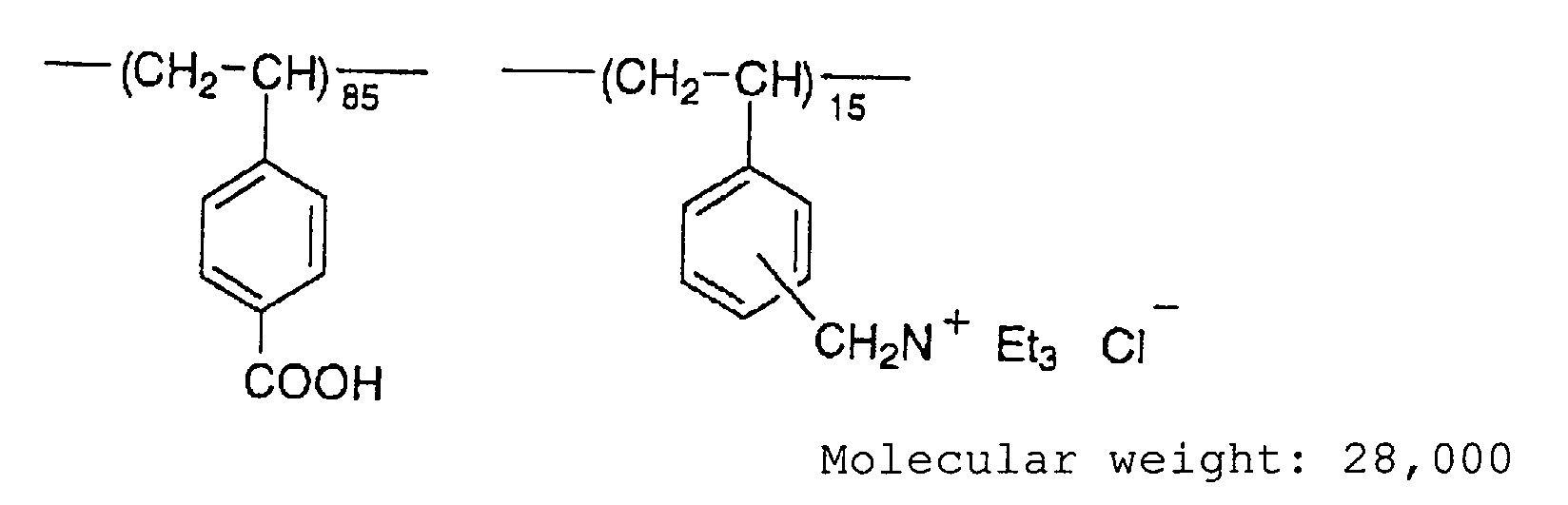
- The following coating solution for the lower recording layer was coated on the thus-obtained substrate in a coating amount of 0.75 g/m2, then dried by means of a air dryer (PERFECT OVEN PH200 made by Tabai Corp.) at 140 °C for 50 seconds with setting wind control level at 7, followed by coating a coating solution for forming the upper recording layer shown below in a coating amount of 0.3 g/m2 and drying at 120 °C for 1 minute to obtain lithographic printing plate material 1.
(Coating solution for the lower recording layer) N-(4-Aminosulfonylphenyl)methacrylamide/ acrylonitrile/methyl methacrylate (36/34/30 copolymer; weight average molecular weight: 50,000) 2.133 g 3-Methoxy-4-diazophenylamine hexafluorophosphate 0.030 g Cyanine dye A (shown below) 0.109 g 4,4'-Bishydroxyphenylsulfone 0.063 g Tetrahydrophthalic anhydride 0.190 g p-Toluenesulfonic acid 0.008 g Dye obtained by changing the counter ion of Ethyl Violet to 6-hydroxynaphthalenesulfonic acid 0.05 g Fluorine-containing surfactant (Megafac F176, made by Dainippon Ink & Chemicals Inc.) 0.035 g Methyl ethyl ketone 26.6 g 1-Methoxy-2-propanol 13.6g γ-Butyrolactone 13.8 g Compound (I-1) shown below 0.15 g 


(Coating solution for the upper recording layer) m,p-Cresol novolak (m/p ratio = 6/4; weight average molecular weight: 4,500; content of unreacted cresol: 0.8% by weight) 0.237 g Cyanin dye A (shown above) 0.047 g Dodecyl stearate 0.060 g 3-Methoxy-4-diazodiphenylamine hexafluorophosphate 0.030 g Fluorine-containing surfactant (Megafac F176, made by Dainippon Ink & Chemicals Inc.) 0.110 g Fluorine-containing surfactant (Megafac MCF312 (30%), made by Dainippon Ink & Chemicals Inc.) 0.120 g Tetramethylammonium bromide 0.03 g Methyl ethyl ketone 15.1 g 1-Methoxy-2-propanol 13.6g - The following coating solution 2 for the recording layer was coated on the same substrate as used in the preparation of lithographic printing plate material 1 in a coating amount of 1.0 g/m2, then dried at 140 °C for 50 seconds to obtain lithographic printing plate material 2.
(Coating solution 2 for the recording layer) N-(4-Aminosulfonylphenyl)methacrylamide/ acrylonitrile/methyl methacrylate (35/35/30 copolymer; weight average molecular weight: 50,000) 1.896 g m, p-Cresol novolak (m/p = 6/4; weight average molecular weight: 4,500; content of unreacted cresol: 0.8% by weight) 0.332 g 3-Methoxy-4-diazophenylamine hexafluorophosphate 0.030 g Cyanin dye A (shown above) 0.155 g 4,4'-Bishydroxyphenylsulfone 0.063 g Tetrahydrophthalic anhydride 0.190 g p-Toluenesulfonic acid 0.008 g Dye obtained by changing the counter ion of Ethyl Violet to 6-hydroxynaphthalenesulfonic acid 0.05 g Fluorine-containing surfactant (Megafac F176, made by Dainippon Ink & Chemicals Inc.) 0.145 g Fluorine-containing surfactant (Megafac MCF312 (30%), made by Dainippon Ink & Chemicals Inc.) 0.120 g Methyl ethyl ketone 26.6 g 1-Methoxy-2-propanol 13.6 g γ-Butyrolactone 13.8 g Compound (I-2) shown below 0.06 g 
- One hundred sheets the thus-obtained printing plate material 1 (650 mm x 550 mm x 0.30 mm thick) were subjected to recording of halftone dot images of 175 lines and 2400 dpi at 150 rpm with exposure energies increasing stepwise by 0,1 w from 3.0 w to 16.0 w using Trendsetter 3244 made by Creo Co. (image area ratio: about 20%). The exposed printing plate materials were preserved for 12 hours under the conditions shown in Table 1 in a build-in thermostatic humidistatic chamber (TBR-6W2S3L made by Tabai Espec Corp.) to prepare preserved samples.
- A printing plate material 1 immediately after the exposure and the preserved sample were developed by an automatic processor LP-900H made by Fuji Photo Film Co., Ltd. using a non-silicate developing solution DT-1 and a replenisher DT-1R both made by Fuji Photo Film Co., Ltd. in conventional manner.
- The minimum exposure energy by which the non-image areas became clear (plate sensitivity) was determined in each of the plate material immediately after the exposure and the preserved sample. When the plate sensitivity of the preserved sample was deviated from that of the plate material immediately after the exposure, the replenisher was added so that the plate material immediately after the exposure and the preserved sample exhibit equivalent sensitivities. The plate material immediately after the exposure was developed with the developer to which the replenisher had been added to determine the plate sensitivity.
- Similar experiments were conducted with the plate material 2.
- The results obtained are shown in Table 1.
No. Lithographic Printing Plate Material Preserving Temperature (°C) Preserving Humidity (%) Plate Sensitivity (W) 1 1 immediately after exposure 6.5 2 1 23 40 6.5 3 1 21 50 6.5 4 1 20 35 6.5 5 1 27 65 5.0 6 2 immediately after exposure 6.0 7 2 23 40 6.0 8 2 21 50 6.0 9 2 20 35 6.0 10 2 27 65 4.0 - The following coating solution 3 for the recording layer was coated on the same substrate as used in the preparation of lithographic printing plate material 1 in a coating amount of 1.8 g/m2, then dried at 150 °C for 60 seconds to obtain lithographic printing plate material 3.
(Coating solution 3 for the recording layer) m, p-Cresol novolak (PR54046; Sumitomo Durez Co.) 1.00 g Cyanine dye A (shown above) 0.10 g Phthalic anhydride 0.05 g p-Toluenesulfonic acid 0.002 g Dye obtained by changing the counter ion of Ethyl Violet to β-naphthalenesulfonic acid 0.02 g Fluorine-containing surfactant (Megafac F177, made by Dainippon Ink & Chemicals Inc.) 0.05 g Methyl ethyl ketone 8 g 1-Methoxy-2-propanol 4 g - Using the thus-obtained printing plate material 3, the same procedures as described above were performed except using a developing solution LH-DS and a replenisher LH-DRS both made by Fuji Photo Film Co., Ltd. in place of the developing solution DT-1 and replenisher DT-1R, respectively.
- The results are shown in Table 2.
No. Lithographic Printing Plate Material Preserving Temperature (°C) Preserving Humidity (%) Plate Sensitivity (W) 11 3 immediately after exposure 5.5 12 3 23 40 5.5 13 3 21 50 5.5 14 3 20 35 5.5 15 3 27 65 4.0 - It is seen from the above results that, when preserved at 15 to 23 °C, the lithographic printing plates for evaluation do not undergo change in sensitivity, thus permitting good control of the developing solution.
- According to the invention, even when a plurality of image-forming materials are exposed at once to prepare lithographic printing plates for evaluation and separately developed where evaluation is required, there are obtained the same evaluation results and, as a result, lithographic printing plates can be evaluated with good work efficiency and, further, quality of the lithographic printing plates can be maintained at a definite level. Thus, there is provided a simple method for evaluation whereby plate-making conditions for direct plate-making type positive-working image-forming materials adapted for infrared laser, particularly the state of activity of the developing solution, can easily be judged and, further a method of easily controlling quality by making feedback of the results to the exposing/developing steps to maintain quality of the lithographic printing plates at a definite level and continuously form uniform images.
Claims (6)
- An image-evaluating method comprising:(i) a step of forming plural lithographic printing plates for evaluation by subjecting image-forming materials comprising a support having provided thereon a light-sensitive layer containing both an alkaline aqueous solution-soluble resin and a compound which absorbs a light to generate heat, to exposure under a plurality of conditions with stepwise changing plate surface energy;(ii) a step of preserving the exposed plural lithographic printing plates for evaluation at a temperature of 15 to 23 °C;(iii) a step of developing at least one of the plural lithographic printing plates for evaluation with a standard developing solution having a standard formulation to prepare a lithographic printing plate having been treated with the standard developing solution;(iv) a step of developing other lithographic printing plates for evaluation than the above-described lithographic printing plate having been developed with the standard developing solution, with a developing solution to be evaluated according to the necessity of evaluation to thereby prepare lithographic printing plates having been treated with the developing solution to be evaluated; and(v) a step of comparing the state of image areas or non-image areas formed under predetermined exposure conditions in the lithographic printing plate having been treated with the standard developing solution with that in the lithographic printing plates having been treated with the developing solution to be evaluated.
- A method for controlling quality of lithographic printing plates comprising:(i) a step of forming plural lithographic printing plates for evaluation by subjecting image-forming materials comprising a support having provided thereon a light-sensitive layer containing both an alkaline aqueous solution-soluble resin and a compound which absorbs a light to generate heat, to exposure under a plurality of conditions with stepwise changing plate surface energy;(ii) a step of preserving the exposed plural lithographic printing plates for evaluation at a temperature of 15 to 23 °C;(iii) a step of developing at least one of the plural lithographic printing plates for evaluation with a standard developing solution having a standard formulation to prepare a lithographic printing plate having been treated with the standard developing solution;(iv) a step of developing other lithographic printing plates for evaluation than the above-described lithographic printing plate having been developed with the standard developing solution, with a developing solution to be evaluated according to the necessity of evaluation to thereby prepare lithographic printing plates having been treated with the developing solution to be evaluated;(v) a step of comparing the state of image areas or non-image areas formed under predetermined exposure conditions in the lithographic printing plate having been treated with the standard developing solution with that in the lithographic printing plates having been treated with the developing solution to be evaluated; and(vi) a step of adjusting exposing/developing conditions in the case where the above-described comparison of the image areas or non-image areas of the lithographic printing plates reveals that the difference between the lithographic printing plates exceeds a predetermined level.
- The image-evaluating method as claimed in Claim 1, wherein the preservation of exposed plural lithographic printing plates for evaluation is conducted at a relative humidity of 60% or less.
- The method for controlling quality of lithographic printing plates as claimed in Claim 1, wherein the preservation of exposed plural lithographic printing plates for evaluation is conducted at a relative humidity of 60% or less.
- The image-evaluating method as claimed in Claim 1, wherein the light-sensitive layer of the image-forming material has a multi-layer structure.
- The image-evaluating method as claimed in Claim 1, wherein the standard developing solution is a developing solution containing a non-reducing sugar and a base.
Applications Claiming Priority (2)
| Application Number | Priority Date | Filing Date | Title |
|---|---|---|---|
| JP2001289474A JP2003098684A (en) | 2001-09-21 | 2001-09-21 | Method for evaluating image and method for controlling quality of planographic printing plate |
| JP2001289474 | 2001-09-21 |
Publications (3)
| Publication Number | Publication Date |
|---|---|
| EP1295716A2 true EP1295716A2 (en) | 2003-03-26 |
| EP1295716A3 EP1295716A3 (en) | 2004-01-02 |
| EP1295716B1 EP1295716B1 (en) | 2006-05-24 |
Family
ID=19111956
Family Applications (1)
| Application Number | Title | Priority Date | Filing Date |
|---|---|---|---|
| EP02021328A Expired - Lifetime EP1295716B1 (en) | 2001-09-21 | 2002-09-20 | Method for evaluating image and method for controlling quality of lithographic printing plate |
Country Status (4)
| Country | Link |
|---|---|
| EP (1) | EP1295716B1 (en) |
| JP (1) | JP2003098684A (en) |
| AT (1) | ATE327098T1 (en) |
| DE (1) | DE60211612T2 (en) |
Families Citing this family (3)
| Publication number | Priority date | Publication date | Assignee | Title |
|---|---|---|---|---|
| DE602004006378T2 (en) * | 2004-04-21 | 2008-01-10 | Agfa Graphics N.V. | Method of accurately exposing small dots to a heat-sensitive positive-working planographic printing plate |
| JP5490168B2 (en) * | 2012-03-23 | 2014-05-14 | 富士フイルム株式会社 | Planographic printing plate precursor and lithographic printing plate preparation method |
| CN110568733B (en) * | 2018-06-06 | 2023-06-09 | 台湾积体电路制造股份有限公司 | Semiconductor process and semiconductor equipment |
Citations (8)
| Publication number | Priority date | Publication date | Assignee | Title |
|---|---|---|---|---|
| GB434875A (en) | 1933-02-08 | 1935-09-05 | Bela Gasper | An improved method of producing multi-colour photographic images on coloured and differently sensitized multi-layer photographic material |
| US4327169A (en) | 1981-01-19 | 1982-04-27 | Eastman Kodak Company | Infrared sensitive photoconductive composition, elements and imaging method using trimethine thiopyrylium dye |
| JPS58125246A (en) | 1982-01-22 | 1983-07-26 | Ricoh Co Ltd | Laser recording medium |
| JPS58173696A (en) | 1982-04-06 | 1983-10-12 | Canon Inc | Optical recording medium |
| JPS5973996A (en) | 1982-10-22 | 1984-04-26 | Nec Corp | Optical recording medium |
| JPS5984356A (en) | 1982-11-05 | 1984-05-16 | Ricoh Co Ltd | How to create an optical disc master |
| US5156938A (en) | 1989-03-30 | 1992-10-20 | Graphics Technology International, Inc. | Ablation-transfer imaging/recording |
| JP2001013692A (en) | 1999-06-29 | 2001-01-19 | Fuji Photo Film Co Ltd | Method for evaluating image and method for controlling quality of planographic printing plate |
Family Cites Families (1)
| Publication number | Priority date | Publication date | Assignee | Title |
|---|---|---|---|---|
| JP4369570B2 (en) * | 1999-10-15 | 2009-11-25 | 富士フイルム株式会社 | Quality control method for lithographic printing plates |
-
2001
- 2001-09-21 JP JP2001289474A patent/JP2003098684A/en active Pending
-
2002
- 2002-09-20 EP EP02021328A patent/EP1295716B1/en not_active Expired - Lifetime
- 2002-09-20 DE DE60211612T patent/DE60211612T2/en not_active Expired - Lifetime
- 2002-09-20 AT AT02021328T patent/ATE327098T1/en not_active IP Right Cessation
Patent Citations (8)
| Publication number | Priority date | Publication date | Assignee | Title |
|---|---|---|---|---|
| GB434875A (en) | 1933-02-08 | 1935-09-05 | Bela Gasper | An improved method of producing multi-colour photographic images on coloured and differently sensitized multi-layer photographic material |
| US4327169A (en) | 1981-01-19 | 1982-04-27 | Eastman Kodak Company | Infrared sensitive photoconductive composition, elements and imaging method using trimethine thiopyrylium dye |
| JPS58125246A (en) | 1982-01-22 | 1983-07-26 | Ricoh Co Ltd | Laser recording medium |
| JPS58173696A (en) | 1982-04-06 | 1983-10-12 | Canon Inc | Optical recording medium |
| JPS5973996A (en) | 1982-10-22 | 1984-04-26 | Nec Corp | Optical recording medium |
| JPS5984356A (en) | 1982-11-05 | 1984-05-16 | Ricoh Co Ltd | How to create an optical disc master |
| US5156938A (en) | 1989-03-30 | 1992-10-20 | Graphics Technology International, Inc. | Ablation-transfer imaging/recording |
| JP2001013692A (en) | 1999-06-29 | 2001-01-19 | Fuji Photo Film Co Ltd | Method for evaluating image and method for controlling quality of planographic printing plate |
Also Published As
| Publication number | Publication date |
|---|---|
| EP1295716A3 (en) | 2004-01-02 |
| DE60211612T2 (en) | 2007-05-03 |
| EP1295716B1 (en) | 2006-05-24 |
| ATE327098T1 (en) | 2006-06-15 |
| JP2003098684A (en) | 2003-04-04 |
| DE60211612D1 (en) | 2006-06-29 |
Similar Documents
| Publication | Publication Date | Title |
|---|---|---|
| JP3461377B2 (en) | Image recording material | |
| EP1262318B1 (en) | Lithographic printing plate precursor | |
| EP1316421B1 (en) | Infrared-sensitive photosensitive composition | |
| EP1347014B1 (en) | Infrared-photosensitive composition | |
| US6436596B1 (en) | Quality control method for a planographic printing plate | |
| EP1295716B1 (en) | Method for evaluating image and method for controlling quality of lithographic printing plate | |
| US6800426B2 (en) | Process for making a two layer thermal negative plate | |
| EP1156371A2 (en) | Replenishing method of planographic printing plate developer | |
| EP1403716B1 (en) | Process for developing lithographic printing plate | |
| JP2002229186A (en) | Original plate of planographic printing plate | |
| JP4709104B2 (en) | Photosensitive lithographic printing plate precursor | |
| JP2009204829A (en) | Lithographic printing plate precursor | |
| JP2003098657A (en) | Positive-working original plate for printing plate | |
| JP2002182400A (en) | Plate making method for planographic printing plate | |
| JP2002062663A (en) | Method for quality control of lithographic printing plate | |
| JP4315535B2 (en) | Quality control method for lithographic printing plates | |
| US8263311B2 (en) | Photosensitive lithographic printing plate precursor for infrared laser | |
| JP2001013692A (en) | Method for evaluating image and method for controlling quality of planographic printing plate | |
| JP2001228623A (en) | Method for controlling quality of planographic printing plate | |
| JP2000199950A (en) | Image forming material and image forming method using the same | |
| JP2002351066A (en) | Positive type planographic printing plate material for infrared laser and processing method | |
| JP2001147522A (en) | Quality control method of planographic printing plate | |
| EP2236293A2 (en) | Lithographic printing plate precursor | |
| JP2001125278A (en) | Quality control method of planographic printing plate | |
| US20040033435A1 (en) | Process for producing printing plate precursor |
Legal Events
| Date | Code | Title | Description |
|---|---|---|---|
| PUAI | Public reference made under article 153(3) epc to a published international application that has entered the european phase |
Free format text: ORIGINAL CODE: 0009012 |
|
| AK | Designated contracting states |
Kind code of ref document: A2 Designated state(s): AT BE BG CH CY CZ DE DK EE ES FI FR GB GR IE IT LI LU MC NL PT SE SK TR Designated state(s): AT BE BG CH CY CZ DE DK EE ES FI FR GB GR IE IT LI LU MC NL PT SE SK TR |
|
| AX | Request for extension of the european patent |
Extension state: AL LT LV MK RO SI |
|
| PUAL | Search report despatched |
Free format text: ORIGINAL CODE: 0009013 |
|
| AK | Designated contracting states |
Kind code of ref document: A3 Designated state(s): AT BE BG CH CY CZ DE DK EE ES FI FR GB GR IE IT LI LU MC NL PT SE SK TR |
|
| AX | Request for extension of the european patent |
Extension state: AL LT LV MK RO SI |
|
| RIC1 | Information provided on ipc code assigned before grant |
Ipc: 7G 03F 7/30 B Ipc: 7B 41C 1/10 A |
|
| 17P | Request for examination filed |
Effective date: 20040616 |
|
| AKX | Designation fees paid |
Designated state(s): AT BE BG CH CY CZ DE DK EE ES FI FR GB GR IE IT LI LU MC NL PT SE SK TR |
|
| GRAP | Despatch of communication of intention to grant a patent |
Free format text: ORIGINAL CODE: EPIDOSNIGR1 |
|
| GRAS | Grant fee paid |
Free format text: ORIGINAL CODE: EPIDOSNIGR3 |
|
| GRAA | (expected) grant |
Free format text: ORIGINAL CODE: 0009210 |
|
| AK | Designated contracting states |
Kind code of ref document: B1 Designated state(s): AT BE BG CH CY CZ DE DK EE ES FI FR GB GR IE IT LI LU MC NL PT SE SK TR |
|
| PG25 | Lapsed in a contracting state [announced via postgrant information from national office to epo] |
Ref country code: SK Free format text: LAPSE BECAUSE OF FAILURE TO SUBMIT A TRANSLATION OF THE DESCRIPTION OR TO PAY THE FEE WITHIN THE PRESCRIBED TIME-LIMIT Effective date: 20060524 Ref country code: NL Free format text: LAPSE BECAUSE OF FAILURE TO SUBMIT A TRANSLATION OF THE DESCRIPTION OR TO PAY THE FEE WITHIN THE PRESCRIBED TIME-LIMIT Effective date: 20060524 Ref country code: LI Free format text: LAPSE BECAUSE OF FAILURE TO SUBMIT A TRANSLATION OF THE DESCRIPTION OR TO PAY THE FEE WITHIN THE PRESCRIBED TIME-LIMIT Effective date: 20060524 Ref country code: IT Free format text: LAPSE BECAUSE OF FAILURE TO SUBMIT A TRANSLATION OF THE DESCRIPTION OR TO PAY THE FEE WITHIN THE PRESCRIBED TIME-LIMIT;WARNING: LAPSES OF ITALIAN PATENTS WITH EFFECTIVE DATE BEFORE 2007 MAY HAVE OCCURRED AT ANY TIME BEFORE 2007. THE CORRECT EFFECTIVE DATE MAY BE DIFFERENT FROM THE ONE RECORDED. Effective date: 20060524 Ref country code: FI Free format text: LAPSE BECAUSE OF FAILURE TO SUBMIT A TRANSLATION OF THE DESCRIPTION OR TO PAY THE FEE WITHIN THE PRESCRIBED TIME-LIMIT Effective date: 20060524 Ref country code: CZ Free format text: LAPSE BECAUSE OF FAILURE TO SUBMIT A TRANSLATION OF THE DESCRIPTION OR TO PAY THE FEE WITHIN THE PRESCRIBED TIME-LIMIT Effective date: 20060524 Ref country code: CH Free format text: LAPSE BECAUSE OF FAILURE TO SUBMIT A TRANSLATION OF THE DESCRIPTION OR TO PAY THE FEE WITHIN THE PRESCRIBED TIME-LIMIT Effective date: 20060524 Ref country code: BE Free format text: LAPSE BECAUSE OF FAILURE TO SUBMIT A TRANSLATION OF THE DESCRIPTION OR TO PAY THE FEE WITHIN THE PRESCRIBED TIME-LIMIT Effective date: 20060524 Ref country code: AT Free format text: LAPSE BECAUSE OF FAILURE TO SUBMIT A TRANSLATION OF THE DESCRIPTION OR TO PAY THE FEE WITHIN THE PRESCRIBED TIME-LIMIT Effective date: 20060524 |
|
| REG | Reference to a national code |
Ref country code: GB Ref legal event code: FG4D |
|
| REG | Reference to a national code |
Ref country code: CH Ref legal event code: EP |
|
| REG | Reference to a national code |
Ref country code: IE Ref legal event code: FG4D |
|
| REF | Corresponds to: |
Ref document number: 60211612 Country of ref document: DE Date of ref document: 20060629 Kind code of ref document: P |
|
| PG25 | Lapsed in a contracting state [announced via postgrant information from national office to epo] |
Ref country code: SE Free format text: LAPSE BECAUSE OF FAILURE TO SUBMIT A TRANSLATION OF THE DESCRIPTION OR TO PAY THE FEE WITHIN THE PRESCRIBED TIME-LIMIT Effective date: 20060824 Ref country code: DK Free format text: LAPSE BECAUSE OF FAILURE TO SUBMIT A TRANSLATION OF THE DESCRIPTION OR TO PAY THE FEE WITHIN THE PRESCRIBED TIME-LIMIT Effective date: 20060824 |
|
| PG25 | Lapsed in a contracting state [announced via postgrant information from national office to epo] |
Ref country code: ES Free format text: LAPSE BECAUSE OF FAILURE TO SUBMIT A TRANSLATION OF THE DESCRIPTION OR TO PAY THE FEE WITHIN THE PRESCRIBED TIME-LIMIT Effective date: 20060904 |
|
| PG25 | Lapsed in a contracting state [announced via postgrant information from national office to epo] |
Ref country code: IE Free format text: LAPSE BECAUSE OF NON-PAYMENT OF DUE FEES Effective date: 20060920 |
|
| PG25 | Lapsed in a contracting state [announced via postgrant information from national office to epo] |
Ref country code: MC Free format text: LAPSE BECAUSE OF NON-PAYMENT OF DUE FEES Effective date: 20060930 |
|
| PG25 | Lapsed in a contracting state [announced via postgrant information from national office to epo] |
Ref country code: PT Free format text: LAPSE BECAUSE OF FAILURE TO SUBMIT A TRANSLATION OF THE DESCRIPTION OR TO PAY THE FEE WITHIN THE PRESCRIBED TIME-LIMIT Effective date: 20061024 |
|
| NLV1 | Nl: lapsed or annulled due to failure to fulfill the requirements of art. 29p and 29m of the patents act | ||
| REG | Reference to a national code |
Ref country code: CH Ref legal event code: PL |
|
| RAP2 | Party data changed (patent owner data changed or rights of a patent transferred) |
Owner name: FUJIFILM CORPORATION |
|
| PLBE | No opposition filed within time limit |
Free format text: ORIGINAL CODE: 0009261 |
|
| STAA | Information on the status of an ep patent application or granted ep patent |
Free format text: STATUS: NO OPPOSITION FILED WITHIN TIME LIMIT |
|
| REG | Reference to a national code |
Ref country code: GB Ref legal event code: 732E |
|
| 26N | No opposition filed |
Effective date: 20070227 |
|
| EN | Fr: translation not filed | ||
| PG25 | Lapsed in a contracting state [announced via postgrant information from national office to epo] |
Ref country code: GR Free format text: LAPSE BECAUSE OF FAILURE TO SUBMIT A TRANSLATION OF THE DESCRIPTION OR TO PAY THE FEE WITHIN THE PRESCRIBED TIME-LIMIT Effective date: 20060825 Ref country code: FR Free format text: LAPSE BECAUSE OF FAILURE TO SUBMIT A TRANSLATION OF THE DESCRIPTION OR TO PAY THE FEE WITHIN THE PRESCRIBED TIME-LIMIT Effective date: 20070309 |
|
| PG25 | Lapsed in a contracting state [announced via postgrant information from national office to epo] |
Ref country code: BG Free format text: LAPSE BECAUSE OF FAILURE TO SUBMIT A TRANSLATION OF THE DESCRIPTION OR TO PAY THE FEE WITHIN THE PRESCRIBED TIME-LIMIT Effective date: 20060824 Ref country code: EE Free format text: LAPSE BECAUSE OF FAILURE TO SUBMIT A TRANSLATION OF THE DESCRIPTION OR TO PAY THE FEE WITHIN THE PRESCRIBED TIME-LIMIT Effective date: 20060524 |
|
| PG25 | Lapsed in a contracting state [announced via postgrant information from national office to epo] |
Ref country code: TR Free format text: LAPSE BECAUSE OF FAILURE TO SUBMIT A TRANSLATION OF THE DESCRIPTION OR TO PAY THE FEE WITHIN THE PRESCRIBED TIME-LIMIT Effective date: 20060524 Ref country code: LU Free format text: LAPSE BECAUSE OF NON-PAYMENT OF DUE FEES Effective date: 20060920 |
|
| PG25 | Lapsed in a contracting state [announced via postgrant information from national office to epo] |
Ref country code: FR Free format text: LAPSE BECAUSE OF FAILURE TO SUBMIT A TRANSLATION OF THE DESCRIPTION OR TO PAY THE FEE WITHIN THE PRESCRIBED TIME-LIMIT Effective date: 20060524 Ref country code: CY Free format text: LAPSE BECAUSE OF FAILURE TO SUBMIT A TRANSLATION OF THE DESCRIPTION OR TO PAY THE FEE WITHIN THE PRESCRIBED TIME-LIMIT Effective date: 20060524 |
|
| PGFP | Annual fee paid to national office [announced via postgrant information from national office to epo] |
Ref country code: GB Payment date: 20120919 Year of fee payment: 11 |
|
| PGFP | Annual fee paid to national office [announced via postgrant information from national office to epo] |
Ref country code: DE Payment date: 20120912 Year of fee payment: 11 |
|
| GBPC | Gb: european patent ceased through non-payment of renewal fee |
Effective date: 20130920 |
|
| REG | Reference to a national code |
Ref country code: DE Ref legal event code: R119 Ref document number: 60211612 Country of ref document: DE Effective date: 20140401 |
|
| PG25 | Lapsed in a contracting state [announced via postgrant information from national office to epo] |
Ref country code: GB Free format text: LAPSE BECAUSE OF NON-PAYMENT OF DUE FEES Effective date: 20130920 |
|
| PG25 | Lapsed in a contracting state [announced via postgrant information from national office to epo] |
Ref country code: DE Free format text: LAPSE BECAUSE OF NON-PAYMENT OF DUE FEES Effective date: 20140401 |