EP1293574A2 - Reagents, methods and devices for detecting analytes - Google Patents
Reagents, methods and devices for detecting analytes Download PDFInfo
- Publication number
- EP1293574A2 EP1293574A2 EP02019843A EP02019843A EP1293574A2 EP 1293574 A2 EP1293574 A2 EP 1293574A2 EP 02019843 A EP02019843 A EP 02019843A EP 02019843 A EP02019843 A EP 02019843A EP 1293574 A2 EP1293574 A2 EP 1293574A2
- Authority
- EP
- European Patent Office
- Prior art keywords
- phenothiazine
- phenylimino
- mediator
- reagent
- group
- Prior art date
- Legal status (The legal status is an assumption and is not a legal conclusion. Google has not performed a legal analysis and makes no representation as to the accuracy of the status listed.)
- Granted
Links
- 0 *C([C@@]1N=C2C=C3Oc(c(*)c(*)c(*)c4*)c4N=C3C=C2)C(*)=C(*)C(*)=C1S Chemical compound *C([C@@]1N=C2C=C3Oc(c(*)c(*)c(*)c4*)c4N=C3C=C2)C(*)=C(*)C(*)=C1S 0.000 description 2
Images


Classifications
-
- C—CHEMISTRY; METALLURGY
- C12—BIOCHEMISTRY; BEER; SPIRITS; WINE; VINEGAR; MICROBIOLOGY; ENZYMOLOGY; MUTATION OR GENETIC ENGINEERING
- C12Q—MEASURING OR TESTING PROCESSES INVOLVING ENZYMES, NUCLEIC ACIDS OR MICROORGANISMS; COMPOSITIONS OR TEST PAPERS THEREFOR; PROCESSES OF PREPARING SUCH COMPOSITIONS; CONDITION-RESPONSIVE CONTROL IN MICROBIOLOGICAL OR ENZYMOLOGICAL PROCESSES
- C12Q1/00—Measuring or testing processes involving enzymes, nucleic acids or microorganisms; Compositions therefor; Processes of preparing such compositions
- C12Q1/54—Measuring or testing processes involving enzymes, nucleic acids or microorganisms; Compositions therefor; Processes of preparing such compositions involving glucose or galactose
-
- C—CHEMISTRY; METALLURGY
- C12—BIOCHEMISTRY; BEER; SPIRITS; WINE; VINEGAR; MICROBIOLOGY; ENZYMOLOGY; MUTATION OR GENETIC ENGINEERING
- C12Q—MEASURING OR TESTING PROCESSES INVOLVING ENZYMES, NUCLEIC ACIDS OR MICROORGANISMS; COMPOSITIONS OR TEST PAPERS THEREFOR; PROCESSES OF PREPARING SUCH COMPOSITIONS; CONDITION-RESPONSIVE CONTROL IN MICROBIOLOGICAL OR ENZYMOLOGICAL PROCESSES
- C12Q1/00—Measuring or testing processes involving enzymes, nucleic acids or microorganisms; Compositions therefor; Processes of preparing such compositions
- C12Q1/26—Measuring or testing processes involving enzymes, nucleic acids or microorganisms; Compositions therefor; Processes of preparing such compositions involving oxidoreductase
- C12Q1/32—Measuring or testing processes involving enzymes, nucleic acids or microorganisms; Compositions therefor; Processes of preparing such compositions involving oxidoreductase involving dehydrogenase
Definitions
- the present invention relates to reagents, methods and devices for measurement of analytes and, more particularly, to reagents, methods and devices for the measurement of glucose in the blood.
- Electrochemical biosensors are based on enzyme-catalyzed chemical reactions involving the analyte of interest. In the case of glucose monitoring, the relevant chemical reaction is the oxidation of glucose to gluconolactone.
- This oxidation is catalyzed by a variety of enzymes, some of which may contain a bound coenzyme such as nicotinamide adenine dinucleotide (phosphate) (NAD(P)), while others may contain a bound cofactor such as flavin adenine dinucleotide (FAD) or pyrroloquinolinequinone (PQQ).
- a bound coenzyme such as nicotinamide adenine dinucleotide (phosphate) (NAD(P)
- NAD(P) nicotinamide adenine dinucleotide
- FAD flavin adenine dinucleotide
- PQQ pyrroloquinolinequinone
- the redox equivalents generated in the course of the oxidation of glucose are transported to the surface of an electrode whereby an electrical signal is generated. The magnitude of the electrical signal is then correlated with concentration of glucose.
- the transfer of redox equivalents from the site of chemical reaction in the enzyme to the surface of the electrode is accomplished with the use of electron transfer mediators.
- Electron transfer mediators previously used with FAD-glucose oxidase and PQQ-glucose dehydrogenase include quinones, phenzine methosulfate, dichlorophenolindophenol and ferricyanide. Unfortunately, these compounds have proven to be highly susceptible to the environmental agents described above, and result in biosensor reagents of low stability. Thus, mediators are needed which exhibit good stability upon exposure to commonly-encountered environmental agents, and which can be used in flavoprotein- and quinoprotein-based systems.
- biosensor reagents that are stable to the environmental agents described above, it would be desirable to provide biosensor reagents that are stable to the radiation conditions commonly employed in lancet sterilization. Reagents stable to such radiation sterilization could be incorporated into highly user-convenient units in which lancet and biosensor are combined.
- the present invention is directed to electron transfer mediators for use in flavoprotein- and quinoprotein-based biosensor reagents, which exhibit improved stability to both environmental interferents and to radiation sterilization.
- a composition aspect of the present invention is directed to a reagent for detecting an analyte, comprising (a) an enzyme selected from the group consisting of a flavoprotein, a quinoprotein, and a combination thereof; and (b) a mediator selected from the group consisting of a phenothiazine, a phenoxazine, and a combination thereof.
- a first apparatus aspect of the present invention is directed to an electrochemical sensor comprising: (a) a working electrode having a surface; and (b) a second electrode coupled to the working electrode.
- the surface of the working electrode is coated with a solution or mixture of a reagent comprising an enzyme selected from the group consisting of a flavoprotein, a quinoprotein, and a combination thereof; and a mediator selected from the group consisting of a phenothiazine, a phenoxazine, and a combination thereof.
- a second apparatus aspect of the present invention is directed to a device for measuring an analyte, comprising (a) a lancet; and (b) a sampling chamber connected to the lancet.
- the sampling chamber comprises a reagent comprising an enzyme selected from the group consisting of PQQ-glucose dehydrogenase, FAD-glucose oxidase, and a combination thereof; and (b) a mediator selected from the group consisting of a phenothiazine, a phenoxazine, and a combination thereof.
- a first method aspect of the present invention is directed to a method of producing a sterilized device for measuring an analyte, comprising (a) providing a device in accordance with the present invention, and (b) irradiating the device with E-beam or gamma ray radiation.
- a second method aspect of the present invention is directed to a method for detecting an analyte which undergoes a chemical reaction, the method comprising (a) providing an electrode surface; (b) catalyzing the chemical reaction with an enzyme selected from the group consisting of a flavoprotein, a quinoprotein, and a combination thereof; (c) generating a redox equivalent by the chemical reaction; and (d) transferring the redox equivalent to the electrode surface using a mediator selected from the group consisting of a phenothiazine, a phenoxazine, and a combination thereof.
- the presently preferred embodiments discussed herein may possess one or more advantages relative to other flavoprotein- and quinoprotein-based biosensor reagents, which can include but are but not limited to: improved biosensor reagent stability; enhanced electron transfer capability of mediators; ability to tune mediators for optimum electrode operation; reduced oxygen susceptibility of mediators; increased thermal stability of mediators; increased stability of mediators to ambient humidity; lower redox potential of mediators; reduced susceptibility to interferents in blood; and stability of biosensor reagents to radiation sterilization conditions.
- analyte refers to one or a plurality of species having a concentration of interest.
- flavoprotein refers to enzymes containing flavin cofactors.
- quinoprotein refers to enzymes containing PQQ or similar cofactors.
- redox equivalent refers to one or a plurality of charged species (e.g., electrons) produced in electrochemical reactions involving the analyte.
- E-beam irradiation or “electron beam irradiation” refers to a process of exposure to a concentrated, high-current stream of electrons.
- alkyl alkenyl
- alkynyl alkynyl
- aryl heteroaryl
- cyclic heterocyclic
- halo haloalkyl
- carboxy alkyl
- alkoxycarbonyl alkoxycarbonyl
- aryloxycarbonyl alkoxycarbonyl
- aromatic keto aliphatic keto
- dialkylamino alkoxy
- aminoalkyl amino acid
- sulfo dihydroxyboron
- biosensor reagent refers to the combination of an enzyme that catalyzes a reaction of an analyte, and a phenothiazine and/or phenoxazine mediator.
- bioburden refers to the population of viable microorganisms on a product determined immediately prior to irradiation.
- a biosensor reagent for detecting an analyte in accord with the present invention includes (1) an enzyme selected from the group consisting of a flavoprotein, a quinoprotein, and a combination thereof; and (2) a mediator selected from the group consisting of a phenothiazine, a phenoxazine, and a combination thereof.
- analyte monitored in accord with the present invention is unrestricted, provided the analyte undergoes a chemical reaction that is catalyzed by an enzyme selected from the group consisting of a flavoprotein, a quinoprotein, and a combination thereof.
- Preferred analytes include but are not limited to glucose, lactate, D-amino acids, ascorbate, alcohol, cholesterol, choline, and acetylcholine.
- Flavoproteins in accord with the present invention include FAD-glucose oxidase (Enzyme Classification No. 1.1.3.4), Flavin-hexose oxidase (EC No. 1.1.3.5) and FAD-glucose dehydrogenase (EC No. 1.1.99.10)
- FAD-glucose oxidase Enzyme Classification No. 1.1.3.4
- Flavin-hexose oxidase EC No. 1.1.3.5
- FAD-glucose dehydrogenase EC No. 1.1.99.10
- Additional oxidase enzymes for use in accord with the present invention include but are not limited to lactate oxidase, cholesterol oxidase, alcohol oxidase (e.g., methanol oxidase), d-aminoacid oxidase, choline oxidase, and FAD derivatives thereof.
- a preferred flavoprotein for use in accord with the present invention is FAD-glucose oxidase.
- Quinoproteins in accord with the present invention include but are not limited to membrane bound and soluble PQQ-glucose dehydrogenase (EC No. 1.1.99.17). Information relating to PQQ-glucose dehydrogenase can be found in the Olsthoorn reference cited above. Additional quinoprotein enzymes for use in accord with the present invention include but are not limited to lactate dehydrogenase, aldehyde dehydrogenase, methylamine dehydrogenase, alcohol dehydrogenase (e.g., methanol dehydrogenase), and PQQ derivatives thereof.
- a preferred quinoprotein for use in accord with the present invention is PQQ-glucose dehydrogenase.
- Mediators in accord with the present invention include phenothiazines having the formula and phenoxazines having the formula wherein R 1 , R 2 R 3 , R 4 , R 5 , R 6 , R 7 , R 8 , and R 9 are the same or different, and are independently selected from the group consisting of hydrogen, alkyl, alkenyl, alkynyl, aryl, heteroaryl, cyclic, heterocyclic, halo, haloalkyl, carboxy, carboxyalkyl, alkoxycarbonyl, aryloxycarbonyl, aromatic keto, aliphatic keto, alkoxy, aryloxy, nitro, dialkylamino, aminoalkyl, sulfo, dihydroxyboron, and combinations thereof.
- mediators in accord with the present invention have the ability to carry two redox equivalents, and are therefore well suited for use in FAD and quinoprotein oxidation/reduction processes, which generally involve the transfer of two electrons.
- the potential of mediators of the present invention can be tuned to the optimum potential (i.e., the potential where the signal contribution from interferences is minimized) for a specific sample matrix by varying the substitution on the aromatic rings.
- Electron-donating substituents e.g., alkyl, alkoxy, amine, hydroxy, etc.
- electron-withdrawing substituents e.g., carboxylic acid, ester, aldehyde, ketone, nitrile, nitro, sulfonic acid, trifluromethyl, etc.
- the ideal potential usually lies between about -200 and about 100 mV versus an Ag/AgCl reference.
- the substituents on the aromatic rings in addition to their utility in tuning the redox potentials of the mediators, can also be used to enhance mediator solubility.
- the introduction of a substituent having the capacity for hydrogen bonding can be expected to render the mediator more water soluble than a mediator lacking such substitution.
- these substituents can serve as functional groups for immobilizing the mediators to a support (e.g., the electrode surface or, alternatively, a chemical matrix such as a polymer backbone, which is suitable for application to the electrode surface).
- mediators used in biosensor reagents include 3-(4'-chloro-phenylimino)-3H-phenothiazine, 3-(4'-diethylamino-phenylimino)-3H-phenothiazine, 3-(4'ethyl-phenylimino)-3H-phenothiazine, 3-(4'-trifluoromethyl-phenylimino)-3H-phenothiazine, 3-(4'-methoxycarbonyl-phenylimino)-3H-phenothiazine, 3-(4'-nitro-phenylimino)-3H-phenothiazine, 3-(4'-methoxy-phenylimino)-3H-phenothiazine, 7-acetyl-3-(4'-methoxycarbonylphenylimino)-3H-phenothiazine, 7-trifluoromethyl-3-(4'-methoxycarbonylphen
- the mediator used in accord with the present invention is selected from the group consisting of and
- phenothiazine mediators ⁇ in particular mediator I ⁇ are less susceptible to oxygen degradation, more thermally stable, and more stable to ambient humidity.
- mediator I works at a lower redox potential than ferricyanide.
- E 0 for mediator I is approximately 0 mV versus an Ag/AgCl reference
- E 0 for ferricyanide is approximately 250 mV versus an. Ag/AgCl reference.
- the lower redox potential of phenothiazine mediators is advantageous in that there is a region around 0 mV versus an Ag/AgCl reference in which the amount of electrochemical interferences are minimized.
- the impact from chemical interferents in the blood can be minimized by using these mediators.
- Reagents embodying features of the present invention can be incorporated into a variety of biosensor devices, including but not limited to the ones described in United States Patents No. 5,120,420 and No. 5,798,031, the entire contents of both of which are incorporated herein by reference, except that in the event of any inconsistent disclosure or definition from the present application, the disclosure or definition herein shall be deemed to prevail.
- FIG. 1 shows a representative electrochemical sensor in accordance with the present invention.
- the electrochemical sensor 2 is comprised of an insulating base 4 upon which is printed (typically by screen printing techniques) an electrode pattern ( 6 and 8 ) and a reagent layer 10 that contains a reagent embodying features of the present invention.
- the two parts of the electrode print, 6 and 8 provide the working and reference electrodes necessary for the electrochemical determination.
- a lancet element 12 can be incorporated into the electrochemical sensor (e.g., interposed between layers 1 and 2), as is described more fully hereinbelow.
- the three layers shown in FIG. 1 can be joined by means of an adhesive (e.g., pressure sensitive, hot melt, etc.) or by sonic welding, depending on the identity of the materials.
- biosensor reagents comprising PQQ-glucose dehydrogenase and certain phenothiazine mediators exhibit high stability to radiation sterilization.
- a preferred application of radiation stable biosensor reagents in accord with the present invention is for the development of integrated lancet/biosensor devices.
- An example of such an integrated device is illustrated in FIG. 2 and described in United States Patent No. 5,801,057, the entire contents of which are incorporated herein by reference, except that in the event of any inconsistent disclosure or definition from the present application, the disclosure or definition herein shall be deemed to prevail.
- the integrated lancet/biosensor device 14 has a finely bored needle 16 connected to a sampling chamber 18 .
- Sampling chamber 18 has at least one optical window 20 and a vent 22 through which air can be displaced when the chamber 18 fills with blood or other fluids.
- sampling chamber 18 comprises a biosensor reagent comprising PQQ-glucose dehydrogenase and a phenothiazine and/or phenoxazine mediator.
- the mediator is a phenothiazine. More preferably, the mediator has a structure represented by mediator I or mediator II above.
- the method of sterilization involves electron beam (E-beam) irradiation or gamma irradiation.
- a sterility assurance level (SAL) of 10 -6 , which corresponds to a one in a million probability of a viable microorganism being present on a product unit after sterilization.
- the sterilization dose needed to achieve a 10 -6 SAL depends on the bioburden of the sample. For example, a sample with a bioburden of 1,021 requires a sterilization dose of 24.9 kGy to achieve a 10 -6 SAL.
- E-beam electron beam irradiation
- the biosensor reagents subjected to the electron beam absorb energy from the electrons.
- the energy that is absorbed per unit mass of material is referred to as the absorbed dose, and it is this absorption of energy ⁇ or dose delivery ⁇ that destroys the reproductive cells and DNA chains of microorganisms, thereby rendering a product sterile.
- E-beam doses of 25, 50 and 100 kGy were used because the bioburden of the biosensor reagents was unknown.
- FIG. 3 shows a graph of the background currents observed for three formulations of biosensor reagents exposed to increasing levels of radiation: (1) NAD-glucose dehydrogenase with Mediator I, (2) PQQ-glucose dehydrogenase with Ferricyanide, and (3) PQQ-glucose dehydrogenase with Mediator I.
- the PQQ formulations tolerated the irradiation extremely well.
- the NAD formulation exhibited poor tolerance to the sterilization conditions, and resulted in a background signal which constituted a significant amount of the glucose signal.
- formulation (2) exhibited good tolerance to the radiation process, the activity of the extracted enzyme was lower than the corresponding activity of the enzyme extracted from formulation (3).
- Fig 4 shows a graph of current response when these radiation-sterilized sensors were exposed to 600 mg/dL glucose.
- the working electrode employed in electrochemical sensors according to the present invention can be varied, with suitable electrodes including but not limited to carbon electrodes, platinum electrodes, palladium electrodes, gold electrodes, and the like.
- the reference electrode can be varied, with suitable electrodes including but not limited to silver-silver chloride electrodes, calomel electrodes, saturated calomel electrodes, and the like.
- a quasi-reference electrode e.g., a large surface area platinum electrode
- the surface areas of all electrodes employed in accordance with the present invention are likewise subject to variation.
- the working electrode has dimensions of about 0.6 mm x 1.2 mm.
- Suitable buffer solutions include but are not limited to HEPES (i.e., N-2-hydroxyethylpiperazine-N'-2-ethanesulfonic acid), MOPS (i.e., 3-(N-morpholino)propanesulfonic acid), TES (i.e., N-tris(hydroxymethyl)methyl-2-aminoethanesulfonic acid), 2-([2-hydrox-1,1-bis(hydroxymethyl)-ethyl]amino)ethanesulfonic acid), PIPES (i.e., piperazine-N,N'-bis(2-ethanesulfonic acid)), 1,4-piperazinediethanesulfonic acid), ACES (i.e., N-(carbamoylmethyl)-2-aminoethanesulfonic acid), N-(2-acetyl-N-N-ethanesulfonic acid), N-(2-acetyl-N-N-ethanesulf
- these reagents can also be adapted for in vivo analyte monitoring by chemically immobilizing the phenoxazine and/or phenothiazine mediators (e.g., by chemical reaction at one or more of the substituent groups on the aromatic rings), and incorporating the immobilized mediators into a device which can be implanted subcutaneously into a patient.
- a liquid chemistry reagent was prepared to be 20 Units/ ⁇ L pyrolloquinolinequinone-glucose dehydrogenase (PQQ-GDH) and 24 mM mediator I in 100 mM Sodium Phosphate, pH 7.4.
- the first component of the reagent was made by dissolving the mediator in 100 mM phosphate pH 7.4, adjusting the pH back to 7.4, and filtering the solution by forcing it through a Whatman 0.45 micron PTFE syringe filter.
- the reagent was completed by adding lyophilized PQQ-GDH (Toyobo Product No. GLD-321) to an activity of 20 U/ ⁇ L.
- the chemistry formulation was deposited onto electrodes, which had been produced using a 3-pass screen-printing process by Conductive Technologies, Inc. During this process, the silver/silver chloride (DuPont 5870 ink) leads and reference electrode were printed first onto polycarbonate base material. The second pass of Dupont 7102T carbon-graphite working electrode was printed on top of this. A final pass of Norcote RDMSK4954-A2 dielectric defined the working electrode area to be 0.0113 cm 2 .
- the chemistry was deposited over the working electrode with the use of an Asymtek Automove® 402 Dispensing System.
- the system was programmed to perform the transfer by dipping a 62 mL stainless steel pin into a 1.5 mL Eppendorf vial filled with reagent.
- Polycarbonate lid material was laminated to the sensors creating a capillary area over the working and reference electrodes capable of holding approximately 3 ⁇ L of test solution.
- the capillary area which defines the sample volume, is first formed in the polycarbonate lid material by a coining or stamping process.
- reactivity of the chemistry was analyzed by generating a glucose dose-response curve with buffered (100 mM phosphate, 100 mM sodium chloride, pH 7.4) samples containing a range of glucose concentrations from 0 to 600 mg/dL.
- Current generated at each of the glucose concentrations was measured using a potentiostat programmed to apply 150 mV potential with trigger level set to 100 nA, and timing programmed to record the current at 5,10,15, and 20 seconds.
- the trigger level refers to a threshold level above which timing and recording are initiated.
- Electrochemical biosensors were constructed using a screen-printing process. Sensors were comprised of a carbon working electrode and a silver/silver chloride reference electrode. A solution (150 to 800nl) containing 12mM mediator I in 100mM phosphate buffer (pH 7.4), and of the enzyme PQQ-glucose dehydrogenase (10 U/ ⁇ L) was deposited on the surface of the working electrode and allowed to dry at room temperature for 5 minutes prior to desiccation. The electrodes were assembled into a format having a small capillary gap, which allowed inoculation of the sensors with sample solutions.
- the sensors were subjected to the following environmental conditions prior to testing: 1) 50 °C for 2, 4, and 8 weeks; and 2) room temperature with 40% relative humidity.
- the sensors were poised at a potential of 150mV relative to the Ag/AgCl reference electrode and the resulting current was measured.
- This mediator/enzyme combination is quite stable to both heat stress and humidity stress as shown in FIG. 7.
- FIGS. 8-12 show glucose dose response curves for each of the five formulations both before and after irradiation.
- the stability of the five formulations is high, as is clearly shown by the near overlapping of the glucose response generated before and after irradiation.
- Table 2 shows the results of enzyme assays conducted on the five formulations both before and after irradiation. Enzyme activity following irradiation remains high in all instances.
- Formulation # kGy Level Enzyme Activity I 0 4.67 25 4.32 50 4.20 100 4.24 II 0 3.31 25 3.34 III 0 4.93 25 4.87 IV 0 4.96 25 4.86 V 0 3.63 25 4.05
Landscapes
- Chemical & Material Sciences (AREA)
- Life Sciences & Earth Sciences (AREA)
- Organic Chemistry (AREA)
- Health & Medical Sciences (AREA)
- Engineering & Computer Science (AREA)
- Zoology (AREA)
- Wood Science & Technology (AREA)
- Proteomics, Peptides & Aminoacids (AREA)
- Molecular Biology (AREA)
- General Engineering & Computer Science (AREA)
- Immunology (AREA)
- Microbiology (AREA)
- Biophysics (AREA)
- Analytical Chemistry (AREA)
- Physics & Mathematics (AREA)
- Genetics & Genomics (AREA)
- Biochemistry (AREA)
- Bioinformatics & Cheminformatics (AREA)
- Biotechnology (AREA)
- General Health & Medical Sciences (AREA)
- Emergency Medicine (AREA)
- Measuring Or Testing Involving Enzymes Or Micro-Organisms (AREA)
- Investigating Or Analysing Biological Materials (AREA)
- Apparatus Associated With Microorganisms And Enzymes (AREA)
Abstract
Description


| Formulation # | Enzyme Concentration PQQ-GDH Units | Concentration Mediator I mM | Polymer Concentration CMC % | Polymer Concentration PEO % |
| I | 20 | 12 | 0 | 0 |
| II | 20 | 12 | 0 | 0 |
| | 20 | 12 | 1 | 0 |
| | 20 | 12 | 2 | 0 |
| | 20 | 12 | 0 | 2 |
| Formulation # | kGy Level | Enzyme Activity |
| I | 0 | 4.67 |
| 25 | 4.32 | |
| 50 | 4.20 | |
| 100 | 4.24 | |
| II | 0 | 3.31 |
| 25 | 3.34 | |
| III | 0 | 4.93 |
| 25 | 4.87 | |
| | 0 | 4.96 |
| 25 | 4.86 | |
| | 0 | 3.63 |
| 25 | 4.05 |
Claims (10)
- A reagent for detecting an analyte, comprising:an enzyme selected from the group consisting of a flavoprotein, a quinoprotein, and a combination thereof; anda mediator selected from the group consisting of a phenothiazine, a phenoxazine, and a combination thereof.
- The reagent of claim 1, wherein the mediator is selected from the group consisting of
 and combinations thereof, wherein R1, R2 R3, R4, R5, R6, R7, R8, and R9 are the same or different, and are independently selected from the group consisting of hydrogen, alkyl, alkenyl, alkynyl, aryl, heteroaryl, cyclic, heterocyclic, halo, haloalkyl, carboxy, carboxyalkyl, alkoxycarbonyl, aryloxycarbonyl, aromatic keto, aliphatic keto, alkoxy, aryloxy, nitro, dialkylamino, aminoalkyl, sulfo, dihydroxyboron, and combinations thereof.
- The reagent of claim 1, wherein the mediator is selected from the group consisting of 3-(4'-chloro-phenylimino)-3H-phenothiazine, 3-(4'-diethylamino-phenylimino)-3H-phenothiazine, 3-(4'ethyl-phenylimino)-3H-phenothiazine, 3-(4'-trifluoromethyl-phenylimino)-3H-phenothiazine, 3-(4'-methoxycarbonyl-phenylimino)-3H-phenothiazine, 3-(4'-nitro-phenylimino)-3H-phenothiazine, 3-(4'-methoxy-phenylimino)-3H-phenothiazine, 7-acetyl-3-(4'-methoxycarbonylphenylimino)-3H-phenothiazine, 7-trifluoromethyl-3-(4'-methoxycarbonylphenylimino)-3H-phenothiazine, 3-(4'-ω-carboxy-n-butylphenylimino)-3H-phenothiazine, 3-(4'-aminomethyl-phenylimino)-3H-phenothiazine, 3-(4'-(2"-(5"-(p-aminophenyl)-1,3,4-oxadiazoyl)phenylimino)-3H-phenothiazine, 3-(4'-β-aminoethyl-phenylimino)-3H-phenothiazine, 6-(4'-ethylphenyl)amino-3-(4'-ethyl-phenylimino)-3H-phenothiazine, 6-(4'-[2-(2-ethanoloxy)ethoxy]ethoxyphenyl)amino-3-(4'-[2-(2-ethanoloxy)ethoxy]ethoxyphenylimino-3H-phenothiazine, 3-(4'-[2-(2-ethanoloxy)ethoxy]ethoxyphenylimino-3H-phenothiazine, 3-(4'-phenylimino)-3H-phenothiazineboronic acid, (3-(3',5'-dicarboxy-phenylimino)-3H-phenothiazine, 3-(4'-carboxyphenylimino)-3H-phenothiazine, 3-(3',5'-dicarboxy-phenylimino)-3H-phenoxazine, 3-(3',5'-phenylimino)-3H-phenothiazinedisulfonic acid, 3-(3-phenylimino)-3H-phenothiazinesulfonic acid, and combinations thereof.
- The reagent of claim 1, wherein the mediator comprises
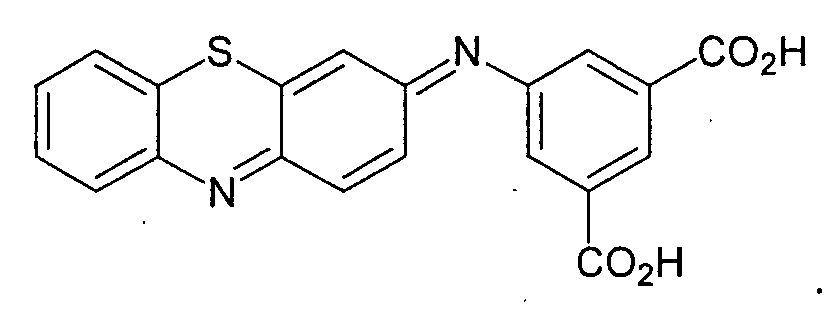
- The reagent of claim 1, wherein the mediator comprises

- The reagent of claim 8, wherein the mediator is selected from the group consisting of 3-(4'-chloro-phenylimino)-3H-phenothiazine, 3-(4'-diethylamino-phenylimino)-3H-phenothiazine, 3-(4'ethyl-phenylimino)-3H-phenothiazine, 3-(4'-trifluoromethyl-phenylimino)-3H-phenothiazine, 3-(4'-methoxycarbonyl-phenylimino)-3H-phenothiazine, 3-(4'-nitro-phenylimino)-3H-phenothiazine, 3-(4'-methoxy-phenylimino)-3H-phenothiazine, 7-acetyl-3-(4'-methoxycarbonylphenylimino)-3H-phenothiazine, 7-trifluoromethyl-3-(4'-methoxycarbonylphenylimino)-3H-phenothiazine, 3-(4'-ω-carboxy-n-butyl-phenylimino)-3H-phenothiazine, 3-(4'-aminomethyl-phenylimino)-3H-phenothiazine, 3-(4'-(2"-(5"-(p-aminophenyl)-1,3,4-oxadiazoyl)phenylimino)-3H-phenothiazine, 3-(4'-β-aminoethyl-phenylimino)-3H-phenothiazine, 6-(4'-ethylphenyl)amino-3-(4'-ethyl-phenylimino)-3H-phenothiazine, 6-(4'-[2-(2-ethanoloxy)ethoxy]ethoxyphenyl)amino-3-(4'-[2-(2-ethanoloxy)ethoxy]ethoxyphenylimino-3H-phenothiazine, 3-(4'-[2-(2-ethanoloxy)ethoxy]ethoxyphenylimino-3H-phenothiazine, 3-(4'-phenylimino)-3H-phenothiazineboronic acid, (3-(3',5'-dicarboxy-phenylimino)-3H-phenothiazine, 3-(4'-carboxyphenylimino)-3H-phenothiazine, 3-(3',5'-dicarboxy-phenylimino)-3H-phenoxazine, 3-(3',5'-phenylimino)-3H-phenothiazinedisulfonic acid, 3-(3-phenylimino)-3H-phenothiazinesulfonic acid, and combinations thereof.
- The reagent of claim 8, wherein the mediator comprises

- The reagent of claim 8, wherein the mediator comprises

- The reagent of claim 1, further comprising a polymer selected from the group consisting of carboxymethylcellulose, polyethylene oxide, and combinations thereof.
- A reagent for detecting glucose, comprising:wherein the mediator has a concentration in the buffer between about 0.1 mM and about 30 mM.PQQ-glucose dehydrogenase in an activity of about 20 Units/µL;a buffer having a concentration between about 0.1 mM and about 100 mM, and a pH between about 4.5 and about 9.5; anda mediator having a structure
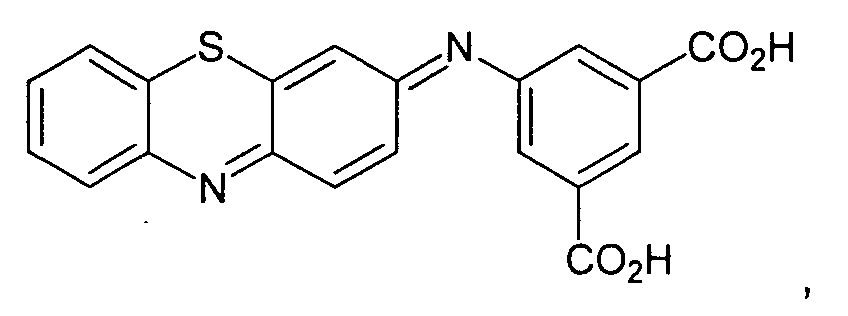
Priority Applications (2)
| Application Number | Priority Date | Filing Date | Title |
|---|---|---|---|
| DK07018162.3T DK1867732T3 (en) | 2001-09-14 | 2002-09-09 | Reagents, Methods and Devices for Detecting Analyte |
| EP07018162.3A EP1867732B1 (en) | 2001-09-14 | 2002-09-09 | Reagents, methods and devices for detecting analytes |
Applications Claiming Priority (2)
| Application Number | Priority Date | Filing Date | Title |
|---|---|---|---|
| US31871601P | 2001-09-14 | 2001-09-14 | |
| US318716P | 2001-09-14 |
Related Child Applications (1)
| Application Number | Title | Priority Date | Filing Date |
|---|---|---|---|
| EP07018162.3A Division EP1867732B1 (en) | 2001-09-14 | 2002-09-09 | Reagents, methods and devices for detecting analytes |
Publications (3)
| Publication Number | Publication Date |
|---|---|
| EP1293574A2 true EP1293574A2 (en) | 2003-03-19 |
| EP1293574A3 EP1293574A3 (en) | 2004-03-03 |
| EP1293574B1 EP1293574B1 (en) | 2007-11-21 |
Family
ID=23239317
Family Applications (1)
| Application Number | Title | Priority Date | Filing Date |
|---|---|---|---|
| EP02019843A Expired - Lifetime EP1293574B1 (en) | 2001-09-14 | 2002-09-09 | Reagents, methods and devices for detecting analytes |
Country Status (8)
| Country | Link |
|---|---|
| US (1) | US7163616B2 (en) |
| EP (1) | EP1293574B1 (en) |
| JP (3) | JP2003185619A (en) |
| AU (1) | AU2002300939C1 (en) |
| CA (1) | CA2401365C (en) |
| DE (1) | DE60223635T2 (en) |
| DK (2) | DK1867732T3 (en) |
| ES (2) | ES2535286T3 (en) |
Cited By (8)
| Publication number | Priority date | Publication date | Assignee | Title |
|---|---|---|---|---|
| EP1430831A1 (en) * | 2002-12-20 | 2004-06-23 | LifeScan, Inc. | Method for manufacturing a sterilized and calibrated biosensor-based medical device |
| WO2007022485A3 (en) * | 2005-08-19 | 2007-11-15 | Becton Dickinson Co | Sterilization of biosensors |
| US7368221B2 (en) * | 2002-06-17 | 2008-05-06 | Verification Technologies, Inc. | Changing light absorption by disruption of conjugation |
| WO2009076433A1 (en) * | 2007-12-10 | 2009-06-18 | Bayer Healthcare Llc | Reagents and methods for detecting analytes |
| WO2010141359A3 (en) * | 2009-06-01 | 2011-01-20 | Bayer Healthcare Llc | Redox molecules and methods of making the same |
| US8742063B2 (en) | 2010-05-28 | 2014-06-03 | Bayer Healthcare Llc | Polymer bonded redox molecules and methods of making the same |
| EP3187866A1 (en) * | 2007-12-10 | 2017-07-05 | Ascensia Diabetes Care Holdings AG | Electrochemical test sensor |
| EP2229590B1 (en) * | 2007-12-10 | 2018-11-21 | Ascensia Diabetes Care Holdings AG | Process of making 3-phenylimino-3h-phenothiazine or 3-phenylimino-3h-phenoxazine mediator |
Families Citing this family (99)
| Publication number | Priority date | Publication date | Assignee | Title |
|---|---|---|---|---|
| AU6157898A (en) * | 1997-02-06 | 1998-08-26 | E. Heller & Company | Small volume (in vitro) analyte sensor |
| US6036924A (en) * | 1997-12-04 | 2000-03-14 | Hewlett-Packard Company | Cassette of lancet cartridges for sampling blood |
| US6391005B1 (en) | 1998-03-30 | 2002-05-21 | Agilent Technologies, Inc. | Apparatus and method for penetration with shaft having a sensor for sensing penetration depth |
| US8641644B2 (en) | 2000-11-21 | 2014-02-04 | Sanofi-Aventis Deutschland Gmbh | Blood testing apparatus having a rotatable cartridge with multiple lancing elements and testing means |
| DE10057832C1 (en) | 2000-11-21 | 2002-02-21 | Hartmann Paul Ag | Blood analysis device has syringe mounted in casing, annular mounting carrying needles mounted behind test strip and being swiveled so that needle can be pushed through strip and aperture in casing to take blood sample |
| US9795747B2 (en) | 2010-06-02 | 2017-10-24 | Sanofi-Aventis Deutschland Gmbh | Methods and apparatus for lancet actuation |
| ATE485766T1 (en) | 2001-06-12 | 2010-11-15 | Pelikan Technologies Inc | ELECTRICAL ACTUATING ELEMENT FOR A LANCET |
| US7025774B2 (en) | 2001-06-12 | 2006-04-11 | Pelikan Technologies, Inc. | Tissue penetration device |
| JP4209767B2 (en) | 2001-06-12 | 2009-01-14 | ペリカン テクノロジーズ インコーポレイテッド | Self-optimized cutting instrument with adaptive means for temporary changes in skin properties |
| AU2002348683A1 (en) | 2001-06-12 | 2002-12-23 | Pelikan Technologies, Inc. | Method and apparatus for lancet launching device integrated onto a blood-sampling cartridge |
| US8337419B2 (en) | 2002-04-19 | 2012-12-25 | Sanofi-Aventis Deutschland Gmbh | Tissue penetration device |
| US7981056B2 (en) | 2002-04-19 | 2011-07-19 | Pelikan Technologies, Inc. | Methods and apparatus for lancet actuation |
| US9226699B2 (en) | 2002-04-19 | 2016-01-05 | Sanofi-Aventis Deutschland Gmbh | Body fluid sampling module with a continuous compression tissue interface surface |
| DE60239132D1 (en) * | 2001-06-12 | 2011-03-24 | Pelikan Technologies Inc | APPARATUS FOR INCREASING THE SUCCESS RATE IN RESPECT OF BLOOD EXPLOITATION OBTAINED BY A FINGERSTICK |
| US9427532B2 (en) | 2001-06-12 | 2016-08-30 | Sanofi-Aventis Deutschland Gmbh | Tissue penetration device |
| EP1404232B1 (en) | 2001-06-12 | 2009-12-02 | Pelikan Technologies Inc. | Blood sampling apparatus and method |
| ATE494837T1 (en) | 2001-06-12 | 2011-01-15 | Pelikan Technologies Inc | INTEGRATED SYSTEM FOR BLOOD SAMPLE ANALYSIS WITH MULTIPLE-USE SAMPLING MODULE |
| US7344894B2 (en) | 2001-10-16 | 2008-03-18 | Agilent Technologies, Inc. | Thermal regulation of fluidic samples within a diagnostic cartridge |
| US7004928B2 (en) * | 2002-02-08 | 2006-02-28 | Rosedale Medical, Inc. | Autonomous, ambulatory analyte monitor or drug delivery device |
| US7232451B2 (en) | 2002-04-19 | 2007-06-19 | Pelikan Technologies, Inc. | Method and apparatus for penetrating tissue |
| US8267870B2 (en) | 2002-04-19 | 2012-09-18 | Sanofi-Aventis Deutschland Gmbh | Method and apparatus for body fluid sampling with hybrid actuation |
| US7582099B2 (en) | 2002-04-19 | 2009-09-01 | Pelikan Technologies, Inc | Method and apparatus for penetrating tissue |
| US9314194B2 (en) | 2002-04-19 | 2016-04-19 | Sanofi-Aventis Deutschland Gmbh | Tissue penetration device |
| US7410468B2 (en) * | 2002-04-19 | 2008-08-12 | Pelikan Technologies, Inc. | Method and apparatus for penetrating tissue |
| US7491178B2 (en) * | 2002-04-19 | 2009-02-17 | Pelikan Technologies, Inc. | Method and apparatus for penetrating tissue |
| US7648468B2 (en) | 2002-04-19 | 2010-01-19 | Pelikon Technologies, Inc. | Method and apparatus for penetrating tissue |
| US7892183B2 (en) | 2002-04-19 | 2011-02-22 | Pelikan Technologies, Inc. | Method and apparatus for body fluid sampling and analyte sensing |
| US7717863B2 (en) | 2002-04-19 | 2010-05-18 | Pelikan Technologies, Inc. | Method and apparatus for penetrating tissue |
| US8702624B2 (en) | 2006-09-29 | 2014-04-22 | Sanofi-Aventis Deutschland Gmbh | Analyte measurement device with a single shot actuator |
| US9795334B2 (en) | 2002-04-19 | 2017-10-24 | Sanofi-Aventis Deutschland Gmbh | Method and apparatus for penetrating tissue |
| US7976476B2 (en) * | 2002-04-19 | 2011-07-12 | Pelikan Technologies, Inc. | Device and method for variable speed lancet |
| US7563232B2 (en) * | 2002-04-19 | 2009-07-21 | Pelikan Technologies, Inc. | Method and apparatus for penetrating tissue |
| US7141058B2 (en) * | 2002-04-19 | 2006-11-28 | Pelikan Technologies, Inc. | Method and apparatus for a body fluid sampling device using illumination |
| US7909778B2 (en) | 2002-04-19 | 2011-03-22 | Pelikan Technologies, Inc. | Method and apparatus for penetrating tissue |
| US7291117B2 (en) | 2002-04-19 | 2007-11-06 | Pelikan Technologies, Inc. | Method and apparatus for penetrating tissue |
| US8784335B2 (en) | 2002-04-19 | 2014-07-22 | Sanofi-Aventis Deutschland Gmbh | Body fluid sampling device with a capacitive sensor |
| US7713214B2 (en) | 2002-04-19 | 2010-05-11 | Pelikan Technologies, Inc. | Method and apparatus for a multi-use body fluid sampling device with optical analyte sensing |
| US7229458B2 (en) | 2002-04-19 | 2007-06-12 | Pelikan Technologies, Inc. | Method and apparatus for penetrating tissue |
| US7524293B2 (en) | 2002-04-19 | 2009-04-28 | Pelikan Technologies, Inc. | Method and apparatus for penetrating tissue |
| US8579831B2 (en) | 2002-04-19 | 2013-11-12 | Sanofi-Aventis Deutschland Gmbh | Method and apparatus for penetrating tissue |
| US9248267B2 (en) | 2002-04-19 | 2016-02-02 | Sanofi-Aventis Deustchland Gmbh | Tissue penetration device |
| US7374544B2 (en) | 2002-04-19 | 2008-05-20 | Pelikan Technologies, Inc. | Method and apparatus for penetrating tissue |
| US7331931B2 (en) | 2002-04-19 | 2008-02-19 | Pelikan Technologies, Inc. | Method and apparatus for penetrating tissue |
| US7674232B2 (en) * | 2002-04-19 | 2010-03-09 | Pelikan Technologies, Inc. | Method and apparatus for penetrating tissue |
| US7481776B2 (en) * | 2002-04-19 | 2009-01-27 | Pelikan Technologies, Inc. | Method and apparatus for penetrating tissue |
| US7371247B2 (en) * | 2002-04-19 | 2008-05-13 | Pelikan Technologies, Inc | Method and apparatus for penetrating tissue |
| US7901362B2 (en) | 2002-04-19 | 2011-03-08 | Pelikan Technologies, Inc. | Method and apparatus for penetrating tissue |
| US8221334B2 (en) | 2002-04-19 | 2012-07-17 | Sanofi-Aventis Deutschland Gmbh | Method and apparatus for penetrating tissue |
| US7175642B2 (en) | 2002-04-19 | 2007-02-13 | Pelikan Technologies, Inc. | Methods and apparatus for lancet actuation |
| US7547287B2 (en) | 2002-04-19 | 2009-06-16 | Pelikan Technologies, Inc. | Method and apparatus for penetrating tissue |
| US7297122B2 (en) | 2002-04-19 | 2007-11-20 | Pelikan Technologies, Inc. | Method and apparatus for penetrating tissue |
| US7192405B2 (en) * | 2002-09-30 | 2007-03-20 | Becton, Dickinson And Company | Integrated lancet and bodily fluid sensor |
| US8052926B2 (en) * | 2002-12-27 | 2011-11-08 | Roche Diagnostics Operations, Inc. | Method for manufacturing a sterilized lancet integrated biosensor |
| US8574895B2 (en) | 2002-12-30 | 2013-11-05 | Sanofi-Aventis Deutschland Gmbh | Method and apparatus using optical techniques to measure analyte levels |
| US20060195128A1 (en) * | 2002-12-31 | 2006-08-31 | Don Alden | Method and apparatus for loading penetrating members |
| US20040126831A1 (en) * | 2002-12-31 | 2004-07-01 | Medtronic Minimed, Inc. | Functionalization of immobilized proteins |
| ES2490740T3 (en) | 2003-06-06 | 2014-09-04 | Sanofi-Aventis Deutschland Gmbh | Apparatus for blood fluid sampling and analyte detection |
| WO2006001797A1 (en) | 2004-06-14 | 2006-01-05 | Pelikan Technologies, Inc. | Low pain penetrating |
| US7604592B2 (en) | 2003-06-13 | 2009-10-20 | Pelikan Technologies, Inc. | Method and apparatus for a point of care device |
| US8148164B2 (en) | 2003-06-20 | 2012-04-03 | Roche Diagnostics Operations, Inc. | System and method for determining the concentration of an analyte in a sample fluid |
| KR100785670B1 (en) | 2003-06-20 | 2007-12-14 | 에프. 호프만-라 로슈 아게 | Method and reagent for producing narrow, homogenous reagent strips |
| US8679853B2 (en) | 2003-06-20 | 2014-03-25 | Roche Diagnostics Operations, Inc. | Biosensor with laser-sealed capillary space and method of making |
| EP1671096A4 (en) | 2003-09-29 | 2009-09-16 | Pelikan Technologies Inc | METHOD AND APPARATUS FOR AN IMPROVED SAMPLING INTERFERENCE DEVICE |
| WO2005037095A1 (en) | 2003-10-14 | 2005-04-28 | Pelikan Technologies, Inc. | Method and apparatus for a variable user interface |
| US8668656B2 (en) | 2003-12-31 | 2014-03-11 | Sanofi-Aventis Deutschland Gmbh | Method and apparatus for improving fluidic flow and sample capture |
| US7822454B1 (en) | 2005-01-03 | 2010-10-26 | Pelikan Technologies, Inc. | Fluid sampling device with improved analyte detecting member configuration |
| US20050247573A1 (en) * | 2004-03-23 | 2005-11-10 | Hideaki Nakamura | Biosensors |
| US8828203B2 (en) | 2004-05-20 | 2014-09-09 | Sanofi-Aventis Deutschland Gmbh | Printable hydrogels for biosensors |
| US9820684B2 (en) | 2004-06-03 | 2017-11-21 | Sanofi-Aventis Deutschland Gmbh | Method and apparatus for a fluid sampling device |
| CA2577688A1 (en) * | 2004-08-24 | 2006-03-02 | Bayer Healthcare Llc | Method for determining the concentration of analytes in samples by direct mediation of enzymes |
| US8652831B2 (en) | 2004-12-30 | 2014-02-18 | Sanofi-Aventis Deutschland Gmbh | Method and apparatus for analyte measurement test time |
| JP4691378B2 (en) * | 2005-03-29 | 2011-06-01 | シーシーアイ株式会社 | Substrate measurement method using biosensor |
| US8801631B2 (en) | 2005-09-30 | 2014-08-12 | Intuity Medical, Inc. | Devices and methods for facilitating fluid transport |
| JP5232003B2 (en) | 2005-09-30 | 2013-07-10 | インテュイティ メディカル インコーポレイテッド | Multi-part body fluid sampling and analysis cartridge |
| US7955484B2 (en) | 2005-12-14 | 2011-06-07 | Nova Biomedical Corporation | Glucose biosensor and method |
| DE102006014714B3 (en) * | 2006-03-30 | 2007-05-16 | Draegerwerk Ag | Electrochemical sensor for gas detection has aromatic or alphatic acid carbonic acids in alkali electrolyte solution |
| US20090134023A1 (en) * | 2006-04-19 | 2009-05-28 | Junko Nakayama | Biosensor |
| BRPI0717430A2 (en) | 2006-09-22 | 2013-11-12 | Bayer Healthcare Llc | BIOSSENSOR SYSTEM HAVING STABILITY AND PERFORMANCE OF LARGER HEMATOCITES |
| JP2011506967A (en) * | 2007-12-10 | 2011-03-03 | バイエル・ヘルスケア・エルエルシー | Method and system for producing a reagent with reduced background current |
| US7678250B2 (en) * | 2008-01-22 | 2010-03-16 | Home Diagnostics, Inc. | Reagent compositions for use in electrochemical detection |
| IL197532A0 (en) | 2008-03-21 | 2009-12-24 | Lifescan Scotland Ltd | Analyte testing method and system |
| US9386944B2 (en) | 2008-04-11 | 2016-07-12 | Sanofi-Aventis Deutschland Gmbh | Method and apparatus for analyte detecting device |
| WO2009145920A1 (en) | 2008-05-30 | 2009-12-03 | Intuity Medical, Inc. | Body fluid sampling device -- sampling site interface |
| US10383556B2 (en) | 2008-06-06 | 2019-08-20 | Intuity Medical, Inc. | Medical diagnostic devices and methods |
| JP5642066B2 (en) | 2008-06-06 | 2014-12-17 | インテュイティ メディカル インコーポレイテッド | Method and apparatus for performing an assay to determine the presence or concentration of an analyte contained in a sample of body fluid |
| RU2546862C2 (en) | 2008-12-08 | 2015-04-10 | БАЙЕР ХЕЛТКЭА ЭлЭлСи | Biosensor system and test sensors for determination of concentration of analysed substance (versions) |
| US9375169B2 (en) | 2009-01-30 | 2016-06-28 | Sanofi-Aventis Deutschland Gmbh | Cam drive for managing disposable penetrating member actions with a single motor and motor and control system |
| EP3106871B1 (en) | 2009-11-30 | 2021-10-27 | Intuity Medical, Inc. | A method of verifying the accuracy of the operation of an analyte monitoring device |
| EP2333544A1 (en) | 2009-12-11 | 2011-06-15 | F. Hoffmann-La Roche AG | Sterilisable chemistry for test elements |
| US8965476B2 (en) | 2010-04-16 | 2015-02-24 | Sanofi-Aventis Deutschland Gmbh | Tissue penetration device |
| EP2584964B1 (en) | 2010-06-25 | 2021-08-04 | Intuity Medical, Inc. | Analyte monitoring devices |
| JP5698085B2 (en) * | 2010-07-12 | 2015-04-08 | アークレイ株式会社 | Biosensor and manufacturing method thereof |
| US8877344B2 (en) * | 2010-09-23 | 2014-11-04 | Bayer Healthcare Llc | Radically polymerizable phenothiazine macromonomer for use in the coating of medical devices |
| EP2623974B1 (en) * | 2010-09-30 | 2022-02-16 | PHC Holdings Corporation | Sensor, sensor system, and sensor manufacture process |
| EP3750480B1 (en) | 2011-08-03 | 2022-02-02 | Intuity Medical, Inc. | Body fluid sampling arrangement |
| WO2013118744A1 (en) * | 2012-02-09 | 2013-08-15 | 協和メデックス株式会社 | Method for storing aqueous solution containing leuco-type chromogen |
| WO2013161675A1 (en) * | 2012-04-27 | 2013-10-31 | 協和メデックス株式会社 | Method for stabilizing serum or plasma ascorbic acid |
| WO2014160210A1 (en) * | 2013-03-13 | 2014-10-02 | The Regents Of The University Of Michigan | Method for determining tear glucose concentration with blood glucose test strips |
| US10729386B2 (en) | 2013-06-21 | 2020-08-04 | Intuity Medical, Inc. | Analyte monitoring system with audible feedback |
Family Cites Families (31)
| Publication number | Priority date | Publication date | Assignee | Title |
|---|---|---|---|---|
| DE3278334D1 (en) | 1981-10-23 | 1988-05-19 | Genetics Int Inc | Sensor for components of a liquid mixture |
| CA1226036A (en) * | 1983-05-05 | 1987-08-25 | Irving J. Higgins | Analytical equipment and sensor electrodes therefor |
| CA1219040A (en) | 1983-05-05 | 1987-03-10 | Elliot V. Plotkin | Measurement of enzyme-catalysed reactions |
| US5126247A (en) | 1988-02-26 | 1992-06-30 | Enzymatics, Inc. | Method, system and devices for the assay and detection of biochemical molecules |
| DE68924026T3 (en) | 1988-03-31 | 2008-01-10 | Matsushita Electric Industrial Co., Ltd., Kadoma | BIOSENSOR AND ITS MANUFACTURE. |
| US4941308A (en) | 1988-07-25 | 1990-07-17 | Abbott Laboratories | Method of packaging for a sterilizable calibratable medical device |
| US4863016A (en) | 1988-07-25 | 1989-09-05 | Abbott Laboratories | Packaging for a sterilizable calibratable medical device |
| DE3826922A1 (en) | 1988-08-09 | 1990-02-22 | Boehringer Mannheim Gmbh | PROCESS FOR THE COLOR-RIMETRIC DETERMINATION OF AN ANALYTE BY ENZYMATIC OXIDATION |
| US5236567A (en) | 1989-05-31 | 1993-08-17 | Nakano Vinegar Co., Ltd. | Enzyme sensor |
| ATE140536T1 (en) | 1990-10-10 | 1996-08-15 | Novo Nordisk As | USE OF BENZENE DERIVATIVES AS CHARGE TRANSFER MEDIATORS |
| FI905324A7 (en) | 1990-10-29 | 1992-04-30 | Valtion Teknillinen | ENZYMATISKT BESTAEMNINGSFOERFARANDE FOER ALDOSER. |
| JP3717529B2 (en) * | 1992-03-31 | 2005-11-16 | 征夫 軽部 | Composition for enzyme electrode and enzyme-immobilized electrode |
| US5212092A (en) | 1992-05-22 | 1993-05-18 | Puritan-Bennett Corporation | Storage and calibration solution for multiparameter intravascular blood gas sensor device |
| US5298144A (en) | 1992-09-15 | 1994-03-29 | The Yellow Springs Instrument Company, Inc. | Chemically wired fructose dehydrogenase electrodes |
| ZA938555B (en) * | 1992-11-23 | 1994-08-02 | Lilly Co Eli | Technique to improve the performance of electrochemical sensors |
| US5393615A (en) | 1994-02-03 | 1995-02-28 | Miles Inc. | Mediators suitable for the electrochemical regeneration of NADH, NADPH or analogs thereof |
| JPH07294481A (en) * | 1994-04-25 | 1995-11-10 | Matsushita Electric Ind Co Ltd | Biosensor |
| US5520786A (en) * | 1995-06-06 | 1996-05-28 | Bayer Corporation | Mediators suitable for the electrochemical regeneration of NADH, NADPH or analogs thereof |
| US5801057A (en) | 1996-03-22 | 1998-09-01 | Smart; Wilson H. | Microsampling device and method of construction |
| US5723284A (en) * | 1996-04-01 | 1998-03-03 | Bayer Corporation | Control solution and method for testing the performance of an electrochemical device for determining the concentration of an analyte in blood |
| DE19639169A1 (en) | 1996-09-24 | 1998-04-02 | Boehringer Mannheim Gmbh | Redox-active compounds and their application |
| US5798031A (en) | 1997-05-12 | 1998-08-25 | Bayer Corporation | Electrochemical biosensor |
| US6656697B1 (en) | 1998-09-28 | 2003-12-02 | Lifescan, Inc. | Diagnostics based on tetrazolium compounds |
| JP3694424B2 (en) * | 1998-09-29 | 2005-09-14 | 松下電器産業株式会社 | Glucose sensor |
| US6338790B1 (en) * | 1998-10-08 | 2002-01-15 | Therasense, Inc. | Small volume in vitro analyte sensor with diffusible or non-leachable redox mediator |
| JP2000116629A (en) * | 1998-10-15 | 2000-04-25 | Kdk Corp | Wearing body |
| JP4352108B2 (en) * | 1998-12-15 | 2009-10-28 | アークレイ株式会社 | Substrate quantification method |
| US6360888B1 (en) * | 1999-02-25 | 2002-03-26 | Minimed Inc. | Glucose sensor package system |
| WO2001041643A1 (en) * | 1999-12-13 | 2001-06-14 | Arkray, Inc. | Body fluid measuring apparatus with lancet and lancet holder used for the measuring apparatus |
| US6562210B1 (en) * | 1999-12-30 | 2003-05-13 | Roche Diagnostics Corporation | Cell for electrochemical anaylsis of a sample |
| US6706159B2 (en) * | 2000-03-02 | 2004-03-16 | Diabetes Diagnostics | Combined lancet and electrochemical analyte-testing apparatus |
-
2002
- 2002-09-03 US US10/231,539 patent/US7163616B2/en not_active Expired - Lifetime
- 2002-09-05 CA CA2401365A patent/CA2401365C/en not_active Expired - Lifetime
- 2002-09-09 EP EP02019843A patent/EP1293574B1/en not_active Expired - Lifetime
- 2002-09-09 ES ES07018162.3T patent/ES2535286T3/en not_active Expired - Lifetime
- 2002-09-09 DE DE60223635T patent/DE60223635T2/en not_active Expired - Lifetime
- 2002-09-09 AU AU2002300939A patent/AU2002300939C1/en not_active Ceased
- 2002-09-09 DK DK07018162.3T patent/DK1867732T3/en active
- 2002-09-09 ES ES02019843T patent/ES2296856T3/en not_active Expired - Lifetime
- 2002-09-09 DK DK02019843T patent/DK1293574T3/en active
- 2002-09-12 JP JP2002266575A patent/JP2003185619A/en active Pending
-
2008
- 2008-11-04 JP JP2008283415A patent/JP2009025318A/en active Pending
-
2012
- 2012-05-24 JP JP2012118392A patent/JP5275494B2/en not_active Expired - Fee Related
Cited By (17)
| Publication number | Priority date | Publication date | Assignee | Title |
|---|---|---|---|---|
| US7368221B2 (en) * | 2002-06-17 | 2008-05-06 | Verification Technologies, Inc. | Changing light absorption by disruption of conjugation |
| EP1430831A1 (en) * | 2002-12-20 | 2004-06-23 | LifeScan, Inc. | Method for manufacturing a sterilized and calibrated biosensor-based medical device |
| WO2007022485A3 (en) * | 2005-08-19 | 2007-11-15 | Becton Dickinson Co | Sterilization of biosensors |
| EP3187866A1 (en) * | 2007-12-10 | 2017-07-05 | Ascensia Diabetes Care Holdings AG | Electrochemical test sensor |
| WO2009076433A1 (en) * | 2007-12-10 | 2009-06-18 | Bayer Healthcare Llc | Reagents and methods for detecting analytes |
| US11180790B2 (en) | 2007-12-10 | 2021-11-23 | Ascensia Diabetes Care Holdings Ag | Reagents and methods for detecting analytes |
| US10696998B2 (en) | 2007-12-10 | 2020-06-30 | Ascensia Diabetes Care Holdings Ag | Reagents and methods for detecting analytes |
| RU2518310C2 (en) * | 2007-12-10 | 2014-06-10 | БАЙЕР ХЕЛТКЭА ЭлЭлСи | Reagents and methods for detecting analytes |
| EP2229590B1 (en) * | 2007-12-10 | 2018-11-21 | Ascensia Diabetes Care Holdings AG | Process of making 3-phenylimino-3h-phenothiazine or 3-phenylimino-3h-phenoxazine mediator |
| WO2010141359A3 (en) * | 2009-06-01 | 2011-01-20 | Bayer Healthcare Llc | Redox molecules and methods of making the same |
| US8283347B2 (en) | 2009-06-01 | 2012-10-09 | Bayer Healthcare Llc | Redox molecules and methods of making the same |
| US9505884B2 (en) | 2010-05-28 | 2016-11-29 | Ascensia Diabetes Care Holdings Ag | Polymer comprising a plurality of phenothiazine groups and methods of making the same |
| US9944725B2 (en) | 2010-05-28 | 2018-04-17 | Ascensia Diabetes Care Holdings Ag | Polymer comprising a plurality of phenothiazine groups and methods of making the same |
| US9238717B2 (en) | 2010-05-28 | 2016-01-19 | Bayer Healthcare Llc | Polymer comprising a plurality of phenothiazine groups and methods of making the same |
| US10662264B2 (en) | 2010-05-28 | 2020-05-26 | Ascensia Diabetes Care Holdings Ag | Polymer comprising a plurality of phenothiazine groups and methods of making the same |
| US8742063B2 (en) | 2010-05-28 | 2014-06-03 | Bayer Healthcare Llc | Polymer bonded redox molecules and methods of making the same |
| US10947328B2 (en) | 2010-05-28 | 2021-03-16 | Ascensia Diabetes Care Holdings Ag | Polymer comprising a plurality of phenothiazine groups and methods of making the same |
Also Published As
| Publication number | Publication date |
|---|---|
| DE60223635D1 (en) | 2008-01-03 |
| DK1293574T3 (en) | 2008-03-10 |
| AU2002300939B2 (en) | 2008-10-23 |
| ES2296856T3 (en) | 2008-05-01 |
| JP2012154955A (en) | 2012-08-16 |
| DE60223635T2 (en) | 2008-10-30 |
| US7163616B2 (en) | 2007-01-16 |
| AU2002300939C1 (en) | 2009-03-05 |
| EP1293574A3 (en) | 2004-03-03 |
| JP5275494B2 (en) | 2013-08-28 |
| JP2003185619A (en) | 2003-07-03 |
| DK1867732T3 (en) | 2015-04-27 |
| EP1293574B1 (en) | 2007-11-21 |
| CA2401365A1 (en) | 2003-03-14 |
| US20030094384A1 (en) | 2003-05-22 |
| ES2535286T3 (en) | 2015-05-08 |
| JP2009025318A (en) | 2009-02-05 |
| CA2401365C (en) | 2013-12-31 |
Similar Documents
| Publication | Publication Date | Title |
|---|---|---|
| EP1293574B1 (en) | Reagents, methods and devices for detecting analytes | |
| US11180790B2 (en) | Reagents and methods for detecting analytes | |
| AU2019283368B2 (en) | Crosslinker comprising genipin for use in preparation of sensing film or diffusion control film of electrochemical sensor | |
| AU2003270938A1 (en) | Method for manufacturing a sterilized and calibrated biosensor-based medical device | |
| US10106835B2 (en) | Methods of producing sterilized diagnostic test elements | |
| JP2013502212A (en) | Enzyme stabilization with stable coenzymes | |
| EP1867732B1 (en) | Reagents, methods and devices for detecting analytes | |
| HK1147525B (en) | Reagents and methods for detecting analytes | |
| HK1174390A (en) | Sterilizing chemistry for test elements |
Legal Events
| Date | Code | Title | Description |
|---|---|---|---|
| PUAI | Public reference made under article 153(3) epc to a published international application that has entered the european phase |
Free format text: ORIGINAL CODE: 0009012 |
|
| AK | Designated contracting states |
Kind code of ref document: A2 Designated state(s): AT BE BG CH CY CZ DE DK EE ES FI FR GB GR IE IT LI LU MC NL PT SE SK TR Designated state(s): AT BE BG CH CY CZ DE DK EE ES FI FR GB GR IE IT LI LU MC NL PT SE SK TR |
|
| AX | Request for extension of the european patent |
Extension state: AL LT LV MK RO SI |
|
| PUAL | Search report despatched |
Free format text: ORIGINAL CODE: 0009013 |
|
| AK | Designated contracting states |
Kind code of ref document: A3 Designated state(s): AT BE BG CH CY CZ DE DK EE ES FI FR GB GR IE IT LI LU MC NL PT SE SK TR |
|
| AX | Request for extension of the european patent |
Extension state: AL LT LV MK RO SI |
|
| 17P | Request for examination filed |
Effective date: 20040903 |
|
| 17Q | First examination report despatched |
Effective date: 20041008 |
|
| AKX | Designation fees paid |
Designated state(s): AT BE BG CH CY CZ DE DK EE ES FI FR GB GR IE IT LI LU MC NL PT SE SK TR |
|
| GRAP | Despatch of communication of intention to grant a patent |
Free format text: ORIGINAL CODE: EPIDOSNIGR1 |
|
| GRAS | Grant fee paid |
Free format text: ORIGINAL CODE: EPIDOSNIGR3 |
|
| GRAA | (expected) grant |
Free format text: ORIGINAL CODE: 0009210 |
|
| AK | Designated contracting states |
Kind code of ref document: B1 Designated state(s): AT BE BG CH CY CZ DE DK EE ES FI FR GB GR IE IT LI LU MC NL PT SE SK TR |
|
| REG | Reference to a national code |
Ref country code: GB Ref legal event code: FG4D |
|
| REG | Reference to a national code |
Ref country code: IE Ref legal event code: FG4D |
|
| REG | Reference to a national code |
Ref country code: CH Ref legal event code: EP |
|
| REG | Reference to a national code |
Ref country code: CH Ref legal event code: NV Representative=s name: E. BLUM & CO. AG PATENT- UND MARKENANWAELTE VSP |
|
| REF | Corresponds to: |
Ref document number: 60223635 Country of ref document: DE Date of ref document: 20080103 Kind code of ref document: P |
|
| REG | Reference to a national code |
Ref country code: SE Ref legal event code: TRGR |
|
| REG | Reference to a national code |
Ref country code: DK Ref legal event code: T3 |
|
| PG25 | Lapsed in a contracting state [announced via postgrant information from national office to epo] |
Ref country code: NL Free format text: LAPSE BECAUSE OF FAILURE TO SUBMIT A TRANSLATION OF THE DESCRIPTION OR TO PAY THE FEE WITHIN THE PRESCRIBED TIME-LIMIT Effective date: 20071121 |
|
| NLV1 | Nl: lapsed or annulled due to failure to fulfill the requirements of art. 29p and 29m of the patents act | ||
| REG | Reference to a national code |
Ref country code: ES Ref legal event code: FG2A Ref document number: 2296856 Country of ref document: ES Kind code of ref document: T3 |
|
| PG25 | Lapsed in a contracting state [announced via postgrant information from national office to epo] |
Ref country code: BG Free format text: LAPSE BECAUSE OF FAILURE TO SUBMIT A TRANSLATION OF THE DESCRIPTION OR TO PAY THE FEE WITHIN THE PRESCRIBED TIME-LIMIT Effective date: 20080221 |
|
| PG25 | Lapsed in a contracting state [announced via postgrant information from national office to epo] |
Ref country code: AT Free format text: LAPSE BECAUSE OF FAILURE TO SUBMIT A TRANSLATION OF THE DESCRIPTION OR TO PAY THE FEE WITHIN THE PRESCRIBED TIME-LIMIT Effective date: 20071121 |
|
| PG25 | Lapsed in a contracting state [announced via postgrant information from national office to epo] |
Ref country code: CZ Free format text: LAPSE BECAUSE OF FAILURE TO SUBMIT A TRANSLATION OF THE DESCRIPTION OR TO PAY THE FEE WITHIN THE PRESCRIBED TIME-LIMIT Effective date: 20071121 |
|
| ET | Fr: translation filed | ||
| PG25 | Lapsed in a contracting state [announced via postgrant information from national office to epo] |
Ref country code: BE Free format text: LAPSE BECAUSE OF FAILURE TO SUBMIT A TRANSLATION OF THE DESCRIPTION OR TO PAY THE FEE WITHIN THE PRESCRIBED TIME-LIMIT Effective date: 20071121 Ref country code: SK Free format text: LAPSE BECAUSE OF FAILURE TO SUBMIT A TRANSLATION OF THE DESCRIPTION OR TO PAY THE FEE WITHIN THE PRESCRIBED TIME-LIMIT Effective date: 20071121 |
|
| PLBE | No opposition filed within time limit |
Free format text: ORIGINAL CODE: 0009261 |
|
| STAA | Information on the status of an ep patent application or granted ep patent |
Free format text: STATUS: NO OPPOSITION FILED WITHIN TIME LIMIT |
|
| PG25 | Lapsed in a contracting state [announced via postgrant information from national office to epo] |
Ref country code: PT Free format text: LAPSE BECAUSE OF FAILURE TO SUBMIT A TRANSLATION OF THE DESCRIPTION OR TO PAY THE FEE WITHIN THE PRESCRIBED TIME-LIMIT Effective date: 20080421 |
|
| 26N | No opposition filed |
Effective date: 20080822 |
|
| PGFP | Annual fee paid to national office [announced via postgrant information from national office to epo] |
Ref country code: FI Payment date: 20080930 Year of fee payment: 7 Ref country code: IE Payment date: 20080925 Year of fee payment: 7 Ref country code: MC Payment date: 20080821 Year of fee payment: 7 |
|
| PG25 | Lapsed in a contracting state [announced via postgrant information from national office to epo] |
Ref country code: GR Free format text: LAPSE BECAUSE OF FAILURE TO SUBMIT A TRANSLATION OF THE DESCRIPTION OR TO PAY THE FEE WITHIN THE PRESCRIBED TIME-LIMIT Effective date: 20080222 |
|
| PGFP | Annual fee paid to national office [announced via postgrant information from national office to epo] |
Ref country code: DK Payment date: 20080929 Year of fee payment: 7 Ref country code: LU Payment date: 20081006 Year of fee payment: 7 |
|
| PGFP | Annual fee paid to national office [announced via postgrant information from national office to epo] |
Ref country code: SE Payment date: 20080929 Year of fee payment: 7 |
|
| PG25 | Lapsed in a contracting state [announced via postgrant information from national office to epo] |
Ref country code: EE Free format text: LAPSE BECAUSE OF FAILURE TO SUBMIT A TRANSLATION OF THE DESCRIPTION OR TO PAY THE FEE WITHIN THE PRESCRIBED TIME-LIMIT Effective date: 20071121 |
|
| PG25 | Lapsed in a contracting state [announced via postgrant information from national office to epo] |
Ref country code: CY Free format text: LAPSE BECAUSE OF FAILURE TO SUBMIT A TRANSLATION OF THE DESCRIPTION OR TO PAY THE FEE WITHIN THE PRESCRIBED TIME-LIMIT Effective date: 20071121 |
|
| PG25 | Lapsed in a contracting state [announced via postgrant information from national office to epo] |
Ref country code: FI Free format text: LAPSE BECAUSE OF NON-PAYMENT OF DUE FEES Effective date: 20090909 Ref country code: MC Free format text: LAPSE BECAUSE OF NON-PAYMENT OF DUE FEES Effective date: 20090930 |
|
| EUG | Se: european patent has lapsed | ||
| REG | Reference to a national code |
Ref country code: DK Ref legal event code: EBP |
|
| PG25 | Lapsed in a contracting state [announced via postgrant information from national office to epo] |
Ref country code: IE Free format text: LAPSE BECAUSE OF NON-PAYMENT OF DUE FEES Effective date: 20090909 |
|
| PG25 | Lapsed in a contracting state [announced via postgrant information from national office to epo] |
Ref country code: TR Free format text: LAPSE BECAUSE OF FAILURE TO SUBMIT A TRANSLATION OF THE DESCRIPTION OR TO PAY THE FEE WITHIN THE PRESCRIBED TIME-LIMIT Effective date: 20071121 |
|
| PG25 | Lapsed in a contracting state [announced via postgrant information from national office to epo] |
Ref country code: DK Free format text: LAPSE BECAUSE OF NON-PAYMENT OF DUE FEES Effective date: 20090930 |
|
| PG25 | Lapsed in a contracting state [announced via postgrant information from national office to epo] |
Ref country code: LU Free format text: LAPSE BECAUSE OF NON-PAYMENT OF DUE FEES Effective date: 20090909 |
|
| PG25 | Lapsed in a contracting state [announced via postgrant information from national office to epo] |
Ref country code: SE Free format text: LAPSE BECAUSE OF NON-PAYMENT OF DUE FEES Effective date: 20090910 |
|
| REG | Reference to a national code |
Ref country code: FR Ref legal event code: PLFP Year of fee payment: 15 |
|
| REG | Reference to a national code |
Ref country code: FR Ref legal event code: PLFP Year of fee payment: 16 |
|
| REG | Reference to a national code |
Ref country code: FR Ref legal event code: PLFP Year of fee payment: 17 |
|
| PGFP | Annual fee paid to national office [announced via postgrant information from national office to epo] |
Ref country code: GB Payment date: 20200928 Year of fee payment: 19 Ref country code: FR Payment date: 20200925 Year of fee payment: 19 Ref country code: DE Payment date: 20200929 Year of fee payment: 19 |
|
| PGFP | Annual fee paid to national office [announced via postgrant information from national office to epo] |
Ref country code: IT Payment date: 20200923 Year of fee payment: 19 |
|
| PGFP | Annual fee paid to national office [announced via postgrant information from national office to epo] |
Ref country code: ES Payment date: 20201001 Year of fee payment: 19 Ref country code: CH Payment date: 20201002 Year of fee payment: 19 |
|
| REG | Reference to a national code |
Ref country code: DE Ref legal event code: R119 Ref document number: 60223635 Country of ref document: DE |
|
| REG | Reference to a national code |
Ref country code: CH Ref legal event code: PL |
|
| GBPC | Gb: european patent ceased through non-payment of renewal fee |
Effective date: 20210909 |
|
| PG25 | Lapsed in a contracting state [announced via postgrant information from national office to epo] |
Ref country code: GB Free format text: LAPSE BECAUSE OF NON-PAYMENT OF DUE FEES Effective date: 20210909 Ref country code: FR Free format text: LAPSE BECAUSE OF NON-PAYMENT OF DUE FEES Effective date: 20210930 Ref country code: DE Free format text: LAPSE BECAUSE OF NON-PAYMENT OF DUE FEES Effective date: 20220401 |
|
| PG25 | Lapsed in a contracting state [announced via postgrant information from national office to epo] |
Ref country code: LI Free format text: LAPSE BECAUSE OF NON-PAYMENT OF DUE FEES Effective date: 20210930 Ref country code: CH Free format text: LAPSE BECAUSE OF NON-PAYMENT OF DUE FEES Effective date: 20210930 |
|
| REG | Reference to a national code |
Ref country code: ES Ref legal event code: FD2A Effective date: 20221027 |
|
| PG25 | Lapsed in a contracting state [announced via postgrant information from national office to epo] |
Ref country code: IT Free format text: LAPSE BECAUSE OF NON-PAYMENT OF DUE FEES Effective date: 20210909 |
|
| PG25 | Lapsed in a contracting state [announced via postgrant information from national office to epo] |
Ref country code: ES Free format text: LAPSE BECAUSE OF NON-PAYMENT OF DUE FEES Effective date: 20210910 |