EP1291446A1 - A cast iron of particular composition which has good thixocasting properties - Google Patents
A cast iron of particular composition which has good thixocasting properties Download PDFInfo
- Publication number
- EP1291446A1 EP1291446A1 EP02020089A EP02020089A EP1291446A1 EP 1291446 A1 EP1291446 A1 EP 1291446A1 EP 02020089 A EP02020089 A EP 02020089A EP 02020089 A EP02020089 A EP 02020089A EP 1291446 A1 EP1291446 A1 EP 1291446A1
- Authority
- EP
- European Patent Office
- Prior art keywords
- content
- casting
- die
- thixocasting
- value
- Prior art date
- Legal status (The legal status is an assumption and is not a legal conclusion. Google has not performed a legal analysis and makes no representation as to the accuracy of the status listed.)
- Granted
Links
- 238000010117 thixocasting Methods 0.000 title claims abstract description 14
- 229910001018 Cast iron Inorganic materials 0.000 title description 4
- 239000000203 mixture Substances 0.000 title description 2
- 239000000463 material Substances 0.000 claims abstract description 35
- 238000000034 method Methods 0.000 claims abstract description 30
- XEEYBQQBJWHFJM-UHFFFAOYSA-N Iron Chemical compound [Fe] XEEYBQQBJWHFJM-UHFFFAOYSA-N 0.000 claims abstract description 28
- 238000005266 casting Methods 0.000 claims abstract description 23
- OKTJSMMVPCPJKN-UHFFFAOYSA-N Carbon Chemical compound [C] OKTJSMMVPCPJKN-UHFFFAOYSA-N 0.000 claims abstract description 17
- 229910052742 iron Inorganic materials 0.000 claims abstract description 14
- 239000000956 alloy Substances 0.000 claims abstract description 13
- 239000007790 solid phase Substances 0.000 claims abstract description 11
- 229910052799 carbon Inorganic materials 0.000 claims abstract description 7
- 238000004512 die casting Methods 0.000 claims description 5
- 239000002184 metal Substances 0.000 claims 2
- 229910052751 metal Inorganic materials 0.000 claims 2
- 238000007711 solidification Methods 0.000 abstract description 19
- 230000008023 solidification Effects 0.000 abstract description 19
- 230000008602 contraction Effects 0.000 abstract description 18
- 230000007547 defect Effects 0.000 abstract description 5
- 230000002401 inhibitory effect Effects 0.000 abstract description 3
- 238000012360 testing method Methods 0.000 description 17
- 239000011159 matrix material Substances 0.000 description 12
- 238000000465 moulding Methods 0.000 description 12
- 239000011651 chromium Substances 0.000 description 11
- 230000000052 comparative effect Effects 0.000 description 11
- 229910002804 graphite Inorganic materials 0.000 description 10
- 239000010439 graphite Substances 0.000 description 10
- 238000010438 heat treatment Methods 0.000 description 10
- 238000009864 tensile test Methods 0.000 description 7
- 238000000137 annealing Methods 0.000 description 6
- 230000015572 biosynthetic process Effects 0.000 description 5
- 238000002425 crystallisation Methods 0.000 description 5
- 230000008025 crystallization Effects 0.000 description 5
- 230000002829 reductive effect Effects 0.000 description 5
- 230000007423 decrease Effects 0.000 description 4
- 239000012071 phase Substances 0.000 description 4
- VYPSYNLAJGMNEJ-UHFFFAOYSA-N Silicium dioxide Chemical compound O=[Si]=O VYPSYNLAJGMNEJ-UHFFFAOYSA-N 0.000 description 3
- 238000005299 abrasion Methods 0.000 description 3
- 230000000694 effects Effects 0.000 description 3
- 230000005496 eutectics Effects 0.000 description 3
- 230000003247 decreasing effect Effects 0.000 description 2
- 239000007791 liquid phase Substances 0.000 description 2
- 238000004519 manufacturing process Methods 0.000 description 2
- VYZAMTAEIAYCRO-UHFFFAOYSA-N Chromium Chemical compound [Cr] VYZAMTAEIAYCRO-UHFFFAOYSA-N 0.000 description 1
- RYGMFSIKBFXOCR-UHFFFAOYSA-N Copper Chemical compound [Cu] RYGMFSIKBFXOCR-UHFFFAOYSA-N 0.000 description 1
- PWHULOQIROXLJO-UHFFFAOYSA-N Manganese Chemical compound [Mn] PWHULOQIROXLJO-UHFFFAOYSA-N 0.000 description 1
- 229910045601 alloy Inorganic materials 0.000 description 1
- XAGFODPZIPBFFR-UHFFFAOYSA-N aluminium Chemical compound [Al] XAGFODPZIPBFFR-UHFFFAOYSA-N 0.000 description 1
- 229910052782 aluminium Inorganic materials 0.000 description 1
- 229910052804 chromium Inorganic materials 0.000 description 1
- 229910052681 coesite Inorganic materials 0.000 description 1
- 238000011109 contamination Methods 0.000 description 1
- 238000001816 cooling Methods 0.000 description 1
- 229910052802 copper Inorganic materials 0.000 description 1
- 239000010949 copper Substances 0.000 description 1
- 229910052906 cristobalite Inorganic materials 0.000 description 1
- 238000005087 graphitization Methods 0.000 description 1
- 230000006698 induction Effects 0.000 description 1
- 238000001746 injection moulding Methods 0.000 description 1
- 238000003780 insertion Methods 0.000 description 1
- 230000037431 insertion Effects 0.000 description 1
- 239000007788 liquid Substances 0.000 description 1
- 238000012423 maintenance Methods 0.000 description 1
- 229910052748 manganese Inorganic materials 0.000 description 1
- 239000011572 manganese Substances 0.000 description 1
- 238000005259 measurement Methods 0.000 description 1
- 238000002844 melting Methods 0.000 description 1
- 230000008018 melting Effects 0.000 description 1
- 238000002156 mixing Methods 0.000 description 1
- 230000003647 oxidation Effects 0.000 description 1
- 238000007254 oxidation reaction Methods 0.000 description 1
- 238000005498 polishing Methods 0.000 description 1
- 230000000717 retained effect Effects 0.000 description 1
- 239000004576 sand Substances 0.000 description 1
- 239000000377 silicon dioxide Substances 0.000 description 1
- 229910052682 stishovite Inorganic materials 0.000 description 1
- 238000005728 strengthening Methods 0.000 description 1
- 229910052905 tridymite Inorganic materials 0.000 description 1
- 238000005406 washing Methods 0.000 description 1
Images


Classifications
-
- C—CHEMISTRY; METALLURGY
- C22—METALLURGY; FERROUS OR NON-FERROUS ALLOYS; TREATMENT OF ALLOYS OR NON-FERROUS METALS
- C22C—ALLOYS
- C22C33/00—Making ferrous alloys
- C22C33/08—Making cast-iron alloys
-
- B—PERFORMING OPERATIONS; TRANSPORTING
- B22—CASTING; POWDER METALLURGY
- B22D—CASTING OF METALS; CASTING OF OTHER SUBSTANCES BY THE SAME PROCESSES OR DEVICES
- B22D17/00—Pressure die casting or injection die casting, i.e. casting in which the metal is forced into a mould under high pressure
- B22D17/007—Semi-solid pressure die casting
-
- C—CHEMISTRY; METALLURGY
- C22—METALLURGY; FERROUS OR NON-FERROUS ALLOYS; TREATMENT OF ALLOYS OR NON-FERROUS METALS
- C22C—ALLOYS
- C22C1/00—Making non-ferrous alloys
- C22C1/12—Making non-ferrous alloys by processing in a semi-solid state, e.g. holding the alloy in the solid-liquid phase
-
- C—CHEMISTRY; METALLURGY
- C22—METALLURGY; FERROUS OR NON-FERROUS ALLOYS; TREATMENT OF ALLOYS OR NON-FERROUS METALS
- C22C—ALLOYS
- C22C37/00—Cast-iron alloys
- C22C37/06—Cast-iron alloys containing chromium
-
- C—CHEMISTRY; METALLURGY
- C22—METALLURGY; FERROUS OR NON-FERROUS ALLOYS; TREATMENT OF ALLOYS OR NON-FERROUS METALS
- C22C—ALLOYS
- C22C37/00—Cast-iron alloys
- C22C37/10—Cast-iron alloys containing aluminium or silicon
Definitions
- the present invention relates to an iron based alloy material for a thixocasting process and to a method for casting the material.
- Thixocasting processes are methods in which a pressure load is applied to a half-melted billet in a solid-liquid coexisting state to perform injection molding into a die. This method enables the formation of parts with thinner walls and more complicated shapes in comparison with conventional forming methods. In this method, production costs can be reduced due to reduction of machined portions, and thermal load to the die is extremely reduced since the casting can be performed at a lower melting temperature than that in an ordinary diecasting process. Therefore, it has been known that thixocasting processes are promising as method for diecasting materials such as cast iron. However, the liquid phase of cast iron produced by thixocasting processes forms a quenched matrix with low toughness. In iron molding using a high-temperature billet, solidification contraction is greatly when cooling in the die, and cracks are easily formed in the quenched matrix.
- Japanese Patent Unexamined (KOKAI) Publication No. 239513/97 there is proposed a method in which formation of cracks can be suppressed by preventing the formation of chill matrix by using a carbon die.
- the carbon die has insufficient strength and the service life thereof is short, and the production efficiency is reduced due to frequent maintenance of the die.
- Japanese Patent Unexamined (KOKAI) Publication No. 123242/01 and Japanese Patent Unexamined (KOKAI) Publication No. 144304/00 there is proposed a method in which formation of cracks can be inhibited by strengthening the quenched matrix by adding chromium or by mixing the quenched matrix with a high toughness phase by increasing the content of manganese.
- the die is worn by friction with a product having a hard quenched matrix during solidification contraction thereof since the solidification contraction in the die still occurs to a great extent.
- the wear in the die is promoted, the precision in size of a product at the worn portion is degraded and service life of the die is shortened.
- a washing provided on the inner surface of the die is partially stripped by friction with the product, the heat conductivity between the die and the product varies at each portion. As a result, the solidification rate varies at each portion, and this results in casting defects such as size variations and cracks.
- an object of the present invention is to provide an iron based alloy material for thixocasting processes and a method for casting the material, in which the service life of the die can be extended by inhibiting solidification contraction and in which casting defects such as size variations and cracks can be inhibited.
- the present invention provides an iron based alloy material for a thixocasting process, the material comprising: 1.6 wt% ⁇ C ⁇ 2.5 wt%; 3.0 wt% ⁇ Si ⁇ 5.5 wt%; a carbon equivalent (the value of CE) defined as "C(wt%)+1/3Si(wt%)"; and satisfying 2.9 ⁇ (C(wt%)+1/3Si(wt%)) ⁇ 3.5.
- the iron based alloy material preferably contains 0.1 wt% ⁇ Cr ⁇ 0.3 wt%.
- the present invention also provides a method for casting an iron based alloy material for a thixocasting process in which the aforesaid material of the present invention is made to be in a half-melted state with 35 to 50 wt% of a solid phase, to be cast under a pressure load.
- the solidification contraction rate in a thin walled part of, for example, about 2.5 mm is suppressed to 0.6% or less by reducing the amount of solidification contraction in the case in which the content of Si is limited at more than 3.0 wt%. Therefore, as the abrasion of the molding for the die decreases, preventing damage to the die, the formation of cracks also becomes difficult.
- the lower limit value of the Si content is more than 3.0 wt%, and preferably it is 3.5 wt% or more. In conventional sand molded nodular graphite cast iron, elongation and toughness tend to be remarkably decreased in the case in which the material contains 3.5 wt% or more of Si.
- the content of Si is in the range of 3.0 wt% ⁇ Si ⁇ 5.5 wt%, the greater the content of Si, the more a hard passive oxide film composed of SiO 2 is formed on the surface of the material when the material before the casting, such as a billet, is heated. Therefore, the material becomes difficult to transform to become easy to handle, and oxidation is also difficult to progress in the heating. Furthermore, the material held on a pallet, etc., is heated by using an induction heating coil or a furnace, and there are cases in which the adhesion of the material and the pallet becomes a problem; however, there is an advantage in that the adhesion is difficult to generate because the hard oxide film on the surface is formed.
- Equivalent of carbon (the value of CE): 2.9 ⁇ the value of CE ⁇ 3.5
- the amount of the eutectic phase decreases when the value of CE falls less than 2.9, and in the molding in a half-melted state, the resupply of the liquid phase becomes inadequate, so that the filling easily becomes insufficient.
- the amount of the eutectic phase increases too much when the value of CE exceeds 3.5, and deformation may easily occur when the material is heated in the half-melted state, so that the material becomes difficult to handle. Therefore, there is a possibility that the material will be transformed in the case in which the half-melted material is filled into the die in the molding, and that the oxide film of the surface will contaminate the inside. Therefore, the value of CE is made to be 2.9 ⁇ the value of CE ⁇ 3.5. Content of C: 1.6 wt% ⁇ C ⁇ 2.5 wt%
- the content of C is decided according to the content of Si and the value of CE, and it is made to be 1.6 wt% ⁇ C ⁇ 2.5 wt%. However, it is desirable that the content of C be small because a lowering of Young's modulus is caused after the product is heat-treated by annealing after the molding in the case in which the content of C is not small.
- Content of Cr 0.1 wt% ⁇ Cr ⁇ 0.3 wt%
- the aforesaid Si is an element which promotes graphitization, and the graphite crystallizes in the molding in the case in which the content of Si in the composition of the material is 4.0 wt% and in thick walled parts which are difficult to cool rapidly, and the crystallized graphite coarsens when the annealing heat treatment is conducted after the molding in the product, thereby lowering mechanical properties. Furthermore, it is not desirable that the crystallization of the graphite be partially generated because the dimensional accuracy is lowered since the solidification contraction rate in the graphite crystallized parts changes.
- the addition of Cr is effective, and the crystallization of the graphite cannot be suppressed when the content of Cr is less than 0.1 wt%, and the toughness after the annealing heat treatment is lowered when the content of Cr is more than 0.3 wt%. Therefore, the content of Cr is made to be 0.1 wt% ⁇ Cr ⁇ 0.3 wt%. Solid phase rate: 35 to 50%
- the solid phase rate in the molding of the material when the value is less than 35%, deformation of the material easily occurs, and the material becomes difficult to handle, whereas when the value is more than 50%, the fluidity is reduced since the solid phase part is too great, and failure to fill the die occurs. Therefore, the solid phase rate in the cast is made to be 35 to 50%.
- Fig. 1 is a longitudinal sectional view of casting equipment by which pressure load can be conducted in order to cast a thin plate-shaped test piece which has two thicknesses which change stepwise as shown in Figs. 2A and 2B.
- the pressure load type of casting equipment 1 comprises a fixed die 2 and a movable die 3 which are both made of copper and which have perpendicular matching planes 2a and 3a matching each other, a runner 4 and cavities 5 in which test pieces are formed between the two perpendicular matching planes 2a and 3a.
- a chamber 6 which accommodates billet B as the cast material is formed in the fixed die 2, and the chamber 6 runs to the runner 4 by way of the gate 7.
- sleeve 8 which runs to the chamber 6 is installed horizontally in the fixed die 2, and plunger 9 which is inserted in the chamber 6 is fit horizontally in the sleeve 8 so as to freely slide.
- billet B is filled in the cavities 5 from the runner 4 by placing the billet B in the half-melted state in the sleeve 8 from insertion mouth 8a formed at an upper part of the impounding dike in sleeve 8, and by moving the plunger 9 horizontally in a direction of the movable die 3.
- a test piece molded in cavity 5 in the aforesaid pressure load type of the casting equipment 1 is 90 mm in width and 110 mm in height as is shown in Figs. 2A and 2B, and is a thin plate with two thicknesses which change stepwise in which there is a thin walled part 10A 2.5 mm in thickness extending from half way in the height direction to one end (upper parts of Figs. 2A and 2B) and a thick walled part 10B 5 mm in thickness extending from half way in the height direction to the other end (lower parts of Figs. 2A and 2B).
- Iron based alloys of embodiments 1 to 5 and comparative examples 1 to 5 with C contents, Si contents and Cr contents as shown in Table 1 were used as materials in the following test, cylindrical billets 50 mm in diameter and 65 mm long were made of these materials, and these were heated inductively.
- the conditions of the heating were as follows: temperature and solid phase rate at which the billet was filled into the part 2.5 mm in thickness of the aforesaid cavity 5 by measuring the internal temperature in the 5 mm depth from the end face of the billet were properly set.
- the heating conditions are given in Table 1.
- the heated billets were cast under a pressure load by using the pressure load type of casting equipment 1 shown in Fig. 1, and the test pieces were molded.
- the pressurization force in the cast was 70 MPa, preheating temperature in the dies 2 and 3 was 200°C, and the test pieces were taken out by opening the dies 2 and 3 after a holding time of 1 second.
- the amount of solidification contraction was obtained by measuring the width of the thin walled part 10A in the test pieces of embodiments 1 to 5 and comparative examples 1 to 5 which were molded in the above manner. Furthermore, the internal texture of the thick walled part 10B of the as-cast condition was observed after polishing by a microscope, and the existence of crystallization of graphite was examined. These results are given in Table 1, and the results of the amounts of solidification contraction are shown in Fig. 3.
- test pieces of embodiments 1 to 5 an annealing heat treatment was conducted in which the test pieces were cooled in a furnace after they were retained at 950°C for 60 minutes. Afterwards, the tensile test pieces having the tensile test parts 6 mm in width and 27 mm in parallel parts were cut down from the thick walled part 10B. The elongations of these tensile test pieces were measured by conducting the tensile tests. The measurement results are given in Table 1.
- the amounts of solidification contraction are less than 0.6 % in any of the embodiments, and this value is equivalent to or less than the value in diecasting products composed of aluminum. Therefore, it can clearly prevent damage such as abrasion of the die. Furthermore, the oxide film on the surface of the billet was trapped at the gate, and so the contamination of the test piece by the oxide film was not observed because the billet was transformed so as not to collapse when the billet was put into the sleeve.
- Fig. 4 is a photomicrograph of the matrix in embodiment 4
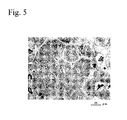
- Fig. 5 is a photomicrograph of the matrix in comparative example 5. It is clear that the matrix in embodiment 4 is uniform and sound; however, in comparative example 5, crystallization (black part) of the graphite is confirmed in parts. Therefore, it is believed that mechanical properties after annealing heat treatment and dimensional accuracy when the solidification contraction rate changes, etc., will be reduced in comparative example 5.
- An iron based alloy material for a thixocasting process and a method for casting the material which extends the service life of dies by inhibiting solidification contraction, and in which casting defects such as size variations and cracks can be inhibited.
- the material comprises 1.6 wt% ⁇ C ⁇ 2.5 wt% and 3.0 wt% ⁇ Si ⁇ 5.5 wt%, and a carbon equivalent (the value of CE) defined as "C(wt%)+1/3Si(wt%)" of 2.9 to 3.5.
- This material is made to be in a half-melted state with 35 to 50 wt% of a solid phase to be cast under a pressure load.
Landscapes
- Chemical & Material Sciences (AREA)
- Engineering & Computer Science (AREA)
- Mechanical Engineering (AREA)
- Materials Engineering (AREA)
- Metallurgy (AREA)
- Organic Chemistry (AREA)
- Refinement Of Pig-Iron, Manufacture Of Cast Iron, And Steel Manufacture Other Than In Revolving Furnaces (AREA)
- Molds, Cores, And Manufacturing Methods Thereof (AREA)
- Forging (AREA)
- Mounting, Exchange, And Manufacturing Of Dies (AREA)
Abstract
Description
- The present invention relates to an iron based alloy material for a thixocasting process and to a method for casting the material.
- Thixocasting processes are methods in which a pressure load is applied to a half-melted billet in a solid-liquid coexisting state to perform injection molding into a die. This method enables the formation of parts with thinner walls and more complicated shapes in comparison with conventional forming methods. In this method, production costs can be reduced due to reduction of machined portions, and thermal load to the die is extremely reduced since the casting can be performed at a lower melting temperature than that in an ordinary diecasting process. Therefore, it has been known that thixocasting processes are promising as method for diecasting materials such as cast iron. However, the liquid phase of cast iron produced by thixocasting processes forms a quenched matrix with low toughness. In iron molding using a high-temperature billet, solidification contraction is greatly when cooling in the die, and cracks are easily formed in the quenched matrix.
- In Japanese Patent Unexamined (KOKAI) Publication No. 239513/97, there is proposed a method in which formation of cracks can be suppressed by preventing the formation of chill matrix by using a carbon die. However, the carbon die has insufficient strength and the service life thereof is short, and the production efficiency is reduced due to frequent maintenance of the die. In Japanese Patent Unexamined (KOKAI) Publication No. 123242/01 and Japanese Patent Unexamined (KOKAI) Publication No. 144304/00, there is proposed a method in which formation of cracks can be inhibited by strengthening the quenched matrix by adding chromium or by mixing the quenched matrix with a high toughness phase by increasing the content of manganese. However, the die is worn by friction with a product having a hard quenched matrix during solidification contraction thereof since the solidification contraction in the die still occurs to a great extent. When the wear in the die is promoted, the precision in size of a product at the worn portion is degraded and service life of the die is shortened. When a washing provided on the inner surface of the die is partially stripped by friction with the product, the heat conductivity between the die and the product varies at each portion. As a result, the solidification rate varies at each portion, and this results in casting defects such as size variations and cracks.
- Therefore, an object of the present invention is to provide an iron based alloy material for thixocasting processes and a method for casting the material, in which the service life of the die can be extended by inhibiting solidification contraction and in which casting defects such as size variations and cracks can be inhibited.
- The present invention provides an iron based alloy material for a thixocasting process, the material comprising: 1.6 wt%≦C≦2.5 wt%; 3.0 wt%<Si≦5.5 wt%; a carbon equivalent (the value of CE) defined as "C(wt%)+1/3Si(wt%)"; and satisfying 2.9≦(C(wt%)+1/3Si(wt%))≦3.5. The iron based alloy material preferably contains 0.1 wt%≦Cr≦0.3 wt%.
- The present invention also provides a method for casting an iron based alloy material for a thixocasting process in which the aforesaid material of the present invention is made to be in a half-melted state with 35 to 50 wt% of a solid phase, to be cast under a pressure load.
- The reasons for the aforesaid numerical value limitations and effects are explained hereinafter.
Content of Si: 3.0 wt%<Si≦5.5 wt% - It is possible for the solidification contraction rate in a thin walled part of, for example, about 2.5 mm, to be suppressed to 0.6% or less by reducing the amount of solidification contraction in the case in which the content of Si is limited at more than 3.0 wt%. Therefore, as the abrasion of the molding for the die decreases, preventing damage to the die, the formation of cracks also becomes difficult. From the viewpoint of these effects being well obtained, the lower limit value of the Si content is more than 3.0 wt%, and preferably it is 3.5 wt% or more. In conventional sand molded nodular graphite cast iron, elongation and toughness tend to be remarkably decreased in the case in which the material contains 3.5 wt% or more of Si. However, in a product in which a fixed annealing heat treatment is conducted after casting by using the material of the present invention, sufficient elongation is obtained even if the Si content is more than 3.5 wt%, and in particular, an elongation of 10 % or more is ensured with a Si content of 4 wt% or less. At the same time, it is necessary to lower the solid phase rate in order to ensure sufficient fluidity because viscosity in the casting increases by decreasing the content of C when the content of Si is made to increase at the value of CE in any range. Therefore, decrease in the amount of solidification contraction cannot be expected in the case in which the content of Si is 4.5 wt% or more, and there is the possibility that cracks will occur in the molding by lowering the toughness of the matrix even if the solidification contraction rate is small in the case in which the content of Si is 6.5 wt% or more. Furthermore, it is difficult to obtain a molding having a uniform matrix by crystallizing graphite in the molding in the case in which the content of Si is more than 5.5 wt%. Therefore the content of Si is made to be in the range 3.0 wt%<Si≦5.5 wt%.
- If the content of Si is in the range of 3.0 wt%<Si≦5.5 wt%, the greater the content of Si, the more a hard passive oxide film composed of SiO2 is formed on the surface of the material when the material before the casting, such as a billet, is heated. Therefore, the material becomes difficult to transform to become easy to handle, and oxidation is also difficult to progress in the heating. Furthermore, the material held on a pallet, etc., is heated by using an induction heating coil or a furnace, and there are cases in which the adhesion of the material and the pallet becomes a problem; however, there is an advantage in that the adhesion is difficult to generate because the hard oxide film on the surface is formed. Equivalent of carbon (the value of CE): 2.9≦the value of CE ≦3.5
- The amount of the eutectic phase decreases when the value of CE falls less than 2.9, and in the molding in a half-melted state, the resupply of the liquid phase becomes inadequate, so that the filling easily becomes insufficient. In the meantime, the amount of the eutectic phase increases too much when the value of CE exceeds 3.5, and deformation may easily occur when the material is heated in the half-melted state, so that the material becomes difficult to handle. Therefore, there is a possibility that the material will be transformed in the case in which the half-melted material is filled into the die in the molding, and that the oxide film of the surface will contaminate the inside. Therefore, the value of CE is made to be 2.9≦the value of CE≦3.5.
Content of C: 1.6 wt%≦C≦2.5 wt% - The content of C is decided according to the content of Si and the value of CE, and it is made to be 1.6 wt%≦C≦2.5 wt%. However, it is desirable that the content of C be small because a lowering of Young's modulus is caused after the product is heat-treated by annealing after the molding in the case in which the content of C is not small.
Content of Cr: 0.1 wt%≦Cr≦0.3 wt% - Cr is effective as an element which suppresses the crystallization of the graphite in the molding. The aforesaid Si is an element which promotes graphitization, and the graphite crystallizes in the molding in the case in which the content of Si in the composition of the material is 4.0 wt% and in thick walled parts which are difficult to cool rapidly, and the crystallized graphite coarsens when the annealing heat treatment is conducted after the molding in the product, thereby lowering mechanical properties. Furthermore, it is not desirable that the crystallization of the graphite be partially generated because the dimensional accuracy is lowered since the solidification contraction rate in the graphite crystallized parts changes. Then, the addition of Cr is effective, and the crystallization of the graphite cannot be suppressed when the content of Cr is less than 0.1 wt%, and the toughness after the annealing heat treatment is lowered when the content of Cr is more than 0.3 wt%. Therefore, the content of Cr is made to be 0.1 wt%≦Cr≦0.3 wt%.
Solid phase rate: 35 to 50% - With regard to the solid phase rate in the molding of the material, when the value is less than 35%, deformation of the material easily occurs, and the material becomes difficult to handle, whereas when the value is more than 50%, the fluidity is reduced since the solid phase part is too great, and failure to fill the die occurs. Therefore, the solid phase rate in the cast is made to be 35 to 50%.
-
- Fig. 1 is a longitudinal sectional view of casting equipment by which pressure load can be conducted which is used in an embodiment of the present invention.
- Fig. 2A is a side elevation view of a test piece produced in an embodiment of the present invention.
- Fig. 2B is a front view of a test piece produced in an embodiment of the present invention.
- Fig. 3 is a graph showing the results of the amount of solidification contraction in an embodiment of the present invention and in a comparative example.
- Fig. 4 is a photomicrograph showing the internal texture of a material in an embodiment of the present invention.
- Fig. 5 is a photomicrograph showing the internal texture of a material in a comparative example to be compared to an embodiment of the present invention.
-
- Embodiments of the present invention will be explained hereinafter with reference to the figures to clarify the effects of the invention.
- Fig. 1 is a longitudinal sectional view of casting equipment by which pressure load can be conducted in order to cast a thin plate-shaped test piece which has two thicknesses which change stepwise as shown in Figs. 2A and 2B. The pressure load type of casting equipment 1 comprises a fixed
die 2 and amovable die 3 which are both made of copper and which haveperpendicular matching planes runner 4 andcavities 5 in which test pieces are formed between the twoperpendicular matching planes chamber 6 which accommodates billet B as the cast material is formed in the fixeddie 2, and thechamber 6 runs to therunner 4 by way of thegate 7. Furthermore,sleeve 8 which runs to thechamber 6 is installed horizontally in the fixeddie 2, andplunger 9 which is inserted in thechamber 6 is fit horizontally in thesleeve 8 so as to freely slide. Then, billet B is filled in thecavities 5 from therunner 4 by placing the billet B in the half-melted state in thesleeve 8 frominsertion mouth 8a formed at an upper part of the impounding dike insleeve 8, and by moving theplunger 9 horizontally in a direction of themovable die 3. - A test piece molded in
cavity 5 in the aforesaid pressure load type of the casting equipment 1 is 90 mm in width and 110 mm in height as is shown in Figs. 2A and 2B, and is a thin plate with two thicknesses which change stepwise in which there is a thinwalled part 10A 2.5 mm in thickness extending from half way in the height direction to one end (upper parts of Figs. 2A and 2B) and a thickwalled part 10B - Iron based alloys of embodiments 1 to 5 and comparative examples 1 to 5 with C contents, Si contents and Cr contents as shown in Table 1 were used as materials in the following test, cylindrical billets 50 mm in diameter and 65 mm long were made of these materials, and these were heated inductively. The conditions of the heating were as follows: temperature and solid phase rate at which the billet was filled into the part 2.5 mm in thickness of the
aforesaid cavity 5 by measuring the internal temperature in the 5 mm depth from the end face of the billet were properly set. The heating conditions are given in Table 1. The heated billets were cast under a pressure load by using the pressure load type of casting equipment 1 shown in Fig. 1, and the test pieces were molded. The pressurization force in the cast was 70 MPa, preheating temperature in the dies 2 and 3 was 200°C, and the test pieces were taken out by opening the dies 2 and 3 after a holding time of 1 second.
- The amount of solidification contraction was obtained by measuring the width of the thin
walled part 10A in the test pieces of embodiments 1 to 5 and comparative examples 1 to 5 which were molded in the above manner. Furthermore, the internal texture of the thickwalled part 10B of the as-cast condition was observed after polishing by a microscope, and the existence of crystallization of graphite was examined. These results are given in Table 1, and the results of the amounts of solidification contraction are shown in Fig. 3. - For the test pieces of embodiments 1 to 5, an annealing heat treatment was conducted in which the test pieces were cooled in a furnace after they were retained at 950°C for 60 minutes. Afterwards, the tensile test pieces having the
tensile test parts 6 mm in width and 27 mm in parallel parts were cut down from the thickwalled part 10B. The elongations of these tensile test pieces were measured by conducting the tensile tests. The measurement results are given in Table 1. - In embodiments 1 to 5 based on this invention, the amounts of solidification contraction are less than 0.6 % in any of the embodiments, and this value is equivalent to or less than the value in diecasting products composed of aluminum. Therefore, it can clearly prevent damage such as abrasion of the die. Furthermore, the oxide film on the surface of the billet was trapped at the gate, and so the contamination of the test piece by the oxide film was not observed because the billet was transformed so as not to collapse when the billet was put into the sleeve.
- In addition, in the comparative example 1 among comparative examples 1 to 5 which are outside the scope of the present invention, there were large amount of the eutectic phase since the CE value was high, so the billet was easily transformed in the heating. Therefore, the billet collapsed when the billet was put into the sleeve, and the oxide film on the surface of the billet passed the gate to contaminate the test piece, and therefore cracks and cold shuts arose on the surface of the test piece. Although the defects concerned with the filling of the material in the comparative examples 2 to 4 were not observed, it was clear that the amount of solidification contraction was large and 0.6 % or more, damage such as abrasion to the die occurred, and cracks were easily generated in the product. Although the filling was not insufficient in the comparative example 5 with the large content of Si and the amount of solidification contraction was also small, cracks were generated at the step part of the boundary between the thin walled part and the thick walled part because of low toughness.
- Judging from the tensile tests conducted on embodiments 1 to 5, it was clear that the greater the content of Si, the more the elongation tended to decrease; however sufficient elongation was obtained even if the content of Si exceeded 3.5 wt%.
- Fig. 4 is a photomicrograph of the matrix in
embodiment 4, and Fig. 5 is a photomicrograph of the matrix in comparative example 5. It is clear that the matrix inembodiment 4 is uniform and sound; however, in comparative example 5, crystallization (black part) of the graphite is confirmed in parts. Therefore, it is believed that mechanical properties after annealing heat treatment and dimensional accuracy when the solidification contraction rate changes, etc., will be reduced in comparative example 5. - An iron based alloy material for a thixocasting process and a method for casting the material which extends the service life of dies by inhibiting solidification contraction, and in which casting defects such as size variations and cracks can be inhibited. The material comprises 1.6 wt%≦C≦2.5 wt% and 3.0 wt%<Si≦5.5 wt%, and a carbon equivalent (the value of CE) defined as "C(wt%)+1/3Si(wt%)" of 2.9 to 3.5. This material is made to be in a half-melted state with 35 to 50 wt% of a solid phase to be cast under a pressure load.
Claims (4)
- An iron based alloy material for a thixocasting process, the material comprising:
a carbon equivalent (the value of CE) defined as "C(wt%)+1/3Si(wt%)"; and satisfying 2.9≦(C(wt%)+1/3Si(wt%))≦3.5. - An iron based alloy material for a thixocasting process according to claim 1, wherein the iron based alloy material contains 0.1 wt %≦Cr≦ 0.3 wt %.
- A method for casting an iron based alloy material for a thixocasting process, the method comprising: providing the materials recited in claim 1 in a half-melted state with 35 to 50 wt % of a solid phase; and diecasting the metal.
- A method for casting an iron based alloy material for a thixocasting process, the method comprising: providing the materials recited in claim 2 in a half-melted state with 35 to 50 wt % of a solid phase; and diecasting the metal.
Applications Claiming Priority (2)
| Application Number | Priority Date | Filing Date | Title |
|---|---|---|---|
| JP2001270937A JP3730148B2 (en) | 2001-09-06 | 2001-09-06 | Fe-based alloy material for thixocasting and casting method thereof |
| JP2001270937 | 2001-09-06 |
Publications (2)
| Publication Number | Publication Date |
|---|---|
| EP1291446A1 true EP1291446A1 (en) | 2003-03-12 |
| EP1291446B1 EP1291446B1 (en) | 2005-08-24 |
Family
ID=19096521
Family Applications (1)
| Application Number | Title | Priority Date | Filing Date |
|---|---|---|---|
| EP02020089A Expired - Lifetime EP1291446B1 (en) | 2001-09-06 | 2002-09-06 | A cast iron of particular composition which has good thixocasting properties |
Country Status (4)
| Country | Link |
|---|---|
| US (1) | US6863744B2 (en) |
| EP (1) | EP1291446B1 (en) |
| JP (1) | JP3730148B2 (en) |
| DE (1) | DE60205694T2 (en) |
Cited By (2)
| Publication number | Priority date | Publication date | Assignee | Title |
|---|---|---|---|---|
| EP1661643A4 (en) * | 2003-08-26 | 2008-01-02 | Honda Motor Co Ltd | DEVICE AND METHOD FOR THIXOFORMING CAST IRON |
| CN105728557A (en) * | 2016-05-05 | 2016-07-06 | 太仓小小精密模具有限公司 | High-hardness punching rod for punching die |
Families Citing this family (2)
| Publication number | Priority date | Publication date | Assignee | Title |
|---|---|---|---|---|
| JP5453480B2 (en) * | 2012-04-10 | 2014-03-26 | 日本鋳造株式会社 | Cast iron billet for thixocasting and manufacturing method thereof |
| WO2017053917A1 (en) * | 2015-09-25 | 2017-03-30 | Radyne Corporation | Large billet electric induction pre-heating for a hot working process |
Citations (3)
| Publication number | Priority date | Publication date | Assignee | Title |
|---|---|---|---|---|
| EP0779119A1 (en) * | 1995-12-14 | 1997-06-18 | Honda Giken Kogyo Kabushiki Kaisha | Thixocasting process |
| EP0864662A1 (en) * | 1996-09-02 | 1998-09-16 | Honda Giken Kogyo Kabushiki Kaisha | Casting material for thixocasting, method for preparing partially solidified casting material for thixocasting, thixo-casting method, iron-base cast, and method for heat-treating iron-base cast |
| GB2345699A (en) * | 1998-07-14 | 2000-07-19 | Honda Motor Co Ltd | Fe alloy material for thixocasting and method for heating the same |
Family Cites Families (4)
| Publication number | Priority date | Publication date | Assignee | Title |
|---|---|---|---|---|
| JPS5834160A (en) * | 1981-07-24 | 1983-02-28 | Toshiba Corp | Wear resistant cast iron cast in metallic mold |
| JPH09239513A (en) | 1996-03-11 | 1997-09-16 | Kobe Steel Ltd | Die to be used for die casting of cast iron |
| JP3904335B2 (en) | 1998-11-12 | 2007-04-11 | 本田技研工業株式会社 | Fe-based alloy material for thixocasting and casting method using the same |
| JP3876099B2 (en) | 1999-10-25 | 2007-01-31 | 本田技研工業株式会社 | Fe-based alloy material for thixocasting |
-
2001
- 2001-09-06 JP JP2001270937A patent/JP3730148B2/en not_active Expired - Lifetime
-
2002
- 2002-09-06 DE DE60205694T patent/DE60205694T2/en not_active Expired - Lifetime
- 2002-09-06 EP EP02020089A patent/EP1291446B1/en not_active Expired - Lifetime
- 2002-09-06 US US10/235,855 patent/US6863744B2/en not_active Expired - Lifetime
Patent Citations (3)
| Publication number | Priority date | Publication date | Assignee | Title |
|---|---|---|---|---|
| EP0779119A1 (en) * | 1995-12-14 | 1997-06-18 | Honda Giken Kogyo Kabushiki Kaisha | Thixocasting process |
| EP0864662A1 (en) * | 1996-09-02 | 1998-09-16 | Honda Giken Kogyo Kabushiki Kaisha | Casting material for thixocasting, method for preparing partially solidified casting material for thixocasting, thixo-casting method, iron-base cast, and method for heat-treating iron-base cast |
| GB2345699A (en) * | 1998-07-14 | 2000-07-19 | Honda Motor Co Ltd | Fe alloy material for thixocasting and method for heating the same |
Cited By (2)
| Publication number | Priority date | Publication date | Assignee | Title |
|---|---|---|---|---|
| EP1661643A4 (en) * | 2003-08-26 | 2008-01-02 | Honda Motor Co Ltd | DEVICE AND METHOD FOR THIXOFORMING CAST IRON |
| CN105728557A (en) * | 2016-05-05 | 2016-07-06 | 太仓小小精密模具有限公司 | High-hardness punching rod for punching die |
Also Published As
| Publication number | Publication date |
|---|---|
| US20030049152A1 (en) | 2003-03-13 |
| DE60205694D1 (en) | 2005-09-29 |
| JP3730148B2 (en) | 2005-12-21 |
| DE60205694T2 (en) | 2006-03-09 |
| JP2003073768A (en) | 2003-03-12 |
| US6863744B2 (en) | 2005-03-08 |
| EP1291446B1 (en) | 2005-08-24 |
Similar Documents
| Publication | Publication Date | Title |
|---|---|---|
| Inoue et al. | Mg–Cu–Y bulk amorphous alloys with high tensile strength produced by a high-pressure die casting method | |
| EP0572683B1 (en) | Method for casting aluminum alloy casting and aluminum alloy casting | |
| KR101026056B1 (en) | Manufacturing method of magnesium alloy material | |
| EP1499461B1 (en) | Thermoplastic casting of amorphous alloys | |
| Turakhodjaev et al. | ANALYSIS OF DEFECTS IN WHITE CAST IRON. | |
| EP0864662B1 (en) | Casting material for thixocasting, method for preparing partially solidified casting material for thixocasting, thixo-casting method, iron-base cast, and method for heat-treating iron-base cast | |
| US5846348A (en) | High strength and toughness aluminum alloy casting by high-pressure casting method and method of manufacturing same | |
| JP5020889B2 (en) | Al alloy die casting and method for producing the same | |
| JP4145242B2 (en) | Aluminum alloy for casting, casting made of aluminum alloy and method for producing casting made of aluminum alloy | |
| CN112981190A (en) | Aluminum alloy for die casting and method for manufacturing cast aluminum alloy using the same | |
| EP1291446B1 (en) | A cast iron of particular composition which has good thixocasting properties | |
| KR20190130979A (en) | Steel for die-casting die and die-casting die | |
| US4990310A (en) | Creep-resistant die cast zinc alloys | |
| US20140234159A1 (en) | HIGH THERMAL CONDUCTIVITY Al-Si-Fe-Zn ALLOY FOR DIE CASTING | |
| JPH10158772A (en) | Rocker arm and its production | |
| Tsuchiya et al. | Research of semi solid casting of iron | |
| JP3876099B2 (en) | Fe-based alloy material for thixocasting | |
| JP2002346730A (en) | Method for producing high strength spheroidal graphite cast iron | |
| Ayabe et al. | Effect of high thermal conductivity die steel in aluminum casting | |
| GB2375354A (en) | Method of heating iron alloys | |
| JP4934321B2 (en) | Cast iron method and cast iron mold | |
| KR20160147922A (en) | Heat radiator fin comprising aluminum alloy and method for manufacturing same | |
| US20030219618A1 (en) | Ribbed die cast product | |
| JP2832660B2 (en) | Casting method of Al-based alloy casting | |
| JP7804313B2 (en) | Thin-walled aluminum die-cast member and its manufacturing method |
Legal Events
| Date | Code | Title | Description |
|---|---|---|---|
| PUAI | Public reference made under article 153(3) epc to a published international application that has entered the european phase |
Free format text: ORIGINAL CODE: 0009012 |
|
| 17P | Request for examination filed |
Effective date: 20020906 |
|
| AK | Designated contracting states |
Kind code of ref document: A1 Designated state(s): AT BE BG CH CY CZ DE DK EE ES FI FR GB GR IE IT LI LU MC NL PT SE SK TR Designated state(s): AT BE BG CH CY CZ DE DK EE ES FI FR GB GR IE IT LI LU MC NL PT SE SK TR |
|
| AX | Request for extension of the european patent |
Extension state: AL LT LV MK RO SI |
|
| AKX | Designation fees paid |
Designated state(s): DE GB |
|
| 17Q | First examination report despatched |
Effective date: 20040318 |
|
| GRAP | Despatch of communication of intention to grant a patent |
Free format text: ORIGINAL CODE: EPIDOSNIGR1 |
|
| GRAS | Grant fee paid |
Free format text: ORIGINAL CODE: EPIDOSNIGR3 |
|
| GRAA | (expected) grant |
Free format text: ORIGINAL CODE: 0009210 |
|
| AK | Designated contracting states |
Kind code of ref document: B1 Designated state(s): DE GB |
|
| REG | Reference to a national code |
Ref country code: GB Ref legal event code: FG4D |
|
| REF | Corresponds to: |
Ref document number: 60205694 Country of ref document: DE Date of ref document: 20050929 Kind code of ref document: P |
|
| PLBE | No opposition filed within time limit |
Free format text: ORIGINAL CODE: 0009261 |
|
| STAA | Information on the status of an ep patent application or granted ep patent |
Free format text: STATUS: NO OPPOSITION FILED WITHIN TIME LIMIT |
|
| 26N | No opposition filed |
Effective date: 20060526 |
|
| PGFP | Annual fee paid to national office [announced via postgrant information from national office to epo] |
Ref country code: GB Payment date: 20210728 Year of fee payment: 20 Ref country code: DE Payment date: 20210727 Year of fee payment: 20 |
|
| REG | Reference to a national code |
Ref country code: DE Ref legal event code: R071 Ref document number: 60205694 Country of ref document: DE |
|
| REG | Reference to a national code |
Ref country code: GB Ref legal event code: PE20 Expiry date: 20220905 |
|
| PG25 | Lapsed in a contracting state [announced via postgrant information from national office to epo] |
Ref country code: GB Free format text: LAPSE BECAUSE OF EXPIRATION OF PROTECTION Effective date: 20220905 |