EP1291424A1 - Gasc1 gene - Google Patents
Gasc1 gene Download PDFInfo
- Publication number
- EP1291424A1 EP1291424A1 EP01938609A EP01938609A EP1291424A1 EP 1291424 A1 EP1291424 A1 EP 1291424A1 EP 01938609 A EP01938609 A EP 01938609A EP 01938609 A EP01938609 A EP 01938609A EP 1291424 A1 EP1291424 A1 EP 1291424A1
- Authority
- EP
- European Patent Office
- Prior art keywords
- gene
- gasc1
- protein
- cells
- seq
- Prior art date
- Legal status (The legal status is an assumption and is not a legal conclusion. Google has not performed a legal analysis and makes no representation as to the accuracy of the status listed.)
- Granted
Links
- 108090000623 proteins and genes Proteins 0.000 title abstract description 344
- 201000011510 cancer Diseases 0.000 claims abstract description 68
- 125000003275 alpha amino acid group Chemical group 0.000 claims abstract description 47
- 108090000765 processed proteins & peptides Proteins 0.000 claims abstract description 25
- 102000040430 polynucleotide Human genes 0.000 claims abstract description 19
- 108091033319 polynucleotide Proteins 0.000 claims abstract description 19
- 239000002157 polynucleotide Substances 0.000 claims abstract description 19
- 102000004196 processed proteins & peptides Human genes 0.000 claims abstract description 16
- 229920001184 polypeptide Polymers 0.000 claims abstract description 13
- 238000000034 method Methods 0.000 claims description 186
- 239000002773 nucleotide Substances 0.000 claims description 133
- 125000003729 nucleotide group Chemical group 0.000 claims description 133
- 206010028980 Neoplasm Diseases 0.000 claims description 96
- 108020004414 DNA Proteins 0.000 claims description 80
- 239000000523 sample Substances 0.000 claims description 54
- 230000014509 gene expression Effects 0.000 claims description 52
- 101001088893 Homo sapiens Lysine-specific demethylase 4C Proteins 0.000 claims description 44
- 102100033230 Lysine-specific demethylase 4C Human genes 0.000 claims description 41
- 239000000047 product Substances 0.000 claims description 37
- 102000053602 DNA Human genes 0.000 claims description 27
- 239000004480 active ingredient Substances 0.000 claims description 21
- 239000013604 expression vector Substances 0.000 claims description 16
- 230000027455 binding Effects 0.000 claims description 15
- 238000009739 binding Methods 0.000 claims description 15
- 230000000295 complement effect Effects 0.000 claims description 8
- 239000012472 biological sample Substances 0.000 claims description 7
- 238000003259 recombinant expression Methods 0.000 claims description 7
- 239000000032 diagnostic agent Substances 0.000 claims description 5
- 229940039227 diagnostic agent Drugs 0.000 claims description 5
- 102000008394 Immunoglobulin Fragments Human genes 0.000 claims description 4
- 108010021625 Immunoglobulin Fragments Proteins 0.000 claims description 4
- 239000007795 chemical reaction product Substances 0.000 claims description 4
- 238000009007 Diagnostic Kit Methods 0.000 claims description 3
- 230000008105 immune reaction Effects 0.000 claims description 2
- 102000004169 proteins and genes Human genes 0.000 abstract description 72
- 230000003321 amplification Effects 0.000 abstract description 48
- 238000003199 nucleic acid amplification method Methods 0.000 abstract description 48
- 238000011282 treatment Methods 0.000 abstract description 23
- 208000037265 diseases, disorders, signs and symptoms Diseases 0.000 abstract description 19
- 201000010099 disease Diseases 0.000 abstract description 15
- 238000003745 diagnosis Methods 0.000 abstract description 12
- 208000005623 Carcinogenesis Diseases 0.000 abstract description 9
- 230000036952 cancer formation Effects 0.000 abstract description 9
- 231100000504 carcinogenesis Toxicity 0.000 abstract description 9
- 230000007170 pathology Effects 0.000 abstract description 5
- 230000024245 cell differentiation Effects 0.000 abstract description 4
- 230000010261 cell growth Effects 0.000 abstract 1
- 210000004027 cell Anatomy 0.000 description 173
- 230000000692 anti-sense effect Effects 0.000 description 81
- 239000013598 vector Substances 0.000 description 80
- 235000018102 proteins Nutrition 0.000 description 70
- 239000012634 fragment Substances 0.000 description 40
- 241000700605 Viruses Species 0.000 description 36
- 238000001415 gene therapy Methods 0.000 description 34
- 230000000694 effects Effects 0.000 description 32
- 208000007276 esophageal squamous cell carcinoma Diseases 0.000 description 31
- 206010061534 Oesophageal squamous cell carcinoma Diseases 0.000 description 30
- 208000036765 Squamous cell carcinoma of the esophagus Diseases 0.000 description 30
- 210000001519 tissue Anatomy 0.000 description 28
- 239000002299 complementary DNA Substances 0.000 description 27
- 108020003175 receptors Proteins 0.000 description 27
- 102000005962 receptors Human genes 0.000 description 27
- 238000012546 transfer Methods 0.000 description 26
- 239000002502 liposome Substances 0.000 description 25
- 125000000539 amino acid group Chemical group 0.000 description 24
- 210000000349 chromosome Anatomy 0.000 description 23
- 238000012216 screening Methods 0.000 description 23
- 238000004458 analytical method Methods 0.000 description 21
- 239000003814 drug Substances 0.000 description 21
- 238000012360 testing method Methods 0.000 description 21
- 108091032973 (ribonucleotides)n+m Proteins 0.000 description 20
- 241000282414 Homo sapiens Species 0.000 description 20
- 238000003752 polymerase chain reaction Methods 0.000 description 19
- 239000000126 substance Substances 0.000 description 19
- 238000006467 substitution reaction Methods 0.000 description 19
- 241000701161 unidentified adenovirus Species 0.000 description 18
- 239000013612 plasmid Substances 0.000 description 17
- -1 aralkyl ester Chemical class 0.000 description 16
- 239000003795 chemical substances by application Substances 0.000 description 16
- 238000009396 hybridization Methods 0.000 description 16
- 238000000636 Northern blotting Methods 0.000 description 15
- 235000001014 amino acid Nutrition 0.000 description 15
- 230000006870 function Effects 0.000 description 15
- 241001430294 unidentified retrovirus Species 0.000 description 15
- 238000007792 addition Methods 0.000 description 14
- 150000001413 amino acids Chemical class 0.000 description 14
- 238000002105 Southern blotting Methods 0.000 description 13
- 230000008901 benefit Effects 0.000 description 13
- 238000006243 chemical reaction Methods 0.000 description 13
- 238000002360 preparation method Methods 0.000 description 13
- 108091028043 Nucleic acid sequence Proteins 0.000 description 12
- 229940079593 drug Drugs 0.000 description 12
- 239000000872 buffer Substances 0.000 description 11
- 238000001514 detection method Methods 0.000 description 11
- 238000004519 manufacturing process Methods 0.000 description 11
- 239000000243 solution Substances 0.000 description 11
- 241000701044 Human gammaherpesvirus 4 Species 0.000 description 10
- 150000001875 compounds Chemical class 0.000 description 10
- 239000000825 pharmaceutical preparation Substances 0.000 description 10
- 230000008569 process Effects 0.000 description 10
- 239000013603 viral vector Substances 0.000 description 10
- 238000003556 assay Methods 0.000 description 9
- 238000005516 engineering process Methods 0.000 description 9
- 230000004048 modification Effects 0.000 description 9
- 238000012986 modification Methods 0.000 description 9
- 150000007523 nucleic acids Chemical class 0.000 description 9
- 238000005406 washing Methods 0.000 description 9
- 210000001106 artificial yeast chromosome Anatomy 0.000 description 8
- 238000012217 deletion Methods 0.000 description 8
- 230000037430 deletion Effects 0.000 description 8
- 230000012010 growth Effects 0.000 description 8
- 239000002245 particle Substances 0.000 description 8
- 239000008194 pharmaceutical composition Substances 0.000 description 8
- 238000003757 reverse transcription PCR Methods 0.000 description 8
- 238000003756 stirring Methods 0.000 description 8
- 108091093088 Amplicon Proteins 0.000 description 7
- 108020004705 Codon Proteins 0.000 description 7
- 210000004748 cultured cell Anatomy 0.000 description 7
- 238000001727 in vivo Methods 0.000 description 7
- 238000002372 labelling Methods 0.000 description 7
- 230000034217 membrane fusion Effects 0.000 description 7
- 102000039446 nucleic acids Human genes 0.000 description 7
- 108020004707 nucleic acids Proteins 0.000 description 7
- 230000036961 partial effect Effects 0.000 description 7
- 239000004094 surface-active agent Substances 0.000 description 7
- 229940124597 therapeutic agent Drugs 0.000 description 7
- 210000004881 tumor cell Anatomy 0.000 description 7
- QTBSBXVTEAMEQO-UHFFFAOYSA-N Acetic acid Chemical compound CC(O)=O QTBSBXVTEAMEQO-UHFFFAOYSA-N 0.000 description 6
- HEDRZPFGACZZDS-UHFFFAOYSA-N Chloroform Chemical compound ClC(Cl)Cl HEDRZPFGACZZDS-UHFFFAOYSA-N 0.000 description 6
- 101001045846 Homo sapiens Histone-lysine N-methyltransferase 2A Proteins 0.000 description 6
- ZMXDDKWLCZADIW-UHFFFAOYSA-N N,N-Dimethylformamide Chemical compound CN(C)C=O ZMXDDKWLCZADIW-UHFFFAOYSA-N 0.000 description 6
- 108700020796 Oncogene Proteins 0.000 description 6
- 102100033254 Tumor suppressor ARF Human genes 0.000 description 6
- 125000002091 cationic group Chemical group 0.000 description 6
- 239000003153 chemical reaction reagent Substances 0.000 description 6
- KRKNYBCHXYNGOX-UHFFFAOYSA-N citric acid Chemical compound OC(=O)CC(O)(C(O)=O)CC(O)=O KRKNYBCHXYNGOX-UHFFFAOYSA-N 0.000 description 6
- 230000005764 inhibitory process Effects 0.000 description 6
- 150000002632 lipids Chemical class 0.000 description 6
- 239000012528 membrane Substances 0.000 description 6
- 230000014616 translation Effects 0.000 description 6
- 230000003612 virological effect Effects 0.000 description 6
- 206010006187 Breast cancer Diseases 0.000 description 5
- 208000026310 Breast neoplasm Diseases 0.000 description 5
- 102100022103 Histone-lysine N-methyltransferase 2A Human genes 0.000 description 5
- 210000004369 blood Anatomy 0.000 description 5
- 239000008280 blood Substances 0.000 description 5
- 210000000170 cell membrane Anatomy 0.000 description 5
- 239000002552 dosage form Substances 0.000 description 5
- 238000010353 genetic engineering Methods 0.000 description 5
- 230000002401 inhibitory effect Effects 0.000 description 5
- 239000003446 ligand Substances 0.000 description 5
- 230000035772 mutation Effects 0.000 description 5
- 238000004806 packaging method and process Methods 0.000 description 5
- 230000002062 proliferating effect Effects 0.000 description 5
- 230000001105 regulatory effect Effects 0.000 description 5
- 238000011160 research Methods 0.000 description 5
- 238000012163 sequencing technique Methods 0.000 description 5
- 230000001225 therapeutic effect Effects 0.000 description 5
- 238000013519 translation Methods 0.000 description 5
- YBJHBAHKTGYVGT-ZKWXMUAHSA-N (+)-Biotin Chemical compound N1C(=O)N[C@@H]2[C@H](CCCCC(=O)O)SC[C@@H]21 YBJHBAHKTGYVGT-ZKWXMUAHSA-N 0.000 description 4
- 108700028369 Alleles Proteins 0.000 description 4
- 108010077544 Chromatin Proteins 0.000 description 4
- IAZDPXIOMUYVGZ-UHFFFAOYSA-N Dimethylsulphoxide Chemical compound CS(C)=O IAZDPXIOMUYVGZ-UHFFFAOYSA-N 0.000 description 4
- 241000588724 Escherichia coli Species 0.000 description 4
- 102100033495 Glycine dehydrogenase (decarboxylating), mitochondrial Human genes 0.000 description 4
- 102100025303 Glycogenin-2 Human genes 0.000 description 4
- 101710152102 Glycogenin-2 Proteins 0.000 description 4
- 102000000588 Interleukin-2 Human genes 0.000 description 4
- 108010002350 Interleukin-2 Proteins 0.000 description 4
- 108700026244 Open Reading Frames Proteins 0.000 description 4
- 108700020978 Proto-Oncogene Proteins 0.000 description 4
- 102000052575 Proto-Oncogene Human genes 0.000 description 4
- 108020004511 Recombinant DNA Proteins 0.000 description 4
- 108020004682 Single-Stranded DNA Proteins 0.000 description 4
- WYURNTSHIVDZCO-UHFFFAOYSA-N Tetrahydrofuran Chemical compound C1CCOC1 WYURNTSHIVDZCO-UHFFFAOYSA-N 0.000 description 4
- 125000003295 alanine group Chemical group N[C@@H](C)C(=O)* 0.000 description 4
- HVYWMOMLDIMFJA-DPAQBDIFSA-N cholesterol Chemical compound C1C=C2C[C@@H](O)CC[C@]2(C)[C@@H]2[C@@H]1[C@@H]1CC[C@H]([C@H](C)CCCC(C)C)[C@@]1(C)CC2 HVYWMOMLDIMFJA-DPAQBDIFSA-N 0.000 description 4
- 210000003483 chromatin Anatomy 0.000 description 4
- 238000010367 cloning Methods 0.000 description 4
- 230000009918 complex formation Effects 0.000 description 4
- 238000010276 construction Methods 0.000 description 4
- RGWHQCVHVJXOKC-SHYZEUOFSA-J dCTP(4-) Chemical compound O=C1N=C(N)C=CN1[C@@H]1O[C@H](COP([O-])(=O)OP([O-])(=O)OP([O-])([O-])=O)[C@@H](O)C1 RGWHQCVHVJXOKC-SHYZEUOFSA-J 0.000 description 4
- 238000004925 denaturation Methods 0.000 description 4
- 230000036425 denaturation Effects 0.000 description 4
- 230000004069 differentiation Effects 0.000 description 4
- 239000003085 diluting agent Substances 0.000 description 4
- 208000035475 disorder Diseases 0.000 description 4
- 239000003937 drug carrier Substances 0.000 description 4
- 238000002474 experimental method Methods 0.000 description 4
- 210000002443 helper t lymphocyte Anatomy 0.000 description 4
- 230000036210 malignancy Effects 0.000 description 4
- 239000002609 medium Substances 0.000 description 4
- 108020004999 messenger RNA Proteins 0.000 description 4
- 239000000203 mixture Substances 0.000 description 4
- 230000029279 positive regulation of transcription, DNA-dependent Effects 0.000 description 4
- 238000000746 purification Methods 0.000 description 4
- 238000010839 reverse transcription Methods 0.000 description 4
- 206010041823 squamous cell carcinoma Diseases 0.000 description 4
- 235000000346 sugar Nutrition 0.000 description 4
- 238000003786 synthesis reaction Methods 0.000 description 4
- 230000002194 synthesizing effect Effects 0.000 description 4
- 238000002560 therapeutic procedure Methods 0.000 description 4
- 238000013518 transcription Methods 0.000 description 4
- 230000035897 transcription Effects 0.000 description 4
- VZSRBBMJRBPUNF-UHFFFAOYSA-N 2-(2,3-dihydro-1H-inden-2-ylamino)-N-[3-oxo-3-(2,4,6,7-tetrahydrotriazolo[4,5-c]pyridin-5-yl)propyl]pyrimidine-5-carboxamide Chemical compound C1C(CC2=CC=CC=C12)NC1=NC=C(C=N1)C(=O)NCCC(N1CC2=C(CC1)NN=N2)=O VZSRBBMJRBPUNF-UHFFFAOYSA-N 0.000 description 3
- 208000031212 Autoimmune polyendocrinopathy Diseases 0.000 description 3
- 102100036465 Autoimmune regulator Human genes 0.000 description 3
- 102100023060 Casein kinase I isoform gamma-2 Human genes 0.000 description 3
- 108010009392 Cyclin-Dependent Kinase Inhibitor p16 Proteins 0.000 description 3
- 230000004544 DNA amplification Effects 0.000 description 3
- 241000702421 Dependoparvovirus Species 0.000 description 3
- 102000004190 Enzymes Human genes 0.000 description 3
- 108090000790 Enzymes Proteins 0.000 description 3
- XEKOWRVHYACXOJ-UHFFFAOYSA-N Ethyl acetate Chemical compound CCOC(C)=O XEKOWRVHYACXOJ-UHFFFAOYSA-N 0.000 description 3
- WSFSSNUMVMOOMR-UHFFFAOYSA-N Formaldehyde Chemical compound O=C WSFSSNUMVMOOMR-UHFFFAOYSA-N 0.000 description 3
- PEDCQBHIVMGVHV-UHFFFAOYSA-N Glycerine Chemical compound OCC(O)CO PEDCQBHIVMGVHV-UHFFFAOYSA-N 0.000 description 3
- DHMQDGOQFOQNFH-UHFFFAOYSA-N Glycine Chemical compound NCC(O)=O DHMQDGOQFOQNFH-UHFFFAOYSA-N 0.000 description 3
- 101000928549 Homo sapiens Autoimmune regulator Proteins 0.000 description 3
- 101001049881 Homo sapiens Casein kinase I isoform gamma-2 Proteins 0.000 description 3
- 101000997832 Homo sapiens Tyrosine-protein kinase JAK2 Proteins 0.000 description 3
- XUJNEKJLAYXESH-REOHCLBHSA-N L-Cysteine Chemical compound SC[C@H](N)C(O)=O XUJNEKJLAYXESH-REOHCLBHSA-N 0.000 description 3
- 241000699666 Mus <mouse, genus> Species 0.000 description 3
- 241000699670 Mus sp. Species 0.000 description 3
- 206010030155 Oesophageal carcinoma Diseases 0.000 description 3
- 239000004952 Polyamide Substances 0.000 description 3
- 108010007568 Protamines Proteins 0.000 description 3
- 102000007327 Protamines Human genes 0.000 description 3
- 102000007365 Sialoglycoproteins Human genes 0.000 description 3
- 108010032838 Sialoglycoproteins Proteins 0.000 description 3
- 102100022011 Transcription intermediary factor 1-alpha Human genes 0.000 description 3
- 102100033444 Tyrosine-protein kinase JAK2 Human genes 0.000 description 3
- 101100020289 Xenopus laevis koza gene Proteins 0.000 description 3
- 239000000556 agonist Substances 0.000 description 3
- 235000004279 alanine Nutrition 0.000 description 3
- 210000004102 animal cell Anatomy 0.000 description 3
- 239000005557 antagonist Substances 0.000 description 3
- 239000000427 antigen Substances 0.000 description 3
- 108091007433 antigens Proteins 0.000 description 3
- 102000036639 antigens Human genes 0.000 description 3
- 201000009771 autoimmune polyendocrine syndrome type 1 Diseases 0.000 description 3
- 230000015572 biosynthetic process Effects 0.000 description 3
- 210000000988 bone and bone Anatomy 0.000 description 3
- 210000004899 c-terminal region Anatomy 0.000 description 3
- 208000035269 cancer or benign tumor Diseases 0.000 description 3
- 239000001913 cellulose Chemical class 0.000 description 3
- 229920002678 cellulose Chemical class 0.000 description 3
- 230000008859 change Effects 0.000 description 3
- 239000002738 chelating agent Substances 0.000 description 3
- 238000004587 chromatography analysis Methods 0.000 description 3
- 230000002860 competitive effect Effects 0.000 description 3
- 238000011161 development Methods 0.000 description 3
- 230000018109 developmental process Effects 0.000 description 3
- 238000001962 electrophoresis Methods 0.000 description 3
- 230000002708 enhancing effect Effects 0.000 description 3
- 229940088598 enzyme Drugs 0.000 description 3
- 230000004927 fusion Effects 0.000 description 3
- 238000003306 harvesting Methods 0.000 description 3
- 239000003112 inhibitor Substances 0.000 description 3
- 238000002955 isolation Methods 0.000 description 3
- 230000003211 malignant effect Effects 0.000 description 3
- 230000031864 metaphase Effects 0.000 description 3
- 238000010369 molecular cloning Methods 0.000 description 3
- 238000010647 peptide synthesis reaction Methods 0.000 description 3
- 229920002647 polyamide Polymers 0.000 description 3
- 230000035755 proliferation Effects 0.000 description 3
- 229940048914 protamine Drugs 0.000 description 3
- 235000002639 sodium chloride Nutrition 0.000 description 3
- 239000007787 solid Substances 0.000 description 3
- 239000002904 solvent Substances 0.000 description 3
- 150000008163 sugars Chemical class 0.000 description 3
- 239000013589 supplement Substances 0.000 description 3
- 108010071511 transcriptional intermediary factor 1 Proteins 0.000 description 3
- 230000001131 transforming effect Effects 0.000 description 3
- 230000029812 viral genome replication Effects 0.000 description 3
- 238000002424 x-ray crystallography Methods 0.000 description 3
- 210000005253 yeast cell Anatomy 0.000 description 3
- 102000040650 (ribonucleotides)n+m Human genes 0.000 description 2
- 208000030507 AIDS Diseases 0.000 description 2
- 208000024893 Acute lymphoblastic leukemia Diseases 0.000 description 2
- 208000014697 Acute lymphocytic leukaemia Diseases 0.000 description 2
- 206010003571 Astrocytoma Diseases 0.000 description 2
- 241000193830 Bacillus <bacterium> Species 0.000 description 2
- 101710132601 Capsid protein Proteins 0.000 description 2
- CURLTUGMZLYLDI-UHFFFAOYSA-N Carbon dioxide Chemical compound O=C=O CURLTUGMZLYLDI-UHFFFAOYSA-N 0.000 description 2
- 208000017897 Carcinoma of esophagus Diseases 0.000 description 2
- 101710094648 Coat protein Proteins 0.000 description 2
- 108020004635 Complementary DNA Proteins 0.000 description 2
- 108091035707 Consensus sequence Proteins 0.000 description 2
- 238000002965 ELISA Methods 0.000 description 2
- 241001635598 Enicostema Species 0.000 description 2
- 241000283073 Equus caballus Species 0.000 description 2
- WHUUTDBJXJRKMK-UHFFFAOYSA-N Glutamic acid Natural products OC(=O)C(N)CCC(O)=O WHUUTDBJXJRKMK-UHFFFAOYSA-N 0.000 description 2
- 102000005720 Glutathione transferase Human genes 0.000 description 2
- 108010070675 Glutathione transferase Proteins 0.000 description 2
- 102100021181 Golgi phosphoprotein 3 Human genes 0.000 description 2
- 102100033071 Histone acetyltransferase KAT6A Human genes 0.000 description 2
- 102000003964 Histone deacetylase Human genes 0.000 description 2
- 108090000353 Histone deacetylase Proteins 0.000 description 2
- 101000866302 Homo sapiens Excitatory amino acid transporter 3 Proteins 0.000 description 2
- 102000008100 Human Serum Albumin Human genes 0.000 description 2
- 108091006905 Human Serum Albumin Proteins 0.000 description 2
- 241000725303 Human immunodeficiency virus Species 0.000 description 2
- CPELXLSAUQHCOX-UHFFFAOYSA-N Hydrogen bromide Chemical compound Br CPELXLSAUQHCOX-UHFFFAOYSA-N 0.000 description 2
- 208000026350 Inborn Genetic disease Diseases 0.000 description 2
- 102100034343 Integrase Human genes 0.000 description 2
- 150000008575 L-amino acids Chemical class 0.000 description 2
- WHUUTDBJXJRKMK-VKHMYHEASA-N L-glutamic acid Chemical compound OC(=O)[C@@H](N)CCC(O)=O WHUUTDBJXJRKMK-VKHMYHEASA-N 0.000 description 2
- 206010058467 Lung neoplasm malignant Diseases 0.000 description 2
- 101710125418 Major capsid protein Proteins 0.000 description 2
- 241000124008 Mammalia Species 0.000 description 2
- 206010027476 Metastases Diseases 0.000 description 2
- AFVFQIVMOAPDHO-UHFFFAOYSA-N Methanesulfonic acid Chemical compound CS(O)(=O)=O AFVFQIVMOAPDHO-UHFFFAOYSA-N 0.000 description 2
- 241000711408 Murine respirovirus Species 0.000 description 2
- AFCARXCZXQIEQB-UHFFFAOYSA-N N-[3-oxo-3-(2,4,6,7-tetrahydrotriazolo[4,5-c]pyridin-5-yl)propyl]-2-[[3-(trifluoromethoxy)phenyl]methylamino]pyrimidine-5-carboxamide Chemical compound O=C(CCNC(=O)C=1C=NC(=NC=1)NCC1=CC(=CC=C1)OC(F)(F)F)N1CC2=C(CC1)NN=N2 AFCARXCZXQIEQB-UHFFFAOYSA-N 0.000 description 2
- 102000048850 Neoplasm Genes Human genes 0.000 description 2
- 108700019961 Neoplasm Genes Proteins 0.000 description 2
- 101710141454 Nucleoprotein Proteins 0.000 description 2
- 102000011931 Nucleoproteins Human genes 0.000 description 2
- 108010061100 Nucleoproteins Proteins 0.000 description 2
- 108091034117 Oligonucleotide Proteins 0.000 description 2
- 206010033128 Ovarian cancer Diseases 0.000 description 2
- NBIIXXVUZAFLBC-UHFFFAOYSA-N Phosphoric acid Chemical compound OP(O)(O)=O NBIIXXVUZAFLBC-UHFFFAOYSA-N 0.000 description 2
- 108091000080 Phosphotransferase Proteins 0.000 description 2
- 229920003171 Poly (ethylene oxide) Polymers 0.000 description 2
- WCUXLLCKKVVCTQ-UHFFFAOYSA-M Potassium chloride Chemical compound [Cl-].[K+] WCUXLLCKKVVCTQ-UHFFFAOYSA-M 0.000 description 2
- 208000006664 Precursor Cell Lymphoblastic Leukemia-Lymphoma Diseases 0.000 description 2
- 101710083689 Probable capsid protein Proteins 0.000 description 2
- 108010092799 RNA-directed DNA polymerase Proteins 0.000 description 2
- 108020005091 Replication Origin Proteins 0.000 description 2
- 102000012979 SLC1A1 Human genes 0.000 description 2
- 240000004808 Saccharomyces cerevisiae Species 0.000 description 2
- 108091081021 Sense strand Proteins 0.000 description 2
- 238000012300 Sequence Analysis Methods 0.000 description 2
- 241000700584 Simplexvirus Species 0.000 description 2
- FAPWRFPIFSIZLT-UHFFFAOYSA-M Sodium chloride Chemical compound [Na+].[Cl-] FAPWRFPIFSIZLT-UHFFFAOYSA-M 0.000 description 2
- 108091081024 Start codon Proteins 0.000 description 2
- 101710172711 Structural protein Proteins 0.000 description 2
- 229930006000 Sucrose Natural products 0.000 description 2
- CZMRCDWAGMRECN-UGDNZRGBSA-N Sucrose Chemical compound O[C@H]1[C@H](O)[C@@H](CO)O[C@@]1(CO)O[C@@H]1[C@H](O)[C@@H](O)[C@H](O)[C@@H](CO)O1 CZMRCDWAGMRECN-UGDNZRGBSA-N 0.000 description 2
- DTQVDTLACAAQTR-UHFFFAOYSA-N Trifluoroacetic acid Chemical compound OC(=O)C(F)(F)F DTQVDTLACAAQTR-UHFFFAOYSA-N 0.000 description 2
- 241000251539 Vertebrata <Metazoa> Species 0.000 description 2
- 239000000654 additive Substances 0.000 description 2
- 238000001042 affinity chromatography Methods 0.000 description 2
- 230000004075 alteration Effects 0.000 description 2
- 125000001584 benzyloxycarbonyl group Chemical group C(=O)(OCC1=CC=CC=C1)* 0.000 description 2
- 239000011230 binding agent Substances 0.000 description 2
- 229960002685 biotin Drugs 0.000 description 2
- 235000020958 biotin Nutrition 0.000 description 2
- 239000011616 biotin Substances 0.000 description 2
- 230000037396 body weight Effects 0.000 description 2
- 239000001506 calcium phosphate Substances 0.000 description 2
- 229910000389 calcium phosphate Inorganic materials 0.000 description 2
- 235000011010 calcium phosphates Nutrition 0.000 description 2
- 229910052799 carbon Inorganic materials 0.000 description 2
- 235000012000 cholesterol Nutrition 0.000 description 2
- 239000013611 chromosomal DNA Substances 0.000 description 2
- 230000002759 chromosomal effect Effects 0.000 description 2
- 238000000975 co-precipitation Methods 0.000 description 2
- 239000011248 coating agent Substances 0.000 description 2
- 238000000576 coating method Methods 0.000 description 2
- 230000000052 comparative effect Effects 0.000 description 2
- 238000012875 competitive assay Methods 0.000 description 2
- 238000005094 computer simulation Methods 0.000 description 2
- 238000009833 condensation Methods 0.000 description 2
- 230000005494 condensation Effects 0.000 description 2
- 230000001268 conjugating effect Effects 0.000 description 2
- 239000000470 constituent Substances 0.000 description 2
- LOKCTEFSRHRXRJ-UHFFFAOYSA-I dipotassium trisodium dihydrogen phosphate hydrogen phosphate dichloride Chemical compound P(=O)(O)(O)[O-].[K+].P(=O)(O)([O-])[O-].[Na+].[Na+].[Cl-].[K+].[Cl-].[Na+] LOKCTEFSRHRXRJ-UHFFFAOYSA-I 0.000 description 2
- 230000002255 enzymatic effect Effects 0.000 description 2
- 201000005619 esophageal carcinoma Diseases 0.000 description 2
- 150000002148 esters Chemical class 0.000 description 2
- 239000013613 expression plasmid Substances 0.000 description 2
- 239000000945 filler Substances 0.000 description 2
- 108700004026 gag Genes Proteins 0.000 description 2
- 101150098622 gag gene Proteins 0.000 description 2
- 206010017758 gastric cancer Diseases 0.000 description 2
- 239000000499 gel Substances 0.000 description 2
- 230000002068 genetic effect Effects 0.000 description 2
- 208000005017 glioblastoma Diseases 0.000 description 2
- 235000013922 glutamic acid Nutrition 0.000 description 2
- 239000004220 glutamic acid Substances 0.000 description 2
- 210000003494 hepatocyte Anatomy 0.000 description 2
- 238000002744 homologous recombination Methods 0.000 description 2
- 230000006801 homologous recombination Effects 0.000 description 2
- 239000003906 humectant Substances 0.000 description 2
- 230000002163 immunogen Effects 0.000 description 2
- 238000007850 in situ PCR Methods 0.000 description 2
- 238000007901 in situ hybridization Methods 0.000 description 2
- 230000000977 initiatory effect Effects 0.000 description 2
- 238000002347 injection Methods 0.000 description 2
- 239000007924 injection Substances 0.000 description 2
- 230000010354 integration Effects 0.000 description 2
- 230000003993 interaction Effects 0.000 description 2
- 210000003734 kidney Anatomy 0.000 description 2
- 208000032839 leukemia Diseases 0.000 description 2
- 210000004185 liver Anatomy 0.000 description 2
- 239000000314 lubricant Substances 0.000 description 2
- 201000005202 lung cancer Diseases 0.000 description 2
- 208000020816 lung neoplasm Diseases 0.000 description 2
- 210000004698 lymphocyte Anatomy 0.000 description 2
- 239000000463 material Substances 0.000 description 2
- 230000001404 mediated effect Effects 0.000 description 2
- 230000009401 metastasis Effects 0.000 description 2
- BDAGIHXWWSANSR-UHFFFAOYSA-N methanoic acid Natural products OC=O BDAGIHXWWSANSR-UHFFFAOYSA-N 0.000 description 2
- 230000003472 neutralizing effect Effects 0.000 description 2
- 210000004940 nucleus Anatomy 0.000 description 2
- 238000011275 oncology therapy Methods 0.000 description 2
- 210000000496 pancreas Anatomy 0.000 description 2
- 239000000546 pharmaceutical excipient Substances 0.000 description 2
- UYWQUFXKFGHYNT-UHFFFAOYSA-N phenylmethyl ester of formic acid Natural products O=COCC1=CC=CC=C1 UYWQUFXKFGHYNT-UHFFFAOYSA-N 0.000 description 2
- 239000002953 phosphate buffered saline Substances 0.000 description 2
- 102000020233 phosphotransferase Human genes 0.000 description 2
- 239000002504 physiological saline solution Substances 0.000 description 2
- 239000013600 plasmid vector Substances 0.000 description 2
- 230000008488 polyadenylation Effects 0.000 description 2
- 230000000750 progressive effect Effects 0.000 description 2
- 210000001236 prokaryotic cell Anatomy 0.000 description 2
- 210000002307 prostate Anatomy 0.000 description 2
- 125000006239 protecting group Chemical group 0.000 description 2
- 230000005855 radiation Effects 0.000 description 2
- 238000003127 radioimmunoassay Methods 0.000 description 2
- 230000002829 reductive effect Effects 0.000 description 2
- 230000000717 retained effect Effects 0.000 description 2
- 210000002966 serum Anatomy 0.000 description 2
- 230000035939 shock Effects 0.000 description 2
- 238000002741 site-directed mutagenesis Methods 0.000 description 2
- 239000003381 stabilizer Substances 0.000 description 2
- 239000005720 sucrose Substances 0.000 description 2
- 239000000725 suspension Substances 0.000 description 2
- YLQBMQCUIZJEEH-UHFFFAOYSA-N tetrahydrofuran Natural products C=1C=COC=1 YLQBMQCUIZJEEH-UHFFFAOYSA-N 0.000 description 2
- QORWJWZARLRLPR-UHFFFAOYSA-H tricalcium bis(phosphate) Chemical compound [Ca+2].[Ca+2].[Ca+2].[O-]P([O-])([O-])=O.[O-]P([O-])([O-])=O QORWJWZARLRLPR-UHFFFAOYSA-H 0.000 description 2
- 239000002691 unilamellar liposome Substances 0.000 description 2
- 238000011144 upstream manufacturing Methods 0.000 description 2
- XLYOFNOQVPJJNP-UHFFFAOYSA-N water Substances O XLYOFNOQVPJJNP-UHFFFAOYSA-N 0.000 description 2
- DIGQNXIGRZPYDK-WKSCXVIASA-N (2R)-6-amino-2-[[2-[[(2S)-2-[[2-[[(2R)-2-[[(2S)-2-[[(2R,3S)-2-[[2-[[(2S)-2-[[2-[[(2S)-2-[[(2S)-2-[[(2R)-2-[[(2S,3S)-2-[[(2R)-2-[[(2S)-2-[[(2S)-2-[[(2S)-2-[[2-[[(2S)-2-[[(2R)-2-[[2-[[2-[[2-[(2-amino-1-hydroxyethylidene)amino]-3-carboxy-1-hydroxypropylidene]amino]-1-hydroxy-3-sulfanylpropylidene]amino]-1-hydroxyethylidene]amino]-1-hydroxy-3-sulfanylpropylidene]amino]-1,3-dihydroxypropylidene]amino]-1-hydroxyethylidene]amino]-1-hydroxypropylidene]amino]-1,3-dihydroxypropylidene]amino]-1,3-dihydroxypropylidene]amino]-1-hydroxy-3-sulfanylpropylidene]amino]-1,3-dihydroxybutylidene]amino]-1-hydroxy-3-sulfanylpropylidene]amino]-1-hydroxypropylidene]amino]-1,3-dihydroxypropylidene]amino]-1-hydroxyethylidene]amino]-1,5-dihydroxy-5-iminopentylidene]amino]-1-hydroxy-3-sulfanylpropylidene]amino]-1,3-dihydroxybutylidene]amino]-1-hydroxy-3-sulfanylpropylidene]amino]-1,3-dihydroxypropylidene]amino]-1-hydroxyethylidene]amino]-1-hydroxy-3-sulfanylpropylidene]amino]-1-hydroxyethylidene]amino]hexanoic acid Chemical compound C[C@@H]([C@@H](C(=N[C@@H](CS)C(=N[C@@H](C)C(=N[C@@H](CO)C(=NCC(=N[C@@H](CCC(=N)O)C(=NC(CS)C(=N[C@H]([C@H](C)O)C(=N[C@H](CS)C(=N[C@H](CO)C(=NCC(=N[C@H](CS)C(=NCC(=N[C@H](CCCCN)C(=O)O)O)O)O)O)O)O)O)O)O)O)O)O)O)N=C([C@H](CS)N=C([C@H](CO)N=C([C@H](CO)N=C([C@H](C)N=C(CN=C([C@H](CO)N=C([C@H](CS)N=C(CN=C(C(CS)N=C(C(CC(=O)O)N=C(CN)O)O)O)O)O)O)O)O)O)O)O)O DIGQNXIGRZPYDK-WKSCXVIASA-N 0.000 description 1
- KIUKXJAPPMFGSW-DNGZLQJQSA-N (2S,3S,4S,5R,6R)-6-[(2S,3R,4R,5S,6R)-3-Acetamido-2-[(2S,3S,4R,5R,6R)-6-[(2R,3R,4R,5S,6R)-3-acetamido-2,5-dihydroxy-6-(hydroxymethyl)oxan-4-yl]oxy-2-carboxy-4,5-dihydroxyoxan-3-yl]oxy-5-hydroxy-6-(hydroxymethyl)oxan-4-yl]oxy-3,4,5-trihydroxyoxane-2-carboxylic acid Chemical compound CC(=O)N[C@H]1[C@H](O)O[C@H](CO)[C@@H](O)[C@@H]1O[C@H]1[C@H](O)[C@@H](O)[C@H](O[C@H]2[C@@H]([C@@H](O[C@H]3[C@@H]([C@@H](O)[C@H](O)[C@H](O3)C(O)=O)O)[C@H](O)[C@@H](CO)O2)NC(C)=O)[C@@H](C(O)=O)O1 KIUKXJAPPMFGSW-DNGZLQJQSA-N 0.000 description 1
- JNYAEWCLZODPBN-JGWLITMVSA-N (2r,3r,4s)-2-[(1r)-1,2-dihydroxyethyl]oxolane-3,4-diol Chemical compound OC[C@@H](O)[C@H]1OC[C@H](O)[C@H]1O JNYAEWCLZODPBN-JGWLITMVSA-N 0.000 description 1
- NWUYHJFMYQTDRP-UHFFFAOYSA-N 1,2-bis(ethenyl)benzene;1-ethenyl-2-ethylbenzene;styrene Chemical compound C=CC1=CC=CC=C1.CCC1=CC=CC=C1C=C.C=CC1=CC=CC=C1C=C NWUYHJFMYQTDRP-UHFFFAOYSA-N 0.000 description 1
- FVXDQWZBHIXIEJ-LNDKUQBDSA-N 1,2-di-[(9Z,12Z)-octadecadienoyl]-sn-glycero-3-phosphocholine Chemical compound CCCCC\C=C/C\C=C/CCCCCCCC(=O)OC[C@H](COP([O-])(=O)OCC[N+](C)(C)C)OC(=O)CCCCCCC\C=C/C\C=C/CCCCC FVXDQWZBHIXIEJ-LNDKUQBDSA-N 0.000 description 1
- IJFVSSZAOYLHEE-SSEXGKCCSA-N 1,2-dilauroyl-sn-glycero-3-phosphocholine Chemical compound CCCCCCCCCCCC(=O)OC[C@H](COP([O-])(=O)OCC[N+](C)(C)C)OC(=O)CCCCCCCCCCC IJFVSSZAOYLHEE-SSEXGKCCSA-N 0.000 description 1
- RYHBNJHYFVUHQT-UHFFFAOYSA-N 1,4-Dioxane Chemical compound C1COCCO1 RYHBNJHYFVUHQT-UHFFFAOYSA-N 0.000 description 1
- ASOKPJOREAFHNY-UHFFFAOYSA-N 1-Hydroxybenzotriazole Chemical compound C1=CC=C2N(O)N=NC2=C1 ASOKPJOREAFHNY-UHFFFAOYSA-N 0.000 description 1
- IIZPXYDJLKNOIY-JXPKJXOSSA-N 1-palmitoyl-2-arachidonoyl-sn-glycero-3-phosphocholine Chemical compound CCCCCCCCCCCCCCCC(=O)OC[C@H](COP([O-])(=O)OCC[N+](C)(C)C)OC(=O)CCC\C=C/C\C=C/C\C=C/C\C=C/CCCCC IIZPXYDJLKNOIY-JXPKJXOSSA-N 0.000 description 1
- OWEGMIWEEQEYGQ-UHFFFAOYSA-N 100676-05-9 Natural products OC1C(O)C(O)C(CO)OC1OCC1C(O)C(O)C(O)C(OC2C(OC(O)C(O)C2O)CO)O1 OWEGMIWEEQEYGQ-UHFFFAOYSA-N 0.000 description 1
- KISWVXRQTGLFGD-UHFFFAOYSA-N 2-[[2-[[6-amino-2-[[2-[[2-[[5-amino-2-[[2-[[1-[2-[[6-amino-2-[(2,5-diamino-5-oxopentanoyl)amino]hexanoyl]amino]-5-(diaminomethylideneamino)pentanoyl]pyrrolidine-2-carbonyl]amino]-3-hydroxypropanoyl]amino]-5-oxopentanoyl]amino]-5-(diaminomethylideneamino)p Chemical compound C1CCN(C(=O)C(CCCN=C(N)N)NC(=O)C(CCCCN)NC(=O)C(N)CCC(N)=O)C1C(=O)NC(CO)C(=O)NC(CCC(N)=O)C(=O)NC(CCCN=C(N)N)C(=O)NC(CO)C(=O)NC(CCCCN)C(=O)NC(C(=O)NC(CC(C)C)C(O)=O)CC1=CC=C(O)C=C1 KISWVXRQTGLFGD-UHFFFAOYSA-N 0.000 description 1
- 101710176122 28 kDa heat- and acid-stable phosphoprotein Proteins 0.000 description 1
- 102100039377 28 kDa heat- and acid-stable phosphoprotein Human genes 0.000 description 1
- OSWFIVFLDKOXQC-UHFFFAOYSA-N 4-(3-methoxyphenyl)aniline Chemical compound COC1=CC=CC(C=2C=CC(N)=CC=2)=C1 OSWFIVFLDKOXQC-UHFFFAOYSA-N 0.000 description 1
- SQDAZGGFXASXDW-UHFFFAOYSA-N 5-bromo-2-(trifluoromethoxy)pyridine Chemical compound FC(F)(F)OC1=CC=C(Br)C=N1 SQDAZGGFXASXDW-UHFFFAOYSA-N 0.000 description 1
- SLXKOJJOQWFEFD-UHFFFAOYSA-N 6-aminohexanoic acid Chemical compound NCCCCCC(O)=O SLXKOJJOQWFEFD-UHFFFAOYSA-N 0.000 description 1
- 239000013607 AAV vector Substances 0.000 description 1
- 108010013043 Acetylesterase Proteins 0.000 description 1
- 108010051457 Acid Phosphatase Proteins 0.000 description 1
- 208000031261 Acute myeloid leukaemia Diseases 0.000 description 1
- 108700026758 Adenovirus hexon capsid Proteins 0.000 description 1
- 229920000936 Agarose Polymers 0.000 description 1
- 101150020927 Aire gene Proteins 0.000 description 1
- VJVQKGYHIZPSNS-FXQIFTODSA-N Ala-Ser-Arg Chemical compound C[C@H](N)C(=O)N[C@@H](CO)C(=O)N[C@H](C(O)=O)CCCN=C(N)N VJVQKGYHIZPSNS-FXQIFTODSA-N 0.000 description 1
- 108010088751 Albumins Proteins 0.000 description 1
- 102000009027 Albumins Human genes 0.000 description 1
- 102000002260 Alkaline Phosphatase Human genes 0.000 description 1
- 108020004774 Alkaline Phosphatase Proteins 0.000 description 1
- GUBGYTABKSRVRQ-XLOQQCSPSA-N Alpha-Lactose Chemical compound O[C@@H]1[C@@H](O)[C@@H](O)[C@@H](CO)O[C@H]1O[C@@H]1[C@@H](CO)O[C@H](O)[C@H](O)[C@H]1O GUBGYTABKSRVRQ-XLOQQCSPSA-N 0.000 description 1
- 108091023043 Alu Element Proteins 0.000 description 1
- QGZKDVFQNNGYKY-UHFFFAOYSA-N Ammonia Chemical compound N QGZKDVFQNNGYKY-UHFFFAOYSA-N 0.000 description 1
- 239000004382 Amylase Substances 0.000 description 1
- 102000013142 Amylases Human genes 0.000 description 1
- 108010065511 Amylases Proteins 0.000 description 1
- 102000014654 Aromatase Human genes 0.000 description 1
- 108010078554 Aromatase Proteins 0.000 description 1
- HCAUEJAQCXVQQM-ACZMJKKPSA-N Asn-Glu-Asp Chemical compound [H]N[C@@H](CC(N)=O)C(=O)N[C@@H](CCC(O)=O)C(=O)N[C@@H](CC(O)=O)C(O)=O HCAUEJAQCXVQQM-ACZMJKKPSA-N 0.000 description 1
- 244000186140 Asperula odorata Species 0.000 description 1
- IJGRMHOSHXDMSA-UHFFFAOYSA-N Atomic nitrogen Chemical group N#N IJGRMHOSHXDMSA-UHFFFAOYSA-N 0.000 description 1
- 241000972773 Aulopiformes Species 0.000 description 1
- 208000023275 Autoimmune disease Diseases 0.000 description 1
- 208000003950 B-cell lymphoma Diseases 0.000 description 1
- 108700020462 BRCA2 Proteins 0.000 description 1
- 241000894006 Bacteria Species 0.000 description 1
- 241000283690 Bos taurus Species 0.000 description 1
- 101150008921 Brca2 gene Proteins 0.000 description 1
- 102100025399 Breast cancer type 2 susceptibility protein Human genes 0.000 description 1
- 208000011691 Burkitt lymphomas Diseases 0.000 description 1
- 101150069831 CBP gene Proteins 0.000 description 1
- 102000055006 Calcitonin Human genes 0.000 description 1
- 108060001064 Calcitonin Proteins 0.000 description 1
- 241000282465 Canis Species 0.000 description 1
- 102000003846 Carbonic anhydrases Human genes 0.000 description 1
- 108090000209 Carbonic anhydrases Proteins 0.000 description 1
- 108010022366 Carcinoembryonic Antigen Proteins 0.000 description 1
- 102100025475 Carcinoembryonic antigen-related cell adhesion molecule 5 Human genes 0.000 description 1
- 201000009030 Carcinoma Diseases 0.000 description 1
- 208000010667 Carcinoma of liver and intrahepatic biliary tract Diseases 0.000 description 1
- 102000011632 Caseins Human genes 0.000 description 1
- 108010076119 Caseins Proteins 0.000 description 1
- 102000053642 Catalytic RNA Human genes 0.000 description 1
- 108090000994 Catalytic RNA Proteins 0.000 description 1
- 241000282693 Cercopithecidae Species 0.000 description 1
- 229920001287 Chondroitin sulfate Polymers 0.000 description 1
- 108091026890 Coding region Proteins 0.000 description 1
- 108700010070 Codon Usage Proteins 0.000 description 1
- 102100038385 Coiled-coil domain-containing protein R3HCC1L Human genes 0.000 description 1
- 102000008186 Collagen Human genes 0.000 description 1
- 108010035532 Collagen Proteins 0.000 description 1
- 206010010099 Combined immunodeficiency Diseases 0.000 description 1
- 241000557626 Corvus corax Species 0.000 description 1
- 241000699802 Cricetulus griseus Species 0.000 description 1
- 102000006311 Cyclin D1 Human genes 0.000 description 1
- 108010058546 Cyclin D1 Proteins 0.000 description 1
- 102000013701 Cyclin-Dependent Kinase 4 Human genes 0.000 description 1
- 108010025464 Cyclin-Dependent Kinase 4 Proteins 0.000 description 1
- 102000013698 Cyclin-Dependent Kinase 6 Human genes 0.000 description 1
- 108010025468 Cyclin-Dependent Kinase 6 Proteins 0.000 description 1
- ZGERHCJBLPQPGV-ACZMJKKPSA-N Cys-Ser-Gln Chemical compound C(CC(=O)N)[C@@H](C(=O)O)NC(=O)[C@H](CO)NC(=O)[C@H](CS)N ZGERHCJBLPQPGV-ACZMJKKPSA-N 0.000 description 1
- 102000002004 Cytochrome P-450 Enzyme System Human genes 0.000 description 1
- 108010015742 Cytochrome P-450 Enzyme System Proteins 0.000 description 1
- 241000701022 Cytomegalovirus Species 0.000 description 1
- FBPFZTCFMRRESA-KVTDHHQDSA-N D-Mannitol Chemical compound OC[C@@H](O)[C@@H](O)[C@H](O)[C@H](O)CO FBPFZTCFMRRESA-KVTDHHQDSA-N 0.000 description 1
- WQZGKKKJIJFFOK-QTVWNMPRSA-N D-mannopyranose Chemical compound OC[C@H]1OC(O)[C@@H](O)[C@@H](O)[C@@H]1O WQZGKKKJIJFFOK-QTVWNMPRSA-N 0.000 description 1
- 238000012270 DNA recombination Methods 0.000 description 1
- 108010014303 DNA-directed DNA polymerase Proteins 0.000 description 1
- 102000016928 DNA-directed DNA polymerase Human genes 0.000 description 1
- 229920002307 Dextran Polymers 0.000 description 1
- LTMHDMANZUZIPE-AMTYYWEZSA-N Digoxin Natural products O([C@H]1[C@H](C)O[C@H](O[C@@H]2C[C@@H]3[C@@](C)([C@@H]4[C@H]([C@]5(O)[C@](C)([C@H](O)C4)[C@H](C4=CC(=O)OC4)CC5)CC3)CC2)C[C@@H]1O)[C@H]1O[C@H](C)[C@@H](O[C@H]2O[C@@H](C)[C@H](O)[C@@H](O)C2)[C@@H](O)C1 LTMHDMANZUZIPE-AMTYYWEZSA-N 0.000 description 1
- 241000255581 Drosophila <fruit fly, genus> Species 0.000 description 1
- 239000012591 Dulbecco’s Phosphate Buffered Saline Substances 0.000 description 1
- ZGTMUACCHSMWAC-UHFFFAOYSA-L EDTA disodium salt (anhydrous) Chemical compound [Na+].[Na+].OC(=O)CN(CC([O-])=O)CCN(CC(O)=O)CC([O-])=O ZGTMUACCHSMWAC-UHFFFAOYSA-L 0.000 description 1
- 108090000394 Erythropoietin Proteins 0.000 description 1
- 102000003951 Erythropoietin Human genes 0.000 description 1
- 241000588722 Escherichia Species 0.000 description 1
- 241001646716 Escherichia coli K-12 Species 0.000 description 1
- 208000000461 Esophageal Neoplasms Diseases 0.000 description 1
- 239000001856 Ethyl cellulose Substances 0.000 description 1
- ZZSNKZQZMQGXPY-UHFFFAOYSA-N Ethyl cellulose Chemical compound CCOCC1OC(OC)C(OCC)C(OCC)C1OC1C(O)C(O)C(OC)C(CO)O1 ZZSNKZQZMQGXPY-UHFFFAOYSA-N 0.000 description 1
- 108700024394 Exon Proteins 0.000 description 1
- 241000282324 Felis Species 0.000 description 1
- 241000282326 Felis catus Species 0.000 description 1
- 108010067306 Fibronectins Proteins 0.000 description 1
- 102000016359 Fibronectins Human genes 0.000 description 1
- KRHYYFGTRYWZRS-UHFFFAOYSA-N Fluorane Chemical compound F KRHYYFGTRYWZRS-UHFFFAOYSA-N 0.000 description 1
- 229930091371 Fructose Natural products 0.000 description 1
- 239000005715 Fructose Substances 0.000 description 1
- RFSUNEUAIZKAJO-ARQDHWQXSA-N Fructose Chemical compound OC[C@H]1O[C@](O)(CO)[C@@H](O)[C@@H]1O RFSUNEUAIZKAJO-ARQDHWQXSA-N 0.000 description 1
- 241000233866 Fungi Species 0.000 description 1
- 230000004707 G1/S transition Effects 0.000 description 1
- 235000008526 Galium odoratum Nutrition 0.000 description 1
- 101710112780 Gene 1 protein Proteins 0.000 description 1
- 102000053171 Glial Fibrillary Acidic Human genes 0.000 description 1
- 101710193519 Glial fibrillary acidic protein Proteins 0.000 description 1
- FTIJVMLAGRAYMJ-MNXVOIDGSA-N Gln-Ile-Leu Chemical compound CC(C)C[C@@H](C(O)=O)NC(=O)[C@H]([C@@H](C)CC)NC(=O)[C@@H](N)CCC(N)=O FTIJVMLAGRAYMJ-MNXVOIDGSA-N 0.000 description 1
- CBEUFCJRFNZMCU-SRVKXCTJSA-N Glu-Met-Leu Chemical compound [H]N[C@@H](CCC(O)=O)C(=O)N[C@@H](CCSC)C(=O)N[C@@H](CC(C)C)C(O)=O CBEUFCJRFNZMCU-SRVKXCTJSA-N 0.000 description 1
- 102400000321 Glucagon Human genes 0.000 description 1
- 108060003199 Glucagon Proteins 0.000 description 1
- WQZGKKKJIJFFOK-GASJEMHNSA-N Glucose Natural products OC[C@H]1OC(O)[C@H](O)[C@@H](O)[C@@H]1O WQZGKKKJIJFFOK-GASJEMHNSA-N 0.000 description 1
- ZZJVYSAQQMDIRD-UWVGGRQHSA-N Gly-Pro-His Chemical compound NCC(=O)N1CCC[C@H]1C(=O)N[C@@H](Cc1cnc[nH]1)C(O)=O ZZJVYSAQQMDIRD-UWVGGRQHSA-N 0.000 description 1
- 102100031181 Glyceraldehyde-3-phosphate dehydrogenase Human genes 0.000 description 1
- 239000004471 Glycine Substances 0.000 description 1
- 108010036684 Glycine Dehydrogenase Proteins 0.000 description 1
- HTTJABKRGRZYRN-UHFFFAOYSA-N Heparin Chemical compound OC1C(NC(=O)C)C(O)OC(COS(O)(=O)=O)C1OC1C(OS(O)(=O)=O)C(O)C(OC2C(C(OS(O)(=O)=O)C(OC3C(C(O)C(O)C(O3)C(O)=O)OS(O)(=O)=O)C(CO)O2)NS(O)(=O)=O)C(C(O)=O)O1 HTTJABKRGRZYRN-UHFFFAOYSA-N 0.000 description 1
- 206010073069 Hepatic cancer Diseases 0.000 description 1
- 241000700586 Herpesviridae Species 0.000 description 1
- SQUHHTBVTRBESD-UHFFFAOYSA-N Hexa-Ac-myo-Inositol Natural products CC(=O)OC1C(OC(C)=O)C(OC(C)=O)C(OC(C)=O)C(OC(C)=O)C1OC(C)=O SQUHHTBVTRBESD-UHFFFAOYSA-N 0.000 description 1
- 241000238631 Hexapoda Species 0.000 description 1
- RXVOMIADLXPJGW-GUBZILKMSA-N His-Asp-Glu Chemical compound [H]N[C@@H](CC1=CNC=N1)C(=O)N[C@@H](CC(O)=O)C(=O)N[C@@H](CCC(O)=O)C(O)=O RXVOMIADLXPJGW-GUBZILKMSA-N 0.000 description 1
- 101710083400 Histone acetyltransferase KAT6A Proteins 0.000 description 1
- 102100027768 Histone-lysine N-methyltransferase 2D Human genes 0.000 description 1
- 241000282412 Homo Species 0.000 description 1
- 101000743767 Homo sapiens Coiled-coil domain-containing protein R3HCC1L Proteins 0.000 description 1
- 101001045848 Homo sapiens Histone-lysine N-methyltransferase 2B Proteins 0.000 description 1
- 101001008894 Homo sapiens Histone-lysine N-methyltransferase 2D Proteins 0.000 description 1
- 101001046960 Homo sapiens Keratin, type II cytoskeletal 1 Proteins 0.000 description 1
- 101001030211 Homo sapiens Myc proto-oncogene protein Proteins 0.000 description 1
- 101000579425 Homo sapiens Proto-oncogene tyrosine-protein kinase receptor Ret Proteins 0.000 description 1
- 101000612671 Homo sapiens Pulmonary surfactant-associated protein C Proteins 0.000 description 1
- VEXZGXHMUGYJMC-UHFFFAOYSA-N Hydrochloric acid Chemical compound Cl VEXZGXHMUGYJMC-UHFFFAOYSA-N 0.000 description 1
- 239000004354 Hydroxyethyl cellulose Substances 0.000 description 1
- 229920000663 Hydroxyethyl cellulose Polymers 0.000 description 1
- 229920002153 Hydroxypropyl cellulose Polymers 0.000 description 1
- RENBRDSDKPSRIH-HJWJTTGWSA-N Ile-Phe-Met Chemical compound N[C@@H]([C@@H](C)CC)C(=O)N[C@@H](CC1=CC=CC=C1)C(=O)N[C@@H](CCSC)C(=O)O RENBRDSDKPSRIH-HJWJTTGWSA-N 0.000 description 1
- DGAQECJNVWCQMB-PUAWFVPOSA-M Ilexoside XXIX Chemical compound C[C@@H]1CC[C@@]2(CC[C@@]3(C(=CC[C@H]4[C@]3(CC[C@@H]5[C@@]4(CC[C@@H](C5(C)C)OS(=O)(=O)[O-])C)C)[C@@H]2[C@]1(C)O)C)C(=O)O[C@H]6[C@@H]([C@H]([C@@H]([C@H](O6)CO)O)O)O.[Na+] DGAQECJNVWCQMB-PUAWFVPOSA-M 0.000 description 1
- 108060003951 Immunoglobulin Proteins 0.000 description 1
- 102100021244 Integral membrane protein GPR180 Human genes 0.000 description 1
- 108091092195 Intron Proteins 0.000 description 1
- 108010041872 Islet Amyloid Polypeptide Proteins 0.000 description 1
- 102100027670 Islet amyloid polypeptide Human genes 0.000 description 1
- 241001102334 Janua Species 0.000 description 1
- 102000005706 Keratin-6 Human genes 0.000 description 1
- 108010070557 Keratin-6 Proteins 0.000 description 1
- QNAYBMKLOCPYGJ-REOHCLBHSA-N L-alanine Chemical group C[C@H](N)C(O)=O QNAYBMKLOCPYGJ-REOHCLBHSA-N 0.000 description 1
- ROHFNLRQFUQHCH-YFKPBYRVSA-N L-leucine Chemical compound CC(C)C[C@H](N)C(O)=O ROHFNLRQFUQHCH-YFKPBYRVSA-N 0.000 description 1
- TYYLDKGBCJGJGW-UHFFFAOYSA-N L-tryptophan-L-tyrosine Natural products C=1NC2=CC=CC=C2C=1CC(N)C(=O)NC(C(O)=O)CC1=CC=C(O)C=C1 TYYLDKGBCJGJGW-UHFFFAOYSA-N 0.000 description 1
- QIVBCDIJIAJPQS-VIFPVBQESA-N L-tryptophane Chemical compound C1=CC=C2C(C[C@H](N)C(O)=O)=CNC2=C1 QIVBCDIJIAJPQS-VIFPVBQESA-N 0.000 description 1
- GUBGYTABKSRVRQ-QKKXKWKRSA-N Lactose Natural products OC[C@H]1O[C@@H](O[C@H]2[C@H](O)[C@@H](O)C(O)O[C@@H]2CO)[C@H](O)[C@@H](O)[C@H]1O GUBGYTABKSRVRQ-QKKXKWKRSA-N 0.000 description 1
- 101710192606 Latent membrane protein 2 Proteins 0.000 description 1
- 239000000232 Lipid Bilayer Substances 0.000 description 1
- YKIRNDPUWONXQN-GUBZILKMSA-N Lys-Asn-Gln Chemical compound C(CCN)C[C@@H](C(=O)N[C@@H](CC(=O)N)C(=O)N[C@@H](CCC(=O)N)C(=O)O)N YKIRNDPUWONXQN-GUBZILKMSA-N 0.000 description 1
- 102100033247 Lysine-specific demethylase 5B Human genes 0.000 description 1
- 101710105712 Lysine-specific demethylase 5B Proteins 0.000 description 1
- GUBGYTABKSRVRQ-PICCSMPSSA-N Maltose Natural products O[C@@H]1[C@@H](O)[C@H](O)[C@@H](CO)O[C@@H]1O[C@@H]1[C@@H](CO)OC(O)[C@H](O)[C@H]1O GUBGYTABKSRVRQ-PICCSMPSSA-N 0.000 description 1
- 229930195725 Mannitol Natural products 0.000 description 1
- 208000024556 Mendelian disease Diseases 0.000 description 1
- 102000003792 Metallothionein Human genes 0.000 description 1
- 108090000157 Metallothionein Proteins 0.000 description 1
- 241001465754 Metazoa Species 0.000 description 1
- 241000699660 Mus musculus Species 0.000 description 1
- 102100038895 Myc proto-oncogene protein Human genes 0.000 description 1
- 206010028470 Mycoplasma infections Diseases 0.000 description 1
- 102000006386 Myelin Proteins Human genes 0.000 description 1
- 108010083674 Myelin Proteins Proteins 0.000 description 1
- 208000033776 Myeloid Acute Leukemia Diseases 0.000 description 1
- NQTADLQHYWFPDB-UHFFFAOYSA-N N-Hydroxysuccinimide Chemical compound ON1C(=O)CCC1=O NQTADLQHYWFPDB-UHFFFAOYSA-N 0.000 description 1
- 108091061960 Naked DNA Proteins 0.000 description 1
- 101100018566 Neurospora crassa (strain ATCC 24698 / 74-OR23-1A / CBS 708.71 / DSM 1257 / FGSC 987) tif-1 gene Proteins 0.000 description 1
- 108010077850 Nuclear Localization Signals Proteins 0.000 description 1
- 102000043276 Oncogene Human genes 0.000 description 1
- 241000283973 Oryctolagus cuniculus Species 0.000 description 1
- 102000004067 Osteocalcin Human genes 0.000 description 1
- 108090000573 Osteocalcin Proteins 0.000 description 1
- 206010061535 Ovarian neoplasm Diseases 0.000 description 1
- 239000012807 PCR reagent Substances 0.000 description 1
- 206010033701 Papillary thyroid cancer Diseases 0.000 description 1
- 241001494479 Pecora Species 0.000 description 1
- 241000009328 Perro Species 0.000 description 1
- BQMFWUKNOCJDNV-HJWJTTGWSA-N Phe-Val-Ile Chemical compound [H]N[C@@H](CC1=CC=CC=C1)C(=O)N[C@@H](C(C)C)C(=O)N[C@@H]([C@@H](C)CC)C(O)=O BQMFWUKNOCJDNV-HJWJTTGWSA-N 0.000 description 1
- 229920002594 Polyethylene Glycol 8000 Polymers 0.000 description 1
- 108010039918 Polylysine Proteins 0.000 description 1
- 102000007584 Prealbumin Human genes 0.000 description 1
- 108010071690 Prealbumin Proteins 0.000 description 1
- 241000125945 Protoparvovirus Species 0.000 description 1
- 241001112090 Pseudovirus Species 0.000 description 1
- 102100040971 Pulmonary surfactant-associated protein C Human genes 0.000 description 1
- 108091034057 RNA (poly(A)) Proteins 0.000 description 1
- 239000013614 RNA sample Substances 0.000 description 1
- 241000700159 Rattus Species 0.000 description 1
- 102000007056 Recombinant Fusion Proteins Human genes 0.000 description 1
- 108010008281 Recombinant Fusion Proteins Proteins 0.000 description 1
- 102100028255 Renin Human genes 0.000 description 1
- 108090000783 Renin Proteins 0.000 description 1
- 241000283984 Rodentia Species 0.000 description 1
- 102000037054 SLC-Transporter Human genes 0.000 description 1
- 108091006207 SLC-Transporter Proteins 0.000 description 1
- 241000235070 Saccharomyces Species 0.000 description 1
- 108091035242 Sequence-tagged site Proteins 0.000 description 1
- 208000009642 Severe combined immunodeficiency due to adenosine deaminase deficiency Diseases 0.000 description 1
- 102000001854 Steroid 17-alpha-Hydroxylase Human genes 0.000 description 1
- 108010015330 Steroid 17-alpha-Hydroxylase Proteins 0.000 description 1
- 208000005718 Stomach Neoplasms Diseases 0.000 description 1
- 101000979697 Streptomyces carzinostaticus 2-hydroxy-5-methyl-1-naphthoate 7-hydroxylase Proteins 0.000 description 1
- 241000282898 Sus scrofa Species 0.000 description 1
- 108010006785 Taq Polymerase Proteins 0.000 description 1
- 101710109576 Terminal protein Proteins 0.000 description 1
- GQPQJNMVELPZNQ-GBALPHGKSA-N Thr-Ser-Trp Chemical compound C[C@H]([C@@H](C(=O)N[C@@H](CO)C(=O)N[C@@H](CC1=CNC2=CC=CC=C21)C(=O)O)N)O GQPQJNMVELPZNQ-GBALPHGKSA-N 0.000 description 1
- 102000009843 Thyroglobulin Human genes 0.000 description 1
- 108010034949 Thyroglobulin Proteins 0.000 description 1
- 108700022175 Tissue Kallikreins Proteins 0.000 description 1
- 102000057032 Tissue Kallikreins Human genes 0.000 description 1
- 102000004338 Transferrin Human genes 0.000 description 1
- 108090000901 Transferrin Proteins 0.000 description 1
- 108010033576 Transferrin Receptors Proteins 0.000 description 1
- 102100026144 Transferrin receptor protein 1 Human genes 0.000 description 1
- QIVBCDIJIAJPQS-UHFFFAOYSA-N Tryptophan Natural products C1=CC=C2C(CC(N)C(O)=O)=CNC2=C1 QIVBCDIJIAJPQS-UHFFFAOYSA-N 0.000 description 1
- LUMQYLVYUIRHHU-YJRXYDGGSA-N Tyr-Ser-Thr Chemical compound [H]N[C@@H](CC1=CC=C(O)C=C1)C(=O)N[C@@H](CO)C(=O)N[C@@H]([C@@H](C)O)C(O)=O LUMQYLVYUIRHHU-YJRXYDGGSA-N 0.000 description 1
- FZADUTOCSFDBRV-RNXOBYDBSA-N Tyr-Tyr-Trp Chemical compound C([C@H](N)C(=O)N[C@@H](CC=1C=CC(O)=CC=1)C(=O)N[C@@H](CC=1C2=CC=CC=C2NC=1)C(O)=O)C1=CC=C(O)C=C1 FZADUTOCSFDBRV-RNXOBYDBSA-N 0.000 description 1
- 108091000117 Tyrosine 3-Monooxygenase Proteins 0.000 description 1
- 102000048218 Tyrosine 3-monooxygenases Human genes 0.000 description 1
- GVJUTBOZZBTBIG-AVGNSLFASA-N Val-Lys-Arg Chemical compound CC(C)[C@@H](C(=O)N[C@@H](CCCCN)C(=O)N[C@@H](CCCN=C(N)N)C(=O)O)N GVJUTBOZZBTBIG-AVGNSLFASA-N 0.000 description 1
- 108010003533 Viral Envelope Proteins Proteins 0.000 description 1
- 108010087302 Viral Structural Proteins Proteins 0.000 description 1
- 108010046377 Whey Proteins Proteins 0.000 description 1
- 102000007544 Whey Proteins Human genes 0.000 description 1
- TVXBFESIOXBWNM-UHFFFAOYSA-N Xylitol Natural products OCCC(O)C(O)C(O)CCO TVXBFESIOXBWNM-UHFFFAOYSA-N 0.000 description 1
- HCHKCACWOHOZIP-UHFFFAOYSA-N Zinc Chemical compound [Zn] HCHKCACWOHOZIP-UHFFFAOYSA-N 0.000 description 1
- KVPMQCQOEVMOOK-JSSVAETHSA-N [2-[[(2r)-1,5-didodecoxy-1,5-dioxopentan-2-yl]amino]-2-oxoethyl]-trimethylazanium;chloride Chemical compound [Cl-].CCCCCCCCCCCCOC(=O)CC[C@@H](NC(=O)C[N+](C)(C)C)C(=O)OCCCCCCCCCCCC KVPMQCQOEVMOOK-JSSVAETHSA-N 0.000 description 1
- SORGEQQSQGNZFI-UHFFFAOYSA-N [azido(phenoxy)phosphoryl]oxybenzene Chemical compound C=1C=CC=CC=1OP(=O)(N=[N+]=[N-])OC1=CC=CC=C1 SORGEQQSQGNZFI-UHFFFAOYSA-N 0.000 description 1
- 230000002159 abnormal effect Effects 0.000 description 1
- 230000005856 abnormality Effects 0.000 description 1
- 238000009825 accumulation Methods 0.000 description 1
- DPXJVFZANSGRMM-UHFFFAOYSA-N acetic acid;2,3,4,5,6-pentahydroxyhexanal;sodium Chemical compound [Na].CC(O)=O.OCC(O)C(O)C(O)C(O)C=O DPXJVFZANSGRMM-UHFFFAOYSA-N 0.000 description 1
- 125000002777 acetyl group Chemical group [H]C([H])([H])C(*)=O 0.000 description 1
- 239000002253 acid Substances 0.000 description 1
- 150000008065 acid anhydrides Chemical class 0.000 description 1
- 150000007513 acids Chemical class 0.000 description 1
- 230000004913 activation Effects 0.000 description 1
- 230000000996 additive effect Effects 0.000 description 1
- 238000005377 adsorption chromatography Methods 0.000 description 1
- 239000011543 agarose gel Substances 0.000 description 1
- 238000012867 alanine scanning Methods 0.000 description 1
- 229910052783 alkali metal Inorganic materials 0.000 description 1
- 150000001340 alkali metals Chemical class 0.000 description 1
- 229910052784 alkaline earth metal Inorganic materials 0.000 description 1
- 125000005907 alkyl ester group Chemical group 0.000 description 1
- 150000005215 alkyl ethers Chemical class 0.000 description 1
- 102000015395 alpha 1-Antitrypsin Human genes 0.000 description 1
- 108010050122 alpha 1-Antitrypsin Proteins 0.000 description 1
- 229940024142 alpha 1-antitrypsin Drugs 0.000 description 1
- WQZGKKKJIJFFOK-PHYPRBDBSA-N alpha-D-galactose Chemical compound OC[C@H]1O[C@H](O)[C@H](O)[C@@H](O)[C@H]1O WQZGKKKJIJFFOK-PHYPRBDBSA-N 0.000 description 1
- 108010026331 alpha-Fetoproteins Proteins 0.000 description 1
- 102000013529 alpha-Fetoproteins Human genes 0.000 description 1
- 229910000147 aluminium phosphate Inorganic materials 0.000 description 1
- 229960002684 aminocaproic acid Drugs 0.000 description 1
- 235000019418 amylase Nutrition 0.000 description 1
- 238000012443 analytical study Methods 0.000 description 1
- 238000000137 annealing Methods 0.000 description 1
- 230000003302 anti-idiotype Effects 0.000 description 1
- 230000000259 anti-tumor effect Effects 0.000 description 1
- 230000000890 antigenic effect Effects 0.000 description 1
- 239000000074 antisense oligonucleotide Substances 0.000 description 1
- 238000012230 antisense oligonucleotides Methods 0.000 description 1
- 238000013459 approach Methods 0.000 description 1
- 125000000637 arginyl group Chemical group N[C@@H](CCCNC(N)=N)C(=O)* 0.000 description 1
- 108010062796 arginyllysine Proteins 0.000 description 1
- 210000004507 artificial chromosome Anatomy 0.000 description 1
- 210000001130 astrocyte Anatomy 0.000 description 1
- 208000036556 autosomal recessive T cell-negative B cell-negative NK cell-negative due to adenosine deaminase deficiency severe combined immunodeficiency Diseases 0.000 description 1
- 150000001540 azides Chemical class 0.000 description 1
- 125000001797 benzyl group Chemical group [H]C1=C([H])C([H])=C(C([H])=C1[H])C([H])([H])* 0.000 description 1
- WQZGKKKJIJFFOK-VFUOTHLCSA-N beta-D-glucose Chemical compound OC[C@H]1O[C@@H](O)[C@H](O)[C@@H](O)[C@@H]1O WQZGKKKJIJFFOK-VFUOTHLCSA-N 0.000 description 1
- GUBGYTABKSRVRQ-QUYVBRFLSA-N beta-maltose Chemical compound OC[C@H]1O[C@H](O[C@H]2[C@H](O)[C@@H](O)[C@H](O)O[C@@H]2CO)[C@H](O)[C@@H](O)[C@@H]1O GUBGYTABKSRVRQ-QUYVBRFLSA-N 0.000 description 1
- 230000003115 biocidal effect Effects 0.000 description 1
- 239000003139 biocide Substances 0.000 description 1
- 230000004071 biological effect Effects 0.000 description 1
- 230000008827 biological function Effects 0.000 description 1
- KGBXLFKZBHKPEV-UHFFFAOYSA-N boric acid Chemical compound OB(O)O KGBXLFKZBHKPEV-UHFFFAOYSA-N 0.000 description 1
- 239000004327 boric acid Substances 0.000 description 1
- 210000004556 brain Anatomy 0.000 description 1
- 210000000481 breast Anatomy 0.000 description 1
- 201000008275 breast carcinoma Diseases 0.000 description 1
- 125000000484 butyl group Chemical group [H]C([*])([H])C([H])([H])C([H])([H])C([H])([H])[H] 0.000 description 1
- AIYUHDOJVYHVIT-UHFFFAOYSA-M caesium chloride Chemical compound [Cl-].[Cs+] AIYUHDOJVYHVIT-UHFFFAOYSA-M 0.000 description 1
- BBBFJLBPOGFECG-VJVYQDLKSA-N calcitonin Chemical compound N([C@H](C(=O)N[C@@H](CC(C)C)C(=O)NCC(=O)N[C@@H](CCCCN)C(=O)N[C@@H](CC(C)C)C(=O)N[C@@H](CO)C(=O)N[C@@H](CCC(N)=O)C(=O)N[C@@H](CCC(O)=O)C(=O)N[C@@H](CC(C)C)C(=O)N[C@@H](CC=1NC=NC=1)C(=O)N[C@@H](CCCCN)C(=O)N[C@@H](CC(C)C)C(=O)N[C@@H](CCC(N)=O)C(=O)N[C@@H]([C@@H](C)O)C(=O)N[C@@H](CC=1C=CC(O)=CC=1)C(=O)N1[C@@H](CCC1)C(=O)N[C@@H](CCCNC(N)=N)C(=O)N[C@@H]([C@@H](C)O)C(=O)N[C@@H](CC(N)=O)C(=O)N[C@@H]([C@@H](C)O)C(=O)NCC(=O)N[C@@H](CO)C(=O)NCC(=O)N[C@@H]([C@@H](C)O)C(=O)N1[C@@H](CCC1)C(N)=O)C(C)C)C(=O)[C@@H]1CSSC[C@H](N)C(=O)N[C@@H](CO)C(=O)N[C@@H](CC(N)=O)C(=O)N[C@@H](CC(C)C)C(=O)N[C@@H](CO)C(=O)N[C@@H]([C@@H](C)O)C(=O)N1 BBBFJLBPOGFECG-VJVYQDLKSA-N 0.000 description 1
- 229960004015 calcitonin Drugs 0.000 description 1
- 229910052791 calcium Inorganic materials 0.000 description 1
- 239000011575 calcium Substances 0.000 description 1
- 159000000007 calcium salts Chemical class 0.000 description 1
- 150000001720 carbohydrates Chemical class 0.000 description 1
- 239000001569 carbon dioxide Substances 0.000 description 1
- 229910002092 carbon dioxide Inorganic materials 0.000 description 1
- 125000003178 carboxy group Chemical group [H]OC(*)=O 0.000 description 1
- 229920003123 carboxymethyl cellulose sodium Polymers 0.000 description 1
- 229940063834 carboxymethylcellulose sodium Drugs 0.000 description 1
- 238000010531 catalytic reduction reaction Methods 0.000 description 1
- 230000021164 cell adhesion Effects 0.000 description 1
- 210000003855 cell nucleus Anatomy 0.000 description 1
- 230000004663 cell proliferation Effects 0.000 description 1
- 230000001413 cellular effect Effects 0.000 description 1
- 230000030570 cellular localization Effects 0.000 description 1
- 238000005119 centrifugation Methods 0.000 description 1
- 210000002230 centromere Anatomy 0.000 description 1
- 208000019065 cervical carcinoma Diseases 0.000 description 1
- 238000012512 characterization method Methods 0.000 description 1
- 238000002512 chemotherapy Methods 0.000 description 1
- 229940059329 chondroitin sulfate Drugs 0.000 description 1
- 229920001436 collagen Polymers 0.000 description 1
- 210000001072 colon Anatomy 0.000 description 1
- 239000002131 composite material Substances 0.000 description 1
- 238000006482 condensation reaction Methods 0.000 description 1
- 238000012790 confirmation Methods 0.000 description 1
- 230000021615 conjugation Effects 0.000 description 1
- 239000000356 contaminant Substances 0.000 description 1
- 230000001276 controlling effect Effects 0.000 description 1
- 238000007796 conventional method Methods 0.000 description 1
- 239000013601 cosmid vector Substances 0.000 description 1
- 230000008878 coupling Effects 0.000 description 1
- 238000010168 coupling process Methods 0.000 description 1
- 238000005859 coupling reaction Methods 0.000 description 1
- 239000013078 crystal Substances 0.000 description 1
- XUJNEKJLAYXESH-UHFFFAOYSA-N cysteine Natural products SCC(N)C(O)=O XUJNEKJLAYXESH-UHFFFAOYSA-N 0.000 description 1
- 235000018417 cysteine Nutrition 0.000 description 1
- 230000002559 cytogenic effect Effects 0.000 description 1
- 230000034994 death Effects 0.000 description 1
- 231100000517 death Toxicity 0.000 description 1
- 238000000354 decomposition reaction Methods 0.000 description 1
- 230000002950 deficient Effects 0.000 description 1
- 238000000432 density-gradient centrifugation Methods 0.000 description 1
- 201000001981 dermatomyositis Diseases 0.000 description 1
- 238000013461 design Methods 0.000 description 1
- 238000000502 dialysis Methods 0.000 description 1
- 235000014113 dietary fatty acids Nutrition 0.000 description 1
- 230000029087 digestion Effects 0.000 description 1
- LTMHDMANZUZIPE-PUGKRICDSA-N digoxin Chemical compound C1[C@H](O)[C@H](O)[C@@H](C)O[C@H]1O[C@@H]1[C@@H](C)O[C@@H](O[C@@H]2[C@H](O[C@@H](O[C@@H]3C[C@@H]4[C@]([C@@H]5[C@H]([C@]6(CC[C@@H]([C@@]6(C)[C@H](O)C5)C=5COC(=O)C=5)O)CC4)(C)CC3)C[C@@H]2O)C)C[C@@H]1O LTMHDMANZUZIPE-PUGKRICDSA-N 0.000 description 1
- 229960005156 digoxin Drugs 0.000 description 1
- LTMHDMANZUZIPE-UHFFFAOYSA-N digoxine Natural products C1C(O)C(O)C(C)OC1OC1C(C)OC(OC2C(OC(OC3CC4C(C5C(C6(CCC(C6(C)C(O)C5)C=5COC(=O)C=5)O)CC4)(C)CC3)CC2O)C)CC1O LTMHDMANZUZIPE-UHFFFAOYSA-N 0.000 description 1
- OZRNSSUDZOLUSN-LBPRGKRZSA-N dihydrofolic acid Chemical compound N=1C=2C(=O)NC(N)=NC=2NCC=1CNC1=CC=C(C(=O)N[C@@H](CCC(O)=O)C(O)=O)C=C1 OZRNSSUDZOLUSN-LBPRGKRZSA-N 0.000 description 1
- 229910001873 dinitrogen Inorganic materials 0.000 description 1
- MWRBNPKJOOWZPW-CLFAGFIQSA-N dioleoyl phosphatidylethanolamine Chemical compound CCCCCCCC\C=C/CCCCCCCC(=O)OCC(COP(O)(=O)OCCN)OC(=O)CCCCCCC\C=C/CCCCCCCC MWRBNPKJOOWZPW-CLFAGFIQSA-N 0.000 description 1
- MKRTXPORKIRPDG-UHFFFAOYSA-N diphenylphosphoryl azide Chemical compound C=1C=CC=CC=1P(=O)(N=[N+]=[N-])C1=CC=CC=C1 MKRTXPORKIRPDG-UHFFFAOYSA-N 0.000 description 1
- 150000002016 disaccharides Chemical class 0.000 description 1
- 238000009826 distribution Methods 0.000 description 1
- 238000012377 drug delivery Methods 0.000 description 1
- 238000007877 drug screening Methods 0.000 description 1
- 230000005611 electricity Effects 0.000 description 1
- 238000004520 electroporation Methods 0.000 description 1
- 210000001671 embryonic stem cell Anatomy 0.000 description 1
- 210000001163 endosome Anatomy 0.000 description 1
- 239000002158 endotoxin Substances 0.000 description 1
- 102000052116 epidermal growth factor receptor activity proteins Human genes 0.000 description 1
- 108700015053 epidermal growth factor receptor activity proteins Proteins 0.000 description 1
- 229940105423 erythropoietin Drugs 0.000 description 1
- 201000004101 esophageal cancer Diseases 0.000 description 1
- 210000003238 esophagus Anatomy 0.000 description 1
- 230000032050 esterification Effects 0.000 description 1
- 238000005886 esterification reaction Methods 0.000 description 1
- 229940011871 estrogen Drugs 0.000 description 1
- 239000000262 estrogen Substances 0.000 description 1
- 229920001249 ethyl cellulose Polymers 0.000 description 1
- 235000019325 ethyl cellulose Nutrition 0.000 description 1
- 125000004494 ethyl ester group Chemical group 0.000 description 1
- LYCAIKOWRPUZTN-UHFFFAOYSA-N ethylene glycol Natural products OCCO LYCAIKOWRPUZTN-UHFFFAOYSA-N 0.000 description 1
- 210000003527 eukaryotic cell Anatomy 0.000 description 1
- 239000000194 fatty acid Substances 0.000 description 1
- 229930195729 fatty acid Natural products 0.000 description 1
- 210000002950 fibroblast Anatomy 0.000 description 1
- 238000001917 fluorescence detection Methods 0.000 description 1
- 235000019253 formic acid Nutrition 0.000 description 1
- 125000000524 functional group Chemical group 0.000 description 1
- 108020001507 fusion proteins Proteins 0.000 description 1
- 102000037865 fusion proteins Human genes 0.000 description 1
- 229930182830 galactose Natural products 0.000 description 1
- 239000007789 gas Substances 0.000 description 1
- 208000010749 gastric carcinoma Diseases 0.000 description 1
- 238000001502 gel electrophoresis Methods 0.000 description 1
- 238000005227 gel permeation chromatography Methods 0.000 description 1
- 238000002523 gelfiltration Methods 0.000 description 1
- 238000012239 gene modification Methods 0.000 description 1
- 108091006104 gene-regulatory proteins Proteins 0.000 description 1
- 102000034356 gene-regulatory proteins Human genes 0.000 description 1
- 230000004077 genetic alteration Effects 0.000 description 1
- 231100000118 genetic alteration Toxicity 0.000 description 1
- 208000016361 genetic disease Diseases 0.000 description 1
- 210000005046 glial fibrillary acidic protein Anatomy 0.000 description 1
- MASNOZXLGMXCHN-ZLPAWPGGSA-N glucagon Chemical compound C([C@@H](C(=O)N[C@H](C(=O)N[C@@H](CCC(N)=O)C(=O)N[C@@H](CC=1C2=CC=CC=C2NC=1)C(=O)N[C@@H](CC(C)C)C(=O)N[C@@H](CCSC)C(=O)N[C@@H](CC(N)=O)C(=O)N[C@@H]([C@@H](C)O)C(O)=O)C(C)C)NC(=O)[C@H](CC(O)=O)NC(=O)[C@H](CCC(N)=O)NC(=O)[C@H](C)NC(=O)[C@H](CCCNC(N)=N)NC(=O)[C@H](CCCNC(N)=N)NC(=O)[C@H](CO)NC(=O)[C@H](CC(O)=O)NC(=O)[C@H](CC(C)C)NC(=O)[C@H](CC=1C=CC(O)=CC=1)NC(=O)[C@H](CCCCN)NC(=O)[C@H](CO)NC(=O)[C@H](CC=1C=CC(O)=CC=1)NC(=O)[C@H](CC(O)=O)NC(=O)[C@H](CO)NC(=O)[C@@H](NC(=O)[C@H](CC=1C=CC=CC=1)NC(=O)[C@@H](NC(=O)CNC(=O)[C@H](CCC(N)=O)NC(=O)[C@H](CO)NC(=O)[C@@H](N)CC=1NC=NC=1)[C@@H](C)O)[C@@H](C)O)C1=CC=CC=C1 MASNOZXLGMXCHN-ZLPAWPGGSA-N 0.000 description 1
- 229960004666 glucagon Drugs 0.000 description 1
- 239000008103 glucose Substances 0.000 description 1
- 108010042598 glutamyl-aspartyl-glycine Proteins 0.000 description 1
- 150000004676 glycans Chemical class 0.000 description 1
- 108020004445 glyceraldehyde-3-phosphate dehydrogenase Proteins 0.000 description 1
- 235000011187 glycerol Nutrition 0.000 description 1
- PCHJSUWPFVWCPO-UHFFFAOYSA-N gold Chemical compound [Au] PCHJSUWPFVWCPO-UHFFFAOYSA-N 0.000 description 1
- 239000010931 gold Substances 0.000 description 1
- 229910052737 gold Inorganic materials 0.000 description 1
- 239000001963 growth medium Substances 0.000 description 1
- 125000002795 guanidino group Chemical group C(N)(=N)N* 0.000 description 1
- 210000004524 haematopoietic cell Anatomy 0.000 description 1
- 230000036541 health Effects 0.000 description 1
- 238000010438 heat treatment Methods 0.000 description 1
- 229920000669 heparin Polymers 0.000 description 1
- 229960002897 heparin Drugs 0.000 description 1
- 206010073071 hepatocellular carcinoma Diseases 0.000 description 1
- GNOIPBMMFNIUFM-UHFFFAOYSA-N hexamethylphosphoric triamide Chemical compound CN(C)P(=O)(N(C)C)N(C)C GNOIPBMMFNIUFM-UHFFFAOYSA-N 0.000 description 1
- 238000004128 high performance liquid chromatography Methods 0.000 description 1
- 102000049285 human KMT2A Human genes 0.000 description 1
- 102000054803 human KRT1 Human genes 0.000 description 1
- 210000005104 human peripheral blood lymphocyte Anatomy 0.000 description 1
- 229920002674 hyaluronan Polymers 0.000 description 1
- 229960003160 hyaluronic acid Drugs 0.000 description 1
- 229910000042 hydrogen bromide Inorganic materials 0.000 description 1
- IXCSERBJSXMMFS-UHFFFAOYSA-N hydrogen chloride Substances Cl.Cl IXCSERBJSXMMFS-UHFFFAOYSA-N 0.000 description 1
- 229910000041 hydrogen chloride Inorganic materials 0.000 description 1
- 229910000040 hydrogen fluoride Inorganic materials 0.000 description 1
- 125000002887 hydroxy group Chemical group [H]O* 0.000 description 1
- 239000001341 hydroxy propyl starch Substances 0.000 description 1
- WGCNASOHLSPBMP-UHFFFAOYSA-N hydroxyacetaldehyde Natural products OCC=O WGCNASOHLSPBMP-UHFFFAOYSA-N 0.000 description 1
- 235000019447 hydroxyethyl cellulose Nutrition 0.000 description 1
- 239000001863 hydroxypropyl cellulose Substances 0.000 description 1
- 235000010977 hydroxypropyl cellulose Nutrition 0.000 description 1
- 239000001866 hydroxypropyl methyl cellulose Substances 0.000 description 1
- 229920003088 hydroxypropyl methyl cellulose Polymers 0.000 description 1
- 235000010979 hydroxypropyl methyl cellulose Nutrition 0.000 description 1
- UFVKGYZPFZQRLF-UHFFFAOYSA-N hydroxypropyl methyl cellulose Chemical compound OC1C(O)C(OC)OC(CO)C1OC1C(O)C(O)C(OC2C(C(O)C(OC3C(C(O)C(O)C(CO)O3)O)C(CO)O2)O)C(CO)O1 UFVKGYZPFZQRLF-UHFFFAOYSA-N 0.000 description 1
- 235000013828 hydroxypropyl starch Nutrition 0.000 description 1
- 230000001900 immune effect Effects 0.000 description 1
- 238000003119 immunoblot Methods 0.000 description 1
- 102000018358 immunoglobulin Human genes 0.000 description 1
- 230000016784 immunoglobulin production Effects 0.000 description 1
- 230000002055 immunohistochemical effect Effects 0.000 description 1
- 238000009169 immunotherapy Methods 0.000 description 1
- 238000011065 in-situ storage Methods 0.000 description 1
- 230000002779 inactivation Effects 0.000 description 1
- 230000001939 inductive effect Effects 0.000 description 1
- 239000004615 ingredient Substances 0.000 description 1
- 229960000367 inositol Drugs 0.000 description 1
- CDAISMWEOUEBRE-GPIVLXJGSA-N inositol Chemical compound O[C@H]1[C@H](O)[C@@H](O)[C@H](O)[C@H](O)[C@@H]1O CDAISMWEOUEBRE-GPIVLXJGSA-N 0.000 description 1
- 238000003780 insertion Methods 0.000 description 1
- 230000037431 insertion Effects 0.000 description 1
- 230000003834 intracellular effect Effects 0.000 description 1
- 238000001990 intravenous administration Methods 0.000 description 1
- 238000004255 ion exchange chromatography Methods 0.000 description 1
- 239000003456 ion exchange resin Substances 0.000 description 1
- 229920003303 ion-exchange polymer Polymers 0.000 description 1
- 239000002563 ionic surfactant Substances 0.000 description 1
- 210000004153 islets of langerhan Anatomy 0.000 description 1
- 238000011813 knockout mouse model Methods 0.000 description 1
- 239000008101 lactose Substances 0.000 description 1
- 239000000787 lecithin Substances 0.000 description 1
- 235000010445 lecithin Nutrition 0.000 description 1
- 229940067606 lecithin Drugs 0.000 description 1
- 239000007791 liquid phase Substances 0.000 description 1
- 201000002250 liver carcinoma Diseases 0.000 description 1
- 230000004807 localization Effects 0.000 description 1
- 210000004072 lung Anatomy 0.000 description 1
- 229910052749 magnesium Inorganic materials 0.000 description 1
- 239000011777 magnesium Substances 0.000 description 1
- 159000000003 magnesium salts Chemical class 0.000 description 1
- 238000012423 maintenance Methods 0.000 description 1
- 239000000594 mannitol Substances 0.000 description 1
- 235000010355 mannitol Nutrition 0.000 description 1
- 229960001855 mannitol Drugs 0.000 description 1
- 239000003550 marker Substances 0.000 description 1
- 239000011159 matrix material Substances 0.000 description 1
- 230000007246 mechanism Effects 0.000 description 1
- HEBKCHPVOIAQTA-UHFFFAOYSA-N meso ribitol Natural products OCC(O)C(O)C(O)CO HEBKCHPVOIAQTA-UHFFFAOYSA-N 0.000 description 1
- 230000001394 metastastic effect Effects 0.000 description 1
- 206010061289 metastatic neoplasm Diseases 0.000 description 1
- 229940098779 methanesulfonic acid Drugs 0.000 description 1
- 229920000609 methyl cellulose Polymers 0.000 description 1
- 150000004702 methyl esters Chemical class 0.000 description 1
- 239000001923 methylcellulose Substances 0.000 description 1
- 235000010981 methylcellulose Nutrition 0.000 description 1
- 238000013508 migration Methods 0.000 description 1
- 230000005012 migration Effects 0.000 description 1
- 238000002156 mixing Methods 0.000 description 1
- 102000035118 modified proteins Human genes 0.000 description 1
- 108091005573 modified proteins Proteins 0.000 description 1
- 239000003607 modifier Substances 0.000 description 1
- 230000009456 molecular mechanism Effects 0.000 description 1
- 239000002808 molecular sieve Substances 0.000 description 1
- 238000012544 monitoring process Methods 0.000 description 1
- 210000001616 monocyte Anatomy 0.000 description 1
- 210000005087 mononuclear cell Anatomy 0.000 description 1
- 150000002772 monosaccharides Chemical class 0.000 description 1
- YOHYSYJDKVYCJI-UHFFFAOYSA-N n-[3-[[6-[3-(trifluoromethyl)anilino]pyrimidin-4-yl]amino]phenyl]cyclopropanecarboxamide Chemical compound FC(F)(F)C1=CC=CC(NC=2N=CN=C(NC=3C=C(NC(=O)C4CC4)C=CC=3)C=2)=C1 YOHYSYJDKVYCJI-UHFFFAOYSA-N 0.000 description 1
- ZUSSTQCWRDLYJA-UHFFFAOYSA-N n-hydroxy-5-norbornene-2,3-dicarboximide Chemical compound C1=CC2CC1C1C2C(=O)N(O)C1=O ZUSSTQCWRDLYJA-UHFFFAOYSA-N 0.000 description 1
- 230000017066 negative regulation of growth Effects 0.000 description 1
- 230000001613 neoplastic effect Effects 0.000 description 1
- 208000002154 non-small cell lung carcinoma Diseases 0.000 description 1
- 239000002736 nonionic surfactant Substances 0.000 description 1
- 210000000056 organ Anatomy 0.000 description 1
- 210000003463 organelle Anatomy 0.000 description 1
- 230000003204 osmotic effect Effects 0.000 description 1
- 201000008968 osteosarcoma Diseases 0.000 description 1
- 230000002611 ovarian Effects 0.000 description 1
- 238000004810 partition chromatography Methods 0.000 description 1
- 101150093672 pcl gene Proteins 0.000 description 1
- 101150019841 penP gene Proteins 0.000 description 1
- 239000008024 pharmaceutical diluent Substances 0.000 description 1
- 229940127557 pharmaceutical product Drugs 0.000 description 1
- 150000003904 phospholipids Chemical class 0.000 description 1
- 210000002826 placenta Anatomy 0.000 description 1
- 230000003169 placental effect Effects 0.000 description 1
- 239000004033 plastic Substances 0.000 description 1
- 229920003023 plastic Polymers 0.000 description 1
- 229920002401 polyacrylamide Polymers 0.000 description 1
- 229920001223 polyethylene glycol Polymers 0.000 description 1
- 229920000656 polylysine Polymers 0.000 description 1
- 229920001282 polysaccharide Polymers 0.000 description 1
- 239000005017 polysaccharide Substances 0.000 description 1
- 230000004481 post-translational protein modification Effects 0.000 description 1
- 239000001103 potassium chloride Substances 0.000 description 1
- 235000011164 potassium chloride Nutrition 0.000 description 1
- 159000000001 potassium salts Chemical class 0.000 description 1
- OXCMYAYHXIHQOA-UHFFFAOYSA-N potassium;[2-butyl-5-chloro-3-[[4-[2-(1,2,4-triaza-3-azanidacyclopenta-1,4-dien-5-yl)phenyl]phenyl]methyl]imidazol-4-yl]methanol Chemical compound [K+].CCCCC1=NC(Cl)=C(CO)N1CC1=CC=C(C=2C(=CC=CC=2)C2=N[N-]N=N2)C=C1 OXCMYAYHXIHQOA-UHFFFAOYSA-N 0.000 description 1
- 230000001376 precipitating effect Effects 0.000 description 1
- 230000002265 prevention Effects 0.000 description 1
- 230000037452 priming Effects 0.000 description 1
- 238000004393 prognosis Methods 0.000 description 1
- 238000001243 protein synthesis Methods 0.000 description 1
- 230000004850 protein–protein interaction Effects 0.000 description 1
- 101150079601 recA gene Proteins 0.000 description 1
- 210000003370 receptor cell Anatomy 0.000 description 1
- 230000022532 regulation of transcription, DNA-dependent Effects 0.000 description 1
- 238000007634 remodeling Methods 0.000 description 1
- 230000008521 reorganization Effects 0.000 description 1
- 230000010076 replication Effects 0.000 description 1
- 238000012827 research and development Methods 0.000 description 1
- 230000000284 resting effect Effects 0.000 description 1
- 108091008146 restriction endonucleases Proteins 0.000 description 1
- 230000002441 reversible effect Effects 0.000 description 1
- 239000003161 ribonuclease inhibitor Substances 0.000 description 1
- 108091092562 ribozyme Proteins 0.000 description 1
- 244000195895 saibo Species 0.000 description 1
- 235000019515 salmon Nutrition 0.000 description 1
- 238000005185 salting out Methods 0.000 description 1
- 150000003839 salts Chemical class 0.000 description 1
- 238000002416 scanning tunnelling spectroscopy Methods 0.000 description 1
- CDAISMWEOUEBRE-UHFFFAOYSA-N scyllo-inosotol Natural products OC1C(O)C(O)C(O)C(O)C1O CDAISMWEOUEBRE-UHFFFAOYSA-N 0.000 description 1
- 230000035945 sensitivity Effects 0.000 description 1
- 238000000926 separation method Methods 0.000 description 1
- 230000019491 signal transduction Effects 0.000 description 1
- 229910052708 sodium Inorganic materials 0.000 description 1
- 239000011734 sodium Substances 0.000 description 1
- URGAHOPLAPQHLN-UHFFFAOYSA-N sodium aluminosilicate Chemical compound [Na+].[Al+3].[O-][Si]([O-])=O.[O-][Si]([O-])=O URGAHOPLAPQHLN-UHFFFAOYSA-N 0.000 description 1
- 239000011780 sodium chloride Substances 0.000 description 1
- 229940037001 sodium edetate Drugs 0.000 description 1
- 159000000000 sodium salts Chemical class 0.000 description 1
- 239000007790 solid phase Substances 0.000 description 1
- 238000010532 solid phase synthesis reaction Methods 0.000 description 1
- 241000894007 species Species 0.000 description 1
- 230000009870 specific binding Effects 0.000 description 1
- 230000002269 spontaneous effect Effects 0.000 description 1
- 230000006641 stabilisation Effects 0.000 description 1
- 238000011105 stabilization Methods 0.000 description 1
- 238000010186 staining Methods 0.000 description 1
- 230000003068 static effect Effects 0.000 description 1
- 230000000638 stimulation Effects 0.000 description 1
- 201000011549 stomach cancer Diseases 0.000 description 1
- 201000000498 stomach carcinoma Diseases 0.000 description 1
- 150000005846 sugar alcohols Chemical class 0.000 description 1
- 230000001629 suppression Effects 0.000 description 1
- 210000003411 telomere Anatomy 0.000 description 1
- 108091035539 telomere Proteins 0.000 description 1
- 102000055501 telomere Human genes 0.000 description 1
- 208000011317 telomere syndrome Diseases 0.000 description 1
- 125000000999 tert-butyl group Chemical group [H]C([H])([H])C(*)(C([H])([H])[H])C([H])([H])[H] 0.000 description 1
- 238000010257 thawing Methods 0.000 description 1
- 229960002175 thyroglobulin Drugs 0.000 description 1
- 210000001685 thyroid gland Anatomy 0.000 description 1
- 208000030045 thyroid gland papillary carcinoma Diseases 0.000 description 1
- 230000005026 transcription initiation Effects 0.000 description 1
- 230000005030 transcription termination Effects 0.000 description 1
- 108091006108 transcriptional coactivators Proteins 0.000 description 1
- 230000002103 transcriptional effect Effects 0.000 description 1
- 238000010361 transduction Methods 0.000 description 1
- 230000026683 transduction Effects 0.000 description 1
- 238000001890 transfection Methods 0.000 description 1
- 239000012581 transferrin Substances 0.000 description 1
- 238000011830 transgenic mouse model Methods 0.000 description 1
- 239000001226 triphosphate Substances 0.000 description 1
- 235000011178 triphosphate Nutrition 0.000 description 1
- 125000002264 triphosphate group Chemical class [H]OP(=O)(O[H])OP(=O)(O[H])OP(=O)(O[H])O* 0.000 description 1
- 108010044292 tryptophyltyrosine Proteins 0.000 description 1
- 125000001493 tyrosinyl group Chemical group [H]OC1=C([H])C([H])=C(C([H])=C1[H])C([H])([H])C([H])(N([H])[H])C(*)=O 0.000 description 1
- 238000000108 ultra-filtration Methods 0.000 description 1
- 238000005199 ultracentrifugation Methods 0.000 description 1
- 241001529453 unidentified herpesvirus Species 0.000 description 1
- 210000004291 uterus Anatomy 0.000 description 1
- 108090000195 villin Proteins 0.000 description 1
- 238000001262 western blot Methods 0.000 description 1
- 235000021119 whey protein Nutrition 0.000 description 1
- 239000000811 xylitol Substances 0.000 description 1
- 235000010447 xylitol Nutrition 0.000 description 1
- HEBKCHPVOIAQTA-SCDXWVJYSA-N xylitol Chemical compound OC[C@H](O)[C@@H](O)[C@H](O)CO HEBKCHPVOIAQTA-SCDXWVJYSA-N 0.000 description 1
- 229960002675 xylitol Drugs 0.000 description 1
- 229910052725 zinc Inorganic materials 0.000 description 1
- 239000011701 zinc Substances 0.000 description 1
- 235000021247 β-casein Nutrition 0.000 description 1
Images


Classifications
-
- C—CHEMISTRY; METALLURGY
- C07—ORGANIC CHEMISTRY
- C07K—PEPTIDES
- C07K14/00—Peptides having more than 20 amino acids; Gastrins; Somatostatins; Melanotropins; Derivatives thereof
- C07K14/82—Translation products from oncogenes
-
- A—HUMAN NECESSITIES
- A61—MEDICAL OR VETERINARY SCIENCE; HYGIENE
- A61P—SPECIFIC THERAPEUTIC ACTIVITY OF CHEMICAL COMPOUNDS OR MEDICINAL PREPARATIONS
- A61P35/00—Antineoplastic agents
Definitions
- the invention relates to a novel gene, more particularly to a novel gene which is located in the region of chromosome p23-24 in human esophagus squamous cells and the amplification and excessive gene product expression of which are observable with malignant alteration of those cells.
- Gene amplification is often observed in tumor cells. Such amplification constitutes one of the mechanisms of protooncogene activation that influences the progress of tumor (Stark, G. R. et al., Cell, 57 , 901-908 (1989)).
- the identification of amplification of a target gene occurring in the amplified region and the characterization of the same provides important information in clarifying the molecular mechanisms of the development and advancement of cancer.
- Esophageal carcinoma is ranked as the sixth cause of deaths due to cancers in the world (Pisani, P. et al., Int. J. Cancer, 83 , 18-29 (1999)).
- the two main histopathological types of tumors found in esophageal cancer tissues are squamous cell carcinoma and adenomatous carcinoma. Squamous cell carcinoma is the type most frequently found in Japan as in other countries (Public Welfare White Paper 1999).
- the inventors searched for abnormal DNA copy numbers in 29 esophageal squamous cell carcinoma cell lines and, as a result, detected several new amplification regions. These amplification regions can be confirmed in the chromosome region 9p23-24 with high frequency.
- a genomic change in the chromosome region 9p23-24 is reported to be associated with various malignancies such as nonsmall cell lung carcinoma, liver carcinoma, ovarian carcinoma, uterine cervix carcinoma, mammary carcinoma, osteosarcoma and mediastinal B cell lymphoma (Knuutila, S. et al., Am. J. Pathol., 152, 1107-1123 (1998)).
- the inventors made an intensive study of the chromosome region 9p23-24 including the amplification regions recognized with high frequency in the above-mentioned esophageal squamous cell carcinoma cell lines. Consequently, the inventors succeeded in screening and isolating new tumor-associated genes and transcripts thereof occurring in the 9p23-24 amplification region.
- One of the genes isolated is a gene (DNA molecule) coding for a protein having the PHD and PX domains (cf. Aasland, R. et al., Trends Biochem. Sci., 20 , 56-59 (1995); Lock, P. et al., EMBO J., 17 , 4346-4357 (1998)).
- the inventors named this gene GASC1 Gene Amplified in Squamous cell Carcinoma 1).
- the gene of the invention (DNA molecule) is sometimes referred to as "GASC1 gene", and the protein encoded by the GASC1 gene as “GASC1 protein” and the activity or function of that protein as “GASC1 activity”.
- the inventors performed CGH (comparative genomic hybridization) with 29 esophageal squamous cell carcinoma cell lines and, as a result, confirmed the occurrence of a new tumor-related gene in the chromosome region 9p23-24 in these cell lines.
- the inventors also carried out fluorescence in situ hybridization (FISH) and southern blot analysis using YAC (yeast artificial chromosome) and PAC (P1 artificial chromosome) as probes for drawing a gene map for the 9p23-24 amplicon (amplification region).
- FISH fluorescence in situ hybridization
- YAC yeast artificial chromosome
- PAC P1 artificial chromosome
- the inventors further carried out northern blot analysis for screening for a target gene occurring in that amplicon or a transcript thereof. In this way, the inventors succeeded in cloning a novel gene amplified and excessively expressed in several esophageal squamous cell carcinoma cell lines and thus obtained a clone of GASC1 gene.
- the GASC1 gene of the invention Upon CGH of esophageal squamous cell carcinoma cell lines (KYSE series) established from surgically excised tumors, the GASC1 gene of the invention showed high levels of amplification in the chromosome region 9p23-24. According to the results of northern blotting, IMAGE clone 131865 (cDNA clone containing a partial sequence of GASC1) alone showed excessive expression in cell lines showing amplification on 9p23-24.
- the nucleotide sequence of the GASC1 gene of the invention is determined by the following procedure.
- two cDNA libraries are constructed from stomach cancer cell line (HSC39)-derived RNA, the cDNA libraries are screened using the IMAGE clone 131865 as a probe, and the nucleotide sequence of the thus-isolated positive clone is determined.
- the GASC1 gene of the invention is specified as a gene having an open reading frame coding for 1,056 amino acid residues shown in SEQ ID NO:1.
- the molecular weight calculated for the amino acid sequence encoded by the GASC1 gene of the invention is 120.0 kDa.
- a genetic alteration in the chromosome region 9p is observed in a wide range of human cancers, including esophageal squamous cell carcinoma.
- the region 9p23-24 attracts attention.
- This region includes, in particular, MTS1(p16/CDKN2A) coding for an inhibitor of cyclin-dependent kinase 4/6 repressively regulating the G1/S transition stage of proliferating cells (Tanaka, H. et al., Int. J. Cancer, 70 , 437-442 (1997)).
- the 9p23-24 region amplification is also observed in breast cancer, lung cancer, advanced astrocytoma, and glioblastoma (Taguchi, T. et al., Genes Chromosomes Cancer, 20 , 208-212 (1997); Giollant, M. et al., Hum. Genet., 98 , 265-270 (1996); Fischer, U. et al., Eur. J. Cancer, 30 , 1124-1127 (1994); Sevelyeva, L. et al., Cancer Res., 58 , 863-866 (1998)).
- the breast cancer cell line COLO824 shows an increase in DNA copy number of about 10 times in the 9p23-24 region occurring on the further terminal side of p16/CDKN2A (Sevelyeva, L. et al., Cancer Res., 58 , 863-866 (1998)). In addition, redundancy of the 9p23-24 region and a mutation of BRCA2 are reported in three brothers with breast cancer (Sevelyeva, L. et al., Cancer Res., 58 , 863-866 (1998)).
- the region 9p23-24 is associated with a plurality of tumor types and has at least one tumor-associated gene.
- the GASC1 protein has one PX domain and two PHD fingers.
- the PX domain occurs in a variety of proteins. This motif may be involved in protein-protein interactions (Lock, P., EMBO J., 17 , 4346-4357 (1998)). However, its function has not been fully identified as yet.
- the PHD finger which is one of zinc finger-like sequences, has been widely found in nucleoproteins associated with chromatin-mediated transcriptional regulation, such as the Drosophila tr1 gene product and pcl gene product (Aasland, R. et al., Trends Biochem. Sci., 20 , 56-59 (1995)).
- the transcriptional coactivator TIF1 transcriptional intermediary factor 1
- the chromatin-related acetylase MOZ monocytic leukemia zinc-finger protein
- PHD finger-containing proteins containing the dermatomyositis-specific autoantigen Mi2 have recently been identified (Venturini, L. et al., 18 , 1209-1217 (1999); Borrow, J. et al., Nat. Gene., 14 , 33-41 (1996); Zhang, Y., Cell, 95 , 279-289 (1998)).
- TIF1 family proteins ( ⁇ , ⁇ , ⁇ ) are considered to play an important role in cell differentiation, oncogenesis, and signal transduction (Venturini, L. et al., 18 , 1209-1217 (1999)).
- Mi2 is found in a complex that possesses histone deacetylase and nucleosome-remodeling activities and is involved in chromatin reorganization.
- the PHD fingers in Mi2 appear to be required for direct interaction of Mi2 with histone deacetylase (Zhang, Y., Cell, 95 , 279-289 (1998)).
- HRX/ALL1/MLL HRX: human trithorax; ALL: acute lymphoblastic leukemia; MLL; mixed lineage leukemia
- a human homologue of trx is frequently altered in acute lymphocytic leukemia in children (Tkachuk, D. C. et al., Cell, 71 , 691-700 (1992)).
- MLL2 another human homologue of trx, has been observed in tumor cell lines derived from a variety of solid tissues (Huntsman, D. G. et al., Oncogene, 18 , 7975-7984 (1999)).
- PLU-1 The expression of PLU-1 is consistently observed in breast cancers; however, its expression is highly restricted in normal tissues (Lu, P. et al., J. Biol. Chem., 274, 15633-15645 (1999)).
- APECED autoimmune polyendocrinopathy-candidiasis-ectodermal dystrophy
- the MOZ gene was found to be fused with the CBP gene [t(8;16)(p11;p14)] (Borrow, J. et al., Nat. Genet., 14 , 33-41 (1996)). Fusion of the RET receptor tyrosine kinase gene with Tif1 has been reported in cases of pediatric papillary thyroid carcinoma (Klugbauer, S., Rabes, H. M., Oncogene, 18 , 4388-4393 (1999)).
- the GASC1 protein having a deduced amino acid sequence encoded by the GASC1 gene of the invention has two PHD finger motifs. Since the PHD finger motif is found in chromatin-mediated transcriptional region-associated nucleoproteins and a number of protooncogenes, as mentioned above, the GASC1 protein expressed excessively is considered to play an important role in the carcinogenesis and/or progression of various tumors, including esophageal squamous cell carcinoma.
- the GASC1 gene of the invention which codes for the PHD motif-containing GASC1 protein is considered to play an important role in the development and progression of a plurality of tumors.
- the GASC1 protein is associated with squamous cell carcinomas, such as esophageal carcinoma, and, therefore, the gene of the invention supposedly belongs to the group of genes associated with such cancers.
- the gene of the invention can regulate the proliferation, differentiation, tumorigenesis, and transcriptional activation, among others, of or in various cells and based on these activities, it can be used in pathology elucidation, diagnosis and treatment, among others, of diseases related to these activities, for example malignant tumor.
- the whole or part of the gene of the invention can be used in producing antibodies or fragments thereof, which are capable of binding to the gene expression product (protein).
- the antibodies or fragments thereof obtained can be used in diagnosing the above-mentioned diseases in which the gene of the invention is involved.
- the antisense fragment of the gene of the invention and its expression product can be used in controlling the onset of the above diseases (e.g. tumorigenesis).
- the whole or part of the gene of the invention can be used also as a probe. By utilizing the same, it is possible to diagnose cancer and prepare a kit for cancer diagnosis.
- Amplification and increased expression of the gene of the invention is observed in tumors and, therefore, the gene of the invention can be used not only in cancer diagnosis but also in judging the malignancy of the cancer.
- the gene of the invention can further be used in screening for substances capable of interacting with the GASC1 gene or GASC1 protein.
- An example of the gene of the invention is of the human cancer cell origin. By utilizing such gene, it is also possible to obtain homologous genes of various mammals, including human. Further, the use of the gene of the invention makes it possible to identify the gene coding for a protein binding to the protein having the amino acid sequence encoded by the gene of the invention on the C terminal side thereof.
- the term “gene (DNA molecule)” includes not only a double-stranded DNA but also its constituent single-stranded DNA, whether sense or antisense, as well as fragments thereof. Therefore, unless otherwise indicated, the term “gene of the invention” includes a double-stranded DNA containing a human genomic DNA, a single-stranded DNA (sense strand) inclusive of the cDNA, a single-stranded DNA (antisense strand) having a sequence complementary to the sense strand, and fragments thereof.
- the gene of the invention may contain a leader sequence, a coding region, exons and introns.
- the polynucleotide includes both RNA and DNA.
- the DNA includes cDNA, genomic DNA and synthetic DNA.
- the polypeptide includes its fragments, homologues, and mutants.
- the mutants include naturally occurring allele mutants, mutants not existing naturally, mutants having amino acid sequences modified by deletion, substitution, addition and/or insertion, and mutants having functionally equivalent modified amino acid sequences.
- a specific example of the gene of the invention is a gene deduced from the DNA sequence which a clone named GASC1 shown later herein in the example section possesses.
- the gene (GASC1 gene) incorporated in this clone has an open reading frame (nucleotide sequence shown in SEQ ID NO:2) comprising 3168 nucleotides and coding for the GASC1 protein composed of 1056 amino acid residues as shown in SEQ ID NO:1. From the one-directional cDNA sequence derived from the positive clone, a 4235 nucleotide transcript containing the above 3168 nucleotide single open reading frame was confirmed. The consensus sequence for initiation of translation ("Kozak's rule) is well conserved in that transcript, hence it was confirmed that the initiation codon is at nucleotides Nos. 146-148. The nucleotide sequence of the full-length cDNA in that transcript is as shown in SEQ ID NO:3.
- the expression product deduced from the GASC1 gene of the invention contains two PHD finger motifs (residues 687-749 and residues 807-867) on the C terminal side and one PX domain (residues 950-1047).
- the gene of the invention includes a DNA molecule having a nucleotide sequence coding for a protein having the amino acid sequence shown in SEQ ID NO:1, and homologues of such DNA molecule.
- the above-mentioned homologues are polynucleotides having at least 70% homology, preferably at least 90% homology, more preferably at least 95% homology, most preferably at least 97% homology, with the polynucleotide coding for the polypeptide having the amino acid sequence shown in SEQ ID NO:1 or the polynucleotide having the sequence shown in SEQ ID NO:2.
- Such homologous genes include genes having a nucleotide sequence capable of hybridizing with the DNA having a sequence of nucleotides 238-638 out of the sequence shown in SEQ ID NO:2 under stringent conditions, namely in 0.2 x SSC containing 0.1% SDS at 50°C or in 1 x SSC containing 0.1% SDS at 60°C.
- the DNA molecules having sequence homology to the gene of the invention include a series of related genes recognizable as constituting one gene family based on the commonality or similarity in structural features, gene expression pattern and biological function (including the function of expression product proteins) to the gene of the invention. They, of course, include alleles (allelomorphs) of the GASC1 gene.
- DNA molecules having sequence homology are genes coding for proteins having a certain modification in the amino acid sequence shown in SEQ ID NO:1 and having the same activity as that of the protein having that specified amino acid sequence.
- the "certain modification” includes, within the meaning thereof, “deletion, substitution or addition of one or several amino acid sequences or a plurality of amino acid residues".
- the extent and site(s) of amino acid deletion, substitution or addition are not particularly restricted provided that the modified protein can serve as an equivalent having the same GASC1 activity as the protein (GASC1 protein) having the amino acid sequence shown in SEQ ID NO:1.
- the GASC1 activity specifically includes the ability to regulate cell proliferation and differentiation and the ability to regulate tumorigenesis and transcriptional activation.
- the amino acid sequence modification may occur naturally, for example by spontaneous mutation or posttranslational modification.
- the modification may also be induced artificially based on the native gene (for example the human GASC1 gene).
- the artificial means includes, for example, genetic engineering techniques such as site-specific mutagenesis [Methods in Enzymology, 154, 350, 367-382 (1987); ibid., 100, 468 (1983); Nucleic Acids Res., 12 , 9441 (1984); Zoku Seikagaku Jikken Koza (Experiments in Biochemistry, Second Series) 1: "Idenshi Kenkyuho (Methods in Gene Research) II", Japanese Biochemical Society (ed.), p 105 (1986)], methods of chemical synthesis such as the phosphotriester method and phosphoamidite method [J. Am. Chem.
- the DNA can be synthesized by a chemical method such as the phosphoamidite method or phosphotriester method, and this synthesis can be effected on a commercially available automated oligonucleotide synthesizer.
- the double-stranded fragment can be obtained from the chemically synthesized single-stranded product by synthesizing a complementary strand and annealing the strands under suitable conditions or by adding the complementary strand using a suitable primer sequence together with a DNA polymerase.
- the gene of the invention includes any gene coding for a modified or mutated amino acid sequence having GASC1 activity (modified gene), irrespective of the cause and means of such modification/mutation.
- the gene coding for such mutated amino acid sequence includes a gene which is silent for amino acid substitution, namely a gene whose nucleotide sequence will not cause any difference in amino acid sequence encoded thereby, and a gene which includes a codon(s) coding for a conservatively substituted amino acid residue(s).
- conservatively substituted amino acid residue(s) refers to a substituent amino acid residue(s) other than the original amino acid residue(s) after substitution of which the activity of the polypeptide having the original amino acid residue will still be conserved. Examples of such substituent amino acid residues are shown below, together with the corresponding original amino acid residues.
- Cys may be substituted by a different kind of amino acid residue, e.g. Ser, Ala or Val.
- polypeptide resulting from substitution of an amino acid residue(s) constituting a polypeptide can generally be expected to favorably modify the characteristics thereof.
- modified amino acid sequences having sequence homology include those amino acid sequences which have a level of identity of at least about 45%, preferably at least about 50%, for the whole amino acid sequence as revealed by searching using the FASTA or BLAST program (Clustal, V., Methods Mol. Biol., 25 , 307-318 (1994)). Also included are amino acid sequences showing a level of identity of at least about 35%, preferably at least about 45%, for the PX domain and PHD finger motif domain.
- a specific embodiment of the gene of the invention is a gene having the nucleotide sequence shown in SEQ ID NO:2.
- the coding region in this nucleotide sequence represents an example of the combination of codons for the respective amino acid residues in the amino acid sequence shown in SEQ ID NO:1.
- codons in the gene of the invention is not limited to the one shown in SEQ ID NO:2. Any arbitrary combination of codons can be employed for the respective amino acid residues. Selection of codons can be made in the routine manner. For example, codons can appropriately be selected with reference to the codon usage frequencies in the host to be employed [Nucleic Acids Res., 9 , 43 (1981)].
- the gene of the invention can be easily produced and isolated by the general genetic engineering technology based on the sequence information on the gene of the invention as disclosed herein [e.g. Molecular Cloning 2d Ed, Cold Spring Harbor Lab. Press (1989); Zoku Seikagaku Jikken Koza (Experiments in Biochemistry, Second Series): "Idenshi Kenkyuho (Methods in Gene Research) I, II, III, Japanese Biochemical Society (ed.), (1986)].
- the gene of the invention can be produced by preparing a cDNA library from a suitable source, in which the gene of the invention is expressed, by a routine procedure and selecting a desired clone from that library using a suitable probe or antibody specific to the gene of the invention.
- Such production procedure can be carried out, for example, according to the method described in the literature [e.g. Proc. Natl. Acad. Sci., USA., 78 , 6613 (1981); Science, 222, 778 (1983)].
- cDNA Appropriate as the source of cDNA are, for example, various cells and tissues expressing the gene of the invention, as well as cultured cells derived therefrom. Isolation of the total RNA from such a source, isolation and purification of mRNA, and acquisition and cloning of cDNA can also be carried out in the conventional manner.
- cDNA libraries such as various cDNA libraries available from Clontech Lab. Inc., for instance, can be used in the production of the gene of the invention.
- the method of screening for the gene of the invention from a cDNA library is not particularly restricted but the conventional procedure can be employed.
- Examples of the screening method include an immunoscreening method using a specific antibody to the protein produced by a cDNA to select the corresponding cDNA clone, a method using a probe selectively binding to the objective DNA sequence, such as a plaque hybridization method or colony hybridization method, and a combination of such methods.
- a DNA chemically synthesized according to the nucleotide sequence information on the gene of the invention can be generally employed.
- the gene of the invention as already obtained or a fragment thereof can also be used as the probe with advantage.
- Sense primers and antisense primers designed according to the nucleotide sequence information on the gene of the invention can be used as probes for screening.
- the nucleotide sequence for use as the probe mentioned above may be a partial nucleotide sequence corresponding to SEQ ID NO:2 and comprising at least 15 consecutive nucleotides, preferably 20 consecutive nucleotides, more preferably 30 consecutive nucleotides, most preferably 50 consecutive nucleotides. Moreover, a positive clone having the sequence shown in SEQ ID NO:2 as such can be used as the probe.
- the DNA/RNA amplification by PCR [Science, 230, 1350 (1985)] can be used with advantage.
- the RACE method Rapid amplification of cDNA ends; Jikken Igaku (Experimental Medicine), 12 (6), 35 (1994)]
- the 5'-RACE method [M. A. Frohman, et al., Proc. Natl. Acad. Sci., USA., 8 , 8998 (1988)]
- the primers for use in such PCR methods can be judiciously designed with reference to the sequence information on the gene of the invention as disclosed herein and can be synthesized by the routine procedure.
- the isolation and purification of the amplified DNA/RNA fragment can be carried out in the routine manner as mentioned above, for example by the gel electrophoresis method.
- Sequencing of the gene of the invention or various DNA fragments thereof as obtained in the above manner can be made in accordance with the dideoxy method [Proc. Natl. Acad. Sci., USA., 74 , 5463 (1977)] or the Maxam and Gilbert method [Methods in Enzymology, 65 , 499 (1980)] or more expediently by using a commercial sequencing kit.
- the expression or non-expression of the gene of the invention in an individual or a given tissue can be specifically detected by utilizing a portion or the whole of the nucleotide sequence of the gene of the invention as obtained in the above manner.
- RNA amplification by RT-PCR reverse transcribed-polymerase chain reaction
- Northern blot analysis [Molecular Cloning, Cold Spring Harbor Lab. (1989)]
- determination on cellular level by in situ RT-PCR [Nucl. Acids Res., 21 , 3159-3166 (1993)] or in situ hybridization, for instance
- NASBA nucleic acid sequence-based amplification, Nature, 350, 91-92 (1991)]
- the RT-PCR detection method can judiciously be used.
- the primers which are to be used when the PCR method is chosen for the above detection may be any ones capable of causing selective amplification of the gene of the invention alone and can be judiciously designed and synthesized based on the sequence information on the gene of the invention.
- partial sequences of the gene of the invention which are about 10-35 nucleotides long, preferably about 15-30 nucleotides long, can be used as the primers.
- the gene of the invention thus, includes the DNA fragments, which can be used as specific primers and/or specific probes for the detection of the gene of the invention.
- the DNA fragments mentioned above can be defined as DNAs capable of hybridizing with the DNA having the nucleotide sequence shown in SEQ ID NO:2 under stringent conditions.
- the stringent conditions mentioned above may be the ordinary conditions under which primers or probes are used.
- the above-mentioned conditions namely in 0.2 x SSC containing 0.1% SDS at 50°C, or in 1 x SSC containing 0.1% SDS at 60°C, may be mentioned.
- the invention further provides a protein encoded by the gene of the invention, a vector for the production of the protein, for example a recombinant expression vector containing the gene of the invention, a host cell transformed with the vector, and a method of producing the protein of the invention which comprises cultivating the host cell.
- a specific embodiment of the protein of the invention is the GASC1 protein having the amino acid sequence shown in SEQ ID NO:1.
- the protein of the invention includes any homologue thereof as well.
- the homologue may be a protein having an amino acid sequence derived from the amino acid sequence shown in SEQ ID NO:1 by deletion, substitution or addition of one or several or a plurality of amino acids and retaining the GASC1 activity.
- a specific example of the homologue is the expression product of a homologue of the GASC1 gene shown in SEQ ID NO:3 (GASC1 equivalent gene inclusive of its allele).
- the homologue of the GASC1 protein of the invention includes proteins having the same activity or function as the GASC1 protein having the amino acid sequence shown in SEQ ID NO:1 as derived from any of human, equine, ovine, bovine, canine, simian, feline, ursine and other mammalian species, and rodents such as rat, mouse and rabbit.
- the protein of the invention can be prepared by the conventional recombinant DNA technology [cf. e.g. Science, 224, 1431 (1984); Biochem. Biophys. Res. Comm., 130, 692 (1985); Proc. Natl. Acad. Sci., USA., 80 , 5990 (1983)] based on the sequence information on the GASC1 gene as provided by the present invention.
- the production of the protein is carried out by constructing a recombinant DNA (expression vector) which permits expression of the gene coding for the desired protein in a host cell, transforming the host cell by introducing the vector thereinto, growing the resulting transformant, and harvesting the protein from the culture broth.
- a recombinant DNA expression vector
- the host cell may be whichever of a prokaryotic cell and a eukaryotic cell.
- Most generally used as the prokaryotic host are Escherichia coli, Bacillus subtilits and the like. Escherichia coli, in particular strains included among the Escherichia coli K12 strain, can be employed with advantage.
- the eukaryotic host cell includes cells of vertebrates and yeasts, and the former include the simian cell line COS [Cell, 23 : 175 (1981)], Chinese hamster ovarian cells, and the dihydrofolate reductase-defective cells thereof [Proc. Natl. Acad. Sci., USA., 77 : 4216 (1980)]. The latter include yeast cells of the genus Saccharomyces, but these are not exclusive choices.
- an expression plasmid constructed by using a vector replicable in the host cells and adding a promoter and SD (Shine and Dalgarno) sequence upstream of the gene of the invention so that the gene may be expressed therein as well as an initiation codon (e.g. ATG) necessary for initiation of protein synthesis can be used with advantage.
- a promoter and SD Shin and Dalgarno sequence upstream of the gene of the invention so that the gene may be expressed therein as well as an initiation codon (e.g. ATG) necessary for initiation of protein synthesis
- plasmids derived from Escherichia coli such as pBR322, pBR325, pUC12, pUC13, etc.
- these are not exclusive choices but various known vectors can be utilized. Examples of the commercial vectors for use in expression systems using E .
- coli include pGEX-4T (Amersham Pharmacia Biotech), pMAL-C2, pMA1-P2 (New England Biolabs), pET21, pET21/lacq (Invitrogen) and pBAD/His (Invitrogen).
- the vector to be used generally has a promoter upstream of the gene of the invention to be expressed, RNA splicing sites, a polyadenylation site and a transcription termination sequence.
- This vector may further have a replication origin where necessary.
- a specific example of the expression vector is pSV2dhfr having the SV40 early promoter [Mol. Cell. Biol., 1 : 854 (1981)].
- various known vectors available commercially can be employed.
- Examples of the commercial vectors which are used in expression systems using animal cells include vectors for animal cells, such as pEGFP-N, pEGFP-C (Clontech), pIND (Invitrogen), pcDNA3.1/His (Invitrogen), etc., and vectors for insect cells, such as pFastBac HT (Gibco BRL), pAcGHLT (PharMingen), pAc5/V5-His, pMT/V5-His and pMT/Bip/V5-His (all Invitrogen).
- vectors for animal cells such as pEGFP-N, pEGFP-C (Clontech), pIND (Invitrogen), pcDNA3.1/His (Invitrogen), etc.
- vectors for insect cells such as pFastBac HT (Gibco BRL), pAcGHLT (PharMingen), pAc5/V5
- pAM82 having a promoter for the acid phosphatase gene is a specific example of the expression vector for use when yeast cells are used as host cells.
- the commercial expression vectors for yeast cells include pPICZ (Invitrogen) and pPICZ ⁇ (Invitrogen).
- the promoter is not particularly restricted, either, but any of those known in the art can be utilized.
- the tryptophan (trp) promoter, lpp promoter, lac promoter, recA promoter, PL/PR promoter, etc. can be utilized with advantage.
- the host is a strain of the genus Bacillus
- the SP01 promoter, SP02 promoter, penP promoter, etc. are preferably used.
- the pH05 promoter, PGK promoter, GAP promoter, ADH promoter, etc. can be utilized with advantage.
- the preferred promoter for use when host cells are animal cells includes the SV40-derived promoters, retrovirus promoters, metallothionein promoter, heat shock promoter, cytomegalovirus promoter, and SR ⁇ promoter. These promoters may be used singly or two or more of them may be used combinedly, for example in a connected form.
- any conventional fusion protein expression vector can be used with advantage.
- pGENX Promega
- GST glutathione-S-transferase
- the method of introducing the desired recombinant DNA (expression vector) into the host cell and the associated transforming method are not particularly restricted but various standardized methods can be utilized.
- the transformant obtained can be cultured in the routine manner, whereby the objective protein of the invention is expressed and produced (accumulated/secreted) within cells, outside cells or on the cell membrane of the transformant.
- the culture medium to be used for the above cultivation can be judiciously selected from among various routine media according to the kind of adopted host cell, and the culture can also be performed under conditions favoring growth of the host cell.
- the thus-obtained recombinant protein of the invention can be optionally isolated and purified by various separation techniques taking advantage of its physical and/or chemical properties, for instance [cf. "Seikagaku Data Book (Biochemical Data Book) II", 1175-1259, First Edition, 1st impression, published June 23, 1980 by Tokyo Kagaku Dozin K.K.; Biochemistry, 25 (25), 8274 (1986); Eur. J. Biochem., 163, 313 (1987), etc.].
- the above techniques specifically include such conventional methods as reconstitution treatment, treatment with a protein precipitating agent (salting-out method), centrifugation, osmotic shock method, ultrasonic disruption, ultrafiltration, various types of chromatography such as molecular sieve chromatography (gel filtration), adsorption chromatography, ion exchange chromatography, affinity chromatography and high performance liquid chromatography (HPLC), dialysis, and combinations of these.
- a particularly preferred technique is an affinity chromatography using a column to which a specific antibody to the protein of the invention has been coupled.
- the nucleotide sequence of the GASC1 gene as shown in SEQ ID NO:2 can be utilized with advantage. If desired, this gene can be used after appropriate selection and alteration of the codons specifying the respective amino acid residues. Furthermore, when any amino acid residue or partial sequence of the amino acid sequence encoded by the GASC1 gene is to be modified by substitution, deletion or addition, such modifications can be made by the various methods described above, for example by site-specific mutagenesis.
- the protein of the invention can also be produced by the standard protocol for chemical synthesis according to the amino acid sequence shown in SEQ ID NO:1.
- the method includes the conventional liquid-phase method and solid-phase method for peptide synthesis.
- the method for peptide synthesis includes the so-called stepwise elongation method in which the constituent amino acids are coupled one by one for chain extension, and the fragment condensation method which comprises synthesizing fragments each consisting of several amino acids beforehand and coupling the fragments together.
- the protein of the invention can be synthesized by whichever of the above two methods.
- the method of condensation for use in the above peptide synthesis may also be a conventional one, including the azide process, mixed acid anhydride process, DCC process, active ester process, redox process, DPPA (diphenylphosphoryl azide) process, DCC + additive (1-hydroxybenzotriazole, N-hydroxysuccinimide, N-hydroxy-5-norbornene-2,3-dicarboximide or the like) process and Woodward's reagent process.
- the solvent to be used in these processes can also be judiciously selected from among the common solvents well known in the art for use in such peptide-forming condensation reactions.
- the solvents include dimethylformamide (DMF), dimethyl sulfoxide (DMSO), hexamethylphosphoramide, dioxane, tetrahydrofuran (THF), ethyl acetate, etc., and mixtures thereof.
- the carboxyl group of any amino acid or fragment peptide that should not take part in the reaction can be protected in advance, generally by esterification in the form of a lower alkyl ester such as methyl ester, ethyl ester or tert-butyl ester, or an aralkyl ester such as benzyl ester, p-methoxybenzyl ester, p-nitrobenzyl ester, etc.
- a lower alkyl ester such as methyl ester, ethyl ester or tert-butyl ester
- an aralkyl ester such as benzyl ester, p-methoxybenzyl ester, p-nitrobenzyl ester, etc.
- any amino acid having a functional group in its side chain for example the hydroxyl group of a tyrosine residue
- the hydroxyl group of a tyrosine residue may be protected in advance with an acetyl, benzyl, benzyloxycarbonyl or tertiary butyl group, for instance, although such protection is not necessarily indispensable.
- the guanidino group of an arginine residue can be protected with a suitable protective group such as nitro, tosyl, p-methoxybenzene-sulfonyl, methylene-2-sulfonyl, benzyloxycarbonyl, isobornyloxycarbonyl, adamantyloxycarboxyl or the like.
- the reactions for eliminating such protective groups from the protected amino acids, peptides or the end product protein of the invention can also be carried out in the routine manner, for example by catalytic reduction or by using liquid ammonia/sodium, hydrogen fluoride, hydrogen bromide, hydrogen chloride, trifluoroacetic acid, acetic acid, formic acid, methanesulfonic acid or the like.
- the protein of the invention can be purified as needed by the various techniques mentioned above, for example ion exchange resin chromatography, partition chromatography, gel chromatography, countercurrent distribution and like methods in routine use in the field of peptide chemistry.
- the protein of the invention or a fragment thereof can be used with advantage as an immunogen for preparation of specific antibodies thereto.
- the desired antiserum (polyclonal antibody) and monoclonal antibodies can be provided.
- the antibody thus obtained can be used with advantage for the purification of the protein of the invention and determination or identification thereof by immunological techniques, among others. More specifically, since amplification and increased expression of the gene of the invention have been confirmed in cancer cells, this antibody can be utilized in cancer diagnosis or cancer malignancy judgment. Furthermore, the above antibody can be used in producing pharmaceutical products comprising the same as an active ingredient, for example diagnostic agents for cancer.
- the present invention further provides a pharmaceutical composition, for example a therapeutic agent for cancer, which comprises the antibody to the protein of the invention as an active ingredient, or a fragment thereof, as well as a method of producing such composition or agent.
- a pharmaceutical composition for example a therapeutic agent for cancer, which comprises the antibody to the protein of the invention as an active ingredient, or a fragment thereof, as well as a method of producing such composition or agent.
- the pharmaceutical composition of the invention is prepared in a form comprising an effective amount of the antibody, or a fragment thereof, to the protein of the invention, together with a pharmaceutically acceptable carrier (inclusive of a diluent).
- the carrier which can be used in this pharmaceutical composition can appropriately be selected according to the mode of use of the preparation to be prepared, the unit dosage form thereof, and other factors. It includes, for example, diluents or excipients such as fillers, volume builders, binders, humectants, disintegrates, surfactants, and lubricants.
- the pharmaceutical composition of the invention is prepared using various ingredients which can be formulated in ordinary protein preparations, such as a stabilizer, biocide, buffer, isotonizing agent, chelating agent, pH control agent, and surfactant.
- a stabilizer such as a stabilizer, biocide, buffer, isotonizing agent, chelating agent, pH control agent, and surfactant.
- the stabilizer includes human serum albumin, ordinary L-amino acids, sugars or saccharides, and cellulose derivatives, for instance. These may be used singly or in combination with a surfactant or the like. The use in combination with a surfactant, in particular, may lead to more effective stabilization of the active ingredient.
- the L-amino acid is not particularly restricted but may for example be any of glycine, cysteine and glutamic acid.
- the sugar is not particularly restricted but includes monosaccharides such as glucose, mannose, galactose, and fructose; sugar alcohols such as mannitol, inositol, and xylitol; disaccharides such as sucrose, maltose, and lactose; polysaccharides such as dextran, hydroxypropylstarch, chondroitin sulfate, and hyaluronic acid; and their derivatives.
- monosaccharides such as glucose, mannose, galactose, and fructose
- sugar alcohols such as mannitol, inositol, and xylitol
- disaccharides such as sucrose, maltose, and lactose
- polysaccharides such as dextran, hydroxypropylstarch, chondroitin sulfate, and hyaluronic acid; and their derivatives.
- the surfactant is not particularly restricted, either, but both ionic and nonionic surfactants can be employed. Specific examples are polyoxyethylene glycol sorbitan alkyl esters, polyoxyethylene alkyl ethers, sorbitan monoacyl esters, and fatty acid glycerides.
- the cellulose derivative that can be used is not particularly restricted, either, but includes methylcellulose, ethylcellulose, hydroxyethylcellulose, hydroxypropylcellulose, hydroxypropylmethylcellulose, and carboxymethylcellulose sodium.
- the level of addition of the sugars is not less than about 0.0001 mg, preferably within the range of about 0.01 to about 10 mg, per microgram ( ⁇ g) of the active ingredient.
- the level of addition of the surfactant is not less than about 0.00001 mg, preferably within the range of about 0.0001 to about 0.01 mg, per ⁇ g of the active ingredient.
- the level of addition of human serum albumin is not less than about 0.0001 mg, preferably within the range of about 0.001 to about 0.1 mg, per ⁇ g of the active ingredient.
- the amino acid is used in an amount within the range of about 0.001 to about 10 mg per ⁇ g of the active ingredient.
- the level of addition of the cellulose derivative is not less than about 0.00001 mg, preferably within the range of about 0.001 to about 0.1 mg, per ⁇ g of the active ingredient.
- the amount of the active ingredient in the pharmaceutical preparation of the invention can be liberally selected from a broad range. Generally, it is within the range of about 0.00001 to about 70% by weight, preferably about 0.0001 to about 5% by weight, based on the weight of the pharmaceutical preparation.
- the pharmaceutical composition of the invention may be further supplemented with various additives such as a buffer, an isotonizing agent, and a chelating agent.
- the buffer includes boric acid, phosphoric acid, acetic acid, citric acid, ⁇ -aminocaproic acid, glutamic acid, and/or the corresponding salts (alkali metal or alkaline earth metal salts thereof, such as sodium salts, potassium salts, calcium salts and magnesium salts).
- the isotonizing agent includes sodium chloride, potassium chloride, sugars, and glycerol, among others.
- the chelating agent includes sodium edetate and citric acid, among others.
- the pharmaceutical preparation of the invention can be used in the form of a solution, or in a lyophilized form derived therefrom, which can be stored.
- lyophilized preparation can be extemporaneously dissolved in, for example, a buffer inclusive of water, physiological saline or the like, to an appropriate concentration for administration.
- the amount of the active ingredient to be contained in the pharmaceutical preparation and the dosage thereof are not particularly restricted but can be selected from within a broad range according to the expected therapeutic effect, administration method, duration of treatment, patient background such as age and sex, and other factors.
- the recommended usual dosage of the active ingredient is about 0.01 ⁇ g to about 10 mg/day, preferably about 0.1 ⁇ g to about 1 mg/day, per kg body weight.
- the preparation may be administered once a day or in 2 to several divided doses.
- the present invention further provides an antisense medicine capable of producing an RNA having a sequence complementary to mRNA within cells to thereby inhibit translation and suppress the expression of the GASC1 gene in cells capable of expressing the GASC1 gene, and a method of gene therapy for cancer which utilizes the same.
- the basic principle of the therapy consists in inhibiting the expression of the target GASC1 gene.
- This expression inhibition is effected, for example, by producing an antisense nucleotide complementary to the mRNA corresponding to the target gene and feeding the same to cancer cells having the target GASC1 gene.
- the antisense nucleotide binds to the mRNA corresponding to the GASC1 gene in the target cells provided with the nucleotide or is intercalated in the DNA double helix in the target cells to form a triple strand.
- the process of transcription or translation of the GASC1 gene is thereby inhibited.
- the proliferation of a neoplasm or tumor in the receptor cells/target cells can be inhibited.
- the antisense nucleotide can be fed to the target cells by introducing a vector or plasmid containing the nucleotide extrachromosomally into the target cells and retaining the same therein. More particularly, the antisense nucleotide is inserted into a vector derived from a retrovirus, adenovirus or AAV, and the target cancer cells are infected with the resulting vector, whereby the antisense nucleotide is fed to the target cells. In the infected cells, the antisense nucleotide is expressed excessively to produce the desired antitumor effect.
- the antisense nucleotide In the gene therapy comprising introducing the antisense nucleotide into cells having the GASC1 gene to inhibit the expression of the GASC1 protein, it is not necessary for the antisense nucleotide to have a sequence corresponding to the full length of the GASC1 gene. It may have a sequence corresponding to the gene coding for some or other modification mentioned above or a sequence comprising a part of the GASC1 gene, provided that the same function as the GASC1 gene expression inhibiting function is retained.
- Starting or source vectors which can be used for introducing a desired gene thereinto for both introduction thereof into target cells and extrachromosomal maintenance thereof are already known in the relevant field of art. Any of such known starting vectors can be used in the practice of the invention. Suitable starting vectors are, for example, the vectors disclosed in USP 5,252,479 and PCT International laid-open specification WO 93/07282 (pWP-7A, pWP-19, pWU-1, pWP-8A, pWP-21, pRSVL, etc.) or the commercial vector pRC/CMV (Invitrogen). Various viral vectors described later herein also are preferred vectors.
- Vectors or plasmids for feeding the desired gene to target cells can be obtained by such introduction.
- the expression vector containing the gene of the invention as described hereinabove can also be used as an introducing vector.
- promoter sequences for use in the introducing vector for gene therapy those promoters, which are intrinsic to the affected tissues to be treated in various diseases, can preferably be employed.
- promoter sequences for albumin, ⁇ -fetoprotein, ⁇ 1-antitrypsin, transferrin, and transthyretin for the liver, for instance.
- the promoter sequences for carbonic anhydrase and carcinoembryonic antigen can be mentioned as examples.
- the promoter sequences for estrogen, aromatase, cytochrome P450, cholesterol side-chain-cleaving enzyme P450, and 17 ⁇ -hydroxylase P450 can be mentioned as examples.
- the promoter sequences for prostate antigens, gp91-fox gene, and prostate-specific kallikrein can be mentioned as examples.
- the promoter sequences for erb-B2, erb-B3, ⁇ -casein, ⁇ -lactoglobin, and whey protein can be mentioned, as examples.
- the promoter sequences for surfactant protein C, and uroglobulin can be mentioned as examples.
- the promoter sequences for K-14-keratin, human keratin 1 or 6, and leucline can be mentioned as examples.
- the promoter sequences for glial fibrillary acidic protein, mature astrocyte-specific protein, myelin basic protein, and tyrosine hydroxylase can be mentioned as examples.
- the promoter sequences for villin, glucagon, and Langerhans islet amyloid polypeptide can be mentioned as examples.
- the promoter sequences for thyroglobulin and calcitonin can be mentioned as examples.
- the promoter sequences for ⁇ 1 collagen, osteocalcin, and bone sialoglycoprotein can be mentioned as examples.
- the promoter sequences for renin, liver/bone/kidney alkaline phosphatase, and erythropoietin can be mentioned as examples.
- the promoter sequences for amylase and PAP1 can be mentioned as examples.
- the antisense nucleotide to be used in introducing vector production (the whole or a part of the complementary sequence corresponding to the sequence of the GASC1 gene) can be easily produced and acquired by the standard genetic engineering techniques based on the nucleotide sequence information on the GASC1 gene of the invention, as described hereinbefore.
- the transfer of such an introduction vector into cells can be carried out by various techniques already known in the art for introducing DNA into cells. Examples thereof are electroporation, calcium phosphate coprecipitation, virus transduction and the like.
- the cells transformed or transfected with the antisense nucleotide to the GASC1 gene as a result of transfer of the introducing vector, as such in an isolated state, can also be utilized as model systems for use in research and development of pharmaceuticals and therapeutic research models for the suppression of cancer or prevention of cancer metastasis.
- the above introducing vector can be introduced into patient's tumor cells by injecting the same either topically into the tumor site or sites of the patient or systemically. When systemically administered on that occasion, it can be caused to arrive at all tumor cells, inclusive of metastatic ones possibly occurring at another site or other sites.
- the transduced gene is permanently taken up in the chromosome of each target tumor cell upon administration in the above manner. In the event of this being insufficient, the uptake of the desired gene can be secured by repeating the administration periodically.
- the method for gene therapy according to the invention includes both the in vivo technique which comprises administering a material for introduction of the above antisense nucleotide (antisense nucleotide introducing vector) directly into the body and the ex vivo technique which comprises excising some target cells from the patient's body, extracorporeally transferring the gene thereinto and, then, returning the cells into the body.
- the method for gene therapy according to the invention also includes a gene therapy method which comprises introducing the antisense nucleotide to the GASC1 gene directly into cells and utilizing ribozymes, which are active molecules slicing RNA chains.
- the agent for gene therapy according to the invention comprises, as an active ingredient, either a gene introducing vector containing the whole or a part of the antisense nucleotide corresponding to the gene of the invention or cells bearing the antisense nucleotide to the gene of the invention as introduced by means of said vector.
- the agent for gene therapy according to the invention is primarily indicated in cancer cases, although it can also be used in the therapy (treatment) of other hereditary diseases, for example viral diseases such as AIDS.
- the agent for gene therapy according to the invention can further be used for the purpose of labeling genes.
- the target cells into which the antisense nucleotide is to be introduced can be judiciously selected according to the object of the gene therapy (treatment).
- the target cells include not only cancer cells or tumor tissues but also lymphocytes, fibroblasts, hepatocytes and hemopoietic cells, among others.
- the method of introducing the antisense nucleotide in the above gene therapy includes a viral introduction technique and a non-viral introduction technique.
- the method using a retrovirus vector in consideration of the fact that the antisense nucleotide to the GASC1 gene is a foreign substance which is expressed in normal cells, the method using a retrovirus vector, for instance, can be mentioned.
- Other viral vectors can also be used and include the adenovirus vector, HIV (human immunodeficiency virus) vector, adeno-associated virus (AAV) vector, herpes virus vector, herpes simplex virus (HSV) vector, and Epstein-Barr virus (EBV) vector, among others.
- the non-viral introduction method includes the following methods.
- the above-mentioned ligand-DNA complex method includes the method comprising using a sialoglycoprotein as the ligand with the sialoglycoprotein receptor expressed in hepatocytes, for instance, as the target [Wu et al., J. Biol. Chem., 266, 14338 (1991); Ferkol et al., FASEB J., 7 , 1081-1091 (1993), and the method comprising using transferring as the ligand with the transferrin receptor strongly expressed by tumor cells as the target [Wagner et al., Proc. Natl. Acad. Sci., USA, 87 , 3410 (1990)], among others.
- the gene introduction or transfer method may consist in an appropriate combination of one or more biological and/or one or more physical gene transfer methods such as mentioned above.
- a plasmid DNA having a certain size is combined with a polylysine-conjugated antibody specific to the adenovirus hexon protein.
- the antibody complex is coupled to the adenovirus vector and, thus, it becomes possible to carry out antisense nucleotide introduction by infecting cells with the thus-obtained trimolecular complex.
- This method enables efficient binding, integration and endosome decomposition before the DNA coupled to the adenovirus vector is damaged.
- the retrovirus vector system consists of a viral vector and a helper cell (packaging cell).
- the helper cell means a cell which has expressed beforehand genes encoding the structural protein gag (structural protein within the virus particle), pol (reverse transcriptase), env (coat protein), etc. of a retrovirus but which has not formed virus particles.
- the viral vector has the packaging signal and LTR (long terminal repeats) but lacks structural genes, such as gag, pol, env, etc., which are necessary for virus replication.
- the packaging signal is a sequence which functions as a tag in the assembly of a virus particle.
- the vector genomic RNA is packaged by the virus structural protein formed by the helper cell, whereby virus particles are formed and secreted.
- the virus particle as a recombinant virus infects the target cell and, as a result, the DNA sequence reverse-transcribed from the virus genomic RNA is integrated into the cell nucleus, so that the antisense gene inserted in the vector is expressed.
- retrovirus vector for use in the above retrovirus vector system is the retrovirus derived from mouse leukemia virus [McLachlin, J. R. et al., Proc. Natl. Acad. Res. Molec. Biol., 38 , 91-135 (1990)].
- the method using an adenovirus vector is now described in detail.
- the adenovirus vector can be constructed in accordance with the methods described by Berkner [Berkner, K. L., Curr. Topics Microbiol. Immunol., 158, 39-66 (1992)], Yasuhiro Setoguchi et al. [Setoguchi, Y. et al., Blood, 84 , 2946-2953 (1994)], Hiromi Kanegae et al. [Kanegae, H. et al., Jikken Igaku (Experimental Medicine), 12 , 28-34 (1994)] and Ketner et al. [Ketner, G. et al., Proc. Natl. Acad. Sci., USA., 91 , 6186-6190 (1994)].
- a non-proliferative adenovirus vector can be constructed in the following manner.
- the early gene region E1 and/or E3 of the adenovirus is excised in the first place.
- a plasmid vector containing the desired foreign gene expression unit which consists of the antisense nucleotide to be transferred, namely the antisense nucleotide to the GASC1 gene, the promoter for transcription of said antisense nucleotide, Poly A for insuring the stability of the transcribed gene
- a part of the adenovirus genomic DNA and a plasmid containing the adenovirus genome are used to cotransfect the 293 cell, for instance.
- a nonproliferative adenovirus vector is obtained as a vector harboring the object antisense nucleotide to the GASC1 gene and suited for use in gene therapy according to the invention.
- a 3'-end adenovirus vector with a terminal protein added can also be constructed by ligating the adenovirus genomic DNA in a cosmid vector.
- the YAC vector may also be utilized for recombinant adenovirus vector construction.
- AAV adeno-associated virus
- Construction of the recombinant AAV can be carried out by utilizing the property of AAV to become integrated into the chromosomal DNA, whereby the desired gene transfer vector can be prepared. More particularly, this method comprises first constructing a plasmid (AAV vector plasmid) retaining the ITRs at both the 5'- and 3'-ends of a wild-type AVV and harboring the antisense nucleotide (GASC1 antisense nucleotide) to be transferred as interposed therebetween.
- the virus protein necessary for virus replication and formation of virus particles is supplied from a separate helper plasmid.
- the two plasmids are transferred, by transfection, into the 293 cell, for example, and, further, the cells are infected with an adenovirus as the helper virus (when the 293 cell is used, this adenovirus may be a non-proliferative one), whereby the desired non-proliferative recombinant AAV is produced. Since this recombinant AAV is present in the nucleus, the cells are then subjected to freeze-thawing and recovered and the contaminant adenovirus is inactivated by heating at 56°C. Further, where necessary, the recombinant AAV is separated and concentrated by ultracentrifugation using cesium chloride. In this manner, the desired recombinant AAV for gene transfer can be obtained.
- an adenovirus as the helper virus
- Production of an EBV vector can be carried out by the method of Shimidzu et al. [Shimidzu, N. et al., Saibo Kogaku (Cell Technology), 14 (3), 280-287 (1995)], for instance.
- EBV Epstein-Barr virus
- Herpesviridae which was first isolated by Epstein and coworkers from cultured cells derived from Burkitt lymphoma [Kieff, E. and Liebowitz, D.: Virology, 2nd ed. Raven Press, New York, 1990, pp. 1889-1920].
- This EBV has cell-transforming activity and, in order to use it as a vector for gene transfer, it is necessary to prepare a virus lacking this transforming activity. This can be done as follows.
- the EBV genome in the vicinity of the target DNA in which the desired foreign gene is to be inserted is cloned. Then, a DNA fragment of the foreign gene and a drug-resistant gene are inserted therein to construct a vector for preparation of a recombinant virus. Then, the vector for recombinant virus construction as excised with a suitable restriction enzyme is transfected into EBV-positive Akata cells. The recombinant virus formed by homologous recombination is recovered, together with the wild type Akata EBV, through stimulation of virus production by anti-surface immunoglobulin treatment.
- the recombinant virus is infected into EBV-negative Akata cells, and drug-resistant clones are selected in the presence of a drug, whereby Akata cells infected exclusively with the recombinant virus free of wild type EBV can be obtained. Further, by inducing viral activity in the recombinant virus-infected Akata cells, the objective recombinant virus vector can be produced in large quantities.
- a non-virus vector for introducing the desired antisense nucleotide into target cells without using any recombinant viral vector can be produced by the gene transfer method using membrane fusion liposomes, for instance. This is a method for introducing the liposome contents directly into cells through the fusion activity to the cell membrane as given to membrane liposomes (small organelles having a lipid bilayer).
- Antisense nucleotide introduction using the above-described membrane fusion liposomes can be carried out, for example, by the method of Nakanishi et al. [Nakanishi, M. et al., Exp. Cell. Res., 159, 399-499 (1985); Nakanishi, M. et al., Gene introduction into animal tissues. In Trends and Future Perspectives in Peptide and Protein Drug Delivery (ed. by Lee, V. H. et al.). Harwood Academic Publishers GmbH, Amsterdam, 1995, pp. 337-349].
- the membrane fusion liposomes have a structure, also called pseudovirus, with a liposome-derived cavity inside and the same spikes as the virus envelope outside.
- the membrane fusion liposomes are further purified by sucrose density gradient centrifugation and then allowed to be adsorbed on the target cultured cells or tissue cells at 4°C. Then, the temperature is raised to 37°C, when the liposome contents are introduced into the cells and the desired antisense nucleotide can be introduced into the target cells.
- the lipid component to be used here in preparing liposomes consists of 50% (mole ratio) cholesterol, lecithin and a negatively charged synthetic phospholipid, and unilamellar liposomes having a diameter of 300 nm are preferably prepared and used.
- Another method of introducing the antisense nucleotide into target cells using liposomes is the antisense nucleotide introduction method using cationic liposomes.
- This method can be carried out according to the method of Yagi et al. [Yagi, K. et al., B.B.R.C., 196, 1042-1048 (1993)].
- this method comprises positively charging both the internal and external sides of the liposome membrane to thereby increase the uptake of the plasmid by means of static electricity and enhance the interaction thereof with the cells.
- the liposomes to be used here are positively charged multilamellar large vesicles (MLVs).
- lipid TMAG N-( ⁇ -trimethylammonioacetyl)didodecyl D-glutamate chloride
- DLPC diilauroyl phosphatidylcholine
- DOPE dioleoyl phosphatidylethanolamine
- the film is dried by further thoroughly removing the chloroform under reduced pressure. Then, 0.5 ml of Dulbecco's phosphate-buffered saline containing Mg and Ca together with 20 ⁇ g of the plasmid for gene transfer is added and, after nitrogen gas substitution, the contents are stirred with a vortex mixer for 2 minutes, whereby a suspension of cationic MLVs can be obtained with the plasmid containing the object antisense nucleotide included therein.
- 0.6 ⁇ g (as DNA) of the expression plasmid with the antisense nucleotide to be expressed inserted therein is embedded in the above cationic MLVs so that the liposome lipid amounts to 30 nmol.
- the resulting liposomes are suspended in 2 ⁇ l of phosphate-buffered saline, and the suspension is administered every other day to the target cells extracted from a patient or to a patient's tissue or tissues.
- gene therapy is "to administer a gene or cells with a gene introduced therein intracorporeally to humans for the treatment of a disease".
- gene therapy includes, in addition to the above guideline definition, the treatment of various diseases, inclusive of cancer, by introducing the antisense nucleotide to the GASC1 gene into the above-mentioned target cells and, further, the treatment of various diseases by introducing the target gene or cells with the target gene introduced therein to the human body.
- the method of introducing the object gene into the target cell or target tissue in the gene therapy of the invention includes the following representative two methods.
- the first method comprises harvesting the target cells from a patient to be treated, growing the cells ex vivo, for example under addition of interleukin-2 (IL-2) or the like, to transfer the objective antisense nucleotide to the GASC1 gene as harbored in the retrovirus vector, and retransplanting the resulting cells ( ex vivo method).
- IL-2 interleukin-2
- This method is suitable for the therapy of ADA deficiency, genetic diseases caused by defective genes, cancer, and AIDS, for instance.
- the second method is a method for direct gene transfer which comprises injecting the object antisense nucleotide (antisense nucleotide to the GASC1 gene) directly into the patient's body or the target site such as a tumor tissue (direct method).
- the first method can be carried out in the following manner, for instance.
- the mononuclear cells harvested from the patient are fractionally separated from monocytes using a blood sorter and the separated cells are cultured in the presence of IL-2 in a suitable medium such as AIM-V medium for about 72 hours, followed by addition of the vector harboring the antisense nucleotide (antisense nucleotide to the GASC1 gene) to be introduced.
- the cells may be grown in the presence of protamine at 32°C for 1 hour, centrifuged at 2500 ppm, and then cultured under 10% carbon dioxide gas at 37°C for 24 hours.
- the cells are further cultured in the presence of IL-2 in, for example, AIM-V medium for 48 hours and then washed with physiological saline.
- the viable cells are counted and the efficiency of introduction of the object antisense nucleotide is evaluated by the above-mentioned in situ PCR or, when the object is enzymatic activity, for instance, by assaying the degree of that activity.
- the safety checks such as culture of bacteria and fungi in cultured cells, check for the presence or absence of mycoplasma infection, search for endotoxin, etc. are carried out for safety confirmation. Thereafter, the cultured cells transformed with the predicted effective dose of the antisense nucleotide (antisense nucleotide to the GASC1 gene) are returned to the patient by intravenous drip injection. The above procedure is repeated at intervals of several weeks or a few months to consummate the gene therapy.
- the dosage of the viral vector is judiciously selected according to the target cell.
- the usually preferred dose may for example be 1 ⁇ 10 3 cfu to 1 ⁇ 10 8 cfu in terms of virus titer per 1 ⁇ 10 8 target cells.
- the second method for gene therapy, it is particularly preferable to perform a preliminary experiment ex vivo to check whether the objective antisense nucleotide (antisense nucleotide to the GASC1 gene) can be actually introduced by the gene transfer method by carrying out PCR of the vector gene cDNA or in situ PCR or check whether the desired therapeutic effect, for example elevation of a specific activity or the growth or inhibition of growth of the target cell can be actually achieved by introduction of the objective antisense nucleotide (antisense nucleotide to the GASC1 gene).
- An example of the gene therapy of the invention is a cancer therapy which comprises harvesting cancer cells from the patient, establishing a cultured cell line by enzymatic treatment or the like, introducing the object antisense nucleotide into the target cancer cells utilizing a retrovirus, for instance, carrying out a screening with G418 cells, then measuring the amount of expression of IL-12 or the like ( in vivo ), giving a radiation treatment, and inoculating the cells into the patient's tumor or paraneoplastic (tumor-associated) site(s).
- the present invention further provides a pharmaceutical composition or preparation (a gene therapeutic agent) comprising an antisense nucleotide transfer vector of the invention or a cell line transformed/transfected with the antisense nucleotide (antisense nucleotide to the GASC1 gene) as an active ingredient in a pharmacologically effective amount in combination with a suitable pharmaceutical carrier or diluent.
- a pharmaceutical composition or preparation comprising an antisense nucleotide transfer vector of the invention or a cell line transformed/transfected with the antisense nucleotide (antisense nucleotide to the GASC1 gene) as an active ingredient in a pharmacologically effective amount in combination with a suitable pharmaceutical carrier or diluent.
- the pharmaceutical carrier that can be utilized in the gene therapeutic agent of the invention includes those diluents or excipients, e.g. fillers, volume builders, binders, humectants, disintegrators, surfactants, lubricants, etc., which are usually employed depending on the mode of use of such a preparation, and these can be selectively used according to the contemplated unit dosage form of the preparation.
- diluents or excipients e.g. fillers, volume builders, binders, humectants, disintegrators, surfactants, lubricants, etc.
- the unit dosage form of the gene therapeutic agent of the invention may be the same as mentioned for the pharmaceutical composition of the invention, and a suitable one can be selected according to the therapeutic objective.
- the gene therapeutic agent of the invention when it contains an antisense nucleotide transfer vector, for instance, is prepared in the form of liposomes with said vector embedded therein or in the form of cultured cells infected with a virus harboring a retrovirus vector containing the desired antisense nucleotide.
- the agent for example be formulated in phosphate-buffered saline (pH 7.4), Ringer's solution or an intracellular composition injection or in such a dosage form as can be administered in combination with a substance conducive to an enhanced gene transfer efficiency, such as protamine.
- phosphate-buffered saline pH 7.4
- Ringer's solution or an intracellular composition injection or in such a dosage form as can be administered in combination with a substance conducive to an enhanced gene transfer efficiency, such as protamine.
- the method of administering the above pharmaceutical preparation is not particularly restricted but a suitable regimen can be established according to the particular dosage form, the patient's age, sex and other factors, the severity of illness, and the like.
- the amount of the active ingredient to be incorporated in the above pharmaceutical preparation and the dosage are not particularly restricted but each can be liberally selected from a broad range according to the expected therapeutic benefit, method of administration, duration of treatment, patient background inclusive of age and sex, and other variables.
- the dosage of the retrovirus vector harboring the object antisense nucleotide as a pharmaceutical preparation may for example be about 1 ⁇ 10 3 pfu through about 1 ⁇ 10 15 pfu in terms of retrovirus titer per kilogram body weight per day.
- the dosage can be properly selected from the range of about 1 ⁇ 10 4 cells/body through 1 ⁇ 10 15 cells/body.
- the above preparation can be administered once a day or in a few divided doses a day, or even intermittently at intervals of 1 or several weeks.
- a substance conducive to an enhanced gene transfer efficiency such as protamine, or a preparation containing the same can be administered in combination.
- the gene therapy according to the invention When the gene therapy according to the invention is applied to the therapy of cancer, it can be performed in a suitable combination with various gene therapies such as mentioned above (conjunctive gene therapy) and/or in combination with the conventional cancer chemotherapy, radiation treatment, immunotherapy, etc.
- the gene therapy of the invention can be performed with reference to the NIH guidelines, inclusive of its safety aspect [Recombinant DNA Advisory Committee, Human Gene Therapy, 4 , 365-389 (1993)].
- a biological sample such as blood or serum, optionally extract the nucleic acid, and analyze it for the occurrence or absence of a GASC1-sensitive gene.
- a biological sample having some or other disorder and analyze it for the occurrence or absence of a GASC1-associated neoplasm gene for detecting a neoplasm in cells or a tissue, the advance to a malignant prodromic disorder and/or the occurrence thereof as a prognostic index.
- the above detection method may comprise preparing a DNA fragment of the GASC1 gene based on the information concerning the GASC1 gene obtained from a sample from a patient with a tumor and designing it so that it may be used in the screening for the GASC1 gene and/or its amplification. More specifically, it is possible to construct a DNA fragment having the properties of a probe for use in plaque hybridization, colony hybridization, Southern blotting, Northern blotting, etc. or of a probe for the preparation of a full-length or partial DNA of the GASC1 gene as amplified by the polymerase chain reaction (PCR) which amplifies a nucleotide sequence with a polymerase.
- PCR polymerase chain reaction
- a primer having the same sequence as at least a part of the GASC1 gene is first prepared.
- the primer is then reacted, as a probe for screening, with a biological sample (nucleic acid sample), whereby the sample can be checked for the presence of the GASC1 gene sequence in the sample.
- the nucleic acid sample may be prepared by any of various techniques facilitating detection of the target sequence, such as denaturation, restriction digestion, electrophoresis, or dot blotting.
- a PCR technique is particularly preferred from sensitivity points of view, and this technique is not particularly restricted inasmuch as a fragment of the GASC1 gene is used as a primer.
- any of the hitherto-known techniques (Science, 230, 1350-1354 (1985)) and the modified versions of PCR which have been developed of late or will be developed in the future (Sakaki, Yoshiyuki et al. (ed.), Jikken Igaku (Experimental Medicine), Supplement 8 (9) (1990), Y o dosha; Protein, Nucleic Acid, Enzyme: Special Supplement, Kyoritsu Shuppan, 35 (17) (1990)
- the hitherto-known techniques (Science, 230, 1350-1354 (1985)) and the modified versions of PCR which have been developed of late or will be developed in the future (Sakaki, Yoshiyuki et al. (ed.), Jikken Igaku (Experimental Medicine), Supplement 8 (9) (1990), Y o dosha;
- the DNA fragment for use as the primer is a chemically synthesized oligo-DNA, and such oligo-DNA can be synthesized using an automated DNA synthesizer or the like, for example Pharmacia LKB Gene Assembler Plus (Pharmacia).
- the preferred length of the primer (sense primer or antisense primer) to be synthesized may for example be about 10-30 nucleotides.
- the probe for us in the above-mentioned screening is usually a labeled probe but may be an unlabeled one, or the detection may be made according to specific binding to a directly or indirectly labeled ligand.
- the suitable label and the method of labeling the probe or ligand are known in the field of art to which the present invention belongs.
- the prior art label includes radioisotopes, biotin, fluorescent groups, chemiluminescent groups, enzymes, antibodies, etc., which can be taken up through known procedures such as nick translation, random priming and kinase treatment.
- PCR technique to be used for detection may for example be RT-PCR but various modifications of the technique which are in routine use in the art can be utilized.
- the assay method of the invention can be expediently carried out by utilizing a reagent kit for detecting the GASC1 gene in samples.
- the present invention thus provides a GASC1 gene detection reagent kit comprising a DNA fragment of the GASC1 gene.
- the reagent kit comprises, as an essential component, at least a DNA fragment which hybridizes with a part or the whole of the nucleotide sequence shown in SEQ ID NO:2 or its complementary nucleotide sequence. It may optionally contain other components such as a labeling agent and PCR reagents (for example, Taq DNA polymerase, deoxynucleotide triphosphates, primers, etc.).
- a labeling agent for example, Taq DNA polymerase, deoxynucleotide triphosphates, primers, etc.
- the labeling agent may be a radioisotope or a chemical modifier such as a fluorescent substance.
- the kit need not contain such a labeling agent separately.
- the reagent kit may further contain a suitable reaction diluent, standard antibody, buffer, wash solution, reaction stopper solution, etc. which make an assay easier to perform.
- the present invention also provides a method for cancer diagnosis which comprises using the above assay method and a diagnostic agent or diagnostic reagent kit for use in practicing said method.
- the present invention further provides a method of screening for human GASC1 gene-related genes in test samples which comprises performing such assay and sequencing the GASC1 DNA contained in the test samples.
- the wild-type GASC1 and/or mutant GASC1 can be determined by utilizing the protein having the amino acid sequence shown in SEQ ID MO:1, namely the protein encoded by the human GASC1 gene, a protein having an amino acid sequence derived from the sequence shown in SEQ ID NO:1 by deletion, substitution or addition of one to several or a plurality of amino acids, a fragment of either of them, or an antibody to any of such proteins.
- the invention provides an antibody method and an antigen method for determining an anti-wild-type GASC1 and/or mutant GASC1.
- the degree of neoplastic state disorder or the malignancy of malignant tumor can be detected based on a change in the wild-type GASC1 polypeptide.
- Such change can be detected by GASC1 sequence analysis by the well-established technology described hereinabove, more preferably using an antibody (polyclonal or monoclonal antibody).
- an antibody polyclonal or monoclonal antibody
- the GASC1 protein is immunoprecipitated from a solution containing a biological sample obtained from a human body, such as blood or serum, using an anti-GASC1 antibody. Then, Western blot or immunoblot is carried out for the reaction with the GASC1 protein on a polyacrylamide gel.
- a biological sample obtained from a human body, such as blood or serum
- Western blot or immunoblot is carried out for the reaction with the GASC1 protein on a polyacrylamide gel.
- an anti-GASC1 antibody is utilized, the GASC1 protein in a paraffin-embedded or frozen tissue section can be detected by an immunohistochemical technique.
- the technologies to be used in the above assay and detection can appropriately be selected from among the antibody production and purification technologies well known in the art.
- the method for detecting the wild-type and/or mutant GASC1 includes enzyme-linked immunosorbent assay (ELISA), radioimmunoassay (RIA), immunoradiometric assay (IRMA), and immunoenzymometric assay (IEMA), inclusive of the sandwich technique, using a monoclonal antibody(ies) and/or a polyclonal antibody(ies).
- ELISA enzyme-linked immunosorbent assay
- RIA radioimmunoassay
- IRMA immunoradiometric assay
- IEMA immunoenzymometric assay
- Protein receptor of the invention and pharmacoscreening
- the invention can further provide a GASC1 receptor existing in a cell membrane fraction or on the cell surface and having binding affinity for the GASC1 protein.
- the GASC1 receptor can be obtained by conjugating a labeled GASC1 protein in a biological sample containing a cell membrane fraction, extracting and isolating the GASC1 conjugation product, and identifying the amino acid sequence of the isolated product.
- the procedures for obtaining and sequencing the GASC1 receptor can be carried out in the manner conventional in this field of art.
- the GASC1 receptor or a fragment thereof, preferably the GASC1 receptor can be utilized in the technology of screening for any of various drugs. Thereby it is possible to screen for compounds (compounds which react with the GASC1 receptor, inclusive of low molecular compounds, high molecular compounds, proteins, partial protein fragments, antigens, antibodies, etc.).
- the GASC1 receptor polypeptide or a fragment thereof; hereinafter the same shall apply to be used in such screening tests may have been immobilized on a solid matrix.
- An example of the above pharmacoscreening is a screening method which comprises reacting the test substance and the GASC1 protein, or a fragment thereof, competitively with the GASC1 receptor in a competitive binding assay and detecting the extent of inhibition of the complex formation between the GASC1 receptor and the GASC1 protein or its fragment by the substance under testing.
- the present invention provides a method for pharmacoscreening which comprises contacting a test substance with the GASC1 receptor for complex formation therebetween and determining the extent of inhibition, by the resulting complex, of the complex formation between the GASC1 receptor and the GASC1 protein, or a fragment thereof.
- a substance having inhibitory activity as obtained by this screening method can regulate the GASC1 activity itself through inhibition of the activity of the GASC1 receptor.
- the measured value By labeling the GASC1 receptor and measuring amount of the label on the free (non-complex-forming) GASC1 receptor in the above competitive binding assay, it becomes possible for the measured value to serve as a yardstick of the binding of the test substance to the GASC1 receptor or as a measure of inhibition of the complex formation between the GASC1 receptor and the GASC1 protein.
- the pharmacoscreening can be utilized also in screening for not only substances capable of inhibiting the activity of the GASC1 receptor but also compounds (peptides) having an adequate level of binding affinity for said receptor.
- This procedure comprises synthesizing a large number of different test compounds on a solid support such as the surface of a plastic pin, then reacting the compounds with the GASC1 receptor and, after washing, detecting the binding reaction products by a known method [cf. e.g. PCT patent publication No. WO 84-03564].
- the purified GASC1 receptor can be used by directly coating the same on an appropriate plate, or can also be used in a form captured by a non-neutralizing antibody against the polypeptide and thus immobilized on a solid phase.
- the above screening method can also be utilized in a competitive pharmacoscreening assay.
- a neutralizing antibody capable of specifically binding to the GASC1 receptor is caused to competitive reaction with the test compound.
- Such a competitive reaction can detect the presence of any peptide having one or more antigenic determinants of the GASC1 receptor.
- the method which uses a nonfunctional GASC1 gene-harboring eukaryotic host cell line comprises growing the eukaryotic host cell line in the presence of a test compound for a certain period of time and then measuring the rate of growth of the host cells, whereby it is possible to confirm whether the test compound can bind to a protein regulating the growth and differentiation of the host cells to thereby control the concentration in blood and in tissues of the bound protein and the degree of migration thereof, for instance, or control the activity of that protein itself.
- One means for measuring the rate of growth of the host cells is to measure the biological activity of the GASC1 receptor.
- the sequence of such a structural analogue can be designed, for example, by identifying and analyzing the three-dimensional structure of the complex of the GASC1 protein and another protein by means of X ray crystallography, computer modeling or a combination of these.
- the information on the structure of the structural analogue can also be obtained by protein modeling based on the structures of homologous proteins.
- the region exerting an important influence on the activity or stability of the GASC1 protein can be realized, for example, by alanine scanning (alanine substitution) at least one of the amino acid residues constituting the GASC1 protein and determining the GASC1 activity of the peptide after alanine substitution. Further, a more active or stabilized derivative of the GASC1 protein can be obtained by substituting alanine for at least one amino acid residue in that region.
- a biologically active other protein or a structural analogue thereof capable of interacting with the GASC1 protein it is also of use to isolate a target-specific antibody in advance by functional assaying and analyze the crystal structure thereof.
- This approach makes it possible to obtain a pharmacore which serves as a basis for designing a desired drug.
- a functional anti-idiotype antibody to a pharmacologically active antibody, it becomes possible to select a desired peptide from among a peptide bank constructed by chemical or biological synthesis and accumulation. A peptide selected in this manner can be expected to serve as a pharmacore as well.
- the GASC1 protein can be obtained in large amounts in accordance with the present invention, it will be possible to utilize the protein in analytical studies such as X ray crystallography. Further, the GASC1 protein provided by the invention can be applied to the computer modeling technology in lieu of or in addition to X ray crystallography.
- GASC1 gene-bearing knockout mice transgenic mice
- This method is a technique to intentionally modify the genetic information of a living body by utilizing homologous recombinant genes, and includes a method using mouse embryonic stem cells (ES cells) as an example [Capecchi, M. R., Science, 244, 1288-1292 (1989)].
- ES cells mouse embryonic stem cells
- mutant mice can be produced with ease.
- the invention provides a novel gene capable of regulating the growth and differentiation of various cells, tumorigenesis and transcriptional activation, among others.
- the gene is useful, for example, in elucidating the pathology of, diagnosing and/or treating diseases in which such activities are involved, for example malignant tumor, as mentioned below.
- the gene of the invention encodes two PHD finger motifs and one PX domain on the C terminal side of the relevant amino acid sequence. Further, amplification of the chromosome 9p23-24 region where the gene of the invention is located has been observed in a number of cancers. Analysis of the gene of the invention serves to elucidate the relation between the function of that gene and various diseases. Therefore, when this is utilized, the gene of the invention enables gene diagnosis of various diseases through examination of the state of expression of that gene in various tissues or analysis of the function thereof in vivo.
- the protein encoded by the gene of the invention in large amounts in the manner of genetic engineering, and it is also possible to produce antibodies to that protein.
- the protein is useful in determining the GASC1 activity, the binding activity with the GASC1 receptor and other functions.
- the protein and antibodies thereto are useful in particular in pathology elucidation, diagnosis and treatment of diseases in which the GASC1 gene and the product thereof are involved, for example cancer.
- the invention provides the antisense strand of the gene of the invention, a gene transfer vector useful in gene therapy which contains the same, cells harboring said vector, a gene therapeutic agent which comprises said vector or cells as an active ingredient, and a method for gene therapy which utilizes the same.
- the above gene therapy can be utilized in the treatment of various types of cancer through the growth inhibiting activity against various cancer cells.
- the 29 esophageal squamous cell carcinoma cell lines (KYSE series) used in the test are ones established from surgically excised tumors (Shimada, Y. et al., Cancer, 69 , 277-284 (1992)). Copy number abnormalities in all of these cell lines have previously been confirmed by the present inventors.
- Metaphase chromosome slides were prepared according to the method of Shinomiya (Shinomiya, T. et al., Genes Chromosomes Cancer, 24 , 337-344 (1999)) and used in a FISH test.
- the information on the location of the YAC in the specified region was collected from Whitehead Institute/MIT Genome Center (http//www-genome.Wi.Mit.Edu/) and Resources for Human Molecular Cytogenetics http://bioserver.uniba.it/FISH/rocchi/welcom.html).
- a plurality of YAC clones covering the human 9p23-24 region were isolated from YAC library of the Centre d'Etude du Polymorphisme Humain (CEPH), and FISH probes were prepared therefrom by PCR using the Alu sequence in accordance with the above-mentioned method of Shinomiya et al.
- the above probe was labeled by nick translation using biotin 16-dUTP or digoxin 11-dUTP (Boehringer Mannheim). Fluorescence detection of chromosomal hybridization signals was carried out according to the above-mentioned method of Shinomiya et al.
- CCD cooled charge-coupled device
- A is a gene map of the 9p23-24 region including the gene of the invention and, in the figure, "STSs (Genes/ESTs)” stands for the sequence-tagged site (gene/expression sequence tag), "Tel” for the telomere side, “Cen” for the centromere side, and "YACs/PAC” for each probe used in FISH.
- STSs Genes/ESTs
- Fig. 1A known genes and transcripts identified by the respective expression sequence tags (EST) shown in the parentheses are shown on the line representing the chromosome. These were used as probes in Southern blotting.
- the plurality of YACs (953A7, 807B4, 799D2, 871F1, 853F4, 933F6, 830E1 and 845G2) and one PAC (PJ2B) used in the FISH are indicated by horizontal black lines interrupted by one or more white small circles, respectively below the chromosome-indicating line.
- the small circles in these horizontal lines respectively indicate the points of fixation of the markers on the YACs or PAC.
- This figure is a schematic one, hence it does not reflect the actual sizes of the YACs and PAC or the actual marker-to-maker distances.
- Fig. 1B is a schematic representation of the 9p23 amplicons in the five respective esophageal squamous cell carcinoma cell lines (in the figure, shown as KYSE70, KYSE450, KYSE890, KYSE1170 and KYSE150) specified in a Southern blot analysis (shown approximately corresponding to the chromosome-indicating line in Fig. 1A). In the figure, the region of smallest overlapping (SRO) was specified by FISH, together with the results of Southern blot analysis.
- SRO region of smallest overlapping
- Fig. 2 is a representation of typical results of the FISH analysis in KYSE 150, one of the above-mentioned esophageal squamous cell carcinoma cell lines.
- YAC799D2 produced intense signals as homogeneously staining regions (HSRs) on two marker chromosomes. This indicates that a high level of amplification occurred in the region in which YAC799D2 is included.
- HSRs homogeneously staining regions
- hybridization signals of YAC799D2 and 807B4 were detected as small HSR patterns in KYSE890 and 1170.
- the number of signals was about 6 to 9 in KYSE70 and 450.
- broader regions were amplified than the amplification region detected in KYSE150, so that the amplicon size determined in KYSE150 could not be narrowed.
- Tumor DNA was extracted from each esophageal squamous cell carcinoma cell line cultured by a standardized method (reference: Sambrook, J. et al., Molecular Cloning, A Laboratory Manual, 2nd Ed., Cold Spring Harbor Laboratory Press, 1989).
- each membrane was hybridized with each EST probe labeled with [ ⁇ 32 P]dCTP, under appropriate conditions and, after washing, used for exposure of a Kodak X-OMAT film according to the above-mentioned method of Shinomiya.
- Northern blots prepared by using RNAs extracted from 12 different tissues (MTN-human 12 lanes; product of Clontech) were hybridized with the IMAGE clone 131865 (GenBank accession number R24542) labeled with [ ⁇ 32 P]dCTP.
- Fig 3A shows the amplifications of GASC1 in the esophageal squamous cell carcinoma cell lines. This figure was obtained by Southern blotting using IMAGE clone 131865 as the probe in the manner described above.
- Fig. 3B shows the results of Northern blot analysis as obtained by subjecting total RNA of each of the same eight esophageal squamous cell carcinoma cell lines as used in Fig. 3A to hybridization using IMAGE clone 131865 (GASC1) or a control (GAPDH) as the probe.
- GSC1 IMAGE clone 131865
- GAPDH a control
- Fig. 4 shows the results of an examination of the expression of the gene of the invention in normal human tissues.
- This figure shows the results produced by hybridizing the Northern blots produced using RNA samples extracted from 12 different tissues with IMAGE clone 131865 labeled with [ ⁇ 32 P]dCTP.
- the hybridization procedure used was the same as in the case of Fig. 3B.
- cDNA libraries were constructed from RNA of a stomach carcinoma cell line (HSC39) using the oligo cap method (Maruyama, K. et al., Gene, 138, 171-174 (1994)) and the ZAP-cDNA GigaPACK III Gold cloning kit (Stratagene).
- Each library was subjected to screening using, as the probe, the IMAGE clone 131865 (a partial sequence of which is known, that sequence having GenBank Accession No. R24542).
- the transcript agreed well in size to the one indicated by the Northern blot analysis, hence this cDNA was estimated to be the full-length cDNA.
- RT-PCR reverse transcription PCR
- the RT (reverse transcription) reaction was carried out by mixing 1 ⁇ g of RNA with 0.5 ⁇ g of oligo(dT) primer (total amount 10 ⁇ l) and, after 10 minutes of denaturation treatment at 70°C, adding 4 ⁇ l of 5 x reverse transcription buffer (GIBCO), 1 ⁇ l of RNase inhibitor (TOYOBO) and 4 ⁇ l of 2.5 mM dNTPs (TAKARA) (total amount 19 ⁇ l), further adding 1 ⁇ l of Superscript II (GIBCO), and incubating the mixture at 42°C for 45 minutes.
- GEBCO reverse transcription buffer
- TOYOBO RNase inhibitor
- TAKARA 2.5 mM dNTPs
- the PCR was carried out utilizing GeneAmp PCR system 9700 (Perkin-Elmer). The reaction was carried out by adding 2 ⁇ l of 10 x ExTaq buffer (TAKARA), 1.0 ⁇ l of 2.5 mM dNTPs (TAKARA), 0.5 ⁇ l of 10 ⁇ M each primer and 0.5 U of ExTaq (TAKARA) to 1 ⁇ l of the RT product and making the total amount 20 ⁇ l. As for the conditions, the initial denaturation was carried out at 94°C for 2 minutes, followed by 25 cycles each comprising 30 seconds at 94°C, 30 seconds at 58°C and 30 seconds at 72°C and further followed by additional 7 minutes for the extension reaction at 72°C.
- TAKARA 10 x ExTaq buffer
- TAKARA 1.0 ⁇ l of 2.5 mM dNTPs
- TAKARA 0.5 ⁇ l of 10 ⁇ M each primer and 0.5 U of ExTaq
- the gene product contains two PHD fingers and one PX domain (the sequences from the 687th to the 749th and from the 806th to the 867th out of the amino acid sequence shown in SEQ ID NO:1 being the finger sequences, and the amino acid sequence from the 980th to the 1047th being the PX domain sequence).
- the GASC1 gene containing the PHD finger motifs which are motifs suggesting its being a candidate "oncogene"
- the PX domain is supposed to play an important role in the genesis and advancement, among others, of various tumors
- said gene should be a tumor-associated gene (inclusive of a candidate oncogene) associated with the genesis and/or progress of various types of tumor, inclusive of esophageal squamous cell carcinoma as well, upon increased expression of the GASC1 transcript in the chromosome 9p23-24 region.
- the invention provides a novel gene, namely GASC1 gene, having activity in regulating the growth and differentiation of various cells, tumorigenesis and transcriptional activation, among others.
- GASC1 gene having activity in regulating the growth and differentiation of various cells, tumorigenesis and transcriptional activation, among others.
Landscapes
- Health & Medical Sciences (AREA)
- Chemical & Material Sciences (AREA)
- Organic Chemistry (AREA)
- Medicinal Chemistry (AREA)
- Life Sciences & Earth Sciences (AREA)
- General Health & Medical Sciences (AREA)
- Biophysics (AREA)
- Biochemistry (AREA)
- Genetics & Genomics (AREA)
- Gastroenterology & Hepatology (AREA)
- Molecular Biology (AREA)
- Proteomics, Peptides & Aminoacids (AREA)
- Oncology (AREA)
- Nuclear Medicine, Radiotherapy & Molecular Imaging (AREA)
- General Chemical & Material Sciences (AREA)
- Chemical Kinetics & Catalysis (AREA)
- Pharmacology & Pharmacy (AREA)
- Animal Behavior & Ethology (AREA)
- Public Health (AREA)
- Veterinary Medicine (AREA)
- Peptides Or Proteins (AREA)
- Medicines That Contain Protein Lipid Enzymes And Other Medicines (AREA)
- Measuring Or Testing Involving Enzymes Or Micro-Organisms (AREA)
- Micro-Organisms Or Cultivation Processes Thereof (AREA)
- Medicines Containing Antibodies Or Antigens For Use As Internal Diagnostic Agents (AREA)
- Preparation Of Compounds By Using Micro-Organisms (AREA)
Abstract
Description
- The invention relates to a novel gene, more particularly to a novel gene which is located in the region of chromosome p23-24 in human esophagus squamous cells and the amplification and excessive gene product expression of which are observable with malignant alteration of those cells.
- Gene amplification is often observed in tumor cells. Such amplification constitutes one of the mechanisms of protooncogene activation that influences the progress of tumor (Stark, G. R. et al., Cell, 57, 901-908 (1989)). The identification of amplification of a target gene occurring in the amplified region and the characterization of the same provides important information in clarifying the molecular mechanisms of the development and advancement of cancer.
- Esophageal carcinoma is ranked as the sixth cause of deaths due to cancers in the world (Pisani, P. et al., Int. J. Cancer, 83, 18-29 (1999)). The two main histopathological types of tumors found in esophageal cancer tissues are squamous cell carcinoma and adenomatous carcinoma. Squamous cell carcinoma is the type most frequently found in Japan as in other countries (Public Welfare White Paper 1999).
- Several gene modifications involved in development, advancement and metastasis of esophageal squamous cell carcinoma (inclusive of amplification of MYC, EGFR and CCND1) have already been identified (Lu, S. H. et al., Int. J. Cancer, 42, 502-505 (1988); Jiang, W. et al., Cancer Res., 52, 2980-2983 (1992)).
- Recent studies based on the comparative genomic hybridization technique (CGH; Kallioniemi et al., Science, 258, 818-821 (1992)) have newly revealed at least ten amplification regions in esophageal squamous cell carcinoma (Pack, S. D., Genes Chromosomes Cancer, 25, 160-168 (1999); Shinomiya, T. et al., Genes Chromosomes Cancer, 24, 337-344 (1999); Du Plessis, L. et al., Cancer Res., 59, 1877-1883 (1999)). However, no genes involved in esophageal squamous cell cancer have been identified in those detected chromosomal amplification regions.
- The inventors searched for abnormal DNA copy numbers in 29 esophageal squamous cell carcinoma cell lines and, as a result, detected several new amplification regions. These amplification regions can be confirmed in the chromosome region 9p23-24 with high frequency.
- On the other hand, a genomic change in the chromosome region 9p23-24 is reported to be associated with various malignancies such as nonsmall cell lung carcinoma, liver carcinoma, ovarian carcinoma, uterine cervix carcinoma, mammary carcinoma, osteosarcoma and mediastinal B cell lymphoma (Knuutila, S. et al., Am. J. Pathol., 152, 1107-1123 (1998)).
- Taking this report into consideration, it is inferred that there is a possibility that one or more genes capable of functioning as an oncogene activated by amplification might be found in the above chromosome region 9p23-24, irrespective of tissue type.
- The inventors made an intensive study of the chromosome region 9p23-24 including the amplification regions recognized with high frequency in the above-mentioned esophageal squamous cell carcinoma cell lines. Consequently, the inventors succeeded in screening and isolating new tumor-associated genes and transcripts thereof occurring in the 9p23-24 amplification region. One of the genes isolated is a gene (DNA molecule) coding for a protein having the PHD and PX domains (cf. Aasland, R. et al., Trends Biochem. Sci., 20, 56-59 (1995); Lock, P. et al., EMBO J., 17, 4346-4357 (1998)). The inventors named this gene GASC1 (Gene Amplified in Squamous cell Carcinoma 1).
- In the present specification, the gene of the invention (DNA molecule) is sometimes referred to as "GASC1 gene", and the protein encoded by the GASC1 gene as "GASC1 protein" and the activity or function of that protein as "GASC1 activity".
- The present invention, which has been developed on the basis of the above-mentioned study results, provides the following subject matters (1) to (12):
- (1) An isolated DNA molecule comprising one of the
following polynucleotides (a) to (d).
- (a) a polynucleotide coding for the polypeptide consisting of the amino acid sequence shown in SEQ ID NO:1;
- (b) a polynucleotide having at least 95% homology with the nucleotide sequence shown in SEQ ID NO:2;
- (c) a polynucleotide capable of hybridizing with the nucleotide sequence shown in SEQ ID NO:2 under stringent conditions;
- (d) a polynucleotide which is complementary to the above polynucleotide (a) or (b).
- (2) An isolated DNA molecule as described above under (1) which is a polynucleotide coding for a polypeptide consisting of the amino acid sequence shown in SEQ ID NO:1.
- (3) An isolated DNA molecule as described above under (2) which has the nucleotide sequence shown in SEQ ID NO:2.
- (4) An expression product comprising the amino acid sequence shown in SEQ ID NO:1.
- (5) A recombinant expression vector comprising the isolated DNA molecule described above under (1) or (3).
- (6) A host cell harboring the recombinant expression vector described above under (5).
- (7) A GASC1 detecting probe having a sequence comprising at least 15 consecutive nucleotides out of the nucleotide sequence shown in SEQ ID NO:2.
- (8) A GASC1 detecting probe as described above under (7) which has a sequence comprising at least 30 consecutive nucleotides out of the nucleotide sequence shown in SEQ ID NO:2.
- (9) A cancer diagnostic agent comprising the probe described above under (7) or (8) as an active ingredient.
- (10) A cancer diagnostic kit comprising the probe described above under (7) or (8).
- (11) An antibody or antibody fragment capable of binding to the expression product of the isolated DNA molecule described above under (1).
- (12) A method of diagnosing cancer which comprises the steps of preparing a biological sample, preparing the antibody described above under (11) or a fragment thereof, and immunologically reacting the above sample with the above antibody or fragment and detecting the immune reaction product in the sample. The present invention also provides the following subject matters (13) to (20):
- (13) A cloned cDNA capable of expressing the expression product described above under (4) and an equivalent thereof, for example, a cDNA coding for a modification of the above expression product as derived by deletion, substitution or addition of one or a plurality of amino acid resides in the amino acid sequence of the expression product and having the same activity as the above expression product has and a homologue having a certain level of homology to such cDNAs.
- (14) An antisense nucleotide to a sequence comprising at least 15 consecutive nucleotides out of the nucleotide sequence shown in SEQ ID NO:2.
- (15) An antisense nucleotide as described above under (14) which is antisense to a sequence comprising at least 30 consecutive nucleotides out of the nucleotide sequence shown in SEQ ID NO:2.
- (16) An agent for gene therapy which comprises the antisense nucleotide described above under (14) or (15) as an active ingredient.
- (17) (a) A protein comprising the amino acid sequence shown in SEQ ID NO:1 or (b) a protein comprising a modified amino acid sequence derived from the amino acid sequence shown in SEQ ID NO:1 by deletion, substitution or addition of one or a plurality of amino acid residues and being equivalent in activity to the protein comprising the amino acid sequence shown in SEQ ID NO:1.
- (18) A method of screening for a substance or substances (agonist and/or antagonist) capable of interacting with the expression product of the isolated DNA molecule described above under (1), the method comprising the steps of cultivating host cells containing the isolated DNA molecule described above under (1) in a medium containing a test substance to be screened, and quantitating the expression product of the isolated DNA molecule described above under (1).
- (19) A homologue of the isolated DNA molecule described above under (1) which is isolated from a mammal selected from the group consisting of human, dog, monkey, horse, pig, sheep and cat species.
- (20) A therapeutic agent for cancer which comprises an effective amount of the antibody described above under (11) or a fragment thereof together with a pharmaceutically acceptable carrier.
-
- Representation of amino acids, peptides, nucleotide sequences, nucleic acids (nucleotides), etc. by abbreviations in the specification is in conformity with the rules recommended by the IUPAC-IUB, "Guideline for drafting patent specifications etc. relative to nucleotide sequences and/or amino acid sequences" (edited by the Patent Office of Japan) and the conventions relating to the use of codes or symbols in the art.
- The inventors performed CGH (comparative genomic hybridization) with 29 esophageal squamous cell carcinoma cell lines and, as a result, confirmed the occurrence of a new tumor-related gene in the chromosome region 9p23-24 in these cell lines.
- The inventors also carried out fluorescence in situ hybridization (FISH) and southern blot analysis using YAC (yeast artificial chromosome) and PAC (P1 artificial chromosome) as probes for drawing a gene map for the 9p23-24 amplicon (amplification region).
- The inventors further carried out northern blot analysis for screening for a target gene occurring in that amplicon or a transcript thereof. In this way, the inventors succeeded in cloning a novel gene amplified and excessively expressed in several esophageal squamous cell carcinoma cell lines and thus obtained a clone of GASC1 gene.
- Upon CGH of esophageal squamous cell carcinoma cell lines (KYSE series) established from surgically excised tumors, the GASC1 gene of the invention showed high levels of amplification in the chromosome region 9p23-24. According to the results of northern blotting, IMAGE clone 131865 (cDNA clone containing a partial sequence of GASC1) alone showed excessive expression in cell lines showing amplification on 9p23-24.
- The nucleotide sequence of the GASC1 gene of the invention is determined by the following procedure. Thus, two cDNA libraries are constructed from stomach cancer cell line (HSC39)-derived RNA, the cDNA libraries are screened using the IMAGE clone 131865 as a probe, and the nucleotide sequence of the thus-isolated positive clone is determined.
- The GASC1 gene of the invention is specified as a gene having an open reading frame coding for 1,056 amino acid residues shown in SEQ ID NO:1.
- The molecular weight calculated for the amino acid sequence encoded by the GASC1 gene of the invention is 120.0 kDa.
- According to prior reports, a genetic alteration in the chromosome region 9p is observed in a wide range of human cancers, including esophageal squamous cell carcinoma. According to the results of earlier molecular genetic studies of esophageal squamous cell carcinoma, the region 9p23-24 attracts attention. This region includes, in particular, MTS1(p16/CDKN2A) coding for an inhibitor of cyclin-dependent kinase 4/6 repressively regulating the G1/S transition stage of proliferating cells (Tanaka, H. et al., Int. J. Cancer, 70, 437-442 (1997)).
- Recent studies using CGH and FISH (Inazawa, J. et al., Jpn J. Cancer Res., 83, 1248-1252 (1992)) have revealed that, like in other types of tumor, DNA amplification often occurs in the region 9p23-24 in esophageal squamous cell carcinoma as well (Sonoda, G. et al., Genes Chromosomes Cancer, 20, 320-328 (1997); Taguchi, T. et al., Genes Chromosomes Cancer, 20, 208-212 (1997); Giollant, M. et al., Hum. Genet., 98, 265-270 (1996); Fischer, U. et al., Eur. J. Cancer, 30, 1124-1127 (1994); Sevelyeva, L. et al., Cancer Res., 58, 863-866 (1998)).
- Among various reports on the above-mentioned DNA amplification in the region 9p23-24 and related reports, there are the following findings and documentary records, among others.
- CGH analysis of human ovarian cancer has revealed that 9p21-pter is one of those sites where an increase in copy number readily occurs. The results of this analysis also indicate that one out of 9 cases showed specific 9p24 amplification and further that the above amplification tends to occur more frequently in the progressive stage of tumor (Sonoda, G. et al., Genes Chromosomes Cancer, 20, 320-328 (1997)).
- The 9p23-24 region amplification is also observed in breast cancer, lung cancer, advanced astrocytoma, and glioblastoma (Taguchi, T. et al., Genes Chromosomes Cancer, 20, 208-212 (1997); Giollant, M. et al., Hum. Genet., 98, 265-270 (1996); Fischer, U. et al., Eur. J. Cancer, 30, 1124-1127 (1994); Sevelyeva, L. et al., Cancer Res., 58, 863-866 (1998)).
- The breast cancer cell line COLO824 shows an increase in DNA copy number of about 10 times in the 9p23-24 region occurring on the further terminal side of p16/CDKN2A (Sevelyeva, L. et al., Cancer Res., 58, 863-866 (1998)). In addition, redundancy of the 9p23-24 region and a mutation of BRCA2 are reported in three brothers with breast cancer (Sevelyeva, L. et al., Cancer Res., 58, 863-866 (1998)).
- Taking these reports into account, it is suggested that the region 9p23-24 is associated with a plurality of tumor types and has at least one tumor-associated gene.
- The GASC1 protein has one PX domain and two PHD fingers.
- The PX domain occurs in a variety of proteins. This motif may be involved in protein-protein interactions (Lock, P., EMBO J., 17, 4346-4357 (1998)). However, its function has not been fully identified as yet.
- The PHD finger, which is one of zinc finger-like sequences, has been widely found in nucleoproteins associated with chromatin-mediated transcriptional regulation, such as the Drosophila tr1 gene product and pcl gene product (Aasland, R. et al., Trends Biochem. Sci., 20, 56-59 (1995)).
- The transcriptional coactivator TIF1 (transcriptional intermediary factor 1), the chromatin-related acetylase MOZ (monocytic leukemia zinc-finger protein) and several PHD finger-containing proteins containing the dermatomyositis-specific autoantigen Mi2 have recently been identified (Venturini, L. et al., 18, 1209-1217 (1999); Borrow, J. et al., Nat. Gene., 14, 33-41 (1996); Zhang, Y., Cell, 95, 279-289 (1998)).
- The TIF1 family proteins (α, β, γ) are considered to play an important role in cell differentiation, oncogenesis, and signal transduction (Venturini, L. et al., 18, 1209-1217 (1999)). On the other hand, Mi2 is found in a complex that possesses histone deacetylase and nucleosome-remodeling activities and is involved in chromatin reorganization. The PHD fingers in Mi2 appear to be required for direct interaction of Mi2 with histone deacetylase (Zhang, Y., Cell, 95, 279-289 (1998)).
- The PHD motif is also retained in several protooncogenes. HRX/ALL1/MLL (HRX: human trithorax; ALL: acute lymphoblastic leukemia; MLL; mixed lineage leukemia), a human homologue of trx, is frequently altered in acute lymphocytic leukemia in children (Tkachuk, D. C. et al., Cell, 71, 691-700 (1992)). Further, amplification of MLL2, another human homologue of trx, has been observed in tumor cell lines derived from a variety of solid tissues (Huntsman, D. G. et al., Oncogene, 18, 7975-7984 (1999)).
- The expression of PLU-1 is consistently observed in breast cancers; however, its expression is highly restricted in normal tissues (Lu, P. et al., J. Biol. Chem., 274, 15633-15645 (1999)).
- Mutations within the PHD finger of the AIRE gene have been found in DNA from patients with an autoimmune disease such as APECED (autoimmune polyendocrinopathy-candidiasis-ectodermal dystrophy) (The Finnish-German APECED Consortium. Nat. Genet., 17, 399-403 (1997)).
- In a case of acute myeloid leukemia, the MOZ gene was found to be fused with the CBP gene [t(8;16)(p11;p14)] (Borrow, J. et al., Nat. Genet., 14, 33-41 (1996)). Fusion of the RET receptor tyrosine kinase gene with Tif1 has been reported in cases of pediatric papillary thyroid carcinoma (Klugbauer, S., Rabes, H. M., Oncogene, 18, 4388-4393 (1999)).
- The GASC1 protein having a deduced amino acid sequence encoded by the GASC1 gene of the invention has two PHD finger motifs. Since the PHD finger motif is found in chromatin-mediated transcriptional region-associated nucleoproteins and a number of protooncogenes, as mentioned above, the GASC1 protein expressed excessively is considered to play an important role in the carcinogenesis and/or progression of various tumors, including esophageal squamous cell carcinoma.
- Further, in view of the facts that the PHD motif is found in a number of protooncogenes, that amplification of the 9p23-24 region is often found in esophageal squamous cell carcinoma, that there is a tendency toward the amplification of the 9p23-24 region, in particular, being generally observed in tumors at the progressive stage and, further, that the 9p23-24 region amplification is also observed in breast cancer, lung cancer, advanced astrocytoma and glioblastoma, as mentioned above, the GASC1 gene of the invention which codes for the PHD motif-containing GASC1 protein is considered to play an important role in the development and progression of a plurality of tumors.
- Further, as mentioned later herein, the GASC1 protein is associated with squamous cell carcinomas, such as esophageal carcinoma, and, therefore, the gene of the invention supposedly belongs to the group of genes associated with such cancers.
- The gene of the invention can regulate the proliferation, differentiation, tumorigenesis, and transcriptional activation, among others, of or in various cells and based on these activities, it can be used in pathology elucidation, diagnosis and treatment, among others, of diseases related to these activities, for example malignant tumor.
- The whole or part of the gene of the invention can be used in producing antibodies or fragments thereof, which are capable of binding to the gene expression product (protein). The antibodies or fragments thereof obtained can be used in diagnosing the above-mentioned diseases in which the gene of the invention is involved.
- The antisense fragment of the gene of the invention and its expression product can be used in controlling the onset of the above diseases (e.g. tumorigenesis).
- The whole or part of the gene of the invention can be used also as a probe. By utilizing the same, it is possible to diagnose cancer and prepare a kit for cancer diagnosis.
- Amplification and increased expression of the gene of the invention is observed in tumors and, therefore, the gene of the invention can be used not only in cancer diagnosis but also in judging the malignancy of the cancer.
- The gene of the invention can further be used in screening for substances capable of interacting with the GASC1 gene or GASC1 protein.
- An example of the gene of the invention is of the human cancer cell origin. By utilizing such gene, it is also possible to obtain homologous genes of various mammals, including human. Further, the use of the gene of the invention makes it possible to identify the gene coding for a protein binding to the protein having the amino acid sequence encoded by the gene of the invention on the C terminal side thereof.
- In the following, the gene (DNA molecule) of the invention is described in detail.
- In the specification, the term "gene (DNA molecule)" includes not only a double-stranded DNA but also its constituent single-stranded DNA, whether sense or antisense, as well as fragments thereof. Therefore, unless otherwise indicated, the term "gene of the invention" includes a double-stranded DNA containing a human genomic DNA, a single-stranded DNA (sense strand) inclusive of the cDNA, a single-stranded DNA (antisense strand) having a sequence complementary to the sense strand, and fragments thereof.
- The gene of the invention may contain a leader sequence, a coding region, exons and introns. The polynucleotide includes both RNA and DNA. The DNA includes cDNA, genomic DNA and synthetic DNA. The polypeptide includes its fragments, homologues, and mutants. The mutants include naturally occurring allele mutants, mutants not existing naturally, mutants having amino acid sequences modified by deletion, substitution, addition and/or insertion, and mutants having functionally equivalent modified amino acid sequences.
- A specific example of the gene of the invention is a gene deduced from the DNA sequence which a clone named GASC1 shown later herein in the example section possesses.
- The gene (GASC1 gene) incorporated in this clone has an open reading frame (nucleotide sequence shown in SEQ ID NO:2) comprising 3168 nucleotides and coding for the GASC1 protein composed of 1056 amino acid residues as shown in SEQ ID NO:1. From the one-directional cDNA sequence derived from the positive clone, a 4235 nucleotide transcript containing the above 3168 nucleotide single open reading frame was confirmed. The consensus sequence for initiation of translation ("Kozak's rule) is well conserved in that transcript, hence it was confirmed that the initiation codon is at nucleotides Nos. 146-148. The nucleotide sequence of the full-length cDNA in that transcript is as shown in SEQ ID NO:3.
- The expression product deduced from the GASC1 gene of the invention contains two PHD finger motifs (residues 687-749 and residues 807-867) on the C terminal side and one PX domain (residues 950-1047).
- The gene of the invention includes a DNA molecule having a nucleotide sequence coding for a protein having the amino acid sequence shown in SEQ ID NO:1, and homologues of such DNA molecule.
- The above-mentioned homologues are polynucleotides having at least 70% homology, preferably at least 90% homology, more preferably at least 95% homology, most preferably at least 97% homology, with the polynucleotide coding for the polypeptide having the amino acid sequence shown in SEQ ID NO:1 or the polynucleotide having the sequence shown in SEQ ID NO:2.
- Such homologous genes include genes having a nucleotide sequence capable of hybridizing with the DNA having a sequence of nucleotides 238-638 out of the sequence shown in SEQ ID NO:2 under stringent conditions, namely in 0.2 x SSC containing 0.1% SDS at 50°C or in 1 x SSC containing 0.1% SDS at 60°C.
- The DNA molecules having sequence homology to the gene of the invention include a series of related genes recognizable as constituting one gene family based on the commonality or similarity in structural features, gene expression pattern and biological function (including the function of expression product proteins) to the gene of the invention. They, of course, include alleles (allelomorphs) of the GASC1 gene.
- Specific examples of the DNA molecules having sequence homology are genes coding for proteins having a certain modification in the amino acid sequence shown in SEQ ID NO:1 and having the same activity as that of the protein having that specified amino acid sequence.
- The "certain modification" includes, within the meaning thereof, "deletion, substitution or addition of one or several amino acid sequences or a plurality of amino acid residues". The extent and site(s) of amino acid deletion, substitution or addition are not particularly restricted provided that the modified protein can serve as an equivalent having the same GASC1 activity as the protein (GASC1 protein) having the amino acid sequence shown in SEQ ID NO:1.
- The GASC1 activity specifically includes the ability to regulate cell proliferation and differentiation and the ability to regulate tumorigenesis and transcriptional activation.
- The amino acid sequence modification (mutation) may occur naturally, for example by spontaneous mutation or posttranslational modification. The modification may also be induced artificially based on the native gene (for example the human GASC1 gene).
- The artificial means includes, for example, genetic engineering techniques such as site-specific mutagenesis [Methods in Enzymology, 154, 350, 367-382 (1987); ibid., 100, 468 (1983); Nucleic Acids Res., 12, 9441 (1984); Zoku Seikagaku Jikken Koza (Experiments in Biochemistry, Second Series) 1: "Idenshi Kenkyuho (Methods in Gene Research) II", Japanese Biochemical Society (ed.), p 105 (1986)], methods of chemical synthesis such as the phosphotriester method and phosphoamidite method [J. Am. Chem. Soc., 89, 4801 (1967); ibid., 91, 3350 (1969); Science, 150, 178 (1968); Tetrahedron Lett., 22, 1859 (1981); ibid., 24, 245 (1983)], and combinations of such methods.
- More particularly, the DNA can be synthesized by a chemical method such as the phosphoamidite method or phosphotriester method, and this synthesis can be effected on a commercially available automated oligonucleotide synthesizer. The double-stranded fragment can be obtained from the chemically synthesized single-stranded product by synthesizing a complementary strand and annealing the strands under suitable conditions or by adding the complementary strand using a suitable primer sequence together with a DNA polymerase.
- The gene of the invention includes any gene coding for a modified or mutated amino acid sequence having GASC1 activity (modified gene), irrespective of the cause and means of such modification/mutation.
- The gene coding for such mutated amino acid sequence includes a gene which is silent for amino acid substitution, namely a gene whose nucleotide sequence will not cause any difference in amino acid sequence encoded thereby, and a gene which includes a codon(s) coding for a conservatively substituted amino acid residue(s). The term "conservatively substituted amino acid residue(s)" refers to a substituent amino acid residue(s) other than the original amino acid residue(s) after substitution of which the activity of the polypeptide having the original amino acid residue will still be conserved. Examples of such substituent amino acid residues are shown below, together with the corresponding original amino acid residues.
Original amino acid residue Conservatively substituting amino acid residue Ala Ser Arg Lys Asn Gln or His Asp Glu Cys Ser Gln Asn Glu Asp Gly Pro His Asn or Gln Ile Leu or Val Leu Ile or Val Lys Arg or Glu Met Leu or Ile Phe Met, Leu or Tyr Ser Thr Thr Ser Trp Tyr Tyr Trp or Phe Val Ile or Leu - In addition, Cys may be substituted by a different kind of amino acid residue, e.g. Ser, Ala or Val.
- In the following cases, for instance, the polypeptide resulting from substitution of an amino acid residue(s) constituting a polypeptide can generally be expected to favorably modify the characteristics thereof.
- a) Substitution of Leu, Ile, Phe, Val or Ala, for instance, for a hydrophilic residue such as Ser or Thr;
- b) Substitution, for Cys or Pro, of any of various other amino acids;
- c) Substitution of an electrically negative amino acid residue, such as Val or Asp, for an amino acid residue having an electrically positive side chain, such as Lys, Arg or His;
- d) Substitution of a side chain-free amino acid residue, such as Gly, for an amino acid residue having a bulky side chain, such as Phe.
-
- The above-mentioned modified amino acid sequences having sequence homology include those amino acid sequences which have a level of identity of at least about 45%, preferably at least about 50%, for the whole amino acid sequence as revealed by searching using the FASTA or BLAST program (Clustal, V., Methods Mol. Biol., 25, 307-318 (1994)). Also included are amino acid sequences showing a level of identity of at least about 35%, preferably at least about 45%, for the PX domain and PHD finger motif domain.
- A specific embodiment of the gene of the invention is a gene having the nucleotide sequence shown in SEQ ID NO:2. The coding region in this nucleotide sequence represents an example of the combination of codons for the respective amino acid residues in the amino acid sequence shown in SEQ ID NO:1.
- The combination of codons in the gene of the invention is not limited to the one shown in SEQ ID NO:2. Any arbitrary combination of codons can be employed for the respective amino acid residues. Selection of codons can be made in the routine manner. For example, codons can appropriately be selected with reference to the codon usage frequencies in the host to be employed [Nucleic Acids Res., 9, 43 (1981)].
- The gene of the invention can be easily produced and isolated by the general genetic engineering technology based on the sequence information on the gene of the invention as disclosed herein [e.g. Molecular Cloning 2d Ed, Cold Spring Harbor Lab. Press (1989); Zoku Seikagaku Jikken Koza (Experiments in Biochemistry, Second Series): "Idenshi Kenkyuho (Methods in Gene Research) I, II, III, Japanese Biochemical Society (ed.), (1986)].
- More particularly, the gene of the invention can be produced by preparing a cDNA library from a suitable source, in which the gene of the invention is expressed, by a routine procedure and selecting a desired clone from that library using a suitable probe or antibody specific to the gene of the invention. Such production procedure can be carried out, for example, according to the method described in the literature [e.g. Proc. Natl. Acad. Sci., USA., 78, 6613 (1981); Science, 222, 778 (1983)].
- Appropriate as the source of cDNA are, for example, various cells and tissues expressing the gene of the invention, as well as cultured cells derived therefrom. Isolation of the total RNA from such a source, isolation and purification of mRNA, and acquisition and cloning of cDNA can also be carried out in the conventional manner.
- Moreover, commercially available cDNA libraries such as various cDNA libraries available from Clontech Lab. Inc., for instance, can be used in the production of the gene of the invention.
- The method of screening for the gene of the invention from a cDNA library is not particularly restricted but the conventional procedure can be employed.
- Examples of the screening method include an immunoscreening method using a specific antibody to the protein produced by a cDNA to select the corresponding cDNA clone, a method using a probe selectively binding to the objective DNA sequence, such as a plaque hybridization method or colony hybridization method, and a combination of such methods.
- As the probe for the above method, a DNA chemically synthesized according to the nucleotide sequence information on the gene of the invention can be generally employed. The gene of the invention as already obtained or a fragment thereof can also be used as the probe with advantage. Sense primers and antisense primers designed according to the nucleotide sequence information on the gene of the invention can be used as probes for screening.
- The nucleotide sequence for use as the probe mentioned above may be a partial nucleotide sequence corresponding to SEQ ID NO:2 and comprising at least 15 consecutive nucleotides, preferably 20 consecutive nucleotides, more preferably 30 consecutive nucleotides, most preferably 50 consecutive nucleotides. Moreover, a positive clone having the sequence shown in SEQ ID NO:2 as such can be used as the probe.
- In obtaining the gene of the invention, the DNA/RNA amplification by PCR [Science, 230, 1350 (1985)] can be used with advantage. Particularly when a full-length cDNA can hardly be obtained from a library, the RACE method [Rapid amplification of cDNA ends; Jikken Igaku (Experimental Medicine), 12(6), 35 (1994)], especially the 5'-RACE method [M. A. Frohman, et al., Proc. Natl. Acad. Sci., USA., 8, 8998 (1988)], can be used with advantage.
- The primers for use in such PCR methods can be judiciously designed with reference to the sequence information on the gene of the invention as disclosed herein and can be synthesized by the routine procedure. The isolation and purification of the amplified DNA/RNA fragment can be carried out in the routine manner as mentioned above, for example by the gel electrophoresis method.
- Sequencing of the gene of the invention or various DNA fragments thereof as obtained in the above manner can be made in accordance with the dideoxy method [Proc. Natl. Acad. Sci., USA., 74, 5463 (1977)] or the Maxam and Gilbert method [Methods in Enzymology, 65, 499 (1980)] or more expediently by using a commercial sequencing kit.
- The expression or non-expression of the gene of the invention in an individual or a given tissue can be specifically detected by utilizing a portion or the whole of the nucleotide sequence of the gene of the invention as obtained in the above manner.
- The above detection can be made by the conventional procedures, such as RNA amplification by RT-PCR [reverse transcribed-polymerase chain reaction; E.S. Kawasaki, et al., Amplification of RNA. In PCR Protocol, A Guide to Methods and Applications, Academic Press, Inc., SanDiego, 21-27 (1991)]; Northern blot analysis [Molecular Cloning, Cold Spring Harbor Lab. (1989)]; determination on cellular level by in situ RT-PCR [Nucl. Acids Res., 21, 3159-3166 (1993)] or in situ hybridization, for instance; NASBA [nucleic acid sequence-based amplification, Nature, 350, 91-92 (1991)]; etc. The RT-PCR detection method can judiciously be used.
- The primers which are to be used when the PCR method is chosen for the above detection may be any ones capable of causing selective amplification of the gene of the invention alone and can be judiciously designed and synthesized based on the sequence information on the gene of the invention. Usually, partial sequences of the gene of the invention, which are about 10-35 nucleotides long, preferably about 15-30 nucleotides long, can be used as the primers.
- The gene of the invention, thus, includes the DNA fragments, which can be used as specific primers and/or specific probes for the detection of the gene of the invention.
- The DNA fragments mentioned above can be defined as DNAs capable of hybridizing with the DNA having the nucleotide sequence shown in SEQ ID NO:2 under stringent conditions. The stringent conditions mentioned above may be the ordinary conditions under which primers or probes are used. For example, the above-mentioned conditions, namely in 0.2 x SSC containing 0.1% SDS at 50°C, or in 1 x SSC containing 0.1% SDS at 60°C, may be mentioned.
- By utilizing the gene of the invention, it becomes possible to produce the expression product of the gene of the invention (GASC1 protein) or a protein containing the same easily and stably in large quantities by using the conventional genetic engineering techniques.
- The invention further provides a protein encoded by the gene of the invention, a vector for the production of the protein, for example a recombinant expression vector containing the gene of the invention, a host cell transformed with the vector, and a method of producing the protein of the invention which comprises cultivating the host cell.
- A specific embodiment of the protein of the invention is the GASC1 protein having the amino acid sequence shown in SEQ ID NO:1. The protein of the invention includes any homologue thereof as well. The homologue may be a protein having an amino acid sequence derived from the amino acid sequence shown in SEQ ID NO:1 by deletion, substitution or addition of one or several or a plurality of amino acids and retaining the GASC1 activity. A specific example of the homologue is the expression product of a homologue of the GASC1 gene shown in SEQ ID NO:3 (GASC1 equivalent gene inclusive of its allele).
- Furthermore, the homologue of the GASC1 protein of the invention includes proteins having the same activity or function as the GASC1 protein having the amino acid sequence shown in SEQ ID NO:1 as derived from any of human, equine, ovine, bovine, canine, simian, feline, ursine and other mammalian species, and rodents such as rat, mouse and rabbit.
- The protein of the invention can be prepared by the conventional recombinant DNA technology [cf. e.g. Science, 224, 1431 (1984); Biochem. Biophys. Res. Comm., 130, 692 (1985); Proc. Natl. Acad. Sci., USA., 80, 5990 (1983)] based on the sequence information on the GASC1 gene as provided by the present invention.
- More particularly, the production of the protein is carried out by constructing a recombinant DNA (expression vector) which permits expression of the gene coding for the desired protein in a host cell, transforming the host cell by introducing the vector thereinto, growing the resulting transformant, and harvesting the protein from the culture broth.
- The host cell may be whichever of a prokaryotic cell and a eukaryotic cell. Most generally used as the prokaryotic host are Escherichia coli, Bacillus subtilits and the like. Escherichia coli, in particular strains included among the Escherichia coli K12 strain, can be employed with advantage. The eukaryotic host cell includes cells of vertebrates and yeasts, and the former include the simian cell line COS [Cell, 23: 175 (1981)], Chinese hamster ovarian cells, and the dihydrofolate reductase-defective cells thereof [Proc. Natl. Acad. Sci., USA., 77: 4216 (1980)]. The latter include yeast cells of the genus Saccharomyces, but these are not exclusive choices.
- When prokaryotic cells are used as host cells, an expression plasmid constructed by using a vector replicable in the host cells and adding a promoter and SD (Shine and Dalgarno) sequence upstream of the gene of the invention so that the gene may be expressed therein as well as an initiation codon (e.g. ATG) necessary for initiation of protein synthesis can be used with advantage. As the vector mentioned above, it is usual to employ plasmids derived from Escherichia coli, such as pBR322, pBR325, pUC12, pUC13, etc. However, these are not exclusive choices but various known vectors can be utilized. Examples of the commercial vectors for use in expression systems using E. coli include pGEX-4T (Amersham Pharmacia Biotech), pMAL-C2, pMA1-P2 (New England Biolabs), pET21, pET21/lacq (Invitrogen) and pBAD/His (Invitrogen).
- As the expression vector for use when cells of a vertebrate are used as host cells, the vector to be used generally has a promoter upstream of the gene of the invention to be expressed, RNA splicing sites, a polyadenylation site and a transcription termination sequence. This vector may further have a replication origin where necessary. A specific example of the expression vector is pSV2dhfr having the SV40 early promoter [Mol. Cell. Biol., 1: 854 (1981)]. Aside from the above, various known vectors available commercially can be employed. Examples of the commercial vectors which are used in expression systems using animal cells include vectors for animal cells, such as pEGFP-N, pEGFP-C (Clontech), pIND (Invitrogen), pcDNA3.1/His (Invitrogen), etc., and vectors for insect cells, such as pFastBac HT (Gibco BRL), pAcGHLT (PharMingen), pAc5/V5-His, pMT/V5-His and pMT/Bip/V5-His (all Invitrogen).
- pAM82 having a promoter for the acid phosphatase gene [Proc. Natl. Acad. Sci., USA., 80: 1 (1983)] is a specific example of the expression vector for use when yeast cells are used as host cells. The commercial expression vectors for yeast cells include pPICZ (Invitrogen) and pPICZα (Invitrogen).
- The promoter is not particularly restricted, either, but any of those known in the art can be utilized. When a strain of the genus Escherichia is used as the host, the tryptophan (trp) promoter, lpp promoter, lac promoter, recA promoter, PL/PR promoter, etc. can be utilized with advantage. When the host is a strain of the genus Bacillus, the SP01 promoter, SP02 promoter, penP promoter, etc. are preferably used. When a yeast strain is used as the host, the pH05 promoter, PGK promoter, GAP promoter, ADH promoter, etc. can be utilized with advantage. The preferred promoter for use when host cells are animal cells includes the SV40-derived promoters, retrovirus promoters, metallothionein promoter, heat shock promoter, cytomegalovirus promoter, and SRα promoter. These promoters may be used singly or two or more of them may be used combinedly, for example in a connected form.
- As the expression vector for the gene of the invention, any conventional fusion protein expression vector can be used with advantage. pGENX (Promega) for the expression of glutathione-S-transferase (GST)-fused proteins is a specific example of such vector.
- The method of introducing the desired recombinant DNA (expression vector) into the host cell and the associated transforming method are not particularly restricted but various standardized methods can be utilized.
- The transformant obtained can be cultured in the routine manner, whereby the objective protein of the invention is expressed and produced (accumulated/secreted) within cells, outside cells or on the cell membrane of the transformant.
- The culture medium to be used for the above cultivation can be judiciously selected from among various routine media according to the kind of adopted host cell, and the culture can also be performed under conditions favoring growth of the host cell.
- The thus-obtained recombinant protein of the invention can be optionally isolated and purified by various separation techniques taking advantage of its physical and/or chemical properties, for instance [cf. "Seikagaku Data Book (Biochemical Data Book) II", 1175-1259, First Edition, 1st impression, published June 23, 1980 by Tokyo Kagaku Dozin K.K.; Biochemistry, 25(25), 8274 (1986); Eur. J. Biochem., 163, 313 (1987), etc.].
- The above techniques specifically include such conventional methods as reconstitution treatment, treatment with a protein precipitating agent (salting-out method), centrifugation, osmotic shock method, ultrasonic disruption, ultrafiltration, various types of chromatography such as molecular sieve chromatography (gel filtration), adsorption chromatography, ion exchange chromatography, affinity chromatography and high performance liquid chromatography (HPLC), dialysis, and combinations of these. A particularly preferred technique is an affinity chromatography using a column to which a specific antibody to the protein of the invention has been coupled.
- In designing the objective gene encoding the protein of the invention, the nucleotide sequence of the GASC1 gene as shown in SEQ ID NO:2 can be utilized with advantage. If desired, this gene can be used after appropriate selection and alteration of the codons specifying the respective amino acid residues. Furthermore, when any amino acid residue or partial sequence of the amino acid sequence encoded by the GASC1 gene is to be modified by substitution, deletion or addition, such modifications can be made by the various methods described above, for example by site-specific mutagenesis.
- The protein of the invention can also be produced by the standard protocol for chemical synthesis according to the amino acid sequence shown in SEQ ID NO:1. The method includes the conventional liquid-phase method and solid-phase method for peptide synthesis.
- More particularly, the method for peptide synthesis includes the so-called stepwise elongation method in which the constituent amino acids are coupled one by one for chain extension, and the fragment condensation method which comprises synthesizing fragments each consisting of several amino acids beforehand and coupling the fragments together. The protein of the invention can be synthesized by whichever of the above two methods.
- The method of condensation for use in the above peptide synthesis may also be a conventional one, including the azide process, mixed acid anhydride process, DCC process, active ester process, redox process, DPPA (diphenylphosphoryl azide) process, DCC + additive (1-hydroxybenzotriazole, N-hydroxysuccinimide, N-hydroxy-5-norbornene-2,3-dicarboximide or the like) process and Woodward's reagent process.
- The solvent to be used in these processes can also be judiciously selected from among the common solvents well known in the art for use in such peptide-forming condensation reactions. Examples of the solvents include dimethylformamide (DMF), dimethyl sulfoxide (DMSO), hexamethylphosphoramide, dioxane, tetrahydrofuran (THF), ethyl acetate, etc., and mixtures thereof.
- In conducting the peptide synthesizing reactions, the carboxyl group of any amino acid or fragment peptide that should not take part in the reaction can be protected in advance, generally by esterification in the form of a lower alkyl ester such as methyl ester, ethyl ester or tert-butyl ester, or an aralkyl ester such as benzyl ester, p-methoxybenzyl ester, p-nitrobenzyl ester, etc.
- Referring to any amino acid having a functional group in its side chain, for example the hydroxyl group of a tyrosine residue, may be protected in advance with an acetyl, benzyl, benzyloxycarbonyl or tertiary butyl group, for instance, although such protection is not necessarily indispensable. Furthermore, the guanidino group of an arginine residue can be protected with a suitable protective group such as nitro, tosyl, p-methoxybenzene-sulfonyl, methylene-2-sulfonyl, benzyloxycarbonyl, isobornyloxycarbonyl, adamantyloxycarboxyl or the like.
- The reactions for eliminating such protective groups from the protected amino acids, peptides or the end product protein of the invention can also be carried out in the routine manner, for example by catalytic reduction or by using liquid ammonia/sodium, hydrogen fluoride, hydrogen bromide, hydrogen chloride, trifluoroacetic acid, acetic acid, formic acid, methanesulfonic acid or the like.
- The protein of the invention, thus produced, can be purified as needed by the various techniques mentioned above, for example ion exchange resin chromatography, partition chromatography, gel chromatography, countercurrent distribution and like methods in routine use in the field of peptide chemistry.
- The protein of the invention or a fragment thereof can be used with advantage as an immunogen for preparation of specific antibodies thereto. By utilizing this immunogen, the desired antiserum (polyclonal antibody) and monoclonal antibodies can be provided.
- The technology of producing antibodies is well known to those skilled in the art and these routine procedures can be employed in practicing the present invention as well [cf. e.g. Zoku Seikagaku Jikken Koza (Experiments in Biochemistry, second series) "Men-eki Seikagaku Kenkyuho (Methods in Immunobiochemistry)", edited by Japanese Biochemical Society (1986)].
- The antibody thus obtained can be used with advantage for the purification of the protein of the invention and determination or identification thereof by immunological techniques, among others. More specifically, since amplification and increased expression of the gene of the invention have been confirmed in cancer cells, this antibody can be utilized in cancer diagnosis or cancer malignancy judgment. Furthermore, the above antibody can be used in producing pharmaceutical products comprising the same as an active ingredient, for example diagnostic agents for cancer.
- The present invention further provides a pharmaceutical composition, for example a therapeutic agent for cancer, which comprises the antibody to the protein of the invention as an active ingredient, or a fragment thereof, as well as a method of producing such composition or agent.
- The pharmaceutical composition of the invention is prepared in a form comprising an effective amount of the antibody, or a fragment thereof, to the protein of the invention, together with a pharmaceutically acceptable carrier (inclusive of a diluent).
- The carrier which can be used in this pharmaceutical composition (pharmaceutical preparation) can appropriately be selected according to the mode of use of the preparation to be prepared, the unit dosage form thereof, and other factors. It includes, for example, diluents or excipients such as fillers, volume builders, binders, humectants, disintegrates, surfactants, and lubricants.
- Most preferably, the pharmaceutical composition of the invention is prepared using various ingredients which can be formulated in ordinary protein preparations, such as a stabilizer, biocide, buffer, isotonizing agent, chelating agent, pH control agent, and surfactant.
- The stabilizer includes human serum albumin, ordinary L-amino acids, sugars or saccharides, and cellulose derivatives, for instance. These may be used singly or in combination with a surfactant or the like. The use in combination with a surfactant, in particular, may lead to more effective stabilization of the active ingredient.
- The L-amino acid is not particularly restricted but may for example be any of glycine, cysteine and glutamic acid.
- The sugar is not particularly restricted but includes monosaccharides such as glucose, mannose, galactose, and fructose; sugar alcohols such as mannitol, inositol, and xylitol; disaccharides such as sucrose, maltose, and lactose; polysaccharides such as dextran, hydroxypropylstarch, chondroitin sulfate, and hyaluronic acid; and their derivatives.
- The surfactant is not particularly restricted, either, but both ionic and nonionic surfactants can be employed. Specific examples are polyoxyethylene glycol sorbitan alkyl esters, polyoxyethylene alkyl ethers, sorbitan monoacyl esters, and fatty acid glycerides.
- The cellulose derivative that can be used is not particularly restricted, either, but includes methylcellulose, ethylcellulose, hydroxyethylcellulose, hydroxypropylcellulose, hydroxypropylmethylcellulose, and carboxymethylcellulose sodium.
- The level of addition of the sugars is not less than about 0.0001 mg, preferably within the range of about 0.01 to about 10 mg, per microgram (µg) of the active ingredient. The level of addition of the surfactant is not less than about 0.00001 mg, preferably within the range of about 0.0001 to about 0.01 mg, per µg of the active ingredient. The level of addition of human serum albumin is not less than about 0.0001 mg, preferably within the range of about 0.001 to about 0.1 mg, per µg of the active ingredient. The amino acid is used in an amount within the range of about 0.001 to about 10 mg per µg of the active ingredient. The level of addition of the cellulose derivative is not less than about 0.00001 mg, preferably within the range of about 0.001 to about 0.1 mg, per µg of the active ingredient.
- The amount of the active ingredient in the pharmaceutical preparation of the invention can be liberally selected from a broad range. Generally, it is within the range of about 0.00001 to about 70% by weight, preferably about 0.0001 to about 5% by weight, based on the weight of the pharmaceutical preparation.
- The pharmaceutical composition of the invention may be further supplemented with various additives such as a buffer, an isotonizing agent, and a chelating agent. The buffer includes boric acid, phosphoric acid, acetic acid, citric acid, ε-aminocaproic acid, glutamic acid, and/or the corresponding salts (alkali metal or alkaline earth metal salts thereof, such as sodium salts, potassium salts, calcium salts and magnesium salts). The isotonizing agent includes sodium chloride, potassium chloride, sugars, and glycerol, among others. The chelating agent includes sodium edetate and citric acid, among others.
- The pharmaceutical preparation of the invention can be used in the form of a solution, or in a lyophilized form derived therefrom, which can be stored. Such lyophilized preparation can be extemporaneously dissolved in, for example, a buffer inclusive of water, physiological saline or the like, to an appropriate concentration for administration.
- The amount of the active ingredient to be contained in the pharmaceutical preparation and the dosage thereof are not particularly restricted but can be selected from within a broad range according to the expected therapeutic effect, administration method, duration of treatment, patient background such as age and sex, and other factors. Generally, the recommended usual dosage of the active ingredient is about 0.01 µg to about 10 mg/day, preferably about 0.1 µg to about 1 mg/day, per kg body weight. The preparation may be administered once a day or in 2 to several divided doses.
- The present invention further provides an antisense medicine capable of producing an RNA having a sequence complementary to mRNA within cells to thereby inhibit translation and suppress the expression of the GASC1 gene in cells capable of expressing the GASC1 gene, and a method of gene therapy for cancer which utilizes the same.
- The basic principle of the therapy consists in inhibiting the expression of the target GASC1 gene. This expression inhibition is effected, for example, by producing an antisense nucleotide complementary to the mRNA corresponding to the target gene and feeding the same to cancer cells having the target GASC1 gene. The antisense nucleotide binds to the mRNA corresponding to the GASC1 gene in the target cells provided with the nucleotide or is intercalated in the DNA double helix in the target cells to form a triple strand. The process of transcription or translation of the GASC1 gene is thereby inhibited. Through the inhibition of the expression function of the GASC1 gene, the proliferation of a neoplasm or tumor in the receptor cells/target cells can be inhibited.
- The antisense nucleotide can be fed to the target cells by introducing a vector or plasmid containing the nucleotide extrachromosomally into the target cells and retaining the same therein. More particularly, the antisense nucleotide is inserted into a vector derived from a retrovirus, adenovirus or AAV, and the target cancer cells are infected with the resulting vector, whereby the antisense nucleotide is fed to the target cells. In the infected cells, the antisense nucleotide is expressed excessively to produce the desired antitumor effect.
- In the gene therapy comprising introducing the antisense nucleotide into cells having the GASC1 gene to inhibit the expression of the GASC1 protein, it is not necessary for the antisense nucleotide to have a sequence corresponding to the full length of the GASC1 gene. It may have a sequence corresponding to the gene coding for some or other modification mentioned above or a sequence comprising a part of the GASC1 gene, provided that the same function as the GASC1 gene expression inhibiting function is retained.
- Starting or source vectors which can be used for introducing a desired gene thereinto for both introduction thereof into target cells and extrachromosomal maintenance thereof are already known in the relevant field of art. Any of such known starting vectors can be used in the practice of the invention. Suitable starting vectors are, for example, the vectors disclosed in USP 5,252,479 and PCT International laid-open specification WO 93/07282 (pWP-7A, pWP-19, pWU-1, pWP-8A, pWP-21, pRSVL, etc.) or the commercial vector pRC/CMV (Invitrogen). Various viral vectors described later herein also are preferred vectors.
- The introduction of the desired gene into these starting vectors can be carried out in the routine manner. Vectors or plasmids (introducing vector) for feeding the desired gene to target cells can be obtained by such introduction. These are viral vectors or plasmid vectors containing a copy of the antisense nucleotide to the GASC1 gene as connected to an expression regulating element and being capable of producing the antisense nucleotide product in the target cells. The expression vector containing the gene of the invention as described hereinabove can also be used as an introducing vector.
- As the promoter sequences for use in the introducing vector for gene therapy, those promoters, which are intrinsic to the affected tissues to be treated in various diseases, can preferably be employed.
- Specific examples thereof are the promoter sequences for albumin, α-fetoprotein, α1-antitrypsin, transferrin, and transthyretin, for the liver, for instance.
- For the colon, the promoter sequences for carbonic anhydrase and carcinoembryonic antigen can be mentioned as examples.
- For the uterus and placenta, the promoter sequences for estrogen, aromatase, cytochrome P450, cholesterol side-chain-cleaving enzyme P450, and 17α-hydroxylase P450 can be mentioned as examples.
- For the prostate, the promoter sequences for prostate antigens, gp91-fox gene, and prostate-specific kallikrein can be mentioned as examples.
- For the breast, the promoter sequences for erb-B2, erb-B3, β-casein, β-lactoglobin, and whey protein can be mentioned, as examples.
- For the lung, the promoter sequences for surfactant protein C, and uroglobulin can be mentioned as examples.
- For the skin, the promoter sequences for K-14-keratin, human keratin 1 or 6, and leucline can be mentioned as examples.
- For the brain, the promoter sequences for glial fibrillary acidic protein, mature astrocyte-specific protein, myelin basic protein, and tyrosine hydroxylase can be mentioned as examples.
- For the pancreas, the promoter sequences for villin, glucagon, and Langerhans islet amyloid polypeptide can be mentioned as examples.
- For the thyroid, the promoter sequences for thyroglobulin and calcitonin can be mentioned as examples.
- For the bone, the promoter sequences for α1 collagen, osteocalcin, and bone sialoglycoprotein can be mentioned as examples.
- For the kidney, the promoter sequences for renin, liver/bone/kidney alkaline phosphatase, and erythropoietin can be mentioned as examples.
- For the pancreas, the promoter sequences for amylase and PAP1 can be mentioned as examples.
- Furthermore, the antisense nucleotide to be used in introducing vector production (the whole or a part of the complementary sequence corresponding to the sequence of the GASC1 gene) can be easily produced and acquired by the standard genetic engineering techniques based on the nucleotide sequence information on the GASC1 gene of the invention, as described hereinbefore.
- The transfer of such an introduction vector into cells can be carried out by various techniques already known in the art for introducing DNA into cells. Examples thereof are electroporation, calcium phosphate coprecipitation, virus transduction and the like.
- The cells transformed or transfected with the antisense nucleotide to the GASC1 gene as a result of transfer of the introducing vector, as such in an isolated state, can also be utilized as model systems for use in research and development of pharmaceuticals and therapeutic research models for the suppression of cancer or prevention of cancer metastasis.
- In gene therapy, the above introducing vector can be introduced into patient's tumor cells by injecting the same either topically into the tumor site or sites of the patient or systemically. When systemically administered on that occasion, it can be caused to arrive at all tumor cells, inclusive of metastatic ones possibly occurring at another site or other sites. Generally, the transduced gene is permanently taken up in the chromosome of each target tumor cell upon administration in the above manner. In the event of this being insufficient, the uptake of the desired gene can be secured by repeating the administration periodically.
- The method for gene therapy according to the invention includes both the in vivo technique which comprises administering a material for introduction of the above antisense nucleotide (antisense nucleotide introducing vector) directly into the body and the ex vivo technique which comprises excising some target cells from the patient's body, extracorporeally transferring the gene thereinto and, then, returning the cells into the body.
- The method for gene therapy according to the invention also includes a gene therapy method which comprises introducing the antisense nucleotide to the GASC1 gene directly into cells and utilizing ribozymes, which are active molecules slicing RNA chains.
- The agent for gene therapy according to the invention comprises, as an active ingredient, either a gene introducing vector containing the whole or a part of the antisense nucleotide corresponding to the gene of the invention or cells bearing the antisense nucleotide to the gene of the invention as introduced by means of said vector.
- The agent for gene therapy according to the invention is primarily indicated in cancer cases, although it can also be used in the therapy (treatment) of other hereditary diseases, for example viral diseases such as AIDS. The agent for gene therapy according to the invention can further be used for the purpose of labeling genes.
- In the gene therapy according to the invention, the target cells into which the antisense nucleotide is to be introduced can be judiciously selected according to the object of the gene therapy (treatment). The target cells include not only cancer cells or tumor tissues but also lymphocytes, fibroblasts, hepatocytes and hemopoietic cells, among others.
- The method of introducing the antisense nucleotide in the above gene therapy includes a viral introduction technique and a non-viral introduction technique.
- As to the viral introduction technique, in consideration of the fact that the antisense nucleotide to the GASC1 gene is a foreign substance which is expressed in normal cells, the method using a retrovirus vector, for instance, can be mentioned. Other viral vectors can also be used and include the adenovirus vector, HIV (human immunodeficiency virus) vector, adeno-associated virus (AAV) vector, herpes virus vector, herpes simplex virus (HSV) vector, and Epstein-Barr virus (EBV) vector, among others.
- The non-viral introduction method includes the following methods.
- Calcium phosphate coprecipitation method;
- Membrane fusion liposome method; the method comprising preparing membrane fusion liposomes by fusing DNA-including liposomes with inactivated Sendai virus prepared by disrupting the genes with ultraviolet rays, directly fusing the liposomes with the cell membrane, and introducing the fusion product into cells [Kato, K. et al., J. Biol. Chem., 266, 22071-22074 (1991)];
- Method comprising coating a plasmid DNA with gold and physically introducing the DNA into cells by means of high voltage discharge [Yang, N. S. et al., Proc. Natl. Acad. Sci., 87, 9568-9572 (1990)];
- Naked DNA method; the method comprising injecting a plasmid DNA directly into an organ or tumor in vivo [Wolff, J. A. et al., Science, 247, 1465-1467 (1990)];
- Cationic liposome method; the method comprising introducing a gene embedded in positively charged multilamellar liposomes into cells [Yagi, Kunio, Igaku no Ayumi (Advances in Medicine), Vol. 175, No. 9, 635-637 (1995)];
- Ligand-DNA complex method; the method comprising binding DNA to a ligand binding to a receptor expressed in target cells and administering the binding product so that the gene can be introduced into specific cells alone but may not be introduced into other cells [Frindeis et al., Trends Biotechnol., 11, 202 (1993); Miller et al., FASEB J., 9, 190 (1995)].
- The above-mentioned ligand-DNA complex method includes the method comprising using a sialoglycoprotein as the ligand with the sialoglycoprotein receptor expressed in hepatocytes, for instance, as the target [Wu et al., J. Biol. Chem., 266, 14338 (1991); Ferkol et al., FASEB J., 7, 1081-1091 (1993), and the method comprising using transferring as the ligand with the transferrin receptor strongly expressed by tumor cells as the target [Wagner et al., Proc. Natl. Acad. Sci., USA, 87, 3410 (1990)], among others.
- The gene introduction or transfer method may consist in an appropriate combination of one or more biological and/or one or more physical gene transfer methods such as mentioned above. In an example of such combination, a plasmid DNA having a certain size is combined with a polylysine-conjugated antibody specific to the adenovirus hexon protein. According to this method, the antibody complex is coupled to the adenovirus vector and, thus, it becomes possible to carry out antisense nucleotide introduction by infecting cells with the thus-obtained trimolecular complex. This method enables efficient binding, integration and endosome decomposition before the DNA coupled to the adenovirus vector is damaged.
- The method of constructing a viral vector for antisense nucleotide transfer and the method for transfer of the antisense nucleotide to target cells or a target tissue are now specifically described.
- The retrovirus vector system consists of a viral vector and a helper cell (packaging cell). The helper cell means a cell which has expressed beforehand genes encoding the structural protein gag (structural protein within the virus particle), pol (reverse transcriptase), env (coat protein), etc. of a retrovirus but which has not formed virus particles. On the other hand, the viral vector has the packaging signal and LTR (long terminal repeats) but lacks structural genes, such as gag, pol, env, etc., which are necessary for virus replication. The packaging signal is a sequence which functions as a tag in the assembly of a virus particle. Selective genes (neo, hyg) and the object antisense nucleotide (whole or a fragment of the antisense nucleotide to the GASC1 gene) ligated in a cloning site are inserted in lieu of the virus genes. In order that a high titer of virus particles may be obtained, it is important to use an insert as short as possible, provide a broad packaging signal including a part of the gag gene, and use care not to leave ATG of the gag gene.
- As the vector DNA harboring the object antisense nucleotide to the GASC1 gene is transferred to the helper cell, the vector genomic RNA is packaged by the virus structural protein formed by the helper cell, whereby virus particles are formed and secreted. The virus particle as a recombinant virus infects the target cell and, as a result, the DNA sequence reverse-transcribed from the virus genomic RNA is integrated into the cell nucleus, so that the antisense gene inserted in the vector is expressed.
- There may also be employed a technique using a fibronectin fragment containing the cell adhesion domain, heparin-binding site and conjugating segment [Hanenberg, H. et al., Exp. Hemat., 23, 747 (1995)], for enhancing the efficiency of transfer of the object gene.
- An example of the retrovirus vector for use in the above retrovirus vector system is the retrovirus derived from mouse leukemia virus [McLachlin, J. R. et al., Proc. Natl. Acad. Res. Molec. Biol., 38, 91-135 (1990)].
- The method using an adenovirus vector is now described in detail. The adenovirus vector can be constructed in accordance with the methods described by Berkner [Berkner, K. L., Curr. Topics Microbiol. Immunol., 158, 39-66 (1992)], Yasuhiro Setoguchi et al. [Setoguchi, Y. et al., Blood, 84, 2946-2953 (1994)], Hiromi Kanegae et al. [Kanegae, H. et al., Jikken Igaku (Experimental Medicine), 12, 28-34 (1994)] and Ketner et al. [Ketner, G. et al., Proc. Natl. Acad. Sci., USA., 91, 6186-6190 (1994)].
- A non-proliferative adenovirus vector can be constructed in the following manner. Thus, the early gene region E1 and/or E3 of the adenovirus is excised in the first place. Then, a plasmid vector containing the desired foreign gene expression unit (which consists of the antisense nucleotide to be transferred, namely the antisense nucleotide to the GASC1 gene, the promoter for transcription of said antisense nucleotide, Poly A for insuring the stability of the transcribed gene) and a part of the adenovirus genomic DNA and a plasmid containing the adenovirus genome are used to cotransfect the 293 cell, for instance. As a homologous recombination is thus caused to take place between them for substitution of the gene expression unit for E1, a nonproliferative adenovirus vector is obtained as a vector harboring the object antisense nucleotide to the GASC1 gene and suited for use in gene therapy according to the invention. A 3'-end adenovirus vector with a terminal protein added can also be constructed by ligating the adenovirus genomic DNA in a cosmid vector. Furthermore, the YAC vector may also be utilized for recombinant adenovirus vector construction.
- Production of an adeno-associated virus (AAV) vector is now described briefly. AAV was discovered as a small virus contaminating adenovirus culture systems. As to this virus, the existence of the genus Parvovirus capable of autonomous proliferation within the host cell without requiring a helper virus for virus replication and the genus Dependovirus which requires a helper virus has been identified. This AAV has a broad host range and is one of the common viruses infecting various kinds of cells. The virus genome is a linear single-stranded DNA consisting of 4680 nucleotides, with the 145 nucleotides at both ends having a characteristic sequence known as ITR (inverted terminal repeat). This ITR region functions as the replication origin and plays the role of a primer. This ITR is also essential to packaging for virus particles and integration of AAV into the chromosomal DNA of the host cell. In regard of the virus protein, the left-half of the genome codes for the nonstructural protein, that is the regulatory protein Rep which controls replication and transcription.
- Construction of the recombinant AAV can be carried out by utilizing the property of AAV to become integrated into the chromosomal DNA, whereby the desired gene transfer vector can be prepared. More particularly, this method comprises first constructing a plasmid (AAV vector plasmid) retaining the ITRs at both the 5'- and 3'-ends of a wild-type AVV and harboring the antisense nucleotide (GASC1 antisense nucleotide) to be transferred as interposed therebetween. On the other hand, the virus protein necessary for virus replication and formation of virus particles is supplied from a separate helper plasmid. It is necessary to insure that no common nucleotide sequence will exist between the two plasmids so that a wild-type virus will not appear on DNA recombination. Thereafter, the two plasmids are transferred, by transfection, into the 293 cell, for example, and, further, the cells are infected with an adenovirus as the helper virus (when the 293 cell is used, this adenovirus may be a non-proliferative one), whereby the desired non-proliferative recombinant AAV is produced. Since this recombinant AAV is present in the nucleus, the cells are then subjected to freeze-thawing and recovered and the contaminant adenovirus is inactivated by heating at 56°C. Further, where necessary, the recombinant AAV is separated and concentrated by ultracentrifugation using cesium chloride. In this manner, the desired recombinant AAV for gene transfer can be obtained.
- Production of an EBV vector can be carried out by the method of Shimidzu et al. [Shimidzu, N. et al., Saibo Kogaku (Cell Technology), 14(3), 280-287 (1995)], for instance.
- Production of the EBV vector for transfer of the antisense nucleotide is now described briefly.
- EB virus (Epstein-Barr virus: EBV) is a virus of the family Herpesviridae, which was first isolated by Epstein and coworkers from cultured cells derived from Burkitt lymphoma [Kieff, E. and Liebowitz, D.: Virology, 2nd ed. Raven Press, New York, 1990, pp. 1889-1920]. This EBV has cell-transforming activity and, in order to use it as a vector for gene transfer, it is necessary to prepare a virus lacking this transforming activity. This can be done as follows.
- Thus, first of all, the EBV genome in the vicinity of the target DNA in which the desired foreign gene is to be inserted is cloned. Then, a DNA fragment of the foreign gene and a drug-resistant gene are inserted therein to construct a vector for preparation of a recombinant virus. Then, the vector for recombinant virus construction as excised with a suitable restriction enzyme is transfected into EBV-positive Akata cells. The recombinant virus formed by homologous recombination is recovered, together with the wild type Akata EBV, through stimulation of virus production by anti-surface immunoglobulin treatment. The recombinant virus is infected into EBV-negative Akata cells, and drug-resistant clones are selected in the presence of a drug, whereby Akata cells infected exclusively with the recombinant virus free of wild type EBV can be obtained. Further, by inducing viral activity in the recombinant virus-infected Akata cells, the objective recombinant virus vector can be produced in large quantities.
- A non-virus vector for introducing the desired antisense nucleotide into target cells without using any recombinant viral vector can be produced by the gene transfer method using membrane fusion liposomes, for instance. This is a method for introducing the liposome contents directly into cells through the fusion activity to the cell membrane as given to membrane liposomes (small organelles having a lipid bilayer).
- Antisense nucleotide introduction using the above-described membrane fusion liposomes can be carried out, for example, by the method of Nakanishi et al. [Nakanishi, M. et al., Exp. Cell. Res., 159, 399-499 (1985); Nakanishi, M. et al., Gene introduction into animal tissues. In Trends and Future Perspectives in Peptide and Protein Drug Delivery (ed. by Lee, V. H. et al.). Harwood Academic Publishers GmbH, Amsterdam, 1995, pp. 337-349].
- In the following, the method of antisense nucleotide introduction by utilizing the above membrane fusion liposomes is described briefly.
- Sendai virus, after gene inactivation with ultraviolet rays, and liposomes including the desired antisense nucleotide and high-molecular substances, such as expressed proteins, are fused together at 37°C. The membrane fusion liposomes have a structure, also called pseudovirus, with a liposome-derived cavity inside and the same spikes as the virus envelope outside. The membrane fusion liposomes are further purified by sucrose density gradient centrifugation and then allowed to be adsorbed on the target cultured cells or tissue cells at 4°C. Then, the temperature is raised to 37°C, when the liposome contents are introduced into the cells and the desired antisense nucleotide can be introduced into the target cells. The lipid component to be used here in preparing liposomes consists of 50% (mole ratio) cholesterol, lecithin and a negatively charged synthetic phospholipid, and unilamellar liposomes having a diameter of 300 nm are preferably prepared and used.
- Another method of introducing the antisense nucleotide into target cells using liposomes is the antisense nucleotide introduction method using cationic liposomes. This method can be carried out according to the method of Yagi et al. [Yagi, K. et al., B.B.R.C., 196, 1042-1048 (1993)]. Paying attention to the fact that the plasmid as well as cells is negatively charged, this method comprises positively charging both the internal and external sides of the liposome membrane to thereby increase the uptake of the plasmid by means of static electricity and enhance the interaction thereof with the cells. Useful as the liposomes to be used here are positively charged multilamellar large vesicles (MLVs). It is also possible, however, to realize introduction of the object antisense nucleotide by using large unilamellar vesicles (LUVs) or small unilamellar vesicles (SUVs) and preparing composites thereof with the plasmid.
- The method of preparing plasmid-including cationic MLVs is now described briefly. First, a chloroform solution containing lipid TMAG (N-(α-trimethylammonioacetyl)didodecyl D-glutamate chloride), DLPC (dilauroyl phosphatidylcholine) and DOPE (dioleoyl phosphatidylethanolamine) in a mole ratio of 1:2:2 (lipid concentration 1 mM) is prepared. Then, a total amount of 1 µmol of the lipid is placed in a Spitz test tube, and a thin lipid film is prepared by removing the chloroform in a rotary evaporator under reduced pressure. The film is dried by further thoroughly removing the chloroform under reduced pressure. Then, 0.5 ml of Dulbecco's phosphate-buffered saline containing Mg and Ca together with 20 µg of the plasmid for gene transfer is added and, after nitrogen gas substitution, the contents are stirred with a vortex mixer for 2 minutes, whereby a suspension of cationic MLVs can be obtained with the plasmid containing the object antisense nucleotide included therein.
- In an example of the use, in gene therapy, of the plasmid-including cationic MLVs obtained in the above manner, 0.6 µg (as DNA) of the expression plasmid with the antisense nucleotide to be expressed inserted therein is embedded in the above cationic MLVs so that the liposome lipid amounts to 30 nmol. The resulting liposomes are suspended in 2 µl of phosphate-buffered saline, and the suspension is administered every other day to the target cells extracted from a patient or to a patient's tissue or tissues.
- According to the definition in the relevant Japanese Ministry of Health and Welfare guideline, gene therapy is "to administer a gene or cells with a gene introduced therein intracorporeally to humans for the treatment of a disease". The term "gene therapy" as used herein includes, in addition to the above guideline definition, the treatment of various diseases, inclusive of cancer, by introducing the antisense nucleotide to the GASC1 gene into the above-mentioned target cells and, further, the treatment of various diseases by introducing the target gene or cells with the target gene introduced therein to the human body.
- The method of introducing the object gene into the target cell or target tissue in the gene therapy of the invention includes the following representative two methods.
- The first method comprises harvesting the target cells from a patient to be treated, growing the cells ex vivo, for example under addition of interleukin-2 (IL-2) or the like, to transfer the objective antisense nucleotide to the GASC1 gene as harbored in the retrovirus vector, and retransplanting the resulting cells (ex vivo method). This method is suitable for the therapy of ADA deficiency, genetic diseases caused by defective genes, cancer, and AIDS, for instance.
- The second method is a method for direct gene transfer which comprises injecting the object antisense nucleotide (antisense nucleotide to the GASC1 gene) directly into the patient's body or the target site such as a tumor tissue (direct method).
- More particularly, the first method can be carried out in the following manner, for instance. Thus, the mononuclear cells harvested from the patient are fractionally separated from monocytes using a blood sorter and the separated cells are cultured in the presence of IL-2 in a suitable medium such as AIM-V medium for about 72 hours, followed by addition of the vector harboring the antisense nucleotide (antisense nucleotide to the GASC1 gene) to be introduced. For enhancing the efficiency of transfer of the antisense nucleotide, the cells may be grown in the presence of protamine at 32°C for 1 hour, centrifuged at 2500 ppm, and then cultured under 10% carbon dioxide gas at 37°C for 24 hours. After this procedure is repeated a few times, the cells are further cultured in the presence of IL-2 in, for example, AIM-V medium for 48 hours and then washed with physiological saline. The viable cells are counted and the efficiency of introduction of the object antisense nucleotide is evaluated by the above-mentioned in situ PCR or, when the object is enzymatic activity, for instance, by assaying the degree of that activity.
- The safety checks, such as culture of bacteria and fungi in cultured cells, check for the presence or absence of mycoplasma infection, search for endotoxin, etc. are carried out for safety confirmation. Thereafter, the cultured cells transformed with the predicted effective dose of the antisense nucleotide (antisense nucleotide to the GASC1 gene) are returned to the patient by intravenous drip injection. The above procedure is repeated at intervals of several weeks or a few months to consummate the gene therapy.
- The dosage of the viral vector is judiciously selected according to the target cell. The usually preferred dose may for example be 1×10³ cfu to 1×10⁸ cfu in terms of virus titer per 1×10⁸ target cells.
- There can be adopted an alternative version of the above first method that comprises co-cultivating the virus-producer cells having the retrovirus vector harboring the object antisense nucleotide and the patient's cells to thereby introduce the antisense nucleotide (antisense nucleotide to the GASC1 gene) into the target cells.
- In carrying out the second method (direct method) for gene therapy, it is particularly preferable to perform a preliminary experiment ex vivo to check whether the objective antisense nucleotide (antisense nucleotide to the GASC1 gene) can be actually introduced by the gene transfer method by carrying out PCR of the vector gene cDNA or in situ PCR or check whether the desired therapeutic effect, for example elevation of a specific activity or the growth or inhibition of growth of the target cell can be actually achieved by introduction of the objective antisense nucleotide (antisense nucleotide to the GASC1 gene). Moreover, when a viral vector is used, it is, of course, of great importance to confirm the safety of introduction of the antisense nucleotide in gene therapy by performing a PCR search for proliferative retrovirus and the like, determining the reverse transcriptase activity, or monitoring the coat protein (env) gene by the PCR technique.
- An example of the gene therapy of the invention, especially when cancer or malignant tumor is the target, is a cancer therapy which comprises harvesting cancer cells from the patient, establishing a cultured cell line by enzymatic treatment or the like, introducing the object antisense nucleotide into the target cancer cells utilizing a retrovirus, for instance, carrying out a screening with G418 cells, then measuring the amount of expression of IL-12 or the like (in vivo), giving a radiation treatment, and inoculating the cells into the patient's tumor or paraneoplastic (tumor-associated) site(s).
- The present invention further provides a pharmaceutical composition or preparation (a gene therapeutic agent) comprising an antisense nucleotide transfer vector of the invention or a cell line transformed/transfected with the antisense nucleotide (antisense nucleotide to the GASC1 gene) as an active ingredient in a pharmacologically effective amount in combination with a suitable pharmaceutical carrier or diluent.
- The pharmaceutical carrier that can be utilized in the gene therapeutic agent of the invention includes those diluents or excipients, e.g. fillers, volume builders, binders, humectants, disintegrators, surfactants, lubricants, etc., which are usually employed depending on the mode of use of such a preparation, and these can be selectively used according to the contemplated unit dosage form of the preparation.
- The unit dosage form of the gene therapeutic agent of the invention may be the same as mentioned for the pharmaceutical composition of the invention, and a suitable one can be selected according to the therapeutic objective.
- The gene therapeutic agent of the invention, when it contains an antisense nucleotide transfer vector, for instance, is prepared in the form of liposomes with said vector embedded therein or in the form of cultured cells infected with a virus harboring a retrovirus vector containing the desired antisense nucleotide.
- The agent for example be formulated in phosphate-buffered saline (pH 7.4), Ringer's solution or an intracellular composition injection or in such a dosage form as can be administered in combination with a substance conducive to an enhanced gene transfer efficiency, such as protamine.
- The method of administering the above pharmaceutical preparation is not particularly restricted but a suitable regimen can be established according to the particular dosage form, the patient's age, sex and other factors, the severity of illness, and the like.
- The amount of the active ingredient to be incorporated in the above pharmaceutical preparation and the dosage are not particularly restricted but each can be liberally selected from a broad range according to the expected therapeutic benefit, method of administration, duration of treatment, patient background inclusive of age and sex, and other variables.
- Generally, the dosage of the retrovirus vector harboring the object antisense nucleotide as a pharmaceutical preparation may for example be about 1×10³ pfu through about 1×10¹⁵ pfu in terms of retrovirus titer per kilogram body weight per day.
- In the case of cells carrying the antisense nucleotide for introduction, the dosage can be properly selected from the range of about 1×10⁴ cells/body through 1×10¹⁵ cells/body.
- The above preparation can be administered once a day or in a few divided doses a day, or even intermittently at intervals of 1 or several weeks. Preferably, a substance conducive to an enhanced gene transfer efficiency, such as protamine, or a preparation containing the same can be administered in combination.
- When the gene therapy according to the invention is applied to the therapy of cancer, it can be performed in a suitable combination with various gene therapies such as mentioned above (conjunctive gene therapy) and/or in combination with the conventional cancer chemotherapy, radiation treatment, immunotherapy, etc. The gene therapy of the invention can be performed with reference to the NIH guidelines, inclusive of its safety aspect [Recombinant DNA Advisory Committee, Human Gene Therapy, 4, 365-389 (1993)].
- In accordance with the invention, for the purpose of detecting the occurrence of the GASC1 gene which promotes tumorigenesis of cells, it is possible to prepare a biological sample such as blood or serum, optionally extract the nucleic acid, and analyze it for the occurrence or absence of a GASC1-sensitive gene. In accordance with the invention, it is also possible to prepare a biological sample having some or other disorder and analyze it for the occurrence or absence of a GASC1-associated neoplasm gene for detecting a neoplasm in cells or a tissue, the advance to a malignant prodromic disorder and/or the occurrence thereof as a prognostic index. By using this method, it becomes possible to detect a neoplasm in cells or a tissue, the progress to a malignant prodromic disorder or the occurrence thereof as a prognostic index and, thus, the diagnosis of such, for example cancer diagnosis and judgment of the effect of cancer therapy, and prognosis thereof become possible.
- For example, the above detection method may comprise preparing a DNA fragment of the GASC1 gene based on the information concerning the GASC1 gene obtained from a sample from a patient with a tumor and designing it so that it may be used in the screening for the GASC1 gene and/or its amplification. More specifically, it is possible to construct a DNA fragment having the properties of a probe for use in plaque hybridization, colony hybridization, Southern blotting, Northern blotting, etc. or of a probe for the preparation of a full-length or partial DNA of the GASC1 gene as amplified by the polymerase chain reaction (PCR) which amplifies a nucleotide sequence with a polymerase. For this purpose, a primer having the same sequence as at least a part of the GASC1 gene is first prepared. The primer is then reacted, as a probe for screening, with a biological sample (nucleic acid sample), whereby the sample can be checked for the presence of the GASC1 gene sequence in the sample. The nucleic acid sample may be prepared by any of various techniques facilitating detection of the target sequence, such as denaturation, restriction digestion, electrophoresis, or dot blotting.
- As the above screening method, the use of a PCR technique is particularly preferred from sensitivity points of view, and this technique is not particularly restricted inasmuch as a fragment of the GASC1 gene is used as a primer. Thus, any of the hitherto-known techniques (Science, 230, 1350-1354 (1985)) and the modified versions of PCR which have been developed of late or will be developed in the future (Sakaki, Yoshiyuki et al. (ed.), Jikken Igaku (Experimental Medicine), Supplement 8(9) (1990), Y
o dosha; Protein, Nucleic Acid, Enzyme: Special Supplement, Kyoritsu Shuppan, 35(17) (1990)) may be used. - The DNA fragment for use as the primer is a chemically synthesized oligo-DNA, and such oligo-DNA can be synthesized using an automated DNA synthesizer or the like, for example Pharmacia LKB Gene Assembler Plus (Pharmacia). The preferred length of the primer (sense primer or antisense primer) to be synthesized may for example be about 10-30 nucleotides. The probe for us in the above-mentioned screening is usually a labeled probe but may be an unlabeled one, or the detection may be made according to specific binding to a directly or indirectly labeled ligand. The suitable label and the method of labeling the probe or ligand are known in the field of art to which the present invention belongs. Thus, the prior art label includes radioisotopes, biotin, fluorescent groups, chemiluminescent groups, enzymes, antibodies, etc., which can be taken up through known procedures such as nick translation, random priming and kinase treatment.
- The PCR technique to be used for detection may for example be RT-PCR but various modifications of the technique which are in routine use in the art can be utilized.
- Furthermore, the assay method of the invention can be expediently carried out by utilizing a reagent kit for detecting the GASC1 gene in samples.
- The present invention thus provides a GASC1 gene detection reagent kit comprising a DNA fragment of the GASC1 gene.
- The reagent kit comprises, as an essential component, at least a DNA fragment which hybridizes with a part or the whole of the nucleotide sequence shown in SEQ ID NO:2 or its complementary nucleotide sequence. It may optionally contain other components such as a labeling agent and PCR reagents (for example, Taq DNA polymerase, deoxynucleotide triphosphates, primers, etc.).
- The labeling agent may be a radioisotope or a chemical modifier such as a fluorescent substance. In cases where the DNA fragment as such has been conjugated with such a labeling agent in advance, the kit need not contain such a labeling agent separately.
- The reagent kit may further contain a suitable reaction diluent, standard antibody, buffer, wash solution, reaction stopper solution, etc. which make an assay easier to perform.
- The present invention also provides a method for cancer diagnosis which comprises using the above assay method and a diagnostic agent or diagnostic reagent kit for use in practicing said method.
- By directly or indirectly sequencing the GASC1 gene obtained from test samples by utilizing the assay method of the invention, it may become possible to find out new GASC1 gene-related genes having high homology to the wild-type GASC1 gene. Therefore, the present invention further provides a method of screening for human GASC1 gene-related genes in test samples which comprises performing such assay and sequencing the GASC1 DNA contained in the test samples.
- The wild-type GASC1 and/or mutant GASC1 can be determined by utilizing the protein having the amino acid sequence shown in SEQ ID MO:1, namely the protein encoded by the human GASC1 gene, a protein having an amino acid sequence derived from the sequence shown in SEQ ID NO:1 by deletion, substitution or addition of one to several or a plurality of amino acids, a fragment of either of them, or an antibody to any of such proteins. Thus, the invention provides an antibody method and an antigen method for determining an anti-wild-type GASC1 and/or mutant GASC1.
- By these methods, the degree of neoplastic state disorder or the malignancy of malignant tumor can be detected based on a change in the wild-type GASC1 polypeptide. Such change can be detected by GASC1 sequence analysis by the well-established technology described hereinabove, more preferably using an antibody (polyclonal or monoclonal antibody). Thereby, the difference(s) in the GASC1 protein or the presence or absence of the GASC1 protein can be detected.
- More specifically, in carrying out the wild-type GASC1 and/or mutant GASC1 assaying method of the invention, the GASC1 protein is immunoprecipitated from a solution containing a biological sample obtained from a human body, such as blood or serum, using an anti-GASC1 antibody. Then, Western blot or immunoblot is carried out for the reaction with the GASC1 protein on a polyacrylamide gel. When an anti-GASC1 antibody is utilized, the GASC1 protein in a paraffin-embedded or frozen tissue section can be detected by an immunohistochemical technique. The technologies to be used in the above assay and detection can appropriately be selected from among the antibody production and purification technologies well known in the art.
- In preferred examples, the method for detecting the wild-type and/or mutant GASC1 includes enzyme-linked immunosorbent assay (ELISA), radioimmunoassay (RIA), immunoradiometric assay (IRMA), and immunoenzymometric assay (IEMA), inclusive of the sandwich technique, using a monoclonal antibody(ies) and/or a polyclonal antibody(ies).
- The invention can further provide a GASC1 receptor existing in a cell membrane fraction or on the cell surface and having binding affinity for the GASC1 protein.
- The GASC1 receptor can be obtained by conjugating a labeled GASC1 protein in a biological sample containing a cell membrane fraction, extracting and isolating the GASC1 conjugation product, and identifying the amino acid sequence of the isolated product. The procedures for obtaining and sequencing the GASC1 receptor can be carried out in the manner conventional in this field of art.
- The GASC1 receptor or a fragment thereof, preferably the GASC1 receptor, can be utilized in the technology of screening for any of various drugs. Thereby it is possible to screen for compounds (compounds which react with the GASC1 receptor, inclusive of low molecular compounds, high molecular compounds, proteins, partial protein fragments, antigens, antibodies, etc.). The GASC1 receptor (polypeptide or a fragment thereof; hereinafter the same shall apply) to be used in such screening tests may have been immobilized on a solid matrix.
- An example of the above pharmacoscreening is a screening method which comprises reacting the test substance and the GASC1 protein, or a fragment thereof, competitively with the GASC1 receptor in a competitive binding assay and detecting the extent of inhibition of the complex formation between the GASC1 receptor and the GASC1 protein or its fragment by the substance under testing. Thus, the present invention provides a method for pharmacoscreening which comprises contacting a test substance with the GASC1 receptor for complex formation therebetween and determining the extent of inhibition, by the resulting complex, of the complex formation between the GASC1 receptor and the GASC1 protein, or a fragment thereof. A substance having inhibitory activity as obtained by this screening method can regulate the GASC1 activity itself through inhibition of the activity of the GASC1 receptor.
- By labeling the GASC1 receptor and measuring amount of the label on the free (non-complex-forming) GASC1 receptor in the above competitive binding assay, it becomes possible for the measured value to serve as a yardstick of the binding of the test substance to the GASC1 receptor or as a measure of inhibition of the complex formation between the GASC1 receptor and the GASC1 protein.
- The pharmacoscreening can be utilized also in screening for not only substances capable of inhibiting the activity of the GASC1 receptor but also compounds (peptides) having an adequate level of binding affinity for said receptor.
- This procedure comprises synthesizing a large number of different test compounds on a solid support such as the surface of a plastic pin, then reacting the compounds with the GASC1 receptor and, after washing, detecting the binding reaction products by a known method [cf. e.g. PCT patent publication No. WO 84-03564]. In this procedure, the purified GASC1 receptor can be used by directly coating the same on an appropriate plate, or can also be used in a form captured by a non-neutralizing antibody against the polypeptide and thus immobilized on a solid phase.
- Furthermore, the above screening method can also be utilized in a competitive pharmacoscreening assay. In this case, a neutralizing antibody capable of specifically binding to the GASC1 receptor is caused to competitive reaction with the test compound. Such a competitive reaction can detect the presence of any peptide having one or more antigenic determinants of the GASC1 receptor.
- As a further method for drug screening, the method which uses a nonfunctional GASC1 gene-harboring eukaryotic host cell line may be mentioned. This method comprises growing the eukaryotic host cell line in the presence of a test compound for a certain period of time and then measuring the rate of growth of the host cells, whereby it is possible to confirm whether the test compound can bind to a protein regulating the growth and differentiation of the host cells to thereby control the concentration in blood and in tissues of the bound protein and the degree of migration thereof, for instance, or control the activity of that protein itself. One means for measuring the rate of growth of the host cells is to measure the biological activity of the GASC1 receptor.
- In accordance with the present invention, it is also possible to design and produce another biologically active protein or a structural analogue, which interacts with the GASC1 protein, for example a GASC1 agonist, GASC1 antagonist, or GASC1 inhibitor. These are useful in developing a more active or stabilized derivative of the GASC1 protein or, for example, a drug capable of enhancing or suppressing the function of the GASC1 protein in vivo.
- The sequence of such a structural analogue can be designed, for example, by identifying and analyzing the three-dimensional structure of the complex of the GASC1 protein and another protein by means of X ray crystallography, computer modeling or a combination of these. The information on the structure of the structural analogue can also be obtained by protein modeling based on the structures of homologous proteins.
- As for the more active or stabilized derivative of the GASC1 protein, the region exerting an important influence on the activity or stability of the GASC1 protein can be realized, for example, by alanine scanning (alanine substitution) at least one of the amino acid residues constituting the GASC1 protein and determining the GASC1 activity of the peptide after alanine substitution. Further, a more active or stabilized derivative of the GASC1 protein can be obtained by substituting alanine for at least one amino acid residue in that region.
- For obtaining a biologically active other protein or a structural analogue thereof capable of interacting with the GASC1 protein, it is also of use to isolate a target-specific antibody in advance by functional assaying and analyze the crystal structure thereof. This approach makes it possible to obtain a pharmacore which serves as a basis for designing a desired drug. By utilizing a functional anti-idiotype antibody to a pharmacologically active antibody, it becomes possible to select a desired peptide from among a peptide bank constructed by chemical or biological synthesis and accumulation. A peptide selected in this manner can be expected to serve as a pharmacore as well.
- If the GASC1 protein can be obtained in large amounts in accordance with the present invention, it will be possible to utilize the protein in analytical studies such as X ray crystallography. Further, the GASC1 protein provided by the invention can be applied to the computer modeling technology in lieu of or in addition to X ray crystallography.
- Furthermore, in accordance with the invention, it is possible, by constructing GASC1 gene-bearing knockout mice (transgenic mice), to ascertain which site or sites of the GASC1 gene sequence have influences on said multiple GASC1 activities in vivo, that is to say what functions the GASC1 gene expression product and of a modified GASC1 gene product have in vivo.
- This method is a technique to intentionally modify the genetic information of a living body by utilizing homologous recombinant genes, and includes a method using mouse embryonic stem cells (ES cells) as an example [Capecchi, M. R., Science, 244, 1288-1292 (1989)].
- The method of constructing such mutant mice is by now a routine technology in the relevant field of art [cf. e.g. Noda, Testuo (ed.): Jikken Igaku (Experimental Medicine), Supplement, 14(20) (1996), Yodosha]. By applying this technique to the wild-type GASC1 gene and mutant GASC1 gene, mutant mice can be produced with ease.
- Establishment of an association between the mutant GASC1 gene sequence in the mutant mice obtained and the function thereof gives useful information in designing and developing GASC1 protein derivatives in a more active or stabilized form, such as mentioned above, in particular drugs functioning as GASC1 agonists, GASC1 antagonists or GASC1 inhibitors.
- The invention provides a novel gene capable of regulating the growth and differentiation of various cells, tumorigenesis and transcriptional activation, among others. The gene is useful, for example, in elucidating the pathology of, diagnosing and/or treating diseases in which such activities are involved, for example malignant tumor, as mentioned below.
- Like known oncogenes, the gene of the invention encodes two PHD finger motifs and one PX domain on the C terminal side of the relevant amino acid sequence. Further, amplification of the chromosome 9p23-24 region where the gene of the invention is located has been observed in a number of cancers. Analysis of the gene of the invention serves to elucidate the relation between the function of that gene and various diseases. Therefore, when this is utilized, the gene of the invention enables gene diagnosis of various diseases through examination of the state of expression of that gene in various tissues or analysis of the function thereof in vivo.
- In accordance with the invention, it is possible to produce the protein encoded by the gene of the invention in large amounts in the manner of genetic engineering, and it is also possible to produce antibodies to that protein. The protein is useful in determining the GASC1 activity, the binding activity with the GASC1 receptor and other functions. The protein and antibodies thereto are useful in particular in pathology elucidation, diagnosis and treatment of diseases in which the GASC1 gene and the product thereof are involved, for example cancer.
- Furthermore, the invention provides the antisense strand of the gene of the invention, a gene transfer vector useful in gene therapy which contains the same, cells harboring said vector, a gene therapeutic agent which comprises said vector or cells as an active ingredient, and a method for gene therapy which utilizes the same. In particular, the above gene therapy can be utilized in the treatment of various types of cancer through the growth inhibiting activity against various cancer cells.
-
- Fig. 1 is a schematic representation of the results of the FISH test described in Example 1-1. In the figure, A is a gene map of the 9p23-24 region surrounding the gene of the invention, and B schematically shows the sizes (lengths) of the 9p23 amplicons in five esophageal squamous cell carcinoma cell lines as identified by Southern blot analysis.
- Fig. 2 is a representation of typical results of the FISH analysis as described in Example 1-1, in KYSE150, which is an esophageal squamous cell carcinoma cell line.
- Fig. 3 is a representation of the results of the test described in Example 1-2. In the Figure, A shows the extents of amplification of GASC1 in various esophageal squamous cell carcinoma cell lines, and B shows the results of Northern blot analysis using RNAs from various esophageal squamous cell carcinoma cell lines, illustrating an excessive expression of GASC1.
- Fig. 4 is a representation of the results of the test described in Example 1-2, showing the results of examination of the expression patterns of the gene of the invention in various normal human tissues.
-
- The following examples are given to illustrate the invention in further detail.
- The 29 esophageal squamous cell carcinoma cell lines (KYSE series) used in the test are ones established from surgically excised tumors (Shimada, Y. et al., Cancer, 69, 277-284 (1992)). Copy number abnormalities in all of these cell lines have previously been confirmed by the present inventors. Metaphase chromosome slides were prepared according to the method of Shinomiya (Shinomiya, T. et al., Genes Chromosomes Cancer, 24, 337-344 (1999)) and used in a FISH test.
- The information on the location of the YAC in the specified region was collected from Whitehead Institute/MIT Genome Center (http//www-genome.Wi.Mit.Edu/) and Resources for Human Molecular Cytogenetics http://bioserver.uniba.it/FISH/rocchi/welcom.html).
- A plurality of YAC clones covering the human 9p23-24 region were isolated from YAC library of the Centre d'Etude du Polymorphisme Humain (CEPH), and FISH probes were prepared therefrom by PCR using the Alu sequence in accordance with the above-mentioned method of Shinomiya et al.
- This PCR was carried out in the following manner. Thus, the YAC DNA 1 µg (1 µl), the primer 2484 having the nucleotide sequence shown in SEQ ID NO:4 (30 µM) 1 µl, the primer PDJ34 having the nucleotide sequence shown in SEQ ID NO:5 (10 µM) 1 µl, 10 x PCR buffer (ExTaq buffer, Takara Shuzo) 10 µl, 2.5 mM dNTPs (Takara Shuzo) 5 µl, ExTaq polymerase 0.5 µl and water 81.5 µl (total 100 µl) were mixed up and, following 4 minutes of treatment at 95°C (first one denaturation treatment), the reaction was carried out in a total of 30 cycles (each cycle comprising 95°C-4 minutes, 55°C-1 minute, and 72°C-4 minutes), followed by the final treatment (once) at 72°C for 7 minutes. All the above reactions were carried out using Perkin-Elmer GeneAmp PCR system 9700.
- One PAC clone (gift from Dr. Peter Marynen) containing janua kinase 2 (JAK2, GenBank Accession No. NM-004972), a known gene mapped in 9p24, was used as a probe.
- The above probe was labeled by nick translation using biotin 16-dUTP or digoxin 11-dUTP (Boehringer Mannheim). Fluorescence detection of chromosomal hybridization signals was carried out according to the above-mentioned method of Shinomiya et al.
- After washing, the stained images and fluorescence signals on the slides were simultaneously imaged using CCD (cooled charge-coupled device) camera (KAF 1400; product of Photometrics).
- Relative changes in DNA sequence copy number were analyzed using the IP Lab Spectrum software (product of Signal Analytics Corp.). The copy numbers of the necessary region were evaluated according to the hybridization patterns observed for the chromosomes both at the metaphase stage and at the resting stage. When the fluorescence intensity ratio exceeded 1.5, that chromosome region was judged to show a high level of amplification.
- As a result, increases in copy number on 9p were detected in 5 (17.2%) out of the 29 esophageal squamous cell carcinoma cell lines investigated by the present inventors in a previous CGH analysis. A still higher level of amplification was found in one of them. Based on the results of this CGH, a FISH analysis was carried out in KYSE150 using 8 YACs and one PAC as probes.
- The results are shown in Fig. 1 (Fig. 1A and Fig. 1B).
- In Fig. 1, A is a gene map of the 9p23-24 region including the gene of the invention and, in the figure, "STSs (Genes/ESTs)" stands for the sequence-tagged site (gene/expression sequence tag), "Tel" for the telomere side, "Cen" for the centromere side, and "YACs/PAC" for each probe used in FISH.
- In Fig. 1A, known genes and transcripts identified by the respective expression sequence tags (EST) shown in the parentheses are shown on the line representing the chromosome. These were used as probes in Southern blotting.
- The plurality of YACs (953A7, 807B4, 799D2, 871F1, 853F4, 933F6, 830E1 and 845G2) and one PAC (PJ2B) used in the FISH are indicated by horizontal black lines interrupted by one or more white small circles, respectively below the chromosome-indicating line. The small circles in these horizontal lines respectively indicate the points of fixation of the markers on the YACs or PAC. This figure is a schematic one, hence it does not reflect the actual sizes of the YACs and PAC or the actual marker-to-maker distances.
- Fig. 1B is a schematic representation of the 9p23 amplicons in the five respective esophageal squamous cell carcinoma cell lines (in the figure, shown as KYSE70, KYSE450, KYSE890, KYSE1170 and KYSE150) specified in a Southern blot analysis (shown approximately corresponding to the chromosome-indicating line in Fig. 1A). In the figure, the region of smallest overlapping (SRO) was specified by FISH, together with the results of Southern blot analysis.
- Fig. 2 is a representation of typical results of the FISH analysis in
KYSE 150, one of the above-mentioned esophageal squamous cell carcinoma cell lines. - In that figure, the results of the FISH carried out using the PACPJ2B, YAC799D2 and YAC830E1 clones are respectively shown from top to bottom. In each representation, the number of fluorescent spots indicates the DNA copy number. In each representation, the abbreviations PJ2B, 799D2 and 830E1 are the same as those shown in Fig. 1A.
- As shown in Fig. 2, YAC799D2 produced intense signals as homogeneously staining regions (HSRs) on two marker chromosomes. This indicates that a high level of amplification occurred in the region in which YAC799D2 is included. In the case of 807B4, the FISH carried out in the same manner gave the same results (not shown).
- The numbers of FISH signals in YAC953A7, 871F1, 853F4 and 933F6 occurring on both sides of YAC799D2 (cf. Fig. 1A) ranged from 4 to 9. These are, however, by far smaller as compared with YAC799D2 and 807B4. With PACPJ2B and YAC830E1, the copy numbers were only 2 to 3.
- For identifying the common region showing the lowest level of amplification within the 9p23-24 region, other 4 cell lines (KYSE70, 450, 890 and 1170), which showed increases in copy number on 9p in the previous CGH analysis, were also subjected to FISH analysis.
- As a result, hybridization signals of YAC799D2 and 807B4 were detected as small HSR patterns in KYSE890 and 1170. On the other hand, the number of signals was about 6 to 9 in KYSE70 and 450. In these cell lines, however, broader regions were amplified than the amplification region detected in KYSE150, so that the amplicon size determined in KYSE150 could not be narrowed.
- It was thus estimated that the desired gene in the 9p23-24 region amplicons should occur in a relatively narrow region covered by YAC799D2 and 807B4.
- Eight EST clones ((1) GYG2, (2) GLDC, (3) IMAGE clone 131865 (GenBank Accession No. R24542), (4) SLC1A1, (5) CSNK1G2, (6) JAK2, (7) IMAGE clone 650495 (GenBank Accession No. AA219360) and (8) IMAGE clone 30354 (GenBank Accession No. R18567); the above clones (1), (2) and (4)-(6) each is a part of a known gene and (3), (7) and (8) each is a part of a transcript) in the 9p23-24 region as selected from Whitehead Institute for a genome research database were purchased from Research Genetics and used as probes for Southern blot and Northern blot analyses.
- Tumor DNA was extracted from each esophageal squamous cell carcinoma cell line cultured by a standardized method (reference: Sambrook, J. et al., Molecular Cloning, A Laboratory Manual, 2nd Ed., Cold Spring Harbor Laboratory Press, 1989).
- For the Southern blot analysis, 10 µg of DNA extracted from each cell line or normal lymphocytes and digested with EcoRI was subjected to electrophoresis on a 0.8% agarose gel, followed by transfer onto a polyamide membrane (BIODYNE B, product of Nihon Pall). For the Northern blot analysis, 20 µg of total RNA extracted from each cell line was subjected to electrophoresis on a 1.0% agarose/0.67 M formaldehyde gel, followed by transfer onto a polyamide membrane (Hybond-N+, product of Amersham Pharmacia Biotech).
- After transfer, each membrane was hybridized with each EST probe labeled with [α32P]dCTP, under appropriate conditions and, after washing, used for exposure of a Kodak X-OMAT film according to the above-mentioned method of Shinomiya.
- For comparing the expression patterns in different human normal tissues, Northern blots prepared by using RNAs extracted from 12 different tissues (MTN-human 12 lanes; product of Clontech) were hybridized with the IMAGE clone 131865 (GenBank accession number R24542) labeled with [α32P]dCTP.
- The Southern blot analysis was carried out under the following conditions:
- 1) Prehybridization and hybridization buffers: PEG/SDS solution (7% PEG 8000, 10% SDS) containing denatured salmon sperm DNA (200 mg/ml) and human placental DNA (200 mg/ml);
- 2) Prehybridization conditions: 12-16 hours at 65°C with continuous stirring;
- 3) Hybridization conditions: 12-16 hours at 65°C with continuous stirring;
- 4) Washing: with washing solution 1 (2 x SSC, 0.1% SDS), 15 minutes at 55°C with continuous stirring, and then with washing solution 2 (0.1 x SSC, 0.1% SDS), 15 minutes at 55°C with continuous stirring, followed by rinsing with 2 x SSC.
-
- The Northern blot analysis was carried out under the following conditions:
- 1) Prehybridization and hybridization buffers: ExpressHyb (Clontech) was used;
- 2) Prehybridization conditions: 30 minutes at 68°C with continuous stirring;
- 3) Hybridization conditions: 1 hour at 68°C with continuous stirring;
- 4) Washing: with washing solution 1 (2 x SSC, 0.1% SDS), 30 minutes at 55°C with continuous stirring, and then with washing solution 2 (0.1 x SSC, 0.1% SDS), 15 minutes at 55°C, twice, with continuous stirring, followed by rinsing with 2 x SSC.
-
- As a result, the Southern blot analysis of the esophageal squamous cell carcinoma cell lines using three EST probes, namely glycogenin 2 (GYG2) and glycine dehydrogenase (GLDC) localized on YAC799D2, and IMAGE clone 131865 (GenBank Accession No. R24542), showed amplification patterns in the 5 cell lines which had showed an increase in copy number on 9p in the CGH and FISH tests.
- On the contrary, it was revealed that the probes for out-of-region genes or unknown transcripts, namely SLC1A1, one of the solute-carrier family, JAK2, casein kinase 1γ2 (CSNK1G2), IMAGE clone 650495 (GenBank Accession No. AA219360) and IMAGE clone 350354 (GenBank Accession No. R18567), show no amplification in KYSE150 (for these probes, refer to Fig. 1B).
- Upon rough estimation of the degrees of amplification based on the comparison in hybridization signal between esophageal squamous cell carcinoma cell line DNA and normal DNA, it was revealed that the first three probes (GYG2, GLDC, IMAGE clone 131865) showed at least 12-fold amplification in KYSE150; and 3 to 6-fold amplification was confirmed in the other four cell lines (cf. Fig. 3A).
- Fig 3A shows the amplifications of GASC1 in the esophageal squamous cell carcinoma cell lines. This figure was obtained by Southern blotting using IMAGE clone 131865 as the probe in the manner described above.
- From the figure, it is seen that the signal on the normal human peripheral blood lymphocyte-derived DNA (N) is weaker than KYSE70, 150, 450, 890 and 1170, among the 8 esophageal squamous cell carcinoma cell lines, stronger than 1250 and 1260, and comparable to 110. This indicates that IMAGE clone 131865 was amplified in KYSE70, 150, 450, 890 and 1170.
- Fig. 3B shows the results of Northern blot analysis as obtained by subjecting total RNA of each of the same eight esophageal squamous cell carcinoma cell lines as used in Fig. 3A to hybridization using IMAGE clone 131865 (GASC1) or a control (GAPDH) as the probe.
- From the figure, it is evident that the GASC1 gene was excessively expressed in the five esophageal squamous cell carcinoma cell lines showing amplification in Fig. 3A (KYSE70, KYSE150, KYSE450, KYSE890 and KYSE1170).
- Further, Fig. 4 shows the results of an examination of the expression of the gene of the invention in normal human tissues.
- This figure shows the results produced by hybridizing the Northern blots produced using RNA samples extracted from 12 different tissues with IMAGE clone 131865 labeled with [α32P]dCTP. The hybridization procedure used was the same as in the case of Fig. 3B.
- From the above findings, discussion may be made as follows.
- The results of the Northern blot carried out for analyzing the levels of expression of the three unknown transcripts (IMAGE clone 131865, 650495 and 30354) revealed that the IMAGE clone 131865 alone showed excessive expression in cell lines showing amplification on 9p23-24 (cf. Fig. 3B).
- This result indicates that the IMAGE clone 131865 is a part of the candidate amplification target gene occurring within this amplicon. Therefore, the full-length gene was cloned using this clone and the sequence thereof was determined.
- The Northern blots produced by using RNA from a plurality of human normal tissues that hybridized with the IMAGE clone 131865 revealed the expression of a 4.5 Kb one signal transcript in all the tissues (cf. Fig. 4).
- Two cDNA libraries were constructed from RNA of a stomach carcinoma cell line (HSC39) using the oligo cap method (Maruyama, K. et al., Gene, 138, 171-174 (1994)) and the ZAP-cDNA GigaPACK III Gold cloning kit (Stratagene).
- Each library was subjected to screening using, as the probe, the IMAGE clone 131865 (a partial sequence of which is known, that sequence having GenBank Accession No. R24542).
- As a result of such screening, six overlapping cDNA clones were isolated, and their DNA sequences were determined using a model 377 ABI automated sequencer (PE Biosystems). In this way, a transcript consisting of 4235 nucleotides was found.
- The transcript agreed well in size to the one indicated by the Northern blot analysis, hence this cDNA was estimated to be the full-length cDNA.
- Upon nucleic acid sequence analysis, the consensus sequence for transcription initiation (Kozak's rule) was found well conserved, hence it was supposed that the transcription should start at the 147th nucleotide. Two AATAA polyadenylation signals were found at the 3' end continued by poly(A) extension. Thus, the amino acid sequence of the deduced protein was identified as comprising the 1056 amino acid residue sequence as shown in SEQ ID NO:1.
- The region from the 10th to the 3140th nucleotide out of the DNA sequence of GASC1 (shown in SEQ ID NO:2) showed marked homology to the cDNA portion of KIAA0780 (GenBank Accession No. AB018323).
- Furthermore, for confirming the sequence of the isolated clone, a reverse transcription PCR (RT-PCR) analysis was carried out using, as the template, RNA from each of the five esophageal squamous cell carcinoma cell lines (KYSE-70, KYSE-150, KYSE-450, KYSE-890 and KYSE-1170) that had showed excessive expression, together with two pairs of primers shown below as prepared based on the sequence determined from a clone isolated by screening the clone 131865.
- The sequences of the primers used in such RT-PCR are shown in SEQ ID NO:6 to SEQ ID NO:9.
- Primer W1f: SEQ ID NO:6
- Primer W1r: SEQ ID NO:7
- Primer W2f: SEQ ID NO:8
- Primer W2r: SEQ ID NO:9
-
- The RT (reverse transcription) reaction was carried out by mixing 1 µg of RNA with 0.5 µg of oligo(dT) primer (total amount 10 µl) and, after 10 minutes of denaturation treatment at 70°C, adding 4 µl of 5 x reverse transcription buffer (GIBCO), 1 µl of RNase inhibitor (TOYOBO) and 4 µl of 2.5 mM dNTPs (TAKARA) (total amount 19 µl), further adding 1 µl of Superscript II (GIBCO), and incubating the mixture at 42°C for 45 minutes.
- The PCR was carried out utilizing GeneAmp PCR system 9700 (Perkin-Elmer). The reaction was carried out by adding 2 µl of 10 x ExTaq buffer (TAKARA), 1.0 µl of 2.5 mM dNTPs (TAKARA), 0.5 µl of 10 µM each primer and 0.5 U of ExTaq (TAKARA) to 1 µl of the RT product and making the total amount 20 µl. As for the conditions, the initial denaturation was carried out at 94°C for 2 minutes, followed by 25 cycles each comprising 30 seconds at 94°C, 30 seconds at 58°C and 30 seconds at 72°C and further followed by additional 7 minutes for the extension reaction at 72°C.
- As a result, it was found that a single band product had been produced that had a predicted size by which the sequence determined can be confirmed to be correct. In addition, a DNA fragment comprising from the 238th to the 638th nucleotide out of the DNA sequence as produced by RT-PCR using W2f and W2r as probes was labeled with [α32P]dCTP and hybridized with a polyamide membrane (BIODYNE B, product of Nihon Pall) spotted with YAC799D2 containing the IMAGE clone (R24542), whereupon a signal was detected and, furthermore, amplified signals were shown on all the Southern blots of the five tumor cell lines (KYSE70, KYSE150, KYSE450, KYSE890 and LYSE1170) showing amplification in the 9p23-24 region.
- Analysis of the estimated amino acid sequence suggested that the gene product contains two PHD fingers and one PX domain (the sequences from the 687th to the 749th and from the 806th to the 867th out of the amino acid sequence shown in SEQ ID NO:1 being the finger sequences, and the amino acid sequence from the 980th to the 1047th being the PX domain sequence).
- In a computer prediction about the intracellular localization thereof using the PSORT II program (reference: http://psort.nibb.ac.jp/form2.html), one typical doublet nuclear localization signal was detected on the 979th to 996th amino acids in the GASC1 protein, suggesting the localization in the nucleus.
- In view of the results mentioned above, the GASC1 gene containing the PHD finger motifs, which are motifs suggesting its being a candidate "oncogene", and the PX domain is supposed to play an important role in the genesis and advancement, among others, of various tumors, and it is strongly suggested that said gene should be a tumor-associated gene (inclusive of a candidate oncogene) associated with the genesis and/or progress of various types of tumor, inclusive of esophageal squamous cell carcinoma as well, upon increased expression of the GASC1 transcript in the chromosome 9p23-24 region.
- The invention provides a novel gene, namely GASC1 gene, having activity in regulating the growth and differentiation of various cells, tumorigenesis and transcriptional activation, among others. By utilizing this gene, it becomes possible to elucidate the pathology of diseases associated with said activity, for example malignant tumors, and/or carry out diagnosis and treatment thereof, among others.

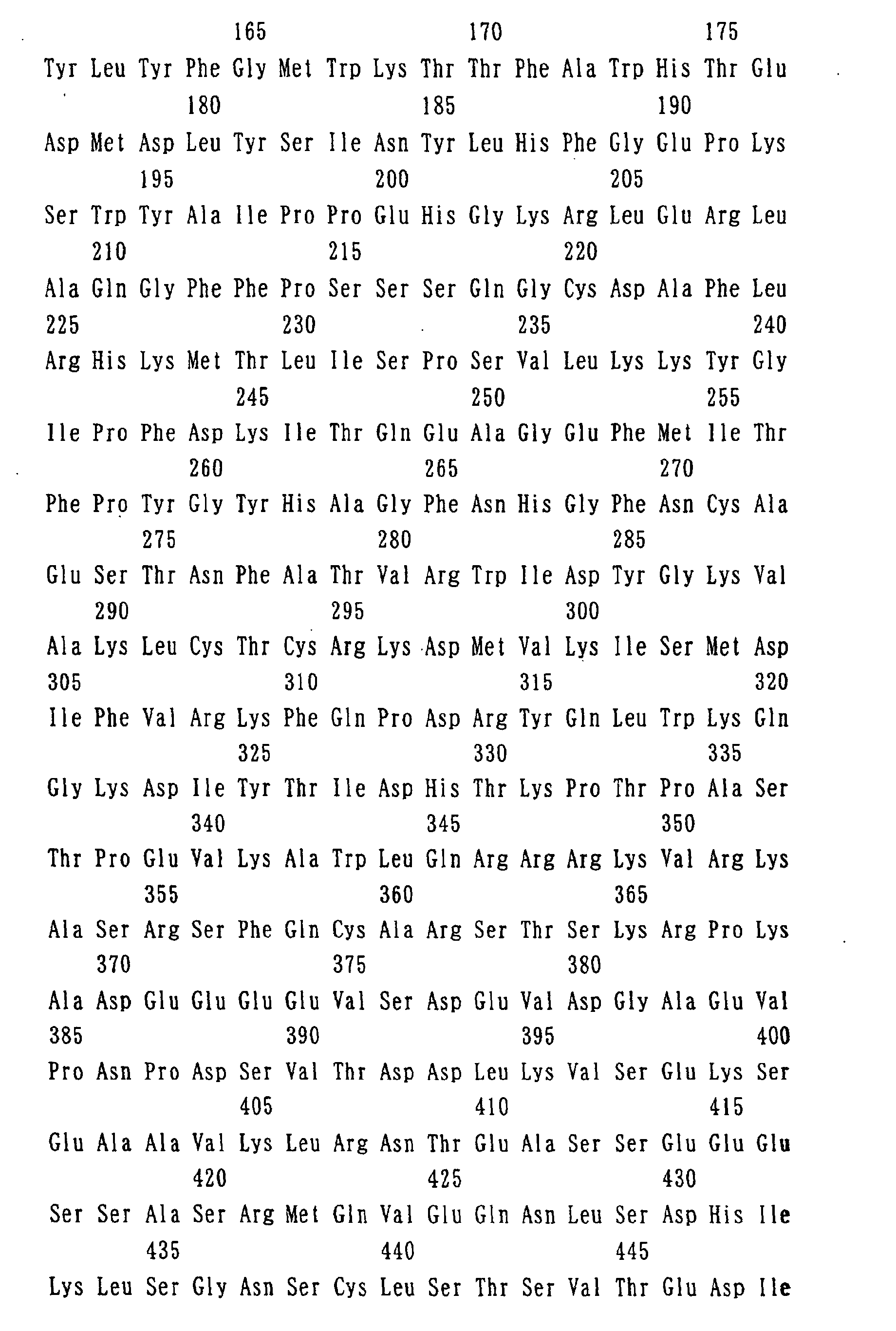


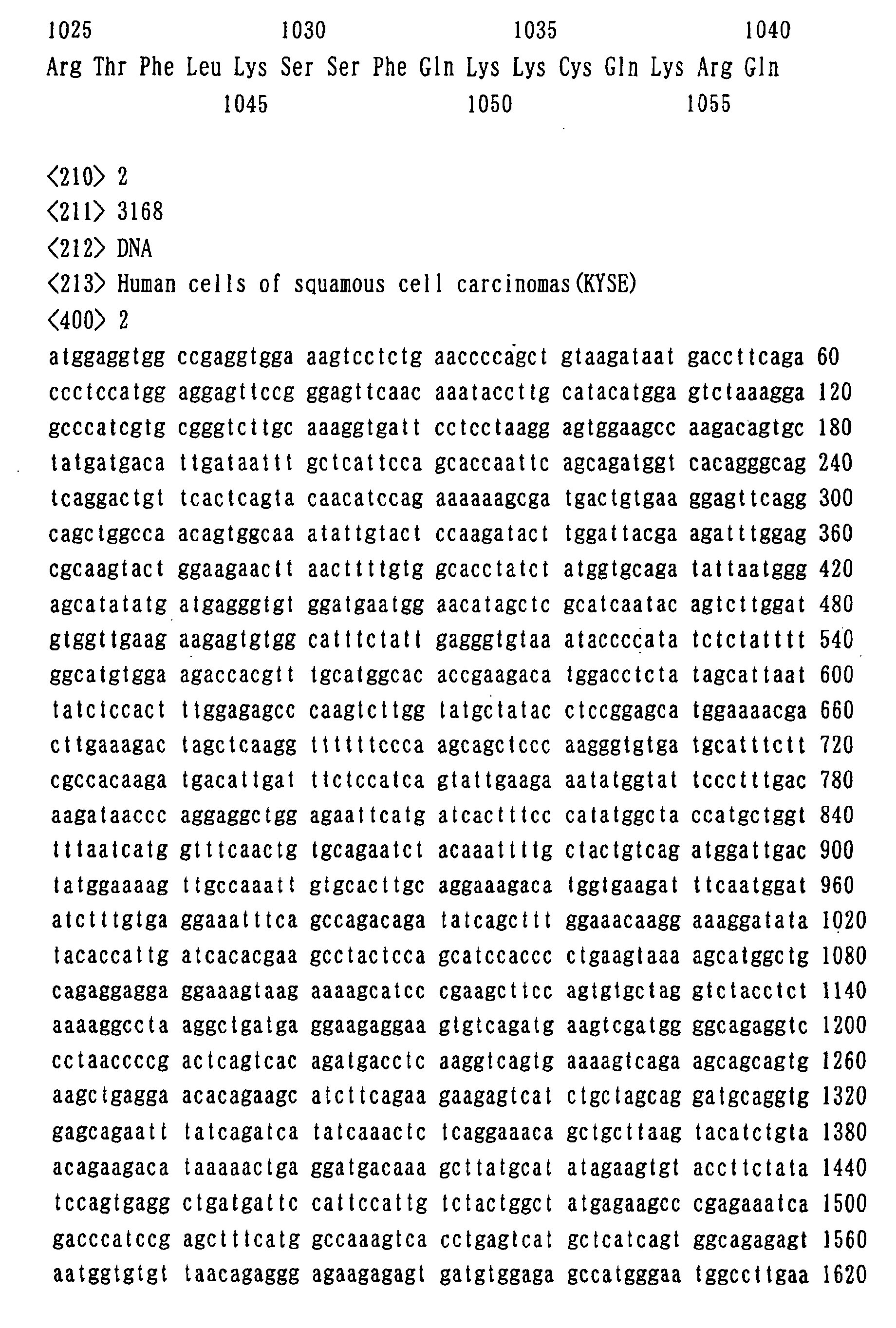
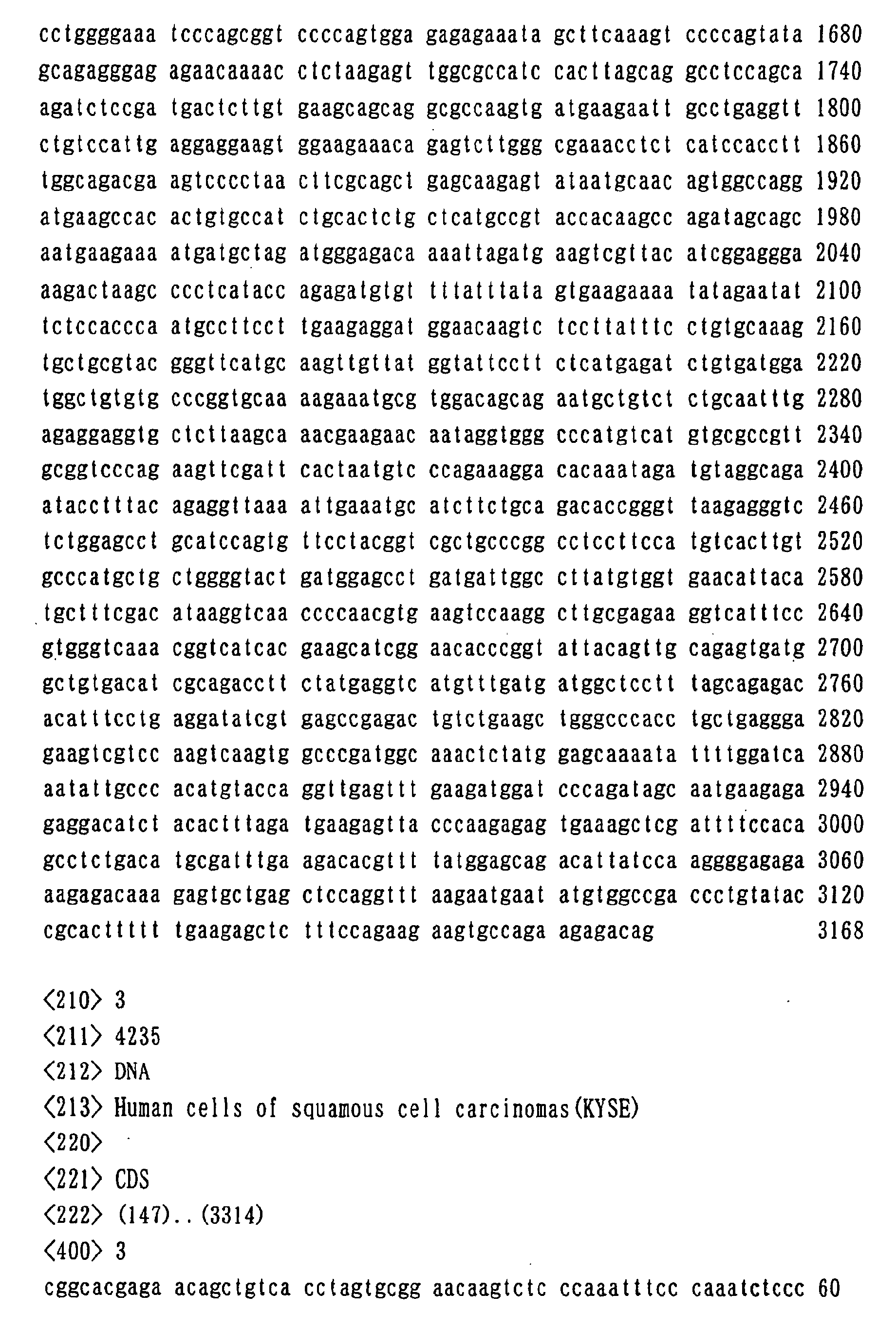
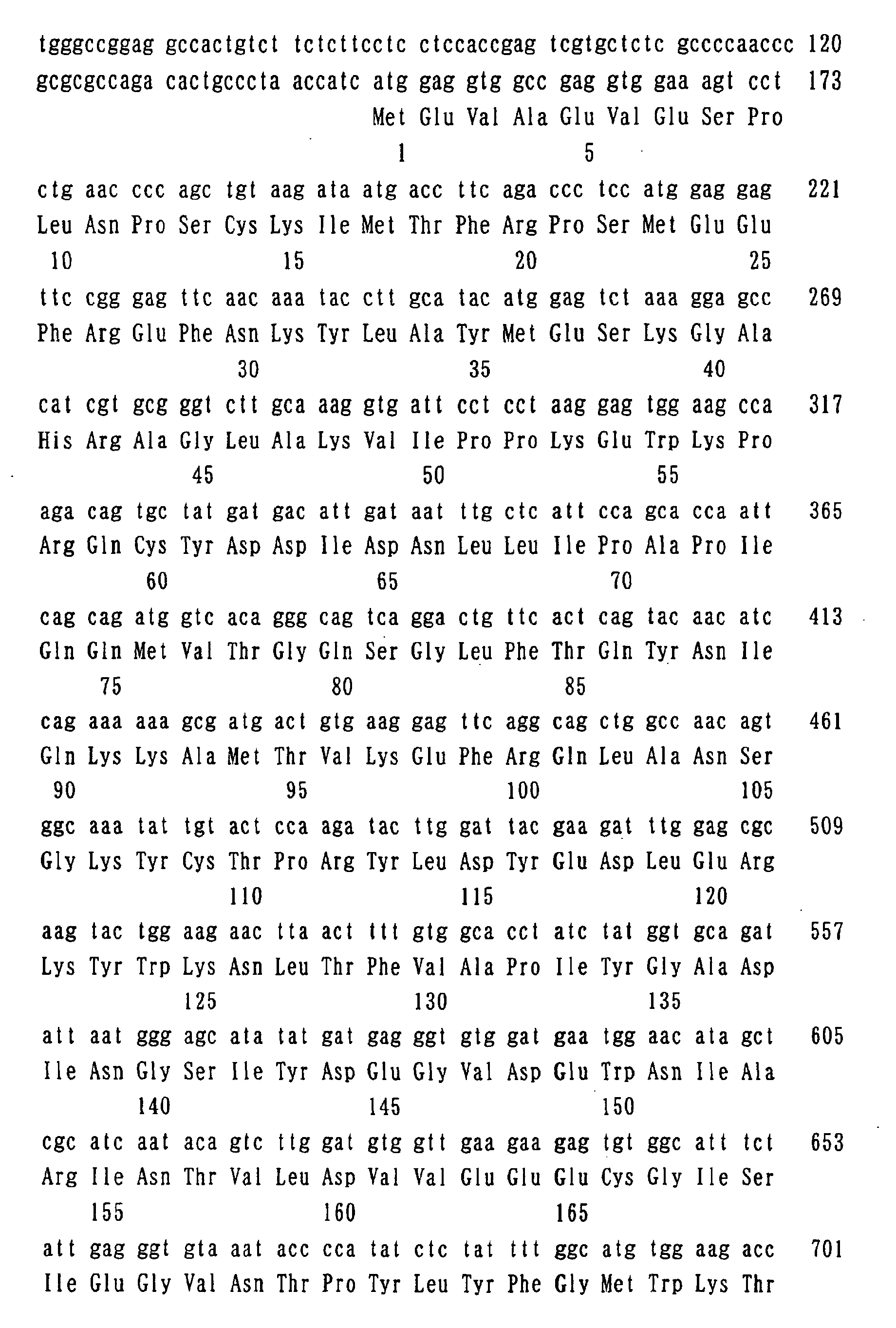

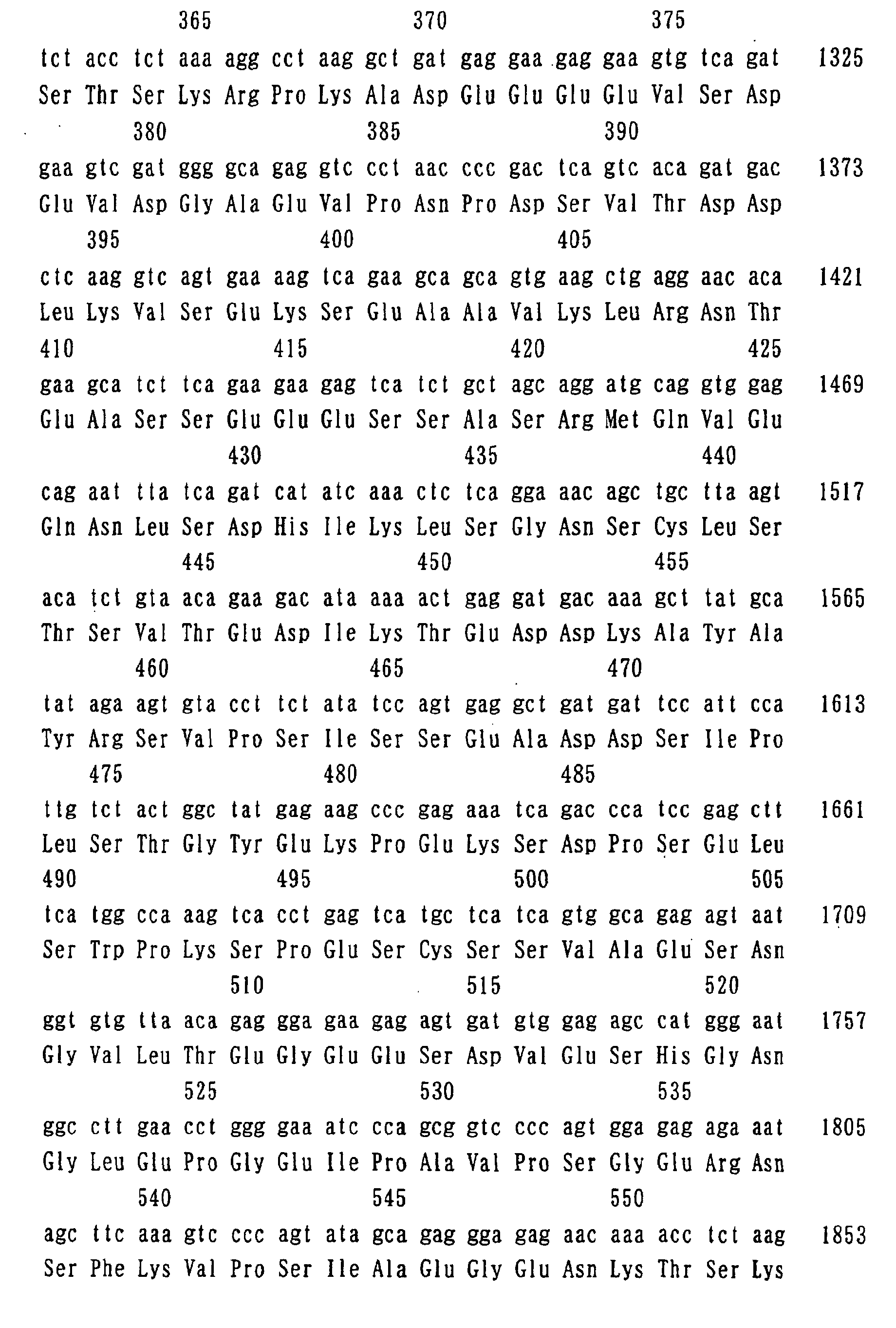


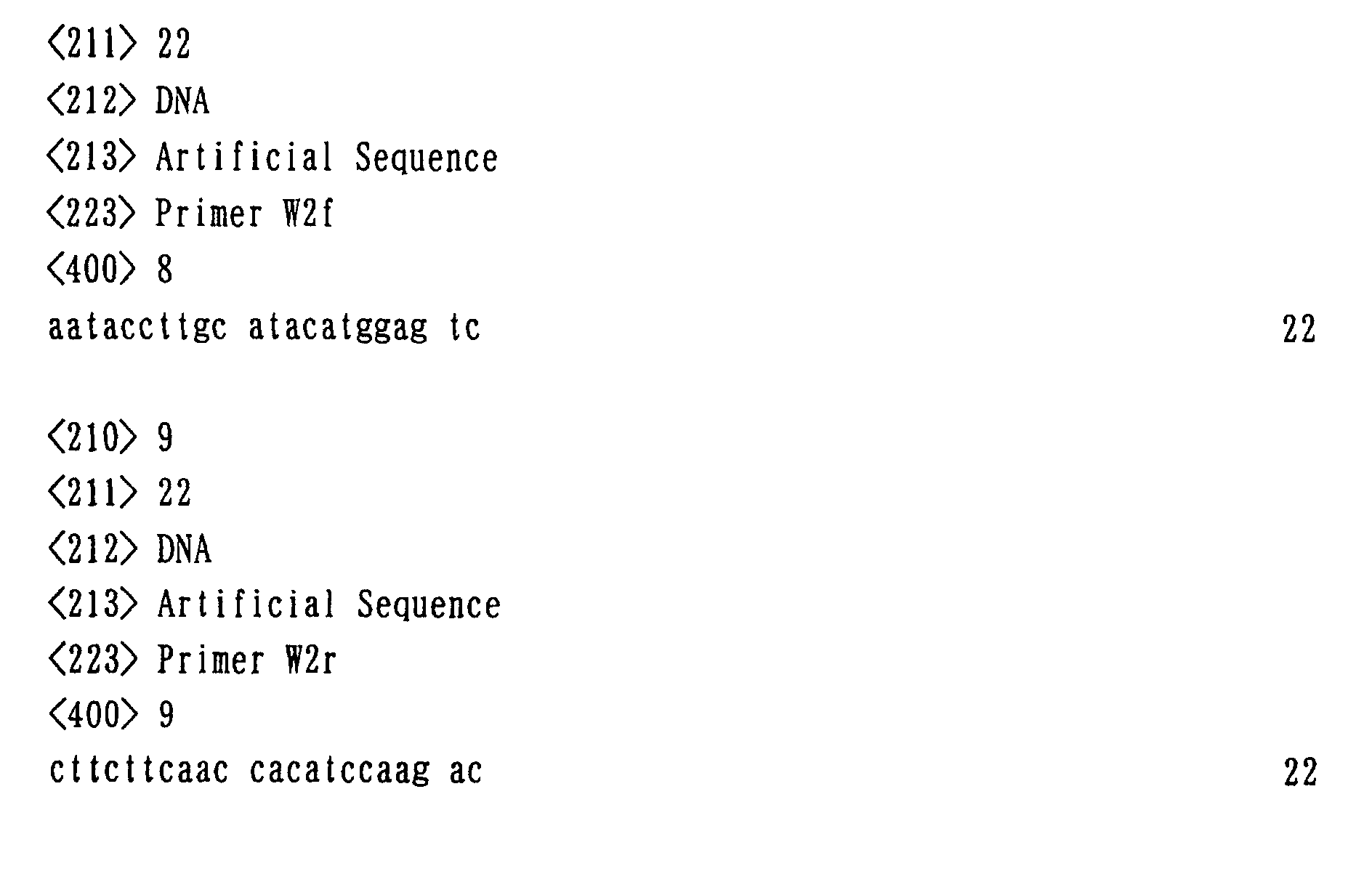
Claims (16)
- An isolated DNA molecule comprising one of the following polynucleotides (a) to (d).(a) a polynucleotide coding for the polypeptide consisting of the amino acid sequence shown in SEQ ID NO:1;(b) a polynucleotide having at least 95% homology with the nucleotide sequence shown in SEQ ID NO:2;(c) a polynucleotide capable of hybridizing with the nucleotide sequence shown in SEQ ID NO:2 under stringent conditions;(d) a polynucleotide which is complementary to the above polynucleotide (a) or (b).
- An isolated DNA molecule according to Claim 1 which is a polynucleotide coding for a polypeptide consisting of the amino acid sequence shown in SEQ ID NO:1.
- An isolated DNA molecule according to Claim 2 which has the nucleotide sequence shown in SEQ ID NO:2.
- An expression product comprising the amino acid sequence shown in SEQ ID NO:1.
- A recombinant expression vector comprising the isolated DNA molecule according to Claim 1 or 3.
- A recombinant expression vector comprising the isolated DNA molecule according to Claim 3.
- A host cell harboring the recombinant expression vector according to Claim 5.
- A host cell harboring the recombinant expression vector according to Claim 6.
- A GASC1 detecting probe having a sequence comprising at least 15 consecutive nucleotides out of the nucleotide sequence shown in SEQ ID NO:2.
- A GASC1 detecting probe according to Claim 9 which has a sequence comprising at least 30 consecutive nucleotides out of the nucleotide sequence shown in SEQ ID NO:2.
- A cancer diagnostic agent comprising the probe according to Claim 9 as an active ingredient.
- A cancer diagnostic agent comprising the probe according to Claim 10 as an active ingredient.
- A cancer diagnostic kit comprising the probe according to Claim 9 as an active ingredient.
- A cancer diagnostic kit comprising the probe according to Claim 10 as an active ingredient.
- An antibody or antibody fragment capable of binding to the expression product of the isolated DNA molecule according to Claim 1.
- A method of diagnosing cancer, which comprises the steps of preparing a biological sample, preparing the antibody or antibody fragment according to Claim 15, and immunologically reacting said sample with said antibody or antibody fragment and detecting the immune reaction product in the sample.
Applications Claiming Priority (3)
| Application Number | Priority Date | Filing Date | Title |
|---|---|---|---|
| JP2000174946 | 2000-06-12 | ||
| JP2000174946A JP4771576B2 (en) | 2000-06-12 | 2000-06-12 | GASC1 gene |
| PCT/JP2001/004959 WO2001096566A1 (en) | 2000-06-12 | 2001-06-12 | Gasc1 gene |
Publications (3)
| Publication Number | Publication Date |
|---|---|
| EP1291424A1 true EP1291424A1 (en) | 2003-03-12 |
| EP1291424A4 EP1291424A4 (en) | 2005-08-10 |
| EP1291424B1 EP1291424B1 (en) | 2011-04-06 |
Family
ID=18676897
Family Applications (1)
| Application Number | Title | Priority Date | Filing Date |
|---|---|---|---|
| EP01938609A Expired - Lifetime EP1291424B1 (en) | 2000-06-12 | 2001-06-12 | Gasc1 gene |
Country Status (8)
| Country | Link |
|---|---|
| US (1) | US7105649B2 (en) |
| EP (1) | EP1291424B1 (en) |
| JP (1) | JP4771576B2 (en) |
| CN (1) | CN1436236A (en) |
| AU (2) | AU6424701A (en) |
| CA (1) | CA2411249C (en) |
| DE (1) | DE60144374D1 (en) |
| WO (1) | WO2001096566A1 (en) |
Cited By (3)
| Publication number | Priority date | Publication date | Assignee | Title |
|---|---|---|---|---|
| WO2007104314A3 (en) * | 2006-03-14 | 2007-11-01 | Biotech Res & Innovation Ct | INHIBITION OF GASCl |
| US7785778B2 (en) | 2002-11-25 | 2010-08-31 | University Of Copenhagen | Porcine polymorphisms and methods for detecting them |
| CN106755474B (en) * | 2017-01-18 | 2020-04-28 | 西北农林科技大学 | Method for detecting insertion/deletion polymorphism of boar KDM5B gene and application thereof |
Families Citing this family (7)
| Publication number | Priority date | Publication date | Assignee | Title |
|---|---|---|---|---|
| US20040029134A1 (en) * | 2002-12-06 | 2004-02-12 | Wei Gu | P53-associated Parkin-like cytoplasmic protein, and related compositions and methods |
| DK1851340T3 (en) * | 2005-02-10 | 2013-03-11 | Us Gov Health & Human Serv | PROCEDURE FOR DIAGNOSTICATION AND TREATMENT OF CANCER USING B-CATENIN SPLIT VARIETIES |
| US8043804B2 (en) * | 2007-05-23 | 2011-10-25 | The Trustees Of Columbia University In The City Of New York | DBC1, a novel native inhibitor of anti-aging protein SIRT1 |
| WO2011011366A2 (en) * | 2009-07-20 | 2011-01-27 | Constellation Pharmaceuticals | Agents for stimulating activity of methyl modifying enzymes and methods of use thereof |
| HK1204294A1 (en) * | 2012-03-21 | 2015-11-13 | 拜耳知识产权有限责任公司 | Use of (rs)-s-cyclopropyl-s-(4-{[4-{[1r, 2r)-2-hydroxy-1-methylpropyl]oxy}-5-(trifluoromethyl)pyrimidin-2-yl]amino}phenyl)sulfoximide for treating specific tumours |
| CN110652589A (en) * | 2019-10-12 | 2020-01-07 | 中国人民解放军陆军军医大学 | Application of GASC1 inhibitor in preparation of medicine for treating liver cancer |
| CN116165325B (en) * | 2023-02-10 | 2026-02-27 | 中国工程物理研究院化工材料研究所 | A device for measuring the laminar combustion rate of explosives in a confined space |
Family Cites Families (2)
| Publication number | Priority date | Publication date | Assignee | Title |
|---|---|---|---|---|
| US6025480A (en) * | 1995-04-03 | 2000-02-15 | Sloan-Kettering Institute For Cancer Research | Isolated nucleic acid molecules encoding P57KIP2 |
| US5928884A (en) * | 1996-02-09 | 1999-07-27 | Croce; Carlo M. | FHIT proteins and nucleic acids and methods based thereon |
-
2000
- 2000-06-12 JP JP2000174946A patent/JP4771576B2/en not_active Expired - Lifetime
-
2001
- 2001-06-12 EP EP01938609A patent/EP1291424B1/en not_active Expired - Lifetime
- 2001-06-12 AU AU6424701A patent/AU6424701A/en active Pending
- 2001-06-12 AU AU2001264247A patent/AU2001264247B2/en not_active Expired
- 2001-06-12 CN CN01811036A patent/CN1436236A/en active Pending
- 2001-06-12 DE DE60144374T patent/DE60144374D1/en not_active Expired - Lifetime
- 2001-06-12 US US10/311,002 patent/US7105649B2/en not_active Expired - Lifetime
- 2001-06-12 CA CA2411249A patent/CA2411249C/en not_active Expired - Lifetime
- 2001-06-12 WO PCT/JP2001/004959 patent/WO2001096566A1/en not_active Ceased
Non-Patent Citations (6)
| Title |
|---|
| DATABASE EMBL [Online] 25 May 2000 (2000-05-25), "PM3-OT0096-080300-001-h11 OT0096 Homo sapiens cDNA, mRNA sequence." XP002332028 retrieved from EBI accession no. EM_PRO:AW887822 Database accession no. AW887822 * |
| DATABASE EMBL [Online] 6 February 2000 (2000-02-06), "QV3-BT0379-161299-040-h05 BT0379 Homo sapiens cDNA, mRNA sequence." XP002332026 retrieved from EBI accession no. EM_PRO:AW372902 Database accession no. AW372902 * |
| DATABASE EMBL [Online] 6 February 2000 (2000-02-06), "QV4-LT0016-271299-068-d01 LT0016 Homo sapiens cDNA, mRNA sequence." XP002332027 retrieved from EBI accession no. EM_PRO:AW385519 Database accession no. AW385519 * |
| DATABASE EMBL [Online] 8 February 2000 (2000-02-08), "UI-HF-BK0-aba-d-12-0-UI.r1 NIH_MGC_36 Homo sapiens cDNA clone IMAGE:3055558 5', mRNA sequence." XP002332025 retrieved from EBI accession no. EM_PRO:AW402136 Database accession no. AW402136 * |
| See also references of WO0196566A1 * |
| YANG ZENG-QUAN ET AL: "Identification of a novel gene, GASC1, within an amplicon at 9p23-24 frequently detected in esophageal cancer cell lines" CANCER RESEARCH, vol. 60, no. 17, 1 September 2000 (2000-09-01), pages 4735-4739, XP002332024 ISSN: 0008-5472 * |
Cited By (4)
| Publication number | Priority date | Publication date | Assignee | Title |
|---|---|---|---|---|
| US7785778B2 (en) | 2002-11-25 | 2010-08-31 | University Of Copenhagen | Porcine polymorphisms and methods for detecting them |
| WO2007104314A3 (en) * | 2006-03-14 | 2007-11-01 | Biotech Res & Innovation Ct | INHIBITION OF GASCl |
| US8420335B2 (en) | 2006-03-14 | 2013-04-16 | Kobenhavns Universitet | Inhibition of GASC1 |
| CN106755474B (en) * | 2017-01-18 | 2020-04-28 | 西北农林科技大学 | Method for detecting insertion/deletion polymorphism of boar KDM5B gene and application thereof |
Also Published As
| Publication number | Publication date |
|---|---|
| WO2001096566A1 (en) | 2001-12-20 |
| US20050037345A1 (en) | 2005-02-17 |
| EP1291424B1 (en) | 2011-04-06 |
| EP1291424A4 (en) | 2005-08-10 |
| CA2411249C (en) | 2011-07-26 |
| JP2001352985A (en) | 2001-12-25 |
| JP4771576B2 (en) | 2011-09-14 |
| US7105649B2 (en) | 2006-09-12 |
| CN1436236A (en) | 2003-08-13 |
| DE60144374D1 (en) | 2011-05-19 |
| AU6424701A (en) | 2001-12-24 |
| CA2411249A1 (en) | 2001-12-20 |
| AU2001264247B2 (en) | 2006-06-15 |
Similar Documents
| Publication | Publication Date | Title |
|---|---|---|
| US7582732B2 (en) | Ly6h polypeptide | |
| EP1710582A2 (en) | Suppressor genes | |
| EP1291424B1 (en) | Gasc1 gene | |
| JPWO2000017345A1 (en) | LY6H gene | |
| US7964367B2 (en) | Human p51 genes and gene products thereof | |
| US6171857B1 (en) | Leucine zipper protein, KARP-1 and methods of regulating DNA dependent protein kinase activity | |
| JPH10504714A (en) | Human potassium channel 1 and 2 proteins | |
| JPWO1999050412A1 (en) | Human p51 gene and its gene product | |
| JP4280878B2 (en) | MASL1 gene | |
| JP4112976B2 (en) | PCA2501 gene | |
| JP2000325087A (en) | Tsa2306 gene | |
| US6835812B1 (en) | Human p-Hyde proteins | |
| JPH11103867A (en) | Epo primary response gene1, eprg1 | |
| JP2001025389A (en) | Tsa7005 gene | |
| JP2002523069A (en) | RAMP2a: receptor activity-modifying protein-2a | |
| JP2001078772A (en) | Lunx gene and detection of cancer micrometastasis | |
| JP2008118989A (en) | Pca2501 gene | |
| JP2003116558A (en) | Adult T cell leukemia (ATL) related genes and their expressed proteins | |
| JP2001046072A (en) | Ace-like gene | |
| JPWO1999011786A1 (en) | Pancpin gene and gene therapy composition | |
| JP2003245088A (en) | Epo primary response gene 1, eprg1 | |
| WO2001070780A1 (en) | A novel polypeptide-human ribosomal sii protein 12 and the polynucleotide encoding said polypeptide |
Legal Events
| Date | Code | Title | Description |
|---|---|---|---|
| PUAI | Public reference made under article 153(3) epc to a published international application that has entered the european phase |
Free format text: ORIGINAL CODE: 0009012 |
|
| 17P | Request for examination filed |
Effective date: 20021223 |
|
| AK | Designated contracting states |
Kind code of ref document: A1 Designated state(s): AT BE CH CY DE DK ES FI FR GB GR IE IT LI LU MC NL PT SE TR |
|
| A4 | Supplementary search report drawn up and despatched |
Effective date: 20050628 |
|
| 17Q | First examination report despatched |
Effective date: 20070131 |
|
| RAP1 | Party data changed (applicant data changed or rights of an application transferred) |
Owner name: INAZAWA, JOHJI |
|
| GRAP | Despatch of communication of intention to grant a patent |
Free format text: ORIGINAL CODE: EPIDOSNIGR1 |
|
| GRAS | Grant fee paid |
Free format text: ORIGINAL CODE: EPIDOSNIGR3 |
|
| RBV | Designated contracting states (corrected) |
Designated state(s): DE GB |
|
| GRAA | (expected) grant |
Free format text: ORIGINAL CODE: 0009210 |
|
| AK | Designated contracting states |
Kind code of ref document: B1 Designated state(s): DE GB |
|
| REG | Reference to a national code |
Ref country code: GB Ref legal event code: FG4D |
|
| REF | Corresponds to: |
Ref document number: 60144374 Country of ref document: DE Date of ref document: 20110519 Kind code of ref document: P |
|
| REG | Reference to a national code |
Ref country code: DE Ref legal event code: R096 Ref document number: 60144374 Country of ref document: DE Effective date: 20110519 |
|
| PLBE | No opposition filed within time limit |
Free format text: ORIGINAL CODE: 0009261 |
|
| STAA | Information on the status of an ep patent application or granted ep patent |
Free format text: STATUS: NO OPPOSITION FILED WITHIN TIME LIMIT |
|
| 26N | No opposition filed |
Effective date: 20120110 |
|
| REG | Reference to a national code |
Ref country code: DE Ref legal event code: R097 Ref document number: 60144374 Country of ref document: DE Effective date: 20120110 |
|
| PGFP | Annual fee paid to national office [announced via postgrant information from national office to epo] |
Ref country code: DE Payment date: 20200602 Year of fee payment: 20 |
|
| PGFP | Annual fee paid to national office [announced via postgrant information from national office to epo] |
Ref country code: GB Payment date: 20200603 Year of fee payment: 20 |
|
| REG | Reference to a national code |
Ref country code: DE Ref legal event code: R071 Ref document number: 60144374 Country of ref document: DE |
|
| REG | Reference to a national code |
Ref country code: GB Ref legal event code: PE20 Expiry date: 20210611 |
|
| PG25 | Lapsed in a contracting state [announced via postgrant information from national office to epo] |
Ref country code: GB Free format text: LAPSE BECAUSE OF EXPIRATION OF PROTECTION Effective date: 20210611 |