EP1291196A2 - Heat-sensitive recording material - Google Patents
Heat-sensitive recording material Download PDFInfo
- Publication number
- EP1291196A2 EP1291196A2 EP02019838A EP02019838A EP1291196A2 EP 1291196 A2 EP1291196 A2 EP 1291196A2 EP 02019838 A EP02019838 A EP 02019838A EP 02019838 A EP02019838 A EP 02019838A EP 1291196 A2 EP1291196 A2 EP 1291196A2
- Authority
- EP
- European Patent Office
- Prior art keywords
- heat
- group
- recording material
- compound
- sensitive recording
- Prior art date
- Legal status (The legal status is an assumption and is not a legal conclusion. Google has not performed a legal analysis and makes no representation as to the accuracy of the status listed.)
- Granted
Links
- 239000000463 material Substances 0.000 title claims abstract description 74
- 150000002736 metal compounds Chemical class 0.000 claims abstract description 49
- 239000002243 precursor Substances 0.000 claims abstract description 33
- 239000003094 microcapsule Substances 0.000 claims abstract description 16
- 150000001875 compounds Chemical class 0.000 claims description 55
- -1 fluoran compound Chemical class 0.000 claims description 47
- 125000000217 alkyl group Chemical group 0.000 claims description 27
- 239000010410 layer Substances 0.000 claims description 23
- 125000001424 substituent group Chemical group 0.000 claims description 21
- 125000003277 amino group Chemical group 0.000 claims description 16
- 125000004435 hydrogen atom Chemical group [H]* 0.000 claims description 15
- 239000011241 protective layer Substances 0.000 claims description 12
- 125000003545 alkoxy group Chemical group 0.000 claims description 11
- 239000002250 absorbent Substances 0.000 claims description 10
- 230000002745 absorbent Effects 0.000 claims description 10
- 125000003118 aryl group Chemical group 0.000 claims description 10
- 229910052751 metal Inorganic materials 0.000 claims description 10
- 239000002184 metal Substances 0.000 claims description 10
- 125000004432 carbon atom Chemical group C* 0.000 claims description 9
- PXHVJJICTQNCMI-UHFFFAOYSA-N Nickel Chemical compound [Ni] PXHVJJICTQNCMI-UHFFFAOYSA-N 0.000 claims description 8
- HCHKCACWOHOZIP-UHFFFAOYSA-N Zinc Chemical compound [Zn] HCHKCACWOHOZIP-UHFFFAOYSA-N 0.000 claims description 7
- YRKCREAYFQTBPV-UHFFFAOYSA-N acetylacetone Chemical compound CC(=O)CC(C)=O YRKCREAYFQTBPV-UHFFFAOYSA-N 0.000 claims description 7
- 150000002989 phenols Chemical class 0.000 claims description 7
- 229910052725 zinc Inorganic materials 0.000 claims description 7
- 239000011701 zinc Substances 0.000 claims description 7
- XEEYBQQBJWHFJM-UHFFFAOYSA-N Iron Chemical compound [Fe] XEEYBQQBJWHFJM-UHFFFAOYSA-N 0.000 claims description 6
- 150000007933 aliphatic carboxylic acids Chemical class 0.000 claims description 6
- 125000002887 hydroxy group Chemical group [H]O* 0.000 claims description 6
- 229910052757 nitrogen Inorganic materials 0.000 claims description 6
- 125000004433 nitrogen atom Chemical group N* 0.000 claims description 6
- 229920003986 novolac Polymers 0.000 claims description 6
- 229920000642 polymer Polymers 0.000 claims description 6
- 229920005989 resin Polymers 0.000 claims description 6
- 239000011347 resin Substances 0.000 claims description 6
- JUJWROOIHBZHMG-UHFFFAOYSA-N Pyridine Chemical group C1=CC=NC=C1 JUJWROOIHBZHMG-UHFFFAOYSA-N 0.000 claims description 5
- 239000002253 acid Substances 0.000 claims description 4
- 229910052782 aluminium Inorganic materials 0.000 claims description 4
- XAGFODPZIPBFFR-UHFFFAOYSA-N aluminium Chemical compound [Al] XAGFODPZIPBFFR-UHFFFAOYSA-N 0.000 claims description 4
- 125000001797 benzyl group Chemical group [H]C1=C([H])C([H])=C(C([H])=C1[H])C([H])([H])* 0.000 claims description 4
- 125000005843 halogen group Chemical group 0.000 claims description 4
- 229910052759 nickel Inorganic materials 0.000 claims description 4
- OEKATORRSPXJHE-UHFFFAOYSA-N 2-acetylcyclohexan-1-one Chemical compound CC(=O)C1CCCCC1=O OEKATORRSPXJHE-UHFFFAOYSA-N 0.000 claims description 3
- OSWDNIFICGLKEE-UHFFFAOYSA-N 2-acetylcyclopentan-1-one Chemical compound CC(=O)C1CCCC1=O OSWDNIFICGLKEE-UHFFFAOYSA-N 0.000 claims description 3
- OYPRJOBELJOOCE-UHFFFAOYSA-N Calcium Chemical compound [Ca] OYPRJOBELJOOCE-UHFFFAOYSA-N 0.000 claims description 3
- RYGMFSIKBFXOCR-UHFFFAOYSA-N Copper Chemical compound [Cu] RYGMFSIKBFXOCR-UHFFFAOYSA-N 0.000 claims description 3
- FYYHWMGAXLPEAU-UHFFFAOYSA-N Magnesium Chemical compound [Mg] FYYHWMGAXLPEAU-UHFFFAOYSA-N 0.000 claims description 3
- 229920002396 Polyurea Polymers 0.000 claims description 3
- 239000000440 bentonite Substances 0.000 claims description 3
- 229910000278 bentonite Inorganic materials 0.000 claims description 3
- SVPXDRXYRYOSEX-UHFFFAOYSA-N bentoquatam Chemical compound O.O=[Si]=O.O=[Al]O[Al]=O SVPXDRXYRYOSEX-UHFFFAOYSA-N 0.000 claims description 3
- 150000008366 benzophenones Chemical class 0.000 claims description 3
- 229910052791 calcium Inorganic materials 0.000 claims description 3
- 239000011575 calcium Substances 0.000 claims description 3
- 125000005521 carbonamide group Chemical group 0.000 claims description 3
- 125000003178 carboxy group Chemical group [H]OC(*)=O 0.000 claims description 3
- 150000001851 cinnamic acid derivatives Chemical class 0.000 claims description 3
- 239000004927 clay Substances 0.000 claims description 3
- 239000010941 cobalt Substances 0.000 claims description 3
- 229910017052 cobalt Inorganic materials 0.000 claims description 3
- GUTLYIVDDKVIGB-UHFFFAOYSA-N cobalt atom Chemical compound [Co] GUTLYIVDDKVIGB-UHFFFAOYSA-N 0.000 claims description 3
- 150000004696 coordination complex Chemical class 0.000 claims description 3
- 229910052802 copper Inorganic materials 0.000 claims description 3
- 239000010949 copper Substances 0.000 claims description 3
- 125000004093 cyano group Chemical group *C#N 0.000 claims description 3
- 229910052742 iron Inorganic materials 0.000 claims description 3
- 229910052749 magnesium Inorganic materials 0.000 claims description 3
- 239000011777 magnesium Substances 0.000 claims description 3
- 125000000449 nitro group Chemical group [O-][N+](*)=O 0.000 claims description 3
- 239000004814 polyurethane Substances 0.000 claims description 3
- 229920003226 polyurethane urea Polymers 0.000 claims description 3
- 125000003373 pyrazinyl group Chemical group 0.000 claims description 3
- 150000003872 salicylic acid derivatives Chemical class 0.000 claims description 3
- WPYMKLBDIGXBTP-UHFFFAOYSA-N benzoic acid Chemical class OC(=O)C1=CC=CC=C1 WPYMKLBDIGXBTP-UHFFFAOYSA-N 0.000 claims description 2
- NIHNNTQXNPWCJQ-UHFFFAOYSA-N o-biphenylenemethane Natural products C1=CC=C2CC3=CC=CC=C3C2=C1 NIHNNTQXNPWCJQ-UHFFFAOYSA-N 0.000 claims description 2
- 229950000688 phenothiazine Drugs 0.000 claims description 2
- 239000000975 dye Substances 0.000 description 25
- 239000000243 solution Substances 0.000 description 19
- 239000002775 capsule Substances 0.000 description 7
- 239000000126 substance Substances 0.000 description 7
- XEKOWRVHYACXOJ-UHFFFAOYSA-N Ethyl acetate Chemical compound CCOC(C)=O XEKOWRVHYACXOJ-UHFFFAOYSA-N 0.000 description 6
- 239000004372 Polyvinyl alcohol Substances 0.000 description 6
- 238000006243 chemical reaction Methods 0.000 description 6
- 229920000126 latex Polymers 0.000 description 6
- 239000004816 latex Substances 0.000 description 6
- 229920002451 polyvinyl alcohol Polymers 0.000 description 6
- 239000011248 coating agent Substances 0.000 description 5
- 238000000576 coating method Methods 0.000 description 5
- 239000006185 dispersion Substances 0.000 description 5
- 229920003169 water-soluble polymer Polymers 0.000 description 5
- VYPSYNLAJGMNEJ-UHFFFAOYSA-N Silicium dioxide Chemical compound O=[Si]=O VYPSYNLAJGMNEJ-UHFFFAOYSA-N 0.000 description 4
- IISBACLAFKSPIT-UHFFFAOYSA-N bisphenol A Chemical compound C=1C=C(O)C=CC=1C(C)(C)C1=CC=C(O)C=C1 IISBACLAFKSPIT-UHFFFAOYSA-N 0.000 description 4
- 229920001577 copolymer Polymers 0.000 description 4
- 238000011161 development Methods 0.000 description 4
- 239000002245 particle Substances 0.000 description 4
- 239000000049 pigment Substances 0.000 description 4
- YGSDEFSMJLZEOE-UHFFFAOYSA-N salicylic acid Chemical compound OC(=O)C1=CC=CC=C1O YGSDEFSMJLZEOE-UHFFFAOYSA-N 0.000 description 4
- 238000003860 storage Methods 0.000 description 4
- 239000000839 emulsion Substances 0.000 description 3
- 150000002148 esters Chemical class 0.000 description 3
- 238000000034 method Methods 0.000 description 3
- 239000000178 monomer Substances 0.000 description 3
- 238000002360 preparation method Methods 0.000 description 3
- 239000002904 solvent Substances 0.000 description 3
- VBFSEZPGDSUQIJ-UHFFFAOYSA-N 2-hydroxy-3,5-bis(2,4,4-trimethylpentan-2-yl)benzoic acid Chemical compound CC(C)(C)CC(C)(C)C1=CC(C(O)=O)=C(O)C(C(C)(C)CC(C)(C)C)=C1 VBFSEZPGDSUQIJ-UHFFFAOYSA-N 0.000 description 2
- ZWQBZEFLFSFEOS-UHFFFAOYSA-N 3,5-ditert-butyl-2-hydroxybenzoic acid Chemical compound CC(C)(C)C1=CC(C(O)=O)=C(O)C(C(C)(C)C)=C1 ZWQBZEFLFSFEOS-UHFFFAOYSA-N 0.000 description 2
- 239000005995 Aluminium silicate Substances 0.000 description 2
- VTYYLEPIZMXCLO-UHFFFAOYSA-L Calcium carbonate Chemical compound [Ca+2].[O-]C([O-])=O VTYYLEPIZMXCLO-UHFFFAOYSA-L 0.000 description 2
- 229920002134 Carboxymethyl cellulose Polymers 0.000 description 2
- RTZKZFJDLAIYFH-UHFFFAOYSA-N Diethyl ether Chemical compound CCOCC RTZKZFJDLAIYFH-UHFFFAOYSA-N 0.000 description 2
- WSFSSNUMVMOOMR-UHFFFAOYSA-N Formaldehyde Chemical compound O=C WSFSSNUMVMOOMR-UHFFFAOYSA-N 0.000 description 2
- 108010010803 Gelatin Proteins 0.000 description 2
- 229920000084 Gum arabic Polymers 0.000 description 2
- 238000012695 Interfacial polymerization Methods 0.000 description 2
- VGGLHLAESQEWCR-UHFFFAOYSA-N N-(hydroxymethyl)urea Chemical compound NC(=O)NCO VGGLHLAESQEWCR-UHFFFAOYSA-N 0.000 description 2
- 229920000459 Nitrile rubber Polymers 0.000 description 2
- 239000005062 Polybutadiene Substances 0.000 description 2
- 241000978776 Senegalia senegal Species 0.000 description 2
- 229920002472 Starch Polymers 0.000 description 2
- XTXRWKRVRITETP-UHFFFAOYSA-N Vinyl acetate Chemical compound CC(=O)OC=C XTXRWKRVRITETP-UHFFFAOYSA-N 0.000 description 2
- XLOMVQKBTHCTTD-UHFFFAOYSA-N Zinc monoxide Chemical compound [Zn]=O XLOMVQKBTHCTTD-UHFFFAOYSA-N 0.000 description 2
- 235000010489 acacia gum Nutrition 0.000 description 2
- 239000000205 acacia gum Substances 0.000 description 2
- 125000002777 acetyl group Chemical group [H]C([H])([H])C(*)=O 0.000 description 2
- LEQAOMBKQFMDFZ-UHFFFAOYSA-N alpha-ketodiacetal Natural products O=CC=O LEQAOMBKQFMDFZ-UHFFFAOYSA-N 0.000 description 2
- 235000012211 aluminium silicate Nutrition 0.000 description 2
- 239000003125 aqueous solvent Substances 0.000 description 2
- TZCXTZWJZNENPQ-UHFFFAOYSA-L barium sulfate Chemical compound [Ba+2].[O-]S([O-])(=O)=O TZCXTZWJZNENPQ-UHFFFAOYSA-L 0.000 description 2
- IMHDGJOMLMDPJN-UHFFFAOYSA-N biphenyl-2,2'-diol Chemical group OC1=CC=CC=C1C1=CC=CC=C1O IMHDGJOMLMDPJN-UHFFFAOYSA-N 0.000 description 2
- YXVFYQXJAXKLAK-UHFFFAOYSA-N biphenyl-4-ol Chemical compound C1=CC(O)=CC=C1C1=CC=CC=C1 YXVFYQXJAXKLAK-UHFFFAOYSA-N 0.000 description 2
- 238000009835 boiling Methods 0.000 description 2
- LRTQWXGNPCHTFW-UHFFFAOYSA-N buta-1,3-diene;methyl prop-2-enoate Chemical compound C=CC=C.COC(=O)C=C LRTQWXGNPCHTFW-UHFFFAOYSA-N 0.000 description 2
- 239000001768 carboxy methyl cellulose Substances 0.000 description 2
- 235000010948 carboxy methyl cellulose Nutrition 0.000 description 2
- 239000008112 carboxymethyl-cellulose Substances 0.000 description 2
- 229940105329 carboxymethylcellulose Drugs 0.000 description 2
- 239000005018 casein Substances 0.000 description 2
- BECPQYXYKAMYBN-UHFFFAOYSA-N casein, tech. Chemical compound NCCCCC(C(O)=O)N=C(O)C(CC(O)=O)N=C(O)C(CCC(O)=N)N=C(O)C(CC(C)C)N=C(O)C(CCC(O)=O)N=C(O)C(CC(O)=O)N=C(O)C(CCC(O)=O)N=C(O)C(C(C)O)N=C(O)C(CCC(O)=N)N=C(O)C(CCC(O)=N)N=C(O)C(CCC(O)=N)N=C(O)C(CCC(O)=O)N=C(O)C(CCC(O)=O)N=C(O)C(COP(O)(O)=O)N=C(O)C(CCC(O)=N)N=C(O)C(N)CC1=CC=CC=C1 BECPQYXYKAMYBN-UHFFFAOYSA-N 0.000 description 2
- 235000021240 caseins Nutrition 0.000 description 2
- 230000000052 comparative effect Effects 0.000 description 2
- 239000003431 cross linking reagent Substances 0.000 description 2
- 125000001301 ethoxy group Chemical group [H]C([H])([H])C([H])([H])O* 0.000 description 2
- 125000003754 ethoxycarbonyl group Chemical group C(=O)(OCC)* 0.000 description 2
- 125000006260 ethylaminocarbonyl group Chemical group [H]N(C(*)=O)C([H])([H])C([H])([H])[H] 0.000 description 2
- 239000000945 filler Substances 0.000 description 2
- 150000002220 fluorenes Chemical class 0.000 description 2
- 229920000159 gelatin Polymers 0.000 description 2
- 235000019322 gelatine Nutrition 0.000 description 2
- 235000011852 gelatine desserts Nutrition 0.000 description 2
- 229920003063 hydroxymethyl cellulose Polymers 0.000 description 2
- 229940031574 hydroxymethyl cellulose Drugs 0.000 description 2
- NLYAJNPCOHFWQQ-UHFFFAOYSA-N kaolin Chemical compound O.O.O=[Al]O[Si](=O)O[Si](=O)O[Al]=O NLYAJNPCOHFWQQ-UHFFFAOYSA-N 0.000 description 2
- 125000000956 methoxy group Chemical group [H]C([H])([H])O* 0.000 description 2
- 125000001160 methoxycarbonyl group Chemical group [H]C([H])([H])OC(*)=O 0.000 description 2
- 229920000609 methyl cellulose Polymers 0.000 description 2
- 125000004458 methylaminocarbonyl group Chemical group [H]N(C(*)=O)C([H])([H])[H] 0.000 description 2
- 239000001923 methylcellulose Substances 0.000 description 2
- 235000010981 methylcellulose Nutrition 0.000 description 2
- 229960002900 methylcellulose Drugs 0.000 description 2
- FJKROLUGYXJWQN-UHFFFAOYSA-N papa-hydroxy-benzoic acid Natural products OC(=O)C1=CC=C(O)C=C1 FJKROLUGYXJWQN-UHFFFAOYSA-N 0.000 description 2
- 239000012071 phase Substances 0.000 description 2
- 125000006678 phenoxycarbonyl group Chemical group 0.000 description 2
- 125000003170 phenylsulfonyl group Chemical group C1(=CC=CC=C1)S(=O)(=O)* 0.000 description 2
- 239000002985 plastic film Substances 0.000 description 2
- 229920006255 plastic film Polymers 0.000 description 2
- 229920002401 polyacrylamide Polymers 0.000 description 2
- 229920002857 polybutadiene Polymers 0.000 description 2
- 125000001325 propanoyl group Chemical group O=C([*])C([H])([H])C([H])([H])[H] 0.000 description 2
- 229960004889 salicylic acid Drugs 0.000 description 2
- 230000035945 sensitivity Effects 0.000 description 2
- 239000008107 starch Substances 0.000 description 2
- 235000019698 starch Nutrition 0.000 description 2
- 229920003048 styrene butadiene rubber Polymers 0.000 description 2
- 239000004094 surface-active agent Substances 0.000 description 2
- 239000001993 wax Substances 0.000 description 2
- RTTZISZSHSCFRH-UHFFFAOYSA-N 1,3-bis(isocyanatomethyl)benzene Chemical compound O=C=NCC1=CC=CC(CN=C=O)=C1 RTTZISZSHSCFRH-UHFFFAOYSA-N 0.000 description 1
- IXPNQXFRVYWDDI-UHFFFAOYSA-N 1-methyl-2,4-dioxo-1,3-diazinane-5-carboximidamide Chemical compound CN1CC(C(N)=N)C(=O)NC1=O IXPNQXFRVYWDDI-UHFFFAOYSA-N 0.000 description 1
- XAAILNNJDMIMON-UHFFFAOYSA-N 2'-anilino-6'-(dibutylamino)-3'-methylspiro[2-benzofuran-3,9'-xanthene]-1-one Chemical compound C=1C(N(CCCC)CCCC)=CC=C(C2(C3=CC=CC=C3C(=O)O2)C2=C3)C=1OC2=CC(C)=C3NC1=CC=CC=C1 XAAILNNJDMIMON-UHFFFAOYSA-N 0.000 description 1
- YQTCQNIPQMJNTI-UHFFFAOYSA-N 2,2-dimethylpropan-1-one Chemical group CC(C)(C)[C]=O YQTCQNIPQMJNTI-UHFFFAOYSA-N 0.000 description 1
- WNZQDUSMALZDQF-UHFFFAOYSA-N 2-benzofuran-1(3H)-one Chemical class C1=CC=C2C(=O)OCC2=C1 WNZQDUSMALZDQF-UHFFFAOYSA-N 0.000 description 1
- XKNJLTIOFWHLEQ-UHFFFAOYSA-N 2-dodecoxy-6-hydroxy-4-methoxybenzoic acid Chemical compound CCCCCCCCCCCCOC1=CC(OC)=CC(O)=C1C(O)=O XKNJLTIOFWHLEQ-UHFFFAOYSA-N 0.000 description 1
- UXDLAKCKZCACAX-UHFFFAOYSA-N 2-hydroxy-3,5-bis(1-phenylethyl)benzoic acid Chemical compound C=1C(C(C)C=2C=CC=CC=2)=C(O)C(C(O)=O)=CC=1C(C)C1=CC=CC=C1 UXDLAKCKZCACAX-UHFFFAOYSA-N 0.000 description 1
- YDHMBOBWVQZXIA-UHFFFAOYSA-N 2-hydroxy-3,5-bis(2-phenylpropan-2-yl)benzoic acid Chemical compound C=1C(C(O)=O)=C(O)C(C(C)(C)C=2C=CC=CC=2)=CC=1C(C)(C)C1=CC=CC=C1 YDHMBOBWVQZXIA-UHFFFAOYSA-N 0.000 description 1
- IJAWKNXNDNQFEJ-UHFFFAOYSA-N 2-hydroxy-3-(2-phenylpropan-2-yl)-5-(2,4,4-trimethylpentan-2-yl)benzoic acid Chemical compound CC(C)(C)CC(C)(C)C1=CC(C(O)=O)=C(O)C(C(C)(C)C=2C=CC=CC=2)=C1 IJAWKNXNDNQFEJ-UHFFFAOYSA-N 0.000 description 1
- RYIJAJSDZMDFFP-UHFFFAOYSA-N 2-hydroxy-3-methyl-5-(1-phenylethyl)benzoic acid Chemical compound C=1C(C)=C(O)C(C(O)=O)=CC=1C(C)C1=CC=CC=C1 RYIJAJSDZMDFFP-UHFFFAOYSA-N 0.000 description 1
- RNVCNYOEVJFCNK-UHFFFAOYSA-N 2-hydroxy-3-methyl-5-(2-phenylpropan-2-yl)benzoic acid Chemical compound OC(=O)C1=C(O)C(C)=CC(C(C)(C)C=2C=CC=CC=2)=C1 RNVCNYOEVJFCNK-UHFFFAOYSA-N 0.000 description 1
- QCTXYKHYIZDVRR-UHFFFAOYSA-N 2-hydroxy-3-phenyl-5-(2,4,4-trimethylpentan-2-yl)benzoic acid Chemical compound CC(C)(C)CC(C)(C)C1=CC(C(O)=O)=C(O)C(C=2C=CC=CC=2)=C1 QCTXYKHYIZDVRR-UHFFFAOYSA-N 0.000 description 1
- YBXZFYBYIPONRP-UHFFFAOYSA-N 2-hydroxy-3-phenyl-5-(2-phenylpropan-2-yl)benzoic acid Chemical compound C=1C(C(O)=O)=C(O)C(C=2C=CC=CC=2)=CC=1C(C)(C)C1=CC=CC=C1 YBXZFYBYIPONRP-UHFFFAOYSA-N 0.000 description 1
- FYCJGRISRLXTCZ-UHFFFAOYSA-N 2-hydroxy-4-(2-phenoxyethoxy)benzoic acid Chemical compound C1=C(O)C(C(=O)O)=CC=C1OCCOC1=CC=CC=C1 FYCJGRISRLXTCZ-UHFFFAOYSA-N 0.000 description 1
- ZCPCQTFJJJQCGQ-UHFFFAOYSA-N 2-hydroxy-4-pentadecylbenzoic acid Chemical compound CCCCCCCCCCCCCCCC1=CC=C(C(O)=O)C(O)=C1 ZCPCQTFJJJQCGQ-UHFFFAOYSA-N 0.000 description 1
- MTZZPKHQCOKLGE-UHFFFAOYSA-N 2-hydroxy-5-octadecylbenzoic acid Chemical compound CCCCCCCCCCCCCCCCCCC1=CC=C(O)C(C(O)=O)=C1 MTZZPKHQCOKLGE-UHFFFAOYSA-N 0.000 description 1
- YLSIJAXCRMURFO-UHFFFAOYSA-N 2-hydroxy-5-phenyl-3-(2-phenylpropan-2-yl)benzoic acid Chemical compound C=1C(C=2C=CC=CC=2)=CC(C(O)=O)=C(O)C=1C(C)(C)C1=CC=CC=C1 YLSIJAXCRMURFO-UHFFFAOYSA-N 0.000 description 1
- HXIQYSLFEXIOAV-UHFFFAOYSA-N 2-tert-butyl-4-(5-tert-butyl-4-hydroxy-2-methylphenyl)sulfanyl-5-methylphenol Chemical compound CC1=CC(O)=C(C(C)(C)C)C=C1SC1=CC(C(C)(C)C)=C(O)C=C1C HXIQYSLFEXIOAV-UHFFFAOYSA-N 0.000 description 1
- BWAIVHRXZSZIKZ-UHFFFAOYSA-N 3',6'-bis(n-phenylanilino)spiro[2-benzofuran-3,9'-xanthene]-1-one Chemical compound C12=CC=CC=C2C(=O)OC1(C1=CC=2)C3=CC=C(N(C=4C=CC=CC=4)C=4C=CC=CC=4)C=C3OC1=CC=2N(C=1C=CC=CC=1)C1=CC=CC=C1 BWAIVHRXZSZIKZ-UHFFFAOYSA-N 0.000 description 1
- UYMBCDOGDVGEFA-UHFFFAOYSA-N 3-(1h-indol-2-yl)-3h-2-benzofuran-1-one Chemical class C12=CC=CC=C2C(=O)OC1C1=CC2=CC=CC=C2N1 UYMBCDOGDVGEFA-UHFFFAOYSA-N 0.000 description 1
- PYSRRFNXTXNWCD-UHFFFAOYSA-N 3-(2-phenylethenyl)furan-2,5-dione Chemical compound O=C1OC(=O)C(C=CC=2C=CC=CC=2)=C1 PYSRRFNXTXNWCD-UHFFFAOYSA-N 0.000 description 1
- NNGUHFZOUUGFJE-UHFFFAOYSA-N 3-[4-(diethylamino)-2-methylphenyl]-3-(2-methyl-1-octylindol-3-yl)-2-benzofuran-1-one Chemical compound C12=CC=CC=C2N(CCCCCCCC)C(C)=C1C1(C2=CC=CC=C2C(=O)O1)C1=CC=C(N(CC)CC)C=C1C NNGUHFZOUUGFJE-UHFFFAOYSA-N 0.000 description 1
- VWGKEVWFBOUAND-UHFFFAOYSA-N 4,4'-thiodiphenol Chemical compound C1=CC(O)=CC=C1SC1=CC=C(O)C=C1 VWGKEVWFBOUAND-UHFFFAOYSA-N 0.000 description 1
- ZTILAOCGFRDHBH-UHFFFAOYSA-N 4-(4-propan-2-yloxyphenyl)sulfonylphenol Chemical compound C1=CC(OC(C)C)=CC=C1S(=O)(=O)C1=CC=C(O)C=C1 ZTILAOCGFRDHBH-UHFFFAOYSA-N 0.000 description 1
- PVFQHGDIOXNKIC-UHFFFAOYSA-N 4-[2-[3-[2-(4-hydroxyphenyl)propan-2-yl]phenyl]propan-2-yl]phenol Chemical compound C=1C=CC(C(C)(C)C=2C=CC(O)=CC=2)=CC=1C(C)(C)C1=CC=C(O)C=C1 PVFQHGDIOXNKIC-UHFFFAOYSA-N 0.000 description 1
- QHPQWRBYOIRBIT-UHFFFAOYSA-N 4-tert-butylphenol Chemical compound CC(C)(C)C1=CC=C(O)C=C1 QHPQWRBYOIRBIT-UHFFFAOYSA-N 0.000 description 1
- SKVLHBJJOXTLKQ-UHFFFAOYSA-N 7,7-bis[4-(diethylamino)-2-ethoxyphenyl]furo[3,4-b]pyridin-5-one Chemical compound CCOC1=CC(N(CC)CC)=CC=C1C1(C=2C(=CC(=CC=2)N(CC)CC)OCC)C2=NC=CC=C2C(=O)O1 SKVLHBJJOXTLKQ-UHFFFAOYSA-N 0.000 description 1
- RCVMSMLWRJESQC-UHFFFAOYSA-N 7-[4-(diethylamino)-2-ethoxyphenyl]-7-(1-ethyl-2-methylindol-3-yl)furo[3,4-b]pyridin-5-one Chemical compound CCOC1=CC(N(CC)CC)=CC=C1C1(C=2C3=CC=CC=C3N(CC)C=2C)C2=NC=CC=C2C(=O)O1 RCVMSMLWRJESQC-UHFFFAOYSA-N 0.000 description 1
- SYAOBLHWASSYCO-UHFFFAOYSA-N 7-[4-(diethylamino)-2-methylphenyl]-7-(1-ethyl-2-methylindol-3-yl)furo[3,4-b]pyridin-5-one Chemical compound CC1=CC(N(CC)CC)=CC=C1C1(C=2C3=CC=CC=C3N(CC)C=2C)C2=NC=CC=C2C(=O)O1 SYAOBLHWASSYCO-UHFFFAOYSA-N 0.000 description 1
- HTVITOHKHWFJKO-UHFFFAOYSA-N Bisphenol B Chemical compound C=1C=C(O)C=CC=1C(C)(CC)C1=CC=C(O)C=C1 HTVITOHKHWFJKO-UHFFFAOYSA-N 0.000 description 1
- GIXXQTYGFOHYPT-UHFFFAOYSA-N Bisphenol P Chemical compound C=1C=C(C(C)(C)C=2C=CC(O)=CC=2)C=CC=1C(C)(C)C1=CC=C(O)C=C1 GIXXQTYGFOHYPT-UHFFFAOYSA-N 0.000 description 1
- SDDLEVPIDBLVHC-UHFFFAOYSA-N Bisphenol Z Chemical compound C1=CC(O)=CC=C1C1(C=2C=CC(O)=CC=2)CCCCC1 SDDLEVPIDBLVHC-UHFFFAOYSA-N 0.000 description 1
- DDTPKRQDXGEHHB-UHFFFAOYSA-N CC(CCCCCCCCCC)OCCOC=1C=C(C(C(=O)O)=CC=1)O Chemical compound CC(CCCCCCCCCC)OCCOC=1C=C(C(C(=O)O)=CC=1)O DDTPKRQDXGEHHB-UHFFFAOYSA-N 0.000 description 1
- ZNZYKNKBJPZETN-WELNAUFTSA-N Dialdehyde 11678 Chemical class N1C2=CC=CC=C2C2=C1[C@H](C[C@H](/C(=C/O)C(=O)OC)[C@@H](C=C)C=O)NCC2 ZNZYKNKBJPZETN-WELNAUFTSA-N 0.000 description 1
- BRLQWZUYTZBJKN-UHFFFAOYSA-N Epichlorohydrin Chemical compound ClCC1CO1 BRLQWZUYTZBJKN-UHFFFAOYSA-N 0.000 description 1
- SXRSQZLOMIGNAQ-UHFFFAOYSA-N Glutaraldehyde Chemical compound O=CCCCC=O SXRSQZLOMIGNAQ-UHFFFAOYSA-N 0.000 description 1
- DGAQECJNVWCQMB-PUAWFVPOSA-M Ilexoside XXIX Chemical compound C[C@@H]1CC[C@@]2(CC[C@@]3(C(=CC[C@H]4[C@]3(CC[C@@H]5[C@@]4(CC[C@@H](C5(C)C)OS(=O)(=O)[O-])C)C)[C@@H]2[C@]1(C)O)C)C(=O)O[C@H]6[C@@H]([C@H]([C@@H]([C@H](O6)CO)O)O)O.[Na+] DGAQECJNVWCQMB-PUAWFVPOSA-M 0.000 description 1
- 239000004368 Modified starch Substances 0.000 description 1
- 229920000881 Modified starch Polymers 0.000 description 1
- 150000007945 N-acyl ureas Chemical class 0.000 description 1
- ISWSIDIOOBJBQZ-UHFFFAOYSA-N Phenol Chemical compound OC1=CC=CC=C1 ISWSIDIOOBJBQZ-UHFFFAOYSA-N 0.000 description 1
- 239000004952 Polyamide Substances 0.000 description 1
- 239000004793 Polystyrene Substances 0.000 description 1
- 229920001131 Pulp (paper) Polymers 0.000 description 1
- 229920000147 Styrene maleic anhydride Polymers 0.000 description 1
- GWEVSGVZZGPLCZ-UHFFFAOYSA-N Titan oxide Chemical compound O=[Ti]=O GWEVSGVZZGPLCZ-UHFFFAOYSA-N 0.000 description 1
- ZJCCRDAZUWHFQH-UHFFFAOYSA-N Trimethylolpropane Chemical compound CCC(CO)(CO)CO ZJCCRDAZUWHFQH-UHFFFAOYSA-N 0.000 description 1
- XSQUKJJJFZCRTK-UHFFFAOYSA-N Urea Chemical compound NC(N)=O XSQUKJJJFZCRTK-UHFFFAOYSA-N 0.000 description 1
- MBHRHUJRKGNOKX-UHFFFAOYSA-N [(4,6-diamino-1,3,5-triazin-2-yl)amino]methanol Chemical compound NC1=NC(N)=NC(NCO)=N1 MBHRHUJRKGNOKX-UHFFFAOYSA-N 0.000 description 1
- 229920006322 acrylamide copolymer Polymers 0.000 description 1
- NIXOWILDQLNWCW-UHFFFAOYSA-N acrylic acid group Chemical group C(C=C)(=O)O NIXOWILDQLNWCW-UHFFFAOYSA-N 0.000 description 1
- 239000000654 additive Substances 0.000 description 1
- 239000000853 adhesive Substances 0.000 description 1
- 150000008431 aliphatic amides Chemical class 0.000 description 1
- 125000001931 aliphatic group Chemical group 0.000 description 1
- WNROFYMDJYEPJX-UHFFFAOYSA-K aluminium hydroxide Chemical compound [OH-].[OH-].[OH-].[Al+3] WNROFYMDJYEPJX-UHFFFAOYSA-K 0.000 description 1
- PNEYBMLMFCGWSK-UHFFFAOYSA-N aluminium oxide Inorganic materials [O-2].[O-2].[O-2].[Al+3].[Al+3] PNEYBMLMFCGWSK-UHFFFAOYSA-N 0.000 description 1
- 239000002518 antifoaming agent Substances 0.000 description 1
- 239000002216 antistatic agent Substances 0.000 description 1
- 239000008346 aqueous phase Substances 0.000 description 1
- 239000007864 aqueous solution Substances 0.000 description 1
- 150000008378 aryl ethers Chemical class 0.000 description 1
- 125000004104 aryloxy group Chemical group 0.000 description 1
- AYJRCSIUFZENHW-DEQYMQKBSA-L barium(2+);oxomethanediolate Chemical compound [Ba+2].[O-][14C]([O-])=O AYJRCSIUFZENHW-DEQYMQKBSA-L 0.000 description 1
- VHNFAQLOVBWGGB-UHFFFAOYSA-N benzhydrylbenzene;3h-2-benzofuran-1-one Chemical class C1=CC=C2C(=O)OCC2=C1.C1=CC=CC=C1C(C=1C=CC=CC=1)C1=CC=CC=C1 VHNFAQLOVBWGGB-UHFFFAOYSA-N 0.000 description 1
- 125000003236 benzoyl group Chemical group [H]C1=C([H])C([H])=C(C([H])=C1[H])C(*)=O 0.000 description 1
- 239000011230 binding agent Substances 0.000 description 1
- 125000006267 biphenyl group Chemical group 0.000 description 1
- 229910021538 borax Inorganic materials 0.000 description 1
- KGBXLFKZBHKPEV-UHFFFAOYSA-N boric acid Chemical compound OB(O)O KGBXLFKZBHKPEV-UHFFFAOYSA-N 0.000 description 1
- 239000004327 boric acid Substances 0.000 description 1
- 239000001405 butyl (E)-3-phenylprop-2-enoate Substances 0.000 description 1
- 229910000019 calcium carbonate Inorganic materials 0.000 description 1
- 239000004202 carbamide Substances 0.000 description 1
- 239000001913 cellulose Substances 0.000 description 1
- 229920002678 cellulose Polymers 0.000 description 1
- 239000003795 chemical substances by application Substances 0.000 description 1
- 239000008119 colloidal silica Substances 0.000 description 1
- 239000000084 colloidal system Substances 0.000 description 1
- 239000006103 coloring component Substances 0.000 description 1
- 238000009833 condensation Methods 0.000 description 1
- 230000005494 condensation Effects 0.000 description 1
- 239000004020 conductor Substances 0.000 description 1
- 238000004132 cross linking Methods 0.000 description 1
- 230000000694 effects Effects 0.000 description 1
- DUZXVLRTMFAOLX-UHFFFAOYSA-N ethenyl acetate;prop-2-enamide Chemical compound NC(=O)C=C.CC(=O)OC=C DUZXVLRTMFAOLX-UHFFFAOYSA-N 0.000 description 1
- 238000011156 evaluation Methods 0.000 description 1
- 238000002474 experimental method Methods 0.000 description 1
- FWQHNLCNFPYBCA-UHFFFAOYSA-N fluoran Chemical class C12=CC=CC=C2OC2=CC=CC=C2C11OC(=O)C2=CC=CC=C21 FWQHNLCNFPYBCA-UHFFFAOYSA-N 0.000 description 1
- 239000007850 fluorescent dye Substances 0.000 description 1
- 150000002222 fluorine compounds Chemical class 0.000 description 1
- 239000008273 gelatin Substances 0.000 description 1
- 229940014259 gelatin Drugs 0.000 description 1
- 229940015043 glyoxal Drugs 0.000 description 1
- 239000010440 gypsum Substances 0.000 description 1
- 229910052602 gypsum Inorganic materials 0.000 description 1
- 150000008282 halocarbons Chemical class 0.000 description 1
- 238000010438 heat treatment Methods 0.000 description 1
- 230000002209 hydrophobic effect Effects 0.000 description 1
- 230000001678 irradiating effect Effects 0.000 description 1
- 239000012948 isocyanate Substances 0.000 description 1
- 150000002576 ketones Chemical class 0.000 description 1
- ZLNQQNXFFQJAID-UHFFFAOYSA-L magnesium carbonate Chemical compound [Mg+2].[O-]C([O-])=O ZLNQQNXFFQJAID-UHFFFAOYSA-L 0.000 description 1
- 239000001095 magnesium carbonate Substances 0.000 description 1
- 229910000021 magnesium carbonate Inorganic materials 0.000 description 1
- VTHJTEIRLNZDEV-UHFFFAOYSA-L magnesium dihydroxide Chemical compound [OH-].[OH-].[Mg+2] VTHJTEIRLNZDEV-UHFFFAOYSA-L 0.000 description 1
- 239000000347 magnesium hydroxide Substances 0.000 description 1
- 229910001862 magnesium hydroxide Inorganic materials 0.000 description 1
- 238000004519 manufacturing process Methods 0.000 description 1
- 239000010445 mica Substances 0.000 description 1
- 229910052618 mica group Inorganic materials 0.000 description 1
- 239000011259 mixed solution Substances 0.000 description 1
- 239000000203 mixture Substances 0.000 description 1
- 235000019426 modified starch Nutrition 0.000 description 1
- 125000006606 n-butoxy group Chemical group 0.000 description 1
- 125000001298 n-hexoxy group Chemical group [H]C([H])([H])C([H])([H])C([H])([H])C([H])([H])C([H])([H])C([H])([H])O* 0.000 description 1
- 125000006608 n-octyloxy group Chemical group 0.000 description 1
- 125000006256 n-propyloxycarbonyl group Chemical group [H]C([H])([H])C([H])([H])C([H])([H])OC(*)=O 0.000 description 1
- 125000001624 naphthyl group Chemical group 0.000 description 1
- 239000003960 organic solvent Substances 0.000 description 1
- 150000002990 phenothiazines Chemical class 0.000 description 1
- 125000001997 phenyl group Chemical group [H]C1=C([H])C([H])=C(*)C([H])=C1[H] 0.000 description 1
- 229920002647 polyamide Polymers 0.000 description 1
- 238000006068 polycondensation reaction Methods 0.000 description 1
- 229920000728 polyester Polymers 0.000 description 1
- 229920000139 polyethylene terephthalate Polymers 0.000 description 1
- 239000005020 polyethylene terephthalate Substances 0.000 description 1
- 238000006116 polymerization reaction Methods 0.000 description 1
- 230000000379 polymerizing effect Effects 0.000 description 1
- 229920002223 polystyrene Polymers 0.000 description 1
- 235000019422 polyvinyl alcohol Nutrition 0.000 description 1
- 229920000036 polyvinylpyrrolidone Polymers 0.000 description 1
- 239000001267 polyvinylpyrrolidone Substances 0.000 description 1
- 235000013855 polyvinylpyrrolidone Nutrition 0.000 description 1
- 230000001681 protective effect Effects 0.000 description 1
- 150000003216 pyrazines Chemical class 0.000 description 1
- UMJSCPRVCHMLSP-UHFFFAOYSA-N pyridine Natural products COC1=CC=CN=C1 UMJSCPRVCHMLSP-UHFFFAOYSA-N 0.000 description 1
- 238000011160 research Methods 0.000 description 1
- 230000004043 responsiveness Effects 0.000 description 1
- 150000003839 salts Chemical class 0.000 description 1
- 238000007127 saponification reaction Methods 0.000 description 1
- 230000001235 sensitizing effect Effects 0.000 description 1
- 239000000377 silicon dioxide Substances 0.000 description 1
- 239000002356 single layer Substances 0.000 description 1
- 239000000344 soap Substances 0.000 description 1
- 239000011734 sodium Substances 0.000 description 1
- 229910052708 sodium Inorganic materials 0.000 description 1
- 235000010413 sodium alginate Nutrition 0.000 description 1
- 239000000661 sodium alginate Substances 0.000 description 1
- 229940005550 sodium alginate Drugs 0.000 description 1
- 239000004328 sodium tetraborate Substances 0.000 description 1
- 235000010339 sodium tetraborate Nutrition 0.000 description 1
- 239000007962 solid dispersion Substances 0.000 description 1
- 229940032147 starch Drugs 0.000 description 1
- BDHFUVZGWQCTTF-UHFFFAOYSA-M sulfonate Chemical compound [O-]S(=O)=O BDHFUVZGWQCTTF-UHFFFAOYSA-M 0.000 description 1
- 150000003457 sulfones Chemical class 0.000 description 1
- 239000000454 talc Substances 0.000 description 1
- 229910052623 talc Inorganic materials 0.000 description 1
- 238000012360 testing method Methods 0.000 description 1
- 150000003568 thioethers Chemical class 0.000 description 1
- OGIDPMRJRNCKJF-UHFFFAOYSA-N titanium oxide Inorganic materials [Ti]=O OGIDPMRJRNCKJF-UHFFFAOYSA-N 0.000 description 1
- 150000004654 triazenes Chemical class 0.000 description 1
- 125000004044 trifluoroacetyl group Chemical group FC(C(=O)*)(F)F 0.000 description 1
- 150000004961 triphenylmethanes Chemical class 0.000 description 1
- XLYOFNOQVPJJNP-UHFFFAOYSA-N water Substances O XLYOFNOQVPJJNP-UHFFFAOYSA-N 0.000 description 1
- 229910052724 xenon Inorganic materials 0.000 description 1
- FHNFHKCVQCLJFQ-UHFFFAOYSA-N xenon atom Chemical compound [Xe] FHNFHKCVQCLJFQ-UHFFFAOYSA-N 0.000 description 1
- 239000011787 zinc oxide Substances 0.000 description 1
Classifications
-
- B—PERFORMING OPERATIONS; TRANSPORTING
- B41—PRINTING; LINING MACHINES; TYPEWRITERS; STAMPS
- B41M—PRINTING, DUPLICATING, MARKING, OR COPYING PROCESSES; COLOUR PRINTING
- B41M5/00—Duplicating or marking methods; Sheet materials for use therein
- B41M5/26—Thermography ; Marking by high energetic means, e.g. laser otherwise than by burning, and characterised by the material used
- B41M5/30—Thermography ; Marking by high energetic means, e.g. laser otherwise than by burning, and characterised by the material used using chemical colour formers
- B41M5/337—Additives; Binders
- B41M5/3377—Inorganic compounds, e.g. metal salts of organic acids
-
- B—PERFORMING OPERATIONS; TRANSPORTING
- B41—PRINTING; LINING MACHINES; TYPEWRITERS; STAMPS
- B41M—PRINTING, DUPLICATING, MARKING, OR COPYING PROCESSES; COLOUR PRINTING
- B41M5/00—Duplicating or marking methods; Sheet materials for use therein
- B41M5/26—Thermography ; Marking by high energetic means, e.g. laser otherwise than by burning, and characterised by the material used
- B41M5/28—Thermography ; Marking by high energetic means, e.g. laser otherwise than by burning, and characterised by the material used using thermochromic compounds or layers containing liquid crystals, microcapsules, bleachable dyes or heat- decomposable compounds, e.g. gas- liberating
- B41M5/287—Thermography ; Marking by high energetic means, e.g. laser otherwise than by burning, and characterised by the material used using thermochromic compounds or layers containing liquid crystals, microcapsules, bleachable dyes or heat- decomposable compounds, e.g. gas- liberating using microcapsules or microspheres only
-
- B—PERFORMING OPERATIONS; TRANSPORTING
- B41—PRINTING; LINING MACHINES; TYPEWRITERS; STAMPS
- B41M—PRINTING, DUPLICATING, MARKING, OR COPYING PROCESSES; COLOUR PRINTING
- B41M5/00—Duplicating or marking methods; Sheet materials for use therein
- B41M5/26—Thermography ; Marking by high energetic means, e.g. laser otherwise than by burning, and characterised by the material used
- B41M5/30—Thermography ; Marking by high energetic means, e.g. laser otherwise than by burning, and characterised by the material used using chemical colour formers
- B41M5/333—Colour developing components therefor, e.g. acidic compounds
- B41M5/3333—Non-macromolecular compounds
- B41M5/3335—Compounds containing phenolic or carboxylic acid groups or metal salts thereof
Definitions
- the present invention relates to a heat-sensitive recording material using an electron-donating dye precursor contained in microcapsules and to a developer.
- Heat-sensitive recording has developed in recent years because recording apparatus therefor are simple, highly reliable, and maintenance-free. Heat-sensitive recording materials that utilize the reaction between an electron-donating achromic dye and an electron-receiving compound, and heat-sensitive recording materials that utilize the reaction between a diazo salt compound and a coupler, are widely known. Extensive research has been conducted in recent years with respect to improving properties of heat-sensitive recording materials, such as (1) color development density and color development sensitivity and (2) chromogenic fastness.
- heat-sensitive recording materials have several drawbacks in terms of storage stability (resistance to heat and to light) in image areas and in non-image areas. Although various methods have been proposed to improve storage stability in image areas and in non-image areas, it is not always the case that sufficient effects are obtained.
- the present invention has been devised in consideration of the aforementioned conventional problems, and attempts to achieve the following object. It is an object of the invention to provide a heat-sensitive recording material that has excellent color developing properties, and excellent fastness and resistance to light and heat in image areas.
- a first aspect of the invention is a heat-sensitive recording material comprising a support having disposed thereon a heat-sensitive layer including microcapsules, which contain an achromic or a hypochromic electron-donating dye precursor, and a developer, wherein the microcapsules contain at least one metal compound.
- a second aspect of the invention is the heat-sensitive recording material of the first aspect, wherein the metal compound includes at least one of a metal compound of aliphatic carboxylic acid and a metal compound of 1,3-diketone.
- a third aspect of the invention is the heat-sensitive recording material of the second aspect, wherein the metal compound of aliphatic carboxylic acid includes 2 to 40 carbon atoms, and has a straight-chain structure or a branched-chain structure.
- a fourth aspect of the invention is the heat-sensitive recording material of the second aspect, wherein the metal compound of 1,3-diketone is at least one selected from the group consisting of 2,4-pentadione, 3,5-heptadione, 2,2,6,6-tetramethylheptadione, 4,6-nonadione, 7,9-pentadecadione, 2,4-dimethyl-7,9-pentadecadione, 2-acetylcyclopentanone, 2-acetylcyclohexanone, 3-methyl-2,4-pentadione, 3-(2-ethylhexyl)2,4-pentadione and 3-[4-(2-ethylhexyloxy)benzyl]-2,4-pentadione.
- the metal compound of 1,3-diketone is at least one selected from the group consisting of 2,4-pentadione, 3,5-heptadione, 2,2,6,6-t
- a fifth aspect of the invention is the heat-sensitive recording material of the first aspect, wherein the metal of the metal compound is at least one selected from the group consisting of zinc, aluminum, calcium, magnesium, iron, cobalt, nickel and copper.
- a sixth aspect of the invention is the heat-sensitive recording material of the first aspect, wherein the metal of the metal compound is zinc.
- a seventh aspect of the invention is the heat-sensitive recording material of the first aspect, wherein the content of the metal compound in the heat-sensitive layer is from 10 to 500 % by mass relative to the electron-donating dye precursor.
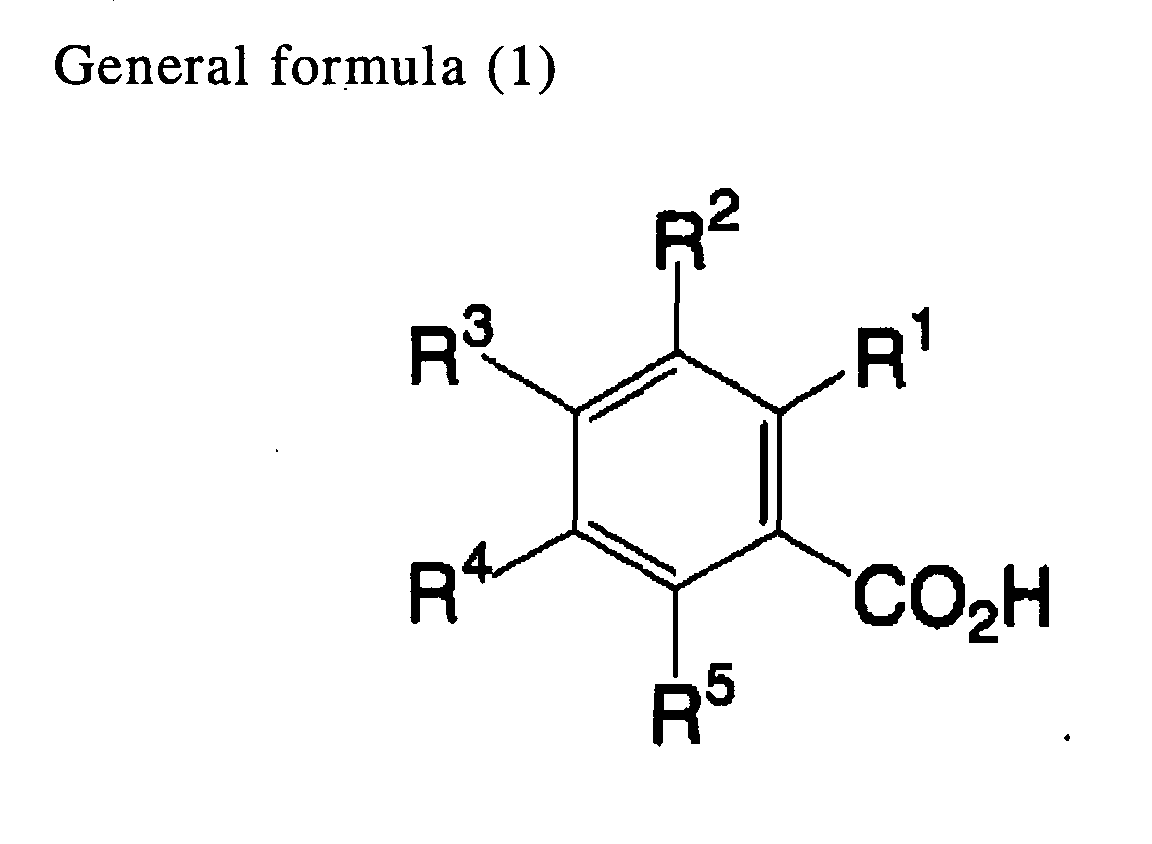
- An eighth aspect of the invention is the heat-sensitive recording material of the first aspect, wherein the developer includes a compound indicated by general formula (1) below: wherein R 1 represents a hydroxyl group or an amino group that may have a substituent; and each of R 2 , R 3 , R 4 and R 5 independently represents a hydrogen atom, a halogen atom, a hydroxyl group, an amino group that may have a substituent, an alkyl group, an aryl group, an alkoxy group, a carboxyl group, a carbonamide group, a sulfoneamide group, a nitro group, or a cyano group.
- R 1 represents a hydroxyl group or an amino group that may have a substituent
- each of R 2 , R 3 , R 4 and R 5 independently represents a hydrogen atom, a halogen atom, a hydroxyl group, an amino group that may have a substituent, an alkyl group, an aryl group, an alkoxy group, a
- a ninth aspect of the invention is the heat-sensitive recording material of the first aspect, wherein the developer includes at least one selected from the group consisting of a phenol derivative, a salicylic acid derivative, an aromatic carboxylic acid derivative, acid clay, bentonite, novolak resin, metal-treated novolak resin and a metal complex.
- a tenth aspect of the invention is the heat-sensitive recording material of the first aspect, wherein the content of the developer in the heat-sensitive layer is from 0.5 to 6g/m 2 .
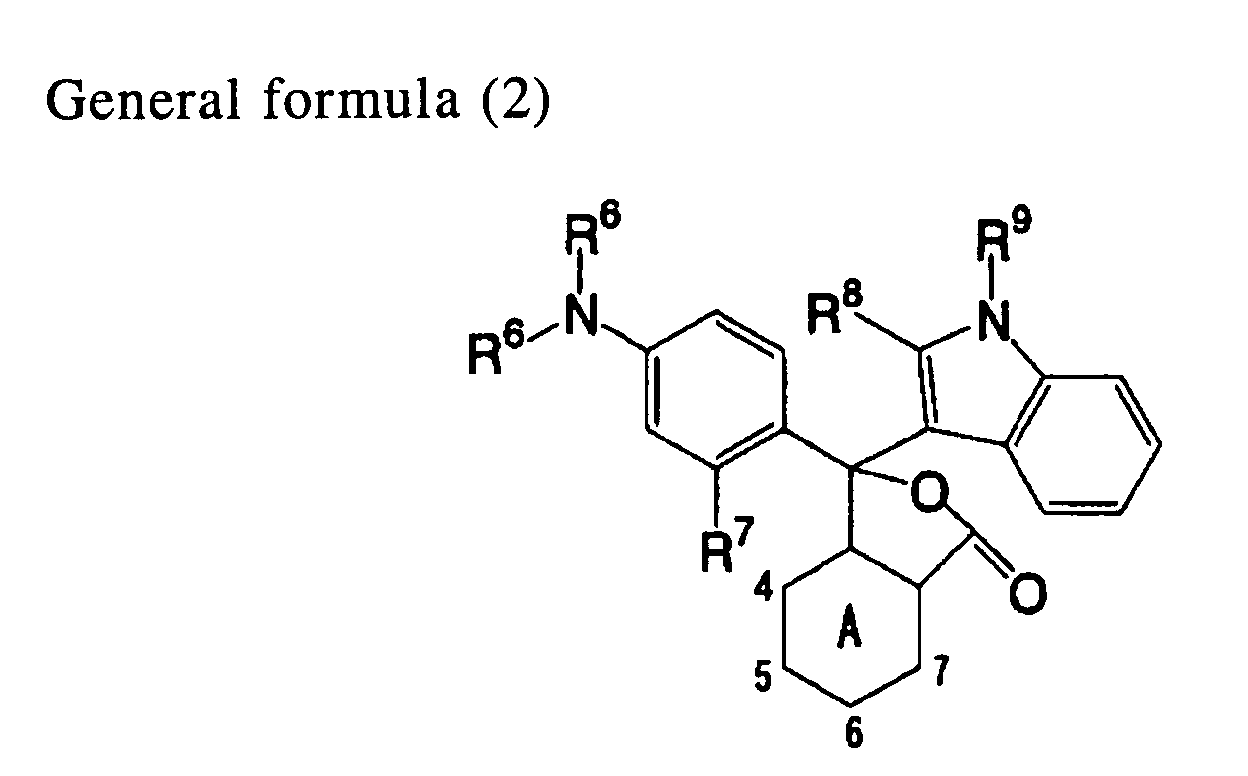
- An eleventh aspect of the invention is the heat-sensitive recording material of the first aspect, wherein the electron-donating dye precursor includes a compound indicated by general formula (2) below: wherein R 6 represents an alkyl group or an aryl group; R 7 represents a hydrogen atom, an alkyl group, an amino group that may have a substituent, or an alkoxy group; each of R 8 and R 9 independently represents a hydrogen atom or an alkyl group; and A represents a pyridine ring in which a nitrogen atom is located at the fourth and fifth positions or at the sixth and seventh positions, or a pyrazine ring in which a nitrogen atom is located at the fourth and seventh position.
- R 6 represents an alkyl group or an aryl group
- R 7 represents a hydrogen atom, an alkyl group, an amino group that may have a substituent, or an alkoxy group
- each of R 8 and R 9 independently represents a hydrogen atom or an alkyl group
- A represents a pyridine ring in which
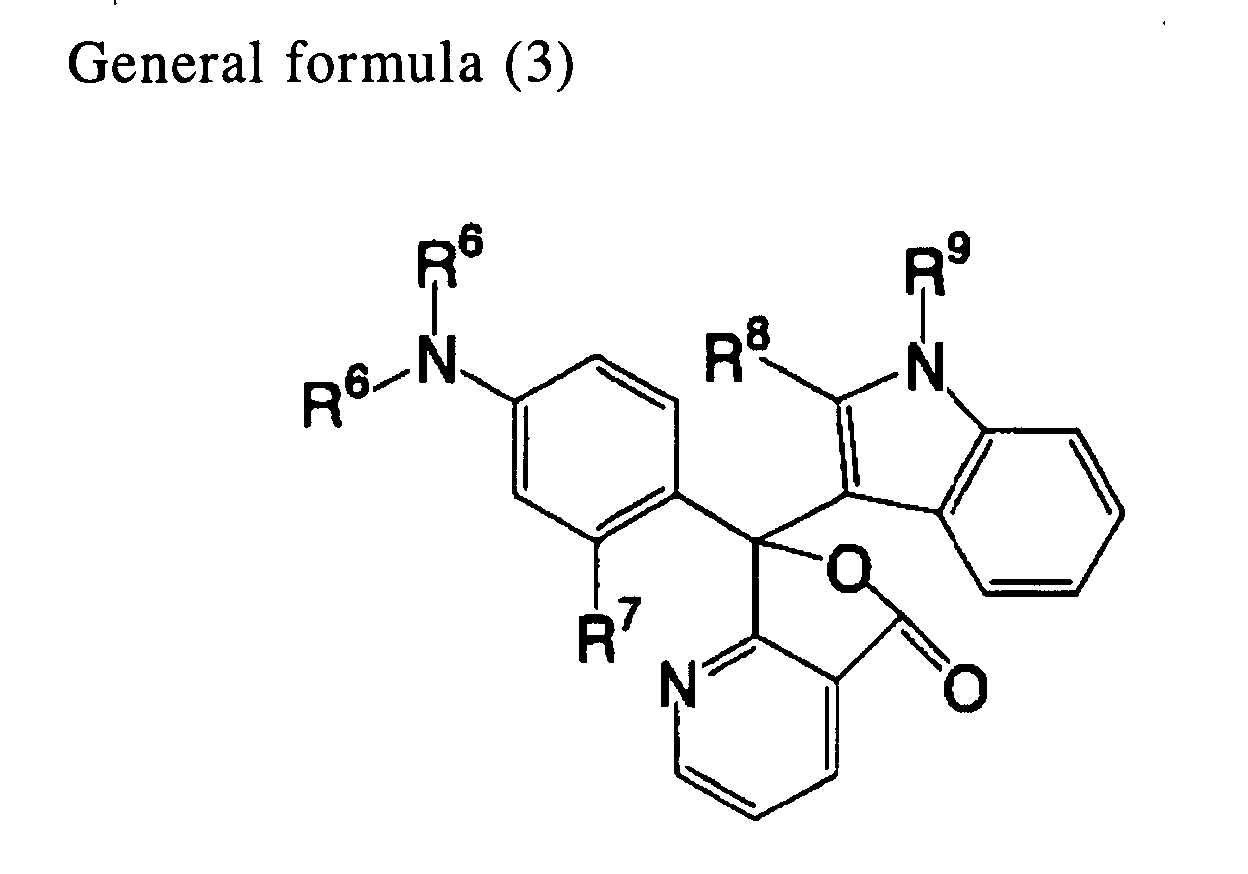
- a twelfth aspect of the invention is the heat-sensitive recording material of the eleventh aspect, wherein the compound indicated in general formula (2) is a compound indicated by general formula (3) below: wherein R 6 represents an alkyl group or an aryl group; R 7 represents a hydrogen atom, an alkyl group, an amino group that may have a substituent, or an alkoxy group; and each of R 8 and R 9 independently represents a hydrogen atom or an alkyl group.
- a thirteenth aspect of the invention is the heat-sensitive recording material of the first aspect, wherein the electron-donating dye precursor includes at least one selected from the group consisting of a triphenylmethanephthalide compound, a fluoran compound, a phenothiazine compound, an indolylphthalide compound, a leucoauramine compound, a rhodaminelactam compound, a triphenylmethane compound, a triazene compound, a spiropyran compound and a fluorene compound.
- the electron-donating dye precursor includes at least one selected from the group consisting of a triphenylmethanephthalide compound, a fluoran compound, a phenothiazine compound, an indolylphthalide compound, a leucoauramine compound, a rhodaminelactam compound, a triphenylmethane compound, a triazene compound, a spiropyran compound and a fluoren
- a fourteenth aspect of the invention is the heat-sensitive recording material of the first aspect, wherein the content of the electron-donating dye precursor in the heat-sensitive layer is from 0.05 to 1.0g/m 2 .
- a fifteenth aspect of the invention is the heat-sensitive recording material of the first aspect, wherein walls of the microcapsules are formed of at least one polymer compound selected from the group consisting of polyurethane and polyurea.
- a sixteenth aspect of the invention is the heat-sensitive recording material of the first aspect, further comprising an ultraviolet absorbent that includes at least one selected from the group consisting of cinnamic acid derivatives, benzophenone derivatives and benzotriazolil phenol derivatives.
- a seventeenth aspect of the invention is the heat-sensitive recording material of the sixteenth aspect, wherein the added amount of the ultraviolet absorbent is from 0.05 to 1.0 g/m 2 .
- An eighteenth aspect of the invention is the heat-sensitive recording material of the first aspect, further comprising a protective layer disposed on the heat-sensitive layer.
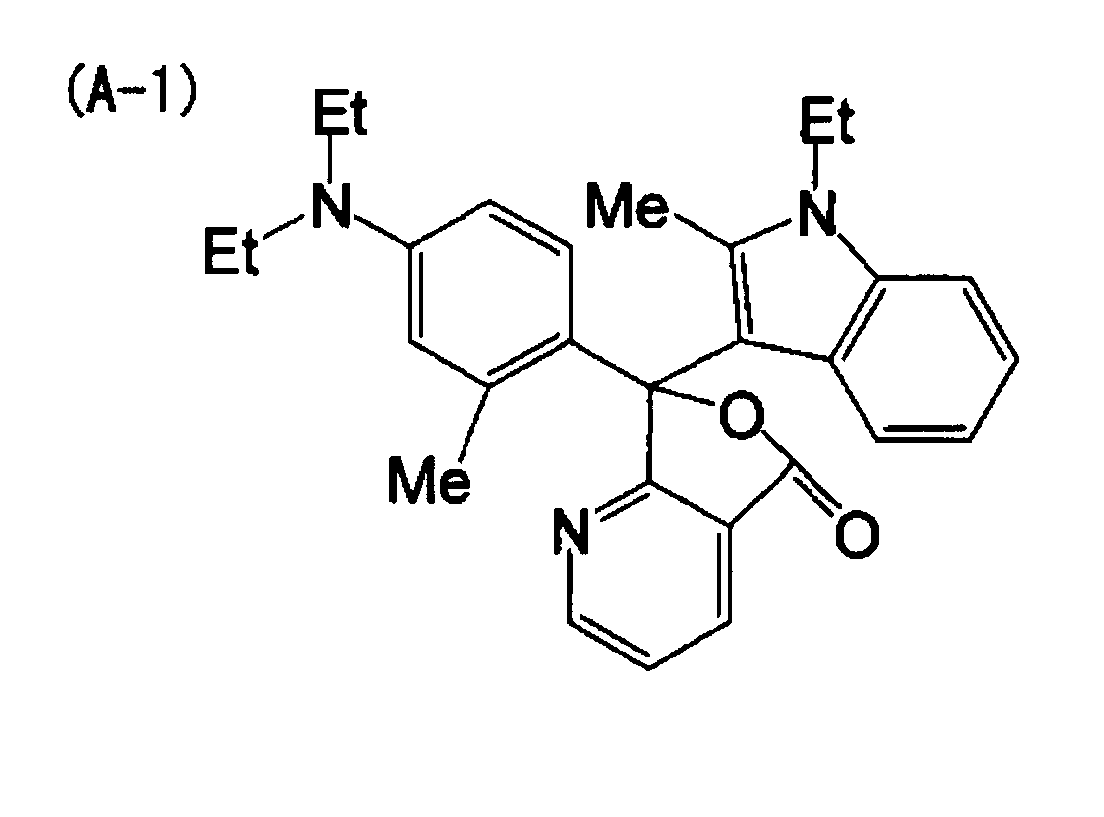
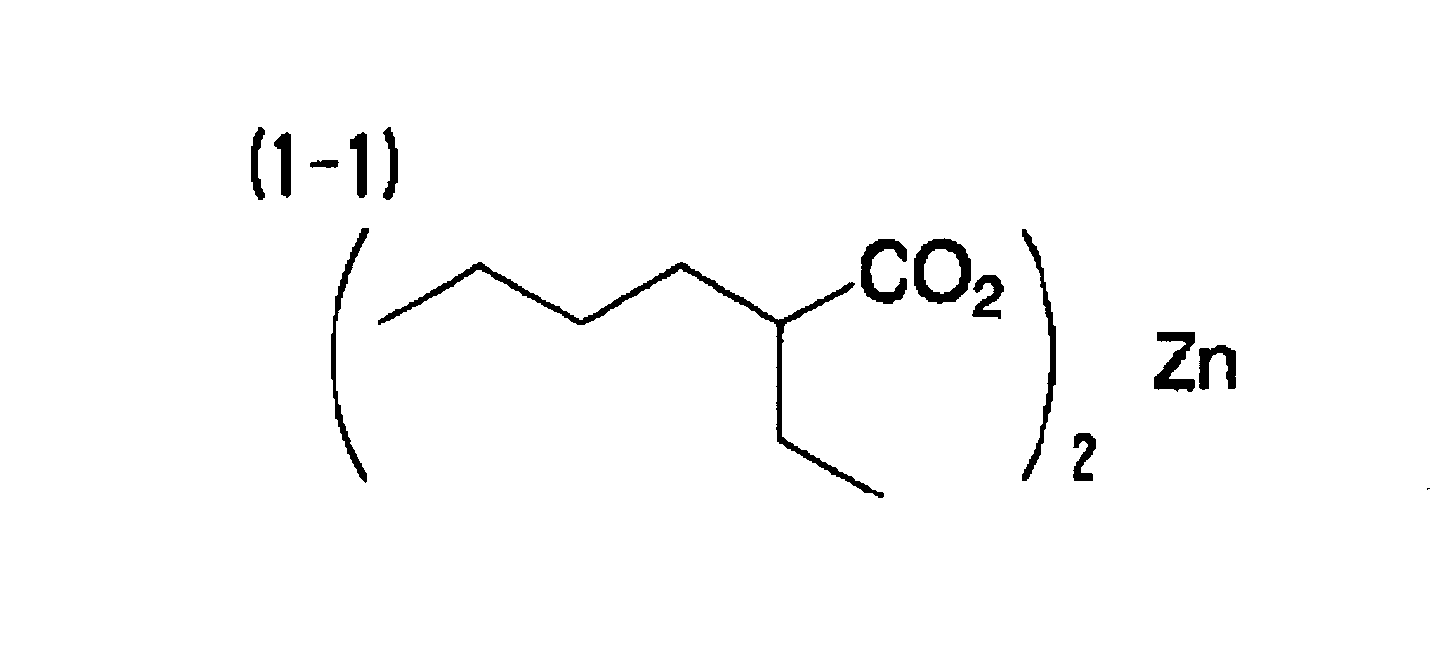
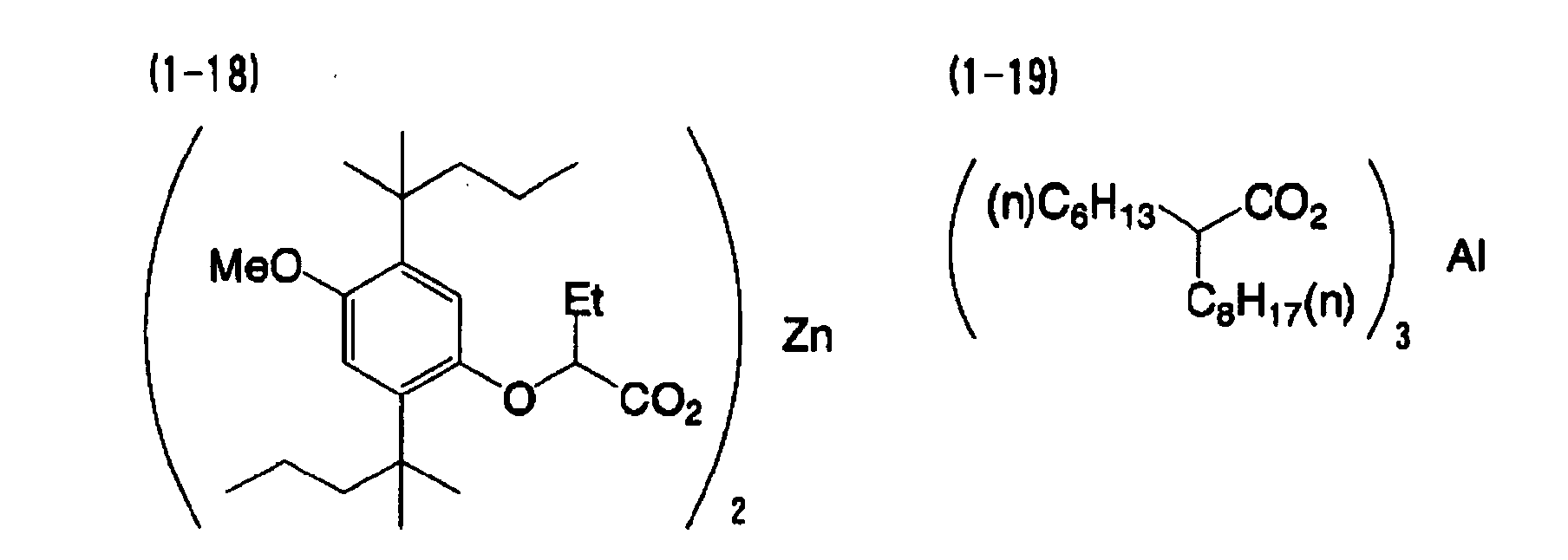
- a nineteenth aspect of the invention is the heat-sensitive recording material of the first aspect, wherein the electron-donating dye precursor includes at least a compound indicated by (A-1) below, the developer includes at least one compound indicated by (B-1) and (B-2) below, and the metal compound includes at least one selected from the group consisting of (1-1), (1-12), (1-13), (1-18) and (1-21) below.
- a heat-sensitive recording material of the present invention comprises a support having disposed thereon a heat-sensitive layer including microcapsules, which contain an achromic or hypochromic electron-donating dye precursor, and a developer, wherein the microcapsules contain at least one metal compound.
- the metal compound is preferably at least one of a metal compound of aliphatic carboxylic acid and a metal compound of 1,3-diketone.
- the aliphatic carboxylic acid may have a straight-chain structure or branched-chain structure, and preferably includes 2 to 40 carbon atoms and more preferably 6 to 25 carbon atoms. It may also have a substituent. Examples of the substituent include a phenyl group, a naphthyl group, a biphenyl group, an alkoxy group, an aryloxy group, and a halogen atom.
- 1,3-diketone examples include 2,4-pentadione, 3,5-heptadione, 2,2,6,6-tetramethylheptadione, 4,6-nonadione; 7,9-pentadecadione, 2,4-dimethyl-7,9-pentadecadione, 2-acetylcyclopentanone, 2-acetylcyclohexanone, 3-methyl-2,4-pentadione, 3-(2-ethylhexyl)2,4-pentadione, and 3-[4-(2-ethylhexyloxy)benzyl]-2,4-pentadione.
- 2,4-pentadione, 7,9-pentadecadione, and 3-[4-(2-ethylhexyloxy)benzyl]-2,4-pentadione are preferable.
- the metal of the metal compound is preferably one selected from the group consisting of zinc, aluminum, calcium, magnesium, iron, cobalt, nickel and copper. Among these, zinc, aluminum and nickel are preferable, and zinc is particularly preferable.
- the content of the metal compound in the heat-sensitive layer is preferably from 10 to 500 % by mass, and more preferably from 50 to 300 % by mass, with respect to the content of the electron-donating dye precursor.
- R 1 represents a hydroxyl group or an amino group that may have a substituent
- each of R 2 , R 3 , R 4 and R 5 independently represents a hydrogen atom, a halogen atom, a hydroxyl group, an amino group that may have a substituent, an alkyl group, an aryl group, an alkoxy group, a carboxyl group, a carbonamide group, a sulfoneamide group, a nitro group, or a cyano group.
- examples of the substituent include an acetyl group, a propanoyl group, an n-butanoyl group, an i-butanoyl group, a pivaloyl group, a 2-ethylhexanoyl group, a benzolyl group, a methoxycarbonyl group, an ethoxycarbonyl group, an n-propyloxycarbonyl group, a 2-ethylhexyloxycarbonyl group, a phenoxycarbonyl group, a methylaminocarbonyl group, an ethylaminocarbonyl group, an n-propylaminocarbonyl group, a 2-ethylhexylaminocarbonyl group, a phenylaminocarbonyl group, a dimethylaminocarbonyl group, a diethylaminocarbonyl group, a phenylthiocarbon
- the alkyl group represented by each of R 2 , R 3 , R 4 and R 5 may have straight-chain structure or branched-chain structure and preferably includes 1 to 12 carbon atoms.
- Examples of the alkoxy group represented by each of R 2 , R 3 , R 4 and R 5 include a methoxy group, an ethoxy group, an n-propyloxy group, an i-propyloxy group, an n-butoxy group, an i-butoxy group, an s-butoxy group, a t-butoxy group, an n-hexyloxy group, a 2-ethylhexyloxy group, an n-octyloxy group, an n-decileoxy group, an n-dodecyloxy group, a phenoxyethoxyoxyoxy group, and a p-methoxyphenoxyethyloxy group.
- a methoxy group, an ethoxy group, a 2-ethylhexyloxy group and a p-methoxyphenoxyethyloxy group are preferable.
- examples of the substituent include the same substituents of the amino group represented by R 1 .
- the alkyl group represented by each of R 2 , R 3 , R 4 and R 5 may have straight-chain structure or branched-chain structure and preferably has 1 to 12 carbon atoms.
- Some of these examples include 4-tertiarybutyl phenol, 4-phenyl phenol, 2,2'-dihydroxybiphenyl, 2,2-bis(4-hydroxyphenyl) propane (bisphenol A), 4,4'-sec-butylidene diphenol, 4,4'-cyclohexyliden diphenol, 4-hydroxyphenyl-3',4'dimethylphenyl sulfone, 4-(4-isopropoxyphenylsulfonyl) phenol, 4,4'-dihydroxydiphenyl sulfide, 1,4-bis-(4'-hydroxycumyl) benzene, 1,3-bis-(4'-hydroxycumyl) benzene, 4,4'-thiobis (6-tert-butyl-3-methyl phenol), 4-hydroxybenzylbenzoate ester, 3,5-di-tert-butyl salicylic acid, 3-phenyl-5-( ⁇ , ⁇ -dimethylbenzyl) salicylic acid, 3-cumy
- the content of the developer in the heat-sensitive layer is preferably from 0.5 to 6 g/m 2 and more preferably from 1 to 5 g/m 2 .
- R 6 represents an alkyl group or an aryl group
- R 7 represents a hydrogen atom, an alkyl group, an amino group that may have a substituent, or an alkoxy group
- each of R 8 and R 9 independently represents a hydrogen atom or an alkyl group
- A represents a pyridine ring in which a nitrogen atom is located at the fourth and fifth positions or at the sixth and seventh positions, or a pyrazine ring in which a nitrogen atom is located at the fourth and seventh position.
- the alkyl group represented by R 6 may have straight-chain structure or branched-chain structure and preferably includes 1 to 12 carbon atoms.
- the alkyl group represented by R 7 may have straight-chain structure or branched-chain structure and preferably includes 1 to 12 carbon atoms.
- substituents include acetyl, propanoyl, trifluoroacetyl, benzoyl, methoxycarbonyl, ethoxycarbonyl, phenoxycarbonyl, methylaminocarbonyl, ethylaminocarbonyl, phenylaminocarbonyl, dimethylaminocarbonyl, diethylaminocarbonyl, metansulfonyl and benzenesulfonyl.
- the alkyl group represented by R 8 and R 9 may include straight-chain structure or branched-chain structure and preferably includes 1 to 12 carbon atoms.
- R 6 represents an alkyl group or an aryl group
- R 7 represents a hydrogen atom, an alkyl group, an amino group that may have a substituent, or an alkoxy group
- each of R 8 and R 9 independently represents a hydrogen atom or an alkyl group.
- R 6 , R 7 and R 8 are synonymous with R 6 , R 7 and R 8 in general formula (2).
- various conventionally known compounds can be utilized as the electron-donating dye precursor, such as triphenylmethane phthalide compounds, fluoran compounds, phenothiazine compounds, indolylphthalide compounds, leucoauramine compounds, rhodaminelactam compounds, triphenylmethane compounds, triazene compounds, spiropyran compounds and the fluorene compounds.
- phthalide compounds are described in U.S. Reissued Patent No. 23024, and in U.S. Patent Nos. 3491111, 3491112, 3491116 and 3509174.
- fluorine compounds are described in U.S. Patent Nos.
- Examples of specific compounds include 3-(2-methyl-4-diethylaminophenyl)-3-(1-ethyl-2-methylindole-3-yl)-4-azaphthalide, 3-(2-methyl-4-dinormalhexylaminophenyl)-3-(1-normalocthyl-2-methylindole-3-yl)-4, 7-diazaphthalide, 3,3-bis (2-ethoxy-4-diethylaminophenyl)-4-azaphthalide, 3,3-bis(1-normalocthyl-2-methylindole-3-yl)-4-azaphthalide, 3-(2-ethoxy-4-diethylaminophenyl)-3-(1-ethyl-2-methylindole-3-yl)-4-azaphthalide, 3-(2-ethoxy-4-diethylaminophenyl)-3-(1-normalocthyl-2-methylindole-3-yl)-phthalide, 3,3-bis(1
- the content of the electron-donating dye precursor in the heat-sensitive layer is preferably from 0.05 to 1.0 g/m 2 and more preferably from 0.1 to 0.5 g/m 2 .
- the electron-donating dye precursor of the invention is used after being microencapsulated with the metal compound, and the developer of the invention is used after being solid-dispersed or emulsion-dispersed.
- the solid dispersion, emulsion dispersion and microencapsulation can be performed by known methods.
- interfacial polymerization a coloring component A is dissolved or dispersed in a hydrophobic organic solvent that becomes the core of the capsules, to thereby prepare an oil phase.
- the prepared oil phase is mixed with an aqueous phase in which a water-soluble polymer has been dissolved, and the mixture is emulsion-dispersed by means such as a homogenizer. Thereafter, a polymer-forming reaction is caused at oil drop interfaces by heating, whereby microcapsule walls of a polymer substance are formed.
- This method makes it possible to form capsules having a uniform particle diameter within a short period of time, resulting in a recording material that has excellent storage stability.
- the microcapsules containing the electron-donating dye precursor and the metal compound include substantially no solvent and are produced in the following manner.
- a solution is prepared by dissolving, in a non-aqueous solvent having a boiling point of 40°C to 95°C at normal pressure, the electron-donating dye precursor and similar or different compounds that mutually react to generate a polymer substance.
- the temperature of the system is increased while reducing the pressure of the reaction chamber, and the wall-forming substance is moved to the surfaces of the oil drops while removing the solvent.
- Wall films are formed by advancing a polymer-generating reaction resulting from polycondensation and polyaddition at the surfaces of the oil drops.
- the non-aqueous solvent for dissolving the electron-donating dye precursor is preferably at least one compound selected from halogenated hydrocarbon, aliphatic acid ester, ketone and ether.
- the polymer substance that forms the walls of the microcapsules is preferably formed from at least one selected from polyurethane and polyurea. These polymer substances are respectively produced from aromatic or aliphatic isocyanate compounds as a corresponding monomer.
- the microcapsules containing the electron-donating dye precursor in the invention can be obtained by polymerizing the corresponding monomer. The amount of the monomer used is determined so as to produce microcapsules with an average diameter of from 0.3 to 12 ⁇ m and a wall thickness of from 0.01 to 0.3 ⁇ m.
- An ultraviolet absorbent may be added to the heat-sensitive recording material of the invention in order to improve stability with respect to light.
- examples thereof include cinnamic acid derivatives, benzophenone derivatives, and benzotriazolil phenol derivatives. Specific examples include ⁇ -cyano- ⁇ -phenyl butyl cinnamate, o-benzotriazol phenol, o-benzotriazol-p-chloro phenol, o-benzotriazol-2,4-di-t-butyl phenol, and o-benzotriazol-2,4-di-t-octyl phenol.
- phenol derivatives in which one or more of at least the 2nd or 6th position is substituted with a branched alkyl group is preferable.
- These ultraviolet absorbents can be utilized by being solid-dispersed, emulsion-dispersed or microencapsulated.
- the amount of the ultraviolet absorbent used is preferably 0.05 to 1.0 g/m 2 and more preferably from 0.1 to 0.4 g/m 2 .
- water-soluble polymer compounds and latexes can be used as the binder in the heat-sensitive recording material of the invention.
- water-soluble polymer compounds include methylcellulose, carboxymethylcellulose, hydroxymethylcellulose, starch, gelatin, gum arabic, casein, styrene-maleic anhydride copolymer hydrolyzed material, ethylene-maleic anhydride copolymer hydrolyzed material, polyvinyl alcohol, polyacrylamide, and modified materials thereof.
- latexes include styrene-butadiene rubber latex, acrylic nitrile-butadiene rubber latex, methyl acrylate-butadiene rubber latex, and vinyl acetate emulsion. The amount of these materials used is preferably from 0.4 to 5 g/m 2 and more preferably from 0.8 to 1.6 g/m 2 .
- pigments can be used as the pigment in the heat-sensitive recording material of the invention, regardless of whether the pigment is organic or inorganic.
- Specific examples include kaolin, calcined kaolin, talc, agalmatolite, silious earth, calcium carbonate, aluminum hydroxide, magnesium hydroxide, zinc oxide, lithopone, amorphous silica, colloidal silica, calcined gypsum, silica, magnesium carbonate, titanium oxide, alumina, barium carbonate, barium sulfate, mica, micro balloon, urea formalin filler, polyester particles, and cellulose filler.
- additives can be used as needed in the heat-sensitive recording material of the invention, such as known waxes, antistatic agents, antifoaming agents, conductive materials, fluorescent dyes, surfactants, and ultraviolet absorbent precursors.
- a protective layer may be disposed as needed on the surface of the heat-sensitive layer of the heat-sensitive recording material of the invention.
- the protective layer may comprise two or more layers as needed.
- materials used for the protective layer include water-soluble polymer compounds such as polyvinyl alcohol, carboxy-modified polyvinyl alcohol, vinyl acetate-acrylamide copolymer, silicon-modified polyvinyl alcohol, starch, modified starch, methyl cellulose, carboxy methyl cellulose, hydroxymethyl cellulose, gelatins, gum arabic, casein, hydrolyzed styrene-maleic acid copolymer, hydrolyzed styrene-maleic acid copolymer half ester, hydrolyzed isobutylene-maleic anhydride copolymer, polyacrylamide derivatives, polyvinyl pyrrolidone, polystyrene sodium sulfonate, sodium alginate; and latexes such as styrene-butadiene rubber latex,
- Storage stability can be further improved by cross-linking the water-soluble polymer compound of the protective layer, and known cross-linking agents can be used.
- known cross-linking agents include water-soluble initial condensation materials such as N-methylol urea, N-methylol melamine and urea-formalin; dialdehyde compounds such as glyoxal and glutaric aldehyde; inorganic cross-linking agents such as boric acid and borax; and polyamide epichlorohydrin.
- the protective layer may also contain known pigments, metal soaps, waxes, and surfactants.
- the coating amount of the protective layer is preferably from 0.2 to 5 g/m 2 and more preferably from 0.5 to 2 g/m 2 .
- the thickness of the protective layer is preferably from 0.2 to 5 ⁇ m and more preferably from 0.5 to 2 ⁇ m.
- the heat-sensitive recording material of the invention may include an ultraviolet absorbent or an ultraviolet absorbent precursor in the protective layer.
- acid paper, acid-free paper, coated paper, plastic film laminated paper, synthetic paper, and plastic film can be used as the support usable in the heat-sensitive recording material of the invention.
- a known undercoat layer may also be disposed on the support. The undercoat layer can be formed in the same manner as the protective layer.
- a backcoat layer may be disposed in order to adjust the curl balance of the support or to improve resistance to chemicals from the back surface. It is also possible to combine a stripping paper with the backcoat layer on the back surface via an adhesive agent layer, resulting in a label.
- the backcoat layer can be formed in the same manner as the protective layer.
- the heat-sensitive recording material is described in detail in JP-B No. 59-53193 and in JP-A Nos. 59-197463 and 62-114989.
- a known sensitizing agent can be contained in the heat-sensitive layer.
- examples thereof include aromatic ether, thioether, ester and/or aliphatic amide or ureide. These examples are described in detail in JP-A Nos. 58-57989, 58-87094, 61-58789, 62-109681, 62-132674, 63-151478 and 63-235961.
- the amount used is preferably from 1 to 10 g/m 2 and more preferably from 2 to 4 g/m 2 .
- the electron-donating dye precursor capsule solution and the developer dispersion solution were mixed so that the molar ratio of the electron-donating dye precursor with respect to the developer was 1/15, whereby a target coating solution was prepared.
- the coating solution was coated with a Mayer's bar onto a polyethylene terephthalate support of 75 ⁇ m in thickness and dried to obtain a target heat-sensitive recording material.
- a heat-sensitive recording material was obtained in the same manner as in Example 1, except that the metal compound (1-1) was replaced with the exemplary compound (1-12).
- a heat-sensitive recording material was obtained in the same manner as in Example 1, except that the metal compound (1-1) was replaced with the exemplary compound (1-13).
- a heat-sensitive recording material was obtained in the same manner as in Example 1, except that the metal compound (1-1) was replaced with the exemplary compound (1-18).
- a heat-sensitive recording material was obtained in the same manner as in Example 1, except that the metal compound (1-1) was replaced with the exemplary compound (1-21).
- a heat-sensitive recording material was obtained in the same manner as in Example 1, except that the metal compound (1-1) was replaced with the exemplary compound (1-12) and the developer was replaced with the following compound (B-2).
- a heat-sensitive recording material was obtained in the same manner as in Example 6, except that the metal compound (1-12) was replaced with the exemplary compound (1-21).
- a heat-sensitive recording material was obtained in the same manner as in Example 1, except that the metal compound was not used.
- a heat-sensitive recording material was obtained in the same manner as in Example 1, except that the metal compound was not used and the developer (B-1) was replaced with the following compound (B-3).
- Image density D0 in respective color-developed areas was measured with a Macbeth densitometer. The results are shown in Table 1. The higher the value of D0 is, the higher sensitivity of the heat-sensitive recording paper was.
- Image density D1 was measured with a Macbeth reflection densitometer after irradiating, using a xenon fademeter (FAL-25AX-HC, manufactured by Suga Test Instruments Co., Ltd.), with light for 48 hours an image area obtained by printing.
- Example 1 (A-1) (B-1) (1-1) 1.41 75
- Example 2 (A-1) (B-1) (1-12) 1.48
- Example 3 (A-1) (B-1) (1-13) 1.52 78
- Example 4 (A-1) (B-1) (1-18) 1.47
- Example 5 (A-1) (B-1) (1-21) 1.56
- Example 6 (A-1) (B-2) (1-12) 1.35
- Example 7 (A-1) (B-2) (1-21) 1.43 75 Comp. Ex. 1 (A-1) (B-1) - 1.05 45 Comp. Ex. 2 (A-1) (B-3) - 0.45 70
- a heat-sensitive recording material that has excellent color developing properties, and excellent fastness and resistance to light and heat in image areas can be provided.
Landscapes
- Chemical & Material Sciences (AREA)
- Inorganic Chemistry (AREA)
- Chemical Kinetics & Catalysis (AREA)
- General Chemical & Material Sciences (AREA)
- Physics & Mathematics (AREA)
- Optics & Photonics (AREA)
- Heat Sensitive Colour Forming Recording (AREA)
Abstract
Description
- The present invention relates to a heat-sensitive recording material using an electron-donating dye precursor contained in microcapsules and to a developer.
- Heat-sensitive recording has developed in recent years because recording apparatus therefor are simple, highly reliable, and maintenance-free. Heat-sensitive recording materials that utilize the reaction between an electron-donating achromic dye and an electron-receiving compound, and heat-sensitive recording materials that utilize the reaction between a diazo salt compound and a coupler, are widely known. Extensive research has been conducted in recent years with respect to improving properties of heat-sensitive recording materials, such as (1) color development density and color development sensitivity and (2) chromogenic fastness. However, heat-sensitive recording materials have several drawbacks in terms of storage stability (resistance to heat and to light) in image areas and in non-image areas. Although various methods have been proposed to improve storage stability in image areas and in non-image areas, it is not always the case that sufficient effects are obtained.
- The present invention has been devised in consideration of the aforementioned conventional problems, and attempts to achieve the following object. It is an object of the invention to provide a heat-sensitive recording material that has excellent color developing properties, and excellent fastness and resistance to light and heat in image areas.
- This object is achieved by the following means.
- A first aspect of the invention is a heat-sensitive recording material comprising a support having disposed thereon a heat-sensitive layer including microcapsules, which contain an achromic or a hypochromic electron-donating dye precursor, and a developer, wherein the microcapsules contain at least one metal compound.
- A second aspect of the invention is the heat-sensitive recording material of the first aspect, wherein the metal compound includes at least one of a metal compound of aliphatic carboxylic acid and a metal compound of 1,3-diketone.
- A third aspect of the invention is the heat-sensitive recording material of the second aspect, wherein the metal compound of aliphatic carboxylic acid includes 2 to 40 carbon atoms, and has a straight-chain structure or a branched-chain structure.
- A fourth aspect of the invention is the heat-sensitive recording material of the second aspect, wherein the metal compound of 1,3-diketone is at least one selected from the group consisting of 2,4-pentadione, 3,5-heptadione, 2,2,6,6-tetramethylheptadione, 4,6-nonadione, 7,9-pentadecadione, 2,4-dimethyl-7,9-pentadecadione, 2-acetylcyclopentanone, 2-acetylcyclohexanone, 3-methyl-2,4-pentadione, 3-(2-ethylhexyl)2,4-pentadione and 3-[4-(2-ethylhexyloxy)benzyl]-2,4-pentadione.
- A fifth aspect of the invention is the heat-sensitive recording material of the first aspect, wherein the metal of the metal compound is at least one selected from the group consisting of zinc, aluminum, calcium, magnesium, iron, cobalt, nickel and copper.
- A sixth aspect of the invention is the heat-sensitive recording material of the first aspect, wherein the metal of the metal compound is zinc.
- A seventh aspect of the invention is the heat-sensitive recording material of the first aspect, wherein the content of the metal compound in the heat-sensitive layer is from 10 to 500 % by mass relative to the electron-donating dye precursor.
- An eighth aspect of the invention is the heat-sensitive recording material of the first aspect, wherein the developer includes a compound indicated by general formula (1) below:wherein R1 represents a hydroxyl group or an amino group that may have a substituent; and each of R2, R3, R4 and R5 independently represents a hydrogen atom, a halogen atom, a hydroxyl group, an amino group that may have a substituent, an alkyl group, an aryl group, an alkoxy group, a carboxyl group, a carbonamide group, a sulfoneamide group, a nitro group, or a cyano group.
- A ninth aspect of the invention is the heat-sensitive recording material of the first aspect, wherein the developer includes at least one selected from the group consisting of a phenol derivative, a salicylic acid derivative, an aromatic carboxylic acid derivative, acid clay, bentonite, novolak resin, metal-treated novolak resin and a metal complex.
- A tenth aspect of the invention is the heat-sensitive recording material of the first aspect, wherein the content of the developer in the heat-sensitive layer is from 0.5 to 6g/m2.
- An eleventh aspect of the invention is the heat-sensitive recording material of the first aspect, wherein the electron-donating dye precursor includes a compound indicated by general formula (2) below:wherein R6 represents an alkyl group or an aryl group; R7 represents a hydrogen atom, an alkyl group, an amino group that may have a substituent, or an alkoxy group; each of R8 and R9 independently represents a hydrogen atom or an alkyl group; and A represents a pyridine ring in which a nitrogen atom is located at the fourth and fifth positions or at the sixth and seventh positions, or a pyrazine ring in which a nitrogen atom is located at the fourth and seventh position.
- A twelfth aspect of the invention is the heat-sensitive recording material of the eleventh aspect, wherein the compound indicated in general formula (2) is a compound indicated by general formula (3) below:wherein R6 represents an alkyl group or an aryl group; R7 represents a hydrogen atom, an alkyl group, an amino group that may have a substituent, or an alkoxy group; and each of R8 and R9 independently represents a hydrogen atom or an alkyl group.
- A thirteenth aspect of the invention is the heat-sensitive recording material of the first aspect, wherein the electron-donating dye precursor includes at least one selected from the group consisting of a triphenylmethanephthalide compound, a fluoran compound, a phenothiazine compound, an indolylphthalide compound, a leucoauramine compound, a rhodaminelactam compound, a triphenylmethane compound, a triazene compound, a spiropyran compound and a fluorene compound.
- A fourteenth aspect of the invention is the heat-sensitive recording material of the first aspect, wherein the content of the electron-donating dye precursor in the heat-sensitive layer is from 0.05 to 1.0g/m2.
- A fifteenth aspect of the invention is the heat-sensitive recording material of the first aspect, wherein walls of the microcapsules are formed of at least one polymer compound selected from the group consisting of polyurethane and polyurea.
- A sixteenth aspect of the invention is the heat-sensitive recording material of the first aspect, further comprising an ultraviolet absorbent that includes at least one selected from the group consisting of cinnamic acid derivatives, benzophenone derivatives and benzotriazolil phenol derivatives.
- A seventeenth aspect of the invention is the heat-sensitive recording material of the sixteenth aspect, wherein the added amount of the ultraviolet absorbent is from 0.05 to 1.0 g/m2.
- An eighteenth aspect of the invention is the heat-sensitive recording material of the first aspect, further comprising a protective layer disposed on the heat-sensitive layer.
- A nineteenth aspect of the invention is the heat-sensitive recording material of the first aspect, wherein the electron-donating dye precursor includes at least a compound indicated by (A-1) below, the developer includes at least one compound indicated by (B-1) and (B-2) below, and the metal compound includes at least one selected from the group consisting of (1-1), (1-12), (1-13), (1-18) and (1-21) below.
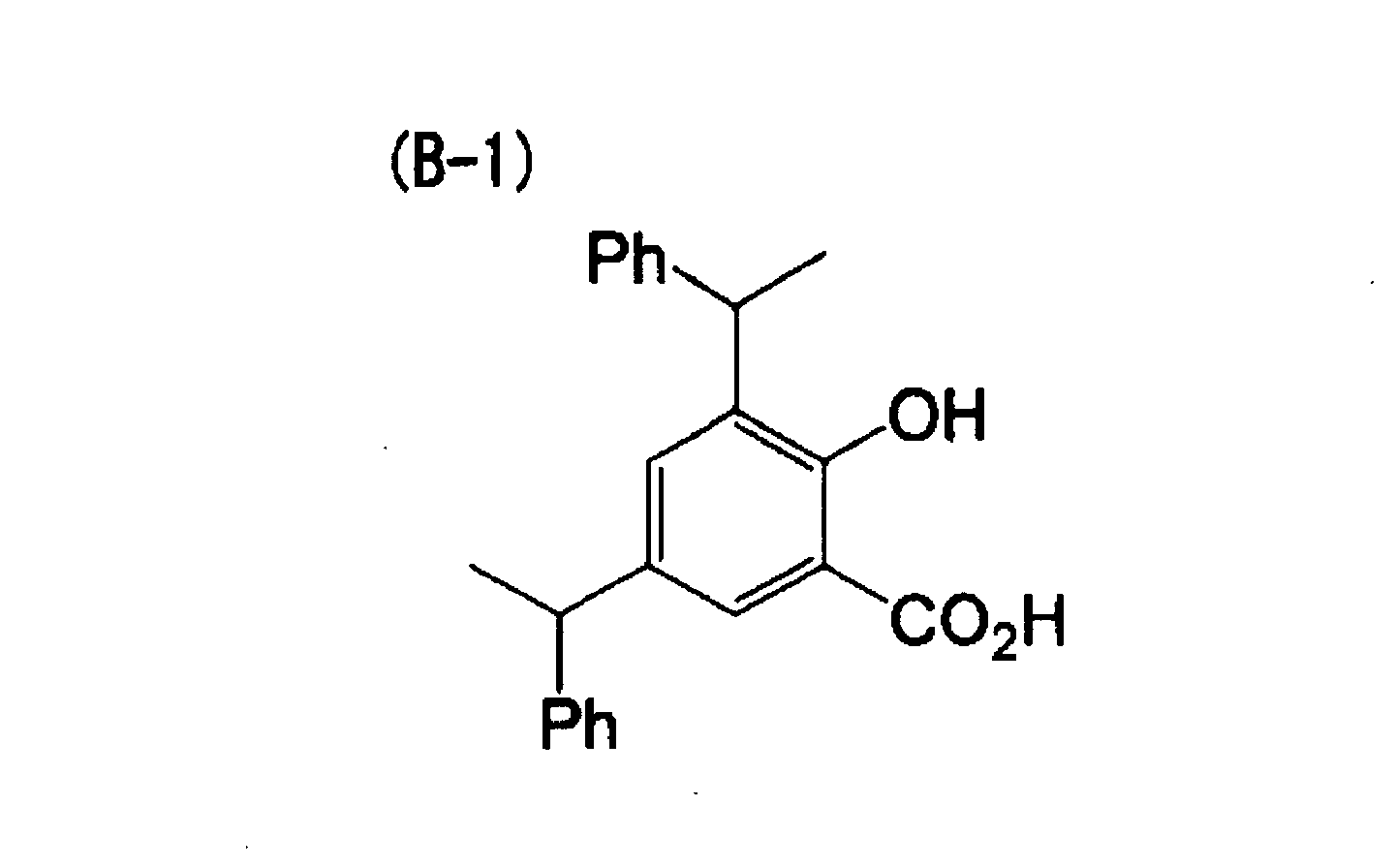
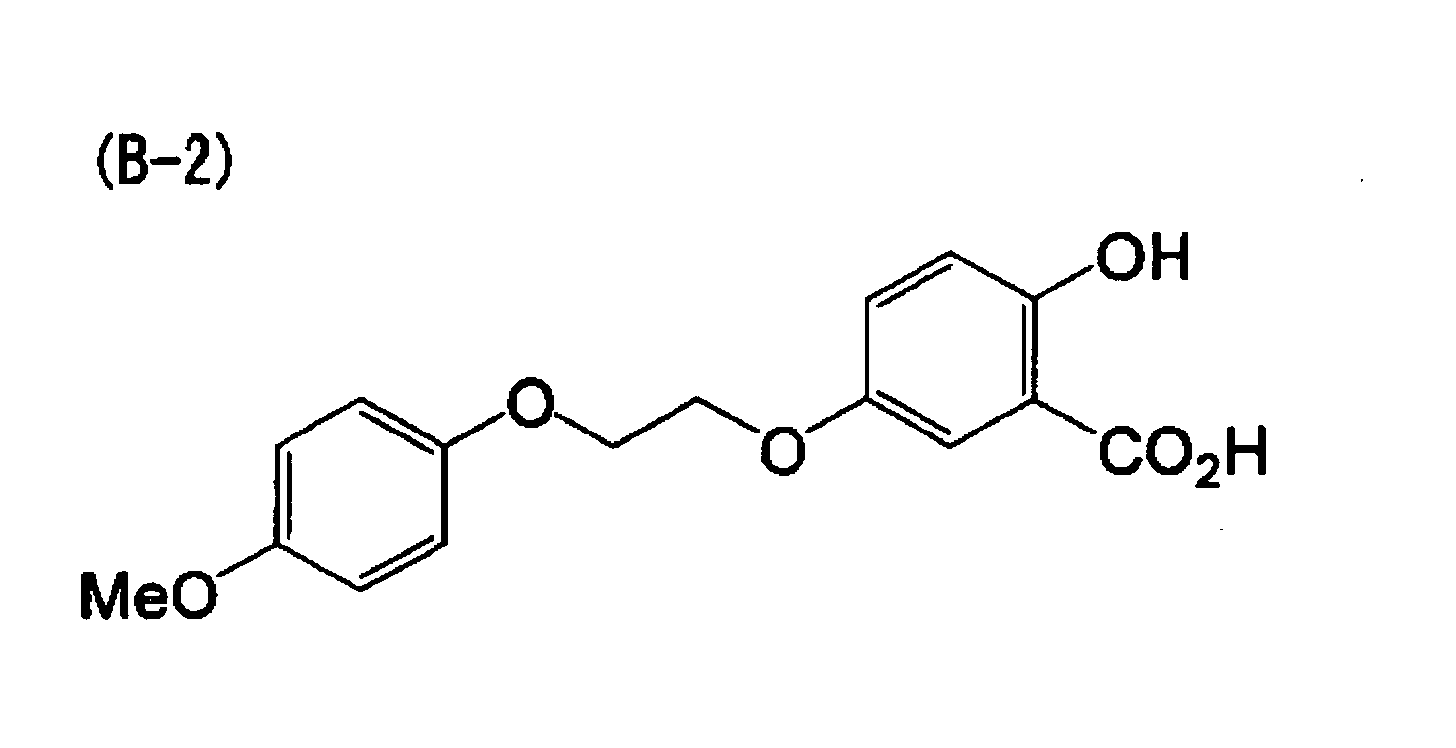


- A heat-sensitive recording material of the present invention comprises a support having disposed thereon a heat-sensitive layer including microcapsules, which contain an achromic or hypochromic electron-donating dye precursor, and a developer, wherein the microcapsules contain at least one metal compound.
- The metal compound is preferably at least one of a metal compound of aliphatic carboxylic acid and a metal compound of 1,3-diketone.
- The aliphatic carboxylic acid may have a straight-chain structure or branched-chain structure, and preferably includes 2 to 40 carbon atoms and more preferably 6 to 25 carbon atoms. It may also have a substituent. Examples of the substituent include a phenyl group, a naphthyl group, a biphenyl group, an alkoxy group, an aryloxy group, and a halogen atom.
- Examples of the 1,3-diketone include 2,4-pentadione, 3,5-heptadione, 2,2,6,6-tetramethylheptadione, 4,6-nonadione; 7,9-pentadecadione, 2,4-dimethyl-7,9-pentadecadione, 2-acetylcyclopentanone, 2-acetylcyclohexanone, 3-methyl-2,4-pentadione, 3-(2-ethylhexyl)2,4-pentadione, and 3-[4-(2-ethylhexyloxy)benzyl]-2,4-pentadione. Among these, 2,4-pentadione, 7,9-pentadecadione, and 3-[4-(2-ethylhexyloxy)benzyl]-2,4-pentadione are preferable.
- The metal of the metal compound is preferably one selected from the group consisting of zinc, aluminum, calcium, magnesium, iron, cobalt, nickel and copper. Among these, zinc, aluminum and nickel are preferable, and zinc is particularly preferable.
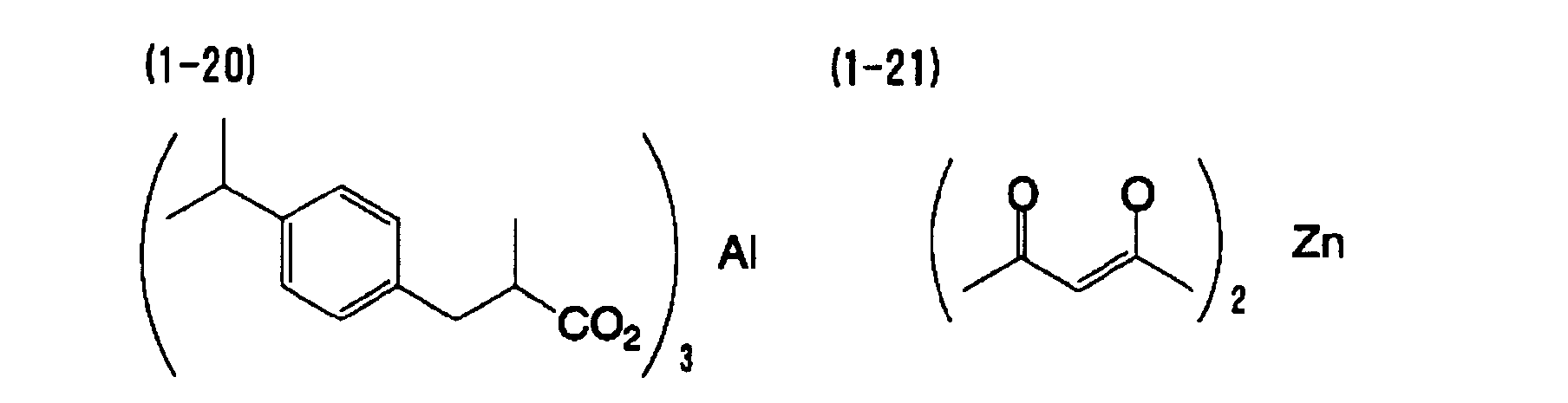
- Specific examples of the metal compound (exemplary compounds 1-1 to 1-32) are given below. However, the present invention is not limited to these examples.







- The content of the metal compound in the heat-sensitive layer is preferably from 10 to 500 % by mass, and more preferably from 50 to 300 % by mass, with respect to the content of the electron-donating dye precursor.
- The compound indicated by general formula (1) below is preferably used as the developer.In general formula (1), R1 represents a hydroxyl group or an amino group that may have a substituent; and each of R2, R3, R4 and R5 independently represents a hydrogen atom, a halogen atom, a hydroxyl group, an amino group that may have a substituent, an alkyl group, an aryl group, an alkoxy group, a carboxyl group, a carbonamide group, a sulfoneamide group, a nitro group, or a cyano group.
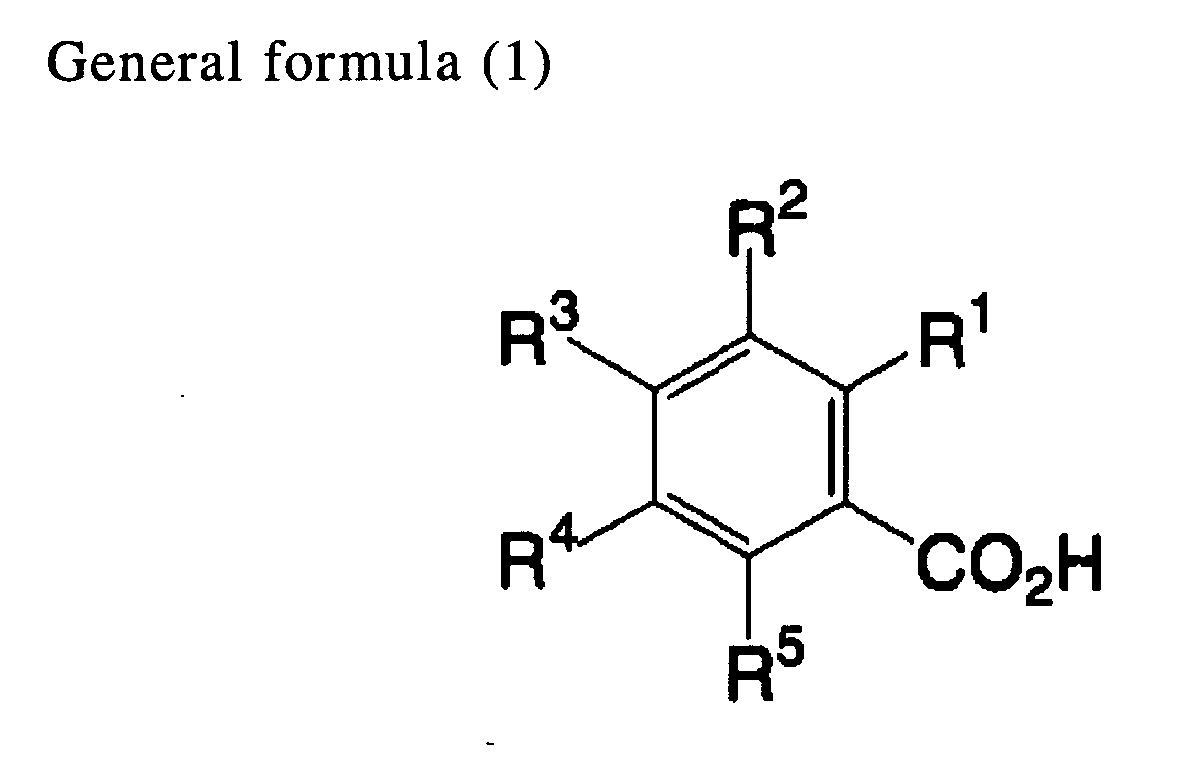
- When the amino group represented by R1 has a substituent, examples of the substituent include an acetyl group, a propanoyl group, an n-butanoyl group, an i-butanoyl group, a pivaloyl group, a 2-ethylhexanoyl group, a benzolyl group, a methoxycarbonyl group, an ethoxycarbonyl group, an n-propyloxycarbonyl group, a 2-ethylhexyloxycarbonyl group, a phenoxycarbonyl group, a methylaminocarbonyl group, an ethylaminocarbonyl group, an n-propylaminocarbonyl group, a 2-ethylhexylaminocarbonyl group, a phenylaminocarbonyl group, a dimethylaminocarbonyl group, a diethylaminocarbonyl group, a phenylthiocarbonyl group, a phenylaminothiocarbonyl group, a p-toluenesulfonylaminocarbonyl group, an ethanesulfonyl group and a benzenesulfonyl group.
- The alkyl group represented by each of R2, R3, R4 and R5 may have straight-chain structure or branched-chain structure and preferably includes 1 to 12 carbon atoms.
- Examples of the alkoxy group represented by each of R2, R3, R4 and R5 include a methoxy group, an ethoxy group, an n-propyloxy group, an i-propyloxy group, an n-butoxy group, an i-butoxy group, an s-butoxy group, a t-butoxy group, an n-hexyloxy group, a 2-ethylhexyloxy group, an n-octyloxy group, an n-decileoxy group, an n-dodecyloxy group, a phenoxyethoxyoxy group, and a p-methoxyphenoxyethyloxy group. Among these, a methoxy group, an ethoxy group, a 2-ethylhexyloxy group and a p-methoxyphenoxyethyloxy group are preferable.
- When the amino group represented by each of R2, R3, R4 and R5 has a substituent, examples of the substituent include the same substituents of the amino group represented by R1. The alkyl group represented by each of R2, R3, R4 and R5 may have straight-chain structure or branched-chain structure and preferably has 1 to 12 carbon atoms.
- In addition to the compound indicated in general formula (1), conventionally known compounds of a phenol derivative, salicylic acid derivative, aromatic series carboxylic acid derivative, acid clay, bentonite, novolak resin, metal-treated novolak resin and metal complex can be used as the developer. These examples are described in detail in Japanese Patent Application Bulletin (JP-B) Nos. 40-9309 and 45-14039, and in Japanese Patent Application Laid-Open (JP-A) Nos. 48-51510, 57-210886, 58-87089, 59-11286, 60-76795 and 61-95988.
- Some of these examples include 4-tertiarybutyl phenol, 4-phenyl phenol, 2,2'-dihydroxybiphenyl, 2,2-bis(4-hydroxyphenyl) propane (bisphenol A), 4,4'-sec-butylidene diphenol, 4,4'-cyclohexyliden diphenol, 4-hydroxyphenyl-3',4'dimethylphenyl sulfone, 4-(4-isopropoxyphenylsulfonyl) phenol, 4,4'-dihydroxydiphenyl sulfide, 1,4-bis-(4'-hydroxycumyl) benzene, 1,3-bis-(4'-hydroxycumyl) benzene, 4,4'-thiobis (6-tert-butyl-3-methyl phenol), 4-hydroxybenzylbenzoate ester, 3,5-di-tert-butyl salicylic acid, 3-phenyl-5-(α, α-dimethylbenzyl) salicylic acid, 3-cumyl-5-t-octyl salicylic acid, 3,5-di-t-butyl salicylic acid, 3-phenyl-5-t-octyl salicylic acid, 3-methyl-5-α-methylbenzyl salicylic acid, 3-methyl-5-cumyl salicylic acid, 3,5-di-t-octyl salicylic acid, 3,5-bis(α-methylbenzyl) salicylic acid, 3-cumyl-5-phenyl salicylic acid, 5-n-octadecyl salicylic acid, 4-pentadecyl salicylic acid, 3,5-bis(α, α-dimethylbenzyl) salicylic acid, 3,5-bis-t-octyl salicylic acid, 4-β-dodecyloxyethoxy salicylic acid, 4-methoxy-6-dodecyloxy salicylic acid, 4-β-phenoxyethoxy salicylic acid, 4-β-p-ethylphenoxyethoxy salicylic acid, 4-β-p-methoxyphenoxyethoxy salicylic acid, and metal salts thereof.
- The content of the developer in the heat-sensitive layer is preferably from 0.5 to 6 g/m2 and more preferably from 1 to 5 g/m2.
- As the electron-donating dye precursor, it is preferable to use a compound indicated by general formula (2) below.In general formula (2), R6 represents an alkyl group or an aryl group; R7 represents a hydrogen atom, an alkyl group, an amino group that may have a substituent, or an alkoxy group; each of R8 and R9 independently represents a hydrogen atom or an alkyl group; and A represents a pyridine ring in which a nitrogen atom is located at the fourth and fifth positions or at the sixth and seventh positions, or a pyrazine ring in which a nitrogen atom is located at the fourth and seventh position.
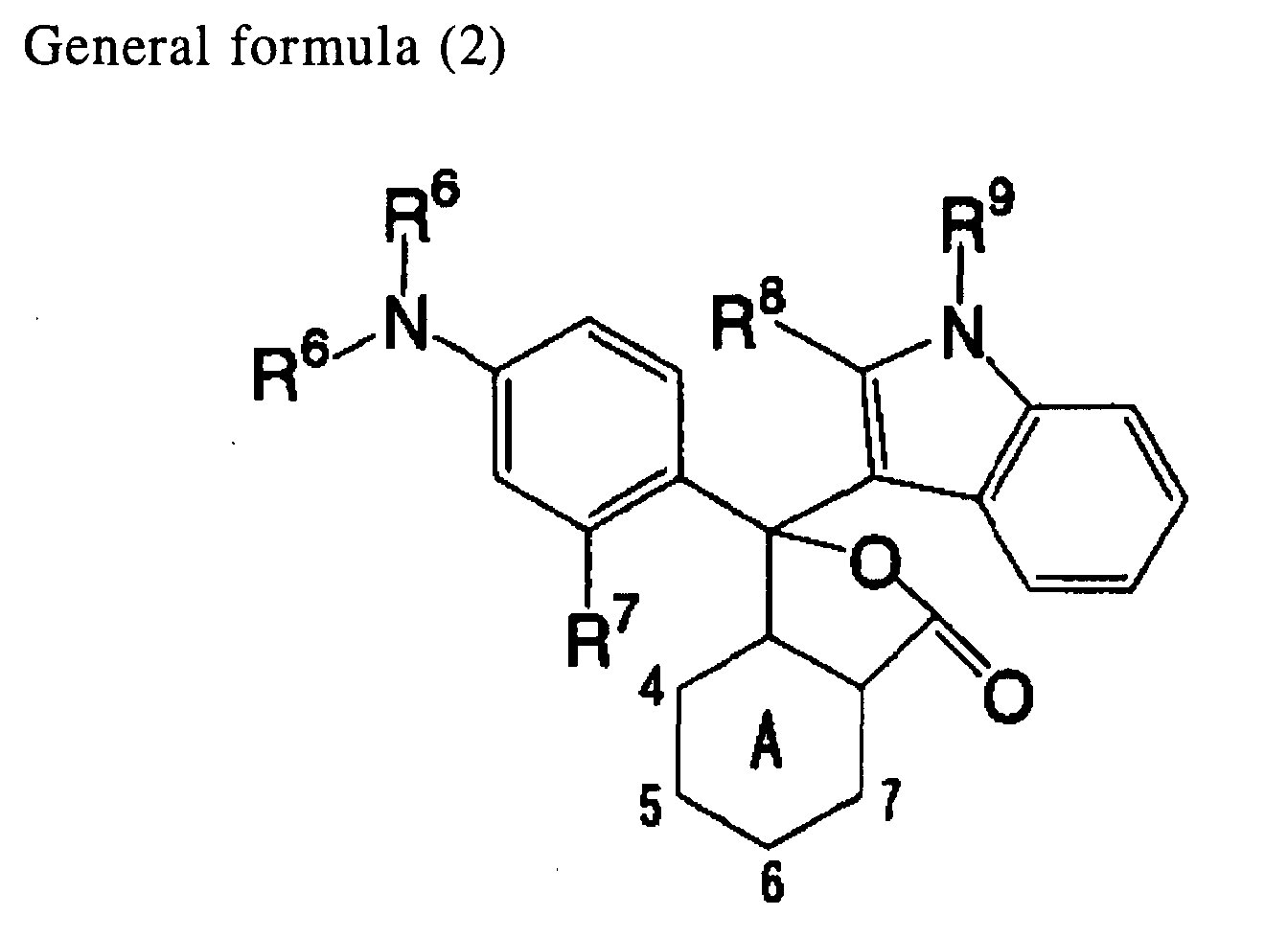
- The alkyl group represented by R6 may have straight-chain structure or branched-chain structure and preferably includes 1 to 12 carbon atoms.
- The alkyl group represented by R7 may have straight-chain structure or branched-chain structure and preferably includes 1 to 12 carbon atoms. When the amino group represented by R7 has a substituent, examples of the substituent include acetyl, propanoyl, trifluoroacetyl, benzoyl, methoxycarbonyl, ethoxycarbonyl, phenoxycarbonyl, methylaminocarbonyl, ethylaminocarbonyl, phenylaminocarbonyl, dimethylaminocarbonyl, diethylaminocarbonyl, metansulfonyl and benzenesulfonyl.
- The alkyl group represented by R8 and R9 may include straight-chain structure or branched-chain structure and preferably includes 1 to 12 carbon atoms.
- Among the compounds indicated by general formula (2), it is preferable to use a compounds indicated by general formula (3) below.In general formula (3), R6 represents an alkyl group or an aryl group; R7 represents a hydrogen atom, an alkyl group, an amino group that may have a substituent, or an alkoxy group; and each of R8 and R9 independently represents a hydrogen atom or an alkyl group. R6, R7 and R8 are synonymous with R6, R7 and R8 in general formula (2).
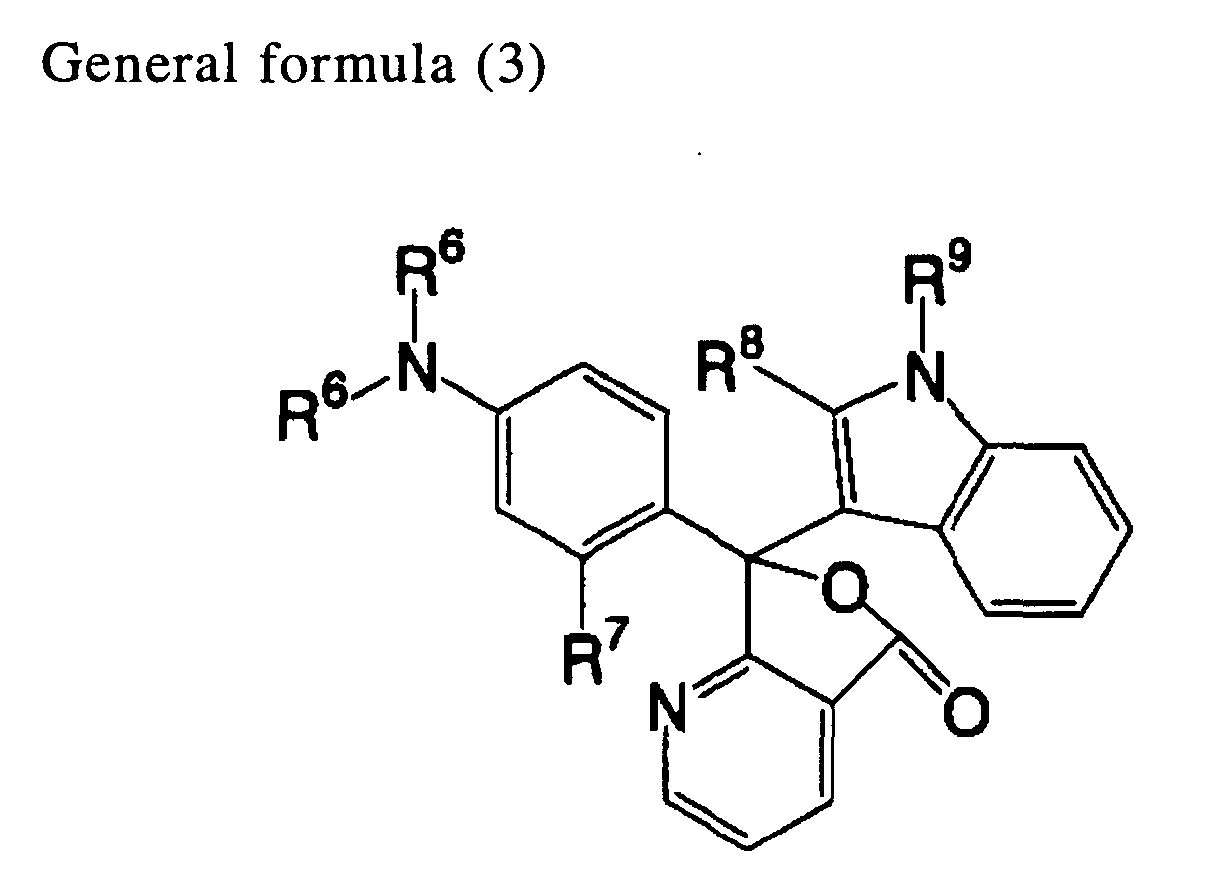
- In addition to the compounds indicated by general formulae (2) and (3), various conventionally known compounds can be utilized as the electron-donating dye precursor, such as triphenylmethane phthalide compounds, fluoran compounds, phenothiazine compounds, indolylphthalide compounds, leucoauramine compounds, rhodaminelactam compounds, triphenylmethane compounds, triazene compounds, spiropyran compounds and the fluorene compounds. Specific examples of phthalide compounds are described in U.S. Reissued Patent No. 23024, and in U.S. Patent Nos. 3491111, 3491112, 3491116 and 3509174. Specific examples of fluorine compounds are described in U.S. Patent Nos. 3624107, 3627787, 3641011, 3462828, 3681390, 3920510 and 3959571. Specific examples of spirodipyran compounds are described in U.S. Patent No. 3971808. Specific examples of pyridine and pyrazine compounds are described in U.S. Patent Nos. 3775424, 3853869 and 4264318. Specific examples of fluorene compounds are described in JP-A Nos. 59-199757 and 63-41183. Examples of specific compounds include 3-(2-methyl-4-diethylaminophenyl)-3-(1-ethyl-2-methylindole-3-yl)-4-azaphthalide, 3-(2-methyl-4-dinormalhexylaminophenyl)-3-(1-normalocthyl-2-methylindole-3-yl)-4, 7-diazaphthalide, 3,3-bis (2-ethoxy-4-diethylaminophenyl)-4-azaphthalide, 3,3-bis(1-normalocthyl-2-methylindole-3-yl)-4-azaphthalide, 3-(2-ethoxy-4-diethylaminophenyl)-3-(1-ethyl-2-methylindole-3-yl)-4-azaphthalide, 3-(2-ethoxy-4-diethylaminophenyl)-3-(1-normalocthyl-2-methylindole-3-yl)-phthalide, 3,3-bis(1-normalocthyl-2-methylindole-3-yl)-phthalide, 3-(2-methyl-4-diethylaminophenyl)-3-(1-normaloctyl-2-methylindole-3-yl)-phthalide, 3-(N-ethyl-N-isoamyl)-6-methyl-7-anilinofluoran, 3,6-bis(diphenylamino) fluoran, 3-dibutylamino-6-methyl-7-anilinofluoran, and 3-(N-ethyl-N-isobutyl)-6-methyl-7-anilinofluoran.
- The content of the electron-donating dye precursor in the heat-sensitive layer is preferably from 0.05 to 1.0 g/m2 and more preferably from 0.1 to 0.5 g/m2.
- The electron-donating dye precursor of the invention is used after being microencapsulated with the metal compound, and the developer of the invention is used after being solid-dispersed or emulsion-dispersed. The solid dispersion, emulsion dispersion and microencapsulation can be performed by known methods.
- Although there are no limitations on how the electron-donating dye precursor and the metal compound are microencapsulated, it is preferable to employ interfacial polymerization. In interfacial polymerization, a coloring component A is dissolved or dispersed in a hydrophobic organic solvent that becomes the core of the capsules, to thereby prepare an oil phase. The prepared oil phase is mixed with an aqueous phase in which a water-soluble polymer has been dissolved, and the mixture is emulsion-dispersed by means such as a homogenizer. Thereafter, a polymer-forming reaction is caused at oil drop interfaces by heating, whereby microcapsule walls of a polymer substance are formed. This method makes it possible to form capsules having a uniform particle diameter within a short period of time, resulting in a recording material that has excellent storage stability.
- In view of obtaining excellent shelf life, it is preferable that the microcapsules containing the electron-donating dye precursor and the metal compound include substantially no solvent and are produced in the following manner. A solution is prepared by dissolving, in a non-aqueous solvent having a boiling point of 40°C to 95°C at normal pressure, the electron-donating dye precursor and similar or different compounds that mutually react to generate a polymer substance. After emulsion-dispersing the solution in a hydrophilic protective colloid solution, the temperature of the system is increased while reducing the pressure of the reaction chamber, and the wall-forming substance is moved to the surfaces of the oil drops while removing the solvent. Wall films are formed by advancing a polymer-generating reaction resulting from polycondensation and polyaddition at the surfaces of the oil drops. The non-aqueous solvent for dissolving the electron-donating dye precursor is preferably at least one compound selected from halogenated hydrocarbon, aliphatic acid ester, ketone and ether.
- In the present invention, the polymer substance that forms the walls of the microcapsules is preferably formed from at least one selected from polyurethane and polyurea. These polymer substances are respectively produced from aromatic or aliphatic isocyanate compounds as a corresponding monomer. The microcapsules containing the electron-donating dye precursor in the invention can be obtained by polymerizing the corresponding monomer. The amount of the monomer used is determined so as to produce microcapsules with an average diameter of from 0.3 to 12 µm and a wall thickness of from 0.01 to 0.3 µm.
- An ultraviolet absorbent may be added to the heat-sensitive recording material of the invention in order to improve stability with respect to light. Examples thereof include cinnamic acid derivatives, benzophenone derivatives, and benzotriazolil phenol derivatives. Specific examples include α-cyano-β-phenyl butyl cinnamate, o-benzotriazol phenol, o-benzotriazol-p-chloro phenol, o-benzotriazol-2,4-di-t-butyl phenol, and o-benzotriazol-2,4-di-t-octyl phenol. As a hindered phenol compound, phenol derivatives in which one or more of at least the 2nd or 6th position is substituted with a branched alkyl group is preferable. These ultraviolet absorbents can be utilized by being solid-dispersed, emulsion-dispersed or microencapsulated. The amount of the ultraviolet absorbent used is preferably 0.05 to 1.0 g/m2 and more preferably from 0.1 to 0.4 g/m2.
- Known water-soluble polymer compounds and latexes can be used as the binder in the heat-sensitive recording material of the invention. Examples of water-soluble polymer compounds include methylcellulose, carboxymethylcellulose, hydroxymethylcellulose, starch, gelatin, gum arabic, casein, styrene-maleic anhydride copolymer hydrolyzed material, ethylene-maleic anhydride copolymer hydrolyzed material, polyvinyl alcohol, polyacrylamide, and modified materials thereof. Examples of latexes include styrene-butadiene rubber latex, acrylic nitrile-butadiene rubber latex, methyl acrylate-butadiene rubber latex, and vinyl acetate emulsion. The amount of these materials used is preferably from 0.4 to 5 g/m2 and more preferably from 0.8 to 1.6 g/m2.
- Known pigments can be used as the pigment in the heat-sensitive recording material of the invention, regardless of whether the pigment is organic or inorganic. Specific examples include kaolin, calcined kaolin, talc, agalmatolite, silious earth, calcium carbonate, aluminum hydroxide, magnesium hydroxide, zinc oxide, lithopone, amorphous silica, colloidal silica, calcined gypsum, silica, magnesium carbonate, titanium oxide, alumina, barium carbonate, barium sulfate, mica, micro balloon, urea formalin filler, polyester particles, and cellulose filler.
- Various additives can be used as needed in the heat-sensitive recording material of the invention, such as known waxes, antistatic agents, antifoaming agents, conductive materials, fluorescent dyes, surfactants, and ultraviolet absorbent precursors.
- A protective layer may be disposed as needed on the surface of the heat-sensitive layer of the heat-sensitive recording material of the invention. The protective layer may comprise two or more layers as needed. Examples of materials used for the protective layer include water-soluble polymer compounds such as polyvinyl alcohol, carboxy-modified polyvinyl alcohol, vinyl acetate-acrylamide copolymer, silicon-modified polyvinyl alcohol, starch, modified starch, methyl cellulose, carboxy methyl cellulose, hydroxymethyl cellulose, gelatins, gum arabic, casein, hydrolyzed styrene-maleic acid copolymer, hydrolyzed styrene-maleic acid copolymer half ester, hydrolyzed isobutylene-maleic anhydride copolymer, polyacrylamide derivatives, polyvinyl pyrrolidone, polystyrene sodium sulfonate, sodium alginate; and latexes such as styrene-butadiene rubber latex, acrylonitrile-butadiene rubber latex, methylacrylate-butadiene rubber latex, and vinyl acetate emulsion. Storage stability can be further improved by cross-linking the water-soluble polymer compound of the protective layer, and known cross-linking agents can be used. Specific examples thereof include water-soluble initial condensation materials such as N-methylol urea, N-methylol melamine and urea-formalin; dialdehyde compounds such as glyoxal and glutaric aldehyde; inorganic cross-linking agents such as boric acid and borax; and polyamide epichlorohydrin. The protective layer may also contain known pigments, metal soaps, waxes, and surfactants. The coating amount of the protective layer is preferably from 0.2 to 5 g/m2 and more preferably from 0.5 to 2 g/m2. The thickness of the protective layer is preferably from 0.2 to 5 µm and more preferably from 0.5 to 2 µm.
- The heat-sensitive recording material of the invention may include an ultraviolet absorbent or an ultraviolet absorbent precursor in the protective layer.
- As the support usable in the heat-sensitive recording material of the invention, acid paper, acid-free paper, coated paper, plastic film laminated paper, synthetic paper, and plastic film can be used. A known undercoat layer may also be disposed on the support. The undercoat layer can be formed in the same manner as the protective layer.
- A backcoat layer may be disposed in order to adjust the curl balance of the support or to improve resistance to chemicals from the back surface. It is also possible to combine a stripping paper with the backcoat layer on the back surface via an adhesive agent layer, resulting in a label. The backcoat layer can be formed in the same manner as the protective layer.
- The heat-sensitive recording material is described in detail in JP-B No. 59-53193 and in JP-A Nos. 59-197463 and 62-114989.
- In order to improve heat-responsiveness in the invention, a known sensitizing agent can be contained in the heat-sensitive layer. Examples thereof include aromatic ether, thioether, ester and/or aliphatic amide or ureide. These examples are described in detail in JP-A Nos. 58-57989, 58-87094, 61-58789, 62-109681, 62-132674, 63-151478 and 63-235961. The amount used is preferably from 1 to 10 g/m2 and more preferably from 2 to 4 g/m2.
- Examples of the present invention are described below. However, the invention is not limited to these examples. Unless otherwise indicated, units are given in percent by mass.
- 3.0 parts of the following compound (A-1) as an electron-donating dye precursor and 3.0 parts of the exemplary compound (1-1) as a metal compound were dissolved in 20 parts of ethyl acetate. Further, 17.0 parts of alkylnaphthalene (KMC-210, manufactured by Kureha Chemical Industries Co., Ltd.), which is a high boiling point solvent, was added and mixed uniformly. 20 parts of a 3/1 adduct of xylilenediisocyanate/trimethylolpropane (75 mass percent ethyl acetate solution) (Takenate D-110N, manufactured by Takeda Pharmaceutical Co., Ltd.) as material for capsule walls was added to the obtained mixed solution and mixed uniformly.

- 54 parts of a solution of 6% polyvinyl alcohol (polymerization degree: 1700; saponification degree: 88%) was prepared separately, the above-mentioned electron-donating dye precursor was added thereto, and then the solution was emulsion-dispersed with a homogenizer. 68 parts of water was added to the obtained emulsified solution. The solution was then made uniform and heated to 50°C while being stirred. After a three-hour microencapsulation reaction, a target capsule solution was obtained. The average particle diameter of the capsules was 1.6 µm.
- 30 parts of the following compound (B-1) was added as a developer to 150 parts of a 4% aqueous solution of polyvinyl alcohol, and the solution was then dispersed for 24 hours with a ball mill to form a dispersion solution. The average particle diameter of the developer in the resulting dispersion solution was 1.2 µm.
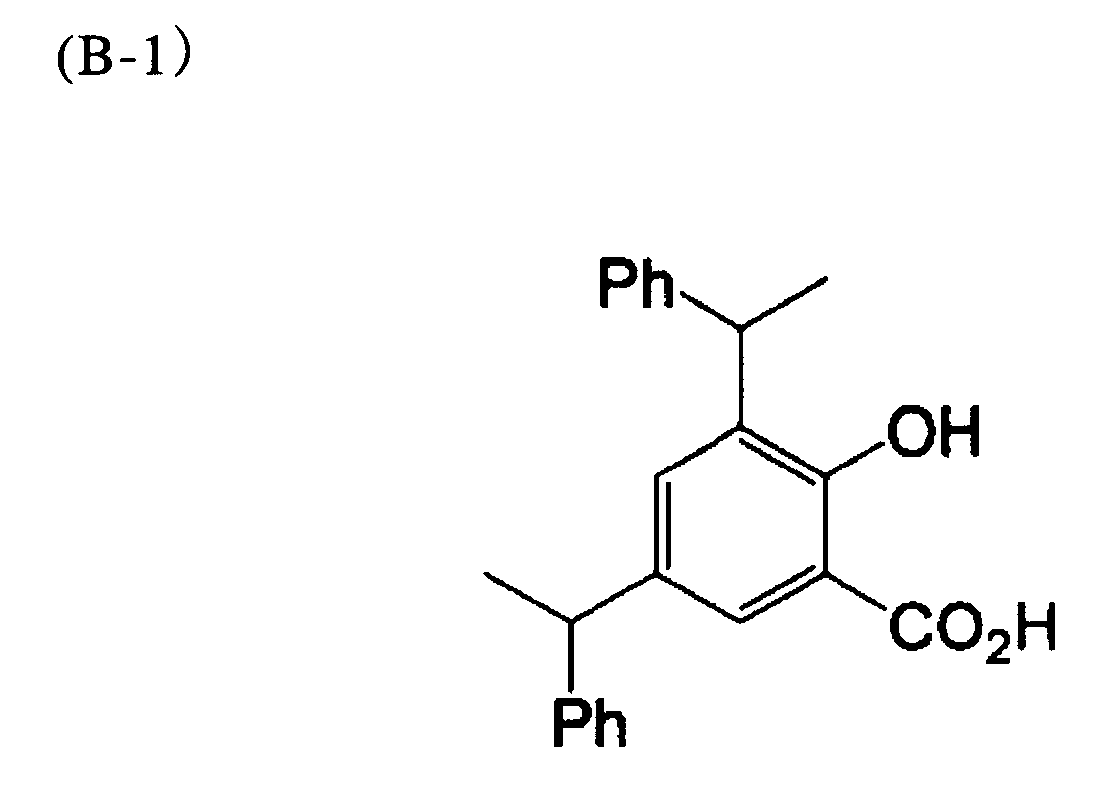
- The electron-donating dye precursor capsule solution and the developer dispersion solution were mixed so that the molar ratio of the electron-donating dye precursor with respect to the developer was 1/15, whereby a target coating solution was prepared.
- The coating solution was coated with a Mayer's bar onto a polyethylene terephthalate support of 75 µm in thickness and dried to obtain a target heat-sensitive recording material.
- A heat-sensitive recording material was obtained in the same manner as in Example 1, except that the metal compound (1-1) was replaced with the exemplary compound (1-12).
- A heat-sensitive recording material was obtained in the same manner as in Example 1, except that the metal compound (1-1) was replaced with the exemplary compound (1-13).
- A heat-sensitive recording material was obtained in the same manner as in Example 1, except that the metal compound (1-1) was replaced with the exemplary compound (1-18).
- A heat-sensitive recording material was obtained in the same manner as in Example 1, except that the metal compound (1-1) was replaced with the exemplary compound (1-21).
- A heat-sensitive recording material was obtained in the same manner as in Example 1, except that the metal compound (1-1) was replaced with the exemplary compound (1-12) and the developer was replaced with the following compound (B-2).

- A heat-sensitive recording material was obtained in the same manner as in Example 6, except that the metal compound (1-12) was replaced with the exemplary compound (1-21).
- A heat-sensitive recording material was obtained in the same manner as in Example 1, except that the metal compound was not used.
- A heat-sensitive recording material was obtained in the same manner as in Example 1, except that the metal compound was not used and the developer (B-1) was replaced with the following compound (B-3).
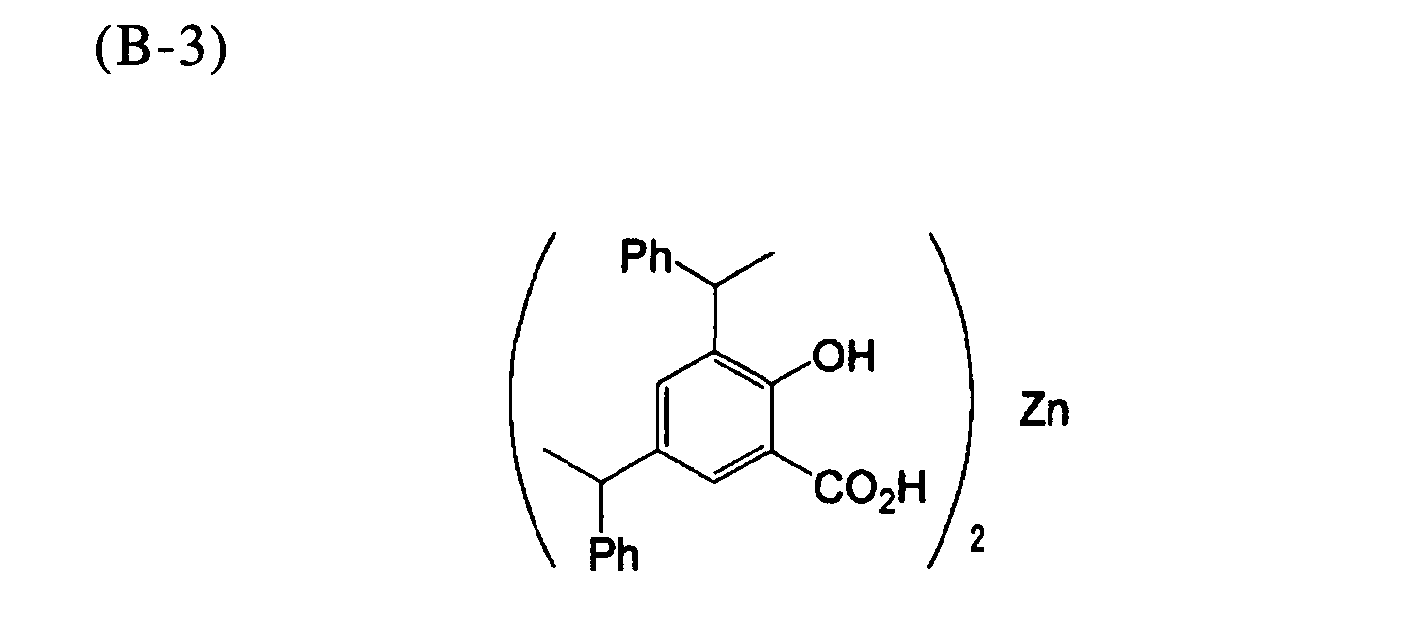
- Image density D0 in respective color-developed areas was measured with a Macbeth densitometer. The results are shown in Table 1. The higher the value of D0 is, the higher sensitivity of the heat-sensitive recording paper was.
- Image density D1 was measured with a Macbeth reflection densitometer after irradiating, using a xenon fademeter (FAL-25AX-HC, manufactured by Suga Test Instruments Co., Ltd.), with light for 48 hours an image area obtained by printing. The light resistance in the image area is shown in Table 1 as the residual ratio of the image after being irradiated with light, wherein the residual ratio = (D1/D0) ×100%. The larger the residual ratio is, the better light resistance in the image area was.
Electron-Donating Dye Precursor Developer Metal Compound Color Development Density Light Resistance in Image Area Example 1 (A-1) (B-1) (1-1) 1.41 75 Example 2 (A-1) (B-1) (1-12) 1.48 77 Example 3 (A-1) (B-1) (1-13) 1.52 78 Example 4 (A-1) (B-1) (1-18) 1.47 72 Example 5 (A-1) (B-1) (1-21) 1.56 80 Example 6 (A-1) (B-2) (1-12) 1.35 70 Example 7 (A-1) (B-2) (1-21) 1.43 75 Comp. Ex. 1 (A-1) (B-1) - 1.05 45 Comp. Ex. 2 (A-1) (B-3) - 0.45 70 - According to the present invention, a heat-sensitive recording material that has excellent color developing properties, and excellent fastness and resistance to light and heat in image areas can be provided.
Claims (19)
- A heat-sensitive recording material comprising a support having disposed thereon a heat-sensitive layer including microcapsules, which contain an achromic or a hypochromic electron-donating dye precursor, and a developer, wherein the microcapsules contain at least one metal compound.
- The heat-sensitive recording material according to claim 1, wherein the metal compound includes at least one of a metal compound of aliphatic carboxylic acid and a metal compound of 1,3-diketone.
- The heat-sensitive recording material according to claim 2, wherein the metal compound of aliphatic carboxylic acid includes 2 to 40 carbon atoms, and has a straight-chain structure or a branched-chain structure.
- The heat-sensitive recording material according to claim 2, wherein the metal compound of 1,3-diketone is at least one selected from the group consisting of 2,4-pentadione, 3,5-heptadione, 2,2,6,6-tetramethylheptadione, 4,6-nonadione, 7,9-pentadecadione, 2,4-dimethyl-7,9-pentadecadione, 2-acetylcyclopentanone, 2-acetylcyclohexanone, 3-methyl-2,4-pentadione, 3-(2-ethylhexyl)2,4-pentadione and 3-[4-(2-ethylhexyloxy)benzyl]-2,4-pentadione.
- The heat-sensitive recording material according to claim 1, wherein the metal of the metal compound is at least one selected from the group consisting of zinc, aluminum, calcium, magnesium, iron, cobalt, nickel and copper.
- The heat-sensitive recording material according to claim 1, wherein the metal of the metal compound is zinc.
- The heat-sensitive recording material according to claim 1, wherein the content of the metal compound in the heat-sensitive layer is from 10 to 500 % by mass relative to the electron-donating dye precursor.
- The heat-sensitive recording material according to claim 1, wherein the developer includes a compound indicated by general formula (1) below:wherein R1 represents a hydroxyl group or an amino group that may have a substituent; and each of R2, R3, R4 and R5 independently represents a hydrogen atom, a halogen atom, a hydroxyl group, an amino group that may have a substituent, an alkyl group, an aryl group, an alkoxy group, a carboxyl group, a carbonamide group, a sulfoneamide group, a nitro group, or a cyano group.

- The heat-sensitive recording material according to claim 1, wherein the developer includes at least one selected from the group consisting of a phenol derivative, a salicylic acid derivative, an aromatic carboxylic acid derivative, acid clay, bentonite, novolak resin, metal-treated novolak resin and a metal complex.
- The heat-sensitive recording material according to claim 1, wherein the content of the developer in the heat-sensitive layer is from 0.5 to 6g/m2.
- The heat-sensitive recording material according to claim 1, wherein the electron-donating dye precursor includes a compound indicated by general formula (2) below:wherein R6 represents an alkyl group or an aryl group; R7 represents a hydrogen atom, an alkyl group, an amino group that may have a substituent, or an alkoxy group; each of R8 and R9 independently represents a hydrogen atom or an alkyl group; and A represents a pyridine ring in which a nitrogen atom is located at the fourth and fifth positions or at the sixth and seventh positions, or a pyrazine ring in which a nitrogen atom is located at the fourth and seventh position.
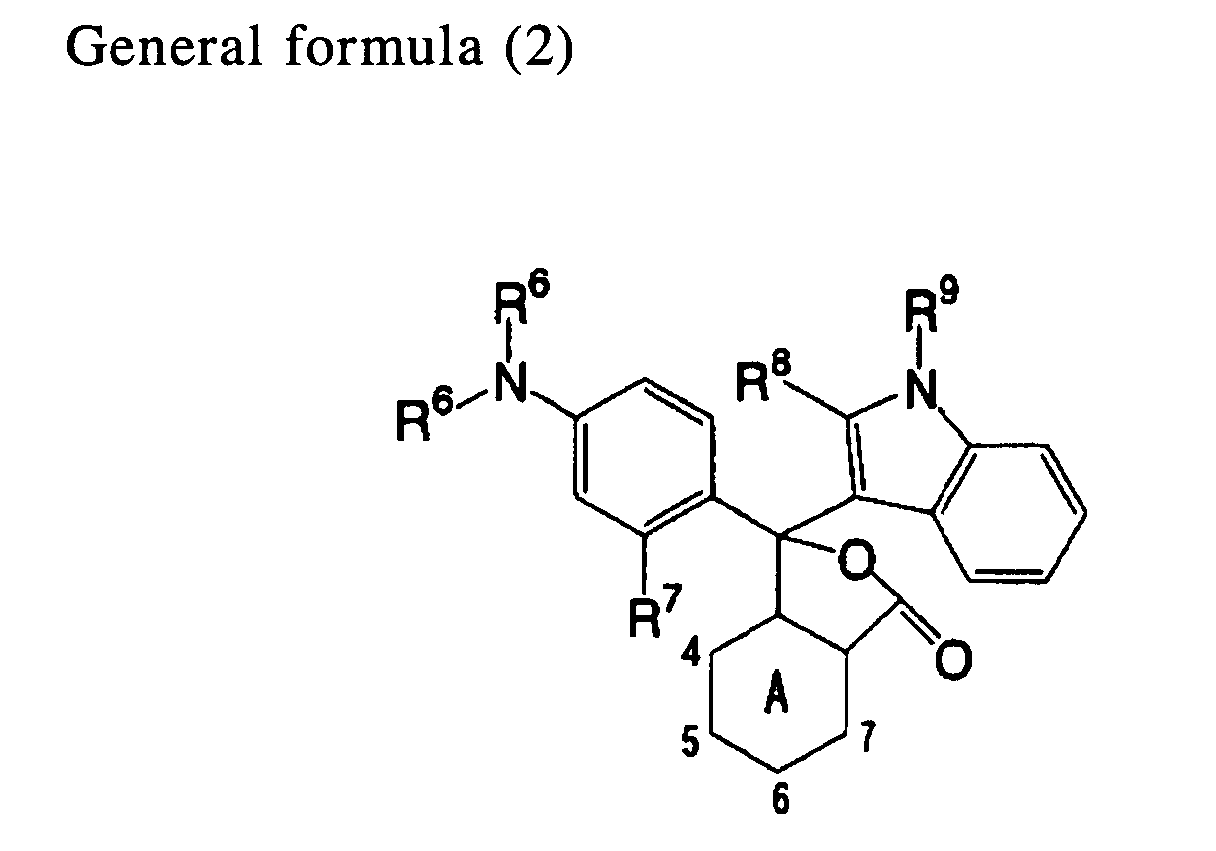
- The heat-sensitive recording material according to claim 11, wherein the compound indicated in general formula (2) is a compound indicated by general formula (3) below:wherein R6 represents an alkyl group or an aryl group; R7 represents a hydrogen atom, an alkyl group, an amino group that may have a substituent, or an alkoxy group; and each of R8 and R9 independently represents a hydrogen atom or an alkyl group.

- The heat-sensitive recording material according to claim 1, wherein the electron-donating dye precursor includes at least one selected from the group consisting of a triphenylmethanephthalide compound, a fluoran compound, a phenothiazine compound, a indolylphthalide compound, a leucoauramine compound, a rhodaminelactam compound, a triphenylmethane compound, a triazene compound, a spiropyran compound and a fluorene compound.
- The heat-sensitive recording material according to claim 1, wherein the content of the electron-donating dye precursor in the heat-sensitive layer is from 0.05 to 1.0g/m2.
- The heat-sensitive recording material according to claim 1, wherein walls of the microcapsules are formed of at least one polymer compound selected from the group consisting of polyurethane and polyurea.
- The heat-sensitive recording material according to claim 1, further comprising an ultraviolet absorbent that includes at least one selected from the group consisting of cinnamic acid derivatives, benzophenone derivatives and benzotriazolil phenol derivatives.
- The heat-sensitive recording material according to claim 16, wherein the added amount of the ultraviolet absorbent is from 0.05 to 1.0 g/m2.
- The heat-sensitive recording material according to claim 1, further comprising a protective layer disposed on the heat-sensitive layer.
- The heat-sensitive recording material according to claim 1, wherein the electron-donating dye precursor includes at least a compound indicated by (A-1) below, the developer includes at least one compound indicated by (B-1) and (B-2) below, and the metal compound includes at least one selected from the group consisting of (1-1), (1-12), (1-13), (1-18) and (1-21) below.
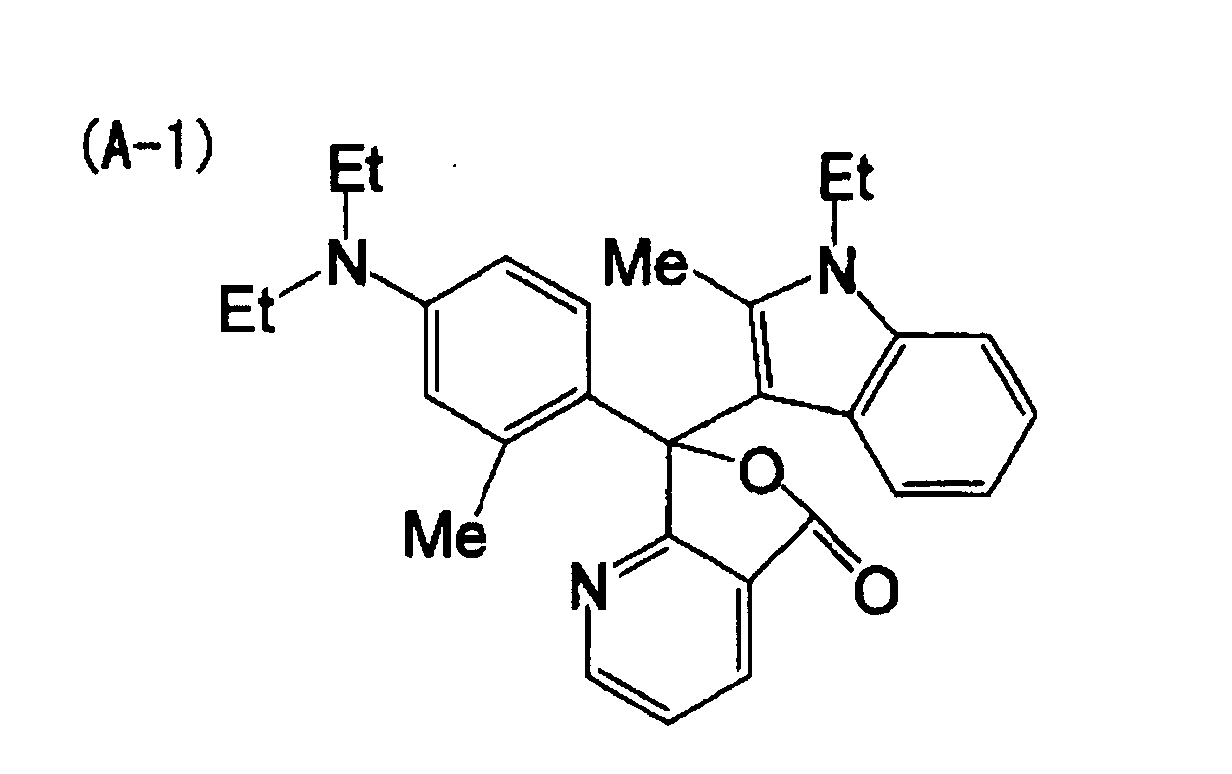

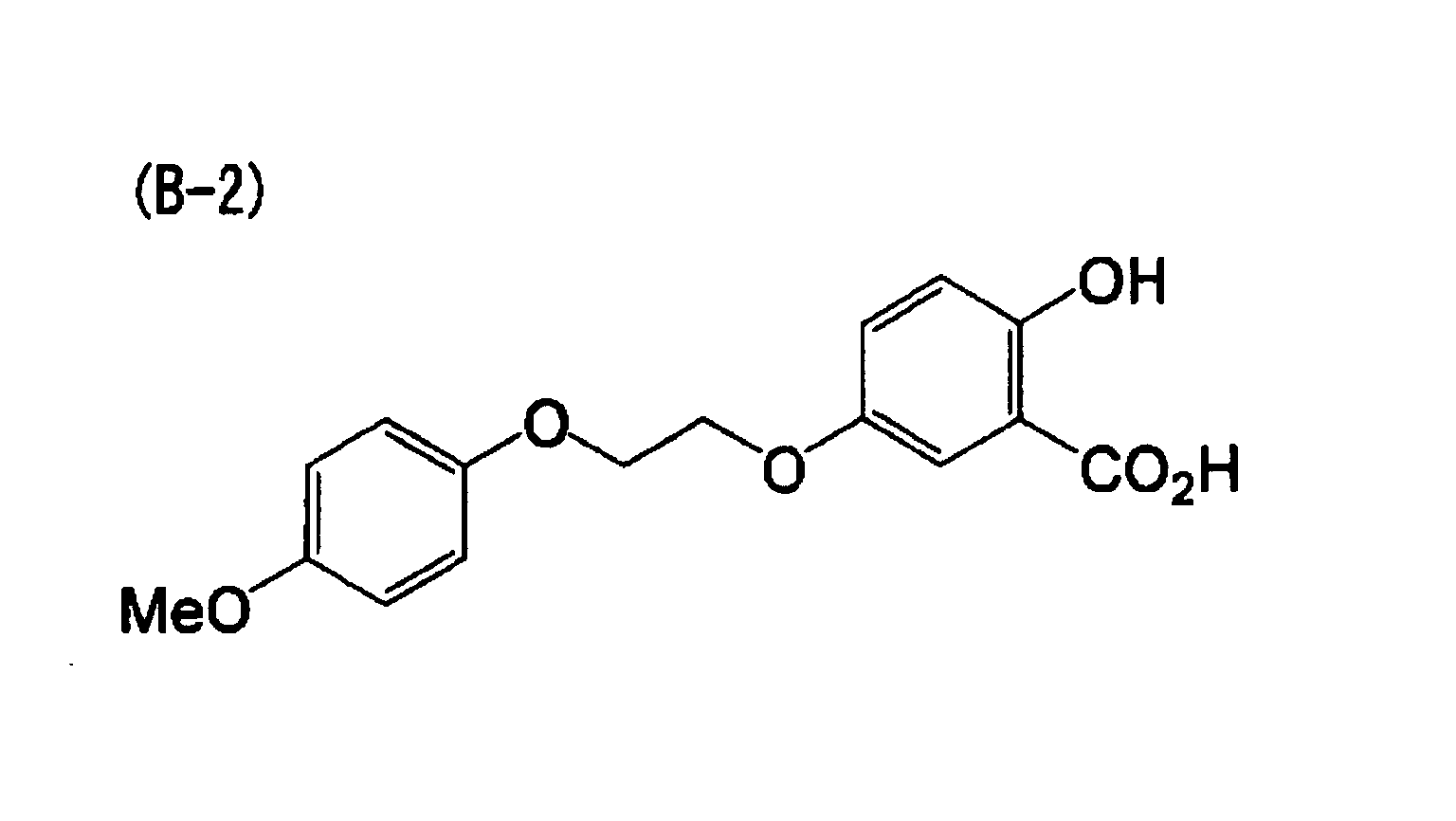


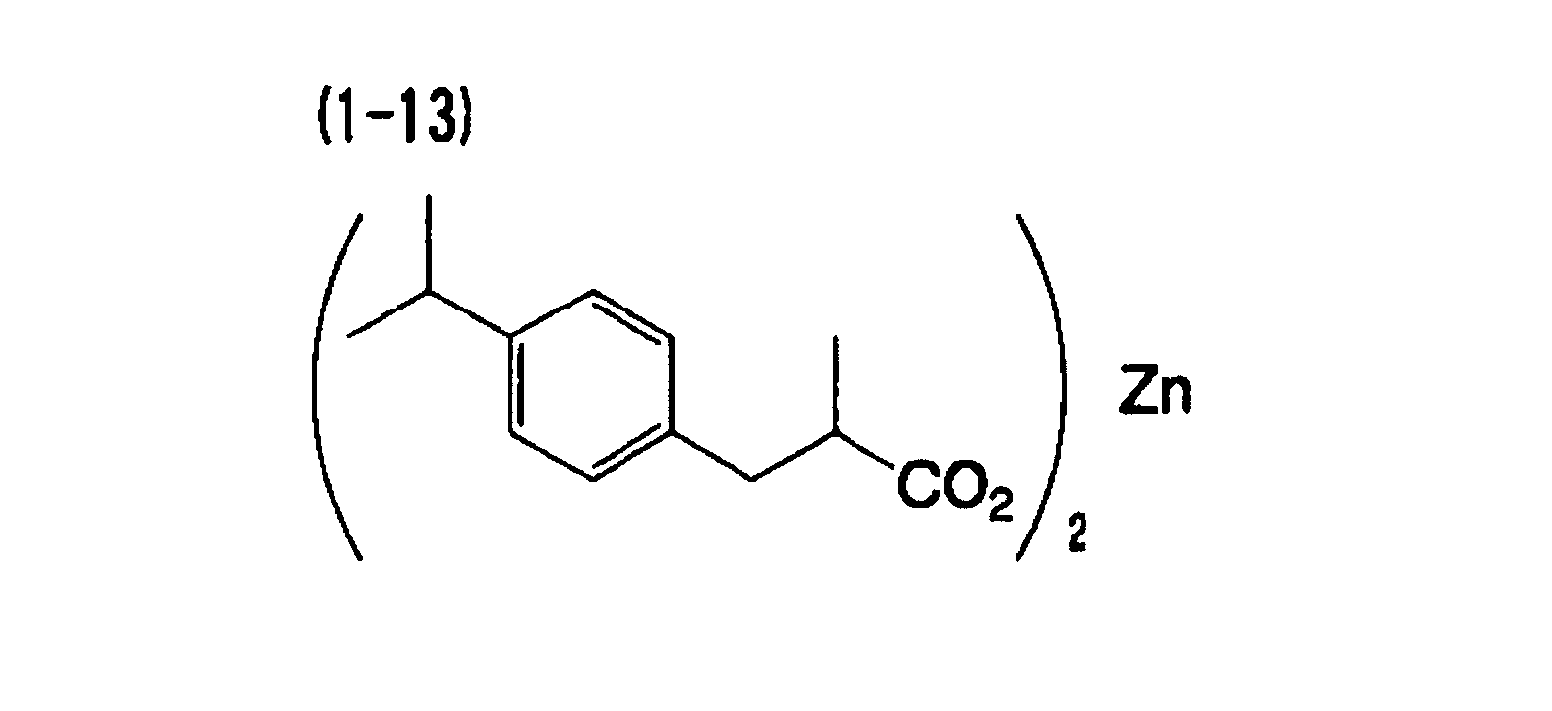
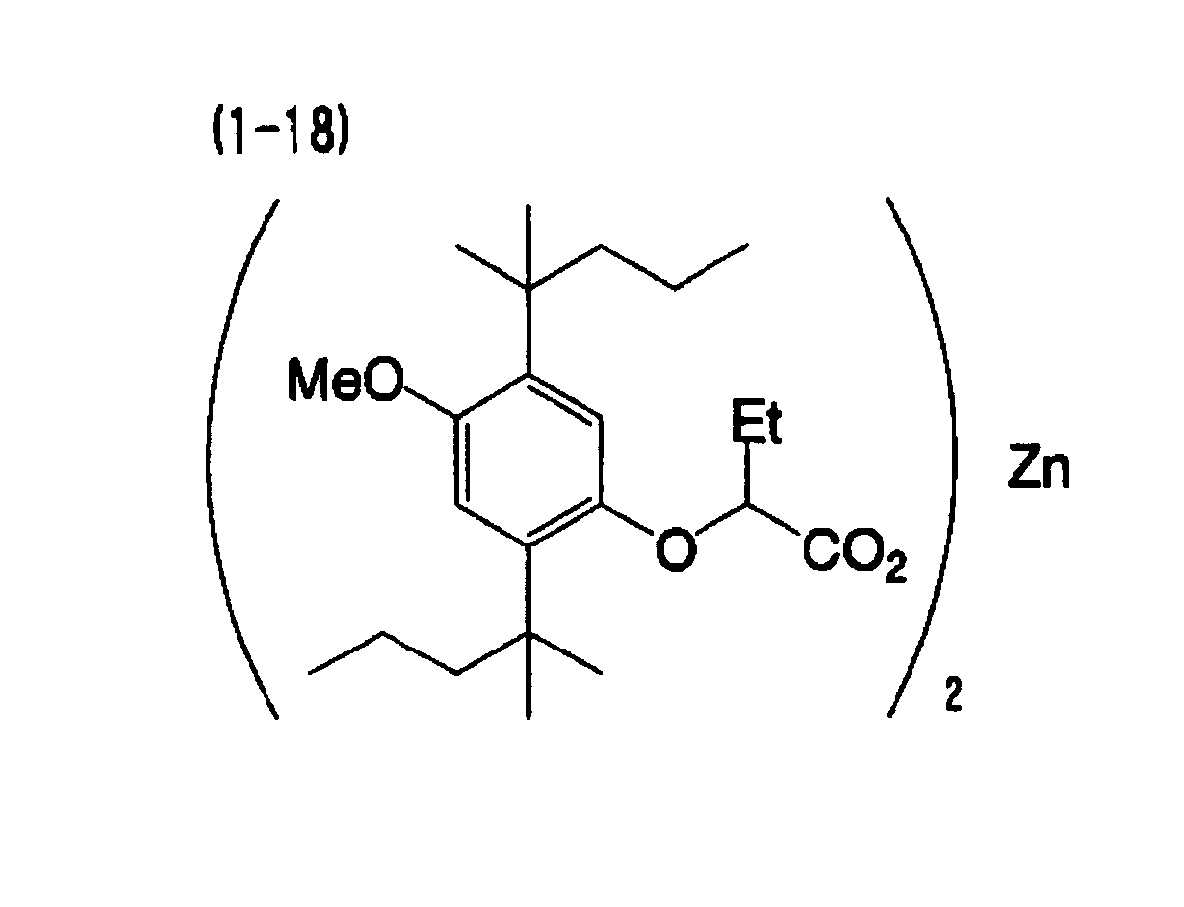
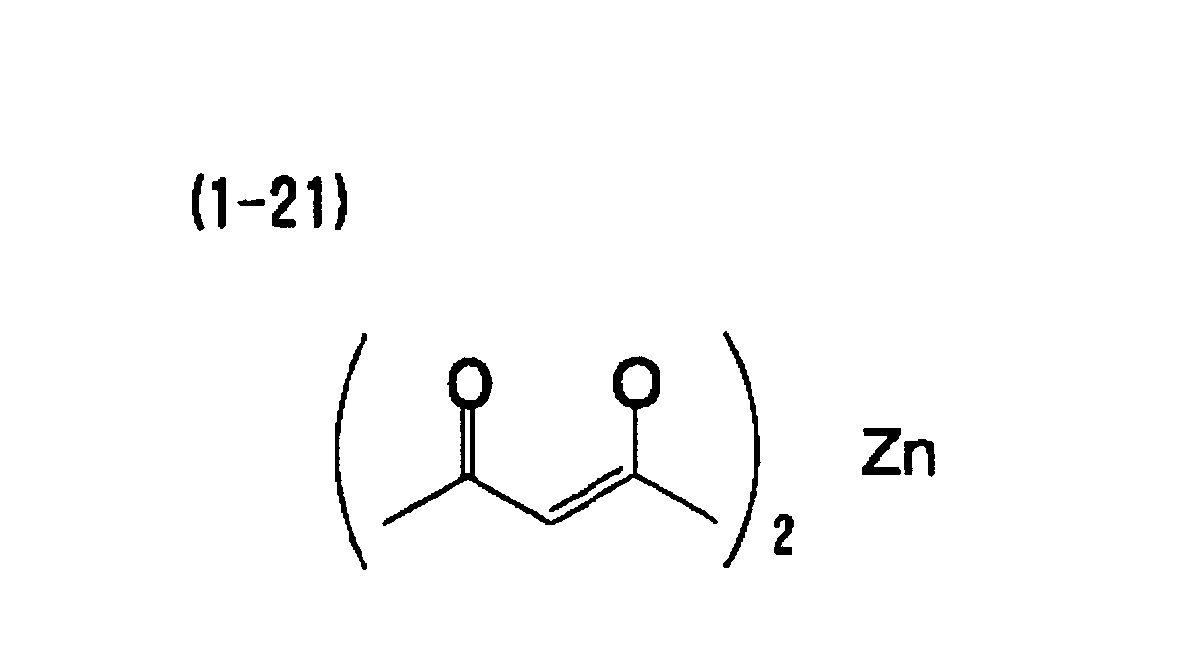
Applications Claiming Priority (2)
| Application Number | Priority Date | Filing Date | Title |
|---|---|---|---|
| JP2001271219 | 2001-09-07 | ||
| JP2001271219A JP2003072241A (en) | 2001-09-07 | 2001-09-07 | Heat-sensitive recording material |
Publications (3)
| Publication Number | Publication Date |
|---|---|
| EP1291196A2 true EP1291196A2 (en) | 2003-03-12 |
| EP1291196A3 EP1291196A3 (en) | 2004-02-04 |
| EP1291196B1 EP1291196B1 (en) | 2006-06-21 |
Family
ID=19096754
Family Applications (1)
| Application Number | Title | Priority Date | Filing Date |
|---|---|---|---|
| EP02019838A Expired - Lifetime EP1291196B1 (en) | 2001-09-07 | 2002-09-06 | Heat-sensitive recording material |
Country Status (4)
| Country | Link |
|---|---|
| US (1) | US6890880B2 (en) |
| EP (1) | EP1291196B1 (en) |
| JP (1) | JP2003072241A (en) |
| DE (1) | DE60212531T2 (en) |
Cited By (1)
| Publication number | Priority date | Publication date | Assignee | Title |
|---|---|---|---|---|
| EP2634006A1 (en) * | 2012-03-01 | 2013-09-04 | Mondi AG | Thermally writeable compound and thermally writeable recording material |
Families Citing this family (1)
| Publication number | Priority date | Publication date | Assignee | Title |
|---|---|---|---|---|
| US20070116910A1 (en) * | 2005-11-23 | 2007-05-24 | Polykarpov Alexander Y | Multilayer laminated structures |
Citations (6)
| Publication number | Priority date | Publication date | Assignee | Title |
|---|---|---|---|---|
| JPS4851510A (en) | 1971-10-28 | 1973-07-19 | ||
| JPS57210886A (en) | 1981-06-15 | 1982-12-24 | Ciba Geigy Ag | Pressure sensing or thermo-sensitive recording material |
| JPS5887089A (en) | 1981-11-18 | 1983-05-24 | Fuji Photo Film Co Ltd | Heat-sensitive recording paper |
| JPS5911586A (en) | 1982-07-09 | 1984-01-21 | Hitachi Ltd | Tape remaining amount display device |
| JPS6076795A (en) | 1983-10-03 | 1985-05-01 | 凸版印刷株式会社 | Manufacture of diaphragm |
| JPS6195988A (en) | 1984-10-18 | 1986-05-14 | Fuji Photo Film Co Ltd | Thermal recording paper |
Family Cites Families (9)
| Publication number | Priority date | Publication date | Assignee | Title |
|---|---|---|---|---|
| AU608567B2 (en) * | 1987-02-20 | 1991-04-11 | Fuji Photo Film Co., Ltd. | Recording material |
| JPH0698836B2 (en) | 1987-10-15 | 1994-12-07 | 富士写真フイルム株式会社 | Thermal recording material |
| GB2216676A (en) * | 1988-03-10 | 1989-10-11 | Sugai Chemical Ind Co Ltd | Fading inhibitor for color former |
| JPH0615963A (en) | 1992-06-29 | 1994-01-25 | Fuji Photo Film Co Ltd | Heat-sensitive recording material |
| JP3426330B2 (en) | 1994-03-11 | 2003-07-14 | 富士写真フイルム株式会社 | Thermal recording material |
| JPH07314904A (en) | 1994-05-27 | 1995-12-05 | Fuji Photo Film Co Ltd | Recording material wherein trisphenol derivative is used |
| JPH08276654A (en) | 1995-04-07 | 1996-10-22 | Fuji Photo Film Co Ltd | Indolylazaphthalide compound and recording material employing it |
| JPH11254826A (en) * | 1998-03-09 | 1999-09-21 | Fuji Photo Film Co Ltd | Thermal recording material |
| JP2000190643A (en) | 1998-10-20 | 2000-07-11 | Fuji Photo Film Co Ltd | Heat sensitive recording material |
-
2001
- 2001-09-07 JP JP2001271219A patent/JP2003072241A/en active Pending
-
2002
- 2002-09-06 DE DE60212531T patent/DE60212531T2/en not_active Expired - Fee Related
- 2002-09-06 US US10/235,731 patent/US6890880B2/en not_active Expired - Fee Related
- 2002-09-06 EP EP02019838A patent/EP1291196B1/en not_active Expired - Lifetime
Patent Citations (6)
| Publication number | Priority date | Publication date | Assignee | Title |
|---|---|---|---|---|
| JPS4851510A (en) | 1971-10-28 | 1973-07-19 | ||
| JPS57210886A (en) | 1981-06-15 | 1982-12-24 | Ciba Geigy Ag | Pressure sensing or thermo-sensitive recording material |
| JPS5887089A (en) | 1981-11-18 | 1983-05-24 | Fuji Photo Film Co Ltd | Heat-sensitive recording paper |
| JPS5911586A (en) | 1982-07-09 | 1984-01-21 | Hitachi Ltd | Tape remaining amount display device |
| JPS6076795A (en) | 1983-10-03 | 1985-05-01 | 凸版印刷株式会社 | Manufacture of diaphragm |
| JPS6195988A (en) | 1984-10-18 | 1986-05-14 | Fuji Photo Film Co Ltd | Thermal recording paper |
Cited By (1)
| Publication number | Priority date | Publication date | Assignee | Title |
|---|---|---|---|---|
| EP2634006A1 (en) * | 2012-03-01 | 2013-09-04 | Mondi AG | Thermally writeable compound and thermally writeable recording material |
Also Published As
| Publication number | Publication date |
|---|---|
| DE60212531D1 (en) | 2006-08-03 |
| US6890880B2 (en) | 2005-05-10 |
| DE60212531T2 (en) | 2007-06-06 |
| EP1291196B1 (en) | 2006-06-21 |
| EP1291196A3 (en) | 2004-02-04 |
| US20030087758A1 (en) | 2003-05-08 |
| JP2003072241A (en) | 2003-03-12 |
Similar Documents
| Publication | Publication Date | Title |
|---|---|---|
| CA1249720A (en) | Heat-sensitive recording material | |
| EP1291196B1 (en) | Heat-sensitive recording material | |
| JPH07314914A (en) | Heat-sensitive recording material | |
| US4800193A (en) | Recording material | |
| JPH07314904A (en) | Recording material wherein trisphenol derivative is used | |
| JP2001162935A (en) | Multi-color thermal recording material | |
| JP2960266B2 (en) | Thermal recording material | |
| JP2002002115A (en) | Multicolor heat sensitive recording material and manufacturing method therefor | |
| JP3373669B2 (en) | Thermal recording material and method for producing the same | |
| JPH08276654A (en) | Indolylazaphthalide compound and recording material employing it | |
| JPH08244346A (en) | Reversible thermosensitive recording material | |
| JP2002002119A (en) | Heat sensitive recording type magnetic recording material and manufacturing method therefor | |
| JP3588371B2 (en) | α-resorcinic acid ester derivative and recording material using the same | |
| JP3591680B2 (en) | Thermal recording material | |
| JPH04269584A (en) | heat sensitive recording material | |
| JP2003251942A (en) | Thermal recording material | |
| JP2002029155A (en) | Heat-sensitive recording material | |
| JPH0193392A (en) | Thermal recording material | |
| JPH021367A (en) | Thermal recording material | |
| JPH09118073A (en) | Thermal recording material | |
| JPH03227289A (en) | Recording material | |
| JPH04270681A (en) | heat sensitive recording material | |
| JPH08216524A (en) | Recording material | |
| JPH08324116A (en) | Thermal recording material | |
| JPH04195047A (en) | Recording material |
Legal Events
| Date | Code | Title | Description |
|---|---|---|---|
| PUAI | Public reference made under article 153(3) epc to a published international application that has entered the european phase |
Free format text: ORIGINAL CODE: 0009012 |
|
| AK | Designated contracting states |
Kind code of ref document: A2 Designated state(s): AT BE BG CH CY CZ DE DK EE ES FI FR GB GR IE IT LI LU MC NL PT SE SK TR |
|
| AX | Request for extension of the european patent |
Extension state: AL LT LV MK RO SI |
|
| PUAL | Search report despatched |
Free format text: ORIGINAL CODE: 0009013 |
|
| AK | Designated contracting states |
Kind code of ref document: A3 Designated state(s): AT BE BG CH CY CZ DE DK EE ES FI FR GB GR IE IT LI LU MC NL PT SE SK TR |
|
| AX | Request for extension of the european patent |
Extension state: AL LT LV MK RO SI |
|
| 17P | Request for examination filed |
Effective date: 20040316 |
|
| AKX | Designation fees paid |
Designated state(s): DE FR |
|
| 17Q | First examination report despatched |
Effective date: 20050524 |
|
| GRAP | Despatch of communication of intention to grant a patent |
Free format text: ORIGINAL CODE: EPIDOSNIGR1 |
|
| GRAS | Grant fee paid |
Free format text: ORIGINAL CODE: EPIDOSNIGR3 |
|
| GRAA | (expected) grant |
Free format text: ORIGINAL CODE: 0009210 |
|
| AK | Designated contracting states |
Kind code of ref document: B1 Designated state(s): DE FR |
|
| REF | Corresponds to: |
Ref document number: 60212531 Country of ref document: DE Date of ref document: 20060803 Kind code of ref document: P |
|
| ET | Fr: translation filed | ||
| RAP2 | Party data changed (patent owner data changed or rights of a patent transferred) |
Owner name: FUJIFILM CORPORATION |
|
| PLBE | No opposition filed within time limit |
Free format text: ORIGINAL CODE: 0009261 |
|
| STAA | Information on the status of an ep patent application or granted ep patent |
Free format text: STATUS: NO OPPOSITION FILED WITHIN TIME LIMIT |
|
| 26N | No opposition filed |
Effective date: 20070322 |
|
| REG | Reference to a national code |
Ref country code: FR Ref legal event code: CD Ref country code: FR Ref legal event code: TP |
|
| PGFP | Annual fee paid to national office [announced via postgrant information from national office to epo] |
Ref country code: FR Payment date: 20080915 Year of fee payment: 7 |
|
| PGFP | Annual fee paid to national office [announced via postgrant information from national office to epo] |
Ref country code: DE Payment date: 20080919 Year of fee payment: 7 |
|
| REG | Reference to a national code |
Ref country code: FR Ref legal event code: ST Effective date: 20100531 |
|
| PG25 | Lapsed in a contracting state [announced via postgrant information from national office to epo] |
Ref country code: DE Free format text: LAPSE BECAUSE OF NON-PAYMENT OF DUE FEES Effective date: 20100401 Ref country code: FR Free format text: LAPSE BECAUSE OF NON-PAYMENT OF DUE FEES Effective date: 20090930 |