EP1290946A2 - Herbizides Mittel - Google Patents
Herbizides Mittel Download PDFInfo
- Publication number
- EP1290946A2 EP1290946A2 EP02026752A EP02026752A EP1290946A2 EP 1290946 A2 EP1290946 A2 EP 1290946A2 EP 02026752 A EP02026752 A EP 02026752A EP 02026752 A EP02026752 A EP 02026752A EP 1290946 A2 EP1290946 A2 EP 1290946A2
- Authority
- EP
- European Patent Office
- Prior art keywords
- formula
- crops
- herbicide
- safener
- alkyl
- Prior art date
- Legal status (The legal status is an assumption and is not a legal conclusion. Google has not performed a legal analysis and makes no representation as to the accuracy of the status listed.)
- Granted
Links
Classifications
-
- A—HUMAN NECESSITIES
- A01—AGRICULTURE; FORESTRY; ANIMAL HUSBANDRY; HUNTING; TRAPPING; FISHING
- A01N—PRESERVATION OF BODIES OF HUMANS OR ANIMALS OR PLANTS OR PARTS THEREOF; BIOCIDES, e.g. AS DISINFECTANTS, AS PESTICIDES OR AS HERBICIDES; PEST REPELLANTS OR ATTRACTANTS; PLANT GROWTH REGULATORS
- A01N47/00—Biocides, pest repellants or attractants, or plant growth regulators containing organic compounds containing a carbon atom not being member of a ring and having no bond to a carbon or hydrogen atom, e.g. derivatives of carbonic acid
- A01N47/08—Biocides, pest repellants or attractants, or plant growth regulators containing organic compounds containing a carbon atom not being member of a ring and having no bond to a carbon or hydrogen atom, e.g. derivatives of carbonic acid the carbon atom having one or more single bonds to nitrogen atoms
- A01N47/28—Ureas or thioureas containing the groups >N—CO—N< or >N—CS—N<
- A01N47/38—Ureas or thioureas containing the groups >N—CO—N< or >N—CS—N< containing the group >N—CO—N< where at least one nitrogen atom is part of a heterocyclic ring; Thio analogues thereof
Definitions
- the present invention relates to novel selective herbicidal compositions for controlling Grasses and weeds in crops of crops, especially in crops of Cereals and rice containing a herbicide and a safener (antidote, antidote) and which the crops, but not the weeds, against the phytotoxic effects of Herbicides, as well as the use of this weed control agent in Crops of useful plants.
- the crop, the soil condition and the climatic Conditions such as exposure time, temperature and precipitation also the Crops are significantly damaged.
- alkyl groups occurring in the substituent definitions can be straight-chain or be branched and are, for example, methyl, ethyl, propyl, butyl, pentyl or hexyl, and their branched isomers.
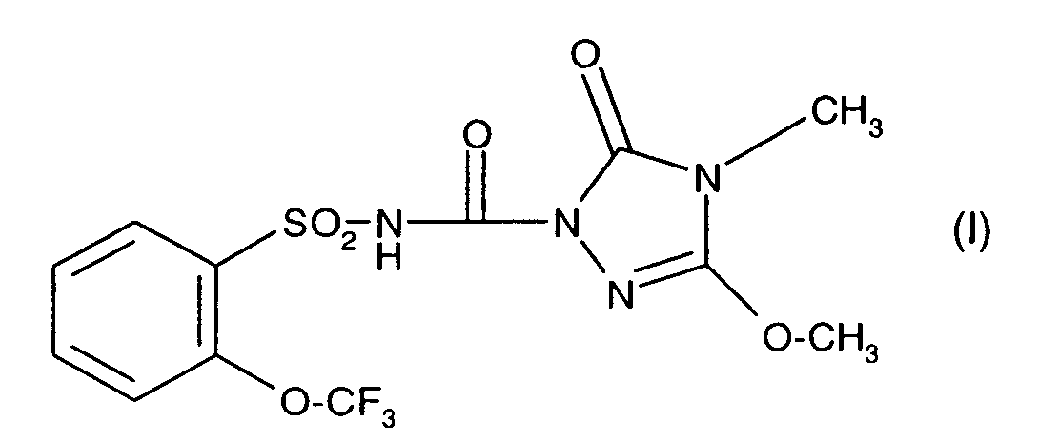
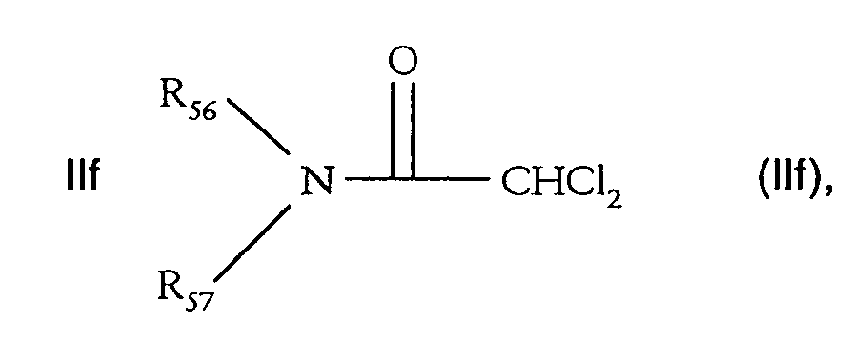
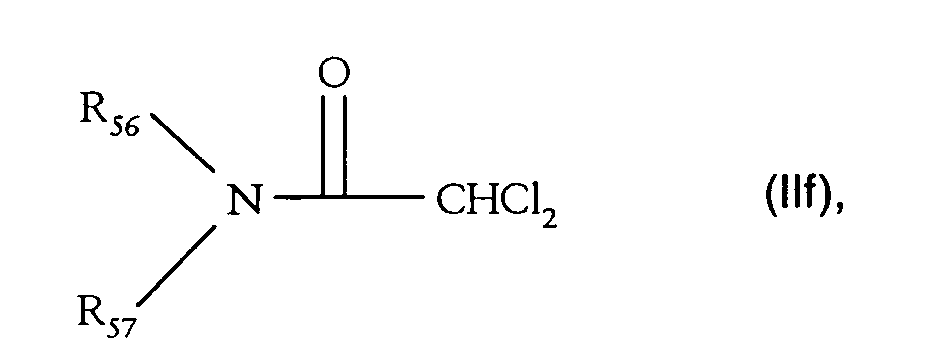
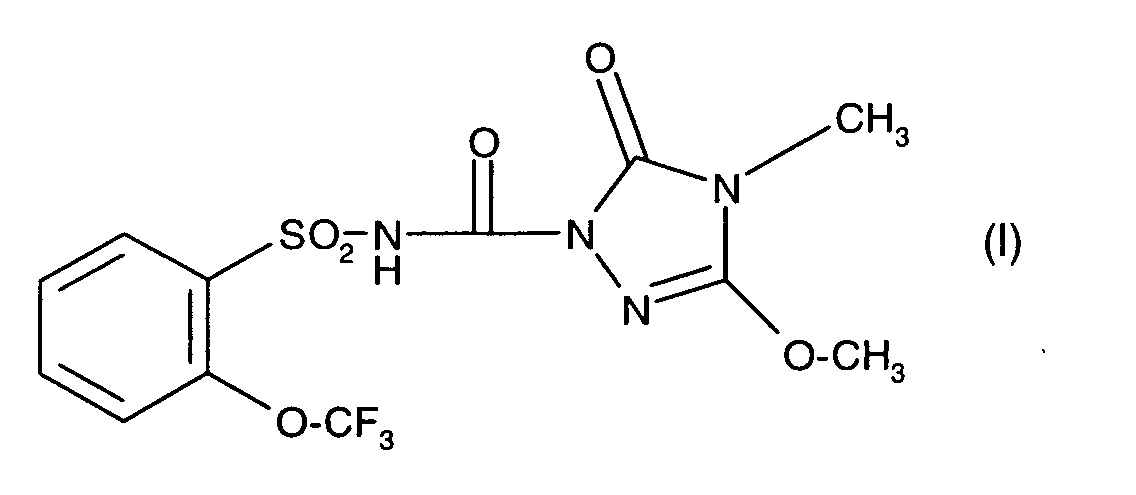
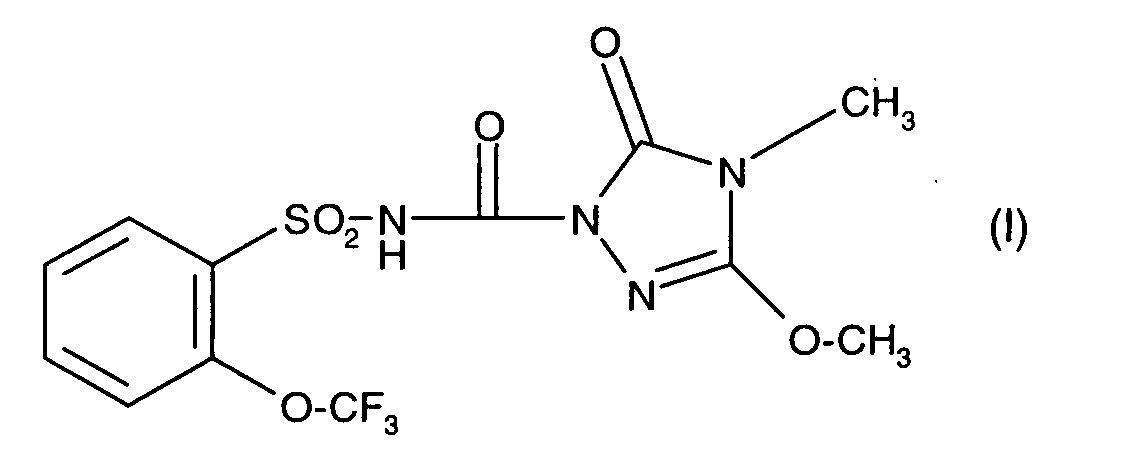
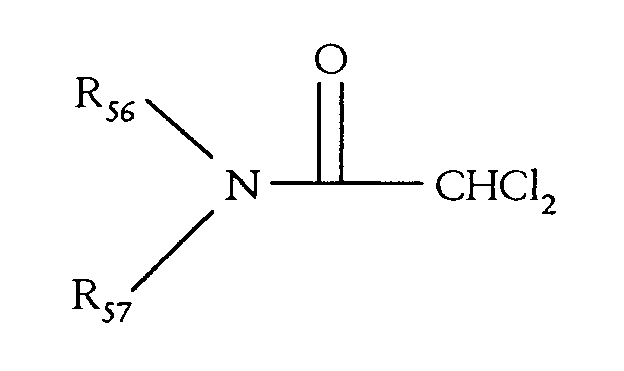
- the invention also relates to a method for selective control of Weeds and grasses in crops, which consists of one the crops, their seeds or cuttings or their acreage simultaneously or separately with a herbicidally effective amount of the herbicide Formula I and a herbicidally-antagonistically effective amount of the safener Formula IIf treated.
- the weeds to be controlled can be either monocot or dikotyle Weeds, such as Stellaria, Nasturtium, Agrostis, Digitaria, Avena, Setaria, Sinapis, Lolium, Solanum, Echinochloa, Scirpus, Monochoria, Sagittaria, Bromus, Alopecurus, Sorghum halepense, Rottboellia, Cyperus, Abutilon, Sida, Xanthium, Amaranthus, Chenopodium, Ipomoea, Chrysanthemum, Galium, Viola and Veronica.
- Weeds such as Stellaria, Nasturtium, Agrostis, Digitaria, Avena, Setaria, Sinapis, Lolium, Solanum, Echinochloa, Scirpus, Monochoria, Sagittaria, Bromus, Alopecurus, Sorghum halepense, Rottboellia, Cyperus, Abutilon, Sid
- the cultivated areas are those already covered with the crops or with the Seed of these crops fed soil areas as well as those for building with soils destined for these crops.
- a safener of formula II may, depending on the application for pretreatment of Seeds of the crop (Beizung the seed or cuttings) used or voi or after sowing in the soil. He can also do it on his own or in person be applied together with the herbicide after emergence of the plants.
- the Treatment of the plants or seeds with the safener can therefore basically regardless of the time of application of the herbicide.
- the application rate of safener too Herbicide depends largely on the type of application. In a field treatment, which is either using a tank mix with a combination of Safener and herbicide or by separate application of safener and herbicide, is usually a ratio of herbicide to safener of 1: 100 to 1: 1, preferably 1:50 to 5: 1.
- the application rates of herbicide are usually between 0.001 to 2 kg / ha, but preferably between 0.005 to 1 kg / ha.
- compositions of the invention are common to all in agriculture Application methods such as e.g. pre-eminent application, post-emergence application and Seed dressing suitable.
- seed dressing in general, 0.001 to 10 g of safener / kg of seed, preferably 0.05 to 2 g safener / kg of seed, applied.
- safener in liquid form short applied before sowing with seed swelling, so are expediently Safener solutions containing the active ingredient in a concentration of 1 to 10,000, preferably from 100 to 1000 ppm.
- the safeners of the formula II or combinations of these safeners with the herbicides of the formula I expediently together with in the Formulation technology conventional tools processed into formulations, e.g. to Emulsion concentrates, spreadable pastes, directly sprayable or dilutable Solutions, dilute emulsions, wettable powders, soluble powders, dusts, Granules or microcapsules.
- formulations are described, for example, in WO 97/34485 on pages 9 to 13 described.
- the formulations are prepared in a known manner, e.g. through heartfelt Mixing and / or grinding of the active ingredients with liquid or solid Formulation aids such as e.g. Solvents or solid carriers.
- liquid or solid Formulation aids such as e.g. Solvents or solid carriers.
- surfactants surface - active compounds
- Solvents and solids suitable for this purpose Carriers are e.g. in WO 97/34485 on page 6 indicated.
- nonionic, cationic and / or anionic surfactants and Surfactant mixtures with good emulsifying, dispersing and wetting properties into consideration.
- suitable anionic, nonionic and cationic surfactants are for example, in WO 97/34485 on pages 7 and 8 enumerated.
- surfactants commonly used in formulation technology which i.a. in "Mc Cutcheon's Detergents and Emulsifiers Annual "MC Publishing Corp., Ridgewood New Jersey, 1981, Stache, H., "Tensid-Taschenbuch", Carl Hanser Verlag, Kunststoff / Vienna, 1981 and M. and J. Ash, "Encyclopedia of Surfactants", Vol I-III, Chemical Publishing Co., New York, 1980-81 are described, suitable for the preparation of the herbicidal compositions according to the invention.
- the herbicidal formulations generally contain 0.1 to 99% by weight, in particular 0.1 to 95 wt .-% active ingredient mixture of the compound of formula I with the compounds of formula IIf, 1 to 99.9% by weight of a solid or liquid formulation auxiliary and 0 to 25 wt.%, In particular 0.1 to 25 wt.% Of a surfactant.
- compositions may also contain other additives such as stabilizers e.g. optionally epoxidized Vegetable oils (epoxidized coconut oil, rapeseed oil or soybean oil), defoamers, e.g. Silicone oil, Preservatives, viscosity regulators, binders, adhesives and fertilizers or contain other active ingredients.
- stabilizers e.g. optionally epoxidized Vegetable oils (epoxidized coconut oil, rapeseed oil or soybean oil), defoamers, e.g. Silicone oil, Preservatives, viscosity regulators, binders, adhesives and fertilizers or contain other active ingredients.
- the dressing of the seeds or the treatment of the germinated seedling are natural the preferred methods of administration, because the drug treatment completely aimed at the target culture.
- 1 to 1000 g of antidote are used, preferably 5 to 250 g of antidote, per 100 kg of seed, depending on the methodology, which also the addition of other active substances or micronutrients, of the specified Limit concentrations may vary up or down (repeat pickle).
- a liquid workup of a mixture of antidote and herbicide (mutual Amount ratio between 10: 1 and 1: 100) is used, with the application rate at Herbicide is 0.005 to 5.0 kg per hectare.
- Such tank mixes are before or applied after sowing.
- the active substance of the formula IIf is used as emulsion concentrate, wettable powder or as granules in introduced the open seeded seed furrow. After covering the seed furrow becomes in Usually, the herbicide applied in pre-emergence.
- the active substance of the formula IIf is dissolved in mineral granules or polymerized granules (urea / formaldehyde) mounted and dried.
- a coating can be applied (coating granules) containing it allowed to deliver the active ingredient over a certain period of time.
- emulsions of any desired concentration can be prepared by dilution with water.
- F2. solutions a) b) c) d) Active substance 5% 10% 50% 90% 1-Methoxy-3- (3-methoxypropoxy) -propane - 20% 20% - Polyethylene glycol MG 400 20% 10% - - N-methyl-2-pyrrolidone - - 30% 10% Arom. Hydrocarbon mixture C 9 -C 12 75% 60% - -
- the active ingredient is well mixed with the additives and ground well in a suitable mill. This gives wettable powders which can be diluted with water to give suspensions of any desired concentration.
- Carrier material ( ⁇ 0.1 - 1 mm) 99.0% 93% 83% such as CaCO 3 or SiO 2
- the active ingredient is mixed with the additives, ground and moistened with water. This mixture is extruded and then dried in a stream of air.
- F7. dusts a) b) c) Active substance 0.1% 1 % 5% talc 39.9% 49% 35% kaolin 60.0% 50% 60%
- the finely ground active ingredient is intimately mixed with the additives. You get so Suspension concentrate, from which by dilution with water suspensions each desired concentration can be produced.
- Example B1 Post-emergent applications of mixtures of a herbicide of the formula I with a safener of the formula IIf on barley
Landscapes
- Life Sciences & Earth Sciences (AREA)
- Agronomy & Crop Science (AREA)
- Pest Control & Pesticides (AREA)
- Plant Pathology (AREA)
- Health & Medical Sciences (AREA)
- Engineering & Computer Science (AREA)
- Dentistry (AREA)
- General Health & Medical Sciences (AREA)
- Wood Science & Technology (AREA)
- Zoology (AREA)
- Environmental Sciences (AREA)
- Agricultural Chemicals And Associated Chemicals (AREA)
Abstract
Description



| Emulgierbare Konzentrate: | |
| Aktives Wirkstoffgemisch | 1 bis 90 %, vorzugsweise 5 bis 20 % |
| oberflächenaktives Mittel | 1 bis 30 %, vorzugsweise 10 bis 20 % |
| flüssiges Trägermittel | 5 bis 94 %, vorzugsweise 70 bis 85 % |
| Stäube: | |
| Aktives Wirkstoffgemisch | 0,1 bis 10 %, vorzugsweise 0,1 bis 5 % |
| festes Trägermittel | 99,9 bis 90 %, vorzugsweise 99,9 bis 99 % |
| Suspensions-Konzentrate: | |
| Aktives Wirkstoffgemisch | 5 bis 75 %, vorzugsweise 10 bis 50 % |
| Wasser | 94 bis 24 %, vorzugsweise 88 bis 30 % |
| oberflächenaktives Mittel | 1 bis 40 %, vorzugsweise 2 bis 30 % |
| Benetzbare Pulver: | |
| Aktives Wirkstoffgemisch | 0,5 bis 90 %, vorzugsweise 1 bis 80 % |
| oberflächenaktives Mittel | 0,5 bis 20 %, vorzugsweise 1 bis 15 % |
| festes Trägermaterial | 5 bis 95 %, vorzugsweise 15 bis 90 % |
| Granulate: | |
| Aktives Wirkstoffgemisch | 0,1 bis 30 %, vorzugsweise 0,1 bis 15 % |
| festes Trägermittel | 99,5 bis 70 %, vorzugsweise 97 bis 85 % |
Formulierungsbeispiele für Mischungen aus Herbiziden der Formel I und Safener der Formel IIf (% = Gewichtsprozent)
| F1. Emulsionskonzentrate | a) | b) | c) | d) |
| Wirkstoffgemisch | 5 % | 10 % | 25 % | 50 % |
| Ca-Dodecylbenzolsulfonat | 6 % | 8 % | 6 % | 8 % |
| Ricinusöl-polyglykolether (36 Mol EO) | 4 % | - | 4 % | 4 % |
| Octylphenol-polyglykolether (7-8 Mol EO) | - | 4 % | - | 2 % |
| Cyclohexanon | - | - | 10 % | 20 % |
| Arom. Kohlenwasserstoffgemisch C9-C12 | 85 % | 78 % | 55 % | 16 % |
| F2. Lösungen | a) | b) | c) | d) |
| Wirkstoffgemisch | 5 % | 10 % | 50 % | 90 % |
| 1 -Methoxy-3-(3-methoxypropoxy)-propan | - | 20 % | 20 % | - |
| Polyethylenglykol MG 400 | 20 % | 10 % | - | - |
| N-Methyl-2-pyrrolidon | - | - | 30 % | 10 % |
| Arom. Kohlenwasserstoffgemisch C9-C12 | 75 % | 60 % | - | - |
| F3. Spritzpulver | a) | b) | c) | d) |
| Wirkstoffgemisch | 5 % | 25 % | 50 % | 80 % |
| Na-Ligninsulfonat | 4 % | - | 3 % | - |
| Na-Laurylsulfat | 2 % | 3 % | - | 4 % |
| Na-Diisobutyl-naphthalinsulfonat | - | 6 % | 5 % | 6 % |
| Octylphenol-polyglykolether (7-8 Mol EO) | - | 1 % | 2 % | - |
| Hochdisperse Kieselsäure | 1 % | 3 % | 5 % | 10 % |
| Kaolin | 88 % | 62 % | 35 % | - |
| F4. Umhüllungs-Granulate | a) | b) | c) |
| Wirkstoffgemisch | 0.1 % | 5 % | 15 % |
| Hochdisperse Kieselsäure | 0.9 % | 2 % | 2 % |
| Anorg. Trägermaterial (Æ 0.1 - 1 mm) | 99.0 % | 93 % | 83 % |
| F5. Umhüllungs-Granulate | a) | b) | c) |
| Wirkstoffgemisch | 0.1 % | 5 % | 15 % |
| Polyethylenglykol MG 200 | 1.0 % | 2 % | 3 % |
| Hochdisperse Kieselsäure | 0.9 % | 1 % | 2 % |
| Anorg. Trägermaterial | 98.0 % | 92 % | 80 % |
wie z.B. CaCO3 oder SiO2
| F6. Extruder-Granulate | a) | b) | c) | d) |
| Wirkstoffgemisch | 0.1 % | 3 % | 5 % | 15 % |
| Na-Ligninsulfonat | 1.5 % | 2 % | 3 % | 4 % |
| Carboxymethylcellulose | 1.4 % | 2 % | 2 % | 2 % |
| Kaolin | 97.0 % | 93 % | 90% | 79% |
| F7. Stäubemittel | a) | b) | c) |
| Wirkstoffgemisch | 0.1 % | 1 % | 5 % |
| Talkum | 39.9 % | 49 % | 35% |
| Kaolin | 60.0 % | 50 % | 60% |
| F8. Suspensions-Konzentrate | a) | b) | c) | d) |
| Wirkstoffgemisch | 3 % | 10 % | 25 % | 50% |
| Ethylenglykol | 5 % | 5 % | 5 % | 5 % |
| Nonylphenol-polyglykolether (15 Mol EO) | - | 1 % | 2 % | - |
| Na-Ligninsulfonat | 3 % | 3 % | 4 % | 5 % |
| Carboxymethylcellulose | 1 % | 1 % | 1 % | 1 % |
| 37%ige wäßrige Formaldehyd-Lösung | 0.2 % | 0.2 % | 0.2 % | 0.2 % |
| Silikonöl-Emulsion | 0.8 % | 0.8 % | 0.8 % | 0.8 % |
| Wasser | 87% | 79% | 62% | 38% |
| Pflanze: | Herbizid der Formel I: 60 g/ha | Herbizid der Formel I: 60 g/ha Safener Nr. 1.006: 15 g/ha |
| Gerste | 40 | 30 |
| Chenopodium | 90 | 80 |
| Emex | 90 | 90 |
| Raphanus | 80 | 70 |
| Setaria | 80 | 80 |
Claims (4)
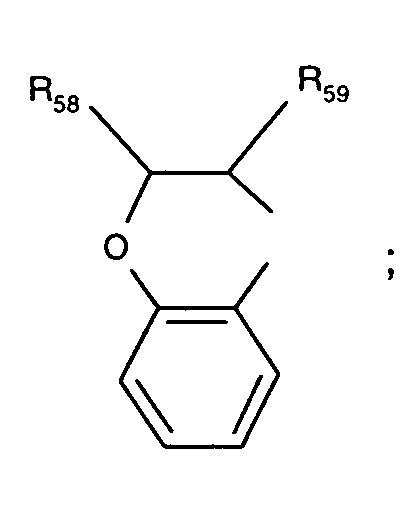
- Selektiv-herbizides Mittel, dadurch gekennzeichnet, daß es neben üblichen inerten Formulierungshilfsmitteln als Wirkstoff eine Mischung ausworin R56 und R57 unabhängig voneinander für C1-C6-Alkyl oder C2-C6-Alkenyl; oder R56 und R57 zusammen füra) einer herbizid-wirksamen Menge des Herbizids der Formel Iund
 b) einer herbizid-antagonistisch wirksamen Menge eines Safeners der Formel IIf
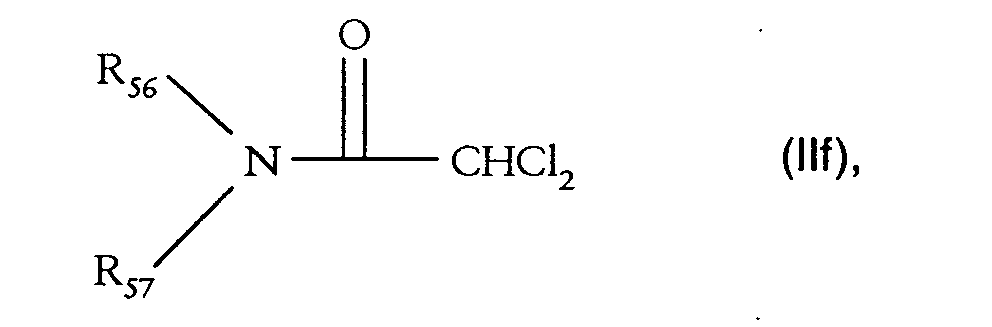 R58 und R59 unabhängig voneinander für Wasserstoff oder C1-C6-Alkyl; oder R56 und R57 zusammen für
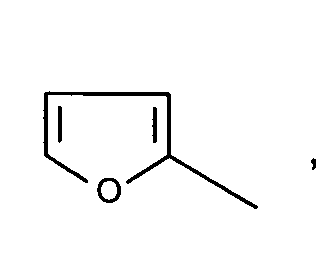
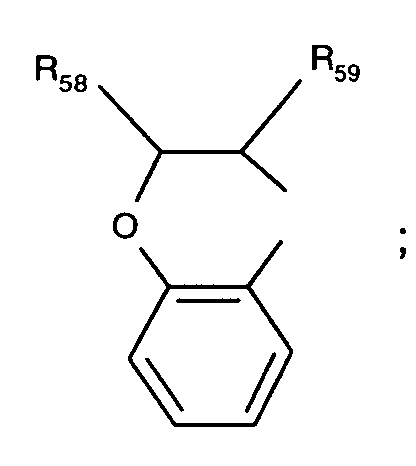 R60 und R61 unabhängig voneinander für C1-C4-Alkyl, oder R46 und R47 zusammen -(CH2)5-; R62 für Wasserstoff, C1-C4-Alkyl oder
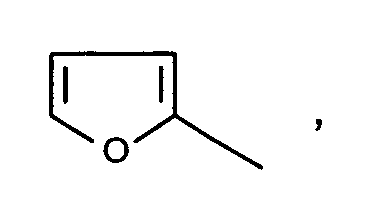
 oder R56 und R57 zusammen
 R63, R64, R65, R66, R67, R68, R69, R70, R71, R72, R73, R74, R75, R76, R77 und R78 unabhängig voneinander für Wasserstoff oder C1-C4-Alkyl stehen; enthält.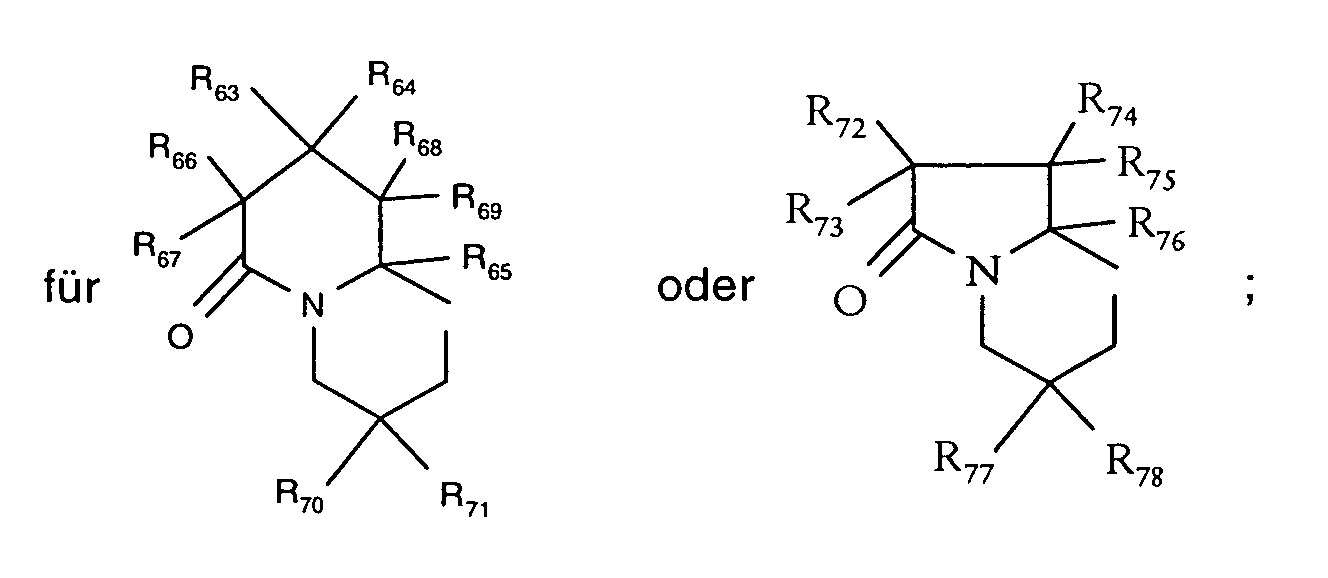
- Verfahren zum selektiven Bekämpfen von Unkräutern und Gräsern in Nutzpflanzenkulturen, dadurch gekennzeichnet, daß man die Nutzpflanzen, deren Samen oder Stecklinge oder deren Anbaufläche mit einer herbizid wirksamen Menge eines Herbizids der Formel I und einer herbizid-antagonistisch wirksamen Menge eines Safeners der Formel IIf behandelt.
- Verfahren gemäß Anspruch 2, dadurch gekennzeichnet, daß man Nutzpflanzenkulturen oder Anbauflächen für die Nutzpflanzenkulturen mit 0,001 bis 2 kg/ha eines Herbizids der Formel I gemäß Anspruch 1 und einer Menge von 0,001 bis 0,5 kg/ha eines Safeners der Formeln IIf gemäß Anspruch 1 behandelt.
- Verfahren gemäß Anspruch 2, dadurch gekennzeichnet, daß es sich bei den Nutzpflanzenkulturen um Getreide oder Reis handelt.
Applications Claiming Priority (3)
| Application Number | Priority Date | Filing Date | Title |
|---|---|---|---|
| CH13598 | 1998-01-21 | ||
| CH13598 | 1998-01-21 | ||
| EP99100891A EP0931456B1 (de) | 1998-01-21 | 1999-01-19 | Herbizides Mittel |
Related Parent Applications (1)
| Application Number | Title | Priority Date | Filing Date |
|---|---|---|---|
| EP99100891A Division EP0931456B1 (de) | 1998-01-21 | 1999-01-19 | Herbizides Mittel |
Publications (3)
| Publication Number | Publication Date |
|---|---|
| EP1290946A2 true EP1290946A2 (de) | 2003-03-12 |
| EP1290946A3 EP1290946A3 (de) | 2003-03-26 |
| EP1290946B1 EP1290946B1 (de) | 2004-03-31 |
Family
ID=4180051
Family Applications (4)
| Application Number | Title | Priority Date | Filing Date |
|---|---|---|---|
| EP02026751A Expired - Lifetime EP1290945B1 (de) | 1998-01-21 | 1999-01-19 | Herbizides Mittel |
| EP02026750A Expired - Lifetime EP1290944B1 (de) | 1998-01-21 | 1999-01-19 | Herbizides Mittel |
| EP99100891A Expired - Lifetime EP0931456B1 (de) | 1998-01-21 | 1999-01-19 | Herbizides Mittel |
| EP02026752A Expired - Lifetime EP1290946B1 (de) | 1998-01-21 | 1999-01-19 | Herbizides Mittel |
Family Applications Before (3)
| Application Number | Title | Priority Date | Filing Date |
|---|---|---|---|
| EP02026751A Expired - Lifetime EP1290945B1 (de) | 1998-01-21 | 1999-01-19 | Herbizides Mittel |
| EP02026750A Expired - Lifetime EP1290944B1 (de) | 1998-01-21 | 1999-01-19 | Herbizides Mittel |
| EP99100891A Expired - Lifetime EP0931456B1 (de) | 1998-01-21 | 1999-01-19 | Herbizides Mittel |
Country Status (9)
| Country | Link |
|---|---|
| US (1) | US6162762A (de) |
| EP (4) | EP1290945B1 (de) |
| AT (4) | ATE262790T1 (de) |
| AU (1) | AU719657B2 (de) |
| CA (1) | CA2259697C (de) |
| DE (4) | DE59909066D1 (de) |
| DK (3) | DK1290945T3 (de) |
| ES (4) | ES2218500T3 (de) |
| ZA (1) | ZA99394B (de) |
Families Citing this family (11)
| Publication number | Priority date | Publication date | Assignee | Title |
|---|---|---|---|---|
| DE19845407B4 (de) | 1998-10-02 | 2012-06-28 | Arysta LifeScience North America Corp.(n.d.Ges.d.Staates Californien) | Selektive Herbizide auf Basis eines substituierten Phenylsulfonylaminocarbonyl-triazolinons |
| DE19940860A1 (de) * | 1999-08-27 | 2001-03-01 | Bayer Ag | Selektive Herbizide auf Basis eines substituierten Phenylsulfonyl aminocarbonyltriazolinons und Safenern II |
| EP1221848B1 (de) * | 1999-09-30 | 2006-01-25 | Bayer CropScience AG | Selektive herbizide auf basis eines n-aryl-triazolinons |
| DE10143083A1 (de) | 2001-09-03 | 2003-03-20 | Bayer Cropscience Ag | Selektive Herbizide auf Basis von substituierten Arylsulfonylaminocarbonyltriazolinonen und Safenern |
| DE10146590A1 (de) | 2001-09-21 | 2003-04-10 | Bayer Cropscience Ag | Selektive Herbizide auf Basis von substituierten Thien-3-yl-sulfonylamino(thio)carbonyl-triazolin(thi)onen und Safenern |
| DE10146591A1 (de) * | 2001-09-21 | 2003-04-10 | Bayer Cropscience Ag | Herbizide auf Basis von substituierten Thien-3-yl-sulfonylamino(thio)carbonyl-triazolin(thi)onen |
| JP4092976B2 (ja) * | 2002-08-05 | 2008-05-28 | ソニー株式会社 | ガイドシステム、コンテンツサーバ、及び情報処理プログラム |
| AU2003213473A1 (en) * | 2002-08-07 | 2004-02-26 | Syngenta Participations Ag | Herbicidal composition |
| DE102004010813A1 (de) | 2004-03-05 | 2005-11-10 | Bayer Cropscience Ag | Neue Herbizide auf Basis von substituierten Thien-3-yl-sulfonylamino(thio)carbonyltriazolin(thi)onen und 4-HPPD-Hemmstoffen |
| WO2009089165A2 (en) * | 2008-01-07 | 2009-07-16 | Auburn University | Combinations of herbicides and safeners |
| CA2714560A1 (en) * | 2008-02-12 | 2009-08-20 | Arysta Lifescience North America, Llc | Method of controlling unwanted vegetation |
Family Cites Families (2)
| Publication number | Priority date | Publication date | Assignee | Title |
|---|---|---|---|---|
| DE4110795A1 (de) * | 1991-04-04 | 1992-10-08 | Bayer Ag | Sulfonylaminocarbonyltriazolinone mit ueber sauerstoff gebundenen substituenten |
| US5541337A (en) * | 1989-04-13 | 1996-07-30 | Bayer Aktiengesellschaft | Substituted 5-alkoxy-1,2,4-triazol-3-(thi)ones |
-
1999
- 1999-01-07 AU AU11279/99A patent/AU719657B2/en not_active Expired
- 1999-01-19 ES ES02026750T patent/ES2218500T3/es not_active Expired - Lifetime
- 1999-01-19 DK DK02026751T patent/DK1290945T3/da active
- 1999-01-19 AT AT02026752T patent/ATE262790T1/de active
- 1999-01-19 EP EP02026751A patent/EP1290945B1/de not_active Expired - Lifetime
- 1999-01-19 DE DE59909066T patent/DE59909066D1/de not_active Expired - Lifetime
- 1999-01-19 EP EP02026750A patent/EP1290944B1/de not_active Expired - Lifetime
- 1999-01-19 AT AT02026751T patent/ATE262789T1/de active
- 1999-01-19 DK DK02026752T patent/DK1290946T3/da active
- 1999-01-19 ES ES02026752T patent/ES2218502T3/es not_active Expired - Lifetime
- 1999-01-19 AT AT02026750T patent/ATE261659T1/de active
- 1999-01-19 ES ES99100891T patent/ES2195455T3/es not_active Expired - Lifetime
- 1999-01-19 DK DK02026750T patent/DK1290944T3/da active
- 1999-01-19 DE DE59904799T patent/DE59904799D1/de not_active Expired - Lifetime
- 1999-01-19 EP EP99100891A patent/EP0931456B1/de not_active Expired - Lifetime
- 1999-01-19 EP EP02026752A patent/EP1290946B1/de not_active Expired - Lifetime
- 1999-01-19 DE DE59908921T patent/DE59908921D1/de not_active Expired - Lifetime
- 1999-01-19 AT AT99100891T patent/ATE235823T1/de active
- 1999-01-19 ES ES02026751T patent/ES2218501T3/es not_active Expired - Lifetime
- 1999-01-19 CA CA2259697A patent/CA2259697C/en not_active Expired - Lifetime
- 1999-01-19 DE DE59909067T patent/DE59909067D1/de not_active Expired - Lifetime
- 1999-01-20 ZA ZA9900394A patent/ZA99394B/xx unknown
- 1999-01-21 US US09/235,348 patent/US6162762A/en not_active Expired - Lifetime
Also Published As
| Publication number | Publication date |
|---|---|
| ES2218501T3 (es) | 2004-11-16 |
| ES2218502T3 (es) | 2004-11-16 |
| ATE262790T1 (de) | 2004-04-15 |
| EP1290945A3 (de) | 2003-03-26 |
| DK1290945T3 (da) | 2004-07-26 |
| EP1290944A3 (de) | 2003-03-26 |
| ES2195455T3 (es) | 2003-12-01 |
| ATE261659T1 (de) | 2004-04-15 |
| EP1290946A3 (de) | 2003-03-26 |
| EP1290945B1 (de) | 2004-03-31 |
| EP1290944A2 (de) | 2003-03-12 |
| EP1290944B1 (de) | 2004-03-17 |
| ATE235823T1 (de) | 2003-04-15 |
| EP0931456B1 (de) | 2003-04-02 |
| DE59904799D1 (de) | 2003-05-08 |
| DE59909066D1 (de) | 2004-05-06 |
| EP0931456A1 (de) | 1999-07-28 |
| DK1290946T3 (da) | 2004-07-26 |
| EP1290946B1 (de) | 2004-03-31 |
| ES2218500T3 (es) | 2004-11-16 |
| AU719657B2 (en) | 2000-05-11 |
| DE59908921D1 (de) | 2004-04-22 |
| AU1127999A (en) | 1999-12-09 |
| US6162762A (en) | 2000-12-19 |
| CA2259697C (en) | 2011-07-12 |
| DE59909067D1 (de) | 2004-05-06 |
| CA2259697A1 (en) | 1999-07-21 |
| ATE262789T1 (de) | 2004-04-15 |
| ZA99394B (en) | 1999-07-21 |
| DK1290944T3 (da) | 2004-07-12 |
| EP1290945A2 (de) | 2003-03-12 |
Similar Documents
| Publication | Publication Date | Title |
|---|---|---|
| DE69706530T2 (de) | Herbizide synergistische zusammensetzung und verfahren zur unkrautbekämpfung | |
| DE69625587T2 (de) | Synergistiche herbizide zusammensetzungen mit metolachlor | |
| EP0158600A2 (de) | Verfahren zur selektiven Unkrautbekämpfung in Nutzpflanzenkulturen | |
| DE69702968T2 (de) | Herbizide zusammensetzung und deren verwendung zur unkrautbekämpfung | |
| CH668530A5 (de) | Synergistisches mittel und verfahren zur selektiven unkrautbekaempfung in reis. | |
| EP0236273B1 (de) | Synergistisches Mittel und Verfahren zur selektiven Unkrautbekämpfung in Getreide | |
| EP1290944B1 (de) | Herbizides Mittel | |
| EP0768034B1 (de) | Herbizides synergistisches Mittel und Verfahren zur Unkrautbekämpfung | |
| EP0043802B1 (de) | Synergistisches Mittel und Verfahren zur selektiven Unkrautbekämpfung, insbesondere in Getreide | |
| WO1998047356A2 (de) | Dicamba und safener enthaltende herbizide mittel | |
| EP0542687A1 (de) | Synergistisches Mittel und Verfahren zur selektiven Unkrautbekämpfung | |
| EP0685157B1 (de) | Selektiv-herbizides Mittel | |
| EP0112799A1 (de) | Herbizides Mittel zur selektiven Unkrautbekämpfung in Getreide | |
| EP0058639A2 (de) | 2-(4-(6-Halogen-chinoxalinyl-2-oxy)-phenoxy)-propionsäureester, Verfahren zu ihrer Herstellung sowie ihre Verwendung als Herbizide und Pflanzenwuchsregulatoren | |
| EP0431545A2 (de) | Selektive herbizide Mittel und fungizide Mittel | |
| DE19961465A1 (de) | Herbizides Mittel | |
| EP0616770B1 (de) | Selektiv-herbizides Mittel | |
| EP0182740A2 (de) | Synergistisches Mittel und Verfahren zur selektiven Unkrautbekämpfung, insbesondere in Getreide | |
| EP0480306A1 (de) | Synergistische herbizide Mittel | |
| WO1998034480A1 (de) | Herbizides mittel | |
| DE69216905T2 (de) | Herbizide Zusammensetzungen mit verbesserter Getreide-Sicherheit | |
| EP0585199A1 (de) | Selektiv-herbizides Mittel | |
| EP0069705B1 (de) | Synergistisches Mittel und Verfahren zur selektiven Unkrautbekämpfung, insbesondere in Getreide | |
| EP0043349A1 (de) | Synergistisches Mittel und Verfahren zur selektiven Unkrautbekämpfung, insbesondere in Getreide und Sojabohnenkulturen | |
| EP0208245B1 (de) | Herbizide und wachstumsregulierende Mittel auf Basis von Chinolinderivaten |
Legal Events
| Date | Code | Title | Description |
|---|---|---|---|
| PUAI | Public reference made under article 153(3) epc to a published international application that has entered the european phase |
Free format text: ORIGINAL CODE: 0009012 |
|
| PUAL | Search report despatched |
Free format text: ORIGINAL CODE: 0009013 |
|
| 17P | Request for examination filed |
Effective date: 20021202 |
|
| AC | Divisional application: reference to earlier application |
Ref document number: 0931456 Country of ref document: EP Kind code of ref document: P |
|
| AK | Designated contracting states |
Kind code of ref document: A2 Designated state(s): AT BE CH DE DK ES FR GB GR IE IT LI LU NL SE |
|
| AK | Designated contracting states |
Kind code of ref document: A3 Designated state(s): AT BE CH DE DK ES FR GB GR IE IT LI LU NL SE |
|
| RIN1 | Information on inventor provided before grant (corrected) |
Inventor name: CORNES, DEREK Inventor name: GLOCK, JUTTA |
|
| GRAP | Despatch of communication of intention to grant a patent |
Free format text: ORIGINAL CODE: EPIDOSNIGR1 |
|
| GRAS | Grant fee paid |
Free format text: ORIGINAL CODE: EPIDOSNIGR3 |
|
| AKX | Designation fees paid |
Designated state(s): AT BE CH DE DK ES FR GB GR IE IT LI LU NL SE |
|
| GRAA | (expected) grant |
Free format text: ORIGINAL CODE: 0009210 |
|
| AC | Divisional application: reference to earlier application |
Ref document number: 0931456 Country of ref document: EP Kind code of ref document: P |
|
| AK | Designated contracting states |
Kind code of ref document: B1 Designated state(s): AT BE CH DE DK ES FR GB GR IE IT LI LU NL SE |
|
| REG | Reference to a national code |
Ref country code: GB Ref legal event code: FG4D Free format text: NOT ENGLISH Ref country code: CH Ref legal event code: EP |
|
| REG | Reference to a national code |
Ref country code: IE Ref legal event code: FG4D Free format text: GERMAN |
|
| REF | Corresponds to: |
Ref document number: 59909067 Country of ref document: DE Date of ref document: 20040506 Kind code of ref document: P |
|
| GBT | Gb: translation of ep patent filed (gb section 77(6)(a)/1977) |
Effective date: 20040511 |
|
| REG | Reference to a national code |
Ref country code: GR Ref legal event code: EP Ref document number: 20040401922 Country of ref document: GR |
|
| REG | Reference to a national code |
Ref country code: SE Ref legal event code: TRGR |
|
| REG | Reference to a national code |
Ref country code: DK Ref legal event code: T3 |
|
| REG | Reference to a national code |
Ref country code: ES Ref legal event code: FG2A Ref document number: 2218502 Country of ref document: ES Kind code of ref document: T3 |
|
| ET | Fr: translation filed | ||
| PLBE | No opposition filed within time limit |
Free format text: ORIGINAL CODE: 0009261 |
|
| STAA | Information on the status of an ep patent application or granted ep patent |
Free format text: STATUS: NO OPPOSITION FILED WITHIN TIME LIMIT |
|
| 26N | No opposition filed |
Effective date: 20050104 |
|
| REG | Reference to a national code |
Ref country code: FR Ref legal event code: PLFP Year of fee payment: 18 |
|
| REG | Reference to a national code |
Ref country code: FR Ref legal event code: PLFP Year of fee payment: 19 |
|
| PGFP | Annual fee paid to national office [announced via postgrant information from national office to epo] |
Ref country code: GB Payment date: 20161228 Year of fee payment: 19 Ref country code: IE Payment date: 20161229 Year of fee payment: 19 |
|
| PGFP | Annual fee paid to national office [announced via postgrant information from national office to epo] |
Ref country code: GR Payment date: 20161229 Year of fee payment: 19 |
|
| PGFP | Annual fee paid to national office [announced via postgrant information from national office to epo] |
Ref country code: NL Payment date: 20170109 Year of fee payment: 19 |
|
| PGFP | Annual fee paid to national office [announced via postgrant information from national office to epo] |
Ref country code: SE Payment date: 20170109 Year of fee payment: 19 Ref country code: DE Payment date: 20170131 Year of fee payment: 19 Ref country code: FR Payment date: 20170103 Year of fee payment: 19 Ref country code: CH Payment date: 20170124 Year of fee payment: 19 |
|
| PGFP | Annual fee paid to national office [announced via postgrant information from national office to epo] |
Ref country code: AT Payment date: 20161229 Year of fee payment: 19 Ref country code: BE Payment date: 20170116 Year of fee payment: 19 Ref country code: LU Payment date: 20170117 Year of fee payment: 19 |
|
| PGFP | Annual fee paid to national office [announced via postgrant information from national office to epo] |
Ref country code: ES Payment date: 20170119 Year of fee payment: 19 Ref country code: IT Payment date: 20170117 Year of fee payment: 19 |
|
| PGFP | Annual fee paid to national office [announced via postgrant information from national office to epo] |
Ref country code: DK Payment date: 20171228 Year of fee payment: 20 |
|
| REG | Reference to a national code |
Ref country code: DE Ref legal event code: R119 Ref document number: 59909067 Country of ref document: DE |
|
| REG | Reference to a national code |
Ref country code: SE Ref legal event code: EUG |
|
| REG | Reference to a national code |
Ref country code: CH Ref legal event code: PL |
|
| REG | Reference to a national code |
Ref country code: NL Ref legal event code: MM Effective date: 20180201 |
|
| REG | Reference to a national code |
Ref country code: AT Ref legal event code: MM01 Ref document number: 262790 Country of ref document: AT Kind code of ref document: T Effective date: 20180119 |
|
| GBPC | Gb: european patent ceased through non-payment of renewal fee |
Effective date: 20180119 |
|
| PG25 | Lapsed in a contracting state [announced via postgrant information from national office to epo] |
Ref country code: DE Free format text: LAPSE BECAUSE OF NON-PAYMENT OF DUE FEES Effective date: 20180801 Ref country code: LU Free format text: LAPSE BECAUSE OF NON-PAYMENT OF DUE FEES Effective date: 20180119 Ref country code: SE Free format text: LAPSE BECAUSE OF NON-PAYMENT OF DUE FEES Effective date: 20180120 Ref country code: FR Free format text: LAPSE BECAUSE OF NON-PAYMENT OF DUE FEES Effective date: 20180131 |
|
| REG | Reference to a national code |
Ref country code: IE Ref legal event code: MM4A |
|
| REG | Reference to a national code |
Ref country code: FR Ref legal event code: ST Effective date: 20180928 |
|
| REG | Reference to a national code |
Ref country code: BE Ref legal event code: MM Effective date: 20180131 |
|
| PG25 | Lapsed in a contracting state [announced via postgrant information from national office to epo] |
Ref country code: AT Free format text: LAPSE BECAUSE OF NON-PAYMENT OF DUE FEES Effective date: 20180119 Ref country code: LI Free format text: LAPSE BECAUSE OF NON-PAYMENT OF DUE FEES Effective date: 20180131 Ref country code: GB Free format text: LAPSE BECAUSE OF NON-PAYMENT OF DUE FEES Effective date: 20180119 Ref country code: CH Free format text: LAPSE BECAUSE OF NON-PAYMENT OF DUE FEES Effective date: 20180131 Ref country code: GR Free format text: LAPSE BECAUSE OF NON-PAYMENT OF DUE FEES Effective date: 20180802 Ref country code: BE Free format text: LAPSE BECAUSE OF NON-PAYMENT OF DUE FEES Effective date: 20180131 Ref country code: NL Free format text: LAPSE BECAUSE OF NON-PAYMENT OF DUE FEES Effective date: 20180201 |
|
| REG | Reference to a national code |
Ref country code: DK Ref legal event code: EUP Effective date: 20190119 |
|
| PG25 | Lapsed in a contracting state [announced via postgrant information from national office to epo] |
Ref country code: IE Free format text: LAPSE BECAUSE OF NON-PAYMENT OF DUE FEES Effective date: 20180119 |
|
| PG25 | Lapsed in a contracting state [announced via postgrant information from national office to epo] |
Ref country code: IT Free format text: LAPSE BECAUSE OF NON-PAYMENT OF DUE FEES Effective date: 20180119 |
|
| REG | Reference to a national code |
Ref country code: ES Ref legal event code: FD2A Effective date: 20190730 |
|
| PG25 | Lapsed in a contracting state [announced via postgrant information from national office to epo] |
Ref country code: ES Free format text: LAPSE BECAUSE OF NON-PAYMENT OF DUE FEES Effective date: 20180120 |