EP1290150B1 - Cutinase variants - Google Patents
Cutinase variants Download PDFInfo
- Publication number
- EP1290150B1 EP1290150B1 EP01933646A EP01933646A EP1290150B1 EP 1290150 B1 EP1290150 B1 EP 1290150B1 EP 01933646 A EP01933646 A EP 01933646A EP 01933646 A EP01933646 A EP 01933646A EP 1290150 B1 EP1290150 B1 EP 1290150B1
- Authority
- EP
- European Patent Office
- Prior art keywords
- variant
- cutinase
- seq
- amino acid
- dna
- Prior art date
- Legal status (The legal status is an assumption and is not a legal conclusion. Google has not performed a legal analysis and makes no representation as to the accuracy of the status listed.)
- Expired - Lifetime
Links
- 108010005400 cutinase Proteins 0.000 title claims abstract description 99
- 238000006467 substitution reaction Methods 0.000 claims abstract description 26
- 125000000539 amino acid group Chemical group 0.000 claims abstract description 5
- 238000000034 method Methods 0.000 claims description 50
- 101100059197 Bacillus subtilis (strain 168) katE gene Proteins 0.000 claims description 34
- 102220518847 Olfactory receptor 1G1_N15D_mutation Human genes 0.000 claims description 34
- 102220602638 TAR DNA-binding protein 43_S48E_mutation Human genes 0.000 claims description 31
- 108091028043 Nucleic acid sequence Proteins 0.000 claims description 25
- 229920000728 polyester Polymers 0.000 claims description 21
- 239000004744 fabric Substances 0.000 claims description 17
- 102220283118 rs755987663 Human genes 0.000 claims description 16
- 102200004921 rs56047316 Human genes 0.000 claims description 14
- 230000008569 process Effects 0.000 claims description 10
- 239000003795 chemical substances by application Substances 0.000 claims description 6
- 125000004122 cyclic group Chemical group 0.000 claims description 6
- 238000004043 dyeing Methods 0.000 claims description 6
- 102200121302 rs12142270 Human genes 0.000 claims description 6
- 102200133203 rs3218619 Human genes 0.000 claims description 6
- 102220081228 rs372168541 Human genes 0.000 claims description 5
- 102220003816 rs387906480 Human genes 0.000 claims description 5
- 102220254337 rs201815571 Human genes 0.000 claims description 4
- 102200083947 rs28937872 Human genes 0.000 claims description 4
- 230000007071 enzymatic hydrolysis Effects 0.000 claims description 3
- 238000006047 enzymatic hydrolysis reaction Methods 0.000 claims description 3
- 239000000985 reactive dye Substances 0.000 claims description 3
- 102200108250 rs121918282 Human genes 0.000 claims description 3
- 102220081926 rs73927405 Human genes 0.000 claims description 3
- LLLVZDVNHNWSDS-UHFFFAOYSA-N 4-methylidene-3,5-dioxabicyclo[5.2.2]undeca-1(9),7,10-triene-2,6-dione Chemical compound C1(C2=CC=C(C(=O)OC(=C)O1)C=C2)=O LLLVZDVNHNWSDS-UHFFFAOYSA-N 0.000 claims description 2
- 102220518444 Enhancer of filamentation 1_T29I_mutation Human genes 0.000 claims description 2
- 239000002216 antistatic agent Substances 0.000 claims description 2
- 239000000986 disperse dye Substances 0.000 claims description 2
- 239000011347 resin Substances 0.000 claims description 2
- 229920005989 resin Polymers 0.000 claims description 2
- 125000003275 alpha amino acid group Chemical group 0.000 claims 6
- 102220173368 rs74740454 Human genes 0.000 claims 2
- 230000002538 fungal effect Effects 0.000 abstract description 9
- 230000001976 improved effect Effects 0.000 abstract description 9
- 230000004075 alteration Effects 0.000 abstract description 6
- 241000196324 Embryophyta Species 0.000 description 39
- 210000004027 cell Anatomy 0.000 description 36
- 108020004414 DNA Proteins 0.000 description 35
- 239000002773 nucleotide Substances 0.000 description 26
- 125000003729 nucleotide group Chemical group 0.000 description 26
- 102000004190 Enzymes Human genes 0.000 description 22
- 108090000790 Enzymes Proteins 0.000 description 22
- 229940088598 enzyme Drugs 0.000 description 21
- 108090000623 proteins and genes Proteins 0.000 description 21
- 239000003599 detergent Substances 0.000 description 17
- 230000000694 effects Effects 0.000 description 17
- 240000004808 Saccharomyces cerevisiae Species 0.000 description 16
- 235000014680 Saccharomyces cerevisiae Nutrition 0.000 description 16
- 241001480714 Humicola insolens Species 0.000 description 14
- 239000012634 fragment Substances 0.000 description 14
- 238000003752 polymerase chain reaction Methods 0.000 description 14
- 150000001413 amino acids Chemical group 0.000 description 13
- 239000013598 vector Substances 0.000 description 13
- -1 poly(ethylene terephthalate) Polymers 0.000 description 11
- 230000009466 transformation Effects 0.000 description 11
- 238000005406 washing Methods 0.000 description 11
- 239000000203 mixture Substances 0.000 description 10
- 230000035772 mutation Effects 0.000 description 10
- 239000013604 expression vector Substances 0.000 description 9
- 239000013612 plasmid Substances 0.000 description 8
- 239000000243 solution Substances 0.000 description 8
- 239000004753 textile Substances 0.000 description 8
- 241000588724 Escherichia coli Species 0.000 description 7
- 241000223218 Fusarium Species 0.000 description 7
- 238000006243 chemical reaction Methods 0.000 description 7
- 239000008103 glucose Substances 0.000 description 7
- 108091034117 Oligonucleotide Proteins 0.000 description 6
- JLCPHMBAVCMARE-UHFFFAOYSA-N [3-[[3-[[3-[[3-[[3-[[3-[[3-[[3-[[3-[[3-[[3-[[5-(2-amino-6-oxo-1H-purin-9-yl)-3-[[3-[[3-[[3-[[3-[[3-[[5-(2-amino-6-oxo-1H-purin-9-yl)-3-[[5-(2-amino-6-oxo-1H-purin-9-yl)-3-hydroxyoxolan-2-yl]methoxy-hydroxyphosphoryl]oxyoxolan-2-yl]methoxy-hydroxyphosphoryl]oxy-5-(5-methyl-2,4-dioxopyrimidin-1-yl)oxolan-2-yl]methoxy-hydroxyphosphoryl]oxy-5-(6-aminopurin-9-yl)oxolan-2-yl]methoxy-hydroxyphosphoryl]oxy-5-(6-aminopurin-9-yl)oxolan-2-yl]methoxy-hydroxyphosphoryl]oxy-5-(6-aminopurin-9-yl)oxolan-2-yl]methoxy-hydroxyphosphoryl]oxy-5-(6-aminopurin-9-yl)oxolan-2-yl]methoxy-hydroxyphosphoryl]oxyoxolan-2-yl]methoxy-hydroxyphosphoryl]oxy-5-(5-methyl-2,4-dioxopyrimidin-1-yl)oxolan-2-yl]methoxy-hydroxyphosphoryl]oxy-5-(4-amino-2-oxopyrimidin-1-yl)oxolan-2-yl]methoxy-hydroxyphosphoryl]oxy-5-(5-methyl-2,4-dioxopyrimidin-1-yl)oxolan-2-yl]methoxy-hydroxyphosphoryl]oxy-5-(5-methyl-2,4-dioxopyrimidin-1-yl)oxolan-2-yl]methoxy-hydroxyphosphoryl]oxy-5-(6-aminopurin-9-yl)oxolan-2-yl]methoxy-hydroxyphosphoryl]oxy-5-(6-aminopurin-9-yl)oxolan-2-yl]methoxy-hydroxyphosphoryl]oxy-5-(4-amino-2-oxopyrimidin-1-yl)oxolan-2-yl]methoxy-hydroxyphosphoryl]oxy-5-(4-amino-2-oxopyrimidin-1-yl)oxolan-2-yl]methoxy-hydroxyphosphoryl]oxy-5-(4-amino-2-oxopyrimidin-1-yl)oxolan-2-yl]methoxy-hydroxyphosphoryl]oxy-5-(6-aminopurin-9-yl)oxolan-2-yl]methoxy-hydroxyphosphoryl]oxy-5-(4-amino-2-oxopyrimidin-1-yl)oxolan-2-yl]methyl [5-(6-aminopurin-9-yl)-2-(hydroxymethyl)oxolan-3-yl] hydrogen phosphate Polymers Cc1cn(C2CC(OP(O)(=O)OCC3OC(CC3OP(O)(=O)OCC3OC(CC3O)n3cnc4c3nc(N)[nH]c4=O)n3cnc4c3nc(N)[nH]c4=O)C(COP(O)(=O)OC3CC(OC3COP(O)(=O)OC3CC(OC3COP(O)(=O)OC3CC(OC3COP(O)(=O)OC3CC(OC3COP(O)(=O)OC3CC(OC3COP(O)(=O)OC3CC(OC3COP(O)(=O)OC3CC(OC3COP(O)(=O)OC3CC(OC3COP(O)(=O)OC3CC(OC3COP(O)(=O)OC3CC(OC3COP(O)(=O)OC3CC(OC3COP(O)(=O)OC3CC(OC3COP(O)(=O)OC3CC(OC3COP(O)(=O)OC3CC(OC3COP(O)(=O)OC3CC(OC3COP(O)(=O)OC3CC(OC3COP(O)(=O)OC3CC(OC3CO)n3cnc4c(N)ncnc34)n3ccc(N)nc3=O)n3cnc4c(N)ncnc34)n3ccc(N)nc3=O)n3ccc(N)nc3=O)n3ccc(N)nc3=O)n3cnc4c(N)ncnc34)n3cnc4c(N)ncnc34)n3cc(C)c(=O)[nH]c3=O)n3cc(C)c(=O)[nH]c3=O)n3ccc(N)nc3=O)n3cc(C)c(=O)[nH]c3=O)n3cnc4c3nc(N)[nH]c4=O)n3cnc4c(N)ncnc34)n3cnc4c(N)ncnc34)n3cnc4c(N)ncnc34)n3cnc4c(N)ncnc34)O2)c(=O)[nH]c1=O JLCPHMBAVCMARE-UHFFFAOYSA-N 0.000 description 6
- 102000004169 proteins and genes Human genes 0.000 description 6
- 210000001519 tissue Anatomy 0.000 description 6
- 230000009261 transgenic effect Effects 0.000 description 6
- FWMNVWWHGCHHJJ-SKKKGAJSSA-N 4-amino-1-[(2r)-6-amino-2-[[(2r)-2-[[(2r)-2-[[(2r)-2-amino-3-phenylpropanoyl]amino]-3-phenylpropanoyl]amino]-4-methylpentanoyl]amino]hexanoyl]piperidine-4-carboxylic acid Chemical compound C([C@H](C(=O)N[C@H](CC(C)C)C(=O)N[C@H](CCCCN)C(=O)N1CCC(N)(CC1)C(O)=O)NC(=O)[C@H](N)CC=1C=CC=CC=1)C1=CC=CC=C1 FWMNVWWHGCHHJJ-SKKKGAJSSA-N 0.000 description 5
- 240000006439 Aspergillus oryzae Species 0.000 description 5
- 241000894006 Bacteria Species 0.000 description 5
- 241000209510 Liliopsida Species 0.000 description 5
- 240000007594 Oryza sativa Species 0.000 description 5
- 235000007164 Oryza sativa Nutrition 0.000 description 5
- UYXTWWCETRIEDR-UHFFFAOYSA-N Tributyrin Chemical compound CCCC(=O)OCC(OC(=O)CCC)COC(=O)CCC UYXTWWCETRIEDR-UHFFFAOYSA-N 0.000 description 5
- 238000010276 construction Methods 0.000 description 5
- 239000000047 product Substances 0.000 description 5
- 235000009566 rice Nutrition 0.000 description 5
- 239000008399 tap water Substances 0.000 description 5
- 235000020679 tap water Nutrition 0.000 description 5
- UHPMCKVQTMMPCG-UHFFFAOYSA-N 5,8-dihydroxy-2-methoxy-6-methyl-7-(2-oxopropyl)naphthalene-1,4-dione Chemical compound CC1=C(CC(C)=O)C(O)=C2C(=O)C(OC)=CC(=O)C2=C1O UHPMCKVQTMMPCG-UHFFFAOYSA-N 0.000 description 4
- 241000228245 Aspergillus niger Species 0.000 description 4
- LFQSCWFLJHTTHZ-UHFFFAOYSA-N Ethanol Chemical compound CCO LFQSCWFLJHTTHZ-UHFFFAOYSA-N 0.000 description 4
- 241000221779 Fusarium sambucinum Species 0.000 description 4
- DHMQDGOQFOQNFH-UHFFFAOYSA-N Glycine Chemical compound NCC(O)=O DHMQDGOQFOQNFH-UHFFFAOYSA-N 0.000 description 4
- 108090001060 Lipase Proteins 0.000 description 4
- 102000004882 Lipase Human genes 0.000 description 4
- 239000004367 Lipase Substances 0.000 description 4
- 102000035195 Peptidases Human genes 0.000 description 4
- 108091005804 Peptidases Proteins 0.000 description 4
- 239000004365 Protease Substances 0.000 description 4
- KKEYFWRCBNTPAC-UHFFFAOYSA-N Terephthalic acid Chemical compound OC(=O)C1=CC=C(C(O)=O)C=C1 KKEYFWRCBNTPAC-UHFFFAOYSA-N 0.000 description 4
- 102000005924 Triose-Phosphate Isomerase Human genes 0.000 description 4
- 108700015934 Triose-phosphate isomerases Proteins 0.000 description 4
- 239000002299 complementary DNA Substances 0.000 description 4
- 239000002270 dispersing agent Substances 0.000 description 4
- 235000019421 lipase Nutrition 0.000 description 4
- 239000003550 marker Substances 0.000 description 4
- 239000002609 medium Substances 0.000 description 4
- 230000037039 plant physiology Effects 0.000 description 4
- 235000019419 proteases Nutrition 0.000 description 4
- 210000001938 protoplast Anatomy 0.000 description 4
- 239000000758 substrate Substances 0.000 description 4
- XLYOFNOQVPJJNP-UHFFFAOYSA-N water Substances O XLYOFNOQVPJJNP-UHFFFAOYSA-N 0.000 description 4
- 241000228212 Aspergillus Species 0.000 description 3
- 235000014469 Bacillus subtilis Nutrition 0.000 description 3
- 229920000742 Cotton Polymers 0.000 description 3
- LYCAIKOWRPUZTN-UHFFFAOYSA-N Ethylene glycol Chemical compound OCCO LYCAIKOWRPUZTN-UHFFFAOYSA-N 0.000 description 3
- 229910009891 LiAc Inorganic materials 0.000 description 3
- HEMHJVSKTPXQMS-UHFFFAOYSA-M Sodium hydroxide Chemical compound [OH-].[Na+] HEMHJVSKTPXQMS-UHFFFAOYSA-M 0.000 description 3
- 244000061456 Solanum tuberosum Species 0.000 description 3
- 235000002595 Solanum tuberosum Nutrition 0.000 description 3
- 239000002253 acid Substances 0.000 description 3
- 239000003945 anionic surfactant Substances 0.000 description 3
- 239000000872 buffer Substances 0.000 description 3
- 210000000349 chromosome Anatomy 0.000 description 3
- 238000004925 denaturation Methods 0.000 description 3
- 230000036425 denaturation Effects 0.000 description 3
- 241001233957 eudicotyledons Species 0.000 description 3
- 238000002474 experimental method Methods 0.000 description 3
- 230000010354 integration Effects 0.000 description 3
- 238000004519 manufacturing process Methods 0.000 description 3
- 230000001404 mediated effect Effects 0.000 description 3
- 239000003921 oil Substances 0.000 description 3
- 235000019198 oils Nutrition 0.000 description 3
- 239000002245 particle Substances 0.000 description 3
- 229920000139 polyethylene terephthalate Polymers 0.000 description 3
- 239000005020 polyethylene terephthalate Substances 0.000 description 3
- 108090000765 processed proteins & peptides Proteins 0.000 description 3
- 230000001105 regulatory effect Effects 0.000 description 3
- 239000006228 supernatant Substances 0.000 description 3
- 238000012360 testing method Methods 0.000 description 3
- 238000013518 transcription Methods 0.000 description 3
- 230000035897 transcription Effects 0.000 description 3
- 238000012546 transfer Methods 0.000 description 3
- 230000001131 transforming effect Effects 0.000 description 3
- 239000000080 wetting agent Substances 0.000 description 3
- RZVAJINKPMORJF-UHFFFAOYSA-N Acetaminophen Chemical compound CC(=O)NC1=CC=C(O)C=C1 RZVAJINKPMORJF-UHFFFAOYSA-N 0.000 description 2
- 229920001817 Agar Polymers 0.000 description 2
- 235000002247 Aspergillus oryzae Nutrition 0.000 description 2
- IJGRMHOSHXDMSA-UHFFFAOYSA-N Atomic nitrogen Chemical compound N#N IJGRMHOSHXDMSA-UHFFFAOYSA-N 0.000 description 2
- 241000194108 Bacillus licheniformis Species 0.000 description 2
- 244000063299 Bacillus subtilis Species 0.000 description 2
- 108091005658 Basic proteases Proteins 0.000 description 2
- 240000002791 Brassica napus Species 0.000 description 2
- FERIUCNNQQJTOY-UHFFFAOYSA-N Butyric acid Chemical compound CCCC(O)=O FERIUCNNQQJTOY-UHFFFAOYSA-N 0.000 description 2
- 244000025254 Cannabis sativa Species 0.000 description 2
- 102220596876 Cytoplasmic FMR1-interacting protein 1_N15T_mutation Human genes 0.000 description 2
- 102000053602 DNA Human genes 0.000 description 2
- 108010017826 DNA Polymerase I Proteins 0.000 description 2
- 102000004594 DNA Polymerase I Human genes 0.000 description 2
- 102000016911 Deoxyribonucleases Human genes 0.000 description 2
- 108010053770 Deoxyribonucleases Proteins 0.000 description 2
- IAYPIBMASNFSPL-UHFFFAOYSA-N Ethylene oxide Chemical compound C1CO1 IAYPIBMASNFSPL-UHFFFAOYSA-N 0.000 description 2
- 241000233866 Fungi Species 0.000 description 2
- 241000223195 Fusarium graminearum Species 0.000 description 2
- 241000427940 Fusarium solani Species 0.000 description 2
- 108700028146 Genetic Enhancer Elements Proteins 0.000 description 2
- 241000193385 Geobacillus stearothermophilus Species 0.000 description 2
- WQZGKKKJIJFFOK-GASJEMHNSA-N Glucose Natural products OC[C@H]1OC(O)[C@H](O)[C@@H](O)[C@@H]1O WQZGKKKJIJFFOK-GASJEMHNSA-N 0.000 description 2
- 239000004471 Glycine Substances 0.000 description 2
- 108020005187 Oligonucleotide Probes Proteins 0.000 description 2
- 108010019653 Pwo polymerase Proteins 0.000 description 2
- 108020004511 Recombinant DNA Proteins 0.000 description 2
- 240000006677 Vicia faba Species 0.000 description 2
- 235000010749 Vicia faba Nutrition 0.000 description 2
- 240000008042 Zea mays Species 0.000 description 2
- 235000002017 Zea mays subsp mays Nutrition 0.000 description 2
- 238000010521 absorption reaction Methods 0.000 description 2
- 239000008272 agar Substances 0.000 description 2
- 108090000637 alpha-Amylases Proteins 0.000 description 2
- 102000004139 alpha-Amylases Human genes 0.000 description 2
- 229940024171 alpha-amylase Drugs 0.000 description 2
- 150000001412 amines Chemical class 0.000 description 2
- 230000001580 bacterial effect Effects 0.000 description 2
- 239000011324 bead Substances 0.000 description 2
- 230000008901 benefit Effects 0.000 description 2
- WPYMKLBDIGXBTP-UHFFFAOYSA-N benzoic acid Chemical compound OC(=O)C1=CC=CC=C1 WPYMKLBDIGXBTP-UHFFFAOYSA-N 0.000 description 2
- 125000002091 cationic group Chemical group 0.000 description 2
- 230000036978 cell physiology Effects 0.000 description 2
- 238000004140 cleaning Methods 0.000 description 2
- 238000003776 cleavage reaction Methods 0.000 description 2
- 238000010367 cloning Methods 0.000 description 2
- 239000003086 colorant Substances 0.000 description 2
- 238000007796 conventional method Methods 0.000 description 2
- 239000008162 cooking oil Substances 0.000 description 2
- 230000002950 deficient Effects 0.000 description 2
- 238000005238 degreasing Methods 0.000 description 2
- 235000014113 dietary fatty acids Nutrition 0.000 description 2
- 238000001035 drying Methods 0.000 description 2
- 239000000975 dye Substances 0.000 description 2
- 235000013399 edible fruits Nutrition 0.000 description 2
- 238000004520 electroporation Methods 0.000 description 2
- 239000013613 expression plasmid Substances 0.000 description 2
- 229930195729 fatty acid Natural products 0.000 description 2
- 239000000194 fatty acid Substances 0.000 description 2
- 150000002191 fatty alcohols Chemical class 0.000 description 2
- 230000009477 glass transition Effects 0.000 description 2
- 239000007999 glycylglycine buffer Substances 0.000 description 2
- 239000001963 growth medium Substances 0.000 description 2
- 238000010438 heat treatment Methods 0.000 description 2
- 230000001939 inductive effect Effects 0.000 description 2
- 235000019626 lipase activity Nutrition 0.000 description 2
- 244000005700 microbiome Species 0.000 description 2
- 238000010369 molecular cloning Methods 0.000 description 2
- ZBJVLWIYKOAYQH-UHFFFAOYSA-N naphthalen-2-yl 2-hydroxybenzoate Chemical compound OC1=CC=CC=C1C(=O)OC1=CC=C(C=CC=C2)C2=C1 ZBJVLWIYKOAYQH-UHFFFAOYSA-N 0.000 description 2
- 230000007935 neutral effect Effects 0.000 description 2
- 239000002736 nonionic surfactant Substances 0.000 description 2
- 239000002751 oligonucleotide probe Substances 0.000 description 2
- SXADIBFZNXBEGI-UHFFFAOYSA-N phosphoramidous acid Chemical compound NP(O)O SXADIBFZNXBEGI-UHFFFAOYSA-N 0.000 description 2
- 230000008488 polyadenylation Effects 0.000 description 2
- 229920001610 polycaprolactone Polymers 0.000 description 2
- 239000004632 polycaprolactone Substances 0.000 description 2
- 229920001223 polyethylene glycol Polymers 0.000 description 2
- 229920000642 polymer Polymers 0.000 description 2
- 239000011535 reaction buffer Substances 0.000 description 2
- 230000006798 recombination Effects 0.000 description 2
- 238000005215 recombination Methods 0.000 description 2
- 230000010076 replication Effects 0.000 description 2
- 102220328583 rs111822347 Human genes 0.000 description 2
- 102220064816 rs200643211 Human genes 0.000 description 2
- 102220026812 rs63750850 Human genes 0.000 description 2
- 239000000523 sample Substances 0.000 description 2
- 230000007017 scission Effects 0.000 description 2
- 238000012216 screening Methods 0.000 description 2
- 238000002741 site-directed mutagenesis Methods 0.000 description 2
- 241000894007 species Species 0.000 description 2
- 238000010561 standard procedure Methods 0.000 description 2
- 230000004580 weight loss Effects 0.000 description 2
- 210000002268 wool Anatomy 0.000 description 2
- 239000007222 ypd medium Substances 0.000 description 2
- DNIAPMSPPWPWGF-VKHMYHEASA-N (+)-propylene glycol Chemical compound C[C@H](O)CO DNIAPMSPPWPWGF-VKHMYHEASA-N 0.000 description 1
- JNYAEWCLZODPBN-JGWLITMVSA-N (2r,3r,4s)-2-[(1r)-1,2-dihydroxyethyl]oxolane-3,4-diol Chemical class OC[C@@H](O)[C@H]1OC[C@H](O)[C@H]1O JNYAEWCLZODPBN-JGWLITMVSA-N 0.000 description 1
- YPFDHNVEDLHUCE-UHFFFAOYSA-N 1,3-propanediol Substances OCCCO YPFDHNVEDLHUCE-UHFFFAOYSA-N 0.000 description 1
- OWEGMIWEEQEYGQ-UHFFFAOYSA-N 100676-05-9 Natural products OC1C(O)C(O)C(CO)OC1OCC1C(O)C(O)C(O)C(OC2C(OC(O)C(O)C2O)CO)O1 OWEGMIWEEQEYGQ-UHFFFAOYSA-N 0.000 description 1
- IPYNIQBMIIXLIG-UHFFFAOYSA-N 1h-indol-3-ylmethyl(trimethyl)azanium Chemical compound C1=CC=C2C(C[N+](C)(C)C)=CNC2=C1 IPYNIQBMIIXLIG-UHFFFAOYSA-N 0.000 description 1
- 244000215068 Acacia senegal Species 0.000 description 1
- 101710197633 Actin-1 Proteins 0.000 description 1
- 229930024421 Adenine Natural products 0.000 description 1
- GFFGJBXGBJISGV-UHFFFAOYSA-N Adenine Chemical compound NC1=NC=NC2=C1N=CN2 GFFGJBXGBJISGV-UHFFFAOYSA-N 0.000 description 1
- 241000589158 Agrobacterium Species 0.000 description 1
- 241000589155 Agrobacterium tumefaciens Species 0.000 description 1
- 241000743339 Agrostis Species 0.000 description 1
- 102000009027 Albumins Human genes 0.000 description 1
- 108010088751 Albumins Proteins 0.000 description 1
- 244000144730 Amygdalus persica Species 0.000 description 1
- 239000004382 Amylase Substances 0.000 description 1
- 108010065511 Amylases Proteins 0.000 description 1
- 102000013142 Amylases Human genes 0.000 description 1
- 241000219195 Arabidopsis thaliana Species 0.000 description 1
- 102000004580 Aspartic Acid Proteases Human genes 0.000 description 1
- 108010017640 Aspartic Acid Proteases Proteins 0.000 description 1
- 241000351920 Aspergillus nidulans Species 0.000 description 1
- 235000007319 Avena orientalis Nutrition 0.000 description 1
- 244000075850 Avena orientalis Species 0.000 description 1
- 241000193830 Bacillus <bacterium> Species 0.000 description 1
- 241000193744 Bacillus amyloliquefaciens Species 0.000 description 1
- 101000775727 Bacillus amyloliquefaciens Alpha-amylase Proteins 0.000 description 1
- 241000193752 Bacillus circulans Species 0.000 description 1
- 241000193749 Bacillus coagulans Species 0.000 description 1
- 241000193422 Bacillus lentus Species 0.000 description 1
- 108010029675 Bacillus licheniformis alpha-amylase Proteins 0.000 description 1
- 241000194107 Bacillus megaterium Species 0.000 description 1
- 241000193388 Bacillus thuringiensis Species 0.000 description 1
- 239000005711 Benzoic acid Substances 0.000 description 1
- 241000219310 Beta vulgaris subsp. vulgaris Species 0.000 description 1
- 235000011293 Brassica napus Nutrition 0.000 description 1
- 235000006008 Brassica napus var napus Nutrition 0.000 description 1
- 235000011299 Brassica oleracea var botrytis Nutrition 0.000 description 1
- 240000003259 Brassica oleracea var. botrytis Species 0.000 description 1
- 241000219193 Brassicaceae Species 0.000 description 1
- 241000193764 Brevibacillus brevis Species 0.000 description 1
- 101100520142 Caenorhabditis elegans pin-2 gene Proteins 0.000 description 1
- 229920002134 Carboxymethyl cellulose Polymers 0.000 description 1
- 241000701248 Chlorella virus Species 0.000 description 1
- 229920000832 Cutin Polymers 0.000 description 1
- 101100342470 Dictyostelium discoideum pkbA gene Proteins 0.000 description 1
- KCXVZYZYPLLWCC-UHFFFAOYSA-N EDTA Chemical compound OC(=O)CN(CC(O)=O)CCN(CC(O)=O)CC(O)=O KCXVZYZYPLLWCC-UHFFFAOYSA-N 0.000 description 1
- 101100385973 Escherichia coli (strain K12) cycA gene Proteins 0.000 description 1
- 241000206602 Eukaryota Species 0.000 description 1
- 241000234642 Festuca Species 0.000 description 1
- 241000192125 Firmicutes Species 0.000 description 1
- 241000145614 Fusarium bactridioides Species 0.000 description 1
- 241000567163 Fusarium cerealis Species 0.000 description 1
- 241000223221 Fusarium oxysporum Species 0.000 description 1
- 108700007698 Genetic Terminator Regions Proteins 0.000 description 1
- 101100001650 Geobacillus stearothermophilus amyM gene Proteins 0.000 description 1
- 102000006395 Globulins Human genes 0.000 description 1
- 108010044091 Globulins Proteins 0.000 description 1
- 108010073178 Glucan 1,4-alpha-Glucosidase Proteins 0.000 description 1
- 102100022624 Glucoamylase Human genes 0.000 description 1
- 108010068370 Glutens Proteins 0.000 description 1
- 244000068988 Glycine max Species 0.000 description 1
- 235000010469 Glycine max Nutrition 0.000 description 1
- 229920000084 Gum arabic Polymers 0.000 description 1
- 101100295959 Halobacterium salinarum (strain ATCC 700922 / JCM 11081 / NRC-1) arcB gene Proteins 0.000 description 1
- 241000238631 Hexapoda Species 0.000 description 1
- 240000005979 Hordeum vulgare Species 0.000 description 1
- 235000007340 Hordeum vulgare Nutrition 0.000 description 1
- 229920002153 Hydroxypropyl cellulose Polymers 0.000 description 1
- 206010020649 Hyperkeratosis Diseases 0.000 description 1
- QIVBCDIJIAJPQS-VIFPVBQESA-N L-tryptophane Chemical compound C1=CC=C2C(C[C@H](N)C(O)=O)=CNC2=C1 QIVBCDIJIAJPQS-VIFPVBQESA-N 0.000 description 1
- 101710094902 Legumin Proteins 0.000 description 1
- 102000003960 Ligases Human genes 0.000 description 1
- 108090000364 Ligases Proteins 0.000 description 1
- 241000209082 Lolium Species 0.000 description 1
- 241000219745 Lupinus Species 0.000 description 1
- 235000007688 Lycopersicon esculentum Nutrition 0.000 description 1
- GUBGYTABKSRVRQ-PICCSMPSSA-N Maltose Natural products O[C@@H]1[C@@H](O)[C@H](O)[C@@H](CO)O[C@@H]1O[C@@H]1[C@@H](CO)OC(O)[C@H](O)[C@H]1O GUBGYTABKSRVRQ-PICCSMPSSA-N 0.000 description 1
- 241000124008 Mammalia Species 0.000 description 1
- 241001465754 Metazoa Species 0.000 description 1
- 108060004795 Methyltransferase Proteins 0.000 description 1
- 229910002651 NO3 Inorganic materials 0.000 description 1
- 244000061176 Nicotiana tabacum Species 0.000 description 1
- 235000002637 Nicotiana tabacum Nutrition 0.000 description 1
- NHNBFGGVMKEFGY-UHFFFAOYSA-N Nitrate Chemical compound [O-][N+]([O-])=O NHNBFGGVMKEFGY-UHFFFAOYSA-N 0.000 description 1
- 241000194109 Paenibacillus lautus Species 0.000 description 1
- 244000100170 Phaseolus lunatus Species 0.000 description 1
- 235000010617 Phaseolus lunatus Nutrition 0.000 description 1
- 240000004713 Pisum sativum Species 0.000 description 1
- 235000015622 Pisum sativum var macrocarpon Nutrition 0.000 description 1
- 241000209048 Poa Species 0.000 description 1
- 241000209049 Poa pratensis Species 0.000 description 1
- 241000209504 Poaceae Species 0.000 description 1
- 229920001030 Polyethylene Glycol 4000 Polymers 0.000 description 1
- 235000006040 Prunus persica var persica Nutrition 0.000 description 1
- 241000235403 Rhizomucor miehei Species 0.000 description 1
- 101000968489 Rhizomucor miehei Lipase Proteins 0.000 description 1
- 241000235070 Saccharomyces Species 0.000 description 1
- 241000235346 Schizosaccharomyces Species 0.000 description 1
- 235000007238 Secale cereale Nutrition 0.000 description 1
- 244000082988 Secale cereale Species 0.000 description 1
- 241001199840 Senegalia laeta Species 0.000 description 1
- 108020004682 Single-Stranded DNA Proteins 0.000 description 1
- 240000003768 Solanum lycopersicum Species 0.000 description 1
- 240000003829 Sorghum propinquum Species 0.000 description 1
- 235000011684 Sorghum saccharatum Nutrition 0.000 description 1
- 241000554265 Sphaerias Species 0.000 description 1
- 241000187432 Streptomyces coelicolor Species 0.000 description 1
- 241000187398 Streptomyces lividans Species 0.000 description 1
- 241001468239 Streptomyces murinus Species 0.000 description 1
- 102000005158 Subtilisins Human genes 0.000 description 1
- 108010056079 Subtilisins Proteins 0.000 description 1
- 235000021536 Sugar beet Nutrition 0.000 description 1
- ULUAUXLGCMPNKK-UHFFFAOYSA-N Sulfobutanedioic acid Chemical class OC(=O)CC(C(O)=O)S(O)(=O)=O ULUAUXLGCMPNKK-UHFFFAOYSA-N 0.000 description 1
- 244000152045 Themeda triandra Species 0.000 description 1
- 101100157012 Thermoanaerobacterium saccharolyticum (strain DSM 8691 / JW/SL-YS485) xynB gene Proteins 0.000 description 1
- AYFVYJQAPQTCCC-UHFFFAOYSA-N Threonine Natural products CC(O)C(N)C(O)=O AYFVYJQAPQTCCC-UHFFFAOYSA-N 0.000 description 1
- 239000004473 Threonine Substances 0.000 description 1
- 240000000359 Triticum dicoccon Species 0.000 description 1
- QIVBCDIJIAJPQS-UHFFFAOYSA-N Tryptophan Natural products C1=CC=C2C(CC(N)C(O)=O)=CNC2=C1 QIVBCDIJIAJPQS-UHFFFAOYSA-N 0.000 description 1
- 241000700605 Viruses Species 0.000 description 1
- 235000005824 Zea mays ssp. parviglumis Nutrition 0.000 description 1
- 235000016383 Zea mays subsp huehuetenangensis Nutrition 0.000 description 1
- 239000000205 acacia gum Substances 0.000 description 1
- 235000010489 acacia gum Nutrition 0.000 description 1
- 108010048241 acetamidase Proteins 0.000 description 1
- 150000007513 acids Chemical class 0.000 description 1
- 239000012190 activator Substances 0.000 description 1
- 229960000643 adenine Drugs 0.000 description 1
- 238000001042 affinity chromatography Methods 0.000 description 1
- 108010045649 agarase Proteins 0.000 description 1
- 239000011543 agarose gel Substances 0.000 description 1
- 125000003158 alcohol group Chemical group 0.000 description 1
- 150000001336 alkenes Chemical class 0.000 description 1
- 150000008055 alkyl aryl sulfonates Chemical class 0.000 description 1
- 125000000217 alkyl group Chemical group 0.000 description 1
- 150000008051 alkyl sulfates Chemical group 0.000 description 1
- 101150069003 amdS gene Proteins 0.000 description 1
- 150000001408 amides Chemical class 0.000 description 1
- BFNBIHQBYMNNAN-UHFFFAOYSA-N ammonium sulfate Chemical compound N.N.OS(O)(=O)=O BFNBIHQBYMNNAN-UHFFFAOYSA-N 0.000 description 1
- 229910052921 ammonium sulfate Inorganic materials 0.000 description 1
- 239000001166 ammonium sulphate Substances 0.000 description 1
- 235000011130 ammonium sulphate Nutrition 0.000 description 1
- 229960000723 ampicillin Drugs 0.000 description 1
- AVKUERGKIZMTKX-NJBDSQKTSA-N ampicillin Chemical compound C1([C@@H](N)C(=O)N[C@H]2[C@H]3SC([C@@H](N3C2=O)C(O)=O)(C)C)=CC=CC=C1 AVKUERGKIZMTKX-NJBDSQKTSA-N 0.000 description 1
- 235000019418 amylase Nutrition 0.000 description 1
- 125000000129 anionic group Chemical group 0.000 description 1
- 239000007864 aqueous solution Substances 0.000 description 1
- 101150008194 argB gene Proteins 0.000 description 1
- 229940054340 bacillus coagulans Drugs 0.000 description 1
- 229940097012 bacillus thuringiensis Drugs 0.000 description 1
- OGBUMNBNEWYMNJ-UHFFFAOYSA-N batilol Chemical class CCCCCCCCCCCCCCCCCCOCC(O)CO OGBUMNBNEWYMNJ-UHFFFAOYSA-N 0.000 description 1
- 235000010233 benzoic acid Nutrition 0.000 description 1
- SIYOBNPTQMYNCY-UHFFFAOYSA-N benzoic acid;bis(2-hydroxyethyl) benzene-1,4-dicarboxylate Chemical compound OC(=O)C1=CC=CC=C1.OC(=O)C1=CC=CC=C1.OCCOC(=O)C1=CC=C(C(=O)OCCO)C=C1 SIYOBNPTQMYNCY-UHFFFAOYSA-N 0.000 description 1
- 230000003115 biocidal effect Effects 0.000 description 1
- 230000015572 biosynthetic process Effects 0.000 description 1
- QPKOBORKPHRBPS-UHFFFAOYSA-N bis(2-hydroxyethyl) terephthalate Chemical compound OCCOC(=O)C1=CC=C(C(=O)OCCO)C=C1 QPKOBORKPHRBPS-UHFFFAOYSA-N 0.000 description 1
- 229940041514 candida albicans extract Drugs 0.000 description 1
- 239000001768 carboxy methyl cellulose Substances 0.000 description 1
- 235000010948 carboxy methyl cellulose Nutrition 0.000 description 1
- 239000008112 carboxymethyl-cellulose Substances 0.000 description 1
- 230000015556 catabolic process Effects 0.000 description 1
- 239000003054 catalyst Substances 0.000 description 1
- 239000003093 cationic surfactant Substances 0.000 description 1
- 239000006285 cell suspension Substances 0.000 description 1
- 210000002421 cell wall Anatomy 0.000 description 1
- 238000005119 centrifugation Methods 0.000 description 1
- 235000013339 cereals Nutrition 0.000 description 1
- 229960005091 chloramphenicol Drugs 0.000 description 1
- WIIZWVCIJKGZOK-RKDXNWHRSA-N chloramphenicol Chemical compound ClC(Cl)C(=O)N[C@H](CO)[C@H](O)C1=CC=C([N+]([O-])=O)C=C1 WIIZWVCIJKGZOK-RKDXNWHRSA-N 0.000 description 1
- 210000003763 chloroplast Anatomy 0.000 description 1
- 239000013611 chromosomal DNA Substances 0.000 description 1
- 238000005352 clarification Methods 0.000 description 1
- 238000004590 computer program Methods 0.000 description 1
- 235000005822 corn Nutrition 0.000 description 1
- 239000013078 crystal Substances 0.000 description 1
- 238000005520 cutting process Methods 0.000 description 1
- 210000000805 cytoplasm Anatomy 0.000 description 1
- 101150005799 dagA gene Proteins 0.000 description 1
- 230000007547 defect Effects 0.000 description 1
- 238000006731 degradation reaction Methods 0.000 description 1
- 238000012217 deletion Methods 0.000 description 1
- 230000037430 deletion Effects 0.000 description 1
- 150000004985 diamines Chemical class 0.000 description 1
- MTHSVFCYNBDYFN-UHFFFAOYSA-N diethylene glycol Chemical compound OCCOCCO MTHSVFCYNBDYFN-UHFFFAOYSA-N 0.000 description 1
- 238000007598 dipping method Methods 0.000 description 1
- 238000004851 dishwashing Methods 0.000 description 1
- NEKNNCABDXGBEN-UHFFFAOYSA-L disodium;4-(4-chloro-2-methylphenoxy)butanoate;4-(2,4-dichlorophenoxy)butanoate Chemical compound [Na+].[Na+].CC1=CC(Cl)=CC=C1OCCCC([O-])=O.[O-]C(=O)CCCOC1=CC=C(Cl)C=C1Cl NEKNNCABDXGBEN-UHFFFAOYSA-L 0.000 description 1
- 210000002257 embryonic structure Anatomy 0.000 description 1
- 239000003995 emulsifying agent Substances 0.000 description 1
- 230000001804 emulsifying effect Effects 0.000 description 1
- 238000005516 engineering process Methods 0.000 description 1
- 238000010931 ester hydrolysis Methods 0.000 description 1
- 230000032050 esterification Effects 0.000 description 1
- 238000005886 esterification reaction Methods 0.000 description 1
- 150000002170 ethers Chemical class 0.000 description 1
- RKWPMPQERYDCTB-UHFFFAOYSA-N ethyl n-[4-[benzyl(2-phenylethyl)amino]-2-(4-nitrophenyl)-1h-imidazo[4,5-c]pyridin-6-yl]carbamate Chemical compound N=1C(NC(=O)OCC)=CC=2NC(C=3C=CC(=CC=3)[N+]([O-])=O)=NC=2C=1N(CC=1C=CC=CC=1)CCC1=CC=CC=C1 RKWPMPQERYDCTB-UHFFFAOYSA-N 0.000 description 1
- 229940093476 ethylene glycol Drugs 0.000 description 1
- 238000011156 evaluation Methods 0.000 description 1
- 238000000605 extraction Methods 0.000 description 1
- 150000004665 fatty acids Chemical class 0.000 description 1
- 239000000835 fiber Substances 0.000 description 1
- 210000005254 filamentous fungi cell Anatomy 0.000 description 1
- 238000001914 filtration Methods 0.000 description 1
- 239000004459 forage Substances 0.000 description 1
- 125000000524 functional group Chemical group 0.000 description 1
- 239000000499 gel Substances 0.000 description 1
- 230000002068 genetic effect Effects 0.000 description 1
- 239000011521 glass Substances 0.000 description 1
- 108010061330 glucan 1,4-alpha-maltohydrolase Proteins 0.000 description 1
- PCHJSUWPFVWCPO-UHFFFAOYSA-N gold Chemical compound [Au] PCHJSUWPFVWCPO-UHFFFAOYSA-N 0.000 description 1
- 239000010931 gold Substances 0.000 description 1
- 229910052737 gold Inorganic materials 0.000 description 1
- 238000009396 hybridization Methods 0.000 description 1
- 230000007062 hydrolysis Effects 0.000 description 1
- 238000006460 hydrolysis reaction Methods 0.000 description 1
- 230000003301 hydrolyzing effect Effects 0.000 description 1
- 239000001863 hydroxypropyl cellulose Substances 0.000 description 1
- 235000010977 hydroxypropyl cellulose Nutrition 0.000 description 1
- 230000006872 improvement Effects 0.000 description 1
- 238000004255 ion exchange chromatography Methods 0.000 description 1
- 239000002563 ionic surfactant Substances 0.000 description 1
- 229930027917 kanamycin Natural products 0.000 description 1
- 229960000318 kanamycin Drugs 0.000 description 1
- SBUJHOSQTJFQJX-NOAMYHISSA-N kanamycin Chemical compound O[C@@H]1[C@@H](O)[C@H](O)[C@@H](CN)O[C@@H]1O[C@H]1[C@H](O)[C@@H](O[C@@H]2[C@@H]([C@@H](N)[C@H](O)[C@@H](CO)O2)O)[C@H](N)C[C@@H]1N SBUJHOSQTJFQJX-NOAMYHISSA-N 0.000 description 1
- 229930182823 kanamycin A Natural products 0.000 description 1
- 239000010985 leather Substances 0.000 description 1
- 235000021374 legumes Nutrition 0.000 description 1
- 150000002632 lipids Chemical class 0.000 description 1
- 230000002366 lipolytic effect Effects 0.000 description 1
- 239000007788 liquid Substances 0.000 description 1
- XIXADJRWDQXREU-UHFFFAOYSA-M lithium acetate Chemical compound [Li+].CC([O-])=O XIXADJRWDQXREU-UHFFFAOYSA-M 0.000 description 1
- 101150039489 lysZ gene Proteins 0.000 description 1
- 235000009973 maize Nutrition 0.000 description 1
- 239000000463 material Substances 0.000 description 1
- 238000005259 measurement Methods 0.000 description 1
- 108020004999 messenger RNA Proteins 0.000 description 1
- 230000002503 metabolic effect Effects 0.000 description 1
- 150000005217 methyl ethers Chemical class 0.000 description 1
- 230000000813 microbial effect Effects 0.000 description 1
- 210000001724 microfibril Anatomy 0.000 description 1
- 238000000520 microinjection Methods 0.000 description 1
- 210000003470 mitochondria Anatomy 0.000 description 1
- 125000000896 monocarboxylic acid group Chemical group 0.000 description 1
- 238000002703 mutagenesis Methods 0.000 description 1
- 231100000350 mutagenesis Toxicity 0.000 description 1
- 231100000219 mutagenic Toxicity 0.000 description 1
- 230000003505 mutagenic effect Effects 0.000 description 1
- 101150095344 niaD gene Proteins 0.000 description 1
- 229910052757 nitrogen Inorganic materials 0.000 description 1
- 108020004707 nucleic acids Proteins 0.000 description 1
- 102000039446 nucleic acids Human genes 0.000 description 1
- 150000007523 nucleic acids Chemical class 0.000 description 1
- 230000031787 nutrient reservoir activity Effects 0.000 description 1
- 210000000056 organ Anatomy 0.000 description 1
- 230000035699 permeability Effects 0.000 description 1
- 210000002824 peroxisome Anatomy 0.000 description 1
- 150000003014 phosphoric acid esters Chemical class 0.000 description 1
- 238000007747 plating Methods 0.000 description 1
- 229920000747 poly(lactic acid) Polymers 0.000 description 1
- 229920002961 polybutylene succinate Polymers 0.000 description 1
- 239000004631 polybutylene succinate Substances 0.000 description 1
- 239000004626 polylactic acid Substances 0.000 description 1
- 229920001184 polypeptide Polymers 0.000 description 1
- 229920000166 polytrimethylene carbonate Polymers 0.000 description 1
- 230000001376 precipitating effect Effects 0.000 description 1
- 102000004196 processed proteins & peptides Human genes 0.000 description 1
- 108060006613 prolamin Proteins 0.000 description 1
- 230000001902 propagating effect Effects 0.000 description 1
- 238000002708 random mutagenesis Methods 0.000 description 1
- 238000003259 recombinant expression Methods 0.000 description 1
- 238000004064 recycling Methods 0.000 description 1
- 230000008929 regeneration Effects 0.000 description 1
- 238000011069 regeneration method Methods 0.000 description 1
- 238000011160 research Methods 0.000 description 1
- 108091008146 restriction endonucleases Proteins 0.000 description 1
- 238000012552 review Methods 0.000 description 1
- 102200076255 rs199474711 Human genes 0.000 description 1
- 102200028554 rs61754421 Human genes 0.000 description 1
- 102220188881 rs747642461 Human genes 0.000 description 1
- 102220241690 rs761540486 Human genes 0.000 description 1
- 102200133317 rs869025586 Human genes 0.000 description 1
- 150000003839 salts Chemical class 0.000 description 1
- 210000002374 sebum Anatomy 0.000 description 1
- 238000002805 secondary assay Methods 0.000 description 1
- 238000012163 sequencing technique Methods 0.000 description 1
- 230000035939 shock Effects 0.000 description 1
- 239000013605 shuttle vector Substances 0.000 description 1
- 238000003860 storage Methods 0.000 description 1
- KDYFGRWQOYBRFD-UHFFFAOYSA-L succinate(2-) Chemical compound [O-]C(=O)CCC([O-])=O KDYFGRWQOYBRFD-UHFFFAOYSA-L 0.000 description 1
- 150000003445 sucroses Chemical class 0.000 description 1
- 239000004094 surface-active agent Substances 0.000 description 1
- 239000000725 suspension Substances 0.000 description 1
- 238000003786 synthesis reaction Methods 0.000 description 1
- OFVLGDICTFRJMM-WESIUVDSSA-N tetracycline Chemical compound C1=CC=C2[C@](O)(C)[C@H]3C[C@H]4[C@H](N(C)C)C(O)=C(C(N)=O)C(=O)[C@@]4(O)C(O)=C3C(=O)C2=C1O OFVLGDICTFRJMM-WESIUVDSSA-N 0.000 description 1
- 229930101283 tetracycline Natural products 0.000 description 1
- 238000001757 thermogravimetry curve Methods 0.000 description 1
- 238000004448 titration Methods 0.000 description 1
- 230000002103 transcriptional effect Effects 0.000 description 1
- 238000005809 transesterification reaction Methods 0.000 description 1
- 238000011426 transformation method Methods 0.000 description 1
- 230000014621 translational initiation Effects 0.000 description 1
- WFKWXMTUELFFGS-UHFFFAOYSA-N tungsten Chemical compound [W] WFKWXMTUELFFGS-UHFFFAOYSA-N 0.000 description 1
- 229910052721 tungsten Inorganic materials 0.000 description 1
- 239000010937 tungsten Substances 0.000 description 1
- 210000003934 vacuole Anatomy 0.000 description 1
- 235000015112 vegetable and seed oil Nutrition 0.000 description 1
- 238000011179 visual inspection Methods 0.000 description 1
- 101150110790 xylB gene Proteins 0.000 description 1
- 239000012138 yeast extract Substances 0.000 description 1
- 239000002888 zwitterionic surfactant Substances 0.000 description 1
Classifications
-
- D—TEXTILES; PAPER
- D06—TREATMENT OF TEXTILES OR THE LIKE; LAUNDERING; FLEXIBLE MATERIALS NOT OTHERWISE PROVIDED FOR
- D06P—DYEING OR PRINTING TEXTILES; DYEING LEATHER, FURS OR SOLID MACROMOLECULAR SUBSTANCES IN ANY FORM
- D06P1/00—General processes of dyeing or printing textiles, or general processes of dyeing leather, furs, or solid macromolecular substances in any form, classified according to the dyes, pigments, or auxiliary substances employed
- D06P1/0004—General aspects of dyeing
-
- C—CHEMISTRY; METALLURGY
- C11—ANIMAL OR VEGETABLE OILS, FATS, FATTY SUBSTANCES OR WAXES; FATTY ACIDS THEREFROM; DETERGENTS; CANDLES
- C11D—DETERGENT COMPOSITIONS; USE OF SINGLE SUBSTANCES AS DETERGENTS; SOAP OR SOAP-MAKING; RESIN SOAPS; RECOVERY OF GLYCEROL
- C11D3/00—Other compounding ingredients of detergent compositions covered in group C11D1/00
- C11D3/16—Organic compounds
- C11D3/38—Products with no well-defined composition, e.g. natural products
- C11D3/386—Preparations containing enzymes, e.g. protease or amylase
- C11D3/38627—Preparations containing enzymes, e.g. protease or amylase containing lipase
-
- C—CHEMISTRY; METALLURGY
- C12—BIOCHEMISTRY; BEER; SPIRITS; WINE; VINEGAR; MICROBIOLOGY; ENZYMOLOGY; MUTATION OR GENETIC ENGINEERING
- C12N—MICROORGANISMS OR ENZYMES; COMPOSITIONS THEREOF; PROPAGATING, PRESERVING, OR MAINTAINING MICROORGANISMS; MUTATION OR GENETIC ENGINEERING; CULTURE MEDIA
- C12N9/00—Enzymes; Proenzymes; Compositions thereof; Processes for preparing, activating, inhibiting, separating or purifying enzymes
- C12N9/14—Hydrolases (3)
- C12N9/16—Hydrolases (3) acting on ester bonds (3.1)
- C12N9/18—Carboxylic ester hydrolases (3.1.1)
-
- C—CHEMISTRY; METALLURGY
- C12—BIOCHEMISTRY; BEER; SPIRITS; WINE; VINEGAR; MICROBIOLOGY; ENZYMOLOGY; MUTATION OR GENETIC ENGINEERING
- C12Y—ENZYMES
- C12Y301/00—Hydrolases acting on ester bonds (3.1)
- C12Y301/01—Carboxylic ester hydrolases (3.1.1)
- C12Y301/01074—Cutinase (3.1.1.74)
-
- D—TEXTILES; PAPER
- D06—TREATMENT OF TEXTILES OR THE LIKE; LAUNDERING; FLEXIBLE MATERIALS NOT OTHERWISE PROVIDED FOR
- D06M—TREATMENT, NOT PROVIDED FOR ELSEWHERE IN CLASS D06, OF FIBRES, THREADS, YARNS, FABRICS, FEATHERS OR FIBROUS GOODS MADE FROM SUCH MATERIALS
- D06M16/00—Biochemical treatment of fibres, threads, yarns, fabrics, or fibrous goods made from such materials, e.g. enzymatic
- D06M16/003—Biochemical treatment of fibres, threads, yarns, fabrics, or fibrous goods made from such materials, e.g. enzymatic with enzymes or microorganisms
-
- D—TEXTILES; PAPER
- D06—TREATMENT OF TEXTILES OR THE LIKE; LAUNDERING; FLEXIBLE MATERIALS NOT OTHERWISE PROVIDED FOR
- D06P—DYEING OR PRINTING TEXTILES; DYEING LEATHER, FURS OR SOLID MACROMOLECULAR SUBSTANCES IN ANY FORM
- D06P5/00—Other features in dyeing or printing textiles, or dyeing leather, furs, or solid macromolecular substances in any form
- D06P5/02—After-treatment
-
- D—TEXTILES; PAPER
- D06—TREATMENT OF TEXTILES OR THE LIKE; LAUNDERING; FLEXIBLE MATERIALS NOT OTHERWISE PROVIDED FOR
- D06P—DYEING OR PRINTING TEXTILES; DYEING LEATHER, FURS OR SOLID MACROMOLECULAR SUBSTANCES IN ANY FORM
- D06P5/00—Other features in dyeing or printing textiles, or dyeing leather, furs, or solid macromolecular substances in any form
- D06P5/13—Fugitive dyeing or stripping dyes
- D06P5/137—Fugitive dyeing or stripping dyes with other compounds
-
- D—TEXTILES; PAPER
- D06—TREATMENT OF TEXTILES OR THE LIKE; LAUNDERING; FLEXIBLE MATERIALS NOT OTHERWISE PROVIDED FOR
- D06P—DYEING OR PRINTING TEXTILES; DYEING LEATHER, FURS OR SOLID MACROMOLECULAR SUBSTANCES IN ANY FORM
- D06P5/00—Other features in dyeing or printing textiles, or dyeing leather, furs, or solid macromolecular substances in any form
- D06P5/15—Locally discharging the dyes
- D06P5/158—Locally discharging the dyes with other compounds
Definitions
- the present invention relates to a cutinase variant, more particularly to a cutinase variant having improved thermostability.
- the invention also relates to a DNA sequence encoding the variant, and to use of the variant.
- Cutinases are lipolytic enzymes capable of hydrolyzing the substrate cutin. Cutinases are known from various fungi (P.E. Kolattukudy in "Lipases", Ed. B. Borgström and H.L. Brockman, Elsevier 1984, 471-504). The amino acid sequence and the crystal structure of a cutinase of Fusarium solani pisi have been described (S. Longhi et al., Journal of Molecular Biology, 268 (4), 779-799 (1997)). The amino acid sequence of a cutinase from Humicola insolens has also been published (US 5,827,719).
- Fungal cutinases may be used in the enzymatic hydrolysis of cyclic oligomers of poly(ethylene terephthalate), e . g . In the finishing of yarn or fabric from poly(ethylene terephthalate) fibers (WO 97/27237). It is desirable to improve the thermostability of known fungal cutinases to allow a higher process temperature.
- WO 00/34450 an earlier-filed application under Art. 54 (3) and (4) EPC, discloses variants of fungal cutinases with improved thermostability.
- the inventors have found certain variants of SEQ ID NO: 1 (mature peptide of the cutinase of H. insolens strain DSM 1800) having improved thermostability.
- the variants have an amino acid sequence with above 80 % homology to SEQ ID NO: 1 and comprise substitution of amino acid residue A4, A88, N91, A130, Q139, T166, L167, 1168, I169 or R189, or an amino acid substitution Q1C/L, L2K/Q/V, G8D, S11T, N15D, A16T, T29M/I/C, V38H, N44D, S48E/K, H49Y, L66I, S116K, S119P, G120D, T164S, L174F or I178V.
- the variants may optionally comprise additional alterations at other positions.
- the invention also provides a DNA sequence encoding the variant, and processes using the variant and a detergent composition comprising the variant.
- the parent enzyme is a cutinase classified as EC 3.1.1.74 according to Enzyme Nomenclature (available at http://www.chem.gmw.ac.uk/lubmb/enzyme ). It is a fungal cutinase, native to H. insolens strain DSM 1800.
- SEQ ID NO: 1 shows the amino acid sequence of the cutinase of H. insolens strain DSM 1800 (the mature peptide) and the numbering system used herein for the H. insolens cutinase.
- the amino acid sequence and the DNA sequence encoding it were previously published as SEQ ID NO: 2 and SEQ ID NO: 1 of US 5,827,719.
- the parent cutinase may have an amino acid sequence which is at least 50 % (particularly at least 70 % or at least 80 %) homologous to the cutinase of H. insolens strain DSM 1800.
- the parent cutinase may particularly be one that can be aligned with the cutinase of H. insolens strain DSM 1800.
- substitutions are basically as described in WO 92/05249.
- S11T indicates substitution of S (Ser) at position 11 with T (Thr).
- Q1 C/L indicates substitution of Q (Gln) with C (Cys) or L (Leu).
- the degree of homology may be suitably determined according to the method described in Needleman, S.B. and Wunsch, C.D., (1970), Journal of Molecular Biology, 48, 443-45, with the following settings for polypeptide sequence comparison: GAP creation penalty of 3.0 and GAP extension penalty of 0.1.
- the determination may be done by means of a computer program known such as GAP provided in the GCG program package (Program Manual for the Wisconsin Package, Version 8, August 1994, Genetics Computer Group, 575 Science Drive, Madison, Wisconsin, USA 53711).
- Two given sequences can be aligned according to the method described in Needleman ( supra ) using the same parameters. This may be done by means of the GAP program ( supra ).
- the homology between the parent cutinase and the cutinase variant may be above 80 %, e.g. above 85 % or above 90 %, particularly above 95 %.
- the variants may particularly comprise one or more substitutions corresponding to the following in the H. insolens cutinase ( H. insolens cutinase numbering): Q1C/L, L2K/Q/V, A4V, G8D, S11T, N15D, A16T, T29C/I/M, V38H, N44D, S48E/K, H49Y, L66I, A88H/L/V, N91H, S116K, S119P, G120D, A130V, Q139R, T164S, T166M/I, L167P, I168F, I169A/G/T/V, L174F, I178V and/or R189A/H/V.
- the cutinase variant may include the following such substitutions or combinations of substitutions:
- the cutinase variant may optionally include one or more other amino acid alterations, particularly substitution of one or more amino acid residues corresponding to the following in the H. insolens cutinase ( H. insolens cutinase numbering): Q1, L2, E6, E10, S11, A14, N15, F24, L46, E47, R51, D63, L138 and/or E179, more particularly one or more substitutions corresponding to Q1P, L2V, E6Q, E10Q, S11C, A14P, N15T, F24Y, L46I, E47K, R51 P, D63N, L138I and/or E179Q.
- H. insolens cutinase numbering Q1, L2, E6, E10, S11, A14, N15, F24, L46, E47, R51, D63, L138 and/or E179Q.
- the cutinase variant may include the following such substitutions or combinations of substitutions:
- the cutinase variant of the invention may be used, e.g., for the enzymatic hydrolysis of cyclic oligomers of poly(ethylene terephthalate), such as cyclic tri(ethylene terephthalate), abbreviated as c3ET.
- this may be used to remove such cyclic oligomers from polyester containing fabric or yarn by treating the fabric or yam with the cutinase variant, optionally followed by rinsing the fabric or yam with an aqueous solution having a pH in the range of from about pH 7 to about pH 11.
- the treatment of polyester is conveniently carried out above the glass transition temperature of c3ET (about 55°C) and below the glass transition temperature of polyester (about 70°C).
- the process may be carried out in analogy with WO 97/27237.
- the cutinase variant may be used to treat polyester-containing textile. e.g. PET (polymer of ethyleneglycol and terephthalic acid), P3GT (polymer of 1,3-propanediol and terephthalic acid) or a polyester/cotton blend.
- PET polymer of ethyleneglycol and terephthalic acid
- P3GT polymer of 1,3-propanediol and terephthalic acid
- the treatment may provide benefits to the polyester textile such as improved wear and comfort, increased water permeability, reduced antistatic behavior, improve handle and softness, changed redeposition characteristics and/or color clarification.
- the cutinase variant may be used to improve the functional finish of a PET-containing yam or fabric by a treatment with the cutinase variant, followed by a treatment with a finishing agent such as a softener, an anti-crease resin, an anti-static agent, an anti-soiling agent or agents to impair wrinkle-free, permanent press ior fire resistance effects.
- a finishing agent such as a softener, an anti-crease resin, an anti-static agent, an anti-soiling agent or agents to impair wrinkle-free, permanent press ior fire resistance effects.
- the treatment with the cutinase variant may increase the number of functional groups in the surface, and this can be used to attach the functional finish. Examples of finishing agents are described in "SENSHOKU SIAGEKAKO BENRAN" published 1998-10-15 by Nihon Seni Sentaa KK.
- the cutinase variant of the invention is also useful in detergents, where it may be incorporated to improve the removal of fatty soiling, as described in WO 94/03578 and WO 94/14964.
- the addition of the cutinase variant to laundry detergent may reduce malodor from cloth which is accumulated during several wash/wear-cycles.
- the cutinase variant may also be used for degradation and recycling of polyester such as polycaprolactone (PCL), poly-ethyleneglycol-terephthalate (PET), polylactic acid, polybutylenesuccinate, and poly(hydroxybutiric acid)-co-(hydroxyvaleric acid), e.g. film and bottles, e.g. as described in JP-A 5-344897.
- polyester such as polycaprolactone (PCL), poly-ethyleneglycol-terephthalate (PET), polylactic acid, polybutylenesuccinate, and poly(hydroxybutiric acid)-co-(hydroxyvaleric acid), e.g. film and bottles, e.g. as described in JP-A 5-344897.
- the cutinase variant may also be used for other known applications of lipases and cutinases, for example, in the baking industry (e.g. as described in WO 94/04035 and EP 585988), in the papermaking industry (e.g. for pitch removal, see EP 374700), and in the leather, wool and related industries (e.g. for degreasing of animal hides, sheepskin or wool), and for other applications involving degreasing/defatting. It may be used in immobilized form in the fat and oil industry, as a catalyst in organic synthesis (e.g. esterification, transesterification or ester hydrolysis reactions).
- organic synthesis e.g. esterification, transesterification or ester hydrolysis reactions.
- the invention provides a process for dyeing polyester fabric or yam.
- the fabric or yam is first treated with a cutinase, e.g. 12-48 hours at 50-70°C or 65-70°C, pH 7-10, followed by dyeing with dye, e.g. a reactive dye, a disperse dye or a cationic dye.
- dye e.g. a reactive dye, a disperse dye or a cationic dye.
- the reactive dye may be one that reacts with OH or COOH groups, e.g. having the structure Chromophore-NHPh-SO 2 CH 2 CH 2 OSO 3 Na.
- the dyeing may be conducted at 40-80°C, e.g. for 20-60 minutes.
- the cutinase may be a thermostable cutinase having a thermal denaturation temperature, T d , at pH 8.5 which is at least 5° higher than the parent cutinase, e.g. 7-10° higher, e.g. a value of 65°C or higher.
- T d thermal denaturation temperature
- the measurement may be made by DSC as described in an Example of this specification.
- a conventional wetting agent and/or a dispersing agent may be used to improve the contact with the enzyme.
- the wetting agent may be a nonionic surfactant, e.g. an ethoxylated fatty alcohol.
- a very useful wetting agent is an ethoxylated and propoxylated fatty acid ester such as Berol 087 (product of Akzo Nobel, Sweden).
- the dispersing agent may suitably be selected from nonionic, anionic, cationic, ampholytic or zwitterionic surfactants. More specifically, the dispersing agent may be selected from carboxymethylcellulose, hydroxypropylcellulose, alkyl aryl sulfonates, long-chain alcohol sulfates (primary and secondary alkyl sulfates), sulfonated olefins, sulfated monoglycerides, sulfated ethers, sulfosuccinates, sulfonated methyl ethers, alkane sulfonates, phosphate esters, alkyl isothionates, acylsarcosides, alkyltaurides, fluorosurfactants, fatty alcohol and alkylphenol condensates, fatty acid condensates, condensates of ethylene oxide with an amine, condensates of ethylene oxide with an amide, sucrose esters, sorb
- the cutinase variant of the invention can be prepared by methods known in the art, e.g. as described in WO 94/14963 or WO 94/14964 (Unilever). The following describes methods for the cloning of cutinase-encoding DNA sequences, followed by methods for generating mutations at specific sites within the cutinase-encoding sequence.
- the DNA sequence encoding a parent cutinase may be isolated from any cell or microorganism producing the cutinase in question, using various methods well known in the art.
- a genomic DNA and/or cDNA library should be constructed using chromosomal DNA or messenger RNA from the organism that produces the cutinase to be studied.
- labeled oligonucleotide probes may be synthesized and used to identify cutinase-encoding clones from a genomic library prepared from the organism in question..
- oligonucleotide probe containing sequences homologous to another known cutinase gene could be used as a probe to identify cutinase-encoding clones, using hybridization and washing conditions of lower stringency.
- Yet another method for identifying cutinase-encoding clones would involve inserting fragments of genomic DNA into an expression vector, such as a plasmid, transforming cutinase-negative bacteria with the resulting genomic DNA library, and then plating the transformed bacteria onto agar containing a substrate for cutinase (i.e. maltose), thereby allowing clones expressing the cutinase to be identified.
- an expression vector such as a plasmid
- transforming cutinase-negative bacteria with the resulting genomic DNA library
- the DNA sequence encoding the enzyme may be prepared synthetically by established standard methods, e.g. the phosphoroamidite method described S.L. Beaucage and M.H. Caruthers, (1981), Tetrahedron Letters 22, p. 1859-1869, or the method described by Matthes et al., (1984), EMBO J. 3, p. 801-805.
- phosphoroamidite method oligonucleotides are synthesized, e.g. in an automatic DNA synthesizer, purified, annealed, ligated and cloned in appropriate vectors.
- the DNA sequence may be of mixed genomic and synthetic origin, mixed synthetic and cDNA origin or mixed genomic and cDNA origin, prepared by ligating fragments of synthetic, genomic or cDNA origin (as appropriate, the fragments corresponding to various parts of the entire DNA sequence), in accordance with standard techniques.
- the DNA sequence may also be prepared by polymerase chain reaction (PCR) using specific primers, for instance as described in US 4,683,202 or R.K Saiki et al., (1988), Science 239, 1988, pp. 487-491.
- a cutinase variant may be obtained by site-directed mutagenesis at selected positions or by localized random mutagenesis, i.e. by introduction of random amino acid residues in selected positions or regions of the parent enzyme, e.g. as described in WO 95/22615.
- a preferred method is to use doped or spiked oligonucleotides for the mutagenesis.
- the selected positions may be one more of those described above, and the selected region may be one comprising one or more of these positions.
- Some particular examples are: A. Spiked oligo shuffling: Library S1 44, 46, 48, 51, 55 Library S2 48, 66, 88, 91, 119, 169, 189 Library S3 26, 66, 70, 139, 167, 168, 169, 174 Library S4 4, 5, 6, 33, 34 Library S5 6, 7, 8, 9, 55, 56, 57 B.
- Doped libraries Library 1 42-52 Library 2 59-77 Library 3 116-122 Library 4 1-16 Library 5 69, 70, 73 Library 6 140-145 Library 7 161, 162, 164-174
- mutations may be introduced using synthetic oligonucleotides. These oligonucleotides contain nucleotide sequences flanking the desired mutation sites.
- a single-stranded gap of DNA, the cutinase-encoding sequence is created in a vector carrying the cutinase gene.
- the synthetic nucleotide, bearing the desired mutation is annealed to a homologous portion of the single-stranded DNA.
- the remaining gap is then filled in with DNA polymerase I (Klenow fragment) and the construct is ligated using T4 ligase.
- a DNA sequence encoding the variant produced by methods described above, or by any alternative methods known in the art, can be expressed, in enzyme form, using an expression vector which typically includes control sequences encoding a promoter, operator, ribosome binding site, translation initiation signal, and, optionally, a repressor gene or various activator genes.
- the recombinant expression vector carrying the DNA sequence encoding a cutinase variant of the invention may be any vector which may conveniently be subjected to recombinant DNA procedures, and the choice of vector will often depend on the host cell into which it is to be introduced.
- the vector may be one which, when introduced into a host cell, is integrated into the host cell genome and replicated together with the chromosome(s) into which it has been integrated. Examples of suitable expression vectors include pMT838.
- the DNA sequence should be operably connected to a suitable promoter sequence.
- the promoter may be any DNA sequence which shows transcriptional activity In the host cell of choice and may be derived from genes encoding proteins either homologous or heterologous to the host cell.
- Suitable promoters for directing the transcription of the DNA sequence encoding a cutinase variant of the invention, especially in a bacterial host are the promoter of the lac operon of E.coli , the Streptomyces coelicolor agarase gene dag A promoters, the promoters of the Bacillus licheniformis ⁇ -amylase gene ( amyL ), the promoters of the Bacillus stearothermophilus maltogenic amylase gene ( amyM ), the promoters of the Bacillus amyloliquefaciens ⁇ -amylase ( amyQ ), the promoters of the Bacillus subtilis xylA and xylB genes etc.
- examples of useful promoters are those derived from the gene encoding A. oryzae TAKA amylase, the TPI (triose phosphate isomerase) promoter from S. cerevisiae (Alber et al. (1982), J. Mol. Appl. Genet 1, p. 419-434, Rhizomucor miehei aspartic proteinase, A. niger neutral ⁇ -amylase, A. niger acid stable ⁇ -amylase; A. niger glucoamylase, Rhizomucor miehei lipase, A. oryzae alkaline protease, A. oryzae triose phosphate isomerase or A. nidulans acetamidase.
- the expression vector may also comprise a suitable transcription terminator and, in eukaryotes, polyadenylation sequences operably connected to the DNA sequence encoding the variant of the invention. Termination and polyadenylation sequences may suitably be derived from the same sources as the promoter.
- the vector may further comprise a DNA sequence enabling the vector to replicate in the host cell in question.
- a DNA sequence enabling the vector to replicate in the host cell in question. Examples of such sequences are the origins of replication of plasmids pUC19, pACYC177, pUB110, pE194, pAMB1 and pIJ702.
- the vector may also comprise a selectable marker, e.g. a gene the product of which complements a defect in the host cell, such as the dal genes from B. subtilis or B. licheniformis , or one which confers antibiotic resistance such as ampicillin, kanamycin, chloramphenicol or tetracyclin resistance.
- a selectable marker e.g. a gene the product of which complements a defect in the host cell, such as the dal genes from B. subtilis or B. licheniformis , or one which confers antibiotic resistance such as ampicillin, kanamycin, chloramphenicol or tetracyclin resistance.
- the vector may comprise Aspergillus selection markers such as amdS, argB, niaD and sC, a marker giving rise to hygromycln resistance, or the selection may be accomplished by co-transformation, e.g. as described In WO 91/17243.
- the cell either comprising a DNA construct or an expression vector as defined above, is advantageously used as a host cell in the recombinant production of a cutinase variant of the invention.
- the cell may be transformed with the DNA construct encoding the variant, conveniently by integrating the DNA construct (in one or more copies) in the host chromosome. This integration is generally considered to be an advantage as the DNA sequence is more likely to be stably maintained in the cell. Integration of the DNA constructs into the host chromosome may be performed according to conventional methods, e . g . by homologous or heterologous recombination. Alternatively, the cell may be transformed with an expression vector as described above in connection with the different types of host cells.
- the cell may be a cell of a higher organism such as a mammal or an insect, particularly a microbial cell, e.g. a bacterial or a fungal (including yeast) cell.
- a microbial cell e.g. a bacterial or a fungal (including yeast) cell.
- suitable bacteria are Gram positive bacteria such as Bacillus subtilis, Bacillus licheniformis, Bacillus lentus, Bacillus brevis, Bacillus stearothermophilus, Bacillus alkalophilus, Bacillus amyloliquefaciens, Bacillus coagulans, Bacillus circulans, Bacillus lautus, Bacillus megaterium, Bacillus thuringiensis, or Streptomyces lividans or Streptomyces murinus , or gramnegative bacteria such as E.coil .
- the transformation of the bacteria may, for instance, be effected by protoplast transformation or by using competent calls in a manner known per se .
- the yeast organism may favorably be selected from a species of Saccharomyces or Schizosaccharomyces, e . g . Saccharomyces cerevisiae .
- the host cell may also be a filamentous fungus e.g. a strain belonging to a species of Aspergillus, particularly Aspergillus oryzae or Aspergillus niger , or a strain of Fusarium , such as a strain of Fusarium oxysporum, Fusarium graminearum (in the perfect state named Gibberella zeae, previously Sphaeria zeae, synonym with Gibberella roseum and Gibberella roseum f. sp.
- a filamentous fungus e.g. a strain belonging to a species of Aspergillus, particularly Aspergillus oryzae or Aspergillus niger
- a strain of Fusarium such as a strain of Fusarium oxysporum, Fusarium graminearum (in the perfect state named Gibberella zeae, previously Sphaeria zeae, synonym with Gibberella roseum and Gibberella roseum f.
- Fusarium sulphureum in the prefect state named Gibberella puricaris , synonym with Fusarium trichothecloides, Fusarium bactridioides, Fusarium sambucinum, Fusarium roseum, and Fusarium roseum var. graminearum
- Fusarium cerealis in the prefect state named Gibberella puricaris , synonym with Fusarium trichothecloides, Fusarium bactridioides, Fusarium sambucinum, Fusarium roseum, and Fusarium roseum var. graminearum
- Fusarium cerealis asynonym with Fusarium crokkwellense
- Fusarium venenetum in the prefect state named Gibberella puricaris , synonym with Fusarium trichothecloides, Fusarium bactridioides, Fusarium sambucinum, Fusarium roseum, and Fusarium roseum
- the host cell is a protease deficient or protease minus strain.
- Filamentous fungi cells may be transformed by a process involving protoplast formation and transformation of the protoplasts followed by regeneration of the cell wall In a manner known per se.
- Aspergillus as a host micro-organism is described in EP 238 023 (Novo Nordisk A/S), the contents of which are hereby incorporated by reference.
- a cutinase variant of the invention may be produced by a method which comprises cultivating a host cell under conditions conducive to the production of the variant and recovering the variant from the cells and/or culture medium.
- the medium used to cultivate the cells may be any conventional medium suitable for growing the host call In question and obtaining expression of the cutinase variant of the invention. Suitable media are available from commercial suppliers or may be prepared according to published recipes (e.g. as described in catalogues of the American Type Culture Collection).
- the cutinase variant secreted from the host cells may conveniently be recovered from the culture medium by well-known procedures, including separating the cells from the medium by centrifugation or filtration, and precipitating proteinaceous components of the medium by means of a salt such as ammonium sulphate, followed by the use of chromatographic procedures such as ion exchange chromatography, affinity chromatography, or the like.
- a transgenic plant, plant part or plant cell may be transformed with a DNA sequence encoding the variant of the invention so as to express and produce this enzyme in recoverable quantities.
- the enzyme may be recovered from the plant or plant part.
- the plant or plant part containing the recombinant enzyme may be used as such.
- the transgenic plant can be dicotyledonous or monocotyledonous, for short a dicot or a monocot.
- monocot plants are grasses, such as meadow grass (blue grass, Poa), forage grass such as festuca, lolium, temperate grass, such as Agrostis, and cereals, e.g. wheat, oats, rye, barley, rice, sorghum and maize (corn).
- dicot plants are tobacco, legumes, such as lupins, potato, sugar beet, pea, bean and soybean, and cruciferous (family Brassicaceae), such as cauliflower, oil seed rape and the closely related model organism Arabidopsis thaliana.
- plant parts are stem, callus, leaves, root, fruits, seeds, and tubers.
- plant tissues such as chloroplast, apoplast, mitochondria, vacuole, peroxisomes and cytoplasm are considered to be a plant part.
- any plant cell, whatever the tissue origin, is considered to be a plant part.
- the transgenic plant or plant cell expressing the variant of the Invention may be constructed in accordance with methods known in the art.
- the plant or plant cell is constructed by incorporating one or more expression constructs encoding the enzyme of the invention into the plant host genome and propagating the resulting modified plant or plant cell into a transgenic plant or plant cell.
- the expression construct is a DNA construct which comprises a gene encoding the enzyme of the invention in operable association with appropriate regulatory sequences required for expression of the gene in the plant or plant part of choice.
- the expression construct may comprise a selectable marker useful for identifying host cells into which the expression construct has been integrated and DNA sequences necessary for introduction of the construct into the plant in question (the latter depends on the DNA introduction method to be used).
- regulatory sequences such as promoter and terminator sequences and optionally signal or transit sequences is determined, e.g. on the basis of when, where and how the enzyme is desired to be expressed.
- the expression of the gene encoding the enzyme of the invention may be constitutive or inducible, or may be developmental, stage or tissue specific, and the gene product may be targeted to a specific tissue or plant part such as seeds or leaves.
- Regulatory sequences are e.g. described by Tague et al, Plant, Phys., 86, 506, 1988.
- the 35S-CaMV promoter may be used (Franck et al., 1980. Cell 21: 285-294).
- Organ-specific promoters may eg be a promoter from storage sink tissues such as seeds, potato tubers, and fruits (Edwards & Coruzzi, 1990. Annu. Rev. Genet. 24: 275-303), or from metabolic sink tissues such as meristems (Ito et al., 1994. Plant Mol. Biol. 24: 863-878), a seed specific promoter such as the glutelin, prolamin, globulin or albumin promoter from rice (Wu et al., Plant and Cell Physiology Vol. 39, No. 8 pp.
- Vicia faba promoter from the legumin B4 and the unknown seed protein gene from Vicia faba described by Conrad U. et al, Journal of Plant Physiology Vol. 152, No. 6 pp. 708-711 (1998), a promotter from a seed oil body protein (Chen et al., Plant and cell physiology vol. 39, No. 9 pp.
- the promoter may be a leaf specific promoter such as the rbcs promoter from rice or tomato (Kyozuka et al., Plant Physiology Vol. 102, No. 3 pp. 991-1000 (1993), the chlorella virus adenine methyltransferase gene promoter (Mitra, A. and Higgins, DW, Plant Molecular Biology Vol. 26, No. 1 pp. 85-93 (1994), or the aldP gene promoter from rice (Kagaya et al., Molecular and General Genetics Vol. 248, No. 6 pp. 668-674 (1995), or a wound inducible promoter such as the potato pin2 promoter (Xu et al, Plant Molecular Biology Vol. 22, No. 4 pp. 573-588 (1993).
- a promoter enhancer element may be used to achieve higher expression of the enzyme in the plant.
- the promoter enhancer element may be an intron which is placed between the promoter and the nucleotide sequence encoding the enzyme.
- Xu et al. op cit disclose the use of the first intron of the rice actin 1 gene to enhance expression.
- the selectable marker gene and any other parts of the expression construct may be chosen from those available in the art.
- the DNA construct is incorporated into the plant genome according to conventional techniques known in the art, including Agrobacterium-mediated transformation, virus-mediated transformation, micro injection, particle bombardment, biolistic transformation, and electroporation (Gasser et al, Science, 244, 1293; Potrykus, Bio/Techn. 8, 535, 1990; Shimamoto et al, Nature, 338, 274, 1989).
- transgenic dicots for review Hooykas & Schilperoort, 1992. Plant Mol. Biol. 19: 15-38
- the method of choice for generating transgenic monocots is particle bombardment (microscopic gold or tungsten particles coated with the transforming DNA) of embryonic calli or developing embryos (Christou, 1992. Plant J. 2: 275-281; Shimamoto, 1994. Curr. Opin. Biotechnol. 5: 158-162; Vasil et al., 1992.
- transformants having incorporated the expression construct are selected and regenerated into whole plants according to methods well-known in the art.
- E.coli DH12S (available from Gibco BRL) is used for yeast plasmid rescue.
- E.coli JM110 (available from Toyobo K.K., Japan) is used for preparing recombinant plasmids.
- pJSO026 is a S. cerevisiae expression plasmid described in WO 97/07205 and in J.S.Okkels, (1996) "A URA3-promoter deletion in a pYES vector increases the expression level of a fungal lipase in Saccharomyces cerevisiae. Recombinant DNA Biotechnology III: The Integration of Biological and Engineering Sciences, vol. 782 of the Annals of the New York Academy of Sciences).
- pJC039 is a yeast and E.coli shuttle vector for expression of the "reference" cutinase variant described in the Examples under the control of TPI promoter, constructed from pJS0026.
- Saccharomyces cerevisiae YNG318 MATa Dpep4[cir+] ura3-52, leu2-D2, his 4-539 is used for the construction of yeast library and the expression of H. insolens cutinase. It is described in J. Biol. Chem. 272 (15), 9720-9727, 1997.
- yeast nitrogen base w/o amino acids 100 g/L succinate 60 g/L NaOH
- Terephthalic acid bis(2-hydroxyethyl)ester dibenzoate is herein abbreviated as BETEB (benzoyl-ethylene-terephthalic-ethelene-benzoate). It was prepared from terephthalic acid bis (2-hydroxyethyl) ester and benzoic acid.
- a substrate for lipase is prepared by emulsifying tributyrin (glycerin tributyrate) using gum Arabic as emulsifier.
- tributyrin glycol tributyrate
- the hydrolysis of tributyrin at 30 °C at pH 7 is followed in a pH-stat titration experiment.
- One unit of lipase activity (1 LU) equals the amount of enzyme capable of releasing 1 ⁇ mol butyric acid/min at the standard conditions.
- Dop libraries are constructed by SOE method followed by yeast recombination.
- the first PCR reaction was carried out with 2 primer pairs, 620AM34 (SEQ ID NO: 3) and Dop2-R (SEQ ID NO: 4), and Dop83-2 (SEQ ID NO: 5 with nucleotide mixtures described above) and 680AM35 (SEQ ID NO: 6) under the following condition: 48.6 ⁇ l H 2 O 33 ⁇ l 3.3 X reaction buffer 4.4 ⁇ l 25 mM MgOAc 2 ⁇ l rTth polymerase (Perkin Elmer) 8 ⁇ l 10 mM dNTPs 1 ⁇ l X 2 100 pmol/ ⁇ l Primers 1 ⁇ l 0.5 ⁇ g/ ⁇ l Template (pJC039) 1 94° C 20 sec 2 94° C 15 sec 3 45° C 45 sec 4 72° C 30 sec + 3 sec/cycle 2-4 50 cycles 5 72° C 10 min
- the resulting fragments were gel-purified and used for the template for the second PCR reaction.
- the second PCR was carried out with 620 (SEQ ID NO: 7) and 680 (SEQ ID NO: 8) as primers under the following condition. 38.2 ⁇ l H 2 O 5 ⁇ l 10 X reaction buffer 1 ⁇ l Klen Taq LA (CLONTECH) 4 ⁇ l 10 mM dNTPs 0.4 ⁇ l X 2 100 pmol/ ⁇ l Primers 0.5 ⁇ l X 2 PCR fragments 1 98° C 10 sec 2 68° C 90 sec 1-2 30 cycles 3 68° C 10min
- PCR reaction for preparing a gene fragment of the reference variant described in a later example was carried out with rTth polymerase and AM34 (SEQ ID NO: 9) and AM35 (SEQ ID NO: 10) as primers as described above and the fragment was gel-purified.
- DNA fragments of correct size (50-150bp) was purified by Whatman glass filter.
- DNase treated fragments were reassembled under the following condition. 0.2, 0.5 and 1 pmol DNase-treated template 3, 6, 12x molar excess of each mutagenic oligo 1 beads Ready-to-go 0.1 ⁇ l Pwo polymerase final volume 25 ⁇ l 1 94°C 2 min. 2 94°C 30 sec 3 45°C 30 sec 4 72°C 1 min.: 2-4 30 cycles 5 72°C 5 min.
- second PCR was carried out under the following condition: 0.2, 0.5, 1 and 2 ⁇ l 1 st PCR reaction 2 beads Ready-to-go 0.3 ⁇ l 100pmol primer 1 (AM34, SEQ ID NO: 9) 0.3 ⁇ l 100pmol primer 2 (AM35, SEQ ID NO: 10) 0.1 ⁇ l Pwo polymerase 1 94°C 2 min. 2 94°C 30 sec 3 55°C 30 sec 4 72°C 90 sec 2-4 25cycles 5 72°C 10 min.
- a number of samples were prepared, each containing 10 LU/ml of a variant of the H. insolens cutinase. 20 ⁇ l of each sample was applied to a well of a BETEB plate, and the plate was incubated at 68° overnight (14 hours). The presence of a clearing zone around the well was taken as a positive result.
- each variant contained the same substitutions as the reference variant (E6Q +A14P +E47K +R51P +E179Q) and additionally one or more substitutions according to the invention. As shown above, four variants are believed to have an N-terminal extension stemming from the substitution A(-7)V in the prosequence resulting in an alteration of the cleavage site.
- Cutinase variants were incubated with anionic surfactant (10 or 40 ppm of Avolan, product of Bayer) at 60°C, and the residual activity was determined after 14 hours. 8 of the variants described in the previous example were found to have significant residual activity after incuation with 10 ppm of detergent and some activity with 40 ppm. The reference variant showed no residual activity.
- Thermostability of cutinase variants was investigated by means of DSC at pH 10 (50 mM glycine buffer).
- the thermal denaturation temperature, Td was taken as the top of denaturation peak (major endo-thermic peak) in thermograms (Cp vs. T) obtained after heating of enzyme solutions at a constant programmed heating rate.
- the reference variant described above was found to have Td of 68°C.
- Three variants according to the invention described in Example 2 were found to have Td of 71-72°C, i.e. a clear improvement.
- the detergency was determined by measuring adoptedssion increase ( ⁇ R) for the lipstick swatches compared to swatches washed without addition of cutinase variant.
- ⁇ R adopteds the cutinase variant of the invention at dosages of 2000-10000 LU/L with each detergent.
- Redeposition of fat brown from lard swatches was determined by measuring remission increase ( ⁇ R) for the white polyester swatches compared to swatches washed without addition of cutinase variant.
- ⁇ R remission increase
- the stability of the two variants was determined in solutions of the two detergents. After 10 minutes at 25°C, the variant of the invention showed 92-95 % residual activity in the two detergents, whereas the reference variant showed 71-72 % residual activity. The results showed that the variant of the invention provides a clearly improved washing performance in terms of washing performance, antiredeposition effect and stability in detergent solution.
- Polyester textile was treated with a cutinase variant of the invention and with the reference variant (both described in Example 2) as follows:
- a cutinase variant of the invention (described in Example 2) was tested for its cleaning effect on real oxidized oil stain from kitchen.
- the cutinase variant was added in an amount of 1000 LU/ml to a commercial liquid dish-washing detergent with neutral pH.
- the detergent with the cutinase variant was applied directly to denatured cooking oil stuck on ventilator filter from kitchen, it was left for 15, 30 or 60 minutes, and was finally rinsed with tap water for 1 minute.
- Polyester textile was treated with a cutinase variant of the invention (described in Example 2) and, as control, with the reference variant of Example 2.
- the conditions were: 75°C, 3 ours washing, pH 9.0 (glycylglycine buffer), 14x14 cm peach skin polyester (produced by Toray, Japan), bath ratio 5 pieces (around 16 g) per 1000 ml, Tergotometer at 100 rpm, followed by 10 min rinsing in tap water.
- the treated textile was tested by cutting into strips, dipping the end of the strips into a colorant solution, removing excess colorant, and measuring the height of the colored part.
- the treatment with the cutinase variant increased the height of the colored part from 16 to 77 mm, indicating an improved water absorption.
Landscapes
- Engineering & Computer Science (AREA)
- Chemical & Material Sciences (AREA)
- Life Sciences & Earth Sciences (AREA)
- Organic Chemistry (AREA)
- Textile Engineering (AREA)
- Health & Medical Sciences (AREA)
- Wood Science & Technology (AREA)
- Biochemistry (AREA)
- Bioinformatics & Cheminformatics (AREA)
- Genetics & Genomics (AREA)
- Microbiology (AREA)
- Zoology (AREA)
- Chemical Kinetics & Catalysis (AREA)
- General Engineering & Computer Science (AREA)
- General Health & Medical Sciences (AREA)
- Biomedical Technology (AREA)
- Molecular Biology (AREA)
- Medicinal Chemistry (AREA)
- General Chemical & Material Sciences (AREA)
- Oil, Petroleum & Natural Gas (AREA)
- Biotechnology (AREA)
- Enzymes And Modification Thereof (AREA)
- Micro-Organisms Or Cultivation Processes Thereof (AREA)
- Chemical Or Physical Treatment Of Fibers (AREA)
- Detergent Compositions (AREA)
- Immobilizing And Processing Of Enzymes And Microorganisms (AREA)
- Medicines Containing Material From Animals Or Micro-Organisms (AREA)
- Preparation Of Compounds By Using Micro-Organisms (AREA)
- Processing Of Solid Wastes (AREA)
- Paper (AREA)
- Bidet-Like Cleaning Device And Other Flush Toilet Accessories (AREA)
- Toilet Supplies (AREA)
Abstract
Description
- The present invention relates to a cutinase variant, more particularly to a cutinase variant having improved thermostability. The invention also relates to a DNA sequence encoding the variant, and to use of the variant.
- Cutinases are lipolytic enzymes capable of hydrolyzing the substrate cutin. Cutinases are known from various fungi (P.E. Kolattukudy in "Lipases", Ed. B. Borgström and H.L. Brockman, Elsevier 1984, 471-504). The amino acid sequence and the crystal structure of a cutinase of Fusarium solani pisi have been described (S. Longhi et al., Journal of Molecular Biology, 268 (4), 779-799 (1997)). The amino acid sequence of a cutinase from Humicola insolens has also been published (US 5,827,719).
- A number of variants of the cutinase of Fusarium solani pisi have been published: WO 94/14963; WO 94/14964; WO 00/05389; Appl. Environm. Microbiol. 64, 2794-2799, 1998; Proteins: Structure, Function and Genetics 28, 442-458, 1996; J. of Computational Chemistry 17, 1783-1803, 1996; Protein Engineering 6, 157-165, 1993; Proteins: Structure, Function, and Genetics 33, 253-264, 1998; J. of Biotechnology 66, 11-26, 1998; Biochemistry 35, 398-410, 1996; Chemistry and Physics of Lipids 97, 181-191, 1999; Proteins: Structure, Function, and Genetics 31, 320-333, 1998; Biochimica et Biophysica Acta 1441, 185-196, 1999; Appl. Environm. Microbiol. 64, 316-324, 1998; BioTechniques 27, 1102-1108, 1999.
- Fungal cutinases may be used in the enzymatic hydrolysis of cyclic oligomers of poly(ethylene terephthalate), e.g. In the finishing of yarn or fabric from poly(ethylene terephthalate) fibers (WO 97/27237). It is desirable to improve the thermostability of known fungal cutinases to allow a higher process temperature.
- WO 00/34450, an earlier-filed application under Art. 54 (3) and (4) EPC, discloses variants of fungal cutinases with improved thermostability.
- The inventors have found certain variants of SEQ ID NO: 1 (mature peptide of the cutinase of H. insolens strain DSM 1800) having improved thermostability. The variants have an amino acid sequence with above 80 % homology to SEQ ID NO: 1 and comprise substitution of amino acid residue A4, A88, N91, A130, Q139, T166, L167, 1168, I169 or R189, or an amino acid substitution Q1C/L, L2K/Q/V, G8D, S11T, N15D, A16T, T29M/I/C, V38H, N44D, S48E/K, H49Y, L66I, S116K, S119P, G120D, T164S, L174F or I178V. The variants may optionally comprise additional alterations at other positions.
- The invention also provides a DNA sequence encoding the variant, and processes using the variant and a detergent composition comprising the variant.
- The parent enzyme is a cutinase classified as EC 3.1.1.74 according to Enzyme Nomenclature (available at http://www.chem.gmw.ac.uk/lubmb/enzyme). It is a fungal cutinase, native to H. insolens strain DSM 1800.
- SEQ ID NO: 1 shows the amino acid sequence of the cutinase of H. insolens strain DSM 1800 (the mature peptide) and the numbering system used herein for the H. insolens cutinase. The amino acid sequence and the DNA sequence encoding it were previously published as SEQ ID NO: 2 and SEQ ID NO: 1 of US 5,827,719.
- The parent cutinase may have an amino acid sequence which is at least 50 % (particularly at least 70 % or at least 80 %) homologous to the cutinase of H. insolens strain DSM 1800. The parent cutinase may particularly be one that can be aligned with the cutinase of H. insolens strain DSM 1800.
- The specification and claims refer to amino acids by their one-letter codes. A particular amino acid In a sequence is identified by its one-letter code and its position, e.g. Q1 indicates Gln (glulamine at position 1, i.e. at the N-terminal.
- The nomenclature used herein for defining substitutions is basically as described in WO 92/05249. Thus, S11T indicates substitution of S (Ser) at position 11 with T (Thr). Q1 C/L indicates substitution of Q (Gln) with C (Cys) or L (Leu).
- For purposes of the present invention, the degree of homology (or identity) may be suitably determined according to the method described in Needleman, S.B. and Wunsch, C.D., (1970), Journal of Molecular Biology, 48, 443-45, with the following settings for polypeptide sequence comparison: GAP creation penalty of 3.0 and GAP extension penalty of 0.1. The determination may be done by means of a computer program known such as GAP provided in the GCG program package (Program Manual for the Wisconsin Package, Version 8, August 1994, Genetics Computer Group, 575 Science Drive, Madison, Wisconsin, USA 53711).
- Two given sequences can be aligned according to the method described in Needleman (supra) using the same parameters. This may be done by means of the GAP program (supra).
- The homology between the parent cutinase and the cutinase variant may be above 80 %, e.g. above 85 % or above 90 %, particularly above 95 %.
- The variants may particularly comprise one or more substitutions corresponding to the following in the H. insolens cutinase (H. insolens cutinase numbering): Q1C/L, L2K/Q/V, A4V, G8D, S11T, N15D, A16T, T29C/I/M, V38H, N44D, S48E/K, H49Y, L66I, A88H/L/V, N91H, S116K, S119P, G120D, A130V, Q139R, T164S, T166M/I, L167P, I168F, I169A/G/T/V, L174F, I178V and/or R189A/H/V.
- More specifically, the cutinase variant may include the following such substitutions or combinations of substitutions:


- In addition to the substitutions described above, the cutinase variant may optionally include one or more other amino acid alterations, particularly substitution of one or more amino acid residues corresponding to the following in the H. insolens cutinase (H. insolens cutinase numbering): Q1, L2, E6, E10, S11, A14, N15, F24, L46, E47, R51, D63, L138 and/or E179, more particularly one or more substitutions corresponding to Q1P, L2V, E6Q, E10Q, S11C, A14P, N15T, F24Y, L46I, E47K, R51 P, D63N, L138I and/or E179Q.
- More specifically, the cutinase variant may include the following such substitutions or combinations of substitutions:
- R51P
- E6N/Q+ L138I
- A14P+ E47K
- E47K
- E179N/Q
- E6N/Q+ E47K+ R51 P
- A14P+ E47K+ E179N/Q
- E47K+ E179N/Q
- E47K+ D63N
- E6N/Q+ E10N/Q+ A14P+ E47K+ R51 P+ E179N/Q
- E6N/Q+ A14P+ E47K+ R51 P+ E179N/Q
- Q1P+ L2V+ S11C+ N15T+ F24Y+ L46I+ E47K
-
- The cutinase variant of the invention may be used, e.g., for the enzymatic hydrolysis of cyclic oligomers of poly(ethylene terephthalate), such as cyclic tri(ethylene terephthalate), abbreviated as c3ET.
- In particular, this may be used to remove such cyclic oligomers from polyester containing fabric or yarn by treating the fabric or yam with the cutinase variant, optionally followed by rinsing the fabric or yam with an aqueous solution having a pH in the range of from about pH 7 to about pH 11. The treatment of polyester is conveniently carried out above the glass transition temperature of c3ET (about 55°C) and below the glass transition temperature of polyester (about 70°C). The process may be carried out in analogy with WO 97/27237.
- The cutinase variant may be used to treat polyester-containing textile. e.g. PET (polymer of ethyleneglycol and terephthalic acid), P3GT (polymer of 1,3-propanediol and terephthalic acid) or a polyester/cotton blend. The treatment may provide benefits to the polyester textile such as improved wear and comfort, increased water permeability, reduced antistatic behavior, improve handle and softness, changed redeposition characteristics and/or color clarification.
- The cutinase variant may be used to improve the functional finish of a PET-containing yam or fabric by a treatment with the cutinase variant, followed by a treatment with a finishing agent such as a softener, an anti-crease resin, an anti-static agent, an anti-soiling agent or agents to impair wrinkle-free, permanent press ior fire resistance effects. The treatment with the cutinase variant may increase the number of functional groups in the surface, and this can be used to attach the functional finish. Examples of finishing agents are described in "SENSHOKU SIAGEKAKO BENRAN" published 1998-10-15 by Nihon Seni Sentaa KK.
- The cutinase variant of the invention is also useful in detergents, where it may be incorporated to improve the removal of fatty soiling, as described in WO 94/03578 and WO 94/14964. The addition of the cutinase variant to laundry detergent may reduce malodor from cloth which is accumulated during several wash/wear-cycles.
- The cutinase variant may also be used for degradation and recycling of polyester such as polycaprolactone (PCL), poly-ethyleneglycol-terephthalate (PET), polylactic acid, polybutylenesuccinate, and poly(hydroxybutiric acid)-co-(hydroxyvaleric acid), e.g. film and bottles, e.g. as described in JP-A 5-344897.
- The cutinase variant may also be used for other known applications of lipases and cutinases, for example, in the baking industry (e.g. as described in WO 94/04035 and EP 585988), in the papermaking industry (e.g. for pitch removal, see EP 374700), and in the leather, wool and related industries (e.g. for degreasing of animal hides, sheepskin or wool), and for other applications involving degreasing/defatting. It may be used in immobilized form in the fat and oil industry, as a catalyst in organic synthesis (e.g. esterification, transesterification or ester hydrolysis reactions).
- The invention provides a process for dyeing polyester fabric or yam. In this process, the fabric or yam is first treated with a cutinase, e.g. 12-48 hours at 50-70°C or 65-70°C, pH 7-10, followed by dyeing with dye, e.g. a reactive dye, a disperse dye or a cationic dye. The reactive dye may be one that reacts with OH or COOH groups, e.g. having the structure Chromophore-NHPh-SO2CH2CH2OSO3Na. The dyeing may be conducted at 40-80°C, e.g. for 20-60 minutes.
- The cutinase may be a thermostable cutinase having a thermal denaturation temperature, Td, at pH 8.5 which is at least 5° higher than the parent cutinase, e.g. 7-10° higher, e.g. a value of 65°C or higher. The measurement may be made by DSC as described in an Example of this specification.
- In the treatment of fabric or yarn, a conventional wetting agent and/or a dispersing agent may be used to improve the contact with the enzyme. The wetting agent may be a nonionic surfactant, e.g. an ethoxylated fatty alcohol. A very useful wetting agent is an ethoxylated and propoxylated fatty acid ester such as Berol 087 (product of Akzo Nobel, Sweden).
- The dispersing agent may suitably be selected from nonionic, anionic, cationic, ampholytic or zwitterionic surfactants. More specifically, the dispersing agent may be selected from carboxymethylcellulose, hydroxypropylcellulose, alkyl aryl sulfonates, long-chain alcohol sulfates (primary and secondary alkyl sulfates), sulfonated olefins, sulfated monoglycerides, sulfated ethers, sulfosuccinates, sulfonated methyl ethers, alkane sulfonates, phosphate esters, alkyl isothionates, acylsarcosides, alkyltaurides, fluorosurfactants, fatty alcohol and alkylphenol condensates, fatty acid condensates, condensates of ethylene oxide with an amine, condensates of ethylene oxide with an amide, sucrose esters, sorbitan esters, alkyloamides, fatty amine oxides, ethoxylated monoamines, ethoxylated diamines, alcohol ethoxylate and mixtures thereof. A very useful dispersing agent is an alcohol ethoxylate such as Berol 08 (product of Akzo Nobel, Sweden).
- The cutinase variant of the invention can be prepared by methods known in the art, e.g. as described in WO 94/14963 or WO 94/14964 (Unilever). The following describes methods for the cloning of cutinase-encoding DNA sequences, followed by methods for generating mutations at specific sites within the cutinase-encoding sequence.
- The DNA sequence encoding a parent cutinase may be isolated from any cell or microorganism producing the cutinase in question, using various methods well known in the art. First, a genomic DNA and/or cDNA library should be constructed using chromosomal DNA or messenger RNA from the organism that produces the cutinase to be studied. Then, if the amino acid sequence of the cutinase is known, labeled oligonucleotide probes may be synthesized and used to identify cutinase-encoding clones from a genomic library prepared from the organism in question.. Alternatively, a labeled oligonucleotide probe containing sequences homologous to another known cutinase gene could be used as a probe to identify cutinase-encoding clones, using hybridization and washing conditions of lower stringency.
- Yet another method for identifying cutinase-encoding clones would involve inserting fragments of genomic DNA into an expression vector, such as a plasmid, transforming cutinase-negative bacteria with the resulting genomic DNA library, and then plating the transformed bacteria onto agar containing a substrate for cutinase (i.e. maltose), thereby allowing clones expressing the cutinase to be identified.
- Alternatively, the DNA sequence encoding the enzyme may be prepared synthetically by established standard methods, e.g. the phosphoroamidite method described S.L. Beaucage and M.H. Caruthers, (1981), Tetrahedron Letters 22, p. 1859-1869, or the method described by Matthes et al., (1984), EMBO J. 3, p. 801-805. In the phosphoroamidite method, oligonucleotides are synthesized, e.g. in an automatic DNA synthesizer, purified, annealed, ligated and cloned in appropriate vectors.
- Finally, the DNA sequence may be of mixed genomic and synthetic origin, mixed synthetic and cDNA origin or mixed genomic and cDNA origin, prepared by ligating fragments of synthetic, genomic or cDNA origin (as appropriate, the fragments corresponding to various parts of the entire DNA sequence), in accordance with standard techniques. The DNA sequence may also be prepared by polymerase chain reaction (PCR) using specific primers, for instance as described in US 4,683,202 or R.K Saiki et al., (1988), Science 239, 1988, pp. 487-491.
- A cutinase variant may be obtained by site-directed mutagenesis at selected positions or by localized random mutagenesis, i.e. by introduction of random amino acid residues in selected positions or regions of the parent enzyme, e.g. as described in WO 95/22615. A preferred method is to use doped or spiked oligonucleotides for the mutagenesis.
- The selected positions may be one more of those described above, and the selected region may be one comprising one or more of these positions. Some particular examples are:
A. Spiked oligo shuffling: Library S1 44, 46, 48, 51, 55 Library S2 48, 66, 88, 91, 119, 169, 189 Library S3 26, 66, 70, 139, 167, 168, 169, 174 Library S4 4, 5, 6, 33, 34 Library S5 6, 7, 8, 9, 55, 56, 57 B. Doped libraries: Library 1 42-52 Library 2 59-77 Library 3 116-122 Library 4 1-16 Library 5 69, 70, 73 Library 6 140-145 Library 7 161, 162, 164-174 - Once a cutinase-encoding DNA sequence has been isolated, and desirable sites for mutation identified, mutations may be introduced using synthetic oligonucleotides. These oligonucleotides contain nucleotide sequences flanking the desired mutation sites. In a specific method, a single-stranded gap of DNA, the cutinase-encoding sequence, is created in a vector carrying the cutinase gene. Then the synthetic nucleotide, bearing the desired mutation, is annealed to a homologous portion of the single-stranded DNA. The remaining gap is then filled in with DNA polymerase I (Klenow fragment) and the construct is ligated using T4 ligase. A specific example of this method is described in Morinaga at al., (1984), Biotechnology 2, p. 646-639. US 4,760,025 discloses the introduction of oligonucleotides encoding multiple mutations by performing minor alterations of the cassette. However, an even greater variety of mutations can be introduced at any one time by the Morinaga method, because a multitude of oligonucleotides, of various lengths, can be introduced.
- Another method for introducing mutations into cutinase-encoding DNA sequences is described in Nelson and Long, (1989), Analytical Biochemistry 180, p. 147-151. It involves the 3-step generation of a PCR fragment containing the desired mutation introduced by using a chemically synthesized DNA strand as one of the primers in the PCR reactions. From the PCR-generated fragment, a DNA fragment carrying the mutation may be isolated by cleavage with restriction endonucleases and reinserted into an expression plasmid.
- A DNA sequence encoding the variant produced by methods described above, or by any alternative methods known in the art, can be expressed, in enzyme form, using an expression vector which typically includes control sequences encoding a promoter, operator, ribosome binding site, translation initiation signal, and, optionally, a repressor gene or various activator genes.
- The recombinant expression vector carrying the DNA sequence encoding a cutinase variant of the invention may be any vector which may conveniently be subjected to recombinant DNA procedures, and the choice of vector will often depend on the host cell into which it is to be introduced. The vector may be one which, when introduced into a host cell, is integrated into the host cell genome and replicated together with the chromosome(s) into which it has been integrated. Examples of suitable expression vectors include pMT838.
- In the vector, the DNA sequence should be operably connected to a suitable promoter sequence. The promoter may be any DNA sequence which shows transcriptional activity In the host cell of choice and may be derived from genes encoding proteins either homologous or heterologous to the host cell.
- Examples of suitable promoters for directing the transcription of the DNA sequence encoding a cutinase variant of the invention, especially in a bacterial host, are the promoter of the lac operon of E.coli, the Streptomyces coelicolor agarase gene dagA promoters, the promoters of the Bacillus licheniformis α-amylase gene (amyL), the promoters of the Bacillus stearothermophilus maltogenic amylase gene (amyM), the promoters of the Bacillus amyloliquefaciens α-amylase (amyQ), the promoters of the Bacillus subtilis xylA and xylB genes etc. For transcription in a fungal host, examples of useful promoters are those derived from the gene encoding A. oryzae TAKA amylase, the TPI (triose phosphate isomerase) promoter from S. cerevisiae (Alber et al. (1982), J. Mol. Appl. Genet 1, p. 419-434, Rhizomucor miehei aspartic proteinase, A. niger neutral α-amylase, A. niger acid stable α-amylase; A. niger glucoamylase, Rhizomucor miehei lipase, A. oryzae alkaline protease, A. oryzae triose phosphate isomerase or A. nidulans acetamidase.
- The expression vector may also comprise a suitable transcription terminator and, in eukaryotes, polyadenylation sequences operably connected to the DNA sequence encoding the variant of the invention. Termination and polyadenylation sequences may suitably be derived from the same sources as the promoter.
- The vector may further comprise a DNA sequence enabling the vector to replicate in the host cell in question. Examples of such sequences are the origins of replication of plasmids pUC19, pACYC177, pUB110, pE194, pAMB1 and pIJ702.
- The vector may also comprise a selectable marker, e.g. a gene the product of which complements a defect in the host cell, such as the dal genes from B. subtilis or B. licheniformis, or one which confers antibiotic resistance such as ampicillin, kanamycin, chloramphenicol or tetracyclin resistance. Furthermore, the vector may comprise Aspergillus selection markers such as amdS, argB, niaD and sC, a marker giving rise to hygromycln resistance, or the selection may be accomplished by co-transformation, e.g. as described In WO 91/17243.
- The procedures used to ligate the DNA construct encoding a cutinase variant, the promoter, terminator and other elements, respectively, and to insert them Into suitable vectors containing the information necessary for replication, are well known to persons skilled in the art (cf., for instance, Sambrook et al., Molecular Cloning: A Laboratory Manual, 2nd Ed., Cold Spring Harbor, 1989).
- The cell, either comprising a DNA construct or an expression vector as defined above, is advantageously used as a host cell in the recombinant production of a cutinase variant of the invention. The cell may be transformed with the DNA construct encoding the variant, conveniently by integrating the DNA construct (in one or more copies) in the host chromosome. This integration is generally considered to be an advantage as the DNA sequence is more likely to be stably maintained in the cell. Integration of the DNA constructs into the host chromosome may be performed according to conventional methods, e.g. by homologous or heterologous recombination. Alternatively, the cell may be transformed with an expression vector as described above in connection with the different types of host cells.
- The cell may be a cell of a higher organism such as a mammal or an insect, particularly a microbial cell, e.g. a bacterial or a fungal (including yeast) cell.
- Examples of suitable bacteria are Gram positive bacteria such as Bacillus subtilis, Bacillus licheniformis, Bacillus lentus, Bacillus brevis, Bacillus stearothermophilus, Bacillus alkalophilus, Bacillus amyloliquefaciens, Bacillus coagulans, Bacillus circulans, Bacillus lautus, Bacillus megaterium, Bacillus thuringiensis, or Streptomyces lividans or Streptomyces murinus, or gramnegative bacteria such as E.coil. The transformation of the bacteria may, for instance, be effected by protoplast transformation or by using competent calls in a manner known per se.
- The yeast organism may favorably be selected from a species of Saccharomyces or Schizosaccharomyces, e.g. Saccharomyces cerevisiae.
- The host cell may also be a filamentous fungus e.g. a strain belonging to a species of Aspergillus, particularly Aspergillus oryzae or Aspergillus niger, or a strain of Fusarium, such as a strain of Fusarium oxysporum, Fusarium graminearum (in the perfect state named Gibberella zeae, previously Sphaeria zeae, synonym with Gibberella roseum and Gibberella roseum f. sp. cerealis), or Fusarium sulphureum (in the prefect state named Gibberella puricaris, synonym with Fusarium trichothecloides, Fusarium bactridioides, Fusarium sambucinum, Fusarium roseum, and Fusarium roseum var. graminearum), Fusarium cerealis (synonym with Fusarium crokkwellense), or Fusarium venenetum.
- In a particular embodiment the host cell is a protease deficient or protease minus strain.
- This may for instance be the protease deficient strain Aspergillus oryzae JaL 125 having the alkaline protease gene named "alp" deleted. This strain is described in WO 97/35956 (Novo Nordisk).
- Filamentous fungi cells may be transformed by a process involving protoplast formation and transformation of the protoplasts followed by regeneration of the cell wall In a manner known per se. The use of Aspergillus as a host micro-organism is described in EP 238 023 (Novo Nordisk A/S), the contents of which are hereby incorporated by reference.
- A cutinase variant of the invention, may be produced by a method which comprises cultivating a host cell under conditions conducive to the production of the variant and recovering the variant from the cells and/or culture medium..
- The medium used to cultivate the cells may be any conventional medium suitable for growing the host call In question and obtaining expression of the cutinase variant of the invention. Suitable media are available from commercial suppliers or may be prepared according to published recipes (e.g. as described in catalogues of the American Type Culture Collection).
- The cutinase variant secreted from the host cells may conveniently be recovered from the culture medium by well-known procedures, including separating the cells from the medium by centrifugation or filtration, and precipitating proteinaceous components of the medium by means of a salt such as ammonium sulphate, followed by the use of chromatographic procedures such as ion exchange chromatography, affinity chromatography, or the like.
- A transgenic plant, plant part or plant cell may be transformed with a DNA sequence encoding the variant of the invention so as to express and produce this enzyme in recoverable quantities. The enzyme may be recovered from the plant or plant part. Alternatively, the plant or plant part containing the recombinant enzyme may be used as such.
- The transgenic plant can be dicotyledonous or monocotyledonous, for short a dicot or a monocot. Examples of monocot plants are grasses, such as meadow grass (blue grass, Poa), forage grass such as festuca, lolium, temperate grass, such as Agrostis, and cereals, e.g. wheat, oats, rye, barley, rice, sorghum and maize (corn).
- Examples of dicot plants are tobacco, legumes, such as lupins, potato, sugar beet, pea, bean and soybean, and cruciferous (family Brassicaceae), such as cauliflower, oil seed rape and the closely related model organism Arabidopsis thaliana.
- Examples of plant parts are stem, callus, leaves, root, fruits, seeds, and tubers. In the present context, also specific plant tissues, such as chloroplast, apoplast, mitochondria, vacuole, peroxisomes and cytoplasm are considered to be a plant part. Furthermore, any plant cell, whatever the tissue origin, is considered to be a plant part.
- The transgenic plant or plant cell expressing the variant of the Invention may be constructed in accordance with methods known in the art. In short the plant or plant cell is constructed by incorporating one or more expression constructs encoding the enzyme of the invention into the plant host genome and propagating the resulting modified plant or plant cell into a transgenic plant or plant cell.
- Conveniently, the expression construct is a DNA construct which comprises a gene encoding the enzyme of the invention in operable association with appropriate regulatory sequences required for expression of the gene in the plant or plant part of choice. Furthermore, the expression construct may comprise a selectable marker useful for identifying host cells into which the expression construct has been integrated and DNA sequences necessary for introduction of the construct into the plant in question (the latter depends on the DNA introduction method to be used).
- The choice of regulatory sequences, such as promoter and terminator sequences and optionally signal or transit sequences is determined, e.g. on the basis of when, where and how the enzyme is desired to be expressed. For instance, the expression of the gene encoding the enzyme of the invention may be constitutive or inducible, or may be developmental, stage or tissue specific, and the gene product may be targeted to a specific tissue or plant part such as seeds or leaves. Regulatory sequences are e.g. described by Tague et al, Plant, Phys., 86, 506, 1988.
- For constitutive expression the 35S-CaMV promoter may be used (Franck et al., 1980. Cell 21: 285-294). Organ-specific promoters may eg be a promoter from storage sink tissues such as seeds, potato tubers, and fruits (Edwards & Coruzzi, 1990. Annu. Rev. Genet. 24: 275-303), or from metabolic sink tissues such as meristems (Ito et al., 1994. Plant Mol. Biol. 24: 863-878), a seed specific promoter such as the glutelin, prolamin, globulin or albumin promoter from rice (Wu et al., Plant and Cell Physiology Vol. 39, No. 8 pp. 885-889 (1998)), a Vicia faba promoter from the legumin B4 and the unknown seed protein gene from Vicia faba described by Conrad U. et al, Journal of Plant Physiology Vol. 152, No. 6 pp. 708-711 (1998), a promotter from a seed oil body protein (Chen et al., Plant and cell physiology vol. 39, No. 9 pp. 935-941 (1998), the storage protein napA promoter from Brassica napus, or any other seed specific promoter known in the art, eg as described in WO 91/14772: Furthermore, the promoter may be a leaf specific promoter such as the rbcs promoter from rice or tomato (Kyozuka et al., Plant Physiology Vol. 102, No. 3 pp. 991-1000 (1993), the chlorella virus adenine methyltransferase gene promoter (Mitra, A. and Higgins, DW, Plant Molecular Biology Vol. 26, No. 1 pp. 85-93 (1994), or the aldP gene promoter from rice (Kagaya et al., Molecular and General Genetics Vol. 248, No. 6 pp. 668-674 (1995), or a wound inducible promoter such as the potato pin2 promoter (Xu et al, Plant Molecular Biology Vol. 22, No. 4 pp. 573-588 (1993).
- A promoter enhancer element may be used to achieve higher expression of the enzyme in the plant. For instance, the promoter enhancer element may be an intron which is placed between the promoter and the nucleotide sequence encoding the enzyme. For instance, Xu et al. op cit disclose the use of the first intron of the rice actin 1 gene to enhance expression.
- The selectable marker gene and any other parts of the expression construct may be chosen from those available in the art.
- The DNA construct is incorporated into the plant genome according to conventional techniques known in the art, including Agrobacterium-mediated transformation, virus-mediated transformation, micro injection, particle bombardment, biolistic transformation, and electroporation (Gasser et al, Science, 244, 1293; Potrykus, Bio/Techn. 8, 535, 1990; Shimamoto et al, Nature, 338, 274, 1989).
- Presently, Agrobacterium tumefaciens mediated gene transfer is the method of choice for generating transgenic dicots (for review Hooykas & Schilperoort, 1992. Plant Mol. Biol. 19: 15-38), however it can also be used for transforming monocots, although other transformation methods are generally preferred for these plants. Presently, the method of choice for generating transgenic monocots is particle bombardment (microscopic gold or tungsten particles coated with the transforming DNA) of embryonic calli or developing embryos (Christou, 1992. Plant J. 2: 275-281; Shimamoto, 1994. Curr. Opin. Biotechnol. 5: 158-162; Vasil et al., 1992. Bio/Technology 10: 667-674). An alternative method for transformation of monocots is based on protoplast transformation as described by Omirulleh S, et al., Plant Molecular biology Vol. 21, No. 3 pp. 415-428 (1993).
- Following transformation, the transformants having incorporated the expression construct are selected and regenerated into whole plants according to methods well-known in the art.
- E.coli DH12S (available from Gibco BRL) is used for yeast plasmid rescue.
- E.coli JM110 (available from Toyobo K.K., Japan) is used for preparing recombinant plasmids.
- pJSO026 is a S. cerevisiae expression plasmid described in WO 97/07205 and in J.S.Okkels, (1996) "A URA3-promoter deletion in a pYES vector increases the expression level of a fungal lipase in Saccharomyces cerevisiae. Recombinant DNA Biotechnology III: The Integration of Biological and Engineering Sciences, vol. 782 of the Annals of the New York Academy of Sciences).
- pJC039 is a yeast and E.coli shuttle vector for expression of the "reference" cutinase variant described in the Examples under the control of TPI promoter, constructed from pJS0026.
- Saccharomyces cerevisiae YNG318: MATa Dpep4[cir+] ura3-52, leu2-D2, his 4-539 is used for the construction of yeast library and the expression of H. insolens cutinase. It is described in J. Biol. Chem. 272 (15), 9720-9727, 1997.
-
100 ml/L 20% glucose 4 ml/L 5% threonine 10 ml/L 1 % tryptophan 25 ml/L 20% casamino acids 100 ml/L 10 X basal solution Filter sterilized separately -
66.8 g/L yeast nitrogen base w/o amino acids 100 g/L succinate 60 g/L NaOH -
20 g/L Bacto pepton 10 g/L yeast extract 100 ml/L 20% glucose (sterilized separately) - Terephthalic acid bis(2-hydroxyethyl)ester dibenzoate is herein abbreviated as BETEB (benzoyl-ethylene-terephthalic-ethelene-benzoate). It was prepared from terephthalic acid bis (2-hydroxyethyl) ester and benzoic acid.
-
100 ml/l 500 mM glycine buffer (pH 8.5) 1 g/l BETEB (soluble in ethanol) 30 g/l agar -
50ml 40% PEG4000 (sterile) 1ml 5M LiAc (sterile) -
- 1 (nucleotide 25): G 91%, A 9 %
- 2 (nucleotide 26): G 96%, C 4%
- 3 (nucleotide 37): G 92.5%, A 7.5%
- 4 (nucleotide 38): A 96%, C 4%
- 5 (nucleotide 39): G 0.5%, A 3.5%, T 96%
- 6 (nucleotide 40): G 96%, A 2%, T 2%
- 7 (nucleotide 41): A 4.5%, C 95.5%
- 8 (nucleotide 42): A 2.5%, T 97.5%
- 9 (nucleotide 43): G 92%, A 2.5%, T 3%, C 2.5%
- 10 (nucleotide 45): G 71.5%, A 1 %, T 27.5%
- 11 (nucleotide 46): G 3.5%, A 2%, T 43%, C 51.5%
- 12 (nucleotide 47): T 93.5%, C 6.5%
- 13 (nucleotide 49): G 92%, A 2.5%, T 3%, C 2.5%
- 14 (nucleotide 51): G 71.5%, T 27.5%, A 1%
- 15 (nucleotide 52): A 98%, C 2%
- 16 (nucleotide 53): G2.5%, T 4.5%, C 93%
- 17 (nucleotide 54): G 54.5%, A 9.5%, T 36%
- 18 (nucleotide 58): G 2%, A 3.5%, T 94.5%
- 19 (nucleotide 59): A 4%, T 91%, C 5%
- 20 (nucleotide 61): G 4.5%, T 95.5%
- 21 (nucleotide 62): T95.5%, C 4.5 %
- 22 (nucleotide 63): G 98%, A 2%
-
- A substrate for lipase is prepared by emulsifying tributyrin (glycerin tributyrate) using gum Arabic as emulsifier. The hydrolysis of tributyrin at 30 °C at pH 7 is followed in a pH-stat titration experiment. One unit of lipase activity (1 LU) equals the amount of enzyme capable of releasing 1 µmol butyric acid/min at the standard conditions.
-
- 1. Spread yeast library onto SC-glucose plates and incubate for 3 days at 30°C.
- 2. Replica to new SC-glucose plates with nitrate filters by using velvet cloth. Incubate the plates at 30°C for 1 days. (or 20°C O/W)
- 3. Transfer the filters to pre-heated 0.1 % BETEB plates (pH8.5) with/without 50ppm Avolan.
- 4. Incubate BETEB plate with Avolan at 70°C and w/o Avolan at 73°C O/N.
- 5. Remove the filters and find the yeast clones with clear zones.
- 6. Isolate candidate clones from the master plate and inoculate to a new SC-glucose plate and 1ml of YPD medium in 24well plates.
-
-
- 1. Cultivate YPD medium in 24well plates at 30°C for 2 days at 180rpm.
- 2. Centrifuge the plate/ or just leave them still for a few hours.
- 3. Apply 5µl and 10µl of supernatants to holes in a BETEB plates with Avolan and 2 without Avolan.
- 4. Incubate one BETEB plate and the BETEB plate with Avolan at 60°C, the other BETEB plate at 68°C overnight.
- 5. Check the diameter of clear zones.
- 6. Determine the LU activity of the supernatant of the clones which retains activity at 68°C or 60°C with Avolan.
- 7. Adjust the LU activity to 10LU/ml and apply to BETEB plates as 4).
- 8. Check the diameter of clear zones.
-
-
- 1. Mix 0.5µl of vector (Hind III-Xba I digested) and 1µl of PCR fragments.
- 2. Thaw YNG318 competent cell on ice.
- 3. Mix 100µl of the cell, the DNA mixture and 10µl of carrier DNA (Clontech) in Falcon 1058.
- 4. Add 0.6ml PEG/LiAc solution and mix gently.
- 5. Incubate at 30°C at 200 rpm for 30min.
- 6. Incubate at 42°C for 15 min (heat shock).
- 7. Transfer to a eppendorf tube and centrifuge for 5sec.
- 8. Remove the supernatant and resolve in 3ml of YPD.
- 9. Incubate the cell suspension for 45min at 30rpm at 30°C.
- 10. Pour the suspension to SC-glucose plates to give ca.300clones/plate.
-
- Dop libraries are constructed by SOE method followed by yeast recombination.
-
- E.coli transformation for constructing libraries and subcloning is carried out by electroporation (BIO-RAD Gene Pulser).
- DNA Plasmids are prepared by alkaline method (Molecular Cloning, Cold Spring Harbor) or with the Qiagen® Plasmid Kit.
- DNA fragments are recovered from agarose gel by the Qiagen gel extraction Kit.
- PCR is carried out by the PTC-200 DNA Engine
- The ABI PRISM™ 310 Genetic Analyzer is used for determination of all DNA sequences.
- Yeast transformation is carried out by lithium acetate method.
- Yeast total DNA is extracted by the Robzyk and Kassir's method described in Nucleic acids research vol.20, No14 (1992) 3790.
- All positive clones in the secondary assay are cultivated in 1 ml of YPD at 30° C overnight for extracting total yeast DNA. The prepared DNA is introduced into E.coli, isolate E.coli colonies and prepare their plasmids for sequencing and further evaluation.
- The first PCR reaction was carried out with 2 primer pairs, 620AM34 (SEQ ID NO: 3) and Dop2-R (SEQ ID NO: 4), and Dop83-2 (SEQ ID NO: 5 with nucleotide mixtures described above) and 680AM35 (SEQ ID NO: 6) under the following condition:
48.6 µl H2O 33 µl 3.3 X reaction buffer 4.4 µl 25 mM MgOAc 2 µl rTth polymerase (Perkin Elmer) 8 µl 10 mM dNTPs 1 µl X 2 100 pmol/µl Primers 1 µl 0.5 µg/µl Template (pJC039) 1 94° C 20 sec 2 94° C 15 sec 3 45° C 45 sec 4 72° C 30 sec + 3 sec/cycle 2-4 50 cycles 5 72° C 10 min - The resulting fragments were gel-purified and used for the template for the second PCR reaction. The second PCR was carried out with 620 (SEQ ID NO: 7) and 680 (SEQ ID NO: 8) as primers under the following condition.
38.2 µl H2O 5 µl 10 X reaction buffer 1 µl Klen Taq LA (CLONTECH) 4 µl 10 mM dNTPs 0.4µl X 2 100 pmol/µl Primers 0.5µl X 2 PCR fragments 1 98° C 10 sec 2 68° C 90 sec 1-2 30 cycles 3 68° C 10min - Spiked libraries were constructed as follows:
- PCR reaction for preparing a gene fragment of the reference variant described in a later example was carried out with rTth polymerase and AM34 (SEQ ID NO: 9) and AM35 (SEQ ID NO: 10) as primers as described above and the fragment was gel-purified.
- About 10 ug DNA/250µl was incubated with 0.8µl DNasel (Gibco BRL 18068-015) and 30µl 10X buffer at 25°C for 7-10min. Adding EDTA to the final concentration at 10mM stopped the reaction.
- DNA fragments of correct size (50-150bp) was purified by Whatman glass filter.
- Then the DNase treated fragments were reassembled under the following condition.
0.2, 0.5 and 1 pmol DNase-treated template 3, 6, 12x molar excess of each mutagenic oligo 1 beads Ready-to-go 0.1µl Pwo polymerase final volume 25µl 1 94°C 2 min. 2 94°C 30 sec 3 45°C 30 sec 4 72°C 1 min.: 2-4 30 cycles 5 72°C 5 min. - Using the above PCR mixture as a template, second PCR was carried out under the following condition:
0.2, 0.5, 1 and 2µl 1st PCR reaction 2 beads Ready-to-go 0.3µl 100pmol primer 1 (AM34, SEQ ID NO: 9) 0.3µl 100pmol primer 2 (AM35, SEQ ID NO: 10) 0.1µl Pwo polymerase 1 94°C 2 min. 2 94°C 30 sec 3 55°C 30 sec 4 72°C 90 sec 2-4 25cycles 5 72°C 10 min. - A number of samples were prepared, each containing 10 LU/ml of a variant of the H. insolens cutinase. 20 µl of each sample was applied to a well of a BETEB plate, and the plate was incubated at 68° overnight (14 hours). The presence of a clearing zone around the well was taken as a positive result.
- The following variants according to the invention were tested, and a reference variant (not according to the invention) was included for comparison.
Reference E6Q +A14P +E47K +R51 P +E179Q Invention Reference +S48E +A88H +N91 H +R189V Reference +(AAVDSNHTPAVPELVAR, SEQ ID NO: 2) +Q1L +L2K +G8D +N15D Reference +N44D +A130V Reference +Q1C +L2V +G120D Reference +A88L +R189A Reference +S48E +L66I +A88L +I169A +R189H Reference +A88V +S116K +S119P +Q139R +I169V +R189V Reference +A88V +R189A Reference +S48K +A88H +I169G +R189H Reference +Q1L +L2Q +A4V +S 11 T Reference +T164S Reference +L174F Reference +H49Y Reference +(AAVDSNHTPAVPELVAR, SEQ ID NO: 2) +Q1L +L2K +G8D +N15D +S48E +A88H +N91 H +R189V Reference +(AAVDSNHTPAVPELVAR, SEQ ID NO: 2) +Q1L +L2K +G8D +N15D +N44D +A130V Reference +(AAVDSNHTPAVPELVAR, SEQ ID NO: 2) +Q1L +L2K +G8D +N15D +N44D +S48E +A88H +N91 H +A130V +R189V Reference +G8D +N15D +A16T Reference +A130V Reference +Q1C +L2V Reference +G8D +N15D +S48E +A88H +N91 H +A130V +R189V Reference +G8D +N15D +T29M +S48E +A88H +N91 H +A130V +R189V Reference +G8D +N15D +T29I +S48E +A88H +N91 H +A130V +R189V Reference +G8D +N15D +T29C +S48E +A88H +N91H +A130V +R189V Reference +G8D +N15D +S48E +A88H +N91 H +A130V +L174F +I178V +R189V Reference +G8D +N15D +S48E +A88H +N91 H +A130V +T166M +I168F +R189V Reference +G8D +N15D +S48E +A88H +N91 H +A130V +T166I +L167P +R189V Reference +G8D +N15D +V38H +S48E +A88H +N91 H +A130V +I169T + R189V Reference +G8D +N15D +V38H +S48E +A88H +N91 H +A130V +R189V Reference +G8D +N15D +T29M +S48E +A88H +N91H +A130V +T166I +L167P +R189V - As indicated above, each variant contained the same substitutions as the reference variant (E6Q +A14P +E47K +R51P +E179Q) and additionally one or more substitutions according to the invention. As shown above, four variants are believed to have an N-terminal extension stemming from the substitution A(-7)V in the prosequence resulting in an alteration of the cleavage site.
- The results were that all variants of the invention showed a distinct clearing zone whereas the reference did not. The reference variant showed a clearing zone in a similar experiment at 60°C. Thus, each set of substitutions according to the invention markedly improved the thermostability of the variant.
- Some variants were also tested at higher temperatures, and some of the above variants gave positive results at temperatures as high as 76 °C.
- Cutinase variants were incubated with anionic surfactant (10 or 40 ppm of Avolan, product of Bayer) at 60°C, and the residual activity was determined after 14 hours. 8 of the variants described in the previous example were found to have significant residual activity after incuation with 10 ppm of detergent and some activity with 40 ppm. The reference variant showed no residual activity.
- Thermostability of cutinase variants was investigated by means of DSC at pH 10 (50 mM glycine buffer). The thermal denaturation temperature, Td, was taken as the top of denaturation peak (major endo-thermic peak) in thermograms (Cp vs. T) obtained after heating of enzyme solutions at a constant programmed heating rate.
- The reference variant described above was found to have Td of 68°C. Three variants according to the invention described in Example 2 were found to have Td of 71-72°C, i.e. a clear improvement.
- The reference variant and one variant of the invention described in Example 2 were tested in washing tests with two different detergents at the following conditions:
- Detergent: Commercial Japanese detergents, rich in anionic surfactant
- Detergent concentration: 0.50 g/L or 0.67 g/L
- Test swatches per beaker:
- 3 cotton swatches (8 x 8 cm) soiled with lard/fat brown
- 3 cotton/polyester swatches (4.5 x 4.5 cm) soiled with lipstick (20LS)
- 2 commercial sebum swatches (5 x 5 cm)
- 1 white polyester swatch (5 x 5 cm)
- Washing machine: Terg-O-Tometer, 100 r.p.m.
- Dosage of cutinase variant: 0, 2000, 5000, 10000 LU/L
- Water hardness: 3°dH (Ca)
- Washing temperature: 25°C
- Washing liquor: 1 Liter/beaker
- Washing time: 10 min
- Rinse: 10 min in running tap water
- Drying: line dry, overnight
-
- The detergency was determined by measuring remisssion increase (ΔR) for the lipstick swatches compared to swatches washed without addition of cutinase variant. The results showed that at dosages of 2000-10000 LU/L with each detergent, the cutinase variant of the invention provided ΔR of 10-16 whereas the reference variant provided ΔR of 3-7.
- Redeposition of fat brown from lard swatches was determined by measuring remission increase (ΔR) for the white polyester swatches compared to swatches washed without addition of cutinase variant. The results showed that at a dosage of 5000-10000 LU/L with each detergent, the cutinase variant of the invention provided ΔR of more than twice of that provided by the reference variant.
- Further, the stability of the two variants was determined in solutions of the two detergents. After 10 minutes at 25°C, the variant of the invention showed 92-95 % residual activity in the two detergents, whereas the reference variant showed 71-72 % residual activity. The results showed that the variant of the invention provides a clearly improved washing performance in terms of washing performance, antiredeposition effect and stability in detergent solution.
- Polyester textile was treated with a cutinase variant of the invention and with the reference variant (both described in Example 2) as follows:
- 1. Test Conditions
- Temp. : 75°C
- Washing time: 3hrs
- pH: 9.0 (50mM Glycylglycine buffer)
- Textile : Polyester (Teijin), 14cm X 14cm
- Bath ratio: 5pieces/1000ml (= around 13g/L)
- Dosage of enzyme: 0, 10, 50, 100mg/L (based on enzyme protein)
- T-O-M : 100rpm
- Rinsing time: 10min by tap water
- 2. Procedure
- 1.Dried a set of five pieces polyester at 105°C for 2 hrs
- 2. Cool them in a desiccator for at least 30min
- 3. Weighted out the set
- 4. Washed the set of Polyester by the variant at 75°C for 3 hrs at 100rpm
- 5. Rinsed the set for 10 min by tap water
- 6. Line dried them overnight
- 7. Dried them at 105°C for 2hrs
- 8. Cool them in a desiccator for at least 30min
- 9. Weighted out the set
- 10. Calculated Weight loss
-
- The results are shown below as weight loss.
Variant Dosage 0 mg/L 10 mg/L 50 mg/L 100 mg/L Invention 0.05% 0.95% 1.44% 1.44% Reference 0.05% 0.33% 0.43%. 0.20% - The results show that the variant of the invention is sufficiently thermostable to act at 75°C, but the reference variant has little effect.
- A cutinase variant of the invention (described in Example 2) was tested for its cleaning effect on real oxidized oil stain from kitchen.
- The cutinase variant was added in an amount of 1000 LU/ml to a commercial liquid dish-washing detergent with neutral pH. The detergent with the cutinase variant was applied directly to denatured cooking oil stuck on ventilator filter from kitchen, it was left for 15, 30 or 60 minutes, and was finally rinsed with tap water for 1 minute.
- Visual inspection showed that the oxidized oil was effectively removed. A control experiment using the same detergent without enzyme showed little effect.
- Polyester textile was treated with a cutinase variant of the invention (described in Example 2) and, as control, with the reference variant of Example 2. The conditions were: 75°C, 3 ours washing, pH 9.0 (glycylglycine buffer), 14x14 cm peach skin polyester (produced by Toray, Japan), bath ratio 5 pieces (around 16 g) per 1000 ml, Tergotometer at 100 rpm, followed by 10 min rinsing in tap water.
- Textile treated with 10, 50 and 100 mg/l of the cutinase variant showed improved de-pilling and anti-pilling compared to the control. It was observed that the yarn network became more visible by the treatment, apparently because fuzz was removed and the fuzz (microfibrils) became shorter.
- Tropical plain-weave polyester (Teijin, Japan) was treated with 100 mg/l of the same cutinase variant and at the same conditions as in the previous example, followed by a treatment with a protease (Alcalase ®) to remove any cutinase protein remaining on the surface of the fabric, soaping, rinsing and drying. A control was made in the same way without the cutinase variant treatment.
- The treated textile was tested by cutting into strips, dipping the end of the strips into a colorant solution, removing excess colorant, and measuring the height of the colored part. The treatment with the cutinase variant increased the height of the colored part from 16 to 77 mm, indicating an improved water absorption.
-
- <110> Novozymes A/S
- <120> Cutinase variants
- <130> 10038-WO
- <160> 10
- <170> PatentIn version 3.0
- <210> 1
<211> 194
<212> PRT
<213> Humicola insolens - <400> 1
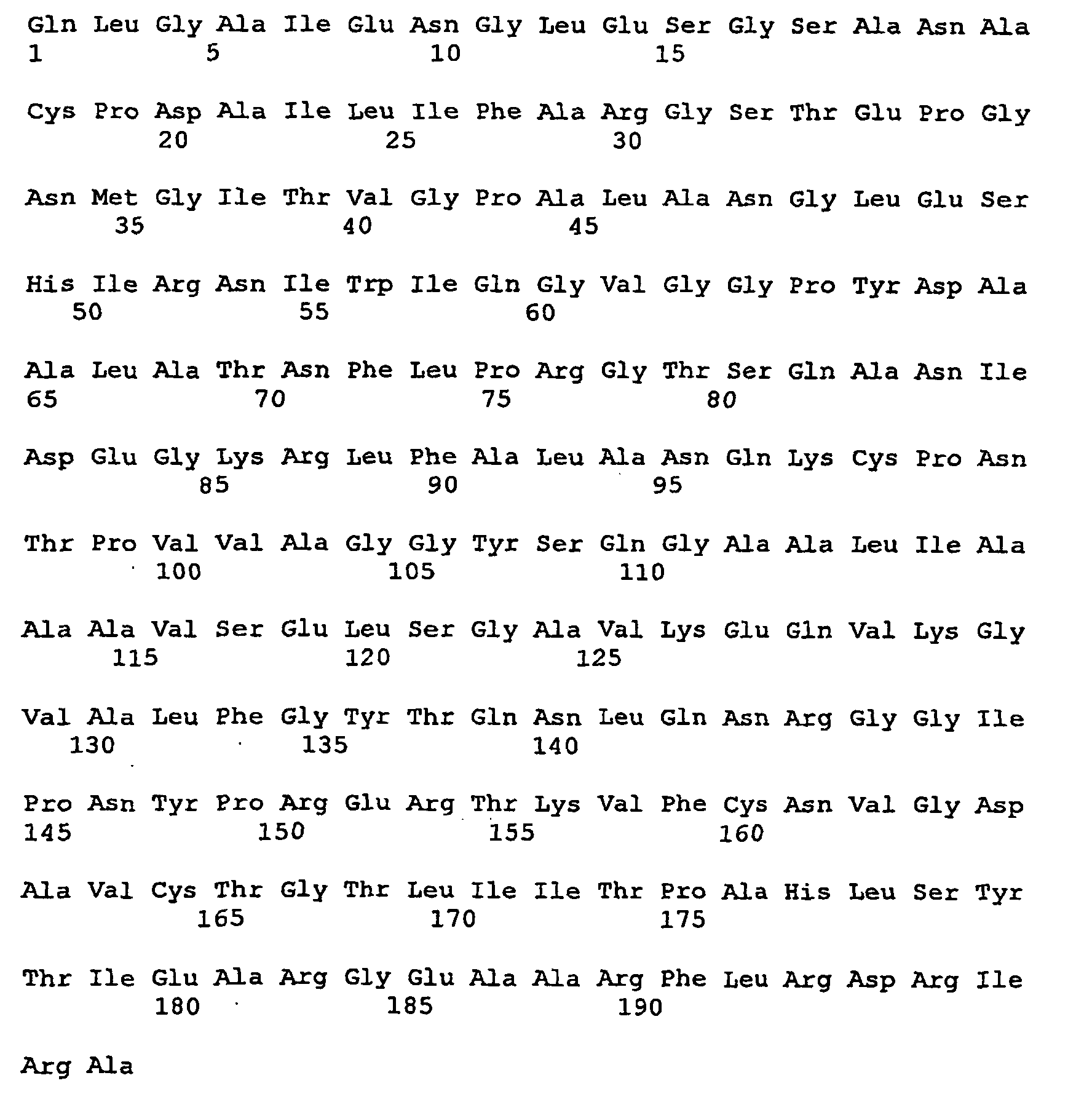
- <210> 2
<211> 17
<212> PRT
<213> Artificial/Unknown - <220>
<221> misc_feature
<222> () .. ()
<223> N-terminal extension - <400> 2

- <210> 3
<211> 42
<212> DNA
<213> Artificial/Unknown - <220>
<221> misc_feature
<222> () .. ()
<223> 620AM34 - <400> 3

- <210> 4
<211> 16
<212> DNA
<213> Artificial/Unknown - <220>
<221> misc_feature
<222> () .. ()
<223> Dop2-R - <400> 4

- <210> 5
<211> 87
<212> DNA
<213> Artificial/Unknown - <220>
<221> misc feature
<222> ()..()
<223> Dop83-2 - <220>
<221> modified_base
<222> (25)..(63)
<223> See text - <400> 5

- <210> 6
<211> 41
<212> DNA
<213> Artificial/Unknown - <220>
<221> misc_feature
<222> ()..()
<223> 680AM35 - <400> 6

- <210> 7
<211> 22
<212> DNA
<213> Artificial/Unknown - <220>
<221> misc_feature
<222> ()..()
<223> 620 - <400> 7

- <210> 8
<211> 23
<212> DNA
<213> Artificial/Unknown - <220>
<221> misc_feature
<222> ()..()
<223> 680 - <400> 8

- <210> 9
<211> 20
<212> DNA
<213> Artificial/Unknown - <220>
<221> misc_feature
<222> ( ) .. ( )
<223> AM34 - <400> 9

- <210> 10
<211> 18
<212> DNA
<213> Artificial/Unknown - <220>
<221> misc_feature
<222> () .. ()
<223> AM35 - <400> 10

-
Claims (9)
- A variant cutinase, which:a) has an amino acid sequence with above 80 % homology with SEQ ID NO: 1,b) compared to SEQ ID NO: 1 comprises substitution of amino acid residue A4. A88, N91. A130, Q139, T166, L167, I168, I169 or R189, or an amino acid substitution Q1C/L, L2K/Q/V, G8D, S11T, N15D, A16T, T29M/I/C, V38H, N44D, S48E/K, H49Y, L66I, S116K, S119P, G120D, T164S, L174F or I178V andc) is more thermostable than the cutinase having the amino acid sequence shown in SEQ ID NO: 1.
- The variant of the preceding claim wherein the substitution is A4V, A88H/L/V, N91H, A130V, Q139R, T166M/I, L167P, I168F, I169A/G/T/V or R189A/H/V.
- The variant of any preceding claim further comprising an amino acid substitution corresponding to L2V, E6Q, A14P, N44D, E47K, R51P, or E179Q in SEQ ID NO: 1.
- The variant of the preceding claim which further comprises amino acid substitutions L2V +E6Q +A14P +E47K +R51P +E179Q in SEQ ID NO: 1.
- The variant of any preceding claim comprising the following amino acid substitutions compared to SEQ ID NO: 1:a) S48E +A88H +N91H +R189Vb) Q1L +L2K +G8D +N15Dc) N44D +A130Vd) Q1C +L2V +G120De) A88L +R189Af) S48E +L66I +A88L +I169A +R189Hg) A88V +S116K +S119P +Q139R +1169V +R189Vh) A88V +R189Ai) S48K +A88H +I169G +R189Hj) Q1L +L2Q +A4V +S11Tk) T164Sl) L174Fm) H49Yn) Q1L +L2K +G8D +N15D +S48E +A88H +N91H +R189Vo) Q1L +L2K +G8D +N15D +N44D +A130Vp) Q1L +L2K +G8D +N15D +S48E +A88H +N91 H +A130V +R189Vq) G8D +N15D +A16Tr) A130Vs) Q1C +L2Vt) G8D +N15D +A16Tu) G8D +N15D +S48E +A88H +N91H +A130V +R189Vv) G8D +N15D +T29M +S48E +A88H +N91H +A130V +R189Vw) G8D +N15D +T29I +S48E +A88H +N91H +A130V +R189V and/orx) G8D +N15D +T29C +S48E +A88H +N91H +A130V +R189Vy) G8D +N15D +S48E +A88H +N91H +A130V +L174F +I178V +R189Vz) G8D +N15D +S48E +A88H +N91H +A130V +T166M +I168F +R189Vaa) G8D +N15D +S48E +A88H +N91H +A130V +T166I +L167P +R189Vbb) G8D +N15D +V38H +S48E +A88H +N91H +A130V +I169T + R189Vcc) G8D +N15D +V38H +S48E +A88H +N91H +A130V +R189Vdd) G8D +N15D +T29M +S48E +A88H +N91H +A130V +T166I +L167P +R189V
- A DNA sequence encoding the variant of any preceding claim.
- A process for enzymatic hydrolysis of a cyclic oligomer of ethylene terephthalate, which process comprises treating the cyclic oligomer with the variant cutinase of any of claims 1-5
- A process for improving the functional finish of a PET-containing yam or fabric comprising treating the yam or fabric with the variant cutinase of any of claims 1-5 and subsequently treating the yarn or fabric with a finishing agent selected from the group consisting of softeners, anti-crease resins, anti-static agents, anti-soiling agents.
- A process for dyeing polyester fabric or yarn, comprising treating the fabric or yam with the cutinase variant of any of claims 1-5; and dyeing the treated fabric with a reactive dye or a disperse dye.
Applications Claiming Priority (9)
| Application Number | Priority Date | Filing Date | Title |
|---|---|---|---|
| DKPA200000861 | 2000-06-02 | ||
| DK200000861 | 2000-06-02 | ||
| DK200001577 | 2000-10-23 | ||
| DKPA200001577 | 2000-10-23 | ||
| DKPA200001772 | 2000-11-24 | ||
| DK200001772 | 2000-11-24 | ||
| DK200100100 | 2001-01-19 | ||
| DKPA200100100 | 2001-01-19 | ||
| PCT/DK2001/000350 WO2001092502A1 (en) | 2000-06-02 | 2001-05-22 | Cutinase variants |
Publications (2)
| Publication Number | Publication Date |
|---|---|
| EP1290150A1 EP1290150A1 (en) | 2003-03-12 |
| EP1290150B1 true EP1290150B1 (en) | 2005-08-24 |
Family
ID=27439810
Family Applications (2)
| Application Number | Title | Priority Date | Filing Date |
|---|---|---|---|
| EP01933646A Expired - Lifetime EP1290150B1 (en) | 2000-06-02 | 2001-05-22 | Cutinase variants |
| EP01938007A Expired - Lifetime EP1290129B1 (en) | 2000-06-02 | 2001-06-05 | Redeposition or backstain inhibition during stonewashing process |
Family Applications After (1)
| Application Number | Title | Priority Date | Filing Date |
|---|---|---|---|
| EP01938007A Expired - Lifetime EP1290129B1 (en) | 2000-06-02 | 2001-06-05 | Redeposition or backstain inhibition during stonewashing process |
Country Status (11)
| Country | Link |
|---|---|
| US (1) | US6960459B2 (en) |
| EP (2) | EP1290150B1 (en) |
| JP (1) | JP4988124B2 (en) |
| CN (3) | CN1426463A (en) |
| AT (2) | ATE302845T1 (en) |
| AU (1) | AU2001260085A1 (en) |
| CA (1) | CA2408406C (en) |
| DE (2) | DE60112928T2 (en) |
| ES (1) | ES2248328T3 (en) |
| MX (1) | MXPA02011911A (en) |
| WO (1) | WO2001092502A1 (en) |
Cited By (4)
| Publication number | Priority date | Publication date | Assignee | Title |
|---|---|---|---|---|
| EP2767582A1 (en) | 2013-02-19 | 2014-08-20 | The Procter and Gamble Company | Method of laundering a fabric |
| EP2767579A1 (en) | 2013-02-19 | 2014-08-20 | The Procter and Gamble Company | Method of laundering a fabric |
| EP2767581A1 (en) | 2013-02-19 | 2014-08-20 | The Procter & Gamble Company | Method of laundering a fabric |
| EP2987848A1 (en) | 2014-08-19 | 2016-02-24 | The Procter & Gamble Company | Method of laundering a fabric |
Families Citing this family (403)
| Publication number | Priority date | Publication date | Assignee | Title |
|---|---|---|---|---|
| US6936289B2 (en) | 1995-06-07 | 2005-08-30 | Danisco A/S | Method of improving the properties of a flour dough, a flour dough improving composition and improved food products |
| EP1433852B1 (en) | 1997-04-09 | 2006-06-28 | Danisco A/S | Use of lipase for improving doughs and baked products |
| NZ528260A (en) | 2001-05-18 | 2005-09-30 | Danisco | Method of improving dough and bread quality with the addition of an enzyme that hydrolyses a glycolipid and a phospholipid and incapable of hydrolysing a triglyceride or monoglyceride |
| US20030051836A1 (en) | 2001-05-21 | 2003-03-20 | Novozymes A/S | Enzymatic hydrolysis of a polymer comprising vinyl acetate monomer |
| CN1774508A (en) * | 2002-08-16 | 2006-05-17 | 诺维信北美公司 | Process for enzymatic hydrolysis of cyclic oligomers |
| MXPA05007654A (en) | 2003-01-17 | 2005-09-30 | Danisco | Method. |
| US20040253696A1 (en) | 2003-06-10 | 2004-12-16 | Novozymes North America, Inc. | Fermentation processes and compositions |
| ATE489457T1 (en) | 2004-01-16 | 2010-12-15 | Novozymes Inc | METHOD FOR DEGRADING LIGNOCELLULOSE MATERIALS |
| ES2468366T3 (en) | 2004-01-30 | 2014-06-16 | Novozymes Inc. | Polypeptides with cellulolytic enhancement activity and polynucleotides that encode them |
| GB0405637D0 (en) | 2004-03-12 | 2004-04-21 | Danisco | Protein |
| EP1735454B1 (en) | 2004-03-25 | 2017-05-10 | Novozymes, Inc. | Methods for degrading or converting plant cell wall polysaccharides |
| EA014985B1 (en) | 2004-07-16 | 2011-04-29 | Даниско А/С | A process of enzymatic degumming edible oils by hydration and use lipid acyltransferase for carrying out the process |
| ES2543131T3 (en) | 2004-12-22 | 2015-08-14 | Novozymes North America, Inc. | Enzymes for starch treatment |
| EP1838860B1 (en) | 2005-01-10 | 2011-03-23 | Novozymes A/S | Process for the production of fatty acid alkyl esters from triglycerides and alcohols employing a combination of two lipolytic enzymes |
| JP4997397B2 (en) * | 2005-09-08 | 2012-08-08 | 学校法人立命館 | Filamentous fungi and resin degradation method using the same |
| EP2385110A3 (en) | 2005-09-30 | 2011-11-16 | Novozymes, Inc. | Methods for enhancing the degradation or conversion of cellulosic material |
| JP4831664B2 (en) * | 2005-10-28 | 2011-12-07 | 独立行政法人科学技術振興機構 | Cutinase variant with excellent thermostability |
| EP2041278B1 (en) | 2006-06-21 | 2017-08-09 | Novozymes North America, Inc. | Desizing and scouring process |
| US8383097B2 (en) | 2006-08-11 | 2013-02-26 | Novozymes Biologicals, Inc | Bacteria cultures and compositions comprising bacteria cultures |
| EP2137307B1 (en) | 2007-03-09 | 2014-07-30 | Novozymes A/S | Thermostable asparaginases |
| JP5427041B2 (en) | 2007-03-23 | 2014-02-26 | ノボザイムス バイオロジカルズ,インコーポレイティド | Prevention and reduction of biofilm formation and plankton-like growth |
| FI120835B (en) * | 2007-07-10 | 2010-03-31 | Valtion Teknillinen | New esters and their use |
| CN101168735B (en) * | 2007-08-17 | 2012-01-25 | 江南大学 | Heat resistance cutinase and its coding gene and expression |
| MX2010010348A (en) | 2008-03-26 | 2010-11-09 | Novozymes As | COMPOSITIONS OF STABILIZED LIQUID ENZYMES. |
| EP2149786A1 (en) | 2008-08-01 | 2010-02-03 | Unilever PLC | Improvements relating to detergent analysis |
| CN202181298U (en) | 2008-09-12 | 2012-04-04 | 荷兰联合利华有限公司 | Dispenser and preconditioner for viscous liquids |
| PL2342323T3 (en) | 2008-09-26 | 2013-11-29 | Novozymes As | Hafnia phytase variants |
| EP2202290A1 (en) | 2008-12-23 | 2010-06-30 | Unilever PLC | A flowable laundry composition and packaging therefor |
| US9040280B2 (en) | 2009-12-11 | 2015-05-26 | Novozymes A/S | Protease variants |
| CN102260655B (en) * | 2009-12-18 | 2012-07-25 | 江南大学 | Cutinase mutants and preparation method thereof |
| CN101775382B (en) * | 2009-12-18 | 2011-08-24 | 江南大学 | A mutant of cutinase and its preparation method |
| WO2011078949A1 (en) | 2009-12-21 | 2011-06-30 | Danisco Us Inc. | Surfactants that improve the cleaning of lipid-based stains treated with lipases |
| WO2011127802A1 (en) | 2010-04-14 | 2011-10-20 | Novozymes A/S | Polypeptides having glucoamylase activity and polynucleotides encoding same |
| CA2803541A1 (en) | 2010-07-01 | 2012-01-05 | Novozymes A/S | Bleaching of pulp |
| CN103052704A (en) | 2010-07-22 | 2013-04-17 | 荷兰联合利华有限公司 | Compositions of rhamnolipids and enzymes for enhanced cleansing |
| GB201015672D0 (en) | 2010-09-20 | 2010-10-27 | Unilever Plc | Improvements relating to fabric treatment compositions comprising targeted benefit agents |
| US9816112B2 (en) | 2010-12-22 | 2017-11-14 | Novozymes A/S | Processes for producing fermentation products |
| JP5850342B2 (en) * | 2011-01-19 | 2016-02-03 | 天野エンザイム株式会社 | A novel esterase derived from twig leaf compost |
| BR112013017319A2 (en) | 2011-01-21 | 2019-09-24 | Novozymes As | process for the production of alkyl fatty acid esters |
| KR102004375B1 (en) | 2011-02-15 | 2019-07-29 | 노보자임스 바이오로지컬스 인코포레이티드 | Mitigation of odor in cleaning machines and cleaning processes |
| US9926547B2 (en) | 2011-04-28 | 2018-03-27 | Novozymes, Inc. | Polypeptides having endoglucanase activity and polynucleotides encoding same |
| CN107475235B (en) | 2011-06-20 | 2022-09-13 | 诺维信公司 | Particulate composition |
| EP2537918A1 (en) | 2011-06-20 | 2012-12-26 | The Procter & Gamble Company | Consumer products with lipase comprising coated particles |
| DK2734633T3 (en) * | 2011-07-22 | 2019-06-11 | Novozymes North America Inc | PROCEDURES FOR PREPARING CELLULOSE MATERIALS AND IMPROVING HYDROLYSIS THEREOF |
| CN103764905A (en) | 2011-09-09 | 2014-04-30 | 诺维信公司 | Improving properties of paper materials |
| IN2014CN03467A (en) | 2011-10-11 | 2015-10-16 | Novozymes North America Inc | |
| CN103930544A (en) | 2011-11-08 | 2014-07-16 | 诺维信公司 | Methods for production of archeae protease in yeast |
| CN103957929B (en) | 2011-11-25 | 2017-06-30 | 诺维信公司 | Polypeptides having lysozyme activity and polynucleotides encoding said polypeptides |
| CN104245942A (en) | 2011-12-02 | 2014-12-24 | 诺维信公司 | Method for producing fermentation product |
| US9809787B2 (en) | 2011-12-29 | 2017-11-07 | Novozymes A/S | Detergent compositions comprising lipase |
| MX2014008764A (en) | 2012-01-26 | 2014-08-27 | Novozymes As | Use of polypeptides having protease activity in animal feed and detergents. |
| ES2935920T3 (en) | 2012-03-30 | 2023-03-13 | Novozymes North America Inc | Production processes of fermentation products |
| WO2013149858A1 (en) | 2012-04-02 | 2013-10-10 | Novozymes A/S | Lipase variants and polynucleotides encoding same |
| US9458441B2 (en) | 2012-05-07 | 2016-10-04 | Novozymes A/S | Polypeptides having xanthan degrading activity and polynucleotides encoding same |
| US9476072B2 (en) | 2012-05-14 | 2016-10-25 | Novozymes A/S | Cutinase variants and polynucleotides encoding same |
| CN104302753A (en) | 2012-05-16 | 2015-01-21 | 诺维信公司 | Compositions comprising lipase and methods of use thereof |
| BR112014031882A2 (en) | 2012-06-20 | 2017-08-01 | Novozymes As | use of an isolated polypeptide, polypeptide, composition, isolated polynucleotide, nucleic acid construct or expression vector, recombinant expression host cell, methods for producing a polypeptide, for enhancing the nutritional value of an animal feed, and for the treatment of protein, use of at least one polypeptide, animal feed additive, animal feed, and detergent composition |
| BR112014032865A2 (en) | 2012-07-18 | 2017-08-01 | Novozymes As | method for treating polyester textile, and, composition |
| US20150291656A1 (en) | 2012-11-01 | 2015-10-15 | Novozymes A/S | Method for removal of dna |
| EP2740840A1 (en) | 2012-12-07 | 2014-06-11 | Novozymes A/S | Improving drainage of paper pulp |
| WO2014087011A1 (en) | 2012-12-07 | 2014-06-12 | Novozymes A/S | Preventing adhesion of bacteria |
| US9551042B2 (en) | 2012-12-21 | 2017-01-24 | Novozymes A/S | Polypeptides having protease activity and polynucleotides encoding same |
| US9902946B2 (en) | 2013-01-03 | 2018-02-27 | Novozymes A/S | Alpha-amylase variants and polynucleotides encoding same |
| MX360759B (en) | 2013-03-21 | 2018-11-15 | Novozymes As | Polypeptides with lipase activity and polynucleotides encoding same. |
| MY192746A (en) | 2013-05-14 | 2022-09-06 | Novozymes As | Detergent compositions |
| WO2014183921A1 (en) | 2013-05-17 | 2014-11-20 | Novozymes A/S | Polypeptides having alpha amylase activity |
| US10538751B2 (en) | 2013-06-06 | 2020-01-21 | Novozymes A/S | Alpha-amylase variants and polynucleotides encoding same |
| AU2014280111B2 (en) | 2013-06-12 | 2018-04-05 | Earth Alive Clean Technologies Inc. | Dust suppressant |
| EP3013955A1 (en) | 2013-06-27 | 2016-05-04 | Novozymes A/S | Subtilase variants and polynucleotides encoding same |
| US10378001B2 (en) | 2013-06-27 | 2019-08-13 | Novozymes A/S | Subtilase variants and compositions comprising same |
| RU2015156280A (en) | 2013-07-04 | 2017-08-09 | Новозимс А/С | POLYEPEPTIDES HAVING AN EFFECT AGAINST RESETITATION AND POLYNUCLEOTIDES CODING THEM |
| CN105339492A (en) | 2013-07-09 | 2016-02-17 | 诺维信公司 | Polypeptides having lipase activity and polynucleotides encoding them |
| US9926550B2 (en) | 2013-07-29 | 2018-03-27 | Novozymes A/S | Protease variants and polynucleotides encoding same |
| CN117904081A (en) | 2013-07-29 | 2024-04-19 | 诺维信公司 | Protease variants and polynucleotides encoding the same |
| EP3063282B1 (en) | 2013-09-11 | 2020-03-25 | Novozymes A/S | Processes for producing fermentation products |
| WO2015049370A1 (en) | 2013-10-03 | 2015-04-09 | Novozymes A/S | Detergent composition and use of detergent composition |
| CN122012456A (en) * | 2013-12-11 | 2026-05-12 | 诺维信公司 | Cutinase variants and polynucleotides encoding same |
| CN105814200A (en) | 2013-12-20 | 2016-07-27 | 诺维信公司 | Polypeptides having protease activity and polynucleotides encoding same |
| WO2015109972A1 (en) | 2014-01-22 | 2015-07-30 | Novozymes A/S | Polypeptides with lipase activity and polynucleotides encoding same |
| TR201901610T4 (en) | 2014-01-26 | 2019-02-21 | Novozymes As | A method for producing an antimicrobial polyester fabric using cutinase. |
| US20160348035A1 (en) | 2014-03-05 | 2016-12-01 | Novozymes A/S | Compositions and Methods for Improving Properties of Non-Cellulosic Textile Materials with Xyloglucan Endotransglycosylase |
| EP3114272A1 (en) | 2014-03-05 | 2017-01-11 | Novozymes A/S | Compositions and methods for improving properties of cellulosic textile materials with xyloglucan endotransglycosylase |
| WO2015135464A1 (en) | 2014-03-12 | 2015-09-17 | Novozymes A/S | Polypeptides with lipase activity and polynucleotides encoding same |
| EP3126479A1 (en) | 2014-04-01 | 2017-02-08 | Novozymes A/S | Polypeptides having alpha amylase activity |
| RU2737535C2 (en) | 2014-04-11 | 2020-12-01 | Новозимс А/С | Detergent composition |
| EP3131921B1 (en) | 2014-04-15 | 2020-06-10 | Novozymes A/S | Polypeptides with lipase activity and polynucleotides encoding same |
| CN106459937B (en) | 2014-05-27 | 2024-09-10 | 诺维信公司 | Method for producing lipase |
| WO2015181119A2 (en) | 2014-05-27 | 2015-12-03 | Novozymes A/S | Lipase variants and polynucleotides encoding same |
| CN106414729A (en) | 2014-06-12 | 2017-02-15 | 诺维信公司 | Alpha-amylase variants and polynucleotides encoding same |
| EP3739029A1 (en) | 2014-07-04 | 2020-11-18 | Novozymes A/S | Subtilase variants and polynucleotides encoding same |
| EP3140399B1 (en) | 2014-07-04 | 2018-03-28 | Novozymes A/S | Subtilase variants and polynucleotides encoding same |
| WO2016007309A1 (en) | 2014-07-07 | 2016-01-14 | Novozymes A/S | Use of prehydrolysate liquor in engineered wood |
| EP2987849A1 (en) | 2014-08-19 | 2016-02-24 | The Procter and Gamble Company | Method of Laundering a Fabric |
| US20160122692A1 (en) * | 2014-08-19 | 2016-05-05 | The Procter & Gamble Company | Method of laundering a fabric |
| WO2016079110A2 (en) | 2014-11-19 | 2016-05-26 | Novozymes A/S | Use of enzyme for cleaning |
| WO2016079305A1 (en) | 2014-11-20 | 2016-05-26 | Novozymes A/S | Alicyclobacillus variants and polynucleotides encoding same |
| RU2710720C2 (en) | 2014-12-04 | 2020-01-10 | Новозимс А/С | Subtilase variants and polynucleotides encoding same |
| US10457921B2 (en) | 2014-12-05 | 2019-10-29 | Novozymes A/S | Lipase variants and polynucleotides encoding same |
| PL3608403T3 (en) | 2014-12-15 | 2025-06-23 | Henkel Ag & Co. Kgaa | Detergent composition comprising subtilase variants |
| CN107002049A (en) | 2014-12-16 | 2017-08-01 | 诺维信公司 | Polypeptide with N acerylglucosamine oxidase actives |
| EP3234123B1 (en) | 2014-12-19 | 2020-06-03 | Novozymes A/S | Protease variants and polynucleotides encoding same |
| WO2016097352A1 (en) | 2014-12-19 | 2016-06-23 | Novozymes A/S | Protease variants and polynucleotides encoding same |
| KR20170100495A (en) | 2014-12-31 | 2017-09-04 | 노보자임스 에이/에스 | Method of treating polyester textile |
| EP3280818A2 (en) | 2015-04-07 | 2018-02-14 | Novozymes A/S | Methods for selecting enzymes having lipase activity |
| EP3280791A1 (en) | 2015-04-10 | 2018-02-14 | Novozymes A/S | Laundry method, use of dnase and detergent composition |
| CN107636134A (en) | 2015-04-10 | 2018-01-26 | 诺维信公司 | Detergent composition |
| CN107835853B (en) | 2015-05-19 | 2021-04-20 | 诺维信公司 | Odor reduction |
| ES2712459T3 (en) | 2015-06-04 | 2019-05-13 | Procter & Gamble | Liquid detergent composition for dishwashing by hand |
| EP3310908B1 (en) | 2015-06-16 | 2020-08-05 | Novozymes A/S | Polypeptides with lipase activity and polynucleotides encoding same |
| WO2016202785A1 (en) | 2015-06-17 | 2016-12-22 | Novozymes A/S | Container |
| EP3310912B1 (en) | 2015-06-18 | 2021-01-27 | Novozymes A/S | Subtilase variants and polynucleotides encoding same |
| EP3106508B1 (en) | 2015-06-18 | 2019-11-20 | Henkel AG & Co. KGaA | Detergent composition comprising subtilase variants |
| TR201815258T4 (en) | 2015-06-26 | 2018-11-21 | Unilever Nv | Laundry detergent composition. |
| US20180171271A1 (en) | 2015-06-30 | 2018-06-21 | Novozymes A/S | Laundry detergent composition, method for washing and use of composition |
| CA3175255A1 (en) | 2015-07-01 | 2017-01-05 | Novozymes A/S | Methods of reducing odor |
| EP3320089B1 (en) | 2015-07-06 | 2021-06-16 | Novozymes A/S | Lipase variants and polynucleotides encoding same |
| EP3064589A1 (en) | 2015-07-29 | 2016-09-07 | F.I.S.- Fabbrica Italiana Sintetici S.p.A. | Enzymatic process for the preparation of testosterone and esters thereof |
| EP3344742A1 (en) * | 2015-09-01 | 2018-07-11 | Novozymes A/S | Laundry method |
| ES2794837T3 (en) | 2015-09-17 | 2020-11-19 | Henkel Ag & Co Kgaa | Detergent Compositions Comprising Polypeptides Having Xanthan Degrading Activity |
| WO2017046260A1 (en) | 2015-09-17 | 2017-03-23 | Novozymes A/S | Polypeptides having xanthan degrading activity and polynucleotides encoding same |
| WO2017060475A2 (en) | 2015-10-07 | 2017-04-13 | Novozymes A/S | Polypeptides |
| MY188051A (en) | 2015-10-09 | 2021-11-15 | Novozymes As | Enzymatic or non-enzymatic biodiesel polishing process |
| CN108291215A (en) | 2015-10-14 | 2018-07-17 | 诺维信公司 | Polypeptide with proteinase activity and encode their polynucleotides |
| EP3362556B1 (en) | 2015-10-14 | 2024-07-10 | Novozymes A/S | Polypeptide variants |
| MX388896B (en) | 2015-10-28 | 2025-03-20 | Novozymes As | DETERGENT COMPOSITION INCLUDING VARIANTS OF AMYLASE AND PROTEASE. |
| EP3380608A1 (en) | 2015-11-24 | 2018-10-03 | Novozymes A/S | Polypeptides having protease activity and polynucleotides encoding same |
| WO2017093318A1 (en) | 2015-12-01 | 2017-06-08 | Novozymes A/S | Methods for producing lipases |
| CA3007103A1 (en) | 2015-12-22 | 2017-06-29 | Novozymes A/S | Process of extracting oil from thin stillage |
| DE102016201173A1 (en) * | 2016-01-27 | 2017-07-27 | Henkel Ag & Co. Kgaa | Improved anti-pilling on polyester textiles by using a cutinase |
| BR112018069220A2 (en) | 2016-03-23 | 2019-01-22 | Novozymes As | use of polypeptide that has dnase activity for tissue treatment |
| CN109312270B (en) | 2016-04-08 | 2022-01-28 | 诺维信公司 | Detergent composition and use thereof |
| MX391044B (en) | 2016-04-29 | 2025-03-21 | Novozymes As | DETERGENT COMPOSITIONS AND THEIR USES. |
| EP3464582A1 (en) | 2016-06-03 | 2019-04-10 | Novozymes A/S | Subtilase variants and polynucleotides encoding same |
| CN114381342A (en) | 2016-06-23 | 2022-04-22 | 诺维信公司 | Uses, compositions and methods for soil removal of enzymes |
| US11203732B2 (en) | 2016-06-30 | 2021-12-21 | Novozymes A/S | Lipase variants and compositions comprising surfactant and lipase variant |
| WO2018002261A1 (en) | 2016-07-01 | 2018-01-04 | Novozymes A/S | Detergent compositions |
| US20200317749A1 (en) * | 2016-07-01 | 2020-10-08 | Denali Therapeutics Inc. | Albumin variants for enhanced serum half-life |
| WO2018007573A1 (en) | 2016-07-08 | 2018-01-11 | Novozymes A/S | Detergent compositions with galactanase |
| WO2018011277A1 (en) | 2016-07-13 | 2018-01-18 | Novozymes A/S | Bacillus cibi dnase variants |
| WO2018015295A1 (en) | 2016-07-18 | 2018-01-25 | Novozymes A/S | Lipase variants, polynucleotides encoding same and the use thereof |
| EP3284805B1 (en) | 2016-08-17 | 2020-02-19 | The Procter & Gamble Company | Cleaning composition comprising enzymes |
| US11072765B2 (en) | 2016-08-24 | 2021-07-27 | Novozymes A/S | GH9 endoglucanase variants and polynucleotides encoding same |
| WO2018037061A1 (en) | 2016-08-24 | 2018-03-01 | Novozymes A/S | Xanthan lyase variants and polynucleotides encoding same |
| AU2017317563B8 (en) | 2016-08-24 | 2023-03-23 | Henkel Ag & Co. Kgaa | Detergent compositions comprising xanthan lyase variants I |
| WO2018037065A1 (en) | 2016-08-24 | 2018-03-01 | Henkel Ag & Co. Kgaa | Detergent composition comprising gh9 endoglucanase variants i |
| CN110023474A (en) | 2016-09-29 | 2019-07-16 | 诺维信公司 | Purposes, washing methods and utensil washing composition of the enzyme for washing |
| WO2018077938A1 (en) | 2016-10-25 | 2018-05-03 | Novozymes A/S | Detergent compositions |
| US11753605B2 (en) | 2016-11-01 | 2023-09-12 | Novozymes A/S | Multi-core granules |
| US10889836B2 (en) | 2016-11-23 | 2021-01-12 | Novozymes A/S | Yeast for ethanol production |
| MX2019006425A (en) | 2016-12-01 | 2019-08-14 | Basf Se | Stabilization of enzymes in compositions. |
| EP3551740B1 (en) | 2016-12-12 | 2021-08-11 | Novozymes A/S | Use of polypeptides |
| US11208639B2 (en) | 2017-03-31 | 2021-12-28 | Novozymes A/S | Polypeptides having DNase activity |
| WO2018177936A1 (en) | 2017-03-31 | 2018-10-04 | Novozymes A/S | Polypeptides having dnase activity |
| EP3601552A4 (en) | 2017-03-31 | 2022-01-12 | Novozymes A/S | POLYPEPTIDES EXHIBITING DNASE ACTIVITY |
| EP3601551A1 (en) | 2017-03-31 | 2020-02-05 | Novozymes A/S | Polypeptides having rnase activity |
| US20200109352A1 (en) | 2017-04-04 | 2020-04-09 | Novozymes A/S | Polypeptide compositions and uses thereof |
| WO2018185150A1 (en) | 2017-04-04 | 2018-10-11 | Novozymes A/S | Polypeptides |
| CN114480034A (en) | 2017-04-04 | 2022-05-13 | 诺维信公司 | Glycosyl hydrolase |
| EP3385361B1 (en) | 2017-04-05 | 2019-03-27 | Henkel AG & Co. KGaA | Detergent compositions comprising bacterial mannanases |
| EP3385362A1 (en) | 2017-04-05 | 2018-10-10 | Henkel AG & Co. KGaA | Detergent compositions comprising fungal mannanases |
| DK3478811T3 (en) | 2017-04-06 | 2020-01-27 | Novozymes As | Cleaning compositions and uses thereof |
| EP3607037A1 (en) | 2017-04-06 | 2020-02-12 | Novozymes A/S | Cleaning compositions and uses thereof |
| CN110662829B (en) | 2017-04-06 | 2022-03-01 | 诺维信公司 | Cleaning compositions and their uses |
| EP3607042A1 (en) | 2017-04-06 | 2020-02-12 | Novozymes A/S | Cleaning compositions and uses thereof |
| CN110651030B (en) | 2017-04-06 | 2023-10-13 | 诺维信公司 | Cleaning compositions and their uses |
| EP3607043A1 (en) | 2017-04-06 | 2020-02-12 | Novozymes A/S | Cleaning compositions and uses thereof |
| WO2018184818A1 (en) | 2017-04-06 | 2018-10-11 | Novozymes A/S | Cleaning compositions and uses thereof |
| EP3967756B1 (en) | 2017-04-06 | 2025-03-05 | Novozymes A/S | Detergent compositions and uses thereof |
| CN110651038B (en) | 2017-05-05 | 2025-02-18 | 诺维信公司 | Composition comprising lipase and sulfite |
| WO2018206535A1 (en) | 2017-05-08 | 2018-11-15 | Novozymes A/S | Carbohydrate-binding domain and polynucleotides encoding the same |
| EP3401385A1 (en) | 2017-05-08 | 2018-11-14 | Henkel AG & Co. KGaA | Detergent composition comprising polypeptide comprising carbohydrate-binding domain |
| CA3071078A1 (en) | 2017-08-24 | 2019-02-28 | Novozymes A/S | Xanthan lyase variants and polynucleotides encoding same |
| EP3673060A1 (en) | 2017-08-24 | 2020-07-01 | Henkel AG & Co. KGaA | Detergent composition comprising xanthan lyase variants ii |
| WO2019038058A1 (en) | 2017-08-24 | 2019-02-28 | Novozymes A/S | Gh9 endoglucanase variants and polynucleotides encoding same |
| US11624059B2 (en) | 2017-08-24 | 2023-04-11 | Henkel Ag & Co. Kgaa | Detergent compositions comprising GH9 endoglucanase variants II |
| EP3684897A1 (en) | 2017-09-20 | 2020-07-29 | Novozymes A/S | Use of enzymes for improving water absorption and/or whiteness |
| EP3684899A1 (en) | 2017-09-22 | 2020-07-29 | Novozymes A/S | Novel polypeptides |
| CA3072932C (en) | 2017-09-27 | 2023-09-26 | The Procter & Gamble Company | Detergent compositions comprising lipases |
| CA3073362A1 (en) | 2017-09-27 | 2019-04-04 | Novozymes A/S | Lipase variants and microcapsule compositions comprising such lipase variants |
| CN111542589A (en) | 2017-10-16 | 2020-08-14 | 诺维信公司 | Low powdering particles |
| WO2019076800A1 (en) | 2017-10-16 | 2019-04-25 | Novozymes A/S | Cleaning compositions and uses thereof |
| WO2019076833A1 (en) | 2017-10-16 | 2019-04-25 | Novozymes A/S | Low dusting granules |
| CN111542604A (en) | 2017-10-27 | 2020-08-14 | 诺维信公司 | DNase variants |
| PL3476936T3 (en) | 2017-10-27 | 2022-04-11 | The Procter & Gamble Company | Detergent compositions comprising polypeptide variants |
| BR112020008737A2 (en) | 2017-11-01 | 2020-10-13 | Novozymes A/S | polypeptides and compositions comprising such polypeptides |
| DE102017125559A1 (en) | 2017-11-01 | 2019-05-02 | Henkel Ag & Co. Kgaa | CLEANSING COMPOSITIONS CONTAINING DISPERSINE II |
| DE102017125560A1 (en) | 2017-11-01 | 2019-05-02 | Henkel Ag & Co. Kgaa | CLEANSING COMPOSITIONS CONTAINING DISPERSINE III |
| CN111479919A (en) | 2017-11-01 | 2020-07-31 | 诺维信公司 | Polypeptides and compositions comprising such polypeptides |
| DE102017125558A1 (en) | 2017-11-01 | 2019-05-02 | Henkel Ag & Co. Kgaa | CLEANING COMPOSITIONS CONTAINING DISPERSINE I |
| EP3704220B1 (en) | 2017-11-01 | 2026-04-15 | Novozymes A/S | Methods for cleaning medical devices |
| WO2019092191A1 (en) | 2017-11-13 | 2019-05-16 | Unilever Plc | Method of demonstrating sebum removal from laundered garments |
| JP2021504541A (en) | 2017-11-29 | 2021-02-15 | ビーエイエスエフ・ソシエタス・エウロパエアBasf Se | Storage stability enzyme preparations, their production and methods of using them |
| CN107938308A (en) * | 2017-12-01 | 2018-04-20 | 武汉新华扬生物股份有限公司 | Improve the method that cowboy's enzyme washes the method for middle dyestuff staining and washs jean products |
| US11725197B2 (en) | 2017-12-04 | 2023-08-15 | Novozymes A/S | Lipase variants and polynucleotides encoding same |
| RU2020123786A (en) | 2017-12-20 | 2022-01-25 | Басф Се | LAUNDRY COMPOUND FOR REMOVING FATTY COMPOUNDS HAVING A MELTING POINT >30oC DEPOSITIONED ON TEXTILES |
| CN111801461B (en) * | 2018-01-23 | 2023-09-15 | 卡特科丹宁纺织品贸易有限公司 | Method and device for dyeing synthetic fibers, dyed fibers and fabrics containing the dyed fibers |
| BR112020016677A2 (en) | 2018-02-15 | 2020-12-15 | Novozymes A/S | IMPROVED YEAST FOR ETHANOL PRODUCTION |
| US20210102184A1 (en) | 2018-02-23 | 2021-04-08 | Henkel Ag & Co. Kgaa | Detergent composition comprising xanthan lyase and endoglucanase variants |
| WO2019180111A1 (en) | 2018-03-23 | 2019-09-26 | Novozymes A/S | Subtilase variants and compositions comprising same |
| EP3781660A1 (en) | 2018-04-17 | 2021-02-24 | Novozymes A/S | Polypeptides comprising carbohydrate binding activity in detergent compositions and their use in reducing wrinkles in textile or fabric |
| CN118460512A (en) | 2018-04-19 | 2024-08-09 | 诺维信公司 | Stabilized cellulase variants |
| EP3781659B1 (en) | 2018-04-19 | 2022-08-17 | Basf Se | Compositions and polymers useful for such compositions |
| CN118530973A (en) | 2018-04-19 | 2024-08-23 | 诺维信公司 | Stabilized cellulase variants |
| CN108753671A (en) * | 2018-06-05 | 2018-11-06 | 江南大学 | A kind of the recombination bacillus coli engineering bacteria and its zymotechnique of high yield cutinase |
| WO2019238761A1 (en) | 2018-06-15 | 2019-12-19 | Basf Se | Water soluble multilayer films containing wash active chemicals and enzymes |
| EP3814472A1 (en) | 2018-06-28 | 2021-05-05 | Novozymes A/S | Detergent compositions and uses thereof |
| WO2020002608A1 (en) | 2018-06-29 | 2020-01-02 | Novozymes A/S | Detergent compositions and uses thereof |
| WO2020002255A1 (en) | 2018-06-29 | 2020-01-02 | Novozymes A/S | Subtilase variants and compositions comprising same |
| EP3818139A1 (en) | 2018-07-02 | 2021-05-12 | Novozymes A/S | Cleaning compositions and uses thereof |
| PL3818138T3 (en) | 2018-07-03 | 2025-11-03 | Henkel Ag & Co. Kgaa | Cleaning compositions and uses thereof |
| WO2020008024A1 (en) | 2018-07-06 | 2020-01-09 | Novozymes A/S | Cleaning compositions and uses thereof |
| EP3818140A1 (en) | 2018-07-06 | 2021-05-12 | Novozymes A/S | Cleaning compositions and uses thereof |
| WO2020030623A1 (en) | 2018-08-10 | 2020-02-13 | Basf Se | Packaging unit comprising a detergent composition containing an enzyme and at least one chelating agent |
| WO2020058096A1 (en) | 2018-09-18 | 2020-03-26 | Unilever Plc | Detergent composition |
| WO2020058091A1 (en) | 2018-09-18 | 2020-03-26 | Unilever Plc | Method of chemical monitoring the fat removal from surfaces |
| US20210340466A1 (en) | 2018-10-01 | 2021-11-04 | Novozymes A/S | Detergent compositions and uses thereof |
| WO2020070014A1 (en) | 2018-10-02 | 2020-04-09 | Novozymes A/S | Cleaning composition comprising anionic surfactant and a polypeptide having rnase activity |
| WO2020070209A1 (en) | 2018-10-02 | 2020-04-09 | Novozymes A/S | Cleaning composition |
| EP3861094A1 (en) | 2018-10-02 | 2021-08-11 | Novozymes A/S | Cleaning composition |
| WO2020070249A1 (en) | 2018-10-03 | 2020-04-09 | Novozymes A/S | Cleaning compositions |
| CN113056476A (en) | 2018-10-03 | 2021-06-29 | 诺维信公司 | Polypeptides having alpha-mannan degrading activity and polynucleotides encoding same |
| MX2021003932A (en) | 2018-10-05 | 2021-06-04 | Basf Se | Compounds stabilizing hydrolases in liquids. |
| EP3677676A1 (en) | 2019-01-03 | 2020-07-08 | Basf Se | Compounds stabilizing amylases in liquids |
| EP3861115A1 (en) | 2018-10-05 | 2021-08-11 | Basf Se | Compounds stabilizing hydrolases in liquids |
| BR112021006317A2 (en) | 2018-10-05 | 2021-07-06 | Basf Se | enzyme preparation, process for making a stable enzyme preparation, methods of reducing loss of amyolytic activity, of preparing a detergent formulation, of removing amylase sensitive stains, and of increasing the storage stability of a liquid detergent formulation, uses of a compound and enzyme preparation, and detergent formulation |
| US20220033739A1 (en) | 2018-10-11 | 2022-02-03 | Novozymes A/S | Cleaning compositions and uses thereof |
| ES2981999T3 (en) | 2018-10-31 | 2024-10-14 | Henkel Ag & Co Kgaa | Cleaning compositions containing dispersins V |
| EP3647397A1 (en) | 2018-10-31 | 2020-05-06 | Henkel AG & Co. KGaA | Cleaning compositions containing dispersins iv |
| WO2020104231A1 (en) | 2018-11-19 | 2020-05-28 | Basf Se | Powders and granules containing a chelating agent and an enzyme |
| WO2020114965A1 (en) | 2018-12-03 | 2020-06-11 | Novozymes A/S | LOW pH POWDER DETERGENT COMPOSITION |
| WO2020114968A1 (en) | 2018-12-03 | 2020-06-11 | Novozymes A/S | Powder detergent compositions |
| EP3898919A1 (en) | 2018-12-21 | 2021-10-27 | Novozymes A/S | Detergent pouch comprising metalloproteases |
| US11959111B2 (en) | 2018-12-21 | 2024-04-16 | Novozymes A/S | Polypeptides having peptidoglycan degrading activity and polynucleotides encoding same |
| CN109929821A (en) * | 2018-12-27 | 2019-06-25 | 江南大学 | A kind of cutin enzyme mutant and its application in plain boiled water processing |
| EP3699273A1 (en) * | 2019-02-21 | 2020-08-26 | EVOXX Technologies GmbH | Lc-cutinase |
| EP3699272A1 (en) * | 2019-02-21 | 2020-08-26 | Henkel AG & Co. KGaA | Improved caring properties on polyester textiles by use of a cutinase |
| WO2020169633A1 (en) * | 2019-02-21 | 2020-08-27 | Evoxx Technologies Gmbh | Polyester compositions treatment agent and method for treatment of a polyester composition |
| EP3702452A1 (en) | 2019-03-01 | 2020-09-02 | Novozymes A/S | Detergent compositions comprising two proteases |
| US20220177808A1 (en) | 2019-03-08 | 2022-06-09 | Basf Se | Cationic surfactant and its use in laundry detergent compositions |
| CA3122942A1 (en) | 2019-03-21 | 2020-09-24 | Novozymes A/S | Alpha-amylase variants and polynucleotides encoding same |
| WO2020193101A1 (en) | 2019-03-22 | 2020-10-01 | Unilever Plc | Method for washing a garment worn on the head |
| US20220169953A1 (en) | 2019-04-03 | 2022-06-02 | Novozymes A/S | Polypeptides having beta-glucanase activity, polynucleotides encoding same and uses thereof in cleaning and detergent compositions |
| EP3953462A1 (en) | 2019-04-10 | 2022-02-16 | Novozymes A/S | Polypeptide variants |
| MX2021012289A (en) | 2019-04-12 | 2021-11-12 | Novozymes As | Stabilized glycoside hydrolase variants. |
| WO2020229480A1 (en) | 2019-05-14 | 2020-11-19 | Basf Se | Compounds stabilizing hydrolases in liquids |
| US20220372408A1 (en) | 2019-06-28 | 2022-11-24 | Conopco, Inc., D/B/A Unilever | Detergent composition |
| WO2021009067A1 (en) | 2019-07-12 | 2021-01-21 | Novozymes A/S | Enzymatic emulsions for detergents |
| WO2021018751A1 (en) | 2019-07-26 | 2021-02-04 | Novozymes A/S | Enzymatic treatment of paper pulp |
| BR112022002203A2 (en) | 2019-08-05 | 2022-09-06 | Novozymes As | ENZYME MIXTURES AND PROCESSES FOR PRODUCTION OF A FOOD INGREDIENT WITH HIGH PROTEIN CONTENT FROM A COMPLETE VINAGE BY-PRODUCT |
| WO2021037878A1 (en) | 2019-08-27 | 2021-03-04 | Novozymes A/S | Composition comprising a lipase |
| WO2021037895A1 (en) | 2019-08-27 | 2021-03-04 | Novozymes A/S | Detergent composition |
| US20220315866A1 (en) | 2019-09-19 | 2022-10-06 | Novozymes A/S | Detergent Composition |
| WO2021064068A1 (en) | 2019-10-03 | 2021-04-08 | Novozymes A/S | Polypeptides comprising at least two carbohydrate binding domains |
| US20240132808A1 (en) | 2019-10-18 | 2024-04-25 | Basf Se | Storage-Stable Hydrolase Containing Liquids |
| WO2021115912A1 (en) | 2019-12-09 | 2021-06-17 | Basf Se | Formulations comprising a hydrophobically modified polyethyleneimine and one or more enzymes |
| BR112022011634A2 (en) | 2019-12-16 | 2022-08-30 | Novozymes As | PROCESSES FOR PRODUCTION OF A FERMENTATION PRODUCT, FOR DECREASE THE QUANTITY OF RESIDUAL STARCH PRESENT IN A LIQUEPHATE AND FOR INCREASE THE QUANTITY OF SHORT-CHAIN OLIGOSACCHARIDES PRESENT IN A LIQUEFATE |
| EP4077617B1 (en) | 2019-12-20 | 2026-03-18 | Novozymes A/S | Stabilized liquid boron-free enzyme compositions |
| KR20220119608A (en) | 2019-12-20 | 2022-08-30 | 헨켈 아게 운트 코. 카게아아 | Cleaning Composition Comprising Dispersin VIII |
| EP4077656A2 (en) | 2019-12-20 | 2022-10-26 | Novozymes A/S | Polypeptides having proteolytic activity and use thereof |
| CN114829563A (en) | 2019-12-20 | 2022-07-29 | 汉高股份有限及两合公司 | Cleaning compositions comprising dispersed protein IX |
| KR20220121235A (en) | 2019-12-20 | 2022-08-31 | 헨켈 아게 운트 코. 카게아아 | Cleaning Composition Comprising Dispersin and Carbohydrase |
| AU2020404593B2 (en) | 2019-12-20 | 2026-05-14 | Henkel Ag & Co. Kgaa | Cleaning compositions comprising dispersins VI |
| PY2110525A (en) | 2020-02-10 | 2022-05-11 | Novozymes As | POLYPEPTIDES WITH ALPHA AMYLASE ACTIVITY AND THE POLYNUCLEOTIDES THAT ENCODE THEM |
| EP3892708A1 (en) | 2020-04-06 | 2021-10-13 | Henkel AG & Co. KGaA | Cleaning compositions comprising dispersin variants |
| EP4133066A1 (en) | 2020-04-08 | 2023-02-15 | Novozymes A/S | Carbohydrate binding module variants |
| US20230167384A1 (en) | 2020-04-21 | 2023-06-01 | Novozymes A/S | Cleaning compositions comprising polypeptides having fructan degrading activity |
| US20230212548A1 (en) | 2020-05-26 | 2023-07-06 | Novozymes A/S | Subtilase variants and compositions comprising same |
| US20230212822A1 (en) | 2020-05-29 | 2023-07-06 | Novozymes A/S | Method for controlling slime in a pulp or paper making process |
| WO2021259099A1 (en) | 2020-06-24 | 2021-12-30 | Novozymes A/S | Use of cellulases for removing dust mite from textile |
| EP3936593A1 (en) | 2020-07-08 | 2022-01-12 | Henkel AG & Co. KGaA | Cleaning compositions and uses thereof |
| WO2022008732A1 (en) | 2020-07-10 | 2022-01-13 | Basf Se | Enhancing the activity of antimicrobial preservatives |
| WO2022023250A1 (en) | 2020-07-27 | 2022-02-03 | Unilever Ip Holdings B.V. | Use of an enzyme and surfactant for inhibiting microorganisms |
| EP4204551B1 (en) | 2020-08-25 | 2025-09-17 | Novozymes A/S | Variants of a family 44 xyloglucanase |
| WO2022043563A1 (en) | 2020-08-28 | 2022-03-03 | Novozymes A/S | Polyester degrading protease variants |
| WO2022063699A1 (en) | 2020-09-22 | 2022-03-31 | Basf Se | Improved combination of protease and protease inhibitor with secondary enzyme |
| US20250346879A1 (en) | 2020-10-07 | 2025-11-13 | Novozymes A/S | Alpha-amylase variants |
| WO2022084303A2 (en) | 2020-10-20 | 2022-04-28 | Novozymes A/S | Use of polypeptides having dnase activity |
| US20230392129A1 (en) * | 2020-10-27 | 2023-12-07 | Carbios | Novel esterases and uses thereof |
| EP4237525A1 (en) | 2020-10-28 | 2023-09-06 | Novozymes A/S | Use of lipoxygenase |
| US20240035005A1 (en) | 2020-10-29 | 2024-02-01 | Novozymes A/S | Lipase variants and compositions comprising such lipase variants |
| WO2022103725A1 (en) | 2020-11-13 | 2022-05-19 | Novozymes A/S | Detergent composition comprising a lipase |
| WO2022106400A1 (en) | 2020-11-18 | 2022-05-27 | Novozymes A/S | Combination of immunochemically different proteases |
| WO2022106404A1 (en) | 2020-11-18 | 2022-05-27 | Novozymes A/S | Combination of proteases |
| EP4032966A1 (en) | 2021-01-22 | 2022-07-27 | Novozymes A/S | Liquid enzyme composition with sulfite scavenger |
| EP4284905A1 (en) | 2021-01-28 | 2023-12-06 | Novozymes A/S | Lipase with low malodor generation |
| EP4039806A1 (en) | 2021-02-04 | 2022-08-10 | Henkel AG & Co. KGaA | Detergent composition comprising xanthan lyase and endoglucanase variants with im-proved stability |
| EP4291646A2 (en) | 2021-02-12 | 2023-12-20 | Novozymes A/S | Alpha-amylase variants |
| US20250075152A1 (en) | 2021-02-12 | 2025-03-06 | Novozymes A/S | Stabilized biological detergents |
| EP4047088A1 (en) | 2021-02-22 | 2022-08-24 | Basf Se | Amylase variants |
| EP4294917A1 (en) | 2021-02-22 | 2023-12-27 | Basf Se | Amylase variants |
| EP4305146A1 (en) | 2021-03-12 | 2024-01-17 | Novozymes A/S | Polypeptide variants |
| EP4060036A1 (en) | 2021-03-15 | 2022-09-21 | Novozymes A/S | Polypeptide variants |
| US20240060061A1 (en) | 2021-03-15 | 2024-02-22 | Novozymes A/S | Dnase variants |
| CN117083370A (en) | 2021-03-26 | 2023-11-17 | 诺维信公司 | Detergent compositions with reduced polymer content |
| BR112023022967A2 (en) | 2021-05-04 | 2024-01-23 | Novozymes As | ENZYMATIC TREATMENT OF RAW MATERIALS FOR PRODUCTION OF HYDROTREATED VEGETABLE OIL (HVO) |
| EP4355868A1 (en) | 2021-06-16 | 2024-04-24 | Novozymes A/S | Method for controlling slime in a pulp or paper making process |
| EP4359518A1 (en) | 2021-06-23 | 2024-05-01 | Novozymes A/S | Alpha-amylase polypeptides |
| EP4453160A1 (en) | 2021-12-21 | 2024-10-30 | Novozymes A/S | Composition comprising a lipase and a booster |
| WO2023118015A1 (en) | 2021-12-21 | 2023-06-29 | Basf Se | Environmental attributes for care composition ingredients |
| EP4206309A1 (en) | 2021-12-30 | 2023-07-05 | Novozymes A/S | Protein particles with improved whiteness |
| EP4234664A1 (en) | 2022-02-24 | 2023-08-30 | Evonik Operations GmbH | Composition comprising glucolipids and enzymes |
| WO2023165507A1 (en) | 2022-03-02 | 2023-09-07 | Novozymes A/S | Use of xyloglucanase for improvement of sustainability of detergents |
| WO2023165950A1 (en) | 2022-03-04 | 2023-09-07 | Novozymes A/S | Dnase variants and compositions |
| JP2025511813A (en) | 2022-04-08 | 2025-04-16 | ノボザイムス アクティーゼルスカブ | Hexosaminidase variants and compositions |
| KR20250005200A (en) | 2022-04-20 | 2025-01-09 | 노보자임스 에이/에스 | Method for producing free fatty acids |
| US20250311734A1 (en) | 2022-05-14 | 2025-10-09 | Novozymes A/S | Compositions and Methods for Preventing, Treating, Suppressing and/or Eliminatting Phytopathogenic Infestations and Infections |
| CA3255689A1 (en) | 2022-05-17 | 2023-11-23 | Novozymes A/S | Process for reducing free fatty acids |
| WO2023227332A1 (en) | 2022-05-27 | 2023-11-30 | Unilever Ip Holdings B.V. | Laundry liquid composition comprising a surfactant, an alkoxylated zwitterionic polyamine polymer and a protease |
| EP4532652B1 (en) | 2022-05-27 | 2025-12-03 | Unilever IP Holdings B.V. | Composition comprising a specific methyl ester ethoxylate surfactant and a lipase |
| WO2023227421A1 (en) | 2022-05-27 | 2023-11-30 | Unilever Ip Holdings B.V. | Laundry liquid composition comprising a surfactant, an alkoxylated zwitterionic polyamine polymer, and a fragrance |
| WO2023227335A1 (en) | 2022-05-27 | 2023-11-30 | Unilever Ip Holdings B.V. | Liquid composition comprising linear alkyl benzene sulphonate, methyl ester ethoxylate and alkoxylated zwitterionic polyamine polymer |
| WO2023227375A1 (en) | 2022-05-27 | 2023-11-30 | Unilever Ip Holdings B.V. | Laundry liquid composition comprising a surfactant, an aminocarboxylate, an organic acid and a fragrance |
| DE102022205588A1 (en) | 2022-06-01 | 2023-12-07 | Henkel Ag & Co. Kgaa | DETERGENT AND CLEANING AGENTS WITH IMPROVED ENZYME STABILITY |
| DE102022205591A1 (en) | 2022-06-01 | 2023-12-07 | Henkel Ag & Co. Kgaa | DETERGENT AND CLEANING AGENTS WITH IMPROVED ENZYME STABILITY |
| DE102022205593A1 (en) | 2022-06-01 | 2023-12-07 | Henkel Ag & Co. Kgaa | DETERGENT AND CLEANING AGENTS WITH IMPROVED ENZYME STABILITY |
| US20250368924A1 (en) | 2022-06-24 | 2025-12-04 | Novozymes A/S | Lipase variants and compositions comprising such lipase variants |
| WO2024033135A2 (en) | 2022-08-11 | 2024-02-15 | Basf Se | Amylase variants |
| JP2025526759A (en) | 2022-08-11 | 2025-08-15 | ビーエーエスエフ ソシエタス・ヨーロピア | Enzyme composition containing amylase |
| JP2025526654A (en) | 2022-08-11 | 2025-08-15 | ビーエーエスエフ ソシエタス・ヨーロピア | Enzyme composition comprising a protease, a mannanase and/or a cellulase |
| US20260055347A1 (en) | 2022-08-11 | 2026-02-26 | Basf Se | Amylase variants |
| EP4324900A1 (en) | 2022-08-17 | 2024-02-21 | Henkel AG & Co. KGaA | Detergent composition comprising enzymes |
| WO2024050538A1 (en) * | 2022-09-02 | 2024-03-07 | The Board Of Trustees Of The Leland Stanford Junior University | Plastic-degrading enzyme variants and their use |
| US20260085256A1 (en) | 2022-09-13 | 2026-03-26 | Conopco, Inc., D/B/A Unilever | Washing machine and washing method |
| CN119895017A (en) | 2022-09-13 | 2025-04-25 | 联合利华知识产权控股有限公司 | Washing machine and washing method |
| CN119895022A (en) | 2022-09-13 | 2025-04-25 | 联合利华知识产权控股有限公司 | Washing machine and washing method |
| WO2024056331A1 (en) | 2022-09-13 | 2024-03-21 | Unilever Ip Holdings B.V. | Washing machine and washing method |
| EP4349944A1 (en) | 2022-10-05 | 2024-04-10 | Unilever IP Holdings B.V. | Laundry liquid composition |
| EP4349948A1 (en) | 2022-10-05 | 2024-04-10 | Unilever IP Holdings B.V. | Laundry liquid composition |
| EP4349942A1 (en) | 2022-10-05 | 2024-04-10 | Unilever IP Holdings B.V. | Laundry liquid composition |
| EP4349945A1 (en) | 2022-10-05 | 2024-04-10 | Unilever IP Holdings B.V. | Laundry liquid composition |
| EP4349947A1 (en) | 2022-10-05 | 2024-04-10 | Unilever IP Holdings B.V. | Laundry liquid composition |
| EP4349946A1 (en) | 2022-10-05 | 2024-04-10 | Unilever IP Holdings B.V. | Unit dose fabric treatment product |
| EP4349943A1 (en) | 2022-10-05 | 2024-04-10 | Unilever IP Holdings B.V. | Laundry liquid composition |
| EP4608955A1 (en) | 2022-10-25 | 2025-09-03 | Unilever IP Holdings B.V. | Composition |
| WO2024088706A1 (en) | 2022-10-25 | 2024-05-02 | Unilever Ip Holdings B.V. | Composition |
| EP4361239A1 (en) | 2022-10-25 | 2024-05-01 | Unilever IP Holdings B.V. | Laundry liquid composition |
| WO2024094733A1 (en) | 2022-11-04 | 2024-05-10 | Basf Se | Polypeptides having protease activity for use in detergent compositions |
| CN120693402A (en) | 2022-11-04 | 2025-09-23 | 巴斯夫欧洲公司 | Polypeptides having protease activity for use in detergent compositions |
| CN120153068A (en) | 2022-11-04 | 2025-06-13 | 巴斯夫欧洲公司 | Polypeptides having protease activity for use in detergent compositions |
| AU2023405411A1 (en) | 2022-11-29 | 2025-04-24 | Unilever Global Ip Limited | Composition |
| DE102022131732A1 (en) | 2022-11-30 | 2024-06-06 | Henkel Ag & Co. Kgaa | Improved washing performance through the use of a protease fused with a special adhesion promoter peptide |
| JP2026508744A (en) | 2022-12-05 | 2026-03-12 | ノボザイムス アクティーゼルスカブ | Protease variants and the polynucleotides that encode them |
| CN120225643A (en) | 2022-12-05 | 2025-06-27 | 诺维信公司 | Compositions comprising lipase and peptide |
| EP4634355A1 (en) | 2022-12-14 | 2025-10-22 | Novozymes A/S | Improved lipase (gcl1) variants |
| EP4389864A1 (en) | 2022-12-20 | 2024-06-26 | Basf Se | Cutinases |
| JP2026501223A (en) | 2022-12-23 | 2026-01-14 | ノボザイムス アクティーゼルスカブ | Detergent composition containing catalase and amylase |
| WO2024151608A2 (en) | 2023-01-09 | 2024-07-18 | Protein Evolution Inc. | Systems, methods, and compositions involving pretreatment and/or enzymatic degradation of crystallizable polymers, including copolymers |
| EP4655371A1 (en) | 2023-01-23 | 2025-12-03 | Novozymes A/S | Cleaning compositions and uses thereof |
| CN116064470B (en) * | 2023-03-15 | 2025-11-04 | 中国科学院南海海洋研究所 | A keratinase mutant and its application in the efficient degradation of PET |
| WO2024194098A1 (en) | 2023-03-21 | 2024-09-26 | Unilever Ip Holdings B.V. | Detergent unit dose |
| CN120882843A (en) | 2023-03-21 | 2025-10-31 | 诺维信公司 | Detergent compositions based on biosurfactants |
| TW202506250A (en) | 2023-03-21 | 2025-02-16 | 美商蛋白質演化股份有限公司 | Methods and compositions for the separation of particles from a fluid |
| CN120835924A (en) | 2023-04-11 | 2025-10-24 | 联合利华知识产权控股有限公司 | Composition |
| WO2024213430A1 (en) | 2023-04-11 | 2024-10-17 | Unilever Ip Holdings B.V. | Composition |
| EP4695363A1 (en) | 2023-04-11 | 2026-02-18 | Unilever IP Holdings B.V. | Composition |
| WO2024213376A1 (en) | 2023-04-11 | 2024-10-17 | Unilever Ip Holdings B.V. | Composition |
| WO2024213428A1 (en) | 2023-04-11 | 2024-10-17 | Unilever Ip Holdings B.V. | Composition |
| WO2024213513A1 (en) | 2023-04-12 | 2024-10-17 | Novozymes A/S | Compositions comprising polypeptides having alkaline phosphatase activity |
| WO2024223218A1 (en) | 2023-04-25 | 2024-10-31 | Unilever Ip Holdings B.V. | Composition |
| EP4461795A1 (en) | 2023-05-10 | 2024-11-13 | Novozymes A/S | Detergent composition comprising laccase |
| EP4461796A1 (en) | 2023-05-10 | 2024-11-13 | Novozymes A/S | Detergent composition comprising laccase |
| EP4709830A1 (en) | 2023-05-11 | 2026-03-18 | Novozymes A/S | Automatic dishwashing detergent compositions comprising a lipase |
| WO2025002934A1 (en) | 2023-06-28 | 2025-01-02 | Novozymes A/S | Detergent composition comprising lipases |
| EP4662299A1 (en) | 2023-07-11 | 2025-12-17 | Unilever IP Holdings B.V. | Method for treating fabric |
| CN121569016A (en) | 2023-07-11 | 2026-02-24 | 联合利华知识产权控股有限公司 | Method for treating fabrics |
| WO2025012293A1 (en) | 2023-07-13 | 2025-01-16 | Unilever Ip Holdings B.V. | Washing machine and method |
| WO2025016669A1 (en) | 2023-07-19 | 2025-01-23 | Unilever Ip Holdings B.V. | Laundry capsule |
| CN121773188A (en) | 2023-08-02 | 2026-03-31 | 联合利华知识产权控股有限公司 | Composition |
| CN121605174A (en) | 2023-08-04 | 2026-03-03 | 联合利华知识产权控股有限公司 | Composition and method for producing the same |
| WO2025031925A1 (en) | 2023-08-04 | 2025-02-13 | Unilever Ip Holdings B.V. | Composition |
| WO2025036642A1 (en) | 2023-08-15 | 2025-02-20 | Evonik Operations Gmbh | Improved method for cleaning |
| EP4509589A1 (en) | 2023-08-16 | 2025-02-19 | Unilever IP Holdings B.V. | Unit dose product |
| WO2025088003A1 (en) | 2023-10-24 | 2025-05-01 | Novozymes A/S | Use of xyloglucanase for replacement of optical brightener |
| WO2025103765A1 (en) | 2023-11-17 | 2025-05-22 | Novozymes A/S | Lytic polysaccharide monooxygenases and their use in detergent |
| WO2025114053A1 (en) | 2023-11-30 | 2025-06-05 | Novozymes A/S | Biopolymers for use in detergent |
| WO2025124811A1 (en) | 2023-12-14 | 2025-06-19 | Unilever Ip Holdings B.V. | Composition |
| EP4570890A1 (en) | 2023-12-14 | 2025-06-18 | Unilever IP Holdings B.V. | Composition |
| EP4574943A1 (en) | 2023-12-20 | 2025-06-25 | The Procter & Gamble Company | Method of laundering fabric at low temperatures |
| EP4574941A1 (en) | 2023-12-20 | 2025-06-25 | The Procter & Gamble Company | Method of laundering fabric at low temperatures |
| WO2025132258A1 (en) | 2023-12-20 | 2025-06-26 | Basf Se | Stabilized enzyme composition comprising a protease |
| EP4574951A1 (en) | 2023-12-20 | 2025-06-25 | The Procter & Gamble Company | Method of laundering fabric at low temperatures |
| WO2025153046A1 (en) | 2024-01-19 | 2025-07-24 | Novozymes A/S | Detergent compositions and uses thereof |
| EP4624572A1 (en) | 2024-03-27 | 2025-10-01 | Basf Se | Polypeptides having protease activity for use in detergent compositions |
| WO2025202369A1 (en) | 2024-03-27 | 2025-10-02 | Basf Se | Polypeptides having protease activity for use in detergent compositions |
| WO2025202374A1 (en) | 2024-03-27 | 2025-10-02 | Basf Se | Polypeptides having protease activity for use in detergent compositions |
| WO2025202379A1 (en) | 2024-03-27 | 2025-10-02 | Basf Se | Polypeptides having protease activity for use in detergent compositions |
| WO2025202372A1 (en) | 2024-03-27 | 2025-10-02 | Basf Se | Polypeptides having protease activity for use in detergent compositions |
| WO2025202370A1 (en) | 2024-03-27 | 2025-10-02 | Basf Se | Polypeptides having protease activity for use in detergent compositions |
| WO2025214720A1 (en) | 2024-04-11 | 2025-10-16 | Unilever Ip Holdings B.V. | Washing machine and washing method |
| WO2025214659A1 (en) | 2024-04-11 | 2025-10-16 | Unilever Ip Holdings B.V. | Washing method |
| WO2025257254A1 (en) | 2024-06-12 | 2025-12-18 | Novozymes A/S | Lipases and lipase variants and the use thereof |
| EP4663737A1 (en) | 2024-06-13 | 2025-12-17 | Unilever IP Holdings B.V. | Laundry unit dose product |
| EP4663738A1 (en) | 2024-06-13 | 2025-12-17 | Unilever IP Holdings B.V. | Laundry unit dose product |
| EP4663729A1 (en) | 2024-06-13 | 2025-12-17 | Unilever IP Holdings B.V. | Method for treating fabrics |
| EP4663728A1 (en) | 2024-06-13 | 2025-12-17 | Unilever IP Holdings B.V. | Method for treating fabrics |
| WO2026012789A1 (en) | 2024-07-08 | 2026-01-15 | Unilever Ip Holdings B.V. | Composition |
| WO2026012788A1 (en) | 2024-07-08 | 2026-01-15 | Unilever Ip Holdings B.V. | Composition |
| WO2026017636A1 (en) | 2024-07-17 | 2026-01-22 | Novozymes A/S | Compositions comprising combination of enzymes |
| WO2026032783A1 (en) | 2024-08-06 | 2026-02-12 | Evonik Operations Gmbh | Bacillus velezensis strains in cleaning and animal feeding |
| EP4692292A1 (en) | 2024-08-06 | 2026-02-11 | Evonik Operations GmbH | Improved method for germinating bacterial spores |
| WO2026046881A1 (en) | 2024-08-26 | 2026-03-05 | Novozymes A/S | Compositions comprising a hexosaminidase and a protease |
| WO2026068782A1 (en) | 2024-09-30 | 2026-04-02 | Novozymes A/S | Protease variants and polynucleotides encoding same |
| WO2026093440A1 (en) | 2024-11-04 | 2026-05-07 | Novozymes A/S | Protease variants and compositions comprising same |
Family Cites Families (7)
| Publication number | Priority date | Publication date | Assignee | Title |
|---|---|---|---|---|
| WO1990009446A1 (en) * | 1989-02-17 | 1990-08-23 | Plant Genetic Systems N.V. | Cutinase |
| PL309388A1 (en) * | 1992-12-18 | 1995-10-02 | Unilever Nv | Modified cutinases, dna, vector and host |
| WO1994014964A1 (en) | 1992-12-23 | 1994-07-07 | Unilever N.V. | Modified cutinases, dna, vector and host |
| CN1167503A (en) * | 1994-10-26 | 1997-12-10 | 诺沃挪第克公司 | an enzyme with lipolytic activity |
| KR100311696B1 (en) | 1996-01-22 | 2001-12-17 | 피아 스타르 | Enzymatic Hydrolysis of Cyclic Oligomers |
| AU5504999A (en) | 1998-07-20 | 2000-02-14 | Frenken, Leon Gerardus Joseph | Production of proteins |
| EP1137761B1 (en) * | 1998-12-04 | 2007-08-01 | Novozymes A/S | Cutinase variants |
-
2001
- 2001-05-22 ES ES01933646T patent/ES2248328T3/en not_active Expired - Lifetime
- 2001-05-22 AU AU2001260085A patent/AU2001260085A1/en not_active Abandoned
- 2001-05-22 CA CA2408406A patent/CA2408406C/en not_active Expired - Lifetime
- 2001-05-22 JP JP2002500694A patent/JP4988124B2/en not_active Expired - Fee Related
- 2001-05-22 WO PCT/DK2001/000350 patent/WO2001092502A1/en not_active Ceased
- 2001-05-22 CN CN01808568A patent/CN1426463A/en active Pending
- 2001-05-22 DE DE60112928T patent/DE60112928T2/en not_active Expired - Lifetime
- 2001-05-22 AT AT01933646T patent/ATE302845T1/en not_active IP Right Cessation
- 2001-05-22 EP EP01933646A patent/EP1290150B1/en not_active Expired - Lifetime
- 2001-05-22 CN CN2008101700481A patent/CN101423824B/en not_active Expired - Lifetime
- 2001-05-22 MX MXPA02011911A patent/MXPA02011911A/en active IP Right Grant
- 2001-06-01 US US09/873,075 patent/US6960459B2/en not_active Expired - Lifetime
- 2001-06-05 DE DE60132327T patent/DE60132327T2/en not_active Expired - Lifetime
- 2001-06-05 CN CNB018104436A patent/CN1221648C/en not_active Expired - Fee Related
- 2001-06-05 AT AT01938007T patent/ATE383414T1/en not_active IP Right Cessation
- 2001-06-05 EP EP01938007A patent/EP1290129B1/en not_active Expired - Lifetime
Cited By (7)
| Publication number | Priority date | Publication date | Assignee | Title |
|---|---|---|---|---|
| EP2767582A1 (en) | 2013-02-19 | 2014-08-20 | The Procter and Gamble Company | Method of laundering a fabric |
| EP2767579A1 (en) | 2013-02-19 | 2014-08-20 | The Procter and Gamble Company | Method of laundering a fabric |
| EP2767581A1 (en) | 2013-02-19 | 2014-08-20 | The Procter & Gamble Company | Method of laundering a fabric |
| WO2014130509A1 (en) | 2013-02-19 | 2014-08-28 | The Procter & Gamble Company | Method of laundering a fabric |
| WO2014130512A1 (en) | 2013-02-19 | 2014-08-28 | The Procter & Gamble Company | Method of laundering a fabric |
| WO2014130508A1 (en) | 2013-02-19 | 2014-08-28 | The Procter & Gamble Company | Method of laundering a fabric |
| EP2987848A1 (en) | 2014-08-19 | 2016-02-24 | The Procter & Gamble Company | Method of laundering a fabric |
Also Published As
| Publication number | Publication date |
|---|---|
| DE60112928T2 (en) | 2006-06-14 |
| CN101423824A (en) | 2009-05-06 |
| ATE302845T1 (en) | 2005-09-15 |
| ATE383414T1 (en) | 2008-01-15 |
| CN1432058A (en) | 2003-07-23 |
| EP1290129A1 (en) | 2003-03-12 |
| JP2003534797A (en) | 2003-11-25 |
| JP4988124B2 (en) | 2012-08-01 |
| CA2408406A1 (en) | 2001-12-06 |
| CN101423824B (en) | 2013-01-30 |
| CN1221648C (en) | 2005-10-05 |
| WO2001092502A1 (en) | 2001-12-06 |
| DE60132327T2 (en) | 2009-01-08 |
| DE60112928D1 (en) | 2005-09-29 |
| MXPA02011911A (en) | 2003-05-27 |
| US20020123123A1 (en) | 2002-09-05 |
| ES2248328T3 (en) | 2006-03-16 |
| DE60132327D1 (en) | 2008-02-21 |
| US6960459B2 (en) | 2005-11-01 |
| EP1290129B1 (en) | 2008-01-09 |
| EP1290150A1 (en) | 2003-03-12 |
| CA2408406C (en) | 2014-07-29 |
| AU2001260085A1 (en) | 2001-12-11 |
| CN1426463A (en) | 2003-06-25 |
Similar Documents
| Publication | Publication Date | Title |
|---|---|---|
| US6960459B2 (en) | Cutinase variants | |
| EP1137761B1 (en) | Cutinase variants | |
| US6815190B1 (en) | Cutinase variants | |
| CN101084307B (en) | Polypeptides having lipase activity and polynucleotides encoding same | |
| CA2349897C (en) | Cutinase variants | |
| US8546115B2 (en) | Esterases and their use | |
| CN105483099B (en) | Geobacillus stearothermophilus α -Amylase (AMYS) variants with improved properties | |
| CA2353379C (en) | Lipolytic enzyme variants | |
| CN108463552A (en) | Cellulase variants and the polynucleotides that it is encoded | |
| EP1994148B1 (en) | Polypeptides having endoglucanase activity and polynucleotides encoding same | |
| EP0785994A1 (en) | An enzyme with lipolytic activity | |
| CN105518142B (en) | Polypeptides with endoglucanase activity and polynucleotides encoding them | |
| CN111699252B (en) | Endoglucanase compositions and methods | |
| US9598816B2 (en) | Methods for treating textiles using polypeptides having endoglucanase activity | |
| CN114657166A (en) | Additional Endoglucanase Variants and Methods | |
| Bojsen et al. | Lipolytic enzyme variants | |
| MXPA01005422A (en) | Cutinase variants | |
| CN104204199B (en) | Polypeptide with endoglucanase activity and polynucleotide encoding the polypeptide |
Legal Events
| Date | Code | Title | Description |
|---|---|---|---|
| PUAI | Public reference made under article 153(3) epc to a published international application that has entered the european phase |
Free format text: ORIGINAL CODE: 0009012 |
|
| 17P | Request for examination filed |
Effective date: 20030102 |
|
| AK | Designated contracting states |
Kind code of ref document: A1 Designated state(s): AT BE CH CY DE DK ES FI FR GB GR IE IT LI LU MC NL PT SE TR |
|
| AX | Request for extension of the european patent |
Extension state: AL LT LV MK RO SI |
|
| RIN1 | Information on inventor provided before grant (corrected) |
Inventor name: FUKUYAMA, SHIRO Inventor name: MATSUI, TOMOKO Inventor name: SVENDSEN, ALLAN Inventor name: GLAD, SANNE, O., S. |
|
| 17Q | First examination report despatched |
Effective date: 20031015 |
|
| GRAP | Despatch of communication of intention to grant a patent |
Free format text: ORIGINAL CODE: EPIDOSNIGR1 |
|
| GRAS | Grant fee paid |
Free format text: ORIGINAL CODE: EPIDOSNIGR3 |
|
| GRAA | (expected) grant |
Free format text: ORIGINAL CODE: 0009210 |
|
| AK | Designated contracting states |
Kind code of ref document: B1 Designated state(s): AT BE CH CY DE DK ES FI FR GB GR IE IT LI LU MC NL PT SE TR |
|
| PG25 | Lapsed in a contracting state [announced via postgrant information from national office to epo] |
Ref country code: BE Free format text: LAPSE BECAUSE OF FAILURE TO SUBMIT A TRANSLATION OF THE DESCRIPTION OR TO PAY THE FEE WITHIN THE PRESCRIBED TIME-LIMIT Effective date: 20050824 Ref country code: AT Free format text: LAPSE BECAUSE OF FAILURE TO SUBMIT A TRANSLATION OF THE DESCRIPTION OR TO PAY THE FEE WITHIN THE PRESCRIBED TIME-LIMIT Effective date: 20050824 Ref country code: CH Free format text: LAPSE BECAUSE OF FAILURE TO SUBMIT A TRANSLATION OF THE DESCRIPTION OR TO PAY THE FEE WITHIN THE PRESCRIBED TIME-LIMIT Effective date: 20050824 Ref country code: FI Free format text: LAPSE BECAUSE OF FAILURE TO SUBMIT A TRANSLATION OF THE DESCRIPTION OR TO PAY THE FEE WITHIN THE PRESCRIBED TIME-LIMIT Effective date: 20050824 Ref country code: NL Free format text: LAPSE BECAUSE OF FAILURE TO SUBMIT A TRANSLATION OF THE DESCRIPTION OR TO PAY THE FEE WITHIN THE PRESCRIBED TIME-LIMIT Effective date: 20050824 Ref country code: LI Free format text: LAPSE BECAUSE OF FAILURE TO SUBMIT A TRANSLATION OF THE DESCRIPTION OR TO PAY THE FEE WITHIN THE PRESCRIBED TIME-LIMIT Effective date: 20050824 |
|
| REG | Reference to a national code |
Ref country code: GB Ref legal event code: FG4D |
|
| REG | Reference to a national code |
Ref country code: CH Ref legal event code: EP |
|
| REG | Reference to a national code |
Ref country code: IE Ref legal event code: FG4D |
|
| REF | Corresponds to: |
Ref document number: 60112928 Country of ref document: DE Date of ref document: 20050929 Kind code of ref document: P |
|
| PG25 | Lapsed in a contracting state [announced via postgrant information from national office to epo] |
Ref country code: DK Free format text: LAPSE BECAUSE OF FAILURE TO SUBMIT A TRANSLATION OF THE DESCRIPTION OR TO PAY THE FEE WITHIN THE PRESCRIBED TIME-LIMIT Effective date: 20051124 Ref country code: GR Free format text: LAPSE BECAUSE OF FAILURE TO SUBMIT A TRANSLATION OF THE DESCRIPTION OR TO PAY THE FEE WITHIN THE PRESCRIBED TIME-LIMIT Effective date: 20051124 Ref country code: SE Free format text: LAPSE BECAUSE OF FAILURE TO SUBMIT A TRANSLATION OF THE DESCRIPTION OR TO PAY THE FEE WITHIN THE PRESCRIBED TIME-LIMIT Effective date: 20051124 |
|
| PG25 | Lapsed in a contracting state [announced via postgrant information from national office to epo] |
Ref country code: PT Free format text: LAPSE BECAUSE OF FAILURE TO SUBMIT A TRANSLATION OF THE DESCRIPTION OR TO PAY THE FEE WITHIN THE PRESCRIBED TIME-LIMIT Effective date: 20060124 |
|
| NLV1 | Nl: lapsed or annulled due to failure to fulfill the requirements of art. 29p and 29m of the patents act | ||
| REG | Reference to a national code |
Ref country code: CH Ref legal event code: PL |
|
| REG | Reference to a national code |
Ref country code: ES Ref legal event code: FG2A Ref document number: 2248328 Country of ref document: ES Kind code of ref document: T3 |
|
| PG25 | Lapsed in a contracting state [announced via postgrant information from national office to epo] |
Ref country code: IE Free format text: LAPSE BECAUSE OF NON-PAYMENT OF DUE FEES Effective date: 20060522 |
|
| PG25 | Lapsed in a contracting state [announced via postgrant information from national office to epo] |
Ref country code: MC Free format text: LAPSE BECAUSE OF NON-PAYMENT OF DUE FEES Effective date: 20060531 |
|
| PLBE | No opposition filed within time limit |
Free format text: ORIGINAL CODE: 0009261 |
|
| STAA | Information on the status of an ep patent application or granted ep patent |
Free format text: STATUS: NO OPPOSITION FILED WITHIN TIME LIMIT |
|
| 26N | No opposition filed |
Effective date: 20060526 |
|
| EN | Fr: translation not filed | ||
| PG25 | Lapsed in a contracting state [announced via postgrant information from national office to epo] |
Ref country code: FR Free format text: LAPSE BECAUSE OF FAILURE TO SUBMIT A TRANSLATION OF THE DESCRIPTION OR TO PAY THE FEE WITHIN THE PRESCRIBED TIME-LIMIT Effective date: 20061020 |
|
| REG | Reference to a national code |
Ref country code: IE Ref legal event code: MM4A |
|
| PG25 | Lapsed in a contracting state [announced via postgrant information from national office to epo] |
Ref country code: LU Free format text: LAPSE BECAUSE OF NON-PAYMENT OF DUE FEES Effective date: 20060522 |
|
| PG25 | Lapsed in a contracting state [announced via postgrant information from national office to epo] |
Ref country code: FR Free format text: LAPSE BECAUSE OF FAILURE TO SUBMIT A TRANSLATION OF THE DESCRIPTION OR TO PAY THE FEE WITHIN THE PRESCRIBED TIME-LIMIT Effective date: 20050824 Ref country code: CY Free format text: LAPSE BECAUSE OF FAILURE TO SUBMIT A TRANSLATION OF THE DESCRIPTION OR TO PAY THE FEE WITHIN THE PRESCRIBED TIME-LIMIT Effective date: 20050824 |
|
| PG25 | Lapsed in a contracting state [announced via postgrant information from national office to epo] |
Ref country code: IT Free format text: LAPSE BECAUSE OF NON-PAYMENT OF DUE FEES Effective date: 20100522 |
|
| PGRI | Patent reinstated in contracting state [announced from national office to epo] |
Ref country code: IT Effective date: 20110616 |
|
| PGFP | Annual fee paid to national office [announced via postgrant information from national office to epo] |
Ref country code: IT Payment date: 20170522 Year of fee payment: 17 Ref country code: ES Payment date: 20170602 Year of fee payment: 17 |
|
| PG25 | Lapsed in a contracting state [announced via postgrant information from national office to epo] |
Ref country code: IT Free format text: LAPSE BECAUSE OF NON-PAYMENT OF DUE FEES Effective date: 20180522 |
|
| REG | Reference to a national code |
Ref country code: ES Ref legal event code: FD2A Effective date: 20190913 |
|
| PG25 | Lapsed in a contracting state [announced via postgrant information from national office to epo] |
Ref country code: ES Free format text: LAPSE BECAUSE OF NON-PAYMENT OF DUE FEES Effective date: 20180523 |
|
| PGFP | Annual fee paid to national office [announced via postgrant information from national office to epo] |
Ref country code: DE Payment date: 20200528 Year of fee payment: 20 Ref country code: TR Payment date: 20200507 Year of fee payment: 20 |
|
| PGFP | Annual fee paid to national office [announced via postgrant information from national office to epo] |
Ref country code: GB Payment date: 20200527 Year of fee payment: 20 |
|
| REG | Reference to a national code |
Ref country code: DE Ref legal event code: R071 Ref document number: 60112928 Country of ref document: DE |
|
| REG | Reference to a national code |
Ref country code: GB Ref legal event code: PE20 Expiry date: 20210521 |
|
| PG25 | Lapsed in a contracting state [announced via postgrant information from national office to epo] |
Ref country code: GB Free format text: LAPSE BECAUSE OF EXPIRATION OF PROTECTION Effective date: 20210521 |