EP1288325A1 - Galvannealed sheet steel and method for production thereof - Google Patents
Galvannealed sheet steel and method for production thereof Download PDFInfo
- Publication number
- EP1288325A1 EP1288325A1 EP01900757A EP01900757A EP1288325A1 EP 1288325 A1 EP1288325 A1 EP 1288325A1 EP 01900757 A EP01900757 A EP 01900757A EP 01900757 A EP01900757 A EP 01900757A EP 1288325 A1 EP1288325 A1 EP 1288325A1
- Authority
- EP
- European Patent Office
- Prior art keywords
- steel sheet
- galvannealed steel
- coating layer
- phase
- manufacturing
- Prior art date
- Legal status (The legal status is an assumption and is not a legal conclusion. Google has not performed a legal analysis and makes no representation as to the accuracy of the status listed.)
- Granted
Links
Images

Classifications
-
- C—CHEMISTRY; METALLURGY
- C23—COATING METALLIC MATERIAL; COATING MATERIAL WITH METALLIC MATERIAL; CHEMICAL SURFACE TREATMENT; DIFFUSION TREATMENT OF METALLIC MATERIAL; COATING BY VACUUM EVAPORATION, BY SPUTTERING, BY ION IMPLANTATION OR BY CHEMICAL VAPOUR DEPOSITION, IN GENERAL; INHIBITING CORROSION OF METALLIC MATERIAL OR INCRUSTATION IN GENERAL
- C23C—COATING METALLIC MATERIAL; COATING MATERIAL WITH METALLIC MATERIAL; SURFACE TREATMENT OF METALLIC MATERIAL BY DIFFUSION INTO THE SURFACE, BY CHEMICAL CONVERSION OR SUBSTITUTION; COATING BY VACUUM EVAPORATION, BY SPUTTERING, BY ION IMPLANTATION OR BY CHEMICAL VAPOUR DEPOSITION, IN GENERAL
- C23C2/00—Hot-dipping or immersion processes for applying the coating material in the molten state without affecting the shape; Apparatus therefor
- C23C2/26—After-treatment
-
- C—CHEMISTRY; METALLURGY
- C21—METALLURGY OF IRON
- C21D—MODIFYING THE PHYSICAL STRUCTURE OF FERROUS METALS; GENERAL DEVICES FOR HEAT TREATMENT OF FERROUS OR NON-FERROUS METALS OR ALLOYS; MAKING METAL MALLEABLE, e.g. BY DECARBURISATION OR TEMPERING
- C21D8/00—Modifying the physical properties of ferrous metals or ferrous alloys by deformation combined with, or followed by, heat treatment
- C21D8/02—Modifying the physical properties of ferrous metals or ferrous alloys by deformation combined with, or followed by, heat treatment during manufacturing of plates or strips
-
- C—CHEMISTRY; METALLURGY
- C21—METALLURGY OF IRON
- C21D—MODIFYING THE PHYSICAL STRUCTURE OF FERROUS METALS; GENERAL DEVICES FOR HEAT TREATMENT OF FERROUS OR NON-FERROUS METALS OR ALLOYS; MAKING METAL MALLEABLE, e.g. BY DECARBURISATION OR TEMPERING
- C21D8/00—Modifying the physical properties of ferrous metals or ferrous alloys by deformation combined with, or followed by, heat treatment
- C21D8/02—Modifying the physical properties of ferrous metals or ferrous alloys by deformation combined with, or followed by, heat treatment during manufacturing of plates or strips
- C21D8/0221—Modifying the physical properties of ferrous metals or ferrous alloys by deformation combined with, or followed by, heat treatment during manufacturing of plates or strips characterised by the working steps
- C21D8/0226—Hot rolling
-
- C—CHEMISTRY; METALLURGY
- C21—METALLURGY OF IRON
- C21D—MODIFYING THE PHYSICAL STRUCTURE OF FERROUS METALS; GENERAL DEVICES FOR HEAT TREATMENT OF FERROUS OR NON-FERROUS METALS OR ALLOYS; MAKING METAL MALLEABLE, e.g. BY DECARBURISATION OR TEMPERING
- C21D8/00—Modifying the physical properties of ferrous metals or ferrous alloys by deformation combined with, or followed by, heat treatment
- C21D8/02—Modifying the physical properties of ferrous metals or ferrous alloys by deformation combined with, or followed by, heat treatment during manufacturing of plates or strips
- C21D8/0278—Modifying the physical properties of ferrous metals or ferrous alloys by deformation combined with, or followed by, heat treatment during manufacturing of plates or strips involving a particular surface treatment
-
- C—CHEMISTRY; METALLURGY
- C23—COATING METALLIC MATERIAL; COATING MATERIAL WITH METALLIC MATERIAL; CHEMICAL SURFACE TREATMENT; DIFFUSION TREATMENT OF METALLIC MATERIAL; COATING BY VACUUM EVAPORATION, BY SPUTTERING, BY ION IMPLANTATION OR BY CHEMICAL VAPOUR DEPOSITION, IN GENERAL; INHIBITING CORROSION OF METALLIC MATERIAL OR INCRUSTATION IN GENERAL
- C23C—COATING METALLIC MATERIAL; COATING MATERIAL WITH METALLIC MATERIAL; SURFACE TREATMENT OF METALLIC MATERIAL BY DIFFUSION INTO THE SURFACE, BY CHEMICAL CONVERSION OR SUBSTITUTION; COATING BY VACUUM EVAPORATION, BY SPUTTERING, BY ION IMPLANTATION OR BY CHEMICAL VAPOUR DEPOSITION, IN GENERAL
- C23C2/00—Hot-dipping or immersion processes for applying the coating material in the molten state without affecting the shape; Apparatus therefor
- C23C2/04—Hot-dipping or immersion processes for applying the coating material in the molten state without affecting the shape; Apparatus therefor characterised by the coating material
- C23C2/06—Zinc or cadmium or alloys based thereon
-
- C—CHEMISTRY; METALLURGY
- C23—COATING METALLIC MATERIAL; COATING MATERIAL WITH METALLIC MATERIAL; CHEMICAL SURFACE TREATMENT; DIFFUSION TREATMENT OF METALLIC MATERIAL; COATING BY VACUUM EVAPORATION, BY SPUTTERING, BY ION IMPLANTATION OR BY CHEMICAL VAPOUR DEPOSITION, IN GENERAL; INHIBITING CORROSION OF METALLIC MATERIAL OR INCRUSTATION IN GENERAL
- C23C—COATING METALLIC MATERIAL; COATING MATERIAL WITH METALLIC MATERIAL; SURFACE TREATMENT OF METALLIC MATERIAL BY DIFFUSION INTO THE SURFACE, BY CHEMICAL CONVERSION OR SUBSTITUTION; COATING BY VACUUM EVAPORATION, BY SPUTTERING, BY ION IMPLANTATION OR BY CHEMICAL VAPOUR DEPOSITION, IN GENERAL
- C23C2/00—Hot-dipping or immersion processes for applying the coating material in the molten state without affecting the shape; Apparatus therefor
- C23C2/26—After-treatment
- C23C2/28—Thermal after-treatment, e.g. treatment in oil bath
-
- C—CHEMISTRY; METALLURGY
- C23—COATING METALLIC MATERIAL; COATING MATERIAL WITH METALLIC MATERIAL; CHEMICAL SURFACE TREATMENT; DIFFUSION TREATMENT OF METALLIC MATERIAL; COATING BY VACUUM EVAPORATION, BY SPUTTERING, BY ION IMPLANTATION OR BY CHEMICAL VAPOUR DEPOSITION, IN GENERAL; INHIBITING CORROSION OF METALLIC MATERIAL OR INCRUSTATION IN GENERAL
- C23C—COATING METALLIC MATERIAL; COATING MATERIAL WITH METALLIC MATERIAL; SURFACE TREATMENT OF METALLIC MATERIAL BY DIFFUSION INTO THE SURFACE, BY CHEMICAL CONVERSION OR SUBSTITUTION; COATING BY VACUUM EVAPORATION, BY SPUTTERING, BY ION IMPLANTATION OR BY CHEMICAL VAPOUR DEPOSITION, IN GENERAL
- C23C2/00—Hot-dipping or immersion processes for applying the coating material in the molten state without affecting the shape; Apparatus therefor
- C23C2/34—Hot-dipping or immersion processes for applying the coating material in the molten state without affecting the shape; Apparatus therefor characterised by the shape of the material to be treated
- C23C2/36—Elongated material
- C23C2/40—Plates; Strips
-
- C—CHEMISTRY; METALLURGY
- C23—COATING METALLIC MATERIAL; COATING MATERIAL WITH METALLIC MATERIAL; CHEMICAL SURFACE TREATMENT; DIFFUSION TREATMENT OF METALLIC MATERIAL; COATING BY VACUUM EVAPORATION, BY SPUTTERING, BY ION IMPLANTATION OR BY CHEMICAL VAPOUR DEPOSITION, IN GENERAL; INHIBITING CORROSION OF METALLIC MATERIAL OR INCRUSTATION IN GENERAL
- C23C—COATING METALLIC MATERIAL; COATING MATERIAL WITH METALLIC MATERIAL; SURFACE TREATMENT OF METALLIC MATERIAL BY DIFFUSION INTO THE SURFACE, BY CHEMICAL CONVERSION OR SUBSTITUTION; COATING BY VACUUM EVAPORATION, BY SPUTTERING, BY ION IMPLANTATION OR BY CHEMICAL VAPOUR DEPOSITION, IN GENERAL
- C23C22/00—Chemical surface treatment of metallic material by reaction of the surface with a reactive liquid, leaving reaction products of surface material in the coating, e.g. conversion coatings, passivation of metals
- C23C22/05—Chemical surface treatment of metallic material by reaction of the surface with a reactive liquid, leaving reaction products of surface material in the coating, e.g. conversion coatings, passivation of metals using aqueous solutions
- C23C22/06—Chemical surface treatment of metallic material by reaction of the surface with a reactive liquid, leaving reaction products of surface material in the coating, e.g. conversion coatings, passivation of metals using aqueous solutions using aqueous acidic solutions with pH less than 6
- C23C22/48—Chemical surface treatment of metallic material by reaction of the surface with a reactive liquid, leaving reaction products of surface material in the coating, e.g. conversion coatings, passivation of metals using aqueous solutions using aqueous acidic solutions with pH less than 6 not containing phosphates, hexavalent chromium compounds, fluorides or complex fluorides, molybdates, tungstates, vanadates or oxalates
- C23C22/53—Treatment of zinc or alloys based thereon
-
- C—CHEMISTRY; METALLURGY
- C23—COATING METALLIC MATERIAL; COATING MATERIAL WITH METALLIC MATERIAL; CHEMICAL SURFACE TREATMENT; DIFFUSION TREATMENT OF METALLIC MATERIAL; COATING BY VACUUM EVAPORATION, BY SPUTTERING, BY ION IMPLANTATION OR BY CHEMICAL VAPOUR DEPOSITION, IN GENERAL; INHIBITING CORROSION OF METALLIC MATERIAL OR INCRUSTATION IN GENERAL
- C23G—CLEANING OR DE-GREASING OF METALLIC MATERIAL BY CHEMICAL METHODS OTHER THAN ELECTROLYSIS
- C23G1/00—Cleaning or pickling metallic material with solutions or molten salts
- C23G1/02—Cleaning or pickling metallic material with solutions or molten salts with acid solutions
-
- C—CHEMISTRY; METALLURGY
- C21—METALLURGY OF IRON
- C21D—MODIFYING THE PHYSICAL STRUCTURE OF FERROUS METALS; GENERAL DEVICES FOR HEAT TREATMENT OF FERROUS OR NON-FERROUS METALS OR ALLOYS; MAKING METAL MALLEABLE, e.g. BY DECARBURISATION OR TEMPERING
- C21D1/00—General methods or devices for heat treatment, e.g. annealing, hardening, quenching or tempering
- C21D1/62—Quenching devices
- C21D1/673—Quenching devices for die quenching
-
- Y—GENERAL TAGGING OF NEW TECHNOLOGICAL DEVELOPMENTS; GENERAL TAGGING OF CROSS-SECTIONAL TECHNOLOGIES SPANNING OVER SEVERAL SECTIONS OF THE IPC; TECHNICAL SUBJECTS COVERED BY FORMER USPC CROSS-REFERENCE ART COLLECTIONS [XRACs] AND DIGESTS
- Y10—TECHNICAL SUBJECTS COVERED BY FORMER USPC
- Y10S—TECHNICAL SUBJECTS COVERED BY FORMER USPC CROSS-REFERENCE ART COLLECTIONS [XRACs] AND DIGESTS
- Y10S428/00—Stock material or miscellaneous articles
- Y10S428/922—Static electricity metal bleed-off metallic stock
- Y10S428/923—Physical dimension
- Y10S428/924—Composite
- Y10S428/926—Thickness of individual layer specified
-
- Y—GENERAL TAGGING OF NEW TECHNOLOGICAL DEVELOPMENTS; GENERAL TAGGING OF CROSS-SECTIONAL TECHNOLOGIES SPANNING OVER SEVERAL SECTIONS OF THE IPC; TECHNICAL SUBJECTS COVERED BY FORMER USPC CROSS-REFERENCE ART COLLECTIONS [XRACs] AND DIGESTS
- Y10—TECHNICAL SUBJECTS COVERED BY FORMER USPC
- Y10T—TECHNICAL SUBJECTS COVERED BY FORMER US CLASSIFICATION
- Y10T428/00—Stock material or miscellaneous articles
- Y10T428/12—All metal or with adjacent metals
- Y10T428/12493—Composite; i.e., plural, adjacent, spatially distinct metal components [e.g., layers, joint, etc.]
- Y10T428/12535—Composite; i.e., plural, adjacent, spatially distinct metal components [e.g., layers, joint, etc.] with additional, spatially distinct nonmetal component
- Y10T428/12583—Component contains compound of adjacent metal
-
- Y—GENERAL TAGGING OF NEW TECHNOLOGICAL DEVELOPMENTS; GENERAL TAGGING OF CROSS-SECTIONAL TECHNOLOGIES SPANNING OVER SEVERAL SECTIONS OF THE IPC; TECHNICAL SUBJECTS COVERED BY FORMER USPC CROSS-REFERENCE ART COLLECTIONS [XRACs] AND DIGESTS
- Y10—TECHNICAL SUBJECTS COVERED BY FORMER USPC
- Y10T—TECHNICAL SUBJECTS COVERED BY FORMER US CLASSIFICATION
- Y10T428/00—Stock material or miscellaneous articles
- Y10T428/12—All metal or with adjacent metals
- Y10T428/12493—Composite; i.e., plural, adjacent, spatially distinct metal components [e.g., layers, joint, etc.]
- Y10T428/12535—Composite; i.e., plural, adjacent, spatially distinct metal components [e.g., layers, joint, etc.] with additional, spatially distinct nonmetal component
- Y10T428/12583—Component contains compound of adjacent metal
- Y10T428/1259—Oxide
-
- Y—GENERAL TAGGING OF NEW TECHNOLOGICAL DEVELOPMENTS; GENERAL TAGGING OF CROSS-SECTIONAL TECHNOLOGIES SPANNING OVER SEVERAL SECTIONS OF THE IPC; TECHNICAL SUBJECTS COVERED BY FORMER USPC CROSS-REFERENCE ART COLLECTIONS [XRACs] AND DIGESTS
- Y10—TECHNICAL SUBJECTS COVERED BY FORMER USPC
- Y10T—TECHNICAL SUBJECTS COVERED BY FORMER US CLASSIFICATION
- Y10T428/00—Stock material or miscellaneous articles
- Y10T428/12—All metal or with adjacent metals
- Y10T428/12493—Composite; i.e., plural, adjacent, spatially distinct metal components [e.g., layers, joint, etc.]
- Y10T428/12535—Composite; i.e., plural, adjacent, spatially distinct metal components [e.g., layers, joint, etc.] with additional, spatially distinct nonmetal component
- Y10T428/12611—Oxide-containing component
-
- Y—GENERAL TAGGING OF NEW TECHNOLOGICAL DEVELOPMENTS; GENERAL TAGGING OF CROSS-SECTIONAL TECHNOLOGIES SPANNING OVER SEVERAL SECTIONS OF THE IPC; TECHNICAL SUBJECTS COVERED BY FORMER USPC CROSS-REFERENCE ART COLLECTIONS [XRACs] AND DIGESTS
- Y10—TECHNICAL SUBJECTS COVERED BY FORMER USPC
- Y10T—TECHNICAL SUBJECTS COVERED BY FORMER US CLASSIFICATION
- Y10T428/00—Stock material or miscellaneous articles
- Y10T428/12—All metal or with adjacent metals
- Y10T428/12493—Composite; i.e., plural, adjacent, spatially distinct metal components [e.g., layers, joint, etc.]
- Y10T428/12535—Composite; i.e., plural, adjacent, spatially distinct metal components [e.g., layers, joint, etc.] with additional, spatially distinct nonmetal component
- Y10T428/12611—Oxide-containing component
- Y10T428/12618—Plural oxides
-
- Y—GENERAL TAGGING OF NEW TECHNOLOGICAL DEVELOPMENTS; GENERAL TAGGING OF CROSS-SECTIONAL TECHNOLOGIES SPANNING OVER SEVERAL SECTIONS OF THE IPC; TECHNICAL SUBJECTS COVERED BY FORMER USPC CROSS-REFERENCE ART COLLECTIONS [XRACs] AND DIGESTS
- Y10—TECHNICAL SUBJECTS COVERED BY FORMER USPC
- Y10T—TECHNICAL SUBJECTS COVERED BY FORMER US CLASSIFICATION
- Y10T428/00—Stock material or miscellaneous articles
- Y10T428/12—All metal or with adjacent metals
- Y10T428/12493—Composite; i.e., plural, adjacent, spatially distinct metal components [e.g., layers, joint, etc.]
- Y10T428/12771—Transition metal-base component
- Y10T428/12785—Group IIB metal-base component
- Y10T428/12792—Zn-base component
- Y10T428/12799—Next to Fe-base component [e.g., galvanized]
-
- Y—GENERAL TAGGING OF NEW TECHNOLOGICAL DEVELOPMENTS; GENERAL TAGGING OF CROSS-SECTIONAL TECHNOLOGIES SPANNING OVER SEVERAL SECTIONS OF THE IPC; TECHNICAL SUBJECTS COVERED BY FORMER USPC CROSS-REFERENCE ART COLLECTIONS [XRACs] AND DIGESTS
- Y10—TECHNICAL SUBJECTS COVERED BY FORMER USPC
- Y10T—TECHNICAL SUBJECTS COVERED BY FORMER US CLASSIFICATION
- Y10T428/00—Stock material or miscellaneous articles
- Y10T428/12—All metal or with adjacent metals
- Y10T428/12993—Surface feature [e.g., rough, mirror]
Definitions
- the present invention relates to a galvannealed steel sheet having excellent sliding performance during press-forming and to a method for manufacturing thereof.
- Galvannealed steel sheets are used in wide industrial fields centering on the automobile body owing to the excellent weldability and paintability compared with those of galvanized steel sheets.
- the galvannealed steel sheets are, however, difficult in smooth entering into a die during press-forming at a portion that is sandwiched between the die and a bead, where the sliding resistance increases. In other words, the galvannealed steel sheets do not have superior sliding performance and likely induce fracture compared with ordinary cold-rolled steel sheets.
- the alloy phase consists of ⁇ phase, ⁇ 1 phase, and ⁇ phase, gives Fe concentration decreasing in the order of ⁇ phase, ⁇ 1 phase, and ⁇ phase, and has a tendency of decreasing the hardness and the melting point in that order. Accordingly, from the point of sliding performance during press-forming, it is effective to form an alloy phase containing large amount of Fe, having high hardness and high melting point, and therefore being difficult to induce adhesion.
- JP-A-1-319661 discloses a method of forming a hard iron-base alloy layer as a second layer on the coating layer using electrodeposition coating treatment or the like.
- the method requires additional coating treatment after hot dip galvanization, which makes the process complex and significantly increases the cost.
- a widely used method for improving the press-formability of zinc-base coated steel sheets is to apply high viscosity lubricant oil on the steel sheet.
- the method raises a problem of generation of coating defects during painting caused by insufficient degreasing, and a problem of instable press-formability caused by lack of oil during press-forming.
- JP-A-53-60332 and JP-A-2-190483 provide methods to improve the press-formability and the weldability by forming an oxide film consisting mainly of ZnO on the surface of coating layer on the zinc-base coated steel sheet using electrodeposition coating treatment, immersion treatment, application and oxidation treatment, heating treatment, or the like.
- JP-A-4-88196 provides a method to improve the press-formability and the chemical conversion treatment performance by forming an oxide film consisting mainly of P-oxide on the surface of the coating layer by immersing a zinc-base coated steel sheet in an aqueous solution containing 5 to 60 g/l of sodium phosphate, at 2 to 6 of pH, by conducting electrodeposition coating treatment in the aqueous solution, or by applying the aqueous solution onto the surface of the steel sheet.
- JP-A-3-191093 provides a method to improve the press-formability and the chemical conversion treatment performance by forming a Ni-oxide film on the surface of the coating layer on the zinc-base coated steel sheet using electrodeposition coating treatment, immersion treatment, application treatment, application and oxidation treatment, heating treatment, or the like.
- An object of the present invention is to provide a galvannealed steel sheet that does not generate powdering during press-forming and that assures stable and excellent sliding performance, and to provide a method for manufacturing thereof.
- the object is attained by a galvannealed steel sheet having an oxide layer having 10 nm or larger thickness on plateau of coating layer flattened by temper rolling.
- the steel sheet can be manufactured by a method for manufacturing a galvannealed steel sheet comprising the steps of: applying hot dip galvanization to a steel sheet; heating the hot dip coated steel sheet to alloy the coating layer; applying temper rolling to the galvannealed steel sheet; and forming a zinc-base oxide layer on the surface of coating layer of the galvannealed steel sheet after the temper rolling.
- the inventors of the present invention conducted detail study on the causes of failing in attaining stable and excellent sliding performance even when an oxide layer is formed on the surface of coating layer of a galvannealed steel sheet, and found that the reactivity at the surface is poor owing to the Al oxide which exists non-uniformly on the surface, and that the surface irregularity is large. That is, at portions rich in Al oxide, the reactivity at the surface is poor so that ordinary electrodeposition coating treatment, immersion treatment, application and oxidation treatment, or heating treatment is difficult in forming a thick oxide layer and cannot form an uniform oxide layer. In addition, since the surface irregularity is large, the die directly contacts with the plateau of the coating layer. At that moment, the sliding resistance increases at the plateau of the coating layer having a thin oxide layer, which likely induces fracture.
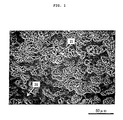
- the inventors of the present invention conducted investigation on the thickness of the oxide layer of the plateau to reduce the sliding resistance and to prevent fracture during press-forming, and found that, as shown in Fig. 1, the formation of 10 nm or larger thickness of oxide layer, preferably 20 nm or larger thickness, on the plateau 20 of the coating layer flattened by temper rolling satisfies the requirement. With that thickness of the oxide layer, no degradation of sliding performance occurs even if the oxide layer wears during press-forming. Although there is no specific upper limit of the oxide layer thickness, exceeding 200 nm thereof results in extreme degradation of reactivity of the surface, and results in difficulty in forming chemical conversion film. Consequently, the thickness of the oxide layer is preferably 200 nm or less.
- Determination of the thickness of oxide layer may be done by Auger electron spectroscopy (AES) combined with Ar ion sputtering. That is, after applying sputtering to a specified depth of the oxide layer, the composition of the oxide layer at the depth is determined based on the spectral intensity of each target element while applying correction of relative sensitivity factor, and the depth where the sum of the maximum value of O content and the value of succeedingly reduced in the O content to a stable level becomes 1/2 is adopted as a thickness of the oxide layer.
- AES Auger electron spectroscopy
- the area percentage of the plateau of the flattened coating layer is 20 to 80 %. If the percentage is less than 20 %, the portions other than the plateau of the flattened coating layer, or the contact area with the die at the portions without contacting temper rolling expressed by the reference number 21 in Fig. 1, increase, and the area percentage of the plateau of the flattened coating layer, which surely controls the thickness of the oxide layer, decreases, thus decreasing the effect of improving the sliding performance. Since the portions without contacting temper rolling play a role in holding press work oil during press-forming, if the area percentage of portions without contacting temper rolling becomes less than 20 %, or if the area percentage of plateau of the flattened coating layer exceeds 80 %, absence of oil likely occurs to decrease the effect of improvement in press-formability.
- the area percentage of plateau of the flattened coating layer means the percentage of flat portions in the observation field, obtained by observing the surface of the coating layer using an optical microscope or a scanning electron microscope (SEM) and by applying image analysis.
- the plateau of the flattened coating layer are portions with which the die directly contacts during press-forming, it is preferable that a hard material having high melting point that prevents adhesion with the die exists in view of sliding performance. To this point, a sole ⁇ 1 phase coating layer is effective.
- alloying treatment to increase the Fe content in the coating layer is required.
- the treatment forms a hard and brittle ⁇ phase between the coating layer and the steel sheet, which likely induces powdering. Therefore, it is preferred to form a coating layer consisting mainly of ⁇ 1 phase and further containing ⁇ phase.
- existence of ⁇ phase in the surface of the coating layer on at least one side of the steel sheet reduces the content of ⁇ phase, which is effective to prevent powdering. If the ⁇ phase exists in the surface of the coating layer, the reactivity of surface increases, which allows effectively forming an oxide layer on the convex portions of the flattened coating layer.
- the X-ray diffraction peak ratio between ⁇ phase and ⁇ 1 phase, ( ⁇ / ⁇ ), in the coating layer to 0.2 or more, or to keep the area percentage of ⁇ phase on the surface of coating layer to 10 % or more.
- the area percentage of ⁇ phase means the percentage of area of columnar crystals, which are presumably the ⁇ phase, in the observation area of coating layer on SEM image.
- ⁇ / ⁇ the area percentage of ⁇ phase
- the galvannealed steel sheet according to the present invention may be manufactured by applying hot dip galvanization to a steel sheet, alloying the coating layer by heating the steel sheet, applying temper rolling, and then forming an oxide layer on the surface of the coating layer.
- an oxide layer is formed after removing the oxide layer formed during the alloying step to activate the surface, more uniform oxide layer is formed, which is preferable in view of sliding performance. This is because the non-uniform reaction caused by the oxide layer left after the temper rolling is prevented during the formation of oxide layer.
- mechanical method such as grinding or chemical method such as dipping in alkaline solution and spraying alkaline solution may be applied.
- oxide layer There are various methods for forming oxide layer, as described below.
- Zn easily forms oxide by contacting with a neutral solution, and the reaction rapidly proceeds in a high temperature state. Consequently, the oxide layer necessary for improving the sliding performance can be formed within a short time.
- the method can form oxide layer at relatively low temperatures around room temperature.
- oxide layer The mechanism of the formation of oxide layer is not clearly analyzed. Although Zn easily forms oxide by contacting with a neutral solution, further contact with air would enhance the formation of the oxide.
- pH is preferably 5 or less. If the solution temperature is 50 °C or above, the Zn dissolution and the oxide formation are further enhanced.
- the water temperature for washing is preferably adjusted to 50 °C or above.
- the coating weight of the contacted acidic solution is 3.0 g/m 2 or less per a side of the steel sheet, the formation of Zn hydroxide is further enhanced to more surely form the oxide layer.
- the adjustment of the coating weight may be done by squeezing roll or air wiping.
- the acidic solution contains Fe ion and/or Zn ion, the dispersion of frictional coefficient after the oxidation treatment decreases. Since these ions are ingredients of the coating layer, they do not give bad influence even if they are left on the surface of the coating layer.
- An example of the acidic solution containing Fe ion and/or Zn ion is an Fe-Zn-base coating bath. In particular, treating the steel sheet through an electrodeposition coating line without applying electric current provides similar effect as that described above.
- contact of the steel sheet with a coating solution prepared by diluting the Fe-Zn coating bath is also effective to form oxide layer.
- the mechanism of formation of oxide layer is not fully analyzed, presumable mechanism is the following. Since the Fe-Zn coating bath is acidic, when the galvannealed steel sheet is immersed therein, Zn dissolution occurs on the surface of the coating layer. At the same time, hydrogen is generated to increase pH at the surface of the coating layer, thus making the formation of Zn hydroxide easy.
- the pH is low so that it is necessary to remove the coating solution which was intentionally left for preventing excessive etching of the coating layer and to further increase pH to enhance the formation of Zn hydroxide.
- the pH is high so that there is no anxiety of excessive etching on the surface of coating layer, and small amount of Zn dissolution can easily increase the pH at the surface of coating layer, thus relatively easily forming the oxide layer.
- the dilution rate of the coating solution is necessarily 100 fold or more from the point of prevention of excessive etching. Excessive dilution, however, hinders the Zn dissolution reaction, so the dilution rate is preferably 10,000 fold or less.
- An example of the acidic solution containing Fe ion and/or Zn ion is a solution containing one or more of sulfate, nitrate, and chloride of Fe and/or Zn.
- the required pH of solution is within the above-given range, and the concentration of the solution is not limited.
- the oxide layer according to the present invention is a layer made by an oxide and/or a hydroxide of one or more of Zn, Fe, Al, and other metal elements.
- Al is required to exist in the coating bath. Nevertheless, existing or adding the metal elements other than Al, such as Pb, Sb, Si, Sn, Mg, Mn, Ni, Ti, Li, and Cu does not give bad influence on the effect of the present invention. Furthermore, even when the treating solution used in oxidation treatment includes impurities, and resulting in inclusion of S, N, P, B, Cl, Na, Mn, Ca, Mg, Ba, Sr, Si, or the like in the oxide layer, they do not give bad influence on the effect of the present invention.
- Cold-rolled steel sheets having 0.8 mm of thickness were treated by normal galvannealing to form a coating layer having a specified Fe content and 60 g/m 2 of coating weight.
- the coated steel sheets were temper rolled, and were treated by A or B treatment, separately, described below, to form an oxide layer thereon having different thickness from each other, thus obtaining the samples No. 1 through 20.
- the rolling load in the temper rolling was varied to vary the area percentage of plateau of the coating layer which was flattened by the temper rolling.
- the galvannealed steel sheets were immersed in respective aqueous solution of hydrogen peroxide acidified by sulfuric acid to pH 3, at 50 °C, with varied content of hydrogen peroxide to each other.
- the galvannealed steel sheets were immersed in aqueous solutions acidified by sulfuric acid to pH 2, at 50 °C, and were subjected to anodic electrolysis with varied current density and varied time for applying current.
- Auger electron spectroscopy combined with Ar ion sputtering was applied to give Ar sputtering for 30 seconds as a preliminary treatment to remove the contaminated layer on the surface. After that, the depth where the sum of the maximum value of O content and the value of succeedingly reduced in the O content to astable level becomes 1/2 was determined at arbitrarily selected three points, and the average of the three point data was adopted as a thickness of oxide layer.
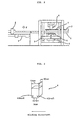
- Fig. 2 shows the frictional coefficient determination apparatus.
- a sample 1 is fixed on a slide table 3 which moves horizontally on rollers 4 placed on a slide table holder 5 which is movable in vertical direction.
- the slide table holder 5 is lifted and is moved in horizontal direction while loading the sample 1 against a bead 6 placed above the sample 1.
- the load N to press the sample 1 against the bead 6 is determined by a load cell 7 attached to the slide table holder 5.
- the sliding resistance F to move the sample 1 in horizontal direction is determined by a load cell 8 attached to the slide table 3.
- the test was conducted by applying a lubricant oil NOX-RUST 550HN, produced by Nihon Parkerizing Co., Ltd., onto the surface of the sample 1.
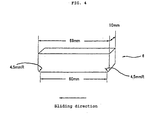
- Figs. 3 and 4 show the shape and dimensions of respective applied beads.
- the bead shown in Fig. 3 has 10 mm in width, 12 mm in length in the sliding direction, and 4.5 mm in radius of curvature at lower section of both edges in the sliding direction.
- the bottom face of the bead where the bead is pressed against the sample has a flat plane with 10 mm in width and 3 mm in length in the sliding direction.
- the bead shown in Fig. 4 has 10 mm in width, 69 mm in length in the sliding direction, and 4.5 mm in radius of curvature at both edges of lower section in the sliding direction.
- the bottom face of the bead where the bead is pressed against the sample has a flat plane with 10 mm in width and 60 mm in length in the sliding direction.
- the sample 1 slides in a state that the bottom face of bead is pressed against the sample.
- Condition 1 With the bead shown in Fig. 3, load N of 400 kgf, and sample moving speed in horizontal direction of 100 cm/min.
- Condition 2 With the bead shown in Fig. 4, load N of 400 kgf, and sample moving speed in horizontal direction of 20 cm/min.
- the samples No. 4 through 7 and 10 through 15 had the area percentage of plateau on the surface of flattened coating layer of 20 to 80 % so that the frictional coefficient ⁇ under the condition 2 was significantly decreased to 0.170 or smaller, which shows superior sliding performance.
- sample No. 18 as a comparative example where oxide layer is formed without applying temper rolling
- sample No. 19 as a comparative example that was not subjected to the treatment for forming oxide layer after temper rolling
- sample No. 20 as a comparative example that had less than 10 nm of thickness of oxide layer showed large frictional coefficient ⁇ , giving poor sliding performance.
- Galvannealed steel sheets having 0.8 mm in thickness and having varied ⁇ phase ratio with varied alloying conditions were temper-rolled.
- the steel sheets were immersed in an aqueous solution of sodium hydroxide of pH 12 to remove the oxide layer formed during alloying treatment. Then an oxide layer was formed on the surface of steel sheets applying the above-described treatment A or B, respectively, to obtain the samples No. 1 through 31.
- the load of temper rolling was varied to vary the area percentage of plateau on the surface of coating layer flattened by temper rolling.
- the samples No. 9 through 13 as examples according to the present invention gave large ⁇ / ⁇ value and large area percentage of ⁇ phase, and even when the ⁇ phase distinctively exists in the surface, the frictional coefficient ⁇ under the condition 1 was low, which gives superior sliding performance.
- the samples No. 11 through 24, which are the samples according to the present invention, having 20 nm or larger thickness of oxide layer gave small frictional coefficient ⁇ under the condition 2, thus giving further improved sliding performance.
- the samples No. 5 through 8 which had small area percentage of plateau on the surface of flattened coating layer, having the thickness of oxide layer within the range of the present invention, did not decrease the frictional coefficient ⁇ under the condition 2, though giving small frictional coefficient ⁇ under the condition 1, thus resulting in less effect for improving the sliding performance.
- the samples No. 1 through 4 which are comparative example having the thickness of oxide layer outside the range of the present invention, showed large frictional coefficient ⁇ , and gave poor sliding performance.
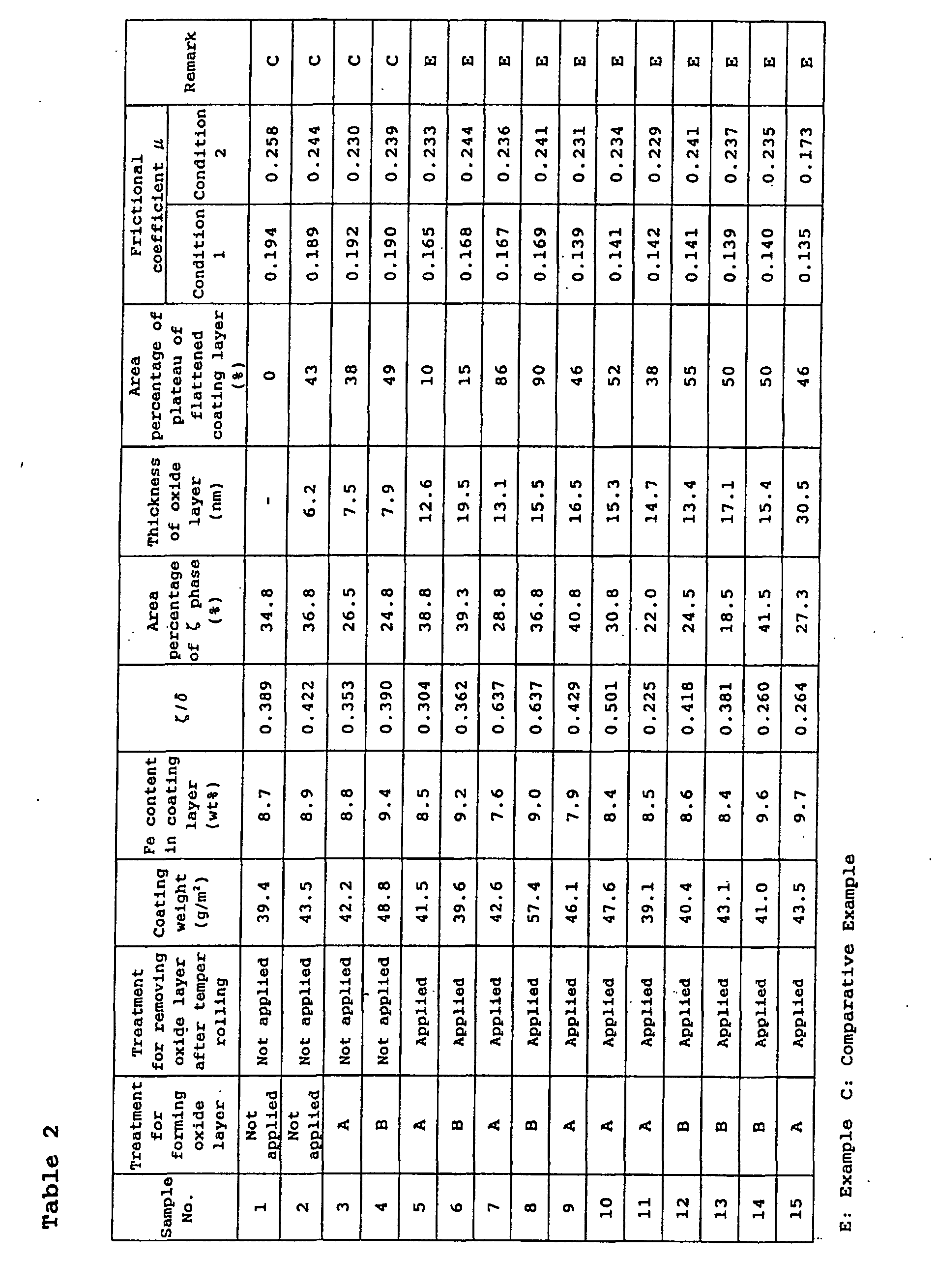
- Galvannealed steel sheets having 0.8 mm in thickness prepared by a general method, were temper-rolled.
- the steel sheets were immersed in an aqueous solution of sodium hydroxide of pH 12 to remove the oxide layer formed during alloying treatment.
- oxide layers of various thicknesses were formed on the surface of steel sheets applying the above-described treatment A and the treatments C and D given below, respectively, to obtain the samples No. 1 through 38.
- the load of temper rolling was varied to vary the area percentage of convex portions on the surface of coating layer flattened by temper rolling.
- the galvannealed steel sheets were heated to 250 °C in an atmosphere of oxygen content 40 % for different treatment periods.
- the measurement was given on the coating layer in terms of Fe content in the coating layer, area percentage of plateau on the surface of flattened coating layer, thickness of oxide layer, and frictional coefficient ⁇ .
- the samples No. 6 through 38 which are the examples according to the present invention, showed small frictional coefficient ⁇ under the condition 1, giving superior sliding performance.
- the samples No. 15 through 38, giving 20 nm or larger thickness of oxide layer gave small frictional coefficient ⁇ under the condition 2, and showed further improved sliding performance.
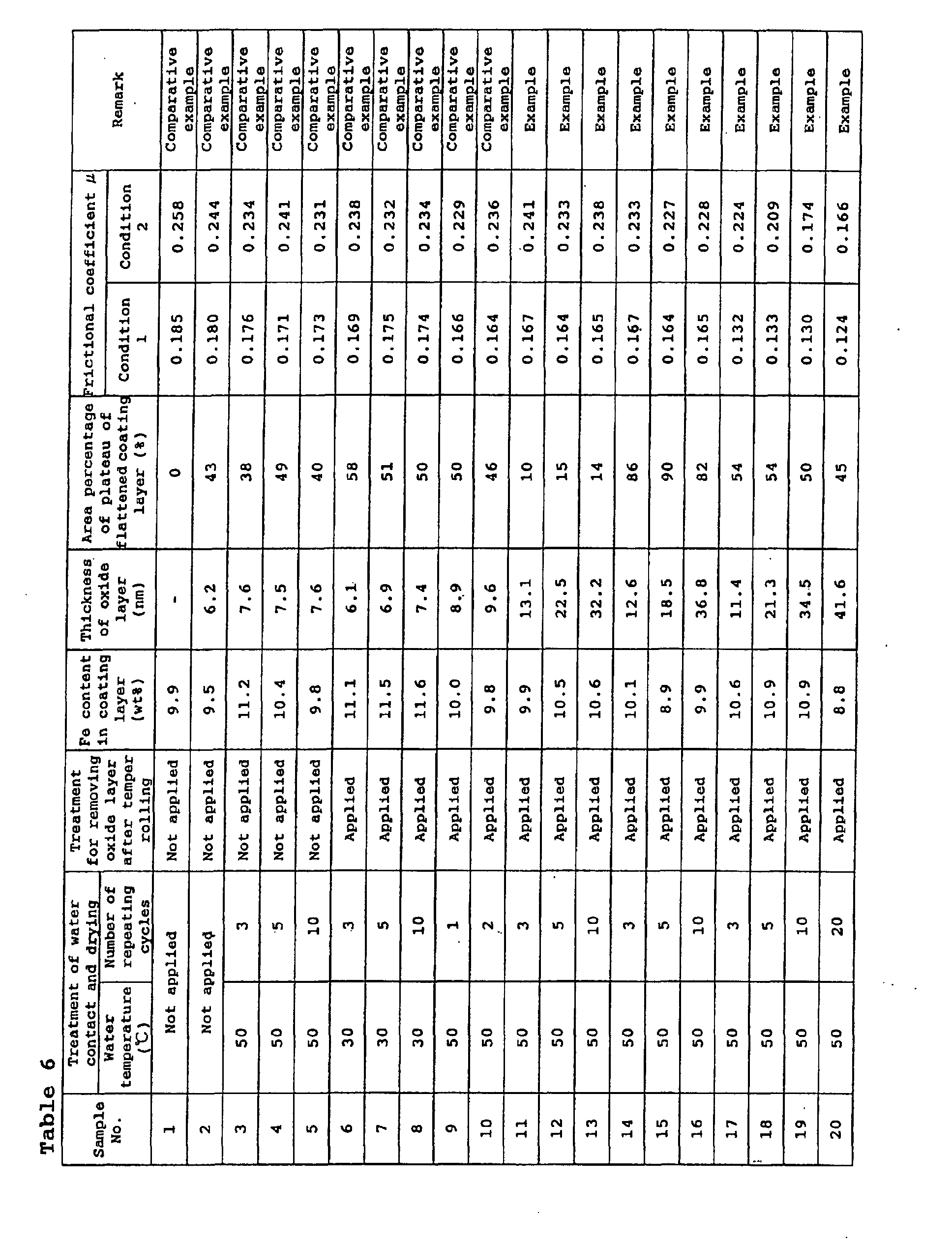
- Galvannealed steel sheets having 0.8 mm in thickness prepared by a general method, were temper-rolled.
- the steel sheets were immersed in an aqueous solution of sodium hydroxide of pH 12 to remove the oxide layer formed during alloying treatment.
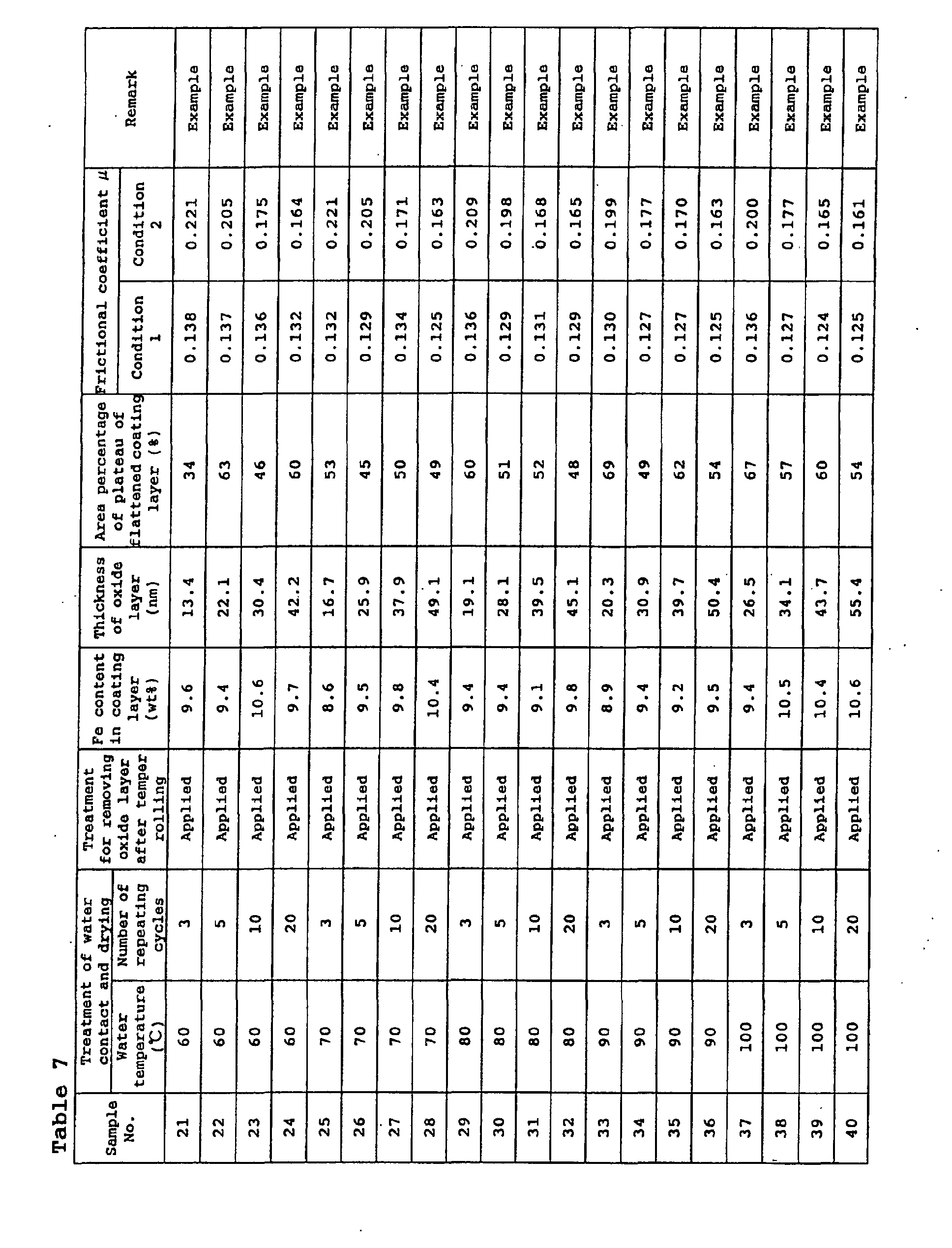
- oxide layers of various thicknesses were formed on the surface of steel sheets applying repeated treatment cycles of 5 seconds of spray of filtered water at a specified temperature against the surface of the steel sheet, followed by immediate drying, thus obtained the samples No. 1 through 40.
- the load of temper rolling was varied to vary the area percentage of plateau on the surface of coating layer flattened by temper rolling.
- the measurement was given on the coating layer in terms of Fe content in the coating layer, area percentage of plateau on the surface of flattened coating layer, thickness of oxide layer, and frictional coefficient ⁇ .
- the samples No. 11 through 40 which are the examples according to the present invention, gave small frictional coefficient ⁇ under the condition 1 and showed superior sliding performance.
- the samples having 20 nm or larger thickness of oxide layer gave small frictional coefficient ⁇ under the condition 2, and showed further improved sliding performance.
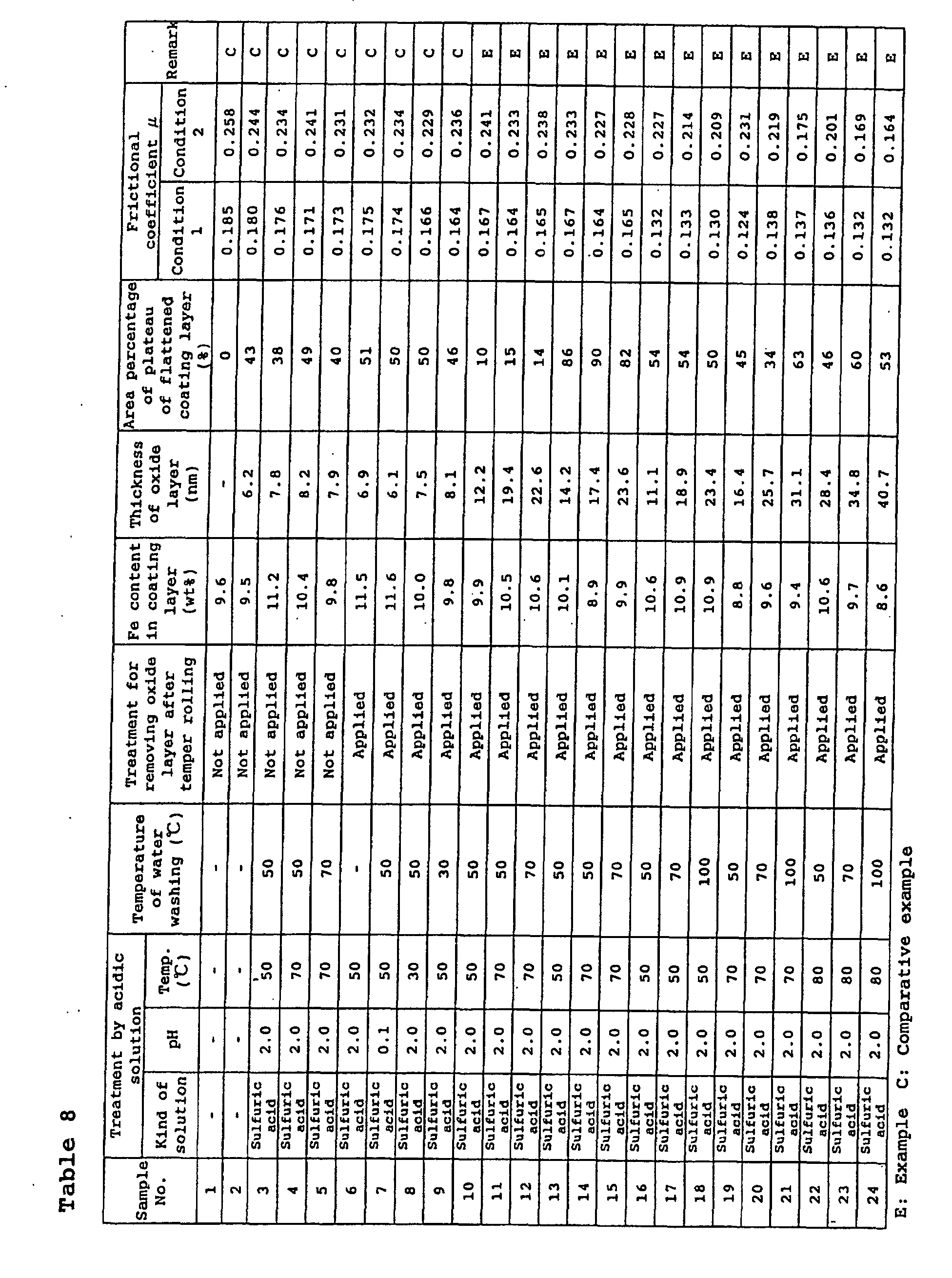
- Galvannealed steel sheets having 0.8 mm in thickness prepared by a general method, were temper-rolled.
- the steel sheets were immersed in an aqueous solution of sodium hydroxide of pH 12 to remove the oxide layer formed during alloying treatment.
- oxide layers of various thicknesses were formed on the surface of steel sheets immersing in an aqueous solution acidified by sulfuric acid or in an Fe-Zn coating bath containing 1.0 mol/l of iron(II) sulfate and 0.1 mol/l of zinc sulfate, at a specified temperature and pH to obtain the samples No. 1 through 51.
- the load of temper rolling was varied to vary the area percentage of plateau on the surface of coating layer flattened by temper rolling.
- the pH adjustment of the Fe-Zn coating bath was done using dilute sulfuric acid.
- the measurement was given on the coating layer in terms of Fe content in the coating layer, area percentage of plateau on the surface of flattened coating layer, thickness of oxide layer, and frictional coefficient ⁇ .
- the samples No. 10 through 51 which are the examples according to the present invention, gave small frictional coefficient ⁇ under the condition 1, and showed superior sliding performance. Particularly for the samples having 20 nm or larger thickness of oxide layer and having 20 to 80 % of area percentage of plateau on the surface of coating layer gave small frictional coefficient ⁇ under the condition 2, and showed further improved sliding performance.
- Galvannealed steel sheets having 0.8 mm in thickness prepared by a general method, were temper-rolled.
- the steel sheets were immersed in an aqueous solution of sodium hydroxide of pH 12 to remove the oxide layer formed during alloying treatment.
- oxide layers of various thicknesses were formed on the surface of steel sheets by immersing in an aqueous solution prepared by diluting an Fe-Zn coating bath containing 1.0 mol/l of iron(II) sulfate and 0.1 mol/l of zinc sulfate, at pH 2 to obtain the samples No. 1 through 39.
- the load of temper rolling was varied to vary the area percentage of plateau on the surface of coating layer flattened by temper rolling.
- the measurement was given on the coating layer in terms of Fe content in the coating layer, area percentage of plateau on the surface of flattened coating layer, thickness of oxide layer, and frictional coefficient ⁇ .
- the samples No. 12 through 39 which are the examples according to the present invention, gave small frictional coefficient ⁇ , and showed superior sliding performance.
- the samples having 20 nm or larger thickness of oxide layer gave small frictional coefficient ⁇ under the condition 2, and showed further improved sliding performance.
- Galvannealed steel sheets having 0.8 mm in thickness prepared by a general method, were temper-rolled. Using the oxide layer forming and treating apparatus shown in Fig. 5, oxide layers having difference thickness were formed on the surface thereof, thus preparing the samples No. 1 through 20. During the treatment, the load of temper rolling was varied to adjust the area percentage of plateau on the surface of coating layer flattened by temper rolling to a range of from 20 to 80 %.
- a galvannealed steel sheet was immersed in an acidic solution tank 11 which was filled with a solution acidified by sulfuric acid, regulated to 50 °C and pH 5, and the coating weight of the acidic solution on the surface of the steel sheet was adjusted using squeezing rolls 12, followed by washing the surface thereof in a #1 washing tank 14 using 50 °C hot water spray.
- the washed steel sheet passes through a neutralization tank 15.
- the steel sheet was washed in a #2 washing tank 16 using 50 °C hot water spraying, and was dried in a drier 17, thus forming the oxide layer on the surface of the steel sheet.
- the coating weight of the acidic solution was adjusted by the squeezing rolls 12, then a shower water washing unit 13 was applied, or the neutralization tank 15 was applied to neutralize the acidic solution remained on the surface of the steel sheet using spraying an aqueous solution of sodium hydroxide at 10 pH. At that moment, the coating weight of the acidic solution and the time for allowing standing the steel sheet before starting the washing in the #1 washing tank or in the shower water washing unit 13 were varied.
- the measurement was given on the coating layer in terms of Fe content in the coating layer, area percentage of plateau on the surface of flattened coating layer, thickness of oxide layer, and frictional coefficient ⁇ .
- the steel sheet was allowed standing outdoors while taking care not receiving external disturbance. After six months of standing outdoors, the surface was checked to identify the presence ( ⁇ ) and absence ( ⁇ ) of spot rusting.
- Coating weight of acid in solution (g/m 2 ) Time for allowing standing after contacted with acid (sec) Use of neutralization tank Fe content in coating layer (wt%) Thickness of oxide layer (nm) Area percentage of plateau of flattened coating layer (%) Frictional coefficient ⁇ Presence / absence of rust spotting Condition 1
- Condition 2 1 5.0 0 - 9.4 10.2 34 0.173 0.231 ⁇ 2 5.0 0.5 - 10.6 10.8 63 0.170 0.229 ⁇ 3 5.0 1.0 - 9.9 11.8 46 0.165 0.221 ⁇ 4 5.0 2.0 - 10.9 15.4 60 0.158 0.215 ⁇ 5 5.0 5.0 - 10.9 20.1 53 0.140 0.200 ⁇ 6 5.0 10.0 - 10.0 21.1 45 0.139 0.198 ⁇ 7 5.0 20.0 - 10.6 21.8 50 0.139 0.200 ⁇ 8 5.0 30.0 - 10.6 22.0 49 0.138 0.200 ⁇ 9 3.0 1.0 - 10.8 13.4 60 0.160 0.215
Landscapes
- Chemical & Material Sciences (AREA)
- Engineering & Computer Science (AREA)
- Metallurgy (AREA)
- Materials Engineering (AREA)
- Mechanical Engineering (AREA)
- Organic Chemistry (AREA)
- Chemical Kinetics & Catalysis (AREA)
- Physics & Mathematics (AREA)
- Thermal Sciences (AREA)
- General Chemical & Material Sciences (AREA)
- Crystallography & Structural Chemistry (AREA)
- Oil, Petroleum & Natural Gas (AREA)
- Coating With Molten Metal (AREA)
- Chemical Treatment Of Metals (AREA)
Abstract
Description
| Sample No. | Treatment for forming oxide layer | Fe content in coating layer (wt%) | Thickness of oxide layer (nm) | Area percentage of plateau of flattened coating layer (%) | Frictional coefficient µ | | |
| Condition | |||||||
| 1 | | ||||||
| 1 | A | 10.3 | 16 | 2 | 0.153 | 0.183 | Example |
| 2 | A | 10.5 | 35 | 6 | 0.135 | 0.181 | Example |
| 3 | A | 10.2 | 28 | 10 | 0.135 | 0.181 | Example |
| 4 | A | 9.4 | 29 | 22 | 0.134 | 0.168 | Example |
| 5 | A | 11.2 | 22 | 38 | 0.136 | 0.168 | Example |
| 6 | A | 11.6 | 40 | 59 | 0.133 | 0.160 | Example |
| 7 | A | 10.8 | 16 | 80 | 0.150 | 0.159 | Example |
| 8 | A | 8.9 | 18 | 85 | 0.153 | 0.181 | Example |
| 9 | A | 13.0 | 26 | 100 | 0.138 | 0.187 | Example |
| 10 | A | 11.9 | 13 | 60 | 0.158 | 0.169 | Example |
| 11 | A | 9.0 | 14 | 55 | 0.153 | 0.165 | Example |
| 12 | B | 8.2 | 22 | 50 | 0.138 | 0.161 | Example |
| 13 | B | 10.6 | 68 | 55 | 0.133 | 0.162 | Example |
| 14 | B | 10.4 | 120 | 45 | 0.132 | 0.161 | Example |
| 15 | B | 12.5 | 220 | 50 | 0.132 | 0.162 | Example |
| 16 | B | 12.4 | 11 | 85 | 0.154 | 0.184 | Example |
| 17 | B | 11.0 | 13 | 14 | 0.155 | 0.181 | Example |
| 18 | without treatment | 11.8 | - | without temper rolling | 0.184 | 0.245 | Comparative Example |
| 19 | without treatment | 11.5 | 7 | 45 | 0.178 | 0.226 | Comparative Example |
| 20 | A | 9.8 | 9 | 42 | 0.171 | 0.214 | Comparative Example |

| Sample No. | Treatment for forming oxide layer | Treatment for removing oxide layer after temper rolling | Fe content in coating layer (wt%) | Thickness of oxide layer (nm) | Area percentage of plateau of flattened coating layer (%) | Frictional coefficient µ | | |
| Condition | ||||||||
| 1 | | |||||||
| 1 | without treatment | not applied | 9.9 | - | 0 | 0.185 | 0.258 | |
| 2 | without treatment | not applied | 9.5 | 6.2 | 43 | 0.180 | 0.244 | C |
| 3 | C | not applied | 11.2 | 8.1 | 38 | 0.178 | 0.230 | C |
| 4 | D | not applied | 10.4 | 7.9 | 49 | 0.173 | 0.239 | C |
| 5 | A | not applied | 9.8 | 7.4 | 40 | 0.175 | 0.233 | C |
| 6 | C | applied | 9.9 | 12.6 | 10 | 0.164 | 0.244 | E |
| 7 | D | applied | 10.5 | 19.5 | 15 | 0.167 | 0.236 | E |
| 8 | A | applied | 10.6 | 22.4 | 14 | 0.163 | 0.241 | E |
| 9 | C | applied | 10.1 | 13.1 | 86 | 0.163 | 0.231 | E |
| 10 | D | applied | 8.9 | 15.5 | 90 | 0.166 | 0.234 | E |
| 11 | A | applied | 9.9 | 18.3 | 82 | 0.160 | 0.229 | E |
| 12 | C | applied | 11.5 | 16.5 | 51 | 0.132 | 0.241 | E |
| 13 | D | applied | 11.6 | 15.3 | 50 | 0.133 | 0.237 | E |
| 14 | A | applied | 10.0 | 14.7 | 50 | 0.130 | 0.235 | E |
| 15 | C | applied | 9.8 | 25.1 | 46 | 0.124 | 0.200 | E |
| 16 | D | applied | 11.1 | 14.8 | 58 | 0.132 | 0.195 | E |
| 17 | A | applied | 10.6 | 22.4 | 54 | 0.129 | 0.193 | E |
| E: Example C: Comparative example |
| Sample No. | Treatment for forming oxide layer | Treatment for removing oxide layer after temper rolling | Fe content in coating layer (wt%) | Thickness of oxide layer (nm) | Area percentage of plateau of flattened coating layer (%) | Frictional coefficient µ | | |
| Condition | ||||||||
| 1 | | |||||||
| 18 | C | applied | 10.9 | 31.0 | 54 | 0.134 | 0.176 | E |
| 19 | C | applied | 10.9 | 32.5 | 50 | 0.125 | 0.178 | E |
| 20 | C | applied | 8.8 | 46.2 | 45 | 0.136 | 0.171 | E |
| 21 | C | applied | 8.6 | 51.3 | 53 | 0.127 | 0.165 | E |
| 22 | C | applied | 9.5 | 62.2 | 45 | 0.124 | 0.166 | E |
| 23 | C | applied | 9.8 | 82.4 | 50 | 0.125 | 0.166 | E |
| 24 | C | applied | 10.4 | 125 | 49 | 0.136 | 0.162 | E |
| 25 | D | applied | 9.4 | 33.4 | 67 | 0.127 | 0.176 | E |
| 26 | D | applied | 10.5 | 30.6 | 57 | 0.133 | 0.179 | E |
| 27 | D | applied | 10.4 | 45.9 | 60 | 0.132 | 0.169 | E |
| 28 | D | applied | 10.6 | 53.3 | 54 | 0.129 | 0.162 | E |
| 29 | D | applied | 10.6 | 68.1 | 58 | 0.128 | 0.166 | E |
| 30 | D | applied | 9.3 | 81.0 | 58 | 0.131 | 0.168 | E |
| 31 | D | applied | 9.5 | 146 | 63 | 0.129 | 0.165 | E |
| 32 | A | applied | 10.4 | 38.1 | 65 | 0.128 | 0.177 | E |
| 33 | A | applied | 9.6 | 34.5 | 64 | 0.126 | 0.175 | E |
| 34 | A | applied | 10.2 | 42.5 | 38 | 0.131 | 0.169 | E |
| 35 | A | applied | 9.8 | 56.1 | 66 | 0.131 | 0.164 | E |
| 36 | A | applied | 10.2 | 60.3 | 59 | 0.129 | 0.170 | E |
| 37 | A | applied | 9.6 | 82.7 | 55 | 0.136 | 0.171 | E |
| 38 | A | applied | 10.4 | 131 | 56 | 0.127 | 0.166 | E |
| E: Example C: Comparative example |


| Sample No. | Coating weight of acid in solution (g/m2) | Time for allowing standing after contacted with acid (sec) | Use of neutralization tank | Fe content in coating layer (wt%) | Thickness of oxide layer (nm) | Area percentage of plateau of flattened coating layer (%) | Frictional coefficient µ | Presence / absence of rust spotting | |
| Condition 1 | Condition 2 | ||||||||
| 1 | 5.0 | 0 | - | 9.4 | 10.2 | 34 | 0.173 | 0.231 | × |
| 2 | 5.0 | 0.5 | - | 10.6 | 10.8 | 63 | 0.170 | 0.229 | × |
| 3 | 5.0 | 1.0 | - | 9.9 | 11.8 | 46 | 0.165 | 0.221 | × |
| 4 | 5.0 | 2.0 | - | 10.9 | 15.4 | 60 | 0.158 | 0.215 | × |
| 5 | 5.0 | 5.0 | - | 10.9 | 20.1 | 53 | 0.140 | 0.200 | × |
| 6 | 5.0 | 10.0 | - | 10.0 | 21.1 | 45 | 0.139 | 0.198 | × |
| 7 | 5.0 | 20.0 | - | 10.6 | 21.8 | 50 | 0.139 | 0.200 | × |
| 8 | 5.0 | 30.0 | - | 10.6 | 22.0 | 49 | 0.138 | 0.200 | × |
| 9 | 3.0 | 1.0 | - | 10.8 | 13.4 | 60 | 0.160 | 0.215 | × |
| 10 | 3.0 | 2.0 | - | 10.5 | 17.7 | 51 | 0.155 | 0.210 | × |
| 11 | 3.0 | 5.0 | - | 10.5 | 22.4 | 52 | 0.135 | 0.197 | × |
| 12 | 3.0 | 10.0 | - | 10.7 | 25.1 | 48 | 0.134 | 0.195 | × |
| 13 | 3.0 | 20.0 | - | 11.1 | 26.4 | 69 | 0.133 | 0.196 | × |
| 14 | 3.0 | 30.0 | - | 10.9 | 27.1 | 49 | 0.135 | 0.194 | × |
| 15 | 1.0 | 1.0 | ○ | 11.7 | 14.1 | 62 | 0.158 | 0.216 | ○ |
| 16 | 1.0 | 2.0 | ○ | 10.4 | 18.8 | 54 | 0.157 | 0.211 | ○ |
| 17 | 1.0 | 5.0 | ○ | 10.5 | 22.6 | 67 | 0.134 | 0.194 | ○ |
| 18 | 1.0 | 10.0 | ○ | 9.9 | 25.9 | 57 | 0.132 | 0.191 | ○ |
| 19 | 1.0 | 20.0 | ○ | 10.3 | 27.0 | 60 | 0.133 | 0.195 | ○ |
| 20 | 1.0 | 30.0 | ○ | 10.9 | 27.9 | 54 | 0.133 | 0.194 | ○ |
Claims (29)
- A galvannealed steel sheet comprising an oxide layer having 10 nm or larger thickness on plateau of the surface of coating layer flattened by temper rolling.
- The galvannealed steel sheet of claim 1, wherein the area percentage of the plateau of the flattened coating layer is 20 to 80 %.
- The galvannealed steel sheet of claim 1, wherein the coating layer is a single layer of δ1 phase.
- The galvannealed steel sheet of claim 2, wherein the coating layer is a single layer of δ1 phase.
- The galvannealed steel sheet of claim 1, wherein the coating layer consists mainly of δ1 phase and contains ζ phase.
- The galvannealed steel sheet of claim 2, wherein the coating layer consists mainly of δ1 phase and contains ζ phase.
- The galvannealed steel sheet of claim 5, wherein ζ phase exists in the surface of the coating layer on at least one side of the steel sheet.
- The galvannealed steel sheet of claim 6, wherein ζ phase exists in the surface of the coating layer on at least one side of the steel sheet.
- The galvannealed steel sheet of claim 7, wherein the X-ray diffraction peak ratio (ζ/δ) between the ζ phase and the δ1 phase in the coating layer is 0.2 or more.
- The galvannealed steel sheet of claim 8, wherein the X-ray diffraction peak ratio (ζ/δ) between the ζ phase and the δ1 phase in the coating layer is 0.2 or more.
- The galvannealed steel sheet of claim 7, wherein the area percentage of ζ phase existing in the surface of the coating layer is 10 % or more.
- The galvannealed steel sheet of claim 8, wherein the area percentage of ζ phase existing in the surface of the coating layer is 10 % or more.
- A method for manufacturing a galvannealed steel sheet comprising the steps of: applying hot dip galvanization to a steel sheet; heating the hot dip galvanized steel sheet to alloy the coating layer; applying temper rolling to the galvannealed steel sheet; and forming a Zn-base oxide layer on the surface of coating layer of the galvannealed steel sheet after the temper rolling.
- The method for manufacturing a galvannealed steel sheet of claim 13 further comprising the steps of: removing the oxide layer formed during alloying treatment after temper rolling to activate the surface; and forming an oxide layer on the surface.
- The method for manufacturing a galvannealed steel sheet of claim 13, wherein the formation of oxide layer is conducted under the contact of the steel sheet with high temperature steam.
- The method for manufacturing a galvannealed steel sheet of claim 13, wherein the formation of oxide layer is conducted by heating the steel sheet in an atmosphere of 20 % or higher oxygen content.
- The method for manufacturing a galvannealed steel sheet of claim 13, wherein the formation of oxide layer is conducted under the contact of the steel sheet with an aqueous solution containing an oxidizing agent.
- The method for manufacturing a galvannealed steel sheet of claim 13, wherein the formation of oxide layer is conducted by repeating the treatment cycles of contact between the steel sheet and water followed by immediate drying of the steel sheet.
- The method for manufacturing a galvannealed steel sheet of claim 18, wherein the contacting water is at 50 °C or higher temperature.
- The method for manufacturing a galvannealed steel sheet of claim 18, wherein the number of repeated treatment cycles of contact between the steel sheet and water followed by immediate drying of the steel sheet is three or more.
- The method for manufacturing a galvannealed steel sheet of claim 20, wherein the number of repeated treatment cycles of contact between the steel sheet and water followed by immediate drying of the steel sheet is three or more.
- The method for manufacturing a galvannealed steel sheet of claim 13, wherein the formation of oxide layer is conducted under the contact of the steel sheet with an acidic solution, and by washing the steel sheet with water.
- The method for manufacturing a galvannealed steel sheet of claim 22, wherein pH of the acidic solution is 1 or more, and the temperature thereof is 50 °C or above.
- The method for manufacturing a galvannealed steel sheet of claim 22, wherein the coating weight of the contacted acidic solution is 3.0 g/m2 or less per side of the steel sheet.
- The method for manufacturing a galvannealed steel sheet of claim 22, wherein the washing water is hot water at 50 °C or above.
- The method for manufacturing a galvannealed steel sheet of claim 22, wherein the washing with water is given after allowing the steel sheet standing for 1.0 to 3.0 sec after contacted with the acidic solution.
- The method for manufacturing a galvannealed steel sheet of claim 25 further comprising the step of applying neutralization treatment after water washing.
- The method for manufacturing a galvannealed steel sheet of claim 22, wherein the acidic solution contains Fe ion and/or Zn ion.
- The method for manufacturing a galvannealed steel sheet of claim 28, wherein the acidic solution containing Fe ion and/or Zn ion further contains one or more of sulfate, nitrate, and chloride of Fe and/or Zn.
Applications Claiming Priority (7)
| Application Number | Priority Date | Filing Date | Title |
|---|---|---|---|
| JP2000122280 | 2000-04-24 | ||
| JP2000122280 | 2000-04-24 | ||
| JP2000212591A JP3675313B2 (en) | 1999-07-15 | 2000-07-13 | Method for producing alloyed hot-dip galvanized steel sheet with excellent slidability |
| JP2000212591 | 2000-07-13 | ||
| JP2000368329 | 2000-12-04 | ||
| JP2000368329A JP2002173751A (en) | 2000-12-04 | 2000-12-04 | Galvannealed steel sheet |
| PCT/JP2001/000190 WO2001081646A1 (en) | 2000-04-24 | 2001-01-15 | Galvannealed sheet steel and method for production thereof |
Publications (3)
| Publication Number | Publication Date |
|---|---|
| EP1288325A1 true EP1288325A1 (en) | 2003-03-05 |
| EP1288325A4 EP1288325A4 (en) | 2007-04-04 |
| EP1288325B1 EP1288325B1 (en) | 2014-10-15 |
Family
ID=27343178
Family Applications (1)
| Application Number | Title | Priority Date | Filing Date |
|---|---|---|---|
| EP01900757.4A Expired - Lifetime EP1288325B1 (en) | 2000-04-24 | 2001-01-15 | Method for production of galvannealed sheet steel |
Country Status (5)
| Country | Link |
|---|---|
| US (1) | US6699592B2 (en) |
| EP (1) | EP1288325B1 (en) |
| KR (2) | KR100603427B1 (en) |
| CN (1) | CN1207424C (en) |
| WO (1) | WO2001081646A1 (en) |
Cited By (12)
| Publication number | Priority date | Publication date | Assignee | Title |
|---|---|---|---|---|
| EP1439240A4 (en) * | 2001-10-23 | 2005-09-07 | Sumitomo Metal Ind | PRESS WORK METHOD, PLATE STEEL PRODUCT FOR THIS METHOD AND PROCESS FOR PRODUCTION OF SAID STEEL PRODUCT |
| EP1616973A4 (en) * | 2003-04-18 | 2007-09-12 | Jfe Steel Corp | Zinc hot dip galvanized steel plate excellent in press formability and method for production thereof |
| EP1666624A4 (en) * | 2003-08-29 | 2009-07-22 | Jfe Steel Corp | Hot dip zinc plated steel sheet and method for production thereof |
| EP2014783A4 (en) * | 2006-05-02 | 2010-12-01 | Jfe Steel Corp | HOT AND ALLENED TEMPERED ZINC PLATED STEEL SHEET AND PROCESS FOR PRODUCING THE SAME |
| US8025980B2 (en) | 2003-08-29 | 2011-09-27 | Jfe Steel Corporation | Hot dip galvanized steel sheet and method for manufacturing same |
| EP2366812A4 (en) * | 2008-12-16 | 2012-04-25 | Jfe Steel Corp | Galvanized steel sheet and method for manufacturing the same |
| EP2527493A4 (en) * | 2010-07-09 | 2014-01-08 | Nippon Steel & Sumitomo Metal Corp | ZINC COATED STEEL SHEET BY HOT IMMERSION |
| EP1658390B1 (en) * | 2003-07-29 | 2014-09-17 | Voestalpine Stahl GmbH | Method for producing a hardened steel part |
| EP2186925A4 (en) * | 2007-09-04 | 2015-05-27 | Jfe Steel Corp | GALVANIZED STEEL |
| US9260774B2 (en) | 2010-03-31 | 2016-02-16 | Jfe Steel Corporation | Method for manufacturing hot dip galvanized steel sheet |
| US9809884B2 (en) | 2013-01-16 | 2017-11-07 | Jfe Steel Corporation | Method for manufacturing galvanized steel sheet |
| EP2239350B1 (en) * | 2009-04-08 | 2019-10-16 | Bayerische Motoren Werke Aktiengesellschaft | Thermally treated sheet metal moulded parts from sheet metal material with an anti-corrosion coating |
Families Citing this family (7)
| Publication number | Priority date | Publication date | Assignee | Title |
|---|---|---|---|---|
| DE102007061489A1 (en) * | 2007-12-20 | 2009-06-25 | Voestalpine Stahl Gmbh | Process for producing hardened hardenable steel components and hardenable steel strip therefor |
| JP5354166B2 (en) * | 2007-12-27 | 2013-11-27 | Jfeスチール株式会社 | Method for producing galvanized steel sheet |
| JP5354165B2 (en) * | 2008-01-30 | 2013-11-27 | Jfeスチール株式会社 | Method for producing galvanized steel sheet |
| CN101775471B (en) * | 2009-01-13 | 2011-07-20 | 攀钢集团研究院有限公司 | Method for producing low-carbon steel hot dip steel plate |
| KR101102075B1 (en) * | 2009-03-06 | 2012-01-04 | 주식회사 에취알에스 | Low Temperature Cooker for Cooking Chicken Meat |
| JP6087684B2 (en) | 2013-03-25 | 2017-03-01 | 大同メタル工業株式会社 | Sliding member and manufacturing method of sliding member |
| US10040270B2 (en) * | 2013-05-20 | 2018-08-07 | Nippon Steel & Sumitomo Metal Corporation | Galvannealed steel sheet and manufacturing method thereof |
Family Cites Families (14)
| Publication number | Priority date | Publication date | Assignee | Title |
|---|---|---|---|---|
| US4059711A (en) * | 1976-05-14 | 1977-11-22 | Bethlehem Steel Corporation | Partially alloyed galvanize product and method |
| JPS6043428B2 (en) | 1976-11-10 | 1985-09-27 | 新日本製鐵株式会社 | Alloyed galvanized iron plate with excellent weldability |
| JPS5819464A (en) * | 1981-07-27 | 1983-02-04 | Sumitomo Metal Ind Ltd | Manufacture of galvanized steel plate |
| JPH0772332B2 (en) * | 1987-03-20 | 1995-08-02 | 新日本製鐵株式会社 | Method for producing alloyed molten zinc plated steel sheet with excellent spot weldability |
| JPH01319661A (en) | 1988-06-21 | 1989-12-25 | Kawasaki Steel Corp | Alloying hot dip galvanized steel sheet excellent in press formability |
| JPH02190483A (en) | 1989-01-19 | 1990-07-26 | Nippon Steel Corp | Galvanized steel sheet having superior press formability |
| JPH02258962A (en) * | 1989-03-30 | 1990-10-19 | Nippon Steel Corp | Equipment for producing galvanizing steel sheet having excellent weldability |
| JPH03191093A (en) | 1989-12-19 | 1991-08-21 | Nippon Steel Corp | Galvanized steel sheet excellent in press formability and chemical conversion treating property |
| JP2819427B2 (en) | 1990-08-01 | 1998-10-30 | 新日本製鐵株式会社 | Galvanized steel sheet with excellent press formability and chemical conversion properties |
| JPH08325689A (en) * | 1995-05-30 | 1996-12-10 | Nippon Steel Corp | Manufacturing facility for hot-dip galvanized steel sheet with excellent lubricity and chemical conversion treatment |
| JP3111888B2 (en) | 1996-03-26 | 2000-11-27 | 日本鋼管株式会社 | Manufacturing method of galvanized steel sheet |
| US5849423A (en) * | 1995-11-21 | 1998-12-15 | Nkk Corporation | Zinciferous plated steel sheet and method for manufacturing same |
| JP3114610B2 (en) * | 1996-03-26 | 2000-12-04 | 日本鋼管株式会社 | Method for producing alloyed hot-dip galvanized steel sheet having Fe-Ni-O-based coating |
| KR100247633B1 (en) | 1996-12-30 | 2000-03-15 | 김영환 | Pixel array structure, liquid crystal display device employing the same, and driving method thereof |
-
2001
- 2001-01-15 WO PCT/JP2001/000190 patent/WO2001081646A1/en not_active Ceased
- 2001-01-15 KR KR1020027013159A patent/KR100603427B1/en not_active Expired - Fee Related
- 2001-01-15 KR KR1020057020349A patent/KR100608556B1/en not_active Expired - Fee Related
- 2001-01-15 EP EP01900757.4A patent/EP1288325B1/en not_active Expired - Lifetime
- 2001-01-15 CN CNB018079989A patent/CN1207424C/en not_active Expired - Lifetime
-
2002
- 2002-10-21 US US10/274,808 patent/US6699592B2/en not_active Expired - Lifetime
Cited By (19)
| Publication number | Priority date | Publication date | Assignee | Title |
|---|---|---|---|---|
| EP1439240A4 (en) * | 2001-10-23 | 2005-09-07 | Sumitomo Metal Ind | PRESS WORK METHOD, PLATE STEEL PRODUCT FOR THIS METHOD AND PROCESS FOR PRODUCTION OF SAID STEEL PRODUCT |
| US7673485B2 (en) | 2001-10-23 | 2010-03-09 | Sumitomo Metal Industries, Ltd. | Hot press forming method |
| EP1616973A4 (en) * | 2003-04-18 | 2007-09-12 | Jfe Steel Corp | Zinc hot dip galvanized steel plate excellent in press formability and method for production thereof |
| US7338718B2 (en) | 2003-04-18 | 2008-03-04 | Jfe Steel Corporation | Zinc hot dip galvanized steel plate excellent in press formability and method for production thereof |
| EP2071048A1 (en) | 2003-04-18 | 2009-06-17 | JFE Steel Corporation | A method for producing hot-dip galvanized steel sheet having excellent press formability. |
| EP1660693B1 (en) * | 2003-07-29 | 2014-09-17 | voestalpine Krems GmbH | Method for producing a hardened profile part |
| EP1658390B1 (en) * | 2003-07-29 | 2014-09-17 | Voestalpine Stahl GmbH | Method for producing a hardened steel part |
| US20120031531A1 (en) * | 2003-08-29 | 2012-02-09 | Jfe Steel Corporation | Hot dip galvanized steel sheet and method for manufacturing same |
| US8025980B2 (en) | 2003-08-29 | 2011-09-27 | Jfe Steel Corporation | Hot dip galvanized steel sheet and method for manufacturing same |
| US8815349B2 (en) | 2003-08-29 | 2014-08-26 | Jfe Steel Corporation | Hot dip galvanized steel sheet and method for manufacturing same |
| EP1666624A4 (en) * | 2003-08-29 | 2009-07-22 | Jfe Steel Corp | Hot dip zinc plated steel sheet and method for production thereof |
| US8268095B2 (en) | 2006-05-02 | 2012-09-18 | Jfe Steel Corporation | Method of manufacturing hot dip galvannealed steel sheet and hot dip galvannealed steel sheet |
| EP2014783A4 (en) * | 2006-05-02 | 2010-12-01 | Jfe Steel Corp | HOT AND ALLENED TEMPERED ZINC PLATED STEEL SHEET AND PROCESS FOR PRODUCING THE SAME |
| EP2186925A4 (en) * | 2007-09-04 | 2015-05-27 | Jfe Steel Corp | GALVANIZED STEEL |
| EP2366812A4 (en) * | 2008-12-16 | 2012-04-25 | Jfe Steel Corp | Galvanized steel sheet and method for manufacturing the same |
| EP2239350B1 (en) * | 2009-04-08 | 2019-10-16 | Bayerische Motoren Werke Aktiengesellschaft | Thermally treated sheet metal moulded parts from sheet metal material with an anti-corrosion coating |
| US9260774B2 (en) | 2010-03-31 | 2016-02-16 | Jfe Steel Corporation | Method for manufacturing hot dip galvanized steel sheet |
| EP2527493A4 (en) * | 2010-07-09 | 2014-01-08 | Nippon Steel & Sumitomo Metal Corp | ZINC COATED STEEL SHEET BY HOT IMMERSION |
| US9809884B2 (en) | 2013-01-16 | 2017-11-07 | Jfe Steel Corporation | Method for manufacturing galvanized steel sheet |
Also Published As
| Publication number | Publication date |
|---|---|
| WO2001081646A1 (en) | 2001-11-01 |
| CN1423708A (en) | 2003-06-11 |
| EP1288325B1 (en) | 2014-10-15 |
| US6699592B2 (en) | 2004-03-02 |
| KR100603427B1 (en) | 2006-07-20 |
| KR20020087461A (en) | 2002-11-22 |
| CN1207424C (en) | 2005-06-22 |
| EP1288325A4 (en) | 2007-04-04 |
| KR100608556B1 (en) | 2006-08-08 |
| KR20050108427A (en) | 2005-11-16 |
| US20030175548A1 (en) | 2003-09-18 |
Similar Documents
| Publication | Publication Date | Title |
|---|---|---|
| US6699592B2 (en) | Galvannealed steel sheet and method for manufacturing the same | |
| JP3807341B2 (en) | Method for producing galvannealed steel sheet | |
| US7338718B2 (en) | Zinc hot dip galvanized steel plate excellent in press formability and method for production thereof | |
| JP3608519B2 (en) | Method for producing alloyed hot-dip galvanized steel sheet and alloyed hot-dip galvanized steel sheet | |
| US20120301709A1 (en) | Hot dip galvannealed steel sheet | |
| US9809884B2 (en) | Method for manufacturing galvanized steel sheet | |
| US6129995A (en) | Zinciferous coated steel sheet and method for producing the same | |
| JP3675313B2 (en) | Method for producing alloyed hot-dip galvanized steel sheet with excellent slidability | |
| EP3428315B1 (en) | Method for producing galvanized steel plate | |
| JP6992831B2 (en) | Manufacturing method of hot-dip galvanized steel sheet | |
| JP2007297686A (en) | Method for producing alloyed hot-dip galvanized steel sheet and alloyed hot-dip galvanized steel sheet | |
| EP1666624B1 (en) | Hot dip zinc plated steel sheet and method for production thereof | |
| CA2745332C (en) | Galvanized steel sheet and method for producing the same | |
| JP4604712B2 (en) | Method for producing hot dip galvanized steel sheet and hot dip galvanized steel sheet | |
| TWI460306B (en) | Fabrication method of hot dip galvanized steel sheet | |
| JP5593601B2 (en) | Alloyed hot-dip galvanized steel sheet and method for producing the same | |
| JP2002302753A (en) | Galvannealed steel sheet | |
| JP2005139557A (en) | Alloyed hot-dip galvanized steel sheet and method for producing the same | |
| US20110236677A1 (en) | Galvanized steel sheet and method for producing the same | |
| JP2007138231A (en) | Method for producing alloyed hot-dip galvanized steel sheet and alloyed hot-dip galvanized steel sheet | |
| JP2003171751A (en) | Galvannealed steel sheet | |
| JP2001131772A (en) | Alloyed hot-dip galvanized steel sheet excellent in press formability and method for producing the same | |
| JP5927995B2 (en) | Method for producing galvanized steel sheet |
Legal Events
| Date | Code | Title | Description |
|---|---|---|---|
| PUAI | Public reference made under article 153(3) epc to a published international application that has entered the european phase |
Free format text: ORIGINAL CODE: 0009012 |
|
| 17P | Request for examination filed |
Effective date: 20021114 |
|
| AK | Designated contracting states |
Kind code of ref document: A1 Designated state(s): AT BE CH CY DE DK ES FI FR GB GR IE IT LI LU MC NL PT SE TR |
|
| RAP1 | Party data changed (applicant data changed or rights of an application transferred) |
Owner name: JFE STEEL CORPORATION |
|
| RBV | Designated contracting states (corrected) |
Designated state(s): AT BE CH DE FR GB LI |
|
| A4 | Supplementary search report drawn up and despatched |
Effective date: 20070302 |
|
| RIC1 | Information provided on ipc code assigned before grant |
Ipc: C23C 30/00 20060101ALI20070226BHEP Ipc: C23C 2/26 20060101AFI20011108BHEP |
|
| 17Q | First examination report despatched |
Effective date: 20070619 |
|
| GRAP | Despatch of communication of intention to grant a patent |
Free format text: ORIGINAL CODE: EPIDOSNIGR1 |
|
| INTG | Intention to grant announced |
Effective date: 20140522 |
|
| GRAS | Grant fee paid |
Free format text: ORIGINAL CODE: EPIDOSNIGR3 |
|
| GRAA | (expected) grant |
Free format text: ORIGINAL CODE: 0009210 |
|
| RIN1 | Information on inventor provided before grant (corrected) |
Inventor name: TAIRA, SHOICHIRO Inventor name: GAMOU, AKIRA Inventor name: NODE, SHUNSAKU Inventor name: NOMURA, SHUJI Inventor name: SUGIMOTO, YOSHIHARU Inventor name: MIYAKAWA, YOICHI Inventor name: INAGAKI, JUNICHI Inventor name: SATO, KAORU Inventor name: IMOKAWA, TORU Inventor name: IWABUCHI, MASAHIRO Inventor name: YAMASHITA, MASAAKI Inventor name: NAGOSHI, MASAYASU Inventor name: SAKURAI, MICHITAKA |
|
| AK | Designated contracting states |
Kind code of ref document: B1 Designated state(s): DE FR GB |
|
| RBV | Designated contracting states (corrected) |
Designated state(s): DE FR GB |
|
| REG | Reference to a national code |
Ref country code: GB Ref legal event code: FG4D |
|
| REG | Reference to a national code |
Ref country code: DE Ref legal event code: R096 Ref document number: 60149050 Country of ref document: DE Effective date: 20141127 |
|
| RIN2 | Information on inventor provided after grant (corrected) |
Inventor name: IWABUCHI, MASAHIRO Inventor name: IMOKAWA, TORU Inventor name: NODE, SHUNSAKU Inventor name: MIYAKAWA, YOICHI Inventor name: NAGOSHI, MASAYASU Inventor name: SATO, KAORU Inventor name: NOMURA, SHUJI Inventor name: YAMASHITA, MASAAKI Inventor name: GAMOU, AKIRA Inventor name: SAKURAI, MICHITAKA Inventor name: INAGAKI, JUNICHI Inventor name: SUGIMOTO, YOSHIHARU Inventor name: TAIRA, SHOICHIRO |
|
| REG | Reference to a national code |
Ref country code: DE Ref legal event code: R026 Ref document number: 60149050 Country of ref document: DE |
|
| PLBI | Opposition filed |
Free format text: ORIGINAL CODE: 0009260 |
|
| 26 | Opposition filed |
Opponent name: ARCELORMITTAL Effective date: 20150715 |
|
| PLAX | Notice of opposition and request to file observation + time limit sent |
Free format text: ORIGINAL CODE: EPIDOSNOBS2 |
|
| REG | Reference to a national code |
Ref country code: FR Ref legal event code: PLFP Year of fee payment: 16 |
|
| PLAF | Information modified related to communication of a notice of opposition and request to file observations + time limit |
Free format text: ORIGINAL CODE: EPIDOSCOBS2 |
|
| PLAF | Information modified related to communication of a notice of opposition and request to file observations + time limit |
Free format text: ORIGINAL CODE: EPIDOSCOBS2 |
|
| PLBB | Reply of patent proprietor to notice(s) of opposition received |
Free format text: ORIGINAL CODE: EPIDOSNOBS3 |
|
| REG | Reference to a national code |
Ref country code: FR Ref legal event code: PLFP Year of fee payment: 17 |
|
| REG | Reference to a national code |
Ref country code: FR Ref legal event code: PLFP Year of fee payment: 18 |
|
| PLCK | Communication despatched that opposition was rejected |
Free format text: ORIGINAL CODE: EPIDOSNREJ1 |
|
| STAA | Information on the status of an ep patent application or granted ep patent |
Free format text: STATUS: THE PATENT HAS BEEN GRANTED |
|
| APBM | Appeal reference recorded |
Free format text: ORIGINAL CODE: EPIDOSNREFNO |
|
| APBP | Date of receipt of notice of appeal recorded |
Free format text: ORIGINAL CODE: EPIDOSNNOA2O |
|
| APAH | Appeal reference modified |
Free format text: ORIGINAL CODE: EPIDOSCREFNO |
|
| APBQ | Date of receipt of statement of grounds of appeal recorded |
Free format text: ORIGINAL CODE: EPIDOSNNOA3O |
|
| PGFP | Annual fee paid to national office [announced via postgrant information from national office to epo] |
Ref country code: FR Payment date: 20191216 Year of fee payment: 20 |
|
| PGFP | Annual fee paid to national office [announced via postgrant information from national office to epo] |
Ref country code: GB Payment date: 20200113 Year of fee payment: 20 Ref country code: DE Payment date: 20191231 Year of fee payment: 20 |
|
| REG | Reference to a national code |
Ref country code: DE Ref legal event code: R071 Ref document number: 60149050 Country of ref document: DE |
|
| REG | Reference to a national code |
Ref country code: GB Ref legal event code: PE20 Expiry date: 20210114 |
|
| PG25 | Lapsed in a contracting state [announced via postgrant information from national office to epo] |
Ref country code: GB Free format text: LAPSE BECAUSE OF EXPIRATION OF PROTECTION Effective date: 20210114 |
|
| APBU | Appeal procedure closed |
Free format text: ORIGINAL CODE: EPIDOSNNOA9O |
|
| REG | Reference to a national code |
Ref country code: DE Ref legal event code: R100 Ref document number: 60149050 Country of ref document: DE |
|
| PLBN | Opposition rejected |
Free format text: ORIGINAL CODE: 0009273 |
|
| STAA | Information on the status of an ep patent application or granted ep patent |
Free format text: STATUS: OPPOSITION REJECTED |
|
| 27O | Opposition rejected |
Effective date: 20210714 |