EP1287382B1 - Strahlungsidentifizierung mit hilfe eines proportionalgaszählers - Google Patents
Strahlungsidentifizierung mit hilfe eines proportionalgaszählers Download PDFInfo
- Publication number
- EP1287382B1 EP1287382B1 EP01915484A EP01915484A EP1287382B1 EP 1287382 B1 EP1287382 B1 EP 1287382B1 EP 01915484 A EP01915484 A EP 01915484A EP 01915484 A EP01915484 A EP 01915484A EP 1287382 B1 EP1287382 B1 EP 1287382B1
- Authority
- EP
- European Patent Office
- Prior art keywords
- spectrum
- energy
- detected
- radiation
- pulse height
- Prior art date
- Legal status (The legal status is an assumption and is not a legal conclusion. Google has not performed a legal analysis and makes no representation as to the accuracy of the status listed.)
- Expired - Lifetime
Links
- 230000005855 radiation Effects 0.000 title claims abstract description 31
- 238000001228 spectrum Methods 0.000 claims abstract description 67
- 238000000034 method Methods 0.000 claims abstract description 43
- 230000001131 transforming effect Effects 0.000 claims abstract description 4
- 238000009826 distribution Methods 0.000 claims description 42
- 238000001514 detection method Methods 0.000 claims description 13
- 230000000694 effects Effects 0.000 claims description 11
- 238000005259 measurement Methods 0.000 claims description 10
- 238000004876 x-ray fluorescence Methods 0.000 claims description 7
- 238000004519 manufacturing process Methods 0.000 claims description 4
- 238000002922 simulated annealing Methods 0.000 claims description 4
- 239000000758 substrate Substances 0.000 claims description 4
- 238000007476 Maximum Likelihood Methods 0.000 claims description 2
- 238000005315 distribution function Methods 0.000 claims 3
- 238000009681 x-ray fluorescence measurement Methods 0.000 claims 1
- 239000007789 gas Substances 0.000 description 45
- XKRFYHLGVUSROY-UHFFFAOYSA-N Argon Chemical compound [Ar] XKRFYHLGVUSROY-UHFFFAOYSA-N 0.000 description 20
- 230000008569 process Effects 0.000 description 12
- 229910052786 argon Inorganic materials 0.000 description 10
- 230000006872 improvement Effects 0.000 description 6
- NNPPMTNAJDCUHE-UHFFFAOYSA-N isobutane Chemical compound CC(C)C NNPPMTNAJDCUHE-UHFFFAOYSA-N 0.000 description 6
- 230000004044 response Effects 0.000 description 6
- 238000000926 separation method Methods 0.000 description 6
- 230000009466 transformation Effects 0.000 description 6
- 238000004458 analytical method Methods 0.000 description 5
- 238000005316 response function Methods 0.000 description 5
- 238000006243 chemical reaction Methods 0.000 description 4
- 229920013655 poly(bisphenol-A sulfone) Polymers 0.000 description 4
- 239000004065 semiconductor Substances 0.000 description 4
- 230000007423 decrease Effects 0.000 description 3
- 239000001282 iso-butane Substances 0.000 description 3
- 238000002083 X-ray spectrum Methods 0.000 description 2
- 238000010521 absorption reaction Methods 0.000 description 2
- 239000004411 aluminium Substances 0.000 description 2
- 229910052782 aluminium Inorganic materials 0.000 description 2
- XAGFODPZIPBFFR-UHFFFAOYSA-N aluminium Chemical compound [Al] XAGFODPZIPBFFR-UHFFFAOYSA-N 0.000 description 2
- 238000000137 annealing Methods 0.000 description 2
- 230000001419 dependent effect Effects 0.000 description 2
- 229910052732 germanium Inorganic materials 0.000 description 2
- 239000000203 mixture Substances 0.000 description 2
- 238000012986 modification Methods 0.000 description 2
- 230000004048 modification Effects 0.000 description 2
- 238000010606 normalization Methods 0.000 description 2
- 239000002245 particle Substances 0.000 description 2
- 238000011002 quantification Methods 0.000 description 2
- 229910052710 silicon Inorganic materials 0.000 description 2
- 239000007787 solid Substances 0.000 description 2
- 238000012360 testing method Methods 0.000 description 2
- 238000012935 Averaging Methods 0.000 description 1
- 244000287680 Garcinia dulcis Species 0.000 description 1
- 230000003321 amplification Effects 0.000 description 1
- 238000013459 approach Methods 0.000 description 1
- 230000015572 biosynthetic process Effects 0.000 description 1
- 238000010276 construction Methods 0.000 description 1
- 238000013461 design Methods 0.000 description 1
- 238000011161 development Methods 0.000 description 1
- 238000009792 diffusion process Methods 0.000 description 1
- 238000004070 electrodeposition Methods 0.000 description 1
- 230000008030 elimination Effects 0.000 description 1
- 238000003379 elimination reaction Methods 0.000 description 1
- 230000002708 enhancing effect Effects 0.000 description 1
- 230000004907 flux Effects 0.000 description 1
- 239000003574 free electron Substances 0.000 description 1
- 230000008014 freezing Effects 0.000 description 1
- 238000007710 freezing Methods 0.000 description 1
- GNPVGFCGXDBREM-UHFFFAOYSA-N germanium atom Chemical compound [Ge] GNPVGFCGXDBREM-UHFFFAOYSA-N 0.000 description 1
- 239000011521 glass Substances 0.000 description 1
- 230000001939 inductive effect Effects 0.000 description 1
- 238000011835 investigation Methods 0.000 description 1
- 239000000463 material Substances 0.000 description 1
- 229910052751 metal Inorganic materials 0.000 description 1
- 239000002184 metal Substances 0.000 description 1
- 238000003199 nucleic acid amplification method Methods 0.000 description 1
- 238000005192 partition Methods 0.000 description 1
- 230000000737 periodic effect Effects 0.000 description 1
- 230000002285 radioactive effect Effects 0.000 description 1
- 238000011160 research Methods 0.000 description 1
- 230000026954 response to X-ray Effects 0.000 description 1
- 239000010703 silicon Substances 0.000 description 1
- 229910052709 silver Inorganic materials 0.000 description 1
- 238000004088 simulation Methods 0.000 description 1
- 230000003595 spectral effect Effects 0.000 description 1
- 230000001629 suppression Effects 0.000 description 1
- 230000005469 synchrotron radiation Effects 0.000 description 1
- 238000012546 transfer Methods 0.000 description 1
Images







Classifications
-
- G—PHYSICS
- G01—MEASURING; TESTING
- G01T—MEASUREMENT OF NUCLEAR OR X-RADIATION
- G01T1/00—Measuring X-radiation, gamma radiation, corpuscular radiation, or cosmic radiation
- G01T1/16—Measuring radiation intensity
- G01T1/18—Measuring radiation intensity with counting-tube arrangements, e.g. with Geiger counters
Definitions
- the present invention relates to improvements in proportional gas counters, such as for instance gas microstrip detectors (GMSDs). Particularly, but not exclusively, the invention provides improvements in the energy resolution of the data obtained from gas counters used in X-ray fluorescence (XRF) and X-ray absorption fine structure (XAFS) measurements.
- XRF X-ray fluorescence
- XAFS X-ray absorption fine structure
- Proportional gas counters are a well known type of gas-filled detector which rely on the phenomenon of gas amplification to amplify a charge represented by ion pairs created within the gas by the particles or radiation being detected.
- One important application of proportional counters is the detection of low energy X-rays in, for instance, XRF and XAFS measurements.
- the GMSD was first proposed by A.OED of the Institut Laue-Langerin, France (see the article "Position Sensitive Detector with Microstrip Anode for Electron Multiplication with Gases", Nuclear Instruments and Methods in Physics Research A263 (1988) 351-359) and essentially comprises an array of fine metallic lines produced on a semiconducting glass substrate by micro-lithographic processes which replace the cathodes and wire anode of conventional gas counters. That is, the metallic lines are alternately connected to high electric potentials to form an array of inter-leaved anodes and cathodes.
- the metal strips When an appropriate potential (typically of the order of 700V) is established between the anode and cathode strips (or groups of anode and cathode strips) in a suitable gas, the metal strips function as amplifiers of free electrons formed in the gas surrounding them.
- a drift cathode at a suitable distance from the electrode array (typically of the order of 10mm) defines the active gas volume. For instance, when used to detect X-rays gas gains of up to 5,000 enable individual X-rays to be detected as a pulse in an amplifier connected to either a single electrode strip or group of strips.
- the GMSD has a number of advantages over traditional wire counters. All of the high-resolution gain-defining elements are located on the semiconductor substrate which is a simple component that can easily be cleaned and handled and is very simple to connect electrically. The planar geometry further simplifies operation by providing weak dependence of the gas gain on the drift electrode position. The GMSD is also capable of a very high counting rate (counting rate densities of the order of 10MHz/cm 2 are attainable) which is for instance necessary when the X-ray source is the intense beam provided by a synchrotron radiation source.
- proportional gas counters and GMSDs in particular, have a number of useful applications.
- the use of such detectors is still restricted by the relatively poor energy resolution which to date remains inferior to that of semiconductor detectors.
- the best relative pulse height resolution (FWHM/peak height) is remarkably constant for all types of proportional gas counters at around 14.5% for 5.9keV X-rays in a standard gas mixture.
- the output of a gas counter (such as a GMSD) operated in a wall-less mode with a stable response function can be manipulated to provide explicit enhancement of the detected spectra giving an energy resolution comparable to that of cryogenic silicon or germanium detectors.
- the invention provides very good energy resolution where the original detector radiation comprises more than one component at different energies.
- the present invention can be used to improve the energy resolution of a gas counter sufficiently to discriminate between X-rays produced by neighbouring elements of the periodic table whereas with conventional counters it is not possible to discriminate between elements of less than about 5 atomic numbers separation.
- One application of the invention is in the detection of X-rays in, for instance, XRF and XAFS measurements.
- the invention is not, however, limited to detection of X-rays and the term "radiation" used above and in the appended claims should be interpreted broadly to include other radiation within the electromagnetic spectrum and also to include beams of particles such as neutrons.
- the invention may be used in any application where a proportional gas counter may be used.
- the point spread function of the pulse height spectrum of the wall-less detector can be modelled by a log normal distribution to a high degree of accuracy. This enables very good energy resolution and quantification of the detected radiation. Moreover, when the detected radiation has two or more components of different energies, this aspect of the invention permits fitting of the amplitude and position of the overlapping pulse height distributions generated by components which are close in energy (such as closely spaced X-ray lines).
- the log normal fitting can be applied to the output of any wall-less gas counter and thus can be used in any application where a gas counter may be used and the reference to radiation is to be interpreted accordingly.
- the invention is particularly useful in XAFS measurements, where the qualitative composition of the sample under detection is known so that the fitting routine may be relatively straightforward and the fitted functions can be used to provide an accurate quantitative analyses of the sample.
- This aspect of the invention is also useful in XRF systems where a single measurement may be used to identify a number of X-ray lines which can then be quantified which is not possible with existing XRF equipment based on proportional gas counters (unless either the detected X-ray lines are well separated or filters are used and separate measurements taken to detect different lines).
- the methods according to the present invention have a relatively high statistical requirement.
- GMSD's as mentioned above, are capable of very high counting rates and therefore can readily meet the high statistical requirements.
- the detector in accordance with the present invention is a novel form of GMSD adapted to provide the wall-less operation required for the methods according to the present invention, but is not limited to use in such methods.
- the basic processes of X-ray conversion and avalanche gain in the GMSD are essentially the same as in the traditional single wire cylindrical proportional counter.
- the output of a GMSD is a series of electrical pulses proportional in size to the energy of the detected X-rays which may be determined using an appropriate pulse height analyser (PHA).
- PHA pulse height analyser
- the detected pulses provide a pulse height spectrum (a histogram of number of pulse counts versus energy (channel number of the PHA)).
- Figure 1 shows the pulse height spectrum for 5.9 keV MnK ⁇ X-rays in a conventional GMSD with a gas filling of argon plus 25% isobutane.
- the particular GMSD used in this instance had a single section detector plate (6mm wide) comprising an interleaved array of anodes and cathodes, the anodes being 10 ⁇ m in width and the cathodes being 90 ⁇ m in width with an anode-cathode gap of 100 ⁇ m.
- the voltage across the anode and cathode pairs was 619V (V c in Figure 1) and the drift voltage was 2kV (V d in Figure 1).
- the response of the GMSD has two peaks; the full energy peak of the K ⁇ X-rays and a smaller argon escape peak (the production of "escape peaks” in proportional counters is dependent upon the gas used and is well understood).
- the FWHM (full width half maximum) of the full energy peak is of the order of 14.5%, which is the typical value for a well constructed counter as mentioned above.
- the detector response exhibits a low energy tail going down to zero energy, which is characteristic of all gas counters.
- the production of this tail is the result of "wall effects" and is well understood. Essentially, part of the electron cloud of an event may be lost by collision with the wall of the detector, or by loss from the scavenged volume of the detector, reducing the size of the corresponding detected pulse.
- FIG. 3 is a schematic illustration of a GMSD in accordance with the present invention.
- the illustrated GMSD is effectively a modification of a conventional GMSD, the basic elements of which are described above. Accordingly, no detailed description will be given of the basic GMSD structure (which may well vary widely). Rather, the modifications made to adapt the GMSD for wall-less operation in accordance with the present invention will be described.
- the illustrated GMSD comprises an electrode array lithographically produced on a substrate 1.
- the electrode array is in three sections; a central detecting section 2 bounded by two guard sections 3.
- a drift electrode 4 is positioned parallel to the electrode array at a distance of about 10mm as is conventional.
- the GMSD is designed to receive incident radiation parallel to the electrode array through a side window or opening 5. The suppression of wall effects is achieved by two provisions; side entry of the incident radiation parallel to the electrode array and provision of the guard sections 3 and associated anti-coincidence circuitry 6.
- the GMSD for side entry of incident radiation, and by sufficiently collimating the incident radiation, it is possible to very carefully control the gas volume in which the ionisation occurs to ensure that this is not very close (for instance within 1mm) to either the electrode array or the drift electrode. This suppresses the effects of an electron cloud produced by ionisation in the gas losing a portion of its charge to the electrodes.
- the guard sections 3 and associated anti-coincidence circuitry are provided to veto events in which charge has been shared by the main detecting electrode section 2 and the guard sections 3 as a result of diffusion of the electron cloud during its drift towards the electrode array.
- the anti-coincidence circuitry incorporates two discriminators 7 which prevent shared events from reaching the PHA 8 (which may be otherwise conventional). Since any events shared between the main detecting section 2 of the electrode array and either guard section 3 will have the same time structure the anti-coincidence operation can be performed within a narrow time frame ( a few tens of nanoseconds) without inducing significant extra dead time in the counter circuit.
- the lower discriminator threshold in the anti-coincidence guard sections 3 of the electrode array determines how well the detected pulse height spectrum (PHS) is cleaned up.
- PHS pulse height spectrum
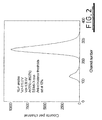
- the results plotted in Figure 2 are for a GMSD in accordance with the present invention detecting Mn X-rays with the discriminator threshold set at 590eV (10% of the main peak energy).
- the anti-coincidence provisions of the present invention enable the elimination of loss at the edge of the main detecting section of the electrode array by rejecting shared events.
- the lower discriminator threshold should not be more than about 20% of the main peak energy. For the Mn X-rays little improvement is shown if the lower threshold is dropped much below 20% of the main peak energy.
- the stable results are obtained using argon with 25% isobutane as the gas and a drift electrode voltage of between 1300 and 1400V.
- the detector could incorporate a number of separate detector sections formed by groups of anodes/cathodes bussed together. In this case, guard sections could be placed on either side of each particular detecting section to veto shared events.
- the identification and quantification of X-ray lines is greatly improved in a wall-less counter by fitting the measured peak spread function (PSF) with a standard PSF, or a number of standard PSFs.
- PSF peak spread function
- the inventors have established that the PSF of a wall-less counter in fact has a positive skew (due to the effects of avalanche statistics, of electron loss to negative ion formation in the drift, and non-homogeneity in the electron field) and moreover that a good fit for the PSF is provided by a log normal distribution.
- the log normal distribution has the property of generating a positive skew dependent only on the standard deviation ( ⁇ R ) of the logarithmic transform of the pulse height spectrum.
- the radioactive (internal conversion) X-ray source 55 Fe yields the MnK ⁇ and MnK ⁇ X-rays at 5.9 keV and 6.49 keV respectively.
- the MnK lines from this source are routinely used as a convenient test stimulus for X-ray detectors.
- the relative intensity of the two lines can vary depending on the effect of differential absorption in the source, detector window and detector volume, but the K ⁇ is generally found to be approximately 20% of the total rate.
- two escape peaks appear at 2.9 keV and 3.49 keV respectively due to the escape of argon K X-rays from the counter volume without conversion. This therefore provides a useful set of four X-ray lines for demonstrating the utility of the present invention.
- the basic energy resolution of the detector is not sufficient to distinguish the two full energy peaks nor the two escape peaks.
- the response obtained using a wall-less GMSD (containing argon with 25% isobutane) with the anti-coincidence lower level threshold set to 10% of the main peak height is as shown in Figure 4 (the energy resolution of the GMSD being around 855eV FWHM compared with the 590eV separation in the K ⁇ and K ⁇ energy peaks).
- the sum of two standard PSFs in the form of two log normal curves fits very well to the obtained data for the full energy peaks and a further pair of log normal distributions fit the escape peaks equally well.
- a spectral line has only two innate properties, its amplitude and its energy position which may be represented in the above formula by the parameters a and c.
- x is the PHA channel number
- ln(c) is the mean of the ln(x) distribution.
- the standard deviation of the ln(x) distribution is represented by the parameter b (which determines both the width and the skewness of the PSF).
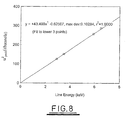
- Figure 5 plots the channel positions obtained from the fits displayed in Figure 4 against the known energies of Mn lines.
- the K ⁇ peaks have the best statistics, so they are used to generate a straight line fit. It will be seen that the fitting is very accurate and all four points lie close to the straight line fit, the fitted peak channels being accurately linear with the known X-ray line energies.
- the relative standard deviation of the LRF was assumed to be constant over the energy span of the K ⁇ and K ⁇ lines (0.59keV).
- b 0.0606 giving a FWHM of 14.3%.
- At the escape peaks b 0.091 giving an FWHM of 21.5% which shows the typical increase of the relative PSF width as the energy decreases.
- the errors dictated by the statistical noise were evaluated by the Marquart-Levenburg fitting routine which is for instance used in the implementation in the commercial EasyPlot package (produced by Spiral Software).
- the position errors were found to be 0.097 channels (2.2eV) in the K ⁇ and 0.28 channels (6.4eV) in the K ⁇ lines.
- the amplitude errors were found to be 2183 (in 3.63x10 5 ) counts for the K ⁇ line and 1972 (in 99439) counts in the K ⁇ line.
- the position errors i.e. energy resolution errors
- the amplitude errors are high compared with the Poisson errors expected from the amplitudes, i.e. 602 for K ⁇ and 100 for K ⁇ ( ⁇ N where N is the number of counts in the line).
- the factor of 3.63 increase in the standard deviation of the fitted K ⁇ means that 13.1 (3.63 2 ) times the number of counts must be collected to achieved the same amplitude resolution as would be achieved by a given number of events in the peak as detected by an ideal detector.
- the corresponding factor in the K ⁇ case is 389.
- the ratio of the observed variance in the fitted number of counts to the Poisson value (i.e. ⁇ N 2 /N) is known as the excess noise factor (F) and represents the factor by which the counting time must be extended to achieve the same resolution in the counts as would be achieved by an ideal detector counting N events.
- the excess noise factor varies with the partition fraction between the two adjacent lines and also with the ratio of the line resolution to the line spacing and increases from unity as the fraction of the counts in the peak under study and the separation of the lines decrease.
- the fitting process can be effectively viewed as one which transfers the position noise of the initial spectrum into amplitude noise in the fitted parameters.
- E x is the X-ray line energy in keV, the E x -1/2 term being dictated by ionisation statistics.
- a constant term of 5.14% is due to the gain variation of the counter over the working area.
- the calibration of the PSF width can be used either to give the starting value of a three parameter fit to each peak or to remove one parameter and fit only the position and amplitude.
- the PSF of a proportional counter can be modelled to a high degree of accuracy by a log normal distribution which permits fitting of the amplitude and position of overlapping pulse height distributions generated by closely spaced X-ray lines.
- XFA X-ray fluorescent analysis
- the fitting process in accordance with the above aspect of the present invention may be used to improve the energy resolution adequately for many different circumstances.
- the detected spectrum does not consist chiefly of lines, or if the lines are completely unknown
- fitting becomes difficult if not impossible.
- the inventors however have established that the stable PSF of a wall-less detector can be used more generally in an enhancement algorithm which can process the measured pulse height spectrum and deliver the equivalent spectrum of a pseudo-detector with improved energy resolution comparable to that of current solid state detectors.
- the inventors have, for instance, established a method for identifying unknown X-ray lines which can then, if required, be quantified accurately by subsequently fitting log normal distributions to the raw data in the manner described above.
- the resultant transformed PSF is substantially independent of line position and can thus be de-convolved to enhance the spectrum.
- the inventors have established that the fitting function for the curves in u-space are normal gaussian curves rather than log normal curves. This is a consequence of the properties of the original log normal curve under U-transformation, the initial log normal curve simply changing into another log normal curve with the width simply halved. It is easy to show that a log normal curve asymptotically approaches a normal form as the width tends to 0 (since the skewness and width of a log normal curve are specified by the same parameter). Thus, the U-transformation automatically symetrisises the PSF.
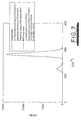
- Figure 7 shows the data of Figure 4 plotted in u-space. Having reduced the spectrum to a constant gaussian function the task of de-convoluting it to uncover the underlying spectrum becomes much easier.
- spectrum enhancement algorithms are commercially available based on a variety of techniques such as, for example, maximum entropy, maximum likelihood, and simulated annealing. These will all be well known to the skilled person. In this example the deconvolution was performed using a readily available simulated annealing algorithm (with a uniform normal PSF).
- the simulated annealing algorithm was used in this example simply because the relevant software was available.
- the algorithm is derived from the ideas developed in the article in Science 220 (1983) pages 671-680, S Kirkpatrick, CD Gelatt and M P Vecci.
- a target distribution (the final solution) is generated by adding or subtracting a small "grain” randomly across the field. The grain is chosen to be a small fraction of the maximum amplitude in the input distribution (i.e. the raw data), typically 1%.
- the target distribution is convolved with the known X-ray line response function and a "potential" generated from the sum of the squares of the differences between the convolved target distribution and the input distribution. Minimising this potential yields a target distribution which when convolved with the line response function matches the raw data. In the ideal case this process would yield a series of delta functions for any given X-ray line pulse height spectrum.
- the minimisation of the potential is achieved by rejecting any grain which increases its value. Since the process can easily be trapped in a local minimum (especially in the early stages) positive excursions of the potential are permitted on a random basis controlled by a Boltzman factor which is characterised by a "temperature". As grains are added (and discarded) this "temperature" is periodically reduced to restrict the positive excursions. This is the "annealing" concept which ensures a smooth decline of the potential and the conversions of the target distribution to a stable solution. Convergence is further aided by reducing the grain size as the process proceeds. (For the X-ray spectra under study the number of grains used is typically 10 6 or more. The program was written in complied BASIC and runs 10 6 grains in about 1 minute on a Celeron 433 MHz pc.)
- the enhanced output of the simulated annealing program in response to the u spectrum shown in Figure 7, is shown in Figure 9.
- the four lines of the MnK radiation in an argon-filled detector are clearly resolved.
- the number of grains is 10 6 and the initial "temperature” is 3 x 10 -5
- the high frequency statistical noise present in the peaks is an artefact caused by the "freezing in” of the poor statistics at the beginning of the annealing process. This is different each time it is run and is much reduced by averaging the results of a number of runs (for instance eight replicates seem to work very well).
- the frequency of the noise is high, the data could be smoothed with a gaussian distribution of about half the width of the enhanced peaks. This gives noise-free data with little sacrifice of resolution.
- Figure 10 shows the smoothed version of Figure 9, transformed back into x-space (i.e. PHA channels) and compared with the raw data of Figure 4.
- the energy resolution of the lines produced by the algorithm is 239 eV (FWHM) which compares with 842 eV for the K ⁇ line in the original data.
- FWHM 239 eV
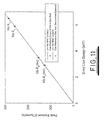
- a further improvement is that in the enhanced spectrum the width of the peaks is essentially independent of energy. Comparing the line positions identified by the peaks in Figure 10 with the known line energies shows they are proportional and agree well with the values obtained from the log normal of fits, as shown in Figure 11.
- Figure 12 shows the U-transform of the pulse height spectrum obtained by shining Mn X-rays onto an aluminium sample housed within the active volume of the detector.
- the lines present are the MnK X-rays and the A1K X-ray.
- the plateau of counts arises from the detection of the photo electrons and augers from the A1 surface.
- the width of the A1 peak prior to transformation should be about 50% of the width of the Mn peak.
- Figure 12 shows that following u transformation the peaks have only a 10% width difference.
- the 10% discrepancy can be accredited to the plate gain variation which upsets the ideal energy dependence of the standard deviation of the point spread function.
- FIG. 13 this shows simulated pulse height distributions of a GMSD in response to X-ray lines at 0.75 keV, 1.5 keV, 3 keV and 6.0 keV.
- the simulation was done with a Monte Carlo program giving 10 4 events in each line.
- the transformed peaks can be closely approximated by a gaussian function of constant width so that a spectrum enhancing algorithm can be applied. Fitting the four peaks of Figure 14 to a sum of four gaussian functions with the same standard deviation provides a very close fit with peak areas fitting to 10 4 counts with errors of less than 1%. When squares of the means of the fitted distribution means are plotted against the input energies a perfect straight line is obtained.
Landscapes
- Spectroscopy & Molecular Physics (AREA)
- Life Sciences & Earth Sciences (AREA)
- General Physics & Mathematics (AREA)
- High Energy & Nuclear Physics (AREA)
- Molecular Biology (AREA)
- Physics & Mathematics (AREA)
- Health & Medical Sciences (AREA)
- Analysing Materials By The Use Of Radiation (AREA)
- Measurement Of Radiation (AREA)
- Investigating Or Analysing Materials By Optical Means (AREA)
- Investigating Or Analyzing Materials By The Use Of Electric Means (AREA)
- Other Investigation Or Analysis Of Materials By Electrical Means (AREA)
- Electron Tubes For Measurement (AREA)
- Spectrometry And Color Measurement (AREA)
Claims (17)
- Verfahren zum Identifizieren von Strahlung, die in einem wandlosen Proportionalgaszähler erfasst wird, der ein stabiles Impulsböhenspektrum erzeugt, wobei das Verfahren die folgenden Schritte umfasst:i) Korrigieren des Effekts einer positiven Schrägung des erfassten Imputshöhenspektrums; undii) Ermitteln der Energie(n) und/oder Intensität(en) der erfassten Strahlung.
- Verfahren nach Anspruch 1, wobei die Korrektur Folgendes beinhaltet:i) Transformieren des erfassten Impulshöhenspektrums (dn/dx) in Übereinstimmung mit der Transformationsgleichung u=x½, wobei x die Energie der erfassten Impulse im ursprünglichen Impulshöhenspektrum repräsentiert;ii) Erzeugen eines normalisierten Spektrums im u-Rauzn, das eine Repräsentation von dn/du in Abhängigkeit von u umfasst, wobei n die erfasste Impulszahl in Abhängigkeit von x ist; undiii) Entfalten des normalisierten Spektrums im u-Raum zum Vergrößern des Spektrums; wobei die Energie(n) und/oder Intensität(en) der erfassten Strahlung von dem vergrößerten Spektrum aus ermittelt werden.
- Verfahren nach Anspruch 2, wobei für den Schritt des Entfaltens des Spektrums im u-Raum das Spektrum als normale Gaußsche Verteilung behandelt wird.
- Verfahren nach Anspruch 3, wobei das Entfalten mit einer aus einer Reihe herkömmlicher Spektmmsvergrößerungsmethoden einschließlich eines simulierten Glühens, einer Maximum-Entropie und einer Maximum-Wahrscheinlichkeit ausgeführt wird.
- Verfahren nach Anspruch 1, wobei die Korrektur Folgendes beinhaltet:i) Transformieren des erfassten Impulshöhenspektrums mit der Transformationsgleichung u=x1/2, wobei x die Energie der erfassten Impulse im ursprünglichen Impulshöhenspektrum repräsentiert;ii) Erzeugen eines normalisierten Spektrums im u-Raum, das eine Darstellung von dn/du in Abhängigkeit von u umfasst, wobei n die erfasste Impulszahl in Abhängigkeit von x ist; undiii) Modellieren des normalisierten Spektrums im u-Raum durch Anpassen einer oder mehrerer Standardverteilungsfunktion(en) (oder der Summe von mehr als einer Standardvarteilungsfunktion) an das Spektrum; wobei die Energie(n) und/oder Intensität(en) der erfassten Strahlung von der Best-Fit-Verteilung(en) aus ermittelt wird/werden.
- Verfahren nach Anspruch 5, wobei die Standardverteilungen normale Graußschc Verteilungen sind.
- Verfahren nach Anspruch 5, wobei die zum Modellieren des Spektrums verwendeten Standardverteilungen Log-Normal-Verteilungen sind.
- Verfahren nach Anspruch 1, wobei die Korrektur Folgendes beinbaltet:i) Anpassen einer Log-Normal-Verteilungsfunktion (oder der Summe von mehr als einer Log-Normal-Funktion) an das vom Zähler produzierte Impulshöhenspektrum, wobei die Energie(n) und/oder Intensität(en) der erfassten Strahlung von der Best-Fit-Log-Normal-Verteilung(en) aus ermittelt wird/werden.
- Verfahren nach Anspruch 8, wobei die parametrische Form der Log-NormalVerteilung gemäß der folgenden Formel verwendet wird:
 dn/dx das Histogramm von Impulszahlen in Abhängigkeit von x ist;x die Energie jedes erkannten Impulses repräsentiert;In(c) das Mittel der In(x) Verteilung ist; undb die Standardabweichung der In(x) Verteilung repräsentiert.
 - Verfahren zum Erfassen von Röntgenstrahlen, wobei das Verfahren die Verwendung eines wandlosen Proportionalgaszählers zum Erfassen der Röntgenstrahlen und das Produzieren eines Impulshöhenspektrums, das für die erfassten Strahlungsenergien und intensitäten repräsentativ ist, und das Auflösen des Spektrums zum Identifizieren der Energie(n) und/oder Intensität(en) der erfassten Strahlung mit einem Verfahren nach einem der Ansprüche 1 bis 9 beinhaltet.
- Verfahren zum Durchführen von Röntgenfluoreszenzmessungen, wobei Röntgenstrahlung mit dem Verfahren nach Anspruch 10 erfasst wird.
- Vorrichtung zum Erkennen von Strahlung, die einen Proportionalgaszähler umfasst, der für einen wandlosen Betrieb und die Produktion eines für die erfasste Strahlung repräsentativen stabilen Impulshöhenspektrums geeignet ist, und die Ferner Mittel zum Ausführen des/der Schritte(s) eines Verfahrens nach einem der Ansprüche 1 bis 11 umfasst.
- Vorrichtung nach Anspruch 12, wobei der Proportionalgaszähler ein Gas-Mikrostreifen-Detektor ist, der Folgendes umfasst:eine Anordnung von verschachtelten Anoden und Kathoden, die auf einem im Wesentlichen flachen Substrat definiert sind, wodurch sich eine im Wesentlichen planare Detektorplatte bildet;eine im Wesentlichen planare Driftelektrode (4) parallel zu der Erfassungsplatte, wobei die Driftelektrode (4) und die Erfassungsplatte so voneinander beabstandet sind, dass ein Gasvolumen dazwischen definiert wird;eine Öffnung oder ein Fenster (5) zum Einlassen von einfallender Strahlung in das Gasvolumen in einer Richtung parallel zu der Erfassungsplatte;wobei die Erfassungsplatte in wenigstens einen Detektorteil, der von einem jeweiligen Schutzteil (3) auf jeder Seite des Detektorteils in der Strahlungseinfallsrichtung begrenzt wird, und Elektronikmittel (6, 7, 8) in Verbindung mit dem Schutzteil unterteilt ist, um Events auszuschließen, die dem Detektorteil und jedem der Schutzteile gemeinsam sind.
- Detektor nach Anspruch 13, wobei das Mittel zum Ausschließen gemeinsamer Events eine Unterscheidungsschaltung (7) umfasst, die Schutzteilevents unterhalb einer vorbestimmten Schwellenenergie ausschließt.
- Detektor nach Anspruch 14, wobei die Schwellenenergie als ein Energicanteil der Spitzenenergie der erfassten Strahlung ermittelt wird.
- Detektor nach Anspruch 15, wobei die Schwellenenergie gleich oder kleiner als 20% der Spitzenenergie der erfassten Strahlung ist.
- Vorrichtung nach Anspruch 12 oder 13, die für das Erfassen von Röntgenstrahlen zum Durchführen von Röntgenfluoreszenz- oder Röntgenfeinstrukturmessungen geeignet ist.
Applications Claiming Priority (3)
| Application Number | Priority Date | Filing Date | Title |
|---|---|---|---|
| GBGB0014096.2A GB0014096D0 (en) | 2000-06-09 | 2000-06-09 | Proportional gas counters |
| GB0014096 | 2000-06-09 | ||
| PCT/GB2001/001307 WO2001094977A2 (en) | 2000-06-09 | 2001-03-26 | Identifying radiation using a proportional gas counter |
Publications (2)
| Publication Number | Publication Date |
|---|---|
| EP1287382A2 EP1287382A2 (de) | 2003-03-05 |
| EP1287382B1 true EP1287382B1 (de) | 2006-08-30 |
Family
ID=9893322
Family Applications (1)
| Application Number | Title | Priority Date | Filing Date |
|---|---|---|---|
| EP01915484A Expired - Lifetime EP1287382B1 (de) | 2000-06-09 | 2001-03-26 | Strahlungsidentifizierung mit hilfe eines proportionalgaszählers |
Country Status (8)
| Country | Link |
|---|---|
| US (2) | US20030007600A1 (de) |
| EP (1) | EP1287382B1 (de) |
| JP (1) | JP2003536078A (de) |
| AT (1) | ATE338283T1 (de) |
| AU (1) | AU2001242575A1 (de) |
| DE (1) | DE60122713T2 (de) |
| GB (1) | GB0014096D0 (de) |
| WO (1) | WO2001094977A2 (de) |
Families Citing this family (9)
| Publication number | Priority date | Publication date | Assignee | Title |
|---|---|---|---|---|
| RU2293999C1 (ru) * | 2006-01-23 | 2007-02-20 | Вячеслав Михайлович Мосяж | Способ обнаружения и измерения слабых потоков ионизирующих излучений |
| JP2009115818A (ja) * | 2009-01-16 | 2009-05-28 | Japan Atomic Energy Agency | 低温中性子イメージ検出器 |
| US9588236B2 (en) | 2012-09-12 | 2017-03-07 | Mitsubishi Electric Corporation | Radioactivity analyzing apparatus |
| BR112015008193A2 (pt) * | 2012-10-24 | 2017-07-04 | Halliburton Energy Services Inc | método, programa de computador, e, aparelho para estabilizar um espectro |
| CN103744106B (zh) * | 2014-01-01 | 2017-01-25 | 成都理工大学 | 一种基于高斯滤波成形多道脉冲幅度分析装置 |
| CN110376638A (zh) * | 2019-07-19 | 2019-10-25 | 四川轻化工大学 | 基于反卷积迭代射线能谱分辨率增强的寻峰方法 |
| CN110610152B (zh) * | 2019-09-10 | 2022-03-22 | 西安电子科技大学 | 基于判别特征学习无监督网络的多光谱云检测方法 |
| CN110694186B (zh) * | 2019-09-20 | 2020-11-17 | 华中科技大学 | 基于硬件高斯拟合粒子束束斑位置的计算机可读存储介质 |
| CN115436991B (zh) * | 2022-09-14 | 2024-09-20 | 成都理工大学 | 一种基于最优波形的核脉冲梯形成形方法 |
Family Cites Families (8)
| Publication number | Priority date | Publication date | Assignee | Title |
|---|---|---|---|---|
| GB1302552A (de) * | 1969-05-03 | 1973-01-10 | ||
| FR2054433A1 (de) * | 1969-05-23 | 1971-04-23 | Commissariat Energie Atomique | |
| US4453226A (en) * | 1981-07-15 | 1984-06-05 | United Technologies Corporation | Method and apparatus for particle size determination in a host material |
| JPS6215746A (ja) * | 1985-07-11 | 1987-01-24 | Toshiba Corp | 放射線検出器 |
| US4751391A (en) * | 1986-12-19 | 1988-06-14 | General Electric Company | High resolution X-ray collimator/detector system having reduced sensitivity to leakage radiation |
| DE4139369A1 (de) * | 1991-11-29 | 1993-06-03 | Berthold Lab Prof Dr | Proportionalzaehlrohr, insbesondere vielfachzaehlrohr zur messung radioaktiver strahlung |
| US5608222A (en) * | 1995-04-07 | 1997-03-04 | Hardy, Ii; William H. | Analog to digital conversion technique for spectroscopy |
| CA2245862A1 (en) * | 1996-02-12 | 1997-08-14 | George C. Giakos | Multimedia detectors for medical imaging |
-
2000
- 2000-06-09 GB GBGB0014096.2A patent/GB0014096D0/en not_active Ceased
-
2001
- 2001-03-26 JP JP2002502471A patent/JP2003536078A/ja active Pending
- 2001-03-26 AT AT01915484T patent/ATE338283T1/de not_active IP Right Cessation
- 2001-03-26 AU AU2001242575A patent/AU2001242575A1/en not_active Abandoned
- 2001-03-26 WO PCT/GB2001/001307 patent/WO2001094977A2/en not_active Ceased
- 2001-03-26 US US10/181,141 patent/US20030007600A1/en not_active Abandoned
- 2001-03-26 EP EP01915484A patent/EP1287382B1/de not_active Expired - Lifetime
- 2001-03-26 DE DE60122713T patent/DE60122713T2/de not_active Expired - Fee Related
-
2004
- 2004-12-22 US US11/021,699 patent/US20050161612A1/en not_active Abandoned
Also Published As
| Publication number | Publication date |
|---|---|
| DE60122713D1 (de) | 2006-10-12 |
| WO2001094977A2 (en) | 2001-12-13 |
| AU2001242575A1 (en) | 2001-12-17 |
| ATE338283T1 (de) | 2006-09-15 |
| GB0014096D0 (en) | 2000-08-02 |
| US20050161612A1 (en) | 2005-07-28 |
| WO2001094977A3 (en) | 2002-03-28 |
| JP2003536078A (ja) | 2003-12-02 |
| US20030007600A1 (en) | 2003-01-09 |
| DE60122713T2 (de) | 2007-09-20 |
| EP1287382A2 (de) | 2003-03-05 |
Similar Documents
| Publication | Publication Date | Title |
|---|---|---|
| Garty et al. | The performance of a novel ion-counting nanodosimeter | |
| Richter et al. | Linearity tests for secondary electron multipliers used in isotope ratio mass spectrometry | |
| Ware et al. | Background corrections for quantitative electron microprobe analysis using a lithium drifted silicon X-ray detector | |
| EP1287382B1 (de) | Strahlungsidentifizierung mit hilfe eines proportionalgaszählers | |
| Sarvestani et al. | Study and application of hole structures as gas gain devices for two dimensional high rate X-ray detectors | |
| Lépy et al. | Si (Li) Detector Efficiency and Peak Shape Calibration in the Low‐Energy Range Using Synchrotron Radiation | |
| Gold et al. | Electron multiplication process in proportional counters | |
| Ford Jr et al. | A position sensitive proportional detector for a magnetic spectrograph | |
| Sosnin et al. | Fission fragment atomic number measurements using Bragg detectors | |
| Babichev et al. | Photon counting and integrating analog gaseous detectors for digital scanning radiography | |
| Cunsolo et al. | A low-pressure gas detector for heavy-ion tracking and particle identification | |
| Bateman et al. | Energy resolution in X-ray detecting micro-strip gas counters | |
| Van Espen et al. | Evaluation of a practical background calculation method in X‐ray energy analysis | |
| Vinagre et al. | A technique for the absolute measurement of the W-value for X-rays in counting gases | |
| Green et al. | Fast-timing measurements using a Chevron microchannel plate electron multiplier | |
| Bateman | Precision measurement of X-ray line spectra by energy dispersion in a gas microstrip detector | |
| JPS5856958B2 (ja) | 電子スペクトロメ−タ | |
| Yang et al. | A modified diffusion model for characterization of real I–V curve and charge collection efficiency of CdZnTe detectors | |
| Tassotto et al. | Detection efficiency of a channel electron multiplier for low energy incident noble gas ions | |
| US7135688B2 (en) | Apparatus and method for the detection of the energy of ionizing electro-magnetic radiation | |
| González et al. | Efficiency at different interaction depths in large coplanar CdZnTe detectors | |
| Ahsan et al. | The pulse-pile-up tail artifact in pulse-height spectra | |
| JP2005049144A (ja) | 放射線計測方法 | |
| Schütz | Measurement of the breakup probability of pi+ pi-atoms in a nickel target with the DIRAC spectrometer | |
| Anderson et al. | A large-area gas scintillation proportional counter for X-ray astronomy |
Legal Events
| Date | Code | Title | Description |
|---|---|---|---|
| PUAI | Public reference made under article 153(3) epc to a published international application that has entered the european phase |
Free format text: ORIGINAL CODE: 0009012 |
|
| 17P | Request for examination filed |
Effective date: 20020717 |
|
| AK | Designated contracting states |
Designated state(s): AT BE CH CY DE DK ES FI FR GB GR IE IT LI LU MC NL PT SE TR Kind code of ref document: A2 Designated state(s): AT BE CH CY DE DK ES FI FR GB GR IE IT LI LU MC NL PT SE TR |
|
| AX | Request for extension of the european patent |
Extension state: AL LT LV MK RO SI |
|
| 17Q | First examination report despatched |
Effective date: 20041103 |
|
| GRAP | Despatch of communication of intention to grant a patent |
Free format text: ORIGINAL CODE: EPIDOSNIGR1 |
|
| GRAS | Grant fee paid |
Free format text: ORIGINAL CODE: EPIDOSNIGR3 |
|
| GRAA | (expected) grant |
Free format text: ORIGINAL CODE: 0009210 |
|
| AK | Designated contracting states |
Kind code of ref document: B1 Designated state(s): AT BE CH CY DE DK ES FI FR GB GR IE IT LI LU MC NL PT SE TR |
|
| PG25 | Lapsed in a contracting state [announced via postgrant information from national office to epo] |
Ref country code: IT Free format text: LAPSE BECAUSE OF FAILURE TO SUBMIT A TRANSLATION OF THE DESCRIPTION OR TO PAY THE FEE WITHIN THE PRESCRIBED TIME-LIMIT;WARNING: LAPSES OF ITALIAN PATENTS WITH EFFECTIVE DATE BEFORE 2007 MAY HAVE OCCURRED AT ANY TIME BEFORE 2007. THE CORRECT EFFECTIVE DATE MAY BE DIFFERENT FROM THE ONE RECORDED. Effective date: 20060830 Ref country code: NL Free format text: LAPSE BECAUSE OF FAILURE TO SUBMIT A TRANSLATION OF THE DESCRIPTION OR TO PAY THE FEE WITHIN THE PRESCRIBED TIME-LIMIT Effective date: 20060830 Ref country code: AT Free format text: LAPSE BECAUSE OF FAILURE TO SUBMIT A TRANSLATION OF THE DESCRIPTION OR TO PAY THE FEE WITHIN THE PRESCRIBED TIME-LIMIT Effective date: 20060830 Ref country code: FI Free format text: LAPSE BECAUSE OF FAILURE TO SUBMIT A TRANSLATION OF THE DESCRIPTION OR TO PAY THE FEE WITHIN THE PRESCRIBED TIME-LIMIT Effective date: 20060830 Ref country code: CH Free format text: LAPSE BECAUSE OF FAILURE TO SUBMIT A TRANSLATION OF THE DESCRIPTION OR TO PAY THE FEE WITHIN THE PRESCRIBED TIME-LIMIT Effective date: 20060830 Ref country code: LI Free format text: LAPSE BECAUSE OF FAILURE TO SUBMIT A TRANSLATION OF THE DESCRIPTION OR TO PAY THE FEE WITHIN THE PRESCRIBED TIME-LIMIT Effective date: 20060830 Ref country code: BE Free format text: LAPSE BECAUSE OF FAILURE TO SUBMIT A TRANSLATION OF THE DESCRIPTION OR TO PAY THE FEE WITHIN THE PRESCRIBED TIME-LIMIT Effective date: 20060830 |
|
| REG | Reference to a national code |
Ref country code: GB Ref legal event code: FG4D |
|
| REG | Reference to a national code |
Ref country code: CH Ref legal event code: EP |
|
| REG | Reference to a national code |
Ref country code: IE Ref legal event code: FG4D |
|
| REF | Corresponds to: |
Ref document number: 60122713 Country of ref document: DE Date of ref document: 20061012 Kind code of ref document: P |
|
| PG25 | Lapsed in a contracting state [announced via postgrant information from national office to epo] |
Ref country code: SE Free format text: LAPSE BECAUSE OF FAILURE TO SUBMIT A TRANSLATION OF THE DESCRIPTION OR TO PAY THE FEE WITHIN THE PRESCRIBED TIME-LIMIT Effective date: 20061130 Ref country code: DK Free format text: LAPSE BECAUSE OF FAILURE TO SUBMIT A TRANSLATION OF THE DESCRIPTION OR TO PAY THE FEE WITHIN THE PRESCRIBED TIME-LIMIT Effective date: 20061130 |
|
| PG25 | Lapsed in a contracting state [announced via postgrant information from national office to epo] |
Ref country code: ES Free format text: LAPSE BECAUSE OF FAILURE TO SUBMIT A TRANSLATION OF THE DESCRIPTION OR TO PAY THE FEE WITHIN THE PRESCRIBED TIME-LIMIT Effective date: 20061211 |
|
| REG | Reference to a national code |
Ref country code: CH Ref legal event code: PL |
|
| NLV1 | Nl: lapsed or annulled due to failure to fulfill the requirements of art. 29p and 29m of the patents act | ||
| PGFP | Annual fee paid to national office [announced via postgrant information from national office to epo] |
Ref country code: GB Payment date: 20070321 Year of fee payment: 7 |
|
| PGFP | Annual fee paid to national office [announced via postgrant information from national office to epo] |
Ref country code: DE Payment date: 20070322 Year of fee payment: 7 |
|
| EN | Fr: translation not filed | ||
| PLBE | No opposition filed within time limit |
Free format text: ORIGINAL CODE: 0009261 |
|
| STAA | Information on the status of an ep patent application or granted ep patent |
Free format text: STATUS: NO OPPOSITION FILED WITHIN TIME LIMIT |
|
| 26N | No opposition filed |
Effective date: 20070531 |
|
| PG25 | Lapsed in a contracting state [announced via postgrant information from national office to epo] |
Ref country code: IE Free format text: LAPSE BECAUSE OF NON-PAYMENT OF DUE FEES Effective date: 20070326 Ref country code: MC Free format text: LAPSE BECAUSE OF NON-PAYMENT OF DUE FEES Effective date: 20070331 |
|
| PG25 | Lapsed in a contracting state [announced via postgrant information from national office to epo] |
Ref country code: FR Free format text: LAPSE BECAUSE OF FAILURE TO SUBMIT A TRANSLATION OF THE DESCRIPTION OR TO PAY THE FEE WITHIN THE PRESCRIBED TIME-LIMIT Effective date: 20070511 Ref country code: GR Free format text: LAPSE BECAUSE OF FAILURE TO SUBMIT A TRANSLATION OF THE DESCRIPTION OR TO PAY THE FEE WITHIN THE PRESCRIBED TIME-LIMIT Effective date: 20061201 |
|
| GBPC | Gb: european patent ceased through non-payment of renewal fee |
Effective date: 20080326 |
|
| PG25 | Lapsed in a contracting state [announced via postgrant information from national office to epo] |
Ref country code: FR Free format text: LAPSE BECAUSE OF FAILURE TO SUBMIT A TRANSLATION OF THE DESCRIPTION OR TO PAY THE FEE WITHIN THE PRESCRIBED TIME-LIMIT Effective date: 20060830 |
|
| PG25 | Lapsed in a contracting state [announced via postgrant information from national office to epo] |
Ref country code: DE Free format text: LAPSE BECAUSE OF NON-PAYMENT OF DUE FEES Effective date: 20081001 |
|
| PG25 | Lapsed in a contracting state [announced via postgrant information from national office to epo] |
Ref country code: GB Free format text: LAPSE BECAUSE OF NON-PAYMENT OF DUE FEES Effective date: 20080326 |
|
| PG25 | Lapsed in a contracting state [announced via postgrant information from national office to epo] |
Ref country code: CY Free format text: LAPSE BECAUSE OF FAILURE TO SUBMIT A TRANSLATION OF THE DESCRIPTION OR TO PAY THE FEE WITHIN THE PRESCRIBED TIME-LIMIT Effective date: 20060830 Ref country code: LU Free format text: LAPSE BECAUSE OF NON-PAYMENT OF DUE FEES Effective date: 20070326 |
|
| PG25 | Lapsed in a contracting state [announced via postgrant information from national office to epo] |
Ref country code: TR Free format text: LAPSE BECAUSE OF FAILURE TO SUBMIT A TRANSLATION OF THE DESCRIPTION OR TO PAY THE FEE WITHIN THE PRESCRIBED TIME-LIMIT Effective date: 20060830 |
|
| PG25 | Lapsed in a contracting state [announced via postgrant information from national office to epo] |
Ref country code: PT Free format text: LAPSE BECAUSE OF FAILURE TO SUBMIT A TRANSLATION OF THE DESCRIPTION OR TO PAY THE FEE WITHIN THE PRESCRIBED TIME-LIMIT Effective date: 20060830 |