EP1286364B1 - A phosphor panel with good humidity resistance - Google Patents
A phosphor panel with good humidity resistance Download PDFInfo
- Publication number
- EP1286364B1 EP1286364B1 EP20020100298 EP02100298A EP1286364B1 EP 1286364 B1 EP1286364 B1 EP 1286364B1 EP 20020100298 EP20020100298 EP 20020100298 EP 02100298 A EP02100298 A EP 02100298A EP 1286364 B1 EP1286364 B1 EP 1286364B1
- Authority
- EP
- European Patent Office
- Prior art keywords
- layer
- phosphor
- parylene
- panel
- group
- Prior art date
- Legal status (The legal status is an assumption and is not a legal conclusion. Google has not performed a legal analysis and makes no representation as to the accuracy of the status listed.)
- Expired - Lifetime
Links
- 0 **(C=*C=C1)C=*1NN Chemical compound **(C=*C=C1)C=*1NN 0.000 description 2
Images
Classifications
-
- G—PHYSICS
- G21—NUCLEAR PHYSICS; NUCLEAR ENGINEERING
- G21K—HANDLING OF PARTICLES OR IONISING RADIATION NOT OTHERWISE PROVIDED FOR; IRRADIATION DEVICES; GAMMA RAY OR X-RAY MICROSCOPES
- G21K4/00—Conversion screens for the conversion of the spatial distribution of X-rays or particle radiation into visible images, e.g. fluoroscopic screens
-
- C—CHEMISTRY; METALLURGY
- C09—DYES; PAINTS; POLISHES; NATURAL RESINS; ADHESIVES; COMPOSITIONS NOT OTHERWISE PROVIDED FOR; APPLICATIONS OF MATERIALS NOT OTHERWISE PROVIDED FOR
- C09K—MATERIALS FOR MISCELLANEOUS APPLICATIONS, NOT PROVIDED FOR ELSEWHERE
- C09K11/00—Luminescent materials, e.g. electroluminescent or chemiluminescent
- C09K11/08—Luminescent materials, e.g. electroluminescent or chemiluminescent containing inorganic luminescent materials
- C09K11/77—Luminescent materials, e.g. electroluminescent or chemiluminescent containing inorganic luminescent materials containing rare earth metals
- C09K11/7728—Luminescent materials, e.g. electroluminescent or chemiluminescent containing inorganic luminescent materials containing rare earth metals containing europium
- C09K11/7732—Halogenides
- C09K11/7733—Halogenides with alkali or alkaline earth metals
-
- G—PHYSICS
- G21—NUCLEAR PHYSICS; NUCLEAR ENGINEERING
- G21K—HANDLING OF PARTICLES OR IONISING RADIATION NOT OTHERWISE PROVIDED FOR; IRRADIATION DEVICES; GAMMA RAY OR X-RAY MICROSCOPES
- G21K4/00—Conversion screens for the conversion of the spatial distribution of X-rays or particle radiation into visible images, e.g. fluoroscopic screens
- G21K2004/06—Conversion screens for the conversion of the spatial distribution of X-rays or particle radiation into visible images, e.g. fluoroscopic screens with a phosphor layer
-
- G—PHYSICS
- G21—NUCLEAR PHYSICS; NUCLEAR ENGINEERING
- G21K—HANDLING OF PARTICLES OR IONISING RADIATION NOT OTHERWISE PROVIDED FOR; IRRADIATION DEVICES; GAMMA RAY OR X-RAY MICROSCOPES
- G21K4/00—Conversion screens for the conversion of the spatial distribution of X-rays or particle radiation into visible images, e.g. fluoroscopic screens
- G21K2004/10—Conversion screens for the conversion of the spatial distribution of X-rays or particle radiation into visible images, e.g. fluoroscopic screens with a protective film
Definitions
- the present invention relates to a phosphor panel with a protective layer.
- a well-known use of phosphors is in the production of X-ray images.
- an X-ray radiograph is obtained by X-rays transmitted image-wise through an object and converted into light of corresponding intensity in a so-called intensifying screen (X-ray conversion screen) wherein phosphor particles absorb the transmitted X-rays and convert them into visible light and/or ultraviolet radiation to which a photographic film is more sensitive than to the direct impact of X-rays.
- a special type of phosphor is used, known as a photostimulable phosphor, which being incorporated in a panel, is exposed to incident pattern-wise modulated X-ray beam and as a result thereof temporarily stores energy contained in the X-ray radiation pattern.
- a beam of visible or infra-red light scans the panel to stimulate the release of stored energy as light that is detected and converted to sequential electrical signals which can be processed to produce a visible image.
- the phosphor should store as much as possible of the incident X-ray energy and emit as little as possible of the stored energy until stimulated by the scanning beam. This is called “digital radiography” or "computed radiography”.
- a radiation image storage panel having at least one stimulable phosphor layer on a support and a protective layer provided on the stimulable phosphor layer, wherein the protective layer comprises at least two layers of which regains under a relative humidity of 90% on a sorption isotherm at 25 °C. are different by 0.5% or more.
- a radiation image storage panel which has good humidity resistance and can be used for a long term is obtained.
- parylene layers as humidity protective layers in photostimulable phosphor screens has been disclosed in e.g. EP-A-1 286 362 . Also in DE-A-196 25 912 and GB-A-2 287 864 phosphor screens containing a parylene layer are disclosed.
- a parylene layer deposited directly on a scintillator layer and further having a second protective layer of a heat curable acrylic based resin deposited as an outer layer upon said parylene layer, has been described in EP-A-1 231 483 .
- screens prepared according to the disclosures above do yield screens with acceptable to very good overall quality, the need for a phosphor screen combining good humidity resistance and good resistance against physical damage during use is still present.
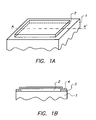
- FIG. 1A schematic view of an embodiment of a panel according to the present invention is shown (not on scale).
- Fig. 1B a cross section along the line A-A' of Fig. 1A is shown.
- a panel according to the present invention comprises a protective coating divided in two layers, a layer A, being closest to the phosphor layer and a layer B farther away from the phosphor layer wherein the layer A is a layer of parylene.
- the layer A in a phosphor panel of the present invention is the layer A in a phosphor panel of the present invention.
- Preferred polymers for use in the preparation of the layer A of a phosphor panel of this invention are, poly(p-xylylene), poly(p-2-chloroxylylene), poly(p-2,6-dichloroxylylene) and fluoro substituted poly(p-xylylene).
- Most preferred polymers for use in the protective layer of this invention are vacuum deposited, preferably chemical vacuum deposited poly-p-xylylene film.
- a poly-p-xylylene has repeating units in the range from 10 to 10000, wherein each repeating unit has an aromatic nuclear group, whether or not substituted.
- Each substituent group, if present, can be the same or different and can be any inert organic or inorganic group which can normally be substituted on aromatic nuclei.
- substituent groups are alkyl, aryl, alkenyl, amino, cyano, carboxyl, alkoxy, hydroxylalkyl, carbalkoxy and similar groups as well as inorganic ions such as hydroxyl, nitro, halogen and other similar groups which are normally substitutable on aromatic nuclei.
- Particularly preferred substituted groups are those simple hydrocarbon groups such as the lower alkyl groups such as methyl, ethyl, propyl, butyl, hexyl and halogen groups particularly chlorine, bromine, iodine and fluorine as well as the cyano group and hydrogen.
- the commercially available di-p-xylylene composition sold by the Union Carbide Co. under the trademark "PARYLENE” is thus preferred.
- the preferred compositions for the protective moistureproof protective layer covering the phosphor screens or panels thus are the unsubstituted "PARYLENE N", the monochlorine substituted "PARYLENE C”, the dichlorine substituted "PARYLENE D” and the “PARYLENE HT” (a completely fluorine substituted version of PARYLENE N, opposite to the other "parylenes” resistant to heat up to a temperature of 400°C and also resistant to ultra-violet radiation, moisture resistance being about the same as the moisture resistance of "PARYLENE C”: see the note about "High Performance Coating for Electronics Resist Hydrocarbons and High Temperature” written by Guy Hall, Specialty Coating Systems, Indianapolis, available via www.scscookson.com.
- Most preferred polymers for use in the preparation of the layer A of a phosphor panel of this invention are poly(p-2-chloroxylylene), i.e. PARYLENE C film, poly(p-2,6-dichloroxylylene), i.e. PARYLENE D film and "PARYLENE HT" (a completely fluorine substituted version of PARYLENE N.
- Parylene is available from a variety of sources and is commonly used for protecting printed circuit boards, sensors, and other electronic and electrical devices. Although the specific manner in which the parylene is applied to the phosphor layer forms no part of the present invention, it is preferred to apply the parylene layer by chemical vapour deposition (CVD). A method for doing so is disclosed in European Application 01000401.8, filed 23 August 2001 . The process of deposition basically proceeds as follows :
- a suitable dimer - e.g., (cyclo-di(p-xylene) for the deposition of PARYLENE N, cyclo-di(p-2-chloroxylene) for the deposition of PARYLENE C or cyclo-di(p-2,6-dichloroxylene) for the deposition of PARYLENE D), - is heated and decomposes in two radicals. These radicals are deposited on the phosphor layer where they polymerise and form a polymeric layer.
- the chemical vapour deposition of the parylene layer (either PARYLENE N, C or D) has several advantages : - the layer is deposited without pinholes - the barrier layer is not only deposited on the main surface of the phosphor layer, but also on the edges so that the sealing of the phosphor layer is complete.
- the layer A, in a phosphor panel of this invention is immediately adjacent to the phosphor layer.
- the layer A, in a phosphor panel of this invention preferably has a thickness in the range between 0.05 ⁇ m and 15 ⁇ m, more preferably between 1 ⁇ m and 10 ⁇ m.
- the layer B in a phosphor screen of the present invention is the layer B in a phosphor screen of the present invention.
- the layer B in a phosphor screen of this invention can be any polymeric layer known in the art of applying a protective layer to a phosphor screen.
- the layer B can be coated onto the phosphor panel by directly applying thereto a coating solution containing a film-forming organic solvent-soluble polymer such as nitrocellulose, ethylcellulose or cellulose acetate or poly(meth)acrylic resin and removing the solvent by evaporation.
- a clear, thin, tough, flexible, dimensionally stable polyamide film is bonded to the phosphor panel as described in published EP-A-392 474 .
- the layer B is produced with a radiation-curable composition, thus providing, according to the present invention, a radiation cured polymeric layer.
- a radiation curable coating as protective top layer in a X-ray conversion screen has been described e.g. in EP-A-209 358 and JP-A-86 176 900 and US-A-4 893 021 .
- the protective layer comprises a UV cured resin composition formed by monomers and/or prepolymers that are polymerised by free-radical polymerisation with the aid of a photoinitiator.
- the monomeric products are preferably solvents for the prepolymers used.
- Very useful radiation curable compositions for forming a protective coating according to the present invention contain as primary components: (1) a cross-linkable prepolymer or oligomer or a mixture of cross-linkable prepolymers or oligomers, (2) a reactive diluent monomer or mixture of reactive diluent monomers, and (3) in the case of a UV curable formulation a photoinitiator.
- the usual amounts of these primary components calculated on the total coating composition are in the range from 30-100% by weight for the prepolymer, 10-70% by weight for the reactive diluent and 0-10% by weight for the photoinitiator.
- minor amounts e.g. 5% by weight
- of non-reactive organic solvent for the prepolymer may be present.
- any radiation curable composition known in the art as e.g., the composition disclosed in EP-A-510 753 can be used, it can be very beneficial to have a coating solution containing fluorinated compounds so that the finished protective layer comprises at least 1 % mol/mol of fluorinated moieties.
- the coating composition is so that the finished protective layer comprises between 5 % and 50 % (mol/mol) of fluorinated moieties.
- the fluorinated moieties can be present either in said cross-linkable prepolymer or oligomer or in said reactive diluent monomer or in both.
- the fluorinated moieties are added by using as diluent monomer a fluorinated monomer or by adding a fluorinated monomer to the mixture of diluent monomers.
- the fluorinated monomers can be used as diluent monomer(s) or can be used in combination with non-fluorinated diluent moieties.
- Very useful non-fluorinated diluent monomers for use in this invention are : methyl (metha)acrylate, ethyl acrylate, butyl acrylate, 2-ethylhexyl methacrylate, 2-hydroxyethyl acrylate, 2-hydroxyethyl methacrylate, glycidyl methacrylate, n-hexyl acrylate, lauryl acrylate, tetrahydrofurfurylmethacrylate and the like.
- fluorinated moieties When the fluorinated moieties are present in the cross-linkable prepolymer or oligomer then preferably a mixture of fluorinated and non-fluorinated prepolymers is used.
- fluorinated prepolymers - useful in order to bring fluorinated moieties in the protective layer of this invention - are, e.g., fluorinated polyester acrylates wherein the polyester includes fluorinated moieties brought in the polyester via fluorinated di- or poly-ols or via fluorinated di- or poly-carboxylic acid.
- Very suitable fluorinated diols and polyesters derived therefrom are those described in, e.g., US-A-4 957 986 , US-A-5 004 790 and US-A-5 109 103 .
- suitable diols are, e.g., 3,3,4,4,5,5,6,6-octafluorooctan-1,8-diol, or 2,2,3,3-tetrafluoro-1,4-butanediol
- most suitable diols are diols with the formula HOCH 2 (CF 2 ) n CH 2 OH, wherein 2 ⁇ n ⁇ 10.
- Suitable fluorinated poly- or diacids are those corresponding to the formula HOOC(CF 2 ) n COOH or the methylesters thereof.
- terephthalic acid carrying -O-(CH 2 ) 10 -(CF 2 ) 9 -CF 3 as a side group can be used in order to produce a fluorinated prepolymer suitable for use in a screen of the present invention.
- the polyester can then be functionalised with acrylates as described in EP-A-207 257 . It is also possible to introduce the fluorinated moieties via the acrylation step; when using polyesters as described in, e.g., EP-A-207 257 , these are functionalised by using fluorinated acrylates, as those shown above.
- non-fluorinated prepolymers or oligomers When fluorinated prepolymers or oligomers are used, these can be mixed with non-fluorinated prepolymers or oligomers.
- suitable non-fluorinated prepolymers for use in a radiation-curable composition applied according to the present invention are the following unsaturated polyesters, e.g. polyester acrylates; urethane modified unsaturated polyesters, e.g. urethane-polyester acrylates.
- Liquid polyesters having an acrylic group as a terminal group e.g. saturated co-polyesters which have been provided with acryl-type end groups, have been described in the published EP-A-207 257 .
- UV ultraviolet radiation
- a photoinitiator is present in the coating composition in order to serve as a catalyst thereby initiating the polymerisation of the monomers and their optional cross-linking with the prepolymers, resulting in curing of the coated protective layer composition.
- a photosensitizer for accelerating the effect of the photoinitiator may be present.
- Photoinitiators suitable for use in UV-curable coating compositions belong to the class of organic carbonyl compounds, for example, benzoin ether series compounds such as benzoin isopropyl, isobutylether; benzil ketal series compounds; ketoxime esters; benzophenone series compounds such as benzophenone, o-benzoylmethylbenzoate; acetophenone series compounds such as acetophenone, trichloroacetophenone, 1,1-dichloroacetophenone, 2,2-diethoxyacetophenone, 2,2-dimethoxy-2-phenylacetophenone; thioxanthone series compounds such as 2-chlorothioxanthone, 2-ethylthioxanthone; and compounds such as 2-hydroxy-2-methylpropiophenone, 2-hydroxy-4'-isopropyl-2-methylpropiophenone, 1-hydroxycyclohexylphenylketone; etc..
- benzoin ether series compounds such as be
- a particularly preferred photoinitiator is 2-hydroxy-2-methyl-1-phenyl-propan-1-one which product is marketed by E. Merck, Darmstadt, Germany under the trade name DRACUT 1173.
- photopolymerisation initiators may be used alone or as a mixture of two or more.
- Suitable photosensitisers are particular aromatic amino compounds as described e.g. in GB-P 1,314,556 , 1,486,911 , in US-A 4,255,513 and merocyanine and carbostyril compounds as described in US-A 4,282,309 .
- a storage stabiliser e.g
- the layer B of a phosphor panel of this invention is an outermost layer with good abrasion properties.
- the abrasion properties of the layer B are tested in a Taber abrasion test using a TELEDYNE TABER 5130 Abraser (trade name of Taber Industries, New York, USA) with rotation elements CALIBRASE CS10F, sandpaper P220, and load of 250 g on each element.
- the percentage thickness loss of the layer B can be measured after 500 cycles.
- the layer B looses, in the test as described above, at most 25 % of its thickness. More preferably the layer B looses in the test above at most 20 % of its thickness and most preferably at most 15 %.
- the layer B of the present invention may include spacing particles in favour of improved transportability and adjusted electrostatic properties.
- Suitable spacing agents in form of friction reducing polymer beads are selected from the group consisting of solid polystyrene, solid polyalkylene and a solid organic fluorinated polymer.
- the spacing agents are beads incorporating fluorinated moieties. Such beads have been described in US-A-4 059 768 . In the construction of the scanning apparatus used for reading storage phosphor screens the trend is towards more and more compact apparatus, so that the distance between the (moving) storage phosphor screen and mechanical (moving) parts of the scanner can become very low (e.g. inbetween 10-100 ⁇ m).
- beads used as spacing particles in a storage phosphor screen of the present invention preferably have a median volume diameter, d v50 , so that 5 ⁇ m ⁇ dv50 ⁇ 25 ⁇ m and a median numeric diameter, d n50 , so that 1 ⁇ d v50 /d n50 ⁇ 1.20.
- the beads are preferably adapted to the thickness, t, of the layer B on the storage panel of the present invention so that said polymeric beads have a median volume diameter, d v50 , wherein 1.25 ⁇ d v50 /t ⁇ 4.0.
- the phosphor layer in a phosphor panel of the present invention is a phosphor layer in a phosphor panel of the present invention.
- the phosphor layer in a panel of the present invention is a photostimulable phosphor.
- the phosphor layer in a panel according to the present invention may be a layer including a phosphor mixed in a polymer binder as well a binderless phosphor layer.
- a phosphor panel having a protective layer according to the present invention may comprise a hygroscopic phosphor.
- the phosphor layer in a phosphor panel of the present invention comprises a photostimulable phosphor, and, even more preferably, the phosphor layer is a binderless phosphor layer.
- a phosphor layer comprising needle-shaped phosphor particles separated by voids, of a CsX:Eu phosphor, wherein X represents a halide selected from the group consisting of Br and Cl, is most preferred as a phosphor layer in the present invention.
- a layer A with very low water permeability is deposited, it is preferred that this layer A is a chemical vacuum deposited parylene layer, while such a layer not only covers the surface of the needle crystals, but also covers the voids between the needles thus protecting the edges of the phosphor needles thoroughly against humidity.
- a phosphor panel of the present invention may also comprise edge reinforcements as the ones described in e.g. US-A-5 334 842 and US-A-5 340 661 .
- a phosphor panel of the present invention can be a self-supporting panel as well as a panel comprising a support.
- This support can be any support known in the art, but in view of the desired high humidity resistance of the screens, a support with very low water vapour permeability is preferably used.
- a preferred support is a support of anodised aluminium and the supports as disclosed in EP-A's 1 316 972 and 1 316 971 ..
- the surface of the phosphor layer (2) is smaller than the surface of the support (1) so that the phosphor layer does not reach the edges of the support.
- a panel with a support having a surface larger than the main surface of the phosphor layer, so that the phosphor layer leaves a portion of the support free, and wherein the protective layer comprising layer A (3) and layer B (4) covers at least in part the portion of the support left free by the phosphor layer is a preferred embodiment of the present invention.
- Another advantage of this construction is that no special edge reinforcement is necessary (although, if desired, further edge reinforcement can be applied).
- a construction of a phosphor panel wherein the surface of the phosphor layer is smaller than the surface of the support, so that the phosphor layer does not reach the edges of the support represents a specific embodiment of the present invention, such a construction can be beneficial for the manufacture of any phosphor panel covered with any protective layer known in the art.
- the invention moreover encompasses a method for the preparation of a photostimulable phosphor panel comprising the steps of :
- the present invention moreover includes a method for the preparation of a binderless phosphor panel comprising the steps of :
- CsBr:Eu screens were made via thermal vapour deposition of CsBr and EuOBr.
- Therfore CsBr was mixed with EuOBr and placed in a container in a vacuum deposition chamber.
- the phosphor was deposited on a glass disk with a thickness of 1.5 mm and a diameter of 40 mm.
- the distance between the container and the substrate was 10 cm.
- the substrate was rotated at 12 r.p.m..
- the container with starting materials was heated to a temperature of 750°C. Before starting evaporation the chamber was evacuated to a pressure of 4.10 -5 mbar.
- the screen was divided in four portions in order to prepare 4 test screens :
Landscapes
- Chemical & Material Sciences (AREA)
- Engineering & Computer Science (AREA)
- Inorganic Chemistry (AREA)
- Materials Engineering (AREA)
- Organic Chemistry (AREA)
- Physics & Mathematics (AREA)
- General Engineering & Computer Science (AREA)
- High Energy & Nuclear Physics (AREA)
- Conversion Of X-Rays Into Visible Images (AREA)
- Luminescent Compositions (AREA)
Priority Applications (3)
| Application Number | Priority Date | Filing Date | Title |
|---|---|---|---|
| EP20020100298 EP1286364B1 (en) | 2001-08-23 | 2002-03-26 | A phosphor panel with good humidity resistance |
| US10/113,514 US6710356B2 (en) | 2001-08-23 | 2002-04-01 | Phosphor panel with good humidity resistance |
| JP2002168255A JP2003075596A (ja) | 2001-08-23 | 2002-06-10 | 良好な耐湿性を有する燐光体パネル |
Applications Claiming Priority (3)
| Application Number | Priority Date | Filing Date | Title |
|---|---|---|---|
| EP01000401A EP1286362A1 (en) | 2001-08-23 | 2001-08-23 | Moistureproof phosphor screens for use in radiation detectors |
| EP01000401 | 2001-08-23 | ||
| EP20020100298 EP1286364B1 (en) | 2001-08-23 | 2002-03-26 | A phosphor panel with good humidity resistance |
Publications (3)
| Publication Number | Publication Date |
|---|---|
| EP1286364A2 EP1286364A2 (en) | 2003-02-26 |
| EP1286364A3 EP1286364A3 (en) | 2005-10-05 |
| EP1286364B1 true EP1286364B1 (en) | 2008-05-28 |
Family
ID=26076416
Family Applications (1)
| Application Number | Title | Priority Date | Filing Date |
|---|---|---|---|
| EP20020100298 Expired - Lifetime EP1286364B1 (en) | 2001-08-23 | 2002-03-26 | A phosphor panel with good humidity resistance |
Country Status (2)
| Country | Link |
|---|---|
| EP (1) | EP1286364B1 (https=) |
| JP (1) | JP2003075596A (https=) |
Families Citing this family (10)
| Publication number | Priority date | Publication date | Assignee | Title |
|---|---|---|---|---|
| EP1316970A1 (en) * | 2001-12-03 | 2003-06-04 | Agfa-Gevaert | A binderless storage phosphor screen having fluoro-containing moieties |
| US6977385B2 (en) | 2002-03-26 | 2005-12-20 | Agfa-Gevaert | Storage phosphor screen having binderless colored layers |
| US7501155B2 (en) * | 2003-03-20 | 2009-03-10 | Agfa Healthcare | Manufacturing method of phosphor or scintillator sheets and panels suitable for use in a scanning apparatus |
| EP1492127A1 (en) * | 2003-06-27 | 2004-12-29 | Agfa-Gevaert | A binderless storage phosphor screen comprising a support including an amorphous (a-C) carbon layer |
| US7193226B2 (en) | 2003-09-30 | 2007-03-20 | Agfa-Gevaert | Scratch resistant moisture-protecting parylene layers |
| EP1541333A1 (en) * | 2003-09-30 | 2005-06-15 | Agfa-Gevaert | Scratch resistant moisture-protecting parylene layers |
| US20100119839A1 (en) * | 2008-11-13 | 2010-05-13 | Maven Optronics Corp. | System and Method for Forming a Thin-Film Phosphor Layer for Phosphor-Converted Light Emitting Devices |
| TWI608760B (zh) * | 2008-11-13 | 2017-12-11 | 行家光電有限公司 | 形成螢光粉轉換發光元件之方法 |
| JP6033609B2 (ja) | 2012-08-29 | 2016-11-30 | 浜松ホトニクス株式会社 | 放射線像変換パネル |
| JP6154518B2 (ja) * | 2016-06-02 | 2017-06-28 | 浜松ホトニクス株式会社 | 放射線像変換パネル |
Family Cites Families (6)
| Publication number | Priority date | Publication date | Assignee | Title |
|---|---|---|---|---|
| US4225647B1 (en) * | 1977-12-02 | 1995-05-09 | Richard A Parent | Articles having thin, continuous, impervious coatings |
| JPS6215500A (ja) * | 1985-07-15 | 1987-01-23 | コニカ株式会社 | 放射線画像変換パネル |
| US5466947A (en) * | 1994-03-18 | 1995-11-14 | Bio-Rad Laboratories, Inc. | Protective overlayer for phosphor imaging screen |
| EP1684095B1 (en) * | 1998-06-18 | 2013-09-04 | Hamamatsu Photonics K.K. | Scintillator panel and radiation image sensor |
| EP1113458B1 (en) * | 1999-12-27 | 2005-02-02 | Agfa-Gevaert | A binderless storage phosphor screen with needle shaped crystals and methods for producing the same |
| US6835936B2 (en) * | 2001-02-07 | 2004-12-28 | Canon Kabushiki Kaisha | Scintillator panel, method of manufacturing scintillator panel, radiation detection device, and radiation detection system |
-
2002
- 2002-03-26 EP EP20020100298 patent/EP1286364B1/en not_active Expired - Lifetime
- 2002-06-10 JP JP2002168255A patent/JP2003075596A/ja active Pending
Also Published As
| Publication number | Publication date |
|---|---|
| EP1286364A3 (en) | 2005-10-05 |
| EP1286364A2 (en) | 2003-02-26 |
| JP2003075596A (ja) | 2003-03-12 |
Similar Documents
| Publication | Publication Date | Title |
|---|---|---|
| US6710356B2 (en) | Phosphor panel with good humidity resistance | |
| EP0648254B1 (en) | Luminescent article with high phosphor to binder ratio and manufacture thereof | |
| US6822243B2 (en) | Phosphor panel with a protective layer | |
| EP1286364B1 (en) | A phosphor panel with good humidity resistance | |
| EP0522609B1 (en) | Luminescent article used in radiography | |
| EP0510753B1 (en) | Luminescent article with protective coating and manufacture | |
| US7199379B2 (en) | Binderless storage phosphor screen | |
| US7026632B2 (en) | Binderless storage phosphor screen | |
| EP1286363A2 (en) | A phosphor panel with good humidity resistance | |
| US7193226B2 (en) | Scratch resistant moisture-protecting parylene layers | |
| US20080026155A1 (en) | Polymer compositions and use thereof as topcoat layers for phosphor or scintillator screens or panels | |
| EP1376615B1 (en) | Binderless storage phosphor screen | |
| US6800362B2 (en) | Binderless storage phosphor screen having voids filled up to a defined extent | |
| EP1316969B1 (en) | A binderless storage phosphor screen having voids filled up to a defined extent | |
| JP2005125764A (ja) | 耐スクラッチ性湿分保護パリレン層 | |
| EP1541333A1 (en) | Scratch resistant moisture-protecting parylene layers | |
| US6844056B2 (en) | Binderless storage phosphor screen having fluoro-containing moieties | |
| EP1316970A1 (en) | A binderless storage phosphor screen having fluoro-containing moieties | |
| EP1492128A1 (en) | Binderless storage phosphor screen | |
| JP3910146B2 (ja) | 特定の層配置を有する放射線像貯蔵パネル |
Legal Events
| Date | Code | Title | Description |
|---|---|---|---|
| PUAI | Public reference made under article 153(3) epc to a published international application that has entered the european phase |
Free format text: ORIGINAL CODE: 0009012 |
|
| AK | Designated contracting states |
Kind code of ref document: A2 Designated state(s): AT BE CH CY DE DK ES FI FR GB GR IE IT LI LU MC NL PT SE TR Designated state(s): AT BE CH CY DE DK ES FI FR GB GR IE IT LI LU MC NL PT SE TR |
|
| AX | Request for extension of the european patent |
Extension state: AL LT LV MK RO SI |
|
| PUAL | Search report despatched |
Free format text: ORIGINAL CODE: 0009013 |
|
| AK | Designated contracting states |
Kind code of ref document: A3 Designated state(s): AT BE CH CY DE DK ES FI FR GB GR IE IT LI LU MC NL PT SE TR |
|
| AX | Request for extension of the european patent |
Extension state: AL LT LV MK RO SI |
|
| RIC1 | Information provided on ipc code assigned before grant |
Ipc: 7G 21K 4/00 A Ipc: 7C 09K 11/85 B |
|
| 17P | Request for examination filed |
Effective date: 20060405 |
|
| AKX | Designation fees paid |
Designated state(s): DE FR GB |
|
| 17Q | First examination report despatched |
Effective date: 20060710 |
|
| 17Q | First examination report despatched |
Effective date: 20060710 |
|
| RAP1 | Party data changed (applicant data changed or rights of an application transferred) |
Owner name: AGFA HEALTHCARE NV |
|
| GRAJ | Information related to disapproval of communication of intention to grant by the applicant or resumption of examination proceedings by the epo deleted |
Free format text: ORIGINAL CODE: EPIDOSDIGR1 |
|
| GRAP | Despatch of communication of intention to grant a patent |
Free format text: ORIGINAL CODE: EPIDOSNIGR1 |
|
| GRAS | Grant fee paid |
Free format text: ORIGINAL CODE: EPIDOSNIGR3 |
|
| RAP1 | Party data changed (applicant data changed or rights of an application transferred) |
Owner name: AGFA HEALTHCARE NV |
|
| GRAA | (expected) grant |
Free format text: ORIGINAL CODE: 0009210 |
|
| AK | Designated contracting states |
Kind code of ref document: B1 Designated state(s): DE FR GB |
|
| REG | Reference to a national code |
Ref country code: GB Ref legal event code: FG4D |
|
| REF | Corresponds to: |
Ref document number: 60226818 Country of ref document: DE Date of ref document: 20080710 Kind code of ref document: P |
|
| PLBE | No opposition filed within time limit |
Free format text: ORIGINAL CODE: 0009261 |
|
| STAA | Information on the status of an ep patent application or granted ep patent |
Free format text: STATUS: NO OPPOSITION FILED WITHIN TIME LIMIT |
|
| 26N | No opposition filed |
Effective date: 20090303 |
|
| REG | Reference to a national code |
Ref country code: FR Ref legal event code: PLFP Year of fee payment: 15 |
|
| REG | Reference to a national code |
Ref country code: FR Ref legal event code: PLFP Year of fee payment: 16 |
|
| REG | Reference to a national code |
Ref country code: FR Ref legal event code: PLFP Year of fee payment: 17 |
|
| REG | Reference to a national code |
Ref country code: GB Ref legal event code: 732E Free format text: REGISTERED BETWEEN 20180816 AND 20180822 |
|
| REG | Reference to a national code |
Ref country code: DE Ref legal event code: R081 Ref document number: 60226818 Country of ref document: DE Owner name: AGFA NV, BE Free format text: FORMER OWNER: AGFA HEALTHCARE NV, MORTSEL, BE |
|
| PGFP | Annual fee paid to national office [announced via postgrant information from national office to epo] |
Ref country code: DE Payment date: 20200207 Year of fee payment: 19 Ref country code: GB Payment date: 20200207 Year of fee payment: 19 |
|
| PGFP | Annual fee paid to national office [announced via postgrant information from national office to epo] |
Ref country code: FR Payment date: 20200207 Year of fee payment: 19 |
|
| REG | Reference to a national code |
Ref country code: DE Ref legal event code: R119 Ref document number: 60226818 Country of ref document: DE |
|
| GBPC | Gb: european patent ceased through non-payment of renewal fee |
Effective date: 20210326 |
|
| PG25 | Lapsed in a contracting state [announced via postgrant information from national office to epo] |
Ref country code: DE Free format text: LAPSE BECAUSE OF NON-PAYMENT OF DUE FEES Effective date: 20211001 Ref country code: FR Free format text: LAPSE BECAUSE OF NON-PAYMENT OF DUE FEES Effective date: 20210331 Ref country code: GB Free format text: LAPSE BECAUSE OF NON-PAYMENT OF DUE FEES Effective date: 20210326 |