EP1284744B1 - Antimigraine combination comprising sapindus and emblica extracts - Google Patents
Antimigraine combination comprising sapindus and emblica extracts Download PDFInfo
- Publication number
- EP1284744B1 EP1284744B1 EP00946262A EP00946262A EP1284744B1 EP 1284744 B1 EP1284744 B1 EP 1284744B1 EP 00946262 A EP00946262 A EP 00946262A EP 00946262 A EP00946262 A EP 00946262A EP 1284744 B1 EP1284744 B1 EP 1284744B1
- Authority
- EP
- European Patent Office
- Prior art keywords
- migraine
- amount
- anyone
- prophylactic treatment
- pharmaceutical composition
- Prior art date
- Legal status (The legal status is an assumption and is not a legal conclusion. Google has not performed a legal analysis and makes no representation as to the accuracy of the status listed.)
- Expired - Lifetime
Links
- 239000000284 extract Substances 0.000 title claims description 8
- 241000580938 Sapindus Species 0.000 title 1
- 230000002460 anti-migrenic effect Effects 0.000 title 1
- 239000000203 mixture Substances 0.000 claims abstract description 126
- 238000009472 formulation Methods 0.000 claims abstract description 113
- 206010027599 migraine Diseases 0.000 claims abstract description 103
- 208000019695 Migraine disease Diseases 0.000 claims abstract description 100
- 238000000034 method Methods 0.000 claims abstract description 49
- 238000011321 prophylaxis Methods 0.000 claims abstract description 46
- 230000008569 process Effects 0.000 claims abstract description 37
- 240000006075 Sapindus trifoliatus Species 0.000 claims abstract description 32
- 239000008194 pharmaceutical composition Substances 0.000 claims abstract description 29
- 235000015489 Emblica officinalis Nutrition 0.000 claims abstract description 27
- 239000000654 additive Substances 0.000 claims abstract description 24
- WRMNZCZEMHIOCP-UHFFFAOYSA-N 2-phenylethanol Chemical compound OCCC1=CC=CC=C1 WRMNZCZEMHIOCP-UHFFFAOYSA-N 0.000 claims description 26
- 244000119298 Emblica officinalis Species 0.000 claims description 25
- 239000000243 solution Substances 0.000 claims description 21
- 239000003755 preservative agent Substances 0.000 claims description 20
- IJGRMHOSHXDMSA-UHFFFAOYSA-N Atomic nitrogen Chemical compound N#N IJGRMHOSHXDMSA-UHFFFAOYSA-N 0.000 claims description 18
- 229940037003 alum Drugs 0.000 claims description 17
- XLYOFNOQVPJJNP-UHFFFAOYSA-N water Substances O XLYOFNOQVPJJNP-UHFFFAOYSA-N 0.000 claims description 17
- 239000003963 antioxidant agent Substances 0.000 claims description 16
- 230000003078 antioxidant effect Effects 0.000 claims description 16
- 235000006708 antioxidants Nutrition 0.000 claims description 16
- OSASVXMJTNOKOY-UHFFFAOYSA-N chlorobutanol Chemical compound CC(C)(O)C(Cl)(Cl)Cl OSASVXMJTNOKOY-UHFFFAOYSA-N 0.000 claims description 16
- 229960004926 chlorobutanol Drugs 0.000 claims description 16
- 238000001914 filtration Methods 0.000 claims description 15
- 238000002791 soaking Methods 0.000 claims description 15
- 239000000375 suspending agent Substances 0.000 claims description 14
- 230000002335 preservative effect Effects 0.000 claims description 12
- 239000003352 sequestering agent Substances 0.000 claims description 12
- 239000007951 isotonicity adjuster Substances 0.000 claims description 11
- HEMHJVSKTPXQMS-UHFFFAOYSA-M Sodium hydroxide Chemical compound [OH-].[Na+] HEMHJVSKTPXQMS-UHFFFAOYSA-M 0.000 claims description 9
- 229910052757 nitrogen Inorganic materials 0.000 claims description 9
- 238000002360 preparation method Methods 0.000 claims description 9
- 235000013399 edible fruits Nutrition 0.000 claims description 8
- 239000003002 pH adjusting agent Substances 0.000 claims description 8
- 239000000230 xanthan gum Substances 0.000 claims description 8
- 229920001285 xanthan gum Polymers 0.000 claims description 8
- 235000010493 xanthan gum Nutrition 0.000 claims description 8
- 229940082509 xanthan gum Drugs 0.000 claims description 8
- FAPWRFPIFSIZLT-UHFFFAOYSA-M Sodium chloride Chemical compound [Na+].[Cl-] FAPWRFPIFSIZLT-UHFFFAOYSA-M 0.000 claims description 7
- 238000000605 extraction Methods 0.000 claims description 6
- 229940067107 phenylethyl alcohol Drugs 0.000 claims description 6
- CDBYLPFSWZWCQE-UHFFFAOYSA-L sodium carbonate Substances [Na+].[Na+].[O-]C([O-])=O CDBYLPFSWZWCQE-UHFFFAOYSA-L 0.000 claims description 6
- 239000001509 sodium citrate Substances 0.000 claims description 6
- NLJMYIDDQXHKNR-UHFFFAOYSA-K sodium citrate Chemical compound O.O.[Na+].[Na+].[Na+].[O-]C(=O)CC(O)(CC([O-])=O)C([O-])=O NLJMYIDDQXHKNR-UHFFFAOYSA-K 0.000 claims description 6
- HRZFUMHJMZEROT-UHFFFAOYSA-L sodium disulfite Chemical compound [Na+].[Na+].[O-]S(=O)S([O-])(=O)=O HRZFUMHJMZEROT-UHFFFAOYSA-L 0.000 claims description 6
- 235000010262 sodium metabisulphite Nutrition 0.000 claims description 6
- 239000004743 Polypropylene Substances 0.000 claims description 5
- 238000011109 contamination Methods 0.000 claims description 5
- 239000003109 Disodium ethylene diamine tetraacetate Substances 0.000 claims description 4
- ZGTMUACCHSMWAC-UHFFFAOYSA-L EDTA disodium salt (anhydrous) Chemical compound [Na+].[Na+].OC(=O)CN(CC([O-])=O)CCN(CC(O)=O)CC([O-])=O ZGTMUACCHSMWAC-UHFFFAOYSA-L 0.000 claims description 4
- 238000009835 boiling Methods 0.000 claims description 4
- 235000019301 disodium ethylene diamine tetraacetate Nutrition 0.000 claims description 4
- 235000011869 dried fruits Nutrition 0.000 claims description 4
- -1 polypropylene Polymers 0.000 claims description 4
- 239000011780 sodium chloride Substances 0.000 claims description 4
- 229920002907 Guar gum Polymers 0.000 claims description 3
- 229920002153 Hydroxypropyl cellulose Polymers 0.000 claims description 3
- 229960000686 benzalkonium chloride Drugs 0.000 claims description 3
- CADWTSSKOVRVJC-UHFFFAOYSA-N benzyl(dimethyl)azanium;chloride Chemical compound [Cl-].C[NH+](C)CC1=CC=CC=C1 CADWTSSKOVRVJC-UHFFFAOYSA-N 0.000 claims description 3
- 230000015556 catabolic process Effects 0.000 claims description 3
- 238000006731 degradation reaction Methods 0.000 claims description 3
- 239000000665 guar gum Substances 0.000 claims description 3
- 235000010417 guar gum Nutrition 0.000 claims description 3
- 229960002154 guar gum Drugs 0.000 claims description 3
- 239000001863 hydroxypropyl cellulose Substances 0.000 claims description 3
- 235000010977 hydroxypropyl cellulose Nutrition 0.000 claims description 3
- 239000001866 hydroxypropyl methyl cellulose Substances 0.000 claims description 3
- 235000010979 hydroxypropyl methyl cellulose Nutrition 0.000 claims description 3
- 229920003088 hydroxypropyl methyl cellulose Polymers 0.000 claims description 3
- UFVKGYZPFZQRLF-UHFFFAOYSA-N hydroxypropyl methyl cellulose Chemical compound OC1C(O)C(OC)OC(CO)C1OC1C(O)C(O)C(OC2C(C(O)C(OC3C(C(O)C(O)C(CO)O3)O)C(CO)O2)O)C(CO)O1 UFVKGYZPFZQRLF-UHFFFAOYSA-N 0.000 claims description 3
- 229920001155 polypropylene Polymers 0.000 claims description 3
- GRLPQNLYRHEGIJ-UHFFFAOYSA-J potassium aluminium sulfate Chemical compound [Al+3].[K+].[O-]S([O-])(=O)=O.[O-]S([O-])(=O)=O GRLPQNLYRHEGIJ-UHFFFAOYSA-J 0.000 claims description 3
- PPASLZSBLFJQEF-RKJRWTFHSA-M sodium ascorbate Substances [Na+].OC[C@@H](O)[C@H]1OC(=O)C(O)=C1[O-] PPASLZSBLFJQEF-RKJRWTFHSA-M 0.000 claims description 3
- 235000010378 sodium ascorbate Nutrition 0.000 claims description 3
- 229960005055 sodium ascorbate Drugs 0.000 claims description 3
- 229910000029 sodium carbonate Inorganic materials 0.000 claims description 3
- 239000001488 sodium phosphate Substances 0.000 claims description 3
- 229910000162 sodium phosphate Inorganic materials 0.000 claims description 3
- PPASLZSBLFJQEF-RXSVEWSESA-M sodium-L-ascorbate Chemical compound [Na+].OC[C@H](O)[C@H]1OC(=O)C(O)=C1[O-] PPASLZSBLFJQEF-RXSVEWSESA-M 0.000 claims description 3
- RYFMWSXOAZQYPI-UHFFFAOYSA-K trisodium phosphate Chemical compound [Na+].[Na+].[Na+].[O-]P([O-])([O-])=O RYFMWSXOAZQYPI-UHFFFAOYSA-K 0.000 claims description 3
- 238000013019 agitation Methods 0.000 claims description 2
- 239000013011 aqueous formulation Substances 0.000 claims description 2
- 239000012298 atmosphere Substances 0.000 claims description 2
- 239000003610 charcoal Substances 0.000 claims description 2
- 239000000454 talc Substances 0.000 claims description 2
- 229910052623 talc Inorganic materials 0.000 claims description 2
- 239000001132 aluminium potassium sulphate Substances 0.000 claims 2
- 235000011126 aluminium potassium sulphate Nutrition 0.000 claims 2
- 239000004296 sodium metabisulphite Substances 0.000 claims 2
- 235000010268 sodium methyl p-hydroxybenzoate Nutrition 0.000 claims 2
- PESXGULMKCKJCC-UHFFFAOYSA-M sodium;4-methoxycarbonylphenolate Chemical compound [Na+].COC(=O)C1=CC=C([O-])C=C1 PESXGULMKCKJCC-UHFFFAOYSA-M 0.000 claims 2
- IXMINYBUNCWGER-UHFFFAOYSA-M sodium;4-propoxycarbonylphenolate Chemical compound [Na+].CCCOC(=O)C1=CC=C([O-])C=C1 IXMINYBUNCWGER-UHFFFAOYSA-M 0.000 claims 2
- 230000000694 effects Effects 0.000 abstract description 35
- 230000007794 irritation Effects 0.000 abstract description 23
- 230000002195 synergetic effect Effects 0.000 abstract description 23
- 239000006286 aqueous extract Substances 0.000 abstract description 9
- 239000007923 nasal drop Substances 0.000 abstract description 8
- 229940100662 nasal drops Drugs 0.000 abstract description 8
- 238000004519 manufacturing process Methods 0.000 abstract description 7
- 230000006378 damage Effects 0.000 abstract description 6
- 239000012528 membrane Substances 0.000 abstract description 2
- 240000009120 Phyllanthus emblica Species 0.000 abstract 2
- 210000003097 mucus Anatomy 0.000 abstract 1
- 206010019233 Headaches Diseases 0.000 description 48
- 230000009467 reduction Effects 0.000 description 45
- 238000011282 treatment Methods 0.000 description 43
- 231100000869 headache Toxicity 0.000 description 39
- 239000000902 placebo Substances 0.000 description 30
- 229940068196 placebo Drugs 0.000 description 30
- 241000700159 Rattus Species 0.000 description 19
- 239000003814 drug Substances 0.000 description 19
- 238000012360 testing method Methods 0.000 description 16
- 229940079593 drug Drugs 0.000 description 14
- SMANXXCATUTDDT-QPJJXVBHSA-N flunarizine Chemical compound C1=CC(F)=CC=C1C(C=1C=CC(F)=CC=1)N1CCN(C\C=C\C=2C=CC=CC=2)CC1 SMANXXCATUTDDT-QPJJXVBHSA-N 0.000 description 14
- 229960000326 flunarizine Drugs 0.000 description 14
- 239000004480 active ingredient Substances 0.000 description 13
- 244000187656 Eucalyptus cornuta Species 0.000 description 10
- 238000012937 correction Methods 0.000 description 10
- 206010028813 Nausea Diseases 0.000 description 9
- 206010047700 Vomiting Diseases 0.000 description 9
- 210000002850 nasal mucosa Anatomy 0.000 description 9
- 230000008693 nausea Effects 0.000 description 9
- 229960003708 sumatriptan Drugs 0.000 description 9
- KQKPFRSPSRPDEB-UHFFFAOYSA-N sumatriptan Chemical compound CNS(=O)(=O)CC1=CC=C2NC=C(CCN(C)C)C2=C1 KQKPFRSPSRPDEB-UHFFFAOYSA-N 0.000 description 9
- 230000006872 improvement Effects 0.000 description 8
- 241000196324 Embryophyta Species 0.000 description 7
- VREFGVBLTWBCJP-UHFFFAOYSA-N alprazolam Chemical compound C12=CC(Cl)=CC=C2N2C(C)=NN=C2CN=C1C1=CC=CC=C1 VREFGVBLTWBCJP-UHFFFAOYSA-N 0.000 description 7
- 230000000144 pharmacologic effect Effects 0.000 description 7
- QZAYGJVTTNCVMB-UHFFFAOYSA-N serotonin Chemical compound C1=C(O)C=C2C(CCN)=CNC2=C1 QZAYGJVTTNCVMB-UHFFFAOYSA-N 0.000 description 7
- 238000002560 therapeutic procedure Methods 0.000 description 7
- 206010020772 Hypertension Diseases 0.000 description 6
- 241001465754 Metazoa Species 0.000 description 6
- 208000002193 Pain Diseases 0.000 description 6
- 208000021017 Weight Gain Diseases 0.000 description 6
- 230000037396 body weight Effects 0.000 description 6
- 239000006196 drop Substances 0.000 description 6
- 235000019786 weight gain Nutrition 0.000 description 6
- KPJZHOPZRAFDTN-ZRGWGRIASA-N (6aR,9R)-N-[(2S)-1-hydroxybutan-2-yl]-4,7-dimethyl-6,6a,8,9-tetrahydroindolo[4,3-fg]quinoline-9-carboxamide Chemical compound C1=CC(C=2[C@H](N(C)C[C@@H](C=2)C(=O)N[C@H](CO)CC)C2)=C3C2=CN(C)C3=C1 KPJZHOPZRAFDTN-ZRGWGRIASA-N 0.000 description 5
- 101800004538 Bradykinin Proteins 0.000 description 5
- 241000283973 Oryctolagus cuniculus Species 0.000 description 5
- 239000007864 aqueous solution Substances 0.000 description 5
- 230000008859 change Effects 0.000 description 5
- 238000012505 colouration Methods 0.000 description 5
- 235000013305 food Nutrition 0.000 description 5
- 229960001186 methysergide Drugs 0.000 description 5
- 231100000017 mucous membrane irritation Toxicity 0.000 description 5
- 239000000041 non-steroidal anti-inflammatory agent Substances 0.000 description 5
- 229940021182 non-steroidal anti-inflammatory drug Drugs 0.000 description 5
- 239000000047 product Substances 0.000 description 5
- 230000002829 reductive effect Effects 0.000 description 5
- 230000004584 weight gain Effects 0.000 description 5
- 201000004384 Alopecia Diseases 0.000 description 4
- 102400000967 Bradykinin Human genes 0.000 description 4
- QXZGBUJJYSLZLT-UHFFFAOYSA-N H-Arg-Pro-Pro-Gly-Phe-Ser-Pro-Phe-Arg-OH Natural products NC(N)=NCCCC(N)C(=O)N1CCCC1C(=O)N1C(C(=O)NCC(=O)NC(CC=2C=CC=CC=2)C(=O)NC(CO)C(=O)N2C(CCC2)C(=O)NC(CC=2C=CC=CC=2)C(=O)NC(CCCN=C(N)N)C(O)=O)CCC1 QXZGBUJJYSLZLT-UHFFFAOYSA-N 0.000 description 4
- 206010019280 Heart failures Diseases 0.000 description 4
- 230000002411 adverse Effects 0.000 description 4
- QXZGBUJJYSLZLT-FDISYFBBSA-N bradykinin Chemical compound NC(=N)NCCC[C@H](N)C(=O)N1CCC[C@H]1C(=O)N1[C@H](C(=O)NCC(=O)N[C@@H](CC=2C=CC=CC=2)C(=O)N[C@@H](CO)C(=O)N2[C@@H](CCC2)C(=O)N[C@@H](CC=2C=CC=CC=2)C(=O)N[C@@H](CCCNC(N)=N)C(O)=O)CCC1 QXZGBUJJYSLZLT-FDISYFBBSA-N 0.000 description 4
- 150000001875 compounds Chemical class 0.000 description 4
- 229910003460 diamond Inorganic materials 0.000 description 4
- 239000010432 diamond Substances 0.000 description 4
- 206010015037 epilepsy Diseases 0.000 description 4
- 230000036541 health Effects 0.000 description 4
- 239000004615 ingredient Substances 0.000 description 4
- 230000005764 inhibitory process Effects 0.000 description 4
- 239000002085 irritant Substances 0.000 description 4
- 231100000021 irritant Toxicity 0.000 description 4
- 230000000813 microbial effect Effects 0.000 description 4
- 230000035935 pregnancy Effects 0.000 description 4
- 230000000069 prophylactic effect Effects 0.000 description 4
- 230000000717 retained effect Effects 0.000 description 4
- 229940001584 sodium metabisulfite Drugs 0.000 description 4
- 230000002792 vascular Effects 0.000 description 4
- 230000008673 vomiting Effects 0.000 description 4
- KRQUFUKTQHISJB-YYADALCUSA-N 2-[(E)-N-[2-(4-chlorophenoxy)propoxy]-C-propylcarbonimidoyl]-3-hydroxy-5-(thian-3-yl)cyclohex-2-en-1-one Chemical compound CCC\C(=N/OCC(C)OC1=CC=C(Cl)C=C1)C1=C(O)CC(CC1=O)C1CCCSC1 KRQUFUKTQHISJB-YYADALCUSA-N 0.000 description 3
- 206010010904 Convulsion Diseases 0.000 description 3
- WQZGKKKJIJFFOK-GASJEMHNSA-N Glucose Natural products OC[C@H]1OC(O)[C@H](O)[C@@H](O)[C@@H]1O WQZGKKKJIJFFOK-GASJEMHNSA-N 0.000 description 3
- 208000001953 Hypotension Diseases 0.000 description 3
- 206010072720 Medication overuse headache Diseases 0.000 description 3
- 238000011887 Necropsy Methods 0.000 description 3
- 208000007920 Neurogenic Inflammation Diseases 0.000 description 3
- 208000018262 Peripheral vascular disease Diseases 0.000 description 3
- 208000013738 Sleep Initiation and Maintenance disease Diseases 0.000 description 3
- 206010041349 Somnolence Diseases 0.000 description 3
- 230000009471 action Effects 0.000 description 3
- 229940035676 analgesics Drugs 0.000 description 3
- 239000000730 antalgic agent Substances 0.000 description 3
- 230000008901 benefit Effects 0.000 description 3
- 239000003152 bradykinin antagonist Substances 0.000 description 3
- 210000004556 brain Anatomy 0.000 description 3
- 239000003795 chemical substances by application Substances 0.000 description 3
- NIJJYAXOARWZEE-UHFFFAOYSA-N di-n-propyl-acetic acid Natural products CCCC(C(O)=O)CCC NIJJYAXOARWZEE-UHFFFAOYSA-N 0.000 description 3
- 208000037265 diseases, disorders, signs and symptoms Diseases 0.000 description 3
- 229960004943 ergotamine Drugs 0.000 description 3
- OFKDAAIKGIBASY-VFGNJEKYSA-N ergotamine Chemical compound C([C@H]1C(=O)N2CCC[C@H]2[C@]2(O)O[C@@](C(N21)=O)(C)NC(=O)[C@H]1CN([C@H]2C(C3=CC=CC4=NC=C([C]34)C2)=C1)C)C1=CC=CC=C1 OFKDAAIKGIBASY-VFGNJEKYSA-N 0.000 description 3
- XCGSFFUVFURLIX-UHFFFAOYSA-N ergotaminine Natural products C1=C(C=2C=CC=C3NC=C(C=23)C2)C2N(C)CC1C(=O)NC(C(N12)=O)(C)OC1(O)C1CCCN1C(=O)C2CC1=CC=CC=C1 XCGSFFUVFURLIX-UHFFFAOYSA-N 0.000 description 3
- 238000011156 evaluation Methods 0.000 description 3
- 230000003676 hair loss Effects 0.000 description 3
- 230000036543 hypotension Effects 0.000 description 3
- 206010022437 insomnia Diseases 0.000 description 3
- 230000035987 intoxication Effects 0.000 description 3
- 231100000566 intoxication Toxicity 0.000 description 3
- 210000003734 kidney Anatomy 0.000 description 3
- 230000000670 limiting effect Effects 0.000 description 3
- 239000002398 materia medica Substances 0.000 description 3
- 210000004400 mucous membrane Anatomy 0.000 description 3
- 208000035824 paresthesia Diseases 0.000 description 3
- FIADGNVRKBPQEU-UHFFFAOYSA-N pizotifen Chemical compound C1CN(C)CCC1=C1C2=CC=CC=C2CCC2=C1C=CS2 FIADGNVRKBPQEU-UHFFFAOYSA-N 0.000 description 3
- 229960004572 pizotifen Drugs 0.000 description 3
- 230000004044 response Effects 0.000 description 3
- 229930182490 saponin Natural products 0.000 description 3
- 150000007949 saponins Chemical class 0.000 description 3
- 235000017709 saponins Nutrition 0.000 description 3
- 238000007789 sealing Methods 0.000 description 3
- 238000007920 subcutaneous administration Methods 0.000 description 3
- 239000000126 substance Substances 0.000 description 3
- 231100000041 toxicology testing Toxicity 0.000 description 3
- 230000024883 vasodilation Effects 0.000 description 3
- 102000035038 5-HT1 receptors Human genes 0.000 description 2
- 108091005478 5-HT1 receptors Proteins 0.000 description 2
- VCCNKWWXYVWTLT-CYZBKYQRSA-N 7-[(2s,3r,4s,5s,6r)-4,5-dihydroxy-6-(hydroxymethyl)-3-[(2s,3r,4r,5r,6s)-3,4,5-trihydroxy-6-methyloxan-2-yl]oxyoxan-2-yl]oxy-5-hydroxy-2-(3-hydroxy-4-methoxyphenyl)chromen-4-one Chemical compound C1=C(O)C(OC)=CC=C1C(OC1=C2)=CC(=O)C1=C(O)C=C2O[C@H]1[C@H](O[C@H]2[C@@H]([C@H](O)[C@@H](O)[C@H](C)O2)O)[C@@H](O)[C@H](O)[C@@H](CO)O1 VCCNKWWXYVWTLT-CYZBKYQRSA-N 0.000 description 2
- RZVAJINKPMORJF-UHFFFAOYSA-N Acetaminophen Chemical compound CC(=O)NC1=CC=C(O)C=C1 RZVAJINKPMORJF-UHFFFAOYSA-N 0.000 description 2
- CIWBSHSKHKDKBQ-JLAZNSOCSA-N Ascorbic acid Chemical compound OC[C@H](O)[C@H]1OC(=O)C(O)=C1O CIWBSHSKHKDKBQ-JLAZNSOCSA-N 0.000 description 2
- 206010003671 Atrioventricular Block Diseases 0.000 description 2
- 108060001064 Calcitonin Proteins 0.000 description 2
- 102000055006 Calcitonin Human genes 0.000 description 2
- 206010015866 Extravasation Diseases 0.000 description 2
- 208000010412 Glaucoma Diseases 0.000 description 2
- 208000010271 Heart Block Diseases 0.000 description 2
- 206010019851 Hepatotoxicity Diseases 0.000 description 2
- 206010024264 Lethargy Diseases 0.000 description 2
- 208000019693 Lung disease Diseases 0.000 description 2
- 208000000060 Migraine with aura Diseases 0.000 description 2
- 102000010909 Monoamine Oxidase Human genes 0.000 description 2
- 108010062431 Monoamine oxidase Proteins 0.000 description 2
- 208000008469 Peptic Ulcer Diseases 0.000 description 2
- RMUCZJUITONUFY-UHFFFAOYSA-N Phenelzine Chemical compound NNCCC1=CC=CC=C1 RMUCZJUITONUFY-UHFFFAOYSA-N 0.000 description 2
- 208000003782 Raynaud disease Diseases 0.000 description 2
- 208000012322 Raynaud phenomenon Diseases 0.000 description 2
- 206010047141 Vasodilatation Diseases 0.000 description 2
- 206010047513 Vision blurred Diseases 0.000 description 2
- 230000002378 acidificating effect Effects 0.000 description 2
- 230000001154 acute effect Effects 0.000 description 2
- 231100000460 acute oral toxicity Toxicity 0.000 description 2
- 230000003474 anti-emetic effect Effects 0.000 description 2
- 239000002111 antiemetic agent Substances 0.000 description 2
- 206010003119 arrhythmia Diseases 0.000 description 2
- 230000001174 ascending effect Effects 0.000 description 2
- 208000006673 asthma Diseases 0.000 description 2
- 239000002876 beta blocker Substances 0.000 description 2
- 229940097320 beta blocking agent Drugs 0.000 description 2
- WQZGKKKJIJFFOK-VFUOTHLCSA-N beta-D-glucose Chemical compound OC[C@H]1O[C@@H](O)[C@H](O)[C@@H](O)[C@@H]1O WQZGKKKJIJFFOK-VFUOTHLCSA-N 0.000 description 2
- UYRCOTSOPWOSJK-JXTBTVDRSA-N bradykinin antagonist Chemical compound C1C2=CC=CC=C2CC1[C@@H](NC(=O)C(CO)NC(=O)C(NC(=O)CNC(=O)[C@H]1N(C[C@H](O)C1)C(=O)C1N(CCC1)C(=O)C(CCCNC(N)=N)NC(=O)[C@@H](CCCNC(N)=N)NC(=N)CCCCCCC(=N)N[C@H](CCCNC(N)=N)C(=O)NC(CCCNC(N)=N)C(=O)N1C(CCC1)C(=O)N1[C@@H](C[C@@H](O)C1)C(=O)NCC(=O)NC(C1CC2=CC=CC=C2C1)C(=O)NC(CO)C(=O)N[C@H](C1CC2=CC=CC=C2C1)C(=O)N1C2CCCCC2CC1C(=O)NC(CCCNC(N)=N)C(O)=O)C1CC2=CC=CC=C2C1)C(=O)N1C2CCCCC2CC1C(=O)NC(CCCNC(=N)N)C(O)=O UYRCOTSOPWOSJK-JXTBTVDRSA-N 0.000 description 2
- 210000000133 brain stem Anatomy 0.000 description 2
- BBBFJLBPOGFECG-VJVYQDLKSA-N calcitonin Chemical compound N([C@H](C(=O)N[C@@H](CC(C)C)C(=O)NCC(=O)N[C@@H](CCCCN)C(=O)N[C@@H](CC(C)C)C(=O)N[C@@H](CO)C(=O)N[C@@H](CCC(N)=O)C(=O)N[C@@H](CCC(O)=O)C(=O)N[C@@H](CC(C)C)C(=O)N[C@@H](CC=1NC=NC=1)C(=O)N[C@@H](CCCCN)C(=O)N[C@@H](CC(C)C)C(=O)N[C@@H](CCC(N)=O)C(=O)N[C@@H]([C@@H](C)O)C(=O)N[C@@H](CC=1C=CC(O)=CC=1)C(=O)N1[C@@H](CCC1)C(=O)N[C@@H](CCCNC(N)=N)C(=O)N[C@@H]([C@@H](C)O)C(=O)N[C@@H](CC(N)=O)C(=O)N[C@@H]([C@@H](C)O)C(=O)NCC(=O)N[C@@H](CO)C(=O)NCC(=O)N[C@@H]([C@@H](C)O)C(=O)N1[C@@H](CCC1)C(N)=O)C(C)C)C(=O)[C@@H]1CSSC[C@H](N)C(=O)N[C@@H](CO)C(=O)N[C@@H](CC(N)=O)C(=O)N[C@@H](CC(C)C)C(=O)N[C@@H](CO)C(=O)N[C@@H]([C@@H](C)O)C(=O)N1 BBBFJLBPOGFECG-VJVYQDLKSA-N 0.000 description 2
- 229960004015 calcitonin Drugs 0.000 description 2
- 230000000747 cardiac effect Effects 0.000 description 2
- 230000015271 coagulation Effects 0.000 description 2
- 238000005345 coagulation Methods 0.000 description 2
- 210000000795 conjunctiva Anatomy 0.000 description 2
- 239000000470 constituent Substances 0.000 description 2
- 210000004087 cornea Anatomy 0.000 description 2
- 230000003247 decreasing effect Effects 0.000 description 2
- 206010012601 diabetes mellitus Diseases 0.000 description 2
- 201000010099 disease Diseases 0.000 description 2
- 208000002173 dizziness Diseases 0.000 description 2
- 229960001903 ergotamine tartrate Drugs 0.000 description 2
- 230000036251 extravasation Effects 0.000 description 2
- 206010016256 fatigue Diseases 0.000 description 2
- 230000006870 function Effects 0.000 description 2
- 239000008103 glucose Substances 0.000 description 2
- 230000007686 hepatotoxicity Effects 0.000 description 2
- 231100000304 hepatotoxicity Toxicity 0.000 description 2
- 201000001881 impotence Diseases 0.000 description 2
- CGIGDMFJXJATDK-UHFFFAOYSA-N indomethacin Chemical compound CC1=C(CC(O)=O)C2=CC(OC)=CC=C2N1C(=O)C1=CC=C(Cl)C=C1 CGIGDMFJXJATDK-UHFFFAOYSA-N 0.000 description 2
- 238000011835 investigation Methods 0.000 description 2
- 210000000554 iris Anatomy 0.000 description 2
- 210000004185 liver Anatomy 0.000 description 2
- 210000004072 lung Anatomy 0.000 description 2
- 239000000463 material Substances 0.000 description 2
- 229910021645 metal ion Inorganic materials 0.000 description 2
- TTWJBBZEZQICBI-UHFFFAOYSA-N metoclopramide Chemical compound CCN(CC)CCNC(=O)C1=CC(Cl)=C(N)C=C1OC TTWJBBZEZQICBI-UHFFFAOYSA-N 0.000 description 2
- 229960004503 metoclopramide Drugs 0.000 description 2
- 206010052787 migraine without aura Diseases 0.000 description 2
- 239000002899 monoamine oxidase inhibitor Substances 0.000 description 2
- 210000003928 nasal cavity Anatomy 0.000 description 2
- 230000008506 pathogenesis Effects 0.000 description 2
- 208000011906 peptic ulcer disease Diseases 0.000 description 2
- 229960000964 phenelzine Drugs 0.000 description 2
- 230000002265 prevention Effects 0.000 description 2
- 238000009117 preventive therapy Methods 0.000 description 2
- 235000018102 proteins Nutrition 0.000 description 2
- 102000004169 proteins and genes Human genes 0.000 description 2
- 108090000623 proteins and genes Proteins 0.000 description 2
- 238000004062 sedimentation Methods 0.000 description 2
- 229940076279 serotonin Drugs 0.000 description 2
- 238000012453 sprague-dawley rat model Methods 0.000 description 2
- 208000024891 symptom Diseases 0.000 description 2
- 239000001648 tannin Substances 0.000 description 2
- 235000018553 tannin Nutrition 0.000 description 2
- 229920001864 tannin Polymers 0.000 description 2
- 231100000419 toxicity Toxicity 0.000 description 2
- 230000001988 toxicity Effects 0.000 description 2
- 210000002700 urine Anatomy 0.000 description 2
- 230000000007 visual effect Effects 0.000 description 2
- QDZOEBFLNHCSSF-PFFBOGFISA-N (2S)-2-[[(2R)-2-[[(2S)-1-[(2S)-6-amino-2-[[(2S)-1-[(2R)-2-amino-5-carbamimidamidopentanoyl]pyrrolidine-2-carbonyl]amino]hexanoyl]pyrrolidine-2-carbonyl]amino]-3-(1H-indol-3-yl)propanoyl]amino]-N-[(2R)-1-[[(2S)-1-[[(2R)-1-[[(2S)-1-[[(2S)-1-amino-4-methyl-1-oxopentan-2-yl]amino]-4-methyl-1-oxopentan-2-yl]amino]-3-(1H-indol-3-yl)-1-oxopropan-2-yl]amino]-1-oxo-3-phenylpropan-2-yl]amino]-3-(1H-indol-3-yl)-1-oxopropan-2-yl]pentanediamide Chemical compound C([C@@H](C(=O)N[C@H](CC=1C2=CC=CC=C2NC=1)C(=O)N[C@@H](CC(C)C)C(=O)N[C@@H](CC(C)C)C(N)=O)NC(=O)[C@@H](CC=1C2=CC=CC=C2NC=1)NC(=O)[C@H](CCC(N)=O)NC(=O)[C@@H](CC=1C2=CC=CC=C2NC=1)NC(=O)[C@H]1N(CCC1)C(=O)[C@H](CCCCN)NC(=O)[C@H]1N(CCC1)C(=O)[C@H](N)CCCNC(N)=N)C1=CC=CC=C1 QDZOEBFLNHCSSF-PFFBOGFISA-N 0.000 description 1
- METKIMKYRPQLGS-GFCCVEGCSA-N (R)-atenolol Chemical compound CC(C)NC[C@@H](O)COC1=CC=C(CC(N)=O)C=C1 METKIMKYRPQLGS-GFCCVEGCSA-N 0.000 description 1
- TWBNMYSKRDRHAT-RCWTXCDDSA-N (S)-timolol hemihydrate Chemical compound O.CC(C)(C)NC[C@H](O)COC1=NSN=C1N1CCOCC1.CC(C)(C)NC[C@H](O)COC1=NSN=C1N1CCOCC1 TWBNMYSKRDRHAT-RCWTXCDDSA-N 0.000 description 1
- HXTGXYRHXAGCFP-OAQYLSRUSA-N (r)-(2,3-dimethoxyphenyl)-[1-[2-(4-fluorophenyl)ethyl]piperidin-4-yl]methanol Chemical compound COC1=CC=CC([C@H](O)C2CCN(CCC=3C=CC(F)=CC=3)CC2)=C1OC HXTGXYRHXAGCFP-OAQYLSRUSA-N 0.000 description 1
- SGTNSNPWRIOYBX-UHFFFAOYSA-N 2-(3,4-dimethoxyphenyl)-5-{[2-(3,4-dimethoxyphenyl)ethyl](methyl)amino}-2-(propan-2-yl)pentanenitrile Chemical compound C1=C(OC)C(OC)=CC=C1CCN(C)CCCC(C#N)(C(C)C)C1=CC=C(OC)C(OC)=C1 SGTNSNPWRIOYBX-UHFFFAOYSA-N 0.000 description 1
- 102000056834 5-HT2 Serotonin Receptors Human genes 0.000 description 1
- 108091005479 5-HT2 receptors Proteins 0.000 description 1
- XKFPYPQQHFEXRZ-UHFFFAOYSA-N 5-methyl-N'-(phenylmethyl)-3-isoxazolecarbohydrazide Chemical compound O1C(C)=CC(C(=O)NNCC=2C=CC=CC=2)=N1 XKFPYPQQHFEXRZ-UHFFFAOYSA-N 0.000 description 1
- COCLLEMEIJQBAG-UHFFFAOYSA-N 8-methylnonyl 2-methylprop-2-enoate Chemical compound CC(C)CCCCCCCOC(=O)C(C)=C COCLLEMEIJQBAG-UHFFFAOYSA-N 0.000 description 1
- 208000004998 Abdominal Pain Diseases 0.000 description 1
- 102100036475 Alanine aminotransferase 1 Human genes 0.000 description 1
- 108010082126 Alanine transaminase Proteins 0.000 description 1
- 206010002388 Angina unstable Diseases 0.000 description 1
- 208000019901 Anxiety disease Diseases 0.000 description 1
- BSYNRYMUTXBXSQ-UHFFFAOYSA-N Aspirin Chemical compound CC(=O)OC1=CC=CC=C1C(O)=O BSYNRYMUTXBXSQ-UHFFFAOYSA-N 0.000 description 1
- 201000008283 Atrophic Rhinitis Diseases 0.000 description 1
- 241000894006 Bacteria Species 0.000 description 1
- 201000004569 Blindness Diseases 0.000 description 1
- 229940127291 Calcium channel antagonist Drugs 0.000 description 1
- 241000282461 Canis lupus Species 0.000 description 1
- 206010007559 Cardiac failure congestive Diseases 0.000 description 1
- 206010008479 Chest Pain Diseases 0.000 description 1
- 102000008186 Collagen Human genes 0.000 description 1
- 108010035532 Collagen Proteins 0.000 description 1
- 208000027932 Collagen disease Diseases 0.000 description 1
- 206010010774 Constipation Diseases 0.000 description 1
- ZZZCUOFIHGPKAK-UHFFFAOYSA-N D-erythro-ascorbic acid Natural products OCC1OC(=O)C(O)=C1O ZZZCUOFIHGPKAK-UHFFFAOYSA-N 0.000 description 1
- SHZGCJCMOBCMKK-UHFFFAOYSA-N D-mannomethylose Natural products CC1OC(O)C(O)C(O)C1O SHZGCJCMOBCMKK-UHFFFAOYSA-N 0.000 description 1
- SRBFZHDQGSBBOR-IOVATXLUSA-N D-xylopyranose Chemical compound O[C@@H]1COC(O)[C@H](O)[C@H]1O SRBFZHDQGSBBOR-IOVATXLUSA-N 0.000 description 1
- 206010012735 Diarrhoea Diseases 0.000 description 1
- LFQSCWFLJHTTHZ-UHFFFAOYSA-N Ethanol Chemical compound CCO LFQSCWFLJHTTHZ-UHFFFAOYSA-N 0.000 description 1
- 241000221017 Euphorbiaceae Species 0.000 description 1
- 241000192125 Firmicutes Species 0.000 description 1
- 206010016807 Fluid retention Diseases 0.000 description 1
- 208000012671 Gastrointestinal haemorrhages Diseases 0.000 description 1
- 208000004547 Hallucinations Diseases 0.000 description 1
- 208000027109 Headache disease Diseases 0.000 description 1
- 208000035150 Hypercholesterolemia Diseases 0.000 description 1
- 208000004356 Hysteria Diseases 0.000 description 1
- HEFNNWSXXWATRW-UHFFFAOYSA-N Ibuprofen Chemical compound CC(C)CC1=CC=C(C(C)C(O)=O)C=C1 HEFNNWSXXWATRW-UHFFFAOYSA-N 0.000 description 1
- 208000014919 IgG4-related retroperitoneal fibrosis Diseases 0.000 description 1
- DGAQECJNVWCQMB-PUAWFVPOSA-M Ilexoside XXIX Chemical compound C[C@@H]1CC[C@@]2(CC[C@@]3(C(=CC[C@H]4[C@]3(CC[C@@H]5[C@@]4(CC[C@@H](C5(C)C)OS(=O)(=O)[O-])C)C)[C@@H]2[C@]1(C)O)C)C(=O)O[C@H]6[C@@H]([C@H]([C@@H]([C@H](O6)CO)O)O)O.[Na+] DGAQECJNVWCQMB-PUAWFVPOSA-M 0.000 description 1
- 206010061218 Inflammation Diseases 0.000 description 1
- 206010022562 Intermittent claudication Diseases 0.000 description 1
- PNNNRSAQSRJVSB-UHFFFAOYSA-N L-rhamnose Natural products CC(O)C(O)C(O)C(O)C=O PNNNRSAQSRJVSB-UHFFFAOYSA-N 0.000 description 1
- 231100000111 LD50 Toxicity 0.000 description 1
- 206010024119 Left ventricular failure Diseases 0.000 description 1
- 206010026749 Mania Diseases 0.000 description 1
- 229940123685 Monoamine oxidase inhibitor Drugs 0.000 description 1
- 208000001089 Multiple system atrophy Diseases 0.000 description 1
- 208000007101 Muscle Cramp Diseases 0.000 description 1
- 206010029155 Nephropathy toxic Diseases 0.000 description 1
- 102400000097 Neurokinin A Human genes 0.000 description 1
- 101800000399 Neurokinin A Proteins 0.000 description 1
- HEAUFJZALFKPBA-YRVBCFNBSA-N Neurokinin A Chemical compound C([C@@H](C(=O)N[C@H](C(=O)NCC(=O)N[C@@H](CC(C)C)C(=O)N[C@@H](CCSC)C(N)=O)C(C)C)NC(=O)[C@H](CO)NC(=O)[C@H](CC(O)=O)NC(=O)[C@@H](NC(=O)[C@H](CCCCN)NC(=O)[C@@H](N)CC=1NC=NC=1)C(C)O)C1=CC=CC=C1 HEAUFJZALFKPBA-YRVBCFNBSA-N 0.000 description 1
- 108090000189 Neuropeptides Proteins 0.000 description 1
- 244000061176 Nicotiana tabacum Species 0.000 description 1
- 235000002637 Nicotiana tabacum Nutrition 0.000 description 1
- PHVGLTMQBUFIQQ-UHFFFAOYSA-N Nortryptiline Chemical compound C1CC2=CC=CC=C2C(=CCCNC)C2=CC=CC=C21 PHVGLTMQBUFIQQ-UHFFFAOYSA-N 0.000 description 1
- 239000004677 Nylon Substances 0.000 description 1
- 208000008589 Obesity Diseases 0.000 description 1
- 206010031127 Orthostatic hypotension Diseases 0.000 description 1
- 208000018737 Parkinson disease Diseases 0.000 description 1
- 108700019535 Phosphoprotein Phosphatases Proteins 0.000 description 1
- 102000045595 Phosphoprotein Phosphatases Human genes 0.000 description 1
- 241000589516 Pseudomonas Species 0.000 description 1
- 206010037660 Pyrexia Diseases 0.000 description 1
- 208000001647 Renal Insufficiency Diseases 0.000 description 1
- 206010038979 Retroperitoneal fibrosis Diseases 0.000 description 1
- 206010039088 Rhinitis atrophic Diseases 0.000 description 1
- 241001093760 Sapindaceae Species 0.000 description 1
- 208000036367 Sensation of heaviness Diseases 0.000 description 1
- 206010040639 Sick sinus syndrome Diseases 0.000 description 1
- 208000032140 Sleepiness Diseases 0.000 description 1
- DWAQJAXMDSEUJJ-UHFFFAOYSA-M Sodium bisulfite Chemical compound [Na+].OS([O-])=O DWAQJAXMDSEUJJ-UHFFFAOYSA-M 0.000 description 1
- 102400000096 Substance P Human genes 0.000 description 1
- 101800003906 Substance P Proteins 0.000 description 1
- 244000299461 Theobroma cacao Species 0.000 description 1
- 108090000340 Transaminases Proteins 0.000 description 1
- 206010044565 Tremor Diseases 0.000 description 1
- 229940123445 Tricyclic antidepressant Drugs 0.000 description 1
- 206010067584 Type 1 diabetes mellitus Diseases 0.000 description 1
- 208000007814 Unstable Angina Diseases 0.000 description 1
- 206010046555 Urinary retention Diseases 0.000 description 1
- 206010047139 Vasoconstriction Diseases 0.000 description 1
- 206010047571 Visual impairment Diseases 0.000 description 1
- 229930003268 Vitamin C Natural products 0.000 description 1
- 241000589636 Xanthomonas campestris Species 0.000 description 1
- PNNCWTXUWKENPE-UHFFFAOYSA-N [N].NC(N)=O Chemical compound [N].NC(N)=O PNNCWTXUWKENPE-UHFFFAOYSA-N 0.000 description 1
- 230000002159 abnormal effect Effects 0.000 description 1
- 239000004015 abortifacient agent Substances 0.000 description 1
- 229960001138 acetylsalicylic acid Drugs 0.000 description 1
- 238000005903 acid hydrolysis reaction Methods 0.000 description 1
- 239000003929 acidic solution Substances 0.000 description 1
- 230000010398 acute inflammatory response Effects 0.000 description 1
- 230000001070 adhesive effect Effects 0.000 description 1
- 230000001919 adrenal effect Effects 0.000 description 1
- 230000032683 aging Effects 0.000 description 1
- PNNNRSAQSRJVSB-BXKVDMCESA-N aldehydo-L-rhamnose Chemical compound C[C@H](O)[C@H](O)[C@@H](O)[C@@H](O)C=O PNNNRSAQSRJVSB-BXKVDMCESA-N 0.000 description 1
- 239000012670 alkaline solution Substances 0.000 description 1
- 231100000360 alopecia Toxicity 0.000 description 1
- 239000004411 aluminium Substances 0.000 description 1
- 229910052782 aluminium Inorganic materials 0.000 description 1
- XAGFODPZIPBFFR-UHFFFAOYSA-N aluminium Chemical compound [Al] XAGFODPZIPBFFR-UHFFFAOYSA-N 0.000 description 1
- 150000001412 amines Chemical class 0.000 description 1
- 238000010171 animal model Methods 0.000 description 1
- 208000022531 anorexia Diseases 0.000 description 1
- 230000001760 anti-analgesic effect Effects 0.000 description 1
- 230000000844 anti-bacterial effect Effects 0.000 description 1
- 230000003459 anti-dromic effect Effects 0.000 description 1
- 230000001387 anti-histamine Effects 0.000 description 1
- 230000002158 anti-implantation Effects 0.000 description 1
- 230000003110 anti-inflammatory effect Effects 0.000 description 1
- 239000001961 anticonvulsive agent Substances 0.000 description 1
- 229940125683 antiemetic agent Drugs 0.000 description 1
- 229940030225 antihemorrhagics Drugs 0.000 description 1
- 239000000739 antihistaminic agent Substances 0.000 description 1
- 230000036506 anxiety Effects 0.000 description 1
- 238000013459 approach Methods 0.000 description 1
- 239000007900 aqueous suspension Substances 0.000 description 1
- 230000006793 arrhythmia Effects 0.000 description 1
- 210000001367 artery Anatomy 0.000 description 1
- 206010003549 asthenia Diseases 0.000 description 1
- 229960002274 atenolol Drugs 0.000 description 1
- 230000009286 beneficial effect Effects 0.000 description 1
- SRBFZHDQGSBBOR-UHFFFAOYSA-N beta-D-Pyranose-Lyxose Natural products OC1COC(O)C(O)C1O SRBFZHDQGSBBOR-UHFFFAOYSA-N 0.000 description 1
- 235000013361 beverage Nutrition 0.000 description 1
- 239000000227 bioadhesive Substances 0.000 description 1
- 230000000035 biogenic effect Effects 0.000 description 1
- 239000008280 blood Substances 0.000 description 1
- 210000004369 blood Anatomy 0.000 description 1
- 230000036760 body temperature Effects 0.000 description 1
- 239000000480 calcium channel blocker Substances 0.000 description 1
- 150000001720 carbohydrates Chemical class 0.000 description 1
- 206010061592 cardiac fibrillation Diseases 0.000 description 1
- 230000002026 carminative effect Effects 0.000 description 1
- 230000000768 catecholaminergic effect Effects 0.000 description 1
- 210000003169 central nervous system Anatomy 0.000 description 1
- 230000003727 cerebral blood flow Effects 0.000 description 1
- 238000006243 chemical reaction Methods 0.000 description 1
- 235000019219 chocolate Nutrition 0.000 description 1
- 230000001684 chronic effect Effects 0.000 description 1
- 230000004087 circulation Effects 0.000 description 1
- 208000024980 claudication Diseases 0.000 description 1
- 229920001436 collagen Polymers 0.000 description 1
- 239000003433 contraceptive agent Substances 0.000 description 1
- 230000002254 contraceptive effect Effects 0.000 description 1
- 208000012839 conversion disease Diseases 0.000 description 1
- 238000001816 cooling Methods 0.000 description 1
- 208000029078 coronary artery disease Diseases 0.000 description 1
- 230000001054 cortical effect Effects 0.000 description 1
- 206010061428 decreased appetite Diseases 0.000 description 1
- LUZRJRNZXALNLM-JGRZULCMSA-N dihydroergotamine Chemical compound C([C@H]1C(=O)N2CCC[C@H]2[C@]2(O)O[C@@](C(N21)=O)(C)NC(=O)[C@H]1CN([C@H]2[C@@H](C=3C=CC=C4NC=C(C=34)C2)C1)C)C1=CC=CC=C1 LUZRJRNZXALNLM-JGRZULCMSA-N 0.000 description 1
- 230000010339 dilation Effects 0.000 description 1
- 238000010790 dilution Methods 0.000 description 1
- 239000012895 dilution Substances 0.000 description 1
- PXEDJBXQKAGXNJ-QTNFYWBSSA-L disodium L-glutamate Chemical compound [Na+].[Na+].[O-]C(=O)[C@@H](N)CCC([O-])=O PXEDJBXQKAGXNJ-QTNFYWBSSA-L 0.000 description 1
- 208000035475 disorder Diseases 0.000 description 1
- 239000006185 dispersion Substances 0.000 description 1
- 230000003291 dopaminomimetic effect Effects 0.000 description 1
- 239000002552 dosage form Substances 0.000 description 1
- 238000001647 drug administration Methods 0.000 description 1
- 238000007876 drug discovery Methods 0.000 description 1
- 238000001035 drying Methods 0.000 description 1
- 201000006549 dyspepsia Diseases 0.000 description 1
- 239000002895 emetic Substances 0.000 description 1
- 230000000095 emetic effect Effects 0.000 description 1
- 239000003995 emulsifying agent Substances 0.000 description 1
- 230000002708 enhancing effect Effects 0.000 description 1
- 235000019441 ethanol Nutrition 0.000 description 1
- 239000003172 expectorant agent Substances 0.000 description 1
- 230000003419 expectorant effect Effects 0.000 description 1
- 239000004744 fabric Substances 0.000 description 1
- 238000000855 fermentation Methods 0.000 description 1
- 230000004151 fermentation Effects 0.000 description 1
- 230000002600 fibrillogenic effect Effects 0.000 description 1
- 239000000706 filtrate Substances 0.000 description 1
- 239000013020 final formulation Substances 0.000 description 1
- 238000009093 first-line therapy Methods 0.000 description 1
- 238000005187 foaming Methods 0.000 description 1
- 235000012631 food intake Nutrition 0.000 description 1
- 230000002538 fungal effect Effects 0.000 description 1
- 230000002496 gastric effect Effects 0.000 description 1
- 210000001156 gastric mucosa Anatomy 0.000 description 1
- 230000005176 gastrointestinal motility Effects 0.000 description 1
- 238000003304 gavage Methods 0.000 description 1
- 150000004676 glycans Chemical class 0.000 description 1
- 230000000025 haemostatic effect Effects 0.000 description 1
- 208000024963 hair loss Diseases 0.000 description 1
- 210000003128 head Anatomy 0.000 description 1
- 230000002489 hematologic effect Effects 0.000 description 1
- 208000014617 hemorrhoid Diseases 0.000 description 1
- 230000002440 hepatic effect Effects 0.000 description 1
- 239000000321 herbal drug Substances 0.000 description 1
- 208000013403 hyperactivity Diseases 0.000 description 1
- 239000000819 hypertonic solution Substances 0.000 description 1
- 229940021223 hypertonic solution Drugs 0.000 description 1
- 229960001680 ibuprofen Drugs 0.000 description 1
- 229960000905 indomethacin Drugs 0.000 description 1
- 230000004054 inflammatory process Effects 0.000 description 1
- 230000028709 inflammatory response Effects 0.000 description 1
- 239000003112 inhibitor Substances 0.000 description 1
- 238000002347 injection Methods 0.000 description 1
- 239000007924 injection Substances 0.000 description 1
- 208000014674 injury Diseases 0.000 description 1
- 201000004332 intermediate coronary syndrome Diseases 0.000 description 1
- 238000007917 intracranial administration Methods 0.000 description 1
- 238000010255 intramuscular injection Methods 0.000 description 1
- 239000007927 intramuscular injection Substances 0.000 description 1
- 229960002672 isocarboxazid Drugs 0.000 description 1
- 229960004752 ketorolac Drugs 0.000 description 1
- OZWKMVRBQXNZKK-UHFFFAOYSA-N ketorolac Chemical compound OC(=O)C1CCN2C1=CC=C2C(=O)C1=CC=CC=C1 OZWKMVRBQXNZKK-UHFFFAOYSA-N 0.000 description 1
- 208000017169 kidney disease Diseases 0.000 description 1
- 201000006370 kidney failure Diseases 0.000 description 1
- 238000009533 lab test Methods 0.000 description 1
- 238000012332 laboratory investigation Methods 0.000 description 1
- 239000008141 laxative Substances 0.000 description 1
- 231100000636 lethal dose Toxicity 0.000 description 1
- 239000003446 ligand Substances 0.000 description 1
- 208000013433 lightheadedness Diseases 0.000 description 1
- 208000019423 liver disease Diseases 0.000 description 1
- 230000007774 longterm Effects 0.000 description 1
- 208000018769 loss of vision Diseases 0.000 description 1
- 231100000864 loss of vision Toxicity 0.000 description 1
- 238000002803 maceration Methods 0.000 description 1
- 210000004379 membrane Anatomy 0.000 description 1
- 210000001259 mesencephalon Anatomy 0.000 description 1
- CWWARWOPSKGELM-SARDKLJWSA-N methyl (2s)-2-[[(2s)-2-[[2-[[(2s)-2-[[(2s)-2-[[(2s)-5-amino-2-[[(2s)-5-amino-2-[[(2s)-1-[(2s)-6-amino-2-[[(2s)-1-[(2s)-2-amino-5-(diaminomethylideneamino)pentanoyl]pyrrolidine-2-carbonyl]amino]hexanoyl]pyrrolidine-2-carbonyl]amino]-5-oxopentanoyl]amino]-5 Chemical compound C([C@@H](C(=O)NCC(=O)N[C@@H](CC(C)C)C(=O)N[C@@H](CCSC)C(=O)OC)NC(=O)[C@H](CC=1C=CC=CC=1)NC(=O)[C@H](CCC(N)=O)NC(=O)[C@H](CCC(N)=O)NC(=O)[C@H]1N(CCC1)C(=O)[C@H](CCCCN)NC(=O)[C@H]1N(CCC1)C(=O)[C@@H](N)CCCN=C(N)N)C1=CC=CC=C1 CWWARWOPSKGELM-SARDKLJWSA-N 0.000 description 1
- 229960002237 metoprolol Drugs 0.000 description 1
- IUBSYMUCCVWXPE-UHFFFAOYSA-N metoprolol Chemical compound COCCC1=CC=C(OCC(O)CNC(C)C)C=C1 IUBSYMUCCVWXPE-UHFFFAOYSA-N 0.000 description 1
- 230000004048 modification Effects 0.000 description 1
- 238000012986 modification Methods 0.000 description 1
- 235000013923 monosodium glutamate Nutrition 0.000 description 1
- 230000036651 mood Effects 0.000 description 1
- 239000002324 mouth wash Substances 0.000 description 1
- 210000003205 muscle Anatomy 0.000 description 1
- 208000031225 myocardial ischemia Diseases 0.000 description 1
- VWPOSFSPZNDTMJ-UCWKZMIHSA-N nadolol Chemical compound C1[C@@H](O)[C@@H](O)CC2=C1C=CC=C2OCC(O)CNC(C)(C)C VWPOSFSPZNDTMJ-UCWKZMIHSA-N 0.000 description 1
- 229960004255 nadolol Drugs 0.000 description 1
- 229960003940 naproxen sodium Drugs 0.000 description 1
- CDBRNDSHEYLDJV-FVGYRXGTSA-M naproxen sodium Chemical compound [Na+].C1=C([C@H](C)C([O-])=O)C=CC2=CC(OC)=CC=C21 CDBRNDSHEYLDJV-FVGYRXGTSA-M 0.000 description 1
- 229960005254 naratriptan Drugs 0.000 description 1
- AMKVXSZCKVJAGH-UHFFFAOYSA-N naratriptan Chemical compound C12=CC(CCS(=O)(=O)NC)=CC=C2NC=C1C1CCN(C)CC1 AMKVXSZCKVJAGH-UHFFFAOYSA-N 0.000 description 1
- 239000000133 nasal decongestant Substances 0.000 description 1
- 229940037525 nasal preparations Drugs 0.000 description 1
- 230000017074 necrotic cell death Effects 0.000 description 1
- 230000007694 nephrotoxicity Effects 0.000 description 1
- 231100000417 nephrotoxicity Toxicity 0.000 description 1
- 210000001640 nerve ending Anatomy 0.000 description 1
- 230000001537 neural effect Effects 0.000 description 1
- 230000003959 neuroinflammation Effects 0.000 description 1
- 239000002858 neurotransmitter agent Substances 0.000 description 1
- 230000007935 neutral effect Effects 0.000 description 1
- 238000011587 new zealand white rabbit Methods 0.000 description 1
- 150000002826 nitrites Chemical class 0.000 description 1
- 239000012299 nitrogen atmosphere Substances 0.000 description 1
- 230000003040 nociceptive effect Effects 0.000 description 1
- 231100000344 non-irritating Toxicity 0.000 description 1
- 230000000474 nursing effect Effects 0.000 description 1
- 229920001778 nylon Polymers 0.000 description 1
- 235000020824 obesity Nutrition 0.000 description 1
- 230000000414 obstructive effect Effects 0.000 description 1
- 210000000056 organ Anatomy 0.000 description 1
- 230000003647 oxidation Effects 0.000 description 1
- 238000007254 oxidation reaction Methods 0.000 description 1
- 229940094443 oxytocics prostaglandins Drugs 0.000 description 1
- 229960005489 paracetamol Drugs 0.000 description 1
- 230000001314 paroxysmal effect Effects 0.000 description 1
- 230000036961 partial effect Effects 0.000 description 1
- 230000009543 pathological alteration Effects 0.000 description 1
- 230000007170 pathology Effects 0.000 description 1
- 230000001991 pathophysiological effect Effects 0.000 description 1
- 230000037361 pathway Effects 0.000 description 1
- 230000035515 penetration Effects 0.000 description 1
- 230000002688 persistence Effects 0.000 description 1
- 239000000419 plant extract Substances 0.000 description 1
- 230000036470 plasma concentration Effects 0.000 description 1
- 208000015768 polyposis Diseases 0.000 description 1
- 229920001282 polysaccharide Polymers 0.000 description 1
- 239000005017 polysaccharide Substances 0.000 description 1
- 238000012545 processing Methods 0.000 description 1
- 229940043274 prophylactic drug Drugs 0.000 description 1
- 239000012658 prophylactic medication Substances 0.000 description 1
- 150000003180 prostaglandins Chemical class 0.000 description 1
- 208000020016 psychiatric disease Diseases 0.000 description 1
- 230000002685 pulmonary effect Effects 0.000 description 1
- 230000001543 purgative effect Effects 0.000 description 1
- 238000010926 purge Methods 0.000 description 1
- 239000008213 purified water Substances 0.000 description 1
- 239000002464 receptor antagonist Substances 0.000 description 1
- 229940044551 receptor antagonist Drugs 0.000 description 1
- 239000003507 refrigerant Substances 0.000 description 1
- 229960000425 rizatriptan Drugs 0.000 description 1
- TXHZXHICDBAVJW-UHFFFAOYSA-N rizatriptan Chemical compound C=1[C]2C(CCN(C)C)=CN=C2C=CC=1CN1C=NC=N1 TXHZXHICDBAVJW-UHFFFAOYSA-N 0.000 description 1
- 238000012216 screening Methods 0.000 description 1
- 230000001953 sensory effect Effects 0.000 description 1
- 230000000862 serotonergic effect Effects 0.000 description 1
- 239000003215 serotonin 5-HT2 receptor antagonist Substances 0.000 description 1
- 230000009528 severe injury Effects 0.000 description 1
- 238000009097 single-agent therapy Methods 0.000 description 1
- 229910052708 sodium Inorganic materials 0.000 description 1
- 239000011734 sodium Substances 0.000 description 1
- ZLVSYODPTJZFMK-UHFFFAOYSA-M sodium 4-hydroxybenzoate Chemical compound [Na+].OC1=CC=C(C([O-])=O)C=C1 ZLVSYODPTJZFMK-UHFFFAOYSA-M 0.000 description 1
- 229940073490 sodium glutamate Drugs 0.000 description 1
- 235000010267 sodium hydrogen sulphite Nutrition 0.000 description 1
- 235000010288 sodium nitrite Nutrition 0.000 description 1
- 229940084026 sodium valproate Drugs 0.000 description 1
- AEQFSUDEHCCHBT-UHFFFAOYSA-M sodium valproate Chemical compound [Na+].CCCC(C([O-])=O)CCC AEQFSUDEHCCHBT-UHFFFAOYSA-M 0.000 description 1
- 230000001150 spermicidal effect Effects 0.000 description 1
- 210000000952 spleen Anatomy 0.000 description 1
- 208000010110 spontaneous platelet aggregation Diseases 0.000 description 1
- 239000007921 spray Substances 0.000 description 1
- 230000007480 spreading Effects 0.000 description 1
- 238000003892 spreading Methods 0.000 description 1
- 239000003381 stabilizer Substances 0.000 description 1
- 238000010561 standard procedure Methods 0.000 description 1
- 238000011272 standard treatment Methods 0.000 description 1
- 230000000638 stimulation Effects 0.000 description 1
- 238000003860 storage Methods 0.000 description 1
- 239000010902 straw Substances 0.000 description 1
- 239000004094 surface-active agent Substances 0.000 description 1
- 239000000725 suspension Substances 0.000 description 1
- 238000002636 symptomatic treatment Methods 0.000 description 1
- 210000001550 testis Anatomy 0.000 description 1
- 230000001225 therapeutic effect Effects 0.000 description 1
- 239000002562 thickening agent Substances 0.000 description 1
- 201000005060 thrombophlebitis Diseases 0.000 description 1
- 229960004605 timolol Drugs 0.000 description 1
- 230000003867 tiredness Effects 0.000 description 1
- 208000016255 tiredness Diseases 0.000 description 1
- 210000001519 tissue Anatomy 0.000 description 1
- 230000001256 tonic effect Effects 0.000 description 1
- 230000002110 toxicologic effect Effects 0.000 description 1
- 231100000027 toxicology Toxicity 0.000 description 1
- 102000014898 transaminase activity proteins Human genes 0.000 description 1
- 230000008733 trauma Effects 0.000 description 1
- 239000003029 tricyclic antidepressant agent Substances 0.000 description 1
- 210000003901 trigeminal nerve Anatomy 0.000 description 1
- 238000009827 uniform distribution Methods 0.000 description 1
- 229960000604 valproic acid Drugs 0.000 description 1
- 230000002227 vasoactive effect Effects 0.000 description 1
- 230000025033 vasoconstriction Effects 0.000 description 1
- 230000003639 vasoconstrictive effect Effects 0.000 description 1
- 229960001722 verapamil Drugs 0.000 description 1
- 230000004393 visual impairment Effects 0.000 description 1
- 235000019154 vitamin C Nutrition 0.000 description 1
- 239000011718 vitamin C Substances 0.000 description 1
- 239000011800 void material Substances 0.000 description 1
- 239000003643 water by type Substances 0.000 description 1
Images

Classifications
-
- A—HUMAN NECESSITIES
- A61—MEDICAL OR VETERINARY SCIENCE; HYGIENE
- A61K—PREPARATIONS FOR MEDICAL, DENTAL OR TOILETRY PURPOSES
- A61K36/00—Medicinal preparations of undetermined constitution containing material from algae, lichens, fungi or plants, or derivatives thereof, e.g. traditional herbal medicines
- A61K36/18—Magnoliophyta (angiosperms)
- A61K36/185—Magnoliopsida (dicotyledons)
- A61K36/47—Euphorbiaceae (Spurge family), e.g. Ricinus (castorbean)
-
- A—HUMAN NECESSITIES
- A61—MEDICAL OR VETERINARY SCIENCE; HYGIENE
- A61K—PREPARATIONS FOR MEDICAL, DENTAL OR TOILETRY PURPOSES
- A61K36/00—Medicinal preparations of undetermined constitution containing material from algae, lichens, fungi or plants, or derivatives thereof, e.g. traditional herbal medicines
- A61K36/18—Magnoliophyta (angiosperms)
- A61K36/185—Magnoliopsida (dicotyledons)
- A61K36/77—Sapindaceae (Soapberry family), e.g. lychee or soapberry
-
- A—HUMAN NECESSITIES
- A61—MEDICAL OR VETERINARY SCIENCE; HYGIENE
- A61P—SPECIFIC THERAPEUTIC ACTIVITY OF CHEMICAL COMPOUNDS OR MEDICINAL PREPARATIONS
- A61P25/00—Drugs for disorders of the nervous system
- A61P25/04—Centrally acting analgesics, e.g. opioids
-
- A—HUMAN NECESSITIES
- A61—MEDICAL OR VETERINARY SCIENCE; HYGIENE
- A61P—SPECIFIC THERAPEUTIC ACTIVITY OF CHEMICAL COMPOUNDS OR MEDICINAL PREPARATIONS
- A61P25/00—Drugs for disorders of the nervous system
- A61P25/06—Antimigraine agents
-
- A—HUMAN NECESSITIES
- A61—MEDICAL OR VETERINARY SCIENCE; HYGIENE
- A61P—SPECIFIC THERAPEUTIC ACTIVITY OF CHEMICAL COMPOUNDS OR MEDICINAL PREPARATIONS
- A61P29/00—Non-central analgesic, antipyretic or antiinflammatory agents, e.g. antirheumatic agents; Non-steroidal antiinflammatory drugs [NSAID]
Definitions
- the present invention relates to a novel synergistic pharmaceutical composition for prophylactic treatment of migraine comprising of aqueous extracts of Sapindus trifoliatus and Emblica officinalis in combination with pharmaceutically acceptable selective additives, which can be administrated through the nasal route.
- Another aspect of the present invention is to provide a process, for manufacture of said synergistic pharmaceutical composition.
- non-pharmacological measures such as educating the patient on various aspects of migraine; ensuring that the patient's intake of food is timely; encouraging the patient to avoid tobacco, caffeinated beverages, alcohol, chocolates, food containing sodium glutamate and nitrites are also employed as part of the treatment.
- sumatriptan is effective during the attack of migraine, it is not beneficial for preventing the onset of migraine with aura.
- side effects such as sensation of heaviness or tightness in the chest, chest pain, pain in the throat, tingling sensation in the head or limbs, nausea and local tingling at the site of injection associated with sumatriptan are limiting factors [Subcutaneous Sumatriptan International Study Group, New Engl. J.
- Sumaptriptan should not be administered to post menopausal women, men older than 40 years, patients with diabetes, smokers, and patients with vascular risk factors such as hypertension, hypercholesterolaemia, obesity and coronary artery disease [Hills, W.S. et al., Lancet , 341 , 1564-65 (1993)].
- sumatriptan cannot be administrated to patients within 24 hours of administration of ergotamine or dehydroergotamine [ Kulbacka, R.T., Am.
- triptans viz. zolimtriptan, naratriptan and rizatriptan
- zolimtriptan a triptan
- naratriptan a triptan
- rizatriptan a triptan that is administered to migraine.
- This treatment aims to bring about a reduction in the frequency and severity of migraine attacks.
- Prophylactic treatment is given if the attack of migraine occurs 2 to 3 times a month [ Stewart, W.F. et al., JAMA, 267, 64-69 (1992)]; whenever the single attack lasts for more than 24-48 hours [Lipton, R.B.
- Sapindus trifoliatus known as Ritha or Aristha belongs to the family of Sapindaceae.
- the fruit of the plant is used therapeutically as a tonic, purgative, emetic and expectorant [Nadkarni, M.K., The Indian Materia Medica, Vol I, 2nd Ed., 1982, ppl 102-03, published by Bombay Popular Prakashan, Bombay, India].
- It also possesses anti-inflammatory and analgesic actions [ Pharmacological investigations of certain medicinal plants and coumpound formulations used in ayurveda and siddha, (1996) published by CCRAS, New Delhi, India, pp 22-25]. It is also used as a spermicidal; in treatment of piles, hysteria and epilepsy and as well as for anti-implantation.
- the pericarp of the fruit of the plant which constitutes 62% of the fruit, consists of glucose (10%), and saponins(11.5%).
- the saponins present in the fruit on acidic hydrolysis give, hederginin, D-glucose, L-rhamnose and D-xylose [ The Wealth of India, Vol IX, (1998), pp 227-29, CSIR Publication, New Delhi, India].
- Sapindus trifoliatus is pungent and bitter in taste. It has emetic actions ie. it causes nausea and vomiting. It also causes irritation of gastric mucosa, when administrated orally [Sharma, P.V., Dravyagunavignan (Hindi Commentary), VIIIth Ed., 1986, PP 384-86, Chaukambha Bharati Publication, Varanasi, India ; Pharmacological investigations of certain medicinal plants and compound formulations used in Ayurveda and Siddha (1996) , published by CCRAS, New Delhi, India, pp 22-25].
- Emblica officinalis belongs to the family of Euphorbiaceae.
- the fruit, leaves, bark and flowers of the plant have therapeutic value.
- the fruit is a rich source of Vitamin C and in addition contains tannins and other chemical constituents.
- the dried fruit of Emblica officinalis is used for the treatment of peptic ulcer, dyspepsia, aging, general debility and hair loss [Nadkarni, M.K., The Indian Materia Medica, Vol. 1, 2 nd Editon (1982), Published by Bombay Popular Prakshan, Bombay, India, pp. 480 & 481 ; Indian Herbal Pharmacopoeia, Vol.
- the basic object of the present invention is to provide for a synergistic formulation containing aqueous extracts of Sapindus trifoliatus and Emblica officinalis and selected pharmaceutically accepted additives in the form of aqueous nasal drops for effective prophylactic treatment of migraine.
- a further object of the present invention is to provide a synergistic formulation of aqueous extracts of Sapindus trifoliatus and Emblica officinalis in combination with selected pharmaceutically acceptable additives for prophylactic treatment of migraine which would be safe and effective to use, without any harmful side effects and would particularly, avoid/reduce chances of damage/irritation to the nasal mucosa membrane when administered nasally.
- Yet further object of the present invention is to provide a process for manufacture of a synergistic formulation containing aqueous extracts of Sapindus trifoliatus and Emblica officinalis in combination with selected pharmaceutically acceptable additives for use in the prophylactic treatment of migraine, which is simple, specific and cost-effective.
- an aqueous solution containing the extracts of Sapindus trifoliatus (in a concentration as used in the prior art) and Emblica officinalis in conjunction with selected pharmaceutically acceptable additives provides a composition, which has a synergistic effect in the prophylactic treatment of migraine.
- the formulation obtained is not only stable but when administrated nasally does not cause damage to or irritation of the nasal mucous membrane. It moreover, does not cause any side effects and Fills the void for a safe and effective prophylactic treatment.
- a synergistic aqueous pharmaceutical composition suitable for nasal administration for prophylactic treatment of migraine comprising:
- the concentration of both Sapindus trifoliatus and Emblica officinalis in the solution which can be employed can vary from 0.1% w/v to 1% wt/v of the finished formulation. Both the upper and lower limits of concentration indicate similar efficacy. However, reduced concentration causes minimal or no irritation of the nasal mucous membrane. Hence, lower optimum concentration of the active ingredients is preferred.
- a synergistic pharmaceutical composition for prophylactic treatment of migraine comprising:
- the synergistic pharmaceutical composition of the present invention containing aqueous extracts of Sapindus trifoliatus and Emblica offcinalis in combination with pharmaceutically acceptable selected additives provide for a composition which when administered to nasal route provide for a safe, simple and effective method for the prophylactic treatment of migraine substantially free of any side effects such as damage/irritation to the nasal mucosa membrane.
- Aluminium potassium sulfate (AlKO 8 S 2 ), commonly known as alum is employed as the astringent in the formulation.
- Alum is usually included in preparations used as mouthwashes or gargles and dermatological preparations. In Pharmaceuticals it is also used as a haemostatic.
- Alum is a known irritant and corrosive, especially in large doses. It can cause necrosis of gums, gastro-intestinal haemorrhage and can adversely affect the muscles and kidney, when taken orally. Because of these reasons it is generally not included in oral preparations.
- the inventors have unexpectedly and surprisingly found that the formulations prepared without alum caused irritation of the nasal mucosa, when administrated nasally while when alum was added to the preparation a substantial reduction in irritation was noted.
- the concentration of alum that is used in the formulation can be between 0.1%wt/vol to 0.6%wt/vol of the formulation, the preferred concentration being in the range of 0.3% to 0.4% wt/vol.
- both the anhydrous and docecahydrate forms of alum can be used, the latter is preferred.
- Suspending agents are used to maintain uniform distribution of the active ingredients in the composition.
- Commonly used suspending agents such as Xanthan gum, Guar gum, Hydroxypropyl methyl cellulose and hydroxypropyl cellulose could be employed in the present invention.
- Xanthan gum is the most preferred.
- Xanthan gum is a bio-adhesive polysaccharide having a molecular weight >10 6 . It is produced by the pure-culture fermentation of a carbohydrate with Xanthomonas campestris. It is highly soluble in cold and hot water and is neutral to litmus. It is used in pharmaceutical and food preparations as an emulsifier, thickener and stabilizer. Moreover, it is not known to be incompatible with tannins and saponins (The main constituents of Emblica officinalis and Sapindus trifoliatus).
- Xanthan gum when used in the present formulation because of its binding and adhesive properties helps to localize the aqueous nasal drops to the nasal mucosa, allowing it not to spread out.
- the components of the formulation are all retained in the active site of administration which not only brings out the best efficacy, but also minimizes or does not cause irritation of the membranes nor the side-effects such as nausea and vomiting associated with the therapies practiced in prior art.
- the formulation involving sapindus trifoliatus and emblica officianalis is highly prone to degradation and susceptible to microbial contamination, thereby reducing the stability of the formulated product and its shelf life. This is avoided by selecting utilization of a preservative in the preparation of the invention.
- any pharmaceutically acceptable preservative could be used, the one employed has to be such that it not only stabilizes the composition but also complements the synergistic effect produced. In addition it should not react with other components in the formulation nor lose its activity.
- the present inventors have found that utilization of benzalkonium chloride as the preservative, renders the aqueous solution alkaline, which in addition to strong foaming when shaken causes mucosal irritation. Moreover, its incompatibility with substances containing aluminium, limits its use in conjunction with alum.
- Chlorbutol is effective against both gram-negative and gram-positive bacteria and is stable at acidic pH. Its activity and stability decrease with increase in pH. It does not completely dissolve in water.
- Chlorbutol in a concentration of 0.1% to 1.0% wt/vol can be used in the formulation, a concentration between 0 4 to 0 8% wt/vol being preferred.
- Phenyl ethyl alcohol on the other hand being a slow acting moderate anti bacterial is normally used in combination with other preservatives. It is active against both gram-positive and gram-negative bacteria and relatively stable in acidic and alkaline solutions. Phenyl ethyl alcohol is poorly soluble in water but in combination with chlorbutol becomes water soluble. The combination has a synergistic activity with Pseudomonas and Staphyloccocus aureus .
- Chlorbutol and phenethyl alcohol in a concentration of 0.40% and 0.25% wt/vol respectively is the most preferred one.
- the pH of the nasal formulation is maintained between 3.5 and 7.0, a pH range between 3.5 and 5.5 being the most preferred.
- the pH may be adjusted by employing bases such as sodium hydroxide, sodium phosphate, sodium citrate, sodium carbonate and sodium ascorbate .
- bases such as sodium hydroxide, sodium phosphate, sodium citrate, sodium carbonate and sodium ascorbate .
- Sodium citrate is the most preferred.
- Another important advantage of maintaining the preferred pH range is that the activity of the preservative in the formulation is not altered.
- the nasal mucosa can tolerate a relatively large variation in isotonicity of the nasal drops, a solution of isotonicity 0.9% was found to be the most optimum one, causing no irritation of the nasal mucosa. Very hypo- or hypertonic solutions cause severe irritation.
- the preferred isotonicity of 0.9% is best achieved by addition of an isotonic agent such as sodium chloride.
- a sequestering agent is added in the formulation to remove any free metal ions present in the aqueous formulation, which may cause irritation.
- Sequestering agents like disodium EDTA readily complexes with free metal ions.
- disodium EDTA acts as an anti-oxidant and prevents any colour change. It also improves the stability of the formulation.
- an anti-oxidant to prevent the colouration.
- Sodium metabisulfite is preferably used. When this anti-oxidant is not added the colour of the solution changes from initial colourless to straw yellow to dark yellow in one month's time and to dark brown in three months. Addition of sodium bisulfite arrests the change in colouration. This can be used in a concentration ranging from 0.020% to 0.080% wt/vol of the composition. A range of 0.04 to 0.05% being the most preferred.
- the synergistic activity produced for the prophylactic treatment of migraine, on administration of the nasal formulation of the present invention was confirmed as follows.
- Bradykinin The role/implication of Bradykinin in neurogenic inflammation / migraine has generated a clinical interest for Bradykinin antagonists for prophylactic treatment of migraine.
- novel findings of the present invention is that it is the combination of all the components in the formulation which acts as a Bradykinin antagonist, preventing/relieving the pain, thereby providing a synergistic effect for prevention of migraine.
- a process for the manufacture of a synergistic pharmaceutical composition for prophylactic treatment of migraine comprising a process for preparation of a synergistic pharmaceutical composition for prophylactic treatment of migraine comprising:
- the step of soaking is preferably carried out for a period of 1 to 8 days and most preferably for a period of 7 days.
- the step of extraction of the actives can be carried out by boiling of actives in water to facilitate the extraction process and thereafter allowing the same to cool.
- the filter aids which can be used include talc, charcoal, hyflosupercel , a bed of all of which is prepared over non-woven polypropylene. Among these, hyflosupercel is the most preferred.
- the active ingredients viz. Sapindus trifoliatus and Emblica officinalis can be used in the coarse form as such or it can be pulverized before use. Formulations based on both the coarse and pulverized materials do not indicate any significant differences in the concentration of the active ingredients as well as the additives retained in the solution. The coarse ingredients as such is preferred since the time taken for filtration of the formulation using the pulverized material is longer.
- Another important feature of the process is that during the entire period of soaking the whole system is purged with nitrogen. After filtration of the solution, the bottle wherein the formulated solution is stored is also purged with nitrogen before sealing. This ensures that aerial oxidation is minimized and the stability and shelf life of the product enhanced. Moreover, it is preferable to boil the water used for the preparation prior to use.
- the anti-oxidant can be added at the start of the process along with the active ingredients or it can be added at the end of the processing, that is before the final formulation is bottled and sealed. No difference is observed in the colour and stability of the formulation by both the methods.
- the formulation prepared by the Cold process is stable upto six months at 40°C under accelerated conditions, and at normal conditions it is stable upto eighteen months at ambient temperature. Such a stability is not achieved in the prior art formulations of Sapindus trifoliatus
- the concentration of the all the ingredients and additives in the formulation were determined by standard methods.
- the required quantities of isotonic agent, astringent, sequestering agent, preservatives and antioxident are dissolved in sufficient quantity of water, which is purged with nitrogen before the addition.
- the desired amount of the pericarp of Sapindus trifoliatus and dried fruits of Emblica officinalis are added to the solution and the mixture stirred for 30 seconds.
- the solution is kept in tightly closed container (flushed with nitrogen before sealing) for seven days for maceration. On the eighth day the contents are passed through a nylon cloth and the filtrate is again passed through a filter press containing non-woven polypropylene pads using hyflosupercel as filter aid.
- suspending agent To boiling water, the required quantity of suspending agent is added gradually and the mixture agitated well to obtain a uniform dispersion. The suspension is cooled to room temperature.
- the solution containing the active ingredients obtained earlier is mixed with the aqueous suspension of suspending agent with agitation, under an atmosphere of nitrogen.. An antioxidant is added at this stage if it is not already added earlier.
- the pH of the solution is checked and adjusted to 4.5 to 5.0 with pH modulating agent.
- the final desired volume of the solution was made up by addition of purified water.
- the aqueous solution is transferred to amber coloured bottles, which was flushed with nitrogen before sealing.
- the concentration ofeach of the ingredients in the solution is determined by appropriate methods as mentioned earlier.
- the formulation was tested for acute oral toxicity on Sprague Dawly rats.
- the test article diluted in water, was administered orally by gavage as a single dose to groups of five male and five female rats at a dose of 5000 mg/kg body weight, as limit test.
- the animals were observed for mortality and signs of intoxication for a period of 14 days post dosing and their body weights were also recorded. Necropsy was performed on all rats at the termination of the study.
- the formulation did not cause any mortality in the treated rats during the observation period. No signs of intoxication were observed in the rats following the treatment. Body weight of the treated rats remained same during the observation period.
- a subacute intranasal toxicity study was in groups of six Sprague Dawley rats of both males and females. The formulation was administered intranasally daily in doses of 0, 5, 25 or 50 ⁇ l for 28 days and the animals were sacrificed on the twenty ninth day for evaluation of toxicity.
- the comparison reveals that there is no difference in the mean hematological values of male and females administrated with the formulation.
- the plasma levels of total proteins, alanine aminotransferase, asparate aminotransferase, alkanline phosphatase, urea nitrogen and glucose in male and female rats administrated with the formulation did not differ significantly from those of control group.
- Physical, chemical and microscopic examination of urine samples collected from male and female rats administrated with the formulation also did not reveal any significant changes compared to controls.
- the formulation was administrated nasally .One drop in each nostril two times a day for a period of two months.
- the patients were evaluated on 0, 2, 4, 6, 8 and 12 weeks after treatment
- the parameters of evaluation were: i) Number of attacks, ii) severity of symptoms - scored as: mild- 1, moderate-2 and severe-3, iii) presence of nausea and vomiting and iv) duration of pain.
- the objective of this study was to evaluate the efficacy and tolerability of the formulation as a prophylactic monotherapy in comparison with a placebo in patients having migraine.
- Patients were included in the study based on the following criteria : those aged between 15-60 years, diagnosed as having migraine as per International Headache Society Classification (IHSC) guidelines; those with at least two or more attacks of acute migraine per month for at least 6 months; women of child bearing age who take contraceptive measures during the study and those taking no other prophylactic therapy during the study period or alteast one month prior to the study.
- IHSC International Headache Society Classification
- a detailed ENT examination was conducted prior to the study to rule out any nasal pathology.
- a written consent was taken from each patient.
- the duration of study was eight months. The period of treatment was three months. Patients later on were crossed over internally (test formulation and placebo) for further treatment of three months and a follow-up period of two months.
- Test formulation was administered into each nostril two times a day, once in the morning and once in the evening.
- placebo was administrated into each nostril, once in the morning and once in the evening flurnarizine tablet (10 mg) was administered once a day orally.
- the formulation obtained by the present invention is a safe and very effective method for prevention of migraine, that is it is very effective for the prophylactic treatment of migraine.
Landscapes
- Health & Medical Sciences (AREA)
- Natural Medicines & Medicinal Plants (AREA)
- Life Sciences & Earth Sciences (AREA)
- General Health & Medical Sciences (AREA)
- Animal Behavior & Ethology (AREA)
- Medicinal Chemistry (AREA)
- Veterinary Medicine (AREA)
- Chemical & Material Sciences (AREA)
- Pharmacology & Pharmacy (AREA)
- Public Health (AREA)
- Engineering & Computer Science (AREA)
- Botany (AREA)
- Epidemiology (AREA)
- Mycology (AREA)
- Microbiology (AREA)
- Medical Informatics (AREA)
- Biotechnology (AREA)
- Alternative & Traditional Medicine (AREA)
- Organic Chemistry (AREA)
- Nuclear Medicine, Radiotherapy & Molecular Imaging (AREA)
- Pain & Pain Management (AREA)
- Chemical Kinetics & Catalysis (AREA)
- General Chemical & Material Sciences (AREA)
- Bioinformatics & Cheminformatics (AREA)
- Neurosurgery (AREA)
- Biomedical Technology (AREA)
- Neurology (AREA)
- Rheumatology (AREA)
- Pharmaceuticals Containing Other Organic And Inorganic Compounds (AREA)
- Medicines That Contain Protein Lipid Enzymes And Other Medicines (AREA)
- Medicinal Preparation (AREA)
- Medicines Containing Plant Substances (AREA)
- Indole Compounds (AREA)
Abstract
Description
- The present invention relates to a novel synergistic pharmaceutical composition for prophylactic treatment of migraine comprising of aqueous extracts of Sapindus trifoliatus and Emblica officinalis in combination with pharmaceutically acceptable selective additives, which can be administrated through the nasal route. Another aspect of the present invention is to provide a process, for manufacture of said synergistic pharmaceutical composition.
-
- A) Migraine, known in the past as hemicrania is one of the commoner forms of headache. It is characterised by a different clinical profile involving the brain, eye and autonomous system. Migraine is a paroxysmal disorder, characterized by attacks of headache, often unilateral at the onset. It is further associated with anorexia and sometimes nausea and vomiting. Visual, sensory and motor or mood disturbances often accompany the above.Migraine is estimated to affect 20-25% of population, females being more susceptible than males [Waters, W.E., Headache, 18, 53-54, (1978); Stewart, W.F. et al., Neurology, 44, S17-S23 (1994); Celentano, D.D. et al. Headache, 32, 237-38 (1992)]. In the USA alone, 23 million people are affected [Stewart, W.F. et al., JAMA, 267(1), 64-69 (1992)]. The usual age of initial onset of migraine is between an age of 5-30 years, however, the first onset of migraine attacks are commonly experienced during puberty [Diamond, S. et al., Clin. Symp., 41, 1-32 (1989)]. The prevalence of migraine increases with age and female preponderance is seen in elderly. However, there is a male preponderance in children under 12 years of age. In school going children, migraine is one of the major causes of headache. The prevalence is estimated to be one in nine children between the age group of 5-15 years [Ishaq, A.A. et al., British Medical Journal, 309, 765-769 (1994)]. Heridity also plays a role in the susceptibility of people to attacks of migraine [Ziegler, D.K. et al., Cephalgia, 2, 125-34 (1982) ].It has been reported that over 80% of migraine patients suffer from some degree of headache related disability [Stewart, W.F. et aI., Cephalgia, 13 (Suppl. 12), 41-46 (1993)]. This disability would be in-terms of direct medical care cost and indirect loss of productivity. In the USA the annual loss due to these disabilities is estimated to be more than $ 17 billion [Delissvoys G. & Lazarus S.S., Neurology, 44 (6 Suppl.4), S56-S62 (1994)]. There are increasing evidences that attack of migraine often interferes with the quality of life (QOL) of an individual. Migraine is one of the causative factors for decreased school attendance or absenteeism among school going children [Ishaq, A.A. et al., British Medical Journal, 309, 765-769 (1994)].
- B) Several advances have been made in understanding the patho-physiological aspects
of migraine. Number of theories / hypotheses have been proposed to explain the
clinical features of migraine. Some of these aspects are discussed in Goodmans and
Gilmans pharmacological basis of Therapeutics, 9th Int. Ed., (1996), McGraw-Hill
Health Professions Division, New York, pp 486-89 ]. Others are :
- i) Wolf (1940 & 1950) proposed the vascular theory, where vasoconstriction was identified as responsible for the aura for migraine attack and vasodilatation was responsible for the headache due to migraine. This theory has now been refuted following detailed cerebral blood flow studies [Olesen, J. et al., Headache, 22, 242-48 (1982) ; Lancet, 2, 438-40 (1981)].
- ii) Studies have demonstrated that trigeminovascular system is also the pathway for headache. The antidromic stimulation of the fifth cranial nerve C fibres and release of vasoactive neruopeptides such as substance P, calcitonin and neurokinin A produces neurogenic inflammation, which essentially consists of platelet aggregation, protein extravasation and vasculardilation, all leading to headache. The occurrence of migraine is thought of as a primary neuronal event which is initiated in the brain and followed by a wave of cortical activity called the spreading depression. These impulses are conveyed to the perivascular nerve endings where there is release of neurotransmitters, which causes vasodilatation ultimately leading to headache [Raskin, N.H., Headache, 28, 254-257 (1988) ; Silberstein, S.D., Neurology , 42 (Suppl 2), 6-10 (1992); Silberstein, S.D., Neurology , 42 (Suppl 2), 6-10 (1992) ; Goadsby, P.J. et al., Ann. Neurol., 29, 91-94 (1991) ; Weiller C. et al., Nature Med., 1 , 658-660 (1995)].
- iii) The brain stem with its ascending and descending circuitry including ascending pain modulating projections from mid brain have also been shown to be an important site responsible for the persistence of the clinical features of migraine. An interest has recently been generated in the role of serotonin in the pathogenesis of migraine. Serotonin is a biogenic amine widely distributed throughout the body. Seven classes of serotonin receptors, 5-HT1 to 5HT7 have already been identified The changes in the serotonergic brain stem can alter cranial circulation and trigger vascular phase to cause headache. This neurovascular reaction not only produces constriction or dilation of intracranial and extracranial arteries but also activates the above nociceptive trigeminal vascular system [ Silberstein, S.D., Headache, 34, 408-17 (1994); 1994; Moskowitz, M.A., Ann. Neurol., 16, 157-68 (1984)].
- iv) The adverse effects, such as nausea, vomiting and reduced gastro-intestinal motility associated with migraine has been suggested as involving dopaminergic hyper activity [Peroutka, S.J., Neurology, 49(5), 650-656 (1997)]. However, in spite of all the above advances, the pathogenesis of migraine remains relatively unknown today.
- C) Migraine, which could be moderate or severe lasts from 4 to 72 hours. The common
problems associated with the attack are nausea, vomiting, forcing the persons to seek
the comforts of darkness. An aura is experienced by migraineurs, which could vary
from visual disturbances, partial loss of vision and tingling sensation.
The International Headache Society (IHS) has proposed a new classification for headache disorders. Migraine without aura is termed as "Common Migraine" and that with aura termed as "Classic Migraine" [ Headache Classification Committee of IO HS Cephalgia. 8(Suppl.7), 1-96 (1988)]. - D) The current methods of treatment of migraine essentially consists of:
- Abortive (acute) treatment and
- Long term prophylactic therapy.
-
- In addition, non-pharmacological measures such as educating the patient on various aspects of migraine; ensuring that the patient's intake of food is timely; encouraging the patient to avoid tobacco, caffeinated beverages, alcohol, chocolates, food containing sodium glutamate and nitrites are also employed as part of the treatment.
- This treatment [Welch, K.M.A, New. Engl. J. Med., 329, 1476-83 (1993)] aims to terminate or decrease the attack of migraine. This is achieved through administration of:
- (i) Simple analgesics such as acetyl salicylic acid [Ross, L.L., et al., Cephalgia, 2, 71-76 (1982)] and acetaminophen [Peters, B.H. et al., Am. J. Med., 74, 36-42 (1983)]. These are limited for the treatment of mild to moderate migraine attacks only. It is important that the analgesics be given early in the attack. These could be combined with anti-emetics, which, however, should be used cautiously. However, over-usage of this class of drugs are associated with rebound headache [Mathew, N.T., Headache 30, 634-38 (1990)].
- (ii) Non Steroidal Anti-Inflammatory Agents (NSAIDs) such as naproxen sodium [Nestvold, K. et al., Cephalgia, 5, 115-119 (1985)], ibuprofen [Havanka-Kanniainen, H., Headache, 29, 507-09 (1989)]; ketorolac [Klapper, J.A. et al., Headache, 31, 523-524 (1991)] and indomethacin [Welch, K.M.A, N. Engl. J. Med., 329, 1476-83 (1993)] find use a first line therapy for treatment of mild to moderate attacks. Combination of NSAIDs with ergotamine tartrate or the antiemetic compound, viz. metoclopramide is also employed for the treatment [Saadah. H.A., Headache, 32, 523-524 (1992)]. These drugs, although superior to placebo in relieving the pain, however are associated with potential side effects such as nausea, abdominal pain, diarrhoea, light headedness, somnolence, fluid retention and nephrotoxicity.
- (iii) Drugs belonging to the Ergot family are widely employed. Ergotamine tartrate, is the drug of choice because of its vasoconstrictive effects. It is effective in moderate to severe migraine attacks that fail to respond to simple or combination of analgesics [Quality Standards Sub-committee of American Academy of Neurology, Neurology, 45, 585-87 (1995)]. It has to be taken early during the attack to have better effect. Since it is poorly absorbed and the bioavailability is low on oral administration, a rectal dosage form is widely used for symptomatic treatment [Perrin, V.L., Clinic Pharmacokinet., 10, 334-352 (1985); Sander, S.W., Eur. J. Clin. Pharmacol., 30, 331-34 (1986). However, there is relatively high incidence of side effects, which range from 17-41% over that observed on use of NSAIDs. Ergotamine actually exacerbates nausea and vomiting. It is contraindicated in hypertension, ischaemic heart diseases, peripheral vascular disease, hepatic & renal insufficiency and pregnancy [Hart, C., Modern Drug Discovery, 20-31 (March/April 1999)]. It cannot be taken more than two days a week or more than 10 mg per week. Further side effects such as drowsiness, tiredness or fatigue and rebound headache add to the limitations of this therapy [Silberstein, S.D., Headache, 37(Suppl.1), S15-S25(1997) ; Meyler, W.J., Cephalgia, 16, 5-10 (1996)].Another ergot derivative, viz. dihydoergotamine (DHE), on the other hand is very effective for the treatment of migraine [Hortone, B.T. et al., "A new product in the treatment of migraine: a preliminary report, Mayo Clin. Proc., 20, 241-48 (1945)]. It could be administrated parenterally as well as through nasal route as a spray formulation. DHE is reported to have less side effects than ergotamine and acts faster [Callaham, M. et al., Headache, 26, 168-71 (1986); Winner, P. et al., Headache, 33, 417-75 (1993)]. It is normally administrated in combination with metaclopramide [Raskin, N.H., Neurology, 36, 995-97 (1986)].However, DHA is not prescribed widely for the treatment of migraine, for reasons unknown.
- (iv) The use of 'triptans", especially sumatriptan is currently used for abortive treatment of migraine [Peroutka, S.J., Headache, 30(Suppl.1 ) 4-16 (1990) ; Mathew, N.T., Neurologic Clinics, 15(1),61-83 (1997)]. These class of compounds are 5-HT1 receptor antagonists which can be given orally [Eur. Neurol., 31, 306-13 (1991)] or subcutaneously [Cady,R.K. et al., JAMA, 265, 2831-35 (1991) ; Subcutaneous Sumatriptan International Study Group, New Engl. J. Med., 325, 316-21 (1991)]. Sumatriptan is quick in action and provides 70% relief to migraine attacks in one hour compared to placebo (less than 27%). The efficacy of oral and subcutaneous administration of sumatriptan are similar, however, the onset of action of the former mode is slower than the latter.
-
- Although, sumatriptan is effective during the attack of migraine, it is not beneficial for preventing the onset of migraine with aura. [Goadsby, P.J. et al., Lancet, 338, 782-83 (1991); Gross, M.L. et al., Headache, 34 (10),559-563 (1994); Bates, D. et al., Neurology, 44, 1587-92 (1994)]. Moreover, side effects such as sensation of heaviness or tightness in the chest, chest pain, pain in the throat, tingling sensation in the head or limbs, nausea and local tingling at the site of injection associated with sumatriptan are limiting factors [Subcutaneous Sumatriptan International Study Group, New Engl. J. Med., 325, 316-21 (1991) ; Simmons, V.E. et al., Rev. Contemp. Pharmacother., 5, 319-28 (1994)]. It is also recommended that Sumaptriptan should not be administered to post menopausal women, men older than 40 years, patients with diabetes, smokers, and patients with vascular risk factors such as hypertension, hypercholesterolaemia, obesity and coronary artery disease [Hills, W.S. et al., Lancet, 341, 1564-65 (1993)]. In addition, sumatriptan cannot be administrated to patients within 24 hours of administration of ergotamine or dehydroergotamine [ Kulbacka, R.T., Am. Pharm., NS 34, 34-44 (1994) ; Diamond, S., Neurology, 45, 1039-40 (1995)]. Moreover, its concurrent administration with a monoamine oxidase (MAO) inhibitor has been considered a contraindication [Diamond, S., Neurology, 45, 1039-40 (1995)].
- Other triptans, viz. zolimtriptan, naratriptan and rizatriptan, are also used for the treatment of migraine. Many more are under various stages of clinical trials, which aim to bring about improvements over sumatriptan by providing shorter tmax, longer half life and good oral bioavailability, better CNS penetration and reduced cardiac effects.
- The clinical study data, however reveal that hardly much improvement is achieved. Moreover, the overall efficacy rates of "triptans" is only about 65% on oral administration [Lipton, R.B., "The triplans and beyond". In Program for the 1998 American Association for the Study of Headache, Scottdale Symposium; AASH: Scottdale, AZ 1998, addendum to agenda].
- This treatment aims to bring about a reduction in the frequency and severity of migraine attacks. Prophylactic treatment is given if the attack of migraine occurs 2 to 3 times a month [ Stewart, W.F. et al., JAMA, 267, 64-69 (1992)]; whenever the single attack lasts for more than 24-48 hours [Lipton, R.B. et al., Neurology, 43, S6-S10 (1993); if attacks are severe [Strang, P.E., et al, Neurology, 44, S47-S55, (1994)] ; inadequate relief obtained or serious side effects produced on abortive treatment [Raskin, N.H., Headache, 28, 254-57 (1988)] or if the patient is unable to cope psychologically [Osterhaus, J.T. et al., Pharmaco-economic, 2, 67-76 (1992)] with the trauma and disabilities associated with the attack [Diener, H.C., Rev. Contemp Pharmacother, 35, 65-69, (1998)].
- Although, several abortive agents have been developed and are in use unfortunately, the number of agents for prophylactic treatment of migraine is not large. The class of drugs that have been clinically studied and indicated for this purpose are summarized below :
- (i) Calcium channel blockers, such as flunarizine and verapamil. Although they bring about a reduction in the frequency of attack, they suffer from shortcomings such as slow onset of action, longer period of administration and contraindications for patients suffering from hypotension, congestive heart failure, arrhythmia's sick sinus syndrome, arterial fibrillation and flutter. One of the major side effects is constipation [Welch, K.M.A., New Engl. J. Med., 329 1476-83 (1993); Fullerton, T., Pharmacy Pract., 6, 53-270 (1993)].
- (ii) Although, Beta blockers such as proponolol, metoprolol, nadolol, atenolol and timolol, are effective in decreasing the frequency of attack [Stensrud, P., et al., Headache, 20, 204-207,, (1980); Kangasniemi, P. et al., Cephalgia, 4, 91-96 (1984); Ryan, R.E. Sr. et al., Headache, 23, 26-31 (1983); Diamond, S. et al., Headache, 16, 24-27 (1976) ; Nadelman, J.W. et al., Headache, 26, 175-82 (1986)], their role in achieving prophylaxis is not clear, ie. whether it is through catecholaminergic system or through serotinin 5-HT2 receptors. Moreover, these compounds are contraindicated in patients suffering from insulin dependent diabetes, asthma, chronic obstructive pulmonary, heart block or failure, peripheral vascular disease, Raynaud phenomenon and pregnancy. The sudden and abrupt withdrawal of the beta blocker may cause rebound headache and other side effects such as lethargy, depression, impotence and loss of hair.
- (iii) Serotonin 5-HT2 receptor antagonists such as methysergide and pizotyline are employed as prophylactic agents for the treatment of migraine. Methysergide, an ergot derivative is effective in cases where the attacks are severe, have high recurrence and do not respond to other medication [Curran, D.A. et al., J. Neurol. Neurosurg. Psychiatry, 27, 463-69 (1964) ; Pederson, E. & Mollerice, Clin. Pharmacol. Ther., 4, 520-26 (1966) ; Welch. K.M.A., New Engl. J. Med., 329, 1476-83 (1993)]. Pizotyline in addition to providing relief for migraine possesses antihistaminic and anticholenergic properties. However, side effects, such as nausea, muscle cramps, aching, claudication, weight gain and hallucinations and other complications such as idiosyncratic retroperitoneal fibrosis associated with methysergide treatment are major concerns. In addition, methysergide is contraindicated in patients suffering from hypertension; cardiac lung, liver, kidney and collagen diseases; thrombophlebitis, peptic ulcer and pregnancy [Lance, J.W. et al., Med J. Aust., 2(22), 909-14 (1965); Seymour, R., Med. J. Aust., 1, 59-60 (1968)]. Moreover, the treatment with methysergide once started should be continued for a longer period of time (4-6 months) and should not be stopped abruptly. Use of Pizotyline is also associated with side effects such as weight gain and fatigue [Capildeo, R. & Rose F.C., Headache, 22, 272-75 (1982); Lawrence, E.R. et al., Headache, 17, 109-12 (1977); Spight, T.M et al., Drugs, 3 , 159-203 (1992)].
- (iv) Tricyclic anti-depressants, like amytryptiline and nortryptiline are given when the attack is aggrevated by tension, depression or insomnia. However, these drugs produce drowsiness; anti-cholenergic effects such as dizziness, drying of mouth, blurred vision, urinary retention and cardiac arrhythmia's and in some cases weight gain. These are contraindicated in patients suffering from hypotension, glaucoma and seizures. Moreover, these drugs are to be used cautiously in elderly patients and not to be used in combination with monoamine oxidase inhibitors[Goodman and Gilman's Pharmacological basis of therapeutics, 9th Ed., Int. Ed., (1996) McGraw Hill Health Profession Division, New York, PP 498].
- (v) Monoamino oxidase inhibitors such as phenelzine and isocarboxazid are given only in cases where the headaches are refractory to standard treatment. These drugs have the ability to increase the levels of endogenous 5-HT and thereby useful in migraine prophylaxis [Goodmans and Gilman's Pharmacological basis of therapeutics, 9th Ed., 1st Ed. (1996) McGraw Hill Health Profession Division, New York, 1996, pp 499]. However, side effects such as nausea, orthostatic hypotension and insomnia limit their use. Moreover, phenelzine should not be given when the patient has taken nasal decongestants.
- vi) Anti-epileptic drugs such as sodium valproate, valproic acid and divalprox sodium are effective in cases where migraine attacks are associated with seizures, mania or anxiety [Jensen R., et al., Neurology, 44,641-65 (1994); Mathew, N.T. et al., Arch. Neurol., 52, 281-86 (1995)]. However, the adverse side effects such as nausea, hepatotoxicity, alopecia, tremor and weight gain and other complications as these drugs affect hemostatis and coagulation, limit their use [Siberstein, S.D., Headache, 36, 239-42 (1996) and 36, 547-55 (1996)].
- vii) NSAIDs are also used for intermittent prophylaxis of migraine. However, potential gastrointestinal and renal complications limit their use.
-
- To summarise, the methods employed in the prior art discussed above (both abortive and prophylactic) for treatment of migraine suffer from one or more of the following shortcomings, which limit their use. These are:
- a. Most of the methods are associated with serious side effects, such as nausea, vomiting, seizures, blurred vision, hepatotoxicity, hypotension, insomnia, lethargy, depression, impotence, loss of hair and weight gain, to mention a few.
- b. Most of the drugs used for the treatment are contraindicated in patients suffering from hypertension, diabetes, asthma, heart block or failure, peripheral vascular disease, pregnancy, Raynaud phenomenon, lung diseases, diseases of the collagen and other diseases.
- c. They cause other complications such as hemostatis and coagulation.
- d. Not safe and effective.
- e. Can be administrated only for a restricted period of time and cannot be stopped abruptly.
- f. Lack of selectivity.
- g. Affects the quality of life (QOL) of the migraineurs.
-
- It is also known that Sapindus trifoliatus, known as Ritha or Aristha belongs to the family of Sapindaceae. The fruit of the plant is used therapeutically as a tonic, purgative, emetic and expectorant [Nadkarni, M.K., The Indian Materia Medica, Vol I, 2nd Ed., 1982, ppl 102-03, published by Bombay Popular Prakashan, Bombay, India]. It also possesses anti-inflammatory and analgesic actions [Pharmacological investigations of certain medicinal plants and coumpound formulations used in ayurveda and siddha, (1996) published by CCRAS, New Delhi, India, pp 22-25]. It is also used as a spermicidal; in treatment of piles, hysteria and epilepsy and as well as for anti-implantation.
- The pericarp of the fruit of the plant, which constitutes 62% of the fruit, consists of glucose (10%), and saponins(11.5%). The saponins present in the fruit on acidic hydrolysis give, hederginin, D-glucose, L-rhamnose and D-xylose [The Wealth of India, Vol IX, (1998), pp 227-29, CSIR Publication, New Delhi, India].
- Sapindus trifoliatus is pungent and bitter in taste. It has emetic actions ie. it causes nausea and vomiting. It also causes irritation of gastric mucosa, when administrated orally [Sharma, P.V., Dravyagunavignan (Hindi Commentary), VIIIth Ed., 1986, PP 384-86, Chaukambha Bharati Publication, Varanasi, India ; Pharmacological investigations of certain medicinal plants and compound formulations used in Ayurveda and Siddha (1996), published by CCRAS, New Delhi, India, pp 22-25].
- It is also known that Emblica officinalis, known as Amalaki belongs to the family of Euphorbiaceae. The fruit, leaves, bark and flowers of the plant have therapeutic value. The fruit is a rich source of Vitamin C and in addition contains tannins and other chemical constituents.
- The dried fruit of Emblica officinalis is used for the treatment of peptic ulcer, dyspepsia, aging, general debility and hair loss [Nadkarni, M.K., The Indian Materia Medica, Vol. 1, 2nd Editon (1982), Published by Bombay Popular Prakshan, Bombay, India, pp. 480 & 481 ; Indian Herbal Pharmacopoeia, Vol. II, 1999, A joint publication of RRL, Jammu & IDMA, Mumbai, India, pp.50-57 ; Sharma, P.V., Dravyagunavignan (Hindi Commentary), VIIIth Edition (1986), Publication of Chaukambha Bharati, Varanasi, India, pp.758-760]. It also finds use as a refrigerant and carminative. It also known to produce cooling and soothing effects. Also, the publication entitled "Some Pharmacological Effects of Emblica Officinalis Gaertn Leaves Extract", European J. Pharmacology, Vol 183, page 2266, 1990, suggests use of Emblica Officinalis in treatment of headache, fever, hypertension and inflammation of eyes.
- Administration of Sapindus trifoliatus through nasal route is indicated for treatment of hemicrania [Nadkarni, M.K., The Indian Materia Medica. Vol 1, 2 nd Ed., 1982, pp. 1102-03, published by Bombay Popular Prakashan, Bombay, India]. The therapy generally practiced consists of preparing an aqueous solution of the active ingredient and administrating the same nasally. There are no documented reports available which describe the concentration of the active ingredient, the dosage required and duration of treatment. Moreover, it is not clear whether this formulation is used as a curative or as a prophylactic. In addition, the formulated solution needs to be prepared fresh all the time, as it has no appreciable shelf life or stability. Over and above all of these, Ritha is a potential irritant and causes damage and severe irritation of the nasal mucosa, when administrated nasally. These factors severly limit the use of Ritha alone for treatment of migraine.
- Eventhough, several combinations of Sapindus trifoliatus with ingredients of other plant species are known, there are however, no mention of any prevailing combination of Sapindus trifoliatus with Emblica officinalis [Herbal Drugs Industry : a Practical Approach to Industrial Pharmacognosy, R.D. Chaudhri Ed., Eastern Publishers, New Delhi, India, 1996].
- It would thus be evident from the above that there is no reported use of Sapindus trifoliatus with Emblica officianalis in treatment of migraine. Moreover, the only known use of aqueous extracts of Sapindus trifoliatus is found to be disadvantageous as the same was accompanied with severe damage and/or irritation of the nasal mucosa membrane which made it administration complex and difficult.
- Thus, a need exists for a formulation for treatment of migraine which would improve the quality of life (QOL) of migraineurs and which moreover, would minimize/eliminate the shortcomings associated with the therapies currently employed.
- The basic object of the present invention is to provide for a synergistic formulation containing aqueous extracts of Sapindus trifoliatus and Emblica officinalis and selected pharmaceutically accepted additives in the form of aqueous nasal drops for effective prophylactic treatment of migraine.
- A further object of the present invention is to provide a synergistic formulation of aqueous extracts of Sapindus trifoliatus and Emblica officinalis in combination with selected pharmaceutically acceptable additives for prophylactic treatment of migraine which would be safe and effective to use, without any harmful side effects and would particularly, avoid/reduce chances of damage/irritation to the nasal mucosa membrane when administered nasally.
- Yet further object of the present invention is to provide a process for manufacture of a synergistic formulation containing aqueous extracts of Sapindus trifoliatus and Emblica officinalis in combination with selected pharmaceutically acceptable additives for use in the prophylactic treatment of migraine, which is simple, specific and cost-effective.
- The present inventors have found that an aqueous solution containing the extracts of Sapindus trifoliatus (in a concentration as used in the prior art) and Emblica officinalis in conjunction with selected pharmaceutically acceptable additives provides a composition, which has a synergistic effect in the prophylactic treatment of migraine. The formulation obtained is not only stable but when administrated nasally does not cause damage to or irritation of the nasal mucous membrane. It moreover, does not cause any side effects and Fills the void for a safe and effective prophylactic treatment.
- Thus according to the present invention there is provided a synergistic aqueous pharmaceutical composition suitable for nasal administration for prophylactic treatment of migraine comprising:
- i. extract of Sapindus trifoliatus in an amount of 0.1% to 1.0% w/v ;
- ii. extract of Emblica officinalis in an amount of 0.1 to 1% w/v;
- iii. pharmaceutically acceptable additives selected from
- a) astringent in an amount of 0.1% w/v to 0.6% w/v ;
- b) suspending agent in an amount of 0.1% to 3% w/v ;
- c) isotonic agent in an amount of 0.85 to 0.90% w/v,
- d) preservative in an amount of 0.1% w/v to 1% w/v,
- e) sequestering agent in an amount of 0.05 to 0.2% w/v,
- f) antioxidant in an amount of 0.02 to 0.08% w/v. and
- g) pH adjusting agent in sufficient amount, said composition having a pH of 3.5 to 7.0.
-
- The concentration of both Sapindus trifoliatus and Emblica officinalis in the solution, which can be employed can vary from 0.1% w/v to 1% wt/v of the finished formulation. Both the upper and lower limits of concentration indicate similar efficacy. However, reduced concentration causes minimal or no irritation of the nasal mucous membrane. Hence, lower optimum concentration of the active ingredients is preferred.
- In accordance with the preferred aspect of the present invention there is provided a synergistic pharmaceutical composition for prophylactic treatment of migraine comprising:
- said Sapindus trifoliatus in an amount of 0.1% to 1.0% w/v ;
- said Emblica officinalis in an amount of 0.1 to 1% w/v ;
- said astringent in an amount of 0.1% w/v to 0.6% w/v ;
- said suspending agent in an amount of 0.1% to 3% w/v ;
- said isotonic agent in an amount of 0.85 to 0.90% w/v,
- said preservative in an amount of 0.1% to 1% w/v,
- said sequestering agent in an amount of 0.05 to 0.2% w/v,
- said antioxidant in an amount of 0.02 to 0.08% w/v. and
- said pH adjusting agent in sufficient amount to maintain the pH of the solution in the range of 3.5 to 7.0.
-
- The synergistic pharmaceutical composition of the present invention containing aqueous extracts of Sapindus trifoliatus and Emblica offcinalis in combination with pharmaceutically acceptable selected additives provide for a composition which when administered to nasal route provide for a safe, simple and effective method for the prophylactic treatment of migraine substantially free of any side effects such as damage/irritation to the nasal mucosa membrane.
- The choice of the appropriate pharmaceutically acceptable additives and their concentration in the formulation is novel and directed to avoid damage/irritation of the nasal mucosa membrane and also the efficacy of the formulation for prophylactic treatment of migraine.
- Aluminium potassium sulfate (AlKO8S2), commonly known as alum is employed as the astringent in the formulation.
- Alum is usually included in preparations used as mouthwashes or gargles and dermatological preparations. In Pharmaceuticals it is also used as a haemostatic.
- Alum is a known irritant and corrosive, especially in large doses. It can cause necrosis of gums, gastro-intestinal haemorrhage and can adversely affect the muscles and kidney, when taken orally. Because of these reasons it is generally not included in oral preparations.
- The use of alum in nasal preparations also is relatively unknown because of its irritant and corrosive properties.
- In the present context, the inventors have unexpectedly and surprisingly found that the formulations prepared without alum caused irritation of the nasal mucosa, when administrated nasally while when alum was added to the preparation a substantial reduction in irritation was noted.
- Interestingly, the severity and duration of the irritation was found to decrease with increase in the concentration of alum used in the formulation. This is contrary to the known fact that alum is an irritant. This is further illustrated in Table-I wherein the dependence of nasal mucosal irritation as a function of the concentration of alum used in the formulation is given.
EFFECT OF CONCENTRATION OF ALUM ON NASAL MUCOSAL IRRITATION Concentration
(%w/v)Response No Alum Severe Irritation 0.1 Moderate Irritation 0.2 Very mild irritation 0.3 No Irritation 0.4 No Irritation - The concentration of alum that is used in the formulation can be between 0.1%wt/vol to 0.6%wt/vol of the formulation, the preferred concentration being in the range of 0.3% to 0.4% wt/vol.
- Although, both the anhydrous and docecahydrate forms of alum can be used, the latter is preferred.
- Suspending agents are used to maintain uniform distribution of the active ingredients in the composition. Commonly used suspending agents such as Xanthan gum, Guar gum, Hydroxypropyl methyl cellulose and hydroxypropyl cellulose could be employed in the present invention.
- Xanthan gum is the most preferred. Xanthan gum is a bio-adhesive polysaccharide having a molecular weight >106. It is produced by the pure-culture fermentation of a carbohydrate with Xanthomonas campestris. It is highly soluble in cold and hot water and is neutral to litmus. It is used in pharmaceutical and food preparations as an emulsifier, thickener and stabilizer. Moreover, it is not known to be incompatible with tannins and saponins (The main constituents of Emblica officinalis and Sapindus trifoliatus).
- Xanthan gum when used in the present formulation because of its binding and adhesive properties helps to localize the aqueous nasal drops to the nasal mucosa, allowing it not to spread out. Thus, the components of the formulation are all retained in the active site of administration which not only brings out the best efficacy, but also minimizes or does not cause irritation of the membranes nor the side-effects such as nausea and vomiting associated with the therapies practiced in prior art. The formulation involving sapindus trifoliatus and emblica officianalis is highly prone to degradation and susceptible to microbial contamination, thereby reducing the stability of the formulated product and its shelf life. This is avoided by selecting utilization of a preservative in the preparation of the invention.
- Although, in principle any pharmaceutically acceptable preservative could be used, the one employed has to be such that it not only stabilizes the composition but also complements the synergistic effect produced. In addition it should not react with other components in the formulation nor lose its activity.
- Thus, the present inventors have found that utilization of benzalkonium chloride as the preservative, renders the aqueous solution alkaline, which in addition to strong foaming when shaken causes mucosal irritation. Moreover, its incompatibility with substances containing aluminium, limits its use in conjunction with alum.
- Use of sodium paraben and other preservatives commonly used in pharmaceuticals and foods also failed to provide the desired synergistic effect to the formulation.
- Amongst all the preservatives tried only chlorbutol alone or a combination of chlorbutol and phenethyl alcohol were found to be suitable.
- Chlorbutol is effective against both gram-negative and gram-positive bacteria and is stable at acidic pH. Its activity and stability decrease with increase in pH. It does not completely dissolve in water.
- Chlorbutol in a concentration of 0.1% to 1.0% wt/vol can be used in the formulation, a concentration between 0 4 to 0 8% wt/vol being preferred.
- Phenyl ethyl alcohol on the other hand being a slow acting moderate anti bacterial is normally used in combination with other preservatives. It is active against both gram-positive and gram-negative bacteria and relatively stable in acidic and alkaline solutions. Phenyl ethyl alcohol is poorly soluble in water but in combination with chlorbutol becomes water soluble. The combination has a synergistic activity with Pseudomonas and Staphyloccocus aureus.
- Importantly, study carried by the inventors on the effect of concentration of chlorbutol and phenethyl alcohol in combination on the preservative efficacy test (PET) revealed that the followingTable-II
EFFECT OF CONCENTRATION OF CHLORBUTOL AND PHENYLETHYL ALCOHOL Concentration (% w/v) P.E.T Chlorbutol Phenethyl Alcohol 0.25 0.25 Acceptable 0.30 0.25 Acceptable 0.40 0.25 Best - Chlorbutol and phenethyl alcohol in a concentration of 0.40% and 0.25% wt/vol respectively is the most preferred one.
- Importantly, the pH of the nasal formulation is maintained between 3.5 and 7.0, a pH range between 3.5 and 5.5 being the most preferred. The pH may be adjusted by employing bases such as sodium hydroxide, sodium phosphate, sodium citrate, sodium carbonate and sodium ascorbate . Sodium citrate is the most preferred.
- Another important advantage of maintaining the preferred pH range is that the activity of the preservative in the formulation is not altered.
- Although, the nasal mucosa can tolerate a relatively large variation in isotonicity of the nasal drops, a solution of isotonicity 0.9% was found to be the most optimum one, causing no irritation of the nasal mucosa. Very hypo- or hypertonic solutions cause severe irritation. The preferred isotonicity of 0.9% is best achieved by addition of an isotonic agent such as sodium chloride.
- A sequestering agent is added in the formulation to remove any free metal ions present in the aqueous formulation, which may cause irritation. Sequestering agents like disodium EDTA readily complexes with free metal ions. In addition, disodium EDTA acts as an anti-oxidant and prevents any colour change. It also improves the stability of the formulation.
- To prevent any colouration during storage of the formulation it is preferable to add an anti-oxidant to prevent the colouration. Sodium metabisulfite is preferably used. When this anti-oxidant is not added the colour of the solution changes from initial colourless to straw yellow to dark yellow in one month's time and to dark brown in three months. Addition of sodium bisulfite arrests the change in colouration. This can be used in a concentration ranging from 0.020% to 0.080% wt/vol of the composition. A range of 0.04 to 0.05% being the most preferred.
- Tabulation of the colour change as a function of the concentration of the sodium meta bisulfite concentration is given below in Table-III.
EFFECT OF CONCENTRTION OF SODIUM META BISULFITE IN COLORATION OF THE FORMULATION Sodium meta bisulfite Concentration (% w/v) Change in colour (period in months) Nil • Colourless→yellow (1 month)
• Colourless→dark brown(3 months)0.020 Calourless→light brown(3 months) 0.040 Colourless→light Yellow(3 months) 0.050 Colourless→very light Yellow(3 months) 0.075 Remains Colourless (3 months) 0.080 Remains Colourless (3 months) - The synergistic activity produced for the prophylactic treatment of migraine, on administration of the nasal formulation of the present invention was confirmed as follows.
- It is known that the peptide Bradykinin by releasing prostaglandins and neuropeptides, such as Substance P and Calcitonin causes extravasation, vasodilation and neurogenic inflammation all leading to pain and headache.[Esbersberger, A. et al., Neuroscience, 89, 901-07, (1999) ; Mowkawitz, M.A., Neurol. Clinic, 4, 801-15 (1990)]. In animal models intramuscular injection ofbradykinin is believed to cause an onset fo migraine attack [Jensen, K., Acta. Neurol. Scand. Suppl., 147, 1-27 (1993)].
- The role/implication of Bradykinin in neurogenic inflammation / migraine has generated a clinical interest for Bradykinin antagonists for prophylactic treatment of migraine.
- The effectiveness of the current line of therapies used for treatment of migraine are all believed to be related to neuroinflammatory process. A safe and effective therapy involving inhibition of Bradykinin is relatively unknown for the treatment of migraine..
- On the basis of ligand screening studies of various plant extracts for their role in inhibition of Bradykinin, two plants varities, viz. Emblica officinalis and Sapindus trifoliatus were chosen by the present inventors for the present study.
- An aqueous extract containing Sapindus trifoliatus and Emblica officinalis alone, when administrated transmucosally was found to cause 8.3% inhibition of Bradykinin when the formulation of the present invention comprising the mix of said Sapindus trifoliatus and Emblica officinalis alongwith selected additives was administrated nasally the percentage of inhibition was found to have synergistically improved to nearly fourfold and was as high as 33.48%. The result are illustrated further in accompanying figure 1.
- Thus, the novel findings of the present invention is that it is the combination of all the components in the formulation which acts as a Bradykinin antagonist, preventing/relieving the pain, thereby providing a synergistic effect for prevention of migraine.
- Importantly, the inventors have not come across any reports that any of the additives or a combination of all the additives employed in the formulation have any Bradykinin antagonist property which further confirms the unexpected synergistic activity demonstrated by the formulation of the invention.
- In accordance with yet another aspect of the present invention there is provided a process for the manufacture of a synergistic pharmaceutical composition for prophylactic treatment of migraine comprising a process for preparation of a synergistic pharmaceutical composition for prophylactic treatment of migraine comprising:
- i. extraction of actives from pericarp of the fruit of Sapindus trifoliatus and dried
fruit of Emblica officinalis following steps of soaking in water and filtration,
adding pharmaceutically acceptable additives selected from suspending agent,
isotonic agent, preservative, sequestering agent, antioxidant and astringent at any
one or more of the following stages :-
- a) prior to said step of soaking and filtration;
- b) after said step of soaking and filtration,
- c) after said soaking but prior to filtration, and
- ii. finally adjusting pH of the solution with pH adjusting agent to maintain the pH in the range of 3.5 to 7.0 and making up of the solution to the desired concentration.
-
- The step of soaking is preferably carried out for a period of 1 to 8 days and most preferably for a period of 7 days.
- In accordance with yet further aspect of the present invention in the process of manufacture of the synergistic pharmaceutical composition the step of extraction of the actives can be carried out by boiling of actives in water to facilitate the extraction process and thereafter allowing the same to cool.
- The filter aids which can be used include talc, charcoal, hyflosupercel , a bed of all of which is prepared over non-woven polypropylene. Among these, hyflosupercel is the most preferred.
- The active ingredients, viz. Sapindus trifoliatus and Emblica officinalis can be used in the coarse form as such or it can be pulverized before use. Formulations based on both the coarse and pulverized materials do not indicate any significant differences in the concentration of the active ingredients as well as the additives retained in the solution. The coarse ingredients as such is preferred since the time taken for filtration of the formulation using the pulverized material is longer.
- It would thus be apparent from the above process details that the extraction of the actives can be carried out both under cold conditions or under boiling (hot). The Cold Process is however, preferred over the Hot Process as because in the Hot process considerable sedimentation and microbial contamination occurs, whereas in the Cold process the level of sedimentation is less and most importantly there is no microbial contamination.
- Another important feature of the process is that during the entire period of soaking the whole system is purged with nitrogen. After filtration of the solution, the bottle wherein the formulated solution is stored is also purged with nitrogen before sealing. This ensures that aerial oxidation is minimized and the stability and shelf life of the product enhanced. Moreover, it is preferable to boil the water used for the preparation prior to use.
- The importance of purging the entire system with nitrogen reflects in the colouration to the product. When no nitrogen is bubbled in to the system the colour of the formulation changes to yellow within 3 months, indicating degradation. In batches where the system is constantly kept under nitrogen atmosphere, no change in colouration is observed even after 3 months.
- The anti-oxidant can be added at the start of the process along with the active ingredients or it can be added at the end of the processing, that is before the final formulation is bottled and sealed. No difference is observed in the colour and stability of the formulation by both the methods.
- The formulation prepared by the Cold process is stable upto six months at 40°C under accelerated conditions, and at normal conditions it is stable upto eighteen months at ambient temperature. Such a stability is not achieved in the prior art formulations of Sapindus trifoliatus
- The concentration of the all the ingredients and additives in the formulation were determined by standard methods.
- The speciality and advantages of the manufacturing process employed are:
- Soaking of the active ingredients with or without other additives together in water for the specified period (one to eight days) ensures that both the active ingredients and the added additives are retained in the desired concentration in the aqueous solution obtained after filtration of the mixture.
- The choice of the filter aid for filtering the solution ensures that the neither the active ingredients and the added additives are retained in the filter pad nor it encourages any fungal growth.
- The soaking of the active ingredients with or without the additives is carried out in a closed container, ensuring that no microbial contamination of the product takes palce.
- The remaining additives can be added to the filtered solution, the desired pH and dilution could be adjusted to prepare the non-limiting formulations described in Table-IV
- The formulations thus produced are standardised and the concentration of each of the active ingredient and the additives are determined by appropriate methods, ensuring that a formulation of consistent composition is produced.
- The formulations thus produced is stable upto eighteen months at ambient temperature enhancing its effectiveness for the prophylactic treatment of migraine.
- Since water soluble portion of Sapindus trifoliatus and Emblica officinalis are used in the formulation, surface active agents are not required in the nasal drops.
- The details of the invention its objects and advantages are explained hereunder in greater detail in relation to non-limiting exemplary embodiments of the synergistic pharmaceutical composition for prophylactic treatment of migraine and its method of manufacture.
- Exemplary formulation of the synergistic pharmaceutical composition of the invention were prepared as detailed hereunder. For the purpose typical formulations detailed under formulations 1 to 14 of Table - IV were prepared as per the process described hereinbelow:
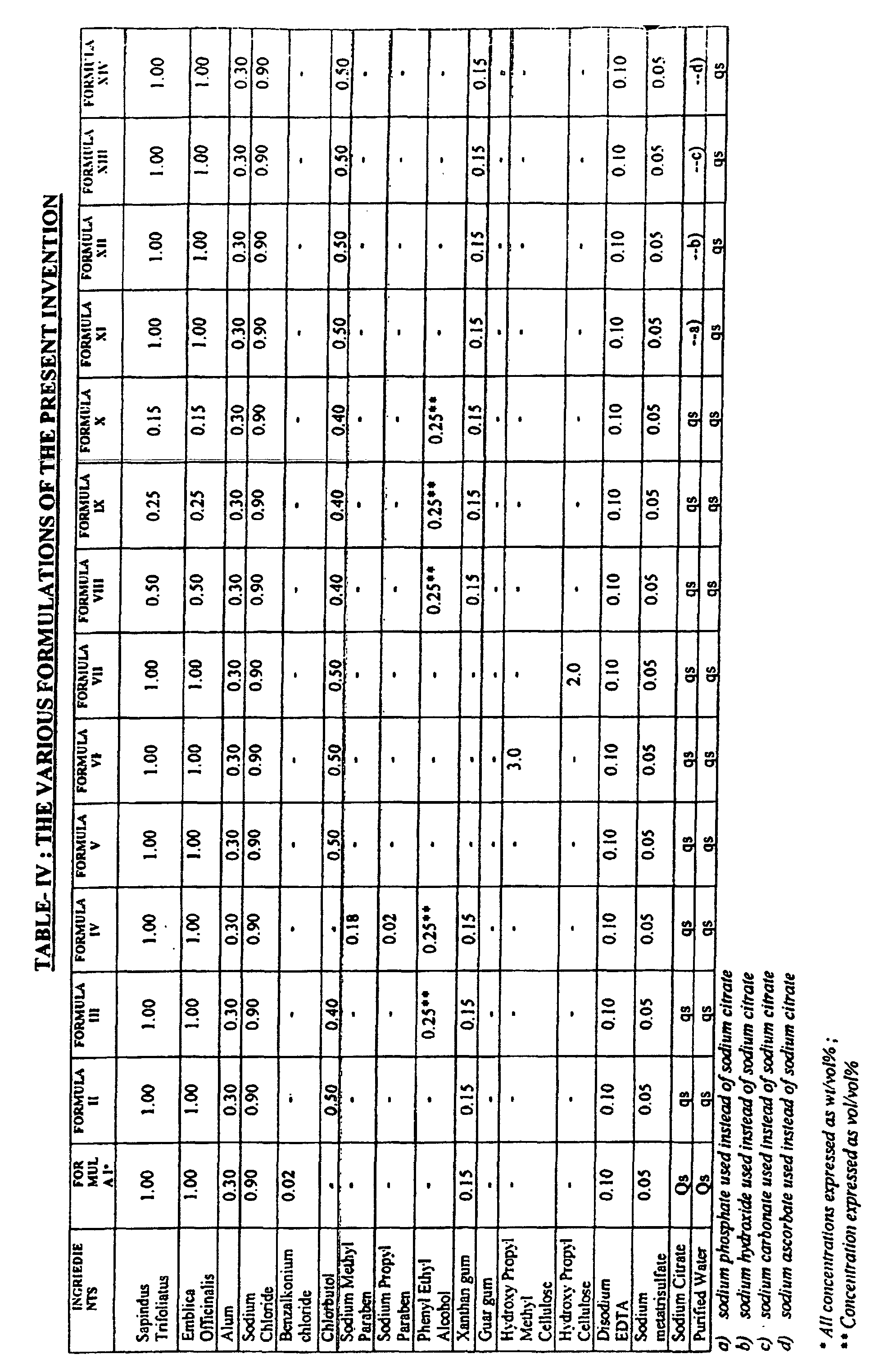
- The required quantities of isotonic agent, astringent, sequestering agent, preservatives and antioxident are dissolved in sufficient quantity of water, which is purged with nitrogen before the addition. The desired amount of the pericarp of Sapindus trifoliatus and dried fruits of Emblica officinalis are added to the solution and the mixture stirred for 30 seconds. The solution is kept in tightly closed container (flushed with nitrogen before sealing) for seven days for maceration. On the eighth day the contents are passed through a nylon cloth and the filtrate is again passed through a filter press containing non-woven polypropylene pads using hyflosupercel as filter aid.
- To boiling water, the required quantity of suspending agent is added gradually and the mixture agitated well to obtain a uniform dispersion. The suspension is cooled to room temperature.
- The solution containing the active ingredients obtained earlier is mixed with the aqueous suspension of suspending agent with agitation, under an atmosphere of nitrogen.. An antioxidant is added at this stage if it is not already added earlier. The pH of the solution is checked and adjusted to 4.5 to 5.0 with pH modulating agent. The final desired volume of the solution was made up by addition of purified water.
- The aqueous solution is transferred to amber coloured bottles, which was flushed with nitrogen before sealing.
- The concentration ofeach of the ingredients in the solution is determined by appropriate methods as mentioned earlier.
- The efficacy and toxicity of the formulation VIII produced above was tested in humans and animals, the details of which are given hereinafter.
- The formulation was tested for acute oral toxicity on Sprague Dawly rats. The test article, diluted in water, was administered orally by gavage as a single dose to groups of five male and five female rats at a dose of 5000 mg/kg body weight, as limit test. The animals were observed for mortality and signs of intoxication for a period of 14 days post dosing and their body weights were also recorded. Necropsy was performed on all rats at the termination of the study.
- The formulation did not cause any mortality in the treated rats during the observation period. No signs of intoxication were observed in the rats following the treatment. Body weight of the treated rats remained same during the observation period.
- The study results indicated no gross pathological alterations in the treated rats at terminal necropsy. The median lethal dose (LD50) of the formulation drops after oral administration as single dose in Sprague Dawley rats was found to be more than 5000 mg / kg body weight.
- A subacute intranasal toxicity study was in groups of six Sprague Dawley rats of both males and females. The formulation was administered intranasally daily in doses of 0, 5, 25 or 50 µl for 28 days and the animals were sacrificed on the twenty ninth day for evaluation of toxicity.
- All incidences of mortality and signs of ill health, body weight and food consumption were recorded during the experimental period. At termination, laboratory investigations were performed on blood and urine. All animals which died during the study or were sacrificed at termination of the study were subjected to a complete necropsy and the weights of certain organs were recorded. A histopathological evaluation was performed on all protocol-listed tissue in control and 50 µl group rats.
- It was observed that no incidence of mortality was noted in any of rats treated with the formulation at 5 µl, 25 µl or 50 µl dosages. Also no abnormal clinical signs of intoxication were observed in rats treated at other different dose levels.
- The quantity of food consumed by rats from treatment groups as well those of control groups were found to be comparable. At all dose level the rats of treatment group showed normal pattern of body weight gain throughout the study period.
- The comparison reveals that there is no difference in the mean hematological values of male and females administrated with the formulation. The plasma levels of total proteins, alanine aminotransferase, asparate aminotransferase, alkanline phosphatase, urea nitrogen and glucose in male and female rats administrated with the formulation did not differ significantly from those of control group. Physical, chemical and microscopic examination of urine samples collected from male and female rats administrated with the formulation also did not reveal any significant changes compared to controls.
- No significant difference was observed in the absolute and relative weights of liver, kidney, adrenal, brain, spleen, lung and testes of male and female rats administrated with the formulation and control animals.
- Administration of the formulation at the level of 5 µl, 25 µl and 50 µl induced a slight subacute inflammatory response in nasal cavity of the treated rats.
- Based on the findings of the present study, it may be concluded that administration of the formulation intranasally to Sprague Dawly rats once a day for 28 day caused only slight sub acute inflammatory response in the nasal cavity at the level of
dose 5 µl and above. - This study was carried out in New Zealand white rabbits as per method of Draizem, J.H. (1965). The test article (0.01ml) was instilled in the lower conjunctiva sac of left eye while the right eye served as control for each animal. The eyes of the first three rabbits were washed with 20 ml of lukewarm water (approximately at body temperature) two seconds after instillation of the test article. The eyes of next three rabbits were washed with 20 ml of lukewarm water for four seconds after instillation of the test article. The eyes of remaining three rabbits remained unwashed.
- The irritation to conjunctiva, iris and cornea were evaluated at 24, 48, 72 and 96 hours and seven days after treatment following the method of Draize. It was observed that test article caused no effect on cornea, iris and conjunctivae. The eyes of the treated rabbits appeared normal throughout the observation period of seven days.
- These finding suggest that the formulation can be classified as non-irritating to mucous membrane in rabbits.
- The formulation according to formulas VII, IX and X of Table - IV where selected and standardised for efficacy and clinical studies. The administration of the formulations showed only mild or no irritation in the volunteers and the formulation of Formula X was used for evaluating the efficacy of the formulation in humans.
- An open clinical trial were conducted on patients suffering from chronic migraine to study the efficacy. The trails were conducted by two different investigators separately and independently. A
total number 30 patients were included in the trials (15 patients in each centre). - The patients with typical migraine and having at least 4-5 attacks per month were selected and included in the trail after taking their written consent. The purpose of trial was also explained to patients. Patients with history of menstural migraine were excluded from the trial.
- The formulation was administrated nasally .One drop in each nostril two times a day for a period of two months. The patients were evaluated on 0, 2, 4, 6, 8 and 12 weeks after treatment The parameters of evaluation were: i) Number of attacks, ii) severity of symptoms - scored as: mild- 1, moderate-2 and severe-3, iii) presence of nausea and vomiting and iv) duration of pain.
- A diary was given to patients to maintain and record the above observations.
- The result indicated that administration of nasal drops showed an improvement in twenty three (77%) patients whereas in seven (23%) patients there was no improvement. The number of attacks per fortnight reduced from 5.33 to 1.53 at the end of three months (Table-V and Fig-2 ) and also the severity score also reduced from 2.43 to 0.73 (Table-V and Fig- 3).
- Overall the formulation produced improvement in twenty three out of thirty patients. This improvement was seen as excellent in ten (33.33%) patients, very good in six (20%) patients, good in three (10%) patients and fair in four (13.33%) patients (Table-VI).
Effect of formulation of Formula-X in Patients with Chronic Migraine Parameters Before Treatment After Treatment % Reduction No. Of Attack per Fortnight 5.33 ± 0.54 1 53 ± 0.70 72 Severity 2.43 ± 0.09 0.73 ± 0.20 70 Effect of formulation of Formula-X on Overall Improvement Improvement Grading No. Of Patients Response (%) Excellent 10 33.00 Very Good 6 20.00 Good 3 10.00 Fair 4 13.33 No Response 7 23.33 - The formulation on nasal route of administration did not show any side effects or mucous membrane irritation in patients. It is indicated from the results of clinical trial that the nasal drops is effective and safe for the prophylactic treatment of migraine.
- Further clinical studies were conducted to confirm the above findings.
- The objective of this study was to evaluate the efficacy and tolerability of the formulation as a prophylactic monotherapy in comparison with a placebo in patients having migraine. Patients were included in the study based on the following criteria : those aged between 15-60 years, diagnosed as having migraine as per International Headache Society Classification (IHSC) guidelines; those with at least two or more attacks of acute migraine per month for at least 6 months; women of child bearing age who take contraceptive measures during the study and those taking no other prophylactic therapy during the study period or alteast one month prior to the study. A detailed ENT examination was conducted prior to the study to rule out any nasal pathology. A written consent was taken from each patient.
- Patients with more than 8 attacks a month, unstable angina, hypertension, cardiac failure, severe left ventricular failure, atrophic rhinitis, nasal polyposis, patients taking any prophylactic medication within 1 month of the study, patients with psychiatric disorders, pregnant/ nursing women, patients with glaucoma and Parkinson's disease were excluded from the study.
- This study, a multi-centric, randomised placebo controlled double blind (test formulation versus matched saline placebo) was conducted at five centres. A non-randomised single blind (test formulation versus flunarizine) study was conducted at two of the five centres. An internal crossover study was done at three of the five centres by cross over of patients in the test formulation and placebo groups.
- The duration of study was eight months. The period of treatment was three months. Patients later on were crossed over internally (test formulation and placebo) for further treatment of three months and a follow-up period of two months. One drop of the test formulation was administered into each nostril two times a day, once in the morning and once in the evening. One drop of placebo was administrated into each nostril, once in the morning and once in the evening flurnarizine tablet (10 mg) was administered once a day orally.
- The enrolled patients underwent a general examination, E.N.T. examination and laboratory tests. Each patient was given a diary to record the details of the migraine, episodes, any adverse events( pre- and post- treatment) as well as details of rescue modification taken, if any. The same was also recorded by the investigator.
- Patients were instructed on how to record the details of various visual symptoms, nausea, vomiting and headache (viz. time of onset, relief, and any additional treatment) and grade them according to severity (4 point scale) in diary. The recorded observations in the diary were reviewed every month of the study period.
- The efficacy of the prophylactic treatment was evaluated on the following basis :
- At least 50% reduction in the intensity or duration of migraine attacks (mean duration of migraine in hours) per month at the end of 12 weeks of treatment, compared to baseline.
- Reduction in the frequency of attack per month using test formulation and flunarizine compared to placebo (>or = 50%).
- Consumption of drugs for symptomatic relief of breakthrough attacks in the three groups.
- At least 50% or more reduction of attack in patients who respond to test formulation compared to the reduction of attack in patients given placebo.
- The safety and patient compliance of test formulation was assessed on the basis of incidence and severity of side effects in each groups compared to placebo and number of drop outs in each group compared to placebo.
- At all the centres a total of one hundred and sixty nine (169) patients completed the full duration of treatment (3 months). The drop out rate for individual drug administration was as detailed in Table VII.
DRUG DROP OUT RATE (%) Formulation of Formula-X 13 Placebo 27 Flunarizine 43 - From the evaluated cases, eighty (80) patients were further crossed over between the formulation of Formula-X and placebo. Seventy three ( 73) patients completed the full duration of therapy.
The results of the trial was statistically analysed based on the following parameters : - 1. Atleast 50% reduction in the frequency of migraine attacks
- 2. Atleast 50% reduction in the duration of migraine attacks
- 3. Reduction in the severity of migraine attacks [graded as none (0), mild (1), moderate (2) and severe (3)
- 4. Reduction in the degree of disability in terms of effect on working capacity or loss of man hours caused due to the attacks, graded on a four-point scale (0-3).
-
-
- i. Reduction in frequency of attacks: It was observed that formulation of formula-X
was significantly better than placebo in producing a ≥ 50% reduction in frequency
of migraine attacks at the end of the third follow-up (Table-VIII). It was also
observed that formulation of fonnula-X showed a significant reduction in mean
frequency of attacks at each follow-up, where as the placebo did not show a
significant reduction in the mean frequency of attacks.
PERCENTAGE REDUCTION IN FREQUENCY AT THE THIRD FOLLOW-UP %REDUCTION IN FREQUENCY FORMULATION OF FORMULA-X PLACEBO ≥50% 63.6% 30.8% Chi square (with Yates correction) = 25.2 (p<0.01) - ii. Crossover results: formulation of formula-X was significantly better than
placebo in reducing the frequency of attacks by 50% or more after the patients
were internally crossed over between fonnutation of formula-X and placebo
(Table-IX). Moreover it was also observed that patients crossed over from
formulation of formula-X to placebo showed a significant increase in the
frequency of attacks (p<0.05).
PERCENTAGE REDUCTION IN FREQUENCY ANT THE END OF SIXTH FOLLOW -UP %REDUCTION IN FREQUENCY FORMULATION OF FORMULA-X PLACEBO ≥ 50% 36.1% 9.4% Chi square (with Yates correction) = 4.5 (p<0.05) -
-
- i. Reduction in duration of attacks : There was no significant difference
amongst formulation of formula-X and placebo in reducing the duration of
attacks (Table-X). It was observed that both formulation of formula-X and
placebo showed a significant reduction in the duration of attacks at the end of
each follow-up.
PERCENTAGE REDUCTION IN DURATION AT THE THIRD FOLLOW-UP %REDUCTION IN DURATION FORMULATION OF FORMULA-X PLACEBO ≥ 50% 68.0% 50.8% Chi square (with Yates correction) = 4.77 (p>0.05) - ii. Crossover results: Formulation of formula-X was significantly better than
placebo in reducing the duration of attacks by ≥ 50% at the end of the sixth
follow-up i.e. after crossover of patients (Table-XI)
PERCENTAGE REDUCTION IN DURATION AT THE END OF SIXTH FOLLOW -UP %REDUCTION IN DURATION FORMULATION OF FORMULA-X PLACEBO ≥ 50% 44.4% 12.9% Chi square (with Yates correction) = 6.5 (p<0.01) -
- Formulation of formula-X was significantly better than placebo in producing a ≥ 50% reduction in severity of attacks and disability due to the attacks at the end of the third follow-up (Table-XII)
PERCENTAGE REDUCTION IN SEVERITY OF ATTACKS AND DISABILITY DUE TO ATTACKS AT THE END OF THE THIRD FOLLOW-UP %REDUCTION IN SEVERITY FORMULATION OF FORMULA-X PLACEBO ≥ 50% 56.6% 17.5% Chi square (with Yates correction) = 22 (p<0.05) %REDUCTION IN DISABILITY FORMULATION OF FORMULA-X PLACEBO ≥ 50% 62.5% 23% Chi square (with Yates correction) = 19.4 (p<0.05) -
- i. Reduction in the frequency of affacks. : There was no statistically
significant difference between formulation of formula-x and flunarizine in
showing a ≥ 50% reduction in the frequency of attacks (p>0.05) (Table-XIII).
It was also observed that both formulation of formula-X and flunarizine
showed a significant difference reduction in the mean frequency of attacks at
the end each follow up.
PERCENTAGE REDUCTION IN FREQUENCY AT THE THIRD FOLLOW UP %REDUCTION IN FREQUENCY FORMULATION OF FORMULA-X FLUNARIZINE ≥ 50% 63.6% 81.5% Chi square (with Yates correction) = 2.3 (p>0.05) -
-
- i. Reduction in the duration of attacks. : There was no statistically significant
difference between formulation of formula-X and flunarizine in showing a ≥
50% reduction in the duration of attacks (p>0.05) (Table-XIV). It was
however observed that while formulation of formula-X showed a significant
reduction in the duration of attacks at the end of each follow-up, flunarizine
showed a significant reduction in the duration of attacks only at the end of the
second and third follow-up.
PERCENTAGE REDUCTION IN DURATION AT THE END OF THIRD FOLLOW UP %REDUCTION IN DURATION FORMULATION OF FORMULA-X FLUNARIZINE ≥ 50% 63.6% 52.0% Chi square (with Yates correction) = 1.5 (p>0.05) -
- A comparison of formulation of formula-X and flunarizine did not show any statistical difference in reducing the severity of attacks and disability due to attacks (≥ 50% reduction)(p>0.05) (Table-XV)
PERCENTAGE REDUCTION IN SEVERITY OF ATTACKS AND DISABILITY DUE TO ATTACKS AT THE END OF THE THIRD FOLLOW-UP %REDUCTION IN SEVERITY FORMULATION OF FORMULA-X FLUNARIZINE ≥ 50% 56.6% 42.3% Chi square (with Yates correction) = 22(p<0.05) %REDUCTION IN DISABILITY FORMULATION OF FORMULA-X FLUNARIZINE ≥ 50% 62.5% 69.6% Chi square (with Yates correction) = 0.13 (p>0.05 - From the toxicological and clinical studies it can be seen that the formulation obtained by the present invention is a safe and very effective method for prevention of migraine, that is it is very effective for the prophylactic treatment of migraine.
Claims (38)
- A aqueous pharmaceutical composition suitable for nasal administration for the prophylactic treatment of migraine comprising:i. extract of Sapindus trifoliatus in an amount of 0.1% to 1.0% w/v ;ii. extract of Emblica officinalis in an amount of 0.1 to 1% w/v;iii. pharmaceutically acceptable additives selected froma) astringent in an amount of 0.1% w/v to 0.6% w/v ;b) suspending agent in an amount of 0.1% to 3% w/v ;c) isotonic agent in an amount of 0.85 to 0.90% w/v,d) preservative in an amount of 0.1% w/v to 1% w/v,e) sequestering agent in an amount of 0.05 to 0.2% w/v,f) antioxidant in an amount of 0.02 to 0.08% w/v. andg) pH adjusting agent in sufficient amount said composition having a pH of 3.5 to 7.0
- A aqueous pharmaceutical composition for prophylactic treatment of migraine as claimed in claim 1 comprising:said Sapindus trifoliatus in an amount of 0.1% to 1.0% w/v ;said Emblica officinalis in an amount of 0.1 to 1% w/v ;said astringent in an amount of 0.1% w/v to 0.6% w/v ;said suspending agent in an amount of 0.1% to 3% w/v ;said isotonic agent in an amount of 0.85 to 0.90% w/v,said preservative in an amount of 0.1% to 1% w/v,said sequestering agent in an amount of 0.05 to 0.2% w/v,said antioxidant in an amount of 0.02 to 0.08% w/v. andsaid pH adjusting agent in sufficient amount to maintain the pH of the solution in the range of 3.5 to 7.0.
- A pharmaceutical composition for prophylactic treatment of migraine as claimed in any of claims 1 or 2 wherein said astringent comprise aluminium potassium sulphate (alum) selected from any of the anhydrous and dodecahydrate forms of alum, preferably dodecahydrate.
- A pharmaceutical composition for prophylactic treatment of migraine as claimed in anyone of claims 1 or 3 wherein said astringent is used in the range of 0.3 to 0.4% w/v.
- A pharmaceutical composition for prophylactic treatment of migraine as claimed in anyone of claims 1 or 4 wherein said suspending agent comprise xanthan gum, guar gum, hydroxypropyl methyl cellulose and hydroxypropyl cellulose, preferably xanthan gum.
- A pharmaceutical composition for prophylactic treatment of migraine as claimed in anyone of claims 1 to 5 wherein said pH adjusting agent comprise sodium hydroxide, sodium phosphate, sodium citrate, sodium carbonate and sodium ascorbate, preferably sodium citrate.
- A pharmaceutical composition for prophylactic treatment of migraine as claimed in anyone of claims 1 to 6 wherein said pH of the formulation is maintained in the range of 3.5 to 5.5.
- A pharmaceutical composition for prophylactic treatment of migraine as claimed in anyone of claims 1 to 7 wherein said isotonic agent comprise sodium chloride.
- A pharmaceutical composition for prophylactic treatment of migraine as claimed in anyone of claims 1 to 8 wherein said preservatives are selected from benzalkonium chloride, chlorbutol, sodium methyl paraben, sodium propyl paraben and phenylethyl alcohol.
- A pharmaceutical composition for prophylactic treatment of migraine as claimed in anyone of claims 1 to 9 wherein said sequestering agent comprise disodium EDTA.
- A pharmaceutical composition for prophylactic treatment of migraine as claimed in anyone of claims 1 to 10 wherein said antioxidant comprise sodium meta bisulphite.
- A pharmaceutical composition for prophylactic treatment of migraine as claimed in anyone of claims 1 to 11 wherein said preservative comprise chlorbutol and/or phenylethyl alcohol.
- A pharmaceutical composition for prophylactic treatment of migraine as claimed in anyone of claims 1 to 12 wherein said chlorbutol is used in an amount of 0.1 to 1% w/v preferably 0.4 to 0.8% w/v.
- A pharmaceutical composition for prophylactic treatment of migraine as claimed in anyone of claims 1 to 13 wherein said chlorbutol and phenylethyl alcohol are used in the concentration of 0.40% and 0.25% w/v respectively.
- A pharmaceutical composition for prophylactic treatment of migraine as claimed in anyone of claims 1 to 14 wherein the isotonicity of the said aqueous formulation is 0.9%.
- A pharmaceutical composition for prophylactic treatment of migraine as claimed in anyone of claims 1 to 15 wherein said antioxidant is used in an amount of 0.04 to 0.05% w/v.
- A process for preparation of a pharmaceutical composition for prophylactic treatment of migraine comprising:i. extraction of actives from pericarp of the fruit of Sapindus trifoliatus and dried fruit of Emblica officinalis following steps of soaking in water and filtration, adding pharmaceutically acceptable additives selected from suspending agent, isotonic agent, preservative, sequestering agent, antioxidant and astringent at any one or more of the fallowing stages :-a) prior to said step of soaking and filtration;b) after said step of soaking and filtration,c) after said soaking but prior to filtration, andii. finally adjusting pH of the solution with pH adjusting agent to maintain the pH in the range of 3.5 to 7.0 and making up of the solution to the desired concentration.
- A process as claimed in claim 17 wherein said step of extraction of actives comprises boiling of actives in water.
- A process as claimed in any one of claims 17 to 18 wherein
said extract of active comprises Sapindus trifoliatus, in an amount of 0.1% to 1% w/v, and Emblica officinalis in an amount of 0.1% to 1% w/v,
said astringent is used in an amount of 0.1% w/v to 0.6% w/v,
said suspending agent is used in an amount of 0.1% to 3% w/v,
said isotonic agent is used in an amount of 0.85% to 0.90% w/v,
said preservatives used in an amount of 0.1% to 1% w/v,
said sequestering agent is used in an amount of 0.05% to 0.02% w/v;
said antioxidant is used in an amount of 0.02% to 0.08% w/v. - A process as claimed in any one of claims 17 - 19 wherein said astringent used comprises aluminium potassium sulphate (alum) selected from any of the anhydrous and dodecahydrate forms of alum, preferably dodecahydrate.
- A process as claimed in any one of claims 17 to 20 wherein said astringent is used in the range of 0.3 to 0.4% w/v.
- A process as claimed in anyone of claims 17 to 21 wherein suspending agent is selected from xanthan gum, guar gum, hydroxypropyl methyl cellulose and hydroxypropyl cellulose, preferably xanthan gum.
- A process as claimed in anyone of claims 17 to 22 wherein said pH adjusting agent used is selected from sodium hydroxide, sodium phosphate, sodium citrate, sodium carbonate, sodium ascorbate, preferably sodium citrate.
- A process as claimed in claims 17 to 23 wherein the pH of the formulation is maintained in the rage of 3.5 to 5.5.
- A process as claimed in anyone of claims 17 to 24 wherein said isotonic agent used is sodium chloride.
- A process as claimed in anyone of ctaims 17 to 25 wherein said preservatives used is selected from benzalkonium chloride, chlorbutol, sodium methyl paraben, sodium propyl paraben and phenethyl alcohol.
- A process as claimed in anyone of claims 17 to 26 wherein said sequestering agent used is disodium EDTA.
- A process as claimed in anyone of claims 17 to 27 wherein said antioxidant used is sodium meta bisulphite.
- A process as claimed in any one of claims 17 to 28 wherein said preservatives used is a combination of chlorbutol and/or phenethyl alcohol
- A process as claimed in claim 29 wherein said chlorbutol and phenethyl alcohol are used in combination in concentration of 0.40% to 0.25% w/v respectively.
- A process as claimed in anyone of claims 17 to 30 wherein said chlorobutol is used in an amount of 0.1% to 1% w/v, preferably 0.4% to 0.8% w/v.
- A process as claimed in any one of claims 17 to 31 wherein the isotonicity of the aqueous pharmaceutical composition is 0.9%.
- A process as claimed in anyone of claims 17 to 32 wherein said antioxidant is used in an amount of 0.04% to 0.05% w/v.
- A process as claimed in any one of claims 17 to 33 wherein said suspending agent is added after said step of soaking and filtration but prior to adjusting of pH.
- A process as claimed in anyone of claims 17 to 34 wherein said step of soaking of the actives is carried out in a tightly closed container under an atmosphere of nitrogen to prevent atmospheric contamination/degradation with or without agitation.
- A process as claimed in anyone of claims 17 to 35 wherein said step of filtration is carried out using filtering aids selected from charcoal, talc, hyflo supercel, preferably hyflo supercel.
- A process as claimed in claim 36 wherein said filter aids are supported on non-woven polypropylene beds.
- A process as claimed in anyone of claims 17 to 37 wherein said step of soaking is carried out for a period of 1 to 8 days, preferably 7 days.
Applications Claiming Priority (1)
| Application Number | Priority Date | Filing Date | Title |
|---|---|---|---|
| PCT/IN2000/000057 WO2001089544A1 (en) | 2000-05-25 | 2000-05-25 | Antimigraine combination comprising sapindus and emblica extracts |
Publications (2)
| Publication Number | Publication Date |
|---|---|
| EP1284744A1 EP1284744A1 (en) | 2003-02-26 |
| EP1284744B1 true EP1284744B1 (en) | 2004-07-28 |
Family
ID=11076251
Family Applications (1)
| Application Number | Title | Priority Date | Filing Date |
|---|---|---|---|
| EP00946262A Expired - Lifetime EP1284744B1 (en) | 2000-05-25 | 2000-05-25 | Antimigraine combination comprising sapindus and emblica extracts |
Country Status (8)
| Country | Link |
|---|---|
| US (1) | US7632528B1 (en) |
| EP (1) | EP1284744B1 (en) |
| JP (1) | JP2003535830A (en) |
| AT (1) | ATE271877T1 (en) |
| AU (1) | AU2000260132A1 (en) |
| CA (1) | CA2409051A1 (en) |
| DE (1) | DE60012586T2 (en) |
| WO (1) | WO2001089544A1 (en) |
Families Citing this family (1)
| Publication number | Priority date | Publication date | Assignee | Title |
|---|---|---|---|---|
| WO2004019960A2 (en) * | 2002-08-28 | 2004-03-11 | Lupin Ltd. | Herbal extract comprising a mixture of saponins obtained from sapindus trifoliatus for anticonvulsant activity |
-
2000
- 2000-05-25 CA CA002409051A patent/CA2409051A1/en not_active Abandoned
- 2000-05-25 DE DE60012586T patent/DE60012586T2/en not_active Expired - Fee Related
- 2000-05-25 JP JP2001585788A patent/JP2003535830A/en active Pending
- 2000-05-25 US US10/276,319 patent/US7632528B1/en not_active Expired - Fee Related
- 2000-05-25 AT AT00946262T patent/ATE271877T1/en not_active IP Right Cessation
- 2000-05-25 WO PCT/IN2000/000057 patent/WO2001089544A1/en not_active Ceased
- 2000-05-25 AU AU2000260132A patent/AU2000260132A1/en not_active Abandoned
- 2000-05-25 EP EP00946262A patent/EP1284744B1/en not_active Expired - Lifetime
Also Published As
| Publication number | Publication date |
|---|---|
| DE60012586D1 (en) | 2004-09-02 |
| DE60012586T2 (en) | 2005-08-11 |
| US7632528B1 (en) | 2009-12-15 |
| CA2409051A1 (en) | 2001-11-29 |
| EP1284744A1 (en) | 2003-02-26 |
| ATE271877T1 (en) | 2004-08-15 |
| JP2003535830A (en) | 2003-12-02 |
| AU2000260132A1 (en) | 2001-12-03 |
| WO2001089544A1 (en) | 2001-11-29 |
Similar Documents
| Publication | Publication Date | Title |
|---|---|---|
| US10195239B2 (en) | Extract of Trigonella foenum-graecum | |
| US6793942B2 (en) | Composition and method for treating the effects of diseases and maladies | |
| Panda | Handbook on medicinal herbs with uses: medicinal plant farming, most profitable medicinal plants in India, medicinal plants farming in India, plants used in herbalism, medicinal herbs you can grow, medicinal herbs and their uses, medicinal herbs, herbal & medicinal plants, growing medicinal herb, most profitable medicinal herbs growing with small investment, herbal medicine herbs | |
| Yadav et al. | Herbal plants used in the treatment of urolithiasis: a review | |
| US20030228383A1 (en) | Herbal cough formulations and process for the preparation thereof | |
| CN103536496B (en) | Toothpaste and preparation method thereof | |
| CN104116734B (en) | A kind of pharmaceutical composition, pharmaceutical preparation and application and method for making for the treatment of oral cavity, pharyngolaryngitis | |
| US20160151438A1 (en) | Synergistic formulation for relieving gout symptoms | |
| CN106794210A (en) | Composition for preventing or improving periodontal disease containing mangosteen extract or α, γ mangostin as an active ingredient | |
| CN108403544A (en) | A kind of Pediatric Oral Emergency care composition and preparation method thereof | |
| US6641801B1 (en) | Gargle method to reduce the duration of common cold symptoms | |
| US20160000826A1 (en) | Gargle Method to Reduce the Duration of Common Cold Symptoms | |
| US5879682A (en) | Aframonum seeds for improving penile activity | |
| WO2010010394A2 (en) | Local pharmaceutical compositions | |
| US7632528B1 (en) | Antimigraine combination comprising Sapindus and Emblica extracts | |
| US20170020946A1 (en) | Analgesic compositions and methods of use | |
| JP5602696B2 (en) | Improvement of sexual function and genital vasculature by proanthocyanidins | |
| WO2000035466A1 (en) | Aframomum seeds for improving penile activity | |
| KR101574678B1 (en) | Composition for preventing or treating periodontal disease comprising Lactuca scariola extract as effective component | |
| CN101637527A (en) | Application method of amur cork for preparing digestive ulcer medicament | |
| KR20030062620A (en) | Composition for preventing and alleviating a trouble caused by smoking | |
| EA052752B1 (en) | TOOTHPASTE COMPOSITION AIMED AT IMPROVING ORAL HYGIENE AND IMPROVING ERECTILE FUNCTION | |
| JP2024530773A (en) | Compositions containing horse chestnut extract | |
| CN111356462A (en) | Composition for the treatment of acute and chronic constipation | |
| TR202011203A2 (en) | HEALING SYRUP AGAINST PROSTATE ENLARGEMENT |
Legal Events
| Date | Code | Title | Description |
|---|---|---|---|
| PUAI | Public reference made under article 153(3) epc to a published international application that has entered the european phase |
Free format text: ORIGINAL CODE: 0009012 |
|
| 17P | Request for examination filed |
Effective date: 20021126 |
|
| AK | Designated contracting states |
Kind code of ref document: A1 Designated state(s): AT BE CH CY DE DK ES FI FR GB GR IE IT LI LU MC NL PT SE |
|
| AX | Request for extension of the european patent |
Extension state: AL LT LV MK RO SI |
|
| RAP1 | Party data changed (applicant data changed or rights of an application transferred) |
Owner name: LUPIN LIMITED |
|
| 17Q | First examination report despatched |
Effective date: 20030519 |
|
| GRAP | Despatch of communication of intention to grant a patent |
Free format text: ORIGINAL CODE: EPIDOSNIGR1 |
|
| GRAS | Grant fee paid |
Free format text: ORIGINAL CODE: EPIDOSNIGR3 |
|
| GRAA | (expected) grant |
Free format text: ORIGINAL CODE: 0009210 |
|
| AK | Designated contracting states |
Kind code of ref document: B1 Designated state(s): AT BE CH CY DE DK ES FI FR GB GR IE IT LI LU MC NL PT SE |
|
| PG25 | Lapsed in a contracting state [announced via postgrant information from national office to epo] |
Ref country code: BE Free format text: LAPSE BECAUSE OF FAILURE TO SUBMIT A TRANSLATION OF THE DESCRIPTION OR TO PAY THE FEE WITHIN THE PRESCRIBED TIME-LIMIT Effective date: 20040728 Ref country code: AT Free format text: LAPSE BECAUSE OF FAILURE TO SUBMIT A TRANSLATION OF THE DESCRIPTION OR TO PAY THE FEE WITHIN THE PRESCRIBED TIME-LIMIT Effective date: 20040728 Ref country code: FI Free format text: LAPSE BECAUSE OF FAILURE TO SUBMIT A TRANSLATION OF THE DESCRIPTION OR TO PAY THE FEE WITHIN THE PRESCRIBED TIME-LIMIT Effective date: 20040728 |
|
| REG | Reference to a national code |
Ref country code: GB Ref legal event code: FG4D |
|
| REG | Reference to a national code |
Ref country code: CH Ref legal event code: EP |
|
| REG | Reference to a national code |
Ref country code: IE Ref legal event code: FG4D |
|
| REF | Corresponds to: |
Ref document number: 60012586 Country of ref document: DE Date of ref document: 20040902 Kind code of ref document: P |
|
| PG25 | Lapsed in a contracting state [announced via postgrant information from national office to epo] |
Ref country code: DK Free format text: LAPSE BECAUSE OF FAILURE TO SUBMIT A TRANSLATION OF THE DESCRIPTION OR TO PAY THE FEE WITHIN THE PRESCRIBED TIME-LIMIT Effective date: 20041028 Ref country code: GR Free format text: LAPSE BECAUSE OF FAILURE TO SUBMIT A TRANSLATION OF THE DESCRIPTION OR TO PAY THE FEE WITHIN THE PRESCRIBED TIME-LIMIT Effective date: 20041028 Ref country code: SE Free format text: LAPSE BECAUSE OF FAILURE TO SUBMIT A TRANSLATION OF THE DESCRIPTION OR TO PAY THE FEE WITHIN THE PRESCRIBED TIME-LIMIT Effective date: 20041028 |
|
| PG25 | Lapsed in a contracting state [announced via postgrant information from national office to epo] |
Ref country code: ES Free format text: LAPSE BECAUSE OF FAILURE TO SUBMIT A TRANSLATION OF THE DESCRIPTION OR TO PAY THE FEE WITHIN THE PRESCRIBED TIME-LIMIT Effective date: 20041108 |
|
| LTIE | Lt: invalidation of european patent or patent extension |
Effective date: 20040728 |
|
| REG | Reference to a national code |
Ref country code: CH Ref legal event code: AEN Free format text: LE BREVET A ETE REACTIVE SELON LA DEMANDE DE POURSUITE DE LA PROCEDURE DU 03.01.2005. |
|
| ET | Fr: translation filed | ||
| PG25 | Lapsed in a contracting state [announced via postgrant information from national office to epo] |
Ref country code: CY Free format text: LAPSE BECAUSE OF FAILURE TO SUBMIT A TRANSLATION OF THE DESCRIPTION OR TO PAY THE FEE WITHIN THE PRESCRIBED TIME-LIMIT Effective date: 20050525 Ref country code: LU Free format text: LAPSE BECAUSE OF NON-PAYMENT OF DUE FEES Effective date: 20050525 |
|
| PG25 | Lapsed in a contracting state [announced via postgrant information from national office to epo] |
Ref country code: MC Free format text: LAPSE BECAUSE OF NON-PAYMENT OF DUE FEES Effective date: 20050531 |
|
| PLBE | No opposition filed within time limit |
Free format text: ORIGINAL CODE: 0009261 |
|
| STAA | Information on the status of an ep patent application or granted ep patent |
Free format text: STATUS: NO OPPOSITION FILED WITHIN TIME LIMIT |
|
| 26N | No opposition filed |
Effective date: 20050429 |
|
| PG25 | Lapsed in a contracting state [announced via postgrant information from national office to epo] |
Ref country code: PT Free format text: LAPSE BECAUSE OF NON-PAYMENT OF DUE FEES Effective date: 20041228 |
|
| PGFP | Annual fee paid to national office [announced via postgrant information from national office to epo] |
Ref country code: NL Payment date: 20090527 Year of fee payment: 10 Ref country code: IE Payment date: 20090525 Year of fee payment: 10 |
|
| PGFP | Annual fee paid to national office [announced via postgrant information from national office to epo] |
Ref country code: IT Payment date: 20090527 Year of fee payment: 10 Ref country code: FR Payment date: 20090521 Year of fee payment: 10 Ref country code: DE Payment date: 20090522 Year of fee payment: 10 |
|
| PGFP | Annual fee paid to national office [announced via postgrant information from national office to epo] |
Ref country code: CH Payment date: 20090521 Year of fee payment: 10 |
|
| PGFP | Annual fee paid to national office [announced via postgrant information from national office to epo] |
Ref country code: GB Payment date: 20090520 Year of fee payment: 10 |
|
| REG | Reference to a national code |
Ref country code: NL Ref legal event code: V1 Effective date: 20101201 |
|
| REG | Reference to a national code |
Ref country code: CH Ref legal event code: PL |
|
| GBPC | Gb: european patent ceased through non-payment of renewal fee |
Effective date: 20100525 |
|
| REG | Reference to a national code |
Ref country code: FR Ref legal event code: ST Effective date: 20110131 |
|
| PG25 | Lapsed in a contracting state [announced via postgrant information from national office to epo] |
Ref country code: CH Free format text: LAPSE BECAUSE OF NON-PAYMENT OF DUE FEES Effective date: 20100531 Ref country code: LI Free format text: LAPSE BECAUSE OF NON-PAYMENT OF DUE FEES Effective date: 20100531 |
|
| REG | Reference to a national code |
Ref country code: IE Ref legal event code: MM4A |
|
| PG25 | Lapsed in a contracting state [announced via postgrant information from national office to epo] |
Ref country code: IT Free format text: LAPSE BECAUSE OF NON-PAYMENT OF DUE FEES Effective date: 20100525 Ref country code: NL Free format text: LAPSE BECAUSE OF NON-PAYMENT OF DUE FEES Effective date: 20101201 |
|
| PG25 | Lapsed in a contracting state [announced via postgrant information from national office to epo] |
Ref country code: DE Free format text: LAPSE BECAUSE OF NON-PAYMENT OF DUE FEES Effective date: 20101201 Ref country code: IE Free format text: LAPSE BECAUSE OF NON-PAYMENT OF DUE FEES Effective date: 20100525 |
|
| PG25 | Lapsed in a contracting state [announced via postgrant information from national office to epo] |
Ref country code: FR Free format text: LAPSE BECAUSE OF NON-PAYMENT OF DUE FEES Effective date: 20100531 |
|
| PG25 | Lapsed in a contracting state [announced via postgrant information from national office to epo] |
Ref country code: GB Free format text: LAPSE BECAUSE OF NON-PAYMENT OF DUE FEES Effective date: 20100525 |