EP1283292A2 - Method for controlling the rotational speed of the drum of a clothes washing machine in the spin-extraction phase - Google Patents
Method for controlling the rotational speed of the drum of a clothes washing machine in the spin-extraction phase Download PDFInfo
- Publication number
- EP1283292A2 EP1283292A2 EP02015297A EP02015297A EP1283292A2 EP 1283292 A2 EP1283292 A2 EP 1283292A2 EP 02015297 A EP02015297 A EP 02015297A EP 02015297 A EP02015297 A EP 02015297A EP 1283292 A2 EP1283292 A2 EP 1283292A2
- Authority
- EP
- European Patent Office
- Prior art keywords
- drum
- water
- spin
- level
- tub
- Prior art date
- Legal status (The legal status is an assumption and is not a legal conclusion. Google has not performed a legal analysis and makes no representation as to the accuracy of the status listed.)
- Granted
Links
Images

Classifications
-
- D—TEXTILES; PAPER
- D06—TREATMENT OF TEXTILES OR THE LIKE; LAUNDERING; FLEXIBLE MATERIALS NOT OTHERWISE PROVIDED FOR
- D06F—LAUNDERING, DRYING, IRONING, PRESSING OR FOLDING TEXTILE ARTICLES
- D06F33/00—Control of operations performed in washing machines or washer-dryers
- D06F33/30—Control of washing machines characterised by the purpose or target of the control
- D06F33/32—Control of operational steps, e.g. optimisation or improvement of operational steps depending on the condition of the laundry
- D06F33/40—Control of operational steps, e.g. optimisation or improvement of operational steps depending on the condition of the laundry of centrifugal separation of water from the laundry
-
- D—TEXTILES; PAPER
- D06—TREATMENT OF TEXTILES OR THE LIKE; LAUNDERING; FLEXIBLE MATERIALS NOT OTHERWISE PROVIDED FOR
- D06F—LAUNDERING, DRYING, IRONING, PRESSING OR FOLDING TEXTILE ARTICLES
- D06F2103/00—Parameters monitored or detected for the control of domestic laundry washing machines, washer-dryers or laundry dryers
- D06F2103/18—Washing liquid level
-
- D—TEXTILES; PAPER
- D06—TREATMENT OF TEXTILES OR THE LIKE; LAUNDERING; FLEXIBLE MATERIALS NOT OTHERWISE PROVIDED FOR
- D06F—LAUNDERING, DRYING, IRONING, PRESSING OR FOLDING TEXTILE ARTICLES
- D06F2105/00—Systems or parameters controlled or affected by the control systems of washing machines, washer-dryers or laundry dryers
- D06F2105/46—Drum speed; Actuation of motors, e.g. starting or interrupting
- D06F2105/48—Drum speed
Definitions
- the present invention refers to a method for controlling the rotational speed of the drum of an automatic clothes washing machine in the spin-extraction phase of a washing cycle.
- Modern clothes washing machines are generally known to use small amounts of water and, therefore, are quite easily subject to considerable sudsing, i.e. heavy foam formation during clothes washing phases, owing for instance to the addition of an excessive amount of detergent in the water or the use of a detergent product that by its nature gives rise to excessive foaming.
- the method according to the present invention may be implemented in a clothes washing machine featuring a substantially traditional structure, with a washing tub 1 that houses a rotating drum 2 adapted to hold the clothes and to be selectively driven rotatably at a low washing speed (under cyclical reversal of the direction of rotation) and a high spin-extraction speed by an electric motor 3 controlled by a programme sequence control unit 4.
- the clothes washing machine shall be understood as being provided with a plurality of operational elements and parts controlled by said programme sequence control unit 4, which is preferably of an electronic type, to carry out a number of selectable operating cycles, at least one of which comprises in particular a washing phase carried out with detergent-added water that is let into the washing tub 1 up to a first operating level L1 and is preferably heated up.
- the washing phase is concluded by at least a water discharge phase, in which the drain pump 6 is energized by the programme sequence control unit 4 under the control of an analogue pressure switch 7 (or a similar level-control switch or sensor).
- the pressure switch 7 drives the programme sequence control unit 4 with a signal that is indicative of the pressure determined by the variations in the level of the water (along with any possible foam in said water) in the washing tub 1. For reasons of greater simplicity, in the following description the assumption is made that the pressure is directly proportional to the water level.
- the programme sequence control unit 4 is set so as to be adapted to start the water discharge phase, through the energization of the drain pump 6, under substantially static conditions of the drum 2, in such a manner as to enable the foam that may be present in the washing tub to be substantially abated.
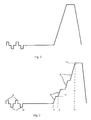
- the programme sequence control unit is further set so as to stop the drain pump 6 and start the driving motor 3, in view of bringing the drum 3 up to a maximum spin-extraction speed Vs, when the water in the washing tub 1 lowers down to a minimum level L2 that preferably corresponds to the minimum pressure value P2 that can be detected by the pressure switch 7. In the example illustrated in Figure 2, this occurs at an instant t1, after which the drum is accelerated into spin-extraction, so that the resulting water released by the clothes causes the water level in the washing tub 1 to increase.
- the programme sequence control unit 4 is set so as to energize again the drain pump 6 and stop the acceleration of the driving motor 3, while keeping the instant speed thereof substantially constant, upon the pressure switch 7 detecting a pre-determined maximum pressure value P3 that substantially corresponds to a water level L3 that is greater than L2.
- said level L3 is lower than or equal to the level at the base 8 of the rotating drum 2, in such a manner as to prevent any further foam from forming owing to a contact of the rotating drum with the water containing sudsing, i.e. foaming additives.
- the drain pump 6 is advantageously energized when the priming conditions thereof are favourable, whereas the discontinuation in the acceleration of the rotating drum 2 enables the clothes to go on being spin-dried, i.e. to further undergo spin-extraction, while at the same time preventing the water in the washing tub from further increasing to any excessive level.
- an operational washing or similar phase is carried out in the machine with water let into the washing tub 1 up to the level L1 and, preferably, under a sequence of alternate rotations of the drum 2, as indicated schematically at A, at a rotating speed of approx. 50 rpm.
- a water discharge phase is then triggered with the drum 2 substantially at a standstill, until the pressure switch 7 then, i.e. at an instant t1, detects a condition indicating that the minimum level L2 has been reached.
- the drain pump 6 is de-energized and the drum 2 is driven to rotate up to its spin-extraction speed Vs.
- the drain pump Upon the pressure switch 7 detecting again a level L2 of the water in the washing tub, the drain pump is again de-energized and the drum is again accelerated up to its pre-determined spin-extraction speed Vs.
- the drum itself will reach said spin-extraction speed Vs thereof within a period of time t1-t3 which is variable depending on and according to the actual operating conditions (such as, in particular, the amount of foam generated in the suds or washing bath).
- a number of transients may possibly be experienced during which, in the above described manner, the drum 2 is accelerated in a gradual, step-like manner (as indicated schematically at B in Figure 2) up to said spin-extraction speed Vs.
- the operation of the washing machine can continue in a traditional manner, possibly with a further time-controlled energization of the drain pump 6.
- the values of the water levels L1, L2 and L3 may be changed in accordance to the requirements, and the means used to implement the control method (such as for instance the pressure switch 7) may be of a different kind.
Landscapes
- Engineering & Computer Science (AREA)
- Textile Engineering (AREA)
- Control Of Washing Machine And Dryer (AREA)
- Centrifugal Separators (AREA)
Abstract
Description
- the rotating drum is repeatedly started to rise to its spin-extraction speed and then de-energized owing to the anti-foaming arrangement tripping, with a resulting sequence of aborted, i.e. "false starts";
- as a result, off-balance conditions and displacements of the machine are most likely to occur, along with considerable mechanical stresses imposed on the whole motion-transmission system between vthe driving motor and the rotating drum;
- the time needed to complete the water discharge phase turns out to be undesirably lengthened;
- the operating noise and the energy usage of the machine are increased.
- Figure 1 is a purely schematic view of a washing machine adapted to implement the method according to the present invention; and
- Figure 2 is a diagrammatical view illustrating the variations in the rotational speed of the drum of the washing machine during significant phases of the method according to the present invention; and
- Figure 3 is a diagrammatical view illustrating the variations in the rotational speed of the drum under optimum theoretical conditions.
Claims (3)
- Method for controlling the rotational speed of the drum of a clothes washing machine in the spin-extraction phase thereof, in which at the end of an operational phase carried out with a first water level (L1) in the washing tub of the machine, the water is let off the machine and the drum is driven into spin-extraction, characterized in that:the water is first let off the tub (1) under substantially static conditions of the drum (2);when the water in the tub (1) reaches down to a minimum level (L2), water discharge is discontinued and the rotating drum (2) is rotatably accelerated up to a maximum spin-extraction speed (Vs), in such a manner as to enable the clothes to release water in the washing tub;if the water in the tub (1) rises again up to a pre-determined level (L3), it is again let off the tub and the instant rotational speed of the drum (2) is kept substantially constant;when the water lowers again down to the minimum level (L2), water discharge is interrupted and the drum (2) is accelerated towards said highest spin-extraction speed (Vs) thereof.
- Control method according to claim 1, characterized in that said water discharge phases and said actuations of the rotating drum (2) as a function of said minimum water level (L2) and said pre-determined water level (L3) occur repeatedly until the drum reaches said highest spin-extraction speed thereof.
- Control method according to claim 1, characterized in that said pre-determined level (L3) is lower than or equal to the level of the base (8) of the rotating drum (2).
Applications Claiming Priority (2)
| Application Number | Priority Date | Filing Date | Title |
|---|---|---|---|
| ITPN20010053 | 2001-08-10 | ||
| IT2001PN000053A ITPN20010053A1 (en) | 2001-08-10 | 2001-08-10 | METHOD FOR CHECKING THE ROTATION SPEED OF THE BASKET OF A WASHING MACHINE FOR CENTRIFUGING THE LINEN. |
Publications (3)
| Publication Number | Publication Date |
|---|---|
| EP1283292A2 true EP1283292A2 (en) | 2003-02-12 |
| EP1283292A3 EP1283292A3 (en) | 2003-09-03 |
| EP1283292B1 EP1283292B1 (en) | 2004-09-29 |
Family
ID=11453296
Family Applications (1)
| Application Number | Title | Priority Date | Filing Date |
|---|---|---|---|
| EP02015297A Expired - Lifetime EP1283292B1 (en) | 2001-08-10 | 2002-07-10 | Method for controlling the rotational speed of the drum of a clothes washing machine in the spin-extraction phase |
Country Status (5)
| Country | Link |
|---|---|
| EP (1) | EP1283292B1 (en) |
| AT (1) | ATE278060T1 (en) |
| DE (1) | DE60201391T2 (en) |
| ES (1) | ES2230426T3 (en) |
| IT (1) | ITPN20010053A1 (en) |
Cited By (7)
| Publication number | Priority date | Publication date | Assignee | Title |
|---|---|---|---|---|
| EP2009165A1 (en) * | 2007-06-28 | 2008-12-31 | Bonferraro S.p.A. | Operating cycle for the drain pump of a household washing appliance |
| WO2009001093A3 (en) * | 2007-06-27 | 2009-04-09 | Mark Anthony James Ward | Water saving systems and/or methods |
| ITTO20091022A1 (en) * | 2009-12-22 | 2011-06-23 | Indesit Co Spa | WASHING MACHINE WITH CENTRIFUGE |
| EP2540897A3 (en) * | 2011-06-30 | 2015-08-12 | Panasonic Corporation | Drum-type washing machine and washing control method performed by the same |
| CN114016246A (en) * | 2021-12-02 | 2022-02-08 | 海信(山东)冰箱有限公司 | Washing machine and dewatering control method and device thereof |
| WO2022213755A1 (en) * | 2021-04-09 | 2022-10-13 | 青岛海尔洗衣机有限公司 | Washing machine and control method |
| US20230055113A1 (en) * | 2021-08-20 | 2023-02-23 | Whirlpool Corporation | Laundry appliance having a fine-particle filter for separating microfibers from process fluids |
Family Cites Families (2)
| Publication number | Priority date | Publication date | Assignee | Title |
|---|---|---|---|---|
| DE3445877A1 (en) * | 1984-12-15 | 1986-06-26 | Licentia Patent-Verwaltungs-Gmbh, 6000 Frankfurt | PROGRAM CONTROL DEVICE FOR A WASHING MACHINE |
| DE19908802A1 (en) * | 1999-03-01 | 2000-09-07 | Bsh Bosch Siemens Hausgeraete | Spinning wet washing in rotating drum of laundry treatment machine |
-
2001
- 2001-08-10 IT IT2001PN000053A patent/ITPN20010053A1/en unknown
-
2002
- 2002-07-10 AT AT02015297T patent/ATE278060T1/en not_active IP Right Cessation
- 2002-07-10 DE DE60201391T patent/DE60201391T2/en not_active Expired - Lifetime
- 2002-07-10 ES ES02015297T patent/ES2230426T3/en not_active Expired - Lifetime
- 2002-07-10 EP EP02015297A patent/EP1283292B1/en not_active Expired - Lifetime
Cited By (9)
| Publication number | Priority date | Publication date | Assignee | Title |
|---|---|---|---|---|
| WO2009001093A3 (en) * | 2007-06-27 | 2009-04-09 | Mark Anthony James Ward | Water saving systems and/or methods |
| EP2009165A1 (en) * | 2007-06-28 | 2008-12-31 | Bonferraro S.p.A. | Operating cycle for the drain pump of a household washing appliance |
| ITTO20091022A1 (en) * | 2009-12-22 | 2011-06-23 | Indesit Co Spa | WASHING MACHINE WITH CENTRIFUGE |
| WO2011077361A1 (en) * | 2009-12-22 | 2011-06-30 | Indesit Company S.P.A. | Laundry washing machine with spin function |
| EP2540897A3 (en) * | 2011-06-30 | 2015-08-12 | Panasonic Corporation | Drum-type washing machine and washing control method performed by the same |
| WO2022213755A1 (en) * | 2021-04-09 | 2022-10-13 | 青岛海尔洗衣机有限公司 | Washing machine and control method |
| US20230055113A1 (en) * | 2021-08-20 | 2023-02-23 | Whirlpool Corporation | Laundry appliance having a fine-particle filter for separating microfibers from process fluids |
| CN114016246A (en) * | 2021-12-02 | 2022-02-08 | 海信(山东)冰箱有限公司 | Washing machine and dewatering control method and device thereof |
| CN114016246B (en) * | 2021-12-02 | 2024-04-05 | 海信冰箱有限公司 | Washing machine and dehydration control method and device thereof |
Also Published As
| Publication number | Publication date |
|---|---|
| DE60201391T2 (en) | 2005-11-03 |
| EP1283292A3 (en) | 2003-09-03 |
| EP1283292B1 (en) | 2004-09-29 |
| ATE278060T1 (en) | 2004-10-15 |
| ITPN20010053A1 (en) | 2003-02-10 |
| DE60201391D1 (en) | 2004-11-04 |
| ES2230426T3 (en) | 2005-05-01 |
Similar Documents
| Publication | Publication Date | Title |
|---|---|---|
| EP1970478B1 (en) | Washing machine and control method for disentangling clothes in the washing machine | |
| US7191484B2 (en) | Laundry appliance | |
| KR101029798B1 (en) | Dehydration Control Method of Drum Washing Machine | |
| GB2155051A (en) | Improvements in or relating to clothes washing machines | |
| EP1283292B1 (en) | Method for controlling the rotational speed of the drum of a clothes washing machine in the spin-extraction phase | |
| GB1275968A (en) | Washing machine | |
| AU2001233977A1 (en) | Laundry appliance | |
| US5647232A (en) | Automatically controlled washing machine | |
| JPH05200186A (en) | How to measure the weight of laundry | |
| KR20100094889A (en) | Apparatus and method for controlling dehydation speed in a washing machine | |
| EP1266061B1 (en) | Laundry appliance | |
| JP4822974B2 (en) | Washing machine | |
| KR0161900B1 (en) | Dewatering method of drum washing machine | |
| CN113605045B (en) | Control method of laundry treating apparatus | |
| KR100379412B1 (en) | Method for controlling dehydration by detecting a bubble in a washer | |
| KR960005803B1 (en) | Dehydrator | |
| JP2008307419A (en) | Washing machine | |
| WO2009062920A1 (en) | A washing machine | |
| EP0553645B1 (en) | Control arrangement for the spin extraction phase in clothes washing machines | |
| EP0224145B1 (en) | Automatic washing machine with rotating drum | |
| JPH0738917B2 (en) | Fully automatic washing machine control method | |
| US20040200008A1 (en) | Method of treating laundry in a washing drum | |
| KR100697062B1 (en) | How to detect the amount of washing machine | |
| KR20080085395A (en) | Control method of drum washing machine | |
| CN118581691A (en) | washing machine |
Legal Events
| Date | Code | Title | Description |
|---|---|---|---|
| PUAI | Public reference made under article 153(3) epc to a published international application that has entered the european phase |
Free format text: ORIGINAL CODE: 0009012 |
|
| AK | Designated contracting states |
Designated state(s): AT BE BG CH CY CZ DE DK EE ES FI FR GB GR IE IT LI LU MC NL PT SE SK TR |
|
| AX | Request for extension of the european patent |
Extension state: AL LT LV MK RO SI |
|
| PUAL | Search report despatched |
Free format text: ORIGINAL CODE: 0009013 |
|
| AK | Designated contracting states |
Kind code of ref document: A3 Designated state(s): AT BE BG CH CY CZ DE DK EE ES FI FR GB GR IE IT LI LU MC NL PT SE SK TR |
|
| AX | Request for extension of the european patent |
Extension state: AL LT LV MK RO SI |
|
| 17P | Request for examination filed |
Effective date: 20031125 |
|
| GRAP | Despatch of communication of intention to grant a patent |
Free format text: ORIGINAL CODE: EPIDOSNIGR1 |
|
| AKX | Designation fees paid |
Designated state(s): AT BE BG CH CY CZ DE DK EE ES FI FR GB GR IE IT LI LU MC NL PT SE SK TR |
|
| GRAS | Grant fee paid |
Free format text: ORIGINAL CODE: EPIDOSNIGR3 |
|
| GRAA | (expected) grant |
Free format text: ORIGINAL CODE: 0009210 |
|
| AK | Designated contracting states |
Kind code of ref document: B1 Designated state(s): AT BE BG CH CY CZ DE DK EE ES FI FR GB GR IE IT LI LU MC NL PT SE SK TR |
|
| PG25 | Lapsed in a contracting state [announced via postgrant information from national office to epo] |
Ref country code: LI Free format text: LAPSE BECAUSE OF FAILURE TO SUBMIT A TRANSLATION OF THE DESCRIPTION OR TO PAY THE FEE WITHIN THE PRESCRIBED TIME-LIMIT Effective date: 20040929 Ref country code: CZ Free format text: LAPSE BECAUSE OF FAILURE TO SUBMIT A TRANSLATION OF THE DESCRIPTION OR TO PAY THE FEE WITHIN THE PRESCRIBED TIME-LIMIT Effective date: 20040929 Ref country code: SK Free format text: LAPSE BECAUSE OF FAILURE TO SUBMIT A TRANSLATION OF THE DESCRIPTION OR TO PAY THE FEE WITHIN THE PRESCRIBED TIME-LIMIT Effective date: 20040929 Ref country code: FI Free format text: LAPSE BECAUSE OF FAILURE TO SUBMIT A TRANSLATION OF THE DESCRIPTION OR TO PAY THE FEE WITHIN THE PRESCRIBED TIME-LIMIT Effective date: 20040929 Ref country code: BG Free format text: LAPSE BECAUSE OF FAILURE TO SUBMIT A TRANSLATION OF THE DESCRIPTION OR TO PAY THE FEE WITHIN THE PRESCRIBED TIME-LIMIT Effective date: 20040929 Ref country code: NL Free format text: LAPSE BECAUSE OF FAILURE TO SUBMIT A TRANSLATION OF THE DESCRIPTION OR TO PAY THE FEE WITHIN THE PRESCRIBED TIME-LIMIT Effective date: 20040929 Ref country code: CH Free format text: LAPSE BECAUSE OF FAILURE TO SUBMIT A TRANSLATION OF THE DESCRIPTION OR TO PAY THE FEE WITHIN THE PRESCRIBED TIME-LIMIT Effective date: 20040929 Ref country code: TR Free format text: LAPSE BECAUSE OF FAILURE TO SUBMIT A TRANSLATION OF THE DESCRIPTION OR TO PAY THE FEE WITHIN THE PRESCRIBED TIME-LIMIT Effective date: 20040929 Ref country code: EE Free format text: LAPSE BECAUSE OF FAILURE TO SUBMIT A TRANSLATION OF THE DESCRIPTION OR TO PAY THE FEE WITHIN THE PRESCRIBED TIME-LIMIT Effective date: 20040929 Ref country code: AT Free format text: LAPSE BECAUSE OF FAILURE TO SUBMIT A TRANSLATION OF THE DESCRIPTION OR TO PAY THE FEE WITHIN THE PRESCRIBED TIME-LIMIT Effective date: 20040929 Ref country code: BE Free format text: LAPSE BECAUSE OF FAILURE TO SUBMIT A TRANSLATION OF THE DESCRIPTION OR TO PAY THE FEE WITHIN THE PRESCRIBED TIME-LIMIT Effective date: 20040929 |
|
| REG | Reference to a national code |
Ref country code: GB Ref legal event code: FG4D |
|
| REG | Reference to a national code |
Ref country code: CH Ref legal event code: EP |
|
| REG | Reference to a national code |
Ref country code: IE Ref legal event code: FG4D |
|
| REF | Corresponds to: |
Ref document number: 60201391 Country of ref document: DE Date of ref document: 20041104 Kind code of ref document: P |
|
| PG25 | Lapsed in a contracting state [announced via postgrant information from national office to epo] |
Ref country code: DK Free format text: LAPSE BECAUSE OF FAILURE TO SUBMIT A TRANSLATION OF THE DESCRIPTION OR TO PAY THE FEE WITHIN THE PRESCRIBED TIME-LIMIT Effective date: 20041229 Ref country code: GR Free format text: LAPSE BECAUSE OF FAILURE TO SUBMIT A TRANSLATION OF THE DESCRIPTION OR TO PAY THE FEE WITHIN THE PRESCRIBED TIME-LIMIT Effective date: 20041229 Ref country code: SE Free format text: LAPSE BECAUSE OF FAILURE TO SUBMIT A TRANSLATION OF THE DESCRIPTION OR TO PAY THE FEE WITHIN THE PRESCRIBED TIME-LIMIT Effective date: 20041229 |
|
| NLV1 | Nl: lapsed or annulled due to failure to fulfill the requirements of art. 29p and 29m of the patents act | ||
| REG | Reference to a national code |
Ref country code: CH Ref legal event code: PL |
|
| REG | Reference to a national code |
Ref country code: ES Ref legal event code: FG2A Ref document number: 2230426 Country of ref document: ES Kind code of ref document: T3 |
|
| PG25 | Lapsed in a contracting state [announced via postgrant information from national office to epo] |
Ref country code: LU Free format text: LAPSE BECAUSE OF NON-PAYMENT OF DUE FEES Effective date: 20050710 Ref country code: CY Free format text: LAPSE BECAUSE OF FAILURE TO SUBMIT A TRANSLATION OF THE DESCRIPTION OR TO PAY THE FEE WITHIN THE PRESCRIBED TIME-LIMIT Effective date: 20050710 |
|
| PG25 | Lapsed in a contracting state [announced via postgrant information from national office to epo] |
Ref country code: IE Free format text: LAPSE BECAUSE OF NON-PAYMENT OF DUE FEES Effective date: 20050711 |
|
| PG25 | Lapsed in a contracting state [announced via postgrant information from national office to epo] |
Ref country code: MC Free format text: LAPSE BECAUSE OF NON-PAYMENT OF DUE FEES Effective date: 20050731 |
|
| PLBE | No opposition filed within time limit |
Free format text: ORIGINAL CODE: 0009261 |
|
| STAA | Information on the status of an ep patent application or granted ep patent |
Free format text: STATUS: NO OPPOSITION FILED WITHIN TIME LIMIT |
|
| ET | Fr: translation filed | ||
| 26N | No opposition filed |
Effective date: 20050630 |
|
| REG | Reference to a national code |
Ref country code: IE Ref legal event code: MM4A |
|
| PG25 | Lapsed in a contracting state [announced via postgrant information from national office to epo] |
Ref country code: PT Free format text: LAPSE BECAUSE OF NON-PAYMENT OF DUE FEES Effective date: 20050228 |
|
| PGFP | Annual fee paid to national office [announced via postgrant information from national office to epo] |
Ref country code: ES Payment date: 20130718 Year of fee payment: 12 |
|
| REG | Reference to a national code |
Ref country code: ES Ref legal event code: FD2A Effective date: 20150828 |
|
| PG25 | Lapsed in a contracting state [announced via postgrant information from national office to epo] |
Ref country code: ES Free format text: LAPSE BECAUSE OF NON-PAYMENT OF DUE FEES Effective date: 20140711 |
|
| REG | Reference to a national code |
Ref country code: FR Ref legal event code: PLFP Year of fee payment: 15 |
|
| PGFP | Annual fee paid to national office [announced via postgrant information from national office to epo] |
Ref country code: GB Payment date: 20160721 Year of fee payment: 15 |
|
| PGFP | Annual fee paid to national office [announced via postgrant information from national office to epo] |
Ref country code: FR Payment date: 20160721 Year of fee payment: 15 |
|
| GBPC | Gb: european patent ceased through non-payment of renewal fee |
Effective date: 20170710 |
|
| REG | Reference to a national code |
Ref country code: FR Ref legal event code: ST Effective date: 20180330 |
|
| PG25 | Lapsed in a contracting state [announced via postgrant information from national office to epo] |
Ref country code: GB Free format text: LAPSE BECAUSE OF NON-PAYMENT OF DUE FEES Effective date: 20170710 |
|
| PG25 | Lapsed in a contracting state [announced via postgrant information from national office to epo] |
Ref country code: FR Free format text: LAPSE BECAUSE OF NON-PAYMENT OF DUE FEES Effective date: 20170731 |
|
| PGFP | Annual fee paid to national office [announced via postgrant information from national office to epo] |
Ref country code: IT Payment date: 20190729 Year of fee payment: 18 |
|
| PGFP | Annual fee paid to national office [announced via postgrant information from national office to epo] |
Ref country code: DE Payment date: 20210721 Year of fee payment: 20 |
|
| PG25 | Lapsed in a contracting state [announced via postgrant information from national office to epo] |
Ref country code: IT Free format text: LAPSE BECAUSE OF NON-PAYMENT OF DUE FEES Effective date: 20200710 |
|
| REG | Reference to a national code |
Ref country code: DE Ref legal event code: R071 Ref document number: 60201391 Country of ref document: DE |