EP1283112A2 - Spoked wheel for a bicycle and method for its manufacture - Google Patents
Spoked wheel for a bicycle and method for its manufacture Download PDFInfo
- Publication number
- EP1283112A2 EP1283112A2 EP02016272A EP02016272A EP1283112A2 EP 1283112 A2 EP1283112 A2 EP 1283112A2 EP 02016272 A EP02016272 A EP 02016272A EP 02016272 A EP02016272 A EP 02016272A EP 1283112 A2 EP1283112 A2 EP 1283112A2
- Authority
- EP
- European Patent Office
- Prior art keywords
- spokes
- radial
- wheel
- spoke
- hub
- Prior art date
- Legal status (The legal status is an assumption and is not a legal conclusion. Google has not performed a legal analysis and makes no representation as to the accuracy of the status listed.)
- Withdrawn
Links
Images


Classifications
-
- B—PERFORMING OPERATIONS; TRANSPORTING
- B60—VEHICLES IN GENERAL
- B60B—VEHICLE WHEELS; CASTORS; AXLES FOR WHEELS OR CASTORS; INCREASING WHEEL ADHESION
- B60B21/00—Rims
- B60B21/06—Rims characterised by means for attaching spokes, i.e. spoke seats
- B60B21/062—Rims characterised by means for attaching spokes, i.e. spoke seats for bicycles
-
- B—PERFORMING OPERATIONS; TRANSPORTING
- B60—VEHICLES IN GENERAL
- B60B—VEHICLE WHEELS; CASTORS; AXLES FOR WHEELS OR CASTORS; INCREASING WHEEL ADHESION
- B60B1/00—Spoked wheels; Spokes thereof
- B60B1/003—Spoked wheels; Spokes thereof specially adapted for bicycles
-
- B—PERFORMING OPERATIONS; TRANSPORTING
- B60—VEHICLES IN GENERAL
- B60B—VEHICLE WHEELS; CASTORS; AXLES FOR WHEELS OR CASTORS; INCREASING WHEEL ADHESION
- B60B1/00—Spoked wheels; Spokes thereof
- B60B1/02—Wheels with wire or other tension spokes
- B60B1/0207—Wheels with wire or other tension spokes characterised by non-standard number of spokes, i.e. less than 12 or more than 32 spokes
-
- B—PERFORMING OPERATIONS; TRANSPORTING
- B60—VEHICLES IN GENERAL
- B60B—VEHICLE WHEELS; CASTORS; AXLES FOR WHEELS OR CASTORS; INCREASING WHEEL ADHESION
- B60B1/00—Spoked wheels; Spokes thereof
- B60B1/02—Wheels with wire or other tension spokes
- B60B1/0215—Wheels with wire or other tension spokes characterised by specific grouping of spokes
- B60B1/0223—Wheels with wire or other tension spokes characterised by specific grouping of spokes the dominant aspect being the spoke arrangement pattern
-
- B—PERFORMING OPERATIONS; TRANSPORTING
- B60—VEHICLES IN GENERAL
- B60B—VEHICLE WHEELS; CASTORS; AXLES FOR WHEELS OR CASTORS; INCREASING WHEEL ADHESION
- B60B1/00—Spoked wheels; Spokes thereof
- B60B1/02—Wheels with wire or other tension spokes
- B60B1/04—Attaching spokes to rim or hub
- B60B1/041—Attaching spokes to rim or hub of bicycle wheels
-
- B—PERFORMING OPERATIONS; TRANSPORTING
- B60—VEHICLES IN GENERAL
- B60B—VEHICLE WHEELS; CASTORS; AXLES FOR WHEELS OR CASTORS; INCREASING WHEEL ADHESION
- B60B1/00—Spoked wheels; Spokes thereof
- B60B1/02—Wheels with wire or other tension spokes
- B60B1/04—Attaching spokes to rim or hub
- B60B1/042—Attaching spokes to hub
Definitions
- the present invention refers to the field of spoked wheels for bicycles and relates to the "spoking pattern", meaning the arrangement of the spokes that connect the hub to the rim.
- spoke Viewed in a plane orthogonal to the longitudinal axis of the hub, each spoke may be oriented in a radial or non-radial direction.
- non-radial spokes are meant those spokes that follow a direction other than that extending from the centre of the rim towards the rim itself.
- the radial spokes by contrast, follow a direction extending from the centre of the rim towards the rim itself.
- the most inexpensive wheels (having a number of spokes that may be as high as 36) are assembled with spokes that are non-radial, and therefore cross over each other, on both sides of the wheel.
- the wheels used in competition are characterized by a smaller number of spokes (which may be as low as 16 or fewer) and are generally assembled with radial spokes on both sides of the wheel in the case of front wheels, while on the rear wheel the spokes on one side may be radial and those on the other side may be non-radial and crossed.
- a further requirement is to make the transmission of forces between the hub and the rim via the spokes more consistent and efficient.
- the present invention relates to a wheel for a bicycle and a method for its manufacture, having the features forming the subject-matter of the claims.
- the numeral 1 designates as a whole a spoked bicycle wheel comprising a rim 2 connected to a hub 4 by means of a plurality of spokes 10 having outer ends secured to the rim 2 and inner ends secured to the hub 4.
- the hub 4 comprises a first and a second securing portion for the spokes, designated respectively 6 and 8.
- the spokes having their inner ends secured to the first securing portion 6 are designated 10' and the spokes having their inner ends secured to the second securing portion 8 are designated 10".
- the spokes 10' will be referred to as spokes of the first set and the spokes 10" will be referred to as spokes of the second set.
- the spokes of the first and of the second set 10', 10" are subdivided into radial spokes and non-radial spokes.
- the radial spokes are identified by the subscript "r" and the non-radial spokes by the subscript "t”.
- the definition of the terms “radial” and “non-radial” is given with reference to the axis of rotation 12 of the hub 4: the definition “radial” is given to a spoke 10 contained in a plane passing through the axis 12 of the hub 4, while conversely the definition “non-radial” is given to a spoke 10 that is not contained in a plane passing through the axis 12.
- the first and the second set of spokes 10' and 10" each comprise a plurality of radial spokes 10' r 10" r and a plurality of non-radial spokes 10' t, 10" t .
- the radial and non-radial spokes are grouped in pairs which are mutually equidistant in the circumferential direction.
- Each pair formed by a radial spoke 10' r and a non-radial spoke 10' t of the first set is associated with a corresponding pair formed by a radial spoke 10" r and a non-radial spoke 10" t of the second set, so that the wheel 1 assumes the form of a wheel having radial members that are mutually equidistant, wherein each radial member comprises a radial spoke and a non-radial spoke of the first set and a radial spoke and a non-radial spoke of the second set.
- the non-radial spokes are oriented in two different ways. Referring to the frontal view according to Figure 2, the non-radial spokes of the first set 10' t are oriented in a direction that we may define as "anticlockwise" relative to the axis of rotation of the hub while the non-radial spokes of the second set 10" t are oriented in the opposite direction, that is to say in a direction that we may define as "clockwise” relative to the axis of rotation of the hub.
- the non-radial spokes of the first and of the second set 10' t and 10" t are equal in number and are equally subdivided between the two orientations.
- the wheel 1 has a total of twenty spokes. On each side of the wheel are provided five radial spokes and five non-radial spokes. The number of spokes may however be varied as a function of requirements.
- the non-radial spokes of the two sides of the wheel have mutually opposite orientations in order to balance the tangential forces acting on the rim 2 and on the hub 4 as a result of the tensioning of the spokes.
- This assembly procedure is especially advantageous in cases where the assembly of the spokes takes place manually.
- the main advantage lies in the fact that by the end of the first phase the wheel is already assembled and stabilized and can be easily manipulated in the subsequent phase. In particular, it is unnecessary for the operative to assemble the non-radial spokes on a unit that is not yet stable.
- the two sets of non-radial spokes in mutual opposition stabilize the wheel from the torsional standpoint and apply a torsional preloading to the hub 4. This induces a state of torsional stress and a rotational deformation of the body of the hub owing to the tensioning of the spokes. This effect allows the recovery of the detensioning of the spokes via the elastic energy stored in the body of the hub, which reduces the risk of loosening of the spokes.
- the wheel according to the present invention may be used either as a front wheel or as a rear wheel.
- the spokes 10' and 10" will have different inclinations relative to the median plane of the wheel because of the size, in the direction of the axis of the hub, of the gear set or of the brake disc.
- a different inclination of the two sets of spokes calls for greater tensioning of the spokes of lesser inclination, for the purpose of balancing the forces applied to the rim by the spokes of the opposite side.
- the fact of having two mutually dissociated sets of non-radial spokes makes it possible to reduce the fatigue stress on the more highly tensioned spokes.
- the wheel may be assembled so that the said spokes, as a result of the torque transmission caused by pedalling or by the braking action on the disc, are detensioned relative to the assembly tension, while the spokes under lower static tension increase their tension relative to the nominal assembly value as a result of the torque transmission.
- the spokes that are more highly tensioned at the time of assembly, and potentially more subject to the risk of breaking are working under reduction of load, and thus under less critical conditions from the point of view of fatigue stress, while the spokes that are less highly tensioned at the time of assembly, and therefore less subject to the risk of breaking, are working under increase of load, and thus under more critical conditions from the point of view of fatigue stress.
- the loading conditions arising overall are more even between the spokes of the first and of the second set.
Landscapes
- Engineering & Computer Science (AREA)
- Mechanical Engineering (AREA)
- Automobile Manufacture Line, Endless Track Vehicle, Trailer (AREA)
- Tires In General (AREA)
- Automatic Assembly (AREA)
- Steering Devices For Bicycles And Motorcycles (AREA)
- Steering Controls (AREA)
- Golf Clubs (AREA)
- Molds, Cores, And Manufacturing Methods Thereof (AREA)
Abstract
Description
- Figure 1 shows a view in perspective of a wheel according to the present invention,
- Figure 2 shows a frontal view of the wheel according to Figure 1,
- Figure 3 shows a view in perspective illustrating on a larger scale the detail indicated by the arrow III in Figure 1,
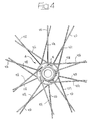
- Figure 4 shows a frontal view of the detail indicated by the arrow IV in Figure 3, and
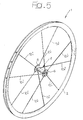
- Figure 5 shows a view in perspective illustrating an intermediate phase of the sequence for assembling the wheel according to Figure 1.
- assembly of the
radial spokes 10'r and 10"r alone and preliminary centring of the wheel (at the end of this phase the wheel assumes the configuration illustrated in Figure 5), - assembly and progressive tensioning of the
non-radial spokes 10't and 10"t, and - final tensioning and centring of the wheel.
Claims (9)
- Spoked bicycle wheel comprising a hub (4) and a rim (2) mutually connected by a plurality of spokes (10', 10"), wherein the hub (4) has a first and a second securing portion for the spokes (6, 8), mutually spaced in the direction of its longitudinal axis (12), and wherein the spokes of a first set (10') have their inner ends secured to the first securing portion (6) and the spokes of a second set (10") have their inner ends secured to the second securing portion (8),
characterized in that the first and the second set of spokes (10', 10") each comprise a plurality of radial spokes (10'r, 10"r) and a plurality of non-radial spokes (10't, 10"t). - Wheel according to Claim 1, characterized in that each radial spoke (10'r, 10"r) is associated with a respective non-radial spoke (10't, 10"t).
- Wheel according to Claim 1, characterized in that the spokes of each set are subdivided into equidistant pairs, each pair comprising a radial spoke (10'r; 10"r) and a non-radial spoke (10't, 10"t).
- Wheel according to Claim 1, characterized in that the non-radial spokes of the first set (10't) have an opposite orientation to the non-radial spokes of the second set (10"t).
- Wheel according to Claim 4, characterized in that the non-radial spokes (10't, 10"t) of each set have the same orientation.
- Wheel according to Claim 1, characterized in that the non-radial spokes of the first set (10't) are in a number equal to that of the non-radial spokes of the second set (10"t).
- Wheel according to Claim 1, characterized in that the spokes are grouped to form a set of equidistant radial members, each radial member comprising a radial spoke of the first set (10'r), a non-radial spoke of the first set (10't), a radial spoke of the second set (10"r) and a non-radial spoke of the second set (10"t).
- Wheel according to Claim 7, characterized in that the points of attack on the rim (2) of the spokes of each radial member are mutually equidistant.
- Method for the assembly of a wheel for a bicycle, characterized in that it comprises the phases of:assembling a plurality of radial spokes (10'r, 10"r) between a rim (2) and a hub (4),undertaking preliminary centring of the wheel comprising radial spokes only,assembling and tensioning a plurality of non-radial spokes (10't, 10"t) between the rim (2) and the hub (4), andundertaking final tensioning of the spokes in order to achieve final centring of the wheel.
All substantially as described and illustrated and for the purposes specified.
Applications Claiming Priority (2)
| Application Number | Priority Date | Filing Date | Title |
|---|---|---|---|
| IT2001TO000806A ITTO20010806A1 (en) | 2001-08-09 | 2001-08-09 | SPOKE WHEEL FOR BICYCLE AND PROCEDURE FOR ITS MANUFACTURE. |
| ITTO20010806 | 2001-08-09 |
Publications (2)
| Publication Number | Publication Date |
|---|---|
| EP1283112A2 true EP1283112A2 (en) | 2003-02-12 |
| EP1283112A3 EP1283112A3 (en) | 2005-01-26 |
Family
ID=11459145
Family Applications (1)
| Application Number | Title | Priority Date | Filing Date |
|---|---|---|---|
| EP02016272A Withdrawn EP1283112A3 (en) | 2001-08-09 | 2002-07-23 | Spoked wheel for a bicycle and method for its manufacture |
Country Status (4)
| Country | Link |
|---|---|
| US (2) | US6722743B2 (en) |
| EP (1) | EP1283112A3 (en) |
| IT (1) | ITTO20010806A1 (en) |
| TW (1) | TW533144B (en) |
Cited By (4)
| Publication number | Priority date | Publication date | Assignee | Title |
|---|---|---|---|---|
| WO2005075218A1 (en) * | 2004-02-10 | 2005-08-18 | Metalurgicas Do Eixo, S.A. | Bicycle wheel |
| NL1026948C2 (en) * | 2004-09-01 | 2006-07-19 | Konink Gazelle B V | Bicycle wheel, has spokes divided into groups each containing radial, forwards pointing and backwards pointing spokes |
| FR2900869A1 (en) * | 2006-05-12 | 2007-11-16 | Salomon Sa | SPOKE WHEEL |
| DE102009005687B4 (en) * | 2008-02-26 | 2019-04-11 | Shimano Inc. | Spoke rear wheel for a vehicle |
Families Citing this family (11)
| Publication number | Priority date | Publication date | Assignee | Title |
|---|---|---|---|---|
| ITTO20010806A1 (en) * | 2001-08-09 | 2003-02-09 | Campagnolo Srl | SPOKE WHEEL FOR BICYCLE AND PROCEDURE FOR ITS MANUFACTURE. |
| EP1462274A1 (en) * | 2003-03-28 | 2004-09-29 | Campagnolo S.R.L. | Spoked wheel for a bicycle |
| US20050023883A1 (en) * | 2003-08-01 | 2005-02-03 | Shimano Inc. | Bicycle rim |
| EP1629996B1 (en) | 2004-08-31 | 2008-01-09 | Campagnolo Srl | Bicycle spoked wheel, components thereof and relative manufacturing methods |
| DE602005015850D1 (en) * | 2005-08-31 | 2009-09-17 | Campagnolo Srl | Spoked wheel for bicycles, corresponding spoke connections, and corresponding method |
| US7562940B2 (en) | 2005-12-22 | 2009-07-21 | Specialized Bicycle Components, Inc. | Bicycle wheel and hub |
| US7562942B2 (en) * | 2005-12-22 | 2009-07-21 | Specialized Bicycle Components, Inc. | Bicycle wheel and release mechanism |
| US7874625B2 (en) * | 2008-09-04 | 2011-01-25 | Trek Bicycle Corporation | Bicycle wheel assembly having dissimilar lateral spoke lacings |
| US9651138B2 (en) | 2011-09-30 | 2017-05-16 | Mtd Products Inc. | Speed control assembly for a self-propelled walk-behind lawn mower |
| TWI610828B (en) | 2014-08-08 | 2018-01-11 | 巨大機械工業股份有限公司 | Bicycle wheel spokes structure and manufacturing method thereof |
| TWI622502B (en) * | 2017-01-24 | 2018-05-01 | 固德貿易有限公司 | Combination Structure Of Hub And Spokes |
Family Cites Families (14)
| Publication number | Priority date | Publication date | Assignee | Title |
|---|---|---|---|---|
| US574538A (en) * | 1897-01-05 | Wheel for vehicles | ||
| US1153919A (en) * | 1915-03-01 | 1915-09-21 | William J Buttschau | Vehicle-wheel. |
| US1653612A (en) * | 1925-09-23 | 1927-12-27 | Trinity Wheel Corp | Wire-spoke wheel |
| US1634700A (en) * | 1926-08-27 | 1927-07-05 | Thomas E Murray | Method and apparatus for making wheels |
| US1933178A (en) * | 1929-12-23 | 1933-10-31 | Kelsey Hayes Wheel Corp | Wire wheel |
| FR1569933A (en) * | 1968-04-17 | 1969-06-06 | ||
| US4090737A (en) * | 1976-10-07 | 1978-05-23 | Jensen Arthur E | Agricultural spoke wheel |
| CA2187695C (en) * | 1995-10-13 | 2005-09-06 | Rolf Dietrich | Cycle, tensioned spoked wheel assembly and hub therefor |
| US6145938A (en) * | 1996-10-11 | 2000-11-14 | Dietrich; Rolf | Cycle, tensioned spoked wheel assembly and hub therefor |
| FR2786435B1 (en) * | 1998-11-27 | 2001-02-16 | Mavic Sa | SPOKE BICYCLE REAR WHEEL |
| IT1321063B1 (en) * | 2000-11-14 | 2003-12-30 | Campagnolo Srl | BICYCLE WHEEL. |
| US6443532B1 (en) * | 2001-02-27 | 2002-09-03 | Formula Engineering Inc. | Spoked wheel assembly for a bicycle |
| ITTO20010806A1 (en) * | 2001-08-09 | 2003-02-09 | Campagnolo Srl | SPOKE WHEEL FOR BICYCLE AND PROCEDURE FOR ITS MANUFACTURE. |
| US6793294B2 (en) * | 2002-10-22 | 2004-09-21 | Giant Manufacturing Co., Ltd. | Wheel assembly with spoke-covering members |
-
2001
- 2001-08-09 IT IT2001TO000806A patent/ITTO20010806A1/en unknown
- 2001-08-28 TW TW090121125A patent/TW533144B/en not_active IP Right Cessation
-
2002
- 2002-07-23 EP EP02016272A patent/EP1283112A3/en not_active Withdrawn
- 2002-08-09 US US10/216,259 patent/US6722743B2/en not_active Expired - Fee Related
-
2003
- 2003-12-09 US US10/731,349 patent/US7144089B2/en not_active Expired - Fee Related
Cited By (7)
| Publication number | Priority date | Publication date | Assignee | Title |
|---|---|---|---|---|
| WO2005075218A1 (en) * | 2004-02-10 | 2005-08-18 | Metalurgicas Do Eixo, S.A. | Bicycle wheel |
| NL1026948C2 (en) * | 2004-09-01 | 2006-07-19 | Konink Gazelle B V | Bicycle wheel, has spokes divided into groups each containing radial, forwards pointing and backwards pointing spokes |
| FR2900869A1 (en) * | 2006-05-12 | 2007-11-16 | Salomon Sa | SPOKE WHEEL |
| WO2007135259A1 (en) * | 2006-05-12 | 2007-11-29 | Salomon S.A. | Spoke wheel |
| EP2311649A3 (en) * | 2006-05-12 | 2011-08-03 | Salomon S.A.S. | Spoke wheel |
| US8162407B2 (en) | 2006-05-12 | 2012-04-24 | Salomon S.A.S. | Spoked wheel |
| DE102009005687B4 (en) * | 2008-02-26 | 2019-04-11 | Shimano Inc. | Spoke rear wheel for a vehicle |
Also Published As
| Publication number | Publication date |
|---|---|
| US20030038530A1 (en) | 2003-02-27 |
| US20040113484A1 (en) | 2004-06-17 |
| US6722743B2 (en) | 2004-04-20 |
| ITTO20010806A1 (en) | 2003-02-09 |
| ITTO20010806A0 (en) | 2001-08-09 |
| EP1283112A3 (en) | 2005-01-26 |
| US7144089B2 (en) | 2006-12-05 |
| TW533144B (en) | 2003-05-21 |
Similar Documents
| Publication | Publication Date | Title |
|---|---|---|
| EP1283112A2 (en) | Spoked wheel for a bicycle and method for its manufacture | |
| US6425641B1 (en) | Spoked cycle wheel | |
| EP1134097A2 (en) | Bicycle hub | |
| US10093389B2 (en) | Bicycle front sprocket, bicycle crank assembly, and bicycle drive train | |
| US7874625B2 (en) | Bicycle wheel assembly having dissimilar lateral spoke lacings | |
| EP0936085A2 (en) | Rim for a spooked wheel, particularly a bicycle rear wheel | |
| JP3545738B2 (en) | Spoke and rim assemblies, bicycle rims, reinforcing members and bicycle spokes | |
| US6145938A (en) | Cycle, tensioned spoked wheel assembly and hub therefor | |
| US20080136248A1 (en) | Spoked wheel for a bicycle | |
| US6382734B1 (en) | Bicycle wheel | |
| EP1201458B1 (en) | Spoked wheel for bicycles | |
| US20170305189A1 (en) | Hub and wheel | |
| US5947565A (en) | Tensioned spoked bicycle wheel assembly and hub therefor | |
| EP1391324A2 (en) | Bearing apparatus for a bicycle hub | |
| US6244667B1 (en) | Tensioned spoked bicycle wheel assembly and hub therefor | |
| US6024414A (en) | Tensioned spoked bicycle wheel assembly and hub therefor | |
| US6491350B2 (en) | Spoked bicycle wheel | |
| JP5715341B2 (en) | Spoke wheel | |
| JPS60161201A (en) | Hollow wire spokes and their wheels | |
| JPS59192601A (en) | Wire spoke wheel | |
| JP2000264006A (en) | Wheel hub | |
| WO2004054818A1 (en) | Bicycle wheel | |
| JPS59192603A (en) | Wire spoke wheel |
Legal Events
| Date | Code | Title | Description |
|---|---|---|---|
| PUAI | Public reference made under article 153(3) epc to a published international application that has entered the european phase |
Free format text: ORIGINAL CODE: 0009012 |
|
| AK | Designated contracting states |
Designated state(s): AT BE BG CH CY CZ DE DK EE ES FI FR GB GR IE IT LI LU MC NL PT SE SK TR |
|
| AX | Request for extension of the european patent |
Extension state: AL LT LV MK RO SI |
|
| PUAL | Search report despatched |
Free format text: ORIGINAL CODE: 0009013 |
|
| AK | Designated contracting states |
Kind code of ref document: A3 Designated state(s): AT BE BG CH CY CZ DE DK EE ES FI FR GB GR IE IT LI LU MC NL PT SE SK TR |
|
| AX | Request for extension of the european patent |
Extension state: AL LT LV MK RO SI |
|
| 17P | Request for examination filed |
Effective date: 20050718 |
|
| AKX | Designation fees paid |
Designated state(s): AT BE BG CH CY CZ DE DK EE ES FI FR GB GR IE IT LI LU MC NL PT SE SK TR |
|
| RIN1 | Information on inventor provided before grant (corrected) |
Inventor name: MEGGIOLAN, MARIO |
|
| STAA | Information on the status of an ep patent application or granted ep patent |
Free format text: STATUS: THE APPLICATION IS DEEMED TO BE WITHDRAWN |
|
| 18D | Application deemed to be withdrawn |
Effective date: 20090820 |