EP1278329A2 - System zur Gewährleistung einer gesteigerten kryptografischen Sicherheit - Google Patents
System zur Gewährleistung einer gesteigerten kryptografischen Sicherheit Download PDFInfo
- Publication number
- EP1278329A2 EP1278329A2 EP02255063A EP02255063A EP1278329A2 EP 1278329 A2 EP1278329 A2 EP 1278329A2 EP 02255063 A EP02255063 A EP 02255063A EP 02255063 A EP02255063 A EP 02255063A EP 1278329 A2 EP1278329 A2 EP 1278329A2
- Authority
- EP
- European Patent Office
- Prior art keywords
- data
- input
- storage module
- output
- data storage
- Prior art date
- Legal status (The legal status is an assumption and is not a legal conclusion. Google has not performed a legal analysis and makes no representation as to the accuracy of the status listed.)
- Withdrawn
Links
- 238000000034 method Methods 0.000 claims abstract description 66
- 238000013500 data storage Methods 0.000 claims description 50
- 238000003860 storage Methods 0.000 claims description 43
- 238000012545 processing Methods 0.000 claims description 13
- 230000009466 transformation Effects 0.000 claims description 11
- 238000013507 mapping Methods 0.000 claims description 9
- 238000000844 transformation Methods 0.000 claims description 5
- 230000015572 biosynthetic process Effects 0.000 abstract description 2
- 238000012432 intermediate storage Methods 0.000 abstract description 2
- 230000008569 process Effects 0.000 description 17
- 230000001419 dependent effect Effects 0.000 description 11
- 238000012795 verification Methods 0.000 description 9
- XOJVVFBFDXDTEG-UHFFFAOYSA-N Norphytane Natural products CC(C)CCCC(C)CCCC(C)CCCC(C)C XOJVVFBFDXDTEG-UHFFFAOYSA-N 0.000 description 6
- 230000006399 behavior Effects 0.000 description 6
- 230000008859 change Effects 0.000 description 5
- 238000005516 engineering process Methods 0.000 description 4
- 238000004422 calculation algorithm Methods 0.000 description 3
- 125000004122 cyclic group Chemical group 0.000 description 3
- 238000013461 design Methods 0.000 description 3
- 230000006870 function Effects 0.000 description 3
- 230000009471 action Effects 0.000 description 2
- 238000013459 approach Methods 0.000 description 2
- 238000004590 computer program Methods 0.000 description 2
- 230000006378 damage Effects 0.000 description 2
- 238000000605 extraction Methods 0.000 description 2
- 230000003287 optical effect Effects 0.000 description 2
- 230000004044 response Effects 0.000 description 2
- 230000008901 benefit Effects 0.000 description 1
- 238000009795 derivation Methods 0.000 description 1
- 230000000694 effects Effects 0.000 description 1
- 230000006872 improvement Effects 0.000 description 1
- 230000009545 invasion Effects 0.000 description 1
- 230000002427 irreversible effect Effects 0.000 description 1
- 238000012804 iterative process Methods 0.000 description 1
- 230000007246 mechanism Effects 0.000 description 1
- 238000012986 modification Methods 0.000 description 1
- 230000004048 modification Effects 0.000 description 1
- 230000035515 penetration Effects 0.000 description 1
- 238000004321 preservation Methods 0.000 description 1
- 238000011084 recovery Methods 0.000 description 1
- 239000004065 semiconductor Substances 0.000 description 1
- 238000004088 simulation Methods 0.000 description 1
- 238000006467 substitution reaction Methods 0.000 description 1
- 230000001360 synchronised effect Effects 0.000 description 1
- 230000001131 transforming effect Effects 0.000 description 1
- 230000001960 triggered effect Effects 0.000 description 1
- 238000010200 validation analysis Methods 0.000 description 1
Images
Classifications
-
- H—ELECTRICITY
- H04—ELECTRIC COMMUNICATION TECHNIQUE
- H04L—TRANSMISSION OF DIGITAL INFORMATION, e.g. TELEGRAPHIC COMMUNICATION
- H04L9/00—Cryptographic mechanisms or cryptographic arrangements for secret or secure communications; Network security protocols
- H04L9/32—Cryptographic mechanisms or cryptographic arrangements for secret or secure communications; Network security protocols including means for verifying the identity or authority of a user of the system or for message authentication, e.g. authorization, entity authentication, data integrity or data verification, non-repudiation, key authentication or verification of credentials
- H04L9/3236—Cryptographic mechanisms or cryptographic arrangements for secret or secure communications; Network security protocols including means for verifying the identity or authority of a user of the system or for message authentication, e.g. authorization, entity authentication, data integrity or data verification, non-repudiation, key authentication or verification of credentials using cryptographic hash functions
-
- H—ELECTRICITY
- H04—ELECTRIC COMMUNICATION TECHNIQUE
- H04L—TRANSMISSION OF DIGITAL INFORMATION, e.g. TELEGRAPHIC COMMUNICATION
- H04L2209/00—Additional information or applications relating to cryptographic mechanisms or cryptographic arrangements for secret or secure communication H04L9/00
- H04L2209/60—Digital content management, e.g. content distribution
Definitions
- This invention relates to the field of cryptography and in particular relates to an input verification or user identification system.
- Cryptographic hashes are an established technology and are frequently used in systems that are designed to restrict access to authorised personnel only. Cryptographic hashes are the basis of almost all secure password verification methods.
- Secure password verification methods may be subject to attack by an unauthorised adversary wishing to gain access. Such attacks may involve a variety of different techniques, depending on the security system and the means available to the attacker. Unsophisticated attackers may use an exhaustive search of all the possible inputs to attempt to find the correct one. However, if physical access to the device can be obtained, more sophisticated attackers might use one of two strategies to overcome such security.
- the first strategy is non-invasive and primarily aims to force errors in the way the process operates.
- an attack involves permuting the inputs and the operating conditions of the system.
- Such attacks focus on either gaining information about the system by analysing its performance, or causing incorrect performance by manipulating the operating conditions of the system. All such attacks require operation of the process whilst the attack takes place, but do not necessarily require direct physical contact.
- the second class of attacks involves physical invasion of the device and possible disassembly of the components.
- the aim of such an attack is to either extract vital information from the device, or to damage or otherwise change the system. This can either provide information about the correct input to the attacker, or delude the system into erroneously producing a correct output from an absent or incorrect input. All techniques in this class of attacks involve physical contact with the device itself.
- apparatus for generating a cryptographic key from an input by a user comprising:
- apparatus for controlling access to secure data by verifying an input by a user comprising:
- apparatus for controlling access to secure data by generating an output from an input by a user comprising:
- the addressing schedule is adapted to determine a set of initial read addresses of a data storage module from which data are read, and is further adapted to write data to a set of write addresses of the data storage module, where the write addresses are distinct from the initial read addresses.
- the addressing schedule may be adapted to determine the set of initial read addresses by performing hash-based transformations of the input.
- the addressing schedule may be adapted to determine the set of initial read addresses by a precalculated mapping using the input as a starting point.
- a method for generating a cryptographic key from an input by a user comprising the steps of:
- a fifth aspect of the invention there is provided a method for controlling access to secure data by verifying an input by a user, the method comprising the steps of:
- a sixth aspect of the invention there is provided a method for controlling access to secure data by generating an output from an input by a user, the method comprising the steps of:
- the method may comprise the additional step of using the input to determine a set of initial read addresses of a data storage module, and at Step E, data is written to a set of write addresses of the data storage module, where the write addresses are distinct from the initial read addresses.
- the step of determining the set of initial read addresses may be carried out by performing hash-based transformations of the input.
- the step of determining the set of initial read addresses may be carried out by a precalculated mapping using the input as a starting point.
- the set of values may be generated by substituting values from the input with data read from the storage module.
- the data written to the data storage module is derived from the hashed data.
- the method may comprise the further steps of:
- Steps (i) to (iii) may be repeated.
- the method is implemented by computer software comprising program instructions which, when loaded onto a computer, cause said computer to carry out the method.
- This invention relates to a system that generates an output from an input by a cryptographic hash-based method.
- the method generates the output by reading from and writing to an intermediate storage medium, in accordance with an addressing schedule.
- the output can subsequently be validated, or can be used in the formation of an encryption/decryption key.
- the system utilises a storage device capable of retaining information.
- This storage device contains values that are read and/or overwritten.
- the final output of the system is derived from these stored values, along with input data.
- the input is mapped to the output by first combining with data from the storage medium and utilising standard cryptographic hashes.
- the design of the system is such that if the reading from the storage medium is chosen to be input dependent, then the additional data used in mapping the input to the output will also be input dependent. In addition, if the writing to the storage medium is input dependent, then the data that is stored in the storage medium is also input dependent. Thus, if both the reading from and writing to the storage medium are input dependent, then the system may operate such that information critical to the performance of the system is guaranteed to be destroyed if the system is provided with an incorrect input. Such behaviour will be referred to as 'data volatility' or being 'volatile'.
- the manner in which the data is read from or written to a storage medium specifies where data is read from or written to in the storage medium.
- this schedule specifies what kind of hash to apply and to which data.
- a transformation typically non-trivial to invert.
- such a transformation is a unique one-to-one mapping, for cryptographic purposes it is sufficient that the transformation possesses pre-image and second pre-image resistance and it is infeasible to compute collisions.
- Examples of such hashes include MD5, SHA-1, and any encryption where the key is withheld.
- the key is required for the encryption and decryption of the data; otherwise, the data is irrecoverable unless the cryptographic process used to secure it is broken.
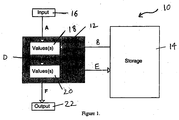
- FIG. 1 illustrates, in schematic form, the system in accordance with an embodiment of present invention.
- the present invention generates a unique output from an input, where the functionality of the system is dependent upon the state of the storage medium.
- the only plausible attack against this system involves the extraction of all the information from this storage medium without the operation of the system. If successful, this would then permit an exhaustive input search to be conducted, typically on a simulation of the system.
- Figure 1 shows the system 10 including a processing module 12 and a data storage module 14.
- a processing module 12 and a data storage module 14.
- An example of a method that could achieve data volatility follows. However, this is a description of the basic system; it is not the only application of this method.
- Step A input 16 is received into the processing module 12.
- the processing module reads data from the data storage module 14.
- An addressing schedule running on the processing module determines from which addresses within the data storage module 14 the data is read.
- the addressing schedule may be predetermined, or may be calculated from the input, as described later.
- the processing module 12 generates a data set based on both the input and the data read from the storage module. This may involve the substitution of some of the input data with the read data. As an alternative, the input data and the read data may be combined. This data set is shown at 18.
- the data set 18 is hashed, to form hashed data 20.
- the processing module includes a cryptographic schedule, part of whose function is to determine the manner in which the data is hashed.
- the cryptographically hashed data is a unique result and depends on both the input and the read data. This hashed data is later used to generate an output 22, which may be used to form a cryptographic key (Step F).
- Step E data is written to the data storage module, thereby changing its data content.
- the manner in which data is written is controlled by the addressing schedule, which includes a number of rules for reading, writing, and dealing with collisions.
- the data written to the storage module could conveniently be derived from the hashed data 20, although this is not essential.
- Step E the output generated from the hashed data is dependent on the content of the data storage module. It follows therefore, that the writing of data to the storage module at Step E could affect subsequent operation of the system. Specifically, if Step E overwrites data that is read during a subsequently carried out Step B, a different set of data 18 would be generated, and thus a different hashed data set 20. This provides an opportunity to prevent the system from generating a correct output the next time it is executed, irrespective of the input. Depending on the cryptographic hashes used, the output can be generated with high probability, or certainty that it is incorrect.
- the task of accurately obtaining the values held in the storage medium without operation of the device is realistically the only approach available to an attacker, and is susceptible to the same failure rate as all other physically invasive techniques.
- addressing schedules and cryptographic schedules referred to here may either be calculated from the input, for example by applying hash-based transformations to the input data and deriving addresses therefrom. Alternatively, they may be precalculated mappings that utilise the input data as a starting point for the mapping. In both cases, the results obtained will be relative to the input data. Furthermore, additional hashing steps could be used to further complicate the process.
- the addressing schedule is input dependent.
- the addresses of the data storage module from which data is read depend on the input data. That is, the processing module calculates a number of addresses to read from by a suitable transformation of the input data. Data is read from those selected addresses, and is combined with the input data (as described above in Step C) to generate data set 18. For the correct input, the same addresses are always read from. If the data held within those addresses has not been altered, the data set will always be the same.
- Step D hashes the data set 18 to generate hashed data 20, from which an output is derived.
- Step E the addressing schedule ensures that data is overwritten, but not at those addresses which have been used in determining the output of the system.
- This system is ideally suited for data security where the physical safety of the device holding the information can not be assured.
- the device envisioned by the inventor is one that works in parallel with standard encryption and decryption methods to secure the information.
- the secured information is decrypted upon provision of the correct key, which is usually derived from information held by the user.
- the actual key used for the encryption and/or decryption should be at least partially derived from the output of a volatile subsystem as described in this disclosure.
- the provision of the correct input to the volatile subsystem is the only method by which the information could be accessed, and moreover the provision of an incorrect input changes the operation of the volatile system such that correct operation may not be restored without restoration of the volatile subsystem.
- Security of the data then rests entirely on the ability of an attacker to access the information used by the volatile subsystem.
- the following embodiment described is specifically designed for use in security applications.
- the following preferred embodiment described herein relates to the necessary considerations required to implement a polystable system on an MCS-51 architecture.
- the MCS-51 is a common 8-bit architecture used in several security processors, such as the Dallas 5002.
- the implementation of secure hashing algorithms using an 8-bit processor would be known to one skilled in the art, and the description assumes the possession of suitable functions capable of implementing a full hash algorithm and managing the memory.
- code compatibility and memory considerations we recommend the use of an 80C52 series processor but any will suffice if it has enough RAM to implement the basic functions and access to a small amount (e.g. 2048 words) of storage.
- the inventors implemented the system on an Atmel AT89S8252.
- the output storage contains data that represents a "running total" of the iterations carried out.
- the output storage contains the final output of the system.
- the output storage is subsequently zeroised, to complicate the steps necessary for a successful invasive attack.
- Step 7 need not be an exclusive OR operation, but could be any operation that combines the recently hashed data with the present content of the output storage.
- the result of performing this method on an input is to produce an output which is a cryptographic derivation of the input and the initially read values.
- the entirety of the storage with the exception of the initially read values has been overwritten twice.
- the addresses of the initially read values are input dependent, thus the probability of an incorrect password not overwriting at least one of the correct initial values is 16!/2048 16 .
- Overwriting a correct initially read value will result in data change (volatility) with a 255/256 chance. An attacker would thus be wise to not attempt to operate the method at all. Glitching the operation of the processor in an attempt to prevent data loss will result in an improper output generation since the correct output is extremely likely to incorporate elements of the storage that are ephemeral and generated from the input on the fly.
- the system is likely to alter an initial value during its operation. This will result in a different behaviour the next time it is operated, even for the correct input. Similarly if the initially read value is protected from uncontrolled writes but is altered in a known manner each time the system is operated (e.g. incremented modulo 256), the behaviour will change (in this example it would be cyclic with a period of 256).
- Incrementation over the whole of the initially read values is also possible, in which case the system would be cyclic with the period of the initially read values, which in this example is 2 128 .
- Variations may also adopt different hashing and addressing schemes without detracting from the security of the system.
- the device By precalculating a relative addressing scheme suitable for a specific input, the device can be engineered to be stable only with that input and that storage state. Operation of the system with an incorrect input will alter the storage state and render the device unstable, it is extremely unlikely that the device will stabilise again, and it is even less likely that the correct output will ever be recovered.
- Such a system that is stable but once, is termed monostable.
- the present invention has a variety of applications, some of which are listed below.
- Hard Disk Drive/memory encryption e.g. secure computers, e-cash cards, etc.
- IFF Identify Friend or Foe
- IR remote locking/access e.g. IR remote locking/access
- transaction verification on biometric/secret inputs and pay per view TV cards.
- Applications also exist in the identification of mobile phone handsets.
- the present invention precludes non-invasive attacks, such as an exhaustive input search.
- the success of an exhaustive search would require success in physical extraction of large amounts of information from the system without the running of the system. This task of extracting the information can be made extremely difficult by use of physical security methods. It is in this manner that the best possible success rate of a physical attack can be made extremely low.
- the overall success rate of an attack against this system is a product of the success rate of the physical penetration to retrieve the data and the subsequent exhaustive input search necessary to derive the correct functionality of the process. If the input is of sufficient complexity then this class of approach is also intractable. Given a sufficiently complex input, the system can be proven to be susceptible to neither of these classes of attack, and as currently there are no other zero information attacks, this system is provably secure.
- Embodiments of the invention are not susceptible to such attack since the normal operation of the process requires the overwriting of information.
- An attacker cannot distinguish between overwriting as part of a valid operation of the system, and that executed when the input is invalid, since there is no fundamental difference.
- An adversary therefore has no knowledge of when information is about to be overwritten outside of the normal operation of the process. Since the system is designed to require the overwriting of information as part of its normal operation, an attacker who can not access the internal information of the system has no better chance of success than a single attempt at guessing the input.
- the application of the present invention forces the attacker to perform recovery of the complete memory space before attempting to break the system. This typically involves physical intervention, is time consuming and error prone, and only gains the attacker the ability to brute force the input space. Use of more than one device further complicates the attack. It is not possible to construct a more secure system without using a trusted third party (which is itself then a target for attack).
- the embodiments of the invention described with reference to the drawings comprise computer apparatus and processes performed in computer apparatus, the invention also extends to computer programs, particularly computer programs on or in a carrier, adapted for putting the invention into practice.
- the program may be in the form of source code, object code, a code of intermediate source and object code such as in partially compiled form suitable for use in the implementation of the processes according to the invention.
- the carrier may be any entity or device capable of carrying the program.
- the carrier may comprise a storage medium, such as ROM, for example a CD ROM or a semiconductor ROM, or a magnetic recording medium, for example, floppy disc or hard disc.
- the carrier may be a transmissible carrier such as an electrical or optical signal which may be conveyed via electrical or optical cable or by radio or other means.
- the carrier may be constituted by such cable or other device or means.
- the carrier may be an integrated circuit in which the program is embedded, the integrated circuit being adapted for performing, or for use in the performance of, the relevant processes.
Landscapes
- Engineering & Computer Science (AREA)
- Computer Security & Cryptography (AREA)
- Computer Networks & Wireless Communication (AREA)
- Signal Processing (AREA)
- Storage Device Security (AREA)
Applications Claiming Priority (2)
| Application Number | Priority Date | Filing Date | Title |
|---|---|---|---|
| GBGB0117628.8A GB0117628D0 (en) | 2001-07-19 | 2001-07-19 | A security system |
| GB0117628 | 2001-07-19 |
Publications (2)
| Publication Number | Publication Date |
|---|---|
| EP1278329A2 true EP1278329A2 (de) | 2003-01-22 |
| EP1278329A3 EP1278329A3 (de) | 2003-01-29 |
Family
ID=9918814
Family Applications (1)
| Application Number | Title | Priority Date | Filing Date |
|---|---|---|---|
| EP02255063A Withdrawn EP1278329A3 (de) | 2001-07-19 | 2002-07-19 | System zur Gewährleistung einer gesteigerten kryptografischen Sicherheit |
Country Status (3)
| Country | Link |
|---|---|
| US (1) | US20030028783A1 (de) |
| EP (1) | EP1278329A3 (de) |
| GB (1) | GB0117628D0 (de) |
Cited By (1)
| Publication number | Priority date | Publication date | Assignee | Title |
|---|---|---|---|---|
| WO2013185326A1 (en) * | 2012-06-14 | 2013-12-19 | Google Inc. | Verifying user identity |
Families Citing this family (14)
| Publication number | Priority date | Publication date | Assignee | Title |
|---|---|---|---|---|
| US9252955B2 (en) * | 2000-08-18 | 2016-02-02 | United States Postal Service | Apparatus and methods for the secure transfer of electronic data |
| US7302582B2 (en) * | 2000-08-21 | 2007-11-27 | United States Postal Service | Delivery point validation system |
| US7664731B2 (en) * | 2002-03-21 | 2010-02-16 | United States Postal Service | Method and system for storing and retrieving data using hash-accessed multiple data stores |
| US7587408B2 (en) * | 2002-03-21 | 2009-09-08 | United States Postal Service | Method and system for storing and retrieving data using hash-accessed multiple data stores |
| US7159119B2 (en) * | 2002-09-06 | 2007-01-02 | United States Postal Service | Method and system for efficiently retrieving secured data by securely pre-processing provided access information |
| US7526555B2 (en) * | 2003-03-25 | 2009-04-28 | Toshiba Corporation | Smart card printing |
| US8332910B2 (en) * | 2003-10-13 | 2012-12-11 | General Electric Company | Method and apparatus for selective data control |
| US7801925B2 (en) * | 2004-12-22 | 2010-09-21 | United States Postal Service | System and method for electronically processing address information |
| US8165909B2 (en) | 2005-05-17 | 2012-04-24 | The United States Postal Service | System and method for automated management of an address database |
| US20090196301A1 (en) * | 2007-05-14 | 2009-08-06 | Brian Parsons | Methods, systems and apparatus for monitoring and/or generating communications in a communications network |
| WO2009048599A1 (en) * | 2007-10-09 | 2009-04-16 | The Trustees Of Columbia University In The City Of New York | Friend or foe detection |
| US8145598B2 (en) * | 2009-02-23 | 2012-03-27 | Iron Mountain Incorporated | Methods and systems for single instance storage of asset parts |
| US8090683B2 (en) * | 2009-02-23 | 2012-01-03 | Iron Mountain Incorporated | Managing workflow communication in a distributed storage system |
| US8397051B2 (en) * | 2009-02-23 | 2013-03-12 | Autonomy, Inc. | Hybrid hash tables |
Family Cites Families (2)
| Publication number | Priority date | Publication date | Assignee | Title |
|---|---|---|---|---|
| US5742807A (en) * | 1995-05-31 | 1998-04-21 | Xerox Corporation | Indexing system using one-way hash for document service |
| EP0993143A1 (de) * | 1998-10-07 | 2000-04-12 | Lateca Computer Inc. N.V. | Verarbeitungsverfahren und Vorrichtung zur Informationsumwandlung von einem ersten Format in ein zweites Format |
-
2001
- 2001-07-19 GB GBGB0117628.8A patent/GB0117628D0/en not_active Ceased
-
2002
- 2002-07-19 EP EP02255063A patent/EP1278329A3/de not_active Withdrawn
- 2002-07-19 US US10/199,557 patent/US20030028783A1/en not_active Abandoned
Cited By (1)
| Publication number | Priority date | Publication date | Assignee | Title |
|---|---|---|---|---|
| WO2013185326A1 (en) * | 2012-06-14 | 2013-12-19 | Google Inc. | Verifying user identity |
Also Published As
| Publication number | Publication date |
|---|---|
| US20030028783A1 (en) | 2003-02-06 |
| GB0117628D0 (en) | 2001-09-12 |
| EP1278329A3 (de) | 2003-01-29 |
Similar Documents
| Publication | Publication Date | Title |
|---|---|---|
| US7131036B2 (en) | Method of detecting malicious code | |
| US20060005046A1 (en) | Secure firmware update procedure for programmable security devices | |
| US7779478B2 (en) | System and method for distributed module authentication | |
| EP1855281B1 (de) | Vorrichtung zum Schreiben von Daten auf ein Medium | |
| EP1278329A2 (de) | System zur Gewährleistung einer gesteigerten kryptografischen Sicherheit | |
| US20050283662A1 (en) | Secure data backup and recovery | |
| US20110307699A1 (en) | Token for securing communication | |
| AU2001266228A1 (en) | Method of detecting malicious code | |
| US9154295B2 (en) | Method of generating a correspondence table for a cryptographic white box | |
| WO2009156302A1 (en) | Electronic device and method of software or firmware updating of an electronic device | |
| WO2010134192A1 (ja) | 電子機器及び鍵生成プログラム及び記録媒体及び鍵生成方法 | |
| US6831982B1 (en) | Encryption key management system using multiple smart cards | |
| CN101491001A (zh) | 数字数据处理单元的防篡改 | |
| US9940462B2 (en) | Code validation | |
| US7835521B1 (en) | Secure keyboard | |
| US20080016127A1 (en) | Utilizing software for backing up and recovering data | |
| US6336189B1 (en) | Apparatus and method for data capsule generation | |
| Banescu et al. | Software-based protection against changeware | |
| US20170004300A1 (en) | Hardware protection for encrypted strings and protection of security parameters | |
| JP2009080772A (ja) | ソフトウェア起動システム、ソフトウェア起動方法、及びソフトウェア起動プログラム | |
| US7779269B2 (en) | Technique for preventing illegal invocation of software programs | |
| CN120874061A (zh) | 一种服务器启动控制方法及电子设备 | |
| US10318766B2 (en) | Method for the secured recording of data, corresponding device and program | |
| US20080120481A1 (en) | Methods For Protection Of Data Integrity Of Updatable Data Against Unauthorized Modification | |
| CN120030563A (zh) | 一种分布式账本加密方法及系统 |
Legal Events
| Date | Code | Title | Description |
|---|---|---|---|
| PUAI | Public reference made under article 153(3) epc to a published international application that has entered the european phase |
Free format text: ORIGINAL CODE: 0009012 |
|
| PUAL | Search report despatched |
Free format text: ORIGINAL CODE: 0009013 |
|
| AK | Designated contracting states |
Kind code of ref document: A2 Designated state(s): AT BE BG CH CY CZ DE DK EE ES FI FR GB GR IE IT LI LU MC NL PT SE SK TR |
|
| AX | Request for extension of the european patent |
Free format text: AL;LT;LV;MK;RO;SI |
|
| AK | Designated contracting states |
Designated state(s): AT BE BG CH CY CZ DE DK EE ES FI FR GB GR IE IT LI LU MC NL PT SE SK TR |
|
| AX | Request for extension of the european patent |
Extension state: AL LT LV MK RO SI |
|
| 17P | Request for examination filed |
Effective date: 20030728 |
|
| AKX | Designation fees paid |
Designated state(s): AT BE BG CH CY CZ DE DK EE ES FI FR GB GR IE IT LI LU MC NL PT SE SK TR |
|
| 17Q | First examination report despatched |
Effective date: 20040507 |
|
| 17Q | First examination report despatched |
Effective date: 20040507 |
|
| GRAP | Despatch of communication of intention to grant a patent |
Free format text: ORIGINAL CODE: EPIDOSNIGR1 |
|
| STAA | Information on the status of an ep patent application or granted ep patent |
Free format text: STATUS: THE APPLICATION IS DEEMED TO BE WITHDRAWN |
|
| 18D | Application deemed to be withdrawn |
Effective date: 20110201 |