EP1277876A2 - Verwendung spezieller Härter in 2-Komponenten PU-Systemen zum Beschichten flexibler Substrate - Google Patents
Verwendung spezieller Härter in 2-Komponenten PU-Systemen zum Beschichten flexibler Substrate Download PDFInfo
- Publication number
- EP1277876A2 EP1277876A2 EP02014923A EP02014923A EP1277876A2 EP 1277876 A2 EP1277876 A2 EP 1277876A2 EP 02014923 A EP02014923 A EP 02014923A EP 02014923 A EP02014923 A EP 02014923A EP 1277876 A2 EP1277876 A2 EP 1277876A2
- Authority
- EP
- European Patent Office
- Prior art keywords
- nco
- hardener
- binder
- component
- use according
- Prior art date
- Legal status (The legal status is an assumption and is not a legal conclusion. Google has not performed a legal analysis and makes no representation as to the accuracy of the status listed.)
- Withdrawn
Links
Classifications
-
- D—TEXTILES; PAPER
- D06—TREATMENT OF TEXTILES OR THE LIKE; LAUNDERING; FLEXIBLE MATERIALS NOT OTHERWISE PROVIDED FOR
- D06M—TREATMENT, NOT PROVIDED FOR ELSEWHERE IN CLASS D06, OF FIBRES, THREADS, YARNS, FABRICS, FEATHERS OR FIBROUS GOODS MADE FROM SUCH MATERIALS
- D06M15/00—Treating fibres, threads, yarns, fabrics, or fibrous goods made from such materials, with macromolecular compounds; Such treatment combined with mechanical treatment
- D06M15/19—Treating fibres, threads, yarns, fabrics, or fibrous goods made from such materials, with macromolecular compounds; Such treatment combined with mechanical treatment with synthetic macromolecular compounds
- D06M15/37—Macromolecular compounds obtained otherwise than by reactions only involving carbon-to-carbon unsaturated bonds
- D06M15/564—Polyureas, polyurethanes or other polymers having ureide or urethane links; Precondensation products forming them
-
- C—CHEMISTRY; METALLURGY
- C08—ORGANIC MACROMOLECULAR COMPOUNDS; THEIR PREPARATION OR CHEMICAL WORKING-UP; COMPOSITIONS BASED THEREON
- C08G—MACROMOLECULAR COMPOUNDS OBTAINED OTHERWISE THAN BY REACTIONS ONLY INVOLVING UNSATURATED CARBON-TO-CARBON BONDS
- C08G18/00—Polymeric products of isocyanates or isothiocyanates
- C08G18/06—Polymeric products of isocyanates or isothiocyanates with compounds having active hydrogen
- C08G18/08—Processes
- C08G18/10—Prepolymer processes involving reaction of isocyanates or isothiocyanates with compounds having active hydrogen in a first reaction step
-
- C—CHEMISTRY; METALLURGY
- C08—ORGANIC MACROMOLECULAR COMPOUNDS; THEIR PREPARATION OR CHEMICAL WORKING-UP; COMPOSITIONS BASED THEREON
- C08G—MACROMOLECULAR COMPOUNDS OBTAINED OTHERWISE THAN BY REACTIONS ONLY INVOLVING UNSATURATED CARBON-TO-CARBON BONDS
- C08G18/00—Polymeric products of isocyanates or isothiocyanates
- C08G18/06—Polymeric products of isocyanates or isothiocyanates with compounds having active hydrogen
- C08G18/08—Processes
- C08G18/10—Prepolymer processes involving reaction of isocyanates or isothiocyanates with compounds having active hydrogen in a first reaction step
- C08G18/12—Prepolymer processes involving reaction of isocyanates or isothiocyanates with compounds having active hydrogen in a first reaction step using two or more compounds having active hydrogen in the first polymerisation step
-
- C—CHEMISTRY; METALLURGY
- C08—ORGANIC MACROMOLECULAR COMPOUNDS; THEIR PREPARATION OR CHEMICAL WORKING-UP; COMPOSITIONS BASED THEREON
- C08G—MACROMOLECULAR COMPOUNDS OBTAINED OTHERWISE THAN BY REACTIONS ONLY INVOLVING UNSATURATED CARBON-TO-CARBON BONDS
- C08G18/00—Polymeric products of isocyanates or isothiocyanates
- C08G18/06—Polymeric products of isocyanates or isothiocyanates with compounds having active hydrogen
- C08G18/28—Polymeric products of isocyanates or isothiocyanates with compounds having active hydrogen characterised by the compounds used containing active hydrogen
- C08G18/40—High-molecular-weight compounds
- C08G18/4009—Two or more macromolecular compounds not provided for in one single group of groups C08G18/42 - C08G18/64
- C08G18/4018—Mixtures of compounds of group C08G18/42 with compounds of group C08G18/48
-
- C—CHEMISTRY; METALLURGY
- C08—ORGANIC MACROMOLECULAR COMPOUNDS; THEIR PREPARATION OR CHEMICAL WORKING-UP; COMPOSITIONS BASED THEREON
- C08G—MACROMOLECULAR COMPOUNDS OBTAINED OTHERWISE THAN BY REACTIONS ONLY INVOLVING UNSATURATED CARBON-TO-CARBON BONDS
- C08G18/00—Polymeric products of isocyanates or isothiocyanates
- C08G18/06—Polymeric products of isocyanates or isothiocyanates with compounds having active hydrogen
- C08G18/70—Polymeric products of isocyanates or isothiocyanates with compounds having active hydrogen characterised by the isocyanates or isothiocyanates used
- C08G18/72—Polyisocyanates or polyisothiocyanates
- C08G18/77—Polyisocyanates or polyisothiocyanates having heteroatoms in addition to the isocyanate or isothiocyanate nitrogen and oxygen or sulfur
- C08G18/78—Nitrogen
- C08G18/79—Nitrogen characterised by the polyisocyanates used, these having groups formed by oligomerisation of isocyanates or isothiocyanates
- C08G18/791—Nitrogen characterised by the polyisocyanates used, these having groups formed by oligomerisation of isocyanates or isothiocyanates containing isocyanurate groups
- C08G18/795—Nitrogen characterised by the polyisocyanates used, these having groups formed by oligomerisation of isocyanates or isothiocyanates containing isocyanurate groups formed by oligomerisation of mixtures of aliphatic and/or cycloaliphatic isocyanates or isothiocyanates with aromatic isocyanates or isothiocyanates
-
- C—CHEMISTRY; METALLURGY
- C09—DYES; PAINTS; POLISHES; NATURAL RESINS; ADHESIVES; COMPOSITIONS NOT OTHERWISE PROVIDED FOR; APPLICATIONS OF MATERIALS NOT OTHERWISE PROVIDED FOR
- C09D—COATING COMPOSITIONS, e.g. PAINTS, VARNISHES OR LACQUERS; FILLING PASTES; CHEMICAL PAINT OR INK REMOVERS; INKS; CORRECTING FLUIDS; WOODSTAINS; PASTES OR SOLIDS FOR COLOURING OR PRINTING; USE OF MATERIALS THEREFOR
- C09D175/00—Coating compositions based on polyureas or polyurethanes; Coating compositions based on derivatives of such polymers
- C09D175/04—Polyurethanes
-
- C—CHEMISTRY; METALLURGY
- C14—SKINS; HIDES; PELTS; LEATHER
- C14C—CHEMICAL TREATMENT OF HIDES, SKINS OR LEATHER, e.g. TANNING, IMPREGNATING, FINISHING; APPARATUS THEREFOR; COMPOSITIONS FOR TANNING
- C14C11/00—Surface finishing of leather
- C14C11/003—Surface finishing of leather using macromolecular compounds
- C14C11/006—Surface finishing of leather using macromolecular compounds using polymeric products of isocyanates (or isothiocyanates) with compounds having active hydrogen
-
- D—TEXTILES; PAPER
- D06—TREATMENT OF TEXTILES OR THE LIKE; LAUNDERING; FLEXIBLE MATERIALS NOT OTHERWISE PROVIDED FOR
- D06M—TREATMENT, NOT PROVIDED FOR ELSEWHERE IN CLASS D06, OF FIBRES, THREADS, YARNS, FABRICS, FEATHERS OR FIBROUS GOODS MADE FROM SUCH MATERIALS
- D06M13/00—Treating fibres, threads, yarns, fabrics or fibrous goods made from such materials, with non-macromolecular organic compounds; Such treatment combined with mechanical treatment
- D06M13/10—Treating fibres, threads, yarns, fabrics or fibrous goods made from such materials, with non-macromolecular organic compounds; Such treatment combined with mechanical treatment with compounds containing oxygen
- D06M13/224—Esters of carboxylic acids; Esters of carbonic acid
-
- D—TEXTILES; PAPER
- D06—TREATMENT OF TEXTILES OR THE LIKE; LAUNDERING; FLEXIBLE MATERIALS NOT OTHERWISE PROVIDED FOR
- D06M—TREATMENT, NOT PROVIDED FOR ELSEWHERE IN CLASS D06, OF FIBRES, THREADS, YARNS, FABRICS, FEATHERS OR FIBROUS GOODS MADE FROM SUCH MATERIALS
- D06M2200/00—Functionality of the treatment composition and/or properties imparted to the textile material
- D06M2200/20—Treatment influencing the crease behaviour, the wrinkle resistance, the crease recovery or the ironing ease
Definitions
- the invention relates to the use of special hardeners in 2-component PU systems for coating flexible substrates such as leather and textile for manufacturing of coatings with good dynamic resilience.
- the reactive coating of substrates with polyurethanes is known per se. you applied the binder (polyisocyanate) and a hardener (polyamine), if necessary are dissolved in a suitable solvent, preferably by means of a Spray gun, on the substrate.
- EP-A 403 921 describes a process for the production of coatings, which is based on a polyisocyanate component and aspartic acid esters as hardeners.
- This publication mainly describes highly crosslinked coatings for inflexible substrates such as sheet steel, plastic, wood and glass and go to the request after high dynamic resilience of the coatings, as for flexible substrates is required, not one.
- the invention relates to the use of a hardener component containing Aspartic acid esters of formula I in a 2K PU system for coating flexible substrates, in particular leather or textile, particularly preferably leather.
- the use according to the invention is thereby in a preferred embodiment characterized in that the poly-NCO-functional binder A) NCO content of 2 to 8%, a number-average molecular weight from 700 to 8,000 g / mol and has an NCO functionality from 2.0 to 3.0, and the amine hardener B) contains an aspartic acid ester of the general formula I, wherein the val ratio of NCO binder A) to amine component B) 1: 1 to 1.33: 1.
- the coating is particularly preferably carried out by application of the two components A and B by means of a spray system, the mixture of the two components done in the spray head.
- the poly-NCO-functional binders of component A) are preferably aromatic or aliphatic prepolymers based on polyethers, polyesters or Polycarbonates with an NCO content between 2 and 8% are suitable.
- the NCO functionality is preferably 2.0 to 3.0, in particular 2.2 to 2.5.
- NCO prepolymers A) can be reacted with organic polyisocyanates a) are prepared with NCO-reactive compounds b), being organic Polyisocyanates a) for example aromatic or aliphatic polyisocyanates be considered.
- IPDI 1-Isocyanato-3,3,5-trimethyl-5-isocyanatomethylcyclohexane
- 4,4'-diisocyanatodicyclohexylmethane 4,4'-diisocyanatodicyclohexylmethane
- hexamethylene diisocyanate the isomeric tolylene diisocyanates and diphenylmethane diisocyanates and their Isomer.
- Aromatic diisocyanates are particularly preferably used.
- polyisocyanates such as those obtained from diisocyanates aliphatic and aromatic series by biuretization, allophanatization, Trimerization, dimerization, but also by short chain urethanization Polyols with an OH functionality> 2 can be obtained. Accordingly, the Polyisocyanates e) in addition to the NCO groups, also biuret, allophanate, iminooxadiazinedione, Have isocyanurate, uretdione and urethane structural elements. The polyisocyanates are largely in "coating resins, chemistry, properties and applications", Ed. D. Stoye, W. Freitag, Hanser Verlag, Kunststoff, Vienna 1996.
- the polyisocyanates can also be used as mixtures.
- the polyisocyanates can be used in the prepolymerization as well be added afterwards.
- Urethane polyisocyanates of aromatic are preferred here Series and mixed trimer based on tolylene diisocyanate / hexamethylene diisocyanate used; in products of the aliphatic series are allophanates, Biurets, trimer and mixtures of trimer with uretdione based Hexamethylene diisocyanate is particularly preferred.
- Preferred NCO-reactive compounds b) are especially polyols.
- polyols can higher molecular weight and in a minor amount also low molecular weight hydroxyl compounds be used.
- Higher molecular hydroxyl compounds include those in polyurethane chemistry usual hydroxypolyesters, hydroxypolylactones, hydroxypolyethers, hydroxypolythioethers, Hydroxypolyacetals, hydroxypolycarbonates, dimer fatty alcohols and / or Esteramides, each with average molecular weights of 400 to 8,000, are preferred those with average molecular weights of 500 to 6,500 g / mol.
- polyols customary in polyurethane chemistry with molecular weights of 62 to 399 g / mol, such as ethylene glycol, triethylene glycol, tetraethylene glycol, 1,2-and 1,3-propanediol, 1,4-butanediol and -1, 3, 1,6-hexanediol, 1,8-octanediol, neopentyl glycol, 1,4-bis (hydroxymethyl) cyclohexane, bis (hydroxymethyl) tricyclo [5.2.1.0 2.6 ] decane or 1,4-bis (2-hydroxyethoxy) - benzene, 2-methyl-1,3-propanediol, 2,2,4-trimethylpentanediol, 2-ethyl-1,3-hexanediol, dipropylene glycol, polypropylene glycols, dibutylene glycol, polybutylene glycol, polybutylene
- Suitable polyether polyols are the polyethers customary in polyurethane chemistry, such as. that using divalent to hexavalent starter molecules such as water or the above-mentioned polyols or having 1 to 4 NH bonds Amines prepared addition or mixed addition compounds of Tetrahydrofuran, styrene oxide, ethylene oxide, propylene oxide, butylene oxide or epichlorohydrin, in particular ethylene oxide and / or propylene oxide.
- Suitable polyester polyols are e.g. Implementation products of multivalent, preferably dihydric and optionally additionally trihydric alcohols with polybasic, preferably dibasic carboxylic acids.
- Polycarboxylic acids can also be the corresponding polycarboxylic anhydrides or corresponding polycarboxylic acid esters of lower alcohols or mixtures thereof used to manufacture the polyester.
- the polycarboxylic acids can be aliphatic, cycloaliphatic, aromatic and / or heterocyclic in nature and optionally e.g. be substituted by halogen atoms and / or unsaturated. Examples for this are:
- Adipic acid phthalic acid, isophthalic acid, succinic acid, suberic acid, azelaic acid, Sebacic acid, trimellitic acid, phthalic anhydride, tetrahydrophthalic anhydride, Glutaric anhydride, tetrachlorophthalic anhydride, endomethylene tetrahydrophthalic anhydride, Maleic anhydride, maleic acid, fumaric acid, dimers and trimeric fatty acids such as oleic acid, optionally in a mixture with monomeric fatty acids, Dimethyl terephthalate, bis-glycol terephthalate.
- the polyols mentioned above are suitable as polyhydric alcohols.
- the polycarbonate polyols in question can be obtained by reacting carbonic acid derivatives, for example diphenyl carbonate or phosgene, with diols.
- diols are ethylene glycol, triethylene glycol, tetraethylene glycol, 1,2-and 1,3-propanediol, 1,4-and 1,3-butanediol, 1,5-pentanediol, 1,6-hexanediol, 1-octanediol , 8, neopentyl glycol, 1,4-bis (hydroxymethyl) cyclohexane, bis (hydroxymethyl) tricyclo [5.2.1.0 2.6 ] decane or 1,4-bis (2-hydroxyethoxy) benzene, 2-methyl-1,3-propanediol , 2,2,4-trimethylpentanediol, dipropylene glycol, polypropylene glycols, dibutylene glycol, polybutylene glycols
- the diol component preferably contains 40 to 100% by weight of hexanediol, preferably 1,6-hexanediol, and / or hexanediol derivatives, preferably those which, in addition to terminal OH groups, have ether or ester groups, for example products which are obtained by reacting 1 Mol of hexanediol with at least 1 mole, preferably 1 to 2 moles of caprolactone according to DE-AS 1 770 245, or by etherification of hexanediol with itself to the di- or trihexylene glycol.
- the preparation of such derivatives is known, for example, from DE-A 1 570 540.
- the polyether polycarbonate diols described in DE-A 3 717 060 can also be used.
- the hydroxypolycarbonates are preferably essentially linear. You can but also if necessary by installing polyfunctional components, in particular low molecular weight polyols, are easily branched. For example, are suitable for this Trimethylolpropane, hexanetriol-1,2,6, glycerol, butanetriol-1,2,4, pentaerythritol, Quinite, mannitol, sorbitol, methyl glycoside and 4,3,6-dianhydrohexite.
- Propylene oxide polyether which contains up to a maximum of 50% by weight of built-in polyethylene oxide units contain with average molecular weights between 200 and 9,000 g / mol, and / or difunctional tetrahydrofuran polyethers with average molecular weights between 200 and 4,000 g / mol and / or polypropylene oxide polyether with a total degree of unsaturation of maximum 0.04 meq / g and an average Molecular weight calculated from OH content and functionality from 2,000 to 12,000 g / mol used.
- polyether polyols with a low degree of unsaturation known in principle and are described by way of example in EP-A 283 148, the US-A 3 278 457, 3 427 256, 3 829 505, 4 472 560, 3 278 458, 3 427 334, 3 941 849, 4,721,818, 3,278,459, 3,427,335 and 4,355,188.
- Keys for making such Polyether polyols with a low degree of unsaturation is catalysis with metal cyanides.
- the binder component A) can be prepared in a manner known per se take place by using the polyhydroxyl compounds mentioned with excess Diisocyanate, preferably at about 40 to 120 ° C.
- An NCO / OH ratio is chosen from 1.5: 1 to 20: 1, preferably 1.7: 1 to 15: 1 and optionally separates excess monomer from the prepolymer by known technical methods such as e.g. Thin film distillation or extraction.
- the binder component A) preferably contains up to 30%, preferably up to 25% solvent and preferably has a viscosity of 300 to 100,000 mPas / 25 ° C, preferably 500 to 15,000 mPas and in particular 500 to 5,000 mPas / 25 ° C.
- the binder component A) can also contain stabilizing substances.
- stabilizing substances are those known per se from polymer chemistry Stabilizers such as in H. Doubt, "Stabilization of Polymeric Materials", Springer-Verlag, Berlin 1997 are described.
- products that are normally used to stabilize NCO can additives such as acid halides, organic and inorganic protonic acids be used.
- suitable acid stabilizers are: benzoyl chloride; phthaloyl; Chloroacetic acid; 2-chloropropionic; partially saponified Phosphoric acid esters such as phosphoric acid dibutyl ester; diethyl phosphate esters or phosphoric acid bis (2-ethylhexyl) ester.
- Amine hardeners containing aspartic acid esters of the general formula I are used as hardener component B), in which R 1 and R 2 independently of one another are preferably methyl or ethyl, particularly preferably methyl.
- the aspartic acid esters are prepared in a manner known per se (compare EP-A 403 921) by reacting primary diamines of the formula (II) H-X-H With
- diamines of the formula (II) are 1,3-diaminopropane, 1,4-diaminobutane, 1,6-diaminohexane, 2,2,4-trimethyl-1,6-aminohexane, 2-methyl-1,5-diaminopentane, 1,11-diaminoundecane, 1,12-diaminododecane, xylylenediamine, hexahydroxylylenediamine, Bis (aminomethyl) tricyclodecane (TCD amine).
- TCD amine Bis (aminomethyl) tricyclodecane
- the diamines can also be used as mixtures.
- Difunctional ones are also suitable Polyetheramines with primary amino groups, such as those under the Name Jeffamin are sold by Texaco.
- 1,6-diaminohexane and 2-methyl-1,5-diaminopentane are particularly preferred is 1.6 diaminohexane.
- the hardener component B) can preferably be up to Contain 50%, especially up to 25% solvent.
- divalent organic radical A in the diamine II are in this embodiment initially in a manner known per se by implementing linear polyether diols with diisocyanates NCO prepolymers with an NCO functionality of 2 and an NCO content of 1 to 30% by weight.
- NCO prepolymers with an NCO content of 1 to 10 are preferred Wt .-%; particularly preferably from 2 to 8% by weight.
- the divalent organic radical A can contain not only ether but also urethane and urea structural elements.
- the diamine of the formula (IV) is preferably in solution submitted and the prepolymer preferably added dropwise at 20 to 60 ° C. It is also possible to initiate hydantoin formation by subsequent heating if necessary, as described, for example, in US-A 3,549,599.
- the preparation of such mixtures is possible particularly simply by using for the implementation of the prepolymers with the diamines of formula (IV) uses these diamines in excess. It a mixture of diamines of the formula (II) and (IV) then results. implementation this mixture with the esters of the formulas (III) then leads directly to the Aspartic acid ester mixtures to be used according to the invention.
- the hardener component B can also have subordinate ones Amounts of auxiliaries and additives, as well as catalytically active substances be formulated.
- additives examples include leveling agents of a silicone nature, colorants, and catalytically active amounts of water and / or organic protonic acids, which may be halogen-substituted to increase their activity in the alpha position could be.
- Such additives are usually only briefly the hardener component added before use.
- Val ratio NCO binder / amine hardener close to 1 the reaction kinetic Parameters either directly comparable to established systems, or they can be easily adjusted by catalysis with water and / or acidic compounds.
- the reactive system must be set so that it is under processing conditions is sticky enough for a lamination of the substrate within to allow a technically sufficiently long period of time.
- On the other hand, must dry the coating so quickly that the coated substrate after one technically reasonable time can deduct from the temporary separating support.
- Lamination times are 3 to 360 seconds, preferably 10 to 180 seconds; peeling time is 3 to 25 minutes, preferably 5 to 12 minutes (The upper limit of the mentioned time periods refers to working at temperatures below 100 ° C if the leather is used as a substrate) from the moment spraying preferred.
- coated flexible Substrates especially leather
- the invention therefore also relates to coated materials flexible substrates such as leather and textile characterized in that they look after the method according to the invention are produced.
- Another technical The advantage is that the process according to the invention makes the leather coatings softer result. This is desirable because it makes it more natural the coated leather is reached.
- Hardener 3 (not according to the invention) analogous to EP-A-403 921, aspartic acid ester F
- Binder 1 (according to the invention)
- Binder 2 (according to the invention)
- TMP trimethylolpropane
- Binder 3 (according to the invention)
- a release paper is placed in front of the rear roller. With a feeler gauge, the distance between the paper and the front Roller set. This distance corresponds to the film thickness (wet) of the resulting one Coating.
- the binder is mixed intensively with the hardener in a beaker for 30 seconds.
- the quantitative ratios of binder / hardener are calculated from the selected one Val ratio NCO (binder) / amine (hardener) in combination with those for equivalence amounts given for these components.
- the mixture is poured onto the gap between the paper and the front roller (see does not drip through due to viscosity reasons).
- the paper immediately passes through the nip pulled vertically downwards, with the corresponding one on paper Film is created.
- the leather on this film is still sticky (short-fiber Chrome gap) placed and with a rubber roller by hand with moderate Laminated print.
- Val ratio prepolymer / hardener 1.08 / 1; Film thickness (wet): 0.2 mm. These parameters correspond almost to the usual under production-technical conditions.
- hardener 3 is combined with the binder 1.
- the Polymer film remains very sticky after drying and can be removed from the release paper only pull off after an hour.
- the fastness to kinking is significantly worse than in the examples according to the invention.
- Example 6 was additionally according to Example 1 in DE-A 2 637 115 on a 2K spraying system with forced mixing in the spray head for production of a coated leather.
- the dosing quantities were set so that a val ratio of prepolymer to hardener of 1.08 and a film thickness (wet) of 0.27 mm results.
- a short-fibred chrome gap was again used as leather.
Landscapes
- Chemical & Material Sciences (AREA)
- Chemical Kinetics & Catalysis (AREA)
- Organic Chemistry (AREA)
- Health & Medical Sciences (AREA)
- Medicinal Chemistry (AREA)
- Polymers & Plastics (AREA)
- Engineering & Computer Science (AREA)
- Textile Engineering (AREA)
- Life Sciences & Earth Sciences (AREA)
- Materials Engineering (AREA)
- Wood Science & Technology (AREA)
- General Chemical & Material Sciences (AREA)
- Adhesives Or Adhesive Processes (AREA)
- Paints Or Removers (AREA)
- Polyurethanes Or Polyureas (AREA)
- Treatment And Processing Of Natural Fur Or Leather (AREA)
- Synthetic Leather, Interior Materials Or Flexible Sheet Materials (AREA)
Abstract
Description
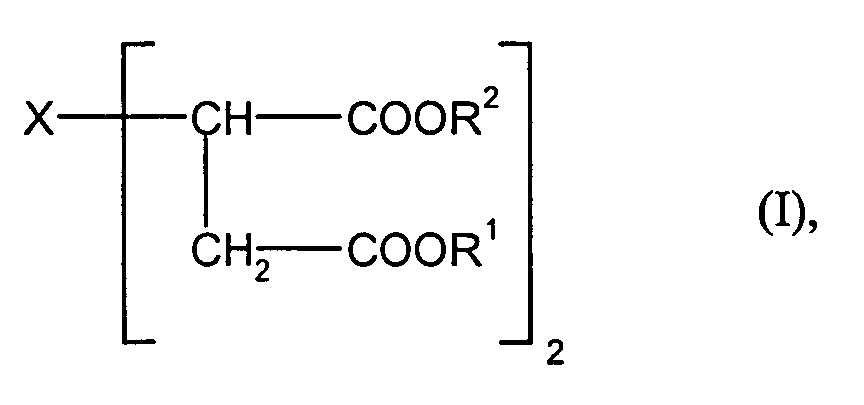
- R1 und R2
- unabhängig voneinander gleich oder verschieden sind und für C1-C4-Alkyl stehen,
- X
- für einen Rest der Formel

worin
- A
- ein bivalenter organischer Rest bedeutet,
- Z
- ein bivalenter aliphatischer Rest mit 4 bis 18 C-Atomen bedeutet und
- n
- für 0 bis 1 steht.
in der
- X
- die in Formel (I) angegebene Bedeutung hat und n = 1 ist,
| Beispiel 1 |
Beispiel 2 |
Beispiel 3 |
Beispiel 4 |
Beispiel 5 |
Beispiel 6 |
Beispiel 7 |
|
| Bindemittel | 1 | 2 | 3 | 1 | 2 | 3 | 1 |
| Härter | 1 | 1 | 1 | 2 | 2 | 2 | 3 |
| Lösemittelgehalt | 20 % | 20 % | 20 % | 20 % | 20 % | 20 % | 20% |
| Filmeigenschaften | |||||||
| 0-Wert | 1,6 | 0,9 | 0,9 | 1,7 | 1,1 | 1,0 | 0,7 |
| Zugfestigkeit [MPa] | 13 | 2,4 | 2,2 | 14,6 | 3,0 | 2,0 | 1,0 |
| Reißdehnung | 610 % | 390 % | 370 % | 650 % | 400 % | 340 % | 290 % |
| Wasserlagerung 24 h | |||||||
| Zugfestigkeit [MPa] | 11,4 | 1,6 | 1,5 | 10,4 | 1,7 | 2 | 0,9 |
| Reißdehnung | 620 % | 300 % | 240 % | 610 % | 340 % | 300 % | 270 % |
| Ledereigenschaften | |||||||
| Trockenknickungen | 60000 / x | 100000 / o | 70000 / x | 100000 / o | 90000 / x | 100000 / x | 30000 / x |
| Nassknickungen | 20000 / x | 20000 / o | 20000 / o | 20000 / o | 20000 / o | 20000 / o | 8000 / x |
| WDD [mg/cm2h] | 0,38 | 0,81 | 1,00 | 0,45 | 0,69 | 0,85 | 0,87 |
| Knickfestigkeit Flexometer | |
| Trocken | 100000 / o |
| Nass | 100000 / o |
| Kälte (-25°C) | 30000 / o |
| Hydrolyse 70C/95 % r. F. 7 Tage | 30000 / o |
| Weiterreißfestigkeit (0,27 mm dick) | 7 N/cm |
| Wasserdampfdurchlässigkeit | 1,26 mg/cm2h |
| Wasserdampfaufnahme (20°C/65 % r. F.) | 12,6 mg/cm2 |
| Legende: Bei allen Knickungen gibt die Zahl vor dem Schrägstrich die Anzahl der Knickungen an; das Symbol nach dem Schrägstrich ist eine Bewertung der Beschädigung der Beschichtung: o = unbeschädigt; x = ganz leichte Beschädigung. Alle Knickversuche wurden beim ersten Anzeichen einer Beschädigung abgebrochen, so dass die Tabelle keine Resultate mit mittlerer Beschädigung oder völliger Zerstörung enthält. |
Claims (7)
- Verwendung eines 2K-PU-Beschichtungssystems aus den Komponenten A) Bindemittel und B) Härter zum Beschichten von flexiblen Substraten, insbesondere Leder oder Textil, dadurch gekennzeichnet, dass die Härterkomponente B) einen Asparaginsäureester der Formel I enthältworin
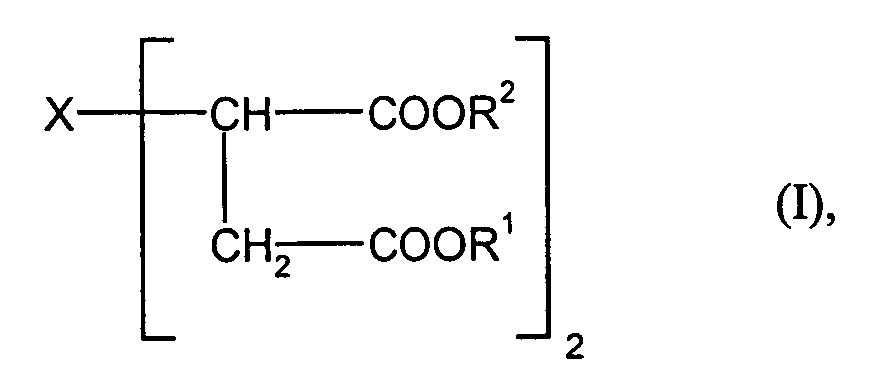
- R1 und R2
- unabhängig voneinander gleich oder verschieden sind und für C1-C4-Alkyl stehen,
- X
- für einen Rest der Formel
steht, worin

- A
- ein bivalenter organischer Rest bedeutet,
- Z
- ein bivalenter aliphatischer Rest mit 4 bis 18 C-Atomen bedeutet und
- n
- für 0 bis 1 steht.
- Verwendung gemäß Anspruch 1, dadurch gekennzeichnet, dass als Bindemittel A) eine Poly-NCO-funktionelle Verbindung mit einem NCO-Gehalt von 2 - 8 %, einem als Zahlenmittel bestimmten Molekulargewicht von 700 bis 8000 g/mol und einer NCO Funktionalität von 2,0 bis 3,0 eingesetzt wird, mit der Maßgabe, dass das Valverhältnis von Bindemittel A) zu Härter B) 1 : 1 bis 1,33 : 1 beträgt.
- Verwendung gemäß Anspruch 1, wobei R1 und R2 für Methyl oder Ethyl stehen.
- Verwendung gemäß Anspruch 1, wobei Z für -(CH2)6- oder -CH2CH(CH3)(CH2)2- steht.
- Verwendung gemäß wenigstens einem der Ansprüche 1 bis 4, wobei als Bindemittel A) solche auf Basis aromatischer Diisocyanate eingesetzt werden.
- Nach der Verwendung gemäß Anspruch 1 hergestelltes beschichtetes Leder.
- Nach der Verwendung gemäß Anspruch 1 hergestelltes beschichtetes Textil.
Applications Claiming Priority (2)
| Application Number | Priority Date | Filing Date | Title |
|---|---|---|---|
| DE2001135316 DE10135316A1 (de) | 2001-07-19 | 2001-07-19 | Verwendung spezieller Härter in 2-Komponenten PU-Systemen zum Beschichten flexibler Substrate |
| DE10135316 | 2001-07-19 |
Publications (2)
| Publication Number | Publication Date |
|---|---|
| EP1277876A2 true EP1277876A2 (de) | 2003-01-22 |
| EP1277876A3 EP1277876A3 (de) | 2004-01-28 |
Family
ID=7692446
Family Applications (1)
| Application Number | Title | Priority Date | Filing Date |
|---|---|---|---|
| EP02014923A Withdrawn EP1277876A3 (de) | 2001-07-19 | 2002-07-08 | Verwendung spezieller Härter in 2-Komponenten PU-Systemen zum Beschichten flexibler Substrate |
Country Status (3)
| Country | Link |
|---|---|
| EP (1) | EP1277876A3 (de) |
| CN (1) | CN1224754C (de) |
| DE (1) | DE10135316A1 (de) |
Cited By (7)
| Publication number | Priority date | Publication date | Assignee | Title |
|---|---|---|---|---|
| EP2011808A1 (de) * | 2007-07-03 | 2009-01-07 | Bayer MaterialScience AG | Medizinische Klebstoffe für die Chirurgie |
| WO2010112157A1 (de) | 2009-04-03 | 2010-10-07 | Bayer Materialscience Ag | Schutzlack |
| WO2011000587A1 (de) * | 2009-07-01 | 2011-01-06 | Evonik Degussa Gmbh | Reaktive derivate auf basis dianhydrohexitol basierender isocyanate |
| US20120178847A1 (en) * | 2009-07-16 | 2012-07-12 | Bayer Materialscience Ag | Polyurea-based fabric glue |
| US8889798B2 (en) | 2008-02-01 | 2014-11-18 | Durable Compliant Coatings B.V. | Paint composition |
| WO2019045868A1 (en) * | 2017-08-30 | 2019-03-07 | Dow Global Technologies Llc | SOLVENT ADHESIVE COMPOSITIONS |
| CN115710828A (zh) * | 2022-11-24 | 2023-02-24 | 湖南航天三丰科工有限公司 | 一种蒙皮用聚天门冬氨酸酯涂料及其制备方法和应用 |
Families Citing this family (1)
| Publication number | Priority date | Publication date | Assignee | Title |
|---|---|---|---|---|
| CN104130390B (zh) * | 2014-07-04 | 2016-04-13 | 山东一航新材料科技有限公司 | 聚醚型聚天冬氨酸酯及其制备方法 |
Family Cites Families (4)
| Publication number | Priority date | Publication date | Assignee | Title |
|---|---|---|---|---|
| GB1400741A (en) * | 1971-06-18 | 1975-07-23 | Kyowa Hakko Kogyo Kk | Leather products |
| ES2062188T3 (es) * | 1989-06-23 | 1994-12-16 | Bayer Ag | Procedimiento para la elaboracion de revestimientos. |
| JP3061396B2 (ja) * | 1990-05-01 | 2000-07-10 | 品川燃料株式会社 | かつら用基材 |
| DE19958843A1 (de) * | 1999-12-07 | 2001-06-13 | Basf Ag | Verfahren zur Herstellung von wässrigen Dispersionen enthaltend Polyurethane mit Carbodiimidgruppen |
-
2001
- 2001-07-19 DE DE2001135316 patent/DE10135316A1/de not_active Withdrawn
-
2002
- 2002-07-08 EP EP02014923A patent/EP1277876A3/de not_active Withdrawn
- 2002-07-19 CN CN 02126515 patent/CN1224754C/zh not_active Expired - Fee Related
Cited By (18)
| Publication number | Priority date | Publication date | Assignee | Title |
|---|---|---|---|---|
| WO2009003596A1 (de) * | 2007-07-03 | 2009-01-08 | Bayer Materialscience Ag | Medizinische klebstoffe für die chirurgie |
| EP2182018A1 (de) * | 2007-07-03 | 2010-05-05 | Bayer MaterialScience AG | Medizinische Klebstoffe für die Chirurgie |
| US7754782B2 (en) | 2007-07-03 | 2010-07-13 | Bayer Material Science Ag | Medical adhesives for surgery |
| EP2011808A1 (de) * | 2007-07-03 | 2009-01-07 | Bayer MaterialScience AG | Medizinische Klebstoffe für die Chirurgie |
| US8889798B2 (en) | 2008-02-01 | 2014-11-18 | Durable Compliant Coatings B.V. | Paint composition |
| EP2238210B1 (de) * | 2008-02-01 | 2015-08-12 | Durable Compliant Coatings B.V. | Lackzusammensetzung |
| WO2010112157A1 (de) | 2009-04-03 | 2010-10-07 | Bayer Materialscience Ag | Schutzlack |
| DE102009016173A1 (de) | 2009-04-03 | 2010-10-14 | Bayer Materialscience Ag | Schutzlack |
| WO2011000587A1 (de) * | 2009-07-01 | 2011-01-06 | Evonik Degussa Gmbh | Reaktive derivate auf basis dianhydrohexitol basierender isocyanate |
| US20120178847A1 (en) * | 2009-07-16 | 2012-07-12 | Bayer Materialscience Ag | Polyurea-based fabric glue |
| US9051410B2 (en) * | 2009-07-16 | 2015-06-09 | Medical Adhesive Revolution Gmbh | Polyurea-based fabric glue |
| US9404026B2 (en) | 2009-07-16 | 2016-08-02 | Adhesys Medical Gmbh | Polyurea-based fabric glue |
| US9717819B2 (en) | 2009-07-16 | 2017-08-01 | Adhesys Medical Gmbh | Polyurea-based fabric glue |
| WO2019045868A1 (en) * | 2017-08-30 | 2019-03-07 | Dow Global Technologies Llc | SOLVENT ADHESIVE COMPOSITIONS |
| EP3676304A1 (de) * | 2017-08-30 | 2020-07-08 | Dow Global Technologies LLC | Lösemittelbasierte klebstoffzusammensetzungen |
| US11414578B2 (en) | 2017-08-30 | 2022-08-16 | Dow Global Technologies Llc | Solvent based adhesive compositions |
| CN115710828A (zh) * | 2022-11-24 | 2023-02-24 | 湖南航天三丰科工有限公司 | 一种蒙皮用聚天门冬氨酸酯涂料及其制备方法和应用 |
| CN115710828B (zh) * | 2022-11-24 | 2024-05-14 | 湖南航天三丰科工有限公司 | 一种蒙皮用聚天门冬氨酸酯涂料及其制备方法和应用 |
Also Published As
| Publication number | Publication date |
|---|---|
| CN1399031A (zh) | 2003-02-26 |
| EP1277876A3 (de) | 2004-01-28 |
| CN1224754C (zh) | 2005-10-26 |
| DE10135316A1 (de) | 2003-01-30 |
Similar Documents
| Publication | Publication Date | Title |
|---|---|---|
| EP2262842B1 (de) | 2,2'-mdi-basierte isocyanat-mischungen und ihre herstellung sowie verwendung | |
| EP1937742B1 (de) | Zweikomponenten-systeme für die herstellung flexibler beschichtungen | |
| DE1770245A1 (de) | Verfahren zur Herstellung von Polyurethanen | |
| EP1551894A1 (de) | Zweikomponente-systeme für die herstellung elastischer beschichtungen | |
| DE1769089C3 (de) | Verfahren zur Herstellung von, gegebenenfalls mikroporösen, Formkörpern | |
| DE102008032779A1 (de) | Polyurethanharnstoff-Lösungen | |
| DE2644923C2 (de) | Verfahren zur Beschichtung von textilen Flächengebilden | |
| DE4203510A1 (de) | Beschichtungsmittel, ein verfahren zu ihrer herstellung und ihre verwendung zur herstellung von beschichtungen | |
| DE19548030A1 (de) | Verwendung wässriger Dispersionen nachvernetzbarer Beschichtungsmittel zur Textil- und Lederbeschichtung | |
| WO1993024550A1 (de) | Wässriges bindemittelgemisch und seine verwendung | |
| EP3280775A1 (de) | Verfahren zum verkleben von substraten mit klebstoffen | |
| DE3522978A1 (de) | Verfahren zur herstellung von lichtechten, loesungsmittelbestaendigen polyurethanharnstoffelastomerbeschichtungen im reaktiv-beschichtungsverfahren | |
| EP3568423A1 (de) | Lösemittelarme beschichtungssysteme für textilien | |
| EP0407829B1 (de) | Hitzehärtbare Gemische und ihre Verwendung zur Herstellung von Beschichtungen von hitzeresistenten Substraten | |
| DE10135316A1 (de) | Verwendung spezieller Härter in 2-Komponenten PU-Systemen zum Beschichten flexibler Substrate | |
| DE3227017A1 (de) | Verfahren zur herstellung von kunststoffen aus polyisocyanat-basis | |
| EP0490158B1 (de) | Verfahren zur Herstellung von Polyurethanbeschichtungen | |
| EP3914632A1 (de) | Kompositwerkstoffe basierend auf urethan- und isocyanuratpolymeren mit dualer härtung | |
| EP0406618B1 (de) | Verfahren zur Herstellung von Harnstoff- und Biuretgruppen enthaltendem 1,5 Naphtylendiisocyanat | |
| EP1276785B1 (de) | Polyurethan-beschichtungen auf basis uretdion- und/oder oxadiazintrion-gruppen enthaltender polyisocyanate | |
| EP3628694A1 (de) | Lösemittelarme beschichtungssysteme für textilien | |
| EP0452775B1 (de) | Thermoplastische Polyurethan-Polyharnstoff-Elastomere mit erhöhtem Wärmestand | |
| DE19919163A1 (de) | Isocyanathaltige Bindemittel | |
| EP0496209B1 (de) | Härtergemisch für Isocyanatgruppen aufweisende Vorpolymere | |
| DE4400224A1 (de) | Feuchtigkeitshärtende Einkomponenten-Beschichtungsmittel |
Legal Events
| Date | Code | Title | Description |
|---|---|---|---|
| PUAI | Public reference made under article 153(3) epc to a published international application that has entered the european phase |
Free format text: ORIGINAL CODE: 0009012 |
|
| AK | Designated contracting states |
Kind code of ref document: A2 Designated state(s): AT BE BG CH CY CZ DE DK EE ES FI FR GB GR IE IT LI LU MC NL PT SE SK TR |
|
| AX | Request for extension of the european patent |
Free format text: AL;LT;LV;MK;RO;SI |
|
| PUAL | Search report despatched |
Free format text: ORIGINAL CODE: 0009013 |
|
| RAP1 | Party data changed (applicant data changed or rights of an application transferred) |
Owner name: BAYER CHEMICALS AG |
|
| AK | Designated contracting states |
Kind code of ref document: A3 Designated state(s): AT BE BG CH CY CZ DE DK EE ES FI FR GB GR IE IT LI LU MC NL PT SE SK TR |
|
| AX | Request for extension of the european patent |
Extension state: AL LT LV MK RO SI |
|
| 17P | Request for examination filed |
Effective date: 20040728 |
|
| AKX | Designation fees paid |
Designated state(s): DE ES IT |
|
| RAP1 | Party data changed (applicant data changed or rights of an application transferred) |
Owner name: LANXESS DEUTSCHLAND GMBH |
|
| GRAP | Despatch of communication of intention to grant a patent |
Free format text: ORIGINAL CODE: EPIDOSNIGR1 |
|
| STAA | Information on the status of an ep patent application or granted ep patent |
Free format text: STATUS: THE APPLICATION IS DEEMED TO BE WITHDRAWN |
|
| 18D | Application deemed to be withdrawn |
Effective date: 20070310 |
|
| RIC1 | Information provided on ipc code assigned before grant |
Ipc: D06M 15/564 20060101ALI20110916BHEP Ipc: C08G 18/38 20060101ALI20110916BHEP Ipc: D06N 3/14 20060101AFI20110916BHEP |