EP1275835A2 - Control unit for internal combustion engine - Google Patents
Control unit for internal combustion engine Download PDFInfo
- Publication number
- EP1275835A2 EP1275835A2 EP02015547A EP02015547A EP1275835A2 EP 1275835 A2 EP1275835 A2 EP 1275835A2 EP 02015547 A EP02015547 A EP 02015547A EP 02015547 A EP02015547 A EP 02015547A EP 1275835 A2 EP1275835 A2 EP 1275835A2
- Authority
- EP
- European Patent Office
- Prior art keywords
- control unit
- internal combustion
- combustion engine
- way catalyst
- rich
- Prior art date
- Legal status (The legal status is an assumption and is not a legal conclusion. Google has not performed a legal analysis and makes no representation as to the accuracy of the status listed.)
- Withdrawn
Links
- 238000002485 combustion reaction Methods 0.000 title claims abstract description 107
- 239000003054 catalyst Substances 0.000 claims abstract description 144
- 239000003463 adsorbent Substances 0.000 claims abstract description 24
- 230000004913 activation Effects 0.000 claims abstract description 16
- 238000001704 evaporation Methods 0.000 claims abstract description 11
- 230000008020 evaporation Effects 0.000 claims abstract description 11
- 230000006866 deterioration Effects 0.000 abstract description 3
- 239000000446 fuel Substances 0.000 description 46
- 238000002347 injection Methods 0.000 description 39
- 239000007924 injection Substances 0.000 description 39
- 238000001179 sorption measurement Methods 0.000 description 16
- 238000010586 diagram Methods 0.000 description 14
- 239000007789 gas Substances 0.000 description 12
- XLYOFNOQVPJJNP-UHFFFAOYSA-N water Substances O XLYOFNOQVPJJNP-UHFFFAOYSA-N 0.000 description 7
- 238000006243 chemical reaction Methods 0.000 description 6
- 239000010970 precious metal Substances 0.000 description 4
- 238000000746 purification Methods 0.000 description 4
- QVGXLLKOCUKJST-UHFFFAOYSA-N atomic oxygen Chemical compound [O] QVGXLLKOCUKJST-UHFFFAOYSA-N 0.000 description 3
- 238000010276 construction Methods 0.000 description 3
- 238000000034 method Methods 0.000 description 3
- 239000001301 oxygen Substances 0.000 description 3
- 229910052760 oxygen Inorganic materials 0.000 description 3
- 101150089431 TCN2 gene Proteins 0.000 description 2
- 238000003795 desorption Methods 0.000 description 2
- 230000002542 deteriorative effect Effects 0.000 description 2
- 230000000694 effects Effects 0.000 description 2
- 238000005516 engineering process Methods 0.000 description 2
- 239000000203 mixture Substances 0.000 description 2
- 230000003213 activating effect Effects 0.000 description 1
- 238000007792 addition Methods 0.000 description 1
- 239000000498 cooling water Substances 0.000 description 1
- 238000001514 detection method Methods 0.000 description 1
- 230000007613 environmental effect Effects 0.000 description 1
- 238000004880 explosion Methods 0.000 description 1
- 230000001590 oxidative effect Effects 0.000 description 1
- 230000002787 reinforcement Effects 0.000 description 1
- 238000005728 strengthening Methods 0.000 description 1
- 238000011144 upstream manufacturing Methods 0.000 description 1
- 238000010792 warming Methods 0.000 description 1
Images








Classifications
-
- F—MECHANICAL ENGINEERING; LIGHTING; HEATING; WEAPONS; BLASTING
- F02—COMBUSTION ENGINES; HOT-GAS OR COMBUSTION-PRODUCT ENGINE PLANTS
- F02D—CONTROLLING COMBUSTION ENGINES
- F02D37/00—Non-electrical conjoint control of two or more functions of engines, not otherwise provided for
- F02D37/02—Non-electrical conjoint control of two or more functions of engines, not otherwise provided for one of the functions being ignition
-
- F—MECHANICAL ENGINEERING; LIGHTING; HEATING; WEAPONS; BLASTING
- F02—COMBUSTION ENGINES; HOT-GAS OR COMBUSTION-PRODUCT ENGINE PLANTS
- F02D—CONTROLLING COMBUSTION ENGINES
- F02D41/00—Electrical control of supply of combustible mixture or its constituents
- F02D41/008—Controlling each cylinder individually
-
- F—MECHANICAL ENGINEERING; LIGHTING; HEATING; WEAPONS; BLASTING
- F02—COMBUSTION ENGINES; HOT-GAS OR COMBUSTION-PRODUCT ENGINE PLANTS
- F02D—CONTROLLING COMBUSTION ENGINES
- F02D41/00—Electrical control of supply of combustible mixture or its constituents
- F02D41/02—Circuit arrangements for generating control signals
- F02D41/021—Introducing corrections for particular conditions exterior to the engine
- F02D41/0235—Introducing corrections for particular conditions exterior to the engine in relation with the state of the exhaust gas treating apparatus
- F02D41/024—Introducing corrections for particular conditions exterior to the engine in relation with the state of the exhaust gas treating apparatus to increase temperature of the exhaust gas treating apparatus
-
- F—MECHANICAL ENGINEERING; LIGHTING; HEATING; WEAPONS; BLASTING
- F02—COMBUSTION ENGINES; HOT-GAS OR COMBUSTION-PRODUCT ENGINE PLANTS
- F02D—CONTROLLING COMBUSTION ENGINES
- F02D41/00—Electrical control of supply of combustible mixture or its constituents
- F02D41/02—Circuit arrangements for generating control signals
- F02D41/14—Introducing closed-loop corrections
- F02D41/1438—Introducing closed-loop corrections using means for determining characteristics of the combustion gases; Sensors therefor
- F02D41/1473—Introducing closed-loop corrections using means for determining characteristics of the combustion gases; Sensors therefor characterised by the regulation method
- F02D41/1475—Regulating the air fuel ratio at a value other than stoichiometry
-
- F—MECHANICAL ENGINEERING; LIGHTING; HEATING; WEAPONS; BLASTING
- F02—COMBUSTION ENGINES; HOT-GAS OR COMBUSTION-PRODUCT ENGINE PLANTS
- F02D—CONTROLLING COMBUSTION ENGINES
- F02D2200/00—Input parameters for engine control
- F02D2200/02—Input parameters for engine control the parameters being related to the engine
- F02D2200/04—Engine intake system parameters
- F02D2200/0418—Air humidity
-
- F—MECHANICAL ENGINEERING; LIGHTING; HEATING; WEAPONS; BLASTING
- F02—COMBUSTION ENGINES; HOT-GAS OR COMBUSTION-PRODUCT ENGINE PLANTS
- F02D—CONTROLLING COMBUSTION ENGINES
- F02D2200/00—Input parameters for engine control
- F02D2200/02—Input parameters for engine control the parameters being related to the engine
- F02D2200/08—Exhaust gas treatment apparatus parameters
- F02D2200/0802—Temperature of the exhaust gas treatment apparatus
-
- F—MECHANICAL ENGINEERING; LIGHTING; HEATING; WEAPONS; BLASTING
- F02—COMBUSTION ENGINES; HOT-GAS OR COMBUSTION-PRODUCT ENGINE PLANTS
- F02D—CONTROLLING COMBUSTION ENGINES
- F02D41/00—Electrical control of supply of combustible mixture or its constituents
- F02D41/02—Circuit arrangements for generating control signals
- F02D41/14—Introducing closed-loop corrections
- F02D41/1401—Introducing closed-loop corrections characterised by the control or regulation method
- F02D41/1408—Dithering techniques
-
- F—MECHANICAL ENGINEERING; LIGHTING; HEATING; WEAPONS; BLASTING
- F02—COMBUSTION ENGINES; HOT-GAS OR COMBUSTION-PRODUCT ENGINE PLANTS
- F02D—CONTROLLING COMBUSTION ENGINES
- F02D41/00—Electrical control of supply of combustible mixture or its constituents
- F02D41/02—Circuit arrangements for generating control signals
- F02D41/14—Introducing closed-loop corrections
- F02D41/1438—Introducing closed-loop corrections using means for determining characteristics of the combustion gases; Sensors therefor
- F02D41/1444—Introducing closed-loop corrections using means for determining characteristics of the combustion gases; Sensors therefor characterised by the characteristics of the combustion gases
- F02D41/1454—Introducing closed-loop corrections using means for determining characteristics of the combustion gases; Sensors therefor characterised by the characteristics of the combustion gases the characteristics being an oxygen content or concentration or the air-fuel ratio
-
- Y—GENERAL TAGGING OF NEW TECHNOLOGICAL DEVELOPMENTS; GENERAL TAGGING OF CROSS-SECTIONAL TECHNOLOGIES SPANNING OVER SEVERAL SECTIONS OF THE IPC; TECHNICAL SUBJECTS COVERED BY FORMER USPC CROSS-REFERENCE ART COLLECTIONS [XRACs] AND DIGESTS
- Y02—TECHNOLOGIES OR APPLICATIONS FOR MITIGATION OR ADAPTATION AGAINST CLIMATE CHANGE
- Y02T—CLIMATE CHANGE MITIGATION TECHNOLOGIES RELATED TO TRANSPORTATION
- Y02T10/00—Road transport of goods or passengers
- Y02T10/10—Internal combustion engine [ICE] based vehicles
- Y02T10/12—Improving ICE efficiencies
Definitions
- the present invention relates to a control unit for an internal combustion engine, especially to a control unit for an internal combustion engine to activate quickly the three way catalyst when the internal combustion engine starts, and to do efficiently the adsorption and the purification of HC.
- three way catalyst having the function of oxidizing HC and CO in the exhaust gas exhausted to the exhaust pipe by the internal combustion engine and reducing NOx to clear said Emission Control has been installed in the automobile engine.
- said three way catalyst can purify HC, CO, and NOx in exhaust gas at a temperature more than a fixed one, it cannot usually purify enough HC, CO, and NOx at a temperature below a fixed temperature.
- An object of the present invention is to provide a control unit for an internal combustion engine in which the three way catalyst is activated at the early stage when the internal combustion engine starts, and the deterioration of components such as HC, CO, and NOx in exhaust gas from an internal combustion engine is reduced.
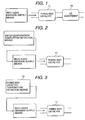
- control unit for an internal combustion engine including the three way catalyst and HC adsorbent on an exhaust side, wherein said control unit alternately controls the A/F between a rich state and a lean state in order to quicken the activation of said three way catalyst when said internal combustion engine starts (Fig.1).
- a control unit for an internal combustion engine of the present invention configured like the above-mentioned can raise the temperature of the three way catalyst by alternately supplying rich exhaust and lean exhaust to the three way catalyst, and by the heat of reaction of CO, HC in the rich exhaust and O 2 in the lean exhaust.
- the three way catalyst can be activated at the early stage without deteriorating the exhaust gas by adsorbing HC emitted from the downstream of the three way catalyst by using HC adsorbent.
- control unit for an internal combustion engine being characterized by a control unit for an internal combustion engine including the three way catalyst on an exhaust side, wherein control unit has a means for detecting completion of the evaporation of moisture in said three way catalyst directly or indirectly, and wherein control unit alternately controls the A/F between a rich state and a lean state in order to quicken the activation of said three way catalyst after the completion of the evaporation of moisture in said three way catalyst is detected (see Fig.2). Further, the ignition time is retarded for the period until moisture in said three way catalyst evaporates directly after the start of said internal combustion engine.
- the reason for the supply of rich/lean exhaust to the three way catalyst is that the temperature of precious metals in the three way catalyst is raised. If the precious metals have been partially activated, the reaction proceeds further in that part, and the activation of precious metals in the catalyst is advanced continuously by the heat of reaction.
- the three way catalyst can be activated at the early stage without deteriorating the exhaust by supplying rich/lean exhaust after water in the three way catalyst evaporates, because the heat of reaction can be efficiently supplied to precious metals if there is no moisture in the three way catalyst.
- the exhaust temperature is raised by making the ignition time retarded directly after the start, moisture in the catalyst evaporates promptly, and the supply of rich/lean exhaust is controlled at the early stage, because the activation time is shortened by time for water to evaporate short.
- a control unit for an internal combustion engine can be characterized by a control unit for an internal combustion engine including the three way catalyst on an exhaust side, wherein control unit has a means for detecting the temperature of said three way catalyst directly or indirectly, and wherein control unit alternately controls the A/F between a rich state and a lean state in order to quicken the activation of the three way catalyst when the temperature of said three way catalyst is a value within the fixed range (Fig.3).
- the control unit for an internal combustion engine of the present invention configured like the above-mentioned can estimate the evaporation of the moisture in the catalyst by directly or indirectly detecting the temperature of the catalyst, and control the supply rich/lean exhaust with a high degree of accuracy by setting the temperature of the catalyst to the value within the fixed range.
- a control unit for an internal combustion engine can be characterized by a control unit for an internal combustion engine including the three way catalyst on an exhaust side, wherein control unit has a means for detecting the operating state of the internal combustion engine, and wherein control unit alternately controls the A/F between a rich state and a lean state in order to quicken the activation of the three way catalyst based on the operating state (Fig.4).
- the control unit for an internal combustion engine of the present invention configured like the above-mentioned can control the supply rich/lean exhaust with a higher degree of accuracy by estimating the temperature of the catalyst and estimating the evaporation of the moisture in the catalyst based on the operating state of the internal combustion engine, for instance, the time after the engine starts, the water temperature, total air flow rate after the engine starts and so on.
- control unit for an internal combustion engine can be characterized by a control unit for an internal combustion engine including the three way catalyst and HC adsorbent on an exhaust side in the order, wherein control unit has a means for detecting the temperature of said HC adsorbent directly or indirectly, and wherein control unit alternately controls the A/F between a rich state and a lean state in order to change the temperature of said HC adsorbent.
- control unit alternately controls the A/F between a rich state and a lean state when the temperature of said HC adsorbent is within the fixed range (Fig.5).
- the HC adsorbent has the characteristic that HC is adsorbed at a temperature below a fixed one, and is desorbed at a temperature more than a fixed one because the HC adsorbent looses the adsorbent characteristic.
- HC desorption temperature is lower than the activating temperature of the three way catalyst, the difference between these temperatures is large, and there is a temperature rise characteristic in which each phase of HC adsorbent, desorption, and purification becomes the best.
- the temperature of said three way catalyst is adjusted by controlling the supply of rich/lean exhaust appropriately with paying attention to the above-mentioned. As a result, it is possible to control so that the temperature rise characteristic of the HC adsorbent may become the best.
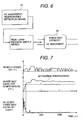
- a control unit for an internal combustion engine can be characterized by a control unit for an internal combustion engine including a catalyst which has the three way catalyst and HC adsorbent in the same carrier on an exhaust side, wherein control unit alternately controls the A/F between a rich state and a lean state in order to change the temperature of said HC adsorbent (Fig.6).
- the temperature of the three way catalyst is raised by the heat of reaction of O 2 in the lean exhaust and CO, HC in the rich exhaust by alternately supplying the rich exhaust and the lean exhaust to the catalyst supported by the same carrier.
- HC separated from the three way catalyst is adsorbed by the HC adsorbent by supplying the rich exhaust and the lean exhaust.
- the exhaust gas is not deteriorated, and the three way catalyst is activated at the early stage.
- the temperature in the downstream of the catalyst is set such that the evaporation of the moisture in the three way catalyst is not completed but the adsorbed HC in HC adsorption catalyst begins to separate.
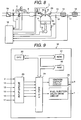
- Fig.8 shows an internal combustion engine system of the control unit for an internal combustion engine of the present invention.
- Internal combustion engine 1 is configured of the internal combustion engine of the multi-cylinder type.
- air from the outside passes air cleaner 19, flows into combustion chamber 9a in cylinder 9 through intake manifold 6.
- ISC valve 5 installed in air passage 4 for the by-pass at idling, and the engine speed of the internal combustion engine is controlled.
- Fuel injection valve 7 for each cylinder is installed in intake manifold 6.
- Sparking plug 8 is installed in cylinder 9 of each cylinder, and intake valve 29 and exhaust valve 30 are also arranged therein.
- exhaust manifold 10 is connected to cylinder 9 of each cylinder, and three way catalyst 11 and HC adsorption catalyst 18 are arranged in the exhaust manifold 10 in the order.
- Airflow sensor 2 is arranged in intake manifold 6 of the air intake system, which detects an amount of the intake air.
- Crank angle sensor 15 outputs a signal every one degree of the rotation angle of the crankshaft.
- throttle opening sensor 17 installed in electronic throttle 3, the opening of electronic throttle 3 is detected, and in water temperature sensor 14, the temperature of the cooling water for the internal combustion engine is detected.
- Each signal from air flow sensor 2, opening sensor 17 installed in throttle 3, crank angle sensor 15, and water temperature sensor 14 is sent to control unit 16.
- the operating state of internal combustion engine 1 is obtained from these sensor outputs, and the main manipulated variable of the ignition time and the basic injection amount of the fuel are calculated appropriately.
- Fuel injection amount calculated in control unit 16 is converted into a valve-open pulse signal and is sent to fuel injection valve 7 installed in the intake pipe of each cylinder. Therefore, fuel injection amount can be controlled every cylinder.
- the predetermined ignition time is calculated in control unit 16, and a driving signal is sent to sparking plug 8 so that it can be ignited at its ignition time.
- the fuel injected from fuel injection valve 7 flows into combustion chamber 9a of internal combustion engine 1, and forms the air-fuel mixture by being mixed with the air from intake manifold 6.
- the air-fuel mixture is exploded by the spark generated by sparking plug 8, and the energy generated at that time becomes the power source for internal combustion engine 1.
- HC adsorption catalyst 18 has the three way characteristic inside, that is, the function of purifying the desorbed HC.
- A/F sensor 12 is installed between cylinder 9 of internal combustion engine 1 and three way catalyst 11, which has a linear output characteristic with respect to the oxygen concentration included in the exhaust gas. Because the relationship between the oxygen concentration included in the exhaust gas and the A/F is approximately linear, it is possible to detect the A/F by A/F sensor 12 which detects the oxygen concentration. Moreover, temperature sensor 13 is installed in the downstream of three way catalyst 11. Therefore, the detection of the temperature in the downstream of three way catalyst 11 is enabled.
- control unit 16 the A/F in the upstream of three way catalyst 11 is calculated from a signal of A/F sensor 12, and the amount of the fuel supplied to internal combustion engine 1 is controlled to become an A/F whose purification efficiency is the highest in three way catalyst 11.
- Fig. 9 shows the inside of the control unit (ECU) 16 shown in Fig.8.
- the output value of each sensor of air flow sensor 2, A/F sensor 12, temperature sensor 13, water temperature sensor 14, internal combustion engine revolution speed sensor 15, and throttle valve opening sensor 17 is input in ECU 16, and after the signal processing such as noise rejection etc. is carried out in input circuit 23, the signal is sent to I/O port 24.
- the value of I/O port 24 is kept in RAM 22, and the operation processing is carried out in CPU 20.
- Control program which describes the content of the operation processing is written in ROM 21 beforehand.
- the value which indicates the amount of each actuator operation calculated according to control program is kept in RAM 22. Then, it is sent to I/O port 24.
- An ON/OFF signal is set as an operation signal of sparking plug 8, in which it is turned on at a conduction state of the primary coil in ignition output circuit 25, and it is turned off at a non-conduction state of the primary coil.
- the ignition time is when the operation signal becomes turning-off from turning-on.
- the signal for the sparking plug set in I/O port 24 is amplified into enough energy necessary for combustion in ignition output circuit 25 and supplied to sparking plug 8.
- An ON/OFF signal is set as a driving signal of fuel injection valve 7, in which the ON/OFF signal is turned on at valve-open and turned off at valve-close.
- the driving signal is amplified into energy enough to open fuel injection valve 7 in fuel injection valve drive circuit 26, and sent to fuel injection valve 7.
- Fig.10 is a control block diagram showing the entire control of control unit 16 as shown in Fig. 9.
- the control unit 16 comprises basic fuel injection amount calculation unit 31, A/F correction term calculation unit 32, #1 cylinder A/F correction amount calculation unit 33a, #2 cylinder A/F correction amount calculation unit 33b, #3 cylinder A/F correction amount calculation unit 33c, #4 cylinder A/F correction amount calculation unit 33d, and rich/lean control permission judgement part 34.
- the fuel injection amount for each cylinder is calculated so that the A/F for all cylinders may become the theoretical air-fuel ratio.
- the A/F for each cylinder is changed in the specified amount in order to activate three way catalyst 11 at the early stage by supplying the rich exhaust and the lean exhaust to the entrance of three way catalyst 11.
- Fig.11 shows basic fuel injection amount calculation unit 31.
- the basic fuel injection amount calculation unit 31 calculates the fuel injection amount to achieve the target torque and the target A/F at the same time in an arbitrary operating condition based on an amount of the inflow air into internal combustion engine 1.
- basic fuel injection amount Tp is calculated as shown in Fig.11.
- K is a constant, which always make A/F adjust the theoretical A/F for the amount of the inflow air.
- Cy1 indicates the number of cylinders of internal combustion engines 1, and the number of cylinders is 4.
- Fig.12 shows A/F correction term calculation unit 32.
- A/F correction term calculation unit 32 feedback-controls A/F based on the A/F detected by A/F sensor 12 so that the A/F of internal combustion engine 1 may take the theoretical A/F in an arbitrary operating condition.
- A/F correction term Lalpha is calculated from deviation Dltabf between the target A/F Tabf and the A/F Rabf detected by A/F sensor by using the PID control as shown in Fig.12.
- A/F correction term Lalpha is multiplied by above-mentioned basic fuel injection amount Tp in order to always keep A/F of internal combustion engine 1 to the theoretical A/F.
- Fig.13 shows rich/lean control permission judgement part 34.
- Tcn is a downstream temperature of the three way catalyst
- Ne is an engine speed of the internal combustion engine.
- TcnL the temperature at which the evaporation of moisture in the three way catalyst is completed.
- the temperature becomes generally 50°C-100°C, which depends on the location of the sensor, etc.
- TcnH the activation temperature of the three way catalyst.
- the temperature becomes 250°C-400°C, which depends on the catalyst performance. You should decide both values of TcnL and TcnH according to the performance of the real machine performance. Further, although it is assumed the method to detect the exhaust gas temperature in the downstream of the catalyst, various methods of estimating from other operating condition of the internal combustion engine without measuring the temperature directly are proposed. Therefore, it is also possible to use them.
- Fig.14 shows the #1 cylinder A/F correction amount calculation unit 33a.
- the amount of the A/F correction in the first cylinder is calculated.
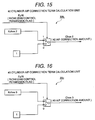
- Fig.15 shows the #2 cylinder A/F correction amount calculation unit 33b.
- Fig.16 shows the #3 cylinder A/F correction amount calculation unit 33c.
- the amount of the A/F correction in the third cylinder is calculated.
- Fig.17 shows the #4 cylinder A/F correction amount calculation unit 33d.
- the #4 cylinder A/F correction amount calculation unit 33d the amount of the A/F correction in the fourth cylinder is calculated.
- Fig.18 shows a system of the internal combustion engine of a control unit for an internal combustion engine of the present invention. Because the system according to Fig. 18 is the same as the system according to Fig. 8, excluding temperature sensor 13 not being provided, the explanation on other configuration is omitted.
- Fig.19 shows an internal configuration of control unit 16. Because its configuration is the same as one according to Fig. 9, excluding the input terminal of temperature sensor 13 not being provided, the explanation on other configuration is omitted.
- a control block diagram showing the entire control of control unit 16 according to Fig.19 is the same as shown in Fig.10, only the input signal of rich/lean control permission judgement part 34 is different. The control block diagram is not shown as a Figure and Fig.10 is referred instead.
- Control unit 16 of this embodiment comprises basic fuel injection amount calculation unit 31, A/F correction term calculation unit 32, #1 cylinder A/F correction amount calculation unit 33a, #2 cylinder A/F correction amount calculation unit 33b, #3 cylinder A/F correction amount calculation unit 33c, #4 cylinder A/F correction amount calculation unit 33d, and rich/lean control permission judgement part 34.
- control unit 16 calculates fuel injection amount for each cylinder so that the A/F for all cylinders may become the theoretical A/F.
- the rich/lean control is permitted, the rich exhaust and the lean exhaust are supplied to the entrance of three way catalyst 11, the A/F for each cylinder is changed in the specified amount in order to activate the three way catalyst 11 at the early stage.
- each calculation unit of control unit 16 will be explained in detail.
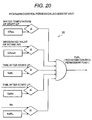
- Fig.20 shows rich/lean control permission judgement part 34.
- Ne is an engine speed of the internal combustion engine.
- #1 cylinder A/F correction amount calculation unit 33a 5. #2 cylinder A/F correction amount calculation unit 33b; 6. #3 cylinder A/F correction amount calculation unit 33c; and 7. #4 cylinder A/F correction amount calculation unit 33d. Because the #1 to #4 cylinder A/F correction amount calculation units 33a, 33b, 33c, and 33d are as shown in Fig.14-Fig.17, the explanation is omitted.
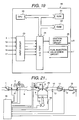
- Fig.21 shows a system of the internal combustion engine of a control unit for an internal combustion engine of the present invention. Because the system according to Fig. 21 is the same as the system according to Fig. 8, excluding temperature sensor 27 being installed in the downstream of HC adsorption catalyst 18, the explanation on other configuration is omitted.
- Fig.22 shows an internal configuration of control unit 16. Because its configuration is the same as one according to Fig. 9, excluding the input terminal of temperature sensor 13 being added, the explanation on other configuration is omitted.
- Fig.23 is a control block diagram showing the entire control of control unit 16 as shown in Fig.22.
- Control unit 16 comprises basic fuel injection amount calculation unit 31, A/F correction term calculation unit 32, #1 cylinder A/F correction amount calculation unit 33a, #2 cylinder A/F correction amount calculation unit 33b, #3 cylinder A/F correction amount calculation unit 33c, #4 cylinder A/F correction amount calculation unit 33d, and rich/lean control permission judgement part 34.
- control unit 16 calculates fuel injection amount for each cylinder so that the A/F for all cylinders may become the theoretical A/F.
- the rich exhaust and the lean exhaust are supplied to the entrance of three way catalyst 11, in order to activate the three way catalyst 11 at the early stage or optimize the temperature-rise characteristic of HC adsorption catalyst 18.
- each calculation unit of control unit 16 will be explained in detail.
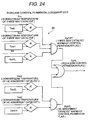
- Fig.24 shows rich/lean control permission judgement part 34.
- the rich/lean control has two purposes, the temperature-rise of three way catalyst 11 and that of HC adsorption catalyst 18. Further, the permission condition is also divided into the temperature-rise control of the three way catalyst and that of HC adsorption catalyst roughly.
- Tcn is an HC adsorption catalyst downstream temperature. It is preferable to set TcnL to the temperature at which the evaporation of moisture in the three way catalyst is completed. The temperature becomes generally 50°C-100°C, which depends on the location of the sensor, etc.
- TcnH it is preferable to set to the activation temperature of the three way catalyst.
- the temperature becomes 250°C-400°C, which depends on the catalyst performance.
- Tcn2L it is preferable to set Tcn2L to the temperature at which the adsorbed HC of the HC adsorption catalyst starts to be desorbed.
- the temperature becomes generally 100°C-200°C, which depends on the location of the sensor, etc.
- Tcn2H to the activation temperature of the three way catalyst in the HC adsorption catalyst 18.
- the temperature becomes 250°C-400°C, which depends on the catalyst performance. You should decide the values of TcnL, TcnH, Tcn2L and Tcn2H according to the performance of the real machine performance.
- #1 cylinder A/F correction amount calculation unit 33a 5. #2 cylinder A/F correction amount calculation unit 33b; 6. #3 cylinder A/F correction amount calculation unit 33c; and 7. #4 cylinder A/F correction amount calculation unit 33d. Because the #1 to #4 cylinder A/F correction amount calculation units 33a, 33b, 33c, and 33d are the same as shown in Fig.14-Fig.17, the explanation is omitted.
- Fig.25 shows a system of the internal combustion engine of a control unit for an internal combustion engine of the present invention.
- Catalyst 28 is a catalyst in which the HC adsorbent and the three way catalyst are supported by the same carrier. Because the configuration except the catalyst 28 is the same as the system according to Fig. 8, the explanation of other configuration is omitted.
- the Control in the control unit for an internal combustion engine is the same as shown in Fig. 9. However, it is preferable to set a set temperature TcnH in the downstream of the catalyst not to the temperature at which the evaporation of moisture in the three way catalyst is completed, but to the temperature at which the adsorbed HC of the HC adsorption catalyst starts to be desorbed.
- the temperature becomes generally 100°C-200°C, which depends on the location of the sensor, etc.
- Fig.26 is a control block diagram showing a control of control unit 16 of the present invention.
- the control unit 16 comprises basic fuel injection amount calculation unit 31, A/F correction term calculation unit 32, #1 cylinder A/F correction amount calculation unit 33a, #2 cylinder A/F correction amount calculation unit 33b, #3 cylinder A/F correction amount calculation unit 33c, #4 cylinder A/F correction amount calculation unit 33d, rich/lean control permission judgement part 34 and ignition time calculation unit 35. Because control unit 16 is the same as shown in Fig. 9 excluding ignition time calculation unit 35 being provided, the explanation is omitted.
- Control unit 16 of the internal combustion engine has the purpose to evaporate the moisture in three way catalyst 11 at the early stage and to heighten an effect of the rich/lean control.
- the retard is put at the ignition time when internal combustion engine 1 is started.
- a fuel injection amount of each cylinder is calculated so that the A/F of all cylinders may become the theoretical A/F.
- the A/F of each cylinder is changed in the specified amount to activate three way catalyst 11 at the early stage by supplying the rich exhaust and the lean exhaust to the entrance of three way catalyst 11.
- each calculation unit of said control unit 16 will be explained in detail.
- Basic fuel injection amount calculation unit 31 2. A/F correction term calculation unit 32; 3. Rich/lean control permission judgement part 34; 4. #1 cylinder A/F correction amount calculation unit 33a; 5. #2 cylinder A/F correction amount calculation unit 33b; 6. #3 cylinder A/F correction amount calculation unit 33c; 7. #4 cylinder A/F correction amount calculation unit 33d.
- Fig.27 shows ignition time calculation unit 35.
- the permission judgment of rich/lean control is performed.
- ADVb is a basic ignition time
- ADVRTD is an ignition time retard amount.
- Basic ignition time ADVb is obtained with reference to basic ignition time MapADVb from basic fuel injection amount Tp and internal combustion engine revolution speed Ne.
- TcnL3 is to evaporate promptly the moisture in three way catalyst 11
- TcnH3 is preferable to set TcnH3 so that the maximum effect may be achieved in the rich/lean control by setting the activation temperature of the three way catalyst as the maximum value.
- KADVRTD is preferable to the retard limit determined according to the stability of the internal combustion engine. and it is determined according to the performance of the internal combustion engine.
- basic ignition time map MapADVb is determined according to the performance of the internal combustion engine to become a so-called MBT.
Landscapes
- Engineering & Computer Science (AREA)
- Chemical & Material Sciences (AREA)
- Combustion & Propulsion (AREA)
- Mechanical Engineering (AREA)
- General Engineering & Computer Science (AREA)
- Exhaust Gas After Treatment (AREA)
- Electrical Control Of Air Or Fuel Supplied To Internal-Combustion Engine (AREA)
- Combined Controls Of Internal Combustion Engines (AREA)
Abstract
Description
- The present invention relates to a control unit for an internal combustion engine, especially to a control unit for an internal combustion engine to activate quickly the three way catalyst when the internal combustion engine starts, and to do efficiently the adsorption and the purification of HC.
- The demand of the work on the energy saving in the world scale and the environmental protection keeps strengthening more and more in the environment which surrounds the car in recent years, and the fuel cost restriction and the Emission Control, etc. have been reinforced.
- In general, three way catalyst having the function of oxidizing HC and CO in the exhaust gas exhausted to the exhaust pipe by the internal combustion engine and reducing NOx to clear said Emission Control has been installed in the automobile engine. Although said three way catalyst can purify HC, CO, and NOx in exhaust gas at a temperature more than a fixed one, it cannot usually purify enough HC, CO, and NOx at a temperature below a fixed temperature.
- In general, an internal combustion engine is at low temperature when starting. Because the purification performance of exhaust gas is remarkably low for the period to becoming of the three way catalyst more than a fixed temperature as shown in Fig.7 (Fig.7 shows an example of HC), it is important to activate the three way catalyst at the early stage when starting to decrease HC, CO, and NOx in exhaust gas. Therefore, a lot of the techniques have been proposed so far.
- In the technology and according to the Japanese Patent Application Laid-Open No. 5-33705, by alternately supplying the rich exhaust and the lean exhaust to said three way catalyst; CO and HC included in the rich exhaust and O2 in the lean exhaust are made to react with each other, and the catalyst is warmed up with the heat of reaction.
- Though in said technology CO and HC included in the rich exhaust and O2 in the lean exhaust are made to burn by alternately supplying the rich exhaust and the lean exhaust to said three way catalyst. All necessarily exhausted HC and CO does not burn, and are exhausted outside through the catalyst. Therefore, there is a problem that HC and CO is not improved though the object of warming up the catalyst can be achieved. Especially, HC deterioration when starting becomes a big problem by the restriction reinforcement of the exhaust gas in recent years.
- The present invention was performed considering said problems. An object of the present invention is to provide a control unit for an internal combustion engine in which the three way catalyst is activated at the early stage when the internal combustion engine starts, and the deterioration of components such as HC, CO, and NOx in exhaust gas from an internal combustion engine is reduced.
- There can be provided a control unit for an internal combustion engine including the three way catalyst and HC adsorbent on an exhaust side, wherein said control unit alternately controls the A/F between a rich state and a lean state in order to quicken the activation of said three way catalyst when said internal combustion engine starts (Fig.1).
- There can be provided a control unit for an internal combustion engine of the present invention configured like the above-mentioned can raise the temperature of the three way catalyst by alternately supplying rich exhaust and lean exhaust to the three way catalyst, and by the heat of reaction of CO, HC in the rich exhaust and O2 in the lean exhaust. In addition, by installing HC adsorbent in the downstream of the three way catalyst and by supplying the rich exhaust and the lean exhaust, the three way catalyst can be activated at the early stage without deteriorating the exhaust gas by adsorbing HC emitted from the downstream of the three way catalyst by using HC adsorbent.
- Moreover, there can be provided a control unit for an internal combustion engine being characterized by a control unit for an internal combustion engine including the three way catalyst on an exhaust side, wherein control unit has a means for detecting completion of the evaporation of moisture in said three way catalyst directly or indirectly, and wherein control unit alternately controls the A/F between a rich state and a lean state in order to quicken the activation of said three way catalyst after the completion of the evaporation of moisture in said three way catalyst is detected (see Fig.2). Further, the ignition time is retarded for the period until moisture in said three way catalyst evaporates directly after the start of said internal combustion engine.
- In the control unit for an internal combustion engine of the present invention configured like the above-mentioned, the reason for the supply of rich/lean exhaust to the three way catalyst is that the temperature of precious metals in the three way catalyst is raised. If the precious metals have been partially activated, the reaction proceeds further in that part, and the activation of precious metals in the catalyst is advanced continuously by the heat of reaction. The three way catalyst can be activated at the early stage without deteriorating the exhaust by supplying rich/lean exhaust after water in the three way catalyst evaporates, because the heat of reaction can be efficiently supplied to precious metals if there is no moisture in the three way catalyst. Moreover, the exhaust temperature is raised by making the ignition time retarded directly after the start, moisture in the catalyst evaporates promptly, and the supply of rich/lean exhaust is controlled at the early stage, because the activation time is shortened by time for water to evaporate short.
- Further, a control unit for an internal combustion engine can be characterized by a control unit for an internal combustion engine including the three way catalyst on an exhaust side, wherein control unit has a means for detecting the temperature of said three way catalyst directly or indirectly, and wherein control unit alternately controls the A/F between a rich state and a lean state in order to quicken the activation of the three way catalyst when the temperature of said three way catalyst is a value within the fixed range (Fig.3).
- The control unit for an internal combustion engine of the present invention configured like the above-mentioned can estimate the evaporation of the moisture in the catalyst by directly or indirectly detecting the temperature of the catalyst, and control the supply rich/lean exhaust with a high degree of accuracy by setting the temperature of the catalyst to the value within the fixed range.
- Further, a control unit for an internal combustion engine can be characterized by a control unit for an internal combustion engine including the three way catalyst on an exhaust side, wherein control unit has a means for detecting the operating state of the internal combustion engine, and wherein control unit alternately controls the A/F between a rich state and a lean state in order to quicken the activation of the three way catalyst based on the operating state (Fig.4).
- The control unit for an internal combustion engine of the present invention configured like the above-mentioned can control the supply rich/lean exhaust with a higher degree of accuracy by estimating the temperature of the catalyst and estimating the evaporation of the moisture in the catalyst based on the operating state of the internal combustion engine, for instance, the time after the engine starts, the water temperature, total air flow rate after the engine starts and so on.
- Further, the control unit for an internal combustion engine can be characterized by a control unit for an internal combustion engine including the three way catalyst and HC adsorbent on an exhaust side in the order, wherein control unit has a means for detecting the temperature of said HC adsorbent directly or indirectly, and wherein control unit alternately controls the A/F between a rich state and a lean state in order to change the temperature of said HC adsorbent. The control unit alternately controls the A/F between a rich state and a lean state when the temperature of said HC adsorbent is within the fixed range (Fig.5).
- In the control unit for an internal combustion engine of the present invention configured like the above-mentioned, the HC adsorbent has the characteristic that HC is adsorbed at a temperature below a fixed one, and is desorbed at a temperature more than a fixed one because the HC adsorbent looses the adsorbent characteristic. In general, HC desorption temperature is lower than the activating temperature of the three way catalyst, the difference between these temperatures is large, and there is a temperature rise characteristic in which each phase of HC adsorbent, desorption, and purification becomes the best. And, the temperature of said three way catalyst is adjusted by controlling the supply of rich/lean exhaust appropriately with paying attention to the above-mentioned. As a result, it is possible to control so that the temperature rise characteristic of the HC adsorbent may become the best.
- Further, a control unit for an internal combustion engine can be characterized by a control unit for an internal combustion engine including a catalyst which has the three way catalyst and HC adsorbent in the same carrier on an exhaust side, wherein control unit alternately controls the A/F between a rich state and a lean state in order to change the temperature of said HC adsorbent (Fig.6).
- In the control unit for an internal combustion engine of the present invention configured like the above-mentioned, the temperature of the three way catalyst is raised by the heat of reaction of O2 in the lean exhaust and CO, HC in the rich exhaust by alternately supplying the rich exhaust and the lean exhaust to the catalyst supported by the same carrier. In addition, HC separated from the three way catalyst is adsorbed by the HC adsorbent by supplying the rich exhaust and the lean exhaust. As a result, the exhaust gas is not deteriorated, and the three way catalyst is activated at the early stage. However, it is preferable that the temperature in the downstream of the catalyst is set such that the evaporation of the moisture in the three way catalyst is not completed but the adsorbed HC in HC adsorption catalyst begins to separate.
- The present invention will be understood more fully from the detailed description given hereinafter and from the accompanying drawing, which, however, should not be taken to be limitative to the invention, but are for explanation and understanding only. In the drawings:
- Fig.1 shows a control unit for an internal combustion engine according to the invention;
- Fig.2 shows a control unit for an internal combustion engine according to the invention;
- Fig.3 shows a control unit for an internal combustion engine according to the invention;
- Fig.4 shows a control unit for an internal combustion engine according to the invention;
- Fig.5 shows a control unit for an internal combustion engine according to the invention;
- Fig.6 shows a control unit for an internal combustion engine according to the invention;
- Fig.7 shows the temperature of three way catalyst under running of a vehicle and a HC emission characteristic after three way catalyst;
- Fig.8 shows an internal combustion engine system of the control unit for an internal combustion engine of the present invention;
- Fig.9 shows the internal construction of a control unit for the internal combustion engine shown in Fig.8;
- Fig.10 shows a control unit for an internal combustion engine shown in Fig.9;
- Fig.11 shows a basic fuel calculation unit in the control block diagram of Fig.10;
- Fig.12 shows an A/F correction term calculation unit in the control block diagram of Fig.10;
- Fig.13 shows a rich/lean control permission judgement unit in the control block diagram of Fig.10;
- Fig.14 shows a #1 cylinder A/F calculation unit in the control block diagram of Fig.10;
- Fig.15 shows a #2 cylinder A/F calculation unit in the control block diagram of Fig.10;
- Fig.16 shows a #3 cylinder A/F calculation unit in the control block diagram of Fig.10;
- Fig.17 shows a #4 cylinder A/F calculation unit in the control block diagram of Fig.10;
- Fig.18 shows an internal combustion engine system of the control unit for an internal combustion engine of the present invention;
- Fig.19 shows the internal construction of a control unit for the internal combustion engine shown in Fig.18;
- Fig.20 shows a rich/lean control permission judgement unit in the control unit for an internal combustion engine of Fig.18;
- Fig.21 shows an internal combustion engine system of the control unit for an internal combustion engine of the present invention;
- Fig.22 shows the internal construction of a control unit for the internal combustion engine shown in Fig.21;
- Fig.23 shows a control unit for an internal combustion engine shown in Fig.21;
- Fig.24 shows a rich/lean control permission judgement unit in the control block diagram of Fig.23;
- Fig.25 shows an internal combustion engine system of the control unit for an internal combustion engine of the present invention;
- Fig.26 shows a control unit for an internal combustion engine of the present invention, and
- Fig.27 shows an ignition time calculation unit in the control block diagram of Fig.26.
-
- The present invention will be discussed hereinafter in detail according to the present invention with reference to the accompanying drawings. In the following description, numerous specific details are set forth in order to provide a thorough understanding of the present invention. It will be obvious, however, to those skilled in the art that the present invention may be practiced without these specific details. In other instance, well-known structures are not shown in detail in order to avoid unnecessary obscurity of the present invention.
- Some embodiments of a control unit for an internal combustion engine of the present invention are explained in detail hereafter referring to the drawings.
- Fig.8 shows an internal combustion engine system of the control unit for an internal combustion engine of the present invention.
-
Internal combustion engine 1 is configured of the internal combustion engine of the multi-cylinder type. In an air intake system, air from the outside passesair cleaner 19, flows intocombustion chamber 9a incylinder 9 throughintake manifold 6. Although an amount of the inflow air is chiefly adjusted withthrottle 3, the air amount is adjusted withISC valve 5 installed inair passage 4 for the by-pass at idling, and the engine speed of the internal combustion engine is controlled.Fuel injection valve 7 for each cylinder is installed inintake manifold 6. Sparkingplug 8 is installed incylinder 9 of each cylinder, andintake valve 29 andexhaust valve 30 are also arranged therein. - Moreover, in an exhaust system,
exhaust manifold 10 is connected tocylinder 9 of each cylinder, and threeway catalyst 11 andHC adsorption catalyst 18 are arranged in theexhaust manifold 10 in the order.Airflow sensor 2 is arranged inintake manifold 6 of the air intake system, which detects an amount of the intake air. Crankangle sensor 15 outputs a signal every one degree of the rotation angle of the crankshaft. Inthrottle opening sensor 17 installed inelectronic throttle 3, the opening ofelectronic throttle 3 is detected, and inwater temperature sensor 14, the temperature of the cooling water for the internal combustion engine is detected. - Each signal from
air flow sensor 2, openingsensor 17 installed inthrottle 3, crankangle sensor 15, andwater temperature sensor 14 is sent to controlunit 16. The operating state ofinternal combustion engine 1 is obtained from these sensor outputs, and the main manipulated variable of the ignition time and the basic injection amount of the fuel are calculated appropriately. Fuel injection amount calculated incontrol unit 16 is converted into a valve-open pulse signal and is sent tofuel injection valve 7 installed in the intake pipe of each cylinder. Therefore, fuel injection amount can be controlled every cylinder. - Moreover, the predetermined ignition time is calculated in
control unit 16, and a driving signal is sent to sparkingplug 8 so that it can be ignited at its ignition time. The fuel injected fromfuel injection valve 7 flows intocombustion chamber 9a ofinternal combustion engine 1, and forms the air-fuel mixture by being mixed with the air fromintake manifold 6. The air-fuel mixture is exploded by the spark generated by sparkingplug 8, and the energy generated at that time becomes the power source forinternal combustion engine 1. - The exhaust gas after explosion is sent to three
way catalyst 11 throughexhaust manifold 10 to purify HC, CO, and NOx.HC adsorption catalyst 18 has the three way characteristic inside, that is, the function of purifying the desorbed HC. - A/
F sensor 12 is installed betweencylinder 9 ofinternal combustion engine 1 and threeway catalyst 11, which has a linear output characteristic with respect to the oxygen concentration included in the exhaust gas. Because the relationship between the oxygen concentration included in the exhaust gas and the A/F is approximately linear, it is possible to detect the A/F by A/F sensor 12 which detects the oxygen concentration. Moreover,temperature sensor 13 is installed in the downstream of threeway catalyst 11. Therefore, the detection of the temperature in the downstream of threeway catalyst 11 is enabled. - In
control unit 16, the A/F in the upstream of threeway catalyst 11 is calculated from a signal of A/F sensor 12, and the amount of the fuel supplied tointernal combustion engine 1 is controlled to become an A/F whose purification efficiency is the highest in threeway catalyst 11. - Fig. 9 shows the inside of the control unit (ECU) 16 shown in Fig.8. The output value of each sensor of
air flow sensor 2, A/F sensor 12,temperature sensor 13,water temperature sensor 14, internal combustion enginerevolution speed sensor 15, and throttlevalve opening sensor 17 is input inECU 16, and after the signal processing such as noise rejection etc. is carried out ininput circuit 23, the signal is sent to I/O port 24. The value of I/O port 24 is kept inRAM 22, and the operation processing is carried out inCPU 20. Control program which describes the content of the operation processing is written inROM 21 beforehand. The value which indicates the amount of each actuator operation calculated according to control program is kept inRAM 22. Then, it is sent to I/O port 24. An ON/OFF signal is set as an operation signal of sparkingplug 8, in which it is turned on at a conduction state of the primary coil inignition output circuit 25, and it is turned off at a non-conduction state of the primary coil. The ignition time is when the operation signal becomes turning-off from turning-on. The signal for the sparking plug set in I/O port 24 is amplified into enough energy necessary for combustion inignition output circuit 25 and supplied to sparkingplug 8. An ON/OFF signal is set as a driving signal offuel injection valve 7, in which the ON/OFF signal is turned on at valve-open and turned off at valve-close. The driving signal is amplified into energy enough to openfuel injection valve 7 in fuel injectionvalve drive circuit 26, and sent tofuel injection valve 7. - Fig.10 is a control block diagram showing the entire control of
control unit 16 as shown in Fig. 9. Thecontrol unit 16 comprises basic fuel injectionamount calculation unit 31, A/F correctionterm calculation unit 32, #1 cylinder A/F correctionamount calculation unit 33a, #2 cylinder A/F correctionamount calculation unit 33b, #3 cylinder A/F correctionamount calculation unit 33c, #4 cylinder A/F correctionamount calculation unit 33d, and rich/lean controlpermission judgement part 34. - When the rich/lean control is not permitted, the fuel injection amount for each cylinder is calculated so that the A/F for all cylinders may become the theoretical air-fuel ratio. When rich/lean control is permitted, the A/F for each cylinder is changed in the specified amount in order to activate three
way catalyst 11 at the early stage by supplying the rich exhaust and the lean exhaust to the entrance of threeway catalyst 11. Hereinafter, each calculation unit of saidcontrol unit 16 will be explained in detail. - Fig.11 shows basic fuel injection
amount calculation unit 31. The basic fuel injectionamount calculation unit 31 calculates the fuel injection amount to achieve the target torque and the target A/F at the same time in an arbitrary operating condition based on an amount of the inflow air intointernal combustion engine 1. Concretely, basic fuel injection amount Tp is calculated as shown in Fig.11. Here, K is a constant, which always make A/F adjust the theoretical A/F for the amount of the inflow air. Further, Cy1 indicates the number of cylinders ofinternal combustion engines 1, and the number of cylinders is 4. - Fig.12 shows A/F correction
term calculation unit 32. Here, A/F correctionterm calculation unit 32 feedback-controls A/F based on the A/F detected by A/F sensor 12 so that the A/F ofinternal combustion engine 1 may take the theoretical A/F in an arbitrary operating condition. Concretely, A/F correction term Lalpha is calculated from deviation Dltabf between the target A/F Tabf and the A/F Rabf detected by A/F sensor by using the PID control as shown in Fig.12. A/F correction term Lalpha is multiplied by above-mentioned basic fuel injection amount Tp in order to always keep A/F ofinternal combustion engine 1 to the theoretical A/F. - Fig.13 shows rich/lean control
permission judgement part 34. The rich/lean controlpermission judgement part 34 performs the permission judgement of the rich/lean control. Concretely, it makes the rich/lean control permission flag to FpRL = 1 and permits the rich/lean control if Tcn≥TcnL, Tcn≤TcnH, and Ne≤NeRL, as shown in Fig.13. Otherwise, rich/lean control is prohibited, and FpRL=0 is set. Wherein, Tcn is a downstream temperature of the three way catalyst, and Ne is an engine speed of the internal combustion engine. - It is preferable to set TcnL to the temperature at which the evaporation of moisture in the three way catalyst is completed. The temperature becomes generally 50°C-100°C, which depends on the location of the sensor, etc. It is preferable to set TcnH to the activation temperature of the three way catalyst. The temperature becomes 250°C-400°C, which depends on the catalyst performance. You should decide both values of TcnL and TcnH according to the performance of the real machine performance. Further, although it is assumed the method to detect the exhaust gas temperature in the downstream of the catalyst, various methods of estimating from other operating condition of the internal combustion engine without measuring the temperature directly are proposed. Therefore, it is also possible to use them.
- Fig.14 shows the #1 cylinder A/F correction
amount calculation unit 33a. In the #1 cylinder A/F correctionamount calculation unit 33a, the amount of the A/F correction in the first cylinder is calculated. The #1 cylinder A/F correction amount Chos1 is set to 0 at rich/lean control permission flag FpRL=0, and fuel injection amount for each cylinder is calculated to obtain the theoretical A/F from the above-mentioned basic fuel injection amount Tp and A/F correction term Lalpha. The A/F of the first cylinder is changed in specified amount Kchos1 to supply the rich/lean exhaust to the entrance of threeway catalyst 11 at rich/lean control permission flag FpRL=1. Concretely, the processing shown in Fig.14 is carried out. That is, it is assumed change amount Chos1 = Kchos1 in the equivalence ratio of the #1 cylinder at rich/lean control permission flag FpRL=1, and assumed Chos1=0 at FpRL=0. It is desirable to set the value of Kchos1 from the performance of the degree of the temperature-rise of the three way catalyst and the exhaust according to the characteristic ofinternal combustion engine 1 and threeway catalyst 11. - Fig.15 shows the #2 cylinder A/F correction
amount calculation unit 33b. In the #2 cylinder A/F correctionamount calculation unit 33b, the amount of the A/F correction in the second cylinder is calculated. The #1 cylinder A/F correction amount Chos2 is set to 0 at rich/lean control permission flag FpRL=0, and fuel injection amount for each cylinder is calculated to obtain the theoretical A/F from the above-mentioned basic fuel injection amount Tp and A/F correction term Lalpha. The A/F of the first cylinder is changed in specified amount Kchos2 to supply the rich/lean exhaust to the entrance of threeway catalyst 11 at rich/lean control permission flag FpRL=1. Concretely, the processing shown in Fig.15 is carried out. That is, it is assumed change amount Chos2=Kchos2 in the equivalence ratio of the #2 cylinder at rich/lean control permission flag FpRL=1, and assumed Chos2=0 at FpRL=0. It is desirable to set the value of Kchos2 from the performance of the degree of the temperature-rise of the three way catalyst and the exhaust according to the characteristic ofinternal combustion engine 1 and threeway catalyst 11. - Fig.16 shows the #3 cylinder A/F correction
amount calculation unit 33c. In the #3 cylinder A/F correctionamount calculation unit 33c, the amount of the A/F correction in the third cylinder is calculated. The #3 cylinder A/F correction amount Chos3 is set to 0 at rich/lean control permission flag FpRL=0, and fuel injection amount for each cylinder is calculated to obtain the theoretical A/F from the above-mentioned basic fuel injection amount Tp and A/F correction term Lalpha. The A/F of the third cylinder is changed in specified amount Kchos3 to supply the rich/lean exhaust to the entrance of threeway catalyst 11 at rich/lean control permission flag FpRL=1. Concretely, the processing shown in Fig.16 is carried out. That is, it is assumed change amount Chos3 = Kchos3 in the equivalence ratio of the #3 cylinder at rich/lean control permission flag FpRL=1, and assumed Chos3=0 at FpRL=0. It is desirable to set the value of Kchos1 from the performance of the degree of the temperature-rise of the three way catalyst and the exhaust according to the characteristic ofinternal combustion engine 1 and threeway catalyst 11. - Fig.17 shows the #4 cylinder A/F correction
amount calculation unit 33d. In the #4 cylinder A/F correctionamount calculation unit 33d, the amount of the A/F correction in the fourth cylinder is calculated. The #4 cylinder A/F correction amount Chos4 is set to 0 at rich/lean control permission flag FpRL=0, and fuel injection amount for each cylinder is calculated to obtain the theoretical A/F from the above-mentioned basic fuel injection amount Tp and A/F correction term Lalpha. The A/F of the fourth cylinder is changed in specified amount Kchos4 to supply the rich/lean exhaust to the entrance of threeway catalyst 11 at rich/lean control permission flag FpRL=1. Concretely, the processing shown in Fig.14 is carried out. That is, it is assumed change amount Chos4=Kchos4 in the equivalence ratio of the #4 cylinder at rich/lean control permission flag FpRL=1, and assumed Chos4=0 at FpRL=0. It is desirable to set the value of Kchos1 from the performance of the degree of the temperature-rise of the three way catalyst and the exhaust according to the characteristic ofinternal combustion engine 1 and threeway catalyst 11. - Fig.18 shows a system of the internal combustion engine of a control unit for an internal combustion engine of the present invention. Because the system according to Fig. 18 is the same as the system according to Fig. 8, excluding
temperature sensor 13 not being provided, the explanation on other configuration is omitted. - Fig.19 shows an internal configuration of
control unit 16. Because its configuration is the same as one according to Fig. 9, excluding the input terminal oftemperature sensor 13 not being provided, the explanation on other configuration is omitted. A control block diagram showing the entire control ofcontrol unit 16 according to Fig.19 is the same as shown in Fig.10, only the input signal of rich/lean controlpermission judgement part 34 is different. The control block diagram is not shown as a Figure and Fig.10 is referred instead. -
Control unit 16 of this embodiment comprises basic fuel injectionamount calculation unit 31, A/F correctionterm calculation unit 32, #1 cylinder A/F correctionamount calculation unit 33a, #2 cylinder A/F correctionamount calculation unit 33b, #3 cylinder A/F correctionamount calculation unit 33c, #4 cylinder A/F correctionamount calculation unit 33d, and rich/lean controlpermission judgement part 34. When the rich/lean control is not permitted,control unit 16 calculates fuel injection amount for each cylinder so that the A/F for all cylinders may become the theoretical A/F. When the rich/lean control is permitted, the rich exhaust and the lean exhaust are supplied to the entrance of threeway catalyst 11, the A/F for each cylinder is changed in the specified amount in order to activate the threeway catalyst 11 at the early stage. Hereafter, each calculation unit ofcontrol unit 16 will be explained in detail. - 1. Basic fuel injection
amount calculation unit term calculation unit 32. - Because basic fuel injection
amount calculation unit 31 and A/F correctionterm calculation unit 32 are as shown in Fig.11 and Fig.12, the explanation is omitted. - 3. Rich/lean control
permission judgement part 34. - Fig.20 shows rich/lean control
permission judgement part 34. In the rich/lean controlpermission judgement part 34, the permission judgement of rich/lean control is carried out. Concretely, it makes the rich/lean control permission flag to FpRL = 1 and permits the rich/lean control if water temperature at start ≤ KTws, inflow air amount integrated value ≤ Qasum, time TaftL after start or more, time TaftH after start or less, and Ne ≤ NeRL, as shown in Fig.13. Otherwise, rich/lean control is prohibited, and FpRL=0 is set. Wherein, Ne is an engine speed of the internal combustion engine. - It is preferable to perform the rich/lean control to the activation of three
way catalyst 11 after the moisture in threeway catalyst 11 evaporates as shown above. Said each parameter should be determined to suit the above condition. - 4. #1 cylinder A/F correction
amount calculation unit 33a; 5. #2 cylinder A/F correctionamount calculation unit 33b; 6. #3 cylinder A/F correctionamount calculation unit 33c; and 7. #4 cylinder A/F correctionamount calculation unit 33d. Because the #1 to #4 cylinder A/F correctionamount calculation units - Fig.21 shows a system of the internal combustion engine of a control unit for an internal combustion engine of the present invention. Because the system according to Fig. 21 is the same as the system according to Fig. 8, excluding
temperature sensor 27 being installed in the downstream ofHC adsorption catalyst 18, the explanation on other configuration is omitted. - Fig.22 shows an internal configuration of
control unit 16. Because its configuration is the same as one according to Fig. 9, excluding the input terminal oftemperature sensor 13 being added, the explanation on other configuration is omitted. - Fig.23 is a control block diagram showing the entire control of
control unit 16 as shown in Fig.22.Control unit 16 comprises basic fuel injectionamount calculation unit 31, A/F correctionterm calculation unit 32, #1 cylinder A/F correctionamount calculation unit 33a, #2 cylinder A/F correctionamount calculation unit 33b, #3 cylinder A/F correctionamount calculation unit 33c, #4 cylinder A/F correctionamount calculation unit 33d, and rich/lean controlpermission judgement part 34. - When the rich/lean control is not permitted,
control unit 16 calculates fuel injection amount for each cylinder so that the A/F for all cylinders may become the theoretical A/F. When the rich/lean control is permitted, the rich exhaust and the lean exhaust are supplied to the entrance of threeway catalyst 11, in order to activate the threeway catalyst 11 at the early stage or optimize the temperature-rise characteristic ofHC adsorption catalyst 18. Hereafter, each calculation unit ofcontrol unit 16 will be explained in detail. - 1. Basic fuel injection
amount calculation unit term calculation unit 32. - Because basic fuel injection
amount calculation unit 31 and A/F correctionterm calculation unit 32 are the same as shown in Fig.11 and Fig.12, the explanation is omitted. - 3. Rich/lean control
permission judgement part 34 - Fig.24 shows rich/lean control
permission judgement part 34. In the rich/lean controlpermission judgement part 34, the permission judgment of rich/lean control is carried out. The rich/lean control has two purposes, the temperature-rise of threeway catalyst 11 and that ofHC adsorption catalyst 18. Further, the permission condition is also divided into the temperature-rise control of the three way catalyst and that of HC adsorption catalyst roughly. - Concretely, it makes three way catalyst temperature-rise control permission flag to FpCAT = 1 if Tcn≥TcnL, Tcn≤TcnH and Ne≤Ne RL,. Otherwise, FpCAT=0. Wherein, Tcn is a three way catalyst downstream temperature and Ne is an engine speed of the internal combustion engine. Further, it makes three way catalyst temperature-rise control permission flag to FpHC=1 if Tcn2≥Tcn2L and Tcn2 ≤ Tcn2H, Otherwise, FpHC=0. Wherein, Tcn is an HC adsorption catalyst downstream temperature. It is preferable to set TcnL to the temperature at which the evaporation of moisture in the three way catalyst is completed. The temperature becomes generally 50°C-100°C, which depends on the location of the sensor, etc.
- It is preferable to set TcnH to the activation temperature of the three way catalyst. The temperature becomes 250°C-400°C, which depends on the catalyst performance. It is preferable to set Tcn2L to the temperature at which the adsorbed HC of the HC adsorption catalyst starts to be desorbed. The temperature becomes generally 100°C-200°C, which depends on the location of the sensor, etc. Further, it is preferable to set Tcn2H to the activation temperature of the three way catalyst in the
HC adsorption catalyst 18. The temperature becomes 250°C-400°C, which depends on the catalyst performance. You should decide the values of TcnL, TcnH, Tcn2L and Tcn2H according to the performance of the real machine performance. - 4. #1 cylinder A/F correction
amount calculation unit 33a; 5. #2 cylinder A/F correctionamount calculation unit 33b; 6. #3 cylinder A/F correctionamount calculation unit 33c; and 7. #4 cylinder A/F correctionamount calculation unit 33d. Because the #1 to #4 cylinder A/F correctionamount calculation units - Although it is assumed the specification which raises temperature up to the temperature to which three way performance in
HC adsorption catalyst 18 are activated at the quickest velocity when the adsorbed HC inHC adsorption catalyst 18 starts to desorb in this embodiment, actually, it is also good to control in feedback based on the output oftemperature sensor 27 according to the best temperature-rise curve. In this case, the temperature ofHC adsorption catalyst 18 is adjusted by repeating an ON/OFF state of rich/lean control. - Fig.25 shows a system of the internal combustion engine of a control unit for an internal combustion engine of the present invention.
Catalyst 28 is a catalyst in which the HC adsorbent and the three way catalyst are supported by the same carrier. Because the configuration except thecatalyst 28 is the same as the system according to Fig. 8, the explanation of other configuration is omitted. - The Control in the control unit for an internal combustion engine is the same as shown in Fig. 9. However, it is preferable to set a set temperature TcnH in the downstream of the catalyst not to the temperature at which the evaporation of moisture in the three way catalyst is completed, but to the temperature at which the adsorbed HC of the HC adsorption catalyst starts to be desorbed. The temperature becomes generally 100°C-200°C, which depends on the location of the sensor, etc. Actually, as described above, it is also good to control in feedback based on the output of
temperature sensor 13 according to the best temperature-rise curve. In this case, the temperature of HC adsorption catalyst is adjusted by repeating an ON/OFF state of rich/lean control. - Fig.26 is a control block diagram showing a control of
control unit 16 of the present invention. Thecontrol unit 16 comprises basic fuel injectionamount calculation unit 31, A/F correctionterm calculation unit 32, #1 cylinder A/F correctionamount calculation unit 33a, #2 cylinder A/F correctionamount calculation unit 33b, #3 cylinder A/F correctionamount calculation unit 33c, #4 cylinder A/F correctionamount calculation unit 33d, rich/lean controlpermission judgement part 34 and ignitiontime calculation unit 35. Becausecontrol unit 16 is the same as shown in Fig. 9 excluding ignitiontime calculation unit 35 being provided, the explanation is omitted. -
Control unit 16 of the internal combustion engine has the purpose to evaporate the moisture in threeway catalyst 11 at the early stage and to heighten an effect of the rich/lean control. The retard is put at the ignition time wheninternal combustion engine 1 is started. Moreover, when the rich/lean control is not permitted, a fuel injection amount of each cylinder is calculated so that the A/F of all cylinders may become the theoretical A/F. When the rich/lean control is permitted, the A/F of each cylinder is changed in the specified amount to activate threeway catalyst 11 at the early stage by supplying the rich exhaust and the lean exhaust to the entrance of threeway catalyst 11. Hereinafter, each calculation unit of saidcontrol unit 16 will be explained in detail. - 1. Basic fuel injection
amount calculation unit 31; 2. A/F correctionterm calculation unit 32; 3. Rich/lean controlpermission judgement part 34; 4. #1 cylinder A/F correctionamount calculation unit 33a; 5. #2 cylinder A/F correctionamount calculation unit 33b; 6. #3 cylinder A/F correctionamount calculation unit 33c; 7. #4 cylinder A/F correctionamount calculation unit 33d. - Because basic fuel injection
amount calculation unit 31, A/F correctionterm calculation unit 32, rich/lean controlpermission judgement part 34, and #1 to #4 cylinder A/F correctionamount calculation units - 8. Ignition time calculation unit
- Fig.27 shows ignition
time calculation unit 35. In the ignitiontime calculation unit 35, the permission judgment of rich/lean control is performed. Final ignition time ADVf is calculated according to ADVf = ADVb-ADVRTD as shown in Fig.27. Wherein, ADVb is a basic ignition time and ADVRTD is an ignition time retard amount. Basic ignition time ADVb is obtained with reference to basic ignition time MapADVb from basic fuel injection amount Tp and internal combustion engine revolution speed Ne. - Ignition time retard amount ADVRTD is ADRTD=KADVRTD if retard control permission flag FpRTD=1 of the ignition time, and ADVRTD=0 if FpRTD=0. Retard control permission flag FpRTD of the ignition time assumes FpRTD=1 when three way catalyst downstream temperature Tcn is Tcn≥TcnL3, Tcn ≤ TcnH3, and Ne ≥ NeRTD, and the retard is performed. Otherwise, FpRTD=0, and the retard is not performed.
- Because one of the purposes of this embodiment is to evaporate promptly the moisture in three
way catalyst 11, it is preferable to set TcnL3 to at least 50°C or less. Further, it is preferable to set TcnH3 so that the maximum effect may be achieved in the rich/lean control by setting the activation temperature of the three way catalyst as the maximum value. It is preferable to set retard amount KADVRTD to the retard limit determined according to the stability of the internal combustion engine. and it is determined according to the performance of the internal combustion engine. Further, basic ignition time map MapADVb is determined according to the performance of the internal combustion engine to become a so-called MBT. - Although the present invention has been illustrated and described with respect to exemplary embodiment thereof, it should be understood by those skilled in the art that the foregoing and various other changes, omission and additions may be made therein and thereto, without departing from the spirit and scope of the present invention. Therefore, the present invention should not be understood as limited to the specific embodiment set out above but to include all possible embodiments which can be embodied within a scope encompassed and equivalent thereof with respect to the feature set out in the appended claims. The above shown features or parts of these features can be combined to any extent without leaving the original disclosure.
Claims (8)
- A control unit for an internal combustion engine including a three way catalyst (11) and an HC adsorbent (18) on an exhaust side,
wherein a control unit (16) alternately controls the A/F between a rich state and a lean state in order to quicken the activation of said three way catalyst (11) when said internal combustion engine (1) starts. - A control unit for an internal combustion engine including the three way catalyst (11) on an exhaust side,
wherein control unit (16) has a means for detecting completion of the evaporation of moisture in said three way catalyst (11) directly or indirectly, and
wherein control unit (16) alternately controls the A/F between a rich state and a lean state in order to quicken the activation of said three way catalyst (11) after the completion of the evaporation of moisture in said three way catalyst (11) is detected. - The control unit for an internal combustion engine according to claim 2,
wherein the ignition time is retarded for the period until moisture in said three way catalyst (11) evaporates directly after the start of said internal combustion engine (1). - A control unit for an internal combustion engine including the three way catalyst (11) on an exhaust side,
wherein control unit (16) has a means for detecting the temperature of said three way catalyst (11) directly or indirectly; and
wherein control unit (16) alternately controls the A/F between a rich state and a lean state in order to quicken the activation of the three way catalyst (11) when the temperature of said three way catalyst (11) is a value within the fixed range. - A control unit for an internal combustion engine including a three way catalyst (11) on an exhaust side,
wherein control unit (16) has a means for detecting the operating state of the internal combustion engine (1), and
wherein control unit (16) alternately controls the A/F between a rich state and a lean state in order to quicken the activation of the three way catalyst (11) based on the operating state. - A control unit for an internal combustion engine including a three way catalyst (11) and an HC adsorbent (18) on an exhaust side in the order,
wherein control unit (16) has a means for detecting the temperature of said HC adsorbent (18) directly or indirectly, and
wherein control unit (16) alternately controls the A/F between a rich state and a lean state in order to change the temperature of said HC adsorbent (18). - The control unit for an internal combustion engine according to claim 6,
wherein control unit (16) alternately controls the A/F between a rich state and a lean state when the temperature of said HC adsorbent (18) is within the fixed range. - A control unit for an internal combustion engine including a catalyst which has a three way catalyst (11) and an HC adsorbent (18) in the same carrier on an exhaust side,
wherein control unit (16) alternately controls the A/F between a rich state and a lean state in order to change the temperature of said HC adsorbent (18).
Applications Claiming Priority (2)
| Application Number | Priority Date | Filing Date | Title |
|---|---|---|---|
| JP2001213873 | 2001-07-13 | ||
| JP2001213873A JP4117120B2 (en) | 2001-07-13 | 2001-07-13 | Control device for internal combustion engine |
Publications (2)
| Publication Number | Publication Date |
|---|---|
| EP1275835A2 true EP1275835A2 (en) | 2003-01-15 |
| EP1275835A3 EP1275835A3 (en) | 2006-06-14 |
Family
ID=19048782
Family Applications (1)
| Application Number | Title | Priority Date | Filing Date |
|---|---|---|---|
| EP02015547A Withdrawn EP1275835A3 (en) | 2001-07-13 | 2002-07-11 | Control unit for internal combustion engine |
Country Status (3)
| Country | Link |
|---|---|
| US (2) | US6675574B2 (en) |
| EP (1) | EP1275835A3 (en) |
| JP (1) | JP4117120B2 (en) |
Families Citing this family (6)
| Publication number | Priority date | Publication date | Assignee | Title |
|---|---|---|---|---|
| JP2004225539A (en) | 2003-01-20 | 2004-08-12 | Hitachi Ltd | Exhaust gas purification device |
| JP4144485B2 (en) * | 2003-09-12 | 2008-09-03 | 株式会社日立製作所 | Catalyst temperature control device, control method, and engine system |
| US7257943B2 (en) * | 2004-07-27 | 2007-08-21 | Ford Global Technologies, Llc | System for controlling NOx emissions during restarts of hybrid and conventional vehicles |
| JP5510649B2 (en) * | 2010-04-13 | 2014-06-04 | スズキ株式会社 | Air-fuel ratio control device for internal combustion engine |
| US9771845B2 (en) * | 2010-07-01 | 2017-09-26 | GM Global Technology Operations LLC | Hydrocarbon adsorber regeneration system |
| US9410466B2 (en) * | 2012-12-05 | 2016-08-09 | Ford Global Technologies, Llc | Exhaust humidity sensor |
Citations (1)
| Publication number | Priority date | Publication date | Assignee | Title |
|---|---|---|---|---|
| JPH0533705A (en) | 1991-07-31 | 1993-02-09 | Nippondenso Co Ltd | Control apparatus for internal combustion engine |
Family Cites Families (23)
| Publication number | Priority date | Publication date | Assignee | Title |
|---|---|---|---|---|
| US5577383A (en) * | 1991-09-20 | 1996-11-26 | Hitachi, Ltd. | Apparatus for controlling internal combustion engine |
| DE4338342C2 (en) * | 1993-11-10 | 2003-07-31 | Bosch Gmbh Robert | Method and device for forming a simulated signal with respect to the exhaust gas, the exhaust gas probe or the catalyst temperature |
| JPH08109824A (en) * | 1994-10-12 | 1996-04-30 | Nippon Soken Inc | Adsorption device for unburned hydrocarbon for internal combustion engine |
| JP3407439B2 (en) * | 1994-12-02 | 2003-05-19 | 日産自動車株式会社 | Exhaust temperature calculator |
| US5845492A (en) * | 1995-09-18 | 1998-12-08 | Nippondenso Co., Ltd. | Internal combustion engine control with fast exhaust catalyst warm-up |
| US6041593A (en) * | 1996-02-22 | 2000-03-28 | Karlsson; Soeren | Exhaust oxidation |
| US5771685A (en) * | 1996-10-16 | 1998-06-30 | Ford Global Technologies, Inc. | Method for monitoring the performance of a NOx trap |
| US5768888A (en) * | 1996-11-08 | 1998-06-23 | Matros Technologies, Inc. | Emission control system |
| US5758493A (en) * | 1996-12-13 | 1998-06-02 | Ford Global Technologies, Inc. | Method and apparatus for desulfating a NOx trap |
| US5832722A (en) * | 1997-03-31 | 1998-11-10 | Ford Global Technologies, Inc. | Method and apparatus for maintaining catalyst efficiency of a NOx trap |
| DE59807160D1 (en) * | 1997-07-19 | 2003-03-20 | Volkswagen Ag | Method and device for monitoring the de-sulfation in NOx storage catalysts |
| US5974788A (en) * | 1997-08-29 | 1999-11-02 | Ford Global Technologies, Inc. | Method and apparatus for desulfating a nox trap |
| US5983627A (en) * | 1997-09-02 | 1999-11-16 | Ford Global Technologies, Inc. | Closed loop control for desulfating a NOx trap |
| JPH1182003A (en) * | 1997-09-11 | 1999-03-26 | Nissan Motor Co Ltd | Control device for internal combustion engine |
| GB2329260A (en) * | 1997-09-12 | 1999-03-17 | Ford Global Tech Inc | Engine exhaust after-treatment and heat treatment of a NOx trap. |
| JP3518338B2 (en) * | 1998-05-29 | 2004-04-12 | 日産自動車株式会社 | Exhaust gas purification device for internal combustion engine |
| JP3402200B2 (en) * | 1998-06-01 | 2003-04-28 | 日産自動車株式会社 | Exhaust gas purification device for internal combustion engine |
| JP2000257479A (en) * | 1999-03-09 | 2000-09-19 | Mitsubishi Electric Corp | Catalyst temperature rise control device for internal combustion engine |
| CA2375813C (en) * | 1999-05-07 | 2005-12-06 | Toyota Jidosha Kabushiki Kaisha | Exhaust gas purification device of internal combustion engine |
| JP2001050086A (en) * | 1999-08-09 | 2001-02-23 | Denso Corp | Air-fuel ratio control device for internal combustion engine |
| US6560959B2 (en) * | 1999-12-06 | 2003-05-13 | Denso Corporation | Exhaust gas purification apparatus of internal combustion engine |
| DE19963928A1 (en) * | 1999-12-31 | 2001-09-06 | Bosch Gmbh Robert | Method for operating an internal combustion engine, in particular a motor vehicle |
| JP4506003B2 (en) * | 2001-02-27 | 2010-07-21 | マツダ株式会社 | Engine exhaust purification system |
-
2001
- 2001-07-13 JP JP2001213873A patent/JP4117120B2/en not_active Expired - Fee Related
-
2002
- 2002-07-11 EP EP02015547A patent/EP1275835A3/en not_active Withdrawn
- 2002-07-12 US US10/193,207 patent/US6675574B2/en not_active Expired - Fee Related
-
2003
- 2003-09-15 US US10/661,579 patent/US20040060285A1/en not_active Abandoned
Patent Citations (1)
| Publication number | Priority date | Publication date | Assignee | Title |
|---|---|---|---|---|
| JPH0533705A (en) | 1991-07-31 | 1993-02-09 | Nippondenso Co Ltd | Control apparatus for internal combustion engine |
Also Published As
| Publication number | Publication date |
|---|---|
| US20030010018A1 (en) | 2003-01-16 |
| US6675574B2 (en) | 2004-01-13 |
| JP2003027987A (en) | 2003-01-29 |
| EP1275835A3 (en) | 2006-06-14 |
| JP4117120B2 (en) | 2008-07-16 |
| US20040060285A1 (en) | 2004-04-01 |
Similar Documents
| Publication | Publication Date | Title |
|---|---|---|
| JP3788424B2 (en) | Engine failure diagnosis device | |
| JP4306642B2 (en) | Internal combustion engine control system | |
| JP4253294B2 (en) | Engine self-diagnosis device | |
| KR19980024127A (en) | Exhaust purifier of internal combustion engine | |
| US20030136113A1 (en) | Method and apparatus for controlling an engine | |
| US8443656B2 (en) | Inter-cylinder air-fuel ratio imbalance abnormality detection device for multi-cylinder internal combustion engine and abnormality detection method therefor | |
| JPH0518234A (en) | Secondary air control system for internal combustion engine | |
| JP2004324538A (en) | Engine control device | |
| US6675574B2 (en) | Control unit for internal combustion engine | |
| JP4378829B2 (en) | Control device for internal combustion engine | |
| JP4583402B2 (en) | Control device for internal combustion engine | |
| WO2008029239A1 (en) | Exhaust gas purification system and method for internal combustion engine | |
| JP2822804B2 (en) | Control device for internal combustion engine | |
| JPH0783148A (en) | Control device for internal combustion engine | |
| JP2000130221A (en) | Fuel injection control device for internal combustion engine | |
| JP2003065027A (en) | Exhaust temperature sensor control device for internal combustion engine | |
| JP4144485B2 (en) | Catalyst temperature control device, control method, and engine system | |
| JP2007127128A (en) | Control device for internal combustion engine | |
| JP2007321590A (en) | Catalyst early warming-up control device of internal combustion engine | |
| JP2005330864A (en) | Control method for internal combustion engine | |
| JPH0518235A (en) | Secondary air control device for internal combustion engine | |
| JP2008309139A (en) | Engine control device | |
| JP2005113780A (en) | Exhaust-emission cleaning system | |
| JP2007046505A (en) | Control device for internal combustion engine | |
| JP2005344535A (en) | Secondary air supply device for internal combustion engine |
Legal Events
| Date | Code | Title | Description |
|---|---|---|---|
| PUAI | Public reference made under article 153(3) epc to a published international application that has entered the european phase |
Free format text: ORIGINAL CODE: 0009012 |
|
| AK | Designated contracting states |
Kind code of ref document: A2 Designated state(s): AT BE BG CH CY CZ DE DK EE ES FI FR GB GR IE IT LI LU MC NL PT SE SK TR |
|
| AX | Request for extension of the european patent |
Free format text: AL;LT;LV;MK;RO;SI |
|
| PUAL | Search report despatched |
Free format text: ORIGINAL CODE: 0009013 |
|
| AK | Designated contracting states |
Kind code of ref document: A3 Designated state(s): AT BE BG CH CY CZ DE DK EE ES FI FR GB GR IE IT LI LU MC NL PT SE SK TR |
|
| AX | Request for extension of the european patent |
Extension state: AL LT LV MK RO SI |
|
| 17P | Request for examination filed |
Effective date: 20061214 |
|
| AKX | Designation fees paid |
Designated state(s): DE FR GB IT |
|
| 17Q | First examination report despatched |
Effective date: 20081127 |
|
| STAA | Information on the status of an ep patent application or granted ep patent |
Free format text: STATUS: THE APPLICATION IS DEEMED TO BE WITHDRAWN |
|
| 18D | Application deemed to be withdrawn |
Effective date: 20090408 |