EP1275425B1 - Dispositif interne de séparation d'un mélange comprenant au moins une phase gazeuse et une phase liquide - Google Patents
Dispositif interne de séparation d'un mélange comprenant au moins une phase gazeuse et une phase liquide Download PDFInfo
- Publication number
- EP1275425B1 EP1275425B1 EP20020290531 EP02290531A EP1275425B1 EP 1275425 B1 EP1275425 B1 EP 1275425B1 EP 20020290531 EP20020290531 EP 20020290531 EP 02290531 A EP02290531 A EP 02290531A EP 1275425 B1 EP1275425 B1 EP 1275425B1
- Authority
- EP
- European Patent Office
- Prior art keywords
- liquid
- fraction
- separator
- chamber
- pipe
- Prior art date
- Legal status (The legal status is an assumption and is not a legal conclusion. Google has not performed a legal analysis and makes no representation as to the accuracy of the status listed.)
- Expired - Lifetime
Links
- 238000000926 separation method Methods 0.000 title claims description 22
- 239000000203 mixture Substances 0.000 title claims description 21
- 239000007791 liquid phase Substances 0.000 title claims description 13
- 239000012071 phase Substances 0.000 title description 9
- 239000007788 liquid Substances 0.000 claims description 88
- 239000007789 gas Substances 0.000 claims description 45
- 239000002245 particle Substances 0.000 claims description 28
- 239000007787 solid Substances 0.000 claims description 21
- 238000004064 recycling Methods 0.000 claims description 18
- 239000007792 gaseous phase Substances 0.000 claims description 13
- 239000003054 catalyst Substances 0.000 claims description 11
- 210000002196 fr. b Anatomy 0.000 claims description 11
- 229930195733 hydrocarbon Natural products 0.000 claims description 11
- 150000002430 hydrocarbons Chemical class 0.000 claims description 11
- 210000003918 fraction a Anatomy 0.000 claims description 10
- 239000004215 Carbon black (E152) Substances 0.000 claims description 8
- 239000007790 solid phase Substances 0.000 claims description 8
- 239000001257 hydrogen Substances 0.000 claims description 6
- 229910052739 hydrogen Inorganic materials 0.000 claims description 6
- UFHFLCQGNIYNRP-UHFFFAOYSA-N Hydrogen Chemical compound [H][H] UFHFLCQGNIYNRP-UHFFFAOYSA-N 0.000 claims description 4
- 230000005484 gravity Effects 0.000 claims 1
- 238000006243 chemical reaction Methods 0.000 description 15
- 230000005587 bubbling Effects 0.000 description 11
- 230000003197 catalytic effect Effects 0.000 description 10
- 239000012530 fluid Substances 0.000 description 8
- 238000000034 method Methods 0.000 description 8
- 238000009835 boiling Methods 0.000 description 6
- 238000011144 upstream manufacturing Methods 0.000 description 4
- 238000009434 installation Methods 0.000 description 3
- 239000012263 liquid product Substances 0.000 description 3
- 238000005259 measurement Methods 0.000 description 3
- JTJMJGYZQZDUJJ-UHFFFAOYSA-N phencyclidine Chemical class C1CCCCN1C1(C=2C=CC=CC=2)CCCCC1 JTJMJGYZQZDUJJ-UHFFFAOYSA-N 0.000 description 3
- 239000002002 slurry Substances 0.000 description 3
- 239000003245 coal Substances 0.000 description 2
- 239000010779 crude oil Substances 0.000 description 2
- 238000004821 distillation Methods 0.000 description 2
- 150000002431 hydrogen Chemical class 0.000 description 2
- 239000003208 petroleum Substances 0.000 description 2
- 238000011282 treatment Methods 0.000 description 2
- 238000013019 agitation Methods 0.000 description 1
- 230000015572 biosynthetic process Effects 0.000 description 1
- 239000003153 chemical reaction reagent Substances 0.000 description 1
- 238000004581 coalescence Methods 0.000 description 1
- 238000010908 decantation Methods 0.000 description 1
- 230000006866 deterioration Effects 0.000 description 1
- 230000001627 detrimental effect Effects 0.000 description 1
- 239000003085 diluting agent Substances 0.000 description 1
- 238000007599 discharging Methods 0.000 description 1
- 230000000694 effects Effects 0.000 description 1
- 238000005194 fractionation Methods 0.000 description 1
- 230000001939 inductive effect Effects 0.000 description 1
- 230000003993 interaction Effects 0.000 description 1
- 238000002156 mixing Methods 0.000 description 1
- 238000012856 packing Methods 0.000 description 1
- 230000001737 promoting effect Effects 0.000 description 1
- 239000000725 suspension Substances 0.000 description 1
- 238000005292 vacuum distillation Methods 0.000 description 1
Images


Classifications
-
- C—CHEMISTRY; METALLURGY
- C10—PETROLEUM, GAS OR COKE INDUSTRIES; TECHNICAL GASES CONTAINING CARBON MONOXIDE; FUELS; LUBRICANTS; PEAT
- C10G—CRACKING HYDROCARBON OILS; PRODUCTION OF LIQUID HYDROCARBON MIXTURES, e.g. BY DESTRUCTIVE HYDROGENATION, OLIGOMERISATION, POLYMERISATION; RECOVERY OF HYDROCARBON OILS FROM OIL-SHALE, OIL-SAND, OR GASES; REFINING MIXTURES MAINLY CONSISTING OF HYDROCARBONS; REFORMING OF NAPHTHA; MINERAL WAXES
- C10G49/00—Treatment of hydrocarbon oils, in the presence of hydrogen or hydrogen-generating compounds, not provided for in a single one of groups C10G45/02, C10G45/32, C10G45/44, C10G45/58 or C10G47/00
- C10G49/22—Separation of effluents
-
- B—PERFORMING OPERATIONS; TRANSPORTING
- B01—PHYSICAL OR CHEMICAL PROCESSES OR APPARATUS IN GENERAL
- B01D—SEPARATION
- B01D19/00—Degasification of liquids
- B01D19/0042—Degasification of liquids modifying the liquid flow
-
- B—PERFORMING OPERATIONS; TRANSPORTING
- B01—PHYSICAL OR CHEMICAL PROCESSES OR APPARATUS IN GENERAL
- B01J—CHEMICAL OR PHYSICAL PROCESSES, e.g. CATALYSIS OR COLLOID CHEMISTRY; THEIR RELEVANT APPARATUS
- B01J8/00—Chemical or physical processes in general, conducted in the presence of fluids and solid particles; Apparatus for such processes
- B01J8/005—Separating solid material from the gas/liquid stream
- B01J8/0065—Separating solid material from the gas/liquid stream by impingement against stationary members
-
- B—PERFORMING OPERATIONS; TRANSPORTING
- B01—PHYSICAL OR CHEMICAL PROCESSES OR APPARATUS IN GENERAL
- B01J—CHEMICAL OR PHYSICAL PROCESSES, e.g. CATALYSIS OR COLLOID CHEMISTRY; THEIR RELEVANT APPARATUS
- B01J8/00—Chemical or physical processes in general, conducted in the presence of fluids and solid particles; Apparatus for such processes
- B01J8/008—Details of the reactor or of the particulate material; Processes to increase or to retard the rate of reaction
-
- B—PERFORMING OPERATIONS; TRANSPORTING
- B01—PHYSICAL OR CHEMICAL PROCESSES OR APPARATUS IN GENERAL
- B01J—CHEMICAL OR PHYSICAL PROCESSES, e.g. CATALYSIS OR COLLOID CHEMISTRY; THEIR RELEVANT APPARATUS
- B01J8/00—Chemical or physical processes in general, conducted in the presence of fluids and solid particles; Apparatus for such processes
- B01J8/18—Chemical or physical processes in general, conducted in the presence of fluids and solid particles; Apparatus for such processes with fluidised particles
- B01J8/1872—Details of the fluidised bed reactor
-
- B—PERFORMING OPERATIONS; TRANSPORTING
- B01—PHYSICAL OR CHEMICAL PROCESSES OR APPARATUS IN GENERAL
- B01J—CHEMICAL OR PHYSICAL PROCESSES, e.g. CATALYSIS OR COLLOID CHEMISTRY; THEIR RELEVANT APPARATUS
- B01J8/00—Chemical or physical processes in general, conducted in the presence of fluids and solid particles; Apparatus for such processes
- B01J8/18—Chemical or physical processes in general, conducted in the presence of fluids and solid particles; Apparatus for such processes with fluidised particles
- B01J8/20—Chemical or physical processes in general, conducted in the presence of fluids and solid particles; Apparatus for such processes with fluidised particles with liquid as a fluidising medium
- B01J8/22—Chemical or physical processes in general, conducted in the presence of fluids and solid particles; Apparatus for such processes with fluidised particles with liquid as a fluidising medium gas being introduced into the liquid
-
- B—PERFORMING OPERATIONS; TRANSPORTING
- B01—PHYSICAL OR CHEMICAL PROCESSES OR APPARATUS IN GENERAL
- B01J—CHEMICAL OR PHYSICAL PROCESSES, e.g. CATALYSIS OR COLLOID CHEMISTRY; THEIR RELEVANT APPARATUS
- B01J2208/00—Processes carried out in the presence of solid particles; Reactors therefor
- B01J2208/00008—Controlling the process
- B01J2208/00017—Controlling the temperature
- B01J2208/00106—Controlling the temperature by indirect heat exchange
- B01J2208/00265—Part of all of the reactants being heated or cooled outside the reactor while recycling
- B01J2208/00283—Part of all of the reactants being heated or cooled outside the reactor while recycling involving reactant liquids
-
- C—CHEMISTRY; METALLURGY
- C10—PETROLEUM, GAS OR COKE INDUSTRIES; TECHNICAL GASES CONTAINING CARBON MONOXIDE; FUELS; LUBRICANTS; PEAT
- C10G—CRACKING HYDROCARBON OILS; PRODUCTION OF LIQUID HYDROCARBON MIXTURES, e.g. BY DESTRUCTIVE HYDROGENATION, OLIGOMERISATION, POLYMERISATION; RECOVERY OF HYDROCARBON OILS FROM OIL-SHALE, OIL-SAND, OR GASES; REFINING MIXTURES MAINLY CONSISTING OF HYDROCARBONS; REFORMING OF NAPHTHA; MINERAL WAXES
- C10G2300/00—Aspects relating to hydrocarbon processing covered by groups C10G1/00 - C10G99/00
- C10G2300/40—Characteristics of the process deviating from typical ways of processing
- C10G2300/4081—Recycling aspects
Definitions
- the present invention relates to a device involving in the same enclosure a solid phase and liquid and gaseous phases.
- the invention is generally applicable in the fields of conversion and / or treatment of distillates or residues from the distillation of petroleum. More precisely, said invention makes it possible to improve, within a reaction chamber, the separation of a mixture comprising a gaseous fraction and a liquid fraction possibly comprising solid particles, said mixture coming from a contacting zone of a liquid phase, a gaseous phase and solid particles.
- said solid particles may for example be dispersed in said liquid phase in a suspension in a lower zone of the enclosure (slurry reactor).
- said solid phase may be included in a bubbling bed of solid particles. Examples of reactors operating according to the principles specific to slurry beds and bubbling beds and their main applications are for example described in " Chemical reagents, P. Trambouze, H. Van Landeghem and JP Wauquier, ed. Technip (1988) ).
- the present invention finds, for example, its application in the conversion of a feedstock introduced into said chamber in the liquid form and containing hydrocarbons, said conversion being effected by contacting with a gaseous phase, comprising by example of hydrogen (hydroconversion) and with a solid phase which most often has a catalytic activity.
- a gaseous phase comprising by example of hydrogen (hydroconversion)
- a solid phase which most often has a catalytic activity.
- Said feed may be, without departing from the scope of the invention, an atmospheric residue obtained by direct distillation of a crude oil, a distillate obtained by vacuum distillation of an atmospheric residue of a crude oil or a hydrocarbon liquid feedstock of a coal.
- the invention may also, for example, be applied to hydrocarbon feedstock hydrotreatment processes such as hydrodesulfurization, hydrodenitrogenation, hydrodemetallization or hydrodearomatization processes of various petroleum fractions.
- the present device is applicable to any process requiring contacting a gaseous phase and a liquid phase with a bed of solid particles, the invention will be subsequently described, in a nonlimiting manner, in the particular case of the hydroconversion of a hydrocarbon feedstock in a bubbling bed of catalytic solid particles.
- the ebullated bed process used for the hydroconversion of heavy hydrocarbon fractions or a hydrocarbonaceous liquid feedstock from a coal generally comprises contacting, in a co-current flow, a hydrocarbonaceous feedstock in the liquid phase and a gaseous phase in a reactor containing a solid phase, most often comprising a hydroconversion catalyst.
- the reaction zone preferably comprises at least one means for withdrawing the solid particles located near the bottom of the reactor and at least one additional means for said particles containing a catalyst near the top of said reactor.
- Said reaction zone comprises most often at least one circuit for recycling the liquid phase, located inside or outside the reaction zone, said recycling being intended, according to a technique known to those skilled in the art , to maintain a sufficient level of expansion of the bed to ensure the proper functioning of the reaction zone in three-phase (gas / solid / liquid).
- the US Patent Re25,770 describes for example such a method.
- a mixture of liquid hydrocarbons and hydrogen is injected through a catalyst bed in such a way that the bed is expanded.
- the level of catalyst is controlled by recycling the liquid, said catalyst level remaining below that of the liquid.
- the gas and the hydrogenated liquid pass through an interface defining an area containing most of the solid particles of the catalyst bed and are found in a zone substantially free of said particles.
- said fluids are then divided into two fractions: a fraction containing most of the liquid is recycled to the boiling pump and another part is withdrawn from the reactor with the gas.
- the US Patent 4,221,653 describes an equipment internal to the reactor and consisting of a cup preferably of conical shape provided with chimneys arranged on two concentric circles. Depending on the position of the conduits, the composition of the fluid passing through it varies. There are gas-rich ducts and liquid-rich ducts.
- the gas-rich conduits are those located at the periphery. Their inlet is located on the surface of the cup and their outlet is placed sufficiently far from the outlets of the liquid-rich tubes and the recycle line to minimize the gas-liquid interactions.
- the inlet of the liquid-rich ducts is located below the surface of the cup. After passing through the recycle cup, most of the liquid is recycled to the boiling pump and the other part is withdrawn from the reactor with the gas. A fraction of gas, estimated at less than 8% by volume, is nevertheless entrained with the recycled liquid.
- the U.S. Patent 4,886,644 proposes to improve the previous device by adding helical inserts that communicate fluid tangential velocity. It is also proposed to add cyclones above the ducts to further improve the efficiency of the separation of the gaseous fraction and the liquid fraction.
- the patent 4,810,359 describes a device in which the separation of the gaseous and liquid fractions is carried out using a cyclone placed at the top of the reactor.
- the cyclone is connected to the recycle line which brings the liquid back to a pump. With this device, a major part of the gaseous fraction is removed from the recycled liquid but a substantial portion of liquid is entrained in the gas of the upper part of said cyclone.
- the fractionation of the mixture from the bubbling bed is carried out outside the reactor.
- the patent application EP 732,389 proposes to use two reactors in series by including a gas-liquid separator between said two reactors. Part of the fluid from the first reactor is recycled to said first reactor so as to maintain the boiling of the catalyst while the other part is sent into said gas / liquid separator. The essentially liquid fraction resulting from this separation then feeds at least part of a second reactor arranged in series. For economic reasons, the separator placed after the reactor is much smaller than the reactor and the control of the liquid level in the external separator is therefore very difficult in this type of process.
- said recycling cup sometimes called “recycle” is conically shaped and placed substantially in the center of said enclosure.
- said second discharge pipe is connected to recycling means in the enclosure of at least a portion of the fraction A.
- the installation further comprises a second separation element or secondary separator of inertial type, allowing the separation of said fraction B into a gas fraction evacuated by the first pipe and a liquid fraction discharged by the second pipe.
- each secondary separator is connected by a line to a primary separator, the number of primary separators being equal to the number of secondary separators.
- each secondary separator is connected by a conduit to a plurality of primary separators.
- the secondary separator is not physically connected to the primary separator, the outlet orifices of the primary and inlet separator of said secondary separator being in a part of the enclosure containing a phase essentially gas.
- the installation may comprise a third separation element or tertiary separator of inertial type, connected in the chamber to the inlet of the evacuation duct of the gas phase outside the enclosure, said separator tertiary processing the gaseous fraction from the secondary separator.
- a third separation element or tertiary separator of inertial type connected in the chamber to the inlet of the evacuation duct of the gas phase outside the enclosure, said separator tertiary processing the gaseous fraction from the secondary separator.
- said initial mixture further comprises a solid phase, said solid phase being separated by the primary separator and discharged from the enclosure with the fraction A containing the majority of the liquid.
- the present device finds particular application in the separation of effluents from a bubbling bed reaction process.
- the present invention can be applied to the hydroconversion of a hydrocarbon feed in the presence of hydrogen and catalytic particles.
- the pressure conditions prevailing within the enclosure will typically be between 10 and 20 MPa, the reaction temperature most often between 350 and 480 ° C and the equivalent diameter of the solid particles advantageously used between 500 microns and 5 mm.
- the invention describes a device for improving the separation of the liquid (for example in the case of a bubbling bed) or solid / liquid (for example in the case of a slurry reactor) fractions.
- the gaseous fraction said fractions being derived from a zone for contacting a liquid phase, a gaseous phase and solid particles.
- the invention makes it possible both to ensure a minimum entrainment of gas in the recycled liquid ensuring the movement of the solid particles and to produce at the head of the reactor a substantially liquid-free gas.
- the invention also makes it possible to reduce the cost of the installations described in the prior art, for example by eliminating external separation equipment.
- the present invention may typically be advantageously applied in the context of the modernization of existing units.
- FIG 1 schematically illustrates an enclosure equipped with a device for separating gaseous and liquid fractions at the outlet of a bubbling bed according to the invention.
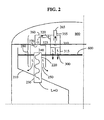
- the figure 2 illustrates a detailed view of an exemplary embodiment of said device.
- the figure 3 illustrates another embodiment of said device.
- the figure 1 illustrates the particular but not limiting case of a reactor 1 for hydroconversion of a heavy hydrocarbon charge in the presence of hydrogen (H 2 ) and catalytic particles in a bubbling bed 700.
- Said reactor 1 is fed in liquid feedstock (comprising a mixture of heavy hydrocarbons) via a conduit 10 and in a gaseous feedstock (comprising mainly hydrogen) via a conduit 20, the mixture between the two phases being able to be carried out upstream or in the reactor; -even.
- Equipment 200 for the distribution of the liquid and gaseous charges are arranged in the lower part of the reactor. This equipment is for example perforated plates or plates equipped with valves, arranged over the entire section of the reactor 1 in a substantially horizontal plane.
- the liquid and gaseous charges are brought into contact with the solid catalytic particles of known size and shape and optimized by those skilled in the art within the bubbling bed 700.
- the catalytic particles are maintained in suspended by the rate of rise of the liquid phase. Most often, said speed sets the expansion rate of the bed of catalytic solid particles, the gas flow rate being kept constant.
- the level 500 consisting of a slightly turbulent plane due to the agitation caused by the passage of gas bubbles, defines the area rich in solid catalytic particles. This level, for a given solid particle inventory, depends solely on the flow rates of gas and liquid passing through the reaction zone. Above the level 500, said particles are not entrained significantly.
- the zone situated between the interface 500 delimiting the bed of said particles and the interface 600 is constituted mainly by a mixture of a gaseous fraction and a liquid fraction.
- the gaseous fraction flows as bubbles into the continuous liquid fraction.
- Above the interface 600 is a substantially gaseous phase containing only splashes of liquid dispersed in the continuous gas phase.
- the boiling of the catalyst is obtained by recycling said liquid fraction in the reactor so as to maintain a liquid superficial velocity adapted to avoid decantation of the catalytic solid particles and to allow a contact time between the liquid, the gas and said particles under the interface 500 sufficiently long to satisfy the kinetic and thermodynamic constraints of the reaction.
- the liquid is thus withdrawn from the reactor under the interface 600 by means of a device 210 which may be a recycling cup placed most often substantially in the center of the reactor 1 and preferably of conical shape, for example as described in FIG. the US Patent 4,221,653 .
- the liquid coming from the equipment 210 feeds a descending pipe 30 and then a pump 190. At the discharge of the pump 190, the liquid is transported by a pipe 40 and reinjected into the reactor upstream of the distribution means 200.
- the feed system of the liquid recycling circuit or withdrawal equipment 210 is equipped with devices to promote gas-liquid separation, the gas entrainment with the recycled liquid being detrimental to the proper functioning of the pump.
- one or two primary separators 280 favoring a vortex effect in the flow are used according to an advantageous embodiment of the invention.
- These separators can advantageously surround a conduit 220 in which is disposed a propeller inducing a centrifugal movement of the fluids present within said 220.
- the lower opening 230 of the conduit 220 connects the area between the interfaces 500 and 600 and the interior of the equipment 210.
- the upper opening 240 of the conduit 220 is located at or near the interface 600 whose position can oscillate during operation of the reactor around a mean value, for example a distance corresponding to 1 to 20 times the diameter of the conduit 220, typically about 3 times.
- Said opening 240 opens on the inside of an enclosure 290 of generally cylindrical shape.
- the liquid free of the majority of the gas flows downward outside the conduit 220 and inside the enclosure 290 and supplies the recycle system 210 through an opening 250 located in the space between the walls. vertical lines of the enclosure 290 and the conduit 220.
- the gas, in the form of bubbles, flows towards the upper part of the enclosure 290 to the interface 600 located near the opening 240 and is removed from this enclosure by an upper opening 270 located above the interface 600.
- the disengaging system 210 for feeding the recycling system (30, 190, 40) as previously described is located inside the reactor and advantageously has a substantially axial symmetry, generally conical, around the axis of the enclosure of the reactor 1 and covers a passage section generally representing between 50 and 100% of the flow section of the reactor, and preferably between 80 to 98% of this section.
- the pump 190 is preferably located outside the reactor but without departing from the scope of the invention may also be internal to said enclosure.
- the liquid products of the reaction are withdrawn preferentially upstream of the pump 190 via the pipe 50 as shown in FIG. figure 1 . Without departing from the scope of the invention, said withdrawal can however be performed downstream of said pump190.
- one or more separators Secondary inertials 310 may be according to the invention positioned downstream of the conduit 270 of each primary separator 280.
- the number of separators 310 is less than or equal to the number of separators 280.
- figure 2 shows in greater detail the connection between the primary separator 280 and the secondary separator 310.
- a conduit 260 preferably bent, connects the outlet opening 270 of each separator 280 to the inlet opening of a secondary separator 310.
- the separators 310 are cyclones consisting of a cylindrical chamber having an inlet opening 320, an outlet opening 300 located below the inlet opening 320 and in the vicinity of the interface 600 for discharging the liquid and an opening 265 for the evacuation of the substantially cleaned gas of at least 50% of the liquid having penetrated by 320, located above the entry 320 and clearly above the interface 600.
- the gaseous phase still charged with droplets from the primary separator 280 via the conduit 260 between tangentially through the opening 320 in the cylindrical body of the secondary separator 310 and rotates around the outlet duct of the gas 355 located in the center and oriented along the axis principal of said body.
- the liquid coming from the enclosure 310 and discharged through the opening 300 joins the interface 600 by mixing with the fluids located in the cup 210 under the interface 600.
- the gas leaving through the opening 265 flows into the phase substantially gaseous diluent 800 located above the interface 600.
- the gas coming from the secondary separator 310 then flows towards a pipe 70 for evacuation of the gases (see figure 1 ) by one or more openings made in the wall of the reactor 1 and located above the interface 600 at a greater distance and advantageously close to one tenth of the diameter of the chamber of the reactor 1.
- the liquid extracted from the gas is evacuated thanks to an opening 300 located at the base of the cylinder.
- a device 315 will advantageously be used to prevent the formation of a liquid vortex promoting the entrainment of gas with the liquid, said device comprising, for example, blades crossed (not shown on the figure 1 ).
- tertiary inertial separators 350 in the vicinity of the outlet of the reactor ( figure 1 ) which can be for example cyclones of structure and operation substantially similar to secondary separators 310 or structured packings.
- the inlet opening (s) 330 or the separators 350 connect the dilute and essentially gaseous phase located above the interface 600 inside the enclosure of the separator (s) 350.
- the tertiary separators 350 make it possible to obtain finally a gaseous effluent substantially cleaned of at least 50% of the liquid having penetrated through the opening 330.
- the liquid separated in the chamber 350 and discharged through the opening 340 joins the interface 600 and mixes with the fluids located under the 'interface.
- the gas freed of the majority of the liquid is evacuated by the pipe 70 flows out of the reactor for subsequent possible treatments.
- the gas flowing in the duct 70 contains less than 1% by mass of liquid thanks to the combined use of the separation means 280, 310 and 350.
- the liquid products from the pipe 30 and substantially free of the majority of the gas are recycled downstream of the reactor via a liquid recycle line 40 and under the action of a recycle pump 190.
- the liquid effluent contains amounts very low gas (usually less than 1% by weight) thanks to separation equipment 280, 310 and 350 implemented above the recycling cup 210.
- measurement and control means can be implemented to ensure proper operation of the reactor. For example, it is possible to accurately measure the level of the interface 500 by evaluating the density profile in the reactor using a gamma meter.
- the measurement of the level obtained by means of this means can feed a control loop 175 which, by comparison with the instruction entered by the operator via a control device 176, controls the speed of rotation of the recycle pump 190.
- a drop in the level of the interface 500 relative to a given setpoint is corrected by an increase in the rotational speed of the pump 190 which induces an increase in the flow of recycled liquid into the recycle circuit ( 30, 40) and results in the increase of the superficial liquid velocity in the reactor and hence the rate of expansion of the catalyst bed.
- the level of the interface 600 it is possible, for example, to evaluate the density profile in the reactor using a differential pressure sensor connected to the reactor by two pressure taps, one 140 located clearly above the desired interface and the other 150 located clearly below the same interface.
- a differential pressure sensor connected to the reactor by two pressure taps, one 140 located clearly above the desired interface and the other 150 located clearly below the same interface.
- gas for example the initial gaseous charge
- liquid for example recycled liquid.
- the level measurement obtained in this way feeds a regulation loop 130 which actuates, for example under the action of a control member 131, the opening of a valve 100 located on a discharge pipe 50 of the liquid products. of the reactor.
- Said conduit 50 is preferably placed in shunt on the pipe 30, upstream of the pump 190.
- a variation of the interface 600 with respect to a given instruction will be corrected respectively by a variation of the opening of the valve 100, a variation of the liquid flow rate drawn by the line 50 and consequently a variation of the recycled liquid fraction, the flow rates of gas and liquid in the lines 10 and 20 remaining for example constant.
- the figure 3 illustrates another embodiment of the invention allowing both the disengagement of the gas in the recycle liquid and the separation of the entrained liquid in the gas stream.
- the droplet-laden gas from the primary separator between tangentially through the opening 320 of a cyclone 310 of the same nature as that previously described in connection with the figure 2 .
- the primary 280 and secondary 310 separators are not connected, the gaseous phase still filled with droplets and resulting from the primary separator 280 being firstly discharged into the essentially gaseous dilute phase 800 located above the interface 600.
Landscapes
- Chemical & Material Sciences (AREA)
- Chemical Kinetics & Catalysis (AREA)
- Organic Chemistry (AREA)
- Engineering & Computer Science (AREA)
- Combustion & Propulsion (AREA)
- Oil, Petroleum & Natural Gas (AREA)
- General Chemical & Material Sciences (AREA)
- Devices And Processes Conducted In The Presence Of Fluids And Solid Particles (AREA)
- Separating Particles In Gases By Inertia (AREA)
- Production Of Liquid Hydrocarbon Mixture For Refining Petroleum (AREA)
- Centrifugal Separators (AREA)
- Degasification And Air Bubble Elimination (AREA)
- Cyclones (AREA)
Applications Claiming Priority (2)
| Application Number | Priority Date | Filing Date | Title |
|---|---|---|---|
| FR0109055A FR2826876B1 (fr) | 2001-07-06 | 2001-07-06 | Dispositif interne de separation d'un melange comprenant au moins une phase gazeuse et une phase liquide |
| FR0109055 | 2001-07-06 |
Publications (2)
| Publication Number | Publication Date |
|---|---|
| EP1275425A1 EP1275425A1 (fr) | 2003-01-15 |
| EP1275425B1 true EP1275425B1 (fr) | 2010-09-15 |
Family
ID=8865254
Family Applications (1)
| Application Number | Title | Priority Date | Filing Date |
|---|---|---|---|
| EP20020290531 Expired - Lifetime EP1275425B1 (fr) | 2001-07-06 | 2002-03-05 | Dispositif interne de séparation d'un mélange comprenant au moins une phase gazeuse et une phase liquide |
Country Status (8)
| Country | Link |
|---|---|
| EP (1) | EP1275425B1 (enExample) |
| JP (1) | JP4329313B2 (enExample) |
| BR (1) | BR0202586B1 (enExample) |
| CA (1) | CA2374894C (enExample) |
| FR (1) | FR2826876B1 (enExample) |
| MX (1) | MXPA02006728A (enExample) |
| PL (1) | PL196111B1 (enExample) |
| RU (1) | RU2301103C2 (enExample) |
Cited By (1)
| Publication number | Priority date | Publication date | Assignee | Title |
|---|---|---|---|---|
| CN104549063B (zh) * | 2013-10-12 | 2016-08-10 | 中国石油化工股份有限公司 | 一种沸腾床反应器 |
Families Citing this family (6)
| Publication number | Priority date | Publication date | Assignee | Title |
|---|---|---|---|---|
| US20050075527A1 (en) * | 2003-02-26 | 2005-04-07 | Institut Francais Du Petrole | Method and processing equipment for hydrocarbons and for separation of the phases produced by said processing |
| CN105688450B (zh) * | 2016-03-31 | 2017-07-14 | 飞潮(无锡)过滤技术有限公司 | 一种气液固液固五相过滤分离器 |
| FR3058421B1 (fr) * | 2016-11-09 | 2020-07-24 | Ifp Energies Now | Nouveau dispositif de separation gaz liquide pour equiper les reacteurs en lit fluidise triphasique tels que ceux utilises dans le procede h-oil |
| CN107297186B (zh) * | 2017-07-24 | 2018-03-20 | 上海英保能源化工科技有限公司 | 一种沸腾床加氢反应系统和沸腾床加氢方法 |
| PL71191Y1 (pl) * | 2018-03-05 | 2020-01-31 | Electronic Components And Devices Marek Turzanski Spolka Jawna | Separator przepływu cieczy i powietrza |
| FR3094984B1 (fr) * | 2019-04-12 | 2024-08-16 | Ifp Energies Now | Reacteur triphasique avec coupelle de recycle de section decroissante et d’angle d’inclinaison variable |
Family Cites Families (6)
| Publication number | Priority date | Publication date | Assignee | Title |
|---|---|---|---|---|
| US4221653A (en) * | 1978-06-30 | 1980-09-09 | Hydrocarbon Research, Inc. | Catalytic hydrogenation process and apparatus with improved vapor liquid separation |
| JPS6051510A (ja) * | 1983-09-01 | 1985-03-23 | Mitsubishi Heavy Ind Ltd | 気液分離器 |
| US4886644A (en) * | 1987-12-02 | 1989-12-12 | Texaco Inc. | Liquid degaser in an ebullated bed process |
| US4971678A (en) * | 1988-06-27 | 1990-11-20 | Texaco Inc. | Liquid inventory control in an ebullated bed process |
| US5066467A (en) * | 1990-10-05 | 1991-11-19 | Texaco Inc. | Liquid degasser in an ebullated bed process |
| US5624642A (en) * | 1994-10-14 | 1997-04-29 | Amoco Corporation | Hydrocarbon processing apparatus |
-
2001
- 2001-07-06 FR FR0109055A patent/FR2826876B1/fr not_active Expired - Lifetime
-
2002
- 2002-03-05 EP EP20020290531 patent/EP1275425B1/fr not_active Expired - Lifetime
- 2002-03-06 CA CA2374894A patent/CA2374894C/fr not_active Expired - Lifetime
- 2002-07-04 PL PL354888A patent/PL196111B1/pl unknown
- 2002-07-05 BR BR0202586A patent/BR0202586B1/pt not_active IP Right Cessation
- 2002-07-05 RU RU2002118206/15A patent/RU2301103C2/ru active
- 2002-07-05 MX MXPA02006728 patent/MXPA02006728A/es active IP Right Grant
- 2002-07-08 JP JP2002198596A patent/JP4329313B2/ja not_active Expired - Fee Related
Cited By (1)
| Publication number | Priority date | Publication date | Assignee | Title |
|---|---|---|---|---|
| CN104549063B (zh) * | 2013-10-12 | 2016-08-10 | 中国石油化工股份有限公司 | 一种沸腾床反应器 |
Also Published As
| Publication number | Publication date |
|---|---|
| EP1275425A1 (fr) | 2003-01-15 |
| MXPA02006728A (es) | 2005-08-16 |
| BR0202586A (pt) | 2003-04-29 |
| FR2826876B1 (fr) | 2003-09-26 |
| RU2301103C2 (ru) | 2007-06-20 |
| PL354888A1 (en) | 2003-01-13 |
| FR2826876A1 (fr) | 2003-01-10 |
| BR0202586B1 (pt) | 2012-04-17 |
| JP4329313B2 (ja) | 2009-09-09 |
| CA2374894A1 (fr) | 2003-01-06 |
| CA2374894C (fr) | 2010-12-14 |
| JP2003112037A (ja) | 2003-04-15 |
| PL196111B1 (pl) | 2007-12-31 |
Similar Documents
| Publication | Publication Date | Title |
|---|---|---|
| EP0403381B1 (fr) | Procédé et dispositif de régulation ou controle du niveau thermique d'un solide pulverulent, comportant un échangeur de chaleur à compartiments en lit fluidisé ou mobile | |
| FR2675714A1 (fr) | Procede et dispositif d'echange thermique de particules solides pour regeneration en craquage catalytique. | |
| EP1866068B1 (fr) | Dispositif pour le melange et la repartition d'un gaz et d'un liquide en amont d'un lit granulaire | |
| EP1275425B1 (fr) | Dispositif interne de séparation d'un mélange comprenant au moins une phase gazeuse et une phase liquide | |
| EP3538627B1 (fr) | Nouveau dispositif de separation gaz liquide pour equiper les reacteurs en lit fluidise triphasique tels que ceux utilises dans le procede h-oil | |
| EP1086734B1 (fr) | Système de séparation gaz/liquide intervenant dans un procédé de conversion d'hydrocarbures | |
| EP2207608B1 (fr) | Dispositif de separation d'un solide finement divise en suspension dans un liquide visqueux | |
| EP3538626A1 (fr) | Nouveau dispositif de separation gaz liquide pour equiper les reacteurs en lit fluidise triphasique tels que ceux utilises dans le procede h-oil | |
| EP3618947B1 (fr) | Nouveau dispositif de distribution de mélange polyphasique dans une enceinte comportant un milieu fluidise | |
| EP0861310A1 (fr) | Procede et dispositif de craquage catalytique descendant mettant en oeuvre l'injection d'une charge sous un angle adequat sur un catalyseur conditionne | |
| EP1374962B1 (fr) | Perfectionnement à un dispositif pour séparer un mélange comprenant au moins une phase gazeuse et une phase liquide, ledit dispositif étant intégré dans une enceinte | |
| US7060228B2 (en) | Internal device for separating a mixture that comprises at least one gaseous phase and one liquid phase | |
| EP1800728B1 (fr) | Nouveau système de séparation gaz solide et de stripage pour les unités de craquage catalytique en lit fluidisé | |
| EP1466958A2 (fr) | Procédé et installation de traitement d'hydrocarbures et de séparation des phases produites par ledit traitement | |
| WO2020207821A1 (fr) | Reacteur triphasique avec coupelle de recycle tronconique a fort angle d'inclinaison | |
| FR3104467A1 (fr) | Dispositif et procédé de séparation gaz-solide de craquage catalytique en lit fluidisé avec déflecteur sous fenêtre | |
| EP3569677B1 (fr) | Dispositif limitateur de vortex et de depots solides | |
| CN101952058A (zh) | 工艺设备的清理和/或疏通 | |
| FR3100992A1 (fr) | Séparateur gaz/liquide haute pression et procédé de séparation mettant en œuvre un tel séparateur | |
| FR3104468A1 (fr) | Dispositif et procédé de séparation gaz-solide de craquage catalytique en lit fluidisé avec paroi externe de préstripage verticale. | |
| FR3130832A1 (fr) | Dispositif de séparation gaz-liquide avec une zone d’accompagnement du liquide en sortie, notamment pour réacteur en lit fluidisé triphasique |
Legal Events
| Date | Code | Title | Description |
|---|---|---|---|
| PUAI | Public reference made under article 153(3) epc to a published international application that has entered the european phase |
Free format text: ORIGINAL CODE: 0009012 |
|
| AK | Designated contracting states |
Kind code of ref document: A1 Designated state(s): AT BE CH CY DE DK ES FI FR GB GR IE IT LI LU MC NL PT SE TR |
|
| AX | Request for extension of the european patent |
Free format text: AL;LT;LV;MK;RO;SI |
|
| 17P | Request for examination filed |
Effective date: 20030715 |
|
| AKX | Designation fees paid |
Designated state(s): BE FI IT NL |
|
| AXX | Extension fees paid |
Extension state: SI Payment date: 20030715 |
|
| REG | Reference to a national code |
Ref country code: DE Ref legal event code: 8566 |
|
| 17Q | First examination report despatched |
Effective date: 20071227 |
|
| R17C | First examination report despatched (corrected) |
Effective date: 20080110 |
|
| GRAP | Despatch of communication of intention to grant a patent |
Free format text: ORIGINAL CODE: EPIDOSNIGR1 |
|
| GRAS | Grant fee paid |
Free format text: ORIGINAL CODE: EPIDOSNIGR3 |
|
| GRAA | (expected) grant |
Free format text: ORIGINAL CODE: 0009210 |
|
| AK | Designated contracting states |
Kind code of ref document: B1 Designated state(s): BE FI IT NL |
|
| AX | Request for extension of the european patent |
Extension state: SI |
|
| REG | Reference to a national code |
Ref country code: NL Ref legal event code: T3 |
|
| PLBE | No opposition filed within time limit |
Free format text: ORIGINAL CODE: 0009261 |
|
| STAA | Information on the status of an ep patent application or granted ep patent |
Free format text: STATUS: NO OPPOSITION FILED WITHIN TIME LIMIT |
|
| 26N | No opposition filed |
Effective date: 20110616 |
|
| PGFP | Annual fee paid to national office [announced via postgrant information from national office to epo] |
Ref country code: IT Payment date: 20200324 Year of fee payment: 19 Ref country code: FI Payment date: 20200319 Year of fee payment: 19 Ref country code: NL Payment date: 20200325 Year of fee payment: 19 |
|
| PGFP | Annual fee paid to national office [announced via postgrant information from national office to epo] |
Ref country code: BE Payment date: 20200325 Year of fee payment: 19 |
|
| REG | Reference to a national code |
Ref country code: FI Ref legal event code: MAE |
|
| PG25 | Lapsed in a contracting state [announced via postgrant information from national office to epo] |
Ref country code: FI Free format text: LAPSE BECAUSE OF NON-PAYMENT OF DUE FEES Effective date: 20210305 |
|
| REG | Reference to a national code |
Ref country code: NL Ref legal event code: MM Effective date: 20210401 |
|
| REG | Reference to a national code |
Ref country code: BE Ref legal event code: MM Effective date: 20210331 |
|
| PG25 | Lapsed in a contracting state [announced via postgrant information from national office to epo] |
Ref country code: NL Free format text: LAPSE BECAUSE OF NON-PAYMENT OF DUE FEES Effective date: 20210401 |
|
| PG25 | Lapsed in a contracting state [announced via postgrant information from national office to epo] |
Ref country code: IT Free format text: LAPSE BECAUSE OF NON-PAYMENT OF DUE FEES Effective date: 20210305 |
|
| PG25 | Lapsed in a contracting state [announced via postgrant information from national office to epo] |
Ref country code: BE Free format text: LAPSE BECAUSE OF NON-PAYMENT OF DUE FEES Effective date: 20210331 |